
PROPERTY TECHNOLOGY FOR HOMEBUYING
Products Present Benefits and Risks Amid Evolving Federal Oversight
Report to Congressional Requesters
United States Government Accountability Office
A report to congressional requesters
For more information, contact: Alicia Puente Cackley at cackleya@gao.gov.
What GAO Found
Property technology encompasses a wide range of digital tools used in real estate and is used in nearly every phase of the homebuying process.
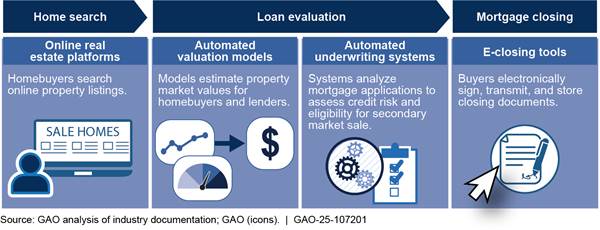
These products can simplify homebuying and reduce costs for homebuyers but also pose risks, particularly related to artificial intelligence (AI). Online real estate platforms offer consumers one-stop shopping but may raise privacy concerns by collecting sensitive consumer data. Chatbots or advertising algorithms also may violate fair housing laws by steering consumers in protected classes toward certain listings, according to studies GAO reviewed and interviews with federal entities, selected companies, and other stakeholders.
Fair lending and other consumer protection laws and regulations may apply to property technology products. With the exception of the Federal Housing Finance Agency (FHFA), agency oversight generally has not focused specifically on the products. FHFA—which examines Fannie Mae and Freddie Mac (enterprises)—has conducted examinations specifically focused on products such as automated mortgage underwriting systems and automated valuation models. The Consumer Financial Protection Bureau’s (CFPB) examinations of mortgage lenders could involve lenders’ use of technology but were not product-focused. The other three agencies in GAO’s review generally have not conducted product-specific oversight.
In 2025, FHFA began implementing new priorities and responding to executive orders directing changes to certain policies and programs. FHFA made changes to its fair lending oversight program, including changing its examination approach, waiving components of its fair lending rule, and rescinding related guidance. Although the enterprises remain subject to fair lending and other consumer protection laws, FHFA has not communicated its revised compliance requirements or supervisory expectations. Given the extent of FHFA’s changes, providing additional written direction for the enterprises on the changes would help ensure the enterprises clearly understand FHFA’s compliance requirements and its supervisory expectations. This would help to ensure that the enterprises appropriately carry out requirements, which are intended to help promote sustainable housing opportunities for underserved communities.
Why GAO Did This Study
Property technology products have transformed homebuying. But their use of AI has raised questions about potential effects on homebuyers and the housing market, particularly regarding compliance with fair housing and other consumer protection laws.
GAO was asked to review issues related to use and oversight of property technology products in the homebuying process. This report examines (1) the use of selected products, (2) their potential benefits and risks, and (3) agency oversight of compliance with fair lending and relevant consumer protection laws for the products.
GAO focused on online real estate platforms, automated valuation models and underwriting systems, and electronic closing products, selected for their use at different stages of the homebuying process and potential risks they may pose to homebuyers. GAO conducted a literature review, reviewed industry and government reports, and examined relevant federal laws, regulations, and guidance. GAO also interviewed officials of five federal agencies—CFPB, Department of Housing and Urban Development, FHFA, Federal Trade Commission, and Department of Veterans Affairs—Fannie Mae and Freddie Mac; selected companies; and other stakeholders, chosen in part for their expertise and diverse characteristics.
What GAO Recommends
GAO recommends that FHFA provide written direction to the enterprises clarifying how they are to comply with fair lending requirements and how FHFA will supervise their compliance. FHFA neither agreed nor disagreed with the recommendation.
Abbreviatons
|
AI |
artificial intelligence |
|
CFPB |
Consumer Financial Protection Bureau |
|
e-closing |
electronic closing |
|
enterprises |
government-sponsored enterprises |
|
FHA |
Federal Housing Administration |
|
FHEO |
Office of Fair Housing and Equal Opportunity |
|
FHFA |
Federal Housing Finance Agency |
|
FTC |
Federal Trade Commission |
|
HUD |
Department of Housing and Urban Development |
|
proptech |
property technology |
|
VA |
Department of Veterans Affairs |
This is a work of the U.S. government and is not subject to copyright protection in the United States. The published product may be reproduced and distributed in its entirety without further permission from GAO. However, because this work may contain copyrighted images or other material, permission from the copyright holder may be necessary if you wish to reproduce this material separately.
September 22, 2025
The Honorable Elizabeth Warren
Ranking Member
Committee on Banking, Housing, and Urban Affairs
United States Senate
The Honorable Maxine Waters
Ranking Member
Committee on Financial Services
House of Representatives
Property technology (proptech)—a broad range of digital tools used in real estate—has transformed nearly every aspect of the homebuying process. Homebuyers can use online platforms to search listings, browse estimated home values, explore financing options, and apply for mortgage loans. Lenders can use automated underwriting systems to assess creditworthiness and inform underwriting decisions.
As the use of artificial intelligence (AI), including machine learning, has grown, questions have emerged about how proptech products use these technologies and their potential effects on homebuyers and the housing market.[1] Because the data inputs and decision-making processes of these tools may not be transparent, questions also have arisen about the extent of federal oversight of proptech products for ensuring compliance with fair lending and other consumer protection laws.[2]
You asked us to review issues related to the use and oversight of proptech products in the homebuying process. This report examines (1) how selected proptech products are used in the homebuying process, (2) the potential benefits and risks these products may pose to homebuyers and the housing market, and (3) how federal entities oversee compliance with fair lending and other relevant consumer protection laws for selected products.[3]
For this report, we selected four types of proptech products: online real estate platforms, automated valuation models, automated underwriting systems, and electronic closing tools (e-closing tools).[4] We selected these products because they are used by different participants (e.g., homebuyers and lenders) during various stages of the homebuying process and because some may pose potential risks to homebuyers. We focused on the use and development of these products for new purchase loans by nonbank mortgage lenders, proptech companies (companies that develop the selected products), and the government-sponsored enterprises Fannie Mae and Freddie Mac (enterprises).[5]
For the first and second objectives, we reviewed and analyzed reports and studies by researchers, industry stakeholders, and federal entities. We also reviewed proptech company websites and media reports related to the selected products. We also conducted a literature review for the second objective, examining relevant research on the selected products published from 2013 through 2024 in peer-reviewed journals and other sources.
For the third objective, we analyzed federal laws, regulations, and agency guidance applicable to the selected products and nonbank mortgage lenders.[6] The federal entities in our review were the Consumer Financial Protection Bureau (CFPB), Department of Housing and Urban Development (HUD), Federal Housing Finance Agency (FHFA), Federal Trade Commission (FTC), Department of Veterans Affairs (VA), and the enterprises.[7] We reviewed these entities’ fair lending and other consumer protection oversight practices for our selected products. We also interviewed representatives of the Conference of State Bank Supervisors to understand the states’ oversight roles. In addition, we determined that the information and communication component of internal control was significant to this objective. We reviewed documentation of FHFA’s communications to the enterprises about changes in its oversight to assess the extent to which they aligned with these standards.[8]
For all the objectives, we interviewed representatives of the federal agencies and enterprises cited above, as well as five industry groups, four research organizations, two consumer advocacy groups, and one law firm. We also interviewed representatives of eight companies that provide or use the selected products. We judgmentally selected these entities based on factors such as expertise and other relevant characteristics. For more information on our scope and methodology, see appendix I.
We conducted this performance audit from November 2023 to September 2025 in accordance with generally accepted government auditing standards. Those standards require that we plan and perform the audit to obtain sufficient, appropriate evidence to provide a reasonable basis for our findings and conclusions based on our audit objectives. We believe that the evidence obtained provides a reasonable basis for our findings and conclusions based on our audit objectives.
Background
Oversight of Proptech Products
Fair lending and other consumer protection laws apply to mortgage lending and, in general, to the use of proptech products in mortgage lending (see table 1).[9] Table 1 lists examples of fair housing, fair lending, and other consumer protection laws and regulations that agency officials cited as relevant to use of the selected proptech products.
Table 1: Examples of Fair Housing, Fair Lending, and Other Consumer Protection Laws and Regulations Relevant to Selected Property Technology Products
|
Law or regulationa |
Example of relevant requirements |
Applicability to products selected for this reviewb |
|
Fair Housing Act |
Prohibits discrimination in the sale, rental, and financing of housing and other housing-related decisions because of race, color, religion, sex, familial status, national origin, and disability. |
Online real estate platforms Automated underwriting systems Automated valuation models Electronic closing tools |
|
Equal Credit Opportunity Act |
Prohibits creditors—including mortgage lenders—from discriminating against credit applicants on a prohibited basis, such as race, color, religion, national origin, sex, marital status, or certain other factors. Creditors must also disclose, or disclose upon request, specific reasons for adverse actions, including credit denials. |
Online real estate platforms Automated underwriting systems Automated valuation models Electronic closing tools |
|
Truth in Lending Act |
Requires creditors, and in some cases advertisers, to disclose information about the costs and terms of consumer credit transactions. |
Online real estate platforms Automated underwriting systems Electronic closing tools |
|
Real Estate Settlement Procedures Act |
Requires mortgage borrowers to receive disclosures about the nature and costs of the settlement process and provides protections against certain abusive practices that could result in unnecessarily high settlement charges. |
Online real estate platforms Electronic closing tools |
|
Federal Housing Enterprises Financial Safety and Soundness Act of 1992 |
Includes provisions that promote fair housing and equitable housing finance. |
Automated underwriting systemsc Automated valuation modelsc |
|
Title XI of the Financial Institutions Reform, Recovery, and Enforcement Act of 1989 |
Sets standards and rules for real estate appraisals. |
Automated valuation models |
|
Quality Control Standards for Automated Valuation Models ruled |
Requires lending institutions to implement quality control standards, adopt policies and practices to protect against data manipulation, and comply with nondiscrimination laws. |
Automated valuation models |
Source: GAO analysis of Consumer Financial Protection Bureau, Department of Housing and Urban Development, Federal Housing Finance Agency, Federal Trade Commission, and Department of Veterans Affairs documentation and interviews with agency officials. | GAO‑25‑107201
aAll statutes are as amended to the most updated versions.
bWhether a law or regulation applies to a product depends on how a product is used or constructed and specific facts and circumstances. Agency officials we interviewed informed us that the selected proptech products listed here may be involved in violations of, or subject to, relevant laws and regulations.
cApplicable to automated underwriting systems or automated valuation models used or developed by Fannie Mae or Freddie Mac.
d89 Fed. Reg. 64538 (Aug. 7, 2024). The rule becomes effective October 1, 2025.
Several federal agencies have fair lending and consumer protection oversight responsibilities related to the development and use of the selected proptech products in the mortgage market (see fig. 1).
Figure 1: Agencies Involved in Oversight of Fair Lending and Consumer Protection of Property Technology Products
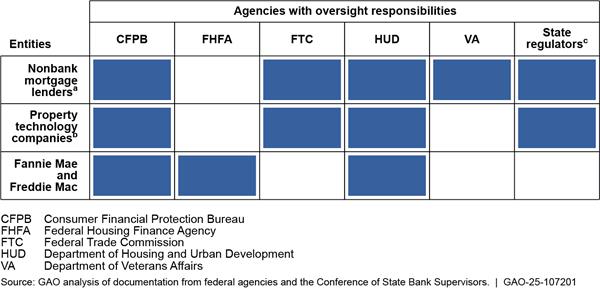
aOversight of products used by depository institution mortgage lenders was outside the scope of this review.
b“Property technology companies” refers to companies that develop property technology products. Some nonbank mortgage lenders may develop such products for internal use.
cNo uniform framework gives state regulators authority over property technology companies, but some state laws and regulations may apply depending on a company’s activities.
CFPB. CFPB is responsible for enforcing federal consumer financial protection laws, including fair lending laws, and has supervisory authority over nonbank mortgage lenders of all sizes.[10] It also has oversight authority over third-party service providers to nonbank lenders, which can include proptech companies for purposes of enforcing the consumer financial protection laws.[11] CFPB is also authorized under federal consumer financial protection laws to administer, enforce, and otherwise implement the provisions of those laws. In addition, CFPB is responsible for monitoring financial markets for risks to consumers, collecting and reviewing consumer complaints, and promoting financial education. In some situations, CFPB may have oversight of Fannie Mae and Freddie Mac in connection with the Equal Credit Opportunity Act, according to Freddie Mac officials. As of July 2025, the administration and Members of Congress were reviewing CFPB’s role in overseeing consumer financial protection laws, including fair lending laws.[12]
FHFA and the enterprises. FHFA regulates Fannie Mae and Freddie Mac.[13] It has supervisory and enforcement authorities related to ensuring the enterprises operate in a safe and sound manner and comply with fair lending laws. FHFA also may issue regulations, guidelines, or orders necessary to carry out its mission. Fannie Mae and Freddie Mac generally purchase mortgages that meet certain criteria and hold the loans in their portfolios or pool them as collateral for mortgage-backed securities sold to investors.[14] In exchange for a fee, the enterprises guarantee the timely payment of interest and principal on the securities they issue.
FTC. FTC is responsible for enforcing a variety of consumer protection laws, including Section 5 of the Federal Trade Commission Act (which prohibits unfair or deceptive acts or practices in or affecting commerce), the Equal Credit Opportunity Act, and the Truth in Lending Act. It has consumer protection enforcement authorities over most nonbank entities, including mortgage companies and mortgage brokers. FTC also investigates and brings cases against individuals and companies, which could include proptech companies. FTC also may issue rules and general statements of policy with respect to unfair or deceptive acts or practices in or affecting commerce, including defining such practices as needed.
HUD. HUD’s Federal Housing Administration (FHA) is responsible for overseeing its single-family loan programs, which insure mortgage loans for the purchase or refinancing of a home. FHA helps ensure that lenders (both bank and nonbank) meet FHA loan program requirements and adhere to applicable laws, including fair lending laws. HUD’s Office of Fair Housing and Equal Opportunity (FHEO) enforces the Fair Housing Act. It investigates consumer complaints regarding companies’ compliance with laws related to housing discrimination, including the Fair Housing Act. Under the Housing and Economic Recovery Act of 2008, HUD is also authorized to prohibit the enterprises from engaging in discriminatory practices and to require them to submit data to support investigations of potential violations of the Fair Housing Act and Equal Credit Opportunity Act.[15]
VA. VA’s Veterans Benefits Administration administers the VA Home Loan Guaranty Program, which guarantees mortgage loans for the purchase, construction, or repair of a home by eligible veterans. VA is responsible for overseeing participating lenders (both bank and nonbank) to ensure they meet program requirements.
State regulators. State financial regulators oversee fair lending and other consumer protection laws for nonbank mortgage lenders operating in their states. They have broad licensing, examination, investigation, enforcement, and prudential regulatory authority over these lenders. Although no uniform regulatory framework provides state regulators authority over proptech companies, some state laws and regulations may apply if a company’s conduct or activities do not comply with relevant state law. States also have the authority to pursue claims under Title X of the Dodd-Frank Wall Street Reform and Consumer Protection Act and implementing regulations in federal district court or other appropriate state regulatory proceedings.
Use of Proptech Products by Homebuyers and Lenders Is Widespread
Nearly all homebuyers use online real estate platforms to search for homes and some may use other services and features, such as valuation models, to get home price estimates. Lenders and the enterprises use automated valuation models for multiple functions, including estimating the market value of properties. The enterprises developed their own automated underwriting systems used by nonbank mortgage lenders. Fully virtual real estate closings remain limited, although one or more closing documents are often accessed, transferred, or signed electronically.
Homebuyers Use Online Platforms to Search for Homes and Access Other Services
Online real estate platforms are websites or online applications that provide tools and information homebuyers can use to search for and purchase homes (see fig. 2). Nearly all homebuyers use online platforms to search for homes, according to a 2021 report by the National Association of Realtors.[16] Examples of online real estate platforms include Realtor.com, Redfin, and Zillow.
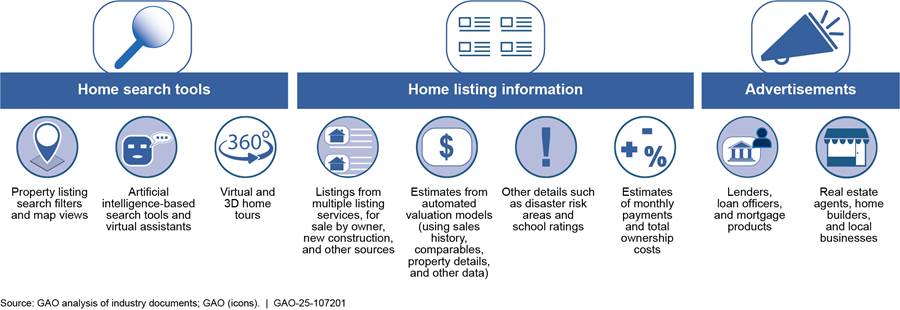
The platforms’ listings and search tools provide wide-ranging information on properties and neighborhoods. Listing information can incorporate data and photographs from multiple listing services.[17] Other information can include neighborhood school ratings and disaster risk information. Certain platforms provide virtual property tours and display home value estimates of homes generated by automated valuation models.[18]
Online platforms also advertise services to homebuyers. For example, homebuyers can use the platforms to find real estate agents or brokers. In addition, homebuyers can research financing options, and some platforms offer mortgage lending services or feature sponsored mortgage lenders.
Online platforms are increasingly using AI, including machine learning, to generate information for users. For example, they may incorporate these technologies into automated valuation models to aggregate and analyze large volumes of data and improve the property value estimates. AI also may be used to enhance property search tools and offer virtual assistants to answer homebuyers’ questions.
Lenders and Enterprises Use Automated Valuation Models for Multiple Functions
Automated valuation models are software programs or tools that use algorithms to estimate a property’s market value using information such as a property’s sales history, sales of similar properties, and characteristics of the property and its location. Mortgage lenders and the enterprises use automated valuation models to estimate the fair market value of properties and for other functions (see fig. 3). Lenders also may use the models to assess the quality of a traditional appraisal, according to proptech company representatives we interviewed.
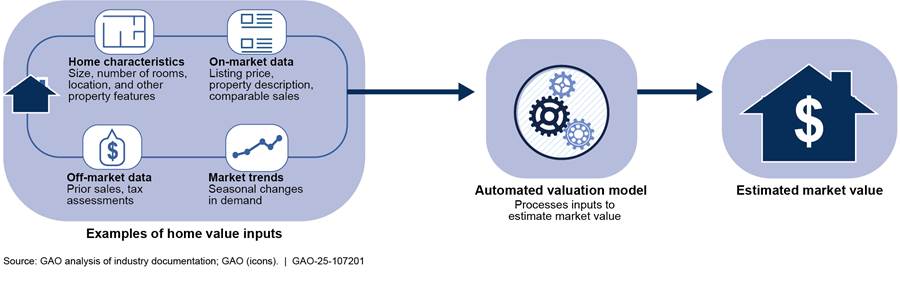
Although lender use of automated valuation models for various functions has increased in recent years, lenders generally do not use them as a substitute for traditional appraisals for new purchase loans. Several factors contribute to this. First, federal loan programs, such as those of FHA and VA, require the use of traditional appraisals for new purchase loans. Second, the enterprises require traditional appraisals for most of the loans they purchase. Third, lender and borrower preferences also support the ongoing use of traditional appraisals, according to a 2023 study of automated valuation models and to enterprise officials and a selected proptech company representative we interviewed. Lenders typically obtain traditional appraisals because loans sold to the enterprises generally require them, according to the study.[19]
Automated valuation models also may have limited applicability for certain properties due to limited data on comparable properties. One proptech company estimated that the models cannot assess about 15 percent of residential properties because of their unique or remote nature.
The enterprises have developed automated valuation models that they use for issuing appraisal waiver offers and other risk-management purposes. For example, Fannie Mae and Freddie Mac issue appraisal waiver offers if properties meet certain eligibility criteria. Lenders can choose to accept the waiver or obtain a traditional appraisal.[20] Approximately 10–15 percent of new purchase loans delivered to the enterprises have qualified for an appraisal waiver, according to enterprise officials.
The enterprises also use their automated valuation models for internal purposes, according to Fannie Mae and Freddie Mac officials. For example, the enterprises use these models as quality checks to validate appraised property values. Fannie Mae also uses its models to price foreclosed properties and distressed assets, determine mortgage insurance termination eligibility based on property value, and monitor loan performance and the expected outcomes of purchased loans. Freddie Mac uses its model to support certain investor disclosures related to credit risk transfer and portfolio management. Freddie Mac and Fannie Mae incorporated machine learning—a type of artificial intelligence—into their models in 2018 and 2020, respectively. They use machine learning to leverage larger datasets, increase the number of properties covered, and improve estimate accuracy, according to enterprise officials.
Nonbank Mortgage Lenders Use Enterprises’ Automated Underwriting Systems to Evaluate Loan Eligibility
In general, automated underwriting systems are digital platforms lenders use to evaluate loan applications. They analyze borrower loan application data to evaluate credit risk and predict the likelihood of loan repayment. Fannie Mae and Freddie Mac developed their own proprietary systems, upon which bank and nonbank mortgage lenders rely (see fig. 4).[21] In addition, some lenders use additional automated underwriting systems to support lending decisions and for other internal purposes, according to Fannie Mae and Freddie Mac officials.
Lenders use the enterprises’ systems to evaluate whether a mortgage loan meets eligibility requirements for sale to the enterprises, which can be a critical factor in lenders’ decisions to originate loans.[22] However, neither the enterprises nor their systems make credit decisions for lenders.[23] Ultimately, the decision to underwrite a loan is made by the lender.
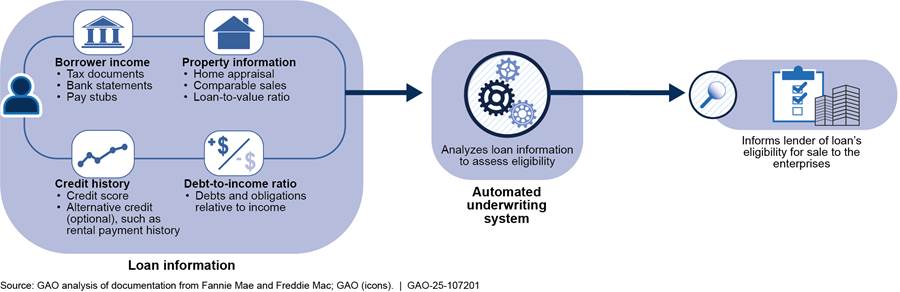
The enterprises’ systems dominate the mortgage market, according to Fannie Mae officials and representatives of a mortgage lending industry group. These officials and representatives told us that nonbank mortgage lenders primarily use these systems because they sell most of the loans they originate to the enterprises on the secondary market.
Although lenders primarily use the enterprises’ automated underwriting systems, some maintain their own systems for determining whether to purchase loans for their portfolios, according to Fannie Mae officials. Some lenders also may develop or use third-party automated systems that use algorithmic models to assess borrower risk and inform credit decisions. These algorithmic models can analyze larger volumes of data than those traditionally used in mortgage underwriting.
Fannie Mae and Freddie Mac’s automated underwriting systems do not use AI to make decisions on loan purchase eligibility, but certain inputs to these systems use machine learning. For example, Fannie Mae’s automated valuation models are incorporated into its underwriting systems. Freddie Mac’s underwriting system has used machine learning to summarize credit information since 2023.
Lenders’ private automated underwriting systems also may use AI to automate certain underwriting tasks such as reviewing borrower documentation, according to representatives of two proptech companies and a study we reviewed.[24]
Use of Fully Virtual Mortgage Closings Is Limited
An e-closing generally refers to mortgage closings in a secure electronic environment in which one or more required documents are accessed, presented, signed, and stored electronically (see fig. 5). More specifically, an e-closing can be fully virtual or hybrid. In a hybrid closing, some documents—such as notarized documents—are physically signed, while others are signed and stored digitally.
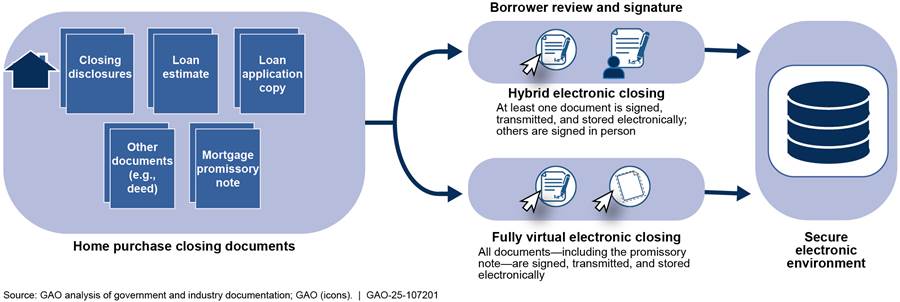
E-closing tools are digital tools that automate closing processes and have built-in mechanisms to help ensure the accuracy of mortgage closing documents. The tools use encryption technologies to protect sensitive loan data, may include tamper-evident digital seals to verify document integrity, and track closing processes. E-closing tools generally do not use advanced forms of AI, according to representatives from the Mortgage Industry Standards Maintenance Organization.
They said that currently, most closings are completed in-person or as a hybrid process. VA permits electronic signatures in the course of closings as part of the VA Home Loan Program, and the enterprises allow hybrid and fully virtual e-closings. The use of e-closing increased during the COVID-19 pandemic in 2020 and 2021. However, fully virtual closings remain rare, according to representatives of an industry group, a nonbank mortgage lender, and one of the enterprises. The industry group, which represents mortgage lenders, estimated that just 3 percent of closings were fully virtual.
Lender preferences and state regulatory requirements affect the use of e-closing tools. Fannie Mae and Freddie Mac reported before the COVID-19 pandemic that lenders and other industry participants showed limited interest in adopting e-closing tools or faced implementation challenges.[25] Representatives of the Mortgage Industry Standards Maintenance Organization also told us that lender preferences were a common challenge affecting adoption. In addition, Fannie Mae and a lender we interviewed told us that homebuyers generally have not shown strong preferences for e-closings. Furthermore, state statutes vary regarding electronic signatures, and states and localities have differing requirements for property records and electronic or remote notarization, according to Fannie Mae guidance.[26]
Proptech Products May Simplify Homebuying and Expedite Underwriting but Also Present Consumer and Market Risks
Selected proptech products can simplify homebuying, improve appraisal accuracy, speed up the underwriting process, and increase convenience for homebuyers. However, they also may pose risks related to market distortions, consumer data privacy, regulatory compliance, and transparency, according to our literature review and interviews with federal officials, industry stakeholders, and selected proptech companies.[27]
Online Platforms May Simplify Homebuying but Can Pose Risks
Potential Benefits
Simplify the homebuying process for homebuyers. Online platforms may offer a “one-stop” resource for the home-buying process. The platforms can aggregate real estate listings from multiple sources, personalize property recommendations, and connect buyers with real estate agents and lenders. The platforms also may allow users to secure financing directly from the platform.
Increase homebuyer access to information. Online platforms may increase access to information by providing home listings, neighborhood data (such as school ratings and climate risk information), financing options, and information on the homebuying process. Representatives from an industry group noted that platforms also allow prospective homebuyers to estimate the mortgage amount for which they may qualify without engaging directly with a lender. Representatives from one company (an online platform) noted they recently added a tool that calculates property affordability for a user. The tool incorporates users’ financial information (such as credit score and debts), real-time mortgage rates, and related costs (such as homeowners’ insurance and homeowners’ association fees). Some platforms also offer information on financing options that may help first-time and low-income borrowers, including downpayment assistance programs and FHA-insured loans.
Potential Risks
Distort housing market prices. The use of automated valuation models in online real estate platforms may distort housing prices by creating a feedback loop.[28] One study we reviewed found that Zillow’s valuation tool affected listing and sales prices in several U.S. cities. Specifically, higher initial Zillow valuation estimates led to higher listing prices, and higher Zillow valuations after a property was listed also generally led to higher sales prices.[29] However, most types of valuation methodologies, including traditional appraisals and tax assessments, involve similar types of risks, according to representatives of a proptech company (an online platform) we interviewed.
Increase risks to consumer data privacy. Online platforms may obtain potentially sensitive consumer data to personalize product offerings and enhance digital marketing to consumers. In one study, consumers noted reservations about virtual reality technologies and digital marketing in real estate, expressing concerns that companies might obtain excessive personal information.[30] Another study noted that virtual reality technologies should have robust data protection protocols and encryption to safeguard consumers’ sensitive personal information.[31]
Noncompliance with fair housing laws. Online platforms’ use of some AI models could result in discrimination against certain consumers in violation of fair housing laws.[32] For example, if search algorithms and chatbots are not trained to recognize problematic search terms—such as references to protected class characteristics like race, national origin, disability, or religion—they may generate search results that illegally “steer” consumers to certain listings.[33] To help mitigate this risk, Zillow developed a tool to detect language in searches and chatbots that potentially violates antidiscrimination laws. When such language is flagged, Zillow product developers determine how to respond, such as amending the model to rephrase consumer questions or educate consumers about fair housing laws.[34]
In addition, there is a risk that online platforms may use algorithms or AI to target advertisements toward or away from specific consumers. According to HUD guidance, such targeting practices may violate the Fair Housing Act.[35] For example, the guidance explains that targeting could deny consumers in protected classes information about housing opportunities, target vulnerable consumers for predatory products, or steer homebuyers to particular neighborhoods. Representatives of a law firm told us that homebuyers may be unaware they are not seeing certain advertisements, potentially missing opportunities available to others.
According to HUD officials with whom we spoke, platforms’ listing or other policies also may lead to Fair Housing Act violations by denying certain consumers housing opportunities and services. In 2022, Redfin entered into a settlement agreement with 10 housing organizations over its minimum price policy, which excluded services for homes below a set amount. Under the policy, if a property fell below its minimum price threshold, Redfin would not provide services to the seller such as 3D walkthroughs of the property, premium placement of the listing on its website, and a personalized dashboard to track buyers viewing the property. The organizations alleged that such policies could perpetuate racial segregation and contribute to the racial wealth gap.[36]
Automated Valuation Models May Improve Appraisal Accuracy and Save Time, but Could Perpetuate Discrimination
Potential Benefits
Improve accuracy and consistency and reduce bias. Automated valuation models used during mortgage underwriting may be more accurate and more consistent in some areas than traditional appraisals. For example, the accuracy of traditional appraisals may be undermined because appraisers know the home’s contract price. A 2019 study by academic and Fannie Mae researchers found that appraisers tend to set appraisal values at the exact contract price when they know that price.[37] Automated valuation models do not incorporate contract prices and therefore avoid this issue.[38] However, VA officials noted that contract prices still may be relevant in assessing whether a property’s price is supported by market data.
Automated valuation models also may improve appraisal consistency and reduce bias by removing some of the subjectivity inherent in traditional appraisals. Appraisers apply their own judgment throughout the appraisal process, such as identifying comparable properties, adjusting for property characteristics, and reconciling values to determine market price. Studies have found that racial bias exists in traditional appraisals. For example, a 2023 Brookings Institution literature review found that anecdotal and empirical evidence suggested a high degree of racial bias in traditional appraisals.[39] Compared to traditional appraisals, automated valuation models may reduce bias because they do not consider the race of the buyer or seller, according to commenters on an interagency rule and representatives of two proptech companies we interviewed.[40]
Reduce appraisal time. Automated valuation models reduce the time required to complete an appraisal.[41] Traditional appraisals can take more than a week, while automated models can generate valuations in seconds. This can be particularly beneficial for homebuyers in competitive housing markets where quick decisions are often needed, according to representatives of an industry group we interviewed.
Reduce costs. Use of automated valuation models may reduce closing and other administrative costs. Based on our analysis, a traditional appraisal generally can cost homebuyers from $350 to $600, while automated models can estimate values at little cost to the homebuyer.[42] Representatives from an industry group representing lenders said a growing shortage of appraisers may result in longer turnaround times and higher costs or rush fees. Traditional appraisals also can cost more in rural areas, due to travel time and additional effort needed to identify comparable properties. Representatives of the industry group also said that greater use of automated models could help address appraiser shortages and create cost-saving opportunities for lenders and homebuyers.
Limitations and Risks
Lack reliability where comparable data are limited. Automated valuation models may not be reliable when data for comparable properties are limited, according to studies we reviewed and interviews with representatives from a proptech company and two industry groups. The precision of the models’ estimates depends heavily on the availability of current data and sufficient information on recent sales of comparable homes.[43]
One company reported that its automated valuation models can estimate values for approximately 85 percent of all U.S. properties, but lack sufficient data to estimate valuations for the remaining 15 percent. For example, properties in both urban and rural areas can be more difficult to appraise because they tend to be older, less homogenous, and have limited comparable sales data, according to representatives from a consumer advocacy group we interviewed.
Perpetuate discrimination due to use of historical data. While automated valuation models do not take into account the race of participants in individual transactions, they may perpetuate valuation disparities by continuing to undervalue properties in historically undervalued communities. Although industry-sponsored tests have found that models may estimate home values more reliably than traditional appraisals, other research has found that reliance on historical housing price data makes it difficult to correct for the effects of past discrimination embedded in these data.[44] Representatives of two consumer advocacy groups emphasized the importance of reviewing models for potential bias and implementing guardrails to ensure they do not amplify disparities in home valuation.
Reduce transparency. Information available to consumers on the inputs and accuracy of automated valuation models is generally limited, due to the “black box” nature of AI models and the lack of publicly available information on methodologies used in valuation models.[45] One study we reviewed noted that model vendors often do not disclose data variables used as inputs and may selectively report statistics on model accuracy.[46]
Lack of transparency on the data and methodology used can make it difficult for users and consumers to identify data errors or evaluate the accuracy of results. This limits the models’ explainability—that is, the ability to understand how and why an AI system produces decisions, predictions, or recommendations. According to HUD officials, the lack of transparency in AI models may hinder consumers’ and regulators’ ability to assess or challenge discriminatory practices.
Although publicly available information on model inputs and accuracy may be limited, vendors share certain information with their clients. For example, two industry participants that submitted public comments on the Quality Control Standards for Automated Valuation Models rule and representatives of two companies and a law firm with whom we spoke noted that lenders have processes to obtain information from vendors.[47] Representatives of one of the companies told us they shared information on model methodology and data inputs with clients under nondisclosure agreements due to the proprietary nature of their models.
Automated Underwriting Systems May Improve Quality, Efficiency, and Access to Credit, but Those That Use AI Present Risks
Potential Benefits
Improve underwriting quality. Traditional automated underwriting systems have built-in checks and safeguards to reduce the potential for human error. For example, the enterprises’ automated underwriting systems, which assess loans for eligibility for sale to Fannie Mae and Freddie Mac, provide automated error codes to lenders to resolve data quality problems and validity issues in the underwriting process.
Freddie Mac reported in 2023 that loans leveraging its automated technologies, including its automated underwriting system, were less likely to have problems than loans that did not use these technologies.[48] FHFA officials said the enterprises’ automated underwriting systems helped manage safety and soundness risks because FHFA and the enterprises calibrated the systems to help lenders make risk-based lending recommendations. In addition, VA officials told us that lenders’ use of underwriting technologies adds another quality check to the underwriting process, including appraisal review.
Speed up the underwriting process. AI-driven automated underwriting systems can speed up lender tasks such as document review and income and employment verification. AI applications can scan large volumes of loan files, extract relevant information, and pass it on to the underwriter in summary form.[49] This can reduce the time needed to assess borrower credit risk.[50] Representatives of one proptech company told us that improvements in AI-driven automated underwriting tools’ ability to recognize employment and income documents will allow lenders to complete underwriting more quickly.
Increase access to credit. Automated underwriting systems that use AI-based algorithmic models and alternative data sources may improve default risk predictions by identifying patterns not captured through traditional underwriting.[51] For example, lenders can incorporate data on utility, rental, or credit card payments to help determine a borrower’s ability to repay. This may expand credit access for homebuyers with multiple or inconsistent income streams, such as gig workers, whose income can be difficult to assess.[52]
Freddie Mac representatives told us that incorporating alternative credit variables into Freddie Mac’s underwriting system in 2023 helped increase loan acceptance rates, particularly for Black borrowers.[53] One study we reviewed noted that although current AI-based models may reflect historical biases in mortgage underwriting, opportunities exist for proactive, responsible AI model development to remove systemic barriers to credit access.[54]
Limitations and Risks
Perpetuate biases. Although AI is not widely used to make credit decisions on mortgage loans, studies we reviewed and an industry group we interviewed noted that its use in underwriting systems may perpetuate biases in mortgage lending.[55] Additionally, data used to train AI-powered algorithmic models may reflect past underwriting decisions and lending practices influenced by discriminatory practices such as redlining.[56] One study we reviewed found that these models may identify data linked to a borrower’s immigration status or prior residence in neighborhoods with elevated default risk.[57] Another study noted that including data that may reflect historical biases in an automated underwriting system may disproportionately penalize certain homebuyers, such as immigrants.[58]
Reduce transparency of loan denials. Another potential risk involving AI-based algorithmic models in underwriting systems is reduced transparency. As previously noted, AI-based models often lack explainability due to their “black box” nature. When mortgage lenders deny a loan application, they must disclose their reasons to the applicant.[59] But the use of AI-based algorithmic models in underwriting systems may complicate a lender’s ability to explain adverse decisions because the model’s reasoning may not be transparent, according to representatives of a research organization and a consumer advocacy group we interviewed. This may make it challenging for borrowers to understand why their applications were denied and for lenders to comply with fair lending laws, according to a study we reviewed.[60] Further, the lack of transparency in AI-based models also may hinder consumers’ and regulators’ ability to assess whether loan decisions comply with the Fair Housing Act, according to HUD officials.
Limit access to credit for certain homebuyers. Automated underwriting systems may exclude some homebuyers—particularly from underserved communities—who do not fit traditional lending models, according to representatives from an industry group and a research organization we interviewed. These systems may lack the flexibility to evaluate nonconventional loan products and may overlook borrowers with unique credit needs.[61]
E-Closing Tools Promote Secure Transactions and Increase Convenience for Homebuyers, and Present Limited Risks
Potential Benefits
Promote completeness and accuracy of mortgage closing documents. CFPB has reported that e-closing tools may assist lenders by automating closing processes and leveraging built-in quality assurance mechanisms to promote accuracy of mortgage closing documents. For example, digital equivalents of promissory notes give lenders more control over loan certification by preventing lost documentation, avoiding missing signatures, and expediting fund transfers.[62] By reducing errors and increasing efficiencies, e-closing tools can help lenders and homebuyers save time and reduce costs throughout the closing process.[63]
Complete transactions securely. E-closing tools help ensure that transactions are secure by using encryption technologies to protect sensitive loan data, implementing tamper-evident digital seals to verify loan documentation, and tracking closing processes through comprehensive audit trails.
Increase convenience for homebuyers. E-closing tools may increase convenience by allowing homebuyers to participate in mortgage closings remotely. Remote access is particularly helpful for homebuyers who cannot be physically present, such as military personnel, according to CFPB officials and representatives we interviewed from the Mortgage Industry Standards Maintenance Organization.
Improve homebuyers’ understanding. E-closing tools may improve homebuyers’ understanding of the closing process by providing access to loan documents and educational materials well before the closing date. For example, in a 2015 report on an e-closing pilot program, CFPB said that participants reported feeling more empowered by having better-organized information and additional time to review their mortgage loan materials.[64]
Risks
We identified fewer potential risks associated with e-closing tools than with the other product types we selected. Our literature search did not identify any relevant studies on the risks of e-closing tools. However, e-closing tools can pose risks related to wire fraud, according to FTC and CFPB officials we interviewed. For example, fraudsters may target borrowers with phishing scams during the closing process.[65] In addition, consumer advocates told us that e-closing tools may not be the best option for borrowers needing more personalized assistance from lenders during the closing process.
Proptech Oversight Generally Has Not Focused on Specific Products, and FHFA Has Not Communicated Revised Expectations
With the exception of FHFA, federal agency oversight of proptech products generally has not focused specifically on the selected products.[66] FHFA and the enterprises conducted oversight of selected products for compliance with fair lending and other consumer protection requirements. In 2025, agencies began implementing the priorities of their new leadership and responding to various executive orders directing changes to policies and programs.[67] For example, FHFA began changing its fair lending oversight of the enterprises, but has not communicated revised expectations for enterprise compliance or its related supervision.
FHFA Conducted Proptech-Specific Oversight, but Has Not Communicated Revised Expectations on Fair Lending Oversight Changes
Oversight of Enterprises’ Proptech Tools
FHFA conducts fair lending and consumer protection oversight focused on Fannie Mae’s and Freddie Mac’s use of proptech. For example, it conducts safety and soundness examinations and has issued regulations and guidance relevant to the enterprises’ use of proptech products.
· FHFA annually conducts from three to five targeted examinations at each enterprise focused on the safety and soundness of enterprise models, including automated underwriting systems and automated valuation models, according to agency officials. These examinations include reviewing the enterprises’ model documentation and development plans.
· In July 2024, FHFA and five other regulatory agencies issued a final rule requiring mortgage originators and secondary market issuers to implement quality control standards for automated valuation models used in valuing real estate collateral securing mortgage loans.[68] The rule requires the enterprises to adopt policies and practices to protect against data manipulation and comply with nondiscrimination laws. The rule provides a framework for the enterprises’ use of the models, and a standard that FHFA can use in its examinations of the enterprises’ models, according to officials.
· FHFA also issued advisory bulletins that, although not specific to the selected proptech products, apply to the enterprises’ use of these products, according to FHFA officials. For example, a 2013 advisory bulletin set supervisory expectations for model risk-management frameworks, and a 2022 bulletin provided supplemental guidance on gaps created by technology changes.[69] Additionally, a 2022 advisory bulletin contained guidance on managing risks associated with the use of AI and machine learning, including compliance with consumer protection, fair lending, and privacy laws.[70]
FHFA Changes to Fair Lending Oversight
Beginning in early 2025, FHFA made changes to its fair lending oversight program, but has not communicated revised compliance and supervisory expectations to the enterprises. Table 2 lists key fair lending oversight documents FHFA officials identified that are applicable to our selected proptech products and actions FHFA took related to them.[71]
Table 2: Key FHFA Oversight Documents on Fair Lending Relevant to Selected Property Technology Products and Related Agency Actions Taken Through July 2025
|
Type of oversight |
Title |
Summary |
FHFA actions taken January–July 2025 |
|
|
Policy statement |
Policy Statement on Fair Lendinga |
Established FHFA’s position on monitoring, information gathering, supervisory examinations, and administrative enforcement related to the Equal Credit Opportunity Act, Fair Housing Act, and Federal Housing Enterprises Financial Safety and Soundness Act |
None |
|
|
Rule |
Fair Lending, Fair Housing, and Equitable Housing Finance Plansb |
Subpart A: A general introduction to the regulations, including definitions and compliance and enforcement applicability Subpart B: Requirements related to fair housing and fair lending compliance; prohibition on unfair or deceptive acts or practices; and reporting and certification of compliance with fair housing and fair lending provisions and on unfair or deceptive acts or practices Subpart C: Enterprise requirements for Equitable Housing Finance Plans, including planning, adoption, reporting, and public engagement Subpart E: Requirements for the enterprises to collect, maintain, and provide single-family mortgage data |
March 25, 2025 – FHFA Director waived requirements for planning, adoption, reporting, and public engagement July 28, 2025 – FHFA issued notice of a proposed rulemaking to repeal the rule |
|
|
Guidance |
Advisory Bulletin: Enterprise Fair Lending and Fair Housing Compliance (AB 2021-04)c |
Guidance on fair lending law compliance, supervisory expectations for effective fair lending programs, and fair lending risk factors |
Rescinded April 7, 2025 |
|
|
Advisory Bulletin: Regulated Entity Unfair or Deceptive Acts or Practices Compliance (AB 2024-06)d |
Expectations for compliance with the Federal Trade Commission Act prohibition on unfair or deceptive acts or practices and guidance on related risk management |
Rescinded March 24, 2025 |
||
|
Advisory Bulletin: Enterprise Fair Lending and Fair Housing Rating System (AB 2024-05)e |
Established a risk-focused rating system to annually assess enterprise fair lending, fair housing, and equitable housing compliance practices and outcomes |
Rescinded April 7, 2025 |
||
Source: GAO analysis of Federal Housing Finance Agency (FHFA) documentation and interviews with agency officials. | GAO‑25‑107201
Note: Although not all of FHFA’s guidance is specific to property technology products it applies to the enterprises’ use of these products, according to FHFA officials.
aPolicy Statement on Fair Lending, 86 Fed. Reg. 36199 (July 9, 2021).
bEquitable Housing Finance Plans are strategic planning documents that Fannie Mae and Freddie Mac released in 2022 and late 2024. The equitable housing finance plans were required to be adopted by the enterprises every three years. Fair Lending, Fair Housing, and Equitable Housing Finance Plans, 89 Fed. Reg. 42768 (May 16, 2024) (codified at 12 C.F.R. pt. 1293).
cFederal Housing Finance Agency, Division of Housing Mission and Goals, Advisory Bulletin: Enterprise Fair Lending and Fair Housing Compliance, AB 2021-04 (Washington, D.C.: Dec. 20, 2021).
dFederal Housing Finance Agency, Advisory Bulletin: Regulated Entity Unfair or Deceptive Acts or Practices Compliance, AB 2024-06 (Washington, D.C.: Nov. 29, 2024)
eFederal Housing Finance Agency, Advisory Bulletin: Enterprise Fair Lending and Fair Housing Rating System, AB 2023-05 (Washington, D.C.: Sept. 27, 2023).
Prior Compliance and Supervisory Expectations Relating to Fair Lending Oversight
Prior to 2025, as part of FHFA’s supervision of the enterprises, FHFA conducted examinations that focused specifically on fair lending compliance. The examinations were risk-based and targeted to one or more enterprise activities. From 2019 through 2024, FHFA conducted five such examinations. FHFA also established an Enterprise Fair Lending and Fair Housing Rating System, which assessed each enterprise’s fair lending compliance and assigned ratings based on its evaluations.
Before 2025, FHFA’s advisory bulletins also provided supervisory expectations and practical guidance specific to Fannie Mae’s and Freddie Mac’s operations and provided examples of how FHFA’s supervisory expectations could apply to the enterprises’ proptech products. For example, the advisory bulletin on fair lending and fair housing compliance outlined expectations that each enterprise would maintain a fair lending program, listed factors associated with higher fair lending risk, and suggested the enterprises should conduct internal fair lending evaluations to consider less discriminatory alternatives when developing automated underwriting models.
Finally, the enterprises were required to plan for, adopt, and issue Equitable Housing Finance Plans and conduct public engagement about them.[72]
2025 Changes to Fair Lending Oversight Program
In 2025, FHFA changed its examination approach, rescinded various advisory bulletins and waived portions of its fair lending rule for the enterprises in response to various executive orders, according to FHFA officials.[73] For example, rather than having dedicated examination teams that focused specifically on fair lending compliance, in April 2025 agency officials told us that the agency planned to evaluate fair lending risk as part of its safety and soundness examinations, as appropriate. They also told us that they no longer intended to implement the enterprise fair lending and fair housing rating system and would use FHFA’s existing composite rating system (which evaluates the enterprises on various aspects of their operations) to assess fair lending compliance. Relatedly, FHFA rescinded its advisory bulletin on the fair lending and fair housing rating system.[74] In July 2025, FHFA also issued a notice of proposed rulemaking to repeal its Fair Lending, Fair Housing, and Equitable Housing Finance Plans regulation.[75]
FHFA’s orders rescinding advisory bulletins and regulatory waiver of certain fair lending rule requirements state that the enterprises remain obligated to comply with applicable statutory and regulatory requirements. However, the orders do not contain any additional guidance on FHFA’s supervisory expectations or more information on how the enterprises should ensure compliance under FHFA’s revised supervisory framework.
FHFA officials told us that agency communications clearly convey that the enterprises must continue to comply with all applicable laws and regulations regarding fair housing and fair lending. They noted that the rescission orders, waiver of certain Equitable Housing Finance Plan requirements, and some transmittal emails reiterated that these changes did not relieve the enterprises of their legal obligations.
However, FHFA has not provided the enterprises with information about how fair lending risk will be incorporated into safety and soundness examinations. FHFA officials said the enterprises would learn of this change when FHFA began including fair lending compliance assessments in examination reports, consistent with practices it used prior to implementing the fair lending and fair housing rating system in 2024.
In addition, in May 2025, FHFA officials told us they had not decided whether the enterprises needed further guidance on fair lending. Officials stated that additional guidance may be considered during supervision if needed, but they did not identify what would prompt such a decision.
Representatives from one of the enterprises told us they were uncertain about what would replace the rating system or whether FHFA would again assess fair lending risk during safety and soundness examinations. Representatives of the other enterprise did not discuss FHFA’s fair lending rating system or further anticipated changes by FHFA.
Federal internal control standards state that management should communicate relevant and quality information with appropriate external parties regarding matters impacting the functioning of the internal control system.[76] In FHFA’s case, the enterprises rely on information from FHFA to help achieve the agency’s objectives of ensuring compliance with legal and regulatory requirements related to fair lending practices and to address related risks.
Given the extent of FHFA’s changes to its fair lending oversight program, providing additional written direction would help ensure that the enterprises clearly understand FHFA’s supervisory expectations and compliance requirements, which are intended to help promote sustainable housing opportunities for underserved communities.[77]
Enterprise Fair Lending Activities
Fannie Mae and Freddie Mac take steps to comply with fair lending and other consumer protection laws, including monitoring and mitigating the risks of automated underwriting systems and valuation model technologies. Each enterprise maintains fair lending policies or standards that require new models and changes to existing models to be assessed for potential fair lending impacts. Freddie Mac officials say they continually evaluate new data sources and techniques to improve the stability and fairness of their automated underwriting system.
The enterprises also maintain policies related to third-party relationships, including vendors that support their automated underwriting systems and valuation models, which may present potential fair lending risks. For example, Fannie Mae officials stated they review third-party vendor documentation; conduct data testing on third-party vendors’ products when possible; or review vendors’ own fair lending or fair housing testing results.
Both enterprises took actions to improve their automated underwriting systems as part of their 2022–2024 Equitable Housing Finance Plans.[78] For example, to help enhance access to credit, they incorporated positive rent payment and bank statement data into their underwriting systems.[79] As mentioned previously, Freddie Mac also introduced an alternative credit variable that helped increase loan acceptance rates for historically underserved borrowers with little or no credit history, who are more likely to be Black or Latino borrowers.
In April 2025, Freddie Mac officials told us the enterprise would comply with direction from FHFA and other applicable regulatory agencies regarding any changes needed to its fair lending program in response to recent executive orders. Fannie Mae officials reported that, as of April 2025, no changes had been made or planned to its fair lending policies or standards, pending their review of recent executive orders and FHFA communications of changes.
CFPB Oversees Nonbank Lenders’ Proptech Use, but Its Future Role Is Uncertain
Opinions, Rules, and Guidance
CFPB has issued an advisory opinion and a rule related to the proptech products included in our review. In February 2023, CFPB issued an advisory opinion on the application of the Real Estate Settlement Procedures Act to online real estate platforms.[80] The opinion states that online real estate platforms that allow consumers to comparison shop for mortgage loans or other real estate settlement services may violate the act if the non-neutral use or presentation of information has the effect of steering consumers to specific service providers based on the payment received from those providers. In December 2024, CFPB officials told us that following issuance of this advisory opinion, they began collecting information on supervised nonbank lenders’ participation in online real estate platforms to determine whether any violations of the Real Estate Settlement Procedures Act might exist.
Additionally, as discussed previously, in June 2024, CFPB and other financial regulators issued a joint final rule on quality control standards for automated valuation models, which will become effective in October 2025.
In May 2025, CFPB withdrew a number of its guidance documents, interpretive rules, and policy statements.[81] This included two circulars, issued in May 2022 and September 2023, that, among other things, had clarified adverse action notification requirements when lenders use AI or other complex credit models in decision-making.[82] These circulars specified that adverse action notice requirements—which seek to prevent and identify discrimination—apply equally to all credit underwriting decisions, whether made manually or through algorithmic models.
Monitoring and Supervision
Until late 2024, CFPB conducted risk-based examinations of nonbank mortgage lenders to oversee their compliance with fair lending and other consumer protection laws.[83] According to CFPB officials in July 2024, criteria considered in the examination prioritization process included lenders’ use of technology, product offerings, market share, and other risk factors.
CFPB’s mortgage origination examinations of nonbank lenders covered the entire loan origination process, including the use of loan origination software and e-closing tools.[84] Although CFPB’s fair lending examinations did not specifically focus on proptech, examiners could consider proptech products when collecting and analyzing information.[85] For example, the examination procedures include evaluations of underwriting decisions, lenders’ use of traditional underwriting or automated underwriting models, and policies and procedures governing these processes for fair lending compliance.[86] As of December 2024, CFPB officials told us that the agency had not taken any enforcement actions related to the selected products.
CFPB also has supervisory and enforcement authority over third-party service providers to CFPB’s regulated entities.[87] Service providers to nonbank mortgage lenders are expected to comply with federal consumer financial law. In July 2024, CFPB officials stated that nonbank mortgage lenders were required to oversee their business relationships with service providers in a manner that ensures compliance with federal consumer financial law. In December 2024, CFPB officials told us CFPB could choose to examine a third-party service provider if concerns arise during a lender examination or if a lender reports problems with a service provider or its products.
Nonbank lenders are also subject to supervision by state regulators, which conduct regular examinations. According to officials of the Conference of State Bank Supervisors, state regulators may monitor nonbank lenders’ use of technology as part of examinations, but they do not evaluate specific technology tools lenders use.
As of July 2025, the administration and Members of Congress were reviewing CFPB’s role in overseeing consumer financial protection laws, including fair lending laws.[88]
According to an April 2025 memorandum outlining CFPB’s supervision and enforcement priorities for 2025, CFPB’s oversight of nonbank mortgage lenders appears to be changing relative to previous years.[89] The memorandum indicates that CFPB will reduce its supervisory focus on nonbanks relative to depository institutions and shift resources from enforcement and supervision that can be performed by states. With respect to fair lending enforcement, the memorandum states that CFPB “will not engage in or facilitate unconstitutional racial classification or discrimination” and “will pursue only matters with proven actual intentional racial discrimination and actual identified victims.”[90] It is not clear how any changes may affect future oversight of the proptech products discussed in our review.[91]
Other Agencies’ Oversight Generally Is Not Specific to Proptech Products
FHA and VA
FHA and VA officials told us that neither agency monitors lenders’ use of proptech products, including automated underwriting systems or automated valuation models. Neither agency has developed guidance for lenders or conducted lender oversight specific to the use of proptech products.
Instead, FHA and VA oversee lenders for compliance with agency-specific program requirements, which include guidelines and quality control requirements for lenders participating in their programs.[92] Both agencies’ policies require human verification of underwriting and appraisals. Therefore, lenders cannot rely solely on automated underwriting systems or automated valuation models to determine eligibility for FHA-insured or VA-guaranteed mortgage loan programs. FHA and VA require an approved underwriter to sign off on each loan application, whether accepted or denied, and generally require traditional appraisals.[93] For example, FHA officials stated that the agency has established defined rules and developed a scoring model to monitor appraisals submitted through its electronic portal.
In addition, FHA’s quality control program has requirements specific to lenders’ compliance with fair lending laws. For example, FHA requires lenders’ quality control plans to contain procedures related to fair lending compliance. These procedures include a monthly review of a sample of denied FHA loan applications to verify that no civil rights violations occurred and that fair lending requirements were met.[94]
However, officials at FHA and VA noted that lenders can use proptech products to supplement their underwriting and appraisal practices. For example, VA allows lenders to use automated underwriting systems as a quality check because such systems can provide a risk assessment and expedite loan processing and approval. Similarly, lenders can use automated valuation models as part of internal risk reviews if all program standards for appraisals are otherwise met.
Neither FHA nor VA has taken enforcement actions specific to the selected products in our review. VA officials stated that VA does not enforce compliance with fair lending and consumer protection laws that are under the jurisdiction of HUD, CFPB, or other agencies. FHA officials stated that FHA can take enforcement action against lenders or refer cases to HUD FHEO or CFPB if it identifies fair lending or consumer protection violations during its lender monitoring reviews.
FHEO
To enforce the Fair Housing Act, FHEO investigates fair housing complaints and conducts compliance reviews, among other activities.[95] FHEO officials stated that these efforts can include reviewing proptech products. FHEO officials told us they had conducted few fair housing investigations focused on the proptech products in our review and had not identified any potential fair housing violations or taken enforcement actions associated with these products.
FHEO also conducts Secretary-initiated investigations, which typically address high-level, systemic issues affecting large numbers of aggrieved persons, according to FHEO officials.[96] For example, in August 2018, FHEO began an investigation into Facebook’s (later renamed Meta) use of algorithmic tools for targeting housing-related advertisements to certain consumers.[97] FHEO alleged that Facebook’s algorithms used characteristics protected under the Fair Housing Act to determine which users received housing advertisements. FHEO referred the case to the Department of Justice, which settled with the company in June 2022. The company agreed to stop using an advertising tool for targeting housing advertisements, among other terms.[98]
In May 2024, FHEO issued guidance on the application of the Fair Housing Act to the advertising of housing, credit, and real estate transactions through digital platforms.[99] The guidance describes the responsibilities and potential liability of both advertisers and advertising platforms. It also explains how advertisement targeting and delivery functions may risk violating the Fair Housing Act when deployed for housing-related advertisements. FHEO officials noted that advertising practices are often a component of allegations in Fair Housing Act and related cases. After issuing the guidance, FHEO added provisions to some conciliation agreements requiring advertising platforms to comply with the guidance when conducting marketing activities, according to FHEO officials.[100]
FHEO officials we interviewed also identified several challenges associated with investigating potential discrimination related to proptech products. First, consumers may not be aware that proptech products contributed to alleged discrimination. This can make it difficult to determine whether such products are relevant to a complaint. Second, limited publicly available information and companies’ reluctance to share proprietary information can constrain FHEO’s ability to determine whether to open an investigation. Third, once an investigation is opened, obtaining the necessary data and documentation can be time-consuming. This can make it difficult for FHEO to meet its 100-day investigation deadline—an ongoing challenge for the office.[101]
In addition, investigations related to companies’ use of technology can require additional technical expertise and staff resources, according to FHEO officials. FHEO must investigate every jurisdictional complaint it receives, regardless of staffing or resource levels.[102]
FTC
FTC targets its enforcement efforts to issues it determines cause the greatest harm to consumers. One source of information for identifying these issues is the collection of consumer complaints.[103] FTC officials stated it can be challenging to prove the elements of deception or unfairness—required under the FTC Act—for emerging areas of commerce and new technologies, such as proptech products.[104] FTC officials explained it also can be challenging to identify discrimination from consumer complaints because consumers may not be aware they are experiencing discrimination.
FTC officials told us that they do not have publicly available information on whether the proptech products included in our review pose significant risks to consumers. They also said that, as of May 2025, FTC had not taken any public enforcement actions involving these products.
Conclusions
The proptech products we reviewed offer benefits to prospective homebuyers, lenders, and the housing market. However, they also pose risks, such as potential market distortions, regulatory compliance risks, and limited transparency. To varying degrees, several agencies play a role in overseeing the use of these products. FHFA is the one agency that has provided oversight specifically focused on these products. Given FHFA’s recent changes to its fair lending oversight program—and Fannie Mae and Freddie Mac’s central roles in the mortgage market—providing additional written direction to the enterprises would help ensure that the enterprises clearly understand FHFA’s supervisory expectations and compliance requirements, which are intended to help promote sustainable housing opportunities for underserved communities.
Recommendation for Executive Action
The Director of FHFA should provide written direction to the enterprises that clarifies FHFA’s expectations for how the enterprises are to comply with fair lending requirements and how FHFA will supervise their compliance in light of rescinded supervisory and compliance guidance related to fair lending laws. (Recommendation 1)
Agency Comments
We provided a draft of this report to CFPB, FHFA, FTC, HUD and VA for review and comment.
FHFA provided written comments that are reprinted in appendix III and summarized below. In addition, CFPB, FHFA, FTC, and HUD provided technical comments, which we incorporated as appropriate. VA did not have any comments on the report.
In its written response, FHFA neither agreed nor disagreed with our recommendation. The agency stated that it believes that no further action is required to address the recommendation, based on its 2025 communications with the enterprises that stated that the enterprises are responsible for complying with all applicable statutory requirements, including fair lending requirements. FHFA also stated that its October 2019 compliance risk management guidance communicates the agency’s supervisory expectations for the enterprises’ compliance programs to maintain the safety and soundness of operations and to be designed in a way that promotes compliance with applicable laws, regulations, rules, and other compliance obligations. FHFA also noted that as part of its annual supervisory planning process, its Division of Enterprise Regulation will continue to assess relevant risks to the enterprises, including their compliance programs and compliance with laws and regulations such as fair lending, in developing its annual risk-based supervision plans.
We maintain that FHFA should provide written direction to the enterprises that clarifies its expectations and processes. Given the extent of recent and potential future changes to FHFA’s fair lending oversight of the enterprises’ property technology products—including the proposed repeal of the Fair Lending, Fair Housing, and Equitable Housing Finance Plans regulation—it is important that FHFA provide clear direction to the enterprises related to the changes. Doing so will help the enterprises understand what is expected of them and how they can comply with requirements in the revised regulatory environment.
While FHFA’s compliance risk management guidance provides direction to the enterprises on establishing an enterprise-wide risk management program, it does not specifically discuss fair lending or FHFA’s examination processes. Additionally, FHFA’s rescission orders, waivers, and emails to the enterprises affirmed the enterprises’ legal obligations. However, FHFA has not provided the enterprises with information about how fair lending compliance will be incorporated into its safety and soundness examinations going forward. Given the large and important role the enterprises’ property technology tools play in the mortgage market and the potential for increased risks associated with greater use of AI, additional communication to the enterprises would help ensure they fully understand FHFA’s expectations and revised oversight processes and would aid in their compliance.
As agreed with your office, unless you publicly announce the contents of this report earlier, we plan no further distribution until 30 days from the report date. At that time, we will send copies to the appropriate congressional committees, the Acting Director of the Consumer Financial Protection Bureau, Director of the Federal Housing Finance Agency, Chair of Federal Trade Commission, Secretary of Housing and Urban Development, Secretary of Veterans Affairs, and other interested parties. In addition, the report will be available at no charge on the GAO website at https://www.gao.gov.
If you or your staff have any questions about this report, please contact me at cackleya@gao.gov. Contact points for our Offices of Congressional Relations and Public Affairs may be found on the last page of this report. GAO staff who made key contributions to this report are listed in appendix IV.

Alicia Puente Cackley
Director, Financial Markets and Community Investment
This report examines (1) how selected property technology (proptech) products are used in the homebuying process, (2) the potential benefits and risks these products may pose to homebuyers and the housing market, and (3) how federal entities oversee compliance with fair lending and other relevant consumer protection laws for selected products.
We selected four types of proptech products: online real estate platforms, automated valuation models, automated underwriting systems, and electronic closing tools. We selected these products because they are used by different housing market participants (such as homebuyers and lenders) during various stages of the homebuying process and because some may pose potential risks to homebuyers.
We focused on the use and development of these products by nonbank mortgage lenders, proptech companies (companies that develop the selected products), and the government-sponsored enterprises, Fannie Mae and Freddie Mac (enterprises), for new purchase loans.[105] We focused on nonbank mortgage lenders because they originate the majority of home mortgage loans.[106] Use of proptech products by depository institution mortgage lenders was outside the scope of this review.
The federal entities included in our review were the Consumer Financial Protection Bureau (CFPB), Department of Housing and Urban Development (HUD), including the Federal Housing Administration (FHA) and the Office of Fair Housing and Equal Opportunity; Federal Housing Finance Agency (FHFA); Federal Trade Commission (FTC); Department of Veterans Affairs (VA); and the enterprises. We included FHA and VA because they have the largest federal programs that insure or guarantee loans for the purchase of single-family homes.
For the first and second objectives, we reviewed and analyzed reports and studies by researchers, industry stakeholders, and federal entities. We identified the reports and studies by conducting internet research, reviewing background literature search results, and obtaining recommendations from entities with which we spoke. We also reviewed proptech company websites and media reports related to the selected products.
For the second objective, we conducted a literature review of relevant research published from 2013 through 2024. We selected this period to include the most recent 10 years of research available. We identified 353 studies from peer-reviewed journals, conference papers, dissertations, working papers, government reports, and publications by associations, nonprofits, and think tanks. Searches used keywords relevant to the selected products and were conducted across databases including Scopus, ABI/Inform, ProQuest Research Library, SciSearch, and Google Scholar. We reviewed the abstracts for all 353 studies and identified 164 as potentially relevant—specifically, if the abstract included key words related to the selected products, referenced their potential benefits or risks, and indicated the products were used during the homebuying process.
GAO economists then conducted a detailed review of the 164 studies and identified 50 that were directly relevant to our reporting objective that described benefits or risks of the selected products (12 studies on online real estate platforms, 17 on automated valuation models, and 21 on automated underwriting systems). The GAO economists conducted in-depth reviews to assess the studies’ quality against minimum standards, and to ensure the data and methodology were sufficient to support key findings. They also identified relevant assumptions and limitations. Another GAO economist performed a secondary review to independently confirm the reported findings of risks or benefits and methods. These 50 studies informed the findings presented in this report. The literature review did not identify any studies related to the benefits and risks of electronic closing tools. For these products, we relied on available reports from agencies and enterprises, as well as industry sources.
We grouped the benefits and risks into categories. We developed preliminary categories based on our review of background research; abstracts of studies identified in our literature review; and interviews with federal entities, industry stakeholders, and companies. We refined these categories based on the economists’ completed reviews of selected studies.
For the third objective, we analyzed federal laws, regulations, and agency guidance applicable to the selected products and nonbank mortgage lenders.[107] We reviewed available documentation on federal and state agencies’ fair lending and other consumer protection oversight practices, including for our selected products. We also determined that the information and communication component of internal control was significant to this objective, along with the underlying principle that management should communicate relevant, and quality information with appropriate external parties. We reviewed documentation of FHFA’s communications to the enterprises about changes in its oversight to assess the extent to which they aligned with these standards.[108]
Additionally, for all our objectives, we conducted interviews with representatives of CFPB; HUD, including FHA, the Office of Fair Housing and Equal Opportunity, and Office of Policy Development and Research; FHFA; FTC; VA; and the enterprises. We also interviewed representatives of the Conference of State Bank Supervisors about state regulation and supervision of nonbank mortgage lenders, including oversight related selected proptech products.
We also conducted interviews with industry stakeholders that included five industry groups representing lenders and proptech companies, four research organizations, two consumer advocacy groups, and one law firm.[109] We judgmentally selected these organizations for their knowledge and diverse perspectives related to the selected products and relevant topics such as artificial intelligence. In these interviews, we discussed trends in proptech products, potential benefits and risks of the products, and federal oversight issues and challenges.
Finally, we interviewed representatives of eight selected companies: five proptech companies that develop automated valuation models, automated underwriting systems, or electronic closing tools; one online real estate platform; one nonbank mortgage lender; and one third-party auditor.[110] We judgmentally selected these companies to include a mix of public and private firms that use, provide, or audit the selected products. In selecting companies, we considered their role in the industry, membership in the Mortgage Industry Standards Maintenance Organization, referrals from industry stakeholders and federal entities, and available company information. In these interviews, we discussed product development and use, market trends, emerging technologies, federal oversight and compliance, and potential benefits and risks.
We conducted this performance audit from November 2023 to September 2025 in accordance with generally accepted government auditing standards. Those standards require that we plan and perform the audit to obtain sufficient, appropriate evidence to provide a reasonable basis for our findings and conclusions based on our audit objectives. We believe that the evidence obtained provides a reasonable basis for our findings and conclusions based on our audit objectives.
We interviewed representatives of eight selected companies about steps they had taken to comply with fair lending and consumer protection requirements and manage artificial intelligence (AI) risks for the selected property technology (proptech) products in our review. Those products were online real estate platforms, automated underwriting systems, automated valuation models, and electronic closing tools. The eight companies consisted of five proptech companies that develop automated valuation models, underwriting tools, or electronic closing tools; one online real estate platform; one nonbank mortgage lender; and one third-party auditor. See appendix I for additional information on our selection criteria.
Lender Compliance
Representatives of the lender and the other companies we interviewed identified steps taken by nonbank mortgage lenders to comply with federal fair lending and other consumer protection requirements. According to these representatives, lenders typically maintain internal compliance departments. As part of their fair lending compliance, lenders analyze lending outcomes and may obtain third-party statistical reviews. Large lenders may review and test vendor-developed proptech products internally, while smaller lender clients may rely on vendors to monitor performance and conduct testing.
Lenders participating in government loan programs must adhere to program requirements. For example, the Federal Housing Administration (FHA) requires lenders to establish a quality control plan that addresses fair lending. Representatives from the lender told us they analyze any lending disparities identified through these plans to determine whether disparities may reflect discriminatory practices or other factors.[111]
Vendor Compliance
Compliance activities of proptech companies varied. Most of the representatives of the five proptech companies and the online real estate platform we interviewed reported having internal compliance departments and conducting internal testing. Some companies may obtain third-party testing. Companies test models for compliance with fair lending laws by assessing whether variables serve as proxies for protected class characteristics and whether model outputs result in disparate impacts.[112] If either is identified, companies may substitute variables and conduct additional testing, according to representatives of a third-party auditor. They said companies typically monitor their models for fair lending annually or semi-annually. Some smaller companies hire third-party firms for ongoing monitoring, while larger companies conduct in-house monitoring using procured software.
Representatives of one proptech company said their compliance team tests products for compliance with loan program requirements of FHA, Department of Veterans Affairs, and Fannie Mae and Freddie Mac (enterprises). Companies that sell proptech products to the enterprises also must comply with the enterprises’ vendor policies.[113] One company reported obtaining third-party assistance to comply with the joint final rule on quality control standards for automated valuation models, effective October 1, 2025.[114] Another company reported testing its automated valuation model for valuation bias monthly, similar to analyses Freddie Mac reported in a 2021 study of appraisal bias.[115] Some companies also obtained voluntary third-party testing, and one company reported retaining third-party assistance to address regulatory changes or new compliance requirements.
AI Governance and Risk Management
Representatives of the eight companies we interviewed reported varied approaches to AI governance and risk management. Five proptech companies developed internal AI governance frameworks. Two companies reported using model risk-management guidance from the Board of Governors of the Federal Reserve System.[116] Two companies reported not using AI-specific frameworks. Additionally, two companies published reports and a memorandum on risk management for their automated underwriting system and automated valuation model.
Other Industry Actions
Some industry participants participate in work groups of the Mortgage Industry Standards Maintenance Organization focused on AI, emerging technologies, automated valuation models, electronic closing systems, and VA loan documentation. These work groups, generally comprising member companies, help develop industry standards and best practices.[117] According to representatives of the organization, an automated valuation model working group was established in part to help companies comply with the new quality control standards for automated valuation models.
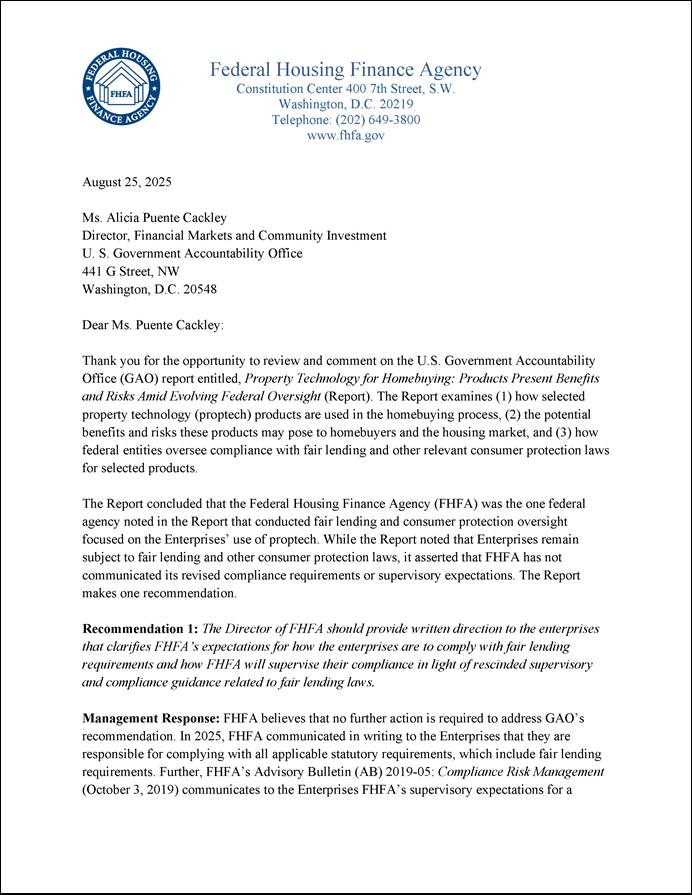
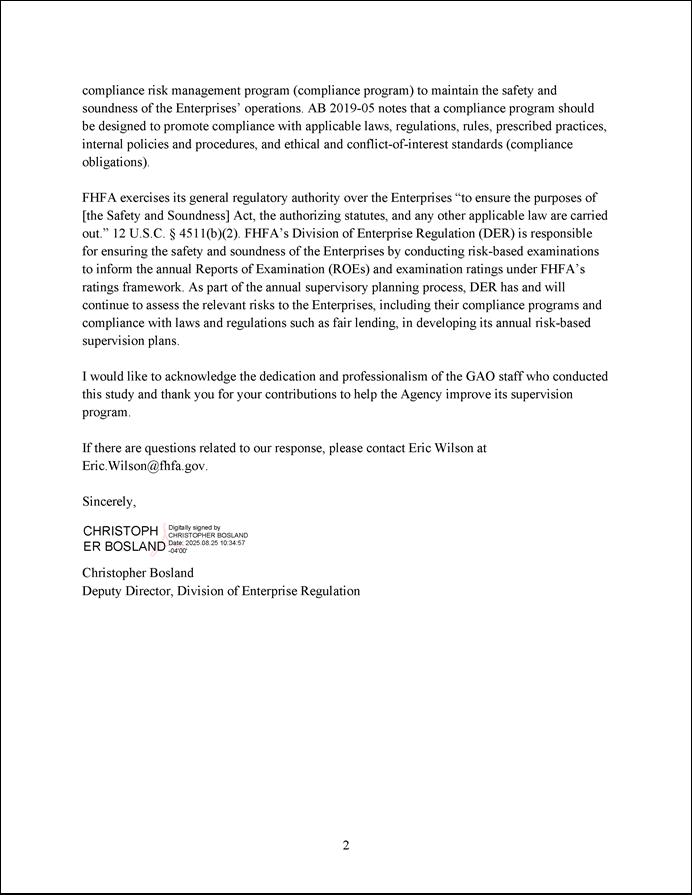
GAO Contact
Alicia Puente Cackley, CackleyA@gao.gov
Staff Acknowledgments
In addition to the contact named above, Christine McGinty (Assistant Director), Heather Chartier (Analyst in Charge), Christophe Beaumier, Abigail Brown, Daniel Horowitz, John Karikari, Mary Kubinski, Lydie Loth, Marc Molino, Barbara Roesmann, Jessica Sandler, Eric Schwab, and Lindsay Shapray made key contributions to this report.
The Government Accountability Office, the audit, evaluation, and investigative arm of Congress, exists to support Congress in meeting its constitutional responsibilities and to help improve the performance and accountability of the federal government for the American people. GAO examines the use of public funds; evaluates federal programs and policies; and provides analyses, recommendations, and other assistance to help Congress make informed oversight, policy, and funding decisions. GAO’s commitment to good government is reflected in its core values of accountability, integrity, and reliability.
Obtaining Copies of GAO Reports and Testimony
The fastest and easiest way to obtain copies of GAO documents at no cost is through our website. Each weekday afternoon, GAO posts on its website newly released reports, testimony, and correspondence. You can also subscribe to GAO’s email updates to receive notification of newly posted products.
Order by Phone
The price of each GAO publication reflects GAO’s actual cost of production and distribution and depends on the number of pages in the publication and whether the publication is printed in color or black and white. Pricing and ordering information is posted on GAO’s website, https://www.gao.gov/ordering.htm.
Place orders by calling (202) 512-6000, toll free (866) 801-7077,
or
TDD (202) 512-2537.
Orders may be paid for using American Express, Discover Card, MasterCard, Visa, check, or money order. Call for additional information.
Connect with GAO
Connect with GAO on X,
LinkedIn, Instagram, and YouTube.
Subscribe to our Email Updates. Listen to our Podcasts.
Visit GAO on the web at https://www.gao.gov.
To Report Fraud, Waste, and Abuse in Federal Programs
Contact FraudNet:
Website: https://www.gao.gov/about/what-gao-does/fraudnet
Automated answering system: (800) 424-5454
Media Relations
Sarah Kaczmarek, Managing Director, Media@gao.gov
Congressional Relations
A. Nicole Clowers, Managing Director, CongRel@gao.gov
General Inquiries
[1]AI generally refers to computer systems that can solve problems and perform tasks that traditionally have required human intelligence and that continually get better at their assigned tasks. The White House, Office of Science and Technology Policy, American Artificial Intelligence Initiative: Year One Annual Report (Washington, D.C.: February 2020). Machine learning, a type of artificial intelligence, uses algorithms to identify patterns in information.
[2]For this report, we use “fair lending laws” to refer to the Fair Housing Act, Equal Credit Opportunity Act, and the fair lending provisions of the Federal Housing Enterprises Financial Safety and Soundness Act of 1992, as amended through June 2025.
[3]We also reported on the use and oversight of proptech products in the rental housing market. See GAO, Rental Housing: Use and Federal Oversight of Property Technology, GAO‑25‑107196 (Washington, D.C.: July 10, 2025).
[4]Online real estate platforms are websites or online applications that provide tools and information homebuyers can use to search for and purchase homes. Automated valuation models are software programs or tools that use algorithms to estimate a property’s market value using information such as a property’s sales history, sales of similar properties, and characteristics of the property and its location. Automated underwriting systems are digital platforms lenders use to evaluate loan applications. They analyze borrower loan application data to evaluate credit risk and predict the likelihood of loan repayment. Electronic closing tools are digital tools that automate closing processes and have built-in mechanisms to help ensure the accuracy of mortgage closing documents.
[5]We focused on nonbank mortgage lenders because they originate the majority of home mortgage loans. Such lenders originate mortgages but are not depository institutions. Some nonbank mortgage lenders also may develop their own proptech products for internal use. The use and development of proptech products for refinance loans or home equity lines of credit was outside the scope of this review.
[6]Beginning in 2025, the President issued a series of Executive Orders and Memorandums that relate to federal regulatory actions, including rules, regulations, and guidance. See, e.g., Executive Order 14219, Ensuring Lawful Governance and Implementing the President’s “Department of Government Efficiency” Deregulatory Initiative, 90 Fed. Reg. 10583 (Feb. 25, 2025). As a result, certain rules, regulations, and guidance discussed in this report may be subject to change.
[7]We included HUD and VA because they have the largest federal programs that insure or guarantee loans for the purchase of a single-family home.
[8]GAO, Standards for Internal Control in the Federal Government, GAO‑14‑704G (Washington, D.C.: Sept. 10, 2014).
[9]Courts have recognized three methods of proof of lending discrimination under the Equal Credit Opportunity Act and the Fair Housing Act, as to the prohibited bases of race or color, religion, national origin, sex, marital status, age (provided the applicant has the capacity to enter into a binding contract), the applicant’s receipt of all or part of their income from any public assistance program, or that the applicant has in good faith exercised any right under the Consumer Credit Protection Act (for the Equal Credit Opportunity Act), or race or color, national origin, religion, sex, familial status or handicap (for the Fair Housing Act). The three methods of proof are (1) overt evidence of disparate treatment; (2) comparative evidence of disparate treatment; and (3) evidence of disparate impact. Overt evidence of disparate treatment occurs when a lender openly treats applicants differently on a prohibited basis. Comparative disparate treatment occurs when a lender treats applicants differently on a prohibited basis in the absence of an explicit policy and without a credible nondiscriminatory reason. Disparate impact occurs when a lender’s policy or practice, while appearing neutral, disproportionately negatively affects a protected group without a legitimate business necessity or where that need could be achieved as well through less discriminatory means. In April 2025, the President issued an Executive Order establishing a policy to eliminate the use of disparate impact liability in all contexts to the maximum degree possible “to avoid violating the Constitution, Federal civil rights laws, and basic American ideals.” Executive Order 14281, Restoring Equality of Opportunity and Meritocracy, 90 Fed. Reg. 17537 (Apr. 28, 2025).
[10]CFPB’s supervisory authority over nonbank mortgage lenders allows it to monitor, examine, impose reporting requirements, and enforce federal consumer financial laws against these entities. 12 U.S.C. § 5514. CFPB has similar supervisory authority over certain large depository institutions. See 12 U.S.C. §§ 5515–5516. In addition to fair lending laws mentioned in this report, CFPB is responsible for enforcing a number of provisions from the Dodd-Frank Wall Street Reform and Consumer Protection Act as well as 18 consumer financial protection laws predating Dodd-Frank.
[11]Title X of the Dodd-Frank Wall Street Reform and Consumer Protection Act also grants CFPB supervisory and enforcement authority over service providers to supervised nonbanks, which includes the authority to conduct on-site examinations of service provider operations. See, e.g., 12 U.S.C. §§ 5514(e), 5515(d), 5516(e), 5563–5564.
[12]For example, see The White House, “CFPB Isn’t a Wall Street Regulator, It’s a Main Street Regulator” (Feb. 10, 2025); and U.S. House of Representatives, Committee on Financial Services, letter to Russell Vought, Acting Director, Consumer Financial Protection Bureau, March 31, 2025.
[13]Since September 2008, FHFA has served as the conservator of the enterprises, which are congressionally chartered, for-profit, shareholder-owned corporations with a primary mission to enhance the liquidity, stability, and affordability of mortgage credit. FHFA is responsible for supervising, regulating, and overseeing the enterprises’ mission activities.
[14]The mortgage market includes a primary market, in which lenders make loans to borrowers, and a secondary market in which loans are packaged into securities and sold to investors.
[15]12 U.S.C. § 4545; 24 C.F.R. §§ 81.41–81.46.
[16]National Association of Realtors Research Group, Real Estate in a Digital Age (Washington, D.C.: September 2021).
[17]Multiple listing services are cooperative organizations of real estate brokers that share information about available properties.
[18]Automated valuation models that provide valuation estimates on online real estate platforms are not used to make credit decisions.
[19]Sylvia Brown and Alex C. Engler, Governing the Ascendancy of Automated Valuation Models: Regulating AI in Residential Property Valuation (Washington, D.C.: Oct. 12, 2023).
[20]Only certain types of properties and mortgages are eligible for appraisal waivers, such as primary residences or second homes with a loan-to-value ratio below 90 percent. The enterprises’ automated underwriting systems review loan and property information (which may include a prior appraisal) to determine eligibility for an appraisal waiver. Fannie Mae and Freddie Mac officials noted that appraisal waivers have been more commonly used for refinance loans, which were outside the scope of this report.
[21]Fannie Mae’s Desktop Underwriter and Freddie Mac’s Loan Product Advisor are the enterprises’ proprietary automated underwriting systems, and offer similar functions. Desktop Underwriter assesses loan risk and provides feedback to lenders on next steps, such as asset verification, income verification, and appraisal requirements, according to Fannie Mae officials. Loan Product Advisor offers feedback that lenders can use to communicate information to borrowers and ensure consistent risk assessment across loans, according to Freddie Mac officials.
[22]See Mortgage Bankers Association, “AI in the Mortgage Industry” (November 2024). When using the enterprises’ systems, lenders also may apply their own additional criteria for approving loans, such as setting credit score standards, according to Fannie Mae officials.
[23]FHFA officials informed us that because the enterprises’ automated underwriting systems do not make underwriting or credit decisions for the lenders, they generally do not consider the enterprises creditors under the Equal Credit Opportunity Act and are not required to deliver adverse action notices to borrowers.
[24]Michael Neal, Linna Zhu, Caitlin Young, Vanessa G. Perry, and Matthew Pruitt, Harnessing Artificial Intelligence for Equity in Mortgage Finance (Washington, D.C.: Urban Institute, 2023): 14.
[25]Fannie Mae and Freddie Mac, GSE Efforts to Improve eMortgage Adoption: A Follow-up to the 2016 GSE Survey Findings Report (November 2017). The enterprises reported on a survey of lenders, technology providers, warehouse banks, servicers, and title and settlement providers.
[26]Since 1999, most states have adopted the Uniform Electronic Transactions Act, which helped establish uniform guidance for the use of electronic signatures. Unif. Elec. Transactions Act §§ 4–5 (Unif. L. Comm’n 1999). In 2000, Congress enacted the Electronic Signatures in Global and National Commerce Act, which ensures the validity of electronic contracts and signatures. 15 U.S.C. §§ 7001–7006.
[27]Some risks discussed in this section relate more broadly to the use of AI and are not specific to proptech products. GAO’s AI accountability framework describes these risks and identifies key practices to help ensure accountability and responsible AI use. See GAO, Artificial Intelligence: An Accountability Framework for Federal Agencies and Other Entities, GAO‑21‑519SP (Washington, D.C.: June 30, 2021).
[28]Both automated valuation models and traditional valuation approaches (such as appraisals and comparable market analyses) may be susceptible to feedback loops. In the context of online platforms, a feedback loop may occur when an automated valuation model uses past listing or sales data—depending on available information in a given area—to estimate future home values. This can perpetuate trends in rising or falling prices depending on market conditions.
[29]Researchers analyzed Zestimate data from March 2019 to March 2021. These findings are not generalizable because they reflect property valuation trends during this time frame in selected U.S. cities. Runshan Fu, Ginger Zhe Jin, and Meng Liu, “Does Human-Algorithm Feedback Loop Lead to Error Propagation? Evidence from Zillow’s Zestimate,” National Bureau of Economic Research Working Paper No. 29880 (March 2022): 23-24. Another study found that Zillow’s valuation estimate helped reduce uncertainty in the housing market. Researchers found that Zillow’s estimate tended to be less accurate in poor neighborhoods than rich ones, but it benefitted the housing market in poor neighborhoods more because property valuation in poor neighborhoods is less certain than in other neighborhoods. They defined poor neighborhoods as the 25th percentile of all properties, rich neighborhoods as the 75th percentile of all properties, and others as mid-range neighborhoods. Runshan Fu, Yan Huang, Nitin Mehta, Param Vir Singh, and Kannan Srinivasan, “Unequal Impact of Zestimate on the Housing Market,” Marketing Science (forthcoming).
[30]Gonçalo Melo Ambrósio Silva Pinhão, How the Implementation of Virtual Reality Technologies Will Influence the Real Estate Market, master’s thesis (ISCTE - Instituto Universitário de Lisboa: October 2022): 24.
[31]Piyush Goswami, Piyush Pandey, Divyanshu Singh, and Ajay Suri, “Implementation and Framework for Virtual Reality Integration in Real Estate Industry Application,” paper presented at the Fifth International Conference on Intelligent Communication Technologies and Virtual Mobile Networks, Tirunelveli, India, March 2024.
[32]GAO’s AI accountability framework recommends specific procedures to address AI system compliance with relevant laws and regulations. See GAO‑21‑519SP.
[33]HUD regulations prohibit steering, which involves restricting or attempting to restrict a homebuyer’s choices by word or conduct based on legally protected characteristics when seeking, negotiating for, or buying a home. 24 C.F.R. § 100.70(a), (c).
[34]Zillow integrated its Fair Housing Classifier into its AI-powered consumer products in 2024. It released the tool under an open-source license, making it available across the real estate industry. Zillow Group, “Breaking new ground in generative AI: Zillow’s Fair Housing Classifier,” news release (May 21, 2024); https://www.zillowgroup.com/news/zillows-fair-housing-classifier/.
[35]Department of Housing and Urban Development, Guidance on Application of the Fair Housing Act to the Advertising of Housing, Credit, and Other Real Estate-Related Transactions through Digital Platforms (Washington, D.C.: Apr. 29, 2024).
[36]As part of the settlement agreement, Redfin agreed to end its minimum price policy. Nat’l Fair Hous. All. et al. v. Redfin Corp., No. 2:20-cv-01586-JLR-RLF (W.D. Wash., settled Apr. 29, 2022).
[37]Specifically, for 69 percent of the properties analyzed, appraisers adjusted the weighting of comparable sales in a way that raised appraisals to match the contract price. The study reviewed 6.5 million appraisals for home purchase loans originated in 2013–2017. Michael D. Eriksen, Hamilton B. Fout, Mark Palim, and Eric Rosenblatt, “The Influence of Contract Prices and Relationships on Appraisal Bias,” Journal of Urban Economics, vol. 111 (May 2019).
[38]Brown and Engler, Governing the Ascendancy of Automated Valuation Models, 7.
[39]One cited factor was the use of racial demographics in selecting comparable homes and neighborhoods for appraisal. Brown and Engler, Governing the Ascendancy of Automated Valuation Models, 8.
[40]Quality Control Standards for Automated Valuation Models, 89 Fed. Reg. 64538 (Aug. 7, 2024). One automated valuation model developer that commented on the rule also reported in 2021 that these models were less likely to produce biased valuation outcomes than traditional appraisals. See HouseCanary, “Reducing Racial Bias in Home Appraisals Using Automated Valuation Technology,” white paper (November 2021).
[41]Michael Neal, et. al., Harnessing Artificial Intelligence for Equity in Mortgage Finance, 4, 17.
[42]We reviewed reports and public comments by industry and research groups, documentation from the enterprises, and websites on homebuying costs, and interviewed selected proptech companies to estimate the cost of an appraisal.
[43]Brown and Engler, Governing the Ascendancy of Automated Valuation Models, 8. FHFA officials noted that an automated valuation model can inform users of the confidence level for a particular value, which allows a user to know the estimate may not be precise. The officials added that appraisers completing traditional appraisals do not provide similar information on the precision of the estimate, such as when comparable properties are limited.
[44]Michael Neal, Vanessa G. Perry, and Linna Zhu, “To Err Is Automated: Have Technological Advances in the Mortgage Market Increased Opportunities for Black Homeownership?” Journal of the Center for Policy Analysis and Research (Washington, D.C.: 2024): 41.
[45]Such systems can be opaque either because the inner workings of the software are inherently difficult to understand, or because vendors do not reveal them for proprietary reasons. This lack of transparency limits the ability of auditors and others to detect errors or misuse and ensure equitable treatment of people affected by AI systems. GAO’s AI accountability framework describes key practices for ensuring transparency of AI systems across its four principles (governance, data, performance, and monitoring). See GAO‑21‑519SP.
[46]Brown and Engler, Governing the Ascendancy: 10, 15.
[47]Specifically, one commenter stated that financial technology lenders (whose lending processes are data-driven and conducted online) require vendors to provide explanations and testing details on how their automated valuation models function and their accuracy. Another commenter stated that automated valuation model vendors have established transparent testing practices. Quality Control Standards for Automated Valuation Models, 89 Fed. Reg. 64538–48 (Aug. 7, 2024).
[48]Specifically, Freddie Mac found that loans originated by lenders that used its automated collateral evaluation appraisal waivers and Loan Product Advisor asset and income modeler tools were four times less likely to have defects than loans underwritten without these technologies (2.3 percent compared to 9.6 percent). A defect is a loan-level deficiency that violates the terms of a mortgage purchase agreement. See Freddie Mac, “Digital Innovation Drives Loan Quality” (McLean, Va.: February 2023).
[49]Michael Neal, et. al., Harnessing Artificial Intelligence for Equity in Mortgage Finance, 14–16.
[50]One study we reviewed found that financial technology lenders, which tend to use more technology in their mortgage origination processes, process mortgage applications 20 percent faster than other lenders, controlling for observable characteristics. According to the study, faster processing did not result in higher default rates. See Andreas Fuster, Matthew Plosser, Philipp Schnabl, and James Vickery, “The Role of Technology in Mortgage Lending,” The Review of Financial Studies vol. 32, no. 5 (2019).
[51]Tyler Haupert, “The Racial Landscape of Fintech Mortgage Lending,” Housing Policy Debate, vol. 32, no. 2 (2022): 338. Generally, alternative data are any consumer information not traditionally used by the three national consumer reporting agencies when calculating a credit score. Examples include rental or utility payment history or educational background. See GAO, Mortgage Lending: Use of Alternative Data Is Limited but Has Potential Benefits, GAO‑22‑104380 (Washington, D.C.: Nov. 16, 2021).
[52]Michael Neal, et. al., Harnessing Artificial Intelligence for Equity in Mortgage Finance, 16.
[53]As mentioned previously, although the enterprises’ automated underwriting systems do not use AI to make underwriting recommendations, certain inputs use machine learning, a type of AI. Freddie Mac incorporated its Freddie Alternative Credit Summary variable into its underwriting in December 2023 to remove reliance on third-party credit scores for credit assessment.
[54]Vanessa G. Perry, Kirsten Martin, and Ann Schnare, “Algorithms for All: Can AI in the Mortgage Market Expand Access to Homeownership?” AI, vol. 4, (2023): 888–903.
[55]GAO’s AI accountability framework recommends procedures to mitigate potential bias in AI systems. GAO‑21‑519SP.
[56]Hariharan Pappil Kothandapani, “Social Implications of Algorithmic Decision-Making in Housing Finance: Examining the broader social impacts of deploying machine learning in lending decisions, including potential disparities and community effects,” Journal of Knowledge Learning and Science Technology, vol. 4, no. 1 (2024): 87.
[57]Tyler Haupert and C. Aujean Lee, “Fintech’s relationship with subprime lending in immigrant gateway metropolitan areas,” Journal of Urban Affairs, vol. 46, no. 2 (2024): 4.
[58]Historically, mainstream lenders have overlooked neighborhoods with large immigrant populations, forcing homebuyers to rely on subprime lenders to access credit. Charu A. Chandrasekhar, “Can new Americans achieve the American dream? Promoting homeownership in immigrant communities,” Harvard Civil Rights-Civil Liberties Law Review, vol. 39, no. 1 (2004): 186–187.
[59]The Equal Credit Opportunity Act requires that a creditor provide an applicant with a statement of reasons for any adverse action taken. This statement must be specific and indicate the principal reason(s) for the adverse action. The reasons disclosed must relate to and accurately describe the factors that a creditor actually considered or scored. The use of AI or other technologies does not change the requirement to disclose the reason for an adverse action, according to CFPB officials.
[60]Michael Neal, et. al., Harnessing Artificial Intelligence for Equity in Mortgage Finance, 25.
[61]Freddie Mac representatives noted that automated underwriting systems are limited by investors’ loan product offerings and the data available from credit bureaus. An investor’s credit risk appetite and the availability of alternative credit data are important factors in determining how these systems may affect access to credit for certain homebuyers.
[62]Fannie Mae, Unlocking the Power of eNotes (2025).
[63]Consumer Financial Protection Bureau, Mortgage Closings Today (Washington, D.C.: 2014): 37–38.
[64]Consumer Financial Protection Bureau, Leveraging Technology to Empower Mortgage Consumers at Closing: Learnings from the eClosing Pilot (Washington, D.C.: 2015), 3–11.
[65]Phishing is a type of online scam in which consumers receive emails that appear to come from legitimate sources—such as banks or mortgage companies—requesting personal identifying information. Scammers then use this information to open new accounts or access the consumer’s existing accounts.
[66]For steps selected companies reported taking to comply with fair lending and consumer protection requirements and manage AI risks, see appendix II.
[67]As discussed earlier, beginning in 2025, the President issued a series of Executive Orders and Memorandums that relate to federal regulatory actions, including rules, regulations, and guidance. As discussed later, some of these executive orders affected regulators’ existing oversight efforts for selected products. To the extent information was available, we describe how the orders affected oversight efforts in this report. Relevant orders include Executive Order 14148, Initial Rescissions of Harmful Executive Orders and Actions, 90 Fed. Reg. 8237 (Jan. 28, 2025); Executive Order 14151, Ending Radical and Wasteful Government DEI Programs and Preferencing, 90 Fed. Reg. 8339 (Jan. 29, 2025); Executive Order 14210, Implementing the President’s “Department of Government Efficiency” Workforce Optimization Initiative, 90 Fed. Reg. 9669 (Feb. 14, 2025); and Executive Order 14281, Restoring Equality of Opportunity and Meritocracy, 90 Fed. Reg. 17,537 (Apr. 28, 2025). Executive Order 14281 in particular could result in changes to how federal agencies oversee selected proptech products. The order established a policy to eliminate the use of disparate impact liability in all contexts to the maximum degree possible. In the past, agencies evaluated disparate impact to assess fair housing compliance related to technologies. See, e.g. U. S. v. Meta Platforms, Inc, 1:22-cv-05187 (S.D.N.Y.). However, the extent to which agencies may continue to do so is uncertain.
[68]The Dodd-Frank Wall Street Reform and Consumer Protection Act required agencies to include quality control standards for Automated Valuation Models used to estimate collateral value for mortgage lending purposes and issue regulations to enforce the requirement. Pub. L. No. 111-203, § 1473(q) (2010) (codified at 12 U.S.C. § 3354). The other agencies that adopted the final rule are CFPB, Federal Deposit Insurance Corporation, Board of Governors of the Federal Reserve System, National Credit Union Administration, and Office of the Comptroller of the Currency. Effective October 1, 2025, the Quality Control Standards for Automated Valuation Models require supervised mortgage originators and secondary market issuers that engage in certain transactions secured by a consumer’s principal dwelling to adopt and maintain policies, practices, procedures, and control systems to ensure that automated valuation models used in these transactions adhere to quality control standards. The standards are designed to (1) ensure a high level of confidence in the estimates produced, (2) protect against the manipulation of data, (3) seek to avoid conflicts of interest, (4) require random sample testing and reviews, and (5) comply with applicable nondiscrimination laws. 89 Fed. Reg. 64538.
[69]See Federal Housing Finance Agency, Advisory Bulletin: Model Risk Management Guidance, AB 2013-07 (Washington, D.C.: Nov. 20, 2013); and Advisory Bulletin: Supplemental Guidance to Advisory Bulletin 2013-07 – Model Risk Management Guidance, AB 2022-03 (Washington, D.C.: Dec. 21, 2022).
[70]See Federal Housing Finance Agency, Advisory Bulletin: Artificial Intelligence/Machine Learning Risk Management, AB 2022-02 (Washington, D.C.: Feb. 10, 2022).
[71]Fair Lending, Fair Housing and Equitable Housing Finance Plans, 89 Fed. Reg. 42768 (May 16, 2024) (codified at 12 C.F.R. pt. 1293). The Fair Housing Act states executive agencies shall administer housing and urban development programs and activities to affirmatively further fair housing purposes. 42 U.S.C. § 3608(d). In July 2025, FHFA issued a notice of proposed rulemaking to repeal its Fair Lending, Fair Housing, and Equitable Housing Finance Plans regulation. Fair Lending, Fair Housing, and Equitable Housing Finance Plans, 90 Fed. Reg. 35475 (July 28, 2025). The proposed rule included the following reasons for repeal: to enhance prudence and financially responsible expenditure of funds, from both public and private sources; to alleviate unnecessary regulatory burdens; and to align with Administration policy, among others. Although not all of FHFA’s guidance is specific to the selected proptech products, it applies to the enterprises’ use of these products, according to FHFA officials.
[72]FHFA established the Equitable Housing Finance Plan program for the enterprises to develop a framework for addressing barriers to sustainable housing opportunities for underserved communities through strategic planning and public participation. The plans were 3-year strategic planning documents that Fannie Mae and Freddie Mac released in 2022 and late 2024. They reported annually on their progress during that period.
[73]Reasons cited in the rescission orders for the changes included to (1) promote FHFA’s review and consideration of best efforts to ensure the achievement of the purposes of the enterprises’ public mission, (2) reduce regulatory burden and ensure that the enterprises can focus their resources on their safe and sound operations, and (3) reduce potential conflict or confusion over interpretation of statutory provisions for unfair and deceptive acts and practices (for which FHFA is not the primary administrator).
[74]See Federal Housing Finance Agency, Order Rescinding Advisory Bulletin 2023-05: Enterprise Fair Lending and Fair Housing Rating System, 2025-OR-FHLMC-6/2025-OR-FNMA-6 (Washington, D.C.: Apr. 7, 2025). This bulletin included example questions that FHFA examiners could consider when determining ratings, such as if enterprise models, including underwriting and automated valuation models, are regularly monitored for disparities and less discriminatory alternatives and if an enterprise makes meaningful efforts to improve disparities in outcomes presented by their automated underwriting systems.
[75]Fair Lending, Fair Housing, and Equitable Housing Finance Plans, 90 Fed. Reg. 35475 (July 28, 2025). The agency is accepting public comments through September 26, 2025.
[76]GAO, Standards for Internal Control in the Federal Government, GAO‑14‑704G (Washington, D.C.: Sept. 10, 2014).
[77]89 Fed. Reg. 42768, 42768 (May 16, 2024) (codified at 12 C.F.R. pt. 1293).
[78]The enterprises submitted Equitable Housing Finance Plans to FHFA for 2022–2024 and 2025–2027. Each enterprise had reported annually on its progress in implementing its 2022–2024 plan, most recently in spring 2024. Following FHFA’s March 2025 waiver, the enterprises no longer have to develop or report on progress of Equitable Housing Finance Plans. In July 2025, FHFA issued a notice of proposed rulemaking to repeal its Fair Lending, Fair Housing, and Equitable Housing Finance Plans regulation. Fair Lending, Fair Housing, and Equitable Housing Finance Plans, 90 Fed. Reg. 35475 (July 28, 2025).
[79]In March 2024, nearly 90 percent of the largest lenders using Fannie Mae’s automated underwriting system had used positive rental payment history in the last 30 days to help assess first-time homebuyer eligibility for a conventional loan. Fannie Mae defined largest lenders as lenders that submitted at least 1,250 conventional purchase applications through its automated underwriting system in the last 30 days.
[80]Real Estate Settlement Procedures Act (Regulation X); Digital Mortgage Comparison-Shopping Platforms and Related Payments to Operators, 88 Fed. Reg. 9162 (Feb. 13, 2023).
[81]The Federal Register notice identifying CFPB’s rescinded documents stated that CFPB withdrew the guidance because it (1) is committed to issuing guidance only where necessary and to reduce compliance burdens rather than increase them, (2) is reducing its enforcement activities in light of Presidential directives to deregulate and streamline bureaucracy, and (3) has no compelling interest for retaining the guidance. The notice also stated that CFPB’s withdrawal of the guidance is not necessarily final, as it intends to continue reviewing all guidance documents to determine whether they ultimately should be retained. In the meantime, it noted the guidance should not be enforced or otherwise relied upon. Interpretive Rules, Policy Statements, and Advisory Opinions: Withdrawal. 90 Fed. Reg. 20084 (May 12, 2025).
[82]Adverse Action Notification Requirements in Connection with Credit Decisions Based on Complex Algorithms, Circular 2022-03 (Washington D.C.: May 26, 2022); and Adverse Action Notification Requirements and the Proper Use of the CFPB’s Sample Forms Provided in Regulation B, Circular 2023-03 (Washington D.C.: Sept. 19, 2023).
[83]CFPB conducts multiple types of risk-based examinations, including mortgage origination examinations and fair lending examinations.
[84]Consumer Financial Protection Bureau, Examination Procedures (December 2021).CFPB’s examination procedures specify that examiners are to obtain and review documentation pertaining to mortgage brokers’ and lenders’ practices and operations, including the contents of loan underwriting and closing files. Examiners also are to obtain and review a sample of an entity’s complete loan files to assess the accuracy of closing documentation and compliance with closing disclosure requirements, such as those specified in the Truth in Lending Act and Real Estate Settlement Procedures Act Integrated Disclosure rules.
[85]The fair lending examinations evaluated how institutions’ compliance management systems identify and manage fair lending risks under the Equal Credit Opportunity Act. CFPB’s fair lending examinations have looked at appraisal biases and underwriting criteria, but they typically focused on more significant fair lending risks, such as disparities in mortgage denials and pricing, according to CFPB officials in December 2024.
[86]Consumer Financial Protection Bureau, CFPB Supervision and Examination Process, Equal Credit Opportunity Act Baseline Review Module, Manual V.2 (March 2022): ECOA 13–17.
[87]For example, 12 U.S.C. §§ 5514(e), 5515(d), 5516(e), 5563, and 5564.
[88]For example, see The White House, “CFPB Isn’t a Wall Street Regulator, It’s a Main Street Regulator” (Feb. 10, 2025); and U.S. House of Representatives, Committee on Financial Services, letter to Russell Vought, Acting Director, Consumer Financial Protection Bureau, March 31, 2025.
[89]Consumer Financial Protection Bureau, 2025 Supervision and Enforcement Priorities, a memorandum to CFPB staff from the Chief Legal Officer (Washington, D.C.: Apr. 16, 2025).
[90]In 2023, CFPB focused much of its fair lending supervision efforts on mortgage origination, including redlining, potential discrimination in mortgage underwriting and pricing processes, weaknesses in fair lending-related compliance management systems, and property valuation bias. See Consumer Financial Protection Bureau, Fair Lending Report of the Consumer Financial Protection Bureau (Washington, D.C.: June 2024).
[91]We have ongoing work related to organizational changes at CFPB resulting from recent executive orders and administration guidance.
[92]Agency handbooks set program standards. See Department of Housing and Urban Development, FHA Single Family Housing Policy Handbook 4000.1 (Washington, D.C.: Jan.10, 2025); and Department of Veterans Affairs, Lenders Handbook, VA Pamphlet 26-7.
[93]Exterior-only and desktop appraisals are permitted for some VA-guaranteed purchase loans. These differ from VA’s standard for traditional appraisals, which requires VA-approved appraisers to access and view both the exterior and interior of the property before completing the appraisal report. In exterior-only appraisals, a VA-approved appraiser views the exterior of a property and reviews public records and other information. In desktop appraisals, the appraiser uses public records and other relevant information without a physical inspection. See Department of Veterans Affairs, Procedures for Alternative Valuation Methods, VBA Circular 26-22-13 (Washington, D.C: July 27, 2022).
[94]VA’s quality control program requirements do not include procedures specific to compliance with fair lending laws, according to officials.
[95]FHEO investigates complaints it receives from consumers, other federal agencies, fair housing organizations, and other sources. Upon receiving an inquiry alleging discrimination, FHEO collects information to determine whether the inquiry falls within HUD’s jurisdiction under the Fair Housing Act and converts the inquiry into a complaint. Once a complaint is filed, FHEO plans and conducts the investigation to determine whether reasonable cause exists to believe the respondent violated the Fair Housing Act. FHEO is statutorily required to investigate every complaint within 100 days, unless it is impracticable to do so. It partners with state and local agencies to investigate housing discrimination complaints.
[96]The Fair Housing Act includes a provision allowing the HUD Secretary to file a complaint. 42 U.S.C. § 3610(a)(1)(A)(i). FHEO’s Office of Systemic Investigations also reviews referrals from other federal agencies to determine whether to open a Secretary-initiated investigation, according to FHEO officials in December 2024.
[97]While Facebook is not a proptech product, it is a digital platform that displays housing-related advertisements, similar to those that may be displayed on online real estate platforms.
[98]In its June 2022 settlement with the Department of Justice, Meta Platforms, Inc. (formerly known as Facebook) agreed to stop using its “Special Ad Audience” housing advertising tool. The tool allegedly relied on a discriminatory algorithm to find users who “look like” other users based on characteristics protected by the Fair Housing Act. Meta also agreed to develop a system to address racial and other disparities caused by its use of personalization algorithms in its delivery system for housing advertisements. The Department of Justice’s lawsuit alleged Meta was liable for both disparate treatment and disparate impact discrimination.
[99]Executive Order 14110, published on Nov. 1, 2023, required HUD to issue this guidance. See Exec. Order 14110, Safe, Secure, and Trustworthy Development and Use of Artificial Intelligence, 88 Fed. Reg. 75191 (Nov. 1, 2023). On Jan. 20, 2025, Executive Order 14148 rescinded Executive Order 14110. See Exec. Order 14148, Initial Rescissions of Harmful Executive Orders and Actions, 90 Fed. Reg. 8237 (Jan. 28, 2025). As of May 2025, HUD officials told us that the guidance on applying the Fair Housing Act to digital real estate advertising was still in effect.
[100]HUD must provide the affected parties an opportunity to conciliate (voluntarily settle) a complaint. If a complaint is not successfully conciliated, the investigator uses the evidence to recommend a finding on whether reasonable cause (or none) exists to believe a violation of the Fair Housing Act occurred. 42 U.S.C. § 3610(b), (c), (g).
[101]42 U.S.C. § 3610(a)(1)(B)(iv). HUD’s Office of Inspector General reported on challenges affecting FHEO’s ability to complete investigations within 100 days. The majority of FHEO investigations from 2020 through 2022 (70 percent) required more than 100 days to complete, due to factors such as limited staffing and training, staff workload, complexity of the case work, and uncooperative or unresponsive parties. The report recommended several actions that FHEO should take to address these challenges. Department of Housing and Urban Development, Office of Inspector General, FHEO Faces Challenges in Completing Investigations Within 100 Days, 2024-BO-0005 (Washington, D.C.: Sept. 24, 2024).
[102]The HUD Office of Inspector General report also noted that FHEO was operating below its desired staffing level. A survey conducted by the office found that 83 percent of investigators, supervisors, and Office of General Counsel staff reported being understaffed or having limited or no investigative experience, and receiving insufficient training to cover the types of cases investigated. Department of Housing and Urban Development, FHEO Faces Challenges in Completing Investigations Within 100 Days. We have ongoing work related to staffing and other changes at HUD and FHEO resulting from the executive orders issued beginning in January 2025.
[103]FTC operates the Consumer Sentinel Network, an online database of complaints received directly from consumers as well as those shared by state, federal, local, and international law enforcement agencies and the Better Business Bureau.
[104]Section 5(n) provides FTC with the authority to declare an act or practice as unfair when three specific criteria are met: (1) the act or practice causes or is likely to cause substantial injury to consumers, (2) is not reasonably avoidable by consumers, and (3) is not outweighed by countervailing benefits to consumers or to competition. 15 U.S.C. § 45(n).
[105]The use and development of proptech products for refinance loans or home equity lines of credit was outside the scope of this review.
[106]Nonbank mortgage lenders originate mortgages but are not depository institutions. Some nonbank mortgage lenders also may develop their own proptech products for internal use.
[107]Beginning in 2025, the President issued a series of Executive Orders and Memorandums that relate to federal regulatory actions, including rules, regulations, and guidance. See, e.g., Executive Order 14219, Ensuring Lawful Governance and Implementing the President’s “Department of Government Efficiency” Deregulatory Initiative, 90 Fed. Reg. 10583 (Feb. 25, 2025). As a result, certain rules, regulations, and guidance discussed in this report may be subject to change.
[108]GAO, Standards for Internal Control in the Federal Government, GAO‑14‑704G (Washington, D.C.: Sept. 10, 2014).
[109]The five industry groups representing lenders and proptech companies were Center for Real Estate Technology and Innovation, Homeownership Council of America, Mortgage Bankers Association, Mortgage Industry Standards Maintenance Organization, and National Association of Realtors. The four research organizations were Alliance for Innovative Regulation, Brookings Institute, FinRegLab, and Urban Institute. The two consumer advocacy groups were Center for Responsible Lending and National Fair Housing Alliance. We selected and contacted four other consumer advocacy or industry groups that declined to participate or did not respond.
[110]We selected and contacted nine other companies, including lenders and online real estate platforms, that declined to participate or did not respond.
[111]Lenders may conduct matched pair testing to determine the presence of disparate treatment. For example, matched pair testing would compare underwriting decisions for two borrowers with similar credit profiles who applied for loans in the same state for approximately the same loan amounts. Such an analysis can be used to determine whether a denial decision was legitimate or discriminatory.
[112]In April 2025, the President issued an Executive Order establishing a policy to eliminate the use of disparate impact liability in all contexts to the maximum degree possible. This could result in changes to how federal agencies oversee selected proptech products. Executive Order 14281, Restoring Equality of Opportunity and Meritocracy, 90 Fed. Reg. 17537 (Apr. 28, 2025).
[113]The enterprises have policies that require business units to develop, implement, and maintain oversight of third-party relationships that may present potential fair lending risks, including third-party vendors that work with their automated underwriting systems and valuation models.
[114]The Consumer Financial Protection Bureau, Federal Deposit Insurance Corporation, Federal Housing Finance Agency, Board of Governors of the Federal Reserve System, National Credit Union Administration, and Office of the Comptroller of the Currency issued the final rule. Under the rule, agencies will require lending institutions to adopt policies and practices to protect against data manipulation and comply with nondiscrimination laws, among other requirements. 89 Fed. Reg. 64538.
[115]Freddie Mac’s study examined differences in the percentage of properties and minority borrowers who received an appraised value lower than the contract price in minority census tracts compared to White census tracts. Freddie Mac, Racial and Ethnic Valuation Gaps in Home Purchase Appraisals (McLean, Va.: Sept. 20, 2021).
[116]One of these companies also developed an internal AI governance framework. The guidance states that an effective framework for model risk management includes robust model development, implementation, and use; effective validation; and sound governance, policies, and controls. See Board of Governors of the Federal Reserve System, Guidance on Model Risk Management, SR-117 (Washington, D.C.: Apr. 4, 2011).
[117]The Mortgage Industry Standards Maintenance Organization maintains industry standards and guidelines for the use of e-closing tools, which cover legal, process, and technical aspects of these tools. The organization also oversees a voluntary certification program that provides baseline technical and procedural requirements for vendors, lenders, and third parties. Certification requirements include legal and regulatory compliance, electronic signatures, audit integrity, and information security.