
Report to the Chairman, Subcommittee on Border Management, Federal Workforce and Regulatory Affairs, Committee on Homeland Security and Governmental Affairs, U.S. Senate
United States Government Accountability Office
A report to the Chairman of the Subcommittee on Border Management, Federal Workforce and Regulatory Affairs, Committee on Homeland Security and Governmental Affairs, U.S. Senate.
For more information, contact: Frank Rusco at ruscof@gao.gov.
What GAO Found
The Department of the Interior has a goal to improve data sharing, which is vital to its oversight of oil and gas development on federal and Tribal lands. Three bureaus within Interior share oversight responsibilities—the Bureau of Indian Affairs (BIA), Bureau of Land Management (BLM), and Office of Natural Resources Revenue. Interior and the bureaus have reported spending about $206 million since 2021 to modernize data systems. However, GAO identified challenges in three selected business processes—leasing land for oil and gas exploration, verifying that production is reported accurately, and reviewing bonds to ensure they are sufficient to cover cleanup costs. For example:
· Manual data sharing. To update data on oil and gas leases, BIA receives lease data in paper documents from companies that it then manually enters into its data system. BIA then emails or mails these data to other Interior bureaus, whose staff must manually enter the data into their systems.
· Inability to accept electronic data. To help ensure accurate royalty payments for extraction of natural gas, BLM verifies selected gas analysis reports submitted by operators. Since 2019, federal regulations have required operators to submit these reports electronically to BLM’s Gas Analysis Reporting and Verification System. However, this system has never been operational, and BLM has discontinued estimating when it will be. As a result, BLM manually collects data from operators as needed and still does not have a system to receive and store reports and data automatically.
Oil and Gas Data-Sharing Challenges Identified at the Department of the Interior
|
Business process |
Bureau of Indian Affairs |
Bureau of Land Management |
Office of Natural Resources Revenue |
|
Leasing |
• Manual data sharing |
• Manual data sharing |
• Manual data sharing |
|
Production verification |
N/A |
• Manual data sharing • Data not accepted by systems |
No challenges identified |
|
Reviewing bonds |
• Data not accepted by systems |
• Manual data sharing |
N/A |
Legend: N/A = not applicable. The bureau does not perform this business process.
Source: GAO analysis of Interior data systems. | GAO-26-106475
Note: Some automated data sharing may also be used for other aspects of these business processes.
Interior issued a 2023 data-sharing policy that targeted further enhancements across the department. However, this strategy does not have time frames and measurable performance goals for improving data sharing. Accordingly, Interior does not know when needed improvements will materialize. Without enhanced automated data sharing, highly inefficient and error-prone manual processes will continue unabated.
Interior and its oil and gas bureaus have generally followed internal data governance policies but have not completed data-sharing agreements as required by Interior policy. These agreements are supposed to guide how officials use and manage shared data. They also could help officials address the inherent challenges of manual processing. Without such agreements, Interior is likely missing opportunities to automate and electronically share information.
Why GAO Did This Study
Development of oil and gas resources on federal lands helps supply the U.S. with energy and generates billions of dollars annually in revenues. Within Interior, selected bureaus use data systems to oversee oil and gas development, such as by issuing drilling permits and inspecting wells.
GAO was asked to review Interior’s oil and gas data systems. This report (1) describes data sharing challenges, (2) examines Interior’s plans for improving data sharing, and (3) examines the extent to which Interior followed policies for data sharing.
GAO reviewed three selected oil and gas business processes that Interior uses. GAO examined data system documentation and interviewed officials who carry out these three business processes to identify challenges. GAO reviewed agency data-sharing policies, documentation, and strategy documents and interviewed system administrators and agency leadership.
What GAO Recommends
GAO recommends that Interior (1) develop a strategy with measurable goals and time frames to improve oil and gas data sharing, including the retirement of manual processes and electronic acceptance of key oversight data; and (2) adhere to Interior policy to document data-sharing agreements. Interior’s audit liaison concurred with our findings and recommendations via email.
This is a work of the U.S. government and is not subject to copyright protection in the United States. The published product may be reproduced and distributed in its entirety without further permission from GAO. However, because this work may contain copyrighted images or other material, permission from the copyright holder may be necessary if you wish to reproduce this material separately.
Abbreviations
|
AFMSS 2 |
Automated Fluid Mineral Support System 2 |
|
BIA |
Bureau of Indian Affairs |
|
BLM |
Bureau of Land Management |
|
GARVS |
Gas Analysis Reporting and Verification System |
|
IT |
Information technology |
|
MLRS |
Mineral & Land Records System |
|
MRMSS |
Minerals Revenue Management Support System |
|
ONRR |
Office of Natural Resources Revenue |
|
OCIO |
Office of the Chief Information Officer |
|
TAAMS |
Trust Asset and Accounting Management System |
January 21, 2026
The Honorable James Lankford
Chairman
Subcommittee on Border Management, Federal Workforce
and Regulatory Affairs
Committee on Homeland Security and Governmental Affairs
United States Senate
Dear Mr. Chairman:
Development of oil and gas resources from federal lands represents a significant source of nontax revenues—about $7.6 billion in fiscal year 2024—that are shared with states where the federal oil and gas is produced. Three bureaus within the U.S. Department of the Interior share oversight responsibilities for oil and gas development on federal lands and on lands held in trust or restricted status by the U.S. for Indian Tribes or tribal citizens: the Bureau of Indian Affairs (BIA), Bureau of Land Management (BLM), and the Office of Natural Resources Revenue (ONRR).
To fulfill their oversight responsibilities, these bureaus use data systems to conduct various business processes. These processes include issuing leases for development activities and ensuring that production of oil and gas is appropriately accounted for and that appropriate royalties are paid. These processes often involve sharing data among the bureaus and across multiple data systems. Sharing data effectively is vital to Interior’s ability to plan and execute its mission. For example, data on leases issued by BIA and BLM must be shared with ONRR, which is responsible for ensuring operators appropriately account for production and pay royalties owed.
In 2021, we found that automated data sharing was limited at Interior and that those limitations led to increased costs.[1] Interior issued a data-sharing policy in May 2023 that established data-sharing requirements and responsibilities, including that all new or updated Interior data systems provide automated data-sharing capabilities.[2] However in 2024, we found that BIA and BLM continued to experience challenges with sharing data about oil and gas leases and bonds.[3]
You asked us to review Interior’s data systems used to manage and oversee oil and gas activities. This report (1) describes data-sharing challenges Interior and its bureaus face in selected business processes related to overseeing oil and gas development on federal and trust and restricted lands, (2) examines the extent to which Interior achieved its goals to improve data sharing, and (3) examines the extent to which Interior’s bureaus have followed relevant data-sharing policies.
To describe the data-sharing challenges Interior and its bureaus face, we selected a nongeneralizable sample of three oil and gas oversight business processes: approving and updating leases, verifying production, and reviewing bonds. Findings from our nongeneralizable sample cannot be used to make inferences about all such business processes, but can be illustrative of the data-sharing challenges that Interior and its bureaus face. We selected these processes because they use data systems across Interior bureaus and represent different portions of the oil and gas development life cycle.[4] We examined Interior and bureau guidance about these business processes.[5] We also examined documentation about the data systems and data sharing used to carry out these business processes.
We interviewed officials who carry out the three business processes across a nongeneralizable sample of two BIA agency offices, BIA’s Indian Energy Service Center, six BLM field offices, and four BLM state offices. We also interviewed officials at ONRR’s headquarters in Lakewood, Colorado.
To examine the extent to which Interior met its goals, we examined Interior’s 2023 Information Management and Technology Strategic Plan and its 2020 Data Strategy.[6] We interviewed agency officials, including Interior’s Chief Information Officer and Chief Data Officer, bureau-level associate chief information officers and associate chief data officers, and system managers for the data systems that the bureaus use for the three business processes we reviewed. We also reviewed Interior documents about the systems’ ability to share oil and gas data.
To evaluate the extent to which the bureaus are following relevant Interior policies, we compared bureau actions described in documentation and interviews against the required actions outlined in Interior’s May 2023 Data Sharing Policy. Specifically, we analyzed the extent to which Interior bureaus adhered to technical requirements for data sharing and requirements for documenting data sharing.
We conducted this performance audit from February 2023 to January 2026, in accordance with generally accepted government standards. Those standards require that we plan and perform the audit to obtain sufficient, appropriate evidence to provide a reasonable basis for our findings and conclusions based on our audit objectives. We believe that the evidence obtained provides a reasonable basis for our findings and conclusions based on our audit objectives.
Background
Interior Oil and Gas Business Processes
To fulfill their onshore oil and gas oversight responsibilities, BIA, BLM, and ONRR conduct business processes that often depend on storing and accessing data in two or more data systems. The three business processes we examined are described below.
Approving and updating a lease. BIA, BLM, and ONRR each have roles in approving, issuing, and updating onshore oil and gas leases. Leasing of Tribes’ and their citizens’ energy resources is a complex process that may involve a range of stakeholders. BIA generally approves leases prior to issuance for oil and gas development on land the U.S. holds in trust or restricted status for Tribes or tribal citizens. To do so, BIA maintains surface and mineral ownership records. For approved leases, it also updates lease documentation when ownership or other information changes, according to BIA officials.
For its part, BLM uses a multistep process for issuing new leases and updating its approximately 24,000 active leases when needed. It issues and updates such leases on (1) BLM-managed land, (2) lands managed by other federal agencies, and (3) nonfederal land where the federal government owns the mineral rights. For such leases, BLM updates lease data when operators change. Separately, ONRR receives information about leases approved and issued by BIA and BLM to collect revenues such as royalty payments generated from the sale of oil and gas, according to ONRR documents.
Production verification. BLM and ONRR verify the volume and other characteristics of oil and gas produced from federal lands to help ensure oil and gas companies pay the appropriate amount of royalties to the federal government. For federal leases, onshore federal oil and gas revenues are typically shared about half between federal accounts and the states where development occurred. For Tribes’ and their citizens’ leases, all royalties are paid to Tribes or tribal citizens for lands held in trust or restricted status by the United States, according to ONRR documents.
Royalties are based in part on the volumes and value of oil and gas produced on federal lands from over 96,000 onshore wells and removed and sold. BLM verifies production by inspecting meters and other measurement equipment and by reviewing oil and gas production data reported by operators. According to BLM officials, BLM also conducts production verification for most Indian leases. In addition, ONRR verifies the completeness of production data reported by oil and gas companies. ONRR does so by reviewing production data such as volume records and automatically comparing these production data against other operator-reported data, among other things.[7]
Bond reviews. BIA and BLM require lessees to provide bonds to help ensure they meet the terms and conditions of their leases, including plugging wells and reclaiming the land. BIA and BLM use these bonds to reimburse at least some of the costs of well reclamation if operators or other liable parties do not reclaim wells. Over the course of an oil and gas lease’s lifetime, both BIA and BLM review existing bonds to ensure that the bond amount continues to be sufficient. This is to be based on the number of wells in a lease and other factors that may affect the ultimate cost of reclaiming a well.[8]
Information on Data Systems Used for Selected Business Processes
BIA, BLM, and ONRR use four data systems in carrying out the three business processes we selected:[9]
· BIA’s Trust Asset and Accounting Management System (TAAMS) maintains land titles and leasing data, among other things. It is used to approve and update leases and carry out bond reviews. BIA began using TAAMS in 1999 and plans to improve its ability to share data with other systems within Interior, according to BIA officials.
· BLM’s Mineral & Land Records System (MLRS) is used as a system of record in carrying out leasing and bond reviews. BLM began using MLRS in 2021 and plans to improve data sharing between MLRS and several other BLM data systems, according to BLM officials.
· BLM’s Automated Fluid Mineral Support System 2 (AFMSS 2) is used in production verification and bond reviews. It tracks oil and gas activities such as drilling, inspections, and monitoring. BLM began using AFMSS 2 in 2021 and plans to replace it with a new system. However, BLM has not received approval from Interior to start work on this new system, according to BLM officials.
· ONRR’s Minerals Revenue Management Support System (MRMSS) is used to record lease approvals and updates and to conduct production verification.[10] It tracks oil and gas production and associated payment information. ONRR began using MRMSS in 2001 and has been modernizing the system by building a new software system to replace MRMSS since 2020. ONRR cancelled its effort to build a new software system in favor of upgrading MRMSS’ current software in 2025, according to ONRR officials.
Interior’s Data-Sharing Policies and Initiatives
Effectively accomplishing Interior’s mission requires sharing key data. Interior has recognized this need and published multiple strategies aimed, at least in part, at improving data sharing. Interior’s Information Management and Technology Strategic Plan, published in 2023 to cover fiscal years 2024 through 2029, is the department’s most recent information technology strategy document. It recognizes the department’s data as a critical strategic asset to the success of its bureaus.[11] Within the strategic plan, Interior outlined a plan to make its data findable, accessible, interoperable, and reusable, as well as improve data sharing to support missions across the department.
The strategic plan references and builds upon Interior’s 2020 Data Strategy, which established strategic goals and objectives specific to data, as well as outlined the role of the Interior Data Governance Board. The Data Governance Board serves as a central advisory body for senior leadership in the Office of the Chief Information Officer (OCIO) and the Office of the Secretary more broadly.
In addition to the strategic plan, the OCIO laid out specific requirements across Interior for data sharing in the May 2023 Data Sharing Policy.[12] This policy targets improving data sharing across the whole department and establishes the roles and requirements for bureaus and data officials. Specifically, the policy outlines two types of requirements:
· technical requirements to ensure Interior data are available to be shared and data systems are set up to automatically share appropriate data, and
· documentary requirements that ensure the exchange of data is sufficiently governed from a legal, privacy, and policy perspective.
Beginning in January 2025, the President, the Office of Management and Budget, and the Office of Personnel Management instructed executive branch agencies to develop plans for large-scale reductions in force and reorganizations.[13] In March 2025, an executive order emphasized the importance of removing unnecessary barriers to federal employees accessing government data and promoting interagency data sharing.[14] Interior issued an order describing plans for consolidation in response to the administration’s directives and guidance. Specifically, in April 2025, the Secretary of the Interior announced plans to consolidate IT functions within the Office of the Secretary, among other functions.[15] According to Interior, this effort will create significant efficiencies by improving processes, eliminating redundant efforts, and helping integrate technology. As of August 2025, this consolidation process was under way, and it was unclear what aspects of system development and operations, including data sharing, would be managed centrally.
Data-Sharing Challenges Include Manual Data Sharing and Data Not Being Stored
While BIA, BLM, and ONRR have made some progress in their efforts to implement Interior’s data-sharing policies and initiatives, the bureaus face data-sharing challenges in the three selected business processes related to manual data sharing and some data not being stored in data systems. According to officials, the bureaus have improved their oil and gas data systems to include technical capabilities necessary to share data among the bureaus. According to Interior data, BLM and ONRR spent approximately $206 million on system replacements or modernizations in fiscal years 2022 through 2025.
We identified two instances where bureaus were able to improve automated data sharing as a result of the modernizations. First, ONRR and BLM were able to connect their systems to automatically transfer new lease information. Second, BLM is now able to store electronic documents from well operators, smoothing business practices for field staff. In addition, while ONRR was working on modernizing its system, officials from BIA and ONRR identified an opportunity to automatically share relevant contractor information. Officials said they are currently developing this capability. BIA officials also told us they are currently exploring enhancements to TAAMS to better integrate bond data tracking, which could support future automation efforts.
Although the bureaus made this progress, Interior continues to face data-sharing challenges in conducting its business processes, as table 1 shows.
Table 1: Identified Oil and Gas Data-Sharing Challenges with Selected Business Processes Conducted by Department of the Interior Bureaus
|
Business process |
Bureau of Indian Affairs |
Bureau of Land Management |
Office of Natural Resources Revenue |
|
Approving and updating a lease |
• Manual data sharing |
• Manual data sharing |
• Manual data sharinga |
|
Production verification |
N/A |
• Manual data sharing • Data not accepted by data systems |
No challenges identified |
|
Bond reviews |
• Data not accepted by data systems |
• Manual data sharing |
N/A |
N/A = not applicable. The bureau does not perform this business process.
Source: GAO analysis of Interior data systems. | GAO‑26‑106475
Note: The table above illustrates business processes where manual work is occurring or data is not accepted; as a result, some automated data sharing may also be used for other aspects of these business processes.
aThe Office of Natural Resources Revenue receives some leasing data manually but does not share these data.
Data Are Shared Manually
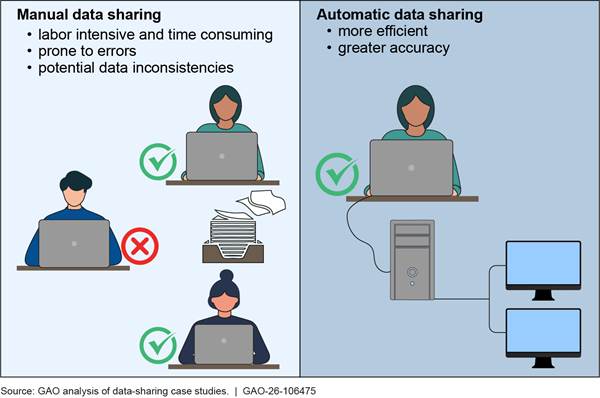
For the three business processes we examined, some bureaus manually share data that could otherwise be shared electronically between systems. Manual data sharing involves staff reading data generated by one system and manually entering the same data elsewhere. This can lead to human error, such as typos and misspellings. In contrast, automated data sharing happens when two data systems have a direct electronic connection that enables data from one data system to be read into other data systems.
Figure 1 below illustrates some potential efficiency gains from automatic data sharing compared to manual data sharing.
Figure 1: Illustration of Potential Efficiency Gains from Automated Data-Sharing Process Compared with Manual Data Sharing
Certain Interior oil and gas data are shared manually between systems in different bureaus, or within the same bureau, for the three business processes we examined. For example:
· BIA enters data about new leases and lease updates into its system and then emails and mails these data to BLM and ONRR. BIA officials told us that when they process new leases or update old leases, they first enter data about the lease into TAAMS, where a second person checks the data to ensure accuracy. Staff then send copies of the lease to BLM and ONRR, whose staff then manually enter some of the lease data into their systems.
· BLM stores some of the same oil and gas lease data separately in two systems—MLRS and AFMSS 2—but staff must manually update these data in both systems when making changes. This is because the two systems do not automatically share data. For example, when changes are made to an oil and gas lease, staff must manually enter data in both systems to reflect the change.
· BLM policy requires its staff to review all oil and gas bonds every 5 years.[16] To review bonds, staff must manually enter data from AMFSS 2 and MLRS into a spreadsheet template that computes whether a company needs additional bonding. As a result, bond reviews are time consuming and can be prone to errors, according to bureau staff members.
Interior Systems Do Not Accept Some Key Oil and Gas Data
We identified three instances in which two Interior bureaus—BIA and BLM—do not accept certain oil and gas data in their data systems that Interior officials need to conduct their management and oversight duties. For BIA, we found in November 2024 that TAAMS does not accept bond data except to note whether a bond exists.[17] Instead, to conduct a bond review, BIA relies on data stored electronically and in hard copy documents outside of TAAMS.[18] As a result, BIA’s bond reviews can take many months to complete, according to BIA staff we interviewed. Moreover, as we found in November 2024, BIA cannot rely on TAAMS as a record of BIA’s bonds or its bond amounts and must instead use spreadsheets to track bonds.
We also identified two instances where BLM does not accept some important data needed for oil and gas production verification. First, BLM does not accept meter identification numbers for the meters that measure production and determine royalties due from oil and gas leases. Oil and gas operators use several meters on each lease to measure the oil and gas volumes produced from the wells on the lease. Certain meters represent the official measurement points for each lease, and these are used to determine the royalties owed. The identification numbers for these measurement meters are key data BLM and ONRR use to verify oil and gas production.[19]
Although measurement meter identification numbers are key data, BLM’s data systems are unable to accept them.[20] As a result, BLM and ONRR must rely on a more manually intensive method to identify the royalty measurement meter, according to BLM and ONRR officials. Specifically, BLM and ONRR must review a site diagram, review other electronic records, or consult BLM engineers to identify the appropriate meter.
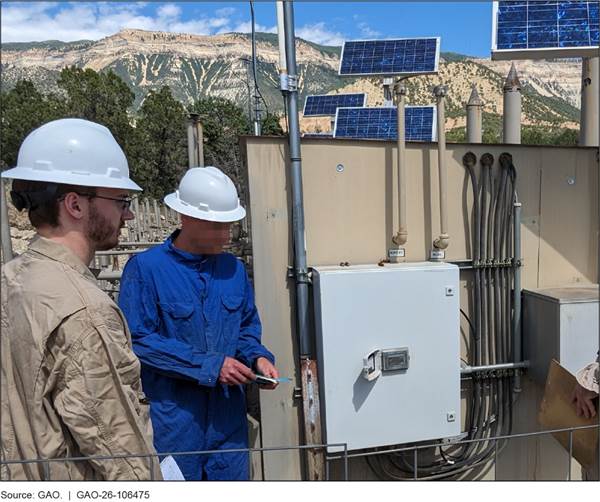
Second, BLM does not accept additional data on the heating value of natural gas. The heating value of natural gas is a key factor in determining the value of the natural gas and, therefore, the amount of royalties due to taxpayers. Data on heating value can be collected and transmitted using flow computers installed at some oil and gas wells. (See fig. 2.)
Figure 2: Flow Computer Capturing Data About Natural Gas Production at an Oil and Gas Well on Federal Land
Currently, BLM manually accepts heating value data on an as-needed basis for cases selected for production verification. BLM took steps to also automatically accept such data universally for all leases. Since 2019, federal regulations have required operators to submit these reports to BLM’s Gas Analysis Reporting and Verification System (GARVS) so that BLM could collect these data.[21]
However, BLM currently does not automatically accept these data because BLM has not put in place a data system to store these data from operators. This system has never been operational, and BLM has discontinued estimating when it will be.
BLM identified several benefits from universally accepting such data, including eliminating the need to request data for cases selected for production verification and potentially reducing the uncertainty of heating value measurements and potential errors in royalty payments. BLM would also be able to automatically compare these data to the heating value data that operators report, according to BLM officials. BLM’s ability to verify natural gas production from federal lands is therefore more time consuming and less effective than it would be if BLM were to automatically accept heating value data for all leases.
Interior Does Not Have a Strategy with Measurable Goals and Time Frames to Improve Oil and Gas Data Sharing
While we identified instances of new data-sharing capabilities, as stated above, we were unable to evaluate whether Interior had met its goals because Interior does not have a department-wide performance management strategy and has not established measurable performance goals or time frames. We have previously defined performance management as a three-step process by which organizations (1) set goals to identify the results they seek to achieve, (2) collect performance information to measure progress, and (3) use that information to assess results and inform decision-making.[22] A robust performance management strategy would lay out such goals, specific metrics to be used to measure progress, and a plan to collect and utilize information in pursuit of achieving the goals.
Interior does not have a robust performance management strategy to improve oil and gas data sharing. Interior’s 2020 Data Strategy and May 2023 Data Sharing Policy contain long-term strategic goals for data sharing, but do not contain time frames and measurable performance goals to track progress over time. In the 2020 strategy, Interior set a goal for all data to be findable, accessible, interoperable, and reusable, which the 2023 policy expanded to promote secure sharing of data to better inform decision-making. However, neither document details how Interior plans to assess its performance on improving data sharing for oil and gas or the metrics it would use to conduct such an assessment. The documents also do not contain specific time frames for identifying or completing improvements, conducting assessments, or collecting critical information. This is because at the time these documents were created, the OCIO set strategic priorities which Interior’s bureaus then implemented, according to OCIO officials.
Developing a performance management strategy that has measurable goals and time frames and that focuses on improving data sharing for oil and gas across Interior would provide greater assurance that the department is meeting its goals. A robust performance management strategy aimed at improving oil and gas data sharing across bureaus would help Interior better identify and pursue opportunities to improve data sharing across the department. Such a strategy would help Interior as it continues to invest in its data systems and develop more efficient business processes, including putting an end to its highly inefficient and error-prone manual processes. As a result, Interior could better meet the needs of businesses and tribal stakeholders through clearer communication and enhanced decision-making.
Interior Bureaus Have Not Followed Most Data-Sharing Documentation Requirements
The Interior bureaus responsible for managing onshore oil and gas activities have adhered to the technical requirements detailed in the OCIO’s May 2023 Data Sharing Policy but have not generally met the policy’s documentation requirements, according to our analysis of system documentation (see table 2). As stated previously, the technical requirements are aimed at ensuring that the data systems are set up with the capabilities to automatically share data with other systems. The documentation requirements are aimed at ensuring that decision-makers understand the categorization and usage of Interior data.
Table 2: Extent to Which Onshore Oil and Gas Bureaus Follow Requirements from the 2023 Data-Sharing Policy
|
Policy requirement |
Bureau of Land Management |
Bureau of Indian Affairs |
Office of Natural Resources Revenue |
|
Technical |
|
|
|
|
All data assets must be available to share, unless otherwise prohibited |
✔ |
✔ |
✔ |
|
New or modernizing IT systems must provide automated sharing capabilities |
✔ |
Not applicablea |
✔ |
|
Data systems must have and maintain data dictionaries |
✔ |
✔ |
✔ |
|
Documentation |
|
|
|
|
Bureaus must determine and document data categorizations and restrictions |
✔ |
✔ |
✔ |
|
The data-sharing agreement should include requirements for safeguarding controlled unclassified information |
✖ |
✖ |
✖ |
|
The data-sharing agreement should include requirements for protecting individual privacy and personally identifiable information |
✖ |
✖ |
✖ |
|
When sharing requires connecting IT systems, an Interconnection Security Agreement is required in addition to a data-sharing agreement |
✔ |
✔ |
✔ |
|
A signed data-sharing agreement is required for any ongoing data sharing that exchanges information beyond the system authorization boundaries. Existing agreements may stay in effect until they are modified or expire. |
✖ |
✖ |
✖ |
✔ = Aligns ✖ = Does not align
Source: GAO analysis of Interior data system documentation. | GAO‑26‑106475
Note: We examined system documentation for BLM’s Automated
Fluid Mineral Support System 2 and Mineral & Land Records System, BIA’s
Trust Asset and Accounting Management System, and ONRR’s Minerals Revenue
Management Support System.
aThe Bureau of Indian Affairs has not developed or modernized the IT
system we reviewed since the policy was established and is not required to have
automated sharing capabilities yet.
As shown in table 2, we found the bureaus’ existing documentation supporting data sharing generally does not include critical elements required by the Interior data-sharing policy. The existing documentation consists of the following:
· Onshore Energy and Mineral Lease Management Interagency Standard Operating Procedures detail what data must be shared among the bureaus; overall responsibilities for each bureau; which bureau has final responsibility for each necessary action; and information-sharing responsibilities, such as which agencies need to be informed of each step. The current procedures have been in place since 2013, with some amendments agreed to in 2022 and 2023.[23]
· Interconnection security agreements detail the security requirements to connect data systems. These agreements are critical to ensuring that information is appropriately protected when it is automatically shared between systems.[24] For example, there is one security agreement between BIA and ONRR that details security-specific requirements and responsibilities for both parties, such as how the system’s firewall will be opened, along with descriptions of the two systems to be connected. Interior’s interconnection security agreements are required to align with standards established by the National Institute of Standards and Technology and OCIO.
These existing documents are critical to managing Interior’s oil and gas data but do not sufficiently govern the exchange of data as prescribed in Interior’s data-sharing policy. As stated previously, the policy requires that data-sharing agreements include a discussion of the scope of the data sharing, data quality, authorized users of the data, training on the data’s usage, data retention, and data protection, among other things. Neither the standard operating procedures nor the interconnection security agreements fully cover these issues. Specifically, the operating procedures do not include details about data quality, how and when to share data, and data protection. The security agreements we reviewed do not provide detail about the data that will be shared between the documented systems or how the bureaus will use these data.
The bureaus we examined do not have data-sharing agreements related to onshore oil and gas in place, as they are required to by the OCIO’s May 2023 Data Sharing Policy. The Data Sharing Policy requires such agreements when exchanging data beyond the original system’s boundaries, except when the sharing requirements can be met with public data or the request is for specific data on a need-to-know basis. BIA and BLM reported that they did not have or were not aware of any relevant data-sharing agreements for oil and gas activities. ONRR referred to the standard operating procedures as its only data-sharing agreement. All three bureaus exchange data with another bureau across their systems and would be required to develop a data-sharing agreement for those exchanges.
In establishing the Data Sharing Policy, OCIO officials also created a guide in 2024 detailing when data-sharing agreements are necessary, including a template for agreements to follow. The guidance was communicated through the Data Governance Board and to leadership for each bureau. However, bureau officials we interviewed said that there were no plans to formalize new data-sharing agreements even though these are required, because the officials viewed the existing security agreements as sufficient. Without detailed documentation that meets the Data Sharing Policy’s requirements, Interior will be less able to protect and control its data, efficiently improve data sharing, and maximize the value and usage of the department’s data systems. In addition, formalizing agreements could help officials address manual processing of data and identify opportunities to automate the sharing of key department information.
Conclusions
Revenue from oil and gas production on federal lands and waters provides billions of dollars to the federal government and to states. Sharing data efficiently and accurately is essential to Interior and its bureaus’ ability to oversee oil and gas development. Interior has taken steps to improve data sharing, such as establishing requirements and responsibilities through policy and undertaking a large-scale consolidation of IT and other functions.
While Interior has taken these steps, the department does not have a performance management strategy to improve data sharing, hampering its ability to evaluate and measure progress toward this goal. Such a strategy could help the department coordinate investments across multiple data systems to address manual data processing and improve the ability to accept key data for oversight. Moreover, such a strategy could strengthen alignment across bureaus to ensure its components are working toward the same objectives.
Further, because Interior bureaus have not adhered to the department’s policy to formally document data-sharing agreements, the department increases the likelihood of risks that could compromise the security and privacy protection of its data. Interior has also missed opportunities to enhance accountability and data governance, address the challenges of manual processing, and create clear rules to allow for better collaboration and information flow.
Recommendations for Executive Action
We are making the following two recommendations to Interior:
The Secretary of the Interior should develop a department-wide performance management strategy with measurable goals and time frames to improve data sharing across oil and gas bureaus, including retirement of manual processes and the ability to electronically accept key data for oversight of oil and gas development. (Recommendation 1)
The Secretary of the Interior should ensure that bureau officials adhere to Interior policy to formally document data-sharing agreements. (Recommendation 2)
Agency Comments
We provided a draft of this report to the Secretary of the Interior for review and comment. Interior’s liaison to GAO stated in an email that Interior concurred with our recommendations. Interior also provided technical comments, which we incorporated as appropriate.
As agreed with your office, unless you publicly announce the contents of this report earlier, we plan no further distribution until 30 days from the report date. At that time, we will send copies of this report to the appropriate congressional committees, the Secretary of the Interior, and other interested parties. In addition, the report will be available at no charge on the GAO website at https://www.gao.gov.
If you or your staff have any questions about this report, please contact me at RuscoF@gao.gov. Contact points for our Offices of Congressional Relations and Public Affairs may be found on the last page of this report. GAO staff who made key contributions to this report are listed in appendix I.
Sincerely,

Frank Rusco
Director, Natural Resources and Environment
GAO Contact
Frank Rusco at RuscoF@gao.gov
Staff Acknowledgments
In addition to the contact named above, Quindi Franco (Assistant Director), Lee Carroll (Analyst in Charge), Adrian Apodaca, Alexis Hartranft, Gwen Kirby, Joshua Leiling, Mark Luth, Caitlin Scoville, and Robert Treadwell made key contributions to this report. Also contributing to this report were William Gerard, Cindy Gilbert, Jason Lee, Joseph Maher, Shannon Murphy, Susan Murphy, and Jerome Sandau.
The Government Accountability Office, the audit, evaluation, and investigative arm of Congress, exists to support Congress in meeting its constitutional responsibilities and to help improve the performance and accountability of the federal government for the American people. GAO examines the use of public funds; evaluates federal programs and policies; and provides analyses, recommendations, and other assistance to help Congress make informed oversight, policy, and funding decisions. GAO’s commitment to good government is reflected in its core values of accountability, integrity, and reliability.
Obtaining Copies of GAO Reports and Testimony
The fastest and easiest way to obtain copies of GAO documents at no cost is through our website. Each weekday afternoon, GAO posts on its website newly released reports, testimony, and correspondence. You can also subscribe to GAO’s email updates to receive notification of newly posted products.
Order by Phone
The price of each GAO publication reflects GAO’s actual cost of production and distribution and depends on the number of pages in the publication and whether the publication is printed in color or black and white. Pricing and ordering information is posted on GAO’s website, https://www.gao.gov/ordering.htm.
Place orders by calling (202) 512-6000, toll free (866) 801-7077,
or
TDD (202) 512-2537.
Orders may be paid for using American Express, Discover Card, MasterCard, Visa, check, or money order. Call for additional information.
Connect with GAO
Connect with GAO on X,
LinkedIn, Instagram, and YouTube.
Subscribe to our Email Updates. Listen to our Podcasts.
Visit GAO on the web at https://www.gao.gov.
To Report Fraud, Waste, and Abuse in Federal Programs
Contact FraudNet:
Website: https://www.gao.gov/about/what-gao-does/fraudnet
Automated answering system: (800) 424-5454
Media Relations
Sarah Kaczmarek, Managing Director, Media@gao.gov
Congressional Relations
David A. Powner, Acting Managing Director, CongRel@gao.gov
General Inquiries
[1]GAO, Oil and Gas: Interior Should Strengthen Management of Key Data Systems Used to Oversee Development on Federal Lands, GAO‑21‑209 (Washington, D.C.: May 27, 2021).
[2]U.S. Department of the Interior, Office of the Chief Information Officer, Data Sharing Policy (Washington, D.C.: May 8, 2023). The policy states that it does not apply to or supersede data-sharing agreements in place at the date of issuance of the policy.
[3]GAO, Oil and Gas: Bureau of Indian Affairs Could Improve Lease Management of Trust and Restricted Land, GAO‑25‑106307 (Washington, D.C.: Nov. 26, 2024).
[4]BIA conducts work related to two of the three business processes we selected: leasing and reviewing bonds. BLM conducts work related to all three selected business processes. ONRR conducts work related to two of the three business processes we selected: leasing and production verification.
[5]See, e.g., U.S. Department of the Interior, Onshore Energy and Mineral Lease Management Interagency Standard Operating Procedures (Sept. 23, 2013) and Attachment A - Addendum 2, Onshore Energy and Mineral Lease Management Interagency Standard Operating Procedures (Feb. 10, 2022).
[6]U.S. Department of the Interior, Information Management and Technology Strategic Plan FY 2024-2029 (Washington, D.C.: Dec. 18, 2023), and DOI Data Strategy (Washington, D.C.: June 6, 2020).
[7]ONRR’s collection and verification activities also apply to revenues due to Tribes and their citizens from production of oil and gas subject to Interior’s trust responsibility.
[8]In contrast to BLM, whose guidance requires regular bond reviews, BIA conducts bond reviews when triggered by particular events, such as a change in operators, according to BIA officials. In addition, BLM advises BIA on the adequacy of bond amounts, if requested, and evaluates a lessee’s reclamation activities before BIA can return the bond.
[9]These systems are also used for other business processes.
[10]As noted above, ONRR does not approve oil and gas leases. Instead, it records data about leases approved by BIA and issued by BLM.
[11]U.S. Department of the Interior, Information Management and Technology Strategic Plan FY 2024-2029 (Washington, D.C.: Dec. 18, 2023).
[12]U.S. Department of the Interior, Office of the Chief Information Officer, Data Sharing Policy (Washington, D.C.: May 8, 2023). The policy applies to sharing among all Interior bureaus and offices and to all of their Interior data assets, as well as to sharing with particular outside entities. It does not apply to or supersede data-sharing agreements already in place at the time of the policy, unless they expire or are revised. Some of the policy’s requirements, such as its requirement that new systems have automated data-sharing capabilities, apply only to data systems developed after the policy was issued in May 2023.
[13]Presidential Memorandum, “Hiring Freeze,” 90 Fed. Reg. 8247 (Jan. 28, 2025); Exec. Order 14210 of February 11, 2025, “Implementing the President’s “Department of Government Efficiency” Workforce Optimization Initiative,” 90 Fed. Reg. 9669 (Feb. 14, 2025); Office of Management and Budget and Office of Personnel Management, Guidance on Agency RIF and Reorganization Plans Requested by Implementing the President’s “Department of Government Efficiency” Workforce Optimization Initiative, Memorandum to Heads of Executive Departments and Agencies (Washington, D.C.: Feb. 26, 2025). Workforce reduction actions stemming from Executive Order 14210 are currently subject to a number of legal challenges. See, e.g., Am. Fed’n of Gov’t Emps. v. Trump, No. 3:25-cv-3698 (N.D. Cal.) (appealed No. 25-3293 (9th Cir.)); Nat’l Treasury Employees Union v. Trump, No. 1:25-cv-420 (D.D.C.).
[14]Exec. Order 14243 of March 20, 2025, Stopping Waste, Fraud, and Abuse by Eliminating Information Silos, 90 Fed. Reg. 13,681 (Mar. 25, 2025).
[15]Secretary of the Interior, U.S. Department of the Interior, Secretarial Order 3429 - Consolidation, Unification and Optimization of Administrative Functions (Washington, D.C.: Apr. 17, 2025). In addition to consolidating Interior’s IT functions within the Secretary’s office, the Secretary also planned to include human resources, financial management, training and development, international affairs, contracting, communications, federal financial assistance, and other unnamed administrative functions. As of August 2025, Interior had not completed this consolidation and did not have documentation describing the ongoing effort, according to agency officials.
[16]Bureau of Land Management, Oil and Gas Bonds Adequacy Reviews, I.M. No. 2024-014 (Feb. 7, 2024). Generally, the policy directs each BLM state office to oversee bond adequacy reviews for all federal oil and gas lease bonds in its portfolio over a 5-year period, with a phased fiscal year target for a percentage of the portfolio covered.
[18]BIA stated that although it uses documents outside TAAMS to track bonds, it maintains internal controls and periodic reviews to ensure data integrity. BIA also stated that the bureau is developing tracking tools for overseeing bonds. BIA also noted it has participated in interagency coordination efforts and that it is reviewing the May 2023 Data Sharing Policy guidance to align future agreements and support data-sharing agreements with tribes.
[19]In 2016, BLM issued final rules for site security, handling, and the measurement of oil and gas removed or sold from federal and Indian leases. Among other things, these rules regulate the oil and gas meters that determine royalty, which BLM calls facility measurement points. Bureau of Land Management, “Onshore Oil and Gas Operations; Federal and Indian Oil and Gas Leases; Site Security—Final rule,” 81 Fed. Reg. 81356 (Nov. 17, 2016) (codified at 43 C.F.R. pt. 3160 and pt. 3170, subpt. 3170, 3173); “Onshore Oil and Gas Operations; Federal and Indian Oil and Gas Leases; Measurement of Oil–Final rule” 81 Fed. Reg. 81462 (Nov. 17, 2016) (codified in 43 C.F.R. pt. 3170, subpt. 3174); and “Onshore Oil and Gas Operations; Federal and Indian Oil and Gas Leases; Measurement of Gas–Final rule,” 81 Fed. Reg. 81516 (Nov. 17, 2016) (codified at 43 C.F.R. pt. 3170, subpt. 3175).
[20]BLM’s 2016 regulations require oil and gas operators to submit measurement meter identification numbers electronically to BLM. 81 Fed. Reg. at 81427, 81428 (codified at 43 C.F.R. §§ 3173.10, 3173.12(e)). In 2017, BLM delayed implementation and enforcement for collecting and accepting these meter identification numbers, which it calls facility measurement point numbers, because of problems with the functionality of AFMSS 2. Bureau of Land Management, Partial Delayed Implementation of 43 CFR 3170 Regulations, I.M. No. 2017-032 (Jan. 17, 2017).
[21]81 Fed. Reg. 81516, 81591–92, 81614–29 (Nov. 17, 2016) (codified in relevant part at 43 C.F.R. §§ 3175.60, 3175.110, 3175.120). BLM has delayed enforcing its collection of heating value data through GARVS until the system is operational. See, e.g., Bureau of Land Management, Implementation of 43 CFR Subparts 3174 And 3175 And Gas Analysis Reporting and Verification System, Instruction Memorandum (IM) No. 2018-077 (June 29, 2018): and “Clarifying the Implementation of Certain BLM Oil and Gas Measurement Regulations—Proposed Notice to Lessees,” 89 Fed. Reg. 90037, 90038 (Nov. 14, 2024).
[22]GAO, Evidence-Based Policymaking: Practices to Help Manage and Assess the Results of Federal Efforts, GAO‑23‑105460 (Washington, D.C.: July 12, 2023).
[23]U.S. Department of the Interior, Onshore Energy and Mineral Lease Management Interagency Standard Operating Procedures (Sept. 23, 2013), Attachment A - Addendum 2, Onshore Energy and Mineral Lease Management Interagency Standard Operating Procedures (Feb. 10, 2022), and Attachment F – ver. 2, Bureaus and Offices Responsibilities and Procedures for IMDA Agreements (eff. Apr. 20, 2023).
[24]Interior provided two Interconnection Security Agreements relevant to our scope of oil and gas activities that documented the connection between BIA’s TAAMS and ONRR’s MRMSS systems and BLM’s MLRS and ONRR’s MRMSS systems, respectively.