
Report to the Ranking Member, Subcommittee on Interior, Environment, and Related Agencies, Committee on Appropriations, House of Representatives
United States Government Accountability Office
Nationwide Assessment and Strategy Needed to Enhance the Climate Resilience of Farms and Forests
A report to the Ranking Member; Subcommittee on Interior, Environment, and Related Agencies; House Committee on Appropriations
Contact: Steve Morris at morriss@gao.gov
What GAO Found
The U.S. Department of Agriculture (USDA) has taken few actions to enhance the resilience of farms and forests to the climate-related risks of diseases and pests, and funding and staffing supporting those actions have decreased. In late 2023, USDA officials told GAO that the risks of diseases and pests had not been fully integrated into the department’s climate resilience planning at all levels and that USDA planned to do so in the future. At that time, USDA provided limited information and technical assistance on individual diseases and pests to farmers and land managers. For example, USDA’s Climate Hubs provided some support for research on the effects of climate change on specific diseases and pests and developed models for forecasting potential outbreak risks, including the southern pine beetle. However, key programs that provide information and assistance to farmers and land managers to help manage the climate-related risks of diseases and pests—such as USDA’s Climate Hubs—have lost staff and face planned funding cuts. In April 2026, GAO requested updated information from USDA about the status and impact of these cuts, but the department did not provide the information.
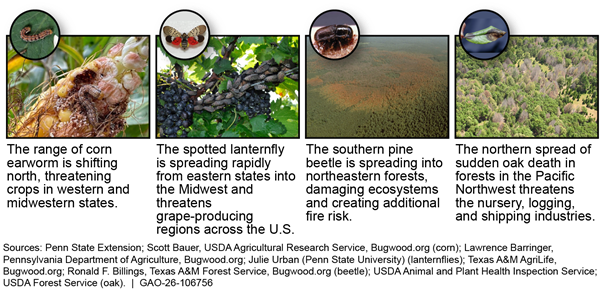
Development and implementation of a national strategy would help USDA enhance the resilience of farms and forests to the climate-related risks of diseases and pests, according to GAO’s analysis of relevant literature and interviews with knowledgeable stakeholders. A nationwide assessment to identify and assess these climate-related risks is a necessary first step to developing a national strategy to enhance resilience to diseases and pests. A national strategy, informed by a nationwide risk assessment, could help USDA direct its resources effectively to ensure that farmers and land managers get the information they need to enhance their resilience. It could also help limit federal fiscal exposure to climate-related risks to the federal crop insurance program and other disaster assistance appropriations. Further, a national strategy could inform congressional decision-making by identifying USDA’s capacity needs to ensure the strategy is implemented effectively.
Why GAO Did This Study
Diseases and pests have large economic impacts on U.S. natural resources—including agricultural lands and forests. From 1960 through 2020, invasive species, including diseases and pests, cost the U.S. agricultural and forestry sectors at least $550 billion.
According to experts, climate change will expand or shift the range of diseases and pests. This creates fiscal exposure—long-term costs and uncertainty regarding future spending—for federal crop insurance and disaster assistance programs. For example, the fiscal year 2024 Analytical Perspectives volume of the President’s Budget—the most recent analysis of the federal crop insurance program’s fiscal exposure to climate change—estimated the federal government could spend an additional $300 million to $2.2 billion annually on crop insurance payments because of changes in the climate.
GAO was asked to review federal efforts to enhance the resilience of farms and forests to climate-related risks of diseases and pests. This report examines (1) USDA’s efforts in this area and (2) options to enhance them.
GAO reviewed laws, regulations, and agency guidance related to diseases and pests; analyzed literature; interviewed 84 knowledgeable stakeholders including USDA, state, and local officials and academic researchers; and conducted site visits to eight states to observe the impacts of selected diseases and pests.
What GAO Recommends
GAO is recommending that USDA (1) conduct a nationwide assessment of the climate-related risks of agricultural and forest diseases and pests and (2) develop a strategy to manage identified risks. USDA did not provide a written response that either agreed or disagreed with the recommendations.
|
Abbreviations |
|
|
|
|
|
|
|
APHIS |
Animal and Plant Health Inspection Service |
|
|
USDA |
U.S. Department of Agriculture |
|
|
USFS |
U.S. Forest Service |
|
This is a work of the U.S. government and is not subject to copyright protection in the United States. The published product may be reproduced and distributed in its entirety without further permission from GAO. However, because this work may contain copyrighted images or other material, permission from the copyright holder may be necessary if you wish to reproduce this material separately.
September 2, 2026
The Honorable Chellie Pingree
Ranking Member
Subcommittee on Interior, Environment, and Related Agencies
Committee on Appropriations
House of Representatives
Dear Ranking Member Pingree:
Agricultural and forest diseases and pests have large negative impacts on our natural resources (e.g., agricultural lands, livestock, forests, and recreational areas). Conservatively, between 1960 and 2020, invasive species, including diseases and pests, cost the U.S. agricultural and forestry sectors at least $550 billion.[1]
According to the Fifth National Climate Assessment, climate change is slowing agricultural productivity and increasing agricultural vulnerability to diseases and pests.[2] For example, higher temperatures are projected to lead to greater disease and pest incidence, which disrupt crop growth, as well as the timing and effectiveness of agricultural management operations. According to a May 2022 U.S. Department of Agriculture (USDA) planning document, climate change will expand or shift the range of diseases and pests, increasing their ability to establish themselves in geographic areas not previously considered at risk.[3] According to USDA planning documents, disease and pest range expansion has already led to forest mortality, which presents capacity challenges for USDA and its state, local, tribal, industry, and other partners that manage diseases and pests as they address wide-ranging changes in the climate.[4]
Such changes in the climate create long-term costs and uncertainty regarding obligations or expectations for future federal spending, otherwise known as fiscal exposure, for USDA programs.[5] This is one of the reasons that Limiting the Federal Government’s Fiscal Exposure by Better Managing Climate Change Risks continues to be on our High Risk List.[6] Specifically, extreme weather events and outbreaks of agricultural diseases and pests create fiscal exposure for the federal crop insurance program, which insures most producers against catastrophic losses. They also create fiscal exposure for ad hoc agricultural disaster assistance programs funded through the Farm Bill or supplemental appropriations. For example, the Office of Management and Budget’s Analytical Perspectives of the President’s 2023, 2024, and 2025 budgets presented analyses of the federal government’s fiscal exposure to climate change in six sectors, including the federal crop insurance program.[7] According to the fiscal year 2024 Analytical Perspectives volume of the President’s Budget, by 2100, the federal government could spend an additional $300 million to $2.2 billion annually on crop insurance payments because of changes in the climate.[8]
You asked us to consider what actions USDA could take to enhance the climate resilience of farms and forests to plant diseases and pests.[9] This report examines (1) actions that USDA has taken to enhance the resilience of farms and forests to the climate-related risks of diseases and pests and (2) options available to USDA to further enhance the resilience of farms and forests to climate-related risks from agricultural and forest diseases and pests.
To examine actions USDA has taken to enhance the resilience of farms and forests to climate-related risks of diseases and pests, we reviewed USDA programs, tools, and policies for helping farmers and land managers enhance the resilience of farms and forests to the climate-related risks of diseases and pests. We did so by reviewing USDA documents, such as departmental and subagency climate adaptation and resilience planning documents, as well as relevant literature on the climate-related risks of diseases and pests from January 2005 through May 2026. We also selected three pests—corn earworm, southern pine beetle, and spotted lanternfly—and one disease—sudden oak death—to provide examples of the climate-related risks of diseases and pests and USDA efforts to help farmers and land managers enhance resilience to those risks. We selected these diseases and pests based on geographic diversity; economic and ecological impact on farms and forests; and associated climate-risks, among other factors. For the selected diseases and pests, we reviewed relevant literature. We also conducted site visits to California, Georgia, Maine, Massachusetts, New York, North Carolina, Oregon, and Pennsylvania to observe the impacts of the diseases and pests we selected. In addition, we interviewed 84 knowledgeable stakeholders, including USDA; tribal, state, and local officials; and nongovernmental stakeholders with experience in managing the spread of the selected diseases and pests at the local, regional, or national level, or who conducted research on managing these diseases and pests and their climate-related risks. Appendix I provides additional information on the impact of each disease and pests on farms and forests and the associated climate-related risks.
To examine the options available to USDA to further enhance the resilience of farms and forests to climate-related risks from agricultural and forest diseases and pests, we analyzed the results of our literature review and interviews with knowledgeable stakeholders. We also evaluated how policy options and activities for further federal action to improve USDA actions to enhance climate resilience of farms and forests align with GAO’s Disaster Resilience Framework. GAO developed the Disaster Resilience Framework to help those with federal oversight or management responsibilities identify opportunities to enhance federal disaster resilience efforts to limit federal fiscal exposure. We supplemented this analysis with our review of relevant literature and insights from the knowledgeable stakeholders we interviewed.[10] For additional details on the scope and methodology of our review, see appendix II.
We conducted this performance audit from March 2023 to September 2026 in accordance with generally accepted government auditing standards. Those standards require that we plan and perform the audit to obtain sufficient, appropriate evidence to provide a reasonable basis for our findings and conclusions based on our audit objectives. We believe that the evidence obtained provides a reasonable basis for our findings and conclusions based on our audit objectives.
Background
Impact of Selected Agricultural and Forest Diseases and Pests
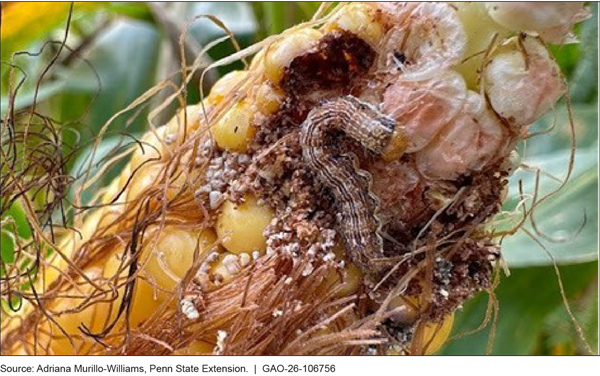
Diseases and pests are responsible for significant economic losses in the agricultural and forestry sectors. The three pests—corn earworm, southern pine beetle, and spotted lanternfly—and one disease—sudden oak death—we selected for our review are representative of these economic impacts (see app. I).[11] For example, corn earworm infestations alone resulted in $2.35 billion in losses in North America from 2021 through 2025, or approximately 10 percent of all corn crop losses caused by invertebrate pests during this period.[12] See figure 1.
In 2024, the Southeast experienced the largest southern pine beetle outbreak in the last 2 decades, with over 14,000 infestations impacting more than 30,000 acres of loblolly pine plantations.[13] Infestations in Alabama alone resulted in over $85 million in losses to the state’s economy.[14] See figure 2.
In 2019, researchers predicted that the spotted lanternfly would have an estimated annual economic impact of over $50 million on the state of Pennsylvania alone.[15] See figure 3.

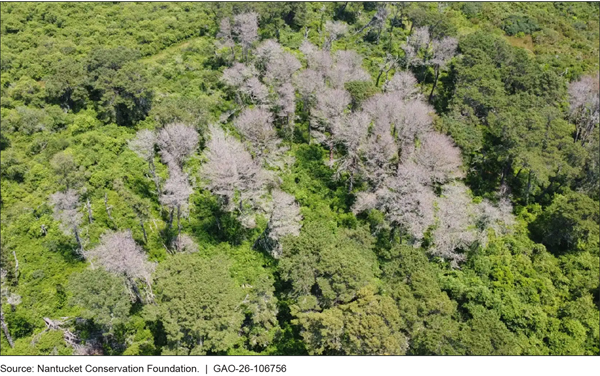
Management of sudden oak death in Oregon cost the federal government, state agencies, and private landowners more than $34 million from 2001 to 2021.[16] See figure 4.

Climate-Related Risks Associated with Agricultural and Forest Diseases and Pests
Climate-related risks from diseases and pests can include the expansion of their geographical range and an expansion of the timing and scale of disease outbreaks and pest infestations. These risks place additional pressures on disease and pest management. For example, as temperatures have increased, the southern pine beetle has spread from its traditional range in the southern and mid-Atlantic states to the Northeast and has been detected as far north as Maine.[17] The resulting increases in dead or damaged trees caused by the southern pine beetle and sudden oak death can leave forests vulnerable to future insect outbreaks and wildfires.[18] Additionally, with warmer winters, the corn earworm is showing up in larger numbers earlier in the growing season, making traditional pest management methods less effective.[19] As a result, farmers may have significant corn yield loss and may use more pesticides to mitigate increased populations of the corn earworm.[20] Table 1 provides additional information on the climate-related risks of the selected pests and disease. Appendix I provides additional details on the climate-related risks.
|
Disease or pest |
Overview |
Climate-related risks |
|
Corn earworm
|
Background: Most common native winged pest for field crops Hosts: Primarily sweet corn and other field crops (e.g., cotton, soybean, sorghum, and other vegetable crops) Location: Entire United States, migrating from south to north Impact: Estimated cause of the third-greatest corn yield loss of agricultural pests in 2024 by damaging over 47 million bushels of corna |
Changing migration patterns impacting new locations Increasing stress exerted by greater populations due to longer periods of activity Increasing pesticide resistance Surviving winters farther north due to warming temperatures |
|
Spotted lanternfly
|
Background: An invasive planthopper that feeds on a wide range of hosts, primarily affecting nursery operators and fruit growers Hosts: Primarily grapes and grapevines, as well as hops, stone fruits, and hardwood trees Location: As of 2026, a total of 19 states in the mid-Atlantic and Midwest and the District of Columbiab Impact: The Center for Rural Pennsylvania estimated that the expected annual direct economic impact of the spotted lanternfly on the state of Pennsylvania is $42.6 million. The spotted lanternfly also poses significant economic and environmental risk to California, which represents 76 percent of the U. S.’s grape industryc |
Increasing stress exerted by greater populations due to longer periods of activity Surviving winters farther north due to warming temperatures |
|
|
Background: A native bark beetle, the size of a grain of rice, that generally attacks in swarms to overcome tree chemical defenses and cause extensive mortality in pine forests Hosts: The beetle infests and kills southern yellow pine treesd Location: Ranging from southern to northeastern United States Impact: From 1998 to 2002, the last major recorded outbreak caused an estimated $1 billion in damage to forest land in the southern Appalachian Mountainse |
Later seasonal activity in the south Surviving winters further north due to warming temperatures |
|
|
Background: The water mold, phytophthora ramorum, is an invasive plant pathogen that causes the disease sudden oak death and was first reported in the United States in 1995 Hosts: Over 100 plant species, primarily tanoak and coastal live oak trees. The pathogen also impacts nursery and landscape plants Location: California and southern Oregon coasts Impact: Sudden oak death has gradually spread north and could have total economic impacts of up to $580 million on the timber and shipping industries, if it reaches Coos County in southwestern Oregonf |
Expanding northern range due to warm and wet weather conditions Increasing stress exerted by greater pressure due to longer periods of activities Increasing tree mortality, which contributes to hazardous wildfire conditions Disproportionately affecting tribal communities, where infected host species, such as tanoak and bay laurel trees, are culturally significant |


Sources: GAO analysis of information provided by U.S. Department of Agriculture (USDA), interview with experts, and relevant literature; Scott Bauer, USDA Agricultural Research Service, Bugwood.org (corn); Lawrence Barringer, Pennsylvania Department of Agriculture, Bugwood.org (lanternfly); Texas A&M AgriLife, Bugwood.org (beetle); and APHIS Guidance on Phytophthora Ramorum (leaf). | GAO‑26‑106756
aCrop Protection Network, Corn Invertebrate Loss Estimates from the United States and Ontario, Canada – 2024 (Feb. 2025).
bSpotted lanternfly populations are in the following 19 states and the District of Columbia: Connecticut, Delaware, Georgia, Illinois, Indiana, Kentucky, Maryland, Massachusetts, Michigan, New Jersey, New York, North Carolina, Ohio, Pennsylvania, Rhode Island, South Carolina, Tennessee, Virginia, and West Virginia.
cU.S. Department of Agriculture, 2022 Census of Agriculture, AC-22-A-51 (Feb. 2024); and California Department of Food and Agriculture, Plant Health and Pest Prevention Services Division, Action Plan for Spotted Lanternfly (Lycorma delicatula) (Apr. 2023).
dAccording to USDA, yellow pine trees include loblolly and shortleaf pines.
eJohn T, Nowak, James R. Meeker, David R. Coyle, Chris A. Steiner, and Cavell Brownie, “Southern Pine Beetle Infestations in Relation to Forest Stand Conditions, Previous Thinning, and Prescribed Burning: Evaluation of the Southern Pine Beetle Prevention Program,” Journal of Forestry, vol. 113 (2015).
fSee Oregon Department of Forestry, Sudden Oak Death: Economic Impact Assessment (Feb. 2019).
USDA Agencies and Offices Involved in Climate Resilience and Agricultural and Forest Diseases and Pests
Within USDA, the United States Forest Service’s (USFS) Forest Health Protection program and the Animal and Plant Health Inspection Service’s (APHIS) Plant Protection and Quarantine program have key roles in delivering information and assistance regarding the risk of agricultural and forest diseases and pests:
· The Forest Health Protection program provides technical assistance to farmers and land managers; conducts forest condition surveys; and shares expertise on disease and pests with tribal, state, and local officials. It also coordinates monitoring within USFS and among tribal, state, and local officials to assess future forest health risks posed by diseases and pests.[21]
· Similarly, the Plant Protection and Quarantine program aims to prevent the entrance, and limit the spread, of destructive diseases and pests by working with tribal, state, and local partners on efforts like verifying pest distribution, mitigating pathways for long-distance spread, and coordinating national disease and pest surveillance.
For fiscal year 2025, USDA’s budget actuals totaled $1.29 billion for APHIS’s overall Plant Health and Plant Pest and Disease Management and Disaster Prevention activities and USFS’s overall State, Private and Tribal Forestry activities, out of the department’s total of $227 billion budget actuals.[22]
USDA’s Climate Hubs also develop and deliver information and technologies on climate-related risks from diseases and pests to farmers and land managers to enable climate-informed decision-making.[23] USDA’s Climate Hubs are led and hosted by the Agricultural Research Service and Forest Service and are located in 10 U.S. regions and internationally: California, Caribbean, Midwest, Northeast, Northern Forests, Northern Plains, Northwest, Southeast, Southern Plains, Southwest, and International.
USDA Has Taken Few Actions to Enhance Resilience to the Climate-Related Risks of Diseases and Pests
USDA officials stated, and our research confirmed, that efforts to enhance the resilience of farms and forests to climate-related risks of diseases and pests were, and continue to be, a gap in the department’s overall climate resilience efforts. Specifically, in October 2023, USDA officials told us that the risks of diseases and pests had not been fully integrated into the department’s climate resilience planning at all levels but that USDA planned to do so in the future. At that time, USDA provided limited information and technical assistance on individual diseases and pests to farmers and land managers. For example, USDA’s Climate Hubs provided some support for research on the effects of climate change on specific diseases and pests and developed models for forecasting potential outbreak risks, including the southern pine beetle. USDA also had dedicated climate change coordinator roles in USDA’s Office of the Chief Economist and APHIS. In April 2026, we requested updated information from USDA on the department’s climate resilience planning and coordination efforts, but the department did not provide the information in response to our request.
The January 2025 Executive Order 14154 on Unleashing American Energy repealed past executive orders that prioritized climate resilience activities.[24] According to the President’s Budget for fiscal year 2027, USDA plans to propose eliminating over $300 million in appropriations for USFS’s State, Private and Tribal Forestry activities, which support programs that help land managers address climate-related risks by promoting forest health management.[25] USDA’s explanatory notes accompanying the President’s Budget for fiscal year 2027 also proposed cuts of $153 million from the Agricultural Research Service’s climate science research program and the department’s Climate Hubs.[26]
Further, in response to a July 2025 reorganization plan memo, USDA began reducing its number of staff, with more than 15,000 staff accepting deferred resignations or early retirement.[27] According to USDA officials, changes to the workforce also included the retirements or reassignments of lead climate change coordinators at the department level and within APHIS, and the coordinator of the Southern Pine Beetle Prevention Program at USFS. We asked USDA to provide updated information on the status and impact of proposed budget and staffing cuts to key programs and activities in our review, but the department did not provide the information in response to our request.
A National Assessment Could Help USDA Develop a Strategy to Address Climate-Related Risks from Diseases and Pests
According to our analysis and our Enterprise Risk Management Framework, a nationwide risk assessment to identify and assess the relative climate-related risks of diseases and pests is a necessary first step to inform the development of a national strategy to address such risks.[28] Through our review of relevant literature and interviews with stakeholders, development and implementation of a national strategy was identified as an important option for USDA to help enhance the resilience of farms and forests to climate-related risks from diseases and pests. In addition, such a strategy would be consistent with the principles in our October 2019 Disaster Resilience Framework.[29] In particular, the strategy would be consistent with the framework’s integration principle, which states that integrated analysis and planning can help decision-makers take coordinated and coherent climate resilience actions. For example, the framework states that integrating strategic resilience goals can help decision-makers work toward a common vision and help ensure a focus on a wide variety of opportunities to reduce risk—in this case, the climate-related risks of diseases and pests.
In a 2021 planning document, USDA recognized the importance of strategic planning for its climate resilience activities.[30] For example, the document highlighted the importance of collaboration across USDA’s subagencies and with state and local stakeholders to develop effective strategic plans that identify and prioritize investments to enhance resilience to climate-related risks. Similarly, our literature review and interviews with key stakeholders found that more proactive and coordinated federal assistance would make it easier for nonfederal partners, such as farmers and land managers, to pursue whole systems solutions to reduce the climate-related risks of diseases and pests to farms and forests.
As we reported in 2023, strategic planning can be a logical starting point for climate resilience activities.[31] Specifically, a robust strategic planning process that addresses regional needs through coordination within USDA, with farmers and land managers, and with other key stakeholders can help set priorities and get buy-in on policy choices designed to enhance climate resilience. Collaborative strategic planning can also help identify region-specific gaps in available information and technical assistance to, for example, farmers and land managers.[32] We also reported in our 2019 High Risk Update that, to reduce its fiscal exposure, the federal government needs a cohesive strategic approach, with strong leadership and the authority to manage climate change risks across the entire range of related federal activities, including federal support for climate resilience activities.[33]
In instances such as this, where different levels of government and multiple stakeholders are involved, our Disaster Resilience Framework can be applied to identify opportunities to address gaps in federal climate resilience efforts. The framework states that integrating strategic resilience goals can help decision-makers work toward a common vision and help ensure a focus on a wide variety of opportunities to reduce risk.[34] National strategies can also facilitate coordination and promote governance approaches that enhance the continuity of different efforts across jurisdictions.[35]
Our Enterprise Risk Management Framework sets forth a forward-looking management approach that allows agencies to assess threats and opportunities that could affect the achievement of their goals—in this case, USDA’s goal of limiting the risks of diseases and pests on crops and forests. The framework calls for agencies to identify and assess risks before selecting the most appropriate strategy to manage them.[36] In addition, our interviews with relevant stakeholders, and our analysis of relevant literature, identified a nationwide risk assessment of the relative risks of diseases and pests as a key activity that USDA should consider when developing a national strategy.
Our analysis identified four additional key activities that USDA could consider when developing a national strategy that could be informed by a nationwide risk assessment: (1) improve and coordinate monitoring and surveillance of diseases and pests; (2) incorporate climate information into modeling and projection data; (3) coordinate and expand education, outreach, and technical assistance; and (4) modify existing, or develop new, disease and pest management strategies. In April 2026, USDA officials identified department-wide and agency-specific actions consistent with the key activities we identified that could be leveraged to help develop a national strategy.
Details on conducting the nationwide risk assessment, associated key activities, and related USDA actions that could be leveraged, are presented below.
Conduct a Nationwide Risk Assessment, and Prioritize Activities to Enhance Resilience
A nationwide assessment of the economic and ecological risks at the farm, forest, and landscape scale to help identify diseases and pests that pose the greatest climate-related risks would help USDA prioritize its activities to enhance the resilience of farms and forests to those risks. For example, according to our analysis of relevant literature, USDA could fully incorporate vulnerability assessments that include climate-related risks from diseases and pests and relevant adaptation options in federal operations—such as national forest and park planning, landscape assessments, resource program strategies, and project design and mitigation. According to one study, combining broad-scale information from vulnerability assessments with land manager knowledge of the local landscape allows land managers to identify attributes of the property that increase or decrease risks from climate change.[37] Additionally, our analysis found that it is important to prioritize climate adaptation actions with the highest probability for success. This can be done by evaluating (1) the economic, ecological, and social consequences of specific disease and pest management actions; and (2) lessons learned from the success or failure of implemented actions.
Related USDA actions that could be leveraged. According to USDA officials, USDA supports risk assessment and prioritization for specific pests and diseases that are recognized as nationally significant.[38] For example, since 2010, USDA has supported multiple teams within USFS and APHIS to forecast common areas of the United States that might be suitable for establishment of Phytophthora ramorum, the causative agent of sudden oak death.[39] Additionally, USDA officials told us the department uses formalized risk assessment procedures to prioritize which diseases and pests to include on a list of priority pests for the department’s annual Cooperative Agricultural Pest Survey.[40]
Improve and Coordinate Monitoring and Surveillance of Diseases and Pests
Improved and coordinated monitoring and surveillance across federal agencies, extensions, and other key stakeholders would provide an early warning system for farmers and land managers to help intercept disease and pest establishment as their ranges expand or shift due to climate change. For example, according to one study, USDA could allocate resources effectively by using climate change information on diseases and pests to focus its monitoring and surveillance efforts at critical times and in places vulnerable to key species.[41] In addition, USDA could standardize data collected through coordinated monitoring efforts to better inform models and projections of climate-related disease and pest range shifts and behavioral changes.
Related USDA actions that could be leveraged. According to USDA officials, the department has partnered with states to monitor diseases and pests of regional and national significance and developed detection, survey, and support tools for national and state efforts to monitor and manage specific diseases and pests.[42] For example, APHIS’s Cooperative Agricultural Pest Survey program provides states with funding to survey pests, allowing the states to focus limited resources on those species considered as significant local concerns, according to USDA officials. USDA officials also told us that, since 1988, the Forest Service—in cooperation with Dartmouth University— has maintained a model that annually forecasts southern pine beetle activity to help identify vulnerable forests.
Incorporate Climate Information into Modeling and Projection Data
Incorporating climate information into disease and pest modeling and projection data would help provide information to farmers and land managers on disease and pest range shifts and expansion and their potential impact on vulnerable farms and forests. For example, to complement historical observation data for forecasting, USDA could research emerging information on climate-related ecological and behavioral changes to diseases and pests and integrate this information with precise climate data into models simulating their distribution and growth cycles.
Related USDA actions that could be leveraged. According to USDA officials, the department supports research to model the future range of diseases and pests based on current and projected future climate conditions.[43] For example, USFS developed models to predict the potential geographic range of the spotted lanternfly based on climate projections.[44] Additionally, USDA officials said the department provides a standardized federal framework that can be used for analyzing climate-driven disease and pest risks in the Forest Service’s Future of America’s Forests and Rangelands: Forest Service 2020 Resources Planning Act Assessment.[45] According to USDA officials, the assessment provides a nationally consistent analytical foundation for understanding how climate change is expected to affect forests, rangelands, and related natural resources.
Coordinate and Expand Education, Outreach, and Technical Assistance
The expansion and improved coordination of USDA’s education, outreach, and technical assistance efforts across subagencies, extensions, and other key stakeholders would help promote practices that enhance the climate resilience of farms and forests to diseases and pests. For example, USDA could identify knowledge gaps, update training, and invest in public education programs. Additionally, the department could increase collaboration with regional and local stakeholders to (1) build networks that enhance connectivity for farmers and land managers to share expertise; and (2) develop consistent messaging on understanding the climate-related risks of diseases and pests, with actionable strategies to manage them.
Related USDA actions that could be leveraged. According to USDA officials, the department has coordinated education, outreach, and technical assistance through its Climate Hubs. For example, USDA officials said that since 2020, with support from university partners, the Southeast Climate Hub delivered 56 presentations, two podcasts, 10 trainings, and three Emerging Forest Threats Factsheets that focused on, or contained significant information about, the southern pine beetle.
Modify Existing, or Develop New, Disease and Pest Management Strategies
Modifying existing management strategies, or developing new ones, would help farmers and land managers enhance the climate resilience of farms and forests to diseases and pests. For example, USDA could improve efforts to provide farmers and land managers with resources and tools to prevent pesticide resistance and to better manage pests by implementing or modifying integrated pest management practices that address climate-affected pest migration, detection, response, and control.[46] USDA could also promote adaptation strategies that increase the crop, species, and genetic diversity to increase farm and forest resilience to climate-related risks from diseases and pests.
Related USDA actions that could be leveraged. According to USDA officials, USDA supports the development and implementation of integrated management strategies for diseases and pests by coordinating APHIS, Agricultural Research Service, and USFS’s suppression and management programs for specific diseases and pests.[47] For example, USDA officials said that USDA’s largest and most successful coordinated integrated management program is the Slow the Spread program for suppression and management of the spongy moth.[48] However, USDA officials told us that there is a need to modify and adapt current management practices to meet the demands imposed by altered forest and climatic conditions.[49]
According to our analysis using the 2019 Disaster Resilience Framework, conducting a nationwide risk assessment to inform the development and implementation of a national strategy to enhance the resilience of farms and forests in the United States to the climate-related risks of diseases and pests could help limit federal fiscal exposure. Further, by leveraging the related actions noted above to conduct an assessment, USDA could identify what additional capacity, if any, would be necessary to effectively implement a national strategy. It could also inform congressional decisions regarding future legislative efforts to help farmers and land managers enhance the resilience of farms and forests to agricultural and forest diseases and pests.
Conclusions
Damage to farms and forests due to diseases and pests costs the U.S. economy billions of dollars annually. According to USDA planning documents and the Fifth National Climate Assessment, climate change will shift and expand the range of diseases and pests, and the size and scale of infestations will increase as diseases and pests infest farms and forests earlier in the growing season and persist later into the fall and winter. This creates a growing fiscal exposure to the federal government through the federal crop insurance program and other supplemental appropriations.
Enhancing the resilience of farmers and land managers to climate-related risks from diseases and pests was a gap in USDA climate resilience programs even before the recent deemphasis on such programs. By leveraging and building upon related USDA actions to conduct a nationwide assessment of these risks, followed by the development and implementation of a national strategy to manage them, USDA could effectively direct its efforts to enhance the resilience of farms and forests to the climate-related risks of diseases and pests. An assessment that includes key activities, such as coordinated monitoring and surveillance of diseases and pests, could provide a starting point for the strategy’s design. A national strategy could also inform congressional decision-making by identifying additional capacity necessary to ensure that the strategy is implemented effectively and that farmers and land managers get the information and assistance they need to enhance their resilience and help reduce federal fiscal exposures to changes in the climate.
Recommendations for Executive Action
We are making the following two recommendations to USDA:
The Secretary of Agriculture should, in consultation with stakeholders across the agricultural and land management communities, leverage and build upon related departmental actions to conduct a nationwide risk assessment of the climate-related risks of agricultural and forest diseases and pests. (Recommendation 1)
The Secretary of Agriculture should, in consultation with stakeholders across the agricultural and land management communities, develop a strategy to manage any identified climate-related risks of agricultural and forest diseases and pests identified in the nationwide risk assessment. (Recommendation 2)
Agency Comments
We provided a draft of this report to the Secretary of Agriculture for review and comment. USDA did not provide a written response that either agreed or disagreed with the findings of this report. USDA provided technical comments which we incorporated as appropriate.
As agreed with your office, unless you publicly announce the contents of this report earlier, we plan no further distribution until 29 days from the report date. At that time, we will send copies to the appropriate congressional committees, the Secretary of the Department of Agriculture, and other interested parties. In addition, the report will be available at no charge on the GAO website at http://www.gao.gov.
If you or your staff have any questions about this report, please contact me at MorrisS@gao.gov. Contact points for our Offices of Congressional Relations and Media Relations may be found on the last page of this report. GAO staff who made significant contributions to the report are listed in appendix III.
Sincerely,

Steve Morris
Director, Natural Resources and Environment
The following graphics provide additional details on the background and climate change risks of the three pests—corn earworm, southern pine beetle, and spotted lanternfly—and one disease—sudden oak death—we selected for our review.
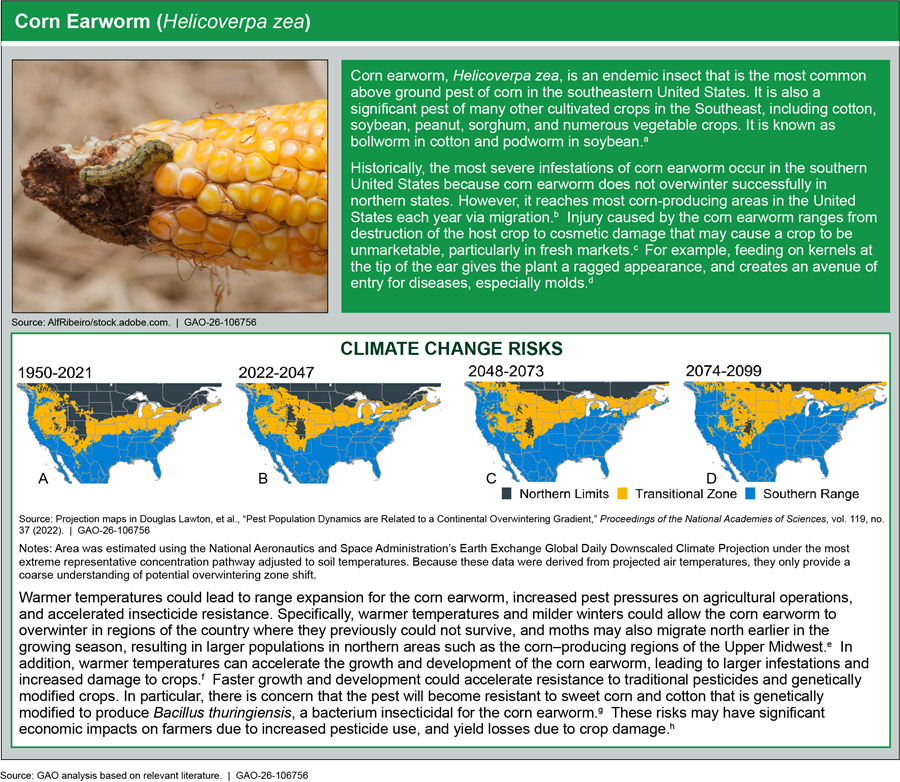
aTim Bryant and Frances P.F. Reay-Jones, “Corn Earworm as a Pest of Field Corn,” Land-Grant Press by Clemson University Cooperative Extension Service, LGP 1117 (2021) and A.C. Morey, W.D. Hutchison, R.C. Venette, and E.C. Burkness, “Cold Hardiness of Helicopverpa zea (Lepidoptera: Noctuidae) Pupae,” Environmental Entomology, vol. 41 no. 1 (2012).
bBryant and Reay-Jones, “Corn Earworm as a Pest of Field Corn.”
c“Corn Earworm,” Crop Science Extension and Outreach, University of Illinois, Department of Crop Sciences, accessed March 11, 2026, http://extension.cropsciences.illinois.edu/fieldcrops/insects/corn_earworm/.
dAshleigh Faris and Maxwell Smith, “Timely Scouting and Management Considerations for Corn Earworms,” Oklahoma State University Extension, EPP-25-28 (Stillwater, OK: May 2025).
eSilvana V. Paula-Moreas et al., “Continental-scale Migration Patterns and Origin of Helicoverpa zea (Lepidoptera: Noctuidae) Based on a Biogeochemcial Marker,” Environmental Entomology, vol. 53, no. 3 (2024); and Douglas Lawton et al., “Pest Population Dynamics Are Related to a Continental Overwintering Gradient,” Proc. Natl. Acad. Sci., vol.119, no. 37 (2022).
fLawton et al., “Pest Population Dynamics.”
gP. Dilip Venugopal and G.P. Dively, “Climate Change, Transgenic Corn Adoption and Field-evolved Resistance in Corn Earworm,” Royal Society Open Science, vol. 4, no.170210 (2017).
hNoah S. Diffenbaugh, Christian H. Krupke, Michael A. White, and Corinne E. Alexander, “Global Warming Presents New Challenges for Maize Pest Management,” Environmental Research Letters, vol. 3, no. 044007 (2008).
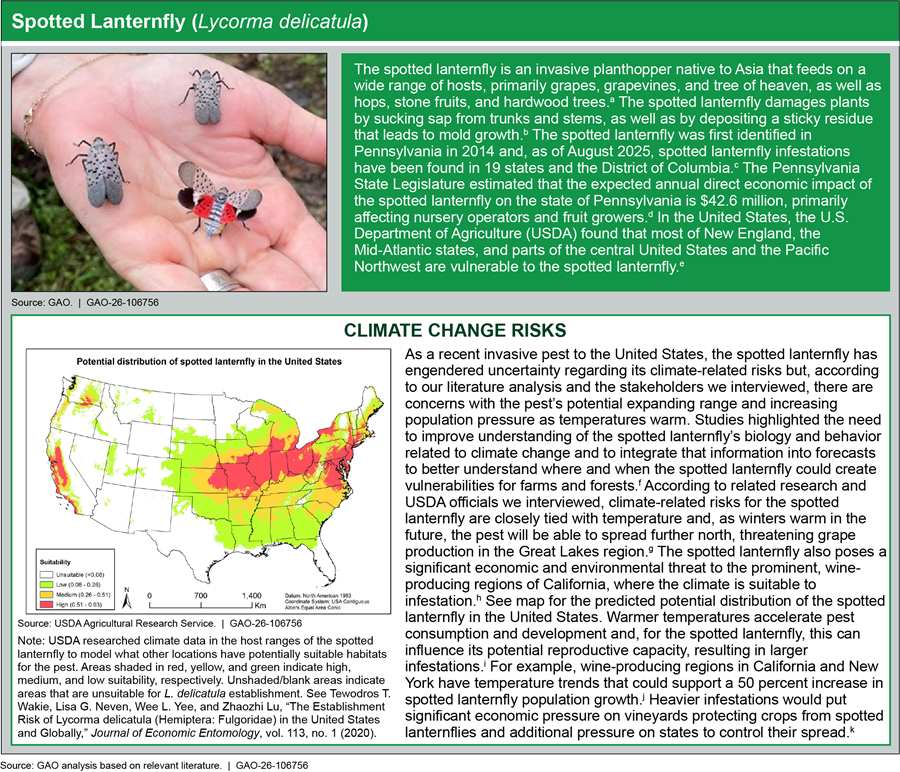
a“Spotted Lanternfly,” Plant Pests and Diseases, U.S. Department of Agriculture, last modified Aug. 26, 2025, https://www.aphis.usda.gov/plant-pests-diseases/slf and Julie M. Urban and Heather Leach, “Biology and Management of the Spotted Lanternfly, Lycorma delicatula (Hemiptera: Fulgoridae), in the United States,” Annual Review of Entomology, vol 68 (2023). Tree of heaven (Ailanthus altissima) is an invasive, rapidly growing, deciduous tree that occurs in 42 states ranging from Maine, south to Florida, and west to California. “Tree of Heaven,” Shenandoah National Park, U.S. National Park Service, accessed August 22, 2025, https://www.nps.gov/shen/learn/nature/tree-of-heaven.htm.
bAllan F. Pinto, Brian C. Eshenaur, Flor E. Acevedo, Alejandro A. Calixto, Michela Centinari, and Miguel I. Gómez, “Assessing the Potential Economic Impacts of Spotted Lanternfly (Hemiptera: Fulgoridae) Infestations on Grape Production in New York State,” Journal of Integrated Pest Management, vol. 16, no. 1 (Dec. 2024).
c“Spotted Lanternfly,” Plant Pests and Diseases, U.S. Department of Agriculture, last modified August 26, 2025, https://www.aphis.usda.gov/plant-pests-diseases/slf.
dJayson K. Harper, William Stone, Timothy W. Kelsey, Lynn F. Kime, and Pennsylvania State University, Potential Economic Impact of the Spotted Lanternfly on Agriculture and Forestry in Pennsylvania (Harrisburg, PA.: The Center for Rural Pennsylvania, Dec. 2019).
eTewodros T. Wakie, Lisa G. Neven, Wee L. Yee, and Zhaozhi Lu, “The Establishment Risk of Lycorma delicatula (Hemiptera: Fulgoridae) in the United States and Globally,” Journal of Economic Entomology, vol. 113, no. 1 (2020): 306-314.
fStephanie M. Lewkiewicz, Benjamin Seibold, and Matthew R. Helmus, “Quantifying Population Resistance to Climatic Variability,” Ecological Modeling, vol. 297 (2024); Chris Jones, et al., “Spotted Lanternfly Predicted to Establish in California by 2033 Without Preventative Management,” Communications Biology, vol. 5, no. 558 (2022); and Melody Keena, George Hamilton, and Devin Kreitman, “The Potential Climatic Range of Spotted Lanternfly May Be Broader Than Previously Predicted,” Frontiers in Insect Science, vol. 3 (2023).
gSee Lewkiewicz, Seibold, and Helmus, “Quantifying Population Resistance to Climatic Variability”; and Pinto, Eshenaur, Acevedo, Calixto, Centinari, and Gómez, “Assessing the Potential Economic Impacts of Spotted Lanternfly Infestations.”
hCalifornia wine-producing regions represent 76 percent of the U.S. grape industry. California Department of Food and Agriculture, Plant Health and Pest Prevention Services Division, Action Plan for Spotted Lanternfly (Lycorma delicatula) (Apr. 2023); U.S. Department of Agriculture, 2022 Census of Agriculture, AC-22-A-51 (Feb. 2024); Jones, et al., “Spotted Lanternfly Predicted to Establish in California by 2033 Without Preventative Management;” and Lewkiewicz, Seibold, and Helmus, “Quantifying Population Resistance to Climatic Variability.”
iLéonard Schneider, Martine Rebetez, and Sergio Rasmann, “The Effect of Climate Change on Invasive Crop Pests Across Biomes,” Current Opinion in Insect Science, vol. 50, no. 100895 (Feb. 2022); Sandra Skendžić, Monika Zovko, Ivana Pajač Živković, Vinko Lešić and Darija Lemić, “The Impact of Climate Change on Agricultural Insect Pests,” Insects, vol. 12, no. 440 (May 2021); and Lewkiewicz, Seibold, and Helmus, “Quantifying Population Resistance to Climatic Variability.”
jLewkiewicz, Seibold, and Helmus, “Quantifying Population Resistance to Climatic Variability.”
kYi Yang et al., “Climate Change Exacerbates the Environmental Impacts on Agriculture,” Science, vol. 385 (Sept. 2024); Pinto, Eshenaur, Acevedo, Calixto, Centinari, and Gómez, “Assessing the Potential Economic Impacts of Spotted Lanternfly (Hemiptera: Fulgoridae) Infestations”; and Harper et al., Potential Economic Impact of the Spotted Lanternfly..
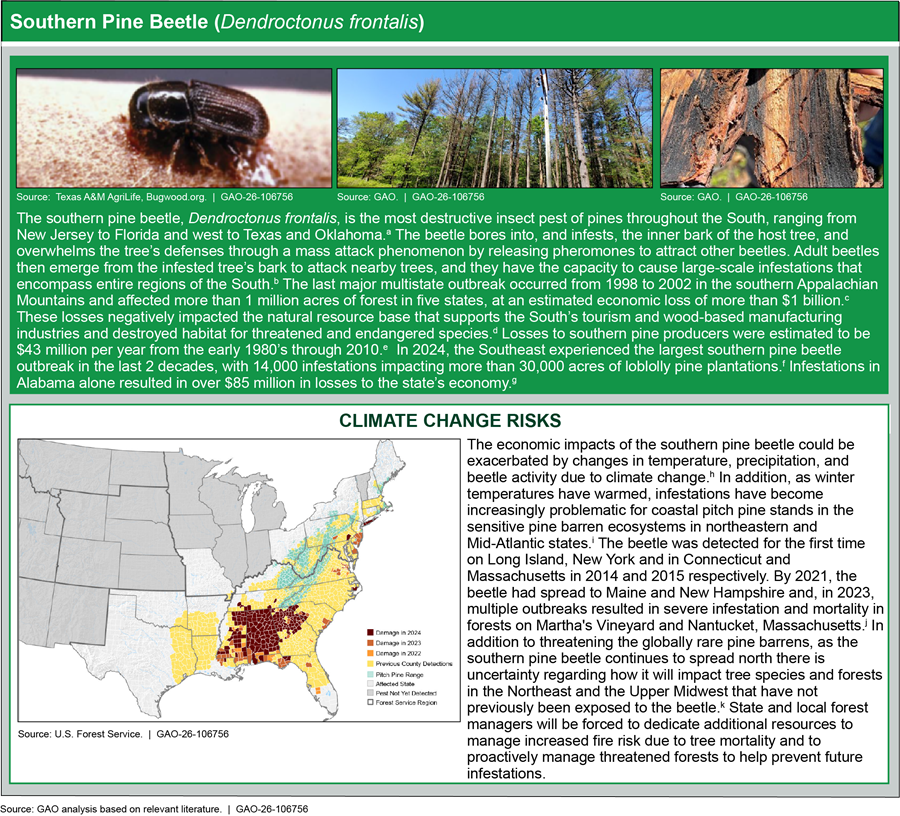
aJohn Nowak, Christopher Asaro, Kier Klepzig, and Ronald Billings, “The Southern Pine Beetle Prevention Initiative: Working for Healthier Forests.” Journal of Forestry (July/Aug. 2008).
bU.S. Forest Service, Southern Pine Beetle II (Asheville, NC: Sept. 2011).
cJohn T. Nowak, James R. Meeker, David R. Coyle, Chris A. Steiner, and Cavell Brownie, “Southern Pine Beetle Infestations in Relation to Forest Stand Conditions, Previous Thinning, and Prescribed Burning: Evaluation of the Southern Pine Beetle Prevention Program,” Journal of Forestry vol. 113 no. 15-002 (2015).
dNowak, Asaro, Klepzig, and Billings, “The Southern Pine Beetle Prevention Initiative.”
eNowak, Meeker, Coyle, Steiner, and Brownie, “Southern Pine Beetle Infestations.”
fU.S. Forest Service, Southern Pine Beetle Information Center, Southern Pine Beetle Status (Clemson, SC: May 2025).
gAlabama Forestry Commission, Financial Relief from Southern Pine Beetle Damage for Forestland Owners in All Alabama Counties, (Montgomery, AL: Sept. 30, 2024).
hElizabeth-Ann K. Jamison, Anthony D’Amato, and Kevin Dodds, “Informing Adaptive Forest Management: A Hazard Rating Tool for Southern Pine Beetle Dendroctonus Frontalis in Pitch Pine Barrens,” Agricultural and Forest Entomology, vol. 24 (2022).
iCorey Lesk, Ethan Coffel, Anthony W. D’Amato, Kevin Dodds, and Radley Horton, “Threats to North American Forests from Southern Pine Beetle with Warming Winters,” Nature Climate Change, vol. 7 (2017): 713-717. The Atlantic Coastal Pine Barrens is a disjunct ecoregion covering approximately 6,200 square miles of the coastal plain of New Jersey; Long Island in New York; and Cape Cod, Martha’s Vineyard, and Nantucket in Massachusetts, as well as nearby islands. Pitch pine is often the dominant tree species in the pine barren ecosystem.
jKevin J. Dodds et al. “Expansion of Southern Pine Beetle into Northeastern Forests: Management and Impact of a Primary Bark Beetle in a New Region,” Journal of Forestry, vol. 16 no. 2 (2018); and “Southern Pine Beetle,” University of Massachusetts Amherst, Center for Agriculture, Food, and the Environment, last modified Mar. 29, 2024, https://www.umass.edu/agriculture-food-environment/landscape/fact-sheets/southern-pine-beetle; and Caroline R. Kanaskie, Thomas C. Schmeelk, Jessica A. Cancelliere, and Jeff R. Garnas, “New Records of Southern Pine Beetle (Dendroctonus frontalis Zimmermann; Coleoptera: Curculionidae) in New York, New Hampshire, and Maine, USA Indicate Northward Range Expansion,” The Coleopterists Bulletin, vol. 77, no. 2 (June 2023).
kDodds et al. “Expansion of Southern Pine Beetle into Northeastern Forests;” and Lesk, Coffel, D’Amato, Dodds, and Horton, “Threats to North American Forests.”

a“Phytophthora ramorum,” Plant Pests and Diseases, U.S. Department of Agriculture, last modified August 29, 2025, https://www.aphis.usda.gov/plant-pests-diseases/pramorum.
bOregon Department of Forestry, Forest Facts: Sudden Oak Death (Phytophthora Ramorum) (Nov. 2023).
cOregon Department of Forestry, Sudden Oak Death: Economic Impact Assessment (Feb. 2019). Several Tribes contributed information to this report about the potential cultural impacts of sudden oak death.
dOregon Department of Forestry, Sudden Oak Death: Economic Impact Assessment; and California Environmental Protection Agency, Office of Environmental Health Hazard Assessment, “Impacts on Tribes,” in Indicators of Climate Change in California, 4th ed. (Nov. 2022).
eJohn T. Kliejunas, A Risk Assessment of Climate Change and the Impact of Forest Diseases on Forest Ecosystems in the Western United States and Canada, General Technical Report, PSW-GTR-236 (Albany, CA: U.S. Department of Agriculture, Forest Service, Dec. 2011).
fSee Oregon Department of Forestry, Sudden Oak Death: Economic Impact Assessment. The study estimated that Oregon’s economy could lose more than $580 million in wages in the logging and shipping industries if sudden oak death reaches the Coos Bay area in Coos County.
gHexon Angel Contreras-Cornejo, John Larsen, Sylvia Patricia Fernández-Pavía, and Ken Oyama, “Climate Change, a Booster of Disease Outbreaks by the Plant Pathogen Phytophthora in Oak Forests,” Rhizosphere, vol. 27 (2023).
hCalifornia Environmental Protection Agency, Office of Environmental Health Hazard Assessment, “Forest Tree Mortality,” in Indicators of Climate Change in California, 4th ed. (Nov. 2022); and John T. Kliejunas, A Risk Assessment of Climate Change and the Impact of Forest Diseases on Forest Ecosystems in the Western United States and Canada (Dec. 2011).
This report examines (1) actions that the U.S. Department of Agriculture (USDA) has taken to enhance the resilience of farms and forests to the climate-related risks of diseases and pests and (2) options available to USDA to further enhance the resilience of farms and forests to climate-related risks from agricultural and forest diseases and pests.[50]
We began our work in March 2023, and USDA programs subsequently underwent substantial changes during our review. We experienced significant delays as we revisited, reanalyzed, and refocused the work, as needed, to reflect current events, including an examination of changes to USDA’s funding levels in 2025 and 2026. During this engagement, USDA was intermittently slow to respond to our requests for information and, in some instances, did not provide the information we requested. For example, we asked USDA to provide updated information on the status and impact of proposed budget and staffing cuts to key programs and activities in our review, and USDA did not provide the information in response to our request. While a response would have provided additional context, this action did not affect our ability to develop the findings and recommendations included in this report.
To describe USDA’s actions to enhance the resilience of farms and forests to climate-related risks from diseases and pests, we reviewed federal laws, regulations, and guidance from USDA on agricultural and forest diseases and pests. We reviewed departmental documents related to USDA’s resilience programs, tools, and policy. For example, we reviewed USDA’s 2021 Action Plan for Climate Adaptation and Resilience and USDA’s 2024–2027 Climate Adaptation Plan.[51] We also reviewed subagency climate adaptation plans developed by the Animal and Plant Health Inspection Service and the U.S. Forest Service in July 2022. We reviewed the department’s website as of May 2026 for current information on USDA’s efforts to research and promote the use of climate-resilient agricultural and forestry practices.
We also selected one disease, sudden oak death, and three pests—corn earworm, southern pine beetle, and spotted lanternfly—to provide examples of the climate-related risks of individual diseases and pests and to describe USDA’s efforts to enhance the resilience of farms and forests to those risks. We selected these diseases and pests based on whether they impact forests, crops, or both; if they were invasive or endemic diseases and pests; if they had significant or uncertain economic or ecological impacts; and geographic diversity. For the selected diseases and pests, we reviewed available research on the potential climate-related impacts and how to enhance resilience to those potential impacts. We also conducted site visits to California, Georgia, Maine, Massachusetts, New York, North Carolina, Oregon, and Pennsylvania to observe the impacts of the selected diseases and pests.
In addition, we interviewed a total of 84 knowledgeable stakeholders. These included 47 knowledgeable tribal, USDA, state, and local governmental officials, including entomologists, climate scientists, and foresters with experience managing the spread of the selected diseases and pests at the local, regional, or national level, or who conducted research on their management and the associated climate-related risks. The remaining 37 were knowledgeable nongovernmental stakeholders, including academic researchers, agricultural extension agents, farmers, and foresters with experience managing the spread of the selected diseases and pests at the local or regional level, or who conducted research on their management and the associated climate-related risks.
To identify and examine policy options and related key activities available to USDA to further enhance the resilience of farms and forests to climate-related risks from diseases and pests, we first used multiple strategies to search for relevant literature or congressional legislation.
· To identify reports and any legislation that proposed or described potential options, we conducted a literature search for reports published from January 2010 through July 2024 on agricultural and forestry diseases and pests and climate resilience, or that described related options and key activities. For example, we included literature examining the integration of climate resilience into agencies and key programs that provide outreach and assistance to farmers and land managers on diseases and pests. We supplemented the literature search with referrals from the knowledgeable governmental and nongovernmental stakeholders we interviewed on the climate-related risks of the individual diseases and pests we selected.
· To conduct the literature search, we used databases (e.g., ProQuest, Elsevier Scopus, EconLit, and PolicyFile) using strategies including searching for relevant key words (e.g., agriculture, forestry, climate resilience, diseases, and pests) and preliminary background research. We identified an initial set of studies and then, among other things, examined their citations to find additional studies. We selected the studies for review that were most relevant to our work. The preliminary searches for background literature included the Congressional Research Service’s report database, the Congressional Budget Office’s website, GAO’s product page, the USDA Inspector General’s website, Congress.gov, and more general internet searches using relevant key words.
· The literature search identified 114 potentially relevant sources. After a more detailed review of these relevant sources from the literature review and other sources identified later in our research, we determined that 88 sources had examples of potential policy options or key activities that USDA could use to help enhance the resilience of farms and forests to climate-related risks from diseases and pests.
We then distilled examples from relevant literature into a preliminary list of policy options and key activities. For our purposes, we focused on options and key activities available to USDA to enhance the resilience of farms and forests to diseases and pests. To identify policy options and key activities from the literature, we analyzed the content of the 88 relevant sources in greater detail, and we recorded and categorized information about the examples of options and key activities. We supplemented this information with options and activities identified in our interviews with USDA; tribal, state, and local officials; and with other key stakeholders for the selected diseases and pests described above. We then distilled the examples into a preliminary list of one policy option — a national strategy to address the climate-related risks of disease and pests on farms and forests — and five related key activities, including a nationwide risk assessment.
To determine whether the option and related activities we identified could enhance the resilience of farms and forests to the climate-related risks of diseases and pests, we compared the option with USDA’s current climate resilience efforts and the integration subprinciple in GAO’s Disaster Resilience Framework. This subprinciple states that the integration of strategic resilience goals across relevant national strategies can help decision-makers work toward a common vision and help ensure a focus on a wide variety of opportunities to reduce climate change risks.[52]
We conducted this performance audit from March 2023 to September 2026 in accordance with generally accepted government auditing standards. Those standards require that we plan and perform the audit to obtain sufficient, appropriate evidence to provide a reasonable basis for our findings and conclusions based on our audit objectives. We believe that the evidence obtained provides a reasonable basis for our findings and conclusions based on our audit objectives.
GAO Contact
Steve Morris, MorrisS@gao.gov
Staff Acknowledgments
In addition to the contact named above, Joseph Thompson (Assistant Director), Micah McMillan (Analyst in Charge), Kala Amos, Carolyn Blocker, and Sara Sullivan made key contributions to this report. Also contributing to this report were Kevin Bray, Mark Braza, Tara Congdon, Tom Cook, Jonathan Dent, David Dornisch, Holly Halifax, Katie Hoover, Mae Jones, Rob Letzler, Joe Maher, Matt McLaughlin, Krista Osmundsen, Mike Smith, Craig Starger, and Kelly Troutman.
The Government Accountability Office, the audit, evaluation, and investigative arm of Congress, exists to support Congress in meeting its constitutional responsibilities and to help improve the performance and accountability of the federal government for the American people. GAO examines the use of public funds; evaluates federal programs and policies; and provides analyses, recommendations, and other assistance to help Congress make informed oversight, policy, and funding decisions. GAO’s commitment to good government is reflected in its core values of accountability, integrity, and reliability.
Obtaining Copies of GAO Reports and Testimony
The fastest and easiest way to obtain copies of GAO documents at no cost is through our website. Each weekday afternoon, GAO posts on its website newly released reports, testimony, and correspondence. You can also subscribe to GAO’s email updates to receive notification of newly posted products.
Order by Phone
The price of each GAO publication reflects GAO’s actual cost of production and distribution and depends on the number of pages in the publication and whether the publication is printed in color or black and white. Pricing and ordering information is posted on GAO’s website, https://www.gao.gov/ordering.htm.
Place orders by calling (202) 512-6000, toll free (866) 801-7077,
or
TDD (202) 512-2537.
Orders may be paid for using American Express, Discover Card, MasterCard, Visa, check, or money order. Call for additional information.
Connect with GAO
Connect with GAO on X,
LinkedIn, Instagram, and YouTube.
Subscribe to our Email Updates. Listen to our Podcasts.
Visit GAO on the web at https://www.gao.gov.
To Report Fraud, Waste, and Abuse in Federal Programs
Contact FraudNet:
Website: https://www.gao.gov/about/what-gao-does/fraudnet
Automated answering system: (800) 424-5454
Media Relations
Sarah Kaczmarek, Managing Director, Media@gao.gov
Congressional Relations
David A. Powner, Acting Managing Director, CongRel@gao.gov
General Inquiries
[1]Robert C. Ornelas et al., “Economic Costs of Biological invasions within North America,” NeoBiota, vol. 67 (July 29, 2021); and Jean E. Fantle-Lepczyk et al., “Economic Costs of Biological Invasions in the United States,” Science of the Total Environment, vol. 806, Part 3 (Feb. 1, 2022). As defined in Executive Order 13112, an "invasive species" is a species that is (1) nonnative (or alien) to the ecosystem under consideration and (2) whose introduction causes, or is likely to cause, economic or environmental harm or harm to human health. Exec. Order No. 13112, 64 Fed. Reg. 6183 (Feb. 3, 1999).
[2]U.S. Global Change Research Program, Fifth National Climate Assessment (Washington, D.C.: Nov. 2023). The Fifth National Climate Assessment, the most recent national climate assessment. was reviewed by federal government experts, external experts, and the public multiple times throughout the report development process. An expert external review was performed by an ad hoc committee of the National Academies of Sciences, Engineering, and Medicine.
[3]U.S. Department of Agriculture, Animal and Plant Health Inspection Service, Climate Change Adaptation Plan May 2022 to October 2025 (Washington, D.C.: May 2022).
[4]U.S. Department of Agriculture, Animal and Plant Health Inspection Service, Climate Change Adaptation Plan May 2022 to October 2025; and Forest Service, Future of America’s Forests and Rangelands: Forest Service 2020 Resources Planning Act Assessment, GTR-WO-102 (Washington, D.C.: July 2023).
[5]GAO, Fiscal Exposures: Improving the Budgetary Focus on Long-Term Costs and Uncertainties, GAO‑03‑213 (Washington, D.C.: Jan. 24, 2003).
[6]See GAO, High-Risk Series: An Update, GAO‑13‑283 (Washington, D.C.: Feb. 14, 2013); and High-Risk Series: Heightened Attention Could Save Billions More and Improve Government Efficiency and Effectiveness, GAO‑25‑107743 (Washington, D.C.: Feb. 25, 2025).
[7]The Analytical Perspectives contain analyses that are designed to highlight specified subject areas or provide other significant presentations of budget data that place the budget in perspective, including the climate change information in the Analytical Perspectives. See Office of Management and Budget, Analytical Perspectives: Budget of the U.S. Government Fiscal Year 2023, Chapter 21: Federal Budget Exposure to Climate Risk (Washington, D.C.: Mar. 2022); Analytical Perspectives: Budget of the U.S. Government Fiscal Year 2024, Chapter 10: Budget Exposure to Increased Costs and Lost Revenue Due to Climate Change (Washington, D.C.: Mar. 2023); and Analytical Perspectives: Budget of the U.S. Government Fiscal Year 2025, Chapter 11: Analysis of Federal Climate Financial Risk Exposure (Washington, D.C.: Mar. 2024).
[8]The fiscal year 2025 Analytical Perspectives did not update the fiscal year 2024 analysis of the fiscal exposure of the crop insurance program due to climate change. Analytical Perspectives were not submitted with the fiscal year 2026 budget, and the fiscal year 2027 Analytical Perspectives for the President’s Budget do not contain analyses of the budget exposure to increased costs and lost revenue due to climate change. These estimates from past Analytical Perspectives are presented as an illustration of the scale of potential fiscal exposures to the federal government.
[9]We narrowed the scope of our report to plant diseases and pests due to the comparability and overlap of their potential climate impacts on farms and forests. For our recent work on zoonotic diseases, see GAO, Zoonotic Diseases: Federal Actions Needed to Improve Surveillance and Better Assess Human Health Risks Posed by Wildlife, GAO‑23‑105238 (Washington, D.C.: May 31, 2023).
[10]GAO, Disaster Resilience Framework: Principles for Analyzing Federal Efforts to Facilitate and Promote Resilience to Natural Disasters, GAO-20-100SP (Washington, D.C.: Oct. 23, 2019).
[11]For the selected diseases and pests, we reviewed available research on the potential climate-related impacts and how to enhance resilience to those potential impacts.
[12]Crop Protection Network, “Estimates of Crop Yield Losses Due To Diseases and Invertebrate Pests: An Online Tool” (2026).
[13]U.S. Forest Service, Southern Pine Beetle Information Center, Southern Pine Beetle Status (Clemson, SC: Aug. 2025).
[14]Alabama Forestry Commission, Financial Relief from Southern Pine Beetle Damage for Forestland Owners in All Alabama Counties (Montgomery, AL: Sept. 30, 2024).
[15]Jayson K. Harper, William Stone, Timothy W. Kelsey, and Lynn F. Kime, Potential Economic Impact of the Spotted Lanternfly on Agriculture and Forestry in Pennsylvania (Harrisburg, PA: The Center for Rural Pennsylvania, Dec. 2019). The Center for Rural Pennsylvania has not conducted an assessment of the economic impacts of the spotted lanternfly on Pennsylvania since 2019.
[16]Jared M. LeBoldus, Sarah M. Navarro, Norma Kline, Gabriela Ritokova, and Niklaus J. Grünwald, “Repeated Emergence of Sudden Oak Death in Oregon: Chronology, Impact, and Management,” Plant Disease, vol. 106 (Dec. 2022). Sudden oak death was first reported in California in 1995. Since that time, it has become established in 15 coastal counties in California and Oregon.
[17]Caroline R. Kanaskie, Mark J. Ducey, and Jeff R. Garnas, “Assessing the Threat of Southern Pine Beetle to Pitch Pine in Acadia National Park,” Northeastern Naturalist, vol. 33, iss. 1 (2026).
[18]John D. Waldron, “Forest Restoration Following Southern Pine Beetle,” Southern Pine Beetle II, General Technical Report SRS-140 (Asheville, NC: Sept. 2011); and California Environmental Protection Agency, Office of Environmental Health Hazard Assessment, “Forest Tree Mortality,” in Indicators of Climate Change in California, 4th ed. (Nov. 2022).
[19]Bijay Subedi, Anju Poudel, and Samikshya Aryal, “The Impact of Climate Change on Insect Pest Biology and Ecology: Implications for Pest Management Strategies, Crop Production, and Food Security,” Journal of Agriculture and Food Research, vol. 14 (2023); and Francis P. F. Reay-Jones, “Pest Status and Management of Corn Earworm (Lepidoptera: Noctuidae) in Field Corn in the United States,” Journal of Integrated Pest Management, vol. 10, no. 1 (2019).
[20]Douglas Lawton, Anders S. Huseth, George G. Kennedy, and Marion Zuefle, “Pest population dynamics are related to a continental overwintering gradient,” Arurag Agrawal, ed., Proc. Natl. Acad. Sci. (PNAS), vol. 119, no. 37 (Sept. 6, 2022).
[21]According to USDA officials, USFS’s Forest Inventory and Analysis program conducts nationwide forest inventories on all U.S. ownership, including information about forest health, such as data about pests and diseases. This program’s data are key to the development of forest pest and diseases maps, such as the Forest Health Protection program’s National Insect and Disease Risk Map. For example, the Alien Forest Pest Explorer tool can use detailed spatial data to describe pest distributions and host inventory estimates for damaging, nonindigenous forest insect and disease pathogens currently established in the United States.
[22]U.S. Department of Agriculture, FY2027 Budget Summary (2026); 2027 USDA Explanatory Notes – Animal and Plant Health Inspection Service (2026); and 2027 USDA Explanatory Notes – Forest Service (2026).
[23]Forest land managers maintain the health of forests and grasslands through vegetation management, ecosystem restoration, and hazard reduction. This includes, among other activities, management for forest products, such as lumber and paper, fire risk management, and disease and pest management.
[24]Exec. Order No. 14154, Unleashing American Energy, 90 Fed. Reg. 8353, 8354 (Jan. 20, 2025).
[25]U.S. Department of Agriculture, FY2027 Budget Summary. Similarly, according to the President’s Budget for fiscal year 2026, USDA proposed eliminating all funding for USFS’s State, Private and Tribal Forestry activities, and closing the associated programs. See U.S. Department of Agriculture, FY2026 Budget Summary.
[26]U.S. Department of Agriculture, Agricultural Research Service, 2027 USDA Explanatory Notes – Agricultural Research Service (2026). Similarly, USDA’s explanatory notes accompanying the President’s Budget for fiscal year 2026 also proposed cutting more than $145 million from the Agricultural Research Service’s climate science research program and the department’s Climate Hubs. See U.S. Department of Agriculture, Agricultural Research Service, 2026 USDA Explanatory Notes – Agricultural Research Service (2025).
[27]U.S. Department of Agriculture, Department of Agriculture Reorganization Plan, Secretary Memorandum 1078-015 (Washington, D.C.: July 24, 2025).
[28]GAO, Enterprise Risk Management: Selected Agencies’ Experiences Illustrate Good Practices in Managing Risk, GAO‑17‑63 (Washington, D.C.: Dec. 1, 2016). As we reported in 2016, identifying and assessing risks are considered essential elements of federal risk management. Identifying risks involves assembling a comprehensive list of risks, both threats and opportunities, that could affect the agency in achieving its goals and objectives. Assessing risks involves examining identified risks and prioritizing the agency’s response through consideration of both the likelihood of the risk and the impact of the risk on the agency’s overall mission. We also reported that integrating risk management efforts with strategic planning would help an organization more effectively assess its risk with respect to the impact on the mission.
[30]U.S. Department of Agriculture, Action Plan for Climate Adaptation and Resilience (Washington, D.C.: Aug. 2021).
[31]GAO, Climate Change: Options to Enhance the Resilience of Agricultural Producers and Reduce Federal Fiscal Exposure, GAO‑23‑104557 (Washington, D.C.: Feb. 16, 2023).
[33]GAO, High-Risk Series: Substantial Efforts Needed to Achieve Greater Progress on High-Risk Areas, GAO‑19‑157SP (Washington, D.C.: Mar. 6, 2019).
[34]GAO, Disaster Resilience Framework: Principles for Analyzing Federal Efforts to Facilitate and Promote Resilience to Natural Disasters, GAO‑20‑100SP (Washington, D.C.: Oct. 23, 2019).
[36]GAO, Enterprise Risk Management: Selected Agencies’ Experiences Illustrate Good Practices in Managing Risk, GAO‑17‑63 (Washington, D.C.: Dec. 1, 2016). As we reported in 2016, the framework can be applied to federal efforts to enhance climate-resilience.
[37]Maria K. Janowiak et al., “A Practical Approach for Translating Climate Change Adaptation Principles into Forest Management Actions,” Journal of Forestry, vol. 112, no. 5 (2014).
[38]For example, see Robert C. Venette et al., “Early Intervention Strategies for Invasive Species Management: Connections Between Risk Assessment, Prevention Efforts, Eradication, and Other Rapid Responses,” in Invasive Species in Forests and Rangelands of the United States, ed. Therese M. Poland, Toral Patel-Weynand, Deborah M. Finch, Chelcy Ford Miniat, Deborah C. Hayes, and Vanessa M. Lopez (Springer, Cham, 2021).
[39]For example, see Robert C. Venette et al., “Pest Risk Maps for Invasive Alien Species: A Roadmap for Improvement,” BioScience, vol. 60, no. 5 (2010); and U.S. Department of Agriculture, Animal Plant and Health Inspection Service, Risk of Phytophthora ramorum to the United States (Raleigh, NC: Oct. 5, 2023).
[40]The Cooperative Agricultural Pest Survey (CAPS) program conducts science-based national and state surveys targeted at specific exotic plant pests, diseases, and weeds identified as threats to U.S. agriculture and the environment. These activities are accomplished primarily under USDA funding that is provided through cooperative agreements with state departments of agriculture, universities, and other entities. Surveys conducted through the CAPS program represent a second line of defense against the entry of harmful plant pests and weeds. The program supports the USDA’s Animal and Plant Health Inspection Service in its efforts to ensure that harmful plant pests and diseases are detected as soon as possible.
[41]Jo Luck, Ian D. Campbell, Roger Magarey, Scott Isard, Jean-Philippe Aurambout, and Kyla Finlay, “Climate Change and Plant Biosecurity: Implications for Policy,” in The Handbook of Plant Biosecurity, ed. G. Gordh and S. McKirdy (Springer Science+Business Media Dordrecht, 2014): 655-691.
[42]For example, see Therese M. Poland, Toby R. Petrice, and Tina M. Ciaramitaro, “Trap Designs, Colors, and Lures for Emerald Ash Borer Detection,” Frontiers in Forests and Global Change, vol. 2, no. 80 (2019); and Robert Talbot Trotter III, Josie K. Ryan, Jennifer L. Chandler, and Scott Pfister, “Tracking the Push Towards Extinction: Combining Dispersal and Management Data to Monitor Asian Longhorned Beetle Eradication in the U.S.,” Frontiers in Insect Science, vol. 3, no. 1286935 (2023).
[43]Vivek Srivastava, Amanda D. Roe, Melody A. Keena, Richard C. Hamelin, and Verena C. Griess, “Oh the Places They’ll Go: Improving Species Distribution Modelling for Invasive Forest Pests in an Uncertain World,” Biological Invasions, vol. 23 (2021).
[44]Melody Keena, George Hamilton, and Devin Kreitman, “The Potential Climatic Range of Spotted Lanternfly May Be Broader Than Previously Predicted,” Front. Insect Sci., vol. 3 (2023).
[45]U.S. Department of Agriculture, Forest Service, Future of America’s Forests and Rangelands: Forest Service 2020 Resources Planning Act Assessment, GTR-WO-102 (Washington, D.C.: 2023). The 2020 Resources Planning Act Assessment summarizes findings about the status, trends, and projected future of the nation's forests and rangelands and the renewable resources that they provide. The assessment specifically focuses on the effects of both socioeconomic and climatic change on the U.S. land base, disturbance, forests, forest product markets, rangelands, water, biodiversity, and outdoor recreation.
[46]According to USDA, “integrated pest management” is a science-based, decision-making process that combines tools and strategies to identify and manage pests that pose health, environmental, economic, or aesthetic risk. Integrated pest management practitioners use knowledge of pest and host biology, in combination with biological and environmental monitoring, to respond to pest problems with management tactics designed to (1) prevent unacceptable levels of pest damage; (2) minimize risk to people, property, infrastructure, natural resources, and the environment; and (3) reduce the evolution of pest resistance to pesticides and other pest management practices. See “Integrated Pest Management,” Office of Pest Management and Policy, U.S. Department of Agriculture, accessed September 17, 2025, https://www.usda.gov/about-usda/general-information/staff-offices/office-chief-economist/office-pest-management-policy-opmp/integrated-pest-management.
[47]For example, see Tom W. Coleman and Andrew M. Liebhold, Slow the Spread: A 20-Year Reflection on the National Lymantria dispar Integrated Pest Management Program, GTR-NRS-212 (Madison, WI: U.S. Department of Agriculture, Forest Service, June 2023); and Jian J. Duan et al., “Protection of North American Ash Against Emerald Ash Borer with Biological Control: Ecological Premises and Progress Toward Success,” BioControl, vol. 68 (2023).
[48]Spongy moth, Lymantria dispar dispar, (formerly known as gypsy moth) is an exotic invasive species introduced from Europe that is spreading south and west in North America. In spring and early summer, spongy moth caterpillars feed on the leaves of many different tree species, especially oaks. During outbreaks, caterpillars defoliate entire forests and, in some years, outbreaks can be massive, with defoliation exceeding several million acres. The National Slow the Spread Program is part of the USDA's integrated pest management program and is coordinated by a chartered, nonprofit foundation that facilitates the movement of funding between USFS, APHIS, and state agencies.
[49]For example, see Christopher J. Fettig et al., “Management Tactics to Reduce Bark Beetle Impacts in North America and Europe Under Altered Forests and Climatic Conditions,” Bark Beetle Management, Ecology, and Climate Change (2022).
[50]We narrowed the scope of our report to plant diseases and pests due to the comparability and overlap of their potential climate impacts on farms and forests. For our recent work on zoonotic diseases, see GAO, Zoonotic Diseases: Federal Actions Needed to Improve Surveillance and Better Assess Human Health Risks Posed by Wildlife, GAO‑23‑105238 (Washington, D.C.: May 31, 2023).
[51]U.S. Department of Agriculture, Action Plan for Climate Adaptation and Resilience (Washington, D.C.: Aug. 2021); and Climate Adaptation Plan 2024–2027 (Washington, D.C.: May 2024).
[52]GAO, Disaster Resilience Framework: Principles for Analyzing Federal Efforts to Facilitate and Promote Resilience to Natural Disasters, GAO‑20‑100SP (Washington, D.C.: Oct. 23, 2019).