
Report to Congressional Committees
United States Government Accountability Office
A report to congressional committees
Contact: Cardell D. Johnson at JohnsonCD1@gao.gov
What GAO Found
When activities impact wetlands, streams, or other waters of the U.S., the U.S. Army Corps of Engineers can require compensatory mitigation activities—such as removing invasive species from wetlands. GAO reviewed Corps oversight of compensatory mitigation activities and found that the three districts it selected had generally improved the frequency of oversight activities, compared with Corps districts selected for a 2005 GAO report. Specifically, the three selected districts’ mitigation files generally included at least one monitoring report, and the three districts improved the degree to which they are performing compliance inspections compared to the districts in the 2005 report. In both 2026 and 2005, GAO found that the Corps (1) can take a variety of enforcement actions if required compensatory mitigation is not performed and (2) relies primarily on negotiation with those responsible for the mitigation as a first step in the enforcement process.
While selected Corps districts generally have improved the frequency of oversight activities, districts have taken inconsistent approaches to implementing certain compensatory mitigation requirements in mitigation plans required by Corps regulations. For example, nearly all of the district files GAO reviewed addressed financial assurances—a required part of mitigation plans—which are used to ensure sufficient funding is available to correct or complete a project if the responsible party does not do so. But a number of files lacked sufficient information to support how assurances were established. District officials told GAO that additional guidance from headquarters would help them implement mitigation requirements. Without consistent implementation of the requirements, the Corps cannot ensure that its oversight of mitigation projects will achieve intended environmental outcomes across districts.
Why GAO Did This Study
Some activities that impact certain wetlands, streams, and other aquatic resources require a Clean Water Act section 404 permit from the Corps. For unavoidable adverse impacts, compensatory mitigation may be required to replace aquatic resource functions. Permittees may perform the work themselves or pay a sponsor to complete the work and assume responsibility for the mitigation project.
Congress included a provision in the Water Resources Development Act of 2022 for GAO to review compensatory mitigation activities. This report reviews (1) the extent to which selected Corps districts conduct compensatory mitigation oversight and enforcement activities and (2) guidance the Corps developed for overseeing this mitigation, and how the guidance can be improved.
GAO identified and reviewed a sample of 85 files from three selected Corps districts. GAO randomly selected a sample from files that met certain criteria, such as permits issued from fiscal year 2017 through fiscal year 2022. GAO also interviewed agency officials from headquarters and the three districts.
What GAO Recommends
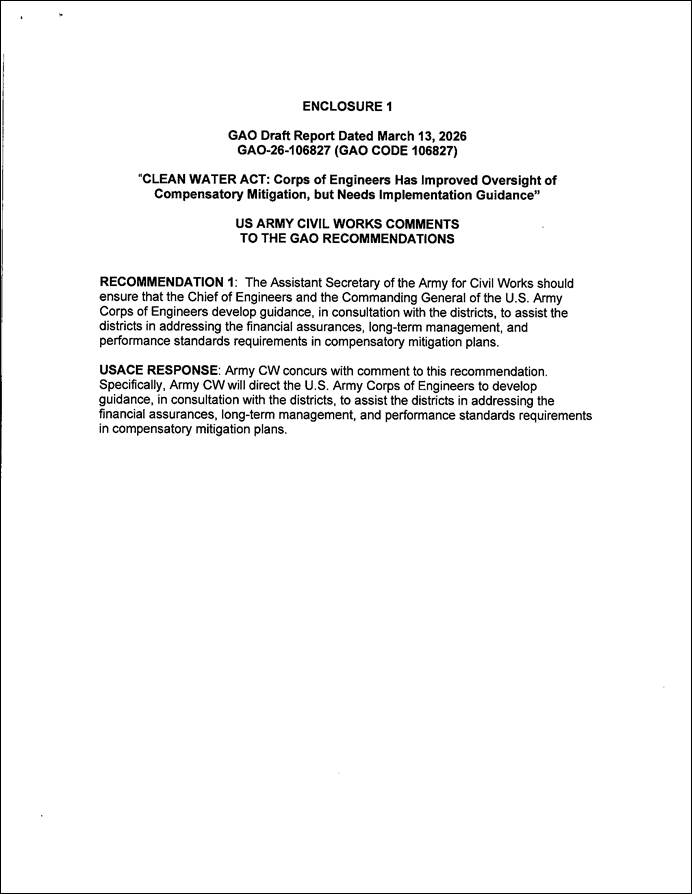
GAO is making a recommendation to the Department of Defense that the Corps develop guidance, in consultation with Corps districts, to assist them in addressing requirements in compensatory mitigation plans. The Office of the Assistant Secretary of the Army for Civil Works agreed with the recommendation.
Abbreviations
ILF in-lieu fee
This is a work of the U.S. government and is not subject to copyright protection in the United States. The published product may be reproduced and distributed in its entirety without further permission from GAO. However, because this work may contain copyrighted images or other material, permission from the copyright holder may be necessary if you wish to reproduce this material separately.
April 30, 2026
The Honorable Shelley Moore Capito
Chairman
The Honorable Sheldon Whitehouse
Ranking Member
Committee on Environment and Public Works
United States Senate
The Honorable Sam Graves
Chairman
The Honorable Rick Larsen
Ranking Member
Committee on Transportation and Infrastructure
House of Representatives
Wetlands, streams, and other aquatic resources are critical to maintaining healthy ecosystems. Wetlands support a number of valuable functions, including controlling floods, improving water quality, and providing wildlife habitat. The U.S. Army Corps of Engineers’ 38 district offices issue permits under section 404 of the Clean Water Act and its implementing regulations for activities that impact certain wetlands, streams, and other aquatic resources.[1] Specifically, discharging dredged or fill material into waters of the United States—which can include wetlands and streams—is generally prohibited without a Corps permit. Activities for which such adverse impacts are unavoidable, such as building driveways, golf courses, or commercial buildings, require a section 404 permit. Applicants for such permits must generally commit to avoiding and minimizing adverse impacts to wetlands, streams, and other aquatic resources to the extent practicable. In fiscal year 2023 alone, the Corps issued permits for permanent and temporary impacts to more than 73,000 acres of aquatic resources.
For unavoidable adverse impacts, compensatory mitigation may be required to replace wetland or aquatic resource functions to the extent practicable, generally in the same watershed. Compensatory mitigation refers to the restoration; establishment; enhancement; or—in certain circumstances—the preservation of wetlands, streams, and other aquatic resources. The purpose of compensatory mitigation is to offset unavoidable adverse impacts that remain after all appropriate and practicable avoidance and minimization measures have been taken. Compensatory mitigation includes activities such as reshaping the slopes of waterways to improve bank stabilization, removing invasive species from wetlands, filling in ditches or destroying drain tiles to restore wetland hydrology, and removing dams. Permittees may perform the work themselves or authorize an agent or contractor to do the work (known as permittee-responsible mitigation), or they may pay a third-party to complete the work and assume responsibility for the mitigation project.
In 2005, we issued a report that found the Corps did not have an effective oversight approach to ensure that compensatory mitigation was occurring.[2] There have been significant legal and policy changes to compensatory mitigation in the approximately 20 years since that report was issued, renewing questions about Corps regulatory oversight efforts. The Water Resources Development Act of 2022 includes a provision for us to review the performance metrics for, compliance with, and adequacy of potential mechanisms for fulfilling compensatory mitigation obligations.[3] As part of our work, we reviewed (1) the extent to which selected Corps districts conduct oversight activities for compensatory mitigation and undertake enforcement actions if required mitigation is not performed and (2) guidance the Corps developed for overseeing compensatory mitigation, and how, if at all, the guidance can be improved.[4]
In conducting our work, we selected three Corps districts—Jacksonville, Florida; Omaha, Nebraska; and St. Paul, Minnesota—for illustrative purposes. We balanced different criteria to inform district selection. Examples of these criteria included the number of standard permits issued in fiscal year 2023 that required compensatory mitigation and different geographical areas of the United States.
For each of the three districts, we randomly selected a nongeneralizable sample of mitigation banks, in-lieu fee (ILF) sites, and permittee-responsible mitigation files for review. In total, we reviewed files pertaining to 28 mitigation banks, 27 ILF sites, and 30 permittee-responsible projects across all three selected districts. We used various criteria to determine the list of banks, ILF sites, and permittee-responsible mitigation projects from which the sample was randomly drawn. These criteria included the following: section 404 standard permits issued from fiscal year 2017 through fiscal year 2022 where the permittee fulfilled their compensatory mitigation requirements through permittee-responsible mitigation; and mitigation banks and ILF sites that were approved from January 1, 2009, to January 10, 2025, to sell credits to permittees required to compensate for impacts pursuant to section 404.
To answer our first objective, we reviewed documents from the sample of files for evidence of Corps oversight (e.g., documentation of compliance inspections conducted by the Corps) and enforcement actions in cases of noncompliance (e.g., suspension of credit sales). We also interviewed Corps officials and reviewed relevant regulations to determine the types of oversight activities and enforcement actions available to the Corps and when they are used.
To answer our second objective, we reviewed regulations, guidance developed by Corps headquarters related to oversight of compensatory mitigation (e.g., regulatory guidance letters), and supplemental guidance developed by the three selected districts (e.g., template documents to aid sponsors or permittees in developing compensatory mitigation project application materials). We also reviewed the sample of files for evidence of financial assurances, long-term management, and performance standards because they relate to specific provisions in the mandate. Finally, we interviewed Corps officials regarding the development and use of its guidance documents.
We provide additional details on our objectives, scope, and methodology in appendix I.
We conducted this performance audit from May 2023 to April 2026 in accordance with generally accepted government auditing standards. Those standards require that we plan and perform the audit to obtain sufficient, appropriate evidence to provide a reasonable basis for our findings and conclusions based on our audit objectives. We believe that the evidence obtained provides a reasonable basis for our findings and conclusions based on our audit objectives.
Background
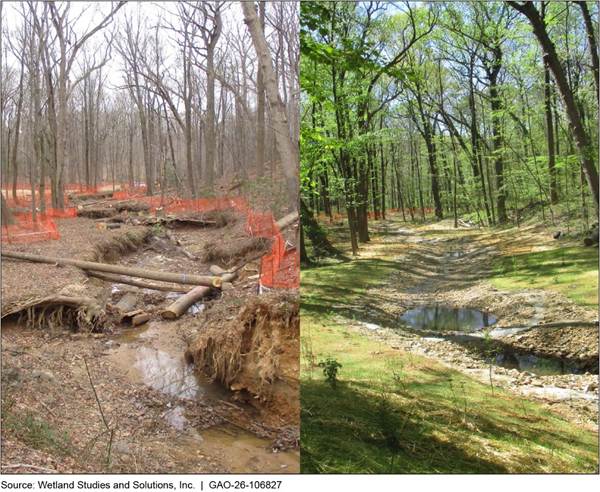
Compensatory mitigation refers to the restoration; establishment; enhancement; or—in certain circumstances—preservation of wetlands, streams, and other aquatic resources. The purpose of compensatory mitigation is to offset adverse impacts to aquatic resources that result from Corps-issued permits. Mitigation is typically conducted in the same watershed in which the impacts occur. See figure 1 below for an example of a compensatory mitigation project where rock structures and other engineering changes were implemented to restore a heavily eroded stream.
Compensatory mitigation for section 404 permits may be accomplished through third-party mitigation mechanisms or by permittees conducting the mitigation themselves. Specifically:
· Mitigation banks. Mitigation banks are typically private, for-profit entities—but may be established by public entities such as state agencies—that provide compensatory mitigation for multiple permittees or, in some cases, a single permittee. A mitigation bank sponsor enters into an agreement with the Corps, known as a mitigation banking instrument. The instrument documents how the bank will be established, operated, and managed, among other things. After finalizing a mitigation banking instrument with the Corps and securing the land, the bank sponsor conducts site work to improve or preserve ecological functions of aquatic resources at the site. Completing this work and generating ecological uplift creates “credits” that section 404 permittees may purchase from mitigation banks to fulfill their compensatory mitigation requirements. Once a permittee purchases credits, the mitigation bank assumes legal responsibility from the permittee for implementing successful compensatory mitigation.
· ILF programs. Similar to mitigation banks, ILF programs conduct work to improve or preserve aquatic resources at a site. In contrast to mitigation banks, ILF programs are sponsored by government entities (such as state agencies) or nonprofit organizations. Under agreements with the Corps, ILF program sponsors sell credits to section 404 permittees to meet their compensatory mitigation requirements. At a later date, after collecting sufficient funds from multiple permittees, the sponsors use them to restore wetlands, streams, or other aquatic resources. Once a section 404 permittee purchases ILF credits, the ILF program sponsor assumes legal responsibility for implementing successful compensatory mitigation. ILF programs are governed by an agreement with the Corps known as an ILF instrument.
· Permittee-responsible mitigation. Permittee-responsible mitigation refers to compensatory mitigation undertaken by the permittee—or an agent or contractor authorized by the permittee—to fulfill their section 404 permit requirements. The permittee performs the mitigation after the Corps issues the permit, whether on the site of the permitted impacts or at an off-site location, and retains legal responsibility for the successful implementation of the project.
In 2008, the Corps and the U.S. Environmental Protection Agency published a joint rule clarifying compensatory mitigation requirements for impacts to wetlands, streams, and other aquatic resources authorized by permits issued under section 404 of the Clean Water Act.[5] (For the purposes of this report, we refer to both the rule and associated regulations as “the regulations.”) Among other requirements, the Corps regulations codifying the 2008 rule establish a preferential hierarchy for fulfilling compensatory mitigation requirements among the three mechanisms. Permittees subject to compensatory mitigation requirements generally must purchase mitigation banking credits to fulfill the requirement. If no banking credits are available within the watershed of the permitted impact, the permittee must generally purchase credits from an ILF program. If neither banking nor ILF credits are available, the permittee must perform the mitigation themselves.[6] In addition, under these regulations, mitigation plans document the proposed compensatory mitigation project and are required components of mitigation banking instruments, ILF instruments, and permittee-responsible mitigation.
To implement the 2008 rule, the Corps has developed and updated its guidance documents related to compensatory mitigation. These documents include the following: (1) Regulatory Guidance Letter 08-03, which provides guidance on minimum requirements for compensatory mitigation project monitoring reports; (2) updated Standard Operating Procedures, which provides a summary of current policies and procedures for use as day-to-day informal guidance by regulatory project managers in implementing the section 404 program; and (3) additional documents, such as fact sheets and a white paper, for implementing the agency’s compensatory mitigation program.[7]
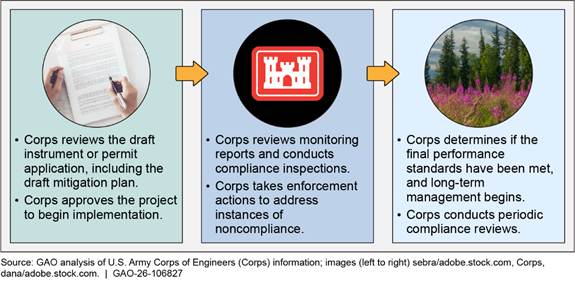
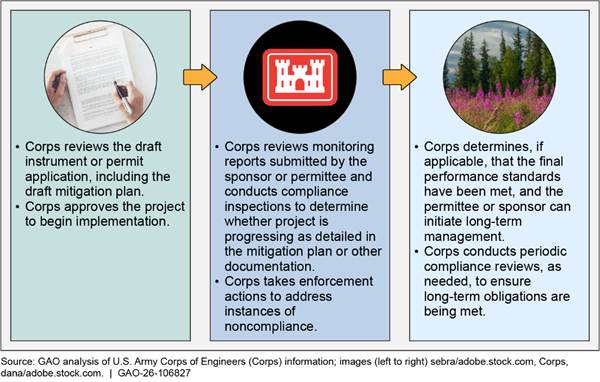
The Corps provides oversight throughout the multiyear lifecycle of a compensatory mitigation project. This oversight involves engaging with sponsors and permittees from initial project design and approval through performance monitoring and eventual long-term management. Figure 2 provides an overview of the Corps’s role in the oversight of compensatory mitigation projects.
In our 2005 report, we found the Corps did not have an effective oversight approach to ensure that compensatory mitigation was occurring.[8] As we reported, Corps oversight relies primarily on the following two compensatory mitigation activities: (1) reviewing monitoring reports submitted by third parties or permittees and (2) conducting compliance inspections (site visits) to observe the status of mitigation projects. However, we found little evidence that required monitoring reports were submitted to the Corps by permittees and sponsors or that the Corps conducted compliance inspections. We also found in 2005 that some of the compensatory mitigation guidance issued by the Corps was vague or internally inconsistent, thus limiting its usefulness.
Selected Corps Districts Generally Improved Oversight and Primarily Negotiated with Permittees and Sponsors to Address Noncompliance
Selected Corps districts generally improved the frequency with which they conducted oversight of compensatory mitigation activities compared with those selected in our 2005 report.[9] Specifically, we found that selected districts’ mitigation bank, ILF site, and permittee-responsible files we reviewed generally included at least one monitoring report, whereas in 2005 we found less evidence of these reports.[10] Similarly, according to the results of our file review, selected Corps districts generally improved the degree to which they performed compliance inspections of third-party and permittee-responsible mitigation sites compared with districts selected for the 2005 report. As in 2005, we found that the Corps can take a variety of enforcement actions if required compensatory mitigation is not performed. However, district officials again told us that they rely primarily on negotiation with permittees or sponsors as a first step in the enforcement process to achieve compliance.
Selected Corps Districts Generally Demonstrated Improved Oversight
For the files we reviewed, we found evidence that selected Corps districts generally received required monitoring reports and improved the degree to which they performed compliance inspections, compared with the districts in our 2005 report.
Monitoring reports
According to our file review, we found that selected Corps districts generally improved in terms of receiving monitoring reports submitted by sponsors and permittees compared with districts selected for the 2005 report. In 2005, we found that Corps districts provided little oversight of permittee-responsible mitigation and somewhat greater oversight of mitigation banks and ILF programs in terms of monitoring reports.
Across all three districts, all of the mitigation banking instruments and permits and nearly all of the ILF instruments included in our current file review contained language requiring submission of monitoring reports, and we found that most of the files we reviewed included evidence that the district received the reports.[11] Specifically, we found the following regarding the implementation of these requirements:
· Mitigation banks. Across the St. Paul, Omaha, and Jacksonville districts, all of the mitigation banks in our review with at least 1 year of active monitoring by the sponsor included one or more monitoring reports.[12]
· ILF programs. All of the ILF sites in the St. Paul district included in our file review—and nearly all in the Omaha district and most in the Jacksonville district—had one or more monitoring reports for projects that had completed at least 1 year of active monitoring.[13]
· Permittee-responsible mitigation. Nearly all of the permittee-responsible mitigation files we reviewed in the St. Paul and Omaha districts included one or more monitoring report. While permittee files in Jacksonville did not consistently include monitoring reports, the district takes a risk-based approach in monitoring mitigation because of the volume of reports that they receive. According to district officials, the Jacksonville district is responsible for oversight of more permittee-responsible mitigation projects than any other Corps district, and, as a result, it receives hundreds of monitoring reports each year. Officials explained that the district does not have the capacity to verify receipt of every report.
Compliance inspections
Similarly, according to the results of our file review, selected Corps districts generally improved the degree to which they performed compliance inspections of third-party and permittee-responsible mitigation sites, compared with districts selected for the 2005 report. We found in 2005 that fewer than half of the files reviewed contained evidence that district officials conducted compliance inspections. In our current file review, most of the mitigation banks in the selected districts contained evidence of compliance inspections. For ILF and permittee-responsible mitigation files, evidence of compliance inspections varied by district due to differences in how districts prioritize these inspections and available resources.
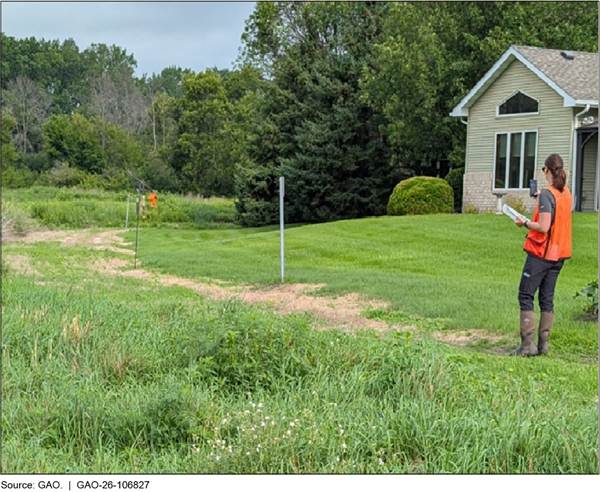
We found that the St. Paul district had conducted at least one compliance inspection for all of the mitigation banks where the sponsor had completed 1 or more years of active monitoring, all of the ILF sites, and nearly all of the permittee-responsible projects included in our review. Officials in St. Paul explained that conducting inspections of mitigation banks and ILF sites is an area of focus for the district. Specifically, around 2023, St. Paul formed a centralized team that reviewed all the district’s 135 banks and ILF sites to determine which sites were missing associated monitoring reports or needed a compliance inspection. Officials told us the team had found that approximately 75 percent of the banks and ILF sites in the active monitoring stage were mostly or fully compliant. Officials told us that for sites that the team determined were mostly compliant, they work with sponsors to attain compliance. Figure 3 shows a St. Paul official conducting an inspection of a compensatory mitigation site.
For the Omaha and Jacksonville districts, we found evidence that the districts conducted at least one compliance inspection for nearly all and all, respectively, of the mitigation banks in our review where the sponsor completed 1 or more years of active monitoring. We found less evidence of compliance inspections for ILF sites and permittee-responsible mitigation projects in these two districts due to various factors. According to officials in Jacksonville, the district takes a risk-based approach to conducting inspections, where factors such as monitoring results and previous compliance issues are considered when deciding which compensatory mitigation projects to inspect. Officials in the Omaha district explained that they primarily conduct compliance inspections of mitigation banks and ILF sites when sponsors request credit releases. For permittee-responsible mitigation projects, they prioritize inspections on the basis of factors including complexity and whether the permittee provided sufficient documentation.
Corps Districts Address Noncompliance Primarily Through Negotiation
The Corps can take a variety of enforcement actions against a sponsor or permittee if the required compensatory mitigation is not performed.[14] As we reported in 2005, we found that the selected Corps districts primarily negotiated with sponsors or permittees as a first step in the enforcement process to achieve compliance.
According to Corps officials, the enforcement actions available to the Corps for permittee-responsible projects differ from those available for addressing noncompliant mitigation banks or ILF programs. For permittee-responsible projects, the Corps can take actions including the following: issue compliance orders specifying a time by which the permittee must achieve compliance, assess administrative penalties of up to $68,446 per day for each violation, require the permittee to forfeit a bond, or refer a case to the U.S. Department of Justice to bring legal action in federal district court.[15] For mitigation banks and ILF programs, Corps enforcement actions can include suspending credit sales, requiring adaptive management, drawing on financial assurances, or terminating the instrument.[16]
According to officials in each of the selected districts—and substantiated by our file review—the districts largely work with permittees and sponsors to bring projects into compliance before resorting to enforcement actions. For example, during a site inspection in October 2021, officials in the St. Paul district found that a mitigation bank site did not have signs, numbered fence posts, or survey posts indicating the boundaries of the bank’s conservation easement, each of which the terms of the instrument require. The district requested that the sponsor address the lack of signage, fence posts, and survey posts by December 2021 to avoid a potential suspension of future bank credit sales. A follow-up site inspection by St. Paul officials confirmed that the issues were adequately addressed.
Although the selected Corps districts primarily use negotiation to address compliance issues, our file review found instances where districts took enforcement actions to resolve noncompliance findings. For example, following an inspection of a Jacksonville mitigation bank site in July 2016, the Corps determined that the significant presence of certain exotic vegetative species indicated the bank was not meeting the performance standards documented in the bank’s instrument. As a result, the Corps suspended all credit sales for the bank until these issues were resolved. The sponsor then provided to the Corps a multistage plan to address the exotic vegetation and began implementing the plan. The Corps inspected the site again in December 2016 and found that the presence of exotic vegetation at the site was improving and, as a result, lifted the credit sales suspension.
Selected Corps Districts Have Taken Inconsistent Approaches to Implementing Compensatory Mitigation Requirements Due to Limited Guidance
While selected Corps districts generally have improved the frequency of oversight of compensatory mitigation activities, we found that they have taken inconsistent approaches to implementing compensatory mitigation requirements. The Corps regulations codifying the 2008 rule establish standardized requirements and procedures to be used nationwide, including requiring all projects to have a mitigation plan with 12 key components.[17] According to Corps officials, the regulations outline requirements at a general level and provide Corps districts with substantial discretion, so as to account for the range of ecosystems, projects, and local laws across the country. Headquarters officials told us that they generally defer to districts to determine how best to implement the regulations, given the diversity of mitigation projects nationwide and the technical expertise at the district level. Specifically, headquarters has developed limited guidance related to the regulations, including a Regulatory Guidance Letter that establishes minimum monitoring requirements for mitigation projects.[18]
District officials told us that the lack of specificity in headquarters guidance can make it difficult to determine if project documentation meets standards established in the regulations, potentially resulting in inconsistencies among and within districts. Similarly, our review of a sample of district files found inconsistencies across the following three areas: (1) financial assurances, (2) long-term management, and (3) performance standards.
· Financial assurances for compensatory mitigation projects are mechanisms—such as performance bonds, letters of credit, and escrow accounts—used to ensure that required mitigation is successfully completed. These assurances help ensure sufficient funding is available to correct, complete, or replace a mitigation project in the event the responsible party is unable or unwilling to do so.
The Corps regulations codifying the 2008 rule require that all mitigation plans include financial assurances or an alternative mechanism to ensure a high level of confidence that the mitigation project will successfully meet its performance standards.[19] These regulations also require that the rationale used in determining the amount of these assurances be documented in the permit or instrument.[20]
While nearly all of the selected districts’ files we reviewed addressed financial assurances to some extent, we found that permittees and sponsors took a wide range of approaches to fulfill these requirements. Several mitigation bank and ILF files provided extensive information explaining how financial assurances were established. For example, one mitigation bank file provided estimates for a range of project development and execution costs—including the cost of construction, maintenance, monitoring, accounting, and insurance—and included documentation of a trust fund agreement covering these expenses. In contrast, a number of mitigation plans described financial assurance requirements in a general sense but offered no project-specific information about how such assurances would be provided. In other cases, the sponsor or permittee identified a total dollar amount intended to cover financial assurances but did not provide a rationale supporting this amount.
Several officials said that financial assurances requirements have prompted questions from regulators and other parties involved in mitigation, such as permittees. In response, Corps headquarters has issued some guidance documents, including a 2017 fact sheet.[21] While the guidance provides descriptive information about different financial assurance mechanisms, these officials said that it does not specify the types of information that should be included in mitigation plans, such as the costs that should be included in the assurance and whether the assurance mechanism must be fully funded at the time the plan is approved.
· Long-term management refers to the care and maintenance of a mitigation project site after the Corps determines that a project has met its performance standards, to ensure the project continues to function into the future. Long-term management can include “active management” tasks such as prescribed burning and invasive species control, as well as less intensive activities, such as maintaining protective fences and signs. Corps regulations specify that a long-term management plan is a required component of each project’s mitigation plan.[22] The plan is to include a description of long-term management needs, annual cost estimates for those needs, and the funding mechanism used to meet those needs.[23]
Our review of selected districts’ files indicated that nearly all addressed long-term management to some extent, though implementation approaches varied widely across districts. Several files addressed the requirement by providing an itemized list of expected long-term management tasks and associated costs, as well as the funding mechanisms to be used, whereas others provided general descriptions of long-term management activities but did not explain how these would be funded. Additionally, a number of mitigation bank and ILF files indicated that long-term management was not necessary, or that plans would be developed in the future as the mitigation project neared completion.
Officials in the three selected districts cited challenges in understanding and implementing long-term management requirements. Several officials said that it could be difficult to determine what was necessary to fulfill these requirements, and that headquarters guidance has not fully addressed this ambiguity. For example, officials from one district said that some provisions are described inconsistently in regulations and guidance issued by headquarters, resulting in confusion among district officials as to what is required to satisfy long-term management requirements. Officials from another district said it was unclear if complete long-term management plans were required as part of a mitigation plan during the planning stages of a project, or whether they could be developed when a project was nearing completion.
Several officials also cited challenges in understanding long-term management funding requirements. For example, one official said it was unclear if dedicated long-term management funding was required for every project, since some projects only required minimal management activity, such as ensuring signs were present. Moreover, while the regulations state that long-term management must “ensure the long-term sustainability of the resource,” several officials said it was unclear how far into the future these activities should extend, making it difficult to evaluate cost estimates as part of a mitigation plan.[24]
· Performance standards are criteria—typically focused on the relevant ecological conditions of a site—used to determine whether a project is achieving its objectives. In addition to being a measure of project success, performance standards can also help identify when projects require intervention. For example, a project failing to meet vegetation standards may be targeted for additional invasive species treatment. The regulations require that the permit and mitigation plan include ecologically based performance standards that are measurable or observable and tied to the project’s objectives.[25] In addition, monitoring reports are to list the performance standards as specified in the mitigation plan, instrument, or permit, and must include sufficient information to determine how the mitigation project is progressing toward meeting those standards.[26]
Nearly all of the selected districts’ files that we reviewed included performance standards, which we found to be measurable or observable as required by the regulations. However, in a number of files, we found that performance standards were not consistent across documents. In particular, the standards in the mitigation plan differed from those in the permit or monitoring reports. In several files, for example, performance standards included in the mitigation plan were changed in subsequent monitoring reports or excluded altogether. Several district officials told us that, in certain cases, performance standards may be adjusted after monitoring has begun. This could occur, for example, if standards approved in a mitigation plan were later determined to be unrealistic due to atypical baseline conditions or environmental changes, such as drought. Officials from one district said that they generally documented such decisions in a memorandum or, in certain cases, pursued a modification of the instrument. According to several district officials, performance standards should align across documents so that project objectives are clear and progress can be tracked against these objectives. However, monitoring requirement guidance from headquarters does not specify that performance standards should be consistent across file documentation.[27]
To help implement the regulations and address gaps stemming from limited headquarters guidance, each of our selected districts told us they developed their own guidance tools, including templates and checklists, aimed at clarifying the requirements for permittees and sponsors. Officials from these districts said that they developed these supplemental tools to clarify areas in the regulations or to address gaps in guidance from headquarters, identified based on the number of requests for clarity the officials receive from permittees and sponsors. For example, officials from the Jacksonville district said that they developed a mitigation bank instrument template and companion instruction document to address requirements within the mitigation plans for which they receive the most questions from applicants, such as financial assurances and long-term management planning. The documents provide sponsors with details on how to ensure the instrument adheres to the financial assurance requirement beyond what appears in Corps regulations, including information to support the cost estimate.
While this supplemental guidance is useful for individual districts, it does not provide a comprehensive solution for all districts nationwide. Officials in the selected districts told us that additional guidance from headquarters would be useful. For example, officials in the St. Paul district told us that having a tool, such as a checklist, from headquarters that the officials could provide to sponsors or permittees to help them understand what is required to satisfy these complex requirements would be welcomed. The officials also said that such tools should not be too prescriptive, allowing for differences across districts, such as variation in ecosystems.
In the absence of centralized implementation guidance or additional clarification from headquarters, districts may be interpreting and implementing Corps regulations and guidance differently. This inconsistency was evident in the files we reviewed in the selected districts, particularly related to financial assurances, long-term management, and performance standards. Leading practices for interagency collaboration—or collaboration between agency components—call for written guidance to document and implement consistent processes across agency efforts.[28] Without consistent implementation of compensatory mitigation requirements, the Corps lacks reasonable assurance that mitigation projects are being overseen in a manner that achieves intended environmental outcomes across districts. For example, if the financial assurances for a site are not properly estimated, they may not be sufficient to cover the anticipated costs of the mitigation. As a result, a project may not achieve revegetation levels of trees and shrubs, invasive species control levels, or other success criteria outlined in the performance standards, thereby not achieving the intended environmental outcome. When mitigation projects do not meet established performance standards, compensatory mitigation may not fully offset permitted impacts, undermining the Corps’s ability to ensure that there is no net loss of aquatic resource functions.
Conclusions
Wetlands and other aquatic resources are vital in controlling floods and supporting wildlife. Compensatory mitigation offsets any impacts to these valuable resources and helps ensure that watersheds continue to provide vital ecological functions. While the Corps has taken actions to improve oversight of compensatory mitigation since our 2005 report, the agency has developed limited guidance on program requirements, which has resulted in implementation inconsistencies across the districts. Selected Corps districts inconsistently implemented requirements in three key areas, including long-term management, which ensures the long-term sustainability of aquatic resources. Headquarters could support the districts by clarifying how to implement certain aspects of mitigation requirements. Doing so, while not being too prescriptive to allow for variation in ecological diversity and other factors across the districts, would help improve environmental outcomes across compensatory mitigation projects nationwide.
Recommendation for Executive Action
The Assistant Secretary of the Army for Civil Works should ensure the Chief of Engineers and Commanding General of the U.S. Army Corps of Engineers develop guidance, in consultation with the Corps districts, to assist them in addressing the financial assurances, long-term management, and performance standards requirements in compensatory mitigation plans. (Recommendation 1)
Agency Comments
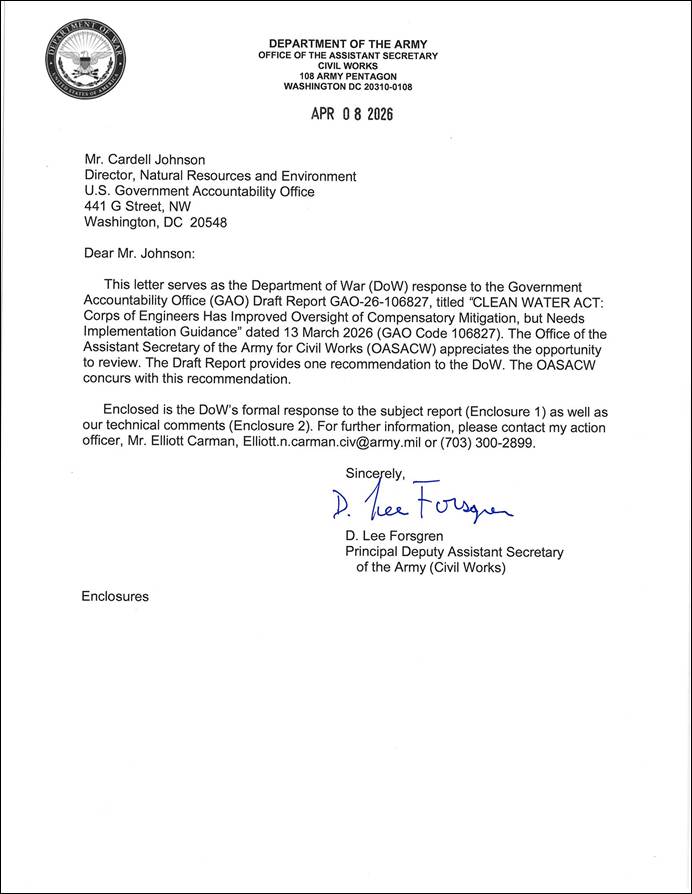
We provided a draft of this report for review and comment to the Department of Defense. In its written comments, reprinted in appendix II, the Office of the Assistant Secretary of the Army for Civil Works agreed with our recommendation and provided technical comments, which we incorporated as appropriate.
We are sending copies of this report to the appropriate congressional committees, the Secretary of Defense, the Assistant Secretary of the Army for Civil Works, the Chief of Engineers and Commanding General of the U.S. Army Corps of Engineers, and other interested parties. In addition, the report is available at no charge on the GAO website at https://www.gao.gov.
If you or your staff have any questions about this report, please contact me at JohnsonCD1@gao.gov. Contact points for our Offices of Congressional Relations and Media Relations may be found on the last page of this report. GAO staff who made key contributions to this report are listed in appendix III.
Cardell D. Johnson
Director, Natural Resources and Environment
The Water Resources Development Act of 2022 includes a provision for us to review the performance metrics for, compliance with, and adequacy of potential mechanisms for fulfilling compensatory mitigation obligations.[29]
As part of our work, we reviewed the (1) extent to which selected U.S. Army Corps of Engineers districts conduct oversight activities for compensatory mitigation and undertake enforcement actions if required mitigation is not performed and (2) guidance the Corps developed for overseeing compensatory mitigation, and how, if at all, the guidance can be improved. Our analysis covered mitigation banks, in-lieu fee (ILF) programs, and direct mitigation by permittees. This analysis also updates the findings and recommendations from our September 2005 report.[30]
As part of our analysis, we looked at how the Corps incorporates performance standards to assess whether compensatory mitigation projects successfully replace lost ecological functions and habitat. We also reviewed how the Corps incorporates long-term management to assess the continued operation and ecological performance of projects beyond the completion of the mitigation work. In addition to the provisions addressed in this report, the act also includes a provision for us to review the costs of carrying out compensatory mitigation activities borne by the federal government and other entities.[31] To address this provision, in September 2024, we issued a separate report on the costs of compensatory mitigation.[32] While this report focused on Corps oversight and long-term management activities, the September 2024 report addressed mitigation costs borne by federal agencies and state governments as part of their regulatory roles.
The act also includes a provision for GAO to review the timeliness of (1) initiation and successful completion of compensatory mitigation activities in relation to when a permitted activity occurs and (2) processing and approval of compensatory mitigation activities.[33] We were not able to complete this analysis because the agency does not track comprehensive data on the timeliness of compensatory mitigation, according to agency officials. Specifically, headquarters officials told us that Corps regulations do not require permittees to notify the agency when a mitigation project begins and the districts may not require the permittee to notify the Corps when work has been completed; therefore, it would be difficult to analyze the mitigation timeline due to the lack of consistent data. Additionally, officials in Corps headquarters said they do not collect or analyze data on the timeliness of the processing and approval of mitigation activities. They explained that multiple reviews are conducted simultaneously as part of permitting and so it is difficult to determine the specific amount of time spent on discrete activities of the mitigation process. Officials in each of the three districts we reviewed told us they track data on various segments of the compensatory mitigation timeline for their own purposes, but there is not a centralized effort at the headquarters level.
Officials in headquarters also told us that the agency has emphasized tracking the amount of time for mitigation banks and ILF programs to get approved. Therefore, in 2020, they finalized a metric to assess the number of third-party instrument decisions reached within 550 days or fewer from the issuance date of the Public Notice to the announcement of the decision on whether to approve the instrument. Officials told us that the agency tracks data for this metric in a centralized database to identify bottlenecks in the process and ways to streamline the approval process. For permittee-responsible mitigation, headquarters officials said they do not track processing and approval time frames because project managers conduct multiple reviews simultaneously when making permit approval decisions; therefore, separating time spent on processing and approval for compensatory mitigation is difficult.
Corps District Selection and File Review Methodology
Our review focused on the compensatory mitigation activities at three of the 38 Corps districts that implement the section 404 program: Jacksonville, Florida; Omaha, Nebraska; and St. Paul, Minnesota. We selected these districts using data from the Corps’s Operation and Maintenance Business Information Link’s Regulatory Module database, which contains data on regulatory permits, and from the Regulatory In-lieu Fee and Bank Information Tracking System, which contains information on mitigation banks and ILF programs. Specifically, we selected three districts that meet the following criteria: (1) mitigation banks and ILF sites active in fiscal year 2023 and (2) a high number of standard permits requiring compensatory mitigation issued in fiscal year 2023 relative to other districts. We applied additional criteria, such as including districts from different areas of the United States. Report findings related to each of the three selected districts cannot be generalized to apply to districts that were not included in our review.
From the three selected districts, we randomly selected a nongeneralizable sample of mitigation banks, ILF sites, and permittee-responsible mitigation files for review using data from the districts, the Corps’s Operation and Maintenance Business Information Link’s Regulatory Module database, and the Regulatory In-lieu Fee and Bank Information Tracking System. These files were selected from the lists of compensatory mitigation projects in each of the three districts generated by meeting specified criteria. We chose to limit our file review to only a selection of compensatory mitigation files meeting our criteria due to the significant time investment required to comprehensively assess each of these files using our review methodology. Findings related to the compensatory mitigation files we reviewed cannot be generalized to apply to projects that we did not review.
We used the following criteria to determine the population of mitigation bank, ILF program, and permittee-responsible mitigation files for the three districts we drew our nongeneralizable random sample from:
· Mitigation banks and ILF programs approved to sell credits to permittees required to compensate for impacts pursuant to section 404 of the Clean Water Act and standard permits pursuant to section 404 of the act.[34]
· Mitigation banks and ILF sites that were approved by the Corps from January 1, 2009, to January 10, 2025, and standard permits issued from fiscal year 2017 through fiscal year 2022. For mitigation banks and ILF programs, we included sites approved no earlier than January 1, 2009, to ensure that any files included our sample were subject to regulatory requirements introduced in the 2008 compensatory mitigation rule.[35] For standard permits, we chose this time frame because officials in the districts told us they started transitioning permit files to electronic format around fiscal year 2017.
· Mitigation banks and ILF sites that were not pending approval, withdrawn from consideration for approval, or terminated by the Corps.
· Standard permits where the permittee fulfilled their compensatory mitigation requirements solely through permittee-responsible mitigation. We excluded those permits where these requirements were met through permittee-responsible mitigation in addition to other means (e.g., through purchasing credits from a mitigation bank or ILF program).
From the identified projects in each of the districts, we randomly selected a sample of mitigation bank, ILF program, and permittee-responsible mitigation files for review—a total of 85 files. For mitigation banks and ILF programs, we randomly sampled up to 10 files of each type that met our criteria from each district.[36] For permittee-responsible mitigation, we randomly selected 15 files from Jacksonville and Omaha. For St. Paul, only 13 permittee-responsible mitigation files met our criteria, so we requested all of these files. We excluded some of these files from our review for various reasons. For example, one mitigation bank file in Jacksonville was excluded because district officials told us that project was not subject to the 2008 rule. Table 1 shows the three types of files, by selected district, that we included in our review.
|
District |
Mitigation banks |
In-lieu fees |
Permittee-responsible mitigation |
|
Jacksonville |
9 |
8 |
11 |
|
Omaha |
10 |
9 |
10 |
|
St. Paul |
9 |
10 |
9 |
Source: GAO analysis of U.S. Army Corps of Engineers documents. | GAO‑26‑106827
For each of the files included in our review, we requested certain types of documents related to Corps oversight of the compensatory mitigation. For example, we requested documents, such as the following:
· Mitigation banking and ILF instruments, and Corps-issued standard permits[37]
· Monitoring reports submitted by sponsors and permittees
· Mitigation plans
· Documentation of Corps site visits
Similar to the methodology used in the 2005 report, following receipt of the files associated with each of the mitigation bank, ILF program, and permittee-responsible mitigation projects in our review, we used a data collection instrument to assess the degree to which these files included documentation related to certain Corps requirements and other factors relevant to our report objectives. To develop the data collection instrument, we reviewed compensatory mitigation project requirements described in the regulations that codify the 2008 compensatory mitigation rule, Regulatory Guidance Letters issued by Corps headquarters, and other relevant sources. Prior to reviewing the files using the data collection instrument, we pretested and revised the data collection instrument using example files provided by the districts. In addition, after our initial review of the files, we submitted clarifying questions to the districts regarding missing documents or to ensure our understanding of the files was accurate and complete.[38]
A GAO analyst reviewed the files using the data collection instrument, and a second analyst independently reviewed the information coded in the data collection instrument for accuracy and completeness. Disagreements regarding the coding were discussed and reconciled. To characterize the results of the file reviews throughout this report, we defined modifiers as follows:[39]
· “Few” represents under 25 percent.
· “Some” represents 25–50 percent.
· “Most” represents 51–75 percent.
· “Nearly all” represents 76–99 percent.
· “All” represents 100 percent.
Other terms—such as “a number of”—are not intended to correspond to a specific percentage of files meeting a specific requirement. Instead, these terms are used when more than one file took a general implementation approach.
Methodology
To review the extent to which selected Corps districts conduct oversight activities for compensatory mitigation and undertake enforcement actions if required mitigation is not performed, we reviewed documents from the sample of mitigation bank, ILF program, and permittee-responsible mitigation files. Specifically, to assess Corps oversight activities, we reviewed the files for evidence that the three Corps districts received required monitoring reports submitted by sponsors and permittees documenting project site conditions and performance standards. We also reviewed the files for any evidence that district officials conducted site compliance inspections of these projects. To assess the extent to which the Corps districts undertook enforcement actions, we reviewed the files for any documented enforcement actions (such as suspension of credit sales) in instances where the district found sponsors or permittees out of compliance with the terms of their instrument or permit, respectively. In addition, we interviewed Corps headquarters and district officials and reviewed relevant regulations to determine the types of oversight activities and enforcement actions available to the Corps and when they are used.
To review the guidance the Corps developed for overseeing compensatory mitigation and how, if at all, it can be improved, we reviewed the 2008 compensatory mitigation rule and associated regulations, guidance developed by Corps headquarters related to oversight of compensatory mitigation (such as regulatory guidance letters), and supplemental guidance developed by the three selected districts. Supplemental district guidance included, for example, templates to aid sponsors or permittees in developing compensatory mitigation project application materials. We also reviewed the files associated with our sample of mitigation bank, ILF program, and permittee-responsible mitigation projects for evidence of financial assurances, long-term management, and performance standards.[40] Lastly, we conducted interviews with officials from Corps headquarters and the three selected districts regarding the development and use of guidance documents related to compensatory mitigation.
We conducted this performance audit from May 2023 to April 2026 in accordance with generally accepted government auditing standards. Those standards require that we plan and perform the audit to obtain sufficient, appropriate evidence to provide a reasonable basis for our findings and conclusions based on our audit objectives. We believe that the evidence obtained provides a reasonable basis for our findings and conclusions based on our audit objectives.
GAO Contact
Cardell D. Johnson at JohnsonCD1@gao.gov
Staff Acknowledgements
In addition to the contact named above, Anthony C. Fernandez (Assistant Director), Lisa Vojta (Analyst in Charge), Adrian Apodaca, Mike Armes, Andrew Edkins, William Gerard, Cindy Gilbert, Vondalee R. Hunt, Jocelyn Kuo, Jessica Lemke, Matt McLaughlin, Jeanette Soares, and Walter Vance made key contributions to this report.
The Government Accountability Office, the audit, evaluation, and investigative arm of Congress, exists to support Congress in meeting its constitutional responsibilities and to help improve the performance and accountability of the federal government for the American people. GAO examines the use of public funds; evaluates federal programs and policies; and provides analyses, recommendations, and other assistance to help Congress make informed oversight, policy, and funding decisions. GAO’s commitment to good government is reflected in its core values of accountability, integrity, and reliability.
Obtaining Copies of GAO Reports and Testimony
The fastest and easiest way to obtain copies of GAO documents at no cost is through our website. Each weekday afternoon, GAO posts on its website newly released reports, testimony, and correspondence. You can also subscribe to GAO’s email updates to receive notification of newly posted products.
Order by Phone
The price of each GAO publication reflects GAO’s actual cost of production and distribution and depends on the number of pages in the publication and whether the publication is printed in color or black and white. Pricing and ordering information is posted on GAO’s website, https://www.gao.gov/ordering.htm.
Place orders by calling (202) 512-6000, toll free (866) 801-7077,
or
TDD (202) 512-2537.
Orders may be paid for using American Express, Discover Card, MasterCard, Visa, check, or money order. Call for additional information.
Connect with GAO
Connect with GAO on X,
LinkedIn, Instagram, and YouTube.
Subscribe to our Email Updates. Listen to our Podcasts.
Visit GAO on the web at https://www.gao.gov.
To Report Fraud, Waste, and Abuse in Federal Programs
Contact FraudNet:
Website: https://www.gao.gov/about/what-gao-does/fraudnet
Automated answering system: (800) 424-5454
Media Relations
Sarah Kaczmarek, Managing Director, Media@gao.gov
Congressional Relations
David A. Powner, Acting Managing Director, CongRel@gao.gov
General Inquiries
[1]See Federal Water Pollution Control Act, ch. 758, tit. IV, § 404 (1948), as added by the Federal Water Pollution Control Act Amendments of 1972, Pub. L. No. 92-500, § 2, 86 Stat. 816, 884 (1972) (codified as amended at 33 U.S.C. § 1344). The Federal Water Pollution Control Act, as amended, is commonly known as the Clean Water Act.
[2]GAO, Wetlands Protection: Corps of Engineers Does Not Have an Effective Oversight Approach to Ensure That Compensatory Mitigation Is Occurring, GAO‑05‑898 (Washington, D.C.: Sept. 8, 2005).
[3]James M. Inhofe National Defense Authorization Act for Fiscal Year 2023 (NDAA FY23), Pub. L. No. 117-263, div. H, tit. LXXXI, § 8236(d)(2), 136 Stat. 2395, 3771–72 (2022). The Water Resources Development Act of 2022 is Division H, Title LXXXI of NDAA FY23.
[4]For the purposes of this report, “guidance” includes internal agency policies and procedures and documents intended to clarify or interpret regulatory or statutory requirements for regulated parties.
[5]U.S. Army Corps of Engineers and U.S. Environmental Protection Agency, “Compensatory Mitigation for Losses of Aquatic Resources—Final rule,” 73 Fed. Reg. 19594 (Apr. 10, 2008) (codified at 33 C.F.R. pts. 325, 332; 40 C.F.R. pt. 230). Section 314(b) of the National Defense Authorization Act for Fiscal Year 2004 required the Corps to issue regulations establishing performance standards and criteria for the use of on-site, off-site, and in-lieu fee mitigation and mitigation banking as compensation for lost wetlands functions in permits issued by the Corps under section 404 of the Clean Water Act, as amended. Pub. L. No. 108-136, div. A, tit. III, § 314(b), 117 Stat. 1392, 1431 (2003). The Corps and the U.S. Environmental Protection Agency jointly issued the regulation because the Corps administers the section 404 permit program and the U.S. Environmental Protection Agency issues the regulations establishing the environmental criteria for evaluating applications for section 404 permits.
[6]33 C.F.R. § 332.3(b). Under the regulations, this preference can be overridden when it is determined, on the basis of a watershed approach, that another option is environmentally preferable.
[7]U.S. Army Corps of Engineers, Corps Regulatory Guidance Letter 08-03, Minimum Monitoring Requirements for Compensatory Mitigation Projects Involving the Restoration, Establishment, and/or Enhancement of Aquatic Resources (Oct. 10, 2008); U.S. Army Corps of Engineers, Standard Operating Procedures for the United States Army Corps of Engineers Regulatory Program (Dec. 2024); U.S. Army Corps of Engineers, Institute for Water Resources, Implementing Financial Assurance for Mitigation Project Success (June 2011); U.S. Army Corps of Engineers, Fact Sheet: Long-Term Management of Compensatory Mitigation Projects (Feb. 21, 2017); and U.S. Army Corps of Engineers, Fact Sheet: Financial Assurances of Compensatory Mitigation Projects (Feb. 21, 2017).
[8]GAO‑05‑898. The report included the following three recommendations for the Corps: (1) develop more specific guidance for overseeing compensatory mitigation, with a focus on defining key terms and specifying actions to take if monitoring reports are not received; (2) clarify expectations for oversight of mitigation, including establishing goals for the number of monitoring reports that should be reviewed and the number of compliance inspections that should be conducted; and (3) review existing mitigation banks and ILF programs to ensure that the sponsor has an approved agreement with the Corps. As of March 2026, only the third recommendation had been closed as implemented.
[10]Although we conducted our file review using a methodology similar to the 2005 report, we generally avoid making direct comparisons with the 2005 file review results due to differences including how we selected the files and the districts included in the review.
[11]We defined “few” as under 25 percent, “some” as 25–50 percent, “most” as 51–75 percent, “nearly all” as 76–99 percent, and “all” as 100 percent.
[12]Some of the mitigation banks included in our file review were approved by selected Corps districts in 2024. As a result, the sponsors were not yet required to submit monitoring reports.
[13]As with mitigation banks, one of the ILF sites in our review was approved in 2024 and as a result did not include monitoring reports.
[14]For the purposes of this report, “enforcement actions” refer to steps that the Corps may take to resolve instances where sponsors or permittees are found to be noncompliant with the terms of their instrument or permit, respectively. This report does not discuss the U.S. Environmental Protection Agency’s statutory enforcement authority under the Clean Water Act.
[15]33 C.F.R. §§ 326.4–326.6; see id at § 325.4.
[16]33 C.F.R. § 332.8(o)(10). Mitigation bank and ILF program instruments are required to include an adaptive management plan to guide decisions for revising compensatory mitigation plans and implementing measures to address both foreseeable and unforeseen circumstances that adversely affect compensatory mitigation success. See id. at § 332.4(c)(1)(iii), (c)(12).
[17]The required elements of a mitigation plan include the following: objectives, site selection, site protection instrument, baseline information, determination of credits, mitigation work plan, maintenance plan, performance standards, monitoring requirements, long-term management plan, adaptive management plan, and financial assurances. 33 C.F.R. § 332.4(c); 40 C.F.R. § 230.94(c).
[18]Corps Regulatory Guidance Letter 08-03.
[20]33 C.F.R. § 332.3(n)(2).
[21]U.S. Army Corps of Engineers, Fact Sheet: Financial Assurances of Compensatory Mitigation Projects; U.S. Army Corps of Engineers, Implementing Financial Assurance for Mitigation Project Success.
[22]33 C.F.R. § 332.4(c)(1), (c)(11).
[23]33 C.F.R. §§ 332.4(c)(11), 332.7(d)(2).
[24]See 33 C.F.R. § 332.4(c)(11).
[25]33 C.F.R. §§ 332.3(k)(2), 332.4(c)(1), (c)(9); id. at § 332.5.
[26]33 C.F.R. § 332.6(c); Corps Regulatory Guidance Letter 08-03.
[27]See Corps Regulatory Guidance Letter 08-03.
[28]GAO, Government Performance Management: Leading Practices to Enhance Interagency Collaboration and Address Crosscutting Challenges, GAO‑23‑105520 (Washington, D.C.: May 24, 2023).
[29]James M. Inhofe National Defense Authorization Act for Fiscal Year 2023 (NDAA FY23), Pub. L. No. 117-263, div. H, tit. LXXXI, § 8236(d)(2), 136 Stat. 2395, 3771–72 (2022). The Water Resources Development Act of 2022 is Division H, Title LXXXI of NDAA FY23.
[30]GAO, Wetlands Protection: Corps of Engineers Does Not Have an Effective Oversight Approach to Ensure That Compensatory Mitigation Is Occurring, GAO‑05‑898 (Washington, D.C.: Sept. 8, 2005).
[31]NDAA FY23, Pub. L. No. 117-263, § 8236(d)(2)(B)(iv), 136 Stat. at 3772.
[32]GAO, Clean Water Act: Costs of Compensatory Mitigation Activities for Losses of Aquatic Resources, GAO‑24‑107493 (Washington, D.C.: Sept. 25, 2024).
[33]NDAA FY23, Pub. L. No. 117-263, § 8236(d)(2)(B)(ii), (iii), 136 Stat. at 3771–72.
[34]Federal Water Pollution Control Act, ch. 758, tit. IV, § 404 (1948), as added by the Federal Water Pollution Control Act Amendments of 1972, Pub. L. No. 92-500, § 2, 86 Stat. 816, 884 (1972) (codified as amended at 33 U.S.C. § 1344). The Federal Water Pollution Control Act, as amended, is commonly known as the “Clean Water Act.”
[35]U.S. Army Corps of Engineers and U.S. Environmental Protection Agency, “Compensatory Mitigation for Losses of Aquatic Resources—Final rule,” 73 Fed. Reg. 19594 (Apr. 10, 2008) (codified at 33 C.F.R. pts. 325, 332; 40 C.F.R. pt. 230).
[36]ILF programs generally have multiple sites associated with each ILF program. We randomly selected sites within ILF programs that met our parameters in instances where there were many associated sites. For example, there was one ILF program with 16 sites in St. Paul that met our parameters, and we randomly selected 10 of the 16 sites for review.
[37]In some cases, the Corps could not provide a copy of the signed instrument or standard permit. However, we reviewed unsigned copies of these documents if provided.
[38]We completed two rounds of clarifying questions with the St. Paul district. For the Jacksonville and Omaha districts, we only completed one round due to delays in receiving responses and additional documents from the agency.
[39]Due to differences in the number of files by district, type of mitigation mechanism, and review result category (e.g., results on monitoring reports), we used percentages, rather than numbers, for our modifiers to present findings in a uniform manner.
[40]We selected these three mitigation plan requirements because they relate to specific provisions in the mandate requiring our review. For financial assurances, Corps regulations allow for the districts to determine that requirements are not necessary. For the purposes of our file review, we did not include such instances in our totals.