
Report to Congressional Committees
United States Government Accountability Office
A report to congressional committees
For more information, contact: Alissa Czyz at czyza@gao.gov.
What GAO Found
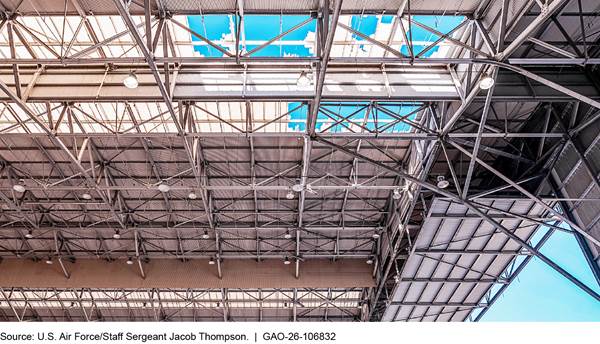
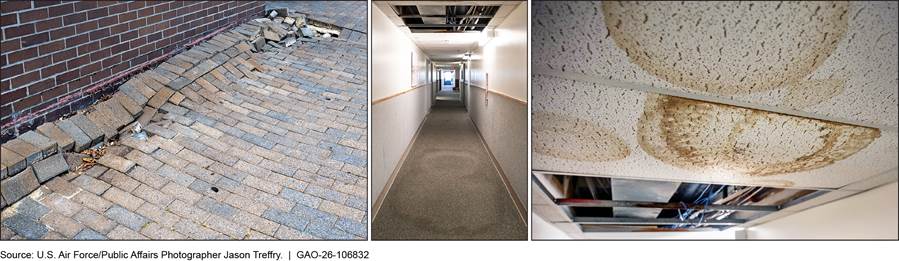
Joint military bases are installations with more than one military service. For example, at Joint Base San Antonio, the Air Force is the lead service, and the Army is the supported service. Eleven of the 12 joint bases received less funding in fiscal years 2018 through 2022 than the Department of Defense’s (DOD) facility sustainment funding goal. However, DOD was unable to obtain data on how this funding was allocated to specific components on joint bases and therefore was unable to determine if the impact of funding below DOD’s goal led to disparities in facility conditions between lead and supported military services on bases. Joint base senior leaders whom GAO surveyed stated that facility management offices do not receive sufficient funding to keep facilities in good working order. During site visits to five joint bases, GAO observed examples of facility degradation due to deferred maintenance (see fig.).
DOD has issued numerous guidance documents for joint base facility management, but senior joint base officials expressed confusion about how responsibilities for funding joint base facilities are allocated between the military services. Joint bases have multiple, ongoing cost-sharing disputes between the military services involving projects totaling over a billion dollars, and these disputes have not been resolved through DOD’s formal oversight structure. In July 2025, DOD finalized a department instruction that adds more detail regarding facility funding responsibilities on joint bases and could improve officials’ understanding of this issue. GAO found that all joint bases with available workforce data have facility management workforce shortages and that workforce requirements have not been reassessed to reflect increasing workloads as military units on joint bases have grown. Improving the availability of data on facility funding and reassessing workforce requirements could help DOD to address risks to unit missions from facility degradation on joint bases.
Why GAO Did This Study
DOD consolidated 26 installations into 12 joint bases over a decade ago to increase readiness, reduce duplication of efforts, and generate cost savings and efficiencies. However, DOD has faced challenges in sustaining its facilities on its 12 joint bases. On joint bases, the lead and supported military services share responsibility for managing facilities and supporting missions.
The Joint Explanatory Statement accompanying the National Defense Authorization Act for Fiscal Year 2023 includes a provision for GAO to assess sustainment of facilities on joint bases. This report addresses, among other things, the extent to which DOD (1) met its funding goal for joint base facility sustainment in fiscal years 2018 through 2022, (2) assessed funding levels for supported component facilities on joint bases, (3) provided guidance and oversight to facility management offices for joint base facility maintenance, and (4) determined whether joint base facility management offices have sufficient workforces to meet their responsibilities.
GAO conducted site visits to five joint bases, surveyed senior leaders at all 12 joint bases (with a 100 percent response rate), analyzed facility investment and workforce data, and reviewed applicable guidance.
What GAO Recommends
GAO is making five recommendations specific to joint bases, including that DOD assess the risks to missions by not meeting its funding goal for facility sustainment, improve the quality of data on facility funding, and reevaluate the workforce levels for facility management offices. DOD generally concurred with GAO’s recommendations and outlined actions it plans to take toward their implementation.
Abbreviations
|
BRAC |
Base Realignment and Closure |
|
CPVF |
Cost and Performance Visibility Framework |
|
DOD |
Department of Defense |
|
FSM |
Facilities Sustainment Mode |
|
FTE |
full-time equivalent |
|
HVAC |
heating, ventilation, and air conditioning |
|
JMOS |
Joint Management Oversight Structure |
|
MOA |
Memorandum of Agreement |
|
OSD |
Office of the Secretary of Defense |
|
PRV |
plant replacement value |
This is a work of the U.S. government and is not subject to copyright protection in the United States. The published product may be reproduced and distributed in its entirety without further permission from GAO. However, because this work may contain copyrighted images or other material, permission from the copyright holder may be necessary if you wish to reproduce this material separately.
February 26, 2026
Congressional Committees
The Department of Defense (DOD) has faced challenges in keeping facilities on installations in good working order. However, senior DOD officials have testified to Congress that the department has chosen to accept risk by investing less in facilities than what DOD had determined was needed to effectively sustain them, and other officials have stated that funding priority is given to other programs and initiatives, such as weapon system acquisitions.[1] More recently, in March 2025, DOD notified Congress that the Army plans to move at least $1 billion from facilities sustainment funding to other programs. DOD consolidated 26 installations into 12 joint bases over a decade ago to increase readiness and to generate cost savings and efficiencies. Facility management is more complicated at DOD’s 12 joint bases, because the lead military service is also responsible for providing installation support to other military services’ facilities on the installation.[2] A 2021 DOD Inspector General audit of joint bases found that managing facility investments was one of the most challenging and longest-standing issues with joint base implementation.[3]
We previously reported that DOD did not realize the cost savings the department expected from joint basing and that the cost of installation support on joint bases was expected to increase, rather than decrease.[4] We made multiple recommendations to improve joint basing, including for DOD to track savings from joint basing and to adjust joint base guidance and criteria. DOD addressed some, but not all, of our recommendations.[5] We also suggested that Congress and DOD reevaluate the purpose of joint basing and determine whether the goals of the program were still appropriate. Congress did not take action on this issue, and DOD did not implement our recommendation.[6]
The Joint Explanatory Statement accompanying the National Defense Authorization Act for Fiscal Year 2023 includes a provision for us to assess the sustainment of facilities on joint bases.[7] This report evaluates the extent to which DOD (1) met its funding goal for joint base facility sustainment for fiscal years 2018 through 2022, (2) assessed funding levels for supported component facilities on joint bases, (3) provided guidance and oversight to facility management offices for joint base facility maintenance, and (4) determined whether joint base facility management offices have sufficient workforce to effectively manage and maintain facilities on the joint bases.
To address our objectives, we reviewed documents and materials, including DOD guidance on joint basing; materials and meeting minutes from DOD’s annual Joint Basing Summit; and Memorandums of Agreement (MOA) between the lead and supported components for each of the 12 joint bases. We also obtained and analyzed data on facility management workforces for fiscal years 2013 through 2023; obtained and analyzed data on funding for joint base facilities for fiscal years 2018 through 2022; visited five joint bases in November and December 2023 to observe facility condition and discuss facility management with officials; collected information from leadership at all joint bases using an online questionnaire in May and June 2024; and interviewed officials at DOD’s Joint Basing Office and the headquarters of the Army, the Air Force, the Navy, and the Marine Corps. We assessed DOD’s efforts to manage joint base facilities against criteria including leading practices for addressing deferred maintenance and federal internal control standards. In July 2025, after we had completed our audit work, DOD issued an instruction on joint basing.[8] Because this instruction was issued following our audit work, this report generally reflects the guidance, procedures, and responsibilities in place under DOD’s 2008 implementing and 2022 operating guidance in effect during our audit. However, we also provide some high-level discussion of the new instruction, where relevant, and note, in some instances, how the new instruction addresses deficiencies we identified. Appendix I provides more information on our scope and methodology.
We conducted this performance audit from May 2023 to February 2026 in accordance with generally accepted government auditing standards. Those standards require that we plan and perform the audit to obtain sufficient, appropriate evidence to provide a reasonable basis for our findings and conclusions based on our audit objectives. We believe that the evidence obtained provides a reasonable basis for our findings and conclusions based on our audit objectives.
Background
Establishment of Joint Bases
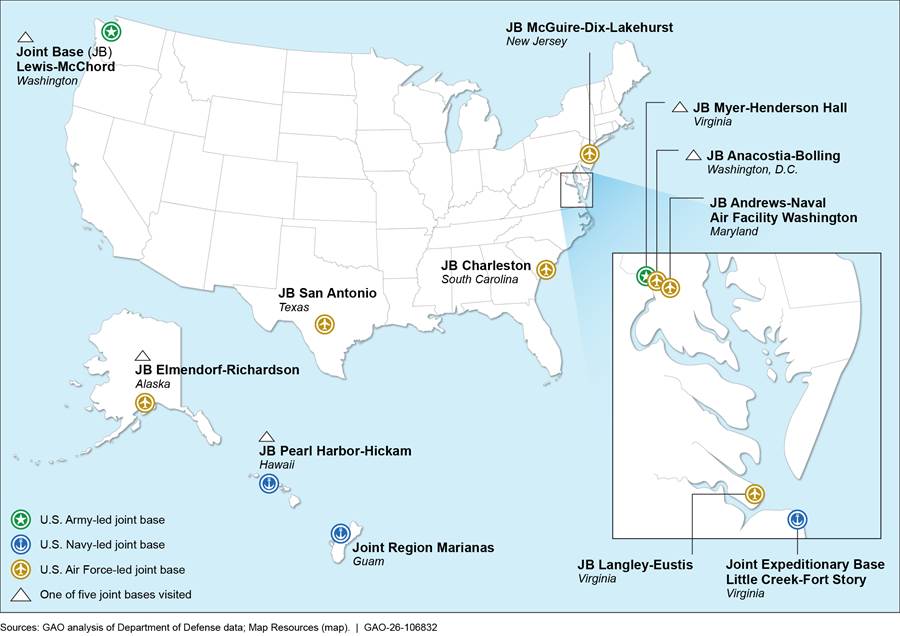
DOD consolidated 26 installations into 12 joint bases from 2009 through 2010 to increase readiness, reduce duplication of efforts, and generate cost savings and efficiencies. DOD designated one military service on the joint base as the lead component and the other military service(s) as the supported component(s). DOD assigned the lead component on the joint base as the property owner for all facilities, and as the responsible party for providing installation support, including facility maintenance activities, for the supported components. See table 1 for a list of joint bases, including which military services are the lead or supported components on each joint base. Figure 1 depicts the locations of the 12 joint bases.
|
Name of Joint Base |
Location |
Lead component |
Supported component(s) |
|
Joint Base Anacostia-Bollinga |
District of Columbia |
Air Force |
Navy |
|
Joint Base Andrews-Naval Air Facility Washington |
Maryland |
Air Force |
Navy |
|
Joint Base Charleston |
South Carolina |
Air Force |
Navy |
|
Joint Base Elmendorf-Richardson |
Alaska |
Air Force |
Army |
|
Joint Base Langley-Eustis |
Virginia |
Air Force |
Army |
|
Joint Base McGuire-Dix-Lakehurst |
New Jersey |
Air Force |
Army, Navy |
|
Joint Base San Antonio |
Texas |
Air Force |
Army |
|
Joint Base Pearl Harbor-Hickam |
Hawaii |
Navy |
Air Force |
|
Joint Expeditionary Base Little Creek-Fort Story |
Virginia |
Navy |
Army |
|
Joint Region Marianasb |
Guam |
Navy |
Army, Air Force, Marine Corps |
|
Joint Base Lewis-McChord |
Washington |
Army |
Air Force |
|
Joint Base Myer-Henderson Hall |
Virginia |
Army |
Marine Corps |
Source: GAO summary of DOD information. | GAO‑26‑106832
aJoint Base Anacostia-Bolling was established with the Navy as the lead component and the Air Force as the supported component. In 2020, the Air Force became the lead component for Joint Base Anacostia-Bolling, with the Navy as the supported component.
bJoint Region Marianas was established with the Navy as the lead component, and the Air Force as the supported component. In 2010 the Marine Corps was added to Joint Region Marianas as a supported component. In 2019, DOD decided to align much of the responsibility for managing Air Force-occupied facilities on Joint Region Marianas (specifically, Andersen Air Force Base) to the Air Force. In 2024, the Army was added to Joint Region Marianas as a supported component.
Governance Structure of Joint Bases
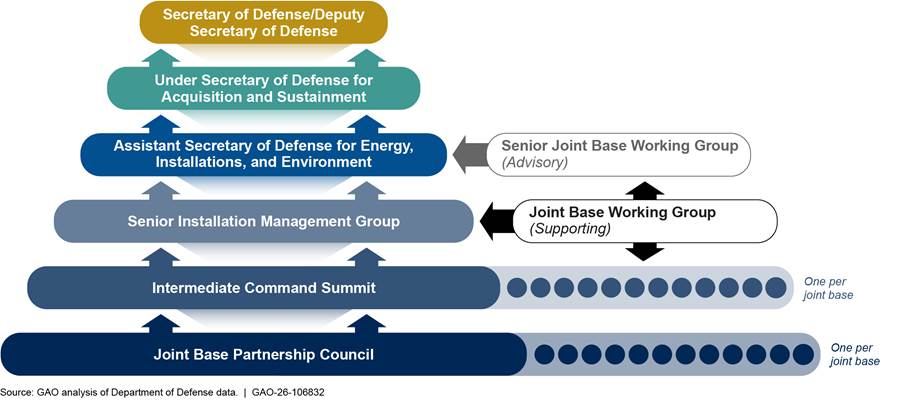
In January 2008, the Deputy Secretary of Defense issued guidance to implement the joint basing initiative.[9] The guidance required that the military services at each joint base enter into an MOA to define the relationships between the components; to detail the transfer of real property and funding to the lead component; and to require the establishment of the Joint Base Partnership Council, which is a group consisting of representation from the major supported component(s) and the tenants on the base. The council’s role includes helping at the joint base level to resolve any disputes that arise between the lead and supported components.[10] Further, the guidance also created a Joint Management Oversight Structure to establish the lines of authority for handling disputes and directed the transfer of installation-support authority and real property to the lead component (see fig. 2). Each level of this oversight structure is required to complete reviews of changes to a joint base MOA within a specified time frame. If the changes under review cannot be resolved by the oversight structure, the changes are to be adjudicated by the Assistant Secretary of Defense for Energy, Installations, and Environment. DOD’s July 2025 instruction retained the same governance structure for joint bases.[11]
Operational guidance requires that each joint base have a Joint Base Commander from the lead component, and a Deputy Joint Base Commander who is generally from the supported component.[12] The Joint Base Commander is responsible for delivering installation support functions documented in each joint base’s relevant MOA.
Responsibilities for Facility Funding at Joint Bases
Examples of facilities on DOD installations include administrative buildings, housing, childcare centers, communication lines, perimeter fencing, parking areas, parade fields, retaining walls, sidewalks, and transformers. As part of establishing joint bases, the DOD implementing guidance required that real property, including facilities, owned by the supported component and related sustainment funding was transferred to the lead component. For example, the Air Force facilities at the former Hickam Air Force Base were transferred to the Navy when Joint Base Pearl Harbor-Hickam was established. Therefore, the Navy is responsible for investing in facilities work, as well as maintaining and repairing the facilities on the joint base, regardless of which component is using the facility.
DOD formulates budgets for facility maintenance primarily using the quantity and types of facilities on military bases. DOD uses the Facilities Sustainment Model (FSM) formula to estimate its annual, department-wide facility sustainment funding requirements, based on metrics such as square footage, plant replacement value (PRV), and sustainment unit cost (i.e., the annual cost of sustaining an average-sized facility for a particular facility analysis category). According to DOD’s Financial Management Regulation, the FSM generates an estimated annual funding requirement for facility sustainment activities necessary to keep facilities in good working order.[13] However, the Financial Management Regulation does not define the term “good working order.”
The DOD components use funding appropriated by Congress for facility sustainment, restoration, modernization, and construction to invest in facilities on DOD installations—including at joint bases. In the case of joint bases, the lead and supported components are responsible for different facility investment types.
The lead component is generally responsible for
· facility sustainment, which includes regularly scheduled adjustments and inspections, preventive maintenance tasks, and emergency response and service calls for minor repairs;
· restoration, which includes repair or replacement of facilities damaged by inadequate sustainment, excessive age, accidents, or other causes;
· modernization— improvements to, or recapitalization of, lead component facilities and common infrastructure to support new mission capabilities; and
· construction of lead component facilities and common infrastructure not tied to a new supported component mission or population increase.
In some cases, the supported component is responsible for modernization and construction of its own facilities.[14] See table 2 for more details on funding responsibilities for joint base facilities.
DOD Has Not Funded Joint Base Facility Sustainment to Its Goal
According to our analysis of DOD funding data for fiscal years 2018 through 2022, nearly all joint bases received less funding for facility sustainment than the 90 percent goal established by DOD policy.[15] Senior joint base officials reported that their facility management offices did not receive sufficient funding to adequately maintain facilities and that the joint bases have a large and growing deferred maintenance backlog.
Nearly All Joint Bases Received Less Facility Sustainment Funding than DOD’s Goal
Our analysis of funding data collected by the DOD Joint Basing Office in 2023 found that all joint bases failed to meet DOD’s goal of 90 percent in at least one year across fiscal years 2018 through 2022. Across all joint bases for the 5 years we analyzed, eight bases never met the goal in any year, three met the goal in only one year, and one met the goal in more than one year. Averaging across all 5 years, 11 of the 12 joint bases received less funding than DOD’s goal to fund at least 90 percent of the estimated requirement calculated by the FSM for fiscal years 2018 through 2022.[16] Only Joint Base Langley-Eustis met DOD’s goal by funding 98 percent of the FSM estimated requirement over the 5 years but failed to meet the 90 percent goal in one fiscal year. Overall, on average, joint bases received sustainment funding at 57 percent of the FSM estimated requirement over the 5-year time frame (see fig. 3).[17]
Figure 3: Average Facility Sustainment Funding at DOD Joint Bases (JB), Compared with Funding Goal, 2018-2022
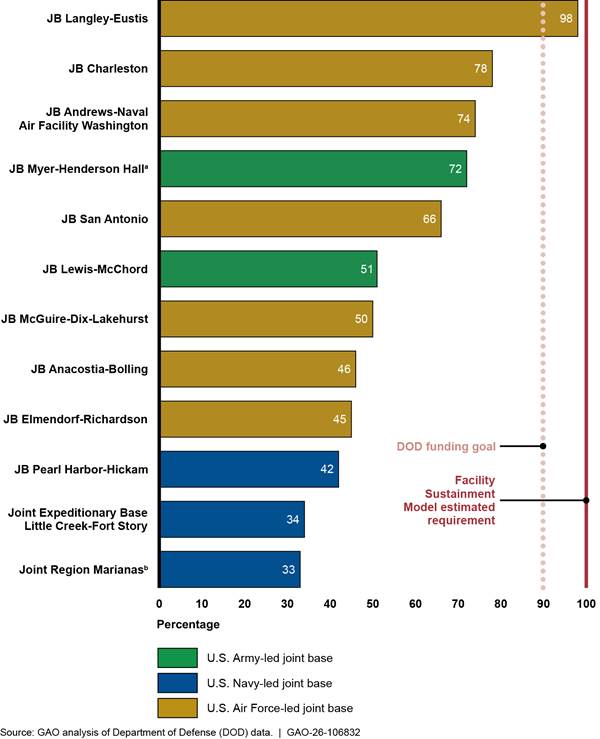
aFiscal year 2020 sustainment funding data for Joint Base Myer-Henderson Hall were unavailable. Therefore, the average was computed using the 4 years of available data.
bFiscal year 2022 sustainment funding data for Joint Region Marianas were unavailable. Therefore, the average was computed using the 4 years of available data.
These results are consistent with our prior work on facility sustainment funding for all DOD installations. We found that the military services generally funded facility sustainment at about 80 percent of the FSM estimated requirement, below DOD’s funding goal of 90 percent.[18]
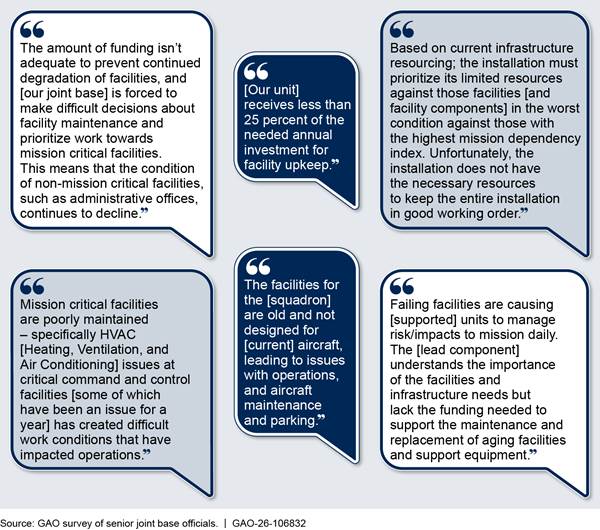
In responses to our survey, senior officials in lead components at the 12 joint bases consistently stated that their facility management offices do not receive sufficient resources to adequately maintain facilities. Nine of the 12 lead components—including both of those leading a joint base with more than one supported component—do not believe they have sufficient resources to keep their own facilities in good working order. Further, 10 of the 12 lead components—including both of those leading a joint base with more than one supported component—do not believe they have sufficient resources to keep the supported components’ facilities in good working order. One joint base senior official stated that their unit on the joint base receives less than a quarter of the funding needed to keep its facilities in good working order. Selected responses to our survey by senior joint base leaders that highlighted concerns with facility funding levels are presented in figure 4.
Joint Base Facilities Have Experienced Degradation, Which Officials Stated Was Due to Insufficient Facility Sustainment Funding
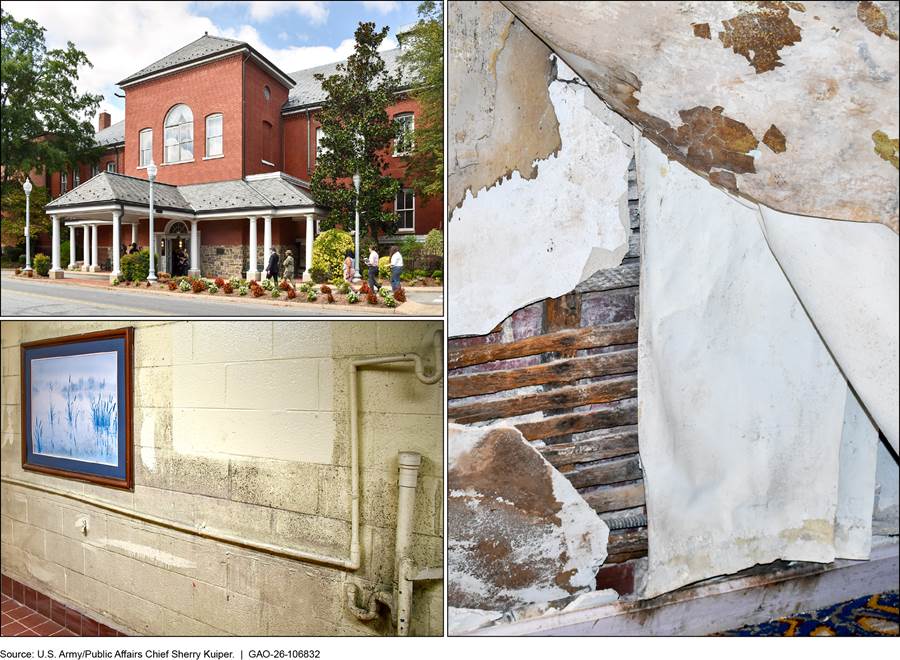
Joint bases that we visited provided examples of how insufficient funding has led to the degradation of some facilities. For example, at Joint Base Myer-Henderson Hall we observed that one building, used for ceremonies such as officer promotions, hosting foreign dignitaries, and military funerals, was deteriorating. One official noted that the building had not received restoration or modernization funding because it did not compete well for funding, given the Army’s emphasis on funding barracks projects. Army officials told us that use of the building had been minimized because the deferred maintenance had made the building unsafe (see fig. 5).
Senior leaders and facility management officials at joint bases we visited reiterated these concerns about funding levels. For example:
· Senior officials at one joint base provided us with their list of 23 priority facilities projects totaling $23 million in requested funding for fiscal year 2024. The officials told us that they received $10 million for these projects from their component headquarters, or less than half of the requested amount. The officials told us that they will have to defer 13 of the 23 priority projects until fiscal year 2025, when they would recompete for funding. The officials noted that continued deferred maintenance of these projects will increase the likelihood that certain facilities could no longer be kept open, due to degraded condition—and that this would impact the mission those facilities support. For example, a project to repair the heating and cooling systems of a building used by Navy personnel had been deferred, and the officials who used that building told us that the lack of effective climate control was impacting the unit’s ability to run servers supporting their missions.
· The Base Commander at another joint base told us that, while the joint basing construct assumes that lead components have sufficient funds to maintain all facilities on a given joint base, DOD has decided to request less funding than required to meet the FSM estimated requirement to prioritize other programs, such as weapon systems acquisition. This official said that, as a result, the lead components are unable to fulfill their responsibilities to maintain all joint base facilities for both lead and supported components, and this is affecting morale, retention, and readiness. Another official at this joint base noted that the installation receives about 75 percent of the FSM estimated funding requirement each year.
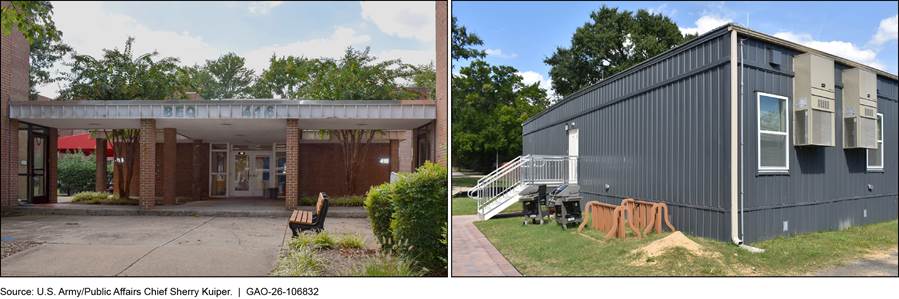
However, joint bases that we visited also provided examples of how increased modernization funding is being used to address degraded facilities. For example, officials at Joint Base Myer-Henderson Hall told us that, to address degradation that resulted from insufficient sustainment funding, increased restoration and modernization funding is being used to improve barracks on the base that house junior enlisted service members. One official explained that because the Army has recently begun an initiative to focus on improving barracks facilities on all Army installations—including joint bases where the Army is the lead component—barracks have benefited from an increased priority in the process used to allocate facility funding. We have previously reported that the conditions of military barracks have affected service member quality of life and readiness.[19] An Army Installation Management Command official told us that, beginning in 2024, the Army would be prioritizing barracks and funding them to 100 percent of the FSM. In October 2025, DOD issued a memorandum directing officials to establish a Barracks Task Force responsible for developing a DOD-wide barracks improvement execution plan, among other things.[20] However, the Army Installation Management Command official said that even if services fund to 100 percent of the FSM, there will still be a need to replace or modernize facilities. During our site visit, we observed older barracks that had been closed and were slated for demolition, and we inspected temporary barracks that had been built to house service members while new barracks were built (see fig. 6).
Figure 6: Closed Barracks (left photo) Replaced by Temporary Barracks (right photo) on Joint Base Myer-Henderson Hall
According to officials at military service headquarters, a portion of facility funding is managed by the military services’ installation management headquarters, such as for facilities projects with costs above a certain funding threshold.[21] Projects for joint base facilities, along with facilities projects at all other DOD installations, are part of this process if they meet the criteria to be centrally managed by the relevant military service. Our analysis of such projects for the Army and the Air Force found that, due to funding constraints, many of these facility projects that were adjudicated at the headquarters level were deferred to future years.[22] Navy and Army officials told us that DOD’s decision to invest in facilities below the funding requirements identified by the FSM complicates their ability to ensure that facilities are maintained or repaired at a pace sufficient to meet mission needs. For example:
· Navy officials told us that due to constrained facility funding, “emergent requirements” (i.e., unplanned facilities projects resulting from natural disasters and other unexpected events) divert funding from projects that the Navy has determined are high priorities to support mission needs and that it can be unclear whether these high-priority planned projects will ever receive sufficient funding.
· According to the Army’s Annual Financial Report for fiscal year 2024, the backlog of deferred maintenance across all Army installations totaled about $147 billion.[23] The Army’s annual budget for facility sustainment, restoration, and modernization in the same fiscal year was about $5.7 billion. Therefore, the Army would need approximately 26 years to address the deferred maintenance backlog, at current funding levels.
· Officials at one Army-led joint base told us that they had a list of 120 projects needed to maintain or repair facilities at the time of our site visit in September 2023. Due to funding constraints they were applying for funding for 20 of those projects from the lead component headquarters—and expected that one project would ultimately receive funding in that fiscal year.
In May 2025, DOD notified Congress that the Army plans to move at least $1 billion from facilities sustainment funding to other programs.[24] In a subsequent testimony before Congress, when asked about the impact of the funding reallocation, the Chief of Staff of the Army stated that if the Army moved funds out of facility maintenance accounts, it would be able to fix fewer facilities—specifically barracks.[25]
According to leading practices recognized as effective strategies for addressing deferred maintenance, agencies should employ models for analyzing tradeoffs and identify the risks posed by a lack of timely investment in facilities.[26] Federal internal control standards state that agencies should define risk tolerances for their objectives, specifically, the acceptable level of variation in performance relative to the achievement of objectives.[27]
While DOD has funded some facilities at joint bases at higher amounts to address degraded buildings, DOD has not analyzed the risk to missions that is caused by not meeting its goal to request 90 percent or higher of its estimated facility sustainment funding requirement at all of its joint bases, as specified in DOD policy, due to competing priorities.[28] Because of this, DOD risks increasing the deferred maintenance backlog at joint bases, resulting in significant anticipated repair costs and reduced capacity of facilities to support DOD missions. By identifying and assessing the risks of not meeting the facility sustainment funding goal and any resulting effect on missions at joint bases, DOD would have greater visibility of the risks it is assuming to readiness due to deteriorating facilities, such as airfields and service member quality of life due to deteriorating facilities, such as barracks.
DOD Is Unable to Determine Funding Levels for Supported Components on Joint Bases, Contributing to Perceptions of Imbalances
According to officials at DOD’s Joint Basing Office, DOD attempted to determine how facility funding was allocated between lead and supported components on joint bases in 2023, but it was unable to do so because of incomplete and inaccurate data. The officials told us DOD was attempting to investigate concerns about perceived imbalances in funding between components on joint bases. They noted that the lack of detailed data on facility funding has contributed to perceptions among senior leaders of supported components that (1) lead components are not providing required sustainment and restoration funding for supported components, and (2) supported component headquarters are not providing required modernization and construction funding.
DOD Does Not Have Information on How Funding Is Allocated Among Components for Joint Base Facilities
Four out of the five joint bases we visited were unable to provide us with funding data for facilities used by the lead and supported components. We asked these five joint bases for data on facility funding for fiscal year 2022—specifically, the funding amount; the components that received the funding; the projects that were funded, by type (i.e., sustainment, restoration, or modernization); and the project status. However, most of the joint bases were unable to provide these data, with the exception of Joint Base Elmendorf-Richardson. For example:
· Air Force officials at Joint Base Anacostia-Bolling told us that they could not provide complete information on which facilities received funding, stating that the data collected and maintained by the Navy prior to the joint base being transferred to the Air Force in 2020 were inaccurate. In September 2023, the officials said they were still working to improve the quality and completeness of funding data for the joint base and, therefore, could not provide us with the funding data we requested.
· Officials at Joint Base Pearl Harbor-Hickam said they lacked the data to assess how funding for facilities is distributed on the joint base because of issues with the quality and completeness of data on facility maintenance funding for the joint base.
Additionally, in 2023, the DOD Joint Basing Office requested data on facility funding from the military services to identify how funding was allocated between the lead and supported components on joint bases and whether supported components were obtaining sufficient facility funding relative to the FSM estimated requirements. However, in November 2023, officials from the DOD Joint Basing Office told us they determined that the available data did not allow the office to determine whether supported components received adequate funding from the lead component. The officials explained that this was because data were only available for the total amount of facility funding on each joint base, and did not allow for detailed analysis of how funding was distributed between lead and supported components.
DOD Joint Basing Office officials told us that the inability to obtain detailed data on facility funding at joint bases has revealed a compelling need to improve the accuracy of data reporting. Additionally, in the absence of these detailed data, senior joint base officials stated in survey responses that they believe that (1) lead components are not meeting their obligation to fund the sustainment and restoration of facilities used by supported component units, and (2) supported component installation management headquarters are reluctant to fund modernization and construction projects at joint bases because they incorrectly believe that funding these projects is the responsibility of the lead components.
Lead and Supported Components Differ in Their Views of Facility Support Provided by the Lead Component
Senior supported component officials told us that they believe the lead component is not providing needed support for facilities they use. For example, at four of the five joint bases we visited, senior officials highlighted that constrained funding for facilities overall has led to instances where the lead component prioritized the maintenance of lead component facilities. One official added that they believed that, because lead component officials were unfamiliar with the missions of supported component units, they were making decisions to allocate funding based on lead component priorities, rather than a comprehensive review of all priorities of the installation, including those of supported components. Some supported component officials acknowledged that lead components are struggling with funding and workforce shortages. One of these officials noted that the joint base construct can exacerbate these challenges because supported component units cannot control how their facilities will be funded, and they believe this is increasing the risk to missions for supported units on joint bases.[29] For example, supported component officials at one base showed us a facility used to calibrate weapon systems components, a procedure that the officials told us required stable temperatures and humidity in the calibration room. However, the officials told us that insufficient maintenance of the building’s heating and air conditioning systems by the lead component could cause inaccurate calibration—including for targeting systems. We observed additional heating and ventilation systems that the supporting component had installed in an ad hoc manner to attempt to stabilize the temperature and humidity in the facility.
In addition, the results of our survey of senior officials from supported and lead components indicated a disconnect in perceptions about the level of facility support provided. Some senior officials stated in responses to our survey that they believed they were not receiving sufficient facility maintenance. Specifically, six of 14 supported components—including two of four supported components that share a joint base with another supported component—responded that the lead component maintains supported component facilities at a lower level than the lead component facilities. In contrast, all 12 of the lead components responded in the survey that they maintain supported component facilities as well as, or better than, their own facilities. Further, 11 of 14 supported components—including three of four supported components that share a joint base with another supported component—responded that the quality of the facilities they use had remained the same, or worsened, after the lead component assumed responsibility for the facilities. However, seven of the 12 lead components—including both leading a joint base with more than one supported component—believed the same facilities had improved since they had assumed responsibility for them. In addition, eight of 14 supported components—including all four supported components who share a joint base with another supported component—responded that they believe the lead component headquarters does not prioritize the facility and infrastructure needs of the supported component at a level equal to the needs of the lead component.
In one example, Joint Base Lewis-McChord officials have been attempting to obtain funding for a fire station that services McChord Airfield, the Air Force airfield on the base. The officials told us that the fire station was built in the 1950s and cannot fit the modern, aviation-specific fire trucks used by the firefighters to respond to incidents at the airfield. The officials added that firefighting foam containing hazardous chemicals needs to be stored in a separate protected space, but there is insufficient space in the fire station to do so. Therefore, the firefighting foam is stored in the station’s hangar space (see fig. 7).
Figure 7: Photographs of Fire Trucks and Firefighting Foam Stored Without Required Space in McChord Airfield Fire Station
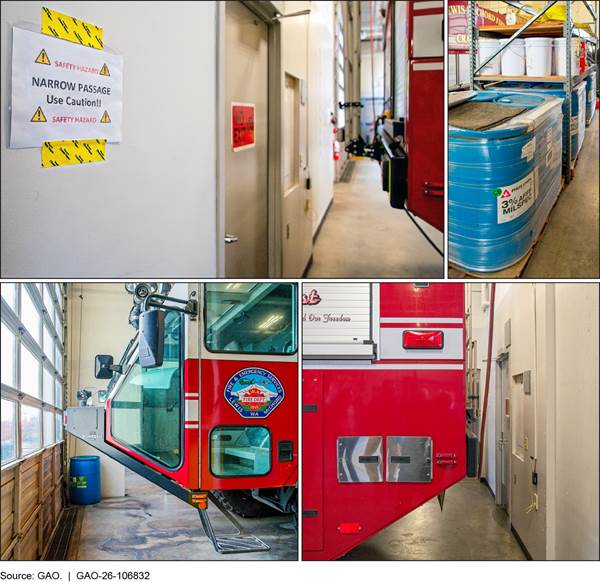
Note: According to Joint Base Lewis-McChord officials, firefighting foam should be stored in a separate protected space—but there is insufficient space in the McChord Airfield fire station to do so.
However, the joint base officials told us that the fire station project did not score well in the Army’s funding process because Army decision-makers believed that, since another fire station on an airfield on the base used by the Army had recently been replaced, there was an “alternative facility” that could serve as a fire station for the airfield used by the Air Force. However, as the joint base officials demonstrated to us during a driving tour of the installation, the airfields are located approximately 30 minutes driving distance apart, so it would not be practical for the new fire station at the airfield used by the Army to provide an effective response to an incident at the airfield used by the Air Force. The Air Force Wing Commander who oversees units that use the airfield told us that the context and needs of the supported component are not being considered by the higher Army headquarters who are making funding decisions, and this is impacting mission readiness of the Air Force missions on the joint base.
Supported Component Senior Leaders Told Us That Their Units Are Not Receiving Needed Modernization Funding from Their Service Headquarters
During our site visits, senior leaders in joint base supported components told us that their service headquarters were not providing needed funding for modernization and construction projects. For example, Army officials at Joint Base Elmendorf-Richardson told us that the Army had underinvested in constructing its own facilities on the base, spending $7 million in military construction funding since the joint base was established in 2010. In contrast, according to data provided by the joint base, in fiscal year 2022 the Air Force spent more than $55 million maintaining facilities used by Army units on the joint base—nearly eight times what the Army spent on building new facilities since the establishment of the joint base.[30] An Army official on the joint base told us that they believe the low amount of Army funding for military construction was because the Army is reluctant to invest in facilities that are viewed as the property of another military service. The Army officials showed us facilities in which units were operating that were older and ill-suited to current equipment and training needs. For example:
· At one vehicle maintenance facility used by an Army unit, we observed damage to ductwork because of insufficient space to work on large vehicles, and vehicles that were stored outside in cold temperatures requiring the unit to store vehicle batteries on a heating pad next to the building (see fig. 8).
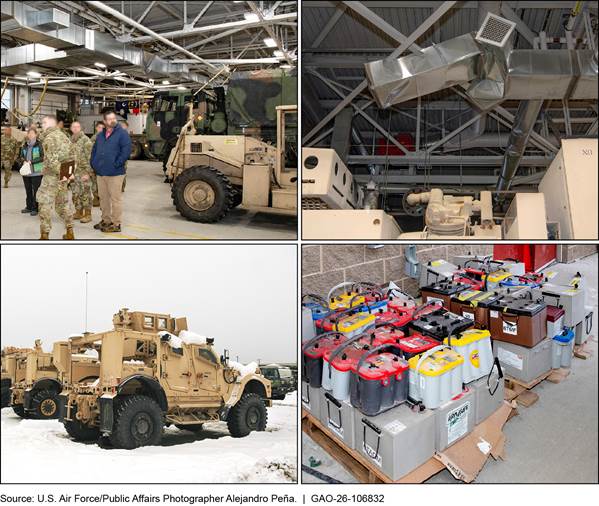
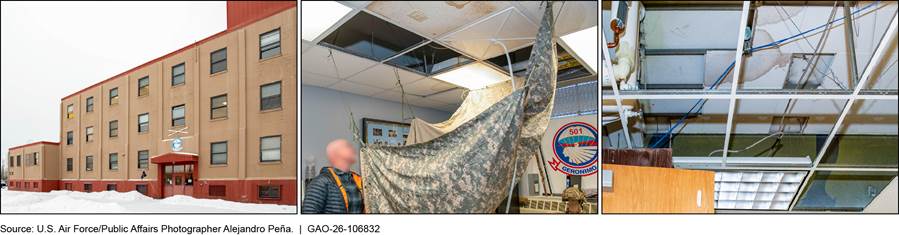
· We also observed a former Army barracks that had been converted to use by an Army unit to store equipment, such as cold-weather clothing and weapons, and as a space for soldiers to prepare for cold-weather training. We observed that this facility had unaddressed system failures, such as broken heating systems and leaking pipes (see fig. 9). The soldiers we met with told us that these issues impacted their ability to keep their clothing and equipment in good condition for training.
Figure 9: Army Barracks Converted to Staging Facility for Soldier Training on Joint Base Elmendorf-Richardson
In response to our survey, senior leaders of supported components were more likely to report being dissatisfied with their service headquarters’ ability to meet their infrastructure needs. Half of the supported components (seven out of 14) responded that they were neither satisfied nor dissatisfied with how their supported headquarters meets their needs, while four were dissatisfied or highly dissatisfied, and only three were satisfied. By contrast, eight of the 12 lead components—including both lead components that lead a joint base with more than one supported component—were satisfied or very satisfied, and only three were somewhat or very dissatisfied with their own service’s headquarters’ ability to meet their infrastructure needs.[31]
In part to address these continued concerns about supported components receiving insufficient support for the facilities they use, officials from DOD’s Joint Basing Office told us that they have been working to enhance the process they use to request Cost and Performance Visibility Framework (CPVF) data from the military services.[32] Specifically, beginning in September 2024, the DOD Joint Basing Office began requiring more granular CPVF reporting of data by specifying that joint bases need to provide funding data for supported components separately from lead component and installation-specific functions. In addition, the Joint Basing Office is adding a “census” of the personnel assigned to joint bases so that they can track population fluctuations over time on a component-specific basis. The officials told us that this will allow them to better track when the footprint of units on joint bases significantly changes and to identify when updates to facility funding allocations may be needed to reflect those changes. For example, when a supported component increases its presence on a joint base, it will be required to increase investment in facilities commensurate with those increases in personnel. DOD’s new instruction on Joint Basing Operations, issued in July 2025, addresses this issue by clarifying when components on joint bases are required to contribute funding to another component, due to mission-related changes that impact installation support.[33] However, without improvements to the completeness and reliability of DOD facility funding data overall, DOD will continue to be unable to complete analyses of how facility funding on joint bases is allocated between facilities used by lead and supported component units.
DOD’s Financial Management Regulation calls for federal managers to produce budgets at a detailed level that will improve accuracy, insight, and increased transparency of an agency’s expenditures.[34] Additionally, Standards for Internal Control in the Federal Government call for management to provide decision-makers with the necessary quality information for making decisions.[35] Key characteristics of an asset management framework include that organizations should collect, analyze, and verify the accuracy of asset data—including data on investments in real property assets.[36] These key characteristics also note that organizations should evaluate the performance of their asset management system and implement necessary improvements.
However, DOD does not know whether joint base facilities are receiving the appropriate level of funding because it has not developed an approach to improve the collection, availability, and quality of data on facility funding at joint bases. At present, DOD cannot identify the funding associated with each facility on its joint bases. The lack of visibility into the full picture of funding in joint base facilities—including any differences in funding levels among facilities used by lead and supported components on joint bases—limits DOD’s ability to evaluate its facility management efforts. DOD will also be limited in its ability to clearly report such information to agency and congressional decision-makers in a complete and comprehensive manner and make any needed adjustments to funding levels. The lack of complete data on facility funding at joint bases will also limit DOD’s ability to implement guidance issued in July 2025 on joint basing. Specifically, DOD’s July 2025 instruction on joint bases adds more detail regarding facility funding responsibilities on joint bases, including that any changes in force structure by supported component units that results in an increased facility footprint should be accompanied by a transfer of funds from the supported component to the lead component.
DOD Recently Issued Guidance That Could Improve Clarity About Responsibilities for Facility Investments on Joint Bases
Until recently, DOD had inconsistently updated guidance for joint bases, and senior officials told us that confusion regarding lead and supported component funding responsibilities had led to lingering cost-sharing disputes. DOD’s July 2025 Instruction clarifies the funding responsibilities for joint base facilities, which may help to address the issue. Joint base senior officials told us that DOD’s oversight structure for joint bases has faced challenges because of issues with transparency and responsiveness. Joint bases have cost-sharing disputes between the military services involving projects totaling over a billion dollars, and these disputes have not been resolved through DOD’s formal oversight structure.
DOD’s Guidance on Joint Basing Has Caused Confusion for Officials; Recently Issued Guidance Could Improve Clarity
DOD Has Issued Multiple Memorandums, Supplements, and Other Guidance for Joint Bases
DOD has issued multiple guidance documents regarding joint bases. Specifically, in 2008 DOD issued the Joint Basing Implementation Guidance, along with supplemental guidance for specific installation support functions, such as real property.[37] As part of the creation of the 12 joint bases, each base formulated an MOA between the lead and supported components. In 2020, DOD issued a memorandum that outlined how the funding responsibilities for joint base facility improvements were to be apportioned between the lead and supported military services (see table 2).[38] In 2022, DOD replaced the 2008 implementation guidance, which was later revised in 2010, with the Joint Basing Operations Guidance.[39] However, the Joint Basing Operations Guidance did not update the 44 appendixes and nine policy memorandums that had served as supplemental guidance to the implementation guidance. Aspects of these appendixes and memorandums still applied to issues such as facility management. During our site visits and in our survey, joint base senior officials told us that this collection of guidance regarding the operation of joint bases was disparate and could be difficult to interpret—especially with respect to joint base facility funding responsibilities.
In July 2025, DOD issued an instruction for Joint Basing Operations[40] that
· establishes policy, assigns responsibilities, and provides procedural direction for the sustained operations of, and provision of, installation management and support functions at joint bases;
· defines the DOD Joint Basing Program; and
· defines the joint management oversight structure that provides a governance framework for equitable conflict resolution and resource allocation between the DOD components at a joint base.
DOD’s Recently Issued Instruction May Address Confusion About Responsibilities for Joint Base Facility Management
During our review, multiple senior officials at joint bases and military service headquarters told us that they were unclear about how funding responsibilities for joint base facilities are divided between lead and supported components. The officials added that this can cause situations where facility maintenance or repairs are not completed because of funding disputes between the lead and supported components. For example, officials at Joint Base Lewis-McChord told us that because of a difference in how the military services on the joint base define equipment on an airfield used to secure aircraft in cases of emergency landings, there was an ongoing dispute about which component was responsible for maintaining the equipment (i.e., whether this was the responsibility of the lead or the supporting component).
DOD’s issuance of supplemental guidance in its July 2020 memorandum was a step toward addressing the broader issue, specifically by delineating the lines of responsibility regarding the different categories of facility funding on joint bases. Further, similar to the July 2020 memorandum, DOD’s July 2025 instruction on Joint Basing Operations specifies that the lead component will sustain and restore all facilities on the joint base, with certain exceptions. These include that supported components will restore facilities when restoration of the facility is required due to negligence of the supported component or its occupants, or a prior agreement exists that requires the supported component to fund restoration. The instruction also adopts the definitions of facility sustainment, restoration, modernization, and recapitalization, as outlined in DOD’s Financial Management Regulation, and defines new construction as activities that provide new and expanded facilities. A summary of the facility funding responsibilities outlined in the July 2020 memorandum and the July 2025 instruction is presented in table 2.
|
Facility funding responsibility |
|||||
|
Facility category |
Sustainment |
Restoration |
Modernization |
Replacement |
Construction |
|
Installation Support Facilitya |
Lead component |
Lead component |
Lead component |
Lead component |
Lead or supported componentd |
|
Lead Component Facility |
Lead component |
Lead component |
Lead component |
Lead component |
Lead component |
|
Supported Component Facility |
Lead component |
Lead or supported componentb |
Lead or supported componentc |
Supported component |
Supported component |
Source: GAO summary of Department of Defense (DOD) policy documents. | GAO‑26‑106832
a”Installation Support Facilities” are defined by DOD as facilities associated with specific installation support functions that apply to more than one component (e.g., dining facilities).
bThe supported component will restore facilities when restoration of a supported component mission facility is required due to negligence of the supported component or its occupants, or a prior agreement exists that requires the supported component to fund restoration.
cThe lead component is responsible for modernization of all installation support facilities and common infrastructure at the joint base, except when the modernization requirement is generated by a new mission or expanded existing mission requirement, in which case the component generating the requirement is responsible.
dThe component generating the requirement for new construction is responsible for programming the necessary planning, design, construction, and sustainment funding needed for that new construction. If the construction requirement of a new facility belongs to a supported component, the supported component will transfer sustainment funding authority to the lead component for this purpose.
Even though these responsibilities have been outlined in guidance since 2020, many senior officials on joint bases told us they did not completely understand the lines between different categories of facility funding. Specifically, in response to our survey, 10 of the 14 supported components—including all four supported components that share a joint base with another supported component—said they understand how the lead component obtains and uses facility funding on their installation only somewhat well, or not very well.
Half of the supported components, including two supported components who share a joint base with another supported component, responded that a lack of transparency into why the lead headquarters funds the facility projects that it does was a challenge. Additionally, about a third of both lead and supported components (or four of the 12 lead components, which did not include either of the bases with multiple supported components, and five of the 14 supported components, including three supported components at bases with multiple supported components) identified unclear responsibilities for each component as a challenge. When asked how much of a problem unclear responsibilities were at joint bases, more lead components indicated that this was a moderate or large problem, compared with supported components.
During our site visits and in our survey, senior joint base officials told us that this collection of guidance regarding the operation of joint bases is disparate and can be difficult to interpret—especially with respect to joint base facility funding responsibilities. In addition, a 2012 Air Force report noted that development of a DOD Instruction could provide the clarity needed to deconflict component instructions and regulations.[41] DOD’s instruction on Joint Base Operations, issued in July 2025, may help to address the concerns we identified during our audit work, specifically by improving officials’ understanding of joint base procedures to manage facilities and address conflicts.
DOD’s Joint Management Oversight Structure Has Faced Challenges Resolving Disputes Between Joint Base Components in a Timely Manner
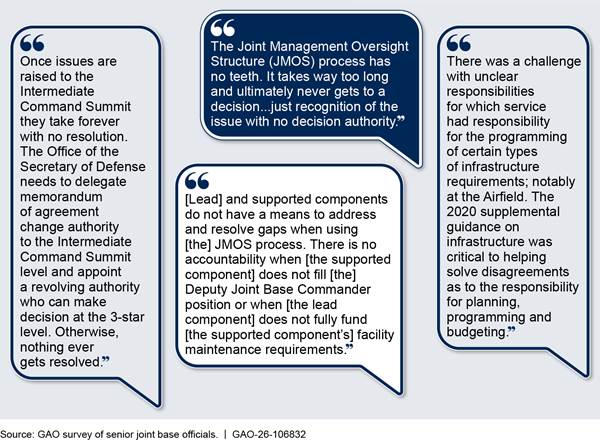
The Joint Management Oversight Structure (JMOS) is a multilayered process to manage disputes between joint base components, whereby such disputes are submitted to military leaders at higher levels in the military organization for adjudication and resolution. Senior joint base officials stated in responses to our survey that the JMOS has faced challenges in addressing disputes in a timely manner. For example, survey respondents noted that when disputes are raised to the Intermediate Command Summit—a group of senior Commanders above the joint base level—the review by this group can be excessively lengthy, leading to lingering disputes on the joint bases. Figure 10 displays examples of concerns that survey respondents noted about the effectiveness of the JMOS in resolving issues and disputes on joint bases.
During our site visits, senior leaders and unit Commanders at joint bases reiterated these concerns. Specifically, the officials told us that the JMOS
· does not provide sufficient opportunities for supported units to advocate for the funding of projects at facilities they occupy,
· does not hold lead components accountable when supported facilities face degradation resulting from insufficient maintenance, and
· does not resolve disputes in a timely manner.
Our analysis of joint base MOAs found that, as of August 2023, half of the joint bases had not reviewed their MOAs within the prior 3 years, as required by DOD policy.[42] Officials at joint bases and at DOD’s Joint Basing Office told us that delays in obtaining approval for MOA changes through the JMOS process has meant that the JMOS has not provided dispute resolution in a timely manner. The officials added that, because of these delays, many joint base components have chosen instead to enter into informal agreements—such as between a joint base Commander and a unit Commander from the supported component—to resolve disputes. However, these officials noted that once the cognizant officials leave their position on the joint base, the lack of a formal written agreement can cause confusion and inefficiencies.
DOD’s Joint Basing Office has taken steps to address some of these concerns. For example, the office developed a web-based tool to provide joint base personnel with information on the status of these reviews, to include what level of the JMOS is conducting the review and in what time frame the joint base personnel should expect a response. This initiative may help to alleviate some of the concerns mentioned to us by joint base senior leaders and facility management officials.
Joint bases face a backlog of facility repairs that is estimated to cost over a billion dollars to address, as previously discussed. Many of these projects have unresolved cost-sharing disputes between the military components. Senior joint base officials told us during our site visits that confusion about the funding responsibilities of the lead and supported components, combined with delayed adjudication of disputes by the JMOS, have resulted in cost-sharing disputes. They noted that facilities continue to degrade, while disputes regarding how to fund projects to fix the facilities continue to be unresolved.
Specifically, during our site visits we observed examples of degraded facilities for which no funding source had been identified, due to unresolved disputes about cost-sharing responsibilities between the lead and supported component. Officials at these joint bases told us that the cost of addressing these issues was estimated at over a billion dollars. For example:
· According to Joint Base Anacostia-Bolling officials, the levee separating the joint base from the Anacostia River, built in 1940, was decertified by the Army Corps of Engineers in 2007 because of structural issues that have affected the integrity of the structure. Joint Base Anacostia-Bolling officials told us that the levee protects assets valued at $700 million, including facilities used by units that perform critical missions in the National Capital Region.[43] The joint base was created in October 2010 with the Navy as the lead component, but Joint Base Anacostia-Bolling officials told us that the Navy took no action to repair the levee. In 2020, leadership of Joint Base Anacostia-Bolling was transferred to the Air Force. Senior officials on the joint base told us that, while the Navy agreed to commit funds toward the levee repairs after the Air Force became the lead component of the base, the officials believed that the level of funding provided by the Navy has been insufficient. This issue became a lingering dispute between the two military departments. According to the Air Force officials at the joint base, as of September 2023 the estimated cost to repair the levee was $178 million. In May 2025, an Air Force official told us that the Navy had agreed to fund a portion of this repair and expects to issue a contract through the U.S. Army Corps of Engineers to formulate a design for repair of the levee by the end of fiscal year 2025. The official also stated that the Navy and the Air Force plan to determine a construction funding strategy once the services have a more definitive cost and an environmental study has been completed.
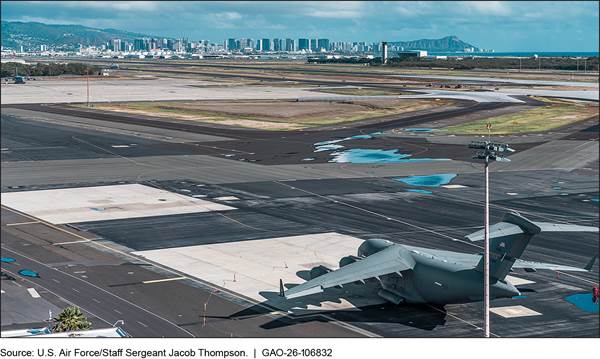
· The Hickam Airfield at Joint Base Pearl Harbor-Hickam used by the Air Force has been found to have deteriorated to the extent that it is negatively impacting the Air Force unit operations at the airfield (see fig. 11). Beginning in October 2018, Air Force officials at the joint base documented concerns with the airfield condition and the lack of actions taken by the lead component (the Navy) to address the issue. Officials at the DOD Joint Basing Office and at Air Force headquarters told us that this dispute lingered and was not effectively addressed via the resolution processes outlined in the JMOS. Therefore, resolution of the issue needed to be obtained outside of the prescribed process, through direct negotiations between the Secretaries of the Department of the Navy and the Department of the Air Force, in 2024. According to Air Force headquarters officials, those negotiations resulted in an agreement to fund repairs to Hickam airfield totaling $1.1 billion through fiscal year 2032, with 89 percent of the costs being provided by the Navy. See appendix II for more discussion of Hickam Airfield.
DOD Has Not Provided Joint Bases with Facility Management Workforce Levels That Meet Their Needs
Joint base facility management offices that maintain and repair facilities for both lead and supported components on joint bases have not been provided with workforce levels that meet the needs of military units. The military services have not reassessed these workforce levels to reflect evolving real estate footprints at the joint bases.
Joint Base Facility Management Workforce Levels Are Below DOD Requirements and Have Not Been Reassessed
In open-ended responses to our survey, senior joint base leaders stated that facility management offices, such as Army Department of Public Works, Navy Public Works Department, and Air Force Civil Engineer Squadrons, were not meeting the facility management needs of the military components on the bases, leading to backlogs in facility maintenance work. Further, in discussions with managers and staff of facility management offices during our site visits, the officials told us that (1) these offices were not provided with the personnel authorizations needed to maintain both the lead and supported portions of the joint base, and (2) they faced significant challenges in recruiting and retaining facility management staff. For example:
· Lead component officials at one joint base told us that the metrics used to determine the workforce levels for facility management personnel did not account for the workload of maintaining the facilities on the joint base. Therefore, the officials explained, the joint base often has to award contracts to complete facility maintenance work because it does not have the workforce capacity to complete the work. They said this results in the work taking longer to be completed, due to contracting and security clearance requirements, and can sometimes result in the work being performed too late to avoid further facility degradation.
· The Commander and Deputy Commander of another joint base told us that there was a large discrepancy between the work requirements, authorized positions, and staffed positions of the installation’s public works office. Specifically, public works officials shared data that showed that staffing levels were at 87 percent of authorized levels. However, the public works officials noted that work requirements were not reassessed when the joint base was created. They estimated that if the requirements were to be updated, their staffing levels would be at about 60 percent of the workforce required to carry out work requirements to keep facilities in good working order.
Joint base officials emphasized that these workforce challenges had led to a large and growing backlog of facility maintenance and related work on the joint bases. Specifically, 10 of the 12 lead components we surveyed—including those leading a joint base with more than one supported component—believe they do not have sufficient resources to keep the supported components’ facilities in good working order. Moreover, nine of the 12 lead components—including those leading a joint base with more than one supported component—believe they do not have sufficient resources to keep their own facilities in good working order. For example, one joint base official stated that key infrastructure, such as heating, ventilation, and air conditioning (HVAC) systems, water pipes, and plumbing are “on triage” and that preventative maintenance is no longer considered. Another official said that a lack of proper resourcing results in higher levels of deferred maintenance, which causes cascading failures across the installation.
According to officials at DOD’s Joint Basing Office, joint base facility management office workforce levels are determined according to the specific policies of the military service that is in the role of lead component for a given joint base. DOD’s Joint Basing Implementation Guidance, in effect from 2010 to 2022, specified that the total funding requirement for joint bases would be based on the needs of the component responsible for delivering installation support, as documented in the MOA, and that this requirement would be considered in setting staffing authorizations and levels as well as annual budget authority for the joint base.[44] DOD’s July 2025 instruction on Joint Basing Operations states that the lead and supported components identify all personnel and funding requirements (funding, end strength, full-time equivalents (FTE), contracts, etc.) corresponding to each installation management and support function and address all applicable requirements.[45] DOD’s guidance on civilian strategic human capital planning assigns responsibility to functional community managers for developing and implementing strategies to mitigate identified workforce and competency gaps.[46] Federal internal control standards state that management should monitor internal control systems, such as workforce planning, through ongoing monitoring and evaluations.[47]
Our analysis found that all joint bases with available workforce data have shortages in facility management workforces relative to authorized FTEs, but that these vary.[48] Specifically, the percentages at which joint base facility management offices were staffed to authorized FTEs ranged from a high of 97 percent at Joint Base Andrews to a low of 68 percent at Joint Base Anacostia-Bolling.
While officials from DOD’s Joint Basing Office and military service headquarters told us that the workforce shortages we identified are similar to those at other, non-joint military installations, joint base senior leaders and facility management officials said that staffing levels below those authorized present particular challenges in terms of managing joint base facilities. For example:
· Officials at Joint Base Anacostia-Bolling told us that challenges in recruiting and retaining staff due to the highly competitive market for federal workers in the National Capital Region has meant that facility repairs often need to be completed by contractors, which is a longer process and can negatively impact the mission of units using the facilities while they wait for repairs to be completed. DOD Joint Basing Office data show that Joint Base Anacostia-Bolling has had facility management workforce levels 32 percent below authorized levels, on average, between fiscal years 2013 and 2023. See figure 12 for examples of facility degradation at Joint Base Anacostia-Bolling.
· Joint Base Lewis-McChord officials told us that Air Force (supported component) units on the installation lost a contract for facility repairs because the Army Department of Public Works Office (lead component) did not have the required workforce to process the contract. Specifically, the officials told us that the supported component recently had the ability to award a contract for a $19 million facility maintenance project, but because the Army Department of Public Works office did not have the workforce capacity to process the contract in time to execute it within the funding period, the project funding expired. Data from DOD’s Joint Basing Office show that Joint Base Lewis-McChord has had facility management workforce levels 12 percent below authorized FTEs, on average, between fiscal years 2013 and 2023. In addition, Army officials told us that workload requirements were not reassessed when the joint base was established and that they believe workload requirements are higher than what the staffing model assumes.
We compared the number of authorized positions—FTEs—for facility management personnel at each of the joint bases with available workforce data with the estimated cost of the installation, based on its PRV. This analysis generates a notional workload for each joint base, because PRV measures the size and number of facilities and land that require attention from facility management personnel to maintain and repair. The lower the number of personnel available to the base, the higher the workload for each person doing the work. Our analysis found that the workloads of joint base facility management offices and their staff vary widely. For example, the workload at Joint Base Pearl Harbor-Hickam is more than double the average workload for all other joint bases, and Joint Base Lewis-McChord also had a high workload. This result aligns with statements made by senior joint base officials during our site visits to both of those locations. They told us they face significant challenges keeping up with the facility management workload for their installations and that funded facility maintenance projects are sometimes not executed, due to insufficient workforce capacity to process contract paperwork in a timely manner.
Senior joint base officials told us that workforce requirements for facility management have not been reassessed since the joint bases were established. They said they believe that the requirements are currently lower than they need to be to keep the facilities on the base in good working order. Officials at military service headquarters explained that this is because the real property footprint on the joint bases has expanded over time, with additional units having moved onto the bases since they were first established. However, the officials noted that workforce requirements have not been updated to reflect those changes, resulting in workforce authorizations and staffing levels that are insufficient.
According to officials at DOD’s Joint Basing Office, the military services are responsible for preparing and updating workforce requirements that reflect necessary workload. GAO’s Key Principles for Effective Strategic Workforce Planning includes a framework for identifying and addressing critical workforce gaps that includes developing action plans to close identified workforce gaps, implementing these plans to address the gaps, and evaluating the success of the action plans to close the workforce gaps.[49] In addition, Standards for Internal Control in the Federal Government states that management should identify, analyze, and respond to risks related to achieving defined objectives.[50]
However, according to DOD’s Joint Basing Office, the military services have not reassessed facility management workforce requirements or staffing levels, or developed action plans to address any identified shortfalls. Senior joint base officials told us that workforce requirements for facility management have not been reassessed since the joint bases were established and that they believe that the requirements are currently lower than they need to be to keep the facilities on the base in good working order. In May 2025, DOD officials told us that they expect impacts from recent downsizing initiatives centered on civilian employees, including employees at joint base facility management offices, but that they were unsure what the extent of those impacts will be. Without reassessing joint base facility management workforce requirements, DOD and the military services do not know if their joint base facility management offices have sufficient personnel to ensure that facilities are in the condition needed to support unit missions.
Conclusions
DOD’s 12 joint bases face greater challenges than other military bases in managing the sustainment, restoration, and modernization of their facilities, as the components share funding responsibility to keep facilities in good working order and accountability for meeting missions. While the joint bases have experienced underfunding for facilities that is similar to non-joint military bases, we found that the department has not analyzed the risk to lead and supporting component missions arising from significant anticipated repair costs and reduced capacity of facilities. DOD could have better visibility and assurance that the risks it is assuming to readiness and service member quality of life are reasonable by identifying how not meeting its goal would affect support to its missions.
Further, DOD does not know how facility funding has been allocated between the lead and supported components on joint bases, resulting in perceptions that supported components are not receiving sufficient support to meet mission needs. DOD could better identify differences in funding levels among facilities used by lead and supported components and make needed adjustments by improving the collection, availability, and quality of data on facility funding at joint bases.
Finally, joint base facility management offices do not have the necessary workforce levels to meet DOD needs. Joint base officials emphasized that these workforce challenges had led to a backlog of facility maintenance on the joint bases. By reevaluating workforce levels, DOD and the military services can ensure they have the proper staffing levels with the necessary competencies to meet mission needs.
Recommendations for Executive Action
We are making a total of five recommendations to DOD:
The Secretary of Defense should ensure that the Assistant Secretary of Defense for Energy, Installations, and Environment, in coordination with the secretaries of the military departments, identify and assess the risks to unit missions associated with not meeting the funding goal for joint base facility sustainment. (Recommendation 1)
The Secretary of Defense should ensure that the Assistant Secretary of Defense for Energy, Installations, and Environment, in coordination with the secretaries of the military departments, formulate an approach to improve the collection, availability, and quality of data on facility funding at joint bases. These data should allow the department to determine the level of funding for facilities for each component on each joint base. (Recommendation 2)
The Secretary of the Navy should reevaluate the workforce levels of Navy Public Works Departments at those joint bases where the Navy is the lead component to determine if these offices have the staff needed to effectively manage and maintain facilities on those joint bases. This effort should determine facility management workforce requirements and workforce authorizations and develop and implement action plans to address any identified shortfalls. (Recommendation 3)
The Secretary of the Army should reevaluate the workforce levels of Army Directorates of Public Works at those joint bases where the Army is the lead component to determine if these offices have the staff needed to effectively manage and maintain facilities on those joint bases. This effort should determine facility management workforce requirements and workforce authorizations and develop action plans to address any identified shortfalls. (Recommendation 4)
The Secretary of the Air Force should reevaluate the workforce levels of Air Force Civil Engineer Squadrons at those joint bases where the Air Force is the lead component to determine if these offices have the staff needed to effectively manage and maintain facilities on those joint bases. This effort should determine facility management workforce requirements and workforce authorizations and develop action plans to address any identified shortfalls. (Recommendation 5)
Agency Comments and Our Evaluation
We provided a draft of this report to DOD for review and comment. In its written comments, reproduced in appendix V, DOD partially concurred with recommendations 1 and 2, and concurred with recommendations 3, 4, and 5. DOD provided information on planned actions to address recommendation 4, including a re-evaluation of workforce levels at joint bases where the Army is the lead component. DOD also provided technical comments, which we incorporated as appropriate.
DOD partially concurred with the recommendation that the Secretary of Defense should ensure that the Assistant Secretary of Defense for Energy, Installations, and Environment, identifies and assesses the risks to unit missions associated with not meeting the funding goal for joint base facility sustainment. DOD stated that every military installation must balance resource constraints against mission requirements, and that—while the Office of the Secretary of Defense establishes the department’s facility sustainment funding goal each year—the secretaries of the military departments prioritize requirements across their portfolios and determine specific sustainment levels for their installations. DOD also stated that the Secretary of Defense does not identify and assess facility sustainment risks to individual units on joint installations. Rather, DOD noted that the secretaries of the military departments who own the missions and are appropriated the funding to support those missions identify and assess facility sustainment risks. We recognize that the Secretary of Defense delegates responsibility for managing the facility sustainment of individual military installations to the secretaries of the military departments. However, we continue to assert that the department needs to more holistically understand, identify, and assess the risk to missions associated with not meeting the funding goal established by the Office of the Secretary of Defense. Therefore, we believe our recommendation should be addressed to an office within the Office of the Secretary of Defense that can provide oversight and coordination across the military services and installations. However, we did revise the recommendation to include the concept that the Assistant Secretary of Defense for Energy, Installations, and Environment should identify and assess risk, in coordination with the secretaries of the military departments.
DOD partially concurred with the recommendation that the Secretary of Defense should ensure that the Assistant Secretary of Defense for Energy, Installations, and Environment coordinates with the secretaries of the military departments to formulate an approach to improve the collection, availability, and quality of data on facility funding at joint bases. DOD stated that the Secretary of Defense does not determine funding for individual installations or joint base installations and that, instead, in accordance with Chapter 169 of Title 10, U.S. Code, the secretaries of the military departments have the responsibility to allocate resources to maintain facilities and provide services on their installations. DOD stated that Department of Defense Instruction 4165.73 (July 2025) directs the lead service to provide annual manpower and cost data and periodic installation support performance data to the associate service and other assigned services. DOD added that the Assistant Secretary of Defense for Energy, Installations, and Environment agrees that opportunities exist to partner with the secretaries of the military departments to improve the collection, availability, and quality of the data on facility funding at joint bases. We recognize that the secretaries of the military departments have the responsibility to allocate resources to maintain facilities and provide services on their installations. However, we believe that oversight of the collection, availability, and quality of data on facility funding on joint bases is important across the department. Therefore, we believe it is important for the Assistant Secretary of Defense for Energy, Installations, and Environment to coordinate with the military departments on the issue. We are encouraged by DOD’s statement that opportunities exist to improve the collection, availability, and quality of the data on facility funding at joint bases and will continue to monitor DOD’s progress toward implementing this recommendation.
We are sending copies of this report to the appropriate congressional committees, the Secretary of Defense, the Under Secretary of Defense (Comptroller), the Under Secretary of Defense for Acquisition and Sustainment, the Secretary of the Army, the Secretary of the Air Force, the Secretary of the Navy, and the Commandant of the Marine Corps. If you or your staff have any questions about this report, please contact me at CzyzA@gao.gov. Contact points for our Offices of Congressional Relations and Media Relations may be found on the last page of this report. GAO staff who made key contributions to this report are listed in appendix VI.
Alissa H. Czyz
Director
Defense Capabilities and Management
List of Committees
The Honorable Roger Wicker
Chairman
The Honorable Jack Reed
Ranking Member
Committee on Armed Services
United States Senate
The Honorable Mitch McConnell
Chair
The Honorable Christopher Coons
Ranking Member
Committee on Appropriations
Subcommittee on Defense
United States Senate
The Honorable Mike Rogers
Chairman
The Honorable Adam Smith
Ranking Member
Committee on Armed Services
House of Representatives
The Honorable Ken Calvert
Chairman
The Honorable Betty McCollum
Ranking Member
Committee on Appropriations
Subcommittee on Defense
House of Representatives
This report examines the extent to which the Department of Defense (DOD) (1) met its funding goal for joint base facility sustainment from fiscal years 2018 through 2022, (2) assessed funding levels for supported component facilities on joint bases, (3) provided guidance and oversight for joint base facility maintenance, and (4) determined whether joint base facility management offices have the workforce needed to effectively manage and maintain facilities on the joint bases.
The scope of our review was facility management—specifically the sustainment, restoration, modernization, and construction of facilities—at the 12 joint bases established by the 2005 Base Realignment and Closure (BRAC) process, including both the lead and supported components on those joint bases.[51] Two key methodologies we used to answer our objectives were (1) a web-based survey of the senior component leaders at all 12 joint bases (deployed in May and June of 2024), and (2) site visits to a non-generalizable selection of five joint bases (conducted in November and December 2023). More details on the implementation of our web-based survey are presented below. We chose the five joint bases to visit based on the makeup of components at each location, selecting a set of installations that allowed us to observe joint bases with a variety of components in both the lead role and the supported role. The joint bases we visited are listed in table 3.
|
Joint Base name |
Location |
Lead component |
Supported component(s) |
|
Joint Base Anacostia-Bolling |
District of Columbia |
Air Force |
Navy |
|
Joint Base Myer-Henderson Hall |
Virginia |
Army |
Marine Corps |
|
Joint Base Pearl Harbor-Hickam |
Hawaii |
Navy |
Air Force |
|
Joint Base Elmendorf-Richardson |
Alaska |
Air Force |
Army |
|
Joint Base Lewis-McChord |
Washington |
Army |
Air Force |
Source: GAO. | GAO‑26‑106832
To address our first objective, we determined the availability, completeness, and reliability of information on the inventory and condition of joint base facilities, as well as funding in facility sustainment, restoration, modernization, and construction on joint bases for fiscal years 2018 through 2022. Specifically, we met with officials at the DOD Joint Basing Office and military service headquarters to discuss the availability of this information, sources of the information, and—if information was available—any concerns the officials had with the completeness and reliability of the information. We also met with senior leaders and facility management officials during site visits to a selection of five joint bases to discuss the availability of information, request information if available, and determine the completeness and reliability of any information provided. On the basis of these steps, we determined that the available information was of insufficient quality to allow us to report on the inventory, condition, and funding at joint base facilities by lead and supported components. However, we did obtain and analyze data that the DOD Joint Basing Office collected in 2023 on facility sustainment funding at joint bases for fiscal years 2018 through 2022; while these data were not granular enough to determine any differences in funding levels between lead and supported facilities on joint bases, they did indicate the facility sustainment funding levels for each joint base as a whole and allowed for comparison between the funding level on the joint base and the funding goal for the facilities sustainment model (FSM) estimated requirement set in DOD policy.[52]
To address our second objective, we determined the extent that DOD has assessed funding levels for both lead and supported components at joint bases. Specifically, we interviewed officials at DOD’s Joint Basing Office about efforts they carried out to obtain detailed data on facility funding levels at joint bases. We also interviewed senior leaders and facility management personnel at the five joint bases we visited, as well as inspecting a selection of facilities at each joint base. We also conducted a web-based survey of senior leaders at all 12 joint bases. We administered the survey from May 1 through June 12, 2024, soliciting information on policies related to joint basing, experiences with joint basing, the impacts of joint basing, and potential solutions to any challenges related to joint basing. We sent this survey to 26 recipients at the joint bases, including both lead and supported components.[53] Specifically, we sent the survey to the senior official within the joint basing hierarchy for each component at each joint base, as identified by the installations and the DOD Joint Basing Office. Therefore, the survey recipients were primarily joint base Commanders and deputy joint base Commanders. However, the web-based survey was designed to allow those senior leaders to obtain input from other officials at the joint base, such as facility management personnel. We received 26 completed questionnaires, for a response rate of 100 percent. The survey results represent the views only of those individuals who responded and may not be generalizable to all components. The results of our survey provide measures of component officials’ views at the time they completed the survey in May and June 2024.
Because we surveyed all 12 joint bases, the survey did not involve sampling errors. A social science survey specialist designed the questionnaire in collaboration with analysts who had subject matter expertise. To minimize non-sampling errors, and to enhance data quality, we employed recognized survey design practices in the development of the questionnaire and in the collection, processing, and analysis of the survey data. To minimize errors arising from differences in how questions might be interpreted and to reduce variability in responses that should be qualitatively the same, we conducted six pretests with officials from four installations: Joint Base Lewis-McChord, Joint Base Pearl Harbor-Hickam, Joint Base Elmendorf-Richardson, and Joint Base Myer-Henderson Hall. An independent survey specialist within GAO also reviewed a draft of the questionnaire prior to its administration. We followed up with officials who had not yet responded to the survey to encourage them to complete it and obtained responses from all respondents.
We developed two surveys, one for the lead component Commander and one for the supporting component Commander. However, because Joint Region Marianas and Joint Base McGuire-Dix-Lakehurst each have more than one supported component, they received slightly modified questionnaires to account for the additional interactions between components. See appendix III for the question set used to survey joint base lead component senior leaders, and see appendix IV for the question set used to survey joint base supported component senior leaders.
To summarize the perspectives obtained through these surveys, we conducted quantitative and qualitative analyses of the survey data. To conduct the quantitative analysis, a data analyst used the SAS statistical analysis software package to identify counts of closed-ended responses. Another analyst verified the analyses. Our report only includes summations of these responses, we did not perform any calculations or statistical inferences. To conduct the qualitative analysis, we reviewed open-ended questions for examples and anecdotes from the participants. To analyze open-ended comments provided by those responding to the survey, GAO analysts read the comments and flagged relevant responses for inclusion in this report. Because the majority of survey respondents did not provide open-ended responses to each question, we did not conduct a formal content analysis of the open-ended responses. We determined that the open-ended responses would not be representative of all components that responded to our survey and we, therefore, present them only as illustrative examples. While the information obtained was not generalizable, it provides perspectives from joint base Commanders who were willing to discuss their thoughts about topics related to joint base facility management.
To address our third objective, we determined the extent that DOD has provided guidance and oversight for joint base facility maintenance. In July 2025, after we had completed our audit work, DOD issued an instruction on joint basing.[54] Because this instruction was issued following our audit work, this report generally reflects the guidance, procedures, and responsibilities in place under DOD’s implementing and operating guidance in effect during our audit. However, we also provide some high-level discussion of the new instruction, where relevant, and note in some instances how the new instruction addresses deficiencies we identified. We obtained and analyzed DOD documentation pertaining to joint bases, such as the Joint Base Implementing Guidance, the Joint Base Operations Guidance, supplementary guidance specific to joint base facility management, the DOD Joint Basing Handbook, and the DOD Instruction on joint basing.[55] We also obtained and analyzed guidance at the joint base level, such as Memorandums of Agreement (MOA) between the lead and supported components; records of changes and variances to the MOAs; and documents, such as white papers discussing cost-sharing disputes regarding specific facilities at the joint bases. We also met with officials at the DOD Joint Basing Office; the installation management headquarters of the Army, the Navy, the Air Force, and the Marine Corps; and senior leaders and facility management personnel at the five joint bases we visited.
To address our fourth objective, we analyzed DOD Joint Basing Office data on the workforces at joint base facility management offices from fiscal years 2013 through 2023.[56] Specifically, we obtained data on the authorized and assigned full-time equivalents (FTE) for the facility management offices at 10 of the 12 joint bases. According to officials at DOD’s Joint Basing Office, complete and reliable workforce data was not available for Joint Region Marianas and Joint Expeditionary Base Little Creek-Fort Story, therefore we excluded both of these joint bases from our analysis. FTEs are defined by the Office of Management and Budget as the basic measure of the levels of employment used in the budget. It is the total number of hours worked (or to be worked), divided by the number of compensable hours applicable to each fiscal year.[57] According to information provided by the DOD Joint Basing Office, authorized FTEs are workforce levels that have been authorized to be funded in the budget. Assigned FTEs represent the workforce levels in place to fill authorized FTEs. We also obtained data from the DOD Joint Basing Office on the plant replacement value (PRV) of each joint base. PRV represents the cost to replace a current facility and supporting infrastructure using present-day construction costs and standards. It is used as a common measure of facility and inventory size, as well as a basis for generating facility condition ratings.
Using these two sets of data, FTEs and PRV, we completed two analyses for the 10 joint bases with available workforce data:
1. Facility management workforce deficits. We calculated the difference between authorized FTEs and assigned FTEs to identify any differences between the two workforce levels for facility management offices on these joint bases. We calculated the difference for these joint bases for each fiscal year from 2013 through 2023 and used those figures to calculate the average difference. We also calculated these differences as a percentage of the authorized FTEs for these joint bases.
2. Facility management workload. We calculated the ratio of authorized FTEs to PRV for these joint bases. We believe that this value estimates the notional workload for the facility management office on a given joint base. The values for authorized FTEs were for each fiscal year from 2013 through 2023, and the PRV value was for fiscal year 2023. For these joint bases, we calculated a ratio of PRV to authorized FTEs for each fiscal year from 2013 through 2023, and an average for those fiscal years.
We conducted this performance audit from May 2023 to February 2026 in accordance with generally accepted government auditing standards. Those standards require that we plan and perform the audit to obtain sufficient, appropriate evidence to provide a reasonable basis for our findings and conclusions based on our audit objectives. We believe that the evidence obtained provides a reasonable basis for our findings and conclusions based on our audit objectives.
This appendix presents information on challenges surrounding maintenance and repair of the Hickam Airfield at Joint Base Pearl Harbor-Hickam. The Hickam Airfield is used by Air Force units, and was found by the Air Force to be sufficiently deteriorated to negatively impact the operations of units at the airfield. Facility condition data for the airfield were not included in the Air Force real property inventory portion of the MOA for Joint Base Pearl Harbor-Hickam, according to our analysis. Documentation we obtained from the joint base outlined that, starting in 2018, there have been continuous disputes between the Navy and the Air Force regarding which component should fund the repairs to Hickam Airfield.
Beginning in October 2018, Air Force officials at the joint base documented concerns with the airfield condition and the lack of actions taken to address the issue. Officials at the Department of Defense (DOD) Joint Basing Office, and at Air Force headquarters told us that this dispute lingered and was not effectively addressed via the resolution processes outlined in the Joint Management Oversight Structure.
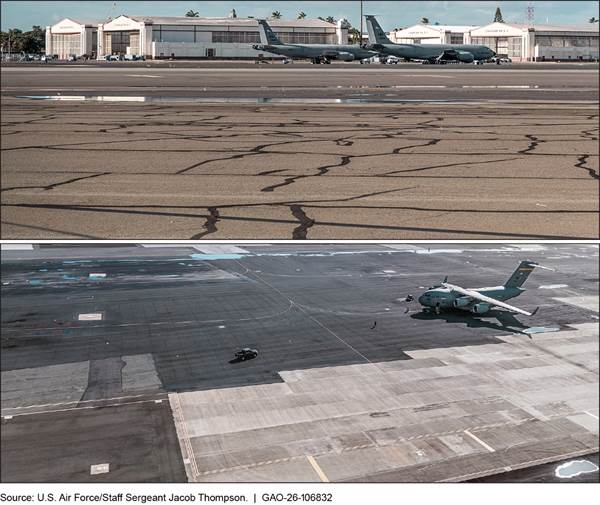
Commanders of aviation units that use the airfield told us that this degradation has significantly limited the capacity of the airfield to support operations. In particular, one Commander told us that the maintenance of the airfield has relied on patching damaged areas with asphalt, rather than repairing the concrete—which can increase the likelihood of sinkholes and loose gravel. The Commander noted that pooling of water—which we observed during our site visit—is likely to sink below the asphalt and erode the soil, threatening to create a sink hole and debris (see fig. 13). The Commander noted that this increases the amount of loose gravel, which a jet engine can pick up in its thrust, damaging whatever is in its path. We observed much higher use of asphalt to pave the tarmac at Hickam Airfield than at comparable airfields at other joint bases, such as McChord Airfield at Joint Base Lewis-McChord (see fig. 14). The Commander told us that this asphalt is not rated to bear the weight of the heavy cargo aircraft that use Hickam Airfield, increasing the risk of damage to an aircraft if the asphalt pavement were to fail.
Figure 14: Visual Comparison of Tarmac Condition at Hickam Airfield (Joint Base Pearl Harbor-Hickam) and McChord Airfield (Joint Base Lewis-McChord)
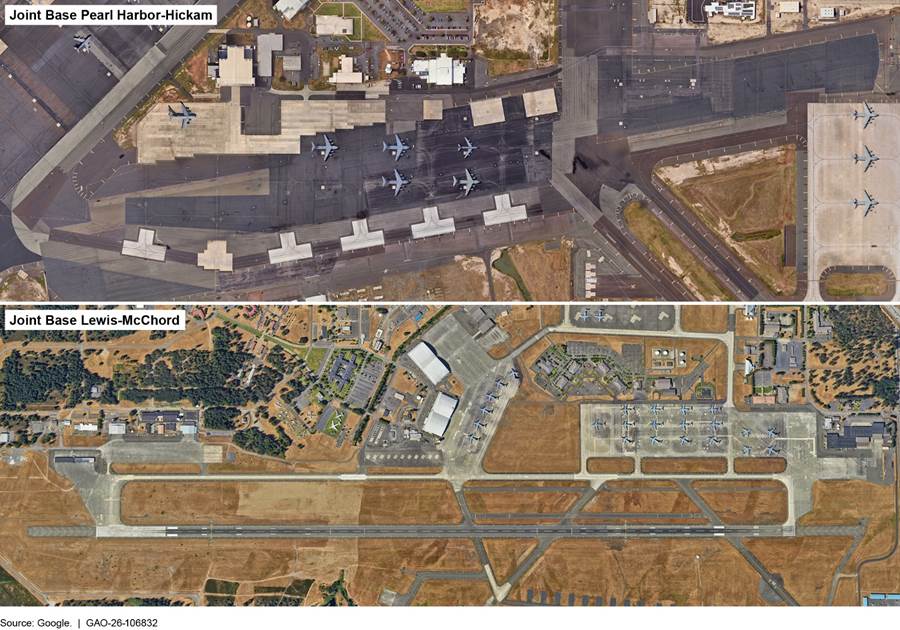
Air Force officials stated that the Navy was supposed to maintain the airfield to the condition at the point of transfer but confirmed that the Air Force did not provide baseline data on the airfield’s condition when the Navy assumed control of the joint base. According to officials, until an agreement in 2024 through direct negotiations between the Secretaries of the Department of the Navy and the Department of the Air Force, the Hickam Airfield experienced continued degradation. Officials stated that those negotiations resulted in an agreement to fund repairs to Hickam Airfield totaling $1.1 billion through fiscal year 2032, with 89 percent of the costs being provided by the Navy.
To obtain the perspectives of lead components on joint bases regarding their experiences with joint base facility management, we conducted a survey using a web-based questionnaire of all 12 lead components. We solicited information on policies related to joint basing, experiences with joint basing, the impacts of joint basing, and potential solutions to any challenges related to joint basing. Specifically, we sent the questionnaire to the senior official within the joint basing hierarchy for each component at each joint base as identified by the installations and the Department of Defense (DOD) Joint Basing Office. Therefore, the survey recipients were primarily joint base Commanders and deputy joint base Commanders. However, the survey was designed to allow those senior leaders to obtain input from other officials at the joint base, such as facility management personnel. The survey results represent the views only of those individuals who responded and may not be generalizable to all components. The results of our survey provide measures of component officials’ views at the time they completed the survey in May and June 2024. Further details about our methodology for conducting this survey can be found in appendix I.
This appendix includes the survey questions we used to obtain information from lead component leadership on joint bases. It shows the key content of the survey questions; however, the format of selected questions and response options have been changed for readability in this report. For example, since Joint Region Marianas and Joint Base McGuire-Dix-Lakehurst each have more than one supported component, they received slightly modified questionnaires to account for the additional interactions between components. These additional questions and response options are presented in bold text. Additionally, each survey contained generic bracketed text that was replaced in the actual survey, depending on the responding service. Questions without response options were open ended.
1. What effect has the [Supported Component]’s presence on the joint base had on the [Lead Component]’s operational readiness?
◯ Very positive
◯ Somewhat positive
◯ No effect
◯ Somewhat negative
◯ Very negative
What effect has the [Supported Component 2]’s presence on the joint base had on the [Lead Component]’s operational readiness?
◯ Very positive
◯ Somewhat positive
◯ No effect
◯ Somewhat negative
◯ Very negative
2. In the past 5 years, has [Supported HQ] funded any modernization or new construction (i.e. MILCON, Unspecified Minor Military Construction) projects, including as part of a jointly funded project where the [Lead Component] was also funding restoration or sustainment as part of the project?
◯ Yes
◯ No
◯ I don’t know
◯ There
was at least one project, but I am not sure if it qualifies. Please
explain your answer.
In the past 5 years, has [Supported HQ 2] funded any modernization or new construction (i.e. MILCON, Unspecified Minor Military Construction) projects, including as part of a jointly funded project where the [Lead Component] was also funding restoration or sustainment as part of the project?
◯ Yes
◯ No
◯ I don’t know
◯ There
was at least one project, but I am not sure if it qualifies. Please
explain your answer.
Display this question if Yes to question 2.
3. In the past 5 years, has [Supported HQ] provided funding for any of the following projects? (Select all that apply)
▢ New construction (i.e. MILCON,
Unspecified Minor Military
Construction) project
▢ Modernization project
▢ Either of the above as part of a jointly funded project
In the past 5 years, has [Supported HQ 2] provided funding for any of the following projects? (Select all that apply)
▢
New construction (i.e. MILCON, Unspecified Minor Military
Construction) project
▢ Modernization project
▢ Either of the above as part of a jointly funded project
Display this question if Yes to question 2.
4. (Optional) Please provide an example of such projects that you think would clarify your answer:
5. Does this installation use specific criteria to inform its facility funding prioritization?
◯ Yes
◯ No
Display this question if Yes to question 5.
6. What criteria does the [Lead Component] on this installation consider when deciding which facilities projects to prioritize? (Select all that apply)
▢
Facility Condition Index, Q rating, Building Condition Index (SMS-
generated), or other similar metric
▢ Mission Criticality Index or Mission Dependency Index
▢
Input from the Deputy Joint Base Commander from the [Supported
Component]
▢
Input from the Deputy Joint Base Commander from the [Supported
Component 2]
▢
Input from senior commander(s) from the [Lead Component] other
than the Joint Base Commander.
▢
Input from senior commander(s) of the [Supported Component],
other
than the Deputy Joint Base Commander.
▢
Input from senior commander(s) of the [Supported Component 2],
other than the Deputy Joint Base Commander.
▢ Any other data or metric. Please explain this metric
Display this question if “Input from senior commander(s) from the [Lead Component] other than the Joint Base Commander” is selected on question 6.
7. Are these senior [Lead Component] officers mentioned in the previous question members of the Joint Base Partnership Council (JBPC), Real Property Planning Board (RPPB), or the Facility Board (FB)?
◯ Yes
◯ No
Display this question if “Input from senior commander(s) of the [Supported Component], other than the Deputy Joint Base Commander” is selected on question 6.
8. Are these senior [Supported Component] officers mentioned in the previous question members of the Joint Base Partnership Council (JBPC), Real Property Planning Board (RPPB), or the Facility Board (FB)?
◯ Yes
◯ No
Display this question if “Input from senior commander(s) of the [Supported Component 2], other than the Deputy Joint Base Commander” is selected on question 6.
Are these senior [Supported Component 2] officers mentioned in the previous question members of the Joint Base Partnership Council (JBPC), Real Property Planning Board (RPPB), or the Facility Board (FB)?
◯ Yes
◯ No
9. How, if at all, does the [Lead Component] on this installation provide the [Supported Component] with visibility into the [Lead Component]’s rationale for its facility funding decisions? (Select all that apply)
▢
The [Lead Component] provides feedback to the [Supported
Component] that explains its decisions, such as through regular
reports, meetings, phone calls, etc.
▢
The [Supported Component] participates in making facility funding
decisions through a seat on the Joint Base Partnership Council
(JBPC), Real Property Planning Board (RPPB), or Facility Board.
▢
We do not provide the [Supported Component] visibility into the
rationale for facility funding decisions.
▢ Other. Please explain your answer:
How, if at all, does the [Lead Component] on this installation provide the [Supported Component 2] with visibility into the [Lead Component]’s rationale for its facility funding decisions? (Select all that apply)
▢
The [Lead Component] provides feedback to the [Supported
Component 2] that explains its decisions, such as through regular
reports, meetings, phone calls, etc.
▢
The [Supported Component 2] participates in making facility funding
decisions through a seat on the Joint Base Partnership Council
(JBPC), Real Property Planning Board (RPPB), or Facility Board.
▢
We do not provide the [Supported Component 2] visibility into the
rationale for facility funding decisions.
▢ Other. Please explain your answer:
10. How satisfied is the [Lead Component] on this installation with the following:
|
|
Very satisfied |
Somewhat satisfied |
Neither satisfied nor dissatisfied |
Somewhat dissatisfied |
Very dissatisfied |
|
The ability of the [Lead Component] on this installation to advocate on behalf of funding for itself at the [Lead HQ] level? |
◯ |
◯ |
◯ |
◯ |
◯ |
|
The ability of the [Lead Component] to advocate on behalf of funding for itself at the joint base level? |
◯ |
◯ |
◯ |
◯ |
◯ |
|
How well the [Lead Component] on this installation incorporates the [Supported Component]’s infrastructure needs into funding decisions? |
◯ |
◯ |
◯ |
◯ |
◯ |
|
How well the [Lead Component] on this installation incorporates the [Supported Component 2]’s infrastructure needs into funding decisions? |
◯ |
◯ |
◯ |
◯ |
◯ |
11. Has the [Lead Component] completed an analysis of how facility funding levels on this installation affect units’ ability to complete their assigned missions?
◯ Yes
◯ No
Display this question if Yes on question 11.
12. Please summarize how the analysis from the previous question was done and describe when this study was conducted and who asked for it.
13. In the next five years, does the [Lead Component] plan to conduct an analysis of how facility funding levels on this installation affect units’ ability to complete their assigned missions?
◯ Yes
◯ No
14. How well does the [Lead Component] understand the [Supported Component]’s facility and infrastructure needs on this installation?
◯ Extremely well
◯ Very Well
◯ Somewhat well
◯ Not very well
◯ Not at all
◯ I Don’t Know
How well does the [Lead Component] understand the [Supported Component 2]’s facility and infrastructure needs on this installation?
◯ Extremely well
◯ Very Well
◯ Somewhat well
◯ Not very well
◯ Not at all
◯ I Don’t Know
15. (Optional) Please provide an example that underscores your answer:
16. How satisfied is the [Lead Component] with how well it meets the [Supported Component]’s facility and infrastructure needs on this installation?
◯ Very satisfied
◯ Somewhat satisfied
◯ Neither satisfied nor dissatisfied
◯ Somewhat dissatisfied
◯ Very dissatisfied
How satisfied is the [Lead Component] with how well it meets the [Supported Component 2]’s facility and infrastructure needs on this installation?
◯ Very satisfied
◯ Somewhat satisfied
◯ Neither satisfied nor dissatisfied
◯ Somewhat dissatisfied
◯ Very dissatisfied
17. (Optional) Please provide an example that underscores your answer:
18. How well does the [Lead Component] believe the following entities understand the [Lead Component]’s facility and infrastructure needs on this installation?
|
|
Extremely well |
Very well |
Moderately well |
Slightly well |
Not at all |
I don’t know |
||
|
[Lead HQ] |
◯ |
◯ |
◯ |
◯ |
◯ |
◯ |
||
|
[Lead Higher HQ] |
◯ |
◯ |
◯ |
◯ |
◯ |
◯ |
||
19. (Optional) Please provide an example that underscores your answer:
20. How satisfied is the [Lead Component] with how well the following entities meet the [Lead Component]’s facility and infrastructure needs on this installation?
|
|
Very satisfied |
Somewhat satisfied |
Neither satisfied nor dissatisfied |
Somewhat dissatisfied |
Very dissatisfied |
|
[Lead HQ] |
◯ |
◯ |
◯ |
◯ |
◯ |
21. (Optional) Please provide an example that underscores your answer:
22. How strongly do you agree or disagree with the following statement? The [Lead Component] on this installation has a good working relationship with:
|
|
Strongly agree |
Somewhat agree |
Neither agree nor disagree |
Somewhat disagree |
Strongly disagree |
|
The [Supported Component] on this installation |
◯ |
◯ |
◯ |
◯ |
◯ |
|
The [Supported Component 2] on this installation |
◯ |
◯ |
◯ |
◯ |
◯ |
|
[Lead HQ] |
◯ |
◯ |
◯ |
◯ |
◯ |
|
[Lead Higher HQ] |
◯ |
◯ |
◯ |
◯ |
◯ |
23. (Optional) Please provide an example that underscores your answer:
24. As part of the implementation of joint basing between 2008 and 2010, did this installation produce a real property inventory that included a list of the facilities transferring to the [Lead Component] and their condition data at the time of the transfer? Note: GAO may request a copy of this inventory.
◯ Yes
◯ No
◯I don’t know
25. How has the [Lead Component]’s maintenance of the [Supported Component]’s facilities on this installation compared to the [Lead Component]’s maintenance of its own?
◯ Much better than it has its own
◯ Somewhat better than it has its own
◯ As well as it has its own
◯ Somewhat worse than it has its own
◯ Much worse than it has its own
How has the [Lead Component]’s maintenance of the [Supported Component 2]’s facilities on this installation compared to the [Lead Component]’s maintenance of its own?
◯ Much better than it has its own
◯ Somewhat better than it has its own
◯ As well as it has its own
◯ Somewhat worse than it has its own
◯ Much worse than it has its own
26. (Optional) Please provide an example that underscores your answer:
27. What impact does the current state of the [Lead Component]’s mission-critical facilities (those that are necessary for the execution of its mission) have on the [Lead Component]’s operational readiness?
◯ Very positive
◯ Somewhat positive
◯ No impact
◯ Somewhat negative
◯ Very negative
28. (Optional) Please provide an example that underscores your answer:
29. After the [Lead Component] assumed control of the [Supported Component]’s facilities on this installation, how has the quality of the [Supported Component]’s facilities changed (beyond what one would expect if the [Supported Component] had maintained control)?
◯ Significantly improved
◯ Somewhat improved
◯ Remained the same
◯ Somewhat worsened
◯ Significantly worsened
After the [Lead Component] assumed control of the [Supported Component 2]’s facilities on this installation, how has the quality of the [Supported Component 2]’s facilities changed (beyond what one would expect if the [Supported Component 2] had maintained control)?
◯ Significantly improved
◯ Somewhat improved
◯ Remained the same
◯Somewhat worsened
◯Significantly worsened
30. After the [Lead Component] assumed control of the [Supported Component]’s and the [Supported Component 2]’s facilities on this installation, how has managing the [Lead Component]’s facilities changed?
◯ Become much easier
◯ Become somewhat easier
◯ Remained the same
◯ Become somewhat more difficult
◯ Become much more difficult
31. How strongly do you agree or disagree with the following statements:
|
|
Strongly agree |
Somewhat agree |
Neither agree nor disagree |
Somewhat disagree |
Strongly disagree |
|
The [Lead Component] on this installation has sufficient resources to keep the [Supported Component]’s and the [Supported Component 2]’s facilities on this installation in good working order? |
◯ |
◯ |
◯ |
◯ |
◯ |
|
The [Lead Component] on this installation has sufficient resources to keep the [Lead Component] facilities in good working order? |
◯ |
◯ |
◯ |
◯ |
◯ |
32. (Optional) If there are any details you would like to add to contextualize or explain your answers to the above two questions, please do so.
33. Has the [Lead Component] experienced any of the following challenges?
|
|
Yes |
No |
I don’t know |
|
Lack of transparency into why the [Lead HQ] funds the facility projects that it does |
◯ |
◯ |
◯ |
|
Lack of feedback in the Joint Management Oversight Structure (JMOS) above the Joint Base Partnership Council (JBPC) level, such as at the Intermediate Command Summit (ICS) level |
◯ |
◯ |
◯ |
|
Unclear responsibilities for each component |
◯ |
◯ |
◯ |
|
Difficulty resolving instructions and regulations conflicts between the components’ services at the joint base level |
◯ |
◯ |
◯ |
|
Supplemental guidance from the Office of the Secretary of Defense (OSD) is too vague or there is not enough guidance from OSD |
◯ |
◯ |
◯ |
|
Supplemental guidance from the Office of the Secretary of Defense (OSD) is too rigid and limits flexibility |
◯ |
◯ |
◯ |
34. (Optional) Please share an example that underscores the answers above or identify additional challenges not mentioned
Display this question if Yes to corresponding options on question 33.
35. Did joint basing create any of the following problems?
|
|
Yes |
No |
I don’t know |
|
Lack of transparency into why the [Lead HQ] funds the facility projects that it does |
◯ |
◯ |
◯ |
|
Supplemental guidance from the Office of the Secretary of Defense (OSD) is too vague or there is not enough guidance from OSD |
◯ |
◯ |
◯ |
|
Supplemental guidance from the Office of the Secretary of Defense (OSD) is too rigid and limits flexibility |
◯ |
◯ |
◯ |
Display this question if No to corresponding options on question 35.
36. Has joint basing exacerbated or lessened any of the following potential problems?
|
|
Greatly exacerbated |
Somewhat exacerbated |
No effect |
Somewhat lessened |
Greatly lessened |
I don’t know |
|
Lack of transparency into why the [Lead HQ] funds the facility projects that it does |
◯ |
◯ |
◯ |
◯ |
◯ |
◯ |
|
Supplemental guidance from the Office of the Secretary of Defense (OSD) is too vague or there is not enough guidance from OSD |
◯ |
◯ |
◯ |
◯ |
◯ |
◯ |
|
Supplemental guidance from the Office of the Secretary of Defense (OSD) is too rigid and limits flexibility |
◯ |
◯ |
◯ |
◯ |
◯ |
◯ |
Display this question if Yes to corresponding options on question 33.
37. How much of a problem are the following?
|
|
Large problem |
Moderate problem |
Small problem |
|
Lack of transparency into why the [Lead HQ] funds the facility projects that it does |
◯ |
◯ |
◯ |
|
Lack of feedback in the Joint Management Oversight Structure (JMOS) above the Joint Base Partnership Council (JBPC) level, such as at the Intermediate Command Summit (ICS) level |
◯ |
◯ |
◯ |
|
Unclear responsibilities for each component |
◯ |
◯ |
◯ |
|
Difficulty resolving instructions and regulations conflicts between the components’ services at the joint base level |
◯ |
◯ |
◯ |
|
Supplemental guidance from the Office of the Secretary of Defense (OSD) is too vague or there is not enough guidance from OSD |
◯ |
◯ |
◯ |
|
Supplemental guidance from the Office of the Secretary of Defense (OSD) is too rigid and limits flexibility |
◯ |
◯ |
◯ |
Display this question if Yes to corresponding options on question 33.
38. Is your joint base working to address any of these potential challenges?
|
|
Yes |
No |
I don’t know |
|
Lack of transparency into why the [Lead HQ] funds the facility projects that it does |
◯ |
◯ |
◯ |
|
Lack of feedback in the Joint Management Oversight Structure (JMOS) above the Joint Base Partnership Council (JBPC) level, such as at the Intermediate Command Summit (ICS) level |
◯ |
◯ |
◯ |
|
Unclear responsibilities for each component |
◯ |
◯ |
◯ |
|
Difficulty resolving instructions and regulations conflicts between the components’ services at the joint base level |
◯ |
◯ |
◯ |
|
Supplemental guidance from the Office of the Secretary of Defense (OSD) is too vague or there is not enough guidance from OSD |
◯ |
◯ |
◯ |
|
Supplemental guidance from the Office of the Secretary of Defense (OSD) is too rigid and limits flexibility |
◯ |
◯ |
◯ |
39. (Optional) Please share an example that underscores the answers above or identify additional challenges not mentioned
40. How has joint basing impacted the following benefits, if at all?
|
|
Strongly promoted |
Somewhat promoted |
No relationship |
Somewhat obstructed |
Strongly obstructed |
I don’t know |
|
Cost savings resulting from shared administrative services (travel, personnel benefits, education/childcare, etc.) or economies of scale (contract or commissary/exchange consolidation) |
◯ |
◯ |
◯ |
◯ |
◯ |
◯ |
|
Cost savings resulting from other cause(s) |
◯ |
◯ |
◯ |
◯ |
◯ |
◯ |
|
Interservice cooperation |
◯ |
◯ |
◯ |
◯ |
◯ |
◯ |
|
Understanding of another service’s processes |
◯ |
◯ |
◯ |
◯ |
◯ |
◯ |
|
Enabled/eased joint force exercises |
◯ |
◯ |
◯ |
◯ |
◯ |
◯ |
|
Other |
◯ |
◯ |
◯ |
◯ |
◯ |
◯ |
41. If joint basing has impacted cost savings from a source other than shared administrative services or economies of scale, please describe the source of this cost saving.
42. What impact would the following potential changes have on joint basing?
|
|
Very positive impact |
Positive impact |
No impact |
Negative impact |
Very negative impact |
I don’t know |
|
A more comprehensive memorandum of agreement that detailed exactly the services that each component needed to provide |
◯ |
◯ |
◯ |
◯ |
◯ |
◯ |
|
Consolidation of all OSD supplemental guidance in a single document |
◯ |
◯ |
◯ |
◯ |
◯ |
◯ |
|
A Department of Defense Instruction (DODI) on the implementation of the Joint Base Operating Guidelines |
◯ |
◯ |
◯ |
◯ |
◯ |
◯ |
|
A process to re-evaluate the facility conditions of both sides of the joint base to establish a new baseline of support |
◯ |
◯ |
◯ |
◯ |
◯ |
◯ |
|
Expedited Joint Base MOA change process |
◯ |
◯ |
◯ |
◯ |
◯ |
◯ |
|
Return authority over facility management to the components on the joint base |
◯ |
◯ |
◯ |
◯ |
◯ |
◯ |
|
A pool of funds that could only be used for joint base projects, not those on single-service installations |
◯ |
◯ |
◯ |
◯ |
◯ |
◯ |
|
A process by which an entity within the [Supported HQ] could formally appeal funding decisions of either the [Lead Component] on this installation or [Lead HQ]. |
◯ |
◯ |
◯ |
◯ |
◯ |
◯ |
|
A process by which an entity within the [Supported HQ 2] could formally appeal funding decisions of either the [Lead Component] on this installation or [Lead HQ]. |
◯ |
◯ |
◯ |
◯ |
◯ |
◯ |
|
A more formal process by which an entity within the [Supported HQ] could advocate for the [Supported Component] on this installation or with [Lead HQ] |
◯ |
◯ |
◯ |
◯ |
◯ |
◯ |
|
A more formal process by which an entity within the [Supported HQ 2] could advocate for the [Supported Component 2] on this installation or with [Lead HQ] |
◯ |
◯ |
◯ |
◯ |
◯ |
◯ |
|
Other |
◯ |
◯ |
◯ |
◯ |
◯ |
◯ |
43. How long did it take for this installation’s most recent Joint Base MOA change to process from the time that the Joint Base Partnership Council approved it to the time that the Office of the Secretary of Defense (OSD) gave it final approval? (If you do not know the precise time, please provide your best estimate, especially for timeframes more than a year or two).
44. Are there any changes to the Joint Base MOA in progress?
◯ Yes
◯ No
45. Are there any changes to the Joint Base MOA planned?
◯ Yes
◯No
◯ I don’t know
46. If leadership in the [Lead Component] on this installation decided that it wanted to create a new Joint Base MOA change, are there any administrative barriers to doing so?
◯ Yes
◯ No
◯ I don’t know
Display this question if Yes to question 46.
47. What are those barriers to changing the joint base MOA? (Select all that apply)
▢
Lack of transparency above the joint base level, such as at the
Intermediate Command Summit (ICS) level
▢
Lack of feedback above the joint base level, such as at the
Intermediate Command Summit (ICS) level
▢ Long waits for decisions to be made at each level of the JMOS
▢
Cumbersome processes to initiate the Joint Base MOA change
process
▢ Other
48. Has the time required to change the Joint Base MOA impacted the following?
|
|
Yes |
No |
I don’t know |
|
This installation’s ability to address the problem(s) that the Joint Base MOA change was intended to solve |
◯ |
◯ |
◯ |
|
This installation’s likelihood to submit Joint Base MOA changes |
◯ |
◯ |
◯ |
Display this question if Yes to the first option on question 48.
49. Has the approval timeline made it harder or easier for this installation to address the problem that the Joint Base MOA change was intended to solve?
◯ Much harder
◯ Somewhat harder
◯ Somewhat easier
◯ Much easier
Display this question if Yes to the second option on question 48.
50. Does the approval timeline make this installation more or less likely to submit Joint Base MOA changes?
◯ Much more likely
◯ Somewhat more likely
◯ Somewhat less likely
◯ Much less likely
51. Have you fully completed this survey and wish to submit your responses? (If you are finished and would like to submit your survey, please click on the “Complete, please submit” response below and hit next. If your survey is not yet complete, do NOT click “Complete, please submit”. Instead, return to previous pages or close your browser window here, and you will be able to reopen your survey at a later time. Your answers will be automatically saved and you may continue to revise your answers using the link sent to you until you click “Completed, please submit.”
◯ Complete, please submit
To obtain the perspectives of supported components on joint bases regarding their experiences with joint base facility management, we conducted a survey using a web-based questionnaire of 14 supported components.[58] We solicited information on policies related to joint basing, experiences with joint basing, the impacts of joint basing, and potential solutions to any challenges related to joint basing. Specifically, we sent the questionnaire to the senior official within the joint basing hierarchy for each component at each joint base as identified by the installations and the Department of Defense (DOD) Joint Basing Office. Therefore, the survey recipients were primarily joint base Commanders and deputy joint base Commanders. However, the survey was designed to allow those senior leaders to obtain input from other officials at the joint base, such as facility management personnel. The survey results represent the views only of those individuals who responded and may not be generalizable to all components. The results of our survey provide measures of component officials’ views at the time they completed the survey in May and June 2024. Further details about our methodology for conducting this survey can be found in appendix I.
This appendix includes the survey questions we used to obtain information from supported component leadership on joint bases. It shows the key content of the survey questions; however, the format of selected questions and response options have been changed for readability in this report. For example, since Joint Region Marianas and Joint Base McGuire-Dix-Lakehurst each have more than one supported component, they received slightly modified questionnaires to account for the additional interactions between components. These additional questions and response options are presented in bold text. Additionally, each survey contained generic bracketed text that was replaced in the actual survey, depending on the responding service. Questions without response options were open ended.
1. What effect has the [Lead Component]’s presence on the joint base had on the [Supported Component]’s operational readiness?
◯ Very positive
◯ Somewhat positive
◯ No effect
◯ Somewhat negative
◯ Very negative
What effect has the [Supported Component 2]’s presence on the joint base had on the [Supported Component]’s operational readiness?
◯ Very positive
◯ Somewhat positive
◯ No effect
◯ Somewhat negative
◯ Very negative
2. In the past 5 years, has the [Supported HQ] funded any modernization or new construction (i.e. MILCON, Unspecified Minor Military Construction) projects, including as part of a jointly funded project where the [Lead Component] was also funding restoration or sustainment as part of the project?
◯ Yes
◯ No
◯ I don’t know
◯ There
was at least one project, but I am not sure if it qualifies. Please
explain your answer.
Display this question if Yes to question 2.
3. In the past 5 years, has [Supported HQ] provided funding for any of the following projects? (Select all that apply)
▢
New construction (i.e. MILCON, Unspecified Minor Military
Construction) project
▢ Modernization project
▢ Either of the above as part of a jointly funded project
▢ Display this question if Yes to question 2.
4. (Optional) Please provide an example of such projects that you think would clarify your answer:
5. How, if at all, does the [Lead Component] on this installation provide the [Supported Component] with visibility into the [Lead Component]’s rationale for its facility funding decisions? (Select all that apply)
▢
The [Lead Component] provides feedback to the [Supported
Component] that explains its decisions, such as through regular
reports, meetings, phone calls, etc.
▢
The [Supported Component] participates in making facility funding
decisions through a seat on the Joint Base Partnership Council
(JBPC), Real Property Planning Board (RPPB), or Facility Board.
▢
The [Lead Component] does not provide the [Supported Component]
visibility into the rationale for facility funding decisions.
▢ Other. Please explain your answer:
6. How well does the [Supported Component] on this installation understand how the [Lead Component] obtains and uses facility funding on this installation?
◯ Extremely well
◯ Very well
◯ Somewhat well
◯ Not very well
◯ Not at all
7. How satisfied is the [Supported Component] on this installation with the following:
|
|
Very Satisfied |
Somewhat Satisfied |
Neither Satisfied nor Dissatisfied |
Somewhat Dissatisfied |
Very Dissatisfied |
|
The ability of the [Supported Component] on this installation to advocate on behalf of funding for itself at the [Lead HQ] level? |
◯ |
◯ |
◯ |
◯ |
◯ |
|
The ability of the [Supported Component] on this installation to advocate on behalf of funding for itself at the joint base level? |
◯ |
◯ |
◯ |
◯ |
◯ |
|
How well the [Lead Component] on this installation incorporates the [Supported Component]’s infrastructure needs into funding decisions? |
◯ |
◯ |
◯ |
◯ |
◯ |
8. How well does the [Supported Component] believe the following entities understand the [Supported Component]’s facility and infrastructure needs on this installation?
|
|
Extremely well |
Very well |
Somewhat well |
Not very well |
Not at all |
I don’t know |
|
[Lead Component] on this installation |
◯ |
◯ |
◯ |
◯ |
◯ |
◯ |
|
[Supported Component] on this installation |
◯ |
◯ |
◯ |
◯ |
◯ |
◯ |
|
[Lead HQ] |
◯ |
◯ |
◯ |
◯ |
◯ |
◯ |
|
[Lead Higher HQ] |
◯ |
◯ |
◯ |
◯ |
◯ |
◯ |
|
[Supported HQ] |
◯ |
◯ |
◯ |
◯ |
◯ |
◯ |
|
[Supported Higher HQ] |
◯ |
◯ |
◯ |
◯ |
◯ |
◯ |
9. (Optional) Please provide an example that underscores your answer:
10. How satisfied is the [Supported Component] with how well the following entities meet the [Supported Component]’s facility and infrastructure needs on this installation?
|
|
Highly Satisfied |
Satisfied |
Neither satisfied nor dissatisfied |
Dissatisfied |
Highly Dissatisfied |
|
[Lead Component] on this installation |
◯ |
◯ |
◯ |
◯ |
◯ |
|
[Lead HQ] |
◯ |
◯ |
◯ |
◯ |
◯ |
|
[Supported HQ] |
◯ |
◯ |
◯ |
◯ |
◯ |
11. (Optional) Please provide an example that underscores your answer:
12. How strongly do you agree or disagree with the following statement: the [Supported Component] on this installation has a good working relationship with:
|
|
Strongly agree |
Somewhat agree |
Neither agree nor disagree |
Somewhat disagree |
Strongly disagree |
|
[Lead Component] on this installation |
◯ |
◯ |
◯ |
◯ |
◯ |
|
[Supported Component 2] on this installation |
◯ |
◯ |
◯ |
◯ |
◯ |
|
[Lead HQ] |
◯ |
◯ |
◯ |
◯ |
◯ |
|
[Lead Higher HQ] |
◯ |
◯ |
◯ |
◯ |
◯ |
|
[Supported HQ] |
◯ |
◯ |
◯ |
◯ |
◯ |
|
[Supported Higher HQ] |
◯ |
◯ |
◯ |
◯ |
◯ |
13. (Optional) Please provide an example that underscores your answer:
14. As part of the implementation of joint basing between 2008 and 2010, did this installation produce a real property inventory that included a list of the facilities transferring to the [Lead Component] and their condition data at the time of the transfer? Note: GAO may request a copy of this inventory.
◯ Yes
◯ No
◯ I don’t know
15. How has the [Lead Component]’s maintenance of the [Supported Component]’s facilities on this installation compared to the [Lead Component]’s maintenance of its own?
◯ Much better than it has its own
◯ Somewhat better than it has its own
◯ As well as it has its own
◯ Somewhat worse than it has its own
◯ Much worse than it has its own
16. (Optional) Please provide an example that underscores your answer:
17. What impact does the current state of the [Supported Component]’s mission-critical facilities (those that are necessary for the execution of its mission) on this installation have on the [Supported Component]’s operational readiness?
◯ Very positive
◯ Somewhat positive
◯ No impact
◯ Somewhat negative
◯ Very negative
18. (Optional) Please provide an example that underscores your answer:
19. After the [Lead Component] assumed control of the [Supported Component]’s facilities on this installation, how has the quality of the [Supported Component]’s facilities changed (beyond what one would expect if the [Supported Component] had maintained control)?
◯ Significantly improved
◯ Somewhat improved
◯ Remained the same
◯ Somewhat worsened
◯ Significantly worsened
20. How strongly do you agree or disagree with the following statements:
|
|
Strongly agree |
Somewhat agree |
Neither agree nor disagree |
Somewhat disagree |
Strongly disagree |
|
The [Lead Component] on this installation has sufficient resources to keep the [Supported Component] facilities on this installation in good working order? |
◯ |
◯ |
◯ |
◯ |
◯ |
|
The [Lead Component] on this installation has sufficient resources to keep the [Lead Component] facilities in good working order? |
◯ |
◯ |
◯ |
◯ |
◯ |
21. (Optional) If there are any details you would like to add to contextualize or explain your answers to the above two questions, please do so.
22. Has the [Supported Component] experienced any of the following challenges?
|
|
Yes |
No |
I don’t know |
|
Lack of transparency into why the [Lead HQ] funds the facility projects that it does |
◯ |
◯ |
◯ |
|
Lack of transparency into why the [Lead Component] on this installation funds the facility projects it does |
◯ |
◯ |
◯ |
|
Lack of feedback from the [Lead Component] on this installation about why certain facility projects were not funded |
◯ |
◯ |
◯ |
|
Lack of feedback in the Joint Management Oversight Structure (JMOS) above the Joint Base Partnership Council (JBPC) level, such as at the Intermediate Command Summit (ICS) level |
◯ |
◯ |
◯ |
|
Unclear responsibilities for each component |
◯ |
◯ |
◯ |
|
Difficulty resolving instructions and regulations conflicts between the components’ services at the joint base level |
◯ |
◯ |
◯ |
|
Supplemental guidance from the Office of the Secretary of Defense (OSD) is too vague or there is not enough guidance from OSD |
◯ |
◯ |
◯ |
|
Supplemental guidance from the Office of the Secretary of Defense (OSD) is too rigid and limits flexibility |
◯ |
◯ |
◯ |
23. (Optional) Please share an example that underscores the answers above or identify additional challenges not mentioned
Display this question if Yes to corresponding options on question 22.
24. Did joint basing create any of the following problems?
|
|
Yes |
No |
I don’t know |
|
Supplemental guidance from the Office of the Secretary of Defense (OSD) is too vague or there is not enough guidance from OSD |
◯ |
◯ |
◯ |
|
Supplemental guidance from the Office of the Secretary of Defense (OSD) is too rigid and limits flexibility |
◯ |
◯ |
◯ |
Display this question if No to corresponding options on question 24.
25. Has joint basing exacerbated or lessened any of the following potential problems?
|
|
Greatly exacerbated |
Somewhat exacerbated |
No effect |
Somewhat lessened |
Greatly lessened |
I don’t know |
|
Supplemental guidance from the Office of the Secretary of Defense (OSD) is too vague or there is not enough guidance from OSD |
◯ |
◯ |
◯ |
◯ |
◯ |
◯ |
|
Supplemental guidance from the Office of the Secretary of Defense (OSD) is too rigid and limits flexibility |
◯ |
◯ |
◯ |
◯ |
◯ |
◯ |
Display this question if Yes to corresponding options on question 22.
26. How much of a problem are the following?
|
|
Large problem |
Moderate problem |
Small problem |
|
Lack of transparency into why the [Lead HQ] funds the facility projects that it does |
◯ |
◯ |
◯ |
|
Lack of transparency into why the [Lead Component] on this installation funds the facility projects it does |
◯ |
◯ |
◯ |
|
Lack of feedback from the [Lead Component] on this installation about why certain facility projects were not funded |
◯ |
◯ |
◯ |
|
Lack of feedback in the Joint Management Oversight Structure (JMOS) above the Joint Base Partnership Council (JBPC) level, such as at the Intermediate Command Summit (ICS) level |
◯ |
◯ |
◯ |
|
Unclear responsibilities for each component |
◯ |
◯ |
◯ |
|
Difficulty resolving instructions and regulations conflicts between the components’ services at the joint base level |
◯ |
◯ |
◯ |
|
Supplemental guidance from the Office of the Secretary of Defense (OSD) is too vague or there is not enough guidance from OSD |
◯ |
◯ |
◯ |
|
Supplemental guidance from the Office of the Secretary of Defense (OSD) is too rigid and limits flexibility |
◯ |
◯ |
◯ |
Display this question if Yes to corresponding options on question 22.
27. Is your joint base working to address any of these potential challenges?
|
|
Yes |
No |
I don’t know |
|
Lack of transparency into why the [Lead HQ] funds the facility projects that it does |
◯ |
◯ |
◯ |
|
Lack of transparency into why the [Lead Component] on this installation funds the facility projects that it does |
◯ |
◯ |
◯ |
|
Lack of feedback from the [Lead Component] on this installation about why certain facility projects were not funded |
◯ |
◯ |
◯ |
|
Lack of feedback in the Joint Management Oversight Structure (JMOS) above the Joint Base Partnership Council (JBPC) level, such as at the Intermediate Command Summit (ICS) level |
◯ |
◯ |
◯ |
|
Unclear responsibilities for each component |
◯ |
◯ |
◯ |
|
Difficulty resolving instructions and regulations conflicts between the components’ services at the joint base level |
◯ |
◯ |
◯ |
|
Supplemental guidance from the Office of the Secretary of Defense (OSD) is too vague or there is not enough guidance from OSD |
◯ |
◯ |
◯ |
|
Supplemental guidance from the Office of the Secretary of Defense (OSD) is too rigid and limits flexibility |
◯ |
◯ |
◯ |
28. (Optional) Please share an example that underscores the answers above or identify additional challenges not mentioned
29. On single-service installations not affected by joint basing, are there any challenges regarding a lack of transparency into why the [Supported HQ] funds what it does?
◯ Yes
◯ No
◯ I don’t know
Display this question if Yes to question 29.
30. How much of a problem was this lack of transparency?
◯ A large problem
◯ A moderate problem
◯ A small problem
31. How has joint basing impacted the following benefits, if at all?
|
|
Strongly promoted |
Somewhat promoted |
No relationship |
Somewhat obstructed |
Strongly obstructed |
I don’t know |
|
Cost savings resulting from shared administrative services (travel, personnel benefits, education/childcare, etc.) or economies of scale (contract or commissary/exchange consolidation) |
◯ |
◯ |
◯ |
◯ |
◯ |
◯ |
|
Cost savings resulting from other cause(s) |
◯ |
◯ |
◯ |
◯ |
◯ |
◯ |
|
Interservice cooperation |
◯ |
◯ |
◯ |
◯ |
◯ |
◯ |
|
Understanding of another service’s processes |
◯ |
◯ |
◯ |
◯ |
◯ |
◯ |
|
Enabled/eased joint force exercises |
◯ |
◯ |
◯ |
◯ |
◯ |
◯ |
|
Other |
◯ |
◯ |
◯ |
◯ |
◯ |
◯ |
32. If joint basing has impacted cost savings from a source other than shared administrative services or economies of scale, please describe the source of this cost saving.
33. What impact would the following potential changes have on joint basing?
|
|
Very positive impact |
Positive impact |
No impact |
Negative impact |
Very negative impact |
I don’t know |
|
A more comprehensive memorandum of agreement that detailed exactly the services that each component needed to provide |
◯ |
◯ |
◯ |
◯ |
◯ |
◯ |
|
Consolidation of all OSD supplemental guidance in a single document |
◯ |
◯ |
◯ |
◯ |
◯ |
◯ |
|
A Department of Defense Instruction (DODI) on the implementation of the Joint Base Operating Guidelines |
◯ |
◯ |
◯ |
◯ |
◯ |
◯ |
|
A process to re-evaluate the facility conditions of both sides of the joint base to establish a new baseline of support |
◯ |
◯ |
◯ |
◯ |
◯ |
◯ |
|
Expedited Joint Base MOA change process |
◯ |
◯ |
◯ |
◯ |
◯ |
◯ |
|
Return authority over facility management to the components on the joint base |
◯ |
◯ |
◯ |
◯ |
◯ |
◯ |
|
A pool of funds that could only be used for joint base projects, not those on single-service installations |
◯ |
◯ |
◯ |
◯ |
◯ |
◯ |
|
A process by which an entity within the [Supported HQ] could formally appeal funding decisions of either the [Lead Component] on this installation or [Lead HQ]. |
◯ |
◯ |
◯ |
◯ |
◯ |
◯ |
|
A more formal process by which an entity within the [Supported HQ] could advocate for the [Supported Component] on this installation or with [Lead HQ] |
◯ |
◯ |
◯ |
◯ |
◯ |
◯ |
|
Other |
◯ |
◯ |
◯ |
◯ |
◯ |
◯ |
34. Do you believe that the [Lead HQ] prioritizes the facility and infrastructure needs of the [Supported Component] equal to those of the [Lead Component] on this installation?
◯ Yes
◯ No
◯ I don’t know
35. (Optional) Please explain your answer, highlighting a specific example if possible.
36. How often do the [Lead Component]’s funding decisions on this installation align with the [Supported Component]’s funding priorities?
◯ Almost Always
◯ Often
◯ Sometimes
◯ Rarely
◯ Almost never
37. Do any types of facilities (such as barracks/dorms, hangars, firing ranges, piers, wharves, etc.) receive inadequate prioritization?
◯ No
◯ Yes (Please explain which)
Display this question if Yes to question 37.
38. Has the [Supported Component] on this installation tried to secure funding for these facilities?
◯ No
◯ Yes (Please describe what efforts you have made)
39. How long did it take for this installation’s most recent Joint Base MOA change to process from the time that the Joint Base Partnership Council approved it to the time that the Office of the Secretary of Defense (OSD) gave it final approval? (If you do not know the precise time, please provide your best estimate, especially for timeframes more than a year or two)
40. Are there any changes to the Joint Base MOA in progress?
◯ Yes
◯ No
41. Are there any changes to the Joint Base MOA planned?
◯ Yes
◯ No
◯ I don’t know
42. If leadership in the [Supported Component] on this installation decided that it wanted to create a new Joint Base MOA change, are there any administrative barriers to doing so?
◯ Yes
◯ No
◯ I don’t know
Display this question if Yes to question 42.
43. What are those barriers to changing the joint base MOA? (Select all that apply)
▢
Lack of transparency above the joint base level, such as at the
Intermediate Command Summit (ICS) level
▢
Lack of feedback above the joint base level, such as at the
Intermediate Command Summit (ICS) level
▢ Long waits for decisions to be made at each level of the JMOS
▢
Cumbersome processes to initiate the Joint Base MOA change
process
▢ Other
44. Has the time required to change the Joint Base MOA impacted the following?
|
|
Yes |
No |
I don’t know |
|
This installation’s ability to address the problem(s) that the Joint Base MOA change was intended to solve |
◯ |
◯ |
◯ |
|
This installation’s likelihood to submit Joint Base MOA changes |
◯ |
◯ |
◯ |
Display this question if Yes to the first option on question 44.
45. Has the approval timeline made it harder or easier for this installation to address the problem that the Joint Base MOA change was intended to solve?
◯ Much harder
◯ Somewhat harder
◯ Somewhat easier
◯ Much easier
Display this question if Yes to the second option on question 44.
46. Does the approval timeline make this installation more or less likely to submit Joint Base MOA changes?
◯ Much more likely
◯ Somewhat more likely
◯ Somewhat less likely
◯ Much less likely
47. Have you fully completed this survey and wish to submit your responses? (If you are finished and would like to submit your survey, please click on the “Complete, please submit” response below and hit next. If your survey is not yet complete, do NOT click “Complete, please submit”. Instead, return to previous pages or close your browser window here, and you will be able to reopen your survey at a later time. Your answers will be automatically saved and you may continue to revise your answers using the link sent to you until you click “Completed, please submit.”
◯ Complete, please submit
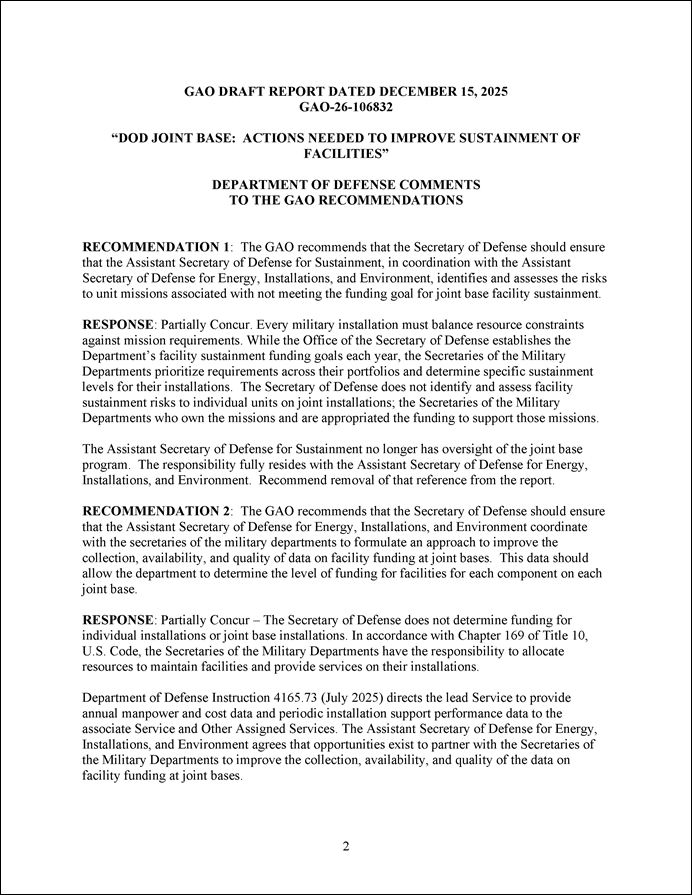
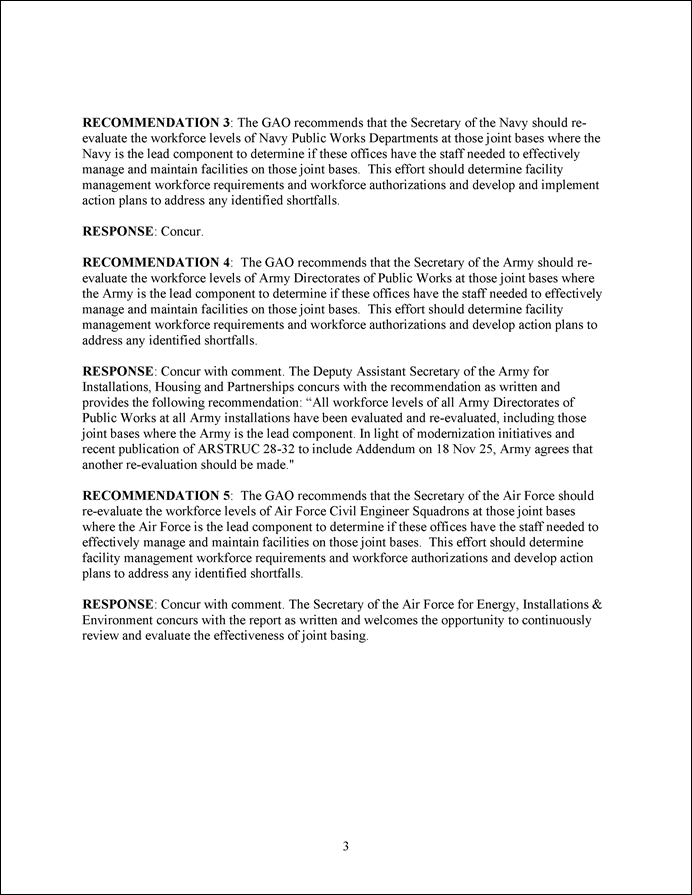
Alissa H. Czyz at CzyzA@gao.gov
In addition to the contact named above, Gina Hoffman (Assistant Director), Foster Kerrison (Analyst in Charge), Aubrey George, Sharon Ballinger, John Bornmann, Peter Casey, Christopher Gezon, Kate Hu, Chelsea Lanuza, Lillian Ofili, Clarice Ransom, and James White made key contributions to this report.
The Government Accountability Office, the audit, evaluation, and investigative arm of Congress, exists to support Congress in meeting its constitutional responsibilities and to help improve the performance and accountability of the federal government for the American people. GAO examines the use of public funds; evaluates federal programs and policies; and provides analyses, recommendations, and other assistance to help Congress make informed oversight, policy, and funding decisions. GAO’s commitment to good government is reflected in its core values of accountability, integrity, and reliability.
Obtaining Copies of GAO Reports and Testimony
The fastest and easiest way to obtain copies of GAO documents at no cost is through our website. Each weekday afternoon, GAO posts on its website newly released reports, testimony, and correspondence. You can also subscribe to GAO’s email updates to receive notification of newly posted products.
Order by Phone
The price of each GAO publication reflects GAO’s actual cost of production and distribution and depends on the number of pages in the publication and whether the publication is printed in color or black and white. Pricing and ordering information is posted on GAO’s website, https://www.gao.gov/ordering.htm.
Place orders by calling (202) 512-6000, toll free (866) 801-7077,
or
TDD (202) 512-2537.
Orders may be paid for using American Express, Discover Card, MasterCard, Visa, check, or money order. Call for additional information.
Connect with GAO
Connect with GAO on X,
LinkedIn, Instagram, and YouTube.
Subscribe to our Email Updates. Listen to our Podcasts.
Visit GAO on the web at https://www.gao.gov.
To Report Fraud, Waste, and Abuse in Federal Programs
Contact FraudNet:
Website: https://www.gao.gov/about/what-gao-does/fraudnet
Automated answering system: (800) 424-5454
Media Relations
Sarah Kaczmarek, Managing Director, Media@gao.gov
Congressional Relations
David A. Powner, Acting Managing Director, CongRel@gao.gov
General Inquiries
[1]Installations and Engineering: Before the House of Representatives Appropriations Subcommittee on Military Construction and Veterans Affairs, and Related Agencies, 117th Cong. 6 (2021) (testimony by Acting Assistant Secretary of the Air Force for Installations, Environment and Energy; and the Director of Civil Engineers, Deputy Chief of Staff for Logistics, Engineering and Force Protection); and Installations, Budget Environment, Quality of Life, and Oversight: Before the House of Representatives Appropriations Subcommittee on Military Construction and Veterans Affairs, and Related Agencies, 117th Cong. 8-9 (2021) (testimony by Acting Assistant Secretary of the Army for Installations, Energy, and Environment; Sergeant Major of the Army; and Headquarters, Department of the Army Deputy Chief of Staff G-9).
[2]For this report, we refer to the military service with primary responsibility over a joint base as the “lead component,” and the other military service(s) included in the joint base Memorandum of Agreement as “supported component(s).” We did not include tenant organizations in our scope.
[3]Department of Defense, Office of the Inspector General Report 2021-094, Audit of Department of Defense Joint Bases (June 18, 2021).
[4]GAO, DOD Joint Bases: Implementation Challenges Demonstrate Need to Reevaluate the Program, GAO‑14‑577 (Washington, D.C.: Sept. 19, 2014); DOD Joint Bases: Management Improvements Needed to Achieve Greater Efficiencies, GAO‑13‑134 (Washington, D.C.: Nov. 15, 2012); and Defense Infrastructure: DOD Needs to Periodically Review Support Standards and Costs at Joint Bases and Better Inform Congress of Facility Sustainment Funding Uses, GAO‑09‑336 (Washington, D.C.: Mar. 30, 2009).
[5]For example, DOD implemented our recommendations to issue additional guidance for joint basing and to reevaluate the installation support functions that were being consolidated to determine if they were still suitable for consolidation. DOD did not implement recommendations such as reevaluating the purpose of the joint basing program and determining whether DOD's goals of achieving greater efficiencies and generating cost savings for the program were still appropriate, or whether goals should be revised.
[6]GAO‑14‑577. At the time we made the matter for congressional consideration, DOD had recently established its joint bases. However, DOD has since transitioned to managing the joint bases as it does other military installations and did not plan to create additional joint bases. Because of this, in June 2021, we closed the matter for congressional consideration as not implemented. After following up with DOD for 6 years, we closed the recommendation to DOD as unimplemented in June 2020. DOD stated that the department and GAO have fundamentally different approaches in viewing how DOD should manage joint bases and maintained that it would not implement this recommendation.
[7]168 Cong. Rec. H9520 (daily ed. Dec. 8, 2022) (Joint Explanatory Statement accompanying the National Defense Authorization Act for Fiscal Year 2023).
[8]See Department of Defense Instruction 4165.73, Joint Basing Operations (July 28, 2025).
[9]Deputy Secretary of Defense Memorandum, Transforming Through Base Realignment and Closure (BRAC) 2005-Joint Basing (Jan. 22, 2008); and Department of Defense, Initial Guidance for BRAC 2005 Joint Basing Implementation (Jan. 22, 2008).
[10]The Joint Base Commander is chair of the Joint Base Partnership Council. Assistant Secretary of Defense for Energy, Installations, and Environment Memorandum, Joint Base Operations Guidance (Aug. 18, 2022).
[11]DOD Instruction 4165.73.
[12]In the case of Joint Region Marianas, the base is led by a Navy-appointed Joint Regional Commander and a Deputy Regional Commander to be determined by the lead and supported components. For Joint Base McGuire-Dix-Lakehurst, the Joint Base Commander is an Air Force officer (from the lead component), with two Deputy Joint Base Commanders from the supported components—one from the Navy and one from the Army. For Joint Base Andrews-Naval Air Facility Washington, the Joint Base Commander and the Deputy Joint Base Commander are from the Air Force, which is the lead component.
[13]Department of Defense 7000.14-R, Financial Management Regulation, vol. 2B, ch. 8 (Dec. 2016).
[14]In July 2025, after we had completed our audit work, DOD issued an instruction on joint basing. The instruction adds more detail regarding facility funding responsibilities on joint bases, such as by clarifying when components on joint bases are required to contribute funding to another component due to mission-related changes that impact installation support. See Department of Defense Instruction 4165.73, Joint Basing Operations.
[15]In April 2014 the Under Secretary of Defense for Acquisition, Technology, and Logistics issued a memo reiterating DOD’s goal to fund sustainment programs at 90 percent or higher of the facilities sustainment model requirement. Under Secretary of Defense for Acquisition, Technology, and Logistics Memorandum, Facility Sustainment and Recapitalization Policy (Apr. 29, 2014). As we reported in 2022, DOD has occasionally set funding targets below 90 percent—but DOD components are not precluded from seeking facility sustainment funding above these targets. See GAO, Defense Infrastructure: DOD Should Better Manage Risks Posed by Deferred Facility Maintenance, GAO‑22‑104481 (Washington, D.C.: Jan. 21, 2022).
[16]See Under Secretary of Defense for Acquisition, Technology, and Logistics Memorandum, Facility Sustainment and Recapitalization Policy. Since 2003, DOD has used the FSM to generate an estimated annual funding requirement for facility sustainment activities necessary to keep facilities in good working order.
[17]On average from fiscal year 2018 through fiscal year 2022, we found that joint bases led by the Air Force met 65 percent of the FSM estimated requirement, those led by the Army met 62 percent of the FSM estimated requirement, and those led by the Navy met 36 percent of the FSM estimated requirement.
[19]GAO, Military Barracks: Poor Living Conditions Undermine Quality of Life and Readiness, GAO‑23‑105797 (Washington, D.C.: Sept. 19, 2023).
[20]Secretary of War Memorandum, Implementation Memorandum for Barracks Task Force (Oct. 6, 2025).
[21]For example, Air Force headquarters centrally manages facilities projects with a cost above $1 million for restoration and modernization, and $2 million for sustainment.
[22]The Navy only provided us with the list of projects that had been approved for funding, so we were not able to determine the proportion of centrally managed projects that had been deferred to future years.
[23]U.S. Army, Fiscal Year 2024 United States Army Annual Financial Report (Nov. 2024).
[24]DOD notified Congress of the intended move via submission of a DD1414, Base for Reprogramming Actions form.
[25]Department of the Army Fiscal Year 2026 Posture, Before the House Armed Services Committee, 119th Cong. (2025) (statement of the Secretary of the Army General Randy A. George).
[26]GAO, Federal Real Property: Improved Transparency Could Help Efforts to Manage Agencies’ Maintenance and Repair Backlogs, GAO‑14‑188 (Washington, D.C.: Jan. 23, 2014).
[27]GAO, Standards for Internal Control in the Federal Government, GAO‑14‑704G (Washington, D.C.: Sept. 10, 2014).
[28]Under Secretary of Defense for Acquisition, Technology, and Logistics Memorandum, Facility Sustainment and Recapitalization Policy (Apr. 29, 2014).
[29]In July 2025, after we had completed our audit work, DOD issued an instruction on joint basing. The instruction adds more detail regarding facility funding responsibilities on joint bases, such as by clarifying when components on joint bases are required to contribute funding to another component, due to mission-related changes that impact installation support. See Department of Defense Instruction 4165.73, Joint Basing Operations.
[30]Joint Base Elmendorf-Richardson was the only joint base of the five we visited that could provide us with complete and reliable data on fiscal year 2022 facilities funding.
[31]Due to the structure of the survey across different types of bases, lead and supported component respondents were asked about their satisfaction in slightly different language. See app. III for the question set used to survey joint base lead component senior leaders, and see app. IV for the question set used to survey joint base supported component senior leaders.
[32]DOD’s CPVF is a data collection tool through which the DOD Joint Basing Office requests data from the joint bases regarding installation support, including funds obligated to provide base support services. Officials involved in management and oversight of the joint bases can use this information to improve joint base management.
[33]See DOD Instruction 4165.73.
[34]Department of Defense 7000.14-R, Financial Management Regulation, vol. 4, ch. 19, Managerial Cost Accounting (Aug. 2023).
[36]GAO, Federal Real Property Asset Management: Agencies Could Benefit from Additional Information on Leading Practices, GAO‑19‑57 (Washington, D.C.: Nov. 5, 2018).
[37]Department of Defense, Joint Basing Implementation Guidance (Jan. 22, 2008).
[38]Under Secretary of Defense for Acquisition and Sustainment Memorandum, Facilities Investment Supplemental Guidance for Operating a Joint Base (July 23, 2020).
[39]Assistant Secretary of Defense for Energy, Installations, and Environment Memorandum, Joint Basing Operations Guidance (Aug. 18, 2022).
[40]DOD Instruction 4165.73, Joint Basing Operations (July 28, 2025).
[41]Air Force Lessons Learned Directorate, Impact of Joint Basing (July 18, 2012).
[42]At a minimum, the Joint Base Partnership Council is required to review the MOA in its entirety triennially; and annually for mission, manpower, and financial impacts to ensure delivery of installation support to common output level standards. Under Secretary of Defense for Acquisition, Technology and Logistics Memorandum, Business Rules for Processing and Approving Joint Base Memorandum of Agreement (MOA) Changes (Apr. 12, 2010).
[43]The term "National Capital Region" means the geographic area located within the boundaries of (A) the District of Columbia; (B) Montgomery and Prince George’s Counties in the State of Maryland; (C) Arlington, Fairfax, Loudoun, and Prince William Counties and the City of Alexandria in the Commonwealth of Virginia; and (D) all cities and other units of government within the geographic areas of such District, Counties, and City. See 10 U.S.C. § 2674(f)(2).
[44]Under Secretary of Defense (Acquisition, Technology and Logistics) Memorandum, Modification to the Joint Basing Implementation Guidance (JBIG) (July 1, 2010). The Joint Basing Operations Guidance that replaced the JBIG in 2022 did not include this statement but provides that the lead component plans, programs, and budgets for all installation support functions included in the MOA. It further notes that supported components bringing new missions, increasing current missions, or changing current missions shall pay their share of the incremental direct and indirect costs and staffing for all installation support functions via the transfer of full-time equivalents and total obligational authority. Assistant Secretary of Defense (Energy, Installations, and Environment) Memorandum, Joint Basing Operations Guidance (Aug. 18, 2022).
[45]Department of Defense Instruction 4165.73, Joint Basing Operations.
[46]Department of Defense Instruction 1400.25, vol. 250, DOD Civilian Personnel Management System: Civilian Strategic Human Capital Planning (SHCP) (June 7, 2016).
[48]We analyzed workforce data collected by the DOD Joint Basing Office. According to officials from this office, authorized FTEs are workforce levels that have been authorized to be funded in the budget. The officials added that complete and reliable workforce data were not available for Joint Region Marianas and Joint Expeditionary Base Little Creek-Fort Story; therefore we excluded both of these joint bases from our analysis.
[49]GAO, Human Capital: Key Principles for Effective Strategic Workforce Planning, GAO‑04‑39 (Washington, D.C.: Dec. 11, 2003).
[51]For this report, we refer to the military service with primary responsibility over a joint base as the “lead component” and the other military service(s) included in the joint base Memorandum of Agreement as “supported component(s).” We did not include tenant organizations in our scope.
[52]Under Secretary of Defense for Acquisition, Technology, and Logistics Memorandum, Facility Sustainment and Recapitalization Policy (Apr. 29, 2014).
[53]At the time of our survey of lead and supported components, the Army had just recently been designated a supported component at Joint Region Marianas. Given that the Army had not yet been integrated into the joint base, we did not obtain the perspective of the Army as a supported component on the installation. Therefore, we surveyed 14, rather than 15, supported components in addition to the 12 lead components, resulting in 26 recipients.
[54]See Department of Defense Instruction 4165.73, Joint Basing Operations (July 28, 2025).
[55]Under Secretary of Defense (Acquisition, Technology and Logistics) Memorandum, Modification to the Joint Basing Implementation Guidance (JBIG) (July 1, 2010); Assistant Secretary of Defense (Energy, Installations, and Environment) Memorandum, Joint Basing Operations Guidance (Aug. 18, 2022); Department of Defense, Joint Basing Handbook (May 19, 2015); and DOD Instruction 4165.73.
[56]These data were obtained as part of DOD’s Cost Performance and Visibility Framework (CPVF), assembled by the DOD Joint Basing Office using data provided by each of the military services from service-specific databases.
[57]Office of Management and Budget Circular No. A-11, Preparation, Submission, and Execution of the Budget (July 2024).
[58]At the time of our survey of lead and supported components, the Army had just recently been designated a supported component at Joint Region Marianas. Given that the Army had not yet been integrated into the joint base, we did not obtain the perspective of the Army as a supported component on the installation. Therefore, surveyed 14, rather than 15, supported components.