
Report to Congressional Committees
United States Government Accountability Office
A report to congressional committees
For more information, contact: Kristy E. Williams at williamsk@gao.gov
What GAO Found
The service academies—West Point, Naval, Air Force, Coast Guard, and Merchant Marine—operate honor and conduct systems to help ensure students adhere to expected ethical and moral standards. Each academy has student-led honor systems to enforce honor codes that prohibit lying, cheating, and stealing; each also has officer-led conduct systems to maintain good order and discipline. However, key differences exist across the academies’ systems, such as the use of hearings and the right to appeal hearing findings or punishments.

Typically, each academy offers procedural due process protections to help ensure that students accused of an honor or conduct offense receive a fair hearing. The academies offer most of the 12 common due process protections GAO reviewed, but some academies’ guidance does not clearly specify the availability of certain protections. For example, two academies do not provide clear guidance on students’ rights to access a complete record of their proceeding. By reviewing and revising honor and conduct system guidance to clearly articulate available protections, the academies can help ensure students are informed of their rights when engaging with processes that could impede their ability to graduate and serve as officers.
The honor and conduct offense data collected by the academies are not always complete or easily accessible. Specifically, some academies do not collect data on certain stages of their honor and conduct systems, such as investigations or appeals. Further, officials from four academies said they faced challenges in accessing relevant data. Addressing these challenges would improve the academies’ ability to manage their systems with quality information
Students GAO surveyed at the academies generally reported favorable opinions about their honor and conduct systems but raised some concerns about their fairness. Between about 25 to 45 percent of students, depending on the academy, said honor system findings were not applied fairly to all students, while about 40 to 55 percent said the same for conduct. Students also stated a reluctance to report honor offenses and minor conduct offenses. However, around 50 to 80 percent of students, depending on the academy, were willing to report major conduct offenses.
Why GAO Did This Study
The service academies seek to graduate military officers with high ethical and moral standards. Students who violate these standards may be disenrolled.
House Report 118-125 includes two provisions for GAO to review academies’ honor and conduct processes. This report assesses the extent to which (1) academy honor and conduct systems compare to one another and provide common procedural due process protections, and (2) academies collect honor and conduct data. It also describes (3) the perceptions of students toward their respective academies’ honor and conduct systems.
GAO reviewed academy policies and honor and conduct data for academic years 2018-2019 through 2023-2024. It also surveyed 6,984 students across the five academies. The survey results are generalizable to the sophomore through senior population at each respective academy. Complete survey results can be viewed at GAO-26-108179. GAO also interviewed academy officials and conducted site visits to each academy.
What GAO Recommends
GAO is making 13 recommendations, including that the academies assess and update honor and conduct system guidance to ensure that due process protections are clearly articulated and include data collection requirements for all system stages. GAO also recommends the academies address challenges that limit timely access to data. The Departments of Defense, Homeland Security, and Transportation concurred with all recommendations.
|
Abbreviations |
|
|
|
|
|
Air Force Academy |
United States Air Force Academy in Colorado Springs, Colorado |
|
Coast Guard Academy |
United States Coast Guard Academy in New London, Connecticut |
|
DOD |
Department of Defense |
|
Merchant Marine Academy |
United States Merchant Marine Academy in Kings Point, New York |
|
Naval Academy |
United States Naval Academy in Annapolis, Maryland |
|
UCMJ |
Uniform Code of Military Justice |
|
West Point |
United States Military Academy in West Point, New York |
This is a work of the U.S. government and is not subject to copyright protection in the United States. The published product may be reproduced and distributed in its entirety without further permission from GAO. However, because this work may contain copyrighted images or other material, permission from the copyright holder may be necessary if you wish to reproduce this material separately.
December 16, 2025
Congressional Committees
The U.S. service academies exist to educate and graduate students with the knowledge and character needed to lead as officers in the U.S. armed forces. As future leaders, academy students are expected to possess the highest ethical and moral standards and may be disenrolled for violating them.[1] To help ensure students exemplify these standards, each of the five academies—the United States Military Academy, United States Naval Academy, United States Air Force Academy, United States Coast Guard Academy, and United States Merchant Marine Academy—has honor and conduct systems, which review and adjudicate student misconduct.[2] Nevertheless, there have been several high-profile cases in recent years in which students at each of the academies have been charged with honor or conduct offenses.
House Report 118-125, accompanying a bill for the National Defense Authorization Act for Fiscal Year 2024, includes two provisions for us to review the honor and conduct processes at each service academy.[3] Our report examines the extent to which (1) academy honor and conduct systems compare to one another and provide common procedural due process protections; and (2) academies collect honor and conduct data; and describes (3) the perceptions and attitudes of students toward their respective academy’s honor and conduct systems.
For our first objective, we reviewed departmental, service, and academy policies and guidance to compare the academies’ honor and conduct systems and to determine the extent to which they include certain procedural due process protections for students accused of honor or conduct offenses. We assessed this information against Standards for Internal Control in the Federal Government, including the principles that management should communicate quality information to achieve objectives and communicate that information throughout the entity.[4]
For our second objective, we obtained and analyzed data for academic years 2018-2019 through 2023-2024 to identify the type of information that each academy collects related to its honor and conduct systems. We selected data from this period because they constituted the most complete and recent data available. We assessed the reliability of these data by interviewing officials responsible for them, reviewing related documentation and reviewing the data for missing values, outliers, and obvious errors. We determined they were sufficiently reliable for reporting on the academies’ honor and conduct data. We assessed this information against Standards for Internal Control in the Federal Government, including the principle that management should use quality information to achieve objectives.
For our third objective, we surveyed a census of 6,984 sophomore through senior students in academic year 2024-2025 across the five service academies to obtain their perceptions of and experiences with the honor and conduct systems.[5] The response rate to our survey ranged from 31 percent to 94 percent, depending on the academy. The results of our survey are generalizable to the sophomore through senior student population at each respective academy.
For all objectives, we interviewed academy officials involved in the administration of honor and conduct systems. We also conducted site visits to each academy to encourage survey participation and to conduct in-person interviews with school administrators and 23 selected students with experience in either the honor or conduct system, whether as a subject of the systems or as an administrator. Appendix I provides a detailed description of our objectives, scope, and methodology.
We conducted this performance audit from September 2023 to December 2025 in accordance with generally accepted government auditing standards. Those standards require that we plan and perform the audit to obtain sufficient, appropriate evidence to provide a reasonable basis for our findings and conclusions based on our audit objectives. We believe that the evidence obtained provides a reasonable basis for our findings and conclusions based on our audit objectives.
Background
Overview of Service Academies
The U.S. has five tuition-free, 4-year degree granting service academies—the United States Military Academy in West Point, New York (hereafter, West Point); the United States Naval Academy in Annapolis, Maryland (hereafter, the Naval Academy); the United States Air Force Academy in Colorado Springs, Colorado (hereafter, the Air Force Academy); the United States Coast Guard Academy in New London, Connecticut (hereafter, the Coast Guard Academy); and the United States Merchant Marine Academy in Kings Point, New York (hereafter, the Merchant Marine Academy). See figure 1 for the emblems and founding dates for each academy.
As of May 2025, the Department of Defense academies (West Point, Naval, Air Force) each had around 4,500 students, while the Coast Guard and Merchant Marine Academies had around 1,000 students. While enrolled at the academies, students have the rank of cadet (Army, Air Force and Coast Guard) or midshipman (Navy) and are considered to be on active duty. Merchant Marine Academy students are also midshipmen, but they are not on active duty.[6]
Students at each academy live in military-style barracks, wear uniforms, and, in addition to the academic curriculum, participate in military training and professional development. The service academies are a major officer commissioning source, accounting for approximately 16 to 51 percent of all active commissioned officers in fiscal year 2022, depending on the branch of service.[7] Except for the Merchant Marine Academy, students are obligated to accept an appointment as a commissioned officer upon graduation and serve 5 years on active duty.[8] Merchant Marine Academy students may commission as an officer and serve 5 years on active duty in any branch of the U.S. military or in the National Oceanic and Atmospheric Administration, or enter the U.S. maritime private industry for 5 years while serving as an officer in any reserve unit of the U.S. military for 8 years.[9]
Academy Oversight Responsibilities
Various entities have oversight responsibility for the academies. There are three entities that oversee the military service academies (West Point, Naval, and Air Force): the Office of the Under Secretary of Defense for Personnel and Readiness, the Board of Visitors for each academy, and the military department Secretaries.[10] The Coast Guard and the Merchant Marine Academies have multiple entities responsible for academy oversight. Specifically, the Coast Guard Academy is overseen by the Secretary of the Department of Homeland Security, the Commandant of the Coast Guard, a Board of Visitors, and a Board of Trustees.[11] The Merchant Marine Academy is overseen by the Secretary of Transportation, a Board of Visitors, and an Advisory Board.[12]
Each academy is led by a Superintendent who is responsible for the operation and management of the academy.[13] A Commandant of Cadets or Midshipmen and an Academic Dean or Provost serve under the Superintendent and have functional responsibility for the student body and faculty, respectively.[14] The Commandant at each academy is responsible for the training, discipline, and administration of the student body.[15] Each academy also has a student chain of command that operates alongside the officer chain of command and has progressively greater leadership responsibilities as students advance through their academic career.
Academy Honor and Conduct Systems
In support of the service academies’ missions to educate and graduate students with knowledge and character, students are expected to possess the highest ethical and moral standards. Academy students are expected to adhere to civilian laws, the Uniform Code of Military Justice (UCMJ), and departmental and academy directives and standards.[16] Each academy operates honor and conduct systems to provide students with relevant training designed to help maintain discipline and standards. Moreover, these systems facilitate the reporting, investigation, and adjudication of reported offenses; the discipline of students who commit offenses; and the appeal of certain findings or punishments.
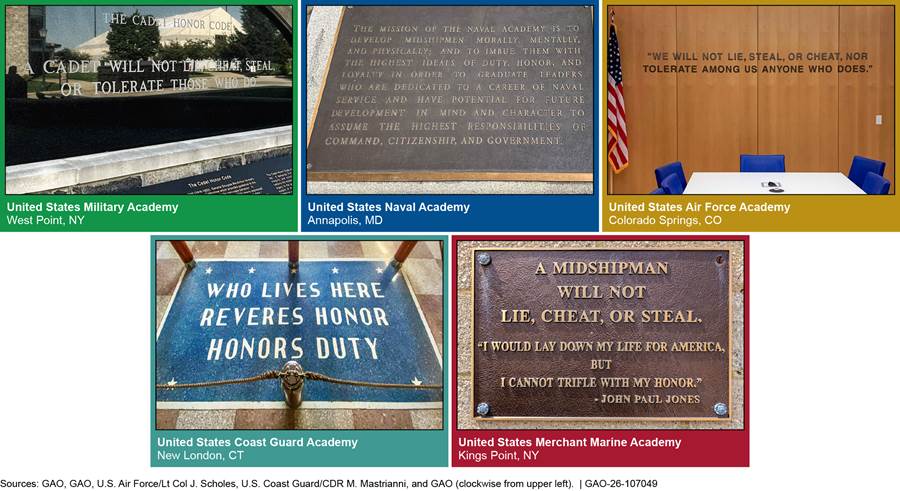
· Honor Systems. Academy students are expected to adhere to honor codes, which prohibit lying, cheating, or stealing.[17] The honor systems are generally student-led, with students administering the reporting, investigation, and hearing processes. Students also serve as honor staff who perform specific duties, such as scheduling honor hearings.[18] Honor staff also generally serve on honor boards, which are student-comprised entities that hear cases of accused students at honor hearings and vote to determine if an accused student committed an honor violation. As noted previously, each academy’s Superintendent, Commandant, and designated officers are responsible for oversight of these systems and for disciplining students found guilty of an honor offense.[19] Figure 2 shows public displays at each academy that remind students to conduct themselves with honor.
· Conduct Systems. Academies use their conduct systems to maintain good order and discipline by providing regulations and processes for adjudicating a variety of misconduct that ranges from minor offenses, such as a deviation from uniform standards, to major offenses, such as illegal drug use.[20] Accordingly, conduct offenses are generally grouped into minor and major offense classifications at each academy.[21] Table 1 provides a range of examples of minor and major offenses as defined in relevant academy guidance.
|
|
West Point |
Naval |
Air Force |
Coast Guard |
Merchant Marine |
|
Minor |
Being late to class; being disrespectful to a superior officer. |
Failure to perform a duty properly; unsatisfactory appearance in uniform. |
Late to class or formation; improper pass usage. |
Asleep at unauthorized time or place; tobacco or electronic smoking device use on academy grounds. |
Failing to comply with orders of an officer; late to class; improper performance of mess hall duty. |
|
Major |
Wrongful use or possession of controlled substances (drugs); criminal conviction; hazing. |
Fraternization of a romantic or sexual nature; providing alcohol to underage persons. |
Possession of unauthorized weapon; driving under the influence. |
Assault; bullying; slander or libel. |
Gambling for money or other items of value; possession, use, or sale of drugs. |
Source: GAO review of service academy guidance. | GAO‑26‑107049
Notes: For the purposes of this report, we grouped conduct offenses into minor and major offense classifications for each academy. Criminal offenses such as serious violations of the Uniform Code of Military Justice or of local, state or federal law are adjudicated through those respective judiciary processes, such as court-martial.
The conduct systems are officer-run, with officers administering reporting, investigation, adjudication, and discipline processes.[22] The rank of the adjudicator, formality of proceedings, and allowable punishments escalate in response to the severity of the offense. All students may report conduct offenses, and all the academies encourage students to address less severe minor offenses immediately, without the need for formal punishment. Criminal offenses such as serious violations of the UCMJ or of local, state, or federal law are adjudicated through those respective judiciary processes, such as court-martial. However, academies are not precluded from also using the conduct system to discipline students for offenses that are coincident to the criminal offense or if the court-martial convening authority or external entity declines to prosecute, according to officials.
While the honor and conduct systems generally operate independent of one another, there are instances in which these bodies may coordinate to address student misconduct. For example, Air Force Academy officials told us that some offenses, such as lying on an official form, are covered by both honor and conduct systems and may be addressed through either the honor process or the conduct process. In addition, an incident that includes a mix of honor and conduct offenses may be addressed under both respective systems, according to officials from each academy. For example, Naval Academy officials told us that if a student was found to have been drinking underage and to have also lied about it, the underage drinking charge would be processed under the conduct system, and the lie would be processed under the honor system.
Students who resign or are disenrolled from the academies for honor or conduct offenses may be required to complete a period of active duty enlisted service or to reimburse the federal government for the cost of their education.[23] While honor and conduct offense records are maintained at the academies, such information is generally not included in individuals’ records once they become commissioned officers, according to officials.
Procedural Due Process Protections
Procedural due process refers to safeguards afforded to individuals involved in adjudicatory proceedings to help ensure that official governmental action meets minimum standards of fairness. To help ensure fairness, adjudicatory systems are typically designed to minimize or structure the discretion of the adjudicator(s) by imposing standardized procedures and mandating certain protections for the accused. The concept of due process is embodied in the Fifth and Fourteenth Amendments to the Constitution and states that no person shall “be deprived of life, liberty, or property, without due process of law.”
Due process protections are generally greater in criminal proceedings than in civil proceedings, such as administrative hearings. However, per case law, the courts view procedural due process as a concept that should be flexibly applied to fit the circumstances and may vary by subgroups and settings. Courts have established that students facing expulsion from tax-supported colleges and universities have constitutionally protected interests that require certain due process protections and established standards for student disciplinary proceedings.[24] The courts have also ruled that the government’s interest in assuring the fitness of future military officers permits the academies greater freedom in providing such protections than in civilian institutions.[25]
There are 12 categories of procedural due process rights commonly used to ensure fairness in hearings (see figure 3).[26]
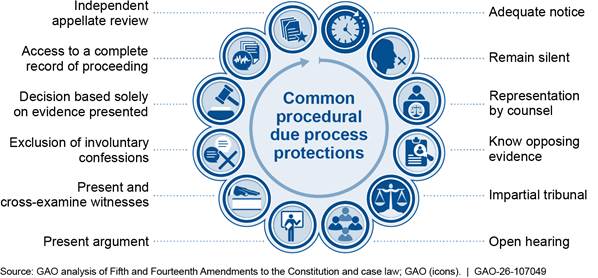
· The right to adequate notice prescribes a minimum amount of time between an individual being informed of an accusation against them, including the nature of the accusation, and its adjudication.
· The right to remain silent prescribes protection from self-incrimination, including awareness of the protection and the ability to invoke it at any time.
· The right to representation by counsel prescribes the rights of individuals to seek counsel and to have counsel accompany them and speak on their behalf at a hearing.
· The right to know opposing evidence prescribes the ability of the individual to be aware of the case made against them before their hearing begins.
· The right to an impartial tribunal prescribes protection from a judgment made by members of the tribunal who may have biases based on a relationship with the individual, and the burden of proof required to find an individual guilty.
· The right to an open hearing prescribes protection from unfair hearings by subjecting them to outside scrutiny, balanced against the individual’s right to privacy.
· The right to present argument prescribes the ability of the individual to make statements and present evidence.
· The right to present and cross-examine witnesses prescribes the ability of the individual to be aware of and confront witnesses against them, as well as to provide their own in support of their case.
· The right to exclusion of involuntary confessions made by an individual prescribes the exclusion of admissions or statements made before being given the right to remain silent.
· The right to have a decision based solely on the evidence presented prescribes the protection provided by any evidentiary standards and requirements to find an individual guilty based on that evidence
· The right to a complete record of the proceedings for the individual prescribes the ability to obtain records of the hearing, including any rationale for the decision and punishment.
· The right to independent appellate review prescribes the opportunity to identify whether there were any legal shortcomings that may have worked to the disadvantage of the individual.
Honor and Conduct Systems Have Similarities and Differences and Guidance Does Not Clearly Articulate Availability of Some Due Process Protections
Academy Honor and Conduct Systems Share Some Similarities
The service academies’ honor and conduct systems are similar in that they all generally progress through five stages when addressing an alleged offense. These include: (1) reporting an alleged offense, (2) investigation of allegation(s), (3) adjudication to determine whether the alleged offense occurred, (4) determination of punishment or discipline for validated allegations, and (5) option to appeal if found guilty. There are similarities within each stage of the academies’ honor and conduct systems that are described in further detail below.
Honor System
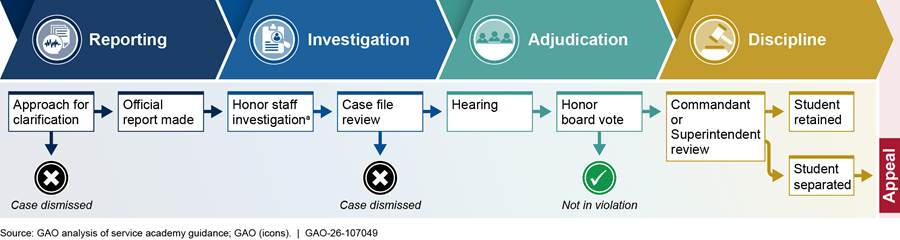
There are similarities in how the academies address each stage of an alleged honor offense. Figure 4 provides an overview of these shared practices followed by additional stage-by-stage details.
aAt the Coast Guard Academy, investigations are completed as part of the conduct investigation process.
Reporting. Academies typically encourage any student or staff member who suspects a violation of the honor code to first engage in an “approach for clarification.” This involves discussing the alleged offense directly with the individual in question to address and potentially resolve any misunderstandings. If an honor offense is still suspected after the approach for clarification, then the student or staff member may make an official report directly to student honor staff or through the student or officer chains of command.
Investigation. Once an honor offense allegation is reported, students from the honor staff are appointed to investigate. These students conduct interviews with relevant parties and collect evidence that they will use to develop a case file for review.[27] Officers who oversee the honor system review the case file and determine whether there is sufficient evidence to proceed to an honor hearing.[28]
Adjudication. If the case file review finds sufficient evidence of an offense, a formal hearing is convened. During the hearing, student honor board members review the case file and conclude by voting on whether the accused student committed the offense.
Discipline. If the honor board finds the student guilty of the offense, it will develop a recommendation for disciplinary action, focusing mainly on whether the student should be disenrolled or retained at the academy. The case file, along with the board’s recommendation, is then typically sent to the Commandant or Superintendent for further review and to decide the appropriate punishment.
Appeal. A student found guilty of an honor offense and recommended for disenrollment may appeal the decision to the appropriate authority or to an administrative board, depending on the academy.[29]
Conduct System
We also identified similarities in how the academies approach each stage of addressing an alleged conduct offense. Figure 5 provides an overview of these shared practices followed by additional stage-by-stage details.
Figure 5: Shared Stages of Service Academies’ Conduct Systems: Major and Minor Offense Case Scenarios
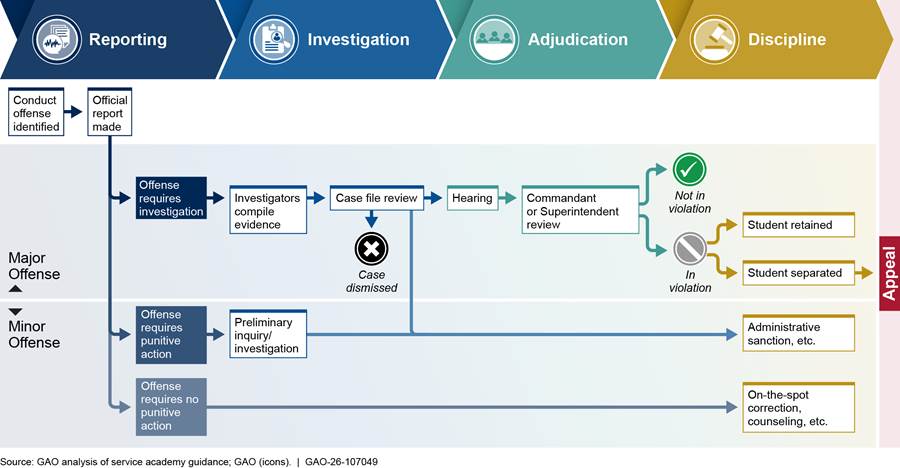
Reporting. Students or staff members generally may report conduct offenses through the student and officer chains of command. Offenses such as sexual assault and sexual harassment are typically handled through judicial processes given their severity.[30] However, such allegations may be reviewed as a conduct offense if the convening authority decides not to take judicial action.[31]
Investigation. The decision to investigate an alleged conduct offense depends, in part, on whether it is deemed to be a major or minor offense. Specifically, major offenses are typically investigated, whereas minor offenses do not always require an investigation, according to academy officials. The type of investigation is also circumstance dependent and may be done as an officer-led investigation or a criminal investigation conducted by a military criminal investigative organization, military police, or civilian law enforcement.[32] An Air Force Academy official provided the example that if a student is suspected of destroying government property by kicking through a locked door but does not admit to it, an investigating officer would be assigned to conduct interviews and obtain evidence such as surveillance footage. The official further stated that the officer would complete the investigation in accordance with relevant service or academy guidance. However, the official further explained that guidance may require that certain offenses such as sexual assault or damages over a specified dollar amount be investigated by a military criminal investigative organization or military police.[33] In general, the appropriate authority reviews the file for conduct systems cases in which an investigation has been completed and determines whether there is sufficient evidence to move forward with adjudication.
Adjudication. The adjudicating authority is a designated officer, who, depending on the academy and severity of the alleged offense, may include the Commandant, Deputy Commandant, or relevant brigade or company officer. The rank of the adjudicator and formality of proceedings is determined by whether the alleged offense is deemed to be major or minor. Major offenses are typically adjudicated via a formal hearing. During the hearing, the adjudicating authority reviews the case file and, depending on the academy, may consider witness testimony and any relevant evidence submitted by the accused and determines guilt. For cases that proceed to disenrollment, the Superintendent is involved. Minor offenses are typically adjudicated by the student or officer chains of command, and, depending on the academy, may or may not involve a formal hearing.
Discipline. Punishments escalate in response to the severity of the offense and tend to be similar across different academies. For major offenses, discipline is determined by the officer chain of command and punishments may include administrative sanctions, such as demerits, extra duty or military instruction, and tours; remediation or probation; or disenrollment.[34] For minor offenses, discipline may be determined by either the student or officer chains of command. As noted previously, all academies generally encourage students to address less severe minor offenses immediately, without the need for formal punishment. According to academy officials, these minor offenses—such as uniform violations—are addressed through nonpunitive methods, such as on-the-spot verbal correction or counseling. For minor offenses that require formal punishment, such punishments typically involve some form of administrative sanctions.
Appeal. Students found guilty of a conduct offense and recommended for disenrollment may appeal the decision to the appropriate authority or to an administrative board, depending on the academy.[35]
Key Differences Distinguish Academies’ Honor and Conduct Systems
While there are similarities in the academies’ honor and conduct systems, there are also key differences.
Honor Systems
We identified five key differences in how academy honor systems operate. These differences include the (1) types of offenses recognized as actionable, (2) legal review of investigation findings, (3) types of hearings, (4) authority and discretion of adjudicators, and (5) accused’s right to appeal.
Types of Offenses
Beyond the standard honor code offenses of lying, cheating, and stealing, West Point and the Air Force Academy also have a toleration clause, meaning that students who witness an honor offense and fail to report it are considered to be in violation themselves and can face punishment.[36] According to a West Point official, the toleration clause requires a commissioned leader of character to report honor offenses, but added that this rarely occurs in practice. Air Force officials stated that the toleration clause has been part of the academy’s framework since its inception, and that they revised their honor guidance in 2023 due to concerns that students were deliberately avoiding confronting misconduct or, at worst, feigning ignorance of offenses to avoid being accused of tolerating an honor offense.[37] However, in May 2025, the Air Force reverted to its former toleration clause requiring students of all class years to report a suspected honor offense, which officials attributed to a cheating incident occurring earlier in the year.[38]
Legal Review of Investigation Findings
To help ensure sufficient evidence, three academies (West Point, Naval, and Air Force) require government attorneys to review honor investigation findings in conjunction with officers before proceeding to a hearing. However, the other two academies (Coast Guard and Merchant Marine) proceed to a hearing after review by the Commandant or Assistant Commandant at the Coast Guard Academy and after a review by the Honor Board Chair and subsequent investigation at the Merchant Marine Academy. Coast Guard and Merchant Marine Academy officials told us that they do not have the capacity or resources to complete legal reviews of every honor investigation and do not think such a review is necessary to ensure appropriate due process.
Hearing Types
Four academies (West Point, Naval, Air Force, and Merchant Marine) adjudicate honor offenses through hearings, but for some academies, the type of hearing varies based on whether the accused preemptively admits to the alleged offense or contests it. Specifically, West Point and the Air Force Academy hold different types of hearings depending on the accused’s admission or denial of guilt. For admitted offenses, validation occurs before the hearing, which then focuses on the honor board’s recommendation for retention or disenrollment. Conversely, the Naval and Merchant Marine Academies conduct the same type of hearing regardless of how the individual pleads.[39] At these academies, validation of the offense takes place during the hearing itself. At the Coast Guard Academy, the honor board is considered to be an advisory body to the Commandant of Cadets and only holds hearings in certain situations, such as for contested cases.
At three academies (Naval, Air Force, and Merchant Marine), qualifying students who admit to the offense may be routed to a different hearing or proceed directly to the disciplinary phase where the possibility of immediate disenrollment is eliminated.[40] See figure 6 for additional details on the academies’ hearing processes.
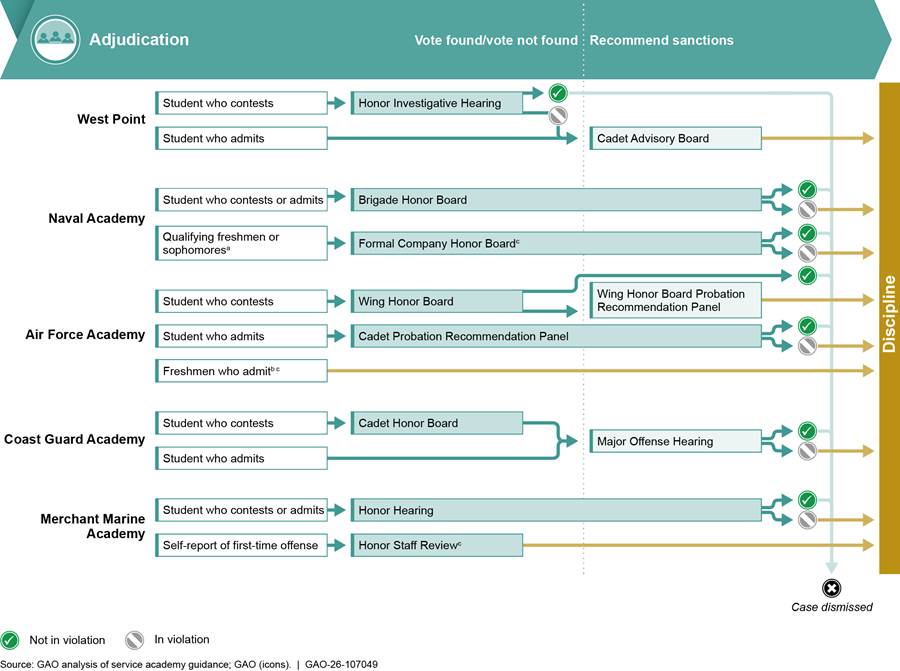
aAfter the investigation, the Brigade Honor Advisor may refer cases involving freshmen or sophomores who admit to an offense and show remorse to the Formal Company Honor Board for review. The Brigade Honor Board may also unanimously approve a voting member’s motion to refer qualifying students to the Formal Company Honor Board.
bFreshmen who commit non-egregious honor offenses that meet certain criteria may waive the Cadet Probation Recommendation Panel and receive immediate honor probation. These criteria are (1) the offense occurring prior to lesson T20 of Spring Semester; (2) the student admitting to the offense on the Honor Allegation Notification form; (3) the student having had no prior honor offenses or pending cases; (4) the student cannot be facing more than one honor offense allegation; and (5) the offense does not involve aiding other students to violate the honor code.
cStudents who qualify for this process are not subject to immediate disenrollment but may ultimately be recommended for it if they fail to complete their required honor remediation or probation.
Disciplinary Authority and Discretion
The authority to discipline students for honor offenses varies by academy and depends on the specific circumstances of each case. At West Point, the Superintendent is responsible for issuing disciplinary actions to all students that have been found to have violated the honor code. In contrast, at the other four academies (Naval, Air Force, Coast Guard, and Merchant Marine), this authority is mainly reserved for cases where disenrollment is recommended, while other cases are typically handled by the Commandant or other authority.
The extent to which a disciplinary authority is obligated to accept the student honor board’s findings (i.e., the adjudicator’s discretion) also varies by academy. Specifically, at three academies (West Point, Naval, and Air Force) disciplinary authorities are prohibited from overturning unfounded findings, although they do have the authority to challenge certain founded cases. In contrast, the Merchant Marine Academy allows disciplinary authorities to overrule the honor board’s decisions entirely. Meanwhile, at the Coast Guard Academy, where all honor offenses are major conduct offenses, disciplinary authorities are only expected to consider the honor board’s findings and ultimately determine whether a case should proceed to a Major Offense Hearing.
See table 2 for a comparison of disciplinary authority and discretion at each academy.
|
Academy |
Disciplinary authority |
Hearing findings binding on disciplinary adjudicatora |
Potential disciplinary actions |
|
West Point |
Superintendent. The chain of command and Commandant provide recommendations to retain or disenroll.b |
· Yes for unfounded cases. · No for founded cases if adjudicator finds a lack of evidence. |
Superintendent may retain student or recommend disenrollment to the Assistant Secretary of the Army for Manpower and Reserve Affairs.c All students found in violation are put on honor probation and assigned sanctions.d |
|
Naval |
Superintendent and Secretary of the Navy make decisions on disenrollments; other cases handled by Battalion Officer or Commandant.e |
· Yes for unfounded cases. · No for founded cases if the Commandant finds a serious honor board error. |
Commandant may place student on honor probation, which may include sanctions, or recommend disenrollment. Superintendent may recommend disenrollment to the Secretary of the Navy or retain and refer back to Commandant.f |
|
Air Force |
Superintendent makes decisions on disenrollments; other cases handled by Commandant. |
· Yes except when the Superintendent considers disenrollment. |
Commandant may place student on honor probation, which includes sanctions, or recommend disenrollment. The Superintendent has all options available.g |
|
Coast Guard |
Superintendent makes decisions on disenrollments; other cases handled by Commandant or other authority.h |
· No, Cadet Honor Board findings are considered advisory. |
Major Offense Hearing Authority may retain the student, recommend disenrollment, or impose other penalties such as remediation. |
|
Merchant Marine |
Superintendent makes decisions on deferred graduations, setbacks, and disenrollments; other cases handled by Commandant. |
· No |
Commandant may place student on honor probation, which may include sanctions, and remediation or recommend deferred graduation, setback, or disenrollment to the Superintendent. The Superintendent has all options available.i |
Source: GAO analysis of service academy guidance. | GAO‑26‑107049
aFinding refers to whether the student was found in violation (called founded here) or not in violation (unfounded).
bThe Commandant is the final authority for new student cases. New students are those in summer training prior to Acceptance Day, which marks their transition to freshmen.
cWest Point freshmen and sophomores can be directly disenrolled by the Superintendent.
dWhile students can face probation or other sanctions, the Superintendent may set aside “founded” findings if he or she determines they are not supported by evidence and can close the case, direct further investigation, or direct enrollment in honor probation (called the Special Leader Development Program).
eThe Battalion Officer adjudicates cases for freshmen and sophomores with no prior honor offenses and for which the board voted on a recommendation for retention or where their vote for disenrollment did not reach seven of nine board members. The Commandant adjudicates cases for juniors and seniors and all repeat honor offenders.
fIf the Superintendent refers the case back to the Commandant, they may take no further action or place the midshipman on honor probation or remediation, which may include sanctions.
gThe Superintendent can take no action, place the cadet in honor probation, or disenroll the cadet. This decision is final. Honor probation includes certain administrative sanctions such as removal of all rank.
hExamples of other authorities include the Assistant Commandant of Cadets, Company Officers, and the Chief of Cadet Training and Operations Branch. According to officials, the hearing authority is chosen by the circumstances of the case.
iThe Superintendent may impose deferred graduation, setback (i.e., temporary separation from the Academy), disenrollment, exonerate, or refer back to the Commandant for honor probation and remediation.
Further, two academies’ policies (West Point and Air Force), limit disciplinary authority discretion in assigning punishments by requiring that students found guilty of an honor offense immediately be given a prescribed set of sanctions, such as restriction, reduction in rank, and placed into a remediation or probation program. At the Naval, Coast Guard, and Merchant Marine Academies, the disciplinary authority has more discretion to determine what punishments to apply, including sanctions and whether the student will enter remediation or probation.
Appeal
A student’s right to appeal honor hearing findings and sanctions also varies by academy. Four academies (Naval, Air Force, Coast Guard and Merchant Marine) allow students to appeal honor hearing findings if new evidence is provided, while West Point does not.[41] Further, four academies (West Point, Naval, Coast Guard and Merchant Marine) allow students to appeal imposed sanctions, whereas the Air Force Academy does not.[42] As noted previously, students at all academies have the option to appeal a recommendation for disenrollment to the appropriate authority or to an administrative board, depending on the academy.
Conduct Systems
We identified five key differences in how academy conduct systems operate, including (1) student roles and responsibilities, (2) the use of hearings, (3) the disenrollment authority and proceedings, (4) the right to appeal, and (5) the use of nonjudicial punishment.
Student Roles and Responsibilities
As noted previously, all academies generally encourage students to address less severe minor offenses immediately, without the need for formal punishment. However, three academies (Naval, Coast Guard, and Merchant Marine) delegate extra responsibilities to certain students for overseeing conduct offenses. Specifically, at the Naval Academy, the student chain of command is empowered to establish a Midshipman Independent Review Board, which is responsible for reviewing and addressing a student’s trend of small offenses. In addition, student company commanders at the Naval Academy are authorized to adjudicate minor offenses committed by freshmen-through-junior students. At the Coast Guard Academy, the student chain of command can directly adjudicate minor conduct offenses.[43] Meanwhile, at the Merchant Marine Academy, students adjudicate certain minor offense hearings but do so under the supervision of an officer.[44]
The Naval and Coast Guard Academies have also codified specific steps in policy that students should follow when holding others accountable for minor offenses. In general, students are advised to first provide verbal correction and then proceed to more formal types of punishment, such as written correction or assigning extra military instruction for subsequent offenses.[45]
Use of Hearings
Three academies (West Point, Naval, and Merchant Marine) hold hearings to adjudicate both major and minor offenses. Specifically, West Point uses Misconduct Hearings to address major offenses and Article 10 hearings to address minor offenses; the Naval Academy uses Adjudicative Hearings to address both offense types; and the Merchant Marine Academy uses Class I Masts for major offenses and Class II Masts for minor offenses.[46]
In contrast, one academy, the Coast Guard Academy, uses Major Hearings to address major offenses but does not use hearings to address minor offenses.[47] Finally, at the remaining academy, the Air Force Academy, hearings are not typically required to adjudicate offenses, but they may use student-run Squadron or Group Command Review Boards to review student performance, take disciplinary action, or make sanction recommendations to the squadron or group commander, an officer, for adjudication.[48]
Disenrollment Authority and Proceedings
The same three academies that hold hearings to adjudicate both major and minor offenses (West Point, Naval, and Merchant Marine) require disenrollments to be approved by service-level leadership. Specifically, the authority for West Point juniors and seniors is the Assistant Secretary of the Army; for Naval Academy students disenrolled for honor or conduct offenses is the Assistant Secretary of the Navy; and for all Merchant Marine Academy disenrollments is the Assistant Secretary for Administration.[49] In contrast, the disenrollment authority at the Air Force and Coast Guard Academies is typically the Superintendent.[50]
The academies also use different proceedings for disenrollment. Specifically, at four academies (Naval, Air Force, Coast Guard, and Merchant Marine) a fact-finding Board may be held prior to the Superintendent’s decision or recommendation to the adjudicating authority.[51] However, at the Naval and Air Force Academies, these Boards are reserved for disenrollment under other than honorable conditions. Finally, at three academies (Naval, Air Force, and Coast Guard) students recommended for disenrollment have the option to meet with the Commandant of Cadets or Superintendent, depending on the infraction, prior to his or her decision.
Appeal
As with the honor system, a student’s right to appeal conduct hearing findings and sanctions differs by academy. Three academies (Naval, Coast Guard, and Merchant Marine) allow students to appeal major conduct hearing findings and sanctions under certain circumstances, while the other academies (West Point and Air Force) do not.[52] All academies permit their students to appeal a recommendation for disenrollment.
Use of Nonjudicial Punishment
Of the four academies where students are subject to the UCMJ, two academies (Air Force and Coast Guard) offer nonjudicial punishment as an option for adjudicating conduct offenses, while the other two (West Point and Naval Academy) do not.[53] The Merchant Marine Academy is not subject to the UCMJ and therefore does not use nonjudicial punishment.
Air Force and Coast Guard Academy officials stated that the decision to use nonjudicial punishment is at the commander’s discretion, given that both the conduct system and nonjudicial punishment are designed to handle similar types of offenses.[54] They stated that factors such as the severity of the offense and any history of prior misconduct play a role in this decision-making process. However, Coast Guard Academy officials told us that they rarely use nonjudicial punishment, as they consider the conduct system to generally be better suited to address any misconduct issues that arise in the academy setting.
West Point and Naval Academy officials told us that while nonjudicial punishment is not an official form of discipline at their academies, their conduct systems generally serve the same function. Specifically, West Point officials stated that the Article 10 hearings used to adjudicate minor offenses closely mirror nonjudicial punishment, except that any Article 10 punishments are not documented outside the student’s academy record and do not follow them once they are commissioned. Similarly, Naval Academy officials stated that the conduct system is designed to more efficiently and effectively address misconduct and remediate students than nonjudicial punishment. Further, these officials stated that a subject’s right to request a court-martial in lieu of nonjudicial punishment could potentially increase the number of courts martial, which would be a substantial strain on academy resources.
Academy Guidance Does Not Clearly Articulate the Full Range of Due Process Protections Available for Honor and Conduct Offenses
The academies’ honor and conduct guidance clearly identifies that students are entitled to some of the 12 procedural due process protections commonly used in judicial and administrative proceedings.[55] However, the availability of other protections is vague or not mentioned at all.
Honor Systems
Our analysis of each academy’s honor system determined that four of five academies provide 10 of the 12 common procedural due process protections to students accused of an honor offense and that West Point provides all 12. The provision of the remaining two due process protections, or whether guidance specifically addressed them, varied among the academies. While the academies similarly offer many of these protections, how they are implemented can vary, in ways such as the timeline for notifying students of charges and whether government legal counsel is available free of charge.[56] Table 3 provides details on the due process protections each academy provides to students accused of honor offenses.
|
|
West Point |
Naval |
Air Force |
Coast Guard |
Merchant Marine |
|
Adequate notice |
Yes |
Yes |
Yes |
Yes |
Yes |
|
Right to remain silent |
Yes |
Yes |
Yes |
Yes |
Yes |
|
Legal representation |
Yes |
Yes |
Yes |
Yes |
Yes |
|
Know opposing evidence |
Yes |
Yes |
Yes |
Yes |
Yes |
|
Impartial tribunal |
Yes |
Yes |
Yes |
Yes |
Yes |
|
Open hearing |
Yes |
Yes |
Yes |
Yes |
Yes |
|
Present argument |
Yes |
Yes |
Yes |
Yes |
Yes |
|
Present and cross-examine witnesses |
Yes |
Yes |
Yes |
Yes |
Yes |
|
Exclusion of involuntary confessions |
Yes |
Yes |
Yes |
Yes |
Yes |
|
Decision based on evidence presented |
Yes |
Guidance |
Guidance |
Guidance unclear |
Guidance |
|
Access to a complete record of proceeding |
Yes |
Guidance |
Yes |
Guidance |
Yes |
|
Right to appeal |
Yes |
Yes |
Yes |
Yes |
Yes |
Source: GAO analysis of service academy guidance. | GAO‑26‑107049
Based on our analysis, we found that guidance on the availability of two protections—the right to a decision based on evidence presented and the right to a complete record of the proceeding—was either unclear or lacking at four of the academies. Below, we provide additional information on those due process protections that were missing or unclear in academy guidance.
Right to Decision Based on Evidence Presented
While all academies provide a right to a decision based on evidence presented, three of them do not clearly define in guidance what types of evidence are allowed and four of them do not thoroughly address protections against illegal search and seizure or the related exclusion of evidence in their guidance.
The presentation of evidence plays a crucial role in honor board hearings and may come in various forms, such as documentation and witness testimonies. While all academies recognize the significance of evidence, officials from the Naval, Air Force, and Merchant Marine Academies told us that certain types of evidence—such as hearsay, which typically would not be admissible in legal contexts, depending on the circumstances—can be used in honor proceedings. However, these academies’ existing guidance does not clearly define what types of evidence are allowed. For example, Naval Academy guidance establishes that any relevant evidence can be considered, and relevancy is determined by the presiding officer in consultation with a judge advocate general. This ambiguity regarding hearsay may lead to misunderstandings among students facing accusations regarding evidentiary standards in honor cases.
Similarly, Air Force Academy guidance states that all evidence deemed relevant by the presiding officer is permissible, but it likewise does not clarify whether hearsay may be used. Merchant Marine Academy guidance acknowledges that the rules of evidence for judicial proceedings do not apply to Honor Boards. However, while students may object to particular pieces of evidence presented in honor board hearings, the guidance does not discuss grounds for objection or explicitly confirm whether all forms of evidence, including hearsay, are acceptable though officials told us that they are.
Additionally, officials at all academies told us that unlawful search and seizure is prohibited in honor investigations to help ensure evidence is obtained in accordance with a student’s civil rights. However, written guidance for the Naval, Air Force, Coast Guard, and Merchant Marine Academies does not clearly articulate this right or the related exclusion of evidence. Officials from these other academies did not consider the absence of this protection in their honor system guidance to be an issue because they said it is provided for elsewhere, such as in the U.S. Constitution and the UCMJ.
Right to Access a Complete Record of the Proceeding
A record of the proceeding can aid the accused in evaluating options for appeal or in understanding the rationale for the verdict. West Point, Air Force, and Merchant Marine Academy guidance specifies that students are entitled to a complete record of their honor hearing. In contrast, Naval and Coast Guard Academy guidance does not include such a provision.
Naval Academy officials told us that a student accused of an honor offense may request to listen to a recording of their hearing, but it can only take place in the office that oversees the honor system. Further, students are not permitted to make a copy of the recordings or of other materials from their case unless they file a Freedom of Information Act request for the records. However, Naval Academy guidance does not state or describe these access rights. Coast Guard Academy officials told us that they do not record or transcribe honor hearings but said that a scribe is designated to take written notes at every major offense hearing, including honor hearings. However, Coast Guard Academy guidance does not specify under what circumstances the notes may be available to a student or how to make such a request.
Conduct Systems
We also analyzed the academies’ conduct systems and found that all academies provide six of the 12 common procedural due process protections to students accused of a conduct offense.[57] The provision of the remaining six due process protections, or whether guidance specifically addressed them, varied among the academies. As with honor processes, the manner in which these protections are implemented can vary. Table 4 provides details on the due process protections each academy provides students accused of conduct offenses.
|
|
West Point |
Naval |
Air Force |
Coast Guard |
Merchant Marine |
|
Adequate notice |
Yes |
Yes |
Yes |
Yes |
Yes |
|
Right to remain silent |
Yes |
Yes |
Guidance unclear |
Yes |
Yes |
|
Legal representation |
Yes |
Yes |
Yes |
Yes |
Yes |
|
Know opposing evidence |
Yes |
Yes |
Yes |
Yes |
Yes |
|
Impartial tribunal |
Yes |
Yes |
Yes |
Yes |
Yes |
|
Open hearing |
Yes |
Yes |
No |
Yes |
Yes |
|
Present argument |
Yes |
Yes |
Yes |
Yes |
Guidance uncleara |
|
Present and cross-examine witnesses |
Yesb |
Yes |
Guidance |
Yes |
Yes |
|
Exclusion of involuntary confessions |
Yes |
Yes |
Yes |
Yes |
Yes |
|
Decision based on evidence presented |
Guidance unclearc |
Yes |
Guidance |
Guidance |
Guidance |
|
Access to a complete record of proceeding |
Yes |
Guidance |
Yes |
Guidance |
Yes |
|
Right to appeal |
Yes |
Yes |
Yes |
Yes |
Yes |
Source: GAO analysis of service academy guidance. | GAO‑26‑107049
Note: We reviewed West Point misconduct hearings and Article 10 proceedings; Naval Academy adjudicative hearings; Air Force Academy Form 10, Letter of Notification, and Board of Inquiry processes; Coast Guard Academy Major Offense Hearings; and Merchant Marine Academy Class I Masts, Executive Boards and Superintendent Hearings.
aAccording to officials, students may make opening and closing statements in Class I Masts, Executive Boards, and Superintendent Hearings. However, only Executive Boards and Superintendent Hearings establish this right in written guidance.
bWest Point allows respondents to cross examine witnesses during misconduct hearings; however, they leave this to the discretion of the tactical officer during Article 10 proceedings
cDuring misconduct hearings, misconduct hearing guidance prohibits the use of evidence that was obtained from an unlawful search and seizure. To the contrary, Article 10 guidance states that the rules of evidence do not apply; it allows the tactical officer to consider any evidence that is “relevant to the offense.”
Based on our analysis, we found that guidance on the availability of six protections—right to remain silent, right to an open hearing, right to present argument, right to present and cross-examine witnesses, right to a decision based on evidence presented, and right to a complete record of proceedings—was either unclear or lacking among the five academies. Below, we provide additional information on those due process protections that were missing or unclear in academy guidance.
Right to Remain Silent
Air Force Academy officials told us that students have the right to remain silent when they are facing UCMJ actions, which they said students are trained on prior to their freshman year. However, Air Force conduct guidance does not specify that a student accused of a conduct offense that is not a UCMJ offense is entitled to this protection.
Right to Open Hearing
As noted previously, at the Air Force Academy, hearings are not typically required to adjudicate offenses and therefore there is not a consistent right to an open hearing.[58] However, the right to an open hearing may be provided at a Board of Inquiry for students recommended for disenrollment from the academy under other than honorable conditions. Per guidance, Boards of Inquiry may be opened to spectators at the request of the respondent, with the approval of the board president in consultation with the legal advisor.
Right to Present Argument
Merchant Marine Academy officials told us that students accused of a conduct offense have the right to make a statement to the Deputy Commandant or Regimental Commander who is adjudicating their Class I Mast. However, this right is not clearly articulated in existing guidance, which may limit a student’s awareness that they are permitted to make a statement on their own behalf at these conduct hearings. Merchant Marine Academy officials told us that they plan to clarify the availability of this protection in future revisions of their conduct system guidance. However, they have not provided a timeline for when these revisions will take place.
Right to Present and Cross-Examine Witnesses
All academies that use hearings with binding outcomes allow the presentation and cross-examination of witnesses, but Air Force guidance is unclear on the use of witness statements. As previously noted, the Air Force Academy use of hearings is limited to non-binding student-run hearings that make recommendations for sanctions to officers and for students facing disenrollment under other than honorable conditions. Air Force officials told us that students may include witness statements in their written rebuttals for disenrollment proceedings. However, their guidance does not specify whether the accused can include witness statements in their rebuttal to a conduct allegation or disenrollment notice. Clearly outlining how witness statements can be submitted as evidence in guidance would enhance students’ understanding of their rights during these administrative proceedings.
Right to Decision Based on Evidence Presented
While all academies provide a right to a decision based on evidence presented, four of them do not thoroughly address protections against illegal search and seizure or the related exclusion of evidence in their guidance. As with the honor systems, officials stated that academies generally provide protections against illegal search and seizure through external sources, such as the UCMJ and the U.S. Constitution. However, written guidance for West Point, Air Force, Coast Guard, and Merchant Marine Academies does not clearly articulate this right or the exclusion of evidence resulting from illegal search and seizure in all types of conduct proceedings, even though officials assert that these protections apply.
Specifically, West Point’s Article 10 guidance specifies that tactical officers are not bound by the rules of evidence and may consider any evidence relevant to the offense, but it does not discuss protection from illegal search and seizure. Officials told us that they advise officers against imposing punishment if it is evident that a cadet’s rights have been infringed upon. At the Air Force Academy, guidance does not address protection from search and seizure, but according to officials, their students are protected by the Fourth Amendment of the U.S. Constitution and Military Rules of Evidence for searches. Coast Guard and Merchant Marine Academy officials told us that they would apply the right as described in laws or guidance outside of their own conduct guidance—specifically, the UCMJ for the Coast Guard Academy and the Fourth Amendment for the Merchant Marine Academy. The conduct processes at these academies, like the honor processes, generally do not follow formal rules of evidence and may accept types of evidence that are normally inadmissible in legal proceedings, such as hearsay. Consequently, it may be unclear to students subjected to these processes whether evidence from illegal searches and seizures may be used. By more explicitly detailing this and other protections available to students in their conduct guidance, the West Point, Air Force, Coast Guard, and Merchant Marine Academies could enhance students’ understanding of their administrative due process rights.
Right to Access a Complete Record of Proceedings
The Naval and Coast Guard Academies’ guidance does not clearly specify whether students are entitled to a complete record of their conduct hearing. Specifically, Naval Academy officials told us that, upon request, students may access some records of their conduct hearing, but officials said that access to the complete record would require that they submit a Freedom of Information Act request. However, this is not specified in the academy’s existing conduct system guidance. As with honor proceedings, Coast Guard Academy officials told us that they do not record or transcribe conduct proceedings but said that a scribe is designated to take written notes at every major offense hearing. However, Coast Guard Academy guidance does not specify when or how the accused may request access to these notes.
Standards for Internal Control in the Federal Government state that management should communicate quality information to achieve objectives and that management communicate that information throughout the entity.[59] Moreover, the U.S. Constitution and federal case law require the military services to provide applicable procedural due process protections in their honor and conduct processes.[60] The academies’ honor and conduct system guidance emphasize the importance of applying standards fairly. However, the due process protections available for honor and conduct proceedings is not always clear in guidance. Assessing the existing guidance and updating it to ensure that it fully and clearly reflects and communicates the protections available to accused students, would help ensure that students are informed of their rights.
|
Use of Attorneys During Hearings Honor and conduct proceedings at all academies are administrative proceedings, similar to nonjudicial punishment under Article 15 of the Uniform Code of Military Justice. For both nonjudicial punishment and some, but not all, of these academy proceedings, the accused is allowed to have a spokesperson who speaks on their behalf. At nonjudicial punishment proceedings, this spokesperson can be the accused’s attorney. Similarly, West Point allows an attorney to accompany the accused for formal misconduct hearings and to serve as the spokesperson for Article 10 proceedings, and the Coast Guard Academy allows counsel for an Executive Board when the board is considering discharge under other than honorable conditions. For other administrative proceedings at the academies, if a spokesperson is permitted, the role is typically filled by a fellow student or an officer advisor. Source: GAO. | GAO‑26‑107049 |
Officials at some of the academies told us that they believe their honor and conduct systems provide adequate due process protections to students and some also said that guidance contains sufficient information about those processes. Specifically, some academy officials stated they assess the protections provided when legal review of cases is required by policy, such as when disenrollment is recommended, or when their relevant guidance is revised. Officials from West Point and the Naval, Air Force, and Coast Guard Academies noted their relevant guidance was updated within the last several years. Merchant Marine officials acknowledged some areas of their guidance were not clear and that they planned to address them in the next update, though they did not provide a date for when the next update would occur.
We recognize that administrative proceedings, such as those used to adjudicate honor and conduct violations, do not necessarily require that the accused be afforded all 12 due process protections. However, without guidance that clearly articulates the intended range of due process protections available—such as those that academy officials told us were available but not documented—students accused of honor and conduct violations may not be fully informed of their rights and thus be unintentionally limited in their ability to mount an effective defense when engaging with processes that could impede their ability to graduate and serve as officers. Furthermore, clear guidance may also help to ensure that students have a favorable perception of the honor and conduct systems and that systems are implemented in a fair and just manner.
The Academies Collect Some Data but Two Issues Limit Visibility Over Honor and Conduct Systems
The Honor and Conduct Data That Academies Collect Are Not Complete
The academies collect and maintain some data related to honor and conduct offenses and their associated proceedings, but these data are incomplete.[61] Specifically, the academies collected and maintained data on some, but not all, of the stages of their honor and conduct systems for academic years 2018-2019 through 2023-2024. As noted previously, the honor and conduct systems at each academy typically involve five stages: (1) reporting a suspected violation, (2) investigating the claim, (3) adjudicating the alleged offense, (4) determining appropriate punishment for confirmed offenses, and (5) providing certain appeal rights. Below we provide an overview of our findings and, in appendix II, we provide more detailed results of our analysis of honor and conduct data.[62]
Honor Data
Each academy collects and maintains data on reported honor offenses and their adjudication, but none collect data consistently across the remaining three stages of the honor system, including investigations, disciplinary actions resulting from honor cases, and appeals.
Investigations. The investigative stage produces key information, such as documentary and testimonial evidence, that is used during honor system proceedings. The Coast Guard and Merchant Marine Academies collect some data on investigations of honor offenses, such as who completes the investigation or the date it was completed.[63] However, the other three academies (West Point, Naval, and Air Force) do not.
Discipline. All five academies have the option to impose administrative sanctions, honor remediation or probation, or disenrollment as disciplinary measures for individuals found guilty of honor offenses. Data on the type of discipline that academies impose is important for a variety of reasons, such as identifying potential disparities in how sanctions are applied. We found that the academies track honor remediation or probation, but not all academies collect data on instances of imposed administrative sanctions or honor related disenrollments. Specifically, we found that two academies (Air Force and Merchant Marine) do not collect data on administrative sanctions, and two academies (Air Force and Coast Guard) do not collect data on related disenrollments.
Appeals. The appeal stage reflects the final outcome of a case, which may differ from the decision reached during the adjudication phase. However, four academies (West Point, Naval, Air Force, and Coast Guard) do not currently track data on appeals, such as the number of appeals or their results.[64]
Conduct Data
As noted previously, each academy collects and maintains some conduct data, but we found that the data from the 2018-2019 through 2023-2024 academic years were incomplete across all five stages of the system.[65]
Reporting. Data on reported offenses helps provide information about the different conduct issues that may be occurring. However, the degree to which each academy collects data on the types of reported conduct offenses varies. Three academies (Naval, Coast Guard, and Merchant Marine) collect data on reports of both major and minor offenses. However, West Point only collects data on reports of minor offenses, and the Air Force Academy collects data on conduct probation, but not on reports of offenses.
West Point and Air Force Academy officials stated that they maintain records for reported offenses outside of their databases, such as in related PDFs or files, but acknowledged they could use current systems to collect and maintain such data. Specifically, West Point’s Office of the Staff Judge Advocate maintains major offense hearing information in its records, but conduct officials acknowledged that collecting information in their conduct database could improve visibility of all reported conduct offenses, provided that doing so does not add a substantial burden to officials’ workloads.
An Air Force Academy official stated that the academy implemented a new database in 2022 to capture derogatory student information, including conduct data.[66] However, this official stated that data in the new system are incomplete because there was no formal requirement to enter data on reported offenses, which the academy anticipated implementing in a forthcoming conduct policy. The academy’s revised policy published in March 2025 requires entering information on probations stemming from a conduct offense in the database but does not require data entry related to reported offenses.[67] Another Air Force Academy official told us that the academy plans to continue maintaining conduct offense data at the squadron level and use data calls as needed and to track disenrollments in Excel workbooks. According to this same official, the Excel workbooks are easier to work with to meet data needs, such as for transferring to briefing slides or for filtering the data.
Investigations. As noted previously, the investigative stage produces important evidence that is used in conduct proceedings. The Naval and Coast Guard Academies collect data on investigations of conduct offenses, such as who completes the investigation. However, three academies (West Point, Air Force, and Merchant Marine) do not collect data related to this stage.
Adjudications. The adjudications stage includes reviewing evidence and determining guilt. The adjudicating authority or hearing type varies based on offense severity, among other factors. The Naval and Coast Guard Academies collect data on adjudication, and West Point collects it for the minor offense data it maintains.[68] However, two academies (Air Force and Merchant Marine) do not collect data on the adjudication method, such as the hearing type or who adjudicated the offense.
Discipline. All academies may impose administrative sanctions, use conduct remediation or probation, or initiate disenrollment for students found guilty of a conduct offense, and the academies collect some data on these actions at varying levels. However, the academies do not consistently collect data on the various disciplinary measures they use. Specifically, the Air Force does not collect data on the use of administrative sanctions, and two academies (West Point and Merchant Marine) do not collect data on the use of remediation for conduct offenses. We also found that no academies collect data on disenrollments resulting from a conduct offense.
Appeal. As noted previously, an appeal may result in an outcome that differs from the adjudicated decision. However, none of the academies collect data on appeals related to a conduct offense.[69]
Standards for Internal Control in the Federal Government state that management should use quality information—that is, information from reliable data that is current, complete, accurate, accessible, and timely—to achieve the entity’s objectives. In doing so, management identifies the information requirements needed to achieve the entity’s objectives and address related risks, and such requirements consider the expectations of internal and external users.[70] Further, the National Defense Authorization Act for Fiscal Year 2017 included requirements related to collecting data across all stages of the military justice system to facilitate case management, analysis, and decision-making.[71] For example, the statute directed the Secretary of Defense to collect data on substantive offenses and procedural matters for pretrial, trial, posttrial, and appellate processes, among other things. While academy honor and conduct systems are distinct from the military justice system and are administrative in nature, they maintain numerous similarities to processes under the UCMJ—such as nonjudicial punishment. Furthermore, offenses by students that are not pursued for prosecution under the UCMJ may be eventually adjudicated under the academy conduct system.
The academies strive to ensure that all honor and conduct offenses are fairly adjudicated, and officials at each academy told us that they rely on the data collected to manage their respective honor and conduct systems. Some noted they use it to respond to external inquiries, such as from Congress or DOD. However, the academies cannot be sure that they are meeting their stated objectives or able to thoroughly respond to requests for information because they have not identified their own comprehensive set of data collection requirements for all stages of honor and conduct systems or documented these requirements in their guidance.[72]
Officials from each academy told us that they collect the data necessary to meet their needs, and some officials stated data collected may adjust as their leaderships’ needs change. Officials also told us that they do not believe that documenting data collection requirements in guidance would improve their ability to oversee their respective honor and conduct systems, as they believe they are able to effectively manage both systems with the data that they currently collect. Naval Academy officials also questioned the utility of expending resources to update guidance with a more comprehensive list of data collection requirements due to the relatively small number of students who are adjudicated under the honor and conduct systems.
While the likelihood of students being adjudicated for an honor or conduct offense may be low, the demand on academy resources, possible repercussions, and the overall experience for students involved in the process can be considerable. By systematically identifying and updating their data needs across all stages, the service academies will be better able to leverage information to pinpoint opportunities to enhance efficiency and address challenges faced by students who become involved in the process, such as the length of investigations or adjudications. Further, by establishing complete and consistent data collection requirements, and documenting them in guidance, the academies will be better positioned to fairly adjudicate all honor and conduct offenses, respond thoroughly to requests for information, and identify related risks across all stages of the systems.
The Academies Are Unable to Readily Access Data
We found that visibility over honor and conduct systems is further constrained by the challenges officials at four academies described in accessing relevant data. West Point officials did not identify any challenges in accessing relevant data, but officials from the remaining academies did. Specifically,
· Naval Academy officials told us that the dated nature of their database, which was created in the 1990s, presents challenges that lead to a less user-friendly experience and hinders their ability to access and analyze conduct data in a timely manner. For example, an official told us they track the number of conduct offenses and their level, such as major, but could not access further detail on the offenses such as the specific offense or demographic data.
· Air Force Academy officials told us that their use of a spreadsheet to track honor-related cases limits their ability to maintain visibility over required tasks related to processing an honor case and showing at what stage it is in.
· Coast Guard Academy officials stated that they do not have immediate access to certain honor and conduct data, such as historical records, necessary for tracking related offenses. Specifically, officials told us that data requests must be submitted through another Academy office, which, despite being supportive, has many competing priorities that delay the completion of these requests.
· Merchant Marine Academy officials told us that they also cannot access historical conduct data from their database. Rather, they must rely on a contractor who manages the database, leading to delays in processing requests. Further, these officials said that the dated nature of their database, at 25 years old, hinders their ability to query the data directly.
Standards for Internal Control in the Federal Government state that management should use quality information—that is information from reliable data that is current, complete, accurate, accessible, and timely—to achieve the entity’s objectives. In doing so, management obtains relevant data from reliable sources and on a timely basis and processes it into quality information within the entity’s information system.[73]
While Naval, Air Force, Coast Guard, and Merchant Marine Academy officials may eventually access the data needed, they cannot do so in a timely manner. Because the academies have not yet addressed the challenges that limit officials’ timely access to the information, they cannot readily access needed data. Officials at all four academies acknowledged these limitations and described steps they are taking to address these challenges. However, the academies are at varying stages of completion in addressing such challenges. Specifically,
· The Naval Academy is currently implementing its expected solution, according to officials. Officials there said that they are in the process of implementing a new data system that is expected to be more user-friendly. They anticipate that this system will be operational by summer 2027 and believe it will greatly enhance their ability to access honor and conduct data. For example, officials told us that the new system will allow them to generate customized reports of honor and conduct data. This is a positive step to help improve officials’ access to such data and to help ensure that they have quality information to achieve objectives. Consequently, we are not making a recommendation to the Naval Academy.
· The Air Force Academy piloted a solution, but it did not address their concerns, according to officials. Specifically, officials told us that they purchased a trial subscription for commercial project management software to track honor-related tasks and the status of honor cases. However, the trial ultimately did not meet their needs, primarily due to cost and the absence of features for setting access permissions. As a result, academy officials stated that they reverted to using a spreadsheet and do not have a timeline for addressing the limitations associated with their current system.
· The Coast Guard Academy has identified a solution but does not have a timeline for its implementation, according to officials. Specifically, officials stated they plan to test a tool designed to query and synthesize data from their existing system. This tool aims to enhance data presentation and mitigate the need to formally request data. Officials said that they are also looking to increase staffing within the cadet division to designate an individual who is responsible for data management, which they believe will facilitate more timely access to the data. However, they stated there is no established timeline for implementing these initiatives due to competing priorities and budget constraints.
· The Merchant Marine Academy has also identified a solution but does not have a timeline for its implementation, according to officials. Specifically, officials told us that they are in the process of implementing a new data system aimed at resolving challenges with accessing conduct data by allowing them to directly pull data from the system for analysis. However, officials did not specify a set timeline for when this transition will be completed.
Once fully implemented, these steps the academies are taking to address identified challenges could help improve their access to honor and conduct data and help ensure that officials who manage their honor and conduct systems have timely access to quality information to achieve objectives. However, until the Air Force Academy takes steps to address challenges to more effectively accessing its data and establishes a time frame for doing so, and the Coast Guard and Merchant Marine Academies establish time frames to implement their solutions expected to address their challenges, each of these academies will lack access to quality information to manage their honor or conduct systems.
Though Opinions Were Generally Favorable, Students Expressed Concerns About Systems and a Reluctance to Report Certain Offenses
While students generally reported favorable opinions about the honor and conduct systems at their respective academies, they also raised concerns about aspects such as the fairness of the findings from these processes and their willingness to report certain offenses. Overall, relatively few students, 15 percent or less at each academy,[74] had faced allegations of an honor offense but some among those reported negative emotional impacts. We surveyed 6,984 sophomore through senior students across the five service academies and obtained generalizable results that are broadly applicable to the sophomore through senior student population at each respective academy.[75] Below we present a summary of findings based on the survey; appendix III presents additional survey analysis.[76]
Academy Students Are Generally Positive About the Honor System, but Expressed Some Concerns About Fairness
Students held a positive view about the fairness of their academy’s honor system, based on the survey results. However, they expressed unease with some aspects, such as the fairness of findings among all students and a reluctance to report honor offenses. Additionally, students we surveyed who were accused of honor offenses reported negative emotional impacts.
Fair Application of Honor Processes
Students generally viewed their academies’ honor system favorably, with between 53 to 76 percent reporting it as being “mostly fair” or “very fair” (see table 5).[77]
Table 5: Service Academy Student Perceptions of the Fairness of the Honor System as a Whole (Estimated Percent)
|
|
Not at all fair |
Somewhat fair |
Mostly fair |
Very fair |
Don’t know |
|
West Point |
6 |
28 |
45 |
14 |
7 |
|
Naval |
3 |
16 |
46 |
30 |
6 |
|
Air Force |
10 |
32 |
42 |
11 |
6 |
|
Coast Guard |
4 |
26 |
47 |
12 |
11 |
|
Merchant Marine |
9 |
32 |
38 |
15 |
6 |
Source: GAO survey of service academy students. | GAO‑26‑107049
Notes: We asked students “How fair, if at all, are the following items?” and included among those items “the honor system as a whole.” Percentages are within a margin of error of 4.81 percent and may not sum to 100 percent due to rounding or non-response. Responses to all items are available in the online supplement: GAO‑26‑108179.
However, some students viewed the application of honor board findings—whether or not the accused was found to have committed an offense—across all students less favorably. Specifically, between 24 and 46 percent of students stated that they did not believe honor board findings were applied fairly to all students.[78] It was only at the Naval Academy where approximately half of students felt that these findings were applied fairly to everyone (see table 6).[79]
Table 6: Service Academy Student Perceptions on Fair Application of Honor Offense Findings Across All Students (Estimated Percent)
|
|
Yes, findings are applied fairly to all |
No, findings are not fairly applied to all |
Don’t know |
|
West Point |
38 |
38 |
24 |
|
Naval |
55 |
24 |
21 |
|
Air Force |
39 |
35 |
26 |
|
Coast Guard |
39 |
43 |
17 |
|
Merchant Marine |
42 |
46 |
12 |
Source: GAO survey of service academy students. | GAO‑26‑107049
Notes: We asked students “In your opinion, do you think findings for the same honor offenses are applied fairly across all [cadets/midshipmen]?”. Percentages are within a margin of error of 4.92 percent and may not sum to 100 percent due to rounding or non-response.
Students who believed that findings were not fairly applied to all selected reasons for this perceived unfairness. Commonly selected causes at academies included, but were not limited to, one’s status as an athlete and a different understanding of rules and regulations among honor board members (see table 7).
Table 7: Service Academy Student Perceptions on Causes of Unfair Honor Offense Findings (Estimated Percent)
|
Perceived causes of unfairness |
West Point |
Naval |
Air Force |
Coast Guard |
Merchant Marine |
|
Race/ethnicity of student |
34 |
32 |
34 |
39 |
61 |
|
Gender of student |
36 |
33 |
32 |
40 |
75 |
|
Rank of student |
43 |
50 |
37 |
44 |
36 |
|
Athlete status of student |
68 |
63 |
58 |
46 |
49 |
|
Social status of student |
41 |
46 |
50 |
46 |
50 |
|
Different understanding of rules and regulations among honor board members |
53 |
55 |
58 |
65 |
36 |
|
Preexisting relationship between accused and authority |
39 |
44 |
48 |
49 |
58 |
Source: GAO survey of service academy students. | GAO‑26‑107049
Notes: We asked students who stated that findings for the same honor offenses are not applied fairly across all [cadets/midshipmen], “Why do you think findings are not applied fairly across all [cadets/midshipmen] for the same honor offenses?” and presented a list of possible causes. Students were able to select multiple responses. We omitted “Other” and “None of the Above” responses from this table. Percentages are within a margin of error of 7.28 percent. Responses to all items are available in the online supplement: GAO‑26‑108179.
Officials from two academies provided perspectives on these perceived causes of unfairness. Specifically, an official at one academy said that student athletes sometimes feel “targeted” because athletic commitments excuse them from many activities otherwise required of students, but also said they did not see any obvious disparities in the academy’s data on honor cases. An official at another academy expressed concern that staff and some students were inconsistent in how they held students accountable for honor offenses and thought more continuity and expertise about the honor system among staff might help to address the concern.
Likelihood to Report Honor Offenses
As noted previously, most academies encourage any student or staff member who suspects a violation of the honor code to first approach the individual in question to address and potentially resolve any misunderstandings. As indicated by the results of our questionnaire, overall, more students reported being likely to confront peers whom they observed to have committed an honor offense, than likely to make a formal report. Specifically, 42 to 75 percent of students, depending upon the academy, stated they were either “moderately likely” or “very likely” to confront a student they observed commit an honor offense, but a smaller share of students—23 to 58 percent—said they were either “moderately likely” or “very likely” to report an offense (see table 8).[80]
Table 8: Service Academy Student Willingness to Confront and Report Observed Honor Offenses (Estimated Percent)
|
|
West Point |
Naval |
Air Force |
Coast Guard |
Merchant Marine |
|
Moderately likely or very likely to confront honor offenses |
72 |
75 |
61 |
62 |
42 |
|
Moderately likely or very likely to report honor offenses |
58 |
54 |
42 |
37 |
23 |
Source: GAO survey of service academy students. | GAO‑26‑107049
Notes: We asked students “How likely, if at all, are you to confront another [cadet/midshipman] you observed commit an honor violation?” and “How likely, if at all, are you to report another [cadet/midshipman] you observed commit an honor violation?” Percentages are within a margin of error of 4.46 percent. Responses to all items are available in the online supplement: GAO‑26‑108179.
Some academy officials acknowledged that students often find it challenging to report a classmate for a suspected honor offense. Officials at one academy said that this reluctance may stem from concerns about potential social consequences, such as the loss of trust with their friends. Two students we interviewed at different academies suggested that students may hesitate to report an honor offense because of varying negative perceptions, including fear of being viewed negatively by their peers. For example, one student said that an individual making a report risks being labeled a “snitch.” Another student described an academy that is not conducive to reporting because the student views the rules as infringing on their personal liberty and said that students choose to “bury everything.” One student we surveyed also described experiencing “some social backlash” after reporting a classmate for cheating.
Students rated specific factors as very important to their decision to report another student for an honor offense. Factors frequently identified as “very important” included, but were not limited to, whether a violation was observed or only heard about, the severity of the violation, and the severity of the possible consequence (see table 9).
Table 9: Service Academy Student Perceptions on Selected Factors Deemed as “Very Important” in Deciding to Report an Honor Offense, by Estimated Percent of Those Selecting “Very Important”
|
|
West Point |
Naval |
Air Force |
Coast Guard |
Merchant Marine |
|
Relationship with student |
35 |
35 |
51 |
48 |
38 |
|
Ability to address the violation informally |
37 |
39 |
38 |
45 |
26 |
|
Possible impact to other student’s grades/career |
34 |
29 |
50 |
36 |
43 |
|
Severity of possible violation |
46 |
42 |
51 |
46 |
39 |
|
Severity of possible consequence |
41 |
33 |
49 |
37 |
35 |
|
Whether violation was observed or only heard about |
51 |
53 |
57 |
59 |
46 |
Source: GAO survey of service academy students. | GAO‑26‑107049
Notes: We asked students “How important, if at all, are the following factors in your consideration about whether or not to report another [cadet/midshipmen] for an honor violation?” and provided a list of 14 possible factors. Students could rate each factor as “not at all important”, “somewhat important”, or “very important”. For this table, we included factors that were among the highest 3 percentages for any academy. Percentages are within a margin of error of 4.92 percent. Responses for all 14 factors are available in the online supplement: GAO‑26‑108179.
Experiences of Accused Students
Depending upon the academy, between 7 and 15 percent of students stated that they had faced allegations of an honor offense (see table 10).[81]
Table 10: Service Academy Students Who Report Having Been Accused of an Honor Offense (Estimated Percent)
|
West Point |
Naval |
Air Force |
Coast Guard |
Merchant Marine |
|
8 |
7 |
11 |
15 |
9 |
Source: GAO survey of service academy students. | GAO‑26‑107049
Notes: We asked students “Have you ever been accused of violating the honor [code/concept]?”. Percentages are within a margin of error of 3.10 percent.
While the percentage of students who reported being accused of an honor offense is relatively low, among those who did experience such accusations, negative emotional impacts or perceptions were among the more frequently described responses. Across the five academies, we received 493 responses (from a total of 6,984 completed questionnaires) describing their experiences with being accused of an honor offense.[82] Of those, 83 students cited feelings of fear or trauma and 117 questioned the fairness of the process, including due to their belief that adjudicators had already made a determination of guilt prior to the hearing. For example, one survey respondent described being “upset and scared and felt there was no way to fight the case,” perceiving it as “very difficult” to avoid being found in violation regardless of their actual innocence. Another student wrote in their response “I have never in my life felt as uncared for or as unsupported as I did when going through the honor system.”
Another common sentiment among these students, present in 142 responses, was the feeling of being falsely or incorrectly accused. For example, one student said they felt they had been “targeted for no reason.” Another student said they were “accused of [a violation] in a group project” because a partner committed the violation without the knowledge of the rest of the group. Two students we interviewed at one academy stated that a lack of transparency and communication regarding the adjudication of honor offenses affects student perceptions and left one of them feeling unprepared for their hearing. In response to this experience, one student chose to join their academy’s honor board with the aim of enhancing the process for future students facing similar situations.
Conversely, some students shared positive experiences in their questionnaire responses, with 38 describing personal growth and 50 describing the process as fair to them. One student called the experience “a catalyst for me to continue to work on my integrity every day.” Another student who shared a positive experience wrote that “[they] felt respected as a [student] and through the informal [clarification process]. [They] think the teacher handled it very well in regard to treating both sides equal and hearing us out.”
Academy Students Expressed Mixed Feelings About Conduct System Processes
Students reported a less favorable opinion of the fairness of their academy conduct system findings than their honor system findings and had mixed feelings about reporting offenses, based on the results of the survey. Specifically, the number of students reporting that findings were applied fairly to all never reached a majority or a plurality. Students also reported they were unlikely to report a minor conduct offense, but more students reported being likely to report a major conduct offense. Additionally, some students accused of conduct offenses described negative emotional responses and an unfair process.
Fair Application of Conduct Processes
Students provided mixed responses about whether conduct offense findings at their respective academies are applied fairly to all students, with between 40 to 54 percent of students stating they were not applied fairly to all students (see table 11).[83]
Table 11: Service Academy Student Perceptions on Fair Application of Conduct Offense Findings (Estimated Percent)
|
|
Yes, findings are applied fairly to all |
No, findings are not fairly applied to all |
Don’t know |
|
West Point |
33 |
44 |
21 |
|
Naval |
41 |
40 |
19 |
|
Air Force |
31 |
44 |
24 |
|
Coast Guard |
35 |
50 |
15 |
|
Merchant Marine |
36 |
54 |
9 |
Source: GAO survey of service academy students. | GAO‑26‑107049
Notes: We asked students “In your opinion, do you think findings for the same conduct offenses are applied fairly across all [cadets/midshipmen]?” Percentages are within a margin of error of 4.92 percent and may not sum to 100 percent due to rounding or non-response.
Students who believed that findings were not fairly applied to all selected reasons for this perceived unfairness. Commonly selected causes at academies included, but were not limited to, a student’s rank, their status as an athlete, differences in understanding of rules and regulations among decision-makers, and the preexisting relationships between accused students and authorities involved (see table 12).
Table 12: Service Academy Student Perceptions on Causes of Unfair Conduct Offense Findings (Estimated Percent)
|
Perceived causes of unfairness |
West Point |
Naval |
Air Force |
Coast Guard |
Merchant Marine |
|
Race/ethnicity of student |
33 |
27 |
34 |
37 |
54 |
|
Gender of student |
43 |
38 |
37 |
39 |
69 |
|
Rank of student |
45 |
50 |
35 |
47 |
44 |
|
Athlete status of student |
68 |
64 |
54 |
41 |
51 |
|
Social status of student |
41 |
40 |
46 |
43 |
47 |
|
Different understanding of rules and regulations among decision-makers |
57 |
58 |
64 |
67 |
38 |
|
Preexisting relationship between accused and authority |
39 |
48 |
52 |
52 |
53 |
Source: GAO survey of service academy students. | GAO‑26‑107049
Notes: We asked students who stated that findings for the same conduct offenses are not applied fairly across all [cadets/midshipmen], “Why do you think findings for the same conduct offenses are not applied fairly across all [cadets/midshipmen]?” and presented a list of possible causes. Students were able to select multiple responses. We omitted “Other” and “None of the Above” responses from this table. Percentages are within a margin of error of 6.70 percent. Responses to all items are available in the online supplement: GAO‑26‑108179.
Both officials and students provided perspectives on these perceived causes of unfairness. For example, when it comes to student rank, both students and officials we interviewed stated that the student chain of command at each academy can lead to higher ranking, upper-class students more frequently reporting offenses committed by under-class students, while the reverse situation is less common. Regarding athlete status, one surveyed student expressed a sense of injustice within the conduct system, stating that they felt “that the system was not fair based on what other people received [for the same incident] …several D1 athletes who had several character violations in the past got less punishment than [they] did.” Another surveyed student said they felt their academy “has very blatant bias against non-athletes.” Officials at West Point and the Naval Academy were aware of the perception among students that the conduct system treats athletes differently from non-athletes, but they maintained that they do not believe any actual disparity exists in how the system operates. Three students across two academies we interviewed suggested that discrepancies in treatment stem from commanders, including squadron or company commanders, applying the conduct rules and regulations inconsistently, which they believe erodes student trust in the conduct system.
Likelihood to Report Conduct Offenses
When it comes to reporting conduct offenses, more students stated that they are moderately or very likely to report major offenses compared to the number of students who stated reporting minor offenses. Specifically, between 15 and 34 percent of respondents, depending upon the academy, stated they were “moderately likely” or “very likely” to report minor conduct offenses. In contrast, a significantly higher percentage—ranging from 51 to 81 percent—expressed the same likelihood for major conduct offenses (see table 13).[84] Three students we spoke with from three different academies said that while they believe their peers would be inclined to report a major conduct offense, they themselves would be more likely to address a minor conduct violation by informally confronting the student rather than filing a report.
Table 13: Service Academy Student Willingness to Report Observed Conduct Offenses (Estimated Percent)
|
|
West Point |
Naval |
Air Force |
Coast Guard |
Merchant Marine |
|
Moderately likely or very likely to report minor conduct offenses |
26 |
26 |
20 |
34 |
15 |
|
Moderately likely or very likely to report major conduct offenses |
81 |
70 |
76 |
58 |
51 |
Source: GAO survey of service academy students. | GAO‑26‑107049
Notes: We asked students “How likely, if at all, are you to report another [cadet/midshipman] for a minor conduct violation?” and “How likely, if at all, are you to report another [cadet/midshipman] for a major conduct violation?” Percentages are within a margin of error of 4.16 percent. Responses to all items are available in the online supplement: GAO‑26‑108179.
Students rated several factors as very important to their decision whether to report another student for a conduct offense. Factors frequently identified as “very important” included, but were not limited to, whether a violation was observed or only heard about, the severity of the violation, and the severity of the possible consequence (see table 14).
Table 14: Service Academy Student Perceptions on Selected Factors Deemed as “Very Important” in Deciding to Report a Possible Conduct Offense (Estimated Percent of Those Selecting “Very Important”)
|
|
West Point |
Naval |
Air Force |
Coast Guard |
Merchant Marine |
|
Relationship with student |
33 |
36 |
46 |
46 |
38 |
|
Severity of possible violation |
51 |
50 |
56 |
56 |
45 |
|
Severity of possible consequence |
40 |
38 |
48 |
44 |
41 |
|
Whether violation was observed or only heard about |
56 |
57 |
57 |
61 |
48 |
Source: GAO survey of service academy students. | GAO‑26‑107049
Notes: We asked students “How important, if at all, are
the following factors in your consideration about whether or not to report
another [cadet/midshipman] for a conduct violation?” and provided a list of 12
possible factors. Students could rank each factor as “not at all important,” “somewhat
important,” or “very important.” For this table, we included factors that were
among the highest three percentages for any academy. Percentages are within a
margin of error of 4.93 percent. Responses for all 12 factors are available in
the online supplement: GAO‑26‑108179.
Experiences of Accused Students
Depending upon the academy, between 12 to 38 percent of students indicated that they had faced allegations of a conduct offense (see table 15).[85]
Table 15: Service Academy Students Who Report Having Been Accused of a Conduct Offense (Estimated Percent)
|
West Point |
Naval |
Air Force |
Coast Guard |
Merchant Marine |
|
19 |
26 |
12 |
38 |
34 |
Source: GAO survey of service academy students. | GAO‑26‑107049
Notes: We asked students “Have you ever been accused of violating the conduct policies and regulations?” Percentages are within a margin of error of 4.68 percent.
Among students who reported being accused of a conduct offense, we received 1,119 responses across academies describing the experience (from a total of 6,984 completed questionnaires).[86] One common theme, appearing in 283 of those responses, was a sense that the process was unfair, including a perception that adjudicators determined their guilt before they could share their side of the story. We received 195 responses describing negative emotional responses, particularly anger and frustration. For example, one survey respondent described the experience as “very aggressive and demeaning” and believed the “threat” of the accusation could “ruin [their] career as an officer.” Another respondent described not receiving any updates on the status of their investigation over a period of months and having “panic attacks every week.”
Conversely, some students shared positive experiences in their questionnaire responses, with 67 describing personal growth and 164 describing the process as fair to them. For example, one respondent described the officer who adjudicated their offense as “extremely professional” and felt they were informed of their rights and the potential consequences throughout the process. Another student with a positive experience wrote, “The process was smooth, simple, and fair”.
Conclusions
For decades, the service academies have educated and graduated students with the knowledge and character needed to lead as officers in the U.S. armed forces. In support of these efforts, the academies use honor systems that enforce honor codes designed to uphold moral and ethical standards, and conduct systems that discipline violators of rules and regulations. To help ensure students accused of an honor or conduct violation receive a fair adjudication, the academies have implemented procedural due process protections in honor and conduct processes. However, some academies’ guidance is unclear for several of the 12 protections we reviewed. By reviewing their honor and conduct system guidance to ensure it clearly articulates the due process protections that are available, the academies can help ensure students are informed of their rights and may improve student perceptions of the fairness of the honor and conduct systems.
The academies collect data related to honor and conduct offenses and their associated proceedings to manage their honor and conduct systems. However, these data are not always complete or easily accessible. Specifically, the academies collect data on some, but not all, stages of their honor and conduct systems—including reporting, investigation, adjudication, discipline, and appeal. Further, at four academies, some officials identified certain data access issues, such as a lack of ready access to data to complete desired analysis. By identifying a comprehensive list of data collection requirements for all stages of the honor and conduct systems and taking steps to address challenges to access, including establishing time frames to address such challenges, the academies can enhance their visibility into the efficacy of these systems and opportunities to improve them.
Recommendations for Executive Action
We are making a total of 13 recommendations, including two to the Secretary of the Army, two to the Secretary of the Navy, three to the Secretary of the Air Force, three to the Secretary of Homeland Security, and three to the Secretary of Transportation. Specifically:
The Secretary of the Army should ensure that the Superintendent of West Point assesses and updates the conduct system guidance to ensure that the intended range of due process protections available to students accused of conduct offenses are fully and clearly articulated. (Recommendation 1)
The Secretary of the Navy should ensure that the Superintendent of the Naval Academy assesses and updates the honor and conduct system guidance to ensure that the intended range of due process protections available to students accused of honor and conduct offenses are fully and clearly articulated. (Recommendation 2)
The Secretary of the Air Force should ensure that the Superintendent of the Air Force Academy assesses and updates the honor and conduct system guidance to ensure that the intended range of due process protections available to students accused of honor and conduct offenses are fully and clearly articulated. (Recommendation 3)
The Secretary of Homeland Security, in coordination with the Commandant of the Coast Guard, should ensure that the Superintendent of the Coast Guard Academy assesses and updates the honor and conduct system guidance to ensure that the intended range of due process protections available to students accused of honor and conduct offenses are fully and clearly articulated. (Recommendation 4)
The Secretary of Transportation, in coordination with the Assistant Secretary for Administration, should ensure that the Superintendent of the Merchant Marine Academy assesses and updates the honor and conduct system guidance to ensure that the intended range of due process protections available to students accused of honor and conduct offenses are fully and clearly articulated. (Recommendation 5)
The Secretary of the Army should ensure that the Superintendent of West Point identifies a comprehensive set of data collection requirements for all stages of the honor and conduct systems—including reporting, investigation, adjudication, discipline and appeal—and documents these requirements in guidance. (Recommendation 6)
The Secretary of the Navy should ensure that the Superintendent of the Naval Academy identifies a comprehensive set of data collection requirements for all stages of the honor and conduct systems—including reporting, investigation, adjudication, discipline and appeal—and documents these requirements in guidance. (Recommendation 7)
The Secretary of the Air Force should ensure that the Superintendent of the Air Force Academy identifies a comprehensive set of data collection requirements for all stages of the honor and conduct systems—including reporting, investigation, adjudication, discipline and appeal—and documents these requirements in guidance. (Recommendation 8)
The Secretary of Homeland Security, in coordination with the Commandant of the Coast Guard, should ensure that the Superintendent of the Coast Guard Academy identifies a comprehensive list of data collection requirements for all stages of the honor and conduct systems—including reporting, investigation, adjudication, discipline and appeal—and documents these requirements in guidance. (Recommendation 9)
The Secretary of Transportation, in coordination with the Assistant Secretary for Administration, should ensure that the Superintendent of the Merchant Marine Academy identifies a comprehensive set of data collection requirements for all stages of the honor and conduct systems—including reporting, investigation, adjudication, discipline and appeal—and documents these requirements in guidance. (Recommendation 10)
The Secretary of the Air Force should ensure that the Superintendent of the Air Force Academy addresses challenges that limit timely access to honor and conduct data by officials responsible for managing and overseeing the systems, including identifying a viable solution for tracking the status of honor offenses and establishing time frames for addressing limitations with its current system. (Recommendation 11)
The Secretary of Homeland Security, in coordination with the Commandant of the Coast Guard, should ensure that the Superintendent of the Coast Guard Academy addresses challenges that limit timely access to honor and conduct data by officials responsible for managing and overseeing the systems, including establishing time frames for addressing any planned solutions. (Recommendation 12)
The Secretary of Transportation, in coordination with the Assistant Secretary for Administration, should ensure that the Superintendent of the Merchant Marine Academy addresses challenges that limit timely access to honor and conduct data by officials responsible for managing and overseeing the systems, including establishing time frames for addressing any planned solutions. (Recommendation 13)
Agency Comments and Our Evaluation
We provided a draft of this report to the Departments of Defense, Homeland Security, and Transportation for review and comment. In their written comments, reproduced in appendixes V, VI, and VII respectively, DOD concurred with our seven recommendations directed to it, the Department of Homeland Security concurred with our three recommendations directed to it, and the Department of Transportation concurred with our three recommendations directed to it. We also received technical comments from the Department of Homeland Security, which we incorporated as appropriate.
The Department of Homeland Security provided comments regarding the recommendations and described actions the department has taken or plans to take to address them, to include planned efforts on identifying and documenting a comprehensive list of data collection requirements for all stages of the honor and conduct systems (recommendation 9) and addressing challenges that limit timely access to honor and conduct data (recommendation 12). It also noted that the Coast Guard Academy has taken steps to address our fourth recommendation that it assess and update honor and conduct system guidance to ensure the full and clear articulation of due process protections and requested that we close the recommendation as implemented. Specifically, the department stated that in Spring 2025, the Coast Guard Academy issued an updated version of its Cadet Conduct and Discipline Manual that identifies the intended range of due process protections available to students accused of honor and conduct offenses.
However, as described in this report, we reviewed this guidance and found that it did not clearly articulate two of the 12 protections commonly available to students accused of an honor or conduct offense—right to a decision based on evidence presented and right to a complete record of proceedings. Specifically, our analysis determined the guidance does not thoroughly address protection against illegal search and seizure or the related exclusion of evidence, an element of the right to a decision based on evidence presented. We also found that while officials said written notes are taken at every major offense hearing, guidance does not specify how the accused students may request access to these notes and thus avail themselves of the right to a complete record of proceedings. Therefore, we do not consider this recommendation to be implemented, as the guidance noted in the department’s comments is the same guidance we found to be deficient in our review. To fully implement the recommendation, the Coast Guard Academy’s guidance should clearly articulate all of the due process protections available to students accused of honor or conduct offenses.
We are sending copies of this report to the appropriate congressional committees, the Secretary of Defense, the Secretary of the Army, the Secretary of the Navy, the Secretary of the Air Force, the Secretary of Homeland Security, and the Secretary of Transportation. In addition, this report is available at no charge on the GAO website at http://www.gao.gov.
If you or members of your staff have any questions regarding this report, please contact me at williamsk@gao.gov. Contact points for our Offices of Congressional Relations and Public Affairs may be found on the last page
of this report. GAO staff who made major contributions to this report are listed in appendix VIII.
Kristy E. Williams
Director, Defense Capabilities and Management
List of Committees
The Honorable Roger F. Wicker
Chairman
The Honorable Jack Reed
Ranking Member
Committee on Armed Services
United States Senate
The Honorable Ted Cruz
Chairman
The Honorable Maria Cantwell
Ranking Member
Committee on Commerce, Science, and Transportation
United States Senate
The Honorable Mitch McConnell
Chair
The Honorable Christopher Coons
Ranking Member
Subcommittee on Defense
Committee on Appropriations
United States Senate
The Honorable Mike Rogers
Chairman
The Honorable Adam Smith
Ranking Member
Committee on Armed Services
House of Representatives
The Honorable Ken Calvert
Chairman
The Honorable Betty McCollum
Ranking Member
Subcommittee on Defense
Committee on Appropriations
House of Representatives
This report examines the extent to which (1) academy honor and conduct systems compare to one another and provide common procedural due process protections; and (2) academies collect honor and conduct data; and describes (3) the perceptions and attitudes of students toward their respective academy’s honor and conduct systems.[87]
Methods To Assess the Extent to Which Academy Honor and Conduct Systems Compare and Provide Common Procedural Due Process Protections
To compare academy honor and conduct systems to one another, we reviewed departmental, service, and academy policies and guidance to identify key similarities or differences in the academies’ honor and conduct systems.[88]
To determine the extent to which academy honor and conduct systems provide common procedural due process protections, we reviewed departmental, service, and academy policies and guidance[89] to identify which of the 12 common procedural due process protections may be available to students accused of honor or conduct violations.[90]
To both compare systems and determine the extent to which they provide common procedural due process protections, we interviewed academy officials involved in the administration of honor and conduct systems and conducted site visits to each academy to conduct in-person interviews with school administrators and selected students.
We assessed this information against Standards for Internal Control in the Federal Government, including the principles that management should communicate quality information to achieve objectives and communicate that information throughout the entity.[91]
Methods to Assess the Extent to Which Academies Collect and Analyze Honor and Conduct Data
To identify the extent to which each academy collects honor and conduct data, we obtained and analyzed data from each academy for academic years 2018-2019 through 2023-2024.[92] We selected data from this period because they constituted the most complete and recent data available when considering all academies. We reviewed the data to identify what data are collected and maintained across every stage of the honor and conduct systems, with the stages consisting of: (1) reporting a suspected violation, (2) investigating the claim, (3) adjudicating the alleged offense, (4) determining appropriate punishment for confirmed offenses, and (5) appealing if found guilty. We interviewed officials responsible for data collection and management and officials responsible for managing the honor and conduct systems to understand how they collect, maintain, and use honor and conduct data.
We also analyzed academy honor and conduct data to identify the following for academic years 2018-2019 through 2023-2024:
· To identify annual honor and conduct case counts we used each academy’s available honor and conduct data. At the Merchant Marine Academy, honor case data for academic years 2018-2019 and 2019-2020 were not available. At the Air Force Academy, conduct case data were not centrally collected and available for analysis.
· To identify the percent of students with an honor or conduct case, we used these same data, and data from the Integrated Postsecondary Education Data System (IPEDS) which identified total student population counts. However, IPEDS data were not available for academic year 2023-2024 at the time of our review. Therefore, we calculated percents for academic years 2018-2019 through 2022-2023.
· To identify the types of reported honor offenses, we counted the number of cases classified as lying, cheating, stealing, or tolerating. Case counts were tabulated as the number of unique students with a case. When academies recorded more than one honor offense per case, we classified those as “multiple.” We did not identify the types of reported conduct offenses due to the varying offense classifications at each academy.
· To identify the number of conduct cases, we counted the number of cases classified as major or minor. Case counts were tabulated as the number of unique students with a case.
· To identify the number of honor and conduct hearings and findings, we identified relevant fields in each dataset and, where available, counted the number of hearings and in which cases the student was found in violation or not in violation. Case counts were tabulated as the number of unique students with a case. For further combinations, (e.g., number found in violation) counts were tabulated as the number of unique students with that particular outcome. Percents of cases were tabulated as the number of unique students with that particular outcome, divided by the total number of cases.
· To identify the number of honor related probations and disenrollments, we identified relevant fields in each dataset and, where available, counted the number of cases where the student was assigned to probation or disenrolled from the academy. Case counts were tabulated as the number of unique students with that particular outcome.
To identify the number of service academy nonjudicial punishment and courts martial cases under the Uniform Code of Military Justice, we requested data from each academy’s relevant legal office.[93]
To assess the reliability of these data, we reviewed documentary and testimonial evidence collected from each academy regarding the structure of the data and method of collection, and reviewed the data for missing values, outliers, and obvious errors. We determined that the data were sufficiently reliable for the purposes described above.
We assessed this information against Standards for Internal Control in the Federal Government, including the principle that management should use quality information to achieve objectives.[94]
Methods to Describe the Perceptions and Attitudes of Students Toward Their Respective Academy’s Honor and Conduct Systems
To obtain student perceptions, attitudes and experiences with their academy’s honor and conduct systems, we surveyed a census of 6,984 sophomore through senior students in academic year 2024-2025 across the five service academies.[95]
To identify our survey population, we received a list of student email addresses from officials at each of the five service academies. We coordinated with officials to verify the status of each student and received updated contact lists prior to survey launch.
At this stage, we also made the decision, for any students who were on a semester exchange from one service academy to another, to remove those students from the population of their host academy while retaining them for their academy of origin. Additionally, we removed any students of the Merchant Marine Academy who, at the time of our survey, were absent from the Academy’s campus on the Academy’s Sea Year program, an extended period during which students serve on a merchant vessel at sea and have limited access to email. The number of students we emailed a questionnaire to for each academy were:
· West Point – 3,317
· Naval Academy – 3,291
· Air Force Academy – 3,075
· Coast Guard Academy – 833
· Merchant Marine Academy – 459
Each Academy population received the same questionnaire, but with questions and response options tailored to each Academy’s terminology and processes to ensure comparability across academies. We tracked responses with differing terminology by assigning a standardized code to comparable questions and response sets across academies, which helped to ensure the consistency of our analysis. The Coast Guard Academy questionnaire received additional modifications to account for changes to the Academy’s conduct processes that were recently implemented at the time of our survey. We pre-tested survey questions with student volunteers from each of the service academies to refine question terminology and response options, and to ensure that each questionnaire remained substantively similar while reflecting relevant differences between the academies’ honor and conduct systems. We also provided each questionnaire to officials at each academy for their review and comment on technical elements such as descriptions of processes and terminology unique to each academy. An internal survey specialist also completed a peer review of the questionnaire for structure and question language.
We launched our web questionnaire on a staggered schedule for each academy, in the late summer through early fall of 2024. For each academy, we sent multiple reminder emails during the period of survey administration to encourage survey participation. We also conducted site visits to each of the academies and for two academies, this included a set-aside time for students to take the questionnaire; other academies chose to provide internal communication or incentives for participation.
We obtained and analyzed student population data for fall 2024 to facilitate our survey analyses. We selected data from this period because they aligned with our survey deployment windows. We assessed the reliability of these data by interviewing officials responsible for the data, reviewing related documentation and reviewing the data for missing values, outliers, and obvious errors. We determined the data were sufficiently reliable for our purposes.
To identify the total number of possible participants, after questionnaires closed for all academies, we checked our list of respondents against student population data provided by the academies to confirm that all survey respondents remained active students during survey deployment and to determine the demographics of respondents for our analysis. We also used this data to remove from our denominator any students who were active on the roster but not included in our survey distribution lists, such as those who withdrew before survey deployment or those who were not on our provided lists of email contacts but were present in the roster data. Students who withdrew from their academy during or after survey deployment were retained in our denominator. From each of the academies, we received:
· West Point – 972 complete responses from a possible 3,176 (31 percent response rate)
· Naval Academy – 3,086 complete responses from a possible 3,291 (94 percent response rate)
· Air Force Academy – 2,026 complete responses from a possible 2,976 (68 percent response rate)
· Coast Guard Academy – 503 complete responses from a possible 826 (61 percent response rate)
· Merchant Marine Academy – 397 complete responses from a possible 450 (88 percent response rate)
For our analysis of these 6,984 survey responses, we performed a nonresponse bias analysis using the student population data. We compared nonrespondents to respondents based on characteristics such as class year, gender, and race/ethnicity and identified differences for some class year, gender, and race/ethnicity groups, depending upon the academy. We applied weighting as appropriate to align survey respondents with the overall demographics of their respective academies. For the academies with lower response rates, non-response bias may exist due to unobservable characteristics, but any bias related to demographics included in the non-response model (race and ethnicity, gender, and class year) is mitigated. All survey results presented in the body of this report are generalizable to the sophomore through senior population of their respective academies, unless otherwise noted. We present survey results and margins of error in the supplemental material to this report.[96]
To examine the experiences of students who were subject to the honor or conduct processes, we conducted a content analysis on open-ended responses to select questions related to that topic. Four staff members developed and reached consensus on a set of coding categories based on a sample of open-ended responses. Coding categories included, but were not limited to: (1) comments alleging bias based on gender, race, or other category; (2) comments alleging the accusation against them was false; (3) comments expressing negative emotional reactions including anger and frustration; (4) comments expressing fear, trauma, or suicidal thinking; (5) comments describing the process as an opportunity for personal growth; (6) comments describing social repercussions including isolation; and (7) comments calling the process, finding, or outcome/punishment unfair. We used data collection instruments to compile, analyze, and categorize common categories identified in these open-ended responses. Each response was assigned one or more categories. During the coding process, GAO analysts worked in pairs to independently code each response. If the two reviewers disagreed on the coding categories, a third analyst would review the codes and confirm the chosen categories.
Additional Methods
To provide a demographic description of the student populations at each academy, we obtained student population data for the period covering academic years 2018-2019 through 2023-2024 and produced summary statistics for the count of students and their gender and race and ethnicity. We selected data from this period because they constituted the most complete and recent data available when considering all academies. We assessed the reliability of these data by interviewing officials responsible for the data, reviewing related documentation and reviewing the data for missing values, outliers, and obvious errors. We determined the data were sufficiently reliable for our purposes.
For all objectives, we interviewed academy officials involved in the administration and oversight of honor and conduct systems and conducted site visits to each academy to encourage survey participation and to conduct in-person interviews with school administrators and select students with experience in either the honor or conduct system, whether as a subject or administering. We interviewed a total of 23 students across the five academies.
We conducted this performance audit from September 2023 to December 2025 in accordance with generally accepted government auditing standards. Those standards require that we plan and perform the audit to obtain sufficient, appropriate evidence to provide a reasonable basis for our findings and conclusions based on our audit objectives. We believe that the evidence obtained provides a reasonable basis for our findings and conclusions based on our audit objectives.
This appendix presents the results of our analyses of each academy’s honor and conduct data from academic years 2018-2019 through 2023-2024.[97] Our analysis includes, for both honor and conduct data, (1) case totals, (2) cases as a percentage of the student body, (3) the percentage of cases that proceeded to a hearing, and (4) the percentage of cases where the student was found to be in violation, among other information.
Honor cases. The number of honor cases at each academy and the percent of students these represent varied considerably. For example, at the Naval Academy, cases ranged from a low of 81 (1.7 percent of students) to a high of 201 (4.4 percent of students). In general, academic year 2020-2021 experienced higher numbers of honor cases at each academy. However, for the years we were able to calculate, the rate of students with an honor case remained at or under 7 percent at all academies. See table 16 for each academy’s honor case totals.
Table 16: Honor Cases at the Service Academies, Academic Years 2018-2019 Through 2023-2024, by Count and Percentage of Student Bodya
|
Academy |
2018-2019 |
2019-2020 |
2020-2021 |
2021-2022 |
2022-2023 |
2023-2024 |
||||||
|
West Point |
118 |
2.5% |
113 |
2.5% |
180 |
4.0% |
98 |
2.1% |
98 |
2.2% |
111 |
— |
|
Naval |
94 |
2.1% |
124 |
2.7% |
201 |
4.4% |
81 |
1.7% |
95 |
2% |
102 |
— |
|
Air Force |
126 |
2.9% |
157 |
3.6% |
310 |
7.0% |
61 |
1.4% |
77 |
1.9% |
58 |
— |
|
Coast Guard |
15 |
1.4% |
13 |
1.2% |
36 |
3.3% |
13 |
1.2% |
12 |
1.2% |
63 |
— |
|
Merchant Marineb |
— |
— |
— |
— |
27 |
2.6% |
14 |
1.4% |
21 |
2.3% |
27 |
— |
— = Data were not available or no related entries were recorded.
Source: GAO analysis of service academy data and Integrated Postsecondary Education Data System data. | GAO‑26‑107049
Notes: A case is defined as a reported honor offense. Academy honor systems have differences that may affect the number of reported offenses. Appendix I provides a detailed description of our objectives, scope, and methodology.
aThe percent of the student population with a reported honor offense. Percents were not calculated for academic year 2023-2024 because student population data were not available from the Integrated Postsecondary Education Data system.
bThe Merchant Marine Academy did not collect honor data for academic years 2018-2019 and 2019-2020.
Honor case types. In general, lying and cheating were the most commonly reported honor offenses at the academies. Academic years 2019-2020 and 2020-2021 had more instances of cheating than compared to other years, which some academy officials attributed to major cheating scandals that were influenced by students being away from the academies and stress related to COVID-19. See table 17 for the types of honor cases at each academy.
Table 17: Honor Case Types at the Service Academies, Academic Years 2018-2019 Through 2023-2024, by Count
|
2018-2019 |
2019-2020 |
2020-2021 |
2021-2022 |
2022-2023 |
2023-2024 |
|
|
West Point |
|
|
|
|
|
|
|
Lying |
62 |
32 |
35 |
39 |
32 |
37 |
|
Cheating |
38 |
70 |
122 |
52 |
48 |
53 |
|
Stealing |
… |
… |
— |
— |
… |
— |
|
Toleratinga |
… |
… |
— |
… |
— |
… |
|
Multipleb |
… |
… |
16 |
… |
… |
… |
|
Navy |
|
|
|
|
|
|
|
Lying |
59 |
51 |
31 |
49 |
47 |
44 |
|
Cheating |
30 |
65 |
155 |
22 |
40 |
41 |
|
Stealing |
… |
… |
… |
… |
… |
… |
|
Air Force |
|
|
|
|
|
|
|
Lying |
33 |
34 |
23 |
27 |
18 |
15 |
|
Cheating |
76 |
88 |
256 |
30 |
54 |
40 |
|
Stealing |
… |
… |
— |
… |
— |
— |
|
Toleratinga |
… |
… |
… |
— |
… |
— |
|
Multipleb |
11 |
… |
… |
— |
— |
— |
|
Coast Guard |
|
|
|
|
|
|
|
Lying |
… |
— |
… |
— |
… |
— |
|
Cheating |
… |
… |
… |
… |
… |
13 |
|
Stealing |
— |
— |
— |
— |
— |
— |
|
Multipleb |
… |
… |
27 |
… |
… |
50 |
|
Merchant Marinec |
|
|
|
|
|
|
|
Lying |
— |
— |
11 |
… |
… |
17 |
|
Cheating |
— |
— |
15 |
11 |
12 |
… |
|
Stealing |
— |
— |
— |
— |
— |
… |
|
Multipleb |
— |
— |
— |
— |
… |
— |
— = Data were not available or no related entries were recorded.; …= Data suppressed to protect confidentiality.
Source: GAO analysis of service academy data. | GAO‑26‑107049
Notes: A case is defined as a reported honor offense. Academy honor systems have differences that may affect the number of reported offenses.
aBeyond the standard honor code offenses of lying, cheating, and stealing, West Point and the Air Force Academy also have a ‘toleration clause,’ meaning that students who witness an honor offense and fail to report it are considered to be in violation themselves and can face punishment.
bMultiple indicates that the student was accused of more than one type of honor offense. When academies recorded more than one honor offense per case, we classified those as “multiple.”
cThe Merchant Marine Academy did not collect honor data for academic years 2018-2019 and 2019-2020.
Honor cases, hearings, and findings. For each academy, we identified the percent of honor cases that proceeded to a hearing, and the percent of cases where the student was found in violation of an honor offense (see tables 18-22).
The rate of honor cases at West Point that received hearings ranged from around 38 percent to 71 percent from academic years 2018-2019 through 2023-2024. The percentage of cases where the student was found in violation ranged from around 18 percent to 51 percent during the same time frame (see table 18).
Table 18: West Point Honor Cases, Hearings, and Findings of Violations, Academic Years 2018-2019 Through 2023-2024
|
Academic year |
Cases |
Hearings |
Found |
Not found |
|||
|
Count |
Count |
Percent of cases |
Count |
Percent of cases |
Count |
Percent of cases |
|
|
2018-2019 |
118 |
61 |
51.7 |
36 |
30.5 |
26 |
22 |
|
2019-2020 |
113 |
58 |
51.3 |
35 |
31 |
24 |
21.2 |
|
2020-2021 |
180 |
128 |
71.1 |
92 |
51.1 |
37 |
20.6 |
|
2021-2022 |
98 |
37 |
37.8 |
18 |
18.4 |
19 |
19.4 |
|
2022-2023 |
98 |
56 |
57.1 |
28 |
28.6 |
28 |
28.6 |
|
2023-2024 |
111 |
53 |
47.8 |
26 |
23.4 |
28 |
25.2 |
Source: GAO analysis of United States Military Academy in West Point, New York (West Point) data. | GAO‑26‑107049
Notes: “Cases” are defined as reported honor offenses and students with multiple cases were counted once. “Hearings” include Honor Investigative Hearings and Cadet Advisory Boards. “Found” and “Not Found” do not sum to 100 percent due to cases with other outcomes being excluded from this analysis, such as those that were not resolved through a hearing (e.g., dropped).
From academic years 2018-2019 through 2023-2024, the percentage of Naval Academy honor cases that proceeded to a hearing ranged from around 50 percent to 77 percent. The percentage of cases where the student was found in violation ranged from around 37 percent to 70 percent during the same time frame (see table 19).
Table 19: Naval Academy Honor Cases, Hearings, and Findings of Violations, Academic Years 2018-2019 Through 2023-2024
|
Academic year |
Cases |
Hearings |
Found |
Not found |
|||
|
Count |
Count |
Percent of |
Count |
Percent of cases |
Count |
Percent of cases |
|
|
2018-2019 |
94 |
60 |
63.8 |
51 |
54.3 |
… |
… |
|
2019-2020 |
124 |
62 |
50.0 |
47 |
37.9 |
… |
… |
|
2020-2021 |
201 |
155 |
77.1 |
140 |
69.7 |
… |
… |
|
2021-2022 |
81 |
41 |
50.6 |
35 |
43.2 |
… |
… |
|
2022-2023 |
95 |
60 |
63.2 |
56 |
59.0 |
… |
… |
|
2023-2024 |
102 |
57 |
55.9 |
47 |
46.1 |
12 |
11.8 |
… = Data suppressed to protect confidentiality.
Source: GAO analysis of United States Naval Academy in Annapolis, Maryland (Naval Academy) data. | GAO‑26‑107049
Notes: “Cases” are defined as reported honor offenses and students with multiple cases were counted once. “Hearings” include Brigade Honor Boards and Commandant and Superintendent Hearings. “Found” and “Not Found” do not sum to 100 percent due to cases with other outcomes being excluded from this analysis, such as those that were not resolved through a hearing (e.g., dropped).
From academic years 2018-2019 through 2023-2024, the percentage of honor cases at the Air Force Academy that had hearings ranged from around 31 percent to 95 percent. The percentage of cases where the student was found in violation ranged from around 57 percent to 78 percent during the same time frame (see table 20).
Table 20: Air Force Academy Honor Cases, Hearings, and Findings of Violations, Academic Years 2018-2019 Through 2023-2024
|
Academic year |
Cases |
Hearings |
Found |
Not found |
|||
|
Count |
Count |
Percent of cases |
Count |
Percent of cases |
Count |
Percent of cases |
|
|
2018-2019 |
126 |
107 |
84.9 |
77 |
61.1 |
14 |
11.1 |
|
2019-2020 |
157 |
93 |
59.2 |
94 |
59.9 |
20 |
12.7 |
|
2020-2021 |
310 |
97 |
31.3 |
241 |
77.7 |
12 |
3.9 |
|
2021-2022 |
61 |
50 |
82.0 |
44 |
72.1 |
… |
… |
|
2022-2023 |
77 |
73 |
94.8 |
53 |
68.8 |
13 |
16.9 |
|
2023-2024 |
58 |
55 |
94.8 |
33 |
56.9 |
… |
… |
… = Data suppressed to protect confidentiality.
Source: GAO analysis of United States Air Force Academy in Colorado Springs, Colorado (Air Force Academy) data. | GAO‑26‑107049
Notes: “Cases” are defined as reported honor offenses and students with multiple cases were counted once. “Hearings” include Wing Honor Boards and Cadet Probation Recommendation Panels. “Found” and “Not Found” do not sum to 100 percent due to cases with other outcomes being excluded from this analysis, such as those that were not resolved through a hearing (e.g., dropped). For the “Found” cases, some cases in which a student was found to have committed an honor violation bypassed the hearing process and went straight to sentencing at the request of the student. These cases would have had a finding of an honor violation, but no associated honor board hearing.
From academic years 2018-2019 through 2023-2024, the number of major conduct offense hearings for honor offenses at the Coast Guard Academy ranged from 12 to 63 (see table 21).[98]
Table 21: Coast Guard Academy Major Conduct Offense Hearings for Honor Offenses, Academic Years 2018-2019 Through 2023-2024
|
2018-2019 |
2019-2020 |
2020-2021 |
2021-2022 |
2022-2023 |
2023-2024 |
|
15 |
13 |
33 |
12 |
12 |
63 |
Source: GAO analysis of United States Coast Guard Academy in New London, Connecticut (Coast Guard Academy) data. | GAO‑26‑107049
Notes: At the Coast Guard Academy, the honor system is embedded in the conduct system, and all honor offenses are major conduct offenses. The adjudicating officer takes any Cadet Honor Board recommendations under advisement and determines whether to proceed to a major conduct offense hearing. The Coast Guard Academy does not collect data on Cadet Honor Boards in the Regimental Information System, according to officials.
From academic years 2020-2021 through 2023-2024, the percentage of honor cases at the Merchant Marine Academy that had hearings ranged from around 74 percent to 86 percent. The percentage of cases where the student was found in violation ranged from around 67 to 79 percent during the same time frame (see table 22).
Table 22: Merchant Marine Academy Honor Cases, Hearings, and Findings, Academic Years 2018-2019 Through 2023-2024
|
Academic year |
Cases |
Hearings |
Found |
Not found |
|||
|
Count |
Count |
Percent of cases |
Count |
Percent of cases |
Count |
Percent of cases |
|
|
2018-2019a |
— |
— |
— |
— |
— |
— |
— |
|
2019-2020a |
— |
— |
— |
— |
— |
— |
— |
|
2020-2021 |
27 |
20 |
74.1 |
18 |
66.7 |
— |
— |
|
2021-2022 |
14 |
12 |
85.7 |
11 |
78.6 |
… |
… |
|
2022-2023 |
21 |
16 |
76.2 |
15 |
71.4 |
… |
… |
|
2023-2024 |
27 |
23 |
85.2 |
… |
… |
… |
… |
— = Data were not available or no related entries were recorded.; … = Data suppressed to protect confidentiality.
Source: GAO analysis of United States Merchant Marine Academy in Kings Point, New York (Merchant Marine Academy) data. | GAO‑26‑107049
Notes: “Cases” are defined as reported honor offenses and students with multiple cases were counted once. “Hearings” include honor hearings. “Found” and “Not Found” do not sum to 100 percent due to cases with other outcomes being excluded from this analysis, such as those that were not resolved through a hearing (e.g., dropped).
aThe Merchant Marine Academy did not collect honor data for academic years 2018-2019 and 2019-2020.
Honor punishment. The number of honor punishments, specifically probations, increased at three academies (West Point, Naval, and Air Force) during academic year 2020-2021. We also identified that while the Coast Guard Academy tracks data on related disenrollments in its conduct tracker spreadsheet, the data were not reliable for our purposes. Additionally, the Air Force Academy tracks data on disenrollments in its honor tracker spreadsheet, but officials stated the data should not be used to identify disenrollments due to reliability concerns. See table 23 for further details on the number of students assigned to honor probation or conduct related disenrollments.
Table 23: Honor Offense Probation and Disenrollment at the Service Academies, Academic Years 2018-2019 through 2023-2024
|
|
2018-2019 |
2019-2020 |
2020-2021 |
2021-2022 |
2022-2023 |
2023-2024 |
|
Probation |
|
|
|
|
|
|
|
West Pointa |
36 |
35 |
92 |
18 |
28 |
26 |
|
Navalb |
39 |
70 |
125 |
17 |
49 |
32 |
|
Air Force |
20 |
20 |
153 |
… |
30 |
15 |
|
Merchant Marinec |
— |
— |
… |
… |
— |
— |
|
Disenrollment |
|
|
|
|
|
|
|
West Point |
12 |
… |
11 |
… |
… |
… |
|
Naval |
— |
— |
— |
— |
— |
— |
|
Merchant Marinec |
— |
— |
… |
… |
… |
— |
— = Data were not available or no related entries were recorded.; … = Data suppressed to protect confidentiality.
Source: GAO analysis of service academy data. | GAO‑26‑107049
aAll West Point students who are found in honor violation are immediately put on probation.
bIncludes both honor probation and remediation in these counts.
cThe Merchant Marine Academy did not collect honor data for academic years 2018-2019 and 2019-2020.
Conduct offenses. For each academy with available data, we identified the number of honor cases for each academic year from 2018-2019 through 2023-2024 and the percent of students these represent (see tables 24-27). As noted previously, Air Force Academy conduct offense data on reported offenses are not centrally collected and are therefore not reflected below.
The number of minor conduct violation cases at West Point ranged from 407 to 1,220, depending on the academic year. For the years we were able to calculate, the rate of students with a conduct case for a minor violation ranged from around 10 percent to 26 percent (see table 24).
Table 24: West Point Minor Conduct (Article 10) Violation Cases, Academic Years 2018-2019 Through 2023-2024, by Count and Percentagea
|
Classification |
2018-2019 |
2019-2020 |
2020-2021 |
2021-2022 |
2022-2023 |
2023-2024 |
||||||
|
Minorb |
1,220 |
26.2% |
824 |
18.3% |
718 |
15.8% |
659 |
14.3% |
440 |
9.7% |
407 |
— |
— = Data were not available or no related entries were recorded.
Source: GAO analysis of Military Academy in West Point, New York (West Point) data and Integrated Postsecondary Education Data System data. | GAO‑26‑107049
Note: A case is defined as a reported conduct offense. Appendix I provides a detailed description of our objectives, scope, and methodology.
aThe percent of the student population with a reported conduct offense. Percents were not calculated for academic year 2023-2024 because student population data were not available from the Integrated Postsecondary Education Data system.
bMinor offenses represent those adjudicated under West Point’s Article 10 Hearing system.
As noted previously, data on major offense hearings at West Point are managed by its Staff Judge Advocate office. Using that office’s internal spreadsheet, we manually counted the number of major offense hearings (called misconduct hearings) for academic years 2020-2021 through 2023-2024. Specifically, the number of major offense hearings in academic year 2020-2021 was 21; in 2021-2022 was 15; in 2022-2023 was 26; and in 2023-2024 was 20.
The number of major conduct violation cases at the Naval Academy from academic year 2018-2019 through 2023-2024 ranged from 161 to 479. The number of minor conduct cases ranged from 436 to 1,656. An official from the Naval Academy told us that they have observed students reporting more conduct violations, which may be due to the academy’s “speeding tickets” or the watch patrol.[99] For the years we were able to calculate, the rate of students with a major conduct case ranged from around 2 percent to 5 percent, and the rate of students with a minor conduct violation case ranged from around 5 percent to 7 percent (see table 25).
Table 25: Naval Academy Major and Minor Conduct Violation Cases, Academic Years 2018-2019 Through 2023-2024, by Count and Percentagea
|
Classification |
2018-2019 |
2019-2020 |
2020-2021 |
2021-2022 |
2022-2023 |
2023-2024 |
||||||
|
Major |
195 |
2.2% |
161 |
1.8% |
479 |
5.2% |
309 |
3.3% |
210 |
2.3% |
327 |
— |
|
Minor |
457 |
5.1% |
541 |
6.0% |
597 |
6.5% |
436 |
4.7% |
614 |
6.6% |
1,656 |
— |
— = Data were not available or no related entries were recorded.
Source: GAO analysis of United States Naval Academy in Annapolis, Maryland (Naval Academy) data and Integrated Postsecondary Education Data System data. | GAO‑26‑107049
Note: A case is defined as a reported conduct offense. Appendix I provides a detailed description of our objectives, scope, and methodology.
aThe percent of the student population with a reported conduct violation offense. Percents were not calculated for academic year 2023-2024 because student population data were not available from the Integrated Postsecondary Education Data system.
The number of class I major conduct cases at the Coast Guard Academy from academic year 2018-2019 through 2023-2024 ranged from 30 to 84. The number of class II minor conduct cases ranged from 133 to 278, and the number of class III cases ranged from 250 to 630. For the years we were able to calculate, the rate of students with a major conduct case ranged from around 1 percent to 4 percent, the rate of students with a class II minor conduct case ranged from around 6 percent to 13 percent, and the rate of students with a class III minor conduct violation case ranged from around 12 percent to 30 percent (see table 26).
Table 26: Coast Guard Academy Major and Minor Conduct Violation Cases Academic Years 2018-2019 Through 2023-2024, by Counts and Percentagea
|
Classification |
2018-2019 |
2019-2020 |
2020-2021 |
2021-2022 |
2022-2023 |
2023-2024 |
||||||
|
Major |
30 |
1.4% |
38 |
1.8% |
84 |
3.8% |
48 |
2.2% |
48 |
2.3% |
71 |
— |
|
Minor |
133 |
6.3% |
164 |
7.8% |
232 |
10.5% |
239 |
10.9% |
278 |
13.4% |
141 |
— |
|
Minor |
250 |
11.8% |
257 |
12.1% |
509 |
23.1% |
446 |
20.4% |
630 |
30.4% |
446 |
— |
— = Data were not available or no related entries were recorded.
Source: GAO analysis of United States Coast Guard Academy in New London, Connecticut (Coast Guard Academy) data and Integrated Postsecondary Education Data System data. | GAO‑26‑107049
Notes: A case is defined as a reported conduct violation offense. These counts include honor offenses, because at the Coast Guard Academy all honor offenses are major conduct offenses. Appendix I provides a detailed description of our objectives, scope, and methodology.
aThe percent of the student population with a reported conduct violation offense. Percents were not calculated for academic year 2023-2024 because student population data were not available from the Integrated Postsecondary Education Data system.
bThe Coast Guard Academy eliminated the category of class III offenses in Fall 2024 and shifted to a cadet conduct continuum to address these minor infractions.
The number of major conduct violation cases at the Merchant Marine Academy from academic year 2018-2019 through 2023-2024 ranged from 47 to 114. The number of class II minor conduct violation cases ranged from 107 to 371, and the number of class III minor conduct violation cases ranged from 137 to 311. For the years we were able to calculate, the rate of students with a major conduct case ranged from around 2 percent to 4 percent, the rate of students with a class II minor conduct case ranged from around 4 percent to 12 percent, and the rate of students with a class III minor conduct case ranged from around 5 percent to 9 percent (see table 27).
Table 27: Merchant Marine Academy Major and Minor Conduct Violation Cases, Academic Years 2018-2019 Through 2023-2024, by Counts and Percentagea
|
Classification |
2018-2019 |
2019-2020 |
2020-2021 |
2021-2022 |
2022-2023 |
2023-2024 |
||||||
|
Major (class I) |
107 |
3.5% |
89 |
2.3% |
114 |
3.6% |
54 |
1.7% |
47 |
1.7% |
55 |
— |
|
Minor (class II) |
326 |
10.8% |
371 |
9.6% |
368 |
11.7% |
233 |
7.5% |
107 |
3.8% |
223 |
— |
|
Minor (class III) |
235 |
7.8% |
308 |
8.0% |
274 |
8.7% |
253 |
8.1% |
137 |
4.9% |
311 |
— |
— = Data were not available or no related entries were recorded.
Source: GAO analysis of United States Merchant Marine Academy in Kings Point, New York (Merchant Marine Academy) data and Integrated Postsecondary Education Data System data. | GAO‑26‑107049
Notes: A case is defined as a reported conduct offense. Appendix I provides a detailed description of our objectives, scope, and methodology.
aThe percent of the student population with a reported conduct violation offense. Percents were not calculated for academic year 2023-2024 because student population data were not available from the Integrated Postsecondary Education Data system.
Conduct cases, hearings, and findings. For each academy, we identified the percent of conduct cases that proceeded to a hearing, and the percent of cases where the student was found in violation of an offense (see tables 28-31). As noted previously, the Air Force Academy conduct offense data on reported offenses are not centrally collected and are therefore not reflected below.
At West Point, the percentage of conduct cases where students were found to have committed minor (Article 10) conduct violations ranged from around 92 percent to 99 percent, for the years we were able to calculate (see table 28).[100]
Table 28: West Point Minor Offense (Article 10) Conduct Violation Cases, Hearings, and Findings of Violations, Academic Years 2018-2019 Through 2023-2024
|
Academic year |
Cases |
Hearings |
Found |
Not found |
|||
|
Count |
Count |
Percent of cases |
Count |
Percent of cases |
Count |
Percent of cases |
|
|
2018-2019 |
1,220 |
1,219 |
99.9 |
— |
— |
— |
— |
|
2019-2020 |
824 |
812 |
98.5 |
— |
— |
— |
— |
|
2020-2021 |
718 |
718 |
100 |
— |
— |
— |
— |
|
2021-2022 |
659 |
659 |
100 |
620 |
94.1 |
14 |
2.1 |
|
2022-2023 |
440 |
439 |
99.7 |
405 |
92.1 |
… |
… |
|
2023-2024 |
407 |
407 |
100 |
403 |
99.0 |
— |
— |
— = Data were not available or no related entries were recorded.; … = Data suppressed to protect confidentiality.
Source: GAO analysis of United States Military Academy in West Point, New York (West Point) data. | GAO‑26‑107049
Notes: “Cases” are defined as reported conduct offenses and students with multiple cases were counted once. “Hearings” include Article 10 hearings. “Found” and “Not Found” do not sum to 100 percent due to multiple cases per student or cases with other outcomes being excluded from this analysis, such as those that were not resolved through a hearing (e.g., dropped).
At the Naval Academy, the percentage of major conduct cases where students were found to have committed the violation ranged from around 77 percent to 89 percent, for the years we were able to calculate. Additionally, the percentage of minor conduct cases where students were found to have committed a violation ranged from around 67 percent to 85 percent (see table 29).
Table 29: Naval Academy Conduct Violation Cases, Hearings, and Findings, Academic Years 2018-2019 Through 2023-2024
|
Type of offense |
Academic Year |
Cases |
Hearings |
Found |
Not found |
|||
|
Count |
Count |
Percent of cases |
Count |
Percent of cases |
Count |
Percent of cases |
||
|
Major |
2018-2019 |
195 |
195 |
100 |
173 |
88.7 |
… |
… |
|
|
2019-2020 |
161 |
161 |
100 |
142 |
88.2 |
… |
… |
|
|
2020-2021 |
479 |
479 |
100 |
396 |
82.7 |
83 |
17.3 |
|
|
2021-2022 |
309 |
309 |
100 |
264 |
85.4 |
43 |
13.9 |
|
|
2022-2023 |
210 |
210 |
100 |
171 |
81.4 |
38 |
18.1 |
|
|
2023-2024 |
327 |
327 |
100 |
251 |
76.8 |
61 |
18.7 |
|
Minor |
2018-2019 |
457 |
457 |
100 |
308 |
67.4 |
168 |
36.8 |
|
|
2019-2020 |
541 |
541 |
100 |
367 |
67.8 |
194 |
35.9 |
|
|
2020-2021 |
597 |
597 |
100 |
509 |
85.3 |
105 |
17.6 |
|
|
2021-2022 |
436 |
436 |
100 |
345 |
79.1 |
114 |
26.2 |
|
|
2022-2023 |
614 |
614 |
100 |
520 |
84.7 |
118 |
19.2 |
|
|
2023-2024 |
1,656 |
1,656 |
100 |
1,313 |
79.3 |
509 |
30.7 |
… = Data suppressed to protect confidentiality.
Source: GAO analysis of United States Naval Academy in Annapolis, Maryland (Naval Academy) data. | GAO‑26‑107049
Notes: “Cases” are defined as reported conduct offenses and students with multiple cases were counted once. “Hearings” include adjudicative hearings. “Found” and “Not Found” do not sum to 100 percent due to students with multiple cases or certain cases being excluded from this analysis, such as those that were not resolved through a hearing (e.g., dropped).
At the Merchant Marine Academy, the percentage of class I conduct cases where students were found to have committed the violation ranged from around 61 percent to 85 percent, for the years we were able to calculate. The percentage of class II conduct cases where students were found to have committed the violation ranged from around 53 percent to 69 percent, and the percentage of class III cases ranged from around 56 percent to 76 percent (see table 30).
Table 30: Merchant Marine Academy Conduct Violation Cases and Findings, Academic Years 2018-2019 through 2023-2024
|
Type of Offense |
Academic Year |
Cases |
Found |
Not Found |
||
|
Count |
Count |
Percent of cases |
Count |
Percent of cases |
||
|
Class I |
2018-2019 |
107 |
91 |
85.1 |
… |
… |
|
|
2019-2020 |
89 |
65 |
73.0 |
16 |
18.0 |
|
|
2020-2021 |
114 |
80 |
70.2 |
29 |
25.4 |
|
|
2021-2022 |
54 |
33 |
61.1 |
11 |
20.4 |
|
|
2022-2023 |
47 |
33 |
70.2 |
15 |
31.9 |
|
|
2023-2024 |
55 |
37 |
67.3 |
16 |
29.1 |
|
Class II |
2018-2019 |
326 |
220 |
67.5 |
43 |
13.2 |
|
|
2019-2020 |
371 |
256 |
69.0 |
52 |
14.0 |
|
|
2020-2021 |
368 |
242 |
65.8 |
36 |
9.8 |
|
|
2021-2022 |
233 |
159 |
68.2 |
30 |
12.9 |
|
|
2022-2023 |
107 |
57 |
53.3 |
31 |
29.0 |
|
|
2023-2024 |
223 |
152 |
68.2 |
49 |
22.0 |
|
Class III |
2018-2019 |
235 |
131 |
55.7 |
43 |
18.3 |
|
|
2019-2020 |
308 |
176 |
57.1 |
68 |
22.1 |
|
|
2020-2021 |
274 |
208 |
75.9 |
34 |
12.4 |
|
|
2021-2022 |
253 |
160 |
63.2 |
24 |
9.5 |
|
|
2022-2023 |
137 |
83 |
60.6 |
25 |
18.3 |
|
|
2023-2024 |
311 |
207 |
66.6 |
71 |
22.8 |
… = Data suppressed to protect confidentiality.
Source: GAO analysis of United States Merchant Marine Academy in Kings Point, New York (Merchant Marine Academy) data. | GAO‑26‑107049
Notes: “Cases” are defined as reported conduct offenses and students with multiple cases were counted once. “Found” and “Not Found” do not sum to 100 percent due to students with multiple cases or cases with other outcomes being excluded from this analysis, such as those that were not resolved through a hearing (e.g. dropped).
At the four academies where students are subject to the Uniform Code of Military Justice, the number of courts martial cases remained very low, ranging from zero to nine from academic year 2018-2019 through 2023-2024. At the two academies (Air Force and Coast Guard) where students are subject to nonjudicial punishment under Article 15 of the Uniform Code of Military Justice, the number of cases ranged from zero to 17 during the same time frame. See table 31 for further details on the number of nonjudicial punishment cases and courts martial at the academies.
Table 31: Service Academy Nonjudicial Punishment (NJP) and Courts Martial Cases, Academic Years 2018-2019 Through 2023-2024 (Count)
|
|
2018-2019 |
2019-2020 |
2020-2021 |
2021-2022 |
2022-2023 |
2023-2024 |
||||||
|
|
NJP |
Courts martial |
NJP |
Courts martial |
NJP |
Courts martial |
NJP |
Courts martial |
NJP |
Courts martial |
NJP |
Courts martial |
|
West Point |
n/a |
5 |
n/a |
2 |
n/a |
4 |
n/a |
2 |
n/a |
1 |
n/a |
5 |
|
Naval |
n/a |
6 |
n/a |
2 |
n/a |
0 |
n/a |
2 |
n/a |
1 |
n/a |
0 |
|
Air Force |
4 |
9 |
8 |
1 |
11 |
3 |
17 |
0 |
6 |
1 |
3 |
0 |
|
Coast Guard |
0 |
0 |
0 |
0 |
2 |
3 |
0 |
0 |
0 |
1 |
0 |
0 |
n/a = Not applicable, as students at West Point and the Naval Academy are not subject to nonjudicial punishment
Source: GAO analysis of service and service academy data. | GAO‑26‑107049
Notes: Nonjudicial Punishment refers to number of cases under Article 15 of the Uniform Code of Military Justice. Courts martial counts represent number of cases sent to courts martial. Merchant Marine Academy midshipmen are not subject to the Uniform Code of Military Justice and are therefore not included in this table.
This appendix presents selected results and analyses from our questionnaire of each service academy’s sophomore through senior students, conducted in August—October 2024.[101] Specifically, we present students’ stated familiarity with the honor and conduct systems, their experiences with the systems—including observing or reporting offenses, and their perceptions of unfairness in the systems.
We surveyed sophomore through senior students at each of the five service academies and obtained generalizable results from West Point and the Naval, Air Force, Coast Guard, and Merchant Marine Academies.[102] We present responses to all survey questions in the online supplement to this report: GAO‑26‑108179.[103]
Familiarity with the honor system. Students expressed a high level of familiarity with honor policies, with majorities (84 to 92 percent) at all academies choosing either mostly familiar or very familiar. A similar share at each academy (86 to 94 percent) rated themselves as either “mostly familiar” or “very familiar” with the possible consequences of honor offenses (see table 32).[104]
Table 32: Service Academy Student Familiarity with Honor Policies and Consequences (Estimated Percent)
|
|
West Point |
Naval |
Air Force |
Coast Guard |
Merchant Marine |
|
Familiarity with honor policies |
|||||
|
Not at all familiar |
○ |
1 |
○ |
○ |
○ |
|
Somewhat familiar |
12 |
9 |
7 |
14 |
7 |
|
Mostly familiar |
39 |
33 |
29 |
39 |
33 |
|
Very familiar |
47 |
56 |
63 |
45 |
58 |
|
Don’t know |
1 |
1 |
1 |
○ |
○ |
|
Familiarity with consequences of honor offenses |
|||||
|
Not at all familiar |
○ |
1 |
○ |
○ |
○ |
|
Somewhat familiar |
10 |
8 |
6 |
12 |
6 |
|
Mostly familiar |
35 |
31 |
25 |
29 |
27 |
|
Very familiar |
54 |
58 |
66 |
57 |
67 |
|
Don’t know |
1 |
1 |
1 |
○ |
○ |
○ = Estimate not sufficiently reliable.
Source: GAO survey of service academy students. | GAO‑26‑107049
Notes: We asked students “How familiar, if at all, are you with the contents of your academy’s honor policies?” and “How familiar, if at all, are you with the possible consequences of violating the honor code, such as loss of privileges?”. Percentages are within a margin of error of 4.87 percent and may not sum to 100 percent due to rounding or insufficient reliability.
Perceived causes of unfairness in the honor system by race/ethnicity and gender. As previously noted, students who stated honor findings were not fairly applied to all students identified causes. We also found that, among students who stated that honor findings were not applied fairly to all students, students identifying with certain racial/ethnic groups or gender attributed unfairness to certain causes at significantly higher or lower rates than other groups or genders.[105] Specifically, we compared the share of each response by race/ethnicity and gender to the share of the overall population by race/ethnicity and gender.[106] West Point is not included in the following results because we adjusted non response by gender and racial/ethnic group, so we could not use these weighting variables for this analysis. We found:[107]
· At the Naval Academy, Hispanic/Latino students represented 15 percent of the academy population but represented a significantly larger share of those that identified the following causes of unfairness: race and ethnicity (22 percent), gender (20 percent), rank (20 percent), athlete status (20 percent), social status (20 percent), and preexisting relationships between accused students and authorities (20 percent). White Naval Academy students represented 56 percent of the academy population but represented a significantly smaller share of those who said that findings are unfair and identified the following as sources of unfairness: race and ethnicity (44 percent), student rank (48 percent), athlete status (50 percent), social status (50 percent), different understandings of rules and regulations (51 percent), and preexisting relationships between accused students and authorities (49 percent). Female students also represented 29 percent of the academy population but were a significantly larger share of those that identified the following sources of unfairness: student rank (41 percent), athlete status (38 percent), social status (42 percent), different understanding of rules (39 percent), and preexisting relationships (40 percent).[108]
· At the Air Force Academy, White students represented 64 percent of the academy population, but among students who said the findings are unfair, a significantly smaller share of White students identified race and ethnicity (52 percent) and gender (56 percent) as a source of unfairness. Black students were 5 percent of the academy population, but they made up a significantly larger share of those who identified the following as sources of unfairness: race and ethnicity (12 percent), gender (10 percent), and preexisting relationships between accused students and authorities (8 percent).[109]
· At the Coast Guard Academy, female students represented 39 percent of the academy population but were a significantly larger share of those that identified the following sources of unfairness: student rank (55 percent), athlete status (52 percent), social status (55 percent), different understanding of rules (53 percent), and preexisting relationships (57 percent).[110]
· At the Merchant Marine Academy, female students represented 16 percent of the academy population but were a significantly larger share of those that identified the following sources of unfairness: student rank (28 percent), athlete status (26 percent), and social status (28 percent).[111]
Likelihood to report. We compared students’ reported willingness to report honor offenses to their perceptions of honor system fairness and found that at some academies, students with a higher willingness to report also viewed the system as fairer. Specifically, students at the Naval Academy and Air Force Academy who expressed a willingness to report honor offenses also viewed the honor system as “mostly fair” or “very fair” at higher rates than the general population of their academies. At the Naval Academy, 30 percent of students rated the honor system as a whole as “very fair,” (see table 5) but students who said they were “very likely to report” did so at a rate of 49 percent (see table 33). At the Air Force Academy, 11 percent of students rated the honor system as a whole as “very fair,” (see table 5) but students who said they were “very likely to report” did so at a rate of 25 percent (see table 33).
Table 33: Service Academy Student Perceptions of Fairness of the Honor System as a Whole, by Willingness to Report Honor Offenses (Estimated Percent) [Margin of Error]
|
|
West Point |
Naval |
Air Force |
Coast Guard |
Merchant Marine |
|
Not at all likely to report |
|||||
|
Not at all fair |
21 [8.55] |
10 [3.73] |
21 [4.15] |
○ |
12 [5.08] |
|
Somewhat fair |
44 [10.52] |
29 [5.61] |
42 [5.00] |
35 [9.36] |
35 [7.31] |
|
Mostly fair |
25 [9.23] |
41 [6.10] |
26 [4.43] |
37 [9.47] |
35 [7.34] |
|
Very fair |
○ |
12 [4.02] |
5 [2.28] |
○ |
10 [4.54] |
|
Don’t know |
○ |
7 [3.22] |
4 [1.99] |
11 [6.11] |
8 [4.03] |
|
Somewhat likely to report |
|||||
|
Not at all fair |
8 [3.24] |
2 [0.94] |
7 [1.95] |
○ |
○ |
|
Somewhat fair |
37 [5.71] |
19 [2.44] |
37 [3.62] |
28 [6.36] |
32 [8.19] |
|
Mostly fair |
38 [5.74] |
51 [3.08] |
45 [3.73] |
48 [7.12] |
46 [8.76] |
|
Very fair |
10 [3.57] |
24 [2.64] |
7 [1.94] |
13 [4.84] |
15 [6.26] |
|
Don’t know |
6 [2.85] |
3 [1.12] |
3 [1.31] |
6 [3.50] |
○ |
|
Moderately likely to report |
|||||
|
Not at all fair |
3 [1.71] |
1 [0.68] |
6 [1.87] |
○ |
○ |
|
Somewhat fair |
24 [4.30] |
14 [1.94] |
28 [3.66] |
20 [6.35] |
30 [10.88] |
|
Mostly fair |
53 [5.00] |
47 [2.82] |
48 [4.05] |
58 [7.89] |
41 [11.69] |
|
Very fair |
14 [3.48] |
34 [2.66] |
14 [2.74] |
12 [5.18] |
21 [9.76] |
|
Don’t know |
5 [2.29] |
4 [1.13] |
4 [1.67] |
8 [4.34] |
○ |
|
Very likely to report |
|||||
|
Not at all fair |
○ |
○ |
8 [3.29] |
○ |
○ |
|
Somewhat fair |
17 [5.53] |
7 [2.38] |
18 [4.67] |
○ |
○ |
|
Mostly fair |
50 [7.37] |
38 [4.41] |
44 [5.98] |
47. [17.10] |
47[21.40] |
|
Very fair |
27 [6.45] |
49 [4.54] |
25 [5.21] |
○ |
○ |
|
Don’t know |
○ |
4 [1.80] |
6 [2.83] |
○ |
○ |
○ = Estimate not sufficiently reliable.
Source: GAO survey of service academy students. | GAO‑26‑107049
Notes: We asked students “In your opinion, how fair, if at all, are the following items?” and included “the honor system as a whole” as an item. We also asked students “How likely, if at all, are you to report another [cadet/midshipman] you observed commit an honor violation?” Percentages may not sum to 100 percent due to rounding or insufficient reliability. Those who answered “Don’t Know” to the likelihood to report question were excluded from this table.
Student experiences with the honor system. Between 34 to 59 percent of students, depending upon academy, stated they have observed a possible honor violation and a smaller share, between 22 percent to 40 percent, said they have confronted another student about a possible honor violation. Fewer than 10 percent of students at all academies said they have reported a possible honor violation (see table 34).[112]
Table 34: Service Academy Student Experiences with Honor Systems (Estimated Percent Responding “Yes” to Having the Named Experience)
|
|
West Point |
Naval |
Air Force |
Coast Guard |
Merchant Marine |
|
Observed a possible honor violation |
39 |
49 |
34 |
59 |
55 |
|
Tolerated a possible honor violationa |
22 |
26 |
21 |
42 |
38 |
|
Confronted a student about a possible honor violation |
28 |
38 |
24 |
40 |
22 |
|
Reported a possible honor violation |
7 |
7 |
6 |
8 |
6 |
|
Investigated a possible honor violation |
9 |
8 |
6 |
5 |
7 |
|
Observed an honor board hearing, without direct involvementb |
17 |
77 |
16 |
n/ac |
24 |
|
Testified as a witness in an honor board hearingb |
6 |
5 |
2 |
4 |
5 |
|
Participated as a board member or in other leadership position at an honor board hearingb |
11 |
12 |
7 |
7 |
7 |
n/a = Not applicable
Source: GAO survey of service academy students. | GAO‑26‑107049
Notes: We asked students “Have you ever taken any of the following actions related to the honor system?” and allowed students to answer “Yes,” “No,” or “Don’t Know” for each action. Percentages are within a margin of error of 4.91 percent. Responses to all items are available in the online supplement: GAO‑26‑108179.
aOnly West Point and the Air Force Academy include a toleration clause in their honor code but students of other academies expressed familiarity with the concept and it was retained in their surveys for comparison.
bAir Force survey question referred to a “Wing Honor Board.”
cCoast Guard honor proceedings are major conduct proceedings and may be closed to observation.
As noted previously, between 7 and 15 percent of students reported being accused of an honor offense. Among these students, approximately 34 to 59 percent stated they were confronted but that it did not proceed to a formal report (see table 35). Another 12 to 58 percent of accused students stated they admitted to their violation and were subsequently the subject of a hearing.[113]
Table 35: Reported Results Among Service Academy Students Who Reported Being Accused of an Honor Offense (Estimated Percent)
|
|
West Point |
Naval |
Air Force |
Coast Guard |
Merchant Marine |
|
I was confronted, and it did not proceed to a formal report |
48 |
38 |
59 |
n/a |
34 |
|
I self-reported my violation of the honor code and underwent honor remediation without a hearing |
n/a |
n/a |
n/a |
n/a |
○ |
|
I was investigated but it did not result in an honor board hearing |
20 |
15 |
n/a |
24 |
n/a |
|
I admitted to the violation and was the subject of an honor board hearing/Cadet Sanctions Recommendation Panel |
12 |
23 |
17 |
58 |
28 |
|
I did not admit to the violation and was the subject of an honor board hearing/Wing Honor Board |
○ |
8 |
8 |
○ |
24 |
|
I did not admit to the violation and the Honor Staff declined to investigate the allegation |
n/a |
n/a |
n/a |
n/a |
○ |
|
Other |
○ |
17 |
16 |
14 |
○ |
○ = Estimate not sufficiently reliable. n/a = Not applicable
Source: GAO survey of service academy students. | GAO‑26‑107049
Notes: We asked students who said they had been accused of an honor offense “What was the outcome of you being accused of violating the honor [code/concept]?” and provided a list of possible outcomes. This question represents the 7-15 percent of students who reported being accused of an honor violation. Percentages are within a margin of error of 15.24 percent. Responses to all items are available in the online supplement: GAO‑26‑108179.
As noted previously, students perceived the honor system as a whole as fair with between 53 to 76 percent reporting it as being “mostly fair” or “very fair”. However, we found that at some academies, students that had been accused of an honor offense perceived the honor system as less fair when compared to their peers. Specifically, at West Point and the Naval and Air Force Academies, students who said they had been accused of an honor offense stated the honor system as a whole was “mostly fair” or “very fair” (combined percentages of 40 percent at West Point, 63 percent at the Naval Academy, and 38 percent at the Air Force Academy) at lower rates than the overall survey population (59 percent combined “mostly fair” and “very fair” at West Point, 76 percent at the Naval Academy, and 53 percent at the Air Force Academy) (see table 36, as compared to table 5).[114]
Table 36: Service Academy Student Perceptions of the Fairness of the Honor System Among Students Accused of an Honor Violation (Estimated Percent)
|
|
Not at all fair |
Somewhat fair |
Mostly fair |
Very fair |
Don’t know |
|
West Point |
16 |
37 |
27 |
13 |
○ |
|
Naval |
10 |
23 |
45 |
18 |
○ |
|
Air Force |
16 |
42 |
29 |
9 |
○ |
|
Coast Guard |
○ |
44 |
37 |
○ |
○ |
|
Merchant Marine |
○ |
44 |
○ |
○ |
○ |
○ = Estimate not sufficiently reliable.
Source: GAO survey of service academy students. | GAO‑26‑107049
Notes: We asked students “How fair, if at all, are the following items?” and included among those items “the honor system as a whole”. We also asked students “Have you ever been accused of violated the honor [code/concept]?” Percentages are within a margin of error of 16.08 percent may not sum to 100 percent due to rounding or insufficient reliability.
Familiarity with conduct system. We asked students to rate their familiarity with both the conduct policies and the potential consequences of conduct offenses of their academies. Students expressed a high level of familiarity with conduct policies, with majorities at all academies choosing either “mostly familiar” or “very familiar” (78 to 91 percent). Similar percentages of students across academies also rated themselves as “mostly familiar” or “very familiar” with the conduct consequences (78 to 90 percent) (see table 37).[115]
Table 37: Service Academy Student Familiarity with Conduct Policies and Consequences (Estimated Percent)
|
|
West Point |
Naval |
Air Force |
Merchant Marine |
|
Familiarity with conduct policies |
||||
|
Not at all familiar |
○ |
1 |
3 |
○ |
|
Somewhat familiar |
15 |
11 |
18 |
7 |
|
Mostly familiar |
39 |
40 |
35 |
37 |
|
Very familiar |
42 |
47 |
43 |
54 |
|
Don’t know |
2 |
2 |
2 |
○ |
|
Familiarity with consequences of conduct violations |
||||
|
Not at all familiar |
○ |
1 |
3 |
○ |
|
Somewhat familiar |
14 |
9 |
16 |
7 |
|
Mostly familiar |
39 |
38 |
34 |
30 |
|
Very familiar |
43 |
49 |
44 |
60 |
|
Don’t know |
2 |
2 |
2 |
○ |
○ = Estimate not sufficiently reliable
Source: GAO survey of service academy students. | GAO‑26‑107049
Note: We asked students “How familiar, if at all, are you with the contents of your academy’s conduct policies and regulations?” and “How familiar, if at all, are you with the possible consequences of violating the conduct policies and regulations?”. Percentages are within a margin of error of 4.92 percent and may not sum to 100 percent due to rounding or insufficient reliability. Responses to all items are available in the online supplement: GAO‑26‑108179.
The Coast Guard Academy was transitioning to an updated conduct policy at the time of our survey; through a modified set of questions, we asked those students to rate their perceived level of familiarity with both the “old” and the “new” conduct systems. At the Coast Guard Academy, more students said they were “somewhat familiar” or “mostly familiar” with the new conduct system than with the old conduct system, and the number of students who said they were “not at all familiar” or “very familiar” was lower than for the old conduct system (see table 38).
Table 38: Coast Guard Academy Student Familiarity with Old and New Conduct Systems (Estimated Percent)
|
|
“Old” conduct system |
“New” conduct system |
|
Not at all familiar |
6 |
○ |
|
Somewhat familiar |
21 |
28 |
|
Mostly familiar |
37 |
49 |
|
Very familiar |
33 |
21 |
|
Don’t know |
3 |
○ |
○ = Estimate not sufficiently reliable.
Source: GAO survey of service academy students. | GAO‑26‑107049
Notes: We asked students “How familiar, if at all, are you with the contents of your Academy’s old conduct policies and regulations?” and “How familiar, if at all, are you with the contents of your Academy’s new conduct policies and regulations?”. Percentages are within a margin of error of 4.39 percent and may not sum to 100 percent due to rounding or insufficient reliability. Responses to all items are available in the online supplement: GAO‑26‑108179.
Perceived causes of unfairness in the conduct system by race/ethnicity and gender. As previously noted, students who said conduct findings were not fairly applied to all students identified several common causes. We also found that, among students who stated that conduct findings were not applied fairly to all students, students identifying with certain racial/ethnic groups or gender attributed this unfairness to certain causes at significantly higher or lower rates than other groups or genders.[116] Specifically, we compared the share of respondents who identified one of the possible causes of unfairness, from a particular race/ethnic group or a particular gender to their share of the overall population.[117] West Point is not included in the following results because we adjusted non response by gender and racial/ethnic group, so we could not use these weighting variables for this analysis. We found:[118]
· At the Naval Academy, Black students represented 7 percent of the academy population but represented a significantly larger share (12 percent) of those that identified race and ethnicity as a cause of unfairness in conduct findings. Students of two or more racial backgrounds represented 9 percent of the academy population but a significantly larger share (11 percent) of those who identified different understanding of rules among authority figures as a cause of unfairness in conduct findings. White students represented 56 percent of the academy population but represented a significantly smaller share of those that identified the following causes of unfairness in conduct findings: race and ethnicity (49 percent), student rank (52 percent), and social status (51 percent). Female students represented 29 percent of the Naval Academy population but significantly larger shares of those identifying the following causes of unfairness: student rank (38 percent), athlete status (36 percent), social status (39 percent), different understanding of rules among authority figures (37 percent), and preexisting relationships between accused students and authorities (36 percent).[119]
· At the Air Force Academy, Black students represented 5 percent of the academy population but a significantly larger share of those identifying race and ethnicity as a cause of unfairness in conduct findings (12 percent). Hispanic/Latino students represented 11 percent of the academy population but a significantly larger share of those identifying social status as a cause of unfairness (15 percent). Additionally, White students represented 64 percent of the academy population but a significantly smaller share (53 percent) of those who identified race and ethnicity as a cause of unfairness. Female students represented 30 percent of the academy population but a significantly larger share of those who identified athlete status as a cause of unfairness in conduct findings, at 34 percent.[120]
· At the Coast Guard Academy, students of two or more racial backgrounds represented 11 percent of the academy population but a significantly larger share (19 percent) of those that identified preexisting relationships between accused students and authorities as a cause of unfairness in conduct findings. Female students represented 39 percent of the academy population but a significantly larger share of those identifying the following causes of unfairness: student rank (49 percent), social status (51 percent), different understanding of rules among authority figures (52 percent), and preexisting relationships between accused students and authorities (51 percent).[121]
· At the Merchant Marine Academy, White students represented 77 percent of the academy population but a significantly smaller share (66 percent) of those that identified social status as a cause of unfairness in conduct findings. Female students represented 16 percent of the academy population but a significantly larger share of those identifying the following causes of unfairness: student rank (27 percent), social status (28 percent), and preexisting relationships between accused students and authorities (26 percent).[122]
Student experiences with the conduct system. At four academies (West Point, Naval, Coast Guard, and Merchant Marine), more than half of students said they had observed a possible conduct offense (between 52 to 72 percent), though at the Air Force Academy, just over a third (37 percent) stated the same. A smaller number of students at all academies (between 26 to 58 percent) said they had confronted another student about a conduct violation, and under a quarter of students at all academies said they had reported a conduct violation to academy staff (between 10 to 24 percent) (see table 39).[123] As noted previously, student involvement in the conduct systems is lower than it is in the honor systems.
Table 39: Service Academy Student Experiences with Conduct Systems (Estimated Percent Responding “Yes” to Having the Named Experience)
|
|
West Point |
Naval |
Air Force |
Coast Guard |
Merchant Marine |
|
Observed a possible conduct violation |
52 |
68 |
37 |
72 |
66 |
|
Confronted a student about a possible conduct violation |
41 |
55 |
26 |
58 |
35 |
|
Reported to staff a possible conduct violation |
13 |
13 |
10 |
24 |
14 |
|
Observed a conduct adjudication, or related disciplinary hearing, without direct involvement |
18 |
46 |
14 |
66 |
n/aa |
|
Provided a written witness statement to a conduct board/investigating official |
16 |
19 |
8 |
23 |
14 |
|
Testified as a witness in a conduct adjudication, or related disciplinary hearing |
9 |
10 |
3 |
7 |
11 |
n/a = Not applicable
Source: GAO survey of service academy students. | GAO‑26‑107049
Notes: We asked students “Have you ever taken any of the following actions related to the conduct system?” and provided a list of possible actions. Percentages are within a margin of error of 4.73 percent. Responses to all items are available in the online supplement: GAO‑26‑108179.
aMerchant Marine Academy conduct hearings are not typically open to observation.
As noted previously, between 12-38 percent of students reported being accused of a conduct offense. Among these students, approximately 10 to 16 percent of students at applicable academies stated they talked with their accuser and it did not proceed to a formal report. Another 10 to 22 percent of students at applicable academies stated they received non-punitive or less-punitive discipline such as counseling, corrective actions, or developmental assignments (see table 40).[124]
Table 40: Reported Results Among Service Academy Students Who Reported Being Accused of a Conduct Offense (Estimated Percent)
|
|
West Point |
Naval |
Air Force |
Coast Guard |
Merchant Marine |
|
I talked with the accuser and it did not proceed to a formal report/we resolved the misunderstanding |
11 |
10 |
16 |
n/a |
○ |
|
I received non-punitive/less-punitive discipline such as counseling, corrective action, or developmental assignment |
22 |
10 |
17 |
13 |
○ |
|
The violation was handled, and I received punishment at or below the company level/such as demerits |
30 |
19 |
30 |
51 |
28 |
|
I was investigated but it did not result in a consequence/misconduct hearing, or other related administrative hearing |
8 |
8 |
9 |
9 |
n/a |
|
I was investigated and received consequences |
n/a |
n/a |
17 |
n/a |
n/a |
|
I was the subject of a major conduct/misconduct hearing, or other related administrative hearing |
25 |
n/a |
n/a |
21 |
n/a |
|
I admitted guilt and received punishment/went to a disciplinary hearing |
n/a |
38 |
n/a |
n/a |
38 |
|
I did not admit guilt and was the subject of a conduct adjudication, or other related disciplinary hearing/went to Mast, or other related disciplinary hearing |
n/a |
5 |
n/a |
n/a |
18 |
|
Other |
○ |
9 |
10 |
○ |
○ |
○ = Estimate not sufficiently reliable; n/a = Not applicable
Source: GAO survey of service academy students. | GAO‑26‑107049
Notes: We asked students who said they had been accused of
a conduct violation “What was the outcome of you being accused of violating the
conduct policies and regulations?” and provided a list of possible outcomes.
This question represents the 12-38 percent of students who reported being
accused of a conduct violation. Percentages are within a margin of error of
8.12 percent. Complete response data for this question, including margins of
error, can be found in the online supplemental material, GAO‑26‑108179. Exact
wording of response options may vary by academy and substantively identical
responses with variation in wording across academies are reported as one
response. Responses that were not applicable to a given academy are reported as
N/A. See complete surveys for each academy in the online supplemental material,
GAO‑26‑108179.
This appendix describes the student population at each service academy from academic year 2018-2019 through 2023-2024.[125] The tables below provide summary statistics for the count of students, and students’ gender and race and ethnicity (see tables 41-42).
Gender. At the service academies, the student population was predominately male during academic years 2018-2019 through 2023-2024. Specifically, during this time frame, males represented around 62 to 81 percent of students, depending on the academy. The Coast Guard Academy had the highest proportion of female students, at around 38 percent, and the Merchant Marine Academy had the lowest, at around 19 percent (see table 41).
Table 41: Service Academy Student Population During Academic Years 2018-2019 Through 2023-2024, by Gender (Number and Percent of Population)
|
|
West Point |
Naval |
Air Force |
Coast Guard |
Merchant Marine |
|||||
|
Female |
2,423 |
22.5% |
3,041 |
28.4% |
3,013 |
27.8% |
962 |
38.1% |
462 |
18.6% |
|
Male |
8,360 |
77.5% |
7,676 |
71.6% |
7,838 |
72.2% |
1,564 |
61.9% |
2,017 |
81.4% |
|
Total |
10,783 |
100% |
10,717 |
100% |
10,851 |
100% |
2,526 |
100% |
2,479 |
100% |
Source: GAO analysis of service academy data. | GAO‑26‑107049
Note: Service academy student data were stored by class year and not academic year. To account for academic years 2018-2019 through 2023-2024, the service academies provided data for students with a class year of 2018 through 2027.
Race and ethnicity. At the service academies, the student population was predominately White during academic years 2018-2019 through 2023-2024. Specifically, during this time frame, White students represented around 60 to 63 percent of the population at all academies except for the Merchant Marine Academy, where it was around 77 percent. At four academies, the second most represented group was Hispanic/Latino students, at around 8 to 13 percent of students. At West Point, the next highest groups were Black/African American students, at around 12 percent, and Hispanic/Latino students, also at around 12 percent. Overall, during the time frame we reviewed, the Naval Academy experienced the greatest racial and ethnic diversity among the service academies, with nearly 40 percent of the student body reporting at least one racial or ethnic group other than White or Declined to respond (see table 42).
Table 42: Service Academy Student Population During Academic Years 2018-2019 Through 2023-2024, by Race/Ethnicity (Number and Percent of Population)
|
Race |
West Point |
Naval |
Air Force |
Coast Guard |
Merchant Marine |
|||||
|
American Indian/ |
89 |
0.8% |
19 |
0.2% |
26 |
0.2% |
… |
… |
16 |
0.6% |
|
Asian |
1,003 |
9.3% |
883 |
8.2% |
683 |
6.3% |
170 |
6.7% |
146 |
5.9% |
|
Black/African American |
1,260 |
11.7% |
734 |
6.8% |
632 |
5.8% |
106 |
4.2% |
49 |
2.0% |
|
Declined to respond |
66 |
0.6% |
119 |
1.1% |
611 |
5.6% |
28 |
1.1% |
29 |
1.2% |
|
Hispanic/Latino |
1,236 |
11.5% |
1,392 |
13.0% |
1,189 |
11.0% |
300 |
11.9% |
200 |
8.1% |
|
Native Hawaiian/ |
48 |
0.4% |
50 |
0.5% |
61 |
0.6% |
… |
… |
15 |
0.6% |
|
Two or more races |
240 |
2.2% |
993 |
9.3% |
843 |
7.8% |
254 |
10.1% |
116 |
4.7% |
|
U.S. nonresident |
131 |
1.2% |
131 |
1.2% |
212 |
2.0% |
67 |
2.7% |
… |
… |
|
White |
6,710 |
62.2% |
6,396 |
59.7% |
6,595 |
60.8% |
1,588 |
62.9% |
1,899 |
76.6% |
|
Total |
10,783 |
100% |
10,717 |
100% |
10,852 |
100% |
2,526 |
100% |
2,480 |
100% |
… = Data suppressed to protect confidentiality.
Source: GAO analysis of service academy data. | GAO‑26‑107049
Note: Service academy student data were stored by class year and not academic year. To account for academic years 2018-2019 through 2023-2024, the service academies provided data for students with a class year of 2018 through 2027.
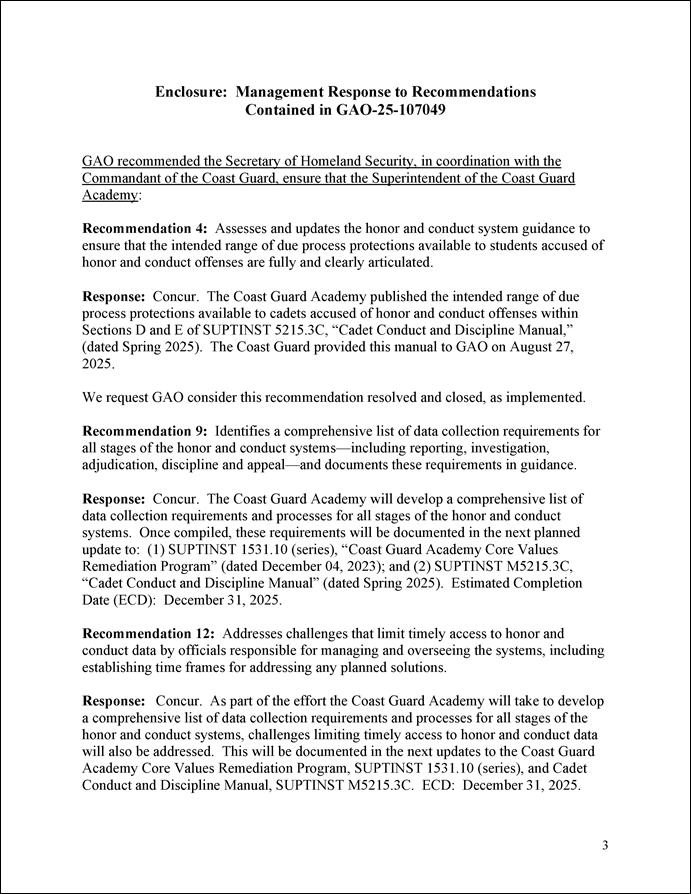
GAO Contact
Kristy E. Williams, williamsk@gao.gov
Staff Acknowledgments
In addition to the contact named above, Kim Mayo (Assistant Director), Kirsten Briggs (Analyst in Charge), Lori Atkinson, Sharon Ballinger, Reneé Brown, Angélica Castillo, Richard Catherina, Kevin Donovan, Isabel Fairclough, Ally Gonzalez, Samantha Huebner, Amelia Koby, Lydie Loth, Lillian Moyano Yob, Shannon Murphy, Samuel Portnow, Raquel Qualls-Hampton, Sean Sannwaldt, and Theologos Voudouris made key contributions to this report.
The Government Accountability Office, the audit, evaluation, and investigative arm of Congress, exists to support Congress in meeting its constitutional responsibilities and to help improve the performance and accountability of the federal government for the American people. GAO examines the use of public funds; evaluates federal programs and policies; and provides analyses, recommendations, and other assistance to help Congress make informed oversight, policy, and funding decisions. GAO’s commitment to good government is reflected in its core values of accountability, integrity, and reliability.
Obtaining Copies of GAO Reports and Testimony
The fastest and easiest way to obtain copies of GAO documents at no cost is through our website. Each weekday afternoon, GAO posts on its website newly released reports, testimony, and correspondence. You can also subscribe to GAO’s email updates to receive notification of newly posted products.
Order by Phone
The price of each GAO publication reflects GAO’s actual cost of production and distribution and depends on the number of pages in the publication and whether the publication is printed in color or black and white. Pricing and ordering information is posted on GAO’s website, https://www.gao.gov/ordering.htm.
Place orders by calling (202) 512-6000, toll free (866) 801-7077,
or
TDD (202) 512-2537.
Orders may be paid for using American Express, Discover Card, MasterCard, Visa, check, or money order. Call for additional information.
Connect with GAO
Connect with GAO on X,
LinkedIn, Instagram, and YouTube.
Subscribe to our Email Updates. Listen to our Podcasts.
Visit GAO on the web at https://www.gao.gov.
To Report Fraud, Waste, and Abuse in Federal Programs
Contact FraudNet:
Website: https://www.gao.gov/about/what-gao-does/fraudnet
Automated answering system: (800) 424-5454
Media Relations
Sarah Kaczmarek, Managing Director, Media@gao.gov
Congressional Relations
A. Nicole Clowers, Managing Director, CongRel@gao.gov
General Inquiries
[1]Department of Defense Instruction 1322.22, Military Service Academies (Sept. 24, 2015) (incorporating change 1, effective Nov. 1. 2023).
[2]The United States Military Academy is an Army institution located in West Point, New York, and is commonly referred to as “West Point.”
[3]H.R. Rep. No. 118-125, at 155, 160 (2023).
[4]GAO, Standards for Internal Control in the Federal Government, GAO‑25‑107721 (Washington, D.C.: May 2025).
[5]We did not include members of the freshman population due to the limited amount of time these students had been subject to honor and conduct processes at the time we distributed our questionnaire.
[6]Students at the Merchant Marine Academy must agree to apply for midshipman status in the Navy Reserve before their appointment to the academy. See 46 U.S.C. § 51311(a).
[7]Department of Defense, Population Representation in the Military Services: Fiscal Year 2022 Summary Report (Oct. 29, 2024). Of all active commissioned officers in fiscal year 2022, approximately 16 percent of Army officers, 20 percent of Navy officers, 18 percent of Marine Corps officers, 22 percent of Air Force officers, 26 percent of Space Force officers, and 51 percent of Coast Guard officers earned their commission through a service academy.
[8]10 U.S.C. §§ 7448(а)(2), 9448(а)(2), 8459(а)(2); 14 U.S.C. § 1925.
[9]46 U.S.C. § 51306(a)(4-5).
[10]Department of Defense Instruction 1322.22, Military Service Academies (Sept. 24, 2015) (incorporating change 1, Nov. 1, 2023). 10 U.S.C. §§ 4355, 6968, 9455.
[11]14 U.S.C. §§ 1901, 1903. U.S. Coast Guard Academy, Deputy Commandant for Mission Support Instruction 5400.2, Coast Guard Academy Program Management and Governance (Apr. 12, 2018).
[12]46 U.S.C. §§ 51301 (c)(1), 51312, 51313.
[13]The superintendent at West Point, and at the Naval and Air Force Academies is a military officer who is a general or admiral assigned to the position by the President. 10 U.S.C. §§ 4333, 6951a, 9433. The superintendent at the Coast Guard Academy is an individual who is on active duty in the Coast Guard assigned by the Commandant of the Coast Guard. 14 U.S.C. § 1901. The superintendent at the Merchant Marine Academy is a military or National Oceanic and Atmospheric Administration officer who is a general or admiral and has served at sea, or an individual who has obtained the rank of Captain, Chief Mate, or Chief Engineer in the U.S. Merchant Marine, assigned to the position by the Secretary of Transportation. Other qualifying individuals can also be appointed, see 46 U.S.C. §51301 (c)(2).
[14]10 U.S.C. §§ 7431, 7435. Army Regulation 150-1, United States Military Academy: Organization, Administration, and Operation (Jan. 12, 2021); Naval Academy Instruction 5450.3G, U.S. Naval Academy Organization Manual (Apr. 4, 2017) (change transmittal 4, Jan. 23, 2025); Air Force Instruction 36-3501, United States Air Force Academy Operations (May 9, 2022); Coast Guard Academy, Superintendent Instruction 5400.1 C, Coast Guard Academy Organizational Structure, Duties, and Responsibilities (July 14, 2022); U.S. Department of Transportation Maritime Administrative Order 150-001, United States Merchant Marine Academy (Mar. 2, 2025).
[15]The student body is referred to by the following terms at each academy: West Point—the Corps of Cadets; Naval Academy—the Brigade of Midshipmen; Air Force Academy—the Cadet Wing; Coast Guard Academy—the Corps of Cadets; Merchant Marine Academy—the Regiment of Midshipmen.
[16]10 U.S.C. §§ 801-946a. Merchant Marine Academy students are not subject to the Uniform Code of Military Justice because they are not in an active-duty status as inactive Navy Reservists.
[17]The Naval and Coast Guard Academies use an honor concept, which also prohibit lying, cheating, or stealing. For the purposes of our report, we use the term honor code for all five academies. Military Academy, United States Corps of Cadets Pamphlet 15-1, The Cadet Honor Code, System, and Committee Procedures (June 7, 2024). Naval Academy Instruction 1610.3M, Brigade Honor Program (Feb. 7, 2022); Air Force Academy, Air Force Cadet Wing Honor Code Reference Handbook (May 5, 2025); Coast Guard Academy, Superintendent Instruction M5215.3C, Cadet Conduct and Discipline Manual (Spring 2025); Merchant Marine Academy, Superintendent Instruction 2024-07, Regimental Honor Program (Nov. 20, 2024).
[18]Honor staff are referred to by the following terms at each academy: West Point—Cadet Honor Committee; Naval Academy—Honor Staff and Honor Congress; Air Force Academy—Cadet Honor Committee; Coast Guard Academy—Foxtrot Company; Merchant Marine Academy—Honor Staff.
[19]At the Coast Guard Academy, the honor system is embedded in the conduct system. Consequently, the Cadet Honor Board serves in an advisory capacity to the Commandant and honor offenses are listed as major conduct offenses and adjudicated at a major conduct hearing.
[20]Military Academy, United States Corps of Cadets Regulation 351-1, Cadet Disciplinary System (June 7, 2024); Naval Academy, Commandant of Midshipmen Instruction 1610.2N, Administrative Performance and Conduct System (Aug. 2, 2024); Air Force Academy, Air Force Cadet Wing Instruction 51-201, Administration of Cadet Discipline (Mar. 4, 2025); Coast Guard Academy, Superintendent Instruction M5215.3C, Cadet Conduct and Discipline Manual (Spring 2025); Merchant Marine Academy, Superintendent Instruction 2025-11, Midshipman Regulations (Mar. 25, 2025). For additional related policies and guidance, see appendix I.
[21]For the purposes of this report, we grouped offenses into minor and major categories. Specifically, at West Point, minor offenses include cadet disciplinary infractions and minor violations of the UCMJ; major offenses include more severe violations of the UCMJ. At the Naval Academy, minor offenses are named as such; major offenses include major and separation potential offenses. At the Air Force Academy, minor offenses include category 1 and 2 offenses and major offenses include category 3 and 4 offenses. At the Coast Guard Academy, minor and major offenses are named as such. At the Merchant Marine Academy, minor offenses include class II offenses; major offenses include class I offenses.
[22]According to officials, whether a conduct offense is adjudicated as minor or major depends on the specific circumstances of the case. For example, West Point officials told us that while being late to class is generally considered a minor offense, it can be considered a major offense if a student is exhibiting a pattern of being late to class.
[23]Generally, freshmen and sophomore students will retain their military service obligation, but they will not be required to reimburse the federal government.
[24]Dixon v. Alabama State Board of Education, 294 F.2d 150 (5th Cir.) cert. denied, 368 U.S. 930 (1961).
[25]Wasson v. Trowbridge, 382 F.2d 807 (2d Cir. 1967); Hagopian v. Knowlton, 470 F.2d 201 (2d Cir. 1972); Phillips v. Marsh, 687 F.2d 620 (2d Cir. 1982).
[26]U.S. Const, amend. V, VI, and XIV.; Goldberg v. Kelly, 397 U.S. 254 (1970); Publicker Indus., Inc. v. Cohen, 733 F.2d 1059 (3d Cir. 1984); Crowley v. United States Merchant Marine Academy, 985 F. Supp 292 (E.D.N.Y 1997); Doolen v. Wormuth, 5 F.4th 125, 135 (2d Cir. 2021).
[27]At the Coast Guard Academy, investigations are completed as part of the conduct investigation process.
[28]At the Merchant Marine Academy, a student—the honor board chair—makes this determination prior to the investigation.
[29]At the Naval, Coast Guard, and Merchant Marine Academies, students can appeal disenrollment to the appropriate authority: the Secretary of the Navy; the Coast Guard Deputy Commandant for Personnel, according to officials; or the Assistant Secretary for Administration, respectively. At West Point, students can appeal disenrollment to the Army Discharge Review Board or the Army Board for Correction of Military Records. At the Air Force Academy, students can request reconsideration to the Commandant or Superintendent, and for students that undergo a Board of Inquiry, reconsideration to the Board.
[30]The passage of the National Defense Authorization Act for Fiscal Year 2022 required the Army, Navy, Marine Corps, Air Force, and Coast Guard to establish a special trial counsel with exclusive authority to prosecute a series of covered offenses, including sexual assault and sexual harassment. The special trial counsel must render a decision to defer to the command or to refer to court-martial at the adjudication phase. Pub. L. No. 117-81 § 531 (2021) (codified as amended at 10 U.S.C. § 824a).
[31]According to Naval Academy officials, if the Office of Special Trial Counsel declines to prosecute a case for Sexual Assault, the Superintendent has the authority to refer the case to a Midshipman Disenrollment Board, which is not a part of the administrative conduct system.
[32]Military criminal investigative organizations conduct criminal investigations with a Department of Defense (DOD) nexus, such as if a crime occurred on a DOD installation. The DOD organizations are the Army Criminal Investigation Command, the Naval Criminal Investigative Service, and the Air Force Office of Special Investigations. In addition, the Coast Guard criminal investigative organization is the Coast Guard Investigative Service. For the Merchant Marine Academy, the Department of Transportation and relevant local, county, and state entities in New York have concurrent criminal jurisdiction.
[33]DOD Instruction 5505.18, Investigation of Adult Sexual Assault in the Department of Defense (Mar. 22, 2017) (incorporating change 5, effective July 26, 2024).
[34]Disciplinary tours refer to the completion of a designated task for a specified period. Depending on the academy, tours may involve marching across a designated portion of the academy’s campus, sitting at a desk while studying, or executing work orders.
[35]At the Naval, Coast Guard, and Merchant Marine Academy, students can appeal disenrollment to the appropriate authority: the Secretary of the Navy; the Coast Guard Deputy Commandant for Personnel, according to officials; or the Assistant Secretary for Administration, respectively. At West Point, according to officials, students can appeal disenrollment to the Army Board for Correction of Military Records or the Army Discharge Review Board. At the Air Force Academy, students can request reconsideration to the Commandant or Superintendent, and for students that undergo a Board of Inquiry, request reconsideration to the Board.
[36]While the Coast Guard Academy does not have a toleration clause, failing to report a major offense, which includes honor offenses, is a type of conduct offense.
[37]Air Force Academy, Air Force Cadet Wing, Honor Code Reference Handbook (Oct. 25, 2023). The revised guidance eliminated the requirement for freshmen and sophomores to report under the toleration clause, instead requiring that they confront the suspected student and requiring sophomores to meet with a mentor to discuss reporting the offense.
[38]Air Force Academy, Air Force Cadet Wing, Honor Code Reference Handbook (May 5, 2025).
[39]As discussed in the next paragraph, qualifying students who admit to the offense may be routed to a different hearing or proceed to the disciplinary phase.
[40]Qualifying students at the academies include: Naval Academy—freshmen and sophomores who admit and show remorse; Air Force Academy—freshmen who commit the offense prior to recognition, admit to the offense on the Honor Allegation Notification, had no prior violations or pending cases, had no additional allegations, and whose offense did not contribute to aiding other students commit offenses; and Merchant Marine Academy—those who self-report a first-time offense. At all these academies, qualifying students found in violation are required to complete honor remediation or probation and may be recommended for disenrollment if they fail to complete it successfully.
[41]At the Naval and Merchant Marine Academies, students may appeal honor hearing findings on the bases that (1) new evidence of a substantive nature exists which could be exculpatory, extenuating, or mitigating and which could not have reasonably been known or available at the time the hearing was convened, (2) procedural errors in the case or in the interpretation of the honor code or instruction were committed which worked to the substantial prejudice of the accused student and cannot subsequently be cured or (3) the severity of the sanction is disproportionate to the violation(s) committed. At the Coast Guard Academy, the bases include the prior three just discussed and that the finding is unjust. At the Air Force Academy, students may appeal if significant new evidence is produced within 5 calendar days of the Case Releasable File Meeting, and if a majority of the reassembled honor board votes to reopen the case to hear the new evidence.
[42]West Point does not have an official appeal mechanism but allows exceptions to policy where the adjudicator may remove sanctions. At the Naval, Coast Guard and Merchant Marine Academies, students may appeal any sanctions awarded by an adjudicating authority if they believe they are disproportionate.
[43]At the Coast Guard Academy, seniors may adjudicate all minor offenses and violations of the Cadet Regulations, juniors may do so for freshmen and sophomores, typically in consultation with the offending student’s chain of command, and sophomores may do so for freshmen after consulting with their student chain of command.
[44]The Midshipman Battalion Commander adjudicates minor offense hearings for freshmen through junior students, under the supervision of the Regimental Officer (RO). The RO adjudicates these hearings for senior students.
[45]Extra military instruction includes assignments designed to address deficiencies in a student’s conduct. The instruction must be logically related to an individual’s deficiencies, such as by assigning a student to be a uniform monitor for a student who is not wearing the uniform properly.
[46]Military Academy, United States Corps of Cadets Regulation 351-1; Military Academy, Regulation 1-10, Procedures for Misconduct Hearings (Dec. 13, 2023); Naval Academy, Commandant of Midshipmen Instruction 1610.2N, Administrative Performance and Conduct System Manual (Aug. 2, 2024). Merchant Marine Academy, Superintendent Instruction 2025-11.
[47]Coast Guard Academy, Superintendent Instruction M5215.3C.
[48]Air Force Academy, Air Force Cadet Wing Instruction 51-201, Administration of Cadet Discipline (Mar. 4, 2025).
[49]At West Point, freshmen and sophomores are disenrolled by the Superintendent. Army Regulation 150-1, United States Military Academy, Organization, Administration, and Operation (Jan. 12, 2021).
[50]The Secretary of the Air Force delegated the authority to disenroll students to the Air Force Academy Superintendent. However, disenrollment resulting in an Under Other Than Honorable Conditions characterization is under the authority of the Director of the Air Force Review Boards Agency. Air Force Academy Instruction 36-3504, Disenrollment of United States Air Force Academy Cadets (Aug. 15, 2022). At the Coast Guard Academy, the Superintendent makes all final decisions concerning disenrollment, as derived from 14 U.S.C. § 1924. Coast Guard Academy, Superintendent Instruction M5215.3C.
[51]The Naval Academy may hold a Midshipman Discharge Board; the Air Force Academy may hold a Board of Inquiry; and the Coast Guard and Merchant Marine Academies may hold an Executive Board.
[52]As noted above, the Air Force Academy does not use hearings to address major conduct offenses. For the academies that allow appeals, the bases for appeal include procedural or substantial errors and argument that the severity of sanctions are disproportionate to the violation. At the Naval and Coast Guard Academies, an additional basis is that the finding of guilt is unjust. At the Coast Guard and Merchant Marine academies another additional basis is new evidence.
[53]10 U.S.C. § 815. Nonjudicial punishment, also known as Article 15, is a form of disciplinary action under the Uniform Code of Military Justice that is less serious than a court-martial, but more serious than administrative actions like counseling. Under the nonjudicial punishment process, certain punishments may be imposed for minor offenses, without a formal trial and the stigma of a court-martial. The purpose is to maintain good order and discipline without the formal legal proceedings.
[54]At the Air Force Academy, the decision to use nonjudicial punishment begins with the Group Commander. At the Coast Guard Academy, it is the Superintendent.
[55]As noted above, case law suggests that academies may not be required to provide all 12 due process protections.
[56]For example, respondents may have anywhere from 2 to 4 days’ notice to prepare for their honor hearing, once scheduled. The Merchant Marine Academy allows respondents to retain private counsel but does not provide access to a government lawyer free of charge, unlike the other service academies.
[57]For this analysis, we reviewed, for West Point: Article 10 and misconduct hearing processes; for the Naval Academy: conduct adjudications; for the Air Force Academy: Form 10 reports, Letter of Notification proceedings, and separation proceedings/Boards of Inquiry; for the Coast Guard Academy: Major Offense Hearings; and for the Merchant Marine Academy: Class I proceedings, Executive Boards and Superintendent Hearings..
[58]As noted previously, the Air Force Academy may use student-run Squadron or Group Command Review Boards to review student performance, take disciplinary action, or make sanction recommendations to the squadron or group commander, an officer, for adjudication.
[60]U.S. Const, amend. V and XIV. See also Wasson v. Trowbridge, 382 F.2d 807 (1967); Doolen V. Wormuth, 5 F.4th 125 (2021); Andrews v. Knowlton, 509 F.2d 898 (1975); and Hagopian v. Knowlton, 470 F.2d 201 (1972).
[61]West Point, and the Naval and Coast Guard Academies collect and maintain honor and conduct data in a database, called the Electronic Academic Management System, Midshipman Information Database System, and Regimental Information System, respectively, according to officials. Coast Guard Academy officials also collect some honor and conduct data in spreadsheets to facilitate case processing. The Air Force Academy collects honor data in a spreadsheet and collects honor and conduct remediation data in a database called Campus Solutions. The Merchant Marine Academy collects honor data in a spreadsheet and collects conduct data in a database called the Comprehensive Academic Management System.
[62]Appendix II provides, for both honor and conduct data for academic years 2018-2019 through 2023-2024, (1) case totals, (2) cases as a percentage of the student body, (3) the percentage of cases that proceeded to a hearing, and (4) the percentage of cases where the student was found to be in violation, among other information.
[63]The Coast Guard Academy tracks the name of the investigating officer, and these data are maintained outside of the primary system used to track honor data, called the Regimental Information System. Instead, these data are tracked in spreadsheets used by officials to facilitate case processing. At the Coast Guard Academy, where all honor offenses are adjudicated as major conduct offenses, the investigation is completed as part of the conduct process.
[64]As noted previously, students at all academies can appeal disenrollment, four academies (Naval, Air Force, Coast Guard, and Merchant Marine) allow appeal of honor hearing findings, and four academies (West Point, Naval, Coast Guard and Merchant Marine) allow the appeal of imposed administrative sanctions.
[65]We define conduct data as information related to minor or major offenses adjudicated by academy processes. For all academies, data for cases adjudicated under Uniform Code of Military Justice processes, including nonjudicial punishment and courts martial, are collected separately by relevant legal offices.
[66]The new database is called “Advocate.”
[67]Air Force Cadet Wing Instruction 51-201, Administration of Cadet Discipline (Mar. 4, 2025).
[68]Coast Guard Academy’s relevant data are maintained outside of the primary system that is used to track honor data, called the Regimental Information System. Rather, these data are tracked in spreadsheets used to facilitate case processing.
[69]As noted previously, students at all academies can appeal disenrollment, and three academies (Naval, Coast Guard, and Merchant Marine) allow appeal of major conduct hearing findings and sanctions under certain circumstances.
[70]GAO, Standards for Internal Control in the Federal Government, GAO‑25‑107721 (Washington, D.C.: May 2025).
[71]National Defense Authorization Act for Fiscal Year 2017, Pub. L. No. 114-328, § 5504 (2016), codified as amended at 10 U.S.C. § 940a; see also S. Rep. No. 114-255, at 621-22 (2016).
[72]The Naval Academy defines its conduct data requirements related to the Midshipman Information Database System in Naval Academy, Commandant of Midshipmen Instruction 1610.2N, Administrative Performance and Conduct System Manual (Aug. 2, 2024) but has not defined honor data requirements.
[74]Percentages are within a margin of error of 3.10 percent.
[75]Students took our questionnaire at the start of academic year 2024-2025; due to a lack of time under the honor and conduct systems, we did not include the new fourth class (freshman) population. We determined survey results were generalizable, but response rates varied across the academies: West Point had a rate of 31 percent, the Naval Academy was 94 percent, the Air Force Academy was 68 percent, the Coast Guard Academy was 61 percent, and the Merchant Marine Academy was 88 percent. See appendix I for our objectives, scope, and methodology.
[76]For a complete listing of all survey questions and responses, see our supplement to this report: GAO, Supplemental Material for GAO‑26‑107049, GAO‑26‑108179 (Washington, D.C.: Dec. 16, 2025).
[77]These percentages are within a margin of error of 4.81 percent.
[78]These percentages are within a margin of error of 4.92 percent.
[79]Naval Academy estimated percentages are within a margin of error of 1.76 percent.
[80]Percentages are within a margin of error of 4.46 percent.
[81]Percentages are within a margin of error of 3.10 percent.
[82]We conducted a content analysis on open-ended responses to the question asking students to describe how they felt going through the honor process after being accused of violating the honor [code/concept]. Each response was assigned one or more categories. Appendix I provides a detailed description of our objectives, scope, and methodology.
[83]Percentages are within a margin of error of 4.92 percent.
[84]Percentages are within a margin of error of 4.16 percent.
[85]Percentages are within a margin of error of 4.68 percent.
[86]We conducted a content analysis on open-ended responses to the question asking students to describe how they felt going through the conduct process after being accused of violating the conduct policies and regulations. Each response was assigned one or more categories. Appendix I provides a detailed description of our objectives, scope, and methodology.
[87]The U.S. has five tuition-free, 4-year degree granting service academies—the United States Military Academy in West Point, New York (hereafter, West Point); the United States Naval Academy in Annapolis, Maryland (hereafter, the Naval Academy); the United States Air Force Academy in Colorado Springs, Colorado (hereafter, the Air Force Academy); the United States Coast Guard Academy in New London, Connecticut (hereafter, the Coast Guard Academy); and the United States Merchant Marine Academy in Kings Point, New York (hereafter, the Merchant Marine Academy).
[88]The guidance we reviewed included: Military Academy, United States Corps of Cadets Pamphlet 15-1, The Cadet Honor Code, System, and Committee Procedures (June 7, 2024); Military Academy, United States Corps of Cadets Pamphlet 600-20, Guide to United States Corps of Cadets Conduct (June 7, 2024); Military Academy, Regulation 1-10, Procedures for Misconduct Hearings (Dec. 13, 2023); Military Academy, United States Corps of Cadets Regulation 351-1, Cadet Disciplinary System (June 7, 2024); Army Regulation 150-1, United States Military Academy Organization, Administration and Operation (Jan.12, 2021); Army Regulation 15-6, Procedures for Preliminary Inquiries, Administrative Investigations and Boards of Officers (June 22, 2025); Naval Academy Instruction 1610.3M, Brigade Honor Program (Feb. 7, 2022); Naval Academy, Commandant of Midshipmen Instruction 1610.2N, Administrative Performance and Conduct System (Aug. 2, 2024); Air Force Cadet Wing Honor Code Reference Handbook (May 5, 2025); Air Force Cadet Wing Instruction 51-201, Administration of Cadet Discipline (Mar. 4, 2025); Air Force Academy Instruction 36-3504, Disenrollment of United States Air Force Academy Cadets (Aug. 15, 2022); Air Force Instruction 36-3211, Military Separations (June 24, 2022); Air Force, Manual 51-507, Enlisted Discharge Boards and Boards of Officers (July 27, 2023); Coast Guard Academy, Superintendent Instruction M5215.3C, Cadet Conduct and Discipline System (Spring 2025); Merchant Marine Academy, Superintendent Instruction 2024-07, Regimental Honor Program (Nov. 20, 2024); Merchant Marine Academy, Superintendent Instruction 2025-11, Midshipman Regulations (Mar. 25, 2025); Merchant Marine Academy, Superintendent Notice 2025-07, Midshipman Regulations (Apr. 1, 2025); Merchant Marine Academy, Superintendent Notice 2025-09, Changes SI 2024-07, SI 2025-11, SI 2025-07 and SI 2025-08 for Disenrollment Appeals to be Submitted to the Assistant Secretary of Administration (May 27, 2025); Merchant Marine Academy, Commandant Notice 2022-04, Investigation Procedures (June 22, 2022); and other internal academy guidance.
[89]See guidance referenced in prior footnote.
[90]U.S. Const, amend. V, VI, and XIV.; Goldberg v. Kelly, 397 U.S. 254 (1970); Publicker Indus., Inc. v. Cohen, 733 F.2d 1059 (3d Cir. 1984); Crowley v. United States Merchant Marine Academy, 985 F. Supp 292 (E.D.N.Y 1997); Doolen v. Wormuth, 5 F.4th 125, 135 (2d Cir. 2021).
[91]GAO, Standards for Internal Control in the Federal Government, GAO‑25‑107721 (Washington, D.C.: May 2025).
[92]West Point, and the Naval and Coast Guard Academies collect and maintain honor and conduct data in a database, called the Electronic Academic Management System, Midshipman Information Database System, and in the Regimental Information System, respectively, according to officials. Coast Guard Academy officials also collect some honor and conduct data in spreadsheets to facilitate case processing. The Air Force Academy collects honor data in a spreadsheet and collects honor and conduct remediation data in a database called Campus Solutions. The Merchant Marine Academy collects honor data in a spreadsheet and collects conduct data in a database called the Comprehensive Academic Management System.
[93]We obtained record-level data from West Point and the Air Force Academy, which collect and maintain related data in their service-wide military justice databases, called Military Justice Online and Disciplinary Case Management System—Automated Military Justice Analysis and Management System, respectively. We obtained summarized data from the Naval and Coast Guard Academies’ Staff Judge Advocate records.
[95]We did not include members of the new fourth class (freshman) population due to the limited amount of time these students had been subject to honor and conduct processes at the time of our survey.
[96]GAO, Supplemental Material for GAO‑26‑107049, GAO‑26‑108179 (Washington, D.C.: Dec. 16, 2025).
[97]The U.S. has five tuition-free, 4-year degree granting service academies—the United States Military Academy in West Point, New York (hereafter, West Point); the United States Naval Academy in Annapolis, Maryland (hereafter, the Naval Academy); the United States Air Force Academy in Colorado Springs, Colorado (hereafter, the Air Force Academy); the United States Coast Guard Academy in New London, Connecticut (hereafter, the Coast Guard Academy); and the United States Merchant Marine Academy in Kings Point, New York (hereafter, the Merchant Marine Academy). Appendix I provides a detailed description of our objectives, scope, and methodology.
[98]At the Coast Guard Academy, the honor system is embedded in the conduct system, and all honor offenses are major conduct offenses. The adjudicating officer takes any Cadet Honor Board recommendations under advisement and determines whether to proceed to a major conduct offense hearing. The Coast Guard Academy does not collect data on Cadet Honor Boards in the Regimental Information System, according to officials.
[99]According to an academy official, in 2023, the Naval Academy implemented “speeding tickets,” which are five demerit sanctions to address small conduct issues such as uniform violations or messy rooms. Initially, only staff could hand out speeding tickets, but the official told us they recently made changes to the conduct policy to allow some students to input speeding tickets, which must be reviewed by the company officer or senior enlisted leader. The Academy also implemented a student watch patrol to monitor areas of concern, such as checking uniforms at the gate or monitoring parking. The watch patrol can also issue speeding tickets.
[100]As noted previously, data on major conduct cases at West Point are managed by its Staff Judge Advocate office and were not reliable for these purposes.
[101]The U.S. has five tuition-free, 4-year degree granting service academies—the United States Military Academy in West Point, New York (hereafter, West Point); the United States Naval Academy in Annapolis, Maryland (hereafter, the Naval Academy); the United States Air Force Academy in Colorado Springs, Colorado (hereafter, the Air Force Academy); the United States Coast Guard Academy in New London, Connecticut (hereafter, the Coast Guard Academy); and the United States Merchant Marine Academy in Kings Point, New York (hereafter, the Merchant Marine Academy).
[102]Students took our survey at the start of academic year 2024-2025. Due to a lack of time under the honor and conduct systems, we did not include the new fourth class (freshman) population. We determined survey results were generalizable, but response rates varied across the academies: West Point had a rate of 31 percent, the Naval Academy was 94 percent, the Air Force Academy was 68 percent, the Coast Guard Academy was 61 percent, and the Merchant Marine Academy was 88 percent. See appendix I for our objectives, scope, and methodology.
[103]GAO‑26‑108179, Supplemental Material for GAO‑26‑107049, (Washington, D.C.: Dec. 16, 2025)
[104]Percentages are within a margin of error of 4.87 percent.
[105]We examined statistically significant differences between each groups’ proportion of the overall population at each academy and their proportion of those who identified each potential response as a cause of unfairness in honor findings, where data allowed (i.e., excluding groups for which the estimates were imprecise due to sample size).
[106]Demographic data for each academy can be found in appendix IV.
[107]Unless otherwise noted, all comparisons are significant at p < .05.
[108]Percentages are within a margin of error of 6.32 percent.
[109]Percentages are within a margin of error of 6.53 percent.
[110]Percentages are within a margin of error of 9.92 percent.
[111]Percentages within a margin of error of 10.80 percent.
[112]Percentages are within a margin of error of 4.91 percent. For information on honor case counts as a percentage of the student body, see Appendix II.
[113]Percentages are within a margin of error of 15.24 percent.
[114]Percentages are within a margin of error of 16.08 percent.
[115]Percentages are within a margin of error of 4.92 percent.
[116]We examined statistically significant differences between each groups’ proportion of the overall population at each academy and their proportion of those who identified each potential response as a cause of unfairness in conduct findings, where data allowed (i.e., excluding groups for which the estimates were imprecise due to sample size).
[117]Demographic data for each academy can be found in Appendix IV.
[118]Unless otherwise noted, all comparisons are significant at p < .05.
[119]Percentages within a margin of error of 5.40 percent.
[120]Percentages are within a margin of error of 5.74 percent.
[121]Percentages are within a margin of error of 9.45 percent.
[122]Percentages are within a margin of error of 9.25 percent.
[123]Percentages are within a margin of error of 4.73 percent.
[124]Percentages are within a margin of error of 8.12 percent.
[125]The U.S. has five tuition-free, 4-year degree granting service academies—the United States Military Academy in West Point, New York (hereafter, West Point); the United States Naval Academy in Annapolis, Maryland (hereafter, the Naval Academy); the United States Air Force Academy in Colorado Springs, Colorado (hereafter, the Air Force Academy); the United States Coast Guard Academy in New London, Connecticut (hereafter, the Coast Guard Academy); and the United States Merchant Marine Academy in Kings Point, New York (hereafter, the Merchant Marine Academy). Service academy student data were stored by class year and not academic year. To account for academic years 2018-2019 through 2023-2024, the service academies provided data for students with a class year of 2019 through 2027.