
TRIBAL PROGRAMS
Information on Freedmen Descendants of the Five Tribes
Report to the Committee on Indian Affairs, U.S. Senate
United States Government Accountability Office
A report to the Committee on Indian Affairs, U.S. Senate.
For more information, contact: Anna Maria Ortiz at ortiza@gao.gov.
What GAO Found
Before the Civil War, the Cherokee, Chickasaw, Choctaw, Muscogee (Creek), and Seminole Nations—known as the Five Tribes—had citizens who enslaved people. In 1866, each Tribe entered a treaty with the U.S. that abolished slavery and addressed tribal citizenship rights of the formerly enslaved people living among the Tribes. Historically, these people are referred to as “Freedmen.”
GAO estimates that the population of descendants of the Freedmen could have ranged from 146,400 to 395,400 in 2022. Since the 1800s, several courts have considered whether the Freedmen and their descendants are entitled to tribal citizenship or other rights under the 1866 treaties. In part because of those cases, Freedmen descendants are eligible to enroll as tribal citizens in the Cherokee and Seminole Nations, but not the Chickasaw or Choctaw Nations. Further, the Muscogee (Creek) Supreme Court recently ruled that the Muscogee (Creek) Nation must begin to permit its Freedmen descendants to enroll.
Federal agencies administer a range of services, such as health care, education, and housing assistance, for the benefit of Tribes and their citizens, including enrolled Freedmen descendants. However, most of the 19 enrolled Freedmen descendants GAO interviewed said they encountered barriers accessing such services. Agencies have taken some actions to address these barriers, such as by clarifying enrollment eligibility. In addition, enrolled Freedmen descendants are regarded differently than other tribal citizens under certain federal statutes concerning land ownership and criminal jurisdiction.
Why GAO Did This Study
To better understand the status of Freedmen descendants, the Senate Committee on Indian Affairs held a hearing in 2022 on selected provisions of the 1866 treaties between the U.S. and the Five Tribes. The committee subsequently requested that GAO provide related information.
This report (1) estimates the population of Freedmen descendants of the Five Tribes, (2) describes key court decisions on Freedmen descendants’ eligibility for tribal citizenship, (3) describes barriers to certain federal services identified by enrolled Freedmen descendants and agency actions to address them, and (4) describes how Freedmen descendants are regarded differently than other citizens of the Five Tribes under certain federal statutes.
GAO conducted demographic modeling to estimate the population of Freedmen descendants of the Five Tribes as of 2022, the most recent year for which data were available.
GAO reviewed the 1866 treaties, the Five Tribes’ constitutions, federal statutes, and key court cases from tribal and federal courts related to the tribal citizenship rights of the Freedmen descendants.
GAO interviewed officials from the Cherokee Nation, an association that represents Freedmen descendants, 19 Freedmen descendants enrolled as tribal citizens in the Cherokee and Seminole Nations, and federal agency officials.
Abbreviations
|
BIA |
Bureau of Indian Affairs |
|
BIE |
Bureau of Indian Education |
|
CDC |
Centers for Disease Control and Prevention |
|
CDIB |
Certificate of Degree of Indian Blood |
|
HHS |
Department of Health and Human Services |
|
HUD |
Department of Housing and Urban Development |
|
IHS |
Indian Health Service |
|
Interior |
Department of the Interior |
|
NAHASDA |
Native American Housing Assistance and Self-Determination Act of 1996, as amended |
|
VSUS |
Vital Statistics of the United States |
|
WONDER |
Wide-ranging ONline Data for Epidemiologic Research |
This is a work of the U.S. government and is not subject to copyright protection in the United States. The published product may be reproduced and distributed in its entirety without further permission from GAO. However, because this work may contain copyrighted images or other material, permission from the copyright holder may be necessary if you wish to reproduce this material separately.
December 15, 2025
The Honorable Lisa Murkowski
Chairman
The Honorable Brian Schatz
Vice Chairman
Committee on Indian Affairs
United States Senate
In the 1830s, the Cherokee, Chickasaw, Choctaw, Muscogee (Creek), and Seminole Nations, collectively known as the Five Tribes, were forcibly relocated from the southeastern United States to land that makes up present-day Oklahoma.[1] At that time, the Five Tribes had citizens who enslaved people of African descent. The forced displacement is known as the “Trail of Tears,” and both the Tribes and the enslaved people were forced to make the devastating journey.[2] In 1866, following the Civil War, each of the Five Tribes entered a Treaty with the United States that abolished slavery within the Tribe.[3] Each Treaty also addressed the tribal citizenship rights of the formerly enslaved people and people of African descent living among the Tribes following the war.
At the turn of the 20th century, the United States undertook a broad effort to break up tribal lands, allot parcels to individual tribal citizens, and sell lands that were not allotted to white settlers. At that time, in preparation for allotment, Congress directed a commission to create lists of the Five Tribes’ citizens “by blood” and “Freedmen”—the formerly enslaved people and people of African descent living among the Tribes who might be entitled to tribal citizenship or other rights under the 1866 treaties.[4] The resulting lists are referred to as the Dawes Rolls and are the base rolls for each of the Five Tribes today. For purposes of this report, Freedmen refers to people on the Freedmen lists of the Dawes Rolls and “Freedmen descendants” refers to people whose ties to one of the Five Tribes are based only on their lineal descent from a person or people listed as Freedmen on the Dawes Rolls.[5]
In the years following the 1866 treaties and subsequent allotment, four of the Tribes—the Cherokee, Choctaw, Muscogee (Creek), and Seminole Nations—permitted the Freedmen and their descendants to enroll as tribal citizens (the Chickasaw Nation never formally enrolled Freedmen in the Tribe). However, beginning in the 1970s, the four Tribes that had afforded the Freedmen and their descendants tribal citizenship adopted new tribal constitutions that limited or attempted to limit tribal citizenship rights for Freedmen descendants. Today, Freedmen descendants are permitted to enroll as tribal citizens in the Cherokee and Seminole Nations, but not in the Chickasaw or Choctaw Nations. Until recently, Freedmen descendants were likewise ineligible for citizenship in the Muscogee (Creek) Nation. However, in July 2025, the Muscogee (Creek) Nation Supreme Court found that the relevant 1866 Treaty guaranteed the Muscogee (Creek) Freedmen and their descendants the right to tribal citizenship and that references to “by blood” citizenship in the Tribe’s Constitution were unlawful and void.[6] The Court directed the Muscogee (Creek) Citizenship Board to apply the 1866 Treaty and issue citizenship to any future applicants of Freedmen descent; however, as of November 2025, Muscogee (Creek) Freedmen descendants’ ability to obtain tribal citizenship was an evolving matter.[7]
There have been long-standing disputes over the tribal citizenship rights of the Freedmen descendants in the Five Tribes.[8] Tribal and federal courts have considered the extent to which Freedmen descendants are entitled to tribal citizenship under several of the 1866 treaties with the United States. Some of the Five Tribes have asserted that they are not required to allow the Freedmen or their descendants to enroll as tribal citizens. By contrast, some Freedmen and their descendants have asserted that they are entitled to tribal citizenship rights under the 1866 treaties. In some cases, Freedmen and their descendants have filed litigation aimed at determining their eligibility for tribal citizenship.
The United States has undertaken a unique trust responsibility to support and protect Tribes and their citizens through statutes, treaties, and historical relations.[9] Additionally, as part of the government-to-government relationship with Tribes, Congress has authorized provision of certain services to Tribes and their citizens. For example, tribal citizens, including those in the Five Tribes, may have access to certain federal services and programs—such as health care, housing assistance, and education—because of their status as tribal citizens. Federal agencies such as the Department of Health and Human Services (HHS), the Department of Housing and Urban Development (HUD), and the Department of the Interior administer some of these services.
To help better understand the status of Freedmen descendants in the Five Tribes, the Senate Committee on Indian Affairs held a hearing in July 2022 on selected provisions of the 1866 treaties between the United States and the Five Tribes. In response to this hearing, the committee requested that we provide related information. In this report we (1) estimate the population of Freedmen descendants of the Five Tribes; (2) describe key court cases regarding Freedmen descendants’ citizenship rights in the Five Tribes since the 1866 treaties; (3) describe barriers that Freedmen descendants enrolled as tribal citizens have faced when accessing federal services and funds, and steps federal agencies have taken to address such barriers; and (4) describe how specific federal statutes and judicial interpretations have led to enrolled Freedmen descendants being regarded differently than other tribal citizens.
To estimate the population size of Freedmen descendants, we developed a demographic model that simulated how the population of Freedmen and their descendants may have changed over time since 1907, given historical birth and death rates from the Centers for Disease Control and Prevention. As a starting point, we used lists of the Freedmen of the Five Tribes compiled from 1898 to 1907, which are part of The Final Rolls of Citizens and Freedmen of the Five Civilized Tribes in Indian Territory, typically referred to as the Dawes Rolls. There are long-standing concerns about how the Dawes Rolls were compiled.[10] Nonetheless, these rolls are the base rolls for the Five Tribes and the Freedmen according to the U.S. government and are also the primary source the Five Tribes use in establishing eligibility for enrollment today. We ended our analysis in 2022, which was the most recent year with data available for all model inputs, given a starting year of 1907 and fixed 5-year intervals.
We obtained electronic database copies of the Dawes Rolls from the Oklahoma Historical Society and a commercial vendor.[11] To assess the reliability of these databases, we compared the number of unique people between sources. We consulted with two independent external subject matter experts who have extensive experience in the history and genealogy of the Freedmen population; and two independent internal reviewers with expertise in demography and vital statistics to ensure that the analysis and estimates are reliable for our purposes. Appendix I describes our analysis and modeling in more detail.
For key court cases regarding Freedmen descendants’ tribal citizenship rights, we reviewed the 1866 treaties between the United States and each of the Five Tribes to identify those portions of the treaties that address the status of the Freedmen and their descendants in the Tribes. We also reviewed the constitutions for each of the Five Tribes to identify the extent to which each Tribe extends tribal citizenship rights to its Freedmen descendants. Finally, we researched and reviewed court cases from tribal and federal courts that pertain to the status of Freedmen descendants within the Five Tribes and provide relevant historical context for how the Five Tribes have regarded their Freedmen descendants since the 1866 treaties.
We report on the key cases that directly address the Freedmen descendants’ citizenship rights in the Five Tribes or provide relevant information about how courts may consider questions regarding these rights, and that have not been overturned or challenged by subsequent case law.[12] To verify our selection of key cases, we reviewed scholarly articles and discussed the identified cases with officials from Interior’s Bureau of Indian Affairs (BIA) and the Department of Justice to ensure we covered the most relevant cases. Courts are the appropriate entities to consider the legal questions regarding what the 1866 treaties require with respect to the Freedmen and their descendants, and thus we do not offer an independent legal opinion on what rights the 1866 treaties may or may not guarantee to the Freedmen descendants. Appendix II includes details on the relevant provisions of the 1866 treaties and key court cases that pertain to the status of Freedmen descendants in each of the Five Tribes.
To identify barriers and relevant statutes, we conducted a comprehensive literature search of academic, governmental, and other sources issued from 2003 through 2024 to identify (1) examples of barriers enrolled Freedmen descendants had to accessing federal services and (2) examples of how enrolled Freedmen descendants are regarded differently than other tribal citizens under certain federal statutes.[13] In addition, we met with an association that represents Freedmen descendants of the Five Tribes to help identify selected individuals who had encountered such barriers to interview.
We relied on non-generalizable snowball sampling to select and interview enrolled Freedmen descendants who expressed concerns about their ability to access certain federal services or being treated differently than other tribal citizens under federal law. We asked them about their experiences accessing federal services from 2017 through 2024.[14] The information we obtained from the enrolled Freedmen descendants we interviewed is illustrative of barriers they experienced and is not generalizable to other enrolled Freedmen descendants or Tribes. We interviewed a total of 19 Freedmen descendants (12 Cherokee citizens and seven Seminole citizens).[15]
We reviewed policies, procedures, and guidance provided by the federal agencies primarily responsible for administering the relevant federal programs and services, including HHS’s Indian Health Service (IHS), Interior’s BIA and Bureau of Indian Education (BIE), HUD’s Office of Native American Programs, and the Department of Justice. We interviewed agency officials about the reported barriers to receiving federal services described by Freedmen descendants enrolled in the Cherokee or Seminole Nations and steps their respective agencies have taken to address those barriers. We also analyzed specific federal statutes to determine how those statutes, or judicial interpretations of those statutes, regard enrolled Freedmen descendants differently from other tribal citizens and interviewed agency officials about what we learned.
While the focus of our review was federal programs, services, and statutes, we reached out to the Five Tribes and requested meetings with officials from each Tribe to obtain their perspectives. Of the Five Tribes, officials from the Cherokee Nation met with us to share information and perspectives.[16]
We conducted this performance audit from October 2023 to December 2025 in accordance with generally accepted government auditing standards. Those standards require that we plan and perform the audit to obtain sufficient, appropriate evidence to provide a reasonable basis for our findings and conclusions based on our audit objectives. We believe that the evidence obtained provides a reasonable basis for our findings and conclusions based on our audit objectives.
Background
The history of the Five Tribes, the Freedmen and their descendants, and their relationship with the United States is part of the larger context of the federal government’s approach to Tribes over the course of our country’s existence. We summarize some of that history and relevant context below.
The Five Tribes During the Early History of the United States
In the years following the Revolutionary War, the Five Tribes occupied portions of the southeastern United States. As the United States expanded further into this region in the early 1800s, pressure from American settlers led to a federal policy focused on removing Tribes from the eastern United States and relocating them on western lands. In 1830, the Indian Removal Act was passed, authorizing the President to relocate Tribes to certain territory west of the Mississippi River.[17] As a result, the Five Tribes and the enslaved and free people of African descent living among them were forcibly relocated to land that is present-day Oklahoma through what has come to be known as the Trail of Tears.
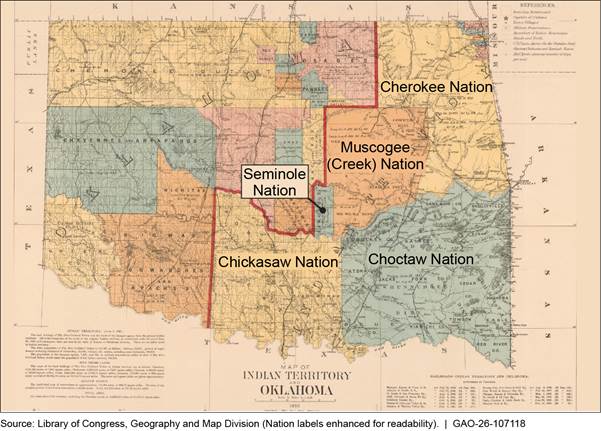
By the mid-1800s, federal policy toward Tribes had shifted from removal to placement on fixed reservations. During this period, the federal government often entered treaties with Tribes to, for example, establish peace, fix land boundaries, and establish reservations. As previously noted, in 1866, following the Civil War, each of the Five Tribes entered a treaty with the United States that—among other things—abolished slavery within the Tribe and addressed the status of Freedmen in that Tribe. By 1890, the Five Tribes had territories along the eastern side of present-day Oklahoma, as shown in figure 1.
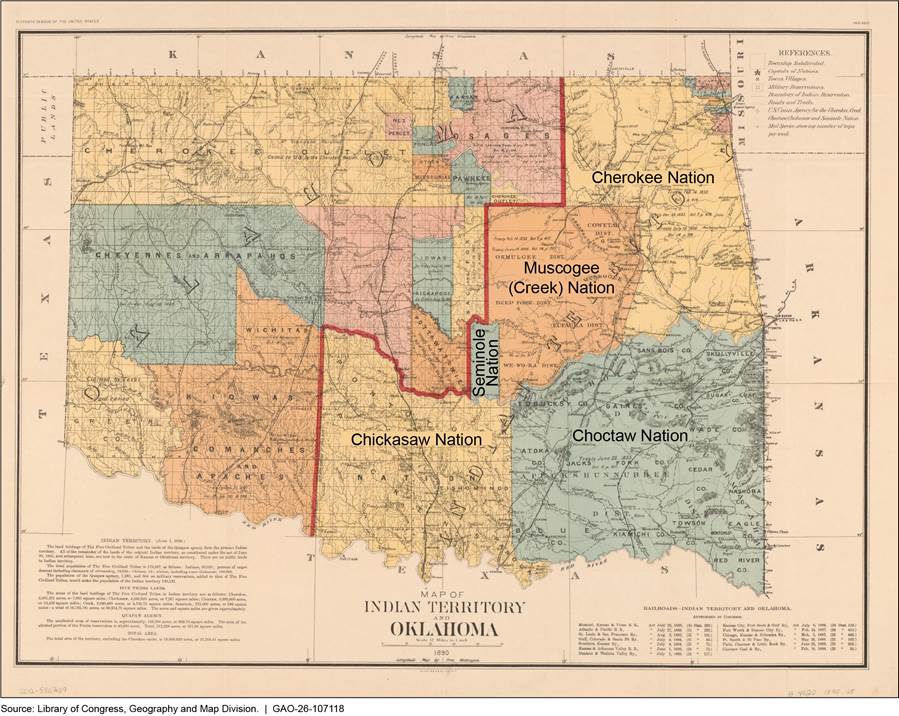
Note: GAO made minor edits to the above image to improve readability of some labels.
The Dawes Commission and the Dawes Rolls
By the late 19th century, American settlers increasingly sought access to western lands held by Tribes. Accordingly, in 1887, Congress passed the General Allotment Act—or Dawes Act—which began a policy under which the government divided tribal lands into allotments for individual tribal citizens and, in many cases, land that was not allotted was sold to settlers for homesteading.[18]
The Five Tribes were initially exempt from the Dawes Act, but in 1893, Congress created a commission—known as the Dawes Commission—to negotiate with the Five Tribes for the allotment of their communal lands in preparation for the creation of a new state—Oklahoma. The Five Tribes resisted allotment, and in 1898, Congress passed the Curtis Act, which provided for forced allotment of the Five Tribes’ communal land without tribal consent.[19] The Curtis Act transferred the authority to determine tribal citizenship to the Dawes Commission and authorized it to compile citizenship rolls—known as the Dawes Rolls—for each of the Five Tribes as a basis for forced allotment.
The Dawes Commission prepared rolls for the Five Tribes starting in 1898 and ending in 1907.[20] For each Tribe, the Dawes Rolls have categories of people identified as having a degree of “Indian blood” (referred to as “by blood”) and people identified as formerly enslaved (the Freedmen) who are referred to as having no “Indian blood.”[21] In general, the Dawes Rolls list individuals who lived with the Tribes in Indian Territory, chose to apply to the Dawes Commission, and were approved by the Dawes Commission.
The process of enrollment used by the Dawes Commission for the Dawes Rolls raised some concerns among the Tribes and the Freedmen, according to Oklahoma Historical Society documents. For example, concerns arose because the Dawes Commission had the authority to enroll people not already included on existing tribal rolls and records. In addition, the enrollment process put the burden of proof on the applicants and some people chose not to participate. Furthermore, according to Oklahoma Historical Society documents, some people with interest in acquiring allotted land allegedly engaged in bribery to be included on the rolls. However, today, the Dawes Rolls are considered the base roll for each of the Five Tribes by the U.S. government and the Tribes.
The Five Tribes Today
Today, the Five Tribes remain located in Oklahoma. Each Tribe has its own elected government, a governing constitution, and process for enrollment of tribal citizens.[22] For each Tribe, the Dawes Rolls remain the basis for enrolling tribal citizens. Therefore, only those who can trace their lineage back to someone whose name appears on the Dawes Rolls may be eligible for citizenship in one of the Five Tribes. In 2024, the Tribes reported the following enrollment information:
· Cherokee Nation, approximately 468,600 people
· Chickasaw Nation, approximately 81,500 people
· Choctaw Nation of Oklahoma, approximately 225,000 people
· Muscogee (Creek) Nation, approximately 102,000 people
·
Seminole Nation of Oklahoma, approximately 18,800 people[23]
Freedmen of the Five Tribes and Their Descendants
In the years following the 1866 treaties, the Cherokee, Choctaw, Muscogee (Creek), and Seminole Nations granted tribal citizenship rights to Freedmen. The Chickasaw Nation, by comparison, never formally enrolled Freedmen in the Tribe. The Cherokee, Choctaw, Muscogee (Creek), and Seminole Nations continued to grant tribal citizenship rights to Freedmen and their descendants for a period of time after enrollment on the Dawes Rolls closed. However, starting in the 1970s, these Tribes undertook several efforts to limit tribal citizenship solely to those descended from the “by blood” individuals on the Dawes Rolls, thereby making Freedmen descendants ineligible for tribal citizenship in some of the Five Tribes.
The Freedmen and their descendants’ tribal citizenship rights—or lack thereof—have been the subject of litigation since shortly after the 1866 treaties. Some Freedmen and their descendants have claimed that they are entitled to tribal citizenship rights under the 1866 treaties, and many federal and tribal courts have considered questions regarding Freedmen descendants’ rights to citizenship in the Five Tribes. Today, partly as a result of that litigation, Freedmen descendants are eligible for tribal citizenship in the Cherokee and Seminole Nations, but they are not eligible for tribal citizenship in the Chickasaw or Choctaw Nations. Until recently, Freedmen descendants were also ineligible for tribal citizenship in the Muscogee (Creek) Nation. However, as noted above, in July 2025, the Muscogee (Creek) Supreme Court ruled that the Tribe’s Freedmen descendants are entitled to tribal citizenship. As of November 2025, the Muscogee (Creek) Nation had not enrolled any of the Tribe’s Freedmen descendants.
Today, enrolled Cherokee Freedmen descendants live primarily in Oklahoma, and have large populations located in Kansas and Texas.[24] According to some of the Freedmen descendants we interviewed, being a tribal citizen is an important part of their identity and their tribal identity is important because it allows them to preserve Freedmen history and culture and educate future generations about the challenges they endured.
The United States’ Relationship with Federally Recognized Tribes
As of December 2024, the federal government recognized 574 Indian Tribes—including the Five Tribes—as distinct, independent political entities whose inherent sovereignty predates the United States but has been limited in certain circumstances by treaty and federal law. The United States maintains a government-to-government relationship with these Tribes. In addition, Congress has broad legislative authority over issues related to federally recognized Tribes. However, federally recognized Tribes, such as the Five Tribes, generally have the authority to establish their own tribal constitutions, which can include criteria for citizenship in the Tribes. While some Tribes’ citizenship criteria are subject to requirements in federal law or treaty, criteria for tribal citizenship are generally determined and set by individual Tribes.
The United States has undertaken a unique trust responsibility to protect and support federally recognized Tribes and their citizens through statutes, treaties, and historical relations.[25] Additionally, as part of the government-to-government relationship with Tribes, Congress has authorized certain federal agencies to provide various services and benefits to Tribes and their citizens. For example, the following federal agencies provide direct services or funding to Tribes or tribal citizens: HHS’s IHS, HUD’s Office of Native American Programs, and Interior’s BIA and BIE. These services include federally funded or operated facilities that provide health care services, housing assistance through federal grant programs, and education services through federally funded schools. In addition, each of the Five Tribes has entered into self-determination contracts or self-governance compacts with the United States that transfer administration of some federal programs to the Tribes.[26]
To be eligible for certain federal programs, benefits, and services, an individual must meet the relevant legal definition of “Indian.” However, these programs and benefits arise under different authorities, and there is no single definition of who qualifies as an “Indian” under federal law. For certain programs, being a citizen of a federally recognized Tribe is sufficient for an individual to qualify. However, in other circumstances an individual must possess “Indian blood” to qualify as an “Indian” under federal law.
A Certificate of Degree of Indian Blood (CDIB) card is an official document from Interior’s BIA that certifies that an individual has a specific degree of “Indian” or Alaska Native blood of a federally recognized Tribe. An individual’s degree of Indian blood is computed from lineal ancestors of Indian blood who were enrolled with a federally recognized Tribe or whose names appear on the designated base rolls of a federally recognized Tribe. The term “Indian blood” was used by the Dawes Commission in the creation of the Dawes Rolls for the Five Tribes in the early 1900s, and the Dawes Rolls are still used as the base rolls for issuing CDIB cards for the Five Tribes. The Dawes Rolls did not record “Indian blood” for the Freedmen, and therefore Freedmen descendants are ineligible for a CDIB card. However, enrolled Freedmen descendants in both the Cherokee and Seminole Nations are issued tribal identification cards by the Tribes. Figure 2 shows an example of a CDIB card.
Figure 2: Example of a Certificate of Degree of Indian Blood (CDIB) Card Issued by Interior’s Bureau of Indian Affairs
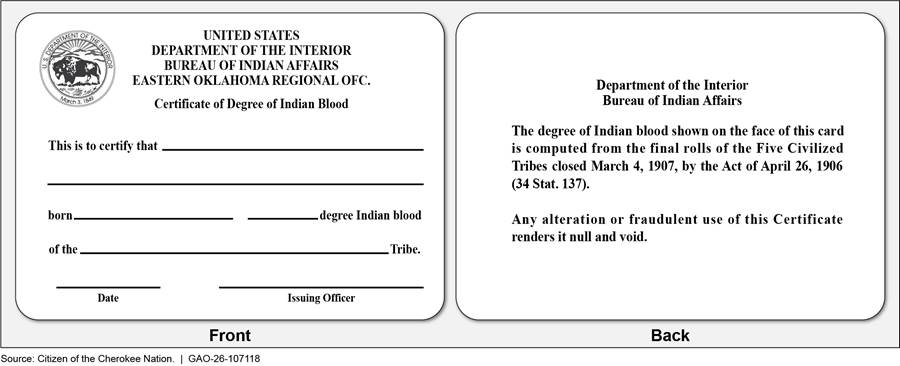
Note: GAO edited this figure to redact personally identifiable information.
Population of Freedmen Descendants of the Five Tribes Estimated to Have Ranged from 146,400 to 395,400 in 2022
Using a demographic model that we developed, we estimate that the population of Freedmen descendants of the Five Tribes could have ranged from 146,400 to 395,400 in 2022, which was the year of the most recent data available at the time of our analysis.[27] The broad range in our estimate reflects the uncertainty in estimating a population that has not been counted or measured in detail since 1907, including their rates of birth and death, their migration to locations beyond Oklahoma, and their fertility within and outside the descendant population.
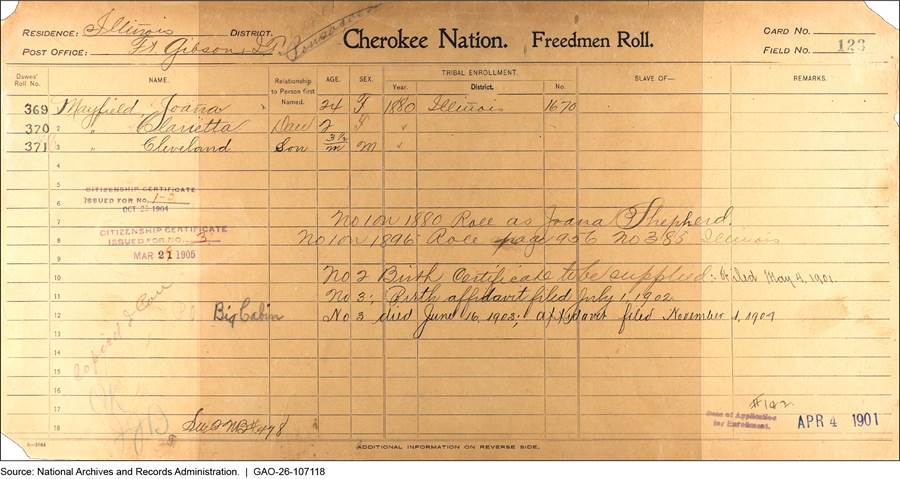
Our demographic model is based on the Dawes Rolls as the starting population, which listed 23,599 Freedmen in 1907.[28] All Freedmen on the Dawes Rolls had an enrollment card that recorded the applicant’s name, age, and sex, among other information. This information makes estimating the population of Freedmen descendants in 2022 possible. Figure 3 shows an example of an enrollment card from the Cherokee Nation’s Freedmen Rolls from 1901.
Our model applied historical birth and death rates from 1907 through 2022 to the data on Freedmen on the Dawes Rolls.[29] Due to the limited availability of historical data and uncertainty in how the population changed over time, we made assumptions about which of the historical data best represented Freedmen and their descendants, and confirmed these assumptions with two subject matter experts who have extensive experience in genealogy of Freedmen populations. We modeled various possible scenarios, based on these assumptions, for how the population may have changed over time, and the range—the high and low estimates—reflects how the population size estimates varied based on these assumptions. Table 1 shows the size of the Freedmen population from the Dawes Rolls in 1907 compared with our estimated population size of Freedmen descendants in 2022, based on birth and death rates across the period. We present population estimates for each of the Five Tribes separately and combined. Appendix I describes our analysis and modeling in more detail.
|
|
|
Freedmen descendants population estimated, rounded, 2022 |
|
|
Tribe |
Freedmen on the Dawes Rolls, actual counts, 1907 |
Low estimate |
High estimate |
|
Cherokee Nation |
4,948 |
30,200 |
81,700 |
|
Chickasaw Nation |
4,778 |
29,400 |
79,400 |
|
Choctaw Nation of Oklahoma |
6,080 |
37,200 |
100,400 |
|
Muscogee (Creek) Nation |
6,777 |
43,500 |
117,300 |
|
Seminole Nation of Oklahoma |
1,016 |
6,200 |
16,700 |
|
Total |
23,599 |
146,400 |
395,400 |
Source: GAO demographic modeling from an analysis of the
Dawes Rolls. | GAO‑26‑107118
Note: The Final Rolls of Citizens and Freedmen of the Five Civilized Tribes in Indian Territory, which are typically referred to as the Dawes Rolls, were compiled by a commission of the U.S. government between 1898 and 1907. The Dawes Rolls are the base rolls for each of the Five Tribes. The low and high range of the estimates reflects uncertainty about births, deaths, migration, and other factors needed for demographic modeling. The intervals reflect how our population size estimates varied, when we assumed various possible scenarios for how the population may have changed over time. Due to rounding, estimate totals may not reflect the sum of the population as presented.
Our estimates do not represent the total population of people who
· may identify as Freedmen descendants, because our estimates are based on people who could trace lineage back to the Dawes Rolls;
· may choose to apply for enrollment in a Tribe if the Freedmen descendants are eligible for enrollment;
· may prove lineage to be accepted into a Tribe as Freedmen descendants; or
· are entitled to federal services or benefits because such entitlement is based on the specific requirements of the relevant federal programs.
Nevertheless, our estimates provide Congress, Tribes, and Freedmen descendants with information that may be useful in understanding the current magnitude of this population.
Court Decisions About Freedmen Descendants’ Rights to Tribal Citizenship Under the 1866 Treaties Vary by Tribe
Several tribal and federal courts have considered whether the Freedmen and their descendants are entitled to tribal citizenship in the Five Tribes and concluded that while some of the 1866 treaties guarantee the Freedmen descendants tribal citizenship rights in the relevant Tribe, others do not. Based in part on those court decisions, Freedmen descendants are currently eligible for tribal citizenship in the Cherokee Nation and the Seminole Nation of Oklahoma; they are not eligible for tribal citizenship in the Chickasaw or Choctaw Nations. As noted above, until recently, the Freedmen descendants were also ineligible for citizenship in the Muscogee (Creek) Nation, but, in July 2025, the Muscogee (Creek) Nation Supreme Court held that the relevant 1866 Treaty guarantees the Muscogee (Creek) Freedmen descendants the right to tribal citizenship. Nonetheless, the ability of Muscogee (Creek) Freedmen descendants to obtain tribal citizenship was an evolving matter as of November 2025.
Below, we summarize each of the Five Tribes’ criteria for tribal citizenship and some of the relevant case law for each Tribe. In addition, appendix II includes details on the relevant provisions of the 1866 treaties and key court cases that pertain to the status of Freedmen descendants in each of the Five Tribes.
Cherokee Nation. Under the Cherokee Nation Constitution, Freedmen descendants are eligible for enrollment in the Cherokee Nation. In 2017, a federal court held that descendants of Cherokee Freedmen are entitled to the same citizenship rights as “by blood” Cherokees under the relevant 1866 Treaty.[30] In 2021, the Supreme Court of the Cherokee Nation ordered the Tribe to remove any reference to “by blood” citizenship from its Constitution, laws, rules, regulations, policies, and procedures.[31]
As of November 2025, “Article IV. Citizenship” of the Constitution of the Cherokee Nation states, “All citizens of the Cherokee Nation must be original enrollees or descendants of original enrollees listed on the Dawes Commission Rolls, including the Delaware Cherokees of Article II of the Delaware Agreement dated the 8th day of May, 1867, and the Shawnee Cherokees of Article III of the Shawnee Agreement dated the 9th day of June, 1869, and/or their descendants.”[32]
Chickasaw Nation. Under the Chickasaw Nation Constitution, Freedmen descendants are not eligible for enrollment in the Chickasaw Nation. In 1904, the U.S. Supreme Court held that the Chickasaw Freedmen were not entitled to citizenship in the Chickasaw Nation under the relevant 1866 Treaty, because the Nation never adopted their Freedmen as provided for in the treaty.[33] Accordingly, the U.S. Supreme Court concluded that the Chickasaw Freedmen (and their descendants) did not acquire the citizenship rights that were dependent upon adoption by the Chickasaw Nation.[34]
As of November 2025, “Article II – Citizenship” of the Constitution of the Chickasaw Nation states, “This Chickasaw Nation shall consist of all Chickasaw Indians by blood whose names appear on the final rolls of the Chickasaw Nation . . . and their lineal descendants.”[35]
Choctaw Nation of Oklahoma. Under the Choctaw Nation Constitution, Freedmen descendants are not eligible for enrollment in the Choctaw Nation. No tribal or federal court has directly spoken to whether the Choctaw Freedmen descendants are entitled to citizenship in the Choctaw Nation according to the relevant 1866 Treaty.
As of November 2025, “Article II – Membership” of the Constitution of the Choctaw Nation of Oklahoma states, “The Choctaw Nation of Oklahoma shall consist of all Choctaw Indians by blood whose names appear on the final rolls of the Choctaw Nation . . . and their lineal descendants.”[36]
Muscogee (Creek) Nation. Freedmen descendants’ ability to enroll in the Muscogee (Creek) Nation was an evolving matter as of November 2025.
In 2023, a Muscogee (Creek) Nation district court held that the relevant 1866 Treaty guarantees Muscogee (Creek) Freedmen descendants the same rights and privileges as the Tribe’s “by blood” citizens.[37] In July 2025, the Muscogee (Creek) Supreme Court upheld this decision, ruling that any reference to “by blood” citizenship in the Muscogee (Creek) Nation Constitution and any of the Tribe’s rules, regulations, policies, or procedures was unlawful and that Freedmen descendants are eligible for tribal enrollment under the 1866 Treaty.[38] Accordingly, the Court directed the Muscogee (Creek) Citizenship Board to issue citizenship to any future applicants of Freedmen descent. In August 2025, the Muscogee (Creek) Nation filed a petition for rehearing, arguing that the Muscogee (Creek) Supreme Court’s decision did not incorporate certain key facts and law, among other things. The Supreme Court denied the Tribe’s petition, finding that the Court had fully considered the issue, and that a rehearing was not warranted.
Following that decision, the Principal Chief of the Muscogee (Creek) Nation issued an executive order directing the Tribe’s citizenship office to continue accepting citizenship applications from Freedmen descendants, but not to issue them citizenship cards, or any other membership identification cards, until the Tribe’s law and policy had been fully reviewed and amended to meet the qualification requirements under the 1866 Treaty.[39] Thereafter, in October 2025, the Muscogee (Creek) Freedmen descendants who filed the case above sought to have the Muscogee (Creek) Supreme Court enforce its ruling and order the Citizenship Board to issue them citizenship cards immediately. In response, in November 2025, the Muscogee (Creek) Supreme Court ordered the Citizenship Board to provide monthly status reports, with the first report covering, among other things, (1) actions taken by various tribal entities to update the Tribe’s code, rules, and internal policies and procedures, and (2) what the Citizenship Board asserts is a reasonable timeframe for completing all necessary steps prior to issuing Freedmen descendants citizenship documents pursuant to the Court’s July 2025 order. The Muscogee (Creek) Supreme Court ordered that the first status report be filed by December 5, 2025.
As of November 2025, “Article III – Citizenship” of the Constitution of the Muscogee (Creek) Nation states, “Persons eligible for citizenship in the Muscogee (Creek) Nation shall consist of Muscogee (Creek) Indians by blood whose names appear on the final rolls . . . and persons who are lineal descendants of those Muscogee (Creek) Indians by blood whose names appear on the final rolls . . .”[40] However, as noted above, the Muscogee (Creek) Supreme Court has held that the restriction of citizenship to only descendants from the Dawes rolls “by blood” is unlawful and void.
Seminole Nation of Oklahoma. According to congressional testimony offered by the Seminole Nation in 2022, Freedmen descendants may enroll as “citizens” of the Seminole Nation, but not as what the Tribe refers to as “members,” which is a category only available to “by blood” Seminoles.[41] The Seminole Nation has developed two forms of tribal identification cards. According to the Tribe, a Seminole Nation Tribal Membership card can be obtained after an individual obtains a CDIB; a Tribal Citizenship card can be obtained by Seminole Freedmen descendants. The Tribe has stated in written testimony that “the Freedmen Tribal Citizenship Card provides the holder with the rights of citizenship of the Nation, primarily the right to vote.”[42] Under Seminole Nation law and policy, enrolled Seminole Freedmen descendants are not always regarded in an identical manner to Seminole Indian citizens with a degree of Indian blood.[43]
In 1940, a federal court found that the rights granted to the Seminole Freedmen in the relevant 1866 Treaty were equal rights to “by blood” Seminoles “in all tribal property as well as civil and other rights.”[44] Further, a federal court in 2001 determined that Interior had properly refused to approve amendments to the Seminole Nation’s Constitution that sought to remove their Freedmen descendants from the Tribe because the amendments would have violated the 1866 Treaty.[45]
As of November 2025, “Article II – Membership” of the Constitution of the Seminole Nation of Oklahoma states, “The membership of this body shall consist of all Seminole citizens whose names appear on the final rolls of the Seminole Nation of Oklahoma . . . and their descendants.” Further, “Article XII – Bill of Rights” of the Constitution states, “Each Seminole Indian citizen by blood of this body shall be entitled to membership in a Seminole Indian Band. Each Seminole Freedman citizen of this body shall be entitled to membership in a Freedman Band.”[46]
Enrolled Freedmen Descendants Have Faced Some Barriers Accessing Federal Services and Funds
Access to certain federal programs and services intended to benefit Tribes and their citizens extends to tribal citizens of the Five Tribes, including the more than 15,000 Freedmen descendants enrolled in the Cherokee Nation and the more than 2,000 Freedmen descendants enrolled in the Seminole Nation of Oklahoma.[47] However, most of the 19 enrolled Freedmen descendants of the Cherokee and Seminole Nations we interviewed told us of instances in which they and others faced barriers accessing federal services. These instances took place from 2017 through 2024 and were related to health care, education, or housing assistance generally available to tribal citizens that, according to agency officials, enrolled Freedmen descendants are eligible to receive.
|
Cherokee Nation 2024 Report on Access to Services by Enrolled Cherokee Freedmen Descendants The Cherokee Nation published a report that assessed enrolled Freedmen descendants’ access to Cherokee Nation programs, identified gaps, and proposed strategies to address any deficiencies. The report determined, among other things, that there is often a lack of awareness among enrolled Freedmen descendants about the programs and services available to them. In response to one of the report’s recommendations, the Cherokee Nation has taken steps to establish a resource team to help guide enrolled Freedmen descendants to more easily find information about these services, according to Cherokee Nation officials. Source: Cherokee Nation, 2024 Report on Access to Services by Cherokee Citizens of Freedmen Descent (June 19, 2024). | GAO‑26‑107118 |
According to several enrolled Freedmen descendants of the Cherokee and Seminole Nations we interviewed, experiencing these barriers may discourage others from attempting to access such services. In addition, most of the enrolled Freedmen descendants in the Seminole Nation of Oklahoma we interviewed told us of instances in which they faced barriers accessing some federal funds made available to other tribal citizens. According to Cherokee Nation officials and documentation they provided, the Cherokee Nation has been proactive in identifying and addressing potential access barriers for Freedmen descendants enrolled in the Cherokee Nation (see sidebar).
Difficulty Accessing Health Care Services
IHS, an agency within HHS, is responsible for providing health care for more than 2.8 million individuals who are citizens or descendants of federally recognized Tribes.[48] IHS provides health care services directly through its federally operated medical facilities and provides funding to Tribes to operate and manage their own medical facilities. Enrolled Freedmen descendants are eligible to access the same health care services provided and funded by IHS as other tribal citizens.
According to IHS officials we interviewed, there are many acceptable forms of documentation for proving eligibility to receive health care services, such as tribal identification cards, and none should be given a higher priority than other forms of documentation. According to these officials, IHS-funded facilities do not require tribal citizens to provide a CDIB card, issued by Interior’s BIA, to access their services or programs.[49] As previously noted, Freedmen descendants are ineligible to receive a CDIB card because they cannot document lineal descent from an ancestor with “Indian blood.” However, enrolled Freedmen descendants in the Cherokee and Seminole Nations are issued tribal identification cards.[50]
Several of the enrolled Freedmen descendants of the Cherokee and Seminole Nations we interviewed told us that, since 2017, staff at IHS-funded facilities had denied them health care services because their tribal identification cards indicated that they were Freedmen descendants or because they could not provide CDIB cards to demonstrate eligibility. For example, in 2021, an enrolled Seminole Freedmen descendant was denied access to the COVID-19 vaccine at a federally operated IHS facility in the Oklahoma City area because of the individual’s status as an enrolled Freedmen descendant.[51] According to IHS officials, the incident initiated an internal agency review of the beneficiary status of the Seminole Nation of Oklahoma’s enrolled Freedmen descendants, which resulted in a determination that enrolled Freedmen descendants are eligible for IHS health care services.
In October 2021, IHS issued a Dear Tribal Leader letter clarifying that enrolled Seminole Freedmen descendants are eligible to receive health care services in accordance with IHS eligibility requirements. Dear Tribal Leader letters inform Tribes about any rules, regulations, procedures, policies, and guidance that affect them directly or their duties and responsibilities to carry out programs or provide services administered by a federal agency. According to IHS officials, Dear Tribal Leader letters are primarily used to initiate the agency’s tribal consultation on specific topics. Moreover, in response to the incident, IHS officials told us that they also provided training to the staff at the facility in the Oklahoma City area regarding eligibility requirements for services provided.
According to IHS officials, Freedmen descendants who are enrolled as Cherokee citizens have been eligible for IHS services since 2017, when the Cherokee Nation began enrolling them. In response to the court ruling and the Cherokee Nation’s enrollment of Freedmen descendants, in November 2017, IHS sent a Dear Tribal Leader letter informing Tribes that enrolled Cherokee Freedmen descendants were eligible to receive health care services from IHS on the same basis as other tribal citizens of the Cherokee Nation.
IHS officials also told us that when the agency issued Dear Tribal Leader letters regarding the eligibility of enrolled Freedmen descendants of the Cherokee and Seminole Nations in 2017 and 2021 respectively, the Area Director of the Oklahoma City Area also issued copies of those letters to all IHS-funded facilities in the area. However, after these letters were issued, some of the enrolled Freedmen descendants of the Cherokee and Seminole Nations we interviewed told us that administrative staff at certain healthcare facilities continued to request a CDIB to demonstrate eligibility, making it difficult for enrolled Freedmen descendants to access health care services.
Difficulty Accessing Education Services
BIE, a bureau within Interior, seeks to provide a high-quality education to approximately 46,000 students at 183 elementary and secondary schools on or near reservations in 23 states. About two-thirds of these schools are operated by Tribes through grants or contracts with BIE, while the remaining one-third are operated by BIE. BIE also contracts with Tribes, tribal organizations, school districts, and states to provide certain education programs to eligible students. In addition, BIE also operates a tribal college and a tribal university. For the purposes of certain BIE programs, under federal statute and regulations, an individual can be an “eligible Indian student” if they are a “member” of a federally recognized Tribe.[52]
Accordingly, Freedmen descendants enrolled in the Cherokee and Seminole Nations are eligible for education services that BIE funds and administers, provided they meet other relevant eligibility requirements. BIE does not require a CDIB card to access its services or programs, and an individual can satisfy certain eligibility criteria by showing enrollment in a federally recognized Tribe.
However, we learned of an incident, occurring in October 2020, in which an enrolled Freedmen descendant was denied admission to a BIE-operated university. According to some enrolled Freedmen descendants we interviewed and agency officials, administrative staff at the BIE-operated university denied the applicant admission because the applicant did not have a CDIB card. After the university’s administrative staff denied the applicant admission, the applicant relied on their tribal leadership to verify eligibility for admission and to coordinate with the university staff. After a delay of several months, the university stated that it would accept the applicant for admission the following semester if they reapplied, but the applicant ultimately chose not to reapply or attend this university. According to the applicant, this was partly because they felt discouraged by the university denying them admission based on their lack of a CDIB card. BIE officials were not aware of any additional incidents since 2017 in which an enrolled Freedmen descendant had encountered a barrier accessing BIE services.
In September 2024, BIE issued a Dear Tribal Leader letter clarifying the agency’s interpretation of “eligible Indian student” under the Indian School Equalization Program. The letter clarifies that program eligibility can be demonstrated by presenting a tribal identification card and that a CDIB card is not required.[53] BIE officials have also coordinated with leaders of BIE-operated schools, including the college and university, to help ensure that the schools’ staff understand the agency’s interpretation of the eligibility requirements. For example, BIE officials assisted college and university officials in developing new eligibility guidelines that were consistent with the agency’s 2024 Dear Tribal Leader letter.
Difficulty Accessing Housing Services
The Office of Native American Programs, an office within HUD, administers programs authorized by the Native American Housing Assistance and Self-Determination Act of 1996, as amended (NAHASDA).[54] Such programs include block grants that Tribes use to develop new housing and to provide other types of housing assistance to eligible individuals. Subject to certain exceptions, such funding for eligible housing activities is generally “limited to low-income Indian families on Indian reservations and other Indian areas” as defined by the law.[55] NAHASDA defines an “Indian” as any person who is a “member” of a Tribe, which includes federally recognized Tribes.[56]
According to agency officials, eligibility is based on tribal enrollment in accordance with NAHASDA. Therefore, Freedmen descendants enrolled in the Cherokee and Seminole Nations are eligible for NAHASDA-authorized housing assistance that HUD’s Office of Native American Programs funds and the Tribes administer.
However, according to most of the enrolled Freedmen descendants in the Seminole Nation of Oklahoma we interviewed, the Tribe’s housing policy prevents enrolled Freedmen descendants from receiving NAHASDA-authorized federally funded housing assistance because the Tribe’s policy gives preference to “by blood” Seminole citizens. Under NAHASDA, Tribes can establish a preferencing system for allocating housing assistance to eligible recipients.[57] As such, Tribes may give priority to applicants according to certain categories, provided the preference is consistently applied. For example, under the Seminole Nation of Oklahoma’s current preference systems for allocating NAHASDA funding to eligible recipients, “full-blood, enrolled Seminole Nation tribal member[s]” are awarded five points and “[a]ll other Seminole Nation tribal members,” excluding Freedmen descendants, are awarded one point for priority consideration. Enrolled Freedmen descendants in the Seminole Nation of Oklahoma are not awarded any points for priority consideration under the Seminole Nation’s housing policies that we reviewed.[58]
According to officials from the Office of Native American Programs, the agency received a complaint about the Seminole Nation of Oklahoma’s housing policies in 2016 and reviewed the policies. According to agency documentation, at the time, the Seminole Nation of Oklahoma required applicants for federally funded housing assistance to provide a CDIB card in addition to a tribal enrollment card. In 2016, HUD responded to the complaint and stated that the Tribe had since changed its application policy and no longer required applicants to provide a CDIB card for federally funded housing assistance. Agency officials told us that they have expressed concerns to Seminole Nation of Oklahoma officials that the execution of the Tribe’s housing policy, including its preferencing system, could raise further legal concerns based on possible Treaty obligations owed and potentially expose the Tribe to legal liability. Agency officials stated that they recommended that the Tribe change its policy.[59] However, as of July 2025, the Seminole Nation of Oklahoma had not changed the preferencing system it uses to allocate NAHASDA funding to eligible recipients.
Agency officials told us that, since 2017, they have received no specific complaints regarding a denial of federally funded housing assistance provided by the Seminole Nation of Oklahoma, including the Tribe’s use of its preferencing system. According to agency officials, HUD has a process to address any civil rights complaints and discrimination issues reported to the agency through an online portal and all complaints are investigated. They also told us that, as of October 2024, no enrolled Freedmen descendants were receiving federally funded housing assistance from the Seminole Nation of Oklahoma. Several of the enrolled Freedmen descendants in the Seminole Nation of Oklahoma we interviewed confirmed that Seminole Freedmen descendants do not apply for housing assistance through the Tribe because they consider it to be a futile effort and that, based on the Seminole Nation’s preference system, they expect there would be no funding available for them.
Difficulty Accessing Certain Tribal Programs That Have Received Federal Funds
According to most of the enrolled Freedmen descendants in the Seminole Nation of Oklahoma we interviewed and federal agency officials, Freedmen descendants enrolled in the Seminole Nation are ineligible for certain tribal programs that have received federal funds. For example, Freedmen descendants cannot access the Seminole Nation of Oklahoma’s “Judgement Fund” programs. The Judgement Fund was awarded to the Seminole Nation of Oklahoma in the 1970s as compensation for tribal lands in Florida ceded to the United States before the Tribe’s forced removal from those lands. Specifically, this compensation was awarded to the Seminole Nation of Oklahoma as it existed in 1823, and the Tribe has used that fund to establish programs including for burial, clothing, and elderly assistance. However, tribal criteria for Judgement Fund programs generally restrict eligibility to enrolled members of the Tribe descended from a member of the Seminole Nation of Oklahoma as it existed in 1823. The Freedmen were not officially recognized as part of the Seminole Nation of Oklahoma until 1866, and thus, are ineligible for the Tribe’s Judgement Fund programs.
While these programs have historically been funded by the compensation awarded to the Tribe in the 1970s, the Seminole Nation of Oklahoma has also elected to distribute other federal funds—such as those provided to the Tribe under the American Rescue Plan Act—as a part of its Judgement Fund programs. Because the funds have been distributed in this manner, they are not accessible to enrolled Freedmen descendants. According to Interior officials, the American Rescue Plan Act provided Tribes with wide discretion in how they allocated the funding provided and Interior’s oversight of how the funding was allocated was limited.
Regarding these access issues, several of the enrolled Freedmen descendants of the Cherokee and Seminole Nations we interviewed told us that agency guidance, such as Dear Tribal Leader Letters, may be helpful in addressing the barriers they encountered. Such guidance could clarify their eligibility for federal services, such as health care, education, and housing, among others, as well as identify appropriate documentation necessary to demonstrate eligibility for such federal services. For example, several Freedmen descendants of the Seminole Nation told us that, after IHS issued its Dear Tribal Leader letter regarding their eligibility for health care services and provided training to facility staff, they no longer encountered barriers accessing services at that particular federally operated facility in the Oklahoma City area.
Enrolled Freedmen Descendants Are Regarded Differently than Other Citizens of the Five Tribes Under Certain Federal Statutes
Our analysis and interviews with Freedmen descendants and agency officials showed that, under certain federal statutes concerning criminal jurisdiction and land ownership, enrolled Freedmen descendants are regarded differently than other citizens of the Five Tribes.
Criminal Jurisdiction
The exercise of criminal jurisdiction in “Indian country”—that is, which court has the legal authority to hear and decide a criminal case—depends on several factors.[60] In particular, under the Indian Country Crimes Act and Major Crimes Act, whether a crime committed in Indian country falls under federal, state, or tribal jurisdiction depends in part on the Indian status of the alleged offender and victim.[61] For example, the Major Crimes Act, as amended, provides federal courts with criminal jurisdiction over Indians charged with certain felony-level offenses enumerated in the statute, and generally state courts do not have jurisdiction over such crimes.[62]
However, neither the Indian Country Crimes Act nor the Major Crimes Act defines the term “Indian.” Therefore, federal and state courts have generally interpreted and applied the test for determining Indian status as set forth in United States v. Rogers, 45 U.S. 567 (1846). Under the Rogers test, for someone to be considered an “Indian,” there must be evidence that the person has some degree of Indian blood and that they are recognized as Indian by a Tribe or the federal government. Even though they are tribal citizens, enrolled Freedmen descendants may not meet the elements of this test because they do not have a lineal relationship to a person with a degree of “Indian blood” on official tribal rolls.
Because courts have defined Indian status for the purposes of criminal jurisdiction as requiring some degree of “Indian blood,” certain Freedmen descendants’ cases are heard in state court, while other tribal citizens’ cases are heard in federal or tribal court.[63] Several of the enrolled Freedmen descendants of both the Cherokee and Seminole Nations we interviewed raised concerns about the potential legal status of enrolled Freedmen descendants in the courts. For example, in a recent case, a Freedmen descendant who is enrolled in the Seminole Nation of Oklahoma challenged the state’s authority to prosecute them on the basis of their Indian status.[64] However, the state appellate court ultimately determined that the individual met only one of the two requirements of the Rogers test—the individual proved affiliation with a Tribe through their tribal citizenship but was not able to demonstrate “Indian blood.” The individual attempted to use DNA evidence to demonstrate Indian ancestry; however, the court rejected the evidence based on its reliability, and the individual was ultimately found to be subject to state criminal jurisdiction.
Officials from the Department of Justice and Interior have met with tribal officials from the Cherokee Nation to discuss the Tribe’s concerns regarding criminal jurisdiction for Freedmen descendants who are Cherokee citizens, including revisions to the law proposed by leaders of the Cherokee Nation to include a statutory definition of “Indian” based on tribal enrollment. Officials from the Department of Justice told us that there are challenges in exercising jurisdiction over enrolled Freedmen descendants because case law has defined Indian status for the purposes of criminal jurisdiction as requiring some degree of “Indian blood.”
Land Ownership
Land in Indian country may include a complicated mixture of lands held by a Tribe, lands held by individual tribal citizens, and lands held by individuals and entities that are not affiliated with the Tribe. Such land held by the Tribe and individual tribal citizens may be held in trust, restricted, or fee status. Trust land is land that the United States holds the legal title to for the benefit of a Tribe or tribal citizen, which generally cannot be transferred (e.g., sold, gifted) or encumbered (e.g., mortgaged or leased) without the approval of the Secretary of the Interior. Restricted land is land that a Tribe or tribal citizen holds the legal title to and that is likewise subject to restrictions on transfers and encumbrances without the approval of the Secretary of the Interior. Trust and restricted lands are generally exempt from state and local property taxes. By comparison, fee land generally does not have restrictions on transfer or encumbrance and, when located outside Indian country, is subject to property taxes.
The Act of August 4, 1947 (commonly referred to as the Stigler Act), as amended, governs the restricted status of allotted lands held by citizens of the Five Tribes. Under the act, when such land is inherited or otherwise acquired, it retains its restricted status only if it is held by citizens of the Five Tribes with lineal descent from the “by blood” rolls.[65] Because the Freedmen were documented as having no degree of Indian blood, Freedmen descendants who are tribal citizens are unable to inherit or otherwise acquire restricted land without the land losing its status.[66] Interior officials we interviewed said that while they are aware of the differential treatment of enrolled Freedmen descendants under the law, their ability to resolve that differential treatment is limited because of the statutory language requiring lineal descent from the “by blood” rolls.
Agency Comments and Third-Party Views
We provided a draft of this report to HHS, HUD, Interior, the Department of Justice, and the National Archives and Records Administration for review and comment. HHS, HUD, and the Department of Justice provided technical comments, which we incorporated as appropriate. Interior and the National Archives and Records Administration did not have any comments on the report. We also provided selected draft excerpts to the Chiefs of the Cherokee Nation, the Choctaw Nation of Oklahoma, the Muscogee (Creek) Nation, and the Seminole Nation of Oklahoma; the Governor of the Chickasaw Nation; officials we interviewed from an association representing Freedmen descendants of the Five Tribes; and other stakeholders for review and comment. The Cherokee Nation did not have any comments. The Choctaw Nation of Oklahoma, Muscogee (Creek) Nation, Seminole Nation of Oklahoma, and Chickasaw Nation did not provide comments. The association representing Freedmen descendants of the Five Tribes and other stakeholders did not have any comments.
As agreed with your offices, unless you publicly announce the contents of this report earlier, we plan no further distribution until 30 days from the report date. At that time, we will send copies to the appropriate congressional committees, the Secretary of HHS, the Secretary of HUD, the Secretary of the Interior, the U.S. Attorney General, the Acting Archivist of the United States, and other interested parties. In addition, the report is available at no charge on the GAO website at https://www.gao.gov.
If you or your staff have any questions about this report, please contact me at OrtizA@gao.gov. Contact points for our Offices of Congressional Relations and Public Affairs may be found on the last page of this report. GAO staff who made key contributions to this report are listed in appendix III.

Anna Maria Ortiz
Director, Natural Resources and Environment
Appendix I: Demographic Simulation Models for Estimating the Five Tribes’ Freedmen Descendant Population
We developed cohort-component demographic models to estimate the population size, as of 2022, of Freedmen descendants of the Cherokee, Chickasaw, Choctaw, Muscogee (Creek), and Seminole Nations of Oklahoma, collectively known as the Five Tribes.[67] The models estimate how the Freedmen population size may have changed over time, as people died, reproduced, and migrated for the 1907 through 2022 estimation period. Two independent internal reviewers with expertise in demography and vital statistics concurred that our analysis and estimates were reliable for estimating the Freedmen descendants’ population size. Below, we describe our models’ assumptions, implementation methods, validation process, and limitations.
Starting Population
The starting population for our models is the lists of the Freedmen on the Final Rolls of Citizens and Freedmen of the Five Civilized Tribes in Indian Territory, referred to as the Dawes Rolls, which were compiled from 1898 through 1907.[68] For our analysis, Freedmen refers to people listed as Freedmen on the Dawes Rolls and Freedmen descendants refers to people who can trace their lineal descent back to a person or people listed as Freedmen on the Dawes Rolls. The Dawes Rolls are considered the base rolls for each of the Five Tribes for the U.S. government and the Tribes, and only those who can trace their lineage back to a person or people listed on the Dawes Rolls may be eligible for citizenship in one of the Five Tribes.
We determined the Dawes Rolls to be the only population lists for Freedmen and the best data source for the Freedmen population. There are no other lists of Freedmen or Freedmen descendants that could be used for demographic modeling. We made this determination by conducting a literature review in March 2024 to identify any lists of the Freedmen population. We also reviewed publicly available documents, including from the Five Tribes and the Oklahoma Historical Society, and met with officials from BIA and the National Archives and Records Administration.
The National Archives and Records Administration maintains the records for the Dawes Rolls, including those records that have data needed to estimate the Freedmen descendants’ population, the Dawes Rolls and enrollment cards.[69] These documents provide each Freedmen’s name, enrollment number, age, and sex. The Dawes Rolls list Freedmen for each of the Five Tribes.
Electronic databases for the Dawes Rolls were necessary to tabulate the starting populations of Freedmen descendants by age and sex. We obtained electronic copies of the Dawes Rolls from the Oklahoma Historical Society and a commercial vendor. Both databases included lists of people approved for enrollment on the Dawes Rolls of the Five Tribes. We relied primarily on the commercial vendor database because the vendor used a more thorough process for inputting the data from both the original enrollment cards and Dawes Rolls.
We determined that the electronic databases were reliable for our purposes by reviewing documentation about the databases and meeting with officials from the National Archives and Records Administration, the Oklahoma Historical Society, and the commercial vendor about the process and quality controls used to digitize and maintain the databases. We conducted electronic reliability tests on both databases to assess completeness of the records by comparing population counts by age, enrollment group, and sex between each source and with population totals reported for the Dawes Rolls from secondary source documents.
Modeling Inputs: Fertility and Mortality Rates Based on Geographic Location and Migration
The demographic models required input data on fertility and mortality rates based on geographic location and migration rates across 115 years. We made assumptions about Freedmen and their descendants, including which of the available data for geographic location, migration, and racial groupings best represented the Freedmen population.[70] We met with experts who have historical and current knowledge on the population of Freedmen and their descendants, and the experts agreed that our data assumptions on locations and fertility and mortality rates were the best available for the modeling.
Geographic Location Assumptions for Fertility and Mortality Rates
Our cohort-component demographic models required input data on migration, fertility, and mortality rates, which vary by geographic location. We could not obtain reliable and precise data on exactly where Freedmen descendants moved over more than 115 years, which would have required an extensive genealogical analysis of households. As a result, we developed assumptions about the possible domestic migration patterns and residential locations of Freedmen descendants from 1907 through 2022 to identify applicable fertility and mortality rates.
Geographic location could have affected the fertility and mortality of Freedmen descendants over time, because infectious disease rates and mortality have varied geographically within the United States from 1907 to the present, even accounting for other factors, such as age and race. For example, local conditions may have varied with respect to public health interventions, socioeconomics, and climate, producing variation in fertility and mortality rates. Therefore, we made assumptions about where Freedmen descendants lived from 1907 on.
For international migration, we assumed there was no emigration or immigration of the Freedmen and their descendants during the period of analysis. International migration is unlikely to have affected the population of Freedmen descendants, because Freedmen descendants that may have moved abroad would retain their lineage to ancestors on the Dawes Rolls, so our estimates include any descendants living abroad. Further, migration into the population of interest is not possible because Freedmen descendants must trace lineal descent from a person or people on the Freedmen lists of the Dawes Rolls.
Fertility and mortality rates vary by geographic location, and, therefore, we developed assumptions about the possible domestic migration patterns and residential locations of Freedmen descendants from 1907 through 2022 to apply rates to the modeling. We based these location assumptions on two sources. First, as of 2024, the Cherokee Nation reported that 60 percent of their Freedmen citizens lived in Oklahoma and substantial populations of Freedmen descendants lived in California, Kansas, and Texas.[71] Second, an expert on the Freedmen descendant population we interviewed agreed that descendants may have disproportionately remained in Oklahoma or moved to California, Kansas, and Texas.
Racial and Ethnic Assumptions for Fertility and Mortality Rates
To meet the input requirements of cohort-component models, we identified the Centers for Disease Control and Prevention (CDC) sources from 1907 through 2022 measuring fertility and mortality rates separately by year, age, race, ethnicity, and sex for the United States and California, Kansas, Oklahoma, and Texas. In particular, the models require “age-specific fertility rates,” which measure the ratio of births by women in specific age groups to the total number of women in those age groups.
The format and detail of the sources varied over time and by geographic location, which presented options for data collection and model specification. Earlier data were available only in printed publications, while later data were available in electronic data files. Racial classifications changed and expanded throughout the period. We scoped our analysis and choice of data sources to balance staff time against the breadth and precision of the input data available. Below, we describe our choice of data sources and methods for processing them.
National Fertility Rates
We obtained national fertility rate data for 1907 through 2002 from printed statistical tables published by the CDC and its predecessors, primarily yearly or multiyear editions of Vital Statistics of the United States.[72] We used age-specific fertility rates, which avoided the need to apply separate adjustments for varying mortality across age groups.
1907 through 1932. We obtained national fertility rates for 1907 through 1932 from Vital Statistics Rates in the United States, 1900-1940, and a similar publication covering 1940 through 1960 that included data in this date range, from federal health statistical agencies.[73] We collected rates separately by year, the mother’s age, and two racial groups: “White” and “All Other.” We used rates for people in the “All Other” group in lieu of more specific groups that may have been more likely to contain Freedmen descendants. Published rates in this period reflected data submitted by various states, as part of the national birth registration system. Some states joined the system earlier than others, and the system included all states in our review for the first time in 1933.
Through 1932, fertility data were available only for the “registration area,” which included participating states. Fertility rates were not available in these sources by race until 1918, so we used data for the registration area in 1918 to impute values during this period.
1933 through 1967. We obtained national fertility rates for 1933 through 1967 from Vital Statistics Rates in the United States, 1900-1940, and a similar publication covering 1940 through 1960, separately by year, the mother’s age, and two racial groups: “White” and “All Other.” The latter group continued to serve as the closest approximation for Freedmen descendants. State participation in the vital statistics system varied through 1933, when all states existing at the time were participating, and CDC corrected rate estimates for the under-reporting of births within each state through 1959.
1968 through 2002. We obtained national fertility rates for 1968 through 2002 from a historical table in the CDC publication, Vital Statistics of the United States, 2003, separately by year, the mother’s age, and “American Indian” and “Black” racial groups.[74]
2003 through 2022. We obtained national fertility rates from CDC’s Wide-ranging ONline Data for Epidemiologic Research (WONDER) website, separately by year, the mother’s age, and “Non-Hispanic Black/African American” and “Non-Hispanic American Indian/Alaska Native” racial groups.[75]
State Fertility Rates
Fertility rates for each state were less available, accessible, and detailed by age and race from 1907 through 2022 than for the United States overall. In particular, the CDC did not start publishing fertility data for Oklahoma until 1930 and Texas until 1940. As a result, we could not use state fertility rates before 1930, so we substituted national rates.
1930 through 1967. We obtained state fertility rates by the mother’s age and race for decennial census years from 1930 through 1960, via time-series tables published in the summary publications mentioned above. Available racial groups most relevant to Freedmen descendants included “Other (non-White).” We interpolated rates for 1962 using the published 1960 estimates from CDC’s Vital Statistics of the United States and estimates for 1968 that we made using public-use microdata.
1968 through 2002. Aggregate electronic data on births and fertility rates are not available from the CDC until 1995. However, CDC public-use microdata files exist for 1968 through 2002, which contain records for each birth along with various characteristics of the mother, child, and birth setting.[76] For each year, we used the microdata to tabulate births by state and the mother’s age and race. The available racial groups most relevant to Freedmen descendants were “Negro” and “Other (non-Negro, non-White)” from 1968 through 1979, and “Black” and “American Indian” from 1980 through 2002. We calculated fertility rates by merging female population data for each year and age-race group from the Population Estimates Program at the U.S. Census Bureau (1968 through 1992) and CDC WONDER (1997 through 2002).[77]
2003 through 2022. We obtained fertility rates from CDC’s WONDER website for each year and by mother’s age and race from 2003 through 2022.[78] The available racial/ethnic groups most relevant to the Freedmen were “Non-Hispanic Black/African American” and “Non-Hispanic American Indian/Alaska Native.”
National Mortality Rates
Similar to fertility rates, the format and detail of available mortality rates varied over time and by geography. Earlier data were available only in printed publications, while later data were available in electronic data files.
1907 through 1967. We obtained national mortality rates by age, race, and sex from 1900 through 1998 from a series of CDC published tables, known as the “HIST290” tables.[79] The data were grouped by age into approximately 10-year intervals, and grouped by race into “Black,” “White,” and “All-Other,” with “Black” being the group most relevant for Freedmen descendants. “HIST290” provided a series of data that were consistently collected and formatted over a long time period, which limited the need to collect extensive data. Mortality rate data prior to 1933 were available only for those states that participated in the national death registration system. Before 1933, we used the available rates for the “registration area” of participating states.
1968 through 2022. We obtained mortality rates for 1968 through 2022 from the CDC’s WONDER website.[80] Various racial groups relevant to Freedmen descendants were available throughout the period, including periods when data were available on multiple group identifications and both race and Hispanic ethnicity. We selected data for the groups that were most relevant to the Freedmen descendant population and that allowed for reasonable consistency with prior time periods. These included “American Indian” and “Black/African American” of any ethnicity, using “bridged race” groups from 1999 through 2020 and “single race” groups from 2021 through 2022. We developed scenarios of plausible racial and ethnic classifications over time and used mortality rates from different groups in specific years as model inputs, in order to develop interval estimates and account for uncertainly.
State Mortality Rates
State mortality rates prior to 1968 had similar limitations of access and granularity as state fertility rates. During this period, CDC published state mortality counts and rates in yearly and multiyear editions of CDC’s Vital Statistics of the United States, which we converted into electronic format through manual data entry and automatic processing of images. We obtained post-1968 state mortality rates in electronic formats from CDC’s WONDER website.
1931 through 1967. State participation in the national death registration system was not complete until 1933. We obtained death count data by age, race, and sex for each state from yearly volumes of CDC’s Vital Statistics of the United States (or similar publications) in 1931 and in each decennial census year from 1950 through 1960, and merged them with the decennial census population data for equivalent groups in the closest years.[81] We then calculated mortality rates for each subpopulation and year. For 1940, we obtained state rates directly from the summary publication, Vital Statistics Rates in the United States, 1900-1940.
1968 through 2022. We obtained state mortality rates for 1968 through 2022 from the CDC’s WONDER website, using identical age, racial, and ethnic groups as we used for national mortality rates. However, mortality rates were not published for many subpopulations with small death or population counts, such as “American Indian” in Kansas between the ages of 5 and 15, to preserve privacy and ensure statistical reliability. We imputed mortality rates using national rates for the same subpopulations, as we describe below in more detail.
CDC Data Processing and Imputation
The wide range of sources on vital statistics required extensive data processing to format consistently from 1907 through 2022. Specifically, we manually entered data from printed publications; converted digital images into machine-readable data via automated conversion software; and imputed rates for selected subpopulations that were not available but necessary to implement cohort-component demographic models.
Data entry and image conversion. We converted images of printed tables of vital statistics by either keying data by hand or by writing code to convert PDF images. For manual data entry, two GAO staff members entered data independently, and we reconciled any transcription errors through automated comparison of all data values and subsequent agreement between the coders on the correct values. For automatic image conversion, we used the tabula PDF package in R to convert tables from PDF images. We validated the results of the conversion by examining the distribution of values from the conversion; vital statistics that were generally within a close range for each age group indicated that there were no errors in the conversion.
Age imputation. Vital statistics were not available for the same age categories over time, which is necessary for the cohort-component model. Age categories were usually available across 5-year intervals, but some sources used 10-year intervals. We imputed rates for missing 5-year intervals using 10-year intervals that spanned them for the same sub-groups. For example, we imputed mortality rates for ages 50 through 54 using rates for 50 through 59 for the same geography and race sub-groups. In effect, we assumed that birth and mortality rates were constant within the 10-year periods used for imputation.
We adapted this imputation method for mortality rates from ages 0 through 4, to reflect higher mortality during the first months of life.[82] Mortality rates were typically available for ages 0 to 1 and ages 1 through 4. We imputed rates for the longer interval from 0 through 4 by averaging the rates across the shorter intervals, weighted by the portion of the larger interval that each spanned (weights of .2 and .8, respectively). We used this imputation method when death and population counts were not available to recalculate rates for the longer interval.
Year imputation. We applied several common methods for imputing data within time-series, due to missing data from a lack of published estimates or limited staff resources for manual data entry from printed publications. National fertility rate data became available in Vital Statistics of the United States summary publications starting in 1918. To impute fertility rates from 1907 through 1917, we assumed that fertility in these years was identical to the fertility rate in 1918 (“first value carried backward”). For states from 1907 through 1967, Vital Statistics of the United States provided only death and birth counts for specific states by age, race, and sex, which required us to join population data to calculate mortality and fertility rates. During this era, the U.S. Census Bureau provided population data for decennial census years only, which limited our rate calculations to these years. To estimate rates for the targeted analysis years, we linearly interpolated between rates, separately by age, geographic location, race, and sex.
State rate imputation. After applying the age and year imputation methods above, a small amount of missing data remained for selected subpopulations of age, race, and sex, within certain states. We imputed these missing state vital rates with values for the United States as a whole in the same year and for the same groups defined by age, race, “Non-Hispanic” ethnicity, and sex. We confirmed that imputation did not substantially affect the time-series of vital rates within groups through graphical inspection.
Model Specification
Our cohort-component models required several assumptions and input data sources, beyond the inputs above related to geography, migration, fertility, and mortality. We combined various combinations of assumptions and input data into a series of model versions, which served to gauge the sensitivity of our results to many uncertain inputs. Our range of estimates captured the degree of uncertainty around the model’s assumptions and inputs.
Time and age intervals. Cohort-component models require a fixed sequence of time and age intervals for estimating population totals over time.[83] We set our time intervals to begin in 1907 and end in 2022, with measurement of vital rates and estimation of population at every 5-year interval. We used 5-year intervals for fertility rates, from the ages of 0 through 45, and 5-year intervals for mortality rates, from the ages of 0 through 85 and older. Meeting these fixed input requirements over a long period, since the enumeration of the Freedmen population on the Dawes Rolls in 1907, required us to balance granularity of measurement against data availability and staff time. In particular, we could not consistently measure mortality rates prior to age 1 or fertility rates from age 50 through 54, which were available for some years and subpopulations but not others. These limitations could result in the mismeasurement of the rates of fertility and mortality among the youngest and oldest members of the Freedmen descendant population, and contribute error to our estimates of population totals. Specifically, assuming zero fertility from ages 50 through 54 may tend to deflate our estimates, due to the under-measurement of births that may have actually occurred.
Sex ratios at birth. We obtained yearly sex ratios at birth—another required input for cohort-component models—from academic journal publications for 1918 through 1994 and from CDC WONDER for 1995 through 2022. Ratios generally did not vary substantially over time and across ethnic and racial groups, so we used a constant rate of 1.025.
Intra-Freedmen descendant fertility rates. The rate at which Freedmen descendants reproduced within versus outside their population, or their degree of “endogamous” or “exogamous” fertility, could have affected the number of descendants linked to the original population on the Dawes Rolls.[84] Children could have been born to either one or two Freedmen or Freedmen descendant parents. More births among couples having only one descendant parent would tend to increase the number of descendants in any new generation, because more descendants are potential parents when they reproduce exogamously.
The effects of endogamous versus exogamous fertility in any one time period should be bounded by two scenarios. First, 100 percent of descendant females could reproduce with descendant males—completely endogamous fertility. In this scenario, the current population size of females and their assumed fertility rates should determine population change, as cohort-component models would normally predict. Alternatively, 0 percent of descendant females could reproduce with descendant males—completely exogamous fertility. In this scenario, the models would predict the same amount of population change from descendant females, but they would not account for children born to descendant males with non-descendant females outside the current target population. If females outside the population give birth at the same rates as females inside the population, we would expect up to twice the fertility and number of descendants implied under complete endogamous fertility.
We accounted for these bounding scenarios by inflating observed age- and subpopulation-specific fertility rates for using a re-scaled measure of analysis time, F(z), by applying an adjustment weight, wz. The weight was bounded on [1, 2] and derived from the normal probability distribution function (for mathematical convenience):
F(z)adj = F(z) * wz = F(z) * (1 + π * P(βz))
We calculated z by re-centering analysis time, t, on its natural scale in years to have a mean of 1952 (rather than its actual mean of 1962), and calculated normalized z statistics on the re-centered scale:
z = (t – 1952) / sd(t – 1952)
We set a ceiling parameter, π, for the percent of exogamous fertility at either .70 or .95, via two distinct model versions, which constrained the upper limit of the weight to 1.7 or 1.95. We set a slope parameter, β, determining the rate of change in exogamous fertility over time, to 2 on the normalized scale. By definition, transforming z with the normal distribution function, P(.), ensured that the rate of change reached its maximum at the mean of 1952.
Together, these assumptions implied that the proportion of exogamous fertility started at nearly 0 in 1907, increased slowly through the 1930s, increased quickly from 1940 through 1980, and reached its ceiling of nearly 70 percent or 95 percent by 2022. Our weighting adjustment increased fertility rates by similar factors over time, as shown in figure 4.
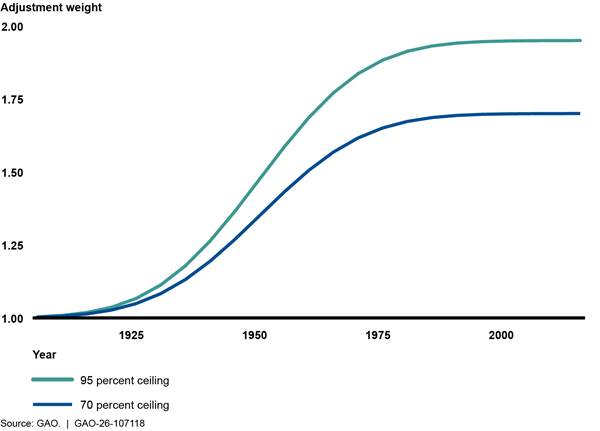
We could not obtain data on the actual rate of exogamous fertility among Freedmen descendants, but we supported our assumptions by interviewing two experts on Freedmen history and genealogy. The experts described their views on the likely degree of exogamy over time, which helped inform our numeric assumptions above for each analytic year. Our assumptions reflect the history of increasing domestic migration and interracial marriage and family structures during some of this time period.[85] However, some exogamous fertility among the Freedmen and their descendants is likely to have been with tribal citizens, especially in the early years of this time period. As a result, our analysis does not estimate the population of Freedmen descendants who might be eligible for tribal citizenship, but instead estimates the population size of lineal descendants of Freedmen on the Dawes Rolls.
Lifetable and survival estimation. We constructed lifetables and estimated survival probabilities for each analysis year and subpopulation. We used the mortality rates described above and an estimate of the average person-years lived within each of our 5-year age intervals. We used a common approximation to assume that nax, the average person-years lived from age x to x + n, equaled n/2, implying that nax = 2.5 given that n = 5 in our implementation. This assumed that each death occurred, on average, halfway through the interval.[86]
Model Estimation and Versions
We combined various data sources and modeling assumptions into several model versions, as shown in table 2. We estimated separate cohort-component models for each scenario and collected estimated population totals for each scenario by subpopulation and analysis year. We developed scenarios by iteratively varying key assumptions, such as racial classification or geography, over all values that were possible and feasible to estimate. The ensemble of estimates approximated uncertainty about Freedmen descendants’ fertility, mortality, exogamy, geographic locations, and racial classifications. In the body of this report, we present ranges of population estimates from our models, separately for each Tribe and overall, for 2022. We do not present point estimates, due to the uncertainty of the inputs and assumptions.
Table 2: Demographic Modeling for Estimating Descendants of Freedmen of the Five Tribes, Selection of Fertility and Mortality Data for Modeling Inputs
|
|
|
|
|
Centers for Disease Control and Prevention (CDC) sources for vital statisticsa |
|
|
Model scenario |
Estimation |
Geographic |
Race or ethnic groupb |
Fertility rates |
Mortality rates |
|
1 |
1907–1967 |
United States |
“Other (Non-White)” |
VSUS 1900–1940 VSUS 1940–1960 VSUS 1967 |
VSUS |
|
1968–2002 |
United States |
“Black” |
VSUS 2003 |
WONDER |
|
|
2003–2022 |
United States |
“Black” |
WONDER |
WONDER |
|
|
2 |
1907–1967 |
United States |
“Other (Non-White)” |
VSUS 1900–1940 VSUS 1940–1960 VSUS 1967 |
VSUS |
|
1968–2002 |
United States |
“Black” |
VSUS 2003 |
WONDER |
|
|
2003–2022 |
United States |
“American Indian” |
WONDER |
WONDER |
|
|
3 |
1907–1931 |
United States |
“Other (Non-White)” |
VSUS 1900–1940 |
VSUS |
|
1932–1967 |
California |
“Other (Non-White)” |
VSUS 1900–1940 VSUS 1940–1960 |
VSUS 1900–1940 VSUS 1950, 1960 |
|
|
1968–2002 |
California |
“Black” |
microdata |
WONDER |
|
|
2003–2022 |
California |
“Black” |
WONDER |
WONDER |
|
|
4 |
1907–1931 |
United States |
“Other (Non-White)” |
VSUS 1900–1940 VSUS 1940–1960 VSUS 1967 |
VSUS |
|
1932–1967 |
California |
“Other (Non-White)” |
VSUS 1900–1940 VSUS 1940–1960 |
VSUS 1900–1940 VSUS 1950,1960 |
|
|
1968–2002 |
California |
“Black” |
microdata |
WONDER |
|
|
2003–2022 |
California |
“American Indian” |
WONDER |
WONDER |
|
|
5 |
1907–1931 |
United States |
“Other (Non-White)” |
VSUS 1900–1940 |
VSUS |
|
1932–1967 |
Kansas |
“Other (Non-White)” |
VSUS 1900–1940 VSUS 1940–1960 |
VSUS 1900–1940 VSUS 1950,1960 |
|
|
1968–2002 |
Kansas |
“Black” |
microdata |
WONDER |
|
|
2003–2022 |
Kansas |
“Black” |
WONDER |
WONDER |
|
|
6 |
1907–1931 |
United States |
“Other (Non-White)” |
VSUS 1900–1940 |
VSUS |
|
1932–1967 |
Oklahoma |
“Other (Non-White)” |
VSUS 1900–1940 VSUS 1940–1960 |
VSUS 1900–1940 VSUS 1950, 1960 |
|
|
1968–2002 |
Oklahoma |
“Black” |
microdata |
WONDER |
|
|
2003–2022 |
Oklahoma |
“Black” |
WONDER |
WONDER |
|
|
7 |
1907–1931 |
United States |
“Other (Non-White)” |
VSUS 1900–1940 |
VSUS |
|
1932–1967 |
Oklahoma |
“Other (Non-White)” |
VSUS 1900–1940 VSUS 1940–1960 |
VSUS 1900–1940 VSUS 1950, 1960 |
|
|
1968–2002 |
Oklahoma |
“Black” |
microdata |
WONDER |
|
|
2003–2022 |
Oklahoma |
“American Indian” |
WONDER |
WONDER |
|
|
8 |
1907–1941 |
United States |
“Other (Non-White)” |
VSUS 1900–1940 |
VSUS |
|
1942–1967 |
Texas |
“Other (Non-White)” |
VSUS 1900–1940 VSUS 1940–1960 |
VSUS 1900-1940 VSUS 1950, 1960 |
|
|
1968–2002 |
Texas |
“Black” |
microdata |
WONDER |
|
|
2003–2022 |
Texas |
“Black” |
WONDER |
WONDER |
|
|
9 |
1907–1931 |
United States |
“Other (Non-White)” |
VSUS 1900–1940 |
VSUS |
|
1932–1947 |
Oklahoma |
“Other (Non-White)” |
VSUS 1900–1940 VSUS 1940–1960 |
VSUS 1900–1940 VSUS 1950,1960 |
|
|
1948–1967 |
California |
“Other (Non-White)” |
VSUS 1900–1940 VSUS 1940–1960 |
VSUS 1900–1940 VSUS 1940–1960 |
|
|
1968–2002 |
California |
“Black” |
microdata |
WONDER |
|
|
2003–2022 |
California |
“Black” |
WONDER |
WONDER |
|
|
10 |
1907–1931 |
United States |
“Other (Non-White)” |
VSUS 1900–1940 |
VSUS |
|
1932–1947 |
Oklahoma |
“Other (Non-White)” |
VSUS 1900–1940 VSUS 1940–1960 |
VSUS 1900–1940 VSUS 1950,1960 |
|
|
1948–1967 |
Kansas |
“Other (Non-White)” |
VSUS 1900–1940 VSUS 1940–1960 |
VSUS 1900–1940 VSUS 1940–1960 |
|
|
1968–2002 |
Kansas |
“Black” |
microdata |
WONDER |
|
|
2003–2022 |
Kansas |
“Black” |
WONDER |
WONDER |
|
|
11 |
1907–1931 |
United States |
“Other (Non-White)” |
VSUS 1900–1940 |
VSUS |
|
1932–1947 |
Oklahoma |
“Other (Non-White)” |
VSUS 1900–1940 VSUS 1940–1960 |
VSUS 1900–1940 VSUS 1950,1960 |
|
|
1948–1967 |
Texas |
“Other (Non-White)” |
VSUS 1900–1940 VSUS 1940–1960 |
VSUS 1900–1940 VSUS 1940–1960 |
|
|
1968–2002 |
Texas |
“Black” |
microdata |
WONDER |
|
|
2003–2022 |
Texas |
“Black” |
WONDER |
WONDER |
|
VSUS = Vital Statistics of the United States; microdata = public-use data, Vital Statistics Online Data Portal; WONDER = Wide-ranging ONline Data for Epidemiologic Research
Source: GAO’s demographic modeling. | GAO‑26‑107118
Notes: According to the list of federally recognized Tribes published annually in the Federal Register, the official name for each of these Tribes is the Cherokee Nation, Chickasaw Nation, Choctaw Nation of Oklahoma, Muscogee (Creek) Nation, and Seminole Nation of Oklahoma. 89 Fed. Reg. 99899 (Dec. 11, 2024). We developed a cohort-component demographic model to estimate the population size of the descendants of Freedmen in 2022. We ran the modeling 11 times with varying assumptions for fertility and mortality rates, based on available data for race or ethnic group and geographic locations.
aForrest E. Linder and Robert D. Grove, Vital Statistics Rates in the United States, 1900-1940 (Washington, D.C.: Federal Security Agency, United States Public Health Service, National Office of Vital Statistics, 1947). Robert D. Grove and Alice M. Hetzel, Vital Statistics Rates in the United States, 1940-1960 (Washington, D.C.: U.S. Department of Health, Education, and Welfare, United States Public Health Service, National Center for Health Statistics, 1968). U.S. Department of Health and Human Services, Centers for Disease Control and Prevention, National Center for Health Statistics, Vital Statistics of the United States, 2003, Volume 1, Natality (Hyattsville, MD, September 2005). U.S. Department of Health and Human Services, Centers for Disease Control and Prevention, WONDER, accessed September and November 2024, http://wonder.cdc.gov. HIST290: Death Rates for Selected Causes by 10-Year Age Groups, Race, and Sex: Death Registration States, 1900-32, and United States,1933-98. National Center for Health Statistics. Accessed online at https://www.cdc.gov/nchs/nvss/mortality/hist290.htm, July 23, 2024. Birth Data Files (microdata), accessed online at https://www.cdc.gov/nchs/data_access/vitalstatsonline.htm on Nov. 13, 2024. Mortality Statistics, 1931 (Washington, D.C.: U.S. Department of Commerce, Bureau of the Census, 1935). Vital Statistics of the United States, 1950, Vol. III, Mortality Data. (Washington, D.C.: U.S. Department of Health, Education and Welfare, Public Health Service, 1953). Vital Statistics of the United States, 1960, Vol. II—Mortality, Part B (Washington, D.C.: U.S. Department of Health, Education, and Welfare, Public Health Service, 1963).
bRace or ethnic group terms used by the Centers for Disease Control and Protection, National Center for Health Statistics for the time period indicated. In the early 1900s, data were limited in collection to “White” or “Other (Non-White)”.
In any of these scenarios, national fertility and mortality rates may not have accurately reflected the rates in locations where Freedmen descendants lived, if conditions affecting birth and death were more state-specific. To reflect this potential variation, we developed alternative models that assumed 100 percent of descendants lived in California, Kansas, Oklahoma, or Texas, respectively, after state data became consistently available in 1932. These alternatives contributed point estimates of population size that we transformed into intervals. Varying the allocation from either 0 or 100 percent by substituting rates for specific states, bounded the possible range of estimates, including the unknown actual share of descendants living in each state. Our geographic location assumptions varied across time periods and demographic groups, depending on the vital statistics available.
Model Validation
We validated our estimates from the demographic models above by comparing them to estimates we derived from several alternative methods. These methods used tribal enrollment totals for each of the Five Tribes, tribally certified as of 2024, and collected by BIA. Specifically, we used three separate validation methods:
1. Model estimates of Freedmen descendants in 2022 versus Freedmen descendant totals in 2024. Enrolled Freedmen population totals were available for the Cherokee and Seminole Nations in 2024. The Cherokee Nation reported its total population of Freedmen citizens in a 2024 report. The Seminole Nation of Oklahoma reported separate statistics for “Freedmen descendants” to BIA in 2024. We used these population totals as validation statistics for the demographic model estimates for Cherokee and Seminole Freedmen descendants in 2022.
2. Model estimates of non-Freedmen descendants in 2022 versus BIA non-Freedmen totals in 2024. We applied our models to the “by blood” enrollment groups on the Dawes Rolls in 1907. We adjusted assumptions about race to include only vital rates for “American Indian” when they were available. We compared estimates from these adjusted models to non-Freedmen citizen totals that the Tribes reported to BIA in 2024.
3. Model estimates of Freedmen descendants in 2022 versus non-Freedmen growth estimates in 2024. We used change in the population of non-Freedmen from 1907 through 2024 to estimate how the Freedmen population may have changed over the same time period. Specifically, we calculated the proportional change in the number of non-Freedmen on the Dawes Rolls to the population reported by the Tribes to BIA in 2024, separately by Tribe and for all Tribes. We applied these rates to the Freedmen population totals on the Dawes Rolls to project their populations in 2024:
N2024, Freedmen = N1907, Freedmen* (N2024, non-Freedmen / N1907, non-Freedmen)
Validating our model estimates using actual tribal enrollments necessarily involved mixing reference populations. Our demographic models estimated the number of people who descended from ancestors on the Dawes Rolls, whereas tribal enrollments include the subset of descendants who were motivated to document their descent from an ancestor on the Dawes Rolls and able to successfully apply for tribal citizenship. For this reason, we could not use actual tribal enrollment data to directly validate our model estimates, but rather to benchmark our estimates as a potential upper bound of the population who might be eligible for citizenship, if current tribal enrollment policies were extended to Freedmen descendants. Our model estimates of descendants should have exceeded enrollment totals by a factor roughly approximating several intermediate selection stages between the descendant and tribal citizen population, including awareness, motivation, capacity, documentation, and approval.
We do not report statistics we calculated summarizing the results of our validation, because the statistics would disclose tribal enrollment data we obtained from BIA that are not publicly available. However, our estimated intervals compare favorably with the available empirical data. Estimates from applying growth among non-Freedmen tribal citizens fall within our estimated intervals, but are closer to the lower bounds. That pattern is consistent with expectations, given that the growth in non-Freedmen citizen populations reflects several stages of self-selection, as discussed above. Similarly, tribal citizen population totals reported to BIA in 2024 are all within our estimated intervals for non-Freedmen descendants, and are closer to the lower bounds, as expected. Actual population totals for Cherokee Freedmen citizens and Seminole Freedmen citizens are below our estimated lower bounds. That is consistent with lower rates of self-selection into tribal citizenship among Freedmen than non-Freedmen, perhaps because Freedmen could not always apply for citizenship and relatively recent changes regarding some Freedmen descendant enrollment.
Model Limitations
Our estimates of the Freedmen descendant population had some limitations related to the limited availability of historical data and uncertainty in the key factors affecting population change over time.
The Freedmen descendant population is not covered by efforts to measure the broader populations who identify as “Black/African American” and “American Indian,” such as the decennial census or American Community Survey programs run by the U.S. Census Bureau. Any survey to identify Freedmen descendants would face the difficulty of measuring a rare population, defined using respondent answers that may not accurately describe their genealogy. Detailed genealogical research tracing lineages from the Dawes Rolls forward in time would precisely identify the population, but tracing individual births and deaths for 23,000 people over 115 years would not be feasible without substantial resources for data analysis and archival research. As a result, empirically measuring the Freedmen descendant population was not feasible, given the public data and staff time available to us.
Demographic models must make assumptions about how the Freedmen descendant population changed over time. We made assumptions about births, deaths, geographic location, race/ethnicity, and endogamy over time, based on available data, and measured the effects of these assumptions through sensitivity analysis. However, we could not identify and assess the impact of every relevant scenario that may have affected the Freedmen descendant population over time, so our range of estimates conveyed only some of the uncertainty about the size of the true population.[87]
Finally, our estimates of Freedmen descendants are based on Freedmen listed on the Dawes Rolls. Our estimates do not represent the number of people who may choose to apply for enrollment in a Tribe if Freedmen descendants are eligible for enrollment; may be able to prove lineage to be accepted into a Tribe as Freedmen descendants; or are entitled to federal services or benefits because such entitlement is based on the specific requirements of the relevant federal programs.
The Five Tribes include the Cherokee, Chickasaw, Choctaw, Muscogee (Creek), and Seminole Nations of Oklahoma. During the 1830s, these Tribes—including enslaved people and people of African descent residing among them—were forcibly removed from the southeastern United States to the Oklahoma territory—a displacement known as the Trail of Tears. Following the Civil War, in 1866, each of the Five Tribes signed a treaty with the United States that abolished slavery and addressed the status and rights of formerly enslaved people and people of African descent residing among the Tribe. In the late 1800s, Congress directed a commission to create lists of the Five Tribes’ citizens “by blood” and “Freedmen”—the formerly enslaved people and people of African descent living among the Tribes who might be entitled to tribal citizenship or other rights under the 1866 treaties. The resulting lists, which were compiled between 1898 and 1907, are referred to as the Dawes Rolls.[88]
Today, eligibility for tribal citizenship in each of the Five Tribes is based on lineal descent from an individual listed on the Tribe’s Dawes Rolls. However, the Tribes differ in the extent to which they allow Freedmen descendants to enroll as tribal citizens. Below, for each of the Five Tribes, we describe the extent to which the Tribe’s Freedmen descendants are currently eligible for tribal citizenship. We also include key provisions of each Tribe’s 1866 Treaty with the United States that relate to the status of the Freedmen and their descendants in the Tribe. Finally, we summarize key cases from federal and tribal courts that directly address the Freedmen descendants’ citizenship rights in the Five Tribes or provide relevant historical context or information about how courts may consider questions regarding these rights.[89]
Cherokee Nation
To what extent are Cherokee Freedmen descendants currently eligible for citizenship in the Cherokee Nation?
Under the Cherokee Nation Constitution, Cherokee Freedmen descendants are eligible for Cherokee Nation citizenship to the same extent as native (i.e., “by blood”) Cherokees.[90]
What key provisions of the 1866 Treaty with the Cherokee relate to the status of Cherokee Freedmen and their descendants in the Tribe?
Article 9 of the 1866 Treaty with the Cherokee states, “The Cherokee [N]ation having . . . forever abolished slavery, hereby covenant and agree that never hereafter shall either slavery or involuntary servitude exist in their nation . . . They further agree that all [F]reedmen who have been liberated by voluntary act of their former owners or by law, as well as all free colored persons who were in the country at the commencement of the rebellion, and are now residents therein, or who may return within six months, and their descendants, shall have all the rights of native Cherokees . . .”[91]
What key court cases pertain to the Cherokee Freedmen and their descendants’ status within the Tribe since the 1866 Treaty?
Cherokee Nation v. Nash (2017): The Cherokee Nation filed this case in federal court in 2009 seeking a declaration that the Freedmen descendants had no citizenship rights in the Tribe. At the time, the Tribe did not permit Freedmen descendants to enroll and restricted citizenship to Cherokees, Delawares, and Shawnees “by blood.” The core issue in the case was whether descendants of individuals listed as Cherokee Freedmen on the Dawes Rolls had a right to equal citizenship in the Cherokee Nation under the relevant 1866 Treaty. In 2017, the federal district court held that the 1866 Treaty’s guarantee that qualifying Cherokee Freedmen would have “all the rights of native Cherokees” meant those Freedmen were extended the entirety of the rights possessed by native Cherokees without limitation. Thus, the court held that the treaty guaranteed Freedmen the right to citizenship in the Tribe to same extent as native Cherokees and that descendants of Cherokee Freedmen were entitled to tribal citizenship.[92]
In 2021, the Supreme Court of the Cherokee Nation gave effect to Cherokee Nation v. Nash in its final order in tribal case no. SC-17-07. The Court ordered the Tribe to remove any reference to “by blood” citizenship from the Tribe’s Constitution, laws, rules, regulations, policies, and procedures.[93]
Chickasaw Nation
To what extent are Chickasaw Freedmen descendants currently eligible for citizenship in the Chickasaw Nation?
Under the Chickasaw Nation Constitution, Chickasaw Freedmen descendants are not currently eligible for citizenship in the Chickasaw Nation.[94]
What key provisions of the 1866 Treaty with the Choctaw and Chickasaw relate to the status of Chickasaw Freedmen and their descendants in the Tribe?
Article 3 of the 1866 Treaty with the Choctaw and Chickasaw states, “The Choctaws and Chickasaws, in consideration of the sum of [$300,000], hereby cede to the United States the territory . . . known as the leased district, provided that the said sum shall be invested and held by the United States . . . in trust for the said nations, until the legislatures of the Choctaw and Chickasaw [N]ations respectively shall have made such laws, rules, and regulations as may be necessary to give all persons of African descent, resident in the said nations at the date of the treaty of Fort Smith, and their descendants, heretofore held in slavery among said nations, all the rights, privileges, and immunities, including the right of suffrage, of citizens of said nations, except in the annuities, moneys, and public domain claimed by, or belonging to, said nations respectively; and also to give to such persons who were residents as aforesaid, and their descendants, forty acres each of the land of said nations on the same terms as the Choctaws and Chickasaws, to be selected on the survey of said land, after the Choctaws and Chickasaws and Kansas Indians have made their selections as herein provided . . . And should the said laws, rules, and regulations not be made by the legislatures of the said nations respectively, within two years from the ratification of this treaty, then the said sum of [$300,000] shall cease to be held in trust for the said Choctaw and Chickasaw [N]ations, and be held for the use and benefit of such of said persons of African descent as the United States shall remove from the said territory in such manner as the United States shall deem proper—the United States agreeing, within ninety days from the expiration of the said two years, to remove from said nations all such persons of African descent as may be willing to remove; those remaining or returning after having been removed from said nations to have no benefit of said sum of [$300,000], or any part thereof, but shall be upon the same footing as other citizens of the United States in the said nations.”[95]
What key court cases pertain to the Chickasaw Freedmen and their descendants’ status within the Tribe since the 1866 Treaty?
United States v. Choctaw Nation & Chickasaw Nation (1904): This case considered whether the Chickasaw Freedmen were “adopted by the Chickasaw Nation” as provided for in the relevant Treaty of 1866. The Treaty provided that the United States would hold $300,000 in trust for the Choctaw and Chickasaw Nations until the Tribe’s legislatures conveyed tribal citizenship rights and an allotment of 40 acres to their residents of African descent. If such laws or provisions were not made within 2 years, the fund was to be held for the benefit of those individuals of African descent willing to be removed by the United States from the territory, rather than for the Choctaw and Chickasaw Nations.
In the decades after the 1866 Treaty, the Chickasaw Nation took several seemingly contradictory actions with respect to the Chickasaw Freedmen. In 1868, the Chickasaw legislature asked the United States to remove the Chickasaw Freedmen from the Chickasaw country. Then, in 1873, the Chickasaw legislature passed an act declaring the adoption of the Freedmen, if such action were approved by the United States, but Congress took no action on the act. Around 1876, the Chickasaw legislature reversed course, and again called on the United States to remove the Freedmen from the Tribe in keeping with the 1866 Treaty. In 1885, the Chickasaw Nation passed an act refusing to adopt or accept the Freedmen as citizens and again calling for their removal by the United States. In 1894, despite the Tribe’s more recent actions rejecting the Freedmen’s adoption, Congress approved the Chickasaw’s 1873 request to adopt the Freedmen.
Thereafter, in 1898, Congress passed a settlement between the United States and the Tribe that entitled the Freedmen to 40 acres, but only until “their rights under said 1866 treaty” were determined. In 1902, a new agreement conferred authority on the United States Court of Claims to settle certain rights of the Chickasaw Nation and Chickasaw Freedmen under the 1866 Treaty. The Court of Claims reached a decision on the issues, and that decision was appealed by both parties to the U.S. Supreme Court.
In reviewing the Court of Claims decision, in 1904, the U.S. Supreme Court concluded that “the [F]reedmen were not adopted into the Chickasaw [T]ribe, and necessarily did not acquire the rights dependent upon adoption.” The Court also held that the Freedmen were not entitled to any share of the $300,000 referenced in the treaty. Specifically, the Court stated that, “[t]he treaty is clear. The Indian nations were to receive the $300,000 if they conferred upon the [F]reedmen the rights expressed in the treaty. Failing to confer those rights, that sum was to be held in trust for all such [F]reedmen, and only such [F]reedmen, as should remove from the territory.” Because no Freedmen had elected to be removed from the Chickasaw Nation, they could not be the beneficiaries of that $300,000. Finally, the Supreme Court noted that the because the relevant 1866 Treaty provided that those Freedmen who remained with the Chickasaw Nation would only have the rights of other United States citizens generally, the Freedmen had no right to Chickasaw lands.[96]
Casey-El v. United States (1991): A Chickasaw Freedmen descendant filed this case in federal court against the United States seeking land and money under the relevant 1866 Treaty. The United States Claims Court held that the plaintiff’s claims were barred by res judicata and the United States Court of Appeals for the Federal Circuit affirmed.[97] The Federal Circuit noted that the United States Supreme Court had already “adjudicated the rights of the Chickasaw [F]reedmen as a class” in 1904 in United States v. Choctaw Nation & Chickasaw Nation. The Federal Circuit explained that the Supreme Court had concluded that the relevant 1866 Treaty promised benefits to those Freedmen who were adopted into the Tribe or were removed from the Tribes’ territory by the United States. “Specifically, adopted [F]reedmen would get either land and political rights within the Chickasaw–Choctaws territory or $100 if they relocated.” Because the Supreme Court concluded that the Chickasaw Freedmen were neither adopted nor removed, they did not qualify for political rights or a share of the trust fund. The plaintiff’s claims were therefore barred because the plaintiff’s “ancestors were bound by the results of the Supreme Court case [and Plaintiff] stands in the position of his ancestor.”[98]
Choctaw Nation of Oklahoma
To what extent are Choctaw Freedmen descendants currently eligible for citizenship in the Choctaw Nation?
Under the Choctaw Nation Constitution, Choctaw Freedmen descendants are not currently eligible for citizenship in the Choctaw Nation.[99]
What key provisions of the 1866 Treaty with the Choctaw and Chickasaw relate to the status of Choctaw Freedmen and their descendants in the Tribe?
Article 3 of the 1866 Treaty with the Choctaw and Chickasaw states, “The Choctaws and Chickasaws, in consideration of the sum of [$300,000], hereby cede to the United States the territory . . . known as the leased district, provided that the said sum shall be invested and held by the United States . . . in trust for the said nations, until the legislatures of the Choctaw and Chickasaw nations respectively shall have made such laws, rules, and regulations as may be necessary to give all persons of African descent, resident in the said nation at the date of the treaty of Fort Smith, and their descendants, heretofore held in slavery among said nations, all the rights, privileges, and immunities, including the right of suffrage, of citizens of said nations, except in the annuities, moneys, and public domain claimed by, or belonging to, said nations respectively; and also to give to such persons who were residents as aforesaid, and their descendants, forty acres each of the land of said nations on the same terms as the Choctaws and Chickasaws, to be selected on the survey of said land, after the Choctaws and Chickasaws and Kansas Indians have made their selections as herein provided . . . And should the said laws, rules, and regulations not be made by the legislatures of the said nations respectively, within two years from the ratification of this treaty, then the said sum of [$300,000] shall cease to be held in trust for the said Choctaw and Chickasaw nations, and be held for the use and benefit of such of said persons of African descent as the United States shall remove from the said territory in such manner as the United States shall deem proper—the United States agreeing, within ninety days from the expiration of the said two years, to remove from said nations all such persons of African descent as may be willing to remove; those remaining or returning after having been removed from said nations to have no benefit of said sum of [$300,000], or any part thereof, but shall be upon the same footing as other citizens of the United States in the said nations.”[100]
What key court cases pertain to the Choctaw Freedmen and their descendants’ status within the Tribe since the 1866 Treaty?
Choctaw Nation v. United States (1940): The Choctaw Nation brought this case in federal court seeking—among other things—to recover principal and interest on a portion of the $300,000 trust fund provided for in the relevant 1866 Treaty. In 1940, the United States Court of Claims held that this claim was without merit. The court explained that the $300,000 trust fund was “essentially contingent” on the “adoption by the Indians of their [F]reedmen within the specified time.” The court noted that the Tribe not only declined to adopt the Freedmen within the specified time of 2 years but refused to do so. Nonetheless, the Nation was paid a cash advance and interest on their portion of the $300,000 in the mid-to-late 1860s pursuant to the Treaty and several acts of Congress. The court found that the Choctaw Nation adopted their Freedmen in 1883, and Congress provided for the settlement of the balance due to the Tribe under the Treaty with an 1885 appropriation. Because the Tribe had already been paid the principal and interest due from the $300,000 trust fund established in the Treaty, the court dismissed their claim.[101]
Choctaw Nation of Indians v. United States (1943): This case was filed by the Chickasaw Nation in federal court against the United States in 1929, seeking compensation for its interest in allotments of common Chickasaw and Choctaw lands made to Choctaw Freedmen in the early 1900s. The Choctaw Nation was brought into the suit as a co-defendant in 1940. The United States Court of Claims held that Chickasaws were entitled to compensation from the Choctaw Nation for the allotments made to Choctaw Freedmen.
The Choctaw Nation appealed, and, in 1943, the United States Supreme Court reversed the Court of Claims decision. The Court noted that, under the relevant 1866 Treaty, the United States was to hold in trust $300,000 for the Nations until they conferred tribal rights on the Freedmen. Immediately following the Treaty, neither the Chickasaw nor the Choctaw acted to confer such rights. However, the Court explained, in 1882, Congress passed a law that again provided that either Tribe might adopt their Freedmen in accordance with the Treaty, and thus gain access to their share of the $300,000 trust fund. The Court found that, “[i]n 1883 the Choctaws adopted their [F]reedmen and declared them each entitled to forty acres of the nation’s lands, but no allotments were actually made” at that time. According to the Court, “Congress thereupon appropriated for the Choctaws their share of the balance of the $300,000 fund.” Though the Chickasaws never adopted Freedmen, the Chickasaws still received some of their share of the fund.
Subsequently, the Court explained, 40-acre allotments were made to both Chickasaw and Choctaw Freedmen from common tribal lands under an agreement enshrined in a 1902 law. The Court held that the Chickasaw Nation was not entitled to compensation for the lands allotted to Choctaw Freedmen because, under the 1902 agreement, “allotments from the common tribal lands were to be made . . . to Choctaw [F]reedmen without deducting those allotments from the Choctaw Nation’s share of the lands or otherwise compensating the Chickasaws for their interest in the lands so allotted.”[102]
Muscogee (Creek) Nation
To what extent are Muscogee (Creek) Freedmen descendants currently eligible for citizenship in the Muscogee (Creek) Nation?
According to a recent court decision, Muscogee (Creek) Freedmen descendants are entitled to citizenship in the Muscogee (Creek) Nation. However, as of November 2025, Muscogee (Creek) Freedmen descendants’ ability to obtain tribal citizenship was an evolving matter. As discussed below, in July 2025, the Muscogee (Creek) Nation Supreme Court ruled that references to “by-blood” citizenship in the Tribe’s Constitution were unlawful and void.[103] The Court directed the Muscogee (Creek) Citizenship Board to apply the relevant 1866 Treaty and issue citizenship to any future applicants of Freedmen descent.
However, in August 2025, the Principal Chief of the Muscogee (Creek) Nation issued an executive order directing the Tribe’s citizenship office to continue accepting citizenship applications from Freedmen descendants, but not to issue them citizenship cards, or any other membership identification, until the Tribe’s law and policy had been fully reviewed and amended to meet the qualification requirements under the 1866 Treaty.[104] The Muscogee (Creek) Supreme Court’s ruling and the Principal Chief’s executive order were issued toward the end of our review and the ability of Muscogee (Creek) Freedmen descendants to obtain tribal citizenship was a developing situation. As of November 2025, the Muscogee (Creek) Nation had not enrolled any of the Tribe’s Freedmen descendants.
What key provisions of the 1866 Treaty with the Muscogee (Creek) relate to the status of Muscogee (Creek) Freedmen and their descendants in the Tribe?
Article 2 of the 1866 Treaty with the Creeks states, “The Creeks hereby covenant and agree that henceforth neither slavery nor involuntary servitude . . . shall ever exist in said nation; and inasmuch as there are among the Creeks many persons of African descent, who have no interest in the soil, it is stipulated that hereafter these persons lawfully residing in said Creek country under their laws and usages, or who have been thus residing in said country, and may return within one year from the ratification of this treaty, and their descendants and such others of the same race as may be permitted by the laws of the said nation to settle within the limits of the jurisdiction of the Creek Nation as citizens (thereof,) shall have and enjoy all the rights and privileges of native citizens, including an equal interest in the soil and national funds, and the laws of the said nation shall be equally binding upon and give equal protection to all such persons, and all others, of whatsoever race or color, who may be adopted as citizens or members of said tribe.”[105]
What key court cases pertain to the Muscogee (Creek) Freedmen and their descendants’ status within the Tribe since the 1866 Treaty?
Citizenship Board of the Muscogee (Creek) Nation v. Grayson and Kennedy (2025): Plaintiffs, who are Muscogee (Creek) Freedmen descendants, filed this case in the District Court of the Muscogee (Creek) Nation in 2020, challenging the Citizenship Board of the Muscogee (Creek) Nation’s denial of their applications for citizenship. In 2023, the district court held that Freedmen and their lineal descendants were entitled to tribal citizenship under the 1866 Treaty and ordered the Citizenship Board to reconsider the plaintiffs’ citizenship applications. The Citizenship Board appealed this decision, and in 2025, the Muscogee (Creek) Nation Supreme Court upheld it, ruling that the 1866 Treaty “clearly extends these citizenship rights to the ‘descendants’ of the Creek Freedmen.”
In reaching its conclusion, the Court considered the history of the Tribe, finding that “the historic Creek Nation believed the Treaty of 1866 demanded citizenship rights be given to the Creek Freedmen” and that “this was [the Tribe’s] position . . . for over one hundred years, until the adoption of the 1979 Constitution.” The Court rejected the Citizenship Board’s argument that because Article 2 of the 1866 Treaty did not specify that the rights were to extend “forever” or “permanently,” the Tribe retained the right to exclude Creek Freedmen from tribal citizenship. Instead, the Court held, the lack of a specified endpoint at which Freedmen descendants could be excluded signaled that Freedmen descendants could not lawfully be excluded from tribal citizenship “both at the time of [the treaty’s] ratification, and for as long as there are living lineal descendants.” Accordingly, the Court held that the Citizenship Board had acted contrary to law in denying the plaintiffs’ citizenship applications, and that “any reference to ‘by blood’ citizenship, specifically in the [1979 Constitution], but also in the Muscogee (Creek) Nation Code, or in any associated . . . rules, regulations, policies, or procedures is unlawful and void ab initio.”[106] The Court then ordered the Citizenship Board to issue citizenship to the plaintiffs, as well as any future applicant able to establish a lineal descendant on the Freedmen Roll.[107] Following the Court’s decision, the Muscogee (Creek) Nation filed a petition for rehearing. The Supreme Court denied the Tribe’s petition, finding that the Court had fully considered the issue and a rehearing was not warranted.
Following that decision, the Principal Chief of the Muscogee (Creek) Nation issued an executive order directing the Tribe’s citizenship office to continue accepting citizenship applications from Freedmen descendants, but not to issue them citizenship cards, or any other membership identification cards, until the Tribe’s law and policy had been fully reviewed and amended to meet the qualification requirements under the 1866 Treaty. Thereafter, in October 2025, the Muscogee (Creek) Freedmen descendants who filed the case above sought to have the Muscogee (Creek) Supreme Court enforce its ruling and order the Citizenship Board to issue them citizenship cards immediately. In response, in November 2025, the Muscogee (Creek) Supreme Court ordered the Citizenship Board to provide monthly status reports, with the first report covering, among other things, (1) actions taken by various tribal entities to update the Tribe’s code, rules, and internal policies and procedures, and (2) what the Citizenship Board asserts is a reasonable timeframe for completing all necessary steps prior to issuing Freedmen descendants citizenship documents pursuant to the Court’s July 2025 order. The Muscogee (Creek) Supreme Court ordered that the first status report be filed by December 5, 2025.
Seminole Nation of Oklahoma
To what extent are Seminole Freedmen descendants currently eligible for citizenship in the Seminole Nation of Oklahoma?
According to testimony offered by the Chief Lewis Johnson of the Seminole Nation on July 27, 2022, “Pursuant to the Seminole Constitution, Seminole Freedmen are Seminole Citizens of the Seminole Nation . . . Seminole Freedmen are Citizens of the Seminole Nation but are not classified as ‘Members’ for historical reasons . . .” Therefore, Seminole Freedmen descendants are currently eligible for what the Nation refers to as “citizenship,” but not for what the Nation calls “membership,” which requires a Certificate of Degree of Indian Blood.[108] Under Seminole Nation law and policy, enrolled Seminole Freedmen descendants are not always regarded in an identical manner to Seminole Indian citizens with a degree of Indian blood.[109]
What key provisions of the 1866 Treaty with the Seminole relate to the status of Seminole Freedmen and their descendants in the Tribe?
Article 2 of the 1866 Treaty with the Seminole states, “The Seminole [N]ation covenant that henceforth in said nation slavery shall not exist, nor involuntary servitude . . . And inasmuch as there are among the Seminoles many persons of African descent and blood, who have no interest or property in the soil, and no recognized civil rights, it is stipulated that hereafter these persons and their descendants, and such other of the same race as shall be permitted by said nation to settle there, shall have and enjoy all the rights of native citizens, and the laws of said nation shall be equally binding upon all persons of whatever race or color, who may be adopted as citizens or members of said tribe.”[110]
What key court cases pertain to the Seminole Freedmen and their descendants’ status within the Tribe since the 1866 Treaty?
Seminole Nation v. United States (1933 & 1940): The Tribe filed a petition in federal court in 1930 arguing that the United States’ allotment of certain communal tribal lands and funds to Freedmen violated the relevant Treaty of 1866 and subsequent agreements. The Tribe argued that the words “member” and “citizen” as used in the Treaty and subsequent agreements were not synonymous. The Nation claimed that only “by blood” Seminoles could be members of the Seminole Tribe, whereas citizens of the Seminole Nation of Oklahoma included “by blood” Seminoles and others permitted to live among them. The Tribe claimed that the Treaty conveyed the Seminole Freedmen citizenship rights—which entailed only political and civil rights—not membership rights that included rights to the Tribe’s communal lands or funds.
In 1933, the United States Court of Claims reviewed the Seminole Nation of Oklahoma’s history and found that the Tribe had not historically distinguished between members of the Tribe and citizens of the Nation. Likewise, the court assessed several of the other 1866 treaties with the Five Tribes and concluded that they used “interchangeably and synonymously the words ‘citizen’ and ‘member.’” Further, the court considered various congressional acts pertaining to the Five Tribes and concluded that Congress did not intend “a technical distinction and restricted application of the rights of Indians upon the basis of the use of the words citizen and member of a tribe.” The court concluded that the rights acquired by the Seminole Freedmen in the relevant 1866 Treaty were the “the rights of native citizens” and noted that a “native citizen is one possessing all the rights of a native Indian.” Therefore, the court rejected the Tribe’s claims and held that the Treaty granted the Freedmen “rights in the soil and civil rights.”[111]
The Tribe then amended its petition to contend that the relevant Treaty of 1866 provided the Freedmen only with political rights and not the right to tribal property enjoyed by Indians “by blood.” Thus, the Tribe argued, the inclusion of Freedmen in the division of tribal funds and lands was illegal. In 1940, the court concluded that the Tribe’s amended petition had already been decided by the 1933 opinion and adopted that decision accordingly. The court also made a special finding of fact that the “Seminole Indians understood and knew that the rights which they were granting to their former slaves by [the 1866] treaty were equal rights in all tribal property as well as civil and other rights.”[112]
Davis v. United States (2003): Two bands of the Seminole Nation of Oklahoma consisting exclusively of Seminole Freedmen descendants filed this case against the United States in federal court in 1996. Plaintiffs challenged, among other things, their ineligibility for certain tribal programs established using funds awarded by the Indian Claims Commission in the 1970s to the “Seminole Nation as it existed in Florida on September 18, 1823” as compensation for tribal lands in Florida ceded to the United States in 1823.[113] A 1990 federal law allocated a portion of the award to the “Seminole Nation of Oklahoma.”[114] The tribal programs the Tribe established with this award generally restricted eligibility to “an enrolled member of the Seminole Nation of Oklahoma who has been determined to have descended from a member of the Seminole Nation as it existed in Florida on September 18, 1823.” These eligibility requirements excluded the Seminole Freedmen descendants, who were not expressly recognized as citizens of the Tribe until the relevant Treaty of 1866.
After two rounds of appeals, in 2003, the Tenth Circuit Court of Appeals ultimately upheld the district court’s decision that the case could not proceed to a ruling on the merits of the plaintiffs’ claims. With respect to the tribal program eligibility claim, the district court held that the claim could not proceed without the Seminole Nation of Oklahoma as a party to the lawsuit, and that the Tribe could not be joined to the suit due to its sovereign immunity.[115] The Tenth Circuit affirmed this holding, and a decision on the merits was never reached.[116]
Seminole Nation of Oklahoma v. Norton (2001 & 2002): The Tribe filed these cases in 2000 and 2002 in federal court challenging the Department of the Interior’s refusal to approve certain amendments to the Tribe’s Constitution and the results of specific tribal elections. In 2000, the Tribe held a referendum election to adopt amendments to its Constitution, including several designed to exclude Seminole Freedmen descendants from membership. In response, Interior sent a letter to the Tribe stating that it would not approve the amendments because they sought to exclude the Freedmen and had not been submitted to Interior for approval. The Tribe then filed suit challenging the federal government’s authority to approve amendments to its Constitution. While that suit was pending, the Tribe held elections for General Council, Principal Chief, and Assistant Chief pursuant to the unapproved constitutional amendments. The Freedmen descendants cast ballots, but their votes were not counted.
In 2001, a federal district court held that Interior had the authority to disapprove amendments to the Tribe’s Constitution and had acted reasonably in refusing to approve the amendments that sought to deny the Freedmen descendants membership. The court concluded that the relevant Treaty of 1866 continued to bind the parties, and that the constitutional amendments purporting to remove the Freedmen appeared to violate the Treaty.[117] Thereafter, relying on the court’s decision, Interior informed the Tribe that it would not recognize the results of the recent election and resume government-to-government relations until Freedmen representatives were restored to the Tribe’s General Council.
The Tribe again filed suit in 2002, arguing that Interior’s continued refusal to recognize the Tribe’s General Council was arbitrary and capricious because the Tribe had taken steps to restore the Freedmen. Interior refused to recognize these efforts because the agency claimed they were undertaken by an illegally constituted Council elected without the participation of the Freedmen descendants. In 2002, a federal district court held that, even considering the Tribe’s right to self-government, Interior’s actions were not arbitrary and capricious. The court noted that the Tribe’s amendments to its Constitution would disenfranchise the Freedmen “in total disregard of the rights afforded to those members by the Treaty of 1866 and the Nation’s Constitution” and that Interior had a duty to protect minority tribal members and authority to ensure that the Tribe’s representatives were valid representatives of the Tribe as a whole.[118]
GAO Contact
Anna Maria Ortiz, ortiza@gao.gov
Staff Acknowledgments
In addition to the contact named above, Tammy Conquest (Assistant Director), Amy Ward-Meier (Analyst in Charge), Rebecca Conway, Jennifer Gould, Claudia Hadjigeorgiou, Mae Jones, Jeff Larson, Matthew Ray, and Jeff Tessin made key contributions to this report. Other staff who contributed to this report include Adrian Apodaca, Kevin Donovan, Nicole Hewitt, Kirsten Lauber, John Mingus Jr., Cynthia Norris, Samuel Portnow, Walter Vance, and Sirin Yaemsiri.
The Government Accountability Office, the audit, evaluation, and investigative arm of Congress, exists to support Congress in meeting its constitutional responsibilities and to help improve the performance and accountability of the federal government for the American people. GAO examines the use of public funds; evaluates federal programs and policies; and provides analyses, recommendations, and other assistance to help Congress make informed oversight, policy, and funding decisions. GAO’s commitment to good government is reflected in its core values of accountability, integrity, and reliability.
Obtaining Copies of GAO Reports and Testimony
The fastest and easiest way to obtain copies of GAO documents at no cost is through our website. Each weekday afternoon, GAO posts on its website newly released reports, testimony, and correspondence. You can also subscribe to GAO’s email updates to receive notification of newly posted products.
Order by Phone
The price of each GAO publication reflects GAO’s actual cost of production and distribution and depends on the number of pages in the publication and whether the publication is printed in color or black and white. Pricing and ordering information is posted on GAO’s website, https://www.gao.gov/ordering.htm.
Place orders by calling (202) 512-6000, toll free (866) 801-7077,
or
TDD (202) 512-2537.
Orders may be paid for using American Express, Discover Card, MasterCard, Visa, check, or money order. Call for additional information.
Connect with GAO
Connect with GAO on X,
LinkedIn, Instagram, and YouTube.
Subscribe to our Email Updates. Listen to our Podcasts.
Visit GAO on the web at https://www.gao.gov.
To Report Fraud, Waste, and Abuse in Federal Programs
Contact FraudNet:
Website: https://www.gao.gov/about/what-gao-does/fraudnet
Automated answering system: (800) 424-5454
Media Relations
Sarah Kaczmarek, Managing Director, Media@gao.gov
Congressional Relations
A. Nicole Clowers, Managing Director, CongRel@gao.gov
General Inquiries
[1]According to the list of federally recognized Tribes published annually in the Federal Register, the official name for each of these Tribes is the Cherokee Nation, Chickasaw Nation, Choctaw Nation of Oklahoma, Muscogee (Creek) Nation, and Seminole Nation of Oklahoma. 89 Fed. Reg. 99899 (Dec. 11, 2024).
[2]The term “Trail of Tears” refers to the journeys that the Five Tribes took during their forced removal from their ancestral lands in the 1830s and 1840s. The journey differed for each of the Tribes, but the marches were long and resulted in thousands of deaths.
[3]There were four relevant treaties for the Five Tribes, because the Choctaw and Chickasaw Nations shared one treaty.
[4]See Act of June 28, 1898, ch. 517, 30 Stat. 495 (known as the Curtis Act).
[5]Excluded from our definition of “Freedmen descendants” are individuals who can trace their lineal descent back to a person or people listed as a Freedmen on the Dawes Rolls, but who are also descended from non-Freedmen individuals included on the Dawes Rolls.
[6]Citizenship Board of the Muscogee (Creek) Nation v. Grayson and Kennedy, SC-2023-10 (Muscogee (Creek) Nation S.C. July 23, 2025).
[7]In August 2025, the Principal Chief of the Muscogee (Creek) Nation issued an executive order directing the citizenship office to continue accepting applications from Freedmen descendants but instructing that no citizenship or other membership identification cards be issued to them until all law and policy have been fully reviewed and amended to meet the qualification requirements under the 1866 Treaty. The Muscogee (Creek) Supreme Court ruling and the subsequent executive order were issued toward the end of our review.
[8]Tribal enrollment criteria are generally set forth in tribal constitutions, articles of incorporation, or ordinances. Criteria vary from Tribe to Tribe. Most Tribes and the U.S. government use the terms “citizen” and “member” interchangeably. However, the Seminole Nation of Oklahoma differentiates between these terms. For the purposes of our report, we generally use the term tribal citizen, except where specifically noted.
[9]For the purposes of this report, we use the term “Tribes” to refer to federally recognized Indian Tribes, which include the Five Tribes. The federal government recognizes these Tribes as distinct, independent political entities that possess certain powers of self-governance and government-to-government relations with the United States. Federally recognized Tribes and individuals who meet the applicable legal definitions of “Indian” have a unique political status and are eligible for certain federal programs, benefits, and services because of that status. As of December 2024, there were 574 federally recognized Tribes.
[10]According to Oklahoma Historical Society documents, among the Tribes and the Freedmen, the process of enrollment used by the Dawes Commission for the Dawes Rolls raised various concerns including, among others, that the Commission did not have authority to enroll people, that many people did not participate in the enrollment process, and that bribery was used for inclusion on the Rolls.
[11]The Oklahoma Historical Society is an agency of the State of Oklahoma whose mission is to collect, preserve, and share history and culture of the state of Oklahoma and its people. Some of the records it stores are through an agreement with the National Archives and Records Administration.
[12]Where the Freedmen descendants’ citizenship rights in one of the Five Tribes have been directly addressed and decided by a court, we do not report on potentially relevant cases that preceded those decisions.
[13]For the purposes of this report, we only reported on barriers which were directly tied to federal services or funding, such as federal health care, education, or housing assistance and were unique to enrolled Freedmen descendants. As of November 2025, the Cherokee and Seminole Nations were the only two Tribes of the Five Tribes that had enrolled Freedmen descendants as citizens.
[14]We chose 2017 as the starting point because it is the year that a federal court decided that Cherokee Freedmen descendants are entitled to the same tribal citizenship rights as native Cherokees under the relevant 1866 Treaty. Cherokee Nation v. Nash, 267 F. Supp. 3d 86 (D.D.C. 2017).
[15]Throughout this report, we summarized and aggregated the statements provided by the enrolled Freedmen descendants we interviewed about the barriers they encountered. For these purposes, we refer to “some” when reporting information we heard from up to 25 percent of those interviewed, “several” when reporting information we heard from 25 percent to 50 percent of those we interviewed, and “most” when reporting information we heard from more than 50 percent of those we interviewed.
[16]Of the remaining four Tribes, one Tribe declined to speak with us because of ongoing litigation related to the rights of Freedmen descendants, another Tribe declined to speak with us because of the sensitivity of the subject matter, and two Tribes did not respond to our requests.
[17]An Act to provide for an exchange of lands with the Indians residing in any of the states or territories, and for their removal west of the river Mississippi, ch. 148, 4 Stat. 411 (1830) (known as the Indian Removal Act).
[18]Act of February 8, 1887, ch. 119, 24 Stat. 388 (1887) (known as the General Allotment Act or Dawes Act).
[19]Act of June 28, 1898, ch. 517, 30 Stat. 495 (known as the Curtis Act).
[20]Enrollment for the Dawes Rolls officially began in 1898 and closed in 1907, although a small number of people were added to the rolls from 1912 through 1914.
[21]The official name of the Dawes Rolls lists is The Final Rolls of Citizens and Freedmen of the Five Civilized Tribes in Indian Territory. According to historical documentation, the Dawes Commission may have put some people who seemed to have any African descent into the Freedmen category, regardless of whether they may have also been of American Indian descent.
[22]Tribes have inherent authority to determine requirements for citizenship. However, some Tribes’ enrollment is subject to requirements in federal law or treaty.
[23]Cherokee Nation, 2024 Report on Access to Services by Cherokee Citizens of Freedmen Descent (June 19, 2024); Chickasaw Nation Progress Report, 2024; Choctaw Nation Year in Review, 2024; Muscogee (Creek) Nation (https://www.muscogeenation.com/, accessed June 16, 2025); Seminole Nation Museum (https://seminolenationmuseum.org/history-seminole-nation/, accessed June 16, 2025).
[24]The Seminole Nation of Oklahoma has not publicly reported information on the location of its enrolled Freedmen descendants.
[25]See, e.g., 25 U.S.C. § 5601.
[26]Under the Indian Self-Determination and Education Assistance Act of 1975, as amended, Tribes may request to enter into self-determination contracts and self-governance compacts with certain federal agencies that transfer to the Tribes the administration of specific federal programs that were previously administered by the federal government on their behalf. Pub. L. No. 93-638, 88 Stat. 2203 (codified as amended at 25 U.S.C. §§ 5301-10).
[27]Demographic models can be used to construct how a historical population may have changed between two points in time, using actual values of birth and death rates from historical vital statistics data. We used a cohort-component demographic simulation method to model the Freedmen descendant population. These models estimate how the size of a starting population, grouped by age, race, and sex, may have changed over time as its members die, reproduce, and migrate.
[28]Enrollment for the Dawes Rolls officially closed in 1907, although a small number of people were added to the rolls in 1914. For purposes of the demographic modeling, all of the Freedmen from the Dawes Rolls are included in the analysis, and the analysis starting year is 1907.
[29]Vital statistics on births and deaths have been collected by the Centers for Disease Control and Prevention, which manages the National Vital Statistics System.
[30]Cherokee Nation v. Nash, 267 F. Supp. 3d 86 (D.D.C. 2017).
[31]In re Effect of Cherokee Nation v. Nash, No. SC-17-07 (Cherokee Sup. Ct. Feb. 22, 2021).
[32]Const. of the Cherokee Nation, art. IV, § 1.
[33]Under the Treaty, the United States would hold $300,000 in trust for the Choctaw and Chickasaw Nations until their legislatures conveyed tribal citizenship rights and an allotment of 40 acres to their residents of African descent. If such laws or provisions were not made within 2 years, the fund was to be held for the benefit of those individuals of African descent willing to be removed by the United States from the territory. See Treaty with the Choctaws and Chickasaws, April 28, 1866, 14 Stat. 769.
[34]United States v. Choctaw Nation & Chickasaw Nation, 193 U.S. 115 (1904).
[35]Const. of the Chickasaw Nation, art. II, § 1.
[36]Const. of the Choctaw Nation of Oklahoma, art. II, § 1.
[37]Grayson v. Citizenship Board of the Muscogee (Creek) Nation of Oklahoma, No. CV-2020-34 (M.C.N. Dist. Ct. Sept. 27, 2023).
[38]Citizenship Board of the Muscogee (Creek) Nation v. Grayson and Kennedy, SC-2023-10 (Muscogee (Creek) Nation S.C. July 23, 2025).
[39]Muscogee (Creek) Nation, Exec. Order No. 25-05, To Establish the Framework for Incorporating the Qualification Requirements in Article II of the Treaty of 1866 in Muscogee (Creek) Nation Law for the Muscogee (Creek) Nation Citizenship Office, Pursuant to the Supreme Court Order in Case SC 2023-10 (Aug. 28, 2025), https://www.muscogeenation.com/wp-content/uploads/2025/08/Executive-Order-25-05.pdf.
[40]Const. of the Muscogee (Creek) Nation, art. III, § 2.
[41]Select Provisions of The 1866 Reconstruction Treaties Between The United States And Oklahoma Tribes, 117th Cong. 17-21 (2022) (joint prepared statement of Hon. Lewis J. Johnson, Chief, Seminole Nation and Hon. Brian Thomas Palmer, Assistant Chief).
[42]Letter from Lewis J. Johnson, Chief, and Brian T. Palmer, Assistant Chief, Seminole Nation of Oklahoma to Hon. Brian Schatz, Chairman, United States Senate Committee on Indian Affairs (Sept. 6, 2022) (Questions for the Record Submitted by Chairman Schatz for U.S. Senate Committee on Indian Affairs “Select Provisions of the 1866 Reconstruction Treaties Between the United States and Oklahoma Tribes”) (on file with GAO).
[43]For example, under the Seminole Nation Constitution, a person must possess—among other qualifications—”no less than one-quarter degree of Seminole Indian blood” to be eligible for the office of Chief and Assistant Chief of the Nation, which means Seminole Freedmen descendants, as defined for the purposes of this report, are never eligible for these positions. Const. of the Seminole Nation of Oklahoma, art. III. We discuss other ways in which enrolled Seminole Freedmen descendants are regarded differently under Seminole Nation policies in the following section.
[44]Seminole Nation v. United States, 90 Ct. Cl. 151 (1940).
[45]Seminole Nation of Oklahoma v. Norton, No. CV-00-2384 (D.D.C. Sept. 27, 2001); see also Seminole Nation of Oklahoma v. Norton, 223 F. Supp. 2d 122 (D.D.C. 2002).
[46]Const. of the Seminole Nation of Oklahoma, art. II; art XII.
[47]As previously mentioned, as of November 2025, the Cherokee and Seminole Nations were the only two Tribes of the Five Tribes that had enrolled Freedmen descendants as citizens.
[48]Under IHS regulations, services will be made available at IHS facilities to individuals “regarded as… Indian[s] by the community in which [they] live[,] as evidenced by such factors as tribal membership [and] enrollment,” among others. 42 C.F.R. § 136.12. For more information, see Indian Health Service, “Part 2, Chapter 1: Eligibility for Services,” Indian Health Manual (Rockville, Md.: June 28, 2017).
[49]IHS-funded facilities include federally operated clinics, tribally operated clinics, and nonprofits known as urban Indian organizations.
[50]As previously noted, the Seminole Nation issues separate tribal identification cards to its enrolled Freedmen descendants and its “by blood” members. According to enrolled Cherokee Freedmen descendants we interviewed, the Cherokee Nation does not issue separate identification cards to Freedmen descendants and their tribal identification cards do not identify them as Freedmen descendants.
[51]The Oklahoma City Area Indian Health Service includes the states of Oklahoma, Kansas, and portions of Texas.
[52]See, e.g., 25 U.S.C. § 2007(f); 25 C.F.R. § 39.2; 25 C.F.R. § 273.112.
[53]According to BIE officials, Freedmen descendants who are enrolled as Seminole citizens have been eligible for admission to BIE-operated schools since the establishment of the schools and Freedmen descendants who are enrolled as Cherokee citizens have been eligible for admission to BIE-operated schools since the Tribe began enrolling them in 2017.
[54]HUD’s Office of Native American Programs also administers other federally funded housing assistance programs, such as the Indian Community Development Block Grant program, Section 184 Home Loan Guarantee program, and the Tribal HUD-Veterans Affairs Supportive Housing program.
[55]25 U.S.C. § 4131.
[56]25 U.S.C. § 4103.
[57]25 U.S.C. § 4131(b)(6).
[58]Housing Authority of the Seminole Nation of Oklahoma, Major Repair and Rehabilitation Program Operating Policy and Procedure (July 21, 2022); Housing Authority of the Seminole Nation of Oklahoma, Rental Assistance Program Operating Policy and Procedure (Oct. 20, 2022). Under both of these policies, applicants receive: 5 points for priority consideration if they are a “full blood, enrolled Seminole tribal member;” 4 points if the household includes at least one “elderly and/or disabled” member; up to 3 points if the household includes a veteran; 2 points if the household includes at least one “near-elderly” member; 1 point for all other enrolled Seminole Nation citizens (excluding Freedmen descendants); and 1 point for first-time applicants.
[59]Agency officials from the Office of Native American Programs also reviewed the housing preferencing policies of all Tribes in the Oklahoma Southern Plains Region and determined that the Seminole Nation of Oklahoma’s preference system for NAHASDA funding was the only one to award some citizens of its own Tribe the same number of points for priority consideration as citizens of other Tribes.
[60]The term “Indian country” refers to all land within the limits of any Indian reservation under the jurisdiction of the U.S. government, notwithstanding the issuance of any patent, and, including rights-of-way running through the reservation; all dependent Indian communities within U.S. borders; and all existing Indian allotments, including any rights-of-way running through an allotment. See 18 U.S.C. § 1151.
[61]See 18 U.S.C. §§ 1152 (codifying the Indian Country Crimes Act, as amended)–1153 (codifying the Major Crimes Act, as amended).
[62]Public Law 280 gave certain states—Alaska, California, Minnesota, Nebraska, Oregon, and Wisconsin—exclusive criminal jurisdiction over offenses committed by or against Indians in Indian country, except as specified in statute, thereby waiving federal jurisdiction in those states. 18 U.S.C. § 1162. A 2010 amendment to this statute enabled tribes in Public Law 280 states to request and obtain concurrent federal jurisdiction over certain crimes in specified circumstances. See Pub. L. No. 111-211, tit. II, subtit. B, § 221(b), 124 Stat. 2258, 2272 (codified as amended at 18 U.S.C. § 1162(d)).
[63]For more information on jurisdiction in Indian country, see GAO, Missing or Murdered Indigenous Women: New Efforts Are Underway but Opportunities Exist to Improve the Federal Response, GAO‑22‑104045 (Washington, D.C.: Oct. 28, 2021).
[64]Barkus v. State, 556 P.3d 633 (Okla. Crim. App. 2024).
[65]Pub. L. No. 80-366, 61 Stat. 731 (1947), as amended by the Act of August 11, 1955, Pub. L. No. 348, 69 Stat. 666 and Stigler Act Amendments of 2018, Pub. L. No. 115-399, 132 Stat. 5331. These restrictions apply to alienation, conveyance, lease, mortgage, creation of liens, or other encumbrances upon all lands, including oil and gas or other mineral interests.
[66]According to BIA officials, enrolled Freedmen descendants are eligible to have land taken into trust by the United States, provided that the requirements for an individual trust acquisition in 25 C.F.R. Part 151 are met. BIA officials stated that a Cherokee Freedmen descendant had made an application to have land taken into trust, but that the application was returned as incomplete because the applicant had not satisfied the title requirements. According to BIA officials, had the trust acquisition been completed, the subject property would not be in “restricted status.” Instead, the subject property would be owned by the United States in trust for the applicant, and any heirs of the applicant who were citizens of a federally recognized Tribe would inherit the property in trust status.
[67]Typically, demographers use cohort-component models to forecast how populations will change in the future, using assumptions about future values of the inputs. However, the demographic models can also be used to construct how a historical population may have changed in the past using actual values of the inputs from historical sources, such as historical vital statistics. According to the list of federally recognized Tribes published annually in the Federal Register, the official name for each of these Tribes is the Cherokee Nation, Chickasaw Nation, Choctaw Nation of Oklahoma, Muscogee (Creek) Nation, and Seminole Nation of Oklahoma. 89 Fed. Reg. 99899 (Dec. 11, 2024).
[68]Enrollment for the Dawes Rolls officially began in 1898 and closed in 1907, although a small number of people were added to the rolls from 1912 through 1914.
[69]National Archives and Records Administration: Record Group 75: Records of the Bureau of Indian Affairs, Created by the Department of the Interior, Office of Indian Affairs, Office of the Commissioner to the Five Civilized Tribes, (1893–1914). NAID: 251747. Record Group 48: Records of the Office of Secretary of Interior, (1899–1914). NAID: 300321.
[70]We used racial groupings, such as American Indian and African American, from demographic data to conduct the modeling. However, the federal government extends certain benefits to tribal citizens based on the political classification of tribal citizens. People identified in these racial groupings for demographic purposes may or may not be tribal citizens.
[71]Cherokee Nation, 2024 Report on Access to Services by Cherokee Citizens of Freedmen Descent (June 19, 2024).
[72]We accessed these historical publications from an archive that the CDC maintained online at https://www.cdc.gov/nchs/products/vsus.htm.
[73]Forrest E. Linder and Robert D. Grove, Vital Statistics Rates in the United States, 1900-1940 (Washington, DC: Federal Security Agency, United States Public Health Service, National Office of Vital Statistics, 1947). Robert D. Grove and Alice M. Hetzel, Vital Statistics Rates in the United States, 1940-1960 (Washington, DC: U.S. Department of Health, Education, and Welfare, United States Public Health Service, National Center for Health Statistics, 1968).
[74]Vital Statistics of the United States, 2003, Volume I, Natality, table 1-7. Accessed online, https://www.cdc.gov/nchs/products/vsus/vsus_1980_2003.htm, June 5, 2025.
[75]We queried CDC’s Wide-ranging ONline Data for Epidemiologic Research (WONDER) database in September and November 2024 at wonder.cdc.gov.
[76]Birth Data Files, accessed online at https://www.cdc.gov/nchs/data_access/vitalstatsonline.htm on Nov. 13, 2024.
[77]U.S. Census Bureau: National Intercensal Tables, 1900-1990 (PE-11-1970s); National Intercensal Datasets, 1980-1990; State Intercensal Tables, 1980-1990; U.S. Population Estimates by Age, Sex, Race, and Hispanic Origin: 1980 to 1999; Estimates of the Population of States by Age, Sex, Race and Hispanic Origin: 1990 to 1999.
[78]We queried WONDER in September and November 2024 at wonder.cdc.gov.
[79]HIST290: Death Rates for Selected Causes by 10-Year Age Groups, Race, and Sex: Death Registration States, 1900-32, and United States,1933-98. National Center for Health Statistics. Accessed online at https://www.cdc.gov/nchs/nvss/mortality/hist290.htm, July 23, 2024.
[80]We queried WONDER in September and November 2024 at wonder.cdc.gov.
[81]U.S. Department of Commerce, Bureau of the Census, Mortality Statistics, 1931 (Washington, D.C.: 1935). U.S. Department of Health, Education and Welfare, Public Health Service, Vital Statistics of the United States, 1950, Vol. III, Mortality Data. (Washington, D.C.: 1953). U.S. Department of Health, Education, and Welfare, Public Health Service, Vital Statistics of the United States, 1960, Vol. II—Mortality, Part B (Washington, D.C.: 1963).
[82]Samuel H. Preston, Patrick Heuveline, and Michel Guillot, Demography: Measuring and Modeling Population Processes (Oxford: Blackwell Publishing, 2001).
[83]Preston, Heuveline, and Guillot, 119–133.
[84]Gullickson, Aaron. 2022. “Patterns of Panethnic Intermarriage in the United States, 1980–2018,” Demography 59(5): 1929–1951. https://doi.org/10.1215/00703370-10218826. Van den Berg, Layla, and Dimitri Mortelmans. 2022. “Endogamy and relationship dissolution: Does unmarried cohabitation matter?” Demographic Research 47: 489–528. https://www.jstor.org/stable/48708287?seq=4.
[85]Pew Research Center, “Intermarriage in the U.S. 50 Years after Loving v. Virginia,” (May 2017). Accessed online at https://www.pewresearch.org/short-reads/2017/06/06/the-rise-of-multiracial-and-multiethnic-babies-in-the-u-s/ on June 6, 2025.
[86]Preston, Heuveline, and Guillot, 46.
[87]For example, according to CDC officials, historical registration of births and deaths in the U.S. was significantly lower than the nearly complete reporting observed today, and the completeness of birth registration has been shown to vary based on the location of delivery (e.g., whether in a hospital or not) and by race.
[88]For purposes of this report, Freedmen refers to people on the Freedmen lists of the Dawes Rolls and “Freedmen descendants” refers to people whose ties to one of the Five Tribes are based only on their lineal descent from a person or people listed as Freedmen on the Dawes Rolls. Excluded from our definition of “Freedmen descendants” are individuals who can trace their lineal descent back to a person listed as a Freedmen on the Dawes Rolls, but who are also descended from non-Freedmen individuals included on the Dawes Rolls. Enrollment for the Dawes Rolls officially began in 1898 and closed in 1907, although a small number of people were added to the rolls from 1912 through 1914.
[89]Where the Freedmen descendants’ citizenship rights in one of the Five Tribes have been directly addressed and decided by a court, we do not report on potentially relevant cases that preceded those decisions.
[90]Const. of the Cherokee Nation, art. IV, § 1.
[91]Treaty with the Cherokee Indians, U.S.-Cherokee Nation of Indians, July 19, 1866, 14 Stat. 799.
[92]Cherokee Nation v. Nash, 267 F. Supp. 3d 86 (D.D.C. 2017).
[93]In re Effect of Nash, SC-17-07 (Cherokee Nation S.C. 2021). A number of cases preceding Cherokee Nation v. Nash also touched on the question of the Cherokee Freedmen and their descendants’ status within the Tribe. However, because the Cherokee Nation has now given effect to Cherokee Nation v. Nash and extended full citizenship rights to Cherokee Freedmen descendants, we do not cover those cases here.
[94]Const. of the Chickasaw Nation, art. II, § 1.
[95]Treaty with the Choctaws and Chickasaws, April 28, 1866, 14 Stat. 769.
[96]United States v. Choctaw Nation & Chickasaw Nation, 193 U.S. 115 (1904).
[97]Res judicata is Latin for “the matter has been decided” and it means that once a court has issued a final decision on the matter, the same parties cannot litigate that matter again.
[98]Casey-El v. United States, 951 F.2d 1267 (Fed. Cir. 1991).
[99]Const. of the Choctaw Nation of Oklahoma, art. II, § 1.
[100]Treaty with the Choctaws and Chickasaws, April 28, 1866, 14 Stat. 769.
[101]Choctaw Nation v. United States, 91 Ct. Cl. 320 (1940).
[102]Choctaw Nation of Indians v. United States, 318 U.S. 423 (1943).
[103]Citizenship Board of the Muscogee (Creek) Nation v. Grayson and Kennedy, SC-2023-10 (Muscogee (Creek) Nation S.C. July 23, 2025).
[104]Muscogee (Creek) Nation, Exec. Order No. 25-05, To Establish the Framework for Incorporating the Qualification Requirements in Article II of the Treaty of 1866 in Muscogee (Creek) Nation Law for the Muscogee (Creek) Nation Citizenship Office, Pursuant to the Supreme Court Order in Case SC 2023-10 (Aug. 28, 2025), https://www.muscogeenation.com/wp-content/uploads/2025/08/Executive-Order-25-05.pdf.
[105]Treaty with the Creeks, U.S.-Creek Nation of Indians, June 14, 1866, 14 Stat. 785.
[106]Void ab initio means a provision was void from the start.
[107]Citizenship Board of the Muscogee (Creek) Nation v. Grayson and Kennedy, SC-2023-10 (Muscogee (Creek) Nation S.C. July 23, 2025).
[108]Chief Lewis Johnson and Assistant Chief Brian Palmer, Written Testimony Regarding the History of the Freedmen Population of the Seminole Nation, Senate Committee on Indian Affairs (July 27, 2022); see also Const. of the Seminole Nation of Oklahoma, arts. II, XII (providing that “[t]he membership of this body shall consist of all Seminole citizens whose names appear on the final rolls of the Seminole Nation of Oklahoma . . . and their descendants” and that “[e]ach Seminole Indian citizen by blood of this body shall be entitled to membership in a Seminole Indian Band. Each Seminole Freedman citizen of this body shall be entitled to membership in a Freedman Band”).
[109]For example, under the Seminole Nation Constitution, a person must possess—among other qualifications—”no less than one-quarter degree of Seminole Indian blood” to be eligible for the office of Chief and Assistant Chief of the Nation, which means Seminole Freedmen descendants, as defined for the purposes of this report, are never eligible for these positions. Const. of the Seminole Nation of Oklahoma, art. III.
[110]Treaty with the Seminole Indians, U.S.-Seminole Nation of Indians, March 21, 1866, 14 Stat. 755.
[111]Seminole Nation v. United States, 78 Ct. Cl. 455 (1933).
[112]Seminole Nation v. United States, 90 Ct. Cl. 151 (1940).
[113]This Commission was established in 1946 by the Indian Claims Commission Act to adjudicate claims by Tribes against the United States that accrued before its enactment.
[114]Pub. L. No. 101-277, 104 Stat. 143 (1990).
[115]Sovereign immunity is the principle that a sovereign, such as the United States or a Tribe, cannot be sued in court without its consent and permission.
[116]Davis v. United States, 343 F.3d 1282 (10th Cir. 2003).
[117]Seminole Nation of Oklahoma v. Norton, 1:00-cv-2384, 2001 WL 36228153 (D.D.C. Sept. 27, 2001).
[118]Seminole Nation v. Norton, 223 F. Supp. 2d 122 (D.D.C. 2002).