
Report to Congressional Committees
United States Government Accountability Office
A report to congressional committees
Contact: Alissa Czyz at CzyzA@gao.gov
What GAO Found
The Department of Defense (DOD) does not request full funding of identified needs for installation maintenance or major improvement projects for facilities. This shortage has led to an estimated $285 billion of maintenance backlogs in fiscal year 2025. Due to competing budget priorities, DOD set a goal to fund 90 percent of its maintenance needs, but GAO found that the military services continue to fall short of this goal by funding about 80 percent of these needs. DOD has not fully determined the risks to its mission and to the quality of life of its personnel as a result of not meeting its funding goal. Fully determining and communicating these risks would provide better information to DOD and Congress to weigh budget priorities.
Examples of Facility Deterioration at Selected Military Installations due to Deferred Maintenance, Resulting in Damage, Corrosion, and Suspected Mold
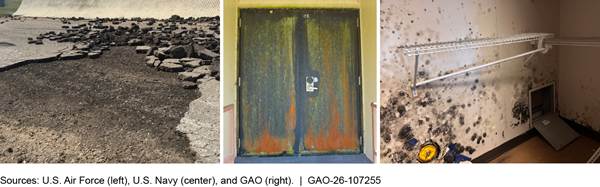
DOD also faces challenges in hiring and retaining key maintenance workers, which are critical for maintaining facilities. According to officials, challenges include hiring in remote and isolated locations; employment competition with the private sector; and federal hiring, pay, and work eligibility practices, which have been exacerbated by recent workforce reductions and the subsequent hiring freeze. However, GAO found that the military departments have not fully identified the extent of maintenance workforce shortages or developed strategies to address these challenges. Doing so would better position department and service leadership to ensure that they have the skilled workforce to address maintenance needs.
Reliable information is important for DOD to effectively prioritize needed maintenance and improvement projects in light of insufficient funding and workforce challenges. However, GAO found that standards for maintenance vary across the services, limiting effective department-wide decision-making. Additionally, installations rely on maintenance work order data systems to respond to identified maintenance needs. However, GAO found that tracking is limited and that the data within those systems are generally unreliable for determining the overall effectiveness of maintenance performed across installations and the services. With improved maintenance information, DOD would be better positioned to take steps to strengthen oversight to improve the department’s vast portfolio of infrastructure and ensure that risks to mission and quality of life are reduced.
Why GAO Did This Study
DOD had over 736,000 facilities worldwide, with an estimated value of $2.6 trillion as of fiscal year 2025. Managing real property has been on GAO’s High-Risk List since 2003. GAO has reported that better management of the federal government’s real property portfolio is needed to collect reliable real property information and improve the condition of federal facilities, including DOD facilities, and could save billions of dollars.
Senate Report 118-58 and House Report 118-125 contained provisions for GAO to assess DOD’s installation maintenance practices. Specifically, this report examines the extent to which DOD has (1) fully funded its facility maintenance and improvement needs; (2) determined the sufficiency of its maintenance workforce; and (3) developed the needed standards, reliable information, and oversight to manage installation maintenance.
GAO analyzed DOD policies, budgets, maintenance data, and other documentation; interviewed DOD officials, including installation officials and maintenance customers from a non-generalizable sample of eight installations.
What GAO Recommends
GAO is making 13 recommendations to DOD, including that DOD determine risks associated with funding maintenance below recommended levels; identify and address maintenance workforce shortages; improve the reliability of maintenance data; and strengthen departmental oversight. DOD concurred with 7 recommendations, partially concurred with 5, and non-concurred with 1, in some cases noting ongoing actions that would address them. GAO maintains that DOD should fully implement all of these recommendations.
|
Abbreviations |
|
|
|
DOD |
Department of Defense |
|
|
FSM |
Facilities Sustainment Model |
|
|
HVAC |
Heating, ventilation, and air conditioning |
|
|
OSD |
Office of the Secretary of Defense |
|
This is a work of the U.S. government and is not subject to copyright protection in the United States. The published product may be reproduced and distributed in its entirety without further permission from GAO. However, because this work may contain copyrighted images or other material, permission from the copyright holder may be necessary if you wish to reproduce this material separately.
August 21, 2026
The Honorable Roger Wicker
Chairman
The Honorable Jack Reed
Ranking Member
Committee on Armed Services
United States Senate
The Honorable Mike Rogers
Chairman
The Honorable Adam Smith
Ranking Member
Committee on Armed Services
House of Representatives
The Department of Defense (DOD) reported that it had over 736,000 facilities worldwide in fiscal year 2025, including buildings and other structures, with an estimated value of $2.6 trillion.[1] Aging infrastructure adds to the department’s needs for maintenance. DOD has reported that about a third of its buildings are more than 50 years old.[2] Neglecting mission-critical infrastructure such as runways and depots can harm readiness, while deficiencies in maintenance for facility systems, such as heating, ventilation, and air conditioning (HVAC) and plumbing, can affect service members’ quality of life—to include their health and safety—as well as opportunities for recruitment and retention. The department requested nearly $20 billion for fiscal year 2025 for the sustainment, restoration, and modernization of facilities.
Managing real property has been on GAO’s High Risk List since 2003. We reported in 2025 that better management of the federal government’s real property portfolio is needed to collect reliable real property information and improve the condition of federal facilities, including DOD facilities, and could save billions of dollars.[3] Contributing to this High Risk designation are poor facility conditions resulting from the deferred maintenance on many buildings and thereby creating a backlog of needed repairs. For example, in January 2022, we reported that for many years, DOD had not fully funded its facility sustainment requirements, averaging about 80 percent of its annual requirement while balancing competing priorities.[4] As a result, the department had a backlog of $137 billion in deferred maintenance costs in fiscal year 2020. Since that time, DOD reported that its deferred maintenance requirements increased to an estimated $285 billion in fiscal year 2025—a significant and growing risk to the department’s ability to support its missions.[5]
In prior work, we found that the maintenance of some barracks was chronically neglected and that resulting poor conditions negatively affected the quality of life and readiness of enlisted service members. In September 2023, we reported that thousands of service members lived in substandard barracks, and we observed barracks that posed potentially serious health and safety risks, such as the existence of mold and inoperable fire systems.[6] As of April 2026, DOD had implemented 19 of our 31 recommendations, including updating guidance on health and safety standards. However, key recommendations remain unaddressed, such as establishing a regular oversight structure for barracks.
House Report 118-125 and Senate Report 118-58, accompanying bills for the National Defense Authorization Act for Fiscal Year 2024, contained provisions for us to assess DOD’s installation maintenance practices.[7] Specifically, we examined the extent to which DOD has (1) fully funded its facility maintenance and improvement needs; (2) determined the sufficiency of its maintenance workforce; and (3) developed the needed standards, reliable information, and oversight to manage installation maintenance.
To address these objectives, we examined facility maintenance at military installations in U.S. states and territories for the Army, Navy, Marine Corps, and Air Force.[8] We focused primarily on facility maintenance, but we also examined utility and horizontal structure maintenance when it overlapped with facility maintenance, such as the maintenance of installations’ water treatment facilities or airplane runways. We also examined backlogs in facility improvements and military construction that affect facility maintenance and condition.
For all objectives, we obtained and reviewed relevant documents, including guidance, policies, and procedural documents. We interviewed officials in each of the services who are responsible for managing installation facility maintenance and facility project funding at the service level. We contacted eight installations to review documents, interview officials, interview maintenance customer organizations, and observe facility conditions at the installation level to support all objectives. Among these, we conducted four in-person site visits to installations in the contiguous U.S., including Marine Corps Air Ground Combat Center Twentynine Palms, California; Minot Air Force Base, North Dakota; Fort Benning, Georgia; and Naval Station Norfolk, Virginia. Further, we contacted four Pacific installations outside the contiguous U.S., including Andersen Air Force Base, Guam; Naval Base Guam; Marine Corps Base Hawaii; and Fort Wainwright, Alaska. We used a non-generalizable (purposeful) sampling strategy; therefore, information obtained from these sites is not generalizable to the larger population of installations and can only be used as anecdotal evidence. We selected installations from each military service and used several selection factors identified by multiple service-level maintenance offices, such as region, climate, size, and remote and isolated areas.[9]
Specifically for our first objective, we reviewed DOD guidance and analyzed military services’ facility sustainment budgets, budget requests, and obligations for fiscal years 2021 through 2025 and compared them with funding levels recommended by the DOD Facilities Sustainment Model (FSM). We found that these data were reliable for the purposes of our analysis. We analyzed data on facility repair and military construction project backlogs and compared DOD’s efforts to determine risk against federal standards for internal controls and DOD guidance.[10] For our second objective, we discussed maintenance workforce challenges with officials from the Office of the Secretary of Defense (OSD), military services, and installations, including any assessments of workforce sufficiency, and compared these efforts with federal standards for internal controls and DOD guidance. For our third objective, we analyzed one year of work order data—fiscal year 2023 for the Army, Navy, and Marine Corps, and August 2023 through July 2024 for Air Force—to identify what percentage of work orders were completed on time, using the military services’ timeliness standards. However, we found that the data were not sufficiently reliable for the analysis, as discussed in this report. We compared DOD’s standards, tracking of performance, and oversight against relevant federal standards for internal controls and DOD guidance. See appendix I for a detailed description of our scope and methodology.
We conducted this performance audit from February 2024 to August 2026 in accordance with generally accepted government auditing standards. Those standards require that we plan and perform the audit to obtain sufficient, appropriate evidence to provide a reasonable basis for our findings and conclusions based on our audit objectives. We believe that the evidence obtained provides a reasonable basis for our findings and conclusions based on our audit objectives.
Background
Types of DOD Facility Maintenance and Related Funding
In its Financial Management Regulation, DOD defines facility maintenance activities that are funded through its facilities sustainment, restoration, and modernization budget, which is provided through annual operation and maintenance appropriations:[11]
· Sustainment is the maintenance and repair activities necessary to keep an inventory of facilities in good working order.[12]
· Restoration is the restoration of real property to such a condition that it may be used for its designated purpose. Restoration includes repair or replacement work to restore facilities damaged by inadequate sustainment, excessive age, natural disaster, fire, accident, or other causes.
· Modernization is the alteration or replacement of facilities solely to implement new or higher standards, to accommodate new functions, or to replace building components that typically last more than 50 years, such as the framework or foundation.
· Recapitalization is the major renovation or reconstruction activities (including facility replacements) needed to keep existing facilities modern and relevant in an environment of changing standards and missions. Recapitalization extends the service life of facilities or restores lost service life. It includes restoration and modernization of existing facilities, as well as replacement of existing facilities with new facilities.
DOD uses FSM to estimate facility sustainment funding requirements for regular maintenance. FSM estimates sustainment funding requirements for facilities based on their type, size, and location, and inflation, resulting in service-level budget estimates when aggregated. DOD requests facilities sustainment, restoration, and modernization funds for facility maintenance needs in its budget request each year, which includes sustainment funding requests based on a percentage of the model’s recommendations. DOD guidance describes the practices to develop budget requests for these activities.[13]
DOD accomplishes its facility sustainment projects—as well as projects to restore and modernize facilities that do not expand the facility size—using appropriations available for operation and maintenance. In some circumstances, such as where the project would expand the facility size, projects may be extensive enough that they become military construction projects. In that case, DOD can only use operation and maintenance amounts up to a specified threshold, presently $4 million, above which it must use amounts from military construction appropriations. In both cases, these repair or construction projects carry requirements for congressional notification and additional approval by the military department secretaries.[14]
Facility Improvement Projects and Construction Funding
DOD typically accomplishes projects to replace obsolete or severely deteriorated facilities, as well as to improve or modernize existing facilities that include expanding their current size, using military construction appropriations for minor construction costing up to $9 million and seeking Congressional authorization and individual funding for projects costing more than $9 million. Military construction appropriations are available for 5 years compared with only one year for operation and maintenance appropriations.[15] Minor construction projects costing less than $4 million may optionally be funded with operation and maintenance appropriations. Facility improvements such as military construction and repair projects from operation and maintenance appropriations—which according to OSD officials include restoration, modernization, and recapitalization projects—may affect maintenance activities on installations. These improvements may add new maintenance requirements for the sustainment of new facilities or may increase or decrease maintenance requirements by replacing or renovating existing facilities. See appendix II for more information on repair and construction project approval requirements.
DOD Facility Maintenance Roles and Responsibilities
Department and service-level offices conduct oversight and guidance for maintenance activities. For OSD, the primary office with installation maintenance responsibilities is the Assistant Secretary of Defense for Energy, Installations, and Environment, within the Office of the Under Secretary of Defense for Acquisition and Sustainment. According to a DOD directive, the Under Secretary of Defense for Acquisition and Sustainment is responsible for overall oversight of DOD real property and overarching guidance and procedures for the acquisition, management, and disposal of DOD real property.[16] See table 1 for a list of key maintenance oversight and guidance offices.
|
DOD organization |
Maintenance oversight and guidance office |
Roles and responsibilities |
|
Office of the |
Assistant Secretary of Defense for Energy, Installations, and Environment, within the Office of the Under Secretary of Defense for Acquisition and Sustainment |
Principal advisor to the Under Secretary on matters relating to installation maintenance, among other topics. |
|
Department of the Army |
Deputy Chief of Staff G-4, Logistics |
Army headquarters office with responsibility for policy and oversight of facility maintenance and construction. |
|
Installation Management Command |
Provides Army installation support services and guidance, including for facility maintenance. |
|
|
Department of the Navy |
|
|
|
Navy |
Deputy Chief of Naval Operations N4, Logistics |
Navy headquarters office with responsibility for policy and oversight of facility maintenance and construction. |
|
Naval Facilities Engineering Systems Command and Commander, Navy Installations Command |
Naval Facilities Engineering Systems Command provides guidance for installation maintenance and executes installation-level maintenance funded by Commander, Navy Installations Command and other offices. According to Navy officials, responsibility for executing installation-level maintenance will transfer from Naval Facilities Engineering Systems Command to Commander, Navy Installations Command by the end of fiscal year 2026. |
|
|
Marine Corps |
Deputy Commandant, Installations and Logistics |
Marine Corps headquarters office with responsibility for policy and oversight of facility maintenance and construction. |
|
Marine Corps Installations Command |
Provides Marine Corps installation support services and guidance, including for facility maintenance. Partners with Naval Facilities Engineering Systems Command to coordinate Marine Corps installation facility support from the Department of Navy as appropriate. |
|
|
Department of the Air Force |
|
|
|
Air Force and Space Forcea |
Headquarters Air Force A4C, Civil Engineers |
Air Force headquarters office with responsibility for policy and oversight of facility maintenance and construction. |
|
Air Force Civil Engineer Center |
Provides Air Force and Space Force installation support services and guidance, including for facility maintenance. |
Source: GAO analysis of Department of Defense information and statements from officials. | GAO‑26‑107255
aAccording to Air Force officials, the Air Force manages maintenance activities for Space Force installations.
At the installation level, there is typically an installation commander and a subordinate installation maintenance office—such as a Directorate of Public Works in the Army, Public Works Department in the Navy or Marine Corps, or a Civil Engineer Squadron in the Air Force—that provides maintenance to customer organizations or tenant groups that occupy facilities on installations. These offices receive maintenance requests and assign them to maintenance workers to complete, based on skills needed. They also schedule preventative maintenance for components to be replaced or serviced based on manufacturer or industry standards. To complete maintenance activities, the installation maintenance office may use a workforce of civilian employees, contractor personnel, or a mixture. Additionally, the Air Force uses military personnel as a substantial element of its maintenance workforce, which, according to officials, is a unique practice among the services.
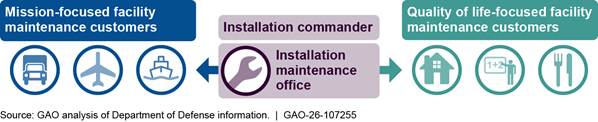
Facility maintenance activities can support customer organizations focused on mission, such as combat and logistics units, and on quality of life, including housing, education, dining, or recreation organizations. While DOD does not categorize facility maintenance by mission or quality of life, these are major areas of installation activity that depend on maintenance support. This maintenance support could include sustainment of combat vehicle infrastructure for customers focused on mission, residential HVAC and plumbing services for housing, maintenance of administrative office buildings, or other services. Figure 1 illustrates the types of customers requiring maintenance on military installations.
DOD Has Not Fully Funded Its Facility Maintenance and Improvement Needs
DOD Has Not Requested Full Funding for Maintenance Activities
DOD does not request full funding for its identified maintenance needs. Specifically, DOD does not request the full amount of maintenance funding recommended by its FSM, which estimates the average annual sustainment funding requirement for an inventory of facilities based on their size, average unit cost, location, and inflation. Continual funding of needed maintenance below recommended FSM funding levels has contributed to the growing backlog of deferred maintenance needs. DOD’s deferred maintenance has increased from $137 billion in fiscal year 2020 to an estimated $285 billion in fiscal year 2025.
The Under Secretary of Defense for Acquisition, Technology, and Logistics issued a memorandum in 2014 on facility sustainment, which established a goal for the services to fund regular maintenance at 90 percent or higher of the amount estimated by the FSM.[17] However, we have previously reported that the services were not meeting that goal: we found that the services requested about 80 percent of the model’s recommendations for fiscal years 2017 through 2020.[18]
During this review, we found that for fiscal years 2021 through 2025, the services continued to fall short of DOD’s goal as shown in figure 2.
Figure 2: Department of Defense Budget Requests and Obligations for Facility Sustainment Compared with Funding Requirements and Goals, Fiscal Years 2021–2025
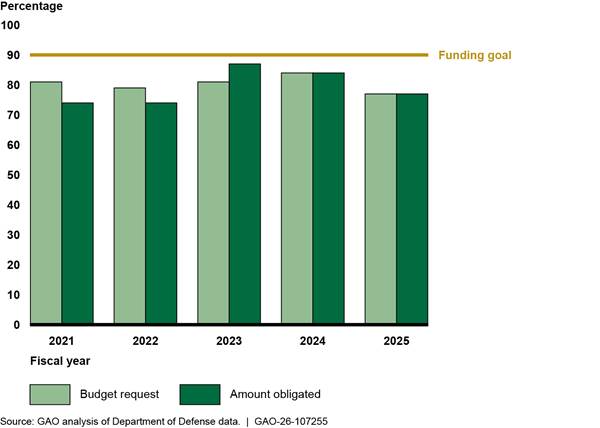
The Army, Navy, and Air Force generally requested around 80 percent of the recommended sustainment funding during this period and obligated funds at similar levels. The Marine Corps requested funding has dropped from 80 to 40 percent over the last 5 fiscal years, which OSD officials stated is due to the Marine Corps requesting to fund more facility restoration and modernization projects in exchange for reduced sustainment funding. Figure 3 shows the estimated percentage of maintenance funding requested compared with the total FSM-recommended funding levels and the 90 percent DOD funding goal by each service for the last 5 fiscal years.
Figure 3: Budget Requests for Facility Sustainment Compared with Funding Requirements and Goals by Military Service, Fiscal Years 2021–2025
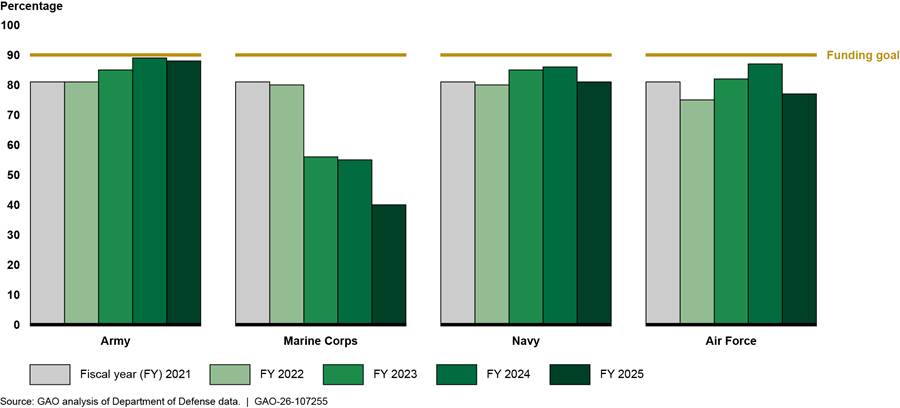
Officials from all eight installation maintenance offices we contacted stated that they received less sustainment funding than recommended, and none reported receiving funding that met DOD’s goal of 90 percent.[19] Consequently, these installations have not been able to fully support maintenance needed to keep all facilities in good working condition. Installation officials stated that they must decide which maintenance work orders to address while delaying others.
Specifically, these installations received the following average levels of sustainment funding from fiscal year 2021 through fiscal year 2025 as a percentage of the full 100 percent amount recommended by FSM:
· Army. These installations had the highest average sustainment funding, as Fort Benning received 83 percent of the level recommended by FSM and Fort Wainwright received 78 percent.
· Navy. Naval Base Guam received 62 percent and Naval Station Norfolk received 61 percent of FSM-recommended funding.
· Marine Corps. Twentynine Palms received 59 percent and Marine Corps Base Hawaii received 60 percent of the FSM recommendations.
· Air Force. These installations had the lowest reported facility sustainment funding levels, with Andersen Air Force Base receiving 37 percent and Minot Air Force Base receiving 40 percent of the FSM recommendations.
See appendix III for a more detailed assessment of DOD’s requests for FSM funding requests compared with funding needs for select installations by military service from fiscal year 2021 through fiscal year 2025.
DOD Has Not Requested Full Funding for Facility Improvements
In addition to funding maintenance below recommended FSM levels, DOD likewise requests less funding than recommended by service installation management offices to complete facility improvement projects. Such projects can include building new infrastructure through military construction appropriations or completing major repairs for the existing infrastructure through facilities restoration, modernization, and recapitalization projects using operation and maintenance appropriations.[20]
In 2025, we reported that DOD had invested on average $14.6 billion annually over the 5 preceding years to build new facilities through military construction.[21] However, OSD and military service officials we spoke with identified many needed facility construction and repair projects that have been approved as valid requirements by service review boards but remain unfunded. For example, in January 2025, officials from Naval Station Norfolk said that multiple piers needed renovation, but the Navy was only actively improving one of the piers. As a result, officials said these piers operated in degraded condition, with one pier having to lower its weight rating for safety, thereby reducing its utility for ship services. Further, multiple piers were using above-ground temporary utility systems due to inoperable integrated utility systems—thus increasing costs and limiting vehicle operations around the piers—as depicted in figure 4.
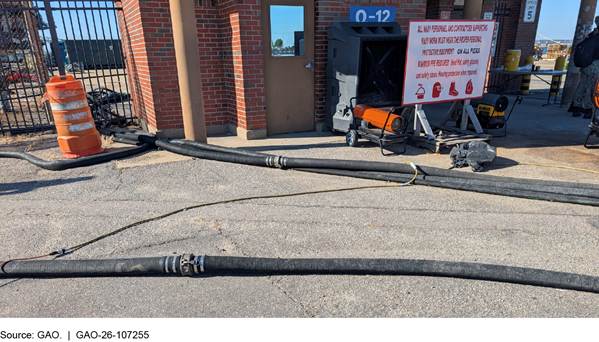
According to officials from the services, there is currently no requirement or standard method to report the total backlogs of military construction projects that have been approved as valid requirements but remain unfunded. As a result, the services varied in their ability to provide complete information about these projects.
· Army. Army officials identified about $140 billion in valid military construction and facility repair projects that have not yet received funding as of April 2025.
· Navy. Navy officials identified about $70 billion in military construction requirements and about $37 billion in repair project requirements as of April 2025, which does not include the Marine Corps. They also stated that there is likely more backlog in facilities projects than has been measured, as these are only requirements that have been identified as valid.
· Marine Corps and Air Force. The Marine Corps and Air Force have not measured unfunded military construction and facility repair needs, but there were substantial unfunded needs as of May 2025, according to officials from these services.
Deferred Maintenance and Improvement Project Backlogs Affect Mission and Quality of Life
Deferred maintenance and improvement project backlogs have contributed to a degraded infrastructure that can negatively affect installation missions as well as service members’ quality of life. Some of the facilities with deferred maintenance and repairs are aging facilities that officials said are overdue for repair or replacement. Service and installation officials estimate that in some cases, the long-term costs for maintaining aging facilities are more than the short-term costs DOD saves through lower budget requests for improvement projects that would renovate or replace these facilities. Officials also stated that these aging facilities are less effective in supporting installation missions and quality of life than if the facilities were repaired or replaced.
During our site visits or meetings with officials from selected sites, officials explained—and in some cases we observed—the negative effects of deferred maintenance and improvement project backlogs. These deferred projects can increase overall costs and affect mission. For example:
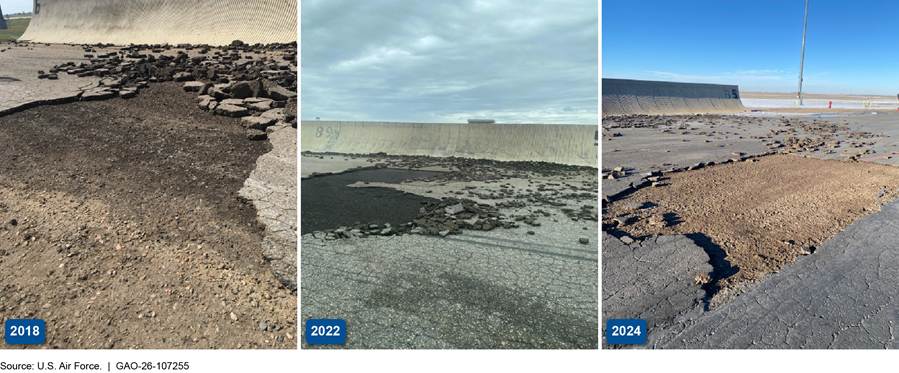
· Minot Air Force Base. Officials identified their B-52 aircraft parking area as being over 30 years past its expected life-span, specifically overdue for a facility improvement to replace the old pavement. According to the installation officials, Air Force leadership instructed the base to complete the project through a multiple-phase repair plan. The base developed a plan accordingly but has not been able to complete it due to competing maintenance priorities at Minot and other bases, among other factors. The installation had only replaced about one-third of the area as of September 2024 and has instead conducted multiple smaller repairs to maintain the old pavement. According to the officials, this approach has likely made infrastructure replacements less cost efficient. They estimate that Minot Air Force Base has spent about $3.5 million in maintenance resources to repair damage to the aging infrastructure, as depicted in figure 5, plus additional labor to frequently inspect the parking area for debris, to prevent damage to aircraft.
Figure 5: Damage to B-52 Parking Area at Minot Air Force Base Requiring Repairs in 2018, 2022, and 2024
· Andersen Air Force Base. An official described an aircraft hangar awaiting completion through military construction funding that would allow aircraft to be painted with low observable paint. However, according to the official, the hangar has been multiple years behind schedule; meanwhile, Andersen Air Force Base must maintain older hangars to house these aircraft and routinely fly the aircraft to other locations when they need to be repainted, thereby increasing aircraft operations costs and reducing their mission availability.
· Twentynine Palms. In October 2024 officials showed us a vehicle maintenance facility that was narrowly able to accommodate existing Marine Corps vehicles. Currently, maintainers must partially deflate the vehicles’ tires to enter the garage doors and must perform maintenance work in a narrow space since they do not have room to remove vehicle under-armor, as shown in figure 6.
Figure 6: Aging Vehicle Maintenance Facility Planned for Repair at Twentynine Palms Marine Corps Air Ground Combat Center, CA
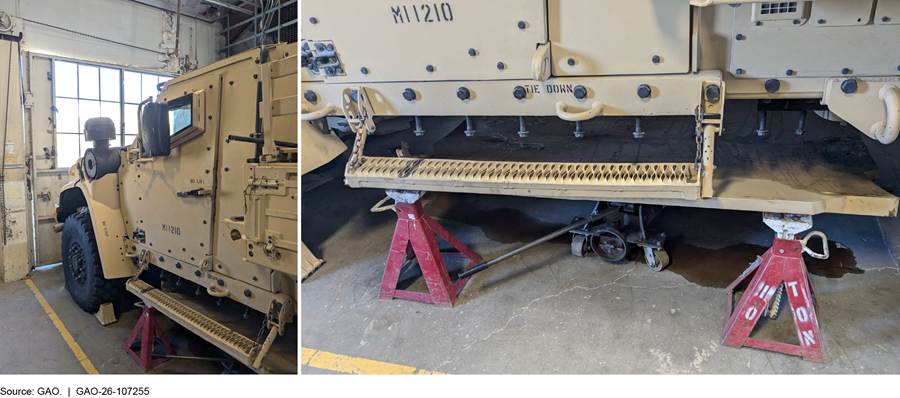
According to the officials, the facility will not be large enough to accommodate future Marine Corps vehicles in its current configuration. They said that it would be more cost-effective and better support mission to construct a new building as a military construction project, but the Marine Corps had not submitted the project for military construction funding. Officials stated that as a result of military construction backlogs, the installation was pursuing a repair project to modify the facility to accommodate the new vehicles, despite the facility being in poor condition and outdated, such as having a deteriorating ceiling and insufficient restrooms.
Service members and others that live or work in facilities in poor condition may have their quality of life affected through their health, safety, or morale. For example:
· Naval Base Guam. Officials identified frequent HVAC failures and roof leaks in their aging workspaces, causing unsafe or undesirable working conditions due to heat, water damage, and possible mold growth.
· Naval Station Norfolk. Officials identified delays in addressing mold growth that affect housing availability and costs. We observed suspected mold growth in a barracks closet, as shown in figure 7.
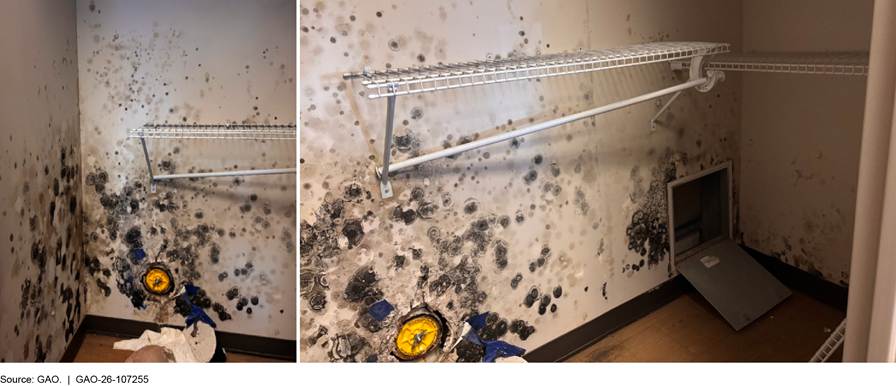
According to Naval Station Norfolk housing officials, they identified the suspected mold in late 2023, but the installation maintenance office declined their request to test the growth for mold due to the cost of testing and potential remediation. The housing officials stated that they treat the area with cleaning products and have closed the affected room and an adjacent room to protect residents’ health and prevent further spread. According to the officials, the suspected mold had not been addressed as of February 2026. As a result, the lack of resources for mold testing and remediation reduced housing availability and created the risk of further damage to the facility. In 2022, we reported that another barracks at Naval Station Norfolk had extensive mold growth, with over half of rooms designated as uninhabitable.[22] According to the housing officials, that barracks suffered from design flaws and a lack of sustainment and has since been completely condemned due to mold.
· Fort Wainwright. Officials identified that the main dining facility for those living in barracks on the installation is designed to serve 800 soldiers, but there are about 3,000 soldiers living there. Officials said that as a result, the dining facility is not able to serve soldiers in a timely manner, so many opt to eat less-healthy food in their living spaces at their own expense, especially in the winter when it is too cold to wait in line outside. According to the officials, the installation commander and other Army leaders have repeatedly advocated for expansion of the dining facility as a high priority, but it had yet to be selected for military construction funding as of March 2026.
See appendix IV for more information on common maintenance challenges on installations and more specific challenges faced in various regions.
DOD Has Not Fully Determined or Reported to Congress Risks of Funding Maintenance and Improvement Projects Below Recommended Levels
By requesting less funding for installation maintenance and improvement projects than its models and experts recommend, DOD has chosen to accept some degree of risk that mission or quality of life will be negatively affected. Senior Air Force officials testified before Congress in 2021 that the department has chosen to accept the risk of investing less in facilities than what DOD had determined was needed to effectively sustain them.[23] Officials from OSD and the services also told us that the services typically set budget caps for facilities that are not fully sufficient to meet facility requirements due to other budget priorities such as weapon platforms and combat units. Although DOD is constrained by these budgetary limitations, it has not fully determined the risks it has chosen to accept by funding facilities below recommended levels each year and thus increasing deferred maintenance and facility improvement backlogs.
Although DOD has not fully determined these risks, DOD communicates to Congress some information about facility sustainment funding levels and facility maintenance and improvement project repair backlogs. According to officials from the services, the services use review boards to select which military construction projects and which operation and maintenance-funded repair projects for facility improvements to fund within respective facilities budget caps, and the services base their budget requests on these decisions. For facility sustainment funding specifically, DOD identifies the level of sustainment funding it is requesting as a percentage of FSM recommendations within its operation and maintenance budget justification materials. This identification informs Congress about maintenance funding requests that are less than recommended. Further, DOD reports estimated totals of deferred maintenance and facility improvement repairs from operation and maintenance-funded activities to Congress in the OSD Comptroller’s annual financial reports.
For military construction projects involving building new facilities or making major facility improvements, DOD provides Congress with the list of projects the services selected for their appropriations requests. DOD provides some information to Congress on identified military construction needs that have not been funded through unfunded priority lists. Specifically, certain officers within DOD are required by law to annually submit lists of unfunded priorities to the Secretary of Defense, Chairman of the Joint Chiefs of Staff, and the congressional defense committees within 10 days of submission of the President’s budget request to Congress. These unfunded priority lists include billions of dollars’ worth of additional military needs not included in the President’s budget request, such as aircraft and military construction.[24] However, we found in September 2025 that the unfunded priority lists have some weaknesses, as several DOD organizations left out information that is needed for prioritizing unfunded needs.[25]
For military construction needs specifically, we previously reported that DOD does not provide Congress full information on the funding requirements for needed projects for certain types of facilities. For example, in 2023 we found that DOD had not established a method for the services to communicate the complete military construction funding needs for barracks improvement projects or new buildings.[26] Officials at five of 10 installations we visited during that review told us they had more barracks projects in need of funding than they included in their submissions for funding requirements due to competing priorities. Thus, we recommended that each military service develop and implement a method to ensure that the service has visibility into all military construction funding needs identified at the installation level, regardless of whether they are chosen to be submitted for funding. The services have taken steps to implement this recommendation, but these positive steps only apply to barracks and not to all other types of buildings and other infrastructure.
During this review of all installation infrastructure, officials at all eight installations we contacted similarly identified military construction needs that were not submitted for funding due to competing priorities. DOD guidance requires that all installations complete master plans covering a 10-year period and include a specific annual listing of all construction projects and major repair and sustainment projects needed during the period covered by the plans.[27] Beyond a statutory requirement to provide a list of all installation master plans completed for each major military installation each year, the department is not required to provide Congress the information in the plans.[28] Military service officials we met stated that needed projects are identified as part of this master installation planning process, and as a result, information about needed projects by installation is readily available. These plans typically contain explanations for proposed projects, such as how they would enhance installation missions and quality of life. However, the planning process does not require a determination of the risks of not completing needed projects, and there is no requirement for DOD to communicate to Congress the potential risks of not completing the projects.
DOD guidance emphasizes efficient management of its assets, including real property. According to DOD Directive 4165.06, the Under Secretary of Defense for Acquisition and Sustainment is responsible overall for oversight of DOD real property and overarching guidance and procedures for the acquisition, management, and disposal of DOD real property.[29] Further, DOD’s Financial Management Regulation notes that budget planning and control serves as an important function in federal government and that, with appropriate cost information collected, managers can produce budgets at a detailed level, which will improve accuracy, insight, and increased transparency.[30] Further, Standards for Internal Control in the Federal Government state that management should identify risks and should internally and externally communicate relevant and quality information.[31]
Although DOD provides information on funding needs as part of the budget process, the department has not fully determined the risks to mission and quality of life due to (1) funding facility sustainment below recommended FSM funding levels and (2) increasing backlogs in military construction and facility repair projects, because there has not been a specific requirement to do so. DOD requiring that the services conduct assessments to fully determine the effects of these risks to mission and quality of life could help the department better identify needed funding for facility sustainment and for facility repair and construction projects to mitigate these risks. Communicating to Congress and DOD leadership the results of these assessments that fully determine risks would provide decision-makers with better information to weigh budget priorities.
Military Departments Have Not Fully Identified Workforce Requirements to Address Installation Maintenance Needs
Installations have taken steps to address challenges in recruiting and retaining a sufficient maintenance workforce. However, the military departments have not fully identified maintenance workforce shortages or developed strategies to address them.
Installations Face Challenges Recruiting and Retaining Maintenance Personnel
Officials from OSD, the military services, and the installations consistently identified several workforce challenges during our review, specifically in recruiting and retaining maintenance staff in remote and isolated locations, competing with private sector employers, and complying with federal hiring and personnel management practices.
We reported in February 2026 that all 10 of the DOD joint bases with available data had shortages in their facility management workforce, ranging from 68 to 97 percent of approved positions, or billets authorized, filled from fiscal year 2013 through fiscal year 2023.[32] Previously, we found in September 2025 that the services and installations reported challenges in recruiting and retaining federal blue-collar employees who work in trade, craft, and labor, such as certain types of maintenance. These reported challenges included difficulty in competing with the private sector for skilled labor, offering competitive wage rates, and navigating the lengthy federal onboarding process.[33]
Each of the eight installation maintenance offices we contacted identified steps taken to address these challenges in recruiting and retaining a sufficient workforce, but each installation still had key shortages that hindered effective maintenance.
Remote and Isolated Locations
Officials from each of the five remote and isolated installations we contacted identified strategies they use to address challenges in recruiting and retaining workers due to the small local population and limited incentives to attract workers from other areas.[34] They reported using differing strategies to recruit and retain staff:
· Andersen and Minot Air Force Bases. Officials from both bases identified the value of using enlisted personnel to support a stable installation maintenance workforce. According to Air Force officials, the Air Force is unique among the services in employing military personnel for facility maintenance, largely enlisted airmen.
· Twentynine Palms. Officials at the installation told us that they have had some success recruiting local workers for entry-level positions and internally training them for higher roles as they progress in their careers.
· Fort Wainwright. Officials from this installation told us that the Army allows the use of incentive pay to help recruit facility maintenance workers to their remote and isolated location.
· Andersen Air Force Base and Naval Base Guam. Officials at these installations reported using foreign H-2B temporary nonagricultural visa workers to supplement their civilian facility maintenance and construction workforce in Guam, with many workers originating from the Philippines, among other locations.[35]
According to installation officials, despite these efforts, workforce shortages continue to negatively affect maintenance at these remote and isolated installations, with officials from all five installations identifying deferred maintenance due to the shortages. For example, Air Force data from August 2024 showed that Minot Air Force Base needed 313 maintenance staff, but the base was authorized for 295 and ultimately assigned 258 staff. Of those assigned, 247 were available to perform work. According to a maintenance customer at Minot Air Force Base, the office building they occupy has three elevators that disabled veterans and others need to access, but only one remained in operation as of September 2024 and was configured with mismatched parts. Since there is often no elevator technician available at Minot, the customer learned to perform some basic elevator maintenance. Although DOD guidance allows more funding flexibility for morale, welfare, and recreation programs for remote and isolated installations and requires the military departments to periodically assess shortages in these programs, the guidance does not address the facility maintenance workforce challenges that these installations experience.[36]
Private Sector Competition
Service and installation officials stated that recruiting and retaining workers is difficult where private sector employment is present, especially in filling specialized roles such as high-voltage electricians, HVAC and elevator technicians, and nuclear facility staff, thereby contributing to gaps in maintenance skills and qualifications at installations. This challenge existed especially in more populated areas, as officials from each of the three select installations located near more populated areas stated that competition with other employers in the surrounding area made recruiting and retaining workers more difficult. For example, officials from Marine Corps Base Hawaii told us that because of retention difficulties, there was only one plumber on staff for their Air Station Kaneohe Bay site as of June 2025—even though the site has multiple barracks and numerous other facilities—resulting in high work demand for the plumber and backlogs of plumbing issues.
According to officials from Fort Benning, Marine Corps Base Hawaii, and Naval Station Norfolk, because private employers can offer more pay, the bases sometimes lose workers that they have trained to other higher-paying opportunities. Officials from Fort Benning told us that salary and hiring challenges are one reason the installation chose to contract its maintenance workforce, as contractors have more flexibility with salary and hiring processes. Officials from Fort Wainwright, although remote and isolated, also identified similar challenges in competition with the private sector due to substantial mining operations in the area.
Federal Hiring and Personnel Management Practices
Officials from seven of the eight installations also cited federal hiring and personnel management practices as a challenge to recruiting and retaining facility maintenance workers. Specifically, officials identified stringent eligibility requirements, slow and lengthy hiring procedures, complex and inefficient hiring systems, and hiring freezes as factors that limit the pool of eligible and interested candidates. Officials also reported that less competitive federal pay has prompted facility maintenance workers to leave for higher-paying positions elsewhere in the region.
We interviewed officials at three installations after the Office of Personnel Management announced the Deferred Resignation Program and it became clear which employees chose to participate in the program.[37] Officials from their installation maintenance offices all reported that their maintenance and facility management workforce substantially decreased and that the positions, or billets, for any individuals participating in the program were permanently eliminated from their offices regardless of need. Further, officials from these three installations stated that the subsequent hiring freeze has prevented them from filling open maintenance billets.[38] According to the officials, these initiatives have substantially reduced installation maintenance office staff—including maintenance technicians, design engineers, and administrative staff—which has reduced their ability to complete facility sustainment maintenance. According to an official from one installation, reductions in personnel due to the Deferred Resignation Program at other organizations also have affected their ability to support facility management. For example, they rely on the U.S. Army Corps of Engineers for facility design support but have not been able to secure the same support following reductions within that organization.
According to Air Force officials, recent maintenance workforce reductions have had wider effects. They stated that a combination of civilian hiring freezes, workforce optimization efforts, the Deferred Resignation Program, and changes from the Agile Combat Wing construct have reduced civilian and military staff in several locations. According to the officials, these initiatives have created broad pressures on facility maintenance. For example, Little Rock Air Force Base consequently lost about 46 percent of its baseline workforce availability for facility maintenance.
Military Departments Have Not Fully Identified Maintenance Workforce Shortages or Developed Strategies to Address These Shortages
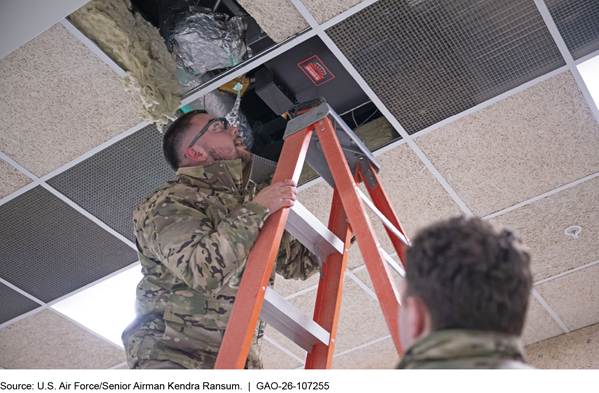
Military department leadership are aware that maintenance workforce shortages exist across installations and know of challenges to recruitment and retention, but the military departments have not managed this risk by fully identifying the shortages or developing a strategy to address them. OSD officials stated that the military departments and individual installations are primarily responsible for the maintenance workforce. Service officials identified some service-level efforts to support recruitment and retention, such as the Army’s and Navy’s pay incentives and career fairs; Marine Corps’s workforce discussions with installation offices and career planning efforts; and Air Force’s use of uniformed airmen to perform facility maintenance to help offset difficulties in civilian recruitment and retention. See figure 8 for an example of an airman performing facility maintenance.
However, according to officials from each of the services, there are not service-level assessments that identify maintenance workforce shortages or strategies to address them because these responsibilities are typically left to the initiative of individual installations or other regional or local offices.
We added strategic human capital management to our High-Risk List in 2001 as DOD faces long-standing challenges in this government-wide High-Risk area. Specifically, agencies experience skills gaps when they have an insufficient number of individuals without the appropriate skills or abilities to successfully perform their work. Skills gaps pose a high risk to the nation because they impede the government from effectively serving the public and achieving desired results. In 2022 the Office of Personnel Management issued a workforce planning guide that provides direction for analyzing a workforce and identifying gaps, as well as planning and implementing workforce action planning efforts.[39]
DOD similarly developed a workforce planning guide to outline a common business practice for workforce planning that would identify the current workforce, future requirements, and a plan to fill gaps to support the mission.[40] DOD conducts workforce planning assessments for certain occupations that are determined to be mission-critical, for which 43 occupations were identified in fiscal year 2024.[41] While some occupations related to maintenance and construction are identified as mission-critical in the most recent list, such as civil engineering, maintenance work was not identified as mission-critical through the most recent department-wide assessment and therefore has not been assessed.[42] Further, we reported in February 2026 that for joint bases specifically, funding and workforce for maintenance was insufficient and operational responsibilities for maintenance was unclear. DOD generally concurred with our five recommendations to address these issues, and we will continue to monitor DOD’s progress towards addressing them.[43]
DOD guidance emphasizes responsible management of its workforce as a department-level responsibility. Specifically, DOD Directive 5124.02 outlines the responsibility of the Under Secretary of Defense for Personnel and Readiness to develop policies on recruitment, training, education, and compensation, including special pay and incentives.[44] Further, Standards for Internal Control in the Federal Government indicate that management should demonstrate a commitment to recruit, develop, and retain competent individuals.[45]
Although individual installations know or can determine their needs for maintenance staff and compare them with current staffing levels, neither DOD nor the military departments have conducted a workforce planning assessment to identify maintenance workforce shortages across the installations because DOD and the military departments have left this responsibility to the installations. However, workforce planning is a military department-level responsibility, and installations may not be positioned to develop strategies to fully address their workforce shortages due to challenges beyond their control, such as location, labor markets, and federal hiring practices. Identifying critical workforce shortages across installations and developing strategies to address them would enable DOD and service decision-makers to ensure the military services have the maintenance workforce, with the needed skills, to complete facility sustainment maintenance.
Opportunities Exist to Improve Standards, Reliability of Information, and Oversight to Determine Effectiveness of Facility Maintenance
Standards for effective maintenance vary across services, such as for timeliness, quality, and customer satisfaction with the work performed. Additionally, the data DOD needs to track maintenance work are unreliable. Further, OSD does not provide sufficient oversight of installation maintenance programs.
Standards for Effective Maintenance Vary Across Military Services
Timeliness Standards
According to officials from the Office of the Assistant Secretary of Defense for Energy, Installations, and Environment, OSD has not defined department-wide standards for the timeliness of installation maintenance. In the absence of such standards, the services have developed service-specific standards for the timely completion of installation maintenance activities that vary by service. According to OSD officials, they have not determined what standards for timeliness support effective maintenance. However, officials from each service identified timeliness standards that their service developed to support their maintenance needs.
Each of the services has guidance requiring that requested maintenance work be assigned to a category to determine how quickly to respond and address the needed work. Army, Navy, and Marine Corps guidance have similar categories, definitions, and timeliness standards for completion, with some minor variance. Generally:
· Emergency: a deficiency that affects mission or life, health, and safety, such as a water main break causing flooding of a building. This category of maintenance should be completed within 24 hours.
· Urgent: a deficiency that does not immediately endanger personnel or property but delays in repairs that could result in an emergency, such as the repair of HVAC systems in noncritical buildings. The Navy requires urgent maintenance to be completed within 5 business days; the Marine Corps, within 5 days; and the Army, within 7 days.
· Routine or corrective: any other asset deficiency that cannot be categorized under emergency or urgent maintenance but is needed to maintain the facility’s working condition should be completed within 30 days. Repairing a hole in drywall and repainting are examples of this category of maintenance.
|
Air Force Work Prioritization System · 1: Emergency work · 2A: Plant operations and preventative maintenance · 2B: Contingency training projects · 3: Sustainment work, subdivided into high, medium, and low priorities · 4: Enhancement work, subdivided into scheduled and all other enhancement work Source: GAO analysis of Air Force Documents. | GAO‑26‑107255 |
Similar to the other services, the Air Force requires that emergency maintenance work sufficient to mitigate the emergency be completed within 24 hours. Otherwise, Air Force guidance uses a different process for categorizing requested maintenance and generally does not define timeliness standards for the completion of maintenance. Air Force officials stated that timeliness standards with rigid requirements can lead to inaccurate reporting from maintenance offices, as maintenance offices may prematurely close work orders to appear to have met those timeliness standards. Air Force officials stated that their work prioritization system allows for optimization of the allocation of limited resources at installations.
Differences in standards can be problematic on joint bases where the installation office and a customer organization may differently understand effective maintenance time frames. For example, officials stated that a Navy office manages Andersen Air Force Base’s family housing due to the Joint Region Marianas structure.[46] Navy housing officials stated that the Air Force’s different timeliness standards led to the Air Force’s local maintenance installation office having different maintenance priorities than the Navy officials who are managing housing. According to Navy officials, these differences in standards and priorities contribute to delayed responses and maintenance work extending past the Navy’s timeliness standards.
This variance in standards could lead to discrepancies in the timeliness of maintenance performed that can affect those that live or work on installations. DOD’s housing management manual establishes standards for housing adequacy.[47] The manual states that for unaccompanied housing, such as a barracks facility, to be suitable for occupancy by a service member, it must, in part, have no serious health and safety hazards and have heating, ventilation, and air conditioning where required by climate conditions, among other requirements. However, according to officials, air conditioning repairs are generally categorized as urgent maintenance (unless during extreme heat situations), and as such, standards for air conditioning repair vary by service. Specifically, the Marine Corps would seek to complete the repair within 5 days, compared with the Army standard that would seek to complete the repair within a week. These differences in maintenance standards for timeliness can result in differences in ensuring barracks meet housing standards. Further, service members may experience different response and completion times for the same type of maintenance across the services, which can negatively affect their quality of life as well as potentially mission. For example, officials from Fort Benning described failed air conditioning systems and lengthy repairs had led to instances of soldiers sleeping outdoors to escape extremely hot temperatures, which negatively affected their ability to rest for training.
Twenty-two of 37 customer organizations we spoke with stated that installation maintenance offices usually complete emergency maintenance work on time but struggle to complete nonemergency work in a timely manner. We heard some examples of long waiting times for the completion of needed repairs. For example, according to an official from a customer organization at Minot Air Force Base, they reported a roof leak about 3 years prior that remained unfixed at the time of our site visit.
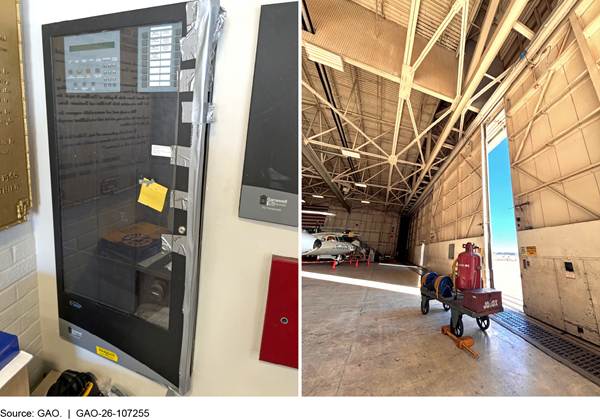
Further, we also observed some instances of safety hazards that remained unaddressed for extended periods. We have previously reported about broken fire safety systems within barracks facilities at four installations we visited, resulting in barracks residents taking on additional fire-watch duties.[48] As part of site visits for this review, we also observed inoperable fire suppression and fire alarm systems in both sailor barracks and aircraft hangars that required staffed fire watches at Naval Station Norfolk in January 2025. According to officials in February 2026, replacement of the barracks system was scheduled for completion that month, requiring staffed fire watches for over a year. In one case, an aircraft hangar had doors that could only be opened manually and lacked fire suppression systems, despite sustaining a recent fire caused by electrical problems in overhead lights. According to officials, the hangar doors and fire suppression systems remained inoperable as of March 2026. The inoperable systems are shown in figure 9.
Figure 9: Barracks and Hangar with Inoperable Fire Safety Systems at Naval Station Norfolk, January 2025
Quality Standards
We also found differences in the services’ guidance on how installations should ensure the quality of maintenance performed. For example, Army and Navy guidance indicates that installation maintenance offices should manage a quality assurance process but do not define how these offices are to do so. According to Air Force officials, quality assurance is managed by installations. Conversely, Marine Corps guidance provides details on how its installations should conduct a quality assurance program, such as requiring maintenance offices to inspect a certain percentage of work orders completed during a set period of time (e.g., weekly) to assess the quality of the work performed.
Customer Satisfaction Standards
Regarding customer satisfaction, Navy guidance states that installation maintenance officers should consider how to measure customer satisfaction but does not require officials to do so. The Marine Corps guidance on customer satisfaction is more detailed. The guidance requires maintenance quality assurance inspectors to obtain customer feedback. According to Army officials, installation maintenance officers send surveys to customers when a maintenance work order is closed, and those officers must respond to negative comments within 5 days of receiving them. According to Air Force officials, installations manage customer satisfaction.
Customer organizations that receive services from installation maintenance offices, such as combat units and housing offices, among others, also told us about being sometimes dissatisfied with maintenance performed due to insufficient communication on the status of repairs. Specifically, 22 of the 37 customer organizations reported communication problems with installation maintenance offices and their maintenance technicians. For example, at Naval Station Norfolk, the directors for barracks housing stated that they frequently email their assigned liaison at the local installation maintenance office for status updates on their open work orders yet rarely hear back.
OSD officials stated that maintenance and installation management overall is the responsibility of the services for their respective installations. However, a DOD directive states that the Under Secretary of Defense for Acquisition and Sustainment is responsible for overarching guidance and procedures for the management of DOD real property.[49] According to OSD officials, there is not an DOD-level policy on maintenance standards since it is more appropriate for the services to establish their own maintenance standards. Further, Standards for Internal Control in the Federal Government state that management should design control activities to achieve objectives and respond to risks by documenting requirements in policies and conducting appropriate control activities, such as establishing and monitoring performance measures.[50]
According to officials from the Office of the Assistant Secretary of Defense for Energy, Installations, and Environment, they have not assessed the services’ existing processes and standards for ensuring the timeliness, quality, and customer satisfaction of installation maintenance because installation management is managed by the services. As a result of the absence of department-wide guidance that would define and guide effective installation maintenance, service guidance differs in processes and standards. Therefore, those that live or work on installations may experience differences in the timeliness, quality, and satisfaction of maintenance performed, even for the same type of maintenance.
A department-wide evaluation of existing standards to determine what processes and standards contribute to the most effective maintenance could better position DOD to revise department-wide installation maintenance guidance to include identified best practices. Revising service guidance to implement best practices for effective maintenance identified in department-wide guidance would ensure that improvements are made across the department.
Maintenance Work Order Data Tracked by Services and Installations Are Unreliable
Data reliability issues within maintenance work order data limit the military services’ and installations’ ability to track the timeliness of maintenance work performed.[51] The services each use a different work order management system to track and manage maintenance activities at the installation level. Once a customer identifies a need for maintenance, a building manager or other designated individual submits a work order into the system, which tracks the work order’s progress, from requesting the maintenance to resolving the issue. These databases are primarily used by installation personnel to track the progress and completion of individual work orders.
We obtained and analyzed one year of maintenance work order data for all of the services, but we found that the data were unreliable to determine what percentage of work orders each service completed on time across all categories of maintenance.[52] Although the services all require that emergency maintenance be completed within 24 hours, it is not possible to compare performance for this type of work across the services due to differences in how data are entered or measured.
In our evaluation of timeliness work order data by service for one year, we found certain data reliability issues for each service’s data. Our analysis covered all installations in the U.S. for the Army, Navy, and Marine Corps, and all Air Force installations globally. Specifically:
· Army. The data show that about 82 percent of emergency work orders are completed within one day. However, according to Army officials, there is no standard process for how local maintenance offices should input data into their database, thus raising data reliability questions. For example, maintenance technicians may edit the start date of a work order to accurately show when the work began. However, according to Army officials, maintenance technicians are not required to update work order start and end dates to be accurate, thus the Army officials questioned work order time-stamp accuracy.
· Navy. The data show that about 89 percent of emergency work orders were completed within one day. However, according to Navy officials, their datasets often lacked complete data from installations where contractors perform maintenance.
· Marine Corps. The data show that about 71 percent of emergency work orders were completed within one day. We found significant discrepancies in the number of work order types submitted by Marine Corps installations of similar size that raised questions about the consistency of work prioritization across installations. For example, at one installation there were only 51 urgent work orders reported for fiscal year 2023. At another installation of similar size, there were about 2,700 urgent work orders reported for the same period.
· Air Force. The data show that about 68 percent of emergency work orders were completed within one day. However, the maintenance dataset Air Force officials provided us had about 2.4 million work orders with missing dates, among other issues.
At site visits and interviews, 17 of the 37 customer organizations that we interviewed that requested maintenance from installation maintenance offices stated that work orders would sometimes be closed prior to the completion of the maintenance work, which further raises questions about the accuracy of the data in determining the timeliness of maintenance work performed. Further, a prior report by the Army Audit Agency found that many instances of needed maintenance had not been submitted, which would negatively affect the completeness of maintenance data. Specifically, they reported identifying about 300 maintenance needs during their inspections of barracks that impacted life, health, and safety but were never submitted as maintenance work orders at three Army installations.[53] Additionally, prioritization of work into timeliness categories may not be consistent across installations. For example, when reviewing Marine Corps data, we found that Twentynine Palms had reported only 51 urgent maintenance work orders during fiscal year 2023, which was substantially lower than installations of similar size.
DOD has identified issues with installation facility data and has taken some steps for improvement. For example, in 2013 DOD began transitioning to a new IT system called the Sustainment Management System to have better data on the condition of facilities. The system is intended to replace and standardize different methods used across DOD to assess facility conditions, although it is not used for tracking maintenance. When we reported on this transition in 2022, DOD estimated the transition to this system would be completed in 2025.[54] However, as of January 2026, implementation was not yet complete. According to OSD officials, they expect the full transition to be complete in fiscal year 2028.
Despite steps towards implementation of the Sustainment Management System, we more recently reported that condition scores for barracks that identify the condition of the overall building and component systems, such as electrical and plumbing, continued to be unreliable. We identified factors that affected the reliability, such as the frequency of inspections and inspector expertise.[55] DOD has taken steps to improve condition scores for the barracks by providing guidance to the services on inspections. Also, OSD officials stated that they plan to perform a high-level audit of 20 percent of the department’s facility condition data every year to identify and correct problems with the data.
However, DOD has not directed the services on how they should review and determine the reliability of their respective facility maintenance work order data to ensure they have accurate timeliness information. According to OSD officials, the department does not provide direction to the services because the services are expected to individually manage these aspects of facility maintenance management. Each service uses its own system for work order management; therefore, the data reliability issues differ by service. Standards for Internal Control in the Federal Government state that management should obtain or generate relevant, quality information and use it to support the functioning of the internal control system.[56] A comprehensive review of each service’s maintenance work order data and databases could identify additional weaknesses that affect the quality of that information, such as missing or inaccurate data. This review could further inform each service of the steps needed to improve their data and databases for more accurate information about the timeliness of their maintenance. Having quality performance information about maintenance timeliness would better position the services to assess the performance of maintenance at their respective installations and make more informed decisions on resource allocation and needed corrective actions.
OSD Provides Limited Oversight of Military Service Installation Maintenance
OSD’s oversight of installation maintenance programs, such as by providing direction or guidance on effective maintenance or by tracking the performance of installation maintenance, is limited. According to OSD officials, the department provides oversight primarily by reviewing the annual budget requests developed by the services, in which maintenance and construction needs are reported up from the installations to the services and ultimately to Offices of the Under Secretary of Defense (Comptroller) and the Assistant Secretary of Defense for Energy, Installations, and Environment. Further, they also stated that installation maintenance is the responsibility of the military services.
However, we found limited examples of the services providing service-wide oversight of installation maintenance as well as variance of oversight activities among the services. We found that the Navy and Marine Corps assess timeliness performance, which varied in the level of detail provided, while the Army could not provide documentation showing that it assesses timeliness performance. According to Air Force officials, they do not assess timeliness performance at the service level. In addition, according to service officials, the results of quality assurance inspections or information about customer satisfaction are typically not reported up from the installations to the services.
A DOD Directive states that the Under Secretary of Defense for Acquisition and Sustainment is responsible overall for oversight of DOD real property and overarching guidance and procedures for the management of DOD real property.[57] However, according to OSD officials, there is not an OSD-level policy to oversee installation maintenance performance. Further, Standards for Internal Control in the Federal Government state that responsibilities of an oversight body include overseeing the entity’s operations and, where appropriate, making oversight decisions so that the entity achieves its objectives.[58]
According to OSD officials, the military services are responsible for tracking work order timeliness, quality of work, and customer satisfaction. Further, according to OSD officials, the division within the Office of the Assistant Secretary of Defense for Energy, Installations, and Environment that is responsible for overall oversight of facility maintenance and repair guidance and procedures only has two government employees with occasional contractor support and therefore is limited in its ability to provide oversight. However, the services lack specific mechanisms for oversight, such as facility maintenance performance reporting requirements. This lack of oversight often leaves installations to manage oversight of timeliness, quality assurance, and customer satisfaction in their operations, despite reporting limited resources. For example, officials at Marine Corps Base Hawaii told us that they do not have adequate resources to complete the quality assurance procedures required by the Marine Corps.
As the services provide information to OSD annually on their budget requests, more information about the performance of installation maintenance across each service could be provided, such as identifying the need for corrective actions at any installations with poor performance. With improved information about maintenance across installations and across the services, OSD would be better positioned to take steps to strengthen oversight and ensure that risks to mission and quality of life related to ineffective facility maintenance are reduced and that the department’s vast portfolio of infrastructure is managed appropriately.
Conclusions
DOD maintains hundreds of thousands of buildings and other facilities on installations worldwide, which require billions of dollars in maintenance annually. As the department chooses to fund maintenance and needed improvement projects below recommended levels, backlogs continue to grow, and DOD must prioritize its most critical needs. Effectively prioritizing the facility maintenance needs that are most critical depends on department and Congressional decision-makers having high-quality information about the full picture of identified funding requirements, having the needed workforce with the right skills, and having the necessary data on maintenance performance.
DOD has processes in place to identify funding requirements for annual maintenance of its facilities and longer-term major improvement and construction projects. However, the department accepts some degree of risk to both mission and quality of life by choosing not to fully fund identified funding requirements at recommended levels as these projects compete against other mission needs. Fully determining the extent of those risks and providing that information to decision-makers would better position Congress and DOD to weigh and determine budget priorities.
In addition to funding, effectively addressing maintenance needs depends on having the needed workforce with the right skills. Recent reductions in the civilian workforce could exacerbate preexisting limitations and shortages. As the military departments have not fully identified maintenance workforce shortages, they are not positioned to effectively take steps to address these issues.
Effective maintenance should be timely and of high quality and meet the needs of the customer. Determining the need for greater standardization of maintenance standards and policies would better position the services to perform effective maintenance. Having more reliable maintenance data would enable department leaders to strengthen oversight and ensure that the most critical maintenance needs are being addressed across the installations. Regular data-based reporting of maintenance performance by the services, such as annual performance information against revised standards, would further support department-level oversight and management.
Recommendations for Executive Action
We are making a total of 13 recommendations to DOD.
The Secretary of Defense should ensure that the Assistant Secretary of Defense for Energy, Installations, and Environment, in coordination with the secretaries of the military departments, fully determine the risks to missions and quality of life associated with funding facility sustainment below recommended levels through a risk assessment and communicates the results of this risk assessment to Congress and DOD leadership to help determine budget priorities. (Recommendation 1)
The Secretary of Defense should ensure that the Assistant Secretary of Defense for Energy, Installations, and Environment, in coordination with the secretaries of the military departments, fully determine the risks to missions and quality of life associated with backlogs in military construction and facility repair projects through a risk assessment and communicates the results of this risk assessment and the extent of these backlogs to Congress and DOD leadership to help determine budget priorities. (Recommendation 2)
The Secretary of the Army, in consultation with the Under Secretary of Defense for Personnel and Readiness, should identify critical shortages in the maintenance workforce across Army installations and develop strategies to help installations address these shortages. (Recommendation 3)
The Secretary of the Navy, in consultation with the Under Secretary of Defense for Personnel and Readiness, should identify critical shortages in the maintenance workforce across Navy installations and develop strategies to help installations address these shortages. (Recommendation 4)
The Secretary of the Navy, in consultation with the Under Secretary of Defense for Personnel and Readiness and the Commandant of the Marine Corps, should identify critical shortages in the maintenance workforce across Marine Corps installations and develop strategies to help installations address these shortages. (Recommendation 5)
The Secretary of the Air Force, in consultation with the Under Secretary of Defense for Personnel and Readiness, should identify critical shortages in the maintenance workforce across Air Force and Space Force installations and develop strategies to help installations address these shortages. (Recommendation 6)
The Secretary of Defense should ensure that the Assistant Secretary of Defense for Energy, Installations, and Environment, in coordination with the secretaries of the military departments, evaluate existing standards and processes on timeliness, quality, and customer satisfaction for effective facility maintenance at installations to determine when greater standardization should be required or other improvements are needed. Once determined, the Secretary should revise department-wide installation maintenance guidance to include improvements identified and require greater standardization if beneficial. (Recommendation 7)
The Secretary of the Army should revise Army policies to comply with revisions to department-wide guidance on effective facility maintenance once determined by the Secretary of Defense. (Recommendation 8)
The Secretary of the Navy, in coordination with the Chief of Naval Operations, should revise Navy policies to comply with revisions to department-wide guidance on effective facility maintenance once determined by the Secretary of Defense. (Recommendation 9)
The Secretary of the Navy, in coordination with the Commandant of the Marine Corps, should revise Marine Corps policies to comply with revisions to department-wide guidance on effective facility maintenance once determined by the Secretary of Defense. (Recommendation 10)
The Secretary of the Air Force should revise policies to comply with revisions to department-wide guidance on effective facility maintenance once determined by the Secretary of Defense. (Recommendation 11)
The Secretary of Defense should ensure that the Assistant Secretary of Defense for Energy, Installations, and Environment requires the secretaries of the military departments to comprehensively review the maintenance data of each military service to identify any additional data reliability issues and to take steps to address identified issues to improve the accuracy of maintenance timeliness information. (Recommendation 12)
The Secretary of Defense should ensure that the Assistant Secretary of Defense for Energy, Installations, and Environment takes steps to strengthen the oversight of military service installation maintenance programs, such as by requiring the military services to provide annual performance information against revised standards for effective maintenance. (Recommendation 13)
Agency Comments and Our Evaluation
We provided a draft of this report to DOD for review and comment. In its written comments, reproduced in their entirety in appendix V, DOD concurred with 7 of our 13 recommendations, partially concurred with five recommendations, and non-concurred with one recommendation. DOD also provided technical comments, which we incorporated as appropriate.
DOD partially concurred with recommendation 1 to fully determine the risks to missions and quality of life associated with funding facility sustainment maintenance below recommended levels through a risk assessment and communicates the results of this risk assessment to Congress and DOD leadership to help determine budget priorities. In its response, DOD stated that existing sustainment plans, such as preventive maintenance work plans, already contribute to the intent of this recommendation. Further, they stated that planned enhancements to the Sustainment Management System software along with improved data through physical inspections and condition assessments will improve DOD’s ability to determine risks. Additionally, DOD stated that installation-level maintenance offices make appropriate risk assessments at the installation level. DOD also stated that its annual Agency Financial Reports communicate maintenance and repair backlogs to Congress as a measure of risk.
We agree that the efforts DOD identified contribute to risk management for facility maintenance. However, DOD has not paired these efforts with a department-level determination of how facility sustainment backlogs put missions and quality of life at risk, and how consistently funding sustainment below recommended levels affects these risks. As described in our report, facility conditions can affect military readiness and can affect the health, safety, morale, recruitment, and retention of service members and others who live and work on installations. By including risk assessment information as part of the budgetary decision making, Congress and DOD leadership would be better equipped to make decisions about budget priorities.
DOD partially concurred with recommendation 2 to fully determine the risks to missions and quality of life associated with backlogs in military construction and facility repair projects through a risk assessment and communicates the results of this risk assessment and the extent of these backlogs to Congress and DOD leadership to help determine budget priorities. DOD stated that their efforts related to sustainment identified in response to recommendation 1 also apply to larger facility repair projects. For military construction, DOD stated that the Assistant Secretary of Defense for Energy, Installations, and Environment will work with the military departments and other DOD components to develop a process that collects all valid unfunded military construction requirements at the component headquarters level with data that supports ranking the requirements in priority order by the components based on risk to mission and quality of life.
We agree that the process identified for military construction risk assessment would address our recommendation as long as DOD sufficiently communicates the results to Congress and DOD leadership to help determine budget priorities. However, as with recommendation 1, the efforts DOD identified for facility repair projects lack department-wide risk determination to assist Congress and DOD leadership in selecting budget priorities.
DOD concurred with recommendations 3-5 and described steps planned to address them.
DOD partially concurred with recommendation 6 that the Air Force identify critical shortages in the maintenance workforce across Air Force and Space Force installations and develop strategies to help installations address these shortages. DOD stated that Air Force installation facility maintenance workforce shortages are identified and documented on installation Unit Manning Documents in both funded and unfunded vacancies. DOD acknowledged that the Air Force needs strategies to help installations recruit, incentivize, and retain strong facility maintenance workforce, but did not identify any such strategies or whether strategies would be developed.
While we agree that there is documentation of vacancies at the installation level, Air Force officials we interviewed stated that the Air Force typically does not develop service-wide or department-wide assessments of maintenance challenges such as these, and that Air Force leadership typically expects Air Force and Space Force installations to address maintenance challenges on their own initiative. Officials from the Air Force installations we contacted identified maintenance workforce challenges they are not able to fully address at the installation level, such as challenges with hiring and retention in remote and isolated locations, difficulty competing with private sector employers, and the effects of federal personnel practices such as hiring freezes. Conducting a broader assessment of workforce shortages across Air Force and Space Force installations and developing strategies to address them would better position DOD and service decision-makers to fully address critical shortages in their maintenance workforce.
DOD partially concurred with recommendation 7 to evaluate existing standards and processes on timeliness, quality, and customer satisfaction for effective facility maintenance at installations to determine when greater standardization should be required or other improvements are needed. DOD stated that the Sustainment Management System will enhance standards for assessing and tracking building conditions, as well as inspection and condition assessment standards for non-building structures. Further, DOD stated that standards and processes for maintenance timeliness and customer satisfaction should remain with the military departments and primarily at the installation level since installation staff have firsthand visibility on local facility conditions and can better set standards based on their installation’s needs.
We agree that greater enhancement of the Sustainment Management System would provide improved information on facility conditions across all installations, and that installation staff are often more aware of local facility conditions and needs than military department headquarters level offices. However, the intent of our recommendation is to evaluate existing standards and processes across the services to see where standardization may be appropriate, such as to identify which are most effective, to improve customer expectations of maintenance services in conditions where a customer works with multiple services, and to make other department-wide improvements as appropriate. Without department-wide evaluation of existing facility maintenance standards and processes, opportunities for improvement may be missed.
DOD concurred with recommendations 8-11 and described steps planned to address them.
DOD partially concurred with recommendation 12 to comprehensively review the maintenance data of each military service to identify any additional data reliability issues and to take steps to address identified issues to improve the accuracy of maintenance timeliness information. DOD stated that the Deputy Assistant Secretary of Defense for Infrastructure Modernization and Resilience is already engaged with the military departments and other DOD components to develop standards for assessing and tracking facility conditions through the Sustainment Management System to improve and address data reliability. Further, DOD stated that maintenance timeliness is a function of installation management and best primarily managed that the installation level.
While we agree that enhancements to the Sustainment Management System would improve knowledge of facility conditions, this system is separate from the service-specific maintenance work order tracking systems where we identified reliability concerns. As we identified in the report, the data in the services’ maintenance work order tracking systems are unreliable and as a result the systems cannot be used to their full potential for broader analysis of maintenance performance across installations. Without improving these systems’ data reliability, DOD’s ability to make more informed decisions on resource allocation and needed corrective actions will be limited.
DOD non-concurred with recommendation 13 that it takes steps to strengthen the oversight of military service installation maintenance programs, such as by requiring the military services to provide annual performance information against revised standards for effective maintenance. DOD stated that the department provides standards for effective maintenance where technically needed through Uniform Facility Criteria. Further, DOD stated that the office within the Office of the Secretary of Defense (OSD) responsible for oversight of facility maintenance and repair is the Deputy Assistant Secretary of Defense for Infrastructure Modernization and Resilience, which does not have capacity to provide increased oversight as there are only two employees in the office with relevant responsibilities. Additionally, DOD stated that our report does not provide an associated recommendation to increase the workforce for this additional workload.
While we agree that the Uniform Facility Criteria are helpful for setting common facility standards, OSD officials told us that there is not a DOD-level policy to oversee installation maintenance performance, and officials from the services either conducted limited analysis of maintenance performance or did not conduct such analysis. As a result, there is limited understanding of maintenance performance across installations, and as noted in the report, we learned of some instances where installations were not able to comply with their services’ maintenance policies due to limited resources and other challenges. As the department chooses to accept risk and underfund installation maintenance as compared to identified requirements, understanding maintenance performance is important for making high-quality decisions regarding how to prioritize maintenance needs. Further, while the existing workforce may not be sufficient for effective oversight of installation maintenance, DOD Directive 4165.06, Real Property, identifies the Under Secretary of Defense for Acquisition and Sustainment as responsible for exercising overall policy making and oversight of DOD real property, and for establishing overarching guidance and procedures for the acquisition, management, and disposal of DOD real property. It is DOD’s responsibility to set appropriate workforce levels to accomplish its responsibilities or to take appropriate steps within existing workforce levels.
We are sending copies of this report to the appropriate congressional committees, the Secretary of Defense; the Secretaries of the Army, Navy, and Air Force and the Commandant of the Marine Corps. In addition, the report is available at no charge on the GAO website at https://www.gao.gov.
If you or your staff have any questions about this report, please contact me at CzyzA@gao.gov.
Contact points for our Offices of Congressional Relations and Media Relations may be found on the last page of this report. GAO staff who made key contributions to this report are listed in appendix V.
Sincerely,
Alissa H. Czyz
Director, Defense Capabilities and Management
This report examines the extent to which the Department of Defense (DOD) has (1) fully funded its facility maintenance and improvement needs; (2) determined the sufficiency of its maintenance workforce; and (3) developed the needed standards, reliable information, and oversight to manage installation maintenance.
The scope of our review includes facility maintenance at active-duty Army, Navy, Marine Corps, and Air Force installations in U.S. states and territories. We did not evaluate Space Force installations separately from the Air Force, because according to Air Force officials, the Air Force provides facility maintenance for Space Force installations.
For all objectives, we reviewed relevant documents, such as guidance, policies, and procedural documents, on topics such as maintenance procedures, large-project requirements, and funding. We also interviewed officials from the Office of the Secretary of Defense (OSD) and from each of the services’ headquarters offices who are involved in managing installation facility maintenance and facility project funding, as shown in table 2.
Table 2: Department of Defense Key Department- and Service-Level Maintenance Oversight and Guidance Offices Interviewed
|
DOD organization |
Maintenance oversight and guidance office |
|
Office of the |
Office of the Under Secretary of Defense (Comptroller) Office of the Assistant Secretary of Defense for Energy, Installations, and Environment |
|
Army |
Installation Management Command |
|
Navy |
Naval Facilities Engineering Systems Command and Commander, Navy Installations Command |
|
Marine Corps |
Marine Corps Installations Command |
|
Air Force and |
Headquarters Air Force A4 (Logistics, Engineering, and Force Protection) and Air Force Civil Engineer Center |
Source: GAO interviews with Department of Defense officials. | GAO‑26‑107255
We conducted four in-person site visits to installations in the contiguous U.S. and contacted four Pacific installations remotely to interview local officials, review local documents and data, and observe facility conditions to support all objectives.
For our first objective, we analyzed data on DOD’s facility sustainment funding requirements and allotments for fiscal years 2021 through 2025 for each of the four military services and each of the eight installations we selected.[59] For the services, we calculated the percentage of the facilities’ sustainment budgets requested and obligated compared with the budgets recommended by the DOD Facilities Sustainment Model for each fiscal year. We found these data to be reliable for the purposes of our analysis. For the eight installations we selected, we calculated the amount received for facilities sustainment as a percentage of the budget recommended for each installation by the Facilities Sustainment Model for each fiscal year. We analyzed data on backlogs for facility repair and military construction projects. We then compared DOD’s efforts to assess associated risks against DOD guidance and federal standards for internal control.[60]
For our second objective, we discussed maintenance workforce challenges with officials from the Office of the Secretary of Defense, military services, and installations, including any assessments of workforce sufficiency, and compared these efforts with DOD guidance and federal standards for internal control.
For our third objective, we compared DOD’s standards for timeliness, quality, and customer satisfaction; tracking of performance; and oversight against relevant DOD criteria and federal standards for internal control. We obtained and reviewed service-wide maintenance work order data and analyzed all maintenance work orders created from October 1, 2022, through September 31, 2023 (fiscal year 2023) in all domestic installations for the Army, Navy, and Marine Corps, as this period provided the latest full fiscal year of data available at the time of our request. For the Air Force, we analyzed work orders from August 1, 2023, through July 31, 2024, for both foreign and domestic installations.[61] We compared the time it took to complete that maintenance by category of priority against the relevant service’s timeliness standards.
Methods to Select Installations
We used a purposeful sampling strategy to select installations for our review. Information obtained through these site selections helped us to interpret data, documents, and policies acquired during our audit; to provide anecdotes and illustrations about installation maintenance offices and customers’ experience with maintenance under a variety of conditions; and to provide information on a range of maintenance challenges related to different geographical regions and climates. However, information obtained from selected sites is not generalizable to the larger population of installations; thus, any information or data we collected from selected sites are anecdotal evidence.
We used DOD’s Base Structure Report for fiscal year 2023 as a master list of installations to select sites.[62] The Office of the Assistant Secretary of Defense for Energy, Installations, and Environment prepares the report each year. The Fiscal Year 2023 Base Structure Report represents a snapshot of the DOD real property inventory as of September 30, 2022, and was the most current version available at the time of our site selection.
To maximize limited resources, the team performed four site visits to installations in the contiguous U.S. in person and contacted four Pacific installations remotely. We used slightly different criteria for in-person and remote site selections. For both types, we selected one installation from each service to better understand its daily operations and the extent to which these operations vary across the services.
Selection criteria. For in-person site visits, we chose selection criteria based on the physical challenges identified by officials from the services’ headquarters-level maintenance offices. Specifically:
· Recruiting workers in remote areas. We used DOD’s “Remote and Isolated Designated Installation Listing” to identify remote installations and selected two remote installations. [63]
· Retaining workers in metropolitan areas. We used the U.S. Department of Agriculture’s Rural-Urban Commuting Area Codes to identify metropolitan installations and selected two metropolitan installations.[64]
· Responding to local extreme weather. Areas with hot summers and cold winters, for example, can degrade infrastructure more quickly and strain critical heating, ventilation, and air conditioning systems. We used the U.S. Department of Energy’s Guide to Determining Climate Regions by County to inform this selection decision.[65] We selected one installation from each broad climate category (dry, humid, and cold) and one coastal installation to visit.
We did not select installations for in-person visits that other GAO teams analyzing similar topics had recently visited to avoid overly burdening certain installations.
For installations we contacted remotely, we selected those from the Pacific region because service officials stated that Pacific installations struggled to complete timely installation facility maintenance due to isolation from the mainland and limited workforce. In addition, we selected Guam installations due to the recent buildup of military assets on the island. See figure 10 for a map and listing of DOD installations we selected.
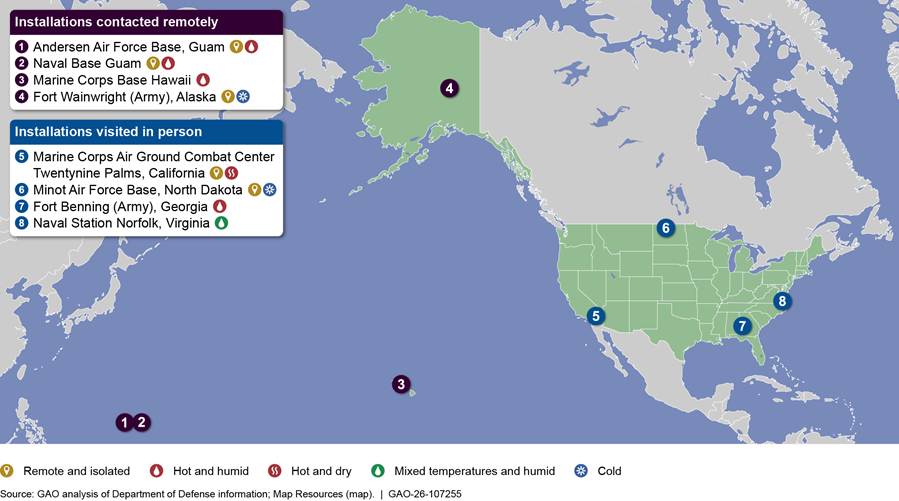
Interviews with officials. At each installation we selected, we interviewed the installation commander or a representative they designated; officials from the local installation maintenance office; and multiple customer organizations served by the installation maintenance office. We met with multiple customer organizations that managed both mission-related and quality-of-life facilities. In these customer meetings, we met with officials who had the most experience with the local maintenance office, such as building managers. Across the eight installations we contacted, we interviewed 37 customer organizations in total.
During customer organization meetings at in-person visits, we often toured relevant facilities where we could observe building conditions. For installations we contacted remotely, we asked installation maintenance offices and customer organizations to provide us with photos of maintenance trends and challenges in lieu of an in-person tour.
Methods to Evaluate Work Order Data
For all military services, we analyzed the percentage of work orders completed on time by work type by comparing the dates the work order were both entered into and closed in the system. All services require that emergency maintenance be resolved within 24 hours. However, according to Air Force officials, the Air Force’s database does not include the time when a work order is closed, only the date. Army officials stated that their hourly data are not reliable, because they lack a standard process for installations to input hourly data. Navy officials also said they perform all measures and analyses in days rather than hours. As such, we decided to measure all the services’ emergency timeliness by using a metric of one day instead of 24 hours as the closest approximation. This strategy yielded less precise results because completing an emergency work order in the next calendar day will still be counted as on-time even though the work may have been completed more than 24 hours later. During our analysis, we also encountered the following data reliability concerns:
· Army. In the Army’s database, there are two start dates associated with every work order—the malfunction start date, which represents when the work order is first entered into the database, and the actual start date, which represents when the work begins. According to Army officials, the time between the malfunction start date and the actual start date represents the response time, and the time from the malfunction start date to the actual end date represents the total time to complete a work order. However, we observed that about 77,000 work orders had malfunction start dates that occurred after the actual start date. As such, we measured the timeliness of the work orders using the actual start date and the actual end date, instead of the malfunction start date.
· Navy. According to Navy officials, the dataset may not have included complete work order data from contracted maintenance work because contractors may not completely enter their work order data into the Navy’s work order database. Officials did not have a list of installations from whom they were missing data.
· Air Force. The Air Force’s dataset had about two million work orders with at least one date missing.
In addition to the concerns about potential missing data in the Air Force system, our results for the Air Force differed from the other branches due to how the Air Force data were provided.
· The Air Force provided work order data with dates that were measured in the number of milliseconds since 1970. In the process of exporting these totals, the output in these date fields was rounded to the nearest 100 million millisecond, which amounts to a little over a day. The rounding makes date comparisons using the exported Air Force data less precise. Air Force officials indicated that the rounding was inherent to the data export mechanisms that were available to them.
· The Air Force data export also included installations in non-U.S. states and territories. Due to the installation labeling style, we could not filter work orders from non-U.S. states and territories out of the dataset without significant additional effort. As such, we chose to leave work orders from non-U.S. states and territories in the dataset.
· Additionally, the Air Force’s dataset excluded all work orders still ongoing at the time of the data request. All other datasets included work orders created during fiscal year 2023 that were still open.
As such, we found that the work order data were not reliable for the purposes of our data analysis. Further, the results of our analysis were not comparable across the services. We instead used the results of the analysis as non-generalizable, illustrative examples of the data reliability concerns we encountered while performing the analysis.
We conducted this performance audit from February 2024 to August 2026 in accordance with generally accepted government auditing standards. Those standards require that we plan and perform the audit to obtain sufficient, appropriate evidence to provide a reasonable basis for our findings and conclusions based on our audit objectives. We believe that the evidence obtained provides a reasonable basis for our findings and conclusions based on our audit objectives.
The Department of Defense (DOD) supports its facility requirements through regular maintenance and through facility improvement projects that include repairs and military construction.[66]
· Sustainment, as defined in DOD guidance, is the maintenance and repair activities necessary to keep an inventory of facilities in good working order.[67] According to officials, the sustainment portion of DOD’s facilities sustainment, restoration, and modernization funds from operation and maintenance appropriations is the primary source of funding for sustainment activities.
· Repair projects, as defined in statute, are projects to restore a real property facility, system, or component to such a condition that it may effectively be used for its designated functional purpose, or to convert a real property facility, system, or component to a new functional purpose without increasing its external dimensions.[68] According to DOD officials, the restoration and modernization portions of DOD’s facilities sustainment, restoration, and modernization funds from operation and maintenance appropriations provide the primary source of funding for repair projects. The statute requires that decisions to conduct repair projects exceeding $7.5 million in estimated cost be submitted to the appropriate committees of Congress with a report containing the following:
· The justification for the repair project and the current estimate of the cost.
· If the estimate of the repair project cost exceeds 75 percent of the estimated cost of a military construction project to replace the facility, an explanation of the reasons why replacement of the facility is not in the best interest of the government.
· A description of the elements of military construction incorporated into the repair project.
· Military construction, as defined in statute, includes any construction, development, conversion, or extension of any kind carried out with respect to a military installation, whether to satisfy temporary or permanent requirements, or any acquisition of land or construction of a defense access road.[69]
· Those military construction projects costing equal to or less than $9 million are unspecified minor military construction projects. DOD can complete them using available amounts from military construction appropriations or, in the case of projects costing not more than $4 million or for laboratory revitalization projects costing not more than $9 million, DOD can use available amounts from operation and maintenance appropriations.[70] If an unspecified minor military construction project costs more than $750,000, the relevant military department secretary must approve the project in advance. If an unspecified minor military construction project costs more than $6 million, the relevant military department secretary must notify the appropriate committees of Congress of the decision to conduct the project and the justification and estimated cost for the project.
· DOD completes military construction projects costing more than $9 million through military construction appropriations.[71] Congress typically approves these projects through itemized military construction appropriations
Table 3 lists the services’ approval authorities for repair and military construction projects based on their expected cost.
|
Military service |
Project type |
Expected cost |
Approval authority |
||
|
Army |
Repairs, with repair costs up to 75% of replacement cost |
Up to $7.5 million |
Installation commander |
||
|
Above $7.5 million |
Deputy Assistant Secretary of the Army for Installations, Housing, and Partnerships, plus congressional notice |
||||
|
Repairs, with repair costs above 75% of replacement cost |
Up to $2 million |
Installation commander |
|||
|
Above $2 million |
Deputy Assistant Secretary of the Army for Installations, Housing, and Partnerships, plus congressional notification above $7.5 million |
||||
|
Construction |
Up to $4 million |
Installation commander |
|||
|
$4 million to $9 million |
Deputy Assistant Secretary of the Army for Installations, Housing, and Partnerships, plus congressional notification above $6 million |
||||
|
Above $9 million |
Specific appropriation and authorizationa |
||||
|
Navy |
Repairs |
Up to $1.5 million |
Installation commander or regional authority |
||
|
Above $1.5 million to $7.5 million |
Commander, Navy Installations Command |
||||
|
Above $7.5 million |
Assistant Secretary of the Navy for Energy, Installations, and Environment, plus congressional notification |
||||
|
Construction |
$2 million to |
Submitted to Commander, Navy Installations Command and Office of the Chief of Naval Operations, Installations Division for approval by Assistant Secretary of the Navy for Energy, Installations, and Environment, plus congressional notification above $6 million |
|||
|
Above $9 million |
Specific appropriation and authorizationa |
||||
|
Marine Corps |
Repairs |
Up to $300,000 |
Installation commander |
||
|
$300,000 to |
Marine Corps Installations Command |
||||
|
Above $7.5 million |
Assistant Secretary of the Navy for Energy, Installations, and Environment, plus congressional notification |
||||
|
Construction |
Up to $100,000 |
Installation commander |
|||
|
Above $100,000 to $1 million |
Marine Corps Installations Command |
||||
|
Above $1 million to |
Submitted to Marine Corps Installations Command for approval by Assistant Secretary of the Navy for Energy, Installations, and Environment, plus congressional notification above $6 million |
||||
|
Above $9 million |
Specific appropriation and authorizationa |
||||
|
Air Force and Space Force |
Repairs |
Up to $5 million |
Installation commander |
||
|
$5 million to |
Air Force Civil Engineer Center and Headquarters Air Force A4 (Logistics, Engineering, and Force Protection) |
||||
|
Above $7.5 million |
Deputy Assistant Secretary of the Air Force for Infrastructure, Energy, and Environment, plus congressional notification |
||||
|
Construction |
Up to $3.6 million |
Installation commanders |
|||
|
$3.6 million to |
Air Force Civil Engineer Center and Headquarters Air Force A4 (Logistics, Engineering, and Force Protection) |
||||
|
$4 million to |
Deputy Assistant Secretary of the Air Force for Infrastructure, Energy, and Environment, plus congressional notification above $6 million |
||||
|
Above $9 million |
Specific appropriation and authorizationa |
||||
Source: GAO analysis of Department of Defense information. | GAO‑26‑107255
Note: This table reflects the general thresholds for construction using amounts from operation and maintenance or military construction appropriations. These thresholds are periodically adjusted, and, depending on the circumstances, other authorities and thresholds may be applicable. See, e.g., 10 U.S.C. §§ 2803, 2804, 2808 (providing for emergency construction, contingency construction, and construction authority in the event of a declaration of war or national emergency).
aConstruction projects exceeding $9 million are typically listed in the joint explanatory statement accompanying the military construction appropriations act; they are also generally identified in the annual National Defense Authorization Act. Projects estimated to cost below $9 million may also be similarly authorized and appropriated as specified major construction projects; however, approval authorities listed in this table for projects at or below that threshold are those for unspecified minor military construction.
Congress provides two primary funding sources to support military infrastructure. Military construction appropriations fund the construction of new facilities and the expansion of existing facilities. Facilities sustainment, restoration, and modernization funding from operation and maintenance appropriations fund the maintenance and repair of existing facilities.
The Department of Defense (DOD) uses a component of facilities sustainment, restoration, and modernization funds—called facilities sustainment funds—to fund installation facility maintenance activities to keep facilities in good working order, known as sustainment. These activities include regularly scheduled adjustments and inspections, preventative maintenance tasks, and emergency response and service calls for minor repairs. They also include major repairs or replacement of facility components that are expected to occur periodically throughout the life cycle of facilities. Examples of this work include regular roof replacement, refinishing of wall surfaces, repairing and replacement of heating and cooling systems, replacing tile and carpeting, and similar types of work. Sustainment activities do not include nonrecurring and unpredictable work such as changes in customer requirements, changes to comply with new building codes, environmental compliance costs, facility leases, or other tasks associated with facility operations, such as custodial services, ground services, waste disposal, and the provision of central utilities.
When DOD develops its budget request, it forecasts requirements for these facilities sustainment funds using the Facilities Sustainment Model (FSM), which it defines in its Financial Management Regulation.[72] DOD uses the following formula to develop the requirements:
Annual sustainment requirement = (facility quantity) x (sustainment unit cost) x (location factor) x (inflation)
· Facility quantity: facility size expressed in the Facility Analysis Category unit of measure (e.g., square feet).[73]
· Sustainment unit cost: average annual unit cost (in current year dollars) for sustaining the average size facility in the given Facility Analysis Category.
· Location factor: location adjustment based upon the local costs for labor, equipment, materials, and currency exchange rates (overseas) compared with an overall base-city average.
· Inflation: factor to adjust current year prices to the target future year.
We requested sustainment funding data from DOD for fiscal years 2021 through 2025 for each of the services and for each of the installations we contacted.[74] The requested data included:
· FSM requirements for each service
· FSM budget requests for each service
· Facilities sustainment obligations for each service
· FSM requirements for each installation
· FSM budgets received for each installation
We requested these data at the service level to compare the sustainment funding levels FSM recommended for the services to how much DOD requested and obligated for each service. We then calculated the percentage of FSM requirements compared with requested and obligated sustainment funding, as shown in table 4.
Table 4: Department of Defense (DOD) Armed Services’ Facilities Sustainment Model (FSM) Requirements and Associated Budget Requests and Obligations for Fiscal Year (FY) 21-25 (Dollars in Thousands)
|
DOD service |
FSM requirements |
Sustainment budget requests |
Percentage of FSM requirements requested |
Sustainment obligations |
Percentage of FSM requirements executed |
|
Army |
|||||
|
FY21 |
$4,201,000 |
$3,402,000 |
81% |
$3,031,000 |
72% |
|
FY22 |
$4,730,000 |
$3,846,000 |
81% |
$3,787,000 |
80% |
|
FY23 |
$4,750,000 |
$4,038,000 |
85% |
$4,372,000 |
92% |
|
FY24 |
$5,057,000 |
$4,483,000 |
89% |
$4,416,000 |
87% |
|
FY25 |
$5,421,000 |
$4,757,000 |
88% |
$4,757,000 |
88% |
|
Average |
|
|
85% |
|
84% |
|
Navy |
|||||
|
FY21 |
$2,717,000 |
$2,200,000 |
81% |
$2,142,000 |
79% |
|
FY22 |
$2,865,000 |
$2,292,000 |
80% |
$2,306,000 |
81% |
|
FY23 |
$2,900,000 |
$2,465,000 |
85% |
$2,470,000 |
85% |
|
FY24 |
$3,131,000 |
$2,688,000 |
86% |
$2,660,000 |
85% |
|
FY25 |
$3,527,000 |
$2,847,000 |
81% |
$2,847,000 |
81% |
|
Average |
|
|
83% |
|
82% |
|
Marine Corps |
|||||
|
FY21 |
$1,025,000 |
$830,000 |
81% |
$830,000 |
81% |
|
FY22 |
$1,173,000 |
$940,000 |
80% |
$935,000 |
80% |
|
FY23 |
$1,278,000 |
$718,000 |
56% |
$718,000 |
56% |
|
FY24 |
$1,306,000 |
$718,000 |
55% |
$716,000 |
55% |
|
FY25 |
$1,781,000 |
$718,000 |
40% |
$718,000 |
40% |
|
Average |
|
|
60% |
|
60% |
|
Air Force |
|||||
|
FY21 |
$3,915,000 |
$3,156,000 |
81% |
$2,728,000 |
70% |
|
FY22 |
$4,521,785 |
$3,370,878 |
75% |
$2,754,718 |
61% |
|
FY23 |
$4,429,000 |
$3,612,000 |
82% |
$4,053,000 |
92% |
|
FY24 |
$4,799,000 |
$4,159,000 |
87% |
$4,205,000 |
88% |
|
FY25 |
$5,598,000 |
$4,314,000 |
77% |
$4,314,000 |
77% |
|
Average |
|
|
80% |
|
78% |
|
Services Total |
|||||
|
FY21 |
$11,858,000 |
$9,588,000 |
81% |
$8,731,000 |
74% |
|
FY22 |
$13,289,785 |
$10,448,878 |
79% |
$9,782,718 |
74% |
|
FY23 |
$13,357,000 |
$10,833,000 |
81% |
$11,613,000 |
87% |
|
FY24 |
$14,293,000 |
$12,048,000 |
84% |
$11,997,000 |
84% |
|
FY25 |
$16,327,000 |
$12,636,000 |
77% |
$12,636,000 |
77% |
|
Average |
|
|
80% |
|
79% |
Source: GAO analysis of DOD data. | GAO‑26‑107255
Note: DOD estimated its facility sustainment funding requirements by using the Facilities Sustainment Model. Percentages have been rounded to the nearest whole number.
Further, we requested sustainment funding levels for the eight installations we contacted, including the amounts recommended by FSM and the amounts they received from the services. We then calculated the percentage of the FSM requirements received compared with the FSM recommendations, as shown in table 5.
Table 5: Installation Facilities Sustainment Model Requirements (FSM), Sustainment Budgets Received, and Percentage of Requirements Received for Fiscal Years (FY) 21-25
|
Service–Installation |
FSM requirements |
Sustainment budgets received |
Percentage of FSM requirements received |
|
|
Army–Fort Benning, GA |
|
|||
|
FY21 |
$104,234,100 |
$72,027,700 |
69% |
|
|
FY22 |
$124,633,860 |
$106,029,400 |
85% |
|
|
FY23 |
$126,992,900 |
$111,580,660 |
88% |
|
|
FY24 |
$132,136,230 |
$115,112,800 |
87% |
|
|
FY25 |
$146,396,600 |
$122,094,770 |
83% |
|
|
Average |
|
|
83% |
|
|
Army–Fort Wainwright, AK |
|
|||
|
FY21 |
$122,350,500 |
$71,051,800 |
58% |
|
|
FY22 |
$134,650,500 |
$109,337,100 |
81% |
|
|
FY23 |
$117,484,804 |
$97,997,500 |
83% |
|
|
FY24 |
$124,520,117 |
$97,587,000 |
78% |
|
|
FY25 |
$146,323,608 |
$130,280,900 |
89% |
|
|
Average |
|
|
78% |
|
|
Navy–Naval Base Guama |
|
|||
|
FY21 |
$113,037,209 |
$70,948,012 |
63% |
|
|
FY22 |
$121,302,188 |
$67,150,884 |
55% |
|
|
FY23 |
$140,205,100 |
$96,931,413 |
69% |
|
|
FY24 |
$157,250,105 |
$100,213,500 |
64% |
|
|
FY25 |
$159,915,870 |
$92,095,164 |
58% |
|
|
Average |
|
|
62% |
|
|
Navy–Naval Station Norfolk, VAa |
|
|||
|
FY21 |
$89,120,163 |
$49,016,090 |
55% |
|
|
FY22 |
$111,711,388 |
$64,917,913 |
58% |
|
|
FY23 |
$116,222,235 |
$76,074,259 |
66% |
|
|
FY24 |
$116,547,761 |
$78,844,653 |
68% |
|
|
FY25 |
$117,014,638 |
$66,715,487 |
57% |
|
|
Average |
|
|
61% |
|
|
Marine Corps–Marine Corps Air Ground Combat Center Twentynine Palms, CA |
||||
|
FY21 |
$64,029,336 |
$38,648,000 |
60% |
|
|
FY22 |
$61,631,110 |
$40,706,000 |
66% |
|
|
FY23 |
$64,246,763 |
$38,177,000 |
59% |
|
|
FY24 |
$73,238,511 |
$40,544,000 |
55% |
|
|
FY25 |
$77,323,929 |
$39,916,000 |
52% |
|
|
Average |
|
|
58% |
|
|
Marine Corps–Marine Corps Base Hawaii |
||||
|
FY21 |
$74,437,028 |
$47,896,000 |
64% |
|
|
FY22 |
$81,493,669 |
$51,044,000 |
63% |
|
|
FY23 |
$82,458,316 |
$51,844,000 |
63% |
|
|
FY24 |
$82,649,785 |
$53,151,000 |
64% |
|
|
FY25 |
$112,100,329 |
$54,149,000 |
48% |
|
|
Average |
|
|
60% |
|
|
Air Force–Andersen Air Force Base, Guamb c |
||||
|
FY23 |
$107,000,000 |
$53,835,385 |
50% |
|
|
FY24 |
$109,000,000 |
$34,674,229 |
32% |
|
|
FY25 |
$122,000,000 |
$34,677,884 |
28% |
|
|
Average |
|
|
37% |
|
|
Air Force–Minot Air Force Base, NDb |
|
|||
|
FY21 |
$61,000,000 |
$35,199,521 |
58% |
|
|
FY22 |
$61,000,000 |
$26,436,343 |
43% |
|
|
FY23 |
$65,000,000 |
$23,537,588 |
36% |
|
|
FY24 |
$66,000,000 |
$22,470,645 |
34% |
|
|
FY25 |
$75,000,000 |
$23,525,282 |
31% |
|
|
Average |
|
|
40% |
|
Source: GAO analysis of DOD data. | GAO‑26‑107255
Note: DOD estimated its facility sustainment funding requirements using the Facilities Sustainment Model. Percentages have been rounded to the nearest whole number.
aAccording to Navy officials, sustainment includes some dredging activities. However, dredging activities are excluded from these figures.
bAccording to Air Force officials, sustainment includes some civilian payroll, overseas operating costs, and natural disaster funding, which are excluded from these figures.
cThis figure covers only fiscal years 2023 through 2025 for Andersen Air Force Base, as the Navy provided facility sustainment services to this installation in prior years through Joint Region Marianas.
We observed and learned of a range of facility conditions during our site visits and contact with select installations. Some facilities were relatively new and in apparent good condition, while other facilities and infrastructure were in poor condition. DOD officials stated that the department faces many challenges that necessitate installation maintenance due to structural degradation and damage, such as aging infrastructure, and, depending on the location, due to extreme weather and climate.
Aging Infrastructure in Use Beyond Expected Life-span
According to officials from the Office of the Secretary of Defense, aging infrastructure is a major challenge for DOD, with many of its facilities originating from historical wartime periods such as World War II. Officials stated that aging facilities are costly to maintain and their systems can degrade faster, thereby affecting installation missions and straining maintenance resources. Although some of the facilities we observed or discussed with officials were constructed recently or were in good condition, we frequently observed or learned of facilities officials identified that were beyond their expected life-span and were in degraded condition.
For example, at Twentynine Palms, California, we observed buildings that officials told us were over 80 years old being used beyond their expected life-span. Part of one building that housed administrative, religious, and counseling services for Marines tested positive for mold and asbestos. Although that part of the building had been condemned, officials said the other part of the building tested negative for mold and asbestos and remained in use for these services. Occupants reported discomfort with the building’s condition and had personally supplied additional air filters to safeguard their workspace. Officials from the installation maintenance office and the customer organization expressed their desire to move these services to another facility and demolish the building. In another case, officials from Marine Corps Base Hawaii stated that 1930s-era aircraft hangars are still in active use on the installation even though they are poorly suited for modern aircraft. They said the hangars’ condition was due to both the cost of replacement and Hawaii state historic preservation requirements, which require maintenance of facilities that were present during the attack on Pearl Harbor in 1941.
As another example, we observed a warehouse at Naval Station Norfolk, Virginia, that officials said was built during World War II but remains in high use. At the facility, a caution sign and other markings on the ceiling indicate the presence of asbestos near significant water damage from previous leaks, as shown in figure 11.
Figure 11: Water Damage and Asbestos Hazard at Aging Facility in Naval Station Norfolk, January 2025
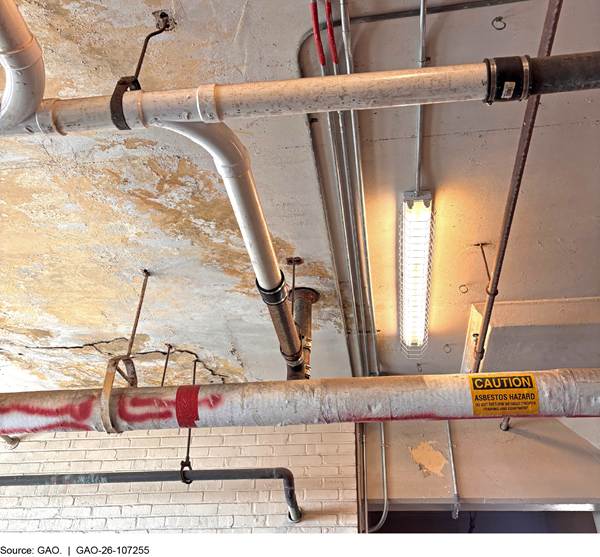
As another example, we observed conditions in a 1960s-era building at Minot Air Force Base that include inoperable building systems, such as lights and elevators, and signs of structural degradation with age. According to an official, weeping concrete in the basement frequently draws water into the building’s foundation, presenting structural concerns, as depicted in figure 12.
Figure 12: Water Present in Foundation of 1960s-era Building at Minot Air Force Base, September 2024
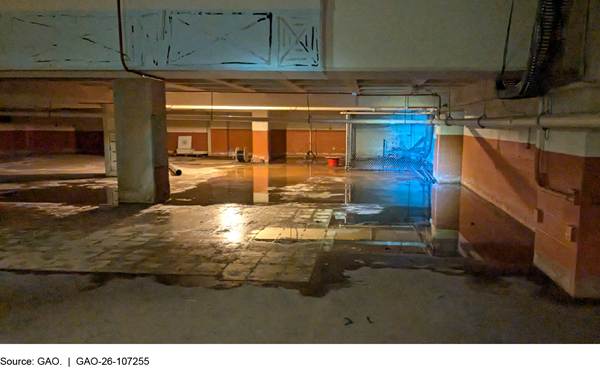
They explained that the Air Force plans to demolish the building because of age and these structural concerns, and substantially reduced its maintenance activities in the building accordingly. However, according to the official, the Air Force still places high demand on the building for services to local airmen and veterans and for Air Force unit workspace, which are provided at lower quality than desired due to the building’s degraded condition.
Extreme Weather and Climate Affect Some Locations
Installations in areas with extreme weather or climates face additional challenges. Extreme heat or cold strains heating, ventilation, and air conditioning (HVAC) systems; humidity supports the spread of mold; corrosive environments cause rapid degradation of machinery; cold environments present challenges from freezing and snow; and various types of storms in different regions can cause damage to facilities.
Hot and Humid Temperatures
Installations with high temperatures and humidity make more use of air conditioning from HVAC systems. Consequently, HVAC systems are strained more, which sometimes results in physical damage to facilities and uncomfortable working and living conditions for personnel when HVAC systems break down. Officials at Fort Benning, Georgia, said the strain of the hot and humid environment on HVAC systems leads to frequent outages and ongoing mold and mildew issues. During our visit in August 2024, we observed conditions in a dining facility where almost all HVAC units in the facility had failed, contributing to the spread of mold and mildew. According to an official, this caused working temperatures in the kitchen to exceed 105 degrees Fahrenheit with almost 100 percent humidity, leading multiple employees to resign their positions. See conditions depicted in figure 13.
Figure 13: Spread of Suspected Mold and Mildew and High Temperature and Humidity in a Fort Benning Dining Facility, August 2024
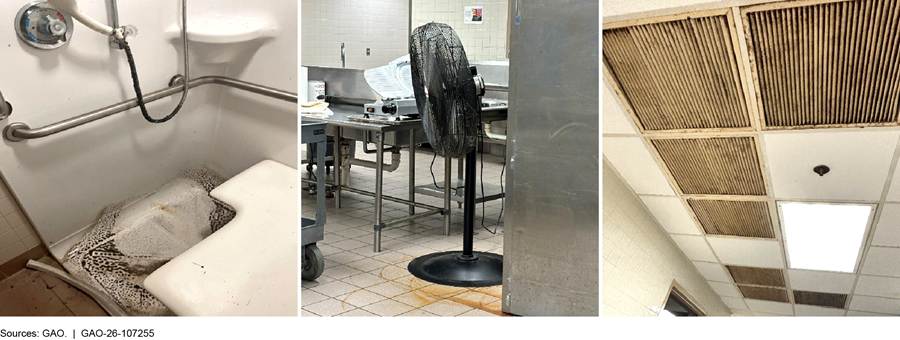
To mitigate such challenges, Fort Benning officials said they must prioritize work orders for HVAC maintenance and repairs and for mold abatement work orders over other maintenance needs.
Freezing Temperatures
Conversely, officials from installations where temperatures are cold reported that freezing and snow can result in facility damage. Officials from Minot Air Force Base, North Dakota told us that broken furnaces contribute to frozen pipes bursting, and that snow melting and leaking roofs can frequently cause water damage. Moreover, low temperatures and snow disrupt installation operations and damage concrete and facility equipment. Officials from Minot and Fort Wainwright said their maintenance priorities shift during the winter to prevent and mitigate seasonal challenges and to respond quickly to any emergencies such as pipe bursts to prevent additional physical structure damage.
Desert Climate
Officials from Twentynine Palms, California identified heat, wind, and flooding in their desert location as contributing significantly to maintenance challenges that affect facilities on the installation. Officials stated that they prioritize HVAC maintenance work orders during hot seasons and maintain a system of storm drains to mitigate flash flooding from heavy rainfalls and low soil drainage. However, we observed mold or mildew growth and physical structure damage that occurred after flash flooding at a barracks facility where the drainage system was insufficient to prevent water intrusion. The barracks rooms affected by mold and water damage were closed to residents but officials said the rest of the barracks remained in use. See figure 14 for depiction of water damage and mold growth caused by flash flooding.
Figure 14: Barracks Water Damage and Mold Growth Caused by Flash Flooding at Twentynine Palms, October 2024
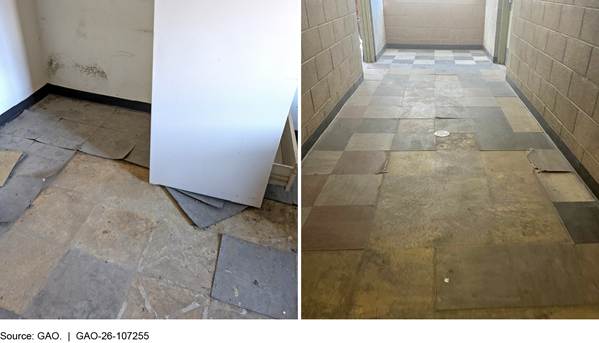
Coastal Climate
Officials at Andersen Air Force Base, Marine Corps Base Hawaii, Naval Base Guam, and Naval Station Norfolk told us that their coastal environment affects maintenance, with salt air rapidly corroding building systems, pipes, and other equipment, and heat and humidity facilitating the spread of mold. According to officials from these bases, facility systems such as HVAC components often fail before their typical life-span because of corrosion. For example, according to Naval Base Guam officials, HVAC systems operate only about half their normal life-span on a tropical island, such as 5 to 7 years in Guam, compared with 10 to 15 years under normal conditions.
At one Naval Base Guam facility, algae and rust built up on the emergency access doors to the extent where the lock’s dial numbers on the door handle were no longer visible, which may affect the door’s functionality during an emergency. Figure 15 shows corrosion and algae at Naval Base Guam due to its island climate.
Figure 15: Corrosion and Algae on Facility Components at Naval Base Guam and Andersen Air Force Base Due to Island Climate, April 2025
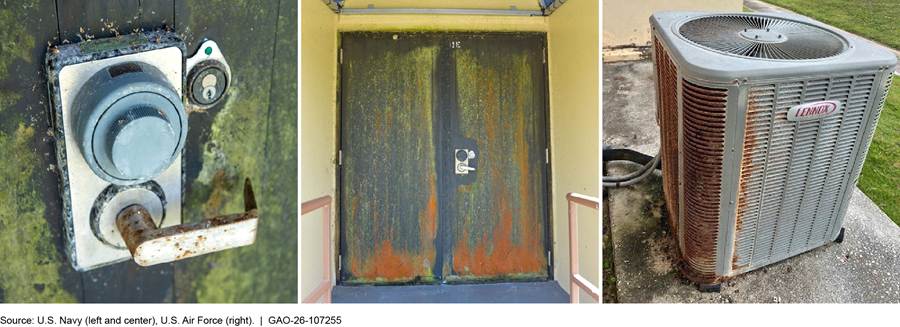
Officials from each of these installations reported that they work to mitigate these conditions by addressing scheduled maintenance, replacing failed equipment, and prioritizing mold prevention and remediation. According to officials from each of these installations, they are also exposed to coastal storms such as typhoons due to their location. For example, according to officials from Naval Base Guam and Andersen Air Force Base, Typhoon Mawar in 2023 caused extensive damage to their installations’ facilities, some of which remains unaddressed.
Alissa H. Czyz, CzyzA@gao.gov
In addition to the contact named above, Suzanne M. Perkins (Assistant Director), David Beardwood (Analyst in Charge), Nicole Ashby, Miranda Cohen, Christopher Gezon, Isamar Hernandez, Gina Hoover, Gloria (Juyoung) Lee, Lillian Ofili, Molly Ryan, Komal Samrow, and Jared Smith made key contributions to this report.
The Government Accountability Office, the audit, evaluation, and investigative arm of Congress, exists to support Congress in meeting its constitutional responsibilities and to help improve the performance and accountability of the federal government for the American people. GAO examines the use of public funds; evaluates federal programs and policies; and provides analyses, recommendations, and other assistance to help Congress make informed oversight, policy, and funding decisions. GAO’s commitment to good government is reflected in its core values of accountability, integrity, and reliability.
Obtaining Copies of GAO Reports and Testimony
The fastest and easiest way to obtain copies of GAO documents at no cost is through our website. Each weekday afternoon, GAO posts on its website newly released reports, testimony, and correspondence. You can also subscribe to GAO’s email updates to receive notification of newly posted products.
Order by Phone
The price of each GAO publication reflects GAO’s actual cost of production and distribution and depends on the number of pages in the publication and whether the publication is printed in color or black and white. Pricing and ordering information is posted on GAO’s website, https://www.gao.gov/ordering.htm.
Place orders by calling (202) 512-6000, toll free (866) 801-7077,
or
TDD (202) 512-2537.
Orders may be paid for using American Express, Discover Card, MasterCard, Visa, check, or money order. Call for additional information.
Connect with GAO
Connect with GAO on X,
LinkedIn, Instagram, and YouTube.
Subscribe to our Email Updates. Listen to our Podcasts.
Visit GAO on the web at https://www.gao.gov.
To Report Fraud, Waste, and Abuse in Federal Programs
Contact FraudNet:
Website: https://www.gao.gov/about/what-gao-does/fraudnet
Automated answering system: (800) 424-5454
Media Relations
Sarah Kaczmarek, Managing Director, Media@gao.gov
Congressional Relations
David A. Powner, Acting Managing Director, CongRel@gao.gov
General Inquiries
[1]Assistant Secretary of Defense for Energy, Installations, and Environment, Fiscal Year 2025 Base Structure Report (Sept. 30, 2024).
[2]Deputy Secretary of Defense Memorandum, Resilient and Healthy Defense Communities (Feb. 14, 2024).
[3]GAO, High-Risk Series: Heightened Attention Could Save Billions More and Improve Government Efficiency and Effectiveness, GAO‑25‑107743 (Washington, D.C.: Feb. 25, 2025).
[4]GAO, Defense Infrastructure: DOD Should Better Manage Risks Posed by Deferred Facility Maintenance, GAO‑22‑104481 (Washington, D.C.: Jan. 31, 2022).
[5]DOD, Agency Financial Report: Fiscal Year 2025 (Dec. 18, 2025).
[6]GAO, Military Barracks, Poor Living Conditions Undermine Quality of Life and Readiness, GAO‑23‑105797 (Washington, D.C.: Sep. 19, 2023).
[7]H.R. Rep. No. 118-125, at 393 (2023); S. Rep. No. 118-58, at 360-61 (2023).
[8]For the purposes of this report, Space Force installations are evaluated as part of the Air Force since currently the Space Force does not independently manage maintenance of its installations.
[9]DOD maintains a list of installations considered to be remote and isolated due to their distance from population centers, security conditions, extreme climatic or environmental conditions, or other reasons. The primary purpose of this designation is to determine what additional support should be given to morale, welfare, and readiness programs since these services may be lacking outside these installations. Although the designation was not intended for maintenance activity categorization, we selected a mix of remote and isolated installations and installations near large civilian population centers to better contrast their maintenance activities. “Remote and Isolated Designated Installation Listing,” Military Community and Family Policy, DOD, accessed May 12, 2025, https://dodmwrandresalepolicy.defense.gov/Nonappropriated‑Fund‑Policy/Remote‑and‑Isolated/; DOD Instruction 1015.10, Military Morale, Welfare, and Recreation (MWR) Programs, (July 6, 2009) (incorporating change 1, May 6, 2011).
[10]GAO, Standards for Internal Control in the Federal Government, GAO‑25‑107721 (Washington, D.C.: May 15, 2025).
[11]DOD 7000.14-R, Financial Management Regulation, vol. 2B, ch. 8, Facilities Sustainment and Restoration/Modernization (Dec. 2016).
[12]Sustainment includes regularly scheduled adjustments and inspections, preventive maintenance tasks, and emergency response and service calls for minor repairs. It also includes major repairs or replacement of facility components (usually accomplished by contract) that are expected to occur periodically throughout the life cycle of facilities. This work includes regular roof replacement, refinishing of wall surfaces, repairing and replacement of heating and cooling systems, replacing tile and carpeting, and similar types of work. It does not include environmental compliance costs, facility leases, or other tasks associated with facilities operations (such as custodial services, grounds services, waste disposal, and the provision of central utilities). DOD 7000.14-R, vol. 2B, ch. 8
[13]DOD 7000.14-R, vol. 2B, ch. 8.
[14]10 U.S.C. §§ 2811, 2805.
[15]10 U.S.C. §§ 2802, 2805, 2860; see e.g., Continuing Appropriations, Agriculture, Legislative Branch, Military Construction and Veterans Affairs, and Extensions Act, 2026, Pub. L. No.119-37, div. D, tit. I (2025). Military construction appropriations may also be used for projects less than $4 million. Construction projects costing more than $9 million are typically listed in the joint explanatory statement accompanying the military construction appropriations act; they are also generally identified in the annual National Defense Authorization Act.
[16]DOD Directive 4165.06, Real Property (July 19, 2022).
[17]Under Secretary of Defense for Acquisition, Technology, and Logistics Memorandum, Facilities Sustainment and Recapitalization Policy (Apr. 29, 2014).
[18]GAO, Defense Infrastructure: DOD Should Better Manage Risks Posed by Deferred Facility Maintenance, GAO‑22‑104481 (Washington, D.C.: Jan. 31, 2022).
[19]Funds used for military installation sustainment are generally appropriated and obligated at the service or department level. To obtain more detailed data, we asked officials from the eight installations to identify the sustainment funding each installation received from their respective service compared with identified needs for fiscal year 2021 through fiscal year 2025.
[20]In addition to use of operation and maintenance appropriations for repair projects, DOD can use operation and maintenance appropriations for military construction projects that cost $4 million or less. 10 U.S.C. §§ 2811, 2805. DOD can use military construction appropriations, which are typically available for 5 years, for construction projects at any amount, but the department must use them for construction projects over $4 million. Construction projects that cost $9 million or less are generally referred to as unspecified minor military construction. 10 U.S.C. § 2805. Construction projects that cost more than $9 million must be specifically authorized by law and are generally listed in annual National Defense Authorization Acts and explanatory statements accompanying appropriation acts. (These thresholds are amended from time to time, and there are certain exceptions or other authorities exist for construction.) DOD experts on installations—such as architects, engineers, and planners—and the DOD facility assessment model—the BUILDER system—both give recommendations on when a facility should be repaired or when it is past its economical life-span and should be replaced by new military construction.
[21]GAO, DOD Real Property: Actions Needed to Improve Oversight of Underutilized and Excess Facilities, GAO‑25‑106132 (Washington, D.C.: Mar. 3, 2025; reissued Mar. 11, 2025).
[23]Installations and Engineering: Hearing Before the House of Representatives Appropriations Subcommittee on Military Construction and Veterans Affairs, and Related Agencies, 117th Cong. 6 (2021) (statement by Acting Assistant Secretary of the Air Force for Installations, Environment and Energy; Director of Civil Engineers; and Deputy Chief of Staff for Logistics, Engineering and Force Protection).
[24]10 U.S.C. § 222a.
[25]GAO, Defense Budget: DOD Should Address All Statutory Elements for Unfunded Priorities, GAO‑25‑107581 (Washington, D.C.: Sept. 4, 2025).
[26]GAO, Military Barracks: Poor Living Conditions Undermine Quality of Life and Readiness, GAO‑23‑105797 (Washington, D.C.: Sept. 19, 2023).
[27]DOD Instruction 4165.70, Real Property Management (Apr. 6, 2005) (incorporating change 1, Aug. 31, 2018).
[28]10 U.S.C. § 2864(d).
[29]DOD Directive 4165.06.
[30]DOD 7000.14-R, Financial Management Regulation, vol. 4, ch. 19, Managerial Cost Accounting (Dec. 2025).
[33]GAO, Defense Workforce: Efforts to Address Challenges in Recruiting and Retaining Federal Wage System Employees, GAO‑25‑107152 (Washington, D.C.: Sept. 3, 2025).
[34]DOD defines remote and isolated installations partly according to commuting time or distance from areas with certain critical services and with critical services not available on the installation. Critical services include activities and facilities for the morale, welfare, and recreation of service members and their dependents; safe and affordable housing; educational services; health care (including behavioral health); and employment opportunities for military spouses. See DOD Instruction 1015.18, Assessing and Managing Challenges Associated with Providing Critical Services at Remote and Isolated Military Installations (May 30, 2024).
[35]The H-2B program allows U.S. employers or U.S. agents who meet specific regulatory requirements to bring foreign nationals to the U.S. to fill temporary nonagricultural jobs. To qualify for the use of H-2B labor, the employer must establish that there are not enough U.S. workers who are able, willing, qualified, and available to do the temporary work and that employing H-2B workers will not adversely affect the wages and working conditions of similarly employed U.S. workers.
[36]DOD Instruction 1015.10, Military Morale, Welfare, and Recreation (MWR) Programs (July 6, 2009) (incorporating change 1, May 6, 2011). DOD guidance also provides procedures for assessing and managing challenges associated with providing critical support services at remote and isolated military installations, but the guidance similarly does not cover maintenance workforce challenges. See DOD Instruction 1015.18.
[37]In January 2025 the Office of Personnel Management announced the Deferred Resignation Program, allowing federal employees to voluntarily submit a resignation letter effective on September 30, 2025, in exchange for exemption from requirements to return to in-person work and for possible reductions in workload during the interim period. “Deferred Resignation Email to Federal Employees,” Office of Personnel Management, accessed July 8, 2025, https://www.opm.gov/fork/original‑email‑to‑employees/. Office of Personnel Management email, Fork in the Road (Jan. 28, 2025).
[38]Hiring Freeze Memorandum for the Heads of Executive Departments and Agencies, 90 Fed. Reg. 8,247 (Jan. 20, 2025); see also Secretary of Defense Memorandum, Immediate Civilian Hiring Freeze for Alignment with National Defense Priorities (Feb. 28, 2025).
[39]Office of Personnel Management, Workforce Planning Guide (Nov. 2022).
[40]DOD, Defense Civilian Personnel Advisory Service, Strategic Workforce Planning Guide (May 2019). The Defense Civilian Personnel Advisory Service—an office within the Defense Human Resources Activity that supports the Office of the Under Secretary of Defense for Personnel and Readiness—develops, implements, and monitors DOD civilian human resource plans, including its Strategic Workforce Planning Guide that supports the listed functions.
[41]Based on its strategic workforce planning process, the Defense Civilian Personnel Advisory Service identifies a list of mission-critical occupations, which it updates every 4 years. The Office of Personnel Management’s Strategic Workforce Planning Guide defines a mission-critical occupation as an occupation that an agency considers core to carrying out its mission, and details steps and tools for assessments of these occupations and skills gaps. Such an occupation usually reflects the primary mission of the organization, without which mission-critical work cannot be completed.
DOD, Defense Civilian Personnel Advisory Service, “Fiscal Year 2024 DOD-Wide Mission Critical Occupation (MCO) List” https://www.dcpas.osd.mil/policy/strategicplanning/missioncriticaloccupations, accessed Feb. 27, 2026.
[42]DOD uses a Mission-Critical Occupation Determination Process to designate DOD occupations as mission critical. The process requires functional communities and DOD components to identify and revalidate mission-critical occupations every 4 years. DOD’s most recent mission-critical occupation list was developed for fiscal year 2024.
[43]GAO, DOD Joint Bases: Actions Needed to Improve Sustainment of Facilities, GAO‑26‑106832 (Washington, D.C.: Feb. 26, 2026).
[44]DOD Directive 5124.02, Under Secretary of Defense for Personnel and Readiness (USD(P&R)) (June 23, 2008) (incorporating change 2, July 23, 2025).
[46]Joint Region Marianas Naval Facilities Engineering Systems Command managed Andersen Air Force Base and Naval Base Guam’s maintenance until 2021. According to Navy officials, at that time Andersen Air Force Base established a local maintenance office and began managing the majority of their own maintenance. However, there are still some assets at Andersen Air Force Base that Joint Region Marianas manages and maintains.
[47]DOD Manual 4165.63, DOD Housing Management (Oct. 28, 2010) (incorporating change 3, Apr. 1, 2025).
[49]DOD Directive 4165.06, Real Property (July 19, 2022).
[51]We found that the services do not consistently track quality assurance or customer satisfaction data and that services lack specific numerical standards for quality assurance or customer satisfaction. The lack of tracking and standards makes these metrics difficult to analyze. Therefore, we opted to focus on timeliness data for this analysis.
[52]We obtained one year of maintenance work order data from all installations in U.S. states and territories for the Army, Navy, and Marine Corps from October 1, 2022, through September 31, 2023 (fiscal year 2023), as this period provided the latest full fiscal year of data at the time of our request. For the Air Force, we examined work orders from August 1, 2023, through July 31, 2024, for both foreign and domestic installations. We chose this later time for the Air Force because Air Force officials reported that the Air Force maintenance work data system, NexGen IT, did not fully automate and standardize its timekeeping practices until July 2023, potentially affecting the reliability of timekeeping data prior to August 2023.
[53]U.S. Army Audit Agency, Maintenance of Unaccompanied Housing (Barracks) (Aug. 9, 2024).
[57]DOD Directive 4165.06.
[59]DOD facility sustainment funding is derived from multiple appropriation accounts, such as for operation and maintenance and for military construction. Of the amounts appropriated for these accounts, DOD and its components internally allot amounts in support of programs, projects, and activities, such as facility sustainment.
[60]GAO, Standards for Internal Control in the Federal Government, GAO‑25‑107721 (Washington, D.C.: May 15, 2025).
[61]We chose this later time for the Air Force because Air Force officials reported that the Air Force maintenance work data system, NexGen IT, did not fully automate and standardize its timekeeping practices until July 2023, potentially affecting the reliability of timekeeping data prior to August 2023. This time frame covers the same one for fiscal year 2023 but occurs after the system began automatically time-stamping work orders.
[62]Assistant Secretary of Defense for Energy, Installations, and Environment, Fiscal Year 2023 Base Structure Report (Sept. 30, 2023).
[63]“Remote and Isolated Designated Installation Listing,” Military Community and Family Policy, DOD, accessed May 12, 2025, https://dodmwrandresalepolicy.defense.gov/Nonappropriated‑Fund‑Policy/Remote‑and‑Isolated/.
[64]“Rural-Urban Commuting Area Codes, 2010,” Department of Agriculture, accessed June 20, 2024, https://www.ers.usda.gov/data‑products/rural‑urban‑commuting‑area‑codes.
[65]Department of Energy, Building America Best Practices Series, Volume 7.3: Guide to Determining Climate Regions by County (Aug. 2015).
[66]Definitions in this section are based upon DOD guidance and relevant statutes. However, DOD officials noted that the agency has a categorization system that further organizes military construction projects by authorization, appropriation, project type, and program.
[67]Sustainment includes regularly scheduled adjustments and inspections, preventive maintenance tasks, and emergency response and service calls for minor repairs. It also includes major repairs or replacement of facility components (usually accomplished by contract) that are expected to occur periodically throughout the life cycle of facilities. This work includes regular roof replacement, refinishing of wall surfaces, repairing and replacement of heating and cooling systems, replacing tile and carpeting, and similar types of work. It does not include environmental compliance costs, facility leases, or other tasks associated with facilities operations (such as custodial services, grounds services, waste disposal, and the provision of central utilities). DOD Financial Management Regulation 7000.14-R, vol. 2B, ch. 8, Facilities Sustainment and Restoration/Modernization (Dec. 2016).
[68]10 U.S.C. § 2811(e).
[69]10 U.S.C. § 2801(a).
[70]10 U.S.C. § 2805. The military construction thresholds discussed in this report are those under section 2805 of Title 10, U.S. Code; these are periodically adjusted and, depending on the circumstances, other authorities and thresholds may be applicable. See, e.g., 10 U.S.C. §§ 2803, 2804, 2808 (providing for emergency construction, contingency construction, and construction authority in the event of a declaration of war or national emergency).
[71]The projects are typically listed in the joint explanatory statement accompanying the military construction appropriations act; they are also generally identified in the annual National Defense Authorization Act.
[72]DOD 7000.14-R, Financial Management Regulation, vol. 2B, ch. 8, Facilities Sustainment and Restoration/Modernization (Dec. 2016).
[73]Facility Analysis Categories are groupings of real property assets that have a common unit of measure and equivalent cost based on the unit of measure. Included in this equivalent cost are costs associated with the real property construction, maintenance, sustainment, and repair. DOD Instruction 4165.14, Real Property Inventory and Reporting (Sept. 8, 2023).
[74]We contacted the following installations: Fort Benning, Fort Wainwright, Naval Base Guam, Naval Station Norfolk, Marine Corps Air Ground Combat Center Twentynine Palms, Marine Corps Base Hawaii, Andersen Air Force Base, and Minot Air Force Base.