
Report to Congressional Committees
United States Government Accountability Office
A report to congressional committees.
For more information, contact: Gretta Goodwin at goodwing@gao.gov.
What GAO Found
The First Step Act of 2018 (FSA) required the Federal Bureau of Prisons (BOP) to assess incarcerated people’s risk of recidivism and their needs, that if addressed, may reduce that risk. BOP did not conduct all assessments within required time frames (28 days for initial and 90 or 180 days for reassessments) for various reasons, including technology issues. For example, BOP conducted initial risk assessments within required time frames for about 75 percent of the 57,902 incarcerated people who entered a BOP facility from June 1, 2022, to March 30, 2024. For the needs it is responsible for assessing, BOP conducted 69 to 95 percent of this cohort’s assessments within required time frames. BOP plans to enhance an existing application to ensure assessments are conducted as required, in response to a 2023 GAO recommendation.
BOP officials said they offer FSA programs and activities that address all 13 needs (e.g., substance use). However, BOP does not have accurate program data because, for example, staff used different methods to record when an incarcerated person declined to participate in a recommended program. GAO also found inaccuracies in program participation data, which BOP officials attributed to data entry errors. Without accurate data, BOP cannot determine if it offers sufficient programming to meet the needs of its incarcerated population.
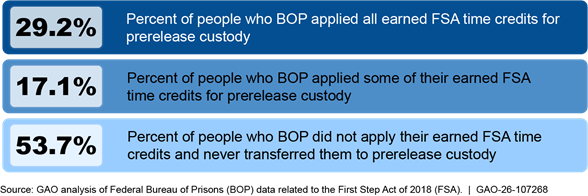
Eligible incarcerated people who agree to participate in programs, among other things, may earn time credits toward early transfer to supervised release and prerelease custody (i.e., home confinement or residential reentry center). GAO found that BOP generally applied all time credits toward supervised release but not for prerelease custody. BOP implemented new planning tools in 2024 and 2025 to help staff anticipate upcoming transfers to prerelease custody and ensure incarcerated people receive their FSA time credits. GAO has ongoing work examining BOP’s efforts to forecast capacity needs and provide sufficient residential reentry center resources.
People Incarcerated in a BOP Facility on March 30, 2024 that Transferred or Could Have Transferred to Prerelease Custody From March 31, 2024–December 31, 2024
The Department of Justice (DOJ) has not been able to fully address all FSA annual reporting requirements because not enough time has passed since the agency implemented FSA to determine certain things, such as recidivism rates. This requirement expired in 2025, and absent congressional actions, DOJ no longer has to submit a report to Congress. Without such information, Congress may be hindered in its decision making regarding the FSA.
Why GAO Did This Study
In 2024, BOP released approximately 42,000 people from federal prisons. Approximately 45 percent of people released from federal prison recidivate (are re-arrested or return within 3 years of their release), according to BOP. Under the FSA, BOP is to help reduce recidivism by assessing a person’s recidivism risk and needs and providing programs and activities to address their needs. The FSA allows eligible people to earn time credits that may reduce their time in prison.
The FSA includes a provision for GAO to assess certain FSA requirements. This report examines the extent to which BOP conducted risk and needs assessments; offered programs and activities; and applied FSA time credits. This report also examines the extent to which DOJ met FSA reporting requirements, among other objectives.
GAO analyzed BOP data from January 2022 through December 2024 for people in BOP custody as of March 30, 2024. GAO analyzed DOJ and BOP policies, guidance, and reports and interviewed officials at BOP’s Central Office and three regional offices. GAO also interviewed staff and incarcerated persons at four facilities. GAO selected facilities based on factors such as geographic location and security level.
What GAO Recommends
GAO recommends that Congress consider extending the reporting requirement for DOJ’s annual FSA report. Additionally, GAO is making six recommendations to BOP, including several recommendations to improve its data collection. BOP concurred with all six recommendations and plans to take action to address them.
Abbreviations
BOP Federal Bureau of Prisons
DOJ Department of Justice
FSA First Step Act of 2018
PATTERN Prisoner Assessment Tool Targeting Estimated Risk and
Needs
SPARC-13 Standardized Prisoner Assessment for Reduction in
Criminality
This is a work of the U.S. government and is not subject to copyright protection in the United States. The published product may be reproduced and distributed in its entirety without further permission from GAO. However, because this work may contain copyrighted images or other material, permission from the copyright holder may be necessary if you wish to reproduce this material separately.
January 27, 2026
Congressional Committees
In 2024, the Department of Justice’s (DOJ) Federal Bureau of Prisons (BOP) released approximately 42,000 people after they had served their federal prison sentence.[1] Central to BOP’s agency mission is to prepare incarcerated people to successfully reenter communities upon release. However, approximately 45 percent of people released from federal prison are re-arrested or return to a federal prison within 3 years of their release, according to BOP.[2] On December 21, 2018, the First Step Act of 2018 (FSA) was enacted and includes certain requirements for DOJ and BOP to help reduce recidivism among individuals incarcerated in federal prisons.[3]
As required by the FSA, BOP is to assess an incarcerated person’s risk of recidivism and identify their “criminogenic needs,” which are characteristics of a person that directly relate to their likelihood to commit another crime. BOP is to use these assessments to place incarcerated people in programs and activities that may help address their needs and reduce their risk of recidivism. Further, eligible incarcerated people may earn FSA time credits related to these programs and activities that may reduce the amount of time they spend in a federal prison.[4] The Consolidated Appropriations Act, 2024, designated not less than approximately $409 million of BOP’s annual appropriation for the programs and activities authorized by the FSA.[5]
We have previously reported on DOJ and BOP’s implementation of the FSA, the challenges that formerly incarcerated people face upon reentering society after incarceration, and the federal grant programs designed to help reduce recidivism.[6] Due to longstanding staffing and infrastructure challenges, leadership changes, and other challenges, we added Strengthening Management of the Federal Prison System to our high-risk list in 2023.[7] The Related GAO Products section at the end of this report lists our prior work.
The FSA includes a provision for us to assess on an ongoing basis the extent to which DOJ and BOP have implemented certain FSA requirements. This report addresses the extent to which: (1) BOP conducted and monitored risk and needs assessments, and DOJ validated the risk and needs assessment tools; (2) DOJ and BOP evaluated and offered programs, activities, and work assignments; (3) BOP applied FSA time credits for eligible incarcerated people; (4) BOP ensured the FSA is consistently implemented bureau-wide; and (5) DOJ met reporting requirements.
To address all five of our objectives, we analyzed relevant legislation and regulations, including the FSA, and relevant DOJ and BOP documents. Documents included BOP policies and guidance, contracts, and agency reports. We also obtained perspectives from DOJ and BOP headquarters officials, through interviews and written responses, regarding their FSA-related efforts. In addition, we interviewed BOP union officials to obtain their perspectives on the FSA. As relevant, we assessed BOP’s processes and practices against criteria, including the FSA,[8] BOP policies, and Standards for Internal Control in the Federal Government.[9]
For objectives one through four, we conducted case studies of four BOP facilities to obtain perspectives from regional and facility-level officials and incarcerated people about their experiences with the FSA.[10] We selected these facilities based on a variety of conditions, such as selecting a range of security levels and different geographic locations.
For objectives one through three, we analyzed BOP data. We obtained and analyzed individual-level BOP data from the SENTRY system on people who have been sentenced and were in BOP custody to conduct analyses related to risk and needs assessments, programs and activities, and FSA time credits, among other things.[11] We assessed the reliability of the data by conducting electronic tests; reviewing BOP documentation; and interviewing BOP staff knowledgeable about the data. We determined that these data were sufficiently reliable for the purposes of determining timeliness of risk and needs assessments, program completions, and application of FSA time credits, among other things. See appendix I for additional information on our scope and methodology.
We conducted this performance audit from January 2024 to January 2026 in accordance with generally accepted government auditing standards. Those standards require that we plan and perform the audit to obtain sufficient, appropriate evidence to provide a reasonable basis for our findings and conclusions based on our audit objectives. We believe that the evidence obtained provides a reasonable basis for our findings and conclusions based on our audit objectives.
Background
Elements of the FSA
Elements associated with the FSA include the risk and needs assessment system, evidence-based recidivism reduction programs and productive activities, and FSA time credits, as shown below in figure 1.
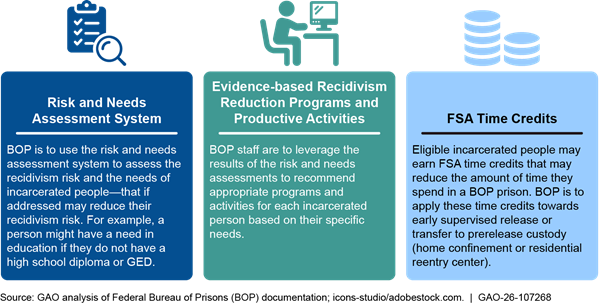
Note: An evidence-based recidivism reduction program is either a group or individual activity that has been shown by empirical evidence to reduce recidivism or is based on research indicating that it is likely to be effective in reducing recidivism; and is designed to help people succeed in their communities upon release from prison. A productive activity is either a group or individual activity that is designed to allow incarcerated people determined as having a minimum or low risk of recidivating to remain productive and thereby maintain a minimum or low risk of recidivating.
Risk and Needs Assessment System
Under the FSA, BOP is to assess both the recidivism risk and the needs of incarcerated people. Specifically, BOP is to complete these assessments when an incarcerated person first arrives at a BOP facility and reassess them at least annually if the incarcerated person is successfully participating in programs or activities.[12] BOP is to conduct these assessments using two tools: the Prisoner Assessment Tool Targeting Estimated Risk and Needs (PATTERN) and the Standardized Prisoner Assessment for Reduction in Criminality (SPARC-13).
PATTERN. PATTERN is DOJ’s risk assessment tool that BOP staff are to use to measure an incarcerated person’s risk of recidivism. The National Institute of Justice developed PATTERN for DOJ in 2019.[13] Since then, DOJ has updated and issued three iterations of the tool. DOJ implemented PATTERN 1.3—the most recent version—in May 2022. BOP uses PATTERN to predict general or violent recidivism:
· General recidivism is any arrest or return to BOP custody following release.[14]
· Violent recidivism is an arrest for an act of violence following release.[15]
PATTERN assesses a person’s risk of recidivism based on factors an incarcerated person can change over time (dynamic factors) and those that cannot change (static factors). It has four static factors and 11 dynamic factors, as described in figure 2.
Figure 2: DOJ’s Prisoner Assessment Tool Targeting Estimated Risk and Needs (Version 1.3) and Its Static and Dynamic Factors
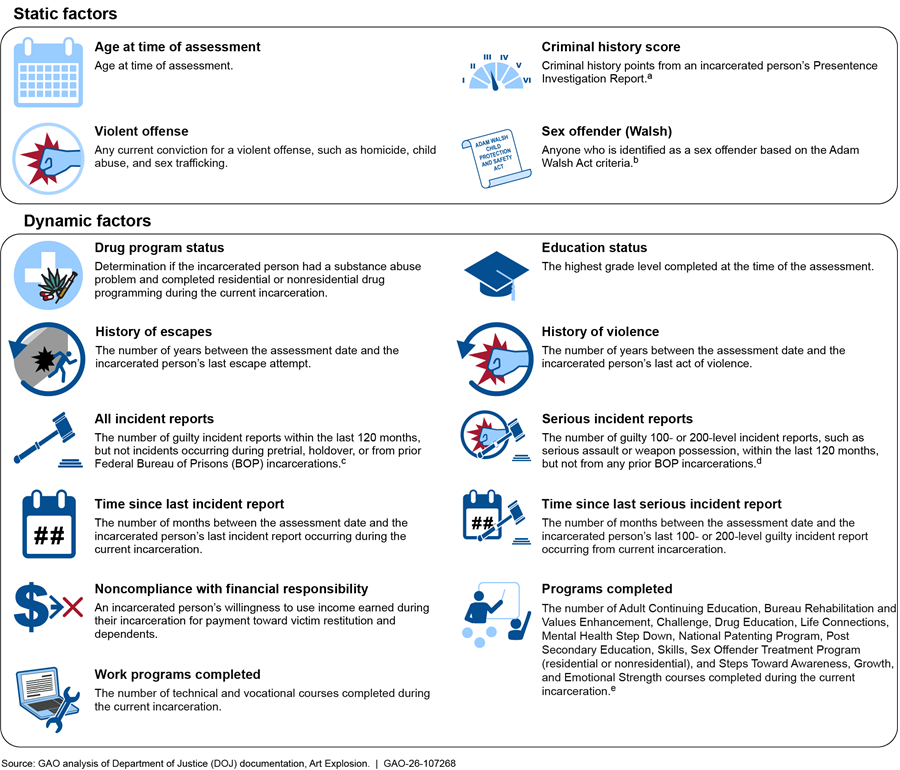
Note: Static factors are characteristics of incarcerated people that are historical and therefore unchangeable, such as an incarcerated person’s age at the time of assessment. By contrast, dynamic factors are variables that may change over time and may reflect more recent incarcerated person behavior, such as prison misconduct or completion of recidivism reduction programs while incarcerated.
aPresentence Investigation Report is a structured report required pursuant to 18 U.S.C. § 3552 to be conducted by a U.S. Probation Officer prior to a defendant’s sentencing. A Presentence Investigation Report contains information from various sources, including criminal history records, educational systems, hospitals and counseling centers, family members, and associates.
bThe Walsh criteria refers to whether the person is a sex offender as defined in the Sex Offender Registration and Notification Act, Title I of the Adam Walsh Child Protection and Safety Act of 2006, Pub. L. No. 109-248, 120 Stat. 587.
cBOP staff may issue an incident report to an incarcerated person when the official witnesses or reasonably believes the person committed a prohibited act as described in BOP regulations and policy. Department of Justice, Bureau of Prisons, Inmate Discipline Program, 5270.09 CN-1 (Washington, D.C.: Nov. 18, 2020).
dAccording to BOP, a 100-level incident is an incident of greatest severity, such as killing another person or rioting. A 200-level incident is an incident of high severity, such as fighting another person or stealing/theft. Department of Justice, Bureau of Prisons, Inmate Discipline Program, 5270.09 CN-1 (Washington, D.C.: Nov. 18, 2020).
ePrograms completed does not include all the evidence-based recidivism reduction programs and productive activities currently available throughout BOP. Additionally, some of the programs currently included in this variable, such as Adult Continuing Education, are not considered evidence-based recidivism reduction programs or productive activities by BOP policy.
PATTERN classifies an incarcerated person’s risk of recidivism into four levels—minimum, low, medium, or high—based on their numerical risk score and applicable “cut points.”[16] A person’s risk score and level may increase or decrease during their incarceration based on some of these factors. For example, as a person ages, their risk score may lower.[17] PATTERN includes different predictive models and scales based on whether an incarcerated person is female or male because risk factors vary among females and males.[18] It uses different cut points for females and males to account for differences in their risks.
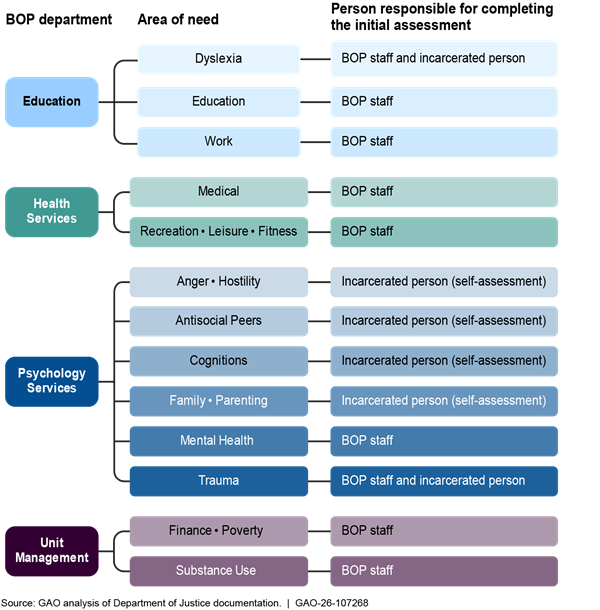
SPARC-13. SPARC-13 is BOP’s needs assessment tool that staff are to use to identify incarcerated people’s needs that, if addressed, may reduce their recidivism risk.[19] As shown in figure 3, BOP is to assess people’s needs in 13 areas. Different BOP departments are responsible for initially assessing specific areas of need. Other areas of need require the voluntary participation of the incarcerated person by completing a self-assessment, and other areas require participation from both BOP staff and the incarcerated person.
Figure 3: Needs Assessed by the Federal Bureau of Prisons (BOP), by Department and Person Responsible for the Initial Assessment
While initial assessments are conducted by BOP staff or an incarcerated person, BOP uses an automated electronic tool for reassessments. Specifically, this tool reassesses needs from information in SENTRY. This information, which is to be updated as appropriate by BOP staff, can include a person’s refusal to take an assessment or a new incident report. For both risk and needs assessments, staff press a button, and the tool pulls the data from SENTRY to create the reassessment result. BOP implemented this tool in August 2021. Prior to this tool, staff at BOP facilities manually calculated risk scores for each reassessment, as we reported in 2023.[20]
Evidence-Based Recidivism Reduction Programs and Productive Activities
BOP is to offer evidence-based recidivism reduction programs and productive activities (programs and activities) to people incarcerated within BOP facilities to help them address their individual needs identified through the SPARC-13 assessments.[21]
· The FSA defines an evidence-based recidivism reduction program as either a group or individual activity that has been shown by empirical evidence to reduce recidivism or is based on research indicating that it is likely to be effective in reducing recidivism, and is designed to help people succeed in their communities upon release from prison.[22]
· A productive activity is either a group or individual activity that is designed to allow incarcerated people determined as having a minimum or low risk of recidivating to remain productive and thereby maintain a minimum or low risk of recidivating.[23]
Each evidence-based recidivism reduction program and productive activity is to address one or more of the 13 areas of need. Some programs and activities address several needs. For example, the anger management program can help address two needs—the anger/hostility need and the cognitions need. Appendix II lists BOP’s programs and productive activities and the needs they address.[24] According to its August 2025 Approved Program Guide, BOP has 48 evidence-based recidivism reduction programs and 73 productive activities.[25] The number of programs and activities have changed over time, and BOP has criteria to review external entities’ proposals—such as from researchers and faith-based organizations—to create new evidence-based recidivism reduction programs that could be offered at BOP facilities.[26] Some of these programs and activities (10 programs and one activity) will result in an incarcerated person’s recidivism risk score lowering if they complete the program or activity. If a person’s risk score lowers, then their risk level may also lower.[27]
FSA Time Credits
Based on BOP’s implementation of the FSA, eligible incarcerated people earn FSA time credits based on their earning status. To be in earning status, eligible incarcerated people must have arrived at their designated BOP facility and completed the needs assessments that require their participation, as shown in figure 4. They remain in earning status unless certain events occur, such as a person declining to participate in recommended programming.
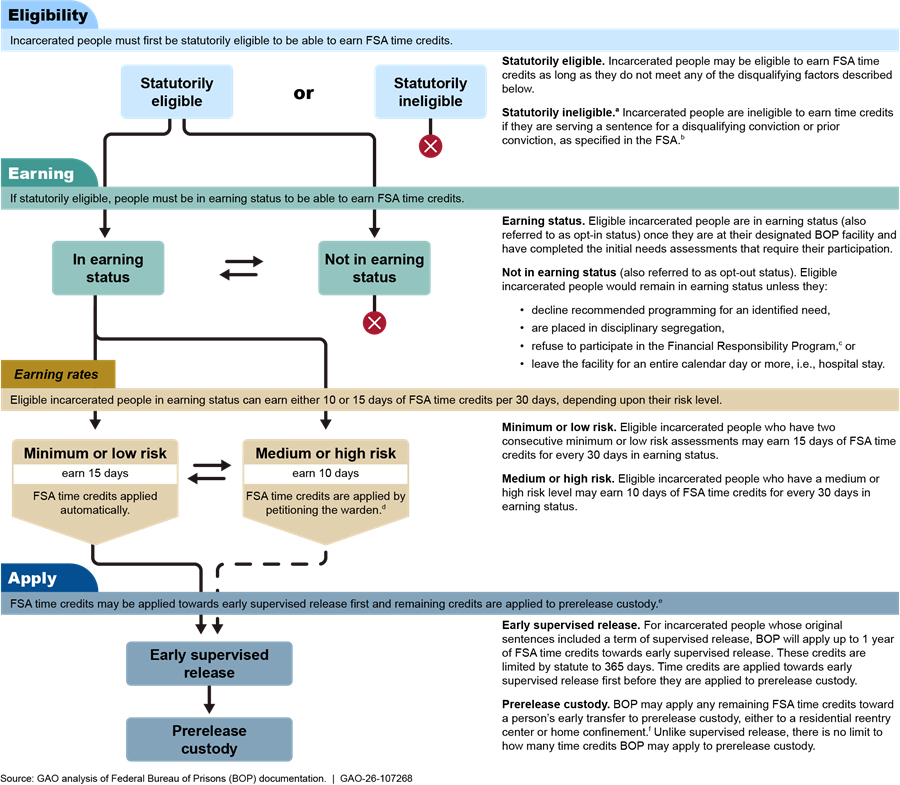
Note: FSA time credits are not earned based on program participation or completion. As such, a person does not need to participate or complete programs or activities to remain in earning status.
aIncarcerated people who are ineligible to earn or apply FSA time credits may still earn other rewards and incentives for successfully participating in evidence-based recidivism reduction programs and productive activities. For example, these people may earn increased phone and video conferencing privileges and additional time for visitation at the prison, as determined by the warden and per the BOP policy guiding the issuance of FSA incentives.
b18 U.S.C. § 3632(d)(4)(D). These disqualifying offenses generally involve violent or gang-related offenses, sex offenses, certain national security or immigration-related offenses, and some drug-trafficking offenses.
cThe Financial Responsibility Program helps people develop a financial plan to complete obligatory payments, such as court-ordered restitutions, fines, and court costs.
dFor a person with a medium or high recidivism risk level to have their time credits applied, they must petition the warden. 18 U.S.C. § 3624(g)(1)(D)(II). And if approved, these time credits would be applied. An incarcerated person who has a final order of removal is ineligible to apply earned FSA time credits. 18 U.S.C. § 3632(d)(4)(E).
eUnder the FSA, to have their time credits applied, eligible incarcerated people generally must have accrued time credits in an amount that is equal to the remainder of the person’s imposed term of imprisonment. 18 U.S.C. § 3624(g)(1)(A)-(D)(i)(I). An incarcerated person who has a final order of removal is ineligible to apply earned FSA time credits. 18 U.S.C. § 3632(d)(4)(E).
fIn making its decision toward prelease custody, in addition to FSA time credits, BOP may also need to consider the Second Chance Act. Specifically, the Act permits incarcerated people to spend a portion of the final 12 months of their sentence in prerelease custody. Additionally, BOP facility staff are to individually assess incarcerated people for the appropriateness of prerelease custody, based on criteria set forth in 18 U.S.C. § 3621(b), and recommend how long the person should be placed at a residential reentry center or home confinement. All incarcerated people are statutorily eligible for prerelease custody under the Act. However, the length of a person’s prerelease custody is also determined by other factors, such as bed space and resource availability of the residential reentry center.
The amount of FSA time credits that incarcerated people earn is not based on how many, if any, programs or activities they participate in or complete. The FSA states that eligible incarcerated people who successfully complete evidence-based recidivism reduction programming or productive activities are to earn 10 days of FSA time credits for every 30 days of successful participation in programs or activities.[28] However, as we reported in 2023, under BOP’s implementation of the FSA, incarcerated people earn time credits based on their earning status—not the number of programs they participate in or complete.[29]
We also reported that BOP officials noted that they designed their earning status criteria to account for items in the FSA Time Credits regulations.[30] For example, under BOP’s procedure, and consistent with the FSA Time Credits regulations, facility interruptions and program unavailability do not affect an incarcerated person’s ability to be in earning status.[31] Thus, a person can earn time credits even when programming is not available or without ever participating in a program.
Ultimately, FSA time credits may reduce the amount of time an incarcerated person spends in a BOP facility. Eligible incarcerated people can earn FSA time credits toward early supervised release and transfer to prerelease custody (i.e., residential reentry centers or home confinement).[32] In making its decision toward prelease custody, in addition to FSA time credits, BOP may also need to consider the Second Chance Act. By law, the Director of BOP is required, to the extent practicable, to ensure incarcerated people serving a term of imprisonment are able to spend a portion of the final 12 months of their sentence under conditions that will afford them a reasonable opportunity to adjust and prepare for reentry into the community.[33]
Figure 5 shows an example of how an incarcerated person entering a BOP facility could have FSA time credits applied.
Figure 5: Example of the First Step Act of 2018 (FSA) Time Credits Process for an Eligible Incarcerated Person at a BOP Facility
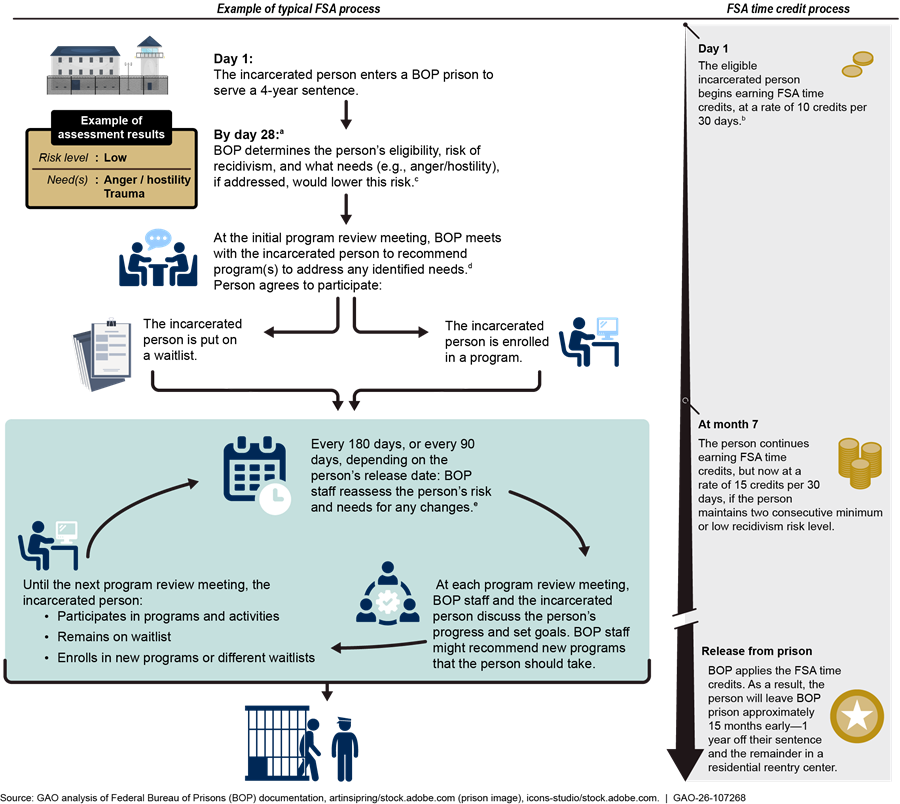
Note: This figure is an example of how an eligible incarcerated person in earning status may earn FSA time credits. Incarcerated people may be eligible to earn FSA time credits as long as they are not serving a sentence for a disqualifying conviction or prior conviction, as specified in the FSA. Eligible incarcerated people are in earning status once they are at their designated BOP facility and have completed the initial needs assessments that require their participation. This figure does not address other rewards or incentives for which an incarcerated person may be eligible.
aBOP policy states that staff are to complete risk assessment by day 28 and some of the needs assessments by day 30. However, according to BOP officials, they ask staff to complete all assessments by day 28.
bAccording to BOP, all eligible incarcerated individuals are to begin earning time credits from day 1, once they arrive at their designated BOP facility. While eligibility and earning status may not be known on day 1, according to BOP officials once this is determined, FSA time credits would be retroactively earned since day 1 of their arrival. An incarcerated person remains in earning status unless the individual declines recommended programming for an identified need, is placed in disciplinary segregation, refuses to participate in the Financial Responsibility Program, or leaves the designated facility for an entire calendar day or more.
cBOP defines risk of recidivism as the likelihood that a person may continue to engage in unlawful behavior once released from prison. DOJ defines recidivism as (a) a new arrest in the U.S. by federal, state, or local authorities within 3 years of release or (b) a return to federal prison within 3 years of release. BOP staff are to conduct a review of the person’s current and prior conviction(s) to determine their eligibility to earn FSA time credits.
dBOP staff are to hold two types of regularly schedule meetings with incarcerated individuals: initial classification and program reviews, per BOP policy. The purpose of the initial classification is to develop a program plan for the incarcerated person during their incarceration. At program reviews, BOP staff are to review progress in recommended programs, and recommend new programs based upon skills the incarcerated person has gained during incarceration. Department of Justice, Bureau of Prisons, Inmate Classification and Program Review, 5322.13 (Washington, D.C.: May 16, 2014).
eAccording to BOP policy, staff are to reassess the incarcerated individuals’ risk and needs at the program review meetings which are to occur every 180 or 90 calendar days if the incarcerated person is within 12 months of their projected release date. Department of Justice, Bureau of Prisons, Inmate Classification and Program Review, 5322.13 (Washington, D.C.: May 16, 2014).
Agency Roles and Responsibilities
Federal Bureau of Prisons. Generally, the FSA requires BOP to ensure all incarcerated people have a recidivism risk level assigned, assess the criminogenic needs of each person, provide programs and activities to address people’s needs, and apply FSA time credits to eligible incarcerated people’s sentences.[34] Within BOP, the Central Office divisions, regional offices, facility departments, and Residential Reentry Management Branch staff have various FSA-related responsibilities, among other duties.
· At the Central Office, staff from various divisions are responsible for the oversight and guidance on the risk and needs assessments. The Central Office is to also oversee the application of FSA time credits. The Designation and Sentence Computation Center is to screen incarcerated people, assign them to a BOP facility that aligns with their security level and basic needs, and enter data into SENTRY that tracks each incarcerated person’s security and custody level classification data.
· Regional offices may monitor some FSA processes at the facilities, such as reviewing data on FSA processes from each facility. Specifically, BOP’s six regional offices may collect data from the facilities on missing needs assessments, program participation, and time credit eligibility, among others.
· At BOP facilities, the unit team is responsible for implementing and overseeing the risk and needs assessment system. Each unit team consists of a unit manager, case manager, and counselor. Specifically, case managers are to conduct, or ensure other BOP staff conduct, risk and needs assessments. Facility staff from the education and recreation services, health services, and psychology services departments are responsible for conducting initial needs assessments and entering data into SENTRY. These departments, plus some other departments, offer programs and activities to the incarcerated population. As of April 2025, BOP had 120 secure facilities (prisons).
· Unit team staff are also responsible for initiating an incarcerated person’s transfer to prerelease custody by referring the person to one of BOP’s Residential Reentry Management offices for placement in a residential reentry center or home confinement. The Residential Reentry Management Branch staff assess the person’s situation, such as a potential location for home confinement, and their history and needs to determine the prerelease custody placement that would best transition them to living in the community again.
Department of Justice. Under the FSA, generally, the Attorney General’s responsibilities include the following activities:
· Annually review, validate, and release publicly on DOJ’s website the risk and needs assessment system. This review includes any changes and a statistical validation of the risk and needs tools.[35]
· Conduct ongoing research and data analysis on evidence-based recidivism reduction programs, among others.[36] Under this requirement, DOJ must conduct research on which programs are most effective at reducing recidivism, and the type, amount, and intensity of programming that most effectively reduces the risk of recidivism.
· Submit an annual report to certain committees of Congress that summarizes the Attorney General’s FSA-related activities and accomplishments, among other things.[37]
BOP Is Taking Steps to Monitor Risk and Needs Assessments, and DOJ Validated the Risk and Needs Assessment System
While BOP staff are conducting risk and needs assessments as required by the FSA, as of December 2024, they are not conducting all assessments within FSA required or internal time frames. However, BOP plans to enhance an application to better monitor whether assessments are conducted within these time frames. Additionally, DOJ validated the risk and needs assessment system as required by the FSA.
BOP Conducted Some, but Not All, Risk and Needs Assessments Within FSA Required and Internal Time Frames
BOP conducted most initial risk assessments and many initial needs assessments within internal time frames. For reassessments, BOP was generally more timely for first reassessments than for second and third reassessments.[38]
Initial Risk Assessments
BOP staff conducted most, but not all, initial risk assessments within internal time frames. According to BOP policy, staff are required to conduct initial risk assessments for incarcerated people in conjunction with their initial classification meeting, which should be within 28 calendar days of their arrival at their designated BOP facility.[39] As shown in Figure 6, we examined a selected cohort of incarcerated people who entered BOP facility from June 1, 2022, to March 30, 2024.[40] We found that BOP conducted initial risk assessments within 28 calendar days for about 75 percent (43,349) of the 57,902 incarcerated people in the selected cohort. For those in the selected cohort whose initial risk assessment was late (14,515), BOP staff conducted these assessments within 60 days for almost 88 percent of these individuals (12,756).
Figure 6: Percent of Selected Cohort of Incarcerated People by When Initial Risk Assessment Was Conducted
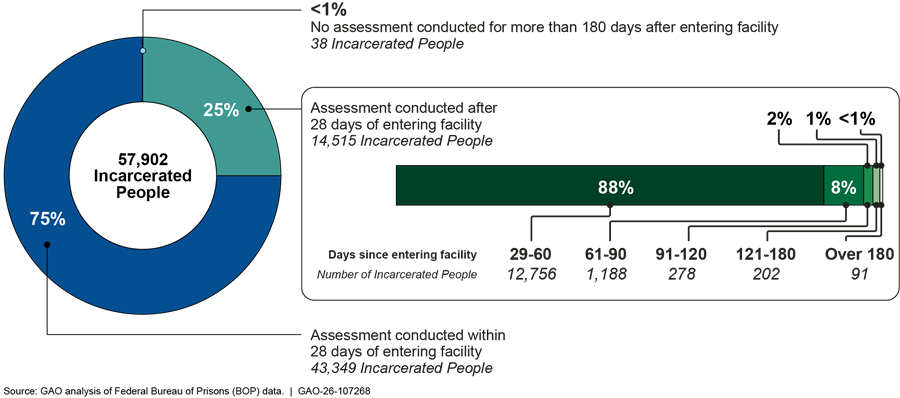
Note: For this figure, we analyzed data for a cohort of incarcerated people who started their sentence and entered a designated BOP facility from June 1, 2022, to March 30, 2024. According to BOP policy, BOP staff are required to conduct initial risk assessments within 28 calendar days of an incarcerated person’s arrival at their designated BOP facility.
BOP facility staff at all four facilities we visited stated that they believe the reason for the late assessments was due to a missing sentence computation.[41] According to BOP officials, the Designation and Sentence Computation Center must complete the sentence computation before BOP staff can conduct a risk assessment. Designation and Sentence Computation Center staff must complete the sentence computation within 60 days of the date that BOP determines where a person will serve their sentence, depending upon the person’s sentence length.[42] BOP facility staff must complete the initial risk assessment within 28 days of a person arriving at a facility. As such, the time frames to complete these processes may not align. However, initial risk assessments that are not conducted within 28 days do not affect an incarcerated person’s ability to be in earning status. Once BOP completes a person’s initial risk assessment, they will retroactively begin earning time credits, as long as they are eligible and otherwise in earning status.
Initial Needs Assessments
According to our analysis, BOP conducted many, but not all, initial needs assessments within internal time frames. While BOP staff are to complete risk assessments during an incarcerated person’s initial classification meeting, the initial needs assessments are to be conducted within 30 days of the incarcerated person’s arrival at a designated BOP facility.[43] Of the 13 initial needs assessments, BOP staff conduct seven independently and another two with participation from the incarcerated person. The incarcerated person completes self-assessments for the remaining four needs.
Specifically, as shown in table 1, the extent to which BOP conducted initial needs assessments within internal time frames for those in the selected cohort varied by need and which department was responsible for the assessment.
Table 1: Percent of Incarcerated People with Initial Needs Assessments Conducted Within BOP Internal Time Frames, by Department and Person Responsible
|
BOP Facility Department |
Area of Need |
Person Responsible for Assessment |
Percent |
|
Education |
Dyslexia |
BOP staff and incarcerated person |
93% |
|
Education |
Education |
BOP staff |
—a |
|
Education |
Work |
BOP staff |
95% |
|
Health Services |
Medical |
BOP staff |
84% |
|
Health Services |
Recreation/Leisure/Fitness |
BOP staff |
83% |
|
Psychology Services |
Anger/Hostility |
Incarcerated person (self-assessment) |
69% |
|
Psychology Services |
Antisocial Peers |
Incarcerated person (self-assessment) |
68% |
|
Psychology Services |
Cognitions |
Incarcerated person (self-assessment) |
68% |
|
Psychology Services |
Family/Parenting |
Incarcerated person (self-assessment) |
69% |
|
Psychology Services |
Mental Health |
BOP staff |
69% |
|
Psychology Services |
Trauma |
BOP staff and incarcerated person |
91% |
|
Unit Management |
Finance/Poverty |
BOP staff |
90% |
|
Unit Management |
Substance Use |
BOP staff |
—b |
Source: GAO analysis of Federal Bureau of Prisons (BOP) data. | GAO‑26‑107268
Note: For this table, we analyzed data for a cohort of incarcerated people who started their sentence and entered a designated BOP facility from June 1, 2022, to March 30, 2024. The total size of the cohort population with initial needs assessments was 57,902 people. Initial needs assessments are to be conducted within 30 days of the incarcerated person’s arrival at a designated BOP facility.
aFor the education need, BOP recorded data in the First Step Act of 2018 (FSA) needs assessments field for 38 percent of incarcerated people within 30 days, respectively. However, BOP stated that assessments for this need may have been conducted but were documented in a different data field that we did not examine.
bFor the substance use need, BOP recorded data in the FSA needs assessments field for 36 percent of incarcerated people within 30 days, respectively. However, BOP stated that assessments for this need may have been conducted but were documented in a different data field that we did not examine.
We found that BOP conducted seven of the nine needs assessments that staff were solely or partially responsible for within 30 days for 69 percent to 95 percent of the 57,902 incarcerated people in the selected cohort.
For the remaining two needs that staff were responsible for conducting, education and substance use, we were unable to determine when these assessments were done due to data limitations. Specifically, while our data analysis found BOP staff conducted these two initial needs assessments within 30 days for approximately one third of the people incarcerated during this time, BOP officials said that these data were not accurate. Officials explained that BOP assessed these two needs using specific data fields prior to the FSA—different than the FSA data fields we analyzed. For example, staff completed a data field in SENTRY that determined if the incarcerated person had a high school diploma or equivalency for the education need. When BOP staff complete this data field, they do not also enter data into the FSA needs data field in SENTRY. However, these assessments do get recorded during the reassessment when staff press the FSA assessment button. As a result, BOP officials stated that BOP staff are generally conducting these needs assessments within internal time frames, but they are not reflected in the FSA data we analyzed.[44]
According to BOP officials, they are working to improve their FSA processes, but technology limitations and staffing shortages have delayed some inputs of initial needs assessments. However, for initial needs assessments that staff are solely or partially responsible for completing, assessments not conducted within internal time frames do not affect an incarcerated person’s ability to be in earning status for FSA time credits.
For the four initial needs assessments that incarcerated people complete through self-assessments, nearly 70 percent of the people in the selected cohort completed each within 30 days of their arrival. The remaining 30 percent could include people who did them after 30 days or refused to complete them. BOP places incarcerated people in a refusal status if they do not complete their self-assessments. BOP facility staff said that some incarcerated people refused to complete their self-assessments. Additionally, incarcerated people may not complete their self-assessments because the system timed out, the person neglected to answer every question in the assessment, or the person was unaware they needed to complete the self-assessments.[45] BOP staff stated that the refusal rate for self-assessments has decreased over time because BOP staff and other incarcerated people informed those newly incarcerated about the process.
Risk and Needs Reassessments
BOP conducted many, but not all, reassessments within FSA required and internal time frames for the incarcerated people in the selected cohort who were incarcerated long enough to have these reassessments.
FSA required time frames. Generally, the FSA requires BOP to reassess each incarcerated person’s risk level annually.[46] We found that BOP conducted the vast majority (99.6 percent) of first risk reassessments within 365 days for incarcerated people in our selected cohort, as required by the FSA.[47] Further, BOP conducted 99.8 percent of second and third risk reassessments within 365 days of the previous assessment.[48]
BOP internal time frames. BOP internal time frames require staff to complete risk and needs assessments during program review meetings, which occur more frequently than the FSA requirements.[49] Specifically, BOP policy requires that staff conduct these meetings every 180 days or at least once every 90 days when an incarcerated person is within 12 months of their projected release date.[50]
We found that BOP conducted first risk and needs reassessments within internal time frames for 70 to 79 percent of incarcerated people in the selected cohort, as shown in figure 7.
Figure 7: Percent of Incarcerated People with First Risk and Needs Reassessments Conducted Within BOP Internal Time Frames
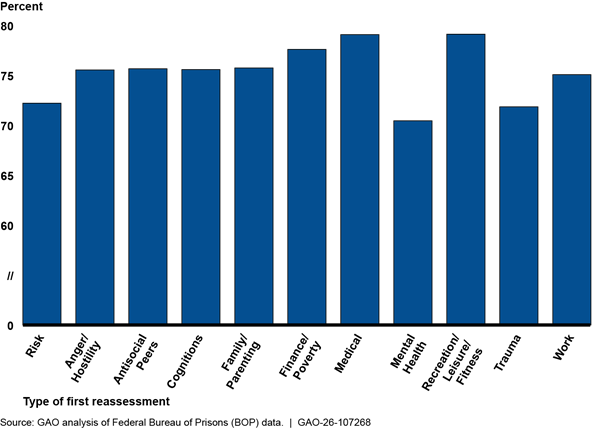
Note: For this figure, we analyzed data for a cohort of incarcerated people who started their sentence and entered a designated BOP facility from June 1, 2022, to March 30, 2024, and that were incarcerated long enough to have a first reassessment for risk and 10 needs. Populations varied for each risk and needs assessment based on the number of incarcerated people in this cohort who had been incarcerated long enough for a first reassessment. Populations ranged between 54,478 for the antisocial peers need and 56,748 for the work need. BOP reassesses 12 of the 13 needs for incarcerated people. BOP does not reassess dyslexia. In addition, we did not include two other needs, education and substance use, because we identified data limitations with the initial assessments. For this analysis, we compared the initial assessment date to the first reassessment date. While BOP’s FSA assessment button conducts reassessments for risk and needs simultaneously, initial assessments are not done at the same time. As a result, the amount of time to complete a reassessment may vary per risk or need.
The percent conducted within internal time frames decreased for subsequent reassessments for risk and each need that was analyzed.[51] For example, BOP conducted first reassessments for the recreation/leisure/fitness need for almost 79 percent of people in our selected cohort who were incarcerated long enough to have a first reassessment (44,735 of 56,551). However, for people incarcerated long enough to have second and third reassessments, BOP conducted those reassessments for 69 percent (36,128 of 52,738) and 66 percent (26,860 of 40,484) of incarcerated people, respectively. For those incarcerated people for whom BOP did not conduct their first risk or needs reassessments within internal time frames (11,382 to 15,374 people), BOP varied in how late it was in conducting these reassessments.
People with more than 1 year remaining on their sentence. For incarcerated people whose risk and needs BOP should have first reassessed at 180 days but did not, BOP conducted reassessments for the majority of these individuals between 181 and 210 days after their initial assessment (1 to 30 days late), as indicated in figure 8. We found a similar pattern when we analyzed second and third reassessments for risk and needs that were not conducted within internal time frames.
Figure 8: Percent of Incarcerated People with Late First Reassessments (Conducted After 180 Days), by Number of Days
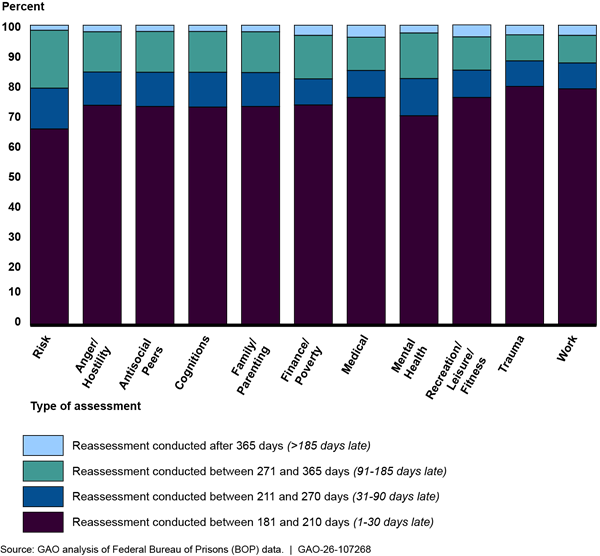
Note: For this figure, we analyzed data for a cohort of incarcerated people who started their sentence and entered a designated BOP facility from June 1, 2022, to March 30, 2024, and were incarcerated long enough to have a first reassessment for risk and 10 needs. This figure includes people whose first reassessments were not conducted within internal time frames (180 days) and had more than 1 year remaining on their sentence at the time of their first reassessment. It does not include people for which BOP conducted reassessments on time. The number of incarcerated people with more than 1 year remaining on their sentence with first reassessments conducted after 180 days ranged between 7,195 for the finance/poverty need and 10,265 for the trauma need. BOP does not reassess dyslexia. In addition, we did not include two other needs, education and substance use, because we identified data limitations with the initial assessments. For this analysis, we compared the initial assessment date to the first reassessment date. While BOP’s assessment button conducts reassessments for risk and needs simultaneously, initial assessments are not done at the same time. As a result, the amount of time to complete a reassessment may vary per risk or need.
People with 1 year or less remaining on their sentence. For incarcerated people whose risk and needs BOP should have first reassessed at 90 days but did not, BOP most frequently conducted these reassessments 151 to 180 days after their initial assessment (61 to 90 days late) for risk and 8 of the 10 needs, as indicated in figure 9. For the trauma need, BOP most frequently conducted this assessment 181 to 365 days after their initial assessment (91 to 275 late). For the work need, BOP most frequently conducted this assessment 91 to 120 days after their initial assessment (1 to 30 days late). Further, if BOP would have been required to first reassess these individuals at 180 days, rather than 90 days, BOP would have conducted most of these assessments (67 to 79 percent) within internal time frames.
Figure 9: Percent of Incarcerated People with Late First Reassessments (Conducted After 90 Days), by Number of Days
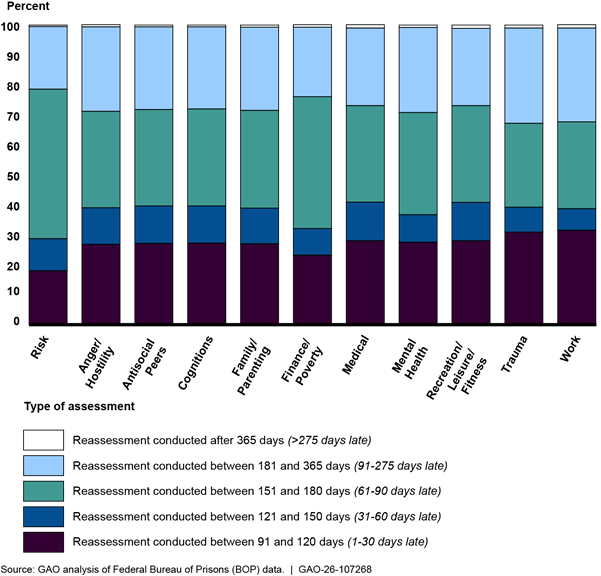
Note: For this figure, we analyzed data for a cohort of incarcerated people who started their sentence and entered a designated BOP facility from June 1, 2022, to March 30, 2024, and were incarcerated long enough to have a first reassessment for risk and 10 needs. This figure includes people whose first reassessments were not conducted within internal time frames (90 days) and had 1 year or less remaining on their sentence at the time of their first reassessment. It does not include people for which BOP conducted reassessments on time. The number of incarcerated people with 1 year or less remaining on their sentence with first reassessments conducted after 90 days ranged between 4,127 for the medical need and 7,132 for risk. BOP does not reassess dyslexia. In addition, we did not include two other needs, education and substance use, because we identified data limitations with the initial assessments. For this analysis, we compared the date of the initial assessment to the first reassessment date. While BOP’s assessment button conducts reassessments for risk and needs simultaneously, initial assessments are not done at the same time. As a result, the amount of time to complete a reassessment may vary per risk or need.
BOP facility staff highlighted technology issues as the primary driver of late reassessments. To conduct reassessments, BOP staff use a tool that pulls data from SENTRY to automatically reassess both risk and needs when staff press the FSA assessment button. One specific technology issue noted by both BOP staff at the facilities we visited and union officials was that there would be instances where staff would press the FSA assessment button, but the system would not record an assessment. In addition, staff noted that sometimes the system would not allow them to conduct an assessment if they were too far ahead of the reassessment timeline. BOP Central Office officials stated that most of these technology issues have since been resolved or were the result of issues with a specific incarcerated person’s information rather than system-wide issues. This normally requires staff and officials to look over the person’s specific case and resolve whatever parts of the file are causing the technology issues before a reassessment can be conducted.
In addition, BOP facility staff provided an explanation as to why 90-day reassessments may not be conducted within internal time frames. Specifically, these staff stated that there is nothing in SENTRY that indicates when an incarcerated person transitions from 180 to 90-day reassessments. Further, these staff stated that SENTRY does not automatically populate the next date for an incarcerated person’s program review meeting. Instead, facility staff manually calculate the date of the next program review meeting and enter that date into SENTRY.
BOP officials stated that they plan to enhance the automated-calculation application to ensure that risk and needs reassessments are conducted according to FSA required and internal time frames, as we discuss in more detail below. Implementing such enhancements will help ensure that incarcerated people are awarded the maximum amount of FSA time credits. While late initial assessments and reassessments may not affect an incarcerated person’s ability to earn FSA time credits—unless they choose to not complete self-assessments—it may affect how many time credits they can earn. Specifically, if risk assessments are delayed, that may affect how long it takes for an individual to demonstrate consecutive low or minimum risk levels which would allow them to earn 15 days of FSA time credits for every 30 days they are in earning status.[52] Further, if initial needs assessments are delayed, then incarcerated people may be delayed in signing up for evidence-based recidivism reduction programs and productive activities that could help address their needs and potentially reduce their recidivism risk.
BOP Is Taking Steps to Better Monitor the Timeliness of Risk and Needs Assessments
BOP conducted some monitoring of the timeliness of risk and needs assessments at the regional and facility level and plans to enhance its automated-calculation application to better monitor whether these assessments are conducted within FSA and internal time frames. For example, BOP officials stated they currently rely on supervisors, such as unit managers and case management coordinators, to monitor assessment timeliness. At all four facilities we visited, officials stated they ran weekly, and sometimes monthly, reports to ensure that case managers are completing their initial risk and needs assessments on time. At some facilities, staff with FSA expertise also monitored the completion of initial assessments through reports and provided this information to the regional office. In addition, two of the three regional offices we spoke with asked facility staff to send them monthly reports that included information on missing needs assessments.[53]
In 2023, we reported on limitations in BOP’s monitoring efforts, finding that BOP had not confirmed whether its monitoring efforts would measure timeliness of risk and needs assessments.[54] We recommended that BOP ensure that the monitoring efforts it implements can determine if BOP is conducting assessments in accordance with FSA required and internal time frames. In addition, we recommended that BOP use and document the results of this monitoring to take appropriate corrective actions, as needed.
In response to our 2023 recommendation on limitations in BOP’s efforts to monitor assessment timeliness, BOP officials stated they were in the process of enhancing their automated-calculation application of FSA time credits. According to officials, this enhanced application will integrate risk and needs reassessments into a single, monthly automated process.[55] Through this application, BOP officials stated they would be able to ensure that risk and needs reassessments are conducted in accordance with FSA required and internal time frames.
Once implemented, this application should be able to address the issues with late risk and needs reassessments identified above. For example, the application will record a reassessment if there is a change to an incarcerated person’s records, such as when a person completes a program. This should help alleviate technology issues that prevent a reassessment from taking place when BOP facility staff attempt to run these reassessments. Further, BOP officials stated that running this application monthly would ensure that a new reassessment is conducted if any of the incarcerated person’s records changed in the last month.
In addition, the application will populate initial assessment results, if missing, for six needs when the monthly automated process occurs. Specifically, the application will extract information, if available, from other data fields in SENTRY. For example, for the education need, the application would search the high school diploma or equivalency data field and record an initial assessment, if missing. However, the application will not populate initial assessment results for the other seven needs. Missing initial assessments for three of these needs will not affect an incarcerated person’s ability to earn FSA time credits.[56] The remaining four needs are self-assessments, which are the responsibility of the incarcerated person to complete and do affect their ability to earn FSA time credits.
BOP originally anticipated initial implementation of the enhanced application in September 2023. However, BOP officials stated that implementation has been delayed due to staff shortages and the departure of key personnel. Further, in December 2025, BOP officials stated that they would begin working on the application after they replace SENTRY with a new system, which they anticipate occurring in September 2026.[57] Taking action to implement the application as intended would help ensure that risk and needs reassessments are completed within FSA required and internal time frames, in line with our previous recommendation.
DOJ Validated the Risk and Needs Assessment System as Required
Since it was first implemented in 2019, the National Institute of Justice, on behalf of DOJ, has validated PATTERN on an annual basis, as required by the FSA.[58] DOJ issued its most recent revalidation report for PATTERN version 1.3 in August 2024. In this report, National Institute of Justice researchers found that racial and ethnic biases persisted since the implementation of PATTERN version 1.2 in 2020.[59] Specifically, the report stated that the transition to the current version of PATTERN neither exacerbated nor solved these racial bias issues overall. However, the over-prediction of recidivism for Black males and females worsened, whereas the over-prediction for Hispanic males was mitigated when compared to previous reports.[60]
National Institute of Justice’s review of recidivism rates of similarly classified incarcerated people found that PATTERN version 1.3 over or under-predicted the risk of recidivism for certain groups. For example, regarding general recidivism, PATTERN tended to over-predict recidivism for Asian, Black, and Hispanic people and under-predict for Native American people, compared to White people. According to DOJ officials, while they have not identified an ideal solution, the researchers continue to develop strategies to reduce these biases. For example, researchers are assessing the viability of obtaining reconviction data, which they would use instead of rearrest data. However, it is too soon to tell if they will be able to collect and use these reconviction data.
Further, in September 2024, DOJ published the first validation report for BOP’s needs assessment system, SPARC-13. The report found that some of the initial needs assessments BOP used did not measure the needs they were intended to measure, and most incarcerated people are not participating in programs to address their identified needs.
To address these findings, the SPARC-13 validation report made 10 recommendations to improve SPARC-13 and the risk and needs assessment system more generally. The recommendations focused on: (1) potential improvements to SPARC-13 to more accurately reflect the needs of the incarcerated population, (2) better aligning needs assessments with available programming, (3) additional training to facilitate the use of risk-need-responsivity principles and skills, and (4) combining PATTERN and SPARC-13 into one unified system.[61] See appendix IV for a description of each of these recommendations. In January 2025, BOP officials stated they were in the process of reviewing and evaluating the feasibility of implementing these recommendations.
DOJ and BOP Are Evaluating and Offering Programs but Data Inaccuracies Limit Monitoring
DOJ and BOP have taken steps to evaluate BOP’s evidence-based recidivism reduction programs to ensure they are effective at reducing recidivism, as required by the FSA.[62] Additionally, BOP officials said they offer evidence-based recidivism reduction programs and productive activities (programs and activities) that address all 13 needs. However, we found that few incarcerated people were able to complete programs or activities. Further, BOP does not have accurate data on programs and activities, such as participation and waitlist data, to determine if each facility offers sufficient programs and activities for its incarcerated population. Lastly, BOP Central Office does not collect, and is not monitoring, standardized bureau-wide data that are readily accessible on whether incarcerated people have work assignments.
DOJ and BOP Are in the Process of Evaluating BOP’s Programs
As required by the FSA, DOJ and BOP have taken steps to evaluate BOP’s evidence-based recidivism reduction programs to ensure they are effective at reducing recidivism.[63] Specifically, DOJ is required to evaluate these programs on an ongoing basis to determine which are the most effective at reducing recidivism, among other requirements.[64] BOP has taken the lead on this requirement and developed a plan to evaluate these programs over time—some of which BOP has, or plans to, contract external entities to complete.
As of September 2025, BOP has completed evaluations for two of its 48 evidence-based recidivism reduction programs—the Federal Prisons Industries and the Anger Management program.[65] BOP has initiated or contracted evaluations for 17 additional programs that are underway—including two programs for which it completed initial retrospective evaluations.[66] BOP officials stated they continue to initiate evaluations and that these would be long-term efforts. According to BOP, plans for future evaluations are dependent upon the availability of resources and funding.[67]
|
Anger Management Program Evaluation BOP’s evaluation of its Anger Management Program reported a small impact on recidivism rates. For this evaluation, BOP contracted with an external entity to evaluate its Anger Management Program, and the contractor issued the evaluation report in August 2024. The evaluation concluded, among other things, that incarcerated people who completed the program and were reincarcerated generally returned to the prison system 1 year and 8 months after release. This was longer than those who did not complete the program—they generally returned to the prison system 1 year and 5 months after release. The report did not state whether this difference was statistically significant. In addition, overall, incarcerated people reported to the researchers that the program was helpful. However, BOP staff and incarcerated people said that areas of improvement included the need for more resources (including staffing and classroom space), people’s access to the program earlier in their sentences, shorter waitlist time, and fewer disruptions during programming. Source: Texas Christian University Report. Federal Bureau of Prisons Anger Management Program Evaluations. (Aug. 27, 2024). | GAO‑26‑107268 |
As we reported in 2023, BOP developed an evaluation plan for the programs that it provides to the incarcerated population.[68] We identified limitations with its plan and recommended that BOP include clear milestones and quantifiable goals that align with FSA requirements in its plan. Specifically, the FSA requires the Attorney General to conduct ongoing research and data analysis on which evidence-based recidivism reduction programs are the most effective at reducing recidivism, and the type, amount, and intensity of programming that most effectively reduces the risk of recidivism.[69] In response to this recommendation, BOP updated its plan to include milestone dates. However, BOP has not documented how it will determine which programs are the most effective at reducing recidivism or the type, amount, and intensity of programming that most effectively reduces the risk of recidivism. We will continue to monitor BOP’s progress in evaluating its programs according to FSA requirements.
In addition, in 2022, BOP contracted with an external entity to evaluate whether the programs and activities it offers qualified as either evidence-based recidivism reduction programs or productive activities. Specifically, the contractor was tasked with reviewing the 38 programs and 50 activities in BOP’s 2022 Approved Programs Guide.[70] To do this, the contractor conducted a literature review.
The contractor issued a report on its findings that contained several recommendations to BOP, such as increasing program availability and conducting regularly scheduled program evaluations, which we also previously recommended.[71] For a list of the contractor’s recommendations, see appendix V. In January 2025, BOP officials said that they generally concurred with many of the recommendations in principle, but implementation will depend on resource availability, operational feasibility, and alignment with statutory requirements under the FSA.
BOP Is Taking Steps to Monitor if It Offers Sufficient Programs and Activities
BOP reports offering programs and activities to meet incarcerated people’s needs and is taking steps to monitor if it is offering sufficient programs and activities to meet these needs. Our analysis of program data showed that people incarcerated in a BOP facility on December 31, 2024, had on average nearly five needs per person.[72] Specifically, work and finance/poverty were the most common needs, as shown in figure 10.[73]
Figure 10: Number of People Incarcerated at a BOP Facility with Each Criminogenic Need, as of December 31, 2024
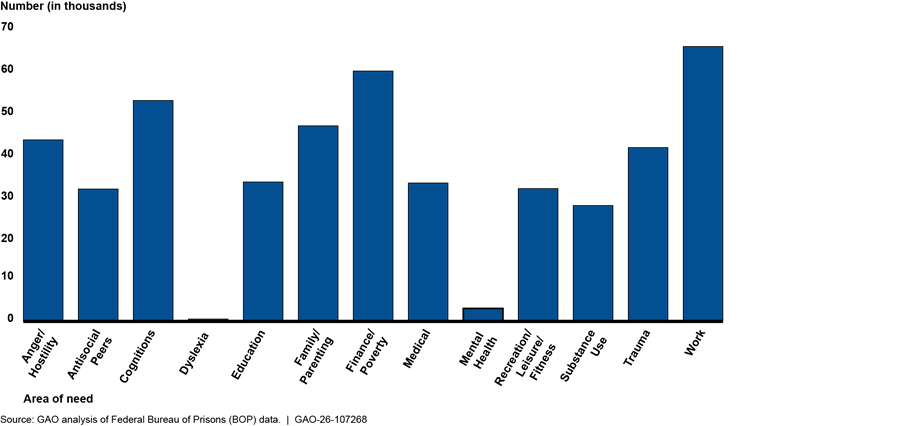
Note: For this figure, we analyzed data for all sentenced and incarcerated people in a designated BOP facility as of March 30, 2024, who were still incarcerated on December 31, 2024 (98,254 people). These data represent their needs as of December 31, 2024. However, not all incarcerated people had each of their needs assessed by this date, so the total for each need may vary. Criminogenic needs are characteristics of a person that directly relate to their likelihood to commit another crime.
BOP officials stated that all their facilities offer evidence-based recidivism reduction programs and productive activities for all 13 areas of need to help incarcerated people address their needs. However, we found that over 23 percent (32,684) of incarcerated people did not complete any programs or activities from 2022 through 2024—including programs that may help to address their needs.[74] Further, we found that 44 percent completed one to three evidence-based recidivism reduction programs, and almost 50 percent of people completed one to three productive activities, from 2022 to 2024, as shown in figure 11.
Figure 11: Percentage of Incarcerated People at a BOP Facility that Completed Evidence-Based Recidivism Reduction Programs or Productive Activities, 2022 through 2024
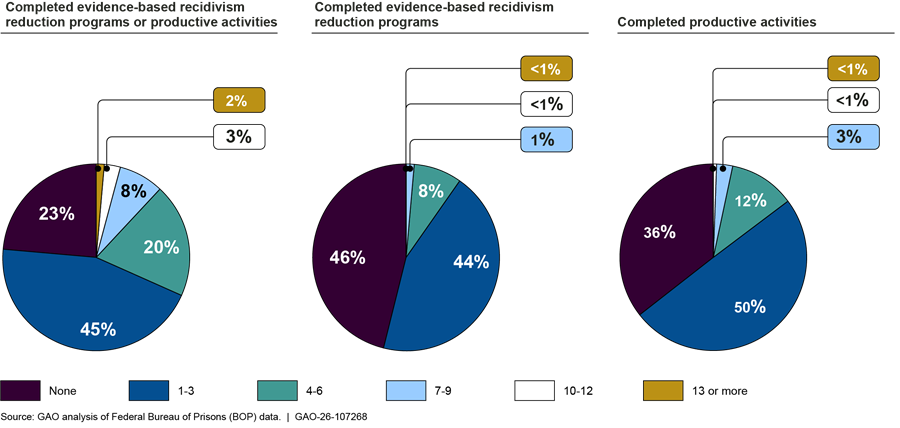
Note: For this figure, we analyzed data for all sentenced and incarcerated people in a designated BOP facility as of March 30, 2024 (139,896 total people). The analyzed data comprise all programs and productive activities completed by these individuals from January 1, 2022, to December 31, 2024.
Additionally, according to a 2023 National Institute of Justice report evaluating the FSA needs assessments, most people in a BOP facility were not enrolled in a program or activity that addressed their identified needs.[75] The report stated there were generally low levels of program participation, noting that an average of 95 percent of people were not participating in programming to address an identified need.[76] The report identified various reasons why this may be the case, including that some programs are meant to be offered closer to the incarcerated person’s release. Due to these reasons, the report stated that these findings are preliminary and should be considered provisional until more detailed analyses can be performed. BOP officials stated the report’s data appear to show a single snapshot of program participants on a given day rather than over a quarter or year which would better illustrate programming efforts. They stated that their data show a higher percentage of the incarcerated population is actively participating in one or more programs.
|
Incarcerated People’s Perspectives on Addressing Needs Some of the 16 incarcerated people we interviewed said they have been able to address most of their needs while incarcerated. However, others said they have not been able to address needs and provided some reasons. For example, three people said they were unable to address some of their identified needs due to long waitlists for the necessary programs. Another person said that there have been lockdowns at the facility, and they have been unable to complete the needed programs as a result. Source: Interviews with Incarcerated People. | GAO‑26‑107268 |
According to BOP officials, staff at each facility determine which programs and activities to offer and at what frequency. Specifically, department supervisors and other facility staff said they choose the programs they offer at their respective facilities from those listed in BOP’s FSA Approved Programs Guide.[77] When asked about the programs and activities that each facility offered at the time of our visit, staff at the four BOP facilities we visited said their facility was offering at least one program or activity to address each of the 13 needs. Staff at three of these facilities further elaborated that they always offer at least one program or activity to address each of the 13 needs. However, some BOP staff and incarcerated people stated that they believe their facilities do not offer enough programs, identifying various challenges such as limited programming space, insufficient staff to teach programs, and lockdowns. We reported on similar concerns in 2023.[78]
· BOP staff at three of the four facilities we visited said that the lack of physical space has hindered their ability to offer programs and activities. At one facility we visited, staff said they use alternative areas to hold class due to limited program space. This included using the chapel, meeting rooms, the visitation area, or the former restricted housing space. Although this facility was using alternative spaces for programs, officials said that they were also using funding from the FSA to build a new programming building. Figure 12 provides photographs of spaces used to hold programs—including a dedicated program space and a staff meeting room used for programs.

· BOP staff at all four facilities we visited said that there were insufficient staff to teach programs and activities.[79] They stated that additional staff would help the facilities to increase their program offerings. Additionally, BOP union staff stated that BOP struggles to offer sufficient programs across all facilities due to insufficient staff across BOP. Union officials previously shared similar concerns, as we reported in 2023, noting that BOP augmented staff up to two or three times a week, which took their time away from their normal duties.[80]
· BOP staff at one facility we visited said that lockdowns affect an incarcerated person’s ability to participate in programs because the facility temporarily stops or postpones classes and activities during lockdowns. The duration of lockdowns varies based on the event, and according to these staff, lockdowns can postpone programming for weeks or months until programming can safely continue.[81] Typically, during lockdowns, all incarcerated people are required to remain in their cells for the majority of the day.
Further, these challenges, described above, have contributed to long waitlists for programs and activities across facilities. BOP officials and incarcerated people said that long waitlists limit the ability of incarcerated people to participate in programs. We reviewed the case files of 16 incarcerated people. We found that 10 of these people were on a waitlist longer than 2 years for at least one program. One incarcerated person we spoke with said they had been on a waitlist for over 2 years for a program that would address one of their identified needs, and BOP staff were unable to tell them when they would be able to enroll in the program. Additionally, some incarcerated people we spoke with mentioned that being on waitlists for lengthy periods affected their ability to address their needs. According to BOP officials, some people may be on waitlists for lengthy periods because some programs are intended to be offered closer to a person’s release.
A shortage of programs and activities and long waitlists will not affect whether a person earns FSA time credits because incarcerated people earn these credits based on their earning status. However, a lack of programming may affect BOP’s ability to help incarcerated people address their needs and reduce their recidivism risk—a goal of the FSA. People can earn FSA time credits and be released early without completing or participating in any programs or activities.
In 2023, we recommended that BOP develop a mechanism to monitor if it is offering a sufficient amount of programs and activities.[82] In response to that recommendation, BOP officials said they planned to develop an FSA Reporting Dashboard to monitor FSA programming metrics, such as program participation by need. BOP Central Office officials said that the facility’s executive staff are to use this dashboard to help determine if they have a sufficient amount of programs to address the highest number of needs per facility. In January 2026, according to BOP officials, the bureau deployed the FSA dashboard.
Inaccurate Data Limit BOP’s Ability to Monitor Its Program Offerings
While BOP has worked towards deploying the FSA dashboard so it may monitor its program offerings, it has not taken steps to ensure it is collecting and maintaining accurate program data to inform the dashboard. BOP policy requires BOP staff to ensure that program data in SENTRY are accurate and up to date for each incarcerated person.[83] BOP officials stated that they created standardized codes in 2020 for most FSA program data in SENTRY, and staff are to use these codes to enter and track program data—such as who participates in, declines, completes, fails, or is placed on a waitlist for the program.[84] For example, BOP policy states that if a person refuses or declines to participate in a program or activity based on their need, staff should enter the program decline code into SENTRY.[85] Further, Standards for Internal Controls in the Federal Government state that management should establish and operate monitoring activities to monitor the internal control system and evaluate the results.[86]
Further, from our analysis, we found that data on program completions were generally accurate; however, other program data were not accurate, such as data on program participation and who declines to participate or is placed on a waitlist.
For example, we found multiple inaccuracies in the program participation data.
· Across all but one of BOP’s facilities, we found 97 programs and activities that had only one incarcerated person participating as of March 30, 2024, including the Residential Drug Abuse Program. BOP Central Office officials told us that although some programs may run with just one participant, this is not a common practice. Officials said that those programs that had only one person participating were likely incorrect and could be “leftover” codes from a person’s former facility. They said only staff at the former facility could change these codes, and if they forgot to do so before transferring, these incorrect codes follow the person to their next facility.
· Our review of 16 incarcerated people’s case files showed that some incarcerated people participated in a program for a few days even though the program should take several months to complete. For example, one person was waitlisted for a program for over 200 days, participated in the program for 1 day, and completed the program the day they got off the waitlist. According to BOP officials at this facility, this program generally lasts 6 to 9 months. Therefore, it is likely the data in the system were inaccurate.
We also found instances in which data were inaccurate because staff did not consistently use the codes in SENTRY.
· At one facility, staff told us they generally did not enter data into SENTRY when an incarcerated person declines a recommended program. They stated they were told by management staff at their facility that participation in programs is voluntary, and they did not want the person to stop earning FSA time credits as a result. In contrast, staff at other facilities stated that they enter information into SENTRY when a person declines a program but only after they have discussed the implications of declining the program. Specifically, they require that the incarcerated person sign a paper indicating they understood they would not earn time credits as a result. Further, although this process was documented in a facility-specific memorandum, staff said that different departments have been given conflicting instructions on how and when to enter information into SENTRY when a person declines a program. According to staff from one of these facilities, they received an email from BOP Central Office that stated determining when an incarcerated person declines a program is subjective. Rather than using the decline code and the incarcerated person losing FSA time credits, staff can reenroll them on the bottom of the waitlist.
· Some department staff at the facilities we visited stated that their department directed them to use paper sign-up sheets for program waitlists, so they did not enter that information into SENTRY. In contrast, other department staff at these facilities noted that they enter waitlist information into SENTRY.
BOP Central Office officials said they rely on staff at the facilities to oversee the data entry process and that guidance on using standardized program codes in SENTRY is available to staff. Further, BOP officials acknowledged that while completion data are reliable, some programming data may not be reliable. While BOP officials said in July 2025 that they created new codes to help to mitigate data errors related to decline codes, BOP has not taken steps to ensure that all program data are accurate.
Without taking steps to ensure it is collecting and maintaining accurate program data, BOP cannot determine if it offers sufficient programming in its facilities to help meet the needs of incarcerated people. In particular, the FSA dashboard that BOP deployed in January 2026 to monitor this will not accurately reflect program information, such as program participation rates or waitlist times. Additionally, if staff are not consistently documenting when people decline programs, then some incarcerated people could be earning FSA time credits even though they refused to participate in a recommended program to address one of their needs.
BOP Central Office Does Not Have Bureau-wide Data That Are Readily Accessible to Monitor Work Assignments
BOP Central Office does not have bureau-wide data that are readily accessible to monitor work assignments of people incarcerated at BOP facilities. BOP policy states that each incarcerated person who is physically and mentally able should be assigned a work assignment.[87] One of these work assignments—the Federal Prison Industries—is an evidence-based recidivism reduction program that might help a person address their work need.
According to BOP officials, a person may be exempt from working for various allowable reasons, such as being in disciplinary segregation or for medical conditions. However, BOP officials and incarcerated people shared other reasons why incarcerated people may not work. For example, some staff from the facilities we visited said they do not have enough work assignments for each incarcerated person who is mentally and physically able to work. In another example, staff said that some people simply do not want to work and therefore do not apply for a work assignment. Some incarcerated people we spoke with said they were on a waitlist to work or waiting to hear back from the job they applied for. Other incarcerated people said that their facility did not have enough jobs or that they did not want to work.[88]
In our analysis of BOP data and case files, we identified various instances in which incarcerated people appeared to not have work assignments. For example:
· In our review of BOP’s work assignment data for people incarcerated in a BOP facility as of December 31, 2024, we found that about 22 percent (22,085 of 98,254 people) had a work assignment code that would likely indicate they are not working.[89] Specifically, they had a work assignment code in SENTRY that included some variation or spelling of “unassigned” or “idle,” which would likely indicate that they are not working.[90] We identified over 300 unique variations of these codes.
· We also found during our review of the 16 incarcerated people’s case files that five people had “unassigned” as their work assignment in SENTRY. For one person, we were able to identify an allowable reason that they were not working. However, we did not identify any information in the other four people’s case files that would explain why they may not have been working.
BOP Central Office officials stated that they do not know how many people are not working across the bureau who should be working. This is because BOP does not have standardized bureau-wide data that are readily accessible on whether incarcerated people have a work assignment, including if they have an allowable reason for not working. While BOP does collect some data, officials stated that they could not confirm which data codes meant that a person did not have a work assignment—including those with variations of “unassigned” or “idle.” According to these officials, facility staff create work assignment codes at each facility, and facility staff would have to identify the meaning of these codes. Further, these officials said that facility staff could check medical databases for medical conditions that may allow a person to not work.
According to BOP Central Office officials, they also do not monitor how many incarcerated people have a work assignment, including whether they have an allowable reason for not working. These officials said they rely on the facility to monitor work assignment data. Standards for Internal Control in the Federal Government states that management is to use quality information to achieve the entity’s objectives, such as collecting relevant data.[91] In addition, these standards state that management should establish and operate monitoring activities to monitor the internal control system and evaluate the results.[92]
Without standardized bureau-wide work assignment data that are readily accessible, and monitoring of such data, BOP is unable to determine if all eligible people have a work assignment and to take corrective actions if they do not. If incarcerated people are not working, then they are not taking productive steps to increase job skills, work habits, and other relevant skills that will increase their likelihood of successful post-release employment. These are skills that could be helpful in reducing recidivism.
BOP Has Not Applied All FSA Time Credits and Has Inaccurate Data on Release Status for Some People
BOP generally applied all FSA time credits that incarcerated people earned toward supervised release but not for prerelease custody—residential reentry center or home confinement—for various reasons. Further, accurate data on when incarcerated people are released were not readily accessible to BOP for some incarcerated people. In addition, BOP seldom approves the petitions from incarcerated people with high or medium recidivism risk level seeking to apply FSA time credits to supervised release or prerelease custody.
BOP Applied All Time Credits for Supervised Release but Not for Prerelease Custody and Is Missing Accurate, Readily Accessible Data for Some People’s Release Status
Supervised Release
For eligible people incarcerated in a BOP facility as of March 30, 2024, we analyzed data on those who could have transferred to supervised release through December 31, 2024.[93] We found that BOP applied all the FSA time credits earned toward supervised release for 98 percent of these individuals (12,373 of 12,637 people). BOP transferred most of the remaining 2 percent of people within 30 days of when they were to have been transferred, had it applied all of their time credits. As noted earlier, the first 365 days of earned FSA time credits are to be applied toward supervised release.[94]
While conducting this analysis, we found that the release status for approximately 9 percent (1,155 of 12,637) of individuals was not readily accessible. Specifically, BOP’s data had conflicting information in SENTRY on these individuals that indicated, for example, two separate dates for when the person was released from BOP custody to supervised released.
We discussed these data discrepancies with BOP, and officials directed us on which specific data would be accurate for us to use for our analysis. We then reviewed each of these individual 1,155 records. For approximately half of the people (610 of 1,155 people), we found that using data that BOP suggested we use allowed us to accurately identify the individual’s release status and associated date. However, for the other half, we found that these data did not allow us to accurately identify this information. For example, we identified individuals that had been released from BOP custody but were still in a BOP facility because they were under a Department of Homeland Security detainer.[95] In another example, we found individuals that had been released from BOP custody but were serving a portion of their supervised release in a residential reentry center. In both examples, if we used data BOP directed us to use, these individuals would have appeared to be incarcerated in BOP custody longer than they were in actuality. As such, a detailed examination of these individual’s records was needed to characterize the accurate release status and associated date for these individuals, since these data were not readily accessible.
While accurate release status data were readily accessible for over 90 percent of the people we reviewed, BOP did not ensure accurate data were readily accessible for the remaining individuals to be able to easily assess if BOP had released them under the FSA. Standards for Internal Control in the Federal Government states that management is to use quality information to achieve the entity’s objectives. Quality information should be accessible, complete, and accurate to help management make informed decisions.[96] Without accurate release data that are readily accessible on a person’s release status and associated release date, BOP will not be able to readily determine if it has applied all a person’s FSA time credits to supervised release.
Prerelease Custody
Under the FSA, BOP is to apply time credits earned beyond 365 days toward early transfer to prerelease custody. We analyzed BOP data for eligible people incarcerated in a BOP facility as of March 30, 2024, and who could have transferred to prerelease custody from March 31, 2024, to December 31, 2024.[97] We found that BOP did not apply all the earned time credits toward prerelease custody for about 71 percent of these individuals (21,190 of 29,934 people), as shown in figure 13.
Figure 13: Percent of Incarcerated People Who BOP Transferred or Could Have Transferred to Prerelease Custody Under the First Step Act of 2018 (FSA)
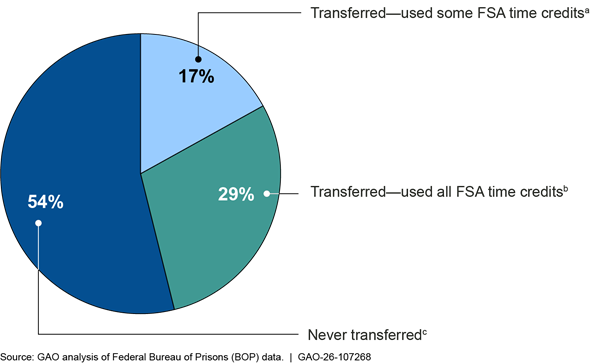
Note: For this figure, we analyzed data for all sentenced and incarcerated people in a BOP facility with the following conditions: (1) they were incarcerated as of March 30, 2024, (2) BOP transferred or could have transferred them to prerelease custody under the FSA through December 31, 2024 (29,934 people), (3) they were eligible to earn and apply FSA time credits, and (4) they had a low or minimum recidivism risk in their previous two assessments or had a medium or high risk of recidivism and successfully petitioned to have their time credits applied towards prerelease custody.
aTransferred—used some FSA time credits: includes incarcerated people who transferred to prerelease custody after BOP applied some, but not all, of the individual’s FSA time credits earned toward prerelease custody. These individuals could have transferred to prerelease custody sooner but instead remained incarcerated in a BOP facility until they transferred.
bTransferred—used all FSA time credits: includes incarcerated people who transferred to prerelease custody after BOP applied all the individual’s FSA time credits earned toward prerelease custody.
cNever transferred: includes incarcerated people who could have transferred to prerelease custody if BOP had applied all or some of the individual’s FSA time credits. These individuals remained incarcerated in a BOP facility as of December 31, 2024.
BOP officials provided some possible explanations on why they did not apply all of an individual’s time credits earned toward prerelease custody. For example, some incarcerated people may have unresolved detainers, or BOP had not updated its policies to initiate transfers earlier. Also, BOP facility staff may have workload challenges and residential reentry centers may have resource constraints.
Detainers. BOP Central Office officials said that there may be delays transferring some incarcerated people to residential reentry centers due to detainers that require additional review by BOP staff and general counsel. Detainers may be a portion of the people who do not have all their FSA time credits applied to prerelease custody, but, according to BOP officials, they do not know the percentage of people in this situation.
BOP’s policies on the transfer process. According to BOP officials, the FSA changed how much time people may be able to spend in prerelease custody because eligible incarcerated people may earn unlimited time credits under the FSA. Prior to October 2024, BOP facility staff were to initiate the process to transfer people from a BOP facility to prerelease custody 17 to 19 months before their projected release date. The projected release date was based on the individual’s sentence and incorporated earned FSA time credits to date and good conduct time, among other things. However, it did not include projected FSA time credits that a person may earn in the future.[98]
BOP implemented new planning dates and guidance in October 2024 to help facility staff better plan an incarcerated person’s transfer to prerelease custody and supervised release under the FSA. Staff are now to initiate the transfer process to prerelease custody 17 to 19 months prior to the “conditional transition to community date” rather than the projected release date, which can be much earlier.[99] This new planning date forecasts the date a person may transfer to prerelease custody, assuming the incarcerated person maintains their current recidivism risk level and earning status, among other things, and incorporates time credits earned under the FSA and time received under the Second Chance Act “stacked” together. As described earlier, under the Second Chance Act, all incarcerated people are statutorily eligible for up to 1 year of prerelease custody.[100]
While the addition of these new planning dates may help ensure BOP is planning far enough in advance, it is too soon to tell if they will be reliable and result in BOP being able to apply more of people’s earned FSA time credits.[101]
Staff workload. Even with the new planning dates, BOP faces additional challenges related to applying all time credits a person earned under the FSA toward prerelease custody. BOP documentation identified staff workload as a challenge to completing the documents needed to refer a person to prerelease custody at a residential reentry center. BOP staff at one facility noted that this documentation—a referral packet—was one of the tasks that took up a large portion of their workday. Staff at all four of the BOP facilities we visited described how staff augmentation or other duties affected their ability to carry out their case management work.[102]
Resource constraints. Resource constraints at BOP’s residential reentry centers may also limit BOP’s ability to apply all earned FSA time credits to prerelease custody. BOP’s Residential Reentry Management Branch field office staff determine the length of time a person is placed in a residential reentry center. They base their decision upon factors such as available bed space, time credit earned toward prerelease custody, and the facility staff’s evaluation of and recommendation for the individual. Staff at all four facilities we visited noted that lack of bedspace was the primary reason BOP was unable to place a person in a residential reentry center for the full amount of a person’s earned FSA time credits.[103] BOP’s former Director also testified in 2024[104] that BOP’s residential reentry centers do not have sufficient capacity to accommodate all those who could transfer to a residential reentry center under the FSA.[105]
Officials from BOP’s Residential Reentry Management Branch, however, stated that while there may be certain geographic regions where the residential reentry centers may be filled or close to capacity, there is not a significant backlog nationwide. However, these officials said they were unable to quantify the extent that capacity may limit their ability to transfer incarcerated people to a residential reentry center for the full amount of their earned time credits. Further, according to BOP facility staff, people convicted of a sexual offense or who previously engaged in violent gang activity may have limited location options and, as a result, may not be transferred to a residential reentry center without approval from the Residential Reentry Management office. BOP officials explained that if a person is unable to go to a certain residential reentry center because of gang affiliations, staff will work to place them in another residential reentry center.
In addition, BOP issued two memos, in May 2025 and June 2025, that, according to BOP officials, emphasized the importance of transferring incarcerated people to home confinement, if eligible.[106] BOP Central Office officials said that they did not anticipate any significant increase in the number of people in prerelease custody or the amount of time they are placed in prerelease custody as a result of these memos. However, they noted that there may be an increase in the number of people who are transferred to home confinement and that may result in additional bed spaces that are available in residential reentry centers. Further, according to the June 2025 memo, BOP staff should use the projected dates for when an incarcerated person may transfer to prerelease custody to help ensure they receive their FSA time credits and recommended time under the Second Chance Act.
Further, in July 2025, BOP’s Director established the FSA Task Force in response to concerns related to transferring individuals to home confinement. The task force is to manually identify and correct community placement dates, specifically for home confinement, to incorporate both the FSA and Second Chance Act. Additionally, the task force is to identify those eligible for home confinement who currently reside in residential reentry centers. The Residential Reentry Management field offices would then facilitate transferring those individuals to home confinement and thereby free up bed space in residential reentry centers. Furthermore, in August 2025, BOP’s Director announced new conditional home confinement placement dates that incorporates both the FSA and the Second Chance Act. These new conditional dates will help prevent delays transitioning incarcerated people to home confinement, according to BOP. Bureau officials said that they are unable to forecast if the efforts by the FSA Task Force would result in any cost savings to the bureau. However, they expect that stacking together the FSA time credits and Second Chance Act eligibility for home confinement may help alleviate bed space constraints at the residential reentry centers.
The Director of BOP is required by law to ensure there is sufficient prerelease custody capacity, including residential reentry center capacity, to accommodate all eligible incarcerated people.[107] We have ongoing work that is examining BOP’s efforts to forecast capacity needs and provide sufficient residential reentry center resources to meet the needs of the incarcerated people transferring to prerelease custody. We anticipate issuing our report in early 2026.
Some Incarcerated People with Higher Recidivism Risk Petitioned to Apply Their FSA Time Credits
Some incarcerated people with a medium or high recidivism risk petitioned to have their FSA time credits applied, and a few were successful. To apply their FSA time credits to supervised release or prerelease custody, eligible incarcerated people with medium or high recidivism risk levels must petition and receive approval from the facility’s warden, among other officials.[108] BOP developed its petition process in November 2022.[109]
Our analysis of BOP regional data from all six regional offices shows that BOP seldom approves these petitions. Specifically, BOP approved 12 percent of petitions submitted from February 2023 through February 2025 (36 of 304 petitions received). The approved petitions were all for incarcerated people with a medium recidivism risk.[110]
Our analysis of SENTRY data found that BOP approved petitions for seven people with medium or high risk levels. This data included all people incarcerated in a BOP facility as of March 30, 2024, and who transferred to supervised release or prerelease custody through December 31, 2024. These data did not include how many people petitioned. However, for scale, on December 31, 2024, there were approximately 25,000 people with medium and high risk levels in BOP custody that were eligible to earn FSA time credits, as shown in figure 14.
Figure 14: Percent of Incarcerated People in BOP’s Custody, by Time Credit Eligibility and Risk Level
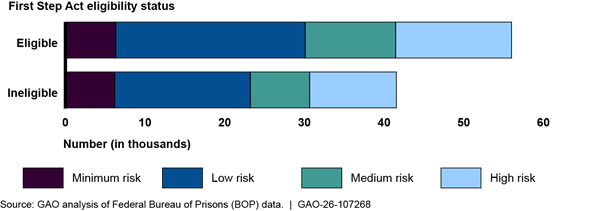
Note: For this figure, we analyzed data for all sentenced and incarcerated people in a designated BOP facility as of March 30, 2024, who were still incarcerated on December 31, 2024 (98,254). Additionally, as of December 31, 2024, 710 people did not have an eligibility assessment, and two did not have a risk assessment.
BOP union officials and BOP facility staff at all four facilities we visited said that few people with a medium or high risk level are successful when they petition because they do not meet the criteria set forth in the FSA to approve the petitions. Under the FSA, a person must petition the warden and have the warden determine if they generally meet the following three criteria: (1) the person does not pose a danger to the community, (2) the person is unlikely to recidivate, and (3) the person has made a good faith effort to lower their recidivism risk through participation in recidivism reduction programs or productive activities.[111] Further, according to BOP’s March 2023 program statement, incarcerated people with a medium or high risk level must demonstrate a good faith effort to lower their recidivism risk by demonstrating the following:[112]
· Maintaining clear conduct for at least 3 years from the date of the request.
· Successfully completing at least one of the residential evidence-based recidivism reduction programs recommended based on an identified needs area within the past 5 years, if BOP assigned any.
· Otherwise being compliant with all the other requirements of the program statement with regard to successful program participation.
BOP Did Not Ensure Consistent Implementation and Understanding of the FSA Bureau-wide
BOP Central Office officials described several mechanisms they use to help staff understand and stay up to date on FSA policies and procedures, but we found instances where staff did not consistently implement or understand the FSA across facilities and regions.
BOP Established Mechanisms to Help Staff Implement and Understand FSA Policies and Procedures
BOP offered training, provided written guidance, established designated FSA subject-matter experts at facilities, and made improvements to technology and planning tools to help regional and facility staff implement and understand FSA policies and procedures.
Training. BOP provided various trainings to its staff that include elements related to the FSA and processes and procedures, including an annual refresher training, position-specific training, and symposiums, according to BOP officials and our review of BOP documentation. All BOP staff are required to complete the annual refresher training, according to BOP Central Office officials.
In November 2024, BOP officials stated they planned to move the FSA portion of the annual refresher training to a separate training course that staff can access on-demand and will be required to complete annually. Specifically, the BOP officials said most staff already knew how to carry out their FSA-related duties, and the new training course would use the information from the annual refresher training as the starting point to develop the new course. Further, BOP Central Office officials said they planned to incorporate additional information on FSA policies and procedures in the new training course.
According to BOP Central Office and facility officials, they placed all position-specific trainings, typically held at BOP’s national training center, on hold starting the middle of fiscal year 2024 due to insufficient budget and to identify the bureau’s training priorities. However, BOP has continued to carry out various local and regional FSA-related trainings during this time, according to BOP facility and regional staff. For example, regional staff we met with said that they would answer questions about new FSA-related policies as part of their regular monthly or quarterly division meetings with the facility staff in their region.
BOP has also held several FSA symposiums since 2022 to discuss ongoing implementation challenges and best practices, among other things, according to Central Office officials. Participants included BOP regional staff, Central Office division staff, and facility staff. These attendees were to disseminate information learned at the symposiums, such as best practices, to the staff at their respective facilities.
Written guidance. BOP maintains an internal intranet website where it stores key information on the FSA, such as training slides, memos, and program statements. BOP Central Office officials said they periodically review the material on the intranet site to ensure that the documents and resources available are up to date with the latest policies and procedures.
Facility-level subject matter experts. Since 2022, BOP has been working to develop FSA subject matter expertise at the BOP facilities. For example, BOP initially supported one FSA point of contact for each facility. BOP held two symposiums at their centralized training facility for these points of contacts to learn about FSA and their duties as the point of contact, which included starting up the FSA Committee at their respective facility. However, BOP Central Office officials said in November 2024 that they wanted to emphasize establishing an FSA Committee at each facility to help with knowledge retention in case of staff turnover. The FSA Committee is to help ensure FSA programming offered at the facility addresses all 13 need areas and that staff complete needs assessments in a timely manner, among other things, according to BOP Central Office staff and BOP documentation.
Improvement to technology and planning tools. BOP Central Office has incorporated several technological improvements to the FSA processes since first implementing the FSA that help BOP staff carry out FSA responsibilities. Specifically, as noted previously, BOP automated the risk and needs assessments in 2021 and FSA time credit calculations in 2022.[113]
Further, according to BOP officials, in January 2023, they implemented several worksheets that described key FSA information, such as an incarcerated person’s recidivism risk level, identified needs, and the number of time credits earned to date. BOP’s assessment tool automatically generates these worksheets during the reassessment process for risk and needs as part of the preparation for the program review meeting with the incarcerated person.
While BOP provided these mechanisms to help regional and facility staff implement and understand FSA policies and procedures, BOP staff we met with had mixed views on these efforts. For example, BOP staff from all four facilities stated they would benefit from additional training on the FSA. Specifically, some staff said they would benefit from comprehensive training that explained details of FSA policies and procedures that went beyond what was provided in the annual refresher training. In addition, while BOP staff from all four facilities we visited noted that they found BOP’s internal intranet site useful, some staff also said it could be difficult at times to find information easily or that the site included outdated information. At one facility, staff noted that it would be helpful if there was a local FSA expert at their facility where they could direct their questions. Finally, while staff found the technological improvements helpful, some staff also noted that because these processes are now automated, they do not know the details of what factors affect these calculations. For example, one facility staff member said they did not know the factors that contributed to calculating a person’s recidivism risk score.
BOP Staff Did Not Implement FSA Policies and Procedures Consistently Bureau-wide
Although BOP has undertaken efforts to help staff understand and implement the FSA, we identified several instances in which the FSA implementation was not consistent across the bureau. While facilities, departments, or regions may have some flexibilities in how they carry out FSA policies and procedures, some inconsistencies should not exist as they could affect an incarcerated person’s ability to fully participate and capitalize on the benefits of the FSA. Below are examples of these inconsistencies.
Recommending programs and activities. We identified several instances where facility staff differed in their approach to recommending what programs and activities an incarcerated person should enroll in. For example, at one facility, a case manager stated they recommend one program to address one need at a time. One staff member at this facility said that participating in too many classes at one time is not beneficial to the incarcerated person. The staff member said they prefer to have the person enrolled or waitlisted in the longer, substantive programs. Another staff at the same facility said that if incarcerated people had multiple needs, they would recommend programs and activities for the need that appeared first on the needs assessment worksheet and gradually work down the list to address all the needs. Recommending one program at a time could result in a person being waitlisted for one program when others are available. However, staff at other facilities we visited said they recommend that people enroll in or get on the waitlist for as many programs as possible.
Enrolling in programs and activities. BOP staff at each of the facilities we visited said the incarcerated person is generally responsible for enrolling themselves in programs and activities and the waitlist, if applicable. However, at two facilities, case managers also said that some of their department staff automatically enroll people in programs that address a need they are responsible for assessing. Facility staff noted that there were benefits and drawbacks to both approaches, but the staff said the inconsistent guidance led to confusion among the staff on what responsibilities, if any, they have in enrolling incarcerated people in programs and activities. Having staff enroll incarcerated people in programs could result in the incarcerated person not knowing or not being ready to participate—and could potentially affect their earning status if they decline the program, according to two facility staff.
Facility-level FSA subject matter expert. The FSA subject matter expert for a facility has varying levels of involvement at their respective BOP facility. For example, at one facility we visited, the FSA Coordinator said that they had been assigned to be the facility’s FSA Coordinator for several months but did not have an understanding of the role and responsibilities of the FSA Coordinator position and had not yet performed any duties in that role. At two other facilities, according to its staff, the FSA Coordinator facilitated the monthly FSA Committee meetings, and the FSA Coordinators served as FSA subject matter experts for the facility and provided FSA-related training to facility staff. The staff at these two facilities said that it was useful to have knowledgeable FSA experts locally and that their expertise and the additional FSA-related trainings they provided were beneficial.
Regional oversight. Officials at two of the three regional offices we met with said they collected FSA-related information from their facilities monthly, such as the number of late initial risk assessments. However, officials at the remaining regional office stated that they do not collect this information from their facilities because the bureau was transitioning to a more comprehensive, agency-wide dashboard, described above, that will contain the same information. BOP Central Office officials stated that it recommended but did not require regional offices to collect these monthly FSA reports. Further, each regional office determines if it will require facilities to report this information to the regional staff. However, all six regions monitor facility FSA implementation through monthly meetings, reports, or a combination of both.
Programming data codes. Lastly, as described above, we also found that BOP staff used inconsistent processes to enter programming codes, such as waitlists and declines. This could result in BOP collecting and maintaining inaccurate data to report on key FSA metrics that would be used for monitoring FSA’s implementation.
These inconsistencies are due in part to BOP’s Central Office not having a process to monitor how consistently BOP facilities and regional offices implement aspects of the FSA. Instead, BOP’s Central Office officials stated they rely on regional, facility, and department officials to apply guidance and oversee implementation. Standards for Internal Control in the Federal Government states that management should establish and operate monitoring activities to monitor the internal control system and evaluate the results.[114] Without a process to ensure staff implement FSA policies and procedures consistently across the bureau, BOP cannot determine if and when corrective actions are needed. This could hinder incarcerated people from fully participating in and benefitting from the FSA.
BOP Staff’s Understanding of FSA Policies and Procedures Varied Across the Bureau
We also found examples where case managers and other facility staff we interviewed varied in their understanding of aspects of the FSA related to incarcerated people’s risk score, identified needs, and time credits. Specifically, some case managers explained specific actions that would result in changes to a person’s recidivism risk score, but others stated that they did not have a full understanding.
Additionally, staff at one of the facilities we visited said they did not understand what actions would result in a new need being added after an incarcerated person’s initial needs assessment. Similarly, several staff said they did not know what actions would result in a need being removed. Specifically, the staff did not know which programs or classes would help address and remove the need from an incarcerated person’s next needs assessment.
Last, staff also varied in their understanding of how incarcerated people earn FSA time credits. For example, staff at one facility incorrectly said that the number of time credits earned was related to the number of hours of the program completed. Other staff accurately explained that eligible incarcerated people earned time credits regardless of program participation and completion.
BOP Central Office officials stated that BOP does not have a process for facility staff to demonstrate competence in implementing FSA policies and procedures. Officials said that some FSA processes have been part of facility staffs’ responsibilities for several years, and the staff know how to carry out these responsibilities. In addition, they stated that the automation of risk assessments and needs reassessments makes it unnecessary for staff to demonstrate competence in conducting the assessments.
The FSA requires BOP staff with FSA responsibilities to demonstrate competence in administering the risk and needs assessment system on a biannual basis (twice a year).[115] Without a process to demonstrate competence, BOP may not be able to identify areas where it should enhance training or guidance, as relevant. Accurate knowledge of the FSA and the respective policies are important for facility staff to understand. As such, they will be able to accurately guide incarcerated people, to understand, for example, the actions they need to take to lower their recidivism risk and, ultimately, benefit from the FSA.
FSA Reporting Requirements Will End Before DOJ Fully Addresses All Aspects Without Congressional Action
While DOJ issued its FSA reports as required, it has not been able to fully address all reporting requirements. Under the FSA, the Attorney General is required to report to certain committees of Congress, starting in December 2020 and annually thereafter through 2025, about its progress implementing FSA requirements.[116] DOJ issued its first FSA report in December 2020 and issued subsequent reports in April 2022, April 2023, and June 2024.[117] According to BOP officials, as of December 2025, DOJ is reviewing the 2025 report.
However, as shown in table 2, these reports do not fully address some of the FSA reporting requirements. For example, the 2024 FSA report summarized the evaluations of evidence-based recidivism reduction studies underway but did not address which programs have been shown to reduce recidivism. Further, the report did not provide information on the capacity of each program and productive activity, or the number of individuals enrolled in them. In addition, the reports stated that DOJ has not seen any cost savings from transferring people to prerelease custody under the FSA or from a decrease in recidivism. However, the reports also stated that it was too soon to be able assess budgetary savings resulting from implementation of the FSA.
|
Selected FSA report requirements |
Assessment |
|
|
(1) A summary of the activities and accomplishments of the Attorney General in carrying out the FSA. |
|
DOJ provided an executive summary of accomplishments. |
|
(2) A summary and assessment of the types and effectiveness of the evidence-based recidivism reduction programs and productive activities in Federal Bureau of Prisons (BOP) facilities, including evidence about which programs have been shown to reduce recidivism, the capacity of each program and activity at each facility, including enrollment numbers, and identification of any gaps or shortages in capacity.a |
◑ |
DOJ provided a summary of the ongoing evaluations of BOP’s evidence-based recidivism reduction programs but did not address the capacity of each program and activity or which programs have been shown to reduce recidivism. Further, DOJ did not provide enrollment numbers for programs and activities. |
|
(3) Rates of recidivism among individuals who have been released from BOP facilities, based on certain criteria, including the primary offense of conviction, the length of sentence imposed and served, the facility or facilities where the sentence was served and the incarcerated person’s assessed and reassessed risk of recidivism.b |
◑ |
DOJ provided rates of recidivism but did not provide recidivism information broken down by facility or by an incarcerated person’s assessed and reassessed recidivism risk. |
|
(4) The status of work programs at BOP facilities, including a strategy to expand work programs, the feasibility of expanding such programs, and the legal authorities required to expand these programs. |
◑ |
DOJ provided a status update of work programs but did not articulate a strategy to expand the availability of such programs or the legal authorities that would be required. |
|
(5) An assessment of BOP’s compliance with the certain statutory requirements related to implementation of the risk and needs assessment system.c |
|
DOJ described BOP’s continued implementation of the FSA over the previous year.d |
|
(6) An assessment of progress made toward carrying out the FSA, including a summary of the amount of any savings resulting from transferring incarcerated people into prerelease custody or supervised release and any decrease in recidivism.e |
◑ |
DOJ provided updates of the progress it made but stated that it could not assess any cost savings because not enough time had passed. Specifically, BOP started releasing individuals to supervised release due to the application of time credits in January 2022. According to the report, an accurate recidivism analysis should reflect full implementation of the current risk and needs assessment tools, which occurred in 2022. This would necessitate a review of those individuals released in 2023 and followed for 3 years. |
|
(7) An assessment of budgetary savings resulting from the FSA, including a summary of the amount of savings resulting from the transfer of incarcerated people into prerelease custody and any decrease in recidivism that may be attributed to the implementation of the risk and needs assessment system. |
◑ |
DOJ stated it has not seen any cost savings from transferring people to prerelease custody under the FSA. However, DOJ stated that it could not assess cost savings because not enough time had passed since implementation of the FSA. Specifically, BOP started releasing individuals to supervised release due to the application of time credits in January 2022. According to the report, an accurate recidivism analysis should reflect full implementation of the current risk and needs assessment tools, which occurred in 2022. This would necessitate a review of those individuals released in 2023 and followed for 3 years. |
|
(8) Statistics on the prevalence of dyslexia and any changes in the effectiveness of dyslexia mitigation programs. |
◑ |
DOJ provided population statistics on dyslexia but did not address any change in the effectiveness of dyslexia mitigation programs. |
Legend:
= Fully Addressed - DOJ addressed all aspects of the requirement
◑= Partially Addressed - DOJ addressed some, but not all, aspects of the requirement
= Not Addressed - DOJ addressed none of the aspects of the requirement
Source: GAO analysis of Department of Justice’s (DOJ) First Step Act Annual Report June 2024. | GAO‑26‑107268
Note: While the table reflects what the 2024 FSA report included, similar limitations were found in the other three FSA reports issued by DOJ. For example, DOJ has not provided information on the capacity of each program and activity in any of the four FSA reports. For more detailed information on each FSA report requirement, see appendix VI. Pursuant to 18 U.S.C. § 3634, the Attorney General is required to submit a report to certain committees of the Senate and the House of Representatives regarding the implementation of the FSA.
aPursuant to 18 U.S.C. § 3635(3), an evidence-based recidivism reduction program is either a group or individual activity that has been shown by empirical evidence to reduce recidivism or is based on research indicating that it is likely to be effective in reducing recidivism; and is designed to help people succeed in their communities upon release from a BOP facility. Pursuant to 18 U.S.C. § 3635(5), a productive activity is either a group or individual activity that is designed to allow incarcerated people determined as having a minimum or low risk of recidivating to remain productive and thereby maintain a minimum or low risk of recidivating.
bDOJ defines recidivism as (a) a new arrest within 3 years of release or (b) a return to federal prison within 3 years of release. Recidivism risk is the likelihood that a person may continue to engage in unlawful behavior once released from a BOP facility.
cBOP is to use the risk and needs assessment system to assess both recidivism risk and the needs of incarcerated people. BOP staff are to use the risk and needs assessment system to determine the type and amount of programming appropriate for each incarcerated person and to assign recommended programming based on the incarcerated person’s specific needs. DOJ’s risk and needs assessment system is composed of two parts: the Prisoner Assessment Tool Targeting Estimated Risk and Needs and the Standardized Prisoner Assessment for Reduction in Criminality.
dThe 2024 FSA report did not address initial implementation efforts, such as the requirement that BOP implement and complete the initial intake risk and needs assessment for each incarcerated person not later than 180 days after the Attorney General completes and releases the risk and needs assessment system. However, these aspects of initial implementation were addressed in prior FSA reports.
ePrerelease custody is lower-security conditions of confinement that help prepare incarcerated people for eventual release. Types of prerelease custody include home confinement and residential reentry centers. Home confinement allows eligible incarcerated people in BOP facilities nearing release to transfer to a home or residence to serve the remainder of their sentence. People placed in home confinement are monitored by BOP and are required to remain at home when not working or participating in programming and other approved activities. Residential reentry centers, or halfway houses, are contracted by BOP to provide assistance to people in the form of employment counseling, job placement, financial management assistance, and other services in a structured and supervised environment. Supervised release is an additional term of supervision imposed by a court for an incarcerated person and begins when the incarcerated person completes their full custody sentence.
According to the 2024 report, not enough time has passed for DOJ to be able to fully address some of the reporting requirements. For example, not enough time has passed to determine the effectiveness of FSA programs in reducing recidivism risk. As stated above, according to BOP officials, evaluations of evidence-based recidivism reduction programs are a long-term process that are dependent upon funding resources. Further, according to DOJ, BOP started releasing individuals as a results of FSA time credits in January 2022, but revised time credit calculations, PATTERN, and SPARC-13 from 2022 through January 2023. As a result, an accurate recidivism analysis of the FSA should review the cohort of people released in fiscal year 2023 to be able to assess their recidivism 3 years after release. Given this, DOJ would be unable to assess cost savings resulting from this cohort’s recidivism reduction until 2026 at the earliest.
DOJ will likely not be able to fully address the reporting requirements mandated in the FSA because the requirement expired in 2025, and DOJ is not required to report this information otherwise. These reports have provided valuable information to Congress. For example, these reports include valuable updates for Congress on steps taken in the prior year to continue to implement aspects of the FSA. These reports could also include valuable information on other DOJ or BOP actions—including those taken to address FSA-related recommendations we or other entities, such as DOJ’s Office of Inspector General, have made to improve FSA implementation.
Absent congressional action to continue to report this information, DOJ will not have time to fully address the reporting requirements before they are no longer required under the FSA, and it is unlikely that DOJ will prioritize continuing to provide this information to the Congress and the public. Without information on budgetary savings and the effects of programming on recidivism, the Congress would not be fully equipped to make informed decisions about future enhancements or changes to the FSA.
Conclusions
Reducing recidivism among formerly incarcerated people is key to BOP’s mission, and the FSA includes requirements for DOJ and BOP to help achieve this mission through the risk and needs assessment system. While BOP has taken many steps to improve this system, additional actions would allow it to further leverage the benefits of the system, including meeting the needs of incarcerated people and providing costs savings to the federal government.
Specifically, BOP must assess an incarcerated person’s recidivism risk and needs prior to staff recommending programs and activities to them, and the person may subsequently earn FSA time credits toward early release. As such, it is important that BOP has data on its efforts to implement the FSA. While BOP maintains some data, we found that these data were not always accurate. Specifically, without taking steps to ensure it is collecting and maintaining accurate programming data, BOP will not be able to ensure it is offering sufficient programs, and without accurate release data that are readily accessible, it will not be able to readily determine if it has applied all FSA time credits.
Similarly, working while incarcerated may help people find employment after being released from prison. As such, without collecting standardized bureau-wide work assignment data that are readily accessible, and monitoring these data, BOP will not be able to determine if all eligible people have work assignments and take corrective action, if needed.
Additionally, BOP implemented the risk and needs assessment system across six regions and 120 facilities. However, without a process to ensure staff demonstrate competence in the FSA and implement the FSA consistently, BOP cannot determine if corrective actions are needed or identify areas where it should enhance training or guidance.
The FSA requires DOJ to report on numerous issues to help Congress assess whether the FSA is effective at reducing recidivism and what budgetary savings were achieved, among other things. However, DOJ has not been able to provide all the information Congress sought. Specifically, while DOJ has reported that there have been no cost savings to date from the implementation of the risk and needs system, it also noted more time is needed to assess cost savings and reductions in recidivism. Without extending the required reporting period for the annual FSA report, which ended in 2025, DOJ will likely not be able to fully address the reporting requirements. As a result, DOJ may not be able to help Congress gain a full understanding of the effectiveness of FSA programs and the budgetary savings resulting from implementing the FSA.
Matter for Congressional Consideration
Congress should consider amending 18 U.S.C. § 3634, to extend the Attorney General’s reporting requirement to help Congress gain a full understanding of the effectiveness of FSA programs and the budgetary savings resulting from implementing the FSA. (Matter for Consideration 1)
Recommendations for Executive Action
We are making the following six recommendations to BOP:
The Director of BOP should take steps to ensure it collects and maintains accurate programming data, including codes to indicate program participation and waitlists. (Recommendation 1)
The Director of BOP should collect standardized data bureau-wide that are readily accessible on incarcerated people who do not have work assignments, including data on people who are exempt from working for allowable reasons. (Recommendation 2)
The Director of BOP should monitor work assignment data, once collected, and take corrective action as needed to ensure eligible persons have work assignments. (Recommendation 3)
The Director of BOP should ensure accurate release data are readily accessible on an individual’s release status and associated date. (Recommendation 4)
The Director of the BOP should develop and implement a process to ensure its FSA policies and procedures are consistently implemented across the bureau and take corrective actions as needed. (Recommendation 5)
The Director of the BOP should develop and implement a process for staff with FSA responsibilities to demonstrate competence in implementing the FSA and take corrective actions as needed. (Recommendation 6)
Agency Comments
We provided a draft of this report to DOJ for review and comment. BOP provided written comments, which are reproduced in appendix VII. In its comments, BOP concurred with our recommendations and identified steps it would take to address them. DOJ also provided technical comments, which we incorporated as appropriate.
We are sending copies of this report to the appropriate congressional committees and the Attorney General. In addition, the report is available at no charge on the GAO website at https://www.gao.gov.
If you or your staff have any questions about this report, please contact Gretta L. Goodwin at GoodwinG@gao.gov. Contact points for our Offices of Congressional Relations and Public Affairs may be found on the last
page of this report. GAO staff who made key contributions to this report are listed in appendix VIII.
Gretta L. Goodwin
Director
Homeland Security and Justice
List of Committees
The Honorable Charles E. Grassley
Chairman
The Honorable Richard J. Durban
Ranking Member
Committee on the Judiciary
United States Senate
The Honorable Jerry Moran
Chair
The Honorable Chris Van Hollen
Ranking Member
Subcommittee on Commerce, Justice, Science, and Related Agencies
Committee on Appropriations
United States Senate
The Honorable Jim Jordan
Chairman
The Honorable Jamie Raskin
Ranking Member
Committee on the Judiciary
House of Representatives
The Honorable Hal Rogers
Chairman
The Honorable Grace Meng
Ranking Member
Subcommittee on Commerce, Justice, Science, and Related Agencies
Committee on Appropriations
House of Representatives
This report examines the extent to which: (1) the Federal Bureau of Prisons (BOP) conducted and monitored risk and needs assessments, and the Department of Justice (DOJ) validated the risk and needs assessment tools; (2) DOJ and BOP evaluated and offered programs, activities, and work assignments; (3) BOP applied First Step Act of 2018 (FSA) time credits for eligible incarcerated people; (4) BOP ensured the FSA is consistently implemented bureau-wide; and (5) DOJ met reporting requirements.
To address all of our objectives, we analyzed relevant legislation and regulations, such as the FSA and First Step Act Time Credit regulations, and relevant agency documents.[118] In addition, we obtained perspectives from various agency officials from DOJ and BOP through interviews and written responses. As relevant, we compared agency processes and practices to legislation, policy, or Standards for Internal Control in the Federal Government.[119] We also obtained perspectives from select non-governmental organizations. For objectives one through four, we conducted case studies at selected BOP facilities.[120] For objectives one through three, we analyzed BOP data.
Document Analysis and Interviews
To determine the extent to which BOP conducted and monitored risk and needs assessments, and DOJ validated the risk and needs assessment tools, we analyzed relevant DOJ and BOP reports and policies. This included BOP’s program statements and DOJ’s National Institute of Justice risk assessment validation reports.[121] We interviewed National Institute of Justice headquarters officials and contractors to discuss their efforts to validate the risk assessment system and BOP Central Office officials on their efforts to conduct and monitor assessments. We also obtained the perspectives of BOP union officials on the assessment tools.
To determine the extent to which DOJ and BOP evaluated and offered programs, activities, and work assignments, we analyzed DOJ and BOP’s documents. This included BOP’s evaluation plan, contracts, program statements, and FSA program guide. We assessed BOP’s processes to collect program data against BOP policy, which requires staff to ensure data in SENTRY are accurate and up to date. Further, we assessed BOP’s collection and monitoring of work assignment data against Standards for Internal Control in the Federal Government, which states management is to use quality information to help ensure it achieves the entity’s objectives, such as by collecting relevant data.[122] In addition, these standards state that management should establish and operate monitoring activities to monitor the internal control system and evaluate the results. We also obtained the perspective of BOP Central Office officials and BOP union officials on the bureau’s efforts to evaluate programs and offer programs, activities, and work assignments to incarcerated people in BOP custody.
To determine the extent to which BOP applied FSA time credits for eligible incarcerated people, we analyzed First Step Act Time Credit regulations and relevant BOP program statements and memorandums to gain an understanding of BOP’s procedures to apply FSA time credits. This included BOP’s guidance on transferring incarcerated people out of a federal prison. We assessed BOP’s collection of release data against Standards for Internal Control in the Federal Government, which states management is to use quality information to help ensure it achieves the entity’s objectives, such as by collecting relevant data. Quality information should be accessible, complete, and accurate to help management make informed decisions.[123] We also analyzed information from all six BOP regional offices to assess whether incarcerated people petitioned to have their FSA time credits applied from February 2023—the date offices first started recording information—through February 2025—the date we requested the information. We interviewed BOP Central Office officials, including staff from the Residential Reentry Management Branch, on their efforts to apply FSA time credits to supervised release and prerelease custody and transfer people to residential reentry centers or home confinement. In addition, we obtained the perspective of BOP union officials on the process to earn and apply FSA time credits.
To determine the extent to which BOP ensured the FSA is consistently implemented bureau-wide, we analyzed relevant BOP reports, program statements, presentations, and training materials to gain an understanding of BOP’s implementation of the FSA bureau-wide. Specifically, we assessed BOP’s efforts against Standards for Internal Control in the Federal Government, which states that management should establish and operate monitoring activities to monitor the internal control system and evaluate the results. We also assessed BOP’s efforts to develop a competence demonstration program for staff administering the risk and needs assessment system against FSA requirements.[124] We obtained the perspective of BOP Central Office officials and BOP union officials on the bureau’s FSA-related efforts to train and provide guidance to BOP staff.
To determine the extent to which DOJ met reporting requirements, we analyzed DOJ’s 2024 annual FSA report—the most recent report available for our review. We assessed whether the contents of this report fully addressed, partially addressed, or did not address FSA reporting requirements.[125] We also obtained the perspective of DOJ and BOP officials, through interviews and written responses, regarding their efforts to meet reporting requirements.
Case Studies of Selected BOP Facilities
To address our first four objectives, we conducted case studies of selected BOP facilities to obtain perspectives from regional and facility-level officials and incarcerated people about their experiences with the FSA. We selected a non-generalizable sample of four different BOP facilities for our case studies based on variation in security level, facility type and size, gender of the incarcerated population, and geographic location.[126]
We interviewed regional and facility-level officials and also selected a non-generalizable sample of four incarcerated people to interview at each of the selected facilities to obtain their perspectives on the FSA. We selected these individuals based on several factors including their eligibility to earn FSA time credits, recidivism risk level, and time remaining on their sentence. For each incarcerated person we met with, we also conducted a case file review where we reviewed their FSA-related information stored in BOP’s systems, including FSA-specific worksheets. Though the information provided by BOP facility staff, regional office staff, and incarcerated people cannot be generalized across all such facilities or offices, the information gathered provided valuable insights into BOP’s efforts regarding the FSA.
Analysis of BOP Data
To determine whether (1) BOP conducted risk and needs assessments within FSA required and internal time frames, (2) individuals completed evidence-based reduction recidivism programs and productive activities, and (3) BOP transferred people to prerelease custody or supervised release, we analyzed BOP data.[127] In addition, we used these data to describe incarcerated people’s eligibility to earn FSA time credits, their Prisoner Assessment Tool Targeting Estimated Risk and Needs (PATTERN) recidivism risk level and criminogenic needs.[128]
Specifically, we obtained and analyzed individual-level data from the SENTRY system, BOP’s case management system for incarcerated people, for people who have been sentenced and were in a designated BOP facility as of March 30, 2024.[129] These data included 139,896 incarcerated people. Each of our analyses described below were derived from this population.
We assessed the reliability of BOP’s data by conducting electronic tests to identify missing data, anomalies, or potentially erroneous values; reviewing BOP documentation; and conducting interviews with relevant BOP staff. We determined that these data were sufficiently reliable for certain purposes, and not sufficiently reliable for other purposes, as described in this appendix.
Timeliness of Risk and Needs Assessments
To determine whether BOP conducted risk and needs assessments within FSA required and internal time frames, we analyzed SENTRY data on a cohort of 57,902 incarcerated people who entered a designated BOP facility from June 1, 2022, to March 30, 2024.[130] Specifically, we analyzed data on when BOP conducted initial risk and needs assessments and reassessments for this selected cohort from June 1, 2022, to December 31, 2024. We selected this time period because BOP introduced PATTERN 1.3 in May 2022, which is the version of PATTERN BOP currently uses, as of September 2025.[131]
Initial assessments. To determine whether BOP conducted initial risk and needs assessments within internal time frames for all 57,902 incarcerated people in our selected cohort, we compared data on when the person entered a designated BOP facility to the date that BOP conducted each of the initial assessments (one risk and 13 needs).[132]
Reassessments. To determine whether BOP conducted risk and needs reassessments within FSA required and internal time frames, we compared the date BOP conducted the initial assessment to the date it first conducted reassessments for risk and 10 of the 12 needs that are reassessed.[133] For each person’s first three reassessments, as available, we compared their reassessment date to their prior assessment.
To be included in the population for a first reassessment, an incarcerated person had to have an initial assessment.[134] For example, of the 57,902 people in our selected cohort, 38 never had an initial risk assessment. Therefore, these individuals were excluded when analyzing first reassessments. In addition, a person had to be incarcerated long enough to have a reassessment. Specifically, we analyzed whether a person had been incarcerated for at least 180 days, or 90 days if the person was within 12 months of their projected release date, beyond their initial assessment date for risk and each of the 12 needs that are reassessed.[135] This resulted in 56,361 people in this analysis.
The populations dropped from 57,902 for initial risk assessments to 56,361; 47,876; and 33,947 respectively for their first, second, and third risk reassessments. The population counts for these analyses varied by risk and needs.[136]
Late assessments. For initial assessments and reassessments that we determined BOP did not conduct within internal time frames, we subsequently analyzed these data to determine how late BOP was in conducting them. Specifically, we used our calculations for the number of days between the person’s arrival at the designated BOP facility and initial assessments, or the number of days between assessments or reassessments, to determine how long it took for BOP staff to conduct the assessment. For individuals that never had an initial assessment, we calculated the number of days between the date of their first arrival to a designated BOP facility and December 31, 2024. For individuals that never had any reassessment but were incarcerated long enough for BOP to be required to do so, we calculated the number of days between December 31, 2024, and the date of their prior assessment.
Evidence-Based Recidivism Reduction Programs, Productive Activities, and Work Assignments
Completions. To determine the number of incarcerated people who completed evidence-based recidivism reduction programs and productive activities, we analyzed SENTRY programming data from January 1, 2022, to December 31, 2024, for all 139,896 incarcerated people in a designated BOP facility as of March 30, 2024. We selected this time period because our previous report on DOJ and BOP’s implementation of the FSA included program and activity completions by facility from 2019 through 2021.[137]
We used the recorded start date for when each person completed each program or activity and counted the number of completions.[138] We also categorized these completions so that we could look at the number of programs each person completed, the number of activities each person completed, and the total number of programs and activities each person completed.
Participation. To determine the number of incarcerated people participating in evidence-based recidivism reduction programs and productive activities, we analyzed SENTRY data for 139,896 incarcerated people who were in a designated BOP facility on March 30, 2024 to determine if they were participating in these programs and activities on March 30, 2024. However, we determined these data were not sufficiently reliable for assessing program participation.[139] Specifically, we found several instances where there was only one person participating in a program or activity at a facility. This included programs and activities that would only be offered to larger groups, such as the Residential Drug Abuse Program. BOP officials said that these programs and activities that had only one person participating were likely incorrect and could be “leftover” codes from a person’s former facility. In addition, Central Office officials said that participation assignment codes may be prone to human errors.
Work assignments. To determine the number of incarcerated people who had a work assignment, we analyzed SENTRY data for people in our population to determine whether they had a work assignment at some point from January 1, 2022, to December 31, 2024. However, we determined these data were not sufficiently reliable for assessing whether people had work assignments or an allowable reason for not working.[140] BOP Central Office officials stated that they could not confirm which work assignment records meant that a person did not have a work assignment—including those with variations of “unassigned” or “idle.” According to these officials, facility staff create work assignment codes at each facility, and facility staff would have to identify the meaning of the work assignment.
Supervised Release, Prerelease Custody, and Petitions
Supervised release. To determine the number of incarcerated people for whom BOP was able to apply all the FSA time credits earned towards supervised release, we analyzed SENTRY data for incarcerated people in our population. This analysis included those in our population who were eligible to apply FSA time credits and could have transferred from March 31, 2024, to December 31, 2024.[141] This resulted in 12,637 people in this analysis. For each of these individuals, we compared their projected release date to the date they were released from BOP custody.
For approximately 9 percent (1,155) of the 12,637 incarcerated people in this analysis, we identified differences in the release date and release method across BOP data sets.[142] We discussed these data discrepancies with BOP, and officials directed us on which specific data would be accurate to use for our analysis. We did a detailed review of each of these 1,155 individuals’ records. We determined the best method to accurately identify the person’s release status using BOP’s directions as well as available data (e.g., data related to whether a person was in a BOP facility due to a detainer). We made decisions about these people’s release status, accordingly.
Prerelease custody. To determine the number of incarcerated people for whom BOP was able to apply all their FSA time credits earned towards prerelease custody, we analyzed SENTRY data for incarcerated people in our population. This analysis included those in our population who were eligible to apply FSA time credits and who could have transferred from March 31, 2024, to December 31, 2024.[143] This resulted in 29,934 people in this analysis—13,851 who were transferred to prerelease custody and 16,083 who could have transferred to prerelease custody based on their FSA time credits, but were still in a BOP designated facility, as of December 31, 2024. For each of these individuals, we used their projected release date and number of FSA time credits earned towards prerelease custody to calculate the earliest date the person could transfer to prerelease custody using their FSA time credits.
Petitions. To determine the number of incarcerated people who successfully petitioned to have their FSA time credits applied, we analyzed SENTRY data for incarcerated people in our population. This analysis included those in our population who had a medium or high recidivism risk, were eligible to apply FSA time credits, and who were transferred to prerelease custody or supervised release as of December 31, 2024. This resulted in 10,455 people in this analysis. We used data on successful petitions, available in SENTRY, to identify those who had successfully petitioned and compared it to the total number of people with a medium or high recidivism risk.[144]
Eligibility, Recidivism Risk Levels, and Identified Needs
To determine the number of incarcerated people (1) eligible to earn FSA time credits, (2) their recidivism risk levels, and (3) their need(s), we analyzed SENTRY data for 98,254 incarcerated people who were in a designated BOP facility as of December 31, 2024.[145]
For FSA eligibility, we identified and analyzed BOP’s most recent determination of the person’s current eligibility. We then took these records and categorized incarcerated people into (1) eligible, (2) not eligible, and (3) undetermined.[146] For risk level, we analyzed BOP’s most recent risk assessment. BOP classifies people’s risk of recidivism into four levels—minimum, low, medium, or high. For needs, we analyzed BOP’s most recent assessment for each of the 13 needs. BOP data indicated whether an individual (1) has the need, (2) does not have the need, or (3) refuses to participate in the assessment of that need.
In addition, we also used the same SENTRY data on needs to determine the total number of needs each of the 98,254 incarcerated people had as of December 31, 2024. To do so, we analyzed the most recent assessment for every person for each of the 13 needs and categorized their total number of needs from 0 to 13 needs.[147]
Changes in Risk Level and Total Number of Needs Over Time
To determine whether incarcerated people’s recidivism risk level changed, we analyzed SENTRY data for the 63,141 incarcerated people who had a medium or high recidivism risk in their first assessment after June 1, 2022, and at least two risk assessments from June 1, 2022, to December 31, 2024.[148] We assessed whether these individuals ever had a risk assessment that classified them as being a low or minimum recidivism risk.[149]
To determine whether incarcerated people can address identified needs over time, we analyzed SENTRY data for the 57,295 people who entered a designated BOP facility from June 1, 2022, to March 30, 2024, and had at least two assessments from June 1, 2022, to December 31, 2024, for each of the 12 needs that are reassessed.[150] We analyzed these data to determine whether the incarcerated people in our analysis had more needs, the same number of needs, or fewer needs at their most recent needs assessment in comparison to their initial needs assessment.
We conducted this performance audit from January 2024 to January 2026 in accordance with generally accepted government auditing standards. Those standards require that we plan and perform the audit to obtain sufficient, appropriate evidence to provide a reasonable basis for our findings and conclusions based on our audit objectives. We believe that the evidence obtained provides a reasonable basis for our findings and conclusions based on our audit objectives.
Appendix II: Needs Addressed by Evidence-Based Recidivism Reduction Programs and Productive Activities
The Federal Bureau of Prisons (BOP) provides evidence-based recidivism reduction programs and productive activities to incarcerated people to help them address one or more of their identified needs.[151] BOP is to assess incarcerated people’s needs in 13 areas. These needs, if addressed, may reduce people’s recidivism risk. Many of BOP’s evidence-based recidivism reduction programs and productive activities are to help address multiple areas of need. For example, a person could enroll in the Anger Management program to address their anger and cognitions need.
Additionally, an incarcerated person may lower their recidivism risk level by completing select evidence-based recidivism reduction programs and productive activities, among other things.[152] Specifically, BOP has a total of 48 evidence-based recidivism reduction programs and 73 productive activities in its guide of programs the bureau may offer at its facilities. Some of these (10 programs and one activity) will result in an incarcerated person lowering their recidivism risk score if they complete it—this may also result in the person lowering their risk level.[153] Generally, lowering their risk level is important because eligible incarcerated people with a medium or high risk level are unable to have their First Step Act of 2018 (FSA) time credits automatically applied toward early release.[154] Specifically, an incarcerated person can lower their risk level through completing the Bureau Literacy Program or completing certain drug abuse treatment programs or work programs.
Tables 3 and 4 show BOP’s evidence-based recidivism reduction programs and productive activities and the areas of need they are to address, respectively, according to BOP’s August 2025 Approved Programs Guide. The tables also identify the programs and productive activities that can lower a person’s recidivism risk score. If a person’s risk score lowers, then their risk level may also lower.
Table 3: BOP’s Evidence-Based Recidivism Reduction Programs and the Needs They Are to Address, According to BOP’s August 2025 Approved Programs Guide
|
|
Areas of need |
|||||||||||||
|
Evidence-based recidivism reduction programs |
Program Hours |
Anger/ |
Antisocial Peers |
Cognitions |
Dyslexia |
Education |
Family/ |
Finance/ |
Medical |
Mental Health |
Recreation/ |
Substance Use |
Trauma |
Work |
|
Anger Management |
10 |
x |
— |
x |
— |
— |
— |
— |
— |
— |
— |
— |
— |
— |
|
Apprenticeship Training* |
500 |
— |
— |
— |
— |
— |
— |
— |
— |
— |
— |
— |
— |
x |
|
Assert Yourself for Female Offenders |
8 |
— |
— |
x |
— |
— |
x |
— |
— |
— |
— |
— |
— |
— |
|
Barton Reading and Spelling Program |
500 |
— |
— |
— |
x |
— |
— |
— |
— |
— |
— |
— |
— |
— |
|
Basic Cognitive Skills |
12 |
— |
— |
x |
— |
— |
— |
— |
— |
— |
— |
— |
— |
— |
|
BRAVE (Residential)* |
350 |
— |
x |
x |
— |
— |
— |
— |
— |
— |
— |
— |
— |
— |
|
Bureau Literacy Program* |
240 |
— |
— |
— |
— |
x |
— |
— |
— |
— |
— |
— |
— |
— |
|
Certification Course Training* |
50 |
— |
— |
— |
— |
— |
— |
— |
— |
— |
— |
— |
— |
x |
|
Challenge (Residential)* |
500 |
x |
x |
x |
— |
— |
— |
— |
— |
— |
— |
x |
— |
— |
|
Cognitive Behavioral Therapy for Chronic Pain |
18 |
— |
— |
— |
— |
— |
— |
— |
x |
— |
— |
— |
— |
— |
|
Cognitive Behavioral Therapy for Late-Life Depression |
20 |
— |
— |
— |
— |
— |
— |
— |
— |
x |
— |
— |
— |
— |
|
Cognitive Processing Therapy |
12 |
— |
— |
x |
— |
— |
— |
— |
— |
x |
— |
— |
x |
— |
|
Criminal Thinking |
10/20 |
— |
x |
x |
— |
— |
— |
— |
— |
— |
— |
— |
— |
— |
|
Dialectical Behavior Therapy |
18 |
— |
— |
x |
— |
— |
— |
— |
— |
x |
— |
— |
x |
— |
|
Emotional Self-Regulation |
10 |
— |
— |
x |
— |
— |
— |
— |
— |
x |
— |
— |
— |
— |
|
English-as-a-Second Language |
500 |
— |
— |
— |
— |
x |
— |
— |
— |
— |
— |
— |
— |
x |
|
Faith Based Conflict Management |
20 |
x |
— |
x |
— |
— |
— |
— |
— |
— |
— |
— |
— |
— |
|
Family Programming Series |
40 |
— |
— |
x |
— |
— |
x |
— |
— |
— |
— |
— |
— |
— |
|
Federal Prison Industries* |
500 |
— |
— |
— |
— |
— |
— |
— |
— |
— |
— |
— |
— |
x |
|
Female Integrated Treatment |
500 |
— |
x |
x |
— |
— |
— |
— |
— |
x |
— |
— |
x |
x |
|
Foundation |
15 |
— |
— |
x |
— |
x |
— |
— |
— |
x |
— |
— |
— |
x |
|
Hooked on Phonics |
500 |
— |
— |
— |
— |
x |
— |
— |
— |
— |
— |
— |
— |
|
|
Illness Management and Recovery |
52 |
— |
— |
— |
— |
— |
— |
— |
— |
x |
— |
— |
— |
— |
|
Inmate Companion Program |
12 |
— |
— |
x |
— |
— |
— |
— |
— |
— |
— |
— |
— |
— |
|
Life Connections Program (Residential)* |
500 |
— |
x |
x |
— |
— |
x |
— |
— |
— |
— |
— |
— |
— |
|
LifeSkills Laboratories |
90 |
— |
— |
— |
— |
— |
— |
x |
— |
x |
x |
— |
— |
— |
|
Management of Compulsions and Cravings |
12 |
— |
— |
x |
— |
— |
— |
— |
— |
— |
x |
— |
— |
— |
|
Mental Health Step Down (Residential)* |
500 |
— |
x |
x |
— |
— |
— |
— |
— |
x |
— |
— |
— |
— |
|
National Parenting from Prison Program* |
40 |
— |
— |
— |
— |
— |
x |
— |
— |
— |
— |
— |
— |
— |
|
Non-Residential Drug Abuse Program |
24 |
— |
x |
x |
— |
— |
— |
— |
— |
— |
— |
x |
— |
— |
|
Post-Secondary Education* |
500 |
— |
— |
— |
— |
— |
— |
— |
— |
— |
— |
— |
— |
x |
|
Residential Drug Abuse Program |
500 |
— |
x |
x |
— |
— |
— |
— |
— |
x |
— |
x |
— |
— |
|
Resolve Program |
80 |
— |
x |
x |
— |
— |
— |
— |
— |
x |
— |
— |
x |
— |
|
Seeking Safety & Seeking Strength |
18 |
— |
x |
x |
— |
— |
— |
— |
— |
x |
— |
x |
x |
— |
|
Sex Offender Treatment Program (Non-residential)* |
144 |
— |
x |
x |
— |
— |
— |
— |
— |
— |
— |
— |
— |
— |
|
Sex Offender Treatment Program (Residential)* |
500 |
— |
x |
x |
— |
— |
— |
— |
— |
— |
— |
— |
— |
— |
|
Skills Program (Residential)* |
500 |
— |
x |
x |
— |
— |
— |
— |
— |
x |
— |
— |
— |
— |
|
Social Skills Training |
10 |
— |
x |
x |
— |
— |
— |
— |
— |
x |
— |
— |
— |
— |
|
STAGES Program (Residential)* |
500 |
— |
x |
x |
— |
— |
— |
— |
— |
x |
— |
— |
x |
— |
|
Threshold Program |
20 |
— |
x |
x |
— |
— |
x |
— |
— |
— |
— |
— |
— |
— |
|
Vocational Training* |
125 |
— |
— |
— |
— |
— |
— |
— |
— |
— |
— |
— |
— |
x |
|
Waysafe |
8 |
— |
— |
— |
— |
— |
— |
— |
x |
— |
— |
— |
— |
— |
|
Wellness: Inside and Out |
30 |
— |
— |
— |
— |
— |
— |
— |
— |
x |
x |
— |
— |
— |
|
Women’s Basic Financial Literacy Program |
18 |
— |
— |
— |
— |
— |
— |
x |
— |
— |
— |
— |
— |
— |
|
Women’s Career Exploration Series |
32 |
— |
— |
— |
— |
— |
— |
x |
— |
— |
— |
— |
— |
x |
|
Women’s Career Skills |
108 |
— |
— |
— |
|
— |
— |
x |
— |
— |
— |
— |
— |
x |
|
Women’s Life Skills |
81 |
— |
— |
|
— |
— |
— |
x |
— |
— |
x |
— |
— |
x |
|
Women’s Sexual Safety |
27 |
— |
— |
x |
— |
— |
— |
— |
— |
— |
— |
— |
x |
— |
Legend
* = According to BOP guidance, these are select evidence-based recidivism reduction programs that can lower an incarcerated person’s recidivism risk score. These evidence-based recidivism reduction programs and productive activities may address eight of the 13 needs. Other programs are available that can lower a person’s score, such as Adult Continuing Education courses that are not considered to be evidence-based recidivism reduction programs. These courses are offered locally by the education department at each facility.
Source: GAO analysis of Federal Bureau of Prisons (BOP) documentation. | GAO‑26‑107268
Table 4: BOP’s Productive Activities and the Needs They Address, According to BOP’s August 2025 Approved Programs Guide
|
|
Areas of need |
|||||||||||||
|
Productive activities |
Program |
Anger/ |
Antisocial Peers |
Cognitions |
Dyslexia |
Education |
Family/ |
Finance/ |
Medical |
Mental Health |
Recreation/ |
Substance Use |
Trauma |
Work |
|
A Healthier Me |
10 |
— |
— |
— |
— |
— |
— |
— |
— |
— |
x |
— |
— |
— |
|
A Matter of Balance |
16 |
— |
— |
— |
— |
— |
— |
— |
— |
— |
x |
— |
— |
— |
|
AARP Foundation Finances 50+ |
5 |
— |
— |
— |
— |
— |
— |
x |
— |
— |
— |
— |
— |
— |
|
Academic Success |
24 |
— |
x |
x |
— |
x |
— |
— |
— |
— |
— |
— |
— |
— |
|
Access |
10 |
— |
— |
x |
— |
— |
— |
— |
— |
x |
— |
— |
x |
— |
|
Alcoholics Anonymous |
20 |
— |
— |
— |
— |
— |
— |
— |
— |
— |
— |
x |
— |
— |
|
Aleph Correspondence Course |
50 |
— |
x |
x |
— |
— |
— |
— |
— |
— |
— |
— |
— |
— |
|
Arthritis Foundation - Walk with Ease |
6 |
— |
— |
— |
— |
— |
— |
— |
x |
— |
x |
— |
— |
— |
|
BE-ACTIV |
10 |
— |
— |
— |
— |
— |
— |
— |
— |
x |
— |
— |
— |
— |
|
Bereavement Support Group |
12 |
— |
— |
— |
— |
— |
— |
— |
— |
x |
— |
— |
— |
— |
|
Brain Health As You Age |
5 |
— |
— |
— |
— |
— |
— |
— |
x |
— |
x |
— |
— |
— |
|
Brief Cognitive Behavioral Therapy Suicidal Individuals |
10 |
— |
— |
— |
— |
— |
— |
— |
— |
x |
— |
— |
— |
— |
|
Celebrate Recovery Inside |
20 |
— |
x |
x |
— |
— |
— |
— |
— |
— |
— |
x |
— |
— |
|
CLEAR (Civil Legal Empowerment, Access, and Reentry) Program |
6 |
— |
— |
— |
— |
— |
x |
x |
— |
— |
— |
— |
— |
— |
|
Cognitive Behavioral Therapy - Eating Disorders |
20 |
— |
— |
— |
— |
— |
— |
— |
— |
x |
— |
— |
— |
— |
|
Cognitive Behavioral Therapy - Insomnia |
8 |
— |
— |
— |
— |
— |
— |
— |
— |
x |
— |
— |
— |
— |
|
Cognitive Behavioral Therapy - Prison Gambling |
4 |
— |
x |
x |
— |
— |
— |
— |
— |
— |
— |
— |
— |
— |
|
Change Plan |
15 |
— |
— |
x |
— |
x |
— |
— |
— |
x |
— |
— |
— |
x |
|
Complicated Grief Treatment |
12 |
— |
— |
— |
— |
— |
— |
— |
— |
x |
— |
— |
— |
— |
|
Community Treatment Services |
25 |
— |
— |
— |
— |
— |
— |
— |
— |
— |
— |
x |
— |
— |
|
Create New Beginnings |
10 |
— |
— |
— |
— |
— |
— |
— |
— |
— |
— |
— |
x |
— |
|
Crossroads Prison Ministry |
22 |
— |
— |
x |
— |
— |
— |
— |
— |
— |
— |
— |
— |
— |
|
Disabilities Education Program |
10 |
— |
x |
x |
— |
— |
— |
— |
x |
— |
— |
— |
— |
— |
|
Doing Time |
10 |
— |
x |
x |
— |
— |
— |
— |
— |
— |
— |
— |
— |
— |
|
Drug Education* |
12 |
— |
— |
— |
— |
— |
— |
— |
— |
— |
— |
x |
— |
— |
|
Embracing Interfaith Cooperation |
10 |
— |
— |
x |
— |
— |
— |
— |
— |
— |
— |
— |
— |
— |
|
Federal Prison Industries Lean Basic Training |
16 |
— |
— |
— |
— |
— |
— |
— |
— |
— |
— |
— |
— |
x |
|
Federal Prison Industries GenEdge Lean-Six Sigma Accelerated Green Belt Certification |
40 |
— |
— |
— |
— |
— |
— |
— |
— |
— |
— |
— |
— |
x |
|
Financial Responsibility Program |
5 |
— |
— |
— |
— |
— |
— |
x |
— |
— |
— |
— |
— |
— |
|
Franklin Covey 7 Habits on the Inside |
50 |
— |
— |
x |
— |
— |
— |
— |
— |
— |
— |
— |
— |
— |
|
Functional Adaptation Skills Training |
48 |
— |
x |
x |
— |
— |
— |
— |
— |
x |
— |
— |
— |
— |
|
Getting to Know Your Healthy Aging Body |
12 |
— |
— |
— |
— |
— |
— |
— |
x |
— |
x |
— |
— |
— |
|
Health and Wellness Throughout the Lifespan |
3 |
— |
— |
— |
— |
— |
— |
— |
x |
— |
x |
— |
— |
— |
|
Healthy Mind and Bodies |
24 |
— |
— |
— |
— |
— |
— |
— |
— |
— |
x |
— |
— |
— |
|
Healthy Steps for Older Adults |
3 |
— |
— |
— |
— |
— |
— |
— |
x |
— |
x |
— |
— |
— |
|
Hydroponics and Gardening |
35 |
— |
— |
— |
— |
— |
— |
— |
— |
— |
x |
— |
— |
— |
|
International School of Ministry |
6 |
— |
— |
x |
— |
— |
— |
— |
— |
— |
— |
— |
— |
— |
|
Houses of Healing |
24 |
— |
— |
x |
— |
— |
— |
— |
— |
— |
— |
— |
— |
— |
|
K2 Awareness Program |
5 |
— |
— |
— |
— |
— |
— |
— |
— |
— |
— |
x |
— |
— |
|
Living a Healthy with Life Chronic Conditions |
24 |
— |
— |
— |
— |
— |
— |
— |
x |
— |
x |
— |
— |
— |
|
Managing Your Diabetes |
12 |
— |
— |
— |
— |
— |
— |
— |
x |
— |
— |
— |
— |
— |
|
Mental Health Maintenance |
12 |
— |
— |
— |
— |
— |
— |
— |
— |
x |
— |
— |
— |
— |
|
Mindfulness-Based Cognitive Therapy |
8 |
— |
— |
— |
— |
— |
— |
— |
— |
x |
— |
— |
— |
— |
|
Money Smart for Adults |
32 |
— |
— |
— |
— |
— |
— |
x |
— |
— |
— |
— |
— |
— |
|
Money Smart for Older Adults |
28 |
— |
— |
— |
— |
— |
— |
x |
— |
— |
— |
— |
— |
— |
|
Narcotics Anonymous |
20 |
— |
— |
— |
— |
— |
— |
— |
— |
— |
— |
x |
— |
— |
|
National Diabetes Prevention Program |
16 |
— |
— |
— |
— |
— |
— |
— |
x |
— |
x |
— |
— |
— |
|
Opioid Use disorder: Release and Recover |
5 |
— |
— |
— |
— |
— |
— |
— |
— |
x |
— |
x |
— |
— |
|
PEER |
10 |
— |
x |
— |
— |
— |
— |
— |
— |
— |
— |
— |
— |
|
|
Preparing for Success After Prison |
30 |
— |
— |
x |
— |
— |
— |
— |
— |
|
— |
— |
— |
— |
|
Pu’a Foundation Reentry Program |
20 |
— |
— |
— |
— |
— |
x |
— |
— |
— |
— |
x |
— |
|
|
Reach Out, Stay Strong, Essentials for Mother of Newborns |
8 |
— |
— |
— |
— |
— |
x |
— |
— |
x |
— |
— |
— |
— |
|
Redefining the Mission: Veterans Reentry Program |
24 |
— |
— |
— |
— |
— |
— |
x |
— |
— |
— |
— |
— |
x |
|
Resilience Support |
8 |
— |
x |
x |
— |
— |
— |
— |
— |
— |
— |
— |
— |
— |
|
Service Fit |
16 |
— |
— |
— |
— |
— |
— |
— |
— |
— |
x |
— |
— |
— |
|
Sexual Self-Regulation |
100 |
— |
— |
x |
— |
— |
— |
— |
— |
— |
— |
— |
— |
— |
|
Soldier On |
15 |
— |
x |
— |
— |
— |
— |
— |
— |
— |
— |
x |
— |
|
|
Square One: Essentials for Women |
12 |
— |
— |
— |
— |
— |
— |
x |
— |
x |
x |
— |
— |
— |
|
Start Now |
32 |
x |
— |
x |
— |
— |
— |
— |
— |
— |
— |
— |
— |
— |
|
Supported Employment |
15 |
— |
— |
— |
— |
x |
— |
— |
— |
x |
— |
— |
— |
x |
|
Survivor Therapy Empowerment Program |
24 |
— |
— |
— |
— |
— |
— |
— |
— |
— |
— |
— |
x |
— |
|
Talking with Your Doctor |
5 |
— |
— |
— |
— |
— |
— |
— |
x |
— |
x |
— |
— |
— |
|
Trauma Education |
8 |
— |
— |
— |
— |
— |
— |
— |
— |
x |
— |
— |
x |
— |
|
Understanding Your Feelings |
7 |
— |
— |
x |
— |
— |
— |
— |
— |
x |
— |
— |
x |
— |
|
Veterans Career Exploration |
72 |
— |
— |
— |
— |
— |
— |
x |
— |
— |
— |
— |
— |
x |
|
Victim Impact |
26 |
— |
— |
x |
— |
— |
— |
— |
— |
— |
— |
— |
— |
— |
|
Wellness Recovery Action Plan |
20 |
— |
— |
— |
— |
— |
— |
— |
— |
x |
— |
— |
— |
— |
|
Women in the 21st Century Workplace |
10 |
— |
— |
— |
— |
x |
— |
— |
— |
— |
— |
— |
— |
x |
|
Women’s Aging |
10 |
— |
— |
— |
— |
— |
— |
— |
x |
— |
x |
— |
— |
— |
|
Women’s Reflections Group |
36 |
— |
x |
x |
— |
— |
— |
— |
— |
— |
— |
— |
— |
— |
|
Women’s Relationships |
5 |
— |
x |
x |
— |
— |
x |
— |
— |
— |
— |
— |
— |
— |
|
Women’s Relationships II |
72 |
— |
x |
x |
— |
— |
x |
— |
— |
— |
— |
— |
x |
— |
|
Your Guide to Labor and Birth |
8 |
— |
— |
— |
— |
— |
x |
— |
— |
— |
— |
— |
— |
— |
Legend
* = According to BOP guidance, there is one productive activity that can lower an incarcerated person’s recidivism risk score. Other programs are available that can lower a person’s score, such as Adult Continuing Education courses that are not considered to be productive activities. These courses are offered locally by the education department at each facility.
Source: GAO analysis of Federal Bureau of Prisons (BOP) documentation. | GAO‑26‑107268
Incarcerated people we spoke with provided various perspectives on their experiences with the First Step Act of 2018 (FSA)—including views on risk and needs assessments, programs and activities, and FSA time credits.[155] We interviewed 16 incarcerated people who were eligible to earn FSA time credits across four selected Federal Bureau of Prisons (BOP) facilities that we visited between June 2024 and October 2024.[156] We selected eligible people who had been incarcerated for at least 1 year and ensured we selected people with different recidivism risk levels and varying amounts of time left on their sentences.[157] The information obtained from these interviews represents the views, perspectives, and recollections of those we interviewed. Although the information is not generalizable to the experiences of the more than 100,000 people who BOP incarcerates annually, it provides important context and illustrative examples regarding experiences with the FSA. We did not independently verify the veracity of the statements made by the 16 incarcerated people we interviewed.
Risk Assessments
Recidivism risk level. Fourteen of 16 incarcerated people stated they were aware of their recidivism risk level.[158] Of the remaining people, one said they were unaware of their risk level. Another person said they did not fully understand what their recidivism risk level was but knew they were able to earn FSA time credits.
Those who were aware of their recidivism risk level stated they learned about it through various sources. For example, some people said their case manager told them their risk level.[159] Others said that BOP staff did not tell them their risk level or that staff did not explain what the risk level means. Instead, these individuals stated they had to research this information themselves or learn from other incarcerated people. One person said their case manager provided their risk score and risk level through the paperwork they received at their program review meetings, but the case manager could not fully explain what the score and level meant because they did not know themselves.[160]
Lowering recidivism risk level.[161] Six of 16 incarcerated people we spoke with said they have been unable to lower their recidivism risk level despite, for example, taking a program. However, six said they have been able to lower their level.[162] Of these six people unable to lower their recidivism risk level, five people said they had a medium or high recidivism risk level at the time our interview.[163]
Incarcerated people described various challenges to lowering recidivism risk level:
· One person said they were frustrated because their recidivism risk level did not change to a lower level even though they believed it should have based on the number of programs they completed.
· Two people said they have been unable to lower their risk level to a minimum or low because they cannot change their criminal history score, which is one of the factors that determines risk level.[164] One of these individuals said this has been a pain point because they want to change their life and want to leverage the FSA to help them leave prison sooner. According to this incarcerated person, their case manager told them the only way they can lower their risk score is to increase in age.[165] Similarly, another person with a high recidivism risk level said they will never be able to lower their risk level due to their high criminal history score, despite completing programs, obtaining a college degree while incarcerated, and avoiding getting into trouble. They stated they will never be able to receive the FSA benefit of receiving 1 year off their sentence.
· One person said they initially did not understand how to lower their risk level, and BOP staff could not provide an adequate explanation. Instead, other incarcerated people explained the process to them.
Needs Assessments
Identified needs. Fifteen of 16 incarcerated people said they were aware that they had identified needs based on their needs assessment results.[166] Of the people who were aware of their identified needs, some of these individuals said they learned what their identified needs were through the assessment paperwork they received at their program review meetings.[167] Others also said that their case manager, or other BOP staff, never told them what their needs were or did not explain what the needs meant. For example, one person said their case manager showed them where their identified needs were on the program review paperwork but did not explain the meaning of the needs.
Needs self-assessments. All 16 incarcerated people we spoke with said they completed their needs self-assessments.[168] One person said that despite completing their self-assessments, a system error placed them into refusal status for not completing this self-assessment, preventing them from earning FSA time credits for 62 days. They stated that although BOP identified the issue during their first program review meeting, they were still required to retake a paper copy of the assessment.
Addressing needs. Incarcerated people’s perspectives on how people can address their identified needs varied.
· Some people said they must complete programs to address an identified need, while another person said they must complete two or three programs to address their needs.
· One person stated that addressing needs is out of their control because all they can do is email BOP staff teaching the program to be added to the waitlist for the program.
· Another person said they are unaware of how to address their needs because BOP staff have not explained this to them.
In addition, some people said they have been able to address most of their needs while incarcerated. However, others said they have not seen their needs change since they were first incarcerated or have not been able to address needs.
Evidence-Based Recidivism Reduction Programs and Productive Activities
Program participation and experiences. Fourteen of 16 people we spoke with said they have either participated in or completed at least one evidence-based recidivism reduction program or productive activity. These individuals spoke about specific programs they have taken, along with classes that are not evidence-based recidivism reduction programs or productive activities, such as Adult Continuing Education courses. Some of the incarcerated people we spoke with said there were specific programs that they found to be beneficial. These included the Residential Drug Abuse Program, Challenge Program, Basic Cognitive Skills, National Parenting Program, and Vocational Technical Programs. Some of the benefits they noted included the following:
· One person said they found a program they completed to be greatly helpful and “life changing.” In this program, they said they learned about their past traumas and how to address them—including learning about expressing emotions, changing their thought processes, and applying coping skills.
· One person said that a program they completed was very helpful and had given them purpose in life again. Specifically, since completing the program, they said they have been serving as a mentor to help other incarcerated people going through the same program.
· One person said that a program helped them re-learn parenting techniques and develop relationship skills with their children.
· Another incarcerated person said they participated in a program, even though they did not have an identified need, because they found it helpful.
Some incarcerated people said that the programs they have participated in or completed have not been helpful, noting that the program they participated in was repetitive.
Programs and activities. Nine of 16 people said their facility did not offer enough evidence-based recidivism reduction programs.[169] Some of these individuals said the lack of programs affected their ability to address their identified needs. The people we interviewed provided the following examples of their perspectives on the amount of programs and activities offered at their facilities:
· One person said that more programs are needed because the incarcerated population is “being thrown back into society” without the tools they need to succeed. Specifically, this person stated that since they arrived at this facility, they have seen incarcerated people released and then recidivate back to the same facility.
· One person said they wish their facility offered more vocational technical programs because these programs typically have long waitlists. Specifically, this person said they would like to acquire a trade skill to support themselves and their family upon release.
Incarcerated people we interviewed provided their perspectives on various challenges to being able to participate in, or BOP offering, evidence-based recidivism reduction programs and productive activities.
BOP staff resources. Three people said their facility does not offer enough programs because BOP has limited staff to teach programs.
Waitlists. Twelve of 16 incarcerated people we spoke with said they were on a waitlist for a program or activity at the time of our interview.[170] These individuals provided the following experiences:
· Some people said that certain waitlists are long—with one noting they were on a list for 7 years, and another saying that the uncertainty of waiting can be a source of frustration. One person said they will likely not have time to complete a vocational technical program to obtain a technical license before their release because of a long waitlist.
· Some people said they did not know how many waitlists they were on or their position on them. Additionally, other people said there is no system in place to check waitlist positions, and BOP staff are unable to provide this information.
· Some raised concerns about long waitlists because of how BOP prioritizes enrollment.[171] One person serving a long sentence said they are unable to enroll in the program to address one of their identified needs because BOP prioritizes people who have shorter sentences and are nearing release. Another person said most people at their facility do not get into programs until they are closer to release.
Lockdowns. Seven incarcerated people said that programs and activities are postponed during lockdowns. The people we interviewed provided the following examples of their experiences.
· One person said that programs are significantly delayed or postponed during lockdowns because they must remain in their cells until the lockdown is cleared. For example, this person said that a person typically completes the Challenge program in 9 to 12 months; however, with all the lockdowns, it can take about 20 months for a person to complete it.
· Another person said that it has been difficult to complete programs for their identified needs due to the number of lockdowns at their facility.
FSA Time Credits
Awareness and understanding of earning FSA time credits. Although 14 of 16 people we spoke with said they were aware of FSA time credits, their understanding of how to earn and apply time credits varied greatly.[172] Some people stated they learned about the FSA time credit process through BOP staff. Others said they learned from doing their own research on the FSA, from talking to other incarcerated people, or by reading the information on the program review paperwork. Some of these individuals provided the following examples of their understanding of FSA time credits:
· One person said they can earn FSA time credits by signing up for any evidence-based recidivism reduction program—which they learned through their own research and not from BOP staff.[173] They said while BOP staff attempted to explain to them how to earn time credits, staff are not fully knowledgeable.
· Another person stated that they have received conflicting information regarding FSA time credits during their incarceration. For example, this person said their case manager told them to enroll into programs for their identified needs to start earning FSA time credits. However, they learned from other incarcerated people that enrolling in a program is not necessary; instead, people earn FSA time credits even while on a waitlist. Further, this person said they initially thought that FSA time credits were awarded depending on the length of the program. When they asked their unit manager for clarification, the unit manager said people earn 10 to 15 days of FSA time credits per month regardless if they enrolled in the class or were on a waitlist.
· One person said that overall, the FSA time credit process is “confusing.” They said that although their case manager tried to explain the FSA to them, the FSA does not make sense to them.
Applying FSA time credits. Two incarcerated people provided their perspectives on people with medium or high risk scores being able to apply FSA time credits. Specifically, one person said that it is “disheartening” that people with a medium or high risk level are disincentivized to participate in a program because they are unable to apply their FSA time credits. The other person said this is a barrier to motivating incarcerated people or that it feels like they are being “punished” for their past even though they are trying to do better now.
Petitioning process.[174] Eight of 16 incarcerated people we spoke with were aware of the petitioning process.[175] Of the people who knew about the petitioning process, some said they became aware of the process through reading policy documents or speaking with other incarcerated people at their facilities.
· Of those that were aware of the petitioning process, some of these individuals stated that it was difficult to obtain approval. One person said the warden at their facility told them that individuals that have a medium or high recidivism risk level will not get approved. Another person with a medium recidivism risk level said that rather than apply for a petition, the more feasible goal is to decrease their risk level to low so they could apply their FSA time credits.
· One person we spoke with said they petitioned the warden to have their FSA time credits applied. However, this person said that their petition request was denied. They said they were unsure if the warden or the regional office denied their petition request.
Work Assignments
Participation in work assignments. Eleven of 16 incarcerated people we spoke with had a work assignment at the time of our interview. Five people said they did not have a work assignment at the time of our interview. Of these individuals, three previously had work assignments; however, two people said they have never had a work assignment since they were incarcerated. Of the people who did not have a work assignment, their reasons varied.
· Two people stated that they have submitted the forms to work but are waiting to be given a work assignment.
· Three people said they do not want to work. One person said they would rather spend their time exercising. Another person said they have chosen not to work because they are uninterested in the available work assignments. Another person said at one point they were assigned a work assignment; however, they never physically went to work. They believed that they were given this assignment so that the facility could improve the total percent employed.
Perspectives on work assignment opportunities. Perspectives regarding the amount of work assignments and work assignment opportunities varied by facility.
· At one facility, some individuals stated that having a work assignment is optional and that some individuals do not want to work. Additionally, one person said that this facility did not offer enough jobs.
· One person at another facility said incarcerated people at their facility typically have work assignments, and if they do not, these individuals are quickly assigned to a job.
Program Review Meetings
BOP staff are to hold two types of regularly schedule meetings with incarcerated individuals: initial classification and program review meetings.[176] The incarcerated people we spoke with provided examples of their experiences regarding program review meetings.
· Some people said they tried to obtain FSA-related information at the program review meetings but found that BOP staff could not answer their questions or explain FSA-related information. For example, one person said they did not find their program review meetings helpful because BOP staff cannot answer their questions.
· One person said that during lockdowns, which occur frequently at their facility, the case managers are not allowed to have in-person program review meetings. Instead, case managers will slide the program review paperwork under their cell door for them to sign.
· People said that typically the case managers are the only BOP staff that attend the program review meetings. One person said sometimes their unit manager and counselor came to the meetings, but generally, only the case manager attended.
· People said the length of the program review meetings typically varied. Twelve of 16 people said their program review meetings were between 5 and 10 minutes.[177] For example, one person said their program review meetings are very short and their case manager typically wants them to sign the paperwork and then leave the meeting.
As part of the First Step Act of 2018 (FSA), the Department of Justice (DOJ) is required to review and validate the risk and needs assessment system annually.[178] BOP developed the Standardized Prisoner Assessment for Reduction in Criminality (SPARC-13) to assess the criminogenic needs of incarcerated people. DOJ’s National Institute of Justice reviewed and validated SPARC-13 in September 2024, including making recommendations described below.[179] BOP also completed an initial review of SPARC-13 in March 2022; however, this review did not validate SPARC-13.
In its validation report, the National Institute of Justice made several recommendations to BOP to enhance future evaluations of SPARC-13, improve its use, and ultimately, help develop and implement a unified risk and needs assessment system that is consistent with the FSA, as shown in Table 5. In January 2025, BOP officials stated that they generally concurred with many of the recommendations in principle, but implementation will depend on resource availability, operational feasibility, and alignment with statutory requirements under the FSA.
Table 5: Recommendations From DOJ’s 2024 Review and Validation of the BOP’s Needs Assessment System Report
|
Number |
Recommendation |
Summary of recommendation |
|
1 |
Improve current information technology |
The SENTRY system, a decades-old management information system, was not designed to integrate a new needs assessment platform.a SENTRY is not a modern or efficient system for collecting assessment data and tracking individual’s progress over time.b For Standardized Prisoner Assessment for Reduction in Criminality (SPARC-13) to achieve its full potential, BOP needs to update or replace the current information technology system for the collection of assessment and programming data. |
|
2 |
Provide the SPARC-13 evaluation team with access to more detailed data |
BOP needs additional data to fully evaluate SPARC-13 and meet First Step Act of 2018 (FSA) requirements. In addition to recidivism data, which are necessary to evaluate SPARC-13’s predictive validity, more detailed data on BOP’s risk assessment scores and score components will be needed to recommend improvements. |
|
3 |
Change SPARC-13 ratings from binary to ordinal |
It may be advantageous for SPARC-13 to transition from a binary yes/no needs rating scheme to an ordinal framework that consists of at least three categories (e.g., high, medium, and low). This will assist case managers in identifying the appropriate intensity of programming where available and greater clarity on which needs should be prioritized for programming. |
|
4 |
Examine reliability of assessments performed by staff |
Future evaluations of SPARC-13 should examine inter-rater reliability for the areas of need assessed by BOP staff. Assessing whether staff are consistent in their assessments of these areas of need is a key element in evaluating SPARC-13’s performance. Perceived as a precursor to predictive validity, inter-rater reliability analyses are used to identify potential inconsistencies in how staff administer ratings and areas needing adjustment. |
|
5 |
Make greater use of validated assessments |
BOP should consider using validated, off-the-shelf assessments for at least some of the areas of need rated by staff. For example, standardized assessments are available for substance use, and BOP should more fully integrate the Test for Adult Basic Education, a standardized education assessment. By doing so, BOP may be able to address the gender disparity that was observed for the Education need. |
|
6 |
Conduct reassessments of key areas of need |
Best practice dictates that reassessments of key areas of need should be done to identify which criminogenic needs are decreasing and their impact on both calculated risk and infraction behavior. Further, reassessments provide key indicators of progress as individuals engage with programming and services. |
|
7 |
Align staffing levels to enhance implementation of SPARC-13 |
Performing reassessments on key areas of need may require additional resources and substantial adjustments to current BOP practices. Routine administration of the SPARC-13 scales is labor-intensive but necessary. Because current staffing levels may be lacking to enhance implementation of the BOP’s needs assessment system, additional staffing resources may be needed for SPARC-13 to achieve its full potential. |
|
8 |
Align programming with assessment scales |
Evaluation findings suggest that more programming resources may be needed to adequately meet the needs of the BOP population. In addition, it may be necessary to adjust the current scales and provide measures that are more in line with the BOP population and programming. |
|
9 |
Support additional training to facilitate use of risk-need-responsivity principles and skills |
Because risk-need-responsivity principles are foundational to successfully implementing SPARC-13, it will be critical to provide case managers with refresher training on the risk-need-responsivity model to facilitate the continued use and development of these skills. The process evaluation highlighted ongoing training efforts that followed the implementation of SPARC-13. Further examination of these efforts will be documented and included as part of future reports. |
|
10 |
Combine risk and needs tools into a unified system |
To improve BOP practice and outcomes for individuals in BOP’s custody, SPARC-13 and the Prisoner Assessment Tool Targeting Estimated Risk and Needs (PATTERN) should operate in tandem.c BOP currently has the foundation for a unified risk and needs assessment system that meets its needs and provides a model that is consistent with the FSA’s intent and correctional best practices. Following further refinement, testing, and validation of SPARC-13 and PATTERN, it will be beneficial to eventually combine the elements of SPARC-13 and PATTERN to form a cooperative risk and needs assessment system. |
Source: GAO analysis of the Department of Justice’s (DOJ) 2024 review and validation of the Federal Bureau of Prisons’ (BOP) needs assessment system report. | GAO‑26‑107268
aSENTRY is BOP’s case management system for incarcerated people. BOP uses the system to collect, maintain, and track information on incarcerated people, including their location, medical care level and duty status, behavior history, and release data.
bSPARC-13 is BOP’s needs assessment tool that BOP staff use to identify incarcerated people’s needs that, if addressed, may reduce their recidivism risk. BOP assesses people’s needs in 13 areas.
cPATTERN is DOJ’s risk assessment tool that BOP staff use to measure an incarcerated person’s risk of recidivism. It includes factors an incarcerated person can change over time (dynamic factors) and factors an incarcerated person cannot change (static factors).
Appendix V: Recommendations From a Literature Review on the Effectiveness of Programs and Activities
In 2022, the Federal Bureau of Prisons (BOP) contracted with an external entity to evaluate whether the programs and activities the bureau offers qualified as either evidence-based recidivism reduction programs or productive activities.[180] Specifically, the contractor conducted a literature review of available published research. The contractor could not classify most of BOP’s 50 productive activities due to a lack of available research. Specifically, of the 38 programs BOP considered to be evidence-based recidivism reduction programs, the contractor determined that six of the programs were evidence-based programs, 19 were provisionally classified, and 13 were not evidence-based.[181]
Furthermore, the contractor made several recommendations to BOP such as to increase program availability and eliminate ineffective programs, as shown in table 6. Some of these recommendations were similar to recommendations we previously made to BOP in 2023.[182] For example, the contractor recommended that BOP conduct regularly scheduled program evaluations. Similarly, we recommended that BOP should evaluate its programs according to its established plan.[183] Additionally, the contractor recommended that BOP create a user-friendly dashboard to monitor program demand, participation, and completion. We also recommended that BOP develop a mechanism to monitor, on an ongoing basis, if it is offering a sufficient amount of programs and productive activities to meet the needs of its incarcerated population. According to BOP officials, the bureau deployed the FSA dashboard in January 2026.
In January 2025, BOP officials said that they generally concur with many of the contractor’s recommendations in principle, but implementation will depend on resource availability, operational feasibility, and alignment with statutory requirements under the First Step Act.
Table 6: Recommendations From the Contracted Literature Review on the Effectiveness of Evidence-Based Recidivism Reduction Programs and Productive Activities in the Federal Bureau of Prisons (BOP)
|
Recommendation category |
Summary of recommendation |
|
Strengthening program referrals |
1. Update Program Statement 5400.01 First Step Act Needs Assessment to incorporate enhanced needs assessment procedures and greater clarity regarding program referral procedures, program prioritization, the reassessment of needs, and procedures for determining a need has been sufficiently addressed. |
|
2. Create a user-friendly dashboard to monitor program demand, participation, and completion. |
|
|
Increasing program availability |
3. Increase the availability of programs identified as effective or promising. |
|
Modifying programs to increase effectiveness and efficiency |
4. Bundle programs to enhance program dosage. |
|
5. Offer more opportunities for skills practice within existing programs to increase dosage and to assess intermediate outcomes. |
|
|
6. Offer periodic program refreshers to strengthen existing programs. |
|
|
Refining program offerings |
7. Streamline BOP programming to eliminate ineffective programs, programs with underdeveloped curricula, low dosage programs, and programs with limited demand. |
|
Incorporating programs into policy |
8. Incorporate programs directly into policy to enhance program fidelity. |
|
Identifying intermediate outcome measures |
9. Incorporate immediate and intermediate outcome measures into all programs. |
|
Monitoring program fidelity |
10. Create a program fidelity tracking system based on program-specific Program Review findings. |
|
11. Encourage regular program observations by supervisors, with the use of fidelity checklists. |
|
|
Classifying programs appropriately |
12. Ensure programs are appropriately classified as either evidence-based recidivism reduction programs or productive activities. |
|
13. Create an expert panel (1) to review and classify any proposed evidence-based recidivism reduction programs and productive activities, including both internally and externally developed programs; and (2) to conduct biannual reviews of existing evidence-based recidivism reduction programs and productive activities to ensure they remain appropriately classified. |
|
|
Conducting regularly scheduled program evaluations |
14. Evaluate all BOP programs to ensure they are appropriately classified as evidence-based recidivism reduction programs. |
|
|
15. Increase BOP subject matter experts’ awareness of relevant correctional programs literature. |
|
|
16. Conduct a series of evaluations of programs in residential reentry centers, day reporting centers, and community treatment services to determine short-term, in-program effects as well as post-release outcomes of these programs. |
|
|
17. For programs with a significant aftercare component, extend program evaluations to include an evaluation of community treatment services and any relevant services offered in residential reentry centers or day reporting centers.a |
|
|
18. Conduct a series of evaluations to determine the impact of multiple program participation on both in-prison and post-release outcomes. |
|
|
19. In all the above evaluations, require program evaluators to use short-term (i.e., up to 1-year post-custody) post-release outcome measures, including—but not limited to recidivism (arrest or conviction). |
Source: GAO presentation of Global Corrections Group information. | GAO‑26‑107268
aBOP contracts with residential reentry centers, also known as halfway houses, to provide assistance to people in the form of employment counseling, job placement, financial management assistance, and other services in a structured and supervised environment. According to BOP, day reporting centers offer similar services as residential reentry centers; however, these centers do not have a residential component. Day reporting centers are tasked with monitoring (i.e., electronic location monitoring) and maintaining accountability of individuals on home confinement, while remaining a reentry resource, according to BOP. BOP currently has two centers—one in Hawaii and one in California.
The FSA includes requirements for the Attorney General to submit a report to certain committees of Congress that is to contain various elements.[184] Table 7 provides detailed information on the FSA report requirements and our assessment of whether the most recent report, published in June 2024, fully addressed each required element.
|
FSA report requirements |
Assessment |
|
|
(1) A summary of the activities and accomplishments of the Attorney General in carrying out the FSA. |
|
Department of Justice (DOJ) provided an executive summary of accomplishments. |
|
(2) A summary and assessment of the types and effectiveness of the evidence-based recidivism reduction programs and productive activities in Federal Bureau of Prisons (BOP) facilities, includinga (A) evidence about which programs have been shown to reduce recidivism;b (B) the capacity of each program and activity at each facility, including the number of people enrolled, along with their recidivism risk;c and (C) identification of any gaps or shortages in capacity of such programs and activities. |
◑ |
DOJ provided a summary of the ongoing evaluations of BOP’s evidence-based recidivism reduction programs but did not address the capacity of each program and activity or which programs have been shown to reduce recidivism. Further, DOJ did not provide enrollment numbers for programs and activities. |
|
(3) Rates of recidivism among individuals who have been released from BOP facilities, based on the following criteria: (A) The primary offense of conviction. (B) The length of the sentence imposed and served. (C) The BOP facility or facilities in which the sentence was served. (D) The programs the incarcerated person successfully completed, if any. (E) The incarcerated person’s assessed and reassessed risk of recidivism. (F) The activities the incarcerated person successfully completed, if any. |
◑ |
DOJ provided rates of recidivism but did not provide recidivism information broken down by facility or by an incarcerated person’s assessed and reassessed recidivism risk. |
|
(4) The status of work programs at BOP facilities, including— (A) a strategy to expand the availability of such programs without reducing job opportunities for workers in the United States who are not in BOP custody, including the feasibility of incarcerated individuals manufacturing products purchased by federal agencies that are manufactured overseas; (B) an assessment of the feasibility of expanding such programs, consistent with the strategy required under (A), with the goal that 5 years after the date of enactment, not less than 75 percent of eligible minimum- and low-risk individuals have the opportunity to participate in a work program for not less than 20 hours per week; and (C) a detailed discussion of legal authorities that would be useful or necessary to achieve the goals described in (A) and (B). |
◑ |
DOJ provided a status update of work programs but did not articulate a strategy to expand the availability of such programs or the legal authorities that would be required. |
|
(5) An assessment of BOP’s compliance with certain statutory requirements related to the implementation of the risk and needs assessment system.d |
|
DOJ described BOP’s continued implementation of the FSA over the previous year.e |
|
(6) An assessment of progress made toward carrying out the FSA, including any savings associated with— (A) the transfer of incarcerated people into prerelease custody or supervised release under the FSA, including savings resulting from the avoidance or deferral of future construction, acquisition, and operations costs; and (B) any decrease in recidivism that may be attributed to the risk and needs assessment system or the increase in evidence-based recidivism reduction programs required under the FSA. |
◑ |
DOJ provided updates of the progress it made but stated that it could not assess any cost savings because not enough time had passed. Specifically, BOP started releasing individuals to supervised release due to the application of time credits in January 2022. According to the report, an accurate recidivism analysis should reflect full implementation of the current risk and needs assessment tools, which occurred in 2022. This would necessitate a review of those individuals released in 2023 and followed for 3 years. |
|
(7) An assessment of budgetary savings resulting from the FSA, including— (A) a summary of the amount of savings resulting from the transfer of incarcerated people into prerelease custody under the FSA, including savings resulting from the avoidance or deferral of future construction, acquisition, or operations costs; (B) a summary of the amount of savings resulting from any decrease in recidivism that may be attributed to the implementation of the risk and needs assessment system or the increase in recidivism reduction programs and productive activities required by the FSA; (C) a strategy to reinvest the savings described in (A) and (B) in other— (i) federal, state, and local law enforcement activities; and (ii) expansions of programs and activities in BOP; and (D) a description of how the reduced expenditures on federal corrections and the budgetary savings resulting from the FSA are currently being used and will be used to— (i) increase investment in law enforcement and crime prevention to combat gangs of national significance and high-level drug traffickers through the High Intensity Drug Trafficking Areas Program and other task forces;f (ii) hire, train, and equip law enforcement officers and prosecutors; and (iii) promote crime reduction programs using evidence-based practices and strategic planning to help reduce crime and criminal recidivism. |
◑ |
DOJ stated it has not seen any cost savings as a result of transferring people to prerelease custody under the FSA. However, DOJ stated that it could not assess cost savings because not enough time had passed since implementation of the FSA. Specifically, BOP started releasing individuals to supervised release due to the application of time credits in January 2022. According to the report, an accurate recidivism analysis should reflect full implementation of the current risk and needs assessment tools, which occurred in 2022. This would necessitate a review of those individuals released in 2023 and followed for 3 years. |
|
(8) Statistics on— (A) the prevalence of dyslexia among incarcerated people in BOP facilities and (B) any change in the effectiveness of dyslexia mitigation programs among such people that may be attributed to the incorporation of dyslexia screening into the risk and needs assessment system and of dyslexia treatment into the evidence-based programs, as required by the FSA. |
◑ |
DOJ provided population statistics on dyslexia but did not address any changes in the effectiveness of dyslexia mitigation programs. |
Legend:
= Fully Addressed - DOJ addressed all aspects of the requirement
◑= Partially Addressed - DOJ addressed some, but not all, aspects of the requirement
= Not Addressed - DOJ addressed none of the aspects of the requirement
Source: GAO analysis of Department of Justice’s (DOJ) First Step Act Annual Report June 2024. | GAO‑26‑107268
Note: While the table reflects what the 2024 FSA report included, similar limitations were found in the other three FSA reports DOJ issued. For example, DOJ did not provide information on the capacity of each program and activity in any of the four FSA reports. Pursuant to 18 U.S.C. § 3634, the Attorney General is required to submit a report to certain committees of the Senate and the House of Representatives regarding the implementation of the FSA.
aPursuant to 18 U.S.C. § 3635(3), an evidence-based recidivism reduction program is either a group or individual activity that has been shown by empirical evidence to reduce recidivism or is based on research indicating that it is likely to be effective in reducing recidivism and is designed to help people succeed in their communities upon release from a BOP facility. Pursuant to 18 U.S.C. § 3635(5), a productive activity is either a group or individual activity that is designed to allow incarcerated people determined as having a minimum or low risk of recidivating to remain productive and thereby maintain a minimum or low risk of recidivating.
bDOJ defines recidivism as (a) a new arrest within 3 years of release or (b) a return to federal prison within 3 years of release.
cRecidivism risk is the likelihood that a person may continue to engage in unlawful behavior once released from a BOP facility.
dBOP is to use the risk and needs assessment system to assess both recidivism risk and the needs of incarcerated people. BOP staff are to use the risk and needs assessment system to determine the type and amount of programming appropriate for each incarcerated person and to assign recommended programming based on the incarcerated person’s specific needs. DOJ’s risk and needs assessment system is composed of two parts: the Prisoner Assessment Tool Targeting Estimated Risk and Needs and the Standardized Prisoner Assessment for Reduction in Criminality.
eThe 2024 FSA report did not address initial implementation efforts, such as the requirement that BOP implement and complete the initial intake risk and needs assessment for each incarcerated person not later than 180 days after the Attorney General completes and releases the risk and needs assessment system. However, these aspects of initial implementation were addressed in prior FSA reports.
fThe High Intensity Drug Trafficking Areas Program coordinates federal, state, local, and tribal law enforcement resources to reduce the availability of illicit drugs and related violence by investing in law enforcement partnerships to dismantle and disrupt drug trafficking and money laundering organizations in the United States.
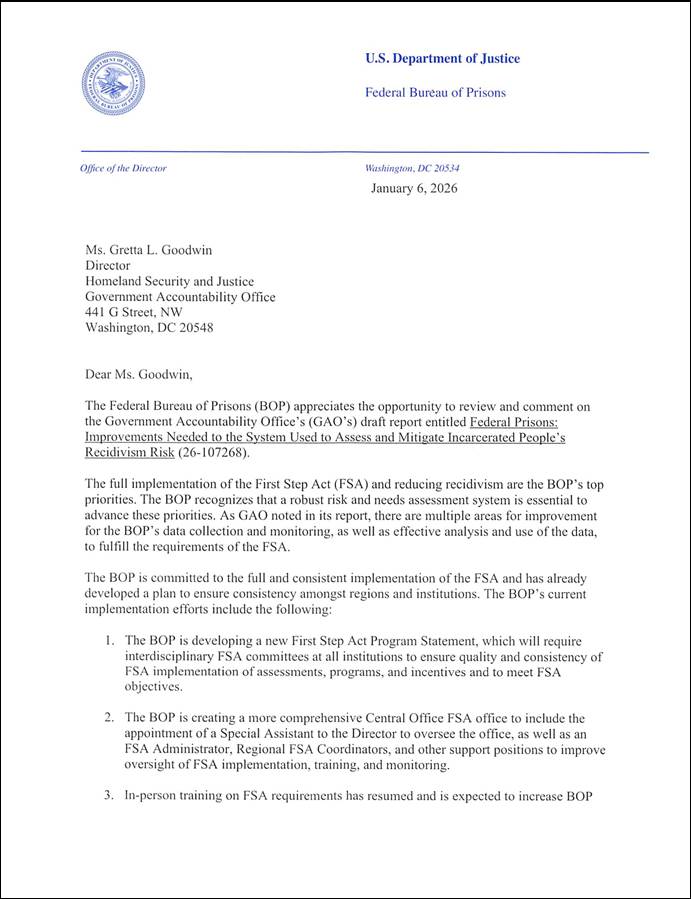
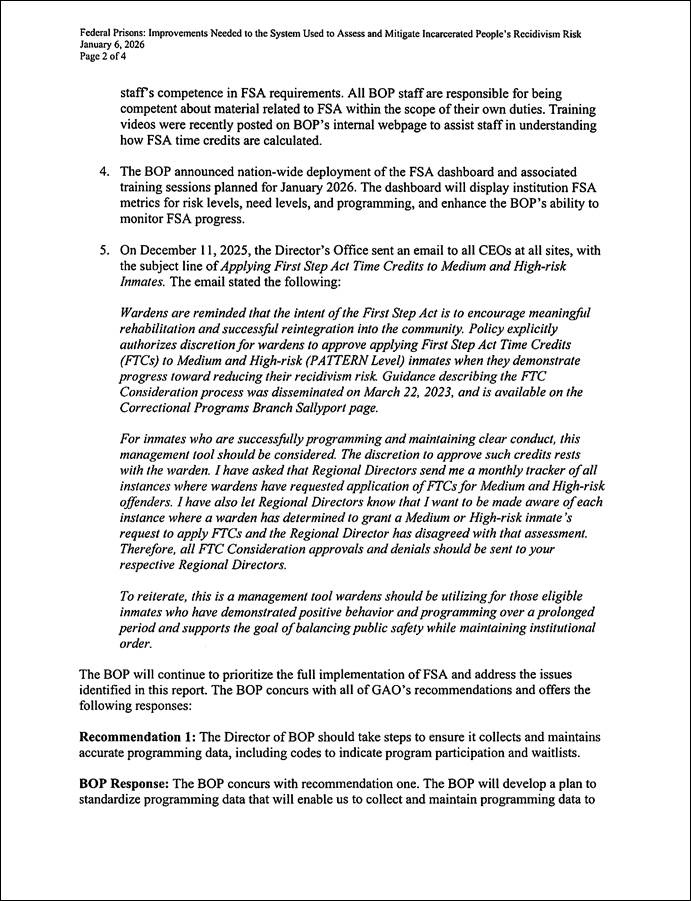
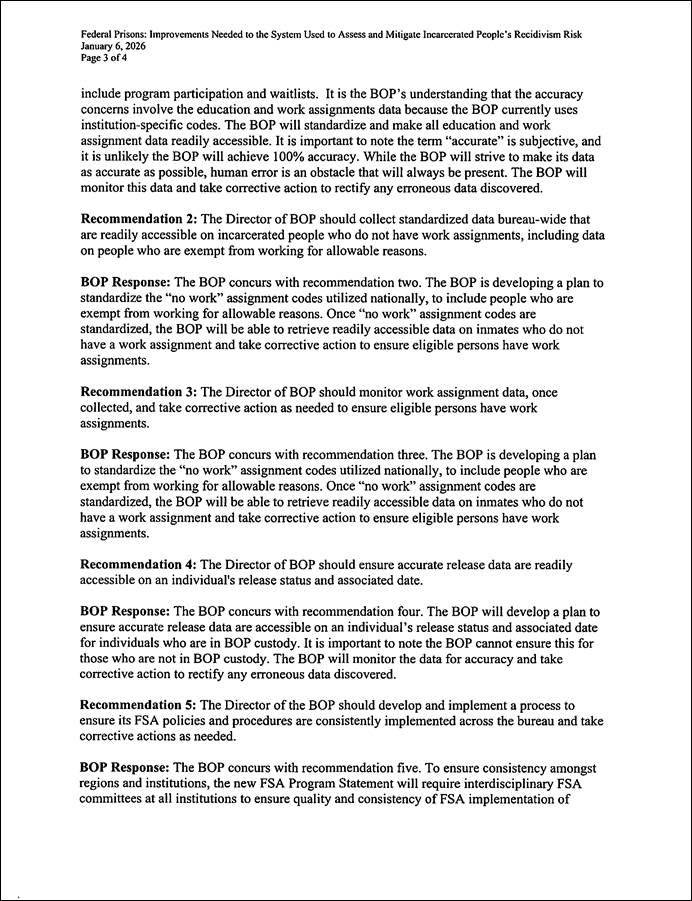
GAO Contact
Gretta L. Goodwin, goodwing@gao.gov
Staff Acknowledgments
In addition to the contact named above, GAO staff who made key contributions to this report include Tracey Cross (Assistant Director), Winchee Lin (Analyst-in-Charge), Michael Distler, Jordan Miller, Hiwotte Amare, Lauri Barnes, Billy Commons, Benjamin Crossley, Elizabeth Dretsch, Benjamin Licht, and Samuel Portnow.
Priority Open Recommendations: Department of Justice. GAO‑25‑108009. Washington, D.C.: May 2, 2025.
High-Risk Series: Heightened Attention Could Save Billions More and Improve Government Efficiency and Effectiveness. GAO‑25‑107743. Washington, D.C.: February 25, 2025.
Bureau of Prisons: Additional Actions Needed to Improve Restrictive Housing Practices. GAO‑24‑105737. Washington, D.C.: February 6, 2024.
Federal Prisons: Bureau of Prisons Should Improve Efforts to Implement its Risk and Needs Assessment System. GAO‑23‑105139. Washington, D.C.: March 20, 2023.
Bureau of Prisons: Opportunities Exist to Better Assist Incarcerated People with Obtaining ID Documents Prior to Release. GAO‑23‑105302. Washington, D.C.: December 8, 2022.
Second Chance Reentry Grants: DOJ Should Report Limitations When Publishing Performance Data. GAO‑22‑104641. Washington, D.C.: April 6, 2022.
Bureau of Prisons: Opportunities Exist to Better Analyze Staffing Data and Improve Employee Wellness Programs. GAO‑21‑123. Washington, D.C.: February 24, 2021.
Federal Prison Industries: Actions Needed to Evaluate Program Effectiveness. GAO‑20‑505. Washington DC: July 29, 2020.
Bureau of Prisons: Improved Planning Would Help BOP Evaluate and Manage its Portfolio of Drug Education and Treatment Programs. GAO‑20‑423. Washington D.C.: May 26, 2020.
Department of Justice: Continued Action Needed to Address Incarceration Challenges and Offenders’ Reentry. GAO‑18‑275T. Washington, D.C.: December 13, 2017.
Nonviolent Drug Convictions: Stakeholders’ Views on Potential Actions to Address Collateral Consequences. GAO‑17‑691. Washington, D.C.: September 7, 2017.
Inmate Reentry Programs: Enhanced Information Sharing Could Further Strengthen Coordination and Grant Management. GAO‑13‑93. Washington, D.C.: December 14, 2012.
The Government Accountability Office, the audit, evaluation, and investigative arm of Congress, exists to support Congress in meeting its constitutional responsibilities and to help improve the performance and accountability of the federal government for the American people. GAO examines the use of public funds; evaluates federal programs and policies; and provides analyses, recommendations, and other assistance to help Congress make informed oversight, policy, and funding decisions. GAO’s commitment to good government is reflected in its core values of accountability, integrity, and reliability.
Obtaining Copies of GAO Reports and Testimony
The fastest and easiest way to obtain copies of GAO documents at no cost is through our website. Each weekday afternoon, GAO posts on its website newly released reports, testimony, and correspondence. You can also subscribe to GAO’s email updates to receive notification of newly posted products.
Order by Phone
The price of each GAO publication reflects GAO’s actual cost of production and distribution and depends on the number of pages in the publication and whether the publication is printed in color or black and white. Pricing and ordering information is posted on GAO’s website, https://www.gao.gov/ordering.htm.
Place orders by calling (202) 512-6000, toll free (866) 801-7077,
or
TDD (202) 512-2537.
Orders may be paid for using American Express, Discover Card, MasterCard, Visa, check, or money order. Call for additional information.
Connect with GAO
Connect with GAO on X,
LinkedIn, Instagram, and YouTube.
Subscribe to our Email Updates. Listen to our Podcasts.
Visit GAO on the web at https://www.gao.gov.
To Report Fraud, Waste, and Abuse in Federal Programs
Contact FraudNet:
Website: https://www.gao.gov/about/what-gao-does/fraudnet
Automated answering system: (800) 424-5454
Media Relations
Sarah Kaczmarek, Managing Director, Media@gao.gov
Congressional Relations
David A. Powner, Acting Managing Director, CongRel@gao.gov
General Inquiries
[1]These numbers include people released from federal prisons in all 50 states, the District of Columbia, and U.S. territories. They do not include people who have been released to the custody of another jurisdiction, such as a release to a state to serve a sentence. According to BOP, as of August 2025, approximately 142,000 individuals were incarcerated in a BOP facility.
[2]Department of Justice, Federal Bureau of Prisons, Recidivism Outcomes of Inmates Released from the Bureau of Prisons 2022 Report to Congress (Washington, D.C.: 2023). For the purposes of our report, we use the terms “incarcerated person” and “incarcerated people” to generally refer to “prisoner” as defined in 18 U.S.C. § 3635(4).
[3]Pub. L. No. 115-391, 132 Stat. 5194. DOJ defines recidivism as (a) a new arrest in the U.S. by federal, state, or local authorities within 3 years of release or (b) a return to federal prison within 3 years of release. See, for example, Department of Justice, The Attorney General’s First Step Act Section 3634 Annual Report (Washington D.C.: December 2020).
[4]When we refer to “time credits” in this report, we are specifically referring to FSA time credits under 18 U.S.C. § 3632(d)(4). Eligible incarcerated people may earn FSA time credits when they arrive at their designated BOP facility and complete the needs assessments that require their participation. FSA time credits are distinct from good conduct time credits. Incarcerated people may earn good conduct time credit toward the service of their sentence for good behavior, which is described as “display[ing] exemplary compliance with institutional disciplinary regulations.” Good conduct time credits reduce certain incarcerated people’s time in BOP custody. See 18 U.S.C. § 3624(b).
[5]Consolidated Appropriations Act, 2024, Pub. L. No. 118-42, 138 Stat. 25, 139. The Consolidated Appropriations Act, 2024, appropriated nearly $8.4 billion to BOP for salaries and expenses in fiscal year 2024, and provided that not less than nearly $409 million would be for the programs and activities authorized by the FSA. In addition, the Consolidated Appropriations Act, 2024, directed BOP to transfer and merge not less than 2 percent (or $8,189,660) of the funds for the programs and activities authorized by the FSA with the appropriation for “Research, Evaluation, and Statistics” for the DOJ’s National Institute of Justice to carry out evaluations of programs and activities related to the FSA. When we refer to “programs and activities” in this report, we are referring to evidence-based recidivism reduction programs and productive activities as defined in the FSA. Further, in July 2025, the Public Law 119-21—commonly known as the One Big Beautiful Bill Act—included a provision that appropriated BOP $5 billion to remain available through September 30, 2029, including not less than $3 billion for hiring and training of new employees and not more than $2 billion for addressing maintenance and repairs to facilities. An Act to provide for reconciliation pursuant to title II of H. Con. Res. 14, Pub. L. No. 119-21, § 100056, 139 Stat. 72, 392-93 (2025).
[6]GAO, Federal Prisons: Bureau of Prisons Should Improve Efforts to Implement its Risk and Needs Assessment System, GAO‑23‑105139 (Washington, D.C.: Mar. 20, 2023).
[7]GAO, High-Risk Series: Efforts Made to Achieve Progress Need to Be Maintained and Expanded to Fully Address All Areas, GAO‑23‑106203 (Washington, D.C.: Apr. 20, 2023). We issued our most recent report in the High-Risk Series in February 2025. See GAO, High-Risk Series: Heightened Attention Could Save Billions More and Improve Government Efficiency and Effectiveness, GAO‑25‑107743 (Washington, D.C.: Feb. 25, 2025).
[8]Pub. L. No. 115-391, 132 Stat. 5194.
[9]GAO, Standards for Internal Control in the Federal Government, GAO‑14‑704G (Washington, D.C.: Sept. 10, 2014).
[10]When we refer to BOP facilities or designated BOP facilities in this report, we are specifically referring to BOP’s secure facilities (or federal prisons). This excludes BOP facilities that do not house individuals, such as Residential Reentry Management offices and other similar facilities. In addition, this excludes in-transit facilities or prerelease custody facilities, such as residential reentry centers.
[11]SENTRY is BOP’s case management system for incarcerated people. The system is used to collect, maintain, and track information on incarcerated people, including their location, medical care level and duty status, behavior history, and release data. Incarcerated people in BOP custody include those in a designated BOP facility, in an in-transit facility, or at a residential reentry center or on home confinement. Data we obtained included information on all people who were sentenced and incarcerated in a designated BOP facility as of March 30, 2024.
[12]18 U.S.C. §§ 3621(h), 3632(d)(5).
[13]The National Institute of Justice is the research, development, and evaluation agency of DOJ and is dedicated to improving knowledge and understanding of crime and justice issues through science.
[14]See 18 U.S.C. § 3632(a). DOJ defines general recidivism as a return to BOP custody or a rearrest within 3 years of release from BOP custody, excluding all traffic offenses except driving under the influence and driving while intoxicated.
[15]DOJ defines violent recidivism as a rearrest for a suspected act of violence within 3 years of release from BOP custody.
[16]To address the requirement to “classify each prisoner as having minimum, low, medium, or high risk for recidivism,” under 18 U.S.C. § 3632(a)(1), the National Institute of Justice consultants identified risk level categories via cut points, which are risk score thresholds that place individuals into the four categories.
[17]PATTERN has four scoring guides, and the score and point structure of these guides differ based on gender and recidivism type (general or violent recidivism). Within each scoring guide, the recidivism risk score is the sum of the points for each factor. Using this score and the cut points, each person is assigned a risk level (minimum, low, medium, and high). For example, for male, general recidivism, the cut points for each risk level are as follows: (1) minimum risk is -22 to 5 points, (2) low is 6 to 39, (3) medium is 40 to 54, and (4) high is 55 to 109. Risk factors for the scoring guides include history of violence, time since last incident report, work programs completed, and age, among others. For example, PATTERN will give 28 points to a male who is 26 to 29 years old for the age factor. When this person turns 30 years old, PATTERN will give them 21 points for this specific factor until they turn 41. As such, a male who is 26 years will at least be at the low risk level based solely on age. This, along with the other risk factors, may increase or decrease the score and level.
[18]According to BOP, separating females and males into individual samples to produce prediction models improves both the context and accuracy of prediction.
[19]BOP launched SPARC-13 on January 15, 2020. BOP created SPARC-13 by enhancing its needs assessment system that existed prior to the FSA’s enactment.
[20]According to BOP officials, the automated process improved scoring reliability by eliminating manual errors, reduced staff labor costs, and increased the speed and efficiency of the assessments, see GAO‑23‑105139.
[21]BOP offered programs and activities prior to the implementation of the FSA.
[22]18 U.S.C. § 3635(3)(A)-(B). Under 18 U.S.C. § 3635(3)(C), an evidence-based recidivism reduction program may include social learning and communication, interpersonal, anti-bullying, rejection response, and other life skills; family relationship building, structured parent-child interaction, and parenting skills; classes on morals or ethics; academic classes; cognitive behavioral treatment; mentoring; substance use treatment; vocational training; faith-based classes or services; civic engagement and reintegrative community services; a prison job, including through a prison work program; victim impact classes or other restorative justice programs; and trauma counseling and trauma-informed support programs.
[23]Pursuant to 18 U.S.C. § 3635(5), “[t]he term ‘productive activity’ means either a group or individual activity that is designed to allow prisoners determined as having a minimum or low risk of recidivating to remain productive and thereby maintain a minimum or low risk of recidivating, and may include the delivery of the programs described in paragraph (1) [sic] to other prisoners.” (So in original. Probably should be “paragraph (3)” in reference to evidence-based recidivism reduction program definition).
[24]According to BOP’s program statement on FSA time credits, productive activities include a variety of groups, programs, classes and individual activities which can be either structured or unstructured. According to BOP officials, they no longer use the term unstructured productive activities and instead refer to these activities as non-FSA programs. These non-FSA programs can include work details, recreation, social visits, participation in religious services, teaching classes, and tutoring other incarcerated people. Department of Justice, Bureau of Prisons, First Step Act of 2018 – Time Credits: Procedures for Implementation of 18 U.S.C. § 3632(d)(4), 5410.01 (Nov. 18, 2022). (Change Notice – Mar. 10, 2023).
[25]Department of Justice, Bureau of Prisons, FSA Approved Programs Guide (Washington, D.C.: Aug. 2025). According to BOP officials, they update the guide at least semiannually.
[26]Since it first implemented the FSA, BOP has added and removed evidence-based recidivism reduction programs and productive activities from its FSA Approved Program Guide. BOP has also revised classifications and changed a program to a productive activity. BOP reviews external entities’ proposals to create new evidence-based recidivism reduction programs to determine if (1) evidence of reducing recidivism is observed and (2) other BOP-relevant criteria are met.
[27]The 10 programs that can lower a person’s risk score, if they complete them, are: Bureau Rehabilitation and Values Enhancement, Challenge, Life Connections, Mental Health Step Down, National Patenting Program, Post Secondary Education, Skills, Sex Offender Treatment Program (residential or nonresidential), and Steps Toward Awareness, Growth, and Emotional Strength. Drug Education is the productive activity that can also lower a person’s risk score. Additionally, these evidence-based recidivism reduction programs and productive activities may address eight of the 13 needs. Incarcerated people can also complete other non-FSA programs that can lower their risk score, such as Adult Continuing Education courses.
[28]18 U.S.C. § 3632(d)(4)(A)(i).
[29]BOP has an automated process in place for calculating the FSA time credits earned by eligible incarcerated person under FSA since August 2022. We previously reported on BOP’s efforts to develop the automated FSA time credit application, see GAO‑23‑105139.
[30]28 C.F.R. pts. 523 and 541.
[31]28 C.F.R. § 523.41(c)(3).
[32]18 U.S.C. §§ 3624(g) and 3632(d)(4)(A)-(C). Supervised release is an additional term of supervision imposed by a court for a person and begins when people complete their full custody sentence. Prerelease custody is lower-security conditions of confinement that help prepare incarcerated person for eventual release. BOP contracts with residential reentry centers, also known as halfway houses, to help people prepare to reenter their communities by helping them find employment and housing, receive drug treatment, and attend job training, among other programs and services, while residing in a structured living environment. BOP contracts with residential reentry centers to oversee both people residing in the center and people on home confinement. People in home confinement receive access to the residential reentry center’s programs and services while residing at an approved location (e.g., a family member’s home) and under electronic location monitoring.
[33]Pub. L. No. 110-199, § 251, 122 Stat. 657, 692-93 (codified as amended at 18 U.S.C. § 3624) (2008). BOP facility staff are to provide an individual assessment of the appropriateness of prerelease custody, based on criteria set forth in 18 U.S.C. § 3621(b), and recommend how long an individual should be placed at a residential reentry center, up to 12 months in a residential reentry center or up to 6 months or 10 percent of the sentence, whichever is less, for home confinement. 18 U.S.C. § 3624(c)(1)-(2).
[34]Pub. L. No. 115-391, §§ 101-102, 132 Stat. 5194, 5195-5208, 5208-13.
[35]The Attorney General is required, on an annual basis, to review, validate, and release publicly on DOJ’s website the risk and needs assessment system, with the review including (1) any subsequent changes to the risk and needs assessment system made after the date of enactment of the FSA; (2) statistical validation of any tools that the risk and needs assessment system uses; (3) an evaluation of the rates of recidivism among similarly classified incarcerated people to identify any unwarranted disparities, including disparities among similarly classified incarcerated people of different demographic groups, in such rates; (4) and other information related to the risk and needs assessment system. 18 U.S.C. § 3631(b)(4).
[36]Under the FSA, the Attorney General is required to conduct ongoing research and data analysis on: (A) evidence-based recidivism reduction programs relating to the use of risk and needs assessment tools; (B) the most effective and efficient uses of such programs; (C) which evidence-based recidivism reduction programs are the most effective at reducing recidivism, and the type, amount, and intensity of programming that most effectively reduces the risk of recidivism; and (D) products purchased by federal agencies that are manufactured overseas and could be manufactured by incarcerated people participating in a prison work program without reducing job opportunities for other workers in the U.S. 18 U.S.C. § 3631(b)(3).
[37]Pursuant to 18 U.S.C. § 3634, the Attorney General is required to submit a report to certain committees of Congress that contains (1) a summary of the activities and accomplishments of the Attorney General in carrying out the FSA; (2) a summary and assessment of the types and effectiveness of evidence-based recidivism reduction programs and productive activities in prisons operated by BOP; (3) rates of recidivism among individuals who have been released from federal prison; and (4) other areas related to the implementation of the relevant portions of the FSA, among other things. This requirement began in December 2020 and was required for 5 years, ending in 2025.
[38]In 2023, we reported that we were unable to assess BOP’s timeliness of risk and needs assessments due to data issues we identified. For example, BOP officials told us they did not have the technological capability to specifically track when risk and needs assessments were conducted prior to August 5, 2021, see GAO‑23‑105139. However, since then, BOP has taken several actions to ensure its data are complete and accurate. As such, we were able to assess timeliness for this report.
[39]Department of Justice, Bureau of Prisons, First Step Act of 2018 – Time Credits: Procedures for Implementation of 18 U.S.C. § 3632(d)(4), 5410.01 (Nov. 18, 2022). (Change Notice – Mar. 10, 2023). Pursuant to 18 U.S.C. § 3621(h)(1), the Director of BOP was required to implement and complete the initial risk and needs assessment for each incarcerated person by January 15, 2020, regardless of the incarcerated person’s length of imposed term of imprisonment. Department of Justice, Bureau of Prisons, Inmate Classification and Program Review, 5322.13 (Washington, D.C.: May 16, 2014).
[40]Specifically, our cohort included incarcerated people who started their sentence and entered a designated BOP facility from June 1, 2022, to March 30, 2024.
[41]We did not obtain data on sentence computations or evaluate the effect of missing sentence computations on assessment timeliness.
[42]According to BOP officials, for an incarcerated person serving a sentence less than 18 months, Designation and Sentence Computation Center staff have up to 30 days to complete the sentence computation. However, if an incarcerated person is serving a sentence longer than 18 months, staff have up to 60 days to complete the sentence computation.
[43]Department of Justice, Bureau of Prisons, First Step Act of 2018 – Time Credits: Procedures for Implementation of 18 U.S.C. § 3632(d)(4), 5410.01 (Nov. 18, 2022). (Change Notice – Mar. 10, 2023). While initial classification meetings are to be held with an incarcerated person within 28 calendar days of arrival at their designated facility, BOP officials stated that some needs assessments had policy statements that predated the FSA and required them to be conducted within 30 days.
[44]According to BOP, as of July 13, 2025, there were 66 missing education assessments, and 238 missing substance use assessments for the 126,224 people incarcerated at a BOP facility for 28 days or more.
[45]See appendix III for perspectives on needs assessments from incarcerated people.
[46]Pursuant to 18 U.S.C. § 3632(d)(5), an incarcerated person who successfully participates in evidence-based recidivism reduction programming or productive activities is required to receive periodic risk reassessments not less often than annually, and an incarcerated person determined to be at a medium or high risk of recidivating and has less than 5 years until his or her projected release date is to receive more frequent risk reassessments.
[47]BOP did not conduct a first risk reassessment within 365 days of their initial risk assessment for 199 of the 56,361 incarcerated people (0.4 percent) in the selected cohort who were incarcerated long enough to have a first risk reassessment.
[48]BOP did not conduct second and third risk reassessments for 97 people (0.2 percent of 47,876) and 70 people (0.2 percent of 33,947), respectively.
[49]Department of Justice, Bureau of Prisons, Inmate Classification and Program Review, 5322.13, (Washington, D.C.: May 16, 2014). Further, BOP’s November 2022 policy clarified that BOP is to reassess each person’s risk and needs at each regularly scheduled program review meeting. Department of Justice, Bureau of Prisons, First Step Act of 2018 – Time Credits: Procedures for Implementation of 18 U.S.C. § 3632(d)(4), 5410.01 (Nov. 18, 2022). (Change Notice – Mar. 10, 2023).
[50]Department of Justice, Bureau of Prisons, Inmate Classification and Program Review, 5322.13, (Washington, D.C.: May 16, 2014). Although BOP does not have an official program statement for risk, BOP officials stated that staff are to conduct risk reassessments on the same basis as need reassessments to coincide with program reviews.
[51]Populations varied for each risk and needs assessment based on the number of incarcerated people in this cohort who had been incarcerated long enough for successive reassessments. For second reassessments, populations ranged between 47,288 for the mental health need and 52,913 for the work need. For third reassessments, populations ranged between 33,465 for the mental health need and 40,566 for the medical need. While BOP’s FSA assessment button conducts reassessments for risk and needs simultaneously, initial assessments are not done at the same time. As a result, the amount of time between reassessments may vary per risk or need.
[52]Pursuant to 18 U.S.C. § 3632(d)(4)(A)(ii), an eligible incarcerated individual determined by BOP to be at a minimum or low risk for recidivating, who, over two consecutive assessments, has not increased their recidivism risk, earn an additional 5 days (or a total of 15 days) of FSA time credits for every 30 days of successful participation in evidence-based recidivism reduction programming or productive activities.
[53]According to BOP officials, its 2023 guidance recommends that facilities report information on missing needs assessments and a summary of risk level assignments to their region. Additional information in the report includes: (1) an overview of current needs assessment results, (2) a review of all current FSA program participation, and (3) a summary of FSA time credit eligibility assignments.
[55]As we previously reported, BOP developed an automated-calculation application for time credits to automatically calculate FSA time credits if an eligible incarcerated person is in earning status. BOP fully implemented the application on September 6, 2022.
[56]For these three needs, additional information not stored in SENTRY would be required to populate an initial assessment.
[57]According to BOP, the bureau is working to replace SENTRY with the Centralized Inmate Case Logistics Operations and Planning System. The new system is to retain the core features of SENTRY but will have a more intuitive interface that enables employees to perform the same function in an easier way.
[58]18 U.S.C. § 3631(b)(4).
[59]Prior validation reports had similar findings on racial and ethnic biases. To help correct for the bias, DOJ adjusted the risk level category cut points in 2022 to attempt to reduce these racial and ethnic disparities.
[60]According to DOJ’s 2024 validation, for the fiscal year 2019 validation samples in the general recidivism tools, the differential prediction analysis demonstrated that there was more than a 6 percent over-prediction of recidivism for Black males, a 4 percent over-prediction for Hispanic males, more than a 9 percent over-prediction for Asian males, and nearly a 13 percent under-prediction of Native American males, relative to White males. There was also an 8 percent over-prediction for Black females, more than a 4 percent over-prediction for Hispanic females, a 10 percent over-prediction for Asian females, and an 11 percent under-prediction for Native American females, relative to White females.
[61]The risk-need-responsivity model is used to guide delivery of programming to correctional populations. The model’s principles hold that: (1) higher-risk individuals should be prioritized for programming, (2) programming must address dynamic, individual characteristics related to criminal behavior, and (3) programs must account for factors that influence effectiveness.
[62]18 U.S.C. § 3631(b)(3).
[63]18 U.S.C. § 3631(b)(3).
[64]Under 18 U.S.C. § 3631(b)(3), the Attorney General is required to conduct ongoing research and data analysis on: (A) evidence-based recidivism reduction programs relating to the use of risk and needs assessment tools; (B) the most effective and efficient uses of such programs; (C) which evidence-based recidivism reduction programs are the most effective at reducing recidivism, and the type, amount, and intensity of programming that most effectively reduces the risk of recidivism; and (D) products purchased by federal agencies that are manufactured overseas and could be manufactured by incarcerated people participating in a prison work program without reducing job opportunities for other workers in the U.S.
[65]Texas Christian University Report. Federal Bureau of Prisons Anger Management Program Evaluations (Aug. 27, 2024). MITRE Technical Report. Independent Evaluation of Federal Prison Industries (McLean, VA.: Sept. 29, 2021). BOP did not agree with the results of the Federal Prison Industries evaluation and took steps to add recidivism reduction goals into the program in response. Specifically, BOP stated that the contractor did not properly analyze BOP’s data, and BOP officials stated that they are taking steps to establish goals for further evaluations of the program. Separately, the FSA requires the Attorney General to conduct ongoing research and data analysis on products purchased by federal agencies that are manufactured overseas and could be manufactured by incarcerated people participating in a prison work program without reducing job opportunities for other workers in the U.S. 18 U.S.C. § 3631(b)(3)(D). To address this requirement, the Federal Prison Industries program contracted with an external entity to complete a product market analysis. The contractor published the analysis results in September 2022. The report describes opportunities for reshoring products purchased by the U.S. Government from overseas vendors to products that could be or are produced within the Federal Prison Industries.
[66]Department of Justice, Office of Research and Evaluation, The Resolve Trauma Treatment Program: A Retrospective Evaluation of the Effects of Program Participation on Behavioral Outcomes. 2014—2019. (August 2024). Department of Justice, Office of Research and Evaluation, Evaluation of BRAVE (May 12, 2025).
[67]BOP officials said that as of July 2025, they have received the funds they requested for evaluations to date. Officials noted that these evaluations are often long-term commitments, some lasting at least 5 years, and they can be resource intensive. They noted that staffing shortages, hiring freezes, and retirements, among other factors, could play a role in delaying these evaluations.
[68]GAO‑23‑105139. We also recommended that BOP evaluate its programs according to its established plan.
[69]18 U.S.C. § 3631(b)(3)(C).
[70]Department of Justice, Bureau of Prisons, FSA Approved Programs Guide (Washington, D.C.: August 2022). The August 2025 Approved Programs Guide has 48 programs and 73 activities. Department of Justice, Bureau of Prisons, FSA Approved Programs Guide (Washington, D.C.: Aug. 2025).
[71]Global Corrections Group, The Effectiveness of Correctional Programs in the Federal Bureau of Prisons, A Systematic Evidence-Based Review of Research (2000-2022), and GAO‑23‑105139.
[72]This analysis includes all sentenced and incarcerated people in a designated BOP facility as of March 30, 2024, who were still incarcerated on December 31, 2024 (98,254 people). A total of 64,862 people had a work need and 59,079 people had a finance/poverty need. The number of needs people had ranged from zero to 12, with 1,755 people having zero needs, and 28 people having 12 needs.
[73]Furthermore, 50 percent (28,701) of the 57,295 incarcerated people who entered a BOP facility from June 1, 2022, to March 30, 2024, and had at least two needs assessments by December 2024, maintained the same number of needs, or increased the number of needs. For this analysis, we compared the number of needs these individuals had at their initial assessment and their most recent assessment that occurred from June 2022 through December 2024. During this time, a person may have addressed some needs and developed others. For example, someone who previously did not have an anger need would develop that need if they received an incident report for fighting. Our analysis incorporated changes in identified needs between the person’s initial and most recent assessment and excludes changes that might have happened in other assessments. BOP does not reassess the dyslexia need.
[74]We analyzed data for all sentenced and incarcerated people in a designated BOP facility as of March 30, 2024 (139,896 people). Approximately 47 percent of the individuals who did not complete a program or activity from 2022 through 2024 (15,393 of the 32,684) had been incarcerated for at least 3 years.
[75]Department of Justice, National Institute of Justice, 2023 Review and Validation of the BOP Needs Assessment System (Washington, D.C.: September 2024).
[76]According to the report, about 11 percent of incarcerated people with a substance use need were involved in programming that addressed this need, which was the highest rate among the 13 needs. However, nearly 90 percent of people with this need were not participating in substance use disorder treatment. Department of Justice, National Institute of Justice, 2023 Review and Validation of the BOP Needs Assessment System (Washington, D.C.: September 2024).
[77]Department of Justice, Bureau of Prisons, FSA Approved Programs Guide (Washington, D.C.: May 2025).
[79]We have previously reported on staffing challenges within the BOP. See GAO‑25‑107743 and GAO, Bureau of Prisons: Opportunities Exist to Better Analyze Staffing Data and Improve Employee Wellness Programs, GAO‑21‑123 (Washington, D.C.: Feb. 24, 2021).
[80]GAO‑23‑105139. Augmentation is the assignment of a non-custody staff member, e.g., a person responsible for educational or vocational training, to a custody role, whereby the staff member’s primary task becomes the custody and supervision of the incarcerated person.
[81]According to these officials, facilities may implement lockdowns lasting approximately 1 week in response to serious or violent incidents. In contrast, following major security breaches, such as homicides, may result in lockdowns for approximately 6 weeks.
[83]According to BOP’s October 2023 First Step Act Needs Assessment and Programming Guide, entering the appropriate SENTRY assignments for FSA Programming is essential. It further states that SENTRY assignments must be accurate and up to date for each participant. In addition, every active participant should have a participation assignment for each program and activity and a completion assignment upon successful completion.
[84]BOP officials said that they were unable to create standardized codes for some FSA programs in the education department. Instead, facility staff use locally created program codes that may be unique to each facility. However, BOP created group codes that can be associated with these program codes that operated similar to the other department’s standardized codes for FSA programs, such as program completions and waitlists. According to these officials, these group codes can be used like the other standardized codes for population of the FSA dashboard.
[85]Department of Justice, Bureau of Prisons, First Step Act of 2018 – Time Credits: Procedures for Implementation of 18 U.S.C. § 3632(d)(4), 5410.01 (Nov. 18, 2022). (Change Notice – Mar. 10, 2023).
[87]In addition to not being physically and mentally able, BOP policy also states that exceptions from work shall be made to allow for participation in an education, vocational, or drug abuse treatment program, on either a full or part-time basis, where this involvement is mandated by BOP policy or statute (for example, the Literacy Program). Where such participation is not required by either policy or statute, exception may be made to allow the person to participate in an education, vocational, or drug abuse treatment program rather than work full-time upon the request of the incarcerated person and approval of the warden or designee. Department of Justice, Bureau of Prisons, Inmate Work and Performance Pay, 5251.06 (Washington, D.C.: Oct. 1, 2008).
[88]See appendix III for more perspectives on work assignments from incarcerated people.
[89]For this analysis, we analyzed data for all sentenced and incarcerated people in a designated BOP facility as of March 30, 2024, who were still incarcerated on December 31, 2024 (98,254 people).
[90]Further, we found that about 93 percent (127,488 of 136,973) of incarcerated people had a work assignment with some variation or spelling of “unassigned” or “idle” that likely indicated they were not working at least once while incarcerated between 2022 and 2024. For this analysis, we analyzed data for all sentenced and incarcerated people in a designated BOP facility as of March 30, 2024. We analyzed data for these 136,973 people who had any work assignment information from 2022 to 2024 while they were incarcerated in a BOP facility. We did not assess work assignment information once a person transferred to supervised release or prerelease custody.
[93]The individuals in our analysis were eligible people who BOP identified as having a low or minimum recidivism risk in their previous two reassessments, as well as any individuals that had a medium or high risk of recidivism and successfully petitioned to have their time credits applied towards supervised release.
[94]See 18 U.S.C. § 3624(g)(3).
[95]Detainers are a formal request from another jurisdiction that it wants custody of the incarcerated person once their current sentence is completed.
[97]The individuals in our analysis were eligible people who BOP identified as having a low or minimum recidivism risk in their previous two reassessments, as well as any individuals that had a medium or high risk of recidivism and successfully petitioned to have their time credits applied towards prerelease custody.
[98]BOP implemented a conditional release calculator in SENTRY in November 2023 that showed an incarcerated person’s forecasted projected release date. BOP forecasted this date assuming that an individual will continue earning time credits at their current rate, including maintaining their current risk level. According to BOP officials, BOP guidance to facility staff did not change after releasing the conditional release calculator, and BOP maintained the guidance that staff should initiate the process to transfer incarcerated people to prerelease custody 17 to 19 months in advance of the projected release date.
[99]While an October 2024 BOP memorandum stated that this should be done 12 months prior to the conditional transition to community date, BOP officials stated their policy is 17 to 19 months.
[100]BOP facility staff are to provide an individual assessment of the appropriateness of prerelease custody, based on criteria set forth in 18 U.S.C. § 3621(b), and recommend how long an individual should be placed at residential reentry center, up to 12 months, or up to 6 months or 10 percent of the sentence, whichever is less, for home confinement. This recommendation is separate from and may be combined with FSA time credits. Pursuant to 18 U.S.C. § 3632(d)(6), the incentives described in the FSA are in addition to any other rewards or incentives for which an incarcerated individual may be eligible.
[101]BOP anticipated that some people may need to immediately transfer based on the tool’s projected date and developed a short-term process to facilitate these transfers. Specifically, the guidance noted that staff had additional time to initiate the transfer process during the initial 90 days of implementing the new planning date. We have ongoing work on residential reentry centers that is also examining these new planning dates. We anticipate issuing our report in early 2026.
[102]Augmentation is the assignment of a noncustody staff member (e.g., a person responsible for case management or educational or vocational training) to a custody role, whereby the staff member’s primary task becomes the custody and supervision of the incarcerated person. We have previously reported on BOP’s staffing challenges. See GAO‑25‑107743 and GAO‑21‑123.
[103]Facility staff at two of the facilities we visited noted that when faced with resource constraints the Residential Reentry Management Branch field office was more likely to apply the individual’s FSA time credits, rather than time in the residential reentry center under the Second Chance Act.
[104]Oversight of the Federal Bureau of Prisons, Before the Subcommittee on Crime and Federal Government Surveillance, Committee on the Judiciary, 118th Cong. (2024) (statement of Colette S. Peters, Director, Federal Bureau of Prisons).
[105]On March 31, 2025, BOP limited the amount of time a person could be placed in a residential reentry center under the Second Chance Act from 12 months to 60 days, due to budget constraints. However, on April 10, 2025, BOP rescinded this guidance due to concerns about the effect on the incarcerated population.
[106]BOP issued guidance on May 2025, and approximately 1 month later reissued the guidance, related to stacking (1) the facility staff’s recommendation under the Second Chance Act for the number of days a person may transfer to a residential reentry center and (2) the FSA time credits a person earned towards prerelease custody. The May 2025 guidance stated that people may not receive additional prerelease custody time under the Second Chance Act if they have already earned 365 days of FSA time credits for prerelease custody. BOP Central Office officials said that the bureau reissued the guidance because it decided to continue the policy of stacking time credits for prerelease custody from both the FSA and the Second Chance Act.
[107]18 U.S.C. § 3624(g)(11).
[108]18 U.S.C. § 3624(g)(1)(D)(i)(II).
[109]Prior to the petition process, BOP officials stated that incarcerated people could use the Administrative Remedy Process—BOP’s formal complaint process—to petition the warden to apply their earned FSA time credits towards their projected release date.
[110]BOP officials stated that some regional offices keep track of the reason for approving or denying the petition.
[111]18 U.S.C. § 3624(g)(1)(D)(i)(II).
[112]Department of Justice, Bureau of Prisons, First Step Act of 2018 – Time Credits: Procedures for Implementation of 18 U.S.C. § 3632(d)(4), 5410.01 (Nov. 18, 2022). (Change Notice – Mar. 10, 2023).
[113]We reported on BOP’s efforts to automate the risk and needs assessments and time credit calculations in our previous report, GAO‑23‑105139.
[115]18 U.S.C. § 3632(f)(4).
[116]18 U.S.C. § 3634. The Attorney General must submit this report to the Committees on the Judiciary of the Senate and the House of Representatives and the Subcommittees on Commerce, Justice, Science, and Related Agencies of the Committees on Appropriations of the Senate and the House of Representatives.
[117]Department of Justice, The Attorney General’s First Step Act Section 3634 Annual Report (Washington D.C.: December 2020), Department of Justice, First Step Act Annual Report (Washington D.C.: April 2022), Department of Justice, First Step Act Annual Report (Washington D.C.: April 2023), and Department of Justice, First Step Act Annual Report (Washington D.C.: June 2024).
[118]28 C.F.R. §§ 523.40.44.
[119]GAO, Standards for Internal Control in the Federal Government, GAO‑14‑704G (Washington, D.C.: Sept. 10, 2014).
[120]When we refer to BOP facilities or designated BOP facilities in this report, we are specifically referring to BOP’s secure facilities (or federal prisons). This excludes BOP facilities that do not house individuals, such as Residential Reentry Management offices and other similar facilities. In addition, this excludes in-transit facilities or prerelease custody facilities, such as residential reentry centers.
[121]The National Institute of Justice is the research, development, and evaluation agency of DOJ and is dedicated to improving knowledge and understanding of crime and justice issues through science.
[124]18 U.S.C. § 3632(f).
[125]18 U.S.C. § 3634.
[126]At each of the four BOP facilities, we interviewed executive staff, unit managers, case manager coordinator, case managers, program staff, and FSA coordinators. Two facilities were located on the same BOP federal correctional complex. We also met with division leads at each of the regional offices.
[127]Prerelease custody is lower-security conditions of confinement that help prepare incarcerated people for eventual release. Supervised release is an additional term of supervision imposed by a court for an incarcerated person and begins when the incarcerated person completes their full custody sentence.
[128]PATTERN is the Department of Justice’s (DOJ) risk assessment tool that BOP staff are to use to measure an incarcerated person’s risk of recidivism. Criminogenic needs are factors in a person’s life that, if addressed, could help reduce a person’s recidivism risk.
[129]SENTRY is used to collect, maintain, and track information on incarcerated people, including their location, medical care level and duty status, behavior history, and release data. Incarcerated people in BOP custody include those in a designated BOP facility (one of BOP’s 121 secure facilities at the time we obtained these data) as of March 30, 2024. We selected March 30 because that was the date that BOP ran its monthly system update.
[130]BOP staff are to conduct initial risk assessments for incarcerated people in conjunction with their initial classification meeting, which should be within 28 calendar days of their arrival at their designated BOP facility. BOP staff are required to conduct initial needs assessments within 30 days of the incarcerated person’s arrival at a designated BOP facility. BOP requires staff to conduct reassessments during program review meetings, which are to occur every 180 days or at least once every 90 days when an incarcerated person is within 12 months of their projected release date. Department of Justice, Bureau of Prisons, Inmate Classification and Program Review, 5322.13, (Washington, D.C.: May 16, 2014). Department of Justice, Bureau of Prisons, First Step Act of 2018 – Time Credits: Procedures for Implementation of 18 U.S.C. § 3632(d)(4), 5410.01 (Nov. 18, 2022). (Change Notice – Mar. 10, 2023). Pursuant to 18 U.S.C. § 3632(d)(5), an incarcerated person who successfully participates in evidence-based recidivism reduction programming or productive activities is required to receive periodic risk reassessments not less often than annually, and an incarcerated person determined to be at a medium or high risk of recidivating and has less than 5 years until his or her projected release date is to receive more frequent risk reassessments.
[131]This date was also after BOP’s implementation of a button that BOP staff press to automatically conduct risk and needs assessments. As we reported in 2023, the implementation of this button improved scoring reliability by eliminating manual errors, reduced staff labor costs, and increased the speed and efficiency of the assessments, according to DOJ and BOP officials. In addition, officials reported that the button would help to resolve some of the data issues we identified in the 2023 report. GAO, Federal Prisons: Bureau of Prisons Should Improve Efforts to Implement its Risk and Needs Assessment System, GAO‑23‑105139 (Washington, D.C.: Mar. 20, 2023).
[132]For needs, an incarcerated person can be categorized as (1) having the need, (2) not having the need, or (3) refusing to participate in the needs assessment process. When analyzing whether BOP conducted needs assessments within FSA required and internal time frames, we did not count a person’s refusal to participate in the assessment process as a completed assessment. We calculated the number of days between a person’s arrival and their first assessment that specifically identified whether they had the criminogenic need being assessed.
[133]BOP reassesses 12 of the 13 needs for incarcerated people; it does not reassess dyslexia. In addition, we did not include two other needs, education and substance use, because we identified data limitations with the initial assessments.
[134]Similarly, to be included in the population for a second assessment, a person had to have a first reassessment. Finally, to be included in the population for a third reassessment, a person had to have a second reassessment.
[135]In addition, we identified when incarcerated people in our selected cohort were transferred to prerelease custody or released. Once a person is in prerelease custody or released, BOP staff are no longer required to conduct reassessments. If a person was released and was not incarcerated long enough for a reassessment, they were excluded from the population for that reassessment and future reassessments.
[136]In general, populations ranged between 54,478 for the antisocial peers need and 56,748 for the work need for first reassessments. For second reassessments, populations ranged between 47,288 for the mental health need and 52,913 for the work need. For third reassessments, populations ranged between 33,465 for the mental health need and 40,566 for the medical need.
[137]GAO‑23‑105139. Comparisons of results between these reports are not possible because we used different types of data. In our previous report, we used aggregated data on completions totals at each facility. In this report, we used individual-level data to analyze the number of programs and activities people completed within the 3-year time frame.
[138]We analyzed SENTRY data on when each incarcerated person completed any evidence-based recidivism reduction program or productive activity, only including those programs and activities that these SENTRY data indicated were completed from 2022 through 2024.
[139]In addition, we found waitlist data to be unreliable following discussions with BOP officials and staff. Specifically, we found that departments at the facilities we visited do not use waitlists the same way. For example, staff do not offer some programs and activities until a person is closer to release, so they may spend years on a waitlist depending on the length of their sentence. According to facility staff, some programs and activities do not use electronic waitlists.
[140]Specifically, we identified over 300 unique variations or spellings of “unassigned” or “idle” amongst these work assignments. In addition, we also analyzed data on the work assignments incarcerated people had as of December 31, 2024. There were 98,254 people who were in a designated BOP facility as of December 31, 2024. We used the same data described above to count the number of people who had one of the variations or spellings that indicated that an individual was not working.
[141]The individuals in our analysis included people who BOP identified as having a low or minimum recidivism risk in their previous two reassessments, as well as any individuals that had a medium or high risk of recidivism and successfully petitioned to have their time credits applied towards supervised release.
[142]Specifically, we had one data set that included sentencing information and one that included information on a person’s location within BOP.
[143]The individuals in our analysis included people who BOP identified as having a low or minimum recidivism risk in their previous two reassessments, as well as any individuals that had a medium or high risk of recidivism and successfully petitioned to have their time credits applied toward prerelease custody.
[144]While SENTRY did capture information on successful petitions, the system did not have information on how many individuals petitioned to apply their FSA time credits but were rejected. Our population only indicates people who could have potentially petitioned to apply their FSA time credits.
[145]Because it only included those at a designated BOP facility, the analysis did not include people located at in-transit facilities or prerelease custody facilities, such as residential reentry centers.
[146]An incarcerated person’s FSA eligibility was categorized as undetermined when BOP staff had not fully reviewed the individual’s eligibility to make a final determination.
[147]Our analysis did not find anyone that had all 13 needs.
[148]This population included incarcerated people who entered a designated BOP facility prior to June 1, 2022.
[149]Decreasing one’s risk of recidivism from medium or high to low or minimum allows an incarcerated person to apply their earned FSA time credits to prerelease custody and supervised release.
[150]BOP reassess 12 of the 13 needs for incarcerated people; it does not reassess dyslexia.
[151]BOP uses the Standardized Prisoner Assessment for Reduction in Criminality to assess a person’s criminogenic needs in 13 different areas (e.g., anger management).
[152]BOP uses the Prisoner Assessment Tool Targeting Estimated Risk and Needs to assess a person’s risk of recidivism. Using this tool, BOP provides each incarcerated person with a numerical score and risk level which is based on numerous factors, including programs completed.
[153]Incarcerated people can also complete other programs that are not considered evidence-based recidivism reduction programs or productive activities to lower their risk score, such as Adult Continuing Education courses.
[154]Pursuant to 18 U.S.C. § 3624(g)(1)(D), an eligible incarcerated person with a medium or high risk level must petition the warden to have their earned FSA time credits applied toward prerelease custody.
[155]BOP is to assess both recidivism risk and the needs of incarcerated people. BOP staff are to use the risk and needs assessment system to determine the type and amount of programming appropriate for each incarcerated person and to assign recommended programming based on the incarcerated person’s specific needs. FSA time credits may reduce the amount of time an incarcerated person spends in a BOP facility. Eligible incarcerated people can earn FSA time credits towards early supervised released and transfer to prerelease custody (i.e., residential reentry centers or home confinement).
[156]Pursuant to 18 U.S.C. § 3632(d)(4)(D), an incarcerated person is ineligible to earn FSA time credits if they have had a disqualifying conviction, such as violent offenses and sex offenses. Pursuant to 18 U.S.C. § 3632(d)(4)(E), an incarcerated person who has a final order of removal is ineligible to apply FSA time credits. Eligible incarcerated people begin earning time credits once they are at their designated BOP facility and have completed the initial needs assessments that require their participation. A person remains in earning status unless they decline recommended programming for an identified need, are placed in disciplinary segregation, refuse to participate in the Financial Responsibility Program, or leave the designated facility for an entire calendar day or more. Department of Justice, Bureau of Prisons, FSA Approved Programs Guide (Washington, D.C.: May 2025).
[157]Specifically, we selected people who had each risk level category (minimum, low, medium, and high). Additionally, we selected people who were nearing release, or within 18 months of their release date, and also people who were not nearing release, or have more than 18 months until their release date. We include people who spoke English and were mentally and physically well. Second, we selected people who had a minimum mental and physical health care levels (Care Level 1). Care Level 1 people are less than 70 years of age and are generally healthy. They may have limited medical needs that can be easily managed by clinician evaluations every 6 to 12 months. Department of Justice, Bureau of Prisons, Care Level Classification for Medical and Mental Health Conditions or Disabilities, (May 2019).
[158]According to these individuals’ case files, eight people had a minimum or low risk level and eight had a medium or high risk level at the time of our interviews.
[159]BOP unit management staff are to provide the reassessment results, which would include risk level, to the incarcerated person during the program review meeting.
[160]An incarcerated person’s risk of recidivism is categorized in one of four levels—minimum, low, medium, or high—based on their numerical risk score and applicable cut points. Program reviews are meetings with unit managers, case managers, correctional counselor, and the incarcerated person, among others, to discuss progress in recommended programs, and new programs recommended based upon skills the incarcerated person has gained during incarceration. Department of Justice, Bureau of Prisons, Inmate Classification and Program Review, 5322.13, (Washington, D.C.: May 16, 2014).
[161]According to BOP guidance, an incarcerated person may lower their recidivism risk level by completing select evidence-based recidivism reduction programs and productive activities. For example, a person with a medium risk level that completes 10 or more of these select programs may lower their risk level to minimum or low. Specifically, an incarcerated person can lower their risk level through completing the Bureau Literacy Program or completing certain drug abuse treatment programs or work programs. Other programs that can lower a person’s score are available, such as Adult Continuing Education courses that are not considered to be evidence-based recidivism reduction programs. These courses are offered locally by the education department at each facility. Department of Justice, Bureau of Prisons, FSA Approved Programs Guide (Washington, D.C.: May 2025).
[162]Of the remaining people, one person was unsure if their recidivism risk level ever lowered and for the other three people, this issue was not discussed during the interview.
[163]The remaining person stated that they had a low recidivism risk level.
[164]Based on BOP’s risk assessment tool (Prisoner Assessment Tool Targeting Estimated Risk and Needs), the criminal history score is a static factor that an incarcerated person cannot change. This score is determined from the person’s Presentence Investigation Report, which contains information from various sources, including criminal history records, educational systems, hospitals and counseling centers, family members, and associates.
[165]Age is static factor of BOP’s risk assessment tool. Age is measured at the time of the assessment. Therefore, as a person ages, their risk score in this factor will decrease.
[166]One person said they were not aware of what a need was or if they had any.
[167]BOP unit management staff are to provide the reassessment results, which would include identified needs, to the incarcerated person during the program review meeting.
[168]Of the 13 needs, four of the needs require the voluntary participation of the incarcerated person by completing a self-assessment. These four needs are anger/hostility, antisocial peers, cognitions, and family/parenting.
[169]Five people did not discuss whether their facility offered enough programs and activities, and two people said that their facility did offer enough programs and activities.
[170]Of the remaining people, two were not on a waitlist at the time of our interview, one was not aware if they were on a waitlist, and the other did not discuss this issue. For the two people who said they were not on a waitlist, one said they are not on a waitlist because they would be leaving the facility soon, and the other said they do not have any identified needs and there are no programs the facility offered that they are interested in taking.
[171]BOP officials told us that their internal guidance on their Intranet states that staff should consider the following when prioritizing people for programming: (1) people with one or more needs that will be addressed by programming, (2) people who have a medium or high recidivism risk level, (3) people’s length of time on the waitlist, and (4) people nearing their release date.
[172]The remaining two people said they did not know if they were earning FSA time credits. One said that although they did not know about FSA time credits nor how to earn them, other incarcerated people told them that people can earn FSA time credits by participating in a work assignment.
[173]Eligible incarcerated people are in earning status once they are at their designated BOP facility and have completed the initial needs assessments that require their participation. A person does not need to participate or complete programs or activities to remain in earning status. Instead, they remain in earning status unless they decline recommended programming for an identified need, are placed in disciplinary segregation, refuse to participate in the Financial Responsibility Program, or leave the designated facility for an entire calendar day or more. Department of Justice, Bureau of Prisons, FSA Approved Programs Guide (Washington, D.C.: May 2025).
[174]This process allows someone who has a medium or high recidivism risk level to request that their FSA time credits be applied through petitioning the warden at the facility.
[175]Seven people were unaware of the process, and one person did not discuss if they were aware of the petitioning process. Of the eight people who were aware of the petitioning process, five people had a medium or high recidivism risk level. Of the seven people who were unaware of the petitioning process, two individuals had a medium or high recidivism risk level.
[176]The purpose of the initial classification is to develop a program plan for the incarcerated person during their incarceration. At program review meetings, BOP staff are to review progress in previously recommended programs and recommend new programs based upon skills the incarcerated person has gained during incarceration.
[177]Of the remaining people, one person said their program review meetings are typically 30 minutes, and three people did not discuss this issue.
[178]Under 18 U.S.C. § 3631(b)(4), the Attorney General is required to—-”on an annual basis, review, validate, and release publicly on the Department of Justice website the risk and needs assessment system, which review shall include—(A) any subsequent changes to the risk and needs assessment system made after the date of enactment of [the First Step Act]; (B) the recommendations developed under paragraph (2) [of 18 U.S.C. 3631], using the research conducted under paragraph (3); (C) an evaluation to ensure that the risk and needs assessment system bases the assessment of each prisoner’s risk of recidivism on indicators of progress and of regression that are dynamic and that can reasonably be expected to change while in prison; (D) statistical validation of any tools that the risk and needs assessment system uses; and (E) an evaluation of the rates of recidivism among similarly classified prisoners to identify any unwarranted disparities, including disparities among similarly classified prisoners of different demographic groups, in such rates.”
[179]Department of Justice, Office of Justice Programs, National Institute of Justice, 2023 Review and Validation of the Federal Bureau of Prisons Needs Assessment System (Washington, D.C.: September 2024). DOJ reviewed the risk assessment tool as well and published its review in a separate report. The National Institute of Justice is the research, development, and evaluation agency of DOJ and is dedicated to improving knowledge and understanding of crime and justice issues through science.
[180]Specifically, the contractor was tasked to review the 88 programs and activities in BOP’s November 2022 First Step Act Approved Programs Guide. According to this guide, BOP had 38 evidence-based recidivism reduction programs and 50 productive activities. In BOP’s most recent guide—January 2025 Approved Program Guide—BOP had 120 total programs and productive activities—48 programs and 72 productive activities.
[181]The contractor stated that a provisional classification is necessary for some of these programs as neither BOP programs nor comparable programs operating at the state level have been fully evaluated. Until additional evaluations of these programs are conducted, and a body of quality evaluation research is available for review, the classification should remain provisional. Additionally, the contractor also classified other programs as provisional evidence-based recidivism reduction programs because the results of their research were “promising.” However, the contractor believes that BOP should conduct its own evaluations before classifying any programs as evidence-based programs.
[182]GAO, Federal Prisons: Bureau of Prisons Should Improve Efforts to Implement its Risk and Needs Assessment System, GAO‑23‑105139 (Washington, D.C.: Mar. 20, 2023).
[183]In response to our recommendation, BOP has updated its plan to include milestone dates. However, BOP has not documented how it will determine which programs are the most efficient at reducing recidivism or the type, amount, and intensity of programming that most effectively reduces the risk of recidivism. In addition, BOP is in the process of evaluating some of its programs.
[184]Pursuant to 18 U.S.C. § 3634, the Attorney General must submit this report to the Committees on the Judiciary of the Senate and the House of Representatives and the Subcommittees on Commerce, Justice, Science, and Related Agencies of the Committees on Appropriations of the Senate and the House of Representatives.