
U.S. POSTAL SERVICE
Action Needed to Fix Unsustainable Business Model
Report to Congressional Committees
United States Government Accountability Office
A report to congressional committees.
For more information, contact: David Marroni at MarroniD@gao.gov or Frank Todisco at TodiscoF@gao.gov.
What GAO Found
In 2021, the United States Postal Service (USPS) introduced a 10-year strategy designed to improve its poor financial condition while fulfilling its statutory mandates. USPS has taken many actions to try to increase revenue and reduce expenses since this strategy was introduced, such as increasing prices and redesigning its transportation network and processing operations. As part of its strategy, USPS also requested the federal government to take action. Congress partially fulfilled this request via the Postal Service Reform Act of 2022. This act canceled $57 billion of USPS’s missed payments, among other things.
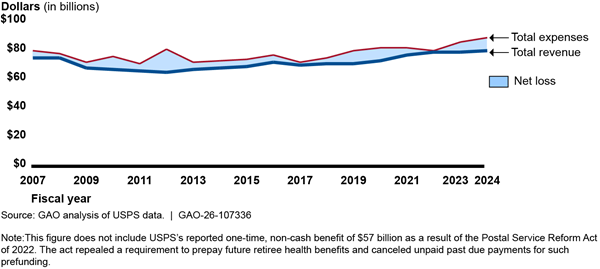
However, USPS’s financial condition remains poor. While USPS has increased revenue, its total expenses continue to outpace total revenue leading to further losses (see fig.). In addition, USPS’s unfunded liabilities and debt have steadily increased since fiscal year 2022. USPS projects that if it made all its required payments toward its unfunded liabilities in full, it would run out of cash as early as fiscal year 2026. USPS updated its strategic plan in 2024, but this plan did not include financial projections showing how near-term results from the updated plan’s actions could increase revenue or reduce expenses. Without financial projections, USPS does not have targets to show progress or to effectively communicate how its actions will restore USPS’s financial sustainability.
USPS and Congress have a wide range of options to improve USPS’s financial condition. However, USPS’s actions alone will likely not be enough for it to become financially self-sufficient. GAO has previously recommended that Congress consider various options. Although Congress has taken some action, key issues remain unresolved. These include identifying a sustainable path for postal retiree health benefits and determining the level of postal service required, and the extent to which USPS should be financially self-sufficient.
Why GAO Did This Study
USPS has lost money almost every fiscal year since 2007, even though Congress created it to be financially self-sufficient. GAO has long reported that USPS’s business model is unsustainable, due to rising costs and lower mail volume. As a result, USPS’s financial viability has been on GAO’s High Risk list since 2009.
This report examines (1) recent USPS actions to improve its financial condition, (2) USPS’s current financial condition and the extent to which USPS projects its financial information, and (3) options that could improve USPS’s financial condition.
GAO reviewed USPS’s strategic plan, financial reports, reports to Congress, and other reports containing financial information; projected USPS’s retiree health care and pension liabilities; interviewed USPS and other relevant agency officials and stakeholders; assessed the financial information in USPS’s updated strategic plan against GAO’s principles of evidence-based policymaking and surveyed selected stakeholders on potential options to improve USPS’s financial condition. GAO selected stakeholders from its prior work and stakeholders’ public statements on postal issues.
What GAO Recommends
GAO recommends that the Postmaster General should develop publicly available financial projections of revenue and expenses. USPS disagreed with the recommendation. GAO also reiterates that Congress should fully address the level of postal service the nation requires, the extent to which USPS should be self-sustaining, and a sustainable financial path for retiree health benefits.
Abbreviations
CSRS Civil Service Retirement System
DFA Delivering for America
FECA Federal Employees Compensation Act
FEHB Federal Employees Health Benefits
FERS Federal Employees Retirement System
OIG U.S. Postal Service Office of the Inspector General
OPM Office of Personnel Management
PAEA Postal Accountability and Enhancement Act
PRA Postal Reorganization Act
PRC Postal Regulatory Commission
PSRA Postal Service Reform Act of 2022
USPS U.S. Postal Service
This is a work of the U.S. government and is not subject to copyright protection in the United States. The published product may be reproduced and distributed in its entirety without further permission from GAO. However, because this work may contain copyrighted images or other material, permission from the copyright holder may be necessary if you wish to reproduce this material separately.
December 16, 2025
The Honorable Rand Paul, M.D.
Chairman
The Honorable Gary C. Peters
Ranking Member
Committee on Homeland Security and Governmental Affairs
United States Senate
The Honorable James Comer
Chairman
The Honorable Robert Garcia
Ranking Member
Committee on Oversight and Government Reform
House of Representatives
The U.S. Postal Service (USPS) has lost money almost every fiscal year since 2007, even though Congress created it to be financially self-sufficient.[1] We have reported that USPS’s business model is unsustainable, due to rising costs and lower mail volume. Accordingly, USPS’s financial viability has been on our High Risk list since 2009.[2] There is a fundamental tension between the level of service Congress expects and what revenue USPS can reasonably be expected to generate.
Both USPS and Congress have taken steps to try to make USPS financially self-sufficient again. USPS introduced the 10-year strategic plan in 2021, designed to restore USPS’s financial self-sufficiency. In addition, Congress passed the Postal Service Reform Act of 2022, which, among other things, provided USPS about $57 billion in noncash financial relief.[3] Despite these efforts, USPS cannot fully fund its current level of services and financial obligations as it continues to lose money—about $31 billion since fiscal year 2021.[4] These losses prevent USPS from addressing its large unfunded liabilities for pensions and retiree health care benefits, putting the taxpayer at increased risk of having to meet these liabilities for USPS.
We performed our work at the initiative of the Comptroller General as USPS financial viability has been on GAO’s High Risk List since 2009. This report examines: (1) recent USPS actions to improve its financial condition, (2) USPS’s current financial condition and the extent to which USPS projects its financial information, and (3) options that could improve USPS’s financial condition.
For all our objectives, we reviewed our prior work and reports from USPS, the USPS Office of the Inspector General (OIG), the Postal Regulatory Commission, and other organizations. We interviewed USPS, OIG, and Postal Regulatory Commission officials, as well as 12 postal stakeholders, including labor unions, an organization representing commercial mailers, a consultant to commercial mailers, and individuals with subject matter expertise.
To determine recent USPS actions to improve its financial condition, we reviewed USPS’s original 10-year strategic plan and most recent update.[5] We also reviewed USPS reports on actions taken under its strategic plan. We completed almost all of our audit work before USPS released its fiscal year 2025 financial results. We have included some financial information from fiscal year 2025 in this report.
To examine USPS’s current financial condition and the extent to which it projects its financial information, we reviewed and analyzed its financial reports, reports to Congress, and other reports that contained financial information. We also reviewed USPS’s revenue and expense projections in its original 10-year strategic plan, and USPS’s projections of its actuarial liabilities and assets for pension and retiree health care benefits, and documentation about these projections. We used Office of Personnel Management (OPM) data to project USPS’s pension and retiree health care liabilities, and USPS data from its annual financial reports to project USPS’s workers’ compensation liabilities. Furthermore, we assessed the extent to which USPS’s most recent updates to its strategic plan were consistent with GAO’s principles of evidence-based policymaking.[6]
To identify options that could improve USPS’s financial condition, we interviewed the stakeholders mentioned above on potential options available to USPS and Congress that could improve USPS’s financial sufficiency, as well as the benefits and challenges for each option. We selected options mentioned either by USPS or by more than one stakeholder and summarized these options. We analyzed USPS and stakeholder comments and utilized standard economic and actuarial principles to identify each selected option’s benefits and challenges. We also compared Congress’s actions against our four open matters concerning USPS to identify progress made on these matters.[7] For additional information on our scope and methodology, see appendix I.
We conducted this performance audit from January 2024 to December 2025 in accordance with generally accepted government auditing standards. Those standards require that we plan and perform the audit to obtain sufficient, appropriate evidence to provide a reasonable basis for our findings and conclusions based on our audit objectives. We believe that the evidence obtained provides a reasonable basis for our findings and conclusions based on our audit objectives.
Background
Prior to 1971, when USPS began operations, the Post Office Department was a cabinet-level government agency that received annual appropriations from Congress. The Post Office Department began to experience significant challenges in the 1960s, as inflation and mail volume grew. At that time, Congress made key management decisions, such as establishing wage levels and postage rates. However, the legislative process made it challenging for the Post Office Department to plan and finance operations to adapt to changing economic and demographic conditions. By the mid-1960s, the Post Office Department struggled with outdated equipment, crowded facilities, and underpaid workers, among other issues. On the advice of a Presidential Commission on Postal Organization, Congress and the Nixon administration established USPS as an independent establishment of the executive branch through the Postal Reorganization Act in 1970.[8]
While USPS was created to be financially self-sufficient, it must also meet costly requirements, including its universal service obligation and other mandates that private sector businesses do not have. USPS’s universal service obligation refers to several statutory provisions that require USPS to serve, as nearly as practicable, the entire U.S. population and to generally provide delivery at least 6 days a week.[9] These delivery locations include rural areas, communities, and small towns where post offices are not financially self-sufficient. In addition, USPS must pay to ship goods to remote locations in Alaska by private shipping companies, which cost USPS $133 million in 2022. Since fiscal year 2007, the number of delivery locations has increased while mail volume has decreased almost every year, which has increased the costs of universal service while decreasing revenue.
USPS also incurs uncompensated expenses from other mandates. For example, it must provide its employees with various benefits through federal employee benefit programs, including federal pension, employee health care, retiree health care, and workers’ compensation programs. Moreover, in the event of an unresolved labor dispute with its unions regarding a collective-bargaining agreement, USPS is required to accept the results of binding arbitration, and the arbitration board does not have to consider USPS’s financial condition in reaching a decision.[10] Furthermore, USPS faces legal limitations on raising its prices and pursuing alternate sources of revenue. Different legislative acts beginning with the founding of USPS in 1970, established these mandates and limitations and, together with various other factors, they have affected its ability to be financially self-sufficient (see fig. 1).
To help cover its expenses, USPS received an annual appropriation as a public service subsidy through fiscal year 1982. While Congress has not provided this general subsidy since then, it continues to provide relatively small appropriations for certain purposes, such as an annual appropriation to cover revenue forgone for free and reduced-cost mail.[11] Congress has also occasionally provided funding for specific purposes, such as $10 billion from the CARES Act in 2020 to fund operating expenses USPS was unable to fund due to the COVID-19 pandemic.[12] Congress also provided $3 billion from the Inflation Reduction Act of 2022 to purchase zero-emission vehicles and purchase, design, and install associated infrastructure.[13]
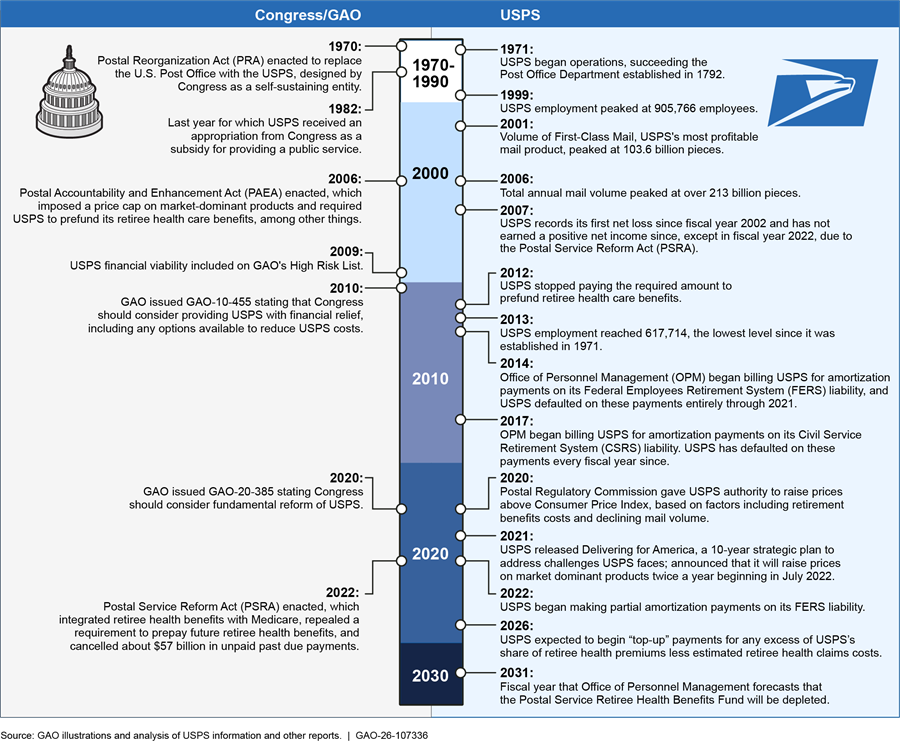
From 1971 through 2007, USPS cycled between years of net operating income and net operating losses. During this time, the volume of mail delivered by USPS generally increased each year, peaking at over 213 billion pieces in fiscal year 2006. To reduce expenses associated with increased mail volume and an expanding delivery network in the 1980s and 1990s, USPS increased the efficiency of mail sorting operations by introducing automated letter, flat, and parcel sorting technologies. This helped enable USPS to cover its expenses.
However, mail volumes began declining in fiscal year 2007, due to greater use of electronic means of communication, such as email and mobile phones. Furthermore, USPS officials stated that the recession in 2008 caused a precipitous decline in mail volume. Declining mail volumes have factored significantly into USPS’s deteriorating financial condition, because mail accounts for most of its revenue.
According to USPS, it was unable to raise prices enough to stem revenue losses from declining mail volume, due to price caps on postal products established by the Postal Accountability and Enhancement Act in 2006.[14] This act also required USPS to begin making annual prefunding payments for retiree health care benefits, which was an additional weight on an already strained budget.[15]
Beginning in fiscal year 2007, USPS recorded consistent net losses as revenue declined while personnel-related expenses, representing the bulk of its expenses, continued to increase. Revenues from postal operations were not sufficient to cover expenses, resulting in annual net losses from fiscal year 2007 through fiscal year 2024 (see fig. 2).
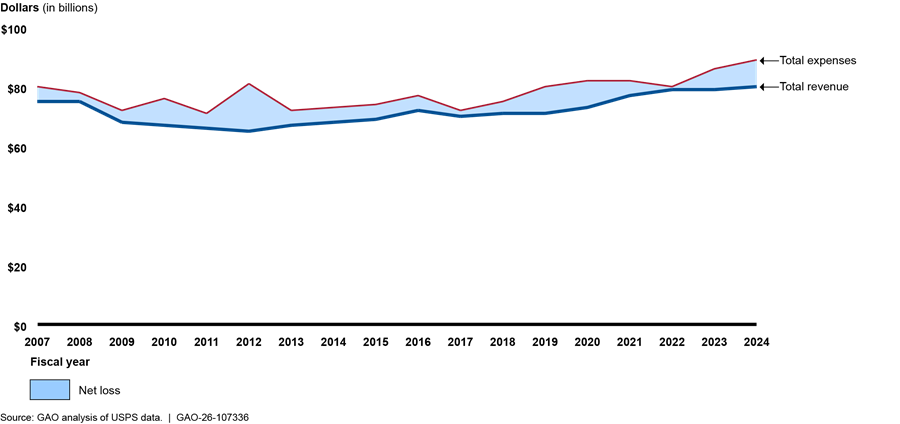
Note: This figure does not include USPS’s reported one-time, noncash benefit of $57 billion as a result of the Postal Service Reform Act of 2022. The act repealed a requirement to prepay future retiree health benefits and canceled unpaid past due payments for such prefunding.
USPS has incurred billions of dollars of net losses each year since 2007, while maintaining enough cash reserves and short-term investments—approximately $14.1 billion at the end of fiscal year 2024—to continue operations.[16] USPS has done this by incurring debt obligations and not making required payments to OPM for retiree health and pension benefits.[17]
USPS’s long-term unfunded liabilities, mostly for retiree health and pension benefits, are a significant financial burden for USPS. As an entity that is intended to be self-sufficient, USPS is supposed to fund these benefits out of its own revenues. However, since 2012, USPS either has not made, or only partially made, its required annual funding payments, contributing to substantial growth in USPS’s unfunded liabilities.[18]
· Pension benefits. Federal law requires USPS to participate in the Federal Employees Retirement System (FERS) and the Civil Service Retirement System (CSRS) and contains specific provisions defining its required contribution level to fund these benefits.[19] USPS’s required payments consist of “normal costs,” its share of the cost of FERS benefits attributable to the current year of employees’ service, and “amortization” payments to pay down unfunded FERS and CSRS liabilities over time.[20] See appendix II for more information on USPS’s CSRS obligations and appendix III for more information on its FERS obligations.
· Retiree health benefits. Federal law requires USPS to participate in the Federal Employees Health Benefits program (FEHB), which includes retiree health benefits.[21] Under the Postal Service Reform Act of 2022, USPS now has its own health care program within the FEHB program, and its program is “integrated” with Medicare, in that postal employees are generally required to enroll in Medicare Part B upon retirement to be covered under USPS’s health care program.[22] USPS is responsible for its share of retiree health benefit premiums, which are currently paid out of the Postal Service Retiree Health Benefits Fund. Since USPS did not make required prefunding payments from 2012 through 2021 and has not been required to make such payments since 2022, this fund’s balance has been steadily declining. As a result, OPM projects that the Postal Service Retiree Health Benefits Fund will be depleted in fiscal year 2031, assuming USPS makes all its required payments to the fund.[23] At that point, if no changes are made, USPS will need to pay its share of retiree health premiums out of its revenue. OPM estimates that these premiums will be about $5.8 billion annually by fiscal year 2031. See appendix IV for more information on USPS’s retiree health benefits obligations.
· Workers’ compensation. Federal law requires USPS to participate in the federal workers’ compensation program (Federal Employees Compensation Act, or FECA program).[24] USPS’s liability for workers’ compensation benefits is an actuarial estimate of the assets that would be needed today to pay for the future benefits associated with all injuries or deaths incurred to date—that is, for all beneficiaries currently on the benefit rolls.[25] This liability is unfunded, as USPS is not required to set aside assets to cover future payments. USPS makes a payment each year to cover the cost of benefits provided to beneficiaries in the past year, plus an administrative fee as determined by the Department of Labor (which administers the program).
According to the OIG, legal limits prevent USPS from adopting certain private industry practices that could further reduce expenses.[26] For example, the OIG reported that the federal workers’ compensation program does not include time limits as to how long a beneficiary is eligible to receive compensation and medical benefits and does not allow USPS to settle workers’ compensation claims.[27] In contrast, the OIG found that 17 states place limitations on the total amount of, or duration of, workers’ compensation disability benefits, and most state organizations can settle claims for future workers’ compensation claims. See appendix V for more information on USPS’s workers’ compensation obligations.
USPS Has Acted to Improve Its Financial Condition, and Congress Has Provided Some Assistance
USPS Has Taken Several Actions to Increase Revenue and Decrease Expenses
In 2021, USPS introduced Delivering for America, its 10-year strategic plan to achieve financial self-sufficiency while continuing to meet its statutory obligations. USPS stated that the plan seeks to modernize its network, meet a changing marketplace, and prompt changes from Congress. Since the introduction of the strategic plan, USPS has taken many actions, including the following:
· Raised prices. The Postal Regulatory Commission gave USPS new pricing authority in November 2020.[28] USPS has raised prices on market-dominant products (such as First-Class Mail) seven times since then, increasing the cost of a First-Class Mail postage stamp by 33 percent.[29] According to USPS, these price increases contributed to an 8.8 percent increase in revenue since fiscal year 2020, from around $73.1 billion in fiscal year 2020 to $79.5 billion in fiscal year 2024.
· Realigned transportation network. USPS aimed to reduce expenses and improve efficiency by implementing new mail transportation strategies. According to USPS, it did not adequately invest in its transportation or processing networks for years prior to 2020 due its poor financial condition. This led to the deterioration of its transportation network, which did not allow the movement of mail and packages in an integrated, precise, and efficient manner. For example, according to USPS, many of its trucks had been leaving facilities less than half full because (1) mail was moved between too many locations and (2) processing schedules were not aligned. USPS is continuing to redesign its transportation operations as part of its strategy to eliminate waste and to efficiently integrate with network operations. At the end of fiscal year 2024, USPS reported that it had saved $535 million in fiscal year 2024 in highway transportation costs, primarily due to its transportation network optimization efforts resulting in the elimination of underutilized transportation trips.
USPS has also moved mail volume from air to ground routes, which contributed to USPS reducing its air transportation expenses by $640 million in fiscal year 2024, according to USPS. As a result of these changes, USPS reported collectively saving over $1 billion annually.[30] USPS has only realigned a portion of its transportation network and plans to roll out further changes on a regional basis over the course of several years.[31]
|
USPS Has Committed Capital Investments to Implement
Its Strategic Plan The U.S. Postal Service (USPS) has planned $40 billion in capital investments over the 10 years of its strategic plan (2021-2031). Thus far, it has already spent $11 billion on capital investments between fiscal years 2021 and 2024. These investments have paid for new facilities, such as the regional processing and distribution center in Atlanta (see photo).
|

· Redesigned mail and package processing operations. USPS redesigned its processing network—its network of facilities to receive, sort, and transport mail between its origin and destination—and began to make significant capital investments in its processing facilities. According to USPS, these changes and capital investments are designed to reduce costs and increase revenues by improving USPS’s operational efficiency. In its legacy network, USPS takes mail through 11 steps in the “middle mile”—from the local post office where the mail originates to the “destination delivery unit,” where it is distributed to carriers for delivery to its ultimate destination. In the redesigned network, the middle mile is reduced to fewer steps.
To accomplish this, USPS stated that it plans to consolidate processing operations into fewer and larger processing, sorting, and delivery centers, organized into 60 regions in a hub and spoke network that covers the nation. According to USPS, as of September 2025, USPS had launched 13 of the planned 60 regional processing and distribution centers that serve as the hubs in its redesigned network. USPS stated that these new facilities within this network are designed with more streamlined layouts, better working environments for employees, and more mechanized package processing systems. As of the end of fiscal year 2025, USPS officials stated that $5.8 billion had been invested in modernizing processing facilities.
USPS also changed service standards for certain First-Class Mail and periodicals; for certain First-Class Mail, it lengthened standards from 1 to 3 days to 1 to 5 days.[32] In 2025, USPS further revised its service standards, which it said would preserve the existing day ranges for First-Class Mail, but some mail and packages would now take longer to deliver.[33]
· Introduced new products. USPS offered new shipping products, with the aim of competing more effectively in the package delivery business and generating more revenue to fund operations. The most prominent new product is Ground Advantage, which USPS introduced in July 2023.[34] USPS credited Ground Advantage with most of its shipping and package revenue and volume growth from fiscal years 2023 through 2024, which was 2 percent and about 3 percent, respectively, across all shipping and package products. Excluding Priority Mail Services, USPS shipping and packages revenue increased by about 25 percent and volume increased by about 10 percent from fiscal year 2023 through 2024.[35] USPS introduced a set of four additional products, known as USPS Connect, in fiscal year 2022. According to USPS, these products leverage ongoing network improvements and other changes to help businesses meet consumer demand for affordable deliveries at different distances within the nation.[36]
· Began making partial payments toward its unfunded pension liability. From 2014 through 2021, USPS did not make its required annual amortization payments to OPM for its two pension programs. Since 2022, USPS has been making partial payments toward its FERS obligation ($500 million of its required $1.6 billion payment in 2022, $600 million of its required $2.1 billion payment in 2023, and $1 billion of its required $2.3 billion payment in 2024).[37] These payments slowed the growth of its unfunded FERS liability but were less than half of the amount due. USPS reported that it missed a total of $27.1 billion in amortization payments from 2014 through the end of fiscal year 2024, when its estimated unfunded FERS liability reached $45.7 billion.
According to USPS officials, USPS has not made any payments toward its unfunded CSRS liability because it cannot make this payment and still meet its statutory obligations to provide postal services.[38] As of the end of fiscal year 2024, USPS has missed $17 billion in CSRS amortization payments assessed beginning in fiscal year 2017. USPS officials also stated that they have prioritized making FERS payments over CSRS, in part because USPS disputes the methodology OPM uses to determine its CSRS payments.
· Converted “pre-career status” employees. USPS stated that a key strategy to creating a stable workforce has been to convert employees from “pre-career status” to “career status.”[39] According to officials, before USPS implemented its strategy to convert employees, the agency had no automatic path to career status. In 2021, we found that USPS pre-career employees had a higher turnover and injury rate than career employees, which negatively affected productivity, efficiency, and service, and incurred expenses.[40] USPS officials also told us that high employee turnover directly affected its ability to stabilize its operations, and its strategy to convert employees allowed it to better align resources with the work. From the end of fiscal year 2020 to the end of fiscal year 2024, USPS reported reducing its total number of employees by less than 1 percent and increasing the number of career employees by about 7.5 percent, while decreasing the number of pre-career employees by about 28 percent.[41] Overall, the percentage of career employees at USPS increased from about 77 to 83 percent between fiscal years 2020 and 2024. During this period, USPS’s total annual compensation and benefits expenses increased by 11 percent, which was less than the cumulative inflation rate for employment expenses of around 18 percent.
· Conducted a voluntary early retirement program. On January 13, 2025, USPS announced an incentive to certain employees who were eligible for optional retirement or voluntary early retirement as of April 30, 2025. USPS officials stated that about 79,000 eligible employees were offered $15,000 each to retire or retire early. This offer was extended to members of two of USPS’s unions, the American Postal Workers Union and the National Postal Mail Handlers Union, which include clerks and mail handlers, among others. USPS officials stated that these employees were at the top of USPS’s wage scale and that the reduction in employees is expected to slow the rate of increase in USPS’s employee compensation and benefit expense but not necessarily decrease it. As of the end of fiscal year 2025, about 10,500 employees had accepted the offer.
USPS has faced setbacks in implementing some of these actions. For example, the OIG found that when USPS launched its first new regional facility and implemented its new surface transportation network for the first time in Richmond, Virginia in October 2023, significant service performance problems emerged that did not abate fully even after the peak holiday mail season concluded.[42] The OIG found similar issues after USPS launched its new regional facility in Atlanta in February 2024; it also found that USPS did not build on lessons learned from the performance problems at the Richmond facility.[43] USPS management told the OIG they had developed plans to address these issues going forward to avoid a repeat of these obstacles when they launch future regional facilities.
USPS has adjusted some of its planned actions after receiving feedback from stakeholders. USPS announced in May 2024 that it was pausing further relocation of certain processing operations until January 2025. In May 2025, USPS officials stated that the pause is still in effect.
In a public letter, the Postmaster General acknowledged confusion and concern on the part of the public and Congress and said that USPS could accommodate a request from Congress to pause implementation and conduct further analysis.[44] USPS officials told us that USPS paused its network modernization efforts to avoid changes during the 2024 election cycle and peak shipping season during the holidays. Furthermore, USPS announced that it would not increase prices for market-dominant products and services in January 2025 and did not plan to do so again before July 2025, 1 year after the last price increase. According to officials, USPS began to implement semi-annual price increases for market-dominant products to minimize the effects of high inflation. However, USPS officials explained, due to Postal Regulatory Commission regulations on rate changes and lower inflation at the time, a January 2025 rate change would not have been advantageous for USPS.[45]
USPS’s Proposals to Change Federal Requirements to Become More Financially Self-Sufficient Have Been Partially Fulfilled
As part of its 2021 strategic plan, USPS sought actions from Congress and other parts of the executive branch to become more financially self-sufficient. Specifically, USPS requested eliminating its required prefunding payments for retiree health benefits, establishing health care plans for only postal workers and retirees, integrating retiree health benefits with Medicare, and reducing its obligation for CSRS pension benefits.
The Postal Service Reform Act of 2022, among other things, eliminated the requirement for USPS to pre-fund its retiree health benefits and canceled $57 billion in payments that USPS had missed since fiscal year 2012. However, USPS still needs to pay for its retiree medical obligations; the elimination of the prefunding requirement means that USPS’s payments will be made over a longer time frame. The act also established postal-only health care plans within the federal employee health benefits program and integrated retiree health benefits with Medicare, generally requiring postal employees to enroll in Medicare Part B upon retirement to be covered by these postal-only health care plans.[46] Consequently, postal retirees in the program who retired beginning in 2025 would have Medicare as their primary payer and the postal health plan as their secondary payer, with certain exceptions.[47] In 2013, we found that postal retirees would have similar levels of coverage under this new integrated plan but that total costs could be higher for some retirees.[48] The integration with Medicare had the effect of reducing USPS’s liability for retiree health care benefits by about $61 billion, or by about 51 percent. USPS estimates that these combined changes (elimination of prefunding, establishment of postal-only health care plans, and integration with Medicare) will result in savings of $40 billion to $50 billion over the next decade.[49]
USPS has also requested that OPM re-allocate the responsibility for CSRS benefits for retirees who worked at the pre-1971 Post Office Department before transitioning to employment with USPS. The USPS OIG and the Postal Regulatory Commission previously opined that the current method allocates too much of the cost of these benefits to USPS, and both have proposed alternative methodologies, while the OPM OIG opined that the current method is appropriate.[50] OPM stated that it did not have the authority to make this change without congressional action and, in 2011, we found the current methodology to be consistent with applicable law.[51] More recently, the Department of Justice has concurred that OPM does not have the authority to make such a change.[52] In its updated strategic plan, USPS has stated that it will ask Congress to do so.
USPS’s Current Financial Condition Is Poor, and It Does Not Have Updated Financial Projections
USPS’s Expenses Have Outgrown Revenue
USPS continues to be in poor financial condition, as its net losses have totaled $118 billion since it last earned a positive net income in fiscal year 2006.[53] Further, USPS has lost about $31 billion since fiscal year 2020, just before USPS released its original strategic plan in March 2021.[54]
Regarding its revenue, USPS earned about $24 billion (8 percent) more than projected from fiscal years 2021 through 2024 in its original strategic plan (see fig. 3). USPS attributed its higher-than-projected revenues to a combination of higher prices and higher-than-expected mail volume, resulting from the implementation of its strategic plan. USPS increased market-dominant mail prices seven times and increased competitive mail prices four times between November 2020 and July 2024.[55] Additionally, USPS delivered about 16.1 billion more mail pieces than projected for fiscal years 2021 and 2022 and about 500 million more mail pieces than projected for fiscal years 2023 and 2024.
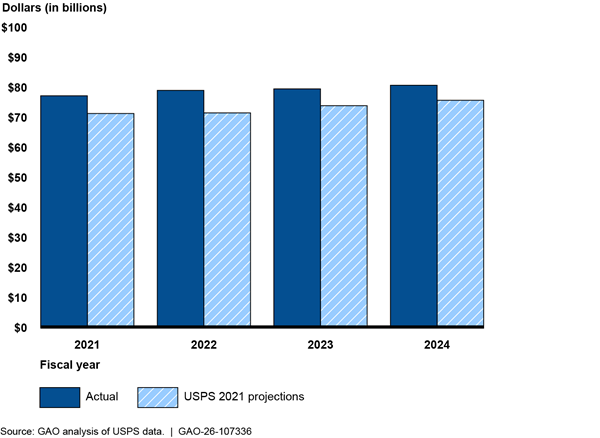
Note: Projected revenue amounts are from USPS’s original strategic plan released in March 2021.
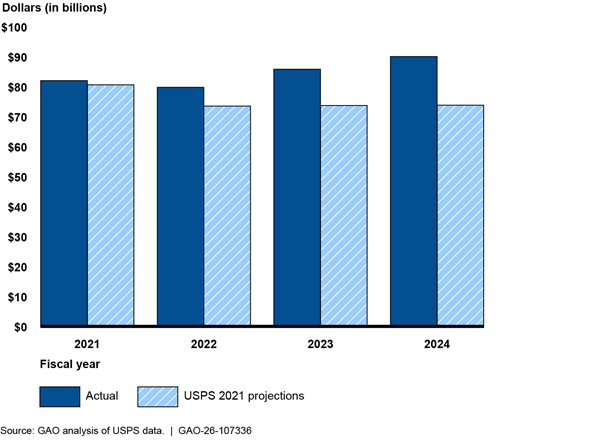
However, while USPS’s revenue exceeded projections, so did its expenses. USPS’s expenses were a total of about $36 billion (11.9 percent) higher than USPS originally projected in its 2021 strategic plan for fiscal years 2021 through 2024 (see fig. 4). USPS attributed these higher-than-expected expenses to, among other things, higher-than-expected inflation and the noncash impact of its workers’ compensation expense.[56]
Note: Projected expense amounts are from USPS’s original strategic plan released in March 2021.
USPS’s total expenses increased by 9.3 percent from about $82.4 billion in fiscal year 2020, the year before USPS’s original strategic plan was introduced, to about $90 billion in fiscal year 2024. As stated above, USPS has taken action to reduce its expenses. For example, USPS reported that its actions to reduce its mail transportation expenses led to a decrease of about $840 million from its fiscal year 2021 expense of about $9.7 billion. However, transportation expenses were about the same level in fiscal year 2024 as in fiscal year 2020, and USPS’s compensation and benefits expenses increased from fiscal years 2020 to 2024 by about $5.3 billion (about 11 percent).
The 9.3 percent increase in USPS’s total expenses from fiscal years 2020 to 2024 does not fully reflect its operational performance in controlling expenses over this period, due to the effect of two components of USPS’s reported expenses.
· First, the noncash components of USPS’s workers’ compensation expense mentioned above are highly variable as they are a result of actuarial and discount (or interest) rate changes and are not directly tied to its operations. These two elements of USPS’s workers’ compensation expense have both decreased and increased USPS’s reported expenses between fiscal years 2020 and 2024. For example, the actuarial revaluation of existing cases and the impact of discount rate changes combined reduced USPS’s fiscal year 2022 expenses by about $3.3 billion but increased its fiscal year 2024 expenses by about $2.5 billion.
· Second, the Postal Service Reform Act of 2022 changed USPS’s reporting of its retiree health benefits expenses in a way that affects the comparability of USPS expense over the period from fiscal year 2020 to fiscal year 2024. USPS’s reported retiree health benefits expenses were reduced from about $5.1 billion in fiscal year 2022 to zero in fiscal years 2023 and 2024 because the Postal Service Reform Act ended USPS’s requirement to prefund retiree health benefits. This effectively deferred retiree health payments to future years and was not reflective of any operating changes.
We calculated an alternative measure of the growth of USPS’s expenses over this 4-year period by removing these two factors. Under this alternative measure, USPS’s expenses increased by 14.9 percent from fiscal years 2020 to 2024 (see table 1 below).
|
|
|
|||||
|
Fiscal year |
2020 |
2021 |
2022 |
2023 |
2024 |
Percent increase from fiscal years 2020 to 2024 |
|
USPS’s reported total expensesa (dollars in billions) |
$82.4 |
$82 |
$79.7 |
$85.8 |
$90 |
9.3% |
|
USPS’s total expenses adjusted to exclude workers’ compensation fluctuations and discontinued retiree health prefunding payments |
$76.2 |
$78.8 |
$83 |
$86.4 |
$87.6 |
14.9% |
Source: GAO analysis of USPS information. | GAO‑26‑107336
Note: Totals and differences may not be exact due to rounding.
aUSPS’s total expenses include its operating expenses and its interest expense.
In addition to USPS’s expenses, its unfunded benefit liabilities (which include workers’ compensation, retiree health, and CSRS and FERS pension benefit unfunded liabilities) and debt have long been another source of concern for its financial sustainability. USPS’s unfunded benefit liabilities and debt (about $61.7 billion) were about 82 percent of USPS’s annual revenue at the end of fiscal year 2007, the first fiscal year of USPS’s consecutive years of net losses (except for the noncash income in fiscal year 2022). Since then, this percentage has more than doubled, to about 206 percent of USPS’s revenue (unfunded liabilities and debt of $163.7 billion) as of the end of fiscal year 2024.[57]
USPS’s FERS unfunded liability grew from $26.9 billion in fiscal year 2020 to $45.7 billion in fiscal year 2024, an increase of about 70 percent, due, in part, to USPS not making about $6.7 billion in required payments toward this unfunded liability.[58] USPS also did not make $12.2 billion in required payments toward its CSRS unfunded liability from fiscal years 2020 to 2024. This led, in part, to this unfunded liability increasing from about $33.8 billion in fiscal year 2020 to about $60.2 billion in fiscal year 2024, an increase of about 78 percent. In addition to its unfunded liabilities, USPS increased its debt to the U.S. Treasury from $14 billion in fiscal year 2020 to its statutory maximum of $15 billion by the end of fiscal year 2024 (see fig.5).
Figure 5: U.S. Postal Service’s (USPS) Unfunded Benefit Liabilities and Debt, Fiscal Years 2020-2024
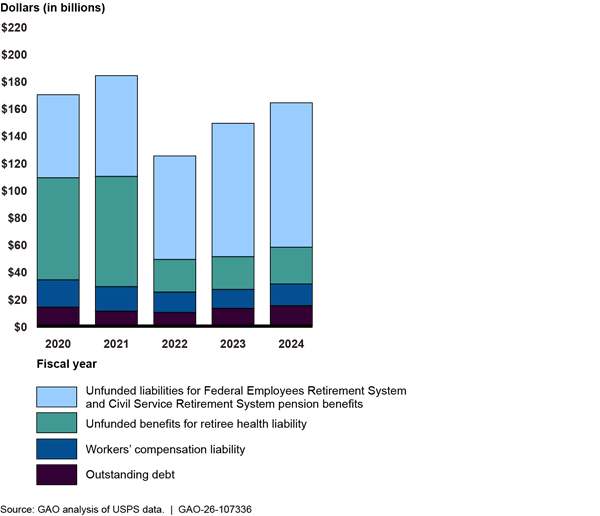
Note: In fiscal year 2022, the Postal Service Reform Act reduced USPS’s retiree health benefits unfunded liability by $61.2 billion by integrating USPS’s retiree health benefits with Medicare, which shifted costs from USPS to Medicare.
In addition to continued annual losses and large unfunded liabilities, there are other indicators of USPS’s poor financial condition, including:
· impact of unfunded pension liabilities on expenses. USPS paid $1 billion of its required $5.5 billion in pension amortization payments in fiscal year 2024.[59] By not making full payments, USPS’s unfunded pension liabilities will most likely continue to grow, increasing the likelihood that its required amortization payments will also grow, negatively impacting USPS’s expenses; and
· future impact of unfunded retiree health care liabilities. As required by federal statute, OPM uses funds from the Postal Service Retiree Health Benefits Fund to pay USPS’s share of retiree health care premiums.[60] However, doing so reduces the balance of the fund each fiscal year since USPS is not making payments into the fund. Starting no later than the end of fiscal year 2026, USPS is required to pay the excess, if any, of its share of the retiree premiums over the estimated postal retiree health care net claims costs (i.e. claims cost less the retirees’ share of premiums) for the previous fiscal year.[61] As stated above, OPM projects that the Postal Service Retiree Health Benefits Fund will be depleted in fiscal year 2031 when these payments are taken into account. When the funds are exhausted, USPS’s annual expenses will increase to cover its share of retiree health care premiums, at which time OPM projects these premiums to cost about $5.8 billion per year. Needing to pay these premiums annually from USPS’s revenue would counteract its expense reduction efforts.
USPS officials stated that it has not made all of its payments toward its unfunded liabilities because it is in an unsustainable financial position. USPS reported that if it paid all required amortization payments for all its unfunded liabilities, it would not have enough liquidity to cover current and anticipated operating expenses, deal with contingencies, and make needed capital investments. USPS stated that it has prioritized payment toward its unfunded liabilities based on the availability of funds, among other things. While not making some of these payments in full has allowed USPS to preserve its cash liquidity, not making these required payments may make it more difficult for it to pay for these benefits in the future.
USPS Does Not Have Updated Projections of Its Future Financial Condition
While USPS updated its strategic plan in September 2024, it did not develop financial projections for its future financial performance, such as for its future revenue, expenses, or net income, in the updated plan.[62] USPS reported that it did not develop such projections, as it was neither required nor productive to do so.[63] According to USPS, in addition to the large number of assumptions inherent in creating multi-year financial projections, such projections are not a meaningful way to assess its progress in implementing its updated strategic plan. USPS stated that its financial reports have financial metrics, such as controllable income and controllable expenses, which are a better way to evaluate its updated strategic plan’s overall progress toward achieving financial self-sufficiency.[64] In addition, USPS also reported that measures such as its net income are highly dependent on factors outside of its control, such as its pension amortization payments and the noncash components of its workers’ compensation expense.
USPS has made financial projections in the past. In its 2021 strategic plan, USPS projected its revenue, expenses, and net income each fiscal year, from 2021 through 2030, and if all the actions in the plan were implemented. USPS projected that its revenue would equal its expenses in fiscal year 2023 and that it would start earning a positive income in fiscal year 2024. However, as stated above, USPS’s revenue did not equal its expenses in fiscal year 2023 as it had projected in 2021. USPS officials stated that this is due, in part, to the actions outlined in its original strategic plan being only partially implemented and to higher-than-expected inflation.
However, we have found that goals, including financial projections, such as projections of revenue, expenses, and unfunded liabilities, are a key practice that can use evidence to effectively assess results. Goals communicate the results that an organization seeks to achieve and allow assessments of performance by comparing planned and actual results. Goals should include near-term results that have quantitative targets and timeframes against which performance can be measured, such as for revenue earned, expenses incurred, and level of unfunded liabilities each fiscal year. Goals should also be linked to long-term outcomes, such as achieving financial self-sufficiency.[65] One benefit of having quantitative targets with timeframes is that an organization can use them to inform different types of decisions, such as identifying problems, determining corrective actions for those problems, and continuing to implement successful strategies. Without financial projections, USPS does not have targets to show progress against its planned goals or to effectively communicate to policymakers how its actions will help to restore its financial self-sustainability.
Such projections will become even more important, as USPS will soon have additional new expenses. First, starting no later than the end of fiscal year 2026, USPS is required to fund the excess, if any, of its share of retiree premiums over the estimated amount of postal retiree health care net claims cost for the previous fiscal year. OPM estimates that these payments will be about $750 million in fiscal year 2026 and grow to about $1.4 billion in fiscal year 2031. Second, USPS is required to pay for its share of retiree health benefit premiums when the Postal Service Retiree Health Benefits Fund is depleted. OPM estimates that this will occur in fiscal year 2031, by which time OPM projects that USPS’s share of retiree premiums will be about $5.8 billion per year.
USPS’s Unfunded Benefit Liabilities Will Be Higher than Projected If Current Trends Continue
USPS’s four unfunded benefit liabilities include pensions (FERS and CSRS), retiree health benefits, and workers’ compensation.[66] According to projections USPS sent to us, USPS projects that its pension and retiree health care unfunded benefit liabilities in aggregate will increase about 22 percent from fiscal years 2024 through 2031.[67] However, these projections assume that USPS would make its full required pension amortization payments for both FERS and CSRS starting in 2025, which USPS has not done since OPM started assessing USPS for these payments.[68] Specifically, USPS did not make any payments toward its FERS unfunded liability between fiscal years 2014 to 2021 and for its CSRS unfunded liability between fiscal years 2017 and 2024. USPS started making partial payments toward its FERS unfunded liability in fiscal year 2022.
We project that if USPS continues to make payments similar to what it has done since fiscal year 2022, its unfunded liabilities will grow more than USPS projects, all other things being equal (see fig. 6). Based on our analysis of OPM data, we project that USPS’s CSRS unfunded liability will increase by about 27 percent between fiscal years 2024 and 2031, if USPS continues to not make any required payments toward it. Additionally, without an additional funding source for the Postal Service Retiree Health Benefits Fund, that unfunded liability is expected to increase by about 91 percent between fiscal years 2024 and 2031 as the fund approaches depletion. If USPS continues to pay a portion of its required payments toward its FERS unfunded liability, that unfunded liability is projected to decrease by about 6 percent between fiscal years 2024 and 2031.[69]
Figure 6: GAO and USPS Projections of U.S. Postal Service’s (USPS’s) Pension and Retiree Health Unfunded Liabilities, Fiscal Years 2025-2031
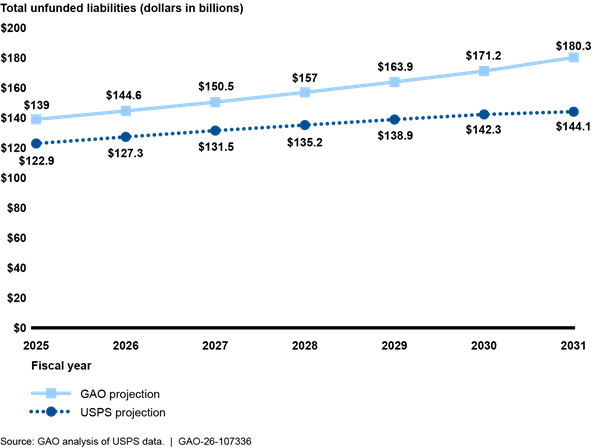
Note: USPS’s projection assumes that all required amortization payments are made in full, whereas GAO’s projection assumes USPS makes the same level of amortization payments that it has in recent years. USPS’s projection uses the vested accrued liability for retiree health care benefits, whereas GAO’s projection uses the total accrued liability. USPS’s projections provided to us were unpublished.
These projections can also be measured against USPS’s projected annual revenue as an estimate of USPS’s capacity to meet these unfunded liabilities. As of the end of fiscal year 2024, these four unfunded benefit liabilities represented about 187 percent of USPS’s fiscal year 2024 revenue. When including its $15 billion debt, they represented about 206 percent of fiscal year 2024 revenue. USPS projects that if it makes all of its required amortization payments in full, its pension and retiree health unfunded liabilities will remain relatively stable, compared with USPS’s projected annual revenue over the fiscal year 2025-2031 period, ranging between 146 percent and 150 percent of USPS’s revenue.[70] However, if USPS’s historical pattern of payments continues, we project that these unfunded liabilities will increase to an estimated 184 percent of its projected fiscal year 2031 revenue (see fig. 7).
Figure 7: GAO and U.S. Postal Service’s (USPS) Projections of USPS’s Pension and Retiree Health Care Unfunded Liabilities as a Percentage of Projected Revenue, Fiscal Years 2025-2031
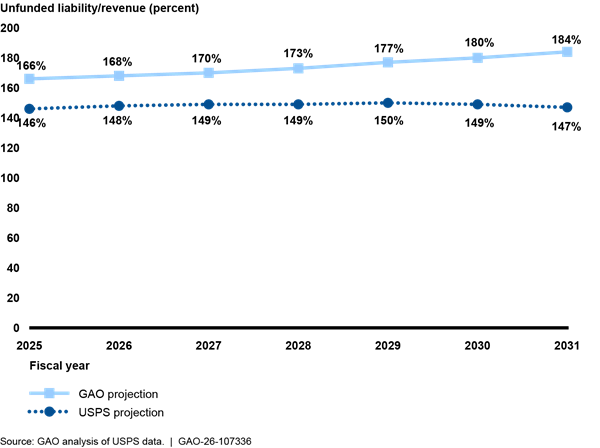
Note: USPS’s revenue projections provided to us for fiscal years 2025 to 2031 do not include interest income. USPS’s projections provided to us were unpublished.
USPS Officials and Stakeholders Said USPS’s Financial Condition Will Continue to Be a Challenge
USPS officials and stakeholders we interviewed said that USPS will continue to face challenges to improving its financial condition and achieving self-sufficiency. USPS stated that it expects overall mail volume to continue its years-long decrease as customers continue their shift toward digital communication. USPS also stated that it competes with private sector package delivery providers, who will continue to divert packages away from USPS, which may cause declines in its package volume. In addition to its projections showing continued annual losses, USPS also stated that it would run out of cash as early as fiscal year 2026 if it made all its required pension amortization payments. Alternatively, USPS reported that it would run out of liquidity in fiscal year 2029 if it continues to make partial pension amortization payments at roughly the same levels as it has in recent years. USPS stated in November 2024 that its liquidity was insufficient to pay all of its obligations, make necessary capital investments, and prepare for unexpected contingencies without putting its ability to fulfill its primary mission at undue risk. USPS further stated that if it does not have sufficient liquidity, it may prioritize its payments to employees, suppliers, and debt before the required payments to fund pension benefits.
The OIG has noted that USPS’s unfunded pension and retiree health care liabilities will put further pressure on USPS’s ability to restore its financial self-sufficiency while making its planned capital investments.[71] In addition, six of the 12 stakeholders we interviewed stated that they did not expect USPS to be able to cover its expenses with its revenue (i.e., “break even”), and two stakeholders stated that it was not clear if USPS could break even or not.
Options Exist to Improve USPS’s Financial Condition, but Congressional Action Is Required to Attain USPS Self-Sufficiency
A Wide Range of Options Exist to Improve USPS’s Financial Condition
The 12 stakeholders we interviewed identified a wide range of options to improve USPS’s financial condition but did not agree on which options USPS should take. While four stakeholders said that USPS could do more to reduce its labor expenses, no other option mentioned by the stakeholders interviewed was suggested by more than one stakeholder (see fig. 8). In addition, four stakeholders said that there is little or nothing USPS could do on its own to achieve financial self-sufficiency.
Figure 8: Potential U.S. Postal Service (USPS) Options Most Mentioned by Stakeholders to Improve Its Financial Self-Sufficiency
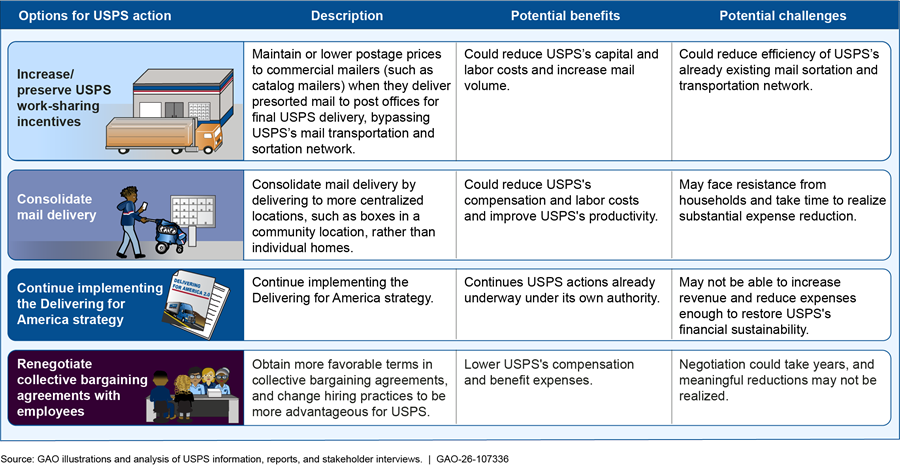
Note: Stakeholders we interviewed included labor unions, an organization representing commercial mailers, a consultant to commercial mailers, and individuals with subject matter expertise. We judgmentally selected these stakeholders from our prior postal work and from their public statements on postal issues, such as comments submitted to the Postal Regulatory Commission on USPS’s strategic plans.
Stakeholders and USPS officials identified several options for congressional action that they believe could help USPS to reduce expenses, increase revenue, and provide funds for USPS operations or capital investments. However, the options could also increase costs to taxpayers or reduce USPS’s level of postal services (see fig. 9).
Figure 9: Potential Congressional Options Most Often Mentioned by Stakeholders to Improve the U.S. Postal Service’s (USPS) Financial Self-Sufficiency
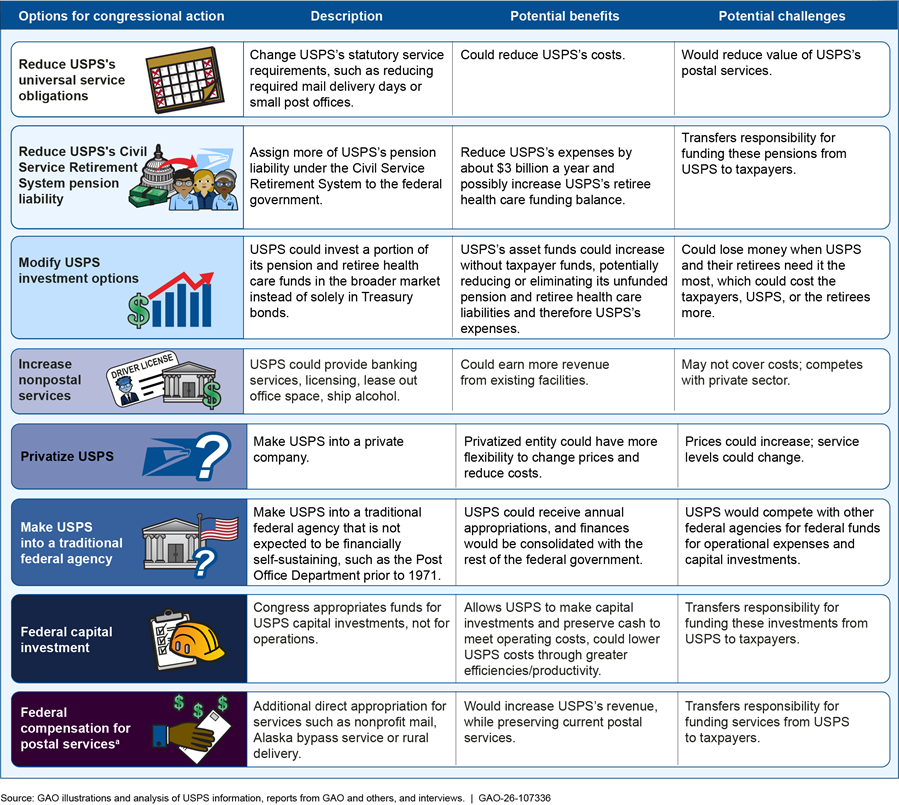
Note: Stakeholders we interviewed included labor unions, an organization representing commercial mailers, a consultant to commercial mailers, and individuals with subject matter expertise. We selected these stakeholders from our prior postal work and from their public statements on postal issues, such as comments submitted to the Postal Regulatory Commission on USPS’s strategic plans. See Appendix VI for a full list of options mentioned by stakeholders.
aUSPS’s Alaska by-pass mail service is mail that bypasses USPS facilities to be prepared by third-party shippers for transportation and delivery to rural Alaska by third-party air carriers.
The 12 stakeholders we interviewed described the benefits and feasibility of potential options Congress could take and indicated that some options would be more beneficial or more feasible than others. For example, 10 of the 11 stakeholders who responded to our follow-up questionnaire about these options indicated that allowing USPS to modify investment options for its pension funds would be either moderately or highly beneficial to its financial self-sustainability, and seven stakeholders indicated that this option would be either very or moderately feasible.[72] In contrast, four stakeholders indicated that increasing non-postal services, such as providing banking services, would be either moderately or highly beneficial.[73]
USPS’s Financial Condition Will Not Be Sustainable Without Congressional Action
We have previously reported that actions USPS could take under its own authority are likely to be insufficient to fully address its financial situation.[74] USPS acknowledges that its actions alone will not result in it becoming financially self-sufficient. We have suggested that Congress consider various options in the past. While Congress has taken some action to address the matters we previously identified, some important considerations remain unresolved. Specifically:
· In 2020, we stated that Congress should consider reassessing and determining (1) the level of postal services the nation requires, (2) the extent to which USPS should be financially self-sustaining, and (3) the appropriate institutional structure for USPS.[75] Congress partially addressed the first two issues in the Postal Service Reform Act of 2022 by codifying the requirement that USPS generally deliver mail at least 6 days a week, among other things.[76] However, the act was silent on USPS’s institutional structure. As of November 2025, at least two bills that could partially address USPS’s financial issues have been introduced.[77]
· We reported in 2018 that the financial outlook for the Postal Service Retiree Health Benefits Fund was poor, as USPS had not made any payments into it since 2010. Therefore, we stated that Congress should consider passing legislation to put postal retiree health benefits on a more sustainable financial footing. The Postal Service Reform Act of 2022 partially addressed this issue by integrating USPS’s retiree health care plans with Medicare, among other things. However, USPS is still responsible for paying its share of retiree health benefit premiums, which are currently paid out of the Postal Service Retiree Health Benefits Fund. OPM estimates that the fund supporting postal retiree health benefits will be depleted in fiscal year 2031. At that point, USPS would be required to pay its share of retiree health care premiums, which OPM estimates to be about $5.8 billion per year.
Conclusions
Recent USPS and congressional actions have reduced some USPS expenses and increased USPS’s revenue, but these actions collectively have not restored USPS’s financial self-sufficiency—putting the current level of postal services and taxpayer funds at risk.
Given the magnitude of the challenges in restoring USPS to financial self-sustainability, we continue to believe that both USPS and congressional action is necessary. While USPS can and should continue to act under its own authority to increase revenue and reduce USPS’s expenses, timely congressional action is also needed to improve USPS’s financial sustainability. However, without current financial projections, USPS is hampered in its ability to communicate to the public and policymakers on progress toward USPS’s objectives and what actions can best help in restoring its financial self-sustainability. It is critical for USPS and Congress to address USPS’s unsustainable business model before it will be responsible for billions in new annual expenses for retiree health care, which is likely in 2031. The sooner actions are taken to improve USPS’s financial health, the less drastic those actions will need to be to address the fundamental tension between the expense of providing the level of postal services Congress expects and the revenue USPS can earn from that level of service. Given the current and potential future state of USPS’s finances, we believe that Congress should act now to consider the matters we previously made. This would include fully addressing the level of postal service the nation requires, the extent to which USPS should be self-sustaining, and a sustainable financial path for retiree health benefits.
Recommendation for Executive Action
We are making the following recommendation to USPS:
The Postmaster General should develop current financial projections out to at least fiscal year 2032, after the assets in the Postal Service Retiree Health Benefits Fund are projected to be exhausted, such as for its revenue, expenses, net income, and unfunded liabilities that link USPS’s near-term results to USPS’s desired long-term outcomes, and make them publicly available. (Recommendation 1)
Agency Comments and Our Evaluation
We provided a draft of this report to USPS. USPS provided written responses, which are reproduced in Appendix VII. In its response, USPS disagreed with our recommendation to develop current financial projections out to at least fiscal year 2032 and make them public. As described below, we continue to believe that the recommendation is valid.
USPS stated that the recommendation would not promote solving the Postal Service’s unsustainable business model and that publishing long-term projections does not promote trust with stakeholders. USPS noted that long-term projections are inherently uncertain and stated that such projections can contribute to a misperception of the success of different initiatives. USPS noted that when it did not meet the long-term projections published in its Delivering for America plan in 2021, certain stakeholders opposed the plan, citing USPS’s unmet projections. We acknowledge that falling short of a projection does not necessarily reflect a management failure but could be caused by unanticipated factors beyond management control. We further recognize that publishing long-term projections does not directly address the Postal Service’s unsustainable business model, as meaningful changes to that model are the purview of Congress. Both our past work and this report make it clear that congressional action is needed to fix the unsustainable business model.
While we understand the inherent uncertainty of long-term financial projections, we continue to see their value to USPS, Congress and external stakeholders. Specifically, without long-term financial projections, USPS cannot fully communicate its progress toward financial sustainability, and Congress cannot measure USPS’s progress against its planned goals. While we acknowledge the criticism that USPS faced when it did not meet its long-term projections published in 2021, USPS could mitigate such criticism by producing a range of projected outcomes that demonstrate how potential USPS and congressional actions, as well as market forces such as inflation, could affect USPS’s future financial condition. The range of projected outcomes could encompass varying assumptions with regard to factors, such as inflation, mail volume, or congressional action or inaction. Such a range of projections could help external stakeholders better understand the uncertainty of USPS’s future financial condition, and the illustration of the risks could be an additional spur to action by Congress.
USPS also stated that it already publishes short-term financial projections in its annual Integrated Financial Plan. However, these projections are only for the upcoming fiscal year, and it will likely take several fiscal years of concerted effort from USPS and Congress to achieve financial sustainability for USPS. As a result, we maintain that financial projections that go to at least fiscal year 2032, when the Postal Service Retiree Health Benefits Fund is expected to be depleted, would be an important tool to allow USPS and Congress to link results to desired long-term outcomes.
USPS also provided technical comments, which we incorporated, as appropriate.
We are sending copies of this report to the appropriate congressional committees, the Postmaster General, and other interested parties. In addition, the report is available at no charge on the GAO website at https://www.gao.gov.
For any questions about this report, please contact us at marronid@gao.gov or todiscof@gao.gov. Contact points for our Offices of Congressional Relations and Public Affairs may be found on the last page of this report. GAO staff who made key contributions to this report are listed in appendix VIII.

David Marroni
Director, Physical Infrastructure

Frank Todisco
Chief Actuary
Mr. Todisco meets the qualification standards of the American Academy of Actuaries to address the actuarial issues contained in this report.
This report examines the U.S. Postal Service’s (USPS) current financial condition. Our objectives were to examine: (1) recent USPS actions to improve its financial condition, (2) USPS’s current financial condition and the extent to which USPS projects its financial information, and (3) options that could improve USPS’s financial condition.
To provide information on recent USPS actions to improve its financial condition, we reviewed USPS’s original 10-year strategic plan and its most recent update. We reviewed USPS reports on actions taken under its strategic plan and interviewed USPS officials about these actions. We also reviewed our prior work and reports from USPS, the USPS’s Office of the Inspector General (OIG), the Postal Regulatory Commission, and other organizations. In addition, we conducted a site visit to new and legacy postal facilities in Atlanta, Georgia, to gain a better understanding of the changes USPS is undertaking to its mail transportation and mail processing networks. The new postal facilities included a regional processing and distribution center and a sorting and delivery center, where we observed elements of USPS’s new processing and delivery operations. We also observed processing operations at a legacy processing and distribution center in Atlanta.
To examine USPS’s current financial condition and future projections, we reviewed and summarized its financial reports, original 10-year strategic plan released in 2021, and its most recent update released in 2024, reports to Congress, and other reports that contained financial information. We completed almost all of our audit work before USPS released its fiscal year 2025 financial results. We have included some financial information from fiscal year 2025 in this report. We reviewed USPS’s revenue and expense projections for fiscal years 2025-2030. We also assessed the extent to which USPS’s updated strategic plan is consistent with key practices on using evidence from GAO’s principles of evidence-based policymaking.[78]
We reviewed USPS documentation about their projections through 2032 of their actuarial liabilities and assets for pension and retiree health benefits. We used Office of Personnel Management (OPM) data to make our own projections of USPS’s pension and retiree health care unfunded liabilities. To do so, we reviewed OPM documentation and interviewed OPM officials about the methodology, data, and assumptions used in their actuarial valuations and projections. To project USPS’s unfunded pension liabilities, we used a standard actuarial roll-forward approach, assuming no future actuarial gains or losses from experience or from assumption changes. We varied these pension projections based on different assumptions as to the degree to which USPS makes required amortization payments, based on interactions with USPS officials.
To project USPS’s unfunded liability for retiree health care benefits, we relied on a projection that OPM provided to us of the depletion of the retiree health benefit fund. OPM’s projection included projections of fund assets, premiums and late enrollment penalties paid from the fund, and required top-up payments made into the fund. We projected the normal cost and liability forward, assuming no future actuarial gains or losses from experience or from assumption changes and using OPM’s medical trend rate assumption and USPS’s projection of its future workforce.
We also used data from USPS’s annual financial reports to project USPS’s workers’ compensation liability. We did so using a “macro” type of methodology, using historical aggregate values and relationships to extrapolate into the future. We assumed no future actuarial gains or losses from discount rate changes or from actuarial revaluations. On the basis of historical impacts of discount rate changes on the liability, we estimated the duration of the historical liabilities, normalized them to a common discount rate, and looked at historical benefit payouts as a percentage of the adjusted liabilities. We also made an assumption as to the excess duration of the cost of new cases over the duration of the liability, adjusted the cost of new cases to a common discount rate, and looked at the adjusted historical cost of new cases as a percentage of payroll. We then projected both the cost of new cases and the benefit payouts to roll forward the liability. We also examined the sensitivity of the projection to key assumptions. The methodology was reviewed by a GAO property and casualty actuary.
All of these actuarial projections should not be regarded as predictions and were performed to indicate plausible directions and magnitudes of USPS’s unfunded liabilities should no additional action be taken or requirements change, including the size of its unfunded liabilities relative to its annual revenue, and to provide additional insight into USPS’s future financial condition, including in comparison to historical results.
To identify options that could improve USPS’s financial condition, we reviewed prior reports by us, USPS’s OIG, and others on USPS’s financial condition and its original and updated strategic plans. We also interviewed USPS, OIG, and Postal Regulatory Commission officials as well as 12 postal stakeholders, including labor unions, an organization representing commercial mailers, a consultant to commercial mailers, and individuals with subject matter expertise.
We judgmentally selected the 12 stakeholders from our prior postal work and from their public statements on postal issues, such as comments submitted to the Postal Regulatory Commission on USPS’s strategic plans. We individually interviewed these stakeholders on potential options available to USPS and Congress that could improve USPS’s financial sustainability, as well as the benefits and challenges for each option. We then sent a survey to these stakeholders asking them about the options mentioned in our individual interviews; we received 11 responses. The survey asked them to rank how beneficial each option was to USPS’s financial sustainability and how feasible each option was to implement on a five-point rating scale and for any additional comments on each option. While the views of the stakeholders we interviewed are not generalizable, they provide information and different perspectives on options for USPS.
We analyzed and classified stakeholder responses to our survey based on how beneficial and feasible they ranked the options. We classified their response to each option as either “beneficial” or “feasible” if the stakeholder responded that the option was either “highly” or “moderately” beneficial or feasible and “less beneficial” or “less feasible” if the stakeholder responded that the option was either “slightly” or “not at all” beneficial or feasible. We then created four groups (“Beneficial/Feasible,” “Beneficial/Less Feasible,” “Less Beneficial/Feasible,” and “Less Beneficial/Less Feasible”) by combining our classification of each stakeholders’ response for each option. The introduction to the survey and a summary of the results are presented in appendix VI.
In addition, we relied on our prior work that addressed some of these options. We selected options mentioned either by USPS or by more than one stakeholder and summarized similar options for analysis. We analyzed USPS and stakeholder comments, as well as applied standard economic and actuarial principles to identify each selected option’s benefits and challenges. We compared Congress’s actions against our four open matters concerning USPS to identify progress made on these matters.[79]
We conducted this performance audit from January 2024 to December 2025 in accordance with generally accepted government auditing standards. Those standards require that we plan and perform the audit to obtain sufficient, appropriate evidence to provide a reasonable basis for our findings and conclusions based on our audit objectives. We believe that the evidence obtained provides a reasonable basis for our findings and conclusions based on our audit objectives.
Background
The U.S. Postal Service (USPS) participates in the Civil Service Retirement System (CSRS), one of two defined-benefit pension plans administered by the Office of Personnel Management (OPM).[80] CSRS covers federal employees who first entered a covered position before 1984, including employees of the Post Office Department and USPS. In fiscal year 2024, about 5,000 current USPS employees were covered under CSRS, which is 1 percent of all active USPS employees enrolled in pension benefits.[81] In contrast, a much greater number of postal retirees were covered under CSRS—OPM estimated that at the end of fiscal year 2023, 362,000 postal annuitants, or 51 percent of USPS annuitants and beneficiaries, were covered under CSRS.[82]
CSRS is a “funded” plan, with participating employees required to make contributions into the fund, as well as USPS depending on the plan’s funded position, and with pension benefits paid to retirees from the fund.[83] Pursuant to federal statute, fund assets are invested in interest-bearing U.S. Treasury securities, whose principal and interest are guaranteed.[84] Participating USPS employees contribute 7 percent of their pay into the fund.
USPS’s Funding Requirements for CSRS
USPS is required to make one type of actuarially determined payments into the fund each year, known as an “amortization cost” payment. Amortization cost payments are amounts intended to pay down any unfunded liability over a particular time frame.[85] The unfunded liability is calculated to be any excess of the actuarial accrued liability over the value of fund assets. The actuarial accrued liability is the estimated actuarial present value of the cost of all future pension benefits (in excess of employee contributions) attributable to all service to date of current employees, plus all remaining future benefits payable to current retirees and other former employees (and beneficiaries) entitled to benefits.
As of the end of fiscal year 2024, USPS’s estimated actuarial accrued liability for CSRS was $165.5 billion, while its estimated net fund balance was $105.3 billion, for an estimated unfunded liability of $60.2 billion.[86] USPS’s required 2024 amortization payment toward paying down this unfunded liability was $3.2 billion. USPS did not contribute any of this required payment, citing its need to preserve liquidity and also noting that it disputes OPM’s methodology for determining this required payment (discussed further below). As of the end of fiscal year 2024, USPS has an unpaid balance of $17.0 billion for CSRS amortization payments assessed between fiscal years 2017 to 2024.
USPS’s Unfunded Liability for CSRS
As noted above, USPS unfunded liability for CSRS was $60.2 billion as of the end of fiscal year 2024. This unfunded liability will vary from year, positively or negatively, due to a variety of factors, such as
1. the extent to which actual actuarial experience differs from the actuarial assumptions that were used in determining the unfunded liabilities, including with respect to asset returns, inflation, deaths, and other factors;
2. occasional updates to actuarial assumptions based on revised expectations; and
3. the extent to which USPS makes its required contribution.
We projected USPS’s unfunded CSRS liability to isolate the potential impact of USPS’s CSRS amortization payments. Our projections are based on a simplifying assumption that the impact of actuarial experience and assumption updates (which can both be either positive or negative) will net out to zero. This unfunded liability could either increase or decrease depending on the extent to which USPS makes these amortization payments. If USPS pays the required amortization payment in full, its unfunded liability is projected to gradually decline each fiscal year from 2025 through 2031. If USPS continues to not make any of the amortization payments, this unfunded liability is projected to increase (see fig. 10).
Figure 10: U.S. Postal Service’s (USPS) Past and Projected Civil Service Retirement System (CSRS) Pension Unfunded Liability, Fiscal Years 2007-2031
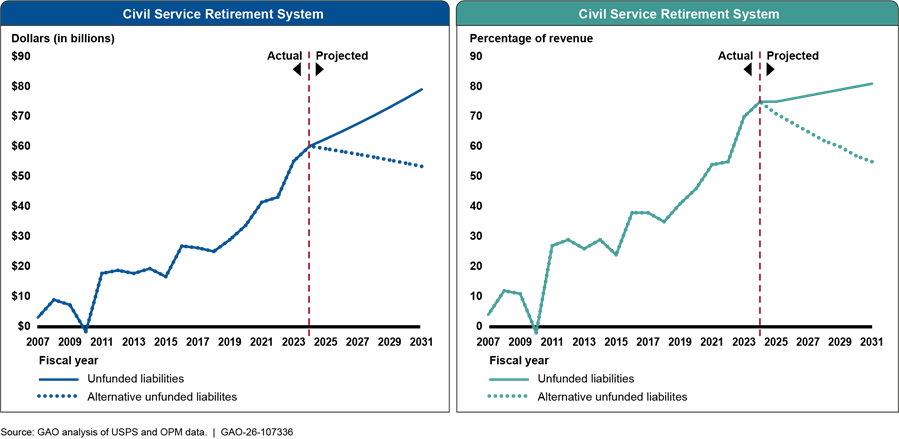
Note: Alternative scenario assumes USPS makes amortization payments. Values from fiscal years (FY) 2007 through FY 2024 are actual values, and values from FY 2025 through FY 2031 are projected values. USPS’s actual revenue above includes USPS’s interest income. USPS’s revenue projections provided to us for fiscal years 2025 to 2031 do not include a projection of USPS’s interest income.
USPS projects its required CSRS amortization payments will grow from $3.3 billion in fiscal year 2025 to $3.7 billion in fiscal year 2031. Even if USPS paid this amortization payment in full over the next few fiscal years, it could still have an unfunded liability. This is due, in part, to the past-due amortization payments accumulated from fiscal years 2017 to 2024, an amortization period that goes out until fiscal year 2043, and the actuarial factors mentioned earlier that can cause the liability to change from year to year, such as demographic and economic experience and updates to actuarial assumptions.
USPS’s Accounting Treatment for CSRS Costs
USPS files a 10-K report each year that includes a Statement of Operations and a Balance Sheet determined in accordance with applicable accounting standards. USPS accounts for its CSRS obligations using the rules applicable to multi-employer pension plans under the accounting standards of the Financial Accounting Standards Board.[87] In its Statement of Operations, USPS’s required CSRS contributions (whether or not USPS makes full or partial payments) are treated as an operating expense in determining USPS’s net loss (or income) for the year. On its balance sheet, USPS recognizes a liability for its cumulative missed required payments, which are amounts that USPS owes to the Civil Service Retirement and Disability Fund. As noted earlier, these missed payments (from fiscal years 2017 through 2024) have accumulated to a liability of about $17 billion out of the total retirement benefit liability of about $27 billion USPS reported on its balance sheet for fiscal year 2024 for the combined accumulated missed payments for CSRS and FERS.
In accordance with multi-employer accounting rules, USPS does not recognize this unfunded actuarial liability on its balance sheet. As noted earlier, this unfunded liability was $60.2 billion at the end of fiscal year 2024. Since only the missed payments of about $17 billion are recognized as a liability on the balance sheet, most of this unfunded actuarial liability ($43.2 billion, equal to $60.2 billion, less $17 billion) is not recognized on USPS’s balance sheet.
Controllable Expenses
USPS regards some of its expenses as “controllable” and some not and reports supplemental results on this basis. USPS regards its required amortization payments as a cost outside its control. From an actuarial perspective, this is a reasonable distinction, as USPS’s required amortization payments do not vary with any aspect of USPS’s current operations and reflect cost for benefits earned in the past.
CSRS Allocation Dispute
USPS began operations on July 1, 1971, succeeding the Post Office Department. For employees who worked at both the Post Office Department and USPS, the responsibility for their pension benefits was split between USPS and the rest of the federal government. The methodology for allocating this responsibility is based on a 1974 statute.[88] Under this methodology, the benefit responsibility of the federal government is based on a pension benefit amount calculated using the employee’s length of service and pay as of June 30, 1971, the last day that the Post Office Department existed. USPS is responsible for the growth in the employee’s pension benefit after July 1, 1971, which grows because of additional years of service, as well as pay increases.
USPS has requested that OPM reallocate the responsibility of CSRS benefits earned by employees who worked at the Post Office Department before transitioning to employment with USPS. In 2010, the USPS’s OIG and the Postal Regulatory Commission (PRC) had opined that the current methodology allocates too much of the responsibility for these benefits to USPS and proposed alternative methodologies, while in 2011 the OPM OIG opined that the current method is appropriate.[89] Each of the alternative methods recommended by the USPS’s OIG and the PRC would have allocated to the federal government responsibility for some or all of the increases in pension benefits resulting from the pay increases that have occurred subsequent to June 30, 1971.
The alternative approaches would have resulted in a significant transfer of pension costs from USPS to the rest of the federal government. At the time of the USPS’s OIG and the PRC reports, the alternative methodologies would have resulted in an estimated reallocation of between $50 billion and $75 billion from the federal government’s assets within the Civil Service Retirement and Disability Fund to USPS’s allocated assets within this fund.[90]
GAO was asked to look at this issue, and in 2011, we found the current methodology to be consistent with applicable law. Further, in response to some claims that USPS has made “overpayments” into the pension fund, we found no evidence of any type of actuarial or accounting “error” in the methodology.[91] In 2010, OPM stated that it did not have the authority to change the methodology without congressional action.[92] In 2024, the Department of Justice determined that OPM does not have the authority to make such a change.[93] In its updated strategic plan, USPS has stated that it will ask Congress to do so.[94]
Background
The U.S. Postal Service (USPS) participates in the Federal Employees Retirement System (FERS), one of two defined-benefit retirement plans administered by the Office of Personnel Management (OPM).[95] FERS generally covers employees who first entered a covered position after December 31, 1983. As of the end of fiscal year 2024, almost all USPS career employees (about 528,000), participated in FERS.[96] OPM estimated that at the end of fiscal year 2023, 341,000 postal annuitants, or 49 percent of USPS annuitants and beneficiaries, were covered under FERS.
FERS is a “funded” plan, as both participating employees and USPS are required to make contributions into the fund, with pension benefits to retirees being paid out of the fund.[97] Pursuant to federal statute, fund assets are invested in interest-bearing U.S. Treasury securities, whose principal and interest are guaranteed.[98] Participating USPS employees contribute between 0.8 percent and 4.4 percent of their pay into the fund.[99]
USPS’s Funding Requirements for FERS
USPS is required to make two types of actuarially determined payments into the fund each year, known as “normal cost” and “amortization cost” payments.
Normal cost payments are the estimated actuarial present value of the cost of future pension benefits attributable to the current year of employees’ service. More specifically, USPS is required to pay the employer share of the normal cost, which is equal to the total normal cost, less the employee contributions into the plan described above. USPS’s FERS normal cost was about $4.9 billion in fiscal year 2024, which USPS paid in full.
Amortization cost payments are amounts intended to pay down any unfunded liability over a particular time frame.[100] The unfunded liability is calculated to be any excess of the actuarial accrued liability over the value of fund assets. The actuarial accrued liability is the estimated actuarial present value of the cost of all future pension benefits (in excess of employee contributions) attributable to all service to date of current employees, plus all remaining future benefits payable to current retirees and other former employees (and beneficiaries) entitled to benefits.
As of the end of fiscal year 2024, USPS’s actuarial accrued liability for FERS was $185.4 billion, while its fund balance was $139.7 billion, for an unfunded liability of $45.7 billion.[101] USPS’s required 2024 amortization payment toward paying down this unfunded liability was $2.3 billion. USPS only contributed $1 billion of this required payment. USPS did not pay the full amount of its required payment, citing its need to preserve liquidity.
Under the retirement-based rate authority it gained in 2020, USPS can increase its prices for certain postal products and use the revenue raised to help meet its retirement obligations, such as amortization payments.[102] From fiscal years 2022 through 2024, USPS used revenue earned under this authority to pay a total of $2.1 billion in partial payments of its required annual FERS amortization payments. As of the end of fiscal year 2024, USPS has an unpaid balance of about $10.1 billion from FERS amortization payments assessed between fiscal years 2014 to 2024.[103]
USPS’s Unfunded Liability for FERS
As noted above, USPS unfunded liability for FERS was $45.7 billion as of the end of fiscal year 2024. USPS’s unfunded liabilities vary from year, positively or negatively, due to a variety of factors, such as
1. the extent to which actual actuarial experience differs from the actuarial assumptions that were used in determining the unfunded liabilities, including with respect to asset returns, pay increases, inflation, retirements and deaths, and other factors;
2. occasional updates to actuarial assumptions based on revised expectations; and
3. the extent to which USPS makes its required contributions.
We projected USPS’s unfunded FERS liability to isolate the potential impact of its FERS amortization payments. Our projections are based on a simplifying assumption that the impact of actuarial experience and assumption updates (which can both be either positive or negative) will net out to zero. This unfunded liability could either increase or decrease depending on the extent to which it makes these amortization payments. If USPS pays the required amortization payment in full, we project USPS’s FERS unfunded liability to gradually decline each fiscal year from 2025 through 2031. If USPS does not make any of the amortization payments, we project that this unfunded liability will increase (see fig. 11).
Figure 11: U.S. Postal Service’s (USPS) Past and Projected Federal Employee Retirement System (FERS) Pension Unfunded Liability, Fiscal Years 2007-2031
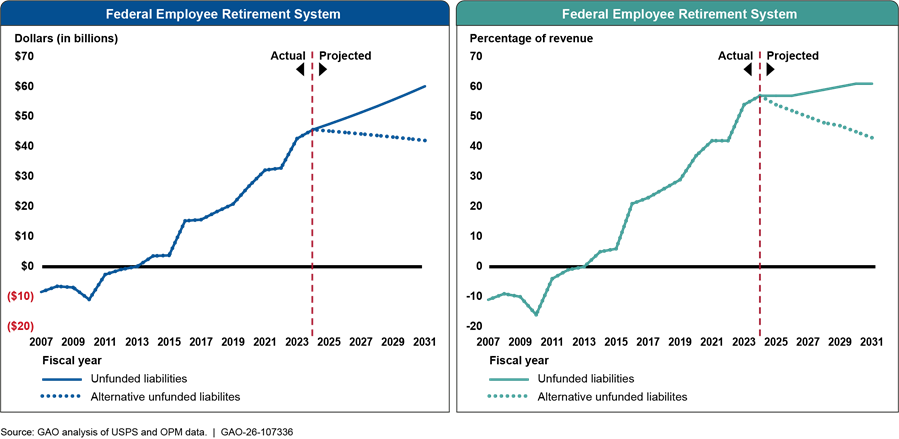
Note: Alternative scenario assumes USPS makes amortization payments in full. Values from fiscal years (FY) 2007 through FY 2024 are actual values, and values from FY 2025 through FY 2031 are projected values. USPS’s actual revenue used in the percentage of revenue graphic above includes USPS’s interest income. USPS’s revenue projections provided to us for fiscal years 2025 to 2031 do not include a projection of USPS’s interest income.
By fiscal year 2027, USPS projects that it will earn up to $3 billion annually from its retirement-based revenue authority and that its required FERS amortization payments will grow to $2.7 billion. However, after fiscal year 2027, USPS projects that the revenue earned from its retirement-based revenue authority will stop growing, while these required amortization payments will continue to grow. In addition, even if USPS could make these amortization payments in full each fiscal year, it could still have an unfunded liability. This is due, in part, to the unpaid FERS amortization payments accumulated between fiscal years 2014 to 2024. In addition, actuarial factors mentioned earlier, such as demographic and economic experience and updates to actuarial assumption, can cause the liability to change from year to year.
USPS’s Accounting Treatment for FERS Costs
USPS files a 10-K report each year that includes a Statement of Operations and a Balance Sheet determined in accordance with applicable accounting standards. USPS accounts for its FERS obligations using the rules applicable to multi-employer pension plans under the accounting standards of the Financial Accounting Standards Board.[104] In its Statement of Operations, USPS’s required contributions for FERS (whether or not USPS makes full or partial payments) are treated as an operating expense in determining USPS’s net loss (or income) for the year. On its balance sheet, USPS recognizes a liability for its cumulative missed required payments, which are amounts that USPS owes to the Civil Service Retirement and Disability Fund. As noted earlier, these missed payments (from fiscal years 2014 through 2024) have accumulated to a liability of $10.1 billion on USPS’s balance sheet.
In accordance with multi-employer accounting rules, USPS does not recognize its FERS unfunded actuarial liability on its balance sheet. As noted earlier, this unfunded liability was $45.7 billion at the end of fiscal year 2024. Since only the missed payments of $10.1 billion are recognized as a liability on the balance sheet, most of the unfunded actuarial liability (approximately $35.5 billion, equal to $45.7 billion, less $10.1 billion) is not recognized on USPS’s balance sheet.[105]
Controllable Expenses
USPS regards some of its expenses as “controllable” and some not and reports supplemental results on this basis. USPS regards required FERS normal cost payments as part of its controllable costs but regards its required amortization payments as a cost outside its control. From an actuarial perspective, this is a reasonable distinction. USPS’s FERS normal cost, for example, will vary with the size of its workforce and payroll, which are factors within USPS’s control and reflect current business operations. USPS’s required amortization payments, on the other hand, do not vary with any aspect of its current operations and reflect benefits earned in the past.
Background
The U.S. Postal Service (USPS) is required to participate in the Federal Employees Health Benefits Program (FEHB), which provides health care benefits to eligible employees and retirees. The Postal Service Reform Act of 2022 (PSRA) required the establishment of the Postal Service Health Benefits program within the FEHB program to be available for postal employees and retirees.[106] This program is also integrated with Medicare. In particular, postal employees who retire on or after January 1, 2025, generally may not enroll in the Postal Service Health Benefits program unless they are eligible for Medicare part A and enrolled in Medicare Part B, which is medical insurance covering such things as outpatient care and preventive services. For Postal Service retirees who were retired as of January 1, 2024, and were eligible for Medicare part A as of that time but had not previously enrolled in Medicare Part B, the act provided a one-time option to enroll in Medicare Part B between April and September 2024, with USPS responsible for any late enrollment penalties. Starting in 2025, all health plans in the Postal Service Health Benefit program are also required to participate in Medicare Part D, which is a prescription drug benefit. The integration with Medicare is expected to lower USPS’s cost of financing retiree health benefits.
The cost of retiree health insurance premiums is a joint responsibility between USPS, the rest of the federal government, and enrolled retirees. USPS is responsible for a specific percentage of premiums, and retirees are generally responsible for the rest.[107] Participation is voluntary for USPS’s retirees, and approximately 491,000 retirees’ health benefits were covered by USPS in fiscal year 2024.
USPS’s share of retiree health premiums is funded through the Postal Service Retiree Health Benefits Fund. Pursuant to federal statute, fund assets are invested in interest-bearing U.S. Treasury securities, whose principal and interest are guaranteed.[108] USPS’s share of retiree health premiums are paid out of the fund. The Office of Personnel Management (OPM) projects that the fund will become depleted in 2031, assuming USPS makes all of its required payments into the Postal Service Retiree Health Benefits Fund, after which USPS will be responsible for paying its share of retiree health premiums out of its operating revenue, at which time OPM projects these premiums to cost about $5.8 billion per year.[109]
USPS’s Funding Requirements for Retiree Health Benefits
Statutory funding requirements for postal retiree health benefits have changed over time. Before 2006, USPS paid its share of premiums for current postal retirees out of USPS’s operating revenue under a “pay-as-you-go” system. The 2006 Postal Accountability and Enhancement Act (PAEA) ended this system and required USPS to start “prefunding” retiree health benefits.[110] Specifically, the act required USPS to make annual prefunding payments, in fixed amounts specified by PAEA, from fiscal years 2007 through 2016 to the newly established Postal Service Retiree Health Benefits Fund. This prefunding requirement was in addition to USPS’s continued payment of its share of premiums out of its operating revenue. PAEA further established that, beginning in fiscal year 2017, USPS’s share of retiree premiums would be paid out of the Postal Service Retiree Health Benefits Fund, while USPS’s required prefunding payments would be determined each year by OPM on an actuarial basis, consisting of an amount to cover annual accruals of future benefits by current employees (known as the “normal cost”) and an amount to pay down the unfunded liability over a period of years (known as the “amortization cost”).[111]
However, due to its deteriorating financial condition, beginning in fiscal year 2012, USPS did not make any of its required prefunding payments. These missed payments totaled about $57 billion over fiscal years 2012 through 2021.
PSRA eliminated the prefunding requirement for retiree health benefits, as well as all of USPS’s past-due obligations for the approximately $57 billion in missed payments to the Postal Service Retiree Health Benefits Fund. The PSRA also created a new requirement for USPS to make so-called “top-up payments” into the Postal Service Retiree Health Benefits Fund beginning in at least fiscal year 2026. OPM estimates that these payments will be about $750 million in fiscal year 2026, growing to about $1.4 billion in fiscal year 2030.[112] In contrast, payments out of the fund for USPS’s share of premiums for retirees was $4.5 billion in fiscal year 2024, and OPM projects this amount to be about $5.8 billion by 2031. As a result of this negative cash flow, and with no prefunding payments being made, as noted, OPM projects that the Postal Service Retiree Health Benefits Fund will become depleted in fiscal year 2031, after which USPS will be responsible for paying its share of retiree health premiums out of its operating revenue.
USPS’s Unfunded Liability for Retiree Health Benefits
USPS’s unfunded liability for retiree health benefits was $26.5 billion at the end of fiscal year 2024, consisting of an actuarial accrued liability of $54.9 billion, less a Postal Service Retiree Health Benefits Fund balance of $28.4 billion.
In fiscal year 2022, the PSRA reduced USPS’s liability for retiree health benefits by $61.2 billion. This reduction was due to the PSRA provisions that integrated USPS’s retiree health benefits with Medicare, discussed earlier, which shifted costs from USPS to Medicare. The PSRA provisions that eliminated USPS’s prefunding requirement and cancelled USPS’s past-due obligations of about $57 billion in missed payments had no impact on the unfunded liability, since it had no impact on either the fund balance or on the actuarial accrued liability. There was no impact on the fund balance, because USPS had not been making prefunding payments. There was no impact on the actuarial accrued liability because the liability is independent of the timing of funding payments.
USPS’s unfunded liability for retiree health benefits will likely continue to increase, because future benefits are still being accrued by current employees (as measured by the normal cost described earlier), while only minimal amounts of additional funding will be going into the Postal Service Retiree Health Benefits Fund, in the form of top-up payments. In fiscal year 2024, the normal cost for retiree health benefits was $2.2 billion, while, as mentioned above, OPM estimates the first top-up payment in fiscal year 2026 to be about $750 million. We project that USPS’s unfunded liability will be about $58.1 billion at the end of fiscal year 2031, after the fund has become depleted (see fig. 12).[113]
Figure 12: U.S. Postal Service (USPS) Past and Projected Unfunded Liability for Retiree Health Benefits, Fiscal Years 2007-2031
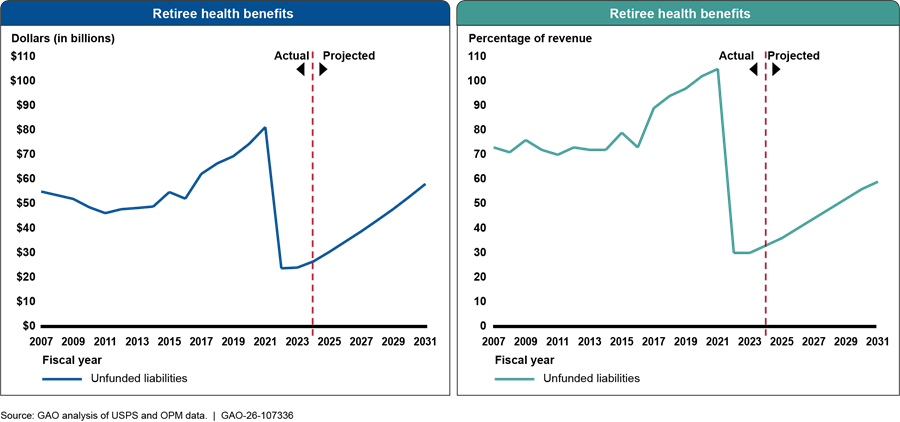
Note: In fiscal year 2022, the Postal Service Reform Act reduced USPS’s retiree health benefits liability by $61.2 billion by integrating USPS’s retiree health benefits with Medicare, which shifted costs from USPS to Medicare.
USPS’s Accounting Treatment for Retiree Health Costs
USPS files a 10-K report each year that includes a Statement of Operations and a Balance Sheet determined in accordance with applicable accounting standards. USPS accounts for its retiree health obligations using the rules applicable to multi-employer pension and postretirement benefit plans under the accounting standards of the Financial Accounting Standards Board.
In its Statement of Operations, USPS’s required payments for retiree health are treated as an operating expense in determining its net loss (or income) for the year, whether or not USPS makes its required payments. Prior to the PSRA, this meant that USPS’s required prefunding payment for the year was treated as an operating expense.[114] As a result of the elimination of the prefunding requirement, USPS recognized an operating expense of zero for retiree health benefits for fiscal years 2022 through 2024.[115] USPS will resume recognizing a positive operating expense for retiree health benefits when it is required to make top-up payments into the fund (starting in at least the end of fiscal year 2026), and more so when the retiree health fund becomes depleted and USPS will have to pay its share of retiree health premiums out of its operating revenue.
On its balance sheet, USPS recognizes a liability for any cumulative unpaid required payments. As noted earlier, these unpaid required payments had accumulated to about $57 billion by the end of fiscal year 2021. With the enactment of the PSRA and the cancellation of these past unpaid amounts, USPS’s balance sheet liability for retiree health benefits has been reduced to zero.
In accordance with multi-employer accounting rules, USPS does not recognize its unfunded actuarial liability for retiree health benefits on its balance sheet. Since USPS’s balance sheet liability is now zero, the entire unfunded actuarial liability of $26.5 billion is not recognized as an accounting liability on USPS’s balance sheet.
Controllable Expenses
USPS regards some of its expenses as “controllable” and some not and reports supplemental results on this basis. In fiscal years 2022 through 2024, USPS recognized zero expense for retiree health benefits, as noted earlier and, thus, made no adjustment for retiree health benefits in calculating what it viewed as its controllable operating results.
In fiscal year 2021, the last year in which USPS recognized positive expense for retiree health benefits (prior to the enactment of the PSRA), its expense for retiree health benefits was $5.1 billion, which consisted of the normal cost of $4.2 billion and the amortization cost of $0.9 billion. USPS regarded its required amortization payments towards paying down its unfunded liability as outside its control, so that only the normal cost of $4.2 billion was considered a controllable expense.[116]
From an actuarial perspective, this was a reasonable distinction. Amortization expense does not vary with USPS’s current operations and reflects benefits earned in the past. In contrast, normal cost will vary with the size of USPS’s workforce, which is a factor within USPS’s control and reflects USPS’s current business operations. As noted in the prior section, USPS does not use accrual accounting for these costs, so that its normal cost for retiree health benefits is no longer recognized as expense in its statement of operations because it is no longer required to be paid.[117] As noted earlier, in fiscal year 2024 the amount of this normal cost was $2.2 billion.
Background
U.S. Postal Service (USPS) employees are covered by the Federal Employees’ Compensation Act (FECA).[118] The FECA program provides workers’ compensation benefits to civilian federal employees who have sustained a work-related injury or disease as a result of their employment. These benefits include wage-loss compensation, medical and rehabilitation services, and death benefit payments to surviving dependents. According to a 2023 USPS Office of Inspector General report, USPS had an average of just over 15,000 employees on the benefit rolls annually between fiscal years 2017 and 2022.[119] In addition, in fiscal year 2022, USPS employees accounted for 42 percent of all workers’ compensation benefit payments across the federal government and more than 41 percent of all new workers’ compensation cases. The Department of Labor administers the federal workers’ compensation program, including paying claims on behalf of injured employees.
USPS’s Funding Requirements for Workers’ Compensation Benefits
Each year, USPS is required to reimburse the Employee Compensation Fund for the cost of workers’ compensation benefits provided in the past year to USPS beneficiaries, plus an administrative fee determined by the Department of Labor. Unlike for USPS’s pension and retiree health care benefits, there is no dedicated fund – or asset balance – set aside for USPS’s workers’ compensation costs. As a result, USPS’s annual reimbursement to the Employee Compensation Fund covers the cost of workers’ compensation benefits provided in the past year to USPS beneficiaries, plus an administrative fee determined by the Department of Labor.[120]
USPS’s Unfunded Liability for Workers’ Compensation Benefits
Since there is no dedicated fund set aside to prefund USPS’s workers’ compensation costs, USPS’s unfunded liability for workers’ compensation benefits is equal to the entire actuarial accrued liability. The actuarial accrued liability is a measure of the actuarial present value of all benefits that are projected to be paid out in the future for covered injuries that have already occurred.[121] As of the end of fiscal year 2024, USPS’s actuarial accrued liability, and therefore, its unfunded liability, was $16.3 billion for workers’ compensation.
The actuarial accrued liability changes from year to year, as a result of several factors. The liability increases each year from the cost of new cases, that is, of new injuries that occur during the year. For each new injury, an estimate is made of the actuarial present value of benefits that will be provided in the future as a result of that injury. This annual cost of new cases has ranged from about $1 billion to about $1.8 billion over the past 10 fiscal years.
The liability decreases each year as benefits are provided to beneficiaries. Benefits paid out can be thought of as a settlement of part of the liability. The annual cost of benefits paid has ranged from about $1.3 billion to about $1.6 billion over the past 10 fiscal years.
The liability can either increase or decrease each year, due to two other factors: actuarial revaluations of existing cases, and changes in the “discount rate.” Actuarial revaluations of existing cases include the impact of changes in actuarial assumptions that are used to estimate the probability and amount of future benefit payments. These actuarial assumptions include inflation, medical inflation, mortality, medical recovery rates, and other factors. Discount rates are used to determine the present value of the estimated future benefits. An increase in the discount rate reduces the liability, while a decrease in the discount rate increases the liability. Because the workers’ compensation liability can have a long duration, with benefits often paid out over decades, actuarial revaluations and discount rate changes can change the liability substantially from year to year.[122]
Figure 13 shows past and projected unfunded workers’ compensation liabilities for USPS. In projecting the liability, we made the simplifying assumption that the impact of actuarial revaluations and discount rate changes would net out to zero each year, since these impacts can go in either direction. As a result, actual future unfunded liabilities could differ significantly from this baseline projection (see fig.13). We project USPS’s unfunded liability to decline modestly, from $16.3 billion at the end of fiscal year 2024 to $15.0 billion at the end of 2031, as a result of projected benefits paid exceeding projected new case costs.
Figure 13: U.S. Postal Service’s (USPS) Past and Projected Workers’ Compensation Unfunded Liabilities, Fiscal Years 2007-2031
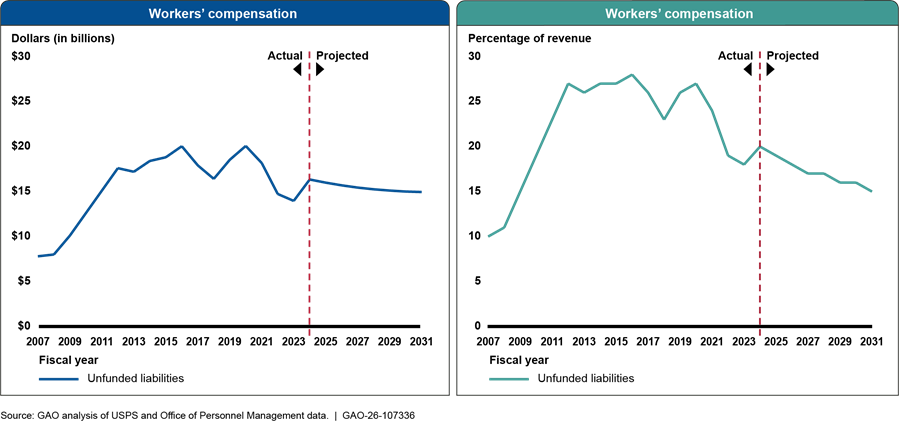
Note: USPS’s actual revenue used in the percentage of revenue graphic above includes USPS’s interest income. USPS’s revenue projections provided to us for fiscal years 2025 to 2031 do not include a projection of USPS’s interest income.
USPS’s Accounting Treatment for Workers’ Compensation Costs
USPS files a 10-K report each year that includes a Statement of Operations and a Balance Sheet determined in accordance with applicable accounting standards. In its Statement of Operations, USPS’s operating expense for the period consists of the net total of the following four elements that were discussed in the prior section: the cost of new cases due to new injuries that occurred during the year, the administrative fee paid to the Department of Labor’s Employee Compensation Fund, the actuarial revaluation of existing cases, and the impact of discount rate changes. Because the last two items can be either unfavorable or favorable in any given year, USPS’s Statement of Operations has sometimes reported a net income, rather than expense, for workers’ compensation benefits.
USPS’s operating expense, or income for workers’ compensation benefits, has ranged from an expense of $3.8 billion to an income of $2.1 billion over the past 10 fiscal years. Most recently, USPS’s workers’ compensation expense changed from a $0.5 billion expense in fiscal year 2023 to a $3.8 billion expense in fiscal year 2024 and, thus, was the primary driver of the worsening of USPS’s overall reported financial results from a net loss of $6.5 billion in fiscal year 2023 to a net loss of $9.5 billion in fiscal year 2024.
On its balance sheet, USPS recognizes a liability for the entire actuarial accrued liability (which is equal to the unfunded actuarial accrued liability). Thus, unlike for its pension and retiree health benefits, for which only a portion of the unfunded actuarial liabilities is recognized as accounting liabilities on its balance sheet, the entire unfunded liability is recognized for workers’ compensation benefits.
Controllable Expenses
USPS regards some of its expenses as “controllable” and some not and reports supplemental results on this basis. It regards controllable expenses as those that can be managed in its normal business operations.
USPS only regards its cash reimbursement for current year benefit payments as a controllable expense. In its calculation of what it regards as its controllable loss, USPS excludes the actuarial revaluation of existing cases, the impact of discount rate changes, the cost of new cases, and the administrative fee paid to the Department of Labor.
From an actuarial perspective, a different approach would regard only the cost of new cases as the controllable cost. The cost of new cases arises from injuries that occur during the fiscal year, which can be regarded as part of the current cost of doing business. These costs are affected by current USPS management decisions, such as the size of its workforce, types of jobs, and workplace safety policies. In contrast, the actuarial revaluation of existing cases, the impact of discount rate changes, and benefits paid out to current beneficiaries all reflect the impact of injuries that occurred in the past, over which USPS has no current management control.
For example, the alternative actuarial approach produces a lower controllable expense than USPS’s version of controllable expense for fiscal years 2023 and 2024 (see table 2).
Table 2: U.S. Postal Service (USPS) Workers’ Compensation Expense Under Three Different Approaches, Fiscal Years 2023-2024
|
(dollars in billions) |
Fiscal year |
||
|
Approach |
2024 |
2023 |
|
|
Accounting expense |
$3.8 |
$0.5 |
|
|
USPS’s version of controllable expense |
1.6 |
1.5 |
|
|
Alternative actuarial version of controllable expense |
1.2 |
1.0 |
|
Source: GAO analysis of USPS data. | GAO‑26‑107336
USPS’s Proposed Changes to Its Workers’ Compensation Benefits
USPS must manage its workers’ compensation expense within the broader Federal Employees’ Compensation Act framework. In its 2024 update of its strategic plan, USPS has proposed legislative modifications to this framework, such as limiting the total amount and duration of workers’ compensation and medical benefits and allowing the use of settlements and buyouts, which would be aimed at reducing USPS’s workers’ compensation costs.
Appendix VI: Introduction to and Results from Survey to Interviewees on Options for USPS and Congress on Financial Sustainability and Summary Results
Potential Policy Options for the Financial Sustainability of USPS
We (the U.S. Government Accountability Office) interviewed you and other stakeholders some months ago about the financial sustainability of the U.S. Postal Service (USPS). In those interviews, we asked what actions USPS and Congress could take to improve USPS’s financial condition. We have collected these options from our interviews and wanted to get your opinion on them.
This questionnaire presents each of the potential options described to us in our interviews and is intended to compile the views of our interviewees on the extent of potential benefits and feasibility of these options.
For each of the policy options presented in this questionnaire, we ask you to rate both how beneficial you believe each option would be for USPS’s financial condition, as well as the feasibility of implementing each option. Please feel free to elaborate on your views in the space provided throughout the questionnaire.
Please note that the policy options do not appear in any particular order in this survey.
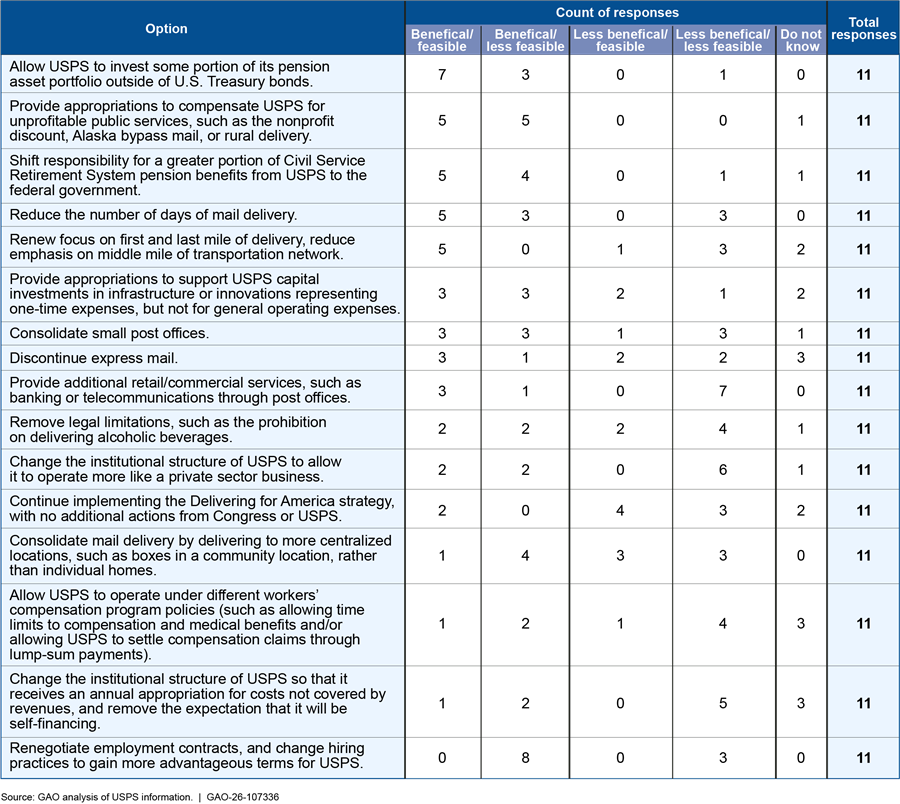
Note: We surveyed our selected stakeholders by asking them to rank how beneficial each option was to USPS’s financial sustainability and how feasible each option was to implement and created four groups (“Beneficial/feasible,” “Beneficial/less feasible,” “Less beneficial/feasible,” and “Less beneficial/less feasible”) by combining our classification of each stakeholders’ response for each option. Eleven out of 12 stakeholders interviewed responded to this follow-up survey.
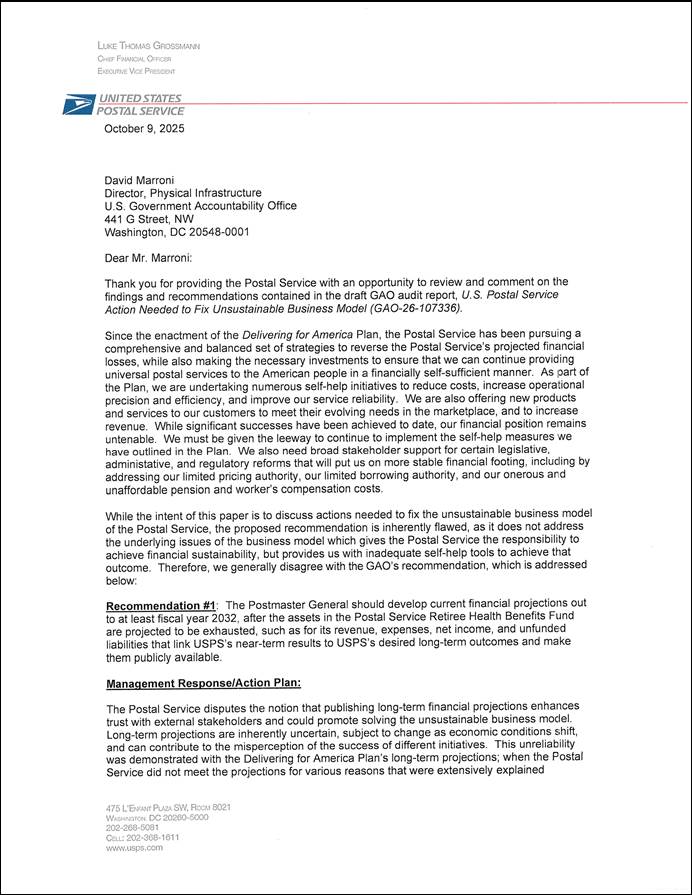
David Marroni, marronid@gao.gov and Frank Todisco, todiscoF@gao.gov
In addition to the individuals named above, key contributors to this report were John W. Shumann (Assistant Director), Greg Hanna (Analyst in Charge), Lilia Chaidez, Danielle Ellingston, Joseph O’Neill, Amy Rosewarne, Peter Rossi, Paras Sharma, Michael Soressi, Malika Williams, and Elizabeth Wood.
The Government Accountability Office, the audit, evaluation, and investigative arm of Congress, exists to support Congress in meeting its constitutional responsibilities and to help improve the performance and accountability of the federal government for the American people. GAO examines the use of public funds; evaluates federal programs and policies; and provides analyses, recommendations, and other assistance to help Congress make informed oversight, policy, and funding decisions. GAO’s commitment to good government is reflected in its core values of accountability, integrity, and reliability.
Obtaining Copies of GAO Reports and Testimony
The fastest and easiest way to obtain copies of GAO documents at no cost is through our website. Each weekday afternoon, GAO posts on its website newly released reports, testimony, and correspondence. You can also subscribe to GAO’s email updates to receive notification of newly posted products.
Order by Phone
The price of each GAO publication reflects GAO’s actual cost of production and distribution and depends on the number of pages in the publication and whether the publication is printed in color or black and white. Pricing and ordering information is posted on GAO’s website, https://www.gao.gov/ordering.htm.
Place orders by calling (202) 512-6000, toll free (866) 801-7077,
or
TDD (202) 512-2537.
Orders may be paid for using American Express, Discover Card, MasterCard, Visa, check, or money order. Call for additional information.
Connect with GAO
Connect with GAO on X,
LinkedIn, Instagram, and YouTube.
Subscribe to our Email Updates. Listen to our Podcasts.
Visit GAO on the web at https://www.gao.gov.
To Report Fraud, Waste, and Abuse in Federal Programs
Contact FraudNet:
Website: https://www.gao.gov/about/what-gao-does/fraudnet
Automated answering system: (800) 424-5454
Media Relations
Sarah Kaczmarek, Managing Director, Media@gao.gov
Congressional Relations
A. Nicole Clowers, Managing Director, CongRel@gao.gov
General Inquiries
[1]USPS recorded net income of about $56 billion in fiscal year 2022 due to the impact of the Postal Service Reform Act of 2022. The act, among other things, cancelled USPS’s missed retiree health care prefunding payments, which USPS reported as a one-time, noncash benefit of about $57 billion.
[2]GAO, U.S. Postal Service: Restructuring Urgently Needed to Achieve Financial Viability, GAO‑09‑958T (Washington D.C.: Aug. 6, 2009).
[3]Pub. L. No. 117-108, 136 Stat. 1127.
[4]These losses are from fiscal years 2021 through 2025. This figure does not include the $57 billion in noncash financial relief from the Postal Service Reform Act of 2022.
[5]U.S. Postal Service, Delivering for America 2.0: Fulfilling the Promise (Washington, D.C.: Sept.30, 2024).
[6]GAO, Evidence-Based Policymaking: Practices to Help Manage and Assess the Results of Federal Efforts, GAO‑23‑105460 (Washington D.C.: July 12, 2023).
[7]GAO, Postal Retiree Health Benefits: Unsustainable Finances Need to Be Addressed, GAO‑18‑602 (Washington D.C.: Aug. 31, 2018); and U.S. Postal Service: Congressional Action Is Essential to Enable a Sustainable Business Model, GAO‑20‑385 (Washington D.C.: May 7, 2020).
[8]Pub. L. No. 91-375, § 201, 84 Stat. 719, 720 (1970); and President’s Commission on Postal Organization, Towards Postal Excellence: The Report of the President’s Commission on Postal Organization, (Washington, D.C.: June 1968), published by the Committee on Post Office and Civil Service, House of Representatives (Washington, D.C.: Nov. 24, 1976).
[9]In fiscal year 2024, USPS reported a total mail and package volume of over 112 billion items to more than 168 million delivery points.
[10]In 2010, we suggested that Congress consider revising the statutory framework for collective bargaining to ensure that binding arbitration takes USPS’s financial condition into account. This matter was subsumed within a subsequent suggestion we made to Congress in 2020, that it should consider determining the extent to which USPS should be financially self-sustaining and what changes to law would be appropriate to enable USPS to meet this goal. The 2010 matter is still valid, since revising the statutory framework for collective bargaining is one way Congress could enable USPS to be more financially self-sustaining. GAO, U.S. Postal Service: Strategies and Options to Facilitate Progress toward Financial Viability, GAO‑10‑455 (Washington, D.C.: Apr. 12, 2010); and GAO‑20‑385.
[11]The appropriation has been between approximately $50 million and $60 million annually since fiscal year 2019, or less than 0.1 percent of USPS’s annual operating revenue. It reimburses USPS for revenue forgone on services such as free mail for the blind and overseas voting in U.S. elections.
[12]The CARES Act provided USPS with authority to borrow $10 billion from the U.S. Treasury. Pub. L. No. 116-136, div. A, tit. VI, § 6001, 134 Stat. 281, 504-05 (2020). The Consolidated Appropriations Act, 2021 amended the CARES Act by providing that USPS shall not be required to repay such amounts borrowed. Pub. L. No. 116-260, div. N, tit. VIII, § 801, 134 Stat. 1182, 2119 (2020).
[13]Pub. L. No. 117-169, § 70002, 136 Stat. 1818, 2086–87.
[14]See Pub. L. No. 109-435, § 201, 120 Stat. 3198, 3202–04 (2006) (codified at 39 U.S.C. § 3622(d)).
[15]In its financial statements, USPS records expense for retiree benefits in the period in which payments are due and payable.
[16]This $14.1 billion included cash and cash equivalents ($4.6 billion) and short-term investments in U.S. Treasury securities ($9.5 billion). Another potential source of liquidity is borrowing capacity, but USPS’s remaining borrowing capacity was zero as of September 30, 2025.
[17]As stated in its 10-K reports, USPS made a policy decision to not make these payments, because it determined it needed to preserve liquidity and ensure it could continue fulfilling its universal service obligation. USPS reported at the end of fiscal year 2025 that it had outstanding debt obligations of $15 billion, which is equal to its statutory limit.
[18]Unfunded liability measures the difference between a program’s actuarial accrued liabilities and its assets. The actuarial accrued liability is a measure of the cost of future benefits attributable to plan participants’ accumulated service.
[19]39 U.S.C. 1005(d); 5 U.S.C. §§ 8348(h), 8423(b).
[20]USPS’s share of the FERS normal cost is equal to the total normal cost, less employees’ required payments for FERS benefits. USPS does not pay a normal cost for CSRS benefits, because the Postal Accountability and Enhancement Act (PAEA) eliminated these payments in 2006. Amortization payments are annual payments intended to pay down an unfunded liability over a set number of years, with such payment amounts adjusted from year to year based on changes in the unfunded liability. The unfunded liability can change from year to year, due to revisions to actuarial estimates, inflation, and other factors. USPS’s required amortization payments for FERS are based on a 30-year amortization schedule, and for CSRS over a shorter amortization period, ending in fiscal year 2043.
[21]39 U.S.C. § 1005(f).
[22]Medicare Part B covers a range of medical services, including physician and outpatient hospital services.
[23]Starting no later than the end of fiscal year 2026, USPS is required to pay into the Postal Service Retiree Health Benefits Fund the excess, if any, of USPS’s share of retiree premiums over the estimated amount of postal retiree health care net claims cost for the previous fiscal year. OPM’s projection that the Postal Service Retiree Health Benefits Fund will be depleted by fiscal year 2031 assumes that USPS makes all of these required “top-up” payments. OPM projects that the Postal Service Retiree Health Benefits Fund will be depleted by fiscal year 2030 if USPS does not make any of these required “top-up” payments.
[24]39 U.S.C. § 1005(c).
[25]The liability is an actuarial present value that takes into account estimates of the costs of future medical and compensation benefits that will be paid to current beneficiaries, as well as estimates of how many beneficiaries will drop off the rolls over time due to recovery from injury or from death.
[26]United States Postal Service, Office of Inspector General, Workers’ Compensation Program Update, Report Number 22-121-R23 (Arlington, VA.: May 11, 2023).
[27]According to the OIG, in most states, organizations other than federal agencies have the option of settling claims for future medical care in the form of a compromise and release agreement, and some states allow lump-sum settlements of compensation claims.
[28]When the 2006 Postal Accountability and Enhancement Act limited postal price increases, it included a provision for the Postal Regulatory Commission to evaluate the price cap system 10 years after enactment and to modify it, if necessary, to meet the objectives of the law. Following the Commission’s December 2017 evaluation, in November 2020 it announced new rules on prices for market-dominant postal products. The Commission allowed USPS to increase its prices beyond Consumer Price Index increases and account for additional costs incurred. As a result, USPS could now base rate increases on factors including (1) decreased mail density (increasing the cost-per-piece of mail) and (2) raising revenue to meet its required payments for retirement-related obligations.
[29]Market-dominant products are those for which USPS exercises sufficient market power that it can effectively increase costs, decrease quality, or decrease output without losing a significant level of business to competitors. See 39 U.S.C. § 3642. Market-dominant products include those that have no direct alternative, such as First-Class Mail, Marketing Mail, and Periodicals. A First-Class Mail postage stamp cost 55 cents in November 2020, and cost 73 cents by the end of fiscal year 2024. The cumulative rate of inflation in the U.S. over that period was about 21 percent, based on the Consumer Price Index from the U.S. Department of Labor, Bureau of Labor Statistics. According to USPS officials, the increased prices are needed to generate enough revenue to cover costs and produce retained earnings, and prior to receiving the new pricing authority they were unable to do that. According to USPS, the price increases have helped generate more revenue, but they are only expected to partially offset the effect of declining mail volume, growing delivery points, and other increasing costs not reflected in the Consumer Price Index.
[30]USPS’s total transportation expense was about $8.8 billion in fiscal year 2024, about 10 percent of its total expenses of about $89 billion.
[31]These plans include USPS’s Regional Transportation Optimization initiative, which will eliminate end-of-day collection at post offices more than 50 miles from a regional processing and distribution center. USPS estimates that this change may slow delivery times for some mail in affected areas by one day. However, USPS officials asserted that customers in the affected areas may receive the same or faster service, due to the changes.
[32]Service standards reflect USPS’s estimate of the amount of time it will take to deliver a piece of mail. These service standard changes went into effect in October 2021, increasing the target time for First-Class Mail delivery by 1 to 2 days, depending on the distance traveled. Mail traveling less than 140 miles maintained a delivery standard of 1 to 2 days, and the new 5-day service standard applied to mail traveling 1,908 or more miles. According to USPS, these changes allowed USPS to improve reliability and shift deliveries from air to ground transportation networks. USPS sets annual performance targets for each class of mail, which are a percentage of mail that is delivered within the established service standards. The Postal Regulatory Commission reports on USPS’s actual performance against these targets on an annual basis and reported that in fiscal year 2023 USPS failed to meet service performance targets for 15 out of 27 market-dominant products, including most categories of First-Class Mail. Postal Regulatory Commission, Annual Compliance Determination Report: Fiscal Year 2023 (Washington, D.C.: Mar. 28, 2024).
[33]In January 2025, the Postal Regulatory Commission issued an advisory opinion stating that it did not support USPS’s network and service changes. The Commission found, among other things, that USPS’s financial projections were questionable and that the proposed changes would have significant negative impacts on certain mail products and rural communities. In its response to the advisory opinion, USPS stated that it disagreed with the Commission’s assessment on several grounds, including that the Commission mischaracterized the service impacts and did not consider the need to ensure the financial viability of USPS. USPS is not legally required to heed the Commission’s advisory position. U.S. Postal Regulatory Commission, Advisory Opinion on the Operational and Service Standard Changes Related to the Delivering for America Plan, Docket No. N2024-1 (Washington, D.C.: Jan. 31, 2025).
[34]USPS’s Ground Advantage combines three of its former products into one simplified ground shipping product. According to USPS, it provides a simple, reliable, and more affordable way to ship packages weighing up to 70 pounds, with delivery in 2 to 5 days across the continental U.S. It includes insurance, package forwarding, and free package pickup service.
[35]The volume and revenue of USPS’s Priority Mail Services declined by 35 percent between fiscal years 2023 and 2024. According to USPS, these services declined due to intense market competition, an industry-wide trend away from expedited products, and the potential shift of package volume to the new USPS Ground Advantage product. USPS does not break down the volume and revenue of Priority Mail Services by sub-category, so it is not possible to know what portion of this is now included in Ground Advantage.
[36]The four products are (1) USPS Connect Local, which allows businesses to quickly reach local customers, with same-day and Sunday delivery in select locations; (2) USPS Connect Regional, which allows businesses to reach a majority of the population next-day; (3) USPS Connect National, which allows businesses to access USPS’s nationwide network in 2 to 5 days; and (4) USPS Connect Returns, which provides services for businesses to offer their customers convenient returns.
[37]USPS has authority to increase postage prices to raise revenue to meet its pension or retiree health benefits liabilities. Postal Regulatory Commission regulations require that USPS make payments toward its pension or retiree health benefits liabilities equal to the revenue it receives from price increases from such authority.
[38]OPM began invoicing USPS for amortization payments toward its CSRS liability in 2017.
[39]USPS uses “pre-career status” to indicate employees who have not achieved “career status,” which means they receive fewer benefits than career employees. Employees in “pre-career status” are typically early in their USPS careers.
[40]GAO, U.S. Postal Service: Further Analysis Could Help Identify Opportunities to Reduce Injuries among Non-Career Employees, GAO‑21‑556 (Washington, D.C.: Aug. 17, 2021).
[41]According to the OIG, pre-career employee retention rates decreased from 50 percent to 43 percent between fiscal years 2021 and 2024. However, USPS has not reported agency-wide retention rates. United States Postal Service, Office of Inspector General, Pre-Career Retention Initiatives, 24-131-R25 (Arlington, VA: Mar. 31, 2025).
[42]United States Postal Service, Office of Inspector General, Impacts Associated with Local Transportation Optimization in Richmond, Virginia, 23-161-1-R24 (Arlington, VA: Apr. 12, 2024).
[43]United States Postal Service, Office of Inspector General, Effectiveness of the New Regional Processing and Distribution Center in Atlanta, GA, 24-074-R24 (Arlington, VA: Aug. 28, 2024).
[44]The Postmaster General’s letter to Chairman Peters of the U.S. Senate Homeland Security and Government Affairs Committee, accessed October 14, 2024, https://about.usps.com/newsroom/global/pdf/0520-pmg-dejoy-to-chairman-peters.pdf.
[45]According to USPS officials, if they had implemented a rate change in January 2025, they would have had to decrease prices on some products.
[46]To enroll in a Postal Service Health Benefits Program plan, new retirees generally must be entitled to benefits under Medicare part A and enrolled in Medicare Part B. Medicare Part B covers a range of medical services, including physician and outpatient hospital services. In addition, postal service health benefit plans are required to provide drug benefits through Medicare Part D for eligible annuitants. According to USPS’s OIG, these requirements are similar to those faced by retirees who worked in the private sector or for many state and local governments. United States Postal Service Office of Inspector General, Primer on Postal Reform, Report Number RISC-WP-23-002 (Arlington, VA: Dec. 20, 2022).
[47]Certain, existing retirees were given the option to enroll in Medicare Part B, with USPS paying late enrollment penalties. See app. IV for more information about USPS’s retiree health benefits.
[48]GAO, U.S. Postal Service: Proposed Health Plan Could Improve Financial Condition, but Impact on Medicare and Other Issues Should Be Weighed before Approval GAO‑13‑658 (Washington, D.C.: July 18, 2013)
[49]The Congressional Budget Office estimated that the changes resulting from the act would increase total spending under Medicare by $5.5 billion through 2031, which reflects shifting part of the cost of retiree health benefits from USPS to taxpayers.
[50]United States Postal Service, Office of Inspector General, The Postal Service’s Share of CSRS Pension Responsibility, RARC-WP-10-001 (Arlington, VA.: Jan. 20, 2010); The Segal Company, Report to the Postal Regulatory Commission on: Civil Service Retirement System Cost and Benefit Allocation Principles, a report prepared at the request of the Postal Regulatory Commission (June 29, 2010); and U.S. Office of Personnel Management, Office of the Inspector General, A Study of the Risks and Consequences of the USPS OIG’s Proposals to Change USPS’s Funding of Retiree Benefits: Shifting Costs from USPS Ratepayers to Taxpayers (Washington, D.C.: Feb. 28, 2011). The Postal Regulatory Commission commissioned an actuarial report by The Segal Company on the allocation of CSRS liabilities between USPS and the federal government.
[51]GAO, U.S. Postal Service: Allocation of Responsibility for Pension Benefits between the Postal Service and the Federal Government; GAO‑12‑146 (Washington, D.C.: Oct. 13, 2011). Further, we did not find evidence of any accounting or actuarial error in the methodology for allocating responsibility for CSRS benefits between USPS and the federal government. Therefore, we found that USPS had not made any “overpayments” toward CSRS benefits, as some had claimed—such that any reallocation of responsibility of CSRS benefits would be a policy choice by Congress, not a correction of an accounting or actuarial error.
[52]U.S. Department of Justice, Whether the United States Postal Service Bears Responsibility for the Cost of Certain Civil Service Retirement Benefits Paid to Its Employees, 48 Op. O.L.C. (Mar. 26, 2024). The Department of Justice is authorized to render opinions on questions of law when requested by the president and the heads of executive branch departments. OPM asked the Department of Justice to render this opinion.
[53]This figure includes USPS’s net losses from fiscal year 2007 through fiscal year 2025. USPS’s total net losses do not include the $57 billion noncash positive financial impact from the Postal Service Reform Act of 2022.
[54]This amount also does not include the $57 billion noncash positive financial impact from the Postal Service Reform Act of 2022.
[55]This total does not include time-limited price increases for USPS domestic shipping.
[56]By way of comparison, general inflation as measured by the Consumer Price Index from the U.S. Department of Labor, Bureau of Labor Statistics, totaled about 21 percent from fiscal year 2020 to fiscal year 2024. USPS’s total noncash workers’ compensation expense ranged from -$2.1 billion (i.e. a net income, due to a downward reestimation of the workers’ compensation liability) in fiscal year 2022 to about $3.8 billion in fiscal year 2024 (affected by an upward reestimation of the liability). See app. V for an explanation of USPS’s workers’ compensation liability and the components of USPS’s workers’ compensation expense.
[57]The total of USPS’s workers’ compensation, retiree health and pension unfunded liabilities and debt decreased from fiscal years 2021 to 2022. This decrease was mainly due to provisions in the Postal Service Reform Act of 2022, which, among other things, reduced USPS’s unfunded retiree health care liability via the integration of postal retiree health care benefits with Medicare.
[58]The amount of USPS’s unfunded liabilities can change from year to year due a variety of factors, such as amounts contributed into and paid out of the fund, benefit accruals, and actuarial gains or losses from assumption changes or from experience, such as inflation, differing from what had been assumed.
[59]OPM assessed USPS $3.2 billion for amortization of its CSRS unfunded liabilities and $2.3 billion for amortization of its FERS unfunded liabilities. USPS paid $1 billion toward its FERS unfunded liability, mainly from $933 million earned via its retirement rate pricing authority. Revenue earned under this authority is required by regulation to be dedicated to USPS’s retirement-related liabilities. According to USPS, it directed these funds toward its FERS liability, in part, due to USPS’s dispute of the methodology used to calculate USPS’s CSRS payment.
[60]See 5 U.S.C. § 8906(g)(2)(A). The Postal Accountability and Enhancement Act created the Postal Service Retiree Health Benefits Fund in 2006. This act required USPS to make prefunding payments into the Postal Service Retiree Health Benefits Fund during fiscal years 2007 through 2016, in fixed amounts ranging from $5.4 billion to $5.8 billion per year. During this period, USPS was also required to pay its share of retiree health care premiums. The act also specified that beginning in fiscal year 2017, USPS’s required contributions to the Postal Service Retiree Health Benefits Fund would be determined by OPM on an actuarial basis, consisting of normal cost plus an amortization payment each year, and that the Postal Service Retiree Health Benefits Fund would be used by OPM to pay USPS’s share of postal retiree premiums for health benefits, which totaled $4.5 billion in fiscal year 2024. USPS did not make any of its required payments to the Postal Service Retiree Health Benefits Fund from 2012 through 2021 and, in 2022, the Postal Service Reform Act eliminated the prefunding requirement, as well as USPS’s liability for the $57 billion in missed payments from fiscal years 2012 through 2021.
[61]As of November 2024, OPM projected that these payments will range from $752 million for 2026 to about $1.4 billion for 2031.
[62]Prior to the release of its updated strategic plan, USPS provided us with a detailed set of projections, including revenue and expenses by category for each fiscal year between fiscal years 2024 to 2031. However, these projections represented USPS’s estimate of what would happen if the strategic plan’s actions were not implemented, rather than a projection if the strategic plan’s actions were implemented.
[63]U.S. Postal Service, United States Postal Service Opposition to Motion of the Association of Postal Commerce for Issuance of Information Request, filing before the Postal Regulatory Commission, Public Inquiry on Changes Associated with the Delivering for America Plan, Docket PI2023-4 (Washington D.C.: Nov. 6, 2024).
[64]USPS defines controllable income as total revenue minus controllable expenses. USPS defines controllable expenses as: salaries and benefits, transportation, depreciation, supplies and services, and rent, utilities, and other expenses. USPS defines noncontrollable expenses as those that do not reflect its short-term operational decisions and that are subject to fluctuations outside of its control. USPS includes amortization payments of unfunded pension liability and noncash expenses related to its participation in the federal workers’ compensation program as non-controllable expenses.
[66]For pension and retiree health benefits, unfunded liability measures the difference between a program’s actuarial accrued liabilities and its assets. The actuarial accrued liability is a measure of the cost of future benefits attributable to plan participants’ accumulated service. For workers’ compensation benefits, the actuarial accrued liability is a measure of the cost of future benefits for covered injuries that have already occurred. Since the workers’ compensation benefits are not prefunded, the liability and unfunded liability are the same amount.
[67]USPS does not project its workers’ compensation liability. USPS stated that as the workers’ compensation program is administered and managed by the Department of Labor, USPS does not forecast that liability. We made a baseline estimate that USPS’s workers’ compensation unfunded liability will decline modestly, from $16.3 billion at the end of fiscal year 2024 to about $15.0 billion at the end of fiscal year 2031. However, future workers’ compensation liabilities will often vary from a baseline projection in either direction, sometimes significantly, because of discount rate changes and actuarial revaluations of costs, among other factors. See app. V for more details on USPS’s workers’ compensation liability.
[68]USPS’s projections for retiree health care benefits are based on a measure of the liability that only includes vested benefits, meaning that it includes liabilities for annuitants and for employees who are eligible to retire but not for employees who are not yet eligible to retire, as provided by the Postal Service Reform Act (PSRA). See 5 U.S.C. § 8909a(e). In contrast, our projections are based on a measure of the liability that includes all employees, in accordance with the measurement basis in OPM’s actuarial valuation report and reported in USPS’s 10-K report, in accordance with actuarial standards of practice.
[69]USPS projects paying between $1.5 billion and $3 billion per year toward its FERS amortization payments in fiscal years 2025 to 2029 via its retirement rate authority.
[70]USPS’s actual revenue above includes USPS’s interest income. USPS’s revenue projections provided to us for fiscal years 2025 to 2031 do not include a projection of USPS’s interest income.
[71]United States Postal Service Office of Inspector General, “State of the U.S. Postal Service Financial Condition.”
[72]We have done prior work on this option. In July 2013, we looked at the option of investing the retiree health benefits fund in the broader market. We noted that these investments can offer the potential for significantly higher returns than those on Treasury securities. However, these investments also have risks, such as an economic downturn resulting in investment losses and decreases in mail volume at the same time. In addition, careful consideration would need to be given to safeguards against an overly aggressive assumed rate of return. GAO‑13‑658.
[73]We sent a survey to the 12 stakeholders we interviewed after the interviews were completed. The survey asked the interviewees how feasible and how beneficial each of the options mentioned in our individual interviews were. We received 11 responses. See app. VI for the introduction to the survey and a summary of our results.
[74]GAO, U.S. Postal Service: Key Considerations for Restoring Fiscal Sustainability, GAO‑17‑404T (Washington D.C.: Feb.7, 2017); and GAO‑20‑385.
[76]The legislation includes language related to the level of postal services the nation requires. Specifically, Congress included a provision on 6-day delivery (which was already in federal statute), language granting the Postal Service more flexibility to develop non-postal products and services, and a statement on an integrated delivery network for packages and other mail. However, the act did not fundamentally reassess the level of universal postal service the nation requires, which we continue to believe is the starting point for reexamining USPS's business model.
[77]One bill would require, among other things, that the Treasury invest a specified percentage of the Postal Service Retiree Health Benefits Fund in indexed funds. Under this provision, the U.S. Treasury must, to the maximum extent practicable, ensure that this investment replicates the performance of the longest-term target date asset allocation investment fund established by the Federal Retirement Thrift Investment Board. H.R. 3004, 119th Cong. (1st Sess. 2025). Another bill would authorize USPS to mail alcoholic beverages. H.R. 3011, 119th Cong. (1st Sess. 2025).
[78]GAO, Evidence-Based Policymaking: Practices to Help Manage and Assess the Results of Federal Efforts, GAO‑23‑105460 (Washington D.C.: July 12, 2023).
[79]GAO, Postal Retiree Health Benefits: Unsustainable Finances Need to Be Addressed, GAO-18-602 (Washington D.C.: Aug. 31, 2018); and GAO, U.S. Postal Service: Congressional Action Is Essential to Enable a Sustainable Business Model, GAO-20-385 (Washington D.C.: May 7, 2020).
[80]A defined-benefit pension plan is a plan in which, typically, the employee earns a monthly pension benefit payable for life, and the amount of the benefit is determined by a formula that takes into account factors such as the employee’s length of service, salary, and age at retirement. CSRS was established by the Civil Service Retirement Act in 1920. The Federal Employees Retirement System (FERS) is the other retirement benefit plan administered by OPM. Established by statute in 1986, it covers employees hired after 1983.
[81]Most current employees are covered under FERS, which covers federal employees who entered a covered position in 1984 or later. See app. III for more information about FERS.
[82]In fiscal year 2024, OPM estimated that about two-thirds of USPS retirement benefits paid out of the two plans were for USPS retirees and beneficiaries covered under CSRS, with CSRS paying out about $13.0 billion in benefits and FERS paying out about $6.5 billion.
[83]The fund is the Civil Service Retirement and Disability Fund, which holds assets for both CSRS and FERS. A portion of the Civil Service Retirement and Disability Fund’s total CSRS assets are allocated to USPS to explicitly track USPS’s CSRS balance.
[84]See 5 U.S.C. § 8348(c).
[85]OPM determines USPS’s amortization payments for CSRS based on amounts that would be needed to pay down the unfunded liability in installments through fiscal year 2043, as required by law.
[86]This unfunded liability of $60.2 billion was equal to about 76 percent of USPS’s fiscal year 2024 revenue.
[87]Other federal agencies also participate in CSRS, although OPM keeps separate track of fund balances and cash flows attributable to USPS within the Civil Service Retirement and Disability Fund.
[88]See Pub. L. No. 93-349, 88 Stat. 354 (1974) (amending 5 U.S.C. § 8348(h)).
[89]United States Postal Service, Office of Inspector General, The Postal Service’s Share of CSRS Pension Responsibility, RARC-WP-10-001 (Arlington, VA.: Jan. 20, 2010); The Segal Company, Report to the Postal Regulatory Commission on: Civil Service Retirement System Cost and Benefit Allocation Principles, a report prepared at the request of the Postal Regulatory Commission (June 29, 2010); and U.S. Office of Personnel Management, Office of the Inspector General, A Study of the Risks and Consequences of the USPS OIG’s Proposals to Change USPS’s Funding of Retiree Benefits: Shifting Costs from USPS Ratepayers to Taxpayers (Washington, D.C.: Feb. 28, 2011).
[90]These amounts would likely be significantly higher today because of the retroactive nature of such a reallocation, among other factors. Such a reallocation could potentially eliminate USPS’s unfunded liability for CSRS, thereby also eliminating its amortization costs for CSRS. In addition, any resulting surplus assets would be transferred to the Postal Service Retiree Health Benefits Fund, reducing or potentially eliminating USPS’s unfunded liability for retiree health benefits and keeping the fund solvent well beyond the currently projected depletion of the fund in 2031. Under current law, OPM determines whether USPS’s CSRS funds in the Civil Service Retirement and Disability Fund represent a surplus compared with USPS’s CSRS liabilities. If OPM finds a surplus, the amount of the surplus is required to be transferred to the Postal Service Retiree Health Benefits Fund. The next transfers, if any, would occur if the determination of the supplemental liability, as of the close of fiscal years 2025 and 2035 show a surplus. 5 U.S.C. § 8348(h)(2)(B)–(C).
[91]GAO, U.S. Postal Service: Allocation of Responsibility for Pension Benefits between the Postal Service and the Federal Government; GAO-12-146 (Washington, D.C.: Oct. 13, 2011). We found that any reallocation of responsibility of CSRS benefits would be a policy choice by Congress, not a correction of an accounting or actuarial error.
[92]Letter from John Berry, Director, Office of Personnel Management to Ruth Y. Goldway, Chairman, Postal Regulatory Commission (Sept. 24, 2010).
[93]The Department of Justice has the authority to render opinions on questions of law when requested by the President and the heads of executive branch departments. 28 U.S.C. § 512.
[94]U.S. Postal Service, Delivering for America 2.0: Fulfilling the Promise (Washington, D.C.: Sept. 30, 2024).
[95]A defined-benefit pension plan is a plan in which, typically, the employee earns a monthly pension benefit payable for life, and the amount of the benefit is determined by a formula that takes into account factors such as the employee’s length of service, salary, and age at retirement. FERS was established by statute in 1986; it covers employees hired after 1983. CSRS is the other retirement benefit plan administered by OPM and was established by the Civil Service Retirement Act in 1920. See app. II for more information about CSRS.
[96]As of the end of fiscal year 2024, USPS also had about 106,000 “pre-career” employees who are not eligible to participate in FERS.
[97]The fund is the Civil Service Retirement and Disability Fund, which holds assets for both FERS and the Civil Service Retirement System (see app. II). A portion of the Civil Service Retirement and Disability Fund’s total FERS assets is allocated to USPS to explicitly track its FERS balance.
[98]See 5 U.S.C. § 8348(c).
[99]USPS employees hired before 2013 contribute 0.8 percent of their pay, employees hired in 2013 contribute 3.1 percent; and employees hired in 2014 or later contribute 4.4 percent.
[100]OPM determines USPS’s amortization payments for FERS based on a 30-year timeframe, as required by law.
[101]This unfunded liability of $45.7 billion was equal to about 57 percent of USPS’s fiscal year 2024 revenue.
[102]In November 2020, the Postal Regulatory Commission modified USPS’s price cap for market-dominant postal products, such as First-Class Mail, to help USPS make amortization payments for retirement costs, such as for its FERS obligations, that are beyond USPS’s control. This additional rate authority increases the price cap based on USPS’s retirement obligations, and USPS is required to make payments toward these obligations equal to the revenue it receives from price increases due to the retirement rate authority. Postal Regulatory Commission, Order No. 5763, Docket No. RM2017-3 (Nov. 30, 2020); see also 39 C.F.R. Part 3030, Subpart E.
[103]USPS did not make any of its required FERS amortization payments between fiscal years 2014 through 2021 and made partial FERS amortization payments from fiscal years 2022 through 2024. Prior to fiscal year 2014, OPM determined that USPS had a surplus in its FERS account balance, so OPM did not estimate an amortization payment for USPS.
[104]Other federal agencies also participate in FERS, although OPM keeps separate track of fund balances and cash flows attributable to USPS within the Civil Service Retirement and Disability Fund.
[105]Totals and differences may not be exact, due to rounding.
[106]Pub. L. No. 117-108, § 101(a), 136 Stat. 1127, 1128 (codified at 5 U.S.C. § 8903c).
[107]The federal government generally pays 72 percent of the weighted average premium across multiple FEHB plans but no more than 75 percent of any particular plan’s premium. 5 U.S.C. § 8906(b). With respect to postal retirees’ premium costs, USPS is responsible for the federal government’s share, except for a prorated portion paid by the rest of the federal government in certain circumstances. 5 U.S.C. § 8906(g).
[108]See 5 U.S.C. § 8909a(c).
[109]More precisely, OPM estimates that the Postal Service Retiree Health Benefits Fund will be depleted in 2031 if USPS makes all of the required payments into the fund starting in 2026. If USPS does not make any of these required payments, OPM estimates that the fund will be depleted in 2030.
[110]Pub. L. No. 109-435, § 803, 120 Stat. 3198, 3251–52 (2006).
[111]Normal cost is the estimated actuarial present value of the cost of future retiree health benefits attributable to the current year of employees’ service. The unfunded liability is any excess of the actuarial accrued liability over the value of fund assets. The actuarial accrued liability is the estimated actuarial present value of the cost of all future retiree health benefits attributable to all service to date of current employees, plus all remaining future benefits payable to current retirees (and beneficiaries) entitled to benefits.
[112]The top-up payments are technical adjustments that reflect estimated differences in net claims costs between retirees and active employees. These top-up payments are equal to the amount (if any) that USPS’s share of premiums for retirees exceeds the estimated net claims costs of retirees. Because of Medicare integration, for retirees, Medicare is generally the primary payer, and the Postal Service Health Benefits Program is the secondary payer. As a result, average net claims costs for retirees are expected to be lower than for active employees, whereas retirees and active employees are charged the same, blended premium rate. The top-up payments will result in the net cash flow out of the Postal Service Retiree Health Benefits Fund (USPS’s share of premiums out, net of top-up payments in) better reflecting the claims costs of retirees.
[113]The unfunded liability will also vary from year to year due to the extent to which actual actuarial experience differs from the actuarial assumptions used in determining the unfunded liability, as well as occasional updates to actuarial assumptions based on revised expectations. These actuarial assumptions cover factors such as asset returns, medical inflation, retirements, and deaths. The impact of actuarial experience and assumption updates can be either positive or negative, so our projections are based on the simplifying assumption that these factors will net out to zero.
[114]Prior to fiscal year 2017, the operating expense also included USPS’s payments for its share of retiree health premiums, which USPS paid out of its operating revenue. Per the provisions of PAEA, USPS’s share of retiree health premiums was paid out of the Postal Service Retiree Health Benefits Fund, beginning in fiscal year 2017.
[115]In contrast to the operating expense of zero for retiree health benefits, for FERS pension benefits, USPS recognizes operating expense equal to the normal cost for continuing benefit accruals, plus an amortization cost for paying down the unfunded liability.
[116]USPS also included a smaller item, impact of revised actuarial assumptions on normal cost, as outside its control.
[117]As noted in the section of this appendix on funding requirements, under the PSRA, USPS is no longer required to make payments for either amortization costs or normal costs into the Postal Service Retiree Health Benefits Fund.
[118]39 U.S.C. § 1005(c).
[119]United States Postal Service Office of Inspector General, Workers’ Compensation Program Update, Report Number 22-121-R23 (Arlington, VA: May 11, 2023).
[120]In fiscal year 2024, USPS reimbursed the fund about $1.6 billion for benefits provided to its beneficiaries. USPS’s administrative fee was $97 million.
[121]The actuarial accrued liability can also be thought of as the amount that would need to be invested, at current interest rates, to fully fund future workers’ compensation payouts for covered injuries that have already occurred.
[122]For example, the USPS’s OIG reported that at the end of fiscal year 2022, USPS workers’ compensation beneficiaries ranged in age from 20 to 103.