
Report to Congressional Committees
United States Government Accountability Office
A report to congressional committees.
For more information, contact: Heather MacLeod at MacLeodH@gao.gov.
What GAO Found
The Coast Guard Investigative Service (CGIS) and the Department of Homeland Security (DHS) Office of Inspector General (OIG) have some overlapping authorities to investigate complaints regarding the Coast Guard. From October 2018 through May 2024, CGIS investigated at least 4,951 such complaints, and DHS OIG investigated 70 such complaints. CGIS is an independent investigative body within the Coast Guard that primarily conducts criminal investigations related to Coast Guard personnel, assets, and operations. DHS OIG investigates complaints of alleged criminal, civil, and administrative misconduct involving Coast Guard employees, contractors, and programs, among others.
CGIS and DHS OIG identified the need to prevent duplicative investigations, but the two agencies have not fully followed five out of six selected leading practices for collaboration. For example, the agencies have different perspectives on which complaints CGIS should refer to DHS OIG. Fully following these five practices to improve collaboration, consistent with their statutory responsibilities, would better position the agencies to deconflict their investigative activities and ensure effective and appropriate allocation of resources.
Extent of Coast Guard Investigative Service (CGIS) and Department of Homeland Security (DHS) Office of Inspector General (OIG) Collaboration
Why GAO Did This Study
CGIS and DHS OIG play critical roles in overseeing the Coast Guard—a multi-mission maritime military service within DHS that employs more than 51,000 personnel.
The James M. Inhofe National Defense Authorization Act for Fiscal Year 2023 includes a provision for GAO to assess the oversight of Coast Guard activities. This report examines the extent that (1) DHS OIG has processes in place to ensure timely and effective oversight of Coast Guard activities and (2) CGIS and DHS OIG coordinate on complaints, among other things.
GAO evaluated CGIS’s and DHS OIG’s processes for referring Coast Guard complaints to one another against GAO-identified leading practices for collaboration. GAO analyzed CGIS and DHS OIG investigative data, reviewed the 2003 memorandum of understanding and CGIS standard operating procedures, and interviewed CGIS and DHS OIG officials.
What GAO Recommends
GAO is making four recommendations to the Coast Guard and three recommendations to DHS OIG to, among other things, improve collaboration between CGIS and the OIG. DHS concurred with each of the four recommendations to the Coast Guard. DHS OIG neither agreed nor disagreed with the three recommendations and expressed concern with several aspects of the report. GAO maintains that its findings are accurate and its recommendations remain warranted.
Abbreviations
CGIS Coast Guard Investigative Service
DHS Department of Homeland Security
MOU Memorandum of understanding
OIG Office of Inspector General
This is a work of the U.S. government and is not subject to copyright protection in the United States. The published product may be reproduced and distributed in its entirety without further permission from GAO. However, because this work may contain copyrighted images or other material, permission from the copyright holder may be necessary if you wish to reproduce this material separately.
January 21, 2026
The Honorable Ted Cruz
Chairman
The Honorable Maria Cantwell
Ranking Member
Committee on Commerce, Science, and Transportation
United States Senate
The Honorable Sam Graves
Chairman
The Honorable Rick Larsen
Ranking Member
Committee on Transportation and Infrastructure
House of Representatives
The U.S. Coast Guard—a multi-mission, maritime military service within the Department of Homeland Security (DHS) with over 51,000 personnel—is responsible for ensuring the safety, security, and stewardship of more than 100,000 miles of U.S. coastline and inland waterways. Coast Guard responsibilities include detecting and interdicting contraband and illegal drug traffic; enforcing U.S. immigration laws and policies at sea; and enforcing our nation’s laws and regulations related to fisheries and marine protected areas, among other missions.[1] To ensure that it can fulfill its missions and that its personnel operate within standards of conduct, the Coast Guard Investigative Service (CGIS) and DHS Office of Inspector General (OIG) conduct oversight and investigations. CGIS is an independent investigative body within the Coast Guard that primarily conducts criminal investigations related to Coast Guard personnel, assets, and operations. DHS OIG serves as an independent and objective oversight body to prevent and detect fraud, waste, abuse, and mismanagement in DHS programs and operations—including those of the Coast Guard.[2]
DHS OIG plays a critical role in enhancing Coast Guard accountability by providing information to decision-makers and the public. In June 2021, however, we reported that DHS OIG had not followed several professional standards for federal OIGs and key practices for effective management.[3] We made 21 recommendations to DHS OIG to address management and operational weaknesses. As of August 2025, DHS OIG had implemented about half of these recommendations.[4] Appendix I provides details on the status of these recommendations.
The James M. Inhofe National Defense Authorization Act for Fiscal Year 2023 includes a provision for us to assess the oversight of Coast Guard activities.[5] This report (1) examines the extent to which DHS OIG has processes in place to ensure timely and effective oversight of Coast Guard activities, and (2) describes the number and types of investigations CGIS and DHS OIG conducted and assesses the extent to which they coordinate on complaints regarding the Coast Guard.[6]
To evaluate the extent to which DHS OIG has processes in place to ensure timely and effective oversight of Coast Guard activities, we assessed DHS OIG’s operations and processes as of August 2025 against selected elements of five standards formulated and adopted by the Council of the Inspectors General on Integrity and Efficiency in its Quality Standards for Federal Offices of Inspector General (federal quality standards for OIGs).[7] Those standards provide the framework for each OIG to conduct official duties in a professional manner. We selected the standards and associated elements that were relevant to timely and effective oversight. DHS OIG’s Coast Guard oversight work follows the same processes and procedures as its oversight work for other DHS components, and therefore we assessed the OIG’s overarching processes and procedures. Specifically, we assessed DHS OIG’s processes and procedures against the following selected standards and elements:
1. Receiving and reviewing complaints: establish policies and procedures for processing and documenting complaints; ensure high-priority matters receive timely attention; and evaluate complaints against guidance when deciding whether to open an investigation.
2. Planning and coordinating: coordinate oversight activities internally and maintain a risk-based work planning approach.
3. Managing human capital: ensure that staff meet continuing professional education requirements; utilize staff members who possess requisite skills; and assess staff members’ skills and determine the extent to which they collectively possess the professional competence to perform assigned work.
4. Maintaining quality assurance: participate in external quality assurance reviews and maintain a quality assurance program.
5. Communicating results of OIG activities: OIG reports should be timely.
To complete our assessment against these standards, we analyzed documents such as DHS OIG directives, guidance, and internal reports. We also interviewed officials from DHS OIG program offices and mission support offices to obtain information on policy and procedure topics relevant to their respective functions.
In addition, for the first objective, we obtained and analyzed DHS OIG data on its oversight projects and recommendations the OIG made to the Coast Guard.[8] Specifically, we analyzed OIG project data for unclassified projects that resulted in a published report or were ongoing from fiscal years 2019 through 2024—the five most recent fiscal years for which complete data were available at the time of our analysis. We analyzed data elements related to time frames for completing projects and the DHS components under review to determine whether the OIG was meeting its timeliness benchmarks. We also analyzed data on OIG recommendations to the Coast Guard from fiscal years 2019 through 2024. We analyzed data elements on whether the Coast Guard had addressed each recommendation and time frames for addressing closed recommendations.
To assess the reliability of DHS OIG’s project and recommendation data, we analyzed documentation about the data and data system, including a data dictionary and user guides. We also interviewed relevant DHS OIG officials and reviewed written responses to understand internal controls and any known data limitations. We performed electronic testing and manual reviews for obvious errors in accuracy and completeness. When our electronic testing or manual reviews of the data identified potential concerns, such as missing data or potential data entry errors, we consulted with DHS OIG officials and made corrections to the data, as needed, based on information officials provided. After taking these steps, we determined that the data were sufficiently reliable to analyze the status of DHS OIG recommendations to the Coast Guard and that some of the data were sufficiently reliable to assess DHS OIG’s timeliness for completing projects. We excluded from our analysis data elements that were not sufficiently reliable.
To describe the number and types of investigations CGIS and DHS OIG conducted on Coast Guard activities, we obtained and analyzed CGIS and DHS OIG investigative data from October 1, 2018, (beginning of fiscal year 2019) through May 31, 2024, the most recent available data at the time of our analysis. To assess the reliability of CGIS’s and DHS OIG’s investigative data, we analyzed documentation about the data and case management systems, including privacy impact assessments, data dictionaries, and user guides. We also interviewed relevant CGIS and DHS OIG officials to understand which internal controls were in place and any known data limitations. We performed electronic testing and manual reviews for obvious errors in accuracy and completeness. When our electronic testing or manual reviews of the data identified potential concerns, such as missing data or potential data entry errors, we consulted with CGIS and DHS OIG officials and made corrections to the data, as needed, based on information officials provided. After taking these steps, we determined that some of the CGIS and DHS OIG investigative data were sufficiently reliable for the purpose of describing the number and types of investigations the agencies conducted. We excluded from our analysis data elements that were not sufficiently reliable.
To evaluate the extent to which CGIS and DHS OIG collaborate on Coast Guard complaints, we assessed the agencies’ collaborative efforts against six of eight leading practices for collaboration identified in our prior work: (1) define common outcomes; (2) ensure accountability; (3) bridge organizational cultures; (4) clarify roles and responsibilities; (5) leverage resources and information; and (6) develop and update written guidance and agreements.[9] We also determined that the information and communication component of internal control was significant to this evaluation, along with the underlying principle that management should communicate relevant and quality information with appropriate external parties regarding matters impacting the functioning of the internal control system.[10]
We reviewed documentation related to CGIS and DHS OIG roles and responsibilities for retaining and referring Coast Guard complaints, including a 2003 memorandum of understanding between the Coast Guard and the OIG, DHS-wide directives, and each agency’s internal guidance for adhering to the memorandum and DHS directives. Further, we interviewed CGIS and DHS OIG officials to obtain information on policy and procedures topics relevant to their respective investigative functions.
For more details on our scope and methodology, see appendix II.
We conducted this performance audit from March 2024 to January 2026 in accordance with generally accepted government auditing standards. These standards require that we plan and perform the audit to obtain sufficient, appropriate evidence to provide a reasonable basis for our findings and conclusions based on our audit objectives. We believe that the evidence obtained provides a reasonable basis for our findings and conclusions based on our audit objectives.
Background
DHS Organizational Structure
The CGIS Director leads CGIS as the senior federal criminal investigative executive within the Coast Guard, and the DHS Inspector General leads the OIG. CGIS is organized as an independent investigative body under the Coast Guard’s Deputy Commandant for Operations, as shown in figure 1. The DHS Inspector General serves under the general supervision of the Secretary of Homeland Security, as shown in figure 1, with a dual reporting responsibility to the Secretary of Homeland Security and to Congress.[11]
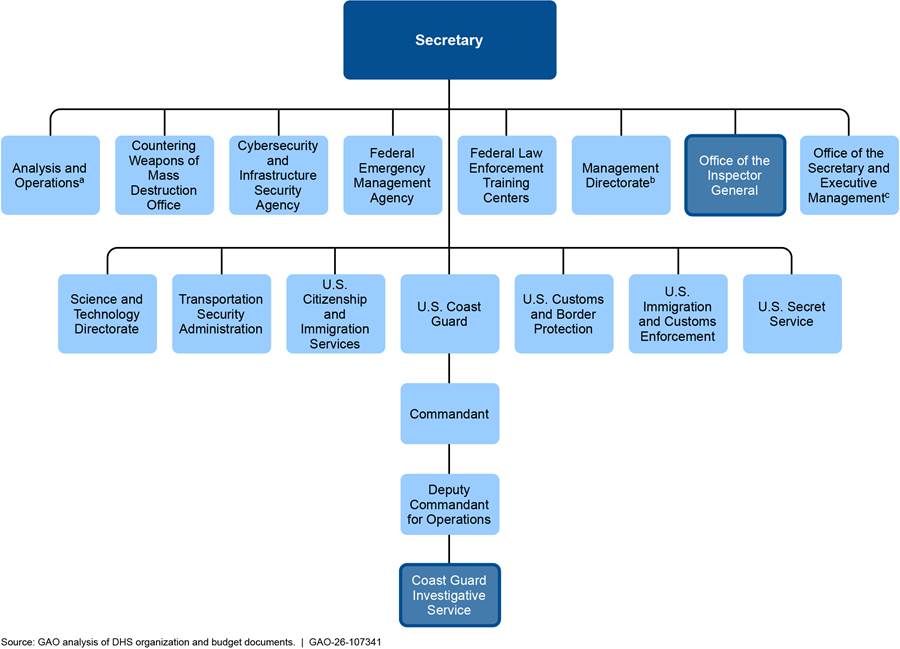
Note: The Coast Guard Investigative Service (CGIS) and the DHS Office of Inspector General have some overlapping authorities to investigate complaints regarding the Coast Guard. CGIS is one example of a component internal investigative office within DHS components—like Offices of Professional Responsibility—with the authority to investigate allegations of internal misconduct.
aAnalysis and Operations includes the Office of Intelligence and Analysis and the Office of Homeland Security Situational Awareness.
bThe Management Directorate includes the Immediate Office of the Under Secretary for Management, the Office of the Chief Human Capital Officer, Office of the Chief Procurement Officer, Office of Program Accountability and Risk Management, Office of the Chief Readiness Support Officer, Office of the Chief Security Officer, Office of the Chief Financial Officer, Office of the Chief Information Officer, Office of Biometric Identity Management, and the Federal Protective Service.
cThe Office of the Secretary and Executive Management includes the Office of the Secretary; Office of Partnership and Engagement; Office of Strategy, Policy, and Plans; Office of Public Affairs; Office of Legislative Affairs; Office of the General Counsel; Office for Civil Rights and Civil Liberties; Privacy Office; Office of the Citizenship and Immigration Services Ombudsman; Office of the Immigration Detention Ombudsman; and the Office of Health Security.
DHS OIG Roles and Responsibilities
DHS OIG conducts and supervises audits, inspections, evaluations, and investigations of DHS programs and operations, including those of the Coast Guard. The OIG may make recommendations to the department and its components for improving the efficiency and effectiveness of those programs and operations.
DHS OIG includes three offices (program offices) whose primary mission is to directly conduct oversight of DHS components, programs, and activities, as shown in table 1. Federal quality standards for OIGs state that each OIG is to conduct its work in compliance with applicable professional standards, also shown in table 1.
Table 1: Department of Homeland Security (DHS) Office of Inspector General (OIG) Program Offices and Professional Standards for OIG Work
|
DHS OIG Program Office |
Type of OIG Work |
Professional Standard |
|
Office of Auditsa |
Plans, conducts, and reports the results of performance audits, attestation engagements, financial audits, grants audits, and evaluations across DHS and its components. |
Audits are to comply with Government Auditing Standards. These standards provide a framework for conducting high-quality projects and contain requirements and guidance dealing with ethics, independence, professional judgement and competence, quality control, conducting the project, and reporting, among others. |
|
Office of Inspections and Evaluations |
Plans, conducts, and reports the results of inspections, evaluations, and reviews that assess the design and implementation of DHS operations, programs, and policies to determine their efficiency, effectiveness, impact, and sustainability. |
Inspections and evaluations are to comply with the Council of the Inspectors General on Integrity and Efficiency’s Quality Standards for Inspection and Evaluationb or other appropriate professional standards.c |
|
Office of Investigations |
Investigates allegations of criminal, civil, and administrative misconduct involving DHS employees, contractors, grantees, and programs. Investigations may result in criminal prosecutions, fines, civil monetary penalties, administrative actions, and personnel actions. |
Investigations are to comply with the Council of the Inspectors General on Integrity and Efficiency’s Quality Standards for Investigations, consistent with applicable Department of Justice guidelines and case law. |
Source: GAO analysis of professional standards and DHS OIG documentation. | GAO‑26‑107341
aThe Office of Audits also conducts work according to the Council of the Inspectors General on Integrity and Efficiency’s Quality Standards for Inspection and Evaluation.
bAccording to the Council of the Inspectors General on Integrity and Efficiency, the inspection and evaluation standards are flexible and not overly prescriptive by design. The standards are meant to be interpreted through the professional judgment of inspectors as they make decisions involved in conducting inspection or evaluation work.
cOfficials from the Council of the Inspectors General on Integrity and Efficiency told us that other appropriate professional standards could include an OIG policy or other internal standard to describe the specific steps under which the work was planned and completed.
In addition to these three program offices, DHS OIG’s Office of Integrity manages the OIG’s quality control and quality assurance program, which evaluates the OIG’s work against internal policies and procedures and external professional standards.[12] Within the Office of Integrity, the Investigations Quality Assurance Division conducts inspections of OIG investigative offices and DHS component internal affairs offices—including CGIS—to assess compliance with agency policies and applicable investigative guidelines. For example, in June 2017, DHS OIG inspected CGIS’s organizational management and investigative work.[13] As a result, DHS OIG made 32 recommendations.[14] In July 2025, DHS OIG initiated an ongoing inspection of CGIS.
In DHS OIG’s work, the Coast Guard could be the primary component under review or be included as one of multiple DHS components under review. For example, the Coast Guard was the primary component under review when DHS OIG evaluated the extent to which the Coast Guard had been interdicting vessels suspected of drug trafficking.[15] The Coast Guard has also been included as one of multiple DHS components for department-wide reviews, such as when DHS OIG evaluated the extent to which DHS complied with National Instant Criminal Background Check System requirements.[16]
CGIS Roles and Responsibilities
CGIS is responsible for conducting criminal investigations into complaints of felony violations of the Uniform Code of Military Justice (e.g., sexual assault and harassment, homicide, desertion, fraud, misappropriation of government property, and illegal activities related to narcotics).[17] It is also responsible for investigating crimes on the high seas and within the Special Maritime and Territorial Jurisdiction of the United States (e.g., migrant and drug smuggling, violations of environmental laws, and terrorism).[18] In addition, Coast Guard commands may request that CGIS assist with administrative investigations (e.g., alleged misconduct that does not rise to the level of a felony violation).[19]
CGIS and DHS OIG Complaint Intake Processes
CGIS and DHS OIG both operate complaint hotlines to facilitate reporting criminal allegations involving Coast Guard personnel, programs, and operations, including allegations of fraud, waste, and abuse. In addition to these web-based and mobile hotlines, CGIS and DHS OIG can receive complaints in other ways, such as in-person and via email. As part of its complaint intake process—as shown in figure 2—CGIS reviews complaints to identify which to refer to DHS OIG.[20]
In May 2023, DHS OIG developed case opening guidelines to review complaints, identify those that align with its investigative priorities (e.g., complaints alleging misconduct related to high-value fraud and criminal corruption), and decide whether to open an investigation. According to DHS OIG officials, if a complaint does not align with the OIG’s investigative priorities, the OIG may refer the complaint externally, including to CGIS, as shown in figure 2. DHS OIG may also forward a complaint internally. For example, DHS OIG may forward a complaint to its Whistleblower Protection Division, which investigates complaints of alleged whistleblower retaliation made by any DHS employee, former employee, contractor, subcontractor, grantee, applicant, or member of the Coast Guard.[21]
Figure 2: Coast Guard Investigative Service (CGIS) and Department of Homeland Security (DHS) Office of Inspector General (OIG) Complaint Intake Process
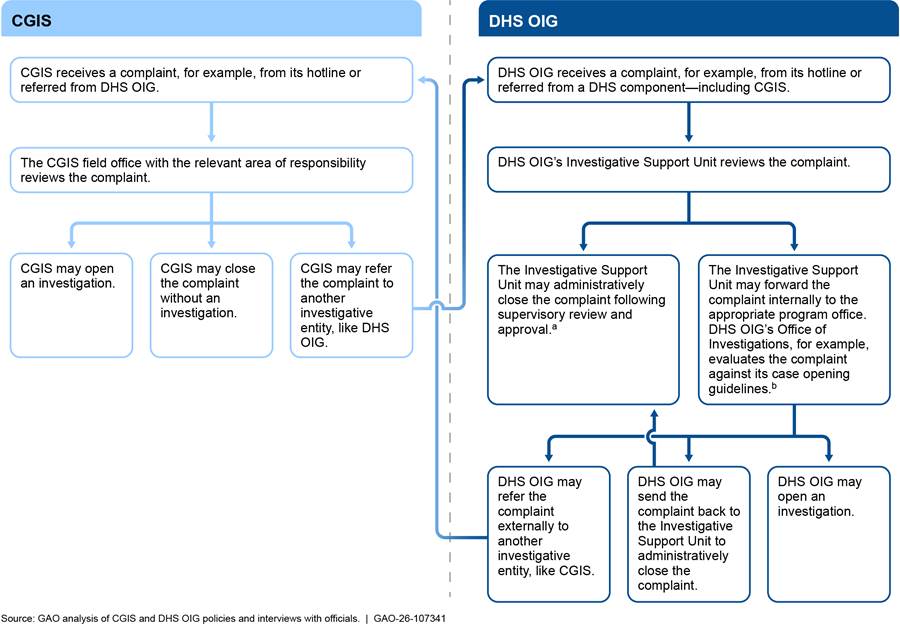
aDHS OIG officials told us that the OIG can administratively close complaints under limited circumstances, including duplicate complaints, when the complaint will be assumed under an existing investigation, and when the information provided is nonsensical.
bDHS OIG implemented case opening guidelines in May 2023 to review complaints, identify complaints that align with the OIG’s investigative priorities, and decide whether to open an investigation.
Leading Collaboration Practices
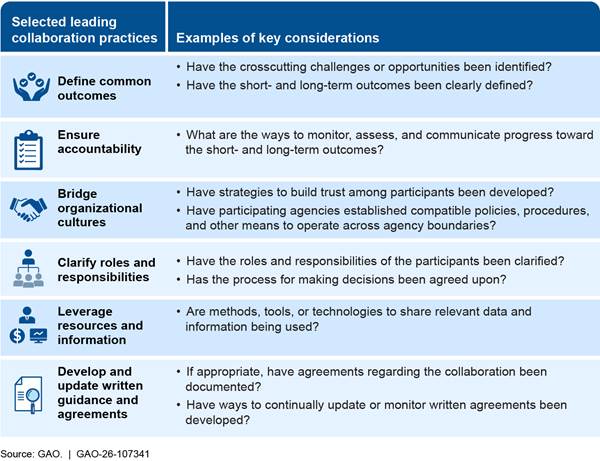
In prior work, we have identified eight leading practices to help agencies collaborate and coordinate their efforts, as well as key considerations for collaborating entities to use when incorporating the leading practices.[22] For this review, we selected six of the eight collaboration leading practices as relevant to CGIS and DHS OIG investigative activities, as shown in figure 3.[23] These leading practices are relevant because CGIS and DHS OIG have overlapping authorities to investigate certain Coast Guard complaints.
DHS OIG Has Taken Steps to More Fully Follow Federal Quality Standards and is Not Meeting Its Timeliness Goals for Coast Guard Oversight
Federal quality standards for OIGs are designed to guide OIGs’ conduct and help ensure timely and effective operations—like Coast Guard oversight activities. DHS OIG generally follows selected elements of one federal quality standard, pertaining to receiving and reviewing complaints. In addition, DHS OIG has taken steps to address management and operational weaknesses that we identified in June 2021 related to federal quality standards for OIGs.[24] However, DHS OIG follows some or does not follow selected elements of the four remaining federal quality standards, related to (1) planning and coordinating, (2) managing human capital, (3) maintaining quality assurance, and (4) communicating results of OIG activities. Figure 4 depicts the extent to which DHS OIG follows the five federal quality standards regarding its Coast Guard oversight activities and reflects examples where the OIG has addressed our June 2021 recommendations.
Figure 4: GAO Assessment of the Extent to Which the Department of Homeland Security (DHS) Office of Inspector General (OIG) Follows Selected Federal Quality Standards for OIGs
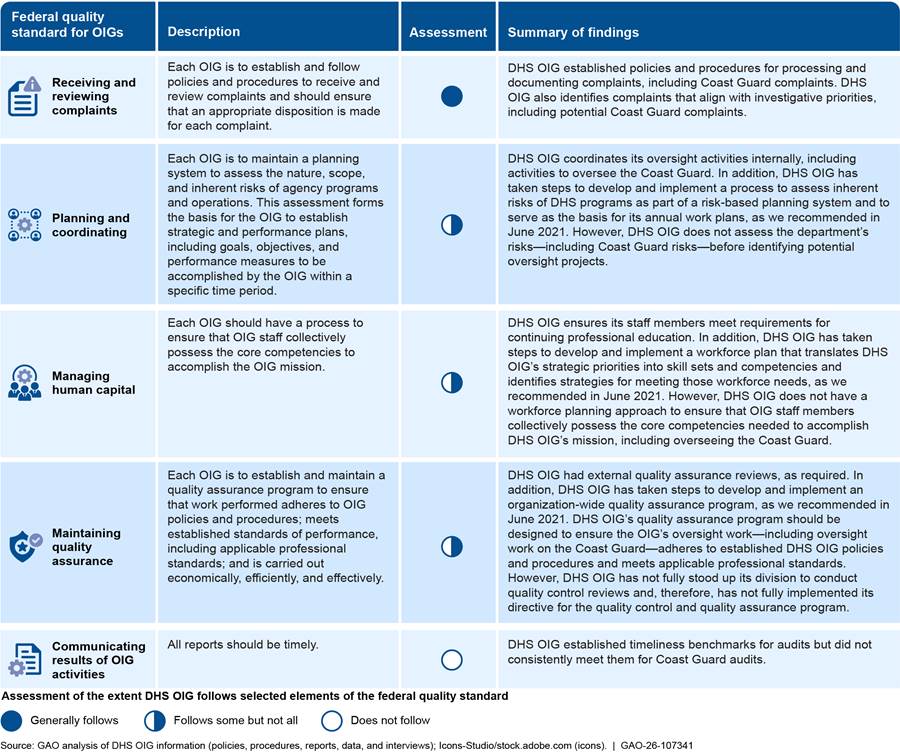
Note: We evaluated DHS OIG’s policies and procedures against these five of nine federal quality standards for OIGs as they are most relevant to effective and timely oversight of Coast Guard activities. In June 2021, we reported that DHS OIG had not followed six federal quality standards for federal OIGs and key practices for effective management. We made 21 recommendations—three of which are included in this figure—to DHS OIG to address management and operational weaknesses. GAO, DHS Office of Inspector General: Actions Needed to Address Long-Standing Management Weaknesses, GAO‑21‑316 (Washington, D.C.: June 3, 2021).
Following is our assessment of the extent to which DHS OIG follows elements of federal quality standards for OIGs. These standards apply to all of the OIG’s oversight work, including its oversight of Coast Guard activities.
DHS OIG Receives and Reviews Complaints to Identify Those that Align with Investigative Priorities
DHS OIG generally follows selected elements of the federal quality standard for receiving and reviewing complaints. Federal quality standards for OIGs state that each OIG shall establish policies and procedures for processing complaints, documenting each complaint, and ensuring that urgent and high-priority matters receive timely attention. In addition, federal quality standards for investigations state that each complaint must be evaluated against guidance for disposition decisions (e.g., whether DHS OIG opened an investigation).
Establish Policies and Procedures. DHS OIG’s special agent handbook includes policies and procedures for processing and documenting complaints, including Coast Guard complaints. We reviewed the handbook and determined that it reflects steps for managing DHS OIG’s complaint hotline and forwarding complaints to the office that covers the relevant areas of responsibility. In addition, DHS OIG documents each complaint in its electronic case management system. The case management system assigns a unique reference number to each complaint. The system enables DHS OIG to track key information, including when the OIG refers a complaint externally—like to CGIS—as well as the OIG’s disposition decisions.
Guidance for Opening Priority Complaints. In addition to the special agent handbook, DHS OIG developed case opening guidelines to review complaints, identify complaints that align with the OIG’s investigative priorities—including potential Coast Guard complaints—and make a disposition decision. DHS OIG officials told us that the case opening guidelines help them to take timely, appropriate action on complaints that align with the OIG’s investigative priorities. According to the case opening guidelines, investigative priorities include complaints alleging misconduct related to major fraud (e.g., contract or grant value over $2 million), criminal corruption, civil rights violations, and national security.
According to DHS OIG officials, they first started using the case opening guidelines in May 2023. DHS OIG had a performance metric for fiscal year 2024 to open 80 percent of all investigations under the case opening guidelines. According to DHS OIG, it met that goal and opened 97 percent of its investigations under the guidelines.
Our analysis of DHS OIG data shows that from October 1, 2023—the beginning of fiscal year 2024, which was the first full fiscal year in which DHS OIG used the case opening guidelines—through May 31, 2024, DHS OIG initiated 251 investigations, as shown in figure 5.[25] Of these 251 investigations, DHS OIG initiated 12 Coast Guard investigations. DHS OIG opened six of these 12 Coast Guard investigations under the case opening guidelines related to financial crimes, including alleged fraud, corruption, and bribery. The remaining six Coast Guard investigations were related to allegations of whistleblower retaliation.[26]
Figure 5: Department of Homeland Security (DHS) Office of Inspector General (OIG) Investigations Initiated by Component, October 1, 2023–May 31, 2024
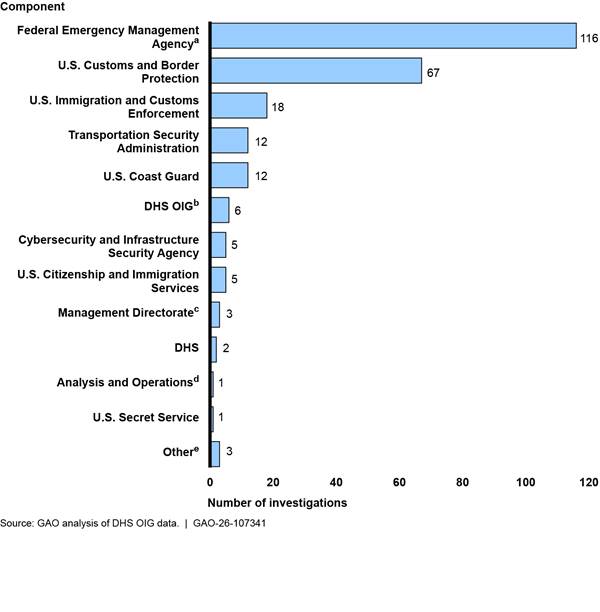
aAccording to DHS OIG officials, the number of investigations they initiated on the Federal Emergency Management Agency were related to that agency’s response to the COVID-19 pandemic, as well as major disaster and emergency declarations.
bDHS OIG’s Special Investigations Division investigates complaints related to alleged misconduct by DHS OIG employees, among other complaints.
cThe Management Directorate includes the Federal Protective Service, the Office of Biometric Identity Management, and the Office of the Chief Financial Officer, among other offices.
dAnalysis and Operations includes the Office of Homeland Security Situational Awareness and the Office of Intelligence and Analysis.
eOther investigations include, for example, investigative activities related to former DHS personnel or DHS OIG investigative support to another agency.
DHS OIG Follows Some Standards for Coordinating Its Work and Implementing a Risk-Based Work Planning Approach
DHS OIG follows some selected elements of the federal quality standard for planning and coordinating its work. Federal quality standards for OIGs state that OIG staff are to coordinate their activities internally to assure effective and efficient use of available resources. Federal quality standards for OIGs also state that each OIG shall maintain a work planning approach that starts with an assessment of the nature, scope, and inherent risks (i.e., weaknesses in areas that involve substantial resources and provide critical services to the public) of programs, operations, and management challenges of the agency for which the OIG provides oversight. This risk assessment is to inform the OIG’s annual work plan that identifies and prioritizes its oversight work.
After assessing risks of agency (e.g., DHS) programs and operations, federal quality standards for OIGs direct OIGs to develop a methodology and process for prioritizing agency programs and operations as potential subjects for audit, inspection, evaluation, and investigation. OIGs are then to use an annual planning process to identify oversight activities. The work plan should include considerations of prior oversight work and the department’s efforts to address recommendations. The work plan should also document the OIG’s determination for how it chose among competing needs. DHS OIG posts its annual work plans on its website.[27]
Risks associated with Coast Guard programs and operations include cybersecurity risks. For example, the U.S. Maritime Transportation System is an essential element of the nation’s critical infrastructure, handling more than $5.4 trillion in goods and services annually.[28] The Coast Guard is responsible for assessing risks to this system, establishing and implementing programs for addressing those risks, and facilitating the exchange of threat information with system owners and operators. In July 2024, DHS OIG reported that the Coast Guard should take additional steps to secure the Maritime Transportation System against cyberattacks, such as completing and publishing cybersecurity-specific regulations.[29] Additionally, information security has been on our High-Risk List since 1997, and we expanded this area to include the protection of critical cyber infrastructure in 2003.[30] We have previously reported that the Coast Guard could take further action to mitigate cybersecurity risks.[31]
Internal Coordination. According to DHS OIG policies and officials, leaders from the OIG’s program offices meet monthly to discuss proposed oversight projects and planned work, including Coast Guard projects. DHS OIG officials told us that they use these monthly engagement planning meetings to deconflict projects and share information related to congressional requests, emerging risks, and hotline complaints. Specifically, officials discuss any indicators of potential systemic issues from hotline complaints—such as allegations of misconduct related to civil rights and civil liberties, serious mismanagement, and dangers to public health and safety. During the monthly engagement planning meetings, program office officials review these complaints and decide whether to pursue further oversight on the potential systemic issues.
Work Planning Approach. In response to our June 2021 recommendation, DHS OIG has taken steps to implement a work planning approach that, consistent with federal quality standards for OIGs, would assess DHS’s programmatic and operational risks—including Coast Guard risks.[32] DHS OIG created an internal dashboard tool, which they demonstrated to us in October 2022, that includes information connected to risk, such as budgetary information and past OIG work. As of January 2025, DHS OIG officials told us that staff were using the information to plan individual project proposals, which are then assigned a risk value using a rubric. The principal deputy inspector general and chief of staff then review project proposals quarterly and determine which ones should move forward to the Inspector General for approval. Our analysis of DHS OIG data shows that a majority (about 59 percent) of the OIG’s oversight projects from fiscal years 2019 through 2024 resulted from this internal process.[33]
DHS OIG rates the risks associated with oversight projects already proposed rather than assessing risks across DHS first to identify potential oversight projects. As a result, DHS OIG’s internal process for proposing projects does not provide DHS OIG leadership and staff with a holistic view of the department’s programs, operations, management challenges, budget trends, and inherent risks (e.g., risk of fraud, waste, and abuse) to identify what types of projects to propose.[34] Thus, while DHS OIG may be selecting the highest risk projects from among available proposals, it does not have assurance that the proposals developed appropriately reflect DHS’s holistic risks. For example, DHS OIG has not assessed whether Coast Guard programs involve more or less risk relative to other programs at DHS. To follow standards for a risk-based work planning approach, as we recommended in June 2021, DHS OIG will need to assess risks across DHS programs and use that information to identify areas for audit, inspection, and evaluation. Conducting such risk assessments, as we recommended in June 2021, would better position DHS OIG to prioritize high-risk projects.
DHS OIG’s work planning approach determines its oversight work, including the extent of its Coast Guard oversight. During fiscal years 2019 through 2024, DHS OIG conducted fewer oversight projects on the Coast Guard compared to some other DHS components, as shown in table 2.[35] Table 2 shows the number of DHS OIG oversight projects per component and the size of each component in terms of full-time equivalent positions and budget, which are elements included in OIG’s dashboard for considering potential risks for project proposals.
Table 2: Department of Homeland Security (DHS) Office of Inspector General (OIG) Oversight Projects by Primary Component, Fiscal Years 2019–2024
|
DHS Primary Component |
Number of DHS OIG Projects |
Fiscal Year 2024 Number of Full-Time Equivalent Positions |
Fiscal Year 2024 Budget (in millions)a |
|
U.S. Customs and Border Protection |
123 |
63,610 |
$24,603 |
|
Federal Emergency Management Agency |
110 |
14,702 |
$48,623b |
|
U.S. Immigration and Customs Enforcement |
86 |
20,917 |
$10,293 |
|
Transportation Security Administration |
26 |
56,193 |
$11,073 |
|
U.S. Coast Guard |
22 |
51,622c |
$13,632 |
|
Cybersecurity and Infrastructure Security Agency |
20 |
3,222 |
$2,895 |
|
U.S. Secret Service |
14 |
8,163 |
$3,413 |
|
U.S. Citizenship and Immigration Services |
13 |
22,100 |
$6,571 |
|
Analysis and Operationsd |
10 |
946 |
$369 |
|
Management Directoratee |
9 |
3,903 |
$4,202 |
|
Office of the Secretary and Executive Managementf |
5 |
948 |
$391 |
|
Science and Technology Directorate |
5 |
544 |
$826 |
|
Federal Law Enforcement Training Centers |
4 |
1,085 |
$548 |
|
Countering Weapons of Mass Destruction Office |
2 |
252 |
$370 |
Source: GAO analysis of DHS OIG data and Office of Management and Budget information. | GAO‑26‑107341
Note: We analyzed DHS OIG’s data on completed and ongoing oversight projects. A project may be an audit, evaluation, or inspection, and may include more than one primary DHS component. An ongoing project is one that the DHS Inspector General approved to initiate but for which DHS OIG has not yet issued a final report. Investigations are not projects and therefore not reflected in the table above. DHS OIG also had 85 projects for which DHS was listed as the primary component, which included: (1) projects on programs and activities for which the department—and not an individual component—is responsible; (2) projects evaluating the extent to which at least one component adhered to department-wide policies; and (3) department-wide projects that include more than one component. For example, the Coast Guard was included in 27 DHS projects. According to DHS OIG officials, factors contributing to the scale of oversight of DHS components from fiscal year 2019 through fiscal year 2024 included the increase in the number of individuals entering the United States between ports of entry, the 2019 cyberattack against the federal government and private sector involving the SolarWinds network management software company, and the Federal Emergency Management Agency’s response during the COVID-19 pandemic.
aBudget data are rounded numbers as of fiscal year 2024. The budget information reflects the total budget authority as reported by the Office of Management and Budget in the 2026 President’s Budget Appendix. See Office of Management and Budget, Technical Supplement to the 2026 Budget, Appendix (Washington, D.C.). Total budget authority does not include all budgetary resources, such as carryover funds from a prior fiscal year. See Office of Management and Budget, Circular No. A-11: Preparation Submission, and Execution of the Budget (Washington, D.C.: July 25, 2024).
bThe Federal Emergency Management Agency’s budget includes about $36 billion from the Disaster Relief Fund—the primary source of federal disaster assistance for tribal, state, and territorial governments, as well individuals and households, when a major disaster is declared.
cCoast Guard full-time equivalent positions include military and civilian personnel.
dThese numbers include the Office of Homeland Security Situational Awareness and the Office of Intelligence and Analysis.
eThese numbers include the Federal Protective Service, the Office of Biometric Identity Management, and the Office of the Chief Financial Officer, among other offices.
fThese numbers include the Office of Strategy, Policy, and Plans and the Privacy Office.
DHS OIG Follows Some Standards for Managing Human Capital and Assessing Collective Competence
DHS OIG follows some selected elements of the federal quality standard for managing human capital. Federal quality standards for OIGs state that OIGs are to ensure that staff meet the requirements for continuing professional education included in the applicable professional standards. These quality standards also state that OIG management is responsible for deciding the methods by which identified needs can be met by using staff members who possess the requisite skills. Further, federal quality standards for OIGs state that each OIG is to assess staff members’ skills and determine the extent to which staff members collectively possess the professional competence (e.g., technical knowledge and experience) to perform assigned work.
Continuing Professional Education. DHS OIG program offices have processes in place to track the extent to which staff are meeting both internal and external requirements for training and continuing professional education, which are designed to ensure that OIG personnel collectively possess the skills and abilities to perform assigned tasks, including Coast Guard oversight. For example, the Office of Audits has a Quality Management and Training Division that is responsible for documenting completed training and conducting semiannual reviews to ensure staff are on target to meet requirements in compliance with government auditing standards.[36] The Office of Inspections and Evaluations has a training coordinator who is responsible for documenting completed training and tracks staff progress toward meeting requirements in compliance with applicable federal professional standards.[37] According to DHS OIG officials, the Office of Investigations has a training unit that is responsible for tracking investigators’ progress toward meeting requirements in compliance with applicable professional standards.[38]
Requisite Skills. DHS OIG officials document aspects of competence for each staff member before assigning them to oversight work, including Coast Guard projects. For example, the Office of Audits certifies whether staff have met continuing professional education requirements, and office management assesses staff members’ education and experience. The Office of Inspections and Evaluations also certifies whether staff have met continuing professional education requirements.
OIG program offices also identify whether internal staff may have specialized skills necessary for oversight work. For example, the Office of Audits may collaborate with the Office of Innovation’s Cybersecurity Risk Assessment Division to provide information technology security expertise and testing services to support DHS OIG audits.[39]
Collective Competence. In response to our June 2021 recommendation, DHS OIG has taken steps to implement a workforce plan that, consistent with federal quality standards for OIGs, ensures staff members collectively possess needed skills.[40] After issuing its strategic plan for fiscal years 2022 through 2026, DHS OIG contracted with an external organization that provided the OIG with support and guidance in the development of a workforce plan. As of January 2025, DHS OIG surveyed its Senior Executive Service personnel and identified two areas for additional development—communication and leadership. DHS OIG officials told us that they plan to identify relevant training to support that development.
However, DHS OIG does not have a workforce planning approach to systematically define current and future workforce needs. In August 2025, DHS OIG officials told us that they were in the process of developing a workforce planning process and associated workforce plan. To follow standards for assessing collective competence, as we recommended in June 2021, DHS OIG will need to (1) identify the skills needed to achieve its goals, (2) assess the extent to which DHS OIG staff possess those identified skills, and (3) identify strategies for meeting those workforce needs. A holistic assessment of the skills of its workforce could help DHS OIG understand any gaps between the skills its staff has and those the OIG requires to successfully complete its work, including Coast Guard oversight.
DHS OIG Follows Some Standards for Implementing a Quality Assurance Program
DHS OIG follows some selected elements of the federal quality standard for maintaining quality assurance. Federal quality standards for OIGs state that OIGs shall participate in external quality assurance review programs. According to these quality standards, external quality assurance reviews provide OIGs with added assurance regarding their adherence to prescribed standards, regulations, and legislation through an assessment of OIG operations, like Coast Guard oversight. These standards also state that OIGs shall establish and maintain a quality assurance program to ensure that work performed meets established standards of performance, including applicable professional standards.
External Quality Reviews. Independent organizations not affiliated with DHS OIG conducted four external quality assurance reviews—known as peer reviews—of DHS OIG activities from November 23, 2020, through March 14, 2024. DHS OIG received a pass rating for the two peer reviews of its audit activities.[41] According to the two peer reviews of DHS OIG’s inspection and evaluation activities, DHS OIG’s internal policies and procedures, as well as selected reports, generally met applicable federal professional standards.[42]
Quality Assurance. In response to our June 2021 recommendation, DHS OIG issued a directive in September 2023 establishing the OIG’s quality control and quality assurance program. This is an important step toward establishing and maintaining a quality assurance program that, consistent with federal quality standards for OIGs, ensures that work performed—like Coast Guard oversight—adheres to OIG policies and procedures and meets applicable professional standards.[43]
DHS OIG has taken some actions in line with the new quality assurance program directive. For example, in January 2025, the Office of Integrity issued a report for fiscal years 2023 and 2024 summarizing completed and ongoing quality control and quality assurance program activities. According to the report, the Office of Integrity reviewed the extent to which the Office of Audits and the Office of Inspections and Evaluations followed up on their recommendations to DHS and its components in a timely manner, among other quality-related activities.[44]
However, the Office of Integrity has not fully implemented its quality control and quality assurance program directive. For example, according to the directive, the Office of Integrity is to establish a Quality Control Review Division that, among other things, will conduct random quality control reviews of ongoing audit, inspection, and evaluation projects to ensure sufficiency of evidence and internal controls were followed.
According to its 2025 report summarizing completed and planned quality control and quality assurance program activities for fiscal years 2023 and 2024, the Office of Integrity is planning to complete standing up this Quality Control Review Division. In August 2025, DHS OIG officials told us that the time frame for completion is unknown and dependent on available resources. To follow standards for implementing a quality assurance program, as we recommended in June 2021, the Office of Integrity will need to fully implement its quality assurance and quality control directive. Fully standing up and maintaining its quality assurance program would help DHS OIG ensure its audit, inspection, evaluation, and investigation work on the Coast Guard is reliable.
DHS OIG Implemented Timeliness Benchmarks for Audits but Does Not Follow the Standard for Timely Reports
DHS OIG does not follow a selected element of the federal quality standard for communicating results of OIG activities. Federal quality standards for OIGs state that all OIG reports should be timely. Manuals for DHS OIG’s Office of Audits and Office of Inspections and Evaluations also state that reporting should be timely.
In August 2021, in response to one of our June 2021 recommendations, DHS OIG established new timeliness benchmarks for audits.[45] For example, DHS OIG established the benchmark to complete audits within 397 days (from initiation to product issuance). However, DHS OIG did not consistently meet its benchmark, based on our analysis of DHS OIG’s data on completed oversight projects from August 2021 through September 2024 (end of fiscal year 2024).[46]
Our analysis of DHS OIG data shows that the OIG did not meet its 397-day benchmark for any of the four audits for which the Coast Guard was the primary component under review from August 1, 2021, (when DHS OIG established the benchmark) through September 30, 2024, (end of fiscal year 2024), as shown in figure 6.[47] DHS OIG also did not meet its 397-day benchmark for half of the audits (four of eight audits) for which the Coast Guard was included but was not the primary DHS component under review. Further, DHS OIG did not meet this benchmark for about two-thirds of audits (26 out of 38 audits) that did not include the Coast Guard. Figure 6 also shows the range and median number of days in which DHS OIG completed these audits.
Figure 6: Department of Homeland Security (DHS) Office of Inspector General (OIG) Time Frames for Completing Audits by Level of Coast Guard Inclusion, August 2021 – September 2024
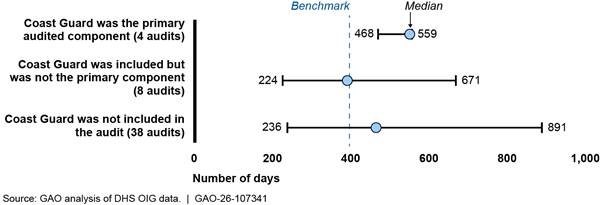
Note: We analyzed DHS OIG’s data on completed audits from August 2021 through September 2024 (end of fiscal year 2024). In August 2021, DHS OIG established a timeliness benchmark to complete audits within 397 days.
DHS OIG also established timeliness benchmarks for interim steps within the audit process, including for reviews of draft and final reports.
· Our analysis of DHS OIG data shows that the OIG did not consistently meet its benchmark to review draft reports within 23 days. Specifically, DHS OIG did not meet its draft report review benchmark for three out of four of its Coast Guard-focused audits and half of the audits (four of eight audits) that included the Coast Guard. DHS OIG also did not meet its draft review benchmark for a majority (20 of 33 audits) of the audits that did not include the Coast Guard.
· Our analysis of the DHS OIG data shows that the OIG generally met its timeliness benchmark to review final reports within 19 days. Specifically, DHS OIG met its final report review benchmark for all four Coast Guard-focused audits and for six of eight other audits that included the Coast Guard. DHS OIG also met its final review benchmark for most of the audits (25 of 30 audits) that did not include the Coast Guard.
In its own reported January 2024 assessment of timeliness benchmarks, DHS OIG found that, on average, it did not meet its benchmarks for planning and fieldwork for all audits that initiated on or after October 1, 2021, (i.e., those audits that initiated in fiscal years 2022 through 2023, the first two full fiscal years since DHS OIG had implemented the benchmarks). In this assessment, DHS OIG attributed not meeting its timeliness benchmarks to two external factors, specifically (1) delays in receiving components’ comments and (2) delays in obtaining DHS components’ data. In June 2025, DHS OIG officials cited these same factors as the reasons for not meeting timeliness benchmarks.
DHS Components’ Comments. Although DHS generally missed the deadline for providing agency comments to DHS OIG within 30 days, our analysis of DHS OIG data found that the delays were minimal in relation to overall audit time frames.[48] Of the 34 audits for which DHS OIG did not meet its overall timeliness benchmark, the median number of days by which the OIG missed the benchmark was 139 days. DHS OIG’s data also show that if DHS components had met the deadline to provide comments for these 34 audits, DHS OIG would have met the overall timeliness benchmark for two of those audits. It would not have met the overall benchmark for the remaining 32 audits.
· DHS and the Coast Guard did not meet the deadline to provide comments for all four audits for which it was the primary component under review, missing the deadline by a range of two to six days. However, DHS OIG did not meet its overall timeliness benchmark for completing these Coast Guard audits by a range of 71 days to 162 days.
· DHS and its components did not meet the deadline to provide comments for five of eight audits that included the Coast Guard. Of these five audits, DHS and its components missed the deadline by a range of three to 25 days. DHS OIG met its overall timeliness benchmark for two of these five audits but did not meet its overall benchmark for completing the other three audits by a range of 43 to 274 days.
· DHS and its components did not meet the deadline to provide comments for most audits (30 of 38 audits) that did not include the Coast Guard. Of these 30 audits, DHS and its components missed the deadline by a range of one to 39 days. DHS OIG met its overall timeliness benchmark for eight of these 30 audits but did not meet its overall benchmark for completing the other 22 audits by a range of three to 494 days.
DHS Components’ Data. According to DHS OIG officials, the Inspector General Act of 1978, as amended, authorizes DHS OIG to have direct access to DHS data systems. However, they have faced challenges in obtaining direct access to components’ data systems. Specifically, DHS OIG officials told us that some DHS components will immediately deny their request for direct access, while other components may take 90 days or longer to deny their request. The officials said that if a DHS component denies the OIG’s request for direct access, then DHS OIG will request data extracts so that its audit, inspection, or evaluation team may continue their oversight work. OIG officials also told us that when they previously made concurrent requests for direct access to a system and for data extracts from that system, DHS provided the data extracts but denied the requests for direct access.
In its semiannual report to Congress covering April 2024 through September 2024, DHS OIG reported that its requests for direct, “read-only” access to databases and data extracts were both denied and delayed.[49] For example, according to this report, the Coast Guard denied DHS OIG direct access to two data systems due to sensitivity concerns and then subsequently provided the OIG with data extracts.[50] DHS OIG reported that it received the data extracts 88 calendar days after it first requested direct access to the Coast Guard’s systems.
DHS OIG officials told us that they address DHS data access challenges by (1) meeting regularly with department and component data personnel to discuss access challenges and try to negotiate access to data systems, (2) notifying the Secretary of Homeland Security, and (3) reporting on the challenges in the OIG’s semiannual reports to Congress. As part of the Secretary of Homeland Security’s transmittal of the semiannual report covering April 2024 through September 2024, the Secretary stated that in response to the OIG’s requests for direct access to data systems, the department and its components may seek information on the relevance of the data to the scope and objectives of the OIG’s oversight work. The Secretary also noted the department’s responsibility for safeguarding sensitive information and preventing improper disclosure. DHS OIG officials similarly told us two reasons the department and its components provide for denying the OIG’s request for direct access are that the data systems may include (1) data that are not relevant to the scope of the OIG’s oversight project and (2) sensitive data—raising concerns about privacy and security. DHS OIG officials told us that they routinely explain to DHS officials how the OIG protects sensitive information.
DHS OIG officials told us that although they track requests for direct access to data systems and requests for data extracts—including any denials and delays to such requests—they have not assessed the extent to which these data access challenges have affected meeting the OIG’s timeliness benchmarks. By assessing the extent to which data access challenges affect oversight project time frames, DHS OIG could use the results of that assessment to identify an approach to address those challenges.
In its annual performance report for fiscal year 2024, DHS OIG reported that it met its performance target to issue 50 percent of all audits, inspections, and evaluations within established time frames. According to its strategic implementation plan for fiscal years 2023 through 2026, DHS OIG has a performance target to increase this target over time. Its strategic implementation plan sets a goal of issuing 57 percent of all audits, inspections, and evaluations within established time frames by fiscal year 2026. Identifying an approach for addressing denials and delays to requests for direct access to data systems and requests for data extracts could better position the OIG to complete oversight projects in a timely manner.
CGIS and DHS OIG Investigate Coast Guard Complaints but Do Not Collaborate Effectively
CGIS and DHS OIG have overlapping authorities to investigate certain Coast Guard complaints, such as those involving criminal conduct within the Coast Guard. CGIS primarily conducts criminal investigations of the Coast Guard, including alleged violations of the Uniform Code of Military Justice.[51] DHS OIG investigates misconduct involving the Coast Guard, including criminal allegations of fraud, waste, abuse, and mismanagement.[52] From October 2018 through May 2024, CGIS received and investigated more Coast Guard complaints than DHS OIG. CGIS and DHS OIG identified the need to prevent duplicative investigations, but the two agencies have not fully followed five out of six selected leading practices for collaboration.[53] For example, the agencies have not established clear roles and responsibilities for CGIS to refer Coast Guard complaints to DHS OIG, and they have not updated their written agreement for complaint referrals in over 20 years.
CGIS and DHS OIG Received and Investigated Coast Guard Complaints
CGIS and DHS OIG Received Coast Guard Complaints
CGIS received more Coast Guard complaints than DHS OIG from October 2018 through May 2024, as shown in figure 7.[54] Specifically, based on its data, CGIS received 10,607 complaints. In contrast, DHS OIG received 1,306 Coast Guard complaints, which was less than 1 percent of the total number of complaints (163,265 complaints) it received across all DHS components during that time.
Figure 7: Coast Guard Complaints Received by the Coast Guard Investigative Service (CGIS) and the Department of Homeland Security (DHS) Office of Inspector General (OIG), October 2018 – May 2024
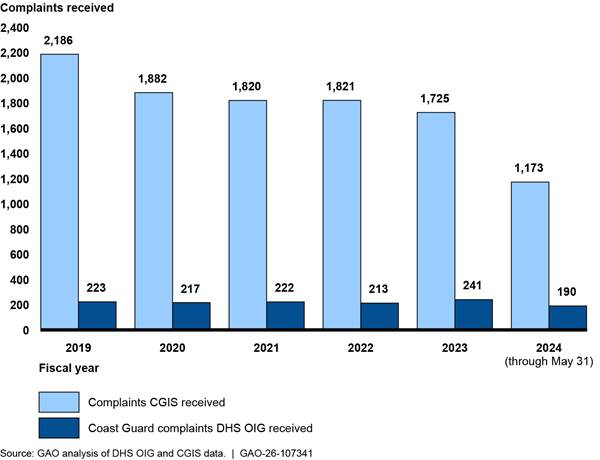
Note: The Coast Guard is one of 14 DHS components for which DHS OIG receives complaints. A complaint includes at least one allegation of criminal, civil, or administrative misconduct involving Coast Guard employees, contractors, grantees, or programs.
CGIS and DHS OIG process complaints differently in their case management systems. In CGIS’s case management system, complaints remain open while CGIS is either reviewing or investigating the complaint, according to CGIS officials. Therefore, an open complaint could indicate an ongoing investigation. In contrast, DHS OIG closes a complaint in its case management system when administratively closing the complaint, referring it to another investigative entity, or opening an investigation on that complaint.
CGIS and DHS OIG have closed most of the complaints they received from October 2018 through May 2024.
· According to its data, CGIS closed about 93 percent (9,854 complaints) of the 10,607 complaints it received from October 2018 through May 2024. Of the 753 complaints that remained open, CGIS received a majority of them (404 complaints) more recently (since October 1, 2023).[55] Because of the way CGIS tracks complaints in its case management system, a closed complaint indicates all work to address the complaint has been completed but does not indicate whether an investigation occurred.
· According to its data, DHS OIG closed almost all (1,302 of 1,306) of the Coast Guard complaints it received from October 2018 through May 2024.[56] DHS OIG officials told us because of the way DHS OIG tracks complaints and investigations in its case management system, some of these closed complaints have been opened for investigation. Therefore, a closed complaint does not indicate that the complaint has been fully addressed.
CGIS and DHS OIG Investigated Coast Guard Complaints
Based on its data, CGIS investigated at least 4,951 Coast Guard complaints from October 2018 through May 2024. After CGIS completes an investigation, if it substantiated the alleged criminal offense, CGIS can refer such complaints for additional action, such as discipline (e.g., written or verbal reprimand, suspension, or discharge) or legal adjudication. Therefore, referring a complaint for additional action indicates that CGIS investigated that complaint.[57] Of the 9,854 complaints that CGIS received and closed, CGIS referred about half (4,951 complaints) for additional action to responsible entities. Specifically, CGIS referred 1,545 complaints of alleged crimes under the Uniform Code of Military Justice to the appropriate convening authority.[58] CGIS also referred 3,406 complaints to the relevant U.S. Attorney’s Office.[59]
Comparatively, DHS OIG data show that it opened investigations for 70 Coast Guard complaints from October 2018 through May 2024, about half of which (32 investigations) remained open as of May 31, 2024.[60] Of the 32 investigations that remained open, almost half (14 investigations) were opened more recently (since October 1, 2023).
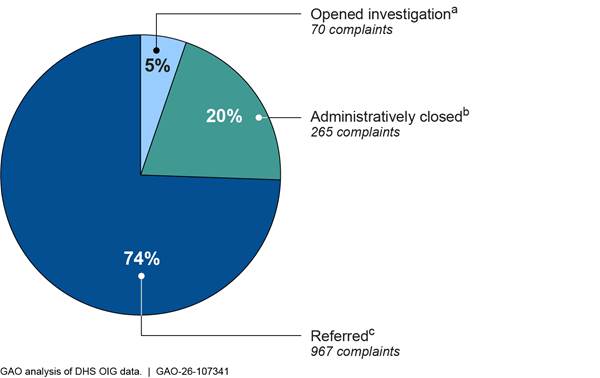
Unlike CGIS, DHS OIG’s case management system tracks the disposition decisions for each complaint (i.e., referred to other investigative entities, administratively closed, or opened for investigation). Based on its data, DHS OIG referred about 74 percent (967 out of 1,302) of the closed Coast Guard complaints to other investigative entities, as shown in figure 8. Of the 967 Coast Guard complaints that DHS OIG referred to other investigative entities, the OIG referred at least 97 percent (940 complaints) to the Coast Guard, including to CGIS.[61] DHS OIG officials told us that the data do not distinguish between referring complaints to Coast Guard leadership and referring complaints to CGIS. As a result, we could not analyze the number of Coast Guard complaints that DHS OIG referred only to CGIS.
Figure 8: Closed Coast Guard Complaints by Department of Homeland Security (DHS) Office of Inspector General (OIG) Disposition Decision, October 2018 – May 2024
aDHS OIG implemented case opening guidelines in May 2023 to review complaints, identify complaints that align with the OIG’s investigative priorities, and decide whether to open an investigation.
bDHS OIG officials told us that the OIG can administratively close complaints under limited circumstances, including duplicate complaints, when the complaint will be assumed under an existing investigation, when the information provided is nonsensical, or when the Office of Investigations refers a complaint to another program office within DHS OIG (e.g., Office of Audits) for a different type of oversight (e.g., audit rather than investigation).
cDHS OIG may refer some complaints to DHS components’ internal investigative offices, including the Coast Guard Investigative Service.
CGIS and DHS OIG Investigated Coast Guard Complaints Related to Alleged Criminal Offenses
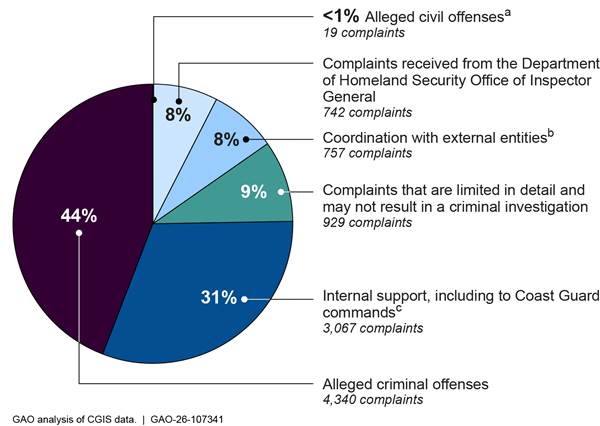
Our analysis of CGIS data shows that of the complaints that CGIS received from October 2018 through May 2024 and subsequently closed (as of July 1, 2024), at least 44 percent (4,340 of 9,854 complaints) involved alleged criminal offenses. Examples of criminal offenses CGIS investigated included offenses related to controlled substances, assault, and special victims (e.g., children and victims of human trafficking). Other types of complaints include CGIS’s support to Coast Guard’s Counterintelligence Service (e.g., identifying and addressing the operations of foreign intelligence entities and of non-state actors attempting to attain information about Coast Guard operations) or alleged cybersecurity incidents. These other types of complaints could also involve alleged criminal offenses because the relevant CGIS data field that indicates complaint type, including whether the complaint involved an alleged criminal offense, has other options that could also involve alleged criminal offenses. For example, the data field records whether a complaint was received from DHS OIG, and such complaints may involve an alleged criminal or civil offense. Figure 9 shows the distribution of complaint types as reflected in this data field, including CGIS support to Coast Guard commands and alleged suspicious activity.
Figure 9: Coast Guard Investigative Service (CGIS) Closed Complaints by Type, Received October 2018 – May 2024
Note: Of the 10,607 complaints that CGIS received from October 1, 2018, through May 1, 2024, CGIS closed 9,854 of them by July 1, 2024—the status at the time of our request. Closed complaints include those that CGIS received and closed without an investigation, as well as those closed after an investigation.
aThis complaint type includes investigative activities related to the enforcement of regulatory compliance and to the gathering of evidence in support of a lawsuit.
bThis complaint type includes CGIS coordination (e.g., sharing law enforcement information) with external entities, including other federal, state, local, tribal, military, and foreign law enforcement and criminal investigative agencies.
cThis complaint type includes (1) CGIS support to Coast Guard commands (e.g., conducting interviews in support of administrative investigations); (2) CGIS support to Coast Guard’s Counterintelligence Service (e.g., identifying and addressing the operations of foreign intelligence entities and of non-state actors attempting to attain information about Coast Guard operations); and (3) alleged cybersecurity incidents.
Fiscal year 2021 is the first full fiscal year in which DHS OIG began consistently tracking the nature of the offense in its investigative data. Our analysis of DHS OIG data shows that DHS OIG investigated 45 Coast Guard complaints (containing 65 alleged offenses) from October 1, 2020 (beginning of fiscal year 2021) through May 31, 2024. Of these 45 Coast Guard complaints, 24 complaints were related to alleged whistleblower retaliation. In addition, about half of offenses associated with the 45 Coast Guard complaints that DHS OIG investigated were related to alleged criminal offenses.[62]
· Of the 65 offenses under investigation for the 45 Coast Guard complaints, 36 offenses (about 55 percent) were alleged criminal offenses.
· About half of those 36 criminal offenses were related to fraud (17 offenses), and the other half were related to criminal offenses that DHS OIG officials told us are less common, such as aiding and abetting or conspiracy to commit an offense. The remaining 29 non-criminal offenses included non-criminal sexual harassment, obstruction of process, and personnel actions.[63]
CGIS and DHS OIG Have Not Fully Followed Five of Six Selected Leading Practices for Collaboration
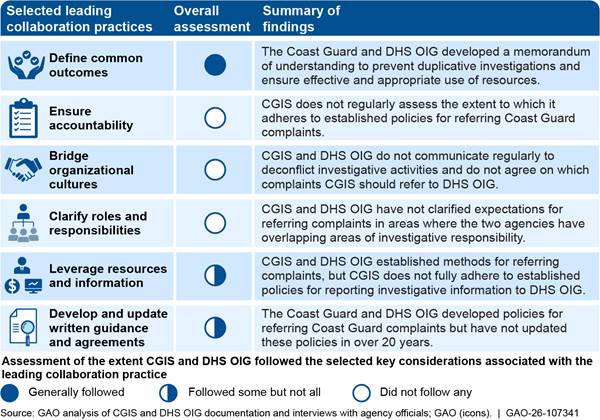
Our leading practices for interagency collaboration and key considerations for implementing the practices can provide valuable insight and guidance to improve collaboration between agencies.[64] CGIS and DHS OIG generally followed the leading practice for defining common outcomes, but they partially followed or did not follow the other five selected leading practices, as shown in figure 10.[65] CGIS and DHS OIG both have authority to investigate alleged criminal misconduct within the Coast Guard. Our prior work has emphasized the importance of following leading practices for collaboration to address areas of potential fragmentation, overlap, and duplication.[66]
Figure 10: Extent to Which the Coast Guard Investigative Service (CGIS) and the Department of Homeland Security (DHS) Office of Inspector General (OIG) Have Followed Selected Leading Practices for Collaboration
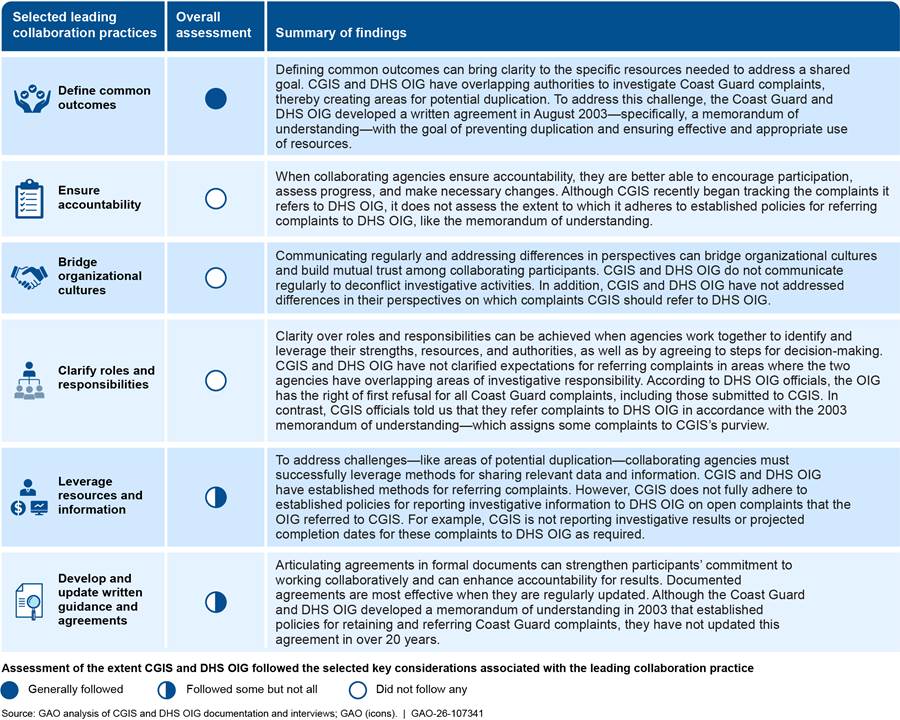
Define Common Outcomes. CGIS and DHS OIG generally followed this leading practice by identifying common outcomes for receiving, retaining, and referring Coast Guard complaints. According to our leading practices for collaboration, defining common outcomes can bring clarity to the specific resources needed to address a shared goal. In August 2003, the Coast Guard and DHS OIG signed a memorandum of understanding (MOU) that outlines their respective roles and responsibilities for referring Coast Guard complaints to one another. CGIS implements the 2003 MOU for the Coast Guard. According to the 2003 MOU, the purpose of the agreement is to help the Coast Guard and DHS OIG achieve common outcomes for preventing duplicative Coast Guard investigations and ensuring the most effective and appropriate use of Coast Guard and DHS OIG resources when addressing Coast Guard complaints. As discussed later, however, the 2003 MOU has not been updated.
Ensure Accountability. CGIS did not follow the leading practice for ensuring accountability and assessing progress toward common outcomes. According to our leading practices for collaboration, when collaborating entities ensure accountability, they are better able to encourage participation, assess progress, and make necessary changes. We have reported that having a way to track and monitor progress towards outcomes, like preventing duplicative investigations, is a key consideration in assessing a collaborative mechanism.[67] We have also reported that, if agencies do not use performance information and other types of evidence to assess progress toward outcomes, they may be at risk of failing to achieve their outcomes.[68]
Prior to July 2025, CGIS had not implemented policies and procedures for tracking the complaints it refers to DHS OIG and thus was not doing so consistently. In October 2024, CGIS notified its staff that they were required to begin tracking all complaints referred to DHS OIG in CGIS’s case management system, among other requirements. In July 2025, CGIS implemented standard operating procedures that institutionalized, in policy, a requirement to track referrals to DHS OIG.[69]
Although CGIS recently began tracking referrals to DHS OIG, CGIS does not assess the extent to which it adheres to the 2003 MOU for referring complaints to DHS OIG. According to the July 2025 standard operating procedures, CGIS supervisors (e.g., Assistant Directors and Special Agents in Charge) are to ensure that CGIS staff are aware of the 2003 MOU’s requirements for referring complaints to DHS OIG and ensure compliance with those requirements. However, the standard operating procedures do not include requirements for CGIS to assess whether its staff are consistently, appropriately, and completely doing so. In addition, CGIS officials told us that they do not regularly conduct such an assessment.
DHS OIG officials expressed concern that, based on the number of complaints they receive from CGIS, they believe CGIS is not referring all the complaints that DHS OIG would expect to receive from CGIS. These officials noted that not receiving complaints limits their visibility into serious allegations, which—according to DHS OIG officials—is central to the OIG’s independence as an oversight body.
By developing and implementing a process to regularly assess the extent to which CGIS is adhering to established policies for referring complaints to DHS OIG—like the 2003 MOU—CGIS and DHS OIG would be better positioned to achieve their common outcomes for preventing duplicative investigations and using resources effectively and appropriately. By identifying corrective action, as needed, based on the results of such assessments, CGIS would be better positioned to ensure compliance with referral requirements.
Bridge Organizational Cultures. CGIS and DHS OIG did not follow the leading practice for bridging organizational cultures. According to our leading practices for collaboration, building trust among collaborating agencies that are not co-located—like CGIS and DHS OIG—requires more frequent communication. We have also reported that addressing differences in perspectives can create the mutual trust among collaborating participants that is critical to enhance and sustain the collaborative effort.[70] As participants engage in trust-building activities—like communicating regularly and addressing differences in perspective—they often become better equipped to effectively work together, identify new opportunities, and find innovative solutions to shared problems. Further, according to Standards for Internal Control in the Federal Government, management should communicate with, and obtain relevant and quality information from, appropriate external parties to achieve objectives.[71]
In addition, DHS issued a management directive in January 2025 that established requirements for DHS components to collaborate with DHS OIG on complaint referrals. DHS also issued an instruction that corresponds with the 2025 management directive. This instruction directs DHS OIG and DHS components’ internal investigative offices, like CGIS, to hold quarterly meetings to ensure continued collaboration on complaint referrals and operational deconfliction.[72] Such regular meetings would support the leading practice to bridge organizational cultures and align with internal control standards for communication.
In April 2025, CGIS and DHS OIG officials told us they do not have regularly scheduled meetings to collaborate on complaint referrals or deconflict investigative activities. CGIS officials told us that their communication with DHS OIG is limited to the OIG’s decisions on whether to open investigations on complaints that CGIS has referred to it. As a result, the two agencies do not communicate about Coast Guard investigative activities until CGIS refers a complaint to DHS OIG. DHS OIG officials told us that they prefer to deconflict investigative activities by reviewing all the complaints that CGIS receives and deciding whether to open investigations or refer them back to CGIS.
However, CGIS and DHS OIG do not agree on which complaints CGIS should refer to DHS OIG. In June 2025, DHS OIG officials told us that they interpret the Inspector General Act of 1978, as amended, as giving DHS OIG the right of first refusal on all DHS complaints—that is, the right to initially review all complaints, including those submitted to CGIS.[73] DHS OIG officials also told us that they currently do not follow the 2003 MOU because it does not give them the right of first refusal. In contrast, CGIS officials told us that they follow the 2003 MOU and thus do not refer all complaints to DHS OIG. CGIS and DHS OIG have not addressed these differences in their perspectives on which complaints CGIS should refer to DHS OIG.
Given these differences in perspectives, establishing regular communication, in accordance with leading practices, could provide an opportunity for deconfliction and coordination on complaint referrals. Regular communication could also better position CGIS and DHS OIG to understand and resolve differences in perspective, prevent duplicative investigations in areas where their responsibilities overlap, and collaborate effectively. By establishing regular communication for deconflicting investigative activities, CGIS and DHS OIG would be able to stay informed of one another’s efforts to investigate the Coast Guard, allocate resources appropriately, and build mutual trust.
Clarify Roles and Responsibilities. CGIS and DHS OIG did not follow the leading practice for having clear roles and responsibilities for referring Coast Guard complaints. According to our leading practices for collaboration, clarifying roles and responsibilities between agencies can be achieved when agencies work together to identify and leverage their strengths, resources, and authorities, as well as agreeing to steps for decision-making.
As we previously mentioned, CGIS and DHS OIG do not agree on which Coast Guard complaints, if any, CGIS may retain without first referring the complaint to DHS OIG. DHS OIG’s position is that CGIS should refer every complaint it receives to the OIG, but CGIS officials told us that they refer complaints to DHS OIG in accordance with the 2003 MOU.[74]
However, we identified sections of the 2003 MOU about referring complaints that were unclear, and CGIS officials also told us they believe these sections are unclear:
· One section of the 2003 MOU specifies that CGIS should refer (1) complaints of wrongful conduct in areas of OIG investigative responsibilities and (2) all complaints of fraud, waste, mismanagement, or abuse. DHS OIG officials also told us that the 2003 MOU does not clearly describe the OIG’s investigative authority. It states that DHS OIG is responsible for criminal, civil, and administrative investigations relating to DHS programs and operations as specified in the Inspector General Act of 1978, as amended.[75] This section of the 2003 MOU also lists examples—such as bribery or corruption of government employees or officials—that would generally fall within the type of activity that CGIS should refer to DHS OIG, but it states that this list is not intended to be exhaustive. Therefore, while the examples provide guidance on some types of complaints CGIS should refer, it does not provide a comprehensive list.
· Another section of the 2003 MOU says that DHS OIG shall lead investigations involving allegations of (1) fraud, waste, or abuse committed by Coast Guard civilian employees, members of the Coast Guard Auxiliary, or non-affiliated civilians and (2) alleged criminal misconduct of senior civilian employees (General Schedule grade 15 or comparable), members of the Senior Executive Service, political appointees, and military personnel above the rank of Captain.[76] That same section notes that CGIS may investigate any suspected incident of fraud, waste, or abuse involving military personnel, provided that only military personnel are involved in such crimes and any victims are subject to the Uniform Code of Military Justice. Therefore, it is not always clear when CGIS should refer complaints involving senior military personnel to DHS OIG.
CGIS officials explained that the 2003 MOU’s provisions regarding alleged criminal misconduct by Coast Guard senior officials could be interpreted in different ways. For example:
· According to CGIS officials, any violation of the Uniform Code of Military Justice could be considered criminal misconduct. Thus, one possible interpretation of the 2003 MOU is that CGIS is to refer any alleged violation of the Uniform Code of Military Justice by a senior official to DHS OIG.
· However, the 2003 MOU also places complaints related to the Uniform Code of Military Justice under CGIS’s purview. Another possible interpretation, then, is that CGIS may retain complaints alleging violations of the Uniform Code of Military Justice by a senior official.
Figure 11 shows the areas of responsibility for CGIS and DHS OIG, as well as the two areas of overlap, according to the 2003 MOU.
Figure 11: Examples of Coast Guard and Department of Homeland Security (DHS) Office of Inspector General (OIG) Areas of Investigative Responsibility According to a 2003 Memorandum of Understanding
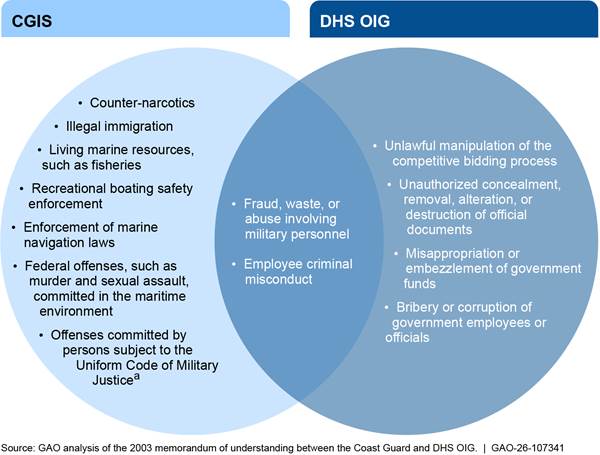
Note: In August 2003, the Coast Guard and DHS OIG signed a memorandum of understanding that delineates their respective roles and responsibilities for referring Coast Guard complaints. The areas of investigative responsibility are examples included in the 2003 memorandum of understanding and not an exhaustive or complete list. The Coast Guard Investigative Service (CGIS) implements the 2003 memorandum of understanding for the Coast Guard.
aThe Uniform Code of Military Justice, first enacted in 1950, provides the framework of the military justice system, establishes the complete code of military criminal law, and provides the legal framework for conducting investigations and prosecutions of complaints of misconduct by service members. 10 U.S.C. §§ 801-946a.
Additionally, DHS OIG’s current position on Coast Guard complaint referrals differs from its position in its June 2017 inspection report on CGIS investigative activities.[77] Among other recommendations, DHS OIG recommended that CGIS comply with the 2003 MOU’s policies for referring Coast Guard complaints to the OIG. Specifically, DHS OIG recommended in that report that the CGIS Director articulate in policy what constitutes a DHS OIG-referrable complaint, train all necessary staff accordingly, and ensure that CGIS refers the requisite complaints to DHS OIG.[78] As noted above, DHS OIG’s current expectation is that CGIS refer all complaints to the OIG.
Without clarifying expected roles and responsibilities for referring Coast Guard complaints where DHS OIG and CGIS have overlapping authorities in an updated MOU or another policy document, the agencies will continue to operate in a state of confusion. This could hinder the collaboration on oversight of Coast Guard complaints and lead to ineffective or inappropriate use of resources.
Leverage Resources and Information. CGIS and DHS OIG partially followed this leading practice by establishing methods for referring complaints, as set forth in the 2003 MOU. However, CGIS does not fully adhere to the 2003 MOU’s requirements for reporting quarterly investigative information to DHS OIG to ensure effective collaboration. According to our leading practices, collaborating agencies should ensure that they have negotiated data- and information-sharing arrangements that can be leveraged to help establish goals and monitor progress.
DHS OIG and CGIS have established methods and technology for referring complaints to each other. DHS OIG officials told us that they email complaint referrals to CGIS through the OIG’s case management system. Additionally, CGIS officials told us they track complaints received from DHS OIG in a spreadsheet and can search for additional information about complaints received from DHS OIG in their case management system. According to DHS OIG officials, CGIS refers complaints to DHS OIG by submitting a form through the OIG’s hotline.
According to the 2003 MOU, CGIS is to provide quarterly reports on the status of all open complaints that the OIG referred to CGIS. These reports are to include the DHS OIG hotline complaint number, a brief description of CGIS’s investigative results, and the projected completion date for ongoing investigations, among other requirements.
We reviewed CGIS’s monthly spreadsheets, submitted to DHS OIG that covered January 2025 through June 2025. We found that the monthly spreadsheets CGIS sends to the OIG do not include all required information in adherence with the 2003 MOU. For example, CGIS’s spreadsheets include the DHS OIG hotline complaint number, but they do not include a brief description of the investigative results or the projected completion date for ongoing investigations. CGIS officials told us that predicting completion dates for ongoing investigations is challenging, and they would like to amend that requirement. By developing and implementing a process to ensure CGIS adheres to established policies for reporting investigative information to DHS OIG, both oversight agencies would be better positioned to ensure effective collaboration and leverage available information to monitor progress toward using resources effectively and appropriately.
Develop and Update Written Guidance and Agreements. CGIS and DHS OIG partially followed this leading practice, given the Coast Guard and the OIG developed the 2003 MOU that addresses referring Coast Guard complaints. However, despite having different perspectives on which complaints CGIS should refer to DHS OIG, the agencies have not updated this MOU in over 20 years. According to our leading practices for collaboration, written agreements can be used to establish expectations for collaboration, promote information sharing, and ensure participants agree on documented policies and procedures. Our leading practices also state that documented agreements are most effective when they are regularly updated and monitored.
As previously mentioned, DHS issued a management directive in January 2025 that established requirements for DHS components to collaborate with DHS OIG on complaint referrals. This management directive superseded a 2004 directive, as shown in figure 12. The 2004 directive prescribed criteria for which complaints DHS components should refer to DHS OIG, whereas the 2025 directive does not. The 2004 directive was previously to be used in conjunction with the 2003 MOU between the Coast Guard and DHS OIG. Officials from both entities said understanding the terms across both documents was confusing.
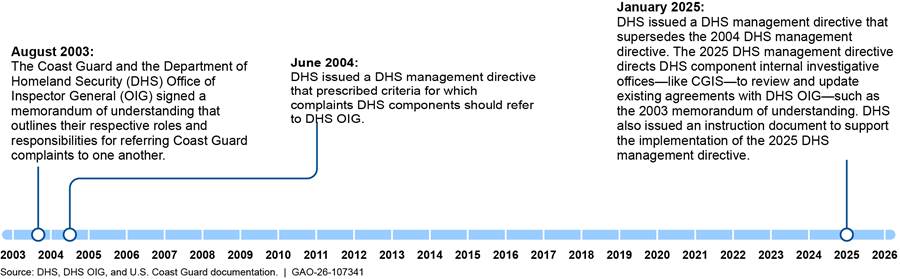
Note: The 2004 DHS management directive was previously to be used in conjunction with the 2003 memorandum of understanding between the Coast Guard and DHS OIG.
The 2025 DHS directive also directs component internal investigative offices—like CGIS—to review and update existing agreements with DHS OIG—such as the 2003 MOU—to help ensure appropriate allocation of resources, support timely investigations, and facilitate effective communication between components’ investigative offices and the OIG. Such a review and update would be consistent with this leading practice for developing and updating written guidance and agreements and with the practices of other departments.[79] Based on the 2025 directive, the 2003 MOU is the only agreement currently in effect between the Coast Guard and DHS OIG related to referring Coast Guard complaints. Additionally, the 2003 MOU states that either the Coast Guard or DHS OIG may request modification to the MOU at any time.
However, CGIS and DHS OIG officials told us in June and July 2025, respectively, that they had not initiated the process to review and update the 2003 MOU.
· CGIS officials told us that DHS OIG’s ongoing investigation of Operation Fouled Anchor may have implications for updating the 2003 MOU, and therefore they prefer to wait until after DHS OIG completes its investigation before updating the 2003 MOU.[80] While the investigation was ongoing, DHS OIG officials declined to provide additional detail on the scope of their investigation or estimated completion time frames. As of December 2025, DHS OIG officials told us that their investigation was ongoing.
· DHS OIG officials told us that they did not plan to initiate the process to update the 2003 MOU because they understood the 2025 DHS management directive to be under review by the department. However, DHS officials from the Management Directorate told us that the 2025 directive is not under review and is in effect.
By updating policies and procedures for referring Coast Guard complaints, like the 2003 MOU or another policy document, CGIS and DHS OIG would be better positioned to ensure effective and appropriate allocation of both agencies’ resources. Such updated policies and procedures should be consistent among the two agencies and reflect clear roles and responsibilities for referring Coast Guard complaints, as previously discussed in this report.
Conclusions
DHS OIG plays a critical role in overseeing the Coast Guard—a maritime military service within DHS that employs more than 51,000 personnel responsible for conducting 11 statutory missions. DHS OIG has taken steps to ensure that its work contributes to timely oversight by, for example, establishing timeliness benchmarks for its oversight projects. However, the OIG has not consistently met its benchmarks for Coast Guard audits. DHS OIG identified denials and delays to its requests for direct access to data systems and for data extracts as factors contributing to delays in its oversight work time frames but has not assessed the extent to which this has occurred. By assessing the extent to which delayed access to DHS components’ data affects oversight project time frames, DHS OIG could take action in response to the findings from the assessment, for example, to identify an approach to address such delays. Taking such action would better position the OIG to complete oversight projects in a timely manner according to its own benchmarks.
Additionally, Coast Guard oversight could be improved by more effective collaboration between CGIS and DHS OIG. The 2003 MOU between the Coast Guard and DHS OIG was intended to prevent duplication and ensure effective and appropriate use of resources. Achieving that desired outcome is dependent upon having a common understanding of clear roles and responsibilities for referring Coast Guard complaints and the agencies’ collective adherence to the policy.
However, CGIS and DHS OIG do not agree on which complaints CGIS should refer to DHS OIG. Despite having different perspectives on complaint referrals, CGIS and DHS OIG have not updated the 2003 MOU in over 20 years and do not communicate regularly to deconflict Coast Guard investigative activities. By clarifying roles and responsibilities for referring Coast Guard complaints and updating policies and procedures (such as the 2003 MOU or another policy document) accordingly, CGIS and DHS OIG would be better positioned to ensure effective and appropriate allocation of both agencies’ resources. Establishing regular communication could better position CGIS and DHS OIG to resolve the difference in their perspectives on complaint referrals and provide an opportunity for deconfliction.
CGIS could also take action to better adhere to policies for sharing information on Coast Guard complaints. Although CGIS recently began tracking the complaints it refers to DHS OIG, CGIS does not use that information to ensure adherence to policies for referring complaints. By developing and implementing a process to regularly assess the extent to which CGIS is adhering to established policies for referring complaints to DHS OIG—and identifying corrective action, as needed, based on the results of such assessments—CGIS would be better positioned to ensure compliance with referral requirements. Further, CGIS also does not fully adhere to policies for reporting investigative information to DHS OIG. By developing and implementing a process to ensure CGIS adheres to established policies for reporting investigative information to DHS OIG, CGIS and DHS OIG would be better positioned to ensure effective collaboration and leveraging available information to monitor progress toward using resources effectively and appropriately.
Recommendations for Executive Action
We are making a total of seven recommendations, including three to DHS OIG and four to the Coast Guard. Specifically:
The DHS Inspector General should assess the extent to which data access affects oversight project time frames and take action in response to the findings from the assessment. (Recommendation 1)
The Commandant of the Coast Guard should ensure the CGIS Director develops and implements a process to regularly assess the extent to which CGIS is adhering to established policies for referring complaints to DHS OIG. This process should include identifying corrective action, as needed, based on the results of such assessments. (Recommendation 2)
The Commandant of the Coast Guard should ensure the CGIS Director establishes regular communication with DHS OIG for deconflicting investigative activities. (Recommendation 3)
The DHS Inspector General should establish regular communication with CGIS for deconflicting investigative activities. (Recommendation 4)
The Commandant of the Coast Guard should ensure the CGIS Director clarifies roles and responsibilities for referring Coast Guard complaints and updates policies and procedures (such as the 2003 memorandum of understanding or another policy document), consistent with those of DHS OIG, accordingly. (Recommendation 5)
The DHS Inspector General should clarify roles and responsibilities for referring Coast Guard complaints and update policies and procedures (such as the 2003 memorandum of understanding or another policy document), consistent with those of CGIS, accordingly. (Recommendation 6)
The Commandant of the Coast Guard should ensure the CGIS Director develops and implements a process to ensure CGIS adheres to established policies for reporting investigative information to DHS OIG. (Recommendation 7)
Agency Comments and Our Evaluation
We provided a draft of this report to the Department of Homeland Security (DHS) and the DHS Office of Inspector General (OIG) for review and comment.
DHS provided written comments on behalf of the Coast Guard, which reproduced in appendix IV. DHS OIG also provided written comments, which are reproduced in appendix V. Additionally, DHS and DHS OIG provided technical comments, which we incorporated as appropriate. DHS concurred with each of our four recommendations to the Coast Guard and described actions planned or underway to address them. DHS OIG neither agreed nor disagreed with our recommendations to the OIG but expressed concerns with our report, as discussed below.
In its written comments, DHS OIG took issue with our focus on collaboration, deconfliction, and communication between DHS—more specifically, the Coast Guard—and DHS OIG. DHS OIG summarized its prior disagreements with DHS regarding the department’s implementation of the Inspector General Act of 1978, as amended, and the implications of assenting to DHS’s positions. DHS OIG also stated that if acted upon, our report would significantly weaken independent oversight of DHS. Furthermore, DHS OIG stated that the “report’s failure to acknowledge DHS OIG’s primacy over internal [d]epartment investigative bodies devalues DHS OIG’s independence, as envisioned by Congress and enumerated in the Inspector General Act and instead treats DHS OIG as just one body among equals insofar as [d]epartment oversight is concerned.”
We disagree. We made recommendations to DHS OIG and the Coast Guard that are essential to addressing the long-standing issues involving collaboration between DHS and DHS OIG. It is DHS’s and DHS OIG’s responsibility to determine how to operationalize their statutory obligations under the Inspector General Act of 1978, as amended, and other statutory authorities, as applicable.[81] Indeed, our recommendations are to be read consistent with applicable law, and our intent is that DHS and DHS OIG should implement our recommendations consistent with their respective statutory obligations. Regular communication and clarification on roles and responsibilities, as we recommended, will enhance, not undermine, the ability of each agency to meet its obligations under the law.
We found that the Coast Guard and DHS OIG are operating in a state of confusion, which risks the ineffective or inappropriate use of resources and needs to be rectified. Recommending that DHS OIG and the Coast Guard clarify roles and responsibilities, memorialize those in policy, and communicate regularly to deconflict investigative activities does not negate or diminish DHS OIG’s critical role in conducting oversight of the Coast Guard pursuant to the Inspector General Act of 1978, as amended. Additionally, we also noted in our report that developing and implementing an agreement between an agency and its OIG that establishes roles and responsibilities for retaining and referring complaints is consistent with the practices of other departments, like the Department of Defense.
DHS OIG also took issue with the “short shrift” given to its investigation into Operation Fouled Anchor, which it has characterized as one of its most resource-intensive investigations. We noted in our report that Congress directed DHS OIG to review Operation Fouled Anchor. On multiple occasions, we sought additional information from DHS OIG regarding its investigation into Operation Fouled Anchor, but DHS OIG declined to share information, citing the ongoing nature of the investigation. Although the Operation Fouled Anchor investigation demonstrates the need for effective oversight and investigations of the Coast Guard, we could not provide further detail without additional information on the OIG’s ongoing investigation.
Regarding our recommendations to the Coast Guard, DHS provided written comments on our second, third, fifth, and seventh recommendations. If fully implemented, the Coast Guard’s planned actions would likely address our second recommendation, which is to regularly assess the extent to which the Coast Guard is adhering to established policies for referring complaints to DHS OIG.
Regarding our third recommendation to establish regular communication between the Coast Guard and DHS OIG for deconflicting investigative activities, DHS noted that the Coast Guard designated the DHS OIG Program Manager position as the primary point of contact for deconflicting investigative activities with DHS OIG. We will follow-up with the Coast Guard to better understand this official’s communication roles and responsibilities to determine the extent to which this role addresses our recommendation.
Regarding our fifth recommendation to clarify roles and responsibilities for referring Coast Guard complaints and update related policies and procedures, as well as our seventh recommendation to ensure the Coast Guard adheres to established policies for reporting investigative information to DHS OIG, DHS noted that the Coast Guard implemented standard operating procedures in July 2025 that established policies for reporting investigative information to DHS OIG. However, we reviewed these procedures and note in our report that they direct the Coast Guard to refer complaints to DHS OIG in accordance with the memorandum of understanding the two agencies signed in August 2003. Our report highlights that this memorandum of understanding is unclear on the Coast Guard’s role and responsibilities for referring complaints in areas where the Coast Guard and DHS OIG have overlapping investigative responsibilities. Additionally, the Coast Guard’s standard operating procedures direct the Coast Guard to provide quarterly investigative reports to DHS OIG, but we found that these reports do not include all required information. Therefore, we maintain our fifth and seventh recommendations remain warranted.
We are sending copies of this report to the appropriate congressional committees, the Secretary of Homeland Security, the Commandant of the Coast Guard, the DHS Inspector General, and other interested parties. In addition, this report is available at no charge on the GAO website at https://www.gao.gov.
If you or your staff have any questions about this report, please contact me at MacLeodH@gao.gov. Contact points for our Offices of Congressional Relations and Public Affairs may be found on the last page of this report. GAO staff who made key contributions to this report are listed in appendix VI.

Heather MacLeod
Director, Homeland Security and Justice
Appendix I: Status of GAO’s Recommendations to the Department of Homeland Security’s Office of Inspector General
In June 2021, we reported that the Department of Homeland Security (DHS) Office of Inspector General (OIG) had not adhered to several professional standards for federal OIGs and key practices for effective management.[82] We made 21 recommendations to DHS OIG to address management and operational weaknesses related to quality assurance, reporting timeliness, and coordination with DHS, among others. DHS OIG concurred with each of our 21 recommendations. DHS OIG has implemented 12 of those recommendations and has taken steps to address four other recommendations, as shown in table 3. DHS OIG has planned steps but made limited progress on the remaining five recommendations, which we consider not implemented.
Table 3: Status of GAO’s Recommendations to the Department of Homeland Security (DHS) Office of Inspector General (OIG), as of August 2025
|
Recommendation |
Status |
Comments |
|
The Inspector General should follow key
organizational transformation practices when implementing any future changes
in its organizational structure. |
Implemented |
In April 2023, in response to our recommendation that DHS OIG evaluate the structure of the organization, DHS OIG provided a report detailing its organizational structure and each office’s alignment with strategic goals. That report proposed combining the Office of External Affairs with the Executive Office to align external communications and noted a final decision would be forthcoming after testing the realignment. Among other actions that align with key organizational transformation practices, the two offices jointly prepared strategic goals for fiscal years 2022 and 2023. The collective staff of the offices were involved in discussing how the units would achieve the goals and work together. DHS OIG finalized the realignment in November 2023 and communicated the change internally and externally. |
|
The Inspector General should develop and implement a
process to assess the nature, scope, and inherent risks of DHS programs as
part of a risk-based planning system and to serve as the basis for its annual
work plans and organizational performance management processes. |
Partially Implemented |
In October 2022, DHS OIG officials provided us with a demonstration of an internal dashboard tool that includes information connected to risk, such as budgetary information and past OIG work. OIG officials noted that the information is accessible to all staff to inform proposals for new work and that they plan to add more information to the dashboard in the future. Staff in the Office of Innovation work with leaders in the Office of Audits and the Office of Inspections and Evaluation to coordinate on how the information can be used for planning purposes. OIG staff have been using the information to plan individual project proposals. These proposals are subsequently assigned a risk value using a rubric. To fully address this recommendation, OIG will need to assess risks across DHS programs beyond individual project proposals. In August 2025, officials said that they have requested risk registers from DHS components and have formed a team of OIG staff to complete risk assessments. This effort, when complete, may provide a more comprehensive understanding of risks of DHS programs that DHS OIG can use to identify areas for audit, inspection, and evaluation. |
|
Recommendation |
Status |
Comments |
|
The Inspector General should develop and implement an annual work planning process, as part of a risk-based planning system, that identifies the activities to audit, inspect, or evaluate. (Recommendation 3) |
Not Implemented |
DHS OIG prepared annual work plans for fiscal years 2022 through 2025. In January 2025, OIG officials said that these work plans generally identify ongoing work as well as mandated work that is planned. The annual work planning process should be part of a risk-based planning system, the first step of which is assessing the nature, scope, and inherent risks of DHS programs. We separately recommended that DHS OIG develop and implement such a risk assessment process (Recommendation 2) which is partially implemented. We will monitor DHS OIG’s efforts to address both recommendations and, in particular, how the risk assessment developed in recommendation 2 informs DHS OIG’s annual work planning process. |
|
The Inspector General should implement organizational performance management processes that are consistent with professional standards and leading practices. Such processes should include (1) developing a strategic plan that documents goals, objectives, and performance measures; (2) developing annual performance plans that translate strategic priorities into outcome-related goals, objectives, and performance measures; and (3) collecting and using data to assess progress as well as identify areas for improvements or corrective actions. (Recommendation 4) |
Implemented |
DHS OIG has issued key organizational performance management documents. Specifically, DHS OIG issued its fiscal years 2022–2026 strategic plan in July 2021. Subsequently, it has issued annual performance plans and annual performance reports. In January 2025, DHS OIG issued a strategic planning program directive and accompanying manual that outline the processes for preparing these documents. By developing and implementing such a process, DHS OIG is better positioned to routinely assess progress towards performance goals or use performance information to identify potential needed improvements. |
|
The Inspector General should develop and implement a workforce plan that translates DHS OIG’s strategic priorities into skill sets and competencies and identifies strategies for meeting those workforce needs. (Recommendation 5) |
Not Implemented |
In July 2021, DHS OIG issued its fiscal years 2022–2026 strategic plan. In October 2021, DHS OIG officials said that the National Academy of Public Administration will provide support and guidance in the development of a workforce plan for DHS OIG. In January 2022, DHS OIG officials said that through the National Academy of Public Administration, they have conducted research to identify best practices and model succession plans in the OIG community and they had begun to draft a workforce plan. In September 2022, officials said they were reviewing a final gap analysis report from the National Academy of Public Administration. In April 2024, officials said they were assessing their workforce structure and needs as part of developing their workforce plan. In August 2025, officials said they were still in the process of developing a workforce plan. |
|
The Inspector General should develop and implement a
process to allocate human capital resources based on the organization’s
current and emerging strategic objectives and priorities, once DHS OIG
establishes them in its strategic plan. |
Not Implemented |
In March 2023, DHS OIG officials provided us with an overview of resource allocation steps in connection with the fiscal years 2022–2026 strategic plan. In August 2025, officials said they were still in the process of developing a workforce plan, which would inform allocation of positions across the organization. |
|
Recommendation |
Status |
Comments |
|
The Inspector General should develop and implement a process to develop succession plans to determine how critical leadership roles will be filled in the event of planned and unplanned vacancies. (Recommendation 7) |
Not Implemented |
In October 2021, DHS OIG officials said that they planned to address our recommendation regarding a workforce plan (Recommendation 5) prior to developing a succession plan. In May 2023, officials provided an overview of succession planning that included (1) professional development activities that support succession planning and (2) an overview of the recruitment and selection process for Senior Executive Service positions. As of January 2025, DHS OIG officials discussed impediments to filling critical leadership roles but have yet to develop succession plans for these roles. In August 2025, officials said they are continuing actions to address our other workforce planning recommendations (Recommendations 5 and 6), and those efforts could result in additional actions related to succession planning. |
|
The Inspector General should develop and implement an updated performance management policy. (Recommendation 8) |
Implemented |
In November 2022, DHS OIG issued an updated performance management policy and an accompanying handbook, both of which the Inspector General emailed to all employees. Having a current performance management policy will better position DHS OIG to maintain a workforce that collectively possesses the core competencies needed to accomplish its mission. |
|
The Inspector General should develop and implement a process to provide regular training and support for staff and supervisors so that they can consistently apply the organization’s performance management policy, once DHS OIG develops and implements an updated performance management policy. (Recommendation 9) |
Implemented |
In November 2022, DHS OIG issued an updated performance management policy that assigns the Director of OIG’s Human Resources Talent Management Division responsibility for ensuring appropriate and ongoing training, including training in performance management processes, for supervisors and employees. DHS OIG also established this as an expectation in the performance plans for its human resource specialists. DHS OIG also established a schedule that includes training for (1) all staff on performance planning and end-of-year performance management and (2) supervisors on annual appraisals. |
|
The Inspector General should evaluate the structure
of the organization and clearly define the responsibilities of each division
and program office to ensure they are aligned with the OIG’s strategic
objectives and priorities, once DHS OIG establishes them in its strategic
plan. |
Partially Implemented |
In August 2021, DHS OIG officials noted that the agency implemented organizational changes in April 2021 to ensure programs and offices were aligned to allow for efficiency and effectiveness in conducting the OIG’s mission. However, the April 2021 changes preceded DHS OIG’s efforts to identify strategic objectives and priorities, which were established in a subsequent strategic plan for fiscal years 2022 – 2026. In April 2023, DHS OIG provided a report detailing its organizational structure, alignment with strategic objectives and priorities, and roles and responsibilities of each program office. However, DHS OIG’s report on its organizational structure does not fully resolve potential operational gaps in some areas as well as overlap and duplication in others that we identified in our June 2021 report. As of August 2025, we are awaiting additional information requested to assess the extent to which other DHS OIG actions may address the intent of our recommendation. |
|
The Inspector General should implement a process to identify, analyze, and determine the appropriate response to risks—that is, the internal and external risks to achieving the organization’s goals and objectives—once DHS OIG establishes them in its strategic plan. (Recommendation 11) |
Not Implemented |
As of January 2025, DHS OIG established an Enterprise Risk Management function within the Office of Audits to discuss short-term and long-term plans to build Enterprise Risk Management capabilities. In August 2025, officials said they had established a cross-functional working group to conduct a comprehensive risk assessment. They said their next steps include documenting this work in a summary report and selecting risks to focus on. They expect to have a risk profile set up for their organization by the end of December 2025. We will continue to monitor DHS OIG’s efforts to address this recommendation. |
|
Recommendation |
Status |
Comments |
|
The Inspector General should implement a process for developing, reviewing, approving, and managing its organizational policies. (Recommendation 12) |
Implemented |
In June 2022, the Office of Innovation provided a catalog of organization policies and the corresponding responsible offices to responsible DHS OIG offices for review and comment to identify whether each policy should be archived, updated, or combined with another existing policy document. In March 2023, DHS OIG issued a directive and process manual that address managing organizational policies and emailed the directive to all employees. The directive establishes requirements to develop, review, issue, and archive DHS OIG-wide directives, manuals, charters, and supporting guidance. It also states that guidance is to be reviewed every three years for accuracy, relevance, and completeness. It also directs a program office within the Office of Innovation to publish and maintain OIG-wide directives and manuals on OIG’s intranet. The process manual describes the process to (1) develop new directives; (2) review and revise existing directives; and (3) archive outdated directives, among other things. DHS OIG has also established a method for tracking when policies are due for review, and the Inspector General has communicated the status of the policy review process with all employees. |
|
The Inspector General should develop and implement a process to ensure that all DHS OIG reports include a compliance statement that identifies the appropriate professional standards to which the work in that report adhered. (Recommendation 13) |
Implemented |
In September 2021, DHS OIG provided us with updated guidance documents that address professional standards and compliance statements. Additionally, in February 2022, DHS OIG provided us with the checklist that internal quality control reviewers use to ensure draft reports contain a professional standards compliance statement. In response to our feedback, DHS OIG subsequently updated the checklist to reflect its current practice of conducting work in accordance with government auditing standards or CIGIE inspection and evaluation standards. We monitored reports issued from June 2021 through September 2022 and confirmed that all reports contained a compliance statement to identify the appropriate professional standards. Including these compliance statements in OIG reports will help ensure that the audience for DHS OIG’s reports-including Congress, DHS, and the public-understand how the work was conducted. |
|
The Inspector General should develop and implement guidance to govern how Office of Audits or Office of Special Reviews and Evaluations work that does not adhere to (1) government auditing standards for audits or (2) CIGIE standards for inspections and evaluations is to be planned, completed, and reported. This guidance should describe how DHS OIG ensures that such work adheres to federal OIG standards of independence, due professional care, and quality assurance. (Recommendation 14) |
Implemented |
In November 2021, DHS OIG institutionalized this expectation by revising its project proposal form to include the proposed standards for the work, and the options on this form are limited to government auditing standards and CIGIE standards for inspections and evaluation. The Inspector General also communicated this expectation in an agency-wide email. These actions address the intent of our recommendation. By conducting work under these established standards, DHS OIG can ensure that its work adheres to federal OIG standards of independence, due professional care, and quality assurance. |
|
Recommendation |
Status |
Comments |
|
The Inspector General should develop and implement an organization-wide quality assurance program, including establishing a structure, responsibility, and authority for implementing quality assurance in all DHS OIG work. (Recommendation 15) |
Partially Implemented |
In September 2023, DHS OIG issued a directive for its Quality Control and Quality Assurance Program. This directive outlined the roles and responsibilities for DHS OIG offices in quality control and quality assurance and assigned the lead role to the Office of Integrity. DHS OIG has taken some actions in line with the new directive. For example, in January 2025, the Office of Integrity issued a quality control and quality assurance report covering fiscal years 2023 and 2024. The directive calls for that office to produce such a report annually. The 2023 directive also says that the Office of Integrity will oversee three quality control and assurance divisions: Audits and Inspections Quality Assurance, Investigations Quality Assurance and Quality Control Review. The January 2025 report describes the activities of the Audits and Inspections and Investigations Quality Assurance Divisions and the results of report reviews for fiscal years 2023 and 2024. It also describes planned and future actions. For example, it says that DHS OIG is planning the future Quality Control Review Division, which will assess compliance with reporting standards, conduct random quality control reviews of ongoing projects, and conduct quality control reviews of other aspects of OIG operations. This division, when fully implemented, is also to be the primary liaison with program offices on program office-initiated quality control reviews. We will continue to monitor how DHS OIG implements its quality assurance program, including the implementation and activities of each of its three quality control and assurance divisions. |
|
The Inspector General should develop and implement a
process to ensure that DHS OIG’s internal quality assurance reviews are
comprehensive and that these reviews regularly assess Office of Audits and
Office of Special Reviews and Evaluations work that is conducted according to
each of (1) audit; (2) inspection and evaluation; and (3) other standards or
authorities. |
Implemented |
In September 2023, DHS OIG issued a directive for its Quality Control and Quality Assurance Program. In September 2023, DHS OIG issued a directive for its Quality Control and Quality Assurance Program. This directive outlined the roles and responsibilities for DHS OIG offices in quality control and quality assurance. In August 2024, DHS OIG issued guidance to document a process and procedures for quality assurance reviews. The guidance outlines key steps in the quality assurance review process, including planning the review, conducting the review, preparing a report on the review, and overseeing implementation of any recommendations from the review. In November 2024, DHS OIG prepared a fiscal year 2025 work plan for the Office of Integrity. The work plan includes quality assurance reviews that address work under audit standards and inspection and evaluation standards. By conducting quality assurance reviews of different types of work, DHS OIG will be better positioned to ensure the full range of its work adheres to the appropriate professional standards. |
|
Recommendation |
Status |
Comments |
|
The Inspector General should develop and implement a process for assessing actual time frames against planned and target time frames for Office of Audits and Office of Special Reviews and Evaluations work. (Recommendation 17) |
Implemented |
In August 2021, DHS OIG officials said that the Office of Audits and Office of Inspections and Evaluations (formerly the Office of Special Reviews and Evaluations) have established target time frames and are assessing engagements against those time frames. In December 2021, DHS OIG’s Office of Innovation showed us a newly developed online dashboard to allow DHS OIG to track project time frames. Officials demonstrated the dashboard’s capabilities-such as visualizing comparisons of current project timelines against standardized goals based on project type (e.g., audit, inspection/evaluation). DHS OIG fully implemented the dashboard in March 2022, and in May 2022, DHS OIG officials told us that it implemented a timeliness performance metric for audit and inspection and evaluation managers. In October 2022, officials demonstrated new features in the dashboard and discussed plans for additional features. They demonstrated how the dashboard can be used to assess performance against DHS OIG’s performance measure for the percentage of completed audits, inspections, and evaluations that adhere to established or agreed-upon time frames (a measure in DHS OIG’s FY 2022 and FY 2023 annual performance plans). In January 2024, DHS OIG completed an assessment of actual time frames against target time frames for projects initiated since fiscal year 2022. Based on this assessment, DHS OIG made some modifications for its target time frames for fiscal year 2024. As a result of this assessment process, DHS OIG is better positioned to understand project time frames and take steps, as necessary, to produce more timely work. |
|
The Inspector General should develop and implement a process to ensure that program offices consistently use DHS OIG’s data system to track project milestones. (Recommendation 18) |
Implemented |
DHS OIG developed a dashboard tool to assist offices in using Project Tracking System data to monitor project milestones. DHS OIG has provided us with demonstrations of this dashboard, including ways that the dashboard identifies projects with potential data entry errors. DHS OIG leaders discussed the ways in which they utilize the dashboard for high-level and individual project management, and how their routine use of the dashboard prioritizes timely and consistent data entry. In addition to routine management, DHS OIG uses the data from the dashboard to assess OIG’s performance against an annual performance measure for project timeliness. With the implementation of this dashboard, DHS OIG leaders are better positioned to understand project time frames and strategically target any efforts to shorten time frames, ensuring that DHS OIG’s work contributes to timely oversight. |
|
The Inspector General should update its report review directive, including reviewer roles, responsibilities, and time frames, for draft and final reviews of Office of Audits and Office of Special Reviews and Evaluations work. (Recommendation 19) |
Implemented |
In January 2023, DHS OIG issued an updated report review directive. The directive includes reviewer roles, responsibilities and time frames for draft and final products (reports and management alerts). Implementing this directive, including tracking the time frames in each step, will provide DHS OIG information to help ensure their processes support timely report completion. |
|
Recommendation |
Status |
Comments |
|
The Inspector General should develop and implement a consistent process for DHS OIG program offices to coordinate with DHS to receive and respond to technical and management comments about Office of Audit and Office of Special Reviews and Evaluations work. (Recommendation 20) |
Implemented |
The Office of Audits and Office of Inspections and Evaluations established standardized process for responding to DHS technical comments; they noted that they shared their planned approach with DHS and incorporated DHS’s feedback into the process. In January 2022, DHS OIG provided official notification to DHS of their implementation of the new process, and this notification included a template for how DHS OIG will document disposition of technical comments. The process includes providing DHS with a written disposition of each of DHS’s technical comments and an opportunity to discuss the comments and response prior to final report issuance. This process has improved transparency and predictability to the process by which DHS and DHS OIG coordinate. |
|
As the Inspector General takes steps to implement recommendations above—and in doing so, transform the organization’s management and operations—the Inspector General should follow key organizational transformation practices. These practices include (1) ensuring top leadership drives the transformation, (2) setting implementation goals and a timeline, (3) dedicating an implementation team to manage the transformation process, and (4) involving employees to obtain their ideas and gain their ownership for the transformation. (Recommendation 21) |
Partially Implemented |
In early 2022, DHS OIG’s Office of Innovation implemented a shared tracking tool for monitoring tasks related to our recommendations. The tool includes a dashboard for OIG leadership to oversee the status of actions to implement our recommendations. It also includes detailed data for each recommendation, including assigned executive sponsor, status details, estimated completion date, and tasks to complete toward recommendation implementation. These are positive steps to ensure timely progress in implementing our recommendations, particularly in terms of leadership involvement and goals/time frames. As of August 2025, DHS OIG has implemented several of our recommendations and continues to take steps toward implementing others. |
Source: GAO. | GAO‑26‑107341
This report (1) examines the extent to which the Department of Homeland Security (DHS) Office of Inspector General (OIG) has processes in place to ensure timely and effective oversight of Coast Guard activities and (2) describes the number and types of investigations the Coast Guard Investigative Service (CGIS) and DHS OIG conducted from October 2018 through May 2024 and assesses the extent to which they coordinate on complaints regarding the Coast Guard.
To evaluate the extent to which DHS OIG has processes in place to ensure timely and effective oversight of Coast Guard activities, we assessed DHS OIG’s operations and processes as of August 2025 against selected elements of five standards formulated and adopted by the Council of the Inspectors General on Integrity and Efficiency in its Quality Standards for Federal Offices of Inspector General (federal quality standards for OIGs).[83] Those standards provide the framework for each OIG to conduct official duties in a professional manner and include guidelines for (1) receiving and reviewing complaints; (2) planning and coordinating; (3) managing human capital; (4) maintaining quality assurance; and (5) communicating results of OIG activities.[84] We selected these quality standards and elements of them because they were relevant to our objective regarding timely and effective oversight.
For this assessment, we analyzed relevant documentation, including DHS OIG’s quality control and quality assurance program directive; strategic planning documents; documents on timeliness benchmarks for audits; and manuals for conducting audits, inspections, evaluations, and investigations. Further, we met with officials from DHS OIG program offices and mission support offices to discuss policy and procedure topics relevant to their respective functions.
Receiving and reviewing complaints. We assessed DHS OIG’s processes and procedures against the elements to establish policies and procedures for processing and documenting complaints; ensure high-priority matters receive timely attention; and evaluate complaints against guidance when deciding whether to open an investigation. We reviewed documentation related to DHS OIG’s special agent handbook and case opening guidelines. We also interviewed officials from across the organization who led or contributed to related complaint processing activities.
Planning and coordinating. We assessed DHS OIG’s processes and procedures against the elements to coordinate oversight activities internally and maintain a risk-based work planning approach. We reviewed documentation related to DHS OIG’s work planning approach, which affects the extent of DHS OIG’s work on the Coast Guard relative to other DHS components. Specifically, we reviewed DHS OIG’s project planning process, audit manual, policy and process manual for inspections and evaluations, annual work plan for fiscal year 2025, strategic plan for fiscal years 2022 through 2026 and corresponding implementation plan, and annual performance plan for fiscal year 2025. We also interviewed officials from across the organization who led or contributed to related planning and coordinating activities. Further, we analyzed DHS OIG project data to assess the extent to which DHS OIG conducted projects on the Coast Guard relative to other DHS components, as discussed later in this appendix.
Managing human capital. We assessed DHS OIG’s processes and procedures against the elements to ensure that staff meet continuing professional education requirements; utilize staff members who possess requisite skills; and assess staff members’ skills and determine the extent to which they collectively possess the professional competence to perform assigned work.[85] We reviewed documentation related to DHS OIG’s audit manual, policy and process manual for inspections and evaluations, the operational plan for the Office of Audit’s Quality Management and Training Division, and special agent handbook. We also interviewed officials from across the organization who led or contributed to related training and skills assessment activities.
Maintaining quality assurance. We assessed DHS OIG’s processes and procedures against the elements to participate in external quality assurance reviews and maintain a quality assurance program. We reviewed documentation related to DHS OIG’s quality assurance program, including DHS OIG’s quality control and quality assurance program directive, quality control and quality assurance summary report for fiscal years 2023 and 2024, audit manual, inspection manual, completed internal quality control and quality assessment reports, and completed external quality assurance reports. We also interviewed DHS OIG officials who led or contributed to related quality assurance activities.
Communicating results of OIG activities. We assessed DHS OIG’s processes and procedures against the element that OIG reports should be timely, as well as DHS OIG’s audit manual and policy and process manual for inspections and evaluations. We reviewed documentation related to DHS OIG’s timeliness benchmarks for audits, including a January 2024 assessment report of those timeliness benchmarks for audits, an annual performance report for fiscal year 2024, and the OIG’s strategic implementation plan for fiscal years 2023 through 2026. We also interviewed officials from across the organization who led or contributed to related oversight timeliness activities. Further, we analyzed DHS OIG project data to assess timeliness of projects against DHS OIG’s benchmarks.
As noted above, for some of these standards, we obtained and analyzed DHS OIG data on its oversight projects.[86] We analyzed record-level project data for unclassified projects that were completed (i.e., resulted in a published report) or ongoing as of the end of fiscal year 2024. Included in these data are projects on all DHS components—including the Coast Guard—from fiscal year 2019 through fiscal year 2024—the five most recent fiscal years for which complete data were available at the time of our analysis. Specifically, we analyzed data elements related to time frames for completing projects to determine whether the OIG was meeting its timeliness benchmarks, including the project initiation date, dates when DHS OIG began and completed draft and final report reviews, and the report issuance date. We also analyzed data elements on the primary DHS components under review, project origin, and the professional standards to which the projects adhered (e.g., government auditing standards). Based on the data we received, a project may review more than one DHS component.
We also obtained and analyzed record-level DHS OIG data on recommendations the OIG made to the Coast Guard from fiscal year 2019 through fiscal year 2024. We analyzed data elements on whether the Coast Guard had addressed each recommendation, which OIG program office made the recommendation, and time frames for addressing closed recommendations.
To assess the reliability of DHS OIG’s project and recommendation data, we reviewed documentation about the data and data system, including a data dictionary and user guides. We also interviewed relevant DHS OIG officials and reviewed written responses to determine which internal controls were in place; how they collected, stored, and processed the project data; and any known data limitations. We performed electronic testing and manual reviews for obvious errors in accuracy and completeness, including missing data, duplicates, and dates not in chronological order. When our electronic testing or manual reviews of the data identified potential concerns, such as missing data or potential data entry errors, we consulted with DHS OIG officials and made corrections to the data, as needed, based on information officials provided.
After taking these steps, we determined that all data elements were sufficiently reliable to analyze the status of DHS OIG recommendations to the Coast Guard and that some of the data elements were sufficiently reliable to assess DHS OIG’s timeliness for completing projects. We excluded from our analyses data elements that were not sufficiently reliable. For example, we found that relevant dates—like the project initiation date and the date when DHS OIG completed its internal reviews of the final report—were sometimes missing or out of chronological order in relation to other steps in the audit process. We excluded projects with these missing or illogical dates from our analysis of project time frames.
We excluded additional projects from our analyses, including (1) classified projects; (2) projects that DHS OIG did not complete, like those for which the OIG contracted with an external firm to conduct the project and projects that the OIG initiated but ultimately terminated without a published report; and (3) annual major management and performance challenges reports, which are not audits, evaluations, or inspection.[87] Further, we excluded a publicly issued report of an internal DHS OIG review of 13 reports that DHS OIG retracted because this was not an oversight review of DHS programs or operations.[88]
To describe the number and types of investigations CGIS and DHS OIG conducted on Coast Guard activities, we obtained and analyzed CGIS and DHS OIG investigative data from October 1, 2018, (beginning of fiscal year 2019) through May 31, 2024, the most recent available data at the time of our analysis. Based on the data we received, a complaint may include more than one alleged offense.[89]
CGIS investigative data. We obtained CGIS’s data on open and closed complaints. Specifically, we analyzed data elements related to the status of complaints, complaint type (e.g., alleged criminal or civil offenses, CGIS support to Coast Guard commands, or coordination with external law enforcement agencies), and investigative outcomes (e.g., complaint not investigated or prosecuted, case prosecuted by U.S. Attorney’s Office, or case referred for courts-martial).[90]
DHS OIG investigative data. We analyzed data on open and closed complaints and investigations, including (1) summary-level data on the number of complaints received per each DHS component; (2) summary-level data on the number of investigations DHS OIG opened for each component; and (3) record-level data on Coast Guard complaints and investigations. Specifically, we analyzed data elements related to the status of complaints, disposition decisions (i.e., administratively closed the complaint, referred the complaint to another investigative entity, or opened an investigation), agencies to which DHS OIG referred complaints, identifiers for complaints related to allegations of whistleblower retaliation, case opening criteria, and offense codes.[91] When analyzing disposition decisions, we excluded open complaints and complaints for which DHS OIG had not recorded a disposition decision. When DHS OIG administratively closed a complaint before referring it internally to an OIG program office (e.g., to the Office of Audits to conduct an audit rather than investigation), we counted such internal referrals as administratively closed complaints.
To assess the reliability of CGIS’s and DHS OIG’s investigative data, we analyzed documentation about the data and case management systems, including privacy impact assessments, data dictionaries, and user guides. We also interviewed relevant CGIS and DHS OIG officials to determine which internal controls were in place; how they collected, stored, and processed the project data; and any known data limitations. We performed electronic testing and manual reviews for obvious errors in accuracy and completeness, including missing data, duplicates, outliers, and inconsistent data entries. When our electronic testing or manual reviews of the data identified potential concerns, such as missing data or potential data entry errors, we consulted with CGIS and DHS OIG officials and made corrections to the data, as needed, based on information officials provided.
After taking these steps, we determined that some of the CGIS and DHS OIG investigative data were sufficiently reliable for the purpose of describing the number and types of investigations the agencies conducted. We excluded from our analysis data elements that were not sufficiently reliable:
CGIS investigative data. We were unable to analyze the types of alleged offenses included in complaints because CGIS inconsistently entered offense data.
DHS OIG investigative data. We were unable to analyze the number and types of complaints CGIS referred to DHS OIG because the OIG’s data field identifying sources of complaints is optional and, therefore, data entries were inconsistent. We were also unable to analyze DHS OIG investigative outcomes on Coast Guard investigations because the OIG’s data field for recording outcomes is not consistently required for all investigations.
To evaluate the extent to which CGIS and DHS OIG collaborate on Coast Guard complaints, we assessed the agencies’ collaborative efforts against six of eight leading practices for collaboration identified in our prior work, specifically (1) define common outcomes; (2) ensure accountability; (3) bridge organizational cultures; (4) clarify roles and responsibilities; (5) leverage resources and information; and (6) develop and update written guidance and agreements.[92] We also determined that the information and communication component of internal control was significant to this evaluation, along with the underlying principle that management should communicate relevant and quality information with appropriate external parties regarding matters impacting the functioning of the internal control system.[93]
As part of our assessment of CGIS’s and DHS OIG’s collaborative efforts, we analyzed the spreadsheet that CGIS uses to track complaints referred by DHS OIG. The spreadsheet we obtained includes data on complaints DHS OIG referred to CGIS from January 1, 2021 (the beginning of fiscal year 2022) through May 30, 2024. To assess the reliability of this spreadsheet, we interviewed relevant CGIS officials and reviewed written responses to determine how they collected, stored, and processed the data, as well as determine any known data limitations. We also performed manual reviews for obvious errors in accuracy and completeness, including missing data and duplicates. When our manual reviews of the data identified potential concerns, we consulted with CGIS officials and made corrections to the data, as needed, based on information officials provided.
After taking these steps, we determined that all data elements were sufficiently reliable for the purposes of describing CGIS’s methods for tracking complaints referred from DHS OIG. CGIS uses this spreadsheet to develop and send monthly reports of investigative information to DHS OIG.[94] We also obtained and analyzed CGIS investigative reports to DHS OIG from January 2025 through June 2025. These reports include information on the DHS OIG hotline number, the CGIS office assigned to address each complaint, and complaint status, among other information.
We reviewed documentation related to CGIS and DHS OIG roles and responsibilities for retaining and referring Coast Guard complaints, including (1) the 2003 memorandum of understanding (MOU) between the Coast Guard and DHS OIG;[95] (2) a 2004 DHS management directive that identified some complaints DHS components should refer to DHS OIG;[96] (3) a January 2025 DHS management directive that supersedes a 2004 DHS management directive and directs DHS component internal investigative offices to update existing agreements with DHS OIG;[97] and (4) an instruction document that DHS issued to support implementation of the 2025 DHS management directive.[98] We also reviewed a CGIS internal announcement issued in October 2024 and CGIS standard operating procedures issued in July 2025. These documents direct CGIS officials to adhere to the 2003 MOU, which outlines complaint referral and reporting requirements, and requirements for tracking referrals to DHS OIG.
Further, we interviewed relevant CGIS and DHS OIG officials and reviewed written responses from these officials on topics related to their respective policies and procedures for referring complaints, their investigative authorities, and strategies for deconflicting investigative activities. We also met with CGIS and DHS OIG officials to obtain their perspectives on potential updates to the 2003 MOU.
We conducted this performance audit from March 2024 to January 2026 in accordance with generally accepted government auditing standards. These standards require that we plan and perform the audit to obtain sufficient, appropriate evidence to provide a reasonable basis for our findings and conclusions based on our audit objectives. We believe that the evidence obtained provides a reasonable basis for our findings and conclusions based on our audit objectives.
The Coast Guard Investigative Service (CGIS) is an independent investigative body within the Coast Guard that primarily conducts criminal investigations related to Coast Guard personnel, assets, and operations—including alleged violations of the Uniform Code of Military Justice.[99] After CGIS completes an investigation, CGIS may send the complaint for final adjudication—a final, legal judgement made by a judge or adjudicator after reviewing evidence and legal arguments.[100]
Our analysis of CGIS investigative data shows that CGIS closed 9,854 complaints from October 1, 2018, through May 31, 2024.[101] In CGIS’s case management system, a closed complaint indicates all work to address the complaint has been completed but does not indicate whether an investigation occurred. Of these 9,854 closed complaints, about 57 percent (5,575 complaints) did not meet the parameters for a full investigation or prosecution, did not meet probable cause, or CGIS did not substantiate the allegation. Over one-quarter of the closed complaints (2,814 complaints) resulted in court proceedings or disciplinary action, as shown in table 4 below.
Table 4: Coast Guard Investigative Service (CGIS) Closed Complaints by Final Adjudication, Received October 2018 through May 2024
|
Final Adjudication |
Number of Complaints |
|
Complaint not investigated or prosecuteda |
5,575 |
|
Complaints resulting in disciplinary action |
|
|
Subject discharged in lieu of court-martialb |
898 |
|
Other administrative action takenc |
497 |
|
Subject received nonjudicial punishmentd |
351 |
|
Complaints resulting in court proceedings |
|
|
Case prosecuted by U.S. Attorney’s Officee |
643 |
|
Case prosecuted by an agency external to the Coast Guard (e.g., state, local, or tribal agency) |
250 |
|
Case referred for civil enforcement |
88 |
|
Case referred within Coast Guard for court-martialf |
87 |
|
CGIS did not record final adjudication data |
838 |
|
Complaint had no Coast Guard jurisdiction or was referred to other agency for investigation |
254 |
|
Investigation was deferred, suspended, or charges withdrawng |
235 |
|
Subject arrested by an outside agency |
128 |
|
Total |
9,854 |
Source: GAO analysis of CGIS data. | GAO‑26‑107341
Note: Of the 10,607 complaints that CGIS received from October 1, 2018, through May 1, 2024, CGIS closed 9,854 of them by July 1, 2024—the status at the time of our request. This table reflects the final adjudication, the formal legal process of resolving a dispute.
aThese complaints did not meet the parameters for a full investigation or prosecution, did not meet probable cause, or CGIS could not substantiate the complaint.
bA Coast Guard military service member may be administratively separated or discharged in lieu of a court-martial. An administrative separation is a nonjudicial process where a service member is removed from active duty, and a discharge is the termination of a service member’s obligation to the military.
cThe Coast Guard did not take criminal or civil action, and the Coast Guard employee who allegedly engaged in misconduct received either a written or verbal reprimand.
dAccused military service members can receive nonjudicial punishment under Article 15 of the Uniform Code of Military Justice, by which a commander can discipline a servicemember (e.g., correctional custody, forfeiture of pay, or extra duties) without going through the court-martial process. See 10 U.S.C. § 815.
eU.S. Attorneys’ Offices prosecute federal crimes.
fA court-martial is a legal proceeding where military service members are tried for offenses against military law. There are three types of courts-martial: summary, special, and general. Each of these types respectively is intended to deal with progressively more serious offenses, and each court-martial type may adjudicate more severe maximum punishments as prescribed under the Uniform Code of Military Justice. The Uniform Code of Military Justice, first enacted in 1950, provides the framework of the military justice system, establishes the complete code of military criminal law, and provides the legal framework for conducting investigations and prosecutions of complaints of misconduct by service members. 10 U.S.C. §§ 801-946a.
gThese complaints are pending further development for reasons such as the prosecution withdrew charges, the complainant declined to cooperate, or CGIS could not locate persons involved in the complaint.
GAO Contact
Heather MacLeod at MacLeodH@gao.gov
Staff Acknowledgments
In addition to the contact named above, Alana Finley (Assistant Director), Caitlin Jackson (Analyst-in-Charge), Diana Chung, and Taylor Gauthier made key contributions to this report. Also contributing to this report were Howard Arp, Matthew Duca, Michele Fejfar, Suellen Foth, Eric Hauswirth, Samantha Lyew, Suzanne Perkins, Kevin Reeves, Janet Temko-Blinder, Estelle Tsay Huang, and Sarah Veale.
The Government Accountability Office, the audit, evaluation, and investigative arm of Congress, exists to support Congress in meeting its constitutional responsibilities and to help improve the performance and accountability of the federal government for the American people. GAO examines the use of public funds; evaluates federal programs and policies; and provides analyses, recommendations, and other assistance to help Congress make informed oversight, policy, and funding decisions. GAO’s commitment to good government is reflected in its core values of accountability, integrity, and reliability.
Obtaining Copies of GAO Reports and Testimony
The fastest and easiest way to obtain copies of GAO documents at no cost is through our website. Each weekday afternoon, GAO posts on its website newly released reports, testimony, and correspondence. You can also subscribe to GAO’s email updates to receive notification of newly posted products.
Order by Phone
The price of each GAO publication reflects GAO’s actual cost of production and distribution and depends on the number of pages in the publication and whether the publication is printed in color or black and white. Pricing and ordering information is posted on GAO’s website, https://www.gao.gov/ordering.htm.
Place orders by calling (202) 512-6000, toll free (866) 801-7077,
or
TDD (202) 512-2537.
Orders may be paid for using American Express, Discover Card, MasterCard, Visa, check, or money order. Call for additional information.
Connect with GAO
Connect with GAO on X,
LinkedIn, Instagram, and YouTube.
Subscribe to our Email Updates. Listen to our Podcasts.
Visit GAO on the web at https://www.gao.gov.
To Report Fraud, Waste, and Abuse in Federal Programs
Contact FraudNet:
Website: https://www.gao.gov/about/what-gao-does/fraudnet
Automated answering system: (800) 424-5454
Media Relations
Sarah Kaczmarek, Managing Director, Media@gao.gov
Congressional Relations
Dave Powner, Acting Managing Director, CongRel@gao.gov
General Inquiries
[1]See 6 U.S.C. § 468(a).
[2]The Inspector General Act of 1978, as amended, establishes OIGs as well as inspectors general within such OIGs and lays out duties and responsibilities for each inspector general within its OIG. Pub. L. No. 95-452, §§ 2-4, 92 Stat. 1101, 1101-03 (codified as amended at 5 U.S.C. §§ 402(a)(1) (establishing OIGs), 403 (establishing inspectors general to head the OIGs), 404(a) (providing responsibilities and duties for each inspector general within their OIG)). For the purposes of this report, we use the term OIG to encompass both the OIG and the inspector general heading the OIG.
[3]GAO, DHS Office of Inspector General: Actions Needed to Address Long-Standing Management Weaknesses, GAO‑21‑316 (Washington, D.C.: June 3, 2021).
[4]DHS OIG has implemented 12 of these recommendations and has partially addressed four others. We continue to monitor DHS OIG’s efforts to implement the nine open recommendations.
[5]Pub. L. No. 117-263, div. K, tit. CXII, subtit. G, § 11271, 136 Stat. 2395, 4065 (2022). This provision also called for GAO to compare the DHS OIG’s oversight structure for the Coast Guard to the DOD and the military service OIGs’ oversight structure for other military services, for which we issued a separate report. See GAO, Coast Guard Oversight: Inspector General Oversight of the Coast Guard and Other Military Services, GAO‑26‑108639 (Washington, D.C.: Jan. 21, 2026).
[6]A complaint includes at least one allegation of criminal, civil, or administrative misconduct involving Coast Guard employees, contractors, grantees, or programs.
[7]Council of the Inspectors General on Integrity and Efficiency, Quality Standards for Federal Offices of Inspector General (Washington, D.C.: Aug. 2012). We include additional information on our selection of federal quality standards for OIGs and related elements of those standards in appendix II. The Council of the Inspectors General on Integrity and Efficiency was statutorily established as an independent entity within the executive branch by the Inspector General Reform Act of 2008, as amended. Pub. L. No. 110-409, § 7(a), 122 Stat. 4302, 4305-12 (codified as amended at 5 U.S.C. § 424). All inspectors general whose offices are established under sections 402 or 415 of title 5 of the U.S. Code, including those that are presidentially appointed and Senate confirmed and those that are appointed by agency heads (designated federal entities), are members, among others, of the Council. 5 U.S.C. § 424(b). The Council’s mission is to support the work of federal inspectors general by, among other things, developing policies, standards, and approaches to aid inspectors general in developing a skilled workforce to conduct their oversight work. 5 U.S.C. § 424(c). The Council also administers a peer review program to support federal OIGs in their compliance with professional standards and statutory requirements.
[8]A project may be an audit, evaluation, or inspection. Projects exclude investigations.
[9]See GAO, Government Performance Management: Leading Practices to Enhance Interagency Collaboration and Address Crosscutting Challenges, GAO‑23‑105520 (Washington, D.C.: May 24, 2023). We excluded two practices from our assessment—including relevant participants and identifying and sustaining leadership—because the scope of our review was limited to CGIS and DHS OIG (relevant participants), both of which have established leadership over the offices responsible for overseeing complaints.
[10]GAO, Standards for Internal Control in the Federal Government, GAO‑25‑107721 (Washington, D.C.: May 15, 2025).
[11]Inspector General Act of 1978, Pub. L. No. 95-452, §§ 3(a), 5(b), 92 Stat. 1101, 1103 (codified as amended at 5 U.S.C. §§ 403(a), 405(c)).
[12]In March 2021, DHS OIG disbanded the Office of Integrity and Quality Oversight and realigned its functions to other DHS OIG offices, including the Office of Integrity.
[13]U.S. Department of Homeland Security, Office of Inspector General, Oversight Review of the United States Coast Guard Investigative Service, OIG-17-74-IQO (Washington, D.C.: June 23, 2017).
[14]CGIS concurred with all 32 recommendations. According to DHS OIG, CGIS has implemented 29 of the 32 recommendations. It has not implemented three recommendations, including that CGIS should: (1) clarify in policy which complaints CGIS is to refer to DHS OIG and ensure that CGIS refers all requisite complaints; (2) update its investigations manual to comply with Coast Guard requirements for documenting policy; and (3) follow the Coast Guard’s process for coordinating with functional areas when drafting new policies.
[15]U.S. Department of Homeland Security, Office of Inspector General, The Coast Guard Faces Challenges Interdicting Non-Commercial Vessels Smuggling Drugs into the United States, OIG-25-17 (Washington, D.C.: Feb. 19, 2025).
[16]U.S. Department of Homeland Security, Office of Inspector General, DHS Did Not Consistently Comply with National Instant Criminal Background Check System Requirements, OIG-23-05 (Washington, D.C.: Dec. 22, 2022).
[17]The Uniform Code of Military Justice, first enacted in 1950, provides the framework of the military justice system, establishes the complete code of military criminal law, and provides the legal framework for conducting investigations and prosecutions of complaints of misconduct by service members. 10 U.S.C. §§ 801-946a.
[18]U.S. Coast Guard, Coast Guard Investigative Service Roles and Responsibilities, Commandant Instruction 5520.5G (Washington, D.C.: Jan. 11, 2023).
[19]The Coast Guard’s field structure is organized under two area commands, the Atlantic and Pacific Area Commands. These two area commands oversee nine districts across the U.S., which in turn collectively oversee 37 sectors. Each Coast Guard area, district, and sector is responsible for managing its assets and accomplishing missions within its area of responsibility.
[20]As discussed later in this report, CGIS and DHS OIG do not agree on which complaints CGIS should refer to the OIG. According to CGIS standard operating procedures, CGIS officials are to refer complaints to DHS OIG in accordance with the memorandum of understanding that the Coast Guard and DHS OIG signed in August 2003. For example, this 2003 memorandum states that CGIS is to refer the following types of complaints to DHS OIG: unlawful manipulation of the competitive bidding process; unauthorized concealment, removal, alteration, or destruction of official documents; misappropriation or embezzlement of government funds; and bribery or corruption of government officials, among others.
[21]Generally, a whistleblower is someone who discloses information they reasonably believe is evidence of wrongdoing, including a violation of a law, rule or regulation; gross mismanagement, a gross waste of funds or abuse of authority; or a substantial and specific danger to public health or safety. See 5 U.S.C. § 2302(b)(8). A whistleblower can make a whistleblower retaliation complaint if they experience retaliation following a disclosure. OIGs across the government oversee investigations of whistleblower disclosures and whistleblower retaliation complaints. See 5 U.S.C. § 403(d)(1)(C). Coast Guard civilian employees can also file whistleblower retaliation complaints to the Office of Special Counsel—an independent federal investigative and prosecutorial agency that is to safeguard the merit system in federal employment by protecting current and former employees and applicants for federal employment from prohibited personnel practices, including reprisal for whistleblowing. See 5 U.S.C. § 1214(h), (i). DHS OIG’s Whistleblower Protection Division is within the Office of Counsel, which provides legal guidance, support, and services to DHS OIG leadership and program officials.
[23]Also included in the collaboration leading practices are (1) including relevant participants and (2) identifying and sustaining leadership.
[24]GAO‑21‑316. For more information and the status of each of the 21 recommendations we made in this report, see appendix I.
[25]We analyzed DHS OIG investigative data from October 1, 2018, through May 31, 2024. These dates reflect the most recent available data at the time of our request, beginning with the start of fiscal year 2019.
[26]According to DHS OIG officials, the OIG does not use the case opening guidelines for allegations of whistleblower retaliation. Rather, the OIG’s Whistleblower Protection Division reviews such allegations to determine whether (1) the complaint constitutes a prima facie allegation of whistleblower retaliation; (2) DHS OIG has jurisdiction; (3) the complaint solely alleges Equal Employment Opportunity retaliation; (4) the complaint was reported anonymously; (5) the complainant is a third-party individual alleging that they witnessed retaliation against someone else; and (6) the complaint is a duplicate. GAO has ongoing audit work on (1) DHS OIG’s processes for receiving and investigating whistleblower retaliation complaints; (2) how DHS OIG communicates information about whistleblower protections; and (3) the number and status of DHS whistleblower retaliation complaints, investigations, and appeals.
[27]In June 2021, we recommended that DHS OIG develop and implement an annual work planning process—as part of a risk-based planning system—that identifies the activities to audit, inspect, and evaluate. See GAO‑21‑316. DHS OIG developed annual work plans for fiscal years 2022 through 2025. To fully address this recommendation, DHS OIG must take additional steps to implement another recommendation from that report—to develop and implement a risk-based planning system, which would inform future work plans. For more information on the recommendations from this report and the status of each recommendation, see appendix I.
[28]The term “critical infrastructure” refers to systems and assets, whether physical or virtual, so vital to the United States that their incapacity or destruction would have a debilitating impact on security, national economic security, national public health or safety, or any combination of these matters. 42 U.S.C. § 5195c(e).
[29]U.S. Department of Homeland Security, Office of Inspector General, Coast Guard Should Take Additional Steps to Secure the Marine Transportation System against Cyberattacks, OIG-24-37 (Washington, D.C.: Jul. 9, 2024). In January 2025, the Coast Guard issued regulations that include minimum cybersecurity requirements for certain Maritime Transportation System owners and operators. Cybersecurity in the Marine Transportation System, 90 Fed. Reg. 6,298 (Jan. 17, 2025); see also 33 C.F.R. §§ 101.600-101.670, 160.202.
[30]In 1990, GAO began a program to report on government operations that we identified as high risk. Since then, we have reported on the status of progress to address high-risk areas and update the list. In September 2018, we issued an update to the High-Risk List that identified actions needed to address cybersecurity challenges facing the nation—including protecting critical infrastructure. We later identified ensuring the nation’s cybersecurity as one of nine high-risk areas that need especially focused executive and congressional attention. We continue to identify the protection of critical cyber infrastructure as a component of this high-risk area, most recently in our June 2024 high-risk update on addressing critical cybersecurity challenges. GAO, High-Risk Series: Urgent Actions Are Needed to Address Cybersecurity Challenges Facing the Nation, GAO‑18‑622 (Washington, D.C.: Sept. 6, 2018); High-Risk Series: Substantial Efforts Needed to Achieve Greater Progress on High-Risk Areas, GAO‑19‑157SP (Washington, D.C.: Mar. 6, 2019); High-Risk Series: Federal Government Needs to Urgently Pursue Critical Actions to Address Major Cybersecurity Challenges, GAO‑21‑288 (Washington, D.C.: Mar. 24, 2021); High-Risk Series: Urgent Action Needed to Address Critical Cybersecurity Challenges Facing the Nation, GAO‑24‑107231 (Washington, D.C.: Jun. 13, 2024).
[31]GAO, Maritime Critical Infrastructure Protection: DHS Needs to Better Address Port Cybersecurity, GAO‑14‑459 (Washington, D.C.: June 5, 2014); and Coast Guard: Workforce Planning Actions Needed to Address Growing Cyberspace Mission Demands, GAO‑22‑105208 (Washington, D.C.: Sept. 27, 2022).
[32]We recommended that DHS OIG develop and implement a process to assess the nature, scope, and inherent risks of DHS programs as part of a risk-based planning system and to serve as the basis for its annual work plans and organizational performance management processes. See GAO‑21‑316. DHS OIG has taken steps but has not yet fully addressed this recommendation. For more information on the recommendations from this report and the status of each recommendation, see appendix I.
[33]A project may be an audit, evaluation, or inspection, and may include more than one DHS component. Projects exclude investigations. These data also show other project origins, including legislative mandates (about 21 percent) and congressional requests (about 10 percent).
[34]In June 2021, we reported that DHS OIG began an effort in 2016 to implement a process for assessing DHS’s programs, operations, management challenges, budget trends, and inherent risks as part of a work planning system. At that time, the Office of Enterprise Risk Identification and Management was to develop risk-based assessments of DHS and its components to contribute to DHS OIG’s annual work planning. As part of our past work, we reviewed documents from that office and interviewed officials who led and supported the office’s efforts. We found the designed process was largely consistent with the elements of the planning process described in quality standards for OIGs. However, as priorities and leadership changed, DHS OIG largely discontinued those efforts and dissolved the Office of Enterprise Risk Identification and Management. See GAO‑21‑316.
[35]We analyzed DHS OIG’s data on completed and ongoing oversight projects from fiscal year 2019 through fiscal year 2024. A project may be an audit, evaluation, or inspection, and may include more than one DHS component. Projects exclude investigations. We analyzed the projects that were completed (resulted in a published report) or ongoing as of the end of fiscal year 2024; we did not include or analyze projects that DHS OIG initiated but ultimately terminated without a published report. DHS OIG officials told us that it is rare for the OIG to terminate an ongoing project. For example, DHS OIG terminated three Coast Guard audits from October 1, 2018 (beginning of fiscal year 2019) through April 5, 2024. DHS OIG terminated the first audit after officials identified department-wide risks and planned to examine the issue at the department level. For the second terminated audit, DHS OIG had initiated work based on an allegation that the OIG received, but upon determining they could not substantiate the allegation they terminated the audit. DHS OIG terminated the third audit after coordinating with GAO and learning that we were conducting similar work in response to a statutory mandate.
[36]GAO’s Government Auditing Standards provides a framework for conducting high-quality audits with competence, integrity, objectivity, and independence. The standards include continuing professional education requirements for auditors who plan, direct, and perform engagement procedures in accordance with the standards to complete at least 80 hours of continuing professional education in every two-year period, among other specifications. The 2018 revision of the standards is effective for financial audits, attestation engagements, and reviews of financial statements for periods ending on or after June 30, 2020, and for performance audits beginning on or after July 1, 2019. GAO, Government Auditing Standards: 2018 Revision Technical Update April 2021, GAO‑21‑368G (Washington, D.C.: Apr. 14, 2021). The standards were updated in February 2024, and the 2024 revision of the standards is effective for financial audits, attestation engagements, and reviews of financial statements for periods beginning on or after December 15, 2025, and for performance audits beginning on or after December 15, 2025. GAO, Government Auditing Standards 2024 Revision, GAO‑24‑106786 (Washington, D.C.: Feb. 1, 2024).
[37]According to the Council of the Inspectors General on Integrity and Efficiency’s inspection and evaluation standards, inspectors must complete a minimum of 40 hours of training every two years. Council of the Inspectors General on Integrity and Efficiency, Quality Standards for Inspection and Evaluation (Dec. 2020).
[38]According to the Council of the Inspectors General on Integrity and Efficiency’s investigation standards, all OIG investigators who exercise law enforcement powers must complete a formal basic training course, a formal OIG-specific follow-on training program, as well as other training requirements related to firearms, use of force, constitutional law, and other topics articulated in authoritative guidelines. Council of the Inspectors General on Integrity and Efficiency, Quality Standards for Investigations (Nov. 15, 2011).
[39]DHS OIG’s Office of Innovation provides support for enterprise-wide products and services, including data governance, cyber assessments, strategic planning, and risk management, among other things.
[40]We recommended that DHS OIG develop and implement a workforce plan that translates DHS OIG’s strategic priorities into skill sets and competencies and identifies strategies for meeting those workforce needs. See GAO‑21‑316. DHS OIG has taken steps but has not yet fully addressed this recommendation. For more information on the recommendations from this report and the status of each recommendation, see appendix I.
[41]U.S. Department of Defense, Office of Inspector General, External Peer Review Report on the U.S. Department of Homeland Security Office of Inspector General Audit Organization (Alexandria, VA: Mar. 14, 2024); and U.S. Department of Education, Office of Inspector General, System Review Report (Washington, D.C.: Mar. 31, 2021).
[42]U.S. Department of Education, Office of Inspector General, Inspection and Evaluation External Peer Review Final Report, (Washington, D.C.: Aug. 31, 2023); and U.S. Department of Veterans Affairs, Office of Inspector General, Department of Homeland Security Office of Inspector General Inspection and Evaluation External Peer Review Report, 21-00000-27 (Washington, D.C.: Nov. 23, 2020). Peer reviews of inspection and evaluation activities initiated before April 1, 2024, did not include an overall rating, such as pass or fail.
[43]We recommended that DHS OIG develop and implement an organization-wide quality assurance program, including establishing a structure, responsibility, and authority for implementing quality assurance in all DHS OIG work. See GAO‑21‑316. DHS OIG has taken steps but has not yet fully addressed this recommendation. For more information on the recommendations from this report and the status of each recommendation, see appendix I.
[44]Our analysis of DHS OIG data shows that, combined, the Office of Audits and the Office of Inspections and Evaluations made 43 recommendations to the Coast Guard from fiscal year 2019 through fiscal year 2024. Of these 43 recommendations, 21 were closed and 22 were open as of the end of fiscal year 2024. Of the recommendations that were open as of the end of fiscal year 2024, DHS OIG made most of them (20 out of 22) more recently (since April 2023). DHS OIG data also show that 13 of the 21 closed recommendations were closed within 1 year, and the remaining eight recommendations took 2 or more years to close.
[45]GAO‑21‑316. We recommended that DHS OIG develop and implement a process for assessing actual time frames against planned and target time frames for Office of Audits and Office of Special Reviews and Evaluations. In March 2021, DHS OIG renamed the Office of Special Reviews and Evaluations to the Office of Inspections and Evaluations. DHS OIG has fully addressed this recommendation. For more information on the recommendations from this report and the status of each recommendation, see appendix I.
[46]DHS OIG also established timeliness benchmarks for inspections and evaluations. However, DHS OIG later determined that these benchmarks were impractical and updated them in January 2024. The updates included establishing benchmarks for each type of oversight project (i.e., inspections, evaluations, and reviews), as well as eliminating benchmarks for the planning phase of the project and increasing the benchmarks for the fieldwork phase of evaluations and reviews, for example. Therefore, given the limited number of inspections and evaluations that started after the new benchmarks were in place and completed by the time we received data at the end of fiscal year 2024, we did not evaluate inspections and evaluations for timeliness. We analyzed DHS OIG’s data on completed audits from August 1, 2021 (when DHS OIG first implemented timeliness benchmarks for audits) through September 30, 2024 (end of fiscal year 2024). We excluded the following projects from our analysis on DHS OIG’s audit benchmarks: (1) ongoing projects for which DHS OIG had not issued a final report as of September 30, 2024; (2) management alerts because the benchmark for receiving DHS agency comments is shorter for management alerts than for audits; (3) projects for which DHS OIG did not record relevant benchmark dates; and (4) projects with potential data entry errors for relevant benchmark dates. For additional information on our analysis, see appendix II.
[47]U.S. Department of Homeland Security, Office of Inspector General, Coast Guard Needs to Implement Effective Planning for Infrastructure Investment and Jobs Act Projects, OIG-24-56 (Washington, D.C.: Sept. 17, 2024); Coast Guard Should Take Additional Steps to Secure the Marine Transportation System Against Cyberattacks, OIG-24-37 (Washington, D.C.: Jul. 9, 2024); The United States Coast Guard Needs to Determine the Impact and Effectiveness of Its Streamlined Inspection Program, OIG-23-46 (Washington, D.C.: Aug. 30, 2023); The United States Coast Guard Needs to Improve Its Accounting for Non-Capitalized Personal Property Assets, OIG-23-23 (Washington, D.C.: Apr. 26, 2023).
[48]DHS OIG’s January 2024 assessment of its timeliness benchmarks included audits that initiated from October 1, 2021 (the beginning of fiscal year 2022) through September 30, 2023 (the end of fiscal year 2023). Our analysis of DHS OIG project data included audits that initiated from August 1, 2021 (when DHS OIG established its timeliness benchmarks) through September 30, 2024 (the end of fiscal year 2024).
[49]U.S. Department of Homeland Security, Office of Inspector General, Semiannual Report to Congress: April 1, 2024 - September 30, 2024 (Washington, D.C.: Oct. 30, 2024). Each Inspector General, including DHS OIG, is required to prepare semiannual reports summarizing the activities of the office. See 5 U.S.C. § 405.
[50]According to this report, DHS OIG had requested read-only access to the Coast Guard’s Merchant Mariner Licensing and Documentation system (the database the Coast Guard uses to track merchant mariner applications for credentials) and the Marine Information for Safety and Law Enforcement Adjudication system (the database the Coast Guard uses to track and report mission results data for nine of 11 Coast Guard missions, including marine safety and law enforcement).
[51]CGIS also conducts polygraph and digital forensic examinations, manages a liaison program to coordinate law enforcement activities with partner agencies, and conducts protective services to Coast Guard personnel, among other responsibilities. See Coast Guard, Coast Guard Investigative Service Roles and Responsibilities, Commandant Instruction 5520.5G (Washington, D.C.: Jan. 11, 2023).
[52]U.S. Department of Homeland Security, Office of Inspector General, Office of Investigations Special Agent Handbook (Apr. 17, 2020).
[53]Collaboration can be broadly defined as any joint activity that is intended to produce more public value than could be produced when the organizations act alone.
[54]We analyzed CGIS and DHS OIG investigative data from October 1, 2018, through May 31, 2024. These dates reflect the most recent available data from the agencies at the time of our request, beginning with the start of fiscal year 2019. We also provide additional detail below on the extent to which CGIS and DHS OIG collaborate on Coast Guard complaints (e.g., refer complaints to each other), which may have affected the number of complaints each agency received. There may be additional potential factors not included in this review that affected the number of complaints each agency received, such as awareness of interested parties in reporting options, decisions of individual complainants about which office to report complaints, and Coast Guard policy. For example, a Coast Guard instruction directs Coast Guard employees to report certain complaints to CGIS, including alleged violations of the Uniform Code of Military Justice, other violations of federal criminal law not covered by the Uniform Code of Military Justice, incidents of sexual assault, possession of controlled substances, and misappropriated government property, among others. See Coast Guard, Coast Guard Investigative Service Roles and Responsibilities, Commandant Instruction 5520.5G (Washington, D.C.: Jan. 11, 2023).
[55]The number of closed and open complaints reflects the status of the complaint as of July 1, 2024 (the time of our request).
[56]The number of closed and open complaints reflects the status of the complaint as of May 31, 2024—the most recent available data at the time of our request.
[57]CGIS may have investigated additional complaints, but CGIS does not specifically track whether it investigated a closed complaint in its case management system. If CGIS did not refer a complaint for additional action—such as in cases where CGIS determines the alleged offense cannot be substantiated, and thus no additional action is warranted—the data would not show whether CGIS conducted an investigation.
[58]The convening authority is an officer with sufficient legal authority to convene a court-martial. For example, a convening authority may include a commissioned officer.
[59]U.S. Attorneys’ Offices prosecute federal crimes.
[60]In May 2023, DHS OIG officials told us the agency issued case opening guidelines to review complaints, identify complaints that align with the OIG’s investigative priorities, and make a disposition decision.
[61]DHS OIG’s case management system records only one entity per referral. However, according to DHS OIG officials, the OIG may refer the same complaint to multiple investigative entities, such as CGIS and the Department of Defense OIG. As a result, complaints that DHS OIG recorded as being referred to an investigative entity other than the Coast Guard may also have been referred to the Coast Guard, without being recorded in the data as such.
[62]To identify the types of offenses, we analyzed offense codes in DHS OIG’s investigative data. The Federal Bureau of Investigation established these codes for its National Incident Based Reporting System, which captures detailed data about the characteristics of criminal incidents, including a broad array of offenses. DHS OIG officials told us that they added these offense codes to their case management system in December 2019. However, it was not mandatory to consistently record these codes during the first few months of implementation. Fiscal year 2021 (beginning October 1, 2020) is the first full fiscal year in which it was mandatory for DHS OIG officials to consistently record these codes. The May 31, 2024, date reflects the most recent available data from DHS OIG at the time of our request. In addition, DHS OIG officials told us that the Federal Bureau of Investigation added—and did not remove—codes in October 2023 to allow for greater specificity to more accurately reflect certain crimes. An investigation of a complaint may involve more than one alleged offense.
[63]Obstruction of process offenses are related to the obstruction of administrative processes, including insubordination, failure to comply with DHS policy, and obstruction of a lawful audit. Personnel action offenses are related to wrongful hiring, promotion, demotion, and disciplinary actions, among others, including nepotism, hostile work environment, and equal employment opportunity violations.
[65]We identified six of eight leading practices as relevant to CGIS and DHS OIG investigative activities, identified corresponding key considerations for collaborating entities to use when incorporating the leading practices, and evaluated CGIS and DHS OIG’s policies and practices against these six selected leading practices.
[66]GAO, 2022 Annual Report: Additional Opportunities to Reduce Fragmentation, Overlap, and Duplication and Achieve Billions of Dollars in Financial Benefits, GAO‑22‑105301 (Washington, D.C.: May 11, 2022). Fragmentation refers to those circumstances in which more than one federal agency (or more than one organization within an agency) is involved in the same broad area of national need and opportunities exist to improve service delivery. Overlap occurs when multiple agencies or programs have similar goals, engage in similar activities or strategies to achieve them, or target similar beneficiaries. Duplication occurs when two or more agencies or programs are engaged in the same activities or provide the same services to the same beneficiaries. See GAO, Fragmentation, Overlap, and Duplication: An Evaluation and Management Guide, GAO‑15‑49SP (Washington, D.C.: April 14, 2015).
[67]GAO, Managing for Results: Key Considerations for Implementing Interagency Collaborative Mechanisms, GAO‑12‑1022 (Washington, D.C.: Sept. 27, 2012); and Results-Oriented Government: Practices That Can Help Enhance and Sustain Collaboration among Federal Agencies, GAO‑06‑15 (Washington, D.C.: Oct. 21, 2005).
[68]GAO, Evidence-Based Policymaking: Survey Results Suggest Increased Use of Performance Information Across the Federal Government, GAO‑22‑103910 (Washington, D.C.: Nov. 3, 2021); Evidence-Based Policymaking: Survey Data Identify Opportunities to Strengthen Capacity across Federal Agencies, GAO‑21‑536 (Washington, D.C.: July 27, 2021); and Managing for Results: Implementation Approaches Used to Enhance Collaboration in Interagency Groups, GAO‑14‑220 (Washington, D.C.: Feb. 14, 2014).
[69]U.S. Coast Guard, Coast Guard Investigative Service (CGIS) Standard Operating Procedures, CGIS INV SOP 5527.20 (Washington, D.C.: July 24, 2025).
[72]Deconfliction is the process of determining whether multiple law enforcement agencies are simultaneously conducting investigations related to the same or similar alleged offenses and initiating collaboration between the agencies.
[73]5 U.S.C. §§ 402(b), 417(a)(2), (3).
[74]We were unable to analyze the number and types of complaints CGIS referred to DHS OIG for two reasons. First, as we explained earlier, CGIS had not implemented policies and procedures for tracking the complaints it refers to DHS OIG prior to July 2025. Second, DHS OIG’s data field identifying sources of complaints is optional and, therefore, data entries were inconsistent. For additional information on our analysis, see appendix II.
[75]See generally 5 U.S.C. § 404(a)(1). The 2003 MOU also notes that the Inspector General Act of 1978, as amended, requires that DHS OIG keep the Secretary of Homeland Security and Congress fully and currently informed concerning fraud and other serious problems relating to the administration of DHS programs, see 5 U.S.C. § 404(a)(5), and that the Inspector General report expeditiously to the Attorney General whenever the Inspector General has reasonable ground to believe a violation of criminal law may have occurred, see 5 U.S.C. § 404(d).
[76]The Classification Act of 1949 established the General Schedule system of classification to set federal white-collar salaried pay rates in line with nonfederal entities, such as state and local governments and the private sector and provide equal pay for substantially equal work. Pub. L. No. 429, 63 Stat. 954 (codified as amended at 5 U.S.C. § 5101 et seq.). The General Schedule pay scale includes 15 grades and 10 steps (also referred to as rates of pay) within each grade. General Schedule grade 15 step 10 is the highest grade and step.
[77]U.S. Department of Homeland Security, Office of Inspector General, Oversight Review of the United States Coast Guard Investigative Service, OIG-17-74-IQO (Washington, D.C.: June 23, 2017).
[78]In August 2024, DHS OIG officials told us that CGIS had initiated but not completed a revision of its policies and standard operating procedures related to this open recommendation.
[79]For example, the Department of Defense issued an instruction in August 2013 that—like the 2003 MOU between the Coast Guard and DHS OIG—established roles and responsibilities for military criminal investigative organizations to retain complaints or refer complaints of fraud to the Department of Defense OIG. According to the instruction, the purpose for establishing these roles and responsibilities specifically for complaints alleging fraud was to prevent duplication of effort and to ensure effective coordination. The Department of Defense most recently updated this instruction in November 2024. See Department of Defense, Instruction 5505.02, Criminal Investigations of Fraud Offenses (Nov. 14, 2024). Military criminal investigative organizations conduct criminal investigations in cases with a Department of Defense nexus, such as if a crime occurred on a department installation or the subject of the investigation is currently affiliated with the department or was subject to the Uniform Code of Military Justice at the time of the offense. They include the Air Force Office of Special Investigations (which performs criminal investigations for both the Air Force and the Space Force), the Department of the Army Criminal Investigation Division, and the Naval Criminal Investigative Service (which performs criminal investigations for both the Navy and the Marine Corps).
[80]In a 2020 internal Coast Guard investigation called “Operation Fouled Anchor,” CGIS examined more than 100 separate allegations of sexual assault from 1990 to 2006 at the Coast Guard Academy and concluded that the academy often mishandled these cases. Coast Guard leadership did not notify Congress of Operation Fouled Anchor until media reporting was imminent in June 2023. Congress directed the DHS Inspector General to review the timeline of all approval correspondence within the Coast Guard regarding the Operation Fouled Anchor report. Among other directives, the report is to provide a detailed accounting of if, when, and why the decision was made to withhold information regarding the investigation from Congress, the Coast Guard personnel involved in any such decision, and their respective roles in any such decision. See Staff of H.R. Comm. on App., 118th Cong., Joint Explanatory Statement for Division C—Department of Homeland Security Appropriations Act 12 (Comm. Print 2024).
[81]5 U.S.C. ch. 4.
[82]GAO, DHS Office of Inspector General: Actions Needed to Address Long-Standing Management Weaknesses, GAO‑21‑316 (Washington, D.C.: June 3, 2021).
[83]Council of the Inspectors General on Integrity and Efficiency, Quality Standards for Federal Offices of Inspector General (Aug. 2012). The Council of the Inspectors General on Integrity and Efficiency was statutorily established as an independent entity within the executive branch by the Inspector General Reform Act of 2008, as amended. Pub. L. No. 110-409, § 7(a), 122 Stat. 4302, 4305-12 (codified as amended at 5 U.S.C. § 424). All inspectors general whose offices are established under sections 402 or 415 of title 5 of the U.S. Code, including those that are presidentially appointed and Senate confirmed and those that are appointed by agency heads (designated federal entities), are members, among others, of the Council. 5 U.S.C. § 424(b). The Council’s mission is to support the work of federal inspectors general by, among other things, developing policies, standards, and approaches to aid inspectors general in developing a skilled workforce to conduct their oversight work. 5 U.S.C. § 424(c). The Council also administers a peer review program to support federal OIGs in their compliance with professional standards and statutory requirements.
[84]Federal quality standards for OIGs also include standards for: ethics, independence, and confidentiality; professional standards; ensuring internal control; and reviewing legislation and regulations. In this review, we did not evaluate DHS OIG’s policies and procedures related to these quality standards because we determined that, relative to the other quality standards, they were less directly relevant to the scale of DHS OIG’s oversight of the Coast Guard, the quality of DHS OIG’s work on the Coast Guard, and the extent to which DHS OIG’s work on the Coast Guard is timely. We previously reported on DHS OIG’s management and operations, see: GAO, DHS Office of Inspector General: Actions Needed to Address Long-Standing Management Weaknesses, GAO‑21‑316 (Washington, D.C.: Jun. 3, 2021).
[85]GAO’s Government Auditing Standards provides a framework for conducting high-quality audits with competence, integrity, objectivity, and independence. The standards include continuing professional education requirements for auditors who plan, direct, and perform engagement procedures in accordance with the standards to complete at least 80 hours of continuing professional education in every two-year period, among other specifications. The 2018 revision of the standards is effective for financial audits, attestation engagements, and reviews of financial statements for periods ending on or after June 30, 2020, and for performance audits beginning on or after July 1, 2019. GAO, Government Auditing Standards: 2018 Revision Technical Update April 2021, GAO‑21‑368G (Washington, D.C.: Apr. 14, 2021). The standards were updated in February 2024, and the 2024 revision of the standards is effective for financial audits, attestation engagements, and reviews of financial statements for periods beginning on or after December 15, 2025, and for performance audits beginning on or after December 15, 2025. GAO, Government Auditing Standards 2024 Revision, GAO‑24‑106786 (Washington, D.C.: Feb. 1, 2024). In addition, according to the Council of the Inspectors General on Integrity and Efficiency’s inspection and evaluation standards, inspectors must complete a minimum of 40 hours of training every two years. Council of the Inspectors General on Integrity and Efficiency, Quality Standards for Inspection and Evaluation (Dec. 2020). Further, according to the Council of the Inspectors General on Integrity and Efficiency’s investigation standards, all OIG investigators who exercise law enforcement powers must complete a formal basic training course, a formal OIG-specific follow-on training program, as well as other training requirements related to firearms, use of force, constitutional law, and other topics articulated in authoritative guidelines. Council of the Inspectors General on Integrity and Efficiency, Quality Standards for Investigations (Nov. 15, 2011).
[86]A project may be an audit, evaluation, or inspection. Projects exclude investigations.
[87]DHS OIG is statutorily required by the Reports Consolidation Act of 2000 to report on identified top management challenges facing the department. Pub. L. No. 106-531, § 3(a), 114 Stat. 2537, 2538 (codified at 31 U.S.C. § 3516(d)).
[88]U.S. Department of Homeland Security, Office of Inspector General, Special Report: Review Regarding DHS OIG’s Retraction of Thirteen Reports Evaluating FEMA’s Initial Response to Disasters, OIG-19-41 (Washington, D.C.: May 23, 2019). These 13 reports were on the Federal Emergency Management Agency’s initial response to certain declared disasters. DHS OIG’s internal review identified the causes of the deficiencies that led to the retractions.
[89]A complaint includes at least one allegation of criminal, civil, or administrative misconduct involving Coast Guard employees, contractors, grantees, or programs.
[90]For information on CGIS investigative outcomes, see appendix III.
[91]The Federal Bureau of Investigation established these offense codes for its National Incident Based Reporting System, which captures detailed data about the characteristics of criminal incidents, including a broad array of offenses. For example, we analyzed offense codes related to blackmail and extortion, fraud, identity theft, sexual harassment, and vandalism, among others.
[92]See GAO, Government Performance Management: Leading Practices to Enhance Interagency Collaboration and Address Crosscutting Challenges, GAO‑23‑105520 (Washington, D.C.: May 24, 2023). We selected six of the eight leading practices for collaboration because they were the most relevant to CGIS’s and DHS OIG’s activities to receive, retain, and refer Coast Guard complaints. We excluded two practices from our assessment—including relevant participants and identifying and sustaining leadership—because the scope of our review was limited to CGIS and DHS OIG (relevant participants), both of which have established leadership over the offices responsible for overseeing complaints.
[93]GAO, Standards for Internal Control in the Federal Government, GAO‑25‑107721 (Washington, D.C.: May 15, 2025)
[94]The 2003 memorandum of understanding between the Coast Guard and DHS OIG requires CGIS to provide a quarterly report to DHS OIG describing the status of all open complaints that the OIG elected to refer to CGIS.
[95]Coast Guard and the Department of Homeland Security Office of Inspector General, Memorandum of Understanding between the United States Coast Guard and the Office of the Inspector General of the Department of Homeland Security (Aug. 5, 2003). This MOU outlines the Coast Guard’s and DHS OIG’s respective statutory authorities for Coast Guard complaints.
[96]Department of Homeland Security Management Directive 0810.1, The Office of Inspector General (Jun. 10, 2004).
[97]Department of Homeland Security Management Directive 077-03, Engagement by and Cooperation with the Office of Inspector General (Jan. 17, 2025).
[98]Department of Homeland Security Instruction 077-03-001, Internal Investigative Coordination with the Office of Inspector General (Jan. 17, 2025).
[99]See Coast Guard, Coast Guard Investigative Service Roles and Responsibilities, Commandant Instruction 5520.5G (Washington, D.C.: Jan. 11, 2023). The Uniform Code of Military Justice, first enacted in 1950, provides the framework of the military justice system, establishes the complete code of military criminal law, and provides the legal framework for conducting investigations and prosecutions of complaints of misconduct by service members. 10 U.S.C. §§ 801-946a.
[100]A complaint includes at least one allegation of criminal, civil, or administrative misconduct involving Coast Guard employees, contractors, grantees, or programs.
[101]We analyzed CGIS investigative data from October 1, 2018, through May 31, 2024. These dates reflect the most recent available data at the time of our request, beginning with the start of fiscal year 2019.