
Report to Congressional Requesters
United States Government Accountability Office
A report to congressional requesters
For more information, contact: Gretta L. Goodwin at GoodwinG@gao.gov
What GAO Found
Department of Justice (DOJ) preliminary data indicate there were approximately 8,500 reported allegations of sexual abuse in federal prisons from 2014 through 2022, the most recent year that aggregate data were available. These data include allegations of sexual abuse of incarcerated individuals, including alleged abuse perpetrated by other incarcerated individuals and by Bureau of Prisons (BOP) employees.
GAO identified challenges that could limit the effectiveness of BOP’s Prison Rape Elimination Act (PREA) audits, held every three years. These audits assess BOP facilities’ compliance with the National Standards to Prevent, Detect, and Respond to Prison Rape (PREA Standards) that were published by DOJ.

· Audit Goals. The goal of the audits is to determine facilities’ compliance with the PREA Standards, not for auditors to detect ongoing sexual abuse at the facilities. For example, auditors review whether facilities have PREA policies in place and collect PREA data, but auditors have no specific instructions to detect whether there is ongoing abuse at the facilities. Some BOP facilities passed their PREA audits despite widespread ongoing sexual abuse.
· Audit Contract. BOP’s current contracting approach for PREA audits may create risks that result in audits not meeting requirements. For example, BOP’s contract for conducting PREA audits conflicts with the Auditor Handbook regarding the amount of time to spend conducting the audit. This poses risks that auditors might not have sufficient time for onsite tasks (e.g., interviewing incarcerated individuals and staff).
· Auditor Access. GAO identified challenges with auditors accessing BOP documentation during PREA audits. BOP has implemented a new file sharing system, but does not have a plan to evaluate whether the system will address this challenge.
By identifying options for audits to better detect ongoing sexual abuse in facilities, addressing risks in the audit contract, and evaluating its new file sharing system, BOP would be better positioned to ensure the effectiveness of its PREA audits.
The PREA Standards were implemented in 2012. Since their implementation, there have been significant technological advancements, changes to correctional practices, and lessons learned. Despite these developments, GAO found that the PREA Standards have not been updated to reflect these changes. By conducting a review of the PREA Standards, DOJ could identify opportunities to strengthen prevention, detection, and response to sexual abuse in correctional facilities.
Why GAO Did This Study
PREA was enacted to prevent, detect, and respond to sexual abuse in U.S. prisons and jails. BOP oversees about 141,000 incarcerated individuals. However, in recent years, several BOP employees have been convicted of sexually abusing incarcerated individuals at men’s and women’s facilities. Since 2022, nine BOP employees have been convicted of sexual abuse at one women’s facility, for example, including the warden and a chaplain.
GAO was asked to review BOP’s efforts to address prison rape. This report examines the (1) number of sexual abuse allegations in BOP facilities from 2014 through 2022, (2) extent that BOP leverages oversight mechanisms to detect sexual abuse, and (3) challenges BOP faces in facilitating the reporting process and reducing sexual abuse.
GAO reviewed relevant federal laws, BOP policies and documents, and data. GAO also interviewed BOP officials responsible for implementing PREA. In addition, GAO visited four BOP facilities to, among other things, conduct nongeneralizable interviews with incarcerated individuals and staff. GAO selected facilities based on variety in location, gender, and number of sexual abuse allegations.
What GAO Recommends
GAO is making seven recommendations to DOJ, including improving the PREA audit process; addressing risks in the audit contracts; evaluating its new file sharing system; and reviewing the PREA Standards to better prevent, detect, and respond to sexual abuse. DOJ concurred with our recommendations.
|
Abbreviations |
|
|
BOP |
Bureau of Prisons |
|
DOJ |
Department of Justice |
|
FCC |
Federal Correctional Complex |
|
FCI |
Federal Correctional Institution |
|
OIG |
Office of the Inspector General |
|
PREA |
Prison Rape Elimination Act |
This is a work of the U.S. government and is not subject to copyright protection in the United States. The published product may be reproduced and distributed in its entirety without further permission from GAO. However, because this work may contain copyrighted images or other material, permission from the copyright holder may be necessary if you wish to reproduce this material separately.
May 5, 2026
The Honorable Charles E. Grassley
Chairman
The Honorable Richard J. Durbin
Ranking Member
Committee on the Judiciary
United States Senate
The Honorable Jamie Raskin
Ranking Member
Committee on the Judiciary
House of Representatives
The Honorable Cory Booker
United States Senate
The Honorable Jon Ossoff
United States Senate
In recent years, several Bureau of Prisons (BOP) employees have been convicted of sexually abusing incarcerated individuals. Since 2022, nine employees at one BOP women’s facility, including the warden and a chaplain, have been convicted of sexually abusing incarcerated women.[1] One employee was responsible for training supervisors about federal laws on prison rape at the time he was perpetrating abuse. In 2023, the Deputy Attorney General described the abuse as “rampant,” and BOP closed the facility in 2024.[2] All women incarcerated at the facility were transferred to other BOP facilities around the country.
The Prison Rape Elimination Act (PREA) of 2003 was enacted to, among other purposes, make the prevention of prison rape a top priority in each prison system, and to analyze the incidence of prison rape perpetrated against incarcerated individuals in federal, state, and local institutions.[3] The PREA statute, as codified and amended, also has requirements to provide information, resources, recommendations, and funding to help protect individuals from prison rape.[4]
In 2012, the Department of Justice (DOJ) published the National Standards to Prevent, Detect, and Respond to Prison Rape (the Standards), as required by the PREA statute.[5] The Standards set requirements for prisons, jails, and other types of detention facilities across the U.S., including BOP. When issuing the final rule implementing the Standards, DOJ affirmed that the goals of the Standards were to prevent, detect, and respond to sexual abuse.
BOP, a component within DOJ, has about 35,000 employees responsible for the custody and care of about 141,000 incarcerated individuals in about 120 federal facilities.[6] We have previously reported on challenges related to BOP employee misconduct, staffing, infrastructure, and program planning.[7] In addition, we added Strengthening Management of the Federal Prison System to our High Risk List in 2023.[8]
You asked us to review BOP’s efforts to prevent and address prison rape. This report addresses the following questions:
1. What do PREA data indicate about the number of allegations of sexual abuse in BOP facilities from 2014 through 2022?
2. What oversight mechanisms has DOJ implemented to detect sexual abuse across BOP facilities, and to what extent does BOP leverage the information to identify and address areas for improvement?
3. What challenges, if any, does BOP face in facilitating the reporting process and reducing the number of sexual abuse incidents in BOP facilities?
To answer all three questions, we visited a nongeneralizable sample of four BOP facilities, including facilities housing incarcerated men and women. We selected these facilities to include those with reported allegations of sexual abuse as indicated by BOP data and publicly available reports, and for variation in security level, geographic location, gender of the incarcerated population, and facility mission (e.g., pretrial detention or medical center). We interviewed facility leadership and other employees, such as health services employees, the PREA Compliance Manager, and facility investigators of incarcerated individual and employee misconduct. We also conducted 19 semistructured interviews with 22 correctional officers and held voluntary semistructured interviews with 44 randomly selected incarcerated individuals. We conducted these interviews to obtain insights about these individuals’ knowledge of available resources and reporting options, their comfort using available reporting methods, and their perspectives concerning potential challenges BOP faces in its effort to prevent, detect, and respond to sexual abuse within their facilities. These interviews are not representative of the entire population incarcerated in BOP facilities, or of the entire incarcerated population at each of the facilities we visited. However, the anecdotal information we learned during these interviews provided valuable insights and illustrative examples about individuals’ experiences.
To analyze the number of allegations of sexual abuse in BOP facilities, we reviewed allegation and outcome data that DOJ collected from 2014 through 2024. Specifically, we analyzed Bureau of Justice Statistics Survey of Sexual Victimization data on the aggregate number of sexual abuse allegations at BOP facilities from 2014 through 2022.[9] We also analyzed Bureau of Justice Statistics data to determine the outcomes of allegations perpetrated by incarcerated individuals from 2014 through 2022. Once reported, the Bureau of Justice Statistics does not collect updated information on the outcomes of the allegations perpetrated by BOP staff. As such, we analyzed these data from BOP’s Case File Manager from 2014 through 2024. In addition, to analyze data at the BOP facility level, we used data from BOP’s Truintel and Case File Manager systems on the number of sexual abuse allegations from 2014 through 2024.[10] Finally, GAO analyzed DOJ Office of the Inspector General (OIG) data from the Investigations Data Management System for sexual abuse allegations from 2014 through 2024 to identify sources for OIG complaints. To assess the reliability of the data, we received demonstrations of the systems, obtained information from BOP officials about their management of the data, and conducted electronic testing of the data. We determined the data were sufficiently reliable for our purpose of reporting and analyzing the number of BOP’s sexual abuse allegations and outcomes from 2014 through 2024. See appendix I for more information on the data sources used for these analyses.
To understand how DOJ has leveraged its oversight mechanisms to detect sexual abuse across BOP facilities, we analyzed related DOJ and BOP documents and interviewed relevant officials. These documents included audit reports, BOP assessments of sexual abuse incidents, DOJ OIG inspection reports, and BOP contract documents for procuring audit services. We determined whether BOP’s use of that information was consistent with PREA Standards, BOP policy, BOP’s Strategic Framework, standards for internal control in the federal government, as well as GAO’s prior work on Enterprise Risk Management.[11]
To understand challenges BOP faces in facilitating the reporting process and reducing sexual abuse incidents, we reviewed documentation, analyzed data as noted above, and interviewed DOJ and BOP officials. We also interviewed incarcerated individuals and various types of BOP employees as described above, during our visits to the four BOP facilities, to identify and understand any challenges related to BOP implementing PREA in BOP facilities. For more information on our scope and methodology, see appendix I.
We conducted this performance audit from February 2024 to May 2026 in accordance with generally accepted government auditing standards. Those standards require that we plan and perform the audit to obtain sufficient and appropriate evidence to provide a reasonable basis for our findings and conclusions based on our audit objectives. We believe that the evidence obtained provides a reasonable basis for our findings and conclusions based on our audit objectives.
Background
Prison Rape Elimination Act
The PREA statute and Standards seek to reduce sexual abuse of incarcerated individuals in all types of correctional settings, including correctional agencies at the federal, state, and local levels.[12] Among other purposes, the PREA statute established a “zero-tolerance standard for the incidence of rape in prisons in the United States.”[13] The law applies to employee sexual abuse of incarcerated individuals, as well as incarcerated individuals’ abuse of other incarcerated individuals.
To implement the purposes of the law, the PREA statute required the Attorney General to publish a final rule adopting national standards for the detection, prevention, reduction and punishment of prison rape.[14] The PREA statute required the standards to be informed by the work of the National Prison Rape Elimination Commission, which was also established by the PREA statute and was required to submit a report to the Attorney General, among others, that included recommended national standards for reducing prison rape.[15] DOJ published the PREA Standards in June 2012, which require correctional agencies such as BOP to collect data about sexual abuse in their facilities and ensure audits of their facilities by DOJ-certified auditors, among other requirements.[16]
PREA Audits
The PREA Standards also require DOJ-certified auditors to audit correctional facilities across the U.S., including all BOP facilities, to determine compliance with the Standards at least once every three years.[17] BOP contracts with a third party to assign independent, certified PREA auditors to conduct facility audits. As part of their role as DOJ-certified auditors, they must conduct audits according to DOJ’s requirements, including the PREA Standards and the PREA Auditor Handbook.[18] BOP posts facility audit reports to its public website, as required by the Standards.
As shown in figure 1, auditors review facility policies and other documentation, interview facility employees and incarcerated individuals onsite, and tour the facility, among other steps. Auditors prepare reports of their findings and, if they identify areas of noncompliance, a 180-day corrective action period begins for the facility to address these areas. At the end of this period, auditors verify implementation of the facility’s corrective action plan and prepare a final report on the facility’s compliance with the Standards. BOP officials reported auditing all facilities in the most recent audit cycle, which concluded at the end of July 2025.
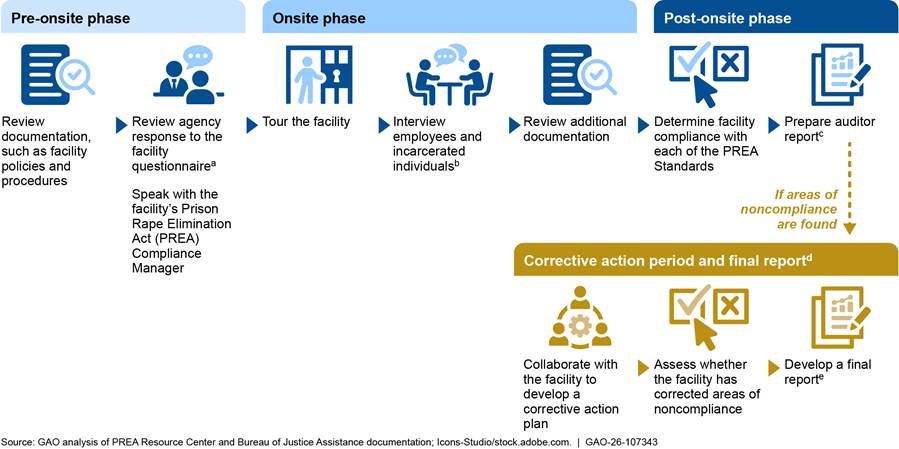
aThe PREA Compliance Manager coordinates the facility’s efforts to comply with the PREA Standards (codified as amended at 28 C.F.R. Part 115), including by completing a facility questionnaire prior to the onsite phase of the audit. The questionnaire requests information on the facility, its employees, and how it implements the PREA Standards.
bThe PREA Auditor Handbook suggests that interviews should take between 2 and 3.4 days, depending on the facility’s size. That suggested timeframe does not include the tour or document reviews during the onsite phase.
cThe auditor has 45 days following the onsite phase to submit the auditor report.
dA corrective action period may last up to 180 days.
eWhen a corrective action period occurs, the auditor has 30 days following the end of the period to submit a final report. The agency has 90 days from the receipt of the final report to appeal the findings.
PREA Roles and Responsibilities Among DOJ Components
Bureau of Prisons. BOP is responsible for implementing the PREA Standards in its own facilities.[19] Implementation includes collecting required data, facilitating the reporting process for sexual abuse, conducting investigations of alleged sexual abuse, and conducting after-action reviews of sexual abuse incidents, among other actions.
The PREA Management Office. Within DOJ’s Bureau of Justice Assistance, the PREA Management Office is responsible for training and certifying PREA auditors to conduct independent audits of U.S. prisons and jails. The office also has oversight authority over PREA auditors and can take remedial or disciplinary action where necessary.[20] The office is also tasked with providing PREA-related grants to state and local agencies and working with DOJ’s PREA Working Group to issue guidance related to the Standards.[21] To help address these responsibilities, the office manages the PREA Resource Center through a cooperative agreement.[22]
Bureau of Justice Statistics. The Bureau of Justice Statistics gathers and reports data about sexual abuse at federal, state, and local prisons using multiple survey instruments.[23] For example, Bureau of Justice Statistics survey instruments gather information from BOP about aggregate numbers of PREA-related cases, as well as detailed information about substantiated cases, when evidence supports that the alleged sexual abuse occurred.[24]
Office of the Inspector General (OIG). DOJ OIG investigates selected sexual abuse cases where an employee is the alleged perpetrator. The OIG receives complaints regarding sexual abuse and other misconduct through multiple internal and external sources. In calendar years 2014 through 2024, the OIG received approximately 3,200 allegations of sexual abuse where a BOP employee was the alleged perpetrator.[25] Of these allegations, the OIG received about 60 percent from officials at various DOJ components, and about 39 percent through its hotline email that, according to OIG officials, is the most common method used by incarcerated individuals.[26]
BOP Sexual Abuse Reporting and Investigation Process
According to BOP, its sexual abuse reporting and investigation process aims to ensure that allegations are documented, investigated, and resolved in compliance with PREA and the Standards. First, an incarcerated individual reports the sexual abuse, or someone else reports on their behalf.[27] Once the BOP facility is aware of the allegation, protocols involve separating the alleged victim from the alleged perpetrator and performing a medical exam and a psychological exam on the involved incarcerated individuals. BOP officials said the facility will collect evidence at the crime scene, if applicable. If the allegation includes a recent instance of penetration, BOP officials said they offer a nurse examiner from outside the prison to conduct a rape kit.[28]
After initial evidence collection and separation of the alleged victim and the alleged perpetrator, investigators begin to examine the case. During the investigation, the alleged perpetrator and alleged victim continue to be separated. According to BOP officials, an alleged employee perpetrator will generally be assigned away from the incarcerated individual (e.g. they will not work in their housing unit) during the investigation. BOP officials told us an alleged incarcerated perpetrator will generally go to the Special Housing Unit. The alleged victim may remain in the housing unit or go to the Special Housing Unit for protective custody, depending on the circumstances. The office that investigates sexual abuse cases differs based on whether the alleged perpetrator is a BOP employee or an incarcerated individual. See figure 2 for a detailed overview of the sexual abuse reporting and investigation process.
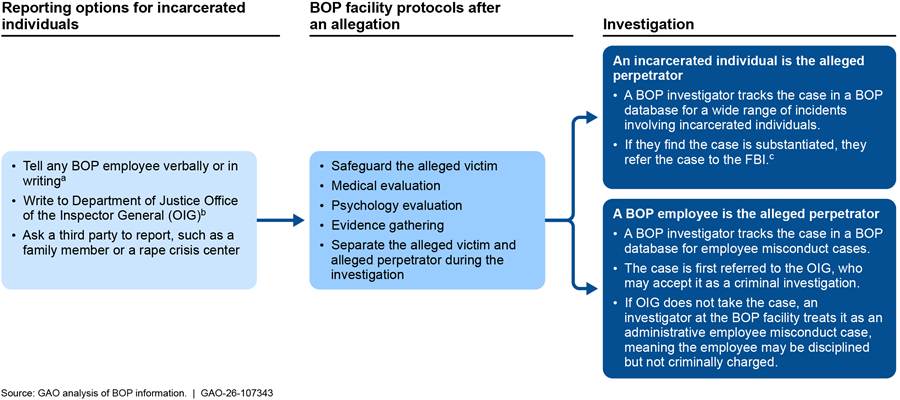
aAll BOP employees are required to report sexual abuse allegations to the relevant supervisor who facilitates the BOP facility protocols. Incarcerated individuals can report abuse to any facility employee in any way, including by filling out forms for making requests to staff, verbally telling them, or slipping them a note. They can also fill out a form to notify the warden, BOP regional office, or BOP central office directly.
bIncarcerated individuals can report incidents of sexual abuse to the Department of Justice OIG. For example, incarcerated individuals can send anonymous emails to the OIG.
cBOP categorizes investigation outcomes as follows: substantiated, meaning evidence supports that the alleged abuse occurred; unsubstantiated, meaning there is not enough evidence to determine whether the alleged abuse occurred; or unfounded, meaning evidence supports that the alleged abuse did not occur.
After each calendar year, BOP reports the number and status of sexual abuse allegations to the Bureau of Justice Statistics. If an investigation of an allegation was completed, BOP classifies the allegation as substantiated, unsubstantiated, or unfounded.[29] If an investigation has not been completed, BOP classified the allegation as “investigation ongoing.” Below are the four classification categories, along with a description of each category:
· Substantiated. The event was investigated and determined to have occurred.
· Unsubstantiated. The investigation concluded that evidence was insufficient to determine whether or not the event occurred.
· Unfounded. The investigation determined that the event did not occur.
· Investigation ongoing. Evidence is still being gathered, processed, or evaluated, and a final determination has not been made.[30]
Department of Justice Data Indicate There Were Approximately 8,500 Sexual Abuse Allegations from 2014 through 2022
According to DOJ’s Bureau of Justice Statistics data, the number of reported allegations of sexual abuse at BOP facilities generally increased from 2014 through 2022.[31] For example, the year with the lowest number of reported allegations was 2016 (797 allegations) and the year with the highest number was 2022 (1,168 allegations).[32] See table 1 for the number of reported sexual abuse allegations, by alleged perpetrator and year.[33]
Table 1: Bureau of Justice Statistics Data on the Number of Bureau of Prisons (BOP) Reported Sexual Abuse Allegations, 2014–2022
|
Year |
Number of Allegations (Allegedly Perpetrated by BOP Employees) |
Number of Allegations (Allegedly Perpetrated by Other Incarcerated Individuals) |
Total |
|
2014 |
511 |
324 |
835 |
|
2015 |
452 |
365 |
817 |
|
2016 |
463 |
334 |
797 |
|
2017 |
460 |
417 |
877 |
|
2018 |
575 |
494 |
1,069 |
|
2019 |
518 |
570 |
1,088 |
|
2020 |
422 |
509 |
931 |
|
2021 |
340 |
603 |
943 |
|
2022 |
584 |
584 |
1,168 |
|
Total |
4,325 |
4,200 |
8,525 |
Source: GAO analysis of Bureau of Justice Statistics, Survey of Sexual Victimization data. | GAO‑26‑107343
Note: The table includes reported allegations of sexual abuse against individuals incarcerated in Bureau of Prisons (BOP) operated facilities. These allegations include those allegedly perpetrated by BOP employees and by incarcerated individuals. Allegations could include multiple allegations for the same incident. Also, in this table, allegations are included in the year they were reported, which may or may not have been the year that the alleged incident occurred. The 2021 and 2022 Bureau of Justice Statistics data presented in this table are preliminary and subject to revisions.
According to BOP, all allegations of sexual abuse are investigated (e.g., investigated by BOP, DOJ OIG, or the Federal Bureau of Investigation). At the conclusion of an investigation, BOP assigns an outcome of substantiated, unsubstantiated, or unfounded. Our analysis found that most allegations resulted in an unsubstantiated outcome, meaning there was not enough evidence to support the allegation did or did not occur.
Sexual Abuse Allegedly Perpetrated by Incarcerated Individuals
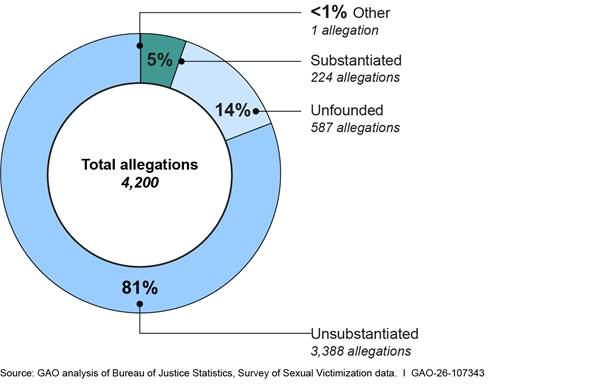
According to Bureau of Justice Statistics data, there were 4,200 reported allegations of sexual abuse where the alleged perpetrator was another incarcerated individual in 2014 through 2022.[34] Of these 4,200 allegations, 224 (5 percent) were substantiated, 3,388 (81 percent) were unsubstantiated, 587 (14 percent) were unfounded, and 1 (less than 1 percent) was an ongoing investigation, as shown in table 2.
Table 2: Bureau of Justice Statistics Data on Bureau of Prisons (BOP) Investigation Outcomes of Sexual Abuse Allegations Where the Alleged Perpetrator was an Incarcerated Individual, 2014–2022
|
Year |
Substantiated |
Unsubstantiated |
Unfounded |
|
2014 |
12 |
223 |
88 |
|
2015 |
15 |
272 |
78 |
|
2016 |
25 |
243 |
66 |
|
2017 |
26 |
337 |
54 |
|
2018 |
30 |
375 |
89 |
|
2019 |
30 |
460 |
80 |
|
2020 |
24 |
447 |
38 |
|
2021 |
32 |
514 |
57 |
|
2022 |
30 |
517 |
37 |
|
Total |
224 |
3,388 |
587 |
Source: GAO Analysis of Bureau of Justice Statistics, Survey of Sexual Victimization data. | GAO‑26‑107343
Note: The table includes outcomes of reported allegations of sexual abuse against individuals incarcerated in Bureau of Prisons (BOP) facilities. These allegations include those allegedly perpetrated by other incarcerated individuals (not by BOP employees). Also, in this table, outcomes are included in the year that the related allegation was reported, which may or may not have been the year that the alleged incident occurred. The total of substantiated, unsubstantiated, and unfounded allegations from 2014 through 2022 add up to 4,199. In 2014, one investigation was still ongoing when the Bureau of Justice Statistics collected the data in 2015, resulting in a total of 4,200 reported allegations from 2014 through 2022. The 2021 and 2022 Bureau of Justice Statistics data presented in this table are preliminary and subject to revisions.
|
Examples of Substantiated Allegations of Sexual Abuse at Bureau of Prisons (BOP) Facilities According to BOP data, a female incarcerated individual sexually abused another female incarcerated individual in a cell. After the victim reported the incident, she received a medical examination and counseling treatment. BOP placed the perpetrator in a special housing unit. The allegation against the perpetrator was referred for prosecution. According to BOP data, a male incarcerated individual sexually harassed another male incarcerated person in a common area, such as a shower or dayroom. A chaplain reported the incident. BOP provided the victim with a medical examination and separated him from the perpetrator. In response, officials placed the perpetrator in restricted custody, kept him separated from the victim, and referred him to counseling or treatment. Source: GAO analysis of BOP data. | GAO‑26‑107343 |
Figure 3 shows the total number of unsubstantiated, substantiated, and unfounded sexual abuse allegations made from 2014 through 2022. See appendix II for a full list of facilities with allegations involving incarcerated individuals as alleged perpetrators from 2020 through 2024.
Figure 3: Bureau of Justice Statistics Data on Bureau of Prisons (BOP) Investigation Outcomes of Sexual Abuse Allegations, Where the Alleged Perpetrator was an Incarcerated Individual, 2014–2022
Note: The figure includes outcomes of reported allegations of sexual abuse against individuals incarcerated in Bureau of Prisons (BOP) facilities. These allegations include those allegedly perpetrated by other incarcerated individuals (not by BOP employees). The 4,200 allegations include one investigation that was still ongoing when the Bureau of Justic Statistics collected the 2014 data in 2015. As the investigation was ongoing, it is not reflected in the unsubstantiated, unfounded, or substantiated categories. This figure relied on Bureau of Justice Statistics data from 2014-2022, including 2021 and 2022 data that are preliminary and subject to revisions.
Sexual Abuse Allegedly Perpetrated by BOP Employees
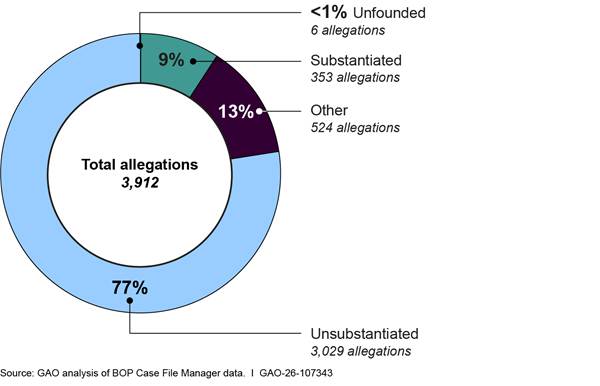
According to BOP Office of Internal Affairs data, there were 3,912 reported allegations of sexual abuse where the alleged perpetrator was a BOP employee from 2014 through 2022.[35] Of these 3,912 sexual abuse allegations where an investigation had concluded, our analysis of Office of Internal Affairs data indicated 353 (9 percent) were substantiated, 3,029 (77 percent) were unsubstantiated, and six (less than 1 percent) were unfounded, as shown in table 3.[36]
Table 3: Bureau of Prisons (BOP) Office of Internal Affairs Data on Investigation Outcomes of Sexual Abuse in BOP Facilities Where the Alleged Perpetrator was a BOP Employee, 2014–2022
|
Year |
Substantiated |
Unsubstantiated |
Unfounded |
|
2014 |
52 |
355 |
0 |
|
2015 |
51 |
326 |
4 |
|
2016 |
41 |
314 |
1 |
|
2017 |
52 |
306 |
0 |
|
2018 |
43 |
431 |
0 |
|
2019 |
41 |
378 |
0 |
|
2020 |
23 |
303 |
0 |
|
2021 |
22 |
224 |
0 |
|
2022 |
28 |
392 |
1 |
|
Total |
353 |
3,029 |
6 |
Source: GAO Analysis of BOP Case File Manager data. | GAO‑26‑107343
Note: We obtained data within this table from the Bureau of Prisons (BOP) Office of Internal Affairs’ Case File Manager system, as of March 2025. This table does not include missing or administrative outcome investigations. The table includes outcomes of reported allegations of sexual abuse against individuals incarcerated in BOP facilities. These allegations include those allegedly perpetrated by BOP employees (not by other incarcerated individuals). Also, in this table, outcomes are included in the year that the related allegation was reported, which may or may not have been the year that the alleged incident occurred.
|
According to BOP data, a male BOP correctional officer with 5 to 10 years of service abused his authority by engaging with more than one female incarcerated person in a nonconsensual sexual act, unwanted touching, sexual harassment, or repeated verbal statements of a sexual nature. Investigators also found that he had at least one sexual relationship with a female incarcerated individual. The abuse occurred in program service areas (e.g., kitchen, storage, laundry) and staff-only areas. After reporting the abuse, some victims were offered medical exams, sexually transmitted infection testing, and counseling or mental health treatment. BOP separated some of them from the perpetrator, and some were placed in administrative segregation, protective custody, or transferred to other facilities. The officer resigned before the investigation concluded. According to BOP data, a female BOP employee, assigned to medical or health care duties, engaged in a sexual relationship with a male incarcerated individual. The female BOP employee wrote letters, showed pictures, or offered gifts or special privileges to the male incarcerated individual. The sexual abuse took place in a medical area such as an infirmary or health clinic. BOP terminated the employee following the investigation. Source: GAO analysis of BOP data. | GAO‑26‑107343 |
Figure 4 presents the total number investigative outcomes of sexual abuse allegations—unsubstantiated, substantiated, and unfounded—from 2014 through 2022. See appendix III for a full list of BOP facilities with employee-related allegations from 2020 through 2024.
Figure 4: Bureau of Prisons (BOP) Office of Internal Affairs Data on Investigation Outcomes of Sexual Abuse Allegations, Where the Alleged Perpetrator was a BOP Employee, 2014–2022
Note: We obtained data within this figure from the Bureau of Prisons (BOP) Office of Internal Affairs’ Case File Manager system, as of March 2025. The category labeled “Other” includes allegations where the outcome was administrative or did not have an investigative outcome as of March 2025. Also, the figure includes outcomes of reported allegations of sexual abuse of individuals incarcerated in BOP facilities. These allegations include those allegedly perpetrated by BOP employees (not by other incarcerated individuals).
BOP Has Not Fully Made Use of Oversight Tools to Prevent, Detect, and Respond to Sexual Abuse
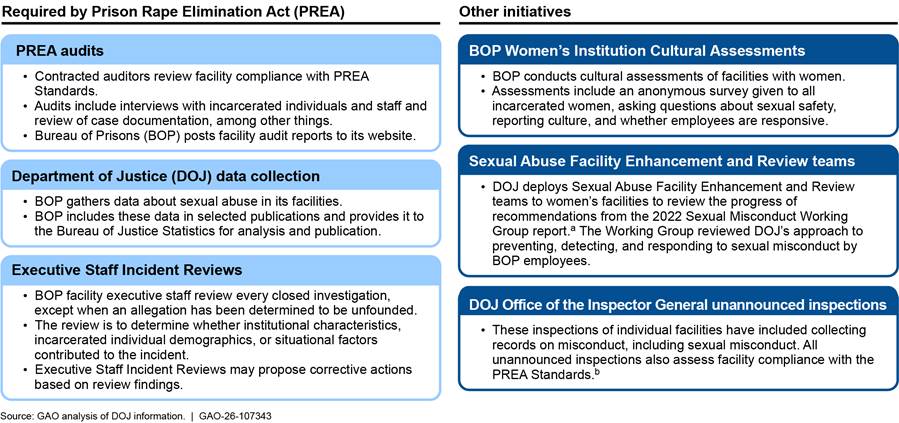
DOJ has oversight tools to help prevent, detect, and respond to sexual abuse in its facilities. However, we found that BOP has not fully leveraged some of the tools, and as a result, may be missing opportunities to provide stronger oversight over sexual abuse of incarcerated individuals. Specifically, we reviewed six oversight tools DOJ uses, as shown in figure 5.[37]
aIn 2022, the Deputy Attorney General issued a memorandum identifying concerns about instances of reported and proven sexual misconduct by BOP employees. The memorandum directed the Principal Associate Deputy Attorney General to chair a Working Group of senior officials from relevant DOJ components to review the Department’s approach to preventing, detecting, and responding to sexual misconduct by BOP employees. This group was a special purpose working group distinct from the general PREA Working Group and was tasked with developing and proposing “recommendations and reforms to address gaps, deficiencies, and problems identified.” This group produced a report in November 2022.
bThe Federal Prison Oversight Act, codified at 5 U.S.C. § 413, requires that the OIG conduct risk-based inspections of BOP facilities, which may include assessment of “[c]redible allegations of incidents involving excessive use of force, completed, attempted, or threatened violence, including sexual abuse, or misconduct committed against incarcerated people.” For purposes of these inspections, the term “sexual abuse” is defined by the regulations implementing PREA. See 28 C.F.R. § 115.6.
In addition to making use of the oversight tools that PREA requires, we found that DOJ has implemented three new oversight tools beginning in 2022. For instance, DOJ deployed Sexual Abuse Facility Enhancement and Review teams to ensure women’s facilities implemented recommendations from a DOJ Working Group. The working group reviewed DOJ’s approach to addressing and preventing sexual misconduct by BOP employees and developed a final report in November 2022 with recommendations.[38] In addition, in 2023, DOJ OIG began conducting unannounced inspections of BOP facilities to review, among other things, sexual misconduct. However, we also found that BOP is not fully leveraging three of the six tools—PREA audits, DOJ’s PREA data collection, and BOP Women’s Institution Cultural Assessments. Below is information on each of the six oversight mechanisms.
PREA Audits
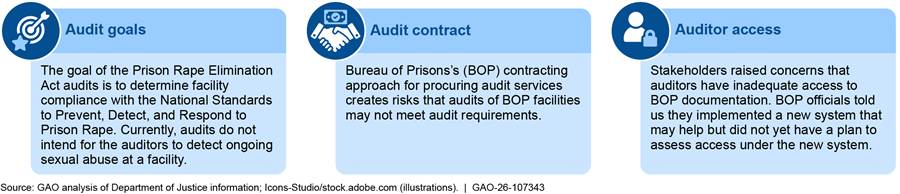
We identified three aspects of PREA audits that could limit their effectiveness as oversight tools, as shown in figure 6. For instance, we found that detecting ongoing sexual abuse at BOP facilities is not a goal for the auditors. This may explain why auditors deemed some BOP facilities fully compliant with all PREA Standards, even when widespread sexual abuse was occurring at those facilities during the time period of the audit. Additionally, BOP’s current contracting approach for procuring audit services may create risks that audits of BOP facilities may not meet audit requirements. Finally, stakeholders have raised concerns that auditors have not had adequate access to BOP documentation needed to conduct the audits. BOP has implemented a new file sharing system that may help alleviate these access concerns. However, BOP officials did not yet have a plan to evaluate whether the system will fully address the issues identified.
Audit Goals
The goal of a PREA audit is to determine a correctional facility’s compliance with the PREA Standards. These Standards are designed to help facilities (like BOP prisons) prevent, detect, and respond to sexual abuse.[39] For instance, the Standards require BOP facilities to detect sexual abuse on an ongoing basis by accepting reports of sexual abuse verbally or in writing and reviewing reported allegations of sexual abuse.[40] Auditors take steps to determine compliance with these required detection efforts, such as reviewing relevant facility policies and documentation of alleged sexual abuse.
However, PREA audits are not currently designed to detect whether there is ongoing sexual abuse at facilities. Specifically, a BOP official with responsibility for overseeing the audit process told us that the purpose of the audits is to check whether correctional facilities have the necessary tools in place to detect sexual abuse, not to see if the auditor can detect sexual abuse while they are onsite.
According to officials from the Bureau of Justice Assistance, a correctional facility may comply with the Standards even when abuse occurs at the facility.[41] For instance, in the past, facilities that experienced rampant sexual abuse—such as FCI Dublin and Federal Correctional Complex (FCC) Coleman—had passed their audits despite the ongoing abuse occurring at the facility. The 2022 final audit report of FCI Dublin stated the facility was 100 percent compliant with the PREA Standards. However, 10 FCI Dublin employees were later charged with sexual abuse they allegedly committed between 2016 and 2022, despite the audit conducted in 2021 and 2022 indicating 100 percent compliance.[42] Additionally, BOP officials told us the three audits of FCC Coleman that covered a period of alleged widespread sexual abuse from 2012 through 2020 found 100 percent compliance with the Standards.[43] In May 2021, the U.S. government settled a civil lawsuit brought by 15 women accusing eight FCC Coleman employees of sexual abuse.[44]
Currently, DOJ-issued audit guidance requires auditors to evaluate facility compliance with each of the Standards, but it does not instruct auditors to detect ongoing sexual abuse.[45] The Bureau of Justice Assistance’s PREA Auditor Handbook (Handbook) serves as guidance for auditors to conduct high quality PREA audits.[46] Specifically, the Handbook states that auditors should assess compliance with each of the Standards using a DOJ-issued auditor compliance tool. According to the Standards, DOJ is responsible for developing and issuing the audit instrument that provides guidance on the contents of the audit.[47] Currently, the tool instructs auditors to, among other things, verify the facility has a zero-tolerance policy, verify that a sample of employees have documented training completion, and ask a sample of incarcerated individuals if they received information about sexual abuse rules and reporting upon arrival at the facility. According to the Handbook, if a facility does not meet the Standards, the auditor should work with that facility to take any corrective action to reach the shared goal of PREA compliance and sexual safety.
Standards for Internal Control in the Federal Government states that management should identify, analyze, and respond to risks related to achieving an organization’s defined objectives.[48] DOJ officials told us they consider compliance with the PREA Standards the goal of the audit, rather than the detection of sexual abuse. One BOP official with responsibility for overseeing the audit process said that PREA audits could detect sexual abuse, but that is not the reason they were created. While audits were established to determine compliance with the Standards, one goal of PREA and the Standards is the detection of sexual abuse. Audits provide an opportunity to further meet this intent because auditors are to conduct detailed reviews of facilities every three years and have the opportunity for additional visibility into facilities’ operations. Identifying options, such as including specific steps in the Handbook, to enhance the ability of PREA audits to detect ongoing sexual abuse could help DOJ be better positioned to recognize ongoing sexual abuse in BOP facilities, such as that which occurred at FCI Dublin and FCC Coleman.
Audit Contract
Our review found that BOP’s contracting approach for procuring PREA audit services creates risks that audits of BOP facilities may not address the requirements of the Handbook or may incorrectly find facilities fully compliant with the Standards.[49] According to BOP, it has a firm fixed unit price contract with Corrections Consulting Services, under which this entity is responsible for assigning DOJ-certified auditors to conduct audits at each BOP facility.[50] Under the current pricing model, BOP officials told us they pay the contractor a set price for each audit, regardless of the size of the facility or the time an auditor spends conducting the audit.[51]
The Handbook outlines requirements and recommendations for agencies contracting for audits and for DOJ-certified auditors conducting audits. As part of their role as a DOJ-certified auditor, auditors must conduct audits according to DOJ’s requirements, including those in the Handbook.[52]
BOP’s current contracting approach creates a risk that audits performed under the contract will not meet the Handbook’s requirement that contracts allow sufficient time to conduct a thorough audit. The Handbook indicates many factors that influence the amount of time needed for the onsite phase of the audit, including facility size. It also provides recommendations for the amount of time an auditor should spend conducting interviews based on a facility’s total population. For example, the Handbook recommends auditors reserve 20.3 hours for interviews at facilities with 0-50 incarcerated individuals, 30.3 hours for facilities with 1,000-2,500 individuals, and 33.7 hours for facilities with over 2,500 individuals. Most BOP facilities house over 1,000 incarcerated individuals, and these suggested timeframes do not include the other portions of the onsite audit such as the tour and document review. BOP’s contract with Corrections Consulting Services says the onsite portion of an audit will generally take up to three days, and restricts each work day to eight-and-a-half-hours (25.5 hours total) for completing the entire onsite portion of the audit, regardless of facility size or other factors that the Handbook says may affect the amount of time needed for a thorough audit.[53]
Further, in February 2024, the Director of the Bureau of Justice Assistance, which oversees and certifies PREA auditors, issued a memo to the BOP Director that identified potential risks with PREA audits conducted by auditors contracted with Corrections Consulting Services. The memo included findings from a PREA Management Office review of over 1,000 audit reports, 412 of which were conducted by Corrections Consulting Services auditors. The review found that auditors from Corrections Consulting Services were three times more likely to spend an inadequate number of days onsite as compared to other DOJ-certified auditors at non-BOP facilities.[54] All three of the PREA auditors we spoke with also told us that the current timeframe for completing audits of BOP facilities may be inadequate. For example, one auditor stated that the current timeframe is not sufficient for larger facilities.
Although the Handbook and BOP’s current contract allow for, and sometimes recommend, additional, secondary auditors to assist with tasks, BOP’s current contracting approach may result in audits that do not make use of this option. The Handbook strongly encourages auditors to conduct audits in teams because of the rigor of the required audit methodology and the amount of work associated with assessing compliance with all of the Standards. Additionally, BOP’s Statement of Work for its contract with Corrections Consulting Services says that sufficient staffing would ordinarily include one auditor at Federal Prison Camps; one or two auditors at U.S. Penitentiaries, Federal Medical Centers, and several other types of BOP facilities; and two or three auditors at FCCs. Although BOP recommends some facilities have one auditor and others have up to three auditors to conduct an adequate audit, officials told us the current contract pricing model pays the same fee for audits regardless of the number of auditors.
Also, BOP’s current contracting approach may create a risk that audits will not identify noncompliance with the Standards. Under the Standards, as codified, audits must determine whether facilities comply with the Standards; finding noncompliance prompts a 180-day corrective action period for the facility to obtain compliance. During this corrective action period, auditors are to collaborate with the facility to develop a corrective action plan, assess whether the facility corrected areas of noncompliance, and develop a final report on their findings.[55] BOP officials told us that BOP does not pay additional fees if an auditor finds areas of noncompliance with the Standards, even though these findings generate additional work for the auditor and require additional time.[56] These officials also told us that they do not provide additional compensation for a corrective action period because they do not want to incentivize auditors to identify false instances of noncompliance. The Handbook, however, cautions that contracts that pay a set amount for each audit, regardless of the audit’s findings, may inappropriately incentivize auditors to find full compliance with the Standards, even in cases where policies or practices are not in compliance.[57]
Our prior work on enterprise risk management has identified essential elements to help agencies adopt a forward-looking approach to anticipating and managing risk. One element is assessing risks to determine the likelihood and impact of their occurrence. Another is selecting a response to these assessed risks while considering the level of risk an agency is willing to tolerate. Risk responses include reduction, avoidance, or acceptance, among others, and agencies should select the most appropriate response.[58]
BOP officials told us they did not perform a risk assessment—such as evaluating whether contract requirements, incentives, and oversight mechanisms were sufficient to ensure audits are conducted in accordance with the Handbook—when contracting for audit services. Thus, they did not take steps to identify and respond to potential risks. These risks include the current contracting approach for audits resulting in audits that do not meet the Handbook’s requirements. In addition, there is a risk that auditors may improperly find full compliance with the Standards, even in cases where facilities are not in full compliance.
By assessing and responding to risks in the current contracting approach, BOP could help ensure auditors conduct thorough audits and make accurate compliance determinations in the future. BOP officials stated that the current contracting approach helps mitigate risks of unnecessary costs, but assessing and responding to the risks we identified remains important to help ensure audits are conducted in accordance with the requirements.
Auditor Access
According to the Bureau of Justice Assistance and PREA Resource Center, some auditors reported that they did not have sufficient access to BOP records while conducting PREA audits. BOP officials stated that they recently implemented a new document sharing system. However, they also said that the new system was implemented to address security concerns, not to address PREA auditor concerns about access to documentation. Table 4 shows the requirements for auditor access to documentation outlined in the Standards and the PREA statute.
Table 4: Requirements from the Prison Rape Elimination Act (PREA) Statute and Standards Related to Auditor Access to Documentation
|
Source |
Requirement |
|
PREA Statute 34 U.S.C. § 30307(e)(8)(D) |
“The Director of the Bureau of Prisons shall comply with each request for documentation necessary to conduct an audit […] which is made by a certified auditor.” |
|
PREA Standards 28 C.F.R. § 115.401(i) and (j) |
“The auditor shall be permitted to request and receive copies of any relevant documents (including electronically stored information).” |
|
“The auditor shall retain and preserve all documentation (including, e.g., video tapes and interview notes) relied upon in making audit determinations.” |
Source: U.S. Code and Code of Federal Regulations. | GAO‑26‑107343
According to the memo that the Bureau of Justice Assistance sent BOP in February 2024, some PREA auditors have reported impediments to accessing and retaining the documentation needed to determine compliance with the Standards. The memo reported that the PREA Management Office reviewed audit documentation and information from auditors after becoming concerned with the performance of BOP’s contractor for PREA audit services, Corrections Consulting Services. Some auditors reported that BOP provided documentation with critical information redacted or did not permit auditors to retain certain documents. Although officials from the Bureau of Justice Assistance told us that they had not independently verified these auditors’ claims, the director of the Bureau of Justice Assistance conveyed the PREA Management Office’s findings to the BOP director in the February 2024 memo.
Also, in a February 2024 memo to the Bureau of Justice Assistance, the PREA Resource Center reported similar findings from its review of PREA audits. Specifically, the Center observed audits and spoke with auditors, among other activities, in response to concerns that audits included inaccurate findings. In the memo, the Center reported that BOP did not always allow auditors to retain and upload documents. The memo states that this restriction may make it difficult for auditors to provide materials to the PREA Management Office for oversight and adhere to the document retention requirements in the Standards.[59]
Additionally, three PREA auditors we spoke with identified challenges with accessing BOP documentation. For example, one auditor indicated that BOP provided documentation that was redacted to the extent that it could no longer substantiate the compliance finding.
BOP officials told us that they adopted the Justice Enterprise File Sharing system in 2024, which may help address concerns about auditor access to documentation. Officials told us that the Justice Enterprise File Sharing system provides a secure platform for sharing sensitive information without the need for BOP to restrict the data. BOP officials also said the platform simplifies the process for auditors to access required information and minimizes delays in providing that information. BOP officials told us that as part of meeting legal and ethical requirements when providing information to auditors, auditors can only leave the facility with their notes after the onsite phase. BOP can use the Justice Enterprise File Sharing System to share documents the auditors viewed after the onsite portion of the audit.
Although the new system could address the concerns auditors expressed with access to documentation, BOP officials did not yet have a plan to assess access under the new system. The officials stated that the new system was implemented to meet DOJ security requirements, not to address auditor concerns. Additionally, BOP officials told us they believe the Justice Enterprise File Sharing system makes the audit process flow better and have not received any recent complaints from BOP or auditors.
Standards for Internal Control in the Federal Government states that management should establish and operate monitoring activities for its internal control system.[60] By evaluating its use of the new file sharing system to provide auditors access to documentation, BOP will be better positioned to make any needed adjustments. In doing so, BOP can help ensure that auditors can review and retain the documentation they need to conduct high-quality audits as required under the PREA statute and Standards.
DOJ’s PREA Data Collection
DOJ collects and publishes data on sexual abuse allegations reported in BOP facilities. We found that BOP compares current year facility-level PREA data it collects to data from the prior year. However, BOP officials told us they do not analyze the data for trends over time. We also found that BOP has not published uniform data in its Annual PREA Reports. Specifically, BOP has published a greater level of detail for data on sexual abuse perpetrated by incarcerated individuals than abuse perpetrated by BOP staff.
The PREA statute, as implemented through the Standards, requires DOJ to collect detailed uniform data for all PREA allegations and publish the data annually.[61] To address these requirements, BOP collects facility-level data for allegations where an incarcerated individual was the alleged perpetrator and where a BOP employee was the alleged perpetrator. According to BOP officials, these data are incorporated into multiple DOJ publications such as BOP’s Office of Internal Affairs Annual Report, the Bureau of Justice Statistics sexual victimization statistical report, and BOP’s Annual PREA Report that is required by the PREA statute.
In addition, according to the PREA Standards, DOJ is required to review data collected to assess and improve the effectiveness of its sexual abuse prevention, detection, and response policies, practices, and training.[62] Also, more broadly, BOP’s Strategic Framework says the agency plans to prioritize the use of agency data.[63] Specifically, one of BOP’s goals is to review and analyze agency data to inform evidence-based decisions to improve operations, policies, and procedures across all disciplines.
However, we found that BOP does not analyze the facility-level PREA data it collects for trends over time. According to BOP officials, they do not analyze PREA data beyond the prior year due to resource constraints. Further, officials from BOP’s Office of Internal Affairs said that their Case File Manager system is used primarily for tracking individual allegations, not for trend analysis.
The November 2022 DOJ Working Group report on sexual abuse highlighted the importance of BOP analyzing its data to identify trends and advance recommendations targeted to specific facilities.[64] Analyzing data that it already collects for trends could help BOP be responsive to this report. Routinely analyzing facility-level PREA data over time can help ensure that BOP is learning from past allegations of sexual abuse. For example, the analyses can help BOP proactively identify federal facilities that may need additional attention. Identifying such facilities could also allow DOJ to expedite audits if the Department has reason to believe that a particular facility may be experiencing problems related to sexual abuse.[65]
We also found that BOP has not published uniform data in its Annual PREA Reports. Specifically, we analyzed BOP’s Annual PREA Reports from 2014 through 2024 and found that BOP published a greater level of detail for allegations where an incarcerated individual was the alleged perpetrator compared to allegations where a BOP employee was the alleged perpetrator. For example, in the 2024 Annual PREA Report, information about alleged abuse perpetrated by incarcerated individuals spans 15 pages.[66] The information includes the number of allegations by BOP facility, and further by the security level within each facility. It also includes detailed descriptions of every allegation substantiated in 2024, such as the type of sexual abuse, location where the abuse occurred, and demographic details of the perpetrator.
In contrast, information about alleged abuse perpetrated by BOP employees spans one page. The number of allegations by facility is not provided, and information on substantiated cases is limited to high-level examples. According to BOP employees who develop the annual PREA report, they do not ask for facility level data or details for each substantiated case, and they only publish the data that the Office of Internal Affairs provides. However, the Office of Internal Affairs collects detailed data on all allegations, including substantiated allegations, of sexual abuse where a BOP employee was the alleged perpetrator.
Standards for Internal Control in the Federal Government states that management should communicate quality information externally to help the agency achieve its objectives and address related risks.[67] By publishing uniform facility-level data on alleged sexual abuse perpetrated by employees that matches the level of detail currently published on allegations where an incarcerated individual was the alleged perpetrator in the Annual PREA Reports, BOP could improve the transparency of its PREA data. In addition, publishing uniform data could allow PREA stakeholders to analyze more complete data, which would help prevent and address sexual abuse in BOP facilities.
BOP Women’s Institution Cultural Assessments
BOP developed the Women’s Institution Cultural Assessments to provide insight into a facility’s overall culture and operations and to help ensure a culture of trust and sexual safety. BOP has completed at least one assessment at each BOP facility with women, and officials have highlighted the benefits of these assessments. However, BOP has only conducted these assessments at women’s facilities, which house about seven percent of the total BOP population of incarcerated individuals.
DOJ began conducting the Women’s Institution Cultural Assessments in 2022 after several FCI Dublin employees were found to have sexually abused incarcerated women at that facility. The initiative is co-led by two BOP offices—the Women and Special Populations Branch and the Office of Internal Affairs. The assessments are conducted every 2 years and analyze a facility’s operations, programming, and service gaps.
The assessments also include interviews with BOP employees and incarcerated women; observations of operations and services; and an anonymous survey to all incarcerated women about sexual safety, reporting culture, and employee responsiveness. According to BOP officials, the assessments can be used to measure an incarcerated individual’s comfort with reporting sexual abuse, sexual safety, and fear of retaliation.
Some BOP officials and facility employees we interviewed said that these assessments have yielded positive benefits for several BOP facilities. For example, one official said the recommendations from these assessments helped BOP target additional training and corrective action plans to individual facilities. In addition, BOP officials said that they gained insight into the PREA-related challenges that some facilities faced and that they have seen improvement after implementing recommendations from the assessments.
One of BOP’s bureau-wide strategic goals is to review and analyze data to inform evidence-based decisions that will be used to improve operations, policies, and procedures across all disciplines.[68] However, in April 2025, BOP officials told us there were no plans to conduct cultural assessments beyond women’s institutions partly due to limited resources. Excluding men’s facilities in BOPs selection for cultural assessments means that BOP is missing insights from about 93 percent of the prison population. Our analysis of BOP data shows that sexual abuse allegations are prevalent at both men’s and women’s facilities. For example, according to the 2024 Annual PREA Report, most substantiated allegations of sexual abuse where an incarcerated individual was the alleged perpetrator occurred at facilities that house men.
In issuing its final rule implementing the Standards, DOJ stated that “the success of the PREA Standards in combating sexual abuse will depend on effective leadership and the development of an agency culture that prioritizes efforts to combat sexual abuse.”[69] DOJ has taken the positive step of conducting cultural assessments at women’s facilities following the rampant abuse at FCI Dublin. BOP said it plans to conduct future assessments, and by including men’s facilities in these assessments, BOP can identify issues and corrective actions to help combat sexual abuse at both men’s and women’s facilities.
Other Oversight Tools
BOP uses three other tools to conduct oversight related to sexual abuse and sexual safety at its facilities: Executive Staff Incident Reviews, Sexual Abuse Facility Enhancement and Review Teams, and DOJ OIG unannounced inspections.
· Executive Staff Incident Reviews. BOP facility staff are required to conduct Executive Staff Incident Reviews within 30 days of the closure of a PREA investigation, unless the allegation was determined to be unfounded.[70] Executive staff conduct the reviews to help determine if certain factors contributed to the incident, such as whether: the incident was motivated by race or ethnicity; physical barriers in the facility enabled the sexual abuse; staffing levels were adequate; and monitoring technology such as cameras should be adjusted. If contributing factors are identified, staff may propose potential corrective actions based on the findings to prevent future sexual abuse incidents. We analyzed 57 Executive Staff Incident Reviews from a nongeneralizable sample of four BOP facilities from 2023 through 2024.[71] According to our analysis, 41 incident reviews did not identify the need for corrective actions, and 16 incident reviews recommended corrective actions. Examples of corrective actions included increased camera monitoring, staffing, and training.
· Sexual Abuse Facility Enhancement and Review Teams. The Sexual Abuse Facility Enhancement and Review teams are part of DOJ’s efforts to combat sexual misconduct in federal prisons. The teams were deployed to women’s facilities to review the progress of recommendations implemented as a result of the November 2022 DOJ Working Group report.[72] Recommendations from the report included enhancing reporting and training related to sexual abuse, preventing sexual misconduct by staff, and improving investigations of sexual abuse, among other things. In April 2025, the official overseeing the teams said they were tracking progress of the recommendations on a monthly basis and that DOJ officials are considering the role of these teams in the future.
· DOJ OIG Unannounced Inspections. In 2023, DOJ OIG launched a new unannounced inspections program at BOP facilities.[73] The onsite inspections can include an assessment of facility compliance with policies and standards, an evaluation of systemic issues, and a review of facility employee misconduct investigations, among other things. With regard to PREA, the final reports from these inspections have identified challenges related to staffing shortages, camera coverage, and tracking of allegations where an incarcerated individual is the alleged perpetrator. DOJ OIG officials told us they had conducted unannounced inspections at six BOP facilities as of September 2025. Officials stated they plan to continue conducting unannounced inspections based on a facility’s risk factors such as staffing levels, access to adequate health resources, and incidences of physical assault, neglect, or sexual abuse.[74]
Incarcerated Individuals and BOP Employees Identified Challenges in Addressing Sexual Abuse
BOP employees and 44 incarcerated individuals we spoke with reported multiple challenges related to reporting and reducing sexual abuse in BOP facilities. The challenges most frequently discussed included: (1) limited knowledge of PREA resources and reporting options, (2) discomfort about reporting and fear of retaliation, (3) insufficient amount or quality of evidence for investigations, (4) length of investigations for allegations against employees, (5) inadequate staffing coverage, and (6) false allegations. In addition, we found that the PREA Standards have not been updated to reflect advances in technologies and correctional practices, and other lessons learned since the implementation of the Standards. Such an update could help address challenges we heard during our interviews and help ensure that the Standards are aligned with the goals of PREA.
The interviews we discuss below are not representative of the entire population incarcerated in BOP facilities, or of the entire incarcerated population at each of the facilities we visited. However, the anecdotal information we learned during these interviews provided valuable insights and illustrative examples about individuals’ experiences. In accordance with our policy, we have referred information related to certain statements made during these interviews to DOJ OIG, as appropriate. Below is a summary of the topics discussed during our interviews.
Knowledge of PREA Resources and Reporting Options
Some incarcerated individuals we spoke with told us they did not know all the options for reporting PREA allegations. For example, 61 percent (27 of 44) of incarcerated individuals we spoke with said they did not know the identity of the PREA Compliance Manager at their facility.[75] Seventy-three percent (32 of 44) said they did not know they could ask a rape crisis center or advocacy group to report a PREA allegation on their behalf, and 32 percent (14 of 44) said they did not know they could ask a family member or friend to report an allegation on their behalf.[76]
Incarcerated individuals we spoke with were more familiar with some reporting options than others. Eighty-two percent (36 of 44) of incarcerated individuals we spoke with knew they could report sexual abuse by telling a correctional officer, and 93 percent (41 of 44) were aware they could report it to another employee.[77] Sixty-eight percent (30 of 44) said they were aware they could report it to the warden.[78]
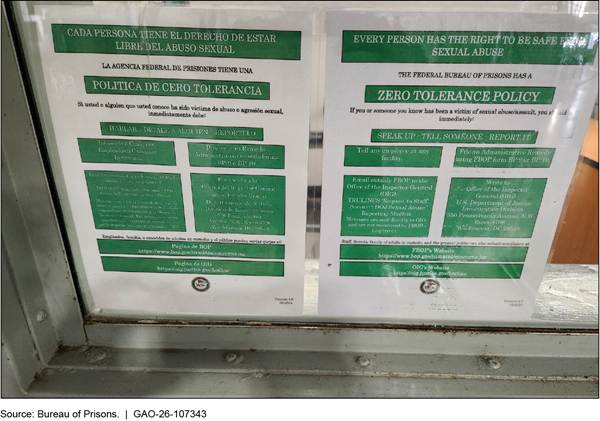
BOP officials told us their facilities provide training to incarcerated individuals at orientation, which includes a section on PREA protections and reporting options. The orientation handbook includes a section about sexual abuse and how to report it. In addition, BOP policy requires signage about sexual abuse reporting is to be posted throughout facilities (see figure 7).
Discomfort About Reporting and Fear of Retaliation
Seventy-five percent (33 of 44) of incarcerated individuals we spoke with believed incarcerated individuals in BOP prisons are generally hesitant about reporting sexual abuse. Five did not think incarcerated individuals would have hesitations about reporting sexual abuse, and six were not sure. Table 5 lists the different reporting methods available to incarcerated individuals, and whether the 44 individuals we spoke with reported being comfortable or not comfortable using the methods.
|
Method |
|
Comfortable Using |
||||
|
|
|
|
|
Yes |
No |
Not Sure |
|
Tell, or write to, a correctional officer |
|
|
|
19 (43%) |
22 (50%) |
3 (7%) |
|
Tell another employee, such as a health care staff person, psychologist, counselor, or case manager |
|
|
|
28 (64%)a |
10 (23%) |
6 (14%) |
|
Write to the warden |
|
|
|
21 (48%) |
19 (43%) |
4 (9%) |
|
Write to the Regional Office |
|
|
|
31 (71%) |
10 (23%) |
3 (7%) |
|
Write an anonymous email to the Office of the Inspector General |
|
|
|
31 (71%) |
11 (25%) |
2 (5%) |
|
Ask a rape crisis center or advocacy group to report it |
|
|
|
30 (68%) |
9 (21%) |
5 (11%) |
|
Ask a family member or friend to report it |
|
|
|
32 (73%) |
8 (18%) |
4 (9%) |
Source: GAO interviews with incarcerated individuals in Bureau of Prisons (BOP) custody. I GAO‑26‑107343
Note: We interviewed 44 incarcerated individuals at four federal facilities. The interviews are not representative of the entire incarcerated population at these facilities or across BOP. Some totals may not add up to 100% due to rounding.
aOf the 34 incarcerated individuals who indicated they would tell a non-correctional employee, or were not sure if they would, 14 indicated there were specific employees or departments they would or would not be comfortable reporting to. For example, some incarcerated individuals said they would feel comfortable reporting to a BOP psychologist or named specific BOP employees they trust.
|
Examples of incarcerated individuals’ views on retaliation If an incarcerated man reports sexual abuse perpetrated by another incarcerated man, then there may be a sense that he is “ratting on” that person. There may also be a sense that he is less masculine, or weak, which could make the victim a target for further abuse. If an incarcerated individual reports sexual abuse perpetrated by an employee, then there may be retaliation. For example, employees may take the incarcerated individual’s pillow or extra blanket, send him to the Special Housing Unit, or write him up for not making his bed. —Incarcerated individual If an incarcerated individual reports sexual abuse perpetrated by an employee, then employees will hound the incarcerated individual by, for example, shaking their room down, patting them down everywhere they go, and giving them looks during the daily count of incarcerated individuals. The least severe way that employees will retaliate against incarcerated individuals is the way they will speak to them in front of other incarcerated individuals, such as humiliating and degrading them, and calling them out during the daily count. They will conduct a shakedown of the incarcerated individual’s cell or bunk area, which includes tearing up their area and taking their personal belongings. Then the incarcerated individual’s bunkmates will also be mad at them because the bunkmates have to endure the shakedowns too. —Incarcerated individual Source: GAO interviews with incarcerated individuals. | GAO‑26‑107343 Note: These are summaries from interviews of incarcerated individuals we spoke with, not direct quotes. |
Incarcerated individuals discussed reasons they might hesitate to report sexual abuse. One reason was the fear of retaliation. Fifty-nine percent (26 of 44) told us that someone who reports sexual assault by another incarcerated person would likely experience retaliation from other incarcerated people.[79] For example, one individual told us the friends of the accused may make comments toward and bully the accuser.
Sixty-one percent (27 of 44) of incarcerated individuals told us that incarcerated individuals who report sexual assault by an employee could experience retaliation from BOP employees.[80] For example, individuals reported that employees might conduct retaliatory cell searches or “shakedowns,” write the incarcerated individual up in an incident report, or send them to the Special Housing Unit.
Nine incarcerated individuals we spoke with reported that incarcerated individuals would hesitate to report sexual abuse because of fear of being embarrassed or stigmatized. Three of the 22 incarcerated individuals we spoke with in men’s housing units expressed a concern that if their victimization became public knowledge, it could make them seem like easy targets for further victimization. One incarcerated individual said a negative stigma goes along with reporting sexual abuse, and that the incarcerated individual could be “labeled as a PREA person.”
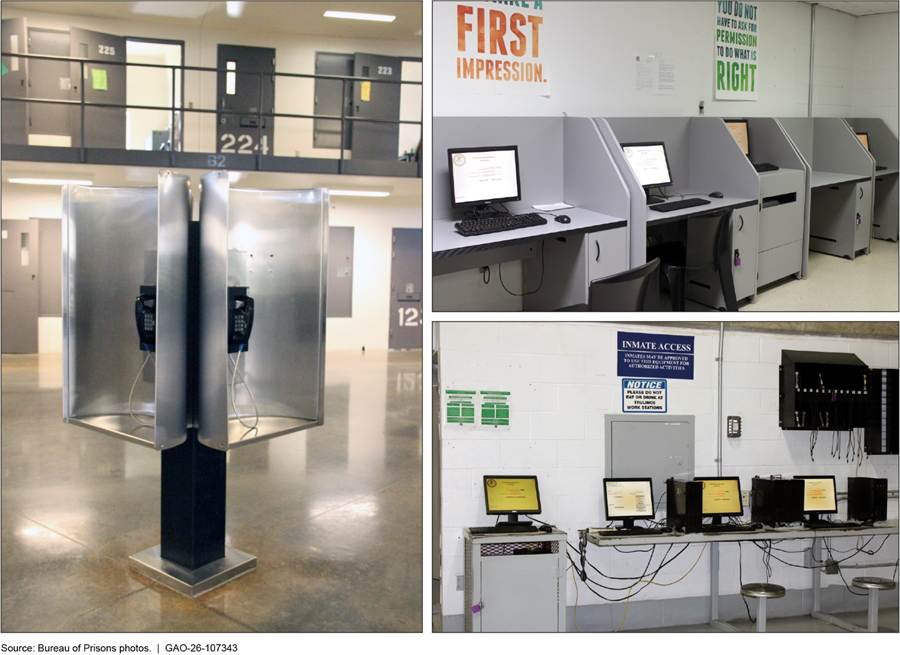
Another reason incarcerated individuals expressed hesitation to report sexual abuse was a perceived lack of privacy and confidentiality in prison. Incarcerated individuals and BOP employees explained that both incarcerated individuals and employees discuss rumors and personal information about others. Employees may read incarcerated individuals’ mail, and people can see an incarcerated individual using the phones, computers, and speaking with BOP employees. Figure 8 shows examples of phone and computer arrangements.
When BOP employees become aware of sexual abuse, they are required to report it.[81] In 16 of the 19 interviews we held with correctional officers, they said they would not hesitate to report sexual abuse perpetrated by employees against incarcerated individuals.[82] The three correctional officers who said they would feel a hesitation said they would still report the other employees. For example, one correctional officer said they may feel empathetic for the correctional officer as they are a coworker and they may have a family, but that would not prevent them from reporting. Another correctional officer said they would hesitate because other employees may call them a snitch or tell lies about them, but that they would still report the abuse.
BOP officials also told us that the agency monitors incarcerated individuals for at least 90 days after they make the allegation to ensure they are not being retaliated against. For example, officials told us that they look for any housing issues, disciplinary actions, or program changes that could be a sign of retaliation. BOP officials said executive staff also speak with the incarcerated individual that made the allegation, to determine if they should be monitored for retaliation for more than 90 days. According to BOP officials, retaliation monitoring is tracked in a retaliation log maintained by the PREA Compliance Manager at each BOP facility.
Amount or Quality of Evidence for Investigations
BOP employees described challenges with the amount or quality of evidence in sexual abuse investigative cases in BOP facilities, including limitations on physical evidence and camera footage. BOP data indicate that most sexual abuse cases have insufficient evidence to determine whether the alleged abuse occurred or not. From 2014 through 2022, 81 percent (3,388 out of 4,200) of investigations of sexual abuse allegedly perpetrated by incarcerated individuals were closed with an unsubstantiated conclusion. In the same timeframe, 77 percent (3,029 out of 3,912) of investigation of sexual abuse allegedly perpetrated by BOP employees were closed with an unsubstantiated conclusion.[83]
Agency officials said BOP facilities deploy an Evidence Recovery Team for sexual abuse allegations that have a recent crime scene. In addition, when an alleged recent incident involved penetration, BOP arranges for a local nurse to conduct a rape kit on the victim. However, BOP officials told us that many sexual abuse allegations are for incidents that did not recently occur. For example, when an incarcerated individual arrives at a facility, they may report an incident that occurred at their previous facility. Investigators at two facilities told us that by the time sexual abuse is reported, physical evidence may not be available. The investigators said they gather what they can for every case, such as witness testimony.
Some BOP employees said the camera coverage, footage retention, and camera quality can be a challenge in investigating sexual abuse cases. Eighty-two percent (36 of 44) of incarcerated individuals, and 68 percent (13 of 19) of the correctional officers, we interviewed said they believe employees and incarcerated individuals know which areas of the facility they can go where they will be out of view of cameras.[84] Further, in five of the eight interviews we had with investigators, and three of the four interviews with PREA Compliance Managers, they said camera blind spots are a challenge. While some blind spots could be improved with better camera coverage, officials said some areas of the facility are intentionally not within the frame of a camera due to restrictions on camera placement in areas such as showers, restrooms, and cells.
At least one BOP employee at all four facilities we visited mentioned that the quality of the camera footage can be poor, or that the footage may not be retained for a long enough period of time.[85] For example, one housing unit employee said she could not recognize faces of incarcerated individuals in camera footage of her housing unit. We also spoke to one investigator who said his facility had a new camera system with high-quality footage, but that the footage may automatically delete in as little as 2 weeks.[86]
The Prison Camera Reform Act of 2021 required BOP to evaluate its camera systems and implement a plan to address deficiencies and make upgrades to the systems.[87] In a January 2025 memo providing a status update following an OIG report, BOP reported that completed camera systems were in place at four facilities and that 80 facilities were in the process of updating cameras.[88]
Length of Investigations for Allegations Against Employees
BOP employees at all four facilities we visited said that investigations of sexual abuse allegedly perpetrated by employees can take a long time. Employees at three of the four facilities highlighted that these investigations can sometimes take years to conclude. One employee noted that as a result it takes a long time for an innocent employee’s name to be cleared and a long time to bring justice to a guilty employee. In addition, BOP officials and union representatives told us that facilities may place employees on administrative leave or reassign them to different duties during the investigation, which can affect the facility’s staffing coverage.
In our September 2025 report on BOP employee misconduct, we reported that Office of Internal Affairs had 12,153 allegations in its open employee misconduct caseload—that is, cases pending investigations, disciplinary action or other action.[89] The data were as of February 2025, and the allegations included all types of employee misconduct, including misconduct related to sexual abuse of incarcerated individuals. BOP officials said a majority of these pending cases were not related to PREA violations. Our September 2025 report also found that 37 percent of the 12,153 allegations were 3 or more years old. We found that BOP had taken some steps to reduce the pending caseload, including realigning and increasing relevant staff, deploying strike teams of investigators to temporarily assist facilities with high caseloads, and working to expedite the discipline review process for less severe infractions. To help reduce BOP’s large investigative caseload, we recommended that BOP document and implement a plan that establishes responsibilities, goals, and milestones for investigating and disciplining employee misconduct cases. In September 2025, BOP concurred with these recommendations and said it will develop a comprehensive plan.
Staffing Coverage
BOP employees at all four facilities we visited indicated that inadequate staffing coverage at facilities is a challenge in preventing and responding to sexual abuse. For example, BOP officials reported that the agency has a shortage of investigators, which can affect the efficiency with which sexual abuse investigations can be conducted. In addition, BOP officials also told us that fewer staff at facilities can decrease the amount of supervision of incarcerated individuals and employees, providing more chances for misconduct to occur.
In February 2021, we reported on staffing challenges across BOP.[90] Also, in 2023, we added management of the federal prison system to our High Risk List due, in part, to longstanding issues with staffing coverage.[91] BOP officials acknowledged their staffing shortages and said they are finding ways to improve staffing coverage through various hiring initiatives. We will continue to monitor their efforts as part of our biennial updates to the High Risk List.
|
Examples of incarcerated individuals’ views on false allegations At Bureau of Prisons (BOP) facilities, things can be mismanaged and incarcerated individuals can feel that they are not heard. For example, BOP employees may lose incarcerated individuals’ personal property during housing transitions. Incarcerated individuals may have complaints or issues that do not get resolved quickly. A sexual abuse report, on the other hand, cannot just be ignored, lost, or sit on someone’s desk for weeks like other complaint types might. Incarcerated individuals know that PREA [the Prison Rape Elimination Act] process is taken seriously and can be the one avenue that they can use if they want to get something done. For example, if an incarcerated individual owes a debt, they may claim PREA so that they will be separated from the person to whom they owe money. If an incarcerated individual has a bad relationship with an employee, they may claim PREA so that employee will be moved to another post. —Incarcerated individual Filing a PREA report can make a situation go away. An incarcerated individual may report an employee who keeps shaking down their cell. An incarcerated individual can get another incarcerated individual out of the way quickly by either putting a knife in their cell or “filing a PREA” on them, because they will go to the Special Housing Unit. —Incarcerated individual Source: GAO interviews with incarcerated individuals. | GAO‑26‑107343 Note: These are summaries from interviews of incarcerated individuals we spoke with, not direct quotes. |
False Allegations
Incarcerated individuals and BOP employees told us that incarcerated individuals may make false allegations of sexual abuse. Eighty-six percent (38 of 44) of incarcerated individuals, correctional officers in 42 percent (8 of 19) of interviews, and other BOP employees we spoke with at all four facilities we visited said that false allegations occur. For example, twelve incarcerated individuals we spoke with said incarcerated individuals may make a false allegation to get back at an officer, such as an officer who previously disciplined them. Seven incarcerated individuals said one may make a false allegation to have a change in their housing situation, such as to have their cellmate removed. We also heard during site visit interviews that incarcerated individuals may make allegations against a correctional officer because they want to discourage officers from conducting searches or “patdowns.” In addition, they said that incarcerated individuals may make an allegation because they owe another incarcerated individual money and want to be separated from them to avoid payment, or because they think their sentence could be reduced as a potential victim of sexual abuse.
BOP employees told us that false allegations against employees can be detrimental to facility operations. Accused staff members may not be able to work in most areas of the facility until the investigation concludes. Some employees expressed frustration that false allegations waste the resources spent on following the PREA protocols. Moreover, some incarcerated individuals and BOP officials said false allegations can make it less likely for people to believe victims of sexual abuse.
BOP investigators at each facility we visited said that
they take every allegation of sexual abuse seriously and follow the standard
investigative process, regardless of whether it may be a false allegation. BOP
officials told us they rarely discipline incarcerated individuals who are found
to have made false allegations, as doing so could discourage others from
reporting real incidents of sexual abuse.
Review of the PREA Standards
The PREA Standards were implemented in 2012, and since that time, there have been significant technological advances and changes to correctional settings. In addition, our work and the work of others have shown that rampant abuse has occurred at some facilities, even as auditors deemed these facilities compliant with the Standards. Despite these developments, the Standards have not been updated to reflect advances in technologies and correctional practices, and other lessons learned since the implementation of the Standards.
When PREA was passed in 2003, it created the National Prison Rape Elimination Commission to help develop national standards.[92] The Commission released recommended standards in 2009, and the DOJ ultimately reviewed and published the PREA Standards in 2012. When the Standards were implemented in 2012, it was the first time national standards had been set for correctional facilities across the U.S. to address prison rape. Since that time, there have been significant technology advancements and other changes in correctional settings. For example, DOJ’s National Institute of Justice published a report about the use of artificial intelligence in correctional settings and described how it has the potential to improve corrections outcomes and increase efficiency, among other things. Further, BOP’s Strategic Framework outlines a goal to modernize infrastructure and advance technology to identify, prioritize, and complete initiatives in support of the agency’s mission.[93]
In addition, we highlight in this report that challenges exist at BOP facilities, despite auditors finding these facilities consistently compliant with the Standards. For instance, we found that audits of FCI Dublin and FCC Coleman indicated 100 percent compliance with the Standards, despite serious crimes going undetected for months, and in some cases, a year or more.
As another example, PREA Standards require BOP to provide at least one way for incarcerated individuals to report abuse or harassment to a public or private entity that is not part of BOP, such as a family member, attorney, or outside advocacy organizations. However, 73 percent (32 of 44) of the incarcerated individuals we spoke said they did not know they could ask a rape crisis center or advocacy group to report a PREA allegation on their behalf, and 32 percent (14 of 44) said they did not know they could ask a family member or friend to report an allegation on their behalf.[94]
Standards for Internal Control in the Federal Government states that entities should periodically review policies for continued relevance and effectiveness in achieving their objectives and addressing related risks.[95] According to Office of Justice Programs officials, DOJ is currently updating select PREA Standards to align with recent executive order requirements and will further adjust PREA related activities, such as the audit instrument, to reflect these changes. However, the Standards have not been updated to reflect advances in technologies and correctional practices, and other lessons learned since their implementation that could make them more effective.
By conducting a review of the Standards, DOJ could identify opportunities to strengthen prevention, detection, and response to sexual abuse in correctional facilities. Such enhancement can also help limit risks of and liabilities for these crimes. Overall, such a review could help ensure the Standards more fully meet the PREA statute’s purpose of establishing a zero-tolerance standard for the incidence of prison rape.
Conclusions
Enacted in 2003, one of the purposes of the PREA statute was to establish a zero-tolerance policy for the incidence of rape in U.S. prisons and it required DOJ to develop and implement national standards. DOJ published the Standards in 2012, setting requirements for prisons, jails, and other types of detention facilities to prevent, detect, and respond to sexual abuse. However, sexual abuse—such as that which occurred at BOP’s FCI Dublin and FCC Coleman facilities—remains a significant problem in the federal prison system 23 years after the enactment of PREA. Sexual abuse undermines the safety of the 141,000 individuals who are in BOP facilities and conflicts with BOP’s responsibility to care for them.
To help address sexual abuse in the federal prison system, DOJ and BOP could take steps to help ensure PREA audits are more effective in providing oversight. Currently, PREA audits do not include specific steps for the auditor to detect ongoing sexual abuse, as the purpose of the audits is assessing facility compliance with the PREA Standards. Also, BOP’s current contracting approach for PREA audits presents risks that the resulting audits could fail to meet the requirements of the Handbook or incorrectly find compliance. BOP has not assessed or responded to these risks. Moreover, although BOP has implemented a new system that could address auditor concerns with access to documentation, BOP officials have not yet planned to assess whether the new system sufficiently addresses these concerns. Taking steps to address each of these issues could help improve the effectiveness of PREA audits of BOP facilities.
Additionally, although DOJ collects data on each sexual abuse allegation made by individuals incarcerated in BOP facilities, we found that BOP does not analyze the data for trends or publish uniform data in its Annual PREA Report. Routinely analyzing the data that BOP already collects and publishing uniform data can enhance DOJ’s ability to identify facilities that require additional support in preventing, detecting, and responding to sexual abuse.
Further, although BOP officials have said that the Women’s Institution Cultural Assessments have yielded positive benefits for facilities, BOP has only conducted these assessments at women’s facilities. By including men’s facilities in future assessments, BOP may better identify issues and corrective actions to help combat sexual abuse at all its facilities.
Sexual assault is a heinous crime that can have lasting, harmful effects on survivors. The issues identified through this report highlight that not all correctional facilities are meeting the intent of PREA. By reviewing the PREA Standards, DOJ could identify opportunities to enhance them. Such a review could help ensure the Standards more fully meet PREA’s purpose of establishing a zero-tolerance standard for the incidence of prison rape in the United States.
Recommendations for Executive Action
We are making the following seven recommendations to DOJ:
The Attorney General should identify options that would enhance the ability of PREA audits to detect ongoing sexual abuse. (Recommendation 1)
The Attorney General should ensure the BOP Director assesses and responds to risks that BOP’s current contracting approach may result in audits that do not meet the requirements of the PREA Auditor Handbook. (Recommendation 2)
The Attorney General should ensure the BOP Director evaluates BOP’s use of the Justice Enterprise File Sharing system to provide PREA auditors with sufficient access to audit documentation. (Recommendation 3)
The Attorney General should ensure the BOP Director routinely analyzes facility-level PREA data to identify trends and other findings that may require targeted action. (Recommendation 4)
The Attorney General should ensure the BOP Director publishes uniform facility-level data in its Annual PREA Report for allegations where an incarcerated individual was the perpetrator and allegations where a BOP employee was the perpetrator. (Recommendation 5)
The Attorney General should ensure the BOP Director includes men’s facilities in future cultural assessments. (Recommendation 6)
The Attorney General should review the PREA Standards to identify opportunities to strengthen prevention, detection, and response to sexual abuse in correctional facilities. (Recommendation 7)
Agency Comments
We provided a draft of this report to DOJ and BOP for review and comment. In their comments, reproduced in appendix IV, DOJ and BOP concurred with our recommendations and provided technical comments, which we incorporated as appropriate.
We are sending copies of this report to the appropriate congressional committees, the Attorney General, and the BOP Director. In addition, the report is available at no charge on the GAO website at https://www.gao.gov.
If you or your staff have any questions about this report, please contact me at GoodwinG@gao.gov. Contact points for our Offices of Congressional Relations and Public Affairs may be found on the last page of this report. GAO staff who made key contributions to this report are listed in appendix V.
Gretta L. Goodwin
Director
Homeland Security and Justice
This report addresses the following questions:
1. What do Prison Rape Elimination Act (PREA) data indicate about the number of allegations of sexual abuse in Bureau of Prisons (BOP) facilities from 2014 through 2022?
2. What oversight mechanisms has the Department of Justice (DOJ) implemented to detect sexual abuse across BOP facilities, and to what extent does BOP leverage the information to identify and address areas for improvement?
3. What challenges, if any, does BOP face in facilitating the reporting process and reducing the number of sexual abuse incidents in BOP facilities?
To answer all three objectives, we visited a nongeneralizable sample of four BOP facilities, including facilities housing incarcerated men and women. We selected these facilities based upon known sexual abuse issues as indicated by BOP data and publicly available reports and seeking variety in security level, geographic location, gender of the incarcerated population, and facility mission (e.g. pretrial detention or medical center). We visited Federal Correctional Institution Aliceville, Metropolitan Detention Center Brooklyn, Federal Medical Center Carswell, and Federal Correctional Complex Coleman.
For each selected facility, we met with the warden and other facility leadership to discuss sexual abuse, including the data collected at the facility level and reporting mechanisms. We toured each facility, and reviewed documents including PREA audit reports, PREA allegation tracking logs, incident reports, and women’s institutional cultural assessment reports. In addition, we interviewed psychology services employees, health services employees, chaplains, housing unit employees, the PREA Compliance Manager, local investigators for incarcerated individual misconduct, local investigators for employee misconduct, local union leadership, the related BOP regional office, and four rape crisis centers contracted with the BOP facilities we visited.
We held 19 semistructured interviews with 22 correctional officers and held voluntary semistructured interviews with 44 randomly selected incarcerated individuals. We conducted these interviews to obtain insights about these individuals’ knowledge of available resources and reporting options, their comfort using available reporting methods, and their perspectives concerning potential challenges BOP faces in its efforts to reduce sexual abuse within their facilities. These interviews are not representative of the entire population incarcerated in BOP facilities, or of the entire incarcerated population at each of the facilities we visited. However, the anecdotal information we learned during these interviews provided valuable insights and illustrative examples about individuals’ experiences. In accordance with our policy, we have referred information related to certain statements made during these interviews to DOJ OIG, as appropriate.
To analyze the number of allegations of sexual abuse in BOP facilities, we reviewed allegation data from 2014 through 2024. BOP gathered these data to track allegation details, and for the Bureau of Justice Statistics annual Survey of Sexual Victimization data at federal, state, and local prisons.[96] At the federal level, these survey instruments gather aggregate numbers of sexual abuse cases in BOP facilities, as well as more detailed information about substantiated cases, where evidence proved the alleged sexual abuse occurred. We analyzed BOP data detailing the number of alleged sexual abuse incidents against incarcerated individuals, both allegedly perpetrated by incarcerated individuals and by BOP employees. These data include allegations of sexual abuse of individuals incarcerated in BOP’s 122 facilities, as well individuals in BOP custody that are placed at residential reentry centers. The data exclude incarcerated individuals in federal custody at contracted state and local facilities. We also used these data to identify the outcomes of the allegations perpetrated by incarcerated individuals.
For the purposes of our report, we used Bureau of Justice Statistics Survey of Sexual Victimization because it is considered the official federal statistical authority for PREA data and provides the most consistent and validated PREA data available. Specifically, we analyzed Bureau of Justice Statistics Survey of Sexual Victimization data on the aggregate number of sexual abuse allegations at BOP facilities from 2014 through 2022.[97] We also analyzed this Bureau of Justice Statistics data to determine the outcomes of allegations perpetrated by incarcerated individuals from 2014 through 2022. These aggregated data were only available from 2014 through 2022 at the time of our analysis. We also used BOP data from Case File Manager to identify the most up to date outcome data for allegations perpetrated by BOP employees from calendar 2014 through 2024. For facility-level data on allegations where the alleged perpetrator was an incarcerated individual, we analyzed BOP’s Truintel data from 2014 through 2024.[98] For facility-level data on allegations where the alleged perpetrator was a BOP employee, we analyzed BOP’s Office of Internal Affairs Case File Manager data from 2014 through 2024. Finally, GAO analyzed DOJ OIG data from the Investigations Data Management System for sexual abuse allegations from 2014 through 2024 to identify sources for OIG complaints. See table 6 for details about the data sources we used to analyze sexual abuse allegation and outcome data.
|
Data Source |
Years Analyzed |
DOJ Component Responsible for Data |
Source Description |
|
Survey of Sexual Victimization |
2014-2022 |
Bureau of Justice Statistics |
Data on the number of sexual assault and sexual harassment allegations in federal institutions such as prions, jails, and detention centers, including the aggregate number of allegations and investigative details for substantiated allegations. |
|
Truintel |
2014-2024 |
Bureau of Prisons |
Detailed information for allegations where an incarcerated person sexually abused another incarcerated person. |
|
Case File Manager |
2014-2024 |
Bureau of Prisons - Office of Internal Affairs |
Detailed information for allegations where a Bureau of Prisons employee sexually abused an incarcerated person. |
|
Investigations Data Management System |
2014-2024 |
DOJ Office of Inspector General |
Detailed information regarding complaints of misconduct such as sexual abuse, received by OIG. |
Source: GAO analysis of DOJ information and data. | GAO‑26‑107343
Note: The 2021 and 2022 Bureau of Justice Statistics data described in this table are preliminary and subject to revisions.
To assess the reliability of these data, we (1) we received demonstrations of the systems; (2) reviewed Bureau of Justice Statistics data collection instruments and other documentation; (3) interviewed and obtained written responses from BOP and Bureau of Justice Statistics officials about their management of the data; and (4) conducted electronic testing for missing, duplicate, and erroneous data. We determined the data were sufficiently reliable for the purpose of analyzing the number of BOP’s sexual abuse allegations from 2014 through 2022.
To assess the reliability of Truintel and Case File Manager data, we (1) received demonstrations of both databases; (2) interviewed and obtained written responses from BOP officials about their management of the data; and (3) conducted electronic testing for missing, duplicate, and erroneous data. We determined the data were sufficiently reliable for the purpose of analyzing the number of BOP’s sexual abuse allegations and outcomes from 2014 through 2024.
Throughout this report, we focused on sexual abuse incidents where the alleged victim was an individual incarcerated in a BOP facility. Sexual abuse of BOP employees, whether perpetrated by incarcerated individuals or by other employees, are legal violations or workplace misconduct not covered under PREA and were not included in our review.
To understand how DOJ has leveraged its oversight mechanisms to detect sexual abuse across BOP facilities, we analyzed related DOJ and BOP documents. For example, these documents included audit reports, BOP assessments of sexual abuse incidents, DOJ Office of the Inspector General (OIG) inspection reports, and BOP contract documents for procuring audit services. We determined whether BOP’s use of that information was consistent with PREA Standards, BOP policy, BOP’s Strategic Framework, standards for internal control in the federal government, as well as GAO’s prior work on Enterprise Risk Management.[99] We also interviewed officials from BOP headquarters and regional offices, the Bureau of Justice Assistance, and DOJ OIG; PREA auditors; and representatives from non-governmental organizations with knowledge of these mechanisms (e.g., PREA Resource Center).
We determined that internal control activities were significant to the second objective. We identified that principle 7, management’s identification, analysis, and response to risks, and principle 16, management’s establishment and operation of monitoring activities for its internal control system, were significant to the current PREA audit structure. We applied these internal control activities to BOP’s current audit process and determined that components of the audit structure could include enhanced internal control activities. Such enhancements could reduce risk and increase monitoring of the PREA audit process. In addition, we determined that principle 15, management’s external communication of quality information, applied to BOP’s current analysis and publication of PREA data. We applied this internal control to BOP’s current PREA data collection, analysis, and publication activities and found that BOP could better analyze and communicate data to enhance quality and transparency of its data.
To understand challenges BOP faces in facilitating the reporting process and reducing sexual abuse incidents, we interviewed DOJ and BOP officials and gathered information during our visits to the four BOP facilities to understand any challenges related to BOP’s implementation of PREA in BOP facilities. We also interviewed representatives from non-governmental organizations with knowledge about sexual abuse in prisons. In addition, we interviewed officials from the union representing bargaining unit BOP employees. We reviewed documentation and analyzed data to corroborate testimony from interviews about challenges in reducing sexual abuse in federal prisons.
We conducted this performance audit from February 2024 to May 2026 in accordance with generally accepted government auditing standards. Those standards require that we plan and perform the audit to obtain sufficient, appropriate evidence to provide a reasonable basis for our findings and conclusions based on our audit objectives. We believe that the evidence obtained provides a reasonable basis for our findings and conclusions based on our audit objectives.
Appendix II: Sexual Abuse Allegations Where an Incarcerated Individual was the Alleged Perpetrator, 2020–2024
Table 7 below provides Bureau of Prisons (BOP) data on the number of reported sexual abuse allegations perpetrated by other incarcerated individuals, at BOP facilities from 2020 through 2024. The table only includes reported allegations where an incarcerated individual was the alleged perpetrator, and thus, does not include allegations where a BOP employee was the alleged perpetrator. In the table, an allegation is included in the year the incident occurred. The BOP facility with the highest number of reported allegations during this time period—Tucson U.S. Penitentiary—had a total of 113 reported allegations (approximately 4 percent of the total allegations).
Table 7: Bureau of Prisons (BOP) Data on Number of Reported Allegations of Sexual Abuse of Incarcerated Individuals Where an Incarcerated Individual was the Alleged Perpetrator, 2020–2024
|
Facility |
2020 |
2021 |
2022 |
2023 |
2024 |
Total |
|
Alderson Federal Prison Camp |
2 |
1 |
1 |
1 |
3 |
8 |
|
Aliceville Federal Correctional Institution |
4 |
4 |
11 |
13 |
16 |
48 |
|
Allenwood Low Federal Correctional Institution |
4 |
0 |
1 |
1 |
2 |
8 |
|
Allenwood Medium Federal Correctional Institution |
2 |
2 |
2 |
3 |
5 |
14 |
|
Allenwood U.S. Penitentiary |
3 |
3 |
0 |
0 |
6 |
12 |
|
Ashland Federal Correctional Institution |
1 |
3 |
0 |
2 |
0 |
6 |
|
Atlanta Federal Correctional Institution |
0 |
0 |
0 |
15 |
12 |
27 |
|
Atlanta U.S. Penitentiary |
7 |
6 |
10 |
0 |
0 |
23 |
|
Atwater U.S. Penitentiary |
6 |
8 |
12 |
15 |
11 |
52 |
|
Bastrop Federal Correctional Institution |
3 |
1 |
2 |
2 |
2 |
10 |
|
Beaumont Low Federal Correctional Institution |
2 |
1 |
1 |
3 |
4 |
11 |
|
Beaumont Medium Federal Correctional Institution |
0 |
2 |
4 |
0 |
5 |
11 |
|
Beaumont U.S. Penitentiary |
3 |
2 |
4 |
5 |
4 |
18 |
|
Beckley Federal Correctional Institution |
6 |
5 |
6 |
4 |
4 |
25 |
|
Bennettsville Federal Correctional Institution |
0 |
6 |
1 |
3 |
0 |
10 |
|
Berlin Federal Correctional Institution |
4 |
3 |
2 |
0 |
4 |
13 |
|
Big Sandy U.S. Penitentiary |
7 |
1 |
2 |
6 |
8 |
24 |
|
Big Spring Federal Correctional Institution |
2 |
2 |
1 |
0 |
0 |
5 |
|
Brooklyn Metropolitan Detention Center |
10 |
3 |
11 |
8 |
10 |
42 |
|
Bryan Federal Prison Camp |
2 |
2 |
1 |
3 |
2 |
10 |
|
Butner Federal Medical Center |
10 |
4 |
5 |
2 |
1 |
22 |
|
Butner Low Federal Correctional Institution |
2 |
3 |
3 |
2 |
3 |
13 |
|
Butner Medium I Federal Correctional Institution |
6 |
12 |
9 |
10 |
29 |
66 |
|
Butner Medium II Federal Correctional Institution |
3 |
12 |
7 |
11 |
10 |
43 |
|
Canaan U.S. Penitentiary |
1 |
13 |
11 |
4 |
18 |
47 |
|
Carswell Federal Medical Center |
3 |
11 |
3 |
9 |
12 |
38 |
|
Chicago Metropolitan Correctional Center |
4 |
2 |
3 |
6 |
4 |
19 |
|
Coleman I U.S. Penitentiary |
5 |
16 |
2 |
5 |
8 |
36 |
|
Coleman II U.S. Penitentiary |
16 |
26 |
22 |
31 |
9 |
104 |
|
Coleman Low Federal Correctional Institution |
5 |
2 |
4 |
2 |
1 |
14 |
|
Coleman Medium Federal Correctional Institution |
5 |
5 |
3 |
6 |
3 |
22 |
|
Cumberland Federal Correctional Institution |
3 |
5 |
3 |
1 |
2 |
14 |
|
Danbury Federal Correctional Institution |
3 |
4 |
8 |
7 |
6 |
28 |
|
Devens Federal Medical Center |
9 |
13 |
7 |
7 |
8 |
44 |
|
Dublin Federal Correctional Institution |
0 |
1 |
9 |
10 |
8 |
28 |
|
Duluth Federal Prison Camp |
0 |
0 |
0 |
0 |
0 |
0 |
|
Edgefield Federal Correctional Institution |
6 |
6 |
9 |
4 |
7 |
32 |
|
El Reno Federal Correctional Institution |
0 |
1 |
1 |
1 |
6 |
9 |
|
Elkton Federal Correctional Institution |
7 |
1 |
2 |
3 |
4 |
17 |
|
Englewood Federal Correctional Institution |
4 |
2 |
9 |
6 |
8 |
29 |
|
Estill Federal Correctional Institution |
6 |
0 |
0 |
0 |
0 |
6 |
|
Fairton Federal Correctional Institution |
10 |
9 |
5 |
1 |
5 |
30 |
|
Florence Administrative-Maximum U.S. Penitentiary |
0 |
0 |
0 |
0 |
0 |
0 |
|
Florence Federal Correctional Institution |
3 |
2 |
1 |
6 |
1 |
13 |
|
Florence High U.S. Penitentiary |
7 |
8 |
6 |
4 |
5 |
30 |
|
Forrest City Federal Correctional Institution |
5 |
6 |
2 |
5 |
2 |
20 |
|
Forrest City Medium Federal Correctional Institution |
2 |
4 |
3 |
7 |
10 |
26 |
|
Fort Dix Federal Correctional Institution |
10 |
20 |
17 |
7 |
10 |
64 |
|
Fort Worth Administrative Federal Medical Center |
3 |
5 |
5 |
8 |
9 |
30 |
|
Gilmer Federal Correctional Institution |
6 |
7 |
6 |
8 |
5 |
32 |
|
Greenville Federal Correctional Institution |
8 |
7 |
10 |
1 |
3 |
29 |
|
Guaynabo Metropolitan Detention Center |
1 |
3 |
3 |
6 |
10 |
23 |
|
Hazelton Federal Correctional Institution |
4 |
1 |
6 |
7 |
9 |
27 |
|
Hazelton U.S. Penitentiary |
3 |
2 |
3 |
8 |
7 |
23 |
|
Herlong Federal Correctional Institution |
0 |
0 |
1 |
1 |
7 |
9 |
|
Honolulu Federal Detention Center |
1 |
2 |
0 |
0 |
6 |
9 |
|
Houston Federal Detention Center |
6 |
5 |
3 |
4 |
4 |
22 |
|
Jesup Federal Correctional Institution |
1 |
0 |
6 |
8 |
16 |
31 |
|
La Tuna Federal Correctional Institution |
1 |
2 |
1 |
5 |
0 |
9 |
|
Leavenworth Federal Correctional Institution |
0 |
0 |
0 |
16 |
10 |
26 |
|
Leavenworth U.S. Penitentiary |
2 |
6 |
6 |
0 |
0 |
14 |
|
Lee U.S. Penitentiary |
2 |
2 |
1 |
2 |
5 |
12 |
|
Lewisburg Federal Correctional Institution |
0 |
0 |
0 |
0 |
6 |
6 |
|
Lewisburg U.S. Penitentiary |
4 |
0 |
2 |
0 |
0 |
6 |
|
Lexington Federal Medical Center |
8 |
10 |
9 |
0 |
2 |
29 |
|
Lompoc Federal Correctional Institution |
1 |
2 |
0 |
0 |
3 |
6 |
|
Lompoc II Federal Correctional Institution |
0 |
0 |
0 |
1 |
2 |
3 |
|
Lompoc U.S. Penitentiary |
1 |
1 |
3 |
0 |
0 |
5 |
|
Loretto Federal Correctional Institution |
2 |
1 |
3 |
5 |
1 |
12 |
|
Los Angeles Metropolitan Detention Center |
0 |
2 |
2 |
6 |
3 |
13 |
|
Manchester Federal Correctional Institution |
4 |
5 |
0 |
1 |
1 |
11 |
|
Marianna Federal Correctional Institution |
1 |
4 |
9 |
12 |
1 |
27 |
|
Marion Federal Correctional Institution |
0 |
0 |
0 |
12 |
15 |
27 |
|
Marion U.S. Penitentiary |
3 |
5 |
12 |
0 |
0 |
20 |
|
McCreary U.S. Penitentiary |
6 |
4 |
0 |
1 |
4 |
15 |
|
McDowell Federal Correctional Institution |
1 |
2 |
6 |
6 |
6 |
21 |
|
McKean Federal Correctional Institution |
1 |
1 |
3 |
6 |
5 |
16 |
|
Memphis Federal Correctional Institution |
5 |
4 |
5 |
2 |
8 |
24 |
|
Mendota Federal Correctional Institution |
1 |
0 |
0 |
2 |
5 |
8 |
|
Miami Federal Correctional Institution |
3 |
0 |
2 |
1 |
0 |
6 |
|
Miami Federal Detention Center |
3 |
6 |
6 |
7 |
13 |
35 |
|
Milan Federal Correctional Institution |
5 |
10 |
19 |
6 |
12 |
52 |
|
Montgomery Federal Prison Camp |
1 |
0 |
0 |
0 |
0 |
1 |
|
Morgantown Federal Correctional Institution |
0 |
0 |
0 |
0 |
0 |
0 |
|
Morgantown Federal Prison Camp |
0 |
0 |
0 |
0 |
0 |
0 |
|
New York Metropolitan Correctional Center |
3 |
3 |
0 |
0 |
0 |
6 |
|
Oakdale I Federal Correctional Institution |
1 |
0 |
1 |
3 |
3 |
8 |
|
Oakdale II Federal Correctional Institution |
0 |
7 |
4 |
2 |
3 |
16 |
|
Oklahoma City Federal Transfer Center |
2 |
2 |
6 |
12 |
19 |
41 |
|
Otisville Federal Correctional Institution |
11 |
8 |
4 |
7 |
7 |
37 |
|
Oxford Federal Correctional Institution |
0 |
1 |
4 |
1 |
1 |
7 |
|
Pekin Federal Correctional Institution |
1 |
7 |
7 |
9 |
16 |
40 |
|
Pensacola Federal Prison Camp |
0 |
0 |
0 |
0 |
0 |
0 |
|
Petersburg Federal Correctional Institution |
1 |
3 |
5 |
1 |
1 |
11 |
|
Petersburg Medium Federal Correctional Institution |
12 |
22 |
10 |
23 |
17 |
84 |
|
Philadelphia Federal Detention Center |
20 |
7 |
6 |
6 |
10 |
49 |
|
Phoenix Federal Correctional Institution |
1 |
1 |
2 |
2 |
1 |
7 |
|
Pollock Medium Federal Correctional Institution |
3 |
3 |
4 |
4 |
4 |
18 |
|
Pollock U.S. Penitentiary |
1 |
4 |
3 |
7 |
6 |
21 |
|
Ray Brook Federal Correctional Institution |
1 |
3 |
1 |
0 |
0 |
5 |
|
Rochester Federal Medical Center |
0 |
4 |
4 |
3 |
1 |
12 |
|
Safford Federal Correctional Institution |
0 |
0 |
1 |
0 |
0 |
1 |
|
San Diego Metropolitan Correctional Center |
5 |
4 |
2 |
9 |
4 |
24 |
|
Sandstone Federal Correctional Institution |
1 |
2 |
3 |
0 |
1 |
7 |
|
Schuylkill Federal Correctional Institution |
5 |
4 |
4 |
1 |
3 |
17 |
|
Seagoville Federal Correctional Institution |
5 |
6 |
6 |
10 |
5 |
32 |
|
Sea Tac Federal Detention Center |
4 |
11 |
6 |
10 |
14 |
45 |
|
Sheridan Federal Correctional Institution |
3 |
3 |
8 |
13 |
21 |
48 |
|
Springfield Medical Center for Federal Prisoners |
0 |
1 |
3 |
2 |
5 |
11 |
|
Talladega Federal Correctional Institution |
6 |
10 |
11 |
12 |
4 |
43 |
|
Tallahassee Federal Correctional Institution |
0 |
4 |
6 |
5 |
8 |
23 |
|
Terminal Island Federal Correctional Institution |
3 |
3 |
1 |
0 |
1 |
8 |
|
Terre Haute Federal Correctional Institution |
0 |
5 |
4 |
1 |
3 |
13 |
|
Terre Haute U.S. Penitentiary |
20 |
15 |
11 |
9 |
15 |
70 |
|
Texarkana Federal Correctional Institution |
3 |
6 |
4 |
2 |
6 |
21 |
|
Thomson Administrative United States Penitentiary |
28 |
45 |
37 |
0 |
0 |
110 |
|
Thomson Federal Correctional Institution |
0 |
0 |
0 |
8 |
3 |
11 |
|
Three Rivers Federal Correctional Institution |
1 |
2 |
1 |
1 |
2 |
7 |
|
Tucson Federal Correctional Institution |
0 |
0 |
1 |
3 |
1 |
5 |
|
Tucson U.S. Penitentiary |
43 |
21 |
19 |
14 |
16 |
113 |
|
Victorville Medium I Federal Correctional Institution |
4 |
3 |
5 |
1 |
0 |
13 |
|
Victorville Medium II Federal Correctional Institution |
1 |
2 |
3 |
1 |
12 |
19 |
|
Victorville U.S. Penitentiary |
7 |
14 |
9 |
12 |
13 |
55 |
|
Waseca Federal Correctional Institution |
2 |
1 |
2 |
2 |
4 |
11 |
|
Williamsburg Federal Correctional Institution |
7 |
9 |
6 |
5 |
4 |
31 |
|
Yankton Federal Prison Camp |
0 |
0 |
0 |
0 |
0 |
0 |
|
Yazoo City Federal Correctional Institution |
0 |
1 |
0 |
0 |
0 |
1 |
|
Yazoo City II Federal Correctional Institution |
0 |
0 |
2 |
0 |
0 |
2 |
|
Yazoo City Low Federal Correctional Institution |
0 |
0 |
0 |
2 |
0 |
2 |
|
Yazoo City Low II Federal Correctional Institution |
0 |
0 |
0 |
2 |
0 |
2 |
|
Yazoo City Medium Federal Correctional Institution |
3 |
3 |
0 |
1 |
8 |
15 |
|
Yazoo City U.S. Penitentiary |
2 |
2 |
0 |
0 |
0 |
4 |
|
Total |
501 |
594 |
574 |
589 |
698 |
2,956 |
Source: GAO analysis of BOP Truintel system data. | GAO‑26‑107343
Note: Data in the table is from the Bureau of Prisons (BOP) Truintel system as of August 2025 and includes 132 institutions.
Appendix III: Sexual Abuse Allegations Where a Bureau of Prisons (BOP) Employee was the Alleged Perpetrator, 2020–2024
Table 8 below provides BOP data on the number of reported sexual abuse allegations perpetrated by an employee at BOP facilities from 2020 through 2024. The table only includes reported allegations where a BOP employee was the alleged perpetrator, and thus, does not include allegations where another incarcerated individual was the alleged perpetrator.[100] In the table, an allegation is included in the year it was reported, not in the year the incident occurred. The BOP facility with the highest number of reported allegations during this time— Dublin Federal Correctional Institution —had a total of 260 reported allegations (approximately 9 percent of the total allegations).
Table 8: Bureau of Prisons (BOP) Data on Number of Reported Allegations of Sexual Abuse of Incarcerated Individuals Where a BOP Employee was the Alleged Perpetrator, 2020–2024
|
Facility |
2020 |
2021 |
2022 |
2023 |
2024 |
Total |
|
Alderson Federal Prison Camp |
1 |
3 |
6 |
7 |
10 |
27 |
|
Aliceville Federal Correctional Institution |
11 |
6 |
7 |
15 |
22 |
61 |
|
Allenwood Low Federal Correctional Institution |
2 |
0 |
3 |
2 |
3 |
10 |
|
Allenwood Medium Federal Correctional Institution |
5 |
2 |
7 |
0 |
3 |
17 |
|
Allenwood U.S. Penitentiary |
2 |
0 |
4 |
6 |
9 |
21 |
|
Ashland Federal Correctional Institution |
2 |
2 |
2 |
2 |
0 |
8 |
|
Atlanta U.S. Penitentiary |
2 |
19 |
3 |
2 |
2 |
28 |
|
Atwater U.S. Penitentiary |
1 |
0 |
35 |
14 |
32 |
82 |
|
Bastrop Federal Correctional Institution |
7 |
1 |
3 |
1 |
0 |
12 |
|
Beaumont Administrative |
0 |
0 |
1 |
2 |
1 |
4 |
|
Beaumont Low Federal Correctional Institution |
3 |
2 |
1 |
2 |
2 |
10 |
|
Beaumont Medium Federal Correctional Institution |
0 |
1 |
3 |
2 |
2 |
8 |
|
Beaumont U.S. Penitentiary |
3 |
4 |
5 |
13 |
6 |
31 |
|
Beckley Federal Correctional Institution |
3 |
10 |
11 |
9 |
10 |
43 |
|
Bennettsville Federal Correctional Institution |
1 |
4 |
1 |
2 |
2 |
10 |
|
Berlin Federal Correctional Institution |
0 |
8 |
10 |
2 |
4 |
24 |
|
Big Sandy U.S. Penitentiary |
5 |
2 |
3 |
1 |
10 |
21 |
|
Big Spring Federal Correctional Institution |
0 |
1 |
2 |
2 |
7 |
12 |
|
Brooklyn Metropolitan Detention Center |
12 |
14 |
10 |
4 |
29 |
69 |
|
Bryan Federal Prison Camp |
5 |
1 |
1 |
9 |
12 |
28 |
|
Butner Federal Medical Center |
0 |
0 |
2 |
3 |
2 |
7 |
|
Butner I Federal Correctional Institution |
2 |
1 |
7 |
4 |
5 |
19 |
|
Butner II Federal Correctional Institution |
0 |
1 |
1 |
8 |
1 |
11 |
|
Butner Low Federal Correctional Institution |
2 |
0 |
1 |
1 |
1 |
5 |
|
Canaan U.S. Penitentiary |
5 |
3 |
14 |
16 |
41 |
79 |
|
Carswell Federal Medical Center |
3 |
6 |
5 |
13 |
14 |
41 |
|
Chicago Metropolitan Correctional Center |
2 |
6 |
3 |
3 |
3 |
17 |
|
Coleman Administrative |
1 |
0 |
2 |
1 |
7 |
11 |
|
Coleman I U.S. Penitentiary |
14 |
0 |
3 |
3 |
2 |
22 |
|
Coleman II U.S. Penitentiary |
6 |
11 |
16 |
1 |
5 |
39 |
|
Coleman Low Federal Correctional Institution |
10 |
1 |
1 |
5 |
7 |
24 |
|
Coleman Medium Federal Correctional Institution |
9 |
8 |
11 |
17 |
12 |
57 |
|
Cumberland Federal Correctional Institution |
0 |
0 |
0 |
4 |
9 |
13 |
|
Danbury Federal Correctional Institution |
3 |
1 |
6 |
9 |
10 |
29 |
|
Devens Federal Medical Center |
3 |
0 |
0 |
10 |
4 |
17 |
|
Dublin Federal Correctional Institution |
2 |
4 |
72 |
103 |
79 |
260 |
|
Duluth Federal Prison Camp |
0 |
3 |
0 |
0 |
3 |
6 |
|
Edgefield Federal Correctional Institution |
0 |
4 |
2 |
9 |
6 |
21 |
|
El Reno Federal Correctional Institution |
3 |
3 |
4 |
5 |
9 |
24 |
|
Elkton Federal Correctional Institution |
2 |
0 |
3 |
3 |
3 |
11 |
|
Englewood Federal Correctional Institution |
1 |
1 |
3 |
2 |
9 |
16 |
|
Estill Federal Correctional Institution |
0 |
1 |
1 |
1 |
0 |
3 |
|
Fairton Federal Correctional Institution |
2 |
1 |
1 |
1 |
9 |
14 |
|
Florence Administrative-Maximum U.S. Penitentiary |
3 |
1 |
7 |
3 |
7 |
21 |
|
Florence Federal Correctional Center |
0 |
0 |
0 |
0 |
1 |
1 |
|
Florence Federal Correctional Institution |
2 |
2 |
2 |
4 |
5 |
15 |
|
Florence High U.S. Penitentiary |
15 |
2 |
9 |
12 |
4 |
42 |
|
Forrest City Low Federal Correctional Institution |
0 |
0 |
0 |
2 |
4 |
6 |
|
Forrest City Medium Federal Correctional Institution |
4 |
0 |
3 |
1 |
9 |
17 |
|
Fort Dix Federal Correctional Institution |
3 |
3 |
5 |
6 |
5 |
22 |
|
Fort Worth Federal Correctional Institution |
2 |
4 |
4 |
2 |
5 |
17 |
|
Gilmer Federal Correctional Institution |
1 |
2 |
1 |
3 |
4 |
11 |
|
Greenville Federal Correctional Institution |
8 |
1 |
1 |
0 |
2 |
12 |
|
Guaynabo Metropolitan Detention Center |
0 |
0 |
4 |
4 |
6 |
14 |
|
Hazelton Federal Correctional Complex |
5 |
2 |
1 |
1 |
1 |
10 |
|
Hazelton U.S. Penitentiary |
4 |
3 |
9 |
8 |
32 |
56 |
|
Herlong Federal Correctional Institution |
0 |
1 |
2 |
3 |
23 |
29 |
|
Honolulu Federal Detention Center |
3 |
3 |
0 |
3 |
7 |
16 |
|
Houston Federal Detention Center |
1 |
3 |
2 |
7 |
4 |
17 |
|
Jesup Federal Correctional Institution |
8 |
4 |
4 |
5 |
5 |
26 |
|
La Tuna Federal Correctional Institution |
1 |
1 |
0 |
2 |
4 |
8 |
|
Leavenworth U.S. Penitentiary |
4 |
2 |
7 |
4 |
11 |
28 |
|
Lee U.S. Penitentiary |
14 |
12 |
20 |
30 |
18 |
94 |
|
Lewisburg U.S. Penitentiary |
1 |
2 |
3 |
2 |
7 |
15 |
|
Lexington Federal Medical Center |
3 |
4 |
5 |
3 |
7 |
22 |
|
Lompoc Federal Correctional Center |
0 |
0 |
1 |
0 |
0 |
1 |
|
Lompoc Federal Correctional Institution |
0 |
1 |
3 |
8 |
3 |
15 |
|
Lompoc U.S. Penitentiary |
2 |
0 |
2 |
2 |
3 |
9 |
|
Loretto Federal Correctional Institution |
3 |
0 |
4 |
1 |
0 |
8 |
|
Los Angeles Metropolitan Detention Center |
0 |
2 |
3 |
10 |
2 |
17 |
|
Manchester Federal Correctional Institution |
6 |
0 |
1 |
0 |
7 |
14 |
|
Marianna Federal Correctional Institution |
2 |
1 |
6 |
8 |
15 |
32 |
|
Marion U.S. Penitentiary |
7 |
1 |
4 |
18 |
8 |
38 |
|
McCreary U.S. Penitentiary |
4 |
2 |
11 |
4 |
7 |
28 |
|
McDowell Federal Correctional Institution |
2 |
0 |
3 |
9 |
8 |
22 |
|
McKean Federal Correctional Institution |
3 |
0 |
6 |
2 |
8 |
19 |
|
Memphis Federal Correctional Institution |
5 |
1 |
6 |
4 |
7 |
23 |
|
Mendota Federal Correctional Institution |
0 |
1 |
0 |
0 |
0 |
1 |
|
Mendota Medium Federal Correctional Institution |
0 |
0 |
3 |
4 |
5 |
12 |
|
Miami Federal Correctional Institution |
0 |
2 |
3 |
1 |
1 |
7 |
|
Miami Federal Detention Center |
0 |
4 |
2 |
1 |
0 |
7 |
|
Milan Federal Correctional Institution |
0 |
0 |
3 |
5 |
7 |
15 |
|
Montgomery Federal Prison Camp |
0 |
1 |
1 |
3 |
2 |
7 |
|
Morgantown Federal Correctional Institution |
0 |
0 |
0 |
0 |
1 |
1 |
|
New York Metropolitan Correctional Center |
2 |
1 |
0 |
0 |
0 |
3 |
|
Oakdale Federal Correctional Institution |
1 |
2 |
1 |
5 |
4 |
13 |
|
Oakdale Federal Detention Center |
0 |
0 |
1 |
0 |
1 |
2 |
|
Oklahoma City Federal Transfer Center |
2 |
1 |
5 |
12 |
14 |
34 |
|
Otisville Federal Correctional Institution |
2 |
1 |
2 |
1 |
7 |
13 |
|
Oxford Federal Correctional Institution |
1 |
1 |
0 |
3 |
3 |
8 |
|
Pekin Federal Correctional Institution |
1 |
1 |
6 |
11 |
14 |
33 |
|
Pensacola Federal Prison Camp |
0 |
0 |
0 |
2 |
1 |
3 |
|
Petersburg Low Federal Correctional Institution |
2 |
2 |
3 |
9 |
7 |
23 |
|
Petersburg Medium Federal Correctional Institution |
3 |
0 |
5 |
4 |
5 |
17 |
|
Philadelphia Federal Detention Center |
6 |
2 |
8 |
2 |
18 |
36 |
|
Phoenix Federal Correctional Institution |
1 |
2 |
3 |
2 |
1 |
9 |
|
Pollock Medium Federal Correctional Institution |
0 |
1 |
2 |
3 |
8 |
14 |
|
Pollock U.S. Penitentiary |
0 |
2 |
4 |
2 |
6 |
14 |
|
Ray Brook Federal Correctional Institution |
0 |
1 |
1 |
4 |
0 |
6 |
|
Rochester Federal Medical Center |
2 |
0 |
1 |
3 |
6 |
12 |
|
Safford Federal Correctional Institution |
1 |
1 |
1 |
1 |
4 |
8 |
|
San Diego Metropolitan Correctional Center |
0 |
4 |
7 |
10 |
8 |
29 |
|
Sandstone Federal Correctional Institution |
2 |
3 |
3 |
4 |
5 |
17 |
|
Schuylkill Federal Correctional Institution |
8 |
6 |
9 |
1 |
2 |
26 |
|
Seagoville Federal Correctional Institution |
1 |
5 |
1 |
6 |
3 |
16 |
|
Sea Tac Federal Detention Center |
7 |
1 |
2 |
5 |
12 |
27 |
|
Sheridan Federal Correctional Institution |
1 |
6 |
3 |
4 |
20 |
34 |
|
Springfield Medical Center for Federal Prisoners |
8 |
2 |
4 |
2 |
4 |
20 |
|
Talladega Federal Correctional Institution |
4 |
7 |
8 |
12 |
10 |
41 |
|
Tallahassee Federal Correctional Institution |
5 |
6 |
10 |
30 |
30 |
81 |
|
Terminal Island Federal Correctional Institution |
0 |
1 |
1 |
1 |
5 |
8 |
|
Terre Haute Federal Correctional Institution |
9 |
7 |
9 |
32 |
11 |
68 |
|
Terre Haute U.S. Penitentiary |
2 |
0 |
2 |
4 |
0 |
8 |
|
Texarkana Federal Correctional Institution |
2 |
1 |
4 |
5 |
2 |
14 |
|
Thomson Administrative U.S. Penitentiary |
14 |
21 |
35 |
13 |
5 |
88 |
|
Three Rivers Federal Correctional Institution |
1 |
0 |
3 |
2 |
3 |
9 |
|
Tucson Federal Correctional Institution |
3 |
2 |
3 |
7 |
7 |
22 |
|
Tucson U.S. Penitentiary |
15 |
5 |
10 |
9 |
14 |
53 |
|
Victorville Federal Correctional Center |
0 |
0 |
1 |
0 |
0 |
1 |
|
Victorville Medium I Federal Correctional Institution |
5 |
2 |
9 |
9 |
27 |
52 |
|
Victorville Medium II Federal Correctional Institution |
3 |
3 |
3 |
2 |
4 |
15 |
|
Victorville U.S. Penitentiary |
3 |
1 |
1 |
2 |
16 |
23 |
|
Waseca Federal Correctional Institution |
2 |
1 |
11 |
7 |
13 |
34 |
|
Williamsburg Federal Correctional Institution |
4 |
2 |
6 |
1 |
1 |
14 |
|
Yankton Federal Prison Camp |
0 |
1 |
1 |
1 |
2 |
5 |
|
Yazoo City Federal Correctional Complex |
4 |
0 |
3 |
0 |
4 |
11 |
|
Yazoo City Low Federal Correctional Institution |
3 |
2 |
1 |
4 |
2 |
12 |
|
Yazoo City Medium Federal Correctional Institution |
1 |
2 |
1 |
1 |
1 |
6 |
|
Total |
382 |
312 |
621 |
742 |
972 |
3,029 |
Source: GAO analysis of BOP Case File Manager system data. | GAO‑26‑107343
Note: Data in the table is from the Bureau of Prisons (BOP) Case File Manager system as of March 2025 and includes 128 institutions.
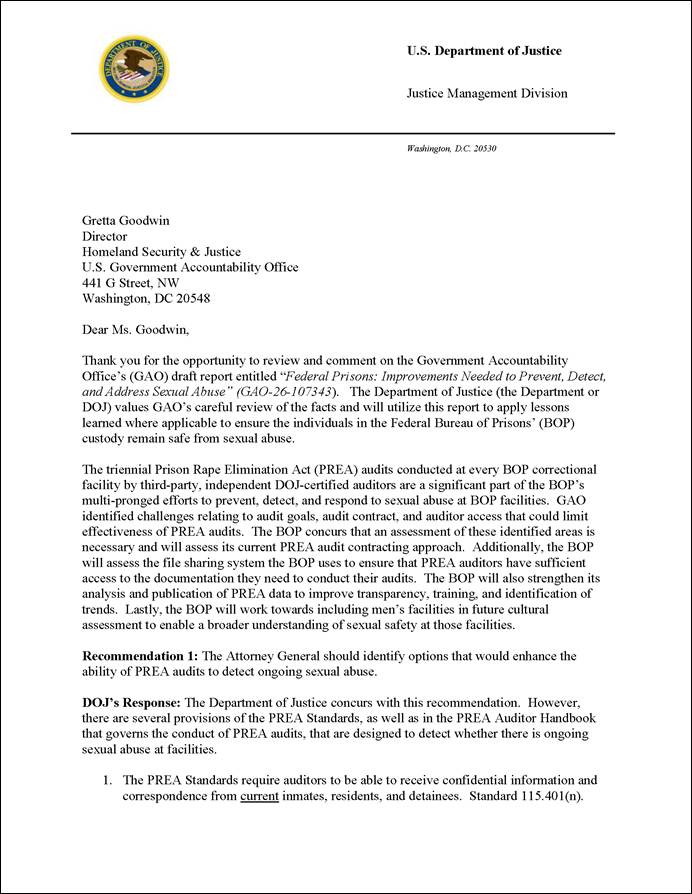
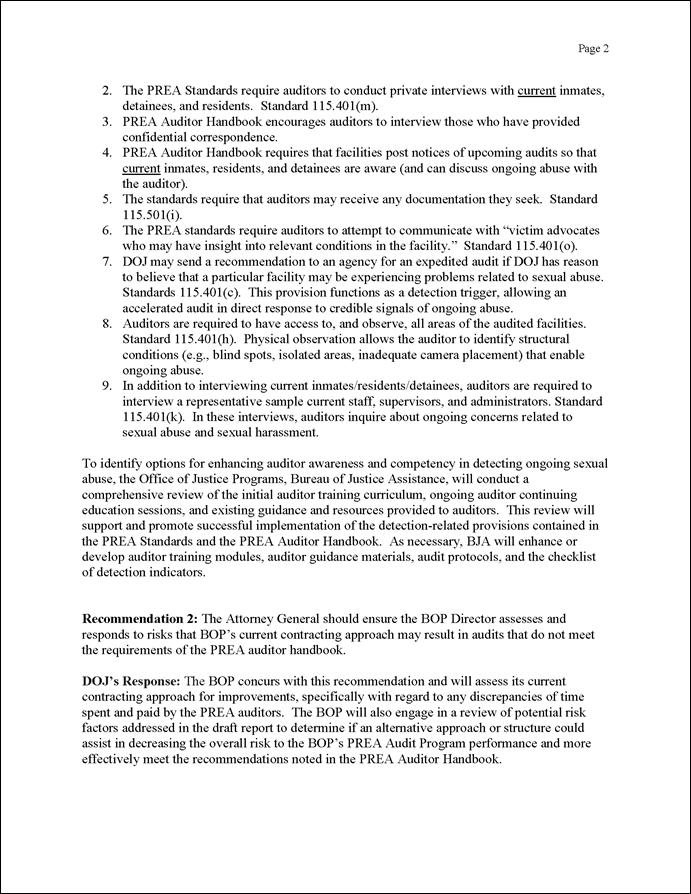
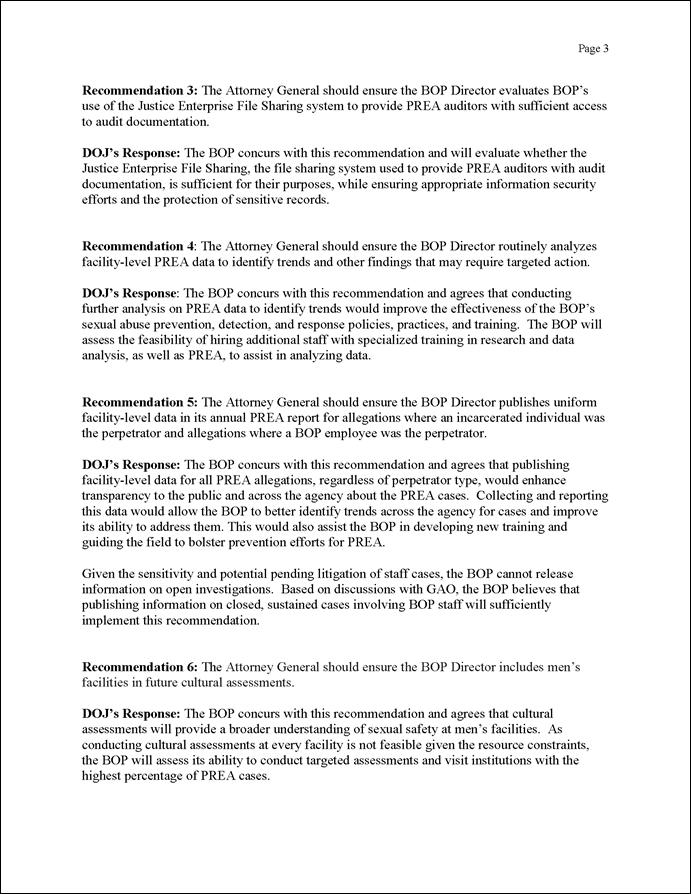
Gretta L. Goodwin, GoodwinG@gao.gov
In addition to the contact listed above, Jeffrey Fiore (Assistant Director), Imoni Hampton Timberlake (Analyst-in-Charge), Brian Lipman, Emily Flores and Kathryn B. Lenart made key contributions to this report. Other contributors included Hiwotte Amare, Howard Arp, Caroline Christopher, Elizabeth Dretsch, Pamela R. Hall, Eric Hauswirth, Nicole Hewitt, Ph.D., Anjalique Lawrence, Kate Lenane, Teague Lyons, Zina D. Merritt, Kimberly Mayo, Mara McMillen, Jeanne Murphy-Stone, Heidi Nielson, and Kevin Reeves.
The Government Accountability Office, the audit, evaluation, and investigative arm of Congress, exists to support Congress in meeting its constitutional responsibilities and to help improve the performance and accountability of the federal government for the American people. GAO examines the use of public funds; evaluates federal programs and policies; and provides analyses, recommendations, and other assistance to help Congress make informed oversight, policy, and funding decisions. GAO’s commitment to good government is reflected in its core values of accountability, integrity, and reliability.
Obtaining Copies of GAO Reports and Testimony
The fastest and easiest way to obtain copies of GAO documents at no cost is through our website. Each weekday afternoon, GAO posts on its website newly released reports, testimony, and correspondence. You can also subscribe to GAO’s email updates to receive notification of newly posted products.
Order by Phone
The price of each GAO publication reflects GAO’s actual cost of production and distribution and depends on the number of pages in the publication and whether the publication is printed in color or black and white. Pricing and ordering information is posted on GAO’s website, https://www.gao.gov/ordering.htm.
Place orders by calling (202) 512-6000, toll free (866) 801-7077,
or
TDD (202) 512-2537.
Orders may be paid for using American Express, Discover Card, MasterCard, Visa, check, or money order. Call for additional information.
Connect with GAO
Connect with GAO on X,
LinkedIn, Instagram, and YouTube.
Subscribe to our Email Updates. Listen to our Podcasts.
Visit GAO on the web at https://www.gao.gov.
To Report Fraud, Waste, and Abuse in Federal Programs
Contact FraudNet:
Website: https://www.gao.gov/about/what-gao-does/fraudnet
Automated answering system: (800) 424-5454
Media Relations
Sarah Kaczmarek, Managing Director, Media@gao.gov
Congressional Relations
David A. Powner, Acting Managing Director, CongRel@gao.gov
General Inquiries
[1]These convicted employees had been sexually abusing incarcerated women at Federal Correctional Institution (FCI) Dublin in California since 2018. Department of Justice, “Two More FCI Dublin Correctional Officers Plead Guilty To Sexually Abusing Female Inmates,” news release, August 7, 2025, https://www.justice.gov/usao-ndca/pr/two-more-fci-dublin-correctional-officers-plead-guilty-sexually-abusing-female-inmates. In January 2026, two Members of Congress from the House Committee on the Judiciary and the House Committee on Oversight and Government Reform wrote a letter to the Attorney General discussing allegations of sexual abuse and retaliation by BOP staff at Federal Prison Camp Bryan. See letter from Jamie Raskin, Ranking Member, House Committee on the Judiciary, and Robert Garcia, Ranking Member, House Committee on Oversight and Government Reform, to the Attorney General, January 22, 2026, 2026-01-22-raskin-rgarcia-to-bondi-doj-re-fpc-bryan.pdf.
[2]“Deputy Attorney General Lisa O. Monaco Delivers Remarks Marking the 20th Anniversary of the Prison Rape Elimination Act,” Office of Public Affairs Archives, Department of Justice, November 29, 2023, https://www.justice.gov/archives/opa/speech/deputy‑attorney‑general‑lisa‑o‑monaco‑delivers‑remarks‑marking‑20th‑anniversary‑prison.
[3]Pub. L. No. 108-79, 117 Stat. 972 (2003).
[4]See Pub. L. No. 108-79, § 3, 117 Stat. at 974 (codified, as amended, at 34 U.S.C. § 30302). We refer to PREA, codified as amended as “the PREA statute” throughout this report. In this report, we focus on sexual abuse incidents where the alleged victim is an incarcerated individual. Incidents where incarcerated individuals perpetrate sexual abuse against employees are legal violations not covered under PREA.
[5]34 U.S.C. § 30302(3); National Standards to Prevent, Detect, and Respond to Prison Rape, 77 Fed. Reg. 37,106 (codified as amended at 28 C.F.R. Part 115).
[6]Facilities are located throughout the nation and operate at five different security levels—minimum, low, medium, high, and administrative. The number of individuals in BOP custody represents incarcerated individuals at BOP facilities only, as of December 2025.
[7]GAO, Bureau of Prisons: Strategic Approach Needed to Prevent and Address Employee Misconduct, GAO‑25‑107339 (Washington, D.C.: Sept. 29, 2025); Bureau of Prisons: Opportunities Exist to Better Analyze Staffing Data and Improve Employee Wellness Programs, GAO‑21‑123 (Washington, D.C.: Feb. 24, 2021); Bureau of Prisons: Enhanced Data Capabilities, Analysis, Sharing, and Risk Assessments Needed for Disaster Preparedness, GAO‑22‑104289 (Washington, D.C.: Feb. 2, 2022); Federal Prisons: Bureau of Prisons Should Improve Efforts to Implement its Risk and Needs Assessment System, GAO‑23‑105139 (Washington, D.C.: Mar. 20, 2023); and Bureau of Prisons: Improved Planning Would Help BOP Evaluate and Manage Its Portfolio of Drug Education and Treatment Programs, GAO‑20‑423 (Washington, D.C.: May 26, 2020).
[8]GAO, High-Risk Series: Efforts Made to Achieve Progress Need to Be Maintained and Expanded to Fully Address All Areas, GAO‑23‑106203 (Washington, D.C.: Apr. 20, 2023). Each biennial update describes the status of high-risk areas, outlines actions that are needed to assure further progress, and identifies new high-risk areas needing attention by the executive branch and Congress. We reported in February 2025, that BOP had made some progress in key challenge areas. However, staffing gaps and leadership stability continue to be central concerns and affect BOP’s ability to monitor persistent issues such as employee misconduct. GAO, High-Risk Series: Heightened Attention Could Save Billions More and Improve Government Efficiency and Effectiveness, GAO‑25‑107743 (Washington, D.C.: Feb. 25, 2025).
[9]The Bureau of Justice Statistics collects and reports data about sexual abuse occurring at federal, state, and local prisons. The Survey of Sexual Victimization is part of the Bureau of Justice Statistics’ National Prison Rape Statistics Program, which gathers mandated data on the incidence and prevalence of sexual victimization in adult correctional and juvenile justice facilities, under the Prison Rape Elimination Act of 2003. The 2021 and 2022 Bureau of Justice Statistics data presented in this report are preliminary and subject to revisions. See table 6 in appendix I for a description of the different DOJ sources used in this report to analyze sexual abuse data.
[10]We collected BOP data from 2014 through 2024; however, the Bureau of Justice Statistics data was only available through 2022 at the time of analysis. See appendix II for the number of allegations perpetrated by incarcerated individuals, by facility, from 2020 through 2024. See appendix III for the number of allegations perpetrated by BOP employees, by facility, from 2020 through 2024.
[11]28 C.F.R. Part 115; GAO, Standards for Internal Control in the Federal Government, GAO‑14‑704G (Washington, D.C.: Sept. 10, 2014); GAO, Enterprise Risk Management: Selected Agencies’ Experiences Illustrate Good Practices in Managing Risk, GAO‑17‑63 (Washington, D.C.: December 2016). GAO published an updated Standards for Internal Control in the Federal Government in May 2025 that became effective in fiscal year 2026, after we had completed our analysis. See GAO, Standards for Internal Control in the Federal Government, GAO‑25‑107721 (Washington, D.C.: May 2025). Bureau of Prisons, Sexually Abusive Behavior Prevention and Intervention Program, Program Statement. 5324.12 (June 4, 2015). Bureau of Prisons, Strategic Framework: Strategic Framework Outline (December 2, 2024).
[12]The PREA Standards as codified define “sexual abuse” to include “(1) sexual abuse of an inmate, detainee, or resident by another inmate, detainee, or resident; and (2) sexual abuse of an inmate, detainee, or resident by a staff member, contractor, or volunteer” and includes enumerated acts if the victim does not consent, is coerced into such act by overt or implied threats of violence, or is unable to consent or refuse. “Staff sexual misconduct” is not defined in the PREA Standards but is defined by the Bureau of Justice Statistics as “any consensual or nonconsensual behavior or act of a sexual nature directed toward an inmate or youth by staff, including romantic relationships.”
[13]34 U.S.C. § 30302(1).
[14]34 U.S.C. § 30307.
[15]See 34 U.S.C. §§ 30306(d), 30307(a).
[16]See 77 Fed. Reg. 37,106; 28 C.F.R. §§ 115.11, 115.87. As described by the final rule issuing the standards, after over four years of work, the Commission released its recommended national standards in June 2009 and subsequently disbanded, pursuant to the statute. 77 Fed. Reg. at 37, 111. The Attorney General then convened a working group comprised of representatives from DOJ components which, among other things, conducted a number of listening sessions. Id. at 37,111-37,112. In March 2010, DOJ published an Advance Notice of Proposed Rulemaking, Id. at 37,112 (citing 75 Fed. Reg. 11,077 (Mar. 10, 2010)) and in February 2011, published a Notice of Proposed Rulemaking (citing 76 Fed. Reg. 6248 (Feb. 3, 2011). Following the public comment period, DOJ published the final PREA standards.
[17]See 28 C.F.R. §§ 115.401-115.405.
[18]34 U.S.C. § 30307(e)(8)(A). Under the PREA statute, “in the case that an auditor fails to comply with a certification agreement or to conduct audits in accordance with the PREA Auditor Handbook, audit methodology, and instrument approved by the PREA Management Office, the Office may take remedial or disciplinary action, as appropriate, including decertifying the auditor.” See 34 U.S.C. § 30307(e)(8)(A)(iii).
[19]In addition, agency officials told us the National Institute of Corrections, within BOP, provides online trainings and resources and reports PREA related statistics to Congress.
[20]See 34 U.S.C. § 30307(e)(8)(A)(iii).
[21]See 34 U.S.C. § 30305 (providing for grants to states to assist states in ensuring that budgetary circumstances do not compromise efforts to protect incarcerated individuals and to safeguard the communities to which they return). In 2022, the Deputy Attorney General issued a memorandum identifying concerns about instances of reported and proven sexual misconduct by BOP employees. The memorandum directed the Principal Associate Deputy Attorney General to chair a Working Group of senior officials from relevant DOJ components to review DOJ’s approach to preventing, detecting, and responding to sexual misconduct by BOP employees. This group was a special purpose Working Group distinct from the general PREA Working Group and was tasked with developing and proposing “recommendations and reforms to address gaps, deficiencies, and problems identified.” This group produced a report in November 2022. Working Group of DOJ Components, Report and Recommendations Concerning the Department of Justice’s Response to Sexual Misconduct by Employees of the Federal Bureau of Prisons (Washington, D.C.: November 2022).
[22]The PREA Resource Center is managed through a cooperative agreement, defined in 31 U.S.C. § 6305, between the Bureau of Justice Assistance and Impact Justice, a nonprofit organization. The mission of the PREA Resource Center is to assist federal, state, local, and tribal confinement facilities nationwide in their efforts to eliminate sexual abuse by managing PREA auditor certification and education and facilitating audit documentation, among other things.
[23]The Bureau of Justice of Statistics fulfills its PREA statutory requirement to collect data on prison rape through three survey instruments, the Survey of Sexual Victimization, the National Inmate Survey, and the National Survey of Youth in Custody. Estimates from these collections are not directly comparable. The Bureau of Justice of Statistics data in this report is from the Sexual Victimization Survey. See 34 U.S.C. § 30303.
[24]The 2021 and 2022 Bureau of Justice Statistics data presented in this report are preliminary and subject to revisions.
[25]GAO analyzed OIG data from the Investigations Data Management System for sexual abuse allegations from 2014 through 2024, as of May 2025.
[26]The OIG’s hotline email is an anonymous email source that is accessible through Trulincs, BOP’s system that offers electronic services to incarcerated individuals. Incarcerated individuals can submit various allegations, including sexual abuse, directly to OIG through Trulincs. About one percent of the allegations were from other sources, including the OIG’s authority to initiate an allegation, GAO’s FraudNet, or allegations received from federal, state, or local agencies outside DOJ.
[27]One incident may have multiple offenses. For example, an incarcerated individual may allege that another incarcerated individual subjected them to sexual abuse as well as sexual harassment. The investigator would track and work on these two allegations under one investigation.
[28]According to the PREA Standards and BOP’s Sexually Abusive Behavior Prevention and Intervention Program policy, BOP must offer all alleged victims of sexual abuse access to forensic medical examinations, either at the facility or at an outside facility, without financial cost. Such examinations shall be performed by Sexual Assault Forensic Examiners or Sexual Assault Nurse Examiners where possible.
[29]BOP’s Office of Internal Affairs uses the terms sustained and not sustained as conclusions in place of substantiated and unsubstantiated. For the purpose of this report, we will use the terms substantiated and unsubstantiated.
[30]According to BOP officials, for allegations perpetrated by an incarcerated individual, the BOP investigator’s case must be investigated and closed within 30 days. The investigator may then refer substantiated cases to the FBI for potential criminal charges. For allegations perpetrated by a BOP employee there is no time limit for the investigation or case closure, according to BOP officials. Employee misconduct cases can involve an OIG criminal investigation in addition to a BOP administrative employee misconduct investigation, according to officials.
[31]The number of reported allegations remained relatively stable from 2014 through 2017, exceeded 1,000 annually in 2018 and 2019, declined in 2020, and then rose again in 2021 and 2022. The 2021 and 2022 Bureau of Justice Statistics data presented in this report are preliminary and subject to revisions.
[32]These Bureau of Justice Statistics data were collected from BOP as part of the Survey of Sexual Victimization. The data collected from BOP did not include allegations made from individuals in the custody of private prisons, jails, or other similar contract facilities; however, they may include allegations from individuals in BOP custody that are under the supervision of residential reentry centers. Calendar year 2022 is the most recent Bureau of Justice Statistics data available. Bureau of Justice Statistics sexual abuse allegation data includes allegations in the year they were reported, which may or may not have been the year that the alleged incident occurred.
[33]For purposes of this report, the term sexual abuse includes sexual abuse and sexual harassment. “Sexual harassment” is defined in the PREA Standards to include “(1) repeated and unwelcome sexual advances, requests for sexual favors, or verbal comments, gestures, or actions of a derogatory or offensive sexual nature by one inmate, detainee, or resident directed toward another; and (2) repeated verbal comments or gestures of a sexual nature to an inmate, detainee, or resident by a staff member, contractor, or volunteer, including demeaning references to gender, sexually suggestive or derogatory comments about body or clothing or obscene language or gestures.” See 8 C.F.R. § 115.6.
[34]These Bureau of Justice Statistics data were collected from BOP as part of the Survey of Sexual Victimization. The data collected from BOP did not include allegations made from individuals in the custody of private prisons, jails, or other similar contract facilities; however, they may include allegations from individuals in BOP custody that are under the supervision of residential reentry centers. The 2021 and 2022 Bureau of Justice Statistics data presented in this report are preliminary and subject to revisions.
[35]For the purposes of our report, we used the Bureau of Justice Statistics Survey of Sexual Victimization for the aggregate number of sexual abuse allegations and the outcomes of the allegations perpetrated by incarcerated individuals from 2014 through 2022. We used BOP data from Case File Manager to identify the outcomes of allegations perpetrated by BOP employees from 2014 through 2022. The total number of allegations perpetrated by BOP employees above from the Bureau of Justice Statistics Survey of Sexual Victimization does not match the total number of allegations from Case File Manager data shown here because the datasets include different types of facilities. For example, the Bureau of Justice Statistics Survey of Sexual Victimization may include other facilities such as halfway houses and for the Case File Manager data we analyzed we were able to exclude those facilities. Additionally, we analyzed Case File Manager Data to show outcomes of allegations perpetrated by BOP employees because that database had the most updated outcome data as of March 2025. See table 6 in appendix I for a description of the different DOJ sources used in this report to analyze sexual abuse data.
[36]Of the 3,912 allegations, 524 allegations were administrative or did not have an investigative outcome as of March 2025.
[37]The PREA statute and Standards require prisons, jails and detention facilities to: collect uniform data on all PREA related allegations, conduct executive staff incident reviews 30 days after certain investigations are closed, and facilitate audits of their facilities by DOJ-certified PREA auditors at least once every three years. See 28 C.F.R. §§ 115.401-115.405.
[38]Working Group of DOJ Components, Report and Recommendations Concerning the Department of Justice’s Response to Sexual Misconduct by Employees of the Federal Bureau of Prisons.
[39]77 Fed. Reg. at 37,106; 28 C.F.R. §115.401 Among other requirements, auditors are required to review all relevant agency-wide policies, procedures, reports, internal and external audits, and accreditations for each facility type. Auditors are also required to have access to, and observe, all areas of the audited facilities, and to interview a representative sample of inmates, residents, and detainees, and of staff, supervisors, and administrators. Finally, the auditors are to review a sampling of any available videotapes and other electronically available data (e.g., Watchtour) that may be relevant to the provisions being audited.
[40]28 C.F.R. §115.51(c) requires staff to accept reports made verbally, in writing, anonymously, and from third parties and promptly document any verbal reports. 28 C.F.R. § 115.22(a) requires agencies to conduct administrative or criminal investigations for all allegations of sexual abuse and sexual harassment.
[41]According to BOP officials, auditors conducted a total of 101 audits of BOP facilities during the most recent 3-year audit cycle. Multiple facilities that make up a single complex, such as FCC Coleman, are reviewed under one audit. BOP officials told us that of these 101 audits, four facilities were deemed 100 percent compliant after a corrective action period. Additionally, officials stated that one facility was currently in a corrective action period as of August 2025. According to officials, the most recent 3-year audit cycle ended at the conclusion of July 2025.
[42]As of November 2025, nine of these employees were convicted of charges related to sexual abuse. DOJ dropped the charges for the tenth employee after two mistrials.
[43]Of these three audits, only the 2021 audit identified areas of noncompliance in its interim report, which were corrected before the auditor issued the final report.
[44]During the lawsuit, the federal government acknowledged that six of the employees had committed sexual abuse against at least 10 women. Staff of S. Comm. On Homeland Security and Governmental Affairs, 117th Cong., Sexual Abuse of Female Inmates in Federal Prisons 12 (Comm. Print 2022).
[45]28 C.F.R. § 115.401(d) requires DOJ to develop and issue an audit instrument that will provide guidance on the conduct of and contents of the audit. The core components of the audit instrument are provided on the PREA Resource Center’s website and provides guidance for auditors “in making compliance determinations for each provision of every PREA Standard.” “Core Components of the Audit Instrument,” PREA Audit Instrument, National PREA Resource Center, accessed January 6, 2026, https://www.prearesourcecenter.org/audit/instrument/core‑components
[46]DOJ, Bureau of Justice Assistance, PREA Auditor Handbook, Version 2.1 (Washington, D.C.: Nov. 2022).
[47]28 C.F.R. § 115.401(d).
[49]The PREA Standards list requirements for conducting PREA audits. 28 C.F.R. § 115.401. One of the Handbook’s purposes is establishing a methodology for these audits that is grounded in the requirements of the Standards. For the purposes of this report, when we say “BOPs current contracting approach” we are referring to BOP’s contract with Corrections Consulting Services for PREA audits and related oversight mechanisms within the contract.
[50]A firm fixed price contract provides for a price that is not subject to any adjustment on the basis of the contractor’s cost experience in performing the contract. 48 C.F.R. § 16.202-1.
[51]According to BOP officials, BOP pays Corrections Consulting Services a set price for each audit. Representatives from Corrections Consulting Services told us that they pay the auditors they contract with to audit BOP facilities a set price for each audit.
[52]34 U.S.C. § 30307(e)(8)(A) Under the PREA statute, “in the case that an auditor fails to comply with a certification agreement or to conduct audits in accordance with the PREA Auditor Handbook, audit methodology, and instrument approved by the PREA Management Office, the Office may take remedial or disciplinary action, as appropriate, including decertifying the auditor.” See 34 U.S.C. § 30307(e)(8)(A)(iii).
[53]According to BOP’s contract with Corrections Consulting Services, additional time required to complete an on-site audit will be considered on a case-by-case basis in accordance with BOP policy and any local employee Union agreements.
[54]In February 2024, the Bureau of Justice Assistance Director sent the BOP Director a memo that included the PREA Management Office’s findings after reviewing the PREA audit practices of BOP and its audit contractor, Corrections Consulting Services. The memo also included possible next steps to address these findings. According to the memo, the PREA Management Office conducted this review after learning about patterns of sexual abuse at selected BOP facilities through a report from the U.S. Senate Permanent Subcommittee on Investigations on sexual abuse at four BOP facilities. The PREA Management Office reviewed over 1,000 audit reports submitted by 127 auditors from early 2022 to early 2023, including 412 audits by auditors from Corrections Consulting Services. Not all of the 412 audits the PREA Management Office reviewed that were conducted by auditors from Corrections Consulting Services were of BOP facilities—for instance, some may have been state correctional facilities. However, BOP officials told us that Corrections Consulting Services is BOP’s sole contractor for PREA auditors. Bureau of Justice Assistance officials told us that they relayed the information from this review to BOP but did not independently verify the review’s findings.
[55]The PREA Standards state that an auditor may need to re-inspect portions of the facility when assessing the facility’s implementation of corrective actions. 28 C.F.R. § 115.404(d). The Handbook states that auditors should consider whether such assessments may be conducted remotely; however, auditors may not conduct certain assessments, such as interviews with incarcerated individuals, remotely.
[56]According to BOP officials, BOP does not pay auditors directly. The auditor is paid by the contractor, Corrections Consulting Services. The contractor receives a firm fixed unit price for the audit.
[57]DOJ, Bureau of Justice Assistance, PREA Auditor Handbook.
[58]GAO, Enterprise Risk Management: Selected Agencies’ Experiences Illustrate Good Practices in Managing Risk, GAO‑17‑63 (Washington, D.C.: Dec. 2016).
[59]The PREA Management Office is required to evaluate all PREA auditors for compliance with the Auditor Certification Agreement, the PREA Auditor Handbook, and the DOJ Audit Instrument, and to take remedial or disciplinary action where necessary. See 34 U.S.C. § 30307(e)(8)(A)(iii). To fulfill this requirement, the PREA Management Office monitors and reviews the work of DOJ-certified PREA auditors, with the goal of ensuring the high quality and integrity of PREA audits.
[61]BOP is required to collect accurate, uniform data for every allegation of sexual abuse at facilities under its direct control using a standardized instrument and set of definitions. 28 C.F.R. § 115.87.
[62]BOP is required to review data collected and aggregated pursuant to § 115.87 in order to assess and improve the effectiveness of its sexual abuse prevention, detection, and response policies, practices, and training, including by: (1) Identifying problem areas; (2) Taking corrective action on an ongoing basis; and (3) Preparing an annual report of its findings and corrective actions for each facility, as well as the agency as a whole. 28 C.F.R. §115.88.
[63]BOP, Strategic Framework: Strategic Framework Outline.
[64]As described above, this special purpose Working Group, distinct from the general PREA Working Group, was tasked with developing and proposing “recommendations and reforms to address gaps, deficiencies, and problems identified.”
[65]28 C.F.R. 115.401(c).
[66]BOP, Annual PREA Report, Calendar Year 2024 (Washington, D.C., June 25, 2025).
[68]BOP, Strategic Framework: Strategic Framework Outline.
[69]77 Fed. Reg. at 37,107.
[70]The facility is required to conduct a sexual abuse incident review at the conclusion of every sexual abuse investigation, including where the allegation has not been substantiated, unless the allegation has been determined to be unfounded. Such reviews shall ordinarily occur within 30 days of the conclusion of the investigation. The review team shall include upper-level management officials, with input from line supervisors, investigators, and medical or mental health practitioners. 28 C.F.R. § 115.86.
[71]We analyzed executive staff incident reviews from FCI Aliceville, Metropolitan Detention Center Brooklyn, FCC Coleman, and FCI Dublin over a 12-month period. See more information on our selection of these facilities in Appendix I: Objectives, Scope, and Methodology.
[72]Working Group of DOJ Components, Report and Recommendations Concerning the Department of Justice’s Response to Sexual Misconduct by Employees of the Federal Bureau of Prisons.
[73]The Federal Prison Oversight Act, codified at 5 U.S.C. § 413, requires that the OIG conduct risk-based inspections of BOP facilities, which may include assessment of “[c]redible allegations of incidents involving excessive use of force, completed, attempted, or threatened violence, including sexual abuse, or misconduct committed against incarcerated people.” For purposes of these inspections, the term “sexual abuse” is defined by the regulations implementing PREA. See 5 C.F.R. § 115.6.
[74]In June 2025, officials from DOJ OIG told us that they plan to continue unannounced inspections of BOP facilities in line with the Federal Prison Oversight Act. This Act requires the OIG to establish methodology and protocols to determine a risk score for each BOP facility and to conduct risk-based inspections of these facilities.
[75]PREA Standards require each BOP facility to designate a PREA Compliance Manager who is responsible for the day-to-day functions related to PREA implementation and response at that facility. See 28 C.F.R. § 115.11(c). In 15 of our 19 interviews with correctional officers, interviewees knew who the PREA Compliance Manager was at their facility.
[76]PREA Standards require BOP to provide at least one way for incarcerated persons to report abuse or harassment to a public or private entity that is not part of BOP. In addition, BOP is required to establish a method to receive third-party reports of sexual abuse. Third parties can include other incarcerated persons, staff members, family members, attorneys, and outside advocacy organizations. See 28 C.F.R. §§ 115.51-115.54.
[77]Eight incarcerated individuals said they were not aware they could report sexual abuse to a correctional officer. Three said they were not aware they could report sexual abuse to other types of employees.
[78]Thirteen incarcerated individuals said they were not aware they could report sexual abuse to the warden, and one said they were not sure.
[79]Two individuals said they did not think the person reporting would face retaliation, and 16 were not sure.
[80]Six incarcerated individuals said they did not think the person reporting would face retaliation, and 11 were not sure.
[81]See 28 C.F.R. § 115.61.
[82]On our visits to the four selected facilities, we held 19 interviews with 22 correctional officers, as some interviews had multiple correctional officers. Throughout this report, findings from correctional officer interviews include the number of interviews in which correctional officers gave the response.
[83]Data is reported by Bureau of Justice Statistics as of February 2025, and the Bureau of Prisons (BOP) Office of Internal Affairs’ Case File Manager system, as of March 2025. These cases include investigations of abuse allegedly perpetrated by BOP employees and by incarcerated individuals. BOP investigations can be closed as substantiated (meaning the alleged misconduct did occur), unfounded (meaning it did not occur), or unsubstantiated (meaning there is insufficient evidence to determine whether the misconduct did or did not occur). If the investigation has not concluded by the end of each annual reporting period, the investigation is marked as ongoing.
[84]Eight incarcerated individuals said they were not sure. Three correctional officers said no, and three said they were not sure.
[85]On our visits to four selected facilities, we met with various facility employees, including local union leadership, health services employees, psychology services employees, housing unit employees such as case managers, local investigators for incarcerated individual misconduct, and local investigators for employee misconduct. The numbers, types, and groupings of these other employee interviews varied at each facility. Throughout this report, findings from the other employee interviews are characterized by the number of facilities at which at least one employee gave the response.
[86]According to BOP, it follows National Archives and Records Administration records disposition authority. According to BOP, the records disposition authority considers video surveillance recording at federal correctional facilities a “temporary” disposition and allows for the erasure or deletion ten days after the recording date.
[87]Pub. L. No. 117-321, § 3, 136 Stat. 4430, 4431 (2022).
[88]Department of Justice, Office of the Inspector General, Notification of Needed Upgrades to the Federal Bureau of Prisons’ Security Camera System, 22-001 (Oct. 2021).
[89]This report examined BOP employee misconduct more broadly, including sexual abuse, bribery, and introduction of contraband, among other things. The case data were as of February 2025. GAO, Bureau of Prisons: Strategic Approach Needed to Prevent and Address Employee Misconduct, GAO‑25‑107339 (Washington, D.C.: Sept. 29, 2025). Cases that are pending other actions can include cases awaiting file review, or under consideration for OIG investigation.
[92]34 U.S.C. § 30306.
[93]BOP, Strategic Framework: Strategic Framework Outline.
[94]PREA Standards require BOP to provide at least one way for incarcerated persons to report abuse or harassment to a public or private entity that is not part of BOP. In addition, BOP is required to establish a method to receive third-party reports of sexual abuse. Third parties can include other incarcerated persons, staff members, family members, attorneys, and outside advocacy organizations. 28 C.F.R. §§ 115.51-115.54.
[96]We collected BOP data from 2014 through 2024; however, the Bureau of Justice Statistics data was only available through 2022 at the time of our analysis.
[97]The Bureau of Justice Statistics collects and reports data about sexual abuse occurring at federal, state, and local prisons. The Survey of Sexual Victimization (SSV) is part of the Bureau of Justice Statistics National Prison Rape Statistics Program, which gathers mandated data on the incidence and prevalence of sexual victimization in adult correctional and juvenile justice facilities, under the Prison Rape Elimination Act of 2003. The 2021 and 2022 Bureau of Justice Statistics data presented in this report are preliminary and subject to revisions.
[98]See appendix II for the number of allegations perpetrated by incarcerated individuals by facility from 2020 through 2024. See appendix III for the number of allegations perpetrated by BOP employees by facility from 2020 through 2024.
[99]34 U.S.C. § 30302(3); National Standards to Prevent, Detect, and Respond to Prison Rape, 77 Fed. Reg. 37,106 (codified as amended at 28 C.F.R. Part 115); GAO, Standards for Internal Control in the Federal Government, GAO‑14‑704G (Washington, D.C.: Sept. 10, 2014); GAO, Enterprise Risk Management: Selected Agencies’ Experiences Illustrate Good Practices in Managing Risk, GAO‑17‑63 (Washington, D.C.: Dec. 1, 2016). GAO published an updated Standards for Internal Control in the Federal Government in May 2025 that became effective in fiscal year 2026, after we had completed our analysis. See GAO, Standards for Internal Control in the Federal Government, GAO‑25‑107721 (Washington, D.C.: May 2025). BOP, Strategic Framework: Strategic Framework Outline.
[100]An allegation allegedly perpetrated by BOP employees could include multiple allegations reported for the same incident. However, the data we display counts each incident only once.