
FEDERAL HOME LOAN BANKS
Role During Financial Stress and Members' Borrowing Trends and Outcomes
Report to the Committee on Financial Services, House of Representatives
United States Government Accountability Office
A report to the Committee on Financial Services, House of Representatives.
For more information, contact: Jill Naamane at naamanej@gao.gov.
What GAO Found
The Federal Home Loan Bank (FHLBank) System consists of 11 federally chartered FHLBanks that support liquidity by making loans to member financial institutions (including banks) in the U.S. As of June 2025, 93 percent of banks (approximately 4,100) were members of an FHLBank, allowing them to obtain liquidity via secured loans. GAO’s analysis found that the FHLBanks generally serve as a reliable and consistent source of funding for banks of all sizes throughout the financial cycle. They can also play a key role in the health of small banks (those with $10 billion or less in assets). This has been the case despite concerns raised in some academic and other literature that FHLBank lending could exacerbate periods of financial stress—for example, by masking problems at troubled member banks or increasing resolution costs when a member bank fails.
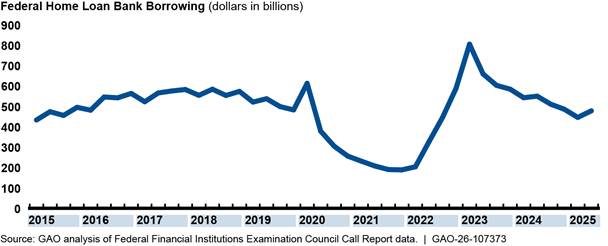
· Banks’ FHLBank borrowing trends. From 2015 through June 2025, most U.S. banks were FHLBank members and obtained secured loans at least once. Banks’ total outstanding borrowing (as of quarter-end) ranged from $189 billion to $804 billion during this period. Although most active FHLBank members maintained relatively consistent FHLBank borrowing, a small number of large banks (with more than $10 billion in assets) drove substantial increases in aggregate borrowing at the onset of the COVID-19 pandemic in 2020 and during the March 2023 liquidity crisis. For example, large banks were responsible for 97 percent of the increased borrowing in the first quarter of 2023. However, median FHLBank borrowing as a share of median total assets generally stayed within a consistent range from 2015 through June 2025, including for large banks. This suggests that their overall reliance on FHLBank loans during stress periods was largely unchanged.
· Outcomes associated with FHLBank borrowing. GAO’s econometric models, which controlled for bank health, macroeconomic factors, and economic cycles, found that higher FHLBank borrowing by a bank was generally associated with positive outcomes for the bank. From 2015 through 2024, higher FHLBank borrowing was associated with (1) increases in real estate lending and (2) lower likelihood of being flagged as a problem bank or of failing or closing voluntarily. These results were largely driven by small banks, which make up 97 percent of banks in GAO’s analysis.
Why GAO Did This Study
The FHLBank System supports liquidity by making billions of dollars in loans to member banks. Federal banking regulators oversee individual banks’ safety and soundness and promote financial stability. The 12 district Federal Reserve Banks also lend to banks and may act as a lender of last resort. Substantial FHLBank lending to three large banks that failed in 2023 renewed questions about FHLBanks’ lending role and communication with banking regulators and Federal Reserve Banks during times of stress.
GAO was asked to review the role of FHLBanks during financial crises. This report examines (1) banks’ FHLBank borrowing trends from 2015 through June 2025; (2) associations between FHLBank borrowing and outcomes; (3) policy considerations for potential changes to FHLBank lending; and (4) communication among FHLBanks and relevant federal agencies during periods of financial stress.
GAO reviewed literature from 2007 through mid-2024; analyzed bank financial reports, FHLBank membership data, and economic indicators; and examined documentation from the FHLBanks, banking regulators, and the Federal Housing Finance Agency. GAO also held seven discussion groups with a total of 30 academics, researchers, and industry group representatives (selected for their relevant knowledge and diverse views) and interviewed representatives of FHLBanks, federal regulators, and a nongeneralizable sample of 10 member banks (selected to reflect varying asset sizes) that borrowed from FHLBanks during recent periods of financial stress.
· Policymaker considerations for potential changes to FHLBank lending. GAO reviewed suggestions for reform from academic, industry, and government sources, such as involving federal banking regulators in lending decisions and changing how FHLBank loans are priced. In discussion groups, interviews, and written comments, stakeholders noted that while these changes could help address certain concerns, each carried potential unintended consequences for markets, member banks (especially smaller ones), and consumers. GAO found that in some cases, the suggested changes would duplicate existing authorities or practices.
The FHLBanks, Federal Housing Finance Agency (which oversees FHLBanks), and the federal banking regulators have mechanisms to communicate during periods of financial stress. The bank failures and related liquidity stress of March 2023 highlighted challenges to timely coordination between the FHLBanks and the Federal Reserve Banks. Since then, they have taken steps to improve their coordination. These include conducting joint tabletop exercises and ongoing discussions to help shared members reallocate collateral during emergencies. In January 2025, the FHLBank System and the Federal Reserve System also established a joint working group to improve routine interoperability between the two systems. These efforts are ongoing and, in some cases, are in early stages, with expected completion in late 2025 or 2026. Continued commitment to these coordination efforts will be important to ensure readiness for future financial stress, when member banks may need to reallocate collateral to access additional liquidity.
Abbreviations
|
FDIC |
Federal Deposit Insurance Corporation |
|
Federal Reserve Board |
Board of Governors of the Federal Reserve System |
|
FHFA |
Federal Housing Finance Agency |
|
FHLBank |
Federal Home Loan Bank |
|
OCC |
Office of the Comptroller of the Currency |
|
UCC |
Uniform Commercial Code |
This is a work of the U.S. government and is not subject to copyright protection in the United States. The published product may be reproduced and distributed in its entirety without further permission from GAO. However, because this work may contain copyrighted images or other material, permission from the copyright holder may be necessary if you wish to reproduce this material separately.
December 17, 2025
The Honorable French Hill
Chairman
The Honorable Maxine Waters
Ranking Member
Committee on Financial Services
United States House of Representatives
The failures of Silicon Valley Bank and Signature Bank in March 2023 renewed questions about the Federal Home Loan Banks’ (FHLBank) role as a liquidity provider during periods of financial stress. In the weeks leading up to their failures, these banks had borrowed large sums via secured loans (known as advances) from their district FHLBanks.[1] That same month, the FHLBank System’s total advances outstanding to all members reached about $1 trillion, exceeding previous financial market disruptions. The bank failures required the two district FHLBanks of which the failed banks were members to coordinate with the Federal Deposit Insurance Corporation (FDIC) and the Federal Reserve Banks, both of which had relevant responsibilities.
Some observers, including academics and former government officials, have suggested changes related to the FHLBanks’ lending role. These suggestions stem from concerns that the system’s structure may lead to lending that threatens financial stability and increases resolution costs when banks fail. In November 2023, the Federal Housing Finance Agency (FHFA), which supervises the FHLBank System, issued a report on its comprehensive review of the system, including the system’s liquidity role, and FHFA has taken some actions in response to the report’s findings.[2]
We were asked to review the role of the FHLBanks during times of financial stress. This report examines (1) active member banks’ FHLBank borrowing trends since 2015, (2) how FHLBank borrowing was associated with member banks’ outcomes from 2015 through 2024, (3) potential changes to FHLBank lending during financial crises and considerations for policymakers when evaluating these changes, and (4) the extent to which FHLBanks, relevant federal regulators, and the Federal Reserve Banks have mechanisms to support effective communication during periods of financial stress.
To address our first objective, we analyzed FHFA’s FHLBank membership data and data from Federal Financial Institutions Examination Council Reports of Condition and Income (known as Call Reports) for banks from the first quarter of 2015 through the second quarter of 2025.[3] We reviewed banks’ FHLBank borrowing, including by outstanding amount and as a share of their total assets. We generally divided banks into two asset-size categories ($10 billion or less in total assets, and greater than $10 billion in total assets) to compare trends. We also analyzed data on key economic indicators and emergency lending to banks by the Board of Governors of the Federal Reserve System (Federal Reserve) to describe economic and financial conditions that may have affected FHLBank member borrowing during our period. We assessed the reliability of these data through reviews of relevant documentation and electronic data testing. We found the data to be sufficiently reliable for the purposes of describing banks’ FHLBank membership, borrowing, and assets, as well as describing economic and financial conditions. We also interviewed executives from a nongeneralizable sample of 10 banks to obtain their perspectives on the role of FHLBank borrowing during recent stress periods. The 10 banks each had FHLBank borrowing in the first quarter of 2020, the first quarter of 2023, or both. See appendix I for more information on our methodology.
To address our second objective, we constructed econometric models that considered the extent to which banks’ FHLBank borrowing levels were associated with their lending levels and certain safety and soundness outcomes from 2015 through 2024. The models controlled for bank health characteristics, certain macroeconomic factors, and economic cycles. We analyzed FHLBank membership data, Call Report data, FDIC data on “problem banks” (those with supervisory ratings below a certain threshold), bank failures, and bank liquidations. We also analyzed data on key economic indicators (such as the unemployment rate and gross domestic product). We assessed the reliability of these data through reviews of relevant documentation, interviews with agency officials, and electronic data testing. We determined that the data were sufficiently reliable for the purposes of describing banks’ FHLBank membership, borrowing, health characteristics, lending, and specific safety and soundness outcomes, as well as describing economic and financial conditions. For more information about our econometric modeling, see appendix II.
To address our third objective, we reviewed literature published from January 2007 (prior to the financial crisis of 2007–2009) through May 2024 (the month we conducted the literature search) that addressed FHLBank lending during times of financial stress. We documented authors’ views about such lending and identified the most frequently cited concerns, as well as any suggestions for changes to FHLBank lending during stress periods. We excluded certain types of changes from further examination (such as changes focused directly on the FHLBanks’ housing mission) and consolidated the remaining suggestions as appropriate into broader categories. This process resulted in eight suggested changes for discussion purposes. We obtained input on the eight suggested changes from 30 discussion group participants (academics, researchers, and representatives of industry and consumer groups, selected for their relevant knowledge and experience and reflecting a range of views on FHLBank lending); representatives of the 11 FHLBanks; and FDIC officials.[4] We performed a content analysis of the input we received to identify key themes related to implementation and potential effects of the suggested changes.
To address our fourth objective, we reviewed relevant laws and regulations about information sharing among the FHLBanks, FHFA, and the federal banking regulators. We also reviewed FHLBank and agency documentation and held interviews with representatives of all 11 FHLBanks and officials from FHFA, FDIC, the Federal Reserve System, the Financial Stability Oversight Council, and the Office of the Comptroller of the Currency (OCC). We compared our findings about their communication mechanisms against relevant principles in our internal control standards.[5] In addition, we analyzed FHLBank membership data and Federal Financial Institutions Examination Council data on member banks’ Federal Reserve district membership to determine intersections of membership between FHLBanks and Federal Reserve Banks. We assessed the reliability of the data by verifying our results with the FHLBanks and the Federal Reserve Board. We determined the data were reliable for the purpose of identifying overlapping membership.
We conducted this performance audit from January 2024 to December 2025 in accordance with generally accepted government auditing standards. Those standards require that we plan and perform the audit to obtain sufficient, appropriate evidence to provide a reasonable basis for our findings and conclusions based on our audit objectives. We believe that the evidence obtained provides a reasonable basis for our findings and conclusions based on our audit objectives.
Background
The FHLBank System and Advances
The FHLBank System is a government-sponsored enterprise that includes 11 federally chartered FHLBanks—each a cooperative owned by its members—and a joint Office of Finance that issues debt on behalf of the FHLBanks.[6] The FHLBanks support liquidity in the financial system and promote housing and community development.
As of June 2025, 93 percent of banks (4,104 of the 4,424 banks in our population) were FHLBank members.[7] To qualify for membership, banks must meet certain criteria, including that they must (1) be regulated by the appropriate federal or state banking regulator, (2) purchase or originate home mortgage loans with terms of 5 years or more, and (3) hold at least 10 percent of their assets in residential mortgage loans at the time of application.[8] Members must also purchase and maintain stock in their FHLBank, consistent with that FHLBank’s capital structure plan.[9]
FHLBanks primarily provide funding through secured loans known as advances. These advances offer member institutions a low-cost source of funding to make mortgage loans or manage liquidity risk—that is, the risk of not meeting financial obligations in a timely and cost-efficient manner. FHLBanks offer a variety of advance products, including fixed- and variable-rate advances.[10] Maturities range from overnight to 30 years, although the majority of advances are for 3 years or less.
The process for obtaining an FHLBank advance includes an ongoing assessment of members’ creditworthiness and the pledging of eligible collateral.
· Credit assessment. When an institution applies for FHLBank membership, the FHLBank evaluates its creditworthiness and assigns a credit rating contingent on the pledge of collateral. FHLBanks periodically reassess member creditworthiness based on both the pledged collateral and the member’s financial condition.
· Collateral pledging. To obtain advances, members must pledge eligible collateral (such as certain mortgage loans, securities, cash, or U.S. Treasuries), ensuring the FHLBank is fully collateralized. Required collateral levels incorporate the cost to sell or liquidate the pledged collateral and the risk of a decline in market value. As a result, the pledged amount generally exceeds the amount owed. Members commonly grant the FHLBank a lien on all eligible collateral, which allows them to borrow as needed, according to FHLBank officials. FHLBanks also have a lien upon and hold member stock as additional collateral for all advances.
Because FHLBank members are both FHLBank customers and stockholders, members receive dividends on their shares of capital stock, which can reduce their effective funding costs.
As the FHLBanks’ regulator, FHFA is responsible for ensuring that the FHLBanks operate in a financially safe and sound fashion, remain adequately capitalized and able to raise funds in the capital markets, and operate in a manner consistent with their housing finance mission.
Bank Population
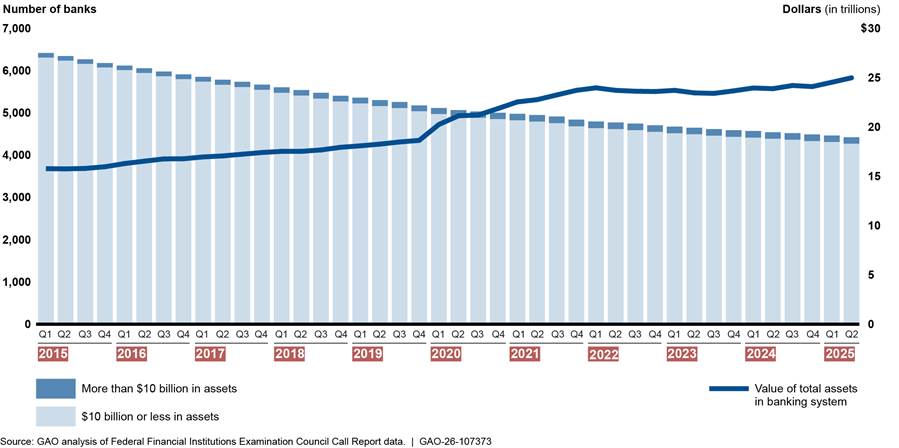
From the first quarter of 2015 through the second quarter of 2025, the number of banks in the United States decreased by 31 percent, from approximately 6,400 to fewer than 4,500 (see fig. 1), continuing a long-term trend.[11] As many small banks (banks with total assets of $10 billion or less) exited the market, the average asset size of remaining banks grew, and total banking system assets expanded significantly. On average, while 97 percent of banks during this period were small, the remaining 3 percent (large banks, with total assets greater than $10 billion) controlled about 84 percent of total system assets.
Figure 1: Number of Banks, by Asset Size, and Total Banking System Assets, First Quarter 2015–Second Quarter 2025
Role of Federal Financial Regulators and Federal Reserve Banks
The federal banking regulators—the Board of Governors of the Federal Reserve System, FDIC, and OCC—supervise the banks that are members of the FHLBanks and promote safety and soundness.[12] As part of their supervision, the regulators review bank data and documents such as quarterly Call Reports and contingency funding plans, which outline how banks would secure funding during periods of stress. Examination guidance generally directs bank examiners to consider the adequacy of the bank’s funding profile, including its reliance on FHLBank advances, as part of the broader assessment of the bank’s funding profile and its liquidity risk management.
The Federal Reserve Banks also operate the discount window, which offers short-term funding to depository institutions at a rate established by the Federal Reserve Banks, subject to review and determination of the Federal Reserve Board.[13] Although the primary discount window program is specifically intended for healthy borrowers experiencing liquidity needs, discount window use is often stigmatized by the market. Banks therefore sometimes avoid using it for fear that market participants and regulators will view it as a sign of weakness.[14]
The discount window accepts a wide variety of collateral, including much that qualifies for FHLBank advances, though it can apply different haircuts—that is, discounts on the value of collateral.[15] To maximize borrowing capacity, FHLBank members often pledge collateral to the Federal Reserve Banks that is not eligible for securing FHLBank advances (for example, consumer loans). However, in some circumstances—such as urgent or large funding needs—FHLBank members may need to reallocate excess FHLBank collateral (collateral pledged to an FHLBank but not needed for borrowing FHLBank advances) to a Federal Reserve Bank to access the discount window. Similarly, members can reallocate collateral the other way, from the Federal Reserve to an FHLBank, depending on liquidity strategies, collateral haircuts, and other factors. In these cases, coordination among the FHLBank, the Federal Reserve Bank, and the member institution may be necessary.
FDIC, in addition to supervising banks, administers the Deposit Insurance Fund, which insures deposits at FDIC-insured banks and helps cover the cost of resolving failed banks.[16] FDIC may also act as the receiver of closed banks, responsible for liquidating or collecting their assets and settling debts, including any outstanding FHLBank advances.
Recent Periods of Financial Stress
COVID-19 pandemic. In February 2020, the U.S. economy entered a recession in response to the effects of COVID-19.[17] Declaration of the pandemic in March 2020 triggered a sharp contraction of economic activity and a surge in unemployment. The federal government responded with multiple measures, including emergency lending programs for financial institutions and businesses and stimulus payments for individuals.[18]
March 2023 liquidity event. On March 8, 2023, Silvergate Bank, which had experienced a bank run starting in late 2022 due to concerns surrounding its involvement with the digital assets industry, announced its intent to wind down operations and voluntarily liquidate. This action prompted broader market uncertainty, especially at banks with depositors affiliated with the digital assets industry and venture capital. The subsequent failures of Silicon Valley Bank and Signature Bank on March 10 and 12, 2023, respectively, increased the risk of runs, particularly on uninsured deposits, on other large banks. To contain the risk of contagion, federal banking regulators and the Department of the Treasury took emergency measures to protect all depositors of the two failed banks. In addition, the Federal Reserve, with the approval of the Secretary of the Treasury, offered an emergency lending program for eligible banks.[19]
Most Banks Have Maintained Relatively Consistent FHLBank Borrowing Since 2015
Most banks maintained relatively consistent FHLBank borrowing activity from the first quarter of 2015 through the second quarter of 2025. Most banks also maintained consistent reliance on FHLBank advances during this period—keeping their FHLBank borrowing around a consistent percentage of their total assets—including during stress periods. While banks’ total outstanding FHLBank borrowing increased substantially during both the onset of the COVID-19 pandemic and the March 2023 liquidity stress period, these trends were driven by a small number of large banks, for which increases in borrowing were still a small fraction of their total assets. According to some bank executives, FHLBank advances have certain advantages compared with other liquidity sources, including accessibility, flexibility, cost advantage, and lack of stigma.
A Majority of Banks Have Regularly Borrowed FHLBank Advances Since 2015
From the first quarter of 2015 through the second quarter of 2025, most banks were active FHLBank members that borrowed regularly from their FHLBank, according to our analysis.[20] Of the 6,491 banks that submitted at least one Call Report during this period, more than three-quarters (5,110 banks) were active FHLBank members, borrowing from their FHLBank at least once during the period.[21] Furthermore, most of these active members, 67 percent on average, had outstanding FHLBank borrowing in each quarter.
Executives of banks across a range of asset sizes and regions reported using FHLBank advances regularly, including during periods of stress, to help meet funding needs and manage risk.[22] Executives from eight banks told us they used FHLBank advances to bridge funding gaps and counter deposit outflows related to factors such as taxes, large customer withdrawals, or tourism fluctuations. In addition to funding needs, two banks reported using FHLBank advances to mitigate interest rate risk.[23]
Total outstanding FHLBank borrowing has fluctuated since 2015, reflecting changes in the financial environment and banks’ funding needs (see fig. 2). As discussed below, these fluctuations were driven mainly by a small number of large banks.
Figure 2: Total Outstanding Federal Home Loan Bank Borrowing, by Bank Size, First Quarter 2015–Second Quarter 2025
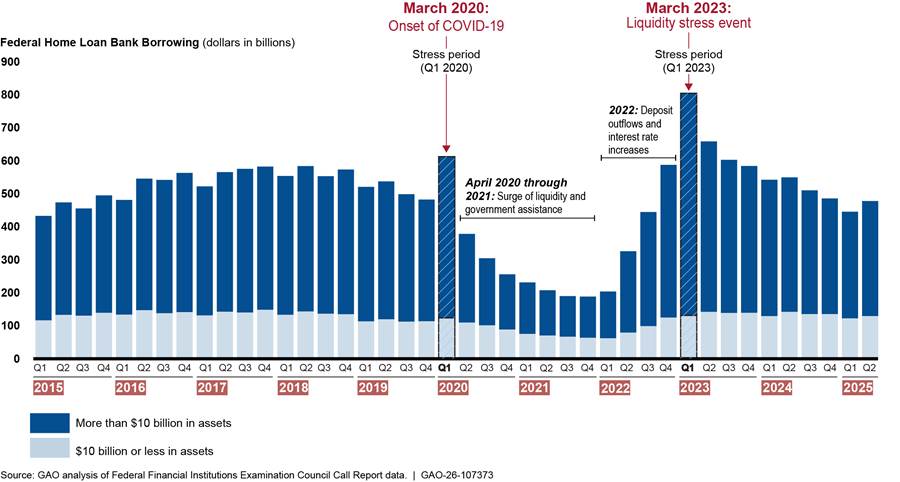
First quarter 2015–fourth quarter 2019. From the first quarter of 2015 through the last quarter of 2019, the financial environment was relatively stable. Banks’ total outstanding FHLBank borrowing fluctuated modestly between $433 billion and $584 billion, with an average change of 5 percent between quarters. Banks’ domestic deposits (which include funds in checking, savings, and money market accounts held in their domestic offices) and U.S. gross domestic product grew modestly, both by an average of 1 percent each quarter. The effective federal funds rate also did not change by more than half a percentage point from one quarter to the next.[24]
First quarter 2020. The first quarter of 2020 included a recession and the announcement of COVID-19 lockdowns. During this period, banks’ total outstanding FHLBank borrowing grew to $613 billion, a 27 percent increase over the previous quarter.[25] According to our analysis, the greatest advance growth this quarter coincided with the World Health Organization’s declaration of a global pandemic and a steep decline in U.S. stocks. Banks’ outstanding FHLBank borrowing continued to grow every week through the end of March as U.S. gross domestic product decreased and unemployment grew.
Executives we spoke with at seven banks reported increasing FHLBank advances during the first quarter of 2020 due to heightened uncertainty about future economic conditions. One executive said FHLBank advances allowed the bank to fund bank activities and meet risk management needs. For example, bank executives reported using advances to build up surplus cash and liquidity reserves in case the pandemic continued to worsen economic conditions. Executives we spoke with at the remaining three banks either did not borrow from their FHLBank during this period or did not cite specific reasons for doing so.
Second quarter 2020–fourth quarter 2021. Starting in the second quarter of 2020, banks’ total outstanding FHLBank borrowing decreased each quarter by an average of 15 percent, until reaching $189 billion in the last quarter of 2021. During this 21-month period, the financial system continued to experience a liquidity surge due to heightened government intervention through stimulus checks and emergency liquidity lending, as well as low interest rates. For example, the effective federal funds rate dropped to 0.09 percent on April 1, 2020, and remained at 0.1 percent or less through March 16, 2022. Our analysis found that banks generally did not borrow from their FHLBanks and many repaid existing advances during this period. Bank executives attributed this to increased deposits, low interest rates, and support from government programs.
First quarter 2022–fourth quarter 2022. Banks’ total outstanding FHLBank borrowing began increasing again in the first quarter of 2022 as interest rates increased, domestic deposits decreased, and pandemic-related government assistance wound down. After remaining at or below 0.1 percent through the end of the week of March 16, 2022, the effective federal funds rate quadrupled the following week. It continued to increase by half a percentage point or more every 6 to 8 weeks until reaching more than 4 percent by year’s end. FHLBank borrowing also increased every quarter in 2022 by an average of 34 percent over the previous quarter.
First quarter 2023. In the first quarter of 2023, which included the March 2023 bank failures and associated liquidity event, banks’ total outstanding FHLBank borrowing reached $804 billion, the highest level for the period and a 37 percent increase over the previous quarter. Most of this growth occurred immediately following the failures of Silicon Valley Bank and Signature Bank on March 10 and 12, according to our analysis. Outstanding FHLBank borrowing by banks with more than $10 billion to $100 billion in assets increased by the greatest amount—approximately three times higher than for smaller and larger banks. By March 31, 2023, banks in this size category were responsible for nearly one-third of outstanding FHLBank borrowing.
We interviewed executives from two banks with more than $10 billion to $100 billion in assets, who both reported increasing FHLBank advances in the first quarter of 2023 due to heightened economic uncertainty or pressure on regional banks to secure funding.[26] For example, one executive reported using FHLBank advances to maintain confidence in the bank’s ability to meet customer needs. An FHFA official also cited increased member test transactions (transactions—typically small—to test a member’s ability to borrow) and regulators’ encouragement to build up liquidity and use the FHLBank System as reasons for increased advance use.
Second quarter 2023–second quarter 2025. Following the March 2023 liquidity stress, banks’ total outstanding FHLBank borrowing decreased by 18 percent to $659 billion in the second quarter of 2023. Starting in March 2023 and continuing through early 2024, the Federal Reserve provided funding to banks through the Bank Term Funding Program, which peaked at more than $167 billion in outstanding loans. Banks’ total outstanding FHLBank borrowing continued to decrease, reaching $478 billion in the second quarter of 2025. While gross domestic product grew by 1 percent, on average, each quarter during this period, the unemployment rate also increased from 3.4 percent in April 2023 to 4.1 percent in June 2025. In the first quarter of 2025, tariff announcements and changes in trade policy created some uncertainty about economic conditions. However, nine of the 10 bank executives we spoke to reported no impact of these events on their banks’ financial condition or FHLBank borrowing activity.
Large Banks Were Responsible for Most FHLBank Borrowing Since 2015
Our analysis of banks’ quarterly Call Report data found that large banks—those with more than $10 billion in total assets—were responsible for a majority of banks’ FHLBank borrowing since 2015, especially during periods of stress. In the second quarter of 2025, fewer than 160 out of the 4,424 banks in our population had more than $10 billion in total assets. Despite representing approximately 3 percent of active FHLBank members, large banks held, on average, nearly 74 percent of all outstanding FHLBank borrowing (see fig. 3).
The concentration of borrowing by large banks was even more pronounced during stress periods. In the first quarter of 2020, at the onset of COVID-19, banks with more than $10 billion in assets held 80 percent of total outstanding FHLBank borrowing—6 percentage points higher than average. During the first quarter of 2023, their share rose to 84 percent, 10 percentage points higher than average.
Figure 3: Banks’ Share of Total Outstanding FHLBank Borrowing, by Bank Size, First Quarter 2015–Second Quarter 2025
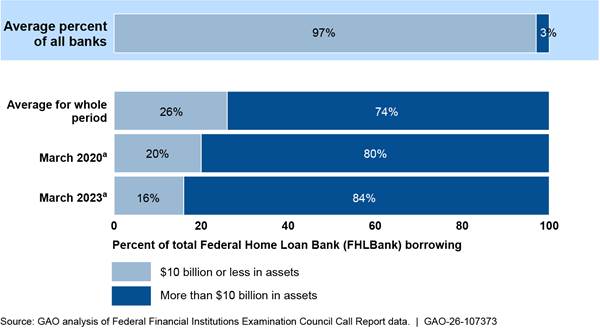
aStress period.
Banks with more than $10 billion in assets were also responsible for more than 90 percent of increases in total outstanding FHLBank borrowing during both stress periods. In the first quarter of 2020, banks’ total outstanding FHLBank borrowing increased by $130 billion over the previous quarter, with 92 percent of that increase ($120 billion) attributable to large banks. Similarly, in the first quarter of 2023, total outstanding borrowing grew by $217 billion, of which 97 percent ($211 billion) was attributable to large banks.
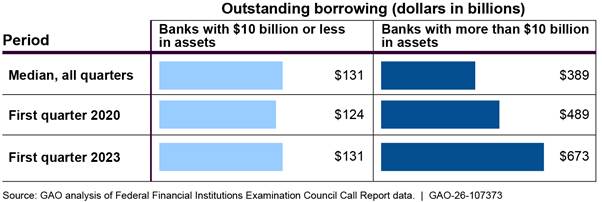
While small banks increased their borrowing during the onset of COVID-19 and March 2023—by about $11 billion and $6 billion, respectively, compared with the previous quarter—their total outstanding FHLBank borrowing during these periods was the same or lower than the median level for the whole period (see fig. 4). By contrast, total outstanding borrowing by banks with more than $10 billion in total assets was above the median level during both stress periods.
Figure 4: Total Outstanding Federal Home Loan Bank Borrowing, by Bank Size, First Quarter 2015–Second Quarter 2025
Banks’ Ratio of FHLBank Borrowing to Total Assets Generally Has Stayed Within a Consistent Range Since 2015
The ratio of a bank’s FHLBank borrowing to its total assets is an indicator of the extent to which the bank relies on FHLBank borrowing, compared with other funding sources, to support operations or manage risk—a higher percentage reflects greater reliance. Since 2015, most active FHLBank members (76 percent) had a ratio of FHLBank borrowing that was 5 percent or less of total assets. Additionally, during this period, most active FHLBank borrowers (62 percent, on average) did not change their ratio compared with the previous quarter. Of the remaining 38 percent that did change their ratio between quarters, most (69 percent) changed it by 2 percentage points or less. This indicates that banks typically do not change their reliance on FHLBank borrowing significantly from one quarter to the next. See sidebar for information on six banks with more than $10 billion to $100 billion in assets that did increase their reliance on FHLBank advances leading up to, and during, the March 2023 liquidity stress.
|
Banks with Increased Reliance on FHLBank Advances Around March 2023 While most banks maintained consistent Federal Home Loan Bank (FHLBank) borrowing activity during recent stress periods, we identified six banks with more than $10 billion to $100 billion in assets that increased their ratio of borrowing to total assets by more than 10 percentage points in 2022 or the first quarter of 2023. Among these six banks was Silvergate Bank, which increased its ratio by 33 percentage points in the last quarter of 2022 and voluntarily liquidated on March 8, 2023. In contrast, the remaining five banks that increased reliance during this period subsequently decreased their outstanding FHLBank borrowing in the second quarter of 2023. We interviewed an executive at one of the six banks, who told us the bank increased reliance on FHLBank advances in March 2023 due to a negative perception of regional banks and increased uncertainty. The executive said FHLBank advances were a secure way to source cash quickly to be able to meet potential challenges. Source: GAO analysis of Federal Financial Institutions Examination Council call report data and an interview. | GAO‑26‑107373 |
Our analysis of Call Report data from the first quarter of 2015 through the second quarter of 2025 found that banks generally maintained a consistent ratio of FHLBank borrowing to total assets to fund their activities, including during periods of stress. Specifically, when examining all quarters except recent stress periods, we found that, at the median, FHLBank borrowing generally made up 0 to 5 percent of total assets, depending on asset size (see table 1). During stress periods—the first quarter of 2020 and the first quarter of 2023—the median ratio of FHLBank borrowing to total assets remained within the banks’ consistent range.
Table 1: Median Ratio of FHLBank Borrowing to Total Assets, by Bank Size, First Quarter 2015–Second Quarter 2025
Federal Home Loan Bank (FHLBank) borrowing as a percentage of total assets
|
|
Bank asset size |
||||
|
Period |
$1 billion or less |
More than $1 billion to |
More than $10 billion to |
More than $100 billion to |
More than |
|
First quarter 2020 |
1% |
3% |
4% |
3% |
2% |
|
First quarter 2023 |
1 |
3 |
5 |
4 |
2 |
|
All other quartersa |
0–2 |
0–4 |
0–5 |
0–4 |
0–3 |
Source: GAO analysis of Federal Financial Institutions Examination Council Call Report data. | GAO‑26‑107373
aThe “all other quarters” category represents the range of median ratios across all quarters from first quarter 2015 through second quarter 2025, excluding the two stress periods (first quarter 2020 and first quarter 2023).
In addition, we found that many banks had no change in their ratio of FHLBank borrowing during either stress period. Specifically, 61 percent of active FHLBank members maintained their FHLBank borrowing ratio in the first quarter of 2020 compared with the prior quarter, and 48 percent did so in the first quarter of 2023. While more banks changed their FHLBank borrowing ratio in the first quarter of 2023, among those that did, about half increased their ratio and about half decreased it.
We also found that banks that typically rely more heavily on FHLBank borrowing did not increase their reliance on advances during stress periods compared with the rest of the period. While some banks held more than 5 percent of their assets in FHLBank borrowing, their borrowing ratios also stayed within a consistent range during periods of stress.[27]
Banks’ ratios of FHLBank borrowing to total assets remained relatively consistent despite aggregate increases in total FHLBank borrowing. This is because banks also increased their use of other funding sources, including repurchase agreements, federal funds, other borrowing, time deposits, and brokered deposits.[28] Our review found that during recent stress periods, other funding sources increased by a magnitude similar to that of FHLBank borrowing.
Selected Banks Reported That FHLBank Advances Have Advantages over Other Funding Sources
Banks primarily fund their operations through customer deposits, like checking and savings accounts, but may also use other funding sources, including FHLBank advances. According to bank executives we interviewed, when deposits are low, these alternative sources help banks meet funding demands, diversify funding structures, and maintain an appropriate ratio of assets to liabilities.
While banks often use a mix of funding sources, executives from the 10 banks we spoke with told us that FHLBank advances have some advantages over other types of funding, including the following:
· Speed and availability. Executives of nine banks told us they preferred FHLBank advances because of how quickly and easily they can secure funds. Banks can submit a request—specifying the amount, term, and type of advance—through their FHLBank’s website and obtain funds within the same business day. Other funding sources, like brokered time deposits and the discount window, require advance planning and are not immediately available. The executives emphasized the importance of securing funding quickly to manage changes in funding or risk during periods of financial stress.
· Flexible maturity options. Executives of six banks highlighted the broad range of terms available with FHLBank advances, with maturities ranging from overnight to 30 years. In contrast, the discount window offers terms of overnight to 90 days. One bank executive told us their bank was able to restructure some advances to longer maturities when interest rates fell, securing long-term funding at a fixed rate.
· Cost advantages. Executives of seven banks reported that FHLBank advances are competitively priced and come with financial incentives. Two executives noted that FHLBank rates are less affected by market swings than other sources, making them useful in periods of stress. Executives from two banks cited dividends on FHLBank stock as an incentive, sometimes making advances attractive even when their rates exceed those of other funding options. Banks may also use FHLBank advances more frequently to earn higher dividends.
· Lack of stigma. Executives of seven banks told us that in an emergency, they would prefer FHLBank funding because it does not carry the same perceived stigma as borrowing from the discount window. Because most banks use FHLBank advances in normal operations, FHLBank borrowing during periods of stress is not considered a sign of trouble.
While bank executives reported that FHLBank advances have certain advantages, three executives noted the importance of maintaining a diversified mix of funding sources. They highlighted time deposits, brokered deposits, repurchase agreements, and federal funds as other funding sources they may use.
The executives also provided reasons why they may use other funding sources instead of FHLBank advances. Two noted that FHLBanks require loan collateral up front, whereas time deposits and brokered deposits do not, potentially making them easier to access. One executive explained for advances under $1 billion, brokered time deposits are less expensive than FHLBank advances.
For Most Banks, Higher FHLBank Borrowing Was Associated with Positive Outcomes from 2015 Through 2024
Our analysis found that higher FHLBank borrowing was generally associated with positive outcomes for most banks, especially smaller banks with $10 billion or less in assets. For these banks, higher borrowing was associated with more lending and not associated with increased likelihood of certain safety and soundness concerns. In contrast, for large banks with more than $10 billion in assets, we found no evidence of a relationship between FHLBank borrowing and lending, and the relationship between borrowing and risk to safety and soundness is unclear.
Small Banks with Higher FHLBank Borrowing Lent More on Average Than Those with Lower FHLBank Borrowing
Overall, our econometric models found that banks with higher FHLBank borrowing lent more on average than banks with lower FHLBank borrowing from 2015 through 2024 (see fig. 5).[29] This finding was consistent across all three measures of FHLBank borrowing we analyzed: (1) total FHLBank borrowing each quarter, (2) increase in FHLBank borrowing quarter to quarter, and (3) ratio of FHLBank borrowing to total assets. For example, a 1 percent increase in total FHLBank borrowing each quarter was associated with a 0.009 percent increase in overall lending.[30] The results were driven by banks with $10 billion or less in assets.[31] For large banks (more than $10 billion in assets), we found no evidence of a relationship between FHLBank borrowing and lending.
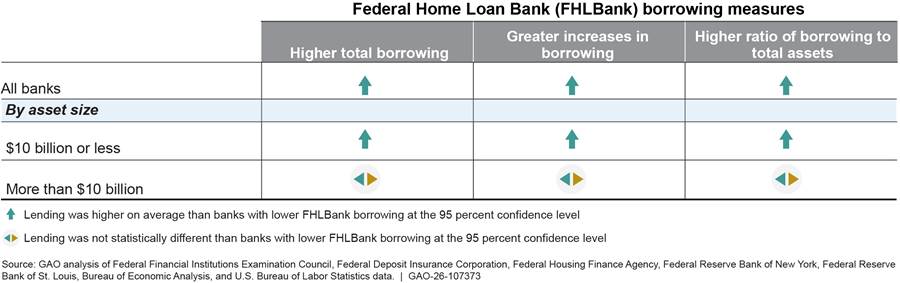
Similarly, banks with higher FHLBank borrowing made more real estate loans on average, according to our analysis (see fig. 6). Specifically, banks with higher FHLBank borrowing across all three measures provided more residential and commercial real estate loans on average than banks with lower FHLBank borrowing.[32] For example, a 1 percent increase in total FHLBank borrowing each quarter was associated with a 0.011 percent increase in residential real estate lending and a 0.01 percent increase in commercial real estate lending. These overall results were driven by banks with assets of $10 billion or less.[33] For banks with more than $10 billion in assets, we generally found no evidence of a relationship between FHLBank borrowing and real estate lending.
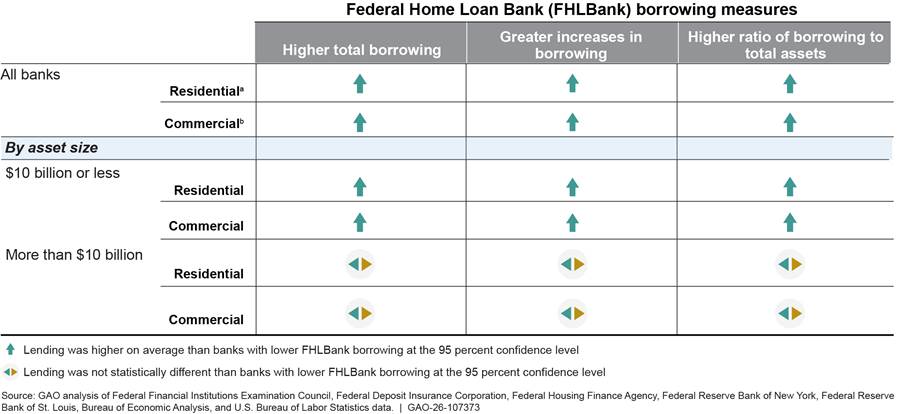
aResidential loans are for 1–4 family and multifamily (5 or more) residential properties, including loans for construction of 1–4 family residential properties.
bCommercial loans are for farmland and other nonresidential, nonfarm properties, including loans for construction and land development (excluding 1–4 family residential construction loans).
In contrast, for consumer lending, we found that small banks with greater increases in FHLBank borrowing quarter to quarter made more consumer loans on average than banks with smaller increases (see fig. 7).[34] For these banks, a 1 percent increase in FHLBank borrowing quarter to quarter was associated with a 0.002 percent increase in consumer lending. For banks overall and those with more than $10 billion in assets, we generally found no evidence of a relationship between FHLBank borrowing and consumer lending.
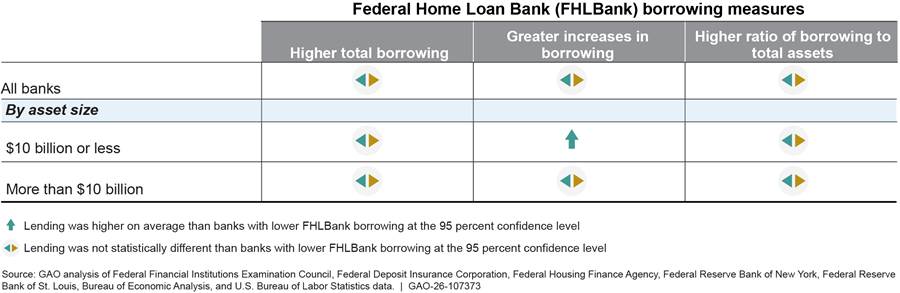
Note: Our analysis of consumer lending included loans for credit cards, automobile loans, and student loans, among other things.
Our findings suggest that FHLBank borrowing may support more loans for housing and community development activities by banks with $10 billion or less in assets. These smaller banks made up 97 percent of the banks in our analysis. However, we did not find the same pattern for banks with more than $10 billion in assets, which were responsible for 74 percent of all FHLBank borrowing on average from 2015 through 2024.
The FHLBanks’ mission is to provide liquidity to their members to support housing finance and community development through all economic cycles. However, because this funding is fungible, it is unclear to what extent FHLBank members are using advances to make loans for housing and community development activities, as opposed to funding other financial assets (e.g., certificates of deposit, federal funds sold, securities).[35]
These findings are generally consistent with research on the relationship between FHLBank borrowing and lending across other periods.[36] For example, one study found that quarter-to-quarter growth in FHLBank borrowing was positively related to growth in total loans, residential real estate loans, commercial real estate loans, and consumer loans from 2000 to 2016.[37]
Small Banks with Higher FHLBank Borrowing Were Generally Less Likely to Have Serious Safety and Soundness Issues
Problem Bank List
Our analysis found that from 2015 through the third quarter of 2024, banks with higher total FHLBank borrowing or greater increases in borrowing were less likely to appear on FDIC’s Problem Bank List (see fig. 8). Banks are added to the Problem Bank List when their supervisory rating falls below a certain threshold.[38]
Figure 8: Banks’ Likelihood of Appearing on FDIC’s Problem Bank List by FHLBank Borrowing Measure, 2015–Third Quarter 2024
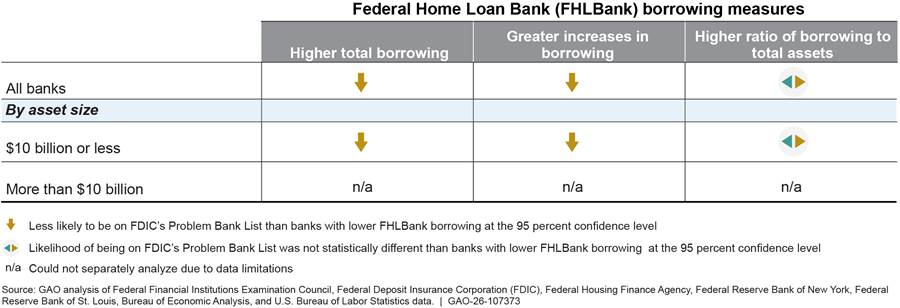
For banks with $10 billion or less in assets, similar to our findings for all banks, we found that those with higher total FHLBank borrowing or larger increases in borrowing were less likely to appear on the Problem Bank List. However, there was no evidence of a relationship between a bank’s ratio of FHLBank borrowing to total assets and its likelihood of being on the list, according to our analysis. We were unable to separately analyze banks with more than $10 billion in assets due to data limitations, such as the low number of such banks of this size appearing on the Problem Bank List from 2015 through the third quarter of 2024.[39]
Failure or Liquidation
Overall, our analysis found a statistically significant difference in the likelihood of bank failure or liquidation for one borrowing measure (see fig. 9).[40] Banks with higher total FHLBank borrowing each quarter were less likely to fail or liquidate than banks with lower FHLBank borrowing during the period from 2015 through the third quarter of 2024.
Figure 9: Banks’ Likelihood of Failure or Liquidation by FHLBank Borrowing Measure, 2015–Third Quarter 2024
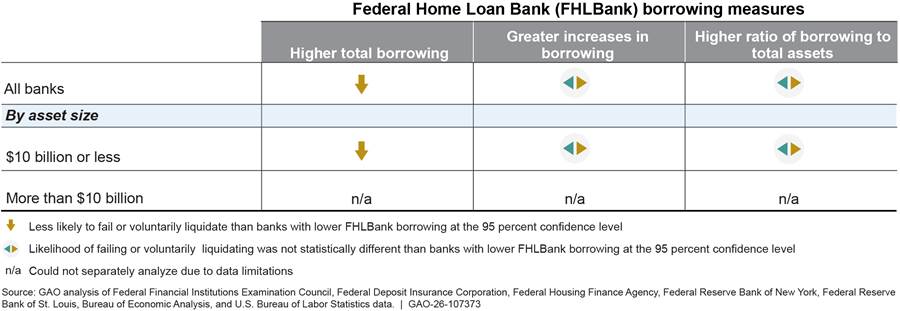
For banks with $10 billion or less in assets, similar to our findings for all banks, we found that banks with higher total FHLBank borrowing each quarter were less likely to fail or liquidate than those with lower FHLBank borrowing. We were unable to separately analyze banks with more than $10 billion in assets due to data limitations, such as the low number of such banks that failed or liquidated from 2015 through the third quarter of 2024.[41]
Taken together, our findings on the relationship between FHLBank borrowing and the likelihood of being on the Problem Bank List and failing or liquidating suggest that higher FHLBank borrowing is generally not associated with increased likelihood of serious safety and soundness issues in banks with $10 billion or less in assets. One study we reviewed raised concerns that the structure of FHLBank advances (i.e., lack of risk-based pricing) incentivizes banks to take certain types of risks.[42] However, this study and others also suggest that FHLBank borrowing may help banks manage certain types of risk.[43] Officials from FDIC, the Federal Reserve Board, and OCC stated that, generally, they do not see an increase in FHLBank borrowing on its own as an indicator of a safety and soundness concern. FHLBank borrowing is just a portion of banks’ overall funding strategy, according to officials. However, officials said that material increases in FHLBank borrowing or other deviations from a bank’s normal borrowing patterns may indicate a problem.
In our analysis, we found no evidence that higher FHLBank borrowing was associated with an increased likelihood of being on the Problem Bank List, failing, or liquidating. Moreover, in some cases, we found that higher FHLBank borrowing was associated with a reduced likelihood of those outcomes, particularly for smaller banks. For banks with more than $10 billion in assets, we were not able to analyze the relationship between FHLBank borrowing and likelihood of safety and soundness issues due to data limitations.
See appendix II for more information about the estimates of each econometric model.
Potential Changes to FHLBank Lending Raise Key Trade-Offs for Policymakers
Academics, market participants, and observers have noted concerns about FHLBanks’ lending to troubled banks or lending during times of financial stress and have suggested changes to address these concerns.[44] Our discussion group participants identified both potential benefits and drawbacks of the suggested changes. Additional considerations—including the findings in this report—may help inform policymakers to the extent that potential reforms to the FHLBank System are considered.
Commonly Cited Concerns About FHLBank Lending Relate to Perceived Structural Incentives for Risk-Taking
Literature we reviewed cited concerns that the structure of the FHLBank System’s lending could threaten financial stability—such as by promoting potentially risky lending—and increase resolution costs when banks fail.[45] Commonly cited concerns generally relate to the following perceived features of FHLBank lending that observers believe could encourage risk-taking by member banks and FHLBanks:
· Implied guarantee. According to our literature review, because FHLBanks are government-sponsored enterprises, their debt may be perceived to carry an implied guarantee—that is, a perception that the federal government would provide support in the event of a default by the FHLBanks. In turn, it is perceived that the FHLBanks can borrow and lend more cheaply, leading to concerns that they may be promoting greater risk-taking by members.[46]
· Low pricing. FHLBanks generally offer lower pricing than other liquidity sources and have the authority to pay dividends to members. Some literature cited this as a potential incentive for troubled banks to borrow more or for longer periods than they otherwise would, leading to potential financial stability risks. Specifically, low FHLBank pricing can allow banks to delay balance sheet recognition of losses or actions to maintain healthy liquidity reserves, according to some literature.[47] A related argument was that consistently low FHLBank pricing relative to the discount window could make it less likely that banks would turn to the Federal Reserve as their lender of last resort during times of stress—the concern being that the FHLBanks are not functionally equipped to serve as the lender of last resort.[48]
· Cooperative structure. Although the FHLBanks’ cooperative structure is often cited as a protective feature against excessive risk-taking, some literature noted that FHLBanks’ lending to their member-owners presents a conflict of interest.[49] Specifically, FHLBanks might be more willing to lend to risky members—especially large, influential members—because the expected benefit of higher profits (and subsequent higher dividends for members) outweighs the risk of bank default or failure.
· Lien status and prepayment fees in a bank failure. The FHLBanks’ perceived lack of accountability—or “skin in the game”—for potential losses is another area of concern commonly cited in the literature. Specifically, some literature cited the FHLBanks’ “super lien” advantage—their statutory repayment priority over certain claimants, including any receiver or conservator, such as FDIC—as a potential incentive for imprudent lending. This repayment priority can reduce the FHLBanks’ losses when a member bank fails or otherwise cannot repay its advances, according to some literature we reviewed.[50]
In addition, FHFA has noted that FHLBank prepayment fees help protect the FHLBank System’s financial condition but may also increase the cost of failure.[51] If a member bank fails and has outstanding advances involving prepayment fees, any outstanding prepayment fees owed must still be repaid to an FHLBank on top of the outstanding balance on the advances, potentially increasing resolution costs.
· Collateral-based lending. The FHLBanks’ use of overcollateralized lending—and their resulting ability to avoid losses in the event of default—was cited in the literature as making them less likely to account for members’ credit risk. This could lead to riskier lending and threaten financial stability, potentially increasing resolution costs to the Deposit Insurance Fund, according to literature we reviewed.[52]
· Transparency. A less frequently cited concern in the literature was that FHLBank lending is less transparent than the discount window.[53] Different disclosure requirements pertaining to information on FHLBank borrowing and terms (such as interest rates or collateral types and amounts) could encourage troubled banks to continue borrowing rather than seeking funding sources that provide more insight into their condition, according to literature we reviewed. This could limit transparency for markets and regulators—and reduce FHLBank accountability for lending decisions.[54]
In our review, we also identified literature that cited benefits of FHLBank lending during crises.[55] We did not examine these views in detail because our objective was to examine concerns about and suggested changes to such lending. While we present these concerns above to establish the context for authors’ suggested changes, we provide more information about the current relevant laws, regulations, and practices in the next section.
Certain Changes to FHLBank Lending Suggested in Literature Have Trade-Offs, and Some Duplicate Existing Authorities
We analyzed eight suggested changes to FHLBank lending cited in academic and government literature that seek to address concerns about incentives for risk-taking.[56] We grouped these suggestions into four broad areas: (1) increasing the federal banking regulators’ role in lending decisions, (2) increasing FHLBanks’ accountability for lending, (3) limiting FHLBank lending during a crisis, and (4) altering the pricing structure of advances. Our analysis found that each suggestion could have both positive and negative effects, and that in some cases, existing laws or regulations already allow for the intended action or make the change less relevant.
Increasing Federal Banking Regulators’ Role in Lending Decisions
Three suggested changes from the literature seek to increase the banking regulators’ role in FHLBank lending under certain circumstances:
1. Approving advances to member banks under certain conditions
2. Restricting access to FHLBank advances when a bank’s condition deteriorates
3. Imposing costs (such as a capital charge) on banks that rely heavily on FHLBank advances[57]
With respect to the first two suggested changes, FHFA regulations currently allow for certain banking regulator interventions in FHLBank credit decisions. For example, an FHLBank may not make an advance to a member without positive tangible capital unless the member’s primary regulator or insurer requests it. A member bank’s regulator can also prohibit FHLBank advances to a capital-deficient member with positive tangible capital by notifying the FHLBank in writing that a member’s use of FHLBank advances has been prohibited.[58] However, banking regulator officials informed us they generally have not intervened in FHLBank lending decisions.
In addition, FHLBank representatives said FHLBanks review members’ creditworthiness at least quarterly—more frequently for members in troubled condition—and reduce a member’s borrowing capacity or require more collateral when necessary. They stated that certain FHLBanks generally coordinate these actions with the member’s primary regulator.
Further, with respect to the third suggested change, FDIC officials noted that, in general, large banks with a heavy reliance on FHLBank advances pay more for deposit insurance. Specifically, for banks with more than $10 billion in total assets, FDIC uses a scorecard methodology that considers the amount of advances—along with other secured liabilities—in calculating banks’ deposit insurance assessment rates.[59]
Several discussion group participants, FHLBank representatives, and FDIC officials noted some potential negative effects of these suggested changes:[60]
· Liquidity delays. Regulatory approval could delay access to funding and increase the risk to member banks. A few participants noted that these suggestions could particularly affect small banks without access to alternative funding sources, like repurchase agreements.[61]
· Business model disruption. Several participants said members might need to adjust their business models to accommodate delays, which might have serious negative effects during periods of financial stress.
· Less lending capacity. A few participants said restricting liquidity could have other unintended consequences, such as constricting lending.
· Conflicts of interest. Giving the regulators greater authority in FHLBank lending decisions could blur the lines between supervisory and lending roles. FDIC officials noted that banking regulators do not have legal authority or responsibility to make credit decisions for FHLBanks and that such authority could introduce conflicts between FDIC’s interests as insurer and potential receiver.[62]
· Resource concerns. Some discussion group participants and FDIC officials questioned whether regulators have the time, staff, or necessary skills to review a large volume of advance requests in real time.
Discussion group participants and FHLBank representatives also noted potential positive effects of increasing the regulators’ role:
· Improved communication. Regulatory involvement could help surface concerns about a bank’s condition earlier, according to a few participants and FHLBank representatives.
· Greater use of the discount window. A few participants said requiring regulators’ approval or otherwise making advances more difficult to obtain could also prompt more banks under stress to use the discount window, which they believed was the intended lender of last resort.
Increasing FHLBanks’ Accountability for Lending
Two suggested changes were intended to increase FHLBanks’ accountability for lending:
1. Change how FHLBanks are paid following the failure of a member bank with outstanding advances, such as by
a. moving FHLBanks lower in the order of actors repaid by the receiver following a bank failure (i.e., eliminating the FHLBanks’ “super lien” advantage), or
b. requiring the FHLBank to pay a penalty or forfeit prepayment fees associated with the failed banks’ advances.[63]
2. Change FHLBanks’ required disclosure of FHLBank borrowing, such as by requiring FHLBanks to immediately and publicly disclose advances beyond a certain size threshold.[64]
Changing How FHLBanks Are Paid in a Bank Failure Situation
One suggestion to increase accountability for lending is to move FHLBanks lower in the repayment order after a member bank fails, effectively eliminating their perceived “super lien” advantage. However, the advantages of the “super lien” have diminished over time. While this lien once gave the FHLBanks a substantial advantage over other creditors in a receivership situation, changes to the Uniform Commercial Code (UCC) around 2001 reduced its significance.[65] Before that time, the only way to “perfect” a security interest in collateral (i.e., give a creditor priority interest in the collateral over other creditors) under the UCC, as relevant here, was through possession of collateral promissory notes. But the “super lien” gave FHLBanks priority over an unperfected security interest. That is, the FHLBank was deemed to have priority over another creditor if the creditor did not possess the collateral. The FHLBank did not have to possess the notes to obtain that priority.
Since the UCC changes took effect, however, any creditor, including an FHLBank, can use an alternative mechanism—filing a financing statement—to perfect their security interest in the property securing the advance. Thus, according to FHFA, because all FHLBanks file financing statements to ensure a first priority position, the perceived “super lien” mainly applies to rare situations where no secured creditor, including the FHLBank, has perfected or possessed the collateral before a receivership.
Another suggestion to increase lending accountability is to require FHLBanks to forfeit prepayment fees. This would require changes to FHFA’s advance regulations, FDIC’s receivership regulations, and, according to FHLBank representatives, their advance agreements.[66] FHLBank representatives told us that eliminating these fees would shift both credit and market risk from member institutions to the FHLBanks, as members would be able to restructure or prepay outstanding advances without bearing any associated financial costs. They explained that this risk transfer could undermine the cooperative structure of the FHLBank System and potentially increase borrowing costs for other members, as the FHLBanks would need to absorb and price for the additional risk across their broader membership base.
Some discussion group participants and FHLBank representatives noted potential negative effects of changing how FHLBanks are paid following a bank failure. They said lending practices inconsistent with market norms could lead FHLBanks to mitigate risk by requiring more collateral or reducing longer-term and fixed-rate advances. FHLBank representatives told us this change could particularly affect small banks with limited funding alternatives. These banks might be forced to use other, less reliable funding sources.
A few discussion group participants and FDIC officials also identified potential positive effects. For example, reducing prepayment fees could lower costs to the Deposit Insurance Fund when a failed bank holds FHLBank advances.[67]
Disclosures
Although the suggestion for FHLBanks to require immediate disclosure of advances above a certain threshold is intended to improve transparency and accountability, various reporting requirements already make some advance information public. For example, all FHLBanks and publicly traded member banks must file periodic reports with the Securities and Exchange Commission.[68] Additionally, the FHLBank System’s Office of Finance issues an annual combined financial report that reports the top five advance holders for each FHLBank. Banks also must disclose their total outstanding FHLBank advances in quarterly Call Reports.
Several discussion group participants and FHLBank representatives said implementing a real-time disclosure requirement would raise complex questions. These include how soon disclosure should occur and how to define the reporting threshold. FHLBank representatives noted that FHFA and the banking regulators would have to conduct rulemakings to establish such a requirement.
As with other proposed changes, some discussion group participants, FDIC officials, and FHLBank representatives noted potential positive and negative effects. A few discussion group participants said a disclosure requirement could increase knowledge of a bank’s condition, and one said it could lead to earlier market corrections for troubled banks. However, some participants, FHLBank representatives, and FDIC officials warned that without adequate context, such disclosure could exacerbate stress and increase the risk of bank runs. They further noted that disclosure could stigmatize FHLBank advances and discourage their use, particularly for banks already experiencing stress. This could lead some members to seek alternative funding to avoid reaching the FHLBank disclosure threshold. FHLBank representatives noted that other wholesale funding sources, such as brokered deposits and repurchase agreements, do not carry similar disclosure requirements.
Limiting FHLBank Lending During a Crisis
One suggested change would replace FHLBank lending during crises with Federal Reserve lending.[69] This change could help address concerns about members’ reliance on the FHLBanks and subsequent financial stability risks and higher resolution costs during times of stress.
The Federal Reserve’s discount window is available to eligible banks throughout the financial cycle. In addition, in certain circumstances and subject to other statutory requirements, the Federal Reserve Board has authority to authorize emergency lending programs, as it has done in recent crises.[70]
Stakeholders we interviewed generally cited more drawbacks than benefits to this suggested change. Some discussion group participants and FHLBank representatives questioned how policymakers would define the start and end of a crisis, and some participants questioned whether the Federal Reserve had the time or necessary skills to implement it effectively. Some participants doubted the Federal Reserve’s capacity to fully replace FHLBank lending during a crisis.
However, a few discussion group participants said such a change could promote market clarity by stating that the Federal Reserve would serve as the lender of last resort in a crisis.[71]
Altering the Pricing Structure of Advances
Two suggested changes would modify how FHLBanks price advances:
1. Require FHLBanks to set advance rates (net of dividends) higher than the discount window’s primary credit program rate.
2. Price advances based on individual members’ credit risk.[72]
These changes aim to reduce member reliance on FHLBank funding and encourage use of other, potentially more transparent, funding sources, including the discount window.
Raising FHLBank Advance Rates
FHLBank representatives said that requiring net advance rates above the Federal Reserve’s discount window rate would require FHFA rulemaking or a policy determination justifying higher pricing. Currently, FHFA’s advance regulations restrict FHLBanks from pricing advances below (1) the market rate for similar products with matching terms and maturity, and (2) the administrative and operating costs associated with making the advance.[73] Thus, FHFA would need to conduct a rulemaking to amend its regulations to require that the minimum pricing on advances exceed the rate charged by the Federal Reserve’s discount window.
A few discussion group participants and FHLBank representatives noted potential downsides to this change. They said it would disrupt FHLBanks’ role as routine liquidity providers, potentially reduce the volume of FHLBank advances, or lead to less business and consumer lending by small member banks. It could also increase borrowing costs and reduce funding for FHLBanks’ housing mission, according to FHLBank representatives.[74] A few participants noted that changing pricing alone might not deter member banks’ use of advances because advances offer desirable features, such as a range of maturities and ease of access.
FHLBank representatives and FDIC officials also cautioned that artificially raising net advance rates higher than the discount window could create market distortions. FHLBank representatives said FHLBank advance pricing is market-driven, reflecting private investor demand for FHLBank debt, unlike discount window rates. They also said that benchmarking advance rates to a nonmarket, government-administered rate introduces the appearance of price controls and would undermine the FHLBanks’ ability to compete with market-based alternatives.
Pricing Based on Individual Member Credit Risk
A few discussion group participants and FHLBank representatives noted that FHFA regulations permit FHLBanks to use differential pricing based on a member bank’s individual credit risk or other reasonable criteria as long as it can be applied to all members equally.[75] A few participants and FHLBank representatives noted that FHLBanks account for credit risk in other ways as well, such as requiring physical delivery of collateral, increasing haircuts, or reducing the advances. Additionally, FHFA issued a 2024 advisory bulletin that emphasized the importance of carefully considering members’ credit risk during lending decisions.[76]
A few discussion group participants also noted potential implementation challenges, including the need for additional resources or expertise at FHFA or FHLBanks. Two other participants said that pricing based on members’ credit risk could disadvantage small banks, which may appear riskier due to their asset size. In addition, two participants cautioned it could drive member banks to leave the FHLBank System if it no longer offered advantageous pricing.
Other Considerations Could Help Inform Policy Deliberations on FHLBank Lending
A key consideration for policymakers in weighing changes to FHLBank lending is the FHLBank System’s interconnectedness with other parts of the financial system. According to discussion group participants, FHLBank representatives, and FDIC officials, many of the suggested changes could restrict, increase the cost of, or otherwise limit member banks’ access to routine liquidity. This could particularly affect small banks with fewer funding alternatives. While some changes could push member banks to use the discount window, they also could discourage healthy banks from using FHLBanks under normal conditions. As our analysis shows, many banks rely on the FHLBanks as a funding source, with at least half of all banks having had outstanding FHLBank borrowing over the past decade. In addition, changes to the FHLBanks’ liquidity role could affect investment by the system and its members in housing and community development.[77]
Although some suggested changes aim to address risks tied to large or increasing volumes of FHLBank borrowing, these risks may be overstated. Our trend analysis found that a small number of large banks drove increases in borrowing during recent crises, and their borrowing largely remained within a normal range relative to their total assets.
Similarly, much of the literature we reviewed is focused on the risks of lending to severely troubled banks. However, our econometric analysis, which controlled for bank health characteristics, found that greater FHLBank borrowing was generally associated with more lending and fewer safety and soundness issues, particularly among small banks. These findings suggest that, given the potential for certain suggested changes to have unintended effects for small banks and customers, careful consideration of existing outcome data would be warranted when contemplating changes to FHLBank lending. The takeaway for large banks is less clear. Since we were unable to separately analyze the effects of greater FHLBank borrowing on safety and soundness outcomes (including failure) for large banks, we were unable to determine whether the suggested changes would have notable effects on resolution costs. The banks that failed in 2023 had large FHLBank borrowing and costly resolutions. As we have recently reported and as reviews by FDIC and the Federal Reserve have found, multiple factors played into the banks’ failures.[78] Given the importance of FDIC, Federal Reserve System, and OCC involvement in troubled bank situations, these agencies’ existing practices, authorities, and capacity—as described above—are relevant factors to consider with regard to any potential changes to FHLBank lending.
FHLBanks and Federal Reserve Banks Have Ongoing Efforts to Improve Coordination
FHLBanks, FHFA, and Banking Regulators Meet Regularly to Discuss Policy and Other Issues
FHLBanks and FHFA meet regularly with federal banking regulators, according to FHLBank representatives and agency officials. All FHLBanks reported meeting at least annually with FDIC, OCC, and Federal Reserve Banks. Additionally, FHFA officials said they hold quarterly meetings with FDIC, the Federal Reserve Board, and OCC.
Participants of these meetings said they cover topics such as membership trends, lending practices, regulatory changes, market trends, and emerging risks. For example, several FHLBanks provided updates on underwriting standards, collateral practices, and products, according to FHLBank representatives. Officials from FHFA and the banking regulators reported discussing similar topics during their quarterly meetings, such as implementation of 2024 guidance on the FHLBanks’ credit risk management practices.[79]
Officials from the three banking regulators said they do not regularly communicate with the FHLBanks about the performance of individual member banks.[80] They said they generally rely on information obtained directly from the member banks they supervise. FHLBank representatives generally agreed, noting that regulators already have access to member borrowing data through the banks themselves or public sources.
However, when banking regulators need to request borrowing information from an FHLBank—for instance, when a bank is in distress—FHLBanks are required by regulation to provide borrowing information to the bank’s primary regulator.[81]
Efforts to Improve Routine and Emergency Coordination Between FHLBanks and Federal Reserve Banks Are Ongoing
When a bank is at risk, timely coordination between FHLBanks and Federal Reserve Banks may be critical.[82] In some cases, the bank may need to access the Federal Reserve’s discount window to mitigate liquidity shortfalls. If a bank lacks sufficient unencumbered collateral to pledge to the discount window, it may pledge excess FHLBank collateral to its district Reserve Bank.[83] To do so, the FHLBank and Reserve Banks may need to take steps—such as establishing an intercreditor or subordination agreement—to ensure that the Reserve Bank has a perfected security interest in such collateral.
However, during the March 2023 liquidity crisis, there were challenges to coordination between the two systems. Specifically, certain member banks were not operationally ready to borrow from the discount window, which delayed collateral reallocation. For example, the Federal Reserve found that Silicon Valley Bank had limited collateral pledged to the discount window, had not conducted test transactions, and could not quickly reallocate collateral from the FHLBank of San Francisco.[84] The bank failed before the FHLBank and the Federal Reserve Bank could complete the reallocation.[85]
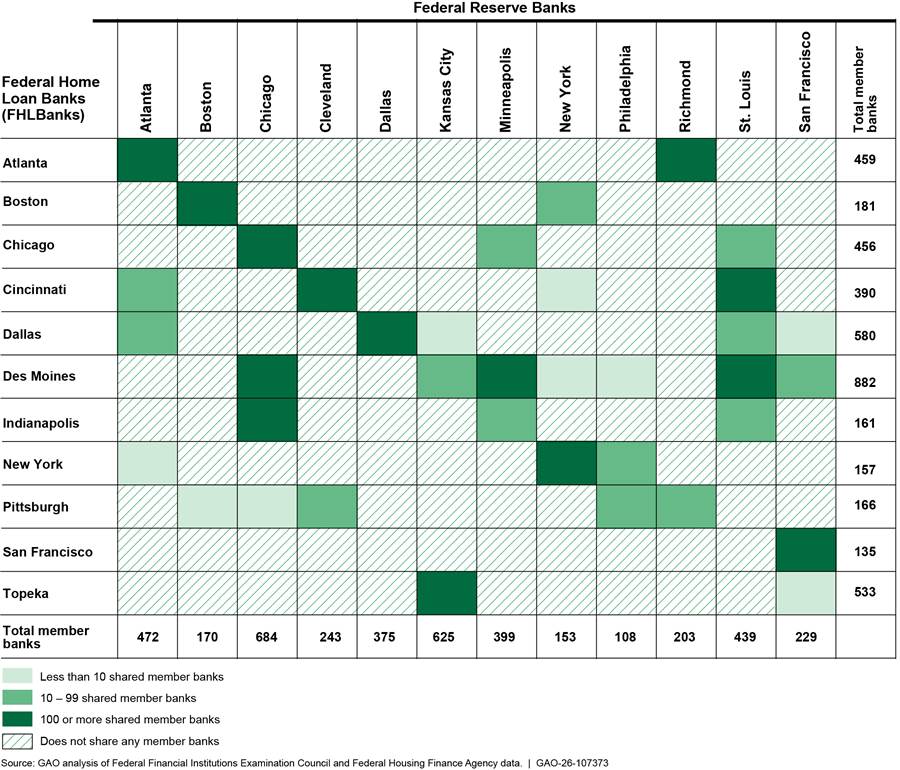
More broadly, coordination is complicated by the complex overlap in membership between the FHLBank and Federal Reserve systems. Thirty-seven unique combinations of FHLBanks and Federal Reserve Banks share at least one common member bank (see fig. 10). While some institutions share members with only one counterpart, others share with up to seven. The extent of these relationships also varies widely, according to FHFA officials—such as how many members they share (from one shared member to more than 500) or how often they reallocate collateral. In addition, procedures can vary among FHLBanks. For example, one Federal Reserve Bank can share member banks with multiple FHLBanks that each use slightly different subordination agreements, according to Federal Reserve System officials.
Since March 2023, the FHLBanks and Federal Reserve System have initiated two efforts to improve coordination both during periods of stress and during day-to-day operations. First, they have increased engagement between FHLBanks and Federal Reserve Banks that share members, particularly around the collateral reallocation process. Second, they have established a working group to improve interoperability of the two systems. These efforts are consistent with federal internal control standards on implementing control activities and information and communication, though some efforts are still in early stages.[86] Continued commitment to these coordination efforts will be important to ensure that the FHLBanks and Federal Reserve Banks are prepared to respond quickly to member liquidity needs during future periods of financial stress.
Increased Engagement Between FHLBanks and Federal Reserve Banks
After the events of March 2023, the FHLBanks and Federal Reserve Banks began to increase their level of ongoing engagement to address the challenges to the timely reallocation of collateral, according to Federal Reserve System officials and FHLBank representatives. Federal Reserve Board officials said the Board assigned a “lead” Reserve Bank to each FHLBank after March 2023. These lead banks are responsible for coordinating outreach and scheduling meetings, including with other Reserve Banks, such as those that share a small number of members with a given FHLBank.
For the FHLBanks, this increased engagement is in part in response to FHFA’s September 2024 guidance encouraging them to test collateral reallocation processes in conjunction with the Federal Reserve Banks.[87] FHFA officials said they would monitor compliance with this guidance as part of routine supervision and examinations.[88]
FHFA and Federal Reserve Board officials said the structure of their engagement varies depending on the relationship between each FHLBank and the corresponding Reserve Bank. Efforts to improve the collateral reallocation process have included the following:
· Regular meetings between key decision-makers. According to the Federal Reserve Board, the FHLBanks and Reserve Banks have established regular meetings or other communications involving senior executives who would be key decision-makers during emergencies.
· Tabletop exercises. As of July 2025, around 54 percent of all combinations of FHLBanks and Reserve Banks with shared members had conducted tabletop exercises.[89] Additionally, of the 13 combinations of FHLBanks and Reserve Banks that share the most members, 10 have held a tabletop exercise. According to FHLBank representatives, these simulations tested collateral reallocation procedures under hypothetical scenarios involving banks of varying sizes, financial conditions, and readiness to borrow from the discount window. The majority of FHLBanks said they anticipate holding additional exercises going forward, and, as of July 2025, several more exercises were scheduled for later in 2025.
· Collateral reallocation tests. Some FHLBanks and Reserve Banks arranged for member banks to conduct actual collateral transfers between the two systems to test the reallocation process. These tests allowed both sides to evaluate the efficiency and compatibility of their processes and identify areas for improvement.
· Staff-level discussions. Staff of some FHLBanks and Reserve Banks held discussions about their respective processes and procedures for collateral reallocation, in addition to or in place of more formal exercises. For example, an official from one Reserve Bank reported holding a series of conversations with FHLBank counterparts to compare collateral valuation practices, pledging processes, and eligibility standards. Federal Reserve Board officials said that generally FHLBanks and Federal Reserve Banks that shared fewer members determined that informal conversations may be sufficient to ensure they could coordinate during emergencies. Additionally, according to FHLBank representatives, some FHLBanks or Federal Reserve Banks that conducted more formal exercises shared lessons learned with their peers.
Both FHLBanks and Federal Reserve Banks reported benefits from this increased engagement. Representatives from both systems said it improved mutual understanding of processes and responsibilities and strengthened working relationships. One executive from a large FHLBank member bank also said the increased coordination had improved the efficiency of pledging collateral.
Working Group to Improve Interoperability
In January 2025, the FHLBank and Federal Reserve Systems established a working group to improve interoperability between the FHLBanks and the Federal Reserve Banks. This effort is being led by a core project team that includes representatives from several FHLBanks, Federal Reserve Banks, FHFA, and the Federal Reserve Board.
According to documentation, the working group intends to establish several workstreams that focus on developing standard procedures, including subordination agreements, information-sharing agreements, and a coordination playbook for reference during emergencies. Each workstream is to include members from both systems.
Officials from the Federal Reserve Bank of Chicago, which is coordinating the working group, said many details—such as roles, responsibilities, and timelines—have not yet been finalized. As of July 2025, Federal Reserve Board officials said draft scopes and goals were under review by both systems’ governance bodies, with finalization expected by the end of 2025 or into 2026.
Agency Comments
We provided a draft of this report to FDIC, the Federal Reserve Board, FHFA, the Financial Stability Oversight Council, OCC, and each of the 11 FHLBanks for review and comment. FDIC, the Federal Reserve Board, OCC, and the FHLBanks provided technical comments, which we incorporated as appropriate. FHFA and the Financial Stability Oversight Council did not have any comments on the report.
We are sending copies of this report to the appropriate congressional committees, the Acting Chairman of the Board of Directors of the Federal Deposit Insurance Corporation, the Chair of the Board of Governors of the Federal Reserve System, the Director of the Federal Housing Finance Agency, the Secretary of the Treasury, the Comptroller of the Currency, and the Presidents of each of the 11 Federal Home Loan Banks. In addition, the report is available at no charge on the GAO website at https://www.gao.gov.
If you or your staff have any questions about this report, please contact me at naamanej@gao.gov. Contact points for our Offices of Congressional Relations and Public Affairs may be found on the last page of this report. GAO staff who made key contributions to this report are listed in appendix IV.
Jill Naamane
Director, Financial Markets and Community Investment
This report examines (1) the borrowing trends of active Federal Home Loan Bank (FHLBank) members since 2015, (2) how FHLBank borrowing was associated with member banks’ outcomes from 2015 through 2024, (3) potential changes to FHLBank lending during financial crises and considerations for policymakers when evaluating these changes, and (4) the extent to which FHLBanks, the Federal Housing Finance Agency (FHFA), federal banking regulators, and the Federal Reserve Banks have mechanisms to facilitate effective communication during periods of financial stress.
Trend Analysis
To describe changes in all banks’ FHLBank borrowing, we analyzed regulator and economic data from the first quarter of 2015 through the second quarter of 2025 for all financial institutions (“banks”) that filed at least one Federal Financial Institutions Examination Council Report of Condition and Income (known as Call Reports) during the period.[90]
We compiled quarterly bank-level data from the Call Reports for each bank for each quarter during the period of our review. These data include outstanding FHLBank borrowing, other borrowing (such as federal funds and repurchase agreements), and total assets. To assess the reliability of the Call Report data, we reviewed the Federal Deposit Insurance Corporation’s (FDIC) Call Report Micro Data Reference Manual and conducted electronic data testing on relevant data fields. We determined that the data were sufficiently reliable for the purpose of analyzing banks’ funding sources over time.
To identify FHLBank member banks to include in our analysis, we matched FDIC identification numbers with FHFA’s FHLBank membership data for each quarter in our review period. To assess the reliability of the membership data, we reviewed data definitions to ensure the data were consistent across quarters. We also conducted electronic data testing to check for any missing values or gaps in FHLBank membership among banks, and we compared FHLBank membership against Call Report data on FHLBank borrowing. We determined that FHFA’s FHLBank membership data were reliable for identifying member banks and their designated districts.
We then analyzed Call Report data on FHLBank borrowing to identify banks with at least $1 in outstanding FHLBank borrowing in any quarter from January 2015 through June 2025. We refer to these institutions as active FHLBank member banks, which made up approximately 93 percent of all banks as of June 2025.[91] We excluded nonmembers (503 banks) and member banks that never borrowed from their FHLBank during the period (878 banks) because including them would skew results toward zero.
To compare FHLBank borrowing trends across bank sizes, we categorized banks into five asset categories: (1) $1 billion or less, (2) greater than $1 billion to $10 billion, (3) greater than $10 billion to $100 billion, (4) greater than $100 billion to $250 billion, and (5) greater than $250 billion. These categories were based on definitions used by key financial regulators and in the Dodd-Frank Wall Street Reform and Consumer Protection Act.
For most analyses, we classified banks with total assets of $10 billion or less as small banks—consistent with the Board of Governors of the Federal Reserve System’s (Federal Reserve Board) definition of a community banking organization—and banks with assets greater than $10 billion as large banks. For some analyses, we examined banks with more than $10 billion to $100 billion separately.
To analyze trends in active FHLBank member borrowing from the first quarter of 2015 through the second quarter of 2025, we analyzed total outstanding FHLBank borrowing, per quarter, for all active banks in our population, as well as separately for small and large banks. To isolate changes during two stress periods—the first quarter of 2020 and the first quarter of 2023—we divided the time frame into the following distinct periods based on trends in borrowing and economic indicators:
1. The first quarter of 2015 through the fourth quarter of 2019 was characterized by no major changes in economic indicators.
2. The first quarter of 2020 was characterized by COVID-19 lockdown announcements, global stock market changes, a recession declaration, and changes in U.S. gross domestic product and unemployment.
3. From the second quarter of 2020 through the last quarter of 2021, FHLBank borrowing and economic indicators generally returned to pre-COVID-19 levels.
4. Calendar year 2022 was characterized by larger increases in the effective federal funds rate and higher FHLBank borrowing.
5. The first quarter of 2023 was characterized by the liquidation of Silvergate Bank, the failures of Silicon Valley Bank and Signature Bank, and elevated FHLBank borrowing.
6. The second quarter of 2023 through the second quarter of 2025 was characterized by a decline in FHLBank borrowing—despite the failure of First Republic Bank in May 2023—and no major changes in economic indicators.
To describe the economic and financial conditions that may have affected active FHLBank member borrowing during our period, we analyzed several economic indicators. Specifically, we analyzed data on the effective federal funds rate from the Federal Reserve’s daily release on selected interest rates, the Bureau of Labor Statistics’ monthly Civilian Unemployment Rate data, and the Bureau of Economic Analysis’s quarterly gross domestic product data. In addition, we analyzed the Federal Reserve’s weekly balance sheet data on lending through emergency facilities during our stress periods. These consisted of two emergency facilities used during COVID-19 for which banks acted as intermediaries—the Money Market Mutual Fund Liquidity Facility and Paycheck Protection Program Liquidity Facility—along with the Bank Term Funding Program established in March 2023. To assess the reliability of the economic indicator and emergency facilities data, we reviewed related documentation and performed electronic testing. We determined that these data were sufficiently reliable for the purposes of describing certain economic and financial conditions during our time period.
To identify changes in outstanding FHLBank borrowing during stress periods for large and small banks, we compared total outstanding FHLBank borrowing during the first quarters of 2020 and 2023 with median outstanding FHLBank borrowing for the entire period. We included these two quarters in our median calculation because the median is a measure of central tendency that is less influenced by outliers.
To compare banks’ FHLBank borrowing on a relative basis, we calculated the ratio of FHLBank borrowing to total assets for all active banks and for active banks in our five size categories for each quarter during our period.[92] To analyze differences during the first quarters of 2020 and 2023, we compared the median borrowing ratio for the two stress quarters with the range of median ratios for all other quarters for each bank size category.[93] We used a range as our comparison measure rather than the median or mean because FHLBank borrowing ratios fluctuate between quarters. Because we used a range, we excluded the median values for the two stress periods from the range calculation.
Finally, we divided banks into the five asset size categories described above instead of the two used in other analyses because funding varies more significantly by size. For example, banks with over $250 billion in assets generally must comply with certain enhanced prudential standards.
We used statistical tests to detect and analyze anomalies in the data. Specifically, we calculated quantiles for all member FHLBank borrowing ratios (FHLBank borrowing to total assets) for the period to assess where the majority of data points fell. We used that information to determine a baseline, or normal, FHLBank borrowing ratio. For banks above that threshold, we analyzed median FHLBank ratios by asset size and compared the ratio during stress periods to the rest of the period. We used the same testing methodology to calculate quarter-to-quarter changes in borrowing ratios. We also analyzed those banks whose percentage-point change was above the 2-percentage point threshold to determine the share that were small banks with $10 billion or less in assets.
We separately analyzed the remaining 186 banks (4 percent of all active FHLBank members) that changed their quarter-to-quarter FHLBank ratio by more than 10 percentage points during the period of our review to determine changes in borrowing ratios during stress periods. Since we observed that banks with more than $10 billion to $100 billion in assets had the greatest increases in FHLBank borrowing in the first quarter of 2023, we also analyzed the six banks in this size category that increased their FHLBank borrowing ratio by more than 10 percentage points from the second quarter of 2022 through the first quarter of 2023 to determine changes in FHLBank borrowing around that stress period.
We performed the same statistical tests on banks that were on FDIC’s Problem Bank List as we did for the broader population.[94] Specifically, we identified banks on the list using FDIC data and calculated their FHLBank ratios and quarter-over-quarter changes in those ratios. We then compared these metrics with those of the overall population of active FHLBank borrowers.
To describe banks’ daily FHLBank borrowing trends during certain stress periods, we obtained aggregated transaction-level data from FHFA for all FHLBank members from February 2020 through July 2020 and March 2023 (periods chosen to capture data from before, during, and after peak stress periods). These data included daily totals on numbers and dollar amounts of advances and advances outstanding.
To obtain banks’ perspectives on the role of FHLBank advances during the onset of COVID-19, the March 2023 stress period, and the first two quarters of 2025, we interviewed a nongeneralizable, judgmental sample of 10 banks.[95] We began by identifying a proportional stratified random sample of 30 banks—15 banks with at least $1 in FHLBank borrowing during the first quarter of 2020 and 15 with at least $1 in FHLBank borrowing during the first quarter of 2023.
Because small banks made up the majority of the population, we used a proportionate sample to represent banks of varying asset sizes. For each stress period, we randomly selected four banks with $1 billion or less in total assets, three with assets greater than $1 billion to $10 billion, three with assets greater than $10 billion to $100 billion, three with assets greater than $100 billion to $250 billion, and two with assets greater than $250 billion. We did not exclude banks from being selected for both stress periods.
From this sample, we selected one bank from each asset-size category for each stress period and tried to achieve representation from as many FHLBank districts as possible. When multiple banks met the criteria, we typically selected the one with the highest FHLBank borrowing (based on daily FHFA transaction data) to maximize insight into FHLBank usage. Because we were unable to reach any banks in our initial sample with assets between $10 billion and $100 billion that had outstanding borrowing in March 2020, we randomly selected an additional bank from that asset group to interview.
Outcome Analysis
To examine the associations between FHLBank borrowing and banks’ outcomes (including appearance on FDIC’s Problem Bank List and failure or liquidation), we constructed econometric models. These models considered the extent to which banks’ FHLBank borrowing levels were associated with their (1) real estate lending, (2) likelihood of appearing on the Problem Bank List, and (3) likelihood of failure or liquidation. The models controlled for bank health characteristics and certain macroeconomic factors. For details on our econometric modeling, see appendix II.
Analysis of Suggested Changes to FHLBank Lending
Identification of Concerns and Suggested Changes in Literature
To address our third objective, we conducted a search for relevant literature published from January 2007 (prior to the financial crisis of 2007–2009) through May 2024 (the month we conducted the search). We searched various databases (e.g., EBSCO, ProQuest, Google Scholar) and websites to identify and review academic, trade, think tank, and government publications that discussed FHLBank lending during times of financial stress. The search resulted in approximately 50 items.
For each publication, we documented the authors’ views about FHLBank lending during stress periods or to troubled banks. We categorized concerns based on key structural factors—such as the FHLBanks’ implied government guarantee and lien status—and counted how frequently each factor appeared across the items we reviewed. We excluded viewpoints related solely to the FHLBanks’ debt issuance and overall viability, as our review focused more on FHLBanks’ lending and associated risks. While our review focused on authors’ views about risks of FHLBank lending during financial stress, we also briefly acknowledged views on the benefits of such lending.
We also documented any changes to FHLBank lending during stress periods that were suggested in these publications, including the actor responsible for implementing the change and any anticipated effects. We then excluded the following categories of suggestions from further examination:
1. Housing mission changes. Suggestions related solely to FHFA’s housing mission were excluded because our work focuses on their liquidity role.
2. Ongoing rulemakings. We excluded suggestions on matters covered by current rulemakings of FHFA or the banking regulators.
3. Discount window proposals. Changes focused solely on the Federal Reserve’s discount window were beyond the scope of our review.
4. Communication-related changes. Suggestions concerning interagency communication were excluded because our fourth research objective addressed that topic separately.
5. FHLBank System viability. Suggestions concerning the safety and soundness of the FHLBank System itself were outside our scope, which focused on FHLBanks’ role in supporting member banks during stress periods.
We analyzed the suggested changes that remained after applying the exclusions (approximately 25 changes) and consolidated them as appropriate into broader categories. This process resulted in eight distinct proposed changes for further discussion, which we categorized according to the concerns we viewed them as addressing.
We then conducted seven interviews with individuals and stakeholder organizations to obtain input on the clarity and comprehensiveness of (1) the eight consolidated suggested changes and (2) the draft discussion document we planned to use to solicit input from additional parties. Interviewees were selected for their recent and varied experience with the topic. We incorporated comments from these individuals as appropriate.
Analysis of Suggested Changes
To obtain more information about the eight suggested changes—including how they might be implemented and their potential effects—we held discussion groups with selected academics, researchers, and industry and consumer group representatives; interviewed FHLBank representatives; and solicited written comments from FHFA and the banking regulators.
For discussion groups, we began with a list of 139 potential participants identified through our literature review, review of relevant congressional testimonies, online searches for national and state banking organizations, FHFA’ s FHLBank System at 100 listening sessions, and events focused on the FHLBanks, such as Brookings Institution panels. We reviewed each potential participant’s current and former employment and excluded those currently employed by a federal agency, FHLBank, or bank or other financial institution, or based outside of the United States.
For the remaining individuals, we assessed whether they had relevant expertise based on authorship of papers, participation in events or testimonies, or other public commentary on FHLBank lending during periods of financial stress. We excluded potential participants who did not have a basis for knowledge about FHLBanks, as well as non-lead authors on multi-author papers.
Forty potential participants met our selection criteria. We invited all 40 individuals or organizations (designating the most relevant representative for each) to participate in virtual, 2-hour discussion groups. Thirty-one invitees agreed to participate. One invitee designated an informed colleague to participate in their place. We scheduled seven discussion groups according to participant availability. One participant was unable to attend their scheduled call, resulting in a total of 30 participants (see app. III for the participant list).
In each facilitated discussion group, we asked participants to share their views for each suggested change on how the change could be implemented and what potential benefits, challenges, and unintended consequences might result.
In addition to the seven discussion groups, we conducted two joint interviews with representatives of all 11 FHLBanks and a representative of the Council of FHLBanks. In these interviews, the representatives spoke on behalf of the FHLBanks collectively. We also requested input from FHFA, FDIC, the Federal Reserve Board, and the Office of the Comptroller of the Currency (OCC) on the same questions posed to the discussion groups and FHLBank representatives. FDIC provided written responses to our questions. FHFA, the Federal Reserve Board, and OCC staff declined to opine on the suggested changes, although FHFA officials provided information on implementation that helped clarify our understanding of current laws, regulations, and practices.
To summarize the views shared during the discussion groups and FHLBank joint interviews, we analyzed transcripts of the discussions. One analyst reviewed each transcript to categorize each statement at a high level (e.g., as being related to implementation details, benefits, or challenges). A second analyst independently performed the same task, and the two met as necessary to resolve differences. To identify common themes, we further categorized the statements into subthemes (e.g., effect on stigma or on banks’ timely access to liquidity). For each change or for groups of similar changes, we counted the number of unique mentions of each subtheme by distinct participants where possible. We also used keyword searches to identify relevant issues not covered by a predefined subtheme.
Not all discussion group participants responded to every question, so the number of respondents varied by topic. We characterized the frequency of participants’ views using the following modifiers: “a few” (three to five respondents), “some” (six to eight), “several” (nine to fourteen), and “many” or “most” (15 or more).
This summary reflects the key ideas that emerged during the discussion groups but is not intended to present an exhaustive list of all comments or viewpoints. The information does not necessarily represent the views of all participants or their respective organizations.
Analysis of Communication Mechanisms During Financial Stress
To examine communication between the FHLBanks and federal entities during periods of financial stress, we reviewed relevant laws and regulations, as well as FHLBank and agency documentation, such as confidentiality, information-sharing, and subordination agreements. We also reviewed documents related to the interagency working group and tabletop exercises involving the FHLBank and Federal Reserve systems. Finally, we interviewed representatives of all 11 FHLBanks, FHFA, FDIC, the Federal Reserve System, the Financial Stability Oversight Council, and OCC. We compared their communication mechanisms against principles on implementing control activities and information and communication in our internal control standards.[96]
To identify overlap between the FHLBanks and Federal Reserve Banks, we analyzed Federal Financial Institutions Examination Council data on each bank’s Federal Reserve district membership. Using banks’ FDIC certificate numbers, we merged these data with FHLBank membership data to identify shared membership. We assessed the reliability of the Federal Reserve district data by verifying our results with the FHLBanks and the Federal Reserve Board. We determined that the data were reliable for the purpose of identifying overlapping membership between FHLBanks and Federal Reserve Banks.
We conducted this performance audit from January 2024 to December 2025 in accordance with generally accepted government auditing standards. Those standards require that we plan and perform the audit to obtain sufficient, appropriate evidence to provide a reasonable basis for our findings and conclusions based on our audit objectives. We believe that the evidence obtained provides a reasonable basis for our findings and conclusions based on our audit objectives.
Appendix II: Description of GAO’s Econometric Models of Associations Between FHLBank Borrowing and Banks’ Outcomes
We used econometric models to examine how Federal Home Loan Bank (FHLBank) borrowing was associated with selected bank outcomes from 2015 through 2024. Specifically, we examined the associations between FHLBank borrowing and banks’ lending and safety and soundness outcomes.[97]
Data Used to Construct Models
We used the following data about banks to construct our models:
· FHLBank membership. Quarterly bank-level data on FHLBank membership status obtained from the Federal Housing Finance Agency’s (FHFA) quarterly FHLBank membership list from the first quarter of 2015 through the fourth quarter of 2024. We used these data to identify FHLBank members and nonmembers.
· Reports of Condition and Income. Quarterly bank-level data on all financial institutions (“banks”) that filed at least one Federal Financial Institutions Examination Council Report of Condition and Income (known as Call Reports) from the first quarter of 2015 through the fourth quarter of 2024.[98]
· FDIC’s Problem Bank List. Quarterly data from the Federal Deposit Insurance Corporation (FDIC) on banks with composite CAMELS ratings of 4 or 5 from the first quarter of 2015 through the third quarter of 2024.[99]
· Bank failures. Data on bank failures from FDIC’s BankFind Suite from the first quarter of 2015 through the fourth quarter of 2024.[100]
· Bank liquidations. Data on bank liquidations from FDIC’s BankFind Suite from the first quarter of 2015 through the fourth quarter of 2024.[101]
To assess the reliability of each type of data, we took two or more of the following steps, as appropriate: (1) performed electronic testing for obvious errors in accuracy and completeness; (2) reviewed related documentation, including data dictionaries; (3) interviewed agency officials knowledgeable about the data; or (4) traced and verified data from source documents. We determined that the data were sufficiently reliable for the purposes of determining FHLBank membership, describing banks’ quarterly borrowing, and determining banks’ status during the period (e.g., on the Problem Bank List, failed, or liquidated).
We used the following macroeconomic data from the first quarter of 2015 through the fourth quarter of 2024 to construct our models:
· Federal funds rate. Quarterly effective federal funds rate from the Federal Reserve Bank of New York.
· Interest rate spread. Quarterly rate spread between 10-year Treasury Constant Maturity and 2-year Treasury Constant Maturity from the Federal Reserve Bank of St. Louis.
· Unemployment rate. Quarterly unemployment rate from the Bureau of Labor Statistics.
· Gross domestic product. Quarterly compounded annual rate of change from preceding period in real gross domestic product from the Bureau of Economic Analysis.
To assess the reliability of these data, we reviewed related documentation, performed electronic testing, and traced and verified the data from source documents. We determined that the data were sufficiently reliable for the purpose of describing certain national macroeconomic conditions from the first quarter of 2015 through the fourth quarter of 2024.
Literature Review
To inform the development of our models, we reviewed existing quantitative academic literature. To identify existing literature, we conducted searches of various databases—such as ProQuest, EBSCOhost, Scopus, and Dialog—for studies that examined FHLBank borrowing from 2007 through 2024. A GAO economist and methodologist reviewed the methodologies of studies cited in our report to assess the overall study quality.
Variables Used in Models
We used the following explanatory variables in the econometric models:
· FHLBank membership status. We determined banks’ FHLBank membership status (i.e., member or nonmember) using FHFA’s quarterly FHLBank membership list from the first quarter of 2015 through the fourth quarter of 2024.
· FHLBank borrowing level. We used the following measures to describe FHLBank borrowing: (1) total outstanding FHLBank borrowing each quarter (in log), (2) increase in total outstanding FHLBank borrowing quarter to quarter (in log), and (3) ratio of total outstanding FHLBank borrowing to total assets each quarter.[102]
In the models, we controlled for the following bank-level health indicators that could affect banks’ outcomes (in addition to the macroeconomic indicators described earlier):[103]
· Capital adequacy. We measured banks’ capital adequacy using the banks’ common equity tier one capital ratio. A higher ratio indicates that banks have better ability to absorb losses during stress.
· Asset quality. We measured banks’ asset quality as the ratio of nonperforming loans and leases to total loans and leases. A higher ratio indicates higher credit risk (i.e., the risk that the credit a bank has extended will not be paid back).
· Earnings. We measured banks’ earnings as the ratio of net income to total assets.
· Liquidity. We measured banks’ liquidity as the ratio of total loans over core deposits. A high ratio indicates that a bank may not have the ability to meet expected and unexpected cash flows and collateral needs at a reasonable cost.
· Interest rate risk. We measured banks’ interest rate risk—the extent to which a bank can withstand periods of stress arising from movements in interest rates—using the ratio of 1-year risk-sensitive assets minus 1-year risk-sensitive liabilities to total assets. A positive ratio indicates that the bank is asset sensitive. If market interest rates increase, an asset-sensitive bank’s net interest income would likely increase, and vice versa.
Description of Models
We constructed models to compare the statistical difference in lending and safety and soundness outcomes between (1) FHLBank member banks and nonmember banks and (2) FHLBank member banks with different levels of FHLBank borrowing.[104] We analyzed three measures of FHLBank borrowing:
1. Total FHLBank borrowing each quarter (in log)
2. Increase in FHLBank borrowing quarter to quarter (in log)
3. Ratio of FHLBank borrowing to total assets
Lending Models
We used panel data regressions with time fixed effects models to analyze the average lending differences for FHLBank members by FHLBank borrowing measure, controlling for other factors that could affect lending.[105] We separately examined the relationship between FHLBank borrowing measures and total lending, residential and commercial real estate lending, and consumer lending. We also examined this relationship by banks’ asset size. We controlled for factors that could affect banks’ outcomes such as bank health measures, macroeconomic indicators, and economic cycles proxied by calendar years. We used cluster-robust methods to estimate standard errors, with unique bank identification numbers defining the clusters. We adjusted all dollar amounts for inflation to calendar year 2024 dollars.
The regression estimates for our lending models are provided in tables 2 and 3. Table 2 lists the key variable of interest (total FHLBank borrowing) and the variables we controlled for in our lending models. Table 3 presents the estimated associations between FHLBank borrowing and lending of FHLBank member by loan type, bank size, and FHLBank borrowing measure. For example, estimates that are statistically significant and positive indicate that banks with higher FHLBank borrowing lend more on average than banks with lower FHLBank borrowing. Specifically, for small banks, a 1 percent increase in FHLBank borrowing outbalance is associated with a 0.009 percent increase in total loans. Conversely, estimates that are statistically significant and negative indicate that banks with higher FHLBank borrowing lend less on average. The lending model results were generally consistent with different control variables described in table 2. We also combined residential and commercial real estate and separately examined the models controlling for durations (the length of time each bank appeared active in each quarter of our time period) to account for potential sample selection issues, and the results were generally consistent.
Table 2: Variables Used and Estimated Associations Between Total Outstanding FHLBank Borrowing and Total Lending by FHLBank Members, 2015–2024
|
Variables |
Total loans (in log) (standard error) |
||
|
All banks |
Small banks ($10 billion or less in total assets) |
Large banks (more than $10 billion in total assets) |
|
|
Total Federal Home Loan Bank (FHLBank) outbalance (in log) |
0.009*** |
0.009*** |
0.003 |
|
|
(0.001) |
(0.001) |
(0.002) |
|
Bank health measures |
|
|
|
|
Asset quality (%) |
-0.002 |
-0.001 |
-0.002 |
|
|
(0.003) |
(0.003) |
(0.025) |
|
Capital adequacy (%) |
-0.002*** |
-0.002*** |
-0.010 |
|
|
(0.001) |
(0.001) |
(0.008) |
|
Earnings (%) |
0.051*** |
0.052*** |
0.041*** |
|
|
(0.010) |
(0.010) |
(0.014) |
|
Liquidity (%) |
-0.000 |
0.000** |
-0.000 |
|
|
(0.000) |
(0.000) |
(0.000) |
|
Interest rate risk (%) |
-0.003*** |
-0.003*** |
-0.002 |
|
|
(0.000) |
(0.000) |
(0.002) |
|
Macroeconomic indicators |
|
|
|
|
Compounded annual rate of change in real gross domestic product (%) |
0.001*** |
0.001*** |
0.001** |
|
|
(0.000) |
(0.000) |
(0.000) |
|
Spread rate (%) |
-0.004* |
-0.004* |
-0.017 |
|
|
(0.002) |
(0.003) |
(0.012) |
|
Effective federal funds rate (%) |
0.008*** |
0.008*** |
0.006 |
|
|
(0.002) |
(0.002) |
(0.007) |
|
Unemployment rate (%) |
0.010*** |
0.010*** |
0.007*** |
|
|
(0.000) |
(0.000) |
(0.002) |
|
Constant |
12.136*** |
12.011*** |
16.942*** |
|
|
(0.016) |
(0.016) |
(0.113) |
|
Calendar year fixed effects |
Yes |
Yes |
Yes |
|
Observations (banks x quarters) |
190,350 |
185,175 |
5,175 |
Legend: *** = statistically significant at p-value < 0.01; ** = statistically significant at p-value < 0.05; * = statistically significant at p-value < 0.10, YES= control for calendar year fixed effects
Source: GAO analysis of data from the Federal Financial Institutions Examination Council, Federal Deposit Insurance Corporation, Federal Housing Finance Agency, Federal Reserve Bank of New York, Federal Reserve Bank of St. Louis, Bureau of Economic Analysis, and Bureau of Labor Statistics. | GAO‑26‑107373
Notes: Loan and FHLBank borrowing data have been adjusted for inflation to 2024 dollars. While various independent variables capture and control for many characteristics across FHLBank borrowing, unobserved factors may also account for differences in lending; thus, our regression results do not establish a causal relationship between FHLBank borrowing and lending outcomes. We log transformed lending outcomes and borrowing measures; specifically, for small banks, a 1 percent increase in FHLBank borrowing outbalance is associated with a 0.009 percent increase in total loans.
Table 3: Estimated Associations Between FHLBank Borrowing and Lending by FHLBank Members, by Borrowing Measure and Loan Type, 2015–2024
|
Loan types and Federal Home Loan Bank (FHLBank) borrowing measures |
Lending (in log) (standard error) |
||
|
All banks |
Small banks ($10 billion or less in total assets) |
Large banks (more than $10 billion in total assets) |
|
|
Total loans |
|
|
|
|
1. Total FHLBank outbalance (in log) |
0.009*** |
0.009*** |
0.003 |
|
|
(0.001) |
(0.001) |
(0.002) |
|
2. FHLBank quarter-over-quarter increase (in log) |
0.002*** |
0.003*** |
0.001 |
|
|
(0.000) |
(0.000) |
(0.001) |
|
3. Ratio of FHLBank outbalance over total assets (%) |
0.006*** |
0.007*** |
0.005 |
|
|
(0.001) |
(0.001) |
(0.003) |
|
Residential loans |
|
|
|
|
1. Total FHLBank outbalance (in log) |
0.011*** |
0.011*** |
0.017 |
|
|
(0.001) |
(0.001) |
(0.013) |
|
2. FHLBank quarter-over-quarter increase (in log) |
0.003*** |
0.003*** |
0.005 |
|
|
(0.001) |
(0.000) |
(0.006) |
|
3. Ratio of FHLBank outbalance over total assets (%) |
0.009*** |
0.010*** |
0.017 |
|
|
(0.002) |
(0.002) |
(0.013) |
|
Commercial loans |
|
|
|
|
1. Total FHLBank outbalance (in log) |
0.010*** |
0.010*** |
0.010 |
|
|
(0.001) |
(0.001) |
(0.011) |
|
2. FHLBank quarter-over-quarter increase (in log) |
0.002*** |
0.002*** |
0.005* |
|
|
(0.000) |
(0.000) |
(0.003) |
|
3. Ratio of FHLBank outbalance over total assets (%) |
0.006*** |
0.006*** |
0.008 |
|
|
(0.002) |
(0.002) |
(0.010) |
|
Consumer loans |
|
|
|
|
1. Total FHLBank outbalance (in log) |
0.001 |
0.002 |
-0.007 |
|
|
(0.002) |
(0.002) |
(0.010) |
|
2. FHLBank quarter-over-quarter increase (in log) |
0.001* |
0.002** |
-0.003 |
|
|
(0.001) |
(0.001) |
(0.005) |
|
3. Ratio of FHLBank outbalance over total assets (%) |
-0.004 |
-0.004 |
-0.016 |
|
|
(0.003) |
(0.003) |
(0.011) |
Legend: *** = statistically significant at p-value < 0.01; ** = statistically significant at p-value < 0.05; * = statistically significant at p-value < 0.10
Source: GAO analysis of data from the Federal Financial Institutions Examination Council, Federal Deposit Insurance Corporation, Federal Housing Finance Agency, Federal Reserve Bank of New York, Federal Reserve Bank of St. Louis, Bureau of Economic Analysis, and Bureau of Labor Statistics. | GAO‑26‑107373
Notes: In all models, we additionally controlled for bank health measures, macroeconomic indicators, and calendar years (see, for example, table 2). Loan and FHLBank borrowing data have been adjusted for inflation to 2024 dollars. While various independent variables capture and control for many characteristics across FHLBank borrowing, unobserved factors may also account for differences in lending; thus, our regression results do not establish a causal relationship between FHLBank borrowing and lending outcomes. We log transformed lending outcomes and the first two FHLBank borrowing measures to focus on percent changes of these measures. Our analysis of residential real estate lending includes loans secured by 1-4 family and multifamily (5 or more) residential properties and loans secured by 1–4 family residential construction loans. Our analysis of commercial real estate lending includes loans secured by farmland, other construction loans (excluding 1-4 family residential construction loans), all land development and other land loans, and loans secured by nonfarm nonresidential properties. Our analysis of consumer lending includes loans for credit cards, automobile loans, and student loans.
FDIC’s Problem Bank List Models
We used a multivariate statistical logit model to estimate the likelihood of banks appearing on FDIC’s Problem Bank List by FHLBank membership and by FHLBank borrowing measure, when controlling for additional factors. We determined whether a bank appeared on the Problem Bank List from the first quarter of 2015 through the third quarter of 2024 using data provided by FDIC.[106] We also examined this relationship specifically for banks with $10 billion or less in assets.[107] We adopted Firth’s Penalized Maximum Likelihood model to mitigate possible bias caused by the rarity of banks appearing on the Problem Bank List.[108] We controlled for factors that could affect banks’ outcomes, such as bank health measures, macroeconomic indicators, and economic cycles proxied by calendar years. We adjusted all dollar amounts for inflation to calendar year 2024 dollars.
The regression estimates for our Problem Bank List model are provided in tables 4 and 5. Table 4 lists the key variable of interest (total FHLBank borrowing) and the variables we controlled for in our Problem Bank List models. Table 5 presents the estimated odds of appearing on the Problem Bank List by FHLBank membership and borrowing measure. An odds ratio that is statistically significant and less than 1 indicates that FHLBank members, for example, are less likely to appear on the Problem Bank List than nonmembers, and an odds ratio that is statistically significant and greater than 1 indicates that FHLBank members are more likely to appear on the Problem Bank List. The Problem Bank List model results were generally consistent across different control variables described in table 4. We also separately examined the models controlling for durations (the length of time each bank appeared active in each quarter of our time period) to account for potential sample selection issues, and the results were generally consistent.
Table 4: Variables Used and Resulting Odds Ratios from Regression Analysis of Appearance on the Problem Bank List, 2015–Third Quarter 2024
|
Variables |
Odds ratio (standard error) |
|
|
All banks |
Small banks ($10 billion or less in total assets) |
|
|
Total Federal Home Loan Bank (FHLBank) outbalance (in log) |
0.941*** |
0.947*** |
|
|
(0.004) |
(0.004) |
|
Bank health measures |
|
|
|
Asset quality (%) |
1.387*** |
1.407*** |
|
|
(0.008) |
(0.009) |
|
Capital adequacy (%) |
0.967*** |
0.961*** |
|
|
(0.002) |
(0.002) |
|
Earnings (%) |
0.366*** |
0.351*** |
|
|
(0.008) |
(0.008) |
|
Liquidity (%) |
1.000 |
1.000 |
|
|
(0.000) |
(0.000) |
|
Interest rate risk (%) |
0.983*** |
0.980*** |
|
|
(0.001) |
(0.001) |
|
Macroeconomic indicators |
|
|
|
Compounded annual rate of change in real gross domestic product (%) |
1.004 |
1.004 |
|
|
(0.004) |
(0.004) |
|
Spread rate (%) |
0.953 |
0.955 |
|
|
(0.167) |
(0.170) |
|
Effective federal funds rate (%) |
1.007 |
1.003 |
|
|
(0.079) |
(0.081) |
|
Unemployment rate (%) |
1.004 |
1.010 |
|
|
(0.024) |
(0.024) |
|
Constant |
0.064*** |
0.066*** |
|
|
(0.019) |
(0.021) |
|
Calendar year fixed effects |
Yes |
Yes |
|
Observations (banks x quarters) |
204,865 |
199,447 |
Legend: *** = statistically significant at p-value < 0.01; ** = statistically significant at p-value < 0.05; * = statistically significant at p-value < 0.10, YES= control for calendar year fixed effects
Source: GAO analysis of data from the Federal Financial Institutions Examination Council, Federal Deposit Insurance Corporation, Federal Housing Finance Agency, Federal Reserve Bank of New York, Federal Reserve Bank of St. Louis, Bureau of Economic Analysis, and Bureau of Labor Statistics. | GAO‑26‑107373
Notes: We log transformed total FHLBank outbalance to focus on percent changes of this measure. Odds ratios that are statistically significant and lower than 1.00 indicate that banks with FHLBank membership or higher FHLBank borrowing are less likely to appear on the Problem Bank List, while odds ratios that are statistically significant and greater than 1.00 indicate that banks with FHLBank membership or higher FHLBank borrowing are more likely to appear on the Problem Bank List. We conducted a multivariate statistical logit model using Firth’s Penalized Maximum Likelihood approach to mitigate the bias caused by rare events in the data set. FHLBank borrowing data have been adjusted for inflation to 2024 dollars. While various independent variables capture and control for many characteristics across FHLBank borrowing, unobserved factors may also account for differences in appearance on the Problem Bank List; thus, our regression results do not establish a causal relationship between FHLBank borrowing and appearance on the Problem Bank List.
Table 5: Variables Used and Resulting Odds Ratios from Regression Analysis of Appearance on the Problem Bank List, by FHLBank Membership and Borrowing Measure, 2015–Third Quarter 2024
|
Federal Home Loan Bank (FHLBank) measures |
Odds ratio (standard error) |
|
|
All banks |
Small banks ($10 billion or less in total assets) |
|
|
Panel A |
|
|
|
FHLBank membership (indicator variable) |
0.689*** |
0.747*** |
|
|
(0.043) |
(0.048) |
|
Panel B |
|
|
|
FHLBank borrowing measures |
|
|
|
|
|
|
|
1. Total FHLBank outbalance (in log) |
0.941*** |
0.947*** |
|
|
(0.004) |
(0.004) |
|
2. FHLBank quarter-over-quarter increases (in log) |
0.919*** |
0.925*** |
|
|
(0.007) |
(0.007) |
|
3. Ratio of FHLBank outbalance over total assets (%) |
0.993* |
1.000 |
|
|
(0.004) |
(0.004) |
Legend: *** = statistically significant at p-value < 0.01; ** = statistically significant at p-value < 0.05; * = statistically significant at p-value < 0.10
Source: GAO analysis of data from the Federal Financial Institutions Examination Council, Federal Deposit Insurance Corporation, Federal Housing Finance Agency, Federal Reserve Bank of New York, Federal Reserve Bank of St. Louis, Bureau of Economic Analysis, and Bureau of Labor Statistics. | GAO‑26‑107373
Notes: We log transformed the first two FHLBank borrowing measures to focus on percent changes of these borrowing measures. Odds ratios that are statistically significant and lower than 1.00 indicate that banks with FHLBank membership or higher FHLBank borrowing are less likely to appear on the Problem Bank List, while odds ratios that are statistically significant and greater than 1.00 indicate that banks with FHLBank membership or higher FHLBank borrowing are more likely to appear on the Problem Bank List. We conducted a multivariate statistical logit model using Firth’s Penalized Maximum Likelihood approach to mitigate the bias caused by rare events in the data set. In all models, we additionally controlled for bank health measures, macroeconomic indicators, and calendar years. FHLBank borrowing data have been adjusted for inflation to 2024 dollars. While various independent variables capture and control for many characteristics across FHLBank borrowing, unobserved factors may also account for differences in appearance on the Problem Bank List; thus, our regression results do not establish a causal relationship between FHLBank membership or borrowing and appearance on the Problem Bank List.
Failure and Liquidation Models
Similar to our analysis of FDIC’s Problem Bank List, we used a multivariate statistical logit model to estimate the likelihood of failure or liquidation (following banks’ last filed Call Reports) by FHLBank membership and by FHLBank borrowing measure, when controlling for additional factors. We combined failure and liquidation into one dummy outcome and determined whether a bank had failed or liquidated between the first quarter of 2015 and the fourth quarter of 2024 using data from FDIC’s BankFind Suite. The dependent variable is an indicator that flagged the last quarter a failed or liquidated bank filed its Call Report. We also examined this relationship for banks with $10 billion or less in assets.[109] We adopted Firth’s Penalized Maximum Likelihood model to mitigate bias caused by the rarity of failure or liquidation.[110] We controlled for factors that could affect bank outcomes, such as bank health measures, macroeconomic indicators, and economic cycles proxied by calendar years. We adjusted all dollar amounts for inflation to calendar year 2024.
The regression estimates for our failure and liquidation model are provided in tables 6 and 7. Table 6 lists the key variable of interest (total FHLBank borrowing) and the variables we controlled for in our failure and liquidation models. Table 7 presents the estimated odds of failure or liquidation by FHLBank membership and borrowing measure. The failure and liquidation model results were generally consistent with different control variables described in table 6. We also separately examined the models controlling for durations (the length of time each bank appeared active in each quarter of our time period) to account for potential sample selection issues, and the results were generally consistent.
Table 6: Variables Used and Resulting Odds Ratios from Regression Analysis of Bank Failure or Liquidation, 2015–Third Quarter 2024
|
Variables |
Odds ratio (standard error) |
|
|
All banks |
Small banks ($10 billion |
|
|
Total Federal Home Loan Bank (FHLBank) outbalance (in log) |
0.951** |
0.942*** |
|
|
(0.018) |
(0.019) |
|
Bank health measures |
|
|
|
Asset quality (%) |
1.159*** |
1.161*** |
|
|
(0.019) |
(0.020) |
|
Capital adequacy (%) |
1.002*** |
1.002* |
|
|
(0.000) |
(0.001) |
|
Earnings (%) |
0.905*** |
0.901*** |
|
|
(0.016) |
(0.018) |
|
Liquidity (%) |
1.000*** |
1.000*** |
|
|
(0.000) |
(0.000) |
|
Interest rate risk (%) |
1.000 |
1.000 |
|
|
(0.005) |
(0.005) |
|
Macroeconomic indicators |
|
|
|
Lead - Compounded annual rate of change in real gross domestic product (%) |
0.992 |
0.994 |
|
|
(0.018) |
(0.017) |
|
Lead - Spread rate (%) |
1.505 |
1.606 |
|
|
(0.790) |
(0.854) |
|
Lead - Effective federal funds rate (%) |
1.134 |
1.037 |
|
|
(0.233) |
(0.223) |
|
Lead - Unemployment rate (%) |
1.030 |
1.040 |
|
|
(0.140) |
(0.141) |
|
Constant |
0.000*** |
0.000*** |
|
|
0.000 |
0.000 |
|
Calendar year fixed effects |
Yes |
Yes |
|
Observations (banks x quarters) |
204,865 |
199,447 |
Legend: *** = statistically significant at p-value < 0.01; ** = statistically significant at p-value < 0.05; * = statistically significant at p-value < 0.10, YES= control for calendar year fixed effects
Source: GAO analysis of data from the Federal Financial Institutions Examination Council, Federal Deposit Insurance Corporation, Federal Housing Finance Agency, Federal Reserve Bank of New York, Federal Reserve Bank of St. Louis, Bureau of Economic Analysis, and Bureau of Labor Statistics. | GAO‑26‑107373
Notes: We log transformed total FHLBank outbalance to focus on percent changes of this measure. Odds ratios that are statistically significant and lower than 1.00 indicate that banks with FHLBank membership or higher FHLBank borrowing are less likely to experience failure or liquidation, while odds ratios that are statistically significant and greater than 1.00 indicate that banks with FHLBank membership or higher FHLBank borrowing are more likely to experience failure or liquidation. We conducted a multivariate statistical logit model using Firth’s Penalized Maximum Likelihood approach to mitigate the bias caused by rare events in the data set. FHLBank borrowing data have been adjusted for inflation to 2024 dollars. We combined failure and liquidation into one dummy outcome. Specifically, the dependent variable is an indicator that flagged the last quarter a failed or liquidated bank filed its Call Report. Thus, the 2024 third quarter data captured failure and liquidation events in the fourth quarter of 2024. We controlled for leading macroeconomic variables because failure and liquidation generally happened after the bank’s last Call Report filing. While various independent variables capture and control for many characteristics across FHLBank borrowing, unobserved factors may also account for differences in failure or liquidation; thus, our regression results do not establish a causal relationship between FHLBank borrowing and failure or liquidation outcomes.
Table 7: Variables Used and Resulting Odds Ratios from Regression Analysis of Bank Failure or Liquidation, by FHLBank Membership and Borrowing Measure, 2015–Third Quarter 2024
|
Federal Home Loan Bank (FHLBank) measures |
Odds ratio (standard error) |
|
|
All banks |
Small banks ($10 billion or less in total assets) |
|
|
Panel A |
|
|
|
FHLBank membership (indicator variable) |
0.881 |
0.874 |
|
|
(0.251) |
(0.250) |
|
Panel B |
|
|
|
FHLBank borrowing measures |
|
|
|
|
|
|
|
1. Total FHLBank outbalance (in log) |
0.951** |
0.942*** |
|
|
(0.018) |
(0.019) |
|
2. FHLBank quarter-over-quarter increase (in log) |
0.968 |
0.932* |
|
|
(0.029) |
(0.034) |
|
3. Ratio of FHLBank outbalance over total assets (%) |
1.022 |
1.021 |
|
|
(0.018) |
(0.020) |
Legend: *** = statistically significant at p-value < 0.01; ** = statistically significant at p-value < 0.05; * = statistically significant at p-value < 0.10
Source: GAO analysis of data from the Federal Financial Institutions Examination Council, Federal Deposit Insurance Corporation, Federal Housing Finance Agency, Federal Reserve Bank of New York, Federal Reserve Bank of St. Louis, Bureau of Economic Analysis, and Bureau of Labor Statistics. | GAO‑26‑107373
Note: We log transformed the first two FHLBank borrowing measures to focus on percent changes of these borrowing measures. Odds ratios that are statistically significant and lower than 1.00 indicate that banks with FHLBank membership or higher FHLBank borrowing are less likely to experience failure or liquidation, while odds ratios that are statistically significant and greater than 1.00 indicate that banks with FHLBank membership or higher FHLBank borrowing are more likely to experience failure or liquidation. We conducted a multivariate statistical logit model using Firth’s Penalized Maximum Likelihood approach to mitigate the bias caused by rare events in the data set. In all models, we additionally controlled for bank health measures, leading macroeconomic indicators, and calendar years. We combined failure and liquidation into one dummy outcome. Specifically, the dependent variable is an indicator that flagged the last quarter a failed or liquidated bank filed its Call Report. Thus, the 2024 third quarter data captured failure and liquidation events in the fourth quarter of 2024. We controlled for leading macroeconomic variables because failure and liquidation generally happened after the bank’s last Call Report filing. FHLBank borrowing data have been adjusted for inflation to 2024 dollars. While various independent variables capture and control for many characteristics across FHLBank borrowing, unobserved factors may also account for differences in failure or liquidation; thus, our regression results do not establish a causal relationship between FHLBank membership or borrowing and failure or liquidation outcomes.
Limitations of Models and Other Considerations
Our regression analyses did not evaluate a causal link between FHLBank membership status or borrowing levels and bank outcomes. Instead, we described and provided insights into the associations between these variables. Specifically, our analyses captured various observed variables and controlled for a range of characteristics related to FHLBank membership status and advance borrowing. However, there could be potential endogeneity issues and selection bias, as FHLBank membership and banks’ borrowing decisions may be influenced by other factors that also affect bank outcomes.
We did not include information on all factors related to FHLBank membership status or borrowing levels and bank outcomes. For example, we did not account for various unobserved factors, such as banks’ risk management, motivation, and internal controls, even though some of these factors could be captured by the fixed effects methodology. Any of these unobserved factors could affect our estimates. Therefore, our regression analyses do not establish a causal relationship between FHLBank membership status or borrowing levels and bank outcomes.
The following individuals participated in our discussion groups about suggested changes to Federal Home Loan Bank lending. The information below reflects participants’ titles and employers as of January 2025, when the discussion groups occurred.
|
Participant name |
Title and employer |
|
Elijah Brewer III |
Professor of Finance, DePaul University |
|
Mark Calabria |
Senior Advisor, Cato Institute |
|
Stephen Cecchetti |
Rosen Family Chair in International Finance, Brandeis International Business School |
|
Patrick Clancy |
Owner, Clancy Company |
|
Sharon Cornelissen |
Director of Housing, Consumer Federation of America |
|
Travis Davidson |
Associate Professor, Finance Department Chair, Ohio University |
|
William (Bill) Dudley |
Senior Advisor, Griswold Center for Economic Policy Studies, Princeton University |
|
Scott Frame |
Chief Economist, Head of Policy, Structured Finance Association |
|
Ron Haynie |
Senior Vice President Housing Finance Policy, Independent Community Bankers Association |
|
Cornelius Hurley |
Lecturer, Boston University |
|
Kathryn Judge |
Professor of Law, Columbia University |
|
Steven Kelly |
Associate Director of Research, Program on Financial Stability, Yale University School of Management |
|
Aaron Klein |
Miriam K. Carliner Chair and Senior Fellow in Economic Studies, Brookings Institution |
|
Herald Kosta |
Senior Research Fellow, Committee on Capital Markets Regulation |
|
Susan McLaughlin |
Lecturer and Executive Fellow, Program on Financial Stability, Yale University School of Management |
|
Andrew Metrick |
Janet L. Yellen Professor of Finance and Management, Program on Financial Stability, Yale University School of Management |
|
Bill Nelson |
Executive Vice President and Chief Economist, Bank Policy Institute |
|
Jim Parrott |
Nonresident Fellow, Housing Finance Policy Center, Urban Institute |
|
T. Rann Paynter |
President and CEO, Michigan Bankers Association |
|
Joseph Pigg |
Senior Vice President, American Bankers Association |
|
Alex J. Pollock |
Senior Fellow, Mises Institute |
|
David Reiss |
Clinical Professor of Law and Research Director of the Blassberg-Rice Center on Entrepreneurship Law at Cornell Law School and Cornell Tech |
|
Stacey Satterlee |
President and CEO, Idaho Bankers Association |
|
Jonathan Scott |
Professor, Fox School of Business, Temple University |
|
Suresh Sundaresan |
Robert W. Lear Professor of Finance, Columbia University |
|
Thomas Vartanian |
Executive Director, Financial Technology and Cybersecurity Center |
|
Lawrence White |
Robert Kavesh Professor of Economics, Leonard N. Stern School of Business, New York University |
|
Bruce Whitehurst |
President and CEO, Virginia Bankers Association |
|
Tim Yeager |
Professor of Finance, Sam M. Walton College of Business, University of Arkansas |
|
Mark Zandi |
Chief Economist, Moody’s Analytics |
GAO Contact
Jill Naamane, naamanej@gao.gov
Staff Acknowledgments
In addition to the contact named above, Patricia MacWilliams (Assistant Director), Lisa Reynolds (Analyst in Charge), Kaitlyn Brown, Lauren Capitini, Pin-En (Annie) Chou, LaToya Jeanita Coleman, Moira Lenox, Amelia Lowe, Marc Molino, Rhonda Rose, Jennifer Schwartz, and Jena Sinkfield made key contributions to this report.
Acrey, James Cash, Wayne Y. Lee, and Timothy J. Yeager. “Can Federal Home Loan Banks Effectively Self-Regulate Lending to Influential Banks?” Journal of Banking Regulation, vol. 20, no. 2 (2019): 197–210.
Ashcraft, Adam, Morten L. Bech, and W. Scott Frame, “The Federal Home Loan Bank System: The Lender of Next-to-Last Resort?” Journal of Money, Credit and Banking, vol. 42, no. 4 (2010): 551–583.
Bacino, Geoff. “The FHLB System Isn’t Broken—Don’t Try to Fix It.” American Banker, vol. 172, no. 212 (2007): 11.
Brewer III, Elijah, William E. Jackson III, and Thomas S. Mondschean. “The Impact of FHLB Advances on Bank Holding Company Lending Over the Credit Cycle.” The Journal of Financial Research, vol. 41, no. 4 (2018): 415–443.
Casey-Landry, Diane. “Home Loan Banks Play a Critical Role.” American Banker, vol. 173, no. 237 (2008): 11.
Cassell, Mark K. and Susan M. Hoffmann. “Not All Housing GSEs Are Alike: An Analysis of the Federal Home Loan Bank System and the Foreclosure Crisis.” Public Administration Review (2009): 613–622.
Cecchetti, Stephen G., Kermit L. Schoenholtz, and Lawrence J. White. “The FHLB Role in the SVB and Related Debacles.” In SVB and Beyond: The Banking Stress of 2023. New York: New York University, Stern School of Business, 2023.
Cecchetti, Stephen G., Kermit L. Schoenholtz, and Lawrence J. White. “Reforming the Federal Home Loan Bank System.” Money, Banking, and Financial Markets. Last modified December 6, 2023. https://www.moneyandbanking.com/commentary/2023/8/2/reforming‑the‑federal‑home‑loan‑bank‑system.
Choudhuri, Pallavi. “Essays on the Banking Industry and the U.S. Economy: An Empirical Analysis.” PhD diss., University of Wyoming, 2014.
Congressional Research Service. GSEs and the Government’s Role in Housing Finance: Issues for the 113th Congress. R40800. September 13, 2013.
Coy, Peter. “Too Much Like Fannie and Freddie?” Businessweek, November 17, 2008: 57–58.
Davidson, Travis, and W. Gary Simpson. “Federal Home Loan Bank Advances and Bank Risk.” Journal of Economics and Finance, vol. 40 (2016): 137–156.
Davidson, Travis R., and W. Gary Simpson. “Federal Home Loan Bank Advances and Small Business Lending.” The Journal of Entrepreneurial Finance, vol. 18, no. 1 (2016): 1–21.
Davidson, Travis R. “Three Essays on the Federal Home Loan Bank and Its Members.” PhD diss., Oklahoma State University, 2012.
Deacle, Scott, and Elyas Elyasiani. “Cost of Debt and Federal Home Loan Bank Funding at U.S. Bank and Thrift Holding Companies.” Applied Economics, vol. 48, no. 50 (2016): 4878–4893.
Dudley, William C. “May You Live in Interesting Times.” Speech, Federal Reserve Bank of Philadelphia, Philadelphia, PA, Oct. 17, 2007.
Federal Housing Finance Agency. FHLBank System at 100: Focusing on the Future. Washington, D.C.: November 2023.
Frame, W. Scott, and Lawrence J. White. “The Federal Home Loan Bank System: Current Issues in Perspective.” Working Paper EC-09-18. New York University, Stern School of Business, 2009.
Frame, Scott W. “The Federal Home Loan Bank System and U.S. Housing Finance.” Working Paper 2016-2. Federal Reserve Bank of Atlanta, January 2016.
Gissler, Stefan, Borghan Narajabad, and Daniel K. Tarullo. “Federal Home Loan Banks and Financial Stability.” Journal of Financial Regulation, vol. 9, no. 1 (2023): 1–29.
Group of Thirty. Bank Failures and Contagion: Lender of Last Resort, Liquidity, and Risk Management. Washington, D.C.: January 2024.
Judge, Kathryn. “The Unraveling of the Federal Home Loan Banks.” Yale Journal on Regulation, vol. 41, no. 3 (2024): 1011–1077.
Judge, Kathryn. “Three Discount Windows.” Cornell Law Review, vol. 99, no. 4 (2014): 795–855.
Kanas, Angelos and Panagiotis D. Zervopoulos. “Federal Home Loan Bank Advances and Systemic Risk.” Review of Quantitative Finance and Accounting, vol. 59 (2022): 1525–1557.
Kelly, Steven, Susan McLaughlin, and Andrew Metrick. “FHLB Dividends: Low-Hanging Fruit for Reconfiguring FHLB Lending.” Yale University School of Management, January 18, 2024. https://som.yale.edu/story/2024/fhlb‑dividends‑low‑hanging‑fruit‑reconfiguring‑fhlb‑lending.
Lender of Last Resort: Issues with the Fed Discount Window and Emergency Lending: Before the Subcommittee on Financial Institutions and Monetary Policy, House Financial Services Committee, 118th Cong. (2024) (statement of Emeritus Professor Hal S. Scott, Harvard Law School).
Moore, Damien, Jim Parrott, Martin Wurm, and Mark Zandi. The Federal Home Loan Banks Support Systemic Stability. Washington, D.C.: Urban Institute, November 3, 2023.
Parrott, Jim, and Mark Zandi. In Defense of the Federal Home Loan Banks. Washington, D.C.: Urban Institute, April 10, 2023.
Ross, Chase P. “The FHLBs May Not Be the Lenders-of-Next-to-Last Resort During the Coronavirus Crisis.” Yale University School of Management, March 24, 2020. https://som.yale.edu/blog/the‑fhlbs‑may‑not‑be‑the‑lenders‑of‑next‑to‑last‑resort‑during‑the‑coronavirus‑crisis.
Scott, Jonathan A., and Reginald T. O’Shields. “ ‘Super Lien’ Doesn’t Mean Super Risk: Money Market Intermediation, Security Interests, Federal Home Loan Bank Lien Protections and Systemic Risk.” North Carolina Banking Institute, vol. 23, no. 1 (2019): 11–25.
Stojanovic, Dusan, Mark D. Vaughan, and Timothy J. Yeager. “Do Federal Home Loan Bank Membership and Advances Increase Bank Risk-Taking?” Journal of Banking & Finance, vol. 32 (2008): 680–698.
Sundaresan, Suresh, and Kairong Xiao. “Unintended Consequences of Post-Crisis Liquidity Regulation.” August 9, 2019.
Thielman, Nicholas. “The Decline and Fall of the Federal Home Loan Banks.” Cato at Liberty (blog), January 2, 2024, https://www.cato.org/blog/decline-fall-federal-home-loan-banks.
Thurlow, Julieann M. “As the Federal Home Loan Banks Turn 90, We Shouldn’t Mess with Success.” American Banker, May 13, 2022.
The Government Accountability Office, the audit, evaluation, and investigative arm of Congress, exists to support Congress in meeting its constitutional responsibilities and to help improve the performance and accountability of the federal government for the American people. GAO examines the use of public funds; evaluates federal programs and policies; and provides analyses, recommendations, and other assistance to help Congress make informed oversight, policy, and funding decisions. GAO’s commitment to good government is reflected in its core values of accountability, integrity, and reliability.
Obtaining Copies of GAO Reports and Testimony
The fastest and easiest way to obtain copies of GAO documents at no cost is through our website. Each weekday afternoon, GAO posts on its website newly released reports, testimony, and correspondence. You can also subscribe to GAO’s email updates to receive notification of newly posted products.
Order by Phone
The price of each GAO publication reflects GAO’s actual cost of production and distribution and depends on the number of pages in the publication and whether the publication is printed in color or black and white. Pricing and ordering information is posted on GAO’s website, https://www.gao.gov/ordering.htm.
Place orders by calling (202) 512-6000, toll free (866) 801-7077,
or
TDD (202) 512-2537.
Orders may be paid for using American Express, Discover Card, MasterCard, Visa, check, or money order. Call for additional information.
Connect with GAO
Connect with GAO on X,
LinkedIn, Instagram, and YouTube.
Subscribe to our Email Updates. Listen to our Podcasts.
Visit GAO on the web at https://www.gao.gov.
To Report Fraud, Waste, and Abuse in Federal Programs
Contact FraudNet:
Website: https://www.gao.gov/about/what-gao-does/fraudnet
Automated answering system: (800) 424-5454
Media Relations
Sarah Kaczmarek, Managing Director, Media@gao.gov
Congressional Relations
A. Nicole Clowers, Managing Director, CongRel@gao.gov
General Inquiries
[1]Silicon Valley Bank and Signature Bank were members of the FHLBanks of San Francisco and New York, respectively. For more on the FHLBanks’ actions related to Silicon Valley Bank and Signature Bank—as well as First Republic Bank, an FHLBank of San Francisco member that failed on May 1, 2023—see GAO, Federal Home Loan Banks: Actions Related to the Spring 2023 Bank Failures, GAO‑24‑106957 (Washington, D.C.: Mar. 8, 2024).
[2]Federal Housing Finance Agency, FHLBank System at 100: Focusing on the Future (Washington, D.C.: Nov. 7, 2023). Related to the FHLBank System’s liquidity role, FHFA issued an advisory bulletin in September 2024 intended to improve FHLBanks’ evaluation of members’ creditworthiness; see Federal Housing Finance Agency, FHLBank Member Credit Risk Management, AB 2024-03 (Washington, D.C.: Sept. 27, 2024).
[3]Call Reports are publicly available, quarterly regulatory reports that collect financial data from banks and report that data as of quarter-end. In this report, we use the term “banks” to include all financial institutions that filed a Call Report during a given time period.
[4]See app. III for a list of discussion group participants.
[5]GAO, Standards for Internal Control in the Federal Government, GAO‑25‑107721 (Washington, D.C.: May 2025).
[6]The Office of Finance facilitates the issuance and servicing of the FHLBanks’ consolidated obligations (debt instruments that serve as the FHLBanks’ primary source of funds and allow them to provide advances). Consolidated obligations are the joint and several liability of the FHLBanks collectively and are not guaranteed by the federal government.
[7]FHLBank members may include banks, thrifts, credit unions, insurance companies, and community development financial institutions.
[8]The requirement to hold at least 10 percent of total assets in residential mortgage loans does not apply to community financial institutions—insured depository institutions with average total assets for a 3-year period below a given asset cap. FHFA adjusts the asset cap annually. As of January 1, 2025, the asset cap was $1.5 billion.
[9]FHLBank stock is not publicly traded. Each FHLBank issues, redeems, and repurchases its stock at par value.
[10]Other advance types include hybrid, convertible, and overnight advances. Advances may be callable (allowing certain early repayment without penalty), convertible (fixed to floating rate or vice versa), or putable (repayable upon FHLBank demand).
[11]For instance, from 2010 through 2017, approximately 1,800 community banks exited the market via mergers (64 percent of exits), consolidations (14 percent), or failures (18 percent). See GAO, Community Banks: Effect of Regulations on Small Business Lending and Institutions Appears Modest, but Lending Data Could Be Improved, GAO‑18‑312 (Washington, D.C.: Aug. 6, 2018).
[12]The 12 district Federal Reserve Banks supervise banks under authority delegated by the Federal Reserve Board.
[13]The discount window includes three lending programs. The primary credit program, for institutions in generally sound financial condition, serves as the principal safety valve for ensuring adequate liquidity in the banking system. It is priced relative to the Federal Open Market Committee's target range for the federal funds rate. The secondary credit program, for institutions ineligible for primary credit, is generally extended on a very short-term basis, typically overnight, at a higher rate than the primary credit program. The seasonal credit program, available to assist small depository institutions (typically less than $500 million in assets) with seasonal funding needs, is priced at a floating rate based on market rates.
[14]See, for example, Olivier Armantier, Marco Cipriani, and Asani Sarkar, Discount Window Stigma After the Global Financial Crisis, Federal Reserve Bank of New York Staff Reports, No. 1137 (New York, NY: Nov. 2024). The Federal Reserve—through the discount window—is generally regarded as the “lender of last resort” to depository institutions, including during a crisis. In other words, it aims to address liquidity concerns before they have systemic consequences.
[15]More specifically, a haircut is a reduction in the reported market or par value of pledged collateral to ensure that the collateral’s liquidation value exceeds the value of the product it is securing. For example, if a bank pledges collateral valued at $1 million and the haircut is 20 percent, the bank can borrow up to $800,000 against it.
[16]The Deposit Insurance Fund is primarily funded by assessments paid by FDIC-insured institutions and interest earned on the investment funds.
[17]The National Bureau of Economic Research considers the peak of an economic expansion to be the beginning of a recession. February 2020 marked the peak of an expansion and was thus the beginning of a recession.
[18]The Board of Governors of the Federal Reserve System authorized 13 lending programs—known as facilities—to ensure the flow of credit to various parts of the economy affected by the COVID-19 pandemic. Three of these facilities were specifically designed to lend to banks, which acted as intermediaries to provide credit to other parties. See GAO, Federal Reserve Lending Programs: Nearly Half of Main Street Program Loans Are Fully Repaid, but Losses Have Increased, GAO‑25‑107246 (Washington, D.C.: Dec. 19, 2024); and Federal Reserve Lending Programs: Status of Monitoring and Main Street Lending Program, GAO‑24‑106482 (Washington, D.C.: Dec. 22, 2023).
[19]On March 12, 2023, the Secretary of the Treasury—with unanimous recommendations of the FDIC Board of Directors and the Federal Reserve Board, and in consultation with the President—invoked the systemic risk exception to the least-cost resolution requirement of the Federal Deposit Insurance Act. (12 U.S.C. § 1823(c)(4)(G)). This determination allowed FDIC to fully protect all depositors, including uninsured depositors with deposits in excess of the standard maximum deposit insurance amount of $250,000, at Silicon Valley Bank and Signature Bank. On the same day, the Federal Reserve created the Bank Term Funding Program, backstopped by Treasury, to provide liquidity to eligible depository institutions. We conducted work related to the agencies’ actions in response to the bank failures. See GAO, Federal Deposit Insurance Act: Federal Agency Efforts to Identify and Mitigate Systemic Risk from the March 2023 Bank Failures, GAO‑25‑107023 (Washington, D.C.: Jan. 23, 2025); and Bank Regulation: Preliminary Review of Agency Actions Related to March 2023 Bank Failures, GAO‑23‑106736 (Washington, D.C.: Apr. 28, 2023).
[20]In this report, quarters are based on the calendar year, not the fiscal year.
[21]Our analysis of banks’ FHLBank borrowing excludes 503 banks that were not FHLBank members (8 percent) and 878 FHLBank members that never borrowed from their FHLBank from the first quarter of 2015 through the second quarter of 2025 (14 percent).
[22]We interviewed a nongeneralizable sample of 10 active FHLBank member banks representing various asset sizes and regions. We selected banks that had at least $1 in FHLBank borrowing during the first quarter of 2020, the first quarter of 2023, or both.
[23]Interest rate risk involves the potential for banks to incur a financial loss due to adverse changes to interest rates and increases in deposit costs. When interest rates rise, banks may need to increase deposit rates for customers to remain competitive, which increases the bank’s deposit costs. Additionally, rising interest rates cause the market value of fixed-income securities commonly held by banks to decrease in value. According to Federal Reserve officials, while banks may not raise their deposit rate one-to-one with interest rate increases, banks can use FHLBank advances to keep deposit rates and funding costs lower and prevent having to sell their securities at a loss.
[24]Federal funds are reserves that banks deposit at their regional Federal Reserve banks. These funds can be lent to other banks with a Federal Reserve bank account that need to meet their lending and reserve needs (typically on an overnight basis). The effective federal funds rate is calculated as a volume-weighted median of these overnight federal funds transactions and is also a benchmark for other interest rates in the economy.
[25]Deposits also increased in the first quarter of 2020. According to FDIC, total deposit balances grew by $1.2 trillion (8.5 percent) from the fourth quarter of 2019 and by $1.9 trillion (13.3 percent) compared with the first quarter of 2019—a record year-over-year growth rate. See Federal Deposit Insurance Corporation, Quarterly Banking Profile: First Quarter 2020 (Washington, D.C.: Mar. 31, 2020).
[26]“Regional banks” is a term for which definitions and asset thresholds vary, but that often refers to banks that are neither small community banks nor very large, systemically important banks. The failures of March 2023 were often referred to as regional bank failures.
[27]See app. I for more information on the statistical tests we used to analyze potential outliers, such as banks with higher reliance on outstanding FHLBank borrowing and banks on FDIC’s Problem Bank List.
[28]Repurchase agreements refer to contracts to sell securities or other interests with the simultaneous agreement to repurchase them shortly thereafter at a specified date or under specified circumstances. Other borrowings refer to borrowed funds that are not repurchase agreements, federal funds, FHLBank advances, or borrowings not reported elsewhere on the bank’s balance sheet. For example, other borrowings include amounts borrowed from the Federal Reserve Banks. Time deposits are deposits that the depositor is not able to access or withdraw for a specific period of time without penalty. Brokered deposits are deposits that are obtained, directly or indirectly, through assistance of a deposit broker.
[29]Our analysis controlled for factors associated with our selected bank outcomes, such as macroeconomic indicators (e.g., gross domestic product, unemployment rate), bank characteristics (e.g., asset quality, earnings), and economic cycles proxied by calendar years. Our analysis of overall lending included all loans. Unless otherwise noted, our models used the 95 percent confidence level to identify statistically significant differences in outcomes with higher FHLBank borrowing measures. For results that were not statistically significant, we were unable to conclude whether outcome disparities existed with higher FHLBank borrowing measures. See app. II for more details on the scope and methodology for our models.
[30]Our models' estimates do not establish the economic significance of the association between banks' FHLBank borrowing and lending. See app. II for information on (1) the magnitude of the relationship between the other two borrowing measures and lending and (2) the limitations of our models.
[31]For banks with $10 billion or less in assets, a 1 percent increase in total FHLBank borrowing each quarter was also associated with a 0.009 percent increase in overall lending.
[32]Our analysis of residential real estate lending includes loans for 1–4 family and multifamily (5 or more) residential properties, including loans for construction of 1–4 family residential properties. Commercial real estate lending includes loans for farmland and other nonresidential, nonfarm properties, including loans for construction and land development (excluding 1–4 family residential construction).
[33]For banks with $10 billion or less in assets, a 1 percent increase in total FHLBank borrowing each quarter was associated with a 0.011 percent increase in residential real estate lending and a 0.01 percent increase in commercial real estate lending.
[34]Our analysis of consumer lending includes credit cards, automobile loans, and student loans, among other things.
[35]Regardless of how banks choose to use FHLBank borrowing, all banks are required to secure any FHLBank borrowing with eligible collateral, which includes certain mortgage loans, agency mortgage-backed securities, and other real estate–related collateral.
[36]Adam Ashcraft, Morten L. Bech, and W. Scott Frame, “The Federal Home Loan Bank System: The Lender of Next-to-Last Resort?,” Journal of Money, Credit and Banking, vol. 42, no. 4 (2010): 552–583; and Elijah Brewer III, William E. Jackson III, and Thomas S. Mondschean, “The Impact of FHLB Advances on Bank Holding Company Lending Over the Credit Cycle,” The Journal of Financial Research, vol. 41, no. 4 (2018): 415–443.
[37]Brewer, Jackson, and Mondschean, “Impact of FHLB Advances,” 429.
[38]As part of examinations, regulators are to closely assess banks’ exposure to risk and assign ratings, under the CAMELS rating system. The ratings reflect a bank’s condition in six areas: capital, asset quality, management, earnings, liquidity, and sensitivity to market risk. Each component is rated on a scale of 1 to 5, with 1 being the best and 5 the worst. The component ratings are then used to develop composite ratings, also ranging from 1 to 5. Banks with composite ratings of 4 or 5 are included on FDIC’s Problem Bank List.
[39]About 1 percent of observations on the Problem Bank List from 2015 through the third quarter of 2024 were banks with more than $10 billion in assets.
[40]According to FDIC, bank failure is when a bank is closed by a federal or state banking regulator, usually because it is unable to meet its obligations to depositors and others. According to OCC, voluntary bank liquidation is when a solvent bank voluntarily closes without being sold to another owner or merged with another entity. A bank undergoing voluntary liquidation will wind down its operations, which generally includes transferring, selling, or liquidating its assets; transferring, selling, or paying its liabilities; and distributing remaining capital to shareholders or members. In our analysis, we combined bank failures and liquidations into one outcome. Although a bank must be solvent to undergo voluntary liquidation, the decision to liquidate may occur as a result of safety and soundness issues. For example, OCC directs its examiners to consider additional actions—including a requirement for voluntary liquidation—for banks that have failed to comply with enforcement actions. See Office of the Comptroller of the Currency, Policies and Procedures Manual, Bank Supervision: Bank Enforcement Actions and Related Matters, PPM 5310-3 (Washington, D.C.: May 25, 2023). Silvergate Bank voluntarily liquidated in 2023 when it experienced safety and soundness issues.
[41]Less than 3 percent of banks that failed or liquidated from 2015 through the third quarter of 2024 had more than $10 billion in assets.
[42]Dusan Stojanovic, Mark D. Vaughan, and Timothy J. Yeager, “Do Federal Home Loan Bank Membership and Advances Increase Bank Risk-Taking?,” Journal of Banking and Finance, vol. 32 (2008): 680–698.
[43]Travis Davidson and W. Gary Simpson, “Federal Home Loan Bank Advances and Bank Risk,” Journal of Economics & Finance, vol. 40 (2016): 137–156; Scott Deacle and Elyas Elyasiani, “Cost of Debt and Federal Home Loan Bank Funding at U.S. Bank and Thrift Holding Companies,” Applied Economics, vol. 48, no. 50 (2016); and Stojanovic, Vaughan, and Yeager, “Do Federal Home Loan Bank Membership and Advances Increase Bank Risk-Taking?,” 680–698.
[44]We found general references to “troubled banks” and other similar terms in the literature. In this report, “troubled banks” generally refers to banks with weakened financial conditions. This may include banks that are not on the Problem Bank List.
[45]We conducted a review of academic literature, trade publications, dissertations, blog posts, and other materials published from 2007 to mid-2024 to identify concerns about FHLBank lending and suggested changes to address these concerns. See app. I for more information about our methodology. A bibliography of the articles reviewed is included at the end of this report.
[46]For example, see Stefan Gissler, Borghan Narajabad, and Daniel K. Tarullo, “Federal Home Loan Banks and Financial Stability,” Journal of Financial Regulation, vol. 9, no. 1 (2023); and Suresh Sundaresan and Kairong Xiao, “Unintended Consequences of Post-Crisis Liquidity Regulation,” (Aug. 9, 2019).
[47]For example, see Stephen G. Cecchetti and Kermit L. Schoenholtz, “Reforming the Federal Home Loan Bank System,” Money and Banking (Aug. 2, 2023), accessed at https://www.moneyandbanking.com/commentary/2023/8/2/reforming-the-federal-home-loan-bank-system; and Kathryn Judge, “Three Discount Windows,” Cornell Law Review, vol. 99, no. 4 (May 2014).
[48]Steven Kelly, Susan McLaughlin, and Andrew Metrick, “FHLB Dividends: Low-Hanging Fruit for Reconfiguring FHLB Lending” (Yale University School of Management: Jan. 18, 2024), https://som.yale.edu/story/2024/fhlb-dividends-low-hanging-fruit-reconfiguring-fhlb-lending.
[49]For example, see Nicholas Thielman, “The Decline and Fall of the Federal Home Loan Banks,” Cato at Liberty (blog), Jan. 2, 2024, https://www.cato.org/blog/decline-fall-federal-home-loan-banks; and W. Scott Frame and Lawrence J. White, “The Federal Home Loan Bank System: Current Issues in Perspective,” Working Paper EC-09-18 (New York University, Stern School of Business, 2009).
[50]For example, see James Cash Acrey, Wayne Y. Lee, and Timothy J. Yeager, “Can Federal Home Loan Banks Effectively Self-Regulate Lending to Influential Banks?” Journal of Banking Regulation, vol. 20, no. 2 (2019); and Pallavi Choudhuri, “Essays on the Banking Industry and the U.S. Economy: An Empirical Analysis” (PhD diss., University of Wyoming, 2014). Any security interest granted to an FHLBank by an FHLBank member or its affiliate has priority over the claims and rights of other creditors (including any receiver, conservator, trustee, or similar party having rights of a lien creditor) other than claims and rights that would be entitled to priority under otherwise applicable law, and are held by actual bona fide purchasers for value or by actual secured parties that are secured by actual perfected security interests. 12 U.S.C. § 1430(e), 12 C.F.R. § 360.2(a). The FHLBank statutory lien does not give the FHLBanks a preference over other secured creditors that have perfected their security interest in collateral. (See the discussion below on increasing FHLBanks’ accountability for more information on how the statutory lien operates in practice.)
[51]Federal Housing Finance Agency, FHLBank System at 100. FHFA’s regulation requires FHLBanks to charge prepayment fees for certain advance products, including those with maturities of greater than 6 months with certain exceptions. These fees are established by formula and are structured so that the FHLBanks are neither financially advantaged nor disadvantaged if certain advances are repaid prior to maturity. 12 C.F.R. § 1266.6(b).
[52]For example, see Acrey, Lee, and Yeager, “Can Federal Home Loan Banks Effectively Self-Regulate?”
[53]The Federal Reserve must report details (including borrower name, loan amount, and collateral information) of all discount window loans made, with a 2-year lag. 12 U.S.C. § 248(s). In addition, the Federal Reserve reports discount window advances outstanding on a weekly basis. 12 U.S.C. § 248(a).
[54]See Cecchetti and Schoenholtz, “Reforming the Federal Home Loan Bank System,” and Kathryn Judge, “The Unraveling of the Federal Home Loan Banks,” Yale Journal on Regulation, vol. 41, no. 3 (2024).
[55]For instance, see Jim Parrott and Mark Zandi, In Defense of the Federal Home Loan Banks (Urban Institute, Apr. 2023), in which the authors argue that the FHLBanks provide a consistent source of liquidity that keeps funding from being prohibitively expensive during times of stress, with particular benefits for smaller institutions. Similarly, in Damien Moore, Jim Parrott, Martin Wurm, and Mark Zandi, The Federal Home Loan Banks Support Systemic Stability (Washington, D.C.: Urban Institute, Nov. 3, 2023), the authors found that an increase in a bank’s use of FHLB advances reduces its odds of failure.
[56]Our literature review identified about 25 suggested changes within our scope. We consolidated them around themes to facilitate discussion, as appropriate. We excluded suggestions that focused explicitly on the following: FHLBanks’ housing mission, actions currently in progress by FHFA or the banking regulators, the Federal Reserve’s discount window, communication between the FHLBanks and banking regulators, FHLBanks’ own viability, and maintaining the status quo. See app. I for more information about the scope of our analysis.
[57]These suggested changes came from a variety of publications listed in our bibliography. For example, see Acrey, Lee, and Yeager, “Can Federal Home Loan Banks Effectively Self-Regulate?”; Stojanovic, Vaughan, and Yeager, “Do Federal Home Loan Bank Membership and Advances Increase Bank Risk-Taking?”; Cecchetti and Schoenholtz, “Reforming the Federal Home Loan Bank System”; Choudhuri, “Essays on the Banking Industry”; and Judge, “Three Discount Windows.”
[58]12 C.F.R. § 1266.4(b), (d).
[59]According to FDIC officials, one measure calculates a bank’s liquidity, and another measure identifies the estimated losses to the Deposit Insurance Fund. For both measures, an increase in FHLBank advances, all else equal, would result in an increase in assessment rates.
[60]We held seven discussion groups with 30 individuals, including academics and other researchers, individuals with government and industry experience, and representatives of industry and consumer organizations. See app. III for a list of discussion group participants. We asked four primary questions about each suggested change, but not all participants responded to every question. Therefore, each question or topic may have had a different number of respondents. We use specific modifiers to indicate the range of participants that responded. Three to five respondents are referred to as “a few;” six to eight are referred to as “some;” nine to 14 are referred to as “several;” and 15 or more are referred to as “many” or “most.” In addition, we held two group interviews with representatives from each of the 11 FHLBanks and a representative of the Council on Federal Home Loan Banks. In these groups, the representatives spoke on behalf of the FHLBanks collectively. FDIC provided written responses to our questions about the suggested changes. Staff from the Federal Reserve Board, OCC, and FHFA declined to opine on the suggested changes.
[61]A repurchase agreement (often called a repo) in banking is a form of secured short-term borrowing that banks may use to manage liquidity. It is a contract to sell securities or other interests, with the simultaneous agreement to repurchase them shortly thereafter. See 12 U.S.C. § 5390(c)(8)(D)(v). Typically, the bank agrees to repurchase these interests at a slightly higher price.
[62]As a receiver, FDIC is statutorily mandated to resolve failed institutions at the least cost to the Deposit Insurance Fund unless a systemic risk determination has been made. 12 U.S.C. § 1823(c)(4).
[63]See Choudhuri, “Essays on the Banking Industry,” and Federal Housing Finance Agency, FHLBank System at 100.
[64]See Stephen G. Cecchetti, Kermit L. Schoenholtz, and Lawrence J. White, “The FHLB Role in the SVB and Related Debacles,” in SVB and Beyond: The Banking Stress of 2023, (New York: New York University, Stern School of Business, 2023) (reiterated at Cecchetti and Schoenholtz, “Reforming the Federal Home Loan Bank System”).
[65]The UCC is a comprehensive set of uniformly adopted state laws governing all commercial transactions in the United States. The Uniform Law Commission drafts the UCC, but states adopt the UCC into state law, which may vary from state to state. The Uniform Law Commission published relevant revisions to the UCC in 1998, with most states enacting these changes between 1999 and 2001, according to the Commission. A financing statement is a form that creditors file in the state of the debtor’s principal jurisdiction pursuant to Article 9 of the UCC.
[66]12 C.F.R. § 1266.6, 12 C.F.R. § 360.2(e).
[67]In a March 2024 report, we stated that, according to FDIC officials, repayment of FHLBank advances (in cases where FDIC as receiver retains them) does not have a direct cost to the Deposit Insurance Fund, but if proceeds of the failed bank’s liquidated assets do not cover claims eligible for the fund after repayment of FHLBank advances and any other secured claims, the Deposit Insurance Fund would incur costs; see GAO‑24‑106957. Prepayment fees could increase those costs.
[68]In quarterly 10-Q and annual 10-K reports to the Securities and Exchange Commission, some FHLBanks publish information on their top 10 advance holders, which can include banks or other types of members, such as insurance companies.
[69]See Frame and White, “Federal Home Loan Bank System.”
[70]Under section 13(3) of the Federal Reserve Act, the Federal Reserve Board can authorize Reserve Banks to extend credit to a broad range of borrowers during unusual and exigent circumstances. In 2010, the Dodd-Frank Wall Street Reform and Consumer Protection Act added restrictions to the Federal Reserve’s section 13(3) authority. The act required the Federal Reserve Board to implement any future emergency lending through facilities with broad-based eligibility designed for the purpose of providing liquidity to the financial system and not to aid a failing financial company. It also required the approval of the Secretary of the Treasury prior to establishing a facility. Pub. L. No. 111-203, § 1101, 121 Stat. 1376, 2113 (2010).
[71]One discussion group participant noted that the Competitive Equality Banking Act of 1987 recognized the FHLBanks as a lender of last resort. Two other participants indicated that member banks may not know whether to go to their FHLBank or to the discount window in a crisis. In 2023, FHFA stated that the distinction between the FHLBank System’s role and the discount window’s role as lender of last resort has not been clear, especially during times of market stress. FHFA further stated that in the spring of 2023, several large depository members were effectively using the FHLBanks as their lender of last resort, but it noted that the FHLBanks cannot functionally serve in this role. See Federal Housing Finance Agency, FHLBank System at 100.
[72]See Kelly, McLaughlin, and Metrick, “FHLB Dividends,” and Choudhuri, “Essays on the Banking Industry.” As noted previously, the primary credit program serves as the principal safety valve for ensuring adequate liquidity in the banking system. It is available to depository institutions that are in generally sound financial condition, and it is priced relative to the Federal Open Market Committee's target range for the federal funds rate.
[73]12 C.F.R. § 1266.5(b).
[74]Among other mission-related requirements, FHLBanks must generally contribute at least 10 percent of their prior year’s net income annually to fund their Affordable Housing Programs, which provide grants or subsidized advances to finance homeownership or rental housing for low- or moderate-income households. 12 U.S.C. § 1430(j).
[75]12 C.F.R. § 1266.5(b)(2).
[76]In September 2024, FHFA provided guidance to the FHLBanks that was intended to memorialize FHFA’s “longstanding expectations that an FHLBank’s underwriting and credit decisions should reflect a member’s financial condition and not rely solely on the collateral securing the member’s credit obligations.” FHFA stated that it issued the guidance because supervision staff observed weaknesses in FHLBank credit risk management. See Federal Housing Finance Agency, FHLBank Member.
[77]As noted above, our econometric analysis did not allow us to estimate the extent to which advances may contribute to the FHLBanks’ mission to support housing and community development. We plan to conduct future work related to the extent to which FHLBanks are meeting this mission.
[78]See GAO, Bank Supervision: More Timely Escalation of Supervisory Action Needed, GAO‑24‑106974 (Washington, D.C.: Mar. 6, 2024); Federal Deposit Insurance Corporation, FDIC’s Supervision of First Republic Bank (Washington, D.C.: Sep. 8, 2023); GAO‑23‑106736; Federal Deposit Insurance Corporation, FDIC’s Supervision of Signature Bank (Washington, D.C.: Apr. 28, 2023); and Board of Governors of the Federal Reserve System, Review of the Federal Reserve’s Supervision and Regulation of Silicon Valley Bank (Washington, D.C.: Apr. 28, 2023).
[79]Federal Housing Finance Agency, FHLBank Member.
[80]Some FHLBanks regularly report member borrowing activity to banking regulators, but the content and recipients of these reports vary. For example, one FHLBank provides monthly reports to FDIC, OCC, and the Federal Reserve, while another reports periodically to OCC on members it has identified as having higher credit risk.
[81]12 C.F.R. § 1266.4(e)(2). Several information-sharing agreements are in place between the FHLBanks, FHFA, and the federal banking regulators governing the handling of shared confidential information. Most FHLBanks also have agreements with certain regulators allowing them to share information on members’ borrowing activity. According to agency officials, these agreements permitting the sharing of member borrowing activity supplement a 1990 agreement between the FHLBanks and the federal prudential regulators, which implemented a statutory requirement for regulators to share supervisory information (including confidential examination findings) with the FHLBanks upon their request. See 12 U.S.C. § 1442(a). Additionally, FHFA has information-sharing agreements with all three banking regulators and with the Financial Stability Oversight Council (which is tasked with identifying systemic risks and promoting market discipline).
[82]In the first quarter of 2025, 4,100 banks were members of both an FHLBank and a Federal Reserve Bank.
[83]As noted previously, FHLBank members typically have more collateral pledged to the FHLBank than is needed to secure their existing advances. This collateral can be reallocated to their district Federal Reserve Bank for discount window borrowing. Banks can also reallocate collateral from the discount window to an FHLBank, depending on their liquidity strategies and other factors.
[84]Board of Governors of the Federal Reserve System, Supervision and Regulation of Silicon Valley Bank.
[85]Silicon Valley Bank was able to borrow from the discount window using unpledged collateral. However, on March 9, 2023, the FHLBank of San Francisco attempted to help Silicon Valley Bank reallocate some of its excess collateral at the FHLBank to the Federal Reserve Bank of San Francisco to access additional borrowing from the discount window, according to FHLBank officials. The bank failed before the reallocation was completed.
[86]GAO‑25‑107721. Internal control standards state that management should implement control activities (actions management establishes to mitigate risks to achieving the entity’s objectives) through policies and procedures. Additionally, the standards state that management should communicate—both internally and externally—relevant and quality information necessary to support the functioning of the internal control system.
[87]Federal Housing Finance Agency, FHLBank Member.
[88]The 2024 guidance document also specifies that this guidance will be used in FHFA examinations of FHLBanks.
[89]A tabletop exercise is designed to test existing plans, policies, or procedures for guiding a response to a simulated incident.
[90]Call Reports are quarterly financial reports that certain financial institutions must submit as of quarter end. They serve as a primary source of financial data used for bank supervision and regulation.
[91]Banks’ FHLBank membership ranged from 88 percent to 93 percent of all banks from the first quarter of 2015 through the second quarter of 2025 and generally increased over the period.
[92]The five categories were total assets of $1 billion or less, greater than $1 billion to $10 billion, greater than $10 billion to $100 billion, greater than $100 billion to $250 billion, and greater than $250 billion.
[93]We used a median measure instead of a mean/average measure because median is less influenced by outliers or skewed distributions.
[94]We reviewed quarterly data from FDIC on banks with supervisory ratings below a certain threshold. The data covered the first quarter of 2015 through the third quarter of 2024.
[95]We interviewed the bank executives during January–February 2025. We contacted them again in July 2025 to ask to what extent tariff announcements and other economic factors had affected their recent FHLBank borrowing decisions.
[96]GAO, Standards for Internal Control in the Federal Government, GAO‑25‑107721 (Washington, D.C.: May 15, 2025).
[97]We did not evaluate a causal link between FHLBank membership status or borrowing levels and bank outcomes. See more on the limitations of and other considerations related to our analysis below.
[98]Call Reports are publicly available, quarterly regulatory reports that collect financial data from banks and report that data as of quarter-end.
[99]As part of examinations, regulators are to closely assess banks’ exposure to risk and assign ratings, under the CAMELS rating system. The ratings reflect a bank’s condition in six areas: capital, asset quality, management, earnings, liquidity, and sensitivity to market risk. Each component is rated on a scale of 1 to 5, with 1 being the best and 5 the worst.
[100]According to FDIC, bank failure is when a bank is closed by a federal or state banking regulator because it is unable to meet its obligations to depositors and others.
[101]According to the Office of the Comptroller of the Currency, voluntary bank liquidation is when a solvent bank voluntarily closes without being sold to another owner or merged with another entity. A bank undergoing voluntary liquidation will wind down its operations, which includes transferring, selling, or liquidating its assets; transferring, selling, or paying its liabilities; and distributing remaining capital to shareholders or members.
[102]As part of the literature review, we reviewed how relevant quantitative studies measured bank-level FHLBank borrowing to inform the FHLBank borrowing measures we used in our economic models.
[103]As part of the literature review, we reviewed (1) indicators that relevant studies used to assess banks’ health condition and (2) how those studies measured each indicator. We used the findings of this review to inform the bank health indicators we used in our economic models.
[104]We also examined these associations by banks’ asset size. Specifically, we modeled outcomes for two asset sizes: small banks (those with $10 billion or less in assets) and large banks (those with more than $10 billion in assets).
[105]We conducted the Hausman test and concluded that time fixed effects models were necessary. We excluded nonmembers from the lending models because FHLBank members and nonmembers could have different lending practices. For example, a federally insured bank must have at least 10 percent of its total assets in residential mortgage loans to be eligible to become an FHLBank member.
[106]The data provided by FDIC captured banks that stayed on the Problem Bank List by the end of each quarter.
[107]We did not examine the relationship for banks with more than $10 billion in assets due to data limitations. For example, only 1 percent of observations on the Problem Bank List from 2015 through the third quarter of 2024 had more than $10 billion in assets.
[108]The rarity of events in a dataset can cause separation in a logistic regression estimation, in which maximum likelihood estimates tend to infinity. In these cases, Firth’s Penalized Maximum Likelihood model allows for the convergence to finite estimates.
[109]We did not examine the relationship for banks with more than $10 billion in assets due to data limitations. For example, less than 3 percent of banks that failed or liquidated from 2015 through 2024 had more than $10 billion in assets.
[110]The rarity of events in a dataset can cause separation in a logistic regression, in which maximum likelihood estimates tend to infinity. In these cases, Firth’s Penalized Maximum Likelihood model allows for the convergence to finite estimates.