
Report to Congressional Committees
United States Government Accountability Office
A report to congressional committees
Contact: Allison Bawden at bawdena@gao.gov
What GAO Found
The National Nuclear Security Administration (NNSA) is preserving a sufficient inventory of low-enriched uranium (LEU) and highly enriched uranium (HEU) to meet national security needs until the 2040s. Separately, the largest needs for civilian enriched uranium are fuel for light water and advanced reactors. Estimates from the Department of Energy (DOE) and others about LEU supply and demand are generally well established, but factors such as the ban on LEU imports from Russia could affect availability. Demand estimates for high-assay low-enriched uranium (HALEU) vary, and estimated supply may not meet near-term demands.
NNSA has a plan to meet national security needs for enriched uranium that includes using current inventory until the 2040s while pursuing three enrichment efforts for long-term needs. NNSA has estimated total program costs for these efforts but has not yet conveyed those costs in a biennial report required by Congress because the estimates are new. Providing this information would inform Congress of future costs for any future production options being considered.
On the civilian side, DOE awarded $900 million to one company to expand LEU enrichment in the U.S. to support the existing commercial reactor fleet. DOE also issued $1.8 billion in awards to two companies to build HALEU capacity in the U.S. to support development of advanced reactors. However, DOE did not document an analysis to determine whether its actions are sufficient to induce expansion of commercial LEU and HALEU production in the U.S.
According to agency documents and stakeholders, a range of challenges may affect NNSA’s and DOE’s goals to increase domestic enriched uranium production, but both agencies are working to mitigate challenges. For example, limitations in domestic fuel cycle infrastructure could challenge NNSA and DOE in achieving their goals. In 2025, DOE entered into an agreement to increase conversion capacity, to address one of the limitations in the domestic fuel cycle.
Why GAO Did This Study
The U.S. needs enriched uranium for national security and civilian purposes. NNSA provides enriched uranium to support missions such as tritium production for nuclear weapons and fuel for naval reactors. Civilian needs include fuel for commercial nuclear power, medical isotope production, and research reactors.
Current law and policy restrict the U.S. from using imported uranium or uranium enriched through foreign technology to meet national security needs and the U.S. does not have a fully domestic enrichment capability. Civilian nuclear fuel can be sourced domestically or internationally. Federal laws direct DOE to support domestic development of advanced nuclear reactors and LEU and HALEU fuels. The fiscal year 2023 National Defense Authorization Act and two congressional committee reports provide for GAO to address NNSA’s and DOE’s management and development of enriched uranium in the U.S. This report describes estimates of enriched uranium supplies and demands, examines agency plans to meet enriched uranium needs, and describes potential challenges to agency enriched uranium supply goals.
GAO reviewed NNSA and DOE documents and plans, and interviewed DOE, NNSA, other agency officials, and industry representatives.
What GAO Recommends
GAO is making five recommendations, including that NNSA report the long-term costs for national security enrichment efforts in a biennial report required by Congress, and that DOE document an analysis aligned with best practices to determine if its actions to support domestic enrichment are sufficient. NNSA and DOE outlined actions they plan to take in response to the recommendations.
This report has been updated since an earlier version was published on August 20, 2026.
This is a work of the U.S. government and is not subject to copyright protection in the United States. The published product may be reproduced and distributed in its entirety without further permission from GAO. However, because this work may contain copyrighted images or other material, permission from the copyright holder may be necessary
|
Abbreviations |
|
|
|
|
|
AOA |
Analysis of Alternatives |
|
Centrus |
Centrus Energy Corporation |
|
Commerce |
Department of Commerce |
|
DOD |
Department of Defense |
|
DOE |
Domestic Uranium Enrichment |
|
DOE-NE |
Department of Energy, Office of Nuclear Energy |
|
EIA |
Energy Information Administration |
|
EUMP |
Enriched Uranium Management Plan |
|
GCEP |
Gas Centrifuge Enrichment Plant |
|
HALEU |
high-assay low-enriched uranium |
|
HEU |
highly enriched uranium |
|
IRA |
Inflation Recovery Act |
|
ISR |
in-situ recovery |
|
LEU |
low-enriched uranium |
|
MTU |
metric tons uranium |
|
NFSA |
Nuclear Fuel Security Act of 2023 |
|
NNSA |
National Nuclear Security Administration |
|
NRC |
Nuclear Regulatory Commission |
|
OMB |
Office of Management and Budget |
|
PEI |
Program Execution Instruction |
|
SWU |
separative work unit |
|
TPBAR |
tritium-producing burnable absorber rod |
|
TRISO |
tri-structural isotropic |
|
TRL |
technology readiness level |
|
TVA |
Tennessee Valley Authority |
|
UF6 |
uranium hexaflouride |
|
USEC |
United States Enrichment Corporation |
August 20, 2026
The U.S. needs enriched uranium—uranium in which the concentration of the fissionable uranium-235 isotope is increased above the levels in natural uranium—for a variety of national security and civilian needs, including for nuclear weapons and for nuclear power.[1] Since 2013, the U.S. has lacked the ability to produce enriched uranium that can be used for national security purposes, and the existing inventory of that material will be depleted in coming decades without a new source of supply. Civilian enriched uranium needs are primarily as fuel for the current fleet of commercial reactors and potentially a range of new advanced commercial reactors under development. However, the U.S. nuclear industry is largely dependent on foreign suppliers of enriched uranium, which presents supply chain risk.
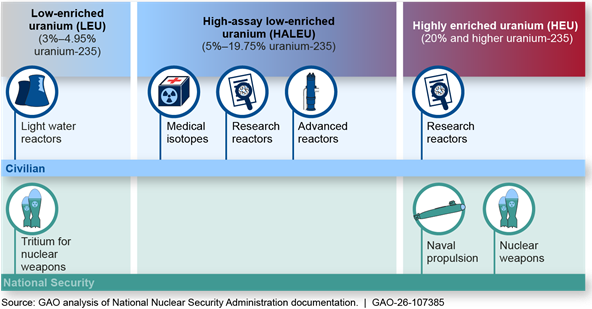
The National Nuclear Security Administration (NNSA), within the Department of Energy (DOE), is responsible for providing low-enriched uranium (LEU) for use in support of national security missions—primarily as fuel for reactors that produce tritium for the nuclear deterrent—and highly enriched uranium (HEU) as fuel for naval nuclear reactors that propel submarines and aircraft carriers.[2] NNSA also supplies high-assay low-enriched uranium (HALEU) and HEU for some non-commercial civilian purposes, including for use as fuel in domestic and foreign research reactors, as well as to produce medical isotopes.[3] DOE’s Office of Nuclear Energy (DOE-NE) helps ensure sufficient LEU supply for the existing fleet of U.S. commercial large light water reactors and supports the development of HALEU to fuel most of the advanced reactor designs under development.[4] Figure 1 shows uses of enriched uranium for national security and civilian purposes.[5]
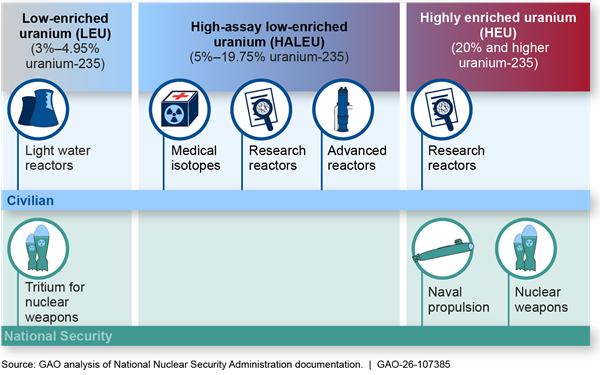
Note: The use of HEU for nuclear weapons comes from already existing material. According to NNSA officials, it is standing U.S. policy not to newly enrich uranium for nuclear weapons purposes.
Uranium used for national security purposes must generally be free of any “obligations” to foreign countries (i.e., be “unobligated”) that restrict use of material and equipment to peaceful purposes.[6] Accordingly, uranium used for national security must be domestically sourced, processed, and enriched using U.S.-origin technology and equipment to guarantee that it can be used for national security purposes.[7] The U.S. does not currently have an enrichment capability free of foreign obligations, and it currently meets national security needs through existing, finite inventories of unobligated enriched uranium that will eventually be exhausted.
Enriched uranium used as fuel for civilian purposes, such as for U.S. commercial reactors, can be foreign sourced and enriched using foreign technologies. However, global interest in nuclear energy is surging, and U.S. and international enriched uranium supply chains may struggle to meet rising demands for nuclear fuels as new reactors are developed and come online. Additionally, a 2024 ban on the import of Russian LEU and a very limited capacity to produce HALEU in the U.S. may pose challenges to the commercial sector in the near-term.[8]
The fiscal year 2023 National Defense Authorization Act included a provision for GAO to provide an assessment of NNSA’s Enriched Uranium Management Plan.[9] In addition, the report accompanying a Senate bill for the fiscal year 2024 National Defense Authorization Act included a provision for GAO to assess DOE and NNSA management of enriched uranium for national security and civilian purposes.[10] Further, a report accompanying the House bill for the fiscal year 2024 Energy and Water Development Appropriations Act included a provision for GAO to assess DOE’s development and management of HALEU for commercial needs.[11]
This report responds to these provisions and addresses: (1) NNSA’s and DOE’s estimates of current U.S. enriched uranium supply and projected future demands, for both national security and civilian needs; (2) the extent to which NNSA has developed program plans to meet projected national security enriched uranium requirements and followed best practices for program management; (3) the extent to which DOE has developed program plans to meet projected civilian enriched uranium requirements and followed best practices for program management; and (4) the challenges NNSA and DOE officials and other stakeholders have identified facing NNSA and DOE in facilitating future enriched uranium supplies, and the extent to which NNSA and DOE have taken steps to address the challenges. For the purposes of this report, we use the term civilian to refer to all non-national security needs for enriched uranium; this includes both commercial needs and needs that are not commercial in nature or related to national security, such as the use of enriched uranium for the production of medical isotopes and in research reactors.
We addressed the provision to review DOE and NNSA management of enriched uranium for national security and civilian purposes by briefing the results of our assessment to the relevant congressional committees in March and April 2025.[12]
To address all of the objectives, we reviewed NNSA and DOE documents and plans and interviewed NNSA and DOE officials, national laboratory staff, and industry representatives from uranium enrichment, advanced nuclear reactor, and related nuclear sectors. We also reviewed available programmatic documentation from NNSA and DOE offices and compared documentation against program management directives and best practices in program management. In addition, to describe challenges facing NNSA and DOE in implementing their plans, we reviewed NNSA and DOE program plans and associated documents, and interviewed government officials and industry stakeholders. In the report, we use the term stakeholders to describe U.S. agency officials, national laboratory staff, and industry representatives when more than one group is used to support a perspective. See appendix I for additional information on our objectives, scope, and methodology.
We conducted this performance audit from February 2024 to August 2026 in accordance with generally accepted government auditing standards. Those standards require that we plan and perform the audit to obtain sufficient, appropriate evidence to provide a reasonable basis for our findings and conclusions based on our audit objectives. We believe that the evidence obtained provides a reasonable basis for our findings and conclusions based on our audit objectives.
Background
Enriched Uranium Production Stages
Uranium is a radioactive element that consists of several naturally occurring isotopes: natural uranium contains approximately 99.3 percent of the isotope uranium-238 and 0.7 percent of the isotope uranium-235. The uranium-235 isotope in a quantity of uranium must be increased, or “enriched,” in order for the uranium to sustain fission. Uranium at different levels of enrichment is used to meet varying national security and civilian—primarily commercial nuclear power—needs. The concentration of uranium-235 in enriched uranium is expressed as a percentage “assay.” Through a series of steps, illustrated in figure 2, natural uranium is enriched to different assays, and fabricated into fuel to meet different national security or civilian nuclear energy needs.
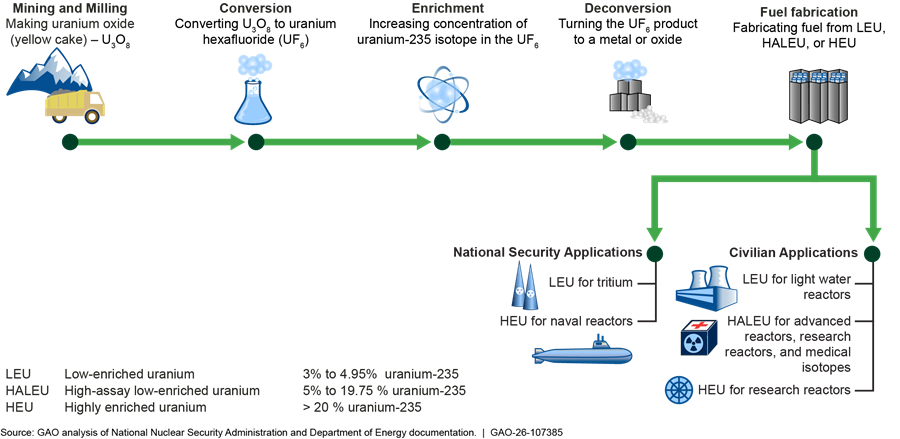
Note: At the time of this report, all of the national security applications above use uranium downblended from existing U.S. stocks of HEU allocated to those purposes. Some civilian HALEU needs in the near term are also being met through HEU downblending. Downblending involves mixing HEU with a “diluent” or other forms of uranium—such as natural uranium—to reduce the concentration of the uranium-235 isotope in the uranium and produce an overall lower level of enrichment.
The process of obtaining enriched uranium fuel for national security and civilian needs includes several general steps: mining and milling, conversion, enrichment, deconversion, and fuel fabrication.
· Mining and milling. The nuclear fuel cycle begins with mining uranium. Mining may be done through conventional methods—including surface mining, open pit mining, and underground mining—or in-situ recovery (ISR) methods that involve pumping acid or alkaline solutions through an underground ore body to leach out and recover the uranium. Uranium ore extracted through conventional mining methods goes to a milling facility, where it is crushed and concentrated. The milled uranium is typically purchased by utility companies and shipped to a conversion facility. In the U.S., ISR methods have generally replaced conventional mining and milling.
· Conversion. Uranium leaves the mining stage as a concentrate in a solid, stable oxide form. Before uranium can be enriched, using traditional methods, it must be converted into a gas. During this conversion process, the mined and milled uranium goes through refinement and other chemical processes in which the uranium is combined with fluorine to produce uranium hexafluoride (UF6). The UF6 is stored and transported as a solid and heated to become a gas suitable for common enrichment processes.
· Enrichment. The enrichment process increases the concentration of uranium-235 in the UF6 gas. The only commercial enrichment process in operation today in the U.S. is the gas centrifuge technology.[13] A gas centrifuge facility contains long lines of many rotating cylinders that are interconnected to form configurations referred to as cascades and trains. In this enrichment method, UF6 gas is placed in a centrifuge cylinder and rotated at a high speed. This rotation creates a strong centrifugal force so that the heavier gas molecules (UF6 containing uranium-238 atoms) move towards the outside of the inner cylinder wall. The lighter gas molecules (containing uranium-235) collect closer to the center. The stream that is slightly enriched in uranium-235 is withdrawn and fed into the next centrifuge, or stage. The slightly depleted stream (with a lower concentration of uranium-235) is recycled back into the next lower stage.[14] At the final withdrawal point, the UF6 is recovered at the desired assay. Uranium enrichment services are sold as separative work units (SWU), which represent the level of effort required to increase the concentration of uranium-235. Higher concentrations of uranium-235 require more SWU.
Since the cessation of uranium enrichment at the Paducah Gaseous Diffusion Plant in 2013—the last U.S. facility capable of enriching unobligated material—both DOE and NNSA have been supporting the development of new domestic enrichment capabilities, including the development of a “large” centrifuge design in Piketon, Ohio,[15] and a “small” centrifuge design in Oak Ridge, Tennessee.[16] The large centrifuges are about 40 feet tall, significantly larger than most centrifuge designs used for uranium enrichment in the rest of the world. The large centrifuges are also comparatively more complex, according to NNSA documents. In contrast, the “small” centrifuge design is significantly smaller and more like centrifuge designs used around the world. For a brief history of domestic uranium enrichment and DOE and NNSA support for these centrifuge designs, see appendix II.
· Deconversion. After enrichment, the enriched UF6 is chemically converted into a form that is suitable for fuel fabrication, most commonly uranium oxide. The deconversion process also removes fluoride atoms from the UF6 and replaces them with oxygen, resulting in a chemically stable oxide suitable for long-term storage. In addition to needing enriched uranium at a higher assay, some new reactors may also require fuels in other non-oxide forms such as metal alloys, which also require different deconversion methods.
· Fuel fabrication. Fabrication of LEU into fuel for light water reactors involves pressing uranium dioxide powder from the deconversion process into ceramic pellets, which are loaded into zirconium alloy tubes to create fuel rods. These rods are then bundled into fuel assemblies that are irradiated inside a reactor. Some advanced reactors under development may use new types of fuel that differ from the conventional fuel rods and fuel assemblies. For example, several advanced reactor designs under development intend to use a fuel type called TRi-structural ISOtropic (TRISO), which involves coating small amounts of HALEU in layers of carbon or ceramic-based materials.[17]
Nuclear Energy Trends
Countries around the world are seeking to increase electricity production, which is projected to double between 2024 and 2050, according to an International Atomic Energy Agency report.[18] In 2025 the current administration announced the goal of quadrupling nuclear generation in the U.S. by 2050, an increase from the previous administration’s goal to triple nuclear generation by the same date. Internationally, the United Nations Climate Change Conference in 2023 set an ambitious collective goal to triple global nuclear capacity by 2050. Separately, the International Atomic Energy Agency estimated that global nuclear operational capacity will increase between 50 percent and 160 percent from 2024 to 2050.
Industries, including manufacturing, artificial intelligence, and data centers, are also seeking a low-carbon source to meet their needs for power and heat. Some data centers are also pursuing advanced reactors to ensure they have reliable power sources.[19] To achieve increased power with lower emissions, major technology companies are pursuing renewable energy options and advanced nuclear technologies. Like the technology sector, companies in other industries, such as petrochemicals, are looking to deploy advanced reactors to power their operations not only with decarbonized electricity but with high temperature heat.
U.S. Agencies Involved in Managing Uranium
Several U.S. agencies play roles in managing domestic uranium supplies for national security and civilian needs, including:
· NNSA. NNSA, a separately organized agency within DOE, is responsible for the management of the nation’s nuclear weapons stockpile and the Naval Nuclear Propulsion program—which is responsible for design, production, operation, and decommissioning propulsion reactors for the U.S. Navy. Unobligated uranium is needed to support these national security missions. For the weapons stockpile, NNSA’s tritium production process is supported by Tennessee Valley Authority (TVA) nuclear reactors, which operate on unobligated LEU provided by NNSA. For naval nuclear propulsion, NNSA supplies HEU to meet the Navy’s needs for its nuclear-powered aircraft carriers and submarines using material presidentially declared to be excess to weapons needs. Similarly, recycled HEU supports the needs of the nuclear weapons stockpile.
NNSA also provides enriched uranium for civilian purposes, including for production of medical isotopes and for the agency’s nuclear nonproliferation efforts, such as research reactor conversions. These conversions seek to reduce overall nuclear material risk by moving research reactors from using weapon-usable HEU materials to HALEU-based materials. The enriched uranium used for these civilian purposes does not need to be unobligated.[20]
· DOE-NE. DOE-NE’s mission is to advance nuclear energy science and technology to meet the nation’s energy, environmental, and economic needs. To help address these needs, DOE-NE enables the operation of existing U.S. nuclear reactors and supports deployment of advanced nuclear reactors and development of advanced nuclear fuel cycles.
· DOD. The Department of Defense (DOD) generates military requirements for nuclear warheads, while NNSA oversees design, production, maintenance, and sustainment efforts to meet those weapon requirements, such as tritium production requirements. DOD also requires HEU fuel supplied by NNSA for the Navy’s nuclear-powered aircraft carriers and submarines. In addition, DOD is developing microreactors to provide transportable nuclear power to military installations.[21] The microreactor designs DOD is considering would require HALEU fuel, though DOD and DOE officials have stated that the U.S. government has not yet determined whether the required HALEU must be unobligated.
· NRC. The Nuclear Regulatory Commission (NRC) regulates commercial nuclear power plants and fuel cycle facilities—such as enrichment and fuel fabrication facilities—as well as other civilian uses of nuclear materials, such as medical uses, through licensing, inspection, and enforcement of its requirements. In addition, jointly with NNSA, NRC co-sponsors the Nuclear Materials Management and Safeguards System, the government’s official program to track movements, uses, and inventories of U.S. nuclear materials.
· TVA. As noted above, TVA supports NNSA by producing tritium in two of its electricity-producing nuclear reactors fueled with unobligated LEU. Small quantities of tritium are the normal by-products of electricity-producing nuclear power plants. Specially designed absorbers—called tritium-producing burnable absorber rods (TPBAR)—in the TVA reactors capture and retain the tritium for later extraction.
Legislative Requirements and Executive Orders Supporting Domestic Development of Enriched Uranium
We have previously reported on risks to the domestic uranium supply chain, including the mining, conversion, and enrichment sectors, and efforts to address those risks.[22] For instance, in his previous administration, the President established a Nuclear Fuel Working Group which released a strategy in April 2020 to mitigate risks to the domestic uranium industry, among other things. Examples of other actions taken by the federal government to revitalize the domestic nuclear industry and develop the domestic uranium supply chain to address both national security and commercial needs include:
· National Defense Authorization Act for Fiscal Year 2016. The National Defense Authorization Act for Fiscal Year 2016 established a biennial requirement for the Department of Energy to prepare and submit to the congressional defense committees a plan for meeting national security requirements for unencumbered uranium.[23]
· Energy Act of 2020. The Energy Act of 2020 called for DOE-NE to establish and carry out a program—the HALEU Availability Program—to support the availability of HALEU for civilian domestic research, development, demonstration, and commercial use.[24] The act requires this program to sunset by 2034 at the latest. According to DOE-NE officials, a HALEU market—which does not exist in the U.S. as of 2026—is dependent on the maturity of advanced nuclear reactors, and DOE will discontinue the program once that market is established.
· Inflation Reduction Act (IRA). The IRA appropriated $700 million to DOE to carry out the HALEU Availability Program established by the Energy Act of 2020.[25] As of April 2026, DOE has obligated $485 million and plans to obligate the remaining $215 million prior to September 30, 2026.
· Nuclear Fuel Security Act of 2023 (NFSA). The NFSA directed DOE to establish a Nuclear Fuel Security Program to increase the supply of HALEU for advanced reactors and, if necessary, LEU, and to promote domestic uranium mining, conversion, enrichment, and deconversion capacity and technologies.[26] The NFSA requires this program to sunset by 2034 as well. The NFSA also required the NNSA Administrator to prepare and submit to the congressional defense committees a plan to establish a domestic enrichment capability sufficient to meet defense requirements for enriched uranium, and to provide the committees with an annual certification as to whether NNSA is in compliance with the plan.[27]
· Consolidated Appropriations Act, 2024. This act appropriated up to $2.72 billion to carry out the NFSA. The act prohibited the use of funds until Russian enriched uranium imports were banned or limited.[28]
· The Prohibiting Russian Uranium Imports Act. This act banned imports of Russian LEU, starting on August 11, 2024, but permitted the Secretary of Energy to grant waivers through the end of 2027 if no alternative supplies were available or if in the national interest.[29]
· The One Big Beautiful Bill Act. This act appropriated $120 million to accelerate NNSA’s existing program to develop the capability to enrich uranium for national security purposes.[30]
In addition to these legislative requirements, the current administration has issued several executive orders pertaining to nuclear energy. These include:
· Deploying advanced nuclear reactor technologies for national security. The executive order directs the Secretary of Energy to prioritize site preparation and authorization activities to operate a privately funded advanced nuclear reactor at a DOE-owned or controlled site to power artificial intelligence infrastructure, or other critical or national security needs, no later than November 2027.[31]
· Ordering the reform of the Nuclear Regulatory Commission. This executive order directs the NRC to establish fixed deadlines for its evaluation and approval of licenses, including a deadline of no more than 18 months for a final decision on an application to construct and operate a new reactor of any type.[32]
· Reforming nuclear reactor testing at the Department of Energy. This executive order directs the Secretary of Energy to create a pilot program and use its authorities under the Atomic Energy Act to authorize the construction and operation of reactors outside the existing National Laboratory framework. The goal of the pilot program is to achieve criticality in three reactors by July 4, 2026.[33]
· Reinvigorating the nuclear industrial base. This executive order directs the Secretary of Energy to develop a plan to expand domestic uranium conversion capacity and expand enrichment capabilities sufficient to meet projected civilian and defense reactor needs.[34]
NNSA and DOE Program Management
Issues associated with NNSA’s and DOE’s program and project management have been on GAO’s High Risk List since 1990.[35] Recent GAO reports highlight ongoing issues particularly with key tools such as integrated master schedules and the absence of documented program management practices.[36] For example, one of NNSA’s largest programs—the Plutonium Modernization program—lacks a comprehensive schedule, which hindered its ability to integrate activities and measure project performance.[37] In 2022, we found that two DOE offices involved in nuclear energy had plans to implement certain program management practices but had not formalized those plans through documentation.[38]
According to NNSA officials, NNSA’s Office of Defense Programs Program Execution Instruction (PEI) serves as agency-specific guidance for managing that office’s programs.[39] All programs are required to document the program’s scope, schedule, and cost estimate in their planning documents, in a manner tailored to reflect program risk, according to the PEI.
For DOE offices, DOE Policy 410.3 seeks to outline the guiding principles for promoting efficient and effective program execution in keeping with statutory requirements such as in the Program Management Improvement Accountability Act and the Evidence-Based Policymaking Act.[40]
According to DOE Policy 410.3, these principles are applied using a graded approach based on each program’s scope, complexity, and capability. They include: establishing decision points that are aligned with the Planning, Programming, Budgeting, and Execution process outlined in DOE Order 130.1A; clearly defined roles and responsibilities; risk and quality management; cost and schedule estimating; performance monitoring; evidence-based decision making; continuous improvement; and maintaining a competent workforce.[41]
GAO Best Practices for Program Management
GAO has previously reported on best practices for program management and has identified nine best practices for program and project management that represent basic program management principles.[42] When followed, these principles give agencies assurance that the program is run efficiently and in an integrated way. We have grouped the identified best practices into the following characteristics and best practices listed in table 1.
|
Characteristic |
Program and project management best practice |
|
Well-planned |
1. Develops and maintains a program or project management plan and roadmap that are traceable to the organization’s strategic plan. |
|
2. Develops and maintains a comprehensive life-cycle cost estimate. |
|
|
3. Develops and maintains an achievable integrated master schedule. |
|
|
Measured |
4. Conducts risk management throughout the life of the program or project. |
|
5. Uses a continuously monitored reporting system to establish and measure performance against costs, schedule, and technical baselines. |
|
|
6. Conducts root cause analysis and develops corrective action plans at regular intervals. |
|
|
Informed |
7. Captures lessons learned throughout the duration of a program or project in a database and disseminates that information across the organization. |
|
8. Conducts independent reviews throughout the life of a program or project, including at key decision points, on the progress of delivering requirements. |
|
|
9. Conducts stakeholder engagement and regularly communicates status and incorporates feedback from stakeholders. |
Source: GAO. | GAO‑26‑107385
NNSA’s Uranium Supplies Are Likely Sufficient to Meet National Security Needs Until the Early 2040s, but DOE’s Civilian Supply and Demand Estimates Are Less Clear
NNSA is preserving a sufficient amount of unobligated enriched uranium to meet national security needs until the 2040s, when new supply will be needed. For the civilian commercial reactor market, estimates for LEU supply and demand are generally well-established, but certain factors, such as the ban on LEU imports from Russia, could affect the availability of LEU in the near-term.[43] Additionally, demand estimates for HALEU on the commercial side vary widely, and most scenarios anticipate rising demand; however, near-term HALEU production is unlikely to scale quickly enough to meet those needs.
NNSA Has Sufficient Enriched Uranium Supplies to Meet National Security Needs Until the Early 2040s
Based on our review and assessment of NNSA’s 2023 Enriched Uranium Management Plan (EUMP) and through interviews with NNSA officials, we found that NNSA’s current and projected inventory of unobligated LEU and HEU is likely sufficient to meet national security missions until the early 2040s. There are currently no national security missions that require unobligated HALEU. While more specific data is classified, we determined that:[44]
· LEU. There is sufficient supply of unobligated LEU, or HEU allocated for downblending to LEU, to produce tritium through the early 2040s.[45]
· HEU. In 2005, 200 metric tons uranium (MTU) of HEU were declared excess to weapons needs and made available for other uses. This material was designated into three categories for future use, including 160 MTU for naval nuclear propulsion, 20 MTU for HEU research reactors and medical isotopes, and 20 MTU for downblending to LEU. NNSA projects there is sufficient HEU to meet naval nuclear propulsion needs until the 2050s. Additionally, there is sufficient HEU allocated to meet needs for isotope production and research reactors until 2040.[46]
However, there are factors that could affect national security demands for unobligated enriched uranium and consume existing and projected inventories at a marginally faster rate. Some of these factors are classified. One unclassified factor is a potential future demand stream for unobligated HALEU to be used as fuel for microreactors under development for use by DOD, if a determination is made that this fuel must be unobligated.[47]
Estimates of Commercial Reactor Demands for LEU Are Generally Well-Established and Expected to Rise, but Near-Term Supply May Be Constrained by a Ban on Importing Russian Uranium
Based on our review of documentation from DOE and the uranium enrichment industry and our interviews with stakeholders, the commercial demands for LEU to support the existing fleet of nuclear reactors in the U.S. are generally well-established. However, stated national goals to dramatically increase nuclear power, coupled with the ban on LEU imports from Russia, could be difficult to achieve in the near-term—after waivers for imports have expired—if domestic and international enrichment services do not expand to meet near-term commercial needs. Specifically, the existing U.S. commercial fleet of 96 large light water reactors requires about 2,000 MTU of LEU per year, representing approximately 15 million SWU, according to the U.S. Energy Information Administration (EIA).[48]
With respect to LEU supply, in 2024 the U.S. imported about 81 percent of the LEU—as measured by SWU—needed to meet commercial nuclear power demands according to EIA. About 20 percent of total U.S. LEU demand was sourced from Russia that year (see fig. 3). As part of the 2024 ban on LEU imports from Russia, companies can apply for waivers to the ban that allow imports until the end of 2027, if they demonstrate a lack of available LEU. For example, DOE granted waivers to Centrus Energy Corporation (Centrus) in 2024 and 2025 to allow the import of Russian uranium to meet the company’s committed delivery dates to utilities in years 2024 through 2027.[49]
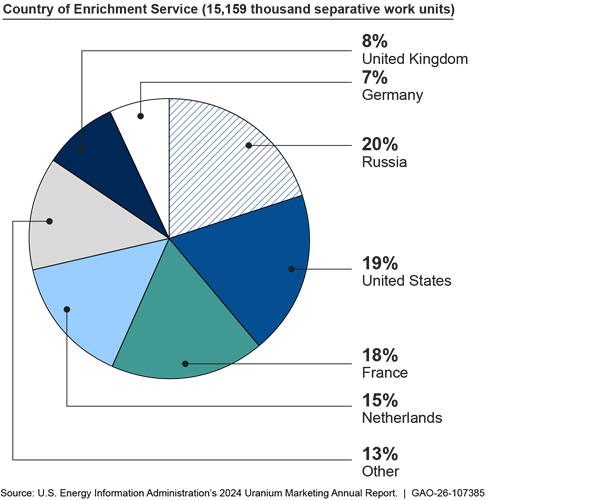
Note: Uranium enrichment services purchased from the United States are provided by Urenco USA, a U.S. subsidiary of a European enrichment company. The enriched uranium from this source is obligated, meaning it cannot be used for national security purposes.
The limited enrichment capacity in the U.S., coupled with the Russian LEU ban, could result in a near-term supply gap, with projected supplies decreasing while projected demands are rising. For example, one study we reviewed, published by the Lawrence Livermore National Laboratory, stated that it is unlikely that domestic enrichment efforts will be able to supplement the loss of Russian enriched uranium by 2028.[50] According to the International Energy Agency, more than 99 percent of global enrichment capacity today is held by just four companies, including a Russian company that accounts for an estimated 40 percent of capacity.[51]
However, we found that some enrichment companies are planning to increase enrichment capacity for LEU in the U.S. and globally, which may address the potential gap as that capacity comes online. For example, in September 2025, Urenco USA—an enrichment services company that operates in the U.S. using European gas centrifuge enrichment technology—announced its second new cascade of centrifuges were brought online at its New Mexico enrichment facility, resulting in a 15 percent enrichment capacity increase at the facility. At the time of this report, Urenco USA provided approximately one-third of the enrichment needs of U.S. commercial nuclear power plants. In addition, Urenco’s global operations announced a similar expansion to the company’s facility in the Netherlands that would double the facility’s capacity by 2030.
Another enrichment company, Orano USA—a subsidiary of Orano, a France-based company specializing in the nuclear fuel cycle—announced in September 2024 that it planned to build a 750,000 square foot enrichment facility in Oak Ridge, Tennessee, to support additional capacity, customer demand, and market needs. If required milestones are met in a timely manner, Orano USA expects enrichment operations could begin in the 2030s.
Demand Estimates for HALEU Vary but Are Generally Increasing and Projected Near-Term Supply Is Likely Insufficient to Meet Those Demands
HALEU demands for commercial reactors remain highly uncertain because the extent to which advanced reactors using HALEU-based fuels—including many first-of-a-kind designs—will be proven, licensed, ordered, and deployed is also highly uncertain. One indicator of the anticipated growth in domestic nuclear energy production and demand for HALEU is the more than 15 advanced reactor designs in different stages of licensing application with the NRC, as of February 2026.[52] See appendix III for a list of these reactors. Some stakeholders expressed skepticism about lofty HALEU demand estimates and noted uncertainty about how many of these reactor designs would succeed and ultimately be deployed.
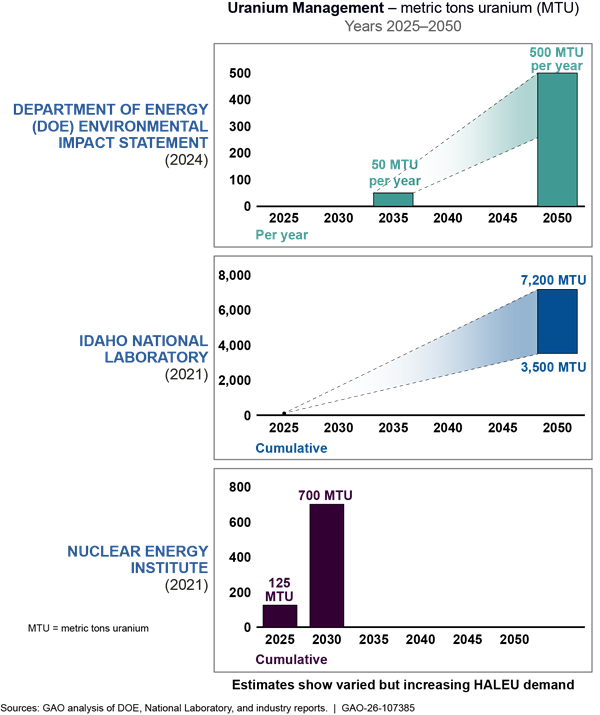
Due to the nascency of the advanced reactor designs and uncertainty around their future deployment, we found that near-term and long-term estimates of commercial nuclear demands for HALEU vary widely. We obtained and reviewed a wide range of HALEU demand estimates that reflect that uncertainty. For example, in 2021, the Nuclear Energy Institute estimated cumulative HALEU demand of 125 MTU by 2025, and 700 MTU by 2030, based on a survey of advanced reactor developers with deployments planned in the U.S. and Canada.[53] The Idaho National Laboratory issued a report in 2021 that estimated a range of 3,450 to 7,175 MTU of the total cumulative amount of HALEU needed by 2050.[54] Additionally, DOE’s 2024 Final Environmental Impact Statement on HALEU production estimated the U.S. commercial market would need 50 MTU of HALEU per year by 2035, with domestic demand increasing to about 500 MTU per year by 2050.[55] Figure 4 shows a wide variability of estimates from existing studies of projected HALEU demand.
Figure 4: Varying Demand Estimates for High-Assay Low-Enriched Uranium (HALEU) from Selected Sources
In the near-term, HALEU demand estimates are somewhat clearer. In September 2024, DOE asked advanced reactor developers to submit requests for allocations of the limited supply of HALEU available to DOE for developers’ use in demonstrating their designs. More than a dozen advanced reactor developers—including companies such as TerraPower LLC, X-energy LLC, and Kairos Power LLC—submitted requests for HALEU needed to produce demonstration fuels for those reactors until the 2030s.[56] However, based on DOE estimates of HALEU it can provide—through a limited HALEU production contract and downblended material—there may not be sufficient supply in the near-term to meet the needs of all advanced reactor companies that have requested HALEU from DOE.
As of April 2026, DOE has indicated that it will have about 21.2 MTU of HALEU available for advanced reactor demonstration companies by the end of 2028, with a total of 23.4 MTU projected to be available by the end of 2030. Based on the most recent information available as of April 2026, DOE officials said that demand will likely exceed what DOE can supply before HALEU is commercially available. However, the magnitude of this shortfall will depend on whether all HALEU requesters successfully meet their schedules, which are in some cases ambitious and linked to the still-emerging domestic expansion of HALEU fuel fabrication capabilities. As a consequence, companies in need of HALEU for reactor demonstration purposes may need to identify sources beyond DOE.[57]
For instance, representatives from one company told us the company has sought HALEU from other sources to support its reactor development plan.[58] DOE told us that information it provided on the quantity of HALEU it may be able to make available is subject to change, and that it was actively searching for other sources to address demand. DOE is not obligated to fulfill all HALEU requests for these companies but is working to allocate available HALEU based on a variety of factors, such as the technical suitability of requests.
Internationally, HALEU production capacity outside of Russia is also limited. The only other country currently with infrastructure to produce HALEU at scale is China, though other international enrichment capacity may come online over the next decade. For example, the European enrichment consortium Urenco is expecting to produce 10 MTU of HALEU per year at an enrichment facility in the United Kingdom, though this supply is not expected until the early 2030s. Other enrichment companies we spoke with said they could expand their capacity to produce HALEU, but only if they had sufficient long-term purchase agreements from HALEU buyers.
For National Security Enrichment, a Key Plan Does Not Include Required Cost Information and Program Plans Do Not Reflect Management Best Practices
NNSA has developed plans documenting its programmatic approach to meeting future national security needs for enriched uranium that includes using current inventory to meet needs until the 2040s, pursuing two commercial acquisitions of enrichment services to address longer-term needs, and establishing a new large-scale unobligated enrichment capability. To support its program plans for these efforts, NNSA has prepared a long-term cost estimate for enrichment efforts but has not included information on these costs in a key plan that Congress has required on a regular basis. In addition, based on our assessment of NNSA’s programmatic documents and agency-specific program management guidance, we found the documents and guidance only substantially or partially met most best practices for program management.
NNSA Has Developed Plans for Its Program to Meet Enriched Uranium Needs for National Security Missions
Within NNSA, the Defense Fuels program—previously referred to as the Domestic Uranium Enrichment (DUE) program, prior to May 2025—is responsible for ensuring a reliable supply of unobligated enriched uranium for national security mission requirements. NNSA has detailed its requirements for enriched uranium for national security purposes in its 2023 EUMP, the 2025 DUE Program Strategy, and other planning documents.[59] The plans detail a four-pronged approach for how NNSA will supply unobligated enriched uranium to meet national security missions. Ultimately NNSA‘s enrichment capability will need to generate about 1.7 million SWU per year by the 2050s to meet national security missions: 500,000 SWU per year to support the tritium mission by the early 2040s, and 1.2 million SWU per year by the 2050s to meet the naval propulsion mission. The four elements of this approach are:
1. Using current inventory of unobligated LEU and HEU to meet national security missions. NNSA plans to use its current inventory of unobligated LEU and HEU to supply its national security needs until new enrichment to support tritium production is needed in the early 2040s. Through its existing program involving the downblending of excess HEU to LEU, NNSA will continue to supply LEU to the two TVA reactors that produce tritium for NNSA. The downblending program is expected to complete by 2027, at which point there will be sufficient unobligated LEU inventory to supply TVA reactors until the early 2040s, according to NNSA officials.[60] For naval reactors, there is sufficient HEU allocated to the naval nuclear propulsion program to supply the Navy’s nuclear-powered submarines and aircraft carriers until the 2050s.[61]
2. Deploying the large centrifuge technology. NNSA plans to use large centrifuges, operated by a commercial operator, at a DOE-owned facility in Piketon, Ohio, to enrich unobligated LEU for national security purposes. The facility was built by DOE in the 1970s specifically to support the large centrifuge technology, was then abandoned, and was later leased by Centrus. It currently has 16 centrifuges that Centrus is operating as a demonstration for commercial enrichment of HALEU. In their current configuration, those centrifuges do not produce unobligated enriched uranium because they contain a foreign part, according to Centrus representatives.
NNSA intends to have a commercial operator deploy one or two cascades (120 centrifuges each) at the Piketon facility, using all unobligated parts, to partially meet unobligated LEU demands beyond the early 2040s.[62] Each cascade will be capable of producing about 50,000 SWU per year.
NNSA is planning to have a contractor construct 24 centrifuges at Piketon by 2028, with the first cascade completed 2 years later. According to the DUE Program Strategy, NNSA expects limited LEU production to start in fiscal year 2030, with a rate of about 100,000 SWU per year when both cascades are completed. This will supply about 20 percent of the 500,000 SWU per year ultimately needed for tritium production.[63] According to NNSA, by providing limited production of LEU in the early 2030s, NNSA will have generated up to 3 years of supply of LEU to support tritium production by the early 2040s, when the current existing inventory is expected to run out; this supply will help mitigate risk if other LEU production is delayed.
3. Developing and deploying the small centrifuge technology. NNSA plans to continue the technological development of the small centrifuge at the Oak Ridge National Laboratory, and ultimately to deploy this technology at a pilot plant at another location in Tennessee.[64]
According to the DUE Program Strategy, the pilot plant may initially produce limited amounts of unobligated LEU for tritium but is being designed to transition to a facility capable of enriching to the HEU level to support the naval nuclear propulsion mission. The small centrifuge technology is expected to receive NRC license approval for pilot plant construction in 2031, with limited operations beginning in 2035. The pilot plant is expected to convert to HEU enrichment beginning around 2049 and will have an enrichment capacity of 50,000 SWU per year.
In September 2025, NNSA awarded BWXT, a global nuclear services company, a sole-source contract valued at $1.5 billion for the licensing, construction, and operations of the pilot plant at a BWXT facility in Erwin, Tennessee.[65]
4. Developing a large-scale unobligated enrichment capability. To provide the majority of SWU needed for national security purposes, NNSA also plans to support a separate LEU production capability to provide additional unobligated LEU necessary to completely fulfill the national security enrichment needs. According to NNSA officials, this production capability could include both or either of the small or large centrifuge technologies as necessary. Large centrifuges to support this production capability would be deployed at DOE’s existing facility in Piketon; small centrifuges would require a separate purpose-built facility. NNSA refers to this capability—whether in Piketon or a separate facility, or both—as the LEU production plant.
This production plant would produce LEU to use as feedstock for enrichment to HALEU. That HALEU product would then serve as a feedstock to produce HEU in the HEU-converted pilot plant in Erwin, Tennessee. The production plant would also provide an additional 400,000 SWU per year of LEU needed to fully support tritium production. According to the DUE Implementation Plan for fiscal year 2025, production plant capacity will be built incrementally.[66] When fully completed, the production plant will need to produce about 1.5 million SWU per year starting in the 2050s to meet national security needs for both tritium and naval propulsion based on the most recent estimates available.
Figure 5 illustrates the timelines and other details for each of the four elements of the NNSA approach.
Figure 5: The National Nuclear Security Administration’s (NNSA) Planned Timelines and Capabilities to Meet Enriched Uranium Requirements for National Security Missions
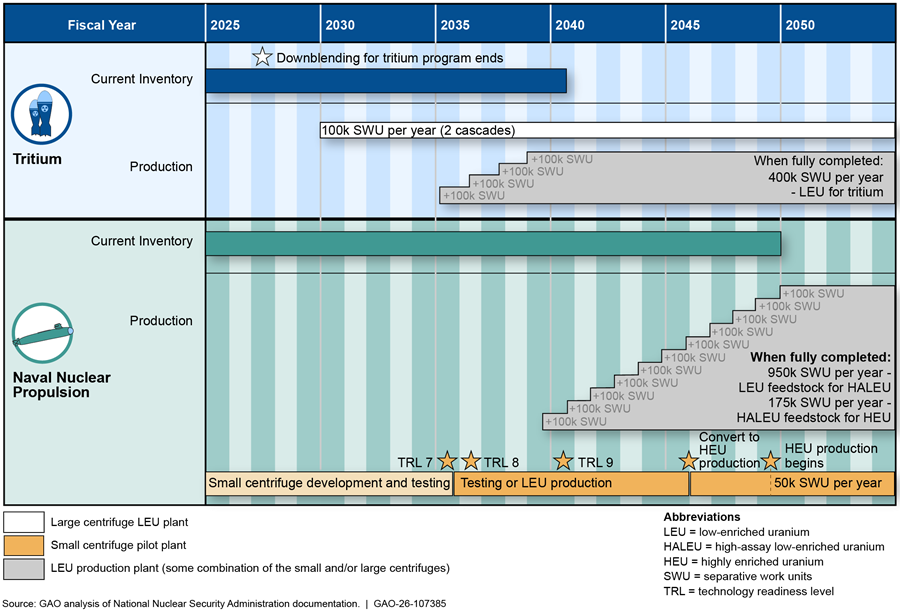
Note: Separative work unit (SWU) is a measure of the effort needed to enrich a given amount of natural uranium into enriched uranium and is how uranium enrichment services are priced.
According to NNSA officials, the Defense Fuels program is still developing its acquisition strategy for new production of unobligated enriched uranium, but NNSA documentation and officials did describe the acquisition plans to us in broad, general terms. Notably, in contrast to other large infrastructure projects, NNSA plans to develop a new supply of unobligated enriched uranium through commercial acquisitions instead of conducting capital acquisitions, such as NNSA-funded construction projects that result in a federally owned facility then operated by a contractor.
NNSA officials told us they assessed that commercial acquisitions are faster and more cost effective than traditional capital acquisition projects that result in government-owned facilities, but could not provide documentation supporting this assessment for nuclear facilities. Further, NNSA officials said that knowledge in the federal government about managing enrichment efforts has atrophied, with industry having more robust levels of knowledge. NNSA officials also told us that they believed site contractors would be challenged in overseeing another major construction project because NNSA is already pursuing numerous capital acquisition projects at its sites, many of which are experiencing cost overruns and schedule delays.[67]
NNSA Has Developed a Long-Term Cost Estimate for National Security Enrichment but Its Enriched Uranium Management Plan Does Not Include Required Cost Information
NNSA has developed a long-term estimate of the cost to achieve the four prongs of its approach. The estimate includes cost information for design and construction of facilities by commercial partners on privately controlled sites following commercial codes and standards (instead of at an NNSA site subject to DOE directives and regulations). The estimate also includes information on the provision of required centrifuges, decades of required operations, and ultimate decommissioning.[68]
NNSA officials said that the long-term cost estimate is based on a scenario in which the full capacity LEU production plant is built using the small centrifuge exclusively. NNSA chose this scenario because using the small centrifuge exclusively in a scenario results in the highest—and therefore most conservative—cost estimate.
|
Analysis of Alternatives In 2016 the National Nuclear Security Administration (NNSA) approved a mission need statement for a long-term capability to supply unobligated enriched uranium to support tritium production. NNSA started an Analysis of Alternatives (AOA) process to help determine the best approach to meeting this need, including the potential use of centrifuges, other enrichment technologies, and non-construction alternatives. NNSA completed Phase One of the AOA in 2021. At that time, officials said NNSA intended to use centrifuge technologies to meet mission needs. However, NNSA said that there was too much uncertainty in performance, reliability, and life-cycle costs to identify which centrifuge technology—the large or small centrifuge—should be deployed. NNSA also planned to conduct a Phase Two of the AOA evaluation to select one of the two technologies. In 2024, NNSA officials told us that it had decided to pursue both centrifuge technologies. Officials believed this decision removed the need to conduct Phase Two of the AOA. Source: GAO analysis of NNSA documentation and interviews with NNSA officials. | GAO‑26‑107385 |
NNSA officials said this cost estimate was derived from several sources, including input from industry developers and documentation from a 2021 Analysis of Alternatives (AOA).[69] See the sidebar for more information about NNSA’s domestic uranium enrichment AOA. We did not assess the reliability of NNSA’s long-term cost estimate because NNSA officials told us that certain aspects of the estimate required additional development, and the estimate should still be considered preliminary.
While NNSA has developed a long-term cost estimate, in our review of NNSA’s EUMP, we found that the plan did not include cost and schedule estimates for the options NNSA had identified to meet national security enriched uranium needs, as required by statute.[70] NNSA provided this long-term cost estimate to GAO about a year after the release of the EUMP in August, 2024.[71] When NNSA was planning a capital acquisition project to establish a national security uranium enrichment capability, it would have had to produce a full cost estimate for the project and report performance against this baseline. Since the current approach will use programmatic funding, future budget justifications are only required to include information about anticipated programmatic budget requests for 5 fiscal years. The statutorily required biennial report is a vehicle for NNSA to provide and update the full lifecycle cost of the program, which is currently estimated for about 80 years. Without including that cost information in future reports, Congress may be unable to fully assess the long-term budgetary implications of this effort or monitor how its costs change over time.
NNSA’s Program Planning and Implementation Plans Substantially or Partially Met Most Best Practices for Program Management
Due to the evolving nature of the Defense Fuels’ programmatic plans, such as its long-term cost and schedule estimates, we were unable to assess the reliability of these estimates. However, given the broad and complex nature of the Defense Fuels program involving the development of multiple technologies and facilities, we conducted an assessment of the Defense Fuels program’s plans and NNSA’s Program Execution Instruction against GAO’s best practices for program management.
Applying these nine best practices, we assessed the plans and documents provided by the Defense Fuels program as of April 2026 to determine the extent to which the program’s management documentation reflects best practices for program management, which would provide some assurance that the program runs efficiently and in an integrated way. We used a 5-point scoring system to evaluate each best practice: “fully met,” “substantially met,” “partially met,” “minimally met,” and “not met.” We found that the provided plans and documents substantially met two of the best practices, partially met four, and minimally met three (see table 2).
Table 2: GAO Assessment of NNSA’s Defense Fuels Program’s Program Management Documentation, as of April 2026
|
Program management best practice |
GAO’s assessment |
|
1. Program Management Plan: Develops and maintains a program management plan and roadmap that are traceable to the organization’s strategic plan. |
◑ |
|
2. Life-cycle Cost Estimate: Develops and maintains a comprehensive life-cycle cost estimate. |
◑ |
|
3. Integrated Master Schedule: Develops and maintains an achievable integrated master schedule. |
◔ |
|
4. Risk Management: Conducts risk management throughout the life of the program. |
◑ |
|
5. Reporting System: Uses a continuously monitored reporting system to establish and measure performance against cost, schedule, and technical baselines. |
◑ |
|
6. Root Cause Analysis: Conducts root cause analyses and develops corrective action plans at regular intervals. |
◔ |
|
7. Lessons Learned: Captures lessons learned throughout the duration of a program in a database and disseminates that information across the organization. |
◔ |
|
8. Independent Review: Conducts independent reviews throughout the life of a program, including at key decision points, on the progress of delivering requirements. |
◕ |
|
9. Stakeholder Engagement: Conducts stakeholder engagement and regularly communicates status and incorporates feedback from stakeholders. |
◕ |
Key: Fully met ● Substantially met ◕ Partially met ◑ Minimally met ◔ Not met ○
Source: GAO analysis of National Nuclear Security Administration (NNSA) programmatic plans and documents. | GAO‑26‑107385
Note: The program management documentation we reviewed was still governing the program as of April 2026. Our assessment resulted in five possible scores: Fully Met—provided complete evidence that satisfies the entire criterion; Substantially Met—provided evidence that satisfies a large portion of the criterion; Partially Met—provided evidence that satisfies about half of the criterion; Minimally Met—provided evidence that satisfies a small portion of the criterion; and Not Met—provided no evidence that satisfies any of the criterion.
Substantially met best practices. Our assessment found that the Defense Fuels program management documentation substantially met the best practices for independent review and stakeholder engagement.
· Independent review: NNSA officials provided us with the agency’s April 2026 Project Oversight Plan, which outlines the roles and responsibilities of the Program Oversight Lead, including conducting independent oversight of project activities and independent reviews of project products, among other things.
· Stakeholder engagement: the Program Oversight Plan outlines strategies to support stakeholder alignment and identifies various prospective stakeholders for the program.
Partially met best practices. We found that the Defense Fuels program management documentation partially met best practices for program management plan, life-cycle cost estimate, risk management, and reporting system.
· Program management plan: at the time of our review, the Defense Fuels program did not have a program specific program management plan, but NNSA officials stated the plan was under development and provided us with a draft copy.
· Life-cycle cost estimate: officials also provided several project cost estimates and a longer-term cost estimate for the Defense Fuels program. We found that the project cost estimates included some details about the underlying assumptions and estimating methodology. However, the longer-term cost estimate provided did not include details related to the estimating methodology, or how the project cost estimates contributed to NNSA’s calculation of the Defense Fuels’ total program costs.
· Risk management: the Program Oversight Plan includes a high-level work plan that details strategies to use and expected activities for the mitigation of consequential risks. However, the Defense Fuels program did not have a specific risk management plan that outlines the roles and responsibilities of the members of the program office. Without adequate risk management, the Defense Fuels program may be unable to concentrate efforts towards areas of concern, which may increase the likelihood of performance impacts.
· Reporting system: officials reported that the Defense Fuels program has established financial management practices in an annual Program Implementation Plan. However, NNSA officials did not provide us with established cost and schedule baseline evidence in support of their variance reporting. Therefore, we were unable to determine how the program’s projects were performing and how they might continue to perform.
Minimally met best practices. We found that the Defense Fuels programmatic documentation minimally met best practices for integrated master schedule, root cause analysis, and lessons learned.
· Integrated master schedule: NNSA officials provided documentation that included a high-level schedule that did not capture the full scope (i.e., including the effort necessary from all government, contractor, and other key parties for successful execution from start to finish) of the program. This resulted in our inability to determine if the activities presented in the schedule were logically related, and if forecasted dates for activities were recalculated when progress changed.
· Root cause analysis: at the time of our review, NNSA officials did not have approved documentation of plans for developing corrective actions to address any future events that could affect achievement of program objectives and goals. Without finalized documentation, the program may face challenges in identifying and effectively mitigating risks, if they arise, as well as taking appropriate corrective action.
· Lessons learned: we were unable to determine how the Defense Fuels program collects or uses lessons learned, as neither officials nor the documentation we reviewed explained how lessons learned are used to improve processes and procedures specific to Defense Fuels projects, or the program as a whole. Without documenting lessons learned, the Defense Fuels program may miss opportunities to improve performance and avoid repeating mistakes.
For further details on our assessment of the Defense Fuels program’s documentation compared to GAO’s best practices for program management, see appendix IV.
According to NNSA officials the Defense Fuels program is currently tracking its mission objectives and updating the program to improve its programmatic documentation. Specifically, we reviewed the Defense Fuels draft program plan. However, details from this document were not included in our assessment because the plan had not yet been approved at the time of this report. We found that the Defense Fuels’ draft program plan includes direction for developing both a life-cycle cost estimate and integrated master schedule, as well as extensive information pertaining to how the program would conduct a root cause analysis to assess any future events affecting program performance.
NNSA officials told us that the execution of program management for the Defense Fuels program—including the program’s plans and documents that we assessed and describe above—followed the guidance outlined in the Standard Management category of the Office of Defense Program’s PEI. The PEI details program management requirements and guidance for programs within NNSA’s Office of Defense Programs. The PEI also establishes four management categories, each with specific implementation requirements that include differing degrees of rigor for managing a program.[72] In addition, all programs, regardless of category, are required to document the program scope, schedule, and cost estimate in their planning documents.
We then reviewed the PEI’s Standard Management category between July and November 2025 to determine if it incorporated best practices for program management. We found that the PEI’s Standard Management category—as program management guidance—does not fully incorporate best practices for program management, which may explain why Defense Fuels program management documentation met those practices to varying degrees. See appendix IV for more detail on our assessment of the Standard Management category of the PEI against best practices.
In August 2025, NNSA officials told us the Defense Fuels program planned to transition from the least rigorous category—Standard Management—to the more rigorous Enhanced Management B category of the PEI some time in fiscal year 2026. Furthermore, as of February 2026, NNSA updated certain Enhanced Management B category requirements to incorporate program management best practices for developing reliable program schedules, cost estimating, and documenting rationale for not following best practices with senior leadership approval.[73] As a result, the Defense Fuels program has an opportunity to bring its program documentation into line with the improved Enhanced Management B guidance as it makes this transition and finalizes the new version of its program. Doing so would provide the Defense Fuels program opportunities for effective and efficient oversight in achieving its stated objectives and goals for its uranium enrichment efforts for national security.
DOE Has Taken Steps to Support Production of Enriched Uranium for Commercial Reactors but Has Not Documented an Economic Analysis or Developed Other Plans for Its Efforts
In response to statutory requirements, DOE has taken multiple steps to facilitate a supply of HALEU for advanced reactors and has taken action to facilitate LEU supply for commercial nuclear reactors. First, DOE is planning to provide a limited supply of HALEU to support advanced reactor developers in the near-term. Second, while reactor development is ongoing, DOE is facilitating the creation of a commercial HALEU market in the U.S. by awarding task orders to companies to build HALEU enrichment capacity and support related services. In addition, DOE has awarded a contract to one company to build LEU enrichment capacity in the U.S. However, DOE’s actions are not currently supported by an economic analysis to guide its efforts. Furthermore, DOE has not yet developed key program management documents to guide the implementation of its efforts such as a written strategic plan, cost estimates, or an integrated schedule.
DOE Plans to Meet Some Near-Term HALEU Needs Using Downblended Material and Limited HALEU Production
Under its HALEU Availability Program, created in response to direction in the Energy Act of 2020, DOE has taken some actions to provide HALEU in the near-term for selected U.S. companies developing advanced reactors. These actions are:
Downblending HEU to HALEU. DOE is downblending limited stocks of HEU to produce HALEU for commercial purposes. According to DOE officials, DOE anticipates that it will be able provide about 21.2 MTU of HALEU by 2028.
As part of the HALEU Availability Program, DOE established a HALEU Consortium consisting of advanced reactor companies and others in industry that sought engagement with DOE about HALEU; DOE also sought requests from companies interested in acquiring HALEU. DOE received requests from 15 companies, and in 2025 made conditional commitments to allocate HALEU to eight companies.[74] However, as discussed above, based on available inventories of HALEU, DOE may not be able to meet all of the near-term HALEU demands of these eight companies. In January 2026, Standard Nuclear, a fuel fabrication company, announced that it had received its first shipment of HALEU from DOE, which the company will use to produce TRISO fuel for a Radiant Industries microreactor.
Limited HALEU production. In 2019, DOE contracted with a Centrus subsidiary to deploy a HALEU cascade at DOE’s Piketon facility to demonstrate HALEU enrichment using large centrifuge technology. In 2022, DOE signed another contract with the Centrus subsidiary to finish deployment of the cascade, demonstrate production, and produce additional quantities of HALEU. Centrus announced in June 2025 that it had completed enrichment of 900 kilograms of UF6 HALEU, and DOE exercised a 1-year contract option with Centrus to enrich another 900 kilograms of UF6 HALEU by June 30, 2026.[75] DOE officials said that Centrus is on track to achieve this production milestone of 1.8 MTU of HALEU in UF6 form.[76] According to DOE, the total combined cost for both demonstration and production contracts from 2019 through June 30, 2026, is approximately $475 million.[77]
DOE’s Plans to Support Commercial HALEU Production Have Shifted from Incentivizing Companies to Enrich Uranium to Funding Companies to Build Enrichment Capacity
DOE officials told us that it is important for DOE to support longer-term development of HALEU enrichment in the U.S. because advanced reactors have not yet been deployed to create sustained demand for HALEU-based fuels. However, because there are no deployed advanced reactors and therefore no significant demand for HALEU, enrichment providers have been reluctant to develop commercially scaled domestic HALEU enrichment capacity. Stakeholders commonly referred to this as a “chicken and egg” dilemma: investment in enrichment capacity depends on reliable advanced-reactor deployment and commitments by companies to purchase fuel, while reactor investment depends on reliable fuel availability to demonstrate the success of reactor designs and fuel them in the future.
DOE’s actions to establish commercial-scale production of HALEU through the HALEU Availability Program have evolved over the past several years. Specifically, DOE has shifted from its initial plan—to incentivize industry expansion of HALEU enrichment capacity through direct purchase of HALEU they produce—to a strategy of awarding funds directly to enrichment service companies to build domestic HALEU enrichment capacity.
Prior to September 2025, DOE had planned to create the HALEU demand necessary to encourage investment in HALEU enrichment by entering into long-term purchase agreements with prospective enrichers, thereby creating temporary, artificial demand for HALEU. DOE would then resell purchased HALEU back onto the market as demand materialized. DOE anticipated that HALEU demand would materialize because DOE would have created near-term supply to enable advanced reactor demonstrations, and because of expected market demand for those reactors.
Specifically, in April 2024, DOE officials said the agency planned to incentivize the production of at least 25 MTU of HALEU per year. It planned to do this by awarding task orders to purchase HALEU from prospective enrichers. Once the HALEU market was functioning, DOE planned to exit its role as the intermediate buyer and seller. DOE is required by statute to cease such activities by 2034 at the latest.[78]
DOE abandoned this incentivization approach in August 2025 and shifted to awarding contracts to multiple companies off of which it could issue task orders to build enrichment capacity, according to DOE officials. Officials said they pivoted to awarding task orders directly to companies to build capacity because negotiations with prospective companies revealed this approach would maximize the amount of capacity built. Enrichment companies could then enter supply contracts with end users—utilities and reactor developers—for them to purchase LEU and HALEU. According to DOE officials, this will lead to the establishment of a domestic HALEU market and will fill part of the LEU supply gap resulting from the Russia import ban.
DOE officials said that the agency is pursuing milestone-based task orders with companies, and as of April 2026, had completed negotiations with one of the companies. These task orders will contain milestones for companies to meet, such as to demonstrate the ability to enrich at commercial scale, as well as other milestones for licensing, construction, and technical items. As part of these task orders, DOE officials said that the companies will be asked to provide 1 MTU of material to DOE, which DOE plans to use to support the HALEU Availability Program.
DOE actions to support the HALEU supply chain include:
· Awards to build HALEU enrichment capacity. In January 2026, DOE announced task order awards of $900 million each to Centrus and another company, General Matter, to build HALEU enrichment capacity, and those companies can then sell HALEU to advanced reactor developers and utilities, according to DOE officials;[79]
· Awards for HALEU deconversion services. DOE has also contracted with six companies, allowing them to bid on task orders for HALEU deconversion services, a necessary step currently performed by fuel fabricators for LEU, but a capability that does not yet exist for HALEU;
· Other actions related to HALEU. DOE has taken other actions to support the market, including making awards for the development of new or modified HALEU transportation packages and conducting research into and creating new criticality benchmarks important for licensing and oversight of commercial-scale HALEU fuel cycle operations and transportation;[80] and
· Award to expand conversion capacity. In September 2025, DOE entered into an agreement under which it will provide up to $187.5 million to expand the capacity of the single conversion facility located in the U.S, targeting a 20 percent increase, according to DOE officials.[81] Increased conversion capacity is needed for both increased HALEU and LEU production.
DOE Is Also Supporting Increases in Domestic LEU Enrichment Capacity
Although more limited in scope compared to its HALEU development efforts, DOE is also taking action to expand domestic LEU enrichment capacity. Specifically, in January 2026, DOE awarded a $900 million task order to Orano USA to build LEU enrichment capacity in the U.S.[82] DOE officials told us in April 2024 the agency intended to incentivize production of about 100 MTU of LEU per year, which would have accounted for about one quarter of the roughly 400 MTU of banned Russian LEU imports. In April 2026, DOE officials said that its efforts were still aimed at filling part of this LEU supply gap, even though its approach had changed from incentivizing companies to directly supporting capacity expansion.[83]
Because U.S. utility companies will need an additional 300 MTU per year to fuel their reactors, DOE officials told us that they expect enrichment companies to independently invest in additional enrichment capacity to meet this existing demand. For example, as indicated above, Urenco plans to increase LEU enrichment capacity at facilities in Europe and in the U.S.
DOE Has Not Conducted an Economic Analysis of How Its Efforts to Support the Expansion of Enrichment Capacity Could Impact the Enriched Uranium Supply Market
DOE did not document any analysis to guide how its efforts to directly support the expansion of HALEU and LEU capacity would affect the development of new commercial enriched uranium production. Such an analysis, properly executed, could provide useful and quality information to help DOE determine whether its planned actions are sized appropriately to induce expansion of commercial U.S. HALEU and LEU production and supply chain capability, or whether any changes in the scope or duration of DOE’s planned actions would be appropriate based on market signals. Given the magnitude of funding, including $2.7 billion in awards to three companies to produce HALEU and LEU in January 2026, it is important for DOE to document its goals and estimates for how this funding will affect the market. Further, in abandoning its original approach to incentivize the production of HALEU and LEU, preparing and documenting analysis could provide assurance that its new approach is well-founded and will be effective.
DOE-NE officials told us that the office had not documented an economic analysis because there was not an existing HALEU market to assess, and without a market an economic analysis was not justified. Officials also told us that they had reviewed industry and government studies and solicited industry input to help inform their plans. For example, as part of industry bids for LEU and HALEU production contracts, each company was asked to identify the minimum amount of contracted production the company would accept in DOE contracts to incentivize them to build enrichment capacity.
However, as market conditions develop and DOE learns more from negotiations, a documented economic analysis would provide greater confidence in the scope and timing of DOE’s uranium enrichment support efforts. DOE-NE officials said the office intends to conduct economic analysis of the impacts of its involvement in the market as the market materializes but did not convey a timeline for completing such an analysis. We have previously raised concerns about studies of the impact of DOE’s interventions in uranium markets. For example, in 2014, we reported that DOE contracted for studies on the impact of transfers of government-owned uranium into the commercial market; we found that the studies lacked transparency and clear descriptions of methodology, which could raise questions about the studies’ conclusions.[84]
To ensure sound economic analysis as markets develop, DOE should conduct its analyses consistent with best practices such as those identified in Office of Management and Budget (OMB) Circular A-94 and GAO guidance for conducting economic analyses.[85] For example, OMB Circular A-94 calls for transparency in cost benefit analysis of government programs, stating that analysis should be clear about assumptions, methods, and data sources. Similarly, the GAO guidance calls for an economic analysis to be transparent in analysis and properly documented. A documented economic analysis consistent with best practices would help provide confidence that DOE’s efforts are fully transparent, credible, and reliable, and help provide assurance to stakeholders that DOE’s actions would lead to a commercially sustainable enriched uranium supply chain.
DOE’s Office of Nuclear Energy Has Not Finalized Key Internal Program Management-Related Documents nor Completed a Required Plan on Its Efforts to Support HALEU Availability
We were unable to assess DOE’s documentation for managing its efforts to support new production of LEU and HALEU against the requirements in DOE’s program management policy or GAO’s best practices for program management because DOE-NE’s Office of Fuel Supply Technologies has not finalized key documents, including a strategic plan, a life-cycle cost estimate, or a preliminary master schedule for its planned efforts. DOE officials said their programmatic documents have not been finalized because they are associated with the program’s procurement efforts and are dependent on the results of their LEU and HALEU awards. As discussed above, in January 2026 DOE announced $900 million task order awards to Centrus and General Matter to build HALEU enrichment capacity and a $900 million task order award to Orano USA to build LEU enrichment capacity.
However, DOE Policy 410.3—DOE’s policy that establishes expectations for program management—says that a program should have documented plans and strategies to formally express its concept, vision, mission, and expected benefits. While DOE has awarded companies with contracts to provide LEU, HALEU, and deconversion services, it has not yet documented a program management plan or strategic plan that comprehensively details goals and deliverables pertaining to how the program office plans to implement these efforts. According to best practices, such plans require well-defined program goals and deliverables that can be measured and tracked to ensure the program progresses as intended.
Under the Energy Act of 2020, which called for DOE to support the availability of HALEU, DOE was to provide a report to Congress on its planned HALEU activities, including cost and schedule estimates. DOE has been drafting this plan since 2021, and as of July 2026 DOE had not finalized it, according to DOE officials. Having comprehensive documentation and plans that provide details on DOE’s efforts to fund expansion of HALEU and LEU capacity would provide assurance to Congress, potential investors, and developers of nuclear facilities, about the direction of such efforts.
NNSA and DOE Face a Range of Challenges in Facilitating Enriched Uranium Supply and Are Taking Steps to Mitigate Some of the Challenges
According to documents we reviewed and stakeholders we interviewed, NNSA and DOE face their own and shared challenges that may affect their goals to increase domestic enriched uranium production, but both agencies are working to mitigate some of the challenges. We did not assess whether the actions these agencies are taking or planning to take will be sufficient to mitigate these challenges because many of the efforts are nascent or in early stages of implementation.
NNSA Is Taking Steps to Mitigate Some Risks to Supplying Enriched Uranium for National Security
NNSA faces risks to supplying enriched uranium for national security with respect to centrifuge reliability and domestic manufacturing capacity and the agency is taking steps to address these risks. Additionally, NNSA’s efforts could be affected by domestic uranium mining shortfalls, which DOE and NNSA have previously sought to address.
Centrifuge Reliability Concerns
According to NNSA documents we reviewed and officials we spoke with, there are reliability challenges associated with the deployment and operation of the large and small centrifuge technologies under development through NNSA’s Defense Fuels program. Centrifuges are complex machines, often operating for decades or more at the physical limits of their components, according to a 2024 NNSA report to Congress.[86] Reliability is a key objective of a dependable centrifuge design and can only be sufficiently demonstrated by testing a large number of machines over several years. Unobligated centrifuge technology must be developed and demonstrated to meet performance and reliability requirements prior to production scale deployment. NNSA’s incremental deployment plan is meant to gather that reliability information.
There are uncertainties associated with both the large and small centrifuge technologies that could affect their reliability, according to the DUE Program Strategy. NNSA plans to support the development and testing of both small and large centrifuges in case one design fails.
Regarding the large centrifuge, it was assessed at technology readiness level (TRL) 8, ready for full-scale deployment, in the 2021 AOA. However, the AOA also stated that reliability is of particular concern for the large centrifuge because it is a more highly engineered and complex machine compared to the small centrifuge. As a result, the large centrifuge could be expensive to maintain if components fail prematurely or at a higher-than-expected rate.
The large centrifuge technology previously had reliability problems during a 2015 demonstration of 120 machines; Centrus representatives stated that the older version of the large centrifuge design had a part that was failure-prone. Centrus representatives also said that these past reliability problems had been resolved and that since HALEU production started at Piketon in 2022 under the DOE contract, none of the 16 large centrifuges in operation have required repair or replacement.
For its part, NNSA officials told us that the Defense Fuels program is taking steps to manage the potential technology reliability risks of the large centrifuge by pursuing a smaller scale initial deployment of one 120-machine cascade to continue gathering data on and assessing performance of the large centrifuges.[87]
The small centrifuge is at TRL 4, which indicates it has been tested in a laboratory environment. The small centrifuge program’s scope is to develop centrifuges to TRL 7, which is the maturity level that is needed to deploy the small centrifuges to a production plant, according to Oak Ridge National Laboratory representatives. They said that the technology readiness level “valley of death”—advancing from TRL 4 to TRL 7—is typically very challenging to overcome. They also said that there are unknown unknowns associated with scaling up the technology from laboratory testing (TRL 4) to prototype demonstration in an operational environment (TRL 7).
By building an engineering-scale demonstration cascade at Oak Ridge National Laboratory, they hope to learn and address these unknowns at smaller scales and achieve TRL 6 while the pilot plant is being built by BWXT, according to the DUE Program Strategy and the DUE Implementation Plan for fiscal year 2025. Enrichment operations involving multiple production-scale small centrifuge cascades in a production-like environment at the pilot plant are intended to generate machine reliability data to inform full-scale operations in the production plant and achieve TRL 7, according to the DUE Program Strategy and national laboratory representatives.
Domestic Centrifuge Manufacturing Capacity
U.S. manufacturing capacity may be insufficient to produce the large numbers of centrifuges to meet national security enriched uranium needs, according to government documents we reviewed and stakeholders we spoke with.
Technologies and their components must be free from peaceful use restrictions for enriched uranium to be guaranteed to be unobligated and useable for national security purposes. However, as of February 2026, there were no operating centrifuges in the U.S. that were built completely with U.S. components. There is also only a limited domestic supply chain of manufacturers for centrifuge components, according to the DUE Program Strategy. For example, there is a single U.S.-owned manufacturer of carbon fiber used for the centrifuge rotors in both the large and small centrifuge designs, according to national laboratory representatives. Centrus representatives told us that the current large centrifuges are obligated due to carbon fiber that has peaceful use restrictions but had identified a U.S.-owned supplier of carbon fiber to support the manufacture of unobligated large centrifuges.[88]
Spurred by NNSA and DOE plans, industry has made investments that could help mitigate this challenge. For example, in January 2026, BWXT opened a centrifuge manufacturing development facility in Oak Ridge, Tennessee. At the same time, Centrus announced plans to expand its centrifuge manufacturing plant in Oak Ridge. Additionally, NNSA has funded two projects with industry partners to help develop a manufacturing base for gas centrifuge components, according to the DUE Program Strategy. The first project involved development of a new UF6 vacuum pump, while the second project aims to develop a UF6 test loop to test auxiliary equipment.
Domestic Mining Shortfalls
The EUMP stated that NNSA will require domestically mined uranium in the future as feedstock to produce unobligated enriched uranium. However, according to an industry group representing multiple mining companies we interviewed, an atrophied mining capacity in the U.S. could pose a challenge to NNSA’s plans.[89] Specifically, production from U.S. uranium mines has decreased dramatically since the 1980s, according to an EIA report. In 2023 over 99 percent of the natural uranium used by U.S. reactors was imported. The Department of the Interior added uranium to its critical minerals list in 2025;[90] uranium was also one of the energy sources included in Interior’s emergency permitting procedures to accelerate the development of domestic energy resources and critical materials.[91]
DOE Is Taking Steps to Mitigate Risks to Its Efforts to Support Commercial Enrichment
DOE’s efforts to support commercial enrichment are generally designed to address the risks of an undeveloped HALEU market as well as constrained global LEU supplies stemming from the import ban on Russian LEU that will go into full effect no later than 2028.
Undeveloped HALEU Market
According to many industry stakeholders and DOE officials we spoke with, and as discussed above, uncertainty about the viability of advanced reactors and the pace of advanced reactor deployment presents a challenge to establishing a clear HALEU demand signal in the U.S. At present only Russia and China have the infrastructure to produce HALEU at scale, according to the World Nuclear Association.[92] According to DOE officials, the HALEU market is dependent on the maturity of advanced nuclear reactors to create demand for the fuel. Similarly, without sufficient supply, developers cannot demonstrate the viability of their advanced reactor designs as discussed in previous sections of the report. DOE’s actions to fund HALEU enrichment are anticipated to spur market development in the long-term, while its downblending efforts are designed to provide a small amount of fuel for reactor testing in the near-term. It is unclear how long it will take for the HALEU market to develop, according to DOE officials. The Energy Act of 2020 and the Nuclear Fuel Security Act of 2023 require DOE to end some of its activities by 2034.
Constrained Global LEU Supplies
According to several government and industry stakeholders, global LEU supplies may be constrained in coming years due to increased demand for LEU and HALEU. Specifically, HALEU production uses LEU as a feedstock and requires a significant quantity of LEU to produce it. For example, near-term HALEU production of 25 MTU a year would require approximately 20 percent of existing U.S. LEU enrichment capacity, according to a 2023 Nuclear Innovation Alliance report.[93]
Furthermore, when waivers for Russian LEU imports end late in 2027, it is unclear if sufficient supply will be available to meet industry needs. Until non-Russian LEU supply increases, global LEU supplies may be limited, according to an industry stakeholder and government officials. The effect of HALEU production on LEU fuel cycle markets for existing reactors may be substantial if the global enrichment market is heavily constrained due to higher demand or international uranium trade restrictions, resulting in limited excess LEU production capacity, according to the 2023 Nuclear Innovation Alliance report. DOE is attempting to mitigate some of this strain by funding an increase in LEU enrichment capacity through its contract with Orano USA.
NNSA and DOE Share Some Risks Relevant to Enriched Uranium Supply for Both National Security and Commercial Purposes that They Are Taking Some Steps to Address
NNSA’s and DOE’s efforts to supply enriched uranium also share risks related to the limitations in certain fuel cycle facilities—particularly for conversion—on which they depend for both national security and commercial enrichment. Further, both NNSA and DOE share risks related to NRC fuel cycle facility licensing timelines and workforce availability.
Limitations in Certain Fuel Cycle Facilities
DOE and NNSA have acknowledged limitations in some sectors of the nuclear fuel cycle that could affect their efforts to support development of enrichment capabilities. For example, the conversion sector has capacity limitations that may affect both DOE’s and NNSA’s plans to increase domestic enriched uranium supply, according to DOE and industry stakeholders. For national security purposes, NNSA must use a domestic conversion facility to guarantee that it can produce unobligated enriched uranium, and there is only one commercial-scale uranium conversion facility in the U.S.[94] For commercial purposes, DOE officials said in September 2024 that global conversion capacity outside of Russia and China is limited, and the agency was relying on the demand signal created by the enrichment contracts to incentivize the conversion sector to increase its capacity. In September 2025, DOE signed a contract with the conversion facility operator to increase production capacity, in response to the President’s May 2025 executive order on reinvigorating the nuclear industrial base.[95]
DOE has also issued contracts to address limited deconversion capabilities in the nuclear fuel cycle, a necessary step in the production of HALEU fuel. In contrast, fuel fabrication was generally not seen as a limitation by stakeholders. Some advanced reactor developer representatives told us they had plans for fuel fabrication, such as building their own fuel fabrication facilities or using facilities at national laboratories.
NRC Licensing Processes
Industry representatives and NNSA documents indicate that uncertainty about the duration of NRC licensing reviews may introduce schedule risk for fuel cycle facility development. For example, an NNSA document identified the timeline for NRC licensing review for the small centrifuge pilot plant as a schedule risk. One industry stakeholder expressed concerns that potential delays in advanced reactor licensing and demonstration could prolong the emergence of clear HALEU demand signals in the U.S.
In response to such concerns, Congress and the administration have directed NRC to take certain actions associated with licensing timelines, including via:
· the ADVANCE Act of 2024, which requires NRC to implement initiatives for efficient, timely, and predictable license application reviews, including developing risk-informed, performance-based licensing strategies and guidance for microreactors;[96] and
· an executive order issued in May 2025, which requires NRC to establish fixed deadlines for its evaluation and approval of licenses and an expedited pathway to approve reactor designs tested by DOE or DOD.[97]
Workforce Availability
According to DOE documents we reviewed and stakeholders we spoke with, workforce constraints could also affect DOE and NNSA plans. For example, a 2025 DOE report on energy and employment stated that 93 percent of employers involved in manufacturing items for nuclear power generation, such as reactor components and fuel assemblies, reported it was somewhat or very difficult to find qualified workers.[98] Another report from the National Academy of Sciences said that there is already a workforce shortfall in the mechanical and electrical engineering fields and critical trades needed to support nuclear technology, including a highly skilled workforce necessary to build and operate nuclear power plants.[99]
Anticipated growth in nuclear projects in the U.S. could exacerbate this competition for a limited pool of skilled nuclear workers. This shortfall in talent could have effects beyond the commercial sector, including affecting staffing at regulatory bodies such as NRC, which are critical to supporting any large-scale growth in nuclear deployment, according to a National Academy of Sciences report. NRC officials told us they were concerned about the limited staffing pool available to fill positions related to the licensing and regulation of advanced reactors.[100] NRC officials also said they are working on their strategic workforce planning process to ensure they are identifying the skills necessary for the future of nuclear regulation while also prioritizing plans to acquire, train, and retain staff.
To mitigate the workforce challenge, in 2025, the President issued an executive order to increase participation in nuclear energy-related apprenticeships and technical education programs.[101] Additionally, DOE is supporting nuclear energy research and development and associated infrastructure at 14 universities in 13 states in 2025 under the Nuclear Energy University Program.
Conclusions
Since 2013, the U.S. has relied on a finite and diminishing inventory of unobligated uranium to meet national security needs. This inventory is due to run out in coming decades and the U.S. currently lacks the ability to procure new unobligated enriched uranium to meet those needs. NNSA has developed plans that describe how it intends to meet near- and long-term needs for enriched uranium. It has also developed a long-term cost estimate for its efforts to supply this enriched uranium. However, NNSA has not included this cost information in its EUMP, which federal law requires to be produced biennially and to include cost information. Without including that cost information in future reports, Congress may be unable to fully assess the long-term budgetary implications of this effort or monitor how its costs change over time.
For civilian energy needs, there is currently no commercial scale capacity to enrich HALEU in the U.S. This is an obstacle to the development of advanced nuclear reactors and the establishment of a HALEU market. For LEU, enrichment in the U.S. is limited to one commercial facility, and the Russian LEU import ban could result in near-term challenges to the LEU fuel supply. While DOE has awarded $2.7 billion in task orders to industry to help enrich HALEU and LEU, it has not documented an economic analysis to support its approach, nor has it finalized a required plan to Congress detailing its efforts to support the availability of HALEU. By documenting an economic analysis and finalizing its HALEU availability plan, DOE could help provide assurance to Congress and other stakeholders that DOE’s efforts are fully transparent, credible, and reliable, and that DOE’s actions would lead to a commercially sustainable enriched uranium supply chain.
For both NNSA and DOE, we found that documentation the agencies’ policies prescribe to manage their programs effectively could be improved by following agency requirements and guidance and program management best practices. NNSA has said that it plans to transition to a more rigorous NNSA program management category for the Defense Fuels program; this transition provides an opportunity to bring its programmatic documentation in line with best practices for program management. DOE-NE has yet to finalize programmatic documents, such as a strategic plan or program management plan, that detail the agency’s goals and deliverables. NNSA and DOE-NE both have opportunities to improve program management by finalizing documents that align with their agency policies and best practices for program management. This would provide assurance to Congress and other stakeholders that these efforts are being planned and managed effectively.
Recommendations
We are making a total of five recommendations, two to NNSA and three to DOE:
The NNSA Administrator should ensure that current long-term cost estimates for its Defense Fuels program are reported to Congress in future biennial Enriched Uranium Management Plans as required. (Recommendation 1)
The NNSA Administrator should ensure that the Defense Fuels program, as it transitions to operate as an Enhanced Management B program under the PEI, updates its program management-related documentation to be consistent with PEI requirements. (Recommendation 2)
The Secretary of Energy should ensure that anticipated economic analyses conducted to support DOE’s enriched uranium efforts are consistent with relevant best practices and executive branch guidance. (Recommendation 3)
The Secretary of Energy should ensure that DOE finalizes its required report to Congress on the availability of HALEU. (Recommendation 4)
The Secretary of Energy should ensure that the programmatic documents developed to guide DOE’s LEU and HALEU support efforts align with agency specific guidance and best practices for program management. (Recommendation 5)
Agency Comments and Our Evaluation
We provided a draft of this report to DOE, NNSA, the Department of Commerce, DOD, NRC and TVA for review and comment. DOE and NNSA provided written comments in a single letter, which are reproduced in appendix V. NNSA and TVA provided technical comments, which we incorporated as appropriate.
In their written comments, NNSA and DOE identified actions they plan to take in response to our recommendations. Regarding the first recommendation, NNSA said that it will provide current or other updated long-term cost estimates for the Defense Fuels program to Congress through appropriate mechanisms in fiscal year 2027. As we note in the report, there is a statutory requirement for NNSA to include this information in its biennial Enriched Uranium Management Plan. Regarding the second recommendation, NNSA stated that it expects to have all program management-related documentation for the Defense Fuels program to align with Enhanced Management B requirements by the end of fiscal year 2028.
Regarding the third recommendation, DOE said that it was committed to publishing a report on fuel cycle and HALEU enrichment, and that the report would contain an economic analysis to support DOE’s enrichment efforts. DOE expects to complete that report and associated economic analysis in June 2027. As we note in the report, it is important that DOE conduct such an economic analysis following best practices and executive branch guidance. Regarding the fourth recommendation, DOE said that it plans to issue the required report on HALEU availability by November 2026. For the fifth recommendation on documentation of LEU and HALEU support efforts, DOE said that it is committed to updating programmatic documents aligned with agency guidance and programmatic best practices, including by developing a program plan and integrated schedule, by February 2027.
We are sending copies of this report to the appropriate congressional committees, the Secretary of Energy, the Administrator of the National Nuclear Security Administration, the Secretary of Commerce, the Secretary of Defense, the Chairman of the Nuclear Regulatory Commission, the Chief Executive Officer of the Tennessee Valley Authority, and other interested parties. In addition, the report is available at no charge on the GAO website at https://www.gao.gov.
If you or your staff have any questions about this report, please contact me at bawdena@gao.gov. Contact points for our Offices of Congressional Relations and Media Relations may be found on the last page of this report. GAO staff who made significant contributions to this report are listed in appendix VI.
Allison Bawden
Managing Director, Natural Resources and Environment
List of Committees
The Honorable Roger F. Wicker
Chairman
The Honorable Jack Reed
Ranking Member
Committee on Armed Services
United States Senate
The Honorable John Kennedy
Chair
The Honorable Patty Murray
Ranking Member
Subcommittee on Energy and Water Development
Committee on Appropriations
United States Senate
The Honorable Mike Rogers
Chairman
The Honorable Adam Smith
Ranking Member
Committee on Armed Services
House of Representatives
The Honorable Chuck Fleischmann
Chairman
The Honorable Marcy Kaptur
Ranking Member
Subcommittee on Energy and Water Development, and Related Agencies
Committee on Appropriations
House of Representatives
This report (1) describes the National Nuclear Security Administration’s (NNSA) and Department of Energy’s (DOE) estimates of current U.S. enriched uranium supply and projected future demands, for both national security and civilian needs; (2) examines the extent to which NNSA has developed program plans to meet projected national security enriched uranium requirements and followed best practices for program management; (3) examines the extent to which DOE has developed program plans to meet projected civilian enriched uranium requirements and followed best practices for program management; and (4) describes the challenges NNSA and DOE officials and other stakeholders have identified facing NNSA and DOE in facilitating future enriched uranium supplies, and the extent to which NNSA and DOE have taken steps to address the challenges.
For all four objectives, we identified, selected, and interviewed 35 relevant “stakeholders,” a term we use to refer collectively to these individuals. The stakeholders we spoke to include: (1) U.S. government officials from DOE, NNSA, the Department of Defense, the Department of Commerce, and the Nuclear Regulatory Commission; (2) contractor representatives from Idaho National Laboratory or Oak Ridge National Laboratory; or (3) representatives from advanced reactor companies and companies and trade groups involved with the mining, conversion, enrichment, and fuel fabrication steps of the nuclear fuel cycle.
To identify appropriate stakeholders to interview, we compiled a list of entities involved in the nuclear fuel cycle through discussions with DOE officials and industry groups. To select the specific entities from which to interview representatives from the larger list, we prioritized certain categories of entities including (1) federal agencies with explicit oversight, management, or regulatory responsibilities of enriched uranium; (2) industry entities in DOE’s Advanced Reactor Demonstration Program; (3) industry entities that have contracts from federal agencies to develop and deploy their technology, whether as a stage in the nuclear fuel cycle or as an advanced reactor; and (4) umbrella entities representing groups of members that are integral to the supply chain or to advanced reactors, such as associations.
Additional criteria used to select stakeholders to interview included (1) geographical co-location at a site the team planned to visit; (2) ease of scheduling a meeting with the relevant points-of-contact; and (3) the relevance of a particular entity to ongoing audit work. We also selected for interview three subject matter experts from the National Academies of Sciences, Engineering, and Medicine who had overseen the development of two related reports.[102] The views of stakeholders we interviewed are not generalizable.
To describe NNSA and DOE estimates of current U.S. enriched uranium supply and projected future demands, for both national security and civilian needs, we reviewed relevant available information from agency reports and websites, as well as documented estimates from other sources such as the U.S. Energy Information Administration, the Nuclear Energy Institute, Lawrence Livermore National Laboratory, and Idaho National Laboratory. We also interviewed NNSA and DOE officials, DOE laboratory contractor representatives, and relevant industry stakeholders. In particular, to respond to a provision in the fiscal year 2023 National Defense Authorization Act, we reviewed NNSA’s Enriched Uranium Management Plan Through 2070: Report to Congress (EUMP) to assess NNSA’s plan to meet current and future national security needs for unobligated enriched uranium. The EUMP, released in August 2024, details enriched uranium requirements for national security purposes and how NNSA intends to facilitate enriched uranium supply to meet those requirements. Our review of this plan provided insight into enriched uranium supply and demands for national security.
For the analysis of the EUMP, two analysts independently assessed whether the plan addressed the individual legislative reporting requirements for what should be included in the plan, as outlined in the fiscal year 2023 National Defense Authorization Act.[103] The independent assessments rated whether the plan (1) addressed the reporting requirement with detail, (2) addressed the reporting requirement without detail, or (3) did not address the reporting requirement. After the independent ratings, the two analysts met to compare their results. Any rating that was unable to be agreed upon was referred to a third analyst to evaluate the evidence and reconcile any differences. From March to April 2025, we provided interim briefings to four congressional committees on the extent to which the information included in the EUMP met legislative requirements.
To examine the extent to which NNSA and DOE had developed plans to meet projected national security missions and support civilian enriched uranium needs, we reviewed federal laws, executive orders, and agency plans, and met with agency officials. For NNSA, in addition to the EUMP review discussed above, we reviewed plans and documents for the Defense Fuels Program (prior to May 2025, known as the Domestic Uranium Enrichment, or “DUE,” Program), including the DUE Program Strategy, the DUE implementation plan for fiscal year 2025, and a 2021 Analysis of Alternatives, as well as other relevant documents. For DOE, we reviewed draft versions of DOE’s Report to Congress about high- assay low-enriched uranium (HALEU) availability; a September 2025 draft program plan for the Office of Fuel Supply Technologies within DOE’s Office of Nuclear Energy (DOE-NE); DOE awards and documentation related to low-enriched uranium (LEU) and HALEU contracts; DOE’s Environmental Impact Statement in support of commercial production of HALEU;[104] and other relevant documents. We also reviewed DOE documents related to requests for HALEU fuel from industry. In addition, NNSA and DOE provided detailed written responses to our written questions on these and other agency documents.
To determine the extent to which NNSA’s Defense Fuels program has applied best practices for program management to meet projected national security enriched uranium requirements, we assessed the program’s plans and documents and met with program officials. Defense Fuels officials reviewed our assessment, after which we conducted additional interviews to discuss program updates and gather further information. Based on the new information gathered, we then updated our assessment accordingly. We were not able to conduct a similar assessment to determine the extent to which DOE’s program office responsible for commercial uranium enrichment has applied best practices for program management to meet projected civilian uranium needs because, at the time of our assessment, the program office had not yet finalized its programmatic plans and documentation.
To assess the extent to which program-specific requirements and guidance aligned with program management best practices, we compared DOE policy and NNSA requirements and guidance with GAO’s nine best practices for program management. DOE Policy 410.3 is DOE’s agency-specific program management guidance. The Program Execution Instruction (PEI) details program management requirements and guidance for programs within NNSA’s Office of Defense Programs.
GAO has previously reported on best practices for program management and has identified nine best practices for program and project management that represent basic program management principles.[105] When followed, these principles give agencies assurance that the program runs in an efficient and integrated way. Using these best practices, we assessed the Defense Fuels program’s plans, documents, written responses, and interviews with NNSA officials to develop a record of analysis. As part of our review, we scored each best practice individually and developed characteristic scores by averaging all best practices together. For additional information related to our assessment on the Defense Fuels program and the PEI, see appendix IV.
To describe the challenges stakeholders have identified facing NNSA and DOE in implementing their plans and the steps the agencies have taken to address the challenges, we reviewed NNSA and DOE program plans and associated documents and interviewed government officials and industry stakeholders from the mining, conversion, and enrichment phases of the uranium fuel cycle and a selection of advanced reactor developers. We asked each stakeholder that we interviewed about potential challenges to implementing the plans for enriched uranium for national security and commercial purposes. After a keyword search and review of documents, interviews, and reports issued by stakeholders—such as the Nuclear Energy Institute, the Nuclear Innovation Alliance, and the National Academies of Sciences, Engineering and Medicine—we identified a selection of challenges based on the number of times they were mentioned by different stakeholders. Given our methodology, we may not have identified all possible challenges to implementing plans to boost domestic uranium enrichment. However, given the multiple, credible sources that we relied on, we believe our selection captures many of the key challenges the U.S. may face.
We conducted this performance audit from February 2024 to August 2026 in accordance with generally accepted government auditing standards. Those standards require that we plan and perform the audit to obtain sufficient, appropriate evidence to provide a reasonable basis for our findings and conclusions based on our audit objectives. We believe that the evidence obtained provides a reasonable basis for our findings and conclusions based on our audit objectives.
Beginning in the 1940s, the Department of Energy (DOE) and its predecessor agencies provided uranium enrichment services—first for national security purposes and later for the emerging commercial nuclear power industry—using government-owned gaseous diffusion plants, the enrichment technology available at the time. Three gaseous diffusion plants were constructed in the 1940s and 1950s and were used to enrich uranium for the U.S. military and the nation’s domestic nuclear power industry. The gaseous diffusion plants were built near Oak Ridge, Tennessee; Paducah, Kentucky; and Portsmouth, Ohio. The U.S. stopped enriching uranium for use in nuclear weapons in 1964 and stopped all highly enriched uranium (HEU) production in 1992. The Paducah Gaseous Diffusion Plant, which stopped enriching uranium in 2013, was the last U.S. enrichment facility capable of producing unobligated enriched uranium for national security purposes.[106]
In the 1980s, DOE developed a gas centrifuge program to replace the gaseous diffusion plants. Specifically, DOE built the Gas Centrifuge Enrichment Plant (GCEP) in Piketon, Ohio, to test a “large centrifuge” design. The plant included two large process buildings, capable of holding over 11,000 large centrifuges, according to licensing information from the Nuclear Regulatory Commission (NRC).
In 1992, the U.S. government established the United States Enrichment Corporation (USEC) as a government corporation to take over operations of DOE’s gaseous diffusion enrichment facilities and to provide uranium enrichment services for the U.S. government and utilities that operate nuclear power plants. In 1998, the corporation was privatized under the USEC Privatization Act. After its privatization USEC also took over development of the large centrifuge from DOE as DOE shifted its focus to a different type of enrichment, laser separation.[107]
From 1998 until 2013, DOE relied exclusively on USEC for the enriched uranium needed to produce the tritium for nuclear weapons. USEC also produced low-enriched uranium (LEU) for commercial sale. This uranium was enriched in DOE’s gaseous diffusion plants, which USEC leased from DOE and operated commercially. After USEC’s bankruptcy in 2014 and the closure of the gaseous diffusion plants, the company was renamed Centrus Energy Corp.
USEC/Centrus has been further developing the large centrifuge technology since 2002 with a focus on enriching LEU. While DOE did not support its development between 1998 and 2012, it did take other actions to support USEC financially.[108] From June 2012 through September 2015, DOE financially supported a research, development, and demonstration program for the large centrifuge technology at Centrus’ demonstration facility in Piketon—the American Centrifuge Plant, previously called the GCEP. In September 2015, DOE announced that it would not continue funding the demonstration plant because it had obtained the testing data it needed. The facility was decommissioned in 2018, according to NRC documents.
In 2019, DOE—through its Office of Nuclear Energy—contracted with Centrus to construct a cascade of 16 large centrifuges at Piketon to demonstrate high-assay low-enriched uranium (HALEU) production.[109] In June 2025, Centrus completed production of 900 kilograms of uranium hexafluoride (UF6) HALEU at Piketon, the only U.S facility currently licensed to enrich uranium up to 19.75 percent for commercial purposes.
In addition to initially developing a large centrifuge design, in 2014 DOE began research and development efforts on a smaller, less complex centrifuge that is more in line with industry standard centrifuges that are deployed around the world today, according to DOE documents. This small centrifuge design was successfully tested at Oak Ridge National Laboratory in 2016, and DOE has continued to support the development of this design.[110]
Table 3 provides more information about the developers who
have submitted applications to the Nuclear Regulatory Commission (NRC) for
review and the developers engaged in preapplication activities with NRC as of
February 2026.[111]
Additionally, the table includes the type of fuel the reactor designs are
anticipated to use. Fuel types are categorized as (1) low-enriched uranium
(LEU) which has been enriched to <4.95 percent uranium-235; (2) low-enriched
uranium plus (LEU+) which has been enriched to 5–10 percent uranium-235; or
(3) high-assay low-enriched uranium (HALEU), which has been enriched to 5–19.75
percent uranium-235. Further, the table indicates which advanced reactor
designs are potential HALEU recipients from the Department of Energy for
near-term demonstrations through its HALEU Availability Program or a
Cooperative Research and Development Agreement.
Table 3: Advanced Reactor License Applicants and Preapplicants with the Nuclear Regulatory Commission, as of February 2026
|
Developer |
Reactor |
Reactor type |
Fuel type |
Potential HALEU recipient |
Application status |
|
TerraPower, LLC, and GE Vernova Hitachi Nuclear Energy |
Natrium® |
Pool-type sodium fast reactor |
HALEU |
☑ |
Construction permit approved |
|
Abilene Christian University |
Molten Salt Research Reactor (MSRR) |
Molten Salt Research Reactor |
HALEU |
☑ |
Construction permit approved |
|
Kairos Power, LLC |
Hermes |
low-power fluoride salt-cooled high-temperature reactor |
HALEU |
☑ |
Construction permit approved |
|
Kairos Power, LLC |
Hermes 2 |
Two low-power fluoride salt-cooled high-temperature reactors |
HALEU |
|
Construction permit approved |
|
X-energy, LLC |
X-energy® Xe-100 |
Pebble-bed high-temperature gas-cooled reactor |
HALEU |
☑ |
Application for construction permit submitteda |
|
Radiant Industries, Inc. |
Radiant™ Kaleidos Microreactor |
Transportable high-temperature gas-cooled micro-reactor |
HALEU |
☑ |
Pre-application |
|
Westinghouse Electric Company |
eVinci™ |
Microreactor |
HALEU |
☑ |
Pre-application |
|
Antares Nuclear, Inc. |
Antares™ R1 |
Microreactor |
HALEU |
☑ |
Pre-application |
|
Oklo, Inc. |
Aurora Powerhouse |
Liquid metal-cooled, metal-fueled fast reactor |
HALEU |
☑ |
Pre-application |
|
Kairos Power, LLC |
Kairos Power-Fluoride salt cooled High-temperature Reactor (KP-FHR) |
Fluoride salt-cooled high-temperature reactor |
HALEU |
|
Pre-application |
|
TerraPower, LLC |
TerraPower™ Molten Chloride Fast Reactor (MCFR) |
Molten Chloride Fast Reactor (MCFR) |
HALEU |
|
Pre-application |
|
X-energy, LLC |
Xenith™ |
High-temperature gas-cooled reactor |
HALEU |
|
Pre-application |
|
Natura Resources, LLC |
MSR-1 |
Molten salt reactor |
HALEU |
|
Pre-application |
|
General Atomics Electromagnetic Systems |
Fast Modular Reactor (FMR) |
Gas cooled fast reactor |
HALEU |
|
Pre-application |
|
ARC Clean Technology, Inc. |
ARC Clean Technology™ ARC-100 |
Sodium-cooled fast reactor |
HALEU |
|
Pre-application |
|
University of Illinois at Urbana-Champaign |
KRONOS MMR™ |
High-Temperature Gas-Cooled Reactor |
HALEU |
|
Pre-application |
|
General Atomics |
Energy Multiplier Module (EM2)b |
Gas-cooled fast reactor |
HALEU |
|
Pre-application |
|
Terra Innovatum |
SOLO™ |
Gas-cooled micro-modular reactor |
LEU, LEU+, or HALEU |
|
Pre-application |
|
Aalo Atomics - Idaho Nuclear Project |
Aalo™ Aalo-1 |
Microreactor |
LEU+ |
|
Pre-application |
|
SMR, LLC (A Holtec International Company) |
SMR-300 |
Light water reactor-small modular reactor |
LEU |
|
Pre-applicationc |
|
Deep Fission, Inc. |
Deep Fission Borehole Reactor 1 (DFBR-1) |
Pressurized water reactor |
LEU |
|
Pre-application |
|
GE Vernova Hitachi Nuclear Energy |
General Electric™-Hitachi™ BWRX-300 |
Light water reactor-small modular reactor |
LEU |
|
Pre-applicationd |
|
Westinghouse Electric Company, LLC |
AP300֭™ |
Light water reactor-small modular reactor |
LEU |
|
Pre-application |
|
Terrestrial Energy USA, Inc. |
IMSR™ |
Molten salt reactor-small modular reactor |
LEU |
|
Pre-application |
|
Hadron Energy, Inc. |
Hadron Microreactor™ |
Light water microreactor |
LEU |
|
Pre-application |
|
Last Energy |
Last Energy™ PWR-20 |
Light water microreactor |
LEU |
|
Pre-application |
|
REPLOY Power, Inc. |
Reploy™ Submerged Power Systems (SPS) |
Modular pressurized water reactor |
LEU |
|
Pre-application |
|
Deployable Energy |
Unity Nuclear Battery (UNB) |
Gas-cooled microreactor |
LEU |
|
Pre-application |
|
Rolls-Royce SMR Limited |
Rolls-Royce® SMR |
Small modular reactor |
LEU |
|
Pre-application |
|
Advanced Energy Bridge, Inc. |
Nuclear Vault System (NVS) |
High-temperature gas-cooled reactor |
Unknown |
|
Pre-application |
|
NuScale Power, LLC |
US460 |
Light water reactor- small modular reactor |
LEU |
|
Standard design approval |
|
NuScale Power, LLC |
US600 |
Light water reactor- small modular reactor |
LEU |
|
Standard design approval |
LEU = Low-enriched uranium is enriched between 3 to 5 percent uranium-235 for commercial nuclear reactor fuel.
LEU+ = Low-enriched uranium plus is enriched between 5 to 10 percent uranium-235.
HALEU = High-assay low-enriched uranium is enriched between 5 to 19.75 percent uranium-235.
Source: GAO analysis of information from the Nuclear Regulatory Commission (NRC), Department of Energy, Nuclear Innovation Alliance, and advanced reactor developers. | GAO‑26‑107385
Notes:
Pre-application: A period before a formal application submission to NRC, in which the applicant and NRC can identify and resolve technical and policy issues that could affect licensing.
Construction permit: For reactor developers pursuing a two-step license under Title 10 of the Code of Federal Regulations, Part 50, an application for a construction permit is submitted before an application for an operating license is submitted.
Standard design approval: The NRC may approve a standard design for a nuclear plant or major portions thereof. A future combined license application can reference an existing standard design approval.
aIn addition to the construction permit submitted by Long Mott Energy, LLC, to build an Xe-100 in Seadrift, Texas, NRC is in pre-application activities with Energy Northwest for a construction permit application for up to 12 Xe-100 small modular reactors on the Department of Energy’s Hanford Reservation in Benton County, Washington.
bEM2 is a trademark and servicemark of General Atomics.
cSMR, LLC (SMR), a Holtec International Company, submitted a limited work authorization request to NRC for a dual-unit SMR-300 plant located at the Palisades Energy Center in Covert, Michigan. A limited work authorization allows subsurface preparation excluding nuclear safety-related activities. The limited work authorization can be submitted as a part of a complete construction permit application or as a partial application. The reactor design itself is in pre-application.
dThe Tennessee Valley Authority has submitted a construction permit application to NRC to build a GE Vernova Hitachi Nuclear Energy BWRX-300 small modular reactor at the Clinch River Nuclear Site in Oak Ridge, Tennessee.
Appendix IV: GAO Assessment of NNSA’s Defense Fuels Program Implementation of Program Management Best Practices
Why We Conducted Program Management Assessments
GAO has identified nine best practices for program and project management that represent program management principles.[112] When followed, these principles give agencies assurance that the program is managed in an efficient and integrated way. The nine best practices apply to programs at any phase, lifecycle stage, duration, scope, or complexity. GAO grouped the identified best practices into the following characteristics shown in Table 4.
|
Characteristic |
Program and project management best practice |
|
Well-Planned |
1. Develops and maintains a program or project management plan and roadmap that are traceable to the organization’s strategic plan. |
|
2. Develops and maintains a comprehensive life-cycle cost estimate. |
|
|
3. Develops and maintains an achievable integrated master schedule. |
|
|
Measured |
4. Conducts risk management throughout the life of the program or project. |
|
5. Uses a continuously monitored reporting system to establish and measure performance against costs, schedule, and technical baselines. |
|
|
6. Conducts root cause analysis and develops corrective action plans at regular intervals. |
|
|
Informed |
7. Captures lessons learned throughout the duration of a program or project in a database and disseminates that information across the organization. |
|
8. Conducts independent reviews throughout the life of a program or project, including at key decision points, on the progress of delivering requirements. |
|
|
9. Conducts stakeholder engagement and regularly communicates status and incorporates feedback from stakeholders. |
Source: GAO. | GAO‑26‑107385
The characteristics are defined as:
· Well-planned: A well-planned program or project has a comprehensive and thoroughly documented plan that defines the achievement of objectives while adhering to scope, cost, and schedule constraints.
· Measured: A measured program or project demonstrates continuous monitoring, enables the timely identification of deviations from the planned effort, and manages and effectively responds to risks.
· Informed: An informed program or project ensures that progress is reported to relevant stakeholders, that there is unbiased oversight, and that lessons learned are carried forward to help with future efforts.
GAO’s Assessment of NNSA’s Defense Fuels Program Management Planning and Implementation Documentation, as of April 2026
We assessed the extent to which the National Nuclear Security Administration’s (NNSA) Defense Fuels program’s planning documentation, as of April 2026, reflects best practices for program management to meet national security enriched uranium needs. Using GAO’s nine best practices for program management, we assessed the plans and documents provided by the Defense Fuels program to determine if the practices they describe met program management best practices. We found that the provided plans and documents substantially met two of the best practices, partially met four, and minimally met three. Table 5 includes the results of our assessment. If the score for all characteristics was “met” or “substantially met,” we conclude that the program is reasonably following program management best practices. In contrast, if the score was “partially met,” “minimally met,” or “not met,” then there are gaps which could result in negative effects for the program.
Table 5: Our Assessment of the National Nuclear Security Administration’s (NNSA) Defense Fuels Program’s Plans and Documents, as of April 2026
|
Characteristic |
Best practice |
Assessment of NNSA’s Defense Fuels’ program management plans and documents |
|
Well-Planned Partially Met |
1. Program Management Plan: Develops and maintains a program or project management plan and roadmap that are traceable to the organization’s strategic plan. |
Partially met The January 2025 Defense Fuels Strategic Plan defined the program mission, objectives, and requirements; however, it did not include a discussion about stakeholder or resource management. Further, the Defense Fuels program specific program management plan was under development and there was no evidence it was updated or that a comprehensive Defense Fuels Program road map was developed to depict key dependencies between major milestones. If there is no program management plan, the program is limited in its ability to coordinate the various aspects of the program such as missed deadlines, cost overruns, poor quality, rework, and failure to achieve the objectives of the program. Moreover, if planning documents are not clearly defined or are misaligned with organizational strategic goals and objectives, the program may not obtain the required results. |
|
2. Life-cycle Cost Estimate: Develops and maintains a comprehensive life-cycle cost estimate. |
Partially met The Defense Fuels program is currently updating preliminary life-cycle cost estimates to reflect its defense mission requirements. The program is also pursuing contracting actions, which will begin to inform higher fidelity life-cycle cost estimates. The program provided GAO with the 2025 life-cycle cost estimate and plans to update annually as required by a 2026 program management plan for the Defense Fuels program and another program management plan, according to NNSA. According to the GAO Cost Guide, if the estimate is not updated, it will be difficult to analyze changes in program costs and collecting cost and technical data to support future estimates will be hindered.[113] |
|
|
3. Integrated Master Schedule: Develops and maintains an achievable integrated master schedule. |
Minimally met The program does not have an integrated master schedule but does plan to update its preliminary schedule and transition to an integrated master schedule as its strategy matures. We found that the program’s high-level acquisition schedule does not include the entire scope of effort, including the effort necessary from all government, contractor, and other key parties for successful execution from start to finish. If the schedule does not fully and accurately reflect the program, it will not be an appropriate basis for analyzing or measuring technical work accomplished and may result in unreliable completion dates, time extension requests, and delays. Because the schedule is used for coordination, missing elements will hinder coordination efforts, increasing the likelihood of disruption and delays. |
|
|
Measured Partially Met |
4. Risk Management: Conducts risk management throughout the life of a program or project. |
Partially met The Defense Fuels program provided a Risk Management Approach Strategy Document used by the NNSA Strategic Materials Production Modernization Office and the April 2026 Project Oversight Plan has a high-level work plan for Project Oversight Teams that includes strategies to use and expected activities for the mitigation of consequential risks. However, the Defense Fuels program did not provide a Defense Fuels specific Risk Management Plan that outlines the roles and responsibilities of the members of the program office and details for recommended handling strategies. When unmanaged, risks have the potential to cause the program or project to fail to achieve cost, schedule, and technical performance objectives. |
|
5. Reporting System: Uses a continuously monitored reporting system to establish and measure performance against cost, schedule, and technical baselines. |
Partially met The Defense Fuels program established financial management practices in an annual Defense Fuels Program Implementation Plan. These practices track cost, schedule, and technical scope against the baseline targets on a monthly basis and results are used to monitor performance, and appropriate actions are taken if performance deficiencies are identified. Additionally, a program strategy document identified the total budget for the Defense Fuels Program’s mission through 2052, but details of this budget were not reproduced nor were cost, schedule, or technical baselines included in the program planning documentation provided. Unless past performance is captured and analyzed, then variances from the plan may not be identified, jeopardizing the ability to take appropriate action. |
|
|
6. Root Cause Analysis: Conducts root cause analysis and develops corrective action plans at regular intervals. |
Minimally met Although the Defense Fuels program documentation identified several baseline deviations, no evidence was provided of a root cause analysis or corrective action plan for any of these deviations. Without root cause analysis, managers will have difficulty identifying which components are causing cost, schedule, or scope growth and may not be able to effectively mitigate risks and take appropriate corrective action. Without communicating what corrective action plans are in place, the continued performance of the program or project is at risk and managers and stakeholders cannot make informed decisions. Lack of corrective action plans hinders management from acting on early warnings of impending issues. |
|
|
Informed Partially Met |
7. Lessons Learned: Captures lessons learned throughout the duration of a program or project in a database disseminating that information across the organization. |
Minimally met Officials stated that the Defense Fuels program reviews the Defense Programs Lessons Learned repository periodically but did not provide documentation showing actual lessons learned collected or explained how lessons learned are used to improve processes and procedures. Without documenting lessons learned, the opportunity is lost to improve performance and avoid repeating mistakes. If resources aren’t invested into corrective actions as a result of a lessons learned review, then the organization’s ability to change behavior will be ineffective and program and project performance may not improve. |
|
8. Independent Review: Conducts independent reviews throughout the life of a program, including at key decision points on the progress of delivering requirements. |
Substantially met The Defense Fuels Project Oversight Plan addressed the majority of the criteria for this best practice. |
|
|
9. Stakeholder Engagement: Conducts stakeholder engagement and regularly communicates status and incorporates feedback from stakeholders. |
Substantially met The Defense Fuels Project Oversight Plan addressed the majority of the criteria for this best practice. |
Source: GAO analysis of National Nuclear Security Administration programmatic plans and documents. | GAO‑26‑107385
Note: This table presents our assessment of NNSA’s Defense Fuels program’s programmatic plans and documents, as of April 2026, against GAO’s best practices for program management. The program management documentation we reviewed was still governing the program as of April 2026. We used the following scale to score the Defense Fuels plans and documents against GAO best practices:
We determined the overall assessment rating by assigning each individual best practice assessment rating a number: Not Met = 1, Minimally Met = 2, Partially Met =3, Substantially Met = 4, and Met = 5. Then, we took the average of the individual assessment ratings to determine the overall rating for each of the three characteristics. The resulting average becomes the overall assessment as follows: Not Met = 1.0 to 1.4, Minimally Met = 1.5 to 2.4, Partially Met = 2.5 to 3.4, Substantially Met = 3.5 to 4.4, and Met = 4.5 to 5.0. In contrast, if the score was “partially met,” “minimally met,” or “not met,” the best practice has not been followed.
Not met—Defense Fuels provided no evidence that satisfies any of the criterion; minimally met— Defense Fuels provided evidence that satisfies a small portion of the criterion; partially met—Defense Fuels provided evidence that satisfies about half of the criterion; substantially met—Defense Fuels provided evidence that satisfies a large portion of the criterion; and Fully met—Defense Fuels provided evidence that satisfies the entire criterion.
GAO’s Assessment of the Standard Management Category of NNSA’s Program Execution Instruction
Our assessment of the NNSA Office of Defense Programs’ Program Execution Instruction (PEI) found that NNSA’s program-specific guidance for the Standard Management category does not incorporate most of GAO’s best practices for program management. According to NNSA officials, the Defense Fuels program was following the PEI’s Standard Management category, which is the least rigorous of the four program management categories; however, the program plans to transition to the Enhanced Management B category in fiscal year 2026, which is more rigorous.[114]
We found that NNSA’s requirements for the Standard Management category did not meet one best practice, minimally met three, partially met one, substantially met three, and fully met one best practice. Table 6 includes the results of our assessment of how NNSA’s requirements for the Standard Management category reflect our best practices for program management. If the score for all best practices was “fully met” or “substantially met,” we conclude that the guidance is considered to be reliable. In contrast, if for any best practice the score was “partially met,” “minimally met,” or “not met,” then there are gaps which could result in negative effects for the program.
Table 6: Our Assessment of the National Nuclear Security Administration’s (NNSA) Office of the Defense Programs Program Execution Instruction (PEI) Standard Management Category
|
Best practice |
GAO assessment of the PEI’s Standard Management Category |
|
1. Program Management Plan Develops and maintains a program or project management plan and roadmap that are traceable to the organization’s strategic plan. |
Substantially met The PEI discusses the creation of a program plan and strategic plan, but there is limited guidance on creating a roadmap outside of the context of an integrated master schedule . |
|
2. Life-cycle Cost Estimate Develops and maintains a comprehensive life-cycle cost estimate. |
Minimally met The PEI provides limited guidance on how to develop a cost estimate. There is mention of best practices related to conducting a risk assessment and having a work breakdown structure, but it does not discuss others like creating documentation and presenting the estimate for management approval. Without fully accounting for life-cycle costs, the program will have difficulty successfully planning program resource requirements and making wise decisions. |
|
3. Integrated Master Schedule Develops and maintains an achievable integrated master schedule. |
Minimally met The PEI provides limited guidance on how programs should develop an integrated master schedule. There is mention of best practices such as logical sequencing and resource loading, but it does not discuss others like establishing durations, horizonal traceability, and reasonable float. Because the schedule is used for coordination, missing elements will hinder coordination efforts, increasing the likelihood of disruption and delays. If the schedule is not planned in sufficient detail, then opportunities for process improvement (for example, identifying redundant activities), what-if analysis, and risk mitigation will be missed. |
|
4. Risk Management Conducts risk management throughout the life of the program or project. |
Substantially met The PEI addressed the majority of criteria in the Standard Management category, but there is a lack of guidance on performing risk analysis and maintaining a separate risk register. |
|
5. Reporting System Uses a continuously monitored reporting system to establish and measure performance against cost, schedule, and technical baselines. |
Substantially met The PEI discusses the need to track progress to a baseline; however, the category does not mention how to ensure the performance data is accurate and complete. |
|
6. Root Cause Analysis Conducts root cause analysis and develops corrective action plans at regular intervals. |
Not met The PEI does not include guidance about performing root cause analysis or creating corrective action plans in the Standard Management category. Without root cause analysis, managers will have difficulty identifying which components are causing cost, schedule, or scope growth and may not be able to effectively mitigate risks and take appropriate corrective action. Without communicating what corrective action plans are in place, the continued performance of the program or project is at risk and managers and stakeholders cannot make informed decisions. Lack of corrective action plans hinders management from acting on early warnings of impending issues. |
|
7. Lessons Learned Captures lessons learned throughout the duration of a program or project in a database disseminating that information across the organization. |
Fully met The PEI contains all the relevant guidance for this best practice. |
|
8. Independent Review Conducts independent reviews throughout the life of a program, including at key decision points on the progress of delivering requirements. |
Partially met The PEI’s Standard Management category describes some reviews, but most of these reviews are optional and only some are independent. Without an independent structured review process conducted by an oversight body, management cannot be assured that the program activities comply with organization and project policies, processes, and procedures. |
|
9. Stakeholder Engagement Conducts stakeholder engagement and regularly communicates status and incorporates feedback from stakeholders. |
Minimally met The PEI’s Standard Management category acknowledges stakeholders but does not provide guidance on how to identify stakeholders, or how communication should be handled. If a stakeholder engagement plan is not documented and adhered to, management may not be engaging with stakeholders with adequate frequency to receive timely feedback. |
Source: GAO analysis of a National Nuclear Security Administration document. | GAO‑26‑107385
Note: This table presents our assessment of NNSA’s Program Execution Instruction (PEI) guidance for its Standard Management category against GAO’s best practices for program management. We used the following scale to score the PEI against GAO best practices:
Fully met—NNSA’s PEI provided evidence that satisfies the entire criterion; substantially met—NNSA’s PEI provided evidence that satisfies a large portion of the criterion; partially met—NNSA’s PEI provided evidence that satisfies about half of the criterion; minimally met—NNSA’s PEI provided evidence that satisfies a small portion of the criterion; and not met—NNSA’s PEI provided no evidence that satisfies any of the criterion.
GAO Contact
Allison Bawden, BawdenA@gao.gov
Staff Acknowledgments
In addition to the contact named above, William Hoehn (Assistant Director), Dave Messman (Analyst in Charge), Antoinette Capaccio, Katherine Earle, Frank Garro, Latoya Hogg, Steven Putansu, Robert Sanchez, and Sara Sullivan made key contributions to this report. Also contributing to this report were Juana Collymore, Jennifer Echard, Daniel Kannell, Jennifer Leotta, and Michael Smith.
The Government Accountability Office, the audit, evaluation, and investigative arm of Congress, exists to support Congress in meeting its constitutional responsibilities and to help improve the performance and accountability of the federal government for the American people. GAO examines the use of public funds; evaluates federal programs and policies; and provides analyses, recommendations, and other assistance to help Congress make informed oversight, policy, and funding decisions. GAO’s commitment to good government is reflected in its core values of accountability, integrity, and reliability.
Obtaining Copies of GAO Reports and Testimony
The fastest and easiest way to obtain copies of GAO documents at no cost is through our website. Each weekday afternoon, GAO posts on its website newly released reports, testimony, and correspondence. You can also subscribe to GAO’s email updates to receive notification of newly posted products.
Order by Phone
The price of each GAO publication reflects GAO’s actual cost of production and distribution and depends on the number of pages in the publication and whether the publication is printed in color or black and white. Pricing and ordering information is posted on GAO’s website, https://www.gao.gov/ordering.htm.
Place orders by calling (202) 512-6000, toll free (866) 801-7077,
or
TDD (202) 512-2537.
Orders may be paid for using American Express, Discover Card, MasterCard, Visa, check, or money order. Call for additional information.
Connect with GAO
Connect with GAO on X,
LinkedIn, Instagram, and YouTube.
Subscribe to our Email Updates. Listen to our Podcasts.
Visit GAO on the web at https://www.gao.gov.
To Report Fraud, Waste, and Abuse in Federal Programs
Contact FraudNet:
Website: https://www.gao.gov/about/what-gao-does/fraudnet
Automated answering system: (800) 424-5454
Media Relations
Sarah Kaczmarek, Managing Director, Media@gao.gov
Congressional Relations
David A. Powner, Acting Managing Director, CongRel@gao.gov
General Inquiries
[1]Isotopes are varieties of a given chemical element with the same number of protons but different numbers of neutrons.
[2]Tritium is a radioactive isotope of hydrogen. Tritium has both national security and civilian applications. Its most significant national security use is to enhance the power of nuclear weapons.
[3]This HALEU is sourced through downblending of existing HEU inventories allocated for these purposes.
[4]The nuclear reactors currently operational in the United States are referred to as light-water reactors, meaning reactors that use light water (ordinary water) to cool and moderate the reactor, as opposed to heavy water, which contains deuterium, an isotope of hydrogen. For the purposes of this report, we use the term advanced reactors to include non-light water reactors and small modular light-water reactors.
[5]Common levels of enriched uranium include LEU with a uranium-235 concentration of 3 to 4.95 percent; HALEU with a uranium-235 concentration in the 5 to 19.75 percent range; and HEU with a concentration of 20 percent or greater uranium-235.
[6]For the purposes of this report we use “unobligated” to refer uranium that is not subject to any restrictions on its uses for national security purposes. Such restrictions may come from peaceful use obligations on uranium and certain processing technologies in international agreements such as nuclear cooperation agreements, or they may come from export controls on other related items. Restrictions may also be imposed by U.S. policy, in which case they may be referred to as “encumbrances.”
[7]We have examined some of the legal and policy considerations behind the U.S. position on the use of obligated material in specific regard to tritium production for use in nuclear weapons. GAO, Department of Energy: Interagency Review Needed to Update U.S. Position on Enriched Uranium That Can be Used for Tritium Production, GAO‑15‑123 (Washington, D.C.: Oct. 14, 2014).
[8]For the purposes of this report, we use the phrase “near-term” to refer generally to the period when advanced reactors are in testing and development stages. We use “long-term” to refer to the period when the advanced reactor and HALEU market is more established.
[9]James M. Inhofe National Defense Authorization Act for Fiscal Year 2023, Pub. L. No. 117-263, § 3112, 136 Stat 2395, 3051 (2022) (codified at 10 U.S.C. § 6132(d), previously 50 U.S.C. § 2538c(d)). Department of Energy, Enriched Uranium Management Plan Through 2070: Report to Congress (Washington, D.C.: August 2024).
[10]S. Rep. No. 118-58, at 381 (2023) (accompanying S. 2226, a bill for the National Defense Authorization Act for Fiscal Year 2024).
[11]H.R. Rep. No. 118-126, at 106 (2023) (accompanying H.R. 4394, a bill for the fiscal year 2024 Energy and Water Development and Related Agencies Appropriations Act).
[12]NNSA’s 2023 Enriched Uranium Management Plan (EUMP) detailed enriched uranium requirements for national security purposes and how NNSA intends to facilitate enriched uranium supply to meet those requirements. For this reason, we refer to the EUMP as an NNSA plan in this report.
[13]Other technologies include gaseous diffusion, which involves passing UF6 in a gaseous form through a series of filters and then cooling it into a solid, and laser separation enrichment, which uses lasers to separate isotopes. Gaseous diffusion is no longer commonly used, in favor of more efficient centrifuge-based enrichment. Ongoing research into and development of various laser enrichment technologies is being conducted.
[14]The enrichment process also results in UF6 with a percentage of uranium-235 that is lower than that of natural uranium. This leftover material is referred to as depleted uranium, or “tails.” Depleted uranium can be used for different purposes, including military applications. It can also sometimes be re-enriched.
[15]In the 1980s, DOE developed a gas centrifuge program to replace U.S. gaseous diffusion plants. Specifically, DOE built the Gas Centrifuge Enrichment Plant in Piketon, Ohio, to test a “large” centrifuge design. Development of this large centrifuge design is continuing.
[16]In 2014 DOE began research and development efforts on a smaller, less complex centrifuge that is more in line with industry standard centrifuges that are deployed around the world today. This small centrifuge design was successfully tested at Oak Ridge National Laboratory in 2016, and DOE has continued to support the development of this design.
[17]According to DOE, the particle’s carbon layers assist in containing the radioactive core and allow the fuel to withstand extremely high temperatures, which may make it safer than traditional nuclear fuels. Multiple companies are involved in the development and testing of TRISO fuels. In December 2025, BWXT, a global nuclear services provider, delivered the first full TRISO fuel load to Idaho National Laboratory to support testing for a DOD micro-reactor called Project Pele.
[18]International Atomic Energy Agency, Energy, Electricity and Nuclear Power Estimates for the Period up to 2050, Reference Data Series Number 1, (Vienna, Austria: 2025). https://doi.org/10.61092/iaea.gwov‑o544.
[19]A 2025 Department of Energy article on nuclear-powered data centers stated that the firm power supplied by nuclear reactors is a good resource for data centers. Building and licensing new advanced reactors to power data centers will take years, however. Co-locating data centers with existing nuclear reactors raises issues of paying to maintain the existing electricity grid, according to the DOE article. Department of Energy, Office of Nuclear Energy, Advantages and Challenges of Nuclear-Powered Data Centers (Washington, D.C.: April 2025), https://www.energy.gov/ne/articles/advantages‑and‑challenges‑nuclear‑powered‑data‑centers.
[20]All HEU available domestically is unobligated because it was produced originally for national security purposes and, similarly, HALEU that has been available to date is from downblended HEU.
[21]Microreactors are very small nuclear reactors generally generating less than 50 megawatts of electricity. By comparison, U.S. large light water reactors typically generate about 1,000 megawatts. The small size of microreactors makes them transportable. DOD is pursuing multiple efforts to support the development of microreactors, including Project Pele, a microreactor project underway at the Idaho National Laboratory, and the U.S. Army’s Janus Program, a recent effort to support the deployment of microreactors for defense purposes.
[22]GAO, Uranium Management: Actions to Mitigate Risks to Domestic Supply Chain Could Be Better Planned and Coordinated, GAO‑21‑28 (Washington, D.C.: Dec. 10, 2020).
[23]Pub. L. No. 114-92, § 3131, 129 Stat. 726, 1201 (codified as amended at 10 U.S.C. § 6132).
[24]Pub. L. No. 116-260, div. Z, title II, § 2001, 134 Stat. 1182, 2453 (codified at 42 U.S.C. § 16281).
[25]Pub. L. No. 117-169, title V, § 50173, 136 Stat. 1818, 2051 (2022).
[26]Pub. L. No. 118-31, div. C, title XXXI, § 3131, 137 Stat. 136, 795 (codified as amended at 42 U.S.C. § 16282).
[27]Pub. L. No. 118-31, div. C, title XXXI, § 3133, 137 Stat. 136, 804 (codified as amended at 10 U.S.C. § 6133).
[28]Pub. L. No. 118-42, div. D, title III, § 312, 138 Stat. 25, 210.
[29]Pub. L. No. 118-62, 138 Stat. 1022 (2024) (codified at 42 U.S.C. § 2297h–10a).
[30]Pub. L. No. 119-21, § 20008(b)(7), 139 Stat. 72, 122 (2025).
[31]Exec. Order No. 14299, 90 Fed. Reg. 22,581 (May 29, 2025).
[32]Exec. Order No. 14300, 90 Fed. Reg. 22,587 (May 29, 2025).
[33]Exec. Order No. 14301, 90 Fed. Reg. 22,591 (May 29, 2025).
[34]Exec. Order No. 14302, 90 Fed. Reg. 22,595 (May 29, 2025).
[35]In 1990, we began reporting at the beginning of each new Congress on government programs and operations that we identified having serious vulnerabilities to waste, fraud, abuse, or mismanagement, or in need of transformation. For our most recent report in this series, see GAO, High-Risk Series: Heightened Attention Could Save Billions More and Improve Government Efficiency and Effectiveness, GAO‑25‑107743 (Washington, D.C.: Feb. 25, 2025).
[36]GAO, Nuclear Weapons: NNSA Does Not Have a Comprehensive Schedule or Cost Estimate for Pit Production Capability, GAO‑23‑104661 (Washington, D.C.: Jan. 12, 2023). We recommended that NNSA should ensure that the Plutonium Modernization program develop a life-cycle cost estimate that aligns with GAO cost estimating best practices. As of April 2026, NNSA has not completed actions to address this recommendation. GAO, Nuclear Weapons: Actions Needed to Improve Management of NNSA’s Lithium Activities, GAO‑21‑244 (Washington, D.C.: Aug. 12, 2021). We made seven recommendations including that NNSA should align its program schedule with the scope of work. At the time of this report, NNSA has taken some actions to address these recommendations; however, three recommendations related to program scope, schedule, and cost remain open. In both reports, we recommended that the Plutonium Modernization and Lithium Modernization programs develop life-cycle cost estimates that meet best practices.
[37]GAO, Nuclear Weapons: NNSA Does Not Have a Comprehensive Schedule or Cost Estimate for Pit Production Capability, GAO‑23‑104661 (Washington, D.C.: Jan. 12, 2023).
[38]GAO, National Nuclear Energy Projects: DOE Should Institutionalize Oversight Plans for Demonstrations of New Reactor Types, GAO‑22‑105394 (Washington, D.C.: Sept. 8, 2022). We recommended that DOE ensure the coordination and institutionalization of documentation of their processes for providing oversight for larger nuclear energy demonstration projects. As of July 2026, DOE has not taken actions to address this recommendation.
[39]NNSA’s Office of Defense Programs is responsible for maintaining and modernizing the U.S. nuclear stockpile. NNSA’s efforts to develop a new domestic uranium enrichment capability are within this NNSA office.
[40]Pub. L. No. 114–264, 130 Stat. 1371 (2016) (codified as amended in scattered sections of 31 U.S.C.) and Pub. L. No. 115–435, 132 Stat. 5529 (2019) (codified as amended in scattered sections of 5, 13, 44, and 49 U.S.C.).
[41]DOE Order 130.1A, Budget Planning, Formulation, Execution, and Departmental Performance Management establishes policies and responsibilities for Department of Energy Budget Formulation, Execution, and Funds Control in accordance with Office of Management and Budget policy and applicable federal laws.
[42]Aspects of GAO’s program management best practices can be found in the following GAO reports: GAO, Nuclear Waste Cleanup: DOE Could Improve Program and Project Management by Better Classifying Work and Following Leading Practices, GAO‑19‑223 (Washington, D.C.: Feb. 19, 2019) and Nuclear Waste Cleanup: Closer Alignment with Leading Practices Needed to Improve Department of Energy Program Management, GAO‑24‑105975 (Washington, D.C.: June 4, 2024). These best practices are further defined in the GAO Program and Project Management Assessment Guide (exposure draft). To develop the exposure draft, we have worked closely with program and project management knowledgeable specialists from the public and private sectors. All best practices included in the exposure draft have been reviewed by this group of knowledgeable specialists.
[43]For the remainder of this report, we use the term “commercial”—instead of “civilian”—because we are referring principally to enriched uranium needs for commercial nuclear reactors. We generally do not use the term “civilian” because it includes enriched uranium needs for isotope production and research reactors, which NNSA accounts for in its supply projections. That is because all HEU was, at one point, considered national security material. HEU for research reactors, and HEU downblended to make HALEU for research reactors or for isotope production, is enriched uranium that has been declared excess to national security needs.
[44]Details regarding the supplies of and demands for enriched uranium for national security purposes are classified.
[45]Downblending involves processing HEU into a uranium product that contains less than 20 percent uranium-235.
[46]In June 2026, GAO published a report on DOE’s isotope program and the extent the program had assessed risks. GAO, Managing Critical Isotopes: DOE Could Better Assess Market Needs and Respond to Risks, GAO‑26‑108053 (Washington, D.C.: June 23, 2026). Because HALEU for isotope production and research reactors does not have to be unobligated—it just has been to date because it is obtained from downblending HEU—and the amount of enriched uranium needed for these purposes is relatively small, as commercial markets for HALEU develop these markets should be sufficient to meet demand for isotope production and research reactors.
[47]The administration’s May 2026 decision to pursue a nuclear-powered battleship could also affect demands for unobligated enriched uranium. These demands were not identified in the 2023 EUMP that we reviewed.
[48]United States Energy Information Administration, 2024 Uranium Marketing Annual Report (Washington, D.C.: September 2025).
[49]Centrus Energy Corp., Quarterly Report (Form 10-Q) (Nov. 6, 2025) leu-20250930.
[50]Department of Energy, Lawrence Livermore National Laboratory, Reducing Reliance: Prospects for the U.S. Decoupling from Russian Uranium by 2028 (LLNL-MI-2011211, August 2025).
[51]International Energy Agency, “The Path to a New Era for Nuclear Energy,” accessed July 27, 2026, https://www.iea.org/reports/the-path-to-a-new-era-for-nuclear-energy. According to industry stakeholders we interviewed, enrichment companies will typically only build out capacity to address a specific need or contract. At the time of the ban on Russian low-enriched uranium, it was not clear how much excess capacity the limited number of enrichment services providers had to offset the loss of Russian supply.
[52]Globally, dozens more advanced reactor designs are in development; in 2024, the International Atomic Energy Agency identified 83 active advanced reactor designs under development in its 180 member states.
[53]Nuclear Energy Institute, Updated Need for High-Assay Low Enriched Uranium (Washington, D.C.: December 2021).
[54]Idaho National Laboratory, Estimated HALEU Requirements for Advanced Reactors to Support a Net-Zero Emissions Economy by 2050, INL/EXT-21-64913 (Idaho Falls, ID: December 2021).
[55]Department of Energy, Final Environmental Impact Statement for Department of Energy Activities in Support of Commercial Production of High-Assay Low-Enriched Uranium (HALEU), DOE/EIS-0559 (Idaho Falls, ID: October 2024).
[56]X-energy’s subsidiary, TRISO-X, LLC received a conditional commitment from the Department of Energy to provide HALEU to meet X-energy’s near-term fuel needs.
[57]DOE also plans to obtain additional HALEU by downblending HEU chemically separated from the spent fuel from the Advanced Test Reactor at Idaho National Laboratory, but the amount of material and the scope of the effort was not clear at the time of our review.
[58]For example, TerraPower said that it had entered into an enrichment agreement with a company in South Africa because it did not believe that DOE would be able to provide a sufficient quantity of HALEU within its requested time window to fuel its first reactor core load. DOE officials said that it would consider prioritizing TerraPower’s needs in the future.
[59]National Nuclear Security Administration, Domestic Uranium Enrichment Program Strategy (Washington, D.C.: January 2025).
[60]DOE established the Downblending Offering for Tritium program in 2018 to provide tritium for nuclear weapons, with an initial end date in 2025. See GAO, Nuclear Weapons: NNSA Should Clarify Long-Term Uranium Enrichment Mission Needs and Improve Technology Cost Estimates, GAO‑18‑126 (Washington, D.C.: Feb.16, 2018).
[61]The allocation of HEU also includes U.S. support for the AUKUS agreement with Australia and the United Kingdom. The AUKUS agreement details conditions under which the U.S. and the United Kingdom may provide Australia with nuclear submarines that operate reactors using HEU.
[62]A cascade is a series of centrifuges connected together to achieve a desired enrichment level.
[63]In December 2024, NNSA issued a request for information from potential companies interested in pursuing development of the large centrifuge. As of April 2026, NNSA is evaluating a proposal from a vendor for deployment of the large centrifuge. NNSA expects to issue an award for this effort in calendar year 2026.
[64]NNSA has supported the development of the small centrifuge at the Oak Ridge National Laboratory since 2016. As of 2024, the small centrifuge technology had achieved technology readiness level 4, which represents technology that has been validated in a laboratory environment.
[65]NNSA had previously awarded a contract to BWXT in 2024 to develop an engineering study that identified pilot plant requirements.
[66]National Nuclear Security Administration, Fiscal Year 2025 Domestic Uranium Enrichment Program Implementation Plan (Aug. 2, 2024).
[67]GAO, Nuclear Security Enterprise: Assessments of NNSA Major Projects, GAO‑26‑107777 (Washington, D.C.: Feb. 26, 2026).
[68]This estimate also includes HEU downblending efforts, which are expected to end in 2027.
[69]Department of Energy, National Nuclear Security Administration, Domestic Uranium Enrichment (DUE) Analysis of Alternatives: Phase 1 Results Report (Washington, D.C.: January 2021).
[70]The EUMP is required to include “An assessment of (A) when additional enrichment of uranium will be required to meet national security requirements, and (B) the options the Secretary is considering to meet such requirements, including an estimated cost and timeline for each option and a description of any changes to policy or law that the Secretary determines would be required for each option.” 10 U.S.C. § 6132(b)(8).
[71]At the time of our review, DOE had not yet released the 2025 EUMP.
[72]The program management categories, from most to least rigorous, are Capital Acquisition Management, Enhanced Management A, Enhanced Management B, and Standard Management. For instance, factors that influence if a program is managed under Enhanced Management B include external commitments, the importance of meeting cost and schedule deadlines, the level of interface required with external stakeholders and partners, and the complexity and risk associated with the program. For additional information regarding these categories, see appendix IV.
[73]GAO‑24‑106342. We recommended that NNSA (1) incorporate the 10 best practices for developing reliable program schedules from GAO’s Schedule Assessment Guide; (2) manage programs in accordance with GAO’s best practices for schedule development; (3) fully incorporate the 12 steps for developing reliable program cost estimates from GAO’s Cost Estimating and Assessment Guide; and (4) document, with senior leadership approval, the rationale for not following GAO’s best practices for cost estimating with senior leadership approval. As of February 2026, NNSA has taken multiple actions to address the intent of these recommendations, and we consider the recommendations to be fully implemented.
[74]The eight companies are: (1) TRISO-X, LLC. (X-energy subsidiary); (2) TerraPower, LLC.; (3) Radiant Industries, Inc.; (4) Westinghouse Electric Company, LLC.; (5) Kairos Power, LLC.; (6) Abilene Christian University/Natura Resources LLC.; (7) Antares Nuclear, Inc.; and (8) Standard Nuclear, Inc.
[75]According to DOE officials, because HALEU in UF6 form still contains fluorine, the fluorine must be removed before the material can be turned into HALEU fuel. Fluorine accounts for about one-third of the weight of UF6. Therefore each 900 kilograms of UF6 HALEU equates to about 600 kilograms of HALEU.
[76]According to DOE officials, the cumulative total production from this effort will amount to about 1.2 MTU of HALEU —i.e. after deconversion and removal of fluorine—that will be suitable for fuel fabrication. DOE is pursuing awards to deconvert UF6 to both metal and oxide forms to meet the needs of advanced reactor developers.
[77]According to DOE officials, annual appropriations to the Office of Nuclear Energy funded the completion of the HALEU demonstration cascade and HALEU production. The option period from July 2025 to June 2026 was funded through IRA appropriations.
[78]42 U.S.C. § 16282(h)(5)(A); 42 U.S.C. § 16281(a)(6).
[79]In October 2024, DOE issued contract awards to four companies for the opportunity to enrich HALEU for up to 10 years. DOE awarded indefinite delivery, indefinite quantity contracts to American Centrifuge Operating (Centrus), General Matter, Louisiana Energy Services (Urenco USA), and Orano USA. Each company was allocated $2 million to prepare proposals to compete for future work to supply HALEU.
[80]According to DOE, these benchmarks, developed using advanced modeling tools and experimental validation, aim to support the licensing of facilities handling HALEU and the certification of transportation packages for HALEU.
[81]DOE entered into this agreement under its “other transaction authority” at 42 U.S.C. § 7256(a). These authorities are not subject to otherwise applicable procurement or financial assistance requirements and thus, according to DOE, provide the flexibility to adopt and incorporate business practices that reflect commercial industry standards and best practices into its award instruments.
[82]Prior to this task order, in December 2024, DOE awarded indefinite delivery, indefinite quantity contracts for the opportunity to enrich LEU to six companies. Specifically, DOE announced contract awards to American Centrifuge Operating (Centrus); General Matter; Global Laser Enrichment; Louisiana Energy Services (Urenco USA); Laser Isotope Separation Technologies; and Orano USA.
[83]The National Fuel Security Act of 2023 established a fund at the Department of the Treasury for depositing revenues received from the sale of fuel, to carry out the program, and to reduce the need for further appropriations.
[84]GAO, Department of Energy: Enhance Transparency Could Clarify Costs, Market Impact, and Legal Authority to Conduct Future Uranium Transactions, GAO‑14‑291 (Washington, D.C.: May 9, 2014). Our review found that studies DOE contracted for included limited information about their methodology, data sources, and assumptions, and we identified several shortcomings with the studies that raised questions about the definitive conclusions that were drawn.
[85]Office of Management and Budget, Circular Number A-94 Guidelines and Discount Rates for Benefit-Cost Analysis of Federal Programs (Washington, D.C.: Nov. 9, 2023). GAO, Assessment Methodology for Economic Analysis, GAO‑18‑151SP (Washington, D.C.: April 2018).
[86]Department of Energy, National Nuclear Security Administration, Restoring Domestic Uranium Enrichment, (Washington, D.C.: May 2024).
[87]As indicated above, as of April 2026, NNSA is evaluating a proposal from a vendor for deployment of the large centrifuge. NNSA expects to issue an award for this effort in calendar year 2026.
[88]Centrus representatives said they chose to use obligated carbon fiber in large centrifuge rotors because it was more cost effective than using unobligated carbon fiber.
[89]In the Consolidated Appropriations Act of 2021 NNSA received $75 million for the Uranium Reserve Program. Pub. L. No. 116-260, 134 Stat. 1182, 1369 (2020). The DOE budget justification for fiscal year 2021 stated that the uranium reserve met the Nuclear Fuel Working Group priorities. The group’s priorities included directly supporting the operation of at least two domestic uranium mines.
[90]The Department of the Interior began compiling this list in response to a 2017 executive order. Exec. Order No. 13817, 82 Fed. Reg 60,835 (Dec. 20, 2017) (A Federal Strategy To Ensure Secure and Reliable Supplies of Critical Minerals).
[91]The Department of the Interior developed these procedures in response to a 2025 executive order. Exec. Order 14156, 90 Fed. Reg. 8,433 (Jan. 29, 2025) (Declaring a National Energy Emergency).
[92]“High-Assay Low-Enriched Uranium (HALEU),” Information Library, World Nuclear Association, last modified February 11, 2026, https://world‑nuclear.org/information‑library/nuclear‑fuel‑cycle/conversion‑enrichment‑and‑fabrication/high‑assay‑low‑enriched‑uranium‑haleu.
[93]Nuclear Innovation Alliance, Characterizing an Emerging Market for High-Assay Low-Enriched Uranium Production, (December 2023).
[94]ConverDyn, located in Metropolis, Illinois, is the only uranium conversion facility in the U.S. According to ConverDyn representatives, orders for conversion at its facility are full until about 2030, but then orders are projected to decline, making it difficult for the company to assess the viability of expansion plans. Additionally, DOE officials said there is limited international conversion capacity to support an expanding commercial uranium market. Outside of Russia and China, the other two countries with conversion facilities are Canada and France. Uranium for commercial purposes could use one of these facilities.
[95]Exec. Order No. 14302, 90 Fed. Reg. 22,595 (May 29, 2025). The executive order directs DOE to develop a plan to expand domestic uranium conversion capacity for commercial and national security needs. Solstice Advanced Materials announced in February 2026 that it had contracted a company to conduct an initial engineering analysis for new capacity expansion investments, backed in part by DOE. ConveryDyn is a partnership between Solstice Advanced Materials and General Atomics.
[96]The Accelerating Deployment of Versatile, Advanced Nuclear for Clean Energy Act of 2024, Pub. L. No. 118-67, div. B, 138 Stat. 1448 (2024) (codified in scattered sections of 42 U.S.C.) (ADVANCE Act of 2024).
[97]Exec. Order No. 14300, 90 Fed. Reg. 22,587 (May 29, 2025). NRC proposed a rule regarding reviews of DOE and DOD reactor designs in March 2026. NRC Reviews of Reactor Designs Previously Authorized by U.S. Department of Energy or Department of War, 91 Fed. Reg 16,584 (proposed March 31, 2026) (to be codified at 10 C.F.R. § 50.43(e)(3)).
[98]Department of Energy, “2025 United States Energy & Employment Report,” https://www.energy.gov/documents/2025‑useer‑national‑report, accessed February 4, 2026.
[99]National Academies of Sciences, Engineering, and Medicine. Laying the Foundation for New and Advanced Nuclear Reactors in the United States, https://doi.org/10.17226/26630.
[100]GAO has ongoing work on NRC’s ADVANCE Act workforce authorities.
[101]Exec. Order No. 14302, 90 Fed. Reg. 22,595 (May 29, 2025). In January 2026, the Department of Labor announced $145 million in funding to expand registered apprenticeships, including those supporting the nuclear industrial base.
[102]National Academies of Sciences, Engineering, and Medicine. Merits and Viability of Different Nuclear Fuel Cycles and Technology Options and the Waste Aspects of Advanced Nuclear Reactors (Washington, D.C.: The National Academies Press, 2023), and National Academies of Sciences, Engineering, and Medicine. Laying the Foundation for New and Advanced Nuclear Reactors in the United States (Washington, D.C.: The National Academies Press, 2023).
[103]James M. Inhofe National Defense Authorization Act for Fiscal Year 2023, Pub. L. No. 117-263, § 3112, 136 Stat 2395, 3051 (2022) (codified at 10 U.S.C. § 6132(b), previously 50 U.S.C. § 2538c(b)).
[104]Department of Energy, Final Environmental Impact Statement for Department of Energy Activities in Support of Commercial Production of High-Assay Low-Enriched Uranium (HALEU), DOE/EIS-0559 (Idaho Falls, ID: October 2024).
[105]Aspects of GAO’s program management best practices can be found in the following GAO reports: GAO, Nuclear Waste Cleanup: DOE Could Improve Program and Project Management by Better Classifying Work and Following Leading Practices, GAO‑19‑223 (Washington, D.C.: February 2019) and Nuclear Waste Cleanup: Closer Alignment with Leading Practices Needed to Improve Department of Energy Program Management, GAO‑24‑105975 (Washington, D.C.: June 4, 2024). These best practices are further defined in the GAO Program and Project Management Assessment Guide. To develop the exposure draft, we have worked closely with program and project management knowledgeable specialists from the public and private sectors. All best practices included in the exposure draft have been reviewed by this group of knowledgeable specialists.
[106]DOE completed demolition of the Oak Ridge gaseous diffusion plant in 2016. As of March 2026, DOE was decontaminating and decommissioning the Portsmouth and Paducah gaseous diffusion plants.
[107]DOE turned over laser enrichment development to USEC in 1995; USEC terminated the laser enrichment development in 1999 in favor of large centrifuges.
[108]GAO, Department of Energy: Transactions Involving USEC Inc. Since 1998, GAO‑15‑730 (Washington, D.C.: Sept. 10, 2015).
[109]In addition, two spare centrifuges were built but not used during the demonstration, according to Centrus representatives.
[110]This effort is known as the Domestic Uranium Enrichment Centrifuge Experiment. In this report we refer to this primarily as the small centrifuge design.
[111]Some of the reactor designs on the table are also participating in DOE’s Reactor Pilot Program established under Executive Order 14301, Reforming Nuclear Reactor Testing at the Department of Energy, but the table only covers the application status of reactor designs at NRC.
[112]Aspects of GAO’s program management best practices can be found in the following GAO reports: GAO, Nuclear Waste Cleanup: DOE Could Improve Program and Project Management by Better Classifying Work and Following Leading Practices, GAO‑19‑223 (Washington, D.C.: Feb. 19, 2019) and GAO, Nuclear Waste Cleanup: Closer Alignment with Leading Practices Needed to Improve Department of Energy Program Management, GAO‑24‑105975 (Washington, D.C.: June 4, 2024). These best practices are further defined in the GAO Program and Project Management Assessment Guide (exposure draft). To develop the exposure draft, we have worked closely with program and project management knowledgeable specialists from the public and private sectors. All best practices included in the exposure draft have been reviewed by this group of knowledgeable specialists.
[113]Cost Estimating and Assessment Guide: Best Practices for Developing and Managing Program Costs, GAO‑20‑195G (Washington, D.C.: Mar. 12, 2020).
[114]The program management categories from most to least rigorous, are Capital Acquisition Management, Enhanced Management A, Enhanced Management B, and Standard Management. Factors that influence which category a program is managed under include external commitments, the importance of meeting cost and schedule deadlines, the level of integration required with external stakeholders and partners, and the complexity and risk associated with the program.