
Report to Congressional Requesters
United States Government Accountability Office
A report to congressional requesters
Contact: John Dicken at dickenj@gao.gov
What GAO Found
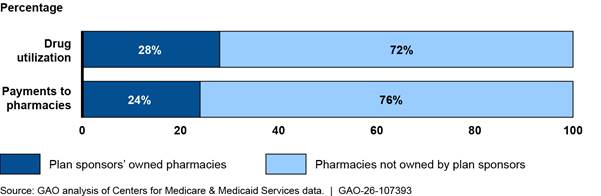
The insurance plan sponsors that provide Medicare Part D drug coverage have increasingly become vertically integrated—that is, under common ownership—with pharmacy benefit managers and pharmacies. GAO found that, for four large Part D plan sponsors, the pharmacies they owned accounted for about 24 percent of the Part D drugs they provided to their enrollees (drug utilization) and about 28 percent of the total payments to pharmacies in 2023 (see figure). Payments included both reimbursement from plan sponsors and cost sharing paid by or on behalf of beneficiaries. When these vertically integrated plan sponsors’ own pharmacies provided drugs to their enrollees, they primarily did so through mail-order pharmacies. In contrast, other (non-owned) pharmacies primarily provided drugs through retail pharmacies.
Percentage of Drug Utilization and Payments at Owned and Non-Owned Pharmacies for Four Selected Medicare Part D Plan Sponsors, 2023
When these plan sponsors paid pharmacies for a 30-day supply of the 100 most commonly used prescription drugs, payments and cost sharing for at least 94 percent of these drugs were lower for owned pharmacies than for non-owned pharmacies. These 100 drugs with the highest total utilization in 2023 were primarily generic drugs, and average payments to owned and non-owned pharmacies for a 30-day supply of most were $10 or less. Lower cost sharing at plan sponsors’ own (primarily mail-order) pharmacies gives beneficiaries a financial incentive to use these pharmacies instead of non-owned (primarily retail) pharmacies, though beneficiaries may consider other factors when choosing a pharmacy to fill a prescription.
Payments to pharmacies and cost sharing were also generally lower at owned pharmacies for the 100 drugs with the highest total payments in 2023, which were primarily brand-name drugs. For some of these drugs, however, payments or cost sharing were higher at owned pharmacies. For example, cost sharing across the four selected plan sponsors was up to about $340 higher at owned pharmacies for about half of the 20 drugs with the highest payments per 30-day supply.
Why GAO Did This Study
Medicare Part D spent $150 billion on prescription drug coverage for 54 million beneficiaries in 2025. Vertically integrated plan sponsors may encourage beneficiaries to fill prescriptions at—or utilize—their own pharmacies, a practice known as steering.
GAO was asked to review vertical integration among Part D plan sponsors, pharmacy benefit managers, and pharmacies. This report describes drug utilization at and payments to selected vertically integrated Part D plan sponsors’ own pharmacies compared to non-owned pharmacies, among other issues.
GAO selected four vertically integrated Part D plan sponsors from among the 15 plan sponsors with the largest Part D enrollment in 2023. These four large, vertically integrated plan sponsors accounted for over 40 percent of total Part D enrollment in 2023. GAO analyzed the Centers for Medicare & Medicaid Services Part D utilization and payments data for 2023 (the data most recently available at the time of GAO’s analysis). Our results for the four selected plan sponsors for 2023 are not generalizable to other plan sponsors or years. For example, Part D benefit changes since 2023 could have affected plan sponsors’ Part D drug utilization and payments at owned and non-owned pharmacies.
|
Abbreviations |
|
|
|
|
|
CMS |
Centers for Medicare & Medicaid Services |
|
MA |
Medicare Advantage |
|
PBM |
pharmacy benefit manager |
This is a work of the U.S. government and is not subject to copyright protection in the United States. The published product may be reproduced and distributed in its entirety without further permission from GAO. However, because this work may contain copyrighted images or other material, permission from the copyright holder may be necessary if you wish to reproduce this material separately.
September 3, 2026
The
Honorable Lloyd Doggett
Ranking Member
Subcommittee on Health
Committee on Ways and Means
House of Representatives
In 2025, approximately 54 million Medicare beneficiaries had prescription drug coverage through the Medicare Part D program. The program spent approximately $150 billion on this coverage. Part D drug coverage is provided to Medicare beneficiaries through drug plans administered by private companies that contract with the Centers for Medicare & Medicaid Services (CMS) to do so.[1]
In recent years, Part D plan sponsors have increasingly become vertically integrated—that is, under common ownership—with downstream entities in the prescription drug supply chain, including pharmacy benefit managers (PBM) and pharmacies.[2] For example, CMS data show eight of the 15 largest Part D plan sponsors in 2023—accounting for about 70 percent of total Part D enrollment—were vertically integrated with one or more PBMs, mail-order pharmacies, and specialty pharmacies.[3] This vertical integration occurs in the private insurance market as well.
Vertical integration may have a range of effects on beneficiaries and competing pharmacies. Part D plan sponsors that are vertically integrated may encourage beneficiaries to fill prescriptions at—or utilize—plan sponsors’ own pharmacies, a practice known as steering. Plan sponsors may have a financial incentive to steer beneficiaries to their own pharmacies to capture revenue and profit from beneficiaries’ prescriptions. If vertically integrated plan sponsors steer beneficiaries to their own pharmacies, they divert revenue away from other pharmacies (for example, independent community pharmacies). Plan sponsors’ payments to pharmacies are based on provisions in confidential contracts between these entities.
You asked us to conduct a study of vertical integration among plan sponsors, PBMs, and pharmacies. In this report, we describe
1. drug utilization at and payments to selected vertically integrated Part D plan sponsors’ own pharmacies compared to non-owned pharmacies; and
2. payment rates and related provisions in selected vertically integrated Part D plan sponsors’ contracts with their own pharmacies compared to non-owned pharmacies.
To describe drug utilization and payments to selected vertically integrated plan sponsors’ own pharmacies compared to non-owned pharmacies, we selected four vertically integrated Medicare Part D plan sponsors (selected plan sponsors) from among the 15 plan sponsors with the largest Part D enrollment in 2023. These four large, vertically integrated plan sponsors accounted for over 40 percent of total Part D enrollment and total Part D drug utilization and payments to pharmacies in 2023. Our results for the four selected plan sponsors for 2023 are not generalizable to other plan sponsors or years. For example, Part D drug benefit changes since 2023 could have affected plan sponsors’ Part D drug utilization and payments at owned and non-owned pharmacies. The term drug utilization refers to the number of 30-day supplies of Part D prescription drugs that pharmacies dispensed to beneficiaries. The term drug payments refers to gross payments to pharmacies at the point-of-sale for Part D prescription drugs, which includes payments from plan sponsors and cost sharing paid by or on behalf of beneficiaries.
We analyzed Part D prescription drug claims data from CMS for 2023 for the four selected plan sponsors. These data were the most current available at the time of our analysis.[4] We focused our analysis on two groups of drugs: (1) the 100 drugs with the highest total Part D drug utilization (highest utilization drugs) in 2023, which accounted for 59 percent of utilization and 18 percent of total payments, and (2) the 100 drugs with the highest total Part D payments (highest payment drugs) in 2023, which accounted for 7 percent of utilization and 53 percent of total payments.[5] Nearly all (92 of 100) of the highest utilization drugs were generic drugs, and nearly all (99 of 100) of the highest payment drugs were brand-name drugs.[6] We analyzed how our results differed between Part D plans that are restricted to members of an employer group (employer plans) compared to plans without such restrictions (non-employer plans).[7] For our comparisons of cost sharing between owned and non-owned pharmacies, we focused primarily on non-employer plans because employer plans report cost sharing differently.[8] When presenting our results, we aggregated them across the four selected plan sponsors.[9] We took steps to assess the reliability of the data we analyzed by, for example, conducting data checks for missing data and errors and comparing the data to published information when available. After taking these steps, we determined that the data were sufficiently reliable for the purposes of our reporting objectives. Appendix I provides additional details on our scope and methodology.
To describe how payment rates and related provisions in vertically integrated plan sponsors’ contracts with their own pharmacies compared to non-owned pharmacies, we reviewed a non-generalizable sample of 36 contracts between several large vertically integrated plan sponsors and pharmacies for 2023.[10] We selected these large vertically integrated plan sponsors from among the 15 plan sponsors with the largest Part D enrollment in 2023. For each plan sponsor in our analysis, we compared at least one owned pharmacy contract to the plan sponsor’s contracts with non-owned pharmacies. When presenting our results, we aggregated them across all plan sponsors in this analysis. We reviewed provisions on point-of-sale payment rates and dispensing fees as well as payment adjustments after the point-of-sale (e.g., based on a pharmacy’s performance on certain metrics). We selected contracts to reflect variation in ownership status, the type of pharmacy (e.g., retail or mail-order), and whether the pharmacy was a chain or independent.[11] The owned pharmacy contracts we reviewed represented a majority of all Part D prescriptions dispensed by each plan sponsor’s own pharmacies in 2023, according to plan sponsor representatives.
We conducted this performance audit from February 2024 to September 2026 in accordance with generally accepted government auditing standards. Those standards require that we plan and perform the audit to obtain sufficient, appropriate evidence to provide a reasonable basis for our findings and conclusions based on our audit objectives. We believe that the evidence obtained provides a reasonable basis for our findings and conclusions based on our audit objectives.
Background
Part D Plans
Medicare beneficiaries have the option to enroll in Part D drug coverage, and there are two common types of drug plans.
· Standalone prescription drug plans that supplement traditional Medicare with prescription drug coverage.
· Medicare Advantage (MA) plans, which generally must cover all traditional Medicare benefits, that opt to include Part D drug coverage.[12]
Either of these types of plans may be sponsored by an employer that contracts with a Part D plan sponsor to provide coverage for their Medicare-eligible members through a prescription drug plan or MA plan with Part D coverage.[13] These employer plans must meet the same CMS requirements as non-employer plans for what drugs are covered. However, employer plans have more flexibility when establishing pharmacy networks and when disseminating information on plan benefits to enrolled beneficiaries.
Part D Benefit
Part D plan sponsors may either offer a minimum “standard benefit” structure or an alternative but equivalent structure for their plans. For 2023—the year of data analyzed for this report—the Part D standard benefit had a deductible of $505, and beneficiaries paid 25 percent of drug costs (coinsurance) until reaching an out-of-pocket threshold of $7,400, after which they paid 5 percent coinsurance.[14] The alternative but equivalent benefit structure adjusts certain cost-sharing features from those of the standard benefit structure while covering the same share of expected drug spending for beneficiaries. Certain beneficiaries with low incomes receive financial assistance with Part D premiums and cost sharing through the low-income subsidy.[15]
In addition, Part D plans may offer supplemental coverage. Those plans are sometimes referred to as enhanced plans. Benefits offered by enhanced plans may include lower beneficiary cost sharing, a lower deductible, or supplemental drug coverage. Beneficiaries pay an additional premium to enroll in these plans. Employer plans may offer supplemental benefits that, for example, help defray expenses not covered by the Part D plan. However, these supplemental benefits from employers are non-Medicare benefits that are financed entirely by the employer and the beneficiary (e.g., through an additional premium).
Pharmacy Networks for Part D Plans
Plan sponsors develop networks of pharmacies to dispense drugs to their enrollees. To be in the network, a pharmacy—which can be an individual pharmacy, a pharmacy chain, or a pharmacy services administrative organization representing a group of independent pharmacies—signs a contract with the plan sponsor that specifies the types and level of payments from the plan sponsor to the pharmacy, among other provisions. Part D plan sponsors are required to include any pharmacies in their network that are willing to accept the sponsors’ standard provisions, which is known as the “any willing pharmacy” requirement.[16]
Additionally, non-employer plans’ networks must meet Part D’s pharmacy access standards, such as ensuring that beneficiaries have convenient access to retail pharmacies.[17] Furthermore, all Part D plans can designate certain network pharmacies as “preferred” pharmacies that may receive lower drug payments from the plan sponsor and offer lower cost sharing to beneficiaries. Preferred pharmacies can include a combination of pharmacies owned and not owned by a plan sponsor. However, Part D plans generally cannot require beneficiaries to fill prescriptions at specific pharmacies.
Part D plan pharmacy networks include three types of pharmacies that account for the majority of payments: retail, mail-order, and specialty.[18] Retail pharmacies primarily dispense drugs in-person at brick-and-mortar locations. Retail pharmacies may be part of a chain or independently owned. Independently owned pharmacies may be represented as a group by a pharmacy services administrative organization. Mail-order pharmacies dispense drugs by mail from facilities that are not open to the public.
Specialty pharmacies tend to dispense specialty drugs, which can include high-cost drugs used to treat complex, rare, or chronic diseases.[19] Manufacturers of specialty drugs may limit the dispensing of their drugs to certain pharmacies—referred to as a limited distribution network—to ensure that specialized transportation and storage needs are met and that patients receive education and monitoring by specialized pharmacists. Drugs with limited distribution networks are often available from specialty pharmacies that mail drugs to patients. For example, certain cancer drugs, such as pembrolizumab or erlotinib, that have a higher risk of serious side effects may be limited to a few pharmacies in a plan sponsors’ network.
Part D Drug Payments and Payment Adjustments Between Plan Sponsors, Pharmacies, and Beneficiaries
Payments between Part D plan sponsors, pharmacies, and beneficiaries for Part D drugs consist of payments to pharmacies at the point-of-sale (payments) and payment adjustments after the point-of-sale (payment adjustments). (See fig. 1.)
The total drug payment to a pharmacy at the point-of-sale includes the following.
· Drug payment rate, which includes (1) the drug payment by the plan sponsor and (2) cost sharing paid by or on behalf of the beneficiary (e.g., copayments or coinsurance). The drug payment rate may be based on a percentage of a drug price benchmark, such as the Average Wholesale Price.[20]
· Dispensing fee, which is a dollar amount the plan sponsor pays the pharmacy when the pharmacy dispenses a drug.
In addition, payment adjustments after the point-of-sale include the following.[21]
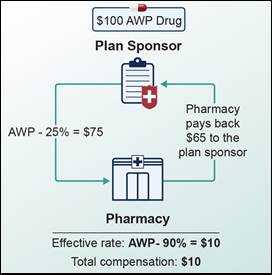
· Effective rates, which involve contract provisions that require payment adjustments to ensure that a plan sponsor pays a pharmacy an average level of payment for brand-name or generic drugs. For example, a pharmacy’s contract may have “effective rate” provisions requiring the pharmacy to receive 40 percent below the Average Wholesale Price for generic drugs. If the pharmacy had previously received a higher amount for these drugs (e.g., 10 percent below the Average Wholesale Price) at the point-of-sale, the pharmacy would be required to pay the difference to the plan sponsor.
· Performance-based adjustments, which are paid based on whether a pharmacy meets performance targets for certain drugs.[22] These adjustments can involve a plan sponsor (1) withholding a percentage of the payment to the pharmacy at the point-of-sale (e.g., a payment withhold of 8 percent); and (2) paying—after the point-of-sale—the pharmacy some of, all of, or more than the amount withheld based on whether the pharmacy met the applicable performance targets.
Figure 1: Payments Between a Medicare Part D Plan Sponsor, a Pharmacy, and a Part D Beneficiary for a Prescription Drug Covered Under Medicare Part D
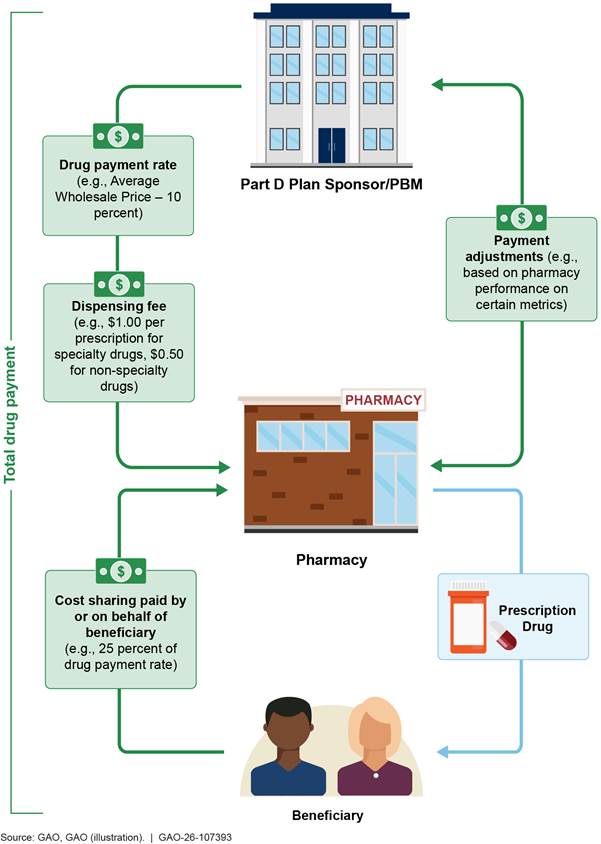
Note: Pharmacy benefit managers (PBM) may provide or receive payments on behalf of plan sponsors. Cost sharing is part of the drug payment paid by or on behalf of the beneficiary (e.g., copayments or coinsurance). The Average Wholesale Price is in most cases the manufacturer’s suggested list price and does not necessarily reflect the actual price paid by the purchaser.
Vertical Integration Between Plan Sponsors, PBMs, and Pharmacies
Many of the largest Part D plan sponsors by enrollment were vertically integrated with PBMs and pharmacies as of 2023. Specifically, eight of the 15 Part D plan sponsors with the largest Part D enrollment in 2023 were vertically integrated. PBMs within these vertically integrated plan sponsors may provide services exclusively to their plan sponsor, or they may also provide PBM services under contract with other plan sponsors. All eight of these vertically integrated plan sponsors owned a mail-order or specialty pharmacy, and some of them also owned retail pharmacies.
Vertically integrated plan sponsors may steer beneficiaries to their own pharmacies instead of other non-owned pharmacies to keep revenue within their organization. For example, plan sponsors may send targeted mailings to beneficiaries to encourage them to use plan sponsors’ own pharmacies.[23] Another way this can occur is by classifying their own pharmacies as “preferred” pharmacies. As noted above, preferred pharmacies may accept lower payment rates and have lower cost sharing.[24] Beneficiaries seeking lower cost sharing may be more likely to choose “preferred” pharmacies, which could increase dispensing volume at these pharmacies. However, steering beneficiaries to plan sponsors’ own pharmacies (e.g., by designating them as “preferred”) also diverts revenue from other pharmacies, which could reduce access to independent and other non-owned pharmacies by potentially making it more difficult for them to compete to stay in business.[25]
Vertically integrated plan sponsors may also have incentives to pay their own pharmacies higher rates than non-owned pharmacies.[26] For example, plan sponsors could pay more to their own pharmacies to shift revenue from the plan sponsor to the owned pharmacy, thus potentially making it easier for the plan sponsor to comply with CMS’s medical loss ratio requirements (see text box).[27]
|
Medical Loss Ratio and Vertical Integration between Plan Sponsors, PBMs, and Pharmacies CMS requires large group health plans—including Medicare Advantage drug plans—to spend at least 85 percent of total premium revenue on health care costs. This includes both payments to pharmacies for prescription drugs, and quality improvement efforts, rather than administrative costs and profit and is referred to as the medical loss ratio. To maintain a medical loss ratio above the 85 percent threshold, a vertically integrated plan sponsor could shift revenue from the plan sponsor to their own pharmacies by paying these pharmacies higher payment rates than non-owned pharmacies. These higher payments to the plan sponsor’s own pharmacies for prescription drugs could increase the plan sponsor’s health care costs and its medical loss ratio. |
Source: GAO. | GAO‑26‑107393
For Selected Plan Sponsors, Vertically Integrated Pharmacies Accounted For About One-Quarter of Drug Utilization and Payments
In 2023, for the four selected plan sponsors, their own pharmacies accounted for about one-quarter of all 30-day drug supplies dispensed (utilization) and point-of-sale payments to pharmacies (payments), which included cost sharing paid by or on behalf of beneficiaries. However, for individual drugs, the percentage of utilization at owned pharmacies compared to non-owned pharmacies was sometimes much higher or lower than the average for all drugs. Employer plans tended to have higher percentages of utilization at owned pharmacies compared to non-employer plans. Furthermore, payments and cost sharing were generally lower at owned pharmacies compared to non-owned pharmacies. Lower cost sharing at plan sponsors’ own pharmacies is one way for plan sponsors to steer beneficiaries to these pharmacies.
Approximately One Quarter of Selected Plan Sponsors’ Total Part D Drug Utilization and Payments Were at Owned Pharmacies
Among the four selected plan sponsors in 2023, pharmacies that were vertically integrated with the plan sponsors accounted for a lower share of the sponsors’ Part D payments and beneficiary drug utilization compared with pharmacies not owned by the plan sponsors.[28] Approximately 28 percent of the selected plan sponsors’ total Part D utilization and 24 percent of their total Part D payments to pharmacies were at pharmacies they owned, which were primarily mail-order and specialty pharmacies.[29] Pharmacies not owned by the plan sponsors—primarily retail pharmacies—accounted for the remaining 72 percent of the sponsors’ Part D utilization and 76 percent of the sponsors’ Part D payments.[30]
The Percentage of Drug Utilization at Owned Pharmacies Varied Across Individual Drugs and Was Generally Higher for Employer Plans
While overall Part D drug utilization at selected plan sponsors’ owned pharmacies was 28 percent, CMS data showed that on an individual drug level, owned pharmacy utilization was sometimes much higher or lower. Specifically, for two groups of drugs—the highest utilization and highest payment drugs—the percentage of a drug’s total utilization at owned pharmacies ranged from 0 to 84 percent. Highest utilization drugs are the 100 drugs with the greatest number of 30-day supplies across Part D in 2023, and highest payment drugs are the 100 drugs with the greatest total payments in 2023 (see text box). Additionally, the percentage of drug utilization at owned pharmacies compared to non-owned pharmacies was generally higher for employer plans than for non-employer plans.
|
Drugs with the Highest Part D Utilization and Payments in 2023 The 100 drugs with the highest total Part D utilization in 2023—of which 92 were generic drugs—accounted for approximately 59 percent of total Part D utilization and 18 percent of total payments in 2023. The 100 drugs with the highest total Part D payments in 2023—of which 99 were brand-name drugs—accounted for approximately 7 percent of total Part D utilization and 53 percent of total payments. For the selected plan sponsors, the average payment ranged from less than $1 to about $600 for the highest utilization drugs, and most of these drugs were $10 or less. For the highest payment drugs, the average payment ranged from about $210 to $29,300 and also differed markedly in terms of their utilization. For example, one drug with an average payment per 30-day supply of about $580 had nearly 25 million 30-day supplies paid for by Part D in 2023. A different drug had an average payment per 30-day supply of about $28,500 and had about 23,000 30-day supplies paid for by Part D in 2023. Cost sharing paid by or on behalf of beneficiaries for most of the highest utilization drugs ranged from less than $0.50 to $5 in selected plan sponsors’ non-employer plans. For most of the highest payment drugs, cost sharing ranged from about $70 to $1,100. However, one-quarter of the highest payment drugs had cost sharing of about $1,100 to $3,400 per 30-day supply. |
Source: GAO analysis of Centers for Medicare & Medicaid Services data. | GAO‑26‑107393
Note: Cost sharing is part of the drug payment paid by or on behalf of the beneficiary (e.g., copayments or coinsurance). Cost sharing results are based on beneficiaries in non-employer plans.
Individual drugs. The percentage of Part D drug utilization at plan sponsors’ own pharmacies compared to non-owned pharmacies varied widely across the 100 highest utilization and 100 highest payment drugs (see fig. 2). Specifically, the percentage of utilization at owned pharmacies ranged from 0 to 48 percent for the highest utilization drugs and from 0 to 84 percent for the highest payment drugs. Also, the percentage of utilization at owned pharmacies tended to be higher for the highest utilization drugs compared to highest payment drugs. Specifically, the median percentage of utilization for highest utilization drugs at owned pharmacies was 5 percentage points higher than the median percentage of utilization for highest payment drugs.
Figure 2: Percentage of Part D Drug Utilization at Owned Pharmacies by Selected Plan Sponsors for the 100 Highest Utilization and Highest Payment Drugs, 2023
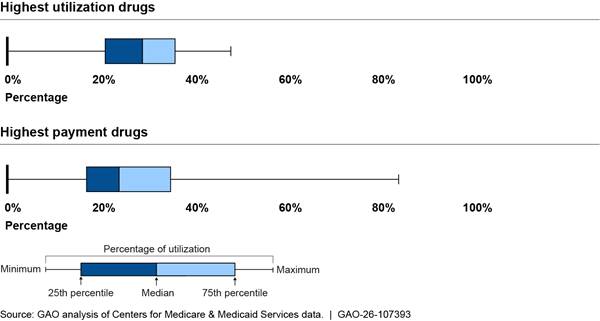
Notes: Selected plan sponsors are four large Medicare Part D plan sponsors that were vertically integrated—that is, under common ownership—with a pharmacy benefit manager and pharmacies in 2023. Results are aggregated across the four selected plan sponsors. The highest utilization drugs are 100 drugs with the highest number of 30-day supplies dispensed by pharmacies across the Part D program in 2023. The highest payment drugs are 100 drugs with the highest total payments across the Part D program in 2023. Percentage of drug utilization at owned pharmacies is the number of 30-day Part D drug supplies dispensed by a plan sponsor’s own pharmacies out of all 30-day supplies of that drug dispensed by the plan sponsor.
For both the highest utilization and highest payment drugs, there were some similarities in the drugs with the highest and lowest percentage of drug utilization at owned pharmacies.
· Highest utilization drugs. For the selected plan sponsors, one to two opioid drugs were among the drugs with the lowest percentage of drug utilization at owned pharmacies. In addition, several drugs used to treat high cholesterol or high blood pressure were among drugs with the highest percentage of drug utilization at owned pharmacies.
· Highest payment drugs. For the highest payment drugs, several drugs with the lowest or highest percentage of drug utilization at owned pharmacies were limited distribution drugs according to one plan sponsor, meaning that the drug manufacturer selects pharmacies to dispense the drug. Some of the limited distribution drugs with the lowest percentage of utilization at owned pharmacies had no claims.
A variety of factors can affect the percentage of a drug’s utilization that is dispensed at a plan sponsor’s own pharmacies. For example, beneficiaries may prefer to fill prescriptions at pharmacies with lower cost sharing, pharmacies closest to home, or pharmacies that deliver prescriptions by mail. Furthermore, marketing and health care provider outreach by plan sponsors also have the potential to influence where beneficiaries fill their prescriptions.[31] In addition, as noted before, drug manufacturers may require that certain drugs be dispensed at specific pharmacies, which could limit beneficiaries’ choice of pharmacy.
Employer versus non-employer plans. The percentage of drug utilization at owned pharmacies compared to non-owned pharmacies was generally higher for employer plans than for non-employer plans. For the selected plan sponsors, the percentage of utilization at owned pharmacies was higher for employer plans than non-employer plans for about three-fourths of the highest utilization and highest payment drugs. For example, one plan sponsor’s percentage of utilization at owned pharmacies for one drug was nearly 50 percentage points higher for employer plans than for non-employer plans. See appendix II for details.
Higher drug utilization at owned pharmacies by employer plans could be related to multiple factors, such as the flexibilities for creating pharmacy networks, and could reflect greater steering to owned pharmacies of beneficiaries in these plans.[32] For example, beneficiaries in employer plans may have previously been enrolled in their employer’s commercial plan, which may have required the use of mail-order pharmacies, according to CMS officials. As a result, CMS officials noted that these beneficiaries may be more comfortable with the use of mail-order pharmacies. In addition, plan sponsors may have more capacity to steer beneficiaries in employer plans to owned pharmacies because they have more flexibility when disseminating benefits information to beneficiaries.
Payments and Cost Sharing Were Lower at Owned Than at Non-Owned Pharmacies
Payments and cost sharing for highest utilization drugs. Payments to pharmacies per 30-day supply of Part D drugs for selected plan sponsors were lower at owned pharmacies compared to non-owned pharmacies for 94 percent of the highest utilization drugs in 2023. Payments to owned pharmacies were up to $5 lower than non-owned pharmacies for 80 percent of the highest utilization drugs. These dollar amounts could equate to large percentage differences given that the total payment for a 30-day supply of most of these drugs was $10 or less. For example, payments were at least 40 percent lower at owned pharmacies for 43 percent of the highest utilization drugs.
Cost sharing was lower at owned pharmacies for at least 98 percent of the highest utilization drugs for beneficiaries in both non-employer and employer plans. Cost sharing for these beneficiaries was generally up to $5 lower at owned pharmacies. See appendix II for more detail.
Payments and cost sharing for highest payment drugs. Payments to pharmacies per 30-day supply of most of the highest payment drugs were lower at owned pharmacies compared to non-owned pharmacies across the selected plan sponsors, and cost sharing was also lower for most of these drugs.[33]
|
Adjustments Paid Back by Pharmacies to the Four Selected Plan Sponsors in 2023 The selected plan sponsors’ payment adjustments in 2023, which included performance-based adjustments, primarily involved pharmacies paying back plan sponsors a portion of the point-of-sale payments. Of the total payments for Part D drugs that pharmacies received at the point-of-sale from the four selected plan sponsors in 2023, pharmacies paid 7 percent back to plan sponsors in the form of net payment adjustments. These net adjustment payments to plan sponsors reflect 8 percent of total payments that pharmacies paid plan sponsors and 1 percent in total payments that pharmacies received from plan sponsors. We could not determine the amount of payment adjustments that went to owned or non-owned pharmacies because these data were not available for individual pharmacies. However, payment adjustments could differ between owned and non-owned pharmacies given that owned pharmacies primarily dispense drugs via mail order while non-owned pharmacies are primarily retail. Source: GAO analysis of CMS data. | GAO-26-107393 |
Payments were lower at owned pharmacies compared to non-owned pharmacies for about 68 percent of the highest payment drugs across the four selected plan sponsors.[34] In addition, about 60 percent of the highest payment drugs for these plan sponsors had average payments that were up to 10 percent lower at owned pharmacies (see fig. 3).
These results are based on gross payments to pharmacies and therefore do not reflect rebates the plan sponsors may have received from drug manufacturers or any payment adjustments between plan sponsors and pharmacies after the point-of-sale, such as performance-based adjustments.[35] For more information on payment adjustments between plan sponsors and pharmacies, see sidebar. We also compared payments to owned and non-owned pharmacies net of drug manufacturer rebates (i.e., gross payments minus drug manufacturer rebates).[36] We found that, similar to the results based on gross payments described above, payments net of manufacturer rebates by three selected plan sponsors to owned pharmacies were lower than non-owned pharmacies for about 67 percent of the highest payment drugs.[37] See appendix III for more detail.
Figure 3: Comparison of Average Payments for the Highest Payment Drugs Between Pharmacies Owned and Not Owned by Selected Part D Plan Sponsors, 2023
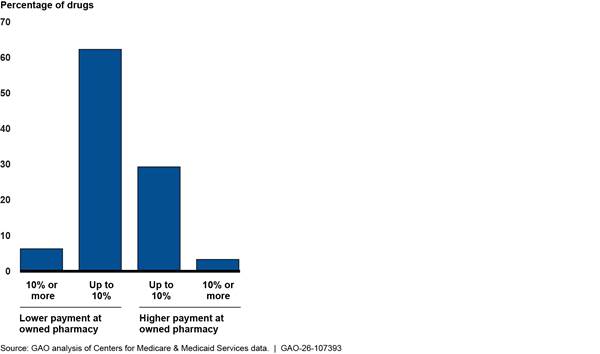
Notes: Selected plan sponsors are four large Medicare Part D plan sponsors that were vertically integrated—that is, under common ownership with—a pharmacy benefit manager and pharmacies in 2023. Highest payment drugs are 100 drugs with the highest total payments across the Part D program in 2023. Average payments are gross payments for 30-day supplies of Part D drugs (i.e., the amount paid to pharmacies by plan sponsors and by or on behalf of beneficiaries—the latter in the form of cost sharing) at the point of sale. Results reflect both standalone and Medicare Advantage plans with Part D drug coverage offered by the selected plan sponsors in 2023.
Cost sharing paid by or on behalf of beneficiaries was lower at owned pharmacies for about 85 percent of the highest payment drugs for beneficiaries in non-employer plans.[38] For these beneficiaries, cost sharing was generally up to $100 lower at owned pharmacies (see fig. 4). Cost sharing was also lower at owned pharmacies for beneficiaries in employer plans for about 92 percent of the highest payment drugs.[39]
Figure 4: Difference in Average Cost Sharing for the Highest Payment Drugs Between Pharmacies Owned and Not Owned by Selected Part D Plan Sponsors for Non-Employer Part D Plans, 2023
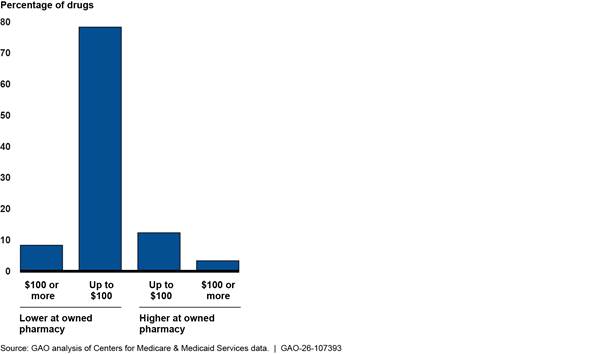
Notes: Selected plan sponsors are four large Medicare Part D plan sponsors that were vertically integrated—that is, under common ownership—with a pharmacy benefit manager and pharmacies in 2023. Highest payment drugs are 100 drugs with the highest total payments across the Part D program in 2023. Cost sharing values are for beneficiaries in non-employer plans, and include amounts paid by or on behalf of beneficiaries. Results reflect both standalone and Medicare Advantage non-employer plans with Part D drug coverage offered by the selected plan sponsors in 2023.
The results described above—for the 100 drugs with the highest total payments across Part D in 2023—differed for the subset of 20 of these drugs with the highest payment per 30-day supply. The payment per 30-day supply for these 20 drugs ranged from about $13,000 to about $29,300, and cost sharing per 30-day supply ranged from about $1,100 to $3,400. Payments for about half of these 20 drugs were up to 10 percent higher at owned pharmacies.[40] This differed from payments for the 100 highest payment drugs, where about one-third of the 100 drugs had higher payments at owned pharmacies for the four selected plan sponsors. In addition, cost sharing in non-employer plans for about half of these 20 drugs was up to about $340 higher at owned pharmacies for the four selected plan sponsors. This differed from cost sharing for the 100 highest payment drugs, where about 15 percent or less of these drugs had higher cost sharing at owned pharmacies. See appendix IV for more detail.
Part D Payment Rates for Owned Pharmacies in Contracts Reviewed Were Not Consistently Higher or Lower than Non-Owned Pharmacies
In the 36 contracts between plan sponsors and pharmacies we reviewed for 2023, payment rates and dispensing fees were not consistently higher or lower in contracts between each plan sponsor’s owned and non-owned pharmacies.[41] Additionally, some contracts we reviewed had effective rate provisions, and we identified differences between owned and non-owned pharmacies in the payments withheld for performance-based adjustments.
Contracted Payment Rates Were Not Consistently Higher or Lower Between Owned and Non-Owned Pharmacies
Drug payment rates. When we compared owned and non-owned pharmacy contracts for each plan sponsor in our analysis, drug payment rates to owned pharmacies were not consistently higher or lower than non-owned pharmacies (see fig. 5). Specifically, the difference for owned pharmacies’ brand-name drug payment rates had a range typically within 10 percentage points higher or lower, while generic drugs had a much wider range. In addition, some plan sponsors had programs for generic drugs that reduced payments to their own pharmacies to $0 and only paid the dispensing fee and taxes.
Figure 5: Range of Differences in Drug Payment Rates in Plan Sponsor Contracts for Owned Compared to Non-owned Pharmacies, 2023
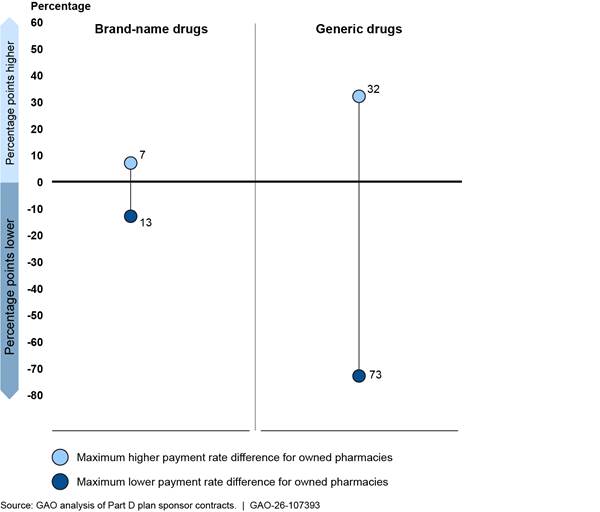
Notes: Results are based on an analysis of 36 contracts for several large Medicare Part D plan sponsors that were vertically integrated—that is, under common ownership with—a pharmacy benefit manager and pharmacies. We selected several sponsors from among the 15 Part D plan sponsors with largest Part D enrollment in 2023. For each plan sponsor, we selected contracts between the plan sponsor, or a pharmacy benefit manager acting on their behalf, and pharmacies, which included at least one owned pharmacy and included contracts with pharmacies that were in a retail chain, were independent, mail-order, or specialty pharmacies.
We compared payment rates for owned and non-owned pharmacies across respective networks within a plan sponsor. The contracts we reviewed generally determined payment for generic drugs (and brand name drugs for some plan sponsors) based on multiple payment benchmarks set by the plan sponsor or a payment rate set in the contract. Because the payment benchmarks were generally similar for all pharmacies within a plan sponsor, our results are based on a comparison of the contracted payment rates. Additionally, some plan sponsors had programs for generic drugs that reduced payments to their own pharmacies to $0 and only paid the dispensing fee and taxes.
|
Effective Payment Rate Provisions Effective payment rate provisions can ensure that a plan sponsor pays a pharmacy an average level of payment for brand-name or generic drugs. If the total payments to a pharmacy differ from the effective rate, then payment adjustments would account for this difference. For example, one plan sponsor’s contract with a pharmacy contained effective payment rates for generic drugs—expressed as a percentage of the drug’s Average Wholesale Price (AWP)—that were over 60 percentage points lower than the payment rate at the point of sale. As a result, the pharmacy would be required to pay this difference to the plan sponsor after the point of sale. The figure below illustrates how such a difference could occur.
|
|
Source: GAO analysis of Part D plan sponsor contracts. | GAO‑26‑107393 |
The size of these differences depended in part on whether the owned pharmacy was a mail-order or another type of pharmacy. For some plan sponsors, payment rates for their own mail-order pharmacies were over 60 percentage points lower than some non-owned pharmacies for generic drugs. For other types of pharmacies owned by these plan sponsors (e.g., specialty pharmacies), the differences were smaller, although we found that owned specialty pharmacies rarely dispensed highly utilized generic drugs. Payment rates for each plan sponsor’s non-owned pharmacies were generally similar to each other, regardless of pharmacy type. For example, payment rates for non-owned retail chain pharmacies were generally similar to rates for non-owned independent and specialty pharmacies.
In the contracts we reviewed, payments for at least some drugs were generally based on multiple payment benchmarks for both owned and non-owned pharmacies. Therefore, the size of any payment differences we identified between owned and non-owned pharmacies depends on which benchmark the plan sponsor used to pay for the drug. Some of these rates or benchmarks included the following:
· Payment rates specified in the contract.
· The maximum allowable cost, which is the maximum amount a plan sponsor will reimburse for a drug.[42]
· Usual and Customary price, which is the price an individual without prescription drug coverage would pay at a retail pharmacy.
Dispensing fees. Dispensing fees ranged from $0 to $2 in the contracts we reviewed, and owned pharmacies were not consistently higher or lower than non-owned pharmacies for the plan sponsors in our analysis. In addition, any differences in dispensing fees between plan sponsors’ owned and non-owned pharmacies were generally $1 or less for brand or generic drugs.
Effective payment rates. Some of the contracts we reviewed contained effective rate provisions that adjusted drug payment rates after the point-of-sale (see sidebar). We were not able to compare effective rates for most plan sponsors in our analysis because either owned pharmacy contracts we reviewed did not include them or the effective rate structures differed between the owned and non-owned pharmacy contracts. For example, owned pharmacies in some contracts we reviewed had effective rates that were either similar or up to 22 percentage points lower than non-owned pharmacies, depending on the type of drug. These effective rates could be substantially lower than point-of-sale payment rates (see sidebar).
We also reviewed non-payment provisions in plan sponsors’ contracts with pharmacies, such as unilateral changes to contracts, generic drug dispensing requirements, and inventory restrictions (see text box). These provisions were generally similar for owned and non-owned pharmacies.
|
Non-Payment Related Provisions in Contracts Between Medicare Part D Plan Sponsors and Pharmacies, 2023 Provisions not related to payment—such as those allowing unilateral changes to contract or relating to audits—can exist in plan sponsor’s (or the pharmacy benefit manager acting on their behalf) contracts with pharmacies. Some of these provisions could include the following: · Unilateral changes to contracts. Contracts between plan sponsors and pharmacies can include provisions that allow the plan sponsor to unilaterally change the contract. These changes could include adjustments to the payment rates, performance-based adjustments, or other provisions. · Contract termination. Contracts between plan sponsors and pharmacies can include provisions that permit termination of the contract without cause. · Generic drug dispensing rates. Contracts between plan sponsors and pharmacies can include generic drug dispensing rates, such as metrics for pharmacies to dispense generic drugs instead of brand name drugs. · Inventory restrictions. Contracts between plan sponsors and pharmacies can include drug inventory restrictions for pharmacies. · Audits. Contracts between plan sponsors and pharmacies can include audit provisions that result in fees for certain activities. To the extent that GAO identified these provisions in the contracts reviewed for each plan sponsor, GAO found they were generally similar between owned and non-owned pharmacies. |
Source: GAO analysis of Part D plan sponsor contracts | GAO‑26‑107393
Note: See Federal Trade Commission, Pharmacy Benefit Managers: The Powerful Middlemen Inflating Drug Costs and Squeezing Main Street Pharmacies, Interim Staff Report (Washington, D.C.: July 2024) and public comments to the Federal Trade Commission.
Payments That Sponsors Withheld from Pharmacies for Performance-Based Adjustments Varied Between Owned and Non-Owned Pharmacies
The percentage of a pharmacy’s drug payments that the plan sponsor withheld for performance-based adjustments varied between owned and non-owned pharmacies for certain drugs, which could lead to different payment adjustments for pharmacies. For example, the percentage of payments withheld from owned pharmacies was similar to or up to 5 percentage points lower than non-owned pharmacies, depending on the plan sponsor and type of drug. In addition, a plan sponsor’s payments withheld were up to 4 percentage points higher for pharmacies in preferred networks than non-preferred networks in the contracts we reviewed.
|
Performance-Based Payment Adjustments Performance-based adjustments in the contracts we reviewed generally applied to drugs that are prescribed to treat chronic conditions requiring ongoing medication such as diabetes, high cholesterol, and hypertension. Plan sponsors withhold a percent of pharmacies’ payment for these drugs. Then, performance-based adjustments are typically calculated based on a drug's payment and a pharmacy’s performance. For example, one plan sponsor withheld around 10 percent of their payment. The plan sponsor subsequently paid pharmacies some of, all of, or more than the withheld amount based on whether the pharmacy met certain performance targets. These performance targets can be based on Centers for Medicare & Medicaid Services Star Ratings. Some Star Ratings’ measures are for adherence to medications for conditions such as diabetes. For example, a performance target could be a percentage of plan members with a prescription for diabetes medication that fills their prescription at least 80 percent of time. Source: GAO analysis of Part D plan sponsor contracts. | GAO‑26‑107393 |
Differences in the amount of payments withheld between owned and non-owned pharmacies could contribute to different net losses or gains for pharmacies due to performance-based adjustments. For example, performance-based adjustments from one plan sponsor for a drug with a $1,000 payment could result in a range—depending on the pharmacy’s performance—of a $70 reduction to a $30 increase in payment rates for the owned pharmacy or a $120 reduction to $0 increase in payment rates for a non-owned pharmacy. This example assumes the payment rates for the two pharmacies are the same. According to one plan sponsor, differences in payment withheld may be offset by differences in payment rates in the contracts.
Pharmacies could receive different performance-based payment adjustments even when they are subject to the same payment withheld. For example, payment adjustments could differ between mail-order and retail pharmacies despite the same payment withhold because, as some studies have reported, mail-order pharmacies could have advantages over retail pharmacies when demonstrating medication adherence.[43]
Agency Comments
We provided a draft of this report to the Department of Health and Human Services for review and comment. The Department of Health and Human Services did not have any comments on the report.
As agreed with your office, unless you publicly announce the contents of this report earlier, we plan no further distribution until 30 days from the report date. At that time, we will send copies of this report to the appropriate Congressional committees, the Secretary of Health and Human Services, and other interested parties. In addition, the report will be available at no charge on the GAO website at https://www.gao.gov.
If you or your staff have any questions about this report, please contact me at DickenJ@gao.gov. Contact points for our Offices of Congressional Relations and Media Relations may be found on the last page of this report. GAO staff who made key contributions to this report are listed in appendix V.
John E. Dicken
Director, Health Care
This appendix provides details on our scope and methodology in addressing objectives that describe: (1) drug utilization at and payments to selected vertically integrated Medicare Part D plan sponsors’ owned pharmacies compared to non-owned pharmacies; and (2) payment provisions in selected vertically integrated plan sponsors’ Part D contracts with owned pharmacies compared to non-owned pharmacies.
To describe drug utilization and payments to selected vertically integrated plan sponsors’ own pharmacies compared to non-owned pharmacies, we selected four large, vertically integrated Medicare Part D plan sponsors (selected plan sponsors) from among the 15 plan sponsors with the largest Part D enrollment in 2023. These four vertically integrated plan sponsors accounted for over 40 percent of total Part D enrollment and total Part D drug utilization and payments to pharmacies in 2023.[44] Our results for the four selected plan sponsors for 2023 are not generalizable to other plan sponsors or years. We analyzed Part D enrollment data from the Centers for Medicare & Medicaid Services’ (CMS) to identify the 15 plan sponsors with the largest Part D enrollment in 2023. We analyzed CMS data on Part D subcontractors along with information from S&P Capital IQ to determine whether plan sponsors were vertically integrated with a pharmacy benefit manager and pharmacies.[45]
We analyzed drug utilization and payments for Medicare Part D prescription drug plans using Part D data from CMS’s Prescription Drug Event database for 2023 for the four selected plan sponsors.[46] This was the most current data available at the time of our analysis. We calculated drug utilization using the number of 30-day drug supplies dispensed by pharmacies to beneficiaries. We calculated drug payments by summing the gross payments made to pharmacies at the point-of-sale by Part D plan sponsors and cost sharing by or on behalf of beneficiaries (cost sharing).
We identified pharmacy ownership for selected plan sponsors (i.e., owned and non-owned) and pharmacy type (i.e., retail, mail-order, specialty, other) using 2023 dataQ® data from the National Council for Prescription Drug Programs.[47] We confirmed pharmacy ownership and pharmacy type for pharmacies owned by selected plan sponsors with plan sponsor representatives.
We also used the Prescription Drug Event data to analyze and report on two groups of drugs: 100 drugs with the highest drug utilization (highest utilization drugs) and 100 drugs with the highest total payments (highest payment drugs) across Medicare Part D in 2023. For the two groups of drugs, we analyzed drug utilization, payments, and cost sharing at owned pharmacies and non-owned pharmacies by plan sponsor. When presenting our results, we aggregated them across the four selected plan sponsors.[48] In addition, our results reflect both standalone and Medicare Advantage plans with Part D drug coverage offered by the selected plan sponsors in 2023.
We analyzed how results for the highest utilization drugs and the highest payment drugs differed by type of Part D plan—that is, stand-alone drug plans and Medicare Advantage (MA) plans restricted to members of an employer group (employer plans) compared to stand-alone and MA plans without such restrictions (non-employer plans). For these analyses, we also compared the percentage of the highest utilization and highest payment drugs with lower payments and lower cost sharing at owned pharmacies between employer and non-employer plans. Due to differences in how cost sharing is reported for employer and non-employer plans, we calculated cost sharing differently for these plan types. For non-employer plans, cost sharing was the total amount paid by or on behalf of the beneficiary, which included payment paid directly from the beneficiary and other sources, such as the low-income subsidy program. For employer plans, cost sharing only included the payment paid directly by the beneficiary and did not include payments from other sources such as supplemental benefits paid by the employer.
We also analyzed payment adjustments using CMS’ Direct and Indirect Remuneration data from 2023. We used summary level data to analyze the net payment adjustments between selected plan sponsors and pharmacies. We used drug-level data to analyze the percentage of drug manufacturer rebates associated with the highest payment drugs. To calculate payments to pharmacies net of drug manufacturer rebates for each plan sponsor and drug, we subtracted the average drug manufacturer rebate per 30-day supply of a drug for owned (or non-owned) pharmacies from the average gross payment for the drug.[49]
For all of the data we analyzed, we took steps to ensure their reliability, including interviewing knowledgeable officials, conducting data checks for missing data and errors, and comparing the data to published information when available. After taking these steps, we determined that the data were sufficiently reliable for the purposes of our reporting objectives.
To describe how payment provisions in selected vertically integrated plan sponsors’ contracts with pharmacies differed between their owned and non-owned pharmacies, we reviewed a non-generalizable sample of 36 contracts between several large vertically integrated plan sponsors, or pharmacy benefit managers acting on their behalf, and pharmacies for 2023. We selected these large vertically integrated plan sponsors from among the 15 plan sponsors with the largest Part D enrollment in 2023. For each plan sponsor in our analysis, we compared at least one owned pharmacy contract to the plan sponsor’s contracts with non-owned pharmacies. We presented results aggregated across all plan sponsors in this analysis. We selected contracts to reflect variation in ownership status, the type of pharmacy (e.g., retail or mail-order), and whether the pharmacy was a chain or independent.[50] The owned pharmacy contracts we reviewed represented a majority of all Part D prescriptions dispensed by the pharmacies owned by plan sponsors in 2023, according to plan sponsor representatives.
The contracts we reviewed generally represented multiple Part D networks for each plan sponsor. Networks may have different payment rates in the contracts. For example, contracts may include separate payment rates for Medicare Advantage, prescription drug, preferred, and non-preferred networks. Additionally, some plan sponsors had separate payment rates for non-specialty and specialty drugs in their contracts with pharmacies. We compared ranges of payment rates for plan sponsors within networks and for non-specialty and specialty drugs, when applicable.
We conducted this performance audit from February 2024 to September 2026 in accordance with generally accepted government auditing standards. Those standards require that we plan and perform the audit to obtain sufficient, appropriate evidence to provide a reasonable basis for our findings and conclusions based on our audit objectives. We believe that the evidence obtained provides a reasonable basis for our findings and conclusions based on our audit objectives.
Appendix II: Analysis of Part D Drug Utilization, Payments, and Cost Sharing by Plan Type for Selected Part D Plan Sponsors
As part of our work, we analyzed how Medicare Part D drug utilization, payments, and cost sharing differed by plan type for selected Part D plan sponsors in 2023.[51] Specifically, we compared employer group waiver plans (employer plans) to non-employer plans.[52] For each plan type, we analyzed utilization, payments, and cost sharing for two groups of drugs: 100 drugs with the highest drug utilization (highest utilization drugs) and 100 drugs with the highest total payments (highest payment drugs) across Medicare Part D in 2023. We analyzed these data at pharmacies owned by selected plan sponsors (owned pharmacies) and pharmacies not owned by selected plan sponsors (non-owned pharmacies).
Differences in Owned Pharmacy Utilization Between Employer and Non-Employer Plans
We found that employer plans tended to have higher percentages of drug utilization at owned pharmacies than non-employer plans, including for both the highest utilization and highest payment drugs. For example, for the highest payment drugs, the median percentage of utilization at owned pharmacies was 21 percentage points higher for employer plans than for non-employer plans. See figure 6.
Figure 6: Median Percentage of Part D Drug Utilization at Owned Pharmacies by Selected Plan Sponsors for the 100 Highest Utilization and Highest Payment Drugs by Plan Type, 2023
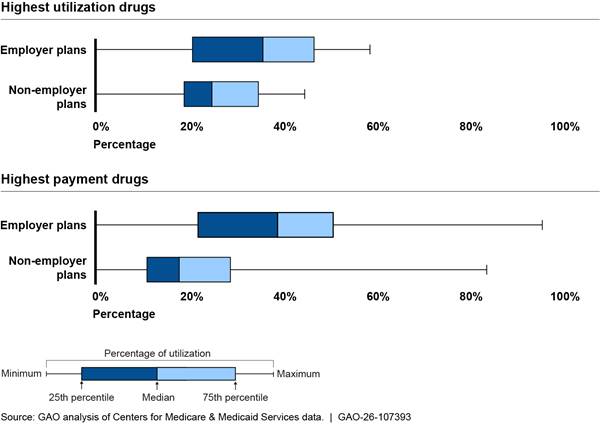
Notes: Selected plan sponsors are four large Medicare Part D plan sponsors that were vertically integrated—that is, under common ownership—with a pharmacy benefit manager and pharmacies in 2023. Results above are aggregated across these four plan sponsors. The highest utilization drugs are 100 drugs with the highest number of 30-day supplies dispensed by pharmacies across the Part D program in 2023. The highest payment drugs are 100 drugs with the highest total payments across the Part D program in 2023. Percentage of drug utilization at owned pharmacies is the number of 30-day Part D drug supplies dispensed by a plan sponsor’s own pharmacies out of all 30-day supplies of that drug dispensed by the plan sponsor. Employer plans are standalone prescription drug plans or Medicare Advantage plans with prescription drug coverage where enrollment is restricted to members of an employer group, while non-employer plans lack such enrollment restrictions.
Data showed that certain drugs had greater differences in drug utilization at owned pharmacies for Part D employer plans compared to non-employer plans. For certain plan sponsors, we identified 10 drugs with the greatest percentage point differences in drug utilization at owned pharmacies for employer compared to non-employer plans and 10 drugs with the lowest percentage point differences.[53] For example, one plan sponsor had one drug where its owned pharmacies dispensed over 70 percent of 30-day supplies for employer plans, compared to about 20 percent of 30-day supplies for non-employer plans, making it the drug with the greatest difference. We examined characteristics of these groups of drugs and found differences, which are summarized in table 1. The drugs with higher differences between employer and non-employer plans generally had lower payments and a smaller percentage of them had low utilization, defined as fewer than 15,000 30-day supplies. We previously reported that provisions in rebate agreements between drug manufacturers and pharmacy benefit managers could encourage higher utilization of rebated drugs relative to competitor drugs by, for example, subjecting competitor drugs to utilization management.[54]
Table 1: Comparing Characteristics of the Highest Payment Drugs with the Highest and Lowest Differences in Owned Pharmacy Utilization between Employer and Non-Employer Plans for Selected Plan Sponsors, 2023
|
Characteristic |
Drugs with highest percentage point difference of owned pharmacy utilization |
Drugs with lowest percentage point difference of owned pharmacy utilization |
|
Difference in owned pharmacy utilization between employer and non-employer plans |
About 30 to 60 percentage points higher for employer plans |
About 20 percentage points lower to 5 percentage points higher for employer plans; more than one-third of the drugs had no difference for employer and non-employer plans, because they were not dispensed by owned pharmacies |
|
Median average payment for 30-day supply |
About $2,200 to $5,200 |
About $8,200 to $14,100 |
|
Median drug manufacturer rebate as a percentage of paymenta |
About 30 to 40 percent |
<1 to 6 percent |
|
Percentage of drugs with less than 15,000 30-day supplies |
10 percent |
>50 percent |
Source: GAO analysis of Centers for Medicare & Medicaid Services data | GAO‑26‑107393
Notes: Selected plan sponsors are four large Medicare Part D plan sponsors that were vertically integrated—that is, under common ownership—with a pharmacy benefit manager and pharmacies in 2023. Results above reflect selected plan sponsors for which the median percentage of utilization at owned pharmacies for the 100 highest payment drugs was higher for employer plans than for non-employer plans. Employer plans are standalone prescription drug plans or Medicare Advantage plans with prescription drug coverage where enrollment is restricted to members of an employer group, while non-employer plans lack such enrollment restrictions. The highest payment drugs are 100 drugs with the highest total payments across the Part D program in 2023. Percentage of drug utilization at owned pharmacies is the number of 30-day Part D drug supplies dispensed by owned pharmacies out of all 30-day supplies dispensed for that drug.
aDrug manufacturer rebates are a type of price concession that lowers plan sponsor spending on Part D drugs. Part D plan sponsors, or pharmacy benefit managers on their behalf, may negotiate rebates with drug manufacturers where the manufacturers agree to make payments when beneficiaries purchase a drug.
Differences in Payments and Cost Sharing Between Employer and Non-Employer Plans
We compared payments and cost sharing of owned and non-owned pharmacies for both employer and non-employer plans (see table 2). These results were generally similar for employer and non-employer plans. However, the percentage of the 100 highest payment drugs with lower payments at owned pharmacies was higher for employer than for non-employer plans.
Table 2: Percentage of Highest Utilization and Payment Drugs with Lower Payments or Lower Cost Sharing at Pharmacies Owned by Selected Medicare Part D Plan Sponsors, 2023
|
|
Lower payments (Percentage of highest utilization drugs) |
Lower cost sharinga (Percentage of highest utilization drugs) |
||
|
|
Non-employer plans |
Employer plans |
Non-employer plans |
Employer plans |
|
100 highest utilization drugs |
83% |
90% |
98% |
99% |
|
100 highest payment drugs |
46% |
69% |
85% |
92% |
Source: GAO analysis of Centers for Medicare & Medicaid Services data | GAO‑26‑107393
Notes: Selected plan sponsors are four large Medicare Part D plan sponsors that were vertically integrated—that is, under common ownership—with a pharmacy benefit manager and pharmacies in 2023. Employer plans are standalone prescription drug plans or Medicare Advantage plans with prescription drug coverage where enrollment is restricted to members of an employer group, while non-employer plans lack such enrollment restrictions. The highest utilization drugs are 100 drugs with the highest number of 30-day supplies dispensed by pharmacies across the Part D program in 2023.
aCost sharing was calculated differently for non-employer and employer plans due to differences in how cost sharing is reported for these plan types. For non-employer plans, cost sharing was the total amount paid by or on behalf of the beneficiary, which included payment paid directly from the beneficiary and other sources, such as the low-income subsidy program. For employer plans, cost sharing only included the payment paid directly by the beneficiary and did not include payments from other sources such as supplemental benefits paid by the employer.
Our analyses of selected plan sponsors’ payments to pharmacies focused primarily on comparing owned and non-owned pharmacies in terms of the average gross payment they received from a selected plan sponsor for a drug at the point of sale. The gross payment to pharmacies at the point-of-sale does not reflect manufacturer rebates the plan sponsors may have received for a given drug or any payment adjustments (e.g., performance-based adjustments) between the plan sponsor and the pharmacy after the point-of-sale. We supplemented this analysis by comparing payments to owned and non-owned pharmacies net of manufacturer rebates, which accounted for up to 74 percent of gross payments for the 100 highest payment drugs.[55] We were unable to account for any differences between owned and non-owned pharmacies in payment adjustments between plan sponsors and pharmacies—such as performance-based adjustments—because these data are not available for individual pharmacies.[56]
Results for our comparisons of gross payments to owned and non-owned pharmacies were generally similar to results based on payments net of manufacturer rebates (net payments). Specifically, the percentage of the 100 highest payment drugs with lower gross payments at owned pharmacies was similar to the percentage of these drugs with lower net payments. This was also the case for the 20 drugs with the highest payment per 30-day supply, which generally had lower rebates than the 100 highest payment drugs (see table 3).[57] A vertically integrated plan sponsor may have an incentive to make higher net payments to its own pharmacies to help the plan sponsor maintain a medical loss ratio above the 85 percent threshold required by CMS.[58]
Table 3: Comparison of Average Payments Between Pharmacies Owned and Not Owned by Selected Part D Plan Sponsors, 2023
|
|
100 highest payment drugs |
|
20 drugs with highest payment per 30-day supply |
||
|
|
Gross payments lower at owned pharmacies (Percent of drugs) |
Net payments lower at owned pharmacies (Percent of drugs) |
|
Gross payments lower at owned pharmacies (Percent of drugs) |
Net payments lower at owned pharmacies (Percent of drugs) |
|
Selected plan sponsors |
68 |
67 |
|
45 |
48 |
Source: GAO analysis of Centers for Medicare & Medicaid Services data. | GAO-26-107393
Notes: Selected plan sponsors are four large Medicare Part D plan sponsors that were vertically integrated—that is, under common ownership—with a pharmacy benefit manager and pharmacies in 2023. Highest payment drugs are 100 drugs with the highest total payments across the Part D program in 2023. Average gross payments per 30-day supply of Part D drugs include the amount paid to pharmacies by plan sponsors and by or on behalf of beneficiaries—the latter in the form of cost sharing at the point of sale. Average net payments per 30-day supply of Part D drugs are gross payments per 30-day supply minus the manufacturer rebate per 30-day supply of the drug.
Although the results described above were similar when we used gross payments and net payments, the percentage differences in payments between owned and non-owned pharmacies were larger for some drugs. For example, gross payments for the selected plan sponsors were more than 10 percent lower at owned pharmacies for 6 percent of the 100 highest payment drugs. However, net payments for the selected plan sponsors were more than 10 percent lower at owned pharmacies for 19 percent of the highest payment drugs (see fig. 7). These larger percentage differences could be due to one or both of the following (see table 4).
· Differences in average manufacturer rebates between owned and non-owned pharmacies for a given drug.
· Payments net of manufacturer rebates that may be significantly lower than gross payments because, as noted above, manufacturer rebates accounted for up to 74 percent of gross payments for the 100 highest payment drugs. Therefore, a given dollar difference in payments between owned and non-owned pharmacies would be a larger percentage of the net payment than the gross payment.
Figure 7: Difference in Average Cost Sharing Between Pharmacies Owned and Non-Owned by Selected Part D Plan Sponsors for Non-Employer Part D Plans in 2023, 20 Drugs with Highest Average Payment per 30-day Supply
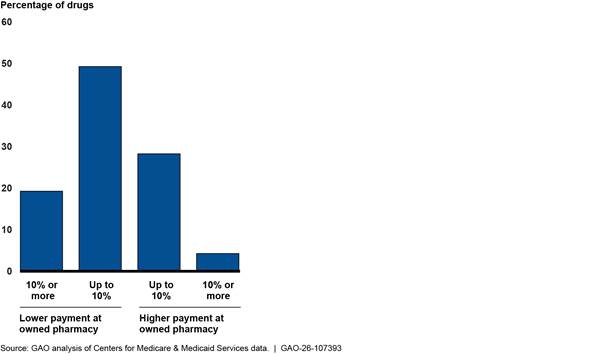
Notes: Selected plan sponsors are four large Medicare Part D plan sponsors that were vertically integrated—that is, under common ownership—with a pharmacy benefit manager and pharmacies in 2023. Highest payment drugs are 100 drugs with the highest total payments across the Part D program in 2023. Average net payments per 30-day supply of Part D drugs are gross payments per 30-day supply minus the manufacturer rebate per 30-day supply of the drug for owned and non-owned pharmacies.
|
Payment per 30-day Supply |
Payment to pharmacies per 30-day supply |
|
Amount higher (lower) at owned pharmacies |
||
|
Owned pharmacies (dollars) |
Non-owned pharmacies (dollars) |
|
Dollars |
Percent |
|
|
Gross payment |
305 |
370 |
|
(65) |
(18) |
|
Manufacturer rebate per 30-day supply |
170 |
130 |
|
40 |
31 |
|
Payment net of manufacturer rebatea |
135 |
240 |
|
(105) |
(44) |
Source: Source: GAO analysis. | GAO-26-107393
aThe payment per 30-day supply net of the manufacturer rebate in the table is calculated as the gross payment per 30-day supply minus the average manufacturer rebate per 30-day supply.
Our analysis of Part D drug payments and cost sharing was based in part on the 100 drugs with the highest total payments across the Part D program in 2023. These drugs had an average payment per 30-day supply ranging from $200 to $30,000. To supplement this analysis, we focused on the subset of 20 of these drugs with the highest average payments per 30-day supply. The average payment per 30-day supply for these 20 drugs ranged from about $13,000 to about $29,300. In addition, cost-sharing paid by or on behalf of beneficiaries in non-employer plans ranged from about $1,100 to $3,400. Our comparisons of payments and cost sharing between owned and non-owned pharmacies are below in figures 8 and 9.
Figure 8: Comparison of Average Payments Between Pharmacies Owned and Non-Owned by Selected Part D Plan Sponsors in 2023, 20 Drugs with Highest Average Payment per 30-day Supply
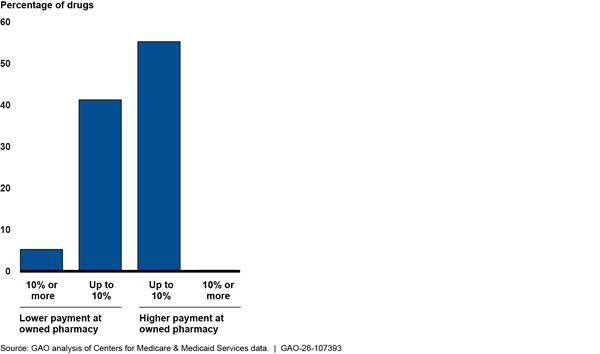
Notes: Selected plan sponsors are four large Medicare Part D plan sponsors that were vertically integrated—that is, under common ownership—with a pharmacy benefit manager and pharmacies in 2023. Highest payment drugs are 100 drugs with the highest total payments across the Part D program in 2023. Average payments are gross payments for 30-day supplies of Part D drugs (i.e., the amount paid to pharmacies by plan sponsors and by or on behalf of beneficiaries—the latter in the form of cost sharing) at the point of sale.
Figure 9: Difference in Average Cost Sharing Between Pharmacies Owned and Non-Owned by Selected Part D Plan Sponsors for Non-Employer Part D Plans in 2023, 20 Drugs with Highest Average Payment per 30-day Supply
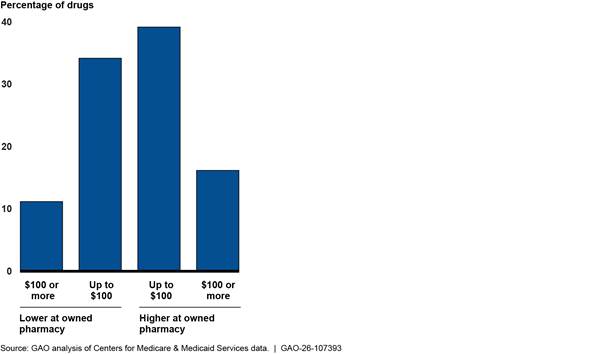
Notes: Selected plan sponsors are four large Medicare Part D plan sponsors that were vertically integrated—that is, under common ownership—with a pharmacy benefit manager and pharmacies in 2023. Highest payment drugs are 100 drugs with the highest total payments across the Part D program in 2023. Cost sharing results are for beneficiaries in non-employer plans (standalone and Medicare Advantage plans with Part D drug coverage where enrollment is not restricted to members of employer groups). Cost sharing was the total amount paid by or on behalf of the beneficiary, which included payment paid directly from the beneficiary and other sources, such as the low-income subsidy program.
GAO Contract
John E. Dicken, dickenj@gao.gov
Staff Acknowledgments
In addition to the contact named above, William Black, Assistant Director; Colin Ashwood, Analyst-in-Charge; Sonia Chakrabarty, Jennifer Lucado, Dan Lee, and Laurie Pachter. Also contributing were Schuyler Janzen, Cynthia Khan, Ravi Sharma, Roxanna Sun, and Cathy Whitmore.
The Government Accountability Office, the audit, evaluation, and investigative arm of Congress, exists to support Congress in meeting its constitutional responsibilities and to help improve the performance and accountability of the federal government for the American people. GAO examines the use of public funds; evaluates federal programs and policies; and provides analyses, recommendations, and other assistance to help Congress make informed oversight, policy, and funding decisions. GAO’s commitment to good government is reflected in its core values of accountability, integrity, and reliability.
Obtaining Copies of GAO Reports and Testimony
The fastest and easiest way to obtain copies of GAO documents at no cost is through our website. Each weekday afternoon, GAO posts on its website newly released reports, testimony, and correspondence. You can also subscribe to GAO’s email updates to receive notification of newly posted products.
Order by Phone
The price of each GAO publication reflects GAO’s actual cost of production and distribution and depends on the number of pages in the publication and whether the publication is printed in color or black and white. Pricing and ordering information is posted on GAO’s website, https://www.gao.gov/ordering.htm.
Place orders by calling
(202) 512-6000, toll free (866) 801-7077, or
TDD (202) 512-2537.
Orders may be paid for using American Express, Discover Card, MasterCard, Visa, check, or money order. Call for additional information.
Connect with GAO
Connect with GAO on X,
LinkedIn, Instagram, and YouTube.
Subscribe to our Email Updates. Listen to our Podcasts.
Visit GAO on the web at https://www.gao.gov.
To Report Fraud, Waste, and Abuse in Federal Programs
Contact FraudNet:
Website: https://www.gao.gov/about/what-gao-does/fraudnet
Automated answering system: (800) 424-5454
Media Relations
Sarah Kaczmarek, Managing Director, Media@gao.gov
Congressional Relations
David A. Powner, Acting Managing Director, CongRel@gao.gov
General Inquiries
[1]Part D is an optional outpatient prescription drug benefit offered by Medicare—the federally financed health insurance program for persons aged 65 and over, individuals under age 65 with certain disabilities, and individuals with end-stage renal disease. Medicare also has a drug benefit available under Part B—primarily for physician-administered drugs—which is outside the scope of this report.
[2]We refer to pharmacies under common ownership with a plan sponsor and PBM as the plan sponsors’ own pharmacies and other pharmacies as non-owned pharmacies. PBMs provide a variety of pharmacy benefit services on behalf of plan sponsors, including drug claims adjudication, developing pharmacy networks, and negotiating rebates and other discounts from manufacturers and others.
[3]Data for 2023 were the most recently available data at the time of our review.
[4]We identified pharmacy ownership and pharmacy type based on 2023 data from the National Council for Prescription Drug Programs, an organization that assigns unique identifiers for and collects data from licensed pharmacies in the U.S.
[5]For the purposes of our report, we defined a drug as a unique set of active ingredients, strength, and dose form and identified whether it was a brand-name drug or generic.
[6]Eight brand-name drugs were in both groups of drugs.
[7]Employer plans are contracted out by employers to a Part D plan sponsor to provide coverage for their Medicare-eligible members. Employer plans accounted for about 15 percent of all Part D beneficiaries in 2023.
[8]When plan sponsors report cost sharing paid by or on behalf of beneficiaries, they are required to include the cost sharing paid by the beneficiary and by other sources. In the case of employer plans, the plan sponsors report supplemental benefits paid by the employers, which can reduce what the beneficiary pays.
[9]For example, when comparing payments between owned and non-owned pharmacies for the 100 highest utilization drugs, we did this comparison for each of the 100 drugs for each plan sponsor. The aggregated results we present reflect approximately 400 comparisons across the four selected plan sponsors.
[10]Some of these contracts were between the plan sponsors and the pharmacies directly; others were between the PBM, acting on behalf of the plan sponsor, and the pharmacies.
[11]We use the term pharmacies to refer to pharmacy chains and pharmacy services administrative organizations, which represent independent pharmacies.
[12]Plan sponsors contract with CMS to provide Part D coverage through individual contracts that each offer one or more unique drug plans.
[13]CMS refers to these plans as Employer Group Waiver Plans. Employers may offer Part D plans to retirees or their Part D-eligible spouses or dependents. In 2023, about 15 percent of Part D enrollment was in employer plans.
[14]Since 2023, the Part D standard benefit—including the out-of-pocket threshold—has changed, as required by the Inflation Reduction Act of 2022. Pub. L. No. 117-169, § 11201, 136 Stat. 1818, 1877 (codified at 42 U.S.C. § 1395w-102). For example, in 2025, the out-of-pocket threshold was reduced to $2,000, and beneficiaries were no longer responsible for cost sharing after reaching this threshold.
[15]Beneficiaries eligible for the low-income subsidy include those whose income is below 150 percent of the federal poverty level or who receive Supplemental Security Income benefits. These beneficiaries can enroll in certain Part D plans without paying a premium and pay minimal Part D cost sharing.
[16]See 42 U.S.C. § 1395w-104(b)(1); see also CMS, Medicare Prescription Drug Benefit Manual, Chapter 12 (accessed January 30, 2026).
[17]As noted above, employer plans have more flexibility than non-employer plans to demonstrate that their pharmacy networks provide adequate access to retail pharmacies.
[18]Additional pharmacy types can include institutional, infusion, compounding, managed care organization, and long-term care pharmacies.
[19]There are multiple definitions for a specialty drug. For example, Medicare regulations define a Part D specialty drug as a drug with a 30-day equivalent ingredient cost that is greater than a dollar-per-month threshold. See 42 C.F.R. § 423.104(d)(2)(iv). In 2023, that threshold was $830. In addition, the Assistant Secretary for Planning and Evaluation has defined specialty drugs as generally high-cost products used to treat complex, rare, or chronic disease. See Department of Health and Human Services, Assistant Secretary for Planning and Evaluation, Office of Science & Data Policy. Trends in Prescription Drug Spending, 2016-2021 (Washington, DC: 2022).
[20]The Average Wholesale Price is in most cases the manufacturer’s suggested list price and does not necessarily reflect the actual price paid by the purchaser.
[21]Payment adjustments between the plan sponsor and pharmacy are not included in claims data but are reported to CMS in a direct and indirect remuneration report. In 2024, CMS began requiring Part D plans to include certain payment adjustments at the point-of-sale.
[22]Performance-based adjustments can be based on CMS’s Star Ratings that measure the quality of prescription drug services received by consumers enrolled in Part D prescription drug plans. Some Star Ratings’ measures are for adherence to medications for conditions such as diabetes, hypertension, and high cholesterol.
[23]See Federal Trade Commission, Pharmacy Benefit Managers: The Powerful Middlemen Inflating Drug Costs and Squeezing Main Street Pharmacies, Interim Staff Report (Washington, D.C.: July 2024), and Pragya Kakani, Swayami Navangul, Christie Lee Luo, et al, “Use of and Steering to Pharmacies Owned by Insurers and Pharmacy Benefit Managers in Medicare,” JAMA Health Forum 6, no. 1 (2025).
[24]Vertically integrated plan sponsors may also use other mechanisms—such as marketing targeted to enrollees who use costly specialty medications—to encourage plan enrollees to use the plan sponsors’ own pharmacies. See House Committee on Oversight and Accountability, The Role of Pharmacy Benefit Managers in Prescription Drug Markets (Washington, D.C., July 2024).
[25]See Federal Trade Commission, Pharmacy Benefit Managers and Kakani, Navangul, and Lee Luo, “Use of and Steering to Pharmacies.”
[26]See Federal Trade Commission, Pharmacy Benefit Managers, and Medicare Payment Advisory Commission, Report to the Congress: Medicare and the Health Care Delivery System (Washington, D.C.: June 2023).
[27]Medicare’s medical loss ratio measures the share of premium revenues that a plan spends on health care claims. See 42 U.S.C. § 300gg-18; 42 C.F.R. pt. 423, subpt. X. See also Richard G. Frank and Conrad Milhaupt, Related businesses and preservation of Medicare’s Medical Loss Ratio rules. (Washington, D.C.: Brookings Institution, 2023).
[28]Utilization is the number of 30-day Part D drug supplies dispensed by pharmacies. Drug payments are gross point-of-sale payments for Part D drugs (i.e., the total amount paid to pharmacies by plan sponsors and by or on behalf of beneficiaries—the latter in the form of cost sharing).
[29]For the four selected plan sponsors, mail-order and specialty pharmacies accounted for a large majority of utilization and payments at owned pharmacies.
[30]For the four selected plan sponsors, retail pharmacies accounted for a large majority of utilization and payments at non-owned pharmacies.
[31]Federal Trade Commission, Pharmacy Benefit Managers.
[32]CMS waives Part D retail pharmacy access standards for employer plans so long as the plan sponsor attests that its retail pharmacy networks are sufficient to meet the needs of its enrollees. However, CMS may review the adequacy of the pharmacy networks and potentially require expanded access in the event of beneficiary complaints or for other reasons to ensure that the plan’s network is sufficient to meet the needs of its enrollee population. See Centers for Medicare & Medicaid Services, Medicare Prescription Drug Benefit Manual, Chapter 12—Employer/Union Sponsored Group Health Plans (Baltimore, M.D.: November 2008).
[33]A recent report also found that gross payments to owned pharmacies by vertically integrated Part D plan sponsors tended to be up to 10 percent lower than payments to non-owned pharmacies for a sample of high cost and high use drugs. See Department of Health and Human Services, Office of Inspector General, Impacts of Vertical Integration in Medicare Part D on Sponsors’ Drug Costs, Pharmacy Reimbursement, and Enrollee Cost Sharing, OEI-BL-24-00240 (Washington, D.C.: May 2026).
[34]These results differed for employer and non-employer plans. See appendix II for more detail.
[35]CMS considers drug manufacturer rebates and pharmacy payment adjustments to be price concessions, which plans report to CMS in the direct and indirect remuneration report.
[36]Drug manufacturer rebates, which manufacturers may pay to plan sponsors or PBMs on their behalf, reduce the amount that plan sponsors ultimately pay for a drug but do not directly affect the payments that pharmacies receive. We were unable to account for payment adjustments between plan sponsors and pharmacies because these data are not available for individual pharmacies. There may be differences in payment adjustments for owned and non-owned pharmacies.
[37]A study by the Medicare Payment Advisory Commission found that, for six therapeutic categories of Part D drugs, payments by vertically integrated plan sponsors to their own pharmacies were generally higher than payments to non-owned pharmacies in 2021. See Medicare Payment Advisory Commission, Report to the Congress: Medicare and the Health Care Delivery System (Washington, D.C.: June 2023).
[38]Non-employer plans accounted for about 85 percent of all Part D beneficiaries in 2023.
[39]See appendix I for more detail on how we calculated cost sharing for employer and non-employer plans.
[40]For our analysis of these 20 drugs, we excluded two to five of them for each plan sponsor because there were fewer than 50 claims at the plan sponsor’s own pharmacies.
[41]Some of these contracts were between the plan sponsors and the pharmacies directly; others were between the PBM, acting on behalf of the plan sponsor, and the pharmacies.
[42]Plan sponsors maintain their own maximum allowable cost pricing lists, so the maximum amount each plan sponsor pays for certain generic drugs may be different. One plan sponsor told us that almost all generic drugs dispensed at pharmacies in their networks were at the maximum allowable cost payment benchmark.
[43]Performance-based adjustments can include performance targets for patient adherence to medications for conditions such as diabetes, hypertension, and high cholesterol. See Phil Schwab, Patrick Racsa, Karen Rascati, Marc Mourer, Yunus Meah, Karen Worley, “A retrospective database study comparing diabetes-related medication adherence and health outcomes for mail-order versus community pharmacy,” J Manag Care Spec Pharm, vol. 25, no. 3 (2019): 332-340. See also, William P. Neil, Chrislynn E. Shiokari, Raoul J. Burchette, David Stapleton, Bruce Ovbiagele, “Mail Order Pharmacy Use and Adherence To Secondary Prevention Drugs Among Stroke Patients,” Journal of the Neurological Sciences, vol. 390 (2018): 117-120.
[44]We analyzed drug utilization and payments using CMS’s Prescription Drug Event database for 2023. Drug utilization is the number of 30-day Part D drug supplies dispensed by pharmacies. Drug payments are gross payments for Part D drugs (i.e., the amount paid to pharmacies by plan sponsors and by or on behalf of beneficiaries—the latter in the form of cost sharing) at the point-of-sale.
[45]S&P Capital IQ offers a variety of information on companies. We used corporate trees, which identify which companies are part of a parent company.
[46]Part D plan sponsors submit a drug event record to CMS each time a beneficiary obtains a prescription drug. This record contains information that identifies the drug, the number of days’ supply of the drug the beneficiary received, and the price paid to the pharmacy.
[47]The National Council for Prescription Drug Programs is an organization that assigns unique identifiers for and collects data from licensed pharmacies in the United States.
[48]For example, when comparing payments between owned and non-owned pharmacies for the 100 highest utilization drugs, we did this comparison for each of the 100 drugs for each plan sponsor. The aggregated results we present reflect approximately 400 comparisons across the four selected plan sponsors.
[49]We calculated the average manufacturer rebate as follows. First, we calculated the manufacturer rebate per 30-day supply of a drug for each Part D plan. We then took the average rebate per 30-day supply across all plans for a plan sponsors owned and non-owned pharmacies, weighted by the number of 30-day supplies of the drug dispensed by owned and non-owned pharmacies, respectively.
[50]We use the term pharmacies to refer to pharmacy chains and pharmacy services administrative organizations, which represent independent pharmacies.
[51]Selected plan sponsors for this analysis are four large Medicare Part D plan sponsors that were vertically integrated—that is, under common ownership—with a pharmacy benefit manager and pharmacies in 2023. We defined drug utilization as the number of 30-day supplies of Part D prescription drugs that pharmacies dispensed to beneficiaries. We defined payments as the gross payments made to pharmacies at the point-of-sale for Part D prescription drugs, including payments from plan sponsors and from or on behalf of beneficiaries (i.e., cost sharing). We defined cost sharing for beneficiaries in non-employer plans as the payments for Part D drugs paid by the beneficiary directly or paid on behalf of the beneficiary by another entity, such as an employer or Medicare’s Low-Income Subsidy program, which provides assistance with out-of-pocket costs for beneficiaries with limited resources and incomes below 150 percent of the federal poverty level. For employer plans, cost sharing only included the payment paid directly by the beneficiary and did not include payments from other sources such as supplemental benefits paid by the employer.
[52]For these comparisons, we included standalone prescription drug plans and Medicare Advantage plans that included Part D coverage. Employer plans include either of these plan types, but enrollment is restricted to members of an employer group, whereas non-employer plans do not have such an enrollment restriction.
[53]For each of these plan sponsors, the median percentage of utilization at owned pharmacies for the 100 highest payment drugs was higher for employer plans than for non-employer plans.
[54]GAO, Medicare Part D: CMS Should Monitor Effects of Rebates on Plan Formularies and Beneficiary Spending, GAO-23-105270 (Washington, D.C.: Sep. 5, 2023).
[55]Manufacturer rebates, which are paid to plan sponsors or pharmacy benefit managers on their behalf, reduce the amount that plan sponsors ultimately pay for a Part D-covered drug but do not directly affect the payments pharmacies receive. See appendix I for our methodology for calculating payments to pharmacies net of the manufacturer rebate.
[56]These payment adjustments between plan sponsors and pharmacies are reported to CMS in a direct and indirect remuneration report.
[57]The 20 drugs in our analysis with the highest payment per 30-day supply had a median rebate of 0 percent of gross payments, and the 100 highest payment drugs had a median rebate of 33 percent of gross payments.
[58]CMS requires large group health plans—including Medicare Advantage drug plans—to spend at least 85 percent of total premium revenue on health care costs, which includes payments to pharmacies for prescription drugs, and quality improvement efforts, rather than administrative costs and profit—referred to as the medical loss ratio. See 42 U.S.C. § 300gg-18. To maintain a medical loss ratio above the 85 percent threshold, a vertically integrated plan sponsor could shift revenue from the plan sponsor to their own pharmacies by paying these pharmacies higher payment rates than non-owned pharmacies. These higher payments to the plan sponsor’s own pharmacies for prescription drugs could increase the plan sponsor’s health care costs and its medical loss ratio. CMS requires that the health care costs Medicare Advantage and Part D drug plans use to calculate their medical loss ratio reflect prescription drug costs net of manufacturer rebates, as opposed to gross prescription drug costs. See 42 C.F.R. §§ 422.2420(b)(2); 423.2420(b)(2).