
Report to Congressional Requesters
United States Government Accountability Office
A report to congressional requesters
Contact: Triana McNeil at McNeilT@gao.gov
What GAO Found
The Drug Enforcement Administration (DEA) and U.S. Immigration and Customs Enforcement (ICE) have entered into longstanding formal agreements to enhance their collaboration on counternarcotics investigations, including a June 2009 interagency cooperation agreement and a January 2021 joint letter. These agreements describe how DEA and ICE’s Homeland Security Investigations (HSI) are to coordinate on investigations. They establish requirements for DEA to cross-designate (or allow) HSI special agents to engage in counternarcotics investigations under the Controlled Substances Act and for both agencies to deconflict case information and engage in joint training, among other things.
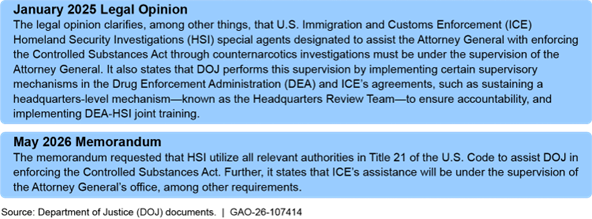
More recently, GAO found that the Department of Justice (DOJ) issued two new documents since 2021 that relate to DEA and HSI collaboration on counternarcotics investigations—a January 2025 DOJ Office of Legal Counsel opinion and a May 2026 memorandum from the Acting Attorney General.
Prior to the issuance of the May 2026 memorandum, GAO found that DEA and ICE’s collaboration generally addressed four out of eight leading collaboration practices, including defining common outcomes and clarifying roles and responsibilities. The four leading practices that DEA and ICE had not fully addressed (ensuring accountability, sustaining leadership, bridging organizational cultures, and updating agreements) involve activities required by the agreements. For example, DEA and ICE never fully sustained a functioning Headquarters Review Team, nor had they fully implemented joint training, which were required by the 2009 and 2021 agreements respectively to address collaboration challenges. As of June 2026, DOJ officials told GAO they were still determining how the May 2026 memorandum will impact existing requirements in the 2009 and 2021 collaboration agreements, including establishing the Headquarters Review Team and implementing the joint training. By clarifying the status of the requirements within DEA and ICE’s agreements, DOJ and DHS would provide DEA and ICE the necessary direction about the activities they should conduct to ensure effective collaboration on counternarcotics investigations.
Why GAO Did This Study
The U.S. faces multiple challenges related to illicit drugs, including the opioid epidemic, which has been a national public health emergency since October 2017. To combat this crisis, the federal government has tasked DEA with leading U.S. efforts against illicit drug trafficking. In this role, DEA works with ICE’s HSI, within the Department of Homeland Security (DHS), to investigate illicit drug activity with a connection to U.S. borders.
GAO was asked to examine how DEA and ICE coordinate on counternarcotics investigations. This report addresses (1) new DOJ and DHS documents since 2021 that address how DEA and ICE collaborate and (2) the extent to which DEA and ICE agreements and activities related to counternarcotics investigations have been aligned with leading practices for collaboration.
To do this work, GAO analyzed DEA and HSI agreements and policies and interviewed relevant headquarters officials. GAO also conducted site visits with a nongeneralizable sample of nine DEA and HSI field offices to interview staff about their collaboration experiences. GAO selected this sample to reflect a variety of geographic regions and quantities of DEA and HSI drug seizures over an 8 ½ -year period. GAO also compared DEA and ICE’s collaboration activities against leading interagency collaboration practices and DOJ legal requirements.
What GAO Recommends
GAO is making five recommendations, including that DOJ and DHS clarify the status of the requirements of the June 2009 agreement and January 2021 joint letter. DOJ agreed and DHS disagreed with the recommendations. GAO maintains its recommendations are valid, as discussed in the report.
Abbreviations
CBP U.S. Customs and Border Protection
DARTS DEA Analysis and Response Tracking System
DEA Drug Enforcement Administration
DHS Department of Homeland Security
DICE Deconfliction and Information Coordination Endeavor
DOJ Department of Justice
FBI Federal Bureau of Investigation
HIDTA High Intensity Drug Trafficking Areas
HSI Homeland Security Investigations
HSTFs Homeland Security Task Forces
ICE U.S. Immigration and Customs Enforcement
This is a work of the U.S. government and is not subject to copyright protection in the United States. The published product may be reproduced and distributed in its entirety without further permission from GAO. However, because this work may contain copyrighted images or other material, permission from the copyright holder may be necessary if you wish to reproduce this material separately.
September 30, 2026
The Honorable John Cornyn
Chairman
Caucus on International Narcotics Control
United States Senate
The Honorable James Lankford
Chairman
Subcommittee on Border Management, Federal Workforce and Regulatory Affairs
Committee on Homeland Security and Governmental Affairs
United States Senate
The Honorable Jon Ossoff
United States Senate
The U.S. faces multiple challenges related to illicit drugs, including the opioid epidemic, which has been a national public health emergency since October 2017. According to a 2025 federal assessment, transnational criminal organizations, including several Mexican drug cartels, are at the heart of this crisis and have developed global supply chain networks to transport narcotics and other illicit drugs over the U.S. border and distribute them.[1] Additionally, in recent years, there have also been media reports of Chinese criminal organizations growing marijuana to fund their criminal networks in the U.S.
These crises present various challenges to U.S. law enforcement and national security. The Drug Enforcement Administration (DEA) works with U.S. Immigration and Customs Enforcement (ICE) Homeland Security Investigations (HSI) on federal drug enforcement efforts. In addition, in response to a 2025 Executive Order, the Departments of Justice (DOJ) and Homeland Security (DHS) jointly established the Homeland Security Task Forces (HSTFs), which are focused on ending the presence of cartels and transnational criminal organizations in the U.S.[2]
While both DEA and HSI initiate counternarcotics investigations, they focus their investigative activities on different efforts.[3] Specifically, DEA, a component of DOJ, focuses on leading U.S. efforts against illicit drug trafficking, and HSI, a component of DHS, focuses on efforts against smuggling with a connection to the U.S. border.[4] To facilitate their collaboration, DEA and ICE entered into agreements, including (1) an August 1994 memorandum of understanding between DEA and U.S. Customs Service, (2) a June 2009 interagency cooperation agreement between DEA and ICE, and (3) a January 2021 joint letter.[5] We refer to these documents as “agreements” in this report. Further, in May 2026, the Acting Attorney General issued a memorandum which may impact these agreements.[6]
We previously reviewed issues related to DEA and HSI collaboration on counternarcotics investigations. For example:
· In March 2009, we reported on DEA’s partnership with ICE and the process used to cross-designate HSI agents to conduct counternarcotics investigations.[7]
· In July 2011, we reported that DEA and ICE took actions to fully implement the cross-designation and deconfliction provisions of their June 2009 agreement and finalized efforts to complete information sharing provisions.[8]
· In March 2025, we reported on DEA’s process to review HSI agent requests to participate in counternarcotics investigations and the extent to which DEA and HSI have implemented the provisions of their January 2021 agreement regarding training requirements.[9]
You asked us to examine how DEA and HSI continue to coordinate on counternarcotics investigations. This report examines (1) any new DHS or DOJ documents since 2021 that address how DEA and ICE collaborate on counternarcotics investigations, and (2) the extent to which DEA and ICE agreements and activities related to conducting counternarcotics investigations have been aligned with leading practices for collaboration. You also asked us to provide specific information on DEA and ICE deconfliction practices, which are included in appendix I.
For both objectives, we analyzed DOJ and DHS documentation and obtained testimonial evidence through interviews with DEA and HSI headquarters and officials in nine field offices. For example, with respect to documentation, we analyzed the interagency agreements between DEA and ICE to thoroughly understand the key collaboration provisions, particularly those related to deconfliction, information sharing, and accountability.[10] We also reviewed DEA and HSI guidance, such as memorandums, legal opinions, directives, and a special agent manual and handbook.
To understand how DEA and HSI have implemented the agreements and related guidance, we interviewed relevant DEA and HSI headquarters officials. In addition, we obtained field perspectives on the implementation of the provisions of the agreements through semi-structured in-person and virtual interviews with DEA and HSI officials in nine field offices.[11] We selected field offices based upon factors such as geographic dispersion, the number of drug seizures recorded in DEA and HSI data, and recommendations from DEA and HSI officials, among others. Because we conducted group interviews and did not select the field offices randomly, our results are not generalizable to all DEA and HSI personnel nationwide. Instead, these interviews provide examples of field-level efforts to implement the interagency agreements.[12]
To assess the extent to which DEA’s and HSI’s collaboration on counternarcotics investigations aligned with leading practices, we assessed information collected on DEA and HSI agreements and activities against eight leading practices for interagency collaboration identified in our prior work.[13] After reviewing documentary and testimonial evidence, we determined if DEA and HSI actions generally addressed, partially addressed, or did not address each leading practice.[14]
· For those we rated as generally addressed, our assessment of documentation and interviews found that DEA and HSI had taken steps to address the key considerations consistent with the leading collaboration practice.
· For those we rated as partially addressed, our assessment of documentation and interviews found that DEA and HSI had taken steps to address some key considerations consistent with the leading practice but could take additional steps to address one or more of the key considerations.
· For a rating of not addressed, our assessment of documentation and interviews found that DEA and HSI had not demonstrated that steps had been taken to address any of the key considerations under the leading practice.
After we completed our information and data collection and analysis and were in the process of finalizing our report, the Acting Attorney General issued the May 2026 memorandum requesting HSI utilize all authorities in Title 21 of the U.S. Code to assist DOJ in enforcing the Controlled Substances Act.[15] The memorandum has the potential to affect the existing DEA and ICE agreements and the collaboration practices the agencies had previously engaged in and which we describe in this report. As of June 2026, DEA and HSI were in the initial phase of determining how the memorandum would impact DEA and HSI collaboration on drug investigations. Therefore, in this report, we identify, where appropriate, how the memorandum could potentially impact DEA and ICE collaboration. Appendix II provides more detailed information about our objectives, scope, and methodology.
We conducted this performance audit from February 2024 through September 2026 in accordance with generally accepted government auditing standards. Those standards require that we plan and perform the audit to obtain sufficient, appropriate evidence to provide a reasonable basis for our findings and conclusions based on our audit objectives. We believe that the evidence obtained provides a reasonable basis for our findings and conclusions based on our audit objectives.
Background
Agency Missions
DEA. DOJ and an executive order created the DEA in 1973, as a single, comprehensive federal agency to lead U.S. efforts against illicit drug trafficking, domestically and internationally. DEA works to disrupt and dismantle the leadership, command, control, and financial infrastructure of major narcotics-trafficking organizations. The directives creating DEA also authorized the Attorney General, through DEA, to coordinate the enforcement of U.S. drug laws among all executive branch departments and agencies, requiring those agencies to assist DEA on drug enforcement efforts when requested.[16] Accordingly, DEA works collaboratively with other federal agencies to accomplish its mission.
DEA is charged with enforcing Title 21 of the U.S. Code, which contains the nation’s laws on controlled substances, including the Controlled Substances Act and Controlled Substances Import and Export Act of 1970. Under section 873 of Title 21 of the U.S. Code, DEA, through delegation by the Attorney General, can cross-designate HSI agents with the authority to investigate violations of controlled substances laws under Title 21 of the U.S. Code. DEA’s fiscal year 2025 budget for carrying out its mission was about $2.57 billion.
Over a 9-year period—fiscal years 2017 through 2025—DEA initiated nearly 107,000 counternarcotics investigations and referred over 50,400 counternarcotics cases for prosecution (an annual average of over 11,900 initiated investigations and over 5,600 cases referred for prosecution). During this period, the agency was annually staffed with about 4,400 special agents who work on DEA’s law enforcement activities to combat illicit drugs in the U.S., based on DEA’s workforce data.
HSI. Formed in 2003 as a part of the U.S. government’s response to the terrorist attacks on September 11, 2001, ICE’s primary mission is to promote homeland security and public safety through the enforcement of federal laws governing border control, customs, trade, and immigration. Within ICE, HSI agents conduct federal criminal investigations into the illegal movement of people, goods, money, contraband, weapons, and sensitive technology into, out of, and through the U.S., including narcotics.[17] For counternarcotics investigations, HSI’s mission includes tracking, intercepting, investigating, and stopping illicit narcotics from flowing into the U.S. through targeting criminal networks; strengthening global partnerships; and enhancing domestic collaboration.
According to HSI officials, HSI agents can pursue counternarcotics investigation activities for various violations of the U.S. Code. These statutory provisions include smuggling violations under Title 19 of the U.S. Code, which are associated with criminal offenses outside of Title 21 of the U.S. Code. In addition, DEA and HSI officials said that HSI agents may carry out appropriate and immediate enforcement actions (e.g., make arrests and seize narcotics) for violations of other applicable statutory provisions when HSI agents are awaiting cross-designation approval from DEA.[18] HSI’s fiscal year 2025 budget for carrying out its mission was about $2.46 billion.
Over a 9-year period—fiscal years 2017 through 2025—HSI initiated over 72,100 counternarcotics investigations and referred nearly 44,000 counternarcotics cases for prosecution (an annual average of 8,000 initiated investigations and approximately 4,900 cases referred for prosecution). During this period, the agency was annually staffed with about 5,700 special agents who work on HSI’s law enforcement activities, including activities to combat illicit drugs in the U.S., based on HSI’s workforce data.
DOJ Office of Legal Counsel. The DOJ Office of Legal Counsel provides legal advice to the President and all executive branch agencies.[19] In addition, according to the Office of Legal Counsel, a core function is to provide controlling advice to Executive Branch officials on questions of law that are centrally important to the functioning of the federal government.
DEA and ICE Interagency Agreements
DEA and ICE have entered into three agreements addressing their collaboration on counternarcotics investigations. These include an August 1994 memorandum of understanding between DEA and U.S. Customs Service, a June 2009 interagency cooperation agreement between DEA and ICE, and a January 2021 joint letter.[20] These agreements outline, among other things, the mechanisms for DEA and ICE to share information and deconflict cases, resolve disputes, and monitor implementation of the agreements.
1994 Memorandum of Understanding. DEA signed an agreement with Customs that created procedures for the cross-designation of Customs agents with Title 21 authority.[21] Under this agreement, Customs agents could only conduct counternarcotics investigations of narcotics smuggling across U.S. international borders.
2009 Interagency Cooperation Agreement. In June 2009, DEA and ICE signed a new agreement that replaced the August 1994 agreement. This superseding agreement included provisions for coordination between the agencies, such as DEA and ICE notifying and inviting each other to participate in counternarcotics investigations. The agreement also outlines requirements for cross-designation, information sharing, and deconfliction.[22] The cross-designation process includes ICE selecting an unlimited number of HSI agents through annual and ad hoc processes. As part of these processes, HSI and DEA both verify that these HSI agents work on relevant counternarcotics smuggling investigations with a nexus to the U.S. border.[23] The Acting Attorney General’s May 2026 memorandum made changes to this process, which we discuss in more detail later in this report.
In addition, the 2009 agreement commits DEA and ICE to certain information sharing activities, including fully participating in interagency task forces and fully sharing investigative records related to drugs, money laundering, and other crimes with federal law enforcement partners. Finally, the 2009 agreement directs DEA and ICE agents to deconflict case information in the early stages of investigations and before conducting operations in efforts to ensure the safety of federal, state, and local law enforcement officers.
2021 Joint Letter on DEA-ICE Interagency Cooperation. In January 2021, DEA and ICE signed a joint letter that outlined four initiatives to ensure provisions in the June 2009 agreement were carried out.[24] These initiatives include creating two training modules:
· Joint training to ensure the June 2009 agreement is taught to DEA and HSI special agents with one voice to ensure consistency and clarity; and
· A module on HSI’s mission, priorities, and border search authority.
In March 2025, we reported that DEA and HSI officials had not implemented the training requirements pursuant to their January 2021 joint letter.[25] This prevents these agencies from ensuring their agents are properly trained and collaborate effectively on counternarcotics investigations. We recommended, among other things, that DEA and ICE develop and implement the training modules pursuant to their January 2021 joint letter. We discuss DEA and ICE efforts to address our recommendation later in this report.
Headquarters Review Team
The agreements require DEA and ICE to establish the Headquarters Review Team, which is a headquarters-level mechanism for ensuring the agencies fully and appropriately implement the agreements. Specifically, the 2009 agreement called for its establishment, and the 2021 joint letter reaffirmed its usefulness and directed the agencies to reestablish it in a meaningful and productive manner. Table 1 identifies the specific activities the Headquarters Review Team is to perform, as outlined in the agreements.
Table 1: Requirements for the Headquarters Review Team Outlined in DEA and ICE Interagency Agreements
|
Requirement |
Agreementa |
|
Strive to meet at least twice a year but be required to meet at least once a year. |
2021 joint letter |
|
Meet as needed to discuss matters where time is of the essence. |
2021 joint letter |
|
Hold meetings with a quorum on each side. |
2021 joint letter |
|
Address collaboration issues that cannot be resolved in field office locations. |
2009 agreement |
|
Periodically review the performance of the 2009 agreement. |
2009 agreement |
|
Poll the agencies to determine issues to ensure healthy relationships. |
2021 joint letter |
|
Evaluate the effectiveness of the agreements and their implementation on a real-time basis. |
2021 joint letter |
Source: GAO analysis of Drug Enforcement Administration (DEA) and U.S. Immigration and Customs Enforcement (ICE) collaboration agreements. | GAO‑26‑107414
aDEA and ICE, Interagency Cooperation Agreement Between the U.S. Drug Enforcement Administration and U.S. Immigration and Customs Enforcement Regarding Investigative Functions Related to the Controlled Substances Act (June 18, 2009); and DEA and ICE, Joint Letter on the DEA-ICE Interagency Cooperation Agreement (Jan. 5, 2021).
Homeland Security Task Forces
DEA and HSI often collaborate on counternarcotics investigations through their participation in federal task forces. We previously reported on changes to the interagency task force model as a result of Executive Order 14159.[26] The order requires the Departments of Justice and Homeland Security to jointly establish HSTFs in all 50 states and territories to end the presence of criminal cartels and transnational criminal organizations in the U.S. Upon their formation in 2025, HSTFs assumed responsibility for ongoing cases belonging to DOJ’s Organized Crime and Drug Enforcement Task Forces, which were dissolved in September 2025.[27] In addition, HSTFs are supported in certain areas by HSI’s Border Enforcement Security Task Force, which is also focused on combating transnational criminal organizations. The HSTFs are co-led by HSI and the Federal Bureau of Investigation (FBI). Appendix III provides more information about the HSTFs.
GAO’s Leading Practices for Interagency Collaboration
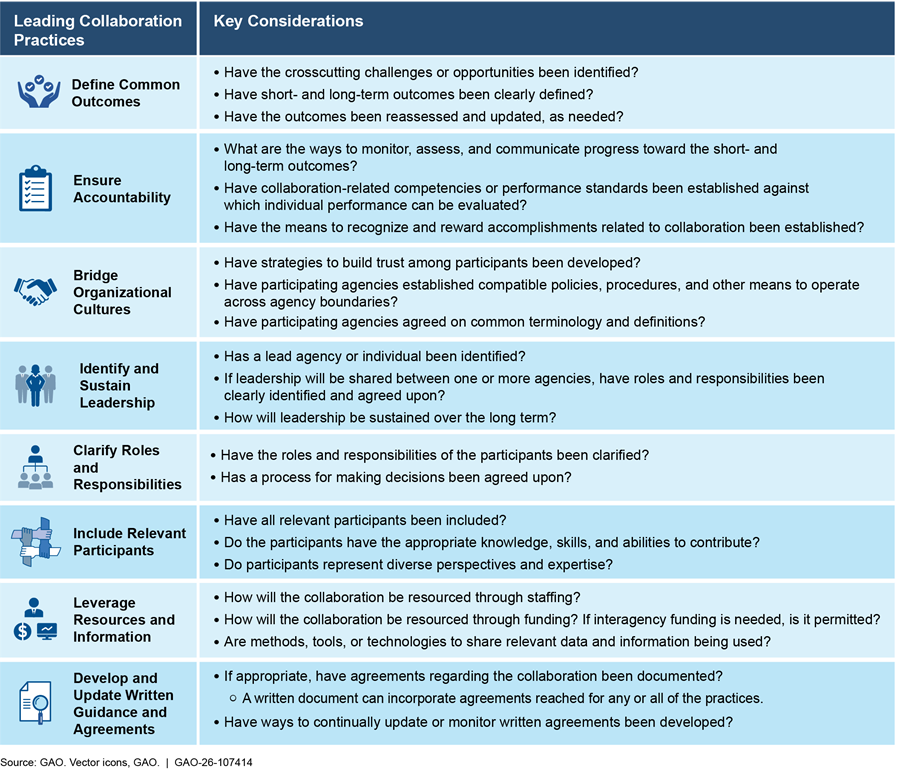
In our prior work, we found that effective collaboration—such as agencies collaborating on counternarcotics investigations—benefits from implementing certain leading practices such as defining common outcomes and clarifying roles and responsibilities.[28] Figure 1 shows eight practices for agency officials to consider when working collaboratively.
Since 2021 DOJ Issued a Legal Opinion and Memorandum Related to DEA and HSI Investigations
Since DEA and ICE issued the 2021 joint letter, DOJ issued two new documents related to DEA and HSI collaboration on counternarcotics investigations. Specifically, the DOJ Office of Legal Counsel issued an opinion in January 2025 related to the designation of HSI special agents to investigate drug offenses under Title 21 of the U.S. Code, and the Acting Attorney General issued a memorandum in May 2026 requesting assistance from HSI to enforce the Controlled Substances Act.
January 2025 Office of Legal Counsel opinion. In January 2025, the Office of Legal Counsel issued an opinion regarding the designation of HSI special agents, as well as state and local law enforcement officers serving on task forces under HSI’s authority, to conduct drug investigations ordinarily within DEA’s jurisdiction under the Controlled Substances Act.[29] The Office of Legal Counsel addressed issues regarding whether those designated personnel were required to be under DEA supervision when engaged in Controlled Substances Act investigations. The issues identified in the Office of Legal Counsel’s opinion correspond with concerns we identified regarding DEA and HSI’s collaboration, as well as the implementation of the Acting Attorney General’s May 2026 memorandum, both of which we discuss in detail later in this report.
First, the Office of Legal Counsel concluded in its opinion that the delegation of the Attorney General’s authority to DEA to designate HSI special agents allowed for a broader range of HSI special agents than included in the 2009 agreement and 2021 joint letter.[30] However, the opinion found that any such agents are required to be under DEA supervision. Figure 2 identifies some of the Office of Legal Counsel’s findings related to supervision.
Figure 2: Department of Justice Office of Legal Counsel’s Opinion Related to the Cross-Designation of Homeland Security Investigations (HSI) Special Agents Under the Controlled Substances Act
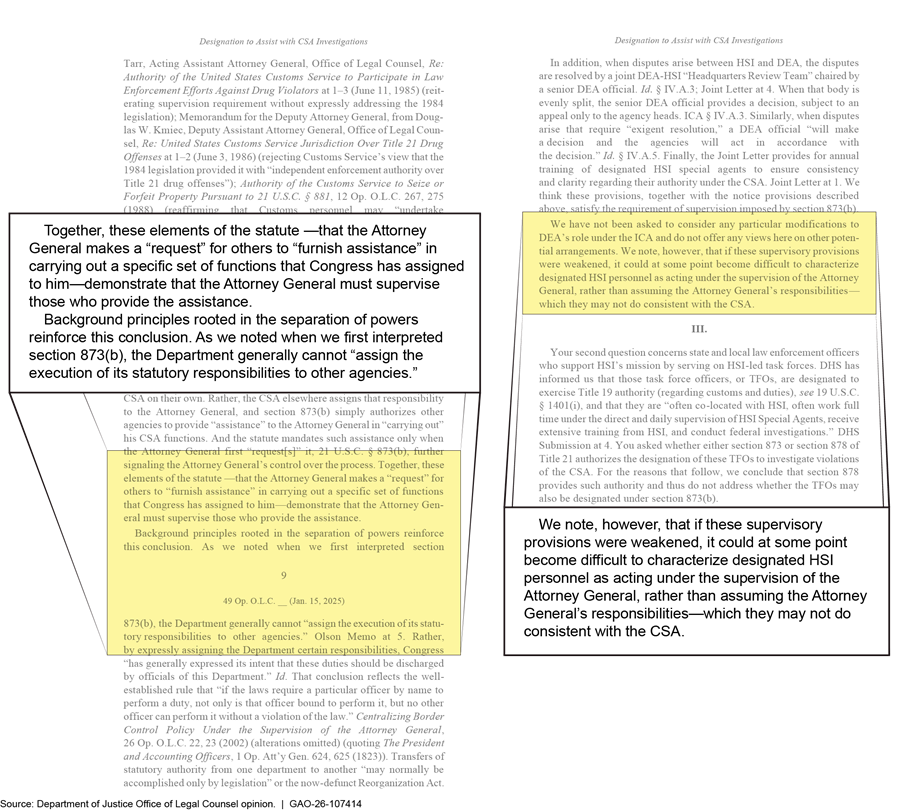
In support of this supervision requirement, the Office of Legal Counsel stated that as a general matter, DOJ may not assign the execution of its statutory responsibilities to other agencies without statutory authorization. Rather, by establishing DOJ and placing certain responsibilities in the Attorney General, Congress has generally expressed its intent that these duties should be discharged by DOJ, and not DHS, officials. Further, the Office of Legal Counsel’s opinion stated that its conclusion is reinforced by background principles rooted in the separation of powers.
Specifically, the Office of Legal Counsel indicated that the text and context of the statute require the Attorney General to supervise personnel designated to assist DEA in enforcing the Controlled Substances Act.[31] According to the Office of Legal Counsel, the elements of the statute—that the Attorney General makes a request for others to furnish assistance in carrying out a specific set of functions that Congress has assigned to the Attorney General—demonstrate that the Attorney General must supervise those who provide the assistance. Further, the Office of Legal Counsel stated in its opinion that reading the law “to include a supervision requirement avoids any concern that, by seeking the involvement of other agencies in the conduct of the Department’s mission, the Attorney General would be improperly transferring power vested in the Department to another agency without Congress’s consent.”
The Office of Legal Counsel also examined the supervisory mechanisms within the 2009 agreement and the 2021 joint letter, noting that the provisions of those documents satisfy the supervisory requirement. For example, these mechanisms include:
(1) Requirements for HSI to notify and invite DEA to narcotics investigations,
(2) HSI submitting operational plans or other proposals to DEA prior to conducting certain operations,
(3) Utilizing the Headquarters Review Team to resolve disputes between DEA and ICE, and
(4) HSI special agents being required to take the training described in the 2021 joint letter annually.
While the Office of Legal Counsel indicated that it did not consider any particular modifications to DEA’s supervisory role under the June 2009 agreement and January 2021 joint letter, the Office of Legal Counsel noted that if the supervisory provisions were weakened, it could at some point become difficult to characterize designated HSI personnel as acting under the supervision of the Attorney General, rather than assuming the Attorney General’s responsibilities—which HSI may not do consistent with the Controlled Substances Act.
The Office of Legal Counsel also addressed the issue of state and local law enforcement officers serving on HSI-led task forces being designated the authority to investigate violations of the Controlled Substances Act by law.[32] The Office of Legal Counsel concluded that state and local law enforcement officers may be designated by DEA to assist in enforcing the Controlled Substances Act through their participation in HSI task forces, but these task force officers must operate under DEA’s supervision when they are engaged in counternarcotics investigations under the Controlled Substances Act. Therefore, the DEA may designate both HSI special agents and state and local law enforcement officers assigned to HSI task forces to assist in the enforcement of the Controlled Substances Act. In carrying out such enforcement activities, both categories of designated personnel must operate under the supervision of DEA, according to the Office of Legal Counsel.
May 2026 Acting Attorney General memorandum. In May 2026, the Acting Attorney General issued a memorandum that requested HSI utilize all authorities in Title 21 of the U.S. Code to assist DOJ in enforcing the Controlled Substances Act.[33] This includes all HSI special agents designated as “customs agents” and their task force officers cross-designated by ICE with certain authorities, such as state and local law enforcement officers.[34] Further, it states that ICE’s assistance in enforcing the Controlled Substances Act will be under the supervision of the Attorney General’s office to ensure that assistance remains consistent with the needs and expectations of DOJ.
The memorandum states that to ensure the effective supervision of this authority, HSI shall coordinate Title 21 enforcement activities and any required deconfliction with DOJ through the coordination structures established pursuant to the Executive Order 14159—the order that established the HSTFs—as well as related interagency operational frameworks designed to maintain appropriate interagency visibility, prosecutorial awareness and operation unity of effort.[35]
Finally, to support accountability, operational oversight, and the effective administration of this authority, the memorandum required the Secretary of Homeland Security to provide the Attorney General a monthly report that includes (1) a list of Title 21 investigations initiated over the prior 30-day period, (2) confirmation that each new investigation has been properly deconflicted pursuant to the interagency deconfliction process, and (3) confirmation that HSI special agents and assigned task force officers exercising delegated Title 21 authority in furtherance of the listed investigations have received appropriate training related to the Controlled Substances Act.
However, the memorandum does not clarify how these activities are to be carried out, or how they relate to requirements in the agreements. For example, it does not address whether DEA will continue its role in supervising cross-designated HSI agents, as described in the Office of Legal Counsel’s opinion and the agreements. It also does not specify which deconfliction systems HSI special agents are to use. Finally, the memorandum does not specify what training these agents are to receive or the content of such training. We discuss these issues later in the report.
DEA and ICE Generally Addressed Half of Leading Practices for Collaboration
DEA and ICE generally addressed four of eight leading practices for collaboration prior to May 2026. However, we found that DEA and ICE did not fully establish some collaborative activities required in their agreements, and it is unclear what requirements remain following the Acting Attorney General’s May 2026 memorandum. For example, DEA and ICE generally have not convened their headquarters level accountability mechanism established in the agreements—the Headquarters Review Team. Furthermore, as discussed, many DEA and ICE collaboration activities performed under the agreements allowed DOJ to meet supervisory requirements described in the January 2025 Office of Legal Counsel’s opinion. However, DOJ has not clarified how it will operationalize the requirements to supervise HSI special agents performing work under the Controlled Substances Act going forward.
DEA and ICE Generally Addressed Four of Eight Leading Practices for Collaboration Prior to May 2026
DEA and ICE’s collaboration on counternarcotics investigations prior to the May 2026 Acting Attorney General memorandum generally addressed four out of eight leading collaboration practices identified in our prior work.[36] Figure 3 depicts our assessment of DEA and HSI’s actions addressing leading collaboration practices prior to the May 2026 Acting Attorney General memorandum.
Figure 3: Assessment of DEA and ICE Collaboration on Counternarcotics Investigations Prior to May 2026
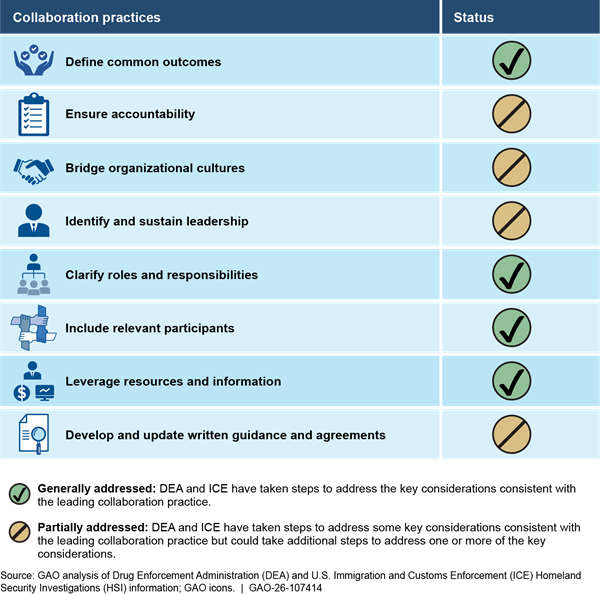
Specifically, we found that DEA and ICE’s interagency agreements and actions generally addressed practices related to defining common outcomes, clarifying roles and responsibilities, including relevant participants, and leveraging resources and information. For example, the agreements articulate DEA and ICE’s roles in counternarcotics investigations and outline the responsibilities of field office staff, including the Special Agent-in-Charge and the Title 21 Coordinator. Therefore, we found they generally addressed the practice related to clarifying roles and responsibilities.[37] In addition, the 2009 agreement describes processes for DEA and ICE to share information and invite each other to participate in task forces, which generally addressed the practice related to leveraging resources and information.
Appendix IV provides more detailed information about the extent to which DEA and HSI had addressed all eight leading collaboration practices prior to May 2026.
DEA and ICE Did Not Fully Establish Some Collaborative Practices Prior to May 2026, and It Is Unclear What Requirements Remain
DEA and ICE did not fully establish some collaborative practices prior to May 2026, including ensuring accountability and sustaining leadership, bridging organizational cultures, and updating written guidance and agreements.
Ensure Accountability and Sustain Leadership
Headquarters Review Team. Prior to the May 2026 memorandum, DEA and ICE leadership had failed to sustain a functioning Headquarters Review Team, which hindered the agencies’ ability to oversee the effectiveness of collaboration in the field on narcotics-related investigations. The 2009 agreement established the Headquarters Review Team, which since 2021 is composed of six participants from DEA and six participants from ICE, including the DEA Deputy Chief of Domestic Operations and the HSI Assistant Director of Domestic Operations.[38] The agreements delineate specific actions the Headquarters Review Team is to perform, which, together, describe how the mechanism should function as a headquarters-level entity to sustain leadership, address collaboration issues, and ensure the agreements are being implemented appropriately. For example, the agreements require that the members of the Headquarters Review Team meet routinely, address collaboration issues that arise in the field, and periodically assess how the agreements are being implemented in the field. As previously described, the DOJ Office of Legal Counsel’s opinion also identified utilizing the Headquarters Review Team to resolve disputes between DEA and HSI as a key mechanism for DEA to supervise HSI special agents, as required by the Controlled Substances Act.[39]
As of May 2026, when the Acting Attorney General issued the memorandum, DEA and HSI generally had not been convening meetings of the Headquarters Review Team as required since 2009 by the agreements. Therefore, it was not functioning as a sustained leadership and accountability mechanism to ensure the agreements were being implemented as intended. DEA and HSI headquarters officials agreed that the Headquarters Review Team did not meet from 2009 to 2020.[40] However, they provided differing views on Headquarters Review Team meetings after 2020. DEA headquarters officials said the Headquarters Review Team met twice since 2020, including in 2021 and 2024. Conversely, HSI headquarters officials said there were no meetings of the Headquarters Review Team, but that groups of DEA and HSI executives met various times to discuss specific issues.
Further, since DEA and HSI officials did not consistently hold meetings, neither agency could provide information on how the Headquarters Review Team addressed its responsibilities to evaluate the implementation of the agreements, address collaboration issues that cannot be resolved in field office locations, and poll agencies to identify issues to ensure healthy relationships.[41]
DEA and HSI officials we met with in the field described some significant issues related to the implementation of the agreements that could be reported to the Headquarters Review Team for its assessments and other oversight responsibilities. For example:
· Circumventing collaboration. An HSI group supervisor in one field office stated that some DEA special agents use task force officers from U.S. Customs and Border Protection to circumvent working with HSI special agents.[42] Specifically, the HSI group supervisor said that DEA special agents in their field office leverage their task force officer’s access to DHS systems to obtain HSI’s investigation information, which effectively eliminates collaboration between HSI special agents and DEA special agents.
· Competition. An HSI special agent in another field office stated that some special agents do not properly deconflict due to competition between DEA and HSI special agents. Specifically, this agent told us that some DEA special agents in their region enter excess information into the shared deconfliction systems—for example, entering an entire apartment building instead of a specific unit in the building—so they are notified when HSI agents deconflict a common target, even if DEA is not actively investigating the target.
· Homeland Security Task Forces. HSI officials in two of the field offices we met with and DEA officials from one noted concerns about the potential impacts of the HSTFs. Specifically, HSI group supervisors and special agents in one field office and HSI special agents in another field office told us that the creation of the HSTFs generated some friction between DEA and HSI as the agencies worked to determine their respective roles for counternarcotics investigations under the HSTFs. Additionally, a DEA Title 21 Coordinator and group supervisor in another field office expressed concerns that DEA would have a subordinate role in HSTF’s counternarcotics investigations. Finally, an HSI group supervisor in one field office expressed concerns that the HSTFs would increase competition, not collaboration, between DEA and HSI at that field office because there will be more cases eligible for task force funding under the HSTFs.
· Field office notification. Under the agreements issued prior to the May 2026 memorandum we found that DEA and HSI did not have mechanisms or processes to ensure Title 21 Coordinators collected and reported relevant information on how field offices were implementing the agreements to the Headquarters Review Team. As discussed, the Headquarters Review Team has responsibilities to assess how the agreements are being implemented systemwide.
DEA and HSI headquarters officials told us that they delegated oversight of the implementation of the agreements, including information sharing and deconfliction procedures, to the Title 21 Coordinators at the field office level.[43] DEA and HSI developed a standard operating procedure that describes the roles and responsibilities of the Title 21 Coordinator.[44] For example, according to the procedure, the Title 21 Coordinators are to ensure cooperation, communication, coordination, and deconfliction in all matters covered by the agreements. This also includes the process for HSI Title 21 Coordinators to notify and invite DEA to HSI investigations and operations and share operational plans prior to conducting certain operations through their counterpart DEA Title 21 Coordinators in the field offices. These are activities which the Office of Legal Counsel identified in its legal opinion as key steps for DEA to supervise HSI special agents, as legally required.[45] Further, the standard operating procedure requires Title 21 Coordinators to accomplish the goals set out in the agreements.
DEA and HSI Title 21 Coordinators told us they rarely report to the Headquarters Review Team. Specifically, Title 21 Coordinators, group supervisors, and special agents we met with in nine field offices confirmed that they usually resolve issues at the special agent, group supervisor, or Title 21 Coordinator level. For example, officials in one field office told us that, while they raised an issue to the Special Agent-in-Charge in their field office, they never elevated the issue to the Headquarters Review Team.
Nevertheless, DEA and HSI officials we met with identified some lapses that could be relevant to the Headquarters Review Team’s assessment of how the agreements were being implemented. For example, in one field office, the DEA Title 21 Coordinator reported that HSI does not consistently submit operational plans for DEA’s review, which the official explained is a key step for deconflicting an operation. The official believes this is a result of HSI lacking a thorough understanding of the 2009 agreement, particularly on provisions related to deconfliction.[46] Appendix I provides more information about field office perspectives on the implementation of the agreements.
According to our leading practices for collaboration, entities should ensure accountability at both the agency and individual levels when collaborating.[47] This includes having ways to monitor, assess, and communicate progress towards outcomes—activities that DEA and ICE’s agreements and procedures direct the Headquarters Review Team and Title 21 Coordinators to perform. Our leading practices also state that by sharing leadership, agencies can create buy-in and convey support for the collaborative effort—which DEA and HSI could do through sustaining its Headquarters Review Team.
With the issuance of the May 2026 memorandum, however, it is unclear whether the accountability activities required by the agreements, which the DOJ Office of Legal Counsel indicated DEA had been using to satisfy its supervisory requirements, remain in effect. For example, to address accountability, the May 2026 memorandum requires the Secretary of Homeland Security to provide the Attorney General a monthly report of Title 21 investigations initiated over the prior 30-day period and confirmation that each new investigation has been properly deconflicted pursuant to the interagency deconfliction process. The memorandum does not address activities identified in our leading collaboration practices, such as monitoring and assessing collaboration. Nor does the memorandum expressly invalidate prior mechanisms established by the agreements, such as the Headquarters Review Team, which was intended to promote accountability.
As of June 2026, DOJ officials told us they were still determining how the May 2026 memorandum will impact existing collaboration requirements in the agreements, including whether the Headquarters Review Team and Title 21 Coordinators will continue to exist. By clarifying the status of the requirements in DEA and ICE’s agreements in light of the Acting Attorney General’s memorandum, DOJ and DHS would provide DEA and ICE with the necessary direction about the activities they should conduct to ensure effective collaboration. This includes activities such as establishing the Headquarters Review Team and HSI notifying DEA of its investigations and sharing operational plans in the field offices.
Bridge Organizational Cultures
Prior to May 2026, DEA and HSI had not developed and implemented the joint training as outlined in the 2021 joint letter. According to the 2021 joint letter, DEA and HSI are to work together to create two training modules, including joint training taught to their respective special agents. The joint training should be required annually for cross-designated HSI special agents, DEA special agents, HSI supervisors, and Title 21 Coordinators. In addition, according to the 2021 joint letter, the purpose of implementing this joint training is to ensure DEA and HSI teach DEA and HSI special agents the required collaboration activities with one voice.[48] Further, the January 2025 DOJ Office of Legal Counsel’s opinion identified the joint training as one of the key mechanisms that DEA uses to supervise HSI special agents and ensures consistency and clarity regarding HSI special agents’ authority under the Controlled Substances Act.
We reported in March 2025 that DEA and HSI’s inability to reconcile their competing interpretations of the June 2009 and January 2021 agreements in order to develop and implement the joint training means DEA and HSI are not fully adhering to their agreed upon policies and procedures to cross designate agents. We reported this brings into question whether DEA and HSI are cross designating HSI agents with Title 21 authority in accordance with those agreements.[49] We recommended that DEA and HSI work together to develop and implement the training modules in accordance with the January 2021 joint letter. Further, we recommended that the agencies use agreed-upon dispute resolution mechanisms to resolve their differences on the content of the training, such as leveraging the Headquarters Review Team.
As of May 2026, the joint training is still not complete, and DEA and HSI disagree on the status of the effort and whether the joint training has been appropriately implemented. Specifically, HSI headquarters officials stated in February 2026 that DEA drafted the training without input from HSI, and DEA did not invite HSI to develop the training or resolve their differences together. Further, these officials stated that they raised several issues to DEA about the content of the training that have yet to be resolved. Some of these issues include differing interpretations of the definitions of key terms, statutory authorities, and provisions in the 2009 agreement language.
Conversely, DEA headquarters officials stated in March 2026 that HSI objected to a single voiceover note included in the training and consequently refused to implement the training. DEA has been using the training for their special agents since September 2022 even though the training still includes content with which HSI does not agree. While DEA and HSI officials stated they train their respective special agents on the June 2009 agreement, we do not consider either training program to reflect the training requirements referenced in the January 2021 joint letter because they are not using mutually agreed upon modules. As of May 2026, DEA and HSI do not have a timeline for resolving these issues.[50]
Our leading interagency collaboration practices state that agencies should bridge organizational cultures. This includes establishing compatible policies and procedures and agreeing on common terminology and definitions, which, as discussed, would be subjects covered by the DEA and HSI joint training.[51] Nevertheless, with the issuance of the May 2026 memorandum, it is unclear whether the agreements, with their requirements to develop joint training, remain in effect. For example, the memorandum states that the Secretary of Homeland Security will report monthly to the Attorney General to confirm that HSI special agents and assigned task force officers exercising delegated Title 21 authority have received appropriate training related to the Controlled Substances Act. However, the memorandum does not state whether the training will be the joint training that DEA and HSI were developing or an entirely new effort.
As of June 2026, DOJ officials told us they were still determining how the May 2026 memorandum will impact existing collaboration requirements within the agreements, including the requirement to develop and implement the joint training. By clarifying the status of the requirements within DEA and ICE’s agreements in light of the Acting Attorney General’s memorandum, DOJ and DHS would provide DEA and ICE with the necessary direction about the activities they should conduct to ensure effective collaboration, including developing the joint training. For example, the 2021 joint letter states that implementing this joint training will ensure DEA and HSI special agents understand required collaboration activities described in the 2009 agreement, which includes activities such as deconfliction that ultimately prevent dangerous blue-on-blue situations during operations.
Develop and Update Written Guidance and Agreements
Prior to the Acting Attorney General’s May 2026 memorandum, we found that DEA and ICE had developed written agreements to guide their collaboration on counternarcotics investigations; however, the agencies had not reviewed these agreements biannually as the agreements require. According to the 2009 agreement, the DEA Chief of Operations and the ICE Director of Investigations or their designees should review the agreement every two years or upon a written request by either party. The agreement also specifies that both parties will resolve any issues and execute any necessary or appropriate modifications to the 2009 agreement.
However, DEA and HSI headquarters officials told us that DEA and HSI did not meet from 2009 to 2020 to review or revise the agreements. In 2020, senior leaders from DEA and HSI created a working group to review the 2009 agreement, among other things. The result of this review was the 2021 joint letter, which is to document and provide a roadmap for implementation for the recommendations of that working group. DEA and HSI have not updated the agreements since signing the 2021 joint letter, as of May 2026.
We identified circumstances related to specific provisions of the agreements that have changed since the agencies signed the 2021 joint letter. As such, the agreements no longer reflect the current operating procedure. For example:
· Changes to the Organized Crime and Drug Enforcement Task Forces. As discussed, the Organized Crime and Drug Enforcement Task Forces were dissolved in 2025 and the HSTFs replaced them. However, the 2009 agreement has not been updated to reflect this change. Specifically, the 2009 agreement instructs DEA and ICE to participate in and share information through the Organized Crime and Drug Enforcement Task Forces Fusion Center, but the HSTFs’ National Coordination Center has replaced the Organized Crime and Drug Enforcement Task Forces Fusion Center. The agreements have not been updated to clarify how DEA and HSI should share information and deconflict HSTF cases through the National Coordination Center.[52]
· Changes to the Title 21 cross-designation process. The agreements describe the requirements for DEA to cross-designate HSI special agents conducting Title 21 investigations, but this process changed in 2025 and 2026. Specifically, the 2009 agreement states that the Assistant Secretary of ICE is authorized to identify any special agent or groups whose duties include the investigation of narcotics cases with a clearly articulable nexus to the border or port of entry for cross-designation.[53] Additionally, the 2021 joint letter states that Title 21 Coordinators will initiate the cross-designation process for HSI special agents.[54] However, beginning in August 2025, HSI started requesting all HSI special agents receive Title 21 cross-designation. Further, in May 2026, the process changed again because of the Acting Attorney General’s memorandum, which granted all HSI agents the authority to conduct Title 21 investigations.[55] As such, it is unclear if the request process is still required.
· Potential changes from the Acting Attorney General’s May 2026 memorandum. As discussed, the memorandum may impact various activities that were previously described in the agreements. The memorandum also states that the Secretary of Homeland Security will report monthly directly to the Attorney General on HSI’s activities.[56]
Our leading interagency collaboration practices include developing and updating written guidance and agreements. Specifically, it states that articulating agreements in formal documents can strengthen participants’ commitment to work collaboratively and enhance accountability for results. Furthermore, these agreements can be most effective when they are regularly updated and monitored.[57]
Prior to May 2026, HSI and DEA officials told us that other agency priorities were more important than updating the agreements. However, as discussed, the Acting Attorney General’s May 2026 memorandum makes it unclear whether these agreements are still valid, and thus whether the agreements need to be updated to reflect the current operating environment or a new agreement or framework needs to be developed.
During our site visits prior to May 2026, HSI officials from three field offices and DEA officials from one field office we met with described the importance of the June 2009 agreement and January 2021 joint letter for promoting collaboration between DEA and HSI and outlining the responsibilities of the agencies. For instance, officials in one DEA field office reported that they believed the agreements were still relevant at the time because DEA was concerned that its work would be minimized at the expense of other agencies under the new HSTFs. Further, HSI officials from one field office indicated that they thought the agreements should be strengthened or the provisions further clarified in order to address significant issues between DEA and HSI.
As of June 2026, DOJ officials told us they were still determining how the May 2026 memorandum will impact the agreements, including whether they would update agreements or create a new framework or agreement to reflect changes to roles and requirements since the memorandum. By either updating the agreements to address changes to the current operating environment or developing a new agreement or framework to address these changes, DEA and ICE would better ensure effective collaboration on counternarcotics investigations.
DOJ Has Not Clarified How It Will Supervise HSI Special Agents Under the May 2026 Memorandum
The January 2025 DOJ Office of Legal Counsel’s opinion states that DOJ satisfies the requirements for supervision of HSI special agents through mechanisms DEA and ICE established in the agreements. These included (1) requirements for HSI to notify and invite DEA to narcotics investigations, (2) HSI submitting operational plans or other proposals to DEA prior to conducting certain operations, (3) utilizing the Headquarters Review Team to resolve disputes between DEA and ICE, and (4) HSI special agents being required to take the training described in the 2021 joint letter annually.[58]
As previously discussed, the continued efforts to implement all four of these required activities are uncertain following the May 2026 memorandum because DOJ has not clarified the status of the agreements. Specifically, it is unclear whether HSI is still required to notify and invite DEA to participate in narcotics investigations in the field offices, and whether Title 21 Coordinators are still required to submit operational plans and other proposals to DEA prior to conducting certain operations. Further, it is unclear whether DEA and ICE intend to utilize the Headquarters Review Team or provide joint training.
According to DOJ officials, DOJ has just started the process of determining how the Acting Attorney General will implement the memorandum. If DOJ determines the agreements are superseded and the mechanisms that the DOJ Office of Legal Counsel’s opinion previously found fulfilled these supervisory requirements are no longer present, it is unclear how the Attorney General will supervise HSI special agents consistent with applicable law.
As discussed, the Office of Legal Counsel’s opinion stated that weakening the DOJ’s supervisory role could present difficulties with characterizing HSI personnel as acting under the supervision of the Attorney General—rather than assuming the Attorney General’s responsibilities—which HSI may not do, consistent with the Controlled Substances Act. According to the Office of Legal Counsel, DOJ may not assign the execution of its statutory responsibilities to other agencies without statutory authorization. By establishing DOJ and placing certain responsibilities in the Attorney General, Congress has generally expressed its intent that these duties should be discharged by DOJ, and not DHS, officials. The Office of Legal Counsel stated that this conclusion is rooted in background principles of the separation of powers. Therefore, without clarifying the status of the agreements and identifying the mechanisms for how the Attorney General will supervise HSI special agents as legally required, DOJ risks weakening the supervisory provisions it previously implemented. This, in turn, has the potential to undermine the validity of HSI investigations conducted under the delegated Title 21 authority and weaken federal efforts to combat the illicit drug crisis.
Conclusions
DEA and HSI’s efforts to enforce federal narcotics laws are a vital part of the federal response to the illicit drug crisis. Collaboration between DEA and HSI on counternarcotics investigations is important to the success of these fragmented efforts.[59] The June 2009 agreement and January 2021 joint letter outlined ways for the agencies to collaborate on these investigations, which the agencies carried out to various degrees and with mixed success. Following the Acting Attorney General’s May 2026 memorandum, it is unclear whether the June 2009 agreement and January 2021 joint letter are still valid, which has the potential to change the various activities DEA and ICE have engaged in to safely and effectively collaborate on counternarcotics investigations.
DEA and HSI’s collaboration efforts prior to the Acting Attorney General’s May 2026 memorandum generally addressed half of the leading collaboration practices identified in our prior work. However, how DOJ and HSI will decide to operationalize the memorandum going forward may impact DEA and HSI’s collaboration activities for the four leading practices that they were generally addressing prior to May 2026.
We also identified additional actions needed to address four of eight practices. For instance, DEA and HSI had been unable to sustain the Headquarters Review Team, a key mechanism to ensure accountability and sustain leadership, which the agreements had required since 2009. Moreover, having joint training would help DEA and ICE to bridge organizational cultures, but it has been 5 years since the January 2021 joint letter established the requirement for the training, and it has not been implemented. DEA and ICE included these requirements in their agreements to address challenges such as resolving disputes and to ensure a mutual understanding of the agreements, respectively. The DOJ Office of Legal Counsel also identified these as activities that DEA was conducting to satisfy the requirement for DOJ to supervise cross-designated HSI special agents.
Furthermore, our leading practices state that written agreements are most effective at enhancing collaboration when they are regularly updated and monitored, but we found that leadership had not reviewed and updated their interagency agreements biannually as required. Consequently, we identified several areas in which information in the agreement was outdated; for example, they did not include the establishment of the HSTFs.
With the issuance of the Acting Attorney General’s memorandum, it is unclear whether activities such as the Headquarters Review Team and joint training required by the agreements remain in effect. By DOJ and DHS clarifying whether these requirements from the June 2009 and January 2021 agreements are still valid, DEA and ICE would be better positioned to fully address the collaboration gaps we identified and ensure special agent safety by preventing blue-on-blue situations. Furthermore, by regularly updating the existing agreements or developing a new agreement or framework to address the current operating environment, the agencies would better ensure effective collaboration on counternarcotics investigations.
Finally, the January 2025 DOJ Office of Legal Counsel’s opinion identified key mechanisms through which DEA supervised HSI special agents. The opinion also found that such supervision was a legal requirement for HSI to conduct work under the Controlled Substances Act. However, following the Acting Attorney General’s May 2026 memorandum, it is unclear how the Attorney General will ensure supervision requirements continue to be met. Specifically, the Office of Legal Counsel’s opinion stated that weakening the DOJ’s supervisory role could present difficulties with characterizing HSI personnel as acting under the supervision of the Attorney General—rather than assuming the Attorney General’s responsibilities—which HSI may not do—consistent with the Controlled Substances Act. As the Office of Legal Counsel found in its opinion, this conclusion is rooted in background principles of the separation of powers. Until DOJ clarifies how it intends to supervise HSI, DOJ and HSI cannot ensure that HSI is conducting investigations under the Controlled Substances Act consistent with legal requirements, which could undermine the separation of powers, as well as the validity of HSI’s illicit drug investigations.
Recommendations for Executive Action
We are making five recommendations, including three recommendations to DOJ and two to DHS:
The Attorney General should collaborate with the Secretary of Homeland Security to clarify the status of requirements in DEA and ICE’s 2009 agreement and 2021 joint letter, including the Headquarters Review Team, field office notification of investigations and operational plans, and the joint training. (Recommendation 1)
After clarifying the status of the requirements in DEA and ICE’s existing agreements, the Attorney General should direct the Administrator of DEA, in collaboration with the Director of ICE, to update DEA and ICE’s 2009 agreement and 2021 joint letter to address changes to the current operating environment or develop a new agreement or framework that addresses these changes. (Recommendation 2)
The Attorney General should clarify how DOJ will implement key supervisory mechanisms identified in DOJ Office of Legal Counsel’s January 2025 opinion in light of any changes to requirements within DEA and ICE’s 2009 agreement and 2021 joint letter. (Recommendation 3)
The Secretary of Homeland Security should collaborate with the Attorney General to clarify the status of requirements in DEA and ICE’s 2009 agreement and 2021 joint letter, including the Headquarters Review Team, field office notification of investigations and operational plans, and the joint training. (Recommendation 4)
After clarifying the status of the requirements in DEA and ICE’s existing agreements, the Secretary of Homeland Security should direct the Director of ICE, in collaboration with the Administrator of DEA, to update DEA and ICE’s 2009 agreement and 2021 joint letter to address changes to the current operating environment or develop a new agreement or framework that addresses these changes. (Recommendation 5)
Agency Comments and Our Evaluation
We provided a draft of this report to DHS and DOJ for review and comment. DHS provided written comments that are reprinted in appendix V and summarized below. DOJ did not provide written comments on the report but concurred with our recommendations.
In its comments, DHS disagreed with our fourth recommendation to clarify the status of requirements in DEA and ICE’s 2009 agreement and 2021 joint letter. Specifically, DHS stated that the May 2026 Acting Attorney General’s memorandum explicitly granted HSI authority under Title 21 of the U.S. Code to assist in enforcing the Controlled Substances Act. Further, DHS noted that the interagency coordination landscape was restructured pursuant to Executive Order 14159, and that all Title 21 enforcement activity and deconfliction is now routed through the National Coordination Center and the HSTFs’ framework. As a result, it does not believe the requirements in the agreements remain necessary. DHS stated that it would take no further action to address this recommendation.
We continue to believe that DHS and DOJ should collaborate to clarify the status of the requirements, including the Headquarters Review Team, field office notification of investigations and operational plans, and joint training. DOJ’s Office of Legal Counsel concluded in January 2025 that the supervision of cross-designated HSI special agents by DOJ was a legal requirement for HSI special agents to conduct work under the Controlled Substances Act because Congress has generally expressed that these duties be performed by DOJ and not DHS. While the May 2026 memorandum and Executive Order 14159 address collaboration on drug investigations, DOJ is still required to supervise cross-designated HSI special agents. Moreover, DHS lacks its own independent authority to conduct Title 21 drug investigations and may not assume such authority.
Further, the Office of Legal Counsel’s opinion identified the Headquarters Review Team, field office notification of investigations and operational plans, and the joint training as key mechanisms through which DEA was supervising HSI special agents. The May 2026 memorandum does not explicitly state that the agreements and the requirements therein are no longer valid. It also does not describe how the Attorney General intends to replace the requirements that the Office of Legal Counsel previously indicated were sufficient to satisfy the requirement for DOJ to supervise cross-designated HSI special agents thereby avoiding the Attorney General improperly transferring power vested in the DOJ to another agency—DHS—without congressional consent.
We also made this recommendation to DOJ, our first recommendation, with which it concurred. In the absence of a documented agreement between DOJ and DHS on DOJ’s supervisory role, DOJ cannot perform the supervision of cross-designated HSI special agents as legally required. Further, clarifying the status of the requirements in DEA and ICE’s agreements would provide assurance that they are conducting all necessary collaborative activities, including properly deconflicting cases to avoid dangerous blue-on-blue situations.
DHS also disagreed with our fifth recommendation to update the 2009 agreement and 2021 joint letter to address changes to the current operating environment or develop a new agreement or framework. DHS stated in its comments that the National Coordination Center and HSTFs framework already address the current operating environment. Further, DHS stated its position that the May 2026 memorandum and Executive Order 14159 collectively provide the current operational framework for interagency coordination and address the requirements of the June 2009 agreement and January 2021 joint letter. As a result, it does not believe that updating or developing a separate, new agreement is necessary. DHS stated that it would take no further action to address this recommendation.
We continue to believe that DHS and DOJ should develop a new agreement or framework to articulate how HSI and DEA will collaborate following the May 2026 memorandum and Executive Order 14159. As stated previously, DOJ is still required to supervise cross-designated HSI special agents, and DHS lacks its own independent authority to conduct Title 21 drug investigations and may not assume such authority. In addition, neither the May 2026 memorandum nor documentation provided to us about the HSTFs indicate how the Attorney General intends to supervise cross-designated HSI special agents.
We also made this recommendation to DOJ, our second recommendation, with which it concurred. In the absence of an updated or new agreement or framework between DOJ and DHS that addresses changes to the operating environment and specifies how DOJ will supervise cross-designated HSI special agents, there may be confusion in the field about how DEA and HSI officials are to collaborate on Title 21 drug investigations. By developing a new agreement or framework, DHS and DOJ can ensure HSI and DEA are collaborating effectively and legally within the statutory authority granted to the Attorney General.
We are sending copies of this report to the appropriate congressional committees and the Attorney General and Secretary of Homeland Security. In addition, this report is available at no charge on the GAO website at http://www.gao.gov.
If you or your staff have any questions, please contact me at mcneilt@gao.gov. Contact points for our Offices of Congressional Relations and Public Affairs may be found on the last page of this report. GAO staff who made significant contributions to this report are listed in appendix VI.

Triana McNeil
Director, Homeland Security and Justice
Appendix I: Perspectives on DEA and HSI Collaboration on Drug Investigations from Field Office Officials
Both the Drug Enforcement Administration (DEA) and U.S. Immigration and Customs Enforcement (ICE) Homeland Security Investigations (HSI) initiate counternarcotics investigations, but the agencies focus their investigative activities on different efforts. Specifically, DEA, a component of the Department of Justice (DOJ), focuses on leading U.S. efforts against illicit drug trafficking and is charged with enforcing Title 21 of the U.S. Code which contains the nation’s controlled substances laws, including the Controlled Substances Act and Controlled Substances Import and Export Act of 1970.[60] HSI, a component of the Department of Homeland Security (DHS), focuses on efforts against smuggling with a connection to the U.S. border. To facilitate their collaboration, DEA and ICE have entered into agreements including: (1) an August 1994 memorandum of understanding between DEA and U.S. Customs Service, (2) a June 2009 interagency cooperation agreement between DEA and ICE, and (3) a January 2021 joint letter.[61]
We interviewed DEA and HSI field officials who conduct counternarcotics investigations.[62] These officials represented a nongeneralizable sample of nine field offices from international border, internal, and maritime areas of responsibility.[63] Appendix II provides more information about our field office selection process and how we conducted our interviews.
Perspectives on Overall DEA and HSI Collaboration in Selected Field Offices
DEA and HSI officials representing all nine selected field offices reported that special agents in their areas of responsibility regularly collaborate on counternarcotics investigations. This may involve regular day-to-day communication, exchange of investigative information, operational coordination, and deconfliction, among other activities.[64] Further, in response to open ended questions about the quality of their collaboration with each other on investigations, DEA and HSI officials’ responses fell into three categories: generally positive, generally effective but having room for improvement, or as having significant, unresolved issues, as shown in Figure 4.
Figure 4: DEA and HSI Perspectives on Collaboration on Counternarcotics Investigations in Selected Field Offices
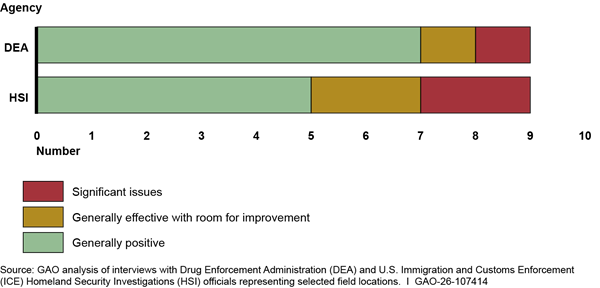
Note: We met with DEA and HSI officials in nine field offices, including: New York, Philadelphia, Denver, Chicago, Tucson, Atlanta, San Diego, Los Angeles, and Miami. At these locations, we conducted semi-structured interviews to assess DEA and ICE’s collaboration on counternarcotics investigations. These semi-structured interviews included questions about the overall collaborative environment in their area of responsibility, including factors that contributed to successes and challenges, and practices involving information sharing and deconfliction, as required by the agreements.
Key Factors Enhancing DEA and HSI Collaboration
Both DEA and HSI officials in five out of nine selected field offices reported currently having a generally positive working relationship. Figure 5 identifies the key factors that the officials identified as enhancing collaboration in these five offices.
Figure 5: Perspectives on Key Factors Enhancing Collaboration on Counternarcotics Investigations in Selected Field Offices
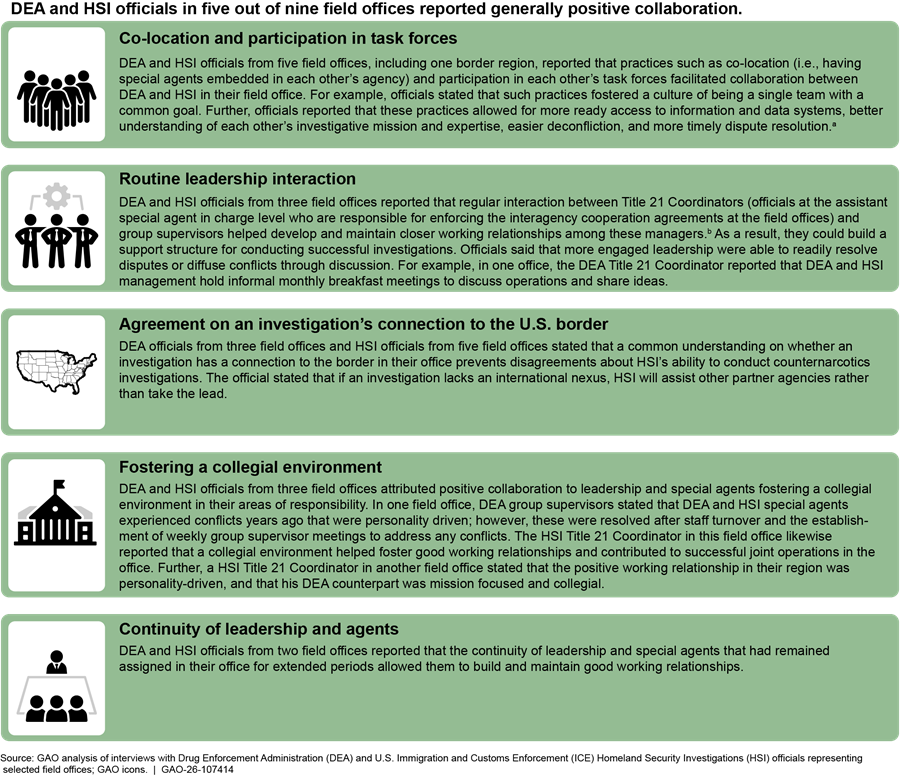
Note: We conducted semi-structured interviews with DEA and HSI field management officials serving as Title 21 Coordinators, DEA and HSI group supervisors, and HSI special agents from nine selected field offices. We selected these offices based on several factors, including DEA and HSI presence in the area, type of region (e.g., interior, border, or maritime) and number of drug seizures using agency provided data. In response to open-ended questions, DEA and HSI officials in five out of nine selected field offices all reported currently having a generally positive working relationship. In the remaining four of the nine offices, the responses were mixed. Specifically, in two out of nine offices, HSI officials in both offices and DEA officials from one of the field offices reported generally effective working relationships but noted some issues that challenge collaboration. In addition, in two out of nine field offices, HSI officials in both and DEA officials in one of the field offices reported significant, unresolved issues that impact their ability to collaborate.
aDeconfliction is the sharing of limited investigative information among federal, state, local, and tribal law enforcement entities to identify common interest or activity. Deconfliction initiates coordination between interested law enforcement entities to prevent duplicative work and possible “blue-on-blue” situations (i.e., personnel from two or more law enforcement agencies unwittingly encountering each other during a law enforcement operation, such as an undercover situation).
bTo facilitate collaboration on drug investigations, DEA and ICE entered into cooperation agreements including a June 2009 interagency cooperation agreement and a January 2021 joint letter, that govern, among other things, deconfliction and information sharing practices. DEA and ICE, Interagency Cooperation Agreement Between the U.S. Drug Enforcement Administration and U.S. Immigration and Customs Enforcement Regarding Investigative Functions Related to the Controlled Substances Act (June 18, 2009) and DEA and ICE, Joint Letter on the DEA-ICE Interagency Cooperation Agreement (Jan. 5, 2021). The January 2021 joint letter reinforces the June 2009 agreement; it does not replace the June 2009 agreement.
Key Factors Challenging DEA and HSI Collaboration
DEA officials in one and HSI officials in two out of nine offices reported generally effective working relationships but noted some issues that challenge collaboration. In addition, DEA officials in one and HSI officials in two out of nine field offices reported significant, unresolved issues that impact their ability to collaborate.[65] Figure 6 identifies the key factors challenging DEA and HSI collaboration in these field offices.
Figure 6: Perspectives on Key Factors Challenging Collaboration on Counternarcotics Investigations in Selected Field Offices
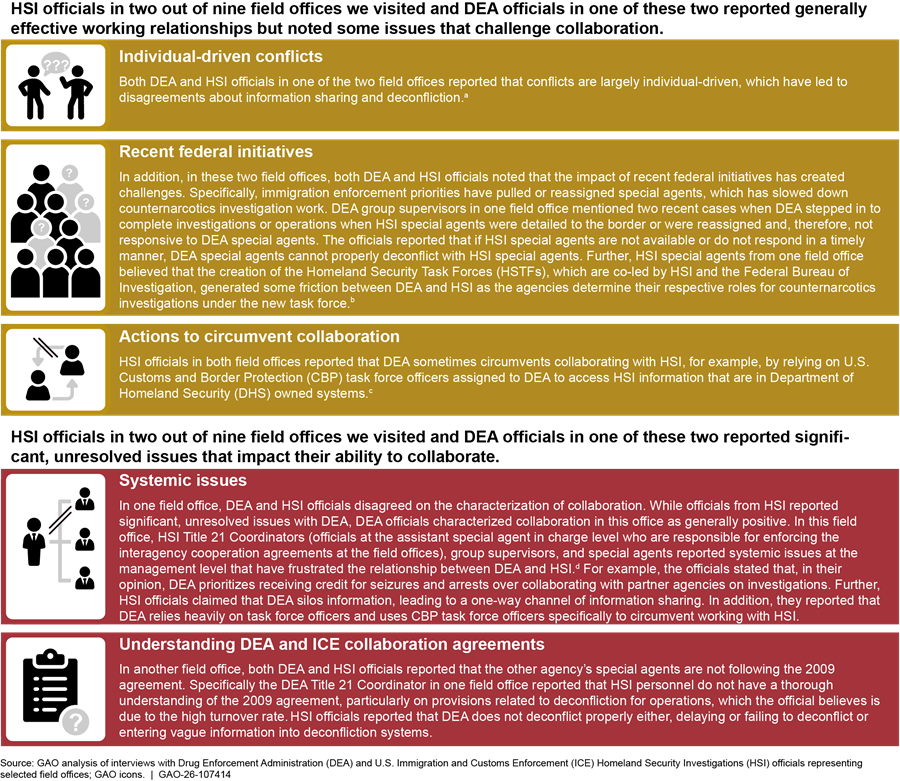
Note: We conducted semi-structured interviews with DEA and HSI field management officials serving as Title 21 Coordinators, DEA and HSI group supervisors, and HSI special agents from nine selected field offices. We selected these offices based on several factors, including DEA and HSI presence in the area, type of region (e.g., interior, border, or maritime) and number of drug seizures using agency provided data. In response to open-ended questions, DEA and HSI officials in five out of nine selected field offices reported currently having a generally positive working relationship. In the remaining four of the nine field offices, the responses were mixed. Specifically, in two out of nine offices, HSI officials in both offices and DEA officials in one of the offices reported generally effective working relationships but noted some issues that challenge collaboration. In addition, in two out of nine field offices, HSI officials in both and DEA officials in one of the field offices reported significant, unresolved issues that impact their ability to collaborate.
aDeconfliction is the sharing of limited investigative information among federal, state, local, and tribal law enforcement entities to identify common interest or activity. Deconfliction initiates coordination between interested law enforcement entities to prevent duplicative work and possible “blue-on-blue” situations (i.e., personnel from two or more law enforcement agencies unwittingly encountering each other during a law enforcement operation, such as an undercover situation).
bExecutive Order 14159 dated January 20, 2025, established the HSTFs. The Executive Order directs federal agencies to support HSTFs in achieving objectives that include dismantling criminal cartels, foreign gangs, and transnational criminal organizations operating within the United States; disrupting cross-border human smuggling and trafficking networks; and prioritizing offenses involving children. The HSTFs replaced the DOJ-led Organized Crime Drug Enforcement Task Force. As of May 2026, HSTFs were located in 30 priority cities across the country. Exec. Order No. 14159, Protecting the American People Against Invasion, § 6, 90 Fed. Reg. 8,443, 8,444 (Jan. 20, 2025).
cDEA deputizes other federal, state, and local law enforcement officers to perform the same functions as DEA special agents. These deputized officers are called task force officers. CBP is an agency under DHS.
dTo facilitate collaboration on drug investigations, DEA and ICE entered into cooperation agreements including a June 2009 interagency cooperation agreement and a January 2021 joint letter, that govern, among other things, deconfliction and information sharing practices. DEA and ICE, Interagency Cooperation Agreement Between the U.S. Drug Enforcement Administration and U.S. Immigration and Customs Enforcement Regarding Investigative Functions Related to the Controlled Substances Act (June 18, 2009) and DEA and ICE, Joint Letter on the DEA-ICE Interagency Cooperation Agreement (Jan. 5, 2021). The January 2021 joint letter reinforces the June 2009 agreement; it does not replace the June 2009 agreement.
Perspectives on Deconfliction and Information Sharing Practices in Selected Field Offices
DEA and HSI officials representing nine selected field offices described the deconfliction and information sharing practices they employ in their areas of responsibility when collaborating on counternarcotics investigations.
Deconfliction Practices
DEA and HSI officials from all nine field offices reported using various systems and mechanisms to deconflict investigative data, targets, and events. As previously discussed, deconfliction is the sharing of limited investigative information among federal, state, local, and tribal law enforcement entities to identify a common interest or activity. Once the common link is identified, law enforcement officers are notified and provided a point of contact with whom they can share information in order to avoid overlapping activities. The officials in all nine field offices we met with also reported that their local deconfliction practices require, at a minimum, using a two-step approach, which is consistent with DOJ and DHS policies.[66]
Nationwide investigative data deconfliction systems. DEA and HSI in all nine field offices we met with told us they use the Deconfliction and Information Coordination Endeavor (generally known by its acronym DICE) and the DEA Analysis and Response Tracking System (generally known by its acronym DARTS) to deconflict counternarcotics investigations.[67] Specifically:
· DEA deconflicts using DARTS, which is a DOJ owned nationwide investigative data deconfliction web-based application that is only available to DEA users.
· HSI deconflicts using DICE, which is a DOJ owned nationwide investigative data deconfliction web-based application. It provides participating federal, state, local, and tribal law enforcement the ability to deconflict information such as telephone numbers, email addresses, and vehicle license plate numbers. DICE accesses DARTS to allow agencies to deconflict with data maintained in DARTS. When DICE identifies a common piece of investigative data, the system notifies relevant law enforcement personnel of the match and provides contact information for the owner of the records.[68]
· Both DEA and HSI officials also reported that they use the DEA-led El Paso Intelligence Center’s nationwide drug seizure tracking system to deconflict seizure operations. The Center’s National Seizure System is a repository for collecting seizure information
on drugs, currency, chemical precursors, lab equipment, and weapons seizures. Information collected includes seizure
locations, individuals, and transportation (aircraft, vehicle, and vessel).[69]
|
Deconfliction Through the Los Angeles Regional Criminal Information Clearinghouse (LA CLEAR)
Source: Icons-studio/adobestock.com. | GAO‑26‑107414 Supporting the Los Angeles High Intensity Drug Trafficking Areas which includes Los Angeles, Orange, San Bernardino and Riverside counties, LA CLEAR provides, among other things, investigative analytical support and real-time target and event deconfliction through its 24-hour Watch Center. It is used by federal, state, and local law enforcement in the area. DEA and HSI officials based in the Los Angeles field offices reported that using LA CLEAR is a key step in their local deconfliction process. According to LA CLEAR officials, an agent investigating a target calls the watch center to provide the information they have, such as a name, address, or vehicle license plate number. The watch center then enters that information into Regional Information Sharing Systems intelligence databases system and notifies both the agent submitting the information and agents in charge of any cases matched by the system. During a live operation deconfliction, the watch center notifies both agencies if the operations are within a certain radius of each other. Source: GAO analysis of information from the Drug Enforcement Administration (DEA), U.S. Immigration and Customs Enforcement (ICE) Homeland Security Investigations (HSI), and LA CLEAR. I GAO‑26‑107414 |

Regional event deconfliction systems. DEA and HSI officials we met with in the field described deconfliction systems they use at the regional or local level. With respect to regional deconfliction systems, the field offices we met with reported using the following three systems to identify potential operational conflicts:
· The Regional Information Sharing Systems Officer Safety Event Deconfliction System, which is administered by DOJ.
· The Secure Automated Fast Event Tracking Network, used by the local High Intensity Drug Trafficking Areas (HIDTA).[70]
· Case Explorer, which is administered and owned by the Washington-Baltimore HIDTA.
When certain elements (such as time, date, and office) are matched between two or more upcoming events or operations, the agencies or personnel involved are notified of the conflict.
DEA and HSI officials in two field offices also use local deconfliction centers, which provide law enforcement, including DEA and HSI, deconfliction support by monitoring the three regional systems and notifying agencies of overlapping efforts. The sidebar provides an example of how DEA, HSI, and other law enforcement agencies use a local deconfliction center in California.
DEA and HSI Title 21 Coordinators told us that they ensure deconfliction occurs through completing their operational plans, which include a data field where special agents must note the specific deconfliction methods they employed. A group supervisor must approve the plan and check that deconfliction has taken place. These operational plans are then reviewed by field management. In addition, HSI is required by the 2009 agreement to submit its plans to the DEA Title 21 Coordinators for notification and review as well. A DEA Title 21 Coordinator from one field office reported that he changed this process from a check the box exercise to requiring that HSI agents provide a narrative step-by-step explanation of their deconfliction activities, including who the HSI agents spoke with, the issues discussed, and how they agreed to proceed. He made this change in coordination with his HSI counterpart and reported that, as a result, DEA and HSI collaboration improved because special agents are deconflicting more thoroughly and at earlier stages in the investigative process.
Outside of these systems and practices, officials also reported using other systems and informal mechanisms to deconflict to reinforce deconfliction efforts. These include phone calls, emails, or in-person meetings. For example, HSI officials in one field office reported using an email chain because the local deconfliction center only operates until 5 or 6 p.m. Additionally, three field offices noted that the information that the El Paso Intelligence Center provides is not as effective for deconfliction purposes, as there are more helpful or faster methods for sharing information. Group supervisors in one field office reported that while special agents still call every drug seizure into the center, officials found that local deconfliction centers are typically more helpful.
Despite these efforts, DEA and HSI officials also reported challenges with deconfliction. HSI officials in three field offices reported that DEA special agents mark all their targets as primary targets, which HSI officials believe is meant to claim ownership of any investigation that arises concerning that target. For example, HSI group supervisors in one of the three field offices stated that DEA special agents do this even if they do not intend to take actions against the targets. They reported that doing so ensures that DEA receives notification from the local deconfliction center when another special agent is working on those targets. In some cases, this has led to overlap. In two out of the three field offices, HSI officials described potentially dangerous situations in which, due to improper deconfliction, DEA and HSI special agents simultaneously arrived at the same location. In one field office, this led to DEA and HSI undercover special agents attempting to purchase narcotics from one another.
Regarding the operational plans that HSI is to submit to DEA, the DEA Title 21 Coordinator in one field office reported that HSI does not consistently submit operational plans for DEA’s approval, which the official explained is a key step for deconflicting an investigation. The official believes this is a result of HSI lacking a thorough understanding of the 2009 agreement, particularly provisions related to operations deconfliction, due to HSI’s high turnover rate in the region and the lack of proper training. Further, group supervisors in the same field office stated that the main challenges they encounter working with HSI revolved around deconfliction and information sharing.[71]
Information Sharing Practices
All nine field offices employ various systems and mechanisms to share investigative information from open and closed investigations, as required by the 2009 agreement. For example, as previously discussed, special agents are required to submit data into DICE, DARTS, and the El Paso Intelligence Center. Further, DEA and HSI officials from most field offices we met with told us that while they usually do not have direct access to each other’s internal case management systems, they can generally obtain access to the information they need from the other agency. They reported doing so by personally reaching out to their counterparts and requesting the information.
As previously discussed, DEA and HSI officials from five field offices reported that close working relationships enhance information sharing, including through practices such as conducting joint investigations, co-locating, embedding special agents, and participating in each other’s task forces. Officials also use informal mechanisms to share information with other agencies, such as through informal meetings, email, and text messages. In another field office, special agents reported using a group chat to share information.
However, DEA officials in two field offices and HSI officials in four field offices described challenges related to information sharing, including the following:
Access to DARTS. In two field offices, HSI group supervisors and special agents reported that it would be helpful to have access to DARTS, which is only available to DEA users. The officials stated that DEA enters more comprehensive investigative information into DARTS, while HSI is limited to just the information necessary to match for deconfliction in DICE. They noted that having access to the narrative information in DARTS would help further investigations. In another office, DEA group supervisors reported rescinding HSI’s direct access to DARTS, which they provided as a courtesy to embedded HSI special agents, because HSI was inputting limited information in DICE.
Special Operations Division reports. In one field office, the HSI Title 21 Coordinator and groups supervisors reported that HSI provides extensive information to DICE, which DEA’s Special Operations Division uses to develop analytical reports.[72] However, the officials said the results of these analyses are seldom shared with HSI. They explained that the Special Operations Division acts as a large data repository, but DEA officials in their field office do not make real-time intelligence readily available to other federal agencies.
Operational plans. In one field office, the DEA Title 21 Coordinator reported that DEA often must go back to HSI to request more details about a specific operational plan. For example, the DEA Title 21 Coordinator said that HSI sometimes provides vague information, such as “operation against cartel moving drugs across the border.” According to the Title 21 Coordinator, DEA needs specific information about the cartel, how it is moving drugs across the border, how HSI obtained this information, and what HSI plans to do during its operation. Additionally, the official claimed that HSI officials can sometimes downplay the need to communicate with DEA, including during foreign operations where DEA should be the primary point of contact.
Acting on another agency’s targets. In one field office, HSI special agents reported that DEA special agents sometimes use HSI’s intelligence or information but preclude HSI from conducting a joint investigation. For example, they said HSI and DEA special agents will meet to deconflict, and then shortly thereafter, HSI will find out DEA special agents arrested the mutual target or made arrests of HSI’s primary targets without notifying HSI.
This report examines (1) any new Department of Homeland Security (DHS) or Department of Justice (DOJ) documents since 2021 that address how the Drug Enforcement Administration (DEA) and U.S. Immigration and Customs Enforcement (ICE) collaborate on counternarcotics investigations, and (2) the extent to which DEA and ICE agreements and activities related to conducting counternarcotics investigations are aligned with leading practices for collaboration.[73] As part of this review, we also provided specific information on DEA and ICE field level collaboration activities, including deconfliction and information sharing practices, which are included in appendix I.[74]
To answer both objectives, we analyzed DOJ and DHS documentation and obtained testimonial evidence through interviews with DEA and ICE’s Homeland Security Investigations (HSI) headquarters and officials in nine field offices.[75]
Documentary Evidence Analysis
We analyzed interagency agreements between DEA and ICE to obtain a thorough understanding of the key collaboration provisions, particularly those related to deconfliction, information sharing, and accountability and the respective roles of DEA and ICE. These agreements include the following:
· August 1994 memorandum of understanding;
· June 2009 interagency cooperation agreement; and
· January 2021 joint letter on the DEA-ICE interagency cooperation.[76]
To further our understanding of these agreements, we reviewed DOJ and DHS guidance on implementing the provisions of these agreements. These include DEA and HSI guidance on the roles and responsibilities of Title 21 Coordinators as well as directives that set requirements for conducting deconfliction (e.g., the use of certain information systems).[77] We also reviewed DOJ and DHS guidance related to counternarcotics investigations, including a special agent manual and handbook and sample operational plans.[78] Finally, we reviewed relevant interagency agreements with other federal agencies such as the memorandum of understanding between DEA and the Federal Bureau of Investigation governing international controlled deliveries of controlled substances.[79]
We also reviewed DOJ documents, including the following:
· A January 2025 legal opinion regarding DOJ’s designation of HSI special agents and state and local law enforcement officers to conduct counternarcotics investigation;[80]
· A May 2026 Acting Attorney General memorandum authorizing all HSI special agents to use all authorities under Title 21 of the U.S. Code to assist DOJ in enforcing the Controlled Substances Act;[81]
· A February 2020 DOJ memorandum meant to provide a process for resolving disputes when multiple investigative agencies seek to prosecute the same target in order to promote collaboration to ensure that the strongest case moves forward.[82]
To inform our understanding of the issues surrounding the implementation of the agreements between DEA and ICE on counternarcotics investigations, we also reviewed prior relevant GAO work.[83]
Testimonial Evidence Analysis
To understand how DEA and HSI have implemented the agreements, we interviewed relevant DEA and HSI headquarters officials. Specifically, we asked questions related to DEA’s cross-designation of HSI special agents to conduct counternarcotics investigations, agreed upon DEA and HSI training, and accountability measures.
In addition, we obtained field perspectives on the implementation of the provisions of the agreements through semi-structured in-person and virtual interviews with DEA and HSI officials in nine field offices: Atlanta, Georgia; Chicago, Illinois; Denver, Colorado; Los Angeles, California; Miami, Florida; New York City, New York; Philadelphia, Pennsylvania; Phoenix/Tucson, Arizona; and San Diego, California.[84] We selected field offices based upon the following:
· Geographic dispersion (e.g., border, maritime, and interior);
· Number of drug seizures from fiscal year 2017 through March 2025 using agency provided data;
· Whether the location was identified in DEA’s 2025 National Drug Threat Assessment as posing significant drug trafficking threats in the United States;[85] and
· Recommendations from DEA and HSI officials as offices that have experienced collaboration successes or challenges.
Because we conducted group interviews and did not select the field offices randomly, our results are not generalizable to all DEA and HSI personnel nationwide. Instead, these interviews provided examples of field level efforts to implement the interagency agreements.[86]
To ensure we collected perspectives of management and investigators at each location, we interviewed DEA and HSI officials from three separate groups from each field office:
· Management-level officials, including the Special Agent-in-Charge and Assistant Special Agents-in-Charge, whom DEA and HSI headquarters officials select to serve as Title 21 Coordinators for their respective field offices. In this role, they are responsible for ensuring cooperation, communication, collaboration, and deconfliction on counternarcotics investigations.
· Group supervisors, who are responsible for supervising special agents, have experience collaborating with their DEA or HSI counterparts on counternarcotics investigations, and operate in the area of responsibility the field office represents; and
· HSI special agents, who are responsible for conducting counternarcotics investigations, have experience collaborating with their DEA counterparts, and operate within the area of responsibility the field office represents.[87]
We asked field officials representing the selected nine locations open-ended questions about the overall collaborative environment in their location, including factors that contributed to successes and challenges. Further, we asked specific questions on field level implementation of the provisions of the interagency agreements, in particular those related to deconfliction, information sharing, training, and accountability measures. We also asked about the extent to which recent federal initiatives such as the establishment of the federal interagency Homeland Security Task Forces (HSTFs) impacted the implementation of the agreements.[88] For each field office, we compared the perspectives of DEA and HSI to identify similarities and differences in their views. We also compared headquarters officials’ views as they relate to field officials’ views.
We sought to corroborate information collected from DEA and HSI field staff on regional information sharing and deconfliction practices by interviewing officials from local investigative support and deconfliction centers. Specifically, we interviewed officials with the Atlanta/Carolinas High Intensity Drug Trafficking Areas, Colorado Information Analysis Center, El Paso Intelligence Center, Los Angeles Regional Criminal Information Clearinghouse, Los Angeles-based Joint Regional Intelligence Center, and the San Diego Law Enforcement Coordination Center.
Analysis of DEA and HSI Collaboration Activities
To assess the extent to which DEA and HSI’s collaboration on counternarcotics investigations aligned with leading practices, we assessed information collected on DEA and HSI agreements and activities against eight leading practices for interagency collaboration identified in our prior work.[89] Each of these practices contains key considerations or questions of which we determined in our prior work to be relevant to collaboration.[90] For example, a key consideration of the “define common outcomes” leading practice is if agencies have identified crosscutting challenges or opportunities.
After reviewing documentary and testimonial evidence, we determined if DEA and HSI actions generally addressed, partially addressed, or did not address each leading practice. To determine the rating, one analyst established an initial rating, and a second analyst reviewed supporting evidence and verified it. If there were discrepancies, both analysts discussed the evidence and assessment and made a final determination. Specifically:
· For those we rated as generally addressed, our assessment of documentation and interviews found that DEA and HSI had taken steps to address the key considerations consistent with the leading collaboration practice.
· For those we rated as partially addressed, our assessment of documentation and interviews found that DEA and HSI had taken steps to address some key considerations consistent with the leading practice but could take additional steps to address one or more of the key considerations.
· For a rating of not addressed, our assessment of documentation and interviews found that DEA and HSI had not demonstrated that steps had been taken to address any of the key considerations under the leading practice.
For more information about the extent to which DEA and HSI have addressed all eight leading collaboration practices, see appendix IV.
After we completed our information and data collection and analysis and were in the process of finalizing our report, the Acting Attorney General issued the May 2026 memorandum requesting HSI utilize all authorities in Title 21 of the U.S. Code to assist DOJ in enforcing the Controlled Substances Act.[91] The memorandum has the potential to affect the existing DEA and ICE agreements and the collaboration practices the agencies had previously engaged in and which we describe in this report. As of June 2026, DEA and HSI were in the initial phase of determining how the memorandum would impact DEA and HSI collaboration on drug investigations. Therefore, in this report, we identify, where appropriate, how the memorandum could potentially impact DEA and ICE collaboration.
We conducted this performance audit from February 2024 through September 2026 in accordance with generally accepted government auditing standards. Those standards require that we plan and perform the audit to obtain sufficient, appropriate evidence to provide a reasonable basis for our findings and conclusions based on our audit objectives. We believe that the evidence obtained provides a reasonable basis for our findings and conclusions based on our audit objectives.
Executive Order 14159 requires the Departments of Justice and Homeland Security to jointly establish Homeland Security Task Forces (HSTFs) in all 50 U.S. states and territories to end the presence of criminal cartels and transnational criminal organizations in the U.S.[92]
The Executive Order directs the heads of all federal agencies to support the Attorney General and Secretary of Homeland Security to ensure HSTFs fulfill their objectives, which include the following:
· Dismantling criminal cartels, foreign gangs, and transnational criminal organizations operating within the United States;
· Disrupting cross-border human smuggling and trafficking networks;
· Prioritizing offenses involving children.[93]
The new task forces are to be co-led by the Department of Homeland Security’s Immigration and Customs Enforcement’s Homeland Security Investigations (HSI) and the Federal Bureau of Investigation (FBI). While HSTFs do not have dedicated funding, they are supported by participating agencies. According to a December 2025 testimony of an FBI official, the HSTFs have over 8,500 federal agents, task force officers, and analysts dedicated to the HSTFs mission along with 440 state and local agencies, and other partners.[94] As of May 2026, the HSTFs were located in 30 priority cities and 29 satellite offices across the country, as shown in figure 7.[95]
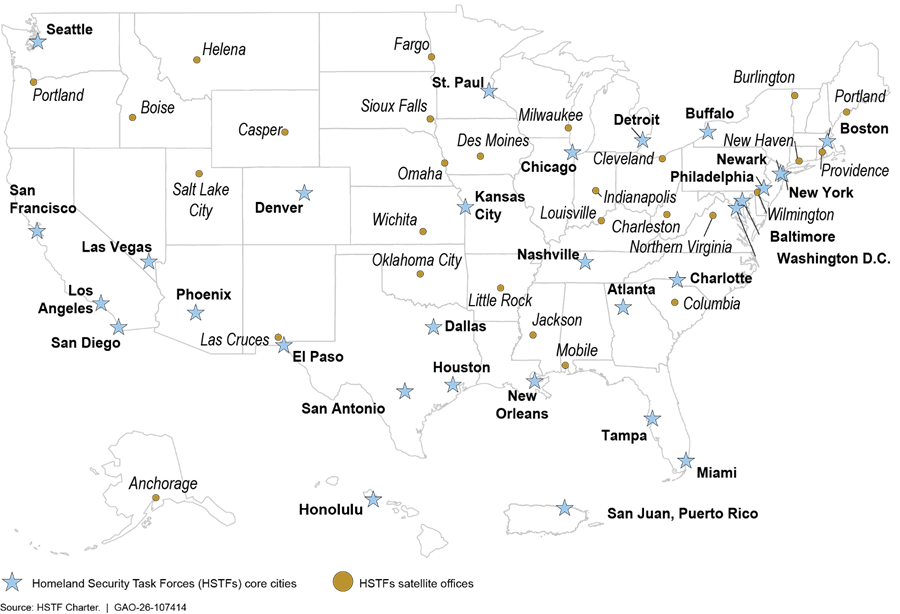
Various components across the federal government participate in the HSTFs, including those from the Departments of Defense, Homeland Security, Justice (including the Drug Enforcement Administration), Labor, State, and Treasury. The U.S. Postal Inspection Service, Office of the Director of National Intelligence, and the Office of National Drug Control Policy also participate.
Appendix IV: Assessment of DEA and ICE Collaboration on Drug Investigations Against Leading Interagency Collaboration Practices
The Drug Enforcement Administration (DEA), a component of the Department of Justice (DOJ), works with U.S. Immigration and Customs Enforcement’s (ICE) Homeland Security Investigations (HSI), a component of the Department of Homeland Security, to carry out counternarcotics enforcement efforts. Specifically, DEA focuses on leading U.S. efforts against illicit drug trafficking, and HSI focuses on efforts against smuggling with a connection to the U.S. border.[96]
DEA and ICE have signed interagency agreements that outline their collaboration practices for these efforts, including a June 2009 interagency cooperation agreement and a January 2021 joint letter.[97] These agreements outline, among other things, the mechanisms for DEA and ICE to share information and deconflict cases, resolve disputes, and monitor implementation of the agreements.[98] The Acting Attorney General issued a memorandum in May 2026 that may impact these agreements.[99] As of June 2026, DEA and HSI were in the process of determining how the memorandum would impact DEA and HSI collaboration on drug investigations.
As shown in table 2, prior to the Acting Attorney General’s May 2026 memorandum, DEA and ICE’s interagency agreements and actions had generally addressed four of eight leading collaboration practices identified in our prior work and had partially addressed four of eight.[100] Appendix II provides additional information about how we analyzed DEA and ICE’s actions.
Table 2: Assessment of DEA and ICE Collaboration for Counternarcotics Investigations Against Leading Interagency Collaboration Practices Prior to May 2026
|
Leading practice and key considerationsa |
Assessment category |
Summary of DEA and ICE actions taken |
|
Define common outcomes · Have the crosscutting challenges or opportunities been identified? · Have the short- and long-term outcomes been clearly defined? · Have the outcomes been reassessed and updated, as needed? |
Generally addressed |
DEA and ICE had taken steps to define common outcomes through the development of the 2009 and 2021 agreements.b The 2009 agreement states the federal government has a strong interest in stopping the unlawful flow of narcotics into the United States. Further, it states DEA and ICE can best advance the government’s interest to dismantle and disrupt trafficking organizations by working together to harness both agencies’ expertise and authorities and avoiding operational conflicts. DEA and ICE reassessed the outcomes discussed in the 2009 agreement and reestablished or updated them as needed in the development of the 2021 joint letter. The 2021 joint letter reiterates that the core principles of the 2009 agreement are the coordination and deconfliction of the operations of both organizations in order to ensure officer safety, enhance their impact on drug trafficking organizations, eliminate duplication of effort, and ensure that the agencies work together to reduce the availability of drugs in the United States.c |
|
Ensure accountability · What are the ways to monitor, assess, and communicate progress towards the short- and long-term outcomes? · Have collaboration-related competencies or performance standards been established against which individual performance can be evaluated? · Have the means to recognize and reward accomplishments related to collaboration been established? |
Partially addressed |
DEA and ICE had taken some steps to ensure accountability. For example, according to DEA officials in seven field offices and ICE Homeland Security Investigations (HSI) officials in seven field offices, representing all nine field office locations we met with, special agents are evaluated on their collaboration with external stakeholders, including other federal law enforcement agencies during overall annual performance assessments.d However, DEA and HSI had not consistently implemented the accountability mechanism required by the agreements known as the Headquarters Review Team. Specifically, the 2009 agreement directs the team to resolve deconfliction and coordination issues and periodically review the performance of the agreement. Furthermore, the 2021 joint letter reaffirmed the utility of the Headquarters Review Team and directed the agencies to reestablish it in a meaningful and productive manner. The agreements delineate specific actions the Headquarters Review Team is to perform, which, taken together, articulate how the mechanism should function as a sustained headquarters-level entity to address collaboration issues and assess how the agreements are being implemented appropriately. However, DEA and HSI generally had not been convening meetings of the Headquarters Review Team as required since 2009 by the agreements. Therefore, it was not functioning as a sustained accountability mechanism to ensure the agreements were being implemented as intended. DEA and HSI headquarters officials agreed that the Headquarters Review Team did not meet from 2009 to 2020 but provided differing views on the extent of meetings after 2020. Specifically, DEA headquarters officials told us that the Headquarters Review Team met in 2021 and 2024. When it met in 2024, DEA headquarters officials said they had no conflicts or disagreements to discuss at the time. According to these officials, during the 2024 meeting, DEA and HSI leadership met to network and build on the coordination and partnership already in place. Conversely, HSI headquarters officials told us that DEA and HSI officials, not the Headquarters Review Team, met in 2020 and 2021 to review the 2009 agreement and the result of that effort was the 2021 joint letter. Further, while they agreed that the Headquarters Review Team met informally in 2024, they also told us that a small group of senior executives—not the Headquarters Review Team—met several times in 2024 and early 2025 to discuss a potential addendum to the 2009 agreement that was never completed. HSI headquarters officials told us that the senior executives discussed issues such as definitions of key phrases in the 2009 agreement, the joint training, deconfliction, and dispute resolution—the type of issues the Headquarters Review Team was intended to address. However, the effort ended in January 2025 without finalizing an addendum. Finally, DEA and HSI did not have mechanisms or processes to ensure Title 21 Coordinators collected and reported relevant information on how field offices are implementing agreements to the Headquarters Review Team. The Headquarters Review Team requires such information from DEA and HSI field offices to carry out two of its required activities. Specifically, the 2009 agreement establishes steps for resolving deconfliction and coordination issues at the field office level, which includes elevating to the Headquarters Review Team any cases in which HSI and DEA cannot resolve issues. Further, the 2009 agreement directs the Headquarters Review Team to periodically review DEA and HSI performance of the collaborative agreements. |
|
Bridge organizational cultures · Have strategies to build trust among participants been developed? · Have participating agencies established compatible policies, procedures, and other means to operate across agency boundaries? · Have participating agencies agreed on common terminology and definitions? |
Partially addressed |
DEA and HSI had taken some steps to bridge organizational cultures such as hosting events to build trust among special agents and managers at the field office level. Specifically, DEA and ICE had developed complementary department-wide memorandums mandating that their special agents use their relevant deconfliction systems and confirm their adherence to using these systems.e At the field office level, DEA officials in four of the nine field offices and HSI officials also in four of the nine field offices we met with also reported practices to build on collaboration. These practices included having special agents embedded in each other’s agencies and being co-located in their field office to aid collaboration. HSI special agents in one field office told us that co-locating and embedding special agents are key to building close working relationships. Additionally, DEA and HSI officials from three field offices reported that regular interaction with their Title 21 Coordinator and group supervisor counterparts helped develop and maintain closer working relationships among these managers. Further, both DEA and HSI officials in five of nine field offices told us they also take steps to build trust locally. For example, a DEA Title 21 Coordinator in one field office stated that DEA and HSI Special Agents-in-Charge and Assistant Special Agents-in-Charge have a monthly breakfast to share ideas, discuss operations, and generally get to know each other.f According to that official, these breakfasts help build positive relationships among DEA and HSI management. However, DEA and HSI had not ensured compatible policies and procedures between agencies through the joint training that was agreed to in the 2021 joint letter. According to the 2021 joint letter, DEA and HSI are to work together to create two training modules, including joint training taught to their respective special agents. The joint training is to be required annually for cross-designated HSI special agents, supervisors, and DEA and HSI Title 21 Coordinators. The purpose of implementing this joint training is to ensure DEA and HSI teach DEA and HSI special agents the required collaboration activities with one voice. However, as of April 2026, the joint training is still not complete, and DEA and HSI disagree on the status of the effort and whether the joint training has been appropriately implemented. Specifically, HSI headquarters officials stated in February 2026 that DEA drafted the training without input from HSI, and DEA did not invite HSI to develop the training or resolve their differences together. Further, HSI Headquarters officials stated that they raised several issues to DEA about the content of the training that have yet to be resolved. Some of these issues include differing interpretations of the definitions of key terms, statutory authorities, and provisions in the 2009 agreement language. Conversely, DEA headquarters officials stated in March 2026 that HSI objected to a single voiceover note included in the training and consequently refused to implement the training. DEA has been using the training for their special agents since September 2022 even though the training still includes content with which HSI does not agree. As of April 2026, DEA and HSI did not have a timeline for resolving these issues. |
|
Identify and sustain leadership · Has a lead agency or individual been identified? · If leadership will be shared between one or more agencies, have roles and responsibilities been clearly identified and agreed upon? · How will leadership be sustained over the long term? |
Partially addressed |
DEA and ICE had taken some steps to identify leadership. For example, the 2009 agreement outlines DEA’s role in overseeing domestic counternarcotics investigations and the cross-designation of HSI special agents. Further, the 2021 joint letter states that Title 21 Coordinators are responsible for ensuring cooperation, communication, coordination, and deconfliction at their field offices. A standard operating procedure supplemented the 2021 joint letter and further outlines the roles and responsibilities of the Title 21 Coordinator.g ICE is required to submit operational plans or other written notices to DEA to allow DEA and ICE Title 21 Coordinators to assess whether conflicts exist, according to the Title 21 Coordinator standard operating procedure. However, DEA and ICE had not taken steps to sustain leadership through the Headquarters Review Team, as outlined in their 2009 and 2021 agreements. As discussed, the agreements delineate specific actions the Headquarters Review Team is to perform to address collaboration issues and ensure the agreements are being implemented appropriately. The agreements also identify the Headquarters Review Team members, which includes the DEA Chief of Operations and Deputy Chief of Domestic Operations, the ICE Director of Investigations and HSI’s Assistant Director of Domestic Operations, and one DEA regional director, one HSI regional attaché, three special agents in charge from each agency, and one non-voting counsel from each agency. Given that DEA and HSI leadership are to meet routinely through the Headquarters Review Team, the team functions as both a forum for sustaining leadership and an accountability mechanism. However, as described previously, DEA and HSI generally had not been routinely convening meetings of the Headquarters Review Team; therefore, it is not functioning as a sustained leadership mechanism to ensure the entities are collaborating as intended by the agreements. |
|
Clarify roles and responsibilities · Have the roles and responsibilities of the participants been clarified? · Has a process for making decisions been agreed upon? |
Generally addressed |
DEA and ICE had taken needed steps to clarify roles and responsibilities. The 2009 agreement outlines DEA and ICE’s authorities and responsibilities across different issue areas relating to counternarcotics investigations. This includes, but is not limited to, the ICE Assistant Secretary identifying special agents or groups whose duties include investigations of narcotics cases with a clearly articulable nexus to the border or port of entry; cross-designated HSI special agents’ authority pursuant to Title 21 of the U.S. Code to conduct work; and DEA and HSI special agents’ requirements for deconfliction and information sharing. Further, in 2021 a DEA and HSI working group developed standard operating procedures and responsibilities for DEA and HSI Title 21 Coordinators to promote consistent implementation of the 2009 agreement across both agencies. Each DEA and HSI field office Special Agent-in-Charge must designate a Title 21 Coordinator for their office at no lower than the Assistant Special Agent-in-Charge level. Additionally, the agreements outline a dispute resolution and escalation process for the field offices. First, in the event of overlap or conflict between DEA and ICE, first line DEA and ICE supervisors are expected to resolve operational conflicts or issues. If they cannot, the Title 21 Coordinators will work to resolve the conflict or issue. While agencies expect the Title 21 Coordinators to work out the vast majority of conflicts, unresolved conflicts or issues will be elevated to the Special Agents-in-Charge. For any instance where the DEA and HSI Special Agents-in-Charge cannot come to an agreement, the issue will be referred to the Headquarters Review Team for resolution. Title 21 Coordinators, group supervisors, and special agents we met with in nine field offices confirmed that they usually resolve issues at the special agent, group supervisor, or Title 21 Coordinator level. |
|
Include relevant participants · Have all relevant participants been included? · Do the participants have the appropriate knowledge, skills, and abilities to contribute? · Do participants represent diverse perspectives and expertise? |
Generally addressed |
DEA and ICE had taken steps to include relevant participants. The agreements identify which individuals from each agency should be participating in counternarcotics investigations and dispute resolution mechanisms, including but not limited to special agents, Assistant Special Agents-in-Charge, Special Agents-in-Charge, and Title 21 Coordinators. As stated above, the 2009 agreement also states which HSI special agents are eligible for cross-designation. This includes HSI special agents who are assigned to relevant task forces. Further, the 2009 agreement directs DEA and HSI special agents to use established local or regional deconfliction centers and procedures prior to conducting an enforcement activity. Deconfliction centers provide law enforcement deconfliction support by monitoring regional deconfliction systems and notify agencies of overlapping efforts. Federal, state, and local law enforcement officers often rely on these centers to ensure officer safety. DEA and HSI officials in two field offices we met with told us they use local deconfliction centers, such as the Los Angeles Regional Criminal Information Clearinghouse, to support their investigations. |
|
Leverage resources and information · How will the collaboration be resourced through staffing? · How will the collaboration be resourced through funding? If interagency funding is needed, is it permitted? · Are methods, tools, or technologies to share relevant data and information being used? |
Generally addressed |
DEA and ICE had taken steps to leverage resources and information. The 2009 agreement states that ICE intends to participate and share information to the same extent as other major federal partners in a fusion center and the Special Operations Division, to include sharing information not yet entered into the shared databases, and DEA will continue to do so. Further, the 2009 agreement states that ICE also agrees to provide and will have access to data related to all seizures of money, drugs, and firearms, including date, type of contraband, amount, place of seizure, and geo spatial data, when known, at a DEA-led intelligence center, and DEA will continue to share data at the center. DEA and HSI are individually responsible for agency staffing and funding decisions; however, funding may also be available through task forces, such as the Homeland Security Task Force and the local High Intensity Drug Trafficking Areas (HIDTA) groups.h Also, the 2009 agreement states that ICE and DEA will invite each other to participate in each other’s task forces. As stated previously, some DEA and HSI field offices are co-located or embed each other’s special agents in their field offices. DEA and HSI special agents across five field offices we met with stated that having DEA and HSI special agents embedded with each other’s teams or co-located was beneficial to information sharing and collaboration. For example, an HSI special agent stated that embedded DEA special agents are invited to join HSI group chats where information is constantly being shared and operations are being coordinated. This allows DEA special agents to receive real-time information about HSI operations. DEA and HSI also share information when deconflicting investigations and operations and through sharing relevant case reports and records upon request.i DEA and HSI officials told us they use systems, as well as a combination of databases, phone calls, emails, and informal group chats to deconflict and share case information. |
|
Develop and update written guidance and agreements · If appropriate, have agreements regarding the collaboration been documented? · Have ways to continually update or monitor the written agreements been developed? |
Partially addressed |
DEA and ICE had taken some steps to develop written guidance and agreements as described previously. However, DEA and ICE had not continually updated their written agreements since they were established. According to the 2009 agreement, the DEA Chief of Operations and the ICE Director of Investigations or their designees should review the agreement every two years or upon a written request by either party. Both parties will resolve any issues and execute any necessary or appropriate modifications to the 2009 agreement. As previously discussed, DEA and HSI did not update the 2009 agreement until 2021. Further, in 2020, senior leaders from DEA and HSI created a working group to review the 2009 agreement, among other things. The result of this review was the 2021 joint letter, which is to document and provide a roadmap for implementation for the recommendations of that working group. According to HSI headquarters officials, DEA and HSI met between April 2024 and January 2025 to draft a potential addendum to the 2009 agreement that would clarify some issues, such as definition of key terms, and requirements for HSI agents to receive Title 21 authority. These officials further stated that work on the draft addendum ended in January 2025 and it was never finalized We identified circumstances related to specific provisions of the agreements that have changed since the agencies signed the 2021 joint letter. As such, the 2009 agreement no longer reflect the current operating procedure. For example, the 2009 agreement refers in various places to the Organized Crime Drug Enforcement Task Forces and its fusion center. However, as of September 2025, the Organized Crime Drug Enforcement Task Forces no longer exists, and have been replaced by the Homeland Security Task Forces. Further, the agreements describe the requirements for DEA to cross-designate HSI special agents conducting Title 21 investigations, but this process changed in 2025 and 2026. Specifically, the 2009 agreement states that the Assistant Secretary of ICE is authorized to identify any special agent or groups whose duties include the investigation of narcotics cases with a clearly articulable nexus to the border or port of entry for cross-designation. However, according to HSI and DEA officials, as of August 2025, HSI was requesting all HSI special agents receive Title 21 cross-designation. In May 2026, the Acting Attorney General issued a memorandum granting all HSI special agents this authority.j |
Legend:
Generally addressed: DEA and ICE have taken steps to address the key considerations consistent with the leading collaboration practice.
Partially addressed: DEA and ICE have taken steps to address some key considerations consistent with the leading collaboration practice but could take additional steps to address one or more of the key considerations.
Source: GAO analysis of Drug Enforcement Administration (DEA) and U.S. Immigration and Customs Enforcement (ICE) information. | GAO‑26‑107414.
aGAO, Government Performance Management: Leading Practices to Enhance Interagency Collaboration and Address Crosscutting Challenges, GAO‑23‑105520 (Washington, D.C.: May 24, 2023).
bDEA and ICE, Interagency Cooperation Agreement Between the U.S. Drug Enforcement Administration and U.S. Immigration and Customs Enforcement Regarding Investigative Functions Related to the Controlled Substances Act (June 18, 2009); DEA and ICE, Joint Letter on the DEA-ICE Interagency Cooperation Agreement (Jan. 5, 2021).
cDeconfliction is the sharing of limited investigative information among federal, state, local, and tribal law enforcement entities to identify common interest or activity. Deconfliction initiates coordination between interested law enforcement entities to prevent duplicative work and possible “blue-on-blue” situations (i.e., personnel from two or more law enforcement agencies unwittingly encountering each other during a law enforcement operation, such as an undercover situation).
dWe met with DEA and HSI officials in nine field offices, including: New York, Philadelphia, Denver, Chicago, Tucson, Atlanta, San Diego, Los Angeles, and Miami. At these locations, we conducted semi-structured interviews to assess DEA and ICE’s collaboration on counternarcotics investigations. These semi-structured interviews included questions about the overall collaborative environment in their area of responsibility, including factors that contributed to successes and challenges, and practices involving information sharing and deconfliction, as required by the agreements.
eDepartment of Justice (DOJ), Department Policy for Mandatory Use of Investigative Deconfliction Systems (May 1, 2014); Department of Homeland Security, Department Policy Regarding Investigative Data and Event Deconfliction (Oct. 18, 2016).
fTitle 21 Coordinators are DEA and HSI officials at the Assistant Special Agent-in-Charge level who are responsible for enforcing the agreements at the field offices.
gDEA and HSI, HSI and DEA Roles and Responsibilities Relating to Title 21 Coordinators (Jan. 5, 2021).
hThe HIDTA program, managed by the Office of National Drug Control Policy, coordinates and assists federal, state, local, and tribal law enforcement agencies to address regional drug threats with the purpose of reducing drug trafficking and drug production in the U.S.
iFor example, they use the DEA Analysis and Response Tracking System (DARTS) and Deconfliction Information Coordination Endeavor (DICE), as well as other locally agreed upon systems to deconflict and share information. For example, special agents in the Los Angeles office use Los Angeles Regional Criminal Information Clearinghouse to deconflict operations. Additionally, special agents in the Atlanta field office use the Atlanta-Carolinas HIDTA’s Secure Automated Fast Event Tracking Network, which various federal, state, and local law enforcement entities can use.
jDOJ, Request for Assistance from U.S. Immigration and Customs Enforcement to Enforce the Controlled Substances Act (Washington, D.C.: May 26, 2026). The memorandum affects circumstances that may impact some of DEA and ICE’s agreements; however, as of June 2026, DEA and HSI were in the initial phase of determining how the memorandum would impact their collaboration on drug investigations.
Triana McNeil, mcneilt@gao.gov
In addition to the contact named above, Mona Nichols Blake (Assistant Director), Stephanie Heiken (Analyst in Charge), Lauri Barnes, Ariana Booker, Billy Commons, Benjamin Crossley, Susan Czachor, Amanda Panko, and Sarah Veale made key contributions to this report. Kelsey M. Carpenter, Riley Grube, Samuel Kim, and Frederick Lyles, Jr. also contributed to this report.
The Government Accountability Office, the audit, evaluation, and investigative arm of Congress, exists to support Congress in meeting its constitutional responsibilities and to help improve the performance and accountability of the federal government for the American people. GAO examines the use of public funds; evaluates federal programs and policies; and provides analyses, recommendations, and other assistance to help Congress make informed oversight, policy, and funding decisions. GAO’s commitment to good government is reflected in its core values of accountability, integrity, and reliability.
Obtaining Copies of GAO Reports and Testimony
The fastest and easiest way to obtain copies of GAO documents at no cost is through our website. Each weekday afternoon, GAO posts on its website newly released reports, testimony, and correspondence. You can also subscribe to GAO’s email updates to receive notification of newly posted products.
Order by Phone
The price of each GAO publication reflects GAO’s actual cost of production and distribution and depends on the number of pages in the publication and whether the publication is printed in color or black and white. Pricing and ordering information is posted on GAO’s website, https://www.gao.gov/ordering.htm.
Place orders by calling (202) 512-6000, toll free (866) 801-7077,
or
TDD (202) 512-2537.
Orders may be paid for using American Express, Discover Card, MasterCard, Visa, check, or money order. Call for additional information.
Connect with GAO
Connect with GAO on X,
LinkedIn, Instagram, and YouTube.
Subscribe to our Email Updates. Listen to our Podcasts.
Visit GAO on the web at https://www.gao.gov.
To Report Fraud, Waste, and Abuse in Federal Programs
Contact FraudNet:
Website: https://www.gao.gov/about/what-gao-does/fraudnet
Automated answering system: (800) 424-5454
Media Relations
Sarah Kaczmarek, Managing Director, Media@gao.gov
Congressional Relations
David A. Powner, Acting Managing Director, CongRel@gao.gov
General Inquiries
[1]Department of Justice, Drug Enforcement Administration, 2025 National Drug Threat Assessment, DEA-DCT-DIR-007-25 (Washington, D.C.: May 2025). In recognition of the significant loss of life and harmful effects resulting from drug misuse, we added national efforts to prevent, respond to, and recover from drug misuse to our High-Risk List in 2021. Drug misuse is defined as the use of illicit drugs and the misuse of prescription drugs. In March 2019, we named drug misuse as an emerging issue requiring close attention. In March 2020, we determined that national efforts to prevent, respond to, and recover from drug misuse were high risk. For the most recent update to the High-Risk List, see GAO, High-Risk Series: Heightened Attention Could Save Billions More and Improve Government Efficiency and Effectiveness, GAO‑25‑107743 (Washington, D.C.: Feb. 25, 2025).
[2]Exec. Order No. 14159, Protecting the American People Against Invasion, 90 Fed. Reg. 8,443 (Jan. 20, 2025).
[3]In this report, we refer to ICE and HSI officials as HSI officials unless discussing the agreements between DEA and ICE.
[4]In January 2025, section 4 of Executive Order 14159 called for the Secretary of Homeland Security to ensure that the primary mission of U.S. Immigration and Customs Enforcement’s Homeland Security Investigations is the enforcement of the provisions of the Immigration and Nationality Act and other federal laws related to the illegal entry and unlawful presence of noncitizens in the United States and the enforcement of the purposes of the order. Exec. Order No. 14159, Protecting the American People Against Invasion, § 4 90 Fed. Reg. 8,443, 8,444 (Jan. 20, 2025).
[5]The August 1994 agreement was signed by DEA and the U.S. Customs Service, ICE’s predecessor agency.
[6]DOJ, Office of the Attorney General, Request for Assistance from U.S. Immigration and Customs Enforcement to Enforce the Controlled Substances Act (Washington, D.C.: May 26, 2026). We discuss this memorandum later in the report.
[7]See GAO, Drug Control: Better Coordination with the Department of Homeland Security and Updated Accountability Framework Can Further Enhance DEA’s Efforts to Meet Post-9/11 Responsibilities, GAO‑09‑63 (Washington, D.C.: Mar 20, 2009). We reported that DEA and ICE’s cross-designation procedures under the 1994 agreement were problematic and made several recommendations to DEA and ICE. Cross-designation refers to the policies and procedures by which DEA provides HSI agents the authority to investigate violations of the controlled substances laws contained in Title 21 of the United States Code (Title 21 authority). In June 2009, DEA and ICE signed an interagency agreement clarifying DEA and ICE roles and responsibilities and revising the process for cross-designating ICE agents, among other things. These steps enhanced DEA and ICE collaboration on counternarcotics investigations.
[8]See GAO, Combatting Illicit Drugs: DEA and ICE Interagency Agreement Has Helped to Ensure Better Coordination of Drug Investigations, GAO‑11‑763 (Washington, D.C.: July 28, 2011). Deconfliction is the sharing of limited investigative information among federal, state, local, and tribal law enforcement entities to identify common interest or activity. There are three types of deconfliction: (1) investigative data deconfliction, which includes but is not limited to information such as phone numbers, email addresses, and vehicle license plates numbers; (2) target deconfliction, which is information related to the target or subject of an active investigation, such as name, date of birth, and gender; and (3) event deconfliction, which relates to operations to determine whether law enforcement personnel are conducting an event in close proximity to one another at the same time. Deconfliction initiates coordination between interested law enforcement entities to prevent duplicative work and possible “blue-on-blue” situations, in which personnel from two or more law enforcement agencies unwittingly encounter each other during a law enforcement operation, such as an undercover operation.
[9]See GAO, Combatting Illicit Drugs: Improvements Needed for Coordinating Federal Investigations, GAO‑25‑107839 (Washington, D.C.: Mar. 5, 2025). We found that DEA doesn't track the time it takes to process HSI agent requests to participate in drug investigations, and DEA and HSI haven't implemented the agent training requirements they agreed to in 2021. We recommended that DEA establish timeliness goals for the cross-designation processes in consultation with ICE, and (2) collect and analyze data on the time involved in the processes to assess its performance against the goals. We also recommended that DEA and ICE collaborate to develop and implement the two training modules in accordance with their January 2021 agreement, using agreed-upon dispute resolution mechanisms as appropriate. DEA and ICE agreed with our recommendations but have not taken action to address them yet. By fully implementing these recommendations, DEA and ICE can make more informed decisions and ensure HSI agents are cross-designated appropriately.
[10]DEA and U.S. Customs, Memorandum of Understanding Between the Drug Enforcement Administration and the United States Customs Service to Implement Title 21 Cross-Designation Policies and Procedures (Aug. 8, 1994); DEA and ICE, Interagency Cooperation Agreement Between the U.S. Drug Enforcement Administration and U.S. Immigration and Customs Enforcement Regarding Investigative Functions Related to the Controlled Substances Act (June 18, 2009); and DEA and ICE, Joint Letter on the DEA-ICE Interagency Cooperation Agreement (Jan. 5, 2021).
[11]The field offices we visited included Atlanta, Georgia; Chicago, Illinois; Denver, Colorado; Los Angeles, California; Miami, Florida; New York City, New York; Philadelphia, Pennsylvania; Phoenix/Tucson, Arizona; and San Diego, California.
[12]The officials we interviewed were selected by DEA and HSI at each field office location based on their area of responsibility, knowledge, and experience. Further, the number of officials in each group was determined by DEA and HSI at these locations; therefore, the size of each group varied by field office.
[13]Each of these practices contains key considerations or questions of which we determined in our prior work to be relevant to collaboration. See GAO, Government Performance Management: Leading Practices to Enhance Interagency Collaboration and Address Crosscutting Challenges, GAO‑23‑105520 (Washington, D.C.: May 24, 2023).
[14]To determine the rating, one analyst established an initial rating, and a second analyst reviewed supporting evidence and verified it. If there were discrepancies, both analysts discussed the evidence and assessment and made a final determination.
[15]DOJ, Request for Assistance from U.S. Immigration and Customs Enforcement to Enforce the Controlled Substances Act.
[16]Executive Order No. 11727 appears at 38 Fed. Reg. 18,357 (1973) and Reorganization Plan No. 2 of 1973, as amended by Pub. L. No. 93-253, 88 Stat. 50 (1974), is reprinted in 5 U.S.C. § 903 Note. 21 U.S.C. § 873(b). As the head of DOJ, the Attorney General supervises and directs the administration and operation of DEA, among other DOJ agencies.
[17]The Homeland Security Act of 2002 transferred the U.S. Customs and the U.S. Immigration and Naturalization Services, with the exception of certain functions, to the newly created Department of Homeland Security, Pub. L. No. 107-296, §§ 403, 412, 441, 451(b), 462, 116 Stat. 2135, 2178, 2179-2180, 2192, 2196, 2202-2205 (2002). The Department of Homeland Security established ICE in March 2003 by combining the criminal investigators from the U.S. Customs Service, which had been a component of the Department of the Treasury, and the criminal investigators from the Immigration and Naturalization Service, which had been a component of the Department of Justice. The remaining elements of Customs and the Immigration and Naturalization Service were reorganized into, among other agencies, U.S. Customs and Border Protection.
[18]For example, HSI officials stated that HSI agents may conduct counternarcotics-related investigations for violations of Titles 8, 18, 19, and 31 of the U.S. Code while awaiting Title 21 authority.
[19]The Office of Legal Counsel drafts legal opinions of the Attorney General and provides its own written opinions and other advice in response to requests from the Counsel to the President, the various executive branch agencies, and other components of DOJ. According to the Office of Legal Counsel, such requests typically deal with legal issues of particular complexity and importance or those about which two or more agencies disagree.
[20]The June 2009 agreement superseded the August 1994 agreement.
[21]DEA and U.S. Customs, Memorandum of Understanding Between the Drug Enforcement Administration and the United States Customs Service to Implement Title 21 Cross-Designation Policies and Procedures.
[22]DEA and ICE, Interagency Cooperation Agreement Between the U.S. Drug Enforcement Administration and U.S. Immigration and Customs Enforcement Regarding Investigative Functions Related to the Controlled Substances Act.
[23]As discussed, in July 2011, we reported that DEA and ICE took actions to fully implement the cross-designation and deconfliction provisions of their June 2009 agreement and finalized efforts to complete the information sharing provisions (GAO‑11‑763). We also reported the agencies implemented the cross-designation provisions through a revised process that elevated the levels at which requests are exchanged between the agencies and consolidated multiple requests into one list of ICE agents. According to ICE officials, the new process was more streamlined and resulted in enhanced flexibility in maximizing investigative resources. Also, DEA and ICE implemented local deconfliction protocols and used a variety of mechanisms to deconflict investigations.
[24]DEA and ICE, Joint Letter on the DEA-ICE Interagency Cooperation Agreement. The January 2021 joint letter reinforces the June 2009 agreement; it does not replace the June 2009 agreement.
[26]Exec. Order No. 14159, Protecting the American People Against Invasion, 90 Fed. Reg. 8,443 (Jan. 20, 2025). See GAO, Illicit Synthetic Drugs: Trafficking Methods, Money Laundering Practices, and Coordination Efforts, GAO‑26‑107918 (Washington, D.C.: Dec. 18, 2025).
[27]The Organized Crime and Drug Enforcement Task Forces were prosecutor-led and combined the resources and the expertise of numerous federal agencies, including DEA and ICE, to target drug trafficking and money laundering organizations nationwide. HSTFs share much of the legacy missions of the Organized Crime and Drug Enforcement Task Forces, such as the focus on transnational criminal organizations and major drug trafficking networks; however, HSTFs have an additional focus on human trafficking. According to FBI officials, HSTFS also investigate immigration-related crimes when they intersect with its mission, or when individuals use immigration systems to hide criminal activity or support terrorism.
[29]DOJ, Designation of Homeland Security Investigations Special Agents and State and Local Officers Serving on HSI Task Forces to Assist with Controlled Substances Act Investigations (Washington, D.C.: Jan. 15, 2025). Pursuant to 21 U.S.C § 873(b), when requested by the Attorney General, it is the duty of any agency or instrumentality of the federal government to provide assistance, including technical advice, to the Attorney General for carrying out the functions of the Controlled Substances Act. DEA, acting pursuant to a delegation of this authority, designated HSI special agents who meet certain criteria to investigate drug offenses ordinarily within DEA’s jurisdiction. 28 C.F.R. Part 0, Subpt. R, App., § 11. In addition, generally, the Attorney General may provide law enforcement authority under the Controlled Substances Act to any State, tribal, or local law enforcement officer designated by the Attorney General. 21 U.S.C. § 878.
[30]The Office of Legal Counsel stated that the 2009 agreement’s requirement that the designated HSI special agents’ ordinary duties include the investigation of narcotics cases was a policy choice, rather than a legal requirement for the designation.
[31]21 U.S.C. § 873(b).
[32]Generally, the Controlled Substances Act authorizes officers and employees of the DEA, as well as any State, tribal, or local law enforcement designated by the Attorney General to engage in certain law enforcement functions pursuant to 21 U.S.C. § 878.
[33]DOJ, Request for Assistance from U.S. Immigration and Customs Enforcement to Enforce the Controlled Substances Act.
[34]The Attorney General’s request was made to all HSI agents designated as “customs officers” under 19 U.S.C. § 1709, and who been vested by their agency with enforcement authorities under 19 U.S.C. § 1589a.
[35]Exec. Ord. No. 14159, Protecting the American People Against Invasion, 90 Fed. Reg. 8,443 (Jan. 20, 2025). The order states that the Attorney General and the Secretary of Homeland Security shall take all appropriate action to provide an operational command center to coordinate the activities of the HSTFs and provide such support as they may require and shall also take all appropriate action to provide supervisory direction to their activities as may be required.
[37]Title 21 Coordinators are DEA and HSI officials at the Assistant Special Agent-in-Charge level who are responsible for enforcing the agreements at the field offices.
[38]Specifically, as amended in the 2021 joint letter, the makeup of the Headquarters Review Team includes the DEA Deputy Chief of Domestic Operations, HSI’s Assistant Director of Domestic Operations, one DEA regional director, one HSI regional attaché, three Special Agents-in-Charge from each agency, and one non-voting counsel from each agency.
[39]DOJ, Designation of Homeland Security Investigations Special Agents and State and Local Officers Serving on HSI Task Forces to Assist with Controlled Substances Act Investigations.
[40]DEA headquarters officials told us that a group of senior executives from both agencies and the previous DEA Deputy Chief of Operations met during this period; however, DEA could not provide the date this meeting occurred or any documentation related to this meeting. According to DEA and HSI headquarters officials, the Headquarters Review Team did not meet from 2009 to 2020 as described in the 2009 agreement, which is why the 2021 joint letter called for reestablishing it.
[41]With respect to the Headquarters Review Team’s responsibility to address collaboration issues that cannot be resolved in field office locations, Title 21 Coordinators, group supervisors, and special agents we met with in nine field offices confirmed that they usually resolve issues at the special agent, group supervisor, or Title 21 Coordinator level. They told us that they have never elevated any individual-level investigation issues to the Headquarters Review Team because they are able to resolve them in the field.
[42]Task force officers are federal, state, and local law enforcement officers DEA deputizes to perform the same functions as DEA special agents. U.S. Customs and Border Protection is an agency under DHS.
[43]DEA headquarters officials told us that field staff only involve the Headquarters Review Team if the field offices have deconfliction issues that they cannot resolve. Additionally, HSI headquarters officials told us that their Title 21 Coordinators regularly communicate with headquarters on status of cooperation in their field offices, including about local conflicts that need to raise to the Headquarters Review Team.
[44]DEA and HSI, HSI and DEA Roles and Responsibilities Relating to Title 21 Coordinators (Jan. 5, 2021).
[45]DOJ, Designation of Homeland Security Investigations Special Agents and State and Local Officers Serving on HSI Task Forces to Assist with Controlled Substances Act Investigations.
[46]As described previously, DOJ also identified the process of HSI sharing its operational plans with DEA in the field offices as a required step for DEA to supervise HSI.
[48]For the second training, the 2021 joint letter states DEA will deliver, with HSI’s assistance, a module on HSI’s mission, priorities, and border search authority.
[50]According to DEA headquarters officials, DEA and HSI planned to have a Headquarters Review Team meeting in February 2026. During that meeting DEA expected to discuss the joint training, among other topics. Due to the DHS lapse in appropriations from February 14, 2026, to April 30, 2026, they were unable to meet. As of May 2026, this meeting has not been rescheduled.
[52]According to FBI headquarters officials, HSI and FBI (which co-lead the HSTFs) are still developing the specific requirements and procedures for all agencies working HSTF cases (including DEA and HSI agents) to coordinate through the National Coordination Center. Specifically, these officials told us FBI and HSI want to ensure that the deconfliction systems that DEA and HSI use currently do not duplicate deconfliction through the Center.
[53]It states the Assistant Secretary will not select special agents whose duties do not relate to these investigations. For purposes of this agreement, cross-designated ICE agents will be authorized to investigate narcotics smuggling with a clearly articulable nexus to the United States border or ports of entry. A case does not have such a nexus simply because at one time the narcotics crossed the border or came into a port of entry or because the target merely purchased narcotics from those who smuggled the narcotics across the border.
[54]Further, the Title 21 Coordinators standard operating procedure reasserts that the cross-designation process of HSI special agents is initiated by Title 21 Coordinators.
[55]DOJ, Request for Assistance from U.S. Immigration and Customs Enforcement to Enforce the Controlled Substances Act.
[56]DOJ, Request for Assistance from U.S. Immigration and Customs Enforcement to Enforce the Controlled Substances Act.
[58]DOJ, Designation of Homeland Security Investigations Special Agents and State and Local Officers Serving on HSI Task Forces to Assist with Controlled Substances Act Investigations.
[59]GAO, Fragmentation, Overlap, and Duplication: An Evaluation and Management Guide, GAO‑15‑49SP (Washington, D.C.: Apr. 14, 2015). Fragmentation refers to those circumstances in which more than one federal agency (or more than one organization within an agency) is involved in the same broad area of national need.
[60]Executive Order No. 11727 appears at 38 Fed. Reg. 18,357 (1973) and Reorganization Plan No. 2 of 1973, as amended by Pub. L. No. 93-253, 88 Stat. 50 (1974), is reprinted in 5 U.S.C. § 903 Note. As the head of DOJ, the Attorney General supervises and directs the administration and operation of DEA, among other DOJ components.
[61]DEA and U.S. Customs, Memorandum of Understanding Between the Drug Enforcement Administration and the United States Customs Service to Implement Title 21 Cross-Designation Policies and Procedures (Aug. 8, 1994); DEA and ICE, Interagency Cooperation Agreement Between the U.S. Drug Enforcement Administration and U.S. Immigration and Customs Enforcement Regarding Investigative Functions Related to the Controlled Substances Act (June 18, 2009); DEA and ICE, Joint Letter on the DEA-ICE Interagency Cooperation Agreement (Jan. 5, 2021). The 1994 agreement was signed by DEA and the U.S. Customs Service, ICE’s predecessor agency. The June 2009 agreement replaced the August 1994 agreement. The January 2021 agreement reinforces the June 2009 agreement; it does not replace the June 2009 agreement. We refer to these collectively as the agreements.
[62]In this report, we refer to ICE and HSI officials as HSI officials unless discussing the agreements between DEA and ICE.
[63]We interviewed DEA and HSI officials from field offices representing Atlanta, Georgia; Chicago, Illinois; Denver, Colorado; Los Angeles, California; Miami, Florida; New York, New York; Philadelphia, Pennsylvania; Phoenix and Tucson, Arizona, and San Diego, California. The areas of responsibility these main field offices represent may encompass multiple sub-offices. For the purposes of this report, we refer to an official assigned to a sub-office as representing the field office we met with.
[64]Deconfliction is defined by the law enforcement community as the sharing of limited investigative information among federal, state, local, and tribal law enforcement entities to identify common interest or activity. For the purposes of this report, deconfliction includes the following types: (1) investigative data deconfliction, which includes but is not limited to significant investigative information (e.g., telephone numbers, email addresses, vehicle license plate numbers), (2) target deconfliction, which is information related to the target or subject of an active investigation (e.g., name, date of birth, gender), and (3) event deconfliction, which relates to operations to determine whether law enforcement personnel are conducting an event in close proximity to one another at the same time.
[65]In one field office, both DEA and HSI officials characterized their working relationship as challenged by significant, unresolved issues. In the other field office, only HSI characterized it as such; DEA in that region described the relationship as generally positive.
[66]The 2009 agreement requires that local deconfliction strategies should include the use of well-developed deconfliction centers or telephonic or brief written notices in advance of conducting an enforcement operation such as search warrants, arrests warrants, and surveillance with a significant risk of alerting the subjects to the presence of law enforcement. In response to this, DOJ and DHS issued policies mandating the use of deconfliction systems. DOJ, Department Policy for Mandatory Use of Investigative Deconfliction Systems (May 1, 2014); DHS, Department Policy Regarding Investigative Data and Event Deconfliction (Oct. 18, 2016).
[67]According to FBI officials, in November 2025, the White House Security Council issued a memorandum that designated the National Coordination Center to be the sole deconfliction point for drug trafficking related to transnational criminal organizations and foreign terrorist organizations. DEA and HSI officials in the nine field offices we met with from August 2025 to April 2026 did not describe their experiences or comment on deconfliction with the National Coordination Center for drug investigations.
[68]However, the system does not have access to the matched investigative data itself.
[69]The system allows U.S. law enforcement agencies, including DEA and ICE, to report seizures to the seizure system. Information collected includes seizure locations, individuals, and transportation (aircraft, vehicle, and vessel). The 2009 agreement required that ICE provide and have access to data related to all seizures of money, drugs, and firearms at the El Paso Intelligence Center. It also requires that DEA continue to share this data at the Center.
[70]The Office of National Drug Control Policy sponsored HIDTA program coordinates and assists the drug enforcement efforts of participating federal, state, local, and tribal law enforcement agencies, including DEA and HSI. There are currently 33 HIDTAs operating in areas determined to be critical drug-trafficking regions of the United States.
[71]DOJ policy states that deconfliction should be conducted when a viable deconfliction item is identified and throughout the course of an active investigation. DOJ, Memorandum for Heads of Department Law Enforcement Components (May 1, 2014). Further, an ICE directive states that deconfliction must occur at the onset of criminal investigations and enforcement events and continued throughout an investigation when new information is encountered and to reassess older targets. ICE, ICE Directive 10090.1: Investigative Data and Event Deconfliction (Feb. 15, 2019).
[72]The Special Operations Division is a DEA-led, multiagency, operational coordination center aimed at dismantling drug trafficking and terrorist organizations by attacking their command, control, and communications. The Special Operations Division serves as a conduit for intelligence products to the field.
[73]Both DEA and ICE initiate counternarcotics investigations, but the agencies focus their investigative activities on different efforts. Specifically, DEA, a component of the Department of Justice, focuses on leading U.S. efforts against illicit drug trafficking and is charged with enforcing Title 21 of the U.S. Code which contains the nation’s controlled substances laws, including the Controlled Substances Act and Controlled Substances Import and Export Act of 1970. ICE’s Homeland Security Investigations (HSI), a component of the Department of Homeland Security focuses on efforts against smuggling with a connection to the U.S. border.
[74]Deconfliction is the sharing of limited investigative information among federal, state, local, and tribal law enforcement entities to identify common interest or activity. Deconfliction initiates coordination between interested law enforcement entities to prevent duplicative work and possible “blue-on-blue” situations (i.e., personnel from two or more law enforcement agencies unwittingly encountering each other during a law enforcement operation, such as an undercover situation).
[75]In this report, we refer to ICE and HSI officials as HSI officials unless discussing the agreements between DEA and ICE.
[76]DEA and U.S. Customs, Memorandum of Understanding Between the Drug Enforcement Administration and the United States Customs Service to Implement Title 21 Cross-Designation Policies and Procedures (Aug. 8, 1994); DEA and ICE, Interagency Cooperation Agreement Between the U.S. Drug Enforcement Administration and U.S. Immigration and Customs Enforcement Regarding Investigative Functions Related to the Controlled Substances Act (June 18, 2009); and the DEA and ICE, Joint Letter on the DEA-ICE Interagency Cooperation Agreement (Jan. 5, 2021). The 2009 agreement superseded the 1994 agreement. The January 2021 agreement reinforces the June 2009 agreement; it does not replace the June 2009 agreement. We refer to these as agreements in this report.
[77]Title 21 Coordinators are DEA and HSI officials at the Assistant Special Agent-in-Charge level who are responsible for enforcing the agreements at the field offices. DEA and HSI, HSI and DEA Roles & Responsibilities Relating to Title 21 Coordinators (Jan. 5, 2021). See also DOJ, Department Policy for Mandatory Use of Investigative Deconfliction Systems (May 1, 2014); DHS, Department Policy Regarding Investigative Data and Event Deconfliction (Oct. 18, 2016); and ICE, ICE Directive 10090.1: Investigative Data and Event Deconfliction (Feb. 15, 2019).
[78]For example, we reviewed DEA, Agents Manual, Section 6514.8 International Controlled Deliveries and ICE, Homeland Security Investigations Drug Smuggling Investigations Handbook, HSI HB 19-03 (Dec. 11, 2019).
[79]DEA and FBI, Memorandum of Understanding Between the Drug Enforcement Administration and the Federal Bureau of Investigation Regarding International Controlled Deliveries of Controlled Substances (July 2, 1999).
[80]DOJ, Designation of Homeland Security Investigations Special Agents and State and Local Officers Serving on HSI Task Forces to Assist with Controlled Substances Act Investigations (Jan. 15, 2025).
[81]DOJ, Office of the Attorney General, Request for Assistance from U.S. Immigration and Customs Enforcement to Enforce the Controlled Substances Act (Washington, D.C.: May 26, 2026).
[82]DOJ, Adjudication of Venues Disputes Related to Multi-District Investigations and Prosecutions of International Narcotics Trafficking (Feb. 12, 2020).
[83]See GAO, Drug Control: Better Coordination with the Department of Homeland Security and Updated Accountability Framework can Further Enhance DEA’s Efforts to Meet Post-9/11 Responsibilities, GAO‑09‑63 (Washington, D.C.: Mar. 20, 2009); GAO, Combatting Illicit Drugs: DEA and ICE Interagency Agreement Has Helped to Ensure Better Coordination of Drug Investigations, GAO‑11‑763 (Washington, D.C.: July 28, 2011); and GAO, Combatting Illicit Drugs: Improvements Needed for Coordinating Federal Investigations, GAO‑25‑107839 (Washington, D.C.: Mar. 5, 2025).
[84]We were unable to interview DEA and HSI Title 21 Coordinators representing Tucson and Phoenix, Arizona. The areas of responsibility these main field offices represent may encompass multiple sub-offices. For the purposes of this report, we refer to an official assigned to a sub-office as representing the field office we met with.
[85]Department of Justice, Drug Enforcement Administration, 2025 National Drug Threat Assessment, DEA-DCT-DIR-007-25 (Washington, D.C.: May 2025).
[86]The officials we interviewed were selected by DEA and HSI at each field office location based on their area of responsibility, knowledge, and experience. Further, the number of officials in each group was determined by DEA and HSI at these locations; therefore, the size of each group varied by field office.
[87]We were unable to interview DEA special agents due to Department of Justice policy prohibiting GAO from meeting with non-supervisory agents.
[88]Executive Order 14159 dated January 20, 2025, established the HSTFs. The Executive Order directs federal agencies to support HSTFs in achieving objectives that include dismantling criminal cartels, foreign gangs, and transnational criminal organizations operating within the United States; disrupting cross-border human smuggling and trafficking networks; and prioritizing offenses involving children. The HSTFs replaced the DOJ-led Organized Crime Drug Enforcement Task Force. As of March 2026, HSTFs were located in 30 priority cities across the country. The Executive Order also prioritizes the immigration enforcement. Exec. Order No. 14159, Protecting the American People Against Invasion (Jan. 20, 2025).
[89]See GAO, Government Performance Management: Leading Practices to Enhance Interagency Collaboration and Address Crosscutting Challenges, GAO‑23‑105520 (Washington, D.C.: May 24, 2023).
[90]Key considerations are questions we identified that raise issues agencies should consider when implementing collaborative mechanisms. See GAO‑23‑105520.
[91]DOJ, Request for Assistance from U.S. Immigration and Customs Enforcement to Enforce the Controlled Substances Act (Washington, D.C.: May 26, 2026).
[92]Exec. Order No. 14159, Protecting the American People Against Invasion, § 6, 90 Fed. Reg. 8,443, 8,444 (Jan. 20, 2025).
[93]The HSTFs are also to ensure the use of all available law enforcement tools to execute immigration laws.
[94]Michael Glasheen, Operations Director, Federal Bureau of Investigation, Worldwide Threats to the Homeland, testimony before the U.S. House Committee on Homeland Security, December 11, 2025.
[95]The FBI is a primary law enforcement agency for the U.S. government, charged with enforcement of more than 200 categories of federal laws, including federal drug laws. The FBI focuses investigations and prosecutions on entire criminal enterprises and the seizure of the enterprise’s assets, which is intended to disrupt or dismantle entire criminal organizations. Although FBI investigates drug crimes, the Drug Enforcement Administration (DEA) leads U.S. efforts against illicit drug trafficking, domestically and internationally.
[96]DEA is charged with enforcing Title 21 of the U.S. Code, which contains the nation’s controlled substances laws, including the Controlled Substances Act and Controlled Substances Import and Export Act of 1970. Under section 873 of Title 21 of the U.S. Code, through delegation by the Attorney General, DEA can cross-designate HSI agents with the authority to investigate the smuggling of controlled substances across U.S. international borders or through ports of entry. For counternarcotics investigations, HSI’s mission includes tracking, intercepting, investigating, and stopping illicit narcotics from flowing into the U.S. through targeting criminal networks; strengthening global partnerships; and enhancing domestic collaboration.
[97]DEA and ICE, Interagency Cooperation Agreement Between the U.S. Drug Enforcement Administration and U.S. Immigration and Customs Enforcement Regarding Investigative Functions Related to the Controlled Substances Act (June 18, 2009); DEA and ICE, Joint Letter on the DEA-ICE Interagency Cooperation Agreement (Jan. 5, 2021). We refer to these documents as agreements. DEA and U.S. Customs Service also signed an August 1994 memorandum of understanding; however, the June 2009 agreement superseded the August 1994 memorandum.
[98]Deconfliction is the sharing of limited investigative information among federal, state, local, and tribal law enforcement entities to identify common interest or activity. This can include deconfliction of investigative data, which includes but is not limited to significant investigative information (e.g., telephone numbers, email addresses, vehicle license plate numbers); target deconfliction, which is information related to the target or subject of an active investigation (e.g., name, date of birth, gender); and event deconfliction, which relates to operations to determine whether law enforcement personnel are conducting an event in close proximity to one another at the same time. Deconfliction initiates coordination between interested law enforcement entities to prevent duplicative work and possible “blue-on-blue” situations (i.e., personnel from two or more law enforcement agencies unwittingly encountering each other during a law enforcement operation, such as an undercover situation).
[99]DOJ, Office of the Attorney General, Request for Assistance from U.S. Immigration and Customs Enforcement to Enforce the Controlled Substances Act (Washington, D.C.: May 26, 2026).
[100]See GAO, Government Performance Management: Leading Practices to Enhance Interagency Collaboration and Address Crosscutting Challenges, GAO‑23‑105520 (Washington, D.C.: May 24, 2023).