
Report to Congressional Requesters
United States Government Accountability Office
A report to congressional requesters.
For more information, contact: Rebecca Gambler at Gamblerr@gao.gov.
What GAO Found
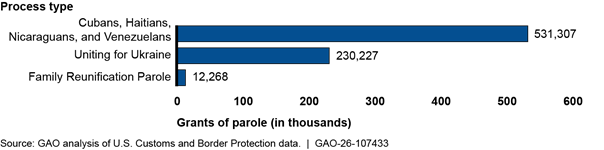
The Department of Homeland Security (DHS) began granting parole—temporary permission to stay in the U.S.—to certain eligible noncitizens through its supporter-based parole processes in May 2022. From that time through September 2024, DHS granted parole to about 774,000 noncitizens across three supporter-based processes: Cubans, Haitians, Nicaraguans, and Venezuelans (CHNV), Uniting for Ukraine (U4U), and family reunification parole (see figure).
Grants of Supporter-Based Parole, May 2022–September 2024
Shortly after U4U began, the DHS components responsible for implementing the parole processes—U.S. Citizenship and Immigration Services (USCIS) and U.S. Customs and Border Protection (CBP)—identified fraud risks and other vulnerabilities. Subsequently, a July 2024 USCIS review found that fraud indicators were widespread in U4U and CHNV. USCIS attributed these risks to insufficient internal controls in its supporter vetting process—for example, not having automated processes to prevent or detect possible fraudulent activity. DHS has since suspended or terminated the processes. However, USCIS has not developed an internal control plan for new or changed programs in the future. Such a plan could include basic antifraud controls and mechanisms to help proactively identify and mitigate fraud risks.
In addition, DHS faced other challenges implementing the parole processes, including limited staffing and resources, inconsistent review of the reasons for beneficiaries requesting parole, and supporters not upholding their commitments to beneficiaries. DHS agencies began taking some corrective actions, but DHS has not assessed lessons learned from the parole processes that it could apply to other efforts, such as lessons related to the use of temporarily assigned staff. By assessing and applying lessons learned from the parole processes, even if the processes have ended, DHS could improve other areas of its operations and thus be better positioned to avoid similar challenges in the future.
Prior to January 2025, U.S. Immigration and Customs Enforcement (ICE), which is responsible for enforcing U.S. immigration laws, did not have enforcement guidance focused specifically on parole beneficiaries, according to ICE officials. After January 2025, in alignment with new presidential administration executive orders and DHS policies, ICE instructed its officers to review each noncitizen case they encounter and determine whether any noncitizen’s parole status should be terminated. As of May 2025, ICE officials said that ICE did not have any nationwide enforcement efforts for paroled noncitizens and that its field offices determined any such actions on a case-by-case basis.
Why GAO Did This Study
In 2022 and 2023, DHS introduced new processes for humanitarian parole in response to increases in noncitizens arriving at the southwest border. The processes allowed eligible noncitizens from certain countries to travel to the U.S. to seek a grant of parole. To be eligible, noncitizens had to have a U.S.-based supporter apply to financially support them. DHS briefly suspended some of the processes in summer 2024 before restarting them. Then, in January 2025, following an executive order, DHS suspended all of the processes.
GAO was asked to review DHS’s administration and oversight of these parole processes. This report addresses (1) what DHS data show about supporter-based parole processes; (2) challenges that existed, and the extent to which DHS addressed them; and (3) DHS’s approach for taking enforcement actions against parole beneficiaries, as appropriate. GAO analyzed USCIS, CBP, and ICE documents and data on the parole processes from 2022 to 2025. GAO also (1) visited four U.S. airports where large numbers of noncitizens seeking parole arrived and (2) interviewed USCIS, CBP, and ICE officials from headquarters and field offices.
What GAO Recommends
GAO is making three recommendations, including one to USCIS to develop an internal control plan that can be applied to a new or changed program, and two to DHS to assess and apply lessons learned from the parole processes. DHS concurred with the first recommendation and disagreed with the two to assess and apply lessons learned, noting terminating the processes sufficiently addresses the challenges. GAO believes these recommendations remain valid and could help improve other areas of DHS operations beyond parole.
Abbreviations
CBP U.S. Customs and Border Protection
CHNV process for Cubans, Haitians, Nicaraguans, and Venezuelans
DHS Department of Homeland Security
FDNS Fraud Detection and National Security Directorate
ICE U.S. Immigration and Customs Enforcement
NTC National Targeting Center
TPS temporary protected status
U4U Uniting for Ukraine
USCIS U.S. Citizenship and Immigration Services
This is a work of the U.S. government and is not subject to copyright protection in the United States. The published product may be reproduced and distributed in its entirety without further permission from GAO. However, because this work may contain copyrighted images or other material, permission from the copyright holder may be necessary if you wish to reproduce this material separately.
December 11, 2025
Congressional Requesters
According to the Department of State, 20 million people in the western hemisphere were displaced as of 2023 due to violence, persecution, and other humanitarian crises. These events contributed to increases in encounters by the Department of Homeland Security (DHS) at the southwest border as individuals have sought entry into the U.S.[1] In fiscal year 2022, DHS reported about 2.4 million encounters with noncitizens at the southwest land border, a 37 percent increase from fiscal year 2021.[2] In fiscal year 2024, DHS reported about 2.1 million encounters with noncitizens at the southwest border, although encounters declined to about 444,000 in fiscal year 2025.
To address these humanitarian crises and the challenges posed by the number of encounters, in fiscal year 2022 DHS began to introduce new processes for humanitarian parole. The Homeland Security Act of 2002 provides the Secretary of Homeland Security with the authority, under the Immigration and Nationality Act, to parole noncitizens, on a case-by-case basis, into the U.S. temporarily for urgent humanitarian reasons or significant public benefit.[3] Pursuant to this authority, DHS may set the duration of the parole and DHS officials may terminate parole.[4] The Secretary of Homeland Security has delegated parole authority to three agencies in the department: U.S. Citizenship and Immigration Services (USCIS), U.S. Customs and Border Protection (CBP), and U.S. Immigration and Customs Enforcement (ICE).
In 2022 and 2023, DHS implemented three different supporter-based processes for humanitarian parole: Uniting for Ukraine (U4U); Cubans, Haitians, Nicaraguans, and Venezuelans (CHNV); and an updated family reunification parole process.[5] One aspect of these processes was that they required eligible noncitizens (prospective beneficiaries) to have a U.S.-based supporter who agreed to financially support them for the duration of their parole period. We refer to these processes as supporter-based parole processes throughout this report.
USCIS was responsible for reviewing supporter applications to determine whether they included sufficient evidence that the supporter had the means to financially support the prospective beneficiary and met other requirements (known as a confirmation). CBP was responsible for vetting eligible prospective beneficiaries, determining whether to authorize them to travel to the U.S., and considering them for a discretionary grant of parole upon their arrival.[6]
In July 2024, DHS suspended the CHNV and U4U processes after identifying issues related to supporter vetting, including security and fraud risks. On January 20, 2025, the President issued an executive order directing the termination of categorical parole processes if they were contrary to the policies of the administration.[7] Following this executive order, USCIS suspended the family reunification parole process and DHS terminated CHNV in March 2025.[8]
You asked us to review DHS’s administration and oversight of the supporter-based parole processes. This report examines DHS’s use of these processes since their inception in 2022. Specifically, this report addresses (1) what DHS data show about supporter-based parole processes; (2) challenges that existed in DHS’s implementation of the parole processes, and the extent to which DHS addressed them; and (3) DHS’s approach for taking enforcement actions against supporter-based parole beneficiaries, as appropriate.
To describe what DHS data show about supporter-based parole processes, we analyzed USCIS and CBP data from April 2022, when DHS initiated the first process, through January 2025, when DHS suspended the processes.[9] From USCIS, we obtained and analyzed data on supporter applications, including supporter demographic information, and USCIS decisions regarding these applications.[10] In addition, we obtained USCIS summary data on approvals of immigration benefits for which beneficiaries applied, such as employment authorization, lawful permanent resident status, and reparole.[11] From CBP, we analyzed record-level and summary data on grants of parole for the supporter-based processes.
To assess the reliability of USCIS and CBP data, we performed electronic tests; reviewed agency documentation, such as user guides and data dictionaries; and interviewed agency officials. We used this information to ensure we were interpreting and tabulating the data appropriately, and to rectify missing, duplicate, or erroneous data. We determined that the data were sufficiently reliable for reporting the characteristics and outcomes of supporter-based parole applications from 2022 to 2025.
To examine the challenges that existed in DHS’s implementation of the parole processes, and the extent to which DHS addressed them, we analyzed USCIS and CBP directives, memorandums, guidance, and training materials for implementing U4U, CHNV, and family reunification parole. We also reviewed USCIS and CBP internal assessments of these policies and procedures, including those related to the challenges components faced, recommendations developed, and actions taken to address the findings of these assessments. We assessed the information we obtained against leading practices for combating fraud in a strategic, risk-based manner.[12]
In addition, we interviewed USCIS and CBP headquarters and field office officials responsible for managing and implementing the parole processes. For example, we interviewed all USCIS staff permanently assigned to review U4U and CHNV supporter applications, as well as a nongeneralizable selection of eight USCIS staff temporarily assigned to review such applications (known as detailees) in calendar year 2024.[13] We also conducted site visits and interviewed CBP officers and supervisors at four airports to understand how CBP processed parole arrivals at ports of entry and any challenges experienced.[14] We assessed the information we obtained from USCIS and CBP regarding its implementation of parole processes, challenges, and actions taken to address such challenges against key practices for program management.[15]
To describe DHS’s approach for taking enforcement actions against supporter-based parole beneficiaries, we reviewed DHS and ICE policies governing immigration enforcement priorities. We also met with officials at ICE headquarters offices and field offices to understand ICE’s approach to taking enforcement actions against parole beneficiaries in accordance with DHS policies, including how its approach has changed over time.
For additional details on our scope and methodology, see appendix I.
We conducted this performance audit from March 2024 to December 2025 in accordance with generally accepted government auditing standards. Those standards require that we plan and perform the audit to obtain sufficient, appropriate evidence to provide a reasonable basis for our findings and conclusions based on our audit objectives. We believe that the evidence obtained provides a reasonable basis for our findings and conclusions based on our audit objectives.
Background
DHS’s Humanitarian Parole Authority
In the immigration context, parole provides official permission for a noncitizen to enter and stay temporarily in the U.S. under certain conditions. Pursuant to the Immigration and Nationality Act, as amended, the Secretary of Homeland Security has discretionary authority to parole into the U.S. “any alien applying for admission . . . on a case-by-case basis for urgent humanitarian reasons or significant public benefit.”[16] Over time, DHS has generally interpreted “humanitarian” parole as related to urgent medical, family, and related needs, and “significant public benefit” parole as limited to individuals of interest for law enforcement purposes, such as witnesses to judicial proceedings.[17] We refer generally to the exercise of this parole authority as “humanitarian parole” throughout this report.
Humanitarian parole does not constitute an admission to the U.S., and DHS considers paroled noncitizens to be applicants for admission during their stay.[18] Parole is not an immigration status, and since it grants beneficiaries an authorized period of stay in the U.S., it is temporary in nature. However, a paroled noncitizen may apply for any immigration status for which they may otherwise be eligible while present in the U.S., which may allow them to stay in the U.S. pursuant to such lawful status.[19] Paroled noncitizens may apply for employment authorization, which allows them to work lawfully in the U.S. during their period of parole.[20] At the end of a noncitizen’s parole, they are generally to depart the U.S.[21] After the period of parole ends or parole is terminated, a paroled noncitizen may be placed in removal proceedings and ordered removed as appropriate.
Since the enactment of the parole authority, the federal government has used it in various ways. For example, prior administrations have paroled groups of noncitizens in response to emergent humanitarian situations. In the 1960s and 1970s, the U.S. paroled in hundreds of thousands of Cuban and Southeast Asian refugees following the Cuban Revolution and the Vietnam War.[22] More recent administrations used parole for children orphaned by the 2010 Haiti earthquake and for relatives of current and former military servicemembers starting in 2010. Additionally, during and after the U.S. military withdrawal from Afghanistan in 2021, the U.S. granted parole to about 77,000 Afghan nationals under an effort called Operation Allies Welcome.
In recent years DHS granted parole to some noncitizens arriving at the southwest border who were found to be inadmissible, in some cases releasing them into the U.S. with a charging document known as a notice to appear, which when filed by DHS with the immigration courts, initiates full removal proceedings in immigration court.[23] These include noncitizens who made appointments to present themselves for inspection at ports of entry using the mobile application formerly known as CBP One.[24]
Establishment of Supporter-Based Parole Processes
From 2022 through 2024, DHS established and operated three different supporter-based parole processes, as shown in figure 1.
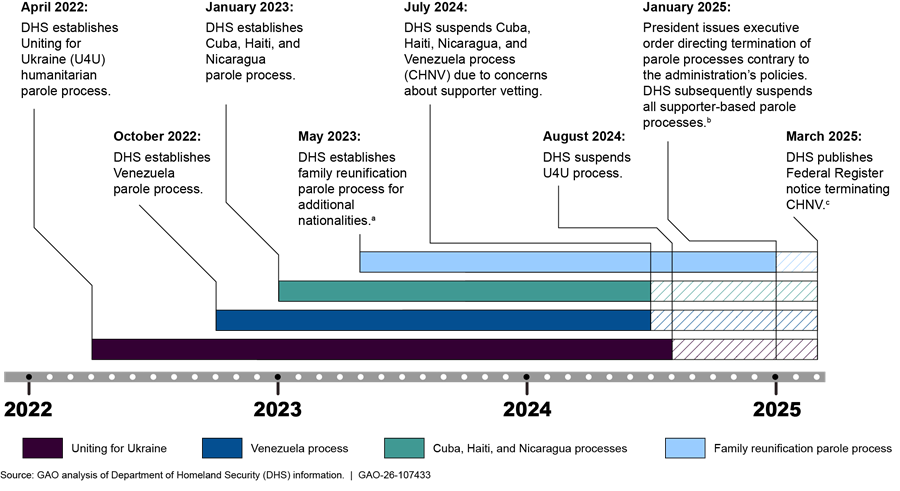
aThe family reunification parole process was established for Cubans in 2007 and for Haitians in 2015. In May 2023, DHS announced that it had updated the process and expanded it to include additional eligible individuals from Colombia, El Salvador, Guatemala, and Honduras. It codified the changes to the process in July and August of 2023. DHS further expanded the process to include eligible individuals from Ecuador in October 2023.
bExec. Order No. 14165, Securing Our Borders, 90 Fed. Reg. 8,467 (Jan. 30, 2025).
cDHS, Termination of Parole Processes for Cubans, Haitians, Nicaraguans, and Venezuelans, 90 Fed. Reg. 13,611 (Mar. 25, 2025). As of June 2025, U4U and family reunification parole remained suspended.
U4U. In April 2022, DHS established a new parole process to allow Ukrainians displaced by the war with Russia and their immediate family members to come to the U.S. for a period of up to 2 years. In the Federal Register notice implementing the process, DHS noted that Russia’s February 2022 invasion of Ukraine had caused more than 5 million people to flee Ukraine for neighboring countries and resulted in shortages of food and medical supplies.[25] At the same time, DHS was experiencing an increased number of Ukrainians arriving at the southwest border, peaking at about 1,300 Ukrainian encounters per day in April 2022, according to a DHS report. DHS stated that it intended for the new parole process to provide an orderly pathway for Ukrainians to enter the U.S., thus deterring some from arriving at the southwest border.
One aspect of this process was DHS’s requirement that the noncitizen (the prospective beneficiary) have a supporter in the U.S. who agreed to receive them and provide for their basic needs for the duration of their parole period.[26] The supporter was to submit to USCIS an application to support the beneficiary, which if confirmed could ultimately allow the prospective beneficiary to receive advance travel authorization to travel to the U.S. and seek parole by CBP at a port of entry. We further discuss the steps and eligibility criteria for this and other parole processes later in this report.
CHNV. In October 2022, DHS announced in a Federal Register notice that it was implementing a new parole process for Venezuelans using U4U as a model.[27] When establishing the process, DHS noted that, like Ukraine, Venezuela was experiencing a humanitarian crisis, in which repression, instability, and violence were pushing millions to leave the country. According to the Federal Register notice announcing the process, DHS had encountered a rising number of Venezuelans at the southwest border—for example, 33,000 encounters in September 2022, compared to a monthly average of 127 in fiscal years 2014 through 2019.
The Venezuelan process, like U4U, required a U.S.-based supporter to apply to support a Venezuelan beneficiary and agree to provide financial support for the parole period of up to 2 years. However, unlike Ukrainians, Venezuelans approved for an advance travel authorization were required to fly to an interior port of entry in the U.S. to request parole from CBP.[28] In addition, the Venezuelan process was initially capped at 24,000 total travel authorizations, while U4U had no such cap. DHS stated in the notice that the purpose of the Venezuelan process was to enhance border security by reducing the levels of Venezuelans arriving at the southwest border, while establishing an orderly pathway to lawfully enter the U.S.[29]
In January 2023, DHS announced additional parole processes for Cubans, Haitians, and Nicaraguans and their immediate family members through Federal Register notices.[30] These new processes were modeled on the Venezuelan process and were functionally the same as that process, and together the four became known as the CHNV process. At the same time, DHS established a combined monthly limit of 30,000 advance travel authorizations for CHNV beneficiaries. Like U4U, the parole period for CHNV beneficiaries was up to 2 years. DHS’s stated purpose in the Federal Register notices for creating the CHNV process was similar to its rationale for creating U4U and the Venezuela process. Specifically, the countries involved were experiencing deteriorating humanitarian conditions, were among the top origin countries of noncitizens encountered at the southwest border, and posed challenges in DHS’s ability to remove and return their nationals without a lawful basis to enter or stay in the U.S.
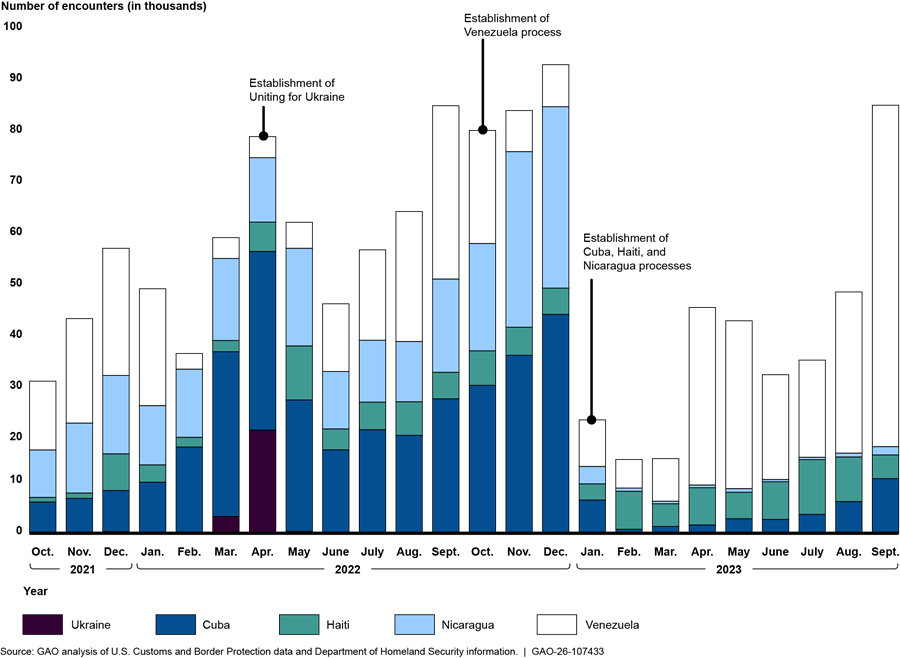
Figure 2 shows the numbers of nationals of U4U and CHNV countries encountered at the southwest border from October 2021 through September 2023, according to DHS data.
Figure 2: Southwest Border Encounters of Ukrainians, Cubans, Haitians, Nicaraguans, and Venezuelans, October 2021–September 2023
Family reunification parole. In addition to the new processes outlined above, in 2023 DHS updated and expanded its process for family reunification parole. This type of parole allowed certain eligible noncitizens who had been approved for a family-based visa to enter the U.S. while they awaited availability of a visa.[31] First established for Cubans in 2007 and Haitians in 2015, the family reunification parole process began when the State Department sent invitations to individuals who had filed immigrant visa petitions on behalf of family members outside of the U.S., allowing them to apply to USCIS for parole for their relatives. If approved for parole, the noncitizen family member would be allowed to live in the U.S. while waiting to receive a visa.
In 2023, DHS expanded the family reunification parole process to also include nationals of Colombia, Ecuador, El Salvador, Guatemala, and Honduras. In addition, DHS incorporated elements of the CHNV process, such as requiring the beneficiary to be approved for an advance travel authorization to travel to the U.S. and request parole at a port of entry. Under the updated family reunification parole process, USCIS required the original petitioner to also serve as the supporter for the beneficiary. Each beneficiary was required to complete a medical exam while abroad by a panel physician—a doctor approved by the U.S. embassy—and attest to receiving medical clearance. The parole period for family reunification parole was up to 3 years. If an individual’s visa had not yet become available at the end of the parole period, they could request reparole.
Agency Roles and Responsibilities
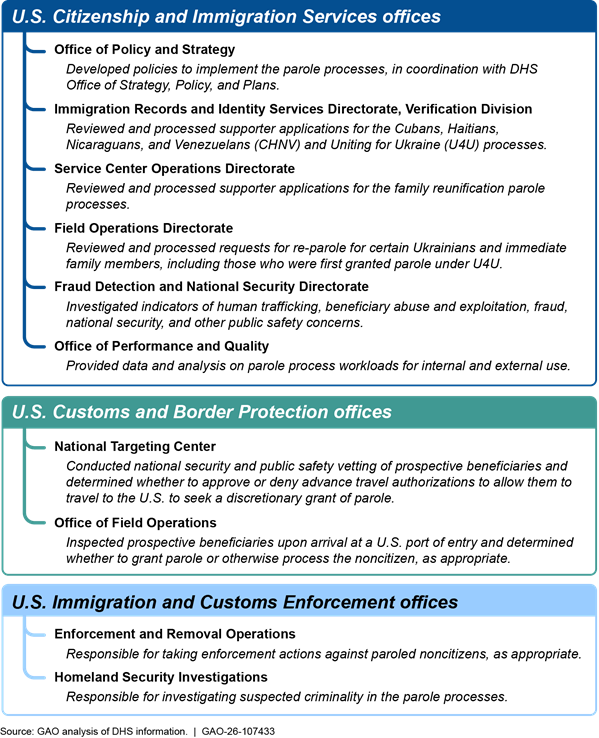
Within DHS, three components had roles and responsibilities in administering the supporter-based parole processes: USCIS, CBP, and ICE. Various offices within the three components had specific responsibilities related to the supporter-based parole processes, as shown in figure 3.
Figure 3: Department of Homeland Security (DHS) Offices’ Roles and Responsibilities Related to Supporter-Based Parole Processes
Steps in the Supporter-Based Parole Processes
Figure 4 outlines the general steps in the supporter-based processes, starting with the supporter submitting an application to initiate the process and ending with the beneficiary receiving a grant of parole at a U.S. port of entry.
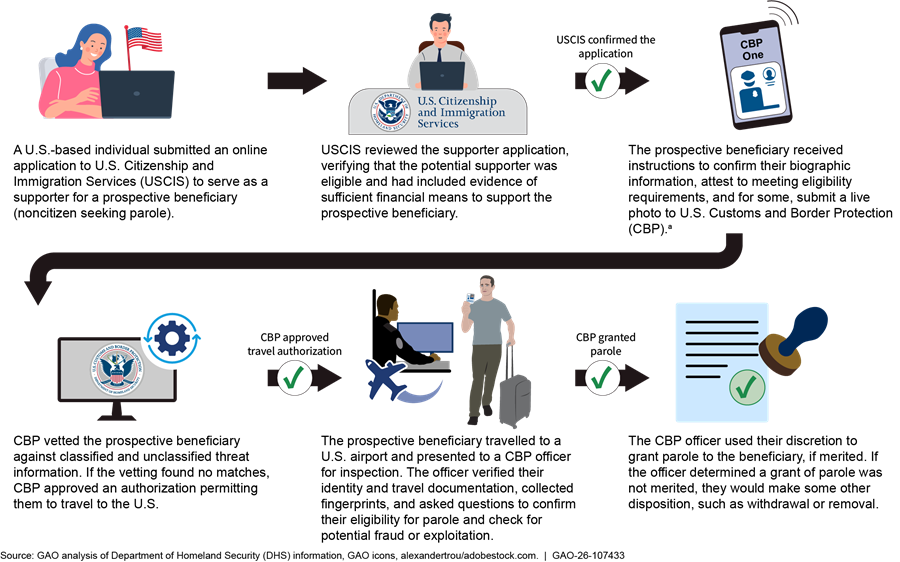
Note: The steps in the family reunification parole process differed from the steps in the Cubans, Haitians, Nicaraguans, and Venezuelans (CHNV) and Uniting for Ukraine (U4U) processes in several ways. For example, family reunification parole beneficiaries were required to complete a medical exam by a panel physician—a doctor approved by the U.S. embassy—while abroad and submit the information electronically before USCIS transmitted beneficiary information to CBP for further vetting. This requirement did not exist for CHNV and U4U beneficiaries. In addition, only U.S. citizens or lawful permanent residents who had previously applied and been approved for a family-based visa on behalf of the prospective beneficiary could serve as the supporter for family reunification parole, and only after receiving an invitation to apply.
aProspective beneficiaries under U4U did not use the CBP One application to submit a live photo or other information directly to CBP. Instead, these noncitizens confirmed their information in their USCIS account and USCIS then transmitted the information to CBP to complete the travel authorization process.
As shown in figure 4, there were generally six steps in DHS’s supporter-based parole processes.
1. Potential supporter submitted an application to USCIS. A U.S.-based individual who committed to providing financial support to a beneficiary submitted a supporter application—Form I-134A, Online Request to be a Supporter and Declaration of Financial Support—to USCIS to initiate the process. The supporter application was entirely online and required the potential supporter to provide biographic information on themselves and the beneficiary, as well as evidence that they met eligibility requirements, as shown in figure 5. Supporters were allowed to support multiple beneficiaries, such as a family unit. However, they were required to submit a separate application for each beneficiary (including children). Supporters could submit applications on behalf of themselves or an organization. For family reunification parole, only the U.S. citizen or lawful permanent resident who had previously applied and been approved for a family-based visa on behalf of the beneficiary could serve as the supporter, and only after receiving an invitation to apply.
2. USCIS reviewed the supporter application. USCIS screened the potential supporter and reviewed the application to ensure that they met the eligibility requirements, as shown in figure 5. If USCIS determined the potential supporter met all requirements, USCIS confirmed the application to move it to the next step.[32]
Figure 5: Eligibility Requirements for Supporters and Beneficiaries in the Supporter-Based Parole Processes
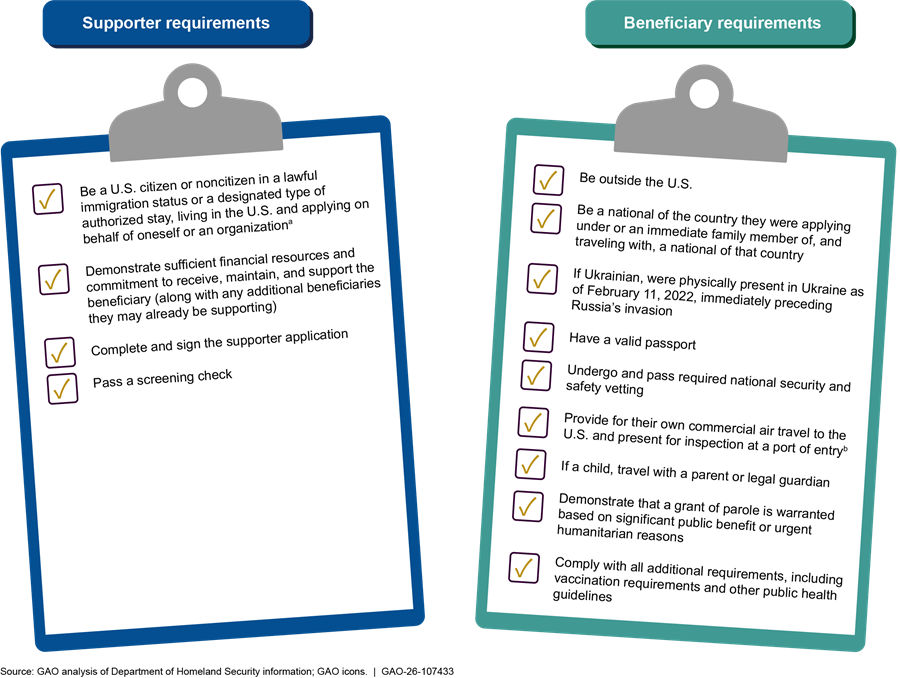
aThere were additional requirements for family reunification parole. For example, only the U.S. citizen or lawful permanent resident who had previously applied and been approved for a family-based visa on behalf of the beneficiary could serve as the supporter, and only after receiving an invitation to apply. Further, prospective beneficiaries were required to complete a medical exam while abroad prior to completing their attestations.
bUniting for Ukraine beneficiaries were allowed to travel to the U.S. through a land border port of entry, whereas beneficiaries under the Cubans, Haitians, Nicaraguans, and Venezuelans and family reunification parole processes were required to travel by air to a U.S. airport.
3. Prospective beneficiary received instructions on next steps. Upon confirmation of their supporter, the prospective beneficiary received an email with instructions to create an online account to review and confirm their biographic information submitted to USCIS. In addition, this step required the noncitizens to attest to meeting the eligibility requirements, as shown in figure 5. After completing these attestations, prospective beneficiaries under CHNV and family reunification parole received instructions on accessing the CBP One mobile application, which they would then use to enter basic biographic information, scan their passport, and submit a live photo of themselves (a “selfie”) to CBP.[33]
4. CBP conducted beneficiary vetting and issued a travel authorization. CBP data systems processed beneficiary information for the purposes of conducting national security and public safety vetting. Specifically, CBP used an automated process to vet the biographic and biometric information against DHS and other federal databases for national security, border security, public health, and safety concerns. In addition, the National Vetting Center—a technology platform within CBP—vetted the biographic information against classified information on national security threats using support from other national security agencies. If the prospective beneficiary passed this vetting, CBP approved an advance travel authorization for them to travel to the U.S. and seek parole at a port of entry. The travel authorization was generally valid for 90 days. If the prospective beneficiary did not pass the vetting, CBP denied the request and the prospective beneficiary would not be allowed to travel.
5. The prospective beneficiary traveled to the U.S. and presented for inspection. Prospective beneficiaries were responsible for securing their own commercial air travel to the U.S. Upon arrival at a U.S. airport, prospective beneficiaries were individually inspected by a CBP officer and considered for parole. As part of the inspection, the noncitizens underwent additional screening and vetting. This included fingerprint biometric vetting and questioning to verify their eligibility for the parole process and identify any indicators of fraud, exploitation, or security concerns.
6. CBP granted parole or some other disposition. CBP granted parole if the beneficiary passed CBP screening and vetting and the officer determined that they merited parole, allowing the individual to stay in the U.S. for up to 2 years (U4U and CHNV) or up to 3 years (family reunification parole).[34] If CBP determined that the noncitizen posed a national security or public safety threat or otherwise did not warrant a grant of parole, CBP processed them for return to their country or removal proceedings.[35]
Suspension and Termination of Parole Processes
In summer 2024, DHS suspended the CHNV and U4U processes after identifying issues related to supporter vetting, including security and fraud risks. DHS later implemented additional vetting procedures and continued to approve some advance travel authorizations and grant parole for small numbers of noncitizens with a focus on cases already in process. For example, under CHNV, about 50 noncitizens were granted parole in November 2024 and 20 in December 2024, according to CBP documentation.[36]
In January 2025, the President issued an executive order directing DHS to terminate all categorical uses of parole that were contrary to the administration’s policies, specifically naming the CHNV processes.[37] In March 2025, DHS issued a notice in the Federal Register announcing that it was terminating the CHNV processes and terminating parole for beneficiaries already in the U.S. under CHNV, stating that all active grants of parole would expire 30 days from the date of the notice.[38] In April 2025, a federal district court issued a preliminary injunction that stayed several aspects of the Federal Register notice that sought to terminate parole, thereby keeping these provisions from taking effect.[39] In May 2025, the U.S. Supreme Court granted DHS’s application to stay the district court’s April injunction, and in doing so allowed the Federal Register notice to take effect, pending further litigation.[40]
Fraud Risk Framework
Executive branch agency managers who implement programs and activities, such as the supporter-based parole processes, are responsible for managing fraud risks and implementing practices for combating those risks. The objective of fraud risk management is to ensure program integrity by continuously and strategically mitigating the likelihood and effects of fraud.
In 2015, we issued A Framework for Managing Fraud Risks in Federal Programs (Fraud Risk Framework), a comprehensive set of leading practices that serves as a guide for combating fraud in a strategic, risk-based manner.[41] GAO created this framework to help federal program managers strategically manage their fraud risks. The framework describes leading practices for:
1. Committing to combating fraud by establishing an organizational structure and culture that are conducive to fraud risk management,
2. Assessing fraud risks by conducting regular fraud risk assessments and determining a fraud risk profile,
3. Designing and implementing antifraud activities to prevent and detect potential fraud, and
4. Monitoring and evaluating antifraud activities to help ensure they are effectively preventing, detecting, and responding to potential fraud.
In 2022, we reviewed USCIS’s agency-wide fraud detection operations for the immigration benefits it adjudicates.[42] We found that USCIS did not have a process for regularly conducting fraud risk assessments, as the Fraud Risk Framework calls for. In addition, we found that although USCIS had documented some of its antifraud activities, it had not developed an agency-wide antifraud strategy nor evaluated the effectiveness of its antifraud activities. We concluded that by taking a more strategic and risk-based approach to managing fraud risks, USCIS could better ensure its antifraud efforts are effective and efficient.
We made six recommendations to USCIS, including that it develop and implement processes for (1) regularly conducting fraud risk assessments, (2) documenting fraud risk profiles, (3) developing and regularly updating an antifraud strategy, and (4) evaluating the effectiveness and efficiency of antifraud activities. USCIS agreed and has taken some steps to address our recommendations, such as developing a draft framework for how it plans to conduct fraud risk assessments and develop fraud risk profiles. As of June 2025, these four recommendations remained open.[43]
Our work has also found that programs created or expanded in response to emergencies may be at increased risk for fraud.[44] Building on this work as well as the Fraud Risk Framework, in 2023 we issued A Framework for Managing Improper Payments in Emergency Assistance Programs to help federal agencies better manage improper payment risk during emergencies.[45] According to this framework, when the federal government provides emergency assistance, the risk of improper payments—such as fraudulent payments—may be higher because the need to provide such assistance quickly can detract from the planning and implementation of effective controls. The framework provides principles and leading practices for program managers to better plan for and take a strategic approach to managing improper payments in emergency assistance programs—before and during emergency situations. Although the framework is focused on financial assistance programs, many of the guiding principles and practices can be similarly applied to programs that provide a non-financial benefit, such as obtaining entry into the U.S. through parole.
DHS Granted Supporter-Based Humanitarian Parole to About 774,000 Beneficiaries from May 2022 Through September 2024
CBP Granted Supporter-Based Parole to About 774,000 Beneficiaries
Our analysis of CBP data found that CBP granted parole to about 774,000 noncitizen beneficiaries from May 2022 when noncitizens began arriving under the supporter-based parole processes through September 2024. Of these beneficiaries, 69 percent were granted parole through CHNV, 30 percent through U4U, and just under 2 percent through family reunification parole, as shown in figure 6.[46]
Figure 6: CBP Grants of Parole Under the CHNV, Uniting for Ukraine, and Family Reunification Parole Processes, May 2022–September 2024
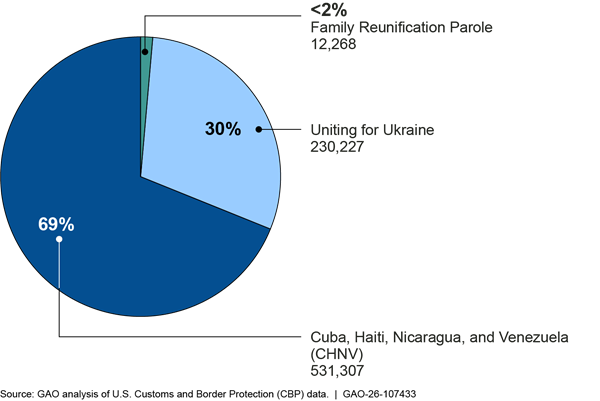
Note: The percentage total is over 100 due to rounding.
As shown in figure 7, the relative number of paroles CBP granted each month varied over time as DHS introduced new parole processes. For example, noncitizen arrivals to the U.S. through U4U began in May 2022, resulting in about 6,000 grants of parole that month. However, starting in January 2023, CHNV beneficiaries made up the largest number of grants of parole each month through August 2024. From January 2023 through August 2024, CBP granted humanitarian parole to about 26,000 beneficiaries per month through the CHNV process.[47] After August 2024, CBP substantially decreased its grants of parole after it suspended the issuance of travel authorizations in summer 2024.
Figure 7: Monthly CBP Grants of Parole Under the CHNV, Uniting for Ukraine, and Family Reunification Parole Processes, May 2022–September 2024
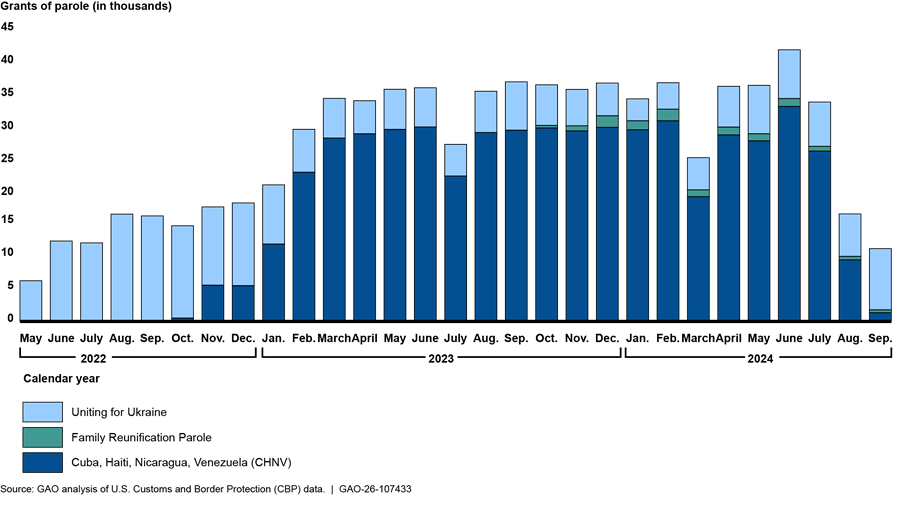
With respect to individual countries, across all three parole processes, beneficiaries from Ukraine made up the largest group (30 percent), followed by Haiti (28 percent), Venezuela (15 percent), Cuba (15 percent), and Nicaragua (12 percent).[48] For additional data on the humanitarian parole processes for each country, see appendix II.
Prior to traveling to the U.S. to request a grant of parole, prospective beneficiaries were required to undergo vetting and receive travel authorization from CBP. From April 2022 through September 2024, CBP received about 917,000 advance travel authorization requests under U4U, CHNV, and family reunification parole. Of these travel authorization requests, CBP approved 91 percent (about 833,500) and cancelled or denied 7 percent (about 61,000).[49]
Prospective beneficiaries with approved advance travel authorizations could fly to a U.S. port of entry to request parole from CBP. From May 2022 through September 2024, the approximately 774,000 noncitizens who were granted parole through CHNV, U4U, and family reunification parole arrived at U.S. airports across the country.[50] However, 88 percent of beneficiaries (nearly 685,000 individuals) arrived at 10 U.S. airports, as shown in figure 8. In particular, two south Florida airports—Miami International Airport and Fort Lauderdale-Hollywood International Airport—accounted for over half of all parole beneficiary arrivals and grants of parole (about 436,000 individuals).[51]
Figure 8: Top 10 Arrival Airports for CBP Grants of Parole Under the CHNV, Uniting for Ukraine, and Family Reunification Parole Processes, May 2022–September 2024
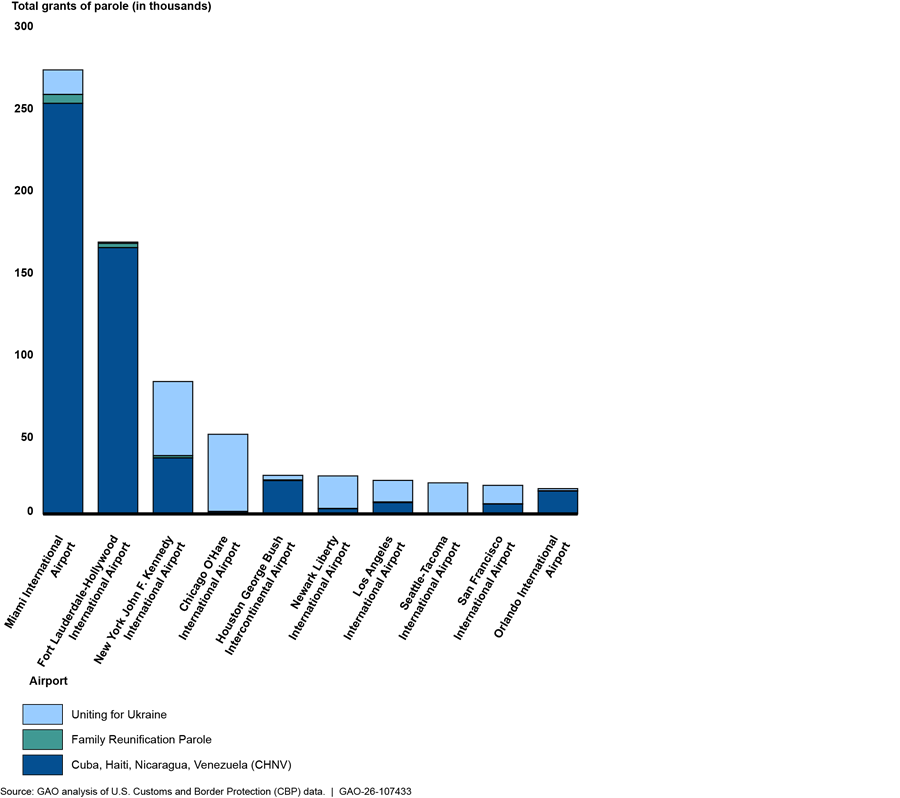
Based on our review of CBP data, CBP officers generally collected the intended address of the noncitizens and entered the information into CBP data systems. Our analysis of these data found that the distribution of beneficiaries’ arrival location generally aligned with their intended address. For example, 40 percent of all humanitarian parole beneficiaries—about 300,000 beneficiaries—indicated Florida as their intended state of residence.[52]
According to CBP officers we spoke to at four selected U.S. airports, CBP officers denied parole to a small number of noncitizens under the supporter-based processes and granted parole to most noncitizens who arrived at U.S. airports with a valid travel authorization.[53] Our review of a selection of CBP data also found that most noncitizens who arrived at two high-volume airports with a valid travel authorization were granted parole. Specifically, in calendar year 2023, CBP granted humanitarian parole to about 99 percent of arrivals at the two Florida airports that accounted for over half of all humanitarian parole arrivals that year.[54] Those who were not granted parole under the supporter-based parole processes were either denied entry to the U.S. or were permitted to enter the U.S. with a disposition other than humanitarian parole, such as being issued a notice to appear for removal proceedings before the immigration courts. See the text box for examples of arrivals who were denied entry into the U.S. or were permitted into the country with a disposition other than humanitarian parole.
|
Examples of How CBP Processed Arriving Noncitizens it Denied Humanitarian Parole at U.S. Airports According to CBP officials, CBP granted humanitarian parole to most noncitizens who arrived at U.S. airports with a valid advance travel authorization under the Uniting for Ukraine (U4U); Cuba, Haiti, Nicaragua, Venezuela (CHNV); and family reunification parole processes. However, CBP denied humanitarian parole to a small percentage of arriving noncitizens. In some cases, the individual was given the opportunity to withdraw their application for admission to the U.S. and board a plane back to their country of origin. In other cases, CBP placed the noncitizen in expedited removal or allowed them to enter the country with a disposition outside of humanitarian parole. In expedited removal proceedings, the government can order noncitizens removed from the U.S. without further hearings before an immigration judge unless they indicate an intention to apply for asylum, a fear of persecution or torture, or a fear of return to their home country. The following are examples of such cases. Withdrawal In 2024 a Venezuelan adult admitted under oath to CBP officers that he had paid an individual $15,000 to file supporter applications for him and his two children. The individual withdrew his application—and the application for his children—for humanitarian parole. CBP officers at two ports we visited told us that when they encountered individuals with potentially fraudulent cases, they would first offer them the option to withdraw the application prior to taking other steps, such as referring them to U.S. Immigrations and Customs Enforcement (ICE) for possible enforcement action, such as detention and removal. Port Parole In 2023, a Venezuelan adult arrived at a port of entry with an expired advance travel authorization (humanitarian parole travel authorizations were generally valid for 90 days after approval). The individual’s travel authorization had been expired for about a week. CBP officers conferred with CBP’s National Targeting Center, which is responsible for vetting parole applicants, and ultimately granted humanitarian parole to the individual under the port’s discretion to grant parole rather than through CHNV. Specifically, CBP officers had the discretion to grant humanitarian parole at ports of entry (referred to as a “port parole”). In such port parole cases, CBP officers generally set the parole period to 2 years. Notice to Appear In 2024 an adult from Nicaragua admitted under oath to CBP officers that he did not know his supporter and that his sister had paid the supporter $5,500 to submit an application to support him. CBP officers referred the individual to ICE for detention and removal. However, the individual claimed fear of returning to Nicaragua, and ICE did not have detention space available to hold the individual for a credible fear interview with an asylum officer. As such, CBP released the individual into the U.S. with a notice to appear in immigration court at a later date. Source: GAO analysis of U.S. Customs and Border Protection (CBP) information. | GAO‑26‑107433 |
Across the supporter-based parole processes, certain characteristics of beneficiaries were relatively similar. For example, the age breakdown of beneficiaries was similar across the parole processes. In total, the largest share of beneficiaries were adults aged 18 to 60 (73 percent). About 20 percent of beneficiaries were minors (aged 0 to 17 at the time of arrival), and around 7 percent were older than 60. The gender breakdown of beneficiaries was nearly equal, with about 53 percent female arrivals and 47 male arrivals. In addition, over 99 percent of beneficiaries were citizens of the 10 countries eligible for parole. Less than 1 percent were citizens of other countries. According to the rules of these parole processes, humanitarian parole was available to nationals of the eligible countries (such as Cuba and Nicaragua) as well as their immediate family members of any nationality.[55]
USCIS Confirmed More Than 1 Million Supporter Applications
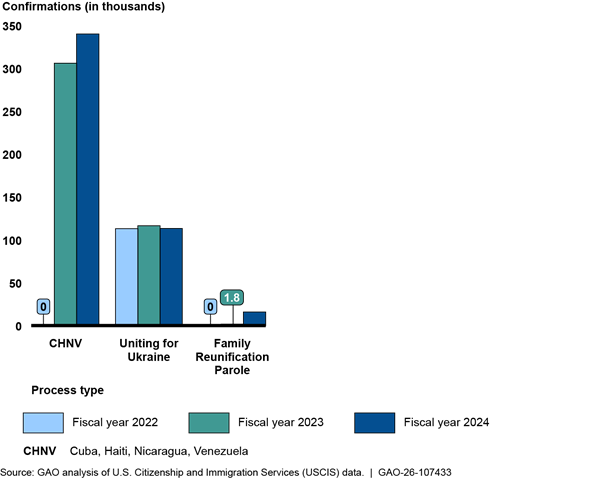
From April 2022 through September 2024, USCIS confirmed over 1 million supporter applications, as shown in figure 9. Of these confirmations, 64 percent were associated with the CHNV parole process, 34 percent with U4U, and 2 percent with family reunification parole.
|
Why Are There More Supporter Confirmations Than Grants of Parole to Beneficiaries? Based on our analysis of U.S. Citizenship and Immigration Services (USCIS) and U.S. Customs and Border Protection (CBP) data through September 2024, there were about 230,000 more confirmed supporter applications than grants of parole. Several factors may have contributed to this difference. For example, according to USCIS officials, prospective beneficiaries had to take additional steps after USCIS confirmed a supporter’s application—such as sign an attestation—before they were able to request authorization to travel to the U.S., and some did not take these steps. Additionally, CBP did not authorize all prospective beneficiaries to travel to the U.S. For example, CBP denied or cancelled about 61,000 requests. For instance, if CBP initially approved a prospective beneficiary’s travel authorization but subsequently identified derogatory or other disqualifying information, it was to cancel the travel authorization. Further, of the over 800,000 CBP-approved travel authorizations, about seven percent of prospective beneficiaries never traveled to the U.S. Source: GAO analysis of USCIS and CBP information. | GAO‑26‑107443 |
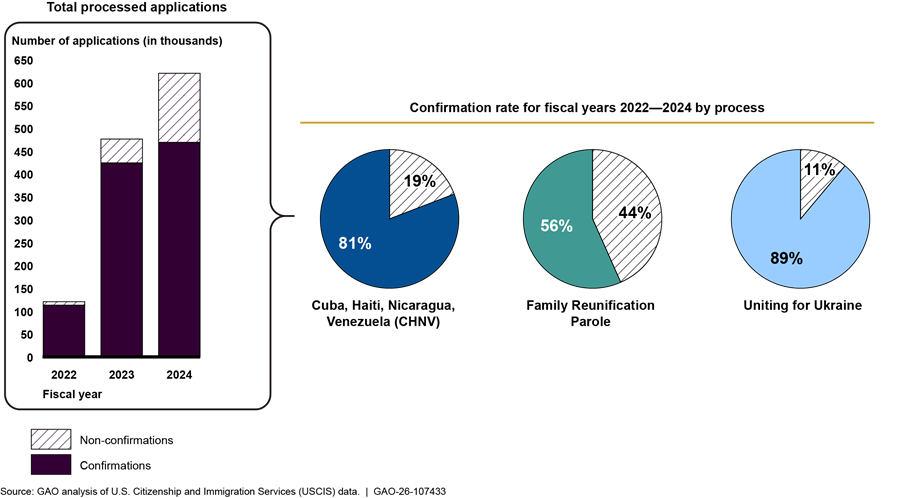
Out of about 1.2 million supporter applications USCIS reviewed across the processes from April 2022 through September 2024, USCIS did not confirm about 210,000 supporter applications—a nonconfirmation rate of about 17 percent.[56] As shown in figure 10, USCIS confirmed supporter applications at a lower rate over time. Specifically, in fiscal year 2022, USCIS’s confirmation rate was about 95 percent. In fiscal years 2023 and 2024, the confirmation rate was about 90 and 75 percent, respectively. Additionally, USCIS’s confirmation rate varied across processes, as shown in figure 10. For example, U4U had the highest confirmation rate (almost 90 percent), while family reunification parole had the lowest (about 55 percent).[57]
Figure 10: USCIS Supporter Confirmations and Nonconfirmations by Fiscal Year and Humanitarian Parole Process, April 2022–September 2024
Across all supporter-based humanitarian parole processes, supporter applicants who self-reported being U.S. citizens, U.S. nationals, and lawful permanent residents accounted for most applications confirmed by USCIS.[58] Specifically, 68 percent of all confirmed applications were submitted by those reporting to be U.S. citizens and nationals, and 22 percent were submitted by lawful permanent residents. The remaining 11 percent of confirmed applications were submitted by noncitizens who were not lawful permanent residents or whose status was not specified on the application form.[59]
Most Parole Beneficiaries Received Employment Authorization and Some Have Adjusted Their Immigration Status
Upon receipt of a grant of parole, beneficiaries were permitted to apply for employment authorization and any other immigration benefits for which they were eligible. According to USCIS records, most humanitarian parole beneficiaries applied for, and received, federal government authorization to work in the U.S. Specifically, as of March 2025, USCIS had issued over 800,000 employment authorization documents to beneficiaries of CHNV and U4U.[60]
In addition, as of March 2025, some humanitarian parole beneficiaries had applied for, and received, lawful immigration status from USCIS, as shown in table 1.[61] Such lawful immigration status included the following:
· Temporary protected status (TPS). This form of humanitarian protection provides eligible noncitizens who are from designated countries and residing in the U.S. temporary protection from removal and allows them to work in the country.[62]
· Asylum. This provides humanitarian protection to noncitizens who demonstrate that they are unable or unwilling to return to their home country because of past persecution or a well-founded fear of future persecution based on their race, religion, nationality, membership in a particular social group, or political opinion.[63]
· Adjustment of status to lawful permanent resident. The Immigration and Nationality Act and certain other federal laws provide different ways to adjust the immigration status to that of a lawful permanent resident.[64] This is often informally referred to as applying for a green card. Family-based immigration and adjustment of status under the Cuban Adjustment Act fall within this category.[65]
Table 1: USCIS Approvals of Applications for Other Immigration Status Made by Humanitarian Parole Beneficiaries, as of March 2025
|
Country |
Temporary Protected Status (TPS)a |
Adjustment of status to lawful permanent residentb |
|
Cuba |
0 |
14,180 |
|
Haiti |
62,436 |
1025 |
|
Nicaragua |
30c |
283 |
|
Ukraine |
85,105 |
4,209 |
|
Venezuela |
33,955 |
463 |
|
Total |
181,526 |
20,160 |
Source: U.S. Citizenship and Immigration Services (USCIS). | GAO‑26‑107433
Notes: USCIS also approved 70 applications for asylum. Asylum provides humanitarian protection to noncitizens who demonstrate that they are unable or unwilling to return to their home country because of past persecution or a well-founded fear of future persecution based on their race, religion, nationality, membership in a particular social group, or political opinion. 8 U.S.C. § 1158.
In February 2025, USCIS placed an administrative hold on all benefit requests filed by beneficiaries of the supporter-based parole processes, pending further screening and vetting by USCIS. This memorandum was stayed by a district court in May 2025. See Doe v. Noem, No. 25-CV-10495 (D. Mass. May 28, 2025) (order granting in part plaintiffs’ emergency motion for preliminary injunction and stay of administrative action).
aTPS provides eligible foreign nationals who are from designated countries and residing in the U.S. temporary humanitarian protection from removal. Countries may be designated for TPS because of temporary conditions in the country, such as armed conflict, that prevent nationals from returning in safety.
bThe Immigration and Nationality Act and certain other federal laws provide many different ways to adjust status to that of a lawful permanent resident. See, for example, 8 U.S.C. § 1154. Family-based immigration falls within this category.
cNicaraguan parole beneficiaries were not eligible for TPS. However, according to USCIS officials, individuals may have received parole through a process for one country and been granted TPS as a citizen of another country. For example, in one case, a Venezuelan citizen who had been living in Nicaragua was granted parole under the Nicaraguan process. This individual subsequently applied for TPS as a Venezuelan citizen after entry to the U.S.
Some paroled noncitizens were also able to remain in the U.S. after their initial period of parole had ended by obtaining reparole.[66] In February 2024, USCIS began accepting reparole applications for certain Ukrainians and their immediate family members originally paroled into the U.S. on or after February 11, 2022, including those paroled under U4U. Family reunification parole beneficiaries were also eligible to apply for a new period of parole through USCIS.[67] DHS did not establish a reparole process for CHNV beneficiaries. As of March 2025, USCIS had processed 75 percent (about 87,500) of the approximately 117,000 reparole applications U4U beneficiaries had submitted.[68] USCIS approved more than 99 percent (about 87,200) of the processed applications, granting such beneficiaries a new period of parole, and denied less than 1 percent (about 250).
DHS Identified Fraud Risks and Other Challenges in Supporter-Based Parole Processes but Has Not Assessed Lessons Learned
DHS Identified Security and Fraud Risks Early in Parole Processes but Has Not Developed a Plan for Internal Controls
USCIS and CBP began identifying fraud risks and other vulnerabilities in the U4U process shortly after it was initiated in April 2022 and identified risks in the CHNV process once implementation began.[69] Subsequently, a USCIS review determined that fraud indicators were widespread in CHNV and U4U, and DHS suspended the processes. These risks were the result of insufficient internal controls in the supporter vetting process, such as activities to verify supporter information, according to USCIS and CBP documentation. DHS has since terminated CHNV and suspended the other processes after briefly restarting them with additional vetting measures in place. However, it has not developed a plan it could use in the future to help proactively mitigate fraud risk and other risks in new or changed programs.
DHS’s Rapid Implementation of the Processes Raised Early Concerns
DHS developed and implemented the U4U process in a period of about 2 months in early 2022, according to USCIS officials. DHS developed the process quickly to respond to the emerging humanitarian crisis in Ukraine following Russia’s invasion, these officials said, leveraging electronic tools to help bring displaced Ukrainians seeking safety to the U.S. in a timely manner. Specifically, USCIS officials said that DHS had learned from its previous experience administering parole for Afghans under Operation Allies Welcome in 2021, which the officials described as time consuming. In developing U4U, DHS aimed to process individuals more quickly. To do so, it adapted CBP’s advance travel authorization process and created an online supporter application, officials said.[70] DHS’s Office of Strategy, Policy, and Plans led the department’s initial development of U4U and worked with CBP and USCIS to implement it, according to DHS and USCIS officials.
Officials with USCIS’s Fraud Detection and National Security Directorate (FDNS), the agency’s antifraud entity, told us that while USCIS was developing U4U, FDNS did not have the opportunity to identify potential risks in the process and suggest ways to mitigate them. Shortly after U4U’s establishment in April 2022, FDNS became aware of suspected human trafficking cases associated with the process and FDNS’s role in the parole processes expanded. For example, in June 2022, FDNS established a dedicated email inbox to receive referrals from the Department of Health and Human Services involving human trafficking reports from Ukrainian beneficiaries and developed a set of questions that human trafficking hotline staffers could use for potential Ukrainian victims.[71]
After DHS implemented the processes for Venezuela and the other CHNV countries beginning in the fall of 2022, FDNS began receiving referrals of potential fraud from CBP and from within USCIS related to the processes. For example, CBP referred fraud schemes that officials encountered at ports of entry, such as non-Ukrainians using fraudulent travel documents and fake marriage arrangements to try to enter the U.S. under U4U. Additionally, CBP officers at one south Florida airport determined that some Haitian beneficiaries traveling with children had been scammed by some Haitian officials to purchase a fraudulent guardianship document. Within USCIS, a team responsible for validating supporter and beneficiary A-numbers noticed that some CHNV applications appeared to be fraudulent.[72] In February 2023, this team referred to FDNS a group of suspicious supporter applications, including some with missing or unverifiable proof of identity, nonexistent addresses and phone numbers, and documentation that appeared to be altered.
In response to these incidents, FDNS officials investigated the referrals, made recommendations to nonconfirm supporter applications where appropriate, and shared information about fraud schemes and trends to help USCIS reviewers identify potential fraud. For example, FDNS created a tip sheet for USCIS reviewers to help them identify fraud indicators in supporter applications. FDNS also referred cases with suspected criminal activity, such as potential human trafficking, to ICE’s Homeland Security Investigations. FDNS officials said that several investigations remained ongoing as of June 2025.
DHS Identified Widespread Indicators of Fraud Among Supporters
In 2024, USCIS and CBP took additional actions to identify and assess fraud risks in the U4U and CHNV processes, determining that fraud indicators were widespread in the CHNV and U4U processes. Both agencies began taking action to mitigate the risks they identified.
USCIS. In early 2024, FDNS officials became increasingly concerned about the prevalence of fraud in CHNV and U4U, these officials said. In response, FDNS analyzed all 2.6 million supporter applications that USCIS had received, including those already processed (confirmed and nonconfirmed), to identify broader trends and vulnerabilities that made the processes susceptible to fraud.
|
Example Fraud Indicator: Counterfeit or Altered Documents Using U.S. Citizen Identities Individuals who filed fraudulent supporter applications sometimes used information and altered documents that belonged to real U.S. citizens or fabricated identities altogether, according to analysis by U.S. Citizenship and Immigration Services’ (USCIS) Fraud Detection and National Security Directorate (FDNS). Some fraudulent documents showed clear indications that they had been altered. FDNS found that filers submitted more than 3,000 forms with images of fraudulent U.S. passports. In some cases, filers used the identities of unwitting U.S. citizens and altered document images to include different photos, according to FDNS documentation. Notable examples include a passport image with a photo of journalist Connie Chung and a driver’s license with a photo of actor Cote de Pablo. In addition, USCIS determined that some filers were using Social Security numbers and other biographical information associated with deceased individuals. For example, FDNS identified multiple applications using a Social Security number that had belonged to Elvis Presley along with other fake biographical data. As of July 2024, more than 1,400 beneficiaries had arrived in the U.S. whose supporter information was associated with a deceased individual, FDNS found. According to FDNS, prior to its involvement, USCIS reviewers generally confirmed these supporter applications because they did not have the ability to verify information about U.S. citizen supporters who did not have a prior USCIS filing history. Source: GAO analysis of USCIS documentation. | GAO 26 107433 |
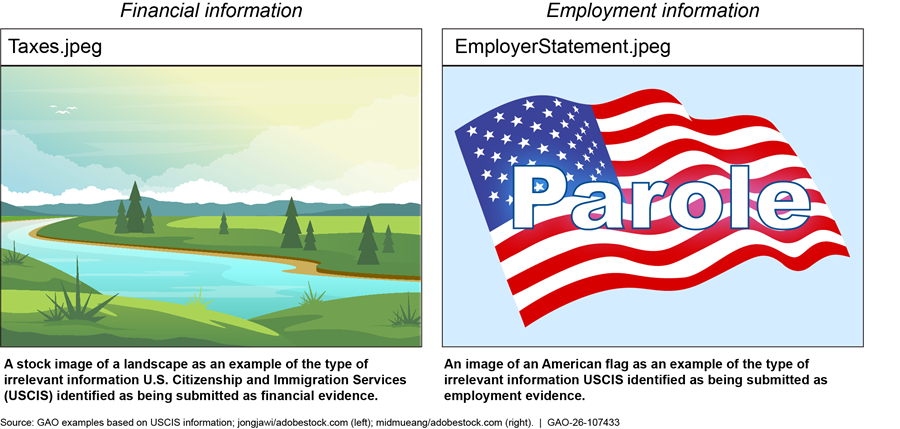
FDNS officials told us the analysis found that fraud indicators were widespread in CHNV and U4U supporter applications. FDNS’s analysis identified several fraud indicators among the applications, such as supporter information belonging to deceased individuals, counterfeit or altered documents, clearly irrelevant evidence (see fig. 11), and thousands of applications with at least one piece of fictitious supporter information. FDNS also found that applications included Social Security numbers, phone numbers, physical addresses, and email addresses that had been used hundreds of times.
|
Example Fraud Indicator: Shell Applications Used to Scam Potential Parole Beneficiaries Some filers under Uniting for Ukraine (U4U) and Cubans, Haitians, Nicaraguans, and Venezuelans (CHNV) submitted supporter applications with fraudulent and incomplete information solely for the purpose of exacting a fee from the prospective beneficiaries—rather than to establish their ability to serve as supporters. Paying filers to submit a supporter application was prevalent across the U4U and CHNV processes, according to U.S. Citizenship and Immigration Services’ (USCIS) Fraud Detection and National Security Directorate (FDNS). These “shell applications” lacked key evidence and were unlikely to be confirmed by USCIS reviewers. For example, some shell applications contained clearly irrelevant documents as evidence of employment and financial means (see fig. 11). To confirm a supporter application, USCIS required that the application include evidence that the supporter had sufficient financial means to provide for the beneficiary. In addition, hundreds of applications contained fictitious supporter information or nonsensical text in response to narrative questions. In other cases, applications appeared legitimate enough for USCIS reviewers to confirm them and the beneficiaries eventually received authorization to travel to the U.S., according to an FDNS report. For example, FDNS reported that one Ukrainian beneficiary paid about $5,000 to a filer for an application that USCIS later confirmed. In addition, U.S. Customs and Border Protection (CBP) officers at some ports of entry told us they had encountered prospective beneficiaries who said they had paid their supporter to file the application, in which case the officers would not grant them parole due to the likelihood of fraud. USCIS officials told us that because there was no statutory provision prohibiting the payment of fees to the supporter in exchange for submitting the form, USCIS lacked the authority to take enforcement action against supporters who solicited or accepted fees. Source: GAO analysis of USCIS and CBP information. | GAO 26 107433 |
FDNS officials also identified some fraud indicators among family reunification parole supporter applications. For example, some confirmed applications were associated with petitioners who had died, FDNS officials said. For family reunification parole, USCIS required the individual who filed the supporter application to be the same person who filed the original petition for the beneficiary’s family-based immigrant visa (to whom the Department of State sent the parole invitation). However, some invitations to apply were sent to deceased petitioners, FDNS found. These invitations resulted in 728 supporter applications filed under the names of deceased individuals—of which USCIS confirmed half. FDNS officials told us there may be reasons other than fraudulent activity why someone might apply under a deceased petitioner’s name. For example, if the original petitioner passed away, a family member may have filed under their name because the visa applicant still wanted to come to the U.S. and the family member did not realize they were not permitted to file the application.
CBP. Separately, starting in July 2024, CBP’s National Targeting Center (NTC) conducted its own review of confirmed CHNV supporter information and found instances of supporters with a criminal history. NTC first reviewed a subset of supporters of Venezuelan beneficiaries by vetting their information against information on national security and public safety threats (derogatory holdings).[73] NTC found that about 25 percent of the supporters were potential matches against this information. Upon manual review, about 18 percent of the supporter subset were found to be true matches, meaning that CBP likely would have found the beneficiary not eligible for parole had the information about the supporter been known during the review process, according to NTC.
In light of these vulnerabilities, NTC suspended its automated process to vet beneficiaries and approve advance travel authorizations for CHNV in July 2024 and for U4U in August 2024. USCIS then suspended its review of new supporter applications, effectively pausing these two supporter-based parole processes at that time.[74]
After pausing the travel authorization process, NTC expanded its vetting efforts to include the supporters of CHNV beneficiaries who had approved travel authorizations but had not yet arrived in the U.S. NTC also began working with officials from FDNS on these vetting efforts. Using CBP derogatory holdings, NTC and FDNS jointly vetted supporter information associated with about 29,000 “travel ready” beneficiaries. Of these, they found that about 5,300 had supporters that matched against derogatory information, and 2,800 had supporters who were ineligible. In total, NTC canceled travel authorization for about 8,100 beneficiaries, about 28 percent of the “travel ready” population. Matches identified a range of illicit activity by supporters, such as illegal narcotics, money laundering, and assault, according to NTC documentation (see text box for examples). Where they encountered evidence of criminality or ineligibility to be a supporter, NTC and FDNS officials took enforcement steps as appropriate, such as canceling travel authorization for beneficiaries who had not yet traveled or referring cases to law enforcement agencies such as the Federal Bureau of Investigation or ICE’s Homeland Security Investigations.
|
Example Security Risk: Prior Criminality Found Among Confirmed Supporters When the National Targeting Center (NTC) reviewed information on a subset of confirmed supporters of Venezuelan prospective beneficiaries against derogatory holdings, they found that about 25 percent had matches that required manual review and 18 percent resulted in true matches. According to NTC documentation, the vetting identified potential or confirmed criminal activity among the supporters that may have made the prospective beneficiaries ineligible for a grant of parole. NTC expanded its vetting to include supporters of prospective beneficiaries in the Cubans, Haitians, Nicaraguans, and Venezuelans (CHNV) process who had approved travel authorizations but had not arrived in the U.S. The vetting resulted in similar findings of potential or confirmed criminal activity, for example · some supporters had links to investigations related to illegal narcotics and money laundering activity; · some supporters had criminal records, including felony arrests for assault and battery, robbery, arrest for conspiracy to sell cocaine, suspected involvement in a transnational criminal organization, and smuggling; · one supporter—who had applied to support a minor child—had a warrant, arrest, or conviction involving an attempt to procure online child sexual exploitation materials on two occasions; and · another supporter, a U.S. citizen, was wanted for murder and assault with a firearm by Haitian authorities. NTC and the Fraud Detection and National Security Directorate (FDNS) reviewed each case and determined what actions to take based on a risk assessment, such as canceling the travel authorization for the beneficiary or making a referral to an appropriate law enforcement agency. In other cases, NTC and FDNS determined that the matches did not present a significant enough risk to warrant canceling the travel authorization or nonconfirming the supporter, such as one supporter who had been charged with loitering. Source: GAO analysis of U.S. Citizenship and Immigration Services and U.S. Customs and Border Protection information. | GAO 26 107433 |
USCIS Has Not Developed an Internal Control Plan to Address Future Vulnerabilities
|
What Are Internal Control Activities and Why Are They Important? Internal control activities are actions program managers establish through policies and procedures to achieve objectives and respond to risks. Control activities serve a range of purposes, one of which is to prevent, detect, and respond to fraud risks. Effective managers design antifraud control activities that are tailored to known fraud risks in the program. Examples may include fraud-awareness training for staff or automated data-analytic techniques to prevent fraudulent applications from being approved. Source: GAO. | GAO‑26‑107433 |
USCIS and CBP assessments attributed the risks they identified in the parole processes to insufficient internal control activities in the supporter application process. While DHS has terminated the CHNV processes and suspended the other parole processes, USCIS has not developed an internal control plan that it could leverage for new or changed programs in the future to quickly implement control activities to help prevent fraud before it occurs, according to USCIS officials.
Agencies are to use internal control activities to prevent fraud in their programs. However, a July 2024 USCIS report found that there was “little to no barrier to entry” to file the supporter application, contributing to the fraud risks and potential exploitation that had occurred. The report noted that because the application initially lacked a filing fee and did not require the potential supporter to submit biometrics—examples of potential control activities—preparers could easily file multiple applications.[75] This was an aspect of the process that some fraud schemes may have exploited. Additionally, antifraud control activities include automated features in data systems to prevent and detect fraudulent activity. However, according to USCIS’s report, its case management system lacked such functionality, for example allowing some applicants to create multiple USCIS accounts with slightly different biographic information or swap in different beneficiaries after the application was confirmed. The system also lacked the ability to efficiently prevent duplicate applications, instead requiring reviewers to manually search for duplicates from the same or different accounts, according to USCIS’s report.
Additionally, limitations in USCIS access to information to review supporter information contributed to the vulnerabilities, the USCIS report found. These included limited access to databases to fully vet supporter criminal history and verify the identities of U.S. citizens. For example, USCIS conducted automated checks of all potential supporters against the National Crime Information Center database upon application submission.[76] This check queried the supporter’s information against active criminal wants and warrants at the time the application was submitted, but did not provide the full criminal arrest history, criminal convictions and dispositions, or other information needed to assess the supporter’s suitability, according to the USCIS report. The report noted that USCIS lacked access to full criminal history record information, although CBP had access to this information.[77] As a result, USCIS confirmed some supporters despite the supporters having a criminal history, as the NTC vetting showed. Further, the two systems USCIS used to verify supporter information were not capable of verifying U.S. passport information—meaning the systems were not strong resources for verifying the identities of U.S. citizens without a history of interacting with USCIS, the USCIS report found.
GAO’s Fraud Risk Framework emphasizes the importance of designing and implementing appropriate internal control activities to manage fraud risks in federal programs, particularly for new programs.[78] Specifically, the Framework states that as a first step, program managers should conduct a fraud risk assessment to assess where fraud may occur in the program and the likelihood and impact of fraud risks. Next, managers should design and implement specific control activities to prevent and detect fraud. Although the Framework applies to all programs, it highlights the importance of taking these steps for new programs or programs that have experienced significant change, as changes may introduce new fraud risks. In addition, effective program managers focus more on activities that prevent rather than detect fraud, to avoid having to address fraud once it is already happening—which can be costly and inefficient.
Another leading practice for program management is to develop an internal control plan that can be immediately implemented or quickly tailored to fit the circumstances of a future emergency or emergent situation.[79] Because the need to act quickly during such situations can increase the risk of fraud, having an internal control plan in place ahead of time can help ensure that program managers consider any fraud risks associated with new programs. Such plans should include potential control activities and may also contain components such as identifying risks specific to the new program and controls to address these risks. In addition, preexisting internal control plans can help program managers quickly adapt when an existing program’s requirements change suddenly or unexpectedly.
As a result of the lack of sufficient internal controls in the CHNV and U4U processes, some individuals perpetrated scams that exploited prospective beneficiaries and stole the identities of U.S. citizens, as described above. In addition, USCIS confirmed some supporters despite them not being eligible, for example those with fictitious biographical information or prior criminal activity.
In its July 2024 report, USCIS made several recommendations to improve internal controls in the CHNV and U4U processes, which—had they been implemented earlier on—may have helped mitigate the fraud risks, USCIS officials said. The report included 41 recommendations to improve various aspects of the processes. Examples were recommendations to collect biometrics and a filing fee from supporter applicants. Other recommendations included improving verification of U.S. citizen identities, such as through passport verification databases; implementing address validation to detect nonexistent addresses; nonconfirming groups of applications that included nonexistent Social Security numbers or those belonging to deceased individuals; and incorporating expanded criminal history checks. In late summer and fall 2024, USCIS began implementing several of the recommended measures, such as adding a biometrics collection and fee requirement and additional supporter vetting.
Although DHS terminated CHNV and suspended the other supporter-based parole processes, USCIS could still benefit from having an internal control plan in place for future situations, including emergent circumstances, that may introduce new or increased fraud risks.[80] Such a plan could help USCIS quickly identify and implement ways to mitigate these risks earlier in the development of a new program, such as a process for reviewing a new immigration benefit form, or a change to an existing program.
A preexisting internal control plan might include basic antifraud controls and other steps to ensure managers are considering fraud risks before implementing a new program or changing an existing program. For example, a USCIS internal control plan might include a mechanism for the appropriate USCIS office to consult key stakeholders early in the development process, such as FDNS or CBP, to identify potential sources of fraud risk prior to implementing the change. Additionally, in developing an internal control plan, USCIS could leverage the recommendations USCIS already made for CHNV and U4U, such as recommendations to collect biometrics and a filing fee from applicants to mitigate fraud risk. The plan could also include a mechanism for identifying and obtaining access to any additional data sources needed to support internal controls, such as criminal history information—whether directly or through information-sharing agreements with other DHS components. Program managers could then use the plan to identify and consider adapting such recommendations and other controls earlier in the implementation of a new program to prevent fraud before it occurs.
DHS Faced Additional Challenges in Implementing the Processes, Such as Resource Limitations and Fragmentation
In addition to the fraud risks and security concerns USCIS and CBP identified, we found that DHS faced several other challenges in implementing the supporter-based parole processes. These included staffing and resourcing challenges, inconsistent review of the reasons for beneficiaries requesting parole, fragmentation of roles and responsibilities across DHS offices and components, and supporters not upholding their commitments to beneficiaries. We discuss steps USCIS and CBP took toward addressing these challenges later in the report.
Staffing and Resourcing Challenges
Applicant interest in the supporter-based parole processes outpaced DHS’s ability to process applications in an efficient, effective manner using the resources it had, according to USCIS and CBP documentation and officials. Given limited staff resources, as well as the 30,000 limit on CHNV approvals each month, USCIS had a backlog of more than 2 million pending supporter applications as of November 2024. The high volume of applications and numbers of arriving beneficiaries placed resource strains on USCIS and CBP, drew staff away from other missions, and would have been unsustainable over the long term, according to USCIS and CBP officials.
USCIS. To review supporter applications for the CHNV and U4U processes, USCIS relied on detailees—staff from across the agency who served temporary assignments in the USCIS office responsible for reviewing supporter applications. USCIS officials told us that because the supporter application process did not confer an immigration benefit, applications did not require review by immigration services officers—USCIS staff specifically trained to make adjudication decisions regarding noncitizens applying for benefits. In particular, immigration officers and asylum officers were not allowed to serve as detailees because they were needed to support other USCIS benefit processing priorities, USCIS officials said.
Instead, USCIS recruited detailee staff in a variety of positions from other offices and trained them to review CHNV and U4U supporter applications. Generally, between 40 and 45 detailees served at one time, overseen by about seven permanent staff, officials told us. They received about a week of formal training, hands-on assistance from more experienced staff, and guidance and tip sheets to help them learn how to review supporter applications, according to USCIS officials. Detailees generally served in the role for 2 to 6 months before returning to their regular duties.
However, the detailee staffing model presented challenges to USCIS ensuring thorough reviews of supporter applications, according to USCIS officials and reports. Detailees had varying degrees of prior experience reviewing immigration benefit forms and many faced a steep learning curve, USCIS officials and detailees said.[81] Although detailees we spoke with generally said the training they received was sufficient, five out of eight indicated that additional training or experience in particular areas would have been helpful, such as on verifying immigration statuses and identifying fraud indicators. USCIS officials who oversaw the work of detailees said they had identified several issues with the quality of their application reviews, such as making incorrect decisions based on missed duplicate applications or lack of thoroughly reviewing immigration status or financial documentation.[82] In addition, USCIS expected detailees to complete between three and five case reviews per hour—and would ask them to leave the detail if they could not, according to USCIS detailees. Three detailees told us that the workload was intense and two said they felt that USCIS was prioritizing review quantity over quality.
In addition, USCIS officials who oversaw the work of detailees said that by the time detailees had fully learned and become comfortable with reviewing applications, their detail was about to end, and they would return to their regular work—taking their training and knowledge with them. This resulted in disruption and inefficiencies when officials needed to start over with a new cohort of detailees. Further, as more cohorts came and went over time, the quality of detailees’ work declined, according to the July 2024 USCIS report. This staffing model would be unsustainable over the long term, the report said.
Beyond the office responsible for supporter application reviews, FDNS and the unit within USCIS that resolved supporter vetting matches were also understaffed, according to the USCIS report. These units took on their responsibilities for these processes without any additional staff, despite having requested more resources, the report found. Additionally, FDNS’s understaffing limited its ability to more fully automate criminality, fraud, and other risk detection strategies in the parole processes, the report said, leading to growing backlogs of pending cases to review for possible fraud concerns. Further, insufficient FDNS staffing resulted in ongoing opportunity costs, where staff were focused on supporter reviews instead of FDNS’s other national security and public safety activities, according to the report.
CBP. Regarding CBP’s role at ports of entry, officials faced resourcing challenges associated with processing dozens or hundreds of parole beneficiaries arriving simultaneously on any given day. CBP officials at all four ports we visited told us accommodating such a large volume of parole arrivals was logistically difficult, and that to do so, they needed to adapt their operations.[83] In particular, unlike for other travelers, CBP required all arriving parole beneficiaries to go to secondary inspection after completing primary inspection.[84] This step necessitated additional resources, according to CBP officials at all the ports we visited, and sometimes led to long wait times, according to officials at three ports.[85] Ports adapted by, for example, creating separate spaces for inspecting and processing parole applicants, hiring data entry contractors to complete some administrative tasks in support of CBP officers, and using overtime for officers assigned to conduct secondary inspections. In addition, CBP reallocated officers from other mission areas, such as countering terrorism and illegal narcotics smuggling and inspecting baggage, which officials from three ports said reduced the capacity of those other missions.
Three of four airports we visited showed us new seating and other waiting areas they had constructed to manage the large quantity of arriving parole beneficiaries, as shown in figure 12.
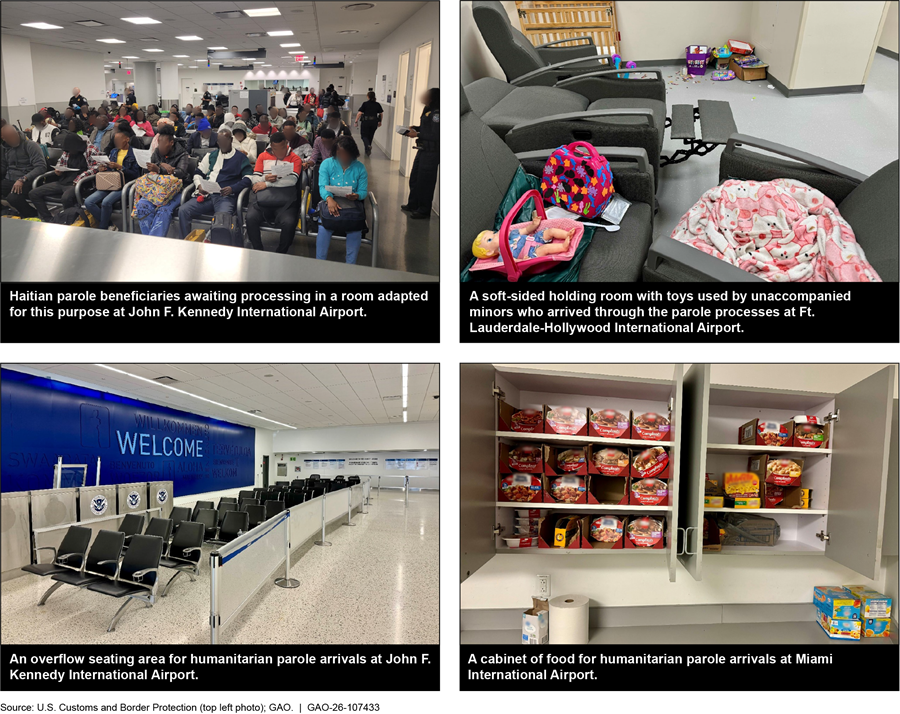
As discussed previously, more than 50 percent of supporter-based parole beneficiaries entered the U.S. via two airports in south Florida, posing particular challenges for these airports. CBP officials at one south Florida airport said the volume of arrivals through the parole processes essentially shifted the work of processing border arrivals from the southwest border to south Florida. Although parole beneficiaries were allowed to fly into any interior airport, CBP officials said that given the wide availability of flights into south Florida from Latin American and Caribbean countries—where many beneficiaries were coming from—these airports were a common entry point.
Additionally, CBP officials told us about two other resourcing-related challenges they faced: (1) processing children who arrived without a parent or legal guardian, and (2) navigating language barriers.
· CBP officers and supervisors at three of the four ports we visited said they had encountered children arriving through the parole processes accompanied by adults who were not their parents or legal guardians, which took additional time for CBP to address.[86] In these situations, CBP officials worked to locate a parent or legal guardian in the U.S. to take custody of the child, which officials said was the outcome in most cases. If they could not, CBP officials would contact the Department of Health and Human Services’ Office of Refugee Resettlement to take custody of the child.[87] CBP officials told us that processing these children and locating their parents took extra time and that verifying the authenticity of foreign guardianship documents was a challenge.
· Regarding language barriers, CBP officers and supervisors at three ports told us they did not have enough officers who spoke the languages needed to conduct in-depth interviews during inspection. Specifically, CBP did not have enough officers who spoke Haitian Creole, Russian, or Ukrainian. This made processing arriving beneficiaries—particularly those from Haiti and Ukraine—more difficult and placed additional burdens on the few officers who did speak these languages.[88]
Further, CBP’s NTC—the office responsible for vetting beneficiaries before they arrive and approving their travel authorization—told us their additional work in support of the parole processes posed resource challenges. For example, NTC is also responsible for reviewing the thousands of applications it receives daily for noncitizens seeking travel authorization through the Visa Waiver Program.[89] NTC officials told us that after they began processing advance travel authorization applications from parole beneficiaries, the turnaround time for manual review of Visa Waiver Program applications increased, given that they were completing more reviews with the same number of staff. Specifically, Visa Waiver Program manual reviews took about a week, whereas NTC aimed to complete all Visa Waiver Program reviews within 72 hours, officials said. In addition, officials with CBP’s National Vetting Center told us that the implementation of the parole processes generated last-minute, unplanned changes to CBP’s technical vetting infrastructure, resulting in CBP shifting resources to support those changes.
Inconsistent Review of Case-by-Case Reasons for Requesting Parole
|
Case-by-Case Basis for Parole The Immigration and Nationality Act provides DHS the authority to parole noncitizens into the U.S. on a case-by-case basis for urgent humanitarian reasons or significant public benefit. In its Federal Register notices for each supporter-based parole process, DHS described the underlying conditions that could serve as a basis for finding urgent humanitarian reasons or significant public benefit to parole eligible noncitizens, while also stating that parole determinations would be made on a case-by-case basis by CBP officers upon arrival at ports of entry. Source: Department of Homeland Security (DHS). | GAO‑26‑107433 |
Our work indicated that USCIS and CBP had mechanisms to collect information about whether individual noncitizens applying for the parole processes had an urgent humanitarian reason or significant public benefit underlying their request for parole. However, these mechanisms were applied and used inconsistently over time and across the different processes, and were not always used for the purposes of determining whether a prospective beneficiary merited a grant of parole. Further, USCIS and CBP did not have defined roles and responsibilities to provide this case-by-case review of prospective beneficiaries.
When CHNV and U4U were established, USCIS’s supporter application did not have a means to collect information about the beneficiary’s case-specific need for humanitarian parole. In July 2023, USCIS added such a question to the supporter application. The question stated that a grant of parole is a discretionary determination granted on a case-by-case basis for urgent humanitarian reasons or significant public benefit, and asked the potential supporter to explain why a favorable exercise of discretion was merited for the beneficiary. USCIS officials told us they added the question as a way to determine whether to prioritize the application for processing and to exclude from consideration those applications with insufficient responses. Reviewers were instructed to consider the responses to this question for CHNV and family reunification parole supporter applications only, and not for those under U4U.[90]
Additionally, USCIS officials told us that they did not use the responses to this question to determine whether any prospective beneficiary had an urgent humanitarian reason or significant public benefit that merited parole. They said that making such determinations was not USCIS’s role because the supporter application process itself did not confer a grant of parole. Instead, USCIS’s role was to review the supporter application to vet the potential supporter and determine if they were able to financially support the beneficiary. Further, USCIS officials said, it was ultimately up to CBP to determine if the prospective beneficiary met the requirements for parole once they arrived for inspection at a port of entry.
At ports of entry, CBP officers asked basic questions of arriving parole beneficiaries, such as to confirm their biographic information, but did not ask them to explain why they merited a grant of parole. CBP supervisors told us that officers were to ask beneficiaries questions about their individual situations, such as how they know their supporter and what their living situation in the U.S. would be. However, during our observations at airports, officers did not consistently ask such questions, and we did not observe any officers ask a noncitizen why they believed they merited a grant of parole. CBP officers told us they focused on identifying disqualifying factors and any derogatory information or indicators of fraud rather than on making a positive determination that the individual merited parole. CBP supervisors and headquarters officials said they felt that DHS had already done the research to determine that these populations merited parole, as described in the Federal Register notices for the processes, and that it was not up to officers to make a determination to the contrary. Further, as discussed above, some CBP officers said that language barriers limited their ability to ask detailed questions.
Fragmentation of Roles and Responsibilities
The humanitarian parole processes lacked an entity or office in a leadership role to manage the processes, including identifying areas for improvement and implementing changes. Instead, the processes were fragmented across multiple offices and components, which, according to USCIS’s internal review, hindered timely decision-making.
For example, USCIS collected and maintained supporter applications for the processes in its data systems and was the public-facing contact with supporters and beneficiaries, while CBP was responsible for granting parole to beneficiaries. CBP officials told us they had limited visibility into USCIS’s process and limited access to the information it gathered on supporters and could have benefited from having access to additional USCIS information.
Supporters Not Upholding Their Commitments to Beneficiary
Some parole beneficiaries reported experiencing a “breakdown” in their relationship with their supporter, in which the supporter did not follow through on their commitment to support the beneficiary. For example, organizations serving Ukrainian beneficiaries reported that many U4U supporters provided the anticipated assistance, such as housing and help finding employment, according to an April 2023 report by the Department of Health and Human Services Office of Refugee Resettlement.[91] However, the report found that other supporters failed to provide expected material support or engaged in inappropriate behavior. These breakdowns existed on a spectrum, with the nature and severity varying significantly from case to case, the report found.
USCIS officials told us the agency did not have a role in monitoring or enforcing supporters’ commitments to provide support for beneficiaries. Further, officials said that their role in the process was to certify that the supporter had included evidence of sufficient financial means to support the beneficiary, and that after they confirmed the supporter application, USCIS’s role was completed. USCIS maintained a public tip form accessible online for members of the public to report suspected fraud and abuse related to immigration benefits, such as supporter noncompliance. However, beneficiaries rarely, if ever, reported their own supporter as fraudulent because it would not be in their interest to do so for fear of having their parole revoked, FDNS officials said. FDNS officials told us they had received tips from the Department of Health and Human Services related to cases where supporters did not uphold their commitments to beneficiaries, but these cases were not a high priority for them compared to other work, such as investigating reports of beneficiary abuse and suspected human trafficking. Further, they said they would not refer cases of supporters failing to financially support a beneficiary to law enforcement because it would not constitute a violation of law.
Additionally, our review of the supporter application form found that there was no provision included within that provided DHS with the authority to enforce a commitment to provide financial support by the supporter. The form required applicants to certify, under the penalty of perjury, that all the information submitted was complete, true, and correct. The form also directed applicants to instructions that provided that knowingly and willfully falsifying or concealing a material fact or filing a false document will subject applicants to penalties and potential criminal prosecution. However, the form did not create a binding or enforceable commitment between the supporter and beneficiary or provide DHS with specific authority to enforce a commitment to provide financial support by a supporter.[92]
USCIS officials said their statutory authority is limited to gathering facts to support eligibility determinations on immigration benefit requests filed before the agency. They also said the supporter application form is not an immigration benefit request as defined in federal regulations.[93] As such, according to these officials, FDNS lacks authority to take enforcement actions on supporters who fail to fulfill their obligations for financial support to the beneficiary, as the issue does not relate to the eligibility of an immigration benefit request.
DHS Began Taking Corrective Actions but Has Not Assessed Lessons Learned from Supporter-Based Parole Processes
In response to the challenges noted above, USCIS and CBP began taking some actions. However, DHS has not assessed lessons learned from the supporter-based parole processes.
GAO has identified that a key practice for program management is to apply learning to decision-making.[94] Agencies can leverage the knowledge and lessons they learn from assessing program results to inform a range of decisions, such as changes to existing strategies to achieve better results or reallocation of resources.
DHS and its components identified areas for improvement in the supporter-based parole processes, as described above, and had begun to identify and implement corrective actions in several areas. More specifically, following the USCIS and CBP assessment of risks in the processes, in late summer and fall 2024 USCIS began taking corrective actions to address identified areas for improvement. These corrective actions included the following:
· Implementing biometrics and filing fee collection for supporters. FDNS officials recommended these two steps to improve supporter vetting and prevent future fraudulent applications. In fall 2024, USCIS began implementing the processes and systems needed to collect biometrics and a fee from supporters. USCIS officials told us that through the end of October 2024, the agency had sent about 3,900 biometrics appointment notices to potential supporters and of those had completed about 2,900 appointments.
· Modifying the case management system. USCIS also implemented several changes to introduce more automation into its case management system for supporter applications. For example, as of October 2024, USCIS had implemented address validation for newly submitted supporter applications. USCIS also implemented automated nonconfirmations for applications for which screening resulted in certain hits of concern or on which supporters answered “yes” to certain questions related to illegal activity. In addition, as of November 2024, USCIS was also working to implement technological solutions to prevent duplicate filings and more efficiently identify supporters who had applied to support more than 10 beneficiaries, a potential fraud indicator.
· Fully staffing key offices. The USCIS report recommended that the offices involved in reviewing supporter applications receive additional staff. The office responsible for CHNV and U4U applications requested and was approved for 40 additional permanent positions for supporter application review, and FDNS was approved for seven additional permanent positions.
In addition, starting in summer 2024 NTC and FDNS jointly created a new approach to vet supporters of approved beneficiaries against additional vetting systems. Through this effort, analysts began conducting vetting of several populations of supporters: (1) supporters of “travel-ready” beneficiaries with an approved advance travel authorization; (2) supporters of noncitizens awaiting issuance of an advance travel authorization; and (3) supporters of CHNV beneficiaries already in the country. Beneficiaries and supporters found through this vetting to pose a national security or public safety risk were referred to law enforcement agencies such as ICE for enforcement action or criminal investigation.
It was a positive step that DHS, through its component agencies, began identifying lessons learned and implementing corrective actions to improve the supporter-based parole processes. However, because DHS has ended the processes, it has not assessed what, if any, lessons learned it can apply to other efforts.
By assessing and applying lessons learned from its implementation of the supporter-based parole processes, even though the processes have ended, DHS could improve other areas of its operations and thus be better positioned to avoid similar challenges in the future. For example:
· USCIS has used a detailee staffing model for other lines of effort, such as to conduct credible fear screenings. As part of its lessons learned assessment, DHS could identify ways to improve upon this model that could be applied to other ongoing USCIS operations. Further, in April 2025, FDNS officials told us they may be able to apply lessons learned related to verifying that family reunification applicants were not deceased to other USCIS form types and immigration benefits. However, they had not formally assessed or applied the lessons learned.
· CBP officials reported facing several challenges processing large volumes of beneficiary arrivals, such as communicating across language barriers, processing children who arrived without a parent or legal guardian, and verifying documentation. Further, CBP officials also told us they could have benefited from greater transparency of and access to USCIS’s supporter information. As part of its lessons learned assessment, DHS could identify ways to improve these aspects of CBP processing for other categories of noncitizens.
DHS Established Policies to Take Enforcement Actions Against Parole Beneficiaries
Prior to January 2025, Supporter-Based Parole Beneficiaries Generally Did Not Fall Within DHS Enforcement Priorities
Prior to January 2025, paroled noncitizens whose parole had expired—including beneficiaries of the supporter-based processes—generally did not fall within DHS’s immigration enforcement priorities, according to ICE officials. These priorities were based on July 2023 guidance directing ICE officers to consider the facts and circumstances of each case and prioritize for enforcement action noncitizens who posed a threat to national security, public safety, or border security.[95]
|
When Does Parole Expire for Beneficiaries of the Supporter-Based Processes? Supporter-based parole beneficiaries’ 2-year periods of parole began expiring in 2024, leaving any who remained in the U.S. beyond that point potentially removable unless they had obtained another form of legal status or temporary protection from removal. For the first Ukrainians who arrived under Uniting for Ukraine (U4U), parole began expiring around May 2024, although some 87,000 applied and were approved for a reparole period of 2 years. Additionally, more than 500,000 beneficiaries under Cubans, Haitians, Nicaraguans, and Venezuelans (CHNV) have a parole expiration date between October 2024 and September 2026, according to U.S. Customs and Border Protection (CBP) data. DHS did not establish a reparole process for CHNV beneficiaries. While some beneficiaries have been granted reparole or have obtained lawful immigration status that permits them to remain in the U.S., others have not. For example, based on our analysis of CBP grants of parole and benefits forms approved by U.S. Citizenship and Immigration Services (USCIS), there were at least 418,000 CHNV parole beneficiaries who had not yet been approved for immigration benefits, such as temporary protected status, as of March 2025. This figure may include beneficiaries with pending applications, as well as those who did not file applications and those who exited the country prior to the end of their parole period. Beneficiaries of parole are required to leave the U.S. before their parole expiration date unless they have obtained a lawful basis to remain in the U.S., or they may be subject to enforcement actions. Source: GAO analysis of CBP and USCIS information. | GAO 26 107433 |
ICE officials told us they did not have any guidance or policies prior to January 2025 that specifically directed them to take enforcement actions against parole beneficiaries who entered the U.S. under CHNV, U4U, or family reunification parole. Further, ICE used the same enforcement approach toward paroled noncitizens that it used for other noncitizens subject to immigration enforcement. ICE officials told us they did not track parole status or expiration dates or take specific action against beneficiaries whose parole had expired. Individuals with expired parole periods were lower priorities for ICE, unless individuals with expired parole posed a threat to public safety or national security.
ICE generally only interacted with parole beneficiaries if they were first apprehended or detained by another law enforcement agency for criminal activity and then referred to ICE for detention or removal, ICE officials said. For example, if a law enforcement agency apprehended a parole beneficiary for a serious traffic violation, it might refer them to ICE. ICE then would likely learn through interactions with the noncitizen that they had entered the U.S. through parole. From there, ICE would process the noncitizen using the same process it used for other noncitizens subject to immigration enforcement and could revoke parole or take another enforcement action depending on the facts and circumstances and the officer’s discretion.
|
U.S. Immigration and Customs Enforcement (ICE) Information on Criminal History of Parole Beneficiaries ICE officials told us that, prior to January 2025, ICE did not have any enforcement guidance or policies that focused specifically on parole beneficiaries who entered the U.S. under the supporter-based parole processes. Rather, ICE would generally only interact with parole beneficiaries if they were first apprehended or detained by another law enforcement agency for criminal activity and then referred to ICE for detention or removal, ICE officials said. In July 2023, ICE developed a report in support of litigation on the criminal history of CHNV beneficiaries who had been subject to ICE enforcement action, ICE officials said. To do this, officials said they cross-referenced ICE information on enforcement actions with data from U.S. Citizenship and Immigration Services (USCIS) and U.S. Customs and Border Protection (CBP) on parole beneficiaries to identify beneficiaries with criminal history. The analysis found that of about 156,000 CHNV beneficiaries, 13 had criminal history records in ICE’s data system. Charges included assault, traffic offenses, and obstructing police. These records refer to data entered manually by the immigration officer at the time of the enforcement actions and may not reflect the full criminal history of the noncitizens. Due to limited sharing of intelligence and law enforcement information from some countries, including the CHNV countries, the U.S. government may not have access to the full criminal histories of beneficiaries, CBP officials told us. Source: GAO analysis of ICE and CBP information. | GAO 26 107433 |
Although ICE did not have any specific guidance or policies to take enforcement actions against CHNV beneficiaries, officials from one ICE field office told us that they faced challenges removing noncitizens from Cuba, Haiti, Nicaragua, and Venezuela more generally, because these countries typically did not accept their citizens for removal from the U.S. In such cases, the U.S. may have been unable to remove noncitizens despite having a final order of removal, officials said. When this occurred, ICE officials said they would typically release the noncitizens from detention to prioritize limited detention space for others who are more likely to be removed.
Additionally, neither USCIS nor CBP systematically tracked parole expiration dates for enforcement purposes, officials from those agencies told us.[96] However, USCIS and CBP referred cases to ICE for potential enforcement action in certain situations where they identified indicators of fraud or derogatory information:
· Upon arrival. CBP officials at all four ports of entry we visited told us they referred arriving beneficiaries to ICE for further enforcement action as warranted if officials suspected they posed a safety or security threat. For example, CBP officers at two airports processed for expedited removal several arriving Haitians whom they suspected to be gang members based on questioning them and finding derogatory photos and videos on their devices.[97] In these cases, the noncitizens were removed from the country or ICE detained them if they expressed fear of return. However, in other examples, such as cases where CBP found the noncitizen had paid their supporter or had been previously removed from the U.S., ICE declined to detain the noncitizen and CBP instead issued a notice to appear and released them pending removal proceedings. CBP officials told us that ICE detention facilities had limited bedspace and ICE generally declined to detain noncitizens if they were not priorities for enforcement.
· After receiving parole. CBP’s NTC conducts ongoing recurrent vetting of all in-country parole beneficiaries and refers any matches against derogatory information to ICE for further action, as warranted, according to CBP documentation. These may include vetting matches that show the noncitizen poses a national security or public safety risk or that they directly participated in supporter fraud. CBP may also revoke the beneficiary’s parole if its recurrent vetting finds a match. In March 2025, CBP officials said they were still conducting this vetting of all humanitarian parole beneficiaries after the parole processes were suspended.
· After receiving another immigration benefit. USCIS may become aware of an in-country beneficiary with a confirmed derogatory match, for example if CBP recurrent vetting surfaces the information after the noncitizen was granted another immigration benefit. In these cases, USCIS evaluates the information and determines whether to initiate revocation or termination of the benefit or refer the beneficiary to ICE for further action. USCIS officials told us they follow a set of referral criteria in a memorandum of agreement with ICE to determine whether to refer cases. For example, the agreement requires USCIS to refer a noncitizen to ICE or issue them a notice to appear (in accordance with USCIS policy) in egregious public safety cases—those where the noncitizen was convicted, arrested, or under investigation for certain serious crimes.[98]
Starting in January 2025, DHS Established Policies to Take Increased Enforcement Actions Against Parole Beneficiaries
In January 2025, the President issued several executive orders to reshape DHS’s approach to humanitarian parole, end the supporter-based processes, and expand immigration enforcement broadly.
· In one executive order, the President directed DHS to adjust its parole policies, including to end use of the mobile application formerly known as CBP One to parole noncitizens into the U.S.; terminate all categorical parole programs, including CHNV, that did not align with the President’s policies; and align operations at the border to ensure that all future parole decisions comply with the order.[99] Pursuant to this order, in January 2025 the acting director of USCIS directed staff to not make any final decisions on applications or requests related to CHNV, U4U, or family reunification parole. Subsequently, USCIS announced it was pausing acceptance of supporter applications until it had completed its review of all categorical parole programs.
· In another executive order, the President rescinded several immigration-related policies of the prior administration, including its immigration enforcement priorities.[100] The order stated that instead, DHS would enable individual components to set priorities that protect the public safety and national security interests of the U.S., including by ensuring the enforcement of final orders of removal. The order also directed the Department of Justice to prioritize the prosecution of criminal offenses related to the unlawful entry or continued unlawful presence of noncitizens in the U.S.
To implement the executive orders, DHS issued several policies specifying changes to the way components are to consider humanitarian parole and apply enforcement discretion to parole beneficiaries. These include policies related to reviewing noncitizens’ parole determinations and terminating parole processes. Several of these policies have been the subject of ongoing litigation, which has prevented them in part—or in full—from taking effect.
Reviewing parole determinations. DHS issued guidance instructing components to review the cases of any noncitizens they are aware of who received parole.[101] Specifically, DHS directed officials to use their enforcement discretion to determine whether parole remains appropriate in light of any changed legal or factual circumstances, or to instead terminate parole and place the noncitizen into expedited removal or full removal proceedings.[102] In full removal proceedings, individuals may apply for various forms of relief or protection, including asylum.
Generally, if noncitizens are placed into expedited removal proceedings instead, they are to be ordered removed without further hearings before an immigration judge unless they indicate either an intention to apply for asylum or express a fear of persecution or torture, or a fear of return to their country (referred to as making a “fear claim”).[103] In such cases, if a USCIS asylum officer determines that the individual has a credible fear of persecution or torture, they will be placed into full immigration proceedings. In addition, DHS issued a Federal Register notice in January 2025 expanding the scope of expedited removal, which was stayed by a federal district court in August 2025.[104]
To align with these policies, ICE instructed its officers to review each noncitizen case they encounter and determine, on a case-by-case basis in consultation with management, whether any noncitizen’s parole status should be revoked and the noncitizen placed into expedited removal. The guidance instructs officers to consider in particular whether the noncitizen filed an application for asylum with USCIS in a timely manner. Additionally, ICE guidance in February 2025 instructed officers to consider for expedited removal any noncitizen whom CBP determined to be inadmissible and previously released, including those with parole, and who had not affirmatively applied for asylum with USCIS.[105]
As of May 2025, ICE officials told us that ICE did not have any nationwide efforts to target paroled noncitizens for enforcement actions, and any enforcement actions taken against paroled noncitizens would be determined on a case-by-case basis at the field office level.
Termination of CHNV processes. In March 2025, DHS issued another Federal Register notice formally terminating the CHNV parole processes.[106] Additionally, the notice terminated the parole periods of noncitizens in the U.S. under the CHNV processes, effective 30 days from the publication of the notice, in April 2025. In the notice, DHS stated that the parole processes were no longer needed to pursue the administration’s border security goals, citing lower numbers of arrivals at the southwest border in early 2025. DHS also stated that the processes were inconsistent with the administration’s foreign policy goals, which include working with countries to accept returns of their migrants.
DHS sent notifications to CHNV parole beneficiaries alerting them that their parole would expire in April 2025—at which point, those who remained in the U.S. and had not obtained a lawful basis to remain in the U.S. would be potentially removable. According to the Federal Register notice, DHS would prioritize for removal those CHNV beneficiaries who had not previously filed an immigration benefit application to obtain legal status or another form of authorized stay, such as Temporary Protected Status, asylum, or family-based immigration.[107] However, in a February 2025 memorandum, USCIS placed an administrative hold on all benefit applications filed by noncitizens who were paroled under the U4U, CHNV, or family reunification parole processes, pending further screening and vetting by USCIS.
Following a challenge filed by several affected beneficiaries in April 2025, a federal court issued a preliminary injunction that stayed several aspects of the termination notice, thereby keeping these provisions from taking effect.[108] The same court also issued a stay on the February 2025 USCIS memorandum that placed an administrative hold on benefit applications filed by parole beneficiaries, and directed USCIS to ensure that officers were authorized to adjudicate all pending benefit applications as well as reparole applications.[109]
In May 2025, the U.S. Supreme Court issued an order staying the district court’s injunction, thereby allowing DHS to proceed with the termination of periods of parole granted under the CHNV processes and revocation of any employment authorization based on such parole, pending further litigation.[110] Following the order, in June 2025, DHS began sending termination notices to CHNV beneficiaries informing them that their parole was terminated and any parole-based employment authorization was revoked, effective immediately. The notices also informed the beneficiaries that they were to leave the U.S. if they had not obtained lawful status to remain in the country. Additionally, the notices provided information about how noncitizens could obtain travel assistance and a $1,000 exit bonus upon their verified departure from the U.S.
As of June 2025, the litigation remained ongoing, and it was too soon to determine how DHS planned to approach enforcement actions against former CHNV beneficiaries.
Conclusions
Between May 2022 and September 2024, DHS granted parole to about 774,000 noncitizens under the CHNV, U4U, and family reunification processes. DHS developed and implemented the processes quickly to respond to emergent humanitarian crises in the affected countries and identified security and fraud risks in the processes after they became operational. For example, DHS found that the processes were sometimes used to exploit prospective beneficiaries and legitimate supporters, and that some supporters were confirmed despite having a criminal history. In response, in summer 2024—more than 2 years into the processes—DHS suspended CHNV and U4U. CBP and USCIS attributed the risks to insufficient internal control activities in USCIS’s supporter application process.
Before DHS suspended these processes in January 2025, USCIS and CBP began taking steps to help mitigate these risks. However, USCIS has not developed an internal control plan that it could leverage for other newly implemented or changed programs in the future. Having such a plan in place could better position USCIS to quickly identify and implement ways to mitigate risks resulting from changes in its activities—thereby helping it prevent fraud, exploitation, and security risks before they occur.
DHS also faced several other challenges in implementing the supporter-based parole processes. However, the department has not assessed what lessons from its experiences implementing these parole processes are applicable to other operations. By assessing and applying lessons learned from the parole processes, even if the processes have ended, DHS could improve other areas of its operations beyond parole.
Recommendations for Executive Action
We are making three recommendations, including one to USCIS and two to DHS:
The Director of USCIS should develop an internal control plan that can be immediately implemented or quickly tailored to mitigate fraud risks in a new program or a change to an existing program, such as a new immigration benefit application. (Recommendation 1)
The Secretary of Homeland Security should assess and document lessons learned from the supporter-based parole processes that are relevant to other ongoing operations. (Recommendation 2)
The Secretary of Homeland Security should apply the lessons learned identified through the assessment to ongoing operations, as appropriate. (Recommendation 3)
Agency Comments and Our Evaluation
We provided a draft of this report to DHS for review and comment. DHS provided written comments, which are reproduced in appendix III. In its comments, DHS concurred with the first recommendation and described planned actions to address it by the end of fiscal year 2026. It did not concur with the second and third recommendations, as discussed below. In addition, DHS provided technical comments, which we incorporated as appropriate.
With regard to the first recommendation that USCIS develop an internal control plan that can be immediately implemented or quickly tailored to mitigate fraud risks in a new or changed program, DHS concurred, stating that it would take steps to develop such a plan. DHS also stated that USCIS’s Director’s Office will identify a lead entity, such as a working group, to take additional actions. These actions include conducting a structural reorganization to ensure that the USCIS Fraud Detection and National Security Directorate is appropriately included on policy and regulatory development and ensuring that USCIS maximizes vetting of eligible individuals for any new immigration benefit program. Provided that these efforts result in an internal control plan that can be applied early in the implementation of a new or existing program, these actions should address our recommendation.
DHS did not concur with our second and third recommendations that DHS assess and document lessons learned from supporter-based parole processes that are relevant to other ongoing operations and apply these lessons, as appropriate. DHS stated that it had already begun carrying out the administration’s goals of terminating categorical parole programs and removing those beneficiaries with no established pathways to lawfully remain in the U.S. DHS acknowledged that certain lessons from the supporter-based processes, such as the use of detailee staff, may be potentially applicable to other ongoing operations, but said that it did not plan to take any further action because it believes terminating the supporter-based processes sufficiently addresses the challenges with them.
We continue to believe that by assessing and applying lessons learned from these parole processes, DHS could improve other areas of its operations. Although DHS has ended the parole processes, the challenges it faced implementing them—such as those related to staffing, resources, and fragmentation of responsibilities—may offer valuable lessons for ongoing and future operations. For example, as discussed in this report, USCIS began taking steps to modify the case management system it used to process supporter applications, such as automating address validations and implementing controls to prevent duplicate filings. While these steps may no longer be relevant to the parole processes because they have ended, USCIS uses the case management system to help adjudicate and process applications for a range of immigration and non-immigration benefits. As such, USCIS may be able to apply what it learned about processing supporter applications to other benefits it uses the case management system to process. Further, as discussed in this report, the challenges CBP officials reported with processing large quantities of parole beneficiary arrivals at airports—such as communicating across language barriers, processing children who arrived without a parent or legal guardian, and verifying documentation—may apply to other populations CBP processes. Thus, we believe that assessing and applying lessons learned could better position DHS to consider improvements to other areas of its operations beyond parole and avoid similar challenges in the future.
We are sending copies of this report to the appropriate congressional committees and the Secretary of Homeland Security. In addition, the report is available at no charge on the GAO website at http://www.gao.gov.
If you or your staff have any questions about this report, please contact me at gamblerr@gao.gov. Contact points for our Offices of Congressional Relations and Public Affairs may be found on the last page of this report. GAO staff who made key contributions to this report are listed in appendix IV.

Rebecca Gambler
Director, Homeland Security and Justice
List of Requesters
The Honorable Charles E. Grassley
Chairman
Committee on the Judiciary
United States Senate
The Honorable Katie Britt
Chair
Subcommittee on Homeland Security
Committee on Appropriations
United States Senate
The Honorable James Lankford
Chairman
Subcommittee on Border Management, Federal Workforce
and Regulatory Affairs
Committee on Homeland Security and Governmental Affairs
United States Senate
The Honorable John Cornyn
Chair
Subcommittee on Border Security and Immigration
Committee on the Judiciary
United States Senate
The Honorable Andrew Garbarino
Chairman
Committee on Homeland Security
House of Representatives
The Honorable Josh Brecheen
Chairman
Subcommittee on Oversight, Investigations, and Accountability
Committee on Homeland Security
House of Representatives
The Honorable Michael Guest
Chairman
Subcommittee on Border Security and Enforcement
Committee on Homeland Security
House of Representatives
The Honorable Marsha Blackburn
United States Senate
The Honorable Tom Cotton
United States Senate
The Honorable Ted Cruz
United States Senate
The Honorable Lindsey Graham
United States Senate
The Honorable John Kennedy
United States Senate
The Honorable Mike Lee
United States Senate
The Honorable Thom Tillis
United States Senate
This report addresses
1. What Department of Homeland Security (DHS) data show about supporter-based parole processes,
2. Challenges that existed in DHS’s implementation of the parole processes, and the extent to which DHS addressed them, and
3. DHS’s approach for taking enforcement actions against supporter-based parole beneficiaries, as appropriate.
To address all three objectives, we focused our audit work on humanitarian parole processes DHS initiated starting in 2022 that required parole beneficiaries to have a U.S.-based financial supporter. Specifically, we reviewed the Cuban, Haitian, Nicaraguan, and Venezuelan (CHNV) process; Uniting for Ukraine (U4U); and the family reunification parole processes. We refer to these processes collectively as supporter-based humanitarian parole processes.
To describe what DHS data show about supporter-based processes, we analyzed data from U.S. Citizenship and Immigration Services (USCIS) and U.S. Customs and Border Protection (CBP). We analyzed data from April 2022, when DHS initiated the first supporter-based parole process, through January 2025, when DHS suspended the supporter-based parole processes. From USCIS, we obtained and analyzed record-level data on supporter applications as well as USCIS decisions regarding these applications from April 2022 through September 2024, the most recent data available at the time of our request.[111] Each record in the data represented a supporter application submitted to USCIS. The data we analyzed included information on the application, such as the date the application was submitted and the specific parole process to which the applicant was applying, as well as whether USCIS confirmed or nonconfirmed the application.[112] We also analyzed demographic information on supporters as reported in each application, such as age and U.S. citizenship or legal immigration status.
In addition, we obtained and analyzed USCIS summary data on approvals of immigration benefits for which beneficiaries applied.[113] We also analyzed USCIS summary data on the outcomes of reparole applications for certain noncitizens, such as those previously paroled through U4U and family reunification parole.[114]
From CBP, we obtained and analyzed record-level and summary data on grants of parole for the supporter-based processes from May 2022 through January 2025.[115] Each record in the data represented a beneficiary’s application to travel to the U.S. and seek a grant of parole. We analyzed data on the beneficiary’s arrival date, U.S. arrival port of entry, and the specific process through which the noncitizen was paroled into the U.S. (e.g., U4U). We also analyzed demographic information on parole beneficiaries, such as age, gender, and country of citizenship.[116]
To assess the reliability of USCIS and CBP data, we performed electronic tests to identify missing, duplicate, or erroneous data, and reviewed agency documentation, such as user guides and data dictionaries. We also interviewed agency officials to ensure we were interpreting and tabulating the data appropriately, and to rectify missing, duplicate, or erroneous data. Specifically, we identified and removed 699 duplicate records out of the 906,480 CBP records of beneficiary applications to travel to the U.S. that were erroneously recorded for two different parole processes. Further, demographic data housed in USCIS systems, such as U.S. citizenship or legal immigration status, reflect information entered by the applicant and should be considered self-reported. Data on USCIS supporter applications were extracted on October 9, 2024, and should be considered a snapshot in time, as changes could occur due to changes in application statuses or database updates. We determined that the data used in each of our analyses were sufficiently reliable for reporting the characteristics and outcomes of supporter-based parole applications. When needed, we provided clarifications on any limitations in the data, such as whether they were self-reported or represented data as of a specific period.
In addition, CBP officials said that CBP’s information systems were not able to capture and store instances of denials of parole at ports of entry, including the reasons for denial and how CBP processed the affected noncitizen. As such, during our site visits we obtained a selection of such data that a CBP field office tracked manually for south Florida ports of entry, which we discuss further below. These data may not be representative of the denial rate of all supporter-based parole arrivals across the U.S. Instead, these data provide an example of parole grants in two high-volume ports of entry.
To examine DHS’s parole process implementation challenges and the extent to which DHS addressed them, we analyzed USCIS and CBP directives, memorandums, guidance, and training materials to identify policies and procedures DHS components developed to carry out the U4U, CHNV and family reunification parole processes. We also reviewed USCIS and CBP internal assessments of these policies and procedures, including those related to the challenges components faced, recommendations they developed, and actions they took to address the findings of these assessments. For example, we reviewed a May 2024 report by USCIS’s Fraud Detection and National Security Directorate (FDNS) that identified potential fraud indicators in the U4U and CHNV processes and additional documentation of the directorate’s recommendations to address such fraud risks. We also reviewed an internal July 2024 USCIS report that identified security and fraud risks and included recommendations for USCIS actions.
In addition, we interviewed officials at USCIS headquarters offices responsible for the parole processes, including USCIS’s Office of Policy and Strategy, Immigration Records and Identity Services Directorate, Service Center Operations Directorate, and FDNS. We also conducted interviews with CBP headquarters offices, including CBP’s Office of Field Operations and the National Targeting Center. During these interviews, we discussed topics related to assessments of security and fraud risks as well as antifraud activities. We assessed the information we obtained from our document reviews and interviews against leading practices for combating fraud in a strategic, risk-based manner.[117]
In addition, we interviewed USCIS and CBP personnel responsible for managing and implementing the humanitarian parole processes.
USCIS. We interviewed USCIS personnel assigned permanently or temporarily to review financial supporter applications to understand how reviewers carried out USCIS review policies and procedures and challenges reviewers experienced during the review process. Specifically, we interviewed all eight USCIS staff from USCIS’s Immigration Records and Identity Services Directorate, Verification Division, permanently assigned to review U4U and CHNV financial supporter applications.[118] In addition, we interviewed a nongeneralizable selection of eight USCIS staff temporarily assigned to review U4U and CHNV financial supporter applications in calendar year 2024 (known as detailees). We selected these individuals from a pool of about 125 detailees identified by USCIS to include reviewers with at least 2 weeks of experience and who were collectively from multiple directorates across USCIS. The information obtained from these detailee interviews is not generalizable to all detailees but provides insights into detailees’ experiences reviewing U4U and CHNV financial supporter applications. Lastly, we interviewed officials from USCIS’s Service Center Operations directorate, which was responsible for reviewing financial supporter applications filed under the family reunification parole processes.
CBP. We conducted site visits and interviewed CBP officers and supervisors at four airports to understand how CBP officers and supervisors processed humanitarian parole arrivals at ports of entry and any challenges they experienced. The four airports we visited were Ft. Lauderdale-Hollywood International Airport, John F. Kennedy International Airport, Miami International Airport, and Newark Liberty International Airport. We selected these four airports because collectively, they received about 70 percent of all humanitarian parole arrivals during fiscal years 2022 through 2024. We also selected these locations to ensure we visited airports that received arrivals under all three humanitarian parole processes. The information we obtained from these site visits is not generalizable to all U.S. airports but provides insights into CBP’s implementation of the parole processes and associated challenges.
We assessed the information we obtained from USCIS and CBP regarding their implementation of parole processes, challenges, and actions taken to address such challenges against key practices for program management.[119]
To describe DHS’s approach for taking enforcement actions against supporter-based parole beneficiaries, we reviewed DHS and U.S. Immigration and Customs Enforcement (ICE) policies governing immigration enforcement priorities since April 2022, when the parole processes were first implemented, and analyzed how the priorities changed over time. In addition, we reviewed the status of ongoing litigation filed in response to DHS policies through June 2025. We also met with ICE headquarters offices and field offices to understand ICE’s approach to taking enforcement actions against parole beneficiaries in accordance with DHS and ICE policies, including how ICE’s approach has changed over time. These offices include ICE’s Enforcement and Removal Operations and Homeland Security Investigations.
We conducted this performance audit from March 2024 to September 2025 in accordance with generally accepted government auditing standards. Those standards require that we plan and perform the audit to obtain sufficient, appropriate evidence to provide a reasonable basis for our findings and conclusions based on our audit objectives. We believe that the evidence obtained provides a reasonable basis for our findings and conclusions based on our audit objectives.
Appendix II: Additional Information on Outcomes of Humanitarian Parole Supporter Applications and Characteristics of Supporters and Beneficiaries
Supporter-Based Parole Processes
This appendix provides additional information on our analysis of data on the supporter-based humanitarian parole processes, including outcomes of supporter applications and characteristics of supporters and beneficiaries. In 2022, the Department of Homeland Security (DHS) began to introduce new processes for humanitarian parole. The Homeland Security Act of 2002 provides the Secretary of Homeland Security with the authority, under the Immigration and Nationality Act, to parole noncitizens, on a case-by-case basis, into the U.S. temporarily for urgent humanitarian reasons or significant public benefit.[120]
One aspect of these processes was the requirement that the noncitizen (the prospective beneficiary) have a supporter in the U.S. who agreed to provide for their basic needs for the duration of their parole period. The supporter was to apply on behalf of the beneficiary to U.S. Citizenship and Immigration Services (USCIS). If USCIS confirmed the supporter application, U.S. Customs and Border Protection (CBP) vetted the beneficiary and determined whether to approve them for advance authorization to travel to the U.S.[121] According to DHS’s Federal Register notices for the processes, when the prospective beneficiary arrived at an interior port of entry (airport), CBP officers were to inspect them and decide whether to grant prospective beneficiaries parole on a case-by-case basis.
The supporter-based parole processes included the following:
· Uniting for Ukraine (U4U). In April 2022, DHS established U4U to allow Ukrainians displaced by the war with Russia and their immediate family members to come to the U.S. for a period of up to 2 years.
· Cubans, Haitians, Nicaraguans, and Venezuelans (CHNV). In October 2022, DHS established a new parole process for Venezuelan nationals and their immediate family members using U4U as a model. The Venezuelan process, like U4U, required a U.S.-based supporter to apply to support a prospective Venezuelan beneficiary and agree to provide financial support for the parole period of up to 2 years.[122] In January 2023, DHS developed additional processes for noncitizens and their immediate family members from Cuba, Haiti, and Nicaragua. These new processes were modeled on the Venezuelan process and were functionally the same. Together, the four processes became known as the CHNV process.
· Family reunification parole. In addition, in 2023, DHS updated and expanded its process for family reunification parole, which allowed certain eligible noncitizens who had been approved for a family-based visa to enter the U.S. while they awaited availability of a visa. DHS expanded the process—which had previously been available for Cubans and Haitians—to nationals of Colombia, Ecuador, El Salvador, Guatemala, and Honduras. DHS also modified the process to incorporate elements of the CHNV process, such as requiring the beneficiary to submit biographic information to USCIS in advance and be approved for an advance authorization to travel to the U.S. and request parole at a port of entry. The parole period for family reunification parole was up to 3 years.
The remainder of this appendix includes results of our analysis of data on each parole process from May 2022 through September 2024.
Data Elements Included for Each Parole Process
Beneficiary Data
· Grants of parole. The number of noncitizens CBP paroled into the U.S.
· Top five ports of entry. The number of CBP grants of parole at the five airports at which CBP paroled the greatest number of beneficiaries. Under the supporter-based parole processes, prospective beneficiaries were to secure their own commercial air travel to the U.S.
· Beneficiary demographic information. The percentage breakdown of CBP grants of parole by gender and age. The supporter-based processes were open to certain nationals of the country they were applying under. They were also open to immediate family members of, and traveling with, a national of that country. Children were to travel with a parent or legal guardian to be eligible for parole.
Supporter Data
· Applications reviewed. The number of supporter applications confirmed and nonconfirmed by USCIS.
· Supporter citizenship or immigration status. The percentage breakdown of U.S. citizenship or immigration status reported by supporters in applications that USCIS confirmed. Under the supporter-based parole processes, applying supporters were required to be in the U.S. and provide evidence to USCIS that they were a U.S. citizen or a noncitizen in an eligible immigration status.
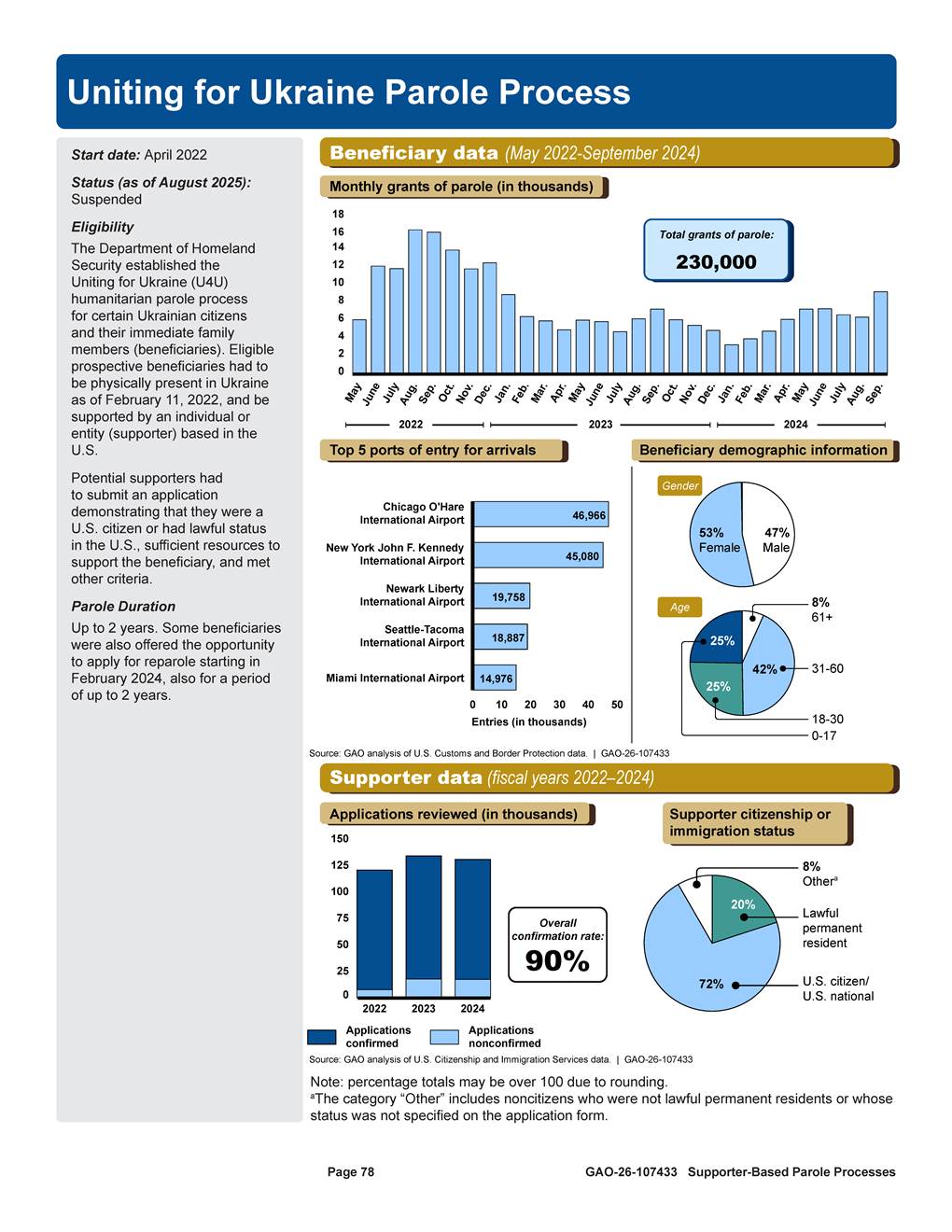
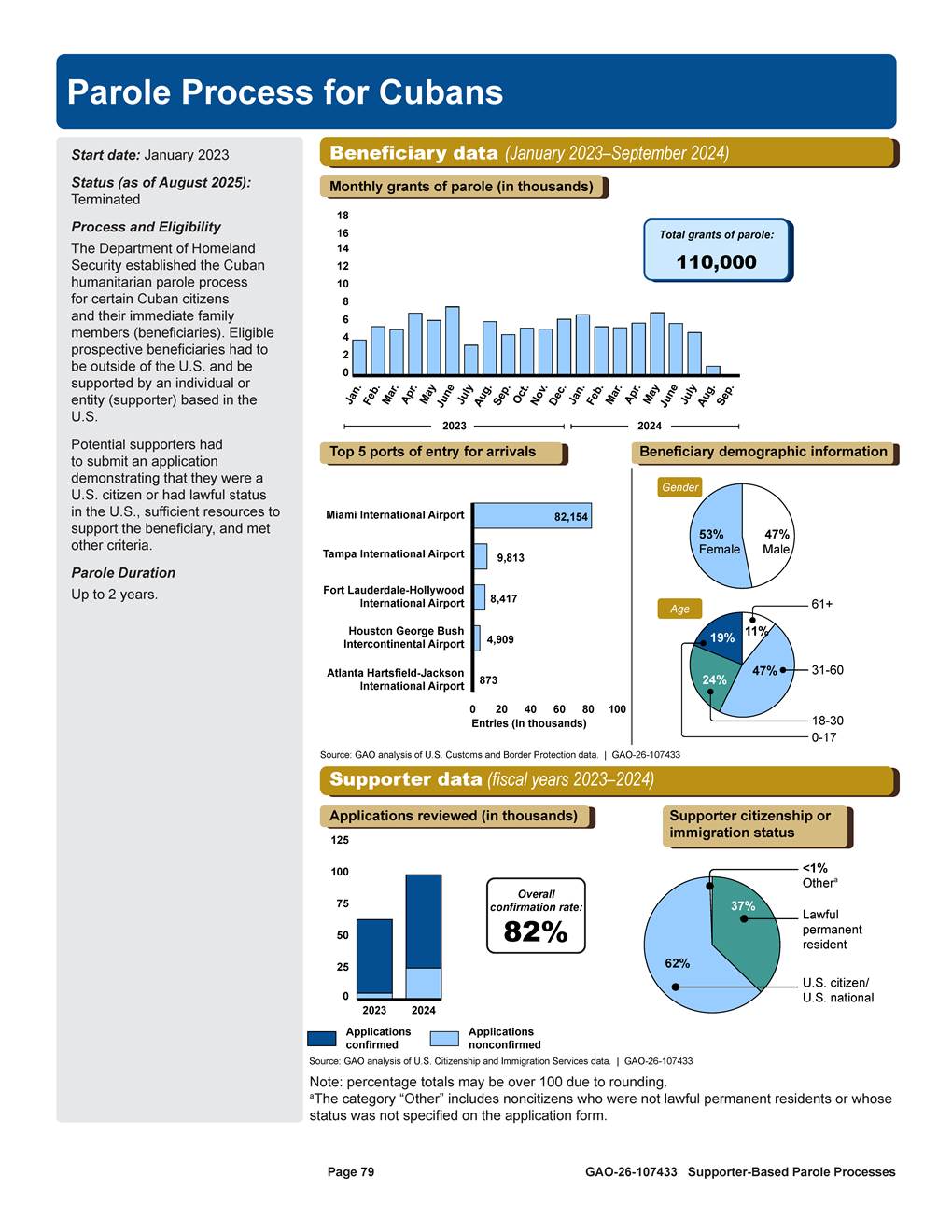
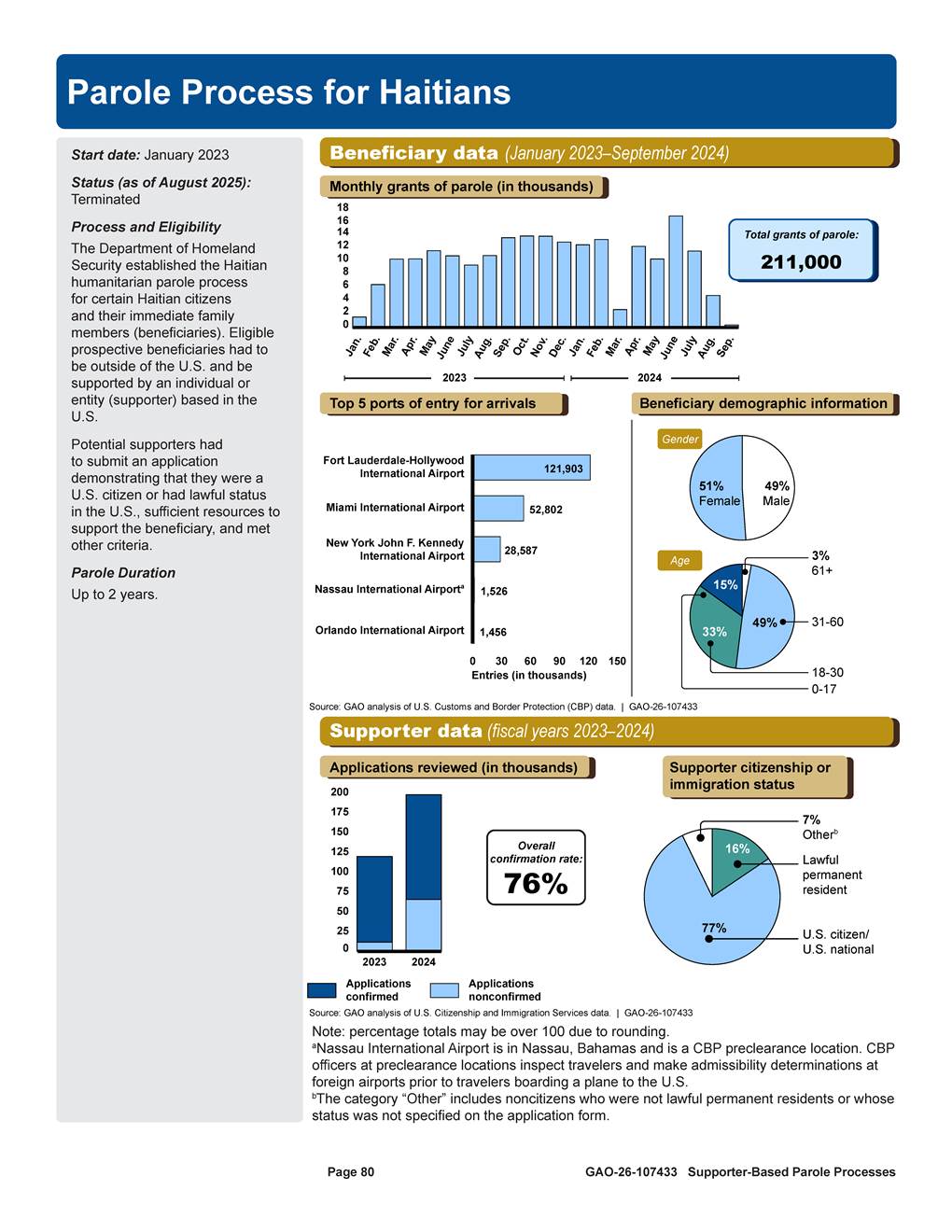
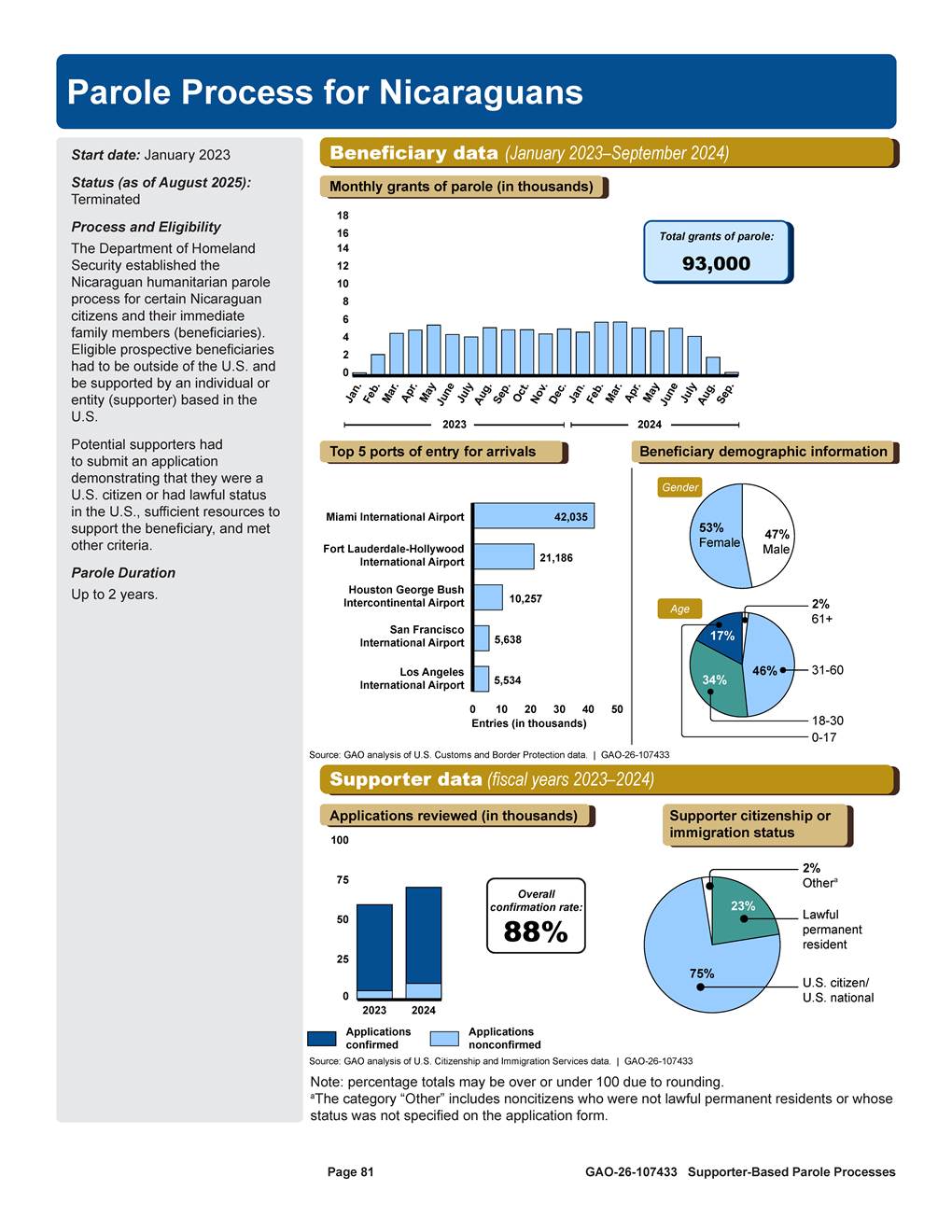
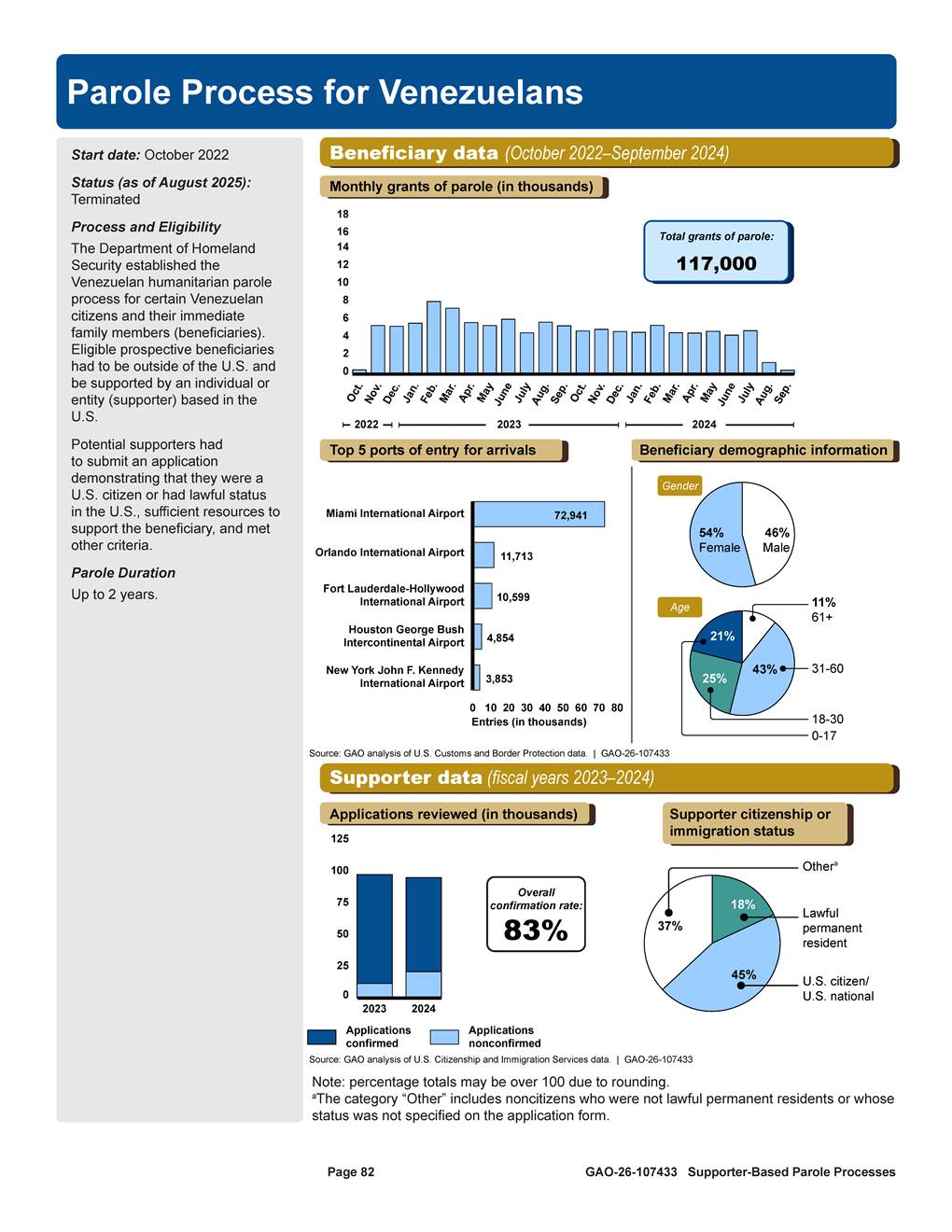
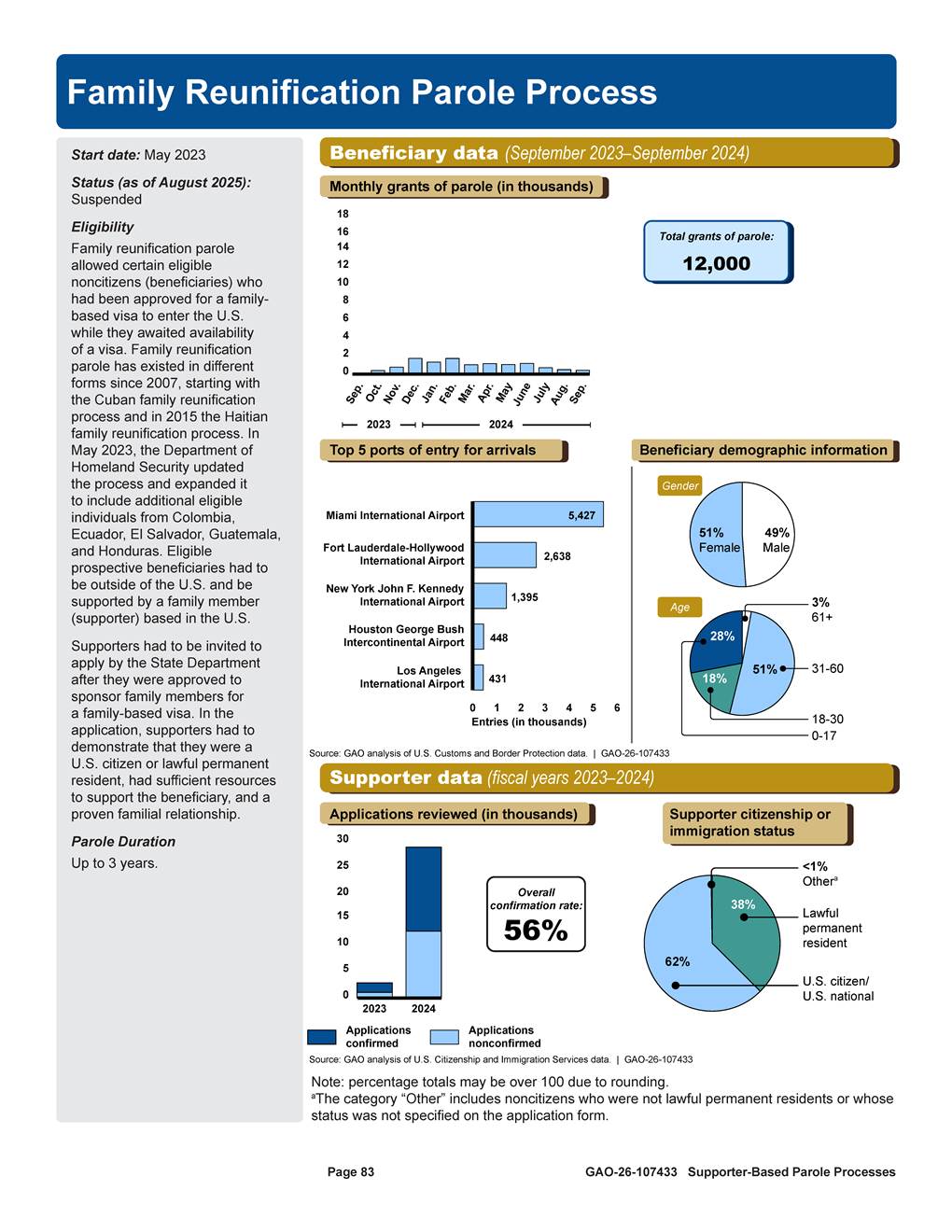
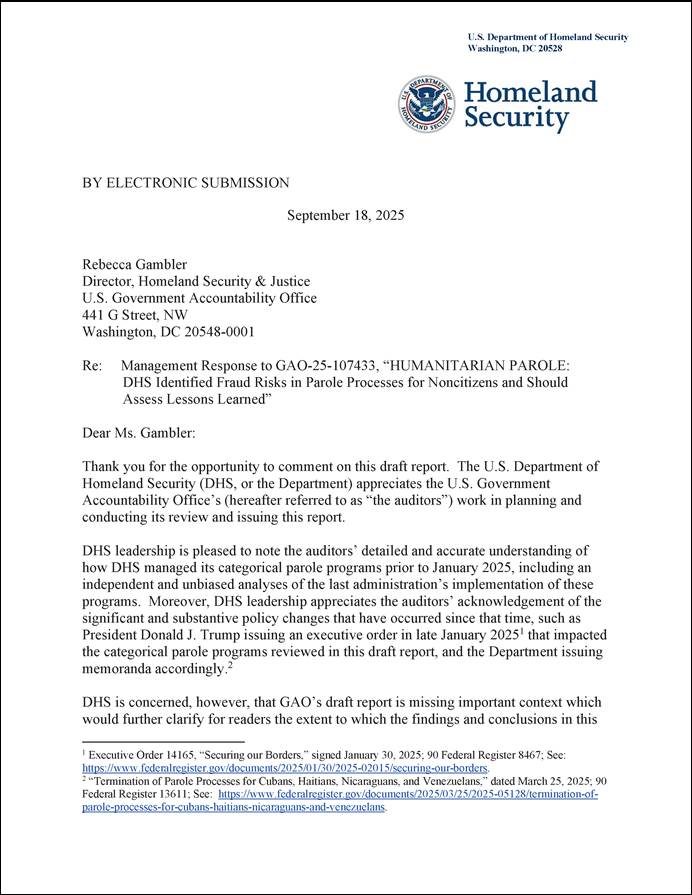


Rebecca Gambler, gamblerr@gao.gov
In addition to the contact named above, Taylor Matheson (Assistant Director), Adrian Pavia (Analyst in Charge), Ben Crossley, Dominick Dale, Marissa Esthimer, Michele Fejfar, Nicole Kelleher, Grant Mallie, Shannon Murphy, and Heidi Nielson made key contributions to this report.
The Government Accountability Office, the audit, evaluation, and investigative arm of Congress, exists to support Congress in meeting its constitutional responsibilities and to help improve the performance and accountability of the federal government for the American people. GAO examines the use of public funds; evaluates federal programs and policies; and provides analyses, recommendations, and other assistance to help Congress make informed oversight, policy, and funding decisions. GAO’s commitment to good government is reflected in its core values of accountability, integrity, and reliability.
Obtaining Copies of GAO Reports and Testimony
The fastest and easiest way to obtain copies of GAO documents at no cost is through our website. Each weekday afternoon, GAO posts on its website newly released reports, testimony, and correspondence. You can also subscribe to GAO’s email updates to receive notification of newly posted products.
Order by Phone
The price of each GAO publication reflects GAO’s actual cost of production and distribution and depends on the number of pages in the publication and whether the publication is printed in color or black and white. Pricing and ordering information is posted on GAO’s website, https://www.gao.gov/ordering.htm.
Place orders by calling (202) 512-6000, toll free (866) 801-7077,
or
TDD (202) 512-2537.
Orders may be paid for using American Express, Discover Card, MasterCard, Visa, check, or money order. Call for additional information.
Connect with GAO
Connect with GAO on X,
LinkedIn, Instagram, and YouTube.
Subscribe to our Email Updates. Listen to our Podcasts.
Visit GAO on the web at https://www.gao.gov.
To Report Fraud, Waste, and Abuse in Federal Programs
Contact FraudNet:
Website: https://www.gao.gov/about/what-gao-does/fraudnet
Automated answering system: (800) 424-5454
Media Relations
Sarah Kaczmarek, Managing Director, Media@gao.gov
Congressional Relations
A. Nicole Clowers, Managing Director, CongRel@gao.gov
General Inquiries
[1]Encounters include interactions with noncitizens DHS’s U.S. Customs and Border Protection apprehends or finds to be inadmissible to the U.S.
[2]Statute defines an “alien” as any person who is not a citizen or national of the U.S. 8 U.S.C. § 1101(a)(3). DHS documentation we reviewed for this report used the terms “alien,” “migrant,” and “noncitizen” interchangeably. For readability, we generally use the term “noncitizen,” except when quoting language in statute, regulation, or executive orders that used the term “alien.”
[3]According to the act, the Secretary has the authority to “parole into the U.S. temporarily under such conditions as [the Secretary] may prescribe only on a case-by-case basis for urgent humanitarian reasons or significant public benefit any alien applying for admission to the U.S.” 6 U.S.C. §§ 251, 557; 8 U.S.C. § 1182(d)(5)(A). We refer to the exercise of parole under this authority as “humanitarian parole” throughout the report. DHS has in the past used humanitarian parole for a variety of purposes, such as for urgent medical reasons, family reunification, or to allow noncitizens to participate as witnesses in judicial proceedings.
[4]DHS officials may terminate parole when, in the opinion of these officials, neither humanitarian reasons nor public benefit warrants the continued presence of the noncitizen in the U.S. See 8 C.F.R. § 212.5(a) (identifying the officials who may make a determination to grant or terminate parole), (e)(2) (providing procedures from termination of parole).
[5]These parole processes were established for eligible noncitizens from specific countries and their immediate family members. For the purposes of this report, we consider U4U, CHNV, and family reunification parole to be the three primary groupings of supporter-based parole processes. However, DHS established a separate parole process for each country included in each grouping. For example, under CHNV, DHS established four similar parole process for Cubans, Haitians, Nicaraguans, and Venezuelans. Similarly, family reunification parole included separate but similar parole processes for each of the seven countries included. Additionally, USCIS officials stated that other uses of parole in the past have involved supporters. For the purposes of this report, we examined only those supporter-based parole processes that DHS implemented since 2022.
[6]In addition, ICE was responsible for taking enforcement actions against paroled noncitizens, as appropriate.
[7]Exec. Order No. 14165, Securing Our Borders, 90 Fed. Reg. 8467 (Jan. 30, 2025). “Categorial parole processes” is not defined, but an Executive Order issued the same day directs the Secretary of Homeland Security to ensure that parole authority is “exercised on only a case-by-case basis in accordance with the plain language of the statute.” Exec. Order No. 14159, Protecting the American People Against Invasion, 90 Fed. Reg. 8,443, 8,446 (Jan. 30, 2025).
[8]DHS, Termination of Parole Processes for Cubans, Haitians, Nicaraguans, and Venezuelans, 90 Fed. Reg. 13,611 (Mar. 25, 2025). On April 14, 2025, the U.S. District Court for the District of Massachusetts issued a preliminary injunction staying parts of the Federal Register notice. This order was subsequently vacated by the U.S. Court of Appeals for the First Circuit and remanded to the district court for further proceedings, which were ongoing as of November 2025. See Doe v. Noem, 152 F.4th 272 (Sept. 12, 2025).
[9]We obtained record-level data from USCIS and CBP on parole processes from April 2022 through September 2024, the most recent data available at the time of our request. We later obtained summary-level data on CBP grants of parole from October 2024 through January 2025—after DHS’s 2024 suspension of the CHNV and U4U parole processes.
[10]The form submitted by prospective supporters was the Form I-134A, Online Request to be a Supporter and Declaration of Financial Support. In documentation on the parole processes and Federal Register notices, DHS and USCIS also referred to supporter requests as applications. In this report, we use the term “applications” to refer to supporter requests submitted using the Form I-134A.
[11]Reparole allowed certain U4U and family reunification parole beneficiaries to remain in the U.S. beyond their initial period of parole.
[12]GAO, A Framework for Managing Fraud Risks in Federal Programs, GAO‑15‑593SP (Washington, D.C.: July 2015).
[13]We selected these detailees from a pool of about 125 individuals identified by USCIS. Our selection included reviewers with at least 2 weeks of experience and who were collectively from multiple directorates across USCIS.
[14]We primarily selected these four airports because collectively, they received about 70 percent of all supporter-based parole arrivals during fiscal years 2022 through 2024. The information we obtained from these site visits is not generalizable to all U.S. airports but provides insights into CBP’s role in the parole processes and associated challenges.
[15]GAO, Evidence-based Policymaking: Practices to Help Manage and Assess the Results of Federal Efforts, GAO‑23‑105460 (Washington, D.C.: July 2023). Specifically, our assessment focused on the practice that agencies leverage the knowledge and lessons they learn from assessing program results to inform a range of decisions, such as changes to existing strategies to achieve better results or reallocation of resources.
[16]6 U.S.C. §§ 251, 557; 8 U.S.C. § 1182(d)(5)(A). The term “admission” means “with respect to an alien, the lawful entry of the alien into the United States after inspection and authorization by an immigration officer” and an “alien who is paroled . . . shall not be considered to have been admitted.” 8 U.S.C. § 1101(a)(13)(A)-(B).
[17]DHS, Memorandum of Agreement Coordinating the Concurrent Exercise by USCIS, ICE, and CBP, of the Secretary’s Parole Authority under INA § 212(d)(5)(A) with Respect to Certain Aliens Located Outside of the United States (September 2008).
[18]USCIS, Policy Manual, Volume 3: Humanitarian Protection and Parole, Part F; Parolees, Chapter 1: Purpose and Background (June 24, 2025).
[19]USCIS, Policy Manual, Volume 1: General Policies and Procedures, Part H: Emergencies or Unforeseen Circumstances, Chapter 2: Emergencies or Unforeseen Circumstances-Related Flexibilities (June 24, 2025). Examples of statuses or benefits that may allow eligible paroled noncitizens to remain on a temporary basis include reparole and Temporary Protected Status. See 8 U.S.C. § 1254a (providing authority for Temporary Protected Status). Examples that may provide a pathway to lawful permanent resident status include asylum and family-based immigration. Cuban nationals may apply and receive lawful permanent resident status after one year of lawful presence in the U.S., under the Cuban Adjustment Act of 1966. See Pub. L. No. 89-732, 80 Stat. 1161 (1966).
[20]See 8 C.F.R. § 274a.12(c)(11).
[21]8 C.F.R. § 212.5(d).
[22]Prior to enactment of the 1980 Refugee Act, parole was the primary mechanism the U.S. used to allow into the country noncitizens it considered to be refugees. The 1980 act defined in statute the term refugee, established a refugee admissions process, and amended the parole authority to restrict its use for bringing in refugees. Pub. L. No. 96-212, tit. II, 94 Stat. 102. Specifically, this restriction now states that the Secretary of Homeland Security may not parole in a noncitizen who is a refugee unless they determine that compelling reasons in the public interest with respect to that particular noncitizen require that they be paroled into the U.S. rather than be admitted as a refugee. See 8 U.S.C. § 1182(d)(5)(B).
[23]We have ongoing work reviewing DHS’s use of humanitarian parole in at the southwest border. We plan to report the results of our review next year.
[24]DHS discontinued the CBP One scheduling functionality on January 20, 2025, and changed the application’s name to CBP Home in March 2025. DHS added functionality to CBP Home to allow noncitizens to voluntarily notify DHS of their intent to leave the U.S.
[25]DHS, Implementation of the Uniting for Ukraine Parole Process, 87 Fed. Reg 25,040, 25,041 (Apr. 27, 2022).
[26]Additionally, other immigration benefits and processes make use of a supporter or sponsor element, such as family-based immigration (in which a family member sponsors a noncitizen to come to the U.S.) and employment-based immigration (in which an employer sponsors a noncitizen).
[27]DHS, Implementation of a Parole Process for Venezuelans, 87 Fed. Reg. 63,507, 63,508 (Oct. 19, 2022).
[28]In June 2022, DHS released updated guidance encouraging U4U beneficiaries to fly into the U.S., to relieve pressure at southwest border land ports of entry.
[29]Additionally, DHS stated that given limitations on the U.S.’s ability to remove Venezuelan nationals to Venezuela, the process would be contingent upon Mexico accepting the return of Venezuelans encountered entering the U.S. between ports of entry along the southwest border. See 88 Fed. Reg. at 63,507.
[30]DHS, Implementation of Parole Process for Cubans, 88 Fed. Reg. 1,266 (Jan. 9, 2023); Implementation of Parole Process for Haitians, 88 Fed. Reg. 1,243 (Jan. 9, 2023); and Implementation of Parole Process for Nicaraguans, 88 Fed. Reg. 1,255 (Jan. 9, 2023).
[31]The Immigration and Nationality Act provides for U.S. citizens and lawful permanent residents to file immigrant visa petitions on behalf of certain family members for lawful permanent residence. See 8 U.S.C. § 1151. U.S. citizens can file petitions for immediate relatives in unlimited numbers and visas for certain relatives of U.S. citizens may be immediately available. However, other relatives of citizens and all relatives of lawful permanent residents eligible to file a petition are subject to a numerically limited system of tiered preferences. Because of these statutory preferences and numerical limits, some prospective immigrants may be required to wait for years after their petitions are approved for a visa to become available.
[32]According to USCIS officials, the agency referred to its review process as a confirmation and not an approval because USCIS was not conferring any immigration benefit to a supporter or beneficiary. CBP decided whether to grant parole in subsequent steps in the process.
[33]For U4U, beneficiaries did not use CBP One and instead USCIS transmitted the beneficiary information to CBP.
[34]Beneficiaries were required to comply with additional medical requirements, including completing a tuberculosis screening within 90 days of arrival for those ages 2 and older.
[35]In full removal proceedings, noncitizens have the opportunity to present evidence to an immigration judge to challenge their removal from the country and apply, as applicable, for various forms of relief or protection, including asylum. See 8 U.S.C. § 1158. Full removal proceedings are initiated when DHS files a charging document, a notice to appear, with the immigration court after it is issued and served on the noncitizen. See 8 U.S.C. § 1229a; 8 C.F.R. § 239.1. In some cases, noncitizens may have been placed into expedited removal proceedings, in which case they are to be ordered removed from the U.S. without further hearing before an immigration judge unless they indicate either (1) an intention to apply for asylum or (2) a fear of persecution or torture, or a fear of return to their country. In such cases, they are referred to USCIS for a credible fear screening by an asylum officer. If USCIS determines that the individual has a credible fear of persecution or torture, the individual will be served with a notice to appear and placed into full immigration proceedings. If the individual receives a negative determination, they can request a review of that determination by an immigration judge within the Department of Justice’s Executive Office for Immigration Review.
[36]We further discuss the suspension and risks DHS identified in the processes later in this report.
[37]Exec. Order No. 14165, Securing Our Borders, 90 Fed. Reg. at 8,468.
[38]DHS, Termination of Parole Processes for Cubans, Haitians, Nicaraguans, and Venezuelans, 90 Fed. Reg. 13,611 (Mar. 25, 2025).
[39]Doe v. Noem, No. 25-CV-10495 (D. Mass. Apr. 14, 2025) (memorandum and order granting in part plaintiffs’ emergency motion for a stay of DHS’s en masse termination of all valid grants of CHNV parole).
[40]Noem v. Doe, 145 S. Ct. 1524 (2025).
[41]GAO‑15‑593SP. The Payment Integrity Information Act of 2019 requires the Office of Management and Budget (OMB) to maintain guidelines for agencies to identify and assess fraud risks and incorporate leading practices from the Fraud Risk Framework. See 31 U.S.C. § 3353. OMB Circular A-123, Management’s Responsibility for Enterprise Risk Management and Internal Control (Washington, D.C.: July 15, 2016) implements this requirement and directs agencies to follow the leading practices outlined in the Fraud Risk Framework.
[42]GAO, U.S. Citizenship and Immigration Services: Additional Actions Needed to Manage Fraud Risks, GAO‑22‑105328 (Washington, D.C.: Sept. 19, 2022).
[43]Additionally, we made two recommendations to improve USCIS’s ability to estimate future Fraud Detection and National Security staffing needs, of which one recommendation remained open as of June 2025. See GAO‑22‑105328.
[44]See, for example, GAO, Emergency Relief Funds: Significant Improvements Are Needed to Ensure Transparency and Accountability for COVID-19 and Beyond, GAO‑22‑105715 (Washington, D.C.: Mar. 17, 2022); and COVID-19: Current and Future Federal Preparedness Requires Fixes to Improve Health Data and Address Improper Payments, GAO‑22‑105397 (Washington, D.C.: Apr. 27, 2022).
[45]GAO, A Framework for Managing Improper Payments in Emergency Assistance Programs, GAO‑23‑105876 (Washington, D.C.: July 2023).
[46]The percentage total is over 100 due to rounding. From October 2024 to January 2025, CBP data show it granted parole to about 11,860 additional noncitizens (about 360 through CHNV, 9,700 through U4U and 1,800 through family reunification parole). As such, in total, CBP granted supporter-based parole to about 785,000 noncitizens during the time those processes were in effect. CBP granted parole to the last CHNV noncitizen beneficiaries in December 2024 and to the last U4U and family reunification parole beneficiaries in January 2025.
[47]The approximately 26,000 figure generally coincides with the 30,000 per month limit DHS established for issuing advance travel authorizations to CHNV beneficiaries. DHS implemented the limit to facilitate what it described as a steady pace of operations and rate of individuals seeking parole.
[48]The figures from Haiti and Cuba include applications from both the CHNV and family reunification parole processes.
[49]The remaining 2 percent (about 23,000 requests) were pending review. CBP officials said that CBP cancelled requests for advance travel authorization if, for example, it determined the requests were associated with duplicate supporter applications.
[50]According to the rules of these supporter-based humanitarian parole processes, a potential parole beneficiary with an approved travel authorization to the U.S. was to travel to an interior port of entry (i.e., an airport) to request parole from CBP. However, there were exceptions across the parole processes. Specifically, prospective U4U beneficiaries were allowed to travel to the U.S. through a land border port of entry. Prospective beneficiaries under CHNV and family reunification parole processes were required to travel by air to a U.S. airport.
[51]We discuss effects of humanitarian parole arrivals on CBP staff and resources at airports later in this report.
[52]The next highest volume states were New York (9 percent), California (6 percent), Texas (5 percent), and Illinois (5 percent).
[53]In accordance with a January 2025 DHS policy directing all DHS components to adhere to statutory language regarding immigration, DHS officials use the term “alien” when referring to any person who is not a citizen or national of the U.S. 8 U.S.C. § 1101(a)(3). DHS, Reinstating Statutory Immigration Terminology (Washington, D.C.: Jan. 23, 2025). For readability, we use the term “noncitizen” when referring to statements made by DHS officials.
[54]We obtained a selection of CBP data on denials of humanitarian parole at south Florida ports of entry during our site visits to CBP offices in the area. These data may not be representative of the denial rate of all humanitarian parole arrivals across the U.S. Instead, these data provide an illustrative example of parole grants at two high-volume ports of entry.
[55]DHS defined immediate family members as a spouse or common-law partner and unmarried children under the age of 21.
[56]According to USCIS officials, nonconfirmation of a supporter’s application resulted in the prospective beneficiary not being able to be considered for parole under that particular application. Potential supporters had the option of re-applying to be a supporter if they were originally nonconfirmed, thereby starting the process over again.
[57]USCIS officials responsible for reviewing supporter applications stated that there were many factors that could have contributed to different confirmation rates over time and across parole processes. Factors these officials cited included increased knowledge by USCIS application reviewers and repeat applicants over time, including those who USCIS had previously nonconfirmed multiple times. Additionally, the family reunification parole process was limited to a smaller, more targeted population and had stricter requirements than the other processes, which may help explain the family reunification parole process’ lower confirmation rate, according to USCIS officials. We discuss USCIS’s review process in greater detail later in this report.
[58]Under CHNV and U4U, a supporter must have been a U.S. citizen, U.S. national, lawful permanent resident, or be a noncitizen with lawful status in the U.S., such as a beneficiary of temporary protected status. For family reunification parole, the supporter must have been a U.S. citizen or legal permanent resident and the same individual named on the invitation to apply from the Department of State.
[59]The percentage total is over 100 due to rounding. Examples of noncitizens who were not lawful permanent residents included refugees who had not yet adjusted status and nonimmigrants. A nonimmigrant is a noncitizen who is admitted to the U.S. for a specific temporary period and for whom there are clear conditions on their stay in country. Examples of nonimmigrants include temporary workers and students. According to USCIS officials, nonimmigrants may also include previously paroled noncitizens.
[60]According to USCIS, the number of work authorizations is larger than the number of total parole arrivals because certain beneficiaries may obtain multiple employment authorizations for differing eligibility categories. For example, certain U4U beneficiaries were eligible for reparole and a new employment authorization after the initial period of parole ended.
[61]In a February 2025 memorandum, USCIS placed an administrative hold on all benefit requests filed by noncitizens who were paroled under the U4U, CHNV, or family reunification parole processes, pending further screening and vetting by USCIS. This memorandum was stayed by a district court in May 2025. See Doe v. Noem, No. 25-CV-10495 (D. Mass. May 28, 2025) (order granting in part plaintiffs’ emergency motion for preliminary injunction and stay of administrative action).
[62]The Secretary of Homeland Security may, after consultation with other agencies, designate a foreign country for TPS if the conditions in that country fall into one or more of three statutory categories. See 8 U.S.C. § 1254a. These categories include (1) ongoing armed conflict, (2) environmental disaster, and (3) extraordinary and temporary conditions. The Secretary may designate a country for a period of at least 6 months but no more than 18 months. As of July 2025, four of the countries with humanitarian parole processes, including family reunification parole, have been designated for TPS since 2022: Haiti, Nicaragua, Ukraine, and Venezuela. Venezuela’s 2023 TPS designation was terminated in February 2025, the termination was initially enjoined by a district court in March 2025, and in May 2025 and October 2025 district court orders enjoining the termination were stayed pending appeal by the U.S. Supreme Court, thus allowing the 2023 TPS designation for Venezuela to be terminated for certain beneficiaries who received TPS decisions after February 5, 2025 while other recipients with earlier decision dates were ordered to be able to maintain that status during the course of the litigation. See, e.g., Noem v. National TPS Alliance, 222 L. Ed. 2d 1241 (2025). Proceedings were ongoing in this case at the U.S. Court of Appeals for the Ninth Circuit as of November 2025. Haiti’s TPS designation was set to terminate effective September 2, 2025. Termination of the Designation of Haiti for Temporary Protected Status, 90 Fed. Reg. 28,760 (July 1, 2025). However, due to litigation the termination of Haiti’s TPS designation has been stayed until February 3, 2026. See Haitian Evangelical Clergy Ass’n v. Trump, No. 25-cv-1464 (E.D.N.Y.). Nicaragua’s TPS designation was set to terminate effective September 8, 2025. However, due to litigation the termination of Nicaragua’s TPS designation has been stayed until November 18, 2025. See National TPS Alliance v. Noem, No. 25-cv-05687 (N.D. Cal.). Both cases are ongoing as of November 2025.
[63]See 8 U.S.C. § 1158.
[64]See, for example, 8 U.S.C. § 1154.
[65]See 8 U.S.C. §§ 1153-54; Pub. L. No. 89-732, 80 Stat. 1161. The Immigration and Nationality Act provides for U.S. citizens and lawful permanent residents to sponsor certain family members for lawful permanent residence by filing immigrant visa petitions on their behalf.
[66]Reparole is a new period of parole, with a new start and end date for the beneficiary.
[67]As of March 2025, USCIS had received six requests for reparole by family reunification parole beneficiaries. These applications were pending USCIS review.
[68]The remaining 25 percent were pending processing as of March 2025.
[69]Fraud involves obtaining something of value through willful misrepresentation. Whether an act is in fact fraud is a determination to be made through the judicial or other adjudicative system. Investigating instances of potential fraud is generally the responsibility of offices of inspector general or law enforcement entities. For the purposes of this review, unless noted otherwise, we generally use the term “fraud” to include potential fraud for which a determination has not been made through the judicial or other adjudicative system.
[70]At the time DHS implemented U4U, CBP’s full advance travel authorization capability was not yet developed. CBP used different processes to screen and vet Ukrainians seeking to travel to the U.S. to seek parole, modeled on CBP’s Electronic System for Travel Authorization process for citizens of countries that participate in the Visa Waiver Program. CBP implemented the full advance travel authorization capability—which was also based on this process—in October 2022 and used it for CHNV, family reunification parole, and later, U4U.
[71]Under the Additional Ukraine Supplemental Appropriations Act of 2022, the Department of Health and Human Services’ Office of Refugee Resettlement was responsible for providing resettlement assistance benefits typically available to refugees to certain Ukrainian individuals paroled into the U.S. See Pub. L. No. 117-328, div. M, tit. V, 136 Stat. 4459, 5195 (2022). These benefits were available until the end of their parole term, or through a new period of parole if applicable. FDNS officials told us that they began hearing from the office about potential trafficking cases among Ukrainians. We have ongoing work reviewing refugee assistance for Ukrainians. We plan to report the results of our review in 2026.
[72]A-numbers are unique seven-, eight-, or nine-digit numbers that federal government agencies, such as USCIS, ICE, or the Department of State, assign to noncitizens. Noncitizens receive an A-number when they apply for an immigration benefit, have a pending enforcement action, or in relation to other actions prescribed by federal law or guidelines.
[73]NTC identified a subset of confirmed supporters associated with Venezuelans whom NTC determined would have been approved through its automated process for travel authorization over a 10-day period in July 2024, based on the vetting guidelines in place at the time. Specifically, these were supporters associated with the 1,935 Venezuelans who would have been approved through the automated process from July 6, 2024, to July 15, 2024. During this time, NTC paused its automated process for all Venezuelans under CHNV while it generated this subset.
[74]During this suspension, DHS continued to process applications and grant parole for beneficiaries under the family reunification parole processes.
[75]In September 2024, USCIS announced it was implementing a requirement for supporters to submit biometrics and pay a biometric services fee of $30. See USCIS, Agency Information Collection Activities; Emergency Revision of a Currently Approved Collection: Online Request to be a Supporter and Declaration of Financial Support, 89 Fed. Reg. 71,384 (Sept. 3, 2024).
[76]The National Crime Information Center is a national criminal justice information system linking criminal (and authorized noncriminal) justice agencies located in the 50 states, the District of Columbia, U.S. territories and possessions, and select foreign countries to facilitate the cooperative sharing of criminal justice information. Operated by the Federal Bureau of Investigation, the National Crime Information Center aims to provide a database of current criminal justice information that is routinely available to authorized criminal justice personnel.
[77]Access to National Crime Information Center information is generally limited for non-criminal justice purposes and non-criminal justice agencies, such as USCIS, absent a statute, executive order, regulation, or order of the Attorney General mandating access to the information. See 28 C.F.R. §§ 20.31(b); 20.33(2).
[78]GAO‑15‑593SP. Additionally, OMB Circular A-123 directs federal agencies to follow the leading practices outlined in the Fraud Risk Framework. See OMB Circular A-123, Management’s Responsibility for Enterprise Risk Management and Internal Control.
[79]GAO, A Framework for Managing Improper Payments in Emergency Assistance Programs, GAO‑23‑105876 (Washington, D.C.: July 2023).
[80]USCIS officials told us that in late 2024, USCIS published a new section in its policy manual that provided guidance for how USCIS officials were to handle emergency situations, such as events that could lead to mass migration or natural disasters affecting the processing of benefits applications. However, our review of this guidance found that it focused on the flexibilities that USCIS could exercise during and after emergencies or unforeseen circumstances and did not include additional internal controls for the agency to consider implementing to mitigate fraud or other risks.
[81]We interviewed a sample of eight detailee reviewers with a range of backgrounds and experience levels who served in the role during 2024. We asked them about the training and guidance available to them, how their work was overseen, and any opportunities they saw for improving the process. Separately, we spoke as a group with the USCIS officials responsible for supervising the work of the detailees.
[82]USCIS officials said they had several oversight mechanisms in place to monitor the work of detailees. For example, team leads performed quality assurance checks on detailee casework on a weekly basis by re-reviewing a statistically representative sample of cases and then providing additional guidance to the group or individual detailees as appropriate. In addition, detailees were not allowed to nonconfirm certain types of cases, such as those they believed had insufficient financial evidence, according to USCIS guidance. In these situations, detailees were to elevate the case to a subject matter expert to render a decision.
[83]We visited four airports that collectively accounted for 70 percent of humanitarian parole arrivals, specifically Ft. Lauderdale-Hollywood International Airport in Ft. Lauderdale, Florida; John F. Kennedy International Airport in New York, New York; Miami International Airport in Miami, Florida; and Newark International Airport in Newark, New Jersey. At each airport, we met separately with CBP officers and supervisors to ask them about their policies and procedures for processing parole arrivals and the impacts of the parole arrivals on CBP operations and resources at the airport. In addition, at each airport we received a tour and observed CBP officers as they processed arriving parole beneficiaries.
[84]According to CBP, it may require other travelers to go through secondary inspection, but only as circumstances warrant.
[85]During primary inspection, CBP officers inspect travelers to determine compliance with U.S. law and admissibility to the U.S. Officers examine travel documents to ensure their validity and visually match the traveler to the photo identification to confirm their identity. Officers also ask travelers what citizenship they hold, their purpose for travel, and about items acquired outside the U.S. If the inspection cannot be completed in primary, officers can refer travelers to secondary inspection, where CBP officers may conduct further questioning, physically examine the traveler, examine the traveler’s electronic devices, and conduct biometric checks of fingerprints.
[86]For the parole processes, CBP required children to be traveling with a parent or a legal guardian. If the latter, CBP required the adult to provide original documentation issued by a court stating that they had been granted full legal and physical permanent custody of the child.
[87]Children under age 18 are considered to be unaccompanied alien children if they arrive in the U.S. without lawful immigration status and do not have a parent or legal guardian available to provide care and physical custody for them. 6 U.S.C. § 279(g)(2). DHS generally refers these children to the Department of Health and Human Services’ Office of Refugee Resettlement for care and placement. Generally, DHS is to transfer children within 72 hours after making a determination that they are unaccompanied children. CBP officials told us that most children they encountered through the parole processes without a parent or guardian were not “true” unaccompanied children, in the sense that CBP was ultimately able to locate a parent or guardian in the U.S. to take custody of the child.
[88]CBP headquarters officials told us that officers at ports of entry also have access to a foreign language interpreter service that they can use when there are no CBP personnel available on site to assist with interpretation. However, we did not observe officers using this service during our visits to ports of entry.
[89]The Visa Waiver Program enables most citizens or nationals of participating countries to travel to the U.S. for tourism or business for stays of 90 days or less without obtaining a visa. Travelers must complete an application and receive a valid Electronic System for Travel Authorization approval from CBP prior to travel.
[90]For U4U, as hostilities in Ukraine entered their second year, DHS assessed that there remained urgent humanitarian reasons as well as a significant public benefit for extending the parole of certain Ukrainians. USCIS officials told us that for Ukrainians paroled under U4U, DHS viewed the “significant public benefit” requirement as having been met due to Congressional support for Ukraine as evidenced by funding appropriated in support of U4U beneficiaries. Specifically, a 2022 enacted appropriation provided resettlement assistance, entitlement programs, and other benefits available for refugees for Ukrainian citizens or nationals paroled into the U.S. between February 24, 2022, and September 30, 2023. See Pub. L. No. 117-128, tit. IV § 401, 136 Stat. 1211 (2022).
[91]Department of Health and Human Services Office of Refugee Resettlement, Ukrainian Arrivals Needs Assessment (April 2023).
[92]Additionally, in a case challenging the CHNV parole program, the court recognized that in establishing the program, DHS “did not explain any mechanism for recovering funds from ‘supporters’ who do not actually provide for the needs of CHNV national paroled under the program, whether by the Department itself, any federal entity, or by any State.” Texas v. U.S. Dep’t of Homeland Security, 722 F. Supp. 3d 688, 698 (S.D. Tex. 2024).
[93]8 C.F.R. § 1.2 (defining “benefit request” as “any application, petition, motion, appeal, or other request relating to an immigration or naturalization benefit”).
[94]GAO, Evidence-based Policymaking: Practices to Help Manage and Assess the Results of Federal Efforts, GAO‑23‑105460 (Washington, D.C.: July 2023).
[95]DHS first announced this policy in September 2021 and the priorities went into effect in November 2021. However, the priorities were subsequently vacated by the U.S. District Court for the Southern District of Texas in June 2022. Texas v. United States, 555 F. Supp 3d 351 (S.D. Tex. 2021) (memorandum opinion and order); see also Texas v. United States, 14 F.4th 332 (5th Cir. 2021) (granting in part and denying in part a motion to stay the preliminary injunction); Texas v. United States., 606 F. Supp. 3d 437 (S.D. Tex. 2022) (vacating the DHS guidance effective November 2021 and denying all other requested relief); Texas v. United States, 40 F. 4th 205 (5th Cir. 2022) (declining to stay the district court’s judgment). Accordingly, through the end of calendar year 2022, ICE did not apply or rely upon priorities guidance while an appeal to the U.S. Supreme Court was pending. In June 2023, the Supreme Court issued an opinion that overturned the district court judgment that had vacated the guidance, thereby allowing DHS to begin implementing guidance prioritizing immigration enforcement. See United States v. Texas, 143 S. Ct. 1964 (2023). On July 28, 2023, ICE reinstated the application of the September 2021 guidance.
[96]CBP headquarters officials said that a CBP information system tracks parole expiration dates for paroled noncitizens and provides details on parole overstays to an ICE information system as well as to CBP’s Office of Field Operations. However, we did not hear from CBP or ICE officials that they were using this information to take targeted enforcement action against parole beneficiaries whose parole had expired. Further, a DHS Office of Inspector General report found that DHS did not initiate enforcement actions for paroled noncitizens whose parole had expired, nor did it have a clear process or designated component to monitor or address parole expiration. See DHS Office of Inspector General, DHS Needs to Improve Oversight of Parole Expiration for Select Humanitarian Parole Processes, OIG-25-30 (Washington, D.C.: July 2, 2025).
[97]Noncitizens whom DHS charges as removable from the U.S. may be placed into full removal proceedings before an immigration court or, if eligible, expedited removal proceedings. See 8 U.S.C. §§ 1225(b), 1229a. In full removal proceedings, individuals may apply for various forms of relief or protection, including asylum. If noncitizens are placed into expedited removal proceedings instead of full removal proceedings, they are to be ordered removed from the U.S. without further hearing before an immigration judge unless they indicate either (1) an intention to apply for asylum or (2) a fear of persecution or torture, or a fear of return to their country. In such cases, they are referred to USCIS for a credible fear screening by an asylum officer. If USCIS determines that the individual has a credible fear of persecution or torture, they will be served with a notice to appear and placed into full immigration proceedings. If the individual receives a negative credible fear determination, they can request a review of that determination by an immigration judge within the Department of Justice’s Executive Office for Immigration Review.
[98]USCIS and ICE, Memorandum of Agreement between USCIS and ICE Regarding the Referral of Immigration Benefit Fraud and Public Safety Cases (December 2020). Specifically, the agreement defines “egregious public safety” cases to include, for example, murder, rape, or sexual abuse of a minor; illicit trafficking of controlled substances, firearms, or destructive devices; crimes of violence where the term of imprisonment is at least one year; child pornography; racketeering; human trafficking or smuggling; human rights violations, known or suspected street gang members, or Interpol hits.
[99]Exec. Order No. 14165, Securing Our Borders, 90 Fed. Reg. 8,467.
[100]Exec. Order No. 14159, Protecting the American People Against Invasion, 90 Fed. Reg. 8,443 (Jan. 29, 2025).
[101]DHS, Guidance Regarding How to Exercise Enforcement Discretion (Washington, D.C.: Jan. 23, 2025).
[102]See 8 U.S.C. §§ 1225(b), 1229a.
[103]See 8 U.S.C. § 1225(b).
[104]DHS, Designating Aliens for Expedited Removal, 90 Fed. Reg. 8,139 (Jan. 24, 2025). Under the previously effective notice, immigration officers could apply expedited removal to noncitizens determined to be inadmissible encountered within 100 air miles of the border and within 14 days of their date of entry regardless of the noncitizen’s method of arrival. See 69 Fed. Reg. 48,877 (Aug. 11, 2004); Expedited Removal, 87 Fed. Reg. 16,022 (Mar. 21, 2022). As of December 2025, the January 2025 notice expanding the scope of expedited removal is stayed, thereby kept from being in effect, pending appeal and appeal is ongoing at the D.C. Circuit Court of Appeals. See Make the Road New York v. Noem, No. CV-00190 (D.D.C. memorandum opinion August 29, 2025).
[105]In part, the statute governing expedited removal outlines an expedited process for the inspection, screening and removal of certain noncitizens “who have not been admitted or paroled.” See 8 U.S.C. § 1225(b)(1). This clause and the extent to which it allows expedited removal to be used for noncitizens who were granted parole under the supporter-based processes is the subject of ongoing litigation. See for example, Doe v. Noem, No. CV-10495 (D. Mass. Apr. 8, 2025) (defendants’ memorandum in opposition to plaintiff’s emergency motion for a preliminary injunction); (Apr. 14, 2025 order granting in part plaintiffs’ emergency motion for a stay of DHS’s en masse truncation of all valid grants of CHNV parole). In August 2025, a federal district court placed a stay on several DHS directives and policies insofar as they subject noncitizens paroled at a port of entry to expedited removal. The ruling blocked DHS from pursuing expedited removal for such noncitizens, pending the conclusion of the legal proceedings. See Coalition for Humane Immigrant Rights v. Noem, No. CV-872 (D.D.C. Aug. 1, 2025 memorandum opinion). As of November 2025, the ruling is on appeal to the D.C. Circuit Court of Appeals.
[106]90 Fed. Reg. at 13,611.
[107]90 Fed. Reg. at 13,619.
[108]Doe v. Noem, No. 25-CV-10495 (D. Mass. Apr. 14, 2025) (memorandum and order granting in part plaintiffs’ emergency motion for a stay of DHS’s en masse termination of all valid grants of CHNV parole). The government appealed these orders to the U.S. Court of Appeals for the First Circuit and sought a stay of the orders pending appeal, which the First Circuit denied. Doe v. Noem, No. 25-1384 (1st Cir. order denying stay).
[109]See Doe v. Noem, No. 25-CV-10495 (D. Mass. May 28, 2025) (order granting in part plaintiffs’ emergency motion for preliminary injunction and stay of administrative action).
[110]Noem v. Doe, 605 U.S. _ (2025).
[111]USCIS parole supporter data are maintained in USCIS’s Electronic Immigration System. The Electronic Immigration System is a case management system designed to assist USCIS personnel perform adjudicative and processing tasks associated with requests from individuals seeking immigration and non-immigration benefits and other immigration-related requests.
[112]According to USCIS, the agency referred to its review process as a confirmation and not an approval because USCIS was not conferring any immigration benefit to a supporter or beneficiary.
[113]Immigration benefits included application for employment authorization, asylum, temporary protected status, and lawful permanent resident status.
[114]U4U and family reunification parole beneficiaries were able to remain in the U.S. by obtaining reparole.
[115]We obtained record-level data on CBP grants of parole from May 2022, the date that CBP reported the first grant of parole under U4U, through September 2024, the most recent data available at the time of our request. We subsequently obtained summary-level data on CBP grants of parole from October 2024 through January 2025, as grants of parole had decreased due to DHS’s 2024 suspension of the CHNV and U4U parole processes.
[116]CBP humanitarian parole arrival data is stored in CBP’s Arrival and Departure Information System. This system is a web-based tool used by CBP for storing, reconciling, and reporting data on all CBP travel encounters regardless of citizenship.
[117]GAO, A Framework for Managing Fraud Risks in Federal Programs, GAO‑15‑593SP (Washington, D.C.: July 2015). The Payment Integrity Information Act of 2019 requires the Office of Management and Budget (OMB) to maintain guidelines for agencies to identify and assess fraud risks and incorporate leading practices from the Fraud Risk Framework. See 31 U.S.C. § 3353. OMB Circular A-123, Management’s Responsibility for Enterprise Risk Management and Internal Control, implements this requirement and directs agencies to follow the leading practices outlined in the Fraud Risk Framework.
[118]There were seven permanent staff and one permanent supervisor responsible for reviewing supporter applications.
[119]GAO, Evidence-based Policymaking: Practices to Help Manage and Assess the Results of Federal Efforts, GAO‑23‑105460 (Washington, D.C.: July 2023). Specifically, our assessment focused on the practice that agencies leverage the knowledge and lessons they learn from assessing program results to inform a range of decisions, such as changes to existing strategies to achieve better results or reallocation of resources.
[120]6 U.S.C. §§ 251, 557; 8 U.S.C. § 1182(d)(5)(A).
[121]According to USCIS officials, the agency referred to its review process as a confirmation and not an approval because USCIS was not conferring any immigration benefit to a supporter or beneficiary.
[122]However, unlike Ukrainians, Venezuelans approved for an advance travel authorization were required to fly to an interior port of entry in the U.S. to request parole from CBP. In June 2022, DHS released updated guidance encouraging U4U beneficiaries to fly into the U.S., to relieve pressure at southwest border land ports of entry.