
Report to Congressional Requesters
United States Government Accountability Office
A report to congressional requesters
Contact: Gretta L. Goodwin at GoodwinG@gao.gov
What GAO Found
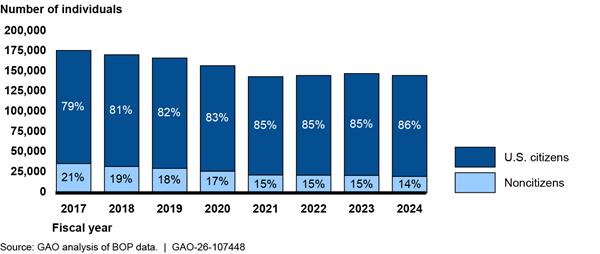
The average number of noncitizens incarcerated by the Federal Bureau of Prisons (BOP) each year decreased 44 percent from fiscal year 2017 (approximately 36,300) through fiscal year 2024 (approximately 20,300). This includes noncitizens with lawful immigration status. During this time, noncitizens, as a proportion of all BOP-incarcerated individuals, also decreased. Immigration-related offenses accounted for more than half of the offenses for which BOP-incarcerated noncitizens were convicted; another 30 percent were drug-related. U.S. Immigration and Customs Enforcement removed approximately 84,800 (76 percent) of the 111,200 noncitizens who completed, at least one term of BOP incarceration from fiscal years 2017 through 2024, as of December 2025.
Individuals Incarcerated by the Federal Bureau of Prisons by U.S. Citizenship Status, Fiscal Years 2017 – 2024
There are no reliable comprehensive data on all noncitizens incarcerated by states and localities. GAO analyzed data from the State Criminal Alien Assistance Program (SCAAP). SCAAP is a Department of Justice (DOJ) program that reimburses jurisdictions for a portion of the eligible costs attributable to incarcerating noncitizens who meet program requirements. Though SCAAP data represent only a portion of all noncitizens incarcerated by states and localities, it provides valuable insights. In state fiscal year 2022, there were a total of approximately 73,500 SCAAP-eligible incarcerations, a decrease of 43 percent from state fiscal year 2016 when there were approximately 128,000 such incarcerations. SCAAP-eligible noncitizens incarcerated by the five state prison systems with the greatest number of SCAAP-eligible incarcerations were convicted of various offenses, including sex crimes, homicide, and drug offenses.
DOJ spent more than $9 billion incarcerating noncitizens from fiscal years 2016 through 2023 (the most recent cost information available at the time of our audit work). This includes approximately $8 billion for BOP’s incarceration of noncitizens from fiscal year 2016 through fiscal year 2023 and approximately $1.44 billion for SCAAP reimbursements to states and localities for incarcerations in state fiscal years 2016 through 2022. This does not reflect costs paid by state and localities that were not reimbursed by the federal government.
Why GAO Did This Study
Depending on the nature of the offense, noncitizens who are arrested and convicted of crimes may be incarcerated by federal, state, or local authorities. These entities each bear the costs of incarcerating them. Following their incarceration, noncitizens may be subject to removal from the U.S. Since 2005, GAO has periodically reported available information on noncitizens incarcerated in the U.S. GAO was asked to update its body of work on this topic (including, GAO-18-433).
This report addresses, among other things, the number and citizenship of noncitizens incarcerated in the U.S., and the cost of incarcerating them.
Noncitizens, in the context of this report, refers to all individuals who are not U.S. citizens, regardless of their immigration status. GAO analyzed data separately for noncitizens incarcerated by BOP and for SCAAP-eligible noncitizens incarcerated by states and localities.
GAO analyzed the most recent data available for each group at the time of our audit work. Generally, analyses of BOP-incarcerated noncitizens span fiscal years 2017 through 2024; analyses of SCAAP-eligible noncitizens incarcerated by states and localities span state fiscal years 2016 through 2022. To calculate the costs of incarcerating noncitizens, GAO analyzed BOP data and information on the annual per person cost of incarcerating an individual in various types of BOP facilities. GAO also analyzed data from the Bureau of Justice Assistance and information collected directly from selected states and localities.
|
Abbreviations |
|
|
|
|
|
ACRIMe |
Alien Criminal Response Information Management System |
|
BJA |
Bureau of Justice Assistance |
|
BOP |
Federal Bureau of Prisons |
|
DHS |
Department of Homeland Security |
|
DOJ |
Department of Justice |
|
ICE |
U.S. Immigration and Customs Enforcement |
|
SCAAP |
State Criminal Alien Assistance Program |
|
USCIS |
U.S. Citizenship and Immigration Services |
This is a work of the U.S. government and is not subject to copyright protection in the United States. The published product may be reproduced and distributed in its entirety without further permission from GAO. However, because this work may contain copyrighted images or other material, permission from the copyright holder may be necessary if you wish to reproduce this material separately.
September 28, 2026
Congressional Requesters
Depending on the nature of the offense, noncitizens in the U.S.—including those with lawful immigration status—who are convicted of crimes may be incarcerated by federal, state, or local authorities, which bear the costs of incarcerating them.[1] Noncitizens convicted in federal court and sentenced to a term of incarceration are under the jurisdiction of the Department of Justice’s (DOJ) Federal Bureau of Prisons (BOP). Noncitizens convicted in state and local courts and sentenced to a term of incarceration are under the jurisdiction of state and local authorities, respectively.
Following their incarceration, noncitizens may be subject to removal from the U.S. The Department of Homeland Security’s (DHS) U.S. Immigration and Customs Enforcement (ICE) is responsible for identifying, apprehending, detaining, litigating charges of removability against, and removing noncitizens who may have violated immigration law.[2]
Components of the judicial branch and federal agencies collect or maintain information about the citizenship of individuals incarcerated by BOP. However, federal agencies do not collect or maintain comprehensive information about the citizenship of individuals incarcerated by states and localities. DOJ’s Bureau of Justice Assistance (BJA) collects information about certain noncitizens in state prisons and local jails as part of its administration of the State Criminal Alien Assistance Program (SCAAP). Through SCAAP, the federal government reimburses states and localities for a portion of the correctional officer salary costs they incur incarcerating certain noncitizens.[3] Not all noncitizens meet the criteria for the program and not all states and localities participate; nevertheless, analysis of this information provides valuable insights about noncitizens whose incarcerations BJA determined are eligible for the SCAAP program.
Since 2005, we have periodically reported available information on noncitizens incarcerated in the U.S. and the cost of incarcerating them.[4] You asked us to update our body of work on noncitizens incarcerated in the U.S. Specifically, this report provides information on:
1. the number and citizenship of BOP-incarcerated noncitizens during fiscal years 2017 through 2024[5] and the number and country of birth of SCAAP-eligible noncitizens during state fiscal years 2016 through 2022;[6]
2. conviction and arrest histories of BOP-incarcerated and SCAAP-eligible noncitizens;
3. the potential removability of BOP-incarcerated noncitizens and what is known about the experiences of those released from incarceration during fiscal years 2017 through 2024; and
4. the cost of incarcerating noncitizens in the U.S.[7]
To address all our objectives, we analyzed data separately for noncitizens incarcerated by BOP and for SCAAP-eligible noncitizens incarcerated by states and localities. Noncitizens, in the context of this report, refers to all individuals who are not U.S. citizens or nationals, regardless of their immigration status. The time periods we analyzed for each group differed because of the availability of the respective data. We selected the start of each time period to provide an update since we last reported on these topics in 2018.[8] We selected the end of each time period to provide the most recent fiscal year data available as of the time we requested the data.
To determine the number and citizenship of BOP-incarcerated noncitizens, we analyzed BOP data for fiscal years 2017 through 2024.[9] We used both point-in-time “snapshots” and individual-level data from BOP’s SENTRY Inmate Management System (SENTRY). Individual-level data included information on approximately 129,200 noncitizens who were incarcerated by BOP during fiscal years 2017 through 2024.[10] Analyses did not include noncitizens who were unsentenced during that time period.
To determine the number and country of birth of SCAAP-eligible noncitizens, we analyzed SCAAP data for state fiscal years 2016 through 2022.[11] SCAAP data provide reliable information on noncitizens who (1) meet the statutory definition for inclusion—that is, individuals who entered the U.S. without being inspected by immigration authorities, individuals who stayed in the U.S. after their visa had expired, or individuals who were the subject of exclusion or deportation proceedings at the time they were taken into custody by the state or locality; (2) have at least one felony or two misdemeanor convictions for violations of state or local law; and (3) are incarcerated for at least 4 consecutive days during the reporting period in a state or locality that applies for and receives reimbursement for costs of incarceration through the program.[12]
SCAAP data do not include (1) noncitizens incarcerated in states or localities that did not apply for and receive reimbursement for costs of incarceration; (2) incarcerated noncitizens with lawful immigration status who were not the subject of removal proceedings at the time they were taken into custody, and (3) noncitizens whose incarcerations did not meet the conviction or incarceration duration criteria for eligibility. As a result, information on SCAAP-eligible noncitizens represent only a portion of the total population of noncitizens incarcerated at the state and local level. We used SCAAP data because there are no reliable comprehensive data on all noncitizens incarcerated by states and localities in the U.S.[13] Overall, our findings are not generalizable to all noncitizens incarcerated by states and localities; nevertheless, they do provide valuable insights.
To determine the crimes for which noncitizens were sentenced in federal court during fiscal years 2018 through 2024, we analyzed conviction data from the U.S. Sentencing Commission’s annual codebooks. To categorize the types of offenses for which BOP-incarcerated noncitizens and SCAAP-eligible noncitizens were arrested, we analyzed data from FBI’s Next Generation Identification database about arrests and transfers. To determine the potential removability status of BOP-incarcerated noncitizens, we analyzed data from ICE’s Alien Criminal Response Information Management System (ACRIMe). To determine the experiences of BOP-incarcerated noncitizens who were released from incarceration during fiscal years 2017 through 2024, we analyzed enforcement data from DHS’s Enforcement Integrated Database and naturalization data from U.S. Citizenship and Immigration Services’ Central Index System. We also analyzed conviction and cost data from five selected states and cost data from five localities.[14] We selected these states and localities because they had the greatest number of SCAAP-eligible incarcerations in state fiscal year 2022. See appendix I for complete information on the scope and methodologies used for our analyses.
We determined that the data used in each of our analyses were sufficiently reliable for the purposes of this report. We made this determination based on our analysis of available documentation about the data systems used to collect and maintain the data, including data dictionaries and privacy impact assessments; conducting electronic tests to identify missing data or anomalies; and interviewing agency officials knowledgeable about the data to understand collections methods and system controls, among other topics.
We conducted this performance audit from March 2024 to September 2026 in accordance with generally accepted government auditing standards. Those standards require that we plan and perform the audit to obtain sufficient, appropriate evidence to provide a reasonable basis for our findings and conclusions based on our audit objectives. We believe that the evidence obtained provides a reasonable basis for our findings and conclusions based on our audit objectives.
Background
Federal Collection and Maintenance of Incarcerated Individuals’ Citizenship Information
Federal incarceration. Federal probation and pretrial services officers—judicial branch employees who work in federal court districts—collect information about the citizenship of individuals sentenced for federal offenses. In general, citizenship is self-reported by individual defendants to federal probation and pretrial services officers at two points—first during a pretrial interview, and second, if the individual is convicted, to support preparation of a presentence report. Federal probation and pretrial services officers may also use information from other sources, such as charging documents or records of arrest and conviction, if the individual does not participate in a pretrial interview, or to confirm or verify information collected from the individual defendant.[15]
The courts share this citizenship information with BOP, which in turn shares it with ICE. For all individuals BOP incarcerates, BOP maintains data in its case management database, including citizenship data and country of birth data from presentence reports. According to ICE officials, since 2018, BOP has provided ICE information about foreign-born individuals in BOP custody, including noncitizens.
State and local incarcerations. Federal agencies do not collect or maintain comprehensive information about the citizenship of individuals incarcerated in state prisons or local jails. In their most recent report on noncitizens incarcerated in the U.S., DOJ and DHS stated that the lack of comprehensive information about state and local incarcerations was a noteworthy data limitation considering that approximately 90 percent of the total population incarcerated in the U.S. were in state and local facilities.[16]
DOJ entities collect and maintain some information about the citizenship of certain individuals incarcerated by state and local authorities. For example, DOJ’s Bureau of Justice Statistics includes information about the citizenship of state prison populations in its annual report on incarcerated individuals in the U.S., though it has identified limitations to this reporting.[17] Not all states, for instance, consistently reported information on citizenship, and states used different methodologies when reporting such information. Moreover, the information reflects point-in-time counts of incarcerated noncitizens, not all noncitizens incarcerated in a certain year. BJA collects information about certain noncitizens in state prisons and local jails as part of its administration of SCAAP, but not all noncitizens meet the criteria for the program, and not all states and localities participate in it.
SCAAP Overview and Reimbursement Categories
Through SCAAP, DOJ reimburses states and localities for a portion of the correctional officer salary costs they incur while incarcerating certain noncitizens. To be eligible for reimbursement, the incarcerated noncitizens must meet statutory and agency criteria.[18] To apply for SCAAP funds, states and localities must submit information to BJA, including correctional officer salary costs and information about each individual for whom they are seeking reimbursement.
DOJ and DHS entities both assess SCAAP applications to determine which incarcerations are eligible for reimbursement. Specifically, DOJ determines if any of the individual records are invalid because they did not meet the minimum number of consecutive days of incarceration, and DHS’s U.S. Citizenship and Immigration Services (USCIS) assesses the individual’s immigration status to categorize the incarceration as eligible-known, eligible-unknown, or ineligible for reimbursement as shown in Table 1.[19]
|
SCAAP incarceration category |
Category definition |
|
Eligible-known |
Incarcerated individual has been convicted of at least one felony or two misdemeanor violations of state or local law resulting in an incarceration of at least 4 consecutive days during the eligibility period, and the Department of Homeland Security (DHS) had sufficient information to determine the individual met the statutory definition for inclusion based on their immigration status. |
|
Eligible-unknown |
Incarcerated individual has been convicted of at least one felony or two misdemeanor violations of state or local law resulting in an incarceration of at least 4 consecutive days during the eligibility period, but DHS did not have sufficient information to determine if the individual met the statutory definition for inclusion based on their immigration status. For example, if a person has not come into contact with DHS authorities, DHS may not be able to verify their immigration status. |
|
Invalid or Ineligible |
Incarcerated individual has not been convicted of at least one felony or two misdemeanor violations of state or local law resulting in an incarceration of at least 4 consecutive days during the eligibility period, or DHS had sufficient information to determine the individual did not meet the statutory definition for inclusion based on their immigration status. |
Source: GAO analysis of Department of Justice information. | GAO‑26‑107448
Note: Statutory definition for inclusion is 8 U.S.C. § 1231(i)(3). In addition to having been convicted of a felony or two misdemeanors, the incarcerated noncitizen must (1) have entered the U.S. without inspection or at any time or place other than as designated by the Attorney General; (2) have been the subject of exclusion or deportation proceedings at the time he or she was taken into custody by the state or a political subdivision of the state; or (3) have been admitted as a nonimmigrant and at the time he or she was taken into custody by the state or a political subdivision of the state failed to maintain the nonimmigrant status in which the individual was admitted or to which it was changed under 8 U.S.C. § 1258, or to comply with the conditions of any such status. As implemented by DOJ, the eligibility period corresponds to the typical state fiscal year—July 1 through June 30.
The amount DOJ awards states and localities that participate in SCAAP depends on 1) the number of incarcerations in each eligibility category, 2) the type of jurisdiction applying for reimbursement (i.e., state, county, city, or U.S. territory), and 3) the amount Congress appropriated for SCAAP that fiscal year.[20] All jurisdictions are eligible to receive reimbursement for 100 percent of the correctional officer salary costs they expended to incarcerate eligible-known individuals and partial reimbursement for eligible-unknown individuals, subject to available appropriations, according to BJA documentation.[21]
In addition, because eligible reimbursement amounts have historically exceeded SCAAP appropriations, the program reimburses each state and locality a standard percentage of its eligible costs. For example, SCAAP reimbursed each participating state and locality for approximately 27 percent of eligible costs associated with state fiscal year 2022 incarcerations.[22]
FBI Arrest History Information
Generally, individuals arrested, transferred to, or incarcerated by federal, state, and local law enforcement authorities are fingerprinted, and their fingerprints may be sent to the FBI.[23] To facilitate and automate the exchange of information about an individual’s arrest history, FBI maintains some information in a database and manages systems that connect its database and participating state and territory repositories.
FBI’s database and systems may not contain all information about an individual’s arrest history, and it does not contain comprehensive citizenship information. Federal, tribal, state, and territorial agencies voluntarily submit fingerprints and other information to the FBI. Not all jurisdictions share information with the FBI, according to FBI officials, and so the database may not contain all data on an individual’s arrest history.
In addition, arrest history information reflects allegations made against an individual, which are not proof of criminal conduct. Not all arrests result in charges filed and not all charges will result in a conviction. However, according to FBI officials, law enforcement and criminal justice entities do not consistently submit disposition information to FBI databases and systems, and so we cannot determine the outcome of these arrests.[24]
ICE Information on Potential Removability of Noncitizens
FBI’s database and systems automatically share fingerprints submitted by law enforcement agencies with DHS, which initiates a process where ICE staff determine the potential removability of noncitizens from the U.S. Specifically, if there is a match in DHS’s system to FBI-provided fingerprints, FBI’s system sends an inquiry to ICE.[25] ICE staff are to use an individual’s biographic information and biometric identifiers, if available, to search various criminal, customs, and immigration databases and determine what is known about an individual’s citizenship status or potential removability from the U.S. ICE staff then send their determination back to the FBI’s system, which shares it with the law enforcement authority from which the fingerprints originated.[26] ICE also uses the determination to make decisions about what immigration enforcement action, if any, to take against the individual.[27]
ICE may remove noncitizens, including noncitizens convicted and incarcerated for crimes, from the U.S. who are already subject to a final order of removal or following a determination of removability by an immigration court, for example.[28] In addition, DOJ’s and DHS’s Institutional Hearing and Removal Program seeks to identify potentially removable noncitizens serving sentences in federal, state, and local correctional facilities. Once identified, the agencies initiate and make efforts to complete removal proceedings while the individuals are still incarcerated, according to DOJ documentation.
BOP generally transfers noncitizens incarcerated in federal facilities to ICE custody upon completion of the individual’s term of incarceration. State and local jurisdictions vary in their response to ICE’s requests to inform DHS of a pending release date for a potentially removable individual and to maintain custody of that individual for up to 48 hours to allow DHS to assume custody (also referred to as a detainer).[29]
Pandemic-Related Policies and Federal Incarcerations
In response to the COVID-19 pandemic, executive actions changed various policies that may have affected the number of individuals incarcerated by BOP. For example, several 2020 executive actions were implemented with the intention of decreasing the number of individuals entering the U.S. and reducing transmission of the virus.[30] Specifically, the Centers for Disease Control and Prevention issued an order in March 2020, under Title 42 of the U.S. Code, which allowed the government to suspend the introduction of individuals from foreign countries to prevent the spread of communicable diseases.[31] The order was lifted in May 2023.[32]
The Number of BOP-Incarcerated Noncitizens and SCAAP-Eligible Incarcerations Have Decreased
The Number and Proportion of BOP-Incarcerated Noncitizens Decreased from Fiscal Year 2017 Through Fiscal Year 2024, and Nearly 70 Percent Were Mexican Citizens
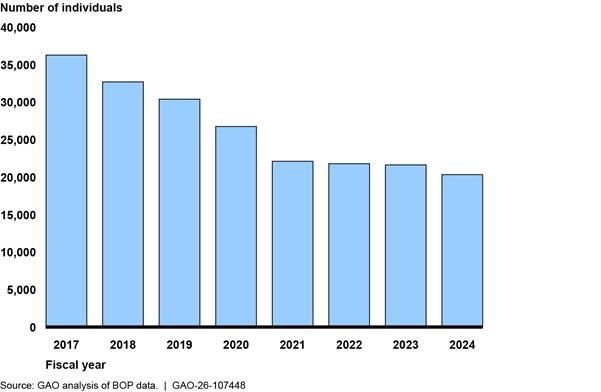
The average number of noncitizens incarcerated by BOP each year decreased 44 percent from fiscal year 2017 (approximately 36,300) through fiscal year 2024 (approximately 20,300), as shown in figure 1.
Figure 1: Average Number of Noncitizens Incarcerated by the Federal Bureau of Prisons (BOP) Each Year, Fiscal Years 2017 Through 2024
Note: This figure reflects the average of 12 monthly point-in-time “snapshots” of the number of noncitizens incarcerated by BOP during fiscal years 2017 through 2024. Data do not include individuals who are unsentenced. As point-in-time data, they may not include all noncitizens incarcerated in each year. For example, an individual incarcerated for less than 1 month between the monthly “snapshot” dates would not be reflected in the data. In addition, data do not represent unique noncitizens across years, as individuals may be incarcerated during more than one fiscal year. Data do not include individuals with unknown citizenship information—which represented 0.01 percent or less of incarcerated individuals each fiscal year.
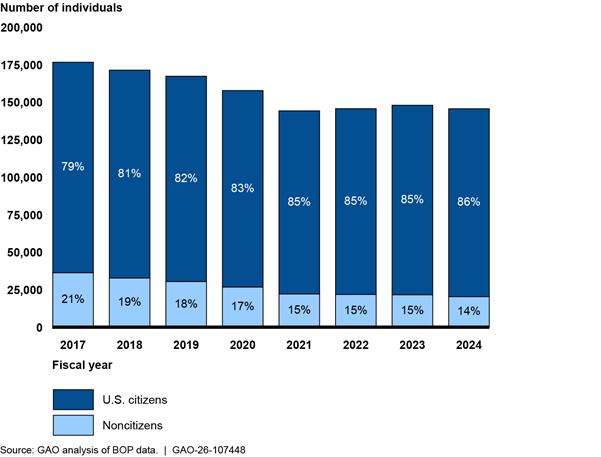
During the same time period, the proportion of individuals incarcerated by BOP who were noncitizens also decreased. As shown in figure 2, in fiscal year 2017, noncitizens comprised 21 percent of the approximately 176,600 individuals incarcerated by BOP. In fiscal year 2024, the proportion declined to 14 percent of the approximately 145,600 individuals incarcerated by BOP.
Figure 2: Average Number of Individuals Incarcerated by the Federal Bureau of Prisons (BOP) Each Year by U.S. Citizenship Status, Fiscal Years 2017 Through 2024
Note: This figure reflects the average of 12 monthly point-in-time “snapshots” of the number of U.S citizens and noncitizens incarcerated by BOP during fiscal years 2017 through 2024. Data do not include individuals who are unsentenced. As point-in-time data, they may not include all individuals incarcerated in each year. For example, an individual incarcerated for less than 1 month between the monthly “snapshot” dates would not be reflected in the data. In addition, data do not represent unique individuals across years, as individuals may be incarcerated during more than one fiscal year. Data do not include individuals with unknown citizenship information—which represented 0.01 percent or less of incarcerated individuals each fiscal year.
From fiscal years 2017 through 2024, BOP incarcerated approximately 129,200 unique noncitizens.[33] These noncitizens accounted for approximately 24 percent of the 536,200 individuals incarcerated during this 8-year period.[34]
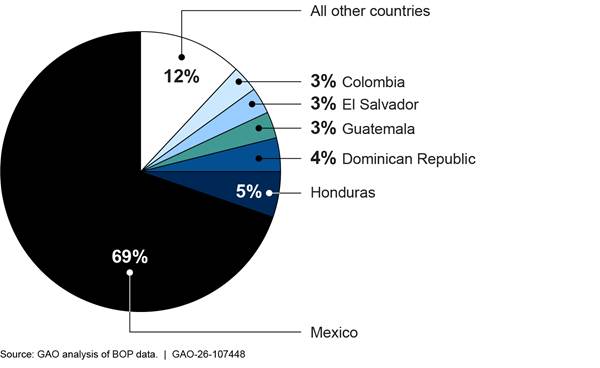
Nearly 70 percent of the approximately 129,200 noncitizens incarcerated by BOP from fiscal years 2017 through 2024 were Mexican citizens, as shown in figure 3. An additional 18 percent were citizens of five countries: Honduras, Dominican Republic, Guatemala, El Salvador, and Colombia. These are the same six countries where most noncitizens incarcerated by BOP from fiscal years 2011 through 2016 held citizenship.[35]
Figure 3: Noncitizens Incarcerated by the Federal Bureau of Prisons (BOP) During Fiscal Years 2017 Through 2024 by Country of Citizenship
Note: The number of unique incarcerated individuals is based on individual-level data from BOP’s system used to track the care, classification, discipline, and programs of individuals it incarcerates, among other information. Data do not include individuals who were unsentenced. Data also do not include individuals with unknown citizenship information—which represented 0.1 percent of incarcerated individuals from fiscal years 2017 through 2024. Percentages do not sum to 100 due to rounding.
SCAAP-Eligible Incarcerations Decreased from State Fiscal Year 2016 Through 2022 and Nearly 60 Percent of Those Incarcerated in Fiscal Year 2022 Were Born in Mexico
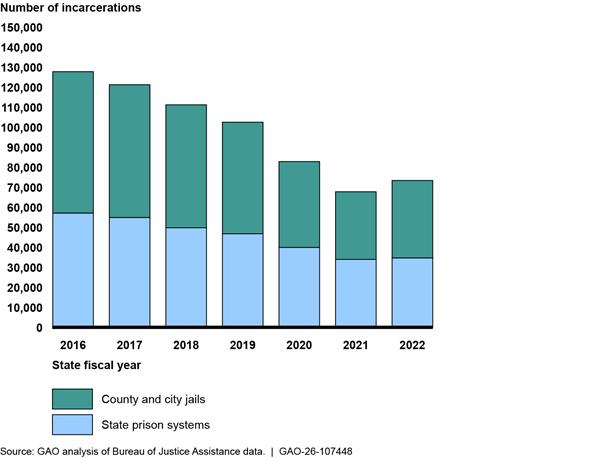
In state fiscal year 2022, there were a total of approximately 73,500 SCAAP-eligible incarcerations, a decrease of 43 percent from state fiscal year 2016 when there were approximately 128,000 SCAAP-eligible incarcerations (see fig. 4).[36] Over this time period, approximately 46 percent of SCAAP-eligible incarcerations were in state prisons, and 54 percent were in county or city jails.[37] The number of SCAAP-eligible incarcerations in both settings decreased each year from state fiscal years 2016 through 2021 before increasing in state fiscal year 2022.[38]
Figure 4: Number of State Criminal Alien Assistance Program (SCAAP)-Eligible Incarcerations by Type of Jurisdiction, State Fiscal Years 2016 Through 2022
Notes: Through SCAAP, the federal government reimburses states and localities, including U.S. territories for a portion of the correctional officer salary costs they incur while incarcerating certain noncitizens. To be eligible for reimbursement, the incarcerated noncitizens must meet the statutory and agency criteria. See 8 U.S.C. § 1231(i)(3).
SCAAP uses the typical state fiscal year (July 1 through June 30) to define the eligibility period for reimbursement and reimburses participating jurisdictions the following year.
The figure reflects the number of incarcerations for which the Bureau of Justice Assistance (BJA) reimbursed participating states, counties, and cities based on program eligibility criteria. BJA also reimbursed U.S. territories for eligible incarcerations each year during this time period. The number of eligible incarcerations in U.S. territories ranged from approximately 50 in state fiscal year 2021 to 670 in state fiscal year 2018.
Data do not represent unique individuals since it is possible to have more than one SCAAP-eligible incarceration in a state fiscal year—for example, if they were incarcerated in more than one participating jurisdiction and their convictions and length of incarceration met program criteria.
In addition, the total number of days attributed to SCAAP-eligible incarcerations in state fiscal year 2022 was 34 percent less than in state fiscal year 2016. In state fiscal year 2016, SCAAP-eligible incarcerations by states and localities accounted for approximately 21.7 million days of incarceration; in state fiscal year 2022, they accounted for approximately 14.3 million days of incarceration.
The decrease can be attributed, in part, to a decrease in the number of participating jurisdictions, but also to a decrease in SCAAP-eligible incarcerations and incarceration days within jurisdictions that continued to participate over time.[39] A total of 681 jurisdictions participated in SCAAP in state fiscal year 2016, compared to 501 jurisdictions in state fiscal year 2022. Among the 470 jurisdictions that participated in SCAAP in state fiscal year 2016 and state fiscal year 2022, 72 percent had fewer SCAAP-eligible incarcerations and 61 percent attributed fewer days to SCAAP-eligible incarcerations.
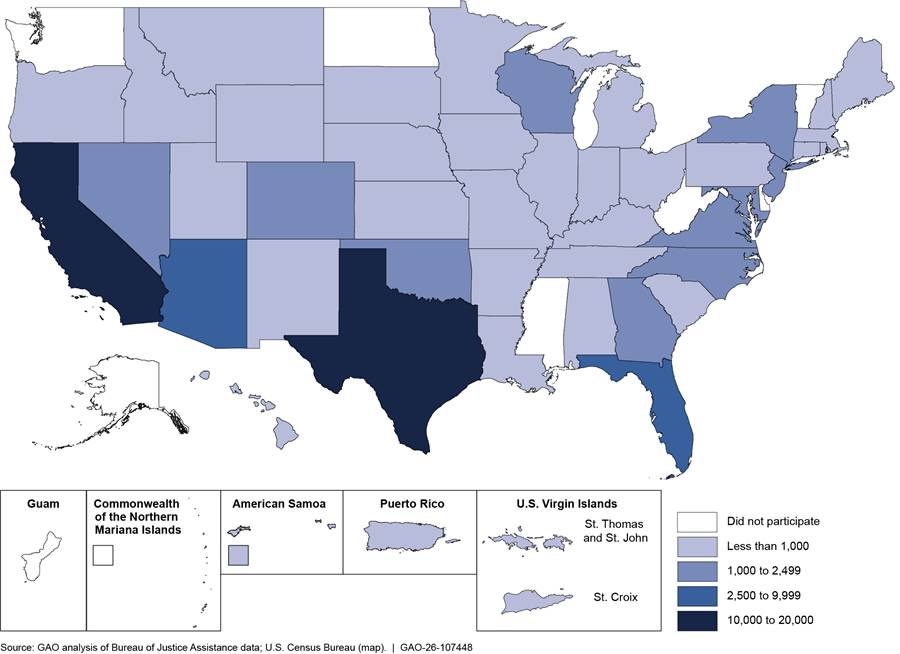
SCAAP-eligible incarcerations in California and Texas accounted for almost half of all SCAAP-eligible incarcerations in state fiscal year 2022. As illustrated in figure 5, of the approximately 73,500 SCAAP-eligible incarcerations that state fiscal year, approximately 26 percent (19,300 incarcerations) were in California’s state prison system or local jails and approximately 23 percent (17,000 incarcerations) were in Texas’s state prison system or local jails. California and Texas had the state prison systems with the most SCAAP-eligible incarcerations and, together, 9 of the 10 local jurisdictions with the most SCAAP-eligible incarcerations. Florida accounted for the next greatest proportion (approximately 8 percent or 6,000 incarcerations), followed by Arizona, Colorado, New York, and North Carolina (each accounted for between 3 and 4 percent of all SCAAP-eligible incarcerations in state fiscal year 2022).
Figure 5: Location of State Criminal Alien Assistance Program (SCAAP)-Eligible Incarcerations in State Fiscal Year 2022
Notes: Through SCAAP, the federal government reimburses states and localities, including U.S. territories for a portion of the correctional officer salary costs they incur while incarcerating certain noncitizens. To be eligible for reimbursement, the incarcerated noncitizens must meet the statutory and agency criteria. See 8 U.S.C. § 1231(i)(3).
SCAAP uses the typical state fiscal year (July 1 through June 30) to define the eligibility period for reimbursement and reimburses participating jurisdictions the following year.
The figure reflects the number of incarcerations for which the Bureau of Justice Assistance (BJA) reimbursed participating states, counties, cities, and territories. Data do not represent unique individuals since it is possible to have more than one SCAAP-eligible incarceration in a state fiscal year—for example, if they were incarcerated in more than one participating jurisdiction and their convictions and length of incarceration met program criteria.
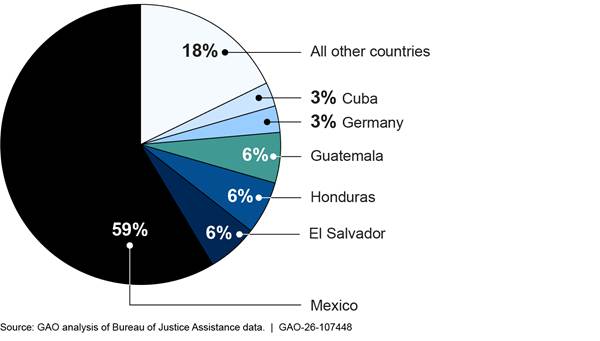
In approximately 59 percent of SCAAP-eligible incarcerations in state fiscal year 2022, the individual was born in Mexico, as shown in figure 6. The next most common countries of birth were El Salvador, Honduras, and Guatemala—each accounting for approximately 6 percent of SCAAP-eligible incarcerations that state fiscal year.
Figure 6: State Criminal Alien Assistance Program (SCAAP)-Eligible Incarcerations in State Fiscal Year 2022 by Country of Birth
Notes: Through SCAAP, the federal government reimburses states and localities, including U.S. territories, for a portion of the correctional officer salary costs they incur while incarcerating certain noncitizens. To be eligible for reimbursement, the incarcerated noncitizens must meet the statutory and agency criteria. See 8 U.S.C. § 1231(i)(3).
Incarcerations occurred between July 1, 2021, and June 30, 2022. Data represent the number of incarcerations for which the Bureau of Justice Assistance (BJA) reimbursed participating states, localities, and territories based on program eligibility criteria. Data do not represent unique individuals since it is possible to have more than one SCAAP-eligible incarceration in a fiscal year. For example, if they were incarcerated in more than one participating jurisdiction and their convictions and length of incarceration met program criteria.
SCAAP data captures data on the individual’s country of birth and not country of citizenship.
Numbers do not sum to 100 due to rounding.
Immigration Offenses Were the Most Common Conviction Category Among BOP-Incarcerated Noncitizens; Categories Varied Among SCAAP-Eligible Noncitizens
More than half of the offenses for which BOP-incarcerated noncitizens were convicted were immigration-related, based on our analysis of BOP data. For the majority of noncitizens sentenced in federal court from fiscal years 2018 through 2024, their most serious offense was immigration-related, according to U.S. Sentencing Commission data.[40] We found the most common conviction categories for SCAAP-eligible noncitizens from the five state prison systems with the most SCAAP-eligible incarcerations in state fiscal year 2022 varied across states.
In addition to our analysis of conviction information—that is, the offenses for which these noncitizens were incarcerated—we analyzed information related to their arrests and transfers to law enforcement agencies before, during, and after their incarceration.[41] Based on our analysis of a random sample of noncitizens incarcerated by BOP during fiscal years 2017 through 2024, we estimated that the approximately 106,800 noncitizens in this federal study population were arrested or transferred for more than 1 million offenses from 1975 to 2025.[42] Immigration-related offenses accounted for more than half of the offenses for which they were arrested, according to our analysis.
Based on our analysis of a random sample of SCAAP-eligible noncitizens incarcerated during state fiscal years 2016 through 2022, we estimated the approximately 218,400 noncitizens in this SCAAP study population were arrested or transferred for about 2.3 million offenses from 1972 to 2025.[43] The most common offense categories were immigration-, traffic-, and drug-related.
Immigration Offenses Accounted for More than Half of the Offenses for Which BOP-Incarcerated Noncitizens Were Convicted
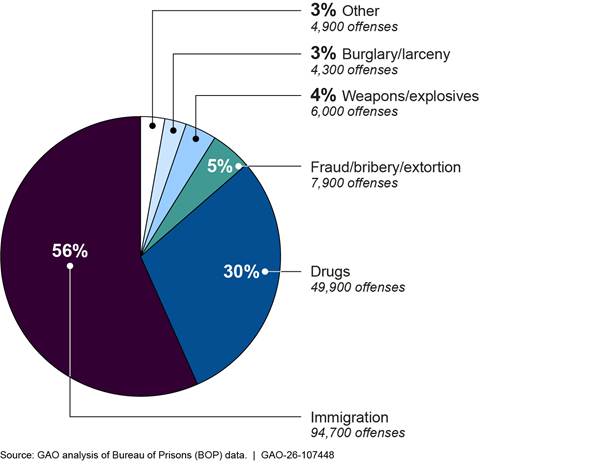
Some incarcerated individuals are incarcerated for a single offense, some for a single period of time for multiple offenses, and others for more than one period of time for one or more offenses. Based on our analysis, the approximately 129,200 noncitizens BOP incarcerated from fiscal years 2017 through 2024 were convicted of about 167,700 offenses.[44] Approximately 56 percent of offenses were immigration-related, such as unlawfully entering or remaining in the U.S., and 30 percent were drug-related (see fig. 7). By comparison, from fiscal years 2017 through 2024, BOP incarcerated approximately 406,900 citizens who were convicted of approximately 555,700 offenses. Approximately 39 percent of those offenses were drug-related, and 25 percent were weapons or explosives-related, according to our analysis.
Figure 7: Offense Categories for Which Noncitizens Were Incarcerated by the Federal Bureau of Prisons (BOP), Fiscal Years 2017 Through 2024
Note: “Other” includes sex offenses, homicide/aggravated assault, court/corrections offenses, robbery, counterfeiting/embezzlement, continuing criminal enterprise, national security offenses, and miscellaneous offenses. An individual may be incarcerated for a single period of time for multiple offenses or for more than one period of time for one or more offenses. See 18 U.S.C. § 3584(a). According to BOP officials, for each individual it incarcerates, BOP records: (1) the offense(s) for which the individual is incarcerated that is/are not eligible for First Step Act of 2018 (FSA) time credits, if any; (2) the offense(s) that BOP records per system requirements to track consecutive sentence obligations, if any, or FBI-requested information, if any; (3) the most serious offense for which the individual is incarcerated. See Pub. L. No. 115-391, tit. I, § 101(a), 132 Stat. 5194, 5196 (codified at 18 U.S.C. § 3632(d)(4)). As a result, more than one offense may be associated with each individual. For the purposes of this analysis, we counted all offenses tracked by BOP. Specifically, the figure reflects the approximately 167,700 offenses associated with the approximately 129,200 noncitizens BOP incarcerated from fiscal years 2017 through 2024. Offenses include an attempt or conspiracy to commit the offense.
Immigration Offenses Were the Most Serious Offense for the Majority of Noncitizens Sentenced in Federal Court
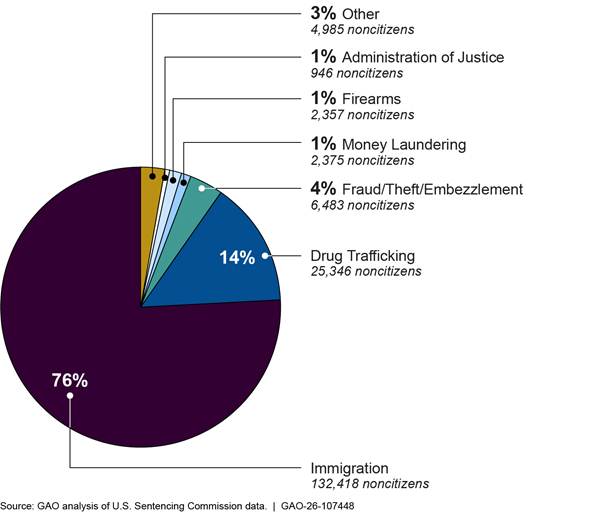
For the majority of noncitizens sentenced in federal court from fiscal years 2018 through 2024, the most serious offense for which they were convicted was immigration-related, based on our analysis of U.S. Sentencing Commission data.[45] Approximately 174,900 noncitizens were sentenced in federal court from fiscal years 2018 through 2024.[46] For each individual sentenced in federal court, the U.S. Sentencing Commission identifies the most serious offense the individual was convicted of based on the sentencing guideline applied—referred to as the “type of crime.” As shown in figure 8, for 76 percent of noncitizens, the most serious offense they were convicted of was immigration-related—the vast majority (90 percent) for unlawfully entering or remaining in the U.S. The next most common offense among noncitizens was drug trafficking (14 percent). By comparison, from fiscal years 2018 through 2024, approximately 280,300 U.S. citizens were sentenced in federal court. Considering the most serious offenses for which they were sentenced, the most common were drug-trafficking (37 percent) followed by firearm offenses (20 percent), according to U.S. Sentencing Commission data.
Figure 8: Noncitizens Sentenced in Federal Court by Offense Category, Fiscal Years 2018 Through 2024
Note: Numbers include noncitizens sentenced in federal court for a felony or class A misdemeanor offense. Felonies are a sentencing classification of offenses which, under federal law, have a maximum term of imprisonment of at least more than 1 year. Class A misdemeanors are a sentencing classification of offenses which, under federal law, have a maximum term of imprisonment of more than 6 months but no more than 1 year. 18 U.S.C. § 3559(a). If an individual was sentenced for a felony or class A misdemeanor offense more than once during this time period, each offense would be included in the data. As such, there could be more than one offense of the same type or of different type per unique noncitizen.
SCAAP-Eligible Noncitizens in Select States Were Convicted of Various Offenses, Including Sex Crimes and Homicide
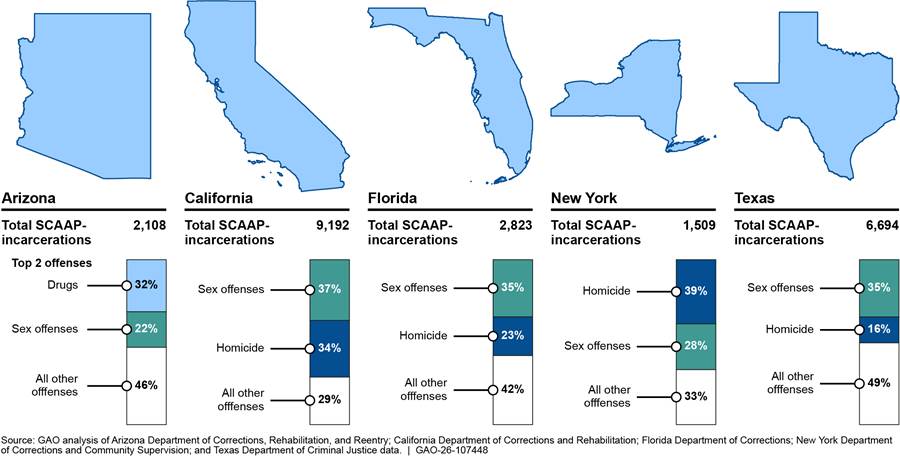
Sex offenses and homicide were the most common offenses for which SCAAP-eligible noncitizens incarcerated in California, Florida, New York, and Texas prison systems during state fiscal year 2022 were convicted; the most common offenses committed by those incarcerated in Arizona prisons were drug and sex offenses (see fig. 9).[47] In general, immigration offenses are charged at the federal level and were not among the common offenses committed by SCAAP-eligible noncitizens in these states.[48]
Among all state prison systems that participated in SCAAP, Arizona, California, Florida, New York, and Texas had the most SCAAP-eligible incarcerations in state fiscal year 2022. Collectively, these states accounted for 64 percent of SCAAP-eligible incarcerations in state prisons that year. For each SCAAP-eligible individual in those states, we requested information on the most serious offense for which the individual was incarcerated.
Though our analysis of offense types showed SCAAP-eligible noncitizens were incarcerated in state fiscal year 2022 for similar offenses as in our previous reports, the number of SCAAP-eligible incarcerations in these states was significantly less.[49] The five states with the largest number of SCAAP-eligible incarcerations in state fiscal year 2022 were the same five states as in state fiscal year 2015—the time period included in our last report on this topic. In state fiscal year 2022, these states collectively reported approximately 22,300 SCAAP-eligible incarcerations, which was approximately 50 percent fewer than these states incarcerated in state fiscal year 2015 (approximately 44,200 SCAAP-eligible incarcerations). For additional information on the offenses committed by SCAAP-eligible noncitizens in these five state prison systems, see appendix III.
Figure 9: Most Common Conviction Categories for State Criminal Alien Assistance Program (SCAAP)-Eligible Incarcerations in Selected State Prison Systems in State Fiscal Year 2022
Notes: Through SCAAP, the federal government reimburses states and localities, including U.S. territories for a portion of the correctional officer salary costs they incur while incarcerating certain noncitizens. To be eligible for reimbursement, the incarcerated noncitizens must meet the statutory and agency criteria. See 8 U.S.C. § 1231(i)(3).
Figure presents the two most common categories of offenses among the 22,326 SCAAP-eligible incarcerations in Arizona, California, Florida, New York, and Texas state prison systems from July 1, 2021, through June 30, 2022. Data do not represent unique individuals since it is possible to have more than one SCAAP-eligible incarceration in a fiscal year—for example, if they were incarcerated in more than one participating state and their convictions and length of incarceration met program criteria.
The conviction for the offense may have occurred prior to July 1, 2021. “Other” primary offenses may include arson; assault; burglary; disorderly conduct; drugs; fraud, forgery and counterfeiting; kidnapping; homicide; immigration; larceny and theft; miscellaneous offenses; motor vehicle theft; obstruction of justice; property damage; robbery; stolen property; traffic violations; and weapons violations, depending on the state. Primary offense refers to the most serious offense for which the individual was convicted, as determined by the state. Offenses for which individuals are convicted may include an attempt or conspiracy to commit the respective offenses. We did not examine the extent to which state policies may have affected the number of individuals convicted of crimes.
Estimates Show Most BOP-Incarcerated Noncitizens Were Arrested at Least Once for Immigration Offenses
We estimated that the approximately 106,800 noncitizens in our federal study population were arrested or transferred approximately 650,100 times for more than 1 million offenses from 1975 to 2025.[50] This information often reflects arrests of an individual, which are not proof of criminal conduct, as not all arrests result in charges filed and not all charges will result in a conviction. Moreover, this arrest information does not necessarily reflect the offense or offenses for which the individual was incarcerated during the period of our review. Nevertheless, the information provides valuable insights about how frequently noncitizens in the study population are arrested or transferred to a law enforcement authority and for what conduct.[51] To make these estimates, we selected a random sample of 500 noncitizens incarcerated by BOP during fiscal years 2017 through 2024—what we refer to as our federal study population.[52] Using this sample, we estimated the following about how many times the noncitizens in our federal study population were arrested or transferred to another arresting agency prior to, during, or following their incarceration:[53]
· about 58 percent of noncitizens were arrested or transferred to another arresting agency from one to five times;[54]
· about 27 percent were arrested or transferred six to ten times;
· about 15 percent were arrested or transferred 11 or more times, including approximately 1 percent who were arrested or transferred more than 20 times.
Considering all the offenses for which the noncitizens in our federal study population were arrested or transferred from 1975 through 2025, we estimated that more than half (about 54 percent) of the offenses were immigration-related, about 17 percent were drug-related, and about 8 percent were traffic violation-related.[55]
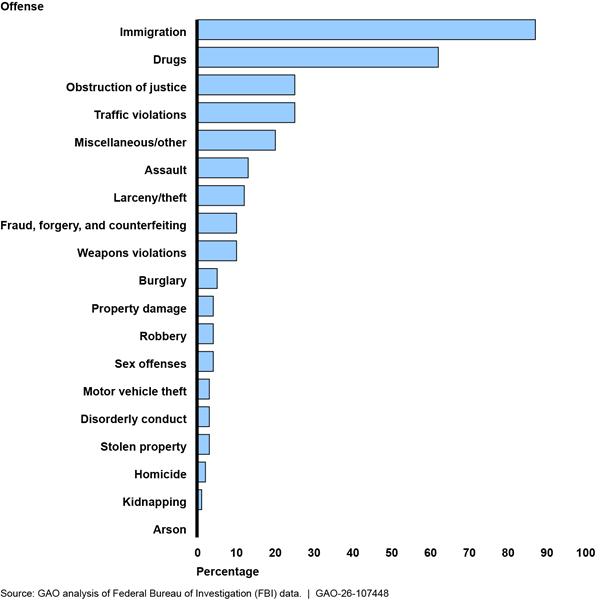
We also estimated that about 87 percent of the approximately 106,800 incarcerated noncitizens in our federal study population were arrested or transferred at least once for an immigration offense, and about 62 percent were arrested or transferred at least once for a drug offense. Figure 10 shows the estimated percentage of incarcerated noncitizens arrested or transferred at least once by offense category—which may include an attempt or conspiracy to commit the offense.
Figure 10: Estimated Percentage of Noncitizens Incarcerated by the Federal Bureau of Prisons (BOP) from Fiscal Year 2017 Through 2024 Who Were Arrested or Transferred at Least Once for the Offense
Notes: Arrests or transfers in this analysis occurred from 1975 through 2025. Dates do not align with our sample period of fiscal year 2017 through 2024 as the FBI data was received after our sample selection, and included arrests or transfers which occurred before, during, and after the individual was incarcerated.
For this analysis, we selected a random sample of 500 from among the approximately 129,500 noncitizens and individuals with unknown citizenship who had a valid FBI number and were incarcerated by BOP at some point from fiscal years 2017 through 2024. Following sample selection, some of the records in our sample had to be excluded for various reasons. As a result, we analyzed data for 413 incarcerated noncitizens, and our analysis is applicable to the estimated approximately 106,800 incarcerated noncitizens defined as our federal study population. The analysis allowed us to estimate and provide valuable insights about the federal study population’s arrests and transfers to arresting agencies; it is not intended to imply conclusions about incarcerated noncitizens not in this group. The percentages in the figure above represent the estimated portion of noncitizens in the study population who were arrested or transferred at least once for the respective offense. All estimates in this figure have a margin of error of less than +/- 5 percentage points.
We are reporting on arrests and transfers together because FBI data did not allow us to determine the difference between a new arrest and a transfer from one arresting agency to another. As a result, if an individual is arrested for an offense and subsequently transferred to different arresting agency that enters the same offense information, the same offense may be counted more than once. These analyses include offenses associated with arrests or transfers by federal, state, and local arresting agencies. For the purposes of this report, we define an arresting agency as one that has the authority to make arrests. These entities send arrest information to the FBI on a voluntary basis; as a result, FBI data on arrest history may not include all arrests.
Offense categories include an attempt or conspiracy to commit the respective offense. See appendix I for a complete description of each of the offense categories.
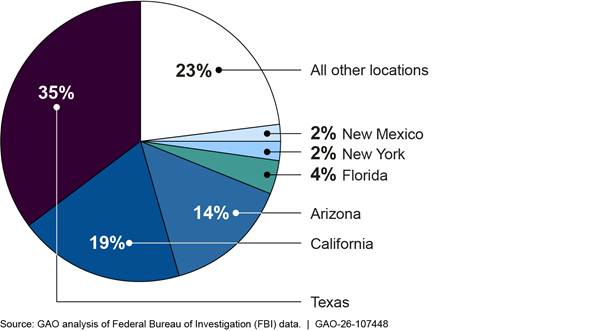
About one-third of the approximately 650,100 arrests or transfers of noncitizens associated with our federal study population took place in Texas (35 percent), according to our estimates and shown in figure 11. An additional estimated 33 percent of arrests or transfers took place in California (19 percent) and Arizona (14 percent). We estimated that the remaining states each accounted for 4 percent or fewer arrests or transfers.
Figure 11: Arrests or Transfers of Noncitizens Incarcerated by the Federal Bureau of Prisons (BOP) from Fiscal Years 2017 Through 2024, by State
Notes: Arrests or transfers in this analysis occurred from 1975 through 2025. Dates do not align with our sample period of fiscal year 2017 through 2024 as the FBI data was received after our sample selection, and included arrests or transfers which occurred before, during, and after the individual was incarcerated.
For this analysis, we selected a random sample of 500 from among the approximately 129,500 noncitizens and individuals with unknown citizenship who had a valid FBI number and were incarcerated by BOP at some point from fiscal years 2017 through 2024. Following sample selection, some of the records in our sample had to be excluded for various reasons. As a result, we analyzed data for 413 incarcerated noncitizens, and our analysis is applicable to the estimated approximately 106,800 incarcerated noncitizens defined as our federal study population. The analysis allowed us to estimate and provide valuable insights about the federal study population’s arrests and transfers to arresting agencies; it is not intended to imply conclusions about incarcerated noncitizens not in this group. The percentages in the figure above represent the estimated portion of arrests or transfers of noncitizens in the study population that occurred in each state. All estimates in this figure have a margin of error of less than +/- 5 percentage points. Numbers do not sum to 100 due to rounding.
We are reporting on arrests and transfers together because FBI data did not allow us to determine the difference between a new arrest and a transfer from one arresting agency to another. These analyses include arrests or transfers by federal, state, and local arresting agencies. For the purposes of this report, we define an arresting agency as one that has the authority to make arrests. These entities send arrest information to the FBI on a voluntary basis; as a result, FBI data on arrest history may not include all arrests.
Estimates Show the Majority of SCAAP-Eligible Noncitizens Were Arrested at Least Once for Immigration Offenses
We estimated that the approximately 218,400 noncitizens in our SCAAP study population were arrested or transferred about 1.4 million times for about 2.3 million offenses from 1972 through 2025.[56] Similar to the analysis in the previous section, to make these estimates, we analyzed data for a random sample of 500 of the SCAAP-eligible noncitizens incarcerated by states and localities during state fiscal years 2016 through 2022—what we refer to as our SCAAP study population.[57] Using this sample, we estimated the following about how many times the noncitizens in our SCAAP study population were arrested or transferred to another arresting agency prior to, during, or following their incarceration:
· about 61 percent were arrested or transferred one to five times;[58]
· about 22 percent were arrested or transferred six to ten times;
· about 17 percent were arrested or transferred 11 or more times, including about 4 percent who were arrested or transferred more than 20 times.
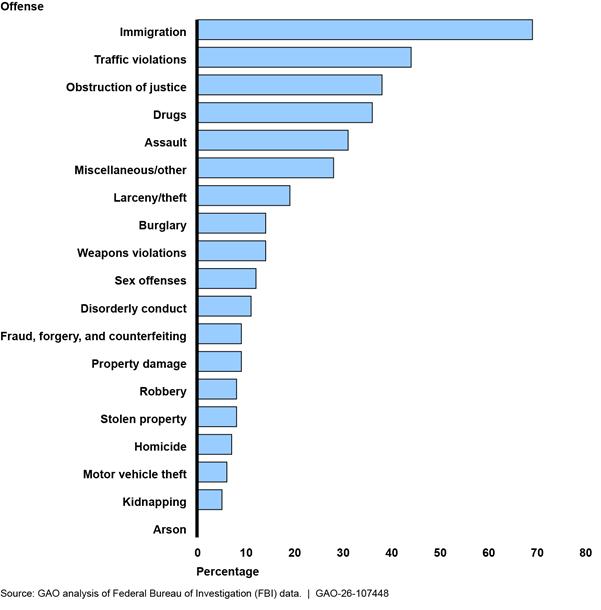
Considering all the offenses for which the noncitizens in our SCAAP study population were arrested or transferred from 1972 through 2025, we estimated that the most common offenses were immigration-related (about 20 percent), traffic violation-related (about 17 percent), and drug-related (about 14 percent).[59]
We also estimated that about 69 percent of the approximately 218,400 noncitizens in our SCAAP study population were arrested or transferred at least once for an immigration offense, and about 44 percent were arrested or transferred at least once for a traffic violation. Figure 12 shows the percentage of noncitizens in our SCAAP study population who were arrested or transferred at least once by offense category.
Figure 12: Estimated Percentage of State Criminal Alien Assistance Program-Eligible Noncitizens Incarcerated from State Fiscal Year 2016 through 2022 Who Were Arrested or Transferred at Least Once For the Offense
Notes: Arrests or transfers in this analysis occurred from 1972 through 2025. Dates do not align with our sample period of fiscal year 2017 through 2024 as the FBI data was received after our sample selection, and included arrests or transfers which occurred before, during, and after the individual was incarcerated.
Estimates are based on analysis of a random sample of 500 of the approximately 269,600 State Criminal Alien Assistance Program (SCAAP)-eligible noncitizens incarcerated by state and local authorities during state fiscal years 2016 through 2022 with an FBI number. Some of the records in our sample had to be excluded for various reasons. As a result, we analyzed data for 405 incarcerated noncitizens. Our analysis is applicable to the estimated 218,400 incarcerated noncitizens in our SCAAP study population. The analysis allowed us to estimate and provide valuable insights about the study population’s arrests and transfers to arresting agencies; it is not intended to imply conclusions about incarcerated noncitizens not in this group. The percentages in the figure above represent the estimated portion of noncitizens in the study population who were arrested or transferred at least once for the respective offense. All estimates in this figure have a margin of error of less than +/- 5 percentage points.
We are reporting on arrests and transfers together because FBI data did not allow us to determine the difference between a new arrest and a transfer from one arresting agency to another. As a result, if an individual is arrested for an offense and subsequently transferred to different arresting agency that enters the same offense information, the same offense may be counted more than once. These analyses include offenses associated with arrests or transfers by federal, state, and local arresting agencies. For the purposes of this report, we define an arresting agency as one that has the authority to make arrests. These entities send arrest information to the FBI on a voluntary basis; as a result, FBI data on arrest history may not include all arrests.
Offense categories include an attempt or conspiracy to commit the respective offense. See appendix I for a complete description of each of the offense categories.
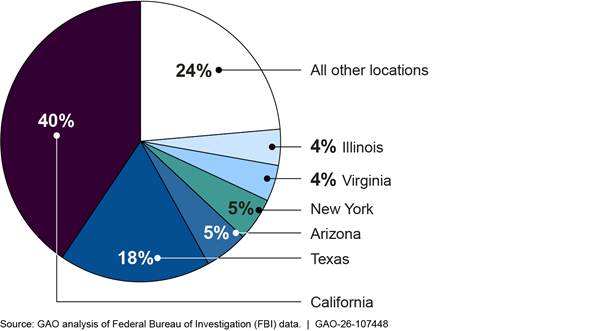
About 40 percent of the approximately 1.4 million arrests or transfers associated with our SCAAP study population took place in California, as shown in figure 13. We estimated that an additional 36 percent of arrests or transfers took place in Texas (18 percent), Arizona (5 percent), New York (5 percent), Virginia (4 percent), and Illinois (4 percent). The remaining states each accounted for 3 percent or fewer arrests or transfers.
Figure 13: Arrests or Transfers of State Criminal Alien Assistance Program-Eligible Noncitizens Incarcerated from State Fiscal Year 2016 Through 2022, By State
Notes: Arrests or transfers in this analysis occurred from 1972 through 2025. Dates do not align with our sample period of fiscal year 2017 through 2024 as the FBI data was received after our sample selection, and included arrests or transfers which occurred before, during, and after the individual was incarcerated.
For this analysis, we selected a random sample of 500 from the approximately 269,600 State Criminal Alien Assistance Program (SCAAP)-eligible noncitizens incarcerated by state and local authorities during state fiscal years 2016 through 2022 with an FBI number. Following sample selection, some of the records in our sample had to be excluded for various reasons. As a result, we analyzed data for 405 incarcerated noncitizens. Our analysis is applicable to the estimated 218,400 incarcerated noncitizens in our SCAAP study population. The analysis allowed us to estimate and provide valuable insights about the SCAAP study population’s arrests and transfers to arresting agencies; it is not intended to imply conclusions about incarcerated noncitizens not in this group. The percentages in the figure above represent the estimated portion of arrests or transfers of noncitizens in the study population that occurred in each state. All estimates in this figure have a margin of error of less than +/- 7 percentage points.
We are reporting on arrests and transfers together because FBI data did not allow us to determine the difference between a new arrest and a transfer from one arresting agency to another. These analyses include arrests or transfers by federal, state, and local arresting agencies. For the purposes of this report, we define an arresting agency as one that has the authority to make arrests. These entities send arrest information to the FBI on a voluntary basis; as a result, FBI data on arrest history may not include all arrests.
Three-Quarters of Noncitizens Were Removed from the U.S. Following Their Release from BOP
About Two-Thirds of Noncitizens Whose Status ICE Reviewed Had a Warrant of Removal or Were in Removal Proceedings Around the Time of Their Incarceration
Of the approximately 129,200 noncitizens incarcerated by BOP from fiscal years 2017 through 2024 who had a valid FBI or alien number, ICE reviewed the status of about 62,700 (48 percent) within 60 days of their incarceration.[60] Approximately two-thirds of the about 62,700 noncitizens had a warrant of removal or were in removal proceedings, according to our analysis.[61] In response to inquiries—both automatically generated from biometric matches between FBI and DHS systems and directly from law enforcement agencies— ICE staff use the agency’s ACRIMe system to search various criminal, customs, and immigration databases to determine what is known about an individual’s identity and potential removability from the U.S.[62] An individual’s immigration status and removability from the U.S. can change over time and ICE’s response may not indicate an individual’s immigration status with certainty.[63] Nevertheless, these data provide valuable information about the potential removability of these approximately 62,700 noncitizens incarcerated by BOP. Based on our analysis, we found the following:
· Warrant of removal. About 35,900 (57 percent) noncitizens incarcerated by BOP appeared to have a warrant of removal pending with ICE around the time of their incarceration, as indicated by ICE’s review of records.[64]
· In removal proceedings. About 4,700 (8 percent) were in removal proceedings around the time of their incarceration, as indicated by ICE’s review of records. In other words, they appeared to have a removal case in process in immigration court around the same time as their incarceration.[65]
· Subject to removal. A total of approximately 21,800 (35 percent) incarcerated noncitizens may have been subject to removal around the time of their incarceration, as indicated by ICE’s review of records. This included about 9,800 incarcerated noncitizens who may have had some lawful presence or status in the U.S., such as being granted a visitor visa, legal permanent residence, temporary protected status, a border crossing card, or other such authorization to be present in or remain in the U.S. However, ICE’s review also indicated that if the individual were convicted of a felony offense or was otherwise in violation of the conditions of their admission, they may be subject to removal from the U.S. for violating immigration law.
The number of noncitizens ICE categorized as subject to removal also included approximately 6,100 individuals who did not have a record of admission or a record of other authorized presence in the U.S., which makes them subject to removal. The number of incarcerated noncitizens subject to removal also included approximately 5,900 individuals who were previously removed from the U.S. and had no record of legal re-entry.
· Insufficient information. ICE did not have enough information to make an assessment for fewer than 100 (less than 1 percent) of the about 62,700 incarcerated noncitizens it reviewed.[66]
Seventy-Six Percent of Noncitizens Were Removed from the U.S. Following Their Release from Incarceration by BOP
Following their release from incarceration by BOP, noncitizens may have a range of experiences. These possibilities include removal from the U.S., reincarceration by BOP or by a state or local authority, or becoming a naturalized U.S. citizen.[67] Of the approximately 129,200 noncitizens who were incarcerated by BOP from fiscal years 2017 through 2024, we identified approximately 111,200 individuals who completed their term of incarceration and were released by BOP.[68]
ICE removal. ICE removed approximately 84,800 (76 percent) of the 111,200 noncitizens who completed a term of incarceration by BOP from fiscal years 2017 through 2024 at least once as of December 2025, according to our analysis.[69] ICE removed approximately 19,800 of these noncitizens on the day they were released from incarceration, based on our analysis of ICE data.
ICE might not remove a noncitizen following their incarceration by BOP for several reasons. For example, the individual may not have a final order of removal, which was the case for approximately 20,700 (19 percent) of the noncitizens released from incarceration by BOP from fiscal years 2017 through 2024. In some cases, even those with a final order of removal might not be removed because the order cannot be executed. This might happen if the individual is granted withholding of removal to the country designated on the final order, if a country is not willing to accept the individual, or if the removal is otherwise impracticable, inadvisable, or impossible.[70] Based on our analysis, approximately 2,300 noncitizens who completed a term of incarceration by BOP from fiscal years 2017 through 2024 had a final order of removal that ICE data indicated could not be executed. Among the approximately 88,200 noncitizens with an executable final order of removal, ICE removed approximately 96 percent of them from the U.S. following their incarceration by BOP.
In addition, ICE may not have any encounters with the individual following their release from incarceration.[71] For approximately 18,500 of the noncitizens released from incarceration by BOP from fiscal years 2017 through 2024, ICE did not have a record of an arrest, admission to, or release from a detention facility as of December 2025, based on our analysis.
About 1,300 of the approximately 84,800 noncitizens ICE removed from the U.S. following their incarceration by BOP had a subsequent encounter with ICE in the U.S., based on our analysis of ICE data. This would indicate that after ICE removed the individual, they reentered the U.S. and were arrested by ICE or were admitted to or released from an ICE detention facility.[72]
BOP reincarceration. About 11,000 of the approximately 111,500 noncitizens (10 percent) who completed a term of incarceration by BOP from fiscal years 2017 through 2024 were subsequently incarcerated in federal prison at least once, as of the end of fiscal year 2024.[73] This includes approximately 8,700 noncitizens who were reincarcerated once, 1,900 who were reincarcerated twice, and 400 who were reincarcerated three or more times. The remaining 90 percent of noncitizens who completed a term of incarceration by BOP from fiscal years 2017 through 2024 were not reincarcerated by BOP as of the end of fiscal year 2024, according to our analysis.
SCAAP reincarceration. About 1,900 noncitizens who completed a term of incarceration by BOP from fiscal year 2017 through June 2022 were subsequently incarcerated in a state prison or local jail system that participated in SCAAP, as of June 2022.[74]
Naturalization. We identified 35 individuals of the approximately 111,200 noncitizens with a valid FBI or alien number who completed a term of incarceration by BOP from fiscal years 2017 through 2024 who became naturalized U.S. citizens following their release, as of the most recent data available.[75] As part of the naturalization process, USCIS officers determine the applicant (1) demonstrated good moral character for the statutory period, (2) completed and resolved all background checks with appropriate law enforcement agencies, and (3) did not demonstrate national security concerns, public safety concerns, or other bars to naturalization, according to USCIS officials.
Based on our analysis, 11 of the 35 naturalized individuals had previously been incarcerated by BOP for fraud/bribery/extortion offenses and 8 for drug-related offenses. The remainder were incarcerated by BOP for embezzlement offenses (4 individuals), immigration offenses (4 individuals), court offenses (3 individuals), larceny offenses (2 individuals), weapons offenses (2 individuals), and aggravated assault offenses (1 individual).
Estimated Costs of BOP’s Incarceration of Noncitizens and Reimbursements for SCAAP-Eligible Incarcerations Exceeded $9 Billion
BOP’s Incarceration of Noncitizens from Fiscal Years 2016 Through 2023 Cost Approximately $8 Billion
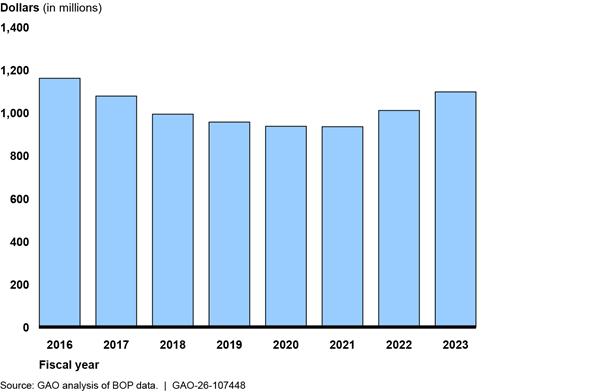
We estimated that BOP’s incarceration of noncitizens from fiscal year 2016 through fiscal year 2023 cost approximately $8 billion.[76] The cost for BOP to incarcerate noncitizens in fiscal year 2023 (estimated $1.1 billion) was approximately 6 percent less than fiscal year 2016 (estimated $1.16 billion), in nominal amounts.[77] However, as illustrated in figure 14, annual costs varied over that time, decreasing each year from fiscal years 2016 through 2021 before increasing in fiscal years 2022 and 2023.
Figure 14: Annual Estimated Cost for the Federal Bureau of Prisons (BOP) to Incarcerate Noncitizens, Fiscal Years 2016 Through 2023
Notes: Costs associated with BOP’s incarceration of noncitizens were estimated using the average of 12 monthly point-in-time “snapshots” of the number of noncitizens incarcerated in each type of BOP facility and BOP’s per capita cost of incarceration in each facility type. Costs do not include those associated with noncitizens who are unsentenced. Facility type refers to BOP’s categorization of facilities based on their security level and mission. Costs include those associated with noncitizens incarcerated in low, medium, high, and administrative maximum facilities, as well as detention centers, medical referral centers, residential re-entry centers, and privately operated institutions. Costs do not include those associated with noncitizens in home confinement, jail or short-term detention, long-term boarders, or independent camp settlings. On average, noncitizens incarcerated in these settings accounted for 0.15 percent or less of incarcerated noncitizens each year.
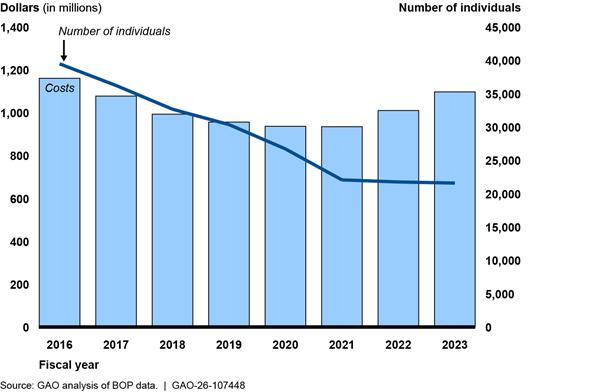
The year-to-year changes in estimated costs associated with BOP’s incarceration of noncitizens did not correspond directly with changes in the number of noncitizens BOP incarcerated. Specifically, the number of noncitizens incarcerated by BOP and the costs associated with incarcerating them both decreased from fiscal years 2016 through 2021. However, in fiscal years 2022 and 2023, the number of noncitizens incarcerated by BOP remained relatively the same while the estimated costs of incarcerating them increased (see fig. 15).
Figure 15: Estimated Cost for the Federal Bureau of Prisons (BOP) to Incarcerate Noncitizens and the Average Number of Noncitizens Incarcerated Each Year, Fiscal Years 2016 Through 2023
Notes: Costs associated with BOP’s incarceration of noncitizens were estimated using the average of 12 monthly point-in-time “snapshots” of the number of noncitizens incarcerated in each type of BOP facility and BOP’s per capita cost of incarceration in each facility type. Costs do not include those associated with noncitizens who are unsentenced. Facility type refers to BOP’s categorization of facilities based on their security level and mission. Costs include those associated with noncitizens incarcerated in low, medium, high, and administrative maximum facilities, as well as detention centers, medical referral centers, residential re-entry centers, and privately operated institutions. Costs do not include those associated with noncitizens in home confinement, jail or short-term detention, or long-term boarders. On average, noncitizens incarcerated in these settings accounted for 0.15 percent or less of incarcerated noncitizens each year.
BOP’s incarceration of noncitizens cost 17 percent more in fiscal year 2023 ($1.1 billion) than in fiscal year 2021 ($935 million), though the number of noncitizens incarcerated remained relatively the same. Adjusting for inflation and expressing the amounts in federal fiscal year 2025 dollars, BOP’s incarceration of noncitizens cost 5 percent more in fiscal year 2023 ($1.15 billion) than in fiscal year 2021 ($1.1 billion).[78]
We observed a potential factor that could have contributed to the increase in costs, but we did not identify all potential factors or assess their relative effects. Specifically, we noted that this time period coincided with the end of BOP’s contracts with privately-operated criminal detention facilities, which were its lowest cost facility type. BOP used privately-operated facilities to incarcerate certain low-security individuals—including noncitizens—according to BOP documentation. In each fiscal year from 2016 through 2021, between 52 and 59 percent of BOP-incarcerated noncitizens were held in privately-operated low security facilities, and between 11 and 17 percent were in BOP-operated low security facilities. Each of those years, incarcerating an individual in a privately-operated facility cost 22 percent to 35 percent less than incarcerating that individual in a BOP-operated low security facility. In January 2021, the administration directed the Attorney General not to renew contracts with privately operated criminal detention facilities.[79] In fiscal year 2023—the year BOP’s last privately operated facility contract ended—approximately half (48 percent) of BOP-incarcerated noncitizens were in BOP-operated low security facilities, a notable increase from the years prior to the executive order.
Reimbursements to States and Localities Through SCAAP Totaled $1.4 billion for Fiscal Years 2016 Through 2022
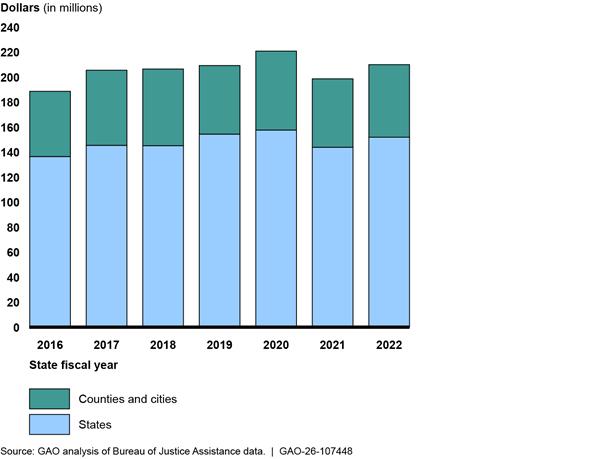
DOJ’s reimbursements to states and localities for incarcerating SCAAP-eligible noncitizens during state fiscal years 2016 through 2022 totaled approximately $1.44 billion.[80] Through SCAAP, DOJ reimburses participating states and localities for a portion of the correctional officer salary costs associated with incarcerating eligible noncitizens. Reimbursement amounts increased each year, from approximately $189 million for state fiscal year 2016 SCAAP-eligible incarcerations to approximately $221 million for state fiscal year 2020 SCAAP-eligible incarcerations, then decreased to approximately $199 million for state fiscal year 2021 incarcerations before increasing again to $210 million in for state fiscal year 2022 incarcerations, in nominal amounts (see fig. 16).[81] Each year, approximately 70 percent of SCAAP reimbursements went to state authorities. Most of the remaining funds went to counties and cities jurisdictions; U.S. territories received less than 1 percent of reimbursements each year.
Figure 16: State Criminal Alien Assistance Program (SCAAP) Reimbursements to States and Localities for Incarcerations Occurring from State Fiscal Years 2016 Through 2022
Notes: Through SCAAP, the federal government reimburses states and localities, including U.S. territories for a portion of the correctional officer salary costs they incur while incarcerating certain noncitizens. To be eligible for reimbursement, the incarcerated noncitizens must meet statutory and agency criteria. See 8 U.S.C. § 1231(i)(3).
SCAAP uses the typical state fiscal year (July 1 through June 30) to define the eligibility period for reimbursement and reimburses participating jurisdictions the following year. For the purposes of this work, costs are reported based on the time period when the incarcerations occurred.
The figure reflects reimbursements BJA made to participating states, counties, and cities. BJA also reimbursed U.S. territories for eligible costs each year during this time period. Reimbursements made to U.S. territories ranged from approximately $325,000 for eligible incarcerations in state fiscal year 2020 to approximately $1.8 million for eligible incarcerations in state fiscal year 2018.
Federal Reimbursements Through SCAAP Covered a Portion of State and Local Costs of Incarcerating Noncitizens
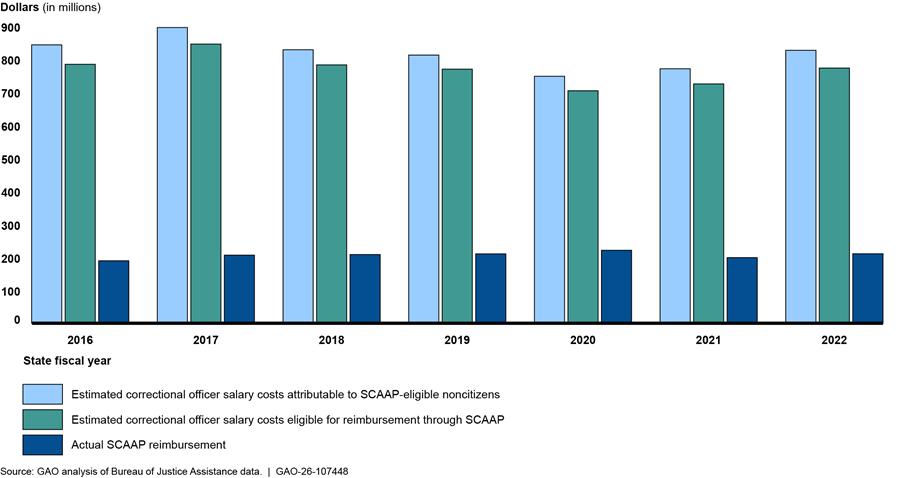
The state and local costs eligible for reimbursement through SCAAP for incarcerations during state fiscal years 2016 through 2022 far exceeded the amount congress appropriated for the program. We estimated that the states and localities that participated in SCAAP could attribute approximately $748 million to $895 million of correctional officer salary costs to the incarceration of noncitizens who met the criteria for the program (see fig. 17). Though most of those costs were eligible for reimbursement based on SCAAP’s reimbursement formula, the amounts far exceeded the program’s appropriations, which ranged from $210 million to $244 million each year.[82] As a result, the federal government reimbursed participating states and localities for 24 to 31 percent of their estimated reimbursement-eligible costs each year.
Figure 17: Estimated Annual Correctional Officer Salary Costs Attributable to State Criminal Alien Assistance Program (SCAAP)-Eligible Incarcerations and Reimbursement Amounts, State Fiscal Years 2016 Through 2022
Notes: Through SCAAP, the federal government reimburses states and localities, including U.S. territories for a portion of the correctional officer salary costs they incur while incarcerating certain noncitizens. To be eligible for reimbursement, the incarcerated noncitizens must meet statutory and agency criteria. See 8 U.S.C. § 1231(i)(3).
SCAAP uses the typical state fiscal year (July 1 through June 30) to define the eligibility period for reimbursement and reimburses participating jurisdictions the following year. For the purposes of this work, costs are reported based on the time period when the incarcerations occurred.
To estimate the correctional officer salary costs incurred by states and localities to incarcerate SCAAP-eligible noncitizens during state fiscal years 2016 through 2022, we used Bureau of Justice Assistance (BJA) data. Specifically, we divided the jurisdiction’s total reported correctional officer salary costs by total incarceration days to calculate the portion of correctional officer salary costs attributable to an individual each day of their incarceration. We then multiplied that by the number of days SCAAP-eligible noncitizens were incarcerated in that jurisdiction to calculate the correctional officer salary costs that were attributable to SCAAP-eligible noncitizens and summed across all participating jurisdictions. To estimate how much of those costs were eligible for reimbursement through SCAAP, we multiplied the daily per person cost of incarceration by the number of days attributable to SCAAP-eligible incarcerations, adjusting the amount by the reimbursement rate BJA applied to incarcerations categorized as “eligible-unknown” for that jurisdiction type. We then summed these estimates across all participating jurisdictions. Reimbursement amounts are actual amounts reported by BJA summed across all participating jurisdictions.
Correctional officer salaries represent a portion of the total costs states and localities incur when incarcerating noncitizens. Other costs include food service, medical care, and utilities, among others. We collected information about the daily cost of incarceration from the five state prison systems and five localities that incarcerated the greatest number of SCAAP-eligible noncitizens in fiscal year 2022. As previously noted, these five state prison systems were Arizona, California, Florida, New York, and Texas.[83] The five localities were Dallas County, TX; Harris County, TX; Hidalgo County, TX; Orange County, CA; and San Bernardino County, CA.[84]
Based on the average daily cost of incarceration and the number of SCAAP-eligible incarceration days in the jurisdiction, we estimated that the selected states collectively spent approximately $1.4 billion to incarcerate SCAAP-eligible noncitizens in state fiscal year 2022.[85] We estimated that approximately $400 million spent by these states was eligible for reimbursement through SCAAP, and they collectively received $109 million in reimbursement from the federal government. These reimbursements accounted for between 7 and 11 percent of the total cost of incarcerating SCAAP-eligible noncitizens in each state (see fig. 18).
Figure 18: Estimated Costs of Incarcerating State Criminal Alien Assistance Program (SCAAP)-Eligible Noncitizens and Reimbursement Amounts for Selected States, Fiscal Year 2022
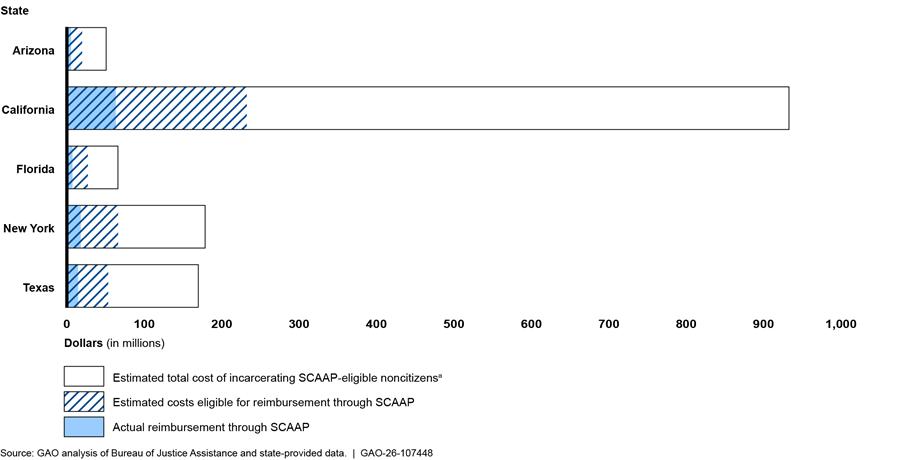
Notes: Through SCAAP, the federal government reimburses states, localities, and U.S. territories for a portion of the correctional officer salary costs they incur while incarcerating certain noncitizens. To be eligible for reimbursement, the incarcerated noncitizens must meet statutory and agency criteria. See 8 U.S.C. § 1231(i)(3).
SCAAP uses the typical state fiscal year (July 1 through June 30) to define the eligibility period for reimbursement and reimburses participating jurisdictions the following year. For the purposes of this work, costs are reported based on the time period when the incarcerations occurred.
To estimate total costs incurred by states to incarcerate SCAAP-eligible noncitizens during state fiscal years 2022, we used Bureau of Justice Assistance (BJA) and state-provided data. Specifically, we collected information from the respective states about the average per person daily cost of incarceration and multiplied it by the number of days SCAAP-eligible noncitizens were incarcerated in that jurisdiction. To estimate the correctional officer salary costs incurred by the state that were eligible for reimbursement, we divided the jurisdiction’s total reported correctional officer salary costs by total incarceration days to calculate the portion of correctional officer salary costs attributable to an individual each day of their incarceration. We multiplied the daily per person correctional officer salary costs by the number of days attributable to SCAAP-eligible incarcerations, adjusting the amount by the reimbursement rate BJA applied to incarcerations categorized as “eligible-unknown.” Reimbursement amounts are actual amounts reported by BJA.
aIncarceration costs for all selected states include the following: correctional officer salaries and wages, other correctional institution staff salaries and wages, utilities, food service, and medical care. Arizona, Florida, New York, and Texas costs also include the salaries and wages of non-institution corrections staff, such as headquarters or regional staff. California costs include those associated with educational and vocational programs that are connected to their institutions.
Using the same approach, we also estimated that the selected localities collectively spent approximately $111 million to incarcerate SCAAP-eligible noncitizens in state fiscal year 2022.[86] We estimated that almost $50 million spent by these localities was eligible for reimbursement through SCAAP and they collectively received $13 million in reimbursement from the federal government. These reimbursements accounted for between 7 and 17 percent of the total cost of incarcerating SCAAP-eligible noncitizens in each jurisdiction (see fig. 19).
Figure 19: Estimated Costs of Incarcerating State Criminal Alien Assistance Program (SCAAP)-Eligible Noncitizens and Reimbursement Amounts for Selected Localities, Fiscal Year 2022
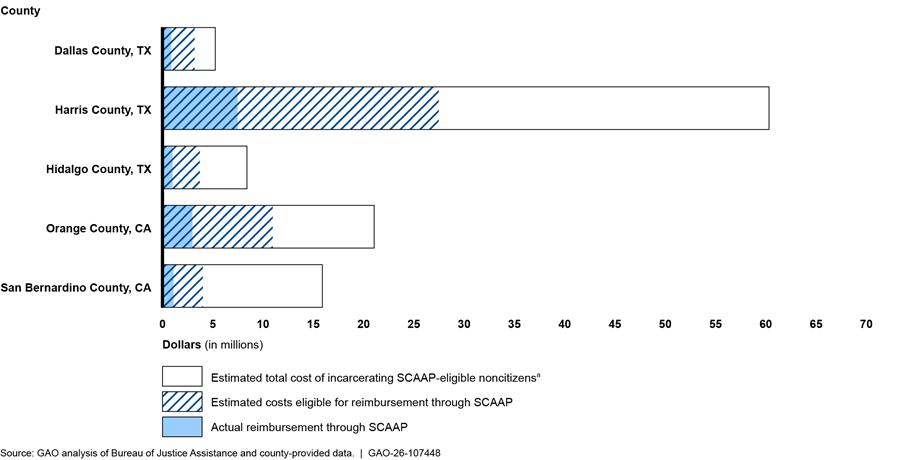
Notes: Through SCAAP, the federal government reimburses states and localities, including U.S. territories for a portion of the correctional officer salary costs they incur while incarcerating certain noncitizens. To be eligible for reimbursement, the incarcerated noncitizens must meet statutory and agency criteria. See 8 U.S.C. § 1231(i)(3).
SCAAP uses the typical state fiscal year (July 1 through June 30) to define the eligibility period for reimbursement and reimburses participating jurisdictions the following year. For the purposes of this work, costs are reported based on the time period when the incarcerations occurred.
To estimate total costs incurred by localities to incarcerate SCAAP-eligible noncitizens during state fiscal years 2022, we used Bureau of Justice Assistance (BJA) and county-provided data. Specifically, we collected information from the respective counties about the average per person daily cost of incarceration and multiplied it by the number of days SCAAP-eligible noncitizens were incarcerated in that jurisdiction. To estimate the correctional officer salary costs incurred by the counties that were eligible for reimbursement, we divided the jurisdiction’s total reported correctional officer salary costs by total incarceration days to calculate the portion of correctional officer salary costs attributable to an individual each day of their incarceration. We multiplied the daily per person correctional officer salary costs by the number of days attributable to SCAAP-eligible incarcerations, adjusting the amount by the reimbursement rate BJA applied to incarcerations categorized as “eligible-unknown.” Reimbursement amounts are actual amounts reported by BJA.
aIncarceration costs for all selected localities include correctional officer salaries and wages and food service. Dallas County, Harris County, Hidalgo County, and San Bernardino County also include medical care in incarceration costs. Dallas County, Orange County, and San Bernardino County include the costs of other correctional institution staff. Hidalgo County, Orange County, and San Bernardino County also include the cost of utilities. Orange County and San Bernardino County include the salaries and benefits of non-institution staff, such as headquarters or regional staff.
Agency Comments and Third Party Views
We provided a draft of this report to DHS, DOJ, and the Administrative Office of the U.S. Courts for review and comment. DHS and DOJ provided technical comments, which we incorporated as appropriate. The Administrative Office of the U.S. Courts did not have any comments on this report.
We also provided relevant portions of this report the Arizona Department of Corrections, Rehabilitation, and Reentry, the California Department of Corrections and Rehabilitation, the Florida Department of Corrections, the New York State Department of Corrections and Community Supervision, the Texas Department of Criminal Justice, Dallas County, the Harris County Sheriff’s Office, the Hidalgo County Sheriff’s Office, the Orange County Sheriff’s Department, and the San Bernardino County Sheriff’s Department. The New York State Department of Corrections and Community Supervision and the Texas Department of Criminal Justice provided technical comments, which we incorporated as appropriate. The other state and local entities did not have any comments on this report.
We are sending copies of this report to the appropriate congressional committees, the Attorney General, the Secretary of Homeland Security, the Director of the Administrative Office of the U.S. Courts, and other interested parties. In addition, the report will be available at no charge on the GAO website at https://www.gao.gov.
If you or your staff have any questions about this report, please contact me at GoodwinG@gao.gov. Contact points for our Offices of Congressional Relations and Media Relations may be found on the last page of this report. GAO staff who made key contributions to this report are listed in appendix V.
Gretta L. Goodwin
Director, Homeland Security and Justice
List of Requesters
The Honorable Pete Sessions
Chairman
Subcommittee on Government Operations
Committee on Oversight and Government Reform
House of Representatives
The Honorable Andy Biggs
House of Representatives
The Honorable Josh Brecheen
House of Representatives
The Honorable Michael Cloud
House of Representatives
The Honorable Dan Crenshaw
House of Representatives
The Honorable Monica De La Cruz
House of Representatives
The Honorable Jake Ellzey
House of Representatives
The Honorable Pat Fallon
House of Representatives
The Honorable Lance Gooden
House of Representatives
The Honorable Clay Higgins
House of Representatives
The Honorable Michael T. McCaul
House of Representatives
The Honorable Nathaniel Moran
House of Representatives
The Honorable Troy Nehls
House of Representatives
The Honorable Andrew Ogles
House of Representatives
The Honorable Mike Rogers
House of Representatives
The Honorable David Rouzer
House of Representatives
The Honorable Chip Roy
House of Representatives
The Honorable Keith Self
House of Representatives
The Honorable Tom Tiffany
House of Representatives
The Honorable Randy K. Weber, Sr.
House of Representatives
The Honorable Roger Williams
House of Representatives
This appendix provides additional details on our objectives, scope, and methodology. Specifically, our objectives were to provide information on:
· the number and citizenship of noncitizens incarcerated by the Department of Justice’s (DOJ) Federal Bureau of Prisons (BOP) during fiscal years 2017 through 2024 and the number and country of birth of noncitizens incarcerated by states and localities during fiscal years 2016 through 2022 whose incarcerations were eligible for reimbursement through the State Criminal Alien Assistance Program (SCAAP)—referred to throughout as “SCAAP-eligible noncitizens”;[87]
· the conviction and arrest histories of BOP-incarcerated noncitizens and SCAAP-eligible noncitizens;
· the potential removability of BOP-incarcerated noncitizens and what is known about the experiences of those released from incarceration during fiscal years 2017 through 2024; and
· the cost of incarcerating noncitizens in the U.S.
To address all our objectives, we analyzed data separately for noncitizens incarcerated by BOP and for SCAAP-eligible noncitizens incarcerated by states and localities. Noncitizens, in the context of this report, refers to all individuals who are not U.S. citizens or nationals, regardless of their immigration status. The time periods we analyzed for each group differed because of the availability of the respective data. We selected the start of each time period to provide an update since we last reported on these topics in 2018.[88] We selected the end of each time period to provide the most recent fiscal year data available as of the time we requested the data.
In general, our analysis of noncitizens incarcerated by BOP covered the time period from fiscal years 2017 through 2024 and used both point-in-time “snapshots” and individual-level data from BOP’s SENTRY Inmate Management System (SENTRY).[89] SENTRY data we used for this report did not include unsentenced individuals. SENTRY individual-level data included information about approximately 129,200 noncitizens who were incarcerated by BOP during fiscal years 2017 through 2024.[90]
Our analysis of SCAAP-eligible noncitizens covered the time period from state fiscal years 2016 through 2022 and used jurisdiction and individual-level data from DOJ’s Bureau of Justice Assistance (BJA).[91] We were not able to determine how many total unique SCAAP-eligible noncitizens were in the dataset because those data do not include sufficient identifiable information to determine if a SCAAP-eligible noncitizen was incarcerated more than once in the same fiscal year or in different jurisdictions. As a result, when reporting on these data for certain analyses, we refer to SCAAP-eligible incarcerations rather than SCAAP-eligible noncitizens. From SCAAP individual-level data, we were able to determine that approximately 269,600 records had a unique FBI number, which we used for certain analyses.[92]
Overall, our findings are not generalizable to incarcerated noncitizens not included in our study populations. Nevertheless, they do provide valuable insights. For example, we used SCAAP data because while there are no reliable comprehensive data on all noncitizens incarcerated by states and localities in the U.S., SCAAP provides reliable data on certain noncitizens incarcerated by states and localities.[93] Specifically, SCAAP provides reliable data on noncitizens who (1) meet the statutory definition for inclusion—that is, individuals who entered the U.S. without being inspected by immigration authorities, individuals who stayed in the U.S. after their visa had expired, or individuals who were the subject of exclusion or deportation proceedings at the time they were taken into custody by the state or locality; (2) have at least one felony or two misdemeanor convictions for violations of state or local law; and (3) were incarcerated for at least 4 consecutive days during the reporting period in a state or locality that applies for and receives reimbursement for costs of incarceration through the program.[94]
SCAAP data do not include (1) noncitizens incarcerated in states or localities that did not apply for and receive reimbursement for costs of incarceration; (2) incarcerated noncitizens with lawful immigration status who were not the subject of removal proceedings at the time they were taken into custody, and (3) noncitizens whose incarcerations did not meet the conviction or incarceration duration criteria for eligibility. As a result, information on SCAAP-eligible noncitizens represents only a portion of the total population of noncitizens incarcerated at the state and local level.
Number and Citizenship or Country of Birth of Incarcerated Noncitizens
To determine the number and citizenship of BOP-incarcerated noncitizens, we analyzed data from BOP’s SENTRY. Specifically, to calculate the number and proportion of noncitizens incarcerated by BOP at a given point in time during fiscal years 2017 through 2024, we averaged 12 monthly point-in-time snapshots of the number of noncitizens and the number of citizens incarcerated.[95] We also analyzed individual-level data to determine the number of unique noncitizens incarcerated by BOP during this time frame and their country of citizenship. BOP obtains country of citizenship data from presentence reports, which may be self-reported or based on documentation.[96]
To determine the number and country of birth of SCAAP-eligible incarcerations, we analyzed data from BJA’s SCAAP. Specifically, to estimate the number of SCAAP-eligible incarcerations by states and localities during state fiscal years 2016 through 2022, we analyzed SCAAP jurisdiction-level data. As previously noted, because we were not able to determine unique SCAAP-eligible noncitizens in these data, we report the number of SCAAP-eligible incarcerations and not the number of SCAAP-eligible noncitizens. We used the same data to describe the number of incarceration days attributable to SCAAP-eligible incarcerations. In addition, for the most recent year of available data—state fiscal year 2022—we analyzed SCAAP individual-level data to determine the country of birth for each SCAAP-eligible incarceration. Country of birth data are provided to DOJ by the states and localities that participate in SCAAP.[97]
Incarcerated Noncitizen Convictions
To determine the number and types of offenses for which incarcerated noncitizens were convicted and arrested, we analyzed various federal, state, and local data. To determine the offenses for which the approximately 129,200 noncitizens incarcerated by BOP were convicted and incarcerated, we analyzed individual-level data on convictions from BOP’s SENTRY database for all noncitizens incarcerated by BOP during fiscal years 2017 through 2024. Some of those individuals were incarcerated for a single offense, some were incarcerated for a single period of time for multiple offenses, and others were incarcerated for more than one period of time for one or more offenses. An individual convicted of more than one offense may serve a term of incarceration concurrently or consecutively for those offenses. According to BOP officials, for each individual it incarcerates, BOP records: (1) the offenses for which the individual is incarcerated that are not eligible for First Step Act of 2018 time credits, if any; (2) the offenses that BOP records per system requirements to track consecutive sentence obligations, if any, or Federal Bureau of Investigations (FBI)-requested information, if any; (3) the most serious offense for which the individual is incarcerated.[98] As a result, more than one offense may be associated with each individual.
For the purposes of this analysis, we counted all offenses tracked by BOP. Offenses include an attempt or conspiracy to commit the offense. Table 2 describes BOP’s categorization of offenses for which individuals were incarcerated by BOP.[99]
Table 2: Offense Categories for Analysis of Individuals Incarcerated by the Federal Bureau of Prisons
|
Offense category |
Category includes |
|
Burglary/larceny |
Burglary; violations of certain customs laws; racketeering; theft; theft of government property and funds; motor vehicle theft; robbery; Interstate Commerce Act violations; stalking; theft involving intellectual property. |
|
Continuing criminal enterprise |
Continuing criminal enterprise. |
|
Counterfeit/embezzlement |
Counterfeiting money, postage, and similar offenses; embezzlement; violations of anti-trust laws; violations of certain elections laws; violations of certain banking and insurances laws. |
|
Court/corrections |
Escaping; bail/bond jumping; criminal contempt; mutiny/riot in a federal penal facility; contraband in prison; perjury; obstructing justice. |
|
Drugs |
Simple possession of a controlled substance; manufacturing, distributing, or possessing with intent to manufacture or distribute a controlled substance; importing narcotics; obtaining a controlled substance by fraud; distribution to a minor; investment of illicit drug profits; maintaining drug-involved premises. |
|
Fraud/bribery/extortion |
Bribery; extortion; forgery; various types of fraud offenses, including tax fraud. |
|
Homicide/aggravated assault |
Homicide; death or injury caused by explosives; assault; assaulting a federal officer; kidnapping; threats against the President; terrorism; domestic violence; drive-by shooting; violence against maritime navigation and similar offenses; criminal street gangs. |
|
Immigration |
Illegal reentry; illegal entry; alien smuggling; impersonation; passport fraud. |
|
National security |
War crimes; espionage; sedition; treason; biological weapons; desertion; impersonating foreign diplomats, consuls, or officers. |
|
Robbery |
Robbery offenses, including bank robbery. |
|
Sex offenses |
Child sexual abuse; mailing obscene matter; sexual abuse; rape; prostitution; incest; failure to register as a sex offender; sexual abuse resulting in death; possession of child pornography. |
|
Weapons/explosives |
Carrying a deadly weapon; arson; participation in nuclear and weapons of mass destruction threats to the U.S.; engaging in the business of importing, manufacturing or dealing in explosives without a license and related offenses; firearms offenses. |
|
Miscellaneous |
Discharging pollution; destruction of energy facilities; liquor law violations; disorderly conduct; vagrancy; damage to religious property and similar offenses; violations of food and drug laws; violations of fishing and gaming laws. |
Source: GAO analysis of Federal Bureau of Prisons (BOP) data. | GAO‑26‑107448
Note: Offenses include an attempt or conspiracy to commit the respective offense. Categories in this table reflect the categories BOP assigns in BOP’s SENTRY database. Data collected and stored in the SENTRY system includes information relating to the care, classification, subsistence, protection, discipline, and programs of federally incarcerated individuals.
In addition, we analyzed aggregated data from the U.S. Sentencing Commission, an independent judicial branch agency responsible for, among other things, collection, preparation, and dissemination of information on sentences imposed across federal courts.[100] Specifically, for the approximately 174,900 noncitizens sentenced in federal court from fiscal years 2018 through 2024, we analyzed data on the most serious crime the individual was convicted of based on the sentencing guideline applied.[101] These noncitizens may have also been included in our analysis of noncitizens incarcerated by BOP if they were sentenced in federal court from fiscal years 2018 through 2024 and also incarcerated during these same fiscal years. We do not include data for fiscal year 2017 in this analysis because the U.S. Sentencing Commission implemented changes to its methodology for categorizing offenses starting in fiscal year 2018. As a result, fiscal year 2017 data are not comparable to later years. Table 3 describes the offense categories for federal convictions used by the U.S. Sentencing Commission.[102]
Table 3: Offense Categories for Analysis of Individuals Sentenced in Federal Court, as Reported by the U.S. Sentencing Commission
|
Offense category |
Category includes |
|
Administration of justice offenses |
Obstructing or impeding officers, contempt, obstruction of justice, perjury or subornation of perjury, bribery of a witness, impersonation, failure to appear by defendant, failure to appear by material witness, commission of offense while on release, payment of witness, and misprision of a felony. |
|
Antitrust |
Bid-rigging, price fixing, and market allocation agreement. |
|
Arson |
Property damage by explosives and use of fire or explosives to commit a federal felony. |
|
Assault |
Attempt to commit murder, assault with intent to murder, threatening communication, aggravated assault, minor assault, and conspiracy that includes assault with attempt to murder. |
|
Bribery/corruption |
Offenses involving public officials and violations of federal election campaign laws, bribe involving officials, bribery—bank loan/ commercial, loan or gratuity to bank examiner, etc., gratuity involving officials, bribe or gratuity affecting employee plan, conflict of interest, payment or receipt of unauthorized compensation, and making, receiving, or failing to report a contribution, donation, or expenditure in violation of the Federal Election Campaign Act. |
|
Burglary/trespass |
Burglary of a residence and burglary of a structure other than a residence, post office burglary, burglary of Drug Enforcement Administration premises (pharmacy), bank burglary, and trespass. |
|
Child sexual abuse materiala |
Receipt or possession of materials involving the sexual exploitation of minors. |
|
Commercialized Vice |
Gambling, animal fighting, and prostitution offenses. |
|
Drug Possession |
Simple possession of all drug types. |
|
Drug Trafficking |
Drug distribution/manufacture—conspiracy, continuing criminal enterprise, drug distribution—employee under 21, drug distribution near school, drug import/export, drug distribution to person under 21, establish/rent drug operation, endangering human life while manufacturing, and narco-terrorism. |
|
Environmental |
Waste discharge; specially protected fish, wildlife, and plants; recordkeeping, tampering, and falsification; tampering with a public water system; mishandling of environmental pollutants; and hazardous devices on federal lands. |
|
Extortion/racketeering |
Extortion by force, or threat of injury or serious damage, extortionate extension of credit, blackmail, Hobbs Act extortion, travel in aid of racketeering, crime relating to racketeering, and violent crimes in aid of racketeering, unlawful conduct relating to contraband cigarettes, and labor racketeering. |
|
Firearms |
Unlawful receipt/possession/transportation of firearms, ammunition, or explosive material; prohibited transactions involving firearms or ammunition; possession of guns/ explosives on aircraft; unlawful trafficking, etc., in explosives; possession of guns/ explosives in federal facility/schools; use of fire or explosives to commit felony; use of firearms or ammunition during crime; improper storage of explosive materials; and failure to report theft of explosive materials. |
|
Food and drug |
Tampering with risk of death or injury, providing false information or tampering with products, tampering to injure business, odometer laws and regulations, and violation of regulations involving food, drugs, etc. |
|
Forgery/counterfeiting/copyright |
Counterfeit bearer obligations and forgery/counterfeit (non-bearer obligations) as well as criminal infringement of copyright or trademark. |
|
Fraud/theft/embezzlement |
Fraud and deceit, embezzlement— property, embezzlement from labor unions, embezzlement—mail/post office, embezzlement from benefit plans, bank embezzlement, bank larceny, theft from benefit plans, other theft—mail/post office, receipt/possession of stolen property, theft from labor union, theft or damage to cultural heritage resources, insider trading, and aggravated identity theft. |
|
Immigration |
Trafficking in U.S. passports, trafficking in entry documents, failure to surrender naturalization certificate, fraudulently acquiring U.S. passports, smuggling, transporting, or harboring an unlawful alien, fraudulently acquiring entry documents, and unlawfully entering or remaining in the U.S. |
|
Individual rights |
Interference with rights under color of law; force or threats to deny benefits or rights; obstructing an election or registration; manufacture, etc.—eavesdropping device; other deprivations/discrimination; obstructing correspondence; peonage, servitude, and slave trade; intercept communication or eavesdropping; and conspiracy to deprive a person of civil rights. |
|
Kidnapping |
Hostage and ransom taking, abduction, unlawful restraint, and aircraft piracy. |
|
Manslaughter |
Both involuntary and voluntary manslaughter. |
|
Money laundering |
Laundering of monetary instruments, monetary transaction from unlawful activity, failure to file currency report, and failure to report monetary transactions. |
|
Murder |
First degree murder, second degree murder, and conspiracy or solicitation to commit murder. |
|
National defense |
Treason, sabotage, espionage, evasion of military service, prohibited financial transactions and exports, providing material support to designated foreign terrorist organizations, nuclear, biological, and chemical weapons, and weapons of mass destruction. |
|
Obscenity/other sex offenses |
Failure to register as a sex offender, recordkeeping offenses involving production of sexually explicit material, and importing, mailing, transporting, or broadcasting obscene material. |
|
Prison offenses |
Contraband in prisons, riots in federal facilities, and escape. |
|
Robbery |
Bank robbery, Hobbs Act robbery, post office robbery, other robbery, and carjacking. |
|
Sexual abuse |
Criminal sexual abuse, sexual abuse of a minor, sexual abuse of a ward, abusive sexual contact, transportation of minor for sex, sex trafficking of children, sex trafficking of adults by force, fraud or coercion, child sexual abuse material production, and child exploitation enterprises. |
|
Stalking/Harassing |
Threatening or harassing communications, hoaxes, false liens, stalking, and domestic violence. |
|
Tax |
Non-payment of taxes, conspiracy to avoid taxes, offenses relating to withholding statements, aiding or advising tax fraud, failing to collect or truthfully account for and pay over taxes, failing to deposit collected taxes in required accounts after notice, alcohol and tobacco tax offenses, and customs taxes. |
|
Other miscellaneous offenses |
Interference with a flight crew, unlawful sale, transportation, possession, manufacturing, or importation of drug paraphernalia, distributing, importing, or exporting listed chemicals, evading reporting or recordkeeping requirements involving chemicals, acquiring a controlled substance by fraud or forgery, border tunnels and subterranean passages, and all other felony and miscellaneous offenses not previously listed in any of the other categories or covered by specific guidelines. |
Source: U.S. Sentencing Commission. | GAO‑26‑107448
Note: U.S. Sentencing Commission offense categories reflect the categorization of offenses in the Commission’s Guidelines Manual, which prescribes guidelines specifying appropriate sentences based on, among other things, the nature of the offense. Categories include attempts or conspiracy to commit the respective offense.
a“Child sexual abuse material” refers to offenses related to trafficking in material involving the sexual exploitation of a minor; receiving, transporting, shipping, or advertising material involving the sexual exploitation of a minor; possessing material involving the sexual exploitation of a minor with intent to traffic; and possessing material involving the sexual exploitation of a minor. U.S. Sentencing Commission, Guidelines Manual, § 2G2.2. It does not include cases where offenders are convicted of producing material involving the sexual exploitation of a minor. See U.S. Sentencing Commission, Guidelines Manual, § 2G2.1.
To determine the types of offenses for which SCAAP-eligible noncitizens incarcerated by state prison systems were convicted, we analyzed state-provided data on the primary offense for which the individual was convicted from Arizona, California, Florida, New York, and Texas for state fiscal year 2022. Primary offense is the most serious offense of which the individual was convicted, as determined by each state. We selected these five state prison systems because they had the most SCAAP-incarcerations in state fiscal year 2022. Collectively, these five state prison systems accounted for 64 percent of SCAAP-incarcerations in state prison systems in state fiscal year 2022. They are also the same prison systems that we analyzed in our 2018 and 2011 reports on incarcerated noncitizens.[103] The information obtained from the selected state prison systems is not generalizable to all state prison systems but provides useful insights about why SCAAP-incarcerated noncitizens were incarcerated in those state prison systems in state fiscal year 2022.[104] Table 4 describes the primary offense categories we applied for state convictions.
|
Primary offense category |
Category includes |
|
Arson |
Arson, reckless burning, and possession of arson materials |
|
Assault |
Assault, battery, assault with a deadly weapon, endangerment, and threats |
|
Burglary |
Breaking and entering, burglary, and possession of burglary tools |
|
Disorderly conduct |
Disturbing the peace, fighting, intoxication, public nuisance, and disorderly conduct |
|
Drugs |
Use/under the influence, possession, possession with intent to distribute, sales, manufacturing, transporting, and possession of drug paraphernalia |
|
Fraud, forgery, and counterfeiting |
Deceptive practices or identification, fraud, giving false information, altering or forging documents, and counterfeiting or possession of counterfeit materials or tools |
|
Homicide |
Murder, manslaughter, and homicide |
|
Immigration |
Illegal entry, illegal reentry, false claim to U.S. citizenship, alien smuggling, and removal proceedings |
|
Kidnapping |
False imprisonment, kidnapping, and taking hostages |
|
Larceny/theft |
Grand and petty larceny and theft, shoplifting, embezzlement, and money laundering |
|
Motor vehicle theft |
Auto theft, carjacking, and taking a vehicle without consent |
|
Obstruction of justice |
Escaping, evading, being a fugitive of justice, failing to appear, failing to register as a sex offender, resisting arrest, and interfering with or obstructing an officer or justice proceedings |
|
Property damage |
Destruction of property, vandalism, and criminal or malicious mischief |
|
Robbery |
Armed robbery, robbery of a dwelling, robbery of a bank, and unarmed robbery |
|
Sex offenses |
Lewd and lascivious acts, rape, sexual assault, indecent exposure, prostitution, and molestation |
|
Stolen property |
Buying, selling, receiving, or possessing stolen property |
|
Terrorism |
Terrorism-related offenses |
|
Traffic violations |
Driving under the influence, hit and run, no proof of insurance, no driver’s license, and moving violations such as speeding and failure to stop |
|
Weapons violations |
Possession of a weapon, discharging a weapon, altering a weapon, and carrying a concealed weapon |
|
Miscellaneous |
Any other offense not listed above, offenses which could fit into multiple categories, and offenses which could not reliably be categorized |
Source: GAO. | GAO‑26‑107448
Note: Offenses include an attempt or conspiracy to commit the respective offense. We developed the criminal offense categories based on our prior work that used the FBI’s classification for offense codes as our guidance.
Incarcerated Noncitizens Arrest/Transfer History
In addition to our analysis of conviction information, we also analyzed information from FBI about incarcerated noncitizens’ interactions with law enforcement before, during, and after their incarceration. Specifically, we selected a random sample of 500 from among the approximately 129,500 noncitizens and individuals with unknown citizenship who had a valid FBI number and were incarcerated by BOP at some point from fiscal years 2017 through 2024.[105] We also selected a random sample of 500 noncitizens from the approximately 269,600 SCAAP-eligible noncitizens incarcerated by states and localities during fiscal years 2016 through 2022. We provided these FBI numbers to FBI to match records in its Next Generation Identification database. The Next Generation Identification database is owned and operated by FBI and provides an automated biometric identification and criminal history records reporting system to support law enforcement and criminal justice agencies, among others.[106] Some of the individuals selected for our sample had to be excluded for various reasons. For example, upon receipt of the records from FBI we compared the names associated with the selected FBI numbers in the FBI data and BOP data or SCAAP data. If we could not be sufficiently confident the FBI records referred to the same person identified in the BOP and SCAAP data, we excluded those records from the analysis. We also excluded records for individuals who did not have valid arrest information. As a result, we analyzed data for 413 noncitizens incarcerated by BOP from fiscal years 2017 through 2024 and our analysis is applicable to the estimated approximately 106,800 incarcerated noncitizens defined as our federal study population. For the same reasons, we analyzed 405 SCAAP-eligible noncitizens incarcerated by states or localities from state fiscal year 2016 through 2022 and our analysis is applicable to the 218,400 SCAAP-incarcerated noncitizens defined as our SCAAP study population.
While the samples we selected for our analyses allowed us to estimate and provide valuable insights about these study populations, our analyses are not generalizable to incarcerated noncitizens outside of these groups. For example, our analyses may not accurately reflect noncitizens incarcerated by states or localities that do not participate in SCAAP.
We used these data to estimate the number and types of offenses for which noncitizens incarcerated by BOP and SCAAP-eligible noncitizens incarcerated by states and localities were arrested/transferred. The format of the data did not allow us to distinguish a new arrest from a transfer between one law enforcement agency and another. For example, an individual may be arrested by one agency or jurisdiction where they are fingerprinted and then transferred to the custody of another agency or jurisdiction that fingerprints them again on the same day. If both entities submit those fingerprints to FBI, each would be recorded separately. As a result, for the purposes of this report, we refer to these actions as an “arrest/transfer.”
In addition, some agencies or jurisdictions may not consider all offenses for which a person is in custody to be part of the same “arrest” and will make more than one submission to FBI for the individual on the same day, each of which is recorded separately. For our analysis, multiple submissions from the same agency or jurisdiction on the same day for the same offense would be counted as one arrest/transfer. We analyzed FBI records for both samples to estimate the following: (1) number of arrests/transfers and (2) number and types of offenses associated with those arrests/transfers.[107]
Because law enforcement agencies send arrest information to the FBI on a voluntary basis, FBI data on arrest history may not include all arrests. In June 2026, the FBI reported that approximately 25,000 local, state, tribal, federal, and international partners submitted criminal and/or civil electronic submissions to the Next Generation Identification database.
The incarcerated noncitizens in our federal sample had arrests/transfers that ranged from 1975 through 2025; the incarcerated noncitizens in our SCAAP sample had arrests/transfers that ranged from 1972 through 2025.[108] We categorized our sample noncitizens’ arrest offenses—which includes attempts or conspiracies to commit each of the respective offenses—as shown in table 5.
Table 5: Offense Categories for Analysis of Federal Bureau of Investigations (FBI) Arrest/Transfer Data
|
Offense category |
Category includes |
|
Arson |
Arson, reckless burning, and possession of arson materials |
|
Assault |
Assault, battery, assault with a deadly weapon, endangerment, and threats (including terrorizing, terroristic threats, or threatening to commit a crime not relating to public officials or official duties) |
|
Burglary |
Breaking and entering, burglary, and possession of burglary tools |
|
Disorderly Conduct |
Disturbing the peace, fighting, intoxication, public nuisance, and disorderly conduct |
|
Drugs |
Use/under the influence, possession, possession with intent to distribute, sales, manufacturing, transporting, and possession of drug paraphernalia |
|
Fraud, forgery, and counterfeiting |
Deceptive practices or identification, fraud, giving false information, altering or forging documents, and counterfeiting or possession of counterfeit materials or tools |
|
Homicide |
Murder, manslaughter, and homicide |
|
Immigration |
Illegal entry, illegal reentry, false claim to U.S. citizenship, alien smuggling, and removal proceedings |
|
Kidnapping |
False imprisonment, kidnapping, and taking hostages |
|
Larceny/theft |
Grand and petty larceny and theft, shoplifting, embezzlement, and money laundering |
|
Motor vehicle theft |
Auto theft, carjacking, and taking a vehicle without consent |
|
Obstruction of justice |
Escaping, evading, being a fugitive of justice, failing to appear, failing to register as a sex offender, resisting arrest, violating terms of supervised release or parole, and interfering with or obstructing an officer or justice proceedings (such as violating a court order, or intimidating a witness) |
|
Property damage |
Destruction of property, vandalism, and criminal or malicious mischief |
|
Robbery |
Armed robbery, robbery of a dwelling, robbery of a bank, and unarmed robbery |
|
Sex offenses |
Lewd and lascivious acts, rape, sexual assault, indecent exposure, prostitution, and molestation |
|
Stolen property |
Buying, selling, receiving, or possessing stolen property |
|
Terrorism |
Terrorism-related offenses |
|
Traffic violations |
Driving under the influence, hit and run, no proof of insurance, no driver’s license, and moving violations such as speeding and failure to stop |
|
Weapons violations |
Possession of a weapon, discharging a weapon, altering a weapon, manufacturing a weapon, brandishing/flourishing a weapon, and carrying a concealed weapon |
|
Miscellaneous |
Any other offense not listed above, offenses which could fit into multiple categories, and offenses which could not reliably be categorized. These may include trespassing, gang participation, child cruelty, alcohol-related offenses (excluding intoxication and traffic violations which are accounted for elsewhere), warrants where underlying offenses are not specified, as well as offenses for which not enough information were available (i.e., “arrest by a law enforcement officer”) |
Source: GAO. | GAO‑26‑107448
Note: Offenses include an attempt or conspiracy to commit the respective offense. We developed the offense categories based on our prior work that used the FBI’s classification for offense codes as guidance. The FBI categorizes offenses for use in the Uniform Crime Reporting program. Through the program, the FBI provides national and state level crime data for use in law enforcement work. See GAO‑18‑433.
Each estimate we report regarding incarcerated noncitizen arrests/transfers and offenses has a measurable margin of error due to sampling. For this report, the margins of error are calculated based on a 95 percent confidence level.[109] All percentage estimates presented in this report for these analyses have a margin of error of less than plus or minus 7 percentage points. All estimates of the number of arrests/transfers or offenses have a relative error of plus or minus 15 percent of the estimate or less. The 7 percentage point margin of error and 15 percent relative error represent upper bounds for the estimates included in this report.
Incarcerated Noncitizen Potential Removability from the U.S. and Experiences of Noncitizens After Incarceration in Federal Prison
To determine what is known about the potential removability from the U.S. of noncitizens incarcerated by BOP and the experiences of noncitizens after their incarceration, we analyzed data from BOP, U.S. Immigration and Customs Enforcement (ICE), and U.S. Citizenship and Immigration Services (USCIS).
Specifically, to analyze the potential removability from the U.S. of noncitizens at the time they were incarcerated by BOP, we matched BOP SENTRY data on noncitizens who were incarcerated during fiscal years 2017 through 2024 with data from ICE’s Alien Criminal Response Information Management System (ACRIMe). ICE analysts use ACRIMe to provide an indication of an individual’s identity and potential removability to law enforcement partners. We used FBI numbers or alien numbers as unique identifiers to match these data.[110] We then verified that the matches were reasonable by comparing names and dates of birth of those individuals who matched using the unique identifiers. To determine each incarcerated noncitizen’s potential removability from the U.S. at the time they entered federal prison, we identified the ACRIMe record for each noncitizen, as available, that was created closest to the date the noncitizen started their period of incarceration and used this record for our analysis. We restricted our analysis to those ACRIMe records that were generated within 60 days of the date the noncitizen started their period of incarceration because a noncitizen’s removability from the U.S. can change over time, including while the individual is incarcerated.
To determine what is known about the experience of noncitizens after their incarceration by BOP, we matched data from those noncitizens who completed a term of federal incarceration during fiscal years 2017 through 2024 with ICE, USCIS, and SCAAP data. We used this information to determine if these noncitizens were subsequently removed from the U.S., reincarcerated, and/or received naturalized citizenship. We compared each noncitizen’s federal incarceration completion date with the dates of subsequent encounters with the federal government and/or any law enforcement agencies participating in SCAAP to determine if those encounters took place after the individual’s completion of their term of incarceration. Specifically, we matched FBI and/or alien numbers, as available, of noncitizens who completed a term of incarceration by BOP during fiscal years 2017 through 2024 with:
· DHS Enforcement Integrated Database data from October 2016 through December 2025 to determine if the noncitizen was removed by ICE after completion of their term of incarceration;[111]
· BOP SENTRY data from fiscal years 2017 through 2024 to determine if a noncitizen was reincarcerated by BOP after completion of their term of incarceration;
· BJA SCAAP data from state fiscal years 2016 through 2022, to determine if a SCAAP-eligible noncitizen was subsequently incarcerated in a state prison or local jail system participating in SCAAP after completion of their term of incarceration; and
· USCIS Central Index System data from October 2016 through December 2025 to determine if a noncitizen received naturalized citizenship after completion of their term of incarceration.[112]
Costs of Incarcerating Noncitizens in the U.S.
To determine the costs associated with incarcerating noncitizens in the U.S., we calculated:
· the costs of BOP’s incarceration of noncitizens from fiscal years 2016 through 2023;
· the costs of reimbursing states and localities for incarcerating SCAAP-eligible; noncitizens during state fiscal years 2016 through 2022;[113]
· the correctional officer salary costs incurred by states and localities to incarcerate SCAAP-eligible noncitizens during state fiscal years 2016 through 2022;
· the total cost of incarcerating SCAAP-eligible noncitizens in selected states and localities during state fiscal year 2022.
To calculate the costs of BOP’s incarceration of noncitizens from fiscal year 2016 through 2023, we used data from BOP’s SENTRY and information on the annual per person cost of incarcerating an individual in various types of BOP facility. Specifically, for each fiscal year, we calculated the average of 12 monthly point-in-time “snapshots” of the number of noncitizens incarcerated in each type of BOP institution.[114] We then multiplied the number of noncitizens incarcerated in that facility type by the annual per person cost of incarcerating an individual in that facility type, as reported by BOP in its Federal Prison System Per Capita Cost summaries.[115] Finally, we summed those figures to estimate annual costs across all facility types. We selected the start of the time frame for this analysis to provide an update since our previous report in this body of work.[116] We selected the end of the time frame to provide the most recent fiscal year cost information available as of December 2024, when we requested the data.
To calculate the costs of reimbursing states and localities for incarcerating SCAAP-eligible noncitizens during state fiscal years 2016 through 2022, we used jurisdiction-level data from BJA. Specifically, we used data on award amounts made through SCAAP to calculate reimbursements by fiscal year and type of jurisdiction—that is, state, county, city, or U.S. territory. We selected the start of the time frame for this analysis to provide an update since our previous report in this body of work.[117] We selected the end of the time frame to provide the most recent information available as of the time we requested the data.
To calculate the correctional officer salary costs incurred by states and localities to incarcerate SCAAP-eligible noncitizens during state fiscal years 2016 through 2022, we used jurisdiction-level data from BJA. Specifically, for each fiscal year, we used data on total correctional officer salary costs and total incarceration days in each jurisdiction to calculate the portion of correctional officer salary costs attributable to an individual each day of their incarceration. We then multiplied that by the number of days SCAAP-eligible noncitizens were incarcerated in that jurisdiction to calculate the correctional officer salary costs that were attributable to SCAAP-eligible noncitizens. Finally, we summed those figures to calculate the total correctional officer salary costs incurred by states and localities to incarcerate SCAAP-eligible noncitizens. We selected the start of the time frame for this analysis to provide an update since our previous report in this body of work.[118] We selected the end of the time frame to provide the most recent information available as of the time we requested the data.
For the analysis of the total cost of incarcerating SCAAP-eligible noncitizens in selected states and localities during state fiscal year 2022, we used data from BJA, and information collected directly from the selected states and localities. For this analysis, we selected the five state prison systems and five localities that incarcerated the greatest number of SCAAP-eligible noncitizens during state fiscal year 2022. The selected states—Arizona, California, Florida, New York, and Texas—were the states selected using the same criteria in our 2018, 2011, and 2005 reports.[119] The selected state prison systems collectively accounted for 64 percent of all SCAAP-eligible incarcerations by state prison systems in state fiscal year 2022. The five selected localities were Dallas County, TX; Harris County, TX; Hidalgo County, TX; Orange County, CA; and San Bernardino County, CA. Two of these five—Harris County, TX and Orange County, CA—were the localities selected using the same criteria in our 2018, 2011, and 2005 reports. The remaining three localities were new to this year’s analysis.[120] The selected localities collectively accounted for 20 percent of all SCAAP-eligible incarcerations by city and county authorities in state fiscal year 2022.
To estimate the cost of incarcerating SCAAP-eligible in these states and localities, we used information provided by the respective state or locality about the average per person daily cost of incarceration and multiplied it by the number of days SCAAP-eligible noncitizens were incarcerated in that jurisdiction.[121] While our analysis provides insights into the costs associated with incarcerating SCAAP-eligible noncitizens in these states and localities during state fiscal year 2022, the results of this analysis are not generalizable to other states and localities. Also, given that these estimated costs are based on average daily cost for the total incarcerated population in the jurisdiction, they may not represent actual costs if expenditures on the incarcerated noncitizen population differ from the average daily costs.
In addition, states and localities differed in what they included in calculating the cost of incarceration in their respective jurisdiction. For example, all selected states included correctional officer salaries and wages, other correctional institution staff salaries and wages, utilities, food service, and medical care. Arizona, Florida, New York, and Texas also included the salaries and wages of non-institution corrections staff, such as headquarters or regional staff. California included costs associated with educational and vocational programs that are connected to their institutions. All selected localities included correctional officer salaries and wages and food service. Dallas County, Harris County, Hidalgo County, and San Bernardino County also included medical care in incarceration costs. Dallas County, Orange County, and San Bernardino County included the costs of other correctional institution staff. Hidalgo County, Orange County and San Bernardino County also included the cost of utilities. Orange County and San Bernardino County included the salaries and benefits of non-institution staff, such as headquarters or regional staff.
This appendix provides additional details on noncitizens and U.S. citizens sentenced in federal court from fiscal year 2018 through 2024 based on U.S. Sentencing Commission data.[122] For approximately 76 percent of the 174,910 noncitizens sentenced during those years, their most serious offense was immigration-related, as shown in figure 20. For approximately 14 percent, their most serious offense was drug trafficking. These noncitizens may also be represented in our other analyses if they were also incarcerated by the Federal Bureau of Prisons (BOP) during fiscal years 2017 through 2024.
Figure 20: Noncitizens Sentenced in Federal Court by Offense Category, Fiscal Years 2018 Through 2024
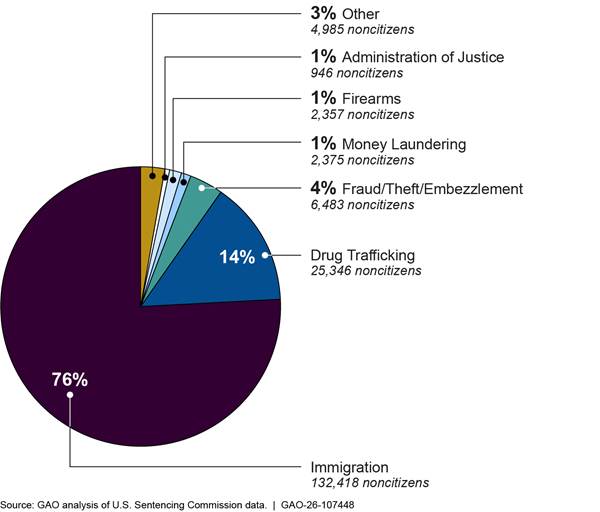
Note: Numbers include noncitizens sentenced in federal court for a felony or class A misdemeanor offense. Felonies are a sentencing classification of offenses which, under federal law, have a maximum term of imprisonment of at least more than 1 year. Class A misdemeanors are a sentencing classification of offenses which, under federal law, have a maximum term of imprisonment of more than 6 months but no more than 1 year. 18 U.S.C. § 3559(a). If an individual was sentenced for a felony or class A misdemeanor offense more than once during this time period, each offense would be included in the data. As such, there could be more than one offense of the same type or of different type per unique noncitizen. Numbers do not sum to 100 due to rounding. “Other” includes assault, bribery/corruption, burglary/trespass, child sexual abuse material, environmental, kidnapping, murder, national defense, robbery, sexual abuse, tax, and other miscellaneous offenses.
Approximately 121,500 of the 132,400 noncitizens sentenced in federal court during fiscal years 2018 through 2024 for an immigration-related offense were sentenced for either (1) unlawfully entering or remaining in the U.S.; (2) smuggling, transporting, or harboring certain noncitizens; (3) immigration fraud (personal use); or (4) immigration fraud (trafficking).[123] Among the approximately 121,500 noncitizens sentenced for these offense types, 90 percent were sentenced for unlawfully entering or remaining in the U.S., as shown in figure 21.[124]
Figure 21: Selected Immigration Offenses for Which Noncitizens Were Sentenced in Federal Court from Fiscal Years 2018 Through 2024
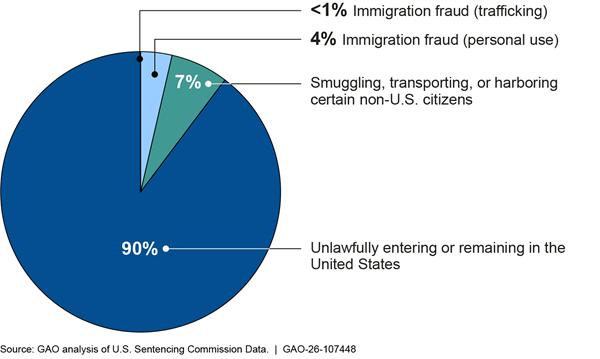
Note: U.S. Sentencing Commission assigns an offense category for each individual sentenced in federal court based on the most serious offense for which they were convicted based on the sentencing guideline applied. These selected immigration offenses accounted for 92 percent of all immigration offenses for which noncitizens were convicted in federal court and sentenced from fiscal years 2018 through 2024.
From fiscal years 2018 through 2024, noncitizens made up between approximately 3 and 87 percent all individuals—U.S. citizens and noncitizens—for whom that offense category was their most serious offense, based upon U.S. Sentencing Commission data, as shown in table 6.
Table 6: Offense Categories for Individuals Sentenced in Federal Court by Citizenship, Fiscal Years 2018 Through 2024
|
Offense Category |
Total, all convictions |
Total, U.S. citizen |
Percentage of all convictions that were for U.S. citizens |
Total, noncitizens |
Percentage of all convictions that were for noncitizens |
|
Immigration |
152,015 |
19,597 |
13 |
132,418 |
87 |
|
Drug trafficking |
129,534 |
104,188 |
80 |
25,346 |
20 |
|
Firearms |
57,914 |
55,557 |
96 |
2,357 |
4 |
|
Fraud/theft/embezzlement |
38,126 |
31,643 |
83 |
6,483 |
17 |
|
Robbery |
10,422 |
10,034 |
96 |
388 |
4 |
|
Child sexual abuse materiala |
9,237 |
8,933 |
97 |
304 |
3 |
|
Sexual abuse |
8,495 |
8,097 |
95 |
398 |
5 |
|
Money laundering |
8,160 |
5,785 |
71 |
2,375 |
29 |
|
Assault |
5,299 |
4,993 |
94 |
306 |
6 |
|
Other miscellaneous offenses |
4,752 |
4,101 |
86 |
651 |
14 |
|
Administration of justice |
4,403 |
3,457 |
79 |
946 |
21 |
|
Prison offenses |
3,507 |
3,371 |
96 |
136 |
4 |
|
Tax |
3,293 |
3,055 |
93 |
238 |
7 |
|
Murder |
2,660 |
2,266 |
85 |
394 |
15 |
|
Obscenity/other sex offenses |
2,397 |
2,320 |
97 |
77 |
3 |
|
Drug possession |
2,375 |
1,713 |
72 |
662 |
28 |
|
Bribery/corruption |
2,231 |
2,065 |
93 |
166 |
7 |
|
Stalking/harassing |
1,632 |
1,590 |
97 |
42 |
3 |
|
National defense |
1,412 |
933 |
66 |
479 |
34 |
|
Forgery/counter/copyright |
1,227 |
1,125 |
92 |
102 |
8 |
|
Environmental |
1,071 |
912 |
85 |
159 |
15 |
|
Extortion/racketeering |
1,063 |
895 |
84 |
168 |
16 |
|
Kidnapping |
786 |
692 |
88 |
94 |
12 |
|
Commercialized vice |
625 |
549 |
88 |
76 |
12 |
|
Individual rights |
602 |
533 |
89 |
69 |
11 |
|
Arson |
545 |
528 |
97 |
17 |
3 |
|
Manslaughter |
506 |
494 |
98 |
12 |
2 |
|
Burglary/trespass |
496 |
469 |
95 |
27 |
5 |
|
Food and drug |
296 |
284 |
96 |
12 |
4 |
|
Antitrust |
124 |
116 |
94 |
8 |
6 |
|
Total |
455,205 |
280,295 |
n/a |
174,910 |
n/a |
Source: GAO analysis of U.S. Sentencing Commission Data. | GAO‑26‑107448
Notes: U.S. Sentencing Commission assigns an offense category for each individual sentenced in federal court based on the most serious offense for which they were convicted based on the sentencing guideline applied. Data include felony and Class A misdemeanor cases for offenders who are convicted and sentenced in the federal court system. Felonies are a sentencing classification of offenses which, under federal law, have a maximum term of imprisonment of at least more than 1 year. Class A misdemeanors are a sentencing classification of offenses which, under federal law, have a maximum term of imprisonment of more than 6 months but no more than 1 year. 18 U.S.C. § 3559(a).
These data do not include state cases, federal petty offenses, federal cases which result in all charges being dismissed or acquitted, federal death penalty cases, or federal juvenile cases. They also do not include information about individuals who (1) were convicted but sentences were not yet issued and (2) sentenced but for whom no sentencing documents were submitted to the U.S. Sentencing Commission. The U.S. Sentencing Commission excluded cases that did not have information on offender’s citizenship status. These accounted for less than 1 percent of cases each year from fiscal years 2018 through 2024. Information on the individual’s citizenship is obtained from their presentence report.
Offense categories include attempts, conspiracies, and intents to commit crimes. For example, the U.S. Sentencing Commission’s offense category of assault includes attempt to commit murder and assault with intent to murder; while the murder offense category includes a conspiracy or solicitation to commit murder. See appendix I for a complete description of each of the offense categories.
a“Child sexual abuse material” refers to offenses related to trafficking in material involving the sexual exploitation of a minor; receiving, transporting, shipping, or advertising material involving the sexual exploitation of a minor; possessing material involving the sexual exploitation of a minor with intent to traffic; and possessing material involving the sexual exploitation of a minor. U.S. Sentencing Commission, Guidelines Manual, § 2G2.2. It does not include cases where offenders are convicted of producing material involving the sexual exploitation of a minor. See U.S. Sentencing Commission, Guidelines Manual, § 2G2.1.
Table 7 details the offense categories for which U.S. citizens and noncitizens were convicted and sentenced in each fiscal year from 2018 through 2024.
Table 7: Most Serious Offense Committed by Individuals Sentenced in Federal Court by Citizenship and Fiscal Year, Fiscal Years 2018 Through 2024
|
|
2018 |
2019 |
2020 |
2021 |
2022 |
2023 |
2024 |
7-Year Change, percent |
|
U.S. Citizens |
||||||||
|
Offense category |
||||||||
|
Immigration |
2,033 |
2,563 |
2,604 |
2,776 |
3,146 |
3,495 |
2,980 |
47 |
|
Drug trafficking |
14,146 |
15,602 |
13,088 |
14,554 |
16,721 |
15,562 |
14,515 |
3 |
|
Firearms |
7,129 |
8,083 |
7,216 |
7,839 |
9,006 |
8,497 |
7,787 |
9 |
|
Fraud/theft/embezzlement |
5,372 |
5,116 |
3,721 |
3,800 |
4,645 |
4,420 |
4,569 |
-15 |
|
Robbery |
1,655 |
1,761 |
1,269 |
1,253 |
1,383 |
1,444 |
1,269 |
-23 |
|
Child sexual abuse materiala |
1,386 |
1,317 |
991 |
1,181 |
1,399 |
1,353 |
1,306 |
-6 |
|
Sexual abuse |
1,022 |
1,104 |
839 |
1,014 |
1,422 |
1,342 |
1,354 |
32 |
|
Money laundering |
944 |
824 |
599 |
719 |
874 |
918 |
907 |
-4 |
|
Assault |
629 |
725 |
569 |
626 |
793 |
797 |
854 |
36 |
|
Other miscellaneous Offenses |
668 |
708 |
457 |
522 |
540 |
569 |
637 |
-5 |
|
Administration of justice |
559 |
523 |
421 |
422 |
523 |
493 |
516 |
-8 |
|
Prison offenses |
536 |
590 |
419 |
508 |
478 |
419 |
421 |
-21 |
|
Tax |
535 |
504 |
339 |
403 |
448 |
415 |
411 |
-23 |
|
Murder |
260 |
312 |
252 |
225 |
344 |
416 |
457 |
76 |
|
Obscenity/other sex offenses |
370 |
375 |
308 |
290 |
331 |
318 |
328 |
-11 |
|
Drug possession |
361 |
368 |
269 |
255 |
247 |
119 |
94 |
-74 |
|
Bribery/corruption |
296 |
311 |
220 |
233 |
335 |
337 |
333 |
13 |
|
Stalking/harassing |
207 |
220 |
216 |
212 |
258 |
234 |
243 |
17 |
|
National defense |
140 |
123 |
88 |
131 |
126 |
168 |
157 |
12 |
|
Forgery/counter/copyright |
273 |
250 |
181 |
123 |
105 |
108 |
85 |
-69 |
|
Environmental |
176 |
135 |
109 |
153 |
131 |
112 |
96 |
-45 |
|
Extortion/racketeering |
246 |
150 |
101 |
95 |
103 |
111 |
89 |
-64 |
|
Kidnapping |
89 |
89 |
61 |
81 |
115 |
133 |
124 |
39 |
|
Commercialized vice |
126 |
78 |
51 |
94 |
61 |
74 |
65 |
-48 |
|
Individual rights |
60 |
47 |
67 |
51 |
88 |
103 |
117 |
95 |
|
Arson |
53 |
65 |
47 |
79 |
101 |
102 |
81 |
53 |
|
Manslaughter |
59 |
72 |
38 |
56 |
75 |
84 |
110 |
86 |
|
Burglary/trespass |
37 |
57 |
37 |
60 |
104 |
83 |
91 |
146 |
|
Food and drug |
40 |
46 |
31 |
44 |
38 |
51 |
34 |
-15 |
|
Antitrust |
51 |
18 |
8 |
6 |
7 |
18 |
8 |
-84 |
|
Total U.S. citizens |
39,458 |
42,136 |
34,616 |
37,805 |
43,947 |
42,295 |
40,038 |
1 |
|
|
||||||||
|
Noncitizens |
||||||||
|
Offense category |
||||||||
|
Immigration |
21,835 |
26,775 |
23,945 |
14,160 |
14,501 |
15,711 |
15,491 |
-29 |
|
Drug trafficking |
4,588 |
4,198 |
3,284 |
3,045 |
3,199 |
3,429 |
3,603 |
-21 |
|
Firearms |
379 |
394 |
316 |
308 |
306 |
321 |
333 |
-12 |
|
Fraud/theft/embezzlement |
1,172 |
1,212 |
1,068 |
724 |
844 |
745 |
718 |
-39 |
|
Robbery |
64 |
64 |
46 |
45 |
60 |
57 |
52 |
-19 |
|
Child sexual abuse materiala |
30 |
51 |
32 |
34 |
35 |
54 |
68 |
127 |
|
Sexual abuse |
45 |
61 |
42 |
48 |
76 |
52 |
74 |
64 |
|
Money laundering |
352 |
348 |
278 |
308 |
317 |
393 |
379 |
8 |
|
Assault |
56 |
46 |
39 |
30 |
49 |
46 |
40 |
-29 |
|
Other miscellaneous offenses |
57 |
128 |
79 |
48 |
67 |
205 |
67 |
18 |
|
Administration of justice |
164 |
171 |
115 |
87 |
125 |
146 |
138 |
-16 |
|
Prison offenses |
21 |
24 |
24 |
21 |
8 |
23 |
15 |
-29 |
|
Tax |
42 |
43 |
27 |
18 |
48 |
31 |
29 |
-31 |
|
Murder |
57 |
61 |
42 |
32 |
63 |
73 |
66 |
16 |
|
Obscenity/other sex offenses |
14 |
18 |
8 |
7 |
12 |
8 |
10 |
-29 |
|
Drug possession |
339 |
139 |
144 |
11 |
15 |
8 |
6 |
-98 |
|
Bribery/corruption |
20 |
30 |
20 |
13 |
25 |
29 |
29 |
45 |
|
Stalking/harassing |
6 |
3 |
8 |
6 |
6 |
4 |
9 |
50 |
|
National defense |
61 |
70 |
77 |
83 |
52 |
67 |
69 |
13 |
|
Forgery/counter/copyright |
25 |
26 |
17 |
14 |
6 |
4 |
10 |
-60 |
|
Environmental |
19 |
25 |
21 |
14 |
18 |
33 |
29 |
53 |
|
Extortion/racketeering |
42 |
35 |
19 |
21 |
14 |
18 |
19 |
-55 |
|
Kidnapping |
17 |
7 |
5 |
11 |
13 |
18 |
23 |
35 |
|
Commercialized vice |
20 |
11 |
2 |
14 |
12 |
10 |
7 |
-65 |
|
Individual rights |
7 |
20 |
3 |
17 |
4 |
10 |
8 |
14 |
|
Arson |
2 |
2 |
1 |
0 |
5 |
4 |
3 |
50 |
|
Manslaughter |
2 |
2 |
0 |
0 |
5 |
2 |
1 |
-50 |
|
Burglary/trespass |
4 |
6 |
2 |
1 |
7 |
0 |
7 |
75 |
|
Food and drug |
3 |
2 |
1 |
1 |
1 |
3 |
1 |
-67 |
|
Antitrust |
2 |
2 |
3 |
0 |
1 |
0 |
0 |
-100 |
|
Total noncitizens |
29,445 |
33,974 |
29,668 |
19,121 |
19,894 |
21,504 |
21,304 |
-28 |
Source: GAO analysis of U.S. Sentencing Commission Data. | GAO‑26‑107448
Notes: U.S. Sentencing Commission assigns an offense category for each individual sentenced in federal court based on the most serious offense for which they were convicted based on the sentencing guideline applied. Data include felony and Class A misdemeanor cases for offenders who are convicted and sentenced in the federal court system. Felonies are a sentencing classification of offenses which, under federal law, have a maximum term of imprisonment of at least more than 1 year. Class A misdemeanors are a sentencing classification of offenses which, under federal law, have a maximum term of imprisonment of at least 6 months and no more than 1 year. 18 U.S.C. § 3559(a).
These data do not include state cases, federal petty offenses, federal cases which result in all charges being dismissed or acquitted, federal death penalty cases, or federal juvenile cases. They also do not include information about individuals who (1) were convicted but sentences were not yet issued and (2) sentenced but for whom no sentencing documents were submitted to the U.S. Sentencing Commission. The U.S. Sentencing Commission excluded cases that did not have information on offender’s citizenship status. These accounted for less than 1 percent of cases each year from fiscal years 2018 through 2024. Information on the individual’s citizenship is obtained from their presentence report.
Offense categories include attempts, conspiracies, and intents to commit crimes. For example, the U.S. Sentencing Commission’s offense category of assault includes attempt to commit murder and assault with intent to murder; while the murder offense category includes a conspiracy or solicitation to commit murder. See appendix I for a complete description of each of the offense categories.
a“Child sexual abuse material” refers to offenses related to trafficking in material involving the sexual exploitation of a minor; receiving, transporting, shipping, or advertising material involving the sexual exploitation of a minor; possessing material involving the sexual exploitation of a minor with intent to traffic; and possessing material involving the sexual exploitation of a minor. U.S. Sentencing Commission, Guidelines Manual, § 2G2.2. It does not include cases where offenders are convicted of producing material involving the sexual exploitation of a minor. See U.S. Sentencing Commission, Guidelines Manual, § 2G2.1.
Offenses related to immigration, drug trafficking, firearms, and fraud/theft/embezzlement accounted for 83 percent of federal convictions of all individuals—noncitizens and U.S. citizens—in fiscal years 2018 through 2024. Figure 22 shows the trends for each of these offense categories.
Figure 22: Individuals Sentenced in Federal Court for Select Offense Categories from Fiscal Years 2018 Through 2024, by Citizenship
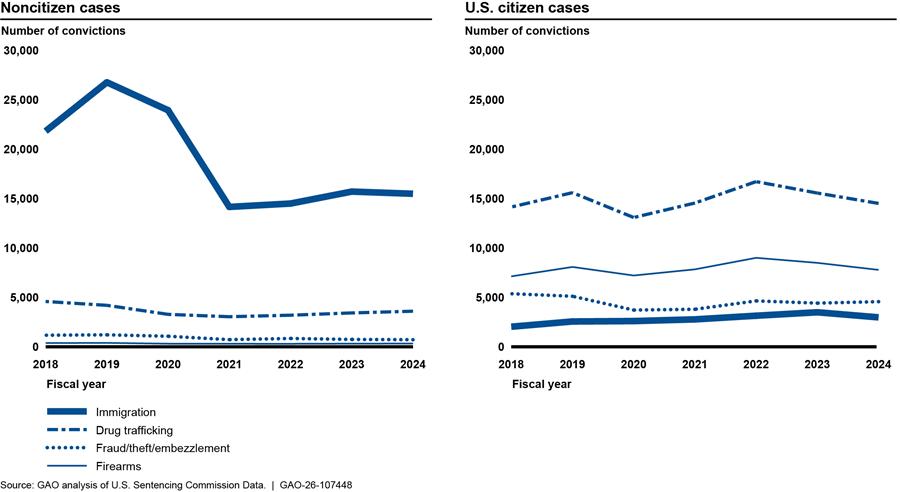
Notes: Data include felony and Class A misdemeanor cases for offenders who are convicted and sentenced in the federal court system. Felonies are a sentencing classification of offenses which, under federal law, have a maximum term of imprisonment of at least more than 1 year. Class A misdemeanors are a sentencing classification of offenses which, under federal law, have a maximum term of imprisonment of more than 6 months but no more than 1 year. 18 U.S.C. § 3559(a). The most serious offense is defined based on the sentencing guideline applied.
These data do not include state cases, federal petty offenses, federal cases which result in all charges being dismissed or acquitted, federal death penalty cases, or federal juvenile cases. They also do not include information about individuals who (1) were convicted but sentences were not yet issued and (2) sentenced but for whom no sentencing documents were submitted to the U.S. Sentencing Commission. The U.S. Sentencing Commission excluded cases that did not have information on offender’s citizenship status. These accounted for less than 1 percent of cases each year from fiscal years 2018 through 2024. Information on the individual’s citizenship is obtained from their presentence report.
Offense categories include attempts, conspiracies, and intents to commit crimes. For example, the U.S. Sentencing Commission’s offense category of assault includes attempt to commit murder and assault with intent to murder; while the murder offense category includes a conspiracy or solicitation to commit murder. See appendix I for a complete description of each of the offense categories.
Appendix III: Primary Offenses for State Criminal Alien Assistance Program-Eligible Incarcerations in Selected State Prison
Since there are no comprehensive data on noncitizens incarcerated in all state prisons and local jails, we analyzed conviction data from the five state prison systems that had the largest number of State Criminal Alien Assistance Program (SCAAP)-eligible incarcerations in state fiscal year 2022.[125] These states were: Arizona, California, Florida, New York, and Texas.[126] Primary offenses for SCAAP-eligible incarcerations occurring from July 1, 2021, through June 30, 2022, in these selected state prison systems varied, as shown in figures 23 through 27.[127]
Figure 23: Arizona State Prison System: State Criminal Alien Assistance Program (SCAAP)-Eligible Incarcerations in Fiscal Year 2022 by Primary Offense, Attempted or Committed
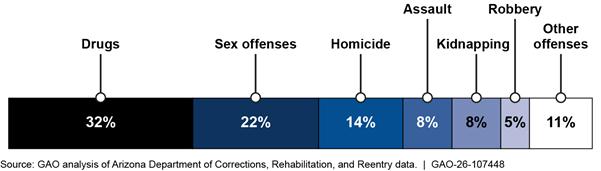
Note: Analysis reflects the six most common primary offenses for SCAAP-eligible incarcerations occurring from July 1, 2021, through June 30, 2022, in the Arizona state prison system; conviction for the offense may have occurred prior to this time period. The figure above represents primary offenses for 2,108 SCAAP-eligible incarcerations. “Other” primary offenses include arson; burglary; disorderly conduct; fraud, forgery and counterfeiting; immigration; larceny and theft; miscellaneous offenses; motor vehicle theft; obstruction of justice; property damage; stolen property; traffic violations; and weapons violations. Each of these offenses make up between less than 0.1 percent and 3.3 percent of all primary offenses for SCAAP-eligible incarcerations occurring from July 1, 2021, through June 30, 2022, in the Arizona state prison system. Primary offense refers to the most serious offense for which the individual was convicted, as determined by the state. Offenses for which individuals are convicted may include an attempt or conspiracy to commit the respective offenses. We did not examine the extent to which state policies may have affected the number of individuals convicted of crimes.
Figure 24: California State Prison System: State Criminal Alien Assistance Program (SCAAP)-Eligible Incarcerations in Fiscal Year 2022 by Primary Offense, Attempted or Committed
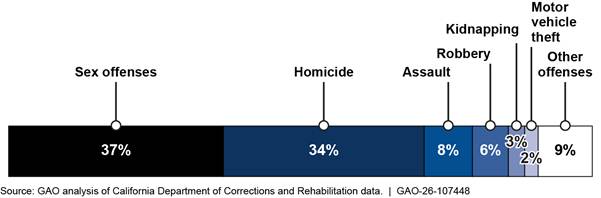
Note: Analysis reflects the six most common primary offenses for SCAAP-eligible incarcerations occurring from July 1, 2021, through June 30, 2022, in the California state prison system; conviction for the offense may have occurred prior to this time period. The figure above represents primary offenses for 9,192 SCAAP-eligible incarcerations. “Other” primary offenses include arson; burglary; drugs; fraud, forgery and counterfeiting; larceny and theft; miscellaneous offenses; obstruction of justice; property damage; stolen property; traffic violations; and weapons violations. Each of these offenses make up between 0.1 percent and 2.3 percent of all primary offenses for SCAAP-eligible incarcerations occurring from July 1, 2021, to June 30, 2022, in the California state prison system. Primary offense refers to the most serious offense for which the individual was convicted, as determined by the state. Offenses for which individuals are convicted may include an attempt or conspiracy to commit the respective offenses. We did not examine the extent to which state policies may have affected the number of individuals convicted of crimes.
Figure 25: Florida State Prison System: State Criminal Alien Assistance Program (SCAAP)-Eligible Incarcerations in Fiscal Year 2022 by Primary Offense, Attempted or Committed
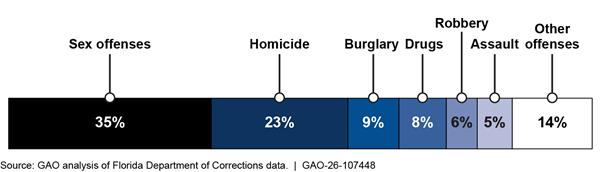
Note: Analysis reflects the six most common primary offenses for SCAAP-eligible incarcerations occurring from July 1, 2021, through June 30, 2022, in the Florida state prison system; conviction for the offense may have occurred prior to this time period. The figure above represents primary offenses for 2,823 SCAAP-eligible incarcerations. “Other” primary offenses include arson; fraud, forgery and counterfeiting; kidnapping; larceny and theft; miscellaneous offenses; motor vehicle theft; obstruction of justice; stolen property; traffic violations; and weapons violations. Each of these offenses make up between 0.4 percent and 3.6 percent of all primary offenses for SCAAP-eligible incarcerations occurring from July 1, 2021, through June 30, 2022, in the Florida state prison system. Primary offense refers to the most serious offense for which the individual was convicted, as determined by the state. Offenses for which individuals are convicted may include an attempt or conspiracy to commit the respective offenses. We did not examine the extent to which state policies may have affected the number of individuals convicted of crimes.
Figure 26: New York State Prison System: State Criminal Alien Assistance Program (SCAAP)-Eligible Incarcerations in Fiscal Year 2022 by Primary Offense, Attempted or Committed
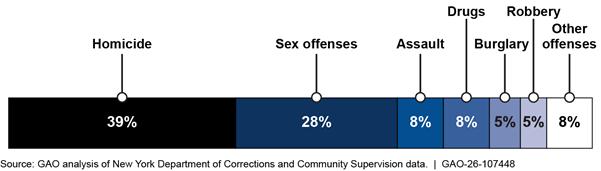
Note: Analysis reflects the six most common primary offenses for SCAAP-eligible incarcerations occurring from July 1, 2021, through June 30, 2022, in the New York state prison system; conviction for the offense may have occurred prior to this time period. The figure above represents primary offenses for 1,509 SCAAP-eligible incarcerations. “Other” primary offenses include arson; kidnapping; larceny and theft; miscellaneous offenses; obstruction of justice; traffic violations; and weapons violations. Each of these offenses make up between 0.3 percent and 3.1 percent of all primary offenses for SCAAP-eligible incarcerations occurring from July 1, 2021, through June 30, 2022, in the New York state prison system. Primary offense refers to the most serious offense for which the individual was convicted, as determined by the state. Offenses for which individuals are convicted may include an attempt or conspiracy to commit the respective offenses. We did not examine the extent to which state policies may have affected the number of individuals convicted of crimes.
Figure 27: Texas State Prison System: State Criminal Alien Assistance Program (SCAAP)-Eligible Incarcerations in Fiscal Year 2022 by Primary Offense, Attempted or Committed
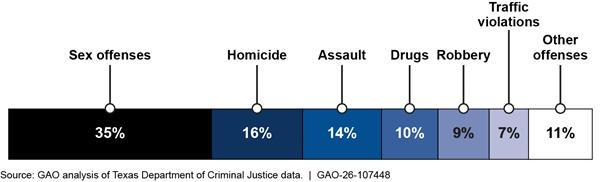
Note: Analysis reflects the six most common primary offenses for SCAAP-eligible incarcerations occurring from July 1, 2021, through June 30, 2022, in the Texas state prison system; conviction for the offense may have occurred prior to this time period. The figure above represents primary offenses for 6,694 SCAAP-eligible incarcerations. “Other” primary offenses include arson; burglary; fraud, forgery and counterfeiting; immigration; kidnapping; larceny and theft; miscellaneous offenses; motor vehicle theft; obstruction of justice; property damage; terrorism; and weapons violations. Each of these offenses make up between less than 0.1 percent and 3.3 percent of all primary offenses for SCAAP-eligible incarcerations occurring from July 1, 2021, through June 30, 2022, in the Texas state prison system. Primary offense refers to the most serious offense for which the individual was convicted, as determined by the state. Offenses for which individuals are convicted may include an attempt or conspiracy to commit the respective offenses. We did not examine the extent to which state policies may have affected the number of individuals convicted of crimes.
This appendix provides additional details on the arrests/transfers of noncitizens in our federal study population and our State Criminal Alien Assistance Program (SCAAP)-eligible study population, using Federal Bureau of Investigations (FBI) data. Because of how FBI data are reported, we could not determine the difference between a new arrest and a transfer from one arresting agency to another. As a result, we refer to these collectively as “arrests/transfers.”
To describe the arrest/transfer history of noncitizens incarcerated by the Federal Bureau of Prisons (BOP) and SCAAP-eligible noncitizens, we selected a generalizable random sample of 500 from the noncitizens incarcerated by BOP during fiscal years 2017 through 2024 with a valid FBI number.[128] We also selected a generalizable random sample of 500 from the SCAAP-eligible noncitizens incarcerated by states and localities during state fiscal years 2016 through 2022.[129] For each of these study populations, we estimated (1) the total number of offenses associated with the arrests/transfers of those individuals, (2) the number of offenses associated with arrests/transfers by federal arresting agencies and (3) the number of offenses associated with arrests/transfers by state and local arresting agencies.[130]
For our analysis, multiple counts of the same offense listed in the same record were counted once. The same offense listed on the same day may be counted more than once if the person was transferred to another agency on the same day and that agency submitted the same offense to the FBI.
Federal study population. We estimated that the approximately 106,800 noncitizens in our federal study population were arrested or transferred a total of 650,100 times for more than 1 million offenses from 1975 to 2025.[131] We estimated that more than half (54 percent) of the offenses were immigration-related, 17 percent were drug-related, and 8 percent were traffic violation-related, as shown in table 8.[132]
Table 8: Estimated Number and Percent of Offenses for Which Noncitizens Incarcerated by the Federal Bureau of Prisons from Fiscal Years 2017 Through 2024 Were Arrested or Transferred
|
Arrest/Transfer Offense Category |
Estimated number |
Estimated percent |
|
Immigrationa |
558,800 |
53.9 |
|
Drugs |
176,600 |
17.0 |
|
Traffic violations |
81,700 |
7.9 |
|
Obstruction of justice |
56,100 |
5.4 |
|
Miscellaneous/other |
33,900 |
3.3 |
|
Assault |
24,100 |
2.3 |
|
Fraud, forgery, and counterfeiting |
20,900 |
2.0 |
|
Larceny/theft |
19,700 |
1.9 |
|
Weapons violations |
17,100 |
1.6 |
|
Burglary |
9,600 |
0.9 |
|
Motor vehicle theft |
7,500 |
0.7 |
|
Robbery |
6,500 |
0.6 |
|
Sex offenses |
4,900 |
0.5 |
|
Property damage |
4,700 |
0.4 |
|
Disorderly conduct |
4,400 |
0.4 |
|
Stolen property |
3,400 |
0.3 |
|
Homicide |
2,300 |
0.2 |
|
Kidnapping |
2,100 |
0.2 |
|
Arson |
1,800 |
0.2 |
|
Totalb |
1,036,000 |
100 |
Source: GAO analysis of Federal Bureau of Investigations (FBI) data. | GAO‑26‑107448
Notes: Arrests or transfers in this analysis occurred from 1975 through 2025. Dates do not align with our sample period of fiscal year 2017 through 2024 as the FBI data was received after our sample selection, and included arrests or transfers which occurred before, during, and after the individual was incarcerated.
For this analysis, we selected a random sample of 500 from among the approximately 129,500 noncitizens and individuals with unknown citizenship who had a valid FBI number and were incarcerated at some point from fiscal years 2017 through 2024. Following sample selection, some of the records in our sample had to be excluded for various reasons. As a result, we analyzed data for 413 incarcerated noncitizens. Our analysis is applicable to the estimated 106,800 incarcerated noncitizens defined as our federal study population. The analysis allowed us to estimate and provide valuable insights about the federal study population’s interactions with arresting agencies; it is not intended to imply conclusions about incarcerated noncitizens not in this group. The numbers in the table above represent the number of offenses for which we estimated incarcerated noncitizens in the federal study population were arrested or transferred. All estimates in this table have a margin of error of less than +/- 4 percentage points.
We are reporting on arrests and transfers together because FBI data did not allow us to determine the difference between a new arrest and a transfer from one arresting agency to another. As a result, if an individual is arrested for an offense and subsequently transferred to different arresting agency that enters the same offense information, the same offense may be counted more than once. This analysis includes offenses associated with arrests or transfers by federal, state, and local arresting agencies. An arresting agency is one that has the authority to make arrests. These entities send arrest information to the FBI on a voluntary basis; as a result, FBI data on arrest history may not include all arrests.
Offense categories include an attempt or conspiracy to commit the respective offense. See appendix I for a complete description of each offense category.
aOffenses included in our immigration category are comprised of both criminal immigration offenses (about 260,700) and civil immigration violations—such as administrative grounds of removability (about 298,200).
bNumbers do not sum to total because of rounding. Percentages do not sum to 100 due to rounding.
We estimated that federal arresting agencies made approximately 443,800 of the arrests/transfers of our federal study population for about 694,900 offenses. As shown in table 9, we estimated that 80 percent of these offenses were immigration-related.
Table 9: Estimated Number and Percent of Offenses for Which Noncitizens Incarcerated by the Federal Bureau of Prisons during Fiscal Years 2017 Through 2024 Were Arrested/Transferred by Federal Arresting Agencies
|
Arrest/transfer offense category |
Estimated number |
Estimated percent |
|
Immigrationa |
555,200 |
79.9 |
|
Drugs |
91,800 |
13.2 |
|
Obstruction of justice |
15,300 |
2.2 |
|
Fraud, forgery, and counterfeiting |
11,900 |
1.7 |
|
Larceny/theft |
5,200 |
0.7 |
|
Weapons violations |
4,700 |
0.7 |
|
Miscellaneous/other |
4,700 |
0.7 |
|
Assault |
1,600 |
0.2 |
|
Robbery |
1,600 |
0.2 |
|
Kidnapping |
1,000 |
0.2 |
|
Sex offenses |
1,000 |
0.2 |
|
Stolen property |
500 |
0.1 |
|
Burglary |
300 |
<0.1 |
|
Homicide |
300 |
<0.1 |
|
Arson |
— |
— |
|
Disorderly conduct |
— |
— |
|
Motor vehicle theft |
— |
— |
|
Property damage |
— |
— |
|
Totalb |
694,900 |
100 |
Legend: — = no estimated offenses.
Source: GAO analysis of Federal Bureau of Investigation (FBI) data. | GAO‑26‑107448
Notes: Arrests or transfers in this analysis occurred from 1975 through 2025. Dates do not align with our sample period of fiscal year 2017 through 2024 as the FBI data was received after our sample selection, and included arrests or transfers which occurred before, during, and after the individual was incarcerated.
For this analysis, we selected a random sample of 500 from among the approximately 129,500 noncitizens and individuals with unknown citizenship who had a valid FBI number and were incarcerated at some point from fiscal years 2017 through 2024. Following sample selection, some of the records in our sample had to be excluded for various reasons. As a result, we analyzed data for 413 incarcerated noncitizens. Our analysis is applicable to the estimated 106,800 incarcerated noncitizens defined as our federal study population. The analysis allowed us to estimate and provide valuable insights about the federal study population’s interactions with arresting agencies; it is not intended to imply conclusions about incarcerated noncitizens not in this group. The numbers in the table above represent the number of offenses for which we estimated incarcerated noncitizens in the federal study population were arrested or transferred. All estimates in this table have a margin of error of less than +/- 3 percentage points.
We are reporting on arrests and transfers together because FBI data did not allow us to determine the difference between a new arrest and a transfer from one arresting agency to another. As a result, if an individual is arrested for an offense and subsequently transferred to different arresting agency that enters the same offense information, the same offense may be counted more than once. This analysis includes offenses associated with arrests or transfers by federal arresting agencies. An arresting agency is one that has the authority to make arrests. These entities send arrest information to the FBI on a voluntary basis; as a result, FBI data on arrest history may not include all arrests.
Offense categories include an attempt or conspiracy to commit the respective offense. See appendix I for a complete description of each offense category.
aOffenses included in our immigration category are comprised of both criminal immigration offenses and civil immigration violations—administrative grounds of removability.
bNumbers do not sum to total because of rounding. Percentages do not sum to 100 due to rounding.
We estimated that state or local arresting agencies made approximately 206,400 of the arrests/transfers our federal study population for about 341,100 offenses. Of these offenses, we estimated that 49 percent were related to drugs or traffic violations, as shown below in table 10.
Table 10: Estimated Number and Percent of Offenses for Which Noncitizens Incarcerated by the Federal Bureau of Prisons (BOP) during Fiscal Years 2017 Through 2024 Were Arrested/Transferred by State and Local Arresting Agencies
|
Arrest/transfer offense category |
Estimated number |
Estimated percent |
|
Drugs |
84,800 |
24.9 |
|
Traffic Violations |
81,700 |
24 |
|
Obstruction of justice |
40,900 |
12 |
|
Miscellaneous/other |
29,200 |
8.6 |
|
Assault |
22,500 |
6.6 |
|
Larceny/theft |
14,500 |
4.3 |
|
Weapons violations |
12,400 |
3.6 |
|
Burglary |
9,300 |
2.7 |
|
Fraud, forgery, and counterfeiting |
9,100 |
2.7 |
|
Motor vehicle theft |
7,500 |
2.2 |
|
Robbery |
4,900 |
1.4 |
|
Property damage |
4,700 |
1.4 |
|
Disorderly conduct |
4,400 |
1.3 |
|
Sex offenses |
3,900 |
1.1 |
|
Immigrationa |
3,600 |
1.1 |
|
Stolen property |
2,800 |
0.8 |
|
Homicide |
2,100 |
0.6 |
|
Arson |
1,800 |
0.5 |
|
Kidnapping |
1,000 |
0.3 |
|
Totalb |
341,100 |
100 |
Source: GAO analysis of Federal Bureau of Investigation (FBI) data. | GAO‑26‑107448
Notes: Arrests or transfers in this analysis occurred from 1975 through 2025. Dates do not align with our sample period of fiscal year 2017 through 2024 as the FBI data was received after our sample selection, and included arrests or transfers which occurred before, during, and after the individual was incarcerated.
For this analysis, we selected a random sample of 500 from among the approximately 129,500 noncitizens and individuals with unknown citizenship who had a valid FBI number and were incarcerated at some point from fiscal years 2017 through 2024. Following sample selection, some of the records in our sample had to be excluded for various reasons. As a result, we analyzed data for 413 incarcerated noncitizens. Our analysis is applicable to the estimated 106,800 incarcerated noncitizens defined as our federal study population. The analysis allowed us to estimate and provide valuable insights about the federal study population’s interactions with arresting agencies; it is not intended to imply conclusions about incarcerated noncitizens not in this group. The numbers in the table above represent the number of offenses for which we estimated incarcerated noncitizens in the federal study population were arrested or transferred. All estimates in this table have a margin of error of less than +/- 6 percentage points.
We are reporting on arrests and transfers together because FBI data did not allow us to determine the difference between a new arrest and a transfer from one arresting agency to another. As a result, if an individual is arrested for an offense and subsequently transferred to different arresting agency that enters the same offense information, the same offense may be counted more than once. This analysis includes offenses associated with arrests or transfers by state and local arresting agencies. An arresting agency is one that has the authority to make arrests. These entities send arrest information to the FBI on a voluntary basis; as a result, FBI data on arrest history may not include all arrests.
Offense categories include an attempt or conspiracy to commit the respective offense. See appendix I for a complete description of each offense category.
aOffenses included in our immigration category are comprised of both criminal immigration offenses and civil immigration violations—administrative grounds of removability.
bPercentages do not sum to 100 due to rounding.
SCAAP study population. We estimated that the approximately 218,400 noncitizens in our SCAAP study population were arrested or transferred about 1.4 million times for about 2.3 million offenses from 1972 through 2025.[133] We estimated that about half of offenses were immigration-related (20 percent), traffic violation-related (17 percent), or drug-related (14 percent), as shown in table 11.
Table 11: Estimated Number and Percent of Offenses for Which State Criminal Alien Assistance Program (SCAAP)-Eligible Noncitizens Incarcerated in State Prisons and Local Jails from State Fiscal Years 2016 through 2022 Were Arrested/Transferred
|
Arrest/transfer offense category |
Estimated number |
Estimated percent |
|
Immigrationa |
448,600 |
19.8 |
|
Traffic violations |
389,900 |
17.2 |
|
Drugs |
322,500 |
14.2 |
|
Obstruction of justice |
244,800 |
10.8 |
|
Assault |
198,400 |
8.7 |
|
Miscellaneous/other |
122,900 |
5.4 |
|
Larceny/theft |
117,000 |
5.2 |
|
Burglary |
80,900 |
3.6 |
|
Weapons violations |
63,100 |
2.8 |
|
Sex offenses |
49,100 |
2.2 |
|
Disorderly conduct |
39,900 |
1.8 |
|
Fraud, forgery, and counterfeiting |
35,100 |
1.5 |
|
Property damage |
34,500 |
1.5 |
|
Motor vehicle theft |
33,400 |
1.5 |
|
Robbery |
29,100 |
1.3 |
|
Stolen property |
25,300 |
1.1 |
|
Homicide |
18,900 |
0.8 |
|
Kidnapping |
13,500 |
0.6 |
|
Arson |
1,600 |
0.1 |
|
Totalb |
2,268,600 |
100 |
Source: GAO analysis of Federal Bureau of Investigation (FBI) data. | GAO‑26‑107448
Note: Arrests or transfers in this analysis occurred from 1972 through 2025. Dates do not align with our sample period of fiscal year 2017 through 2024 as the FBI data was received after our sample selection, and included arrests or transfers which occurred before, during, and after the individual was incarcerated.
For this analysis, we selected a random sample of 500 from the approximately 269,600 SCAAP-eligible noncitizens incarcerated by state and local authorities during state fiscal years 2016 through 2022 with an FBI number. Following sample selection, some of the records in our sample had to be excluded for various reasons. As a result, we analyzed data for 405 incarcerated noncitizens. Our analysis is applicable to the estimated 218,400 incarcerated noncitizens in our SCAAP study population. The analysis allowed us to estimate and provide valuable insights about the SCAAP study population’s interactions with arresting agencies; it is not intended to imply conclusions about incarcerated noncitizens not in this group. The numbers in the table above represent the number of offenses for which we estimated incarcerated noncitizens in the SCAAP study population were arrested or transferred. All estimates in this table have a margin of error of less than +/- 4 percentage points.
We are reporting on arrests and transfers together because FBI data did not allow us to determine the difference between a new arrest and a transfer from one arresting agency to another. As a result, if an individual is arrested for an offense and subsequently transferred to different arresting agency that enters the same offense information, the same offense may be counted more than once. This analysis includes offenses associated with arrests or transfers by federal, state, and local arresting agencies. An arresting agency is one that has the authority to make arrests. These entities send arrest information to the FBI on a voluntary basis; as a result, FBI data on arrest history may not include all arrests.
Offense categories include an attempt or conspiracy to commit the respective offense. See appendix I for a complete description of each offense category.
aOffenses included in our immigration category are comprised of both criminal immigration offenses (about 117,600) and civil immigration violations— administrative grounds of removability (about 331,100).
bNumbers do not sum to total because of rounding. Percentages do not sum to 100 due to rounding.
We estimated that federal arresting agencies made approximately 352,100 of the arrests/transfers our SCAAP study population for the approximately 481,000 offenses. Of these offenses, we estimated that 93 percent were related to immigration, as shown below in table 12.
Table 12: Estimated Number and Percent of Offenses for Which State Criminal Alien Assistance Program (SCAAP)-Eligible Noncitizens Incarcerated during Fiscal Years 2016 Through 2022 Were Arrested/Transferred by Federal Arresting Agencies
|
Arrest/transfer offense category |
Estimated number |
Estimated percent |
|
Immigrationa |
446,000 |
92.7 |
|
Drugs |
15,100 |
3.1 |
|
Obstruction of justice |
8,100 |
1.7 |
|
Fraud, forgery, and counterfeiting |
4,900 |
1 |
|
Miscellaneous/other |
2,700 |
0.6 |
|
Assault |
1,600 |
0.3 |
|
Robbery |
1,100 |
0.2 |
|
Weapons violations |
1,100 |
0.2 |
|
Sex offenses |
500 |
0.1 |
|
Arson |
— |
— |
|
Burglary |
— |
— |
|
Disorderly conduct |
— |
— |
|
Homicide |
— |
— |
|
Kidnapping |
— |
— |
|
Larceny/theft |
— |
— |
|
Motor vehicle theft |
— |
— |
|
Property damage |
— |
— |
|
Stolen property |
— |
— |
|
Traffic violations |
— |
— |
|
Totalb |
481,000 |
100 |
Legend: — = no estimated offenses.
Source: GAO analysis of Federal Bureau of Investigation (FBI) data. | GAO‑26‑107448
Notes: Arrests or transfers in this analysis occurred from 1972 through 2025. Dates do not align with our sample period of fiscal year 2017 through 2024 as the FBI data was received after our sample selection, and included arrests or transfers which occurred before, during, and after the individual was incarcerated.
For this analysis, we selected a random sample of 500 from the approximately 269,600 SCAAP-eligible noncitizens incarcerated by state and local authorities during state fiscal years 2016 through 2022 with an FBI number. Following sample selection, some of the records in our sample had to be excluded for various reasons. As a result, we analyzed data for 405 incarcerated noncitizens. Our analysis is applicable to the estimated 218,400 incarcerated noncitizens in our SCAAP study population. The analysis allowed us to estimate and provide valuable insights about the SCAAP study population’s interactions with arresting agencies; it is not intended to imply conclusions about incarcerated noncitizens not in this group. The numbers in the table above represent the number of offenses for which we estimated incarcerated noncitizens in the SCAAP study population were arrested or transferred. All estimates in this table have a margin of error of less than +/- 3 percentage points.
We are reporting on arrests and transfers together because FBI data did not allow us to determine the difference between a new arrest and a transfer from one arresting agency to another. As a result, if an individual is arrested for an offense and subsequently transferred to different arresting agency that enters the same offense information, the same offense may be counted more than once. This analysis includes offenses associated with arrests or transfers by federal arresting agencies. An arresting agency is one that has the authority to make arrests. These entities send arrest information to the FBI on a voluntary basis; as a result, FBI data on arrest history may not include all arrests.
Offense categories include an attempt or conspiracy to commit the respective offense. See appendix I for a complete description of each offense category.
aOffenses included in our immigration category are comprised of both criminal immigration offenses and civil immigration violations—administrative grounds of removability.
bNumbers do not sum to total because of rounding.
We estimated state or local arresting agencies made approximately 1 million of the arrest/transfers of our SCAAP study population for about 1.8 million offenses. Of these offenses, we estimated that 39 percent were related to traffic violations or drug offenses, as shown below in table 13.
Table 13: Estimated Number and Percent of Offenses for Which State Criminal Alien Assistance Program (SCAAP)-Eligible Noncitizens Incarcerated During State Fiscal Years 2016 Through 2022 Were Arrested/Transferred by State and Local Arresting Agencies
|
Arrest/transfer offense category |
Estimated number |
Estimated percent |
|
Traffic violations |
389,900 |
21.8 |
|
Drugs |
307,400 |
17.2 |
|
Obstruction of justice |
236,700 |
13.2 |
|
Assault |
196,800 |
11 |
|
Miscellaneous/other |
120,300 |
6.7 |
|
Larceny/theft |
117,000 |
6.6 |
|
Burglary |
80,900 |
4.5 |
|
Weapons violations |
62,000 |
3.5 |
|
Sex offenses |
48,500 |
2.7 |
|
Disorderly conduct |
39,900 |
2.2 |
|
Property damage |
34,500 |
1.9 |
|
Motor vehicle theft |
33,400 |
1.9 |
|
Fraud, forgery, and counterfeiting |
30,200 |
1.7 |
|
Robbery |
28,000 |
1.6 |
|
Stolen property |
25,300 |
1.4 |
|
Homicide |
18,900 |
1.1 |
|
Kidnapping |
13,500 |
0.8 |
|
Immigrationa |
2,700 |
0.2 |
|
Arson |
1,600 |
0.1 |
|
Totalb |
1,787,600 |
100 |
Source: GAO analysis of Federal Bureau of Investigation (FBI) data. | GAO‑26‑107448
Notes: Arrests or transfers in this analysis occurred from 1972 through 2025. Dates do not align with our sample period of fiscal year 2017 through 2024 as the FBI data was received after our sample selection, and included arrests or transfers which occurred before, during, and after the individual was incarcerated.
For this analysis, we selected a random sample of 500 from the approximately 269,600 SCAAP-eligible noncitizens incarcerated by state and local authorities during state fiscal years 2016 through 2022 with an FBI number. Following sample selection, some of the records in our sample had to be excluded for various reasons. As a result, we analyzed data for 405 incarcerated noncitizens. Our analysis is applicable to the estimated 218,400 incarcerated noncitizens in our SCAAP study population. The analysis allowed us to estimate and provide valuable insights about the SCAAP-eligible study population’s interactions with arresting agencies; it is not intended to imply conclusions about incarcerated noncitizens not in this group. The numbers in the table above represent the number of offenses for which we estimated incarcerated noncitizens in the SCAAP study population were arrested or transferred. All estimates in this table have a margin of error of less than +/- 4 percentage points.
We are reporting on arrests and transfers together because FBI data did not allow us to determine the difference between a new arrest and a transfer from one arresting agency to another. As a result, if an individual is arrested for an offense and subsequently transferred to different arresting agency that enters the same offense information, the same offense may be counted more than once. This analysis includes offenses associated with arrests or transfers by state and local arresting agencies. An arresting agency is one that has the authority to make arrests. These entities send arrest information to the FBI on a voluntary basis; as a result, FBI data on arrest history may not include all arrests.
Offense categories include an attempt or conspiracy to commit the respective offense. See appendix I for a complete description of each offense category.
aOffenses included in our immigration category are comprised of both criminal immigration offenses and civil immigration violations—administrative grounds of removability.
bNumbers do not sum to total because of rounding.
GAO Contact
Gretta L. Goodwin, at GoodwinG@gao.gov.
Staff Acknowledgment
In addition to the contact named above, Meg Ullengren (Assistant Director), Jessica Wintfeld (Analyst-in-Charge), Justin Bolivar, Priyanka Panjwani, Hiwotte Amare, James Ashley, Lilia Chaidez, Elizabeth Dretsch, Eric Hauswirth, Heidi Nielson, and Kevin Reeves made key contributions to this report.
The Government Accountability Office, the audit, evaluation, and investigative arm of Congress, exists to support Congress in meeting its constitutional responsibilities and to help improve the performance and accountability of the federal government for the American people. GAO examines the use of public funds; evaluates federal programs and policies; and provides analyses, recommendations, and other assistance to help Congress make informed oversight, policy, and funding decisions. GAO’s commitment to good government is reflected in its core values of accountability, integrity, and reliability.
Obtaining Copies of GAO Reports and Testimony
The fastest and easiest way to obtain copies of GAO documents at no cost is through our website. Each weekday afternoon, GAO posts on its website newly released reports, testimony, and correspondence. You can also subscribe to GAO’s email updates to receive notification of newly posted products.
Order by Phone
The price of each GAO publication reflects GAO’s actual cost of production and distribution and depends on the number of pages in the publication and whether the publication is printed in color or black and white. Pricing and ordering information is posted on GAO’s website, https://www.gao.gov/ordering.htm.
Place orders by calling (202) 512-6000, toll free (866) 801-7077,
or
TDD (202) 512-2537.
Orders may be paid for using American Express, Discover Card, MasterCard, Visa, check, or money order. Call for additional information.
Connect with GAO
Connect with GAO on X,
LinkedIn, Instagram, and YouTube.
Subscribe to our Email Updates. Listen to our Podcasts.
Visit GAO on the web at https://www.gao.gov.
To Report Fraud, Waste, and Abuse in Federal Programs
Contact FraudNet:
Website: https://www.gao.gov/about/what-gao-does/fraudnet
Automated answering system: (800) 424-5454
Media Relations
Sarah Kaczmarek, Managing Director, Media@gao.gov
Congressional Relations
David A. Powner, Acting Managing Director, CongRel@gao.gov
General Inquiries
[1]Documentation we reviewed for this report used the terms “alien,” “migrant,” and “noncitizen” interchangeably. For readability, we generally use the term “noncitizen” to refer to any person who is not a citizen or national of the U.S., except when quoting language in statute, regulation, or executive orders that use the term “alien.” Statute defines an “alien” as any person who is not a citizen or national of the U.S. 8 U.S.C. § 1101(a)(3). A “national of the U.S.” refers to a person who, though not a U.S. citizen, owes permanent allegiance to the U.S. This can include individuals who were born in American Samoa or in the Commonwealth of the Northern Mariana Islands who have chosen to be U.S. nationals instead of U.S. citizens.
States and localities, in the context of this report, include the 50 U.S. states, the District of Columbia, counties and cities, and U.S. territories—American Samoa, Guam, Puerto Rico, Northern Mariana Islands, and the U.S. Virgin Islands—unless otherwise noted.
[2]Under U.S. immigration law, an “alien” may be removable on statutory grounds of inadmissibility or deportability. See 8 U.S.C. §§ 1182, 1227, 1229a(c), (e)(2).
[3]8 U.S.C. § 1231(i). To be eligible for reimbursement, the incarcerated noncitizens must (1) meet the statutory definition for inclusion—that is, have at least one felony or two misdemeanor convictions for violations of state or local law and (a) have entered the U.S. without inspection or at any time or place other than as designated by the Attorney General; (b) have been the subject of exclusion or deportation proceedings at the time he or she was taken into custody by the state or a political subdivision of the state; or (c) have been admitted as a nonimmigrant and at the time they were taken into custody by the state or a political subdivision of the state failed to maintain the nonimmigrant status in which the individual was admitted or to which it was changed under 8 U.S.C. § 1258, or to comply with the conditions of any such status; and (2) be incarcerated for at least four consecutive days during the reporting period. The minimum period of consecutive incarceration days is established in BJA’s reimbursement eligibility definition.
Throughout this report, we refer to the individuals whose incarcerations DOJ reimbursed as part of the program as “SCAAP-eligible noncitizens” and their incarcerations as “SCAAP-eligible incarcerations.” For the purposes of this report, the term “state prisons and local jails” includes those located in U.S. territories, unless otherwise noted.
[4]GAO, Noncitizens in the U.S.: Public Information on Federal Incarcerations, GAO‑24‑107598 (Washington, D.C.: Sep. 3, 2024); Criminal Alien Statistics: Information on Incarcerations, Arrests, Convictions, Costs, and Removals, GAO‑18‑433 (Washington, D.C.: July 17, 2018); Criminal Alien Statistics: Information on Incarcerations, Arrests, and Costs, GAO‑11‑187 (Washington, D.C.: Mar. 24, 2011); Information on Criminal Aliens Incarcerated in Federal and State Prisons and Local Jails, GAO‑05‑337R (Washington, D.C.: Apr. 7, 2005); and Information on Certain Illegal Aliens Arrested in the United States, GAO‑05‑646R (Washington, D.C.: May 9, 2005).
[5]Fiscal year 2024 was the most recent year of BOP data available when we requested the data.
[6]SCAAP uses the typical state fiscal year (July 1 through June 30) to define the eligibility period for reimbursement, and reimburses participating jurisdictions the following year. That is, DOJ reimbursed states and localities for SCAAP-eligible incarcerations that occurred from July 1, 2021, to June 30, 2022, with funds appropriated for federal fiscal year 2023. For the purposes of this report, we describe the time period when the incarcerations occurred. Extending the example, we would describe these as state fiscal year 2022 SCAAP-eligible incarcerations. State fiscal year 2022 data were the most recent available when we requested the data.
[7]For our analysis of the cost of BOP’s incarceration of noncitizens, we used the time period of fiscal years 2016 through 2023. We selected the start to provide an update, without gaps, since we last reported on this topic. We selected the end of the time period to provide the most recent fiscal year data available as of the time we requested the data.
[8]GAO, Criminal Alien Statistics: Information on Incarcerations, Arrests, Convictions, Costs, and Removals, GAO‑18‑433 (Washington, D.C.: July 17, 2018).
[9]Analyses do not include unsentenced individuals, including those in pretrial detention.
[10]For some analyses, we used subsets of this BOP data, as described through the report.
[11]We use country of birth for this analysis because that is the information states and localities provide to BJA as part of their grant applications. We did not independently verify this information.
[12]See 8 U.S.C. § 1231(i)(3). The minimum period of consecutive incarceration days is established in the BJA’s reimbursement eligibility definition.
[13]DOJ’s Bureau of Justice Statistics, as part of its National Prisoner Statistics effort, includes information about the citizenship of state prison populations in its annual report on incarcerated individuals in the U.S., but it has identified limitations to this reporting. For example, not all states consistently reported information on citizenship, and states did not all use the same methodologies when reporting.
[14]The selected states were Arizona, California, Florida, New York, and Texas. The selected localities were Dallas County, TX; Harris County, TX; Hidalgo County, TX; Orange County, CA; and San Bernardino County, CA.
[15]It is possible for a citizen to be categorized as a noncitizen during this process. For example, if an individual is born abroad to a U.S. citizen parent, they may not know or be able to demonstrate their citizenship status at the time of their pretrial interview.
[16]DHS and DOJ, Alien Incarceration Report Fiscal Year 2019, (Washington, D.C.: Oct. 16, 2020).
[17]Bureau of Justice Statistics, Prisoners in 2023—Statistical Tables, NCJ 310197 (Washington, D.C.: September 2025).
[18]See 8 U.S.C. § 1231(i)(3). The minimum period of consecutive incarceration days is established in BJA’s reimbursement eligibility definition.
[19]Prior to 2017, ICE also had a role in determining the immigration status of individuals for whom jurisdictions sought reimbursement, according to BJA officials.
[20]Yearly appropriations for SCAAP are as follows: $210 million in fiscal year 2017; $240 million in fiscal year 2018; $243.5 million in fiscal year 2019; $244 million in fiscal year 2020; $244 million in fiscal year 2021; $234 million in fiscal year 2022; $234 million in fiscal year 2023; $234 million in fiscal year 2024; $234 million in fiscal year 2025.
[21]SCAAP reimbursement rates for the correctional officer salary costs attributable to eligible-unknown incarcerations vary by jurisdiction type. Those rates are: 85 percent for states; 86 percent for counties; 62 percent for cities; and 85 percent for U.S. territories.
[22]SCAAP uses the typical state fiscal year (July 1 through June 30) to define the eligibility period for reimbursement and reimburses participating jurisdictions the following year. That is, fiscal year 2023 SCAAP appropriation was used to reimburse states and localities for eligible incarcerations that occurred from July 1, 2021, to June 30, 2022.
[23]FBI acquires, collects, classifies, and preserves identification, criminal identification, crime, and other records, and exchanges such records with authorized officials of federal, tribal, state, local, and penal and other institutions. FBI’s Next Generation Identification System also contains fingerprints collected for authorized criminal justice purposes; employment, licensing, security assessments, or other authorized noncriminal justice purpose, such as authorized federal background check programs and military service; visa, alien registration, immigration, naturalization, or related Department of State or DHS purposes among others. See 28 U.S.C. § 534.
[24]DOJ has undertaken efforts to improve disposition reporting since at least 1990 when it created a national task force to review disposition reporting issues. In 1995, it initiated a grant program to provide monetary awards and technical assistance to states and localities to improve the quality, timeliness, and immediate accessibility of criminal history records and related information. However, participating agencies do not prioritize disposition submissions, according to FBI.
[25]The inquiry, referred to as an Immigration Alien Query, goes to ICE’s ACRIMe—an information system used by ICE to receive and respond to inquiries automatically generated from biometric matches between FBI and DHS systems and from federal, state, and local law enforcement agencies about individuals arrested, subject to background checks, or otherwise encountered by those agencies. According to ICE officials, in fiscal year 2025, ICE responded to approximately 1.9 million queries.
[26]ICE refers to the determination as an Immigration Alien Response.
[27]See 78 Fed. Reg. 10,623 (Feb. 14, 2013).
[28]Depending on the circumstance, a noncitizen may be determined removable through proceedings before an immigration judge or, in some cases, noncitizens may be ordered removed from the U.S. without a hearing before an immigration judge, known as “expedited removal.” See 8 U.S.C. § 1225(b); 1229a.
[29]See, e.g., Cal. Gov’t. Code § 7284.6(a)(1)(B) (prohibiting detaining individuals on the basis of a hold request for immigration enforcement purposes).
[30]Executive actions include actions taken by the administration, such as presidential proclamations, as well as actions taken by executive agencies, such as Centers for Disease Control and Prevention orders and DHS travel restrictions. See, e.g., Proclamation No. 9,984, 85 Fed. Reg. 6,706 (Feb. 5, 2020); 85 Fed. Reg. 16,548 (Mar. 24, 2020); 85 Fed. Reg. 16,559 (Mar. 24, 2020).
[31]Under this order, such individuals could be immediately expelled to their country of last transit to prevent the spread of communicable diseases, rather than being detained and processed for removal. The Title 42 order did not apply to U.S. citizens or legal residents, but to those who would be held in congregate settings, such as processing centers. See 85 Fed. Reg. 16,559 (Mar. 24, 2020); 85 Fed. Reg. 17,060 (Mar. 26, 2020); see also, e.g., 85 Fed. Reg. 65,806 (Oct. 13, 2020).
[32]The Title 42 order was lifted when the COVID-19 Public Health Emergency ended in May 2023. See 88 Fed. Reg. 31,314 (May 16, 2023) (discussing the expiration of the Title 42 order).
[33]The number of unique incarcerated individuals is based on individual-level data from BOP’s system used to track the care, classification, discipline, and programs of individuals it incarcerates, among other information. For this analysis, each individual is counted only once regardless of how many years during the time period they were incarcerated.
[34]Data do not include individuals who were unsentenced. Data also do not include individuals with unknown citizenship information—which represented 0.1 percent of incarcerated individuals from fiscal years 2017 through 2024. The greater proportion of unique noncitizens compared with the proportion incarcerated on average each year indicates that noncitizens were entering and exiting incarceration more frequently than citizens.
[36]Totals do not represent the number of unique SCAAP-eligible noncitizens since these individuals could have been incarcerated in multiple participating states or localities during the same reporting period. As such, these represents the number of SCAAP-eligible incarcerations. Data about state fiscal year 2022 incarcerations were the most recent available when we requested the data.
[37]Fewer than 0.5 percent of SCAAP-eligible incarcerations were in U.S. territory correctional systems.
[38]The number of SCAAP-eligible incarcerations in U.S. territories increased from state fiscal years 2016 through 2018 and fell through state fiscal year 2021 before increasing again in state fiscal year 2022.
[39]Jurisdiction, in this context, refers to the states, counties, cities, and U.S. territories that applied for and received reimbursement through SCAAP.
[40]U.S. Sentencing Commission identifies the most serious crime the individual was convicted of based on the sentencing guideline applied—referred to as the “type of crime.”
Data include individuals sentenced in federal court for a felony or class A misdemeanor offense. Felonies are a sentencing classification which, under federal law, have a maximum term of imprisonment of at least more than 1 year. Class A misdemeanors are a sentencing classification of offenses which, under federal law, have a maximum term of imprisonment of more than 6 months but no more than 1 year. 18 U.S.C. § 3559(a).
Numbers do not include individuals sentenced in federal court for a class B or class C misdemeanor offense. If an individual was sentenced for a felony or class A misdemeanor more than once in the same fiscal year, but in a separate case, each sentencing would be included in the fiscal year’s data, according to U.S. Sentencing Commission officials. If an individual was sentenced for a felony or class A misdemeanor offense more than once and in different fiscal years, each offense type would be included in the respective fiscal year’s data. As such, there could be more than one offense per unique noncitizen sentenced for a federal offense.
[41]Incarcerated individuals suspected of committing a criminal offense prior to or while incarcerated may be arrested for those offenses during their period of incarceration.
[42]These dates, 1975 through 2025, represent the years of the oldest and newest arrest/transfer records provided by FBI. For this analysis, we selected a random sample of 500 from among the approximately 129,500 noncitizens and individuals with unknown citizenship who had a valid FBI number and were incarcerated by BOP at some point from fiscal years 2017 through 2024. Following sample selection, some of the records in our sample had to be excluded for various reasons. For example, we matched BOP data to FBI data using FBI numbers and subsequently checked other identifiers, including names. If we could not be sufficiently confident the records referred to the same person, we excluded those records from the analysis. We also excluded records for individuals who did not have valid arrest information. As a result, we analyzed data for 413 incarcerated noncitizens, and our analysis is applicable to the estimated approximately 106,800 incarcerated noncitizens defined as our federal study population. See appendix I for further information on our methodology.
Dates do not align with our sample period of fiscal year 2017 through 2024 as the FBI data was received after our sample selection, and included arrests or transfers which occurred before, during, and after the individual’s incarceration.
[43]These dates, 1972 through 2025, represent the years of the oldest and newest arrest/transfer records provided by FBI. For this analysis, we selected a random sample of 500 incarcerated noncitizens from our SCAAP-eligible population of approximately 269,600 incarcerated noncitizens. Following sample selection, some of the records in our sample had to be excluded for various reasons. For example, we matched SCAAP data to FBI data using FBI numbers and subsequently checked other identifiers, including names. If we could not be sufficiently confident the records referred to the same person, we excluded those records from the analysis. We also excluded records for individuals who did not have valid arrest information. As a result, we analyzed data for 405 incarcerated noncitizens, and our analysis is applicable to the estimated approximately 218,400 incarcerated noncitizens defined as our SCAAP study population. Dates do not align with our sample period of fiscal year 2016 through 2022 as the FBI data was received after our sample selection and included arrests or transfers which occurred before, during, and after the individual’s incarceration. See appendix I for further information on our methodology.
[44]Data do not include individuals who were unsentenced. Data also do not include individuals with unknown citizenship information—which represented 0.1 percent of incarcerated individuals from fiscal years 2017 through 2024.
An individual convicted of more than one offense may serve a term of incarceration concurrently or consecutively for those offenses. 18 U.S.C. § 3584(a). According to BOP officials, for each individual it incarcerates, BOP records: (1) the offenses for which the individual is incarcerated that are not eligible for First Step Act of 2018 time credits, if any; (2) the offense(s) that BOP records per system requirements to track consecutive sentence obligations, if any, or FBI-requested information, if any; (3) the most serious offense for which the individual is incarcerated. See Pub. L. No. 115-391, tit. I, § 101(a), 132 Stat. 5194, 5196 (codified at 18 U.S.C. § 3632(d)(4)). As a result, more than one offense may be associated with each individual. For the purposes of this analysis, we counted all offenses tracked by BOP. Offenses include an attempt or conspiracy to commit the offense.
Prior to enactment of the First Step Act of 2018, BOP recorded a “primary” offense for each incarcerated individual that reflected the most serious offense for the period of their incarceration. Our prior work on this topic used the “primary” offense in the analysis of conviction information and is therefore not comparable to the information presented in this section.
Offenses that BOP records for tracking purposes as not eligible for First Step Act of 2018 time credits include unlawful possession or use of a firearm during and in relation to any crime of violence or drug trafficking crime and bank robbery resulting in death, among others. See 18 U.S.C. §§ 3632(d)(4)(D)(xxii), (d)(4)(D)(xxxiii).
[45]The U.S. Sentencing Commission is an independent judicial branch agency created, among other things, to reduce sentencing disparities and promote transparency and proportionality in sentencing. It maintains data about all individuals convicted of felonies and class A misdemeanors in federal court in an internal data collection system. Felonies are a sentencing classification which, under federal law have a maximum term of imprisonment of at least more than 1 year. Class A misdemeanors are a sentencing classification of offenses which, under federal law, have a maximum term of imprisonment of more than 6 months but no more than 1 year. 18 U.S.C. § 3559(a). Numbers do not include individuals sentenced in federal court for a class B or class C misdemeanor offense. If an individual was sentenced for a felony or class A misdemeanor offense more than once during this time period, each offense would be included in the data. As such, there could be more than one offense of the same type or of different type per unique noncitizen. These noncitizens may also be included in BOP data if they were sentenced in federal court from fiscal years 2018 through 2024 and incarcerated by BOP during these same fiscal years.
[46]We do not include data for fiscal year 2017 in this analysis because the U.S. Sentencing Commission implemented changes to its methodology for categorizing offenses starting in fiscal year 2018. As a result, fiscal year 2017 data are not comparable to later years.
[47]Our data only include information on SCAAP-eligible noncitizens incarcerated in state prisons, and not those incarcerated in county or local jails. Individuals are typically incarcerated in state prisons for felony convictions, rather than misdemeanors. Felony offenses in our selected states include robbery, murder, and kidnapping, among others. Misdemeanor offenses in our selected states can include petty or petit theft, driving under the influence or driving while intoxicated, and shoplifting under a certain property value, among others. We did not collect information on offenses committed by U.S. citizens incarcerated during this time period and cannot compare the conviction categories between these groups.
[48]Of the five selected states, only Arizona and Texas reported immigration-related offenses. For less than 1 percent of SCAAP-eligible noncitizens incarcerated in those states in state fiscal year 2022, their most serious offense was immigration-related.
[49]GAO‑18‑433 and GAO‑11‑187.
[50]These dates, 1975 through 2025, represent the years of the oldest and newest arrest/transfer records provided by FBI. Dates do not align with our sample period of fiscal year 2017 through 2024 as the FBI data was received after our sample selection, and included arrests or transfers which occurred before, during, and after the individual was incarcerated.
[51]Depending on the circumstances, a single arrest or transfer could be for multiple offense categories, or multiple counts of the same conduct within the same offense category. An arrest or transfer does not necessarily result in a prosecution for or a conviction of all, or any, of the offenses for which an individual was arrested. An arrest indicates that law enforcement had probable cause to believe the individual had committed a crime.
We are reporting on arrests and transfers together because FBI data did not allow us to determine the difference between a new arrest and a transfer from one arresting agency to another. As a result, if an individual is arrested for an offense and subsequently transferred to a different arresting agency that enters the same offense information, the same offense may be counted more than once. These analyses include offenses associated with arrests or transfers by federal, state, and local arresting agencies. An arresting agency is one that has the authority to make arrests. Law enforcement entities send arrest information to the FBI on a voluntary basis; as a result, FBI data on arrest history may not include all arrests. See appendix I for further information on our categorization and estimation methodologies.
[52]For this analysis, we selected a random sample of 500 from among the approximately 129,500 noncitizens and individuals with unknown citizenship who had a valid FBI number and were incarcerated by BOP at some point from fiscal years 2017 through 2024. We only included individuals with an FBI number available because we needed it to match data across sources. Following sample selection, some of the records in our sample had to be excluded for various reasons. For example, we matched BOP data to FBI data using FBI numbers and subsequently checked other identifiers, including names. If we could not be sufficiently confident the records referred to the same person, we excluded those records from the analysis. We also excluded records for individuals who did not have valid arrest information. As a result, we analyzed data for 413 incarcerated noncitizens, and our analysis is applicable to the estimated 106,800 incarcerated noncitizens defined as our federal study population.
While our analyses allowed us to estimate and provide valuable insights about these incarcerated noncitizens, our analyses are not intended to imply conclusions about the arrest history of incarcerated noncitizens not in the federal study population. All percentage estimates presented in this report have a margin of error of less than plus or minus 7 percentage points. All estimates of the number of arrests/transfers or offenses have a relative error of plus or minus 15 percent of the estimate or less. See appendix I for more details on the margin of error for these estimates. See appendix IV for information on the arrests/transfers of noncitizens in our federal study population and associated offenses.
[53]These include arrests and transfers by federal, state, and local authorities.
[54]We estimated that about 5,900 (6 percent) of the approximately 106,800 incarcerated noncitizens in our federal study population had one arrest/transfer since 1975.
[55]Offense categories include an attempt or conspiracy to commit the respective offense. For example, attempted robbery or attempted drug trafficking. For additional details on the offenses for which noncitizens were arrested/transferred, see appendix IV.
[56]These dates, 1972 through 2025, represent the years of the oldest and newest arrest/transfer records provided by FBI. Dates do not align with our sample period of state fiscal year 2016 through 2022 as the FBI data was received after our sample selection, and included arrests or transfers which occurred before, during, and after the individual was incarcerated.
[57]For this analysis, we only included SCAAP-eligible noncitizens if they had an FBI number available because we needed it to match data across sources. We determined that approximately 269,600 individual-level records of SCAAP-eligible noncitizens between fiscal years 2016 through 2022 had a unique FBI number. We selected a random sample of 500 incarcerated noncitizens from our SCAAP-eligible population of approximately 269,600 incarcerated noncitizens. Some of the records in our sample had to be excluded for various reasons. For example, we matched SCAAP data to FBI data using FBI numbers and subsequently checked other identifiers, including names. If we could not be sufficiently confident the records referred to the same person, we excluded those records from the analysis. We also excluded records for individuals who did not have valid arrest information. As a result, we analyzed data for 405 incarcerated noncitizens, and our analysis is applicable to the estimated 218,400 incarcerated noncitizens defined as our SCAAP study population. As stated previously, SCAAP-eligible noncitizens represent a portion of the total population of noncitizens incarcerated in state prisons and local jails. While our analyses allowed us to estimate and provide valuable insights about these incarcerated noncitizens, our analyses are not intended to imply conclusions about the arrest history of incarcerated noncitizens not in this group. See appendix I for more details on the margin of error for these estimates. See appendix IV for the information on the arrests/transfers of noncitizens in our SCAAP study population and associated offenses.
[58]We estimated that about 27,000 (12 percent) of the approximately 218,400 SCAAP-eligible noncitizens in our SCAAP study population had one arrest/transfer since 1972.
[59]Offense categories include an attempt or conspiracy to commit the respective offense. For additional details on the offenses for which noncitizens were arrested/transferred, see appendix IV.
[60]This analysis does not include individuals with unknown citizenship information following matching to ICE data—which represented 0.1 percent of incarcerated individuals from fiscal years 2017 through 2024.
[61]This total includes approximately 160 individuals ICE identified as potential U.S. citizens. We excluded about 40 records for which ICE specialists made multiple, different potential removability determinations on the same day within 60 days of the date the noncitizen entered federal prison from this analysis.
[62]We used ACRIMe data for this analysis because it provided readily available information about an incarcerated noncitizens potential removability as of a particular date. Although ACRIMe is used as a mechanism to share information across agencies, ICE and BOP coordinate in various ways to manage noncitizens incarcerated in federal prison. For example, according to ICE officials, on a daily basis BOP provides ICE with a list of foreign-born individuals who have recently entered BOP custody, which ICE reviews against DHS databases.
[63]According to ICE officials, their determination provides a good indication of an individual’s potential removability from the U.S. at a specific point in time. In some cases, ICE generated multiple ACRIMe responses with different potential removability determinations for the same incarcerated noncitizen on the same day. ICE officials explained that ICE specialists who make these determinations are to use the totality of information available in the databases they search, and available information about an individual’s potential removability may change, even within the same day.
[64]See 8 C.F.R § 241.2.
[65]ICE’s review of records may indicate that an incarcerated noncitizen is in removal proceedings. However, ICE does not oversee immigration court proceedings and, as such, may not have complete information about the status of a noncitizen whose case is pending in immigration court.
[66]In these cases, either ICE’s records did not have enough information to make an assessment of the identity and potential removability of these incarcerated noncitizens, or ICE could not find a match for these incarcerated noncitizens in the databases searched.
[67]These outcomes are not mutually exclusive, and an individual could have experienced some, none, or all of these after their release from incarceration. For example, a noncitizen could have been removed by ICE after their incarceration, then reentered the U.S. and subsequently become reincarcerated in either federal or state prison or local jail. Some noncitizens who were released from incarceration by BOP may not have had subsequent encounters with ICE, BOP, SCAAP-participating jurisdictions, or USCIS; as a result, there would be no data on them.
[68]For this analysis, we included noncitizens who were released from incarceration by BOP from fiscal years 2017 through 2024. The analysis does not include noncitizens who did not complete a term of incarceration. For this analysis, we did not include noncitizens who died while incarcerated by BOP during the fiscal year 2017 through 2024 timeframe, or those with missing or invalid FBI or alien numbers, because we needed those identifiers to match with other data sources.
[69]For this analysis, we used FBI and/or alien numbers to match BOP data with data from DHS’s Enforcement Integrated Database. ICE provided the most recent date of departure from the U.S. for each noncitizen who completed a term of incarceration by BOP from fiscal years 2017 through 2024, as of December 2025. A noncitizen may have departed, and potentially been removed, multiple times from fiscal year 2017 through December 2025, however, the data would only indicate the most recent date. December 2025 was the most recent data available when we made the request. This number includes approximately 84,600 individuals with final orders of removal who ICE data indicate departed the U.S. following their release from incarceration by BOP. An individual determined to be removeable (i.e., either inadmissible or deportable on statutory grounds) and not eligible for any requested relief or protection is to be removed pursuant to an administrative final order of removal. See 8 U.S.C. §§ 1182, 1227, 1229a(c), (e)(2); 8 C.F.R. § 1241.1.
It also includes approximately 300 noncitizens without final orders of removal who departed the U.S. following their release from incarceration by BOP, according to our analysis of ICE data. Noncitizens who departed or were removed without a final order of removal may have done so under a reinstated removal order or under expedited removal processes, which does not require a final order of removal. See 8 U.S.C. §§ 1225(b)(1), 1231(a)(5). The number may also include noncitizens who chose to leave the U.S. voluntarily. See 8 U.S.C. § 1229c.
[70]Withholding or deferral of removal is a mandatory form of protection from removal granted by an immigration judge that prevents ICE from removing an individual subject to an order of removal to a specific country where the individual’s life or freedom would be threatened because of a protected characteristic or where the individual would be tortured. See 8 U.S.C. § 1231(b)(3); 8 C.F.R. § 208.16.
ICE has limited authority to indefinitely detain someone who has a final order of removal if there is no significant likelihood that they could be removed in the foreseeable future, as would be the case if a country will not accept repatriation of its citizens. See Zadvydas v. Davis, 533 U.S. 678 (2001); but see Jennings v. Rodriguez, 583 U.S. 281 (2018).
[71]Encounters with ICE include ICE arrests, ICE releases, and admissions to ICE detention facilities, also known as book-ins. ICE provided the most recent date in its records for each type of encounter for each noncitizen who completed a term of incarceration by BOP from fiscal years 2017 through 2024, as of December 2025. We considered the individual to have had no encounters with ICE if the individual was not removed and all arrest, release, and admission dates were blank in ICE’s data. ICE matched on BOP data using FBI numbers and/or alien numbers as unique identifiers.
[72]A noncitizen may have had more than one ICE arrest, release, detention facility admission, or removal; however, the data would only indicate the most recent date for each encounter type. To determine the number of noncitizens ICE removed from the U.S. following their incarceration by BOP, we matched BOP and ICE data using FBI numbers or alien numbers as unique identifiers.
[73]This analysis was completed using BOP data and did not require matching individuals across agencies using FBI or alien numbers. As a result, we did not have to exclude individuals with missing or invalid identifiers from the analysis. We also did not exclude individuals who died while incarcerated by BOP.
[74]This analysis includes SCAAP-eligible incarcerations that occurred following the release of an individual from incarceration by BOP and uses data that covers SCAAP-eligible incarcerations through the end of June 2022. Only individuals released from BOP prior to that date could have been reincarcerated in a jurisdiction participating in SCAAP and seeking reimbursement for their incarceration. For this analysis we matched BOP data on noncitizens released from incarceration with BJA data on SCAAP-eligible incarcerations using FBI number or alien numbers.
[75]To identify these noncitizens, we matched BOP data to USCIS data using multiple identifiers—alien number, name, and date of birth. We determined that 35 noncitizens matched on all identifiers we considered and became naturalized U.S. citizens following their release. These individuals represent the minimum number who completed a term of incarceration by BOP from fiscal years 2017 through 2024 and naturalized following their release.
To be eligible for naturalization, an applicant must generally have resided continuously after receiving lawful permanent resident status for at least 5 years immediately preceding the application for naturalization, and during the 5-year period have been physically present in the United States for periods totaling at least half of that time. 8 U.S.C. § 1427. Additionally, an applicant for naturalization must demonstrate good moral character during the statutorily prescribed period, including the period between examination and administration of the oath of allegiance. Among other things, during the statutory period an applicant cannot have been confined in a penal institution as a result of a conviction for an aggregate of 180 days, have been convicted of one or more crimes involving moral turpitude, or have committed a number of other crimes, subject to exemptions. 8 U.S.C. §§ 1101(f), 1427(a), (d); 8 C.F.R. § 316.10. The following convictions outside the statutory period will also result in a finding of lack of good moral character for purposes of naturalization: conviction for murder at any time, or conviction for an aggravated felony defined under 8 U.S.C. § 1101(a)(43) on or after November 29, 1990. 8 C.F.R. § 316.10(b)(1).
[76]Costs include those associated with noncitizens incarcerated in low, medium, high, and administrative maximum facilities, as well as detention centers, medical referral centers, residential re-entry centers, and privately operated institutions. Costs do not include those associated with noncitizens in home confinement, jail or short-term detention, long-term boarder, or independent camp settlings. On average, noncitizens incarcerated in these settings accounted for 0.15 percent or less of incarcerated noncitizens each year from fiscal year 2016 through fiscal year 2023.
[77]Adjusting for inflation using the GDP price index and expressing the amounts in federal fiscal year 2025 dollars, we estimated that the cost for BOP to incarcerate noncitizens decreased 24 percent from fiscal year 2016 through fiscal year 2023 (from approximately $1.52 billion in fiscal year 2016 to approximately $1.15 billion in fiscal year 2023).
[78]Amounts were adjusted using the GDP price index.
[79]Exec. Order No. 14,006, 86 Fed. Reg. 7,483 (Jan. 26, 2021).
[80]SCAAP-eligible incarcerations represent a portion of all noncitizens incarcerated at the state and local level. SCAAP uses the typical state fiscal year (July 1 through June 30) to define the eligibility period for reimbursement and reimburses participating jurisdictions the following year. For example, SCAAP-eligible incarcerations occurring between July 1, 2015, and June 30, 2016, were reimbursed with funds appropriated in federal fiscal year 2017. For the purposes of this report, we describe costs based on the time period when the incarcerations occurred. Reimbursements for fiscal year 2022 incarcerations were the most recent data available at the time we requested the data.
[81]Adjusting for inflation using the GDP price index and expressing the amounts in federal fiscal year 2025 dollars, SCAAP reimbursement amounts were: about $247 million for state fiscal year 2016 incarcerations; about $265 million for state fiscal year 2017 incarcerations; about $262 million for state fiscal year 2018 incarcerations; about $260 million for state fiscal year 2019 incarcerations; about $270 million for state fiscal year 2020 incarcerations; about $235 million for state fiscal year 2021 incarcerations; and about $232 million for state fiscal year 2022 incarcerations.
[82]Not all funds appropriated for SCAAP each year were used to reimburse states and localities. DOJ allocated a portion of those funds to management, administration, and program contract support costs, according to DOJ officials. DOJ transferred a portion of the fiscal year 2020 appropriations, which covered state fiscal year 2019 incarcerations within the department for other purposes, according to DOJ officials.
[83]The selected state prison systems collectively accounted for 64 percent of all state fiscal year 2022 SCAAP-eligible incarcerations by state prison systems.
[84]The selected localities collectively accounted for 20 percent of all state fiscal year 2022 SCAAP-eligible incarcerations by city and county authorities.
[85]Refers to typical state fiscal year 2022—that is, July 1, 2021, through June 30, 2022. Incarceration costs for all selected states include the following: correctional officer salaries and wages, other correctional institution staff salaries and wages, utilities, food service, and medical care. Arizona, Florida, New York, and Texas costs also include the salaries and wages of non-institution corrections staff, such as headquarters or regional staff. California costs include educational and vocational programs that are connected to their institutions.
[86]Refers to typical state fiscal year 2022—that is, July 1, 2021, through June 30, 2022. Incarceration costs for all selected localities include correctional officer salaries and wages and food service. Dallas County, Harris County, Hidalgo County, and San Bernardino County also include medical care in incarceration costs. Dallas County, Orange County, and San Bernardino County include the costs of other correctional institution staff. Hidalgo County, Orange County, and San Bernardino County also include the cost of utilities Orange County and San Bernardino County include the salaries and benefits of non-institution staff, such as headquarters or regional staff.
[87]Documentation we reviewed for this report used the terms “alien,” “migrant,” and “noncitizen” interchangeably. For readability, we generally use the term “noncitizen” to refer to any person who is not a citizen or national of the U.S., except when quoting language in statute, regulation, or executive orders that use the term “alien.” Statute defines an “alien” as any person who is not a citizen or national of the U.S. 8 U.S.C. § 1101(a)(3). A “national of the U.S.” refers to a person who, though not a U.S. citizen, owes permanent allegiance to the U.S. This can include individuals who were born in American Samoa or in the Commonwealth of the Northern Mariana Islands who have chosen to be U.S. nationals instead of U.S. citizens.
States and localities, in the context of this report, include the 50 U.S. states, the District of Columbia, counties and cities, and U.S. territories—American Samoa, Guam, Puerto Rico, Northern Mariana Islands, and the U.S. Virgin Islands—unless otherwise noted.
[88]GAO, Criminal Alien Statistics: Information on Incarcerations, Arrests, Convictions, Costs, and Removals, GAO‑18‑433 (Washington, D.C.: July 17, 2018).
[89]For our analysis of the cost of BOP’s incarceration of noncitizens, we used the time period of fiscal years 2016 through 2023. We selected the start to provide an update, without gaps, since we last reported on this topic. We selected the end of the time period to provide the most recent fiscal year cost data available at the time we requested the data.
SENTRY is a real-time information system used for collecting and storing information about individuals incarcerated by BOP. It includes biographical information, as well as information about the individual’s sentence, offense history, housing assignments, care, and discipline, among other topics.
[90]For some analyses, we used subsets of this BOP data, as described through the report.
[91]SCAAP uses the typical state fiscal year (July 1 through June 30) to define the eligibility period for reimbursement and reimburses participating jurisdictions the following year. For example, SCAAP-eligible incarcerations occurring between July 1, 2021, and June 30, 2022, were reimbursed with funds appropriated in federal fiscal year 2023. For the purposes of this report, we describe the time period when the incarcerations occurred. Extending the previous example, we would describe these as incarcerations during state fiscal year 2022. These data were the most recent available at the time we requested the data. Specifically, as of GAO’s June 2024 data request, the solicitation period was still open for jurisdictions to seek reimbursement for state fiscal year 2023 SCAAP-eligible incarcerations; DOJ released information about those reimbursements in January 2025.
Jurisdiction, in this context, refers to the states, counties, cities, and U.S. territories that applied for and received reimbursement through SCAAP.
[92]An FBI number is a unique identifier assigned by the FBI to each individual who has a record in the FBI’s database of fingerprint and criminal history records of individuals who have been arrested, among other reasons.
[93]DOJ’s Bureau of Justice Statistics, as part of its National Prisoner Statistics effort, includes information about the citizenship of state prison populations in its annual report on incarcerated individuals in the U.S., but it has identified limitations to this reporting. For example, not all states consistently reported information on citizenship, and states did not all use the same methodologies when reporting.
[94]See 8 U.S.C. § 1231(i)(3). In addition to having been convicted of at least one felony or at least two misdemeanors, for their incarceration to be eligible for reimbursement under SCAAP, the incarcerated noncitizen must (1) have entered the U.S. without inspection or at any time or place other than as designated by the Attorney General; (2) have been the subject of exclusion or deportation proceedings at the time he or she was taken into custody by the state or a political subdivision of the state; or (3) have been admitted as a nonimmigrant and at the time they were taken into custody by the state or a political subdivision of the state failed to maintain the nonimmigrant status in which the individual was admitted or to which it was changed under 8 U.S.C. § 1258, or to comply with the conditions of any such status. The minimum period of consecutive incarceration days is established in the BJA’s reimbursement eligibility definition.
[95]We calculated the average of 12 monthly snapshots to account for possible differences in incarceration numbers month to month for each fiscal year. As previously noted, SENTRY data we used for this report did not include unsentenced individuals. We excluded from this analysis individuals with unknown citizenship information, which represented 0.01 percent or less of incarcerated individuals each fiscal year.
[96]Following a conviction, a federal probation and pretrial services officer collects information—including citizenship information—when preparing the individual’s presentence report. In general, citizenship is self-reported by the individual defendant. However, federal probation and pretrial services officers may also use information from other sources, such as charging documents or records of arrest and conviction, if the individual does not participate in a pretrial interview or to confirm or verify information collected from the individual defendant. We did not independently verify citizenship data.
[97]We did not independently verify country of birth data for SCAAP-eligible incarcerations.
[98]See Pub. L. No. 115-391, tit. I, § 101(a), 132 Stat. 5194, 5196 (codified at 18 U.S.C. § 3632(d)(4)).
[99] Note that these categories are not identical to those used by the FBI and the U.S. Sentencing Commission, as each organization applies its own system for categorizing offenses.
[100]28 U.S.C. §§ 991, 995.
[101]U.S. Sentencing Commission identifies the most serious crime the individual was convicted of based on the sentencing guideline applied, which it refers to as the “type of crime.”
Numbers include noncitizens sentenced in federal court for a felony or class A misdemeanor offense. Felonies are a sentencing classification of offenses which, under federal law, have a maximum term of imprisonment of at least more than 1 year. Class A misdemeanors are a sentencing classification of offenses which, under federal law, have a maximum term of imprisonment of more than 6 months but no more than 1 year. Class B misdemeanors have a maximum term of imprisonment of more than 30 days but no more than 6 months. Class C misdemeanors have a maximum term of imprisonment of more than 5 days but no more than 30 days. 18 U.S.C. § 3559(a). Numbers do not include individuals sentenced in federal court for a class B or class C misdemeanor offense. If an individual was sentenced for a felony or class A misdemeanor more than once in the same fiscal year, but in a separate case, each sentencing would be included in the fiscal year’s data, according to U.S. Sentencing Commission officials. If an individual was sentenced for a felony or class A misdemeanor offense more than once and in different fiscal years, each offense type would be included in the respective fiscal year’s data. As such, there could be more than one offense type per unique noncitizen sentenced for a federal offense. The U.S. Sentencing Commission excluded cases that did not have information on offender’s citizenship status. These accounted for less than 1 percent of cases each year from fiscal years 2018 through 2024. Information on the individual’s citizenship is obtained from their presentence report.
[102]Generally, federal offenses are crimes defined by federal statute, as opposed to states, and for which federal law prescribes punishment.
[103]Criminal Alien Statistics: Information on Incarcerations, Arrests, and Costs, GAO‑11‑187 (Washington, D.C.: Mar. 24, 2011) and GAO‑18‑433.
[104]We did not examine the extent to which state policies may have affected the number of individuals convicted of crimes in each state. Further, because policies may vary by state, we presented data on each state separately.
[105]Some SENTRY data records for noncitizens incarcerated by BOP and SCAAP data for SCAAP-eligible noncitizens incarcerated by states and localities did not include an FBI number. For example, among 129,800 noncitizens and individuals with unknown citizenship incarcerated by BOP during fiscal years 2017 through 2024, about 129,500 had unique FBI numbers.
[106]The Next Generation Identification database also contains fingerprints collected for other authorized criminal justice purposes; employment, licensing, security assessments, or other authorized noncriminal justice purpose, such as authorized federal background check programs and military service; visa, alien registration, immigration, naturalization, or related Department of State or DHS purposes among others.
[107]An arrest/transfer does not necessarily result in a prosecution for or a conviction of all, or any, of the offenses for which an individual was arrested. An arrest indicates that law enforcement had probable cause to believe the individual had committed a crime.
[108]FBI officials provided all available records on the incarcerated noncitizens in our study groups in December 2025.
[109]The margin of error surrounding an estimate is expressed as (1) a number of percentage points higher or lower than the percentage estimate, (2) a percent higher or lower than the estimated number, or (3) the entire range the margin of error covers, which is referred to as a confidence interval. Margins of error are calculated based on a certain confidence level.
[110]An alien number, or alien registration number, is a unique number DHS assigns to a noncitizen’s administrative file for tracking purposes.
[111]ICE provided the most recent removal date in its records for each noncitizen, as of December 2025. Some noncitizens may have been removed multiple times between fiscal year 2017 and December 2025. An individual removed multiple times would only appear in the data with their most recent removal date.
[112]USCIS’s Central Index System is a repository of electronic data that summarizes the immigration history of a noncitizen. It serves as the focal point for many systems to consolidate information about a noncitizen.
[113]States and localities includes all jurisdiction types eligible to apply for SCAAP—that is states, counties, cities, and U.S. territories.
[114]Facility type refers to BOP’s categorization of facilities based on their security level and mission. We calculated the number of noncitizens incarcerated by facility type because the cost of incarceration varies across facility type.
[115]Analysis included costs associated with noncitizens incarcerated in low, medium, high, and administrative maximum facilities, as well as detention centers, medical referral centers, residential re-entry centers, and privately operated institutions. Analysis did not include costs associated with noncitizens in home confinement, jail or short-term detention, or long-term boarders because these costs were not delineated in the Federal Prison System Per Capita Cost summaries. On average, noncitizens incarcerated in these settings accounted for 0.15 percent or less of incarcerated noncitizens each year from fiscal year 2016 through fiscal year 2023.
[119]GAO‑18‑433, GAO‑11‑187, Information on Criminal Aliens Incarcerated in Federal and State Prisons and Local Jails, GAO‑05‑337R (Washington, D.C.: Apr. 7, 2005).
[121]When the jurisdiction’s fiscal year did not align with the typical state fiscal year (July 1 through June 30) that SCAAP uses to define its eligibility period, we used a weighted average of incarceration costs based on the number of months that the jurisdiction’s fiscal year overlapped with the state fiscal year.
[122]The U.S. Sentencing Commission is an independent agency in the judicial branch of government. Data include felony and Class A misdemeanor cases for offenders who are convicted and sentenced in the federal court system. Felonies are a sentencing classification of offenses which, under federal law, have a maximum term of imprisonment of at least more than 1 year. Class A misdemeanors are a sentencing classification of offenses which, under federal law, have a maximum term of imprisonment of more than 6 months but no more than 1 year. 18 U.S.C. § 3559(a). The most serious offense is defined based on the sentencing guideline applied.
These data do not include state cases, federal petty offenses, federal cases which result in all charges being dismissed or acquitted, federal death penalty cases, federal juvenile cases, or federal witness protection cases. They also do not include information about individuals who (1) were convicted but sentences were not yet issued, and (2) sentenced but for whom no sentencing documents were submitted to the U.S. Sentencing Commission. U.S. Sentencing Commission excluded cases that did not have information on offender’s citizenship status. These accounted for less than 1 percent of cases each year from fiscal years 2018 through 2024. Information on the individual’s citizenship is obtained from their presentence report.
Offense categories include attempts, conspiracies, and intents to commit crimes. For example, the U.S. Sentencing Commission’s offense category of assault includes attempt to commit murder and assault with intent to murder; while the murder offense category includes a conspiracy or solicitation to commit murder. See appendix I for a complete description of each of the offense categories.
We excluded U.S. Sentencing Commission for fiscal year 2017 from several of our analyses due to methodological changes the Commission made starting with the 2018 Sourcebook. Among other changes, the U.S. Sentencing Commission changed the way it assigned cases to a “type of crime” category (previously called “offense type”). Before 2018, the maximum penalty provided under the statute of conviction was used to categorize the “offense type.” From fiscal year 2018 onward, the guidelines that the court applied in determining the sentence determined the “type of crime” category for each case. Due to these methodological changes, direct comparisons between Sourcebooks from before fiscal year 2018 cannot always be made to those after fiscal year 2018.
[123]According to the U.S. Sentencing Commission, subsequent entries, reentry after removal, and remaining in the United States after being ordered removed are felonies covered by U.S. Sentencing Guidelines and as such would be included in these data. Further, conviction for a first offense of illegal entry is a misdemeanor and would not be covered by U.S. Sentencing Guidelines in these data. See 8 U.S.C. §§ 1325(a), 1326, 1253.
[124]Unlawfully entering or remaining in the U.S. accounted for approximately 82 percent of all immigration offenses for which noncitizens were sentenced. See 8 U.S.C. §§ 1325(a), 1326.
[125]For the purposes of this report, “SCAAP-eligible incarcerations” refers to incarcerations in participating states that the Bureau of Justice Assistance determined met the criteria for reimbursement through the program. These data were the most recent available as of the time we requested the data. Note that SCAAP uses the typical state fiscal year (July 1 through June 30) to define the eligibility period for reimbursement and reimburses participating jurisdictions the following year. For fiscal year 2023, SCAAP-eligible incarcerations occurred between July 1, 2021, and June 30, 2022, and were reimbursed with funds appropriated in federal fiscal year 2023.
[126]Collectively, these five state prison systems accounted for 64 percent of the SCAAP-eligible incarcerations in state prisons during state fiscal year 2022. This analysis included state prison systems that participated in SCAAP.
[127]In our requests for state data, we asked for the most serious offense for which the individual was convicted, as determined by the state.
[128]For this analysis, we selected a random sample of 500 from among the approximately 129,500 noncitizens and individuals with unknown citizenship who had a valid FBI number and were incarcerated at some point from fiscal years 2017 through 2024. Following sample selection, some of the records in our sample had to be excluded for various reasons. For example, we matched BOP data to FBI data using FBI numbers and subsequently checked other identifiers, including names. If we could not be sufficiently confident the records referred to the same person, we excluded those records from the analysis. We also excluded records for individuals who did not have valid arrest information. As a result, we analyzed data for 413 incarcerated noncitizens, and our analysis is applicable to the estimated approximately 106,800 incarcerated noncitizens defined as our federal study population.
[129]For this analysis, we selected a random sample of 500 incarcerated noncitizens from our SCAAP population of approximately 269,600 incarcerated noncitizens. Some of the records in our sample had to be excluded for various reasons. For example, we matched SCAAP data to FBI data using FBI numbers and subsequently checked other identifiers, including names. If we could not be sufficiently confident the records referred to the same person, we excluded those records from the analysis. We also excluded records for individuals who did not have valid arrest information. As a result, we analyzed data for 405 incarcerated noncitizens. Our analysis is applicable to the estimated approximately 218,400 incarcerated noncitizens in our SCAAP study population. Dates do not align with our sample period of fiscal year 2016 through 2022 as the FBI data was received after our sample selection and included arrests or transfers which occurred before, during, and after the individual’s incarceration.
[130]An arresting agency is an entity that has the authority to make arrests.
[131]These dates, 1975 through 2025, represent the years of the oldest and newest arrest/transfer records provided by FBI. Dates do not align with our sample period of fiscal year 2017 through 2024 as the FBI data was received after our sample selection, and included arrests or transfers which occurred before, during, and after the individual was incarcerated. All percentage estimates presented in this report have a margin of error of less than plus or minus 7 percentage points. All estimates of the number of arrests/transfers or offenses have a relative error of plus or minus 15 percent of the estimate or less.
[132]See appendix I for a complete description of the offense categories. Each offense category may include an attempt or conspiracy to commit the respective offense.
[133]These dates, 1972 through 2025, represent the years of the oldest and newest arrest/transfer records provided by FBI. Dates do not align with our sample period of state fiscal year 2016 through 2022 as the FBI data was received after our sample selection, and included arrests or transfers which occurred before, during, and after the individual was incarcerated.