
Report to Congressional Committees
United States Government Accountability Office
A report to Congressional Committees
For more information, contact: Jessica Lucas-Judy at lucasjudyj@gao.gov.
What GAO Found
As of June 2025, the Internal Revenue Service (IRS) processed nearly 5 million Employee Retention Credit (ERC) claims. IRS moved quickly to administer ERC but was less prepared to assess improper payment risks and process a surge in claims. To address improper claims, IRS implemented a processing moratorium in September 2023. IRS closed most claims by December 31, 2025, according to IRS officials. GAO identified six lessons from ERC design and administration.
|
Offering Relief Through Employment Taxes Provides Benefits and Challenges · Benefits include availability to employers without tax liability. Challenges include interactions with income tax. |
|
Some Design Decisions Increased Complexity and Improper Payment Risk · Complex and retroactive eligibility criteria complicated eligibility determination. |
|
The Internal Revenue Service (IRS) Would Have Benefitted from a Comprehensive Plan for Managing Employee Retention Credit (ERC) Risks · Timely implementing a 2022 GAO recommendation on project planning could have better prepared IRS for a later surge in claims. |
|
IRS Would Have Benefitted from Additional Eligibility Reporting · Key eligibility information was not required on employment tax returns. |
|
Manual Processing for Amended Returns Complicated Compliance Efforts · Paper-only amended returns limited IRS’s ability to capture key data. |
|
ERC Implementation Could Have Benefitted from More Timely and Consistent Communication with Stakeholders. · IRS did not regularly communicate status of ERC processing. |
Source: GAO. | GAO-26-107456
These lessons could help policymakers consider future emergency employment tax relief, and help IRS better prepare for it. IRS did not complete an improper payment estimate for ERC, as required in law. The Department of the Treasury said it would not do so for pandemic programs as they are short term. However, a timely estimate could have helped identify root causes of improper payments earlier and developing one now could guide future decisions on employment tax relief. The statute of limitations for assessing tax on certain paid improper ERCs has expired. However, IRS can still pursue fraud cases indefinitely.
Employers primarily claimed ERC on paper amended returns. IRS enabled electronic filing in mid-2024 but continued to process the returns manually. Automated processing would yield cost savings and expedite refunds. IRS’s last public update on ERC processing status was in October 2024, leaving uncertainties about cash flow among some employers. IRS also did not follow all risk management and internal control principles from GAO’s A Framework for Managing Improper Payments in Emergency Assistance Programs. IRS could reduce future improper payments by incorporating this framework into its policies.
As a consequence of its design and administrative challenges, most ERC claims were not paid in 2020 or 2021, the eligibility period for the credit. About 83 percent of ERC refunds—about $235 billion—were issued in 2022 through June 2025, well after unemployment had returned to its pre-pandemic level.
Why GAO Did This Study
The ERC—which encouraged employers to keep paying employees during the COVID-19 pandemic—had provided about $283 billion to employers as of June 2025. GAO previously found that implementing new initiatives—such as the ERC—is a challenge for IRS. A law passed in July 2025 affected ERC by, in part, disallowing certain unpaid claims made after January 31, 2024.
In response to a request, this report presents lessons learned on the ERC’s design and administration, examines actions IRS can take to be better prepared for emergency employment tax relief, and describes economic conditions—such as unemployment levels—surrounding ERC.
To identify lessons learned, GAO reviewed literature and interviewed experts and agency officials about the ERC’s design and implementation. GAO observed ERC processing at an IRS campus. GAO compared documents with selected practices for managing payments in emergency programs (GAO-23-105876). GAO also analyzed IRS data on ERC processing and compared it with economic data.
What GAO Recommends
GAO is making four recommendations to IRS, including that it develop and report an improper payment estimate for ERC, automate amended employment tax return processing, provide an update to the public on ERC processing, and include key principles on managing improper payments in emergency assistance programs in its policies. IRS agreed with one recommendation, partially agreed with another, and disagreed with two. GAO maintains that all four recommendations are warranted, as explained in the report.
Abbreviations
ARPA American Rescue Plan Act
BLS Bureau of Labor Statistics
CAA, 2021 Consolidated Appropriations Act, 2021
CI Criminal Investigations
CPEO Certified Professional Employer Organization
EIN Employer Identification Number
ERC Employee Retention Credit
FAQ Frequently Asked Questions
IIJA Infrastructure Investment and Jobs Act
IRS Internal Revenue Service
MOU Memorandum of Understanding
OBBBA One Big Beautiful Bill Act
OMB Office of Management and Budget
PEO Professional Employer Organization
PIIA Payment Integrity Information Act
PMBOK® Guide A Guide to the Project Management Body of Knowledge
PPP Paycheck Protection Program
SBA Small Business Administration
TIGTA Treasury Inspector General for Tax Administration
VDP Voluntary Disclosure Program
This is a work of the U.S. government and is not subject to copyright protection in the United States. The published product may be reproduced and distributed in its entirety without further permission from GAO. However, because this work may contain copyrighted images or other material, permission from the copyright holder may be necessary if you wish to reproduce this material separately.
February 10, 2026
Congressional Committees
The Employee Retention Credit (ERC) resulted in about $283 billion in reduced tax liability or credits to employers since enacted in the CARES Act in March 2020.[1] ERC encouraged employers to keep employees on their payrolls during the COVID-19 pandemic. This refundable tax credit was available to eligible employers whose trade or business was suspended by a government order due to COVID-19 or who were financially affected, according to the statute, during calendar quarters in 2020 and 2021.[2] Implementation of new initiatives—such as the ERC—has been a challenge for the Internal Revenue Service (IRS) as we have previously reported, including in our 2025 High-Risk Report.[3]
Early in the pandemic, federal agencies prioritized swiftly distributing funds and implementing new programs to help businesses and individuals adversely affected by COVID-19. We previously reported that while this swift response helped meet urgent needs, it involved trade-offs that put billions of dollars at increased risk for improper payments, including overpayments.[4] A surge of promoters convincing employers to file questionable ERC claims led IRS to implement a processing moratorium in September 2023.[5] Deficiencies in addressing risks and planning for enforcing ERC compliance, as identified in our prior work, and the subsequent volume and timing of questionable claims suggests there are lessons for future emergency relief.[6] In July 2025, a new law was enacted to retroactively deny some ERC claims and levy penalties on some ERC promoters.[7]
You asked us to report on ERC filing and compliance and to identify lessons learned.[8] This report (1) presents lessons learned related to the design and administration of ERC; (2) examines how IRS can be better prepared to address improper payments while managing emergency assistance through the employment tax system; and (3) describes the economic conditions surrounding ERC during and after the height of the pandemic.
To identify lessons learned and actions that IRS can take, we conducted a literature review and we reviewed legislative proposals for fiscal years 2022 to 2025, and IRS’s documentation of its research, policy and procedures, and leadership briefings from 2020 to 2025. We also interviewed (1) IRS staff and managers from offices involved in ERC implementation, including current and former executives leading ERC implementation, (2) experts with experience in ERC and tax policy that we selected through our literature review and outreach to public policy groups, and (3) two groups representing payroll professionals and an accounting industry group. We visited IRS’s Covington, Kentucky campus where ERC claims are processed to interview IRS ERC leadership and observe ERC processing. Statements from these interviews are used as examples and are not generalizable to all IRS staff, and payroll and tax professionals.
To identify actions that IRS can take to address improper payments, we compared the evidence sources listed above with criteria from A Framework for Managing Improper Payments in Emergency Assistance Programs.[9] The framework provides five principles and corresponding practices that can help federal program managers mitigate improper payments, particularly in emergency assistance programs.[10] The framework is also intended as a resource for Congress to use when designing new programs in response to emergencies.
To describe the economic conditions surrounding ERC, we analyzed ERC processing data from IRS and compared these data with unemployment, and inflation data from the Bureau of Labor Statistics, for third calendar quarter 2020 through second calendar quarter 2025.[11] We also compared ERC refund dates with Paycheck Protection Program (PPP) loan approval data, for 2020 and 2021, from the Small Business Administration. See appendix I for more information on our scope and methodology. We found these data to be sufficiently reliable for describing general ERC processing trends and economic conditions at the time ERC claims were processed.
We conducted this performance audit from February 2024 to February 2026 in accordance with generally accepted government auditing standards. Those standards require that we plan and perform the audit to obtain sufficient, appropriate evidence to provide a reasonable basis for our findings and conclusions based on our audit objectives. We believe that the evidence obtained provides a reasonable basis for our findings and conclusions based on our audit objectives.
Background
Employment Tax Filing
For federal tax purposes, employers generally are required to withhold and remit taxes from their employees’ wages, including federal income tax and Federal Insurance Contribution Act taxes (Social Security and Medicare taxes). Together, they are referred to as “employment taxes.”[12] Employers must deposit employment taxes daily, semi-weekly or monthly, depending on their reported tax liabilities. Employers that accumulate $100,000 or more in taxes in a day must deposit tax by the next business day.[13]
Most employers file employment taxes quarterly, and could claim the ERC on Form 941, Employer’s Quarterly Federal Tax Return. Employers meeting certain industry or size criteria may file annually on other forms.[14]
To receive tax relief such as the ERC more quickly, employers could reduce their employment tax deposits by the anticipated ERC amount during the quarter. Certain employers filing for ERC also had the option to request an advance payment—before the end of a quarter—if the total for their COVID-19 related tax credits exceeded their reduced employment tax deposits.[15] If an employer did not claim the ERC on an original employment tax return (for example, the Form 941), employers could claim the ERC on an amended employment tax return. For Form 941 filers, that amended employment tax return is Form 941-X, Adjusted Employer’s Quarterly Federal Tax Return or Claim for Refund.
ERC Eligibility
Under the CARES Act as amended, eligible employers of any size—including tax-exempt entities, eligible governmental entities, and self-employed individuals with employees—could claim the ERC.[16] The credit amount was based on qualified wages paid to employees after March 12, 2020, including certain health care expenses.[17] Under the CARES Act, as originally enacted, an employer was considered eligible for ERC when it experienced either (1) a full or partial suspension of operations due to governmental orders during any quarter, or (2) a requisite decline in gross receipts of more than 50 percent from the same quarter in 2019.[18] Under the CARES Act, as originally enacted, employers were prohibited from participating in both ERC and the PPP.[19]
Subsequent laws amended or modified key aspects of ERC, which affected implementation. The Consolidated Appropriations Act, 2021 (CAA, 2021), amended aspects of the ERC for credits in 2021, including increased credit maximums, a lower gross receipts threshold, and extending eligibility to employers who had a forgiven PPP loan.[20] The CAA, 2021 also contained retroactive amendments, most notably, the eligibility change for PPP borrowers. Given these modifications, employers could file amended employment tax returns to claim ERCs for qualified wages paid in 2020.
The American Rescue Plan Act of 2021 granted eligibility to “recovery startup businesses” who otherwise would not meet eligibility criteria to claim the credit, among other changes.[21] The Infrastructure Investment and Jobs Act retroactively terminated the ERC for wages paid after September 30, 2021, for employers other than recovery startup businesses.[22] In July 2025, Congress passed Public Law 119-21—commonly known as the One Big Beautiful Bill Act—which retroactively denied certain pending ERC claims.[23] Under the One Big Beautiful Bill Act, pending claims for the third and fourth quarters of 2021 that were filed after January 31, 2024 will be denied. The legislation also extended the statute of limitations on certain IRS assessments, and imposed penalties on ERC promoters for failing to comply with IRS due diligence requirements to confirm ERC eligibility.[24]
Decisions on the Design and IRS’s Administration of ERC Can Provide Lessons for Future Economic Relief
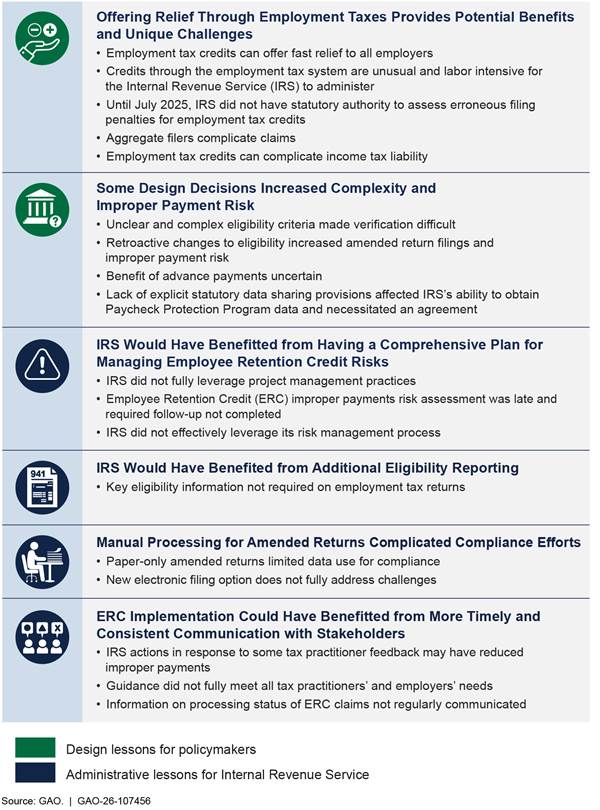
Based on our review of IRS documents, literature and legislative proposals, and interviews with experts, IRS management and staff, and payroll and tax professional groups, we identified six lessons for future economic relief efforts related to the design and IRS’s administration of the ERC (see appendix I for more information on our methodology). See figure 1. This section describes the contributing factors and, where applicable, provides questions policymakers can consider when designing future economic relief. A complete list of questions for policymakers is in appendix II.
Figure 1: Lessons Learned and Contributing Factors from Documents and Interviews on the Design and Administration of the Employee Retention Credit
|
Lessons Learned on Employee Retention Credit Design
We identified two lessons, each with contributing factors. We also pose questions that policymakers can consider for future tax relief. Source: GAO. | GAO‑26‑107456 |

Offering Relief Through Employment Taxes Provides Potential Benefits and Unique Challenges
|
|
Contributing Factors on Employment Tax System · Employment tax credits can offer fast relief to all employers · Credits through the employment tax system are unusual and labor intensive for the Internal Revenue Service (IRS) to administer · Until July 2025, IRS did not have statutory authority to assess erroneous filing penalties for employment tax credits · Aggregate filers complicate claims · Employment tax credits can complicate income tax liability |

Source: GAO analysis. | GAO‑26‑107456
Employment Tax Credits Can Offer Fast Relief to All Employers
The employment tax system has two advantages over using the income tax system to distribute economic relief: it (1) can disburse refunds faster, throughout the year; and (2) is available to all employers.
Faster. The frequency of employment tax deposits—which employers could make daily, semi-weekly or monthly—provided an opportunity for employers to benefit from ERC quickly during the pandemic.[25] The ERC also included both a refundable and nonrefundable portion.[26] The ERC refundable portion was any ERC amount remaining at the end of the quarter if the ERC amount exceeded the employer share of Social Security tax or Medicare tax. If an employer anticipated that during a quarter the ERC amount would exceed the employer’s employment taxes, the employer could reduce deposits during the quarter by the amount of the anticipated ERC. The nonrefundable portion of the credit is limited to the employer’s share of Social Security tax or Medicare tax, depending on the quarter.[27]
Available. The employment tax system also provides tax benefits to entities that do not have an income tax liability. Entities such as non-profit organizations that are exempt from income tax (referred to as “exempt organizations”) accounted for about 10 percent of employment in 2022. In 2022, we reported that about 9 percent of ERC claims were filed by exempt organizations.[28] Additionally, because start-up businesses may not yet have enough income to generate tax liability, employment tax credits offer relief to these entities whereas income tax credits cannot, according to one legal expert.
|
Question for policymakers to consider for future emergency economic relief Will use of the employment tax or employment tax system provide timely relief to the intended population? |
Source: GAO. | GAO‑26‑107456
Credits Through the Employment Tax System Are Unusual and Labor Intensive for IRS to Administer
Unusual. Prior to the pandemic, relatively few tax credits were claimed through the employment tax system compared to the income tax system.[29] Historically, compliance issues for employment taxes typically related to the reporting of taxable wages, such as employee and contractor classifications. As a result, IRS officials told us that when ERC was created, the agency did not have many IT systems and processes in place to administer and ensure compliance with employment tax credits.
Labor intensive. During fiscal year 2024, IRS received about 34 million original employment tax returns and about 12 million of these (35 percent) were filed on paper. Furthermore, prior to mid-2024, amended employment tax returns (Form 941-X) could only be filed on paper.
The large volumes of paper returns made delivering economic relief through employment taxes cumbersome for IRS to administer. During processing, paper-filed returns need to be handled by multiple IRS employees. Employees also need to manually key in data from paper forms into IRS IT systems. By contrast, e-filed returns are processed using automation and only require human intervention if the return has an issue.[30]
While quarterly employment tax filings provided IRS more opportunities to issue refunds to employers, the resulting increases in paper filings added to processing burdens for IRS. These processing challenges for paper returns were exacerbated during the pandemic when IRS had to suspend work at its submission processing centers. As we reported in 2021, the large volumes of paper filings created significant backlogs, delaying relief payments to struggling businesses.[31] In 2021, we recommended that IRS identify and address barriers that taxpayers face to e-filing business returns. In response to our recommendation and other factors, IRS has been taking some steps to improve electronic filing rates for businesses.[32]
|
Question for policymakers to consider for future emergency economic relief Does the Internal Revenue Service have the capacity to use the employment tax system to implement relief efficiently? |
Source: GAO. | GAO‑26‑107456
Until July 2025, IRS Did Not Have Statutory Authority to Assess Erroneous Filing Penalties for Employment Tax Credits
Since 2007, federal law has provided IRS specific authority to impose a civil penalty on erroneous claims for income tax refunds or credits.[33] The penalty is equal to 20 percent of the excessive amount claimed.[34] However, federal law did not provide for this penalty authority for other types of taxes, including employment taxes. In March 2024, the Department of the Treasury proposed that federal law extend the income tax penalty on erroneous claims to employment tax refunds or credits.[35] In July 2025, legislation was enacted to extend the penalty to employment taxes.[36]
In its March 2024 proposal, Treasury said that extending the penalties to employment taxes would discourage certain fraudulent claims. According to IRS officials, prior to the legislative change, if an employer filed erroneous ERC claims that IRS detected before issuing a refund, the only likely consequence to the employer would be the claim’s denial.[37] Promoters of ERC tax schemes might have known that the penalty for claiming erroneous income tax refunds or credits did not apply to employment tax, according to an IRS official. These promoters may have pushed employers to file erroneous ERC claims by convincing the employers that they had nothing to lose, according to IRS.
|
Question for policymakers to consider for future emergency economic relief Does federal law provide the Internal Revenue Service sufficient statutory authority to assess penalties on erroneous claims for emergency economic relief to help ensure compliance? |
Source: GAO. | GAO‑26‑107456
Aggregate Filers Complicate Claims
Third-party aggregate filers, which assist employers with various payroll and tax requirements, are subject to a series of IRS requirements that can complicate compliance decisions and delay ERC processing. To claim ERC for their clients, these filers are required to file a single aggregate employment tax return under their own employer identification number (EIN), representing themselves and their clients.[38] Aggregated information made it difficult for IRS to determine whether some ERC claims represented multiple employers. By contrast, some third parties may file employment taxes for clients, but they file separate returns for each client under the client’s employer’s EIN, therefore eliminating the extra step of IRS having to link an employer with an ERC claim on an aggregate return. See table 1 for the variations of third-party arrangements.
Table 1: Common Third-Party Arrangements, Responsibilities, and Liabilities Prior to Employee Retention Credit
|
Third-party payer arrangement |
Employment tax filings |
Employment tax payments |
Employment tax liability |
|
Third parties that file separate returns for employer clients |
|||
|
Payroll service provider: typically prepares employment tax returns, and processes withholding, deposit, and payment of employment tax. |
Employer signs the return and files under its Employer identification Number (EIN). |
Paid under the employer EIN. |
Employer is solely liable for timely filing and tax payment. |
|
Reporting agent: a type of payroll service provider that is designated as a reporting agent. The agent files returns and may deposit and pay taxes on employer’s behalf.a |
Reporting agent signs the return, filed under the employer EIN. |
Paid under the employer EIN. |
Employer is solely liable for timely filing and tax payment. |
|
Third parties that file an aggregate return |
|
|
|
|
Section 3504 agent: performs acts such as withholding, reporting and paying employment taxes.b |
Aggregate return filed under the agent’s own EIN for all clients. |
Aggregate tax paid under the agent’s EIN. |
Both employer and agent are liable for timely filing and tax payment. |
|
Professional employer organization (PEO): also known as an employee leasing organization, a PEO does some or all withholding, reporting and paying employment tax. |
Aggregate return filed under the PEO’s EIN for all clients. |
Aggregate tax paid under the PEO’s EIN. |
Circumstance dependent. |
|
Certified professional employer organization (CPEO): a PEO that has completed a certification process through the Internal Revenue Service (IRS). |
Aggregate return filed under the CPEO’s EIN for all clients. |
Aggregate tax paid under the CPEO’s EIN. |
Generally, the CPEO is solely liable for filing and tax. |
Source: GAO analysis of IRS information. | GAO‑26‑107456
Notes: The table reflects common third-party arrangements, responsibilities, and liabilities prior to Employee Retention Credit (ERC). An IRS Chief Counsel memorandum states that a third-party payer that is a section 3504 agent, certain PEOs, or a CPEO is liable for any underpayment resulting from an improperly claimed employment tax credit that the third-party payer claimed for the client on the third-party payer’s employment tax return filed under the third-party’s EIN, where the credit was claimed based on wages paid by the third-party payer to the client’s employees. This rule applies to the ERC as it would any other employment tax credit. See IRS, Office of Chief Counsel Memorandum, Liability of Certain Third-Party Payers for an Underpayment of Certain Employment Taxes Resulting from Improperly Claimed Employment Tax Credits (Feb. 05, 2024).
aAn employer and a third-party file Form 8655, Reporting Agent Authorization, with IRS to designate a payroll service provider as a Reporting Agent.
bAn employer and a third-party file Form 2678, Employer/Payer Appointment of Agent, with IRS to authorize the third party as a Section 3504 Agent of the employer.
Beginning in 2020, all third-party filers filing for ERC were required to file Schedule R for any client claiming an ERC employment tax credit. Schedule R is completed with Form 941, and totals from lines on Form 941 are allocated among clients (see fig. 2). Total amounts reported on Form 941 should match the client totals on Schedule R, per line.
Figure 2: Internal Revenue Service Schedule R (Form 941) for Third-Party Payers Filing Employee Retention Credits on Behalf of Clients
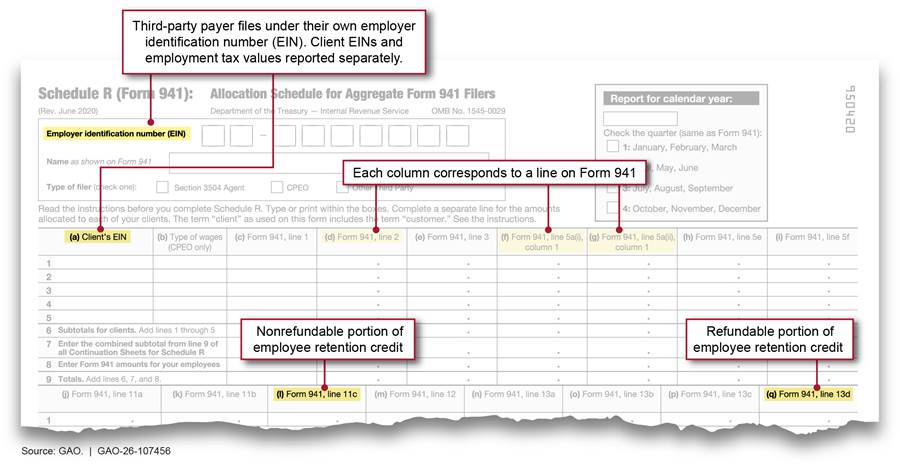
Number of employers represented in an aggregate return is sometimes unclear. IRS does not have data on the population of third-party aggregate filers, according to IRS officials. Therefore, IRS also does not know the number of clients represented in aggregate filings, according to a draft legislative proposal. Despite the requirement to file Schedule R, which would provide IRS with visibility into this population (as reflected under “Client’s EIN” in fig. 2). IRS officials said third-party aggregate filers were not consistent in meeting this requirement. As a result, IRS does not always know whether some ERC claims represented multiple employers. Knowing whether a large claim represents one employer or many employers filed through a third-party helps IRS review the claim, according to IRS officials. For example, a claim of $100 million filed for one employer presents different risks than a claim of the same amount that is an aggregate filing for several employers.
All-or-nothing processing. A third-party payer’s aggregated Schedule R could represent thousands of clients, according to IRS officials. A problem with one client claim on an aggregate return could delay processing for all the claims, according to a group representing certain third-party payers. Each time a client requests a change to their ERC, the third-party payer files another amendment, according to IRS officials and payroll professionals. IRS announced a process in September 2024 for third-party payers to consolidate their ERC filings and withdraw any ineligible claims.
Limited accessible data. Client-level aggregated data from Schedule R filings are not easily extractable for analysis, according to IRS officials, because of the format and amount of information (as reflected in the individual rows for each client in fig. 2). Reviewing compliance for client-level ERC claims requires extra steps to extract the EINs and other client-specific data, which could increase the risk of improper payments.
Citing $10 billion of Professional Employer Organizations’ (PEO) ERC claims considered to be very high risk of being improperly claimed, IRS developed a legislative proposal for Treasury’s consideration for inclusion in its fiscal year 2026 General Explanations of the Administration’s Revenue Proposals.[39] IRS proposed that PEOs be required to file Schedule R, and file aggregated returns electronically. Under the proposal, PEOs would also be required to report on filing agreements with clients. The proposal also included a failure to file penalty for PEOs not filing Schedule R. The proposal stated that employment taxes that are not allocated appropriately or reconciled to a Form 941 may result in a significant loss of revenue if refunds are allocated incorrectly. Treasury officials told us that the department would not issue a fiscal year 2026 version of General Explanations of the Administration’s Revenue Proposals.
|
Question for policymakers to consider for future emergency economic relief Are there any filing requirements or arrangements that could complicate the Internal Revenue Service’s implementation and compliance efforts? |
Source: GAO. | GAO‑26‑107456
Employment Tax Credits Can Complicate Income Tax Liability
Employers generally deduct wages paid to employees on their income tax returns. Under the CARES Act, employers are barred from deducting wages claimed for ERC, thereby preventing a double tax benefit.
ERC claims filed on amended employment tax returns complicate the relationship between employment tax and income tax, especially when ERCs were delayed. According to IRS’s frequently asked questions (FAQ), ERC claimants should amend their income tax returns to reduce the amount of their original wage expenses, if that adjustment has not yet been made.[40]
When an amended income tax return is filed, employers are expected to pay any additional income tax due at the time of filing. For ERC claims facing processing delays, employers face uncertainties about how to amend their income tax returns. Therefore, to maintain cash flow, employers may hesitate to amend their income tax returns until they have received their refunds, according to a tax professional group. If an employer proactively amended its income tax return to reduce its wage deduction by the amount anticipated for ERC but the credit was disallowed, its income tax liability decreases.
In March 2024, Treasury introduced a legislative proposal to extend the statute of limitations for assessment on erroneous ERC claims to 5 years.[41] This proposal included assessing additional income tax from an ERC claimant that did not make a corresponding downward adjustment to its wage deduction. Enacted in July 2025, the One Big Beautiful Bill Act included a provision which extended the statute of limitations on tax assessments of certain ERC claims to 6 years.[42] In March 2025 IRS also issued FAQs stating that employers could adjust income tax liabilities for the year in which their ERCs were finalized. The FAQs also stated that filing a “protective claim” is an option to address the issue.[43]
|
Question for policymakers to consider for future emergency economic relief Are there implications of employment tax relief on income taxes? Issues to consider could include: · Whether corresponding benefits from income tax are allowed. · Whether the statute of limitations is sufficient for accommodating amendments to income tax returns. · Whether income tax liability can be incorporated into employment tax calculations. |
Source: GAO. | GAO‑26‑107456
Some Design Decisions Increased Complexity and Improper Payment Risk
|
|
Contributing Factors on Complexity and Improper Payment Risk · Unclear and complex eligibility criteria made verification difficult · Retroactive changes to eligibility increased amended return filings and improper payment risk · Benefit of advance payments uncertain · Lack of explicit statutory data sharing provisions affected the Internal Revenue Service’s ability to obtain Paycheck Protection Program data and necessitated an agreement |

Source: GAO analysis. | GAO‑26‑107456
Unclear and Complex Eligibility Criteria Made Verification Difficult
The language of the CARES Act regarding some ERC eligibility criteria was vague which made it difficult for employers and IRS to determine eligibility, according to IRS officials and tax and payroll professionals. Employers could claim the ERC if either (1) their business operations were fully or partially suspended by a government order as a result of the COVID-19 pandemic, or (2) their business experienced the requisite decrease in gross receipts. See sidebar.
|
CARES Act definition of suspended business operations due to a government order According to the CARES Act (Pub. L. No. 116-136), employers were eligible for the Employee Retention Credit if their businesses or trades were: “fully or partially suspended during the calendar quarter due to orders from an appropriate governmental authority limiting commerce, travel, or group meetings (for commercial, social, religious, or other purposes) due to the coronavirus disease 2019 (COVID-19).” Source: GAO review of the CARES Act. | GAO‑26‑107456 |
Government suspension. The government suspension criteria for ERC eligibility were subjective and the statutory language did not clearly define what qualified as a government order, according to IRS counsel. Government orders that limited commerce, travel, or group meetings due to COVID-19 varied widely among states and even within states. Unlike federal declarations of disaster areas, there was no central source of information that IRS could use to verify if employers’ operations were fully or partially suspended by a state or local government order.[44] See text box.
|
Challenges with verifying COVID-19 government shutdown order Employee Retention Credit eligibility criteria In some states, the governor’s office issued statewide shutdown or stay-at-home orders that suspended business or trade. Other states gave city, county, and local governments more autonomy to issue their own orders. In some states, governors overrode or preempted those local orders. In other states, courts struck down some governors’ stay-at-home orders. The applicable dates for government orders varied widely. Some governments started issuing stay-at-home orders and closing businesses in the first quarter of 2020 (March), whereas others began in the second quarter (April). Some governments then began loosening restrictions on businesses in the second quarter. Some loosened restrictions only to later reimpose them as COVID-19 cases increased. Some governments ordered only non-essential businesses to close, others closed specific industries or types of businesses, and still others imposed capacity limitations or social distancing on businesses. Some governments issued mandatory stay-at-home orders whereas others made their stay-at-home orders voluntary or included exemptions for some activities like religious gatherings. |
Source: GAO. | GAO‑26‑107456
According to IRS officials, the IRS research division conducted exhaustive searches to obtain information on government shutdown orders. Because there was no central source for information on suspension orders, IRS used some assumptions to identify possible eligibility issues. According to IRS documents, most shutdown orders had been lifted across the continental U.S. by the third quarter of 2021; so, for the third and fourth quarters of 2021 most businesses could only qualify for ERC based on declines in gross receipts. In addition, the lack of statutory definitions for words in the law such as “suspended” and government “order,” made it difficult to audit returns, according to IRS officials.
|
CARES Act definition of requisite decline in gross receipts According to the CARES Act (Pub. L. No. 116-136), employers were eligible for the Employee Retention Credit (ERC) in 2020 if the employer experienced a decline in gross receipts as follows: · beginning with the first calendar quarter beginning after December 31, 2019, for which gross receipts for the calendar quarter are less than 50 percent of gross receipts for the same calendar quarter in the prior year; and · ending with the calendar quarter following the first calendar quarter beginning after a calendar quarter described in clause for which gross receipts of such employer are greater than 80 percent of gross receipts for the same calendar quarter in the prior year. According to the CARES Act, as amended, employers were eligible for the ERC in 2021 if the employer experienced a decline in gross receipts as follows: · the gross receipts of the employer for the calendar quarter are less than 80 percent of the gross receipts of the employer for the same calendar quarter in 2019; and · the employer could also use the alternative quarter election by comparing the preceding calendar quarter in 2021 to the same calendar quarter in 2019 to determine whether the gross receipts were less than 80 percent of the gross receipts of the quarter in 2019. Source: GAO analysis of the CARES Act. | GAO‑26‑107456 |
Some of the distinctions between essential and non-essential businesses in government shutdown orders caused confusion for the members of one business group, according to a group representative. Further, one expert said that uncertainties of the eligibility criteria and the wide variations of government suspension orders led promoters to believe that IRS would likely trust employer filings. In addition to opening the door for promoters, the uncertain eligibility criteria discouraged cautious employers who might legitimately qualify for the credit, according to IRS counsel.
Decrease in gross receipts. Employers could also be eligible for ERC if they experienced the requisite decrease in gross receipts. Employers generally report gross receipts annually on income tax returns. See sidebar.
The gross receipts definition was confusing for tax-exempt entities because most nonprofit organizations did not compute gross receipts quarterly, according to representatives from a group representing these entities. In June 2020, IRS issued a Frequently Asked Question response defining gross receipts for such organizations.[45] In December 2020, the CARES Act was retroactively amended to change the definition of gross receipts applicable to tax-exempt entities.[46]
The initial CARES Act ERC definition of a decline in gross receipts also complicated IRS’s efforts to try to confirm gross receipt losses to determine eligibility. Specifically, according to IRS chief counsel officials, the concepts and measures of gross receipts are more applicable to income, rather than employment taxes. Gross receipts in the income tax context are generally used to determine profit and, therefore, tax liability. In the employment tax context, gross receipts are not necessary to calculate employment tax liability. Employers are required to withhold a portion of an employee’s wages for purposes of paying employment taxes. Operating business income generally is not needed for employment tax purposes.
As we discuss later in this report, IRS did not require employers to report the dollar amount of declines in gross receipts when filing an ERC claim, making it difficult for IRS to confirm eligibility without a resource-intensive examination. As a result, IRS reviewed annual income tax information, according to IRS documents.
|
Question for policymakers to consider for future emergency economic relief Are definitions or eligibility criteria clear and straight-forward to report and verify? |
Source: GAO. | GAO‑26‑107456
Retroactive Changes to Eligibility Increased Amended Return Filings and Improper Payment Risk
Three laws enacted in 2020 and 2021 retroactively changed the first version of the ERC in the CARES Act. These changes expanded ERC eligibility, most notably by allowing employers who had a forgiven Paycheck Protection Program (PPP) loan to also claim the ERC. These laws changed other eligibility criteria, including gross receipts thresholds. The laws also changed the maximum dollar amount of qualified wages an employer could claim. Figure 3 shows eligibility periods for each law, and corresponding retroactive eligibility.
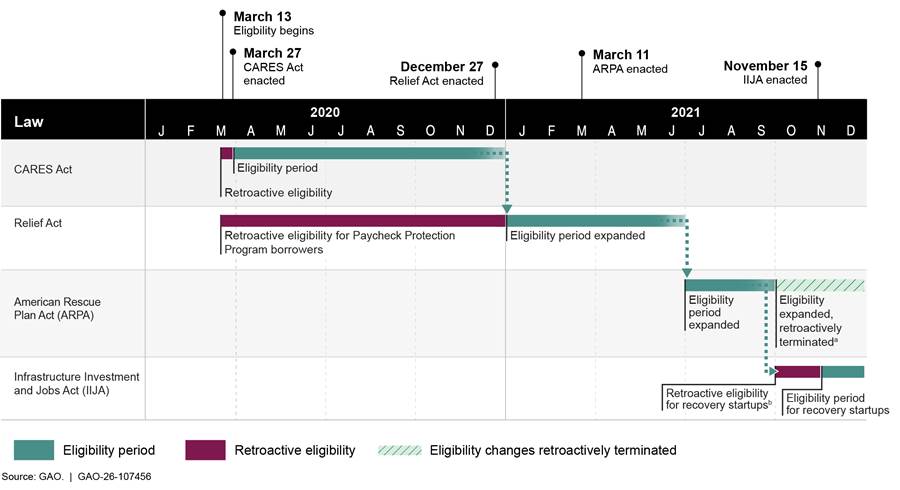
aARPA expanded Employee Retention Credit (ERC) availability to recovery startup businesses for the third and fourth quarter of 2021. The IIJA retroactively limited the ERC to only recovery startup businesses in the 4th quarter of 2021.
bRecovery startup businesses were employers that opened after February 15, 2020, with average annual gross receipts under $1 million during the past 3 years.
The retroactive changes were often effective immediately after the laws were passed. As a result, IRS officials and two experts said IRS had little time to implement them, such as developing new processes or issuing updated guidance. According to some members of a payroll professionals group we interviewed, in some cases employers filed ERC claims based on outdated IRS guidance.
Increased amended return filings. As ERC eligibility expanded, amended return claims increased. Approximately 86 percent of ERC claims were filed on amended returns, mostly on Form 941-X, through mid-2025.[47] Because IRS did not enable electronic filing of Form 941-X until mid-2024, the manual processing of millions of paper-filed forms created a large administrative burden for IRS that delayed processing times and ERC disbursements.[48]
Improper payment risk. Legislative changes made ERC more generous through increased credit maximums. As ERC became more generous, there were uncertainties and promoters exploited employers who were not sure how to navigate the rules, according to IRS counsel. Promoters contributed to the high number of improper claims, as described in IRS’s Dirty Dozen lists in 2023 and 2024.[49] The scams raised the importance of tax compliance efforts, according to IRS officials. IRS generally has 3 years to assess tax from compliance actions, such as certain overclaimed ERC. Due to pandemic and ERC-specific factors—such as processing delays—IRS initially had a narrower window for post-refund assessments. However, as we described above, legislation enacted in July 2025 extended the statute of limitations on tax assessments of certain ERC claims to 6 years.[50]
|
Question for policymakers to consider for future emergency economic relief If considering retroactive provisions, do the benefits outweigh the administrative challenges and improper payment risks? |
Source: GAO. | GAO‑26‑107456
Benefit of Advance Payments Uncertain
The CARES Act included a provision for employers to receive advance ERC payments, prior to the end of a quarter.[51] IRS data indicate that employers did not file for the advance payments as much as might have been anticipated. Overall, filings for advance payments were relatively low. Advance COVID-19 employment tax credits amounted to about $1.4 billion, which was less than 1 percent of the total refund dollars claimed on original returns.[52] The fact that employers were instructed to reduce employment tax deposits for anticipated ERC amounts may have contributed to the low filings because they did not have a refund balance eligible for advance payment.[53]
Further, quarterly employment tax filings are already more frequent than income taxes and employers could reduce employment tax deposits throughout the quarter if they qualified for ERC. This may indicate that employers did not see much of a benefit in completing and filing a different form to receive an advance payment. It is also possible the advance payments in 2020 were low, in part, because of the prohibition at that time on claiming ERC if the employer received PPP loan forgiveness. After federal law was amended in December 2020 to remove this restriction, IRS officials said there was an increase in filings on Form 7200, Advance Payment of Employer Credits Due to COVID-19.
By April 2020, IRS had developed Form 7200 and an electronic fax system for employers to file for advance payments, helping to bypass mail-related delays. Despite the fax system, processing times averaged as high as 7 weeks. Given this turnaround time, it is possible that an employer filing for an advance payment during the last month of a quarter through the end of the quarter due date may have received a refund faster by e-filing Form 941 at the end of the quarter.[54] Paper processing times for Form 941 credits could take up to several months, according to payroll and tax professionals.
|
Question for policymakers to consider for future emergency economic relief If considering offering advance payments for an employment tax credit, do the benefits outweigh the administrative costs and challenges? |
Source: GAO. | GAO‑26‑107456
Lack of Explicit Statutory Data Sharing Provisions Affected IRS’s Ability to Obtain PPP Data and Necessitated an Agreement
The CARES Act did not provide an explicit grant of statutory authority to the Small Business Administration (SBA)—the agency administering the PPP—to share data on PPP loans with IRS. The CARES Act, which established the ERC and PPP, prohibited employers from claiming both ERC and obtaining a PPP loan. Recognizing the need to share data relative to their respective responsibilities under the ERC and PPP, IRS and the SBA started negotiating an agreement under their pre-existing authority for SBA to share limited PPP data in April 2020. The data-sharing memorandum was finalized in September 2020.[55]
Access to PPP loan data enabled IRS to more easily screen ERC claims for potential noncompliance with the rules restricting employers from using both programs (see appendix III for information on actions IRS took to do so). An IRS official stated it would have been helpful in the legislation to have greater clarity around what data can be shared and with whom. A direct grant of statutory authority for SBA to share PPP data with IRS, for example, could have facilitated IRS’s initial compliance efforts to ensure that employers with PPP loans were not also trying to claim the ERC.
In December 2020, federal law was amended to remove the restriction that had prohibited employers from both applying for PPP loan forgiveness and claiming the ERC.[56] However, a limitation was added that employers could not count the same payroll expenses when claiming ERC and obtaining PPP loan forgiveness. IRS and SBA subsequently modified their data-sharing memorandum in 2021 to share more PPP loan data from SBA. IRS could use the additional SBA data to help determine whether employers claiming ERC had used the same wage amounts for PPP loan forgiveness.
IRS officials said that when considering future legislation that provides emergency relief through the tax code, it would be helpful to include language to explicitly permit inter-agency data sharing that could aid IRS compliance efforts. An SBA official also said that having statutory authority in advance is easier than establishing agreements. In other situations where statutory restrictions have prohibited or limited data sharing between agencies, we have previously recommended that Congress consider addressing those restrictions. For example, we have recommended that Congress provide Treasury with access to the Social Security Administration’s full set of death records to prevent payments to ineligible deceased taxpayers.[57]
|
Question for policymakers to consider for future emergency economic relief If the relief hinges on other federal programs not administered by the Internal Revenue Service (IRS), would statutory provisions to permit data sharing between IRS and other agencies help facilitate IRS’s compliance efforts? |
Source: GAO. | GAO‑26‑107456
|
Lessons Learned on Employee Retention Credit Administration
We identified four lessons, each with contributing factors. Source: GAO. | GAO‑26‑107456 |

IRS Would Have Benefitted from Having a Comprehensive Plan for Managing ERC Risks
|
|
Contributing Factors on Planning and Risks · The Internal Revenue Service (IRS) did not fully leverage project management practices · The Employee Retention Credit improper payment risk assessment was late and required follow-up not completed · IRS did not effectively leverage its risk management processes |

Source: GAO analysis. | GAO‑26‑107456
IRS Did Not Fully Leverage Project Management Practices
In 2022, we reported that IRS’s plans to address potential ERC noncompliance partially demonstrated relevant project management practices we selected for review.[58] We found, for example, that IRS’s plans did not include measurable objectives and that plans for coordination among IRS units were inconsistent and incomplete. Specifically, the Office of Fraud Enforcement’s Fabricated Entities Project, which focused on identifying fraudulent entities claiming COVID-19 employment tax credits, was not included in ERC planning documents. The Fabricated Entities Project prevented payment of hundreds of millions of dollars in improper ERCs and also led to criminal investigation referrals. We recommended that IRS develop an integrated project management plan for the COVID-19 credits, including ERC.
IRS disagreed with the recommendation but as of March 2025, IRS made progress in implementing some components of a project plan. For example, IRS documented leadership decision approvals and data analyses that informed decision-making and documented stakeholder involvement, with the creation of the Servicewide ERC Team. However, as of August 2025, it did not have a project plan with measurable objectives or defined and sequenced scheduled activities.
More timely and full implementation of our prior recommendation could have helped IRS prepare to respond to the surge of questionable ERC claims in 2023 and promoters of those claims. Further, compliance activities continue for ERC claims. As of December 31, 2025, about 41,000 claims remain in examination or appeals, according to IRS officials. Employers can file an appeal anytime within 2 years of a disallowance letter. Although the statute of limitations for assessing tax on certain paid improper ERCs has expired, IRS can still pursue fraud cases indefinitely. We maintain that with measurable objectives, performance measures, comprehensive planning documents and schedule management, and other practices, IRS would be better positioned to move forward with compliance activities for ERC.
ERC Improper Payment Risk Assessment Was Late and Required Follow-Up Not Completed
In May 2022, the Treasury Inspector General for Tax Administration (TIGTA) found that IRS was late in conducting a statutorily required improper payments risk assessment on ERC.[59] The assessment should have been completed after ERC had been in operation for 12 months (by April 2021). However, IRS did not complete it until February 2022.[60] IRS officials told TIGTA they did not complete the assessment on time because they misinterpreted which U.S. Coronavirus Refundable Credit fund account was included under the requirement.[61]
When IRS did complete the improper payment risk assessment, the agency concluded that ERC was susceptible to significant improper payments.[62] The identified risk factors included complexity of the credit, volume of payments, and recent significant changes in program policies and procedures.
IRS officials confirmed, however, that they did not conduct specific follow-up steps in response to the 2022 risk assessment, as required by the Payment Integrity Information Act (PIIA).[63] If a program such as ERC is identified as susceptible to significant improper payments, the agency must, among other things, (1) develop an estimate of improper payment rates, (2) identify the root cause for improper payments, (3) develop a corrective action plan, and (4) report on the results of these requirements.[64] PIIA also requires each agency’s inspector general to issue an annual report on the agency’s compliance with applicable PIIA criteria.[65]
In August 2022, Treasury sent a memorandum to the Office of Management and Budget (OMB) stating that due to the short time frame over which the majority of disbursements would be made by the COVID-19 related programs for which Treasury was responsible, quantifying the amount and rate of improper payments, assessing the root cause, and developing corrective action plans to reduce payment errors in the future would have provided minimal value and been an ineffective use of resources.
Treasury specifically stated that many of the COVID-19 related programs would have completed disbursements before an improper payment estimate was due, approximately 3 years into a program. Based on OMB guidance, an improper payment estimate for ERC (which began in 2020) would have been due for fiscal year 2023. Further, developing timely estimates for fiscal years 2023 and 2024 would have been relevant, because after fiscal year 2022 about $183 billion in ERC claims have been paid.[66]
In its response to Treasury’s August 2022 memorandum, OMB acknowledged receipt of Treasury’s statements. [67] TIGTA acknowledged Treasury’s memorandum to OMB, but did not identify the lack of follow-up for ERC as noncompliance with applicable PIIA criteria in its May 2025 required annual report to Congress.[68] In a report covering PIIA compliance for fiscal year 2024, the Treasury Inspector General also acknowledged that IRS did not calculate or report improper payment rates for ERC, but did not make any statements about ERC PIIA compliance.[69] A TIGTA official told us that they considered IRS to be compliant with PIIA because of OMB’s acknowledgement of the August 2022 memorandum.
In 2025, IRS officials stated that the agency had taken actions to address ERC risks after the February 2022 risk assessment, such as increased scrutiny of large and questionable claims. To some degree, these efforts likely helped address improper payment risks. However, by not completing required PIIA improper payment estimates, IRS is unlikely to be able to determine the extent to which improper payments occurred. For example, in 2023, IRS publicly stated that it believed that many ERC claims were likely ineligible and cited anecdotal descriptions from tax professionals that 95 percent or more of recent claims were likely ineligible.[70]
Further, without an estimate, IRS may not be able to identify root causes for ERC improper payments, or develop effective mitigation strategies and corrective actions.[71] Once an agency has gained insight into payment integrity risks and the root causes of improper payments for a program, the agency can then take action to develop and implement effective mitigation strategies and corrective actions and coordinate across the agency on similar challenges. Improper payment estimates and related reporting also provide important information to Congress and taxpayers on agencies’ use of taxpayer funds and progress in the prevention and recovery of improper payments. This information is particularly important for emergency assistance programs such as ERC, which carry higher risks of improper payments.
We have previously reported on the importance of agency oversight of compliance with PIIA criteria and timely reporting. We have also made several recommendations to Congress on this topic, which remain open as of January 2026.[72] Given the rapid timeline of emergency assistance, time lags in assessing risk may result in improper payment issues, including those resulting from fraudulent activities, not being identified or addressed until after most or even all funds are disbursed. For emergency assistance programs, especially large programs with possible widespread improper payments, we have emphasized the importance of estimating improper payments expeditiously, including during the initial year of implementation.
IRS closed all remaining ERC claims, aside from those under examination or appeal, by December 31, 2025, according to IRS officials. New claims can no longer be filed. However, by developing an improper payment estimate for ERC, IRS could help inform future design of employment tax relief programs, if policymakers decide to create them.
IRS Did Not Effectively Leverage Its Risk Management Processes
IRS’s enterprise risk management and fraud risk management processes did not identify the specific compliance risks of ERC claims on amended returns in a timely manner.[73] The warning signs for potential ERC compliance issues on amended returns started in 2021 as the number of questionable claims grew, as shown in figure 4.[74] ERC was included in risks related to refund fraud schemes in IRS’s annual Enterprise Risk Profile in October 2023 and again in 2024. IRS included ERC in its Fraud Risk Profile in December 2023.[75]
Figure 4: Timeline of Internal Revenue Service’s Employee Retention Credit Risk Identification Actions
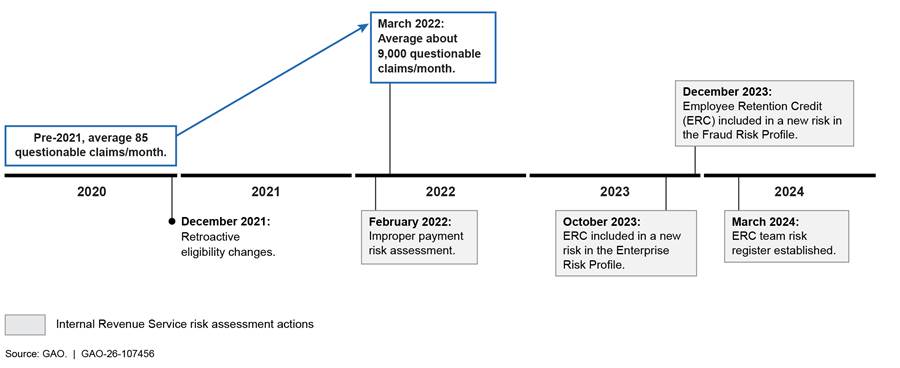
IRS’s February 2022 designation of ERC as susceptible to significant improper payments risk should have triggered escalation of ERC to the agency designated risk official for inclusion in the agency’s risk inventory, per OMB guidance.[76] By March 2022, questionable ERC claims flagged for examination had increased by over 10,000 percent.[77] In May 2022, we reported that IRS had not documented processes to address compliance risks for amended returns and we recommended that IRS do so.[78]
The Internal Revenue Manual documents policies to help ensure compliance with OMB’s enterprise risk management requirements.[79] IRS also has a Risk Assessment Guide and Toolkit for facilitating risk assessments within business units and programs. Both IRS documents state that IRS is to use risk registers, monitor risks, and implement internal controls.
Improper payment risk assessments can help inform enterprise risk management and fraud risk management. An IRS official said the delay in risk identification was because they were focused on implementing CARES Act provisions and getting ERC claims processed. However, several sources reported that the challenges IRS faced implementing economic impact payments, and navigating pandemic-related office closures and legislative changes had eased in 2022.[80] The IRS official agreed IRS could have acknowledged the risks associated with processing paper returns, the newness of the ERC, and its retroactive provisions sooner.
Although IRS began adjusting its compliance process in 2022—such as changing review criteria and capturing additional data—these actions were not included in risk profiles.[81] Documenting risks and following a risk management process facilitates risks being monitored and considered relative to other agency risks, and resource allocation decisions. These steps could have helped IRS better adjust its processes and reduce improper payments in a timely manner, as discussed later in this report.
In October 2023, when ERC was first included in an agencywide risk profile, IRS had just implemented a processing moratorium in the prior month to give the agency time to develop a model to assess compliance issues on amended returns (see appendix IV for details on IRS’s efforts in this regard).[82] IRS established an ERC-specific risk register in March 2024. The text box below describes an example of another risk that IRS initially overlooked—promoter schemes—for which better risk management could have helped guide mitigation.
|
Risk management process could have helped the Internal Revenue Service identify promoter schemes sooner Promoters of Employee Retention Credit (ERC) schemes, a driver of improper ERC amended return claims, were not mentioned in risk assessment documents until September 2024. The Internal Revenue Service (IRS) started alerting employers about schemes promoting improper ERC claims in October 2022. However, until 2024, IRS had limited tools to analyze social media, where many ERC schemes were being promoted, according to IRS officials. Social media analysis plays a pivotal role in identifying tax schemes, but it is resource intensive because of the training and technology involved, according to Criminal Investigations (CI) officials within IRS. A risk assessment that identified ERC amended return risk and promoters may have helped IRS to prioritize social media analysis tools sooner. These tools could help IRS identify and shut down promoters while schemes are active, rather than tracking them down after the issuance of improper refunds. Eventually, IRS took actions to build capacity to identify schemes promoted in social media going forward and to engage with stakeholders, such as tax professionals. As a result of resource prioritization, in March 2024, CI started developing searches to identify individuals and businesses in social media and the dark web (a hidden part of the internet accessed using specialized software), according to CI officials. In August 2024, IRS established the Coalition Against Scam and Scheme Threats, which included state and tax industry stakeholders, to raise awareness and educate taxpayers about social media schemes, beyond just ERC. These considerations of resources, technology use, and partnerships could help IRS more quickly identify and address compliance threats in the future. |
Source: GAO. | GAO‑26‑107456
IRS Would Have Benefitted from Additional Eligibility Reporting
|
|
Contributing Factor on Eligibility Reporting · Key eligibility information not required on employment tax returns |

Source: GAO analysis. | GAO‑26‑107456
Key Eligibility Information Not Required on Employment Tax Returns
IRS used data associated with employer identification numbers, such as business establishment dates, to screen and confirm employer identities to determine eligibility for ERC. Starting with second quarter 2020 Form 941 filings, IRS incorporated some high level ERC eligibility requirements into employment tax returns. For example, Form 941 asked for total qualified wages for ERC, but not for information related to specific components of those wages. Additionally, Form 941 did not ask employers for information about the two key statutory criteria, from the CARES Act, for ERC eligibility: (1) whether they experienced either a requisite decline in gross receipts, or (2) were under a government suspension of operations order.
We recognize, as discussed previously, that statutory ERC eligibility relied on new or unclear definitions. However, designing forms and requesting eligibility information are decisions for IRS. Of the two key eligibility criteria, declines in gross receipts may have been easier to verify than information on government suspension of operations orders.[83] Most employers generally track gross receipts already for inclusion on their income tax returns. Although an imperfect determinant of eligibility, quarterly gross receipts information could have served as a data point in initial screening, among other information, for compliance activities. IRS could have also asked employers for more information about government suspension orders used for eligibility, such as the source and time period.
IRS officials told us they could not be certain that requesting more eligibility information from employers on existing tax forms would have facilitated compliance efforts. They also had concerns about IRS’s capacity to quickly process the additional information requested, according to an IRS official. Later, IRS considered or implemented other options.
· Attestation form. In 2023, IRS considered requiring an attestation form to accompany new ERC claims. This form would have requested that employers answer questions about eligibility, accuracy, and preparation of their returns. IRS planned to use the form to assess claims for processing or further review. Ultimately, IRS officials said they decided against the attestation form because of the correspondence it would create, necessitating resources for response. Further, the timing for introducing the form meant that a large group of ERCs were already allowed without it, creating a disparity with employers who would need to file it going forward, according to IRS officials.
· Narratives. A line on Form 941-X, as available during ERC’s filing period, requests a detailed narrative explanation, in a text box, of the corrections on the form. Although not specified in the instructions, employers had the option to provide information about eligibility in the box. IRS transcribed this box to check for ERC information, but discontinued it because of its “minimal impact” on data analytics. In a separate effort to inform examination selection, IRS analyzed the text box contents with software, avoiding the need for manual reviews, according to IRS officials.
· Eligibility checklist. In November 2023, IRS released an interactive online ERC eligibility checklist, which included questions about gross receipts and government orders. This was an optional tool that was not available when ERC filing began and results were not submitted to IRS. However, it could have helped employers to confirm eligibility themselves and informed decisions about whether to apply.
Requiring employers to address their eligibility at filing could have offered benefits to the employer and IRS. Depending on execution—ranging from asking for an attestation regarding eligibility, to answering questions, or submitting documents—the requested information could have spurred voluntary compliance or resulted in data to be used for screening. For example, asking the employer to indicate how they were eligible for ERC when they initially filed for the benefits—as done in a questionnaire sent to employers under examination, shown in figure 5—would have narrowed down eligibility scenarios. From here, IRS would have more information on potential ineligibility risks, such as an employer claiming to be under a government suspension of operations late in 2021.
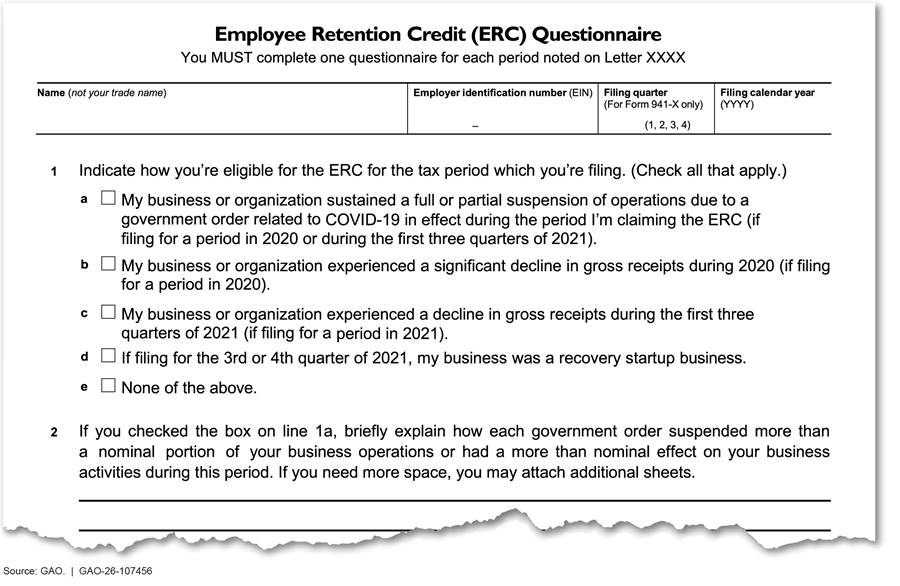
According to IRS officials, changing Forms 941 and 941-X was a labor-intensive process that required programming. Further, as we have noted in prior work, additional reporting on tax forms increases taxpayer burden.[84]
By not requiring information on the core eligibility requirements for ERC, IRS had limited ability to identify ineligible employers to prevent or recapture erroneous refunds. Instead, IRS had to use resource intensive steps, such as examinations, to gather and assess eligibility information after the initial filing. There are tradeoffs to seeking additional eligibility information with the initial filing. However, when coupled with the cost to the government of improper ERC refunds, the time and staff costs required for programming new form lines—an existing process—likely would have been less than implementing the processing moratorium and developing a model to assess ERC claims. For example, IRS was able to release a revised Form 941 in about 3 months, to include COVID-19 tax credits. By contrast, the ERC processing changes based on model results continued through December 2025.
Manual Processing for Amended Returns Complicated Compliance Efforts
|
|
Contributing Factors on Manual Processing · Paper-only amended returns limited data use for compliance · New electronic filing option does not fully address challenges |

Source: GAO analysis. | GAO‑26‑107456
Paper-Only Amended Returns Limited Data Use for Compliance
According to IRS documents, paper filings hampered IRS’s ability to extract and analyze data from these paper forms and delayed their ability to identify and mitigate promoters and fraud. About 86 percent of ERC claims processed were filed on Form 941-X, which prior to mid-2024, employers could only file on paper.[85]
After IRS implemented the processing moratorium in September 2023, IRS digitalized information from the paper forms through transcription (manually keying in data) and an artificial intelligence program. IRS used this information to develop its risk model, which applied tests and eligibility factors to unprocessed ERC claims and sorted them into risk categories (see appendix IV for more information).[86] IRS announced it was starting to process certain ERC claims about 9 months after the moratorium began, and over 3 years since statutory changes necessitated amended filings for many new ERC claims. As of March 2025, an IRS official said they did not have plans to continue use of the artificial intelligence program to digitize Form 941-X, aside from ERC claims. The program was intended to help IRS clear the backlog of Forms 941-X.
Leveraging the experience from digitizing ERC data can help IRS address any future digitization needs for paper returns. Easier access to more data from paper returns could also help IRS improve its compliance, customer service, and enforcement operations.
New Electronic Filing Option Does Not Fully Address Processing Challenges
Making the Form 941-X available for electronic filing in 2024 was an important action towards modernizing employment tax administration. But IRS still faces challenges in increasing employers’ use of e-filing and automating more downstream processing of amended returns. Tax returns submitted on paper and that require manual processing have outsized effects on IRS operations in that the processing takes longer, uses more resources, and is more prone to errors. By contrast, e-filed returns that are processed using automation generally only require human intervention if the return has an issue.
Additionally, despite the electronic filing option, the back end processing of these forms remains highly manual. E-filing allows for data on amended returns to be transmitted to and validated and accepted by IRS. However, once the electronically filed return is accepted, actual adjustments to taxpayer accounts such as for ERC still need to be manually processed by IRS employees.
The Treasury Inspector General for Tax Administration (TIGTA) reported in March 2024 that IRS had approved funding to automate more processing of amended individual income returns filed on Form 1040-X.[87] Individual taxpayers have been able to file Form 1040-X electronically since 2020, but like the Form 941-X, the forms are still processed manually. TIGTA estimated that fully automating the processing of Forms 1040-X would result in significant annual cost savings to IRS.[88]
Although IRS has estimated that it will receive annually about five times more Forms 1040-X than Forms 941-X for fiscal years 2025 to 2032, we found that the Form 941-X volumes are still substantial enough, post-ERC, to generate significant cost savings if IRS were to automate more processing.[89] In fiscal year 2021, IRS received about 565,000 Forms 941-X. By 2023, this amount had increased to 2.5 million, driven mostly by ERC claims. For fiscal years 2025 to 2032, IRS has estimated that it will receive on average 1 million Forms 941-X annually.
Agencies should proactively identify data they may need to verify applicant identity and eligibility and resolve any barriers to accessing data before an emergency occurs, according to A Framework for Managing Improper Payments in Emergency Assistance Programs (Managing Improper Payments Framework).[90] IRS’s reliance on time-consuming manual processing of amended employment tax returns compounded the challenges IRS faced in ensuring ERC compliance and led to significant processing backlogs. As we reported in January 2025, IRS’s total inventory of correspondence—which includes amended returns—was nearly 7 million in November 2024, and about 1 million of this was related to ERC claims.[91] According to IRS officials, as of June 2025, competing priorities and limited resources were barriers to achieving automated processing in the near term.
Underway as of June 2025, the IRS’s Zero Paper initiative aims to leverage cloud-based technology to quickly extract data from tax documents and send those documents as metadata directly into IRS processing systems. Documentation that IRS provided did not specifically state whether Form 941-X processing is included in the initiative’s scope. ERC Servicewide Team officials said they were unsure of IRS’s plans for Form 941-X processing improvements. Although electronic filing facilitates the use of data for compliance purposes, faster refund processing is not possible until more processing of amended returns can be automated.
Including Form 941-X in IRS’s modernization efforts for processing and data capture, such as in the Zero Paper initiative, could help reduce the correspondence backlog. It could also help prepare IRS for any future surge in claims on amended returns, particularly should legislation again provide emergency relief through the employment tax system. In a 2025 committee report, the House Committee on Appropriations recognized the challenges of paper-based processes for employment tax credits. The report directed IRS to brief the Committee on its approach to digitizing 941-X and Schedule R forms within 30 days after enactment of the related appropriations act for fiscal year 2026.[92]
ERC Implementation Could Have Benefitted from More Timely and Consistent Communication with Stakeholders
|
|
Contributing Factors on Communication · IRS actions in response to some tax practitioner feedback may have reduced improper payments · Guidance did not fully meet all tax practitioners’ and employers’ needs · Information on processing status of ERC claims not regularly communicated |

Source: GAO analysis. | GAO‑26‑107456
IRS Actions in Response to Some Tax Practitioner Feedback May Have Reduced Improper Payments
IRS was responsive to stakeholder suggestions regarding some evolving ERC challenges. Specifically:
· ERC Voluntary Disclosure Programs (VDP).[93] In December 2023 IRS announced an ERC VDP as an opportunity for employers who claimed and received an ERC for which they were not entitled to repay those funds at a discount.[94] IRS also offered a second VDP in 2024. These programs were developed and adapted in response to tax practitioner feedback, according to IRS officials. The growth of ERC promoters and IRS communication in 2023 about ERC scams led to increased interest among stakeholders for a VDP, according to IRS officials.
· Online Communications. IRS updated its website in response to tax practitioner feedback. For example, IRS updated its ERC web page and the online ERC eligibility tool based on feedback from tax practitioners, according to IRS officials.
· Professional Responsibility Guidance. As a result of outreach efforts to employers about possible excessive ERC claims, tax professionals requested that IRS provide guidance on professional responsibility obligations for clients’ ERC claims, according to IRS officials. In response, IRS released a bulletin in March 2023 with information on how tax professionals can ensure they are meeting professional responsibilities when preparing returns claiming ERC.[95]
The VDP, website material, and professional responsibility guidance are examples of IRS using lessons learned stemming from stakeholder input. Developing programs and other responses that help address the cause of stakeholder concerns can help IRS reduce improper payments, including those stemming from fraud, in future relief efforts.[96]
Guidance Did Not Fully Meet All Tax Practitioners’ and Employers’ Needs
In 2022, we reported that IRS developed and revised guidance and tax forms for the COVID-19 employment tax credits under tight timeframes during the pandemic. IRS began releasing guidance and forms just days after the CARES Act was enacted in March 2020. IRS continued to issue updates as more legislation was enacted during the pandemic. IRS also issued frequently asked questions (FAQ) and tax tips and held outreach events. IRS continued to update FAQs in 2025 and issued legal memorandums in 2023 through 2025 on issues such as third-party payer claims and whether certain supply chain disruptions could qualify an employer for ERC.[97] Several payroll and tax professionals told us that some IRS guidance like FAQs was helpful, and they recognized the challenges for IRS to issue new material quickly. Several stakeholder groups also told us about examples where guidance was not issued timely, or it was unclear.
For example, in March 2025, IRS issued guidance on when to amend income tax returns that had passed the deadline for filing.[98] Some employers may have continued to delay filing amended income tax returns until IRS notified them about their ERC claim, according to the FAQs and the Taxpayer Advocate Service.[99] IRS internal documentation acknowledged that employer decisions about filing income tax amendments may have been driven by the moratorium and length of time to process the claims. A tax preparer group representative also told us in 2024 that they asked IRS for guidance on whether employers can use protective claims in anticipation of an ERC refund.[100] IRS’s March 2025 guidance confirmed that a protective claim can be filed for the wage expense deduction. It also stated that under special statutory rules, employers could amend income tax returns in the years in which their ERCs were finalized, allowing for income tax amendments beyond the filing deadline.[101]
In its annual report, released in January 2024, the Taxpayer Advocate Service said that based on ERC implementation, IRS should ensure that its guidance and procedures are timely, simple, and practical for both taxpayers and IRS employees, and address any failures in processes early.[102] An IRS official said delays issuing guidance can be attributed to the multistep process for developing guidance and receiving approval, among other things.
Additional guidance is generally no longer needed for ERC since the credit can no longer be claimed. In the next section on applying lessons learned, we further discuss how IRS can be better prepared in the future to administer emergency relief through the employment tax system.
Information on Processing Status of ERC Claims Not Regularly Communicated
IRS has not provided timely updates on ERC processing and some IRS updates may have led employers to expect claim processing that was not occurring. We previously reported that IRS launched a web page in March 2024 that shows the receipt date (month and year) of correspondence, which include amended returns.[103] However, the web page did not provide information on how long taxpayers can expect to wait for a response once IRS began to process their claims. Furthermore, information on response time for processing ERC claims was not included in the updates.[104] As of January 2026, IRS has not issued a news release on the status of ERC processing since October 2024. In its 2024 annual report to Congress, the Taxpayer Advocate Service highlighted IRS procedures which instruct staff not to provide status or time frame information on ERC claims.[105] Instead, staff were instructed to refer phone inquiries to IRS news releases. Afterwards, staff could verify receipt of a claim but not provide status information on processing.[106]
During the processing moratorium that began in September 2023, IRS provided high level updates about the processing status of ERC claims in some news releases but did not announce that the moratorium is over. These news releases did not reflect actual time frames for processing and were not updated after IRS did not meet its September 2023 processing goal for pre-moratorium returns. Specifically:
· In September 2023, IRS stated that it would continue to process ERC claims received prior to the moratorium, within a standard processing goal of 180 days.[107]
· In March 2024, IRS stated it was continuing to process claims received prior to the moratorium.[108]
· In June 2024, IRS stated that employers with “low risk” claims received prior to the moratorium could receive payments later that summer.[109]
· In August 2024, IRS stated that it would start processing certain ERC claims received between September 14, 2023, and January 31, 2024.[110]
Based on the September 2023 and March 2024 press releases, an employer with a pre-moratorium claim could reasonably expect that its claim may be processed. However, IRS inventory reports showed a steady inventory of 792,000 claims, from October 2023 to April 2024, indicating that the expected progress was not being made on processing claims. According to an IRS official, only hardship cases from Members of Congress or the Taxpayer Advocate Service were processed during this time. Several IRS staff who processed ERC said they spent part of their time answering calls about ERC, when not processing claims.
According to the Managing Improper Payments Framework, federal managers of emergency assistance programs should provide timely and quality information to nonfederal entities, including guidance on program implementation.[111] Further, IRS’s Taxpayer Bill of Rights states that taxpayers have the right to be informed of IRS decisions about their tax accounts and to receive clear explanations of the outcomes.[112]
Regarding the accuracy of anticipated processing time frames described in press releases, an IRS official said it took longer than expected to develop the risk model and restart processing, which affected communication updates. Litigation on ERC and challenges getting material approved have prevented IRS from providing processing updates since October 2024, according to IRS officials.[113] However, IRS could have updated communication to reflect the reality of processing prior to this, and IRS was able to issue a press release in March 2025 summarizing ERC criminal investigations.[114] IRS data, as of June 25, 2025, show that IRS had processed over 784,800 ERC claims since the end of October 2024. Information gaps on processing left some employers with uncertainties about their ERC and, in some cases, challenges with cash flow, according to tax and payroll professionals.
In December 2025, we asked IRS for updates and documentation on the status of ERC processing. In its comment letter for this report, IRS stated that it had closed all ERC claims, aside from those under examination or appeals, by December 31, 2025.[115] IRS did not provide documentation of this milestone, or provide a definition of what it considers to be a “closed” claim. As of January 2026, IRS has not made an announcement with this status information. Such information would increase transparency and let employers with previously pending claims know to expect correspondence from IRS. Providing updates to the public about the status of ERC claims remaining to be processed and estimates for completion would help employers anticipate possible refunds, which can help with business planning.
Additionally, employers will continue to call, write, or visit IRS to try to obtain this information, and IRS will continue to struggle to meet demands for taxpayer customer service.
IRS Could Take Steps to Be Better Prepared to Address Improper Payments in Future Emergencies
As demonstrated by the lessons identified in this report, IRS’s existing policies did not adequately equip it to effectively implement ERC. As of May 2025, IRS officials confirmed that although they have procedures for compliance planning for when new legislation passes, they do not have procedures specific to emergency legislation, such as any future employment tax credits. IRS officials said the agency frequently implements legislation on short notice, and they do not have a different process for emergency legislation. Some practices included in our Managing Improper Payments Framework—such as those related to risk management and internal control—are included in the Internal Revenue Manual.[116] However, the manual does not document project planning practices—such as developing measurable objectives and schedules with activities, interdependencies, and sequencing—and practices specific to emergency relief programs.
Preexisting internal control plans allow federal program managers to adapt controls quickly when a program’s statutory requirements change in an emergency, or when a new program is implemented as part of the government’s response to an emergency. According to the Managing Improper Payments Framework, managers should develop plans in advance that have potential eligibility criteria and controls designed for likely future emergencies.[117] Agencies can also apply lessons learned from past emergencies to help build a foundation to quickly respond to and mitigate payment integrity risks in future emergencies.[118]
IRS officials said IRS is experienced at quickly implementing legislation, and emergency relief is not any different. However, this report, and our prior work on ERC implementation, detail challenges and issues that IRS did not sufficiently address. Therefore, a policy aimed at implementing emergency employment tax relief linking to the Managing Improper Payments Framework could help ensure that IRS is able to establish and adapt, as appropriate and necessary, effective and efficient controls over new or expanded employment tax relief during emergencies.[119]
Each of these principles, listed below, would help IRS to be better prepared to manage and process future employment tax credits during an economic emergency.
· Commit to managing improper payments;
· Identify and assess improper payment risks, including fraud;
· Design and implement effective control activities;
· Monitor the effectiveness of controls in managing improper payments; and
· Provide and obtain information to manage improper payments.
ERC Refunds Peaked After Economic Conditions Had Changed Substantially from 2020
Through June 25, 2025, IRS had processed nearly 5 million ERC claims. In total, the claims IRS processed were worth more than $283 billion, of which about 82 percent of the dollars were filed on Form 941-X.[120] IRS officials told us IRS closed all remaining ERC claims, aside from those under examination or appeal, by December 31, 2025.
The ERC was created and updated when employers had challenges keeping employees on their payrolls in 2020 and 2021. Economic conditions in the second quarter of 2020 indicated a struggling economy as the unemployment rate nearly tripled. However, unemployment had improved substantially by 2022—the year with the highest dollar amount of ERC claims process—while another economic indicator, inflation, had gotten worse. Further, as a result of the large number of claims filed on amended returns, the issuance of refunds lagged for the quarters for which they were claimed by a significant margin. According to National Taxpayer Advocate data, average processing times ranged from a low of 71 days for returns processed in 2022 to a high of 546 days for returns processed in the first part of 2025.[121] This meant that receipt of most ERC refund dollars did not align with some of the worst economic conditions.
Though ERC was created and updated when employers needed support in 2020 and 2021, due to COVID-19 when the unemployment rate was elevated, IRS processed few claims during that time period. Unemployment peaked in 2020, at 13 percent in the second quarter. Unemployment averaged approximately 9.5 percent from the second through the fourth quarters, when fewer than 80,000 ERC claims were processed (fig. 6). Conversely, in 2022 when the unemployment rate had returned to its pre-pandemic level (under 4 percent), there were more than 1.6 million ERC claims processed. During the ERC processing moratorium, IRS stopped processing most claims between September 2023 and the summer of 2024.
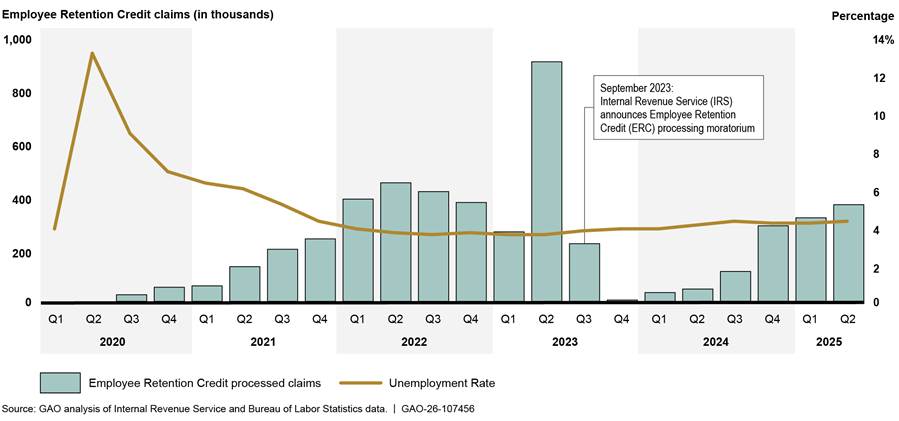
Notes: IRS data are through June 25, 2025. The number of claims is higher than the number of employers who received an ERC; an employer can file multiple amended return claims for 1 quarter, and claims for multiple quarters. Quarters are based on when IRS processed the ERC claims, which may be a later quarter than when IRS received the claims. Unemployment rates are seasonally adjusted, and represent the number of unemployed persons as a percentage of the labor force aged 16 years and over.
Most of the ERC refunds were issued in 2022 through 2025, after unemployment had returned to near pre-pandemic levels. IRS processed approximately $48 billion in ERC claims in 2020 and 2021 (fig. 7). In contrast, IRS processed approximately $94 billion in claims in 2022 and $89 billion in 2023, despite the ERC processing moratorium. In total, for 2022 through June 25, 2025, about $235 billion in ERC refunds were processed, representing about 83 percent of the total refund dollars.
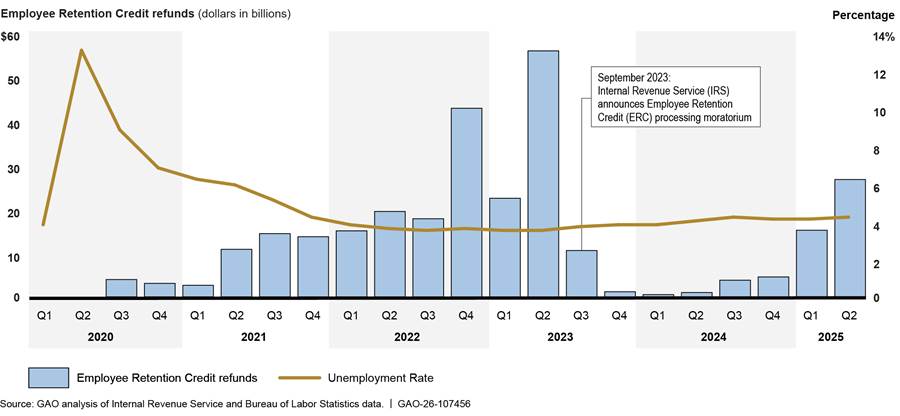
Notes: IRS data are through June 25, 2025. The data include adjustments to amended returns that may have occurred after processing, such as those from compliance activities, the Voluntary Disclosure Program or the withdrawal process. Therefore, the total refund dollars we report are lower than the gross amounts refunded. Quarters are based on when IRS processed the ERC claims, which may be a later quarter than when IRS received the claims. Unemployment represents the number of unemployed persons as a percentage of the labor force aged 16 years and over, averaged over the year.
The recovery from the pandemic was associated with an increase in inflation, and we have tracked inflation as a key indicator of the economic condition of the nation following the pandemic.[122] The inflation rate changed significantly from where it was in 2020 to the time when most of the ERC refunds were distributed, in 2022 through June 2025 (fig. 8). The inflation rate averaged approximately 1 percent in the second through fourth quarters of 2020, when less than $10 billion in ERC refunds were distributed. By 2022, when approximately $94 billion in ERC refunds were distributed, inflation had increased to an approximately 8 percent annual average. Inflation remained elevated at more than 4 percent in the first half of 2023, as an additional $78 billion in ERC refunds were distributed.
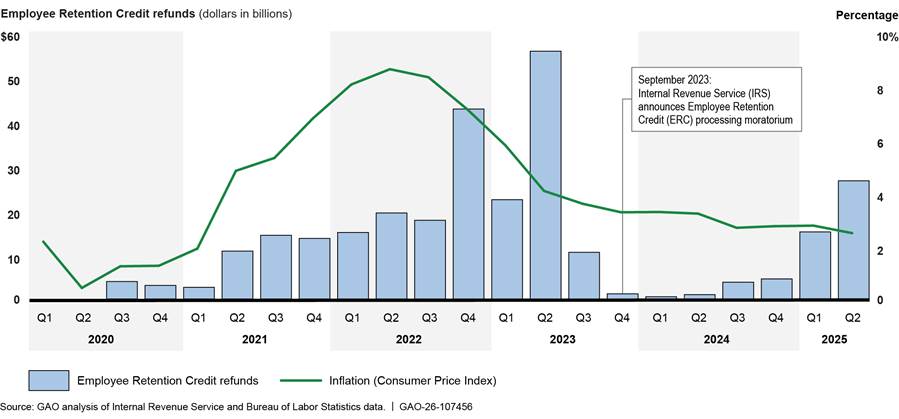
Notes: IRS data are through June 25, 2025. The data include adjustments to amended returns that may have occurred after processing, such as those from compliance activities, the Voluntary Disclosure Program or the withdrawal process. Therefore, the total refund dollars we report are lower than the gross amounts refunded. Quarters are based on when IRS processed the ERC claims, which may be a later quarter than when IRS received the claims. Inflation presented is the average of the of the year-over-year change of the consumer price index for all urban consumers.
Both ERC and PPP were aimed at helping employers maintain payroll during the pandemic. However, PPP disbursed more money and more quickly than ERC (fig. 9).[123] By the end of the program in June 2021, PPP had provided almost $800 billion, while ERC had provided about $283 billion through June 25, 2025.[124] The entirety of the PPP funding was disbursed in 2020 and 2021 when unemployment was at its highest, while about 17 percent of the ERC refunds were distributed in the same years.[125]
Figure 9: Employee Retention Credit Refunds and Paycheck Protection Program Loan Approvals, 2020—2025
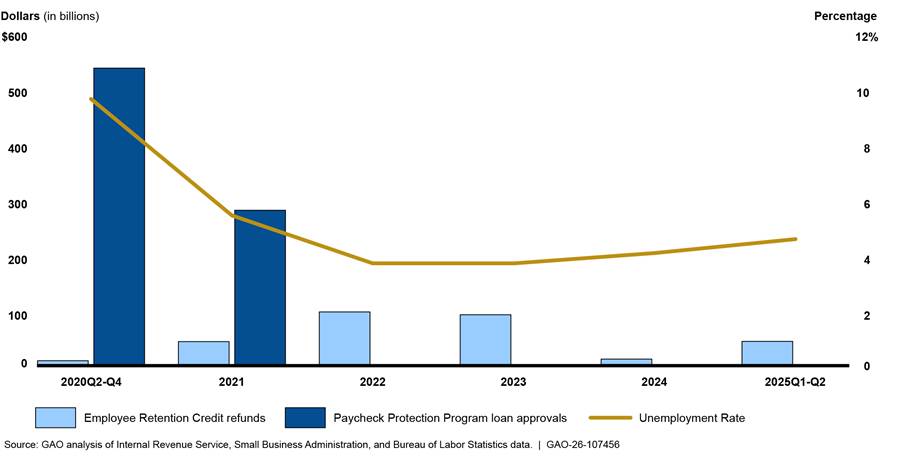
Notes: Internal Revenue Service data are through June 25, 2025. The data include adjustments to amended returns that may have occurred after processing, such as those from compliance activities, the Voluntary Disclosure Program or the withdrawal process. Therefore, the total refund dollars we report are lower than the gross amounts refunded. Paycheck Protection Program loans were administered in three phrases. The Small Business Administration data include loans approved from April 3, 2020—June 30, 2021. Approved loans were to be disbursed within 10 calendar days. Unemployment represents the number of unemployed persons as a percentage of the labor force aged 16 years and over, averaged over the year. The unemployment rate for 2025 reflects the first 2 quarters of the year.
Conclusions
Timely and reliable improper payment estimates, and effective corrective action plans are key in helping to prevent and reduce improper payments. IRS said it has closed most remaining ERC claims, new claims cannot be filed, and the deadline for IRS to assess tax on certain underpayments has passed. Nonetheless, developing an improper payment estimate and conducting statutorily required follow-up activities can still help IRS and policymakers understand and address financial vulnerabilities for future emergency tax relief.
Ensuring that IRS IT systems are capable of processing and extracting data from amended employment tax returns can expedite refund processing and facilitate analysis for compliance purposes. This would benefit employers and IRS staff, regardless of whether another employment tax credit is enacted. IRS has a Zero Paper modernization initiative underway, but documentation for that initiative does not specify plans for including amended employment tax returns and ERC Servicewide team officials were unsure of any plans.
Although IRS officials told us they had closed most remaining ERC claims as of December 31, 2025, this information had not been communicated publicly as of January 2026. In December 2025, we asked for updates and documentation on the status of ERC processing. IRS did not provide documentation of this milestone, and it did not define what it considers to be a “closed” claim. Further, IRS has not communicated publicly about ERC processing status since October 2024. Updating the public gives employers a chance to ensure that they received communication from the IRS on their claim, and can provide information on what employers can expect. Such information can reduce uncertainty for employers expecting a refund.
IRS can take steps to be better prepared for administering emergency relief through the employment tax system in the future. We identified instances where IRS did not identify, prevent, or address ERC improper payments as effectively as it could have. The Managing Improper Payments Framework details five key principles that IRS can use to be better prepared in the future. By establishing policies that ensure the agency adheres to these principles, IRS can be more effective in identifying and addressing compliance risks and can minimize improper payments in future emergency employment tax relief.
Recommendations for Executive Action
We are making the following four recommendations to IRS:
The Commissioner of Internal Revenue should develop and report an improper payment estimate for ERC payments. (Recommendation 1)
The Commissioner of Internal Revenue should include amended employment tax returns in its modernization efforts for processing and for data capture. (Recommendation 2)
The Commissioner of Internal Revenue should update the public about the current status of ERC claims. (Recommendation 3)
The Commissioner of Internal Revenue should develop policies to ensure that—when implementing emergency employment tax relief—the agency adheres to the five principles in GAO’s A Framework for Managing Improper Payments in Emergency Assistance Programs. (Recommendation 4)
Agency Comments and Our Evaluation
We provided a draft of this report to Treasury, IRS, and SBA for review and comment. IRS provided written comments, which are summarized below and reproduced in appendix V. IRS and SBA also provided technical comments, which we incorporated as appropriate. Treasury officials said they did not have any comments.
In its written comments, IRS agreed with one recommendation, partially agreed with one and disagreed with two.
Specifically, IRS disagreed with the recommendation to develop and report an improper payment estimate for ERC (Recommendation 1). In its letter, IRS suggested that the recommendation be modified to focus on developing a lessons-learned summary related to ERC administration to inform the design and oversight of future emergency tax relief programs. IRS said developing a statistically valid improper payment estimate for short-term programs is impractical and the cost would outweigh the benefits. IRS also stated that an estimate would be several years removed from the program. Further, it noted that a retrospective estimate would be unlikely to yield reliable or meaningful information regarding improper payments and would divert resources from higher-priority compliance activities, according to IRS.
We maintain that developing an improper payment estimate for ERC will help inform future emergency employment tax reform. There are flexibilities in PIIA that could facilitate IRS developing an estimate that provides information from claims across years, while acknowledging resource burdens. PIIA requires each executive agency to produce a statistically valid estimate, or an estimate whose methodology OMB has approved, of improper payments made under any program identified as susceptible to significant improper payments.[126]
IRS could work with OMB on a methodology that produces valuable information to guide future programs, but which does not fully meet statistically valid thresholds. Notably, IRS would need an improper payment estimate to develop a root cause analysis, which can identify additional vulnerabilities for IRS to address in future emergency employment tax relief administration. This analysis would be key in completing other statutorily required reporting, such as reports on actions to reduce and recover improper payments.
IRS agreed with the recommendation to include amended employment tax returns in its modernization efforts for processing and for data capture. (Recommendation 2).
IRS disagreed with the recommendation to periodically update the public on ERC processing (Recommendation 3). IRS stated that it had closed all ERC claims, other than those under examination or appeals, by December 31, 2025. As described above, however, IRS did not provide documentary evidence to support this statement or define what it means by “closed.” Further, IRS has not reported this publicly. We maintain that IRS should share this information publicly through its official communication channels—such as IRS’s website. Doing so will provide greater clarity for employers expecting a refund. Based on the IRS response to our draft report, we revised the recommendation to focus on the need to update the public on the current status of ERC claims.
IRS agreed with the intent of our recommendation to develop policies to ensure that IRS adheres to the principles in our Managing Improper Payments Framework when implementing emergency employment tax relief (Recommendation 4). IRS agreed that the principles in the Managing Improper Payments Framework provide a useful reference and said it will consider how to further enhance its existing practices in future emergency tax relief. IRS said many elements of these principles are already incorporated in its approach to administering refundable tax credits and emergency tax relief, such as early risk identification, internal controls, monitoring, coordination and transparency. Similar to its response to Recommendation 1, IRS said it believes a forward-looking focus on policy and lessons learned will provide greater value than retrospective improper payment estimates.
We maintain that an improper payment estimate—which is only one of several practices in the Managing Improper Payments Framework—can help inform implementation of future emergency employment tax relief. Further, as we found in this report, IRS experienced challenges with several of the practices. For example, IRS did not timely assess and identify improper payment risks, leading to a delayed implementation of steps to address ERC risks.
We are sending copies of this report to the appropriate congressional committees, the Commissioner of Internal Revenue, and other interested parties. In addition, the report is available at no charge on the GAO website at https://www.gao.gov.
If you or your staff have any questions about this report, please contact me at LucasJudyJ@gao.gov. Contact points for our Offices of Congressional Relations and Public Affairs may be found on the last page of this report. GAO staff who made key contributions to this report are listed in appendix VI.

Jessica Lucas-Judy
Director, Tax Issues
Strategic Issues
List of Congressional Committees
The Honorable Susan Collins
Chair
The Honorable Patty Murray
Vice Chair
Committee on Appropriations
United States Senate
The Honorable Mike Crapo
Chairman
The Honorable Ron Wyden
Ranking Member
Committee on Finance
United States Senate
The Honorable Bill Cassidy, M.D.
Chair
The Honorable Bernard Sanders
Ranking Member
Committee on Health, Education, Labor and Pensions
United States Senate
The Honorable Rand Paul, M.D.
Chairman
The Honorable Gary C. Peters
Ranking Member
Committee on Homeland Security and Governmental Affairs
United States Senate
The Honorable Tom Cole
Chairman
The Honorable Rosa L. DeLauro
Ranking Member
Committee on Appropriations
House of Representatives
The Honorable Brett Guthrie
Chairman
The Honorable Frank Pallone, Jr.
Ranking Member
Committee on Energy and Commerce
House of Representatives
The Honorable Andrew Garbarino
Chairman
The Honorable Bennie G. Thompson
Ranking Member
Committee on Homeland Security
House of Representatives
The Honorable James Comer
Chairman
The Honorable Robert Garcia
Ranking Member
Committee on Oversight and Government Reform
House of Representatives
The Honorable Jason Smith
Chairman
The Honorable Richard E. Neal
Ranking Member
Committee on Ways and Means
House of Representatives
This report (1) presents lessons learned related to the design and administration of the Employee Retention Credit (ERC), (2) examines how the Internal Revenue Service (IRS) can be better prepared to address improper payments while managing emergency assistance through the employment tax system, and (3) describes the economic conditions surrounding ERC during and after the height of the pandemic.
To identify lessons learned from the design and administration of the ERC, we conducted a literature review about the ERC, and we reviewed our prior work on COVID-19 tax credits and the work of the Treasury Inspector General for Tax Administration. We reviewed the Department of the Treasury’s legislative proposals, submitted to Congress for fiscal years 2022 to 2025, related to employment tax in the General Explanations of the Administration’s Revenue Proposals. We reviewed reports and legislative proposals from the National Taxpayer Advocate, 2021 to 2025.
In addition to reviewing relevant legislation, we analyzed IRS documents such as the Internal Revenue Manual, procedures, leadership briefings, research, guidance and online materials from 2020 to 2025. We analyzed IRS data, ERC related examinations, compliance letters, fraud investigations, and staffing levels, from fiscal years 2020 through 2024 or 2025.
We interviewed experts, tax and payroll professionals and agency officials at various levels. Specifically:
· We contacted the three authors identified in our literature review and met with the two who agreed to meet. We also contacted staff from four public policy research organizations with experience in tax policy, and we interviewed two staff members.
· We met with representatives and tax practitioners from the National Association of Professional Employer Organizations, the American Institute of Certified Professional Accountants, and PayrollOrg to discuss their members’ experiences with ERC implementation and their suggested lessons learned. Statements from these interviews are used as examples and are not generalizable to all payroll and tax professionals.
· We met with IRS officials from the Servicewide ERC Team, as well as current and former executives leading ERC implementation. Our interviews included officials from the Office of Fraud Enforcement; the Office of Promoter Investigations; Criminal Investigations; Chief Counsel; Research, Applied Analytics, and Statistics; and the Small Business and Self-Employed division.
· We held discussion groups with 10 Customer Service Representatives from IRS’s Taxpayer Services division who processed ERCs claimed on amended returns. The participants included one Customer Service Representative from discussions held for our 2022 report, but were otherwise selected randomly and represented both of the offices involved in ERC processing. We discussed guidance provided to Customer Service Representatives, training, feedback to management and lessons learned.
· We visited the IRS campus in Covington, Kentucky to meet with leadership from the Servicewide ERC Team and to observe processing of ERCs claimed on amended returns.
· We also met with officials from the Small Business Administration (SBA), the agency that administered the Paycheck Protection Program (PPP), and Treasury.
Statements from these interviews are used as examples and are not generalizable to all IRS staff, and payroll and tax professionals.
We compared the evidence from interviews and documents described above with criteria from A Framework for Managing Improper Payments in Emergency Assistance Programs.[127] The framework provides five principles and corresponding practices that can help federal program managers mitigate improper payments, particularly in emergency assistance programs. The framework is also intended as a resource for Congress to use when designing new programs in response to emergencies. The framework incorporates payment integrity requirements from the Payment Integrity Information Act of 2019, relevant Office of Management and Budget (OMB) guidance and internal control standards.[128] It also includes information derived from leading practices for managing fraud risks in our Framework for Managing Fraud Risks in Federal Programs.[129]
To describe economic conditions surrounding ERC, we reviewed literature and interviewed experts, as described above for our first two objectives. We also analyzed tax return data from IRS, unemployment and inflation data from the Bureau of Labor Statistics (BLS), and PPP loan approval data from SBA.
IRS processed claims data are from IRS’s Compliance Data Warehouse, Business Master File and Business Return Transaction File, which include data from Forms 941, 943, and 944 and amended returns, processed through June 25, 2025. We met with IRS officials to discuss these data sources and their limitations. Specifically:
· The reported years are based on the date that the claims were processed, which may be delayed from when they were received. IRS provided data by weekly posting cycle, which we converted into calendar quarters. Some cycles crossed quarters, and IRS cycles do not precisely align with calendar weeks. Therefore, the quarterly data we present may not exactly align with calendar quarters. For example, IRS posting cycles for weeks 1 through 14 in 2025 do not align exactly with the calendar year first quarter dates of January 1 to March 31.
· The data do not include Schedule R client information from third-party aggregate filers. Therefore, our counts of employers claiming the ERC are undercounts because the client lists from Schedule R were not available.
· The data include adjustments to amended returns that may have occurred after processing, such as tax assessments from examinations and recapture letters, and reductions from the Voluntary Disclosure Program (VDP) or the withdrawal process. Much of these adjustments—billions of dollars from letters, VDP and withdrawals—occurred in 2024 or 2025. Therefore, the total refund dollars we report are lower than the gross amounts refunded.
We determined that the data were sufficiently reliable for the purpose of describing general ERC processing trends.
The BLS data include the unemployment rate and inflation rate for second calendar quarter 2020 through second calendar quarter 2025. Unemployment rates are seasonally adjusted, and represent the number of unemployed persons as a percentage of the labor force aged 16 years and over. Inflation presented is the average of the of the year-over-year change of the consumer price index for all urban consumers.[130] To assess the reliability of these data, we reviewed officially published data documentation from BLS. We determined that the data used in our analysis were sufficiently reliable for the purpose of describing the economic conditions at the time when ERC claims were processed.
We further used data on PPP loan approvals from SBA to compare the volume and timing of ERC processing to PPP, which was also economic relief to small business employers during the pandemic.[131] To assess the reliability of these data, we reviewed data documentation, interviews with agency officials, and checked the data to other published data sources. We determined that the data were sufficiently reliable for the purpose of comparing the volume and timing of claims for ERC and PPP.
We conducted this performance audit from February 2024 to February 2026 in accordance with generally accepted government auditing standards. Those standards require that we plan and perform the audit to obtain sufficient, appropriate evidence to provide a reasonable basis for our findings and conclusions based on our audit objectives. We believe that the evidence obtained provides a reasonable basis for our findings and conclusions based on our audit objectives.
This report identifies two lessons, and nine contributing factors, addressing the design of the Employee Retention Credit.[132] For each contributing factor, we offer a question for policymakers to consider when faced with decisions about future emergency economic relief. These questions are based on our analysis of relevant literature, interviews with agency officials and experts, and reviews of Internal Revenue Service and legislative documentation, such as statutes and legislative proposals.
When considering future emergency economic relief, policymakers could consider the questions in table 2.
Table 2: Design Lessons and Questions for Policymakers to Consider for Future Emergency Economic Relief
|
Offering Relief Through Employment Taxes Provides Potential Benefits and Unique Challenges |
|
Will use of the employment tax or employment tax system provide timely relief to the intended population? |
|
Does the Internal Revenue Service (IRS) have the capacity to use the employment tax system to implement relief efficiently? |
|
Does federal law provide IRS sufficient statutory authority to assess penalties on erroneous claims for emergency economic relief to help ensure compliance? |
|
Are there any filing requirements or arrangements that could complicate IRS’s implementation and compliance efforts? |
|
Are there implications of employment tax relief on income taxes? Issues to consider could include: · Whether corresponding benefits from income tax are allowed. · Whether the statute of limitations is sufficient for accommodating amendments to income tax returns. · Whether income tax liability can be incorporated into employment tax calculations. |
|
Some Design Decisions Increased Complexity and Improper Payment Risk |
|
Are definitions or eligibility criteria clear and straightforward to report and verify? |
|
If considering retroactive provisions, do the benefits outweigh the administrative challenges and improper payment risks? |
|
If considering offering advance payments for an employment tax credit, do the benefits outweigh the administrative costs and challenges? |
|
If the relief hinges on other federal programs not administered by IRS, would statutory provisions to permit data sharing between IRS and other agencies help facilitate IRS’s compliance efforts? |
Source: GAO. | GAO‑26‑107456
Appendix III: Internal Revenue Service Actions to Identify Employee Retention Credit Claims Improperly Using Wages from Forgiven Paycheck Protection Program Loans
To aid businesses that were experiencing hardships during the COVID-19 pandemic, federal law established several programs to help employers support and retain employees. These laws placed limits on how employers could use one of these programs—the Paycheck Protection Program (PPP)—together with the Employee Retention Credit (ERC).
PPP was administered by the Small Business Administration (SBA). Under PPP, lenders provided low-interest SBA guaranteed forgivable loans to qualifying small businesses and nonprofit organizations, referred to collectively as “small businesses.”[133] Businesses could apply to have the loans forgiven, if certain conditions were met. To qualify for full loan forgiveness, a business had to use at least 60 percent of the loan amount for payroll costs. If a business used less than 60 percent of the loan proceeds on payroll expenses, then the borrower would be eligible for partial forgiveness.
When the ERC was first created in March 2020, employers who had obtained a PPP loan were prohibited from also claiming the ERC.[134] However, in December 2020, this ban was eliminated, and employers were permitted to participate in both programs with some limitations. Specifically, employers were prohibited from using the same payroll expenses to claim both the ERC and to obtain forgiveness of PPP loans. Payroll expenses reported on the PPP loan forgiveness application that were deemed eligible for PPP were not eligible to be considered as ERC qualified wages.[135]
The statutory definitions of some terms further complicated IRS’s efforts to ensure compliance. The PPP used the term “payroll costs” for loan forgiveness, while ERC was calculated using “qualified wages.” The CARES Act also provided different definitions of “qualified wages” depending on the size of the employer, measured by the average number of full-time employees.[136]
Additionally, a PPP loan borrower’s “covered period” could affect the wage amounts that could be used to claim the ERC. The PPP covered period begins on the date a lender disburses the loan and ends on a date selected by the borrower during the period between 8 weeks and 24 weeks after disbursement. This time period could differ from the ERC, which was claimed on quarterly employment tax returns. Therefore, a PPP loan’s covered period could potentially overlap with one to three employment tax quarters.
PPP Data Sharing and Matching Processes
To ensure compliance with the rules and limitations on using both programs, the Internal Revenue Service (IRS) took several steps to identify employers that had filed ERC claims but also applied for PPP loan forgiveness. As of March 2025, IRS calculated that about 1 million employers had participated in both programs. IRS also determined that 89 percent of these employers had at least 1 quarter with ERC claims that overlapped with a PPP covered period.[137]
To obtain data on PPP participants, IRS negotiated a memorandum of understanding with SBA.[138] IRS officials described to us some challenges they experienced in using the SBA data.
· Taxpayer identification numbers. Businesses could apply for PPP loan forgiveness using either an Employer Identification Number (EIN) or a Social Security number. ERC claims are based on EINs, necessitating extra steps to match Social Security numbers in the SBA loan forgiveness data with ERC claimants, according to IRS officials.
· Loan periods and payroll tax quarters. IRS officials said it was difficult to associate PPP payroll costs in a loan period with a particular payroll tax quarter, or a portion of a quarter. The covered period—up to 168 days or 24 weeks—could coincide with as few as one and as many as three tax quarters. According to IRS officials, IRS did not request the PPP covered period data because of these limitations.
· Self-reported payroll costs. Borrowers self-reported PPP payroll costs on loan forgiveness applications, which presented reliability issues. IRS officials also told us that SBA identified gaps in data fields for loans of $50,000 or less.
Actions to Address ERC Claims Improperly Using Forgiven PPP Loan Wages
Original Return Compliance
IRS officials told us that they primarily relied on post-refund controls, such as examinations, to identify improper ERC claims filed on original employment tax returns. According to IRS officials, IRS could not definitively determine if overlap existed between ERC and PPP without conducting an examination.
IRS applied screening filters to employment tax returns to identify leads for potential examinations. One of these filters used PPP loan information SBA shared with IRS. According to IRS data, the filter identified a total of 96,653 EINs for tax years 2020 and 2021. Returns flagged by this and other filters were sent for additional research and examination consideration. Of the 96,653 EINs, IRS selected 652 for exam. For selected returns, the filter results provided information for staff about the possibility that the employer used the same wages for both programs, according to IRS officials. Generally, if noncompliance was found, the employer may have received a tax assessment.
Amended Return Compliance
As discussed in appendix IV, prior to the processing moratorium, ERC claims filed on amended employment tax returns (such as Form 941-X) underwent manual processing. Certain ERC claims exceeding dollar thresholds and other criteria underwent additional review for potential examination. In 2021, IRS conducted limited transcription of these claims, and later ran the data through several tests to screen for potential ERC noncompliance, including one using PPP loan data. Returns failing a certain combination of these tests were examined.
During the processing moratorium, IRS developed a risk model to analyze unprocessed amended claims (see appendix IV). The model scored the amended returns and assigned them one of three risk levels: “highest,” “unacceptable,” and “lowest.”[139] PPP loan forgiveness data were one of several inputs in the model. According to IRS officials, returns from the “unacceptable level of risk” category underwent an additional set of tests, while those in the “highest risk” category were disallowed and those in the “lowest risk” category were issued a refund.
Appendix IV: Internal Revenue Service Efforts to Address Ineligible Employee Retention Credit Claims on Amended Returns
The Internal Revenue Service’s (IRS) efforts to identify ineligible Employee Retention Credit (ERC) claims involved developing processes for reviewing several forms, with a combination of pre-refund and post-refund steps. This appendix describes the processing of ERCs filed on amended returns. Compliance issues with originally filed returns—Forms 941, 943 and 944—were handled through examinations and other processes.
Early Processing of ERCs Filed on Amended Returns
IRS began processing ERC claims on amended returns in 2021. Prior to mid-2024, amended returns, such as Forms 941-X and 943-X, could only be filed on paper. Typically, the paper versions of these forms were not transcribed (keying in return data), according to an IRS official.
IRS staff checked for return completeness and determined whether the credit should be referred for possible examination, fully disallowed, partially disallowed, or fully allowed. ERC claims that exceeded a certain dollar threshold or met other criteria were referred for possible examination. The criteria changed several times in 2022 and 2023 as a backlog of returns developed and IRS tried to expedite processing. In 2021, IRS began transcribing limited data from amended returns and later ran tests to aid in exam selection. A high percentage of the pre-refund examinations referred to the IRS Small Business/Self-Employed division resulted in a change to tax owed (about 99 percent in fiscal year 2023, 94 percent in fiscal year 2024).
Processing Moratorium and Risk Model Development
In September 2023, IRS announced that ERC claims received after September 14, 2023, were subject to a processing moratorium, originally intended to last through December 2023. The moratorium was implemented to allow IRS to add more safeguards to prevent future abuse and protect businesses from predatory tactics, according to IRS officials. IRS used the time period of the moratorium to digitize amended returns and to develop a risking model.[140] IRS ran over 1 million amended returns through the model, sorting them into three risk categories.[141] See figure 10.
Figure 10: Employee Retention Credit Amended Return Processing for Claims Received After September 14, 2023
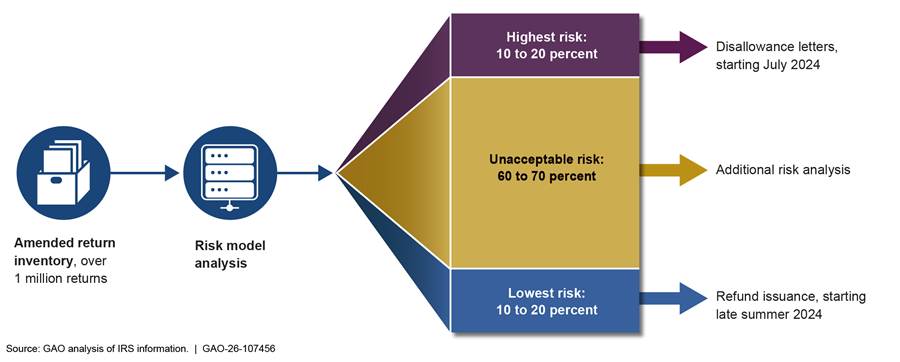
In June 2024, IRS announced that it would begin processing or denying certain low-risk and high risk claims, starting in summer 2024. For the remaining returns, IRS developed a second model to further analyze them, according to IRS officials.
Additional Compliance Efforts
In 2023 and 2024, IRS deployed several initiatives, aside from examinations and letters, directed at ERC noncompliance.
· Withdrawal process. In October 2023, IRS offered certain employers the opportunity to withdrawal their pending ERC claims. This was intended to help employers who were pressured or misled by ERC marketers or promoters into filing ineligible claims. Employers were eligible to withdraw their entire claims if their ERCs had not been paid yet, or if they received a check but had not cashed or deposited it, among other requirements. As of January 2025, there were $829 million in withdrawal requests, according to IRS data.
· ERC Voluntary Disclosure Program (VDP). In December 2023, IRS announced an ERC VDP, open through March 22, 2024. Employers who claimed and received an ERC for which they were not entitled could use VDP to repay the ERC, minus 20 percent of the credit amount. In August 2024, IRS announced a second VDP, running through November 22, 2024. The second VDP offered a 15 percent discount for tax periods in 2021, rather than 20 percent. As of July 2025, IRS reports that it assessed nearly $1 billion through the VDP.
· Supplemental claims. To allow third-party payers an opportunity to separate their clients’ claims and resolve incorrect claims, IRS announced a supplemental claim process in September 2024. A supplemental claim is an amended employment tax return that allows the third-party payer to correct or consolidate unprocessed claims, filed on or before January 31, 2024, if not yet processed. Once a supplemental claim is accepted, IRS treats previous claims as if they were never filed. According to IRS officials, this will facilitate quicker determinations about allowing or auditing the claim. Supplemental claims were accepted through December 31, 2024. IRS received 2,358 supplemental claims requests representing about $2.8 billion in ERC claims. As of May 2025, IRS approved about $444 million and it was still approving requests.
· Letters. Additionally, IRS sent pre-refund letters to entities that, based on when the employer was established and other factors, did not appear to be eligible for ERC. Post-refund recapture letters were issued to employers whose claims exceed statutory maximum amounts.
Civil and Criminal Fraud Investigations
IRS launched civil and criminal investigations on ERC claims. Tax fraud is often defined as intentional wrongdoing, on the part of a taxpayer, with the specific purpose of evading a tax known or believed to be owing, according to IRS.[142] There is no time limit for IRS to assess a fraudulent tax return with intent to avoid tax.
Office of Promoter Investigations
The Office of Promoter Investigations, established in 2021, leads and directs activities that support IRS efforts to detect and deter abusive tax promotions and abusive return preparers. The Office of Promoter Investigations investigates civil fraud and makes referrals to the Department of Justice and IRS’s Criminal Investigations (CI) unit. The Office of Promoter Investigations received over 350 leads, resulting in over 220 promoter reviews, in fiscal years 2021 through 2024, according to IRS data.
Office of Fraud Enforcement
The Office of Fraud Enforcement provides oversight and direction on fraud policy, assists in identifying fraud indicators and compliance staff assist in pursuing civil fraud penalty assertions and other actions to improve compliance. The Office of Fraud Enforcement researched ERC-related leads and identified $1.4 billion of potential ERC fraud in fiscal years 2020 through 2024, according to IRS data.
CI
IRS staff encountering possible fraud on an ERC return can make referrals to IRS’s CI unit. As of February 2025, CI initiated 545 investigations associated with over $5.6 billion in ERC fraud, according to IRS data. Of these, 75 resulted in federal charges, and 38 of those resulted in convictions, while some cases are still being investigated. Starting in 2024, CI began regularly monitoring social media for ERC-related schemes, according to IRS officials. With the acquisition of new tools, social media monitoring is a recent effort.

GAO Contact
Jessica Lucas-Judy, lucasjudyj@gao.gov
Staff Acknowledgments
In addition to the contacts named above, Brian K. James (Assistant Director), Lindsay Swenson (Analyst-in-Charge), T. Jackson Autry, Michael Bechetti, Jacqueline Chapin, David Dornisch, William (Lee) Evans, Gabrielle Fagan, Daniel Flavin, Sarah Garcia, Mary Ann Hardy, Mark Kehoe, Krista Loose, Daniel Mahoney, Sheila R. McCoy, Daniel Newman, Andrew Pauline, Paige Smith, Amanda Stogsdill, Brennan Williams, and Mercedes Wilson-Barthes made key contributions to this report.
The Government Accountability Office, the audit, evaluation, and investigative arm of Congress, exists to support Congress in meeting its constitutional responsibilities and to help improve the performance and accountability of the federal government for the American people. GAO examines the use of public funds; evaluates federal programs and policies; and provides analyses, recommendations, and other assistance to help Congress make informed oversight, policy, and funding decisions. GAO’s commitment to good government is reflected in its core values of accountability, integrity, and reliability.
Obtaining Copies of GAO Reports and Testimony
The fastest and easiest way to obtain copies of GAO documents at no cost is through our website. Each weekday afternoon, GAO posts on its website newly released reports, testimony, and correspondence. You can also subscribe to GAO’s email updates to receive notification of newly posted products.
Order by Phone
The price of each GAO publication reflects GAO’s actual cost of production and distribution and depends on the number of pages in the publication and whether the publication is printed in color or black and white. Pricing and ordering information is posted on GAO’s website, https://www.gao.gov/ordering.htm.
Place orders by calling (202) 512-6000, toll free (866) 801-7077,
or
TDD (202) 512-2537.
Orders may be paid for using American Express, Discover Card, MasterCard, Visa, check, or money order. Call for additional information.
Connect with GAO
Connect with GAO on X,
LinkedIn, Instagram, and YouTube.
Subscribe to our Email Updates. Listen to our Podcasts.
Visit GAO on the web at https://www.gao.gov.
To Report Fraud, Waste, and Abuse in Federal Programs
Contact FraudNet:
Website: https://www.gao.gov/about/what-gao-does/fraudnet
Automated answering system: (800) 424-5454
Media Relations
Sarah Kaczmarek, Managing Director, Media@gao.gov
Congressional Relations
David A. Powner, Acting Managing Director, CongRel@gao.gov
General Inquiries
[1]CARES Act, Pub. L. No. 116-136, § 2301, 134 Stat. 281 347–351. Dollars are based on Internal Revenue Service (IRS) data, as of June 25, 2025. This dollar amount does include later reductions to ERC amounts, according to IRS officials. According to the Taxpayer Advocate Service, IRS had either disallowed, reversed, or recaptured approximately 214,000 of these claims—a small fraction of all taxpayer claims—as of April 29, 2025.
[2]A refundable tax credit means that a credit in excess of tax liability results in a cash refund.
[3]GAO, High-Risk Series: Heightened Attention Could Save Billions More and Improve Government Efficiency and Effectiveness, GAO‑25‑107743 (Washington, D.C.: Feb. 25, 2025).
[4]GAO, COVID-19 Relief: SBA and DOL Should Improve Processes to Identify and Recover Overpayments, GAO‑25‑106199 (Washington, D.C.: Nov. 13, 2024).
[5]The term “promoter” generally means a person who (1) organizes an entity, investment plan or arrangement, or any other plan or arrangement, or participates, directly or indirectly, in the sale of any interest in an entity, plan, or arrangement; and (2) makes, furnishes, or causes another person to make or furnish a statement about its tax benefits. See 26 U.S.C. § 6700(a). In December 2022, we reported on IRS efforts to detect and deter promoters of abusive tax schemes. GAO, Abusive Tax Schemes: Additional Steps Could Further IRS Efforts to Detect and Deter Promoters, GAO‑23‑105843 (Washington, D.C.: Dec. 15, 2022).
[6]GAO, COVID-19: IRS Implemented Tax Relief for Employers Quickly, but Could Strengthen Its Compliance Efforts, GAO‑22‑104280 (Washington, D.C.: May 17, 2022).
[7]An Act to provide for reconciliation pursuant to title II of H. Con. Res. 14, Pub. L. No. 119-21, 139 Stat. 72, 288 (2025).
[8]The CARES Act included a provision for us to monitor and oversee the federal government’s efforts to prepare for, respond to, and recover from the COVID-19 pandemic. Pub. L. No. 116-136, § 19010, 134 Stat. 281, 579–81. The American Rescue Plan Act of 2021 also includes a provision for GAO to conduct oversight of the COVID-19 response. Pub. L. No. 117-2, § 4002, 135 Stat. 4, 78. This report contributes to our body of work on the pandemic, available on GAO’s website at https://www.gao.gov/coronavirus.
[9]GAO, A Framework for Managing Improper Payments in Emergency Assistance Programs, GAO‑23‑105876 (Washington, D.C.: July 13, 2023).
[10]An improper payment is defined by law as any payment that should not have been made or that was made in an incorrect amount (including overpayments and underpayments) under statutory, contractual, administrative, or other legally applicable requirements. It includes any payment to an ineligible recipient, any payment for an ineligible good or service, any duplicate payment, any payment for a good or service not received (except for such payments where authorized by law), and any payment that does not account for credit for applicable discounts. 31 U.S.C. § 3351(4).
[11]IRS data as of June 25, 2025.
[12]26 U.S.C. §§ 3402, 3101, 3102, 3111. Employers must also generally pay the federal unemployment insurance payroll tax. 26 U.S.C. § 3301. However, this is not withheld from employee wages and is reported separately from Federal Insurance Contributions Act taxes.
[13]Certain employers—who meet tax liability and other requirements—may deposit their employment taxes with their timely filed return.
[14]For example, agricultural employers file Form 943, Employer’s Annual Federal Tax Return for Agricultural Employees, and small employers file Form 944, Employer’s Annual Federal Tax Return.
[15]The COVID-19 related tax credits include: ERC; paid sick and family leave credits; and the COBRA Premium Assistance Credit.
[16]Pub. L. No. 116-136, § 2301, 134 Stat. 281, 347–351; Consolidated Appropriations Act, 2021, Pub. L. No. 116-260, §§ 206, 207, 134 Stat.1182, 3059–3065; American Rescue Plan Act of 2021 (ARPA), Pub. L. No. 117-2, § 9651, 135 Stat. 4, 176–182. Infrastructure Investment and Jobs Act (IIJA); Pub. L. No. 117-58, § 80604, 135 Stat. 429, 1341 (2021).
[17]For eligible large employers (that averaged more than 100 employees during 2019), qualified wages were those paid to an employee not providing services during periods of full or partial suspension of operation due to a governmental order or the requisite decrease in gross receipts. For eligible small employers (that averaged 100 or fewer employees during 2019), qualified wages were wages paid to an employee during the same periods.
[18]Employers were no longer eligible in the first quarter after the one in which gross receipts were more than 80 percent of the same quarter in the previous calendar year.
[20]Pub. L. No. 116-260, §§ 206, 207, 134 Stat. 1182, 3059–3064. PPP loans were made by lenders to qualifying small businesses and nonprofit organizations, guaranteed 100 percent by the Small Business Administration, low interest, and fully forgivable if certain conditions are met. To qualify for full loan forgiveness, a business had to use at least 60 percent of the loan amount for payroll costs, among other requirements.
[21]Pub. L. No. 117-2, § 9651, 135 Stat. 4, 179. Recovery startup businesses are employers that: (1) began carrying on a trade or business after February 15, 2020; and (2) had average annual gross receipts under $1 million for the 3 taxable years ending with the taxable year that precedes the calendar quarter for which the ERC is determined.
[22]Pub. L. No. 117-58, § 80604, 135 Stat. 429, 1341 (2021).
[23]Pub. L. No. 119-21, § 70605(d), 139 Stat. 72, 287-288 (2025). The Joint Committee on Taxation estimated that the bill’s ERC provisions would save $1.6 billion from fiscal years 2025 through 2028. See Estimated Revenue Effects Relative to the Present Law Baseline of the Tax Provisions in “Title VII – Finance” of the Substitute Legislation As Passed by the Senate To Provide for Reconciliation of the Fiscal Year 2025 Budget, JCX-35-25 (July 1, 2025).
[24]Pub. L. No. 119-21, § 70605(b), 139 Stat. 72, 287 (2025). For purposes of penalties, the law defined a COVID-ERC promoter as anyone who facilitates the filing of ERC claims and whose ERC fees constitute a certain percentage of their advisory business’s receipts but does not include certified professional employer organizations as defined under 26 U.S.C. § 7705.
[25]Employers use Form 941, Employer’s Quarterly Federal Tax Return, to report income taxes, Social Security tax, or Medicare tax withheld from employee’s paychecks; and to pay the employer’s portion of Social Security or Medicare tax.
[26]Refundable tax credits differ from other credits because a taxpayer is able to receive a refund check from IRS for the amount their credit exceeds their tax liability. A nonrefundable credit can be used to offset tax liability, but any excess of the credit over the tax liability is not refunded to the taxpayer.
[27]This share was also reduced for any amounts claimed for the Qualified Small Business Payroll Tax Credit for Increasing Research Activities, the Work Opportunity Credit for Qualified Tax-Exempt Organizations Hiring Qualified Veterans, and the Sick and Family Leave Credits.
[29]From 2010 to March 2020, IRS only administered three credits on the Form 941 and one credit on the Form 941-X, which taxpayers use to amend a previously filed Form 941. In 2020, there were 38 business tax credits listed in the Form 3800 instructions.
[30]We previously reported that IRS’s reliance on manual processing of paper returns has led to significant backlogs, increased costs, and delays for taxpayers, particularly during the pandemic. GAO, 2024 Tax Filing: IRS Improved Live Service and Began to Modernize Some Operations, but Timeliness Issues Persist, GAO‑25‑107375 (Washington, D.C.: Jan. 30, 2025).
[31]GAO, Tax Filing: Actions Needed to Address Processing Delays and Risks to the 2021 Filing Season, GAO‑21‑251 (Washington, D.C.: Mar. 1, 2021).
[32]In January 2025, we reported that IRS had conducted an assessment to identify barriers business taxpayers face when e-filing and taken some steps to determine actions to address those barriers. Addressing barriers to e-filing business returns, as we recommended in March 2021, could help IRS reduce the volume of more costly paper-based work and improve services. See GAO‑25‑107375.
[33]Small Business and Work Opportunity Act of 2007, Pub. L. No. 110-28, § 8247, 121 Stat. 112, 204.
[34]26 U.S.C. § 6676(a) states: “If a claim for refund or credit with respect to income or employment tax is made for an excessive amount, unless it is shown that the claim for such excessive amount is due to reasonable cause, the person making such claim shall be liable for a penalty in an amount equal to 20 percent of the excessive amount.”
[35]Department of the Treasury, General Explanations of the Administration’s Fiscal Year 2025 Revenue Proposals (Washington D.C.: Mar. 11, 2024).
[36]Pub. L. No. 119-21, § 70605, 139 Stat. 72, 288 (2025).
[37]IRS guidance on the ERC Voluntary Disclosure Program stated that an employer who claims and receives an ERC to which they are not entitled, could face interest, penalties, and potential criminal investigation and prosecution. For example, see Internal Revenue Service, “Frequently Asked Questions about the second Employee Retention Credit Voluntary Disclosure Program,” https://www.irs.gov/newsroom/frequently-asked-questions-about-the-second-employee-retention-credit-voluntary-disclosure-program (last updated May 29, 2025). See for example 26 U.S.C § 6663 and 26 U.S.C. § 6651(f).
[38]Pub. L. No. 116-136, § 2301(l), 134 Stat. 281, 350-351 (2020); Pub. L. No. 116-260, § 207, 134 Stat. 1182, 3064–3065 (2020); Pub. L. No. 119-21, 139 Stat. 72, 287 (2025); 26 U.S.C. §§ 3504, 3511, and 7705; IRS Notice 2021-20, 2021-11 I.R.B. 922 (Mar. 15, 2021). Note that under the One Big Beautiful Bill Act, the COVID-ERC promoter definition does not include a certified professional employer organization as defined in 26 U.S.C. § 7705.
[39]For fiscal years 2022 to 2025, Treasury published explanations of the tax revenue proposals to accompany the president’s budget. Department of the Treasury, “Revenue Proposals,” accessed December 3, 2025, https://home.treasury.gov/policy-issues/tax-policy/revenue-proposals.
[40]IRS, “Frequently Asked Questions About the Employee Retention Credit,” accessed March 25, 2025, https://www.irs.gov/coronavirus/frequently-asked-questions-about-the-employee-retention-credit.
[41]Department of the Treasury, General Explanations of the Administration’s Fiscal Year 2025 Revenue Proposals (Washington D.C.: Mar. 11, 2024).
[42]Pub. L. No. 119-21, § 70605, 139 Stat. 72, 288 (2025). The extended statute of limitations for certain ERC claims expires 6 years after the later of: (1) the date on which the original return which includes the calendar quarter with respect to which such credit is determined is filed, (2) the date on which such return is treated as filed under section 6501(b)(2) of the Internal Revenue Code, or (3) the date on which the claim for credit or refund with respect to such credit is made.
[43]A “protective claim” is a claim for credit or refund filed by the taxpayer to preserve the right to pursue a refund based on the resolution of an issue contingent on future events that may not be determinable until after the refund statute has expired. Taxpayers file protective claims to ensure they meet the timeliness requirement.
[44]Before IRS can authorize tax relief for disaster victims, the President must declare that a major disaster or emergency exists. 42 U.S.C. § 5170. The Federal Emergency Management Agency provides a search tool to find declared disaster areas at: https://www.fema.gov/disaster.
[45]Internal Revenue Service, “COVID-10-Related Employee Retention Credits: Determining When an Employer is Considered to Have a Significant Decline in Gross Receipts and Maximum Amount of an Eligible Employer’s Employee Retention Credit FAQs,” accessed June 22, 2020.
[46]Pub. L. No. 116-260, § 206(a), 134 Stat. 1182, 3059-3060 (2020). IRS Notice 2021-20 stated that prior to the changes made by the Relief Act, section 448(c) of the Internal Revenue Code applied to determine gross receipts of tax-exempt organizations.
[47]According to IRS data on processed ERC claims through June 25, 2025, about 86 percent of claims were filed on Form 941-X and 13 percent were filed on Form 941. About 1 percent were filed on Forms 943, 943-X, 944, and 944-X. Available IRS data did not segregate this 1 percent of claims into amended or original returns.
[48]In January 2025, we reported that IRS made 20 more tax forms available to file electronically during the first 6 months of 2024, and that most of these forms were used by businesses. See GAO‑25‑107375.
[49]Compiled annually, IRS’s Dirty Dozen lists a variety of common scams and schemes that taxpayers may encounter.
[50]Pub. L. No. 119-21, § 70605(e), 139 Stat. 72, 288 (2025).
[51]Form 7200, Advance Payment of Employer Credits Due to COVID-19, could be filed for an advance ERC payment anticipated for a quarter at any time before the end of the month following the quarter in which the qualified wages were paid. If necessary, Form 7200 could be filed several times during each quarter.
[52]Internal Revenue Service, Internal Revenue Service Data Book, 2022, Publication 55-B (Washington, D.C.: March 2023). Data include ERC, sick and family leave credits, and COBRA premium credits, as separate data could not be extracted for each. Advance credits were reported and reconciled on original returns.
[53]For more information on how employers filed for ERC, see Goodman, L, “Delivering Aid to Businesses Through the Payroll Tax System: The Case of the Employee Retention Credit,” National Tax Journal, volume 76, number 2, June 2023.
[54]Form 941 is due 1 month after the end of each quarter. For example, the first quarter Form 941 is due April 30.
[55]The Memorandum of Understanding (MOU) stated that “SBA is also authorized to enter into this MOU under the Small Business Act, 15 U.S.C. §§ 634(a) and 634(b)(7). In addition, the IRS enters into this MOU under the authority of Delegation Order 150-10, 26 U.S.C. §§ 7801 and 7803, which authorize the Commissioner of the IRS to enforce and administer the internal revenue laws.”
[56]Pub. L. No. 116-260, § 206(c), 134 Stat. 1182, 3059–3061 (2020).
[57]GAO‑20‑625. In December 2020, Congress passed, and the President signed into law the Consolidated Appropriations Act, 2021, which required the Social Security Administration, to the extent feasible, to share its full death data with Treasury’s Do Not Pay working system for a 3-year period. In March 2022, we recommended that Congress consider making this data sharing requirement permanent. See GAO, Emergency Relief Funds: Significant Improvement Are Needed to Ensure Transparency and Accountability for COVID-19 and Beyond, GAO‑22‑105715 (Washington, D.C.: Mar. 17, 2022). Congress passed the Ending Improper Payments to Deceased People Act (S. 269 and H.R. 2716), which contains provisions that would address this matter. The Senate passed S. 269 on September 19, 2025 and the House passed this bill on January 12, 2026. As of January 2026, legislation had not been enacted.
[58]GAO‑22‑104280. We assessed IRS’s planning documents against criteria from Project Management Institute, Inc., A Guide to the Project Management Body of Knowledge (PMBOK® Guide), Sixth Edition (Newtown Square, Pa.: 2017). PMBOK is a trademark of Project Management Institute, Inc. The PMBOK® Guide includes proven traditional practices that are widely applied, as well as innovative practices that are emerging, in the field of project management. PMBOK® is a trademark of Project Management Institute, Inc. The Project Management Institute is a not-for-profit association that provides global standards for, among other things, project and program management.
[59]Treasury Inspector General for Tax Administration, Programs Susceptible to Improper Payments Are Not Adequately Assessed and Reported, 2022-40-037 (Washington, D.C.: May 6, 2022). Agencies are required to complete improper payment risk assessments to determine whether their programs may be susceptible to significant improper payments. Significant improper payments are defined as those that, in the preceding fiscal year, may have exceeded either (1) $100 million, or (2) $10 million plus 1.5 percent of the total amount of program outlays. The Payment Integrity Information Act requires agencies to conduct improper payment risk assessments for each of their programs at least once every 3 years. 31 U.S.C. § 3352(a).
[60]For newly established programs, Office of Management and Budget (OMB) guidance states that risk assessments should be completed after the first 12 months of the program. OMB Circular A-123, Appendix C, Requirements for Payment Integrity Improvement, OMB M-21-19 (Washington, D.C.: Mar. 5, 2021).
[61]TIGTA, report 2022-40-037.
[62]In addition to the 2022 assessment, IRS also completed an assessment on ERC in 2024. In that assessment, IRS determined that ERC was susceptible to significant improper payments. We did not assess IRS’s determination.
[63]31 U.S.C.§ 3352.
[64]31 U.S.C. § 3352 and OMB M-21-19. Under PIIA, if during an improper payment review an agency is unable to determine whether a payment was proper because of lacking or insufficient information, it must treat the payment as improper for purposes of producing an estimate.
[65]31 U.S.C. § 3353.
[66]Based on IRS data as of June 25, 2025.
[67]OMB guidance cannot authorize exemptions to applicable PIIA requirements for improper payment estimation and reporting. 31 U.S.C. § 3352(g)(1).
[68]TIGTA report, 2025-400-025.
[69]Office of Inspector General, Department of the Treasury, Financial Management: Audit of Treasury’s Compliance with the PIIA Requirements for Fiscal Year 2024, OIG-25-27 (Washington, D.C.: May 27, 2025).
[70]Internal Revenue Service, “To protect taxpayers from scams, IRS orders immediate stop to new Employee Retention Credit processing amid surge of questionable claims; concerns from tax pros,” IR-2023-169 (Washington D.C: Sept. 14, 2023).
[71]According to OMB guidance, a root cause is something that would directly lead to an improper payment, and if corrected, would prevent the improper payment. OMB M-21-19.
[72]GAO‑22‑105715. We recommended that Congress should amend PIIA to designate all new federal programs making more than $100 million in payments in any one fiscal year as “susceptible to significant improper payments” for their initial years of operation. The PIIA Reform Act (H.R. 1533), the STEP Act (S. 80), and the TRUE Accountability Act (S. 78) contain provisions that would address this or other PIIA- related matters. As of December 2025, Congress has not passed these bills.
[73]OMB stated that enterprise risk management is an effective agency-wide approach to address the full spectrum of the organization’s risks by understanding the combined effect of risks as an interrelated portfolio, rather than addressing risks only within silos. Enterprise risk management provides better insight about how to most effectively prioritize and manage risks. The Office of Management and Budget, Preparation, Submission, and Execution of the Budget, Circular No. A-11, § 260.30 (2024). The 2024 version of this document was in effect during most of our audit period. OMB released a new version in August 2025. Fraud risk management activities may be incorporated into or aligned with enterprise risk management, although this does not eliminate the need for separate and independent fraud risk management efforts, such as a fraud risk assessment process.
[74]Prior to 2023, ERC was mentioned in a division level risk register, but compliance issues on amended returns were not discussed. IRS identified other risks related to the ERC sooner. For example, IRS identified some risks associated with data gaps in 2020, and the effects of the backlog of amended returns in 2021 and 2022. IRS also identified the ERC’s effects on income tax as an emerging issue in 2022.
[75]IRS conducts an enterprise risk assessment annually to develop the Enterprise Risk Profiles. IRS does a Fraud Risk Assessment every 2 years to develop the Fraud Risk Profiles, most recently completed in 2023, according to IRS officials.
[76]OMB M-21-19.
[77]These are claims that meet a certain dollar threshold, or other criteria, requiring a review for potential examination prior to processing. Changes were calculated based on monthly data.
[78]GAO‑22‑104280. As of September 2025, IRS has partially addressed this recommendation. IRS has documented its risk model for ERC amended return claims, and documented the development of and criteria for sending recapture letters to amended return filers. IRS has not yet provided documentation of how it is processing claims that its risk model determined were “intermediate risk.”
[79]Internal Revenue Manual, section 1.4.60.
[80]GAO, Federal Telework: Selected Agencies Need to Evaluate the Potential Effects on Agency Performance, GAO‑25‑106316 (Washington D.C.: Nov. 22, 2024), and Stimulus Checks: Direct Payments to Individuals during the COVID-19 Pandemic, GAO‑22‑106044 (Washington, D.C.: June 29, 2022); GAO,); Taxpayer Advocate Service, National Taxpayer Advocate Annual Report to Congress 2022 (Washington D.C.: Jan. 11, 2023); and Congressional Research Service, COVID-19 and the U.S. Economy, R46606 (Washington D.C.: May 11, 2021).
[81]In December 2022, IRS completed a Risk Acceptance Form and Tool, which documented IRS’s decision-making for addressing the rise in large ERC claims. The Risk Acceptance Form and Tool is optional and guidance states that the tool is not intended to serve as documentation of a full risk assessment.
[82]When processing resumed, IRS did not announce that the moratorium was over.
[83]An employer may have qualified for ERC if it experienced a requisite decline in gross receipts starting March 13, 2020, through December 31, 2021. Generally, this test could be met by comparing the gross receipts of a calendar quarter in 2020 or 2021, to the gross receipts of the same calendar quarter in 2019.
[84]GAO, Tax Expenditures: Background and Evaluation Criteria and Questions, GAO‑13‑167SP (Washington, D.C.: Nov. 29, 2012).
[85]IRS data on processed claims through June 25, 2025.
[86]An example of litigation challenging IRS’s use of the risk model includes ERC Today LLC et al. v. John McInelly et al., No. 2:24-cv-03178 (D. Ariz.). In April 2025, the US District Court for the District of Arizona denied a motion for a preliminary injunction to halt IRS’s use of an automated “risk assessment model” and to restore individualized employee review of ERC claims. The case was on appeal as of December 2025.
[87]Treasury Inspector General for Tax Administration, The IRS Continues to Reduce Backlog Inventories in the Tax Processing Centers, 2024-406-020 (Washington, D.C.: Mar.18, 2024).
[88]Treasury Inspector General for Tax Administration, Additional Actions Are Needed to Reduce Accounts Management Function Inventories to Below Pre-Pandemic Levels, 2023-46-026 (Washington, D.C.: May 10, 2023). TIGTA estimated that IRS would save about $322 million in annual costs by automating the processing of Form 1040-X. TIGTA also stated these savings would be in addition to any interest paid to taxpayers as a result of manual processing delays.
[89]At five pages of information requested, the 2025 Form 941-X is also longer than the 2024 (the most recent version available as of July 2025) Form 1040-X, which is two pages. IRS estimates are from Internal Revenue Service, Fiscal Year Return Projections for the United States, Publication 6292 (June 2025).
[90]GAO‑23‑105876, Principle 1, Commit to Managing Improper Payments, which includes the practice of identifying data sharing opportunities
[92]House of Representatives, Committee on Appropriations, H. R. Rep. No. 119-236 (2025) (accompanying H.R. 5166, Financial Services and General Government Appropriations Act, 2026). As of December 2025, the legislation had not been enacted.
[93]The VDP is an example of one of IRS’s actions to recapture post-refund ERCs. However, according to the Managing Improper Payments Framework, a “pay and chase model,” where efforts are made to identify and recover improper payments after they are made, can be difficult and expensive.
[94]The first VDP was available December 2023 through March 22, 2024. A second VDP was available August 15, 2024, through November 22, 2024. Participants in the first VDP had to repay 80 percent of their ERC. Participants in the second VDP had to repay 85 percent of their ERC.
[95]Internal Revenue Service, “Professional Responsibility and the Employee Retention Credit,” Office of Professional Responsibility News Alert, 2023-02 (Washington D.C.: Mar. 7, 2023), https://www.irs.gov/pub/opr-taxpros/2023-02-professional-responsibility-and-the-employee-retention-credit-R2-508-compliant.pdf.
[96]GAO‑23‑105876, Principle 4, Monitor the Effectiveness of Controls in Managing Improper Payments, which includes the practice of analyzing root cause and developing corrective actions.
[97]Internal Revenue Service, Liability of Certain Third-Party Payers for an Underpayment of Certain Employment Taxes Resulting from Improperly Claimed Employment Tax Credit, Memorandum AM 2024-001 (Washington, D.C.: Feb. 16, 2024:), https://www.irs.gov/pub/lanoa/am-2024-001-corrected-version.pdf;and Whether an Employer Experienced a Full or Partial Suspension of the Operation of a Trade or Business under Section 2301 of the Coronavirus Aid, Relief, and Economic Security Act or Section 3134 of the Internal Revenue Code due to a Supply Chain Disruption, Memorandum AM 2023-005 (Washington, D.C.: July 21, 2023), https://www.irs.gov/pub/lanoa/am-2023-005-508v.pdf.
[98]Under 26 U.S.C.§ 6511(a) and 26 U.S.C. § 6513(c). IRS’s guidance came after the deadline for filing an ERC claim for the 2020 tax year, which was April 15, 2024 and near to the deadline for filing an ERC claim for the 2021 tax year, which was April 15, 2025.
[99]The Taxpayer Advocate Service is an independent organization within IRS that helps taxpayers resolve problems with IRS. Taxpayers and congressional offices, on behalf of constituents, can submit cases for assistance with the Taxpayer Advocate Service.
[100]A “protective claim” is a claim for credit or refund filed by the taxpayer to preserve the right to pursue a refund based on the resolution of an issue contingent on future events that may not be determinable until after the refund statute has expired. Taxpayers file protective claims to ensure they meet the timeliness requirement.
[101]The March 2025 guidance stated that “special statutory rules” referred to here are Section 2301(e) of the CARES Act for qualified wages paid between March 13, 2020, and June 30, 2021. Section 3134(e) of the Internal Revenue Code for wages paid between July 1, 2021, and Dec. 31, 2021.
[102]National Taxpayer Advocate, Annual Report to Congress, 2023 (Washington, D.C.: Jan. 10, 2024).
[103]Internal Revenue Service, “Processing status for tax forms,” accessed Jan. 20, 2026, https://www.irs.gov/help/processing-status-for-tax-forms. GAO, 2024 Tax Filing: IRS Improved Live Service and Began to Modernize Some Operations, but Timeliness Issues Persist, GAO‑25‑107375 (Washington, D.C.: Jan. 30, 2025).
[104]In 2022, we recommended that IRS estimate time frames for resolving IRS’s correspondence backlog, monitor and update these estimates periodically, and communicate this information to taxpayers and stakeholders. While IRS agreed with this recommendation and has taken some action to implement it, as of August 2025, IRS does not provide information on how long taxpayers can expect to wait for a response once IRS begins to process forms or correspondence. As of November 2024, IRS officials stated they do not intend to share this information with taxpayers and stakeholders. GAO, Tax Filing: 2021 Performance Underscores Need for IRS to Address Persistent Challenges, GAO‑22‑104938 (Washington, D.C.: Apr. 11, 2022); and GAO‑25‑107375.
[105]National Taxpayer Advocate, Annual Report to Congress, 2024 (Washington, D.C.: Jan. 8, 2025).
[106]Internal Revenue Manual, section 21.7.2.7.2(5).
[107]Internal Revenue Service, “To protect taxpayers from scams, IRS orders immediate stop to new Employee Retention Credit processing amid surge of questionable claims; concerns from tax pros,” IR-2023-169 (Washington, D.C.: Sept. 14, 2023).
[108]Internal Revenue Service, “IRS Employee Retention Credit compliance effort tops $1 billion threshold since fall,” IR-2024-78 (Washington, D.C.: Mar. 22, 2024).
[109]Internal Revenue Service, “IRS enters next stage of Employee Retention Credit work; review indicates vast majority show risk of being improper,” IR-2024-69 (Washington, D.C.: June 20, 2024).
[110]Internal Revenue Service, “IRS moves forward with Employee Retention Credit claims,” IR-2024-203 (Washington, D.C.: Aug. 8, 2024).
[111]GAO‑23‑105876, Principle 5, Provide and Obtain Information to Manage Improper Payments, including the practice of providing improper payment information to nonfederal entities.
[112]Internal Revenue Service, “Taxpayer Bill of Rights 1: The Right to be Informed.” Last modified June 26, 2025, https://www.irs.gov/taxpayer-bill-of-rights#informed.
[113]An example of litigation includes ERC Today LLC et al. v. John McInelly et al., No. 2:24-cv-03178 (D. Ariz.). In April 2025, the US District Court for the District of Arizona denied a motion for a preliminary injunction to halt the IRS’s use of an automated “risk assessment model” and to restore individualized employee review of ERC claims. The case was on appeal as of December 2025.
[114]Internal Revenue Service, “Five years post-CARES Act: IRS-CI has launched 2,039 COVID fraud investigations totaling $10b in attempted fraud” (Washington, D.C.: March 26, 2025), https://www.irs.gov/compliance/criminal-investigation/five-years-post-cares-act-irs-ci-has-launched-2039-covid-fraud-investigations-totaling-10b-in-attempted-fraud.
[115]The National Taxpayer Advocate’s Annual Report to Congress, released in January 2026, reported similar information attributed to IRS, and stated that the ERC backlog was eliminated. Data analysis from the National Taxpayer Advocate in that report only represent processing through December 8, 2025. See, National Taxpayer Advocate Annual Report to Congress, 2025, (Washington D.C.: January 28, 2026).
[116]Internal Revenue Manual sections 1.4.60 (Enterprise Risk Management Program) and 1.4.2 (Monitoring and Improving Internal Control).
[117]GAO‑23‑105876. Principle 1, Commit to Managing Improper Payments, which includes the practice of developing internal control plans in advance to prepare for future emergencies.
[118]GAO‑23‑105876. Principle 1, Commit to Managing Improper Payments, which includes practice of applying lessons learned.
[119]To help strengthen internal controls across the federal government, in March 2022 we recommended that Congress require the Office of Management and Budget (OMB) to provide guidance for agencies to develop internal control plans that would then immediately be ready for use in, or adaptation for, future emergencies or crises and require agencies to report these plans to OMB and Congress. See GAO‑22‑105715. In the 118th Congress, the Taxpayer Resources Used in Emergencies Accountability Act (S. 5098) contained provisions that would address this matter. In the 119th Congress, the TRUE Accountability Act (S. 78) contains provisions that would also address this matter. As of January 2026, Congress has not passed a bill to address this recommendation.
[120]The June 2025 data were the most recent available during our audit period. These data include adjustments to amended returns that may have occurred after processing, such as tax assessments from examinations and recapture letters, and reductions from the Voluntary Disclosure Program (VDP) or the withdrawal process. Much of these adjustments—billions of dollars from letters, VDP and withdrawals—occurred in 2024 or 2025. Therefore, the total refund dollars we report are lower than the gross amounts refunded.
[121]National Taxpayer Advocate, Objectives Report for Congress, Fiscal Year 2026. Data are through May 29, 2025.
[122]GAO, COVID-19: Update on Key Indicators, the Federal Response, and Implementation of GAO Recommendations, GAO‑25‑107588 (Washington, D.C.: July 31, 2025).
[123]We have previously reported on the Small Business Administration’s (SBA) initial limited PPP safeguards resulting in improper payments and fraud risks. See GAO, Paycheck Protection Program: SBA Added Program Safeguards but Additional Actions Are Needed, GAO‑21‑577 (Washington, D.C.: July 29, 2021).
[124]The deadline to apply for PPP loans was May 31, 2021, but SBA continued to process pending applications in June 2021.
[125]As IRS processes more claims and further data become available, the share of ERC refunds processed in 2020 and 2021 will likely decrease.
[126]31 U.S.C. § 3352(c)(1)(A).
[127]GAO, A Framework for Managing Improper Payments in Emergency Assistance Programs, GAO‑23‑105876 (Washington, D.C.: July 13, 2023).
[128]Pub. L. No. 116-117, 134 Stat. 113 (2020) (codified at 31 U.S.C. §§ 3351-3358); OMB Circular A-123, Appendix C, Requirements for Payment Integrity Improvement (OMB M-21-19); and GAO, Standards for Internal Control in the Federal Government, GAO‑14‑704G (Washington, D.C.: Sept. 10, 2014).
[129]GAO, A Framework for Managing Fraud Risks in Federal Programs, GAO‑15‑593SP (Washington, D.C.: July 28, 2015).
[130]The consumer price index for all urban consumers represents inflation for the goods and services purchased by about 93 percent of the U.S. population. It does not reflect the spending patterns of people living in rural nonmetropolitan areas, those in farm households, people in the Armed Forces, and those in institutions, such as prisons and mental hospitals.
[131]Under PPP, lenders provided low-interest loans that were guaranteed by SBA to qualifying small businesses and nonprofit organizations. Businesses could apply to have the loans forgiven, if certain conditions were met. To qualify for full loan forgiveness, a business had to use at least 60 percent of the loan amount for payroll costs, among other requirements. An employer could not use the same payroll expenses to claim both the ERC and to obtain forgiveness of a PPP loan.
[132]Our report also identifies four lessons on ERC administration, which discuss issues specific to the Internal Revenue Service. Therefore, we did not offer questions for policymakers.
[133]We have previously reported that SBA made or guaranteed over $1 trillion in loans and grants to over 10 million small businesses in 2020-2022 during the COVID-19 pandemic. GAO, COVID-19 Relief: Improved Controls Needed for Referring Likely Fraud in SBA’s Pandemic Loan Programs, GAO‑25‑107267 (Washington, D.C.: Mar. 24, 2025).
[134]Pub. L. No. 116-136, § 2301(j)134 Stat. 281 (2020).
[135]IRS Notice 2021-20, 2021-11 I.R.B. 922 (Mar. 15, 2021). See Pub. L. No. 116-260, § 206(c)(2)(A), 134 Stat. 1182, 3060 (2020).
[136]Pub. L. No. 116-136, § 2301(c)(3)(A), 134 Stat. 281 (2020).
[137]This overlap does not necessarily indicate noncompliance. For example, ERC qualified wages may be from the first couple of weeks of the quarter, and the PPP covered period may start at the end of the quarter.
[138]IRS and SBA completed a data sharing memorandum of understanding in September 2020. They modified this agreement to share more information after federal law was amended in December 2020 to permit employers to participate in both ERC and PPP with limitations.
[139]An example of litigation challenging IRS’s use of the risk model includes ERC Today LLC et al. v. John McInelly et al., No. 2:24-cv-03178 (D. Ariz.). In April 2025, the US District Court for the District of Arizona denied a motion for a preliminary injunction to halt IRS’s use of an automated “risk assessment model” and to restore individualized employee review of ERC claims. The case was on appeal as of December 2025.
[140]IRS transcribed some returns and used an artificial intelligence data extraction program for other returns.
[141]Third-party payers were not included in this model because of the challenges of identifying risk within a filing that represents more than one employer, according to an IRS official.
[142]Civil fraud results in a remedial action taken by the government, such as assessing the correct tax and imposing civil penalties as an addition to tax, as well as retrieving transferred assets. Civil penalties are assessed and collected administratively as part of the unpaid balance of assessment. Criminal fraud results in a punitive action with penalties consisting of fines and/or imprisonment. Internal Revenue Manual section 25.1.1.