
Report to Congressional Requesters
United States Government Accountability Office
A report to congressional requesters
For more information, contact: Elizabeth H. Curda at Curdae@gao.gov.
What GAO Found
Seven percent of participants in the Department of Labor (DOL) workforce programs GAO reviewed reported having disabilities, according to DOL data from July 1, 2023 through June 30, 2024. Participants with disabilities had worse employment outcomes. Of those reporting a disability, 43 percent did not report their disability type (e.g., a physical or cognitive disability). GAO found that the completeness of these data varied widely by state. DOL has taken steps to improve the completeness of these state-collected data, which could help it improve outcomes for participants with different types of disabilities. However, officials said they do not plan to target assistance to states with less complete data.
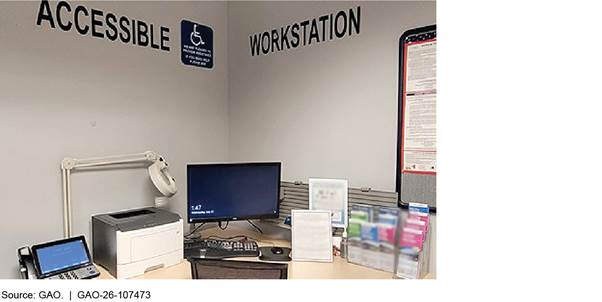
State and local workforce agencies GAO visited have made various efforts to ensure their programs are accessible to participants with disabilities. For example, officials GAO interviewed said they have provided assistive technology such as computers that are accessible to people with visual impairments (see figure). However, officials also reported challenges ensuring that training provided outside of job centers is accessible and providing certain accommodations such as sign language interpreters.
DOL monitors state and local workforce agencies to help ensure its programs are accessible but does not routinely analyze monitoring results. DOL’s monitoring reports include an examination of state and local accessibility efforts, but the agency has not developed a procedure to analyze them at an aggregate level, which increases the risk the agency will fail to identify and address widespread issues. Also, DOL has provided guidance and technical assistance on a range of accessibility topics. However, officials GAO interviewed in several local areas were not aware of or do not use these resources. Without evaluating awareness or use of its guidance and assistance, DOL may miss opportunities to improve dissemination of materials or take other actions to promote them.
Why GAO Did This Study
The Workforce Innovation and Opportunity Act authorizes programs that help job seekers access services at locations called job centers. It prohibits discrimination, requiring that services be accessible to people with disabilities. GAO was asked to examine efforts to ensure programs are accessible.
This report addresses (1) the share of participants in selected DOL workforce programs that report disabilities and use services, and their employment outcomes, (2) the efforts made and challenges faced by state and local workforce agencies to ensure the programs’ services are accessible to people with disabilities, and (3) DOL’s efforts to ensure the programs are accessible.
GAO analyzed participant-level DOL data from July 1, 2023 through June 30, 2024, the most recent year available; reviewed relevant federal laws, policies, and agency documents; interviewed DOL and state officials, disability organizations, and participants with disabilities; and visited a non-generalizable sample of 12 job centers in Arkansas, Oregon, Virginia, and the District of Columbia, selected for variation in geographic location, urban or rural population, and percentage of participants with disabilities.
What GAO Recommends
GAO is making three recommendations: that DOL (1) take additional steps to collect more complete data on participants’ disability type, (2) develop a procedure to routinely analyze state monitoring reports, and (3) evaluate awareness and use of guidance and technical assistance. DOL disagreed with the first recommendation and agreed with the other two. GAO maintains that additional steps to collect more complete data are needed, as discussed in the report.
Abbreviatons
|
COVID-19 |
coronavirus disease 2019 |
|
CRC |
Civil Rights Center |
|
DOL |
U.S. Department of Labor |
|
ETA |
Employment and Training Administration |
|
ODEP |
Office of Disability Employment Policy |
|
PY |
program year |
|
VR |
Vocational Rehabilitation |
|
WIOA |
Workforce Innovation and Opportunity Act |
This is a work of the U.S. government and is not subject to copyright protection in the United States. The published product may be reproduced and distributed in its entirety without further permission from GAO. However, because this work may contain copyrighted images or other material, permission from the copyright holder may be necessary if you wish to reproduce this material separately.
January 21, 2026
The Honorable Robert C. “Bobby” Scott
Ranking Member
Committee on Education and Workforce
House of Representatives
The Honorable Frederica S. Wilson
House of Representatives
The Workforce Innovation and Opportunity Act (WIOA) designates four U.S. Department of Labor (DOL) workforce programs that help increase access to employment—the Adult, Dislocated Worker, Youth, and Wagner-Peyser Act Employment Service (Wagner-Peyser) programs—as core programs.[1] These programs provide funding to state and local workforce agencies to administer the programs at American Job Centers (or “job centers”) throughout the country. From 2021 through 2024, over 500,000 people with disabilities were unemployed and actively looking for work each year. WIOA prohibits discrimination on the basis of disability in WIOA-funded programs, requiring that WIOA-funded services be accessible to people with disabilities. These services include job search assistance, training programs, and career counseling. WIOA-funded programs also work with other employment and training programs that target specific populations, including the Department of Education’s State Vocational Rehabilitation (VR) program that exclusively serves people with disabilities.
To access WIOA services, people with disabilities may need a variety of accommodations, such as additional time to complete training tasks, assistive technology, or personal assistance. However, prior studies funded by DOL have found that state and local workforce agencies faced challenges in making these services accessible. For example, a 2017 report found that almost two-thirds of job centers were not “fully accessible” to people with disabilities.[2]
You asked us to examine the accessibility of DOL core workforce programs for people with disabilities. This report addresses (1) the share of program participants with disabilities and how their use of services and employment outcomes compare to participants without disabilities, (2) selected state and local workforce agencies’ efforts to ensure the accessibility of services for people with disabilities and the challenges they have faced in doing so, and (3) DOL’s efforts to ensure its workforce programs are accessible to people with disabilities.
For our first objective, we examined DOL data from the WIOA Performance Records Public Use File for the Adult, Dislocated Worker, Youth, and Wagner-Peyser programs. DOL collects these data from states via the Participant Individual Record Layout. The data provide individual-level information for participants in the programs. We focused on program year 2023 (July 1, 2023, to June 30, 2024), the most recent full year available, and examined the data elements related to disability status and type, services received, and outcomes obtained. We also examined program year 2018-2023 data for overall trends. To determine the reliability of these data, we spoke with DOL officials knowledgeable about the data, reviewed the data dictionary and other DOL documentation, and tested the data for missing data and inconsistencies. We found the data to be sufficiently reliable for the purposes of calculating the program participation, services, and employment outcomes for people with and without disabilities, except for specific instances we note in the report.
For our second objective, we conducted site visits to 12 job centers in four states to obtain information about job centers’ efforts and challenges in ensuring the accessibility of services for people with disabilities.[3] We selected sites to ensure variety in geographic location and the percentage of workforce program participants who reported they had a disability. During these visits, we interviewed state and local officials to obtain their perspectives on these efforts and challenges and collected related state and local documentation. In addition to the site visits, we held four discussion groups with a total of 18 local workforce board officials located in 10 other states to obtain their perspectives on the efforts and challenges.[4] We interviewed representatives from two disability advocacy organizations and four national workforce organizations. We also communicated with nine individuals with disabilities in four states who have participated in DOL’s workforce programs to obtain their perspectives on accessing the services at job centers.[5]
For our third objective, we reviewed DOL documents related to accessibility for people with disabilities and interviewed DOL officials. We reviewed WIOA and its implementing regulations. We also analyzed DOL policy and guidance related to serving people with disabilities and ensuring accessibility in the agency’s workforce programs, the goals and objectives in DOL’s 2022–2026 strategic plan,[6] and federal standards for internal control related to monitoring and evaluation.[7] Our analysis should not be used to draw conclusions about DOL’s, state agencies’, or local agencies’ legal compliance with accessibility requirements. We also interviewed representatives from the National Center on Leadership for the Employment and Economic Advancement of People with Disabilities (LEAD Center) that provides technical assistance to state and local workforce agencies. For more information on our objectives, scope, and methodology, see appendix I.
We conducted this performance audit from March 2024 to January 2026 in accordance with generally accepted government auditing standards. Those standards require that we plan and perform the audit to obtain sufficient, appropriate evidence to provide a reasonable basis for our findings and conclusions based on our audit objectives. We believe that the evidence obtained provides a reasonable basis for our findings and conclusions based on our audit objectives.
Background
Federal Workforce Programs
WIOA establishes a system for federal, state, and local entities to implement workforce employment and training programs. At the federal level, DOL implements its programs by providing oversight, issuing guidance, allocating funds, collecting data on participants, monitoring performance, and investigating allegations of discrimination, among other activities. At the state level, state workforce development boards and agencies develop plans, designate local areas to carry out the programs, and report on performance measures to DOL.[8] Each state’s plan is required to outline a strategy for the DOL core workforce programs in the state. At the local level, local workforce development boards carry out the programs and services by, among other activities, developing local workforce plans and strategies and selecting job center operators. Job centers administer the programs by offering employment services such as job search assistance, training programs, and career counseling. Job center staff also collect data from participants, including demographic information, disability status, services received, and outcomes achieved.
WIOA authorizes or made amendments to multiple programs and services designed to improve employment outcomes for job seekers, including the four DOL core workforce programs. Title I of WIOA authorizes DOL’s Adult, Dislocated Worker, and Youth programs that provide career and training services, among others. Career services, such as skills assessment and job search assistance, are typically provided in job centers. Training services, such as occupational skills training and on-the-job training, are typically delivered by external training providers. Job center staff and participants select training providers from their state’s list of approved entities. The Wagner-Peyser Act, as amended by Title III of WIOA, authorizes DOL’s Wagner-Peyser program, which provides employment services such as job placement and labor market information.[9] The Rehabilitation Act of 1973, as amended by Title IV of WIOA, authorizes the Department of Education’s VR program, which supports the employment needs of individuals with disabilities and is a partner in the delivery of services available through job centers.[10]
Under WIOA, there are two types of job centers: comprehensive and affiliate. A comprehensive job center is a physical location where job seekers and employers can access the full array of services from all required WIOA partner programs, including services under Title I, the Wagner-Peyser program, and the VR program. An affiliate job center provides access to one or more partner programs but does not offer the complete set of services available at a comprehensive center. All job centers—whether comprehensive or affiliate—must be physically and programmatically accessible to individuals with disabilities.[11] All states operate job centers.
WIOA requires states to report six performance indicators to assess the effectiveness of core programs. Generally, these indicators are:
1. employment rate in the second quarter after program exit,[12]
2. employment rate in the fourth quarter after program exit,
3. median earnings in the second quarter after program exit,
4. credential attainment,
5. measurable skill gains, and
6.
effectiveness in serving employers.[13]
Accessibility for People with Disabilities
WIOA prohibits, in WIOA-funded programs, discrimination against a range of protected groups, including individuals with disabilities.[14] Similarly, section 504 of the Rehabilitation Act of 1973 prohibits discrimination against individuals with disabilities in programs that receive federal funding.[15] In addition, the Americans with Disabilities Act of 1990 prohibits discrimination against individuals with disabilities by public entities and places of public accommodation.[16] Under DOL’s WIOA regulations, job centers must be physically and programmatically accessible, and programs funded under Title I of WIOA must be programmatically accessible, which includes providing reasonable accommodations for program participants with disabilities.[17] Physical accessibility means that facilities are usable and accessible for people with disabilities, according to DOL. Programmatic accessibility means that policies, practices, and procedures provide effective and meaningful opportunities for people with disabilities to participate in or benefit from aid, benefits, services, and training. Ensuring accessibility could also include modifying equipment, adapting schedules or training materials, or providing auxiliary aids and services.
Seven Percent of Program Participants Reported Having Disabilities but Data on Their Disability Type Are Limited, and They Used Less Training and Had Worse Employment Outcomes
Seven Percent of Participants in Program Year 2023 Reported Disabilities, and Almost Half of These Participants Did Not Report Their Disability Type
About 7 percent of participants in the DOL core workforce programs reported having disabilities in program year (PY) 2023, according to DOL data for the four programs. The percentage of participants reporting disabilities in each program varied, from 6 percent in the Dislocated Worker and Wagner-Peyser programs to 22 percent in the Youth program.[18] According to DOL officials, these programs do not require participants to disclose whether they have disabilities. Overall, about 10 percent of participants did not report whether or not they had disabilities in PY 2023, according to DOL data; therefore, their disability status is unknown (see table 1).
Table 1: Reported Disability Status of Participants in Department of Labor (DOL) Core Workforce Programs, Program Year 2023
|
Program |
Participants reporting having disabilities |
Participants reporting having no disabilities |
Participants with unknown disability status |
|
Adult |
23,836 (9%) |
219,021 (79%) |
35,731 (13%) |
|
Dislocated Worker |
12,168 (6%) |
162,864 (80%) |
28,570 (14%) |
|
Youth |
28,861 (22%) |
91,572 (70%) |
10,600 (8%) |
|
Wagner-Peyser |
153,443 (6%) |
2,053,143 (84%) |
245,480 (10%) |
|
Total |
184,227 (7%) |
2,252,261 (83%) |
269,101 (10%) |
Source: GAO analysis of DOL data. | GAO‑26‑107473
Notes: The Workforce Innovation and Opportunity Act designates four DOL workforce programs—the Adult, Dislocated Worker, Youth, and Wagner-Peyser Act Employment Service (Wagner-Peyser) programs—as core programs. Program year 2023 is the period from July 1, 2023 to June 30, 2024. Percentages may not sum to 100 due to rounding.
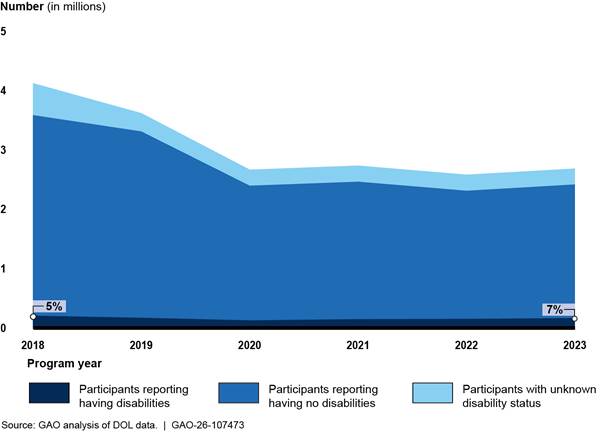
From PY 2018 to PY 2023, overall participation in DOL core workforce programs dropped, but the percentage of participants with disabilities rose, according to DOL data. In PY 2018, about 4.1 million people participated in these programs. Of those participants, about 230,000 (5 percent) reported having disabilities. Participation dropped substantially to about 2.7 million people in PY 2020, of which about 150,000 (5 percent) reported having disabilities. This drop in participation coincided with the initial years of the COVID-19 pandemic. Subsequently, participation remained relatively constant through PY 2023, when the number of participants who reported having disabilities increased to about 184,000 (7 percent) (see fig. 1).
Figure 1: Participation in Department of Labor (DOL) Core Workforce Programs, by Participants’ Reported Disability Status, Program Years 2018–2023
Note: The Workforce Innovation and Opportunity Act designates four DOL workforce programs—the Adult, Dislocated Worker, Youth, and Wagner-Peyser Act Employment Service programs—as core programs. Each program year is the period from July 1 of that year to June 30 of the next year. For example, program year 2023 is the period from July 1, 2023 to June 30, 2024.
Of the about 180,000 participants with a reported disability in PY 2023, about 80,000 (43 percent) did not report their disability type, according to DOL data. Participants in these programs may report a variety of types of disabilities, including physical, mental, vision-related, hearing-related, learning, and cognitive disabilities.[19] Similar to participants’ disability status, these programs do not require participants to disclose their specific types of disabilities, according to DOL officials.
The completeness of DOL’s data on disability type varied widely by state in PY 2023, according to our analysis of DOL data. In PY 2023, states’ percentages of participants with disabilities whose disability type was unknown ranged from about 2 percent in Pennsylvania to about 100 percent in Washington (for more detail, see app. II).
According to DOL officials, states have faced some challenges in reporting data on disability type. They said this could be in part because the data are collected through a multi-layered question, which could be difficult to implement. They also said participants would need to feel comfortable self-disclosing their disability type. In addition, job center staff in three of the four job centers we visited in one state said they do not record participants’ disability types in their data systems. Program application forms we reviewed in this state did not ask questions about disability type.
DOL has taken steps to encourage states to collect more complete data on disability type. Agency officials said they provide technical assistance to state and local officials to do so. For example, a DOL webinar suggested that states’ intake systems could require participants to respond to the question about disability type, rather than allowing it to be skipped.[20] Under this approach, participants would still have the option of responding that they prefer not to disclose their disability type. DOL officials also said they check the completeness of the data as part of quarterly data quality checks. If a state reports “disability type unknown” for more than 35 percent of participants with disabilities in a program, the system will generate a data quality flag and prompt the state to report a summary of steps needed to address the issue, according to DOL officials.[21]
DOL’s efforts to ensure states are properly reporting the data have resulted in some improvement in the completeness of the data, according to data provided by DOL. However, in PY 2023, the Dislocated Worker and Wagner-Peyser programs were still above the 35 percent threshold for unknown data on disability type. In addition, because of the wide variation in completeness across states, the data remain unreliable for nationwide analysis, according to DOL officials. Although DOL staff may provide technical assistance to states on this and other specific topics as requested, officials said they do not have a plan to target assistance to specific states, such as the 23 states reporting more than 35 percent for the “disability type unknown” category for the Dislocated Worker program in PY 2023. DOL officials said they will continue their current efforts and await further progress from those efforts.
According to federal standards for internal control, agencies should use quality information to achieve the entity’s objectives and obtain reliable data in a timely manner.[22] In addition, quality information may support physical and programmatic accessibility and the provision of reasonable accommodations. Accessibility is required by WIOA and its regulations, and DOL’s strategic plan includes a goal to create customer-focused workforce solutions that serve all workers, including underserved communities such as people with disabilities.[23]
More complete data on participants’ disability types, which could result from targeting technical assistance efforts to the states that are above DOL’s 35 percent target, could help DOL and job centers improve services—and, ultimately, employment and earnings outcomes—for program participants with disabilities. For example, with more complete data, DOL could better identify any gaps in services based on participants’ disability type and prioritize efforts to improve outcomes for participants with different types of disabilities. In addition, if job centers collected more complete data from participants on their disability types, they could have better information with which to customize services to meet participants’ individual needs.
Participants with Disabilities Used Career Services About as Often as Those Without Disabilities, but They Used Training Services Less Often
Career services. In each DOL core workforce program, participants with disabilities generally used basic and individualized career services about as often as participants without disabilities in PY 2023, according to our analysis of DOL data.[24] Basic career services are available to all participants and include intake, job-search assistance, provision of information about job openings and skill needs, and referrals to other programs. Individualized career services are available to a participant after job center staff determine that the participant needs them to obtain or keep a job. They are more intensive than basic career services and include skills assessments, individual career counseling, and the development of individual employment plans. The Wagner-Peyser program was the only program with a statistically significant difference in use of individualized career services between participants with and without disabilities in PY 2023 when controlling for selected characteristics, such as age, race/ethnicity, and sex. For this program, participants with disabilities used individualized career services slightly more often than participants without disabilities (61 percent and 56 percent, respectively).[25]
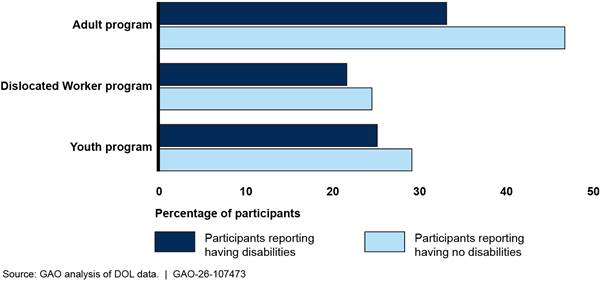
Training services. In PY 2023, participants with disabilities used training services less frequently than participants without disabilities in the three DOL core workforce programs that provide training services (Adult, Dislocated Worker, and Youth programs). However, the difference was not statistically significant for the Dislocated Worker program when controlling for other selected characteristics, such as age, race/ethnicity, and sex, according to our analysis of DOL data.[26] The difference was largest in the Adult program, where 33 percent of participants with disabilities used training services compared to 47 percent of those without disabilities (see fig. 2). Training services include occupational skills training, on-the-job training, and registered apprenticeship. Unlike career services, they are typically offered by training providers outside job centers.
Figure 2: Percentage of Department of Labor (DOL) Core Workforce Program Participants Who Used Training Services, by Reported Disability Status, in Program Year 2023
Notes: The Workforce Innovation and Opportunity Act designates three DOL workforce programs that provide training services—the Adult, Dislocated Worker, and Youth—as core programs. Program year 2023 is the period from July 1, 2023 to June 30, 2024.
DOL officials said they issued guidance and evidence-based practices because they were aware that participants with disabilities, like other underserved populations, used training services less often than those without disabilities. For instance, in response to data showing that lower training completion rates resulted in lower outcomes for underserved populations, including participants with disabilities, DOL issued guidance to state and local officials in 2023 about training access and completion in the Adult and Dislocated Worker programs.[27] It describes a variety of training approaches that could meet the individual needs of different individuals and communities.
According to three state and local officials we interviewed, participants with disabilities may use training services from the VR program rather than from DOL core workforce programs. According to one local official, a participant with disabilities in their area would receive training from the VR program if job center staff determined that it was best for the individual participant. In this type of situation, participants with disabilities may be co-enrolled in a DOL core workforce program and the VR program.[28]
However, DOL officials said their data contain limited information on co-enrollment, and therefore, they cannot determine the extent to which people with disabilities enrolled in the Adult, Dislocated Worker, or Youth programs received training through the VR program. In 2022, we reported that DOL lacked complete information on participants enrolled in multiple WIOA programs—for example, participants with disabilities co-enrolled in the Adult and VR programs.[29] At that time, we recommended that the Secretary of Labor work with the Secretary of Education, which administers VR programs, to determine how to better assist programs in collecting complete co-enrollment information. DOL agreed with our recommendation and provided technical assistance and guidance to states on the challenges of obtaining co-enrollment data. However, it has not provided us with evidence that the quality of related data on co-enrollment, including data on participants with disabilities, has improved. More complete information on co-enrollment would help the departments better identify the extent to which participants, including those with disabilities, receive multiple program services and whether doing so results in positive employment outcomes. We will continue to follow up with DOL on the status of addressing our recommendation.
Participants with Disabilities Achieved Worse Employment and Earnings Outcomes Than Those Without Disabilities
Employment outcomes. According to DOL’s data on WIOA’s performance outcome measures, participants with disabilities in each DOL core workforce program achieved lower employment rates in the second and fourth quarters after they exited from the program than those without disabilities for PY 2023.[30] For example, in the Adult program, which had the largest gap in employment outcomes, 60 percent of participants with disabilities were employed two quarters after exit compared to 76 percent of those without disabilities. In the Youth program—which measures participants’ entry into employment or education—the difference between those with and without disabilities was about 4 percentage points in the second quarter after exit (see table 2).
Table 2: Employment Rates for Department of Labor (DOL) Core Workforce Program Participants, by Reported Disability Status, For Program Year 2023
|
Program |
Participants reporting having disabilities |
Participants reporting having no disabilities |
Difference (in percentage points) |
|
Adult |
|||
|
Employment rate – 2nd quarter after exita |
60% |
76% |
16 |
|
Employment rate – 4th quarter after exitb |
59% |
75% |
16 |
|
Dislocated Worker |
|||
|
Employment rate – 2nd quarter after exita |
64% |
72% |
8 |
|
Employment rate – 4th quarter after exitb |
65% |
73% |
8 |
|
Youth |
|||
|
Youth education and employment rate – 2nd quarter after exitc |
70% |
74% |
4 |
|
Youth education and employment rate – 4th quarter after exite |
71% |
74% |
4d |
|
Wagner-Peyser |
|||
|
Employment rate – 2nd quarter after exita |
57% |
70% |
13 |
|
Employment rate – 4th quarter after exitb |
56% |
70% |
14 |
Source: GAO analysis of DOL data. | GAO‑26‑107473
Notes: The Workforce Innovation and Opportunity Act designates four DOL workforce programs—the Adult, Dislocated Worker, Youth, and Wagner-Peyser Act Employment Service (Wagner-Peyser) programs—as core programs. During program year (PY) 2023, there were 184,227 participants who reported having disabilities in these programs, representing 7 percent of all participants. The number of participants who exited varies by program and by the specific measure. Exit from a program generally occurs when a participant has not received services for 90 days and does not have plans to receive future services. At that point, the date of exit is applied retroactively to the last date of service.
aEmployment rate – 2nd quarter after exit is the percentage of program participants who are in unsubsidized employment during the second quarter after exit from the program. For PY 2023, this measure is based on participants who exited between July 1, 2022 and June 30, 2023.
bEmployment rate – 4th quarter after exit is the percentage of program participants who are in unsubsidized employment during the fourth quarter after exit from the program. For PY 2023, this measure is based on participants who exited between January 1, 2022 and December 31, 2022.
cYouth education and employment rate – 2nd quarter after exit is the percentage of Youth program participants who are in education or training activities, or in unsubsidized employment, during the second quarter after exit from the program. For PY 2023, this measure is based on participants who exited between July 1, 2022 and June 30, 2023.
dDiscrepancy in difference is due to rounding.
eYouth education and employment rate – 4th quarter after exit is the percentage of Youth program participants who are in education or training activities, or in unsubsidized employment, during the fourth quarter after exit from the program. For PY 2023, this measure is based on participants who exited between January 1, 2022 and December 31, 2022.
Earnings outcomes. In each DOL core workforce program, median earnings in the second quarter after exit from the program were lower for participants with disabilities than for those without disabilities.[31] The difference was largest in the Adult program ($1,825) and smallest in the Youth program ($341) (see table 3).
Table 3: Median Earnings in the Second Quarter After Exit for Department of Labor (DOL) Core Workforce Program Participants, by Reported Disability Status, For Program Year 2023
|
Program |
Participants reporting having disabilities |
Participants reporting having no disabilities |
Difference |
|
Adult |
$7,048 |
$8,872 |
$1,825a |
|
Dislocated Worker |
$7,930 |
$9,502 |
$1,572 |
|
Youth |
$4,583 |
$4,924 |
$341 |
|
Wagner-Peyser |
$6,684 |
$8,486 |
$1,802 |
Source: GAO analysis of DOL data. | GAO‑26‑107473
Notes: The Workforce Innovation and Opportunity Act designates four DOL workforce programs—the Adult, Dislocated Worker, Youth, and Wagner-Peyser Act Employment Service (Wagner-Peyser) programs—as core programs. Median earnings in the second quarter after exit is the median earnings of program participants who are in unsubsidized employment during the second quarter after exit from the program, regardless of the number of hours worked. For program year 2023, this measure is based on participants who exited between July 1, 2022 and June 30, 2023. During program year 2023, there were 184,227 participants who reported having disabilities in these programs, representing 7 percent of all participants. The number of participants who exited varies by program and by the specific measure. Exit from a program generally occurs when a participant has not received services for 90 days and does not have plans to receive future services. At that point, the date of exit is applied retroactively to the last date of service.
aDiscrepancy in difference is due to rounding.
According to DOL officials, people with disabilities, including DOL core workforce program participants with disabilities, generally have lower employment and earnings outcomes than people without disabilities for a number of reasons. For instance, people with disabilities may face challenges obtaining accessible transportation to commute to work. In addition, they may lack awareness of the full range of workplace accommodations available to them. People with disabilities may also continue to face bias and discrimination in the workplace, according to DOL officials.
State and Local Agencies Have Undertaken Various Efforts to Make Programs Accessible, but Report Challenges Identifying and Accommodating Some Disabilities
Selected state and local workforce agencies in our review have undertaken various efforts to ensure job centers are accessible to workforce program participants with physical disabilities, and they have made some efforts to accommodate participants with other types of disabilities. However, officials reported facing challenges ensuring the accessibility of training provided outside of the job centers, as well as identifying and accommodating the full range of participants’ disabilities within job centers. These efforts, and associated challenges, can be grouped into six areas: (1) identifying participants with disabilities; (2) ensuring compliance with accessibility requirements; (3) collaborating with the VR program; (4) providing remote access to services; (5) providing accommodations; and (6) training staff on serving participants with disabilities.
Identifying Participants with Disabilities
Efforts. To identify participants with disabilities, job centers have voluntary disability status questions on application forms for participants to report a disability. The disability status questions are not asked in the same way or with the same detail among the states and sites we visited. For example, application forms we obtained asked one of the following questions:
· “Do you have a disability?”
· “Do you consider yourself to have a disability?”
· “Do you acknowledge a disability that substantially limits one or more major life activity?”
Two of these application forms asked for more disability information:
· “If yes, do you need special accommodations for the disability?” and
· “If ‘Yes,’ please identify the type of disability.” Selectable options on this form included
· “Physical chronic health condition,”
· “Physical mobility related disability,”
· “Vision related disability,”
· “Hearing related disability,”
· “Mental or psychiatric disability,”
· “Learning disability,”
· “Cognitive or intellectual disability,” and
· “I choose not to disclose.”
Also, officials we interviewed at several job centers said they may verbally ask participants additional questions to facilitate disclosure of a disability.[32] For example, officials from one job center may ask someone whether they need any assistance completing paperwork. At another job center, officials may ask someone about their “barriers to success,” or “barriers to employment,” or otherwise assess their need for accommodations. At two other job centers, officials might ask participants whom they think have a disability whether they need accommodations or suggest they speak to a specific workforce partner, such as VR staff.
When job center officials know that a participant has a disability, they said they can then provide needed accommodations, such as assistive technology or referrals to VR services.[33] Disclosure of a disability can therefore benefit participants trying to access job center services, according to job center officials.
Challenges. State and local officials we interviewed explained that they face challenges identifying participants with disabilities because participants may not identify as a person with a disability or disclose a disability.
First, officials we interviewed at most job centers explained that a participant may not identify as a person with a disability even when they could be eligible for accommodations. For example, officials from one job center described one participant who said they had dyslexia but did not identify as a person with a disability. They mentioned another participant who did not identify as a person with a disability, but who also said that standing for long periods of time was challenging because of a recent knee surgery.
Second, officials we interviewed at several job centers explained that participants may not disclose their disability due to a fear of discriminatory treatment. Officials from one job center said that participants may worry that if they disclose a disability, the job center programs would not serve them or that employers would find out about their disability and not want to hire them. Officials at another job center explained that participants fear they will be discriminated against in obtaining training services if they disclose a disability.
Furthermore, local officials we interviewed reported some examples of how not disclosing a disability can impact a participant’s experience with job center services. One job center official described a participant who did not initially disclose a disability to staff, but it became apparent after job training started that the participant encountered challenges due to a disability. The participant “bounced” between training programs as a result. After VR program officials confirmed the participant’s disability, job center staff offered accommodations and counseled them to seek other employment that was a better fit. Officials at another job center explained that one participant did not disclose a disability, then subsequently quit training because the training provider did not provide accommodations. These officials stated that if the participant had disclosed their disability, the staff could have provided accommodations, thus increasing the likelihood of the participant completing the training.
Ensuring Compliance with Accessibility Requirements
Efforts. State and local officials reported various efforts to ensure that job centers comply with accessibility requirements. These accessibility requirements apply to both comprehensive and affiliate job centers. Local officials review job centers for compliance as part of a recertification process required by regulations.[34] During these reviews, for example, officials check parking spaces near entrances and communication devices for the deaf for compliance with these requirements. Several local officials we spoke with reported renovating job centers because of these compliance reviews. For example, these officials described the remodeling of parking lots and restrooms, as well as the installation of automatic doors, to comply with accessibility requirements.
States also approve training providers to ensure their programs and facilities are compliant with accessibility requirements, according to officials in three states we selected. In one state we visited, training providers answer questions about how they have served people with disabilities in the past, and self-attest to the accessibility of the training. Once approved, the training provider can appear on the state’s approved list and can receive WIOA funds to provide training, according to the state’s policy.
Challenges. Officials from all four selected states, one discussion group, and one disability organization reported that it can be challenging to ensure that training providers are compliant with accessibility requirements. Officials cited examples where they said providers’ facilities or programs were not fully accessible, and said state approval policies that rely on provider self-attestation of accessibility may not identify these issues. Local officials in one state said they conduct site visits to training providers to check on their accessibility because state approval is not sufficient.
· Training facilities. Training providers’ facilities may not be physically accessible, according to local workforce officials we interviewed. For example, one official mentioned that training facilities in the area faced challenges ensuring physical accessibility since they may not have accessible restrooms. Similarly, another official mentioned visiting a training provider located on the second floor of a building with no elevator, which they said would make it inaccessible to participants using wheelchairs.
· Training programs. Training providers might not modify training programs to be accessible to participants with disabilities, according to local officials.[35] For example, some training programs have strict participation requirements that do not account for individuals’ disability-related needs, such as medical appointments, according to officials at one job center. Local officials at another job center told us that one individual with a physical disability could not attend truck-driver training due to the cost of modifying a vehicle for accommodations. Local officials at another location said that they had a participant who was deaf and could not participate in training because they needed a sign language interpreter, but the interpreter was not available for the time the training required.
Collaborating with the VR Program
Efforts. Local officials from all 12 job centers, nine local workforce board directors, and officials from four discussion groups we spoke with reported that job center staff collaborate with VR staff to provide services to participants with disabilities.[36] Officials reported that VR supplements the services provided in job centers for participants with disabilities through tuition assistance, language interpreters, job coaches, work experiences, job training, and assistive technology. For example, local officials at one job center reported their WIOA program staff worked with VR staff to provide a sign language interpreter for a deaf participant for truck-driver training. At another job center, the Youth program co-enrolled a participant with the VR program to get assistance paying for assistive technology. We also interviewed a participant with a disability who said that VR staff provided mentorship, professional clothing for job interviews, and a new employment opportunity.
Challenges. According to workforce officials and a disability organization representative we interviewed, job center staff face challenges collaborating with VR when VR staff are not readily available. This may occur in job centers where the VR program is not colocated, such as affiliate job centers. For example, a local official explained that when VR staff are not colocated or their availability is otherwise limited, there is little collaboration between their job centers and VR. Another local official explained that it is difficult for their VR participants to get help quickly or easily due to the limited availability of VR staff at an affiliate job center in the area. A state official said that a VR official may visit their affiliate centers on a limited basis—once a week, for a few hours—which they considered to be insufficient VR support.
Another challenge is that job center staff may refer participants with apparent disabilities—such as those using wheelchairs—to the VR program before participants use other job center resources that should be readily available with accommodations. According to one disability organization official, enrolling in the VR program can be a long process, involving extensive documentation to determine eligibility, so people may be able to receive needed services more quickly through the other job center services. One local workforce official from a discussion group similarly stated this can be a challenge, explaining that staff must be reminded not to immediately refer individuals with disabilities to VR but rather try to provide accommodations to them with available job center resources.
Providing Remote Access to Services
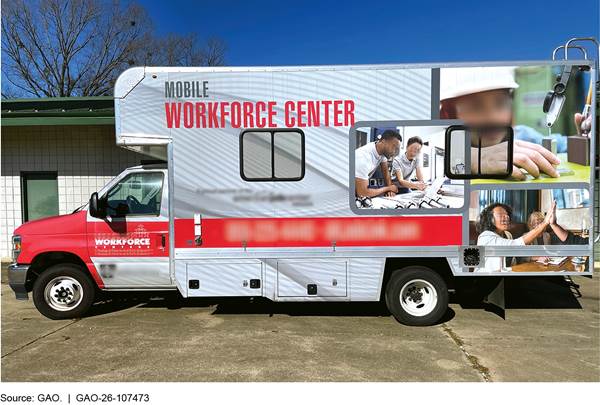
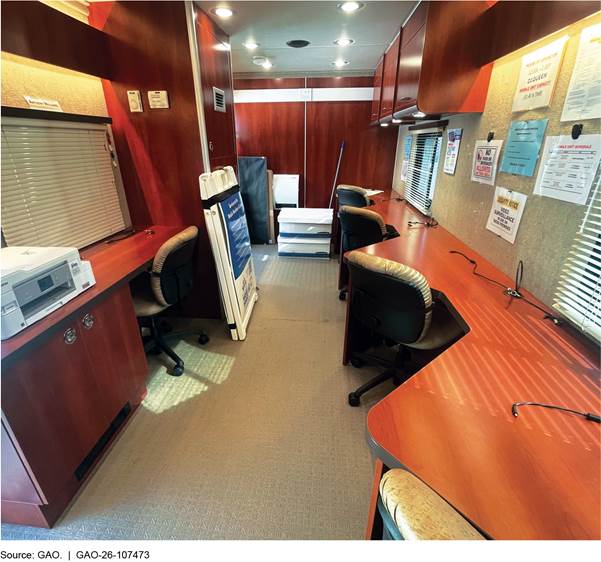
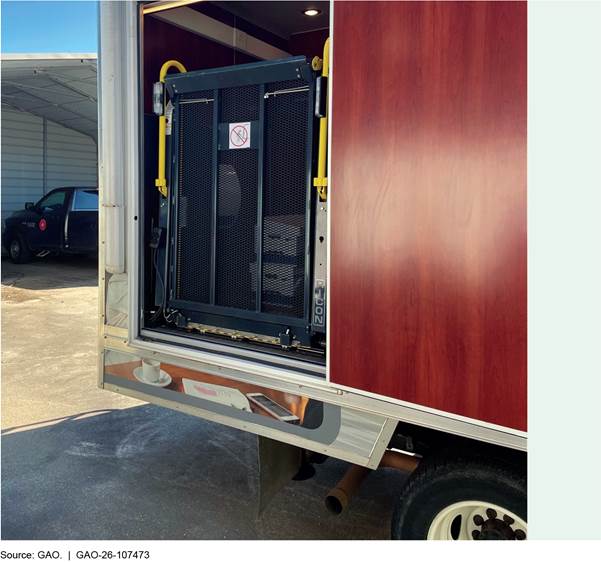
Efforts. Local officials from all four states we visited reported providing remote access to job center services. One local official told us providing the option for remote services has had positive outcomes for participants with disabilities because getting to the job center location can be a significant barrier for accessing services. Remote services may include resume review, job-search assistance, and workshops provided through the mail, over the phone, and with other communication technologies, such as videoconferencing. Remote services may also include in-person services provided at locations other than comprehensive job centers, such as affiliate job centers, other community locations (e.g., restaurants, libraries), or at mobile job centers, according to local officials. Mobile job centers can be relocated to reach people with disabilities affecting their mobility or those in remote areas (see figs. 3, 4, and 5).
Challenges. Lack of broadband internet and participants’ limited knowledge about technology challenge job centers’ ability to provide remote services, according to several local workforce officials we interviewed.[37] For example, one official stated that 36 percent of the state’s population did not have broadband internet access. Another official said that 80 to 90 percent of participants in the area are in the WIOA adult program and are often low-skilled workers. These participants may not have the computer skills needed to access remote services.
Providing Accommodations
Efforts. Local officials reported providing a variety of accommodations to help participants with disabilities access services at job centers. Specifically, they mentioned meeting participants at their vehicles outside the job center, providing large-print materials for people with visual disabilities, and providing extra assistance with using job center services and technologies. For example, officials at one job center helped a participant in a wheelchair exit a municipal bus, enter the job center, and complete the program eligibility and job search processes.
Local officials also described providing assistive technology at job centers to accommodate participants with disabilities (see figs. 6 and 7). The assistive technology that officials described include:
· screen readers to read screen text aloud,
· screen magnifiers to enlarge screen content,
· wheelchair-accessible workstations,
· videoconferencing with sign language interpreters,
· communication devices for participants with hearing and speech disabilities, and
·
virtual reality headsets with settings for users with
disabilities.
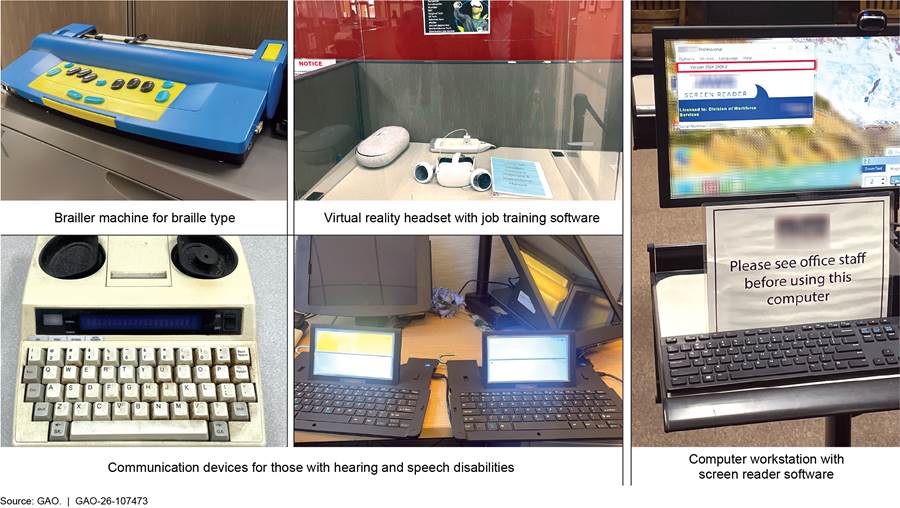
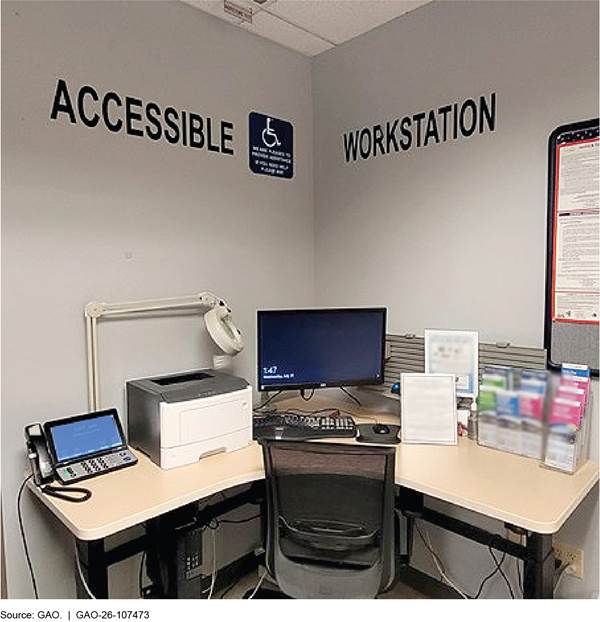
Local officials provided examples illustrating in various ways that assistive technology has provided access to participants with disabilities. For example, one official mentioned that a participant with a disability was able to experience different types of employment through a virtual reality headset at the job center. These headsets offer captioning for participants with hearing disabilities and screen reading for those with visual disabilities. Officials from another job center mentioned that they helped a participant with a visual disability use a screen magnifier to find a job in cybersecurity.
Six of the nine participants with disabilities that we communicated with reported receiving accommodations at job centers as well. For example, one participant reported receiving scheduling accommodations (i.e., additional breaks) while participating in training at the job center. Another participant reported receiving noise-cancelling headphones, a screen reader, and other assistive technology while using job center services.
Challenges. Officials from one disability organization and three job centers mentioned that job centers have limited access to sign language interpreters, which they said can delay some participants’ access to services. For example, one local official mentioned that sign language interpreter technology was no longer available at the job center due to building renovations. Another local official mentioned that they were trying to hire staff at the job center with sign language skills, because their participants had to wait up to 3 days for an interpreter.
We observed challenges with assistive technology at some job centers we visited, which could present challenges for participants trying to access job center services. For example, one job center we visited did not have in operation the computer workstation it had designated as accessible. The local official at the site said that the workstation was not operational due to a renovation at the job center. Other computer workstations were visibly operating and in use during our visit. At another job center, during a demonstration, the job center staff could not operate the screen reading technology available on one computer workstation.
One participant with autism we interviewed said that a job center did not provide the requested accommodation to manage their case through email correspondence instead of face-to-face meetings. The participant said that communication preferences are very important to people with disabilities. The participant also stated that job center officials did not provide access to an equal opportunity officer, whom the participant requested to speak to about accommodations. A week after requesting the officer, the participant said, a job center official informed them that their case was closed.
Training Staff on Serving Participants with Disabilities
Efforts. Job center staff receive training—varying by frequency, requirements, and providers—on how to serve participants with disabilities, according to state and local workforce officials we interviewed in all four states we visited. For example, local officials from two states we visited reported having state-mandated annual training on disability-related issues. In contrast, local officials from one job center in another state mentioned that they receive optional monthly trainings on how to serve people with disabilities. In some cases, officials said they partnered with VR to provide these trainings. Other officials said they provided their staff access to training through “lunch and learn” trainings or online through software platforms such as DOL’s WorkforceGPS.[38] They said that this training addressed various topics, including assistive technology, disability etiquette, disability awareness, accessibility, and providing reasonable accommodations.
Challenges. Local officials from two discussion groups, two job centers, and one disability organization said there should be more training on serving participants with disabilities. They also suggested more training on specific topics related to serving participants with disabilities, such as using assistive technology, encouraging participants to disclose a disability, and accommodating participants with a range of different disabilities.
For example, one local official from a job center we visited said that staff receive training focused on serving participants with apparent disabilities, but not with other kinds of disabilities. The official said that when a participant with Tourette Syndrome entered the job center, the staff in the center misinterpreted the participant’s behavior as a problem.[39] Because the official recognized the symptoms of the condition, the participant received accommodations. The official explained that staff needed more training to help them recognize and assess these situations appropriately.
DOL Does Not Analyze Its Monitoring Results or Evaluate Its Technical Assistance Related to Accessibility
DOL Investigates Allegations of Discrimination to Oversee Program Accessibility
DOL’s Civil Rights Center (CRC) investigates allegations of discrimination, such as failure to provide reasonable accommodations in any of DOL’s programs, according to CRC. Job seekers and other participants may file a complaint with CRC or at the state or local level when they believe they have been discriminated against, and recipients of WIOA Title I funding must post notices informing participants of their rights to file these complaints (see fig. 8).

CRC receives hundreds of complaints each fiscal year across all bases of discrimination, including disability, race, sex, age, and religion, according to CRC officials. In fiscal years 2023 and 2024, CRC accepted 39 new cases for investigation. It accepts a small percentage for investigation for a variety of reasons, including because not all complaints are filed properly, according to agency officials. Many of the complaints alleging disability discrimination CRC receives are outside its jurisdiction and are referred to the Equal Employment Opportunity Commission or other relevant organizations for further action, according to CRC officials. In addition to filing complaints with CRC, program participants can file complaints with state or local agencies. Equal Opportunity Officers at the state and local levels are responsible for the complaint procedures in their area, according to DOL. If a participant files the same complaint at both CRC and at the state or local level, CRC does not investigate the complaint while the state or local agency investigates it.[40]
Of the 39 new cases CRC accepted for investigation in fiscal years 2023 and 2024, 24 cases (62 percent) included an allegation of discrimination based on disability, according to the agency.[41] According to agency officials, there are generally four types of complaints they receive alleging disability discrimination in DOL programs:
1. failing to serve someone with a disability,
2. denying requests for reasonable accommodations,
3. failing to modify procedures or policies to make a program accessible to someone with a disability, and
4. denying requests for effective communications (e.g., real-time captioning technology for participants who are deaf).
There are several possible outcomes for these cases. According to CRC officials, when they find evidence of possible discrimination during their investigation, they may take various actions, such as negotiating corrective actions with the job center or service provider or developing a settlement agreement to use a specific technology or modify a procedure to provide a reasonable accommodation. CRC officials also said they inform Employment and Training Administration (ETA) officials of investigations’ outcomes to inform their monitoring of the job centers. In most cases, the participant who filed the complaint returns to the program or a similar program, according to CRC officials. According to federal regulations, if corrective action is not taken, DOL may take a number of actions, including suspending or terminating WIOA Title I funds.
DOL Monitors State and Local Workforce Agencies’ Compliance with Accessibility Requirements but Does Not Routinely Analyze Its Monitoring Results
DOL’s ETA routinely conducts reviews to monitor states’ compliance with relevant laws and regulations, including those related to accessibility for people with disabilities. ETA monitors how states administer the WIOA Adult, Dislocated Worker, Youth, and Wagner-Peyser programs, among other grant programs. In fiscal year 2024, ETA reviewed about 20 percent of its grants covering 18–20 states, according to agency officials. According to agency guidance, ETA aims to review each state once every 3 years.
For each review, ETA officials review state documentation, monitor state agencies, and develop and issue a written report with their findings to the state. The agency’s guide for conducting these reviews includes questions related to physical and programmatic accessibility, equal opportunity, and the availability of auxiliary aids and services for people with disabilities. For example, it asks whether the full range of services are physically and programmatically accessible for all qualified individuals with disabilities. From 2022 through 2024, these monitoring reports found some issues with accessibility in job centers and with a state policy on training providers.[42] For example, one review found that a job center in one state did not meet physical access requirements and that another job center in the state did not have functional accessibility to certain equipment.
In general, ETA reviews the state agencies, and the state agencies monitor local agencies and job centers. However, for some reviews, ETA staff may also tour job centers and interview their staff to assess physical and programmatic accessibility, according to agency officials. According to agency policy, officials must track all activities involved in resolving report findings until the findings are resolved. If the findings are not resolved, then the agency can impose additional conditions or withhold grant funds until the deficiency is corrected.
ETA officials said they developed a central repository in 2023 to collect and store monitoring reports and track any findings from their individual reviews and resolutions to them.[43] They also said they manually reviewed the reports in 2024 for the prior 3 program years (PY 2021-2023) and identified common findings across states related to physical accessibility. According to ETA officials, they considered these issues when developing technical assistance plans in partnership with the Office of Disability Employment Policy (ODEP) and CRC. While ETA officials said they intend to continue conducting these ad hoc reviews, they have not developed a procedure that would require a regular analysis of the reports to identify any widespread issues. By contrast, ETA officials said they have a procedure for regularly reviewing WIOA state plans and looking for systemic issues that need to be addressed. In addition, DOL officials said they have considered developing an automated process using information technology to analyze the monitoring reports but have not done so because it has not been prioritized.
According to federal standards for internal control, agencies should evaluate issues identified through monitoring activities to determine whether any of the issues rise to the level of an internal control deficiency and determine the appropriate corrective actions.[44] WIOA requires all job centers to provide accessible services for individuals with disabilities. By establishing a procedure to routinely analyze its monitoring reports, DOL could determine (1) the extent of any accessibility issues for people with disabilities in its programs and (2) whether states and local areas are generally taking corrective action to address previously identified issues. DOL would also have the information it needs to determine whether to take additional action at the federal level to address any widespread issues.
DOL Provides Guidance and Technical Assistance on Accessibility but Does Not Evaluate Awareness or Use of Them
DOL issues guidance about accessibility for people with disabilities to state and local agencies. The agency has issued multiple notices, letters, and other guidance with promising practices, clarification on services available to workforce program participants with disabilities, and encouragement to provide assistive technology and equal opportunity to people with disabilities. In 2014, it created a training series and resource guide to support job center staff and partners in serving participants with disabilities. In 2019, DOL issued a guide that referenced the agency’s previously issued guidance and provided promising practices for job centers on nondiscrimination and equal opportunity requirements in law and regulations.[45] In addition, DOL issued a notice in 2022 encouraging state and local agencies to leverage funding from multiple programs to increase employment for participants with disabilities.[46] In 2024, DOL updated its promising practice guide.
While much of DOL’s guidance remains active and is available on its website, the agency removed its promising practices guide to review it for alignment with the administration’s priorities. Agency officials said they would add it back to their website once they have completed their review, estimated for summer 2025. As of January 2026, the promising practices guide had not been added back.
DOL’s guidance addresses many of the challenges mentioned by state and local officials we interviewed. For example, its resource guide provides contact information for technical assistance and resource centers that can help with providing reasonable accommodations to program participants. These resources could address concerns about providing accommodations at the job centers. Prior to its removal from the website, DOL’s promising practices guide encouraged the use of payment mechanisms that incentivize eligible training providers to include the cost of providing the individualized services and supports that participants with disabilities may need, which could help address reported concerns about providers not accommodating some participants with disabilities. Similarly, the promising practices guide encouraged officials to consider developing written policies for staff related to disclosure of participants’ disabilities, providing a packet of information on the topic to participants with disabilities, and sharing this information with all participants to promote disclosure. These strategies could address concerns about non-disclosure.
In addition to written guidance, DOL provides technical assistance on accessibility to state and local agencies. For example, DOL officials said they attend conferences to speak directly to state and local officials to clarify DOL policy and encourage them to follow promising practices and ensure accessibility in their programs. DOL officials also said they work directly with state and local agencies in some circumstances, such as when the agencies request it. Additionally, DOL sponsors WorkforceGPS, a website with materials for state and local agencies to help them comply with federal requirements, including those related to accessibility.
DOL’s ODEP funds technical assistance centers, including the National Center on Leadership for the Employment and Economic Advancement of People with Disabilities (LEAD Center). The LEAD Center helps state and local agencies implement workforce programs to improve employment outcomes for people with disabilities. According to LEAD Center officials, their responsibilities include providing guidance and technical assistance, developing tools, and conducting webinars to state and local agencies. ODEP also funds the Center for Advancing Policy on Employment for Youth that works with states to improve employment outcomes for youth and young adults with disabilities, and the Job Accommodation Network that provides guidance on job accommodations and other disability employment issues.
Officials in all the states we visited said they used the guidance provided by DOL on accessibility, but awareness and use of the guidance was mixed among the local areas we visited. Officials from all four states we visited said that they used DOL’s guidance to help them ensure accessibility and serve participants with disabilities. Officials in one state, for example, said they relied on the guidance to understand how to provide participants with disabilities access to services in a variety of contexts and situations. Among the nine local areas we visited, seven said they were aware of DOL’s guidance and six said they had used it to ensure accessibility in their job centers. For example, one local official said they used it to create a checklist for reviewing the accessibility of their job center. Furthermore, officials in five local areas said they were not aware of or had not used DOL’s promising practices guide. Officials in three local areas said they were not aware of this guide. An official in another of these areas said that the guide was too long and should be reduced in length to be helpful for job center staff.
While DOL promotes its guidance to state and local agencies, DOL does not evaluate awareness or use of its guidance and technical assistance on accessibility. DOL officials said they promoted the promising practices guide through the LEAD Center, DOL website, social media, webinars, and partnerships. ODEP and LEAD Center officials said they collect ongoing feedback from state and local stakeholders. For example, they conduct satisfaction surveys after each webinar they provide. ODEP officials also said they conduct listening sessions with participants to obtain input on their technical assistance. However, they said they do not evaluate awareness or use of their guidance and technical assistance by state and local officials. According to ODEP officials, ODEP is a small agency, and officials have not developed a plan to evaluate their overall efforts.
WIOA requires all job centers to provide accessibility to services for individuals with disabilities. According to federal standards for internal control, management should evaluate and document internal control issues, determine appropriate corrective actions, and communicate with external parties using appropriate methods of communication.[47] By evaluating awareness and use of DOL’s guidance and technical assistance related to accessibility, DOL could determine the extent to which state and local agencies are aware of and use this information to improve accessibility of DOL core workforce programs for participants with disabilities. DOL would also have the information it needs to determine whether additional actions are needed, such as improving dissemination of its materials.
Conclusions
Despite efforts to make their programs both physically and programmatically accessible, state and local workforce agencies continue to face challenges ensuring all people with disabilities can benefit from DOL’s core workforce programs. DOL has taken steps to support state and local agencies in their efforts, but its oversight of these programs does not include all the data and analysis the agency needs to help ensure accessibility. With so much missing data on program participants’ disability type, DOL may struggle to identify any gaps in services and outcomes for participants with specific types of disabilities. DOL may also be missing opportunities to routinely identify and address any widespread issues with accessibility across states because while the agency has conducted ad hoc reviews of its state monitoring reports, it has not established a written procedure to routinely analyze them. Finally, without evaluating awareness and use of accessibility-related guidance at the state level and among local job centers, DOL will not know where to improve dissemination of these materials or take other actions to improve the guidance and promote its use among local officials.
Recommendations for Executive Action
We are making the following three recommendations to DOL:
The Secretary of Labor should take additional steps to collect more complete data on workforce program participants’ disability types. These steps could include targeting technical assistance to states where these data are less complete. (Recommendation 1)
The Secretary of Labor should develop a written procedure for routinely analyzing DOL’s state monitoring reports, including associated reports on local workforce agencies, to identify any widespread issues with accessibility for people with disabilities and take appropriate action to address them. (Recommendation 2)
The Secretary of Labor should evaluate state and local workforce agencies’ awareness and use of guidance, including its promising practices guide at such time as it is reposted to its website, and technical assistance on ensuring accessibility of its workforce programs for people with disabilities and take steps as needed to improve dissemination or promotion. (Recommendation 3)
Agency Comments and Our Evaluation
We provided a draft of this report to DOL for review and comment. DOL provided written comments, which are reproduced in appendix III. In its comments, DOL disagreed with the first recommendation and agreed with the second and third recommendations. We maintain that the first recommendation is warranted.
With regard to the first recommendation, DOL stated that it does not require participants to disclose information on their disability type, consistent with non-discrimination provisions and supporting regulations of the Americans with Disabilities Act. It also noted that participants are provided the choice of voluntarily disclosing this information. Our report acknowledges that DOL does not require participants to disclose this information, and our recommendation does not suggest that DOL should require it. However, we believe that DOL can provide technical assistance that promotes the collection of more complete data without requiring disclosure. For example, variance in state and local data privacy requirements could affect the rates of data completeness across states, and DOL could help states better understand the feasibility of data collection given their particular requirements. DOL could target assistance to states like the one discussed in our report where staff in some job centers we visited said they do not record participants’ disability types in their data systems, and where the program application forms we reviewed did not ask questions about disability type.
DOL also noted its concern that increasing technical assistance on a particular field where data are already substantially complete may encourage states to inappropriately pressure participants to answer the question when participants would prefer not to. However, our recommendation does not suggest increasing technical assistance in states where the data are already substantially complete; our recommendation suggests that such assistance go to states where the data are less complete. As noted in our report, the percentages of participants with disabilities whose disability type was unknown ranged from 2 percent to nearly 100 percent across the states for program year 2023.
In addition, DOL said that its existing processes for improving data integrity are already targeting technical assistance to states where data are less complete. Our report acknowledges DOL’s current processes for improving data integrity, including quarterly data system checks that flag data elements where specific states have less complete data and prompt states to report a summary of steps needed to address the issue. However, as our report points out, DOL does not take further action to follow up on this information, such as through targeted technical assistance. According to DOL officials we interviewed, they do not plan to target technical assistance to those states where the data are less complete.
With regard to the second recommendation, DOL stated that it will develop additional procedures on routinely analyzing monitoring reports in its next update to an employment and training order on grants management policies and responsibilities, scheduled to be completed by the end of fiscal year 2026.
With regard to the third recommendation, DOL stated that it will identify methods and opportunities to increase dissemination of resources and technical assistance and assess state and local workforce agencies’ awareness of them.
As agreed with your office, unless you publicly announce the contents of this report earlier, we plan no further distribution until 30 days from the report date. At that time, we will send copies to the appropriate congressional committees, the Secretary of Labor, and other interested parties. In addition, the report is available at no charge on the GAO website at http://www.gao.gov.
If you or your staff have any questions about this report, please contact me at curdae@gao.gov. Contact points for our Offices of Congressional Relations and Public Affairs may be found on the last page of this report. GAO staff who made key contributions to this report are listed in appendix IV.

Elizabeth H. Curda
Director, Education, Workforce, and Income Security
This report addresses (1) the share of the Department of Labor’s (DOL) core workforce program participants with disabilities and how their use of services and employment outcomes compare to participants without disabilities, (2) selected state and local workforce agencies’ efforts to ensure the accessibility of services for people with disabilities and the challenges they faced in doing so, and (3) DOL’s efforts to ensure its core workforce programs are accessible to people with disabilities. The Workforce Innovation and Opportunity Act (WIOA) designates four DOL workforce programs—the Adult, Dislocated Worker, Youth, and Wagner-Peyser Act Employment Service (Wagner-Peyser) programs—as core programs.
Data Analysis
To determine the share of program participants with disabilities and how their use of services and employment outcomes compare to participants without disabilities, we analyzed DOL administrative data. Specifically, we analyzed data from the Participant Individual Record Layout, DOL’s reporting system that obtains participant-level data from states about the individuals served, services provided, and outcomes attained under WIOA. State workforce agencies submit these data to DOL’s Employment and Training Administration (ETA) as a part of quarterly and annual workforce program reporting requirements.
Using Participant Individual Record Layout data from program year (PY) 2023 (July 1, 2023 through June 30, 2024), the most recent full-year data available at the time of our analysis, we calculated the share of participants who reported disabilities, who reported no disabilities, and who did not report their disability status. We compared the services obtained and employment outcomes of participants with disabilities to those without disabilities, and we conducted regression analysis to control for selected characteristics, which were age, race/ethnicity (i.e., whether the individual was white and non-Hispanic), sex, employment status at entry, veteran status (except for the Youth program), whether the participant had completed high school (except for the Youth program), whether the participant received public assistance, and state. In making these comparisons, we excluded the 10 percent of participants who did not disclose their disability status. We also calculated the share of participants with disabilities for each program year from 2018 through 2023 (July 1, 2018 through June 30, 2024). In addition, we calculated the share of participants with disabilities who did not report their disability type.
To determine the reliability of these data, we reviewed DOL documentation, including documents describing the data records, data adjustments or problems, and guidance and other resources for WIOA grantees. We also interviewed knowledgeable DOL officials to obtain insight on the reliability of the data elements used for our review. We conducted electronic testing for missing data and extreme outliers, and we analyzed data elements selected for our review, including disability status and disability type. Based on our assessment, we found that the data were sufficiently reliable for purposes of calculating the program participation, services, and employment outcomes for people with and without disabilities.
However, we found that the data on reported disability types (e.g., physical, mental, vision-related, hearing-related, learning, and cognitive disabilities) and co-enrollment with the Department of Education’s State Vocational Rehabilitation program were not sufficiently reliable, which we note in the report. We assessed DOL’s efforts to improve the completeness of data on disability type against DOL’s target to obtain more complete data and using the federal standard for internal control that agencies use quality information to achieve their objectives.[48] According to DOL officials, they set a target to collect data on disability type for at least 65 percent of participants with reported disabilities, which corresponds to reducing the unknown category to less than 35 percent.
Our analysis should not be used to draw conclusions about the effectiveness of DOL’s workforce programs.
Site Visits
To obtain information about the efforts made and challenges faced by state and local agencies in ensuring accessibility, we conducted a mix of in-person and virtual site visits to 12 job centers in the following locations:
1. Arkansas (four job centers, in person)
2. District of Columbia (one job center, in person)
3. Oregon (four job centers, virtual)
4. Virginia (three job centers, in person)
To identify the job centers for our site visits, we selected a nongeneralizable sample of states based on variation in geographic location, urban population, and percentage of participants with a disability. We selected states from three different ETA regions. We selected states with a range in the percentage of their population residing in urban areas and in the percentage of DOL core workforce program participants who indicated they had a disability. We then selected job centers in each region to provide a mix of both comprehensive and affiliate centers.
During the site visits, we interviewed job center staff, toured the facilities (during in-person visits), and obtained documents, such as application forms and equal opportunity policies. We also interviewed the local workforce board executive director that oversaw each job center, as well as state agency officials for Arkansas, Oregon, and Virginia. We conducted most of these local workforce board and state agency interviews virtually. The information we obtained from these site visits is not generalizable to other job centers, staff, or officials.
Discussion Groups
To obtain information on efforts made and challenges faced in ensuring accessibility from a broader group of states, we conducted four virtual discussion groups with local workforce board executive directors. Each group had three to five executive directors. We identified them using a selection method similar to the one we used for site visits. We first selected 12 states for variation in geographic location, urban population, and percentage of participants with a disability, excluding the states we had already selected for site visits. Using DOL’s list, we then randomly selected executive directors in those 12 states and invited them to participate in a discussion group. Out of the 32 executive directors we invited, 18 participated. These participating executive directors were from 10 of the 12 states we selected.[49] The information we obtained from these discussion groups is not generalizable to other local workforce board executive directors.
Interviews with Stakeholder Organizations
For additional perspectives on the accessibility of DOL’s core workforce programs for people with disabilities, we interviewed representatives from two disability organizations and four workforce organizations. The disability organizations were the National Disability Rights Network and the National Council on Independent Living. These organizations represent the interests of people with disabilities regarding their rights, independent living, or economic advancement. The workforce organizations were the National Association of State Workforce Agencies, National Association of Workforce Development Professionals, National Association of Workforce Boards, and the Council of State Administrators of Vocational Rehabilitation. These national groups represent the interests of workforce professionals or organizations involved with the programs we reviewed.
Interviews with Program Participants
We communicated with nine individuals with disabilities about their experiences using job center services. We worked with officials from two states we visited and representatives from a disability organization we interviewed to identify individuals who met the following criteria: (1) they reported having a disability, and (2) they used or tried to use job center services during the previous 6 months (September 2024 through February 2025 for participants who answered our recruitment questionnaire). Officials in two states we visited distributed an online recruitment questionnaire that we developed. Of the 21 individuals who answered our recruitment questionnaire, eight met our criteria and seven were willing to be interviewed. We completed interviews with seven of these individuals and received a written response from one. In addition, representatives from one disability organization referred an individual to us who met our criteria and whom we interviewed in July 2024. The information we obtained from these nine individuals represent only their views and experiences and are not generalizable to other workforce program participants.
Review of Federal Laws, Policies, and Guidance and Interviews with Federal Officials
To evaluate DOL’s efforts to ensure its core workforce programs are accessible to people with disabilities, we reviewed DOL policy and guidance related to serving people with disabilities and ensuring accessibility in the agency’s core workforce programs. We also reviewed WIOA and its implementing regulations. We also interviewed officials in DOL’s Civil Rights Center, ETA, and Office of Disability Employment Policy. We also interviewed officials in the National Center on Leadership for the Employment and Economic Advancement of People with Disabilities, a DOL grantee, which provides technical assistance to state and local workforce agencies. We analyzed the goals and objectives in DOL’s 2022–2026 strategic plan[50] and federal standards for internal control related to monitoring and evaluation.[51] Our analysis should not be used to draw conclusions about DOL’s, state agencies’, or local agencies’ legal compliance.
We conducted this audit from March 2024 through January 2026 in accordance with generally accepted government auditing standards. Those standards require that we plan and perform the audit to obtain sufficient, appropriate evidence to provide a reasonable basis for our findings and conclusions based on our audit objectives. We believe that the evidence obtained provides a reasonable basis for our findings and conclusions based on our audit objectives.
Table 4: Number and Percentage of Department of Labor (DOL) Core Workforce Program Participants with Reported Disabilities for Whom Disability Type is Unknown, Program Year 2023
|
Program |
Number |
Percentage |
|
Adult |
8,550 |
36% |
|
Dislocated Worker |
5,606 |
46% |
|
Youth |
5,625 |
19% |
|
Wagner-Peyser |
72,412 |
47% |
|
Total |
79,611 |
43% |
Source: GAO analysis of DOL data. | GAO‑26‑107473
Notes: The Workforce Innovation and Opportunity
Act designates four DOL workforce programs—the Adult, Dislocated Worker, Youth,
and Wagner-Peyser Act Employment Service (Wagner-Peyser) programs—as core
programs. Program Year 2023 is the period from July 1, 2023 through June 30,
2024. Disability types include physical, mental, vision-related,
hearing-related, learning, and cognitive disabilities. Participants may be
enrolled in multiple programs.
Figure 9: Percentage of Department of Labor (DOL) Core Workforce Program Participants with Reported Disabilities for Whom Disability Type is Unknown, By State, Program Year 2023
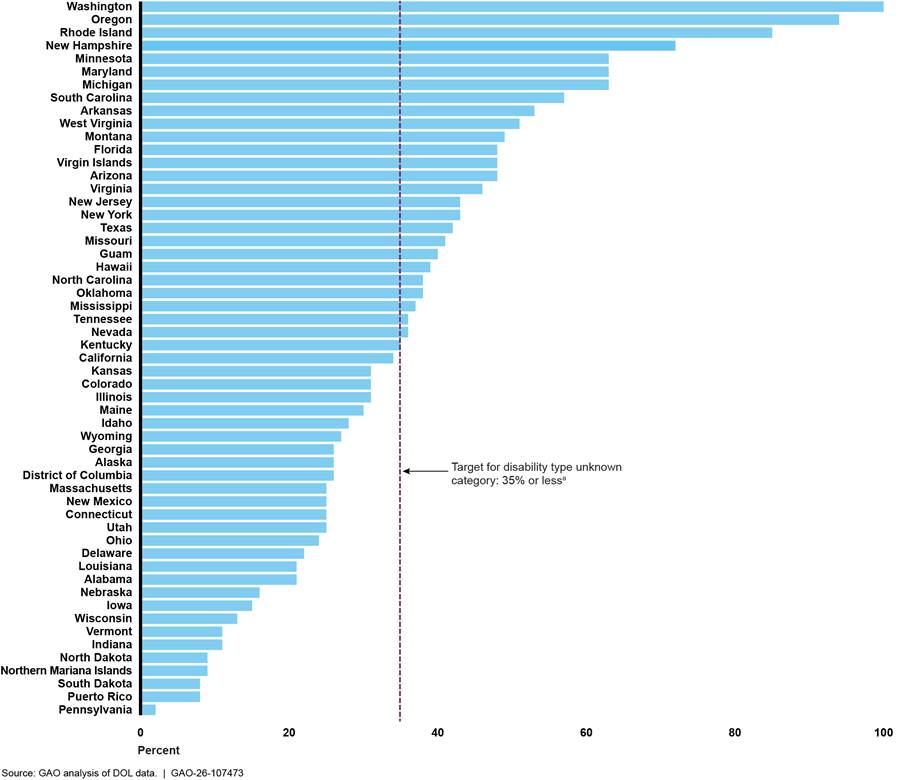
Notes: The Workforce Innovation and Opportunity Act
designates four DOL workforce programs—the Adult, Dislocated Worker, Youth, and
Wagner-Peyser Act Employment Service (Wagner-Peyser) programs—as core programs.
“State” refers to program grantees, including states, territories, and the
District of Columbia. Program year 2023 is the period from July 1, 2023,
through June 30, 2024. Disability types include physical, mental,
vision-related, hearing-related, learning, and cognitive disabilities.
aDOL officials set a national target to collect data on disability
type for at least 65 percent of participants with reported disabilities, which
corresponds to reducing the unknown category to 35 percent or less.
Figure 10: Percentage of Adult Program Participants with Reported Disabilities for Whom Disability Type is Unknown, By State, Program Year 2023
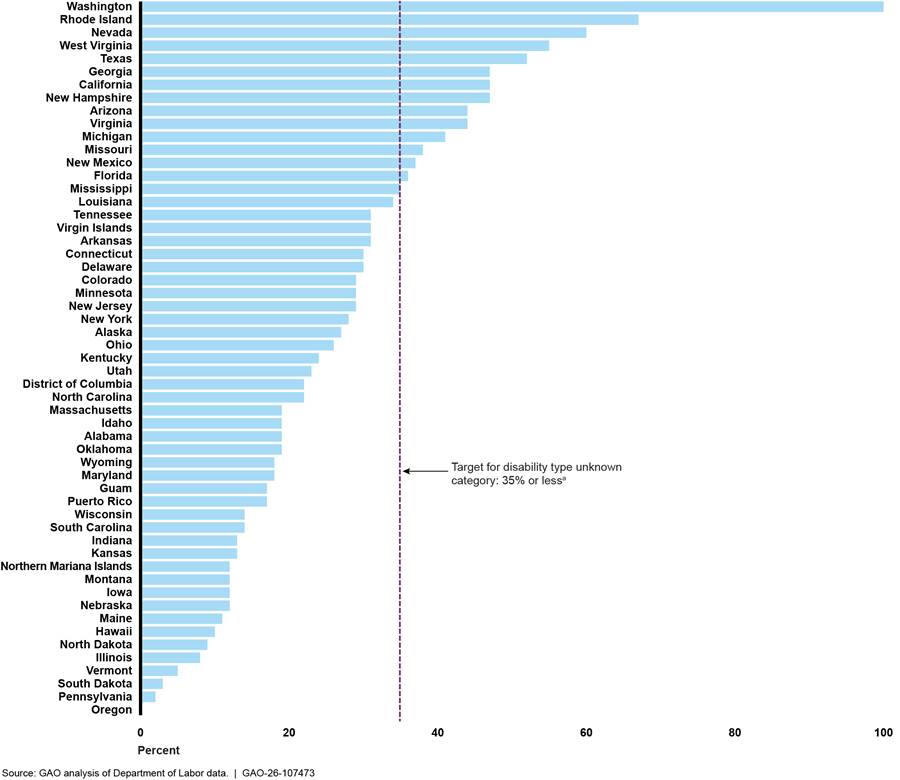
Notes: The Workforce Innovation and Opportunity Act
authorizes the Adult program. “State” refers to program grantees, including
states, territories, and the District of Columbia. Program year 2023 is the
period from July 1, 2023, through June 30, 2024. Disability types include
physical, mental, vision-related, hearing-related, learning, and cognitive
disabilities.
aDepartment of Labor officials set a national target to collect data
on disability type for at least 65 percent of participants with reported disabilities,
which corresponds to reducing the unknown category to 35 percent or less.
Figure 11: Percentage of Dislocated Worker Program Participants with Reported Disabilities for Whom Disability Type is Unknown, By State, Program Year 2023
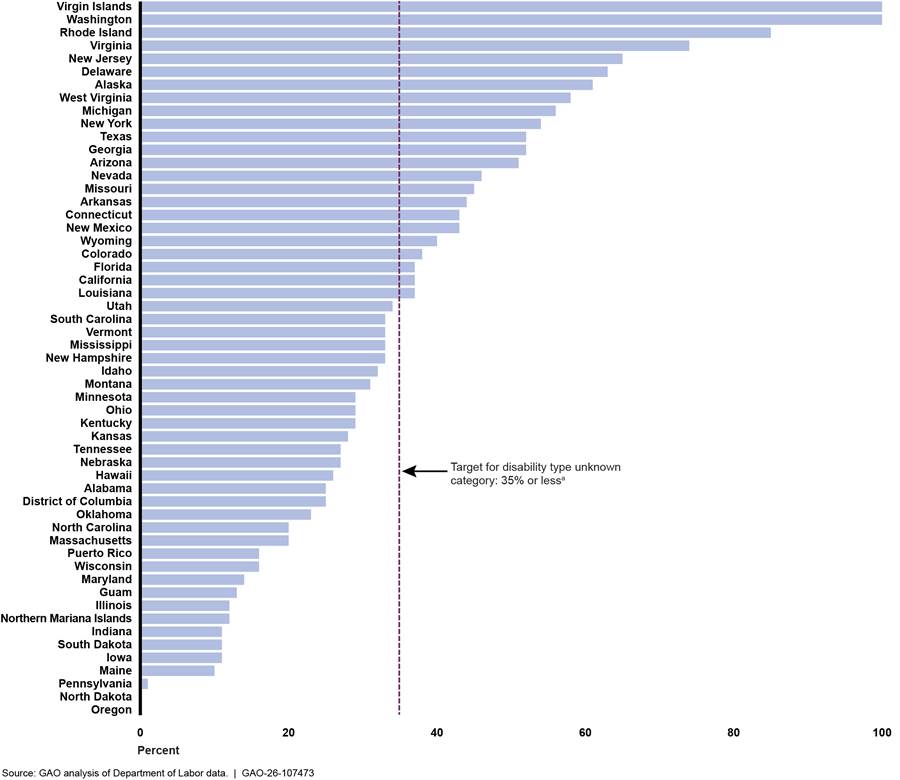
Notes: The Workforce Innovation and Opportunity Act
authorizes the Dislocated Worker program. “State” refers to program grantees,
including states, territories, and the District of Columbia. Program year 2023
is the period from July 1, 2023, through June 30, 2024. Disability types
include physical, mental, vision-related, hearing-related, learning, and cognitive
disabilities.
aDepartment of Labor officials set a national target to collect data
on disability type for at least 65 percent of participants with reported
disabilities, which corresponds to reducing the unknown category to 35 percent
or less.
Figure 12: Percentage of Youth Program Participants with Reported Disabilities for Whom Disability Type is Unknown, By State, Program Year 2023
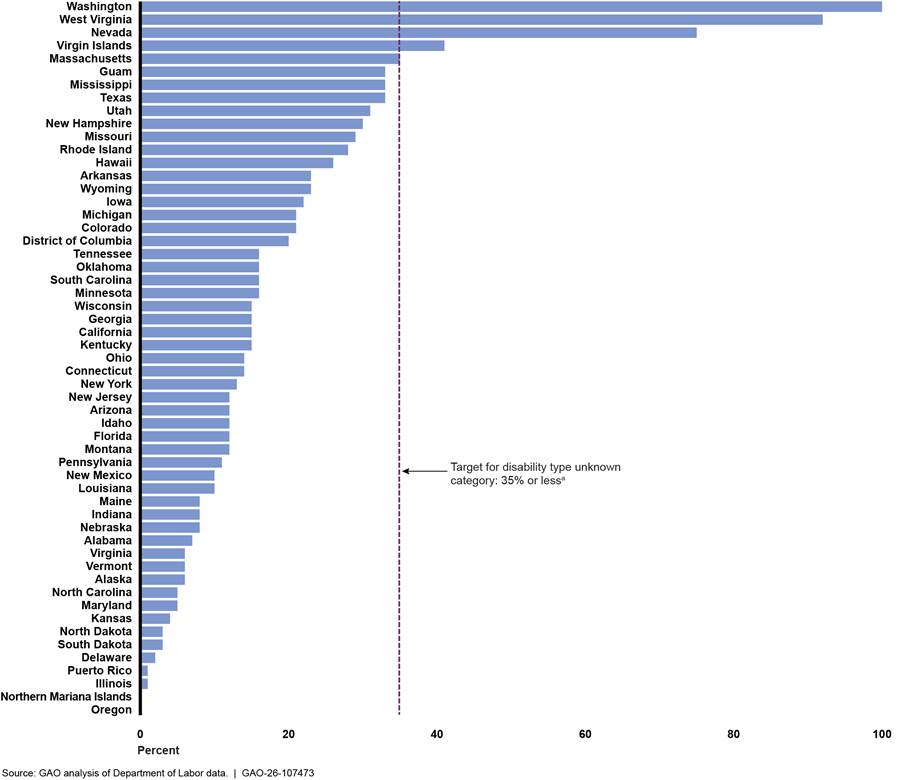
Notes: The Workforce Innovation and Opportunity Act
authorizes the Youth program. “State” refers to program grantees, including
states, territories, and the District of Columbia. Program year 2023 is the
period from July 1, 2023, through June 30, 2024. Disability types include
physical, mental, vision-related, hearing-related, learning, and cognitive
disabilities.
aDepartment of Labor officials set a national target to collect data
on disability type for at least 65 percent of participants with reported disabilities,
which corresponds to reducing the unknown category to 35 percent or less.
Figure 13: Percentage of Wagner-Peyser Program Participants with Reported Disabilities for Whom Disability Type is Unknown, By State, Program Year 2023
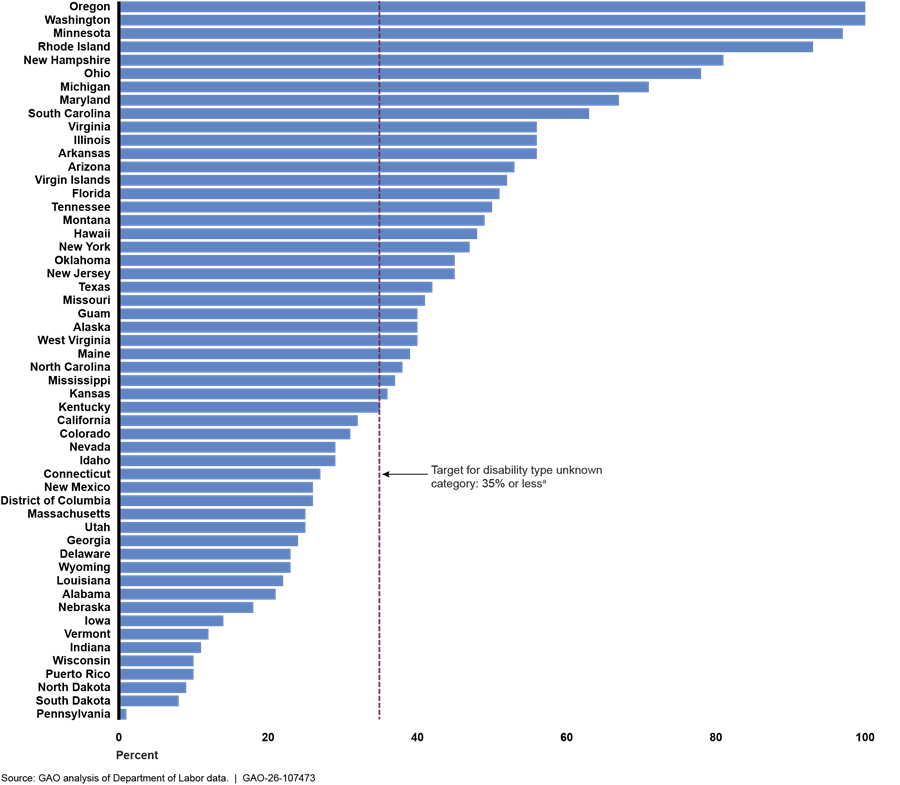
Notes: The Wagner-Peyser Act, as amended by WIOA,
authorizes the Wagner-Peyser Act Employment Service (Wagner-Peyser) program. “State”
refers to program grantees, including states, territories, and the District of
Columbia. Program year 2023 is the period from July 1, 2023, through June 30,
2024. Disability types include physical, mental, vision-related,
hearing-related, learning, and cognitive disabilities.
aDepartment of Labor officials set a national target to collect data
on disability type for at least 65 percent of participants with reported
disabilities, which corresponds to reducing the unknown category to 35 percent
or less.
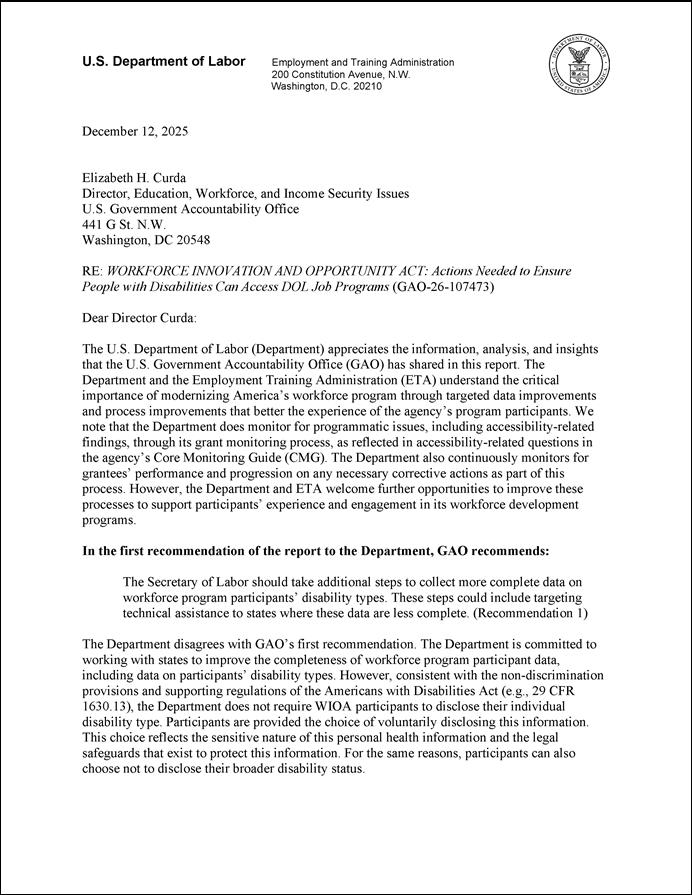
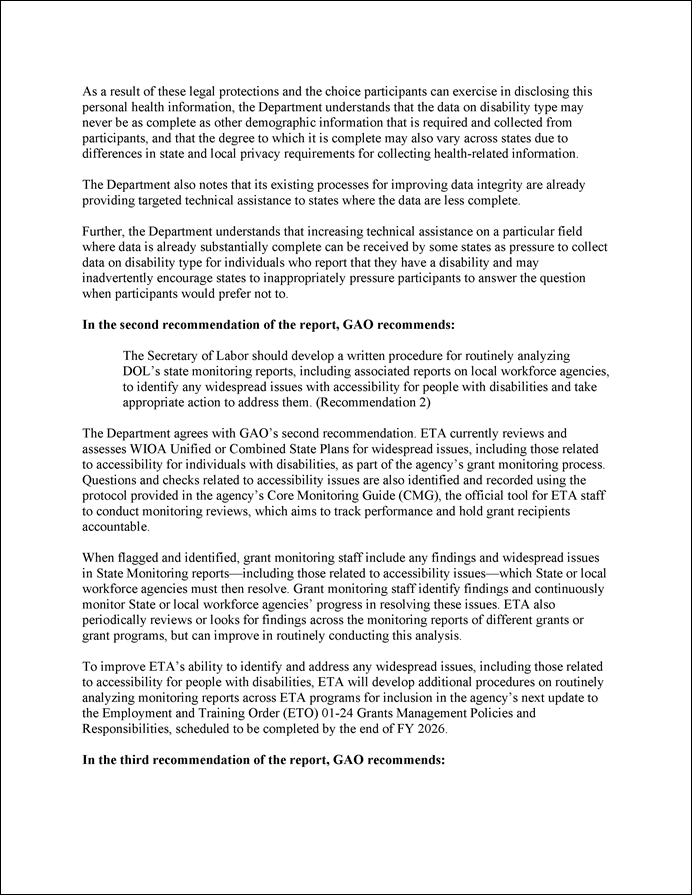
GAO Contact
Elizabeth H. Curda, curdae@gao.gov
Staff Acknowledgments
In addition to the contact above, the following staff members made significant contributions to this report: Lorin Obler (Assistant Director), Paul Schearf (Analyst in Charge), Anna Cielinski, Sean P. Connolly, Gloria (Juyoung) Lee, Anne Ordway, and Brennan Williams. Key support was also provided by Alex Galuten, Justin Gordinas, Kirsten Lauber, Michael Murray, Stacia Odenwald, Almeta Spencer, Curtia Taylor, Betty Ward Zukerman, Adam Wendel, and Jeremy Wood.
Workforce Innovation and Opportunity Act: Additional Steps Needed to Help States Collect Complete Enrollment Information. GAO‑23‑104830. Washington, D.C.: November 16, 2022.
Workforce Innovation and Opportunity Act: Additional DOL Actions Needed to Help States and Employers Address Substance Use Disorder. GAO‑20‑337. Washington, D.C.: May 21, 2020.
Vocational Rehabilitation: Additional Federal Information Could Help States Serve Employers and Find Jobs for People with Disabilities. GAO‑18‑577. Washington, D.C.: September 6, 2018.
Workforce Innovation and Opportunity Act: States and Local Areas Report Progress in Meeting Youth Program Requirements. GAO‑18‑475. Washington, D.C.: June 15, 2018.
Workforce Innovation and Opportunity Act: Federal Agencies’ Collaboration Generally Reflected Leading Practices, but Could Be Enhanced. GAO‑18‑171. Washington, D.C.: February 8, 2018.
Workforce Innovation and Opportunity Act: Selected States’ Planning Approaches for Serving Job Seekers and Employers. GAO‑17‑31. Washington, D.C.: November 15, 2016.
Workforce Innovation and Opportunity Act: Information on Planned Changes to State Performance Reporting and Related Challenges. GAO‑16‑287. Washington, D.C.: March 7, 2016.
Workforce Innovation and Opportunity Act: Performance Reporting and Related Challenges. GAO‑15‑764R. Washington, D.C.: September 23, 2015.
The Government Accountability Office, the audit, evaluation, and investigative arm of Congress, exists to support Congress in meeting its constitutional responsibilities and to help improve the performance and accountability of the federal government for the American people. GAO examines the use of public funds; evaluates federal programs and policies; and provides analyses, recommendations, and other assistance to help Congress make informed oversight, policy, and funding decisions. GAO’s commitment to good government is reflected in its core values of accountability, integrity, and reliability.
Obtaining Copies of GAO Reports and Testimony
The fastest and easiest way to obtain copies of GAO documents at no cost is through our website. Each weekday afternoon, GAO posts on its website newly released reports, testimony, and correspondence. You can also subscribe to GAO’s email updates to receive notification of newly posted products.
Order by Phone
The price of each GAO publication reflects GAO’s actual cost of production and distribution and depends on the number of pages in the publication and whether the publication is printed in color or black and white. Pricing and ordering information is posted on GAO’s website, https://www.gao.gov/ordering.htm.
Place orders by calling (202) 512-6000, toll free (866) 801-7077,
or
TDD (202) 512-2537.
Orders may be paid for using American Express, Discover Card, MasterCard, Visa, check, or money order. Call for additional information.
Connect with GAO
Connect with GAO on X,
LinkedIn, Instagram, and YouTube.
Subscribe to our Email Updates. Listen to our Podcasts.
Visit GAO on the web at https://www.gao.gov.
To Report Fraud, Waste, and Abuse in Federal Programs
Contact FraudNet:
Website: https://www.gao.gov/about/what-gao-does/fraudnet
Automated answering system: (800) 424-5454
Media Relations
Sarah Kaczmarek, Managing Director, Media@gao.gov
Congressional Relations
David A. Powner, Acting Managing Director, CongRel@gao.gov
General Inquiries

[1]Pub. L. No. 113–128, 128 Stat. 1425 (2014). For the purposes of this report, we refer to the DOL-administered Adult, Dislocated Worker, Youth, and Wagner-Peyser Act Employment Service (Wagner-Peyser) programs as “DOL core workforce programs.” The Wagner-Peyser program focuses on providing a variety of employment-related services, including but not limited to job search assistance, job referral, and placement assistance for job seekers, re-employment services to unemployment insurance claimants, and recruitment services to employers with job openings.
[2]Anne Chamberlain et al., Evaluating the Accessibility of American Job Centers for People with Disabilities: Final Report (Columbia, Md: IMPAQ International, LLC, Jan. 2017).
[3]For the purposes of this report, “states” refers to all DOL workforce program grantees, including states, territories, and the District of Columbia.
[4]Local workforce boards perform multiple functions in carrying out the programs and services authorized under WIOA, including oversight of programs, selection of job center operators, and assessment of accessibility for disabled individuals at all local job centers.
[5]In this report, we use terms such as “several” and “most” to describe the number of interviewees providing a response. When we use “several,” that means four to seven interviewees provided the response. When we use “most,” that means over half of interviewees provided the response.
[6]Department of Labor, Fiscal Year (FY) 2022-2026 Strategic Plan. According to DOL officials, the relevant goals and objectives outlined in the FY 2022-2026 strategic plan are active, but specific activities may not be continuing. According to its website, DOL is developing its FY 2026-2030 strategic plan and aims to publish it by February 2026.
[7]GAO, Standards for Internal Control in the Federal Government, GAO‑14‑704G (Washington, D.C.: Sept. 2014).
[8]State workforce development boards are established by the governor of each state to assist in implementing WIOA’s provisions. A majority of each state workforce development board’s members appointed by the governor must be representatives of businesses in the state.
[9]29 U.S.C. §§ 49 et seq.
[10]29 U.S.C. §§ 701 et seq.
[11]20 C.F.R. §§ 678.305(e) and 678.310(d).
[12]Exit from a program generally occurs when a participant has not received services for 90 days and does not have plans to receive future services. At that point, the date of exit is applied retroactively to the last date of service.
[13]This indicator measures the level of retention with the same employer.
[14]29 U.S.C. § 3248.
[15]29 U.S.C. § 794.
[16]42 U.S.C. §§ 12132, 12182.
[17]20 C.F.R. §§ 678.305(e) and 678.310(d); 29 C.F.R. § 38.13(b).
[18]For the purposes of this report, we refer to participants who reported having disabilities as “participants with disabilities.” Similarly, we refer to participants who reported having no disabilities as “participants without disabilities.” When participants did not identify whether they have disabilities, we refer to their disability status as unknown.
[19]Participants may report more than one type of disability.
[20]DOL does not require participants to report disability type, according to DOL officials.
[21]DOL officials told us that as a part of the data quality checks, they set a target response rate of 65 percent for this data element, which corresponds to 35 percent or less for the “disability type unknown” category.
[23]Department of Labor, Fiscal Year 2022-2026 Strategic Plan.
[24]Our analysis compared participants with disabilities to participants without disabilities. It excluded participants who did not report their disability status.
[25]Using regression analysis, we examined the association between disability status and use of career services, controlling for other selected characteristics, which were age, race/ethnicity (i.e., whether the individual was white and non-Hispanic), sex, employment status at entry, veteran status (except for the Youth program), whether the participant had completed high school (except for the Youth program), whether the participant received public assistance, and state. The differences between participants with and without disabilities were not statistically significant except for individualized career services in the Wagner-Peyser program.
[26]Using regression analysis, we examined the association between disability status and using training services, controlling for selected other characteristics, which were age, race/ethnicity (i.e., whether the individual was white and non-Hispanic), sex, employment status at entry, veteran status (except for the Youth program), whether the participant had completed high school (except for the Youth program), whether the participant received public assistance, and state. The differences between participants with and without disabilities were statistically significant in the Adult and Youth programs, but not in the Dislocated Worker program.
[27]Department of Labor, Employment and Training Administration, Increasing Equitable Service Access and Employment Outcomes for All Jobseekers in Workforce Innovation and Opportunity Act Adult and Dislocated Worker Programs, Training and Employment Guidance Letter No. 21-22 (June 9, 2023).
[28]Participants with disabilities may also utilize training funded by other sources, such as Pell Grants, Supplemental Nutrition Assistance Program Employment and Training, Jobs for Veterans State Grants, or state funds, according to DOL officials.
[29]GAO, Workforce Innovation and Opportunity Act: Additional Steps Needed to Help States Collect Complete Enrollment Information, GAO‑23‑104830 (Washington, D.C.: Nov. 16, 2022).
[30]Using regression analysis, we examined the association between disability status and employment rates after program exit, controlling for other selected characteristics, which were age, race/ethnicity (i.e. whether the individual was white and non-Hispanic), sex, employment status at entry, veteran status (except for the Youth program), whether the participant had completed high school (except for the Youth program), whether the participant received public assistance, and state. The differences between participants with and without disabilities (i.e., that participants with disabilities were employed less after exiting than participants without disabilities) were statistically significant. Exit from a program generally occurs when a participant has not received services for 90 days and does not have plans to receive future services. At that point, the date of exit is applied retroactively to the last date of service.
[31]Using regression analysis, we examined the association between disability status and earnings after program exit, controlling for other selected characteristics, which were age, race/ethnicity (i.e., whether the individual was white and non-Hispanic), sex, employment status at entry, veteran status (except for the Youth program), whether the participant had completed high school (except for the Youth program), whether the participant received public assistance, and state. The differences between participants with and without disabilities (i.e. that participants with disabilities earned less than participants without disabilities) were statistically significant.
[32]In this report, we use terms such as “several” and “most” to describe the number of interviewees providing a response. When we use “several,” that means four to seven interviewees provided the response. When we use “most,” that means over half of interviewees provided the response.
[33]According to the Department of Labor, assistive technology includes any items, equipment, or products that individuals with disabilities can use to perform work or other tasks that might otherwise be difficult or impossible.
[34]At least once every 3 years, local workforce boards must assess the effectiveness, physical and programmatic accessibility, and continuous improvement of job centers and their service delivery systems using criteria and procedures developed by the state workforce agency. 20 C.F.R. § 678.800(d). In the states we selected, job center recertifications were performed every 1 to 3 years, according to state and local officials we interviewed.
[35]Providers are not required to make all possible modifications; for example, providers are not required to provide a reasonable accommodation that would present an undue hardship.
[36]By job center staff, officials meant staff from the WIOA Adult, Dislocated Worker, Youth, and Wagner-Peyser programs.
[37]These included three local workforce board officials we interviewed as well as workforce board officials in all four discussion groups.
[38]According to its website, WorkforceGPS is sponsored by DOL’s Employment and Training Administration to connect federal grantees, workforce professionals, educators, and business leaders to materials for compliance with federal requirements. It offers webinars, research, and training resources to help develop and implement employment programs.
[39]According to the National Institute of Neurological Disorders and Stroke, Tourette syndrome is a neurological disorder that may cause sudden unwanted and uncontrolled rapid and repeated movements or vocal sounds called “tics.”
[40]When a participant files a complaint with CRC and the state or local level at the same time, CRC will give the state or local agency 90 days to process the complaint. If the complainant is not satisfied with the result, they may then refile a complaint with CRC, and CRC will review it as a new case not considering the result from the state or local process.
[41]These cases could also include other bases of discrimination, such as race, sex, age, and religion.
[42]Monitoring reports we reviewed were examples of reports that found issues with accessibility in job centers. According to DOL, the other reports during this time did not find issues with accessibility.
[43]The repository also stores all official grant documents, including risk assessments, technical assistance, and any significant monitoring-related communications and correspondence, according to the agency.
[45]DOL, Promising Practices in Achieving Nondiscrimination and Equal Opportunity: A Section 188 Disability Reference Guide.
[46]DOL, Joint Communication on Resource Leveraging & Service Coordination to Increase Competitive Integrated Employment for Individuals with Disabilities, Training and Employment Notice 07-22 (Washington, D.C.: Oct. 18, 2022).
[48]GAO, Standards for Internal Control in the Federal Government, GAO‑14‑704G (Washington, D.C.: Sept. 2014).
[49]Participating executive directors were from Arizona, Connecticut, Kansas, New York, Pennsylvania, Tennessee, Texas, Utah, Washington, and West Virginia.
[50]Department of Labor, Fiscal Year (FY) 2022-2026 Strategic Plan. According to DOL officials, the goals and objectives outlined in the FY 2022-2026 strategic plan are active, but specific activities may no longer continue. According to its website, DOL is developing its FY 2026-2030 strategic plan.