
Report to Congressional Committees
United States Government Accountability Office
A report to congressional committees
Contact: Rashmi Agarwal at AgarwalR@gao.gov
What GAO Found
The Department of Defense (DOD) uses three key processes to determine service member cost-of-living allowances (COLA), with separate programs for service members living in the continental U.S. (CONUS) and outside the continental U.S. (OCONUS). These processes include data on military household spending from the Department of Labor’s Bureau of Labor Statistics, location-specific surveys of shopping patterns, and retail price data for the goods and services that service members typically buy. DOD uses these processes to develop comparative prices for locations where it stations service members. DOD uses average CONUS prices as a baseline for determining eligibility for COLA. Using these processes, DOD determines a COLA rate for each eligible location. Payments to service members in these locations vary based on their spendable income and number of dependents. The department also tracks foreign currency fluctuations relative to the dollar to help determine COLA payments in OCONUS locations.
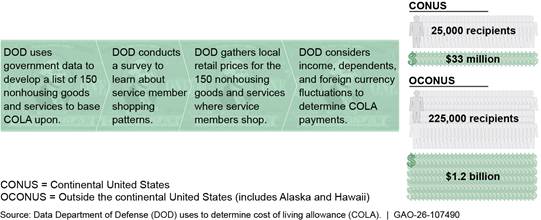
DOD’s processes for determining COLA rates CONUS and OCONUS have several weaknesses. Additionally, information about COLA rates can be better communicated to service members. Specifically:
· DOD’s survey for determining service members’ shopping patterns does not use sound sampling practices.
· DOD does not consistently use existing processes to capture location-specific expenses.
· DOD has inconsistent processes for determining dependent-based COLA compensation in CONUS and OCONUS.
· DOD posts information about COLA on a publicly available website, but there are inconsistencies in the amount and type of information local commands provide to service members at locations that receive COLA. Further, some service members told GAO that they did not understand their COLA payments.
Taking action to address these issues will help ensure service members are appropriately compensated, which will support their quality of life and their ability to meet mission needs.
Why GAO Did This Study
DOD assigns its 1.4 million active-duty service members to over 3,500 locations worldwide. DOD provides a COLA to assist service members with nonhousing expenses, such as food, in high cost areas.
The conference report accompanying the National Defense Authorization Act for Fiscal Year 2024 includes a provision for GAO to examine DOD’s COLA programs. This report (1) describes the processes DOD uses to determine COLA and payments for service members; and (2) examines the extent to which DOD’s COLA processes are appropriately designed and communicated.
GAO analyzed laws, regulations, policies, and COLA rates. GAO interviewed officials responsible for the COLA program and held discussion groups with service members in five locations in Hawaii, Japan, Alaska, Germany, and Virginia. Most of the site visits GAO held were at OCONUS locations because 97 percent of the COLA payments are OCONUS.
What GAO Recommends
GAO recommends that DOD (1) use random sampling to survey service members on shopping patterns, (2) consistently apply its process for location-specific expenses, (3) consider aligning its CONUS and OCONUS dependent-based compensation, and (4) require local commands to provide information about COLA to service members. DOD concurred with the second and third recommendations, and partially concurred with the fourth recommendation. DOD non-concurred with the first recommendation, stating that its current method enhances survey participation. GAO’s recommendation remains valid as DOD’s current process does not produce statistically representative results.
Abbreviations
COLA cost-of-living allowance
CONUS continental United States
DOD Department of Defense
LPS Living Pattern Survey
OCONUS outside the Continental United States
RPS Retail Price Schedule
This is a work of the U.S. government and is not subject to copyright protection in the United States. The published product may be reproduced and distributed in its entirety without further permission from GAO. However, because this work may contain copyrighted images or other material, permission from the copyright holder may be necessary if you wish to reproduce this material separately.
April 30, 2026
The Honorable Roger Wicker
Chairman
The Honorable Jack Reed
Ranking Member
Committee on Armed Services
United States Senate
The Honorable Mike Rogers
Chairman
The Honorable Adam Smith
Ranking Member
Committee on Armed Services
House of Representatives
The Department of Defense (DOD) assigns approximately 1.4 million active-duty service members to over 3,500 different locations worldwide to meet its mission. Service members can be assigned to installations in relatively expensive places to live both inside the continental United States (CONUS), such as Washington, D.C., and outside the continental United States (OCONUS), such as Hawaii and Japan. Living in these locations can be a financial challenge for some service members due to higher expenses for food, transportation, housing, and other living expenses.
DOD has two cost-of-living allowance (COLA) programs to help service members with nonhousing expenses in high-cost areas, one for CONUS service members and another for OCONUS service members. The National Defense Authorization Act for Fiscal Year 1995, authorized DOD’s CONUS COLA program, and DOD began paying allowances to service members stationed at certain high-cost CONUS locations in July 1995.[1] An earlier statute authorized DOD’s OCONUS COLA program in 1962.[2] According to DOD, the OCONUS COLA program is meant to ensure that OCONUS service members could buy a similar level of goods and services as they could if they lived in CONUS. According to information from DOD’s Allowances Division, nearly 225,000 service members received over $1.2 billion in OCONUS COLA payments, and approximately 25,000 received about $33 million in CONUS COLA payments, in calendar year 2024.
In recent years, congressional committees have shown interest in COLA for military service members by requesting reports from DOD on COLA trends. In the House Report accompanying a bill for the National Defense Authorization Act for Fiscal Year 2024, the House Committee on Armed Services expressed concerns about DOD’s adjustments to COLA and the effects it has had on service members’ and their families’ household budgets.[3] Recent legislation has modified aspects of COLA, for example, by placing limitations on the frequency of reductions in OCONUS COLA.[4] The conference report accompanying the National Defense Authorization Act for Fiscal Year 2024 includes a provision for us to examine DOD’s processes for determining COLA for service members stationed in CONUS and OCONUS.[5] This report (1) describes how DOD determines COLA and the payments provided for service members in CONUS and OCONUS; and (2) examines the extent to which DOD’s processes for determining COLA are appropriately designed and communicated.
To address both of our objectives, we focused our data and information collection efforts on the four military services that had the most active-duty service members as of June 2025—Army, Marine Corps, Navy, and Air Force.[6] We analyzed relevant laws, regulations, and policies related to DOD’s CONUS and OCONUS COLA programs. We performed five site visits to hold discussion groups with service members affected by DOD’s COLA programs and to visit shopping outlets used by service members to understand how they shop and the prices of various goods.
We selected locations for CONUS and OCONUS site visits based primarily on the number of service members stationed there and to represent a variety of COLA rates. We held most of our site visits in OCONUS locations, as 90 percent of the service members who received COLA in calendar year 2024 were in OCONUS locations and 97 percent of the total amount of COLA payments made in calendar year 2024 were to OCONUS service members. We focused on data from calendar year 2024 because they were the most recent set of complete data available. We conducted site visits virtually and in person with officials in Hawaii, Japan, Alaska, Germany, and at Fort Belvoir, Virginia. We selected locations with differing COLA rates, which ranged from those receiving no COLA to those receiving COLA up to 30 percent higher than the CONUS average as of June 2024.
We held 29 discussion groups with enlisted service members and officers and two discussion groups with spouses for a total of 31 discussion groups to learn their perspectives on COLA.[7] For the purposes of our analysis, we created 19 summaries across groups of similarly ranked personnel who were at the same location, which we will refer to throughout this report. While the results of our discussion group analyses are not generalizable to all service members or spouses, they provide useful context and examples of the COLA-related experiences of service members in a variety of locations around the world. We also interviewed agency officials from the Office of the Secretary of Defense, the military services, and at various installations who develop and administer DOD’s COLA programs so that we could understand the processes DOD uses to determine service members’ eligibility and the payments they receive.
Additionally, to address our first objective, we reviewed various datasets to understand how DOD determines COLA rates. We analyzed DOD data on COLA rates from calendar years 2019 through 2024 to understand how COLA rates fluctuated over time. We began with data from calendar year 2019 to capture pre-COVID-19 baseline information and ended with calendar year 2024, which provided the most complete data available at the time of our review. We also analyzed DOD data on service member populations at military installations for calendar year 2024. To understand how DOD and the services make budgeting decisions based on COLA rates, we analyzed DOD’s cost estimates for administering the COLA programs in calendar year 2024. We assessed reliability of these data by reviewing related DOD documentation and conducting interviews with, as well as reviewing written responses from, agency officials. We found that these data were sufficiently reliable for describing how DOD determines COLA and the payments it made to service members in calendar year 2024.
To address our second objective, we reviewed the survey instrument DOD uses to understand service member shopping patterns and DOD’s process for collecting prices of goods and services. We compared the procedures DOD used to survey its service members to Office of Management and Budget guidance for survey sampling.[8] We compared the procedures DOD used for price collection of goods and services to practices other organizations use to develop price indexes.[9] Additionally, we compared DOD’s CONUS and OCONUS COLA processes to relevant government standards for determining cost-of-living expenses. Finally, we compared DOD’s COLA processes, including how they are communicated to service members, to Standards for Internal Control in the Federal Government on using quality information to achieve organizational objectives and on effectively communicating information within an organization.[10] For more details on our scope and methodology, see appendix I.
We conducted this performance audit from March 2024 to April 2026 in accordance with generally accepted government auditing standards. Those standards require that we plan and perform the audit to obtain sufficient, appropriate evidence to provide a reasonable basis for our findings and conclusions based on our audit objectives. We believe that the evidence obtained provides a reasonable basis for our findings and conclusions based on our audit objectives.
Background
Service Member Compensation and Allowances
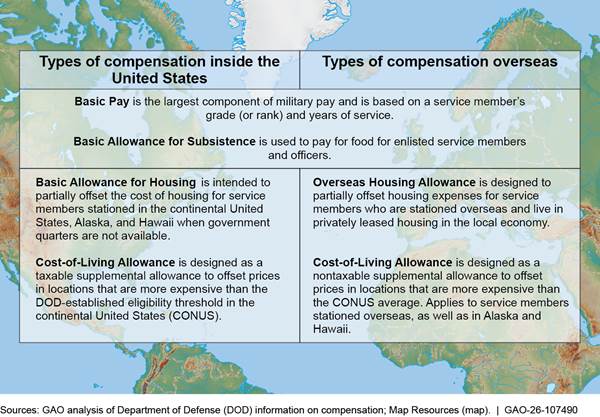
Service members may receive several different types of pay and allowances as part of their overall military compensation.[11] All service members receive basic pay, which is the main component of their compensation. In addition to their basic pay, service members may be eligible for special and incentive pay for specific qualifications or for certain events. For example, there are special pays for holding qualifications as an aviator or parachutist, and for serving in dangerous locations.
Allowances are another important part of military compensation. DOD provides allowances for specific needs such as food or housing. DOD also provides a COLA to help service members with nonhousing expenses in high-cost areas and has two programs to provide this allowance in CONUS and OCONUS.[12] Figure 1 provides a description of some of the pays and allowances DOD offers to service members.
Note: There are other benefits and special pays that service members may receive, such as hazardous duty incentive pay, assignment incentive pay, and hostile fire or imminent danger pay.
Roles and Responsibilities for DOD’s COLA Programs
DOD offices. Several DOD offices have roles and responsibilities related to DOD’s COLA programs. The primary DOD office that is responsible for the COLA program is DOD’s Allowances Division, which is part of the Office of the Under Secretary of Defense for Personnel and Readiness Military Compensation Policy Directorate. The Allowances Division is a team of economists, statisticians, and program managers that collects and analyzes housing and cost-of-living data and sets COLA rates for service members who live in both CONUS and OCONUS locations. Additionally, the Allowances Division officials said they are responsible for developing and updating the COLA-related policies in DOD’s Financial Management Regulation.[13] The Allowances Division also designs and executes COLA surveys of shopping patterns and the process for collecting retail prices of goods and services.
Two other DOD offices that are involved in DOD’s COLA programs are the Defense Manpower Data Center and the Defense Finance and Accounting Service. Officials from the Allowances Division said that they use data and email databases from these two organizations to disseminate COLA surveys and rate information to service members.
Military service compensation representatives. Service compensation representatives are the primary service-level participants in COLA decision-making. Service compensation representatives we spoke with identified several responsibilities they have in relation to COLA. These responsibilities include: (1) communicating with installations to help determine if DOD needs to re-evaluate COLA calculations; (2) periodically disseminating DOD’s Allowances Division COLA surveys; and (3) working with service leadership to help determine CONUS COLA eligibility for the coming year.
Location-based DOD personnel. Several location-based DOD personnel serve a role in publicizing and administering DOD’s Allowances Division COLA surveys. The senior officer of the military services in each overseas location (country, state, or territory) is responsible for appointing a country allowance coordinator. The country allowance coordinator is primarily responsible for publicizing and administering COLA surveys in the location for which they are the designated coordinator. They also maintain copies of prior pricing surveys and various instructional materials, so they can train installation survey coordinators. Installation commanders are responsible for appointing installation survey coordinators, ensuring maximum participation from their service members in COLA surveys, and coordinating with the country allowance coordinator on all required surveys and reports.
DOD Uses Several Key Processes to Determine COLA Rates and Provide Payments to Service Members
DOD Uses Three Key Processes to Determine COLA Rates
DOD uses three key processes to determine a COLA rate for each location where service members live. First, DOD uses data from the Bureau of Labor Statistics to select 150 nonhousing goods and services upon which to base COLA determinations. Second, DOD uses a Living Pattern Survey (LPS) to understand service member shopping patterns (e.g., where service members shop) and then uses a Retail Price Schedule (RPS) to collect retail prices from different shopping locations for those selected goods and services.[14] Third, DOD then uses information from the LPS and RPS to compute a COLA rate that represents how expensive nonhousing goods and services are in a specific location when compared to the CONUS average.
DOD officials explained that they use military household spending data from the Bureau of Labor Statistics’ Consumer Expenditure Survey to select a list of 150 goods and services that service members spend the most money on to form the basis of DOD’s analysis to determine COLA rates by location.[15] Figure 2 provides an overview of the inputs DOD uses to determine COLA rates for each location.

Note: The LPS is a survey of service member shopping patterns, and the RPS is DOD’s price collection process.
The Living Pattern Survey (LPS)
The LPS is an online survey that DOD uses to understand where service members shop for goods and services. DOD’s Allowances Division conducts the LPS with support from officials in the location where the department is collecting data. Prior to January 2026, DOD conducted the LPS in CONUS every 3 years and covered OCONUS locations every 3 years on a rotating basis. In response to a recommendation made in the 14th Quadrennial Review of Military Compensation, DOD stated that it plans to conduct the LPS annually starting in January 2026.[16]
The LPS asks service members where they shop for the 150 goods and services, which the department groups into 35 broad categories (see table 1).
|
Meat |
Children’s clothing |
Movie theater tickets |
|
Seafood |
Toiletries |
Automotive parts |
|
Poultry |
Housekeeping supplies |
Gasoline |
|
Dairy |
Household appliances |
Automotive maintenance |
|
Groceries (bread, cereal, etc.) |
Major appliances |
Automotive insurance |
|
Cigarettes |
Computer supplies |
Dry cleaning |
|
Alcohol |
Medication |
Hair cuts |
|
Fresh fruits and vegetables |
Audio or video supplies |
Day care |
|
Canned fruit and vegetables |
Reading material |
Cellular phone service |
|
Men’s business clothing |
Recreational equipment |
Internet service |
|
Women’s business clothing |
Pet food |
Cellular phone purchase |
|
Casual adult clothing |
Fitness club membership |
|
Source: GAO analysis of Department of Defense (DOD) information. | GAO‑26‑107490
When service members click on any of these categories in the online survey, the survey asks for more details about their shopping patterns. Specifically, the LPS asks what percentage of the items in that category the service member purchased at local off-base locations, at on-base locations such as the commissary or exchange, as well as through online purchases. If the respondent indicates they shop off base for specific goods or services, the survey asks them where they shop. DOD officials told us that the Allowances Division obtains data on commissary and exchange purchases from on-base shopping outlets through the Defense Commissary Agency and service exchange headquarters and compares them with reported shopping patterns from the LPS as an internal control.[17]
DOD provided us information from the 2024 LPS in Kaiserslautern, Germany, and it shows that a majority of respondents took between 10 minutes and 30 minutes to complete the survey, which was consistent with what service members told us in discussion groups. Generally, DOD allows service members and their families to respond to the LPS over the course of a month, with the option to extend those time frames to promote greater participation, at the request of the local command. We discuss the LPS survey instrument in more detail below.
The Retail Price Schedule (RPS)
DOD uses the RPS to collect and record the retail prices of the 150 selected goods and services that it uses to calculate COLA rates for each location. DOD carries out the RPS annually at CONUS and OCONUS locations where service members are stationed by collecting price data from stores that service members frequently shop at for each category of goods or services as identified by the LPS. In CONUS, DOD uses a contractor to gather pricing data. Prior to September 2025, for OCONUS locations, the country allowance coordinator was primarily responsible for coordinating this process, and DOD civilians and military personnel stationed in the area generally collected the price data. In August 2025, DOD awarded a contract to a private firm for COLA data collection and analysis. DOD’s goal is to receive objective, available nonhousing cost data for each CONUS and OCONUS duty location annually from the private sector, which DOD can use to establish COLA rates throughout the world.
DOD uses several steps to calculate COLA rates for CONUS and OCONUS locations based on LPS and RPS data. First, DOD determines the percentage of a nonhousing good or service, such as fruit and vegetables, that service members purchase in the local economy and at the commissary using data from the LPS. Second, DOD uses the RPS to collect data on the price of those goods and services at local stores and at the commissary. DOD uses both pieces of information to calculate a “weighted price” for each of the 150 nonhousing goods and services. These weighted prices are then aggregated to determine the overall cost of living for an area. Finally, to calculate the COLA rates, DOD compares the cost of living in a location to the CONUS average. DOD officials told us the department relies on the private contractor that performs its CONUS COLA calculations to choose the locations that form the basis of the CONUS average.
Figure 3 shows an example of how DOD calculates a weighted price for a red apple—one of the 150 nonhousing goods and services included in the RPS. For this example, we chose Fuji apples, which is a type of red apple. The example shows how DOD compares the price of Fuji apples in Japan to the CONUS average price. We used Washington, D.C., to represent the approximate average CONUS price in our example. This example shows that Fuji apples in Yokota, Japan, are 49 percent more expensive than Fuji apples in the hypothetical average CONUS location.
Figure 3: Price Comparison Example Based on Department of Defense’s (DOD) Cost-of-Living Allowance Processes
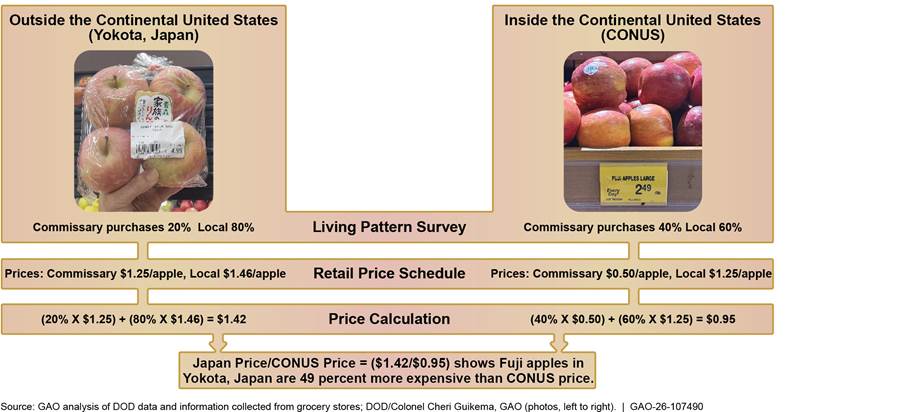
Note: We used Washington, D.C., as an approximation for the average CONUS price.
DOD’s COLA Programs Provide Payments to Service Members Based on Key Inputs
DOD Provided CONUS COLA to over 25,000 Service Members in Calendar Year 2024
In calendar year 2024, approximately 25,000 service members—or about 2 percent—stationed in CONUS received a COLA payment to help them offset the higher costs of nonhousing goods and services where they live. DOD officials reported that the department made $33 million in payments to service members in calendar year 2024. The first and most consequential input in determining DOD’s CONUS COLA payment is the COLA rate for the location where the service member lives and its relation to an eligibility threshold. Other secondary inputs that affect CONUS COLA payments are spendable income and whether a service member has dependents.
Eligibility threshold. The eligibility threshold is an important determinant of DOD CONUS COLA payments. From the program’s inception in 1994 until April 2024, the eligibility threshold to receive a COLA payment was set in statute at least 8 percent above the average CONUS cost of living.[18] Subsequently, the National Defense Authorization Act for Fiscal Year 2024 lowered the threshold to 5 percent.[19] The new statutory threshold provided DOD with greater flexibility to authorize payments in areas that would otherwise not qualify under the 8 percent threshold. However, DOD must ensure that they do not exceed the total amount of funds available in the services’ budgets for paying CONUS COLA. In April 2024, DOD consulted with the eight uniformed services on their respective budgets and set the eligibility threshold to receive a COLA payment at 7 percent higher than the average cost-of-living expenses in CONUS.[20] CONUS locations with rates higher than the eligibility threshold receive the difference between their rate and the eligibility threshold. For example, a service member living in a location with a cost of living of 9 percent over the CONUS average receives a 2 percent COLA (9 percent minus the 7 percent eligibility threshold set by DOD) (see fig. 4).
Figure 4: DOD Cost-of-Living Allowance (COLA) Eligibility Threshold in the Continental United States, as of April 2024
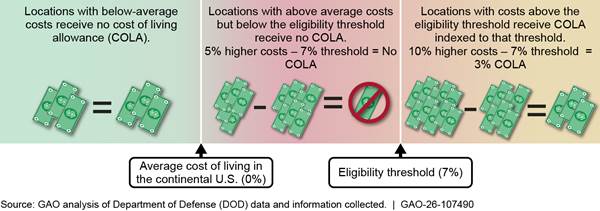
Note: DOD set the eligibility threshold to receive a COLA payment at 7 percent higher than the average CONUS cost of living as of April 1, 2024.
Our analysis of DOD data shows that 2 percent (about 25,000) of service members in CONUS were eligible to receive a COLA payment in calendar year 2024. We also found that 76 percent (about 883,000) of service members lived in locations that had a higher cost-of-living than the CONUS average but did not meet the eligibility threshold of 7 percent to receive a COLA payment. Figure 5 shows the number and percentage of service members stationed in CONUS based on COLA eligibility.
Two percent of CONUS service members were eligible for COLA, while 76 percent lived in locations with higher-than-average costs of living but were not eligible for COLA.
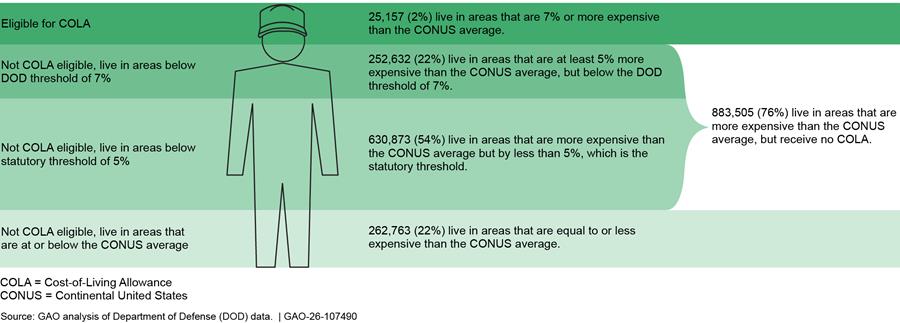
Note: DOD set the eligibility threshold to receive a COLA payment at 7 percent higher than the average CONUS cost of living as of April 1, 2024.
Our analysis also found that, as of August 2024, none of the 10 CONUS locations with the largest population of service members received a COLA, because the cost of living in each area fell below the 7 percent eligibility threshold set by DOD. In total, about 70 of the 299 military housing areas were eligible to receive a COLA. Some of the locations that received a CONUS COLA were New York City, San Francisco, Boston, and Los Angeles. San Diego, the CONUS location with the most service members, fell 0.06 percent short of DOD’s COLA eligibility threshold (see table 2).
Table 2: Service Member Population and Cost-of-Living Allowance (COLA) Rates for Selected Locations, August 2024
None of the 10 continental U.S. (CONUS) locations with the largest service member populations received a COLA because they fell under DOD’s 7 percent eligibility threshold.
|
Population rank and locationa |
Population estimates |
Cost of living compared to CONUS average |
|
1. San Diego, CA |
50,575 |
6.94% |
|
2. Pope Air Force Base, NC |
45,685 |
0.12% |
|
3. Norfolk and Portsmouth, VA |
44,397 |
5.30% |
|
4. Washington, D.C., metro area |
43,973 |
6.31% |
|
5. Camp Lejeune, NC |
39,410 |
0.27% |
|
6. Camp Pendleton, CA |
38,429 |
5.65% |
|
7. San Antonio, TX |
35,496 |
0.68% |
|
8. Colorado Springs, CO |
34,231 |
5.16% |
|
9. Fort Cavazos, TX |
33,522 |
-4.05% |
|
10. Tacoma, WA |
31,189 |
1.64% |
Source: GAO analysis of Department of Defense (DOD) data. | GAO‑26‑107490
Note: As of April 1, 2024, DOD set the threshold at 7 percent.
aService member population rank is based on the number of eligible service members DOD reported in each CONUS location.
In the discussion groups we held with both enlisted and officer service members in the Washington, D.C., area—which DOD reported was about 6.3 percent more expensive than the CONUS average in fiscal year 2024—participants noted they were facing financial and affordability challenges but were not eligible to receive a COLA. Service members from both discussion group summaries from the Washington, D.C., area noted that they use food pantries, commute long distances, and work extra jobs to try to make life more affordable—but these actions are difficult to balance while fulfilling their full-time duties. One discussion group participant told us that after paying rent and utilities, they only have $100 left to live on for a 2-week period. Officers we met with at Fort Belvoir told us that having service members live paycheck to paycheck negatively affects readiness.
DOD must balance providing a COLA to service members who are facing expensive nonhousing costs with available funding. Table 3 shows the costs DOD and the services would have incurred with different CONUS COLA eligibility thresholds and the number of service members that would receive a COLA at those thresholds for calendar year 2024.
Table 3: COLA Eligibility Thresholds, Eligible Service Members, and Estimated Cost, Calendar Year 2024
|
Eligibility thresholda |
Estimated number of |
Estimated cost |
|
8% |
16,953 |
$26,006,700 |
|
7% |
24,010 |
$37,924,699 |
|
6% |
124,444 |
$115,755,067 |
|
5% |
274,679 |
$263,771,239 |
Source: Department of Defense (DOD) information. | GAO‑26‑107490
aThe eligibility threshold represents the percentage above the average cost-of-living in the continental United States at which a location becomes eligible for a COLA payment. As of April 1, 2024, DOD set the threshold at 7 percent.
Spendable income and dependents. Spendable income and whether a service member has dependents are other inputs that affect CONUS COLA payments.[21] Table 4 shows how pay grade and years of service—the primary determinants of spendable income—affect CONUS COLA payments in Los Angeles, California. Table 4 also shows that an O-5 with 16 years of service receives $22 more of a COLA payment per month than an E-1 with 1 year of service.
A service member’s monthly cost-of-living allowance (COLA) in the continental United States varies based on pay grade and years of service.
|
Pay grade |
Years of service |
Monthly COLA amount |
|
E-1 |
1 |
$25.00 |
|
E-5 |
4 |
$30.00 |
|
E-7 |
14 |
$36.00 |
|
O-1 |
1 |
$31.00 |
|
O-3 |
8 |
$43.00 |
|
O-5 |
16 |
$47.00 |
Source: GAO analysis of Department of Defense data. | GAO‑26‑107490
The dependent status, a yes or no variable for the purposes of CONUS COLA payments, adds between $10 to $20 per month to a service member’s COLA payment in Los Angeles, depending upon their rank and time in service. We discuss the issue of payments for dependents in more detail later in the report.
DOD Provided OCONUS COLA to over 225,000 Service Members in Calendar Year 2024
In calendar year 2024, DOD provided about 99 percent (225,000) of its service members serving OCONUS a COLA at a cost of $1.2 billion. The OCONUS COLA program does not have a statutory or DOD eligibility threshold like the CONUS COLA program. Instead, DOD determines OCONUS COLA payments for service members based on the COLA rate for the location at which they are stationed as compared to the CONUS average. However, not all OCONUS locations have a cost of living higher than the CONUS average. Thus, not all service members in OCONUS locations will receive a COLA, and those can vary over time. Other secondary inputs that affect OCONUS COLA payments are currency value fluctuations at a given location, the service member’s spendable income, and the number of dependents the service member has.
COLA rates for OCONUS locations. Table 5 shows the 10 OCONUS locations with the largest population of service members and the COLA rate for those locations as of June 2024.
Table 5: Locations and COLA Rates with the Most COLA Recipients Outside the Continental United States, as of June 2024
|
Location |
Estimated population of service members |
Cost-of-living allowance (COLA) rate |
|
Oahu, Hawaii |
45,624 |
10% |
|
Okinawa, Japan |
23,241 |
4% |
|
Kaiserslautern, Germany |
12,607 |
14% |
|
Anchorage, Alaska |
10,952 |
28% |
|
Camp Humphreys, South Korea |
10,192 |
2% |
|
Yokosuka, Japan |
9,943 |
8% |
|
Lakenheath, United Kingdom |
8,456 |
6% |
|
Grafenwoehr, Germany |
7,158 |
10% |
|
Guam |
6,813 |
14% |
|
Fairbanks, Alaska |
5,506 |
30% |
Source: GAO analysis of Department of Defense data. | GAO‑26‑107490
The data in table 5 show wide variation in COLA rates based on location as they range from 2 percent at Camp Humphreys, South Korea, to 30 percent in Fairbanks, Alaska. This variation is caused by the different relative costs of living in these locations when compared with the average cost of living in CONUS. Some of the locations in table 5 are part of the United States or its territories but are considered OCONUS for COLA purposes, such as Hawaii and Alaska.
|
Service Member Perspectives on the Instability of Outside the Continental United States (OCONUS) Cost-of-Living Allowance (COLA) “If the COLA was more stable, it would be helpful for budgeting purposes.” - Marine officer in Okinawa, Japan “In my 5 years of service, my paycheck has hardly ever been the same, and it has been very difficult to budget.” - Marine officer in Okinawa, Japan “COLA is extra, which is nice. However, you do not know how much you are going to get because it fluctuates every 2 weeks.” - Enlisted marine in Okinawa, Japan COLA fluctuates so frequently that it is hard to rely on it for your budgetary needs. For younger soldiers, about half of their paycheck is COLA, so that is a huge fluctuation. Young soldiers are struggling because of the frequent fluctuations. - Army officers in Kaiserslautern, Germany One benefit to living in Alaska compared to other locations OCONUS, is that our COLA rates fluctuate less because they use the dollar and not a foreign currency. In Japan, the yen is quite volatile. - Enlisted airman in Eielson, Alaska Source: GAO interviews with Department of Defense personnel. | GAO‑26‑107490 |
Currency value fluctuations. Another input that affects OCONUS COLA payments are currency value fluctuations at a given location. Foreign currency rate changes are a primary source of volatility in OCONUS COLA rates. These fluctuations can affect how service members develop their personal budgets (see sidebar).
The James M. Inhofe National Defense Authorization Act for Fiscal Year 2023 helped stabilize OCONUS COLA rates by preventing the Secretary of Defense from reducing OCONUS COLA for a service member more than once every 6 months or in connection with a permanent change of station.[22] However, DOD officials noted that service members encountered challenges because of these policy changes. Since DOD was only reducing OCONUS COLA rates in May and November, sometimes pent-up reductions based on foreign currency values that would have taken place incrementally happened all at once. In response, the National Defense Authorization Act for Fiscal Year 2024 made further adjustments to the OCONUS COLA program. Specifically, the law requires that OCONUS COLA reductions based on cost-of-living data, such as the LPS and RPS, are not to exceed 10 percentage points per adjustment.[23] It also allowed DOD to phase in reductions over time. Furthermore, the National Defense Authorization Act for Fiscal Year 2024 also allowed the department to adjust OCONUS COLA rates based on foreign currency fluctuations as needed to help prevent the dramatic fluctuations that could occur under the previous law.
Figure 6 shows the COLA rates for two OCONUS locations that use foreign currency, which tend to fluctuate more frequently than the COLA rates for OCONUS locations that use the dollar. From calendar years 2019 through 2022, Kaiserslautern, Germany, and Okinawa, Japan, experienced between seven and eight changes in COLA per year, on average. After the statutory change, both Kaiserslautern, Germany, and Okinawa, Japan, had fewer COLA rate changes per year.
Figure 6: COLA Trends for Kaiserslautern, Germany and Okinawa, Japan, Calendar Years 2019 Through 2024
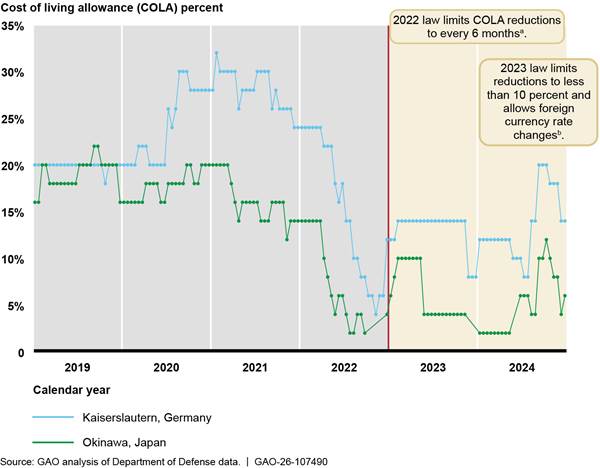
aThe 2022 law is the National Defense Authorization Act for Fiscal Year 2023, which was passed in December 2022.
bThe 2023 law is the National Defense Authorization Act for Fiscal Year 2024, which was passed in December 2023. The provision also amended the frequency of change, prohibiting a reduction more than twice per calendar year, as opposed to once per 6 months. Finally, it permitted DOD to phase-in reductions.
|
Service Member Perspectives on the Effect of Spendable Income on Cost-of-Living Allowance (COLA) “Everyone deserves the same quality [of life], and COLA should be solely based on location” - Enlisted service member in Oahu, Hawaii The COLA payments being based on rank disadvantages lower ranking service members. Alternatively, DOD could reverse the model, so lower ranking sailors receive more COLA. Or just set COLA at the same level for everyone regardless of rank. The prices at the store are the same for everyone. - Navy officers in Yokosuka, Japan Rank should not be considered when DOD calculates COLA because everyone pays the same prices. - Marine Corps officers in Okinawa, Japan Source: GAO interviews with Department of Defense (DOD) personnel. | GAO‑26‑107490 |
Spendable income and dependents. After location, service members’ spendable income amounts are a secondary input that affects the amount of OCONUS COLA they receive. Spendable income varies from service member to service member based on pay grade and years of service. As a result, higher ranking (pay grade) and longer tenured service members receive higher COLA payments (see sidebar). Table 6 shows how monthly COLA payments vary by pay grade and years of service across three selected locations. Across the locations, an O-5 service member receives monthly COLA payments that are more than 80 percent higher than what an E-1 service member receives.
|
Pay grade |
Years of service |
Oahu |
Kaiserslautern |
Anchorage |
|
E-1 |
1 |
$271.77 |
$317.06 |
$634.12 |
|
E-3 |
2 |
$291.40 |
$339.97 |
$679.93 |
|
E-5 |
4 |
$319.30 |
$372.52 |
$745.03 |
|
E-6 |
8 |
$353.40 |
$412.30 |
$824.60 |
|
E-7 |
14 |
$387.50 |
$452.08 |
$904.17 |
|
O-1 |
1 |
$329.63 |
$384.57 |
$769.15 |
|
O-3 |
8 |
$456.73 |
$532.85 |
$1,065.71 |
|
O-4 |
10 |
$485.67 |
$566.61 |
$1,133.22 |
|
O-5 |
16 |
$501.17 |
$584.70 |
$1,169.39 |
Source: GAO analysis of Department of Defense data. | GAO‑26‑107490
Note: This table assumes that the service member has no dependents and is not living in the barracks on base.
DOD also considers the number of dependents a service member has when determining OCONUS COLA, as dependents affect spendable income. The monthly allowance for each additional dependent a service member has at a particular location differs. Table 7 shows that an O-4 service member in Okinawa receives $32.50 extra per month for their first dependent, then about $26 extra per month for the second and fourth dependents, and about $13 extra per month for the third and fifth dependents. DOD develops the COLA spendable income data and limits the dependent-based OCONUS COLA allowance to five dependents, using data from the Bureau of Labor Statistics’ Consumer Expenditure Survey.
Table 7: Example of Monthly Cost-of-Living Allowance Based on Dependents, as of December 2024 for Okinawa, Japan
|
Number of dependents |
Okinawa |
Additional monthly payment based on change in number of dependents |
|
0 |
$203.66 |
— |
|
1 |
$236.16 |
$32.50 |
|
2 |
$262.60 |
$26.44 |
|
3 |
$275.60 |
$13.00 |
|
4 |
$301.74 |
$26.14 |
|
5 |
$315.04 |
$13.30 |
Source: GAO analysis of Department of Defense data. | GAO‑26‑107490
Note: This table assumes 10 years of service and an officer level pay grade of O-4.
DOD’s Processes for Determining COLA Have Several Weaknesses and Can Be Better Communicated
While DOD has processes for determining COLA rates CONUS and OCONUS, these processes can be strengthened. Additionally, information about COLA rates can be better communicated to service members. Specifically, we found:
· DOD’s survey for determining service members’ shopping patterns does not use sound sampling practices.
· DOD does not consistently use its existing process to capture location-specific expenses.
· DOD did not use best practices—such as a private contractor—in its process for collecting retail prices at overseas locations prior to September 2025 but began to do so after that time.
· DOD uses inconsistent processes for determining dependent-based COLA payments for service members in CONUS and OCONUS.
· Although DOD provides some information on COLA rates, some service members who live in some of the highest cost locations told us that they do not understand why their COLA payments decrease.
DOD’s Survey of Service Member Shopping Patterns Has Design Flaws
DOD’s survey of service members’ shopping patterns, the LPS, has two main design flaws. First, DOD does not use sound sampling practices when administering the LPS. Second, DOD does not capture some location-specific expenses when collecting information on shopping patterns.
DOD Does Not Use Sound Sampling Practices for the LPS
DOD uses a non-statistical sampling process for the LPS that focuses on encouraging a high number of responses and accepting information from any service member who responds to the survey. The sampling process DOD uses is called quota sampling, which is not generalizable. DOD implements quota sampling by grouping the service member population by specific pay grades within a salary range together and then monitoring the number of survey responses for each subgroup. DOD sets goals (quotas) for how many completed surveys it wants for each subgroup (a target number of completed surveys). DOD determines the target number of completed surveys by using a sample size formula.
DOD officials from the Allowances Division stated that they do not have written guidance for using quota sampling, but they have been using this process since 2003. The officials stated that DOD survey experts review the methodology of their surveys every 2 years, and these experts have never expressed any issues with quota sampling. Additionally, according to officials from DOD’s Allowances Division, the design of the LPS uses the following practices:
· The purpose of the LPS is clearly explained.
· The LPS is as concise as possible.
· Survey questions are in plain language, so that service members of all pay grades with various education levels can understand what is being asked.
· The survey can be taken on a personal computer or mobile device.
· Responses to the LPS are anonymous.
However, we found weaknesses with DOD’s methodology for administering the LPS. The department uses sampling practices that are not generalizable and may lead to inaccurate results. Specifically, the department does not:
1. Limit survey responses by subgroup to ensure the respondent pool is representative of the population.
2. Ensure that service members responding to the survey are eligible to do so.
First, DOD’s Allowances Division does not limit survey responses by subgroup to ensure the respondent pool is representative of the population. Some examples of subgroups include junior enlisted personnel, officers, service members with dependents, and those without dependents. This practice can result in over-representing certain subgroups of service members, which means the results are not generalizable to the population of the location in question. Officials from the Allowances Division stated that they use all the responses they receive from a given subgroup, even if the number of responses they receive exceeds the target number of responses for that subgroup.
Second, the department does not ensure that service members responding to the survey are eligible to do so. Service members can access the LPS online via a publicly available website that does not require the service member to enter a unique identifier, such as a code. Additionally, DOD does not prevent service members from responding to the survey multiple times, nor does it put geographic limitations on who can respond to the surveys. For example, we met with several service members who completed the LPS in tandem with their spouses and submitted separate surveys. Since the survey is intended to measure household shopping patterns, this practice results in survey estimates that do not reflect actual household shopping patterns for service members. Further, in September 2024, we were able to access and complete the LPS for Winnipeg, Canada, from the Defense Travel Management Office website, even though we are not service members and are not permanently assigned to that location. We did not submit our responses after completing the survey, but we noted that there are no controls over who could access and complete the survey, nor are there any controls over how many times a person can take the survey.
As a result of the department’s sampling practices, DOD may be limited in its ability to ensure the completed surveys are a valid representation of service members’ costs of living. This is reflected in the widely varying LPS response rates from different locations. For example, in the 2024 LPS, Anchorage, Alaska, exceeded its target of completed surveys, by more than 525 percent. Conversely, a DOD official from Hawaii stated that they struggle to get participation to meet 30 percent of the target number of completed surveys. Response rates also varied in other locations, such as in Germany where 93 percent of service members responded to the LPS, and in South Korea where only 35 percent of service members responded.
Officials at the Allowances Division told us it is their goal to ensure that the sample of data collected is adequate for analysis and to include as many respondents as possible. However, survey data collected via quota sampling are statistically biased and do not provide objective data about the population of interest. For example, the data may result in more responses from service members of one rank versus another. According to the Office of Management and Budget’s guidelines for statistical surveys, if a survey designer wants to draw conclusions about a target population, as DOD does with the LPS, the survey should use random sampling.[24] Random sampling uses statistical software to select a subset of individuals from within a population to estimate characteristics of the whole population. According to Standards for Internal Control in the Federal Government, management should use quality information to achieve an organization’s objectives.[25] Using random sampling to select a subset of service members could improve the quality of the information DOD uses from the LPS to determine COLA rates for service members.
When we asked DOD Allowance Division officials why they did not use random sampling, they stated that they previously used it over 20 years ago and would support going back to it. However, DOD changed the sampling methodology because service members complained about COLA reductions that resulted from a process they were unable to participate in. Officials also told us that their method of quota sampling allows them to not only represent the buying patterns of enlisted service members and officers but include responses from any service member who takes the time to respond to the survey. In addition, they stated that it would be challenging to implement random sampling because it may be difficult to deliver the survey link to only selected service members and the selected service members may not complete the survey. Further, the officials said they collect metadata from the responses that could help them identify duplicate or out-of-area responses. DOD officials told us that they have used this metadata to exclude erroneous LPS responses that were from personnel in a different geographic area.
While DOD applies some internal controls to their sampling procedures, the department’s use of quota sampling over random sampling inherently biases the results of the LPS because the results are not statistically representative of the survey population. A recent DOD study also identified problems with the LPS. The January 2025 Fourteenth Quadrennial Review of Military Compensation found that the LPS can drive big differences in OCONUS COLA rates in locations that are in close proximity, which, according to the report, indicates that DOD’s LPS results may be biased and are not generalizable.[26] In that report, DOD also questioned the accuracy of the LPS in representing service member shopping patterns. Random sampling would help to ensure that DOD obtains generalizable data on buying patterns for both enlisted service members and officers. Without statistically sound survey results provided by random sampling, the conclusions that DOD draws from the LPS may be inaccurate and may not provide the department with quality information to appropriately determine COLA rates.
DOD Does Not Consistently Use Its Existing Process to Capture Some Location-Specific Expenses
Service members stationed at some OCONUS locations may incur some location-specific expenses that service members stationed elsewhere do not. DOD has a process to capture such expenses, but DOD is not using it consistently. Specifically, DOD guidance allows service members to receive direct, one-time reimbursements for authorized location-specific expenses as part of the COLA process.[27] According to this guidance, since such expenses are not incurred by every service member stationed OCONUS, DOD does not include them as part of its ordinary COLA rate calculation. Instead, these location-specific expenses must meet the following criteria to be eligible for dollar-for-dollar reimbursement as a COLA-unique expense:
· be incurred by a clear majority of service members at a duty station,
· exceed 1 percent of the spendable income of an E-6 service member with 10 years of service and three dependents, and
· not be regularly incurred by CONUS-based service members.
DOD policy additionally states that a request for such an expense must be made to the Office of the Under Secretary of Defense for Personnel and Readiness from a major command.[28] As of January 2025, we found that DOD has authorized reimbursement for location-specific expenses at only one location. Specifically, service members in Singapore can receive reimbursement for excessive road taxes and vehicle registration fees.
In Alaska, DOD implemented a process outside of the dollar-for-dollar COLA unique expense reimbursement process noted above. Specifically, DOD’s Allowances Division officials stated that they conducted a cold weather survey at 15 installations in Alaska. Allowances Division officials told us that they added location-specific questions to the survey after communicating and receiving feedback from the country allowance coordinator. For example, DOD included cold weather-related expenses, such as battery blankets and winter clothing, in the 2024 LPS surveys for service members stationed in Alaska.
Through our discussions with service members, we found examples of additional location-specific expenses that service members may incur, including utility and transportation expenses.
Utility expenses. The COLA program is not intended to cover utility expenses. DOD partially offsets utility expenses through housing allowances—Basic Allowance for Housing in the United States and Overseas Housing Allowance outside of the United States. However, service members in several locations we conducted discussion groups with observed that the housing allowance does not offset location-specific utility expenses. According to service members we met with through the discussion groups we held in Hawaii and Japan, landlords are aware of how much housing allowance service members receive and charge that amount for rent. Service members in Hawaii, Alaska, and Japan said that they end up paying out-of-pocket for a large portion of their utility costs, such as electricity, which can be very expensive.
In all 10 of our discussion group summaries from Hawaii, participants mentioned challenges with the affordability of utilities such as electricity and drinking water. For example, one service member said electricity is 3 to 4 times more expensive than in most CONUS locations. Another service member stated that electric bills in Oahu can be $400 to $600 per month. One service member said that even without central air conditioning, her electric bill can still be about $200 per month. Additionally, one service member told us that his water bill is about $200 per month for two people. Several service members said that they do not trust the water in Hawaii after an environmental incident at Red Hill, and some of them said they use water delivery services or drink bottled water.[29] Another service member told us that drinking water costs $20 per week.
Service members from Alaska told us that most homes at Eielson Air Force Base use boilers, which are expensive to operate. For example, they said the boilers run on heating oil, which costs $4 to $6 per gallon, and they estimated that families spend about $1,500 per month on heating oil for 7 or 8 months out of the year.
Transportation costs. Service members we spoke with in OCONUS locations also mentioned different types of transportation costs as being particularly expensive. Some common transportation costs that service members mentioned included car maintenance and tolls.
Service members said they experienced high car maintenance costs in several locations where we conducted discussion groups. For example, in all 10 of the discussion group summaries from Hawaii, participants mentioned that car maintenance is particularly expensive. One service member in Hawaii noted that car maintenance expenses can be more than $10,000 per year. Service members in three of the discussion group summaries in Hawaii specifically noted the expense of tires. Service members in Hawaii said that four tires can cost anywhere from $1,700 to $6,600. In addition, service members said that people wait months for standard parts to ship to Hawaii, and labor costs are “through the roof.”
Similarly, service members at Eielson Air Force Base, Alaska, told us that the vehicle maintenance costs are high there because weather can negatively affect vehicles. Service members in the one discussion group we held explained that roads are treated with gravel instead of salt to create traction. However, gravel causes more damage to vehicles than salt does, they said. One service member told us that he goes through three windshields a year because of damage from the gravel. Service members also said that vehicle winterization (e.g., winter tires, storage of extra tires, increased oil changes, labor to winterize the vehicles, etc.) is costly.
Service members in both discussion group summaries from Germany also noted particularly expensive vehicle maintenance costs. One service member told us it cost over $1,200 to repair the air conditioner in his vehicle because it was not standard in Germany and would need to be shipped. Another service member said vehicles must have snow tires in the winter, which are very expensive.
In Japan, service members in three of the four discussion group summaries mentioned tolls as an expense that COLA should help them cover. At Yokosuka, officers and enlisted members noted that the toll between Yokosuka and Tokyo is expensive. At Okinawa, one of the discussion groups identified that tolls can be around $20 per day, which totals more per month than the COLA some of them receive.
As we discussed above, there may be additional location-specific expenses that are not being captured by DOD. Standards for Internal Control in the Federal Government states that management should use quality information to achieve an organization’s objectives.[30] This includes identifying necessary information requirements in an iterative and ongoing process.
DOD’s limited awareness of location-specific expenses at some OCONUS locations is a result of the department not having an iterative process, such as the LPS, to consistently identify location-specific expenses to help determine if such expenses should be reimbursed. Participants from 11 of the 17 OCONUS discussion group summaries stated that the LPS does not include questions about location-specific experiences and costs. However, DOD officials told us that the department adjusted the LPS at only one location—Alaska—to capture cold-weather-related expenses that service members incur.
Officials from the Allowances Division stated that they are considering having a contractor explore unique costs in some locations. For example, DOD officials told us they may adjust the LPS in remote locations where some goods and services are not widely available, so the department can capture more information on military service members’ costs in remote locations. Changes such as this could help DOD better reflect the costs of living in certain locations. Without consistently identifying location-specific expenses at OCONUS locations, service members at these locations may not be receiving appropriate COLA payments to equalize purchasing power with their U.S.-based counterparts as intended by the program.
The Process DOD Used for Collecting OCONUS Retail Prices May Have Resulted in Unreliable Data Prior to September 2025
DOD’s process for collecting retail prices at overseas locations, the RPS, may have resulted in data that are biased and unreliable prior to September 2025. As previously discussed, every year DOD collects retail price data via the RPS for 150 nonhousing goods and services from outlets where service members shop as identified by the LPS. Prior to September 2025, DOD used its own personnel—some of whom are eligible for COLA—to collect RPS data OCONUS. In contrast, DOD uses contractor personnel to collect the retail price data across 48 states and Washington, D.C., in CONUS. By using a contractor, DOD leverages professional expertise and technologies that price survey companies have developed over time, such as retail price scanner logs.[31] The use of a contractor also eliminates a potential conflict of interest because the contractor is independent and does not receive COLA.
DOD officials recognized that there were flaws with their process for administering the OCONUS RPS. Specifically, officials stated that they understand that pricing teams manually collecting RPS data is a labor-intensive process. Also, they acknowledged that in some situations, the individuals involved in the price collection may personally benefit from COLA, which introduces a financial conflict of interest.
During our audit, we had discussions with DOD’s Allowances Division officials about using private contractors that leverage available technologies to perform the OCONUS COLA RPS. In August 2025, DOD awarded a contract to a private contractor to gather pricing information from CONUS and OCONUS. Documentation provided by the department shows that the first OCONUS COLA data are due from the contractor in March 2026 and DOD plans to use those data to update OCONUS COLA rates for the Spring/Summer of 2026. After calendar year 2026, the department plans to regularly update the rates in July of every year. DOD officials stated that they have wanted to use a contractor for the OCONUS RPS for about 7 years, just as they do for the CONUS RPS, but the department has been unable to do so due to cost concerns and the availability of contractor personnel in some locations to collect the data. Given DOD’s recent actions, we are not making any recommendations pertaining to use of a contractor for the OCONUS COLA RPS process.
DOD Has Inconsistent Processes for Determining Dependent-Based COLA in CONUS and OCONUS
As we mentioned earlier, DOD considers a service member’s dependents as an input when determining COLA payments. However, the department uses inconsistent processes for determining how dependents affect COLA payments in CONUS and OCONUS. For service members stationed in CONUS, their dependent status is a yes or no variable as it relates to determining COLA. As a result, service members receive a single flat increase to their COLA if they have one or more dependents. In OCONUS locations, however, service members receive increases to their COLA for each dependent up to five.
For example, in Los Angeles, California, where service members received a COLA in 2024, an O-4 service member with 10 years of service received $16 more per month for having at least one dependent than the same service member without a dependent in December 2024. However, a service member in Okinawa, Japan, receives $32.50 extra per month for their first dependent, then about $26 extra per month for the second and fourth dependents, and about $13 extra per month for the third and fifth dependents (see table 8).
A service member’s monthly cost-of-living allowance (COLA) varies, in part, based on dependents. DOD calculates dependent-based COLA payments differently for service members in the continental United States and those outside the continental United States.
|
Pay grade |
Location |
Dependents |
Monthly COLA amount |
Additional monthly payment based on change in number of dependents |
|
O-4 |
Los Angeles |
0 |
$45.00 |
N/Aa |
|
O-4 |
Los Angeles |
1 or more |
$61.00 |
$16.00 |
|
O-4 |
Okinawa |
0 |
$203.66 |
N/Aa |
|
O-4 |
Okinawa |
1 |
$236.16 |
$32.50 |
|
O-4 |
Okinawa |
2 |
$262.60 |
$26.44 |
|
O-4 |
Okinawa |
3 |
$275.60 |
$13.00 |
|
O-4 |
Okinawa |
4 |
$302.04 |
$26.44 |
|
O-4 |
Okinawa |
5 |
$315.04 |
$13.00 |
Source: GAO analysis of Department of Defense (DOD) data. | GAO‑26‑107490
Note: This table assumes that the service member has 10 years of service and is not living in the barracks on base.
aN/A means not applicable
As mentioned earlier in this report, DOD uses spendable income as an input to determine service members’ COLA. DOD’s source for this information is the Bureau of Labor Statistics Table 1203, which is based on consumer expenditure survey data that the bureau collects.[32] DOD’s OCONUS COLA calculations align with information from the Bureau of Labor Statistics, as it shows increasing spendable income for families as dependents are added, up to five. However, DOD’s CONUS COLA calculation does not follow the criteria laid out by the Bureau of Labor Statistics because it stops providing additional money for dependents after the first one.
An official at the DOD Allowances Division could not identify a reason why the two COLA programs pay differently for dependents. In addition, the official stated that it would make sense for the CONUS COLA program to factor in a payment for each additional dependent, similar to the process followed for the OCONUS COLA. As a result of these differences in the processes for addressing dependents, service members in CONUS receive less COLA compensation than their counterparts serving OCONUS.
DOD Publishes Information on COLA but Does Not Require Local Commands to Disseminate Some Information to Service Members
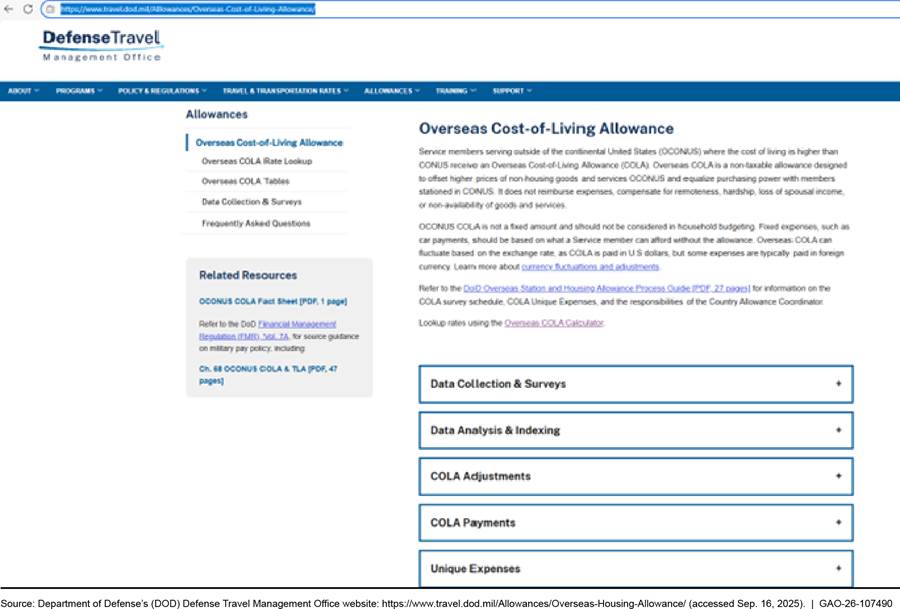
DOD’s Allowances Division makes information on its CONUS and OCONUS COLA programs available to service members on the department’s Defense Travel Management Office website. This website describes the purpose of COLA, explains DOD’s methods for determining COLA rates, and contains a COLA rate lookup tool for service members to find current or past COLA rates for any location. It includes answers to frequently asked questions about the COLA programs. These explain how DOD determines the locations that are eligible for COLA; the CONUS COLA eligibility threshold; and whether an OCONUS location is more expensive than the CONUS average. Officials said the Allowances Division updates the website with new information frequently, including when they begin to administer a new LPS for a location, which occurs on a regular basis. Figure 7 shows DOD’s COLA information web page, as of September 2025.
In addition to the website, DOD publishes a press release before the start of the new calendar year announcing the CONUS COLA rates for the upcoming year with a link to a tool service members can use to calculate their COLA rates. Officials said that for OCONUS COLA, the Allowances Division contacts service compensation representatives, combatant commanders, and country allowance coordinators when COLA rates update, twice every month. The Allowances Division relies on these points of contact to share the information with service members if necessary. Occasionally, though, the division will directly contact these service members when the rates fluctuate drastically, which usually occurs as a response to the local LPS or an extreme change in the CONUS inflation rate.
Despite these efforts, participants in all 19 discussion group summaries noted challenges with communication related to COLA. Service members told us that they generally relied on their local commands to directly communicate information about COLA rates and rate changes. However, they reported varied experiences in the amount and type of information they received about their COLA benefits depending on their location.
For example, service members in both discussion group summaries from one installation in Hawaii we visited noted that they received regular communication and felt the installation kept them well-informed on COLA issues. However, some of the same participants noted limitations with the communications. For example, enlisted service members said they participated in a briefing on the COLA program upon their arrival to the installation, but the briefing did not include an explanation of how their COLA would be determined. Service members from both discussion group summaries at a different installation we visited in Hawaii told us that they received messaging from their command in advance of COLA reductions but still felt they did not understand why COLA was being reduced and how COLA is calculated. Meanwhile, participants from 11 of the 19 discussion group summaries mentioned that one of the primary ways they learned about changes in their COLA payments was through looking at their Leave and Earnings Statements, meaning they had no advance notice.
Some DOD personnel we met with noted that frequent changes in COLA payments paired with having no advance notice can make it difficult for service members to effectively manage their household budgets. In nine of the 17 discussion group summaries we held in locations that receive a COLA, participants mentioned that COLA fluctuates so much that they cannot rely on it as part of their budgets. Furthermore, several senior leaders we met with mentioned that the financial stress of living in expensive locations contributes to recruiting, retention, readiness, and mental health challenges for service members. For example, one general officer on Okinawa said that “eating a beans and rice diet has a direct impact on our ability to fight.”
In addition, service members at multiple locations expressed uncertainty about where to direct questions or have their concerns addressed regarding COLA. For example, one service member who works in the finance branch of an installation said the branch receives questions about COLA daily. Additionally, some service members reported that they had heard information about the COLA program from other service members or officials that we found is inaccurate. For example, in eight of 19 discussion group summaries, participants across various locations incorrectly believed that their COLA rates decreased because they were being punished for low response rates on the LPS.
Standards for Internal Control in the Federal Government state that management should communicate quality information throughout the organization using established reporting lines.[33] Management should ensure that quality information is communicated throughout the organization to enable personnel to perform key roles and to achieve agency objectives. However, DOD does not consistently communicate information about the COLA program because it does not have guidance requiring local commands to provide specific information to service members at locations that receive COLA.
While DOD posts information about the COLA programs on a publicly available website, there are still inconsistencies in the amount and type of information local commands give to service members at locations that receive COLA. In the absence of guidance requiring local commands to consistently communicate information about the COLA programs—such as the COLA website address, how to find their specific COLA information, and information on how COLA is calculated—service members reported to us that they did not understand their COLA payments. The absence of information on COLA can lead to service members having trouble planning their budgets and financial stress, which can affect service member well-being and mission readiness.
Conclusions
DOD’s COLA programs support mission readiness by helping service members and their families afford to live in some of the expensive areas where they are stationed. In calendar year 2024, DOD spent about $1.2 billion annually to provide COLA to about 250,000 of its 1.4 million active-duty service members worldwide. Over time, in accordance with legislation, the department has made positive adjustments to the program to better meet the needs of the military services and their personnel and families. However, DOD has opportunities to improve its COLA programs in several ways. These include improving survey methodologies for the LPS, making dependent-based compensation for CONUS and OCONUS COLA consistent, and improving how it communicates COLA information to service members to help them better understand the programs and use it for budgeting. Taking action to address these issues will help ensure service members are being compensated appropriately, which will support their quality of life and their ability to meet mission needs.
Recommendations for Executive Action
We are making the following four recommendations to DOD:
The Secretary of Defense should direct the Under Secretary of Defense for Personnel and Readiness to ensure that the department uses random sampling for the LPS. (Recommendation 1)
The Secretary of Defense should direct the Under Secretary of Defense for Personnel and Readiness to implement changes in the COLA process for OCONUS, such as using the LPS to consistently identify location-specific expenses and determine whether such expenses should be reimbursed, in accordance with DOD policy. (Recommendation 2)
The Secretary of Defense should require the Under Secretary of Defense for Personnel and Readiness to review and determine whether CONUS COLA dependent-based compensation should be adjusted to reflect changes in spendable income for up to five dependents, as the department does with OCONUS COLA. (Recommendation 3)
The Secretary of Defense should direct the Under Secretary of Defense for Personnel and Readiness to develop guidance requiring local commands to provide information about the COLA programs to service members at locations that receive COLA. Such information should include the website where DOD provides information on the COLA programs and the contact information of an office that can answer questions about COLA. (Recommendation 4)
Agency Comments and Our Evaluation
We provided a draft of this report to DOD for review and comment. In its written comments, reproduced in Appendix II, DOD concurred with our second and third recommendations and provided details on its plans to address them.
DOD did not concur with our first recommendation. In its response, the department stated that random sampling is not the appropriate methodology for the Living Pattern Survey (LPS). DOD stated that it wants as many service members as possible to participate in the data collection instead of having small, random samples for the LPS. The department further stated that the responses it collects through the LPS are weighted to correct for non-response bias and ensure they accurately represent the entire population of the surveyed location. According to DOD, the quota sampling approach they use allows the department to construct a comprehensive and representative picture of the spending habits of all service members, effectively compensating for any missing data.
We found, however, that DOD cannot be sure that the completed surveys are a valid representation of service members’ costs of living. The goal of the LPS is to accurately represent the shopping patterns of service members. The quota sampling methodology the department currently relies on is known to produce biased estimates and the weighting procedures it uses are not able to fully mitigate its shortcomings. The current LPS methodology allows a single individual to submit multiple surveys, and it does not put geographic limitations on who can respond to the surveys. Random sampling addresses these limitations and will allow DOD to obtain generalizable survey results. We therefore maintain that our recommendation is valid.
DOD partially concurred with our recommendation to develop guidance requiring local commands to provide information about the COLA programs to service members at locations that receive COLA. In its response, DOD stated that the Defense Travel Management Office already maintains a comprehensive public-facing website that serves as the official source for all military COLA information. The department also stated that it does not support a central point of contact to address COLA inquiries and maintains that a service member’s chain of command remains the most effective channel for personnel inquiries about COLA.
However, we found that despite having the public-facing website and local commands sending out information on COLA, service members still lacked an understanding of the COLA program and did not understand how their COLA payments were determined. Requiring local commands to consistently communicate information on COLA programs, particularly key information such as changes in COLA payments, will help service members understand their COLA payments so they can budget appropriately for expenses. We agree that a point of contact at a local command office and not a central point of contact would be the best way to address COLA inquiries made by service members.
DOD additionally stated that it is working to simplify available COLA materials, including fact sheets, frequently asked questions, and explanatory guides that, once published, will be disseminated to commands around the world. DOD further stated that it will soon commence a 12-month military education compensation educational campaign to help educate and inform service members about their total military compensation package, which includes COLA. We agree these actions should help service members understand the COLA program but we maintain that local commands consistently communicating the information is what is needed to address our recommendation.
We are sending copies of this report to the appropriate congressional committees; the Secretary of Defense; the Secretaries of the Army, the Navy, and the Air Force; and other interested parties. In addition, the report is available at no charge on the GAO website at https://www.gao.gov.
If you or your staff have any questions concerning this report, please contact me at AgarwalR@gao.gov. Contact points for our Offices of Congressional Relations and Media Relations may be found on the last page of this report. GAO staff who made key contributions to this report are listed in appendix III.
Rashmi Agarwal
Director, Defense Capabilities and Management
This report (1) describes how the Department of Defense (DOD) determines cost-of-living allowances (COLA) and the payments provided for service members in the continental United States (CONUS) and outside the continental United States (OCONUS); and (2) examines the extent to which DOD’s processes for determining COLA are appropriately designed and communicated.
To address these objectives, we focused on DOD’s processes pertaining to COLA for service members stationed in CONUS as well as those OCONUS, which includes Alaska and Hawaii. We collected COLA information from the military services that had the most active-duty service members, as of June 2025—Army, Marine Corps, Navy, and Air Force.[34]
To address both of our objectives, we identified relevant laws, regulations, and policies pertaining to DOD’s COLA programs. These included 37 U.S.C. § 403b and § 405, which give DOD the authority to set COLA rates for CONUS and OCONUS service members, respectively. We reviewed chapters 67 and 68 of the DOD Financial Management Regulation related to the processes for determining CONUS and OCONUS COLA.[35] We also reviewed various DOD COLA policies and instructions, such as DOD Instruction 5154.31, Volume 6, Commercial Travel Management: Uniformed Housing and Station Allowances; the DOD Overseas Station and Housing Allowance Process Guide; and Standard Operating Procedures (SOP) DOD Overseas Cost-of Living Allowance Data Analysis.[36] Further, we reviewed the National Defense Authorization Act for fiscal years 2023 and 2024, which mandated changes to DOD’s COLA programs.[37]
Additionally, we conducted site visits to hold discussion groups with service members affected by DOD’s COLA rates, as well as visited shopping outlets used by service members to document the prices of various goods and services, and to better understand what shopping is like in different locations. We also interviewed local command leadership and officials responsible for implementing DOD’s COLA programs. We held most of our site visits in OCONUS locations as 90 percent of the service members who received COLA in calendar year 2024 were in OCONUS locations, and 97 percent of the total amount of COLA payments made in calendar year 2024 were to OCONUS service members. We selected locations that had over 3,000 service members and selected locations with differing COLA rates, which ranged from those receiving no COLA to those receiving COLA up to 30 percent higher than the CONUS average. We ensured that we spoke with service members from at least one CONUS location, one OCONUS location, and one OCONUS location that uses the U.S. dollar. Using this methodology, we selected the following nine locations to visit: Joint Base Pearl Harbor-Hickham, Schofield Barracks, Marine Corps Base Hawaii, and Camp H. M. Smith in Oahu, Hawaii; Fort Belvoir, Virginia; Camp Foster in Okinawa, Japan; and Yokota Air Base and Yokosuka Naval Base, Japan. We conducted virtual site visits with officials at Eielson Air Force Base, Alaska, and in Kaiserslautern, Germany.
In preparation for our site visits, we coordinated with local commands to invite service members to discussion groups. We gave the local commands broad guidance on how many participants we wanted per group and that we did not want groups that mixed officers and enlisted personnel within a group. As a result of these efforts, we held 29 discussion groups with service members, and we also held two discussion groups with service members’ spouses in Hawaii, for a total of 31 discussion groups. We held separate discussion groups for enlisted personnel and officers, and at many locations we separated lower- and higher-ranking enlisted personnel and officers from each other.[38] The number of participants per discussion group ranged from five to 25 people. We did not select the service members who participated at each location. Rather, we relied on the local command to advertise our discussion groups and then spoke with the service members who were able to attend. During these discussion groups, we took written notes but did not record audio or video.
In these discussion group sessions, we asked service members about their experiences with and knowledge of DOD’s CONUS or OCONUS COLA programs using a structured set of questions. First, we asked service members to tell us what they knew about the respective COLA program, the information they receive from DOD about the program, and how they receive such information. We then asked service members about their impressions of the Living Pattern Survey (LPS). We asked service members to share their households’ overall experiences with COLA at their installation and if there are any expenses that COLA does not cover that they believe should be covered. Finally, we asked service members to explain how fluctuations in COLA amounts have affected their households, if applicable, and if they were aware of or have ever filed a dispute regarding their COLA. At the end of the discussion groups, we provided the opportunity for service members to share any additional information about their experiences with DOD’s COLA programs.
We used a qualitative methodology to analyze the discussion group results. We held 31 discussion groups across the locations we visited. For the purposes of our analysis, we created 19 summaries of these discussion groups, grouping discussions we held with similarly ranked personnel who were at the same location into a combined summary. For example, when we separated enlisted personnel into two groups at a particular location, we combined discussion group write-ups or records. This resulted in the 19 written discussion group summaries, 17 of which were based on discussions with OCONUS-based service members or spouses and two were based on discussions with CONUS-based service members. The 19 discussion group summaries are the unit of analysis we use throughout this report when we refer to discussion groups.
To perform our qualitative analysis of the discussion groups, we first determined eight topics that were commonly discussed in the groups that were relevant to the topics we planned to discuss in our report. Then, one analyst reviewed notes from the groups and extracted statements made about these eight topics in each of the groups into a separate document. For some of these topics, the analyst determined whether the statement was a positive or negative statement relative to the topic. This was necessary because in some instances we reported how many service members had a positive or negative experience. For most of these topics, the analyst tallied the number of discussion groups that mentioned the topic. A second analyst then repeated these steps to ensure reliability. The two analysts then addressed any differences in their reviews. Since we did not select a representative sample of participants, the results of our discussion group analyses are not generalizable to all service members or spouses. However, they provide useful context and examples of the COLA-related experiences of service members in a variety of locations around the world.
We interviewed DOD officials, including those from the Office of the Under Secretary of Defense for Personnel and Readiness/Manpower and Reserve Affairs, to include DOD’s Allowances Division, and the Defense Finance and Accounting Service. Further, we conducted interviews with individuals involved in the COLA programs, including service compensation coordinators, country allowance coordinators, installation allowance coordinators, and local survey coordinators.
For our first objective, we reviewed various datasets to understand how DOD has determined COLA rates. We analyzed DOD data on COLA rates from calendar years 2019 through 2024. We analyzed data on and service member populations at military installations for calendar year 2024. Then, to understand how DOD and the services make budgeting decisions based on COLA rates, we analyzed DOD’s cost estimates for administering the COLA programs in calendar year 2024.[39] We collected data using the CONUS and OCONUS COLA rate lookup tools on DOD’s Defense Travel Management Office website. We used these tools to create outputs of several possible scenarios to understand the effects of pay grade, years of service, and dependents on a service member’s COLA payment. We assessed reliability of these data by reviewing related DOD documentation and interviews with, as well as written responses from, agency officials. Given the results of our assessment, we determined that all data elements were sufficiently reliable for describing how DOD determines COLA and the payments it made to service members in calendar year 2024.
For our second objective, we reviewed two important components of DOD’s COLA determination process to assess the extent to which they are appropriately designed: the Living Pattern Survey (LPS), DOD’s survey of service members’ shopping patterns, and the Retail Price Schedule (RPS), DOD’s price collection process. We compared DOD’s procedures to administer and analyze results of the LPS to Office of Management and Budget’s guidance for statistical surveys.[40] We also assessed the LPS using Standards for Internal Control in the Federal Government, specifically on using quality information to achieve organizational objectives.[41] We compared DOD’s procedures for conducting the RPS to best practices used by the Bureau of Labor Statistics for similar purposes.[42] To assess DOD’s process for determining dependent-based COLA compensation, we compared the department’s CONUS COLA process to its OCONUS COLA process and to information from the Bureau of Labor Statistics on how to calculate spendable income.
To assess the extent to which DOD’s COLA determination processes are communicated to service members, we interviewed DOD officials about their commonly used practices for disseminating information and compared those practices to Standards for Internal Control in the Federal Government, specifically on effectively communicating information within an organization.[43]
We conducted this performance audit from March 2024 to April 2026 in accordance with generally accepted government auditing standards. Those standards require that we plan and perform the audit to obtain sufficient, appropriate evidence to provide a reasonable basis for our findings and conclusions based on our audit objectives. We believe that the evidence obtained provides a reasonable basis for our findings and conclusions based on our audit objectives.
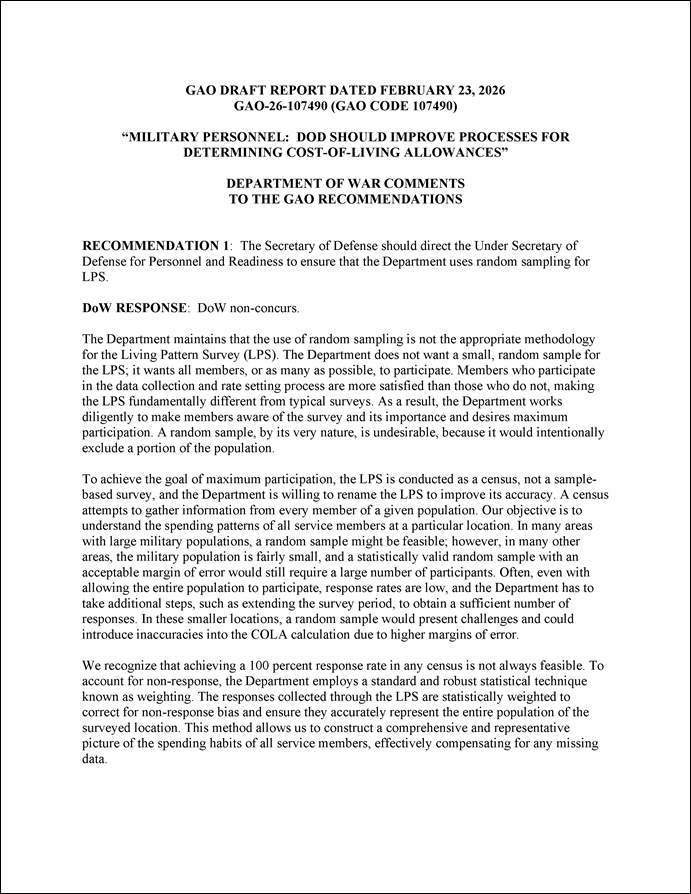
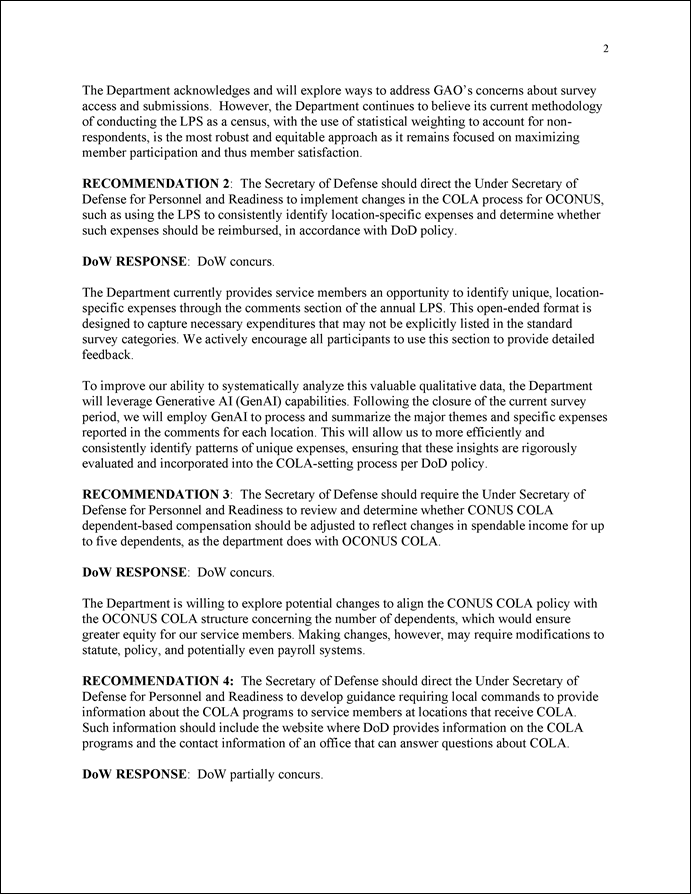
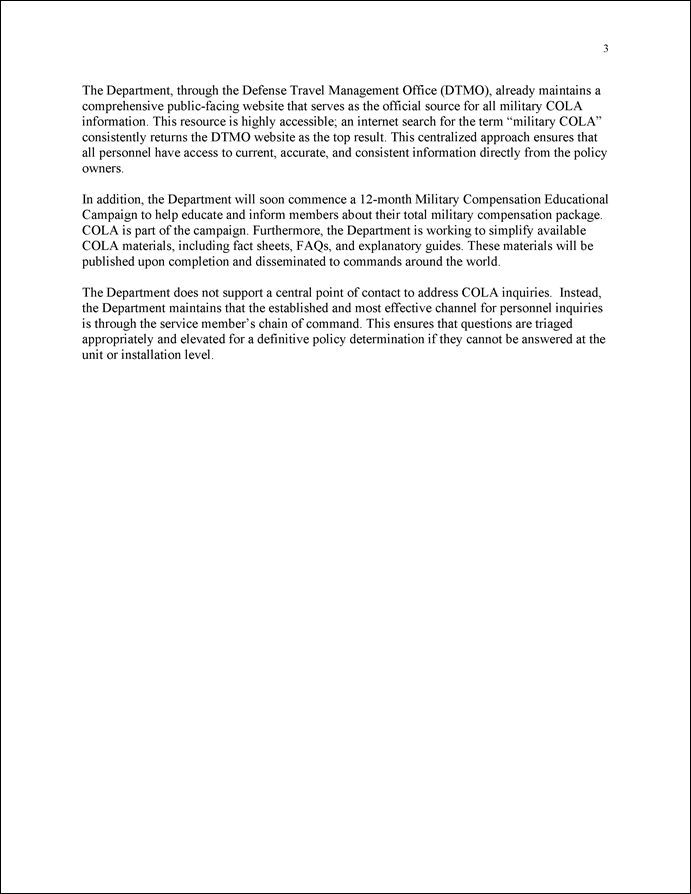
GAO Contact
Rashmi Agarwal, AgarwalR@gao.gov
Staff Acknowledgments
In addition to the contact listed above, key contributors to this report were Richard Geiger (Assistant Director), Randy Neice (Analyst-in-Charge), Jesse Andrews, Carl Barden, Kathleen Bever, Jessie Biltz, Andrew Curry, Pamela Harris, Elisebet Lalisan, Kathleen McQueeney, Leah Nash, Michael Silver, and Theologos Voudouris.
The Government Accountability Office, the audit, evaluation, and investigative arm of Congress, exists to support Congress in meeting its constitutional responsibilities and to help improve the performance and accountability of the federal government for the American people. GAO examines the use of public funds; evaluates federal programs and policies; and provides analyses, recommendations, and other assistance to help Congress make informed oversight, policy, and funding decisions. GAO’s commitment to good government is reflected in its core values of accountability, integrity, and reliability.
Obtaining Copies of GAO Reports and Testimony
The fastest and easiest way to obtain copies of GAO documents at no cost is through our website. Each weekday afternoon, GAO posts on its website newly released reports, testimony, and correspondence. You can also subscribe to GAO’s email updates to receive notification of newly posted products.
Order by Phone
The price of each GAO publication reflects GAO’s actual cost of production and distribution and depends on the number of pages in the publication and whether the publication is printed in color or black and white. Pricing and ordering information is posted on GAO’s website, https://www.gao.gov/ordering.htm.
Place orders by calling (202) 512-6000, toll free (866) 801-7077,
or
TDD (202) 512-2537.
Orders may be paid for using American Express, Discover Card, MasterCard, Visa, check, or money order. Call for additional information.
Connect with GAO
Connect with GAO on X,
LinkedIn, Instagram, and YouTube.
Subscribe to our Email Updates. Listen to our Podcasts.
Visit GAO on the web at https://www.gao.gov.
To Report Fraud, Waste, and Abuse in Federal Programs
Contact FraudNet:
Website: https://www.gao.gov/about/what-gao-does/fraudnet
Automated answering system: (800) 424-5454
Media Relations
Sarah Kaczmarek, Managing Director, Media@gao.gov
Congressional Relations
David A. Powner, Acting Managing Director, CongRel@gao.gov
General Inquiries
[1]National Defense Authorization Act for Fiscal Year 1995, Pub. L. No. 103-337, § 602 (1994).
[2]An Act to revise, codify, and enact title 37 of the United States Code, entitled “Pay and Allowances of the Uniformed Services,” Pub. L. No. 87-649, § 405 (1962).
[3]H.R. Rep. No. 118-125, at 171-72 (2023).
[4]James M. Inhofe National Defense Authorization Act for Fiscal Year 2023, Pub. L. No. 117-263, § 617 (2022) and National Defense Authorization Act for Fiscal Year 2024, Pub. L. No. 118-31, §§ 625, 627 (2023).
[5]H.R. Rep. No. 118-301, at 1092-93 (2023) (Conf. Rep.).
[6]As of June 2025, the Defense Manpower Data Center reported the following number of active-duty personnel: Army–452,823; Navy–337,209; Air Force–321,211; Marine Corps–170,201; Coast Guard–41,689; and Space Force–9,897.
[7]Throughout this report we refer to military personnel by their pay grades. The military services employ pay grades as administrative classifications to standardize compensation. The “O” in O-1 stands for “officer,” while the “1” indicates the pay grade for that position. The other pay grade categories are “W” for warrant officers and “E” for enlisted personnel. In the Army, Marine Corps, Air Force, and Space Force, officers in pay grades O-1 to O-3 are called company grade officers, O-4 to O-6 are called field grade officers, and O-7 and higher are called general officers. Naval officers are grouped similarly but are called junior grade, mid-grade, and flag officers.
[8]Office of Management and Budget, Standards and Guidelines for Labor Statistics (September 2006).
[9]International Monetary Fund, Consumer Price Index Manual: Concepts and Methods (2020).
[10]GAO, Standards for Internal Control in the Federal Government, GAO‑14‑704G (Washington, D.C.: September 2014).
[11]COLA policies cover members of the eight uniformed services, to include DOD personnel from the Army, Navy, Air Force, Marine Corps, and Space Force as well as personnel from the Coast Guard, the United States Public Health Service, and the National Oceanic and Atmospheric Administration. Our review focused on the services with the most active-duty personnel as of June 2025—the Army, Navy, Air Force, and Marine Corps.
[12]For the purposes of DOD’s housing allowance, Alaska and Hawaii are considered part of CONUS while for COLA, they are considered OCONUS.
[13]DOD 7000.14-R, Financial Management Regulation, vol. 7A, ch. 67, Cost of Living Allowance (COLA) in the Continental United States (CONUS) (December 2024); DOD 7000.14-R, vol. 7A, ch. 68, Cost of Living Allowance Outside the Continental United States (OCONUS COLA) and the Temporary Lodging Allowance (TLA) (January 2025). DOD’s Financial Management Regulation directs statutory and regulatory financial management requirements, systems, and functions for all appropriated and nonappropriated, working capital, revolving, and trust fund activities.
[14]The Bureau of Labor Statistics measures labor market activity, working conditions, price changes, and productivity in the U.S. economy to support public and private decision-making by collecting, calculating, analyzing, and publishing economic data.
[15]The Consumer Expenditure Survey program provides data on expenditures, income, and demographic characteristics of consumers in the United States. The Bureau of Labor Statistics primarily uses these data to revise the relative importance of goods that comprise the Consumer Price Index, which is a measure of the change over time in prices paid by consumers.
[16]DOD, Report of The Fourteenth Quadrennial Review of Military Compensation, Vol. 1, Main Report (January 2025).
[17]GAO has prior work on DOD commissaries and found that the Defense Commissary Agency’s data on OCONUS customer savings are unreliable and that it lacks information needed to effectively reform its business practices. We made three recommendations to the Defense Commissary Agency to: (1) review its OCONUS customer savings rate methodology, (2) conduct an analysis that identifies the savings rate and related benefits it can achieve at varying levels of appropriations, and (3) improve its strategic plan. DOD concurred with all three recommendations, but they remain open as of April 2026. We also made a matter for congressional consideration that Congress should consider clarifying its direction to the Defense Commissary Agency regarding the level of customer savings and benefits it should seek to achieve and maintain as a benefit. That matter is also still open as of April 2026. GAO, Defense Commissaries: Actions Needed to Clarify Priorities and Improve Program Management, GAO‑22‑104728 (Washington, D.C.: June 28, 2022).
[18]National Defense Authorization Act for Fiscal Year 1995, Pub. L. No. 103-337, § 602(a)(1) (1994) (codified as amended at 37 U.S.C. § 403b).
[19]Pub. L. No. 118-31, § 625 (2023).
[20]The eight uniformed services include the Army, Navy, Air Force, Marine Corps, and Space Force as well as personnel from the Coast Guard, the United States Public Health Service, and the National Oceanic and Atmospheric Administration.
[21]DOD defines spendable income as regular military compensation minus housing, taxes, savings, life insurance, gifts, and contributions.
[22]Pub. L. No. 117-263, § 617 (2022) (codified as amended at 37 U.S.C. § 403b note).
[23]Pub. L. No. 118-31, § 627 (2023) (amending § 617 of Pub. L. No. 117-263, codified at 37 U.S.C. § 403b note). The act provides that a reduction may not exceed the lesser of 10 OCONUS COLA index points or the number of OCONUS COLA index points by which the cost of living of the permanent duty station exceeds the average CONUS cost of living index. The provision also amended the frequency of change, prohibiting a reduction more than twice per calendar year, as opposed to once per 6 months. This restriction on reductions would not apply to changes caused by fluctuations in foreign currency exchange rates.
[24]Office of Management and Budget, Standards and Guidelines for Statistical Surveys (September 2006).
[26]DOD, Report of The Fourteenth Quadrennial Review of Military Compensation, Vol. 1, Main Report (January 2025). In this report, DOD recommended that the LPS be conducted more frequently than every 3 years and that it be augmented with additional data from the commissaries and exchanges to more accurately reflect service member spending.
[27]DOD, Overseas Station and Housing Allowance Process Guide (Mar. 6, 2026).
[28]DOD 7000.14-R, Financial Management Regulation, vol. 7A, ch. 68, Cost of Living Allowance Outside the Continental United States (OCONUS COLA) and the Temporary Lodging Allowance (TLA) (January 2025).
[29]In November 2022, 1,300 gallons of an aqueous foam concentrate used to fight flammable liquid fires—and that may have adverse effects on human health including effects on fetal development, the immune system, and may cause liver damage and cancer—were released from a pipe in a tunnel at the Red Hill Bulk Fuel Storage Facility at Joint Base Pearl Harbor-Hickam, Hawaii, with some amount migrating out of the tunnel and into the environment. As of February 2024, installation officials continue to monitor the drinking water for per- and polyfluoroalkyl substances (PFAS) at the request of the Environmental Protection Agency and the state of Hawaii. GAO, Persistent Chemicals: Navy Efforts to Address PFAS at Joint Base Pearl Harbor-Hickam, GAO‑24‑106812 (Washington, D.C.: Apr. 15, 2024).
[31]Retail price scanner logs, often referred to as retail scanner data or point-of-sale data, are detailed records generated by scanning barcodes at retail checkout counters. These logs provide a complete record of sales transactions and therefore offer insights into customer shopping patterns.
[32]Department of Labor, Bureau of Labor Statistics Table 1203 (2024).
[34]As of June 2025, the Defense Manpower Data Center reported the following number of active-duty personnel: Army–452,823; Navy–337,209; Air Force–321,211; Marine Corps–170,201; Coast Guard–41,689; and Space Force–9,897.
[35]DOD 7000.14-R, Financial Management Regulation, vol. 7A, ch. 67, Cost of Living Allowance (COLA) in the Continental United States (CONUS) (December 2024); and DOD 7000.14-R, vol. 7A, ch. 68, Cost of Living Allowance Outside the Continental United States (OCONUS COLA) and Temporary Lodging Allowance (TLA) (January 2025). DOD’s Financial Management Regulation governs financial management by establishing the requirements, principles, standards, systems, procedures, and practices necessary to comply with statutory and regulatory financial management requirements applicable to DOD.
[36]DOD Instruction 5154.31, Volume 6, Commercial Travel Management: Uniformed Housing and Station Allowances (Oct. 16, 2015; Department of Defense, Overseas Station and Housing Allowance Process Guide (Aug. 19, 2025); and DOD, Standard Operating Procedures (SOP): DOD Overseas Cost-of-Living Allowance Data Analysis (Feb. 14, 2025).
[37]James M. Inhofe National Defense Authorization Act for Fiscal Year 2023, Pub. L. No. 117-263, § 617 (2022) and National Defense Authorization Act for Fiscal Year 2024, Pub. L. No. 118-31, § 625 (2023).
[38]Throughout this report we refer to military personnel by their pay grades. The military services employ pay grades as administrative classifications to standardize compensation. The “O” in O-1 stands for “officer,” while the “1” indicates the pay grade for that position. The other pay grade categories are “W” for warrant officers and “E” for enlisted personnel. In the Army, Marine Corps, Air Force, and Space Force, officers in pay grades O-1 to O-3 are called company grade officers; O-4 to O-6 are called field grade officers; and O-7 and higher are called general officers. Naval officers are grouped similarly but are called junior grade, mid-grade, and flag officers.
[39]We focused on data from 2019 through 2024 because 2019 data allowed us to capture some pre-covid-19 baseline information, and 2024 data were the most recent complete set of data available. Only partial data for 2025 were available at the time of our review.
[40]Office of Management and Budget, Standards and Guidelines for Statistical Surveys (September 2006).
[41]GAO, Standards for Internal Control in the Federal Government, GAO‑14‑704G (Washington, D.C.: September 2014).
[42]International Monetary Fund, Consumer Price Index: Manual Concepts and Methods (2020).