
Report to Congressional Requesters
United States Government Accountability Office
A report to congressional requesters.
For more information, contact: Courtney LaFountain at lafountainc@gao.gov.
What GAO Found
In 2014, the Financial Crimes Enforcement Network (FinCEN)—a federal agency that helps combat financial crimes—issued guidance on how financial institutions can serve cannabis-related businesses (CRB) while complying with Bank Secrecy Act (BSA) requirements. This guidance instructs institutions to gather thorough information on CRB customers and file suspicious activity reports for certain transactions involving CRBs. Federal banking regulators help oversee institutions’ compliance with these requirements through BSA examinations.
Financial institutions consider various factors when deciding whether to serve CRBs, according to GAO’s focus groups and interviews. Factors dissuading institutions from serving CRBs include potential legal and regulatory sanctions and the costs of complying with BSA requirements. Conversely, some institutions decide to serve CRBs to meet community needs or as a business opportunity.
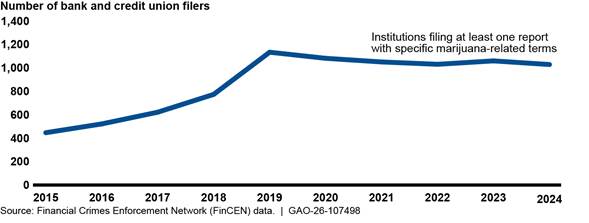
According to FinCEN data, the number of financial institutions that reported providing services to CRBs increased from 2015 to 2019 and then remained relatively steady through 2024. FinCEN requires institutions to include specific terms when filing suspicious activity reports on transactions involving CRBs. FinCEN data indicate that about 1,000 banks and credit unions filed such reports in 2024. These data do not identify how many institutions accept CRBs as ongoing customers as institutions may not report or may not know they are providing services to CRBs, or they may report providing services to a CRB in an occasional transaction but not accept CRBs as ongoing customers. In addition, some institutions filing these reports may only serve ancillary businesses, not plant-touching businesses that directly grow, manufacture, or sell cannabis.
FinCEN Analysis of Numbers of Banks and Credit Unions Filing Selected Suspicious Activity Reports, Fiscal Years 2015–2024
Obtaining and maintaining financial services remain difficult for CRBs, according to CRB owners and managers. For example, CRBs may experience bank account closures, high fees for bank accounts, and high interest rates for business loans. Further, accepting customer payments is difficult largely because two major credit card companies prohibit cannabis purchases. In addition, CRB owners and managers reported that they and their employees face challenges accessing personal financial services due to their work in the cannabis industry.
Why GAO Did This Study
CRBs include state-licensed businesses that grow, manufacture, or sell cannabis products (plant-touching businesses), as well as businesses that support those operations, such as suppliers of growing equipment or providers of legal services (ancillary businesses). Financial institutions may be reluctant to serve CRBs because, with certain exceptions, cannabis is a controlled substance under federal law. As a result, serving these businesses poses legal risks and triggers ongoing BSA compliance obligations.
GAO was asked to review issues related to financial institutions serving CRBs. This report examines (1) the guidance and oversight federal agencies provide to financial institutions on serving state-sanctioned CRBs, (2) factors that affect financial institutions’ decisions about serving CRBs, and (3) challenges CRBs and their employees face in accessing financial services.
GAO reviewed relevant agency guidance and documents, obtained FinCEN’s analysis of data on suspicious activity reports for CRB-related transactions filed from 2015 through 2024, and reviewed literature on CRBs’ access to banking. GAO also conducted nine focus groups and 11 interviews involving a total of 74 financial institutions (selected to represent different asset sizes, institution types, and policies on serving CRBs). Participants were the BSA officer or cannabis banking program manager for each institution. GAO also conducted eight focus groups with owners and managers from 51 CRBs (selected to represent different business sizes and types). Finally, GAO interviewed agency officials, financial and cannabis industry associations, and other interest groups (selected for their expertise or public comments on banking CRBs).
Abbreviations
ACH Automated Clearing House
AML anti-money laundering
ATM automated teller machine
BSA Bank Secrecy Act
CRB cannabis-related business
CSA Controlled Substances Act
DOJ Department of Justice
FDA Food and Drug Administration
FDIC Federal Deposit Insurance Corporation
Federal Reserve Board of Governors of the Federal Reserve System
FinCEN Financial Crimes Enforcement Network
IRS Internal Revenue Service
NCUA National Credit Union Administration
OCC Office of the Comptroller of the Currency
SAR suspicious activity report
THC tetrahydrocannabinol
This is a work of the U.S. government and is not subject to copyright protection in the United States. The published product may be reproduced and distributed in its entirety without further permission from GAO. However, because this work may contain copyrighted images or other material, permission from the copyright holder may be necessary if you wish to reproduce this material separately.
August 7, 2026
The Honorable Elizabeth Warren
Ranking Member
Committee on Banking, Housing, and Urban Affairs
United States Senate
The Honorable Raphael Warnock
Ranking Member
Subcommittee on Economic Policy
Committee on Banking, Housing, and Urban Affairs
United States Senate
The Honorable Tina Smith
Ranking Member
Subcommittee on Housing, Transportation, and Community Development
Committee on Banking, Housing, and Urban Affairs
United States Senate
The Honorable John Fetterman
United States Senate
As of July 2026, 24 states and the District of Columbia have enacted laws legalizing cannabis for both adult recreational and medical use, and an additional 15 states have legalized cannabis exclusively for medical purposes.[1] However, the possession, manufacture, and distribution of cannabis remains illegal under federal law.[2] With certain exceptions, cannabis is a Schedule I controlled substance under the Controlled Substances Act, as amended, meaning that it has no currently accepted medical use, lacks accepted safety for use under medical supervision, and has high potential for abuse.[3]
Despite this federal prohibition, sizeable industries have emerged in states that have legalized cannabis. One report estimated that about 425,000 jobs were supported by state-sanctioned cannabis-related businesses (CRB) in 2024.[4]
Financial institutions may be reluctant to offer services to CRBs because doing so may violate federal criminal laws and trigger certain obligations under the Bank Secrecy Act (BSA) and related anti-money laundering (AML) laws and regulations. Under the BSA, covered financial institutions have requirements to develop, implement, and maintain AML programs and report suspicious transactions.[5] The Financial Crimes Enforcement Network (FinCEN), a bureau within the Department of the Treasury, administers the BSA to help safeguard the U.S. financial system from illicit activity, including money laundering. FinCEN has issued BSA implementing regulations that require financial institutions to file suspicious activity reports (SAR). Institutions must file SARs when they know or suspect a possible violation of law or regulation has occurred, including when a transaction may involve funds derived from illegal activities, such as the sale of cannabis.
The conflict between federal and state law has led CRBs and cannabis industry associations to report challenges accessing basic financial services, including bank accounts and loans.[6] These challenges may also extend to CRB employees seeking personal banking services. Congress has considered, but not enacted, legislation to help address these reported challenges by providing safe harbor protections for financial institutions that serve state-licensed CRBs.[7]
You asked us to review issues related to financial institutions serving CRBs. This report examines (1) the guidance and oversight federal agencies provide to financial institutions on serving state-sanctioned CRBs, (2) factors that affect financial institutions’ decisions about whether and how to serve CRBs, and (3) challenges that CRBs and their employees face in accessing financial services. The scope of our review was limited to CRBs that are licensed and operating in compliance with applicable state cannabis laws and did not include entities unlicensed or operating illegally.
For our first objective, we reviewed guidance related to cannabis banking from relevant federal agencies—FinCEN, the Department of Justice (DOJ), and banking and credit union regulators—and interviewed officials from these agencies.
For our second objective, we obtained FinCEN’s analysis of data on SARs filed by financial institutions for transactions involving CRBs from fiscal years 2015 through 2024.[8] We also conducted focus groups and interviews with officers from 74 financial institutions, selected to include institutions that both do and do not provide services to CRBs and to reflect variation in institution type (bank or credit union) and asset size. We conducted nine focus groups with officers from small- and medium-sized institutions (based on asset size) and 11 interviews with officers from large institutions. We discussed their experiences serving CRBs and the reasons they choose to serve or not serve these customers.
For our third objective, we conducted eight focus groups with a total of 51 CRB owners and managers about their experiences accessing banking services. We also conducted a literature review on how access to banking affects CRBs.
For our second and third objectives, we interviewed representatives of 15 interest groups, including five financial industry associations, four cannabis industry associations, three cannabis banking associations, two associations of state and local cannabis regulators, and one advocacy organization. We selected these groups for their expertise or public comments on cannabis banking. More detailed information on our objectives, scope, and methodology is presented in appendix I.
We conducted this performance audit from April 2024 to August 2026 in accordance with generally accepted government auditing standards. Those standards require that we plan and perform the audit to obtain sufficient, appropriate evidence to provide a reasonable basis for our findings and conclusions based on our audit objectives. We believe that the evidence obtained provides a reasonable basis for our findings and conclusions based on our audit objectives.
Background
Types and Characteristics of Cannabis-Related Businesses
CRBs generally fall into two categories: plant-touching or ancillary. Plant-touching CRBs grow, manufacture, or sell cannabis products. Ancillary CRBs provide other goods or services to plant-touching businesses. The ancillary category comprises a wide range of business sectors, such as professional services (e.g., marketing, accounting, and legal services), construction and repair companies (e.g., plumbing and electrical contractors), and suppliers of products or equipment for growing cannabis (e.g., fertilizer and lighting). Some ancillary businesses exclusively serve the cannabis industry, while others also serve clients from other industries.
Plant-touching businesses generally must obtain a license from the state or states in which they operate. There were 21,760 CRBs with active licenses as of the end of 2025, according to CRB Monitor, a company that collects and analyzes data from licensing agencies nationwide.[9] About 47 percent of these businesses had licenses for cultivation, 39 percent had licenses for retail, and 20 percent had licenses for manufacturing or processing. Smaller shares had licenses for activities such as wholesale and delivery. Eight states—California, Colorado, Michigan, New Mexico, New York, Oklahoma, Oregon, and Washington—accounted for nearly 80 percent of CRBs with active licenses, with California alone accounting for about 22 percent. The number of such CRBs reached 27,852 at the end of 2022 but has declined steadily since then, although trends have varied widely by state.
Two other types of businesses (which were not included in the scope of our review) may provide similar products to those offered by plant-touching CRBs: (1) unlicensed CRBs, which grow, manufacture, or sell cannabis without a state license and therefore violate state law, and (2) hemp businesses.[10] Some hemp products may have psychoactive properties similar to the cannabis products sold by CRBs.
BSA Framework and Requirements
FinCEN oversees the administration of the BSA. The BSA authorizes FinCEN to impose reporting, recordkeeping, and other AML requirements on covered financial institutions, including banks and credit unions.[11] FinCEN’s regulations require these institutions to develop, implement, and maintain effective AML programs. As part of such programs, institutions must establish risk-based customer due diligence procedures. These procedures include understanding the nature and purpose of customer relationships to develop a risk profile for each customer and conducting ongoing transaction monitoring for that customer.[12] If an institution believes a customer transaction is a possible violation of law or regulation, it must file a SAR.[13]
Although FinCEN oversees the administration of the BSA and has independent authority to examine and enforce it, it also relies on federal banking and credit union regulators (federal banking regulators) to examine and supervise financial institutions for compliance with the BSA. These regulators are the Board of Governors of the Federal Reserve System (Federal Reserve), Federal Deposit Insurance Corporation (FDIC), National Credit Union Administration (NCUA), and Office of the Comptroller of the Currency (OCC).[14] NCUA has oversight responsibilities over federally insured credit unions, while the other three agencies oversee banks. The supervisory agency for a particular bank depends on factors such as its charter type and whether it is a member of the Federal Reserve System.
The federal banking regulators perform periodic examinations of bank and credit union compliance with BSA requirements. In addition, FinCEN and the federal banking regulators may take enforcement actions and assess civil money penalties for BSA violations. DOJ may also impose civil or criminal penalties against financial institutions for violating the BSA or federal money laundering statutes.[15]
FinCEN and Federal Banking Regulators Provide Guidance and Oversight for Financial Institutions on Managing CRB-Related Risks
FinCEN’s 2014 Guidance Sets Expectations for Serving CRBs
In 2014, FinCEN issued guidance to financial institutions describing how they can provide services to CRBs consistent with BSA requirements.[16] As of February 2026, this is the only federal guidance that specifically discusses requirements for providing financial services to CRBs.[17] The guidance describes FinCEN’s expectations for financial institutions to meet their BSA obligations when serving CRBs, including (1) conducting risk-based due diligence on CRBs when determining whether to serve or continue serving them and (2) filing SARs, as applicable.
The guidance lists a number of cannabis-related federal law enforcement priorities that are drawn from a 2013 DOJ memo issued by the Deputy Attorney General at the time.[18] Often referred to as the Cole Memo, it directed DOJ attorneys and law enforcement to focus their cannabis-related enforcement resources on preventing specified outcomes, such as the distribution of cannabis to minors and the use of state-licensed cannabis business activity as a front for other illegal enterprises. The guidance instructs institutions to consider whether the CRBs they serve implicate any of these priorities or violate state law.
Conducting Due Diligence
FinCEN’s guidance provides that financial institutions must conduct both initial and ongoing due diligence on CRBs consistent with their BSA obligations. This includes collecting information on prospective CRB customers to assess the risks of providing services. Such information may include verifying that the business is state-licensed, reviewing information the business submitted in its license application, and developing an understanding of its normal and expected activities. When deciding whether to serve a CRB, institutions are expected to consider their ability to effectively manage the associated risks.
After accepting a CRB as a customer, financial institutions must conduct ongoing monitoring. This may include reviewing publicly available sources to identify negative information about the business and monitoring transactions and other activity for indications that the CRB may be interfering with a Cole Memo priority or violating state law. The FinCEN guidance lists 22 “red flags” that may indicate such suspicious activity, including the following:
· Activity indicating that the customer may be using the licensed CRB as a front for laundering money obtained through other criminal enterprises unrelated to cannabis.
· Information that the CRB’s owners, managers, or other related parties have a criminal record or connections to illegal activities or that they have been the subject of enforcement actions by state or local authorities.
· Information that the CRB is engaged in international or interstate activity, such as receiving deposits or transfers from areas outside the state where the business is located.
Filing SARs
According to FinCEN’s guidance, and pursuant to BSA obligations, financial institutions must file SARs when providing financial services to CRBs. The guidance clarifies that, because cannabis remains illegal under federal law, transactions involving CRBs may involve funds derived from illegal activity. Accordingly, institutions are generally required to file SARs for such transactions, consistent with FinCEN’s SAR requirements and reporting thresholds. The guidance specifies that institutions should file one of three SAR types for CRB-related activity:
· “Marijuana Limited” when the institution provides services to a CRB that it reasonably believes does not implicate any of the Cole Memo priorities or violate state law.
· “Marijuana Priority” when the institution provides services to a CRB that it reasonably believes implicates one or more of the Cole Memo priorities or violates state law.
· “Marijuana Termination” when the institution determines that terminating its relationship with a CRB is necessary to maintain an effective AML compliance program.
The federal banking regulators have not issued specific guidance on cannabis banking to the financial institutions they supervise. Instead, agency officials told us they defer to FinCEN and its 2014 guidance. Officials added that they neither encourage nor discourage institutions from providing financial services to CRBs and that decisions about whether to do so are left to individual institutions based on their evaluation of the risks.
The banking regulators and FinCEN issued a joint statement in 2022 explaining that “no customer type presents a single level of uniform risk … related to money laundering, terrorist financing, or other illicit financial activity.”[19] The statement encourages institutions to make case-by-case decisions about which services to provide rather than denying services to entire categories of customers. Although the statement does not reference CRBs explicitly, officials from each of the four federal banking regulators told us that the statement is intended to apply to all customer types, including CRBs.
Federal banking regulator officials also told us that some institutions have sought clarification about providing services to CRBs. In response, they said they refer institutions to FinCEN or its 2014 guidance. FinCEN officials similarly said they generally direct institutions to the guidance and leave it to them to interpret and determine appropriate actions based on the relevant facts and circumstances.
Federal Banking Regulators Use BSA/AML Examinations to Oversee Financial Institutions’ Management of CRB-Related Risks
Federal banking regulators told us they may review how financial institutions manage risks related to CRBs during regular BSA/AML compliance examinations. Officials from each agency said examiners use their judgment to determine whether and how to assess CRB-related risks, as such questions are not a standard component of the examinations. Additionally, consistent with an information-sharing memorandum of understanding between FinCEN and the banking regulators, officials from three of the four regulators said their examiners have access to SARs related to CRB activities.[20] Examiners may review these SARs before an exam to assess whether an institution serves CRBs.
A BSA/AML examination manual providing guidance to federal examiners includes footnotes in two of its sections directing examiners to FinCEN’s 2014 guidance.[21] The manual does not include any additional information specific to financial institutions serving CRBs. However, officials from OCC and NCUA told us they have provided training to examiners on examining institutions that serve CRBs. Officials from the Federal Reserve and FDIC said they have not provided specific training on this topic.
We found no indication that financial institutions have been subject to civil or criminal penalties solely for providing services to CRBs. DOJ officials said their data systems do not allow them to easily identify cases involving financial institutions that serve CRBs, and therefore they could not provide information on whether any institutions had been investigated or prosecuted for serving CRBs. In our interviews, officials from federal banking regulators and financial industry associations did not identify any such instances. Nor did our focus groups and interviews with representatives of dozens of institutions that serve CRBs identify such instances. Furthermore, federal banking regulator officials said that they had not taken any enforcement actions against their supervised institutions solely for serving CRBs.
Legal, Operational, and Community Factors Influence Financial Institutions’ Decisions About Serving CRBs
In focus groups with small- and medium-sized financial institutions and interviews with large financial institutions, participants described weighing legal and regulatory risks, operational costs, community considerations, and financial opportunities when deciding whether and how to serve CRBs. Participants also said that a potential federal safe harbor law for institutions that serve these businesses could influence these decisions. FinCEN data suggest that more institutions have begun serving CRBs over the last 10 years, although those that do represent a relatively small number of all institutions.
Legal and Regulatory Risks Dissuade Some Institutions from Serving CRBs
Participants in our focus groups and interviews with financial institutions said legal and regulatory risks influenced their institutions’ decisions about whether and how to serve CRBs.
Risk of federal sanctions or adverse examination findings. Participants in three of four focus groups and five of six interviews with financial institutions that do not serve CRBs cited regulatory risks as factors in their decisions. These risks include concerns about adverse supervisory actions from their federal banking regulator and conflicting federal and state laws on the legal status of cannabis. For example, one interview participant noted that their institution does not serve CRBs because doing so would require repeatedly filing SARs on such customers, which could draw regulatory scrutiny.
Representatives from one financial industry association and one cannabis banking association similarly said that uncertainty about the future of federal cannabis policy affects financial institutions’ decisions. The cannabis banking association representative said institutions may hesitate to invest in cannabis banking programs given the possibility that federal policy could become more restrictive. In contrast, another representative from a financial industry association said more institutions have become open to serving CRBs in recent years. The representative said this is in part due to the absence of federal enforcement actions—across multiple presidential administrations—against institutions for serving CRBs.
Risks or restrictions associated with particular types of services. Even financial institutions that serve CRBs may limit the services they offer due to legal concerns. Participants in four of five focus groups and two of five interviews with institutions that serve CRBs said they provide fewer or different services to CRBs than to other customers. For example, a few focus group and interview participants said their institutions do not offer international wire transfers to CRBs.[22] Additionally, a few focus group and interview participants noted that they offer limited or no lending services to these businesses. A financial industry association representative explained that lending to CRBs can be risky because cannabis is federally illegal, so the government could seize collateral used to secure the loan.
Operational Cost and Compliance Burden Affect Financial Institutions’ Decisions to Serve CRBs
In addition to legal and regulatory risks, participants said the operational workload and compliance burden associated with serving CRBs—including filing SARs and conducting due diligence, as described in FinCEN’s 2014 guidance—influence whether and how financial institutions serve these businesses.
Operational costs may deter some financial institutions from serving CRBs. Participants in three of four focus groups and one of six interviews with institutions that do not serve CRBs said operational costs contributed to their institution’s decision not to do so. One focus group participant said that their current staff levels are insufficient to begin serving CRBs due to the required onboarding and monitoring activities. Representatives from two financial industry associations and one cannabis banking association similarly said some institutions decide not to serve CRBs to avoid the associated compliance burden.
Operational costs may limit expansion of services to CRBs. Participants in all five focus groups and four of five interviews with financial institutions that serve CRBs said that banking these businesses is operationally challenging. They cited costs such as dedicated staff to manage CRB accounts (cited in all five focus groups and three of the five interviews) and specialized software to monitor CRB customers (cited in four of the five focus groups). Some participants indicated that these costs may limit institutions’ willingness to expand services to CRBs. For example, one participant said their institution was unable to accept additional CRBs as customers due to staff constraints.[23]
Community Need and Financial Opportunities Influence Institutions’ Decisions to Serve CRBs
Participants in our focus groups and interviews with financial institutions cited two primary reasons for serving CRBs:
Community need. Participants in all five focus groups with financial institutions that serve CRBs said the desire to serve their communities contributed to their institutions’ decisions. For example, one participant noted that reducing the amount of cash CRBs hold would improve public safety, while another expressed a desire to meet local businesses’ demand for financial services. Another participant noted that their institution’s state regulator suggested that it serve CRBs because those businesses were having difficulty accessing banking.
Financial opportunities and other business considerations. A few participants in focus groups with financial institutions that serve CRBs said cannabis banking could offer a financial opportunity in an emerging industry. Focus group participants also cited other business considerations that influenced their institutions’ decisions. For example, one participant said their institution chose to continue serving existing customers who entered the cannabis sector rather than close their accounts. Another said their institution believed serving CRBs would be inevitable given the prevalence of these businesses in their communities.
Some Institutions Cited Potential Effects of a Federal Safe Harbor Law
Financial institution officers and industry association representatives we spoke with shared different views on the effects of a federal safe harbor law that would offer protection from civil and criminal liability for serving CRBs operating in compliance with state law. Some said it could lead institutions to begin serving CRBs or expand existing services. Others said that some institutions would not change their policies without other reforms, such as federal legalization of cannabis or reductions in BSA compliance requirements.[24]
Some institutions may begin serving CRBs or expand existing services. In our focus groups with financial institutions that do not serve CRBs, 20 of 25 participants we polled anticipated that a safe harbor law would likely affect the types of CRBs their institution would serve. Representatives from nine financial, cannabis, and cannabis banking associations similarly said such a law would likely increase institutions’ willingness to serve CRBs by reducing legal and regulatory risk and could lead institutions that already serve CRBs to expand services, such as lending. In the five focus groups with institutions that already serve CRBs, most participants we polled (22 of 29) said a safe harbor law likely would not affect the types of services their institution offers.[25] However, participants in three of the five focus groups said it could allow expansion of lending and credit offerings.
Some institutions may not change their policies. When polled, five of the 25 focus group participants from financial institutions that do not serve CRBs expected that a safe harbor law would likely have no effect on their institution’s willingness to serve these businesses. Participants in three focus groups and two interviews with such institutions said broader federal action—such as full legalization—would be necessary to change their institution’s policies.[26]
One participant noted that, even with a safe harbor law, CRBs would still be considered high-risk customers because of the perceived prevalence of illegal activity within the industry, such as money laundering. Similarly, representatives from three financial industry associations and three cannabis banking associations said a safe harbor law would be unlikely to significantly increase the availability of financial services for CRBs. One of the cannabis banking association representatives noted that some institutions are unwilling to serve CRBs unless cannabis is legalized at the federal level.
Effects may depend on third-party payment networks. Some focus group participants noted that the effects of a safe harbor law would partly depend on whether third-party financial service providers, such as credit card companies, change their policies. At present, Mastercard and Visa prohibit the use of their cards for cannabis-related transactions.[27] A few focus group and interview participants from financial institutions that serve CRBs said a safe harbor law would allow their institution to expand services if it led these companies to change their policies. However, an organization representing credit card payment networks stated that these companies would not change their policies unless cannabis is legalized at the federal level.
Effects may depend on compliance burden. A safe harbor law could have greater effect if it reduces the compliance costs of serving CRBs. Focus group participants said such a law would be more likely to prompt their financial institutions to serve CRBs or expand services if it reduces BSA obligations, such as SAR filing or customer due diligence requirements. Specifically, participants in two of four focus groups and two of six interviews with institutions that do not serve CRBs said reducing compliance burdens could make their institutions more comfortable offering financial services to CRBs. More generally, participants in seven of nine focus groups and eight of 11 interviews with institutions that both do and do not serve CRBs noted that federal actions to reduce compliance burdens would significantly affect their decisions about whether and how to serve CRBs.
Available Data Suggest More Financial Institutions Filed Reports on Serving CRBs, but the Number Remains Relatively Small
FinCEN data show that the number of financial institutions that filed reports indicating they provided services to CRBs increased between 2015 and 2024 but remained relatively small compared to the total nationwide. Specifically, the number of banks and credit unions that filed at least one “Marijuana Limited” or “Marijuana Priority” SAR increased each year from fiscal years 2015 to 2019 and then remained relatively steady through fiscal year 2024 (see fig. 1).[28] FinCEN estimated that, in 2024, about 1,000 banks and credit unions filed such SARs, representing about 11 percent of the approximately 9,000 insured depository institutions in the United States.[29] This is consistent with what representatives of a financial industry association and a cannabis banking association told us: while more institutions are now willing to serve CRBs than in the past, most still do not do so.
Figure 1: FinCEN Analysis of Numbers of Banks and Credit Unions Filing Selected Cannabis-Related Suspicious Activity Reports (SAR), Fiscal Years 2015–2024
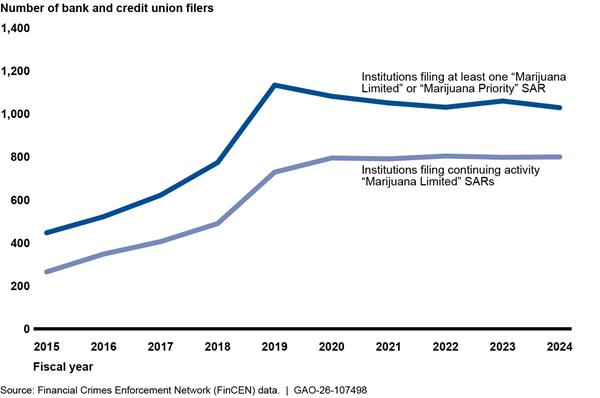
FinCEN data further suggest that most financial institutions filing “Marijuana Limited” SARs had ongoing relationships with CRBs. To simplify filing “Marijuana Limited” SARs for repeat customers, institutions may file a continuing activity SAR every 120 days for the same activity reported in the initial SAR. According to FinCEN data, the number of institutions filing at least one continuing activity “Marijuana Limited” SAR increased each year between fiscal years 2015 and 2020 and then remained steady through 2024 (see fig. 1). Additionally, FinCEN’s analysis shows that, in each fiscal year from 2015 through 2024, most institutions that filed SARs involving CRBs filed at least one continuing activity SAR. This suggests that these institutions were reporting on ongoing customers rather than isolated transactions.
Some financial institutions that filed SARs involving CRBs may only serve ancillary, not plant-touching, businesses. FinCEN’s guidance does not specify the types of CRBs for which institutions are obligated to file SARs. Instead, according to FinCEN officials, the agency leaves this decision to institutions’ discretion.[30] Our review of FinCEN data on entries in the SAR text field for business type identified some entries that likely indicate ancillary businesses, such as “real estate,” “property management,” “law firm,” “marketing,” “consulting,” or “financial institution.” These data are consistent with our interviews and focus groups with financial institutions, which suggested that many institutions file SARs for ancillary CRBs. When polled, 18 of the 30 focus group participants from institutions that serve CRBs indicated that their institutions file SARs for ancillary businesses, as did officers from two of the five institutions we interviewed that serve CRBs.[31]
CRBs and Their Employees Reported Challenges Accessing Financial Services
CRBs Reported Challenges Accessing Bank Accounts, Loans, and Payroll Services
CRB owners and managers in eight focus groups reported a variety of challenges obtaining or maintaining business bank accounts, business loans, and payroll services.
Business Bank Accounts
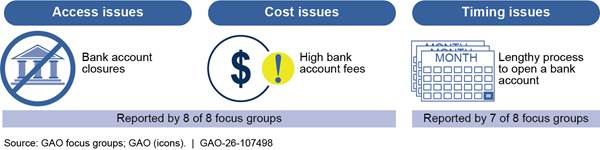
When polled, 43 of 48 focus group participants said they had a bank account for their business.[32] However, participants reported difficulties with these accounts (see fig. 2). For example, they said financial institutions closed their accounts, sometimes with little warning, or charged them high fees.[33] Participants in seven of eight focus groups described paying monthly or annual account fees, with two focus group participants stating they paid $100,000 or more per year. Consistent with these reports, participants in all focus groups with institutions that serve CRBs said their institutions charge CRBs higher fees than other types of customers.
CRB owners and managers also noted that the process of opening an account was lengthy, with some waiting weeks or months before the account was operational. A few focus group participants also discussed engaging with multiple financial institutions before successfully opening an account.[34]
Figure 2: Challenges Related to Business Bank Accounts Reported in Focus Groups with Cannabis-Related Business Owners and Managers
Business Loans and Investments
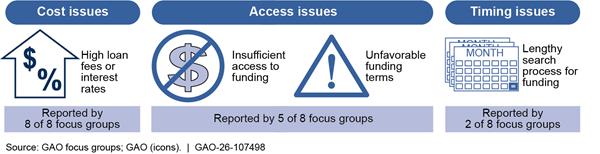
In focus groups, CRB owners and managers reported challenges securing funding, such as loans and investments (see fig. 3). For example, participants stated they were unable to access sufficient funding to meet their business’s needs. Participants also described a lengthy and resource-intensive search process to secure funding. Participants in all eight focus groups reported that banks or other lenders had offered loans with high fees or interest rates, with participants in seven focus groups citing interest rates exceeding 15 percent.[35] Representatives from three cannabis industry associations also reported that CRBs experience high interest rates.
When CRBs are unable to obtain loans from traditional financial institutions, they may turn to nontraditional lenders or private investors, whose funding participants described as involving unfavorable terms. For example, a few focus group participants said that potential investors structured contracts in ways that could allow them to take control of the business.
Figure 3: Funding Challenges Reported in Focus Groups with Cannabis-Related Business Owners and Managers
Given these challenges, a few focus group participants discussed using other funding strategies, such as seeking investments from outside the United States or raising private capital through personal connections.
Another option is government funding. Although CRBs may not be eligible for federal funding, such as Small Business Administration loans, some state or local governments offer grant or loan programs for which CRBs may qualify. Among focus group participants we polled, 14 of 42 said they had sought government funding, and six reported success.[36] However, one participant said they had tried to obtain local government funding but were denied because their business was a plant-touching CRB.
Payroll Services
CRB owners and managers reported using a variety of payroll providers to pay their employees. While at least one participant in six of the eight focus groups said they had not experienced significant challenges related to administering payroll, other participants reported difficulties accessing or maintaining payroll services. In seven of the focus groups, at least one participant said payroll providers had closed or suspended their services; for example, one noted that their provider discontinued services after discovering they were a cannabis business. Participants in three focus groups reported turning to a more manual process, such as paying employees in cash. Representatives from a cannabis regulators’ association and a cannabis banking association noted that CRBs need a business bank account to process paychecks, and account closures (as described above) can disrupt payroll.
CRBs Reported Challenges Related to Credit Card and Electronic Payment Restrictions
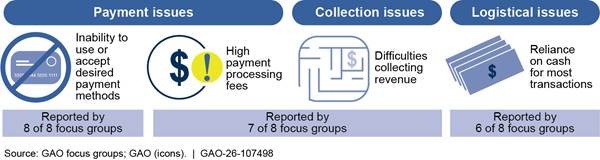
Participants in all of our focus groups with CRB owners and managers reported challenges related to payment processing, particularly credit card transactions (see fig. 4). These challenges largely stem from restrictions by major payment networks, as Mastercard and Visa prohibit the use of their cards to purchase cannabis.[37]
Participants in all eight focus groups said they were unable to accept or use desired payment methods, particularly credit cards. As a result, participants reported incurring high fees, such as ATM-use fees, cash deposit fees, and fees to transport cash. Additionally, one cannabis industry representative noted that the Internal Revenue Service (IRS) may charge a penalty on taxes paid in cash.[38] Participants in seven focus groups also said limited payment options affected their ability to collect revenue from other businesses, such as those in their supply chain.
Some participants said that they must rely on cash for most business transactions, which can create logistical challenges and safety concerns. For example, one participant noted that collecting cash payments is time- and labor-intensive, and a cannabis banking association representative said that some CRBs must travel significant distances to deposit funds because nearby banks do not accept cannabis proceeds. Representatives from four cannabis and financial industry associations noted that holding large amounts of cash makes CRBs targets for theft and robbery. In addition, financial institutions may be reluctant to work with cash-intensive businesses because of concerns about theft and safety, according to a financial industry representative.
Figure 4: Challenges Related to Payment Processing Reported in Focus Groups with Cannabis-Related Business Owners and Managers
Alternatives to cash and card payments used by focus group participants include checks, wire transfers, or Automated Clearing House (ACH) network payments (electronic money transfers sent between banks). However, a cannabis industry representative said ACH payments may be complex, requiring customers to take multiple steps to connect to a bank account, which some may be reluctant to do. A financial industry representative noted that financial institutions may be unwilling to process online payments, including ACH, for CRBs.
Some CRBs attempt to accept card payments from customers despite Mastercard’s and Visa’s prohibitions on cannabis transactions, according to a representative from the Electronic Transactions Association, which represents both companies. For example, CRBs may attempt to circumvent the companies’ rules through deception, such as recording the sale of a non-cannabis item and providing cannabis as a “gift.”[39] According to the representative, payment processors may have difficulty identifying such transactions and determining whether to allow them.
Representatives from five industry associations and other organizations also noted that CRBs use “cashless ATMs” to accept debit card payments.[40] These transactions may violate applicable Visa and Mastercard rules because card processing still occurs, potentially placing card issuers, such as banks and credit unions, at risk. Cashless ATMs and other electronic payment methods can be unreliable and frequently stop working without warning, according to representatives from four cannabis industry and other organizations.
CRB Owners and Managers Reported Challenges Accessing Personal Bank Accounts and Loans
When polled, about half of the 44 owners and managers across all eight focus groups said they or their employees had experienced challenges accessing personal bank accounts and loans because of their work in the cannabis industry (see fig. 5).[41] Participants in seven of the eight focus groups said financial institutions had denied mortgage applications to CRB employees based on their employment. Participants from two focus groups noted that banks may not consider income from a CRB when evaluating a mortgage application.
Figure 5: Personal Banking Challenges Reported in Focus Groups with Cannabis-Related Business Owners and Managers
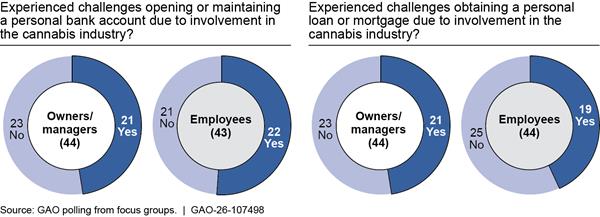
Note: “Owners/managers” reflects the number of participants who reported they had personally experienced each challenge. “Employees” reflects the number of participants who reported being aware that their employees had experienced each challenge. Poll results do not include answers from all 51 focus group participants because some participants did not respond to the poll or did not attend the entire focus group.
Representatives from two cannabis industry associations similarly said that individuals working in the industry can face challenges maintaining bank accounts and obtaining car loans, mortgages, or life insurance. Treatment may vary by an individual’s role within the business. For example, participants in two of four focus groups with financial institutions that do not serve CRBs indicated they would provide personal banking services to CRB employees but not owners.
Challenges May Vary by CRB Characteristics or Owner Attributes
Access to financial services may vary based on whether a CRB is plant-touching or ancillary, its size and location, and attributes of its owners and employees, such as race, gender, or criminal history.
CRB Type
Our focus groups and interviews with financial institutions indicated that some institutions view ancillary businesses as lower risk and are more willing to offer them services. For example, two of five large financial institutions that serve CRBs told us in interviews they only offer services to ancillary businesses, not plant-touching.
Further, owners and employees of ancillary businesses may have fewer challenges accessing personal financial services, according to our focus groups with CRB owners and managers. Two of our eight focus groups consisted of owners and managers of ancillary businesses, and when polled, one-third or fewer of these participants said they and their employees had faced challenges maintaining a personal bank account or getting a mortgage.[42] In contrast, a majority of participants polled in the six focus groups with owners and managers of plant-touching CRBs said they and their employees had faced challenges related to both personal bank accounts and mortgages.[43]
CRB Size
The size of a CRB may affect the challenges it faces, according to our focus groups with CRB owners and managers and interviews with industry associations. A financial industry representative said smaller CRBs may have more trouble raising funding or obtaining insurance, which they may need to receive a cannabis business license. Additionally, one cannabis banking association representative said delays in approval for financial services, such as loans, can be more damaging for small CRBs because they are less likely to have access to interim funding to sustain operations.
However, a few focus group participants said that smaller businesses face fewer financial access challenges because they may receive less scrutiny from financial institutions or payroll providers. One of these participants noted that they had not experienced personal banking challenges and attributed this partly to the small size of their business.
CRB Location
The state in which a CRB is located may affect its access to financial services, according to our focus groups with owners and managers. In one focus group, a participant said their state enacted a law requiring cannabis growers to publicly disclose their address, which they said made it easier for banks to identify customers connected to cannabis and close their personal accounts. Additionally, a few focus group participants with experience operating CRBs in two or more states noted that differences in policies and regulations made some states more challenging to operate in than others.
Race and Gender of CRB Owners
Participants in two focus groups and two cannabis industry representatives said that CRBs owned by women or minorities face greater difficulty securing funding. The representatives noted that minority entrepreneurs may be less likely to have personal or family wealth to draw on, making it harder to gather start-up funds. One participant said that, although states may offer grant programs specifically designed to support minority- or women-owned businesses, CRBs may not be eligible for these programs.
CRB Owners’ Criminal History
Prior arrests or convictions may also affect CRB owners’ access to financial services. As discussed previously, FinCEN’s 2014 guidance identifies a CRB owner’s criminal record as a potential “red flag” that could point to suspicious activity. A representative from a cannabis regulators’ association said this guidance discourages financial institutions from serving such businesses. A cannabis industry association representative also told us that business owners with criminal records face general stigma when seeking banking services.[44]
Participants in all five focus groups and all five interviews with financial institutions that serve CRBs said their institutions may deny services to CRBs whose owners have prior criminal charges. Additionally, one financial industry representative said some institutions will not open accounts for any individuals with a criminal background, and another noted that institutions generally will not provide loans for individuals who were previously incarcerated for drug-related crimes, including crimes related to cannabis prior to state legalization.[45]
However, participants in four of the five focus groups said their financial institution would not necessarily deny services if an owner’s only convictions were cannabis-related, and one financial industry representative said some institutions decide on a case-by-case basis.
CRB Owners and Managers Reported Other Challenges Affecting Their Businesses
In addition to banking-related challenges, CRB owners and managers and industry representatives cited other key challenges facing these businesses:
· Federal tax treatment. Under Internal Revenue Code Section 280E, a business engaging with Schedule I or II controlled substances cannot deduct business expenses for federal tax purposes.[46] Participants in five focus groups with CRB owners and managers described this as a major challenge, and representatives from three cannabis industry associations and one cannabis regulators’ association echoed these concerns.
· Competition from hemp businesses. CRBs compete with hemp businesses that may sell similar products. Hemp businesses have a competitive advantage because they are subject to fewer regulations than CRBs, according to representatives from a cannabis industry association, a cannabis regulators’ association, and a cannabis banking group, as well as a CRB owner.[47] They also noted that certain products marketed as hemp may in fact meet the federal definition of marijuana, but they are not classified as such because of limited testing or oversight.
· Competition from unlicensed operators. Unlicensed CRBs may have a competitive advantage over licensed CRBs because they can avoid many regulatory and financial constraints, according to representatives from three cannabis industry associations, one cannabis regulators’ association, and one cannabis banking group. For example, unlicensed CRBs may misrepresent their business when seeking financial services or filing taxes, allowing them to obtain bank accounts, accept credit cards, and avoid Section 280E.
Agency Comments
We provided a draft of this report to the Department of the Treasury (FinCEN), the Federal Reserve, FDIC, NCUA, OCC, and DOJ for review and comment. NCUA provided written comments, which are reproduced in appendix II. FinCEN provided technical comments, which we incorporated as appropriate. The Federal Reserve, FDIC, OCC, and DOJ did not have any comments on the report.
As agreed with your offices, unless you publicly announce the contents of this report earlier, we plan no further distribution until 30 days from the report date. At that time, we will send copies to the appropriate congressional committees, the Secretary of the Treasury, the Chairman of the Board of Governors of the Federal Reserve System, the Chairman of FDIC, the Chairman of NCUA, the Comptroller of the Currency, the Acting Attorney General of the United States, and other interested parties. In addition, the report will be available at no charge on the GAO website at https://www.gao.gov.
If you or your staff have any questions about this report, please contact me at LaFountainC@gao.gov. Contact points for our Offices of Congressional Relations and Media Relations may be found on the last page of this report. GAO staff who made key contributions to this report are listed in appendix III.

Courtney LaFountain
Director, Financial Markets and Community Investment
This report examines (1) the guidance and oversight federal agencies provide to financial institutions on serving state-sanctioned cannabis-related businesses (CRB), (2) factors that affect financial institutions’ decisions about whether and how to serve CRBs, and (3) challenges that CRBs and their employees face in accessing financial services. The scope of our review was limited to CRBs that are licensed and operating in compliance with applicable state laws and did not include entities unlicensed or operating illegally.
Review of Data on Licensed CRBs
To provide background on the cannabis industry, we requested data on the number and characteristics of licensed CRB entities from CRB Monitor, a company that collects and analyzes data from licensing agencies nationwide. Specifically, we requested data on the number of CRB entities, in total and by state, for calendar years 2021 through 2025. We also requested data on the number of entities by license type (e.g., cultivation or retail). In reporting on licensed CRB entities using CRB Monitor data, we limited our analysis to CRBs licensed as businesses and individual license holders that are registered as a business entity. We excluded individuals who hold a CRB license but are not operating as a registered business.
To assess the reliability of these data, we met with CRB Monitor staff and reviewed written information they provided for any logical inconsistencies and completeness. We found these data to be sufficiently reliable for describing the number, locations, and types of licensed CRB entities.
Review of Cannabis Banking Requirements and Interviews with Agency Officials
For our first objective, we reviewed guidance related to cannabis banking issued by federal agencies: the Financial Crimes Enforcement Network (FinCEN) and four federal banking regulators—the Office of the Comptroller of the Currency, Federal Deposit Insurance Corporation (FDIC), Board of Governors of the Federal Reserve System, and National Credit Union Association (NCUA). Specifically, we reviewed all guidance these agencies provided to financial institutions on serving state-licensed CRBs. We interviewed officials from these agencies about the formal and informal guidance they provided to institutions, the types of questions or comments they received, and their processes for overseeing how institutions serve CRBs.
We also reviewed Department of Justice (DOJ) guidance related to federal cannabis enforcement priorities. We interviewed DOJ officials about DOJ policies and priorities for investigating and taking enforcement action on cannabis-related crimes, including financial crimes, in states with laws permitting medical or recreational cannabis use.
We reviewed documentation related to FinCEN’s and the federal banking regulators’ processes and procedures for overseeing how financial institutions serve CRBs, such as examination manuals and examiner training materials. In addition, we asked these agencies whether, as of August or September 2024, they had taken any formal or informal actions against institutions for serving state-licensed CRBs. We requested documentation related to any such actions. We also requested information from DOJ on any investigations or prosecutions of institutions for providing services to state-licensed CRBs.
FinCEN Analysis of SAR Data
For our second objective, to determine the number of financial institutions that filed reports on serving CRBs, we obtained FinCEN’s analysis of data on suspicious activity reports (SAR) filed by financial institutions on transactions involving CRBs from fiscal years 2015 through 2024 (the most recent data available at the time of our review). FinCEN analyzed these data in response to our request for information on the numbers and characteristics of institutions that filed these SARs.
While SAR data indicate the number of institutions that reported providing services to CRBs, they do not identify how many institutions knowingly accept CRBs as ongoing customers. Institutions may not report or may not know they are providing services to CRBs, or they may report providing services to a CRB in an occasional transaction but not accept CRBs as ongoing customers. In addition, some institutions filing SARs may only provide services to ancillary businesses.
Further, SARs pertaining to CRBs are not captured within FinCEN’s full SARs database in a structured format. Institutions are instructed to signal that a SAR involves a CRB by entering one of three specific terms—“Marijuana Limited,” “Marijuana Priority,” or “Marijuana Termination”—in a narrative text field. For the analyses it conducted for us, FinCEN identified these SARs by searching for those exact phrases. Thus, SARs containing deviations from the specified terms (such as misspellings or typos) may not have been captured in FinCEN’s counts.
In response to our request, FinCEN analyzed data on SARs containing one of the three terms that were filed from fiscal years 2015 through 2024. FinCEN identified the number of SARs filed by type (marijuana limited, priority, or termination), institution characteristics (such as depository or nondepository institution), and fiscal year. FinCEN also counted the number of institutions that filed “Marijuana Limited” SARs that were identified as continuing activity SARs, indicating that a previous SAR had been filed for the same customer and activity. After receiving the summary data from FinCEN, we performed additional calculations on these data, such as summing across different SAR categories or institution types.
Additionally, to better understand the types of businesses for which institutions filed SARs, we requested and reviewed FinCEN data from the SAR field for business type, which is a text field. Specifically, for SARs that it identified as involving CRBs, FinCEN compiled a list of all entries in this field and the number of times that each entry appeared between fiscal years 2015 and 2024. We reviewed the entries with the highest frequency counts to determine if any of them appeared to refer to ancillary businesses.
To assess the reliability of FinCEN’s analysis, we interviewed FinCEN officials about how the agency extracted and analyzed these data. We also reviewed written descriptions of FinCEN’s methods. Additionally, we compared the FinCEN data on SAR filings to similar summary data that FinCEN has reported publicly to check for consistency. Finally, we performed electronic testing to check for obvious errors in accuracy and completeness, and we worked with FinCEN to address any questions with respect to our data request. We found these data to be sufficiently reliable for describing the numbers and characteristics of financial institutions that filed different types of SARs involving CRBs.
Focus Groups and Interviews with CRBs and Financial Institutions
For our second and third objectives, we conducted nine focus groups and 11 interviews with officers from financial institutions that do and do not serve CRBs, involving a total of 74 institutions. For the third objective, we also conducted eight focus groups with CRB owners and managers, with 51 total participants. Each focus group included between three and 10 participants. We designed the focus groups and interviews to obtain in-depth information about our specific topics of interest. The results are not generalizable and represent views of only the participants in our focus groups or interviews.
To recruit focus group participants, we asked relevant industry associations (representing financial institutions and CRBs, respectively) to distribute invitations to their members or contacts. In outreach to financial institutions, we specified that participants should be Bank Secrecy Act officers or managers responsible for their institution’s cannabis banking program, if applicable.
We also conducted individual outreach to large institutions (banks with more than $10 billion in assets and credit unions with more than $5 billion in assets) and to institutions of various sizes that serve CRBs to ensure a sufficient number from each group. We used publicly available data from FDIC and NCUA to identify and contact large institutions, and we used a cannabis industry guide to identify institutions that publicly report serving CRBs.[48]
Potential participants completed a short survey providing contact information and basic details about their institution or business, which we used to organize focus groups of participants sharing similar characteristics.
For financial institutions, we organized focus groups by institution type (bank or credit union), whether the institution served CRBs (based on self-reported survey responses), and asset size. Five of the nine focus groups consisted of institutions that served CRBs, and four consisted of institutions that did not. A total of 63 institutions participated in the focus groups, including 38 that served CRBs and 25 that did not.
To identify asset size categories, we reviewed those used by federal banking regulators and financial industry trade associations. We also analyzed publicly available asset data from NCUA and FDIC call reports. We retrieved the data from FDIC’s and NCUA’s websites in November 2024. Because recruiting large institutions proved difficult, we conducted 11 individual interviews with representatives from those institutions instead of focus groups (five served CRBs, and six did not).
For CRB owners and managers, we organized focus groups based on the number of employees and whether the CRB was plant-touching (i.e., directly handles cannabis products) or ancillary, based on self-reported survey responses. Six of the eight focus groups consisted of owners and managers of plant-touching businesses (with a total of 33 participants), while the other two groups consisted of owners and managers of ancillary businesses (with a total of 18 participants).
A GAO facilitator moderated all focus groups and interviews using videoconferencing software (Zoom) and a structured discussion guide. For financial institutions, the guide included open-ended questions about institutions’ decision-making processes for whether and how to serve CRBs; their policies and experiences providing different types of services (e.g., checking accounts and loans) to CRBs; and their perspectives on how, if at all, a federal safe harbor law (protecting institutions from civil and criminal liability for serving CRBs operating in compliance with state law) or other potential federal actions might affect these decisions.
For CRB owners and managers, the guide included questions about their experiences and challenges accessing financial services for their business, as well as their own and their employees’ experiences and challenges accessing personal banking services. In both types of focus groups, we also polled individual participants using a small number of closed-ended questions.
For each focus group and interview, at least two GAO staff took detailed, transcript-style notes to capture participants’ statements as accurately as possible without including personally identifiable information. To analyze this information, two GAO analysts reviewed each transcript to identify and record common themes. Another analyst reviewed these themes for clarity and comprehensiveness. Two analysts then independently identified whether the themes were present in each transcript. The analysts resolved any areas of disagreement through discussion or, if needed, review by a third analyst.
As part of our content analysis, we identified participant statements from the interview and focus group transcripts to serve as illustrative examples for each theme. Because we did not conduct a systematic or exhaustive search for every instance of these specific examples, we do not report frequency counts by focus group or interview. In cases in which we only identified one example, we report that as an example originating from a single focus group or interview participant. In cases in which we identified more than one participant who shared the same example, we use the quantifier of “a few” to denote a frequency of two to five instances of such examples.
Interviews with Industry Associations and Other Organizations
For our second and third objectives, we used a structured set of questions to interview representatives of
· five financial industry associations—the American Bankers Association, America’s Credit Unions, Independent Community Bankers of America, National Bankers Association, and Electronic Transactions Association;
· four cannabis industry associations—the National Cannabis Industry Association, U.S. Cannabis Council, Minority Cannabis Business Association, and National Hispanic Cannabis Council;
· three cannabis banking associations—the Cannabis Financial Industry Group, Financial Cannabis Network, and Association for Cannabis Banking;
· two associations of state and local cannabis regulators—the Cannabis Regulators Association and Cannabis Regulators of Color Coalition; and
· one advocacy organization that opposes cannabis legalization—Smart Approaches to Marijuana.
Interview topics included the extent to which institutions provide services to CRBs, challenges related to CRBs’ financial access, and the effect of potential legislation or other federal actions on CRBs’ financial access. We selected these organizations for their expertise or public comments on cannabis banking.
To analyze the interview information, we performed a content analysis that quantified the number of interviews in which participants discussed particular topics or perspectives. One analyst reviewed the interview notes to identify common themes, and other analysts reviewed these themes for clarity and comprehensiveness. Once the themes were finalized, one analyst assessed the notes from each interview to determine whether the themes were present, and another analyst reviewed these determinations. The analysts then discussed areas of disagreement to reach consensus.
Review of Literature on Effects of Banking Access on CRBs
For our third objective, we performed a literature search on how access to financial services affects CRBs, including any effects on profitability and growth. To identify peer-reviewed or high-quality studies, we searched databases such as Scopus, EconLit, and ProQuest Research Library. From these sources, we identified five studies published between January 2015 and June 2025 that were relevant to our research objective. Two GAO specialists reviewed the studies for methodological soundness and identified two that met our criteria for methodological quality and provided reliable information on the effects of banking access on CRBs.
We conducted this performance audit from August 2024 to August 2026 in accordance with generally accepted government auditing standards. Those standards require that we plan and perform the audit to obtain sufficient, appropriate evidence to provide a reasonable basis for our findings and conclusions based on our audit objectives. We believe that the evidence obtained provides a reasonable basis for our findings and conclusions based on our audit objectives.
GAO Contact
Courtney LaFountain, LaFountainC@gao.gov
Staff Acknowledgments
In addition to the contact named above, Marshall Hamlett (Assistant Director), Hannah Dodd (Analyst in Charge), Tracy Abdo, Jose Altamirano, Lauren Capitini, Chelsea Carter, Lilia Chaidez, Shidi Dai, Pamela Davidson, Dylan Desjardins, Garrett Hillyer, Marc Molino, Patricia Palao Da Costa, Lindsay Shapray, and Mary Stack made key contributions to this report.
The Government Accountability Office, the audit, evaluation, and investigative arm of Congress, exists to support Congress in meeting its constitutional responsibilities and to help improve the performance and accountability of the federal government for the American people. GAO examines the use of public funds; evaluates federal programs and policies; and provides analyses, recommendations, and other assistance to help Congress make informed oversight, policy, and funding decisions. GAO’s commitment to good government is reflected in its core values of accountability, integrity, and reliability.
Obtaining Copies of GAO Reports and Testimony
The fastest and easiest way to obtain copies of GAO documents at no cost is through our website. Each weekday afternoon, GAO posts on its website newly released reports, testimony, and correspondence. You can also subscribe to GAO’s email updates to receive notification of newly posted products.
Order by Phone
The price of each GAO publication reflects GAO’s actual cost of production and distribution and depends on the number of pages in the publication and whether the publication is printed in color or black and white. Pricing and ordering information is posted on GAO’s website, https://www.gao.gov/ordering.htm.
Place orders by calling (202) 512-6000, toll free (866) 801-7077,
or
TDD (202) 512-2537.
Orders may be paid for using American Express, Discover Card, MasterCard, Visa, check, or money order. Call for additional information.
Connect with GAO
Connect with GAO on X,
LinkedIn, Instagram, and YouTube.
Subscribe to our Email Updates. Listen to our Podcasts.
Visit GAO on the web at https://www.gao.gov.
To Report Fraud, Waste, and Abuse in Federal Programs
Contact FraudNet:
Website: https://www.gao.gov/about/what‑gao‑does/fraudnet
Automated answering system: (800) 424-5454
Media Relations
Sarah Kaczmarek, Managing Director, Media@gao.gov
Congressional Relations
David A. Powner, Acting Managing Director, CongRel@gao.gov
General Inquiries
[1]Bloomberg Law, “In Focus: Cannabis,” accessed July 27, 2026, https://www.bloomberglaw.com/external/page/infocus_medical_marijuana. Bloomberg Law also reports that nine states have enacted laws permitting the possession of cannabis products containing low levels of tetrahydrocannabinol (THC).
[2]The terms “cannabis” and “marijuana” both refer to certain parts, derivatives, and other features of the cannabis sativa L. plant, which contains the psychoactive or mind-altering chemical delta-9-THC, as well as other related compounds. Federal law and guidance generally use the term “marijuana.” In this report, we use the term “cannabis” because it is typically used by the industry in states that legalized adult use.
[3]Pub. L. No. 91-513, 84 Stat. 1242 (1970), codified as amended at 21 U.S.C. §§ 801-904. The Controlled Substances Act (CSA) classifies all federally controlled substances into categories known as schedules depending upon, among other things, the drug’s likelihood for abuse or dependence and whether the drug has an accepted medical use. These schedules range from I through V, with Schedule I having the greatest restrictions. Schedule I substances are those that have been found by the federal government to have a high potential for abuse, no currently accepted medical use in treatment in the United States, and a lack of accepted safety for use under medical supervision. On December 18, 2025, President Trump signed Executive Order 14370, which directed the Attorney General to complete the rulemaking process to reschedule marijuana from Schedule I to Schedule III. Unlike Schedule I substances, Schedule III substances have an accepted medical use and may be dispensed by prescription if approved by the Food and Drug Administration (FDA). On April 23, 2026, the Department of Justice (DOJ) issued a final rule placing in Schedule III (1) those FDA-approved drug products that contain delta-9-THC falling within the CSA’s definition of marijuana, specifically FDA-approved drug products containing delta-9-THC derived from the plant cannabis sativa L., other than the mature stalks and seeds; and (2) marijuana subject to a state medical marijuana license. Any form of marijuana other than in an FDA-approved drug product or marijuana subject to a state medical marijuana license remains a Schedule I controlled substance, and those who handle such material remain subject to the regulatory controls and administrative, civil, and criminal sanctions applicable to Schedule I controlled substances set forth in the CSA and associated regulations. Schedules of Controlled Substances: Rescheduling of Food and Drug Administration Approved Products Containing Marijuana from Schedule I to Schedule III; Corresponding Change to Permit Requirements, 91 Fed. Reg. 22,714 (Apr. 28, 2026). Litigation challenging DOJ’s final rule has been filed. See Smart Approaches to Marijuana (SAM) Inc., et al. v. Department of Justice, et al., No. 26-1106 (D.C. Cir. filed May 4, 2026). DOJ also announced the initiation of an expedited administrative hearing process to consider the broader rescheduling of cannabis from Schedule I to Schedule III. Schedules of Controlled Substances: Rescheduling of Marijuana, 91 Fed. Reg. 22,777 (Apr. 28, 2026). The hearing took place from June 29, 2026, through July 15, 2026.
[4]Beau Whitney, U.S. Cannabis Jobs Report 2025—The State of Cannabis Jobs: Challenges, Changes, and Optimism for the Future (Vangst, 2025).
[5]The legislative framework generally referred to as the BSA (and used in this report) consists of the Currency and Foreign Transactions Reporting Act of 1970, as amended by the Uniting and Strengthening America by Providing Appropriate Tools Required to Intercept and Obstruct Terrorism Act of 2001 (USA PATRIOT Act), and other legislation, including the Anti-Money Laundering Act of 2020 (AML Act). The BSA is codified at 12 U.S.C. §§ 1829b and 1951–1960, and 31 U.S.C. §§ 5311–5314 and 5316–5336, and includes notes thereto, with implementing regulations at 31 C.F.R. chapter X. Additionally, 18 U.S.C. §§ 1956, 1957 criminalize engaging in financial transactions involving the proceeds of certain enumerated unlawful activities, including certain offenses that may include marijuana-related business activities.
[6]See, for example, Mrinalika Roy, “High & Dry: Banking Crisis to Further Choke Funding for Cannabis Sector,” Reuters, Mar. 24, 2023, https://www.reuters.com/business/high-dry-banking-crisis-further-choke-funding-cannabis-sector-2023-03-24; and Paul Demko, “Why Weed Companies Can’t Make Any Money,” Politico, Sept. 4, 2022, https://www.politico.com/news/2022/09/04/weed-companies-cant-make-money-00054541.
[7]The most recent proposed legislation is the Secure and Fair Enforcement Regulation Banking Act (SAFER Banking Act) of 2023. This bill would provide protection from, among other things, civil and criminal liability and from adverse or corrective supervisory actions from federal regulators. S. 2860, 118th Cong., §§ 3, 5 (2023).
[8]We requested and obtained FinCEN’s analysis on the number and characteristics of institutions filing these SARs and the types of SARs submitted.
[9]These figures include business entities with active CRB licenses, as well as entities for which an individual is the license holder, but the license is classified as a business entity. They do not include individuals who are licensed but not operating as a business.
[10]Although the terms “marijuana” and “hemp” both describe parts and derivatives of the cannabis plant, they are distinct under federal law. The Agriculture Improvement Act of 2018 (2018 Farm Bill) legalized hemp by removing it from Schedule I of the CSA and defined it as the cannabis sativa L. plant and any part of that plant, and all derivatives, extracts, cannabinoids, isomers, acids, salts, or salts of isomers, whether growing or not, that contain up to 0.3 percent delta-9-THC by dry weight. Pub. L. No. 115-334, § 10113, 132 Stat. 4490, 4908, codified at 7 U.S.C. § 1639o(1). In contrast, any parts or derivatives of the plant that contain more than 0.3 percent delta-9-THC by dry weight continue to be a controlled substance under federal law. Recently enacted legislation narrows the definition of hemp by (1) replacing the previous delta-9-THC threshold with a total THC limit, which includes delta-9-THC, tetrahydrocannabinolic acid, and other THC compounds, and (2) excluding from the definition of hemp certain parts of the cannabis sativa L. plant and delineated intermediate hemp-derived cannabinoid products, among other things. These new exclusions from the definition of hemp will be considered marijuana, a controlled substance, effective Nov. 12, 2026. Pub. L. No. 119-37, § 781, 139 Stat. 495, 558 (2025).
[11]For purposes of this report, “financial institution” (or simply “institution”) means a bank or credit union. It does not include other entities that may be considered financial institutions under FinCEN’s guidance and regulations.
[12]31 C.F.R. § 1020.210(a)(2)(v)(a) and (b).
[13]FinCEN regulations require banks and credit unions to file a SAR in various circumstances, including when a transaction is conducted or attempted by, at, or through a bank or credit union, and that transaction involves or aggregates at least $5,000 in funds or other assets, and the bank knows, suspects, or has reason to suspect that: (1) the transaction involves funds derived from illegal activities or is intended or conducted in order to hide or disguise funds or assets derived from illegal activities as part of a plan to evade federal legal requirements or avoid federal legal reporting requirements; (2) the transaction is designed to evade certain FinCEN regulations; or (3) the transaction has no business or apparent lawful purpose or is not the sort in which the particular customer would normally be expected to engage, and the bank has no reasonable explanation for the transaction after evaluating all available facts. 31 C.F.R. §§ 1020.320.
[14]In this report, we use the term “federal banking regulators” to refer collectively to the regulators of federally insured banks and credit unions—the Federal Reserve, FDIC, NCUA, and OCC. Under FinCEN regulations, a “federal functional regulator” includes these four agencies, as well as the Securities and Exchange Commission and Commodity Futures Trading Commission. 31 C.F.R. § 1010.100(r). Apart from their delegated examination authority under the BSA, the federal functional regulators have their own regulatory authority to examine the institutions they supervise for compliance with the BSA.
[15]Federal money laundering statutes relevant to this review are codified at 18 U.S.C. §§ 1956, 1957.
[16]Financial Crimes Enforcement Network, BSA Expectations Regarding Marijuana-Related Businesses, FIN-2014-G001 (Feb. 14, 2014).
[17]Additionally, FinCEN and the banking regulators have issued guidance on serving hemp-related businesses. In 2019, FinCEN, the Federal Reserve, FDIC, NCUA, and OCC issued a joint statement called Providing Financial Services to Customers Engaged in Hemp-Related Businesses. FinCEN subsequently issued more detailed supplemental guidance. Financial Crimes Enforcement Network, FinCEN Guidance Regarding Due Diligence Requirements under the Bank Secrecy Act for Hemp-Related Business Customers, FIN-2020-G001 (June 29, 2020).
[18]Department of Justice, Office of the Deputy Attorney General, Guidance Regarding Marijuana Enforcement, Memorandum for All United States Attorneys (Aug. 29, 2013). The memorandum was rescinded in 2018. Department of Justice, Office of the Attorney General, Marijuana Enforcement, Memorandum for All United States Attorneys (Jan. 4, 2018).
[19]Board of Governors of the Federal Reserve System, Federal Deposit Insurance Corporation, Financial Crimes Enforcement Network, National Credit Union Administration, and Office of the Comptroller of the Currency, Joint Statement on the Risk-Based Approach to Assessing Customer Relationships and Conducting Customer Due Diligence (July 6, 2022).
[20]Board of Governors of the Federal Reserve System, Federal Deposit Insurance Corporation, National Credit Union Administration, Financial Crimes Enforcement Network, Office of the Comptroller of the Currency, and Office of Thrift Supervision, Memorandum of Understanding (Sept. 2004).
[21]This manual is issued by the Federal Financial Institutions Examination Council, an interagency body that prescribes uniform principles, standards, and report forms for the federal examination of financial institutions by its member agencies and makes recommendations to promote uniformity in the supervision of financial institutions. Its constituent agencies are the Federal Reserve, FDIC, NCUA, OCC, the Consumer Financial Protection Bureau, and the State Liaison Committee (five representatives from state regulatory agencies that supervise financial institutions). The two sections containing references to FinCEN’s 2014 guidance are “Suspicious Activity Reporting—Overview” and “Transactions of Exempt Persons.” The latter section also references information in FinCEN’s 2014 guidance regarding financial institutions’ currency transaction reporting requirements with respect to CRBs. Federal Financial Institutions Examination Council, Bank Secrecy Act/Anti-Money Laundering Examination Manual (Washington, D.C.), https://bsaaml.ffiec.gov/manual.
[22]As discussed in app. I, we use the quantifier “a few” to denote examples that we identified as being shared by two to five participants in our focus groups and interviews with financial institutions and CRBs. Because we did not conduct a systematic or exhaustive search for these examples, our counts may not be comprehensive.
[23]Even if financial institutions do not serve CRBs, they may incur costs from conducting due diligence to screen out CRB account applicants. Participants from all four focus groups and three of six interviews with institutions that do not serve CRBs said that the complexity of identifying these prospective customers is challenging.
[24]In our focus groups and interviews with financial institution officers, we asked how a safe harbor law, as defined above, might affect their institutions. We referenced the proposed Secure and Fair Enforcement Banking Act (SAFE Banking Act) of 2023 and Secure and Fair Enforcement Regulation Banking Act (SAFER Banking Act) of 2023 as examples. However, these bills may offer safe harbor protections that differ from the definition used in our discussions.
[25]These poll results do not include answers from all 38 participants because we did not include this poll in one of the focus groups with institutions that serve CRBs. Additionally, one participant from another focus group departed before the poll was conducted.
[26]In addition to federal legalization, some participants discussed rescheduling cannabis. As discussed earlier, on December 18, 2025, President Trump signed an executive order that directed the Attorney General to complete the rulemaking process to reschedule marijuana from Schedule I to Schedule III under the CSA. Increasing Medical Marijuana and Cannabidiol Research, 90 Fed. Reg. 60,541 (Dec. 23, 2025). On April 23, 2026, DOJ issued a final rule placing in Schedule III certain FDA-approved drug products and marijuana subject to a state medical marijuana license. Schedules of Controlled Substances: Rescheduling of Food and Drug Administration Approved Products Containing Marijuana From Schedule I to Schedule III; Corresponding Change to Permit Requirements, 91 Fed. Reg. 22,714 (April 28, 2026). Litigation challenging DOJ’s final rule has been filed. See Smart Approaches to Marijuana (SAM) Inc., et al. v. Department of Justice, et al., No. 26-1106 (D.C. Cir. filed May 4, 2026). DOJ also announced the initiation of an expedited administrative hearing process to consider the broader rescheduling of cannabis from Schedule I to Schedule III. Schedules of Controlled Substances: Rescheduling of Marijuana, 91 Fed. Reg. 22,777 (April 28, 2026). The hearing took place from June 29, 2026, through July 15, 2026. A representative from a cannabis banking association explained that, even if cannabis were rescheduled, it would remain federally illegal, and financial institutions would still have to adhere to existing BSA obligations. However, the representative noted that some institutions may be more willing to provide cannabis banking services due to a perceived reduction in risk. A few participants in our focus groups with institutions that do not serve CRBs predicted that rescheduling would significantly affect their cannabis banking policies.
[27]Visa and Mastercard process transactions for debit and credit cards issued under their respective brand names. They publish rules that govern transaction processing that apply to system participants, including card issuers (such as banks and credit unions) and automated teller machine (ATM) operators.
[28]FinCEN’s 2014 guidance instructs financial institutions to include one of three phrases in the narrative field of the SAR to identify the report as involving a CRB. Institutions should file a “Marijuana Termination” SAR when terminating a relationship with a CRB and a “Marijuana Priority” SAR if they believe a CRB has violated state law or interfered with a law enforcement priority outlined in the Cole Memo. Otherwise, institutions should file a “Marijuana Limited” SAR. While data on “Marijuana Limited” and “Marijuana Priority” SARs indicate the number of institutions that reported providing services to CRBs, they do not identify how many institutions accept CRBs as ongoing customers. Institutions may not report or may not know they are providing services to CRBs, or they may report providing services to a CRB in an occasional transaction but not accept CRBs as ongoing customers. Further, SARs pertaining to CRBs are not captured within FinCEN’s full SARs database in a structured format. Institutions are instructed to signal that a SAR involves a CRB by entering “Marijuana Limited,” “Marijuana Priority,” or “Marijuana Termination” (as appropriate) in a narrative text field. For the summary data it provided to us, FinCEN identified these SARs by searching for those exact phrases. Thus, SARs containing deviations from the specified terms (such as misspellings or typos) may not have been captured in FinCEN’s counts. See app. I for additional information on this analysis.
[29]According to FDIC and NCUA data, there were 4,487 insured banks and 4,455 insured credit unions as of the fourth quarter of 2024. These figures exclude state-regulated banks and credit unions that are not insured by FDIC or NCUA.
[30]FinCEN’s 2014 guidance includes a footnote acknowledging that financial institutions may have to exercise judgment in determining whether to file a SAR for a transaction that “indirectly” serves a CRB (e.g., a transaction with an ancillary business).
[31]These poll results do not include answers from all 38 focus group participants because we did not include this poll in one of the focus groups with institutions that serve CRBs.
[32]These poll results do not include answers from all 51 participants because some participants did not respond to the poll or did not attend the entire focus group.
[33]Institutions may accept and then later close CRBs’ accounts for a variety of reasons. For example, a representative from a cannabis banking association and focus group participant noted that mergers can lead to closures, such as when a bank that does not serve CRBs acquires one that does.
[34]A small number of studies suggests that access to a bank account may affect CRB performance. Specifically, two studies using data from Washington state found that CRBs with bank accounts were more profitable than similar CRBs without them. However, these analyses are limited to one state and are not generalizable to other states or to all CRBs. Elizabeth A. Berger and Nathan Seegert, “Half Banked: The Economic Impact of Cash Management in the Marijuana Industry,” The Journal of Finance, vol. 79, no. 4 (2024), https://doi.org/10.1111/jofi.13364; and Gursharan Bhue, “Government Certification, Financial Access, and Growth: Evidence from the U.S. Marijuana Industry” (Oct. 1, 2018), https://ssrn.com/abstract=3263712.
[35]A survey administered by the Federal Reserve Bank of Kansas City provides one point of comparison between the interest rates CRB owners and managers reported and the interest rates offered to other types of businesses. This quarterly survey—which covers loans made by domestically chartered commercial banks to nonfarm businesses with no more than $5 million in annual gross revenue—found that median interest rates ranged from 7.42 to 7.91 percent in the first quarter of 2025 (the period during which we conducted our focus groups with CRB owners and managers). Daniel Harbour and Christina Louie, “Small Business Lending Continues to Increase” (Kansas City, MO: Federal Reserve Bank of Kansas City, Dec. 18, 2025), https://www.kansascityfed.org/surveys/small-business-lending-survey/small-business-lending-continues-to-increase/.
[36]These poll results do not include answers from all 51 participants because some participants did not respond to the poll or did not attend the entire focus group.
[37]When credit card companies detect that a CRB is violating this policy by accepting card payments, they many ban the business or its owner from future use of the company’s credit or debit cards, according to a cannabis banking association representative.
[38]IRS states that all businesses are required to make federal tax deposits electronically and face a 10 percent penalty if they do not. However, IRS may relieve businesses from this penalty on a case-by-case business if they do not have access to a bank account based on reasonable cause. Internal Revenue Service, “Cash Payments to the IRS over $10,000: Frequently Asked Questions” (Washington, D.C.: Dec. 3, 2025), https://www.irs.gov/payments/cash-payments-to-the-irs-over-10000-frequently-asked-questions.
[39]A Congressional Research Service report similarly noted that cannabis is sometimes provided as a ”gift” to individuals who purchase other, non-cannabis goods. Congressional Research Service, “The Evolution of Marijuana as a Controlled Substance and the Federal-State Policy Gap” (Washington, D.C.: Apr. 7, 2022), https://www.congress.gov/crs_external_products/R/PDF/R44782/R44782.5.pdf.
[40]A cashless ATM is an in-store device allowing customers to swipe a debit card to deposit money directly into a merchant’s account. To avoid scrutiny from the card issuer, the device disguises the transaction so that it appears to be a cash withdrawal from an ATM. The amount of the purchase may be rounded up to the nearest $20 denomination, and the retailer gives the customer the difference in cash.
[41]These poll results do not include answers from all 51 participants because some participants did not respond to the poll or did not attend the entire focus group.
[42]When polled, four participants in focus groups with ancillary CRBs said they had faced challenges opening or maintaining a personal bank account, while 14 said they had not; five participants said they had faced challenges obtaining a personal loan or mortgage, while 13 said they had not. Additionally, five participants from these focus groups said they were aware that their employees had faced challenges opening or maintaining a personal bank account, while 13 said they were not; three participants said they were aware that their employees had faced challenges obtaining a personal loan or mortgage, while 15 said they were not.
[43]When polled, 17 participants in focus groups with plant-touching CRBs said they had faced challenges opening or maintaining a personal bank account, while nine said they had not; 16 participants said they had faced challenges obtaining a personal loan or mortgage, while 10 said they had not. Additionally, 17 participants from these focus groups said they were aware that their employees had faced challenges opening or maintaining a personal bank account, while eight said they were not; 16 participants said they were aware that their employees had faced challenges obtaining a personal loan or mortgage, while 10 said they were not. These poll results do not include answers from all 33 participants because some participants did not respond to the polls or did not attend the entire focus group.
[44]We have ongoing work reviewing the evolution and economic effects of drug laws, regulations, and policies since 1970 (including those related to the CSA), as well as their socioeconomic effects on individuals and communities.
[45]Some states and localities have programs designed to provide assistance to cannabis entrepreneurs with prior convictions. For example, in the city of Los Angeles, California, the Social Equity Program may offer fee waivers and financial assistance to low-income cannabis business license applicants with a qualifying prior cannabis arrest or conviction. A Massachusetts program with the same name provides training, technical assistance, fee waivers, and other benefits to prospective cannabis business license applicants who meet certain criteria, such as having a prior drug-related conviction or a close relative with such a conviction.
[46]Section 280E prohibits taxpayers from claiming any deductions or credits on taxes paid or incurred in carrying out a trade or business that consists of trafficking in substances classified as Schedule I or II under the CSA. 26 U.S.C. § 280E. At the time of our focus groups, marijuana, with the exception of hemp, was listed in Schedule I, and cannabis businesses were subject to this provision. As discussed earlier, on December 18, 2025, President Trump signed an executive order that directed the Attorney General to complete the rulemaking process to reschedule marijuana from Schedule I to Schedule III. Increasing Medical Marijuana and Cannabidiol Research, 90 Fed. Reg. 60,541 (Dec. 23, 2025). In DOJ’s April 23, 2026, final rule rescheduling to Schedule III certain FDA-approved drug products and marijuana subject to a state medical marijuana license, it was noted that holders of state medical marijuana licenses will no longer be subject to the deduction disallowance imposed by Section 280E, as that provision only applies to businesses engaged in “trafficking in controlled substances … in … Schedule I or II.” Furthermore, the rule provides that the Administrator of the Drug Enforcement Administration “encourages the Secretary of the Treasury to consider providing retrospective relief from Section 280E liability for taxable years in which a state licensee operated under a state medical marijuana license.” Schedules of Controlled Substances: Rescheduling of Food and Drug Administration Approved Products Containing Marijuana From Schedule I to Schedule III; Corresponding Change to Permit Requirements, 91 Fed. Reg. 22,714 (April 28, 2026). To this end, on April 23, 2026, the Department of the Treasury and IRS announced that they plan to issue guidance that addresses the federal tax consequences of DOJ’s final rule.
[47]As discussed previously, the 2018 Farm Bill legalized hemp by removing it from Schedule I of the CSA and defined it as the cannabis sativa L. plant and any part of that plant, and all derivatives, extracts, cannabinoids, isomers, acids, salts, or salts of isomers, whether growing or not, that contain up to 0.3 percent delta-9-THC by dry weight. Pub. L. No. 115-334, § 10113, 132 Stat. 4490, 4908, codified at 7 U.S.C. § 1639o(1). In contrast, any parts or derivatives of the plant that contain more than 0.3 percent delta-9-THC by dry weight continue to be a controlled substance under federal law. Recently enacted legislation narrows the definition of hemp by (1) replacing the previous delta-9-THC threshold with a total THC limit, which includes delta-9-THC, tetrahydrocannabinolic acid, and other THC compounds, and (2) excluding from the definition of hemp certain parts of the plant and delineated intermediate hemp-derived cannabinoid products, among other things. These new exclusions from the definition of hemp will be considered marijuana, a controlled substance, effective Nov. 12, 2026. Pub. L. No. 119-37, § 781, 139 Stat. 495, 558 (2025).
[48]Published by PBC Conference, the Cannabis Banking Directory is a free resource listing financial institutions that directly serve CRBs. Our review used the third annual edition (May 2024), which vetted and included 62 institutions, detailing their names, states served, and contact information. Because listing is voluntary and curated by PBC Conference, the directory is not an exhaustive list of all institutions that serve CRBs. PBC Conference, PBC Green Pages: Cannabis Banking Directory 2024 (May 2024).