
Report to Congressional Requesters
United States Government Accountability Office
Highlights of GAO-26-107501, a report to congressional requesters
For more information, contact: Rebecca Gambler at GamblerR@gao.gov.
Why This Matters
The Department of Homeland Security’s (DHS) U.S. Customs and Border Protection (CBP) has primary responsibility for securing the 4,000-mile border between the United States and Canada. Border Patrol, within CBP, reported that apprehensions in this region more than tripled from fiscal year 2019 through fiscal year 2024. As we reported in 2024, the agency has not met agent staffing targets in recent years.
GAO Key Takeaways
Border Patrol’s efforts to secure our nation’s borders include apprehending people suspected of illicit activity such as entry without inspection and drug smuggling.
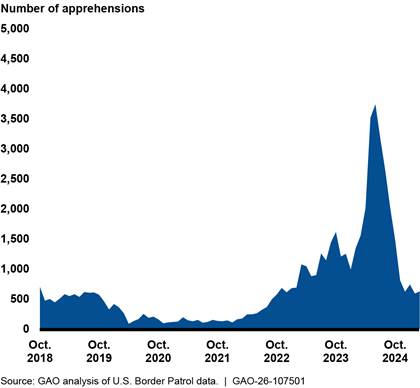
Apprehensions and drug seizures. From fiscal year 2023 to 2024, the number of people Border Patrol apprehended along the northern border increased sharply (see fig.). From fiscal year 2019 through fiscal year 2024, the number of Border Patrol’s drug seizures in this region varied.
Technology. CBP uses aircraft, vessels, and surveillance technology—such as cameras, radar sites, and sensors—as part of its efforts to secure the northern border. From fiscal year 2019 through fiscal year 2024, CBP’s deployment of this technology increased.
Staffing. In this same 5-year period, the number of agents staffed along the northern border decreased, but CBP has initiatives underway to address this issue. In addition, there was a decrease in the staffing rate for Law Enforcement Information Systems Specialists who monitor surveillance technology. The staffing rate for this key position along the northern border has been below its target, and the agency does not have a plan with strategies to address the staffing gap. Developing such a plan could help Border Patrol better carry out its responsibility to secure the northern border.
.
Border Patrol Apprehensions Along the Northern Border from Fiscal Year 2019 Through the First Half of Fiscal Year 2025
How GAO Did This Study
We analyzed Border Patrol data on apprehensions and drug seizures, as well as CBP data on staffing and resources since fiscal year 2019. We visited six CBP units along the northern border, selected based on apprehension levels, among other factors. We also interviewed CBP officials from the other units along the northern border.
What GAO Recommends
We recommend that CBP develop and implement a plan with strategies to address workforce gaps in the Law Enforcement Information Systems Specialist position. DHS concurred with the recommendation.
Abbreviations
AMO Air and Marine Operations
CBP U.S. Customs and Border Protection
DHS Department of Homeland Security
GS general schedule
This is a work of the U.S. government and is not subject to copyright protection in the United States. The published product may be reproduced and distributed in its entirety without further permission from GAO. However, because this work may contain copyrighted images or other material, permission from the copyright holder may be necessary if you wish to reproduce this material separately.
February 12, 2026
The Honorable Andrew Garbarino
Chairman
Committee on Homeland Security
House of Representatives
The Honorable Clay Higgins
House of Representatives
The United States and Canada share the longest common non-militarized border between two countries, spanning nearly 4,000 miles of land and maritime borders. U.S. Customs and Border Protection (CBP) within the Department of Homeland Security (DHS) has the primary responsibility for securing U.S. borders at and between ports of entry.[1] U.S. Border Patrol and Air and Marine Operations (AMO) are CBP subcomponents responsible for securing U.S. borders between ports of entry in the land, air, and maritime environments. In fiscal year 2024, Border Patrol averaged 2,081 apprehensions per month along the northern border, peaking at over 3,700 in June 2024, for a total of almost 25,000 apprehensions—a 277 percent increase over fiscal year 2019.
In June 2019, we reported on northern border security efforts. In that report, we found that CBP had identified staffing and resource challenges affecting its enforcement activities along the northern border and had identified actions to address them.[2] We also found that while CBP had performance measures that assessed selected border security operations or programs, some of which included data from the northern border, it did not have specific measures to assess its effectiveness at securing the northern border between ports of entry. We recommended that both Border Patrol and AMO develop performance measures to assess their effectiveness in securing the northern border. Border Patrol and AMO agreed with these recommendations and have taken some steps toward addressing them. For example, AMO developed a Northern Region strategic plan that contains strategic goals and associated objectives, as well as short-term goals and accomplishments for fiscal year 2024. In addition, in May 2025, Border Patrol officials told us that the agency developed operational objectives and tasks that will serve as a framework for the development of overarching northern border performance measures. While these are positive steps, Border Patrol and AMO need to develop and implement performance measures to fully address our recommendations.
You asked us to review CBP’s allocation of personnel and other resources, such as assets and surveillance technology, between ports of entry at the northern border since our 2019 report. This report addresses (1) what data show about Border Patrol apprehensions and seizures between ports of entry along the northern border since fiscal year 2019, (2) the extent to which CBP’s use of assets and surveillance technology along the northern border changed since fiscal year 2019, (3) the extent to which CBP’s staffing along the northern border changed since fiscal year 2019 and the steps it has taken to address any staffing challenges, and (4) factors Border Patrol sectors reported as affecting their efforts to secure the northern border.[3]
To address all four objectives, we visited Border Patrol’s Blaine, Detroit, and Swanton sectors and AMO’s Bellingham Air and Marine Branch, Great Lakes Air and Marine Branch, and Plattsburgh Air Unit. We selected these six locations based on geographic diversity, such as a mix of land and maritime borders and varying numbers of apprehensions. On these visits, we observed Border Patrol and AMO assets and activities and interviewed officials. For the other five Border Patrol sectors along the northern border and the two AMO locations, we conducted virtual interviews with officials.[4] We also interviewed officials from CBP headquarters, including officials from Office of Information and Technology, Border Patrol, and AMO to obtain perspectives on CBP apprehension and seizure data, the allocation of personnel and assets, and Border Patrol’s challenges along the northern border.
To determine the number of apprehensions and drug, weapon, and currency seizures in each sector along the northern border, we analyzed data on Border Patrol apprehensions and seizures for fiscal years 2019 through the second quarter of fiscal year 2025 (October 1, 2024, to March 31, 2025), which were the most recent data available at the time of our review.[5]
To determine how CBP’s use of assets and surveillance technology along the northern border changed, we analyzed AMO flight hour and float hour data from fiscal year 2019 through fiscal year 2024—the most recent complete year data available at the time of our review—for the Northern Region and the National Air Security Operations Center-Grand Forks.[6] We also analyzed data on AMO aircraft and marine vessels along the northern border from April 2019 and October 2024 since these were the data that were available closest to the end of fiscal year 2019 and fiscal year 2024, respectively. Further, we analyzed Border Patrol data on land-based surveillance technology, such as towers with cameras, deployed across the northern border at the end of fiscal year 2019 and fiscal year 2024 to identify how the deployment of these technologies changed.
To assess the extent to which CBP’s staffing along the northern border changed, we analyzed staffing data on the number of Border Patrol and AMO agents from fiscal year 2019 through fiscal year 2024—the most recent complete year data available at the time of our review. These data included Border Patrol agents assigned to the eight sectors along the northern border and AMO agents assigned to AMO’s Northern Region or National Air Security Operations Center-Grand Forks. We also analyzed Border Patrol staffing data on the number of supervisory and non-supervisory Law Enforcement Communications Assistants and Law Enforcement Information Systems Specialists in each northern border sector for fiscal year 2019 through fiscal year 2024.[7] We assessed Border Patrol’s plans and policies about the staffing gap for the Law Enforcement Information Systems Specialist position against the 2022 DHS Workforce Planning Guide.[8]
To identify Border Patrol’s challenges, we reviewed Border Patrol’s northern border stations’ capability gap analysis reports for fiscal year 2024—the most recent complete year data available at the time of our review. Border Patrol produced these reports as part of its annual capability gap analysis process.[9] We identified common themes reported by northern border stations to use as illustrative examples of factors that have affected Border Patrol’s ability to secure the northern border between ports of entry.[10]
We assessed the reliability of the data included in this report by performing electronic testing and manually reviewing for missing data and obvious errors, reviewing CBP documents, and interviewing knowledgeable CBP officials. We determined that these data are reliable for the purpose of analyzing CBP’s apprehensions and seizures, use of assets, staffing, and challenges along the northern border from fiscal year 2019 through fiscal year 2024. Appendix I provides additional details on our scope and methodology.
We conducted this performance audit from April 2024 through February 2026 in accordance with generally accepted government auditing standards. Those standards require that we plan and perform the audit to obtain sufficient, appropriate evidence to provide a reasonable basis for our findings and conclusions based on our audit objectives. We believe that the evidence obtained provides a reasonable basis for our findings and conclusions based on our audit objectives.
Background
Northern Border Environment
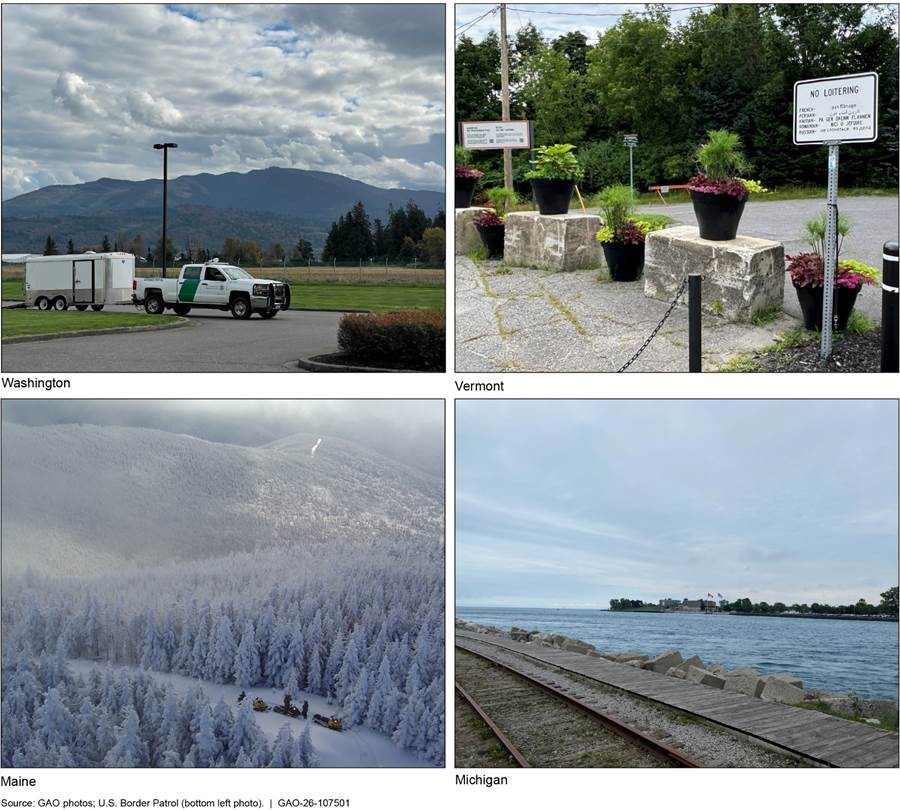
The northern border spans almost 4,000 miles across 12 states in the continental United States and comprises widely different types of terrain—a fact that challenges border security efforts. For example, the border in Montana is characterized by prairie lands and mountainous terrain with a sparse population and limited infrastructure, while in Michigan, the border is exclusively maritime, located near major cities and highway corridors. In addition, approximately 2,400 miles of the northern border consist of waterways, such as the Great Lakes system, the St. Lawrence River, and the Strait of Juan de Fuca.[11] See figure 1 for examples of the terrains along the northern border.
Figure 1: Examples of Different Environments Along the U.S.-Canada Border
Many areas along the northern border have well-developed infrastructure networks. For example, major highways connect the Canadian cities of Montreal, Quebec City, and Toronto to New York and Boston. According to Border Patrol, the well-developed infrastructure provides individuals easier access to routes away from border areas after they cross into the U.S. Border Patrol officials in one sector told us that given the well-developed infrastructure, it is easier for individuals who illegally cross to quickly blend into the surrounding community in some areas of the sector.
CBP Responsibilities and Resources Used to Secure the Northern Border Between Ports of Entry
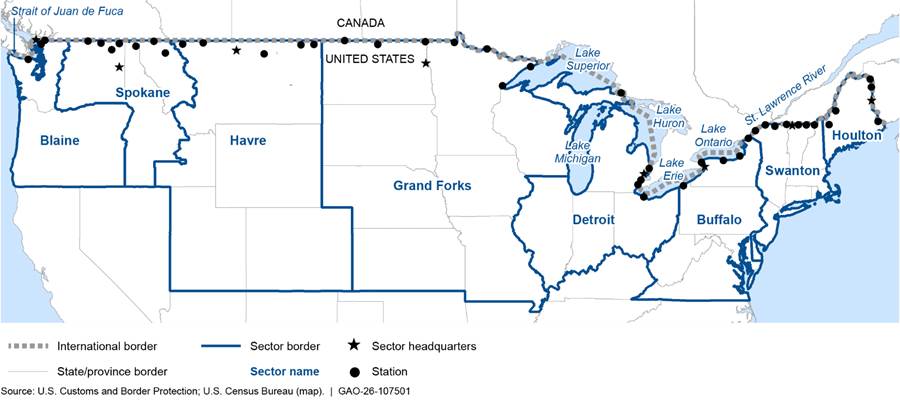
Border Patrol, a uniformed law enforcement subcomponent of CBP, has primary responsibility for securing U.S. land borders between ports of entry.[12] Its area of responsibility along the northern border is divided among eight sectors: Blaine, Spokane, Havre, Grand Forks, Detroit, Buffalo, Swanton, and Houlton.[13] Each Border Patrol sector is further divided into stations, with each station assigned a certain geographic area of responsibility within the sector. Along the northern border, there are a total of 49 stations, with four to eight stations per sector. Each Border Patrol station along the northern border is responsible for an average of about 82 miles of the U.S.-Canada border. Figure 2 shows Border Patrol’s northern border sectors.
Figure 2: Map of U.S. Border Patrol’s Sectors along the U.S.-Canada Border
AMO, another uniformed law enforcement subcomponent of CBP, is responsible for securing U.S. borders in the air and marine domains.[14] Its operations along the northern border are divided among three branches that constitute AMO’s Northern Region: Bellingham Air and Marine Branch in Washington, Great Lakes Air and Marine Branch in Michigan, and Manassas Air Branch in Virginia. Each branch is further divided into units to conduct air or maritime missions, and there are a total of seven air units and nine marine units along the northern border.[15] In addition, the National Air Security Operations Center-Grand Forks, located in North Dakota, operates as an air unit and provides training for unmanned aircraft systems, commonly referred to as “drones.” Figure 3 shows the AMO’s Northern Region as well as the National Air Security Operations Center-Grand Forks.
Figure 3: Map of Air and Marine Operations Branches in Its Northern Region and the National Air Security Operations Center-Grand Forks
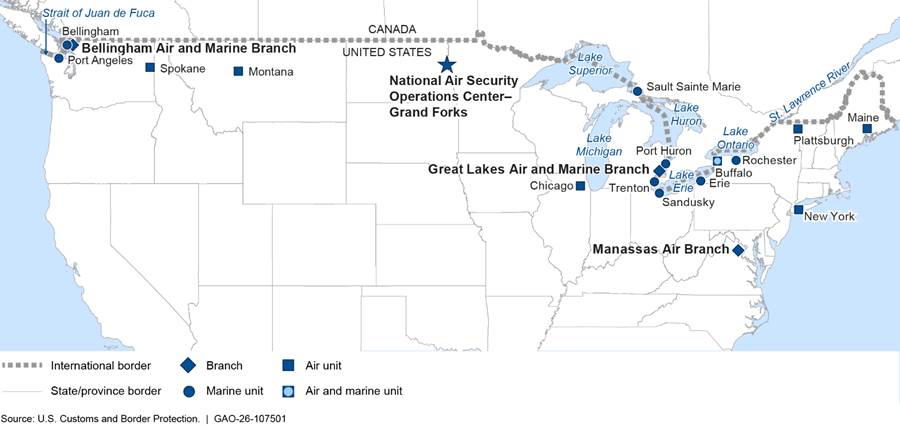
Note: The National Air Security Operations Center-Grand Forks, located in North Dakota, operates as an air unit and provides training for unmanned aircraft systems.
Border Patrol and AMO use a variety of resources to secure the northern border between ports of entry. Figure 4 illustrates examples of resources used by Border Patrol and AMO.
Figure 4: Examples of U.S. Customs and Border Protection’s Resources Along the Northern Border
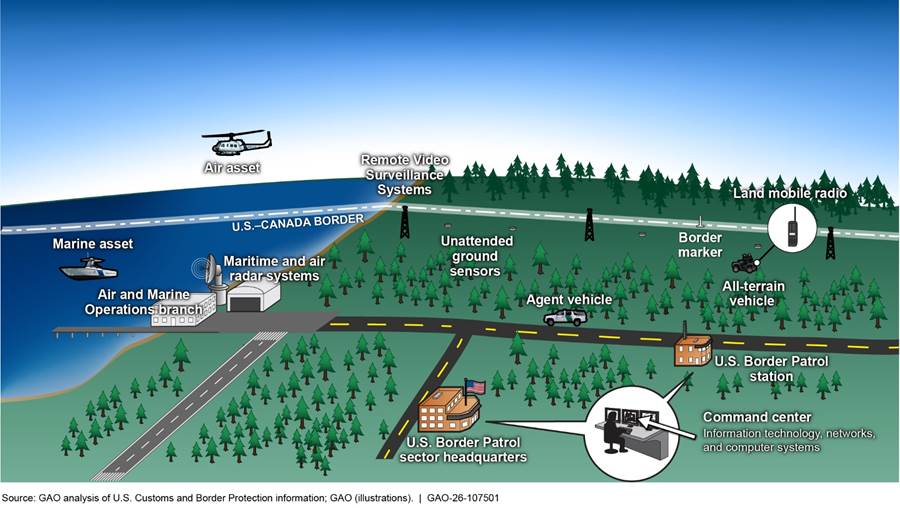
Border Patrol agents secure the border between ports of entry through patrolling international land borders and waterways to detect and prevent the illegal movement of people, narcotics, and contraband into the United States. Agents rely on nonuniformed personnel for mission support duties, including communications, surveillance, and other administrative tasks. For example, in 2019, CBP created a processing coordinator position to support Border Patrol agents in processing individuals apprehended by agents and transporting individuals in Border Patrol custody.[16]
AMO agents secure the air and maritime environments along the border through conducting surveillance and investigative activities to interdict smuggled narcotics and other contraband. Specifically, air interdiction agents pilot airplanes, helicopters, and unmanned aircraft systems, while aviation enforcement agents conduct airborne law enforcement operations, such as operating sensors, executing warrants, and seizing evidence. Marine interdiction agents command and crew vessels and conduct maritime patrols. AMO’s operations along the northern border generally support Border Patrol or other CBP subcomponents. Table 1 shows the types of agencies and frequency to which AMO provided support along the northern border in fiscal years 2019 through 2024.
Table 1: Percentage of Air and Marine Operations (AMO) Flight and Float Enforcement Hours by Agency Supported Along the Northern Border, Fiscal Years 2019–2024
|
Agency |
Flight hours |
Float hours |
|
U.S. Customs and Border Protection (CBP) |
78% |
93% |
|
Federal agencies other than CBP |
19 |
5 |
|
State and local agencies |
3 |
1 |
Source: GAO analysis of AMO data. | GAO‑26‑107501
Notes: Flight and float hours are the number of hours that AMO aircraft and marine vessels, respectively, were operating. These data include National Air Security Operations-Grand Forks, which is not part of AMO’s Northern Region but operates along the northern border. These figures include enforcement hours and exclude other hours, such as training. Flight hours also exclude Manassas Air Branch, Chicago Air Unit, and New York Air Unit. Although they are subordinate to AMO’s Northern Region, they do not generally operate along the northern border. Other federal agencies include U.S. Immigration and Customs Enforcement and the U.S. Secret Service. Percentages may not add to 100 percent due to rounding.
Threats Along the Northern Border Between Ports of Entry
Since fiscal year 2019, CBP has continued to focus its border security operations along the northern border on key threat areas. Specifically, we reported in June 2019 on the key security threats along the northern border between ports of entry that CBP identified: terrorism, contraband smuggling—specifically, the bidirectional flow of illicit drugs—and violations of U.S. immigration law—including improperly entering the United States between ports of entry, and migrant smuggling.[17] These threats continue to be the focus of CBP’s efforts to secure the northern border.
In addition, Border Patrol has reported other threats between ports of entry since fiscal year 2019 that affect border security operations along the northern border, such as vehicle incursions and the use of unmanned aircraft systems.
· Vehicle incursions. According to Border Patrol data, from fiscal years 2021 through 2024, the number of vehicle incursions, or “drive throughs”, into and out of the United States increased.[18] Specifically, Border Patrol reported 48 vehicle incursions in fiscal year 2021, and in fiscal year 2024, the number of vehicle incursions increased to 307, a 540 percent increase.
· Drones. Officials from Border Patrol’s northern border sectors also reported in fiscal year 2024 that small unmanned aircraft systems (i.e., drones) have been used, possibly by transnational criminal organizations, to smuggle contraband, including illicit drugs and firearms.
In 2017, CBP established the Northern Border Coordination Center to provide intelligence support and surveillance to Border Patrol’s northern border sectors. The center monitors threats, risks, and other vulnerabilities along the northern border, producing regional threat assessments on an as needed basis to improve border security.
Northern Border Apprehensions Increased Sharply While the Number of Drug Seizures Varied Since Fiscal Year 2019
Apprehensions Increased Sharply in Two Northern Border Patrol Sectors and Varied in the Other Six Sectors
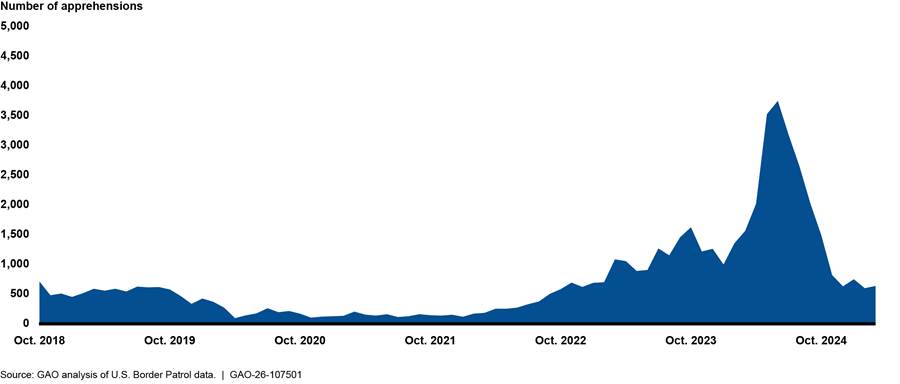
From fiscal year 2019 through fiscal year 2024, the total number of Border Patrol apprehensions along the northern border between ports of entry increased, with sharp increases in 2023 and 2024.[19] In particular, our analysis of Border Patrol data shows that the total number of apprehensions increased from 6,618 in fiscal year 2019 to 24,968 in fiscal year 2024.[20] Beginning in fiscal year 2022, the monthly number of apprehensions generally increased, peaking at over 3,700 apprehensions for the month of June 2024.[21] This compares to an average of 296 monthly apprehensions in fiscal years 2019 through 2022. Monthly apprehensions from October 2024 through March 2025 returned to approximately fiscal year 2023 levels, as shown in figure 5.
Figure 5: Monthly U.S. Border Patrol Apprehensions Along the Northern Border Between Ports of Entry, Fiscal Year (FY) 2019 Through the Second Quarter of FY 2025
Notes: In this report, an apprehension is the physical control or temporary detainment of any person encountered by Border Patrol between ports of entry for suspected violation of U.S. law. Fiscal year 2025 apprehensions reported for October 1, 2024, to March 31, 2025.
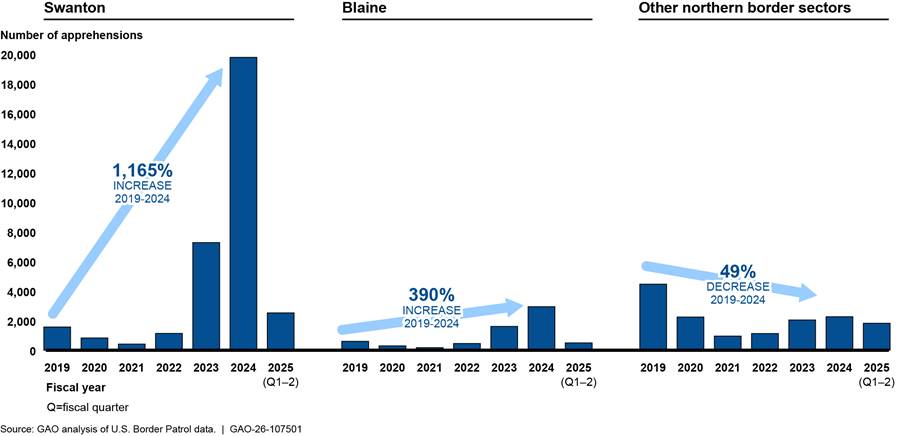
The Swanton and Blaine sectors had the greatest increase in apprehensions from fiscal year 2019 through fiscal year 2024. Swanton sector reported 19,773 apprehensions in fiscal year 2024, a 1,165 percent increase since fiscal year 2019, in which it had 1,563 apprehensions. Similarly, apprehensions in the Blaine sector increased from 600 in fiscal year 2019 to 2,940 apprehensions in fiscal year 2024, a 390 percent increase. Apprehensions in the other six sectors combined decreased by 49 percent, from 4,455 apprehensions in fiscal year 2019 to 2,255 apprehensions in fiscal year 2024. For the first two quarters of fiscal year 2025 (October 1, 2024, to March 31, 2025), Border Patrol’s northern border sectors reported 4,832 total apprehensions. Figure 6 shows the annual apprehensions for Swanton, Blaine, and the six other sectors.
Figure 6: Total Number of Apprehensions at U.S. Border Patrol’s Northern Border Sectors, Fiscal Year (FY) 2019 Through the Second Quarter of FY 2025
Notes: In this report, an apprehension is the physical control or temporary detainment of any person encountered by Border Patrol between ports of entry for suspected violation of U.S. law. Fiscal year 2025 apprehensions reported for October 1, 2024, to March 31, 2025. The six other northern border sectors are Buffalo, Detroit, Grand Forks, Houlton, Havre, and Spokane.
Table 2 shows the number of apprehensions for Border Patrol’s northern border sectors and the percentage change for each sector from fiscal year 2019 through fiscal year 2024.
Table 2: Total Number of Apprehensions in U.S. Border Patrol’s Northern Border Sectors, Fiscal Year (FY) 2019–2024
|
Border Patrol Sector |
FY 2019 |
FY 2020 |
FY 2021 |
FY 2022 |
FY 2023 |
FY 2024 |
Percentage change FY 2019–2024 |
|
Blaine |
600 |
290 |
169 |
454 |
1,604 |
2,940 |
390% |
|
Buffalo |
736 |
374 |
131 |
107 |
319 |
508 |
-31% |
|
Detroit |
1,767 |
760 |
310 |
318 |
651 |
718 |
-59% |
|
Grand Forks |
693 |
360 |
122 |
93 |
331 |
281 |
-59% |
|
Havre |
209 |
75 |
91 |
86 |
88 |
109 |
-48% |
|
Houlton |
425 |
361 |
222 |
424 |
448 |
472 |
11% |
|
Spokane |
625 |
306 |
75 |
96 |
200 |
167 |
-73% |
|
Swanton |
1,563 |
822 |
413 |
1,134 |
7,265 |
19,773 |
1,165% |
|
Total |
6,618 |
3,348 |
1,533 |
2,712 |
10,906 |
24,968 |
277% |
Source: GAO analysis of U.S. Border Patrol data. | GAO‑26‑107501
Notes: In this report, an apprehension is the physical
control or temporary detainment of any person encountered by Border Patrol
between ports of entry for suspected violation of U.S. law. Border Patrol
reported 4,096 apprehensions total across northern border sectors for the first
two quarters of fiscal year 2025 (October 1, 2024, to March 31, 2025).
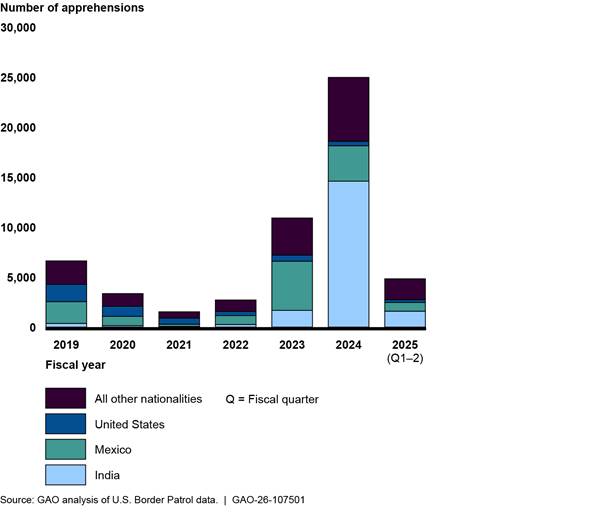
From fiscal year 2019 through the second quarter of fiscal year 2025, our analysis of Border Patrol data showed that there was a shift in the citizenship of individuals apprehended by Border Patrol along the northern border. For example, the countries of origin for Border Patrol apprehensions along the northern border were most often Mexico and the United States in fiscal year 2019 through fiscal year 2023. In fiscal year 2024, 58 percent of individuals apprehended were from India, followed by 14 percent from Mexico, and 7 percent from Bangladesh.[22] Figure 7 shows how country of citizenship for apprehensions at Border Patrol’s northern border sectors have changed from fiscal year 2019 through the first half of fiscal year 2025.
Figure 7: U.S. Border Patrol Northern Border Sectors Apprehensions by Country of Citizenship, Fiscal Year (FY) 2019 Through the Second Quarter of FY 2025
Notes: In this report, an apprehension is the physical control or temporary detainment of any person encountered by Border Patrol between ports of entry for suspected violation of U.S. law. Fiscal year 2025 apprehensions reported for October 1, 2024, to March 31, 2025.
While U.S. citizens are not subject to statutory admissibility restrictions applicable to noncitizens, Border Patrol may enforce U.S. law against U.S. citizens for criminal offenses or non-immigration civil violations.[23] U.S. lawful permanent residents are also subject to U.S. criminal and civil law enforcement, but are generally not subject to noncitizen admissibility restrictions, unless they fall within certain categories.[24]
Border Patrol officials told us that the increase in apprehensions along the northern border for fiscal years 2023 and 2024 can be partially attributed to individuals without valid travel documents seeking entry into the U.S. from Canada after entering that country under its Electronic Travel Authorization system.[25] The Electronic Travel Authorization provides an affordable option for individuals to enter Canada, and, according to Border Patrol officials, once in Canada, these individuals may decide to enter the United States between ports of entry. Specifically, Border Patrol officials stated that many foreign nationals who did not have valid travel documents to enter the United States traveled to Canada first and then attempted to enter the United States during this period.[26] Border Patrol attributed the subsequent decline in apprehensions along the northern border since June 2024 to border enforcement policies intended to discourage individuals from seeking illegal entry into the United States.
Drug Seizures Along the Northern Border Varied Since Fiscal Year 2019
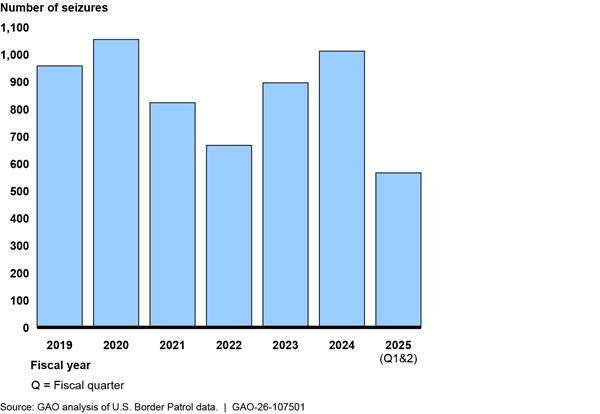
The total number of Border Patrol drug seizure events varied from fiscal year 2019 through fiscal year 2024.[27] The number of annual drug seizure events fluctuated, but the number of drug seizure events increased by about 6 percent from fiscal year 2019 to fiscal year 2024. In particular, our data analysis shows that Border Patrol was involved in 958 drug seizure events in fiscal year 2019 compared with 1,012 drug seizure events in fiscal year 2024.[28] In addition, Border Patrol was involved in 566 drug seizure events in the first two quarters of fiscal year 2025. Figure 8 shows the number of Border Patrol drug seizures from fiscal year 2019 through fiscal year 2025.
Figure 8: U.S. Border Patrol Drug Seizure Events Along the Northern Border, Fiscal Years (FY) 2019 Through the Second Quarter of FY 2025
Notes: Fiscal year 2025 seizure events reported for October 1, 2024, to March 31, 2025. When a CBP agent seizes one or multiple drugs from one or multiple offenders, the entire incident is referred to as a drug seizure event.
The change in the number of Border Patrol drug seizure events varied based on the area in fiscal year 2019 through fiscal year 2024. For example, Blaine sector had a 156 percent increase in drug seizure events, with 27 events reported in fiscal year 2019, compared to 69 events reported in fiscal year 2024. On the other hand, Swanton sector—the sector with the highest number of apprehensions—had about a 76 percent decrease in drug seizure events, with 165 events reported in fiscal year 2019, compared to 39 events reported in fiscal year 2024. The decline in drug seizures between ports of entry at the northern border in certain sectors does not necessarily reflect a decline in drug trafficking activity, according to officials. For example, Border Patrol officials in the Swanton sector stated that they have not been able to target as many drug shipments due to increasingly spending their time processing migrant encounters. Table 3 shows the total number of Border Patrol’s drug seizure events along the northern border from fiscal year 2019 to March 31, 2025.
Table 3: U.S. Border Patrol Drug Seizure Events Along the Northern Border, FY 2019 Through the Second Quarter of FY 2025
|
Sector |
FY 2019 |
FY 2020 |
FY 2021 |
FY 2022 |
FY 2023 |
FY 2024 |
FY 2025 (Q1 & Q2)a |
|
Blaine |
27 |
16 |
18 |
36 |
31 |
69 |
56 |
|
Buffalo |
88 |
95 |
45 |
79 |
92 |
170 |
57 |
|
Detroit |
316 |
427 |
426 |
384 |
572 |
522 |
274 |
|
Grand Forks |
51 |
70 |
67 |
22 |
11 |
10 |
24 |
|
Havre |
50 |
17 |
13 |
15 |
20 |
43 |
15 |
|
Houlton |
132 |
158 |
81 |
50 |
66 |
41 |
30 |
|
Spokane |
129 |
103 |
86 |
40 |
64 |
118 |
90 |
|
Swanton |
165 |
169 |
87 |
41 |
40 |
39 |
20 |
|
Total |
958 |
1,055 |
823 |
667 |
896 |
1,012 |
566 |
Legend: Q1 = quarter 1; Q2 = quarter 2; FY = fiscal year
Source: GAO analysis of U.S. Border Patrol drug seizure data. | GAO‑26‑107501
Notes: This table reports drug seizures events in which Border Patrol participated. A drug seizure event represents one or multiple drug seizures. In our analysis, we define a “drug seizure” as each individual drug type seized within a drug seizure event.
aFiscal year 2025 drug seizure events reported for October 1, 2024, to March 31, 2025.
From fiscal year 2019 to March 31, 2025, marijuana was the top drug seized by Border Patrol along the northern border.[29] According to CBP data, Border Patrol seized marijuana 2,570 times, almost double the number of seizures reported for methamphetamine or cocaine during that time period. However, the number of marijuana seizures decreased by about 46 percent and the number of fentanyl seizures increased by about 746 percent from fiscal year 2019 to fiscal year 2024. Table 4 shows the total number of Border Patrol drug seizures for the top drug types by year from fiscal year 2019 to March 31, 2025.
Table 4: Number of U.S. Border Patrol Drug Seizures Along the Northern Border by Drug Type, FY 2019 Through the Second Quarter of FY 2025
|
Drug types |
FY 2019 |
FY 2020 |
FY 2021 |
FY 2022 |
FY 2023 |
FY 2024 |
FY 2025 (Q1 & Q2)a |
Percentage change FY 2019–2024 |
|
Marijuana |
593 |
564 |
322 |
269 |
353 |
319 |
150 |
-46% |
|
Methamphetamine |
167 |
231 |
282 |
159 |
221 |
269 |
159 |
61% |
|
Cocaine |
130 |
200 |
177 |
160 |
210 |
308 |
199 |
137% |
|
Fentanyl |
35 |
64 |
106 |
142 |
204 |
296 |
160 |
746% |
|
Other drug types |
283 |
308 |
310 |
148 |
245 |
272 |
158 |
-4% |
|
Totalb |
1,208 |
1,367 |
1,197 |
878 |
1,233 |
1,464 |
826 |
21% |
Legend: Q1 = quarter 1; Q2 = quarter 2; FY = fiscal year
Source: GAO analysis of U.S. Customs and Border Protection data. | GAO‑26‑107501
aFiscal year 2025 drug seizures reported for October 1, 2024, to March 31, 2025.
bBecause individual drug seizure events may contain more than one type of drug, the sum of the number of seizures is greater than the total number of drug seizure events.
Firearms and Currency Seizures Have Increased
Border Patrol also seized a higher number of firearms in fiscal year 2024 compared to fiscal year 2019. Specifically, our data analysis showed that Border Patrol participated in the seizure of 141 firearms in fiscal year 2019 and 839 firearms in fiscal year 2024, a 495 percent increase.[30] Border Patrol was involved in the seizure of 451 firearms in the first two quarters of fiscal year 2025. Most of these seizures took place in the Detroit and Spokane sectors during this time. According to CBP officials, firearms are generally smuggled from the United States into Canada.
In addition, Border Patrol’s Blaine sector substantially increased the seizure of currency in fiscal year 2024, whereas currency seizures were largely unchanged in other northern border sectors.[31] Specifically, Blaine sector reported 14 cash seizures events in fiscal years 2019 through 2023 combined and 118 cash seizures events in fiscal year 2024. As of March 31, 2025, Blaine sector reported 51 cash seizures events for fiscal year 2025, compared to the other northern border sectors that reported between zero and five cash seizures events each. Blaine sector seized between $5 and $10,415, with a median of $1,000 for each currency seizure event in fiscal years 2024 and 2025.
Under CBP policy, personal property discovered during apprehension or processing and not deemed to be contraband will be safeguarded, itemized, and documented, with special attention given to the security and return of cash, currency, negotiable instruments, and debit or credit cards.[32] However, Blaine sector officials told us that in fiscal year 2024 they began treating property as contraband and seizing migrants’ assets, including cash, more frequently as a way to impose a consequence for unlawfully crossing the border.[33] According to these officials, the legal basis for Blaine sector’s practice of seizing currency brought into the U.S. between ports of entry is a statute requiring seizure and forfeiture of merchandise introduced into the United States contrary to law and deemed to be stolen, smuggled, or clandestinely imported.[34] Blaine officials stated that merchandise brought by land into the United States other than through a port of entry is smuggled or clandestinely introduced by virtue of the fact that it was not entered at a port of entry. Federal courts have not had occasion to review the specific Blaine sector practice of seizing and seeking forfeiture of currency as a consequence for entering without inspection on its own.[35]
CBP’s Use of Aircraft, Vessels, and Surveillance Technology Along the Northern Border Increased Since Fiscal Year 2019
Across the northern border region, CBP increased the number of hours aircraft and marine vessels operated from fiscal year 2019 through fiscal year 2024, while the number of aircraft and marine vessels available to CBP decreased slightly during those years. During this same time, CBP increased the deployment of land-based surveillance technology across the northern border, including camera towers and unattended ground sensors.
CBP’s Use of Assets Increased While the Number of Aircraft and Vessels Decreased
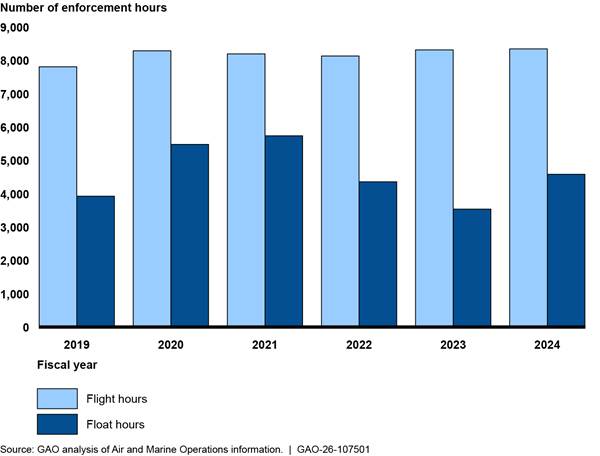
The number of hours that AMO operated aircraft and marine vessels increased, while the number of AMO aircraft and vessels available to AMO agents along the northern border decreased from fiscal year 2019 through fiscal year 2024. Specifically, our analysis of AMO data showed that the number of hours AMO spent in the air, or flight hours, focused on enforcement activities along the northern border increased about 7 percent from about 7,800 in fiscal year 2019 to 8,300 in fiscal year 2024.[36] Flight hours in support of Border Patrol’s northern border sectors increased by about 11 percent over this time period, with most of the increases occurring in the Swanton, Spokane, and Grand Forks sectors.
The number of hours that AMO marine vessels operated, or float hours, focused on enforcement activities along the northern border varied for fiscal years 2019 through 2024. Overall, the number of float hours along the northern border increased from about 3,900 in fiscal year 2019 to 4,600 in fiscal year 2024—an increase of about 17 percent. Flight and float hours from fiscal year 2019 through fiscal year 2024 are shown in figure 9.
Figure 9: Air and Marine Operations Flight and Float Hours Along the Northern Border, Fiscal Years 2019–2024
Notes: Flight hours refer to the number of hours that Air and Marine Operations (AMO) aircraft spent in the air, and float hours refer to the number of hours that AMO marine vessels operated. These data include National Air Security Operations-Grand Forks, which is not part of AMO’s Northern Region but operates along the northern border. These data exclude Manassas Air Branch, Chicago Air Unit, and New York Air Unit. Although they are subordinate to AMO’s Northern Region, they do not generally operate along the northern border. Flight and float hour calculations also exclude non-enforcement activities, such as training and maintenance.
Even though the number of AMO flight and float hours generally increased along the northern border, the number of AMO aircraft and vessels available to AMO agents along the northern border decreased from fiscal year 2019 through fiscal year 2024. In April 2019, AMO units along the northern border had 13 planes, 16 helicopters, and three drones. In October 2024, these units had 11 planes, 15 helicopter, and two drones. Overall, this was a decrease of four aircraft.[37]
The number of marine vessels along the northern border decreased slightly from 28 in fiscal year 2019 to 27 in fiscal year 2024. The number of riverine vessels, which are owned by AMO but operated by Border Patrol, decreased from 66 in October 2019 to 59 in August 2024.
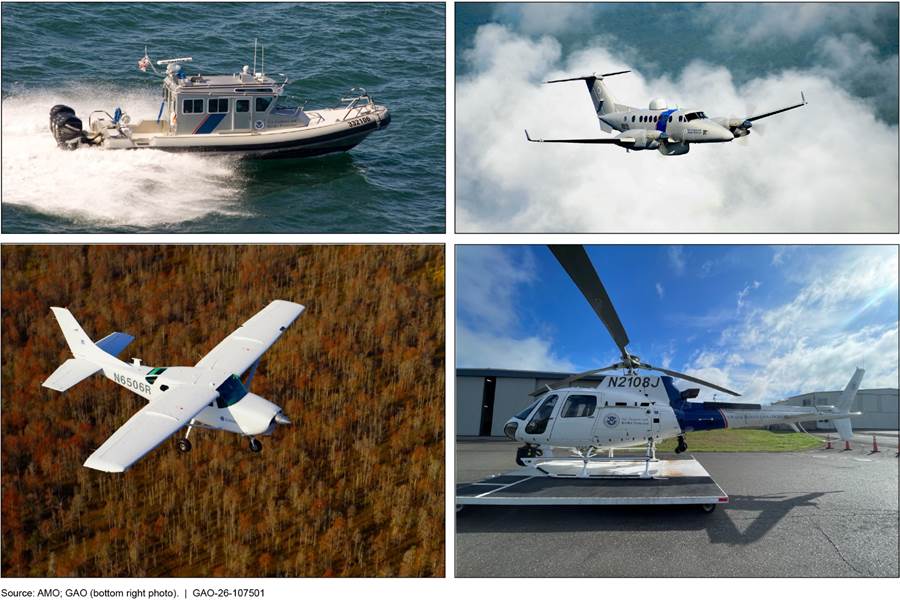
As of 2024, the most common AMO aircraft and vessels along the northern border include the Cessna C-206, the Multi-Role Enforcement Aircraft Super King Air 350ER, the Airbus H125 Light Enforcement Helicopter, and the SAFE Boat, All-Weather Interceptor, as shown in figure 10.
Figure 10: Examples of Air and Marine Operations (AMO) Aircraft and Vessels Used Along the Northern Border
CBP Increased the Amount of Land-Based Surveillance Technology
Since fiscal year 2019, Border Patrol has increased the deployment of land-based surveillance technology along the northern border—namely, camera towers and sensors. Land-based surveillance technology encompasses several types of systems.
· Border Patrol deployed Legacy Remote Video Surveillance Systems from 1998 through 2002. According to Border Patrol officials, the systems provide a point-to-point connection from the camera to workstations inside Border Patrol communications centers. Officials said that they prefer these surveillance systems the least because they require individuals to monitor the feeds and do not have cloud-based storage.
· Northern Border Remote Video Surveillance Systems, deployed beginning in 2011, provide surveillance in the Great Lakes environment. The systems utilize tower- or structure-mounted day and night (infrared) cameras and, in some cases, have radar capabilities.
· Autonomous Surveillance Towers are a newer technology system that is capable of autonomously detecting, identifying, and tracking illicit cross-border activity. According to Border Patrol officials, these towers are 33 feet tall, can withstand cold weather, and are a variant of towers deployed along the southwest border. The autonomous software can determine whether an image is of a person or a vehicle, officials told us. Because Autonomous Surveillance Towers send alerts to agents, they do not need to be continuously monitored.[38]
· Unattended ground sensors are remotely monitored sensors placed in or on the ground—or, in some cases, in trees—to detect, track, identify, and differentiate humans, animals, and vehicles. Sensors have various detection capabilities, including seismic, magnetic, and passive infrared capabilities. Along the northern border, about 60 percent of unattended ground sensors have imaging capabilities and send photographs or videos to agents and to the communications centers.
· Flat-panel radar sites provide Border Patrol with maritime detection capabilities in the Great Lakes region.
· Border Patrol deployed the Tactical Communications Network System in Spokane sector in 2014 as a less expensive surveillance and communications alternative, according to Border Patrol officials. The Tactical Communications Network System includes towers designed to surveil, towers designed to enable communication in the sector, and towers designed to do both. Border Patrol officials told us that staff in the communications center view feeds from Tactical Communications Network System cameras.
· The Border Intrusion Surveillance System in the Swanton sector consists of day and night cameras that are mounted on telephone poles and use cellular technology. According to Border Patrol officials, staff in multiple stations can view feeds from these cameras. Some of the cameras have been upgraded from fixed cameras to pan/tilt/zoom cameras to improve situational awareness and versatility for agents and dispatchers. Additionally, Border Patrol replaced some of the cameras with high-definition cameras where network speeds permit, according to Border Patrol officials.
· Counter drone systems—deployed in Blaine, Buffalo, Detroit, and Swanton sectors—provide Border Patrol with the ability to detect, track, and identify drones, according to Border Patrol officials.[39] They include fixed and relocatable systems. Six of Border Patrol’s systems provide persistent radio-frequency surveillance for drones, and an additional system can take control of drones and land them in a designated zone.
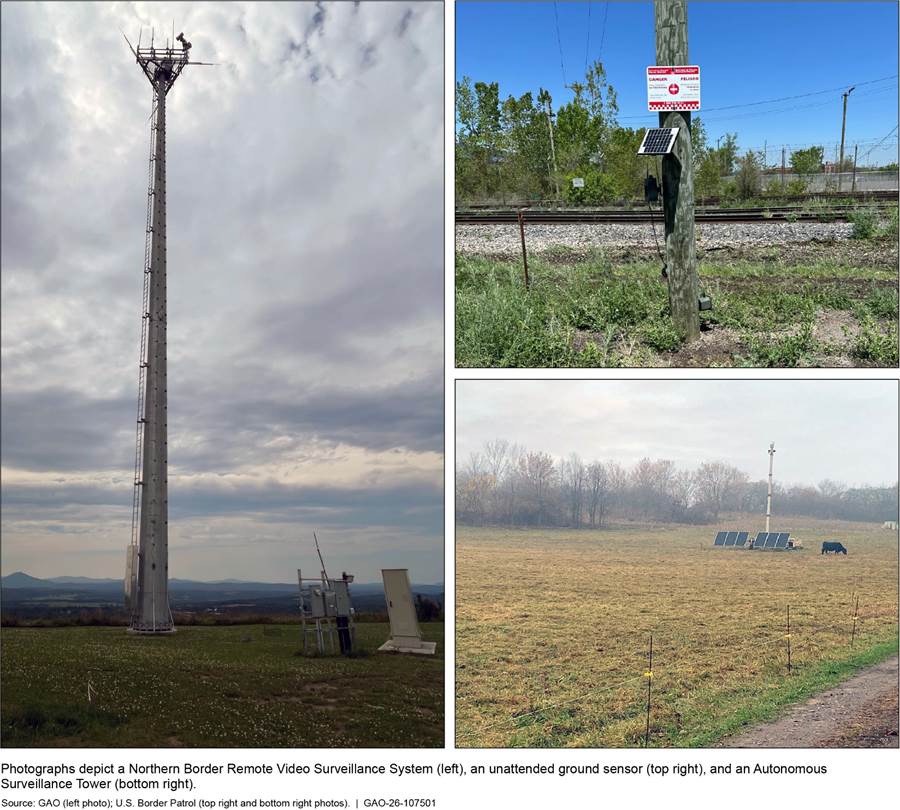
Photographs of a Northern Border Remote Video Surveillance Systems tower, an unattended grounded sensor, and an Autonomous Surveillance Tower are shown in figure 11.
Figure 11: Examples of U.S. Border Patrol Surveillance Technology Along the Northern Border
From the end of fiscal year 2019 to the end of fiscal year 2024, Border Patrol deployed 28 additional camera towers and 1,450 additional unattended ground sensors along the northern border. These include
· Northern Border Remote Video Surveillance System towers in Detroit and Swanton sectors;
· an Autonomous Surveillance Tower in Swanton sector;
· flat-panel radar sites in Buffalo, Detroit, and Swanton sectors;
· Border Intrusion Surveillance Systems towers in Swanton sector;
· Tactical Communication Network System towers in Spokane sector; and
· unattended ground sensors in all eight sectors.
Border Patrol deployed a plurality of the new unattended ground sensors in Swanton sector. Table 5 provides an overview of land-based surveillance technology deployed along the northern border.
Table 5: Selected U.S. Border Patrol Land-Based Surveillance Technology In Use Along the Northern Border, Fiscal Years 2019 and 2024
|
Border Patrol sector |
Land-based surveillance technology as of September 30, 2019 |
Land-based surveillance technology as of |
|
Blaine |
· 32 Legacy Remote Video Surveillance System towers · 524 unattended ground sensors |
· 32 Legacy Remote Video Surveillance System towers · 674 unattended ground sensorsa · 1 counter drone system |
|
Buffalo |
· 12 Northern Border Remote Video Surveillance System towers · 183 unattended ground sensors |
· 12 Northern Border Remote Video Surveillance System towers · 10 flat-panel radar sites · 300 unattended ground sensors · 1 counter drone system |
|
Detroit |
· 12 Northern Border Remote Video Surveillance System towers · 120 unattended ground sensors |
· 13 Northern Border Remote Video Surveillance System towers · 261 unattended ground sensors · 11 flat-panel radar sites · 2 counter drone systems |
|
Grand Forks |
· 294 unattended ground sensors |
· 349 unattended ground sensors |
|
Havre |
· 2 Autonomous Surveillance Towers · 364 unattended ground sensors |
· 2 Autonomous Surveillance Towers · 462 unattended ground sensors |
|
Houlton |
· 4 Legacy Remote Video Surveillance System cameras · 482 unattended ground sensors |
· 4 Legacy Remote Video Surveillance System cameras · 645 unattended ground sensors · 1 counter drone system |
|
Spokane |
· 6 Tactical Communication Network System towers · 771 unattended ground sensors |
· 24 Tactical Communication Network System towers · 908 unattended ground sensors |
|
Swanton |
· 2 Northern Border Remote Video Surveillance System towers · 5 Legacy Remote Video Surveillance System towers · 14 Border Intrusion Surveillance System towers · 804 unattended ground sensors |
· 8 Northern Border Remote Video Surveillance System · 5 Legacy Remote Video Surveillance System towers · 1 Autonomous Surveillance Tower · 5 flat-panel radar sites · 16 Border Intrusion Surveillance System towers · 1393 unattended ground sensors · 1 counter drone systemb |
Source: GAO analysis of Border Patrol information. | GAO‑26‑107501
Note: This table includes only towers with surveillance capabilities.
aUnattended ground sensor data is accurate as of September 29, 2024.
bBorder Patrol officials told us that, as of March 2025, Swanton sector no longer has a counter drone system.
The number of available cameras in two of the three sectors with remote video surveillance towers—Detroit and Swanton sectors—decreased from fiscal year 2021 (the earliest data available) through fiscal year 2024. Specifically, Border Patrol data show that Northern Border Remote Video Surveillance System cameras were available about 90 percent and 98 percent of the time in Detroit and Swanton sectors, respectively, in fiscal year 2021.[40] In fiscal year 2024, the availability in the Detroit and Swanton sectors decreased to about 76 percent and 86 percent, respectively.[41] According to Border Patrol officials, the availability declined for those two sectors because Border Patrol was refreshing the camera technology. The older cameras were at the end of life, and Border Patrol could not immediately deploy new cameras due to issues with the equipment manufacturer, officials stated. Because the new cameras were installed, Border Patrol officials expect the availability of Northern Border Remote Video Surveillance System to increase.
Number of CBP Agents Along the Northern Border Decreased, and Border Patrol Has Not Fully Addressed a Key Staffing Gap
The number of CBP agents—including Border Patrol agents and AMO pilots and mariners—across the northern border region decreased from fiscal year 2019 through fiscal year 2024. Border Patrol’s two initiatives to increase the presence of Border Patrol agents along the northern border have been limited by various factors. In addition, Border Patrol does not have a strategy to address a staffing gap for Law Enforcement Information Systems Specialists, who are professional, non-uniformed analysts who monitor feeds from surveillance technology, among other tasks.
Number of CBP Agents Along the Northern Border Decreased from Fiscal Year 2019 Through Fiscal Year 2024
U.S. Border Patrol
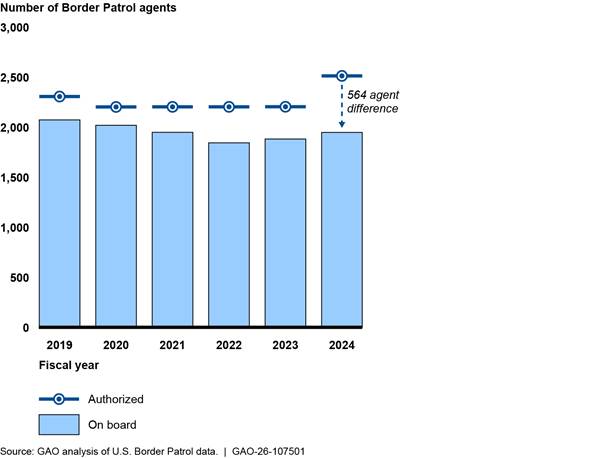
From fiscal year 2019 to fiscal year 2024, the number of Border Patrol agents authorized in northern border sectors increased by about 9 percent, while the number of agents on board in these sectors decreased.[42] Specifically, at the end of fiscal year 2019, Border Patrol reported that 2,306 agents were authorized to be stationed in sectors along the northern border. At the end of fiscal year 2024, Border Patrol reported that 2,512 agents were authorized. The largest increase (14 percent) was from fiscal year 2023 to fiscal year 2024. According to officials, Border Patrol headquarters uses a staffing model to assign the number of authorized agents in each sector and then coordinates with each sector to ensure that this assignment is appropriate. Border Patrol headquarters also considers sectors’ requests to increase the number of authorized agents based on a sector’s current authorized number and the sector’s operating environment.
Despite the number of agents authorized in sectors along the northern border increasing, the number of Border Patrol agents assigned to and working in these sectors decreased by about 6 percent from fiscal year 2019 to fiscal year 2024. In particular, the total number of Border Patrol agents assigned to these sectors decreased from 2,073 at the end of fiscal year 2019 to 1,948 at the end of fiscal year 2024. The levels of authorized agents and on board agents assigned to sectors on the northern border are shown in figure 12.
Figure 12: Number of Authorized and On Board U.S. Border Patrol Agents Assigned to Sectors on the Northern Border, Fiscal Year 2019 Through Fiscal Year 2024
Note: Number of authorized and on board Border Patrol agents calculated on the last day of each fiscal year.
Based on the changes to the authorized and on board levels in northern border sectors, the staffing level—the number of agents on board divided by the number of agents authorized—decreased from fiscal year 2019 through fiscal year 2024. The Border Patrol agent staffing level across northern border sectors decreased from 90 percent at the end of fiscal year 2019 to 78 percent at the end of fiscal year 2024. Individual sector staffing rates ranged from 64 percent in Havre sector to 94 percent in Detroit sector at the end of fiscal year 2024. Overall, the staffing level along the northern border was 78 percent at the end of fiscal year 2024, compared to 90 percent along the southwest border. In addition, stations along the northern border operate at varying staffing levels. Specifically, Border Patrol officials told us that the number of agents per shift and the number of shifts per day varies by station.
According to Border Patrol, reduced agent staffing has affected its operations. For example, officials in one sector said that it was a challenge to patrol a border area that cuts through a lake because the station does not have certified vessel commanders. As another example, according to officials from another sector, reduced agent staffing has had several significant effects, including the inability to staff certain zones and limitations in situational awareness, such as Border Patrol’s ability to conduct intelligence assessments. These officials also noted that limited staffing increases agents’ stress, which may increase the number of agents choosing to retire.[43] Further, according to our analysis of Border Patrol’s annual capability gap analysis reports, at least two stations in each of the eight northern border sectors indicated that agent staffing gaps affected their operations.
Mandatory temporary assignments to the southwest border also posed staffing challenges for sectors along the northern border. From 2018 through 2022, Border Patrol agents were required to serve 30-day assignments at the southwest border to help with migrant surges. According to data reported by DHS Office of Inspector General, from October 2018 through April 2022, Border Patrol agents nationwide were temporarily assigned to the southwest border almost 25,000 times.[44] Officials from Detroit sector, for example, told us that the mandated assignments reduced the number of personnel by 15 to 22 percent across their stations during these years. Although these mandatory assignments ended in 2022, officials from Blaine and Spokane sectors told us that mandatory temporary assignments to the southwest border prompted many eligible agents to retire, exacerbating staffing challenges.
In addition, CBP expects that an upcoming retirement surge could have significant effects on CBP’s ability to meet its mission. As we reported in September 2024, CBP expects significant increases in retirement rates due to a hiring surge for Border Patrol agents that took place from 2007 through 2009. Agents hired during this period will be eligible to retire beginning in 2027.[45] In November 2023, CBP developed a strategic plan to address this retirement surge, and retention- and morale-related efforts will be increasingly important to help mitigate the surge.
As we reported in September 2024, CBP has taken action to help strengthen its recruitment, hiring, and retention efforts for Border Patrol agents.[46] For example, in fiscal year 2024 Border Patrol offered recruitment incentives of $20,000 per recipient, with an additional $10,000 for recipients stationed in remote locations. CBP also has increased its use of financial incentives to retain law enforcement personnel, including for Border Patrol agents. In July 2025, Public Law 119-21—commonly known as the One Big Beautiful Bill Act—provided CBP over $2 billion, available until September 30, 2029, to provide recruitment bonuses, performance awards, or annual retention bonuses to eligible CBP officers and agents.[47]
Air and Marine Operations
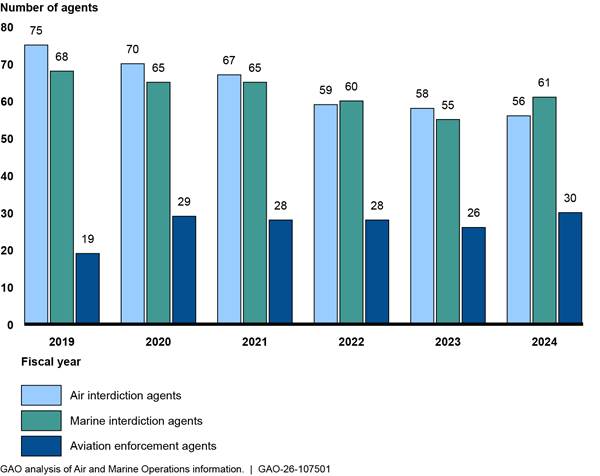
The number of AMO agents on board at branches and units near the northern border decreased from 162 at the end of fiscal year 2019 to 147 at the end of fiscal year 2024—a decrease of about 9 percent.[48] These changes are shown in figure 13.
Figure 13: Number of Air and Marine Operations Agents On Board at Branches and Units Along the Northern Border, Fiscal Years 2019–2024
Despite the decreased number of AMO agents along the northern border, AMO flight and float hours have increased from fiscal year 2019 through fiscal year 2024, as previously discussed. According to AMO officials, the increased operational flight hours per pilot is due to (1) modernized equipment that requires less maintenance, (2) an experienced workforce that requires less initial training, (3) less severe winters, and (4) an increase in dedicated aircrew operating sensor systems (that is, aviation enforcement agents).
In addition, we reported in September 2024 that, similar to Border Patrol, CBP has taken steps to help strengthen recruitment, hiring, and retention efforts for AMO agents.[49] For example, AMO has offered recruitment and retention incentives for air interdiction agents in Grand Forks, North Dakota, and for those with at least 13 years of service.
Border Patrol Has Made Limited Use of Initiatives to Relocate Agents or Place New Agents Directly on the Northern Border
Border Patrol has developed initiatives that could increase the number of staff in northern border sectors: the Operational Mobility Program, which allows eligible agents to transfer between sectors, and an initiative to place newly hired Border Patrol agents directly into northern border stations. However, Border Patrol has made limited use of these initiatives, though in March 2025 Border Patrol restarted efforts to place new agents in northern border stations.
Border Patrol Relocation Funding Limits Use of Operational Mobility Program
The Border Patrol’s Operational Mobility Program allows non-supervisory agents to voluntarily transfer between sectors, including into northern border sectors. Under this program, which began in 2017, Border Patrol can reassign agents from their present sector to another sector in response to mission needs.[50] The program also helps agents gain varied experiences in different sectors and build their knowledge, skills, and abilities, according to agency officials. This program is the only mechanism through which nonsupervisory agents can move laterally between sectors, according to Border Patrol officials.[51] These workforce planning officials said that Border Patrol determines which stations will be included in an Operational Mobility announcement based on various factors. For example, according to Border Patrol officials, when the number of agents on board at a station drops below 80 percent of its authorized level, the station is eligible to receive transfers from other sectors. Fifty-four Border Patrol agents transferred into stations in northern border sectors in fiscal year 2024—a decrease from prior years. In fiscal years 2022 and 2023, about 160 agents transferred into northern border sectors each year, as shown in table 6.
Table 6: Number of U.S. Border Patrol Agents Who Transferred into Northern Border Sectors Through the Operational Mobility Program, Fiscal Years 2019–2024
|
Fiscal year |
Border Patrol agents transferred |
|
2019 |
52 |
|
2020 |
87 |
|
2021 |
85 |
|
2022 |
161 |
|
2023 |
158 |
|
2024 |
54 |
Source: GAO analysis of U.S. Border Patrol information. | GAO‑26‑107501
Note: Border Patrol’s Operational Mobility Program allows non-supervisory agents to voluntarily transfer between sectors, including into northern border sectors.
In the most recent announcement for the Operational Mobility Program in January 2025, Border Patrol announced openings in 18 stations across all eight sectors along the northern border. However, officials said that relocation funding for the Operational Mobility Program has limited Border Patrol’s ability to move agents. According to agency officials, in fiscal year 2025, Border Patrol allocated relocation funding for 110 agents nationwide. Officials in Blaine and Buffalo sectors told us that agents want to transfer into the sectors; however, they said limited funding for the Operational Mobility Program constrains the number of agents who can transfer.
Border Patrol officials said that CBP and Border Patrol collectively decided to decrease the funding for relocations in recent fiscal years. According to Border Patrol officials, the agencies decreased the funding because Border Patrol operations increased, and funding was needed in other areas. They also noted that transfers between stations decreased during the COVID-19 pandemic, and relocation funding was diverted to other needs.
The Operational Mobility Program provides opportunities to relocate away from northern border sectors, which poses an additional challenge. Since the program works in both directions and agents may apply to relocate from northern border stations, stations do not necessarily augment their staffing levels through the program. For example, officials from Grand Forks and Houlton sectors told us that their stations tend to lose at least as many agents through the Operational Mobility Program as they gain.
In addition, officials stated that some agents have declined relocation offers to northern border sectors because of the high housing prices along the northern border. Officials in Houlton, Swanton, Grand Forks, and Havre sectors told us that housing prices or housing availability affects sectors’ ability to attract agents from other sectors.
According to the agreement between the Border Patrol and the National Border Patrol Council, the union that represents Border Patrol agents, half of all openings through the Operational Mobility Program are to be filled in order of the seniority of applicants. In addition, all applicants must have served at least 3 years in the agency before applying for the Operational Mobility Program. These factors could mean that agents who use the Operational Mobility Program to transfer to northern border sectors have more experience and are closer to retirement age.
Border Patrol Paused and Restarted Placing New Agents in Northern Border Stations
In fiscal year 2024, Border Patrol started an initiative to place newly hired Border Patrol agents directly into northern border stations to, according to agency officials, attract prospective candidates for agent positions that already live near the northern border. Prior to this initiative, Border Patrol placed newly hired agents only into stations along the southwest border, which have most of the cross-border traffic between ports of entry. After training at the Border Patrol Academy and an initial period of service, agents may be eligible for the Operational Mobility Program. This would allow agents who wished to live and work near the northern border to apply for a transfer through the Operational Mobility Program or apply for a competitive opening at another station.
With the direct-placement initiative, Border Patrol reasoned that it could increase staffing levels along the northern border without relying on transfers from other sectors. In fiscal year 2024, Border Patrol placed 55 newly hired agents directly in sectors along the northern border, according to Border Patrol officials. A majority of these new agents were assigned to the Spokane sector (19) or Houlton sector (11). As of November 2024, Border Patrol had paused the program to determine how to ensure its long-term success, including determining the appropriate balance of experienced and new agents, according to agency officials.
According to Border Patrol officials, placing newly hired agents in northern border sectors will also require the reassignment of experienced agents to these sectors, in part, to assist with training post-academy. Therefore, officials stated, the Border Patrol will need to use relocation funding to reassign experienced agents to support the direct placement of new agents in northern border sectors.
In March 2025, Border Patrol restarted efforts to place new agents in northern border stations. These efforts included posting a job opportunity announcement for Border Patrol agents that allows applicants to preference placement in certain northern border stations. In addition, officials stated that they are in dialogue with the National Border Patrol Council regarding the placement of new agents in northern border sectors.
Border Patrol Has Not Fully Addressed Staffing Gaps for Key Support Position
Border Patrol created a new staff position to address recruitment and retention challenges with the Law Enforcement Communications Assistant position, but this has not resolved the gap between the number of staff authorized and the number of staff on board. We reported in June 2019 that Border Patrol created the Law Enforcement Information Systems Specialist position in August 2018 to replace the Law Enforcement Communications Assistant position.[52] Border Patrol officials told us it was difficult to recruit and retain qualified applicants for vacant Law Enforcement Communications Assistant positions due to the relatively low general schedule (GS) grade for the positions.[53] The Law Enforcement Information Systems Specialist position has additional responsibilities and a higher grade.
Law Enforcement Information Systems Specialists are professional staff members who support Border Patrol’s sector intelligence units. These nonuniformed staff have a range of responsibilities, including
· responding to radio calls from Border Patrol agents in the field,
· monitoring land-based surveillance technology (such as the feeds from camera towers and unattended ground sensors), and
· creating and reviewing intelligence reports.[54]
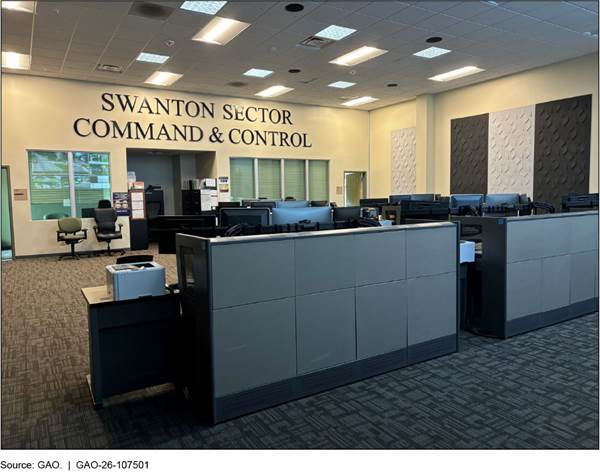
Law Enforcement Information Systems Specialists generally work in sectors’ communications centers like the one shown in figure 14.
Figure 14: Communications Center in U.S. Border Patrol Swanton Sector
However, Border Patrol has not filled or retained staff for all authorized Law Enforcement Information Systems Specialist positions along the northern border. At the end of fiscal year 2024, Border Patrol authorized 115 supervisory and non-supervisory Law Enforcement Information Systems Specialist positions in sectors along the northern border, and 88 of these positions were filled, a staffing rate of 77 percent. Staffing rates ranged from 57 percent in Swanton sector to 92 percent in Spokane sector. For fiscal years 2019 through 2024, the staffing rate varied between 76 percent and 84 percent across all sectors.[55] With the exception of one year (fiscal year 2022), these staffing rates were lower than in fiscal year 2018, the year in which the Law Enforcement Information Systems Specialist position was created. At the end of fiscal year 2018, Border Patrol had 17 vacancies out of 105 Law Enforcement Communication Assistant positions—a staffing rate of 84 percent. The levels for on board and authorized Law Enforcement Information Systems Specialist are shown in figure 15.
Figure 15: Number of Law Enforcement Information Systems Specialists Authorized and On Board in U.S. Border Patrol’s Northern Border Sectors
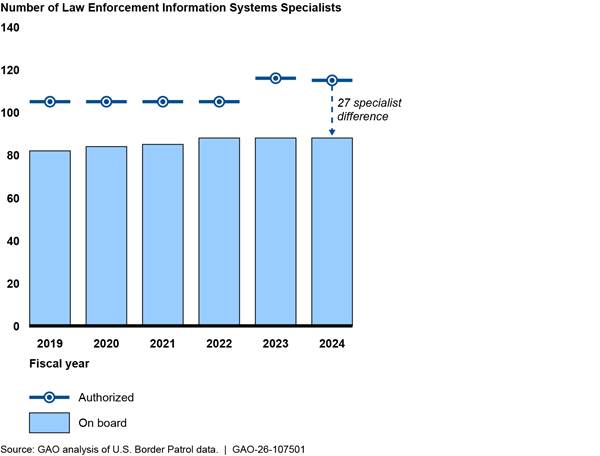
Notes: This figure includes non-supervisory and supervisory Law Enforcement Information Systems Specialists and Law Enforcement Communications Assistants. The Law Enforcement Information Systems Specialist position was created in 2018, though Border Patrol employed Law Enforcement Communications Assistants until fiscal year 2020.
Border Patrol officials from three sectors said that the sectors’ communications centers, where Law Enforcement Information Systems Specialists review cameras and sensor feeds, are not fully staffed, thus reducing the sectors’ ability to monitor land-based surveillance technology.
Officials from three sectors told us that Law Enforcement Information Systems Specialists leave the Border Patrol due to the low pay of the position compared to what they can earn at other local or federal agencies. Law Enforcement Information Systems Specialists are hired at the GS-5 or the GS-7 level with promotion potential up to GS-9. Supervisory Law Enforcement Information Systems Specialists are at the GS-11 level. According to Border Patrol headquarters officials, factors that affect Border Patrol’s ability to hire include a lengthy background investigation process, during which applicants may find other employment; limited local applicant pools; high cost of living; and minimal career advancement opportunities.
The senior Border Patrol official in charge of workforce planning stated that Border Patrol does not have any plans to improve the recruitment or retention of Law Enforcement Information Systems Specialists. This official stated that Border Patrol expects Law Enforcement Information Systems Specialists to leave the agency and look for better career opportunities.
The 2022 DHS Workforce Planning Guide states that DHS components and subcomponents should develop strategies and actions for addressing or closing workforce capacity and capability gaps.[56] According to the guide, strategies to mitigate, reduce, or eliminate critical gaps in the workforce can have multiple and varied approaches, and the strategies should be adapted into solutions and incorporated into plans. Border Patrol did not develop a plan with strategies to address the staffing gaps in the Law Enforcement Communications Assistant position and the Law Enforcement Information Systems Specialist position. The creation of the Law Enforcement Information Systems Specialists in 2018, which resulted in higher pay for these individuals, did not increase the staffing rate.
Without a plan identifying strategies to address the gap in Law Enforcement Information Systems Specialists in sectors along the northern border, Border Patrol is not well-positioned to fill vacancies and reduce attrition. In turn, Border Patrol does not have the resources needed to fully monitor land-based surveillance technology along the border, particularly in light of the expanded deployment of surveillance technology since fiscal year 2019, according to Border Patrol officials. Developing a plan with strategies to improve the recruitment and retention of Law Enforcement Information Systems Specialists would help Border Patrol ensure that it has sufficient personnel with appropriate skills to effectively use northern border surveillance technology.
Border Patrol Sectors Reported Various Factors That Affect Efforts to Secure the Northern Border
According to Border Patrol capability gap analysis reports, northern border sectors and stations reported several factors that affected their ability to secure the northern border.[57] Specifically, all eight northern border sectors reported challenges related to (1) the ability to detect and identify cross-border traffic, (2) communications technology and infrastructure, (3) limited personnel and specialized training to efficiently carry out mission duties, (4) the condition of facilities or fleets, and (5) coordination with other law enforcement agencies. Below are various examples of how these factors have affected Border Patrol’s ability to secure the northern border, according to agency officials.
Ability to detect and identify cross-border traffic. All northern border sectors reported that environmental challenges, including the varying terrain and extreme weather conditions, especially during the winter, affect Border Patrol’s ability to effectively detect and identify cross-border traffic and other threats.[58] Sectors reported in capability gap reports that stations lack surveillance technology, such as sensors, that can withstand cold weather conditions. For example:
· Border Patrol headquarters officials told us that agents are not able to work with remote, underground sensors year-round because the ground stays frozen for a significant part of the year. Officials stated that when the ground is frozen, the sensors are difficult to install, cannot be moved, and their batteries cannot be changed.
· All northern border sectors also reported challenges observing and detecting illicit activity on waterways. For example, Border Patrol stations reported that frozen waterways in the winter pose a difficult challenge for northern border sectors to observe cross-border traffic and illicit activity along waterways. In addition, Border Patrol sector officials discussed these challenges during our interviews. For example, officials from one sector told us that the threat of vehicles crossing the border into the United States increases when the shoreline is frozen in winter months.
In addition to the extreme weather in the region, the terrain itself poses challenges to detecting cross border traffic. For example:
· Detroit sector officials told us that the combination of narrow waterways, heavy maritime traffic, and lack of remote surveillance technology make it particularly difficult to track illicit activity and interdict vessels across Detroit sector’s area of responsibility. Similarly, Buffalo sector officials said that their area of responsibility does not have reliable radar capabilities to detect vessels crossing Lake Ontario and enable them to report the crossings to agents in the field in a timely manner.
· All northern border sectors reported challenges persistently observing and detecting aerial activity, including from drones and low-flying aircraft. Specifically, according to Border Patrol reports, 18 out of 49 stations reported that challenges detecting drones or low-flying aircraft make it harder for Border Patrol to detect illegal cross-border aerial traffic and illicit activities.
Communications technology and infrastructure. All northern border sectors reported that the lack of reliable cellular connectivity and other telecommunications infrastructure hinders sectors’ ability to effectively deploy surveillance technology or agents’ ability to effectively communicate. For example:
· Seven out of eight sectors reported capability gaps that cellular data connectivity issues have limited Border Patrol’s ability to deploy and receive timely returns from remote imaging surveillance technology, such as unattended ground sensors.
· Limited radio coverage in certain areas affects Border Patrol’s ability to communicate real-time information from station headquarters to agents in the field. Border Patrol relies on land-mobile radios to communicate between agents in the field and between agents in the field and stations. However, 28 out of 49 stations (or 57 percent) along the northern border reported challenges with land-mobile radios, which impaired operations and communications with other law enforcement partners and emergency services, according to Border Patrol stations.
Given these challenges with cellular and radio connectivity, at least two sectors reported developing temporary solutions to improve their connectivity. For example, Blaine and Spokane sectors installed Tactical Communication Network System towers. Spokane sector has 51 towers as of the end of fiscal year 2024—of which 29 towers facilitate communication across the sector, 24 towers have cameras, and two have both capabilities. The system allows agents to place cameras anywhere in the field because they are small and easy to move, according to Spokane sector officials. Blaine sector officials stated that the sector utilizes one Tactical Communication Network System tower to support unattended ground sensor connectivity. Blaine sector is also testing a mobile broadband provider at one of its four stations for this system, according to officials.
Limited personnel and specialized training to carry out mission duties. Thirty-five of 49 stations along the northern border (71 percent)—including at least one station in each sector—reported capability gaps of not having the appropriate number of agents to carry out mission duties to secure the northern border between ports of entry. Stations reported that the insufficient number of agents limits the sectors’ ability to efficiently and effectively carry out their responsibilities to secure the border. Further, in seven out of eight sectors at least one station reported that agents needed specialized training to support mission needs. For example, at least one station in Grand Forks, Houlton, and Swanton sectors reported that agents have received limited training to effectively respond to emergency situations, including water rescues.
Condition of northern border sectors’ facilities and fleets. Five out of eight sectors reported that at least one of their station facilities was not equipped to accommodate the increased number of migrants apprehended between ports of entry in fiscal years 2023 and 2024. In addition, officials from Buffalo sector told us that one of the sector’s six stations does not have a designated processing space and uses its kitchen area to process migrants. In November 2024, Buffalo sector officials told us that Border Patrol was taking steps to plan for the construction of a new station.
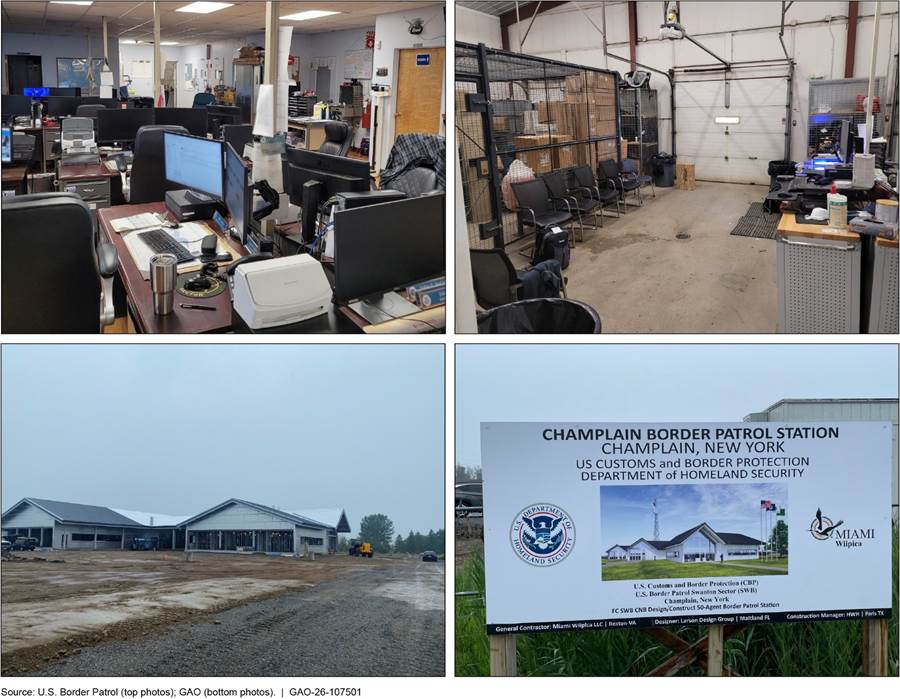
Champlain station within Swanton sector apprehended more migrants compared to other stations along the northern border in fiscal years 2022 through 2024, according to our analysis of Border Patrol data. Champlain station officials told us that the station does not have an adequate processing or holding area for migrants. During our observations at the Champlain station in July 2024, Border Patrol agents processed migrants in an open location within the same area as agents’ workstations and two small detention spaces. A new facility is under construction with an estimated completion of 2027, according to sector officials. In the meantime, to address the currently limited processing space available, Swanton sector signed memoranda of understanding with local jails to hold migrants who are being prosecuted, need to be detained over the weekend, and are not in U.S. Marshals Service custody, according to officials. Figure 16 shows photographs of Champlain station, as of June 2025, including the limited space for processing migrants, and the new Champlain station currently under construction, as of July 2024.
Figure 16: U.S. Border Patrol Champlain Station (June 2025) and the Construction Site for New Champlain Station (July 2024), Swanton Sector, Champlain, New York
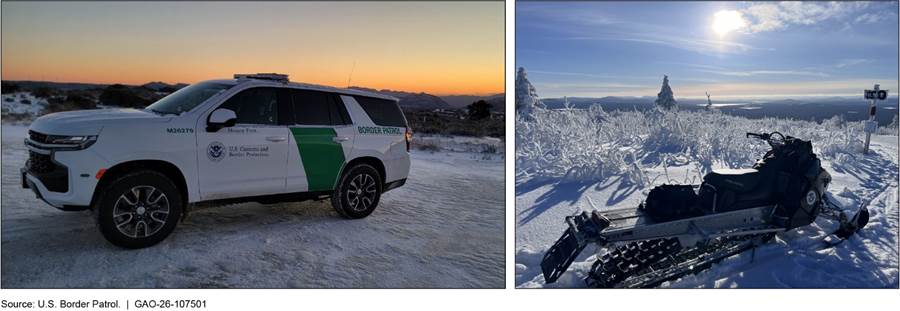
In addition, all sectors reported challenges related to the condition or availability of vehicles, including off-road vehicles and snowmobiles as well as vessels that affect efforts to secure the northern border between ports of entry. For example, stations in Buffalo and Detroit sectors reported that the limited availability of suitable vessels, including unmarked vessels, affect their ability to detect and identify cross-border traffic within a predominately maritime environment. In addition, officials from six out of eight sectors told us that maintaining aging fleets is a challenge.[59] Further, officials from Grand Forks sector told us that the terrain and travel distance put significant wear on their vehicles. Vehicle maintenance in Grand Forks is conducted by local commercial businesses, and there are limited suitable maintenance facilities to service the sector’s fleet, according to officials. These challenges with vehicle maintenance decrease their transportation capabilities, officials stated. Moreover, at least one station in four sectors reported that their facilities lacked fleet storage space that was secure or suitable for all weather conditions. Photographs of Border Patrol vehicles are shown in figure 17 below.
Figure 17: Examples of U.S. Border Patrol Vehicles Used Along the Northern Border
Coordination with other law enforcement agencies. Northern border sectors reported challenges coordinating with other law enforcement agencies. In particular, at least one station in four sectors reported challenges in their coordination with state and local law enforcement agencies in certain areas. For example:
· Officials in Blaine and Spokane sectors reported limitations in local law enforcement agencies’ information sharing with Border Patrol regarding immigration status in Washington state.[60]
· Officials in the Buffalo and Swanton sectors reported challenges with data sharing, which has affected New York state and local law enforcement agencies’ coordination with Border Patrol regarding the sharing of vehicle registration records.[61]
· Officials in Swanton sector also told us that it has been more difficult to coordinate with Vermont state and local law enforcement agencies on things like the routing of 911 dispatch calls to Border Patrol about individuals whose immigration or citizenship status is of interest to Border Patrol.[62]
In addition, officials from four out of eight sectors told us that agents have to travel long distances to transport detained noncitizens to detention facilities operated by U.S. Immigration and Customs Enforcement. For example, officials in Houlton sector told us that there are no U.S. Immigration and Customs Enforcement detention facilities in Maine; as such, two Border Patrol agents must transport noncitizens to facilities in Vermont or New Hampshire.[63] Border Patrol officials stated that these drives can take hours of travel time, diverting already limited personnel and vehicle resources and contributing to the depreciation of their vehicles’ reliability.
To address the transportation needs, Border Patrol began hiring processing coordinators.[64] Blaine sector officials told us that the addition of processing coordinators has allowed stations to use this position to provide transportation to detention facilities and return agents to the field. As of the end of fiscal year 2024, sectors along the northern border had 16 processing coordinators on board out of 30 authorized positions.[65]
Conclusions
Border Patrol agents rely on land-based surveillance technology—cameras, sensors, and radar sites—to help secure the northern border. Border Patrol’s increased deployment of these surveillance technologies can help secure the northern border, particularly when Border Patrol on board agent staffing levels are lower than authorized levels. The increased deployment of this equipment has amplified the need to have a sufficient number of Law Enforcement Information Systems Specialists to monitor the surveillance technology feeds. However, Border Patrol has a low staffing rate for Law Enforcement Information Systems Specialists along the northern border—77 percent at the end of fiscal year 2024—and does not have a plan to address the staffing gap. Developing a plan with strategies to improve the recruitment and retention of Law Enforcement Information Systems Specialists would help ensure Border Patrol has sufficient personnel with the appropriate skills to effectively use the surveillance technology currently deployed along the northern border.
Recommendation for Executive Action
We are making the following recommendation to CBP:
The Commissioner of CBP should develop and implement a plan with strategies for addressing workforce gaps in the Law Enforcement Information Systems Specialist position.
Agency Comments
We provided a draft of this report to DHS for review and comment. In its written comments, reproduced in appendix II, DHS agreed with the recommendation and identified steps it plans to address it. For example, DHS noted that Border Patrol is offering training opportunities to existing Border Patrol processing coordinators so they can fill Law Enforcement Information System Specialist positions, and that Border Patrol is planning to analyze the feasibility of retention incentives for this position. DHS also provided technical comments, which we incorporated as appropriate.
We are sending copies of this report to the appropriate congressional committees and the Secretary of Homeland Security. In addition, the report is available at no charge on the GAO website at https://www.gao.gov.
If you or your staff have any questions about this report, please contact me at gamblerr@gao.gov. Contact points for our Offices of Congressional Relations and Public Affairs may be found on the last page of this report. GAO staff who made key contributions to this report are listed in appendix III.
Rebecca Gambler
Director
Homeland Security and Justice
This report addresses:
1. what data show about Border Patrol apprehensions and seizures between ports of entry along the northern border since fiscal year 2019,
2. the extent to which U.S. Customs and Border Protection’s (CBP) use of assets and surveillance technology along the northern border changed since fiscal year 2019,
3. the extent to which CBP’s staffing along the northern border changed since fiscal year 2019 and the steps it has taken to address any staffing challenges, and
4. factors Border Patrol sectors reported as affecting their efforts to secure the northern border.
To address all four objectives, we interviewed officials from CBP, Border Patrol, and Air and Marine Operations (AMO) headquarters as well as Border Patrol sectors and AMO branches along the U.S.-Canada border.[66] Specifically, we visited Border Patrol’s Blaine, Detroit, and Swanton sectors and AMO’s Bellingham Air and Marine Branch, Great Lakes Air and Marine Branch, and Plattsburgh Air Unit. To select these six locations, we reviewed Border Patrol apprehension data and included locations that had the greatest increase of apprehensions from fiscal year 2019 through the second quarter of fiscal year 2024. We also selected these locations to include a mix of land and maritime borders. In addition, we conducted virtual interviews with officials from Border Patrol’s other northern border sectors—Buffalo, Grand Forks, Havre, Houlton, and Spokane sectors—and from AMO’s Manassas Air Branch and National Air Security Operations Center-Grand Forks. Together these Border Patrol sectors and AMO branches cover the length of the U.S.-Canada border.
To determine the number of apprehensions in each sector along the northern border, we analyzed record-level data from Border Patrol’s e3 portal on apprehensions along the northern border for fiscal year 2019 through the second quarter of fiscal year 2025 (October 1, 2024, to March 31, 2025), which were the most recent data available at the time of our review.[67] These data included all non-permanent resident foreign nationals and U.S. citizens or lawful permanent residents apprehended by one of Border Patrol’s eight sectors along the northern border. Our analyses sought to determine the total number of apprehensions in each sector and the citizenships of the individuals apprehended by Border Patrol.
To determine the number of Border Patrol drug, weapon, and currency seizures, we analyzed record-level data from Border Patrol’s e3 system on seizures along the northern border for fiscal year 2019 through the second quarter of fiscal year 2025 (October 1, 2024, to March 31, 2025), which were the most recent data available at the time of our review.[68] For currency seizures, we included all seizures that were recorded as currency or monetary seizures, to include U.S. cash as well as foreign currency. Firearm seizures included firearm-related equipment, such as silencers and parts.
We assessed the reliability of all apprehension and seizure data by performing electronic testing for obvious errors in accuracy and completeness, reviewing existing information about the data and the systems that produced them, and interviewing knowledgeable agency officials, including officials from CBP’s Office of Information and Technology. We determined that Border Patrol’s apprehension and seizure data were sufficiently reliable to report on Border Patrol’s law enforcement activity along the northern border between ports of entry since fiscal year 2019.
During our review, we also collected and analyzed record-level data related to AMO’s seizure of drugs and firearms along the northern border. However, after reviewing our draft report, which included our analysis of these data, CBP officials noted some inconsistencies with the data on AMO seizures it publicly reports. Following additional reviews of the data and interviews with CBP and AMO officials, we decided not to include the AMO data in the report because we could not ensure that they accurately represented the number of seizures along the northern border in which AMO was involved.
To determine how CBP’s use of assets and surveillance technology along the northern border changed, we analyzed AMO flight hour and float hour data from CBP’s Tasking, Operations, and Management Information System for fiscal year 2019 through fiscal year 2024—the most recent complete year data available at the time of our review—for the Northern Region and the National Air Security Operations Center-Grand Forks.[69] The data analyses focused on enforcement hours and excluded other categories of flight and float hours, such as training and maintenance. We assessed the reliability of these data by conducting electronic testing to detect missing data and obvious errors, reviewing AMO documentations, and interviewing knowledgeable AMO officials. We determined that these data were sufficiently reliable for reporting the total number of flight and float hours in each AMO branch along the northern border.
We also analyzed the laydown of all AMO aircraft and marine vessels, and riverine vessels across the Northern Region and National Air Security Operations-Grand Forks.[70] We included laydown data from April 2019 and October 2024 since these were the data that were available closest to the end of fiscal year 2019 and fiscal year 2024, respectively. For each of the data analyses, we excluded assets and hours associated with Manassas Air Branch, Chicago Air Unit, and New York Air Unit. Although they are subordinate to AMO’s Northern Region, these units do not generally operate along the northern border.
We also analyzed data on Border Patrol’s deployment of land-based surveillance technology across the northern border as of September 30, 2019, and September 30, 2024. By comparing data from these two dates, we were able to identify how the use of these technologies changed over this time frame. Border Patrol’s Program Management Office Directorate, which oversees many of these systems (including Northern Border Remote Video Surveillance Systems and the unattended ground sensors), provided most of these data. We also obtained data from individual Border Patrol sectors, such as data on the Tactical Communications Network System from Spokane sector. In addition to Border Patrol and AMO field officials that we interviewed during site visits and virtual interviews, we also interviewed officials from Border Patrol headquarters, including from the Program Management Office Directorate, and AMO headquarters.
To assess the extent to which CBP’s staffing along the northern border changed, we analyzed summary staffing data on the number of Border Patrol and AMO agents from fiscal year 2019 through fiscal year 2024—the most recent complete year data available at the time of our review. These data included Border Patrol agents assigned to the eight sectors along the northern border and AMO agents assigned to AMO’s Northern Region or National Air Security Operations Center-Grand Forks. We excluded agents assigned to Manassas Air Branch, Chicago Air Unit, and New York Air Unit; although they are subordinate to AMO’s Northern Region, these units do not generally operate along the northern border. We also analyzed summary Border Patrol staffing data on the number of supervisory and nonsupervisory Law Enforcement Communication Assistants and Law Enforcement Information Systems Specialists in each northern border sector for fiscal year 2019 through fiscal year 2024. We assessed the reliability of these data by manually reviewing for missing data and obvious errors, reviewing CBP documents, and interviewing knowledgeable CBP officials. We determined that these data were sufficiently reliable for the purpose of reporting the number of agents and Law Enforcement Information Systems Specialists assigned to the northern border over time.
For this objective we also reviewed various documents, including the Operational Mobility Program agreement between Border Patrol and National Border Patrol Council and position descriptions for Law Enforcement Information Systems Specialists. We assessed Border Patrol’s plans and policies about the staffing gap for the Law Enforcement Information Systems Specialist position against the 2022 DHS Workforce Planning Guide.[71] This guide states that DHS components and subcomponents should develop strategies and actions for addressing or closing workforce capacity and capability gaps. We also interviewed Border Patrol officials from field locations, as described above, and from the Law Enforcement Operations Directorate and the Workforce Management Directorate.
To address our fourth objective about Border Patrol’s challenges, we reviewed Border Patrol’s northern border stations’ capability gap analysis reports for fiscal year 2024. Border Patrol produced these reports as part of its annual capability gap analysis process.[72] The reports group the capability gaps into 12 categories, known as master capability categories.[73] In six of the master capability categories, at least one Border Patrol sector from every northern border sector reported at least one capability gap. We analyzed the summary statements, which detailed the specific capability gap of the categories that had 45 or more records of open capability gaps.
Our analysis resulted in five categories of capability gaps: (1) domain awareness; (2) communications; (3) human capital management; (4) mission readiness; and (5) security partnership.[74] For improved readability in this report, we renamed these categories as follows: (1) Border Patrol’s ability to detect and identify cross-border traffic; (2) communications technology and infrastructure; (3) personnel and training; (4) condition of facilities and fleets; and (5) coordination with other law enforcement agencies. From each of these categories, we identified common themes reported by northern border stations that two GAO analysts reviewed and agreed upon to use as illustrative examples of factors that have affected Border Patrol’s ability to secure the northern border between ports of entry. We also interviewed officials from each sector; insights from those interviews supplement our analysis of Border Patrol’s capability gap analysis reports.
We conducted this performance audit from April 2024 through February 2026 in accordance with generally accepted government auditing standards. Those standards require that we plan and perform the audit to obtain sufficient, appropriate evidence to provide a reasonable basis for our findings and conclusions based on our audit objectives. We believe that the evidence obtained provides a reasonable basis for our findings and conclusions based on our audit objectives.
GAO Contact
Rebecca Gambler at gamblerr@gao.gov.
Staff Acknowledgments
In addition to the contact named above, E. Jeanette Henriquez (Assistant Director), Eric Warren (Analyst in Charge), Lauri Barnes, Kathryn Bernet, Michele Fejfar, Eric Hauswirth, Samantha Lyew, Grant Mallie, and Sasan J. “Jon” Najmi made key contributions to this report. Lincoln Dow, James Holley, and Natalie Swabb also provided substantial assistance.
The Government Accountability Office, the audit, evaluation, and investigative arm of Congress, exists to support Congress in meeting its constitutional responsibilities and to help improve the performance and accountability of the federal government for the American people. GAO examines the use of public funds; evaluates federal programs and policies; and provides analyses, recommendations, and other assistance to help Congress make informed oversight, policy, and funding decisions. GAO’s commitment to good government is reflected in its core values of accountability, integrity, and reliability.
Obtaining Copies of GAO Reports and Testimony
The fastest and easiest way to obtain copies of GAO documents at no cost is through our website. Each weekday afternoon, GAO posts on its website newly released reports, testimony, and correspondence. You can also subscribe to GAO’s email updates to receive notification of newly posted products.
Order by Phone
The price of each GAO publication reflects GAO’s actual cost of production and distribution and depends on the number of pages in the publication and whether the publication is printed in color or black and white. Pricing and ordering information is posted on GAO’s website, https://www.gao.gov/ordering.htm.
Place orders by calling (202) 512-6000, toll free (866) 801-7077,
or
TDD (202) 512-2537.
Orders may be paid for using American Express, Discover Card, MasterCard, Visa, check, or money order. Call for additional information.
Connect with GAO
Connect with GAO on X,
LinkedIn, Instagram, and YouTube.
Subscribe to our Email Updates. Listen to our Podcasts.
Visit GAO on the web at https://www.gao.gov.
To Report Fraud, Waste, and Abuse in Federal Programs
Contact FraudNet:
Website: https://www.gao.gov/about/what-gao-does/fraudnet
Automated answering system: (800) 424-5454
Media Relations
Sarah Kaczmarek, Managing Director, Media@gao.gov
Congressional Relations
David A. Powner, Acting Managing Director, CongRel@gao.gov
General Inquiries
[1]Ports of entry are facilities that provide for the controlled entry into or departure from the United States. Specifically, a port of entry is any officially designated location (seaport, airport, or land border location) where CBP officers are assigned to clear travelers, merchandise, cargo, and other items; collect duties; enforce customs laws; and inspect persons entering or applying for admission into, or departing, the United States pursuant to U.S. travel controls and immigration law. As background, see 8 C.F.R. §§ 100.4, 234.4; 19 C.F.R. §§ 101.1, 101.3.
[2]GAO, Northern Border Security: CBP Identified Resource Challenges but Needs Performance Measures to Assess Security Between Ports of Entry, GAO‑19‑470 (Washington, D.C.: June 26, 2019).
[3]Border Patrol divides responsibility for border security operations along the northern border among eight sectors that are further divided into 49 stations.
[4]Three branches make up AMO’s Northern Region: Bellingham Air and Marine Branch in Washington, Great Lakes Air and Marine Branch in Michigan, and Manassas Air Branch in Virginia. In addition, the National Air Security Operations Center-Grand Forks, located in North Dakota, operates as an air unit and provides training for unmanned aircraft systems.
[5]When a CBP agent seizes one or multiple drugs from one or multiple offenders, the entire incident is referred to as a drug seizure event. Within a drug seizure event, there may be one or multiple types of drugs seized. In our analysis, we define a “drug seizure” as each individual drug type seized.
[6]Flight and float hours are the number of hours that AMO operated its aircraft and marine vessels, respectively.
[7]Law Enforcement Communications Assistants and Law Enforcement Information Systems Specialists are professional, nonuniformed analysts that monitor feeds from surveillance technology, among other tasks.
[8]Department of Homeland Security, Office of the Chief Human Capital Officer, DHS Workforce Planning Guide (Washington, D.C.: Oct. 2022).
[9]Border Patrol’s annual capability gap analysis is a process that is intended to identify each station’s capability gaps. Capability gaps are determined by the difference between a station’s baseline capabilities and a station’s required set of capabilities needed to perform mission essential tasks. The identified shortfall in the required capability is a capability gap. For more information, see GAO, Southwest Border Security: Additional Actions Needed to Better Assess Fencing’s Contributions to Operations and Provide Guidance for Identifying Capability Gaps, GAO‑17‑331 (Washington, D.C.: Feb. 16, 2017).
[10]We reported on themes identified by all northern border sectors in the stations’ reports. For more information, see appendix I.
[11]The Great Lakes system includes lakes Ontario, Erie, Huron, Michigan, and Superior, their connecting waters, and the St. Lawrence River. The U.S.-Canada border includes 163 miles of maritime border in the Salish Sea, including the Strait of Juan de Fuca, in the Pacific Northwest between the Canadian province of British Columbia and the state of Washington.
[12]6 U.S.C. § 211(a) (establishing of U.S. Customs and Border Protection), (c) (enumerating CBP’s duties), (e) (establishing and enumerating duties of the U.S. Border Patrol within CBP).
[13]The Alaska border with Canada is part of Blaine sector’s area of responsibility and is not included in the scope of this work.
[14]6 U.S.C. § 211(f) (establishing and listing duties of AMO within CBP).
[15]Manassas Air Branch, the New York Air Unit, and the Chicago Air Unit are part of the Northern Region but do not generally operate along the northern border.
[16]As we reported in 2024, CBP officials stated that the processing coordinator position has helped reduce the number of temporary details that Border Patrol agents performed at the southwest border. In addition, processing coordinators reduced the amount of time that Border Patrol agents spent on processing paperwork, allowing these agents to spend more time on their law enforcement duties, according to officials. GAO, U.S. Customs and Border Protection: Efforts to Improve Recruitment, Hiring, and Retention of Law Enforcement Personnel, GAO‑24‑107029 (Washington, D.C.: Sept. 25, 2024).
[18]CBP defines a vehicle incursion as the unauthorized crossing of a vehicle over the international boundary of the United States at a place other than at an open port of entry. U.S. Customs and Border Protection, Emergency Driving Including Vehicular Pursuits by U.S. Customs and Border Protection Personnel, Directive No. 4510-26 (January 2021).
[19]For the purposes of this report, the term “apprehension” refers to an enforcement action by Border Patrol to physically control or temporarily detain any persons (noncitizens or U.S. citizens) encountered between ports of entry based on suspected violation of federal law, including laws governing entry into the United States. DHS documentation we reviewed for this report used the terms “alien,” “migrant,” and “noncitizen” interchangeably. For readability, we generally use the term “noncitizen” or “foreign national,” to refer to an “alien,” which is defined by statute as any person who is not a citizen or national of the U.S., except when quoting language in statute, regulation, or executive orders that use the term “alien.” 8 U.S.C. § 1101(a)(3).
[20]These figures include non-permanent resident foreign nationals and U.S. citizens or lawful permanent residents. While U.S. citizens are not subject to statutory admissibility restrictions (i.e., inadmissibility) applicable to noncitizens, Border Patrol may enforce U.S. law against U.S. citizens for criminal offenses or non-immigration civil violations. 8 U.S.C. § 1182(a) (grounds of inadmissibility applicable to noncitizens); regarding CBP officer and agent law enforcement authority, see, e.g., 8 U.S.C. § 1357 (powers of immigration officers and employees); 19 U.S.C. § 1589a (enforcement authority of customs officers).
[21]Border Patrol data do not indicate the reason why apprehensions increased.
[22]These figures represent the number of apprehensions not the number of unique individuals because persons can be apprehended more than once in a given fiscal year. The number of U.S. citizens Border Patrol apprehended along the northern border decreased from 1,733 in fiscal year 2019 to 442 in fiscal year 2024. Border Patrol apprehended 284 U.S. citizens in first two quarters of fiscal year 2025.
[23]8 U.S.C. § 1182(a) (grounds of inadmissibility). It is unlawful for a U.S. citizen to depart from or enter, or attempt to depart from or enter, the U.S. unless they have a valid U.S. passport. 8 U.S.C. § 1185(b). All travelers—U.S. citizens or nationals and noncitizens including U.S. permanent residents or other people of foreign nationality—seeking entry to the U.S. must do so at a designated port of entry where they are required by law to present themselves (along with valid travel documents such as a passport or visa) for inspection by a CBP officer who assesses their citizenship or nationality, immigration status, admissibility, and compliance with U.S. law, and may take appropriate enforcement action under the circumstances. 8 U.S.C. §§ 1185 (travel control of citizens and aliens), 1225 (inspection of aliens arriving in the U.S. who are deemed applicants for admission); 8 C.F.R. pts. 215 subpt. A (alien departure controls), 235 (inspection of persons applying for admission).
[24]8 U.S.C. § 1101(a)(13)(C). Lawful permanent residents remain foreign nationals under U.S. law and may be subject to civil and criminal penalties for entering without inspection, or reentry after denial of admission or removal. See 8 U.S.C. §§ 1325, 1326.
[25]Canada’s Electronic Travel Authorization is an entry requirement for visa-exempt foreign nationals travelling to Canada by air. The authorization costs $7 (Canadian) to apply.
[26]As of February 2024, Mexican citizens who do not hold a valid U.S. nonimmigrant visa or have not held a Canadian visa in the past 10 years and are travelling by air on a Mexican passport will not qualify for electronic travel authorization and therefore must apply for a Canadian visitor visa.
[27]When a CBP agent seizes one or multiple drugs from one or multiple offenders, the entire incident is referred to as a drug seizure event. Within a drug seizure event, there may be one or multiple drug seizures. In our analysis, we define a “drug seizure” as each individual drug type seized within a drug seizure event.
[28]Border Patrol may be the lead agency in a drug seizure or may assist another federal, state, or local agency. These figures include seizures that Border Patrol led or provided assistance to.
[29]In our 2019 report, we reported that marijuana made up the majority of drug seizures for each Border Patrol northern border sector for fiscal year 2013 through fiscal year 2017. See GAO‑19‑470.
[30]Records of Border Patrol seizures include firearm-related equipment, such as silencers and parts.
[31]When a Border Patrol agent seizes one or multiple currencies from one or multiple offenders, the entire incident is referred to as a currency seizure event.
[32]U.S. Customs and Border Protection, National Standards on Transport, Escort, Detention, and Search. (Washington, D.C.: Oct. 2015).
[33]For purposes of CBP’s customs enforcement provisions, “merchandise” that may be subject to seizure and forfeiture is defined by law to include monetary instruments such as currency. See 19 U.S.C. §§ 1401, 1607; 31 U.S.C. § 5312(a)(3). See, e.g., U.S. v. $960,000 U.S. Currency, 307 Fed. Appx. 251 (11th Cir. 2006) (seizure by CBP of currency under 19 U.S.C. § 1595a(c)(1)(A)).
[34]19 U.S.C. § 1595a(c)(1)(A).
[35]As of August 2025, we did not identify any federal court cases addressing this specific currency forfeiture practice described by Blaine sector officials. However, federal courts have interpreted the statute relied on by CBP in other potentially relevant contexts. In U.S. v. Davis, the U.S. Court of Appeals for the Second Circuit stated that the government must demonstrate probable cause to believe merchandise is forfeitable, at which point the burden shifts to the claimant to show by a preponderance of the evidence that it is neither introduced contrary to law, nor stolen, smuggled or clandestinely imported. U.S. v. Davis, 648 F.3d 84, 88 (2d Cir. 2011). The Second Circuit also found in U.S. v. Broadening-Info Enterprises, Inc., that the crime of smuggling, which U.S. law has viewed as having substantially the same meaning as “clandestine introduction,” may result from the knowing use of a false, forged, or fraudulent invoice regardless of the impact on customs duties. U.S. v. Broadening-Info Enters., 578 Fed. Appx. 10, 14-16 (2d Cir. 2014). In addition, the U.S. District Court for the District of Montana entered default judgment for the forfeiture of defendant currency in the amount of $11,262 found inside of a bag on the rear seat of a vehicle which had crossed the northern border into the United States without going through a port of entry. U.S. v. $11,262.00 U.S. Currency, 2022 U.S. Dist. LEXIS 230926 (D. Mont. 2022). The government asserted that the currency is subject to forfeiture based on, among other things, the individual having allegedly met with someone in Canada who provided a contact in California for work and a place to live; traveling a long distance to a remote area in Montana to cross the border in an isolated location ignoring signs directing people to the port of entry; and providing vague responses regarding travel. U.S. v. $11,262.00 U.S. Currency, No. CV-22-86-GF-BMM-JTJ, Verified Complaint for Forfeiture In Rem, ECF No. 1, at 9-10 (D. Mont. Sep. 6, 2022). The court stated that “[t]he facts contained in the verified complaint support the institution of these forfeiture proceedings…The totality of circumstances as set forth…demonstrates that there is a substantial connection that the defendant currency constitutes monetary instruments of more than $10,000.00 subject to currency transportation reporting requirements knowingly transported into the United States at one time without filing a report with CBP at the time of arrival in violations of 31 U.S.C. § 5316(b) and 19 U.S.C. § 1595a(c)(1)(A).” 2022 U.S. Dist. LEXIS 230926, at *5. In another case decided by the Montana federal district court, CBP was granted a default judgment for the forfeiture of ammunition. U.S. v. 8,090 Rounds of Various Ammunition, 2024 U.S. Dist. LEXIS 63531 (D. Mont. 2024). However, CBP did not seize or seek forfeiture of foreign currency found to be concealed in various locations in the vehicle after the individual made numerous untruthful and/or misleading statements when asked about the amount of ammunition and currency in his possession. Instead, CBP issued a fine for failure to declare the currency. See U.S. v. 8,090 Rounds of Various Ammunition, No. CV 23-69-GF-BMM, Verified Complaint for Forfeiture In Rem, ECF No. 1 (D. Mont. Nov. 13, 2023).
[36]These flight and float hour calculations include time spent on enforcement activities and exclude other activities, such as training and maintenance.
[37]Aircraft counts include National Air Security Operations-Grand Forks, which is not part of AMO’s Northern Region but operates along the northern border. These counts exclude aircraft assigned to Manassas Air Branch, Chicago Air Unit, and New York Air Unit. Although they are subordinate to AMO’s Northern Region, these units do not generally operate along the northern border.
[38]We discussed the acquisition of Autonomous Surveillance Towers and other surveillance towers in a February 2025 report. GAO, DHS Annual Assessment: Improved Guidance on Revised Acquisition Goals Would Enhance Transparency, GAO‑25‑107317 (Washington, D.C.: Feb. 25, 2025).
[39]Border Patrol officials told us that, as of March 2025, Swanton sector no longer has a counter drone system.
[40]According to Border Patrol officials, Border Patrol considers towers available when their cameras are sending feeds back to the communication centers.
[41]Camera availability in Buffalo sector decreased at a lower rate, from 97 percent at the end of fiscal year 2019 to 93 percent at the end of fiscal year 2024.
[42]Authorized staff for Border Patrol agent positions represent the authorized staffing levels or number of such positions determined by Border Patrol to be supported by its appropriation and informed by legislative language contained in explanatory statements and other congressional documents. From fiscal year 2018 through fiscal year 2022, Border Patrol reported its overall authorized staffing level for agents as 19,555. The explanatory statement accompanying the fiscal year 2023 appropriation stated that the agreement provides funding for 19,855 agents. See 2023 Explanatory Statement accompanying the Consolidated Appropriations Act, 2023, 168 Cong. Rec. S8553, S8557 (daily ed. Dec. 20, 2022). The explanatory statement accompanying the Further Consolidated Appropriations Act, 2024 provided that $494,804,000 was funding for 22,000 agents, an increase of 1,795 above the President’s Budget request. See 170 Cong. Rec. H1501, H1809-H1810 (daily ed. Mar. 22, 2024). CBP received $4.1 billion in the 2025 reconciliation law, commonly known as the One Big Beautiful Bill Act, available until September 30, 2029, to hire and train additional CBP agents and officers, rehired annuitants, and U.S. Customs and Border Protection field support personnel. See An Act to provide for reconciliation pursuant to title II of H. Con. Res. 14, Pub. L. No. 119-21, title IX, subtitle A, § 90002(a)(1), 139 Stat. 72, 358.
[43]Border Patrol agents are eligible to retire at age 50 with 20 years of law enforcement officer experience or at any age with 25 years of law enforcement officer experience. Generally, the mandatory retirement date for law enforcement personnel is the last day of the month in which the officer or agent reaches 57 years of age or 20 years of law enforcement service if then over that age. 5 U.S.C. § 8425(b)(1).
[44]The temporary assignments included agents from northern and coastal border sectors as well as agents from the southwest border assigned to a different southwest border sector. DHS Office of Inspector General, Intensifying Conditions at the Southwest Border Are Negatively Impacting CBP and ICE Employees’ Health and Morale, OIG-23-24 (Washington, D.C.: May 3, 2023).
[46]GAO‑24‑107029. Our prior work discusses the importance of implementing and assessing the effectiveness of strategies to retain staff and improve morale. See GAO, Federal Workforce: Key Talent Management Strategies for Agencies to Better Meet Their Missions, GAO‑19‑181 (Washington, D.C.: Mar. 28, 2019).
[47]See An Act to provide for reconciliation pursuant to title II of H. Con. Res 14, Pub. L. No. 119-21, § 90002(a)(2), 139 Stat. 72 at 358.
[48]These data include National Air Security Operations-Grand Forks, which is not part of AMO’s Northern Region but operates along the northern border. These data exclude Manassas Air Branch, Chicago Air Unit, and New York Air Unit. Although they are subordinate to AMO’s Northern Region, they do not generally operate along the northern border. Unlike Border Patrol, AMO currently does not set an authorized number of agents per branch or unit.
[50]Prior to the Operational Mobility Program, Border Patrol agents could request transfer between sectors through the Voluntary Relocation Program.
[51]In comments provided for a draft version of this report, Border Patrol officials told us that Border Patrol initiated a job swap program in August 2025, wherein Border Patrol agents and other employees could voluntarily exchange positions with other eligible employees within the same job position.
[52]GAO‑19‑470. As we reported in June 2019, the Law Enforcement Communication Assistant duties at each northern border sector were dispatching and officer safety checks, monitoring surveillance camera feeds and unattended ground sensor activation, and conducting intelligence research checks for agents on duty across all stations in the sector. The nonsupervisory Law Enforcement Communication Assistants were at the GS-5 or GS-6 level, and supervisory Law Enforcement Communication Assistants were at the GS-7 or GS-8 level. Nonsupervisory Law Enforcement Information Systems Specialists are at the GS-5, GS-7, or GS-9 levels, while supervisory Law Enforcement Information Systems Specialists are at the GS-11 level.
[53]The General Schedule (GS) classification and pay system covers the majority of civilian white-collar federal employees in professional, technical, administrative, and clerical positions. The General Schedule has 15 grades: GS-1 (lowest) to GS-15 (highest). Agencies establish (classify) the grade of each job based on the level of difficulty, responsibility, and qualifications required.
[54]The Law Enforcement Information Systems Specialists position has additional responsibilities compared to the Law Enforcement Communications Assistant position, including creating intelligence reports.
[55]These figures combine the Law Enforcement Communications Assistant position and the Law Enforcement Information Systems Specialist position. Border Patrol employed Law Enforcement Communications Assistants until fiscal year 2020.
[56]Department of Homeland Security, Office of the Chief Human Capital Officer, DHS Workforce Planning Guide (Washington, D.C.: Oct. 2022).
[57]The findings in this section are primarily based on our review of Border Patrol’s capability gap analysis reports for fiscal year 2024. Each Border Patrol station produces these reports as part of Border Patrol’s annual capability gap analysis process to determine a station’s baseline capabilities and the required set of capabilities needed to perform mission essential tasks. Border Patrol officials stated that the quantity of documented gaps is not necessarily a measure of the gaps’ overall importance. We also interviewed officials from each sector; insights from those interviews supplement our analysis of Border Patrol’s capability gap analysis reports. For a full description of our methodology, see appendix I.
[58]According to Border Patrol, detection is the act of discovering the presence of a possible item of interest or suspected contraband. Identification is the act of determining whether an item of interest is human, animal, conveyance, or unknown.
[59]In our 2019 report, we noted that Border Patrol’s northern border sectors identified maintaining aging fleets as a challenge. Officials similarly stated that the harsh climate along the northern border creates additional burdens on agent vehicles prior to the vehicles reaching the end of their expected service life. GAO‑19‑470.
[60]Blaine and Spokane sector officials referred to Washington state law which, among other things, limits state and local law enforcement agencies from: (1) inquiring into immigration or citizenship status, or place of birth unless such information is connected to a criminal investigation; or (2) providing information in response to notification requests from the federal government for purposes of civil (i.e., non-criminal) immigration enforcement. Rev. Code Wash. § 10.93.160.
[61]Buffalo and Swanton sector officials referred to New York state law which, among other things, limits sharing of driver’s license or learner’s permit information to any agency that primarily enforces immigration law. N.Y. CLS Veh. & Tr. § 201.
[62]Swanton sector officials referred to Vermont policing policy. As background, 20 V.S.A. § 2366 requires Vermont state, county and municipal law enforcement agencies to adopt a fair and impartial policing policy including each component of the Criminal Justice Council’s model fair and impartial policing policy. Such agencies may include additional restrictions on agency members’ communication and involvement with federal immigration authorities or communications regarding citizenship or immigration status.
[63]Under CBP policy, detainees must be transported or escorted by two agents, as feasible. U.S. Customs and Border Protection, National Standards on Transport, Escort, Detention, and Search. (Washington, D.C.: Oct. 2015).
[64]CBP created the Border Patrol processing coordinator position in 2019 to support Border Patrol agents by performing tasks that allow agents to spend more time on law enforcement duties.
[65]Funds provided to CBP in Public Law 119-21—commonly known as the One Big Beautiful Bill Act—for recruitment, hiring and training of personnel, may not be used to recruit, hire or train personnel for the duties of processing coordinators after October 31, 2028. See Pub. L. No. 119-21, § 90002(b), 139 Stat. at 358.
[66]According to CBP officials, AMO’s National Air Security Operations Center-Grand Forks, though not a branch, is responsible for areas along the border similar to an AMO branch or air unit.
[67]Border Patrol’s e3 portal consists of a series of web applications that collect and transmit data related to U.S. Immigration and Customs Enforcement’s Enforcement Integrated Database.
[68]For the purposes of this analysis, we used Border Patrol’s e3 data to report on drug, weapon, and currency seizures. Although SEACATS is the official system of record for CBP seizures, Border Patrol officials told us that e3 data capture Border Patrol’s operational activity for the scope of our review. CBP officials also told us that these data may differ from the totals reported publicly by CBP for two primary reasons. First, CBP’s reporting only includes instances when Border Patrol was the lead agency; we opted to include seizures in which Border Patrol assisted. Second, CBP officials told us that they may update e3 records as information is corrected, such as the location of the seizure, the type of items seized, or the weight of the seized items.
[69]Flight and float hours are the number of hours that AMO aircraft and marine vessels, respectively, were operating.
[70]Border Patrol operates AMO-owned riverine vessels.
[71]Department of Homeland Security, Office of the Chief Human Capital Officer, DHS Workforce Planning Guide (Washington, D.C.: Oct. 2022).
[72]Border Patrol’s annual capability gap analysis is a process that is intended to identify each station’s capability gaps. Capability gaps are determined by the difference between a station’s baseline capabilities and a station’s required set of capabilities needed to perform mission essential tasks. The identified shortfall in the required capability is a capability gap. Border Patrol officials stated that the quantity of documented gaps is not necessarily a measure of the gaps’ overall importance. For more information about Border Patrol’s capability gap analysis process, see GAO, Southwest Border Security: Additional Actions Needed to Better Assess Fencing’s Contributions to Operations and Provide Guidance for Identifying Capability Gaps, GAO‑17‑331 (Washington, D.C.: Feb. 16, 2017).
[73]Only 11 of the 12 master capability gaps appeared in the fiscal year 2024 capability gap analysis reports for northern border stations.
[74]Border Patrol defines domain awareness as the ability to continuously detect, identify, classify, and track all border incursions in targeted areas at all times. GAO‑17‑331. In this report, we refer to domain awareness as detecting and identifying cross-border traffic.