
Report to Congressional Committees
United States Government Accountability Office
A report to congressional committees
For more information, contact: Alicia Puente Cackley at cackleya@gao.gov
What GAO Found
The Departments of Housing and Urban Development (HUD) and Veterans Affairs (VA) jointly operate the HUD-Veterans Affairs Supportive Housing (HUD-VASH) program. Veterans experiencing homelessness receive HUD housing vouchers and VA case management delivered through local VA medical centers.
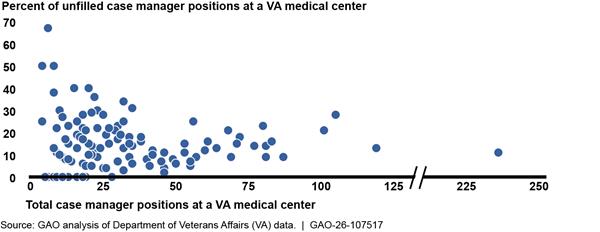
VA has faced challenges hiring and retaining enough case managers. In fiscal year 2024, more than one-quarter of medical centers with two or more case managers had at least 20 percent of these positions unfilled (see figure). Factors contributing to vacancies included staff burnout and turnover. GAO analysis of VA data shows that annual case manager turnover ranged from 20 percent to 26 percent in fiscal years 2020–2024. Stakeholders at all eight sites GAO visited described periods of high turnover and persistent vacancies. The effects of insufficient staffing include reduced services for veterans and delays in admitting new participants.
HUD-VASH Case Manager Staffing Levels in Fiscal Year 2024, by VA Medical Center
Each dot represents a VA medical center’s staffing level for the Housing and Urban Development-Veterans Affairs Supportive Housing (HUD-VASH) program.
VA has taken steps to improve case manager hiring but has not consistently collected data on reasons that prevented veterans from entering HUD-VASH. Of 174,045 instances of veterans not being referred to the program in 2020–2024, VA did not document the reason in 151,296 (87 percent), according to GAO’s analysis. With more complete data on the reasons, VA could better assess its unmet need, adjust hiring strategies, and allocate case managers accordingly. VA then would be better positioned to serve more veterans.
HUD launched the Tribal HUD-VASH pilot program in fiscal year 2016 to test a new approach to serving American Indian/Alaska Native veterans and had served over 1,100 veterans as of April 2025, according to HUD. HUD’s program design aligns to some extent with leading practices GAO identified in prior work. For example, HUD communicated with stakeholders at all stages of the program. But HUD has not clearly defined the program’s objectives or how it will measure progress toward them. HUD also has not implemented an evaluation plan. By fully incorporating leading practices, HUD could help ensure it has the information needed to make informed decisions about the program.
Why GAO Did This Study
HUD estimated that 32,882 veterans experienced homelessness on a single night in January 2024. Some policymakers note that this population faces significant barriers, including high housing costs. The Consolidated Appropriations Act, 2023 includes a provision for GAO to review VA case management and the availability of affordable housing for veterans experiencing homelessness. This report examines, among other things, challenges reported by VA staff and stakeholders related to (1) hiring and retaining case managers for HUD-VASH, and (2) implementing Tribal HUD-VASH.
GAO analyzed data on HUD-VASH case managers for fiscal years 2020–2024; reviewed VA and HUD policies and guidance; and reviewed HUD documentation on the Tribal HUD-VASH program. GAO interviewed officials from VA and HUD and housing and service providers at eight sites GAO visited (selected for geographic diversity and prevalence of veteran homelessness).
What GAO Recommends
GAO recommends that VA collect comprehensive data on the reasons veterans are not referred to HUD-VASH and take appropriate corrective actions. GAO also recommends that HUD clearly define measurable objectives and develop and implement a data analysis plan to evaluate Tribal HUD-VASH. VA agreed with the recommendation. HUD did not agree or disagree but indicated it would take actions to implement the recommendation.
Abbreviations
FY fiscal year
GPD Grant and Per Diem
HUD Department of Housing and Urban Development
HUD-VASH Housing
and Urban Development-Veterans Affairs
Supportive Housing
PHA public housing agencies
Q quarter
SSVF Supportive Services for Veteran Families
Tribal HUD-VASH Tribal
Housing and Urban Development-Veterans
Affairs Supportive Housing
VA Department of Veterans Affairs
VAMC VA medical center
This is a work of the U.S. government and is not subject to copyright protection in the United States. The published product may be reproduced and distributed in its entirety without further permission from GAO. However, because this work may contain copyrighted images or other material, permission from the copyright holder may be necessary if you wish to reproduce this material separately.
March 30, 2026
The Honorable Jerry Moran
Chairman
The Honorable Richard Blumenthal
Ranking Member
Committee on Veterans’ Affairs
United States Senate
The Honorable Mike Bost
Chairman
The Honorable Mark Takano
Ranking Member
Committee on Veterans’ Affairs
House of Representatives
An estimated 32,882 veterans experienced homelessness on a single night in January 2024, according to the Department of Housing and Urban Development (HUD).[1] This is a 55 percent decline in the number of veterans experiencing homelessness in a single night since data collection began in 2009.[2] However, we previously reported that shortages in Department of Veterans Affairs (VA) case managers may limit the number of veterans VA is able to serve, and some policymakers note that this population still may face significant barriers, including high housing costs.[3]
The largest program designed to address veteran homelessness is the HUD-Veterans Affairs Supportive Housing (HUD-VASH) program, which pairs a HUD housing voucher with case management from VA. Other VA programs that provide case management and housing-related services are Supportive Services for Veteran Families (SSVF), Grant and Per Diem (GPD), and the Tribal HUD-VASH pilot program.[4]
The Consolidated Appropriations Act, 2023 includes a provision for us to report on affordable housing for veterans experiencing homelessness, the availability of HUD-VASH housing vouchers, and VA case management. This report examines (1) case management challenges agencies and selected providers reported experiencing in implementing homelessness programs; (2) affordable housing challenges agencies and selected providers reported experiencing in implementing homelessness programs, including voucher availability; and (3) challenges agencies and providers reported experiencing in implementing Tribal HUD-VASH.
To address the first objective, we analyzed the most recently available data from VA’s Homeless Staffing Database for fiscal years 2020–2024 to calculate fill and turnover rates for HUD-VASH case manager positions and to estimate how long positions remained vacant. We also analyzed data for the same period from VA’s Homeless Operations Management and Evaluations System to determine how VA tracks unmet demand. We interviewed VA officials about the collection of referral data and assessed these efforts against federal internal control standards related to information and communication.[5] We conducted eight site visits to interview staff from VA medical centers (VAMC), public housing agencies (PHA), Continuums of Care, and homeless service providers about challenges related to VA case management.[6] In total, we interviewed staff from eight VAMCs, nine PHAs or Tribally Designated Housing Entities, eight Continuum of Care organizations, 18 SSVF and GPD providers, and 23 veterans who had participated in the HUD-VASH, Tribal HUD-VASH, SSVF, or GPD programs.[7]
For the second objective, we analyzed data from HUD’s Voucher Management System for fiscal years 2020–2024 to calculate voucher utilization rates and the average cost per HUD-VASH unit. We reviewed HUD’s registration of interest notices and VA’s associated memorandums announcing HUD-VASH voucher allocations for fiscal years 2020–2024 to describe the voucher allocation and award process. We interviewed stakeholders (described above) during each of our eight site visits to discuss housing challenges.
For the third objective, we conducted a content analysis of all the 29 Tribal HUD-VASH grant applications for fiscal year 2024 to determine successes and challenges identified by grantees. We also interviewed officials from HUD’s Office of Native American Programs and conducted two of our eight site visits in communities that administer the Tribal HUD-VASH pilot program. We compared the program’s design against leading practices for pilot programs we previously identified.[8] We also conducted a staffing analysis of Tribal HUD-VASH case manager positions, using the same approach described for the first objective.
To assess the reliability of all data sources, we interviewed VA and HUD officials knowledgeable about the data and reviewed relevant documentation about how the data were collected and used. We also conducted checks for missing or erroneous data. We determined the data were sufficiently reliable for describing challenges relating to case manager staffing and affordable housing. See appendix I for additional information about our scope and methodology.
We conducted this performance audit from April 2024 to March 2026 in accordance with generally accepted government auditing standards. Those standards require that we plan and perform the audit to obtain sufficient, appropriate evidence to provide a reasonable basis for our findings and conclusions based on our audit objectives. We believe that the evidence obtained provides a reasonable basis for our findings and conclusions based on our audit objectives.
Background
HUD and VA jointly administer the HUD-VASH program, which provides housing and supportive services to veterans experiencing homelessness (see table 1). Veterans may first be enrolled in SSVF and GPD before entering the HUD-VASH or Tribal HUD-VASH programs.
Table 1: HUD and VA Homeless Assistance Programs That Provide Housing and Related Services for Veterans
|
Program |
|
Agency |
Description |
HUD fiscal year 2024 obligations |
VA fiscal year 2024 obligations |
|
HUD-Veterans Affairs Supportive Housing (HUD-VASH) |
|
HUD/VA |
HUD provides rental assistance in the form of housing vouchers and VA provides case management services. |
$904,000,000 |
$1,127,579,000 |
|
Tribal HUD-VASH |
|
HUD/VA |
Grantees (Tribes and Tribally Designated Housing Entities) provide rental assistance and supportive services, including case management, to eligible American Indian/Alaska Native veterans. |
$9,987,212 |
Included in VA’s HUD-VASH total |
|
Supportive Services for Veteran Families |
|
VA |
Grantees (private nonprofit organizations and consumer cooperatives) provide supportive services, including time-limited rental assistance and case management. |
not applicable |
$812,203,000 |
|
Grant and Per Diem |
|
VA |
Grantees (private nonprofit organizations and public entities) provide transitional housing and supportive services. |
not applicable |
$263,082,000 |
Source: Department of Veterans Affairs (VA) and Department of Housing and Urban Development (HUD) documentation. | GAO‑26‑107517
Veterans must be assigned a case manager to enter the HUD-VASH program.[9] HUD-VASH case managers provide clinical support to veterans in their local communities and assist them in securing and maintaining housing with a HUD-VASH voucher. HUD considers a voucher “utilized” when a program participant has leased a housing unit using the voucher.
HUD-VASH programs involve coordination among several entities, including the following:
· VA medical centers. HUD-VASH case management can be provided to veterans through their local VAMCs, which provide a wide range of services, including traditional hospital-based care. VAMC staff identify individuals for participation in HUD-VASH and determine their homeless status, need for the program, and whether they meet the definition of Veteran for purposes of the program.[10]
· Public housing agencies. HUD-VASH vouchers are administered to veterans by PHAs, which are HUD-funded city, county, and state agencies. VAMC staff refer veterans to partnering PHAs, which assess income eligibility and confirm that no member of the household is subject to a lifetime registration requirement under a state sex offender registration program.[11] PHAs then provide approved veterans with a voucher to rent housing in the private market or offer veterans a unit with a project-based voucher.[12]
· Continuums of Care. VAMCs, PHAs, and service providers may coordinate through regional planning bodies known as Continuums of Care. Continuums of Care coordinate assessment and referrals to homeless services in that area, among other responsibilities.[13]
· Service providers. Veterans also may obtain services through local, state, or nonprofit organizations, some of which receive federal grants to fund services, including through SSVF and GPD.
As of April 2025, Tribal HUD-VASH had served over 1,100 veterans since the program’s inception, according to HUD. Tribal HUD-VASH is administered through grants available to Tribes and Tribally Designated Housing Entities.[14] VAMCs determine individuals’ homeless status, need for the program, and whether they meet the definition of veteran for purposes of the program and refer them to Tribal HUD-VASH grantees. Grantees then review Tribal HUD-VASH applicants for income and tribal citizenship eligibility and confirm that no member of the household is subject to a lifetime registration requirement under a state sex offender registration program.[15] Grantees also may prioritize citizens of their own Tribe when selecting participants for the program.[16]
VA Used Hiring Flexibilities to Help Mitigate HUD-VASH Staffing Challenges but Could Better Leverage Data to Inform Staffing Needs
VA Medical Centers Face Challenges Staffing Sufficient Case Managers
From fiscal year 2020 through fiscal year 2024, VAMCs had 14–18 percent of their overall HUD-VASH case manager positions unfilled (see table 2).[17] During this period, the total number of authorized HUD-VASH case manager positions increased by 9 percent.[18]
|
Fiscal year |
Total case manager positions |
Filled positions |
Unfilled positions |
Percent unfilled |
|
2020 |
3,801 |
3,262 |
539 |
14% |
|
2021 |
3,909 |
3,377 |
532 |
14% |
|
2022 |
4,005 |
3,304 |
701 |
18% |
|
2023 |
4,113 |
3,518 |
595 |
14% |
|
2024 |
4,159 |
3,575 |
584 |
14% |
HUD-VASH - Housing and Urban Development-Veterans Affairs Supportive Housing
Source: GAO analysis of Department of Veterans Affairs (VA) data. | GAO‑26‑107517
Note: Staffing levels reflect the status of positions at the end of each fiscal year.
Case manager staffing levels and vacancy rates varied widely across individual VAMCs. In fiscal year 2024, 52 of the 129 VAMCs with two or more HUD-VASH case managers had 10 percent or less of such positions unfilled, while 33 had 20 percent or more unfilled, based on our analysis of VA data (see fig. 1).[19] Among the 61 VAMCs with 25 or more case manager positions, the percentage of positions unfilled ranged from 34 percent to zero percent, with an average of 14 percent.
Each dot represents a VA medical center’s staffing level for the Housing and Urban Development-VA Supportive Housing (HUD-VASH) program.
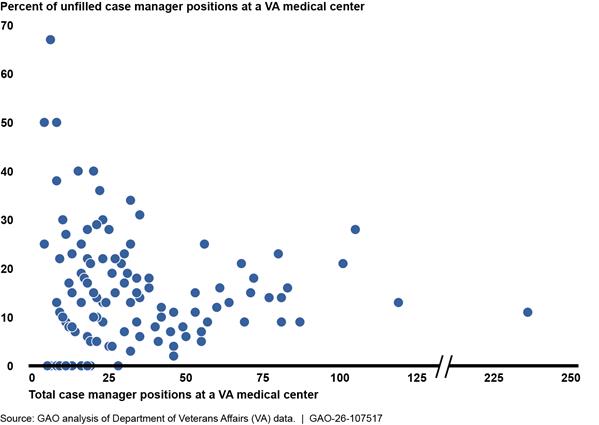
Note: The figure reflects the status of positions at the end of fiscal year 2024 and shows the 129 VA medical centers with two or more HUD-VASH case managers.
Staff at VAMCs, PHAs, and Continuums of Care we interviewed highlighted the importance of case management in supporting HUD-VASH participants.[20] Staff noted that HUD-VASH case managers are highly trained and provide essential support for veterans with high service needs, such as those related to mental health and substance abuse disorders and trauma. They said the HUD-VASH program tailors case management to individual needs and attributed successful outcomes achieved by program participants to this support. For example, staff at one PHA told us that HUD-VASH case management was the reason veterans generally experienced better outcomes than recipients of other voucher programs. Veterans we interviewed also told us their HUD-VASH case managers provided important support.
|
Veterans We Interviewed Generally Spoke Highly of HUD-VASH Case Management Twenty of the 23 veterans we interviewed viewed their experience with HUD-VASH case management very favorably. Several shared examples of how their case managers provided meaningful support during difficult times: · One veteran said his case manager helped him recover from a stroke and cope with the loss of his career. · Another veteran said his case manager supported him through the deaths of several close family members. · A third veteran described how her case manager helped her obtain assistance to resolve outstanding debt, which enabled her to secure housing. |
Source: GAO interviews with Housing and Urban Development-Veterans Affairs Supportive Housing (HUD-VASH) participants. | GAO‑26‑107517
However, staff at all eight of the VAMCs we visited—and most service providers, Continuum of Care, and PHA staff we interviewed—said there were not enough HUD-VASH case managers to support the vouchers allocated to their communities or expressed concerns about the workload of existing case managers.[21] According to our interviews, insufficient staffing had several effects:
· Reduced services. Staff at Continuums of Care, PHAs, and service providers at six of our eight sites told us that limited VA case management capacity has reduced the amount of case management provided to some veterans in HUD-VASH.[22] For example, without adequate assistance, veterans may face delays in finding housing or risk eviction due to a lack of behavioral or mental health support. In other cases, veterans may leave the program due to lack of ongoing case management, according to our interviews. Staff at three VAMCs noted that additional case managers would improve the services they are able to provide to program participants.
|
Five Veterans Reported HUD-VASH Case Managers Appeared Overworked Five of the 23 veterans we interviewed told us HUD-VASH case managers appeared overworked and that local VA medical centers needed more staff. These challenges had negative impacts on veteran participants. For example: · One veteran said he waited 3 months to learn if he was eligible for the program while living in his car. · Another veteran said high caseloads led to delays in completing steps required for participation in the program. |
Source: GAO interviews with Housing and Urban Development-Veterans Affairs Supportive Housing (HUD-VASH) participants. | GAO‑26‑107517
· Decreased capacity in other programs. Staff at Continuums of Care and service providers at seven of our eight sites told us that inadequate case manager staffing can increase reliance on other community programs.[23] Veterans who face delays entering HUD-VASH may remain longer in programs such as SSVF or GPD. One provider noted that extended stays in GPD—where veterans are still considered homeless—can be stressful due to congregate living conditions. These delays can discourage veterans who are pursuing HUD-VASH and strain limited resources. In some cases, providers said they had to step in when HUD-VASH case managers were unable to provide adequate support.
· Delayed referrals. Staff at VAMCs, service providers, Continuums of Care, and PHAs at five of our eight sites said limited case management capacity delayed or impeded referrals and admissions to HUD-VASH.[24] Staff at these VAMCs said they had to pause or reduce new referrals due to a lack of case managers. Similarly, service providers described periods during which this shortage led to a delay in voucher distribution. One veteran told us he faced delays enrolling in HUD-VASH due to a lack of case managers. As a result, he lived with a family member for 2 months until VA could enroll him.
Staff at VAMCs, service providers, Continuums of Care, and PHAs cited burnout, turnover, and confusion regarding VA hiring policies as challenges that affected case manager staffing.
· Burnout. VA officials told us that 40–60 percent of the homeless programs’ workforce reported burnout each year in staff surveys. Staff at VAMCs, PHAs, Continuums of Care, and service providers at five of our sites said case managers have heavy workloads and deal with challenging work conditions, which can contribute to staff burnout.[25] For example, staff at one Continuum of Care noted caseloads as high as 80 veterans per case manager.
Staff at VAMCs, PHAs, Continuums of Care, and service providers at four of our sites said case managers’ clients often have high levels of need, including challenges related to substance abuse or age-related health conditions.[26] These challenges can create stressful and traumatic situations for case managers. For example, staff at one Continuum of Care reported that the case managers experience a high number of deaths among HUD-VASH participants in their community.[27]
Staff at two VAMCs also described how shortages in support staff exacerbated case manager workloads. These staff may assist case managers by performing community outreach, staffing a VAMC’s walk-in clinic, and performing administrative work, for example. Staff at four VAMCs noted they had to stop hiring for some of these positions due to VA’s hiring freeze (discussed in more detail below).
· High turnover. Our analysis of VA data shows annual turnover of 20–26 percent among HUD-VASH case managers from fiscal years 2020 through 2024. Staff at VAMCs, PHAs, service providers, and Continuums of Care at all eight of our sites described periods of high turnover and persistent vacancies.[28] For example, staff at one VAMC told us 11 of 13 case manager positions turned over in a recent 3-year period; another VAMC reported extreme staffing shortages that left half their positions unfilled. High turnover can lead to a lack of experienced staff, disrupt continuity of care, and increase workloads for remaining staff, according to our interviews with VAMCs, service providers, and Continuums of Care at seven of our sites.[29]
· Lengthy hiring process. On average, VA took 7–8 months to fill a vacated HUD-VASH case management position, according to our analysis of VA data from fiscal years 2020 through 2024. VA’s complex hiring process contributes to delays, according to VAMC, Continuum of Care, service provider, and PHA staff at five of our sites.[30] Staff at one VAMC noted that high turnover compounds this challenge, requiring them to fill multiple positions at once. VA officials cited several contributing factors, including the number of internal partners involved in hiring, understaffed human resources departments, and difficulty attracting candidates in some markets.
· Confusion over 2024 hiring guidance. VA’s fiscal year 2024 staffing strategy, which encouraged staff attrition across certain positions, led to confusion at the facility level, according to VA officials.[31] They said VAMC leadership mistakenly paused recruitment for 350 HUD-VASH case manager positions, although the strategy did not target these positions for attrition.[32] Staff at two VAMCs confirmed uncertainty at that time about whether hiring should continue. VA clarified the exemption with regional directors and VAMCs in August 2024 and instructed facilities to resume hiring.[33]
· Confusion over 2025 hiring freeze. Staff at four VAMCs said the 2025 federal hiring freeze created confusion about their ability to hire case managers despite these positions being exempt.[34] Staff at two VAMCs reported rescinding job offers for case manager positions due to the freeze, while staff at another delayed interviews. In June 2025, VA officials said the number of vacant HUD-VASH positions not being recruited by VAMCs increased from 140 to 186 (a 33 percent increase) since the hiring freeze took effect.[35] As of July 2025, 27 percent of vacant HUD-VASH positions were unfilled and not in recruitment, according to officials. Representatives from four VAMCs also said they were unable to hire support staff, such as employment and housing specialists, because these positions were not exempt from the hiring freeze.
VA Used Hiring Flexibilities and Contracting to Help Address Case Manager Vacancies and High Workloads
VA officials and VAMC staff told us they have used hiring incentives and alternative hiring arrangements to increase case manager staffing levels. They also described benefits of team-based case management practices and leveraging community partnerships to address case manager workloads.
· Hiring incentives. According to VA guidance we reviewed, hiring managers can offer education debt reduction, student loan repayment, and increased salaries as incentives. VA officials stated the agency received funding for these incentives in fiscal years 2022 and 2023, but not in fiscal year 2024.[36] VA also has directed hiring managers to expedite hiring by eliminating certain administrative requirements. Staff at three VAMCs said hiring and retention incentives helped them fill vacant case manager positions. However, they expressed concern that funding for these incentives was temporary and could be pulled back in the future.
· Collaborative case management. VA also may provide HUD-VASH case management through collaborative case management agreements with approved SSVF and GPD grantees. These agreements allow SSVF and GPD providers to provide case management to HUD-VASH participants, supplementing VA’s case management capacity. As of June 2025, 63 such agreements were in place between VAMCs and SSVF or GPD providers.[37] Three VAMCs we visited had active collaborative case management agreements. VAMC staff said these agreements helped efficiently transition veterans from SSVF to HUD-VASH and manage HUD-VASH staffing shortages.
· Contracting. VA also may enter into contracts to fill case manager vacancies. Under a law enacted in 2020, VAMCs are required to seek such contracts if
(1) more than 15 percent of all HUD-VASH housing vouchers allocated to the VAMC in the previous fiscal year went unused due to lack of VA-provided case management services; and
(2) one or more HUD-VASH case management positions had been vacant for at least the preceding 9 consecutive months.[38]
As of July 2024, VAMC officials said funding for contracting for case management services had increased by 200 percent from 2022 to 2024.
· Team-based case management. According to VA officials, most VAMCs use multi-disciplinary, team-based case management as a best practice. This model allows VAMCs to tailor teams to local needs—for example, by emphasizing staff with expertise in substance abuse disorders where such services are limited. Staff at all eight VAMCs we visited described benefits of this model, such as distributing workload, supporting newer staff, and ensuring veterans always have access to support.
· Community partnerships. VA has collaborated with other service providers to ensure veterans receive necessary care, according to VAMC staff. Staff at all the VAMCs we visited said they regularly coordinated with other providers when veterans transitioned from GPD or SSVF programs to HUD-VASH. These partnerships can help balance demand on HUD-VASH case management by allowing a veteran to remain in GPD or SSVF until case managers have the capacity to take on new participants.
Inconsistent Collection of HUD-VASH Referral Data Limits VA’s Ability to Identify Staffing Needs
VA does not consistently collect data on why eligible veterans are not referred to HUD-VASH, including when insufficient case management staff is a factor. VA’s data system lists 12 potential reasons from which users can choose for not making a referral (see sidebar). Of the 292,198 referral forms VA completed in fiscal years 2020–2024, 174,045 did not result in a referral.[39] Among the 174,045 forms, 87 percent (151,296) did not have a documented reason explaining why a referral was not made, according to our analysis of VA data.[40] Among the referral forms with a documented reason, 4 percent (or 946 of 22,749) were not referred because “current staffing does not allow for new admissions.”[41] As discussed previously, HUD-VASH specifically requires a veteran to be assigned a case manager before they can be admitted to the program.
|
Reasons for Not Referring Veterans to HUD-VASH VA’s data system allows staff to select the following reasons for not referring chronically homeless veterans to the Housing and Urban Development-Veterans Affairs Supportive Housing (HUD-VASH) program: 1. Veteran’s referral is pending coordinated entry system review 2. Would make referrals but no vouchers available 3. All vouchers are currently in use in the desired location where the veteran wants to live 4. Current staffing does not allow for new admissions 5. Registered sex offender 6. Veteran is over income 7. Veteran has other more preferable housing options 8. Veteran declines offer of admission 9. Veteran needs a higher level of clinical care and cannot live independently 10. Veteran is not eligible for Veterans Health Administration services 11. Other with higher acuity given priority for referral 12. Interviewer omitted item Source: GAO summary of Department of Veteran Affairs (VA) documentation. | GAO‑26‑107517 |
VAMCs are required to collect data on reasons for nonreferrals only when the veteran is chronically homeless—a subgroup accounting for 30 percent of all veterans experiencing individual homelessness, according to HUD’s 2023 estimates.[42] As a result, VA data do not capture how often insufficient case management staffing affected referrals for the broader population.
VA officials said this requirement focuses on chronically homeless veterans because they are a key priority for HUD-VASH admission.[43] When no chronically homeless veterans are identified, VA directs VAMCs to prioritize other vulnerable veterans in alignment with HUD policy.[44] However, when insufficient staffing is the reason for a nonreferral, documenting this information could help inform HUD-VASH hiring and staffing decisions. As of September 2025, VA officials said they were assessing the process for collecting referral data and anticipated broadening it to include all veterans—not just those who are chronically homeless—but had not yet established a time frame for doing so. As of September 2025, VA officials said they had not yet begun planning updates to the data system for fiscal year 2026, and noted they generally prioritize legislatively mandated updates and make other changes as resources allow.
VA officials said they are aware that some VAMCs pause referrals to HUD-VASH due to staffing shortages and note that this is an ongoing challenge. VA officials said that while they discuss staffing challenges with VAMC staff, they do not currently have a consistent method for collecting this information. Officials said they have taken steps to improve data collection. For example, officials said they released a web-based tool in June 2025 that allows VAMCs to voluntarily report common issues affecting HUD-VASH, including staffing challenges. However, they said this tool is not required.
Federal internal control standards state management should collect relevant information to achieve established objectives.[45] Furthermore, VA’s Homeless Programs Office’s most recent strategic plan prioritizes accelerating adequate nationwide staffing and ensuring sufficient case management resources to serve veterans experiencing homelessness.[46]
Without a method for requiring VAMCs to collect more complete data on the reason eligible veterans are not referred to HUD-VASH—including when staffing is the barrier—VA cannot determine how many eligible veterans wanted to enter the program but could not due to lack of capacity. This limits VA’s ability to assess the extent of unmet need in the community. It also limits its ability to use these data to inform the allocation of case manager positions—particularly in locations where staffing shortages could be preventing eligible veterans from entering the program.
Agencies and Providers Reported Challenges in Finding Housing for Veterans, and HUD and VA Have Taken Steps to Help Mitigate Them
Rising Rental Costs and Landlord Reluctance Limit Housing Options for HUD-VASH Participants
Service providers told us that veterans using HUD-VASH vouchers face significant challenges securing housing. These include rising rental costs, a shortage of suitable units, and reluctance among landlords to rent to program participants. VAMC staff at each of our eight sites said substantial increases in rental costs since 2019 have made it more difficult for participants to use their vouchers.[47]
The portion of rent PHAs pay to landlords has increased in part due to the increase in rental costs since 2020.[48] From the end of fiscal year 2020 to the end of fiscal year 2024, the average rent paid by PHAs on behalf HUD-VASH participants rose by $246 per month—a 34.9 percent increase—according to our analysis of HUD data. All census regions except for Puerto Rico and Outlying Areas saw the highest percent increases in rental subsidies in fiscal years 2023 and 2024 (see table 3). HUD annually updates the parameters that are then used by PHAs to establish the maximum rent that can be paid to landlords. However, staff from two VAMCs, two PHAs, two Continuums of Care, and four service providers said veterans still struggle to find housing within these limits.[49]
Table 3: HUD-VASH Housing Assistance Payment Data, Fiscal Years 2020–2024 (as of end of fiscal year)
|
Region |
FY 2020 |
FY 2021 |
FY 2022 |
FY 2023 |
FY 2024 |
||
|
National |
|
|
|
|
|
||
|
Total housing assistance payment |
$55,046,648 |
$57,678,702 |
$60,452,758 |
$69,556,131 |
$82,735,665 |
||
|
Average cost per unit per month |
$706 |
$726 |
$769 |
$858 |
$953 |
||
|
Annual change in average per unit per month |
— |
+$20 (+2.9%) |
+$42 (+5.8%) |
+$89 (+11.6%) |
+$95 (+11.0%) |
||
|
Midwest |
|
|
|
|
|
||
|
Total housing assistance payment |
$5,736,861 |
$5,798,519 |
$6,062,443 |
$6,613,296 |
$7,824,719 |
||
|
Average cost per unit per month |
$497 |
$499 |
$526 |
$569 |
$629 |
||
|
Annual change in average per unit per month |
— |
+$2 (+0.3%) |
+$27 (+5.5%) |
+$43 (+8.2%) |
+$60 (+10.5%) |
||
|
Northeast |
|
|
|
|
|
||
|
Total housing assistance payment |
$9,135,425 |
$9,743,473 |
$9,879,527 |
$11,362,069 |
$13,590,510 |
||
|
Average cost per unit per month |
$753 |
$779 |
$792 |
$891 |
$1,021 |
||
|
Annual change in average per unit per month |
— |
+$25 (+3.3%) |
+$14 (+1.8%) |
+$98 (+12.4%) |
+$130 (+14.6%) |
||
|
West |
|
|
|
|
|
||
|
Total housing assistance payment |
$24,187,934 |
$25,922,272 |
$28,082,724 |
$32,505,637 |
$37,944,351 |
||
|
Average cost per unit per month |
$889 |
$918 |
$981 |
$1,083 |
$1,180 |
||
|
Annual change in average per unit per month |
— |
+$29 (+3.3%) |
+$62 (+6.8%) |
+$102 (+10.4%) |
+$97 (+9.0%) |
||
|
South |
|
|
|
|
|
||
|
Total housing assistance payment |
$15,908,342 |
$16,135,227 |
$16,343,875 |
$18,981,188 |
$23,245,585 |
||
|
Average cost per unit per month |
$591 |
$601 |
$632 |
$715 |
$807 |
||
|
Annual change in average per unit per month |
— |
+$10 (+1.6%) |
+$31 (+5.1%) |
+$83 (+13.2%) |
+$92 (+12.9%) |
||
|
Puerto Rico and Outlying Areas |
|
|
|||||
|
Total housing assistance payment |
$78,086 |
$79,211 |
$84,189 |
$93,941 |
$130,500 |
||
|
Average cost per unit per month |
$444 |
$441 |
$529 |
$630 |
$750 |
||
|
Annual change in average per unit per month |
— |
-$4 (-0.8%) |
+$89 (+20.3%) |
+$101 (+19.1%) |
+$120 (+19.0%) |
||
FY - fiscal year; HUD-VASH - Housing and Urban Development-Veterans Affairs Supportive Housing; — - not applicable
Source: GAO analysis of Department of Housing and Urban Development data. | GAO‑26‑107517
In addition to rising rental costs, HUD-VASH participants have experienced challenges finding quality housing that met both program requirements and their individual needs, including accessibility.
· Housing quality. HUD-VASH housing units must pass initial and periodic inspections to ensure they meet quality standards (are safe and habitable dwellings). It is not uncommon for units to fail the first inspection, according to PHA staff at four of our eight sites. Some landlords make improvements to pass subsequent inspections, but others choose not to—limiting the number of units that can be rented with a voucher, according to staff at two VAMCs, one Continuum of Care, and one PHA.
· Accessible housing. The average age of veterans experiencing homelessness is increasing, which increases the demand for accessible housing, according to staff at one Continuum of Care and three service providers we interviewed.[50] VAMC, Continuum of Care, and provider staff at four of our eight sites said it has become difficult to find housing appropriate for aging veterans or veterans with disabilities.[51] For example, staff at one Continuum of Care said their state’s older housing stock is not always accessible for older adults or for people with physical disabilities.[52]
We previously reported that VA launched an initiative in 2021 that would expand use of HUD-VASH vouchers in specialized settings, such as assisted living facilities.[53] However, staff at three VAMCs and one Continuum of Care told us that placing veterans in assisted living remains difficult. Staff at two of these VAMCs and the Continuum of Care said participants often need to obtain Medicare or Medicaid before an assisted living facility will accept them, and staff described this process as complicated and difficult. For example, staff at one VAMC said they had been trying for a year to place eligible participants into assisted living with a HUD-VASH voucher but had been unable to secure Medicaid approval.
· Housing location. Six of the 23 HUD-VASH participants told us they prioritized housing in safe neighborhoods near public transportation or essential services but found it difficult to find options. According to eight of the 23 HUD-VASH participants, they lack reliable transportation, require help to get to doctor’s visits, or have a history of substance use disorder and want to avoid areas with drug activity.
|
Three of the 23 Veterans We Interviewed Said Much of the Housing They Could Afford Was in Neighborhoods That Felt Unsafe One veteran said he had concerns about crime and police activity in the neighborhood where he currently lives and would prefer to live somewhere safer, further from downtown. Another veteran said the first two units he saw were in areas with significant drug activity, which he worried threatened his ability to maintain sobriety. He ultimately found a unit that met his preferences. Another veteran said that most of the units offered by a service provider were located in a part of the city with a lot of drug activity and safety issues. Instead, he relied on friends to help identify unsafe neighborhoods and walked door-to-door to ask property managers if they took vouchers. |
Source: GAO interviews with Housing and Urban Development-Veterans Affairs Supportive Housing (HUD-VASH) participants. | GAO‑26‑107517
Even when veterans identify a preferred location, affordable housing options may be unavailable. A 2022 report on the HUD-VASH program in Los Angeles noted that units affordable to HUD-VASH participants were largely in under-resourced areas.[54] Program participants often must compete for units against renters with more resources and fewer potential barriers, such as a prior eviction or criminal history, according to staff at two PHAs and one VAMC.
· Special housing types. HUD-VASH participants may use their voucher for special housing types, such as group homes and cooperative housing, which can increase housing options and better suit some veterans’ needs.[55] However, it can be difficult for some participants to navigate the process or receive approval to live with a roommate or to use their voucher for an assisted living unit, according to staff at three VAMCs, one PHA, two Continuums of Care, and two service providers across five of our sites.
· Length of time to locate housing. HUD allows HUD-VASH participants more time to search for housing than Housing Choice Voucher participants.[56] However, PHA staff at four of our eight sites said HUD-VASH participants typically take longer to obtain housing than Housing Choice Voucher participants—ranging from 6 months to a year, according to staff of one PHA. Staff at the four PHAs said contributing factors can include the additional time permitted to look for housing, landlord reluctance to participate, and difficulty finding affordable housing.
If participants are unable to find housing in time, they may risk losing their voucher and remaining homeless.[57] Although staff at one PHA said that they do not expire vouchers when participants are actively searching for housing and two PHAs said they will extend the initial search period an additional 60 days, two veterans told us they had to return their voucher after being unable to find an apartment that would accept it in time.
VAMC, PHA, Continuum of Care, and service provider staff at all eight of our sites said they have experienced challenges with some landlords’ reluctance to participate in the HUD-VASH program.[58] Under program rules, PHAs cannot deny admission to veterans based on criminal history, except if any member of the household is subject to a lifetime registration required under a state sex offender registration program.[59]
However, VAMC and service providers at seven of our sites told us that landlords may be unwilling to rent to tenants with prior criminal records or eviction histories.[60] Staff at two VAMCs, one PHA, and one service provider we interviewed said some landlords avoid participating in HUD-VASH due to negative past experiences—such as late rent payments from the PHA, excessive damage to the unit, or disruptive tenant behavior. Other landlords simply choose not to rent to anyone using a housing voucher, according to staff at VAMCs and PHAs across five of our sites.[61] In contrast, staff at three VAMCs, two Continuums of Care, and one service provider across four of our sites said they have sought out or work with landlords interested in renting to veterans.
Another challenge has been an increase in large or out-of-state companies purchasing rental properties from individual landlords, according to VAMC, PHA, Continuum of Care, and service provider staff at five of our eight sites.[62] Four of these interviewees said these companies can be hard to reach and less responsive to outreach efforts encouraging participation in HUD-VASH.[63]
Agencies Created Landlord Incentives and Hired Staff to Help Veterans Find Housing
VAMC and PHA staff have taken steps to help HUD-VASH participants locate housing.
· Hired additional housing search staff. Staff at VAMCs, PHAs, and service providers at all of our eight sites hired Housing Specialists to help veterans locate affordable housing and to build relationships with local landlords.[64] One PHA without a dedicated HUD-VASH Housing Specialist said 25 percent of its issued vouchers expired because participants did not have the necessary supportive services to find housing. According to our analysis of VA staffing data, the number of filled Housing Specialist and Housing Assistant positions increased from 119 in fiscal year 2020 to 142 in fiscal year 2024, a 19 percent increase.
|
Five of the 23 Veterans We Interviewed Would Have Liked More Support Finding Housing with Their HUD-VASH Voucher Three veterans said they experienced difficulties explaining the HUD-VASH program to landlords and would have liked an advocate who could help them navigate those conversations. One of these veterans said he did not receive any support finding housing. He would have liked his case manager to help his family search for housing since he was largely unsuccessful on his own. Two veterans said service providers gave them outdated or inaccurate housing information, including listings for landlords that did not accept HUD-VASH vouchers. |
Source: GAO interviews with participants of the Housing and Urban Development-Veterans Affairs Supportive Housing (HUD-VASH) program. | GAO‑26‑107517
· Conducted landlord outreach. Stakeholders conduct a variety of landlord outreach activities to help participants secure housing with their HUD-VASH voucher. VAMC, PHA, Continuum of Care, and service provider staff across our eight sites said they use a variety of methods to build, maintain, and expand their networks of participating HUD-VASH landlords and properties (see table 4).[65]
Table 4: Examples of Stakeholder Outreach Activities to Build and Maintain Relationships with Landlords for HUD-VASH
|
Landlord outreach activity |
Illustrative practices |
|
Landlord housing fairs |
Veterans speak with landlords at these events about their properties, eligibility requirements, and availability of units. |
|
Real estate agent relationships |
Local real estate agents help Housing and Urban Development-Veterans Affairs Supportive Housing (HUD-VASH) participants find housing where landlords and buildings are open to participating in the program. |
|
Tracking databases, spreadsheets, or maps |
Centralized landlord databases, agency spreadsheets, or maps track veteran-friendly housing, landlords, landlord requirements, and rental costs, which can streamline housing searches. |
|
Landlord funds |
Privately raised funds and nonfederal grants give service providers more flexibility in encouraging landlord participation—for example, by offsetting rent above the voucher cap, offering landlord incentives, or covering damage from a previous participant. |
|
Electronic contact |
Email lists allow case managers to share program updates and housing fair announcements with local landlords. |
|
One-on-one contact |
Case managers meet individually with landlords to explain the HUD-VASH program and answer questions. |
Source: GAO analysis of interviews. | GAO‑26‑107517
· Increased affordable housing stock. Service providers have been exploring strategies to expand the supply of affordable housing in their communities. For example, staff at one VAMC and two service providers told us they have obtained project-based vouchers for buildings they purchased or constructed. Similarly, a VAMC partnered with real estate developers and allocated HUD-VASH project-based vouchers to increase the number of affordable units in desirable communities. Staff at two VAMCs, one PHA, two Continuums of Care, and two service providers said they have developed housing units or partnered with developers to increase the number of available housing units.
VA and HUD also established program policies and encouraged local practices to reduce the impact of high housing costs on HUD-VASH participants and landlord reluctance to participate in the program.
· Landlord incentives. SSVF providers can offer landlord incentives to encourage them to rent to SSVF and HUD-VASH participants facing barriers to obtaining rental housing.[66] According to six service providers, common issues include prior evictions, criminal backgrounds, or poor credit. Seven service providers said these incentives have been effective in helping veterans find housing.[67]
· Shallow Subsidy service rental assistance. VA’s SSVF Shallow Subsidy service provides eligible homeless veterans in high rent-burdened communities with up to 2 years of rental assistance.[68] According to VA, the program aims to improve housing stability and increase the likelihood that veterans will remain housed after exiting the program.[69] Six service providers said they use the Shallow Subsidy service as a temporary bridge until a veteran can enter and secure housing in HUD-VASH. Specifically, four providers said they use the service when veterans eligible for HUD-VASH must wait for program entrance due to a lack of case managers or available vouchers.
· Online resources for landlords. The VA and HUD websites include information on the steps landlords need to take to participate in the HUD-VASH program, the inspection process and requirements, and the benefits to participating landlords.[70] VA’s website also has a contact form for landlords with available rental units, which connects them to their local VAMC. HUD’s website has a page for landlords interested in the Housing Choice Voucher program generally, and has a landlord newsletter with program updates, tips, and links to additional resources.
Some Communities Reported Reluctance to Apply for Needed Vouchers, and Agencies Have Coordinated with Communities to Help Address Concerns
At seven of the eight sites we visited, staff at PHAs, service providers, or Continuums of Care said there were not enough HUD-VASH vouchers to support homeless veterans in their community.[71] HUD invites PHAs to apply for a specific number of vouchers each year, which it determines using VA’s estimates of the unmet need for permanent supportive housing among veterans experiencing homelessness in each geographic area.[72] But the number of vouchers HUD ultimately awards is based on the number of applications it receives from PHAs, which are not required to apply for additional vouchers, and their eligibility. To be eligible for additional vouchers, PHAs must meet a voucher utilization threshold, as set by HUD, and obtain a letter of support from their partnering VAMC.
Some PHAs and VAMCs said they hesitated or declined to request additional vouchers due to concerns about meeting voucher utilization thresholds—which measure whether PHAs are leasing out a sufficient share of the vouchers they already hold—and concerns about having enough case managers to support new participants (discussed in more detail below).[73] Some PHAs and Continuums of Care also described having disagreements with local VAMCs about whether to apply for new vouchers due to these issues. As a result, HUD may not award the full amount of vouchers available and PHAs may not receive enough vouchers to meet the estimated level of veterans’ needs in their communities. For example, in the 2024 award cycle, PHAs at six of the eight VAMC service areas we visited did not receive vouchers equal in number to VA’s estimate of need.[74] Three of those VAMC service areas did not receive any increase in number of vouchers, although VA estimated a need for additional ones (see fig. 2).
Figure 2: VA’s Estimates of Veterans Needing Permanent Supportive Housing and Number of HUD-VASH Vouchers Awarded by HUD (by VA medical center service area), Fiscal Year 2024
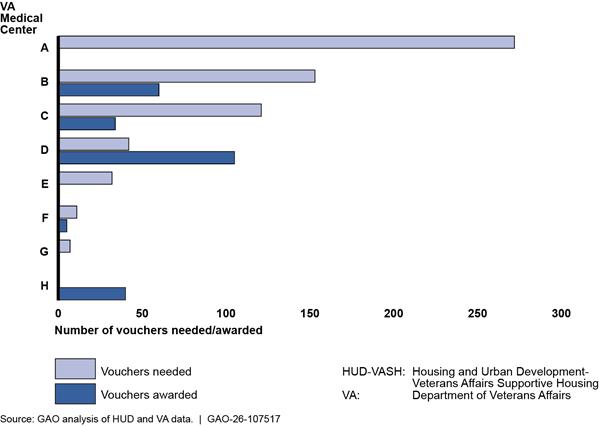
Note: HUD awards vouchers based on applications from public housing authorities that meet a minimum utilization threshold and obtain a letter of support from a partnering VA medical center. However, public housing authorities are not required to apply for additional vouchers and may choose not to due to concerns around sufficient VA case management or voucher utilization, among other factors. As a result, HUD may not award the full amount of vouchers available and public housing authorities may not receive enough vouchers to meet the estimated level of veterans’ needs in their communities.
Voucher utilization threshold. To be eligible for additional vouchers, PHAs must meet a minimum threshold for voucher utilization, set by HUD, and obtain a letter of support from their partnering VAMC. In recent years, HUD has set this threshold between 60 percent and 70 percent. As of September 2024, 527 of the 721 PHAs with HUD-VASH vouchers had utilization rates of 70 percent or higher. Nationally, utilization rates ranged from 74 percent to 78 percent in fiscal years 2020–2024 (see table 5).
|
National |
FY 2020 |
FY 2021 |
FY 2022 |
FY 2023 |
FY 2024 |
|
|
Leased vouchers |
77,943 |
79,398 |
78,652 |
81,080 |
86,862 |
|
|
Effective vouchers |
99,894 |
104,923 |
106,995 |
109,255 |
112,234 |
|
|
Utilization rate |
78.0% |
75.7% |
73.5% |
74.2% |
77.4% |
|
|
Midwest |
|
|
|
|
|
|
|
Leased vouchers |
11,541 |
11,627 |
11,522 |
11,613 |
12,436 |
|
|
Effective vouchers |
14,218 |
14,520 |
14,760 |
14,892 |
15,225 |
|
|
Utilization rate |
81.2% |
80.1% |
78.1% |
78.0% |
81.7% |
|
|
Northeast |
|
|
|
|
|
|
|
Leased vouchers |
12,125 |
12,513 |
12,468 |
12,759 |
13,314 |
|
|
Effective vouchers |
14,276 |
14,897 |
15,343 |
15,561 |
16,067 |
|
|
Utilization rate |
84.9% |
84.0% |
81.3% |
82.0% |
82.9% |
|
|
West |
|
|
|
|
|
|
|
Leased vouchers |
27,199 |
28,230 |
28,638 |
30,020 |
32,149 |
|
|
Effective vouchers |
38,403 |
41,083 |
41,816 |
43,269 |
44,752 |
|
|
Utilization rate |
70.8% |
68.7% |
68.5% |
69.4% |
71.8% |
|
|
South |
|
|
|
|
|
|
|
Leased vouchers |
26,902 |
26,848 |
25,865 |
26,539 |
28,789 |
|
|
Effective vouchers |
32,724 |
34,150 |
34,803 |
35,250 |
35,907 |
|
|
Utilization rate |
82.2% |
78.6% |
74.3% |
75.3% |
80.2% |
|
|
Puerto Rico and Outlying Areas |
|
|||||
|
Leased vouchers |
176 |
180 |
159 |
149 |
174 |
|
|
Effective vouchers |
273 |
273 |
273 |
283 |
283 |
|
|
Utilization rate |
64.5% |
65.9% |
58.2% |
52.7% |
61.5% |
|
FY - fiscal year; HUD-VASH - Housing and Urban Development-Veterans Affairs Supportive Housing
Source: GAO analysis of Department of Housing and Urban Development data. | GAO‑26‑107517
Note: Leased vouchers are the total number of vouchers under lease and effective vouchers are the number of vouchers that were awarded and allocated to public housing agencies for participant use.
Some VAMCs and PHAs may be reluctant to apply for additional vouchers unless their utilization rates exceed the HUD threshold. For example, staff at two VAMCs told us they would not support a PHA’s request for more vouchers unless its utilization rate was at or above roughly 90 percent. Another VAMC said one of its partnering PHAs would only apply if its utilization rate was 100 percent. Other factors that influence utilization include that veterans may struggle to find housing with a voucher due to rising rental costs or limited landlord participation. Additionally, HUD does not consider a voucher as utilized until a lease is signed, which can lower a PHA’s apparent utilization rate.
Case manager staffing. Once HUD makes voucher awards, local VAMCs assess their case management needs associated with the new vouchers, and VA determines whether to approve each VAMC’s request to hire additional staff. For example, in June 2024, VA approved the hiring of 57 new HUD-VASH staff to support 1,739 new vouchers awarded by HUD in September 2023. However, the uncertainty about the number of vouchers for which PHAs will apply makes it difficult to estimate likely staffing needs, according to VA. For example, officials stated that in a recent award cycle, HUD received funding for approximately 8,000 vouchers, but PHAs applied for approximately 4,000.
Concerns about case manager staffing also can prevent PHAs from applying for additional vouchers. For example, two PHAs told us their partnering VAMCs discouraged them from applying for additional vouchers due to insufficient case manager staff to support existing vouchers.
PHAs, VAMCs, or Continuums of Care at five of our eight sites described having disagreements about whether to request additional vouchers rising from concerns about case manager staffing and voucher utilization.[75] In these cases, community stakeholders supported requesting more vouchers, but partnering VAMCs or PHAs declined to do so.
Agency actions. VA officials said that PHAs and VAMCs in some communities are reluctant to apply for new vouchers due to staffing shortages and other challenges they face, resulting in funded vouchers going unused. HUD and VA officials told us they are constantly working to improve the voucher award process to make it more accessible for local partners. For example, HUD officials said they provided PHAs with more time to register interest in applying for additional vouchers in 2024 than in prior competitions, which increased the number of PHAs that registered interest.[76] HUD also issued two funding rounds in 2023 to provide PHAs with a second opportunity to assess voucher needs and encourage additional applications, according to HUD officials. They also noted that they continue to consider other strategies to help PHAs and VAMC partners apply for more vouchers.
Agency officials also work to resolve disagreements between local partners on whether to apply for new vouchers. HUD officials said that while PHAs and VAMCs are expected to assess their own resource needs, HUD staff collaborate with VA to help PHAs and partnering VAMCs come to an agreement on whether to apply for more vouchers. For example, HUD officials said they alert VA of instances when a PHA wants to apply but cannot obtain a letter of support from its VAMC partner, and VA informs VAMCs they will receive additional staff for newly awarded vouchers. HUD officials said they communicate monthly to discuss issues impacting individual communities and hold ad hoc meetings as necessary to facilitate discussions between PHAs and VAMCs.
Tribal HUD-VASH Grantees Face Affordable Housing and Staffing Challenges, but HUD Has Not Defined Objectives or Established an Evaluation Plan
Tribal HUD-VASH Grantees Face Affordability, Staffing, and Outreach Challenges
In interviews with two Tribal HUD-VASH grantees and in 2024 grant applications we reviewed, which included narrative information on grantees’ successes and challenges, grantees cited three main challenges they face: limited affordable housing, shortages of VA case managers, and insufficient capacity to conduct veteran outreach.
Limited Affordable Housing
Twenty-two of 29 Tribal HUD-VASH grantees said that a shortage of affordable housing represented a challenge, according to 2024 grant applications we reviewed.[77] Grantees said tribal lands often have limited private rental housing and limited accessible housing for aging veterans. Grantees also cited rising rental costs and difficulty recruiting landlords as challenges.
|
Two Veterans We Interviewed Reported Challenges Finding Housing with Tribal HUD-VASH Vouchers One veteran looked at eight units before finding housing because many were either not wheelchair-accessible or landlords declined to accept a voucher. Another veteran found a unit through a real estate agent but was unsure of how to explain the Tribal HUD-VASH program to the landlord. Her case manager ultimately helped by speaking directly with the landlord and securing the unit. |
Source: GAO interviews with Tribal Housing and Urban Development-Veterans Affairs Supportive Housing (Tribal HUD-VASH) participants. | GAO‑26‑107517
Tribal HUD-VASH grantees reported that the Indian Housing Block Grant formula further limits housing options for participants on tribal lands, according to 2024 grant applications we reviewed and staff we interviewed at one Tribal HUD-VASH program. The Indian Housing Block Grant is the largest source of housing assistance for Tribes, and funds activities such as new construction and rehabilitation of affordable housing. The funding formula consists of four components, including one component which considers the number of older housing units that need ongoing operational support.[78] However, when veterans occupy these units through Tribal HUD-VASH, the units are removed from the formula count consistent with HUD program requirements, thereby reducing the Tribe’s future funding under the grant. HUD allows units to be counted again only after they are vacated.
As a result, seven of the 29 Tribal HUD-VASH grantees reported the Indian Housing Block Grant formula limits housing options for participants on tribal lands, according to 2024 grant applications we reviewed. For example:
· One grantee said they place veterans in private housing off tribal lands, farther from family and tribal services, to avoid losing grant funding.
· A second grantee stated the formula calculation was a major barrier to housing veterans, nothing that 280 of their 316 units are subject to this limitation.
· A third grantee said they would have enough units to meet veteran housing needs if HUD lifted restrictions on using units counted under the formula.
Staff at the National American Indian Housing Council, an advocacy group, told us they disagreed with the approach to exclude units used for HUD-VASH from the formula grant calculation. They said that because the formula is a method for allocating resources and not a direct subsidy for a unit or tenant, HUD should not exclude units occupied by Tribal HUD-VASH participants. HUD officials said they considered the issue but view their current approach as balanced because a unit may be counted toward the formula again once a Tribal HUD-VASH participant no longer occupies it. HUD stated that the rationale for excluding Tribal HUD-VASH occupied units from the Indian Housing Block Grant formula is to avoid duplicative funding for the same unit.
Case Manager Shortages
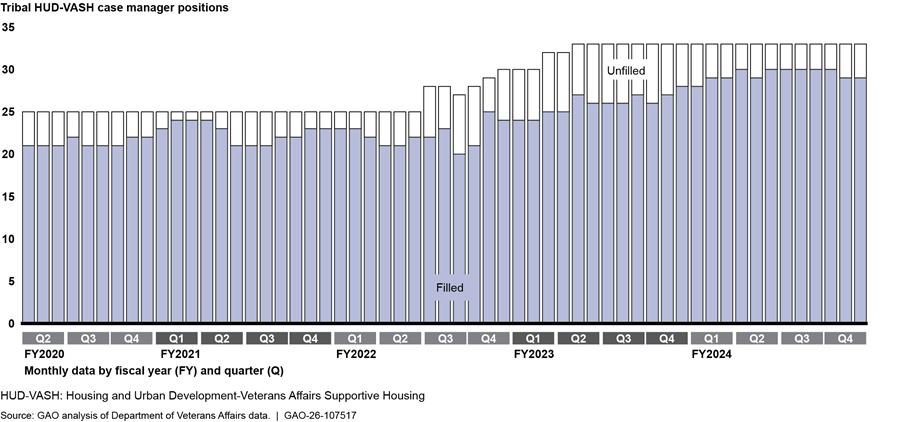
VA experienced challenges hiring and retaining Tribal HUD-VASH case managers, particularly in remote areas, according to a HUD report and 2024 grant applications we reviewed.[79] Specifically, nine of all 29 Tribal HUD-VASH grantees for fiscal year 2024 indicated a shortage of VA case management as a challenge.
In fiscal year 2024, VA had 33 case manager positions assigned to serve the 29 grantees. Of these, nine positions across six facilities were vacated and later filled. VAMCs took an average of 6 months to refill these positions, according to our analysis of VA data. For fiscal years 2020–2024, VA filled from 74 percent to 96 percent of Tribal HUD-VASH case manager positions, depending on the month and year (see fig. 3).
Tribal HUD-VASH case management may be provided directly by a VAMC, a community-based outreach clinic, or through a contract with a tribal health care provider or the Indian Health Service.[80] One grantee interviewed chose to hire a case manager directly to ensure they would be culturally familiar with American Indian/Alaska Native veterans. They said this approach improved trust between veterans and the case manager. However, they said they experienced challenges, including difficulties finding a case manager who met VA’s licensure requirements and reluctance from the VAMC to approve a contract position.
According to 2024 Tribal HUD-VASH grant applications, an insufficient number of case managers limited grantees’ ability to identify eligible veterans and increased case managers’ workload. For example, one grantee received additional funding in 2022, and VA enrolled more participants. But as of June 2024, VA was unable to fill a new case manager position to serve these additional participants, leaving the original case manager with a higher workload. Three other grantees indicated that hiring additional case managers would help them identify more eligible veterans and better serve clients over large service areas.
To address hiring challenges in remote areas, VA has allowed use of recruitment, retention, and relocation funding, according to a 2020 HUD report.[81] VA and grantees cited other arrangements that facilitated the hiring of case managers for remote areas. For example, VA provided travel funding for a case manager located in Anchorage to travel to provide services in a remote part of Alaksa.
Limited Capacity to Conduct Outreach
Eight of the 29 Tribal HUD-VASH grantees cited challenges with finding enough eligible veterans to fully use their vouchers. One reason for this is that Tribal HUD-VASH eligibility includes veterans at risk of homelessness, who may be more difficult to identify.[82] Grantees said expanded eligibility for Tribal HUD-VASH allowed them to respond to homelessness on tribal lands where limited affordable housing can lead to overcrowding. However, veterans living with family or friends might be difficult to identify because they may not identify as homeless.
Case managers are responsible for identifying eligible veterans for the program, but grantees said they had limited capacity to conduct outreach. For example, one grantee told us they had never fully used their 20 Tribal HUD-VASH vouchers but believed there were veterans who would benefit from them. They said VA assigned one case manager to cover their six-county area, and that this case manager does not currently conduct outreach. Two grantees stated that VA should hire additional case managers to identify eligible veterans.
Tribal HUD-VASH grantees and VAMCs have taken steps to identify eligible participants and raise awareness of the program. For example, grantees described partnering with tribal government veteran affairs offices, attending tribal meetings, and distributing brochures. One grantee told us that VA plays an important role in screening veterans for program eligibility, but that veterans may not always feel comfortable disclosing they are American Indian/Alaska Native to VA staff.
Not all grantees experienced challenges identifying enough participants. Four of the 29 grantees said they did not have enough Tribal HUD-VASH vouchers to serve all eligible veterans. [83] For example, one grantee said they always have a waiting list and have stopped publicizing the program because they do not have sufficient vouchers to serve additional veterans.
HUD Has Not Established Measurable Objectives or an Evaluation Plan for Tribal HUD-VASH
HUD launched the Tribal HUD-VASH program as a pilot in fiscal year 2016 to test a new approach to serving American Indian/Alaska Native veterans. However, the program’s objectives are not clearly defined or measurable and HUD does not have a plan to collect and analyze data needed to assess its performance, which could help address some challenges that may impede program success.
|
Five Leading Practices for Pilot Program Design · Ensure two-way stakeholder communication at all stages of the program. · Identify a means to assess lessons learned about the pilot to inform decisions on scalability, and whether and how to integrate pilot activities into overall efforts. · Articulate a data-gathering strategy and an assessment methodology. · Establish well-defined, appropriate, clear, and measurable objectives. · Develop a data analysis and evaluation plan to track pilot performance and implementation. Source: GAO. | GAO‑26‑107517 |
We previously identified leading practices for a well-designed pilot program that can help ensure agency assessments produce information needed to make effective program and policy decisions (see sidebar).[84] For example, an assessment methodology can help agencies determine how well a program is performing and identify what it could do to improve results.
We found that HUD’s design for the Tribal HUD-VASH pilot aligned with one of the five leading practices we identified, partially aligned with two, and did not align with the remaining two.
· Ensuring two-way stakeholder communication. HUD’s efforts aligned with this leading practice. HUD has consistently communicated with stakeholders throughout all stages of the program, particularly regarding key changes to the program such as rating criteria for funding competitions. HUD collects narrative information on successes and challenges from grantees in annual grant applications. HUD officials said they communicate with grantees through email, newsletters, at conferences, and when providing technical assistance.
· Using lessons learned to assess scalability. HUD’s efforts partially aligned with this leading practice. HUD analyzed lessons learned about the pilot in its 2020 report to Congress and concluded Tribal HUD-VASH should be a permanent program.[85] However, HUD has not documented how lessons learned should inform decisions about scaling up the program or integrated lessons learned into the HUD-VASH program more broadly.
· Articulating a data-gathering strategy and assessment methodology. HUD’s data-gathering and assessment practices for Tribal HUD-VASH partially aligned with this leading practice. HUD reviews data on the program, including monthly reports from VA, annual information from grant applications, and information routinely gathered from grantees. However, HUD staff indicated they did not have a system to aggregate the information, which made data analysis difficult and time-consuming. HUD reported on the status of the program in 2020 but has not articulated a strategy for how it will use the data or information it collects to evaluate the pilot.
· Establishing well-defined, appropriate, clear, and measurable objectives. HUD’s objectives for Tribal HUD-VASH did not align with this leading practice. HUD officials stated the objectives of the program are to provide uninterrupted renewal awards to grantees and increase utilization of the program.[86] However, HUD has not clearly defined them in program documentation or indicated how it will measure progress toward these objectives. For example, in a 2020 report on the status of the program, HUD provided an analysis that included data on program performance but did not clearly articulate objectives, including those related to renewal awards or utilization.[87]
· Developing a data analysis and evaluation plan. HUD’s analysis efforts for Tribal HUD-VASH did not align with this leading practice because HUD does not have a data analysis or evaluation plan to track pilot performance and implementation. HUD officials stated staff routinely analyze VA data on Tribal HUD-VASH to ensure positive trends in the program and report to Congress and agency leadership on the program. But HUD does not have a plan that identifies how it will use these data to evaluate the program’s implementation and performance. For example, an evaluation plan could help HUD understand changes in program utilization over time.
In our prior work, we found that defining goals and assessing and using evidence are key practices that can help federal agencies effectively manage and assess their efforts.[88] For example, defining goals can help guide activities and allow decision makers, staff, and stakeholders to assess performance by comparing planned and actual results.
By having well-defined objectives and developing and implementing a data-gathering strategy and an evaluation plan, HUD could help ensure it has information needed to make informed decisions about the Tribal HUD-VASH program—such as what changes are needed to address grantee challenges. HUD also would be better positioned to assess whether the program is working as intended.
Conclusions
As the largest program aimed at addressing veteran homelessness, HUD-VASH has an important role to play in supporting continued reductions in homelessness among veterans. Case managers are central to the program’s success, and VA has taken some steps to help address staffing challenges through contracting and other arrangements. However, VA does not consistently collect data on why eligible veterans are not referred to HUD-VASH, including when staffing limitations are a factor. By developing a method for requiring VAMCs to track and report this information, VA could strengthen its ability to assess unmet demand and efficiently allocate case manager positions.
As a pilot program, Tribal HUD-VASH provides an opportunity to test and evaluate new approaches for serving American Indian/Alaska Native veterans experiencing homelessness. However, HUD has not articulated how it will measure progress toward its objectives or developed and implemented a data collection and analysis plan to assess performance. Taking these steps would better position HUD to ensure the pilot effectively informs policy and program decisions, including whether to expand or modify the program.
Recommendations for Executive Action
We are making a total of two recommendations (one to VA and one to HUD). Specifically:
The Secretary of Veterans Affairs should ensure that the Senior Executive Director of the Homeless Programs Office develops a method for requiring VAMCs to collect data on the reasons eligible veterans were not referred to HUD-VASH, including when veterans are not referred due to insufficient case management capacity, and use these data, as appropriate, to inform staffing assessments. (Recommendation 1)
The Secretary of Housing and Urban Development should ensure that the Deputy Assistant Secretary for Native American Programs clearly define its objectives for the Tribal HUD-VASH pilot program and how it will measure progress toward them and develop and implement a data collection and analysis plan for evaluating the program. The plan should include how lessons learned will inform decisions on scalability or integrating pilot activities into overall efforts. (Recommendation 2)
Agency Comments
We provided a draft of this report to HUD, VA, and the United States Interagency Council on Homelessness for review and comment. HUD and VA provided written comments, which are reproduced in appendixes III and IV. VA also provided technical comments, which we incorporated as appropriate. The United States Interagency Council on Homelessness did not provide comments on the report.
HUD neither agreed nor disagreed with our recommendation but indicated it would take actions to implement it. HUD stated that, in partnership with VA, it would look for more effective ways to assess whether the Tribal HUD-VASH program is achieving its goals and develop a structured data collection and analysis approach to assess program outcomes.
VA agreed with our recommendation and outlined planned steps to implement it. The steps include reviewing its data system to determine how to modify or add data collection elements related to all eligible veterans not referred to HUD-VASH and educating VAMCs on any changes made to VA’s data system and data collection requirements.
We are sending copies of this report to the appropriate congressional committees, the Department of Housing and Urban Development, Department of Veterans Affairs, and the United States Interagency Council on Homelessness. In addition, the report is available at no charge on the GAO website at https://www.gao.gov.
If you or your staff have any questions about this report, please contact me at cackleya@gao.gov. Contact points for our Offices of Congressional Relations and Media Relations may be found on the last page of this report. GAO staff who made key contributions to this report are listed in appendix V.

Alicia Puente Cackley
Director, Financial Markets and Community Investment
This report examines (1) case management challenges agencies and selected providers reported experiencing in implementing homelessness programs; (2) affordable housing challenges agencies and selected providers reported experiencing in implementing homelessness programs, including voucher availability; and (3) challenges agencies and providers reported experiencing in implementing Tribal Housing and Urban Development-Veterans Affairs Supportive Housing (HUD-VASH). The programs we reviewed were HUD-VASH, Supportive Services for Veteran Families (SSVF), Grant and Per Diem (GPD), and Tribal HUD-VASH, as specified in the provision of the 2023 Consolidated Appropriations Act directing us to conduct this work.
Reviews of Literature and Agency Documentation
To identify literature related to our selected programs and research objectives, we conducted a review of online databases, including ProQuest, EBSCO, Scopus, Nexis, and the Harvard Kennedy School Think Tank Search. Two analysts independently reviewed the title and abstracts of all articles and assessed their relevance to our selected programs and to topics including the availability of case management, availability and utilization of vouchers, and availability and affordability of housing. When two analysts disagreed, a third analyst independently reviewed the title and abstract and made the final determination. We identified 25 studies published in 2019–2024. We performed this review from June 2024 to March 2025.
To describe the structure and requirements of HUD-VASH, SSVF, GPD, and Tribal HUD-VASH programs, we reviewed relevant operating procedures of the Department of Veterans Affairs (VA) and Department of Housing and Urban Development (HUD). This included Veterans Health Administration Directive 1162.05, which outlines policies and procedures for implementing HUD-VASH, and HUD’s Housing Choice Vouchers Program Guidebook. We reviewed supplementary HUD-VASH guidance related to contracting, collaborative case management, project-based vouchers, and income eligibility. We also reviewed VA’s GPD Grant Recipient and SSVF program guides and VA’s Homeless Programs Office’s 2025–2029 strategic plan, its most recent.
To learn about VA’s hiring and staffing of HUD-VASH case managers, we reviewed internal memorandums related to VA’s fiscal year 2024 zero-growth strategy, the 2025 hiring freeze, and the hiring of special purpose-funded positions in fiscal years 2020–2024. We also reviewed human resources guides for hiring and onboarding new staff, workforce reports, and strategic goals related to hiring and retention.
To describe the HUD-VASH voucher allocation and award process, we reviewed HUD’s 2024 registration of interest notice and VA’s associated memorandum announcing staffing allocations. We reviewed VA gap analysis data for the VA medical centers (VAMC) for which we conducted site visits, and HUD voucher award announcements for fiscal years 2020–2024.
We determined that internal controls were significant to the first objective.[89] The information and communication component of internal control was significant, along with the underlying principle that management should use quality information to achieve the entity’s objectives. Management is to obtain relevant data from reliable internal and external sources. We assessed VA’s referral data collection practices against these standards by interviewing VA officials and reviewing agency documentation on why veterans were not referred to HUD-VASH.
Interviews with Agencies, Service Providers, and Veterans
For all our objectives, we interviewed officials from VA’s Veterans Health Administration, which oversees the HUD-VASH, SSVF, GPD, and Tribal HUD-VASH programs. We also interviewed officials from HUD’s Public and Indian Housing, which administers HUD-VASH, Office of Native American Programs which administer Tribal HUD-VASH, and Office of Policy Development and Research, which conducts agency research and evaluation. In addition, we spoke with officials from the United States Interagency Council on Homelessness, which coordinates federal agencies to prevent and end homelessness.
Additionally, we interviewed officials from four national housing organizations selected for their policy focus on veterans, affordable housing, or American Indian/Alaska Native communities, as well as their participation in prior GAO reports. These organizations were the National Alliance to End Homelessness, National American Indian Housing Council, National Coalition for Homeless Veterans, and the National Low Income Housing Coalition. We discussed their perspectives on the availability of VA case management, HUD-VASH vouchers, affordable housing for non-Tribal and Tribal veterans experiencing homelessness, and challenges communities face implementing the HUD-VASH, SSVF, GPD, and Tribal HUD-VASH programs.
To obtain information about the challenges communities experience related to VA case management, affordable housing, and implementation of selected homelessness programs, we conducted in-person site visits to eight communities with active HUD-VASH, SSVF, and GPD programs (see table 6).[90]
|
State |
Locality (Continuum of Care or Tribe) |
|
Arizona |
Tohono O’odham (Ki:Ki Association) |
|
Connecticut |
Connecticut Balance of State |
|
Hawaii |
Honolulu City and County |
|
Illinois |
Chicago |
|
Indiana |
Indiana Balance of State |
|
Maryland |
Baltimore County |
|
Oklahoma |
Osage Nation |
|
Texas |
Dallas City and County, Irving |
Source: GAO. | GAO‑26‑107517
We selected six sites with geographic diversity across Census regions (West, Midwest, South, and Northeast) and a mix of Continuum of Care community type (largely rural, largely suburban, or largely urban or major city).[91] Site selection also considered the highest numbers of veterans experiencing homelessness, according to HUD’s 2023 Point-in-Time Count.[92] For half of these six sites, we prioritized communities previously certified as having “ended veteran homelessness” under criteria established by the United States Interagency Council on Homelessness, VA, and HUD.[93] Separately, we judgmentally selected two additional sites with active Tribal HUD-VASH programs—those that received the highest numbers of vouchers in 2023— while also ensuring variation in tribal population size.
During our site visits, we conducted semi-structured interviews with officials from a nongeneralizable sample of eight local VAMCs, nine public housing agencies or Tribally Designated Housing Entities, eight lead Continuum of Care organizations, and 18 SSVF and GPD providers. In communities with multiple SSVF or GPD providers, we prioritized interviewing those with the largest grant awards or highest number of veteran-designated bed grant allotments. We also interviewed 23 veterans who had participated in the HUD-VASH, Tribal HUD-VASH, SSVF, or GPD programs. These veterans were identified by VAMC or service provider staff. We conducted these visits between September 2024 and April 2025. While not generalizable, these interviews provided valuable perspectives based on the interviewee’s experiences with the program.
To identify major themes related to case management, voucher utilization, affordable housing, and data, we performed a content analysis of all records of interview from each of the eight site visits. We systematically reviewed the content of these records and classified statements according to key ideas and themes. One analyst reviewed a random sample of records of interview from four site visit locations to develop an initial list of coding categories. A second analyst reviewed the first analyst’s coding and indicated any disagreements. The first analyst resolved any differences by revising the coding, providing further explanation, or by reaching agreement with the second analyst. To ensure the coding structure was clear and well-defined, the two analysts tested and finalized it using two additional randomly selected records of interview.
Analyses of VA and HUD Data
To address our first and third objective—on case management challenges and Tribal HUD-VASH program challenges—we analyzed data from VA’s Homeless Staffing Database to calculate fill and turnover rates for HUD-VASH case manager positions and to estimate how long positions remained vacant for fiscal years 2020–2024. We also analyzed data from VA’s Homeless Operations Management and Evaluation System for fiscal years 2020–2024 to determine how VA tracks assessments and referrals to HUD-VASH.[94] To assess the reliability of these databases and the extent to which our selected variables were complete, reliable, and of sufficient quality, we performed electronic testing on selected data fields, including checks for missing data elements and duplicative records. We reviewed VA’s supporting documentation and interviewed VA officials about each data source’s known limitations and analytic methods. We also confirmed with the officials that our calculation methods aligned with the agency’s methods. Based on this review, we determined that Homeless Staffing Database data were sufficiently reliable for describing VA staffing and vacancies. We also determined that the Homeless Operations Management and Evaluation System data were sufficiently reliable for describing the number of veterans assessed, referred, and entered in the HUD-VASH program, and the number of veterans who were chronically homeless but not referred.[95]
To address our second objective—on affordable housing challenges—we analyzed the data from HUD’s Voucher Management System for fiscal years 2020–2024. To assess the reliability of this system’s data and the extent to which our selected variables were complete, reliable, and of sufficient quality, we reviewed HUD’s supporting documentation, conducted electronic testing for missing data elements and duplicative records, and interviewed knowledgeable HUD officials. We determined the data were sufficiently reliable for describing voucher utilization rates and the average per-unit housing assistance payment cost of HUD-VASH housing.
Analysis of Tribal HUD-VASH Grant Applications and Pilot Design
To address our third objective—challenges in implementing the Tribal HUD-VASH program—we performed a content analysis of the fiscal year 2024 grant applications submitted by each of the 29 Tribal HUD-VASH grantees. Our analysis focused on their narrative responses, which were required to discuss program successes, challenges, promising practices, and community engagement efforts.
To analyze these narrative responses, we systematically classified the key ideas and themes. One analyst independently reviewed a sample of the applications to develop an initial list for coding grantee statements. Following this initial review, the analysts refined the categories—for instance, by removing duplicates, combining overlapping categories, and creating or removing categories. After the analysts then independently reviewed all 29 applications and applied the categories to the narrative content, a second analyst reviewed the same applications using the initial analyst’s list of codes. They reconciled areas of disagreement and made further refinements to the category list as needed. Once the coding was complete, we summarized the frequency and nature of grantee-identified challenges and promising practices to identify common themes across applications.
To assess whether the Tribal HUD-VASH pilot program aligned with leading practices for pilot program design, we reviewed five leading practices identified in our previous work.[96] An analyst compared the pilot against these practices using HUD and VA program documents, including the VA program guide, report to Congress, grantee guidance, and program notices. Another analyst independently verified these assessments. We assessed that a pilot element aligned with the criteria when there was evidence that all or almost all aspects of the leading practice were met. If a pilot element reflected some of the key elements in the leading practice or if some of the underlying activities were not fully completed, we assessed the element as partially aligned. If we saw no evidence of alignment, we assessed the element as not aligned.
We conducted this performance audit from April 2024 to March 2026 in accordance with generally accepted government auditing standards. Those standards require that we plan and perform the audit to obtain sufficient, appropriate evidence to provide a reasonable basis for our findings and conclusions based on our audit objectives. We believe that the evidence obtained provides a reasonable basis for our findings and conclusions based on our audit objectives.
This appendix presents key housing performance measures and reported results from the Department of Veterans Affairs (VA) for three programs that serve veterans experiencing or at risk of homelessness: Housing and Urban Development-VA Supportive Housing (HUD-VASH), Supportive Services for Veteran Families (SSVF), and Grant and Per Diem (GPD).[97]
Housing and Urban Development-Veterans Affairs Supportive Housing
During fiscal years 2020–2024, VA evaluated the HUD-VASH program using three key housing performance measures: (1) percentage of participants housed through HUD-VASH, (2) percentage of participants with “negative exits” from the program (e.g., exits due to noncompliance with program requirements), and (3) percentage of participants who obtained housing within 90 days of entering the program (see table 7).[98] VA does not report separate performance results for the Tribal HUD-VASH program; participant data for that program are included in the overall HUD-VASH results.
Table 7: Key VA Performance Measures and Reported Results for the HUD-VASH Program, Fiscal Years 2020–2024
|
Program measure |
|
FY 2020 |
FY 2021 |
FY 2022 |
FY 2023 |
FY 2024 |
|
Housed through HUD-VASH (%) |
Target |
≥92 |
≥92 |
≥92 |
≥90 |
≥90 |
|
|
Result |
83.49 |
83.41 |
79.13 |
79.47 |
82.18 |
|
Negative exits from HUD-VASH (%) |
Target |
≤14 |
≤14 |
≤14 |
≤14 |
≤14 |
|
|
Result |
12.71● |
11.53● |
12.45● |
10.61● |
9.05● |
|
Housed within 90 days of entry (%) |
Target |
≥65 |
≥65 |
≥65 |
≥65 |
Discontinued |
|
|
Result |
54.84 |
50.05 |
47.18 |
46.74 |
— |
● - target met; — - not applicable; FY - fiscal year; HUD-VASH: Housing and Urban Development-Veterans Affairs Supportive Housing; VA - Department of Veterans Affairs
Source: GAO summary of Department of Veterans Affairs data. | GAO‑26‑107517
Note: “Negative exits” refer to those participants who exited the program for reasons such as loss of contact with the program or noncompliance with case management.
According to VA’s reported results, the HUD-VASH program met its annual target for the percentage of participants with negative exits in each fiscal year. HUD-VASH did not meet its target for the percentage of participants housed through the program in any fiscal year.
Supportive Services for Veteran Families
For SSVF, VA provided data for three key housing performance measures (see table 8). Two measures—exits to permanent housing and obtaining housing within 90 days—apply to the program’s rapid rehousing component, which provides time-limited financial assistance and supportive services to help veteran families quickly secure permanent housing. Because veterans in the homelessness prevention component are already housed, VA also provided us with results for exits to permanent housing specific to that component.
|
Program measure |
|
FY 2020 |
FY 2021 |
FY 2022 |
FY 2023 |
FY 2024 |
|
SSVF, Rapid Rehousing |
|
|
|
|
|
|
|
Exits to permanent housing (%) |
Target |
— |
— |
— |
≥70 |
≥70 |
|
|
Result |
73.2 |
68.26 |
64.66 |
68.53 |
71.99● |
|
Housed within 90 days entry (%) |
Target |
— |
— |
— |
≥75 |
≥75 |
|
|
Result |
— |
— |
— |
74.44 |
77.37● |
|
SSVF, Homeless Prevention |
|
|
|
|
|
|
|
Exits to permanent housing (%) |
Target |
— |
— |
— |
— |
— |
|
|
Result |
87.9 |
86.5 |
82.11 |
84.15 |
85 |
● - target met; — - not applicable; FY - fiscal year; SSVF - Supportive Services for Veteran Families
Source: GAO summary of Department of Veterans Affairs data. | GAO‑26‑107517
For fiscal years 2020–2022, VA did not have performance targets for SSVF rapid rehousing exits or housing within 90 days of program entry. The program did not meet either target in fiscal year 2023 but met both in fiscal year 2024.
Grant and Per Diem
The GPD program awards grants to service providers to offer transitional housing and other supportive services to veterans experiencing homelessness.[99] Providers administer the GPD program through various models. Transitional housing GPD models include the following:
· Transition in Place provides permanent housing and with supportive services from which the veteran transitions over time.
· Bridge Housing provides veterans with short-term housing before transitioning to permanent housing, such as through HUD-VASH or SSVF.
· Low Demand provides transitional housing and case management for veterans experiencing chronic homelessness or those who have not succeeded in traditional treatment settings.
· Hospital to Housing provides transitional housing for veterans experiencing homelessness who have been discharged from the hospital.
· Clinical Treatment provides treatment and services to veterans experiencing homelessness with specific substance use disorders, mental health diagnoses, or both.
· Service Intensive provides transitional housing and intensive services to veterans to support stabilization, income growth, or movement to permanent housing.
· Special Needs provides transitional housing and services to specific populations of veterans, including women, those with chronic mental illness, and frail elderly veterans.
VA established separate housing performance measures for each GPD program model. Table 9 presents the targets and reported results for these measures for fiscal years 2020–2024.
|
Program model and measure |
|
FY 2020 |
FY 2021 |
FY 2022 |
FY 2023 |
FY 2024 |
|
|
GPD, Transition in Place |
|
|
|
|
|
|
|
|
Exits to permanent housing (%) |
Target |
≥75 |
≥75 |
≥75 |
≥75 |
≥75 |
|
|
|
Result |
81.53● |
78.72● |
85.15● |
78.46● |
83.80● |
|
|
Negative exits (%) |
Target |
≤23 |
≤20 |
≤20 |
≤20 |
≤20 |
|
|
|
Result |
8.24● |
11.44● |
10.15● |
9.23● |
7.85● |
|
|
GPD, Bridge Housing |
|
|
|
|
|
|
|
|
Exits to permanent housing (%) |
Target |
≥70 |
≥75 |
≥75 |
≥75 |
≥75 |
|
|
|
Result |
74.66● |
71.73 |
71.28 |
75.03● |
74.95 |
|
|
Negative exits (%) |
Target |
≤23 |
≤20 |
≤20 |
≤20 |
≤20 |
|
|
|
Result |
15.78● |
17.58● |
17.79● |
14.15● |
15.23● |
|
|
GPD, Low Demand |
|
|
|
|
|
|
|
|
Exits to permanent housing (%) |
Target |
≥50 |
≥60 |
≥60 |
≥60 |
≥60 |
|
|
|
Result |
61.66● |
56.84 |
61.71● |
61.25● |
60.83● |
|
|
Negative exits (%) |
Target |
≤23 |
≤20 |
≤20 |
≤20 |
≤20 |
|
|
|
Result |
24.10 |
25.26 |
23.04 |
23.16 |
23.49 |
|
|
GPD, Hospital to Housing |
|
|
|
|
|
|
|
|
Exits to permanent housing (%) |
Target |
≥65 |
≥65 |
≥65 |
≥65 |
≥65 |
|
|
|
Result |
68.95● |
63.26 |
69.76● |
81.82● |
68.09● |
|
|
Negative exits (%) |
Target |
≤23 |
≤20 |
≤20 |
≤20 |
≤20 |
|
|
|
Result |
17.97● |
21.59 |
18.55● |
15.58● |
27.13 |
|
|
GPD, Clinical Treatment |
|
|
|
|
|
|
|
|
Exits to permanent housing (%) |
Target |
≥65 |
≥65 |
≥65 |
≥65 |
≥65 |
|
|
|
Result |
62.72 |
58.73 |
60.81 |
63.56 |
67.79● |
|
|
Negative exits (%) |
Target |
≤23 |
≤20 |
≤20 |
≤20 |
≤20 |
|
|
|
Result |
22.20● |
25.94 |
22.78 |
23.48 |
22.65 |
|
|
GPD, Service-Intensive |
|
|
|
|
|
|
|
|
Exits to permanent housing (%) |
Target |
≥65 |
≥70 |
≥70 |
≥70 |
≥70 |
|
|
|
Result |
69.10● |
64.77 |
68.02 |
69.20 |
69.35 |
|
|
Negative exits (%) |
Target |
≤23 |
≤20 |
≤20 |
≤20 |
≤20 |
|
|
|
Result |
18.02● |
22.26 |
19.11● |
19.13● |
19.23● |
|
|
GPD, Special Needs – Women |
|
|
|
|
|
|
|
|
Exits to permanent housing (%) |
Target |
— |
— |
≥70 |
≥70 |
≥70 |
|
|
|
Result |
— |
— |
60.47 |
72.73● |
65.33 |
|
|
Negative exits (%) |
Target |
— |
— |
≤20 |
≤20 |
≤20 |
|
|
|
Result |
— |
— |
23.26 |
13.64● |
16● |
|
|
GPD, Special Needs – Frail Elderly |
|
|
|
|
|
||
|
Exits to permanent housing (%) |
Target |
— |
— |
≥65 |
≥65 |
≥65 |
|
|
|
Result |
— |
— |
50 |
85.71● |
89.47● |
|
|
Negative exits (%) |
Target |
— |
— |
≤20 |
≤20 |
≤20 |
|
|
|
Result |
— |
— |
37.50 |
28.57 |
0● |
|
|
GPD, Special Needs – Chronically Mentally Ill |
|
|
|
|
|
||
|
Exits to permanent housing (%) |
Target |
— |
— |
≥60 |
≥60 |
≥60 |
|
|
|
Result |
— |
— |
57.14 |
93.75● |
65.12● |
|
|
Negative exits (%) |
Target |
— |
— |
≤20 |
≤20 |
≤20 |
|
|
|
Result |
— |
— |
38.10 |
12.50● |
18.60● |
|
● - target met; — - not applicable; FY - fiscal year; GPD - Grant and Per Diem
Source: GAO summary of Department of Veterans Affairs data. | GAO‑26‑107517
Note: “Negative exits” refer to participants who exited the program for reasons such as loss of contact with the program and noncompliance with program rules.
Housing performance measures for each GPD model include the percentage of participants who exited to permanent housing and the percentage with a negative exit. According to VA’s reported results, the models varied in the extent to which they met targets for each fiscal year. For example, the Transition in Place model met all its targets from fiscal years 2020 through 2024. The Clinical Treatment model did not meet targets for exits to permanent housing or negative exits in four of the five years.
Because each model has different eligibility requirements for participants, serves different populations, and has different numbers of participants, model results are not directly comparable in terms of relative success.
GAO Contact
Alicia Puente Cackley, cackleya@gao.gov
Staff Acknowledgments
In addition to the contact named above, Allison Abrams (Assistant Director), Erika Navarro (Assistant Director), Anna Blasco (Analyst in Charge), Anna Brunner, Lauren Capitini, Steven Flint, Jill Lacey, Evan Nemoff, and Barbara Roesmann made key contributions to this report.
The Government Accountability Office, the audit, evaluation, and investigative arm of Congress, exists to support Congress in meeting its constitutional responsibilities and to help improve the performance and accountability of the federal government for the American people. GAO examines the use of public funds; evaluates federal programs and policies; and provides analyses, recommendations, and other assistance to help Congress make informed oversight, policy, and funding decisions. GAO’s commitment to good government is reflected in its core values of accountability, integrity, and reliability.
Obtaining Copies of GAO Reports and Testimony
The fastest and easiest way to obtain copies of GAO documents at no cost is through our website. Each weekday afternoon, GAO posts on its website newly released reports, testimony, and correspondence. You can also subscribe to GAO’s email updates to receive notification of newly posted products.
Order by Phone
The price of each GAO publication reflects GAO’s actual cost of production and distribution and depends on the number of pages in the publication and whether the publication is printed in color or black and white. Pricing and ordering information is posted on GAO’s website, https://www.gao.gov/ordering.htm.
Place orders by calling (202) 512-6000, toll free (866) 801-7077,
or
TDD (202) 512-2537.
Orders may be paid for using American Express, Discover Card, MasterCard, Visa, check, or money order. Call for additional information.
Connect with GAO
Connect with GAO on X,
LinkedIn, Instagram, and YouTube.
Subscribe to our Email Updates. Listen to our Podcasts.
Visit GAO on the web at https://www.gao.gov.
To Report Fraud, Waste, and Abuse in Federal Programs
Contact FraudNet:
Website: https://www.gao.gov/about/what-gao-does/fraudnet
Automated answering system: (800) 424-5454
Media Relations
Sarah Kaczmarek, Managing Director, Media@gao.gov
Congressional Relations
David A. Powner, Acting Managing Director, CongRel@gao.gov
General Inquiries
[1]Department of Housing and Urban Development, The 2024 Annual Homeless Assessment Repot (AHAR) to Congress (Washington, D.C.: December 2024).
[2]HUD estimated 73,367 veterans experienced homelessness on a single night in January 2009. Department of Housing and Urban Development, The 2024 Annual Homeless Assessment Repot (AHAR) to Congress.
[3]GAO, Homeless Veterans: Opportunities Exist to Strengthen Interagency Collaboration and Performance Measurement Procedures, GAO‑20‑428 (Washington, D.C.: May 14, 2020).
[4]Tribal HUD-VASH was enacted as a demonstration (pilot) program in fiscal year 2015, with funding provided through the HUD-VASH appropriation. It is modeled after HUD-VASH but allows for waivers or alternative requirements to certain statutory and regulatory requirements. For purposes of this report, we treat Tribal HUD-VASH as a separate program.
[5]GAO, Standards for Internal Control in the Federal Government, GAO‑14‑704G (Washington, D.C.: Sept. 10, 2014).
[6]We selected sites in Arizona, Connecticut, Hawaii, Illinois, Indiana, Maryland, Oklahoma, and Texas for geographic diversity based on census regions and community type (such as urban or rural). Other selection factors included sites with the highest numbers of veterans experiencing homelessness and those with the highest number of Tribal HUD-VASH vouchers.
[7]In communities with multiple SSVF or GPD providers, we prioritized interviewing those with the largest grant awards or highest number of veteran-designated bed grant allotments. Veteran interview participants were identified by VAMC or service provider staff.
[8]GAO, Data Act: Section 5 Pilot Design Issues Need to Be Addressed to Meet Goal of Reducing Recipient Reporting Burden, GAO‑16‑438 (Washington, D.C.: Apr. 19, 2016).
[9]We use VA’s definition of HUD-VASH case managers for this report. According to VA officials, case managers are staff not serving in primarily supervisory or administrative roles and are identified as either social workers, licensed professional mental health counselors, housing specialists, substance use disorder specialists, registered nurses, peer specialists, or psychologists.
[10]As of July 2025, 170 VAMCs operated nationwide. HUD-VASH case management is available to veterans at all VAMCs through 139 parent facilities, according to VA.
[11]In August 2024, HUD issued a Federal Register notice that updated HUD-VASH policies and procedures. Changes included a new requirement to exclude VA service-connected benefits from the applicant’s income determination for purposes of income eligibility and increasing the initial income eligibility from 50 to 80 percent of area median income. Section 8 Housing Choice Vouchers: Revised Implementation of the HUD-Veterans Affairs Supportive Housing Program, 89 Fed. Reg. 65769 (Aug. 13, 2024).
[12]HUD provides veterans in HUD-VASH with Housing Choice Vouchers. When a tenant finds a landlord who will accept the voucher, the PHA (through funds appropriated to HUD) pays a portion of the rent. The tenant pays the remainder of the rent, approximately 30 percent of their income. Project-based HUD-VASH vouchers allow PHAs to contract with property owners for a specified number of units and for a specified term.
[13]HUD requires each Continuum of Care to establish and operate a coordinated entry system, which assesses and refers people experiencing a housing crisis to available services. Continuums of Care also are responsible for applying for grants, setting local priorities, and collecting data on people experiencing homelessness.
[14]Grantees must be eligible to receive Indian Housing Block Grant funding. Tribally Designated Housing Entities may be a department within the Tribe, a tribal housing authority with a separate board of commissioners, or a nonprofit organization.
[15]Specifically, grantees make a determination that the veteran meets the definition of ‘‘Indian’’ under the Native American Housing Assistance and Self-Determination Act of 1996.
[16]HUD allows Tribal HUD-VASH grantees to assist their own tribal citizens before citizens of other Tribes. If the grantee has additional funds remaining after serving its tribal citizens, it must serve other eligible American Indian/Alaska Native veterans referred by VA until all grant funds are fully spent.
[17]Most HUD-VASH staff are case managers. Of the 3,978 filled HUD-VASH positions at the end of fiscal year 2024, 3,575 (or 90 percent) were case managers.
[18]During this same period, the number of effective HUD-VASH vouchers managed by PHAs increased by 12 percent, from 99,894 to 112,234. Effective vouchers are the number of vouchers awarded and allocated to PHAs for participant use. The ratio of vouchers to case managers ranged from 30-to-1 to 32-to-1 during this period.
[19]We excluded VAMCs and Veterans Integrated Service Networks with one or no HUD-VASH case manager positions from our analysis.
[20]Staff were from three VAMCs, four PHAs, and two Continuums of Care. For the purposes of this report, we use “site” to refer to the locations where we interviewed stakeholders.
[21]Staff were from 12 service providers, three Continuums of Care, and four PHAs.
[22]Staff were from two Continuums of Care, five PHAs, and eight service providers.
[23]Staff were from four Continuums of Care and 12 service providers.
[24]Staff were from two VAMCs, two Continuums of Care, one PHA, and four service providers.
[25]Staff were from three VAMCs, two PHAs, two Continuums of Care, and five service providers.
[26]Staff were from two VAMCs, one PHA, one Continuum of Care, and three service providers.
[27]Findings from a systematic review of eight peer-reviewed studies suggest people experiencing homelessness have higher mortality rates than populations not experiencing homelessness. See Amy M. Funk, R. Neil Greene, Kate Dill, and Pia Valvassori, “The Impact of Homelessness on Mortality of Individuals Living in the United States: A Systematic Review of the Literature,” Journal of Health Care for the Poor and Underserved, vol. 33 (2022): 457–477.
[28]Staff were from five VAMCs, four service providers, four Continuums of Care, and two PHAs.
[29]Staff were from five VAMCs, three service providers, and three Continuums of Care.
[30]Staff were from three VAMCs, two Continuums of Care, one service provider, and one PHA. We previously reported that VA experienced challenges with recruitment, retention, hiring, and onboarding in its homelessness programs, including HUD-VASH. See GAO‑20‑428. We designated managing risks and improving VA health care as a high-risk area, including challenges related to staffing. See GAO, High-Risk Series: Efforts Made to Achieve Progress Need to Be Maintained and Expanded to Fully Address All Areas, GAO‑23‑106203 (Washington, D.C.: Apr. 20, 2023). We also testified on VA staffing challenges. See GAO, Veterans Health Care: Staffing Challenges and Recommendations for Improvement, GAO‑23‑106836 (Washington, D.C.: May 17, 2023).
[31]According to guidance we reviewed, VA’s fiscal year 2025 budget required a reduction in its cumulative Veterans Health Administration staffing. VA’s fiscal year 2024 hiring and attrition strategy was implemented to achieve that goal. The strategy called for allowing attrition among administrative and clinical support positions, as well as positions where redistribution of duties would lead to efficiencies.
[32]VA uses specific purpose funding for most HUD-VASH case manager positions. All such positions were exempt from the attrition policy. These include positions related to homelessness, suicide prevention, and women’s health that are required by statutory, congressional, or policy mandates, support clinical priorities, and require uniform execution in the field to meet strategic goals.
[33]Veterans Integrated Service Networks manage the day-to-day functions of VAMCs and provide administrative and clinical oversight.
[34]As of September 2025, VA was subject to a hiring freeze (for all civilian executive-branch employees, except as noted) pursuant to the January 20, 2025, and April 27, 2025, Presidential memorandums entitled “Hiring Freeze” and “Extension of Hiring Freeze,” respectively. VA guidance regarding this hiring freeze instructed agency leadership to stop hiring for positions that were vacant as of January 20, 2025, and to immediately revoke offers that were signed before the hiring freeze if their confirmed start date was after February 8, 2025, or if they had an unconfirmed start date. HUD-VASH case managers were exempt from the hiring freeze as of January 21, 2025.
[35]This total represents all HUD-VASH positions, including case managers. As noted previously, case managers make up the majority of HUD-VASH staff (90 percent at the end of fiscal year 2024). VA officials said VAMCs may choose to place HUD-VASH positions in a “not currently recruiting” status, even if those positions are exempt from the hiring freeze. They may do so to balance their own priorities for hiring based on medical center needs, according to officials.
[36]VA officials said VAMCs may request funding for incentives to fill certain hard-to-hire positions.
[37]VA introduced the Collaborative Case Management model as a pilot program in 2020.
[38]Johnny Isakson and David. P. Roe, M.D., Veterans Health Care and Benefits Improvement Act of 2020, Pub. L. No. 116-315, § 4207, 134 Stat. 4932, 5015 (codified at 38 U.S.C. § 2041 note).
[39]VA staff use intake and referral forms to document their process for assessing veterans’ needs and determine whether to make a referral to one of VA’s programs, including HUD-VASH. Information included in these forms is recorded in VA’s data system. Individual veterans may have multiple intake and referrals over time.
[40]Among the 174,045 forms that did not result in a referral, 22,749 had a documented reason.
[41]Specifically, among the 22,749 forms with a documented reason, “referral pending coordinated entry system review” was selected for 25 percent, “would make referrals but no vouchers available” was selected for 23 percent, “all vouchers are currently in use in the desired location where the veteran wants to live” was selected for 12 percent, and “current staffing does not allow for new admissions” was selected for 4 percent. One of the other eight response options was selected for the remaining 35 percent of forms. Percentages do not add to 100 due to rounding. VA also collects data on veterans who are referred to HUD-VASH but do not ultimately enter the program.
[42]As of December 2025, these were the most recent estimates available. Department of Housing and Urban Development, The 2023 Annual Homeless Assessment Repot (AHAR) to Congress (Washington, D.C.: December 2023).
[43]Any veteran experiencing homelessness may be eligible for HUD-VASH. However, according to agency procedures, HUD-VASH targets chronically homeless veterans. See Section 8 Housing Choice Vouchers: Revised Implementation of the HUD-Veterans Affairs Supportive Housing Program, 89 Fed. Reg. 65769, 65770-65779 (Aug. 13, 2024). HUD-VASH follows the definition of “chronically homeless” as provided at 24 C.F.R. § 91.5, which generally refers to a homeless individual with a disability living in a place not meant for human habitation, a safe haven, or in an emergency shelter for a period of at least 12 continuous months, or a combined period of 12 months over a 3-year period. VA collects data on HUD-VASH participants using the Homeless Operations, Management, and Evaluation System.
[44]VA directs VAMCs to use HUD Notice CPD-16-11, Notice on Prioritizing Persons Experiencing Chronic Homelessness and Other Vulnerable Homeless Persons in Permanent Supportive Housing.
[46]Department of Veterans Affairs, Veterans Health Administration, Homeless Programs Office Strategic Plan 2025–2029.
[47]Nationally, rental costs and the prevalence of severe rent burdens have increased for some renters in recent years. Specifically, HUD reported rental costs increased 17 percent from 2021 to 2023 for very low-income renters with “worst-case housing needs,” defined as those who do not receive housing assistance, earn 50 percent or less of the area median income, and pay more than half of their income on housing or live in substandard housing. See Department of Housing and Urban Development, Office of Policy Development and Research, Worst Case Housing Needs: 2025 Report to Congress (Washington, D.C.: Nov. 20, 2025).
[48]PHAs pay a portion of the rent to the owner of a unit under lease by a HUD-VASH participant. The PHA’s portion, the Housing Assistance Payment, is the difference between the contract rent and participant’s contribution (30–40 percent of the participant’s income). The variation in the portion of rent PHAs pay to landlords is the result of multiple factors, such as the income of assisted households or changes in PHA policy.
[49]To better expand voucher participants’ access to housing in lower-poverty neighborhoods, HUD established Small Area Fair Market Rents in 2016. This policy allows PHAs to calculate payment standards at the zip-code level instead of the metropolitan-area level to more accurately reflect local markets. HUD currently requires 409 PHAs to use Small Area Fair Market Rents in the administration of their Housing Choice Voucher program. An additional 21 PHAs voluntarily adopted these rents. See https://www.hud.gov/helping-americans/housing-choice-vouchers-safmr; last accessed Nov. 25, 2025.
[50]Housing needs of older adults are particularly challenging to address, and providers we interviewed for our September 2024 report said it is difficult to find accessible housing within an already limited supply of affordable housing. See GAO, Homelessness: Actions to Help Better Address Older Adults’ Housing and Health Needs, GAO‑24‑106300 (Washington, D.C.: Sept. 9, 2024).
[51]Staff were from two VAMCs, two Continuums of Care, and three service providers.
[52]For information about HUD assistance for households with disabilities, see GAO, HUD Rental Assistance: Serving Households with Disabilities, GAO‑23‑106339 (Washington, D.C.: Mar. 29, 2023).
[54]These results were based on structured interviews with a nongeneralizable sample of 51 HUD-VASH officials in Los Angeles in 2016–2017. Erica Hua Fletcher, et al., “Stakeholder perspectives on sustainment of Housing First in a VA permanent supportive housing program,” Health Services Research, vol. 57, no. 2 (March 2022).
[55]The HUD-VASH program permits PHAs to allow participants to use their tenant-based vouchers for different types of housing. 24 C.F.R. part 982, subpart M; 24 C.F.R. §§ 983.2, 983.9.
[56]HUD-VASH participants have at least an initial 120-day period to find housing, compared to an initial 60-day period for Housing Choice Voucher participants. If HUD-VASH participants are unable to find housing during the initial period, PHAs are encouraged to use flexibility allowed for needed extensions of search periods.
[57]Veterans are not automatically discharged from HUD-VASH case management because their voucher expires, according to VA officials. Instead, the VAMC may refer the veteran for a new HUD-VASH voucher or assist them in identifying alternative permanent housing options.
[58]Staff were from five VAMCs, four PHAs, one Continuum of Care, and 10 service providers.
[59]In contrast, the Housing Choice Voucher program allows PHAs to deny admission to the program based on criminal convictions, prior evictions from federally assisted housing within the last 3 years for drug-related activity, and other admission criteria. In accordance with HUD-VASH program rules, PHAs cannot establish additional eligibility requirements for families. 24 C.F.R. § 982.553(a). See Section 8 Housing Choice Vouchers: Revised Implementation of the HUD-Veterans Supportive Housing Program, 89 Fed. Reg. 65769, 65771 (Aug. 13, 2024) (providing that the PHA, by agreeing to administer the HUD-VASH program, relinquishes its authority to determine the eligibility of families in accordance with regular Housing Choice Voucher program rules, contained at 24 C.F.R. § 982.201, and PHA policies with the exceptions of income eligibility and lifetime sex offender status). See also 24 C.F.R. §§ 982.306, 982.553, 982.552(b), (c), and HUD Housing Choice Voucher Program Guidebook, sec. 4.1.
[60]Staff were from two VAMCs and six service providers.
[61]Staff were from two VAMCs and three PHAs. In some states, the District of Columbia, and localities, refusing to accept housing vouchers may constitute “source of income” discrimination. Department of Housing and Urban Development, Office of Inspector General, Public Housing Authorities and Source of Income Discrimination, 2025-BO-0003 (Washington, D.C.: Aug. 13, 2025).
[62]Staff were from three VAMCs, three PHAs, one Continuum of Care, and four service providers.
[63]Staff were from one VAMC, one Continuum of Care, and two service providers.
[64]Staff were from five VAMCs, one PHA, and three service providers. Different organizations use different position titles to describe staff who help participants find housing and engage landlords, including Housing Specialists, Housing Navigators, and Landlord Liaisons. For this report, we refer to staff in these positions collectively as Housing Specialists.
[65]Stakeholders who provided examples of landlord outreach activities were staff at six VAMCs, three PHAs, five Continuums of Care, and seven service providers.
[66]On December 21, 2022, VA sent a memorandum of agreement to all fiscal year 2023 SSVF grantees allowing them to use program funds to provide resources to landlords to overcome housing barriers for veterans and resolve landlord concerns.
[67]SSVF providers can offer landlords incentives equivalent to up to 2 months of rent.
[68]For SSVF operating requirements, including the Shallow Subsidy service established in 2019, see 38 C.F.R. pt. 62. See also Rental and Utility Assistance for Certain Low-Income Veteran Families, 84 Fed. Reg. 45074 (Aug. 28, 2019); and Rental and Utility Assistance for Certain Low-Income Veteran Families, 86 Fed. Reg. 42979 (Aug. 5, 2021).
[69]VA amended the Shallow Subsidy Service program in 2021 to increase the subsidy to a maximum of 50 percent and increase the basis for the rental subsidy for eligible participant families to a maximum of 50 percent. The latter change was made in part because, according to HUD, feedback from communities indicated that HUD’s fair market rental rates consistently lag behind the true rental rates in the market, resulting in a subsidy of less than the intended 35 percent of rental rates in the market. Supportive Services for Veterans Families, 86 Fed. Reg. 62482, 62483 (Nov. 10, 2021).
[70]See https://www.va.gov/homeless/landlords.asp; last accessed on July 2, 2025. Also see https://www.hud.gov/helping-americans/housing-choice-vouchers-landlord; last accessed on July 2, 2025.
[71]Staff were from five PHAs, 12 service providers, and three Continuums of Care.
[72]VA uses a gap analysis tool to estimate the needs of homeless veterans in each community, such as for additional rapid rehousing or HUD-VASH resources.
[73]A limited supply of vouchers can lead to VA declining to refer eligible veterans to HUD-VASH. Of those veterans not referred to HUD-VASH with a documented reason, 23 percent were not referred due to lack of available vouchers and 12 percent were not referred due to lack of vouchers in the location in which the veteran desired to live, according to our analysis of VA data.
[74]In 2024, HUD made approximately $78 million available to PHAs to administer approximately 7,800 new vouchers and awarded about $40 million for 3,518 vouchers.
[75]These were four PHAs, four VAMCs, and one Continuum of Care.
[76]HUD requires PHAs to first register their interest in applying before inviting them to apply for a specific number of vouchers. In 2024, HUD provided PHAs with 88 days to register interest in applying for additional vouchers. By comparison, HUD allowed from 31 to 69 days for other HUD-VASH award competitions in 2020–2024.
[77]A 2017 HUD study on the housing needs of American Indians/Alaska Natives on tribal lands cited remoteness, lack of infrastructure, and complex legal and other constraints related to land ownership as factors contributing to housing challenges such as overcrowding and physical housing problems. This study estimated that an additional 68,000 units were needed in tribal areas to address overcrowding and replace inadequate units for the 2013–2015 period. Department of Housing and Urban Development, Office of Policy Development and Research, Housing Needs of American Indians and Alaksa Natives in Tribal Areas: A Report from the Assessment of American Indian, Alaska Native, and Native Hawaiian Housing Needs (Washington, D.C.: January 2017).
[78]HUD’s Indian Housing Block Grant funds are made available through a formula calculated annually. 24 C.F.R. part 1000, subpart D. One component of the formula, Formula Current Assisted Stock, considers existing housing. 24 C.F.R. §§ 1000.310(a), 1000.316. Placing veterans in low-rent Formula Current Assisted Stock units by using Tribal HUD-VASH excludes these units from the count used to determine the grantee’s funding under the formula during the period the veteran is housed in this unit, according to HUD guidance.
[79]Department of Housing and Urban Development, Office of Public and Indian Housing, Report to Congress on the Tribal Housing and Urban Development-Veterans Affairs Supportive Housing Program (Washington, D.C.: March 2020).
[80]Community-based outreach clinics extend services to veterans in rural communities and are operated, funded, or reimbursed by VA.
[81]Department of Housing and Urban Development, Office of Public and Indian Housing, Report to Congress on the Tribal Housing and Urban Development-Veterans Affairs Supportive Housing Program.
[82]Tribal HUD-VASH has an expanded eligibility (beyond the HUD-VASH program) to veterans at risk of homelessness.
[83]HUD makes unspent funds from the Tribal HUD-VASH program available in future competitions. For example, in 2022 HUD announced the availability of $2.2 million in funding remaining from fiscal year 2017 for grants to current and new applicants.
[85]Department of Housing and Urban Development, Office of Public and Indian Housing - Office of Native American Programs, Report to Congress on the Tribal Housing and Urban Development-Veterans Affairs Supportive Housing Program.
[86]We use “objectives” to describe goals or targets the agency seeks to achieve.
[87]Department of Housing and Urban Development, Office of Public and Indian Housing, Report to Congress on the Tribal Housing and Urban Development-Veterans Affairs Supportive Housing Program.
[88]GAO, Evidence-Based Policymaking: Practices to Help Manage and Assess the Results of Federal Efforts, GAO‑23‑105460 (Washington, D.C.: July 12, 2023).
[89]GAO, Standards for Internal Control in the Federal Government, GAO‑14‑704G (Washington, D.C.: Sept. 10, 2014).
[90]We originally selected the Los Angeles Continuum of Care but ultimately visited the Chicago Continuum of Care, due to the 2025 wildfires in Los Angeles at the time of the site visits.
[91]We pretested our site visit approach with the Baltimore County Continuum of Care to ensure that our interview questions were clear and covered our priority topics. We did not make significant changes to our approach and include the information from this site visit in our analysis.
[92]The Point-in-Time Count enumerates sheltered and unsheltered people experiencing homelessness on a single night in January and is planned, coordinated, and carried out locally. See https://www.hudexchange.info/programs/hdx/pit-hic/#2025-pit-count-and-hic-guidance.
[93]In 2019, VA, HUD, and the United States Interagency Council on Homelessness developed criteria and benchmarks designed to help communities make veteran homelessness rare, brief, and a one-time experience. These agencies confirmed communities shown to have met the following criteria: (1) the community identified all veterans experiencing homelessness; (2) the community provided shelter immediately to any veteran experiencing unsheltered homelessness who wanted it; (3) the community provided service-intensive transitional housing only in limited instances; (4) the community had capacity to assist veterans to swiftly move into permanent housing; and (5) the community had resources, plans, partnerships, and system capacity in place should any veteran become homeless or be at risk of homelessness in the future.
[94]These data were the most recently available at the time of this review. Additionally, we requested and received selected program performance results from VA for the HUD-VASH, SSVF, and GPD programs for fiscal years 2020–2024. We did not replicate or independently verify VA’s calculations. For the VA-provided program performance targets and results, see appendix II.
[95]VA’s Homeless Operations Management and Evaluation System documents key steps in the HUD-VASH process—such as assessment, referral, and program entry and exit—using standardized forms. Because veterans may receive multiple assessments or referrals in a fiscal year, they may be associated with multiple forms. For our report, we count the number of assessment or referral forms VA completed in a fiscal year, regardless of how many forms an individual veteran received.
[96]GAO, Data Act: Section 5 Pilot Design Issues Need to Be Addressed to Meet Goal of Reducing Recipient Reporting Burden, GAO‑16‑438 (Washington, D.C.: Apr. 19, 2016). Also see GAO, Small Business Pilot Program: SBA Has Opportunities to Evaluate Outcomes and Enhance Fraud Risk Mitigation, GAO‑25‑107067 (Washington, D.C.: Mar. 27, 2025); and Evidence-Based Policymaking: Practices to Help Manage and Assess the Results of Federal Efforts, GAO‑23‑105460 (Washington, D.C.: July 12, 2023).
[97]In 2020, we reported on key performance measures and reported results for selected homelessness assistance programs, including HUD-VASH, SSVF, and GPD for fiscal years 2015–2019. See GAO, Homeless Veterans: Opportunities Exist to Strengthen Interagency Collaboration and Performance Measurement Procedures, GAO‑20‑428 (Washington, D.C.: May 14, 2020). Performance measures unrelated to housing, such as percentage employed, are not included in this appendix.
[98]VA discontinued the performance measure tracking the percentage of participants who obtained housing within 90 days of program entry for fiscal year 2024.
[99]GPD is VA’s largest transitional housing program for veterans experiencing homelessness. The program also has two additional models that do not directly provide veterans with transitional housing services: Case Management and Capital Grants. These model types do not have performance measures related to veteran participant outcomes and therefore are not included in table 9.