
Report to Congressional Requesters
United States Government Accountability Office
A report to congressional requesters
For more information, contact Gretta Goodwin at GoodwinG@gao.gov
What GAO Found
With few exceptions, in states subject to Public Law 280 (P.L. 280), Tribes share criminal jurisdiction with the state, rather than the federal government, when a tribal citizen commits a crime or, in certain circumstances, is the victim of a crime in Indian country. However, P.L. 280 currently has limited effect on criminal jurisdiction in Alaska—a mandatory P.L. 280 state—because the Alaska Native Claims Settlement Act of 1971 eliminated most of the state’s Indian country. Nevertheless, Tribes in Alaska have inherent authority to exercise certain criminal jurisdiction which, due to other laws, is concurrent with the state. While Alaska and Department of Justice (DOJ) officials had consistent views, officials from the Department of the Interior’s Bureau of Indian Affairs (BIA) shared varying views on this concurrent jurisdiction during GAO’s review. By documenting BIA’s position on concurrent criminal jurisdiction in Alaska and making it readily available, BIA may help ensure consistent understanding of the authority of Tribes in Alaska.
Alaska’s status as a mandatory P.L. 280 state may affect Tribes’ access to certain federal public safety and justice funding. Specifically, BIA data for fiscal years 2017 through 2021 (the most recent data available) showed that Tribes in Alaska and other mandatory P.L. 280 states received less funding than Tribes in all other states in the lower 48. Officials stated that BIA has limited discretionary funding and generally must continue to fund Tribes with existing funding agreements for public safety and justice programs at the same level as the prior year. When new discretionary funding is available, BIA officials stated they generally prioritize this funding for Tribes that do not receive public safety and justice services from their respective states. However, BIA has not documented criteria for entering into new funding agreements with Tribes for the first time. By doing so, BIA could provide greater transparency on funding decisions, particularly if Congress appropriates additional funding.
BIA Public Safety and Justice Estimated Needs and Expenditures to Federally Recognized Tribes and Tribal Organizations, Fiscal Year 2017 Through 2021
|
Tribes by P.L. 280 status |
Tribal needs estimate |
BIA expenditures |
|
Alaska (Mandatory P.L. 280) |
$3,046,624,000 |
$59,519,000 |
|
Mandatory P.L. 280 states in the lower 48 |
$2,827,096,000 |
$151,738,000 |
|
All other states in the lower 48 |
$8,695,641,000 |
$1,864,373,000 |
Source: GAO analysis of Bureau of Indian Affairs (BIA) Tribal Law and Order Act reports for fiscal years 2017 through 2021. | GAO-26-107533
Tribal leaders, Alaska Native community members, as well as federal and state officials identified numerous challenges related to public safety and justice in Alaska Native communities. In general, these challenges included high crime rates and limited public safety infrastructure, funding resources, and training. Federal, state, and tribal officials identified various efforts to improve public safety and justice in Alaska, including state-tribal wellness courts.
Why GAO Did This Study
In 1953, P.L. 280 rescinded most federal criminal jurisdiction in Indian country in certain states and provided it to these select states. As of January 2026, this affects approximately 65 percent of the 575 federally recognized Tribes, including Alaska—a state with one of the highest crime rates in the U.S.. Following the passage of subsequent federal legislation, some uncertainty has been raised about the extent to which P.L. 280 is applicable in the state of Alaska.
GAO was asked to review P.L. 280’s effect on public safety and justice on Alaska Native communities.This report addresses (1) the extent to which P.L. 280 affects criminal jurisdiction in Alaska; (2) the effects of P.L.280 on Tribes in Alaska; and (3) views on public safety and criminal justice challenges in Alaska. Among other methods, GAO analyzed relevant laws and federal memoranda on tribal jurisdiction in Alaska, as well as federal crime and funding data for fiscal years 2017 through 2024. GAO interviewed BIA and DOJ officials, as well as non-governmental stakeholders. GAO conducted listening sessions with a non-generalizable sample of over 50 tribal leaders and Alaska Native community members.
What GAO Recommends
GAO is making two recommendations to the Department of the Interior, including that it ensures BIA documents its position on concurrent criminal jurisdiction in Alaska and makes it readily available, and documents and communicates criteria for entering into new funding agreements for public safety and justice programs with Tribes. The Department of the Interior concurred with our recommendations via email, but did not provide comments on our draft report.
|
Abbreviations |
|
|
|
BIA |
Bureau of Indian Affairs |
|
|
DOJ |
Department of Justice |
|
|
FBI |
Federal Bureau of Investigation |
|
|
NIBRS |
National Incident-Based Reporting System |
|
|
P.L. 280 |
Public Law 280 |
|
This is a work of the U.S. government and is not subject to copyright protection in the United States. The published product may be reproduced and distributed in its entirety without further permission from GAO. However, because this work may contain copyrighted images or other material, permission from the copyright holder may be necessary if you wish to reproduce this material separately.
February 18, 2026
Congressional Requesters
In 1953, Public Law 280 (P.L. 280) rescinded most federal criminal jurisdiction in “Indian country” in certain states and provided it to these select states (mandatory P.L. 280 states).[1] This affects approximately 65 percent of all the 575 federally recognized Tribes, as of January 2026.[2] With few exceptions, under P.L. 280, a Tribe’s inherent criminal jurisdiction is concurrent with the state when a tribal citizen commits a crime or, in certain circumstances, is the victim of a crime in Indian country.[3] As a result, state authorities—as opposed to the federal government—are generally responsible for providing public safety and justice services—law enforcement, courts, and corrections—in mandatory P.L. 280 states, including Alaska.[4]
Following the passage of subsequent legislation, some uncertainty has been raised about the extent to which P.L. 280 is applicable in the State of Alaska.[5] Further, some research on the effect of P.L. 280 suggests the law may have adverse effects on public safety and justice, including slow police response times and limited access to certain federal funding in mandatory P.L. 280 states.[6] Understanding these potentially adverse effects is important in Alaska.[7] For example, statewide crime data reported to the Federal Bureau of Investigation (FBI) identified Alaska as one of the top states for violent crime, and Tribes in Alaska may be affected.[8] Furthermore, the federal government has reported that Alaska’s landscape makes it a challenge to deliver law enforcement and justice services in its rural tribal communities, with many communities lacking any law enforcement presence.
You asked us to review P.L. 280’s effect on public safety and justice in Alaska.[9] This report examines: (1) the extent to which P.L. 280 affects criminal jurisdiction in Alaska; (2) what federal research and data show about P.L. 280’s effect on Tribes in Alaska; and (3) tribal, federal, and state views on public safety and criminal justice challenges in Alaska Native communities.[10]
To examine the extent to which P.L. 280 affects criminal jurisdiction in Alaska, we analyzed relevant laws and documentation from the Department of Justice (DOJ) and the Bureau of Indian Affairs (BIA). For example, we reviewed P.L. 280, the Alaska Native Claims Settlement Act of 1971, and federal memoranda on tribal jurisdiction in the State of Alaska. We also interviewed DOJ and BIA officials, and state officials from the Alaska Department of Public Safety and the Alaska Department of Law. We compared DOJ and BIA interpretation and documentation of concurrent criminal jurisdiction with relevant case law, agency memoranda, and Standards for Internal Control in the Federal Government.[11] We also interviewed relevant nongovernmental stakeholders and legal scholars with subject matter expertise to discuss how P.L. 280 affects criminal jurisdiction in Alaska. We selected these stakeholders and scholars based on empirical research and recommendations from senior officials from a regional intertribal organization.[12]
To examine what federal research and data show about P.L. 280’s effect in Alaska, we reviewed empirical research published from 2000 through 2024 that assess the effect of P.L. 280 to determine whether this research included Tribes in Alaska. We examined the FBI’s National Incident-Based Reporting System (NIBRS) to determine the extent to which crime data are collected among Tribes in Alaska. However, as discussed later in the report, we found NIBRS data were not sufficiently reliable to identify the number of criminal offenses in Alaska Native villages. We also analyzed federal funding data to identify any differences in the level of funding DOJ and BIA provide to Tribes in Alaska, compared with Tribes in other mandatory P.L. 280 states and all other states in the lower 48. Specifically, we analyzed DOJ’s grant award data for fiscal years 2017 through 2024.[13] We assessed the reliability of DOJ grant award data by conducting electronic tests to identify anomalies or duplicate data entries; reviewing relevant documentation; and conducting interviews with knowledgeable agency officials. We found DOJ grant award data to be sufficiently reliable to identify funding differences. We also analyzed BIA public safety and justice funding data for fiscal years 2017 through 2021.[14] We also reviewed relevant DOJ and BIA documentation and interviewed agency officials about policies related to funding for Tribes in mandatory P.L. 280 states, including Alaska. We then assessed the extent to which these policies were consistent with relevant Standards for Internal Control in the Federal Government.[15]
To identify views on public safety and criminal justice challenges, we reviewed relevant tribal, federal, and state memorandums and publications describing efforts to address these challenges in Alaska Native communities.[16] We also interviewed DOJ and BIA officials to discuss challenges and efforts underway to improve public safety and criminal justice in Alaska.
To address all objectives, we conducted two site visits to Alaska. During these visits, we solicited perspectives from tribal leaders, Alaska Native community members, state law enforcement and justice officials, and nongovernmental stakeholders to obtain their views on P.L. 280. Specifically, we attended the 2024 Alaska Federation of Natives convention where we held two listening sessions.[17] In addition, we visited the Yukon-Kuskokwim Delta region, where we convened a roundtable discussion to obtain perspectives from officials from a regional intertribal organization and other state and local public safety organizations, including the Village Public Safety Officer program and local search and rescue. We also convened a listening session with 55 Tribes across 48 Alaska Native communities within the Yukon-Kuskokwim Delta region. We selected the Yukon-Kuskokwim Delta for a site visit due to the presence of Alaska Native villages in the region. While information from our site visits is not generalizable to all Tribes, tribal leaders and community members provided important context and illustrative examples of their experiences seeking public safety and justice and their views on P.L. 280.
We conducted this performance audit from May 2024 to February 2026 in accordance with generally accepted government auditing standards. Those standards require that we plan and perform the audit to obtain sufficient, appropriate evidence to provide a reasonable basis for our findings and conclusions based on our audit objectives. We believe that the evidence obtained provides a reasonable basis for our findings and conclusions based on our audit objectives.
Background
Public Law 280
Generally, the Tribe and the federal government have concurrent criminal jurisdiction over crimes committed in Indian country.[18] However, upon its passage in 1953, P.L. 280 rescinded most federal criminal jurisdiction in “Indian country” in certain states and provided it to these states, with exceptions for certain reservations.[19] In these states, the state and Tribes have concurrent criminal jurisdiction in Indian country when a tribal citizen commits a crime or, in certain circumstances, is a victim of a crime in Indian country. Criminal jurisdiction includes criminal investigations, prosecutions, adjudications, and corrections in Indian country, according to DOJ.
At the time of enactment, the law designated California, Minnesota, Nebraska, Oregon, and Wisconsin as mandatory P.L. 280 states.[20] Congress subsequently amended the law in 1958 to include the Territory of Alaska, which later became the State of Alaska in 1959, as a mandatory P.L. 280 state.[21]
P.L. 280 also provided the option for additional states to assume criminal jurisdiction in Indian country in their respective state.[22] Subsequent legislation further affected criminal jurisdiction. For example, the Tribal Law and Order Act of 2010 allowed Tribes in Indian country in mandatory P.L. 280 states to request the federal government assume concurrent federal criminal jurisdiction to prosecute violations under the Major Crimes Act and the General Crimes Act.[23] As another example, the Violence Against Women Act Reauthorization Act of 2022 affirmed the rights of Tribes occupying an Alaska Native village to exercise criminal jurisdiction over tribal citizens within Alaska Native villages.[24] See figure 1 for the selective legislative history of P.L. 280, including its subsequent amendments and related legislation on tribal criminal jurisdiction.
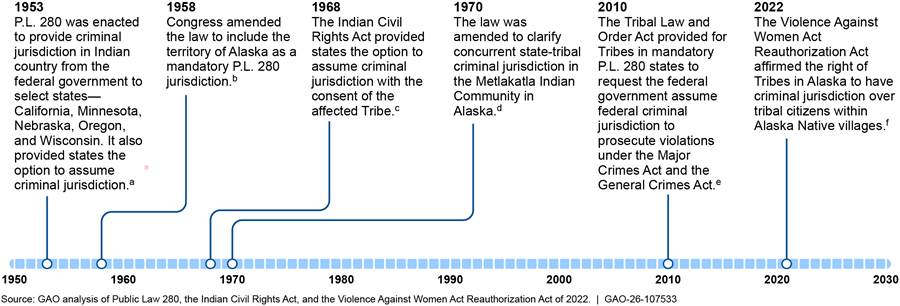
Note: This is not a complete list of Public Law 280 amendments or related legislation.
aExceptions to mandatory P.L. 280 jurisdiction included the Red Lake Reservation in Minnesota, Warm Springs Reservation in Oregon, and the Menominee Reservation in Wisconsin. Act of Aug. 15, 1953, ch. 505, § 2, 67 Stat. 588 (codified at 18 U.S.C. § 1162(a) (1958)).
bAct of Aug. 8, 1958, Pub. L. No. 85-615, 72 Stat. 545 (codified at 18 U.S.C. § 1162(a) (1964)). Alaska was formally admitted into the United States as the 49th state in 1959. Proclamation No. 3269, 3 C.F.R. 4 (1959).
cPub. L. No. 90-284, tit. IV, § 401(a), 82 Stat. 73,78 (codified at 25 U.S.C. § 1321(a) (1970)). This was a shift because tribal consent was not previously required for states to assume criminal jurisdiction. See Act of Aug. 15, 1953, ch. 505, §§ 6, 7, 67 Stat. 588, 590 (codified at 28 U.S.C. § 1360 note (1958)).
dAct of Nov. 25, 1970, Pub. L. No. 91-523, 84 Stat.1358 (codified at 18 U.S.C. § 1162(a) (1976)).
ePub. L. No. 111-211, tit. II, subtit. B, § 221(b), 124 Stat. 2258, 2272 (codified at 18 U.S.C. § 1162(d) (2012)).
fPub. L. No. 117-103, div. W, tit. VIII, subtit. B, § 813(a), 136 Stat. 840, 906 (codified at 25 U.S.C. §1305(a)). For the purposes of this report, we use the term “tribal citizen” in place of the term “Indian” as defined in federal criminal law. In the Ninth Circuit, which Alaska is a part of the definition of Indian for federal criminal law purposes includes more than enrolled citizens or members of a Tribe. See United States v. Broncheau, 597 F.2d 1260, 1262-63 (9th Cir. 1979). Use of the term tribal citizen in this figure reflects the Ninth Circuit’s definition.
Federally Recognized Tribes in Alaska
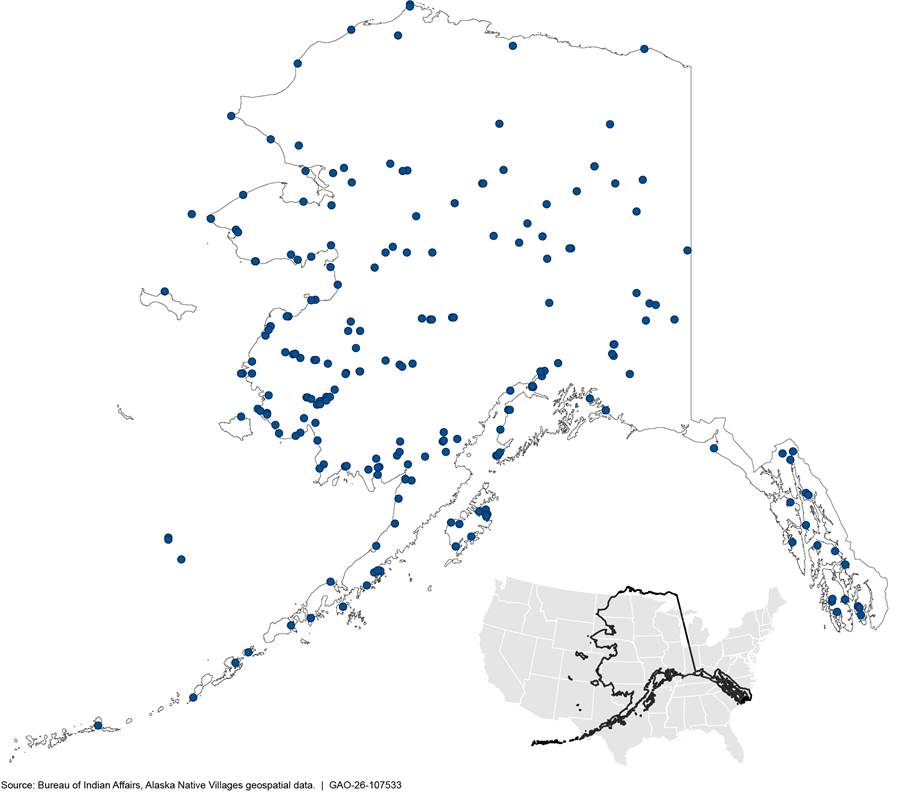
There are 227 federally recognized Tribes in the State of Alaska.[25] Tribes in Alaska account for approximately 61 percent of all Tribes in mandatory P.L. 280 states, and 40 percent of all federally recognized Tribes in the U.S. As of 2021, BIA estimated that approximately 189,458 tribal citizens were enrolled in a federally recognized Tribe in Alaska, accounting for approximately 26 percent of the Alaska state population.[26] Figure 2 identifies the locations of the 227 Tribes in Alaska.
Longstanding issues surrounding ownership of lands and natural resources, and the need to stimulate economic development, led to the enactment of the Alaska Native Claims Settlement Act of 1971.[27] The act provided for the transfer of approximately 45 million acres of lands to 12 Alaska Native regional corporations and roughly 200 Alaska Native village corporations. The land transferred under the act is thus private property and subject to state criminal jurisdiction. The Alaska Native Claims Settlement Act also revoked all existing Indian reservations or reserves in the state except one, effectively revoking much of Indian country in Alaska.[28]
The Metlakatla Indian Community, a federally recognized Tribe, has a reservation on Annette Island, and it was not revoked by the Alaska Native Claims Settlement Act.[29] P.L. 280 still applies on the Annette Island Reserve and any other Indian country in Alaska.
Federal Agencies with Public Safety and Justice Responsibilities in the State of Alaska
Within the Department of the Interior, BIA is the lead federal agency responsible for carrying out federal responsibilities for Tribes and tribal citizens, including public safety and justice responsibilities.[30] In general, BIA provides direct law enforcement, courts, and corrections services to Tribes or provides funding for certain tribally operated public safety and justice programs.[31] In addition, under the Indian Tribal Justice Act, BIA is required to conduct tribal court assessments, part of a tribal justice system survey, using non-federal employees to evaluate need and provide Tribes with recommendations for improving court operations.[32]
DOJ is the federal agency responsible for prosecuting federal criminal cases. DOJ is to also consult with Tribes on certain issues.[33] For example, DOJ must seek tribal input through annual consultations on the federal administration of tribal funds and programs established under the Violence Against Women Act and its various reauthorizations.[34] Three DOJ grant-making components—the Office of Justice Programs, the Office on Violence Against Women, and the Office of Community Oriented Policing Services—provide funding to support tribal public safety and justice programs.[35] In addition, several law enforcement agencies operate in the State of Alaska, including the FBI.[36]
Both BIA and DOJ are required to submit annual reports to Congress describing federal spending and other activities related to public safety and justice programs in Indian country. Specifically, the Tribal Law and Order Act requires BIA to report on agency spending, staffing, and unmet needs for public safety and justice programs in Indian country.[37] The act requires DOJ to report certain information on federal investigations and prosecutions in Indian country.[38]
State and Tribal Law Enforcement Agencies in Alaska Native Communities
Approximately 42 non-federal law enforcement agencies operate in the State of Alaska, including Alaska State Troopers and municipal police. According to Alaska’s Department of Public Safety, combined, these agencies employed 1,255 full-time, sworn officers in 2023 that possessed full arrest powers and were certified to carry a weapon.[39]
Among these non-federal law enforcement agencies, the Alaska State Troopers is the largest and is to enforce all criminal laws of the state. As of 2023, the Alaska Department of Public Safety employed roughly 350 sworn State Troopers and 229 full-time civilian employees. Because Alaska does not have counties, elected sheriffs, or deputies, the Alaska State Troopers provide complete law enforcement services for areas outside of traditional city limits. The Alaska State Troopers are responsible for providing law enforcement services on roughly 490,000 square miles of land, accounting for 86 percent of the state’s land mass and roughly 98 percent of the state’s population.[40]
State Troopers are divided into five units—each responsible for providing public safety and justice services within a geographic region. For example, 60 Alaska State Troopers in a unit in Western Alaska are to provide law enforcement services on over 216,000 square miles of terrain, including over 120 Alaska Native villages—an average of one trooper for every 3,601 square miles (an area nearly twice the size of Delaware), as of 2025.[41]
Within some Alaska Native communities, the state’s Village Public Safety Officers provide public safety services. The Alaska Department of Public Safety operates the Village Public Safety Officer program in conjunction with regional intertribal organizations, nonprofits, and other entities in the state to provide public safety support to tribal communities. Village Public Safety Officers are certified peace officers and first responders, and may be trained in law enforcement, fire protection, emergency medical services, and search and rescue management. Village Public Safety Officers may also monitor the probation and parole of community members in their assigned village and secure potential felony-level crime scenes until Alaska State Troopers arrive.
The state works in conjunction with regional intertribal organizations, nonprofits, and other entities to hire and train Village Public Safety Officers. Certified officers must complete the State of Alaska’s basic training program, which includes instruction on methods of arrest and the state’s criminal law and justice system, among other things. Ninety-one Village Public Safety Officers serve approximately 162 Alaska Native communities (71 percent of Alaska Native communities), as of June 2025.[42] Regional intertribal organizations and nonprofits that opt into the program may also hire Regional Village Public Safety Officers, who have expanded jurisdiction within their employed region.[43]
In addition, Tribes may also hire their own tribal or village police officers who are unarmed, uncertified officers that may be trained to handle misdemeanor offenses. The number of tribal and village police officers in Alaska and their locations are not available. The State of Alaska does not formally recognize tribal and village police officers as law enforcement officers, and we did not identify any entities within the state tracking their numbers or locations.
P.L. 280 Currently Has Limited Effects on Criminal Jurisdiction in Alaska
How does P.L. 280 affect criminal jurisdiction in Alaska?
Although Congress designated Alaska a mandatory P.L. 280 state, the law currently has limited effect on criminal jurisdiction in most of Alaska due to subsequent federal legislation. While P.L. 280 was the principal federal law governing criminal jurisdiction in Indian country in Alaska, in 1971 the Alaska Native Claims Settlement Act eliminated most Indian country in the state—the land to which P.L. 280 applies.
Specifically, the Alaska Native Claims Settlement Act provided for the transfer of approximately 45 million acres of land to private business corporations established pursuant to the act and under state jurisdiction. In doing so, the act revoked all existing Indian reservations or reserves in the state except the Metlakatla Indian Community’s reservation on Annette Island, which retained its status as Indian country.[44] The state has criminal jurisdiction on the land transferred to the corporations pursuant to the act (and that land is not Indian country).[45] Tribes have concurrent criminal jurisdiction with the state over tribal citizens both in Indian country where P.L. 280 applies, such as the Metlakatla Indian Community, and in Alaska Native villages where Indian country was eliminated under the Alaska Native Claims Settlement Act because of inherent tribal criminal jurisdiction.
Table 1 shows the land types in Alaska and criminal jurisdiction on those lands.
|
Land type |
Criminal jurisdictiona |
|
Alaska Native villagesb |
State and Tribes have concurrent jurisdiction if the crime is committed by a tribal citizen.d The state has sole jurisdiction if the crime is committed by a non-tribal citizen, unless the Tribe has special tribal criminal jurisdiction.e |
|
Indian country in Alaskac |
State and Tribes have concurrent jurisdiction if the crime is committed by a tribal citizen.f The state has sole jurisdiction if the crime is committed by a non-tribal citizen. However, if there is no victim, jurisdiction is dependent on whether the crime committed is a state or tribal offense and whether the offender is a tribal citizen or non-tribal citizen. |
Source: GAO analysis of criminal jurisdiction-related laws relevant to Alaska. | GAO‑26‑107533
aCrimes of general applicability, e.g. 21 U.S.C. § 841 (certain drug offenses), also apply in Alaska. Crimes of general applicability apply to anyone nationwide and do not depend on territorial jurisdiction over the location of the crime or the identity of the offender or victim (tribal citizen versus non-tribal citizen).
bAlaska Native village means the Alaska Native Village Statistical Area covering all or a portion of a Native village as defined in the Alaska Native Claims Settlement Act. Pub. L. No. 117-103, div. W, tit. VIII, subtit. B, § 812(7), 136 Stat. 840, 905-906 (2022) (codified at 25 U.S.C. § 1305 note).
cAll lands within the limits of reservations, dependent Indian communities, and Indian allotments to which Indian title has not been extinguished. 18 U.S.C. § 1151.
dInherent tribal authority for criminal jurisdiction recognized and affirmed by the Violence Against Women Act Reauthorization Act of 2022, Pub. L. No. 117-103, div. W, tit. VIII, subtit. B, § 813(a), 136 Stat. 840, 906 (codified at 25 U.S.C. § 1305(a)). For the purposes of this report, we use the term “tribal citizen” in place of the term “Indian” as defined in federal criminal law. In the Ninth Circuit, which Alaska is a part of, the definition of Indian for federal criminal law purposes includes more than enrolled citizens or members of a Tribe. See United States v. Broncheau, 597 F.2d 1260, 1262-63 (9th Cir. 1979). Use of the term tribal citizen in this figure reflects the Ninth Circuit’s definition.
eSpecial tribal criminal jurisdiction recognized and affirmed by the Violence Against Women Act Reauthorization Act of 2022, Pub. L. No. 117-103, div. W, tit. VIII, subtit. B, § 813(c), 136 Stat. 840, 906 (codified at 25 U.S.C. § 1305(c)). Special tribal criminal jurisdiction is limited to certain crimes committed by non-tribal citizens against tribal citizens, obstruction of justice, and assault of tribal justice personnel regardless of whether the personnel is a tribal citizen. The state has jurisdiction over crimes committed by non-tribal citizens against non-tribal citizens.
fAct of Nov. 25, 1970, Pub. L. No. 91-523, 84 Stat. 1358 (codified as amended at 18 U.S.C. § 1162(a)). The Supreme Court recognized inherent tribal criminal jurisdiction over tribal citizens in Indian country in United States v. Wheeler, 435 U.S. 313, 328-29 (1978).
While Tribes in Alaska have concurrent jurisdiction with the state over tribal citizens, the federal government still has a role. Specifically, federal jurisdiction is limited to crimes of general applicability.[46] The U.S. Attorney’s Office for the District of Alaska has jurisdiction to prosecute crimes of general applicability throughout Alaska and is to regularly communicate, collaborate, and coordinate with Alaska State Troopers to determine whether the federal government should exercise this jurisdiction over crimes occurring in Alaska, including Alaska Native villages.[47]
How do law enforcement agencies exercise criminal jurisdiction in Alaska Native communities?
As noted above, while the State of Alaska has concurrent jurisdiction with Tribes over tribal citizens in certain areas, the law enforcement agencies that respond may vary. Village Public Safety Officers, as well as tribal and village police, can respond to civil and misdemeanor offenses, such as theft and disorderly conduct committed within their respective village. As peace officers, Village Public Safety Officers generally do not carry firearms and are not sworn law enforcement officers. In general, these officers are not trained or equipped to address felony-level crimes, including violent crimes such as sexual assault and murder, according to state officials.
Alternatively, the Alaska State Troopers respond to major crimes, such as homicide and assault. The Alaska State Troopers work with Village Public Safety officers to provide law enforcement services in Alaska Native communities. Figure 3 provides an example of Alaska State Trooper and Village Public Safety Officer jurisdiction over a felony-level crime, such as a homicide.
Figure 3: Example of Alaska State Trooper and Village Public Safety Officer Response for a Homicide Investigation
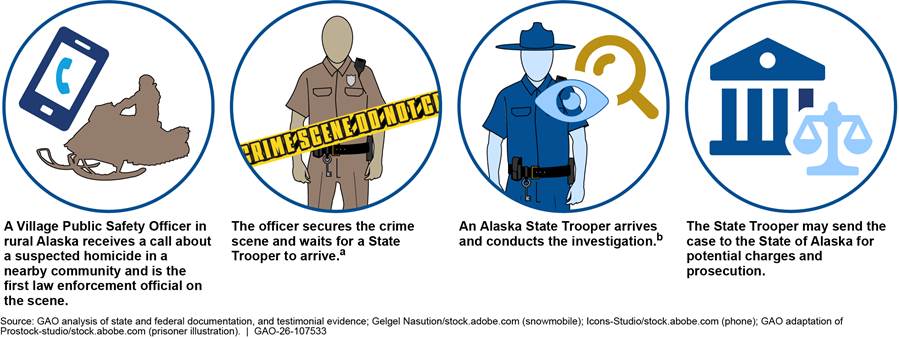
aAccess to Alaska Native villages that are not on the road system often require the use of airplanes, boats, snowmobiles, or all-terrain vehicles, which can affect response times.
bA Village Public Safety Officer may conduct criminal investigations at the discretion of the Alaska State Troopers.
In addition, Tribes may hire their own tribal or village police officers. These officers typically respond to civil and misdemeanor-level offenses under tribal codes and village ordinances. According to Alaska Department of Law officials, who operate the state criminal justice system, the state may pursue charges or cases, from evidence submitted by tribal or village police officers for prosecution if there is probable cause to believe a violation of state law occurred. However, these officials stated many cases referred to the Alaska Department of Law cannot be pursued for further investigation due to evidentiary issues resulting from a lack of formal training or standard accreditation for tribal and village police officers. Further, according to these officials, the state cannot file charges in state court for violations of tribal law since the state is not the appropriate entity to enforce tribal laws.
What are state, federal, and Tribal views on criminal jurisdiction in Alaska?
While state and DOJ officials generally shared similar views and a clear understanding of the criminal jurisdiction framework in Alaska, BIA officials provided conflicting views, and some Alaska Native community members expressed a lack of clarity. Specifically, Alaska state officials we spoke to generally acknowledged that Tribes maintain concurrent criminal jurisdiction over their members, as well as over other tribal citizens within an Alaska Native village the Tribe occupies because of their inherent jurisdiction. Further, state officials told us that federal criminal jurisdiction over Tribes is limited in Alaska due to the lack of Indian country resulting from the Alaska Native Claims Settlement Act. These officials stated that because only one Tribe in Alaska occupies Indian country (the Metlakatla Indian Community), P.L. 280 has limited effect on criminal jurisdiction in the state or how the state operates.
Similarly, DOJ officials acknowledged Tribes’ authority to exercise concurrent criminal jurisdiction. For example, these officials stated Tribes retain concurrent criminal jurisdiction over tribal citizens in Indian country in mandatory P.L. 280 states, including Alaska.[48] DOJ officials further stated the U.S. Attorney’s Office has jurisdiction over crimes of general applicability in mandatory P.L. 280 states, but does not otherwise have federal criminal jurisdiction in Indian country in those states.[49]
Following enactment of the Violence Against Women Act Reauthorization Act of 2022, DOJ affirmed that federally recognized Tribes in Alaska are sovereigns with inherent authority to exercise concurrent criminal jurisdiction over tribal citizens within their villages.[50] Some Alaska Native community members we spoke with stated that the inclusion and definition of “Alaska Native villages” in the Violence Against Women Act Reauthorization Act of 2022 provided clarity on Tribes’ concurrent jurisdiction over tribal citizens within Alaska Native villages.[51]
DOJ has also documented its position on concurrent criminal jurisdiction in Alaska in multiple memorandums. Specifically, in November 2000, DOJ’s Office of Tribal Justice issued a memo clarifying that Tribes retain concurrent criminal jurisdiction over tribal citizens in Indian country in mandatory P.L. 280 states, including Alaska. Additionally, an October 2023 memorandum issued by DOJ’s Office of Tribal Justice confirmed that Tribes in Alaska retain inherent sovereign authority to prosecute tribal citizens for crimes committed within Alaska Native villages and may exercise additional criminal authority as authorized by statute. Further, the memorandum affirmed that P.L. 280 does not deprive Tribes—whether in Alaska or in the lower 48 states—of their inherent criminal jurisdiction.
While state and DOJ officials shared similar views, perspectives on Tribes’ authority to exercise concurrent criminal jurisdiction with the state over tribal citizens varied among BIA officials over the course of our review. For example, in August 2024, BIA officials stated that Tribes and states have concurrent criminal jurisdiction over tribal citizens in Indian country in mandatory P.L. 280 states. Additionally, these BIA officials added that P.L. 280 does not deprive Tribes of their inherent right to exercise concurrent criminal jurisdiction over their members.
However, in May 2025, BIA officials stated that P.L. 280 mandates state jurisdiction “over major crimes on Indian reservations.” Additionally, officials stated that Tribes in mandatory P.L. 280 states—including Alaska—”lack the legal authority necessary to enforce criminal laws.” In June 2025, BIA officials expressed varying views on concurrent jurisdiction among Tribes in mandatory P.L. 280 states. For example, wherein some officials acknowledged the inherent authority of Tribes in Alaska to enforce criminal law in Alaska Native villages, other officials did not. These officials stated that Tribes do not have inherent criminal jurisdiction over major crimes and tribal jurisdiction in Alaska Native villages is case-by-case. Subsequently, in June 2025, BIA officials stated that “P.L. 280 is the exact type of ‘Congressional abrogation’ that effectively transfers inherent authority, such as criminal jurisdiction, from Tribes to the state.”
We sought additional clarification, and in July 2025, BIA officials aligned their position with their August 2024 statements—concluding that, generally, Tribes in Alaska Native villages have concurrent criminal jurisdiction over tribal citizens present in their respective villages. At that time, BIA officials also concurred with DOJ’s position on concurrent criminal jurisdiction, as described in DOJ’s October 2023 memorandum.
Section 1305(a) of title 25 of the U.S. Code states that Congress “recognizes and affirms the inherent authority of any Indian tribe occupying [an Alaska Native] Village in the state to exercise criminal and civil jurisdiction over all Indians present in the [Alaska Native] Village.” While BIA cited this statute in July 2025, some of its previous positions on concurrent criminal jurisdiction conflicted with the statute. Additionally, some of BIA’s previous positions were inconsistent with principles of tribal sovereignty in Indian country outlined in case law.[52]
Based on these statements from BIA officials over the course of our review, it is unclear whether BIA uniformly recognizes Tribes inherent authority to exercise concurrent criminal jurisdiction over tribal citizens in Alaska Native villages and in Indian country. These varying perspectives could foster confusion over Tribes’ inherent right to exercise authority over their tribal citizens and its concurrent criminal jurisdiction with the state.[53]
For example, an Alaska Native community member we spoke with said that P.L. 280 creates some uncertainty about whether Tribes maintain concurrent criminal jurisdiction in Alaska Native villages and questioned whether criminal jurisdiction is the sole authority of the state. This Alaska Native community member added that shared confusion over jurisdiction due to P.L. 280 creates a sense of lawlessness, and sometimes Tribes may fail to recognize their inherent authority to enforce criminal law involving their tribal citizens in Alaska Native villages. Additionally, some tribal police officers told us that a clear definition of concurrent tribal authority is needed, specifically in Alaska, due to a lack of recognition of concurrent jurisdiction. Further, a senior official from a nongovernmental organization that provides legal services to Tribes in Alaska said clear federal documentation of concurrent jurisdiction in Alaska that explains such jurisdiction does not diminish tribal jurisdiction would be helpful.
BIA has not documented its position on concurrent criminal jurisdiction for mandatory P.L. 280 states, including Alaska. Standards for Internal Control in the Federal Government states that management should internally and externally communicate the necessary quality information to achieve the entity’s objectives.[54] The standards also establish that management should implement control activities through documented policies, and that information be readily available when needed.[55]
By documenting its position on concurrent criminal jurisdiction in Alaska, BIA would help ensure that BIA officials share a consistent understanding and recognition of the rights of Tribes in Alaska to exercise concurrent criminal jurisdiction over tribal citizens. In addition, making such documentation readily available to relevant entities, such as Tribes, will help ensure Tribes are aware of BIA’s position.
P.L. 280 May Impede Tribes’ Access to Certain Funding and BIA Has Not Documented Funding Criteria
As noted above, while Alaska is a mandatory P.L. 280 state, there is limited Indian country in the state, and limited research and data exist to determine if P.L. 280 affects public safety and justice. However, Alaska’s status as a mandatory P.L. 280 state may affect Tribes in other ways, such as impeding access to certain public safety and justice funding. Federal data show that Tribes in Alaska may be at a disadvantage when pursuing BIA funding for public safety and justice programs for the first time. BIA has documented criteria describing how it allocates resources among Tribes that already receive public safety and justice funding or direct services.[56] However, BIA has not documented criteria for Tribes requesting new funding for public safety and justice programs for the first time.
What does empirical research show about the effect of P.L. 280 on public safety and justice in Alaska?
We identified limited empirical research examining the effects of P.L. 280 or state criminal jurisdiction on public safety and justice; however, none of this research assessed P.L. 280’s effect in Alaska.[57] Specifically, we searched academic journal articles published between 2000 and 2024 and identified four articles examining P.L. 280 that included empirical research.
What do data show about the effect of P.L. 280 on crime rates, public safety, and justice in Alaska?
Various data constraints, including incomplete data, hinder an assessment of the effects of P.L. 280 on public safety and justice in Alaska.
DOJ’s annual Tribal Law and Order Act reports on criminal justice in Indian country generally state that incidents and cases from P.L. 280 jurisdictions do not appear in federal crime statistics because, in most instances—including in Alaska—the state maintains criminal jurisdiction and prosecutes these cases.[58] A comprehensive view of crime rates in Indian country would require all reported criminal offenses be filed with federal, state, and tribal jurisdictions to be collectively gathered and analyzed.
In addition, the FBI’s database for tracking crimes nationwide—the Uniform Crime Reporting Program’s NIBRS—relies on voluntary participation from law enforcement entities and requires agencies to be eligible to submit data.[59] To be eligible to submit crime data to NIBRS, Tribes must operate a law enforcement organization with commissioned or sworn law enforcement officers. As of 2025, one Tribe in Alaska—the Metlakatla Indian Community—operated such a law enforcement organization and was eligible to report crime data to NIBRS, according to FBI officials. The remaining Tribes in Alaska were ineligible or did not report crime data to NIBRS.
However, other state or local law enforcement agencies, such as the Alaska State Troopers, are eligible to report crime data in NIBRS and can identify whether a reported crime occurred on “tribal lands” within their NIBRS data submission, according to FBI officials.[60] The NIBRS user manual instructs non-tribal law enforcement organizations to document the location of each incident in their NIBRS data submission.[61] Specifically, NIBRS submissions are to include a “location” field that allows law enforcement agencies to select “tribal lands” as the location. Our review of publicly available NIBRS data from 2021 through 2023 identified 20 offenses reported by state and local law enforcement on tribal lands—as defined in the NIBRS user manual—across the state.[62]
However, federal and state data suggest that Alaska has high crime rates and Alaska Native communities, in particular, experience high levels of crime. For example, according to the FBI’s Crime Estimates for 2018 through 2023, Alaska had among the highest rates of crime in the U.S. during this period.[63]
The Alaska Department of Public Safety’s 2024 report also identified a total of 1,273 reported felony sexual offenses in Alaska in 2023. American Indian and Alaska Native women were reported to have the highest victimization rate of any gender or racial group, comprising nearly 50 percent (626 total) of reported victims that year in Alaska where gender and race were reported.[64] In that same year, the crime rate for felony-level sex offenses in Western Alaska (which is home to around half of all Alaska Native communities) was 326 per 100,000 residents—about double the state average that year. According to the report, tribal citizens accounted for roughly 91 percent (224) of all felony sexual assault victims (245 total) in Western Alaska that year. This potential difference in crime counts could result from under or inaccurate reporting within Alaskan law enforcement agencies’ NIBRS submissions or from methodological differences related to data collection.
What do data show about the effect of P.L. 280 on federal funding for public safety and justice programs in Alaska?
DOJ and BIA funding data show that P.L. 280 may affect Tribes in Alaska’s access to certain federal funding, given the state’s mandatory P.L. 280 status. For example, our analysis of DOJ funding data covering fiscal years 2017 through 2024 (the most recent data available) showed that Tribes in Alaska and other mandatory P.L. 280 states received more DOJ funding, per capita, than Tribes in all other states.[65] Conversely, our analysis of BIA funding data in fiscal years 2017 through 2021 (the most recent data available), showed that Tribes in Alaska and other mandatory P.L. 280 received less BIA public safety and justice funding, per capita, than Tribes in all other states.
DOJ grant funding for public safety and justice: DOJ provides funding to Tribes through competitive grants, which are administered by various DOJ components, including the Office of Justice Programs, the Office on Violence Against Women, and the Office of Community Oriented Policing Services. In fiscal years 2017 through 2024, these three DOJ grant-making components generally provided more funding to Tribes in mandatory P.L. 280 states—per capita—compared with Tribes in all other states. During this period, these components provided Tribes in Alaska approximately $350 million in public safety and justice funding. According to DOJ officials, the funding that these components provide is partially driven by which Tribes apply for grants.
Table 2 identifies DOJ’s grant award totals to federally recognized Tribes and tribal organizations from these three grant-making components from fiscal years 2017 through 2024.
Table 2: Department of Justice (DOJ) Grant Award Amounts to Federally Recognized Tribes and Tribal Organizations for Public Safety and Justice, Fiscal Years 2017 Through 2024
|
Public Law 280 (P.L. 280) status |
DOJ grant award |
BIA service population (2021 estimate) |
Per capita funding |
|
Alaska (Mandatory P.L. 280) |
$ 354,538,545 |
189,458 |
$ 1,871 |
|
Mandatory P.L. 280 states in the lower 48 |
$ 789,416,410 |
252,976 |
$ 3,121 |
|
All other states in the lower 48 |
$ 1,315,566,139 |
2,222,982 |
$ 592 |
|
Totals |
$ 2,459,521,094 |
2,665,416 |
$ 923 |
Source: GAO analysis of DOJ grant award data for the Office of Justice Programs, the Office on Violence Against Women, and the Office of Community Oriented Policing Services. Service population data are certified 2021 enrollment numbers from the Bureau of Indian Affairs’ (BIA) Office of Indian Services. | GAO‑26‑107533
Notes: Table 2 includes funding data for DOJ’s Office of Justice Programs, Office on Violence Against Women, and Office of Community Oriented Policing Services, which DOJ manages through its JustGrants award management system. We selected these three DOJ components for analysis since they provide public safety and justice grants to federally recognized Tribes. Mandatory P.L. 280 states include Alaska, California, Minnesota, Nebraska, Oregon, and Wisconsin. “All other states in the lower 48” includes states where P.L. 280 is not mandatory. Act of Aug. 15, 1953, ch. 505, § 2, 67 Stat. 588 (codified as amended at 18 U.S.C. § 1162(a)).
According to DOJ officials, P.L. 280 does not limit Tribes’ access to DOJ grant funding nor does it limit DOJ’s ability to fund Tribes in P.L. 280 states, including Alaska. DOJ officials explained that some grant funding decisions may be based on Tribes’ capacity to establish and operate law enforcement and justice systems.[66] However, Tribes’ ability to establish their own law enforcement and justice systems and ultimately access these federal funds may be limited. In response to these challenges, DOJ officials noted that the Office of Community Oriented Policing Services is providing additional consideration to Tribes in P.L. 280 jurisdictions that do not receive funding from BIA for law enforcement services.
BIA funding for public safety and justice. BIA provides support for tribal court systems, which may include funding for tribal court assessments. It also provides direct public safety and justice services to Tribes and enters into self-determination contracts and self-governance compacts with associated funding agreements (further referred to as funding agreements) with Tribes for their own public safety and justice programs.[67]
· BIA’s Tribal Justice Support Directorate supports up to 400 tribal court systems. In addition, it contracts with other entities to conduct court assessments that assist tribal courts with creating a plan for their respective justice systems. Specifically, BIA’s court assessments review tribal constitutions, codes, and court procedures and entail multi-day visits to observe court proceedings, review case files, and obtain perspectives from tribal court officials. BIA then presents any findings and recommendations to the tribal court and tribal governments, which then become the basis of the Tribe’s plan. BIA and relevant Tribes then work together based on the priorities identified by the Tribe during which BIA may provide technical assistance and onetime funding. The onetime funding associated with BIA’s tribal court assessments may be used to support tribal court operations, which may include training for tribal court staff, tribal court management and alcohol monitoring systems, and equipment for tribal court staff, such as computers and printers.
· BIA’s Office of Justice Services’ direct service model generally consists of BIA funded, staffed, and managed public safety and justice organizations that operate in Indian country and provide services directly to tribal citizens. BIA’s direct service public safety and justice organizations are generally made up of federal law enforcement officers, court staff, and corrections officers, but may also include tribal law enforcement officers and staff who work under BIA direction and supervision, according to officials. BIA provides direct public safety and justice services in Indian country over which the federal government maintains criminal jurisdiction—i.e., non-mandatory P.L. 280 jurisdictions. In general, BIA does not provide direct public safety and justice services in jurisdictions where the federal government does not have criminal jurisdiction. As of 2025, no Tribes in Alaska receive direct BIA public safety and justice services, according to officials.
· Instead of receiving direct public safety and justice services from BIA, a Tribe can enter into a funding agreement with the Department of the Interior. In doing so, BIA would provide funds so the Tribe can administer public safety and justice programs itself. Funding provided through these agreements can be used to staff and operate tribal public safety and justice organizations. As of May 2025, only one Tribe in Alaska—the Metlakatla Indian Community—has such a funding agreement with BIA.
BIA’s funding for tribal public safety and justice in fiscal years 2017 through 2021 showed that Tribes in Alaska and other mandatory P.L. 280 states generally received less funding—per capita—compared with Tribes in all other states. Most BIA funds for Tribes in Alaska supported tribal court assessments and operations during this period.
From fiscal years 2017 through 2021, BIA expended over $2 billion to support tribal public safety and justice through tribal court assessments and operations, direct services, and funding agreements. During this period, BIA’s direct public safety and justice services and funding agreements provided for approximately 14 percent of estimated tribal public safety and justice needs. Tribes in Alaska also received approximately $60 million—or 3 percent—of BIA’s total expenditures on tribal public safety and justice during this period, as shown in table 3.
Table 3: Bureau of Indian Affairs (BIA) Public Safety and Justice Estimated Needs and Expenditures to Federally Recognized Tribes and Tribal Organizations, Fiscal Years 2017 Through 2021
|
Federally recognized Tribes grouped by state Public Law 280 (P.L. 280) status |
Tribal needs estimate |
BIA expenditures |
BIA service population (2021 estimate) |
Need per capita |
Funding per capita |
|
Alaska (Mandatory P.L. 280) |
$3,046,624,000 |
$59,519,000a |
189,458 |
$ 16,081 |
$ 314 |
|
Mandatory P.L. 280 states in the lower 48 |
$2,827,096,000 |
$151,738,000 |
252,976 |
$ 11,175 |
$ 600 |
|
All other states in the lower 48 |
$8,695,641,000 |
$1,864,373,000 |
2,222,982 |
$ 3,912 |
$ 839 |
|
Totals |
$14,569,361,000 |
$ 2,075,630,000 |
2,665,416 |
$ 5,466 |
$ 779 |
Source: GAO analysis of information in the BIA Tribal Law and Order Act reports for fiscal years 2017 through 2021. | GAO‑26‑107533
Notes: Table 3 describes BIA public safety and justice funding, which includes funding for tribal court assessments, direct services, and self-determination contracts and self-governance compacts with funding agreements. “All other states in the lower 48” includes states where P.L. 280 is not mandatory. Act of Aug. 15, 1953, ch. 505, § 2, 67 Stat. 588 (codified as amended at 18 U.S.C. § 1162(a)).
aIn fiscal years 2017 through 2021, funding to Tribes in Alaska primarily consisted of funding for court assessments. Tribes can use these onetime funds to establish tribal court systems or support court operations, which may include training for court staff and equipment. During this period, one Tribe in Alaska—the Metlakatla Indian Community—had a self-governance compact with a funding agreement.
According to BIA’s annual Tribal Law and Order Act reports, Tribes in Alaska have high public safety and justice needs, relative to Tribes in other mandatory P.L. 280 states in the lower 48. These reports estimate Tribes in Alaska collectively needed roughly $3 billion to operate standard public safety and justice services in fiscal years 2017 through 2021.[68] However, BIA provided Tribes in Alaska roughly 2 percent of their estimated public safety and justice needs during this period. Of this BIA funding, approximately 92 percent supported tribal courts, which include court assessments, whereas the remaining 8 percent funded tribal law enforcement and corrections.
According to BIA officials, BIA is not sufficiently funded to fully provide for Tribes’ financial needs related to public safety and justice services. As a result, they said BIA must prioritize the limited discretionary funding it receives for public safety and justice programs among federally recognized Tribes, including Tribes in mandatory P.L. 280 states. BIA officials explained that Tribes in mandatory P.L. 280 states are generally expected to work with the state on matters related to public safety and justice. As a result, BIA prioritizes funding for Tribes that do not receive public safety and justice services from the state, according to these officials.
As shown in table 3 above, from fiscal years 2017 through 2021, Tribes in mandatory P.L. 280 states in the lower 48 received 28 percent less funding per capita than Tribes in all other states. Furthermore, BIA provided Tribes in Alaska around half of the per capita funding it provided Tribes in mandatory P.L. 280 states in the lower 48.[69] As of 2025, BIA has funding agreements for public safety and justice programs with 27 Tribes in mandatory P.L. 280 states and around 161 Tribes in all other states in the lower 48, according to officials.[70] Among these Tribes with BIA funding agreements, one Tribe in Alaska—the Metlakatla Indian Community—has one with BIA for public safety and justice programs, as of May 2025.
According to BIA officials, its limited public safety and justice funding (roughly $415 million per year in fiscal years 2017 through 2021) is fully allocated among a finite number of Tribes. As a result, increasing funding for one Tribe’s funding agreement would generally require BIA to make an offsetting reduction to another Tribe’s funding agreement, which is generally not permitted under the Indian Self Determination and Education Assistance Act of 1975, as amended.[71] In addition, BIA officials stated they lack discretionary spending authority over public safety and justice allocations and are generally required to continue providing the same service and funding levels to Tribes as the previous year. Therefore, increases to BIA appropriations would be needed for it to increase allocations to Tribes. This includes Tribes that already receive direct services and those with existing funding agreements, as well as Tribes that request to enter into new funding agreements with BIA for the first time, according to officials.
BIA officials explained that even when Congress has increased appropriations for tribal public safety and justice services and programs, this funding has been restricted in such a way that limits BIA’s ability to increase allocations and enter into new funding agreements with additional Tribes. For example, since 2013, Congress increased BIA appropriations for law enforcement programs by approximately 54 percent (approximately $177.5 million in 2013 to $274 million in 2024). However, legislative language restricted roughly 57 percent of these increases for specific Tribes or activities, according to BIA. According to these officials, BIA prorated approximately 18 percent of this increase across all Tribes that already received allocations for public safety and justice funding. The remaining 25 percent (approximately $25 million) were discretionary appropriations to support tribal public safety and justice services and programs.
BIA has documented criteria describing how it allocates resources among Tribes that already receive funding for public safety and justice programs. However, BIA has not documented the criteria it uses to enter into new funding agreements with Tribes for public safety and justice programs for the first time if, for instance, appropriations increased.[72] For example, such criteria could identify whether Tribes in mandatory P.L. 280 states, including Alaska, can apply for new funding agreements and how BIA decides which to fund. The lack of documented BIA criteria for entering into new public safety and justice funding agreements with Tribes has been raised in at least one federal lawsuit.
Specifically, a Tribe in Southern California sued BIA in 2013 over its decision to decline the Tribes’ request for a new funding agreement. In the lawsuit, the Tribe alleged that BIA had an “unwritten policy” of not funding tribal law enforcement in P.L. 280 states in violation of the law, and that it applied this unwritten policy in an arbitrary manner. The court ultimately determined that BIA has discretion to make individualized determinations on requests and must prioritize how it spends its limited law enforcement budget. The extent to which its policies or criteria for entering into a new funding agreements were unwritten did not change the outcome of the case. However, the court cited factors BIA said it used to allocate public safety and justice funds to all Tribes. It also included a BIA statement that the agency must “focus its limited dollars” on Tribes in states that are not mandatory P.L. 280 states and therefore do not have state law enforcement in Indian country.[73]
While funding allocation criteria are contained within the opinion, it does not discuss the criteria BIA uses for entering into new funding agreements with Tribes for public safety and justice. As a result, confusion and lack of transparency remains, especially for Tribes in mandatory P.L. 280 states. For example, tribal leaders we met with in Alaska stated they believed their status as a mandatory P.L. 280 state may bar them from entering into funding agreements with BIA for public safety and justice programs. Further, as noted earlier, while BIA officials provided varying interpretations, some officials stated they are unable to enter into funding agreements with Tribes for public safety and justice programs in mandatory P.L. 280 states, including Alaska, because Tribes in these states lack the legal authority to enforce criminal law, which is not accurate.
According to BIA officials, BIA has not documented criteria for entering into new funding agreements with Tribes for public safety and justice programs because it lacks the appropriations to expand its current portfolio of these funding agreements. Specifically, officials stated that such documentation is unnecessary since BIA typically does not receive appropriations to enter into new funding agreements with Tribes. Officials also explained that documenting funding criteria is challenging, due to lengthy internal review processes. However, BIA officials stated that developing written criteria for entering into funding agreements with Tribes for public safety and justice programs for the first time would help improve transparency regarding BIA funding decisions if increases to appropriations were to occur.[74]
Standards for Internal Control in the Federal Government states that management should define objectives so that they are understood at all levels by outlining what is to be achieved, how it will be achieved, and the time frames for achievement. Management should also internally and externally communicate the necessary quality information to achieve the entity’s objectives. The standards also establish that management should implement control activities through documented policies.[75]
While BIA cannot redistribute funding for existing funding agreements and may lack discretionary funding to enter into new funding agreements as of 2025, appropriations for tribal public safety and justice may change in the future. Such a change may allow BIA to expand its portfolio of funding agreements with Tribes for public safety and justice programs to include additional Tribes in Alaska or other mandatory P.L. 280 states.
By documenting and communicating the criteria it uses to enter into new funding agreements with Tribes for public safety and justice programs, BIA could provide greater transparency on who can apply and how it decides which Tribes to enter into funding agreements with. For example, such criteria could clarify whether Tribes in mandatory P.L. 280 states, including Alaska, can be considered for new funding agreements.
Tribal Leaders, Community Members, and Officials Identified Public Safety and Justice Challenges in Alaska Native Communities
What public safety and justice challenges did tribal leaders, Alaska Native community members, and federal and state officials identify?
Tribal leaders, Alaska Native community members, as well as federal and state officials, identified numerous challenges related to public safety and justice in Alaska Native communities, including crime, limited public safety infrastructure, funding resources, sparse law enforcement presence, and limited training.
Crime in Alaska Native communities. Tribal leaders and Alaska Native community members we spoke with explained that illegal drug and alcohol trafficking in Alaska Native communities present major public safety challenges.[76] For example, tribal leaders from one Alaska Native community told us that a high proportion of illegal drugs enter their Alaska Native community through local airfields, which generally lack Transportation Security Administration screening and security checkpoints.
Tribal leaders explained that their respective communities regularly issue search warrants and confiscate illegal drugs and alcohol and that tribal and village police officers often perform these law enforcement services. However, according to officials from the Alaska Department of Law, the evidence these officers collect is often inadmissible in state criminal court, and these efforts usually do not result in criminal charges. BIA officials explained that the inadmissibility of evidence in state criminal court often leaves Alaska Native communities with little recourse to address crime.[77] According to a senior official from the Alaska Department of Law, cases submitted by tribal police officers often lack the necessary detail required to proceed with charges in court.
Alaska Native community members we spoke with in Alaska shared that domestic and sexual violence are significant issues in their communities. For example, some female tribal leaders and Alaska Native community members told us that state law enforcement often do not take reports of sexual or domestic violence within Alaska Native communities seriously and may treat these crimes as “domestic issues” instead. Tribal leaders and Alaska Native community members also shared that missing and murdered Indigenous persons cases are prominent in their communities.[78] Some noted that when a resident is missing, local volunteer search and rescue teams are often the primary responders given the distance Alaska State Troopers must travel to reach certain Alaska Native communities and their limited availability to remain on scene for extended periods of time. However, Alaska Native communities’ reliance on volunteer search and rescue teams is not ideal since they may lack the same level of resources and training available to Alaska State Troopers.
Public safety funding resources. Tribal, federal, and state officials told us that Alaska Native communities often lack adequate public safety resources. In general, resources include state funding to maintain enough Alaska State Troopers and municipal police to patrol the region, funding for prosecutors to manage the state’s case log, and funding for Tribes to provide their own law enforcement services.
Tribal leaders told us that while they do have access to some DOJ grant funding opportunities through DOJ’s grant system, these grants provide short-term funding, and it is generally competitive to receive them. Further, tribal leaders we met with described having limited capacity to pursue DOJ grant funding due to challenges employing full-time grant writers and access to broadband internet.[79] DOJ officials affirmed that the general competitive nature of awards and limited grant writing expertise are impediments to Tribes’ access to funding.[80]
DOJ reported that the competitive nature of DOJ’s grant programs, the temporary nature of DOJ awards, the administrative and reporting requirements of their grants, and restrictions on the use of DOJ awards, makes it a challenge for Tribes in Alaska to receive grant funding.[81] Tribal leaders stated that noncompetitive, recurring DOJ funding would better help Tribes address public safety and justice challenges, as well as support long-term tribal self-determination.
BIA officials further explained that the agency is not funded at the level needed to support law enforcement services or programs for Tribes in Alaska—or other mandatory P.L. 280 states—making it critical for Tribes to leverage existing state law enforcement services.[82] Specifically, according to BIA officials, providing public safety resources in rural Alaska is costly, and there is not enough federal funding to provide adequate law enforcement, and detention services to meet public safety needs in Alaska Native communities. Further, according to officials from the Alaska Department of Public Safety, the State of Alaska receives little federal funding to support the public safety and justice services it provides to federally recognized Tribes and Alaska Native communities under state jurisdiction.
Public safety infrastructure. Tribal leaders and federal and state officials said that Alaska Native communities also tend to lack dedicated public safety infrastructure. This includes, among other things, law enforcement facilities with heated office space, indoor plumbing, and holding cells. In response to these challenges, some Village Public Safety Officers we met explained that due to the lack of secure holding cells, they sometimes hold detainees in their own homes overnight—with their families present—or in post offices or school classrooms. DOJ officials also explained that Alaska Native communities have significant public safety and justice infrastructure needs, but that Alaska’s geography creates unique challenges to building this infrastructure.[83]
A regional intertribal organization in Western Alaska representing 56 Tribes conducted a regional public safety facility assessment, and found eight communities lacked a public safety facility of any kind.[84] The 2018 assessment also found that communities in the region lacked adequate holding cells, including some with broken doors, no indoor plumbing or heat, and that are subject to frequent flooding issues.
According to officials from a regional intertribal organization in Western Alaska, they collected funds and built new heated facilities with holding cells in Alaska Native villages and has plans to build more public safety facilities if funding becomes available. Figure 4 shows a recently completed public safety facility that, at the time of our visit in March 2025, did not have indoor plumbing.

In addition to the lack of adequate public safety infrastructure in Alaska Native communities, senior officials from the Alaska Department of Public Safety told us that the state also has limited public safety and justice facilities in rural Alaska. Specifically, officials explained that the State of Alaska’s administrative structure—which does not include counties, elected sheriffs, or local jails—limits the number of state and local public safety facilities in remote Alaska.
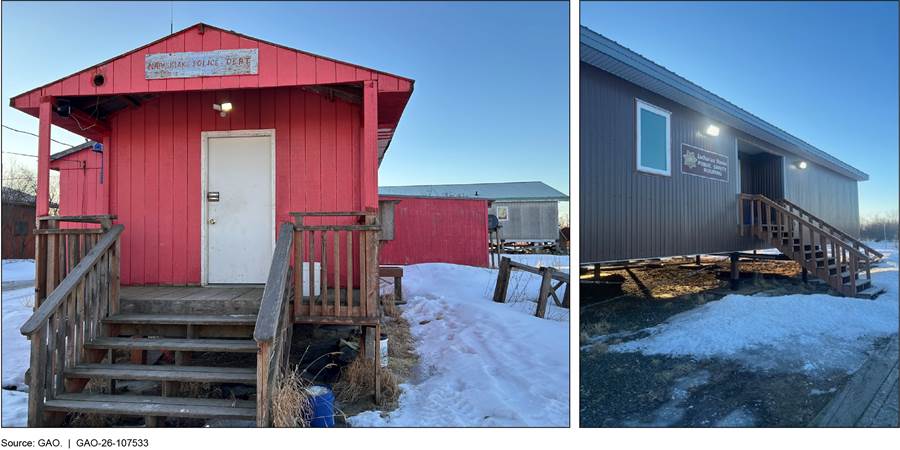
Tribal leaders from one village we met with also explained that maintaining public safety infrastructure is a major challenge due to operational costs. For example, a 2018 facility assessment in Western Alaska found that in communities that had public safety facilities, these facilities were often in poor condition. In response to the assessment findings, the regional intertribal organization funded a new public safety building for a village whose previous public safety facility had fire damage. Figure 5 shows the old public safety building on the left and the new building on the right.
Figure 5: An Alaska Native Village’s Former Public Safety Building (Left) and the New Building (Right)
Limited law enforcement presence. Tribal leaders and Alaska Native community members we spoke with said that their respective communities do not have a consistent law enforcement presence. Rather, these communities are largely dependent on Alaska State Troopers for public safety and law enforcement services. However, tribal leaders explained that Alaska State Troopers often travel great distances to reach remote Alaska Native communities and may lack local knowledge in regions in which they have limited experience. As such, the U.S. Attorney’s Office for the District of Alaska estimates that approximately one-third of Alaska Native villages lack local law enforcement personnel.
Tribal leaders and Alaska Native community members we met with in a remote region of Western Alaska told us State Trooper response times are slow or even nonexistent in some instances. Tribal leaders stated 911 calls are often routed to Fairbanks, Alaska. As a result, tribal leaders said residents often wait days for the Alaska State Troopers to respond to emergency situations. For example, one Alaska Native community member told us that a murder occurred in their community and that out-of-state family members traveling from Pennsylvania arrived on the crime scene before the Alaska State Troopers had responded to the incident. Another tribal leader told us a village resident had an open warrant for attempted murder. Tribal leadership notified the Alaska State Troopers about the individual’s presence in the Alaska Native community but explained to us that it took state law enforcement months to respond and take the individual into custody.[85]
Senior officials from the Alaska Department of Public Safety reported that recruitment and retention challenges have affected State Troopers’ ability to respond to calls in rural Alaska in a timely manner. These officials explained that the Department of Public Safety increased their law enforcement presence in rural Alaska Native communities by assigning two State Troopers or Village Public Safety Officers to such communities so officers can rotate shifts and increase their presence. Additionally, these officials explained that the Alaska State Troopers recently shifted the base of operations for a unit responsible for Western Alaska from Anchorage to Bethel. In doing so, the Alaska State Troopers moved law enforcement officers closer to the communities they serve.
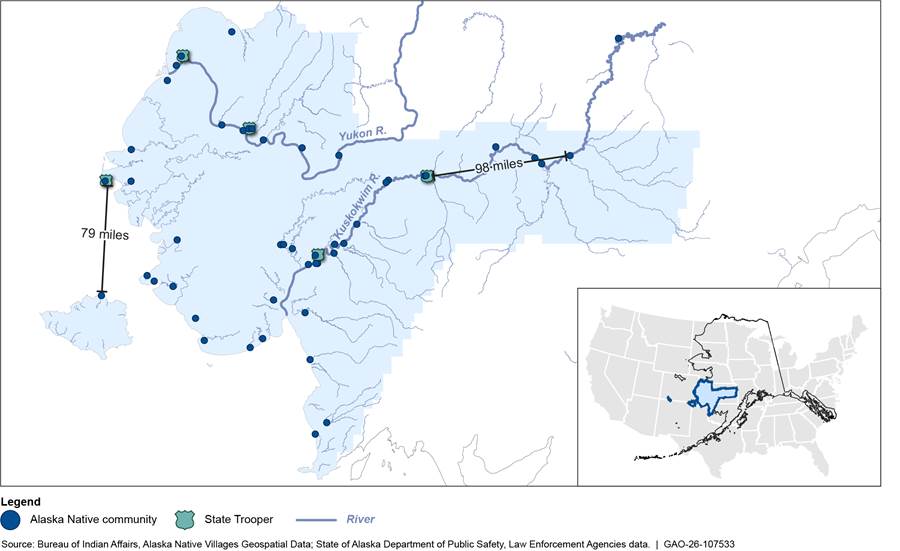
Senior officials from the Department of Public Safety also said they have taken steps to increase the number of Alaska State Troopers and Village Public Safety Officers in rural Alaska by increasing salaries and hiring a dedicated Village Public Safety Officer program director. For example, the Alaska Department of Public Safety more than doubled the number of Village Public Safety Officers serving Alaska Native communities since January 2020 (42 to 91 as of June 2025). However, these officials explained that Alaska’s vastness, the distances Troopers travel to respond to calls, and severe weather all limit law enforcement presence and response times. For example, a retired Village Public Safety Officer we spoke with explained law enforcement response can be delayed by days due to these factors. In addition, because many Alaska Native communities are not connected to the state’s road system, residents and law enforcement must travel via plane or boat. Figure 6 shows the 48 Alaska Native communities within the Yukon Kuskokwim-Delta region, as well as the rivers Alaska State Troopers must use to travel between posts, and the distance between them.
Figure 6: Map of Alaska Native Communities and Alaska State Trooper Posts in the Yukon-Kuskokwim Delta Region as of November 2025
Tribal leaders stated that some Alaska Native villages hire their own tribal or village police officers. However, the State of Alaska does not recognize tribal or village police officers since these officers are not state certified, have limited training, are generally unarmed, and typically only handle civil or misdemeanor offenses. Tribal leaders also explained they face retention challenges with village and tribal police officers due to officer burnout resulting from high crime rates and limited support. Senior officials from the Alaska Department of Public Safety told us that some village and tribal police officers as well as some Village Public Safety Officers struggle with policing the communities they live in, which may require them to arrest members of their own family or friends. According to tribal leaders, high officer burnout results in many tribal and village police officers often working alone, which increases the day-to-day risk these officers face.
Geography and climate. Alaska’s size, geography, and climate creates unique challenges for first responders, such as the Alaska State Troopers. For example, Alaska is the largest state in the U.S. and is mostly rural or remote, with few state roads for law enforcement or first responders to utilize. In many instances, the only access to remote Alaska Native villages is by airplane, boat, snowmachine, or four-wheeler. Additionally, as the only state within the Artic, severe weather, snow, ice, and below freezing temperatures are present in some regions of the state for much of the year, making these locations difficult to access for law enforcement and first responders.
Law enforcement training. Tribal leaders raised concerns about the sufficiency of Village Public Safety Officer training. Specifically, these leaders said an officer’s training is limited, and that these officers are unarmed and are only trained to handle misdemeanor-level offenses. Tribal leaders shared that despite the lack of appropriate training, Alaska State Troopers often expect officers to respond to and handle felony-level offenses.
Tribal leaders also expressed concern about access to public safety and law enforcement training at the state law enforcement academy, as well as the appropriateness of the academy’s training regimen. Specifically, the state law enforcement academy’s location in Southeastern Alaska requires some Alaska Native community members to travel great distances and spend months away from home to complete law enforcement training. According to tribal leaders, many Alaska Native community members engage in subsistence activities, such as fishing and hunting, and are often unable to leave their families for the 17 weeks required to graduate from the academy. Tribal officials also explained that the academy’s training regimen is military-like and is often not culturally appropriate for community members of some Tribes in Alaska, resulting in high dropout rates among tribal trainees.[86]
As described earlier, Alaska Native villages may hire their own tribal and village police officers. However, according to the Alaska Police Standards Council, the State of Alaska does not recognize these officers, and tribal and village police officers generally do not have the authority to enforce state felony criminal law in Alaska Native villages.[87] In many instances, the Tribe or village defines officer roles, responsibilities, and training requirements. In addition, according to officials from a local law enforcement training organization in Western Alaska, they established basic law enforcement training for tribal and village police officers, however high costs and low participation may limit future trainings.
What efforts exist to improve public safety and justice in Alaska?
Tribal leaders, and federal and state officials identified various efforts to improve public safety and justice in Alaska, as shown in table 4, some of which may address the challenges they identified.
|
Effort |
Organizer |
Description |
|
Special Tribal Criminal Jurisdiction |
Department of Justice (DOJ) |
The Violence Against Women Act Reauthorization Act of 2022 established DOJ’s Alaska pilot program to allow participating Tribes to exercise special tribal criminal jurisdiction over certain crimes committed by non-tribal citizens in the village of a participating Tribe.a Participating Tribes also receive federal guidance and technical assistance to develop their criminal justice capacities to exercise this jurisdiction. According to DOJ officials, exercising special tribal criminal jurisdiction may result in significant costs and requirements to Tribes. |
|
Rural Alaska Anti Violence Enforcement Network |
DOJ |
The Rural Alaska Anti Violence Enforcement Network is a long-term working group established by the U.S. Attorney’s Office for the District of Alaska. The network is to support public safety and victim services through the coordination of federal, state, and local law enforcement entities in rural Alaska Native communities, as well as regional intertribal organizations, victim service organizations, and care providers. |
|
Federal public safety and justice funding |
DOJ |
DOJ may provide public safety and justice funding to Tribes in Alaska through various grant-making components, including the Office of Justice Programs, the Office on Violence Against Women, and the Office of Community Oriented Policing Services. For example, Tribes in Alaska received DOJ grant funding to support Village Public Safety Officer programs. |
|
Bureau of Indian Affairs (BIA) |
BIA may contract with entities to conduct court assessments and provide funding to Tribes in Alaska to support tribal court operations.b |
|
|
Tiwahe Initiative |
BIA |
Created in 2014, the Tiwahe initiative is to allow Tribes the flexibility to create solutions that are unique to their Tribe for issues that affect children and families. A regional intertribal organization in Western Alaska created a missing and murdered Indigenous people service delivery guide through the Tiwahe initiative. |
|
Missing and Murdered Unit |
BIA |
The Missing and Murdered Unit is to collaborate with the Alaska State Troopers and various federal, state, and local agencies to provide critical support and investigative assistance for missing and murdered Indigenous people. |
|
Operation Spirit Return is a BIA-led initiative launched in February 2025 to help solve missing and unidentified person cases involving American Indians and Alaska Natives. The unit and its partners are to focus on identifying unknown human remains utilizing forensic genetic genealogy and work to reunite them with their families and tribal communities. |
||
|
Tribal Liaisons |
Alaska Department of Public Safety and Department of Law; United States Attorneys’ offices |
The two state agencies employ tribal liaisons to assist Alaska Native communities and their residents with state public safety and justice services. In addition, according to DOJ officials, United States Attorneys’ offices have tribal liaisons dedicated to improving public safety in tribal communities. |
|
Civil Diversion Agreements |
Alaska Department of Law |
The Civil Diversion Agreements program allows participating Tribes to divert certain low-level criminal offenses from state criminal court to tribal civil courts. |
|
Joint-Jurisdictional Courts |
Alaska Department of Law and Kenaitze Tribe |
Since 2016 the Henu’ Community Wellness Court is a wellness court that is to provide a therapeutic pre-trial diversion program for non-violent substance abuse issues. Both state and tribal court judges are to participate and make rulings together. |
|
Circle Peacemaking Program |
Organized Village of Kake |
Beginning in 1999, the Circle Peacemaking Program is to help address alcohol abuse and mental health challenges affecting Alaska Native youth and provide a culturally relevant sentencing process for youths convicted of a crime in Alaska state courts. The program is to also allow Alaska Native community members to resolve conflicts outside of the state civil and criminal court system. |
|
Yuut Elitnaurviat Training Center |
Non-profit organization |
The Yuut Elitnaurviat Training Center is to provide law enforcement training to village and tribal police officers in Alaska. The center is to provide culturally relevant public safety training over a 3-week course. |
Source: GAO analysis of DOJ, BIA, tribal, and nongovernmental documentation, and testimonial evidence. | GAO‑26‑107533
aPub. L. No. 117-103, div. W, tit. VIII, subtit. B, § 813(c), 136 Stat. 840, 906 (codified at 25 U.S.C. § 1305(c)). The Violence Against Women Act Reauthorization Act of 2022 defined “village” to mean “the Alaska Native Village Statistical Area covering all or any portion of a Native village (as defined in [43 U.S.C. § 1602]), as depicted on the applicable Tribal Statistical Area Program Verification map of the Bureau of the Census.” 25 U.S.C. § 1305 note.
bIndian Tribal Justice Act, Pub. L. No. 103-176, tit. I, § 102, 107 Stat. 2004, 2006-2007 (1993) (codified at 25 U.S.C. § 3612). From 2016 to 2024, BIA funded assessments for 361 tribal justice systems, 84 of which were for Tribes in Alaska. BIA determined 53 tribal courts in Alaska had the necessary tribal codes and judicial staff to be operational. Of the 53 tribal systems assessed, 33 tribal courts exercise a form of civil jurisdiction (e.g. child dependency and family matter-related cases), nine can issue protective orders, and seven have the authority to exercise criminal jurisdiction under Tribal Law and Order ordinances. After these assessments, BIA may provide technical assistance and onetime funding. The onetime funding associated with BIA’s tribal court assessments may be used to support tribal court operations, which may include training for tribal court staff, tribal court management and alcohol monitoring systems, and equipment for tribal court staff, such as computers and printers.
In addition, in June 2019, DOJ declared a law enforcement emergency in rural Alaska and deployed multiple federal resources to help address related challenges. As part of the emergency response, DOJ awarded a $6 million Emergency Law Enforcement Assistance grant to support public safety infrastructure in rural Alaska Native villages.[88]
Further, leaders from a regional intertribal organization are proposing to create a regional public safety model.[89] These leaders stated that they modeled this after the local tribal healthcare system that places medical professionals in rural communities. The regional public safety model would designate law enforcement officers in each Alaska Native community to allow for greater officer presence. The model would also improve coordination efforts by connecting local search and rescue teams with the Alaska State Troopers, Village Public Safety Officers, as well as tribal and village police. The organization’s leadership stated they presented a draft framework of the model to DOJ. Officials from DOJ stated they discussed the organization’s model during tribal listening sessions with Alaska Native villages in October 2024.[90]
Conclusions
Given the reported high crime rates in Alaska, limited law enforcement presence, and that Tribes in Alaska account for approximately 40 percent of all federally recognized Tribes, it is important that criminal jurisdiction is clear. Uniform recognition of Tribes’ right to exercise inherent concurrent criminal jurisdiction over certain lands is essential to support tribal sovereignty. Although state and DOJ officials recognize such criminal jurisdiction in mandatory P.L. 280 states, including Alaska, and in Alaska Native villages, BIA provided varying positions over the course of our review. Documenting its position on concurrent criminal jurisdiction in Alaska will help ensure that BIA officials share a consistent understanding and recognition of the rights of Tribes in Alaska to exercise concurrent criminal jurisdiction. In addition, making such documentation readily available to relevant entities, such as Tribes, will help ensure Tribes are aware of BIA’s position.
Further, while BIA funding to support public safety and justice may be limited, the agency has not documented criteria for entering into new funding agreements with Tribes (including Tribes in mandatory P.L. 280 states, such as Alaska) for the first time. By documenting and communicating criteria for entering into such funding agreements, BIA could provide greater transparency on who can apply and how it decides which Tribes to enter into funding agreements with. This is particularly important if, for example, Congress makes additional funding to support tribal public safety and justice programs available in the future. Such criteria could clarify whether Tribes in mandatory P.L. 280 states, including Alaska, can be considered for new funding agreements.
Recommendations for Executive Action
We are making the following two recommendations to the Department of the Interior:
The Secretary of the Interior should ensure BIA documents its position on concurrent state-tribal criminal jurisdiction in Alaska and makes it readily available to relevant entities (recommendation 1).
The Secretary of the Interior should ensure BIA documents and communicates criteria for entering into new funding agreements with Tribes for public safety and justice programs, including with Tribes in mandatory P.L. 280 states (recommendation 2).
Agency Comments
We provided a draft of this report to the Department of the Interior and DOJ for review and comment. The Department of the Interior confirmed via email that it concurred with our recommendations and did not provide comments on the report. DOJ provided written technical comments, which we incorporated as appropriate. In addition, we provided draft excerpts of the report to the State of Alaska’s Department of Public Safety and Department of Law, as well as to the regional intertribal organization involved in our study. Officials from the State of Alaska and the regional intertribal organization provided written technical comments, which we incorporated as appropriate.
We are sending copies of this report to the appropriate congressional committees, the Secretary of the Interior, the Attorney General, and other interested parties. In addition, the report is available at no charge on the GAO website at https://www.gao.gov.
If you or your staff have any questions about this report, please contact me at GoodwinG@gao.gov. Contact points for our Offices of Congressional Relations and Media Relations may be found on the last page of this report. GAO staff who made key contributions to this report are listed in appendix I.
Gretta L. Goodwin, Director
Homeland Security and Justice
List of Requesters
The Honorable Lisa Murkowski
Chairman
Committee on Indian Affairs
United States Senate
The Honorable Jeff Merkley
Ranking Member
Subcommittee on Interior, Environment, and Related Agencies
Committee on Appropriations
United States Senate
The Honorable Jared Huffman
Ranking Member
Committee on Natural Resources
House of Representatives
The Honorable Alex Padilla
United States Senate
GAO Contact
Gretta L. Goodwin at GoodwinG@gao.gov
Staff Acknowledgments
In addition to the contact named above, Tracey Cross (Assistant Director), Bruce Crise (Analyst-in-Charge), Hiwotte Amare, Estelle J. Bowman, Tonnyé Conner-White, Elizabeth Dretsch, Paige Gilbreath, Samantha Lyew, Mariela Martinez, Catherine Morrissey, Raquel Qualls-Hampton, Kevin Reeves, and Jeanette Soares made key contributions to this report.
The Government Accountability Office, the audit, evaluation, and investigative arm of Congress, exists to support Congress in meeting its constitutional responsibilities and to help improve the performance and accountability of the federal government for the American people. GAO examines the use of public funds; evaluates federal programs and policies; and provides analyses, recommendations, and other assistance to help Congress make informed oversight, policy, and funding decisions. GAO’s commitment to good government is reflected in its core values of accountability, integrity, and reliability.
Obtaining Copies of GAO Reports and Testimony
The fastest and easiest way to obtain copies of GAO documents at no cost is through our website. Each weekday afternoon, GAO posts on its website newly released reports, testimony, and correspondence. You can also subscribe to GAO’s email updates to receive notification of newly posted products.
Order by Phone
The price of each GAO publication reflects GAO’s actual cost of production and distribution and depends on the number of pages in the publication and whether the publication is printed in color or black and white. Pricing and ordering information is posted on GAO’s website, https://www.gao.gov/ordering.htm.
Place orders by calling (202) 512-6000, toll free (866) 801-7077,
or
TDD (202) 512-2537.
Orders may be paid for using American Express, Discover Card, MasterCard, Visa, check, or money order. Call for additional information.
Connect with GAO
Connect with GAO on X,
LinkedIn, Instagram, and YouTube.
Subscribe to our Email Updates. Listen to our Podcasts.
Visit GAO on the web at https://www.gao.gov.
To Report Fraud, Waste, and Abuse in Federal Programs
Contact FraudNet:
Website: https://www.gao.gov/about/what-gao-does/fraudnet
Automated answering system: (800) 424-5454
Media Relations
Sarah Kaczmarek, Managing Director, Media@gao.gov
Congressional Relations
David A. Powner, Acting Managing Director, CongRel@gao.gov
General Inquiries
[1]Act of Aug. 15, 1953, ch. 505, § 2, 67 Stat. 588 (codified as amended at 18 U.S.C. § 1162(a)). In this report, we refer to “Indian country" as defined in 18 U.S.C. § 1151 as (1) all lands within the limits of reservations, (2) dependent Indian communities, and (3) Indian allotments to which Indian title has not been extinguished. In contrast, the term Indian Country is sometimes used to generally describe tribal lands across the U.S. However, it has no legal implication like the statutory definition of Indian country used in this report, and we do not use the term Indian Country in this general sense.
[2]There were 562 federally recognized Tribes when P.L. 280 became law. For this report, we use the term “Tribe(s)” to refer to any federally recognized Tribe, including those in Alaska. Many Tribes in Alaska are also often referred to as Alaska Native villages, and most have the term “Village” as part of their name on BIA’s list of federally recognized Tribes. A single Alaska Native village may be home to more than one Tribe. See Indian Entities Recognized by and Eligible to Receive Services from the United States Bureau of Indian Affairs, 91 Fed. Reg. 4102 (Jan. 30, 2026) (providing for 575 federally recognized Tribes).
[3]For the purposes of this report, we use the term “tribal citizen” in place of the term “Indian” as defined in federal criminal law. In the Ninth Circuit, which Alaska is part of, the definition of Indian for federal criminal law purposes includes more than enrolled citizens or members of a Tribe. See United States v. Broncheau, 597 F.2d 1260, 1262-63 (9th Cir. 1979). Use of the term tribal citizen in this report reflects the Ninth Circuit’s definition. When referring to individuals whose status as a tribal citizen is unknown, we use the term "Alaska Native community member." Relatedly, we use the term "non-tribal citizen" in place of the term "non-Indian."
[4]See 18 U.S.C. § 1162(a) (providing exceptions to mandatory P.L.280 jurisdiction). For the purposes of this report, “public safety and justice services” includes law enforcement, courts, and corrections.
[5]The Alaska Native Claims Settlement Act extinguished all aboriginal land claims and provided for the transfer of land to regional corporations and village corporations. Pub. L. No. 92-203, 85 Stat. 688 (1971) (codified as amended at 43 U.S.C. §§ 1601-1629h). We explain the effect the act has on criminal jurisdiction in further detail later in the report.
[6]See, for example: Valentina Dimitrova-Grajzl, Peter Grajzl, and A. Joseph Guse, “Jurisdiction, Crime, and Development: The Impact of Public Law 280 in Indian Country.” Law & Society Review, vol. 48, no. 1 (2014).
Duane Champagne, and Carole Goldberg, “Is Public Law 280 Fit for the Twenty-First Century? Some Data at Last.”
Connecticut Law Review 38, no. 4 (May 2006): 697-730.
David N. Falcone, and L. Edward Wells, “Tribal Policing on American Indian Reservations.” Policing: An International
Journal of Police Strategies & Management, vol. 31, no. 4 (2008):648-673.
Duane Champagne, Carole Goldberg, and Heather Valdez Singleton, Final Report Law Enforcement and Criminal Justice Under Public Law 280, n.p. (Nov. 1, 2007).
[7]In addition, in the joint explanatory statement to the Department of the Interior, Environment, and Related Agencies Appropriations Act, 2026, Congress reiterated its concern for Tribes in mandatory P.L. 280 states, which includes Alaska, regarding their needs related to law enforcement and courts. See Staff of S. Comm. on App., 119th Cong., Joint Explanatory Statement for Division C—Department of the Interior, Environment, and Related Agencies Appropriations Act, 2026 32 (Comm. Print 2026).
[8]U.S. Department of Justice, Federal Bureau of Investigations Uniform Crime Reporting Program, Summary Reporting System Crime Data Estimates for 1979-2023, accessed on July 7,2025, https://cde.ucr.cjis.gov/LATEST/webapp/#/pages/home. To calculate crime rates, we divided the number of violent crimes reported to the FBI for fiscal year 2018 through 2023, by state, by each state’s respective population for that fiscal year.
[9]We have ongoing work examining the effect of P.L. 280 on tribal public safety and justice in Indian country in selected lower 48 states. For the purposes of this report, “lower 48 states” refers to the 48 states that are contiguous, or touch each other, and do not include Alaska or Hawaii.
[10]As noted above, many Tribes in Alaska are also often referred to as Alaska Native villages. In this report, we use the term "Alaska Native village" as it is used in the Violence Against Women Act Reauthorization Act of 2022, Pub. L. No. 117-103, div. W, tit. VIII, subtit. B, § 812(7), 136 Stat. 840, 905-906 (codified at 25 U.S.C. § 1305 note) (defining village to mean “the Alaska Native Village Statistical Area covering all or any portion of a Native village (as defined in [43 U.S.C. 1602]), as depicted on the applicable Tribal Statistical Area Program Verification map of the Bureau of the Census.”). When a community's status as an Alaska Native village as defined in that act is unknown, we use the term "Alaska Native community.”
[11]GAO, Standards for Internal Control in the Federal Government, GAO‑14‑704G, (Washington D.C.: Sept. 10, 2014).
[12]For the purposes of this report, “regional intertribal organizations” are regional non-profit organizations which represent the interests of Tribes.
[13]We analyzed funding data from the JustGrants system, which is DOJ’s grants management system for its Office of Justice Programs, the Office on Violence Against Women, and the Office of Community Oriented Policing Services because these components provide grants for public safety and justice to federally recognized Tribes and tribal organizations. We selected data for fiscal years 2017 through 2024 because they were the most recent data available at the time of our audit.
[14]We obtained BIA spending data from its annual reports to Congress covering fiscal years 2017 through 2021. Department of the Interior, BIA Report to the Congress on Spending, Staffing, and Estimated Funding Costs for Public Safety and Justice Programs in Indian Country, Fiscal Years 2017-2021. (Washington, D.C.: 2020-2024). We selected data for fiscal year 2017 through fiscal year 2021 because they were the most recent data available at the time of our audit.
[16]For example, for information on the Tiwahe Initiative, we reviewed the Department of the Interior’s Bureau of Indian Affairs, “Tiwahe Final Report to Congress” published in Washington, D.C.: Dec. 2021.
[17]Approximately 45 participants attended these sessions, including residents from Alaska Native communities, tribal citizens, representatives from nongovernmental agencies, and state and local law enforcement officials.
[18]See Alaska v. Native Village of Venetie Tribal Gov’t, 522 U.S. 520, 527 n.1 (1998). This report provides information on criminal jurisdiction related to P.L. 280. A complete overview of criminal jurisdiction affecting Tribes is found in Cohen’s Handbook of Federal Indian Law (Nell Jessup Newton & Kevin K. Washburn, eds., 2024).
[19]18 U.S.C. § 1162(a) (1958) (since 1934, the U.S. Code is published every 6 years; however, given that the U.S. Code was published in 1952 shortly before P.L. 280 was enacted, the 1958 edition of the U.S. Code would be the earliest this change would appear).
[20]Three Tribes were originally excepted from P.L. 280 because they had their own effective law and order organizations. H.R. Rep. No. 83-848, at 6 (1953); see also S. Rep. No. 83-699, at 5 (1953). These Tribes were the Red Lake Band of Chippewa in Minnesota, the Warm Springs Tribe in Oregon, and the Menominee Tribe in Wisconsin. 18 U.S.C. § 1162(a) (1958).
[21]Act of Aug. 8, 1958, Pub. L. No. 85-615, 72 Stat. 545 (codified as amended at 18 U.S.C. § 1162(a)). Alaska was formally admitted into the United States as its 49th state in 1959. Proclamation No. 3269, 3 C.F.R. 4 (1959).
[22]When P. L. 280 was originally enacted in 1953, states could opt-in without tribal consent; however, in 1968, Congress passed the Indian Civil Rights Act, which requires tribal consent for a state to opt-in into P.L. 280. Pub. L. No. 90-284, tit. IV, § 401(a), 82 Stat. 73, 78 (codified as amended at 25 U.S.C. § 1321(a)(1)). Accordingly, in optional P.L. 280 states, since 1968, the decision whether to assume state criminal jurisdiction in Indian country—or to allow the Indian country within its boundaries to remain under federal criminal jurisdiction—is left to the state to decide, with the consent of the relevant Tribe(s). Since 1953, 10 states opted in to assume criminal jurisdiction over select offenses and select Indian country in their respective state. However, courts have invalidated assertions of state jurisdiction under P.L. 280 in some states, such as South Dakota. See Rosebud Sioux Tribe v. South Dakota, 900 F.2d 1164 (8th Cir. 1990). Furthermore, federal and state statutes have affected assertions of state jurisdiction under P.L. 280 in some of these states.
[23]Pub. L. No. 111-211, tit. II, subtit. B, § 221(b), 124 Stat. 2258, 2272 (codified as amended at 18 U.S.C. § 1162(d)). The Major Crimes Act, as amended, provides the federal government with criminal jurisdiction over tribal citizens charged with committing certain offenses enumerated in the statute in Indian country. The General Crimes Act, as amended, extends the criminal laws of the federal government to Indian country and generally establishes federal criminal jurisdiction where either, but not both, the offender and the victim are tribal citizens. See 18 U.S.C. §§ 1153 (codifying the Major Crimes Act, as amended), 1152 (codifying the General Crimes Act, as amended). However, the Major Crimes Act and the General Crimes Act provisions do not apply in certain areas of Indian country in mandatory P.L. 280 jurisdictions except upon a Tribe’s request and consultation with and consent by the Attorney General as provided by the Tribal Law and Order Act. 18 U.S.C. § 1162(c).
[24]Pub. L. No. 117-103, div. W, tit. VIII, subtit. B, § 813(a), 136 Stat. at 906 (codified at 25 U.S.C. § 1305(a)). The Violence Against Women Act Reauthorization Act of 2022 defined "village" to mean "the Alaska Native Village Statistical Area covering all or any portion of a Native village (as defined in [43 U.S.C. § 1602]), as depicted on the applicable Tribal Statistical Area Program Verification map of the Bureau of the Census." 25 U.S.C. § 1305 note.
[25]There are 227 federally recognized Tribes in Alaska. There are two additional Alaska Native entities that BIA recognizes as Tribes (totaling 229). Specifically, the Native Village of Venetie Tribal Government and the Pribilof Islands Aleut Communities of St. Paul & St. George Islands are included in the list of entities in the Federal Register but not in the official count of 575 federally recognized Tribes. All listed Tribes are recognized as having the immunities and privileges available to federally recognized Tribes by virtue of their government-to-government relationship with the U.S. as well as the responsibilities, powers, limitations, and obligations of such Tribes. See 91 Fed. Reg. 4102 (Jan. 30, 2026); 88 Fed. Reg. 54654 (Aug. 11, 2023) (providing context on Tribes in Alaska and their inclusion in the list). While BIA officials state there are 229 federally recognized Tribes in Alaska, we are reporting 227 to align with the Federal Register.
[26]Bureau of Indian Affairs, Office of Justice Services, Report to the Congress on Spending, Staffing, and Estimated Funding Costs for Public Safety and Justice Programs in Indian Country, 2021 (Washington, D.C.: Feb. 2024). BIA’s certified enrollment numbers reflect the number of tribal citizens enrolled in each federally recognized Tribe. These figures do not necessarily represent the number of enrolled tribal members residing on Tribes’ respective reservation or within their villages.
[27]43 U.S.C. §§ 1601-1629h. See H.R. Rep. No. 92-523, at 3 (1971); see also Cohen’s Handbook of Federal Indian Law, § 13.01[2][a] (Nell Jessup Newton & Kevin K. Washburn, eds., 2024).
[28]43 U.S.C. §§ 1601-1629h. In 1998, the Supreme Court ruled that the lands owned in fee simple by a Tribe pursuant to the Alaska Native Claims Settlement Act are not Indian country because they do not meet the requirements for dependent Indian communities. Alaska v. Native Village of Venetie Tribal Gov’t, 522 U.S. at 523.
[29]43 U.S.C. § 1618(a).
[30]The Federal Government has trust responsibilities to all 575 federally recognized Tribes and tribal citizens. The trust responsibility comprises both a general trust responsibility and a more specific responsibility for Tribes’ and their citizens’ trust funds and certain trust assets. Arizona v. Navajo Nation, 599 U.S. 555, 565 (2023). In addition to this general trust responsibility, federal courts have determined that some federal laws and regulations create a fiduciary trust relationship imposing duties on the federal government to manage tribal citizens’ property or money. Cohen’s Handbook of Federal Indian Law, § 6.04[3][b][i][B] (Nell Jessup Newton & Kevin K. Washburn, eds., 2024).
[31]From fiscal years 2017 through 2021, BIA reported expending approximately $2 billion to support tribal public safety and justice programs and services nationwide.
[32]Pub. L. No. 103-176, tit. I, § 102, 107 Stat. 2004, 2006-2007 (1993) (codified at 25 U.S.C. § 3612).
[33]According to DOJ policy, it can seek tribal input through formal consultation with the governments of federally recognized Tribes, as well as through listening sessions, meetings with individual Tribes, and informal discussions with tribal leaders. DOJ, U.S. Department of Justice Policy on Tribal Consultation, U.S. Department of Justice; Policy Statement 0300.01 (2022).
[34]See, e.g., Violence Against Women and Department of Justice Reauthorization Act of 2005, Pub. L. No. 109-162, tit. IX, § 903, 119 Stat. 2960, 3078 (2006) (codified as amended at 34 U.S.C. § 20126).
[35]From fiscal years 2017 through 2024, these components provided approximately $2.5 billion to support tribal public safety and justice programs.
[36]Federal law enforcement agencies that operate in the State of Alaska include the FBI; the U.S. Drug Enforcement Administration; the Bureau of Alcohol, Tobacco, Firearms, and Explosives; the U.S. Attorney’s Office for the District of Alaska; the U.S. Marshals Service, and law enforcement agencies within the Department of Homeland Security.
[37]Pub. L. No. 111-211, tit. II, subtit. A, § 211(b)(2), 124 Stat. at 2264-65 (codified as amended at 25 U.S.C. § 2802(c)(16)). For example, see Department of the Interior, BIA, Report to the Congress on Spending, Staffing, and Estimated Funding Costs for Public Safety and Justice Programs in Indian Country, Fiscal Years 2021. (Washington, D.C.: 2024).
[38]Pub. L. No. 111, 211, tit. II, subtit. A, § 212, 124 Stat. at 2267-68 (codified as amended at 25 U.S.C. § 2809(b)). For example, see U.S. Department of Justice, 2023 Indian Country Investigations and Prosecutions, (Washington, D.C.: Dec. 2024).
[39]Alaska Department of Public Safety, 2023 Crime in Alaska, Uniform Crime Reporting Program Annual Report (Anchorage, AK: Aug.2024). In 2023, there were approximately 1.7 law enforcement officers per 1,000 residents in the State of Alaska whereas the national average is 2.4 law enforcement officers per 1,000 residents, according to the FBI as of 2022. Other than the Alaska State Troopers, the Anchorage Municipal Police and Anchorage Airport Police are the only other law enforcement organizations in Alaska with 50 or more commissioned police officers in the state.
[40]As of 2025, the Alaska State Troopers did not have a presence in the North Slope Borough of Alaska. The North Slope Borough Police provides law enforcement services to North Slope Borough residents, which number roughly 11,000 or around 2 percent of the state population.
[41]In 2024, Alaska’s Department of Public Safety announced it plans to move this unit’s command from Anchorage to Bethel, which is in Western Alaska and closer to more than 120 Alaska Native villages the unit serves.
[42]To participate in the Village Public Safety Officer program, Alaska Native villages must enter into a Memorandum of Agreement with their regional intertribal organization or non-profit established by the regional Alaska Native corporation and the State of Alaska. For example, a regional intertribal organization in Western Alaska employs 13 Village Public Safety Officers and two regional officers to patrol 41 participating Alaska Native communities in its region. As a result, not every community has a Village Public Safety Officer. A single Village Public Safety Officer may have jurisdiction to serve in more than one Alaska Native community.
[43]Regional officers are to provide supervisory support and training for Village Public Safety Officers in their region and help ensure these officers are supported through daily communications and visits to their assigned communities.
[44]43 U.S.C. § 1618(a). The federal government holds the reservation land in trust for the benefit of the Metlakatla Indian Community. The law provided that “except on the Annette Islands, the Metlakatla Indian community may exercise jurisdiction over offenses committed by Indians in the same manner in which such jurisdiction may be exercised by Indian tribes in Indian country over which State jurisdiction has not been extended.” 18 U.S.C. § 1162(a). The Alaska Court of Appeals has interpreted this provision to mean that the Metlakatla Indian Community has concurrent jurisdiction with the State of Alaska. See Booth v. State, 903 P.2d 1079, 1083-84 (Alaska Ct. App. 1995) (also citing the legislative history of the provision, which states the legislation grants the Metlakatla Indian Community concurrent criminal jurisdiction with Alaska). In practice, this means that the Metlakatla Indian Community has concurrent authority to investigate and prosecute crimes on the Annette Island Reserve. The Annette Island Reserve has a land mass of 130 square miles (out of Alaska’s total 586,000 square miles of land) and represents approximately 1 percent of total tribal enrollment in the state.
[45]The Supreme Court has ruled that lands conveyed in fee simple to a Tribe pursuant to the Alaska Native Claims Settlement Act were not Indian country because they do not meet the requirements for dependent Indian communities. Alaska v. Native Village of Venetie Tribal Gov’t, 522 U.S. 520, 523 (1998). In addition, there are over 100 acres held in trust for other Tribes in Alaska, and additional land may also be Indian country.
[46]Crimes of general applicability, e.g. 21 U.S.C. § 841 (certain drug offenses), apply to anyone nationwide and do not depend on territorial jurisdiction over the location of the crime or the identity of the offender or victim (tribal citizen versus non-tribal citizen). These crimes are a type of federal crime.
[47]U.S. Attorney’s Office, District of Alaska, Indian Country Law Enforcement Initiative District Operational Plan (Washington, D.C.).
[48]Department of Justice, Office of Tribal Justice, Concurrent Tribal Authority Under Public Law 83-280 (Washington, D.C.: Nov. 9, 2000).
[49]U.S. Attorney’s Office, District of Alaska, Indian Country Law Enforcement Initiative District Operational Plan (Washington, D.C.).
[50]Department of Justice, Office of Tribal Justice, Concurrent Tribal Authority Under Public Law 83-280 in Alaska (Washington, D.C.: Oct. 27, 2023). The Violence Against Women Act Reauthorization Act of 2022 recognized and affirmed that Tribes in Alaska have the inherent power to exercise both criminal and civil jurisdiction over tribal citizens present within Alaska Native villages. See 25 U.S.C. § 1305(a). Previously, inherent tribal jurisdiction within Alaska Native villages was not clear because Alaska Native villages are not Indian country, where Tribes’ inherent authority was recognized and affirmed by statute.
[51]See 25 U.S.C. § 1305(a).
[52]See, e.g., United States v. Lara, 541 U.S. 193, 197-98 (2004) (interpreting 25 U.S.C. § 1301(2) [establishing definitions that apply in 25 U.S.C. § 1305] to enlarge Tribes' "powers of self-government" to include "the inherent power of Indian tribes, hereby recognized and affirmed, to exercise criminal jurisdiction over all Indians, including non-members").
[53]We will also address how this may affect other states in our ongoing work on P.L. 280 in the lower 48 states.
[56]BIA describes its criteria for allocating funds among Tribes that already receive public safety and justice funding in its annual Tribal Law and Order Act reports. See Department of the Interior, BIA, “Report to the Congress on Spending, Staffing, and Estimated Funding Costs for Public Safety and Justice Programs in Indian Country, 2017 through 2021, (Washington, D.C.; Feb. 2020 through 2024). Within these reports, BIA identifies violent crime rates, staffing levels, service population, and land base as factors it considers when allocating new public safety and justice resources among Tribes already receiving funding or services.
[57]DOJ officials stated there are publicly available studies, research, and recommendations on criminal jurisdiction in Indian country in Alaska. However, these publications are generally not based on empirical research.
[58]U.S. Department of Justice, 2023 Indian Country Investigations and Prosecutions, (Washington, D.C.: Dec. 2024).
[59]As stated, NIBRS is a voluntary reporting system. According to DOJ officials, NIBRS does not include all federal cases in Indian country.
[60]According to the NIBRS user manual, the system allows reporting law enforcement agencies to identify the type of location where each offense in an incident took place. Within this NIBRS data field, reporting law enforcement agencies can select from nearly 60 location types, including “tribal lands.” According to the manual, the tribal land’s location type is primarily intended for non-tribal law enforcement agencies to document offenses and incidents that occur on Native American reservations, communities, and/or trust lands.
[61]FBI officials stated they have not assessed the accuracy of the tribal lands data. Instead, officials told us they focus on ensuring state and local NIBRS data submissions are complete. According to these officials, it conducts triennial audits of select state data, which may include tribal lands data.
[62]The Alaska State Troopers reported 18 offenses on tribal lands in 2021 through 2023. The Nome Police Department and North Slope Borough Police Department each reported one offense during this period. A single incident in NIBRS may include one or more offenses.
[63]U.S. Department of Justice, Federal Bureau of Investigations Uniform Crime Reporting Program, Summary Reporting System Crime Data Estimates for 1979-2023, accessed on July 07/2025, https://cde.ucr.cjis.gov/LATEST/webapp/#/pages/home. Alaska had the third highest violent crime rate in the U.S., behind Washington, D.C. (and New Mexico in 2021 through 2023, and was second in 2018 through 2020, behind Washington, D.C.).
[64]The Alaska Department of Public Safety’s 2023 Crime in Alaska report tracks the occurrence of certain crimes, including murder, rape, robbery, aggravated assault, burglary, larceny theft, motor vehicle theft, and arson. According to this report, over 19,000 felony-level offenses occurred in the state in 2023, including 56 homicides. Among these, 18 (32 percent) murder victims were tribal citizens, despite tribal citizens representing roughly 26 percent of the state’s population. According to the state’s 2023 Felony-Level Sex Offenses report, the crime rate in Alaska for felony-level sex offenses was 173 per 100,000 residents. This report notes that caution should be exercised in comparing Alaska’s Felony Sex Offense data to DOJ’s NIBRS data due to differences in data collection and methodologies for aggregating incidents, offenses, and victims.
[65]According to DOJ officials, the department implemented specific administrative policies to target funding to Alaska, including new programs established under the Violence Against Women Act Reauthorization Act of 2022.
[66]According to DOJ, not all grant award decisions are based on Tribes’ capacity to establish and operate law enforcement and justice systems. In addition, and as described later in this report, DOJ officials stated that Tribes’ ability to access funding may be limited by other factors, such as having capacity to apply for funding or DOJ funding priorities not aligning with Tribes’ needs. DOJ stated that they have taken some action to provide more training and technical assistance to help address these limitations.
[67]Under the Indian Self-Determination and Education Assistance Act of 1975, as amended, federally recognized Tribes can enter into self-determination contracts and self-governance compacts with the Department of the Interior to take over administration of certain federal programs previously administered on their behalf. Pub. L. No. 93-638, 88 Stat. 2203 (codified as amended at 25 U.S.C. §§ 5301-5423). Self-determination contracts allow Tribes to assume responsibility for managing the program’s day-to-day operations, with BIA providing technical oversight to ensure the Tribe meets contract terms. Self-governance compacts transfer administration of the program to Tribes and provide the Tribes with some flexibility in program administration. According to BIA, funding agreements are legal financial obligations on the part of the federal government to federally recognized Tribes with whom it has entered into these agreements.
[68]Department of the Interior, BIA, “Report to the Congress on Spending, Staffing, and Estimated Funding Costs for Public Safety and Justice Programs in Indian Country, 2017 through 2021, (Washington, D.C.; Feb. 2020 through 2024). BIA’s Tribal Law and Order Act reports provide an estimated total full-time equivalents and cost of law enforcement for all Tribes throughout Indian country, including P.L. 280 states, regardless of whether services are provided by federal, state, local, or tribal entities. Cost estimates for law enforcement programs and tribal courts assume that all Tribes of a similar size have law enforcement agencies or tribal courts with the same composition. Law enforcement programs and tribal courts are usually sized to meet the needs of a population range. The full-time equivalents and cost estimates for detention/corrections are limited to existing structures because not every Tribe may need a separate detention facility, and facilities often are shared regionally.
[69]As of 2021, BIA’s public safety and justice funding to Tribes in Alaska consisted of a funding agreement with the Metlakatla Indian Community as well as tribal court assessments and court operations support for roughly 145 Tribes in the state, according to officials.
[70]Tribal Priority Allocations are funds for basic tribal services that give tribes opportunities to further tribal self-determination by establishing their own priorities and reallocating the funds among certain programs. Law enforcement was a service included in tribal priority allocations until 1999, when it was consolidated under a separate funding stream. See H.R. Rep. No. 105-825, at 1209 (1998) (Conf. Rep.). According to BIA, 27 Tribes in mandatory P.L. 280 states had funding agreements with BIA that were entered into before 1999 and included law enforcement. As a result, BIA told us it is required to continue honoring these existing allocations.
[71]25 U.S.C. §§ 5325(b), 5368(g)(3)(B).
[72]Several federal regulations governing funding agreements establish the process for Tribes to request funding agreements and contain reasons the Department of the Interior can decline requests, but they do not address criteria the agency applies in determining whether to enter into new funding agreements. See, e.g., 25 C.F.R. § 900.22 (contracts), and 25 C.F.R. §§ 1000.1145-1000.1155 (compacts).
[73]See Los Coyotes Band of Cahuilla & Cupeño Indians v. Jewell, 729 F.3d 1025, 1031, n.4 (9th Cir. 2013) (citing the following factors: (1) reported crime rates, (2) staffing-level shortages, (3) land base size, (4) drug or gang activity, (5) detention facility shortages, (6) recorded calls for services resulting in a reportable incident, and (7) operating expenses for new DOJ-funded detention facilities).
[74]We have ongoing work examining federal funding to tribal law enforcement agencies.
[76]Many Alaska Native communities ban the sale, purchase, and/or consumption of alcohol within village boundaries, according to the tribal leaders and organizations we spoke with.
[77]According to officials from the Alaska Department of Law, tribal and village police officers are not recognized as state law enforcement officers under Alaska law.
[78]GAO reported in 2021 that American Indian and Alaska Native women experience higher rates of violence than most other women in the U.S. GAO, Missing or Murdered Indigenous Women: New Efforts Are Underway but Opportunities Exist to Improve the Federal Response, GAO‑22‑104045 (Washington, D.C.: Nov. 1, 2021).
[79]We have done prior work on tribal broadband issues. See GAO, Tribal Broadband: Additional Assistance to Recipients Would Better Support Implementation of $3 Billion in Federal Grants, GAO‑24‑106541 (Washington, D.C.: Jun. 24, 2024).
[80]According to DOJ officials, some DOJ funding opportunities are noncompetitive. For example, the Office for Victims of Crime (within the Office of Justice Programs) provides specific funding for Tribes through the Tribal Victim Services Set-Aside Program. The Office for Victims of Crime also provides onsite and virtual grant training and technical assistance, according to DOJ officials. Further, according to DOJ officials, the department implemented new processes for submitting proposals, making them less cumbersome for Tribes.
[81]Department of Justice, Office of Tribal Justice, Tribal Public Safety and Criminal Justice Systems Funding Consultation Report (Jan. 2025).
[82]Senior BIA officials also told us that the agency would support a congressional amendment to establish a formal process for Tribes to opt out of P.L. 280, particularly if their law enforcement needs are not being adequately met by the state. The United States is authorized to accept a retrocession submitted by any state of all or any measure of the criminal or civil jurisdiction, or both, acquired by such State pursuant to the provisions of P.L. 280. 25 U.S.C. § 1323(a). Tribes in P.L. 280 states cannot initiate the retrocession process themselves. However, given the State of Alaska does not have much Indian country to retrocede back to the federal government, the process of retrocession has limited applicability in Alaska.
[83]Some of the geographic challenges to provide adequate public safety infrastructure in rural Alaska include maintenance and operation costs for providing water and electricity. As a result, tribal police officers told us their department developed memoranda of understanding with other tribal police in Alaska Native communities to share resources and infrastructure, such as detention facilities.
[84]The Association of Village Council Presidents, Public Safety Facilities Assessment (Bethel, AK 2018).
[85]We did not independently verify these specific statements or examples with the Alaska State Troopers or officials from the Alaska Department of Public Safety.
[86]The Department of Public Safety Training Academy, located in Sitka, Alaska, offers training in subjects such as criminal justice, investigations, traffic violations, communications, defensive tactics, and use of firearms. The Alaska Law Enforcement Training Program fulfills the requirements to be certified as a municipal police officer or an Alaska State Trooper with the Department of Public Safety. Recruits who have been hired as State Troopers will stay for an additional week after graduation for the Trooper Basic Course.
[87]According to a February 2020 Alaska Police Standards Council classification memoranda, tribal police, whose sovereign authority derives from their tribal entity, are not regarded as peace officers or state police officers and have no special authority to enforce state laws.
[88]DOJ subsequently announced that it awarded an additional $4.5 million to Alaska Native communities in July 2019 through the Office of Community Oriented Policing Services grant program to fund 20 law enforcement positions, equipment, and training. DOJ announced that the two grants totaled more than $10 million dollars.
[89]In 2024 the Association of Village Council Presidents developed a regional public safety model inspired by the Yukon Kuskokwim Health Corporation’s healthcare system.
[90]DOJ documented the results of its consultations with Alaska Native villages. See Department of Justice, Bureau of Justice Assistance, Government-to-Government Tribal Consultation (Santa Fe, NM; Nov. 2024).