
Report to Congressional Requesters
United States Government Accountability Office
A report to congressional requesters
Contact: Thomas Costa at costat@gao.gov or Michael Hoffman at hoffmanme@gao.gov.
What GAO Found
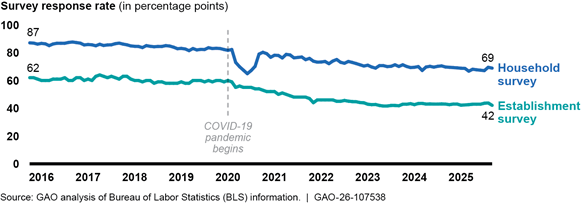
The Bureau of Labor Statistics’s (BLS) Employment Situation report (the Jobs Report) provides key information on the nation’s economy based on data from two surveys—one of households (the household survey) and one of employers (the establishment survey). Stakeholders with jobs data expertise said the report generally meets users’ needs. However, they said occasional large revisions can make the data less useful for informing timely decisions, and BLS faces risks to data quality due to lower survey response rates over time (see figure). BLS met its goals for the data’s precision and size of the revisions from fiscal years 2020 through 2025, but it relaxed one goal during the COVID-19 pandemic.
BLS obtains input from data users and technical experts through various means to inform improvements to the Jobs Report. However, it does not have a plan to address gaps in obtaining regular user and technical feedback since the Departments of Commerce and Labor eliminated three advisory committees in 2025. Having a plan would help ensure that changes to the Jobs Report meet users’ needs and address technical challenges while preserving data quality.
BLS and the Census Bureau—which conducts the household survey for BLS—have met federal requirements for assessing the effects of lower survey response rates on the Jobs Report’s accuracy but released limited information on their findings. Studies by agency staff found limited effects of lower response rates on the accuracy of the household survey data. However, BLS has not released its assessments of the establishment survey due to limitations, including challenges linking the survey data with more comprehensive sources. BLS has started a new establishment survey study designed to address earlier limitations. Releasing the results could help users maintain trust in the data’s accuracy.
Agency efforts and additional options identified by stakeholders aim to enhance the quality of the Jobs Report data. For example, BLS and Census are planning to add an online response method to the household survey in 2027 to try to increase response rates and lower data collection costs. However, BLS and Census officials said recent funding constraints may delay full implementation. Also, stakeholders, researchers, and BLS officials identified additional options to address survey challenges. For instance, some suggested incorporating administrative data from private and other government sources (such as unemployment insurance data) to help mitigate lower survey response rates.
Why GAO Did This Study
Economic policymakers, businesses, and others rely on the monthly Jobs Report for accurate and timely information on the health of the nation’s economy, such as the unemployment rate. However, in recent years, questions have been raised about the quality of the data in the report.
GAO was asked to review the quality of the data in the Jobs Report. GAO’s report addresses (1) the extent to which the Jobs Report data meet users’ needs for accurate, useful, and timely information, and challenges BLS faces in producing these data, (2) the extent to which BLS and Census have followed federal requirements for assessing survey response rates and communicating findings to data users, and (3) potential options to address survey challenges and associated considerations.
GAO reviewed data on BLS’s performance goals for the quality of the Jobs Report data. GAO also reviewed relevant government and academic studies and agency documentation. GAO interviewed agency officials and 14 stakeholders that were selected to provide a range of expert perspectives on the quality of the data for informing economic policy and business decisions and on options to address survey challenges. GAO compared BLS and Census processes to federal statistical policies and relevant federal standards for internal control.
What GAO Recommends
GAO is making three recommendations, including that BLS develop a plan to address gaps in its ability to obtain external input on the Jobs Report data and publish an assessment on the effects of survey nonresponse on the establishment survey. BLS generally agreed with the recommendations.
Abbreviations
BLS Bureau of Labor Statistics
COVID-19 coronavirus disease 2019
establishment survey Current Employment Statistics program
household survey Current Population Survey
Jobs Report Employment Situation report
OMB Office of Management and Budget
This is a work of the U.S. government and is not subject to copyright protection in the United States. The published product may be reproduced and distributed in its entirety without further permission from GAO. However, because this work may contain copyrighted images or other material, permission from the copyright holder may be necessary if you wish to reproduce this material separately.
June 2, 2026
The Honorable Tim Walberg
Chairman
Committee on Education and Workforce
House of Representatives
The Honorable Virginia Foxx
House of Representatives
The Bureau of Labor Statistics’s (BLS) Employment Situation report—commonly referred to as the Jobs Report—is a widely used source for data on national employment trends. It provides critical information on the health of the nation’s economy. The report includes data on key economic indicators from two surveys. The Current Population Survey (the “household survey”) is conducted by the Census Bureau on behalf of BLS and provides the national unemployment rate. The Current Employment Statistics program (the “establishment survey”) is conducted by BLS and provides data on payroll employment growth—the number of jobs added to the economy or lost.
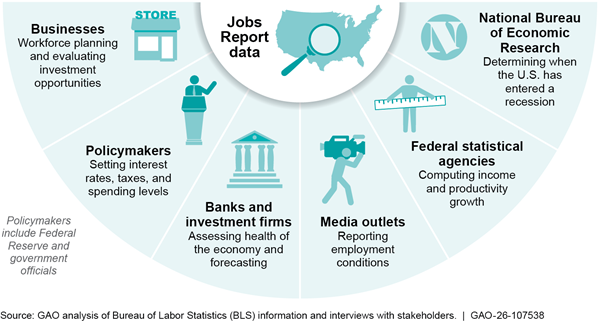
Economic policymakers, business leaders, and others rely on the agency’s monthly Jobs Report for accurate and timely information that they can use to inform decisions. For example, Federal Reserve policymakers closely monitor data on the national unemployment rate and employment growth when determining interest rate levels to manage inflation and promote maximum employment in the economy. Businesses use the data to inform workforce and investment decisions, such as whether to hire more workers or expand operations.[1]
In recent years, questions have been raised about the quality of the data in the Jobs Report. For example, there have been concerns that the Jobs Report estimates may miscount the number of jobs added or lost when there are significant shifts in the direction of the economy, such as at the beginning of a recession or expansion.
You asked us to review the quality of the data in the Jobs Report. This report examines (1) the extent to which the employment data in the Jobs Report meet users’ needs for accurate, useful, and timely information and challenges BLS faces in producing these data; (2) the extent to which BLS and Census have followed federal requirements for assessing survey response rates and for communicating the findings of these assessments to data users; and (3) what potential options BLS, Census, stakeholders, and research have identified to address survey challenges, and what considerations are associated with each option.
We assessed the accuracy, usefulness, and timeliness of the Jobs Report data based on relevant dimensions from the Federal Committee on Statistical Methodology data quality framework. This framework identifies common definitions, objectives, and best practices for federal agencies to follow for producing and reporting data.[2] Specifically, we assessed whether BLS met its performance goals for accuracy, usefulness, and timeliness for the household and establishment survey data from fiscal years 2020 through 2025.[3] We also analyzed survey response rates and information that BLS uses to evaluate its performance goals, including data revisions and measures of survey precision. We assessed the reliability of these data by reviewing relevant documentation, interviewing knowledgeable officials, and conducting electronic data testing. We found the performance data to be sufficiently reliable for determining the extent to which BLS met its own accuracy, usefulness, and timeliness goals and reviewing recent survey response rate trends.[4] Moreover, we assessed the extent to which BLS’s processes for obtaining user and expert input on the Jobs Report data met BLS and Office of Management and Budget (OMB) policies and federal standards for internal control.[5]
We also interviewed 14 stakeholders with expertise on the data and methods in the Jobs Report to obtain their views on the accuracy, usefulness, and timeliness of the employment data for informing economic policy and business decisions.[6] These interviews included discussion of the specific strengths and limitations of the household and establishment surveys, including current and emerging data quality challenges (which we refer to as “survey challenges”) faced by data users, BLS, and Census. Specifically, we selected a nongeneralizable sample of 14 stakeholders from the following categories: (1) public policy decision-makers and advisors, (2) banks and investment firms, (3) business associations, (4) former BLS commissioners, and (5) researchers with expertise related to the household or establishment survey. We selected these stakeholders to obtain a broad range of institutional perspectives, but their views may not be representative of the stakeholder population as a whole.
To further understand how survey challenges may have affected the accuracy of the Jobs Report data, we conducted a literature review. Specifically, we reviewed government and academic studies that examined the accuracy of the employment data in either the household survey or the establishment survey. We included studies that were published from January 2020 to September 2025.[7]
To assess the extent to which BLS and Census have followed federal requirements for assessing survey response rates and for communicating the findings of these assessments to data users, we reviewed BLS and Census data and documentation. Specifically, we reviewed survey response rates that BLS and Census publish, as well as internal and public BLS and Census assessments of the effects of response rates on data quality.[8] We also interviewed BLS and Census officials to understand their processes for reviewing, assessing, and communicating information on response rates to data users. We evaluated the extent to which these processes met relevant OMB and BLS policies and relevant internal control standards.[9]
We interviewed BLS and Census officials, as well as our selected stakeholders, to identify agency initiatives and potential options to address survey challenges. We also identified potential options to address survey challenges through our literature review. In our interviews with agency officials and stakeholders, we gathered information on the anticipated effectiveness of the potential options for addressing survey challenges. In addition, we asked about the feasibility, costs, effects on data quality, and other considerations associated with each option, as appropriate. We also reviewed relevant agency research and documentation, as well as research shared by stakeholders, to further understand these options and key considerations.
To corroborate information shared by agency officials and stakeholders, we also analyzed BLS budget data for the household and establishment surveys from fiscal years 2020 through 2025. We assessed the reliability of these data by interviewing knowledgeable officials. We found the budget data to be sufficiently reliable for describing trends over this period. For more information on our methodology, see appendix I.
We conducted this performance audit from April 2024 to June 2026 in accordance with generally accepted government auditing standards. Those standards require that we plan and perform the audit to obtain sufficient, appropriate evidence to provide a reasonable basis for our findings and conclusions based on our audit objectives. We believe that the evidence obtained provides a reasonable basis for our findings and conclusions based on our audit objectives.
Background
Overview of the Jobs Report
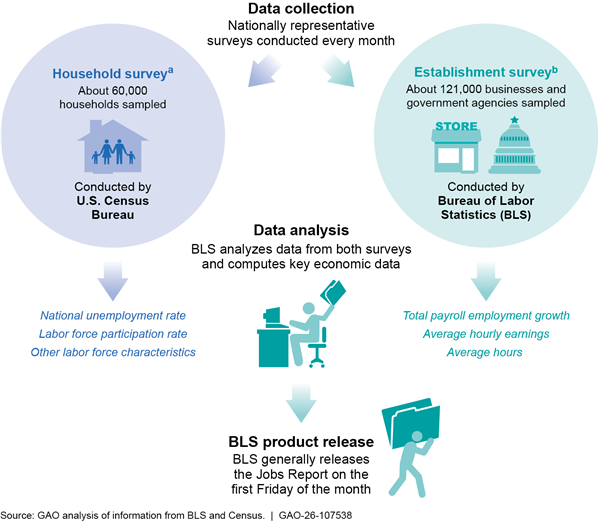
BLS prepares the Jobs Report using data from two statistical surveys (see fig. 1). The household survey provides the national unemployment rate—an estimate of the percentage of the U.S. labor force searching for work—and other labor force indicators.[10] Through in-person or telephone interviews, Census collects these data from a nationally representative statistical sample of households on behalf of BLS. The establishment survey provides total payroll employment growth, as well as data on workers’ hours and their earnings.[11] BLS collects these data from a nationally representative statistical sample of employers through phone interviews and via an online web-reporting system.[12] Data from households and employers are collected monthly. BLS analyzes the data from both sources and then issues the Jobs Report on the first Friday of each month.[13]
Figure 1: Steps in the Collection and Release of Monthly Employment Situation Report (Jobs Report) Data
aHousehold survey refers to the Current Population Survey.
bEstablishment survey refers to the Current
Employment Statistics program.
Note: Establishment survey data do not include employees in agriculture, in
private households, or the self-employed.
Each report presents labor market data for the previous month and recent trends. The report presents these data for the nation as a whole and for various demographic groups and industries. BLS also publishes more detailed subgroup data that users can download from its website after the report is released.
Each report also includes estimates of certain labor market data with adjustments for regular seasonal patterns (“seasonally adjusted data”). Seasonal adjustments are designed to remove the effects of regularly occurring fluctuations in the labor force, such as those due to changes in the weather and major holidays. These fluctuations can be large, such as the number of youth who temporarily enter the labor force each summer, according to BLS documentation. Seasonally adjusted data that remove such patterns can make it easier to distinguish other trends in economic activity.
A broad range of data users rely on the information published in the Jobs Report to assess employment conditions and the broader economy (see fig. 2).
Revisions to the Jobs Report Data
In keeping with longstanding practice, BLS updates the establishment survey data in the Jobs Report over time through a number of “revisions” to allow employers additional time to respond to the survey and to incorporate more complete workforce data.[14] There are two types of revisions—monthly revisions and annual benchmark revisions. BLS has used this combination of monthly revisions and annual benchmarking to update the data since 1982.
Monthly Revisions
Each month, BLS releases initial estimates of payroll employment, hours, and earnings from the establishment survey and then subsequently revises these data two more times. This is because some employers do not report their employment information to BLS in time for the initial release of the Jobs Report data. The establishment survey collects data for payrolls that include the 12th day of the month.[15] BLS starts collecting data for the survey on the first business day after the 12th and continues to do so until the Monday before the Jobs Report’s release. Therefore, the initial estimates in the Jobs Report are based on the sample of employers who reported their payroll information within that window.[16] BLS then continues to collect information from the employers who did not report their payroll information in time and includes this information for the month’s second and third releases, revising its estimates for each release based on this additional information. For example, initial estimates for January are published in February. A revised estimate for January’s data is published in March. The final monthly revision of January’s data is published in April.
These revisions allow BLS to incorporate data from a larger proportion of employers over time. For example, in 2024 BLS collected additional responses that increased the survey’s coverage of employers by about 30 percentage points on average—with responses rising on average from about 60 percent in the first release to about 90 percent by the third release.[17]
Annual Benchmark Revisions
Each February, BLS revises the establishment survey data based on a comparison to comprehensive employment data in a process called the “annual benchmark revision.” Like the monthly revisions, the goal of the annual benchmark revision is to provide more accurate data on employment (i.e., the number of jobs). The establishment survey’s original estimates for the Jobs Report are based on a statistical sample of employers that cover about 26 percent of total U.S. employment, according to BLS documentation. BLS’s annual benchmark revision is based on comprehensive administrative employment records that it obtains quarterly from state agencies through their unemployment insurance programs. These data cover about 97 percent of total employment. BLS uses these administrative employment records to calculate a definitive count of employment for the previous March—the benchmark.[18]
BLS releases its annual benchmark revisions in February. BLS revises 21 months of previously published estimates with the benchmark release. Specifically, BLS revises estimates for the 11 months prior to the benchmark, and it revises the 9 months that follow the benchmark.[19] BLS also typically publishes a preliminary estimate of the annual benchmark revision in August, although it does not revise its previously published estimates with this preliminary estimate.[20] BLS considers the degree of change associated with the annual benchmark revision to the establishment survey to be a measure of overall error in the establishment survey. This is because the revision is based on a comparison between the original establishment survey estimates and employment data that cover nearly the entire U.S. workforce.
Figure 3 shows a recent example of BLS’s monthly and annual benchmark revisions, based on employment data originally released in the Jobs Report for July 2023.[21] As a result of two monthly revisions and two annual benchmark revisions, BLS revises the establishment survey estimates at least four times.[22] For example, the initial survey response for July 2023 showed U.S. payroll employment grew by 187,000 jobs. BLS reported this initial estimate in August 2023. This growth was revised in the following two months, first downward to an increase of 157,000 jobs in September 2023 and then upward to an increase of 236,000 jobs in October 2023. Once administrative employment data were available in February 2024 for the March 2023 benchmark, July 2023 job growth was revised to 184,000 jobs. With additional administrative data in February 2025 for the March 2024 benchmark, July 2023 job growth was revised to 148,000 jobs. The range of these revisions is discussed in more detail below.
Figure 3: Example of BLS Revisions to Establishment Survey Data Monthly and Annually, Based on Payroll Employment Data for July 2023
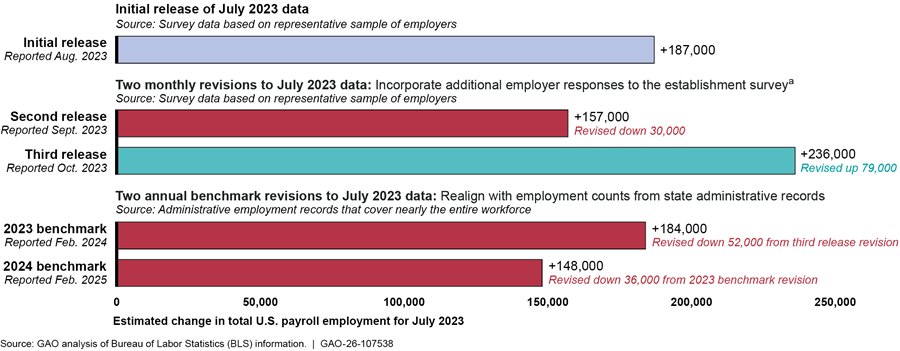
Note: Estimates of employment growth and revisions have been seasonally adjusted. Prior to the annual benchmark revision, estimates of employment growth are based on surveys and have a margin of error of about 130,000 at the 90 percent confidence level. We selected July 2023 to illustrate BLS’s revision process because its monthly revision for July 2023 was close in magnitude to the overall average for that year and the revision was during the latest year in which 2 full years of annual benchmark revisions were available at the time of our analysis.
aEstablishment survey refers to the Current Employment Statistics program.
Federal Requirements and Guidance Related to Data Quality
As principal statistical agencies, BLS and Census are expected to follow federal laws, standards, and guidelines to ensure that statistical policy is carried out consistently and effectively across the federal government. For example, Office of Management and Budget (OMB) policies require statistical agencies to produce data that are accurate, useful, and timely and set standards for running statistical surveys.[23]
When assessing whether the Jobs Report and other data products are accurate, useful, and timely, BLS policy applies the Federal Committee on Statistical Methodology data quality framework.[24] According to the framework, the accuracy of survey data—such as estimates of national unemployment or employment growth—can be affected by multiple factors. The accuracy of such estimates depends on how close they are to their true value (e.g., the value that BLS would compute based on information from the entire population of U.S. households or employers instead of only a statistical sample). For example, estimates that are computed from larger samples will generally have less statistical error than estimates computed from smaller samples, and are therefore more likely to be accurate. In addition, important differences between survey samples and the larger populations they are meant to represent can push—or bias—an estimate consistently in one direction away from the true value depending on the nature of the differences between survey participants and nonparticipants.
Beyond accuracy, the framework also identifies five additional dimensions of data quality that together determine the usefulness of federal data products like the Jobs Report, including their timeliness:[25]
· Relevance. Whether the product is targeted to meet data users’ needs.
· Granularity. The amount of detail available for key data elements.
· Accessibility. The ease with which data users can obtain products and documentation.
· Timeliness. The length of time between the period that the product describes and when it is available to data users.
·
Punctuality. Whether the product is released on schedule.
Annual Agency Performance Goals Related to Data Quality
BLS sets goals annually for monitoring the accuracy, usefulness, and timeliness of the Jobs Report data and other data products as part of the budget development and justification process. For example, to monitor the timeliness of the Jobs Report data, BLS tracks whether it releases its estimates from each survey in the Jobs Report on time each month according to an OMB approved schedule. As part of this process, these goals are reviewed and assessed each year by Department of Labor and OMB officials, according to BLS officials. BLS sets separate goals for the Jobs Report data for the household and establishment surveys.
Stakeholders with Jobs Data Expertise Said the Report Generally Meets Users’ Needs, but BLS Does Not Have a Plan to Address Gaps in External Input
Stakeholders we interviewed generally agreed that, overall, BLS’s Jobs Report meets users’ needs for accurate, useful, and timely data for informing economic policy and business decisions but also noted risks to maintaining data quality. From fiscal years 2020 through 2025, BLS met its own accuracy goals for key estimates in the Jobs Report, such as the size of BLS’s revisions to the payroll employment data from the establishment survey, although it temporarily lowered one goal during the COVID-19 pandemic. Nevertheless, lower survey response rates, occasional large revisions, and other survey challenges can, at times, affect the accuracy and usefulness of the data. BLS has obtained some input from data users and technical experts regarding the Jobs Report data, which it takes into account when considering changes, such as initiatives to address lower survey response rates. However, BLS does not have a plan to address gaps in obtaining regular external feedback from data users and technical experts to improve Jobs Report data. Gaps exist since the Departments of Labor and Commerce eliminated three advisory committees that BLS previously relied on for feedback.
Stakeholders Said Data Users Can Rely on Jobs Report Estimates to Inform Policy and Business Decisions
|
How Did GAO Select Stakeholders to Interview? We selected stakeholders with expertise in the Employment Situation report (Jobs Report) data and methods to obtain a range of institutional perspectives. We interviewed a nongeneralizable sample of stakeholders from the following categories: · Public policy decision-makers and advisors · Banks and investment firms · Business associations · Former Bureau of Labor Statistics commissioners · Researchers with methodological expertise Their views may not be representative of the broader stakeholder population. For more information on GAO’s stakeholder selection methodology, see appendix I. Source: GAO. | GAO‑26‑107538 |
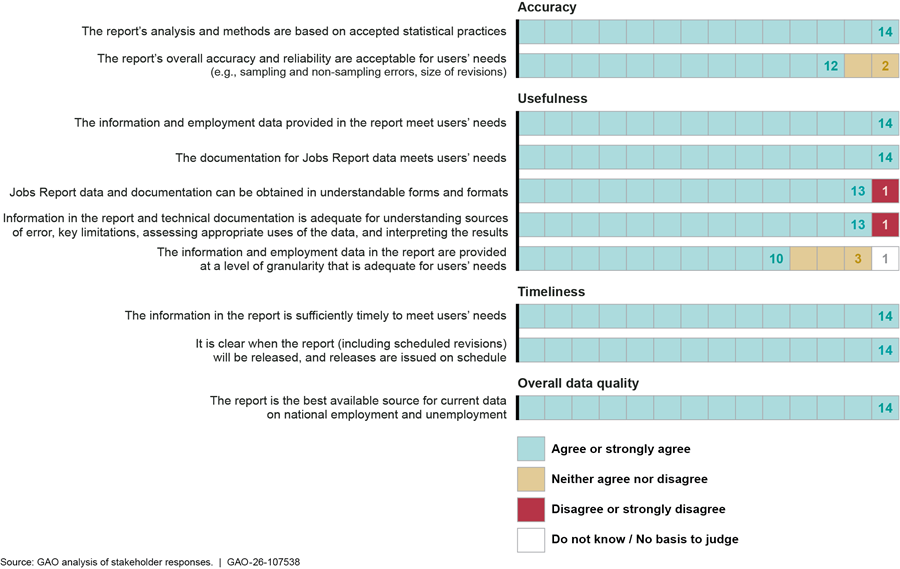
The stakeholders we interviewed generally agreed that the Jobs Report data are sufficiently accurate, useful, and timely for informing economic policy and business decisions. For example, all 14 of the stakeholders we interviewed agreed that BLS’s analysis and methods for the report are based on accepted statistical practices, that the data in the report meet users’ needs, and that the information is sufficiently timely for informing economic policy and business decisions (see fig. 4).
Figure 4: Summary of Stakeholder Responses on Employment Situation Report (Jobs Report) Data Quality
Note: Stakeholders rated their level of agreement or disagreement to questions related to accuracy, usefulness, and timeliness of the Jobs Report data for informing economic policy and business decisions. We used minor variations in the wording of some statements based on stakeholder type and present the results using standardized wording in this figure. For additional details on this methodology and the stakeholder responses, see appendix I.
Twelve of the 14 stakeholders agreed the report’s overall accuracy and reliability are acceptable for informing economic policy and business decisions. Many stakeholders cited aspects of the design of the household and establishment survey as particular strengths of the data.[26] For example, they noted the large number of households and employers that Census and BLS survey each month and that each survey is nationally representative.[27] Citing these features, some stakeholders said the household and establishment surveys are considered “the gold standard” for surveys. However, two stakeholders neither agreed nor disagreed, citing the potential adverse effects of lower survey response rates, the need for more precise survey estimates, and the need for smaller data revisions. We discuss these topics in more detail below.
Many stakeholders we interviewed said they use the Jobs Report data to gain insights into employment trends. For example, some stakeholders said the ability to use the household survey to analyze employment trends over time, including over the business cycle, is a strength. There have been relatively few changes to the questions in the household survey over time, according to BLS documentation, and users can download historical data on key employment measures such as the monthly national unemployment rate back to 1948.
Thirteen of 14 stakeholders agreed that the information in the Jobs Report and BLS’s accompanying technical documentation is adequate for understanding key features and uses of the data. They also agreed that the data and documentation can be obtained in understandable forms and formats. However, one stakeholder disagreed with these statements, explaining that some data users have difficulty finding information they need on the BLS website.
All 14 stakeholders agreed that the Jobs Report is sufficiently timely to meet users’ needs. Both surveys in the Jobs Report followed OMB’s timeliness requirement for federal economic indicators, which states that agencies should compile and release survey estimates no later than 22 working days after the end of the period they cover.[28] BLS schedules the release of the Jobs Report approximately 3 weeks after the period each survey covers.[29] Moreover, BLS released the report on schedule each month from fiscal years 2020 through 2025.[30] One stakeholder mentioned that the Jobs Report is one of the earliest economic indicators that their institution receives on the state of the national economy for the previous month when evaluating policy options.
However, some stakeholders said that the monthly frequency can be inadequate for monitoring sudden changes in labor market conditions. For example, one stakeholder said that business closures in March 2020 immediately following the beginning of the COVID-19 pandemic were not fully captured until the May release of the Jobs Report, delaying key information needed for policymakers’ response to the pandemic.
Jobs Report Estimates Have Met Agency Accuracy Goals
We found that BLS met its annual accuracy goals for the survey estimates in the Jobs Report from fiscal years 2020 through 2025 amid data collection challenges.
Household survey accuracy goal. For the household survey, BLS’s accuracy goal is based on the survey’s precision requirements for its unemployment rate estimates. Specifically, the goal is that a monthly change in the national unemployment rate of at least 0.2 percentage points should be statistically significant—an indication that the change is likely not due to chance. BLS measures this goal using the margin of error.[31] From fiscal years 2020 through 2025, BLS met this goal for the household survey every month.
BLS officials said that it will be difficult to meet this goal in the future. Specifically, BLS expects that lower response rates to the household survey will make it challenging to maintain this level of precision. Consequently, the agency relaxed its precision requirement for the national unemployment rate in April 2025.[32] The agency also relaxed the corresponding accuracy goal for fiscal year 2026. We discuss this change and its implications for users in more detail below.
Establishment survey accuracy goals. For the establishment survey, BLS has accuracy goals for the size of its revisions to payroll employment. The revision process is designed to provide users with initial estimates soon after the month is over, followed by revised estimates as more complete workforce data become available. These revision goals help BLS monitor the survey’s accuracy based on how much the estimates change as a result of obtaining more complete data. BLS has separate goals for its (1) monthly revisions and (2) annual benchmark revisions.
We found that, overall, BLS met its accuracy goals for both types of revisions from fiscal years 2020 through 2025. However, BLS temporarily lowered its goal for monthly revisions during the COVID-19 pandemic, and some revisions exceeded typical levels.
· Accuracy goal for monthly revisions to estimates of payroll employment growth. BLS’s goal is that the monthly revisions must be within 0.1 percentage points of its initial estimate in 10 out of 12 months in a given year. BLS measures this goal using the size of the revision to employment growth from the initial release to the third release.[33] From fiscal years 2022 through 2025, BLS met this accuracy goal (see fig. 5). BLS also met its goal for the monthly revisions in fiscal years 2020 and 2021, but it temporarily lowered its goal during this period from 10 to 8 months of the year. It did so to accommodate larger revisions during the COVID-19 pandemic due to data collection issues and economic fluctuations.[34]
Figure 5: Monthly Revisions to Initial Estimates of Payroll Employment Growth from the Establishment Survey, Fiscal Years 2015 – 2025
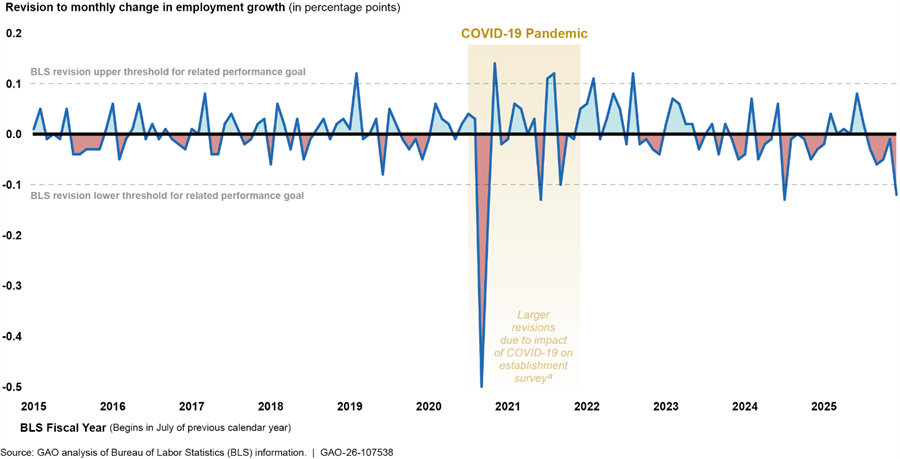
Note: Revisions are based on the comparison of initial and third releases of nonseasonally adjusted payroll employment growth in the Jobs Report. BLS monitors monthly revisions published during the federal fiscal year. These correspond to revisions to employment data from July to June each year. BLS generally has a performance goal of monthly revisions within a threshold of 0.1 percentage points for at least 10 months of each fiscal year. The COVID-19 period shown in the graphic does not reflect the start and end dates of the public health emergency but rather the time period from January 2020 through June 2021 in which BLS lowered this performance goal due to larger expected revisions.
aEstablishment survey refers to the Current Employment Statistics program.
· Accuracy goal for annual benchmark revisions to payroll employment estimates. BLS’s goal is that annual benchmark revisions to these estimates should be on average less than 0.4 percentage points for a 5-year period.[35] From fiscal years 2020 through 2025, BLS met its goal but reported annual benchmark revisions close to or higher than this level in some years.[36] For example, in fiscal year 2025, BLS released an annual benchmark revision that revised its March 2024 employment estimate downward 0.4 percentage points, its largest benchmark revision since 2009. In its preliminary annual benchmark revision release in September 2025, the agency also estimated it would revise its March 2025 employment estimate downward by 0.6 percentage points. In the final annual benchmark revision released in February 2026, BLS revised its March 2025 estimate downward by 0.5 percentage points.
BLS Faces Growing Risks to Data Quality as Fewer Individuals and Employers Respond to Surveys, Among Other Challenges
Stakeholders we interviewed generally agreed that the Jobs Report data are sufficiently accurate, useful, and timely for informing economic policy and business decisions. However, most stakeholders cited lower survey response rates as a challenge that has either already affected the accuracy and usefulness of the report or is expected to do so in the future. From 2015 to 2025, response rates to the household survey fell from 87 to 69 percent, and response rates to the establishment survey fell from 62 to 42 percent (see fig. 6).[37] Response rates to both surveys fell substantially following the onset of the COVID-19 pandemic in January 2020, and have not returned to their pre-COVID-19 pandemic levels.
Figure 6: Response Rates to the Household and Establishment Surveys for the Employment Situation Report (Jobs Report), October 2015-September 2025
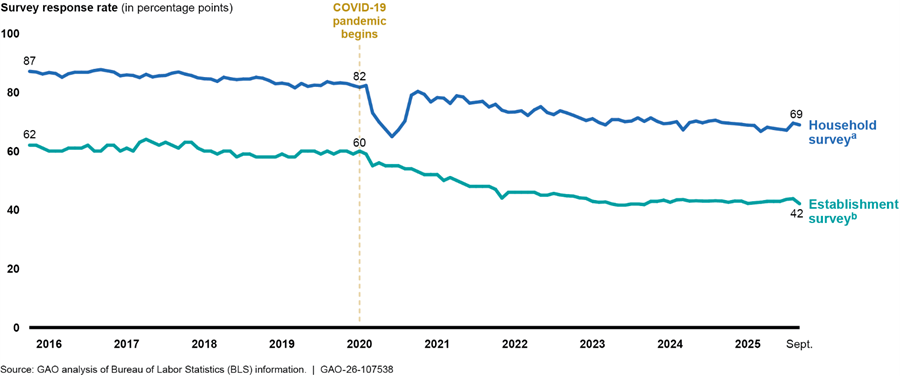
Note: We analyzed response rates to the household and establishment surveys from October 2015 to September 2025. This was the latest full fiscal year of data available at the time of our analysis. BLS measures response rates to the establishment survey based on the percentage of responses it receives in time for the third release of the data. Percentages are rounded to the nearest whole number.
aHousehold survey refers to the Current Population Survey.
bEstablishment survey refers to the Current Employment Statistics program.
|
How Do Lower Survey Response Rates Generally Affect Data Accuracy? Statisticians measure survey response rates—the proportion of a survey sample that responds. Lower survey response rates can affect data accuracy in two principal ways: 1. Precision of survey estimates. Lower response rates result in smaller sample sizes, which in turn reduce precision in survey estimates and make it harder to distinguish important patterns or trends from random fluctuations. 2. Nonresponse bias. If those who respond to the survey (e.g., households or employers) differ systematically from those who do not respond, survey data will no longer represent the intended population. This phenomenon (called “nonresponse bias”) can introduce additional errors that can push survey estimates in a certain direction, causing the estimates to be higher or lower than the true value. Statisticians can use computational adjustments to account for differences between survey respondents and nonrespondents to reduce the effect of nonresponse bias. However, the extent to which such adjustments eliminate nonresponse bias depends on how well they capture these differences. Source: GAO analysis of Federal Committee on Statistical Methodology, A Framework for Data Quality, FCSM-20-04 (Sept. 2020) and Jennifer H. Madans, et al. Best Practices for Nonresponse Bias Reporting, FCSM-23-01 Nonresponse Bias Subcommittee, Federal Committee on Statistical Methodology, June 2023. | GAO‑26‑107538 |
Several stakeholders explained that the decline in responses to the household and establishment survey reflects broader ongoing issues affecting surveys more generally.[38] Lower response rates can affect data accuracy by leading to less precise estimates and introducing nonresponse bias (see sidebar).[39]
Household survey response rate challenges. As discussed previously, BLS met its goal for the precision of its national unemployment rate estimates from fiscal years 2020 through 2025. However, we found that declining survey response rates over this period nevertheless resulted in modest declines in overall precision, as measured by the statistical margin of error. BLS officials told us that these trends led them to revise the agency’s precision requirement for the household survey in April 2025 to permit a higher margin of error. This means the agency will be able to meet its performance goal with less precise estimates. Going forward, the agency will require that the survey be sufficiently precise for a 0.3 percentage point change in the unemployment rate to be statistically significant, an increase from the previous 0.2 percent threshold.
Reduced precision can erode the usefulness of data like the unemployment rate for making specific policy and business decisions, according to several of the stakeholders we interviewed. For example, two stakeholders said that when buying and selling financial assets, stock traders and other financial market participants can make decisions based on small changes to unemployment. These data users would like to have confidence that a change as small as 0.1 percentage points reflects a meaningful change in employment conditions. Should the precision of the household survey continue to decline, such changes are more likely to be viewed as due to chance and are less likely to reflect meaningful trends.
BLS has an annual usefulness goal for the household survey to release a certain number of monthly estimates from the survey to data users.[40] For example, for fiscal year 2020, BLS’s goal was to release on average at least 14,900 monthly estimates. These estimates include data on unemployment rates and other labor force information for various demographic subgroups.
While declining precision of the household survey poses a risk to usefulness, BLS met its usefulness goal consistently from fiscal years 2020 through 2025. It also raised its goal for the number of estimates to release over this period, from 14,900 to 19,900, reflecting expansions in the number of demographic groups included and additional data on telework.
Studies we reviewed found that declining response rates resulted in limited nonresponse bias in key estimates from the household survey such as the national unemployment rate.[41] However, these studies have not examined whether nonresponse bias has impacted estimates since 2021. In one study, Census staff found that the sharp decline in survey response at the start of the COVID-19 pandemic did not lead to a meaningful effect on the estimated unemployment rate.[42] A study authored by BLS staff found similar results.[43] The Census study also found that lower response rates from 2017 to 2019 did not significantly bias estimates of the unemployment rate. This result was supported by an academic study that we reviewed.[44]
BLS and Census are taking several steps to address declining response rates and provide data users with more information on the household survey’s accuracy. First, they are planning to introduce a new response method that would allow respondents to complete the survey questionnaire online rather than through an in-person or telephone interview.[45] Second, Census staff are working on analyzing the effect of nonresponse bias on unemployment and employment from 2020 to 2024. They expect to release the results of their analysis in May 2026. Third, BLS is also expanding its level of transparency regarding the precision of the household survey estimates. Specifically, BLS plans to release data for calculating margins of error for almost all data items that they release with the Jobs Report by the end of fiscal year 2026.[46]
Establishment survey response rate challenges. Lower response rates have posed challenges to BLS’s ability to meet the establishment survey’s annual usefulness goal. BLS’s goal is to release a certain number of monthly estimates from the survey to data users.[47] For example, for fiscal year 2020, BLS’s goal was to release at least 25,450 monthly estimates.[48] These estimates include data on employment, hours, and earnings for various industries. The agency met its usefulness goal in fiscal year 2020, fiscal year 2021, and fiscal year 2023, but it did not meet its goal in fiscal year 2022, fiscal year 2024, and fiscal year 2025.[49]
BLS officials told us they revisit their usefulness goal annually following a review of the estimates, with the aim of releasing information on as many industries as possible while meeting the agency’s quality and confidentiality standards.[50] Due to falling response rates and other factors that have resulted in smaller sample sizes, BLS reduced the number of estimates it releases to meet its standards and also lowered its related performance goal. Specifically, from fiscal year 2020 through fiscal year 2025 BLS lowered its goal for the number of estimates it releases from the establishment survey from 25,450 to 22,900. For instance, BLS no longer reports employment information for some detailed manufacturing industries, such as breakfast cereal manufacturing. BLS officials told us that declining manufacturing employment has also contributed to smaller sample sizes for such detailed industries over time.
To help address these challenges, BLS has taken steps to maintain the usefulness of the establishment survey. For example, BLS staff participated in a cross-country effort to update the North American Industry Classification System, which BLS and other government agencies use to classify industries.[51] This effort resulted in changes in 2023 that helped the establishment survey more accurately capture retail trade and e-commerce activity, according to BLS officials. In addition, in 2025, BLS reviewed the industry-level estimates it did not previously publish due to lower sample sizes in the establishment survey and published some of that data.
Stakeholders and research identified three additional challenges that can affect the quality of the Jobs Report data: (1) occasional large revisions to the employment data, (2) out-of-date population information, and (3) difficulties measuring alternative work arrangements.
|
BLS’s Model for Estimating Business Openings and Closures For the Employment Situation report (Jobs Report), BLS uses a statistical model to account for employment changes resulting from business openings and closures in the establishment survey data. It calls this model the “net birth-death model.” BLS uses this model because it would otherwise be difficult for its survey estimates to reflect employment changes associated with business openings (births) and closures (deaths). It takes time for BLS to include new businesses into its survey sample, or remove businesses after they have closed, due to lags in when BLS receives the administrative data it uses to capture this information. Unaddressed, this limitation would have greater impact on the accuracy of the estimates from the establishment survey because openings and closures are important contributors to employment changes. BLS uses past data and statistical methods in the net birth-death model to estimate the effect of business openings and closures on monthly employment. Source: GAO analysis of Bureau of Labor Statistics (BLS) information. | GAO‑26‑107538 |
Occasional large revisions in the establishment survey. Most stakeholders we interviewed said that large revisions to the establishment survey can be a challenge. For example, one stakeholder said that uncertainty created by larger revisions can delay decision-making because data users must wait longer to more confidently understand trends in the data. Larger monthly revisions led this stakeholder to analyze the estimates using a 3-month rolling average to smooth out volatility and incorporate private data sources when monitoring employment trends.
For the annual benchmark revision, one source of revisions is forecast error from BLS’s model for estimating business openings and closures, known as “the net birth-death model” (see sidebar). The model improves the measurement of national payroll employment during stable economic conditions. However, the model can result in the agency making larger annual benchmark revisions during periods of sudden economic changes, such as the recession of 2007 to 2009, according to BLS documentation and some stakeholders. This is because the model has relied on historical data to forecast how business openings and closures contribute to monthly changes in employment.[52]
Despite the potential for error, 12 of the 14 stakeholders said the overall accuracy of the Jobs Report data, including the size of revisions to establishment survey data, was acceptable for informing economic policy and business decisions. The revision process is designed to provide users with initial estimates soon after the month is over, followed by revised estimates as more complete workforce data become available. Some stakeholders said the revision process itself is a strength because it provides more accurate data over time. BLS has also met its own goals related to the size of the revisions. BLS officials told us they continue to study improvements that could help reduce the size of revisions, and the agency adjusted its net birth-death model in February 2026 in an effort to make its employment estimates more accurate.[53]
Out-of-date population information. Out-of-date population information resulted in understated population and employment levels from the household survey, according to three studies that we reviewed and recent BLS analysis. BLS reported that the household survey understated the population of people living in the U.S. in 2024 by 2.9 million (or 1.1 percent), likely due to challenges that Census had capturing recent immigration in its projections.[54] As a result, the household survey underestimated the total number of employed individuals in the Jobs Report for various demographic groups in 2024; however, it had a limited effect on unemployment rates, according to the studies we reviewed. Census updated its methodology for the 2025 population projections to better reflect immigration by incorporating a wider range of data sources.
Difficulties measuring alternative work arrangements. Three research studies we reviewed and some stakeholders we interviewed said that the household survey questionnaire mismeasures alternative work arrangements, such as informal and gig work.[55] Individuals do not always report these arrangements, particularly if they only work a few hours a week. This undercounting can affect the measurement of employment rates, but studies we reviewed suggest that the impact of mismeasurement of informal work on overall employment may be limited. We previously found that disagreements exist among researchers about the magnitude of the errors in the household survey related to gig work and other nonstandard work arrangements.[56] BLS officials told us they are currently exploring methods to better capture data on alternative work arrangements, such as through a supplemental survey or potentially adding a new question to the household survey.
BLS Does Not Have a Plan to Address Gaps in Obtaining Input from Technical Experts and Data Users on Efforts to Improve Data Quality
While BLS obtains some input from data users and technical experts, gaps exist in obtaining regular feedback to inform improvements to the Jobs Report. BLS officials said they obtain information on users’ needs from various sources. For example, program staff receive inquiries via phone or e-mail regarding the data. BLS also relies on media accounts of labor market issues and public research to understand users’ needs. Program staff use this information to assess whether there are patterns of inquiry that warrant a change. In addition, BLS officials said they obtain feedback from technical experts when presenting at research conferences and publishing in peer-reviewed publications.
However, in February 2025, the Departments of Labor and Commerce eliminated three data user and expert advisory committees following an Executive Order after they determined that the committees had fulfilled their purpose.[57] BLS had relied on these committees to obtain regular feedback on key improvement efforts for the Jobs Report and other data products and to obtain the views of technical experts on BLS’s statistical practices (see table 1).
Table 1. Committees Advising BLS and Examples of Improvement Efforts That Were Discussed, 2020 to 2024
|
Advisory committee |
Purpose and membership |
Example of improvement effort discussed at meetings |
|
BLS Data Users Advisory Committee |
Provided advice to BLS from the perspective of data users Composed of knowledgeable data users from labor, business, government, and other sectors of the U.S. economy |
Changes to a supplement to the household surveya that BLS uses to collect additional data on alternative work arrangements |
|
BLS Technical Advisory Committee |
Provided advice to BLS on best practices related to economics, statistics, and survey design Composed of technical experts |
Plans to modernize the household survey and to add an online response method to address declining response rates |
|
Department of Commerce Federal Economic Statistics Advisory Committee |
Provided advice to BLS, Census, and the Bureau of Economic Analysis on statistical best practices related to federal economic data Composed of technical experts and knowledgeable data users |
New household survey questions to measure telework and other impacts of the COVID-19 pandemic Changes to BLS’s net birth-death model that accounts for business openings and closures in the establishment surveyb |
Source: GAO analysis of Bureau of Labor Statistics (BLS) and Department of Commerce information. | GAO‑26‑107538
Note: The Departments of Labor and Commerce eliminated the BLS Data Users Advisory Committee, the BLS Technical Advisory Committee, and the Federal Economic Statistics Advisory Committee in 2025 in response to Exec. Order No. 14,217, Commencing the Reduction of the Federal Bureaucracy, 90 Fed. Reg. 10,577 (Feb. 25, 2025).
aHousehold survey refers to the Current Population Survey.
bEstablishment survey refers to the Current Employment Statistics program.
While the advisory committees had overlapping scope and membership, each served a distinct advisory role for BLS prior to their elimination, according to BLS and Department of Commerce documentation. For example, the Federal Economic Statistics Advisory Committee provided BLS, Census, and the Bureau of Economic Analysis input related to various economic data. In comparison, the BLS Data Users Advisory Committee and BLS Technical Advisory Committee provided input to BLS alone related to the agency’s broader portfolio of data products, including noneconomic data such as occupational safety and health statistics.
The committees also had different membership bases, with the BLS Technical Advisory Committee and the Federal Economic Statistics Advisory Committee composed primarily of researchers with advanced backgrounds in statistics, economics, and survey design and the BLS Data Users Advisory Committee composed of a broader pool of users. These users included researchers as well as others, such as representatives of employment services and news organizations.
BLS officials acknowledged that gaps exist in their ability to obtain regular external feedback for the Jobs Report without these committees.[58] For example, BLS may not be able to readily obtain information on the needs of private sector and other users that BLS officials do not routinely interact with. They also said they will have difficulty obtaining certain high-level technical advice that was previously provided by the BLS Technical Advisory Committee and the Federal Economic Statistics Advisory Committee. BLS officials also indicated that the committees played an important role and provided a formal public-facing mechanism for feedback on their improvement efforts. BLS officials said the agency is not developing a plan to address the gaps due to limited resources and said they are prioritizing efforts to maintain data quality.
While BLS may be able to obtain additional external input using other sources of information, it is not clear whether those sources will meet its need for a broad range of input from users and technical experts. For example, one BLS statistician explained that they planned to attend research conferences to obtain input on changes to the net birth-death model that could reduce annual benchmark revisions. They explained that the conference participants could provide general feedback, but they did not expect that participants would have the methodological expertise that would have been represented on the BLS Technical Advisory Committee.
OMB policy requires that federal statistical agencies, including BLS, regularly seek input from a broad range of data users, and BLS policy requires that program methodologies are based on sound technical practices.[59] In addition, federal standards for internal control call for agencies to obtain relevant and quality information from external parties to help them achieve their objectives.[60] Proactively developing a plan, including time frames for implementation, to address gaps in external input could help BLS ensure that it obtains relevant and timely information to make informed decisions about the Jobs Report data and acts as needed to enhance data quality. Doing so would improve the likelihood that future changes to the data meet users’ needs, respond to risks, and benefit from needed technical input, which could help BLS maintain the quality of the data over time.
BLS and Census Assessed Lower Survey Response Rates but Shared Limited Information About What They Learned with Data Users
BLS and Census have assessed the effects of lower survey response rates on the accuracy of the data in the Jobs Report, but the agencies have shared limited information about what they have learned from these assessments with data users. We compared BLS’s and Census’s assessment efforts from 2020 to 2025 to relevant OMB and BLS requirements for assessing response rates and communicating the findings of the assessments to users. We assessed the agencies’ efforts for the household and establishment surveys separately. Figure 7 shows the extent to which the agencies met the requirements.
Figure 7: Extent to Which BLS and Census Met Federal Requirements for Assessing Survey Response Rates and Communicating Findings of Assessments to Data Users
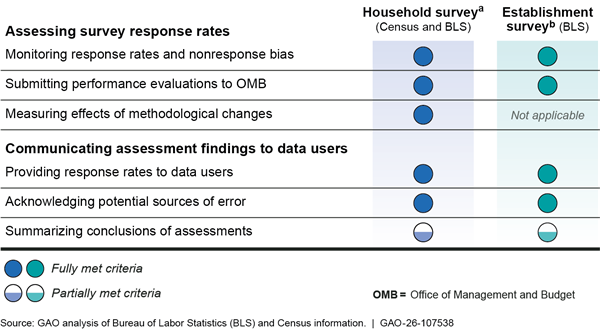
Note: We did not assess the extent to which BLS measured effects of methodological changes on the establishment survey because there were no response rate-related changes from 2020 to 2025, according to BLS officials. We identified federal requirements for our evaluation from the following OMB and BLS policies: OMB, Fundamental Responsibilities of Recognized Statistical Agencies and Units, 89 Fed. Reg. 82,453 (Oct. 11, 2024) (codified at 5 C.F.R. pt. 1321); Standards and Guidelines for Statistical Surveys, 71 Fed. Reg. 55,522 (Sept. 22, 2006); Update of Statistical Policy Directive No. 3: Compilation, Release, and Evaluation of Principal Federal Economic Indicators—Changing Timing of Public Comments by Employees of the Executive Branch, 89 Fed. Reg. 11,873 (Feb. 15, 2024); BLS, Commissioner’s Order No. 30-7 (Mar. 2024) and Program and Reviewer Checklist of BLS Principles for BLS Quality Reviews.
aHousehold survey refers to the Current Population Survey.
bEstablishment survey refers to the Current Employment Statistics program.
BLS and Census Monitored and Measured the Effects of Lower Survey Response Rates on Key Employment Data in the Jobs Report
From 2020 to 2025, BLS and Census fully met OMB and BLS requirements for assessing response rates for the household and establishment surveys for the Jobs Report. Further, both agencies are taking additional steps to understand the effects of survey response rates on data quality. OMB directs agencies that conduct statistical surveys to measure response rates and conduct nonresponse bias analyses when response rates suggest the potential for bias to occur.[61] In addition, BLS policy requires programs to conduct nonresponse bias analyses when response rates fall below 80 percent.[62] Response rates to both surveys fell over this period following the COVID-19 pandemic to levels that would require a nonresponse bias assessment under these requirements.[63] Consistent with OMB’s and BLS’s requirements, both agencies have monitored response rates and evaluated whether lower response rates since 2020 impacted key data in the report. For example:
· Household survey studies. As we previously discussed, BLS and Census staff published two nonresponse bias analyses that found limited effects of the COVID-19 pandemic on the accuracy of the national unemployment rate.[64]
· Establishment survey studies. BLS has annually analyzed nonresponse bias in total payroll employment. Specifically, BLS performs an error analysis, in which it measures how nonresponse bias and other different types of statistical error affect the annual benchmark revision.[65] BLS conducts this analysis by comparing the original survey-based employment estimates to those based on more comprehensive administrative employment records that the agency uses for its annual benchmark revision. To measure nonresponse bias, BLS calculates the difference in payroll employment between employers who responded to the survey and the full sample selected for the establishment survey, including those that did not respond.[66] BLS has used this analysis to understand broadly how nonresponse and other types of statistical error affect the annual benchmark revision, according to BLS officials.[67] However, BLS officials told us the analysis also has methodological limitations that have prevented the agency from releasing the results publicly. (We discuss these methodological limitations and how they have affected what the agency has released in more detail below.)
BLS and Census have also taken steps to obtain additional information on how nonresponse bias has affected the Jobs Report data from both surveys. For the household survey, Census officials told us that the agency is coordinating with BLS on a new analysis that examines whether declining response rates from 2020 to 2024 resulted in any bias. In addition, they said that Census anticipates releasing this new study in May 2026 and plans to perform a new nonresponse bias analysis every two or three years. For the establishment survey, BLS told us it has contracted with an outside entity to conduct a new nonresponse bias study for the establishment survey. The new study is intended to help identify improvements to the survey. BLS expects this study to be completed in 2026.
BLS also fully met relevant OMB requirements for assessing survey response rates that are specifically for agencies that produce principal federal economic indicators like the Jobs Report.[68] For example, BLS has submitted periodic evaluations of survey response rates and other issues to OMB for both the household and establishment surveys.[69] BLS also evaluated a change it made in 2023 to the household survey methodology to use more current response rate information.[70]
Agencies Have Shared Limited Information About the Effects of Lower Survey Response Rates on Data Accuracy but Have Plans to Provide Additional Information
BLS and Census have fully met OMB’s requirements and have adhered to BLS’s policies for providing data users with information about response rates and potential sources of error in the Jobs Report. However, the agencies have shared limited information with data users about what they have learned from their assessments of nonresponse bias specifically. As a result, users of the Jobs Report may not understand how, if at all, lower response rates to the surveys have affected data accuracy since 2020.
Information on response rates and potential sources of error. BLS has publicly reported response rates for the household survey, which data users can download from the agency’s website. The BLS website has also provided users with response rates for the establishment survey. In addition, BLS’s and Census’s documentation for the Jobs Report and the surveys have identified survey nonresponse as a potential source of error in the data.[71]
Conclusions of nonresponse bias assessments. BLS and Census have shared limited information with Jobs Report users about what the agencies have learned from their nonresponse bias assessments of the household survey. In addition, the information that has been available has been outdated. For example, until July 2025, BLS’s webpage with response rate information on the household survey and links to available nonresponse bias assessments did not include a 2024 Census study on nonresponse bias during the COVID-19 pandemic.[72] Further, Census did not release results from a study it conducted in 2022 comparing the characteristics of household survey respondents and nonrespondents. BLS has also not provided users with an overall summary of the extent to which lower survey response rates since 2020 have resulted in nonresponse bias in the unemployment rate or other Jobs Report data from the household survey.[73]
BLS and Census officials told us that they have not provided more information about nonresponse bias in the household survey because research is still evolving. They also said past research findings may be specific to certain time periods and therefore may not currently be representative. BLS officials said they plan to include a link to Census’s new nonresponse bias analysis on its webpage once the analysis is completed. They also told us they will review the results and determine whether there are concrete findings to summarize and share with data users.
We also found that BLS has provided data users with information on overall statistical error in the establishment survey data for the Jobs Report, as measured by the size of the annual benchmark revision. As part of its benchmarking process, BLS releases documentation that describes the methodology and reports the revision to employment numbers for the U.S. as a whole and by industry. The documentation also describes how forecast errors in BLS’s net birth-death model contributed to the revision and actions BLS has taken to address identified survey errors.[74]
However, BLS’s documentation for the annual benchmark revision and other key documentation for the establishment survey have provided data users with limited information regarding how the agency assesses nonresponse bias or what it has found. Specifically:
· Key online documentation for the report and the establishment survey do not explain BLS’s methodology for the error analysis that it has used to understand how nonresponse bias and other types of statistical error have affected the annual benchmark revision to total payroll employment.
· This documentation also lacks information on what BLS found from its error analyses from 2020 to 2024.
· BLS referenced some of its conclusions from its error analyses in 2025 after reporting large annual benchmark revisions.[75] However, BLS did not explain how it formed its conclusions. It also did not provide users with a summary assessment of overall nonresponse bias on payroll employment in the establishment survey.
BLS officials told us that their error analyses have provided the agency with useful information about nonresponse bias and other types of statistical error. For example, BLS officials used the results to investigate revisions for specific industries using raw microdata for the establishment survey. However, the agency has not released the results publicly because of methodological limitations. Specifically, BLS experienced challenges matching the administrative records for the analyses with the original survey responses. The data also have not undergone BLS’s data quality review, such as automated screening and manual review of potential outliers. BLS officials said the results could lead users to draw inaccurate conclusions.
BLS officials explained that it has not provided data users with more information on nonresponse bias in the establishment survey because it would take considerable resources to address these methodological limitations and release the results of the error analyses to the public. However, officials said the agency intends to provide data users with more information after its new nonresponse study is completed in 2026. In addition, the new study is intended to address the methodological limitations of BLS’s error analyses. The study is also intended to result in a reproduceable framework for summarizing the effect of nonresponse bias that BLS could then release to data users on a recurring basis. However, it is not yet clear what information BLS will share publicly. BLS has also not shared publicly the methodology used in its error analyses for assessing nonresponse bias and other sources of statistical error.
OMB policies require BLS to publicly release both documentation with information necessary for evaluating survey results and its evaluations of data quality, and to have a dissemination plan that provides for equivalent, timely access to information to all data users.[76] BLS policy also requires that the agency’s technical documentation include a summary assessment of all sources of error, including direction (i.e., positive or negative) and order of magnitude of errors, with a special focus on key estimates.[77]
By updating its public documentation to explain its current methodology for assessing nonresponse bias in the establishment survey, BLS would be more transparent about how the agency monitors a potentially important source of error in the Jobs Report data that can also affect the annual benchmark revision. In addition, publishing at least summary-level information on how survey nonresponse has affected employment and other estimates from the survey would further strengthen that transparency and help users of the Jobs Report understand how lower response rates have affected the data. This, in turn, could increase users’ confidence in the data and minimize the possibility of users making decisions based on incomplete information. This summary could be drawn from the agency’s new nonresponse bias study under contract or through other means. Greater transparency could also help maintain users’ trust in the revision process and the data’s accuracy.
Agency Efforts and Options Identified by Stakeholders to Address Survey Challenges and Enhance Data Quality Involve Trade-Offs
Agency Efforts That Could Enhance Data Quality
BLS and Census are engaged in efforts aimed at addressing survey challenges and enhancing the quality of the Jobs Report data (see table 2).[78]
|
Agency effort |
How the effort is intended to address survey challengesa |
Key considerations and trade-offs, according to agency officials or stakeholders |
|
Household surveya modernization: Multiyear effort to modernize the household survey, which will include adding an online response method scheduled to be introduced in 2027. |
· Increase response rates · Manage data collection costs |
· Could increase response rates and manage data collection costs. · Could allow BLS and Census to field a larger survey sample. · Requires reviews and testing to understand potential effects of online data collection. · Funding constraints and other challenges have limited field testing and may delay full implementation. |
|
Improvements to the model estimating business openings and closures: BLS introduced technical improvements in 2026 to the statistical model it uses to account for employment changes resulting from business openings and closures, which would otherwise be difficult to account for in survey estimates. |
· Reduce annual benchmark revisions to the employment estimates from the establishment surveya |
· Expected to reduce error in the model, which should result in more accurate monthly employment estimates and smaller annual benchmark revisions. |
Source: GAO analysis of interviews with Bureau of Labor Statistics (BLS) officials, Census officials, and selected stakeholders. | GAO‑26‑107538
aThe Jobs Report includes data from two surveys: the Current Population Survey (the household survey) and the Current Employment Statistics program (the establishment survey).
Household Survey Modernization
BLS and Census are engaged in a multiyear effort to modernize the household survey, which will include adding an online response method. BLS and Census began developing the online response method in fiscal year 2023. It is scheduled to be introduced in 2027.[79]
The key goals of the household survey modernization are to increase response rates and manage data collection costs, including through implementation of the new online response method, according to BLS and Census. As part of the broader modernization effort, BLS and Census are pursuing other updates to data collection processes, including improved cost-tracking, enhanced training for field staff, and data-driven approaches for conducting survey outreach.[80]
Seven stakeholders who discussed the online response method generally anticipated that it would help increase response rates or reduce data collection costs. In particular, three of the stakeholders said the online response method would help to increase survey participation. Six of the stakeholders said it would lower costs, for instance by reducing the need for Census interviewers to collect information from respondents.
Stakeholders and agency officials also anticipated that the planned online response method may have additional benefits. For instance, by potentially lowering data collection costs, the online response method could allow the household survey to field a larger sample, according to two stakeholders. Census officials also said the online response method could improve the quality of the household survey data by reaching households less likely to respond to in-person or telephone surveys. Finally, one stakeholder said the online response method could provide an opportunity for BLS and Census to adapt survey questions and field additional surveys quickly to respond to emerging data needs, such as those that arose during the COVID-19 pandemic.[81]
Stakeholders also identified potential challenges associated with the online response method. Online surveys can lead to differences in responses compared to in-person or telephone surveys, which could affect survey estimates and limit the comparability of data over time, according to five stakeholders. Moreover, two stakeholders raised concerns that the population of individuals who respond to the online survey may have different characteristics compared to the general population. For instance, one stakeholder said that online survey respondents would be more likely to be younger, in the labor force, and more familiar with technology, among other differences.
BLS and Census are conducting extensive reviews and testing to understand the effects of the online response method, which is a key reason for the multiyear implementation timeline. However, agency officials said that recent funding constraints, staffing reductions, and delays related to the 2025 government shutdown have slowed development of the online response method and other parts of the modernization effort, limited the scope of their field tests, and may delay the full implementation of the online response method.
Improvements to the Model Estimating Business Openings and Closures
As discussed previously, in February 2026, BLS made technical improvements to its net birth-death model that estimates business openings and closures each month for the establishment survey. These technical improvements could help reduce annual benchmark revisions to the payroll employment estimates by incorporating information from the establishment survey into the model to increase the model’s sensitivity to current economic conditions.[82]
BLS officials said they anticipate that these technical improvements will be effective at increasing the accuracy of the estimates of business openings and closures that are generated by the model. Specifically, officials said research has shown that the improvements will reduce error in the model, which should result in more accurate monthly estimates in the Jobs Report and smaller annual benchmark revisions.[83]
Potential Options That Could Enhance Data Quality
Stakeholders, researchers, and BLS officials identified potential options aimed at addressing survey challenges and enhancing data quality. Each option involves trade-offs, such as potential improvements to data quality, increased financial costs, and additional respondent burden (see table 3).
Table 3. Potential Options That Could Enhance the Quality of the Employment Situation Report (Jobs Report) Data
|
Option |
How the option is intended to address survey challengesa |
Key considerations and trade-offs, according to agency officials, stakeholders, or research |
|
Blended data: Incorporating alternative data sources into the household survey and establishment surveya estimates, such as unemployment insurance data or private payroll data. |
· Mitigate effects of lower response rates · Reduce monthly revisions and annual benchmark revisions to establishment survey estimates · Improve data collection on alternative work arrangements, such as “gig work” |
· Could help increase the accuracy and granularity of the Jobs Report data. · BLS and Census officials cited challenges around effectiveness, feasibility, and costs. · Would require significant research and testing. |
|
Mandatory surveys: Making the household and establishment surveys mandatory for the individuals and employers randomly selected to participate. |
· Increase response rates |
· Research has shown that mandatory surveys have higher response rates. · BLS officials raised concerns about potential negative reactions to enforcing mandatory survey participation. · BLS officials said it would require an act of Congress to make the surveys mandatory. |
|
Monetary incentives for household survey: Offering monetary incentives for household survey respondents. |
· Increase response rates |
· Research has shown that offering monetary incentives can increase survey participation. · Would involve costs to pay incentives, but costs may be offset by needing fewer interviewers to follow up with nonrespondents. |
|
More resources for administering household survey: Providing more resources, such as additional staff or funding, to BLS and Census to help with administering the household survey. |
· Increase response rates and sample size |
· Could allow for additional follow-up with nonrespondents to increase survey response rates. · Could allow for a larger initial survey sample to account for drop-off in participation over time. · Would involve increased budgetary costs for BLS and Census to administer the survey. |
|
Statistical weighting adjustments for establishment survey estimates: Developing methods for adjusting statistical survey weights to account for differences in the characteristics of responding employers compared to the broader sample of selected employers. |
· Reduce monthly revisions and annual benchmark revisions to establishment survey estimates |
· Could improve accuracy of employment estimates by accounting for fluctuations in the characteristics of employers who respond to the survey over time. |
|
Updating household survey questions: Updating the household survey questions to better capture information on alternative work arrangements (e.g., informal work and gig work). |
· Improve data collection on alternative work arrangements |
· Updating the household survey’s questions could help address limitations in gathering data on alternative work arrangements, for instance by including a specific question about “side jobs.” · BLS officials said such updates would require significant testing, financial costs, and cutting other survey questions to limit respondent burden. · BLS is exploring other methods to capture this information. |
Source: GAO analysis of interviews with Bureau of Labor Statistics (BLS) officials, Census officials, selected stakeholders, and review of selected research. | GAO‑26‑107538
aThe Jobs Report includes data from two
surveys: the Current Population Survey (the household survey) and the Current
Employment Statistics program (the establishment survey).
Blended Data
A potential approach for addressing a range of survey challenges could be to use blended data. Using blended data would involve incorporating alternative data sources into the household and establishment survey estimates. Blended data could involve the use of government administrative data from federal or state sources (such as tax records or unemployment insurance data), private data from payroll processing companies, or other federal and nongovernmental economic data. This would be intended to address challenges related to the effects of lower survey response rates on data quality, large monthly revisions and annual benchmark revisions to the establishment survey data, and difficulty gathering information on alternative work arrangements (e.g., informal work or gig work).
|
The Jobs and Employment Data Exchange The U.S. Chamber of Commerce Foundation is leading a public-private initiative, the Jobs and Employment Data Exchange, focused on standardizing, consolidating, and automating employer data reporting to government agencies. BLS and two states were partners in the initiative’s pilot test, which demonstrated how states could collect unemployment insurance and related data from employers in a more streamlined process, and then report the data to BLS, according to U.S. Chamber of Commerce Foundation staff. U.S. Chamber of Commerce Foundation staff said this initiative could lead to fundamental changes in how employment data is gathered and reported to government agencies. They said this could provide agencies with more timely data on a range of employment measures from a larger number of employers, while reducing costs to employers and the government. BLS officials did not expect that this initiative would replace the Current Employment Statistics program (the establishment survey) but said it could improve the usefulness and granularity of other employment data gathered by BLS and other federal statistical agencies. Source: GAO analysis of interviews with Bureau of Labor Statistics (BLS) officials and U.S. Chamber of Commerce Foundation staff and associated documentation. | GAO‑26‑107538 |
Stakeholders and research have highlighted different ways blended data could be used. For instance, two stakeholders said that updating state unemployment insurance systems and reporting processes could allow BLS to obtain employment data from a larger number of employers, almost in real time, which could help improve the accuracy and granularity of the Jobs Report estimates.[84] This could build on steps that BLS and others are currently taking to standardize and streamline reporting of unemployment insurance data (see sidebar).
Furthermore, data from private payroll processing companies could supplement the data gathered in the establishment survey, according to two stakeholders. In addition, one research study suggested that BLS could improve the accuracy of its initial estimates of payroll employment by using various federal and nongovernmental data sources on employment and other economic factors, including data from the household survey.[85] Finally, another study suggested that various data sources, including tax data and nongovernmental data, could be used to improve estimates of alternative work arrangements.[86]
However, BLS and Census officials cited several challenges associated with blended data and generally did not believe it would be effective or feasible to directly incorporate alternative data sources into the Jobs Report estimates. For instance, BLS and Census officials said that government administrative data are generally not timely enough to use for calculating the report’s key measures, such as total payroll employment growth or the unemployment rate. In addition, BLS officials said that administrative data, such as state unemployment insurance records, can contain errors and have differing scopes and definitions compared to BLS’s survey data. According to officials, this would create obstacles to using it in the monthly estimates.
Census officials said they are researching other ways to use administrative data to help improve response rates for the household survey and account for potential nonresponse bias in the survey’s estimates. Specifically, this research involves using administrative data to identify who is most likely to respond to the survey and through which methods (e.g., in person, via telephone), as well as identify the characteristics of survey nonrespondents. This could allow Census to develop more effective strategies to contact potential survey respondents and to adjust survey estimates to account for nonresponse bias, respectively.[87]
Stakeholders and agency officials cited several additional considerations related to the use of blended data. For instance, this approach would require extensive research and testing. It could also involve significant financial costs, such as costs to update state unemployment insurance systems or to acquire data from private payroll processing companies. In addition, private data sources are not always designed in a way that matches the needs of federal statistical agencies. Finally, if the private sector source of the data were to go out of business, the data would no longer be available.
Mandatory Surveys
A potential approach for addressing lower response rates in the household and establishment surveys would be to designate these surveys as mandatory for the individuals and employers that Census and BLS randomly select to participate in them.[88] While both of these surveys are voluntary at the federal level, some states require employers to participate in the establishment survey.[89]
Mandatory surveys have been shown to have higher response rates compared to voluntary surveys, according to Census officials and one stakeholder.[90] The stakeholder said that making the household and establishment surveys mandatory could be an effective approach for increasing response rates for both surveys. However, BLS officials said that states where the establishment survey is mandatory do not have noticeably higher response rates than states where it is not mandatory. Officials said this may be due to a lack of enforcement of those state requirements.
BLS officials also said that BLS surveys have been voluntary in nature since the agency’s founding. Furthermore, officials did not believe that an increase in response rates from enforcing mandatory participation in the household or establishment survey would be worth the potential for negative reactions to such a requirement. In addition, they said making the surveys mandatory would require an act of Congress.
Monetary Incentives for Household Survey
Another potential approach for addressing declining response rates to the household survey is to offer monetary incentives to survey respondents, according to research cited by one stakeholder and Census officials.[91] BLS and Census are currently studying the use of monetary incentives as part of the online response method they are developing for the household survey, according to agency officials.[92] However, BLS and Census officials said they were currently uncertain regarding the potential effectiveness and feasibility of this approach for increasing survey response rates, as they had only recently begun field testing.
This approach would involve financial costs to the agency to pay survey respondents for participating, according to BLS officials. However, BLS and Census officials said it is possible that these costs would be balanced by reduced overall data collection costs if more respondents respond to the initial survey request, which could reduce the need for costly survey follow-up by Census interviewers. Finally, offering monetary incentives for the household survey would require approval from the Office of Management and Budget, according to BLS officials.
More Resources for Administering Household Survey
Another potential approach for addressing declining response rates to the household survey would be to provide more resources, such as additional funding or staff, to BLS and Census for administering the survey.[93]
Providing more resources for administering the household survey would be an effective way to increase response rates and boost the survey’s sample size, according to one stakeholder. In particular, the stakeholder said that additional funding and staff capacity would allow Census interviewers to perform additional follow-up with nonrespondents, especially through in-person interviews, which could help increase response rates. The stakeholder also said these additional resources would allow BLS and Census to increase the number of individuals sampled in the first month of the survey to account for a drop-off in participation over subsequent months.[94]
This approach would involve increased budgetary costs for BLS and Census to administer the household survey.
Statistical Weighting Adjustments for Establishment Survey Estimates
BLS is researching methods to adjust its establishment survey estimates to account for fluctuations in the characteristics of employers who respond to the survey over time, which could help reduce monthly revisions and annual benchmark revisions.
|
Survey Weighting Statisticians use survey weighting to develop estimates that more accurately reflect the population a survey seeks to represent. This process involves assigning values (or “weights”) to each response to account for important differences in the characteristics of the groups that are sampled or that respond to a survey compared to the broader population those groups are meant to represent. For example, if employers in certain industries are underrepresented in a survey’s sample or among those who respond to the survey, those employers’ responses would be assigned larger weights to ensure the survey’s estimates reflect the broader population. Survey weighting can improve the accuracy of estimates produced from survey data but is subject to limitations. For example, survey weights can only account for differences that are observed in the data, and remaining differences may bias survey estimates. In addition, weighting can result in less precise survey estimates even when it reduces bias. Source: GAO analysis of Jelke Bethlehem, “Weighting,” in Encyclopedia of Survey Research Methods, (Vol. 0, pp. 958-960). Sage Publications, Inc., Jennifer H. Madans, et al., Best Practices for Nonresponse Bias Reporting, FCSM-23-01 Nonresponse Bias Subcommittee, Federal Committee on Statistical Methodology, June 2023, and Bureau of Labor Statistics documentation. | GAO‑26‑107538 |
BLS officials said that taking such steps could help improve the accuracy of monthly employment estimates. Specifically, BLS researchers are developing methods for adjusting statistical survey weights to account for differences in the characteristics of responding employers compared to the broader sample of selected employers. For example, BLS officials said that there can be differences in employer response rates by industry over time.
Officials said the most significant challenge to implementation is identifying correct adjustments to account for changes in the characteristics of responding employers without introducing new error into the employment estimates.
Updating Household Survey Questions
Updating the household survey’s questions could help address limitations in gathering information on alternative work arrangements (e.g., informal work and gig work), according to one stakeholder and two studies in our literature review.[95] For example, one study suggested that the household survey could clarify that respondents should include any type of informal work activity in their answers about employment, or the survey could include a specific question about “side jobs.”[96] BLS officials were uncertain about the potential effectiveness and feasibility of this approach, explaining that alternative work arrangements can be difficult to measure. In addition, BLS does not have an official definition for what is considered “gig work.”[97]
BLS officials also said that updating the household survey questions would require extensive testing, involve significant financial costs, and require BLS to cut other portions of the survey to limit respondent burden. However, BLS is exploring methods to better capture these data through an occasional supplement to the household survey.[98] Furthermore, BLS is field testing the use of a potential follow-up question in its planned online response method, which would ask those respondents who reported no employment if they worked for even as little as one hour during the specified week.
Conclusions
The monthly Jobs Report provides critical information on the health of the nation’s economy and is a key resource for guiding economic policy and business decisions. However, key challenges, including lower response rates for the household and establishment surveys that are the basis for the report present growing risks to BLS’s and Census’s ability to maintain the data’s accuracy and usefulness.
BLS and Census have taken steps to mitigate these and other challenges. For example, the agencies are working to add an online response method for the household survey aimed at improving response rates. BLS has also made adjustments to its model for estimating business openings and closures for the establishment survey, which could help reduce annual benchmark revisions. The agencies are also exploring additional options to adapt, including offering monetary incentives to increase household survey participation and using statistical weighting techniques to improve the accuracy of and reduce revisions to the establishment survey estimates.
However, BLS does not have a plan to address gaps in its ability to obtain regular input from knowledgeable external stakeholders after the Departments of Commerce and Labor eliminated three advisory committees that BLS previously relied on to ensure that it took needed actions to maintain or improve data quality. In addition, BLS has not yet explained to the public its methodology for assessing nonresponse bias and other sources of statistical error on the establishment survey. It also has not published a summary assessment of nonresponse bias on this survey, despite concerns about falling response rates and occasional large revisions.
Without taking steps to address these issues, BLS risks that the Jobs Report data will not adequately meet the needs of data users and that data users may not fully understand how to interpret key data in the report. Taking additional actions in these areas would help BLS ensure that the Jobs Report remains a timely and trusted resource for measuring the health of the economy and helping policymakers and businesses make informed decisions.
Recommendations for Executive Action
We are making the following three recommendations to the Department of Labor:
The Secretary of Labor should ensure that the Commissioner of BLS, in consultation with the Director of the Census Bureau as appropriate, develops and implements a plan to address gaps in BLS’s ability to obtain regular external input on changes to the Employment Situation report (Jobs Report) data. The plan should include timelines for implementation. (Recommendation 1)
The Secretary of Labor should ensure that the Commissioner of BLS updates the public documentation for the Current Employment Statistics program (establishment survey) to explain BLS’s current methodology for assessing nonresponse bias and other sources of statistical error on key survey estimates, including any limitations in its methodology. (Recommendation 2)
The Secretary of Labor should ensure that the Commissioner of BLS publishes a summary assessment of nonresponse bias on the Current Employment Statistics program (establishment survey). The assessment should include the magnitude and direction of any bias on key survey estimates, such as total payroll employment growth. (Recommendation 3)
Agency Comments and Our Evaluation
We provided a draft of our report for review and comment to BLS, the Department of Commerce’s Census Bureau and Bureau of Economic Analysis, the Department of the Treasury, and the Board of Governors of the Federal Reserve System. We received written comments from BLS, which are reproduced in appendix III and summarized below. BLS and Census provided technical comments, which we incorporated, as appropriate. The Bureau of Economic Analysis and the Board of Governors of the Federal Reserve System did not have any comments on the report. Treasury did not provide comments on the report.
In its written comments, BLS agreed with the two recommendations that were related to the establishment survey. BLS stated it planned to implement these recommendations by drawing on the outcomes of its new nonresponse bias study under contract. We discussed this study in our second research objective.
BLS did not disagree with our recommendation to address gaps in its ability to obtain regular external input on changes to the Jobs Report data. BLS noted that it has existing channels to obtain stakeholder input but did not specify whether it has used these channels to specifically discuss the Jobs Report. It also said it would work within applicable guidance to identify additional opportunities to formalize and expand stakeholder input, including through advisory mechanisms where appropriate. We will continue to monitor BLS’s implementation of this recommendation.
We are sending copies of this report to the appropriate congressional committees, the Secretary of Labor, the Secretary of Commerce, the Secretary of the Treasury, the Chair of the Board of Governors of the Federal Reserve System, and other interested parties. In addition, the report is available at no charge on the GAO website at https://www.gao.gov.
If you or your staff have any questions about this report, please contact us at costat@gao.gov or hoffmanme@gao.gov. Contact points for our Offices of Congressional Relations and Media Relations may be found on the last page of this report. GAO staff who made significant contributions to this report are listed in appendix IV.

Thomas Costa
Director
Education, Workforce, and Income Security

Michael Hoffman
Chief Economist
Applied Research and Methods
The objectives of this review were to examine (1) the extent to which the employment data in the Employment Situation report (Jobs Report) meet users’ needs for accurate, useful, and timely information and challenges the Bureau of Labor Statistics (BLS) faces in producing these data; (2) the extent to which BLS and the Census Bureau have followed federal requirements for assessing survey response rates and for communicating the findings of these assessments to data users; and (3) what potential options BLS, Census, stakeholders, and research have identified to address survey challenges, and what considerations are associated with each option.
Overall Summary of Methods
To address our first objective, we assessed the accuracy, usefulness, and timeliness of the Jobs Report data based on relevant dimensions from the Federal Committee on Statistical Methodology data quality framework:[99]
· We assessed BLS’s annual performance goals for the two surveys that collect the data used in the Jobs Report—the Current Population Survey (the “household survey”) and the Current Employment Statistics program (the “establishment survey”). We determined the extent to which BLS met these goals from fiscal years 2020 through 2025.
· We reviewed literature published from January 2020 to September 2025 that examined the accuracy of the employment data in either the household survey or the establishment survey.
· We interviewed 14 stakeholders with expertise on the data and methods in the Jobs Report to obtain their views on the accuracy, usefulness, and timeliness of the employment data for informing economic policy and business decisions.[100] We also discussed current and emerging challenges faced by data users, BLS, and Census related to data quality (which we refer to as “survey challenges”).
· We assessed the extent to which BLS’s processes for obtaining user and technical expert input on the Jobs Report data met BLS and Office of Management and Budget (OMB) policies and federal standards for internal control.[101]
To address our second objective, we reviewed relevant information on survey response rates and assessed BLS’s and Census’s processes for assessing the effects of response rates on the Jobs Report data’s accuracy. We also evaluated the extent to which these processes met relevant OMB and BLS policies and relevant federal standards for internal control.[102]
To address our third objective, we interviewed BLS and Census officials, as well as our selected stakeholders, to identify agency initiatives and potential options to address challenges with data quality. We also identified potential options suggested by studies from our literature review. Furthermore, we reviewed relevant agency research and documentation, as well as research shared by stakeholders, to further understand these options and key considerations. We also analyzed BLS budget data for the household and establishment surveys from fiscal years 2020 through 2025. We do not endorse any particular option.
Review of BLS Performance Goals and Budget Data
We assessed whether BLS met its performance goals for the accuracy, usefulness, and timeliness of the household and establishment surveys from fiscal years 2020 through 2025 and the extent to which the agency adjusted these goals over this period.[103] We determined whether BLS met its performance goals by comparing data we obtained from Congressional Budget Justifications, Agency Management Plans, and Operating Plans to the agency’s reported goals.[104] For time periods in which this information was not available through these sources, we obtained data directly from BLS documentation and officials and calculated performance results, as needed. We also analyzed trends in survey response rates, which BLS uses to monitor data collection.[105] We obtained response rates from the BLS website.
To provide additional context for performance results, we analyzed data that BLS uses to calculate its accuracy goals. In particular, we analyzed trends in margins of error to the national unemployment rate and revisions to payroll employment. We obtained these data from BLS officials and documentation.[106]
We also analyzed BLS budget obligations data for the household and establishment surveys from fiscal years 2020 through 2025 to corroborate information we heard from agency officials and stakeholders. We obtained these data from BLS officials. The budget obligations for these surveys reflect final amounts incurred during the fiscal year and do not include centralized charges for items such as rent, security charges, and other information that are recorded at the budget activity level, according to BLS officials.
We assessed the reliability of these data by reviewing relevant documentation, interviewing knowledgeable officials, and conducting electronic data testing.[107] We found the data to be sufficiently reliable for determining the extent to which BLS met its performance goals for the Jobs Report and reviewing recent survey response rates and agency budget trends.
Literature Review
To understand how survey challenges may have affected the accuracy of the Jobs Report data and to identify potential options to address any accuracy issues, we conducted a literature review. Specifically, we reviewed government and academic studies that examined the accuracy of the employment data in either the household survey or the establishment survey that were published from January 2020 to September 2025.
We identified studies from several sources. In April 2025 we conducted an extensive search of pertinent scholarly databases, such as EconLit, Social SciSearch, and Scopus. We also conducted web searches for working papers published by BLS, Census, and Federal Reserve researchers and those affiliated with the National Bureau of Economic Research. In August and September 2025, we updated our searches to identify studies published in 2025 within our scope. Through this process, we identified 280 potentially relevant studies.
We screened all 280 studies using a multistage approach. During the initial stage, we reviewed the studies’ abstracts to determine whether they examined the accuracy of the employment data in either the household survey or the establishment survey. Multiple GAO staff, including economists and statisticians, reviewed each study abstract for relevance. If we could not determine relevance from the abstract alone, we completed a review of the full text. We removed studies that did not evaluate the accuracy of the household or establishment surveys from further review. From an initial pool of 280 studies, we selected 31 studies that met our criteria.
We completed structured reviews of these 31 studies’ methodologies and findings.[108] We developed a data collection instrument that described each of the selected studies. Multiple GAO staff, including economists and statisticians, reviewed each study in its entirety and completed the data collection instrument at this stage. Each instrument required the reviewers to summarize information from the study and determine whether the study’s methodology was appropriate and sufficiently rigorous for the purposes of our review. The data collection instrument included the study’s objectives and findings, a description of the methodology, any limitations for how the results could be interpreted, and what options, if any, were discussed to address identified accuracy issues.
Interviews with Stakeholders
We interviewed 14 stakeholders with expertise on the data and methods in the Jobs Report. We obtained their views on the accuracy, usefulness, and timeliness of the employment data for informing economic policy and business decisions and to identify options for addressing survey challenges.[109] The stakeholders included representatives of organizations that use these data and other knowledgeable individuals. Specifically, we selected a nongeneralizable sample of stakeholders from the following categories: (1) public policy decision-makers and advisors, (2) banks and investment firms, (3) business associations, (4) former BLS commissioners, and (5) researchers with expertise related to the household or establishment surveys. We also considered the following factors in our selection process: (1) membership or organizational representation on one of BLS’s advisory committees at the time of selection, (2) recommendations from relevant subject matter experts, and (3) selections to obtain a range of institutional perspectives.[110] Table 4 lists the stakeholders we interviewed.
|
Stakeholder/Category |
|
Public policy decision-makers and advisors |
|
Board of Governors of the Federal Reserve System |
|
Congressional Budget Office |
|
Department of the Treasury |
|
Federal Reserve Bank of Chicago |
|
Federal Reserve Bank of Cleveland |
|
Banks and investment firms |
|
Goldman Sachs |
|
JPMorgan Chase |
|
Vanguard |
|
Business associations |
|
National Federation of Independent Business |
|
U.S. Chamber of Commerce |
|
Two former Bureau of Labor Statistics commissioners |
|
Two researchers with expertise related to the household or establishment surveysa |
Source: GAO. | GAO‑26‑107538
aHousehold survey refers to the Current Population Survey. Establishment survey refers to the Current Employment Statistics program.
The interviews included two parts:
1. We asked stakeholders to provide closed-ended responses to 10 statements regarding the accuracy, usefulness, and timeliness of the data in the Jobs Report, using a five-point scale ranging from “strongly agree” to “strongly disagree” (see table 5 for a summary of the stakeholder responses).[111]
2. We used a semi-structured interview protocol to gather information on the specific strengths and limitations of the Jobs Report data, including current and emerging challenges faced by data users, BLS, and Census related to data quality.[112] Specifically, this portion of the interview covered: (1) stakeholders’ backgrounds and experience with the Jobs Report data, (2) how their institutions or economic policymakers and businesses generally use the data, (3) strengths and limitations of the household and establishment survey data, (4) emerging data challenges that could affect the quality of the Jobs Report, and (5) BLS efforts and additional options to address survey challenges, including the anticipated effectiveness and key considerations associated with the efforts and options (e.g., effects on data quality, feasibility, costs, and other trade-offs).[113]
In January 2026, we followed up with each of the stakeholders to see if they had additional observations to share. The nine stakeholders who responded indicated that their views on the quality of the data had not substantively changed since the time of our interviews.
|
Statement |
Strongly Agree |
Agree |
Neither Agree Nor Disagree |
Disagree |
Strongly Disagree |
Do Not Know/No Basis to Judge |
|
The information and employment data provided in the report meet [my institution’s needs/my agency’s needs/economic policymakers’ and business needs]. |
8 |
6 |
0 |
0 |
0 |
0 |
|
The report’s analysis and methods are based on accepted statistical practices. |
13 |
1 |
0 |
0 |
0 |
0 |
|
The report’s overall accuracy and reliability (e.g., sampling and nonsampling errors, size of revisions) are acceptable for [my institution’s needs/my agency’s needs/economic policymakers’ and business needs]. |
5 |
7 |
2 |
0 |
0 |
0 |
|
The information and employment data in the report are provided at a level of granularity that is adequate for [my institution’s needs/my agency’s needs/economic policymakers’ and business needs]. |
5 |
5 |
3 |
0 |
0 |
1 |
|
The documentation for the Employment Situation data meets [my institution’s needs/my agency’s needs/economic policymakers’ and business needs]. |
11 |
3 |
0 |
0 |
0 |
0 |
|
The Employment Situation data and documentation can be obtained in understandable forms and formats. |
9 |
4 |
0 |
1 |
0 |
0 |
|
The information in the report and technical documentation is adequate for understanding sources of error, key limitations, assessing appropriate uses of the data, and interpreting the results. |
8 |
5 |
0 |
1 |
0 |
0 |
|
The information in the report is sufficiently timely to meet [my institution’s needs/my agency’s needs/economic policymakers’ and business needs]. |
8 |
6 |
0 |
0 |
0 |
0 |
|
It is clear when the report (including scheduled revisions) will be released, and releases are issued on schedule. |
13 |
1 |
0 |
0 |
0 |
0 |
|
The report is the best available source for current data on national employment and unemployment. |
12 |
2 |
0 |
0 |
0 |
0 |
Source: GAO analysis of information provided by stakeholders. | GAO‑26‑107538
Note: We used minor variations in the wording of some statements based on stakeholder type. Specifically, these statements asked whether the data met “my agency’s needs” for federal agency stakeholders, “my institution’s needs” for other stakeholder institutions, and “economic policymakers’ and business needs” for the stakeholder categories of former BLS commissioners and researchers with expertise related to the household or establishment surveys.
Evaluation of Agency Assessments and Communication on Survey Response Rates
We evaluated the extent to which BLS and Census have followed federal requirements for assessing survey response rates and for communicating the findings of these assessments to data users. To identify the requirements that we used in our evaluation, we reviewed relevant BLS and OMB policies and interviewed BLS and Census officials.[114] We synthesized the results into six unique requirements, removing requirements that were either not applicable or out of scope: (1) monitoring response rates and nonresponse bias, (2) submitting performance evaluations to OMB, (3) measuring effects of methodological changes, (4) providing response rates to data users, (5) acknowledging potential sources of error, and (6) summarizing conclusions of assessments.
To assess the extent to which BLS and Census have followed these six requirements, we reviewed the data and documentation on survey response rates that BLS and Census publish, as well as internal and public BLS and Census assessments of the effects of response rates on data quality. Our review included key documentation that BLS produces for data users of the Jobs Report, including the report’s technical documentation and the BLS Handbook of Methods, as well as other information available on the BLS and Census websites. We also interviewed BLS and Census officials to understand their processes for reviewing, assessing, and communicating information on response rates to data users.
We determined whether BLS and Census had fully met, partially met, or not at all met each of the six requirements.[115] We determined the requirement was fully met if available evidence demonstrated all aspects of the requirement; partially met if available evidence demonstrated some, but not all, aspects of the requirement; and not at all met if available evidence did not demonstrate any aspects of the requirement. We assessed the agencies’ efforts for the household and establishment surveys separately. We also considered whether these processes met relevant federal standards for internal control.
To understand how survey challenges may have affected the accuracy of the Jobs Report data and to identify potential options to address any accuracy issues, we reviewed the following 31 studies.
Abraham, Katharine G., John Haltiwanger, Claire Hou, Kristin Sandusky, and James R. Spletzer. “Reconciling Survey and Administrative Measures of Self-Employment.” Journal of Labor Economics, vol. 39, no. 4 (2021).
Abraham, Katharine G., Brad Hershbein, Susan N. Houseman, and Beth C. Truesdale. “The Independent Contractor Workforce: New Evidence on its Size and Composition and Ways to Improve its Measurement in Household Surveys.” ILR Review, vol. 77, no. 3 (2024).
Ahn, Joo Hie and James D. Hamilton. “Measuring Labor-Force Participation and the Incidence and Duration of Unemployment.” Review of Economic Dynamics, vol. 44 (2022).
Barnichon, Regis and Winnie Yee. “Adjusting the Unemployment Thermometer.” Federal Reserve Bank of San Francisco Economic Letter, No. 2020-27 (2020).
Bernhardt, Robert, David Munro, and Erin. L. Wolcott. “How Does the Dramatic Rise in Nonresponse in the Current Population Survey Impact Labor Market Indicators?” Journal of Applied Econometrics, vol. 39 (2024).
Bonnéry, Daniel, Yang Cheng, and Partha Lahiri. “An Evaluation of Design-Based Properties of Different Composite Estimators.” Working Paper, April 2020. https://arxiv.org/pdf/1811.12249.
Bracha, Anat and Mary A. Burke. “Informal Work and Official Employment Statistics: What’s Missing?” Research Department Working Papers No. 23-15, Federal Reserve Bank of Boston, September 2023.
Cai, Yixia and Dean Baker. “Masking Real Unemployment: The Overall and Racial Impact of Survey Non-Response on Measured Labor Market Outcomes.” Working Paper No. 150, Institute for New Economic Thinking, March 2021.
Coglianese, John, Seth Murray, and Christopher J. Nekarda. “Harmonized Population and Labor Force Statistics.” Finance and Economics Discussion Series 2025-057, Board of Governors of the Federal Reserve System, July 2025.
Dorfman, Jeffrey, Wenying Li, and Jingfang Zhang. “Forecasting Revisions to the U.S. Jobs Report Data.” The B.E. Journal of Macroeconomics (2025).
Edelberg, Wendy, Olivia Howard, Eileen Powell, and Tara Watson. Higher New Census Population Estimates Will Affect the Employment Report. Brookings Institution, February 2025.
Edelberg, Wendy and Tara Watson. New Immigration Estimates Help Make Sense of the Pace of Employment. The Hamilton Project, Brookings Institution, March 2024.
Eggleston, Jonathan, Yarissa Gonzalez, Carl Lieberman, Tim Trudell, and John Voorheis. “Incorporating Administrative Data in Survey Weights for the Basic Monthly Current Population Survey.” Discussion Paper CES 24-02, U.S. Census Bureau, January 2024.
Feng, Shuaizhang, Yingyao Hu, and Jiandong Sun. “Rotation Group Bias and the Persistence of Misclassification Errors in the Current Population Surveys.” Econometric Reviews, vol. 41, no. 9 (2022).
Grieves, Chris, Steve Mance, and Collin Witt. Predicting the Effects of Business Births and Deaths on the Current Employment Statistics Survey: Using Sample Information to Minimize Coverage Error. Bureau of Labor Statistics, December 2023.
Heffetz, Ori and Daniel Reeves. “Measuring Unemployment in Crisis: Effects of COVID-19 on Potential Biases in the CPS.” NBER Working Paper No. 28310, December 2020.
Hudson, Nicole, Jeannine Mercurio, and Jurgen Kropf. “The Challenges of Seasonal Adjustment for the Current Employment Statistics Survey During the COVID-19 Pandemic.” Monthly Labor Review, Bureau of Labor Statistics, May 2022.
Lahiri, P. and Bogong T. Li. “Linear Empirical Bayes Prediction of Employment Growth Rates Using the U.S. Current Employment Statistics Survey.” In Strategic Management, Decision Theory, and Decisions Science, ed. B.K. Sinha and S.B. Bagchi. Springer, Singapore, 2021.
Leduc, Sylvain, Luiz E. Oliveira, and Caroline M. Paulson. “Do Low Survey Response Rates Threaten Data Dependence?” Federal Reserve Bank of San Francisco Economic Letter, No. 2025-07 (2025).
McIllece, Justin J. COVID-19 and the Current Population Survey: Response Rates and Estimation Bias. Bureau of Labor Statistics, October 2020.
McIllece, Justin J. Optimizing the Current Population Survey Composite Estimator. Bureau of Labor Statistics, October 2022.
McIllece, Justin J. Propensity-Adjusted Raking with Applications to Current Population Survey Nonresponse. Bureau of Labor Statistics, 2023.
Rhein, Bradley D. Imputing for Extraordinary Sample Events: A Story of Targeted Donor Pools and Administrative Data. Bureau of Labor Statistics, December 2023.
Robertson, Kenneth W. A Better Benchmark Process for the U.S. Current Employment Statistics Survey. Bureau of Labor Statistics, December 2021.
Robertson, Kenneth W. BLS Business Surveys in the Wake of COVID-19 – Changes to Data Collection, Imputation, and Estimation. Bureau of Labor Statistics, December 2021.
Severen, Christopher. “Delayed Sampling of Recent Immigrants in the Current Population Survey.” Federal Reserve Bank of Philadelphia Research Briefs (2025).
Shibata, Ippei. “Reassessing Classification Errors in the Analysis of Labor Market Dynamics.” Labour Economics, vol. 78 (2022).
U.S. Census Bureau. Current Population Survey Nonresponse Bias Analysis as of April 2022. Washington, D.C.: October 2022.
Ward, Jason M. and Kathryn Anne Edwards. “CPS Nonresponse During the COVID-19 Pandemic: Explanations, Extent, and Effects.” Labour Economics, vol. 72 (2021).
Willis, Jonathan L. and Tao Zha. “What Accounts for the Growing Divergence Between Employment Measures?” Federal Reserve Bank of Atlanta Policy Hub, No. 6-2024 (2024).
Witt, Collin. Testing of Weight Smoothing Models in the Current Employment Statistics Survey with SAS and R. Bureau of Labor Statistics, August 2023.
GAO Contacts
Thomas Costa, costat@gao.gov
Michael Hoffman, hoffmanme@gao.gov
Staff Acknowledgments
In addition to the contacts named above, Nisha R. Hazra (Assistant Director), Carl Nadler (Analyst in Charge), Natalie Duncombe, and Abinash Mohanty made key contributions to this report. Also contributing to this report were Dana Hopings, Kelsey Kreider, Carly McCann, Michael Naretta, David Reed, Jason Rodriguez Masi, Lindsay Shapray, Jared Smith, Meg Sommerfeld, Almeta Spencer, Will Stupski, Rebecca Kuhlmann Taylor, and Walter Vance.
The Government Accountability Office, the audit, evaluation, and investigative arm of Congress, exists to support Congress in meeting its constitutional responsibilities and to help improve the performance and accountability of the federal government for the American people. GAO examines the use of public funds; evaluates federal programs and policies; and provides analyses, recommendations, and other assistance to help Congress make informed oversight, policy, and funding decisions. GAO’s commitment to good government is reflected in its core values of accountability, integrity, and reliability.
Obtaining Copies of GAO Reports and Testimony
The fastest and easiest way to obtain copies of GAO documents at no cost is through our website. Each weekday afternoon, GAO posts on its website newly released reports, testimony, and correspondence. You can also subscribe to GAO’s email updates to receive notification of newly posted products.
Order by Phone
The price of each GAO publication reflects GAO’s actual cost of production and distribution and depends on the number of pages in the publication and whether the publication is printed in color or black and white. Pricing and ordering information is posted on GAO’s website, https://www.gao.gov/ordering.htm.
Place orders by calling (202) 512-6000, toll free (866) 801-7077,
or
TDD (202) 512-2537.
Orders may be paid for using American Express, Discover Card, MasterCard, Visa, check, or money order. Call for additional information.
Connect with GAO
Connect with GAO on X,
LinkedIn, Instagram, and YouTube.
Subscribe to our Email Updates. Listen to our Podcasts.
Visit GAO on the web at https://www.gao.gov.
To Report Fraud, Waste, and Abuse in Federal Programs
Contact FraudNet:
Website: https://www.gao.gov/about/what-gao-does/fraudnet
Automated answering system: (800) 424-5454
Media Relations
Sarah Kaczmarek, Managing Director, Media@gao.gov
Congressional Relations
David A. Powner, Acting Managing Director, CongRel@gao.gov
General Inquiries
[1]In addition to the monthly Jobs Report, data users may also rely on other principal federal economic indicators, such as measures of inflation, economic growth, and industrial production. Together, these indicators provide a broad view of overall economic conditions and trends.
[2]Federal Committee on Statistical Methodology, A Framework for Data Quality, FCSM-20-04 (Sept. 2020).
[3]Due to a lapse in appropriations, the federal government shut down from October 1, 2025, through November 12, 2025, and it partially shut down from January 31, 2026, through February 3, 2026. During these times, BLS did not release the Jobs Report. BLS published the September 2025 Jobs Report on November 20, 2025, and published partial data for October 2025 with the November Jobs Report. BLS delayed the release of the November Jobs Report from December 5, 2025, to December 16, 2025, to allow for additional data collection. BLS also delayed the release of the January Jobs Report from February 6, 2026, to February 11, 2026. BLS released information on how the 2025 shutdown affected the household survey data—see Bureau of Labor Statistics, “2025 Federal Government Shutdown Impact on the Current Population Survey,” https://www.bls.gov/cps/methods/2025-federal-government-shutdown-impact-cps.htm (last modified March 11, 2026). We did not evaluate the effects of the shutdowns on the quality of the data or data users.
[4]We assessed the appropriateness of BLS’s performance goals by comparing them to related dimensions in the Federal Committee on Statistical Methodology data quality framework. We did not assess whether BLS should develop additional measures for other dimensions of data quality, nor did we assess whether there were limitations or gaps in the overall set of measures.
[5]See Bureau of Labor Statistics, Program and Reviewer Checklist of BLS Principles for BLS Quality Reviews; Office of Management and Budget, Statistical Policy Directive No. 1: Fundamental Responsibilities of Federal Statistical Agencies and Recognized Statistical Units, 79 Fed. Reg. 71,610 (Dec. 2, 2014); and GAO, Standards for Internal Control in the Federal Government, GAO‑25‑107721 (Washington, D.C.: May 2025).
[6]We focused our stakeholder interviews on use of the Jobs Report data for informing economic policy and business decisions. This scope excluded other ways in which the data may be used, such as for longer-term academic research. For additional information on our stakeholder selections, see appendix I.
[7]For a list of the studies that we reviewed, see appendix II.
[8]We included Census in our review because Census collects the data for the household survey that BLS analyzes for inclusion in the Jobs Report.
[9]See Office of Management and Budget, Fundamental Responsibilities of Recognized Statistical Agencies and Units, 89 Fed. Reg. 82,453 (Oct. 11, 2024) (codified at 5 C.F.R. pt. 1321); Standards and Guidelines for Statistical Surveys. 71 Fed. Reg. 55,522 (Sept. 22, 2006); Update of Statistical Policy Directive No. 3: Compilation, Release, and Evaluation of Principal Federal Economic Indicators—Changing Timing of Public Comments by Employees of the Executive Branch, 89 Fed. Reg. 11,873 (Feb. 15, 2024); and Bureau of Labor Statistics, Commissioner’s Order No. 30-7 (Mar. 2024) and Program and Reviewer Checklist of BLS Principles for BLS Quality Reviews.
[10]BLS measures the national unemployment rate based on the percentage of the U.S. labor force who are not working, available for work, and actively searching for work within four weeks of the reference period. For the monthly household survey, the reference period is generally the calendar week that includes the 12th of the month, according to BLS documentation.
[11]BLS refers to the employment data from the establishment survey as total nonfarm payroll employment. These data do not include employees in agriculture, private households, or the self-employed.
[12]Large employers can also directly submit payroll data to BLS in a standardized electronic format. BLS also collects data from a small percentage of employers electronically through a nonstandard format that requires custom processing.
[13]BLS generally schedules the release of the Jobs Report for the first Friday of the month, but there are exceptions. For example, if the first Friday is a federal holiday, the release date will be the Thursday immediately preceding the holiday.
[14]John P. Mullins, “One Hundred Years of Current Employment Statistics—An Overview of Survey Advancements,” Monthly Labor Review, U.S. Bureau of Labor Statistics, August 2016.
[15]BLS officials told us the establishment survey collects data for payrolls that include the 12th day of the month in accordance with OMB Statistical Policy Directive No. 12.
[16]BLS estimates monthly payroll employment growth using a matched sample of establishments that have reported data for both the current and previous months to calculate the percentage change in employment. BLS applies a mathematical formula that adjusts for statistical outliers and other responses that the agency has identified to be invalid. BLS’s formula also accounts for an estimate of business openings and closures over this period using a statistical method it calls the “net birth-death model.” We discuss this model in more detail below.
[17]These percentages are calculated using only employers that agreed to participate in the establishment survey. They exclude sampled employers that declined to participate and those that did not report data for more than six months. On average about 27 percent of employers that BLS had selected for the sample agreed to participate in 2024 (the most recent full year of data available at the time of our analysis).
[18]BLS also separately publishes the state unemployment insurance data that it receives through the Quarterly Census of Employment and Wages program.
[19]For example, for the March 2024 benchmark revision, BLS revised previously published employment estimates from April 2023 through December 2024. BLS released these revisions in February 2025.
[20]In 2025, BLS released the preliminary estimate of the annual benchmark revision in September.
[21]We selected July 2023 to illustrate BLS’s revision process because the size of the monthly revision for July 2023 was close to the overall average for that year. It was also during the latest year in which 2 full years of annual benchmark revisions were available at the time of our analysis.
[22]BLS generally considers nonseasonally adjusted data final after the second subsequent benchmark revision, up to two years after the initial release. However, BLS may revise seasonally adjusted data up to five years after the initial release. This is because BLS readjusts up to five years of data for normal seasonal patterns with each annual benchmark revision. BLS may also revise the data for other reasons, such as to address data errors that require it to reconstruct its historical estimates.
[23]See Office of Management and Budget, Statistical Policy Directive No. 1: Fundamental Responsibilities of Federal Statistical Agencies and Recognized Statistical Units; Fundamental Responsibilities of Recognized Statistical Agencies and Units; and Standards and Guidelines for Statistical Surveys.
[24]See Bureau of Labor Statistics, Commissioner’s Order No. 30-7 and Federal Committee on Statistical Methodology, A Framework for Data Quality. The Federal Committee on Statistical Methodology is an interagency committee that issues guidance on statistical best practices, among other activities, and is composed of experts employed throughout the government.
[25]Under the Federal Committee on Statistical Methodology’s data quality framework, timeliness and punctuality are dimensions of data usefulness (the utility “domain”). For the purposes of this report, we treated timeliness and punctuality as separate from other dimensions of usefulness for consistency with our research objectives. In addition to accuracy and usefulness, the framework also includes dimensions related to data integrity. These dimensions capture maintenance of rigorous scientific standards and protection from manipulation or influence. We did not evaluate data integrity as part of our review.
[26]To characterize stakeholders’ views on data strengths and challenges, we defined modifiers (e.g., “most”) to quantify their views as follows: “most” represents 11 to 13 stakeholders, “many” represents 8 to 10 stakeholders, “several” represents 5 to 7 stakeholders, and “some” represents 2 to 4 stakeholders.
[27]Each month the surveys collect data from samples of about 60,000 households and 121,000 businesses and government agencies.
[28]See Office of Management and Budget, Update of Statistical Policy Directive No. 3: Compilation, Release, and Evaluation of Principal Federal Economic Indicators—Changing Timing of Public Comments by Employees of the Executive Branch.
[29]According to BLS documentation, the household and establishment surveys generally cover the employment period that includes the twelfth of the month. The agency schedules the release of the Jobs Report for the first Friday of the following month, although there are exceptions. OMB approves the release dates for the Jobs Report and publishes them in advance.
[30]Due to a lapse in appropriations, the federal government shut down from October 1, 2025, through November 12, 2025, and it partially shut down from January 31, 2026, through February 3, 2026. During these times, BLS did not release the Jobs Report. BLS published the September 2025 Jobs Report on November 20, 2025, and published partial data for October 2025 with the November Jobs Report. BLS delayed the release of the November Jobs Report from December 5, 2025, to December 16, 2025, to allow for additional data collection. BLS also delayed the release of the January Jobs Report from February 6, 2026, to February 11, 2026. BLS released information on how the 2025 shutdown affected the household survey data, see Bureau of Labor Statistics, “2025 Federal Government Shutdown Impact on the Current Population Survey.” We did not evaluate the effects of the shutdowns on the quality of the data or data users. In addition, in 2024, BLS had instances of unauthorized or early release of other economic data, including the preliminary annual benchmark revision to the establishment survey employment data. The Department of Labor’s Office of Inspector General is reviewing BLS’s efforts to protect the disclosure of economic information.
[31]BLS’s performance goal and related precision requirement for the national unemployment rate’s margin of error is for a 90 percent confidence interval and based on a hypothetical 6 percent unemployment rate to facilitate comparisons over time. This margin of error provides a measure of the statistical error associated with BLS’s sampling process. It is the interval that would contain the true population value of national unemployment for 90 percent of the samples that the survey could have drawn. The survey also has a related requirement for the size of the margin of error for estimated state-level unemployment rates. BLS and Census balance these national and state-level margin of error requirements when determining how to allocate the sample geographically, while keeping the total sample size to a minimum, according to the survey’s documentation.
[32]BLS officials told us lower response rates were the primary reason for relaxing its precision requirement for the national unemployment rate. Another reason was that the survey’s sample size has remained consistent while U.S. population has grown.
[33]To do so, BLS uses nonseasonally adjusted data. Nonseasonally adjusted data do not account for regular seasonal patterns, such as increased hiring at certain times of the year. BLS officials said nonseasonally adjusted data are more reflective of potential data collection issues than seasonally adjusted data. This is because revisions to nonseasonally adjusted data are a more direct indicator of the effect of establishment responses that the agency receives after the data’s initial release. Revisions to seasonally adjusted data can conflate data collection issues with the effect of BLS’s monthly updates to its seasonal adjustment model, which smooths month-to-month employment changes to help distinguish nonseasonal trends. BLS measures this performance goal by dividing the amount that the agency revised the estimated change in employment by the previous month’s employment level (based on the third release of the data).
[34]BLS reinstated its performance goal of 10 months at the start of fiscal year 2022. As shown in figure 5, BLS also met this performance goal from fiscal year 2015 through fiscal year 2019.
[35]BLS calculates the 5-year average using the absolute value of each year’s benchmark revision; therefore, positive and negative revisions do not offset one another in the calculation. BLS officials told us they use a 5-year average because the size of the benchmark revision in any given year can be influenced by external factors such as extreme weather events or sudden changes in economic conditions.
[36]From fiscal year 2020 through fiscal year 2025, BLS published annual benchmark revisions of -0.3, -0.1, 0.0, 0.3, -0.1, and -0.4 percentage points, respectively.
[37]BLS measures response rates to the establishment survey based on the percentage of responses it receives in time for the third release of the data. BLS does not directly measure response rates for the initial release of the data. However, related information that the agency provides on employers who are actively participating in the survey indicates that initial response rates are lower. For example, in 2024, about two thirds of establishments that ultimately reported did so in time for BLS’s initial release, with the remaining one third reporting in time for either the second or third releases.
[38]We have previously reported that participation in federal surveys has been declining over time, driven in part by concerns over privacy and confidentiality, as well as response burden. See GAO, Highlights of a Forum: Expert Views on the Federal Statistical System, GAO‑25‑107124 (Washington, D.C.: September 24, 2025).
[39]In principle, these effects on accuracy can result in larger revisions of estimates that are updated once more comprehensive data are available, such as estimates of payroll employment from the establishment survey. Revisions to estimates of payroll employment can be influenced by multiple factors in addition to lower survey response rates, such as changes in economic conditions or reporting errors, according to BLS documentation. Whether lower response rates lead to larger revisions depends on how their effects compare to these other factors. BLS officials indicated that lower response rates increase the risk of larger revisions but have not found that lower survey response rates resulted in larger revisions to payroll employment. BLS’s view is consistent with an analysis we reviewed on this topic, which compared average revision sizes to payroll employment from 2022 to 2024 to historical averages from 1990 to 2019. See Sylvain Leduc, Luiz E. Oliveira, and Caroline M. Paulson, “Do Low Survey Response Rates Threaten Data Dependence?” Federal Reserve Bank of San Francisco Economic Letter, No. 2025-07 (2025).
[40]BLS has used this performance goal to monitor and report on data “relevance” as part of the budget development and justification process. For consistency with our research objectives and the Federal Committee on Statistical Methodology data quality framework, we refer to this performance goal as a “usefulness goal.” Federal Committee on Statistical Methodology, A Framework for Data Quality.
[41]We completed structured reviews of each study’s methodology and findings. As part of this review, we determined whether the study’s methodology was appropriate and sufficiently rigorous for the purposes of our report. For additional information on our literature review methodology, see appendix I.
[42]Specifically, the study found that the sharp decline at the start of the COVID-19 pandemic led BLS to temporarily overestimate the national unemployment rate by 0.2 to 0.4 percentage points in 2020. This amount is comparable in size to the survey’s margin of error at the time. See Jonathan Eggleston, Yarissa Gonzalez, and Carl Lieberman, et al., “Incorporating Administrative Data in Survey Weights for the Basic Monthly Current Population Survey” Discussion Paper CES 24-02, U.S. Census Bureau (2024).
[43]The author estimated that BLS temporarily overestimated the national unemployment rate by at most 0.1 percentage points. See Justin J. McIllece, COVID-19 and the Current Population Survey: Response Rates and Estimation Bias, Bureau of Labor Statistics (2020).
[44]See Robert Bernhardt, David Munro, and Erin L. Wolcott, “How Does the Dramatic Rise in Nonresponse in the Current Population Survey Impact Labor Market Indicators?” Journal of Applied Econometrics, 39:498-512 (2024). Two other studies we reviewed on this topic found that lower response rates prior to the COVID-19 pandemic may have biased estimates of the unemployment rate from between 0.3 percentage points to 0.7 percentage points, but they did not have the same methodological strength as the Census study. These studies did not evaluate the effect of lower survey responses after 2020.
[45]The online response method is scheduled to be introduced in 2027. BLS and Census officials said that recent funding constraints and other challenges may delay full implementation.
[46]BLS officials told us they plan to publish standard errors for almost all data items they release with the Jobs Report from the household survey. Standard errors are measures of survey precision that can be used to calculate margins of error.
[47]BLS has used this performance goal to monitor and report on data “relevance” as part of the budget development and justification process. For consistency with our research objectives and the Federal Committee on Statistical Methodology data quality framework, we refer to this performance goal as a “usefulness goal.” Federal Committee on Statistical Methodology, A Framework for Data Quality.
[48]BLS’s performance goal for the establishment survey is based on estimates published in the monthly Jobs Report and another economic indicator called the Real Earnings news release, which summarizes national earnings data from the survey adjusted for inflation.
[49]Specifically, in fiscal years 2022, 2024, and 2025 BLS planned to release 25,000, 23,400, and 22,900 estimates monthly from the establishment survey, respectively. BLS released 24,511 estimates monthly in fiscal year 2022, 23,331 estimates in fiscal year 2024, and 22,049 estimates in fiscal year 2025. BLS assesses its establishment survey usefulness goal based on information for January of the given fiscal year.
[50]BLS designs its quality and confidentiality standards to ensure that there is an adequate sample to produce statistically sound estimates and protect the confidentiality of survey respondents, according to BLS documentation.
[51]In 2020 and 2021, BLS staff participated as members of the Economic Classification Policy Committee. The Committee, acting on behalf of the Office of Management Budget, works in collaboration with statistical agencies in Canada and Mexico to revise the North American Industry Classification System every 5 years to keep the system current with changes in economic activities.
[52]BLS temporarily adjusted the net birth-death model after the onset of the COVID-19 pandemic from March 2020 to September 2021 to address limitations capturing business openings and closures during sudden economic changes. These adjustments substantially reduced the size of the annual benchmark revision for 2021, according to BLS documentation.
[53]For additional information, see our third research objective about efforts to address survey challenges and enhance data quality.
[54]BLS estimates population and employment levels in the household survey using projections that Census calculates the previous year for Census’s Population Estimates Program. Census developed its projections for 2024 based on survey estimates that it subsequently found understated migration into the U.S. that year, which the agency attributed to the increase in humanitarian migrants, among other factors. See Mark Gross, Jacqueline Lamas, and Yeris H. Mayol-Garcia, et al., “Improved Method Better Estimates Net International Migration Increase,” Random Samplings (U.S. Census Bureau), December 19, 2024. BLS’s estimates of the population do not include active-duty members of the U.S. Armed Forces or people confined to, or living in, prisons and certain other institutions or facilities.
[55]While BLS does not have an official definition of what is considered gig work, it can include such activities as driving for a rideshare company or being hired for a single project or task—often through a digital marketplace—according to BLS.
[56]See GAO, Work Arrangements: Improved Collaboration Could Enhance Labor Force Data, GAO‑24‑105651 (Washington, D.C.: December 12, 2023). In that report, we also found that federal agencies varied widely in their definitions and estimates of alternative work arrangements. In response to our recommendation that BLS coordinate with OMB to develop or adapt an interagency collaborative mechanism for improving the measurement of work arrangements, BLS established an interagency Work Arrangements Committee in 2024. BLS officials said the committee paused its work in January 2025 before it completed any deliverables.
[57]The Order directed Executive Office officials to identify unnecessary governmental entities and Federal Advisory Committees for elimination. Exec. Order No. 14,217, Commencing the Reduction of the Federal Bureaucracy, 90 Fed. Reg. 10,577 (Feb. 25, 2025).
[58]Census officials who oversee the household survey also acknowledged gaps in obtaining external feedback and are taking steps to address these gaps. Census staff working on modernizing the household survey said they are developing a new communication plan to ensure they obtain the information they need from key external stakeholders.
[59]See Office of Management and Budget, Statistical Policy Directive No. 1: Fundamental Responsibilities of Federal Statistical Agencies and Recognized Statistical Units and Bureau of Labor Statistics, Program and Reviewer Checklist of BLS Principles for BLS Quality Reviews.
[61]Office of Management and Budget, Standards and Guidelines for Statistical Surveys.
[62]Bureau of Labor Statistics, Program and Reviewer Checklist of BLS Principles for BLS Quality Reviews. Nonresponse bias is a type of statistical error that can affect the accuracy of survey estimates. If survey respondents differ systematically from those who do not respond, survey data will no longer represent the intended population (e.g., U.S. households or employers). Left unaddressed, this phenomenon can introduce additional errors that push survey estimates in a certain direction.
[63]As shown in figure 6, response rates to the household survey fell below 80 percent in March 2020 after the onset of the COVID-19 pandemic and have since fallen to 69 percent in September 2025. Similarly, from January 2020 to September 2025 response rates to the establishment survey fell from 60 to 42 percent.
[64]See Justin J. McIllece, COVID-19 and the Current Population Survey: Response Rates and Estimation Bias; and Eggleston et al., Incorporating Administrative Data in Survey Weights for the Basic Monthly Current Population Survey.
[65]BLS calls their error analysis an “error decomposition.” BLS considers the annual benchmark revision to the establishment survey an approximate measure of overall statistical error in the survey because the revision is based on a comparison between the original survey estimates and comprehensive employment data.
[66]See Larry L. Huff and Julie B. Gershunskaya, Components of Error Analysis in the Current Employment Statistics Survey (Washington, DC: U.S. Bureau of Labor Statistics, Office of Survey Methods Research, 2009).
[67]According to BLS officials, the effect of nonresponse bias and other types of statistical error on its annual benchmark revision vary year to year.
[68]Office of Management and Budget, Update of Statistical Policy Directive No. 3: Compilation, Release, and Evaluation of Principal Federal Economic Indicators.
[69]OMB statistical policy directs BLS and other statistical agencies that release principal federal economic indicators to submit a performance evaluation to the Office of Information and Regulatory Affairs every 3 years. BLS met this requirement from fiscal years 2020 to 2025.
[70]Beginning with the January 2023 Jobs Report, BLS has computed margins of error for household survey data based on models that are updated monthly and account for contemporaneous response rates. Before the change, BLS used models for the margins of error that were based on January 2019 data. BLS officials told us that the change had limited effects on the reported margins of error at the time but has since resulted in more accurate and wider margins of error.
[71]BLS provided additional information to users of the Jobs Report about survey response rates during the COVID-19 pandemic. After the pandemic disrupted data collection for the household and establishment surveys, BLS released monthly “impact summaries” with the Jobs Report in each month from March 2020 through December 2021. These summaries described the extent to which the disruption affected response rates and efforts BLS had taken to maintain the data’s accuracy.
[72]This study found limited nonresponse bias. See Eggleston et al., Incorporating Administrative Data in Survey Weights for the Basic Monthly Current Population Survey.
[73]BLS policy also requires that the agency’s technical documentation include a summary assessment of all sources of error, including direction (i.e., positive or negative) and order of magnitude of errors, with a special focus on key estimates. Bureau of Labor Statistics, Commissioner’s Order No. 30-7.
[74]For example, while developing the 2022 and 2024 annual benchmark revisions, BLS reconstructed estimates for certain industries after discovering some establishments’ industries had been misclassified.
[75]In separate agency communications, BLS identified survey nonresponse as a contributing factor to downward revisions of the March 2024 annual benchmark revision and the March 2025 preliminary benchmark revision published in September 2025 but did not explain whether it had found there to be systematic nonresponse bias in the data.
[76]See Office of Management and Budget, Standards and Guidelines for Statistical Surveys.
[77]Bureau of Labor Statistics, Commissioner’s Order No. 30-7. In addition, federal standards for internal control state that agencies should conduct ongoing monitoring of agency programs and communicate relevant and quality information to external parties. See GAO‑25‑107721.
[78]In this section, we discuss agency efforts related to the specific survey challenges we identify in this report. However, BLS and Census also have other efforts underway to enhance the quality of their survey data. For example, BLS is researching technical improvements to the statistical technique it uses to increase the precision of the household survey data by leveraging longitudinal information on households in the sample (“the composite estimator”). This research is intended to reduce persistent though modest errors in key Jobs Report data such as the unemployment rate. See, for example, Justin J. McIllece, Optimizing the Current Population Survey Composite Estimator, Bureau of Labor Statistics (October 2022).
[79]This online response method, which BLS and Census refer to as an Internet Self-Response Mode, would allow survey respondents to complete the questionnaire themselves online rather than provide their responses to a Census interviewer through an in-person or telephone interview. However, BLS officials said the plan is for Census to use in-person interviews for respondents’ first month in the survey panel and in-person and telephone interviews in other instances, such as for respondents who would prefer not to use the online response method.
[80]Specifically, BLS and Census are researching the use of an adaptive survey design to improve outreach efforts for the household survey. Adaptive survey design is data-driven tailoring of surveys to enhance data quality, increase efficiencies, and reduce costs, according to Census. For example, this process can involve examining the characteristics of a household and previous contact attempts to predict if an interview is likely to be completed and interviewer effort should be expended.
[81]The stakeholder compared this opportunity to a survey that Census administered on a weekly basis early in the COVID-19 pandemic, in coordination with BLS and other federal agencies. The survey, known as the Household Pulse Survey, was helpful for gathering time-sensitive data, such as whether respondents received and spent government stimulus checks, according to the stakeholder.
[82]Specifically, BLS officials adjusted the net birth-death model to incorporate sample-based estimates of monthly employment changes from the establishment survey, with the goal of helping the model better capture recent shifts in the labor market. The adjustment builds on changes BLS made to the model in February 2025 that resulted in a smaller annual benchmark revision for that year, according to BLS documentation.
[83]Chris Grieves, Steve Mance, and Collin Witt, Predicting the Effect of Business Births and Deaths on the Current Employment Statistics Survey: Using Sample Information to Minimize Coverage Error. Washington, DC: Bureau of Labor Statistics, 2023.
[84]We have previously reported on long-standing challenges facing the unemployment insurance (UI) system, such as outdated information technology systems and gaps in the Department of Labor’s assistance to and oversight of state UI programs. As a result, we added the UI system to our High-Risk List in 2022. We have made several recommendations to the Department of Labor to address key challenges, many of which remain open as of February 2026. Prior GAO reports include: GAO, Unemployment Insurance: Transformation Needed to Address Program Design, Infrastructure, and Integrity Risks, GAO‑22‑105162 (Washington, D.C.: June 7, 2022); Unemployment Insurance: DOL Needs to Further Help States Overcome IT Modernization Challenges, GAO‑23‑105478 (Washington, D.C.: July 10, 2023); and High-Risk Series: Heightened Attention Could Save Billions More and Improve Government Efficiency and Effectiveness, GAO‑25‑107743 (Washington, D.C.: Feb. 25, 2025).
[85]This study proposed a model-based approach for adjusting payroll employment estimates by incorporating data on recent trends in the establishment survey, other labor market indicators (including from the household survey), and current macroeconomic conditions (from other federal and some nongovernmental sources). The study suggests these data sources could be used to forecast revisions to the establishment survey’s payroll employment estimates and make appropriate adjustments. See Jeffrey H. Dorfman, Wenying Li, and Jingfang Zhang, “Forecasting Revisions to U.S. Jobs Report Data,” The B.E. Journal of Macroeconomics (June 2025).
[86]Katharine G. Abraham, John C. Haltiwanger, and Claire Hou, et al., “Reconciling Survey and Administrative Measures of Self-Employment,” Journal of Labor Economics, vol. 39, no. 4 (2021).
[87]Similarly, one stakeholder suggested using alternative data sources to help address nonresponse bias.
[88]For instance, individuals are legally required to respond to the decennial census, as well as Census’s American Community Survey. Failure to respond to a mandatory survey may result in a fine.
[89]Specifically, there are laws requiring employers to respond to the establishment survey in California, New Mexico, Ohio, Oregon, South Carolina, and Puerto Rico, according to BLS.
[90]See also U.S. Census Bureau, Meeting 21st Century Demographic Data Needs—Implementing the American Community Survey, Report 3: Testing the Use of Voluntary Methods (Dec. 2003).
[91]For instance, a 2024 Census study found that offering monetary incentives to survey participants increased response rates for the National Training, Education, and Workforce Survey by 3 to 7 percentage points compared to no incentive, depending on the amount offered to participants and when the incentive was applied (with experimental incentives ranging from $10 to $30). See U.S. Census Bureau, 2022 National Training, Education, and Workforce Survey (NTEWS) Pilot Final Report of Wave 2 Analyses (Dec. 3, 2024).
[92]Specifically, BLS and Census officials said they are exploring the use of digital incentives, which would allow survey respondents to select from a range of electronic gift cards from a website managed by a Census contractor. BLS officials said digital incentives allow for a simpler process compared to managing cash payments or physical gift cards, which require significant effort to track and distribute to respondents while ensuring the physical security of the incentives. Through the digital incentive program, Census could simply provide respondents with a link to the contractor-managed webpage where they could select their preferred incentive.
[93]BLS’s budget obligation for the household survey was about $74.9 million in fiscal year 2025, which is about $1.9 million below the fiscal year 2020 level, after accounting for inflation. In addition, in 2025, the Department of Commerce’s Office of Inspector General reported the number of Census interviewers for the household survey was 20 percent below Census’s staffing goal, on average, from fiscal year 2019 through fiscal year 2023. Census officials cited budgetary constraints as a key reason for the challenges it faced in attracting and retaining interviewers. See U.S. Department of Commerce, Office of Inspector General, The Census Bureau Did Not Develop a Workforce Plan to Address Field Representative Staffing Gaps, OIG-25-013-I (Washington, D.C.: March 13, 2025).
[94]The household survey’s sample is divided into eight rotation groups that are interviewed for a total of 8 months. Specifically, households are interviewed for 4 months, not interviewed for 8 months, and then interviewed again for 4 more months.
[95]Katharine G. Abraham, Brad Hershbein, and Susan N. Houseman, et al., “The Independent Contractor Workforce: New Evidence on its Size and Composition and Ways to Improve its Measurement in Household Surveys,” ILR Review, vol. 77, no. 3 (2024), and Anat Bracha and Mary A. Burke, “Informal Work and Official Employment Statistics: What’s Missing?” Research Department Working Papers No. 23-15, Federal Reserve Bank of Boston (2023).
[96]Bracha and Burke, “Informal Work.”
[97]For additional information on the varying definitions and estimates of alternative work arrangements among federal agencies, see GAO‑24‑105651.
[98]Specifically, BLS officials said they were exploring updates to the household survey’s Contingent Worker Supplement. Similarly, one stakeholder suggested that updating the Contingent Worker Supplement could be a less costly way to gather these data compared to updating the main household survey, while another stakeholder suggested administering the supplement more frequently.
[99]Federal Committee on Statistical Methodology, A Framework for Data Quality, FCSM-20-04 (Sept. 2020).
[100]We focused our stakeholder interviews on use of the monthly Jobs Report for informing economic policy and business decisions. This scope excluded other ways in which the data may be used, such as for longer-term academic research.
[101]Bureau of Labor Statistics, Program and Reviewer Checklist of BLS Principles for BLS Quality Reviews; Office of Management and Budget, Statistical Policy Directive No. 1: Fundamental Responsibilities of Federal Statistical Agencies and Recognized Statistical Units, 79 Fed. Reg. 71,610 (Dec. 2, 2014); and GAO, Standards for Internal Control in the Federal Government, GAO‑25‑107721 (Washington, D.C.: May 2025).
[102]Office of Management and Budget, Fundamental Responsibilities of Recognized Statistical Agencies and Units, 89 Fed. Reg. 82,453 (Oct. 11, 2024) (codified at 5 C.F.R. pt. 1321); Standards and Guidelines for Statistical Surveys. 71 Fed. Reg. 55,522 (Sept. 22, 2006); Update of Statistical Policy Directive No. 3: Compilation, Release, and Evaluation of Principal Federal Economic Indicators—Changing Timing of Public Comments by Employees of the Executive Branch, 89 Fed. Reg. 11,873 (Feb. 15, 2024); Bureau of Labor Statistics, Commissioner’s Order No. 30-7 (Mar. 2024) and Program and Reviewer Checklist of BLS Principles for BLS Quality Reviews; and GAO‑25‑107721.
[103]Due to a lapse in appropriations, the federal government shut down from October 1, 2025, through November 12, 2025, and it partially shut down from January 31, 2026, through February 3, 2026. During these times, BLS did not release the Jobs Report. BLS published the September 2025 Jobs Report on November 20, 2025, and published partial data for October 2025 with the November Jobs Report. BLS delayed the release of the November Jobs Report from December 5, 2025, to December 16, 2025, to allow for additional data collection. BLS also delayed the release of the January Jobs Report from February 6, 2026, to February 11, 2026. BLS released information on how the 2025 shutdown affected the household survey data. See Bureau of Labor Statistics, “2025 Federal Government Shutdown Impact on the Current Population Survey,” https://www.bls.gov/cps/methods/2025-federal-government-shutdown-impact-cps.htm (last modified March 11, 2026). We did not evaluate the effects of the shutdowns on the quality of the data or data users.
[104]We limited our review to performance goals for the household and establishment surveys related to data produced in the Jobs Report. BLS also has performance goals for these surveys related to other data products, such as employment data on state and local areas.
[105]To measure response rates to the establishment survey, BLS calculates the percentage of employers that respond in time to be used in the third release of the data. Specifically, BLS calculates the percentage of employer state unemployment insurance accounts, which it uses to select employers for participation in the survey. Each unemployment insurance account can correspond to multiple establishment locations within that state. BLS does not publish response rates at the establishment level. We analyzed response rates to both surveys from 2015 to 2025 to assess how trends may have shifted following the onset of the COVID-19 pandemic in 2020.
[106]We analyzed monthly revisions to payroll employment from fiscal years 2015 to 2025 to assess how trends may have shifted following the onset of the COVID-19 pandemic in 2020.
[107]We assessed the appropriateness of BLS’s performance goals by comparing them to related dimensions in the Federal Committee on Statistical Methodology data quality framework. We did not assess whether BLS should develop additional measures for other dimensions of data quality, nor did we assess whether there were limitations or gaps in the overall set of measures.
[108]For a list of these studies, see appendix II.
[109]The stakeholders included individuals with advanced degrees and professional expertise in economics, employment data, survey methodology, and public policy, among other relevant fields.
[110]While we selected stakeholders to obtain a broad range of institutional perspectives, the information we gathered may not be representative of the stakeholder population as a whole. We completed several stakeholder interviews before the elimination of BLS’s advisory committees in February 2025, while the remainder were completed afterwards.
[111]Additionally, we included a response option of “do not know/no basis to judge.”
[112]To characterize stakeholders’ views throughout our first objective, we defined modifiers (e.g., “most”) to quantify their views as follows: “most” represents 11 to 13 stakeholders, “many” represents 8 to 10 stakeholders, “several” represents 5 to 7 stakeholders, and “some” represents 2 to 4 stakeholders.
[113]The stakeholders included a combination of data users at policymaking institutions and business organizations as well as other knowledgeable individuals with methodological expertise that may not use the data directly. We asked data users for their views on the quality of the data specifically for their purposes. For other knowledgeable individuals, we asked for their views on the quality of the data for informing economic policy and business decisions.
[114]We interviewed Census officials because Census collects the household survey data that BLS analyzes for the Jobs Report. We also reviewed relevant Census policy regarding survey response rates and determined that the policy was consistent with the requirements that we used in our review.
[115]See figure 7 in the report for our assessment.