
Report to Congressional Committees
United States Government Accountability Office
A report to congressional committees
For more information, contact: Dawn G. Locke at locked@gao.gov
What GAO Found
Each year, the federal government spends trillions of dollars on federal programs that support the American people and address policy goals. Statutory provisions first enacted in 2011 require the Office of Management and Budget (OMB) to develop and annually update an inventory of all federal programs.
OMB’s January 2025 update to the federal program inventory website demonstrates continued progress in fulfilling statutory requirements. However, OMB has not yet fully addressed 13 of the 20 requirements. For example, the inventory does not yet include all federal programs, such as foreign assistance or defense programs. It also does not provide all required program, spending, and performance information for the more than 2,600 programs currently included in it. Without a complete inventory, decision-makers lack a critical tool to help them better identify and manage fragmentation, overlap, and duplication across the federal government.
GAO identified opportunities for OMB to improve the transparency and usefulness of the inventory. GAO found that the inventory was not fully consistent with four out of five related key practices GAO’s work previously identified, which can help ensure federal websites address relevant requirements.
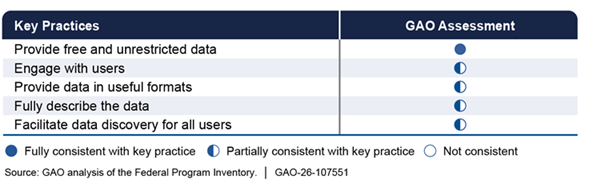
For example, the practice to fully describe the data involves an action to disclose known data quality issues and limitations. GAO found that OMB had disclosed some inventory data quality issues, such as potential discrepancies between two different sources of program spending data. GAO’s assessment identified additional quality issues, such as inactive programs being included in the inventory and missing spending data.
GAO also sought perspectives from 10 organizations that represented actual and potential inventory users. Their feedback at times aligned with GAO’s assessment. For example, five stated that the inventory would be more useful if it more clearly stated its limitations, such as identifying the types of programs not yet included and the proportion of federal spending those programs represent.
Without fully incorporating the key practices into its activities for managing the website, OMB cannot ensure that the inventory addresses relevant federal requirements or provides transparent and useful information that meets the needs of various users, such as Congress, agency leaders, and the public.
Why GAO Did This Study
A comprehensive listing of programs, along with related funding and performance information, would help federal decision-makers and the public better understand what the government does, spends, and achieves each year.
The William M. (Mac) Thornberry National Defense Authorization Act for Fiscal Year 2021 includes provisions for GAO to review program inventory implementation. This is the second report in a series of products responding to those provisions and assesses the extent to which (1) the inventory provides information consistent with statutory requirements, and (2) opportunities exist to improve the transparency and usefulness of the inventory.
To address these objectives, GAO compared the information on the January 2025 inventory website to statutory requirements and key practices for transparent and useful websites. GAO also obtained perspectives from 10 selected organizations that represented a range of actual and potential users, such as recipients of federal awards and federal agency management.
What GAO Recommends
GAO is making 17 recommendations to OMB: 13 recommendations relate to fully addressing statutory requirements to implement a complete inventory, and 4 recommendations relate to taking actions consistent with key practices for enhancing the inventory’s transparency and usefulness.
OMB did not provide comments.
|
Abbreviations |
|
|
|
|
|
API |
application programming interface |
|
CFDA |
Catalog of Federal Domestic Assistance |
|
DATA Act |
Digital Accountability and Transparency Act of 2014 |
|
GPRA |
Government Performance and Results Act of 1993 |
|
GPRAMA |
GPRA Modernization Act of 2010 |
|
GSA |
General Services Administration |
|
NDAA |
National Defense Authorization Act |
|
OMB |
Office of Management and Budget |
|
SAM.gov |
System for Award Management |
|
Treasury |
Department of the Treasury |
This is a work of the U.S. government and is not subject to copyright protection in the United States. The published product may be reproduced and distributed in its entirety without further permission from GAO. However, because this work may contain copyrighted images or other material, permission from the copyright holder may be necessary if you wish to reproduce this material separately.
March 5, 2026
Congressional Committees
Each year, the federal government spends trillions of dollars on federal programs that support the American people and address policy goals. However, it does not have a full inventory of these programs. Statutory provisions first enacted in 2011 require the Office of Management and Budget (OMB) to develop and annually update such an inventory on a publicly available website.[1]
A comprehensive listing of programs, along with related funding and performance information, would help federal decision-makers and the public better understand what the government does, what it spends, and what it achieves each year. Without a complete inventory, decision-makers lack a critical tool to help them better identify and manage fragmentation, overlap, and duplication across the federal government.
The William M. (Mac) Thornberry National Defense Authorization Act for Fiscal Year 2021 (2021 NDAA) amended and expanded requirements for OMB to develop an inventory of all federal programs.[2] OMB has made continued progress in fulfilling these requirements in recent years. As we reported in September 2024, OMB published an inventory of nearly 2,400 federal financial assistance programs in February 2024.[3] In January 2025, OMB updated and expanded the inventory to include additional information and types of programs, as we reported in May 2025.[4] According to the website, the updated inventory provides spending and other information for more than 2,600 federal programs.[5]
The 2021 NDAA also includes provisions for us to review aspects of OMB’s inventory implementation, including the extent to which the inventory provides useful information for transparency, decision-making, and oversight.[6] This is the second in a series of products responding to those provisions.[7] This report assesses the extent to which (1) the inventory provides information consistent with statutory requirements, and (2) opportunities exist to improve the transparency and usefulness of the inventory.
To address our first objective, we assessed the extent to which the information in the inventory was consistent with statutory requirements for the inventory overall as well as for individual programs.[8] We examined a variety of pages on the website that provide information about (1) the inventory and the data it presents overall, and (2) the three different types of federal programs included in the January 2025 version of the inventory: financial assistance, tax expenditures, and interest on the public debt. We randomly selected a program within each of the three types to assess.[9] To assess those overall and program-specific webpages, an analyst compared the information presented on those pages to relevant statutory requirements to determine the extent to which they were consistent. Another analyst then independently confirmed the assessment. We did not assess the extent to which the information presented on all inventory pages was accurate, complete, or available for all programs.
To address our second objective, we assessed the inventory using five key practices and 18 underlying key actions related to the transparency and usefulness of federal websites identified in our past work.[10] We used a three-point scale to determine the extent to which the inventory was consistent with each key action:
1. fully consistent—meaning the inventory was consistent with the key action;
2. partially consistent—meaning the inventory was consistent with some but not all aspects of the key action; or
3. not consistent—meaning the inventory was not consistent with the key action.
To determine consistency at the key practice level, we aggregated the key action assessment using a similar scale as follows:
1. fully consistent—meaning the inventory was consistent with all underlying key actions;
2. partially consistent—meaning the inventory was partially consistent with all underlying key actions or a mix of fully, partially, and not consistent; or
3. not consistent—meaning the inventory was not consistent with all underlying key actions.
To help illustrate the results of our assessment, we also interviewed actual and potential inventory users to obtain their perspectives on the transparency and usefulness of the inventory website and data. To do so, we identified three overall groups of users—organizations representing recipients of federal awards (such as grant awards), public users, and the federal government—and seven underlying subgroups, based on our prior work on federal government spending websites.[11]
We then selected a nongeneralizable sample of organizations that represented actual and potential inventory users within those groups and subgroups. Finally, we conducted semi-structured videoconference and written interviews with 10 selected organizations based on their availability. Appendix I provides a list of the organizations we interviewed, presented by relevant group and subgroup.
For both objectives, we relied on (1) information that was publicly available at the time of our review, such as OMB’s inventory website and related guidance, and (2) our past work related to the inventory.[12] We also sought information from OMB on its implementation of the inventory. Specifically, in March and November 2025, we asked OMB about its efforts to ensure the inventory addresses all requirements and provides useful information. As of February 2026, OMB had not provided information in response to our questions.
We conducted this performance audit from May 2024 to March 2026 in accordance with generally accepted government auditing standards.[13] Those standards require that we plan and perform the audit to obtain sufficient, appropriate evidence to provide a reasonable basis for our findings and conclusions based on our audit objectives. We believe that the evidence obtained provides a reasonable basis for our findings and conclusions based on our audit objectives.
Background
The Federal Program Inventory
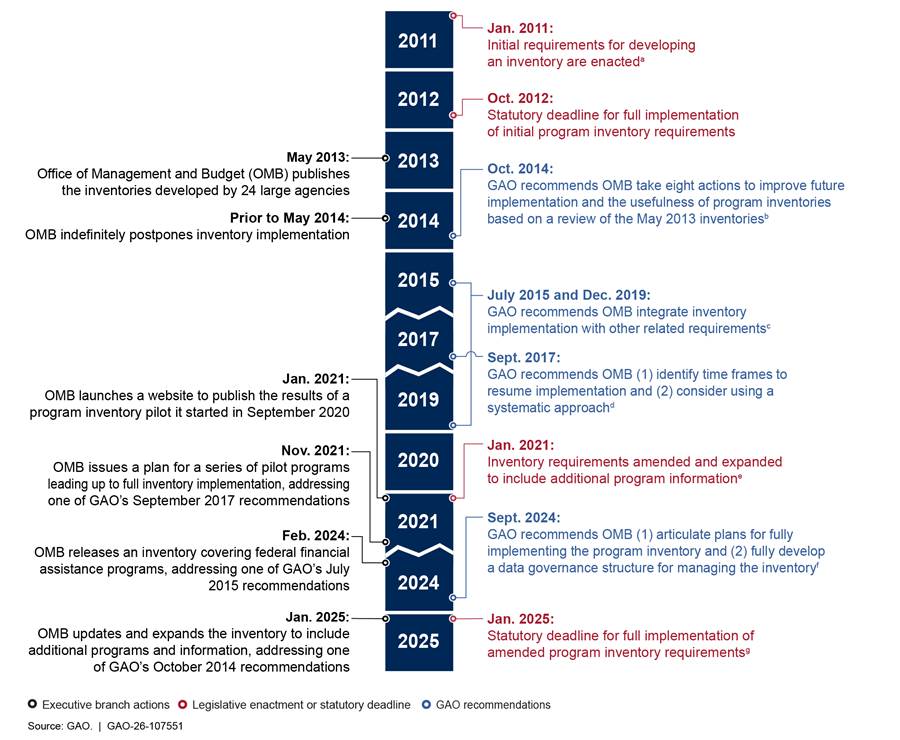
Since 2011, Congress and the Executive Branch have taken various actions to require and develop an inventory of federal programs. For example, in 2013, OMB published individual inventories developed by 24 large agencies in response to initial statutory requirements established in January 2011.[14] In 2021, Congress amended and expanded those requirements and OMB subsequently launched the federal program inventory website in February 2024.[15]
We have reviewed OMB’s efforts over time and made 14 recommendations to improve inventory implementation. Three recommendations remain open and unimplemented. We have closed 11 recommendations for various reasons:
· OMB actions, such as the addition of tax expenditures to its inventory website in January 2025, fulfilled three of our prior recommendations.
· We have closed eight recommendations as no longer valid—they have been superseded by more recent recommendations.
Appendix II provides more information about these 14 recommendations.
Figure 1 provides a timeline of key inventory milestones and actions, as well as our related past work.
aGPRA Modernization Act of 2010, Pub. L. No. 111-352, 7,124 Stat. 3866, 3876 (2011). That law updated the Government Performance and Results Act of 1993 (GPRA), Pub. L. No. 103-62, 107 Stat. 285 (1993).
bGAO, Government Efficiency and Effectiveness: Inconsistent Definitions and Information Limit the Usefulness of Federal Program Inventories, GAO‑15‑83 (Washington, D.C.: Oct. 31, 2014).
cSpecifically, we recommended that OMB integrate inventory implementation with requirements from the Digital Accountability and Transparency Act of 2014 (DATA Act), Pub. L. No. 113-101, 128 Stat. 1146 (2014), and the Program Management Improvement Accountability Act, Pub. L. No. 114-264, 130 Stat. 1371 (2016). For more information, see GAO, DATA Act: Progress Made in Initial Implementation but Challenges Must be Addressed as Efforts Proceed, GAO‑15‑752T (Washington, D.C.: July 29, 2015); and Improving Program Management: Key Actions Taken, but Further Efforts Needed to Strengthen Standards, Expand Reviews, and Address High-Risk Areas, GAO‑20‑44 (Washington, D.C.: Dec. 13, 2019), respectively.
dGAO, Managing for Results: Further Progress Made in Implementing the GPRA Modernization Act, but Additional Actions Needed to Address Pressing Governance Challenges, GAO‑17‑775 (Washington, D.C.: Sept. 29, 2017).
eWilliam M. (Mac) Thornberry National Defense Authorization Act for Fiscal Year 2021 (2021 NDAA), Pub. L. No. 116-283, div. H, 9601, 134 Stat. 3388, 4823–4828 (2021).
fGAO, Federal Programs: OMB Needs a Structure to Govern and a Plan to Develop a Comprehensive Inventory, GAO‑24‑107656 (Washington, D.C.: Sept. 25, 2024).
gThe 2021 NDAA, enacted in January 2021, requires OMB to make available online all information related to the inventory with respect to all programs not later than 3 years after enactment, or January 2024. The statute permits a 1-year extension to January 2025 based on an analysis of costs and notification of congressional committees. Pub. L. No. 116-283, div. H, 9601(b)(3), 134 Stat. at 4826–4827.
Types of Federal Programs in the Inventory
As we reported in September 2024, OMB launched a central inventory website focused on federal financial assistance listings in February 2024.[16] On the inventory website, OMB defines assistance listings as detailed public descriptions of federal programs that provide federal financial assistance such as grants, loans, scholarships, insurance, and other types of assistance awards.[17]
To develop the inventory published in 2024, OMB leveraged existing data on assistance listings from the System for Award Management (SAM.gov) and USAspending.gov.
· SAM.gov. SAM.gov is a federal government website where users can register to do business with the government, search for assistance listings, and access publicly available award data, among other purposes.[18] SAM.gov is managed by the General Services Administration (GSA).
· USAspending.gov. USAspending.gov is a federal government website that provides federal spending information.[19] This includes information about federal awards such as contracts, grants, and loans. OMB and the Department of the Treasury share responsibility for managing USAspending.gov.
In January 2025, OMB expanded the inventory to include two additional types of federal programs—tax expenditures and interest on the public debt—using data from Treasury.
· Tax expenditures. These are provisions of the tax code that can reduce how much a taxpayer owes. They include special tax credits, deductions, exclusions, exemptions, deferrals, and preferential tax rates.[20]
· Interest on the public debt. This is the product of the size of accumulated federal debt and interest rates. The federal debt is composed of (1) debt held by the public and (2) intragovernmental debt.[21]
The January 2025 version of the inventory includes 2,623 federal programs, according to the inventory website.[22] Most of those are federal financial assistance programs (2,448 or 93 percent). Approximately 7 percent of the programs in the inventory are tax expenditures (174 programs). Interest on the public debt is a single program in the inventory. Appendix III provides an example of a program page from the inventory for each of the three types of programs.
Key Practices to Help Ensure the Transparency and Usefulness of Open Government Data Websites
In October 2014, we found that to be useful, the federal program inventory must meet users’ needs.[23] That includes meeting users’ expectations for quality, including accuracy, completeness, consistency, reliability, and validity, among other factors.
In December 2018, we identified five key practices and 18 related key actions that can help agencies ensure the transparency of open government data websites, such as the federal program inventory (see fig. 2).[24] Several of the key practices and key actions also relate to ensuring open government data are useful, such as by engaging users to identify their needs and disclosing known data quality issues and limitations. We identified these key practices and actions as an approach for developing a useful inventory in January 2023.[25]
Figure 2: Key Practices and Key Actions to Help Ensure the Transparency and Usefulness of Open Government Data Websites
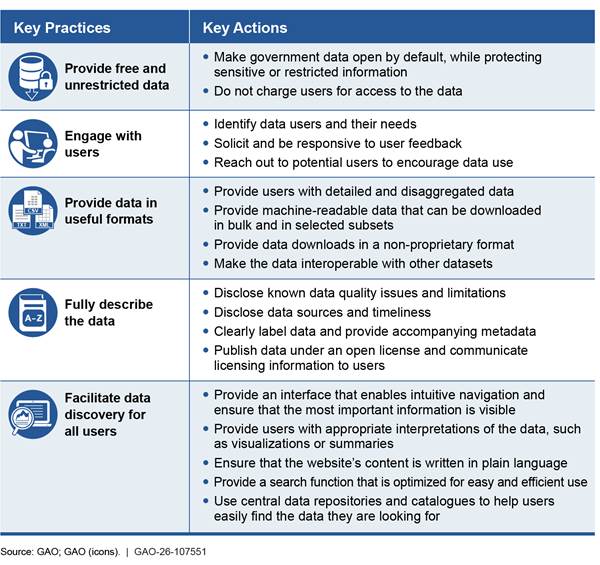
As we previously reported, implementing the five key practices can help agencies increase the availability of their open government data and promote government transparency.[26] Implementing these practices can also help agencies address relevant federal requirements for websites and open data.[27]
The Federal Program Inventory Shows Progress, but Does Not Address Requirements to Include All Programs or Information
The January 2025 version of the federal program inventory demonstrates continued progress in fulfilling statutory requirements, beyond what was included in the February 2024 version. As described earlier, the January 2025 inventory includes two additional types of federal programs: tax expenditures and interest on the public debt. In addition, we found that the inventory provides additional information for federal assistance programs in the 2025 version as compared to the 2024 version.
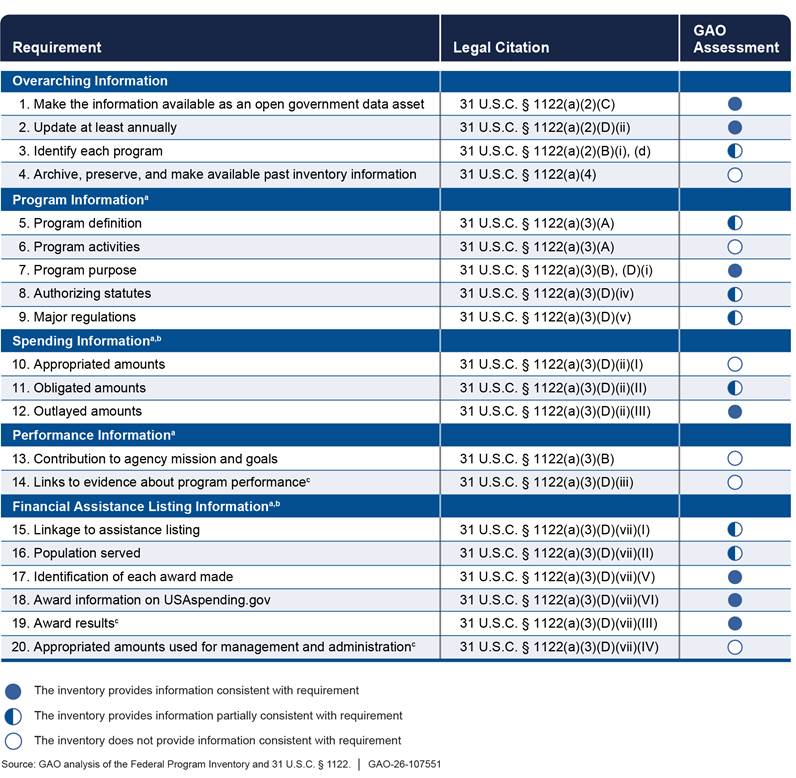
However, OMB has not yet addressed all statutory requirements for the inventory. As shown in figure 3, we organized the 20 statutory requirements into five categories: overarching information, program information, spending information, performance information, and financial assistance listing information. We found that the information provided in the January 2025 inventory is
· consistent with seven requirements;
· partially consistent with seven requirements; and
· not consistent with six requirements.
Figure 3: Extent to Which the 2025 Version of the Federal Program Inventory Provides Information Consistent with Statutory Requirements
Notes: The inventory website presents the same categories of information for programs within each program type. We assessed whether the program pages for each of the three program types in the inventory present categories of information consistent with requirements. We did not assess the extent to which the information presented is accurate, complete, or available for all programs listed in the inventory.
aThe inventory is to present information for the requirements in this category at the program activity level (and, for the program purpose and contribution to agency mission and goals requirements, also at the program level). Program activity refers to a specific activity or project listed in the program and financing schedules of the President’s budget. Program activity structures are intended to provide a meaningful representation of the operations financed by a specific budget account. The January 2025 inventory does not include program activity information. Therefore, we assessed the consistency of these requirements with the program-level information it provides.
bThe inventory is to present information for the requirements in these categories for the current and prior 2 fiscal years. For the spending information requirements, the inventory is to identify the funding by program and the amounts appropriated, obligated, and outlayed by program activity. 31 U.S.C. 1122(a)(3)(C); (D)(ii). As the inventory does not include information at the program activity level, we did not separately analyze these two provisions.
cThe inventory is to provide this information to the extent practicable (and, for the requirement to provide links to evidence about program performance, also to the extent permitted by law).
Below we present our assessment of OMB’s progress in providing information consistent with each inventory requirement.
Overarching Information
Four statutory requirements apply to the federal program inventory overall. We found that the inventory is fully consistent with two of the four overarching information requirements, as shown in figure 4.
Figure 4: Extent to Which the 2025 Version of the Federal Program Inventory Provides Information Consistent with Overarching Statutory Requirements
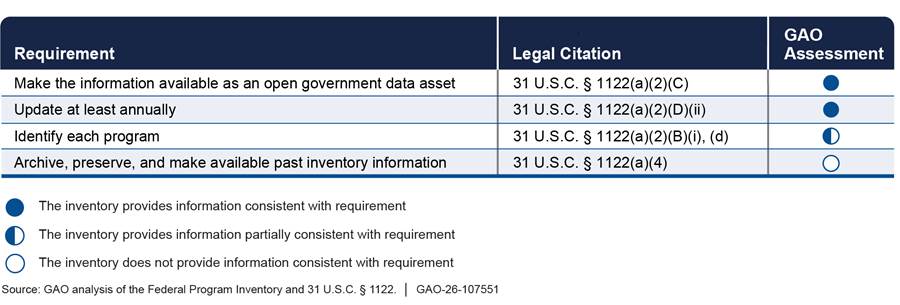
Make information available as an open government data asset: fully consistent. OMB is required to make the information provided on the inventory website available as an open government data asset.[28] We found that the inventory website provides government-produced data that can be freely used, modified, and shared by anyone for any purpose. This helps ensure that inventory information is easily accessible to federal decision-makers, stakeholders, and the public.
Update at least annually: fully consistent. OMB is required to update the data for each program in the inventory at least annually.[29] As was noted earlier, OMB updated the inventory website and its data in January 2025, less than a year after the initial February 2024 launch.[30] Regular updates help show how programs change and ensure decision-makers, stakeholders, and the public have access to recent information.
Identify each program: partially consistent. The inventory is to identify each federal program to provide a coherent picture of all federal programs.[31] As described earlier, the 2025 version of the inventory includes three types of federal programs: financial assistance, tax expenditures, and interest on the public debt. However, the federal government administers various types of programs that are not yet included in the inventory, such as acquisition, defense, direct service, foreign assistance, and regulatory programs.
For context on the scope of the programs not included in the inventory, the federal government obligated approximately $9.7 trillion in fiscal year 2024, according to USAspending.gov. Therefore, the $5.9 trillion in fiscal year 2024 obligations for financial assistance programs and interest on the public debt in the 2025 inventory represent approximately 61 percent of federal spending.[32]
In March 2025, we asked OMB whether it had developed a list of the remaining types of federal programs needed to develop a complete inventory. As of February 2026, OMB had not responded to our question. Without identifying and including all federal program types, it is difficult to determine the scope of the federal government’s investments in particular areas.
Archive, preserve, and make available past inventory information: not consistent. OMB is required to preserve and make publicly available as an open government data asset an archive of historical inventory information.[33] We found that OMB did not publish on the inventory website an archive of the February 2024 version after its January 2025 update.[34] Therefore, the information that had been previously presented on the February 2024 inventory is no longer available. Without archiving, preserving, and making all data from each prior version of the inventory available, users cannot compare past and current inventory information to see how individual (or sets or all) programs have changed over time. Users also cannot see how the inventory overall has evolved.
Program Information
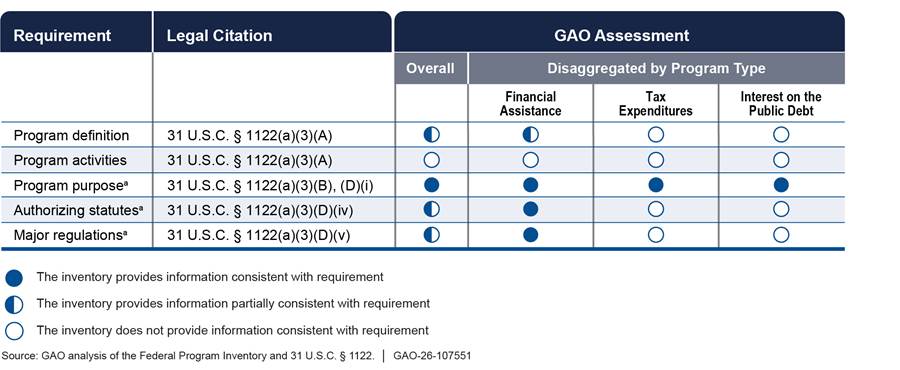
The federal program inventory is required to provide specific information for each program, such as describing its purpose. In general, we found that the inventory is partially consistent in providing this program information, as shown in figure 5.
Figure 5: Extent to Which the 2025 Version of the Federal Program Inventory Provides Program Information Consistent with Statutory Requirements
Notes: The inventory website presents the same categories of information for programs within each program type. We assessed whether the program pages for each of the three program types in the inventory present categories of information consistent with requirements. We did not assess the extent to which the information presented is accurate, complete, or available for all programs listed in the inventory.
aThe inventory is to present information for these requirements at the program activity level (and, for the program purpose requirement, also at the program level). Program activity refers to a specific activity or project listed in the program and financing schedules of the President’s budget. Program activity structures are intended to provide a meaningful representation of the operations financed by a specific budget account. The January 2025 inventory does not include program activity information. Therefore, we assessed the consistency of these requirements with the program-level information it provides.
Program definition: partially consistent. The inventory is to identify how each program is defined, consistent with guidance from OMB.[35] We found that (1) the inventory does not identify how each of the three program types is defined, and (2) OMB has not issued guidance to help agencies consistently identify all types of programs.
The inventory provides a definition for federal financial assistance programs. According to the inventory, a federal financial assistance program is “an individual financial assistance listing as submitted by agencies to SAM.gov.” OMB further defines assistance listings as “detailed public descriptions of federal programs that provide federal financial assistance such as grants, loans, scholarships, insurance, and other types of assistance awards.”
In addition, OMB has provided some guidance to agencies to help them consistently implement the definition of a federal financial assistance program and only include active programs in the inventory. In an April 2024 memorandum, OMB stated that each financial assistance listing reported on SAM.gov should represent a single federal program.[36] OMB instructed agencies to take steps to ensure existing and new assistance listings follow this guidance.[37] In July 2024, OMB provided guidance to ensure that SAM.gov—and therefore the program inventory—only presents information about active financial assistance programs.[38]
However, the inventory does not provide similar definitions for tax expenditures or interest on the public debt.[39] In addition, OMB has not issued guidance to help ensure those programs are consistently identified and active, as it has for financial assistance programs. As a result, we found that the inventory includes at least four tax expenditures that appear to be no longer active, based on information reported in the inventory and by Treasury.[40]
Without clear definitions and related implementation guidance for all program types, agencies could apply different definitions to their programs and incorrectly include or exclude activities as programs in the inventory. Moreover, without clear definitions, users cannot fully understand how programs may differ, which could affect the usefulness of the inventory and its information.
Our past work reviewing the program inventories agencies developed in 2013 identified similar issues with OMB providing sufficient definitions and related implementation guidance, which resulted in variations and inconsistencies across agencies and programs (see text box).
|
Flexible OMB Guidance Led to Inconsistent Program Definitions in Past Inventories In October 2014, we found that OMB issued guidance allowing agencies flexibility to define their programs using different approaches, but within a broad definition of what constitutes a program—a set of related activities directed toward a common purpose or goal.a In May 2013, OMB published the inventories developed by 24 agencies, which used various approaches, such as their budget or organizational structures, to define and identify 1,524 programs. Because agencies used different approaches, similar programs across agencies were not always identifiable. For example, we were unable to identify in 13 agencies’ inventories a large majority of the 158 science, technology, engineering, and mathematics education identified in our past work. Nine programs were an exact match based on names. For instance, both the Department of Education’s inventory and our past work had identified “Mathematics and Science Partnerships” as a program related to science, technology, engineering, and mathematics education. Beyond the nine exact matches, we were able to identify an additional 42 programs based on related information contained in program descriptions in relevant agency inventories. One of OMB’s stated purposes for the inventories was to facilitate coordination among programs that contribute to similar outcomes. However, agencies did not work together to consistently define their programs. Increased coordination could help agencies identify where they have programs that contribute to similar goals and thus, opportunities to collaborate in achieving desired outcomes. We recommended that OMB revise relevant guidance to direct agencies to collaborate with each other in defining and identifying programs that contribute to common outcomes. OMB agreed with this recommendation and had taken limited action in response to it, as of February 2026. In March 2026, we closed this recommendation as no longer valid based on the updated findings and recommendations in this report. |
Source: GAO. | GAO‑26‑107551
aGAO, Government Efficiency and Effectiveness: Inconsistent Definitions and Information Limit the Usefulness of Federal Program Inventories, GAO‑15‑83 (Washington, D.C.: Oct. 31, 2014).
|
Program Activities “Program activity” is defined as a specific activity or project as listed in the program and financing schedules of the annual budget of the United States Government. 31 U.S.C. 1115(h)(11). Program activity structures are intended to provide a meaningful representation of the operations financed by a specific budget account—usually by project, activity, or organization. Each structure is tailored to the individual account and is not uniform across the government. For additional information, see GAO, A Glossary of Terms Used in the Federal Budget Process, GAO‑05‑734SP (Washington, D.C.: Sep. 1, 2005) Source: U.S. Code and GAO. | GAO‑26‑107551 |
Program activities: not consistent. As part of defining a program, the inventory is to identify the program activities that are aggregated, disaggregated, or consolidated to be considered a program by an agency.[41] OMB has not yet included program activity information in the inventory. Without this information, inventory users cannot identify the connections between the programs (and underlying activities) that agencies implement and the funding that is requested, appropriated, and spent through the federal budget process.[42] It limits the usefulness of the inventory in providing a comprehensive picture of the federal government’s spending.
Our past work has examined challenges in identifying the relationship between program activities and programs (see text box). Figure 6 shows several potential relationships identified by our past work to illustrate the complexities in making these connections.
|
Multiple Possible Relationships Exist Between Programs and Program Activities In September 2017, we developed a series of iterative steps that OMB could use to develop a useful inventory, along with the potential benefits of following this approach.a We also identified potential challenges OMB and agencies may face in developing a complete inventory, including identifying the relationship between programs and program activities. For that report, we compared 24 agencies’ financial assistance programs, as identified in the Catalog of Federal Domestic Assistance (the precursor to Assistance Listings on SAM.gov), to program activity information from the agencies’ budget. We found that · the relationships between financial assistance programs and program activities within the same appropriation account varied significantly by agency, but overall, it was unclear for all agencies; and · there are multiple possible relationships between financial assistance programs and agency program activities. |
Source: GAO. | GAO‑26‑107551
aGAO, Federal Programs: Information Architecture Offers a Potential Approach for Development of an Inventory, GAO‑17‑739 (Washington, D.C.: Sept. 28, 2017).
Figure 6: Potential Relationships Between a Selection of Department of Education Program Activities and Catalog of Federal Domestic Assistance (CFDA) Programs
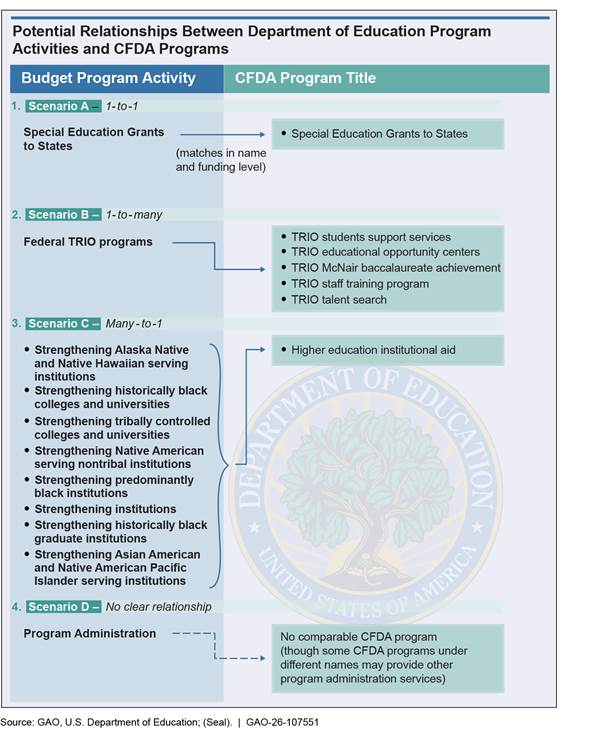
Notes: The Catalog of Federal Domestic Assistance (CFDA) was integrated into the System for Award Management (SAM.gov) in 2018. The Assistance Listings section on SAM.gov now houses information about federal financial assistance programs. We conducted this analysis in 2017 and originally published it in GAO, Federal Programs: Information Architecture Offers a Potential Approach for Development of an Inventory, GAO‑17‑739 (Washington, D.C.: Sept. 28, 2017).
Program purpose: fully consistent. The inventory is to describe the purpose of each program.[43] We found that the program pages for all three program types include a section that provides a description of program purpose. This information helps users understand what each program is seeking to achieve.
Authorizing statutes: partially consistent. The inventory is to identify the statutes that authorize each program.[44] The financial assistance program pages include a section that provides authorizing statues, but the program pages for tax expenditures and interest on the public debt do not. Without this information, users cannot easily access the law(s) that guide each program, to understand the activities it should be undertaking and the period of time for which it should be operating.
Major regulations: partially consistent. The inventory is to identify any major regulations specific to each program.[45] We similarly found that the financial assistance program pages include a section that provides major regulations, but the program pages for tax expenditures and interest on the public debt do not. Without this information, users cannot easily access the regulations that guide each program’s implementation, to understand how it should be operating.
Figure 7 shows the program purpose, authorizing statute, and major regulations identified in the inventory for one financial assistance program: the National School Lunch Program.
Figure 7: Example of Certain Program Information Provided for a Financial Assistance Program in the 2025 Version of the Federal Program Inventory
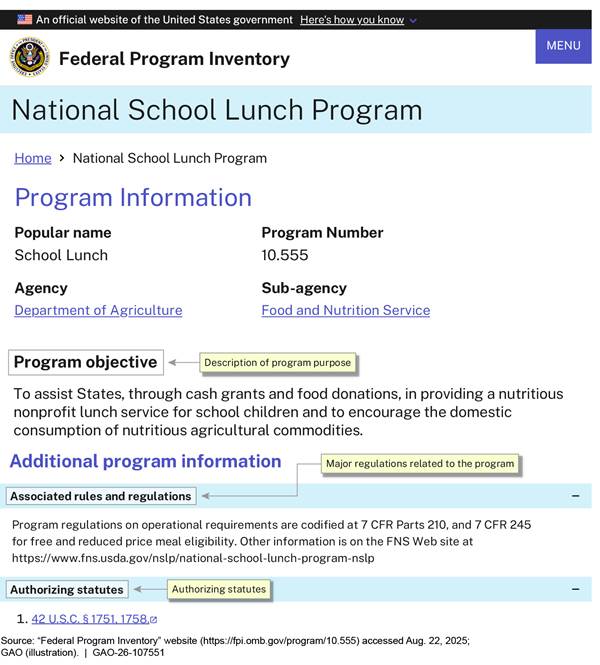
Notes: CFR = Code of Federal Regulations; FNS = Food and Nutrition Service.
Spending Information
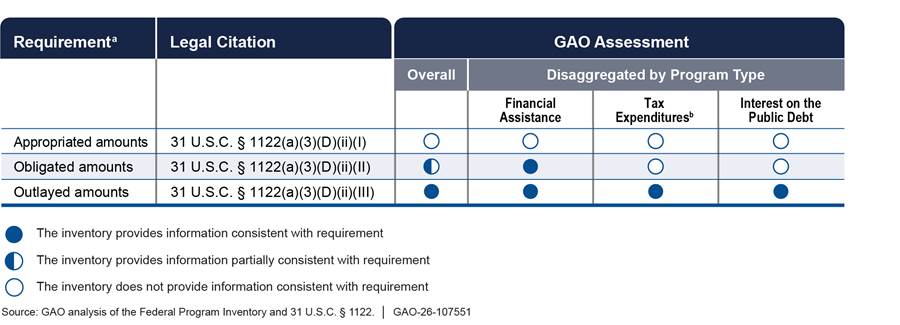
OMB is required to identify spending information for each program in the inventory for the current and prior 2 fiscal years. We found variation across these requirements and by program type (see fig. 8).
Figure 8: Extent to Which the 2025 Version of the Federal Program Inventory Provides Spending Information Consistent with Statutory Requirements
Notes: The inventory website presents the same categories of information for programs within each program type. We assessed whether the program pages for each of the three program types in the inventory present categories of information consistent with requirements. We did not assess the extent to which the information presented is accurate, complete, or available for all programs listed in the inventory.
aThe inventory is to present information for these requirements at the program activity level for the current and prior 2 fiscal years. Program activity refers to a specific activity or project listed in the program and financing schedules of the President’s budget. Program activity structures are intended to provide a meaningful representation of the operations financed by a specific budget account. The January 2025 inventory does not include program activity information. Therefore, we assessed the consistency of these requirements with the program-level information it provides.
bAs tax expenditures result in foregone revenue, they may not have an appropriation or obligations. In those cases, OMB could provide comparable information or an explanation of why providing the required information is not practicable.
Appropriated amounts: not consistent. The inventory is to provide the amounts appropriated—the amounts that the federal government may spend during a specified period—for the current and prior 2 fiscal years for each program.[46] We found that the inventory does not provide appropriated amounts for any of the three program types, or explain why providing this information may not be practicable.[47] Given the unique nature of interest on the public debt and tax expenditures, we identified comparable information that the inventory could provide for those program types in lieu of appropriated amounts.[48] Without appropriated amounts or comparable information, inventory users lack information to understand the amounts available to spend for individual programs. This limits the inventory’s usefulness as a tool to provide a comprehensive picture of what the federal government has made available to spend each year.
Obligated amounts: partially consistent. The inventory is to provide the amounts obligated—the amounts the federal government legally committed to pay for goods and services—for the current and prior 2 fiscal years for each program.[49] We found that the financial assistance program pages include a section that provides obligated amounts for fiscal years 2023, 2024, and 2025. However, the program pages for tax expenditures and interest on the public debt do not provide obligated amounts (or explain why providing this information may not be practicable).[50] Without this information, inventory users lack information to understand what the federal government committed to spend for individual programs. This limits the inventory’s usefulness as a tool to provide a comprehensive picture of what the federal government has committed to spend each year.
Outlayed amounts: fully consistent. The inventory is to provide the amounts outlayed—the amounts to liquidate a federal obligation by issuing checks, disbursing cash, or electronically transferring funds—for the current and prior 2 fiscal years.[51] We found that the program pages for all three program types include a section that provides outlayed amounts for fiscal years 2023, 2024, and 2025.[52] Providing this information helps users understand what the federal government actually spent for each program in a given year.
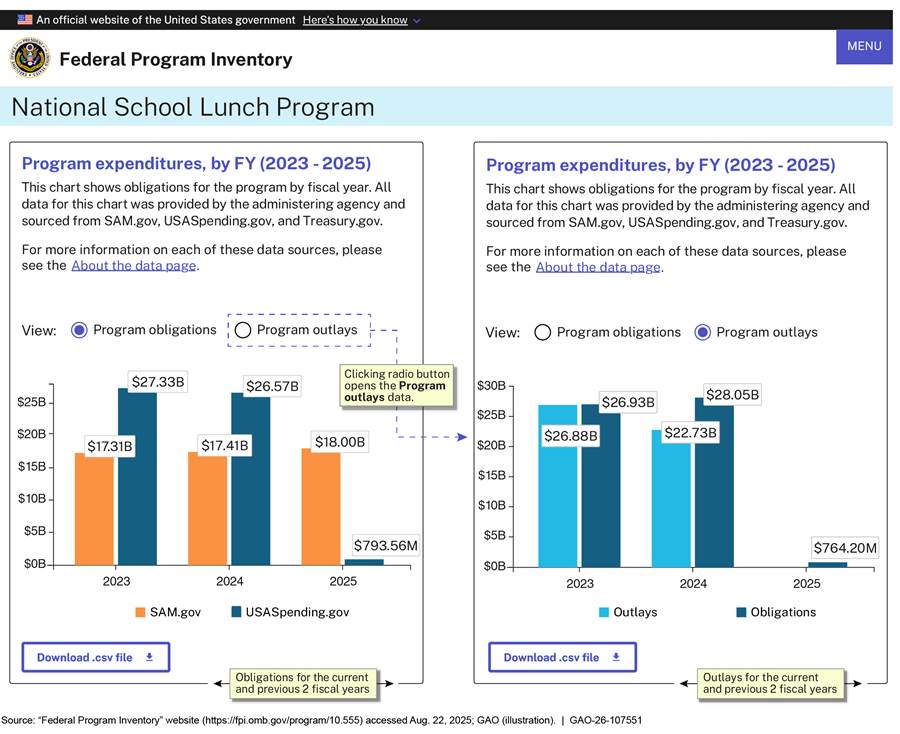
Figure 9 shows the obligation and outlay data provided for a financial assistance program: the National School Lunch Program.
Figure 9: Example of Spending Information Provided for a Financial Assistance Program in the 2025 Version of the Federal Program Inventory
Note: FY = fiscal year.
Performance Information
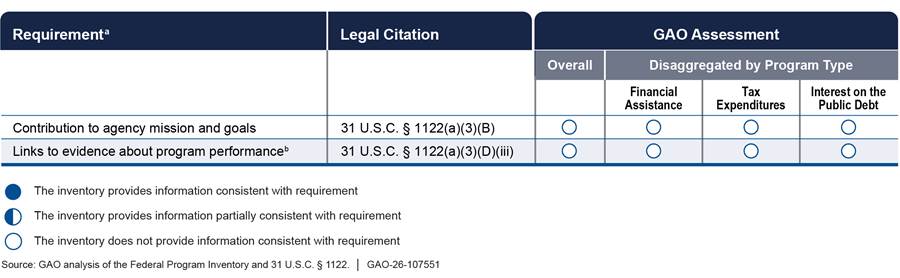
The inventory is required to—but does not yet—provide information about the performance of each program and how it contributes to agency mission and goals, as shown in figure 10.
Figure 10: Extent to Which the 2025 Version of the Federal Program Inventory Provides Performance Information Consistent with Statutory Requirements
Notes: The inventory website presents the same categories of information for programs within each program type. We assessed whether the program pages for each of the three program types in the inventory present categories of information consistent with requirements. We did not assess the extent to which the information presented is accurate, complete, or available for all programs listed in the inventory.
aThe inventory is to present information for these requirements at the program activity level (and at the program level for contribution to agency mission and goals). Program activity refers to a specific activity or project listed in the program and financing schedules of the President’s budget. Program activity structures are intended to provide a meaningful representation of the operations financed by a specific budget account. The January 2025 inventory does not include program activity information. Therefore, we assessed the consistency of these requirements with the program-level information it provides.
bThe inventory is to provide this information to the extent practicable and permitted by law.
Contribution to agency mission and goals: not consistent. The inventory is to describe the contribution of each program to the agency’s mission and goals (see text box below for definitions).[53] However, it does not yet do so, although OMB has taken some initial steps to provide some of this information for one type of program, which we describe further below. Without this information, inventory users will not understand how individual programs contribute to the results the federal government plans to achieve.
|
Description of Mission and Various Federal Goals Since 1993, various laws and OMB guidance have established a federal performance management framework, which requires agencies to develop mission statements and a hierarchy of goals.a Mission statement: As part of their strategic plans, agencies are to identify a comprehensive mission statement covering the major functions and operations of the agency. 5 U.S.C. 306(a)(1). Strategic goals: These goals are outcome-oriented statements of aim or purpose. They articulate what the agency wants to achieve to advance its mission and address relevant problems, needs, challenges, and opportunities. 5 U.S.C. 306(a)(2). Strategic objectives: These goals break strategic goals down into the outcomes or impacts the organization is intending to achieve through its various activities. They are usually outcome-oriented to reflect core mission and service-related functions, as well as the breadth of the organization’s efforts. 5 U.S.C. 306(a)(2). Performance goals: These goals break broader goals (cross-agency priority goals or strategic objectives) down into target levels of performance to be accomplished within a time frame. They are generally expressed as tangible, measurable objectives, or as quantitative standards, values, or rates. 31 U.S.C. 1115(a)(1), (b)(1). Agency priority goals: These goals are a subset of performance goals that have been designated as priorities by the heads of certain agencies, in consultation with OMB, every 2 years. 31 U.S.C. 1120(b)(1). Cross-agency priority goals: These goals are developed by OMB, in conjunction with agencies. They are broad, 4-year outcome-oriented crosscutting goals covering a limited number of mission areas, as well as goals to improve management across the federal government. Agencies are to indicate how their performance goals and priority goals align with these goals, to help show agencies’ contributions to these government-wide efforts. 31 U.S.C. 1120(a). |
Source: GAO analysis of relevant laws and OMB guidance. | GAO‑26‑107551
aOMB’s guidance for this framework is Circular No. A-11, Preparation, Submission, and Execution of the Budget, pt 6 (August 2025). Through this guidance, OMB established and defined strategic goals and objectives as two different types of goals.
OMB has taken limited action to include some of this information in the inventory in the future, but not for all programs. In August 2025 guidance, OMB stated that, to support continued implementation of the inventory, agencies would be required to identify—and regularly update—a mapping of inventory programs that contribute to agency strategic goals and objectives.[54] However, the guidance focuses on providing this information for federal financial assistance programs only, as part of updates to assistance listings on SAM.gov. In addition, it does not direct agencies to identify how their programs contribute to their mission or other types of goals. Our past work found similar issues with OMB’s guidance, and in OMB ensuring agencies provided this information, for the 2013 inventories (see text box).
|
OMB’s Guidance and Agencies Did Not Identify All Relevant Goals in Past Inventories In October 2014, we found that the inventories 24 agencies published in May 2013 did not always describe their programs’ contributions to their missions and goals:a · Only a few inventories (four of 24) identified how the agencies’ programs contribute to their mission. (We noted at that time that, because agency strategic goals and objectives are an outgrowth of the agency’s mission, the linkage between agency programs and those goals can show the program’s support to the mission.) · A majority of the inventories (17 of 24) identified the agency strategic goals each program supported. · Less than half of the inventories (11 of 24) identified the agency strategic objectives each program supported. · Most of the inventories (20 of 24) referred readers to Performance.gov for information about how the agencies’ programs support both cross-agency priority goals and agency priority goals. We also found that OMB’s guidance did not direct agencies to identify in their inventories the performance goals to which each program contributes. We recommended that OMB (1) revise relevant guidance to direct agencies to identify in their inventories the performance goal(s) to which each program contributes, and (2) ensure, during OMB reviews of inventories, that agencies consistently identify, as applicable, the strategic goals, strategic objectives, agency priority goals, and cross-agency priority goals each program supports. OMB neither agreed nor disagreed with the first recommendation and agreed with second. However, it had taken limited action in response to these recommendations, as of February 2026. In March 2026, we closed these recommendations as no longer valid based on the updated findings and recommendations in this report. |
Source: GAO. | GAO‑26‑107551
aGAO, Government Efficiency and Effectiveness: Inconsistent Definitions and Information Limit the Usefulness of Federal Program Inventories, GAO‑15‑83 (Washington, D.C.: Oct. 31, 2014).
As we reported in September 2024, OMB staff told us in July 2024 that they planned to further leverage existing data sources for the inventory, such as the performance information available on Performance.gov.[55] That website exists to communicate government-wide and agency performance information—including agency mission statements and the five types of goals described earlier.[56] Agencies are to identify the programs that contribute to most of the goals reported on Performance.gov.[57] Cross-linking between the inventory website and Performance.gov could help both sites leverage existing information to meet relevant requirements.
Links to evidence about program performance: not consistent. To the extent practicable and permitted by law, the inventory is to include links (i.e., hyperlinks) to evidence related to each program (see text box for more information).[58] Evidence can include performance information, program evaluations, statistical data, and other research and analysis. The inventory does not yet include any links to relevant evidence, but OMB has taken some initial steps to provide some of this information for one type of program, which we describe further below. Without linking to available evidence about program performance for all programs, federal decision-makers and the public are missing information that could help them better understand how efficiently and effectively federal programs are operating.
|
Potential Sources of Evidence Related to Program Performance As appropriate, the inventory is to include links to any related evaluation, assessment, or program performance review developed by the agency, an inspector general, or us. Below is further information about potential sources of evidence and where they can be found. Agency evidence. Agencies produce a range of evidence about their programs and activities, available in a few places including the following: · Evidence plans. Agencies are required to develop 4-year evidence-building plans (also referred to as learning agendas) that identify policy questions and the evidence that the agency expects to develop to address them. 5 U.S.C. 312(a). Annually, agencies are to develop evaluation plans describing the activities they plan to conduct as part of their agency evidence-building plans. 5 U.S.C. 312(b). In August 2025 guidance, OMB directed agencies to consolidate these two plans into a single Evidence Plan, beginning in 2026. These plans are to be posted on agency websites and centrally on Evaluation.gov. Those websites and others make the resulting evidence publicly available. · Agency performance reports. These annual reports provide an update on agency performance by comparing the performance the agency achieved against the performance goals established in the agency’s annual performance plan. 31 U.S.C. 1116. Both the plan and report are to be made available on the agency’s website as well as centrally on Performance.gov. GAO reports and other work. We are an independent, non-partisan professional services agency in the legislative branch of the federal government. We examine how taxpayer dollars are spent and develop non-partisan, objective, and reliable information to advise lawmakers and agency heads on ways to make government work better. Our work, which includes reports, testimonies, and legal decisions, among other things, is made available on our website, GAO.gov. Inspector General reports and other work. Under the Inspector General Act of 1978, as amended, the role of a federal Inspector General is to prevent and detect waste, fraud, and abuse relating to their agency’s programs and operations, and to promote economy, efficiency, and effectiveness in the agency’s operations and programs. 5 U.S.C. 402(b). Offices of Inspector General are located within their agencies but must conduct their audits, investigations, evaluations, and special reviews independently from their agencies. The results of each agency Office of Inspector General’s work are available on its website. In addition, Oversight.gov makes available all public reports from federal Offices of Inspector General that are members of the Council of the Inspectors General on Integrity and Efficiency. |
Source: GAO. | GAO‑26‑107551
In its January 2025 update to the inventory, OMB added a section for oversight reports to the pages for financial assistance programs and tax expenditures. In that section, the inventory states OMB is working with agency inspectors general and us to add links to relevant oversight reports.[59] However, as of February 2026, the inventory does not provide links to those reports or a timeline for when they will be included. The inventory also does not indicate if and when such information will be provided for the third program type, interest on the public debt.
In addition, in August 2025, OMB issued guidance that directed agencies to take steps that could more easily link future agency-developed evidence to financial assistance programs in the inventory. Specifically, OMB directed agencies, beginning in 2026, to include in their evidence plans the applicable federal assistance listing title and number (as described in the federal program inventory) for the evidence-building activities covered by those plans.[60]
While both above actions are promising steps towards linking evidence to programs in the inventory, neither have been implemented yet, nor do they cover all programs.
Financial Assistance Listing Information
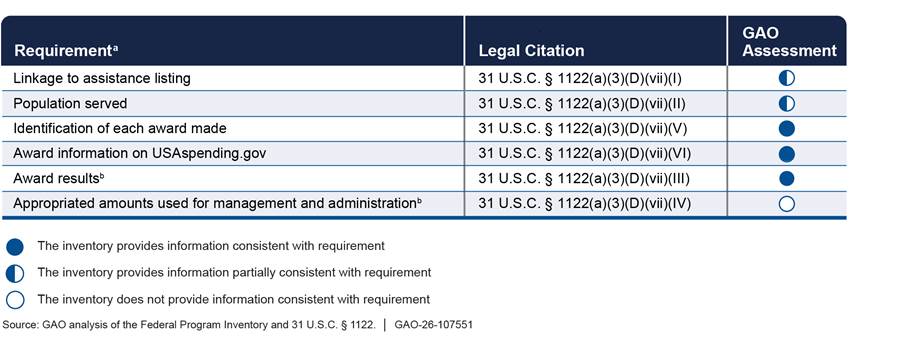
The inventory is to provide additional information for financial assistance listings. Our assessment found that OMB provided information that is fully or partially consistent with five of the six requirements, as shown in figure 11.
Figure 11: Extent to Which the 2025 Version of the Federal Program Inventory Provides Financial Assistance Listing Information Consistent with Statutory Requirements
Notes: The inventory website presents the same categories of information for programs within each program type. We assessed whether the program pages for financial assistance programs in the inventory present categories of information consistent with the additional requirements for financial assistance listings. We did not assess the extent to which the information presented is accurate, complete, or available for all financial assistance programs listed in the inventory.
aThe inventory is to present information for these requirements at the program activity level for the current and prior 2 fiscal years. Program activity refers to a specific activity or project listed in the program and financing schedules of the President’s budget. Program activity structures are intended to provide a meaningful representation of the operations financed by a specific budget account. The January 2025 inventory does not include program activity information. Therefore, we assessed the consistency of these requirements with the program-level information it provides.
bThe inventory is to provide this information to the extent practicable.
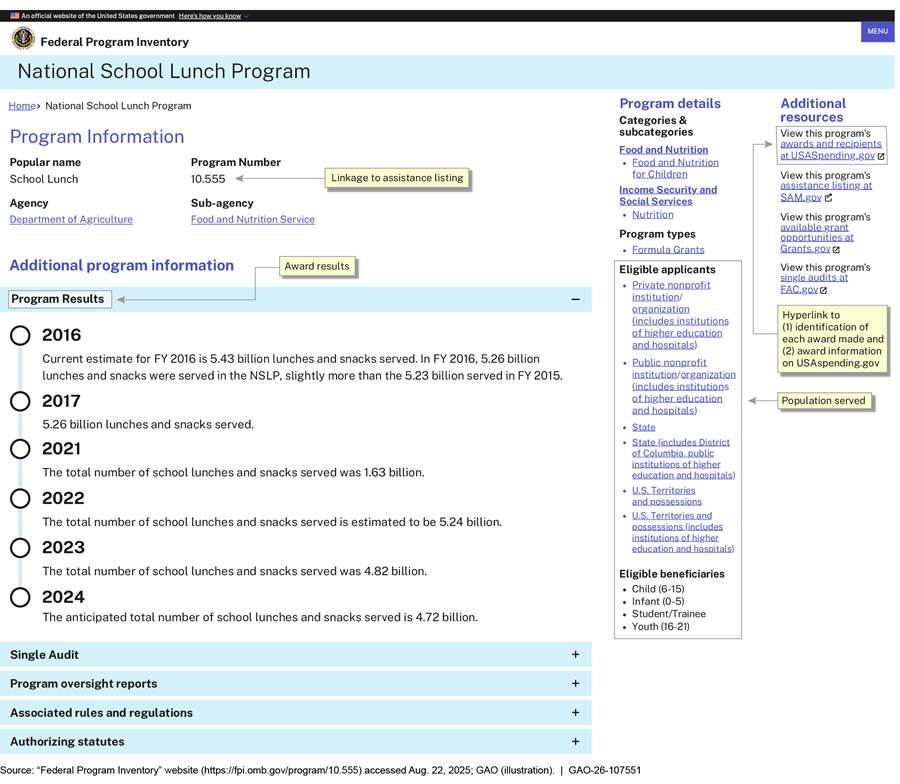
Linkage to assistance listing: partially consistent. The inventory is to identify the connection between federal financial assistance programs and federal financial assistance listings.[61] As discussed earlier in this report, OMB identified the financial assistance programs in the inventory based on individual assistance listings on SAM.gov. In addition, the financial assistance program pages in the inventory provide the assistance listing numbers (unique identifiers used on SAM.gov).
However, this information is linked to fiscal year 2025 information on SAM.gov (the current year when the inventory was updated). It does not identify if the information had been the same or changed in the prior 2 fiscal years. Without this information, users cannot easily access past assistance listings to learn more about these programs and how they have changed from year to year.
Population served: partially consistent. The inventory is to provide information on the population intended to be served by each financial assistance program.[62] We found that the inventory provides information on eligible applicants and beneficiaries on the financial assistance program pages. However, it does not identify the fiscal years for which this information is relevant. Without clearly providing this information for the current and prior 2 fiscal years, users cannot easily learn about a program’s eligible applicants and beneficiaries and how they may have changed over time for various reasons (e.g., expansion or restriction of populations served during reauthorizations, through annual appropriations, etc.).
Identification of each award made: fully consistent. The inventory is to identify each award made and, to the extent practicable, the name of each direct or indirect recipient of the award.[63] The financial assistance program pages provide a link to USAspending.gov, which identifies each award made for the current and prior 2 fiscal years. By providing this information, inventory users have a fuller understanding of which organization or individual received each financial assistance award, providing greater transparency on federal program spending information.
Award information on USAspending.gov: fully consistent. The inventory is to provide any award information for each financial assistance program that is required to be included on USAspending.gov.[64] The financial assistance program pages provide links to relevant award information on USAspending.gov for the current and prior 2 fiscal years. By providing this information, inventory users can access additional information about each financial assistance award, providing greater transparency on federal program spending information.
Award results: fully consistent. The inventory is to provide information on the results of the financial assistance awards, to the extent practicable and based on data reported to the agency administering the assistance program.[65] The financial assistance program pages include a section that provides information on award results, based on the information agencies reported on SAM.gov, sometimes for multiple fiscal years. By providing this, inventory users can more easily access information to learn what the federal government achieved with its spending for federal financial assistance programs.
Figure 12 shows information related to the five financial assistance listing requirements described above for one program in the inventory, the National School Lunch Program.
Figure 12: Example of Financial Assistance Information Provided for a Program in the 2025 Version of the Federal Program Inventory
Appropriated amounts used for management and administration: not consistent. The inventory is to identify, to the extent practicable, the percentage of appropriated amounts used for management and administration of the federal financial assistance listing.[66] The inventory does not provide these amounts or an explanation for why doing so is not practicable.[67] Without information on the amounts used for a program’s management and administration, federal decision-makers cannot evaluate if these costs are reasonable or potentially identify ways to improve management efficiency.
Opportunity for OMB to Address Inventory Requirements Through Implementation Plans
In September 2024, we found that OMB was taking an iterative approach to implement the inventory over time.[68] OMB did not have plans to guide those efforts and ensure that all requirements were met by the January 2025 statutory deadline. As a result, its update to the inventory in January 2025 did not address multiple requirements, as discussed above.
In September 2024, we recommended that OMB publicly articulate plans that lay out the actions, resources, and time frames needed to fully implement the inventory. OMB generally agreed with this recommendation. However, as of February 2026, OMB did not have any updates on its planning efforts, nor had it publicly articulated such plans.
Without implementation plans that cover all required programs and information, OMB has not positioned itself to develop a comprehensive inventory. An incomplete inventory is limited in its effectiveness as a tool for Congress and the public to oversee and understand what the federal government does, spends, and achieves through its programs.
Opportunities Exist to Improve the Transparency and Usefulness of the Federal Program Inventory
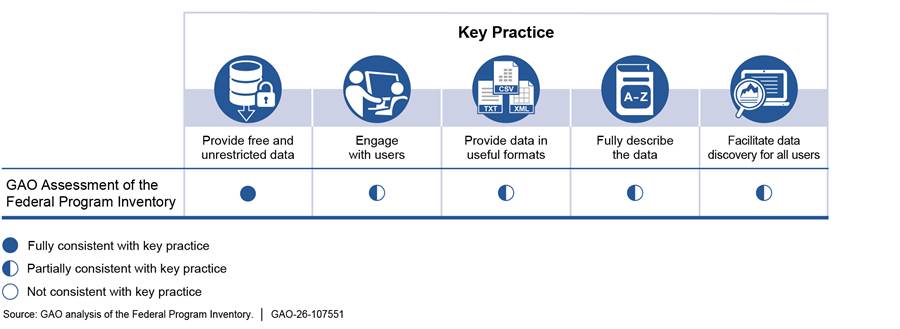
We determined that the inventory is not fully consistent with four out of five key practices for enhancing the transparency and usefulness of open government data websites (see fig. 13).[69] Of the 18 key actions related to those practices, the inventory is fully consistent with three and partially consistent with 15. Without fully addressing the key practices and actions, OMB lacks assurance that the inventory and its data are (1) consistent with relevant federal requirements for websites and open data, and (2) sufficiently transparent and useful to meet various users’ needs.
Figure 13: Extent to Which the 2025 Version of the Federal Program Inventory Is Consistent with Key Practices to Help Ensure the Transparency and Usefulness of Open Government Data Websites
We obtained input through interviews or written feedback from a nongeneralizable sample of 10 organizations that represent actual and potential inventory users (henceforth referred to as potential user organizations). Representatives from these organizations provided their perspectives on information on the website that they found useful for their work. They also identified tools and features that enhanced their user experience. In addition, they shared views on information and tools that would improve the transparency, use, and usefulness of the inventory for their purposes.
Below we provide the results of our assessment, along with potential user organization perspectives related to the key practices and actions, as appropriate.
Practice 1: Provide Free and Unrestricted Data
We found that the inventory was available to users without restrictions, fully consistent with this key practice and the two related key actions (see fig. 14).[70] By making the inventory freely and equally available to all users, OMB helped increase the transparency of the program and spending information it contains.
Figure 14: Extent to Which the 2025 Version of the Federal Program Inventory Is Consistent with the Key Practice and Key Actions for Providing Free and Unrestricted Data
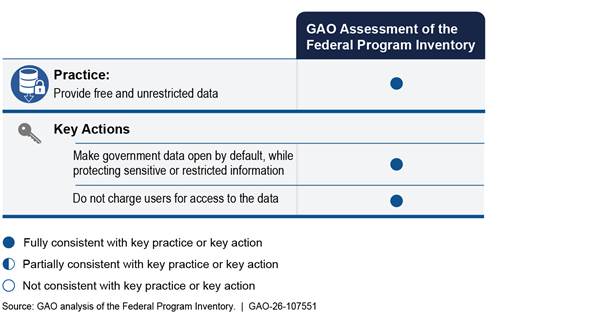
Make government data open by default, while protecting sensitive or restricted information: fully consistent. According to key actions for providing free and unrestricted data, agencies should make government data open by default, while protecting sensitive or restricted information.[71] Inventory data are publicly available as an open government data asset, as discussed earlier in this report. The data do not contain sensitive or restricted information because OMB used existing sources of open government data—SAM.gov, Treasury.gov, and USAspending.gov—to develop and update the inventory. By making inventory data open by default, OMB helped ensure that the data are equally open to all types of users.
Do not charge users for access to the data: fully consistent. According to key actions for providing free and unrestricted data, agencies should not charge users for access to the data.[72] OMB provides the inventory data on a federal government website at no cost to users. By providing data for free, OMB helped ensure equitable access to users independent of their ability to pay.
Practice 2: Engage with Users
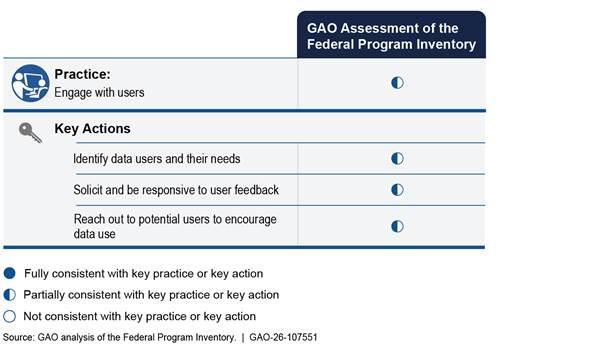
We found that OMB engaged with inventory users in ways that are partially consistent with the key practice and the three related key actions, as shown in figure 15. Our prior work has found that open government data only create value to the extent that they are used.[73]
Figure 15: Extent to Which the 2025 Version of the Federal Program Inventory Is Consistent with the Key Practice and Key Actions for Engaging with Users
OMB engaged with various stakeholders (i.e., potential users) after it launched the initial inventory in February 2024. For example, we reported in September 2024 that OMB reached out to potential users—including Congress, federal agency leaders, and professional organizations—and solicited feedback on the usefulness of the inventory.[74] In addition, as described below, OMB took some actions in response to that feedback when it updated the inventory in January 2025.
However, as of February 2026, OMB had not provided us with information about actions it had taken related to engaging with users since our September 2024 report. In March 2025, we asked OMB about any actions it has taken to (1) identify users and their needs, (2) solicit and respond to user feedback, and (3) reach out to potential users to encourage use of the inventory. Only one of the 10 potential user organizations told us that it had been contacted by OMB about the January 2025 update to the inventory. Five of the organizations told us that additional communication from OMB could help improve the website’s use and usefulness. For example, one organization told us it would be helpful to know what OMB’s plans are for the inventory, such as when it will be updated, so users would know when to check back on the website for new information.
Identify data users and their needs: partially consistent. According to key actions for engaging with users, agencies should identify who is using open government data and what content or features are important to them.[75] Although OMB engaged with certain users when developing and initially launching the inventory in February 2024, it has not subsequently undertaken efforts to systematically identify distinct groups of inventory users or their unique needs. Without doing so, OMB cannot ensure that its efforts to iteratively develop a complete inventory are properly prioritized to present the information its users want or need.
Our past work has highlighted ways in which other agencies have identified different data users and their needs. For example, OMB may be able to leverage work the Department of the Treasury previously undertook for USAspending.gov, since the inventory uses data from that website (see text box).
|
Department of the Treasury Developed User Profiles for USAspending.gov In December 2018, we reported that Treasury conducted research to understand the needs of users of USAspending.gov data, and developed “personas”—or profiles—for eight types of users ranging from data consumers, such as citizens and journalists, to budget analysts and chief financial officers.a Information collected on each persona included characteristics of the persona, motivations for accessing USAspending.gov, and goals for using spending data. As we reported December 2021, in summer 2020 Treasury completed research on its user personas, which incorporated user testing to validate existing user personas and identify potentially new personas, such as policy makers, researchers, and state and local representatives.b Treasury also divided its recipient persona into two separate personas addressing for-profit and nonprofit recipients of federal funding. |
Source: GAO. | GAO‑26‑107551
aGAO, Open Data: Treasury Could Better Align USAspending.gov with Key Practices and Search Requirements, GAO‑19‑72 (Washington, D.C.: Dec. 13, 2018).
bGAO, Federal Spending Transparency: Opportunities Exist for Treasury to Further Improve USAspending.gov’s Use and Usefulness, GAO‑22‑104127 (Washington, D.C.: Dec. 16, 2021).
Solicit and be responsive to user feedback: partially consistent. According to key actions for engaging with users, agencies with open government data websites should solicit and respond to user feedback, both when developing the websites and on an ongoing basis.[76] OMB solicited and responded to some feedback it received related to the February 2024 version of the inventory. For example, we previously reported that OMB staff told us in July 2024 that the most frequent feedback they had received from inventory users had been to improve the website’s search function.[77] In the January 2025 update to the inventory website, OMB improved that function, increasing the amount of information on the site that is included in a search.
However, opportunities exist for OMB to solicit and respond to user feedback on an ongoing basis. While inventory users can send feedback to OMB using an email address on the website, based on our past work, other feedback mechanisms could include online comment forms, discussion boards, or in-person public forums.[78] Only one of the 10 potential user organizations said OMB had contacted them to solicit feedback on the inventory website and its data.
Moreover, in the feedback provided to us, all 10 potential user organizations identified other content that could help the inventory better meet their needs. This included
· additional program types, such as acquisition and defense, which could make the inventory useful for various users’ purposes, such as identifying overlap and duplication across the federal government (seven organizations);
· additional spending information, such as projected and historical spending beyond the 3 fiscal years required, which could be helpful for users who want to identify future funding opportunities (eight organizations);
· performance information, such as oversight reports, which could make the inventory more useful for assessing program performance and identifying opportunities for improvement (six organizations); and
· geographic information, such as spending by state, which could be useful for viewing funding that went to a specific county or congressional district (six organizations).
Without soliciting and responding to user feedback on an ongoing basis, OMB lacks assurance that the inventory is meeting users’ needs, especially if they change or evolve.
Our prior work found similar issues with the inventories published in 2013. OMB and agencies did not solicit feedback on those inventories from users outside their agencies (see text box).
|
OMB and Agencies Did Not Take Steps to Ensure Past Inventories Met Stakeholders’ Needs In October 2014, we found that none of the 24 agencies that developed program inventories sought input from external stakeholders—such as Congress, state and local governments, and the public—although OMB’s 2012 guidance instructed agencies to do so.a In several instances, agency officials stated that they thought OMB was soliciting feedback on all inventories. In the case of the inventories, agency consultation with Congress is of particular importance given Congress’s power to create and fund programs. However, OMB’s 2013 and 2014 updates to its guidance excluded directions to agencies to seek stakeholder feedback. Obtaining stakeholder input, and congressional input in particular, on program inventories would provide OMB and agencies another opportunity to ensure they are presenting useful information for stakeholder decision-making. We recommended that OMB revise relevant guidance to direct agencies to consult with relevant congressional committees and stakeholders on their program definition approach and identified programs when developing or updating their inventories. OMB agreed with this recommendation and had taken limited action in response to it, as of February 2026. In March 2026, we closed this recommendation as no longer valid based on the updated findings and recommendations in this report. |
Source: GAO. | GAO‑26‑107551
aGAO, Government Efficiency and Effectiveness: Inconsistent Definitions and Information Limit the Usefulness of Federal Program Inventories, GAO‑15‑83 (Washington, D.C.: Oct. 31, 2014).
Reach out to potential users to encourage data use: partially consistent. According to key actions for engaging with users, agencies should actively engage potential data users.[79] We found that OMB has taken some actions to encourage data use, such as announcing its January 2025 inventory update via a public blog post.[80] However, to be fully consistent with this key action, OMB needs to actively engage potential users. Without doing so, users lack information on how the data can be appropriately used, which may limit innovation.
Our past work had identified approaches to engage users and encourage data use (see text box).
|
Actions and Resources to Engage Potential Users and Encourage Data Use As we reported in December 2018, agencies can take the following actions to encourage data use:a · Mobilize potential users to use their open data in innovative ways, such as conducting research, designing data visualizations, or creating web and mobile applications and websites that help people access and use the data. · Host prize competitions or challenges for help solving a problem or reaching a specific goal by asking members of the public to submit potential solutions. The agency then evaluates these proposals and provides a monetary or nonmonetary award to selected winners. · Provide resources, such as how-to guides and data trainings, which can include teaching users how the data can be used. In December 2021, we found that providing training resources is one of four good practices for increasing awareness and use of government websites.b The other three are: (1) improving visibility through search engine optimization, (2) implementing social media outreach, and (3) targeting promotion efforts. |
Source: GAO. | GAO‑26‑107551
aGAO, Open Data: Treasury Could Better Align USAspending.gov with Key Practices and Search Requirements, GAO‑19‑72 (Washington, D.C.: Dec. 13, 2018).
bGAO, Federal Spending Transparency: Opportunities Exist for Treasury to Further Improve USAspending.gov’s Use and Usefulness, GAO‑22‑104127 (Washington, D.C.: Dec. 16, 2021).
In addition, two of the 10 potential user organizations told us that it would be helpful for data innovation to be able to access inventory data in an automated way, such as through an Application Programming Interface (API).[81] For example, one organization told us that API capabilities, such as real-time data updates, would allow users to leverage the inventory to develop other applications or websites based on the data. Our past work similarly found that agencies can encourage innovation by mobilizing users to create web and mobile applications and websites that help people access and use the data.[82]
Practice 3: Provide Data in Useful Formats
We found that the inventory is partially consistent with the key practice to provide data in useful formats that can be analyzed in a variety of ways, based on variation across four underlying key actions, as shown in figure 16.
Figure 16: Extent to Which the 2025 Version of the Federal Program Inventory Is Consistent with the Key Practice and Key Actions for Providing Data in Useful Formats
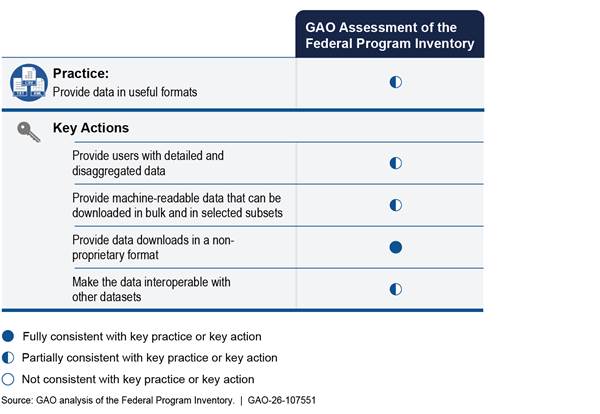
Provide users with detailed and disaggregated data: partially consistent. According to key actions for providing data in useful formats, data are most useful when they are provided with as much granularity as possible.[83] We found that the inventory provides users with some disaggregated data, but our analyses identified additional details that would be useful.
As described earlier in the report, inventory users can view data disaggregated by program, such as some annual spending for the current and prior 2 fiscal years. Eight of the 10 potential user organizations said certain inventory data available at the program level could be useful for their work. This included
· spending information, such as program obligations by fiscal year, which could be used for identifying spending trends (five organizations);
· links to additional resources, such as the assistance listing on SAM.gov for each financial assistance program, which could be used for learning more about a program and potentially applying for funding opportunities (three organizations); and
· authorizing statutes and associated rules and regulations for each financial assistance program, which could be used for oversight and to identify and manage overlap and duplication across programs (three organizations).
However, as was noted earlier, we found that the inventory does not provide all required information for each program, such as links to evidence about program performance. In addition, we found the inventory does not provide comparable details across all program types. For example, OMB is required to provide information on the population served for financial assistance programs, but not other types of programs, such as tax expenditures. Since there may be financial assistance programs and tax expenditures that serve the same groups, such as individuals or small businesses, those details would be useful for identifying all programs that serve a given population.
Although OMB is not required to provide information on the population served by each tax expenditure, according to key actions for providing data in useful formats, data should be as detailed as possible. Without comparable information for all program types, the inventory is limited as a tool to help federal decision-makers and other stakeholders to identify overlap and duplication across the federal government.
In our interviews, potential user organizations identified additional details that could make the inventory more useful, such as disaggregating data by geographic location and additional spending information.
Provide machine-readable data that can be downloaded in bulk and in selected subsets: partially consistent. According to key actions for providing data in useful formats, agencies should provide open government data in formats that are machine-readable and available in bulk and in selected subsets.[84] The inventory provides machine-readable data that can be downloaded in bulk, but the data are incomplete and cannot be downloaded in selected subsets.
· Machine-readable. OMB provides links for users to download inventory data in CSV format—a machine-readable file format that stores tabular data. By providing data in a machine-readable format, OMB made them easier to process and analyze, which is particularly important for large datasets like the inventory.
· Available to download in bulk. OMB allows users to download inventory data in bulk, however, the data do not include all information available in the inventory. For example, the bulk download does not provide the spending data that is presented in the inventory for tax expenditures or interest on the public debt. Without making all inventory data available to download in bulk, users who need the full dataset are not able to easily access it and instead must retrieve information record-by-record (or may not use the data altogether).
· Available to download in selected subsets. The inventory does not allow users to download data in selected subsets (e.g., only certain program types, such as tax expenditures, or by certain beneficiaries, such as programs that serve county governments). Without the ability to download selected subsets, it is difficult for users to work with only the data they want or need.
Provide data downloads in a non-proprietary format: fully consistent. According to key actions for providing data in useful formats, data downloads should be available in formats that do not require specific commercial software.[85] As previously stated, OMB provides inventory data downloads in CSV format, which is a non-proprietary data format. In doing so, OMB ensured that users who do not have specific software can access the data.
Make the data interoperable with other datasets: partially consistent. According to key actions for providing data in useful formats, agencies can make data interoperable—or able to be combined—with other datasets by standardizing the way the data are reported and using standard definitions.[86]
· Standardized reporting. Standardized reporting can involve providing data in consistent formats. We found that most of the items included in the inventory data downloads—known as data elements—are formatted consistently. For example, data on assistance listing number, program title, and agency are presented as individual data points, which can be easily combined with other data.
However, the bulk data download presents obligated amounts from SAM.gov and USAspending.gov for fiscal years 2023 to 2025 in a single column, rather than as individual data points with standard labels that could be combined with other obligations data. Without making the inventory fully interoperable with other datasets, its data are not useful for different types of analysis.
· Standard definitions. Agencies can promote consistency with other datasets by using standard definitions for the specific data elements included in a set of data. We found that OMB provides definitions for some, but not all data elements on the inventory’s “About the data” page. For example, OMB provides a definition for assistance type, but not for associated rules and regulations or authorizing statutes, which are other data elements available for financial assistance programs in the inventory.[87]
OMB previously told us about efforts it had underway to develop additional definitions, but those have not been made available on the inventory, as of February 2026.[88] Without standard definitions on the website or in a related document, such as a data dictionary, federal agencies and inventory users may not fully understand terms or apply them consistently.
Practice 4: Fully Describe the Data
We determined that the inventory is partially consistent with the key practice for fully describing the data, based on variation in implementing four underlying key actions (see fig. 17). Our past work has found that providing information about a dataset allows users to determine whether it is suitable for their intended purpose and make informed decisions about whether and how to use it.[89]
Figure 17: Extent to Which the 2025 Version of the Federal Program Inventory Is Consistent with the Key Practice and Key Actions for Fully Describing the Data
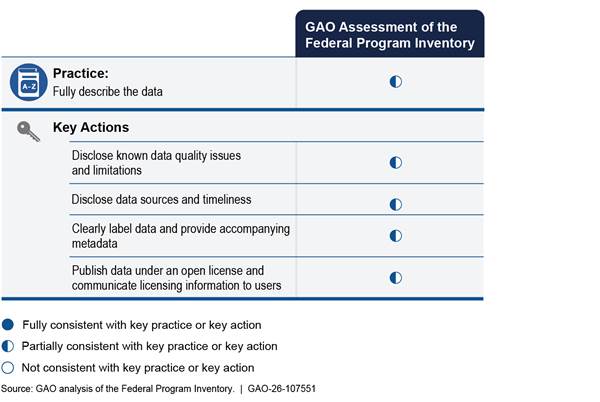
Disclose known data quality issues and limitations: partially consistent. According to key actions for fully describing the data, agencies should disclose known data quality issues and limitations, which can include descriptions of the completeness, timeliness, and accuracy of the data.[90] We found that OMB discloses some, but not all, known data quality issues and limitations on the inventory website.
For example, the inventory discloses known quality issues and limitations that include
· potential discrepancies in obligations data between the two sources (SAM.gov and USAspending.gov) and reasons why those differences may exist;
· variation in the number and context of “functions” and “sub-functions” that agencies assigned to a program, because of a lack of guidance defining those items; and
· differences between how federal financial assistance programs are defined in assistance listings on SAM.gov and other definitive lists of programs.
Figure 23 in appendix III provides an example of an inventory program page with discrepancies in obligations data between SAM.gov and USAspending.gov.
However, in September 2024 we found that OMB did not disclose other known data limitations, including those previously identified by our work related to spending data reported on USAspending.gov.[91] Beyond previously known data quality issues, we identified new issues while assessing the January 2025 version of the inventory. These include
· programs that are no longer active (the four tax expenditures described earlier) or have no reported spending but are included in the January 2025 inventory (157 federal financial assistance programs, described further in appendix IV);
· programs missing spending data (obligations) from one of the two sources (either USAspending.gov or SAM.gov); and
· programs with discrepancies in the spending data they present.
For example, the National Railroad Passenger Corporation Grants program page shows obligated amounts that differ by more than $4 billion each in fiscal years 2023 and 2024 between two spending data visualization charts, as illustrated in figure 18 below. The first chart, showing program obligations data, displays amounts for approximately $6.8 billion that generally match between SAM.gov and USAspending.gov for both fiscal years 2023 and 2024. However, the second chart, which compares obligation and outlay data, displays a different and much lower amount for obligations ($2.4 billion) for those same years. The exact source of the data in this second chart is unclear, due to a lack of specific data labels.
Figure 18: Example of Unexplained Spending Data Discrepancies in the 2025 Version of the Federal Program Inventory
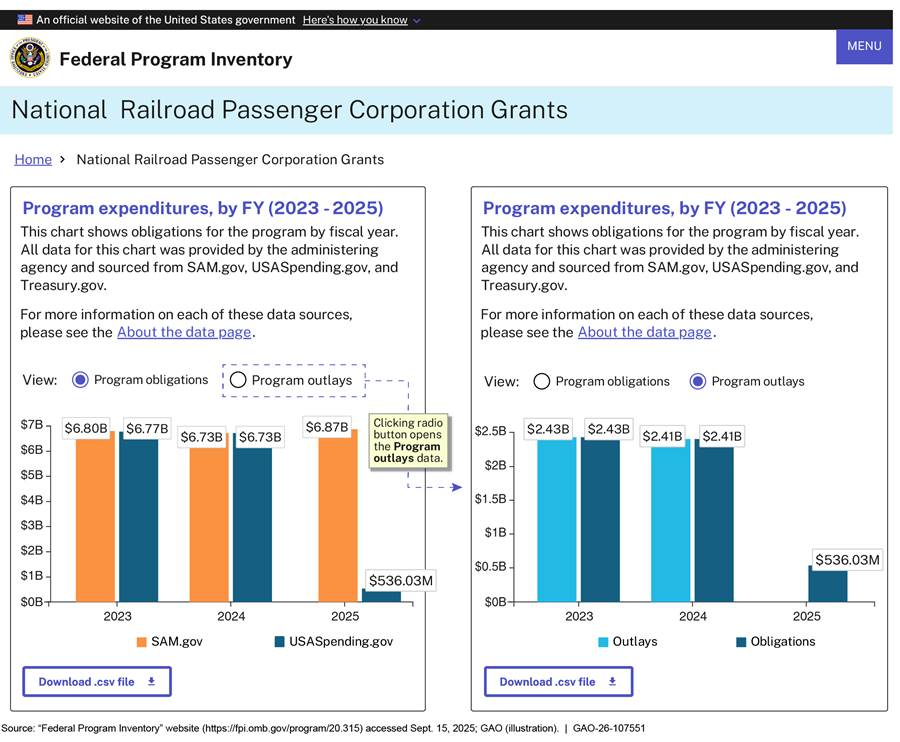
Note: FY = fiscal year.
In March 2025, we asked OMB if it was aware of, and could explain, the new data quality issues we identified. We also asked what processes OMB has in place to review, disclose, and address the quality and limitations of the data it uses for the inventory. As of February 2026, OMB had not responded to our questions. Without disclosing all known data quality issues and limitations, users are unable to make informed decisions about whether to use the data, and if so, how to use them properly.
|
Example User Perspective on the Inventory’s Disclosure of Data Limitations One potential user organization told us it would be helpful for OMB to explicitly acknowledge how much of the federal budget is covered by the inventory and the types of programs that are missing from the data. The organization said the website’s current framing, such as the banner on the landing page, makes it seem like the inventory is complete when it is not. This could lead a user to misunderstand what information the inventory includes and what it does not. Source: GAO. │ GAO‑26‑107551 |
Five of the 10 potential user organizations also told us that the inventory would be more useful if it more clearly stated its limitations, such as that it does not yet include all federal programs (see sidebar). Two of those organizations told us they observed large discrepancies in spending data, such as between data from USAspending.gov and SAM.gov, without explanation for those discrepancies on the page where the data were presented.
Disclose data sources and timeliness: partially consistent. According to key actions for fully describing the data, disclosing where data come from and how frequently they are updated provides context to users.[92] Information on data sources and timeliness helps them judge quality and determine whether the data can be appropriately used for the intended purpose.
We found that OMB disclosed data sources and timeliness for financial assistance programs and tax expenditures, but not for interest on the public debt, as shown in figure 19 below.
Figure 19: Data Sources and Timeliness Disclosed in the 2025 Version of the Federal Program Inventory
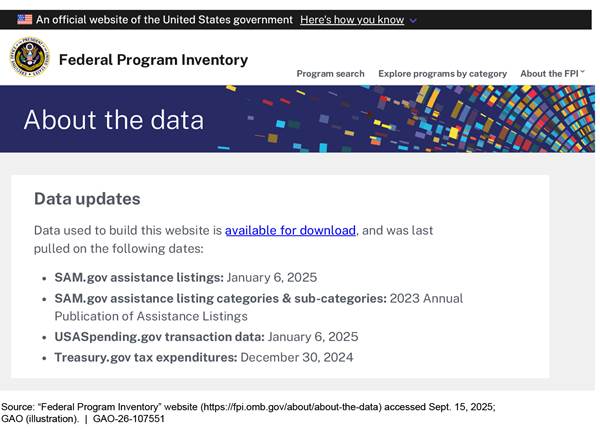
We also found that OMB does not provide a log of changes made to the inventory, so users do not know whether or how the data may have changed since their last visit. For example, the January 2025 inventory identifies 2,448 financial assistance programs—60 more than in the February 2024 version of the inventory (2,388). However, the inventory does not disclose this increase, nor does it describe what accounts for the change—newly created programs, previously missed programs, previously identified programs split into multiple programs, etc.[93]
In March 2025, we asked OMB about (1) the source and timeliness of the data for interest on the public debt and (2) any log of changes associated with the January 2025 inventory update. As of February 2026, OMB had not responded to our questions. Without complete information on inventory data sources and timeliness, users may view, download, or use the data without full knowledge of the extent to which they are timely, complete, or accurate, among other aspects of data quality. Therefore, they could inadvertently draw inaccurate conclusions from the data.
Clearly label data and provide accompanying metadata: partially consistent. According to key actions for fully describing the data, data should be clearly labeled and accompanied by structured metadata, which describe the characteristics of data in clearly defined, machine-readable fields.[94] We found that not all inventory data are clearly labeled, and the data do not have accompanying metadata. Without clearly labeling data and providing structured, machine-readable metadata, users cannot easily find information about the inventory data, potentially limiting their use and usefulness.
· Clearly label data. OMB clearly labels some, but not all data in the inventory. For example, OMB labels the spending data presented in the “Program obligations” charts on the financial assistance program pages with the specific sources—USAspending.gov and SAM.gov. However, the data in the “Program outlays” bar charts on the same pages are labeled “Outlays” and “Obligations,” without the specific data source (see fig. 23 in appendix III). The description provided at the top of those bar charts is also unclear. It states that the data come from SAM.gov, USAspending.gov, and Treasury.gov. Although those are the sources for the inventory overall, only one or two of those sources are used for individual program data, depending on the program type. In March 2025, we asked OMB for the source of the data presented in the “Program outlays” bar charts, but OMB had not responded to our question as of February 2026.
· Provide accompanying metadata. OMB does not provide metadata in the inventory. Metadata describe aspects of the dataset—such as the source of the data and when it was last updated—in clearly delineated fields.
|
Example User Perspective on the Inventory’s Data Labels One potential user organization told us the inventory data download did not have labels with the information needed to be able to use the data, such as exact sources and time frames. The organization found the inventory’s “About the data” page somewhat helpful but was unable to identify the source of certain data, such as outlays. Without clear labels and complete information, the data would not pass the user organization’s robust data quality assurance process and therefore could not be used for its work. Source: GAO. │ GAO‑26‑107551 |
Five of the 10 potential user organizations also identified issues with data labels in the inventory, which affected their ability to use the data. For example, two organizations told us they could not identify the source of certain data, such as program results and outlays, based on the labels and information available in the inventory (see sidebar for an example). Without clear data labels, users told us they were not able to find the programs and information they were interested in, which limited the usefulness of the inventory for their purposes.
Publish data under an open license and communicate licensing information to users: partially consistent. According to key actions for fully describing the data, documentation for a dataset should specify what license applies to the data.[95] As described earlier in this report, inventory data are open because they are publicly available on a government website and can be freely used, modified, and shared by anyone for any purpose. However, OMB does not communicate licensing information on the inventory website, nor in the data downloads. Without clearly communicating that the inventory is published under an open license, users may not be aware that there are few to no restrictions on how the data may be used. Our past work has found that communicating licensing information can encourage innovation, for example, by assuring users that they are permitted to use the data to develop commercial applications.[96]
Practice 5: Facilitate Data Discovery for All Users
We found that the inventory is partially consistent with the key practice, and all five underlying key actions, for facilitating data discovery for all users, as shown in figure 20. Our past work has found that data discovery is facilitated by presenting the data in a way that enables users to easily explore them.[97]
Figure 20: Extent to Which the 2025 Version of the Federal Program Inventory Is Consistent with the Key Practice and Key Actions for Facilitating Data Discovery for All Users
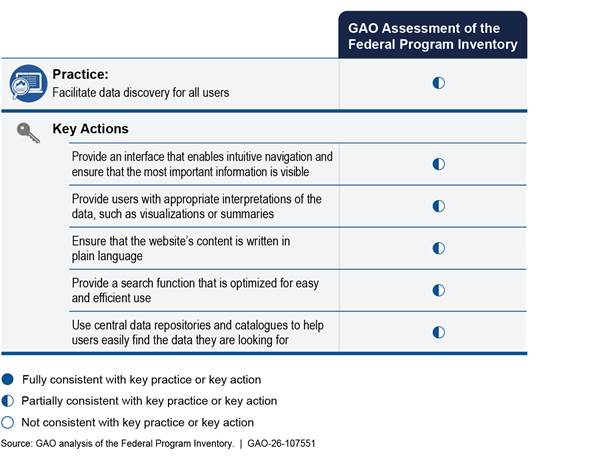
Provide an interface that enables intuitive navigation and ensure that the most important information is visible: partially consistent. According to key actions for facilitating data discovery for all users, agencies should ensure that open government data are provided on a website that is simple and intuitive.[98] Obtaining user feedback and conducting usability testing can help agencies assess whether a website is easy to use and identify any aspects that do not work well for users.[99]
In September 2024, we found that OMB had not developed policies and processes for engaging with users to, for example, obtain feedback or conduct user testing.[100] However, as part of its January 2025 inventory update, OMB changed the website’s interface without having such policies and processes in place. As described earlier in this report, in March 2025, we asked OMB about any actions it had taken since our September 2024 report to solicit and respond to user feedback. As of February 2026, OMB had not responded to our question. Without ensuring the inventory website interface enables intuitive navigation—such as through user feedback or testing—OMB does not know whether users can easily navigate the website to find the information they need.
According to the 10 potential user organizations, none of them had been involved in any user testing for the inventory. Seven of them told us the inventory was generally easy to use and they appreciated certain available features, such as the dropdown menus for program category and subcategory. However, not all were able to find the information they were interested in. For example, although OMB provides a link to download inventory data in bulk on the inventory website’s “About the data” page, two user organizations told us they could not find where to do that.
Provide users with appropriate interpretations of the data, such as visualizations or summaries: partially consistent. According to key actions for facilitating data discovery for all users, visualizations and summaries can help users explore data.[101] While the inventory provides users with some data visualizations and summaries, we found that not all interpretations of the data are appropriate. Without consistently providing appropriate interpretations of inventory data, users could misunderstand the information presented.
OMB provides data visualizations on the inventory website, such as pie charts and bar charts that display spending data. For example, when users visit the “Explore programs by category” page, they see a bar chart with spending information by category, such as health, education, and transportation.[102] Users can explore the data further by clicking on one of the bars, which will bring them to a page with more information about that category, such as the sub-categories and the number of programs within it.
However, we found that OMB’s interpretations are not always appropriate for the underlying data. For example, the inventory website states that program expenditures total over $7 trillion for fiscal year 2024 (see fig. 21). To obtain this total, OMB summed together different types of spending data in the inventory, including obligations, outlays, and estimated revenue losses. This is not appropriate because data should only be combined with other data of the same type (i.e., obligations with obligations and outlays with outlays).
Figure 21: Example of an Inappropriate Data Summary in the 2025 Version of the Federal Program Inventory
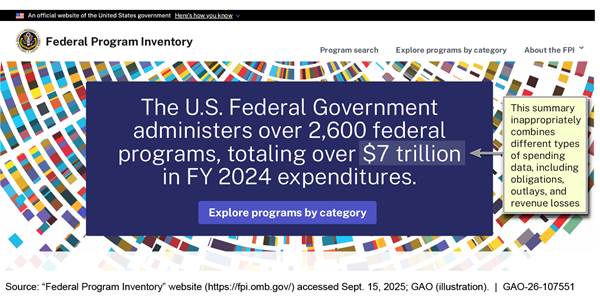
Ensure that the website’s content is written in plain language: partially consistent. According to key actions for facilitating data discovery for all users, the content of an open data website should be written in a way that is clear and direct, using plain language. Our past work found that agencies can accomplish this by using commonly understood terms rather than technical jargon and, in cases where it is necessary to use technical language, providing a glossary that defines key terms.[103] We found that some, but not all, of the inventory’s content is written in plain language.
|
Inventory Definition of Obligation When awarding funding, the U.S. government enters a binding agreement called an obligation. The government promises to spend the money, either immediately or in the future. An agency incurs an obligation, for example, when it places an order, signs a contract, awards a grant, purchases a service, or takes other actions that require it to make a payment. Source: https://fpi.omb.gov/about/about‑the‑data. │ GAO‑26‑107551 |
For example, OMB provides a plain language definition for obligation, which may help users understand that budget term. However, it does not do so for other budget terms used in the inventory, such as outlay.[104] Without providing all content in plain language, users may not fully understand the information provided in the inventory.
Provide a search function that is optimized for easy and efficient use: partially consistent. According to key actions for facilitating data discovery for all users, open data websites should include a search function that is optimized for easy and efficient use.[105] We found that the inventory website allows users to search by program name, popular name, and objective. Users can further explore the data with filters that narrow the list of all programs or search results.[106] However, the search function does not allow users to obtain results from other information available on the site, such as authorizing statutes. Without providing a search function that is optimized for easy and efficient use and that allows users to search all available data elements, inventory users cannot always easily find information that meets their needs.
|
Example User Perspective on the Inventory’s Search Function One potential user organization described challenges identifying programs with similar objectives using the inventory’s search function. The organization entered the term, “fentanyl” and said the search resulted in zero programs. The organization told us it was aware that the federal government administers various programs to combat fentanyl use and addiction. The inability to easily find certain programs limited the usefulness of the inventory as a resource for the organization’s work. Source: GAO. │ GAO‑26‑107551 |
Six of the 10 potential user organizations who provided perspectives to us identified issues with the inventory’s search and filter functions. These issues were that the search bar does not search all data on the website or yield all meaningful results, and the filters do not update based on a user’s previous selection or search, among others (see sidebar). They told us that the limited search functionality led to confusion and prevented them from being able to identify programs and information in which they were interested and that could support their work.
Use central data repositories and catalogues to help users easily find the data they are looking for: partially consistent. According to key actions for facilitating data discovery for all users, central data repositories and catalogues—also known as data portals—are websites that provide a “one-stop shop” for users to access a variety of datasets.[107] These websites host the data directly, link to other websites where users can access the data, or a combination of the two. They typically provide descriptions of the datasets, as well as structured metadata, to help users find data suitable for their purposes.
We found that the inventory is partially consistent with the key action to use central data repositories and catalogues because it links to some, but not all the data portals that OMB used to develop the inventory. Specifically, OMB provides links to SAM.gov and USAspending.gov, which are the data sources for financial assistance programs, on those program pages; however
· the inventory does not provide links to Treasury.gov, which it states is the source of data for tax expenditures and interest on the public debt;
· none of the websites that provide source data—SAM.gov, USAspending.gov, and Treasury.gov—cross-link with the inventory; and
· Data.gov, the federal government’s open data repository, does not contain a link to the inventory.[108]
Without using central data repositories, such as Data.gov, or cross-linking with all inventory data sources, potential users cannot easily find inventory data and determine whether it is suitable for their purposes.
Opportunity for OMB to More Fully Implement Key Practices Through Data Governance
In September 2024, we found that OMB had taken some actions to establish data governance—activities to ensure data are transparent, accessible, and of sufficient quality—for the inventory.[109] However, OMB had not fully implemented five out of the six activities our past work has identified as part of an effective data governance structure.[110] We recommended OMB do so. At the time, OMB generally agreed with this recommendation and OMB staff stated that they were already taking steps to more fully develop a data governance structure. However, as of February 2026, OMB did not have an update on the status of those actions.
By incorporating the key practices and key actions for open government data websites into its data governance activities, OMB would have greater assurance that the inventory provides information that meets the needs of various users, such as Congress, federal agency leaders, and the public. Further, an inventory that is fully consistent with these key practices and actions would be a more transparent and useful tool for decision-making and oversight.
Conclusions
The inventory OMB launched in February 2024 and updated in January 2025 represents continued progress in fulfilling statutory requirements. It provides valuable information about what the government does and how much it spends for more than 2,600 financial assistance programs, tax expenditures, and interest on the public debt.
However, OMB has not yet taken critical actions to develop a comprehensive inventory or ensure the existing inventory provides useful information to federal decision-makers and the public. Addressing specific requirements in its plans would ensure OMB has identified the actions, resources, and time frames needed for full implementation of those requirements. Incorporating and consistently following key practices as part of its data governance activities would help OMB ensure the inventory meets users’ needs and provides transparent and useful information for decision-making and oversight.
Recommendations for Executive Action
We are making the following 17 recommendations to OMB:
The Director of OMB should ensure that OMB’s plans to implement the inventory address requirements to identify and include all program types to ensure the inventory is complete. (Recommendation 1)
The Director of OMB should ensure that OMB’s plans to implement the inventory address requirements to archive and preserve the information included in the program inventory and make the archived information publicly available as an open government data asset. (Recommendation 2)
The Director of OMB should ensure that OMB’s plans to implement the inventory address requirements to provide definitions for each program type. This should include guidance to help agencies consistently implement the definitions, including what constitutes an active program for inclusion in the inventory. (Recommendation 3)
The Director of OMB should ensure that OMB’s plans to implement the inventory address requirements to identify the program activities that are aggregated, disaggregated, or consolidated for each program in the inventory. (Recommendation 4)
The Director of OMB should ensure that OMB’s plans to implement the inventory address requirements to provide the statutes that authorize each program in the inventory. (Recommendation 5)
The Director of OMB should ensure that OMB’s plans to implement the inventory address requirements to identify any major regulations related to each program in the inventory or clearly state that there are not any. (Recommendation 6)
The Director of OMB should ensure that OMB’s plans to implement the inventory address requirements to provide appropriated amounts for the current and prior 2 fiscal years for each program in the inventory or an explanation of why doing so is not practicable. (Recommendation 7)
The Director of OMB should ensure that OMB’s plans to implement the inventory address requirements to provide obligated amounts for the current and prior 2 fiscal years for each program in the inventory or an explanation of why doing so is not practicable. (Recommendation 8)
The Director of OMB should ensure that OMB’s plans to implement the inventory address requirements to identify, for each program, how it contributes to its agency’s mission and goals. At a minimum, this should include relevant agency strategic goals, strategic objectives, and performance goals, as well as cross-agency priority goals and agency priority goals, or clearly state that there are not any. (Recommendation 9)
The Director of OMB should ensure that OMB’s plans to implement the inventory address requirements to provide, for each program listed in the inventory, links to relevant evidence about program performance. This should include agency performance reports, GAO reports, Inspector General reports, and evidence created pursuant to the Foundations for Evidence-Based Policymaking Act of 2018, as applicable. (Recommendation 10)
The Director of OMB should ensure that OMB’s plans to implement the inventory address requirements to identify, for each federal financial assistance program listed in the inventory, how programs link to assistance listings for the current and prior 2 fiscal years. (Recommendation 11)
The Director of OMB should ensure that OMB’s plans to implement the inventory address requirements to provide, for each federal financial assistance program listed in the inventory, information on the population intended to be served by each financial assistance program for the current and prior 2 fiscal years. (Recommendation 12)
The Director of OMB should ensure that OMB’s plans to implement the inventory address requirements to provide, for each federal financial assistance program listed in the inventory, the percentage of the appropriated amounts used for management and administration for the current and prior 2 fiscal years or an explanation of why doing so is not practicable. (Recommendation 13)
The Director of OMB should ensure that the data governance activities for the federal program inventory are fully consistent with the key practice to engage with users. (Recommendation 14)
The Director of OMB should ensure that the data governance activities for the federal program inventory are fully consistent with the key practice to provide data in useful formats. This should include providing comparable information for all program types, as applicable, such as population served for tax expenditures; and using standard definitions for data elements, for example, by developing a data dictionary. (Recommendation 15)
The Director of OMB should ensure that the data governance activities for the federal program inventory are fully consistent with the key practice to fully describe the data. This should include providing a log of changes made to the inventory website and data with information on when those changes occurred. (Recommendation 16)
The Director of OMB should ensure that the data governance activities for the federal program inventory are fully consistent with the key practice to facilitate data discovery for all users. This should include conducting usability testing; providing plain language definitions of all key terms and concepts on the website; allowing users to search all available data elements; and linking to data sources for all programs in the inventory and ensuring those websites also contain links to the inventory. (Recommendation 17)
Agency Comments
We provided a draft of this report to OMB for review and comment. OMB did not provide comments on the report.
We are sending copies of this report to appropriate congressional committees, the Director of OMB, and other interested parties. This report will also be available at no charge on the GAO website at https://www.gao.gov. If you or your staff have any questions about this report, please contact Dawn Locke at LockeD@gao.gov.
Contact points for our Offices of Congressional Relations and Media Relations may be found on the last page of our report. Key contributors to this report are listed in appendix V.
Dawn G. Locke
Director, Strategic Issues
List of Committees
The Honorable Rand Paul, M.D.
Chairman
The Honorable Gary C. Peters
Ranking Member
Committee on Homeland Security and Governmental Affairs
United States Senate
The Honorable James Lankford
Chairman
The Honorable John Fetterman
Ranking Member
Subcommittee on Border Management, Federal Workforce and Regulatory Affairs
Committee on Homeland Security and Governmental Affairs
United States Senate
The Honorable James Comer
Chairman
The Honorable Robert Garcia
Ranking Member
Committee on Oversight and Government Reform
House of Representatives
The Honorable Pete Sessions
Chairman
The Honorable Kweisi Mfume
Ranking Member
Subcommittee on Government Operations
Committee on Oversight and Government Reform
House of Representatives
To obtain perspectives on the transparency and usefulness of the inventory, we first identified user groups and subgroups based on our prior work on federal government spending websites.[111] We then selected a nongeneralizable sample of organizations within those groups and subgroups. Specifically, we selected organizations within each subgroup that represented (1) actual inventory users based on known past engagement with OMB, and (2) potential inventory users based on the mission of the organization.[112]
Finally, we conducted semi-structured videoconference and written interviews with 10 selected organizations based on their availability. Table 1 below provides a list of the organizations we interviewed, presented by relevant group and subgroup.
|
User group |
User subgroup |
Organizations |
|
Organizations representing recipients of federal awards |
Organizations representing nonprofit and private sector recipients of federal awards |
· National Council of Nonprofits · Professional Services Council |
|
Organizations that include federal, state, and/or local governments and officials |
· National Association of State Budget Officers |
|
|
Public users |
Nonprofit organizations/think tanks/advocacy groups/consultants |
· Citizens Against Government Waste · Data Foundation · Project on Government Oversight |
|
Federal government |
Agency senior management |
· Senior Executives Association |
|
Federal agencies |
· General Services Administration |
|
|
Inspectors General |
· Through the Council of the Inspectors General on Integrity and Efficiency, we consolidated input from four Offices of Inspectors General at the (1) Commodity Futures Trading Commission and the Departments of (2) Health and Human Services, (3) the Interior, and (4) Labor |
|
|
Congress |
· Senate Committee on Homeland Security and Governmental Affairs |
Source: GAO. │ GAO‑26‑107551
Table 2: Open Recommendations to the Office of Management and Budget (OMB) from GAO Work Related to Inventory Implementation
|
Recommendation |
Implementation status |
|
GAO‑24‑107656: Federal Programs: OMB Needs a Structure to Govern and a Plan to Develop a Comprehensive Inventory (Sept. 2024) |
|
|
The Director of OMB should fully develop a data governance structure for the federal program inventory consistent with the six activities identified by our past work. |
Open – Not implemented. As of February 2026, OMB had taken limited action in response to this recommendation. In its comments on our September 2024 report, OMB told us it was taking steps to more fully develop a data governance structure for the inventory. However, as of February 2026, OMB had no updates on its actions to implement this recommendation. We will continue to monitor progress. |
|
The Director of OMB should publicly articulate OMB’s plans for fully implementing the federal program inventory, and continue to involve key stakeholders and leverage the systematic approach identified in our past work in the planning efforts. The plans should identify the actions, resources, and time frames needed to fully implement an inventory of all federal programs. |
Open – Not implemented. As of February 2026, OMB had not taken any action to implement this recommendation. We will continue to monitor progress. |
|
GAO‑20‑44: Improving Program Management: Key Actions Taken, but Further Efforts Needed to Strengthen Standards, Expand Reviews, and Address High-Risk Areas (Dec. 2019) |
|
|
The Deputy Director for Management of OMB should clarify for agencies how the different definitions of a “program” relate to each other in OMB guidance. |
Open – Not implemented. As of February 2026, OMB indicated that it does not plan to take action on our recommendation. We continue to believe that OMB needs to clarify in guidance how different definitions of a “program” relate to each other. Clarifying the definitions could help agencies and OMB increase transparency and identify synergies across related laws, such as the GPRA Modernization Act of 2010, Pub. L. No. 111-352, 124 Stat. 3866 (2011); the DATA Act, Pub. L. No. 113-101, 128 Stat. 1146 (2014); and the Program Management Improvement Accountability Act, Pub. L. No. 114-262, 130 Stat. 1371 (2016). |
Source: GAO. │ GAO‑26‑107551
Table 3: Closed as Implemented Recommendations to the Office of Management and Budget (OMB) from GAO Work Related to Inventory Implementation
|
Recommendation |
Implementation status |
|
GAO‑17‑775: Managing for Results: Further Progress Made in Implementing the GPRA Modernization Act, but Additional Actions Needed to Address Pressing Governance Challenges (Sept. 2017) |
|
|
The Director of OMB should consider—as OMB determines its strategy for resumed implementation of the federal program inventory—using a systematic approach, such as the information architecture framework, to help ensure that Government Performance and Results Modernization Act of 2010 (GPRAMA) requirements and our past recommendations for the inventory are addressed. |
Closed – Implemented. In January 2021, Congress amended and expanded requirements for the federal program inventory as part of the William M. (Mac) Thornberry National Defense Authorization Act for Fiscal Year 2021. OMB described how it considered and incorporated our information architecture framework into two separate efforts to test and implement a federal program inventory. |
|
GAO‑15‑752T: DATA Act: Progress Made in Initial Implementation but Challenges Must be Addressed as Efforts Proceed (July 2015) |
|
|
To ensure that federal program spending data are provided to the public in a transparent, useful, and timely manner, the Director of OMB should accelerate efforts to determine how best to merge DATA Act purposes and requirements with the GPRAMA requirement to produce a federal program inventory. |
Closed – Implemented. OMB’s launch of its Federal Program Inventory website in February 2024 provided users access to detailed information about a program’s spending, including specific awards and recipients via USAspending.gov. The inventory’s linking of federal contract, loan, and grant spending information to federal programs should help taxpayers and policy makers track federal spending more effectively and addresses the intent of this recommendation. |
|
GAO‑15‑83: Government Efficiency and Effectiveness: Inconsistent Definitions and Information Limit the Usefulness of Federal Program Inventories (Oct. 2014) |
|
|
The Director of OMB should include tax expenditures in the federal program inventory effort by designating tax expenditures as a program type in relevant guidance. |
Closed – Implemented. In January 2025, OMB included tax expenditures as a type of program in the federal program inventory. The federal program inventory identified 174 tax expenditures based on data from the Department of the Treasury. By including tax expenditures in the inventory, OMB increased the transparency of tax expenditures, including the amount of federal spending or forgone revenue estimated for each tax expenditure. |
Source: GAO. │ GAO‑26‑107551
Table 4: Closed as No Longer Valid Recommendations to the Office of Management and Budget (OMB) from GAO Work Related to Inventory Implementation
|
Recommendation |
Implementation status |
|
GAO‑17‑775: Managing for Results: Further Progress Made in Implementing the GPRA Modernization Act, but Additional Actions Needed to Address Pressing Governance Challenges (Sept. 2017) |
|
|
The Director of OMB should revise and publicly issue OMB guidance—through an update to its Circular No. A-11, a memorandum, or other means—to provide time frames and associated milestones for implementing the federal program inventory. |
Closed – No Longer Valid. In March 2026, we closed this recommendation as no longer valid because it has been superseded by a more recent recommendation. In September 2024, we recommended that the Director of OMB publicly articulate OMB’s plans for fully implementing the federal program inventory. This includes continuing to involve key stakeholders and leverage the systematic approach identified in our past work in the planning efforts. The plans should identify the actions, resources, and time frames needed to fully implement an inventory of all federal programs. See GAO‑24‑107656, Recommendation 2. |
|
GAO‑15‑83: Government Efficiency and Effectiveness: Inconsistent Definitions and Information Limit the Usefulness of Federal Program Inventories (Oct. 2014) |
|
|
The Director of OMB should revise relevant guidance to direct agencies to collaborate with each other in defining and identifying programs that contribute to common outcomes. |
Closed – No Longer Valid. In March 2026, we closed this recommendation as no longer valid based on the updated findings and recommendations in this report. See Recommendation 3. |
|
The Director of OMB should revise relevant guidance to provide a time frame for what constitutes “persistent over time” that agencies can use as a decision rule for whether to include short-term efforts as programs. |
Closed – No Longer Valid. In March 2026, we closed this recommendation as no longer valid based on the updated findings and recommendations in this report. See Recommendation 3. |
|
The Director of OMB should define plans for when additional agencies will be required to develop program inventories. |
Closed – No Longer Valid. In March 2026, we closed this recommendation as no longer valid because it has been superseded by a more recent recommendation. In September 2024, we recommended that the Director of OMB publicly articulate OMB’s plans for fully implementing the federal program inventory. This includes continuing to involve key stakeholders and leverage the systematic approach identified in our past work in the planning efforts. The plans should identify the actions, resources, and time frames needed to fully implement an inventory of all federal programs. See GAO‑24‑107656, Recommendation 2. |
|
The Director of OMB should revise relevant guidance to direct agencies to consult with relevant congressional committees and stakeholders on their program definition approach and identified programs when developing or updating their inventories. |
Closed – No Longer Valid. In March 2026, we closed this recommendation as no longer valid based on the updated findings and recommendations in this report. See Recommendation 14. |
|
The Director of OMB should revise relevant guidance to direct agencies to identify in their inventories the performance goal(s) to which each program contributes. |
Closed – No Longer Valid. In March 2026, we closed this recommendation as no longer valid based on the updated findings and recommendations in this report. See Recommendation 9. |
|
The Director of OMB should ensure, during OMB reviews of inventories, that agencies consistently identify, as applicable, the strategic goals, strategic objectives, agency priority goals, and cross-agency priority goals each program supports. |
Closed – No Longer Valid. In March 2026, we closed this recommendation as no longer valid based on the updated findings and recommendations in this report. See Recommendation 9. |
|
The Director of OMB should, in coordination with the Secretary of the Treasury, develop a tax expenditure inventory that identifies each tax expenditure and provides a description of how the tax expenditure is defined, its purpose, and related performance and budget information. |
Closed – No Longer Valid. In March 2026, we closed this recommendation as no longer valid based on the updated findings and recommendations in this report. See Recommendations 3, 7, 8, 9 and 10. |
Source: GAO. │ GAO‑26‑107551
This appendix presents examples of the information available in the inventory based on a sample page from each of the three program types—federal financial assistance, tax expenditures, and interest on the public debt. Figures 22, 23, and 24 show the program, spending, and additional information available for financial assistance programs, respectively.[113] Figure 25 shows the categories of information available for tax expenditures. Finally, figure 26 shows the information available in the inventory for interest on the public debt, which is presented on a single program page.[114]
Figure 22: Program Information for a Sample Financial Assistance Program in the 2025 Version of the Federal Program Inventory
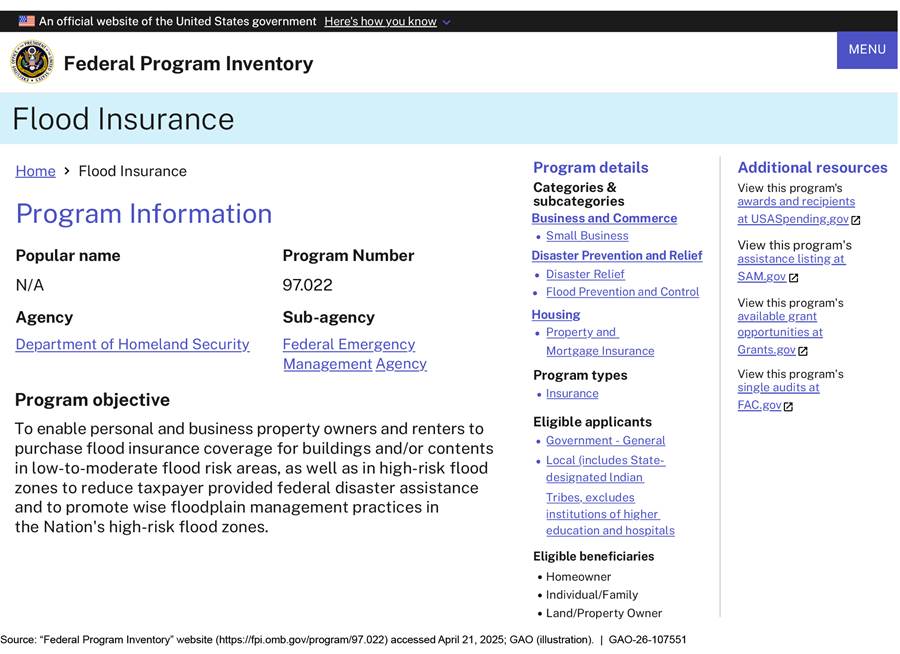
Figure 23: Spending Information for a Sample Financial Assistance Program in the 2025 Version of the Federal Program Inventory
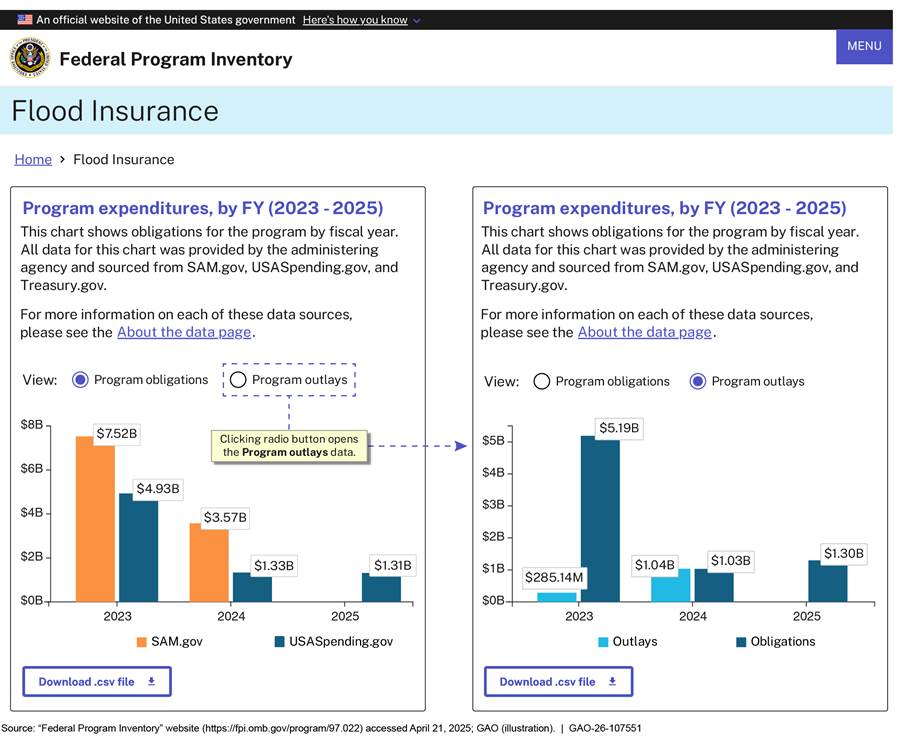
Note: FY = fiscal year.
Figure 24: Additional Information for a Sample Financial Assistance Program in the 2025 Version of the Federal Program Inventory
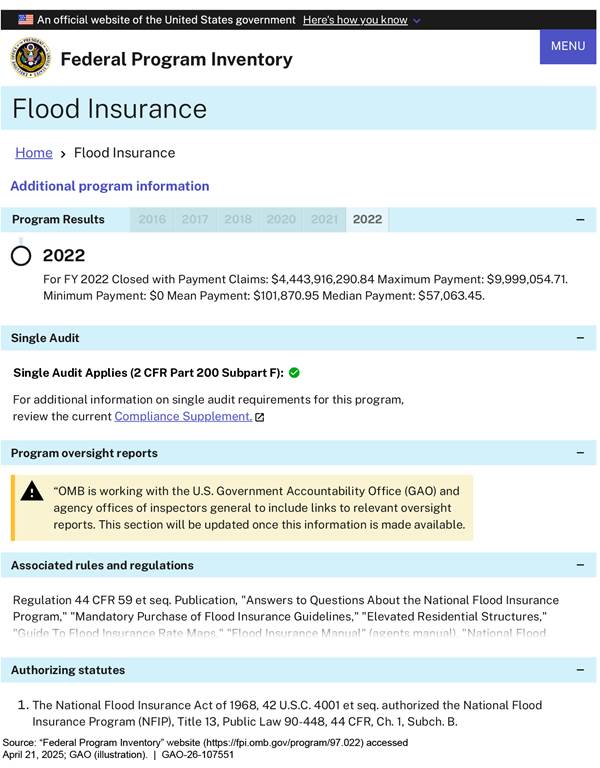
Note: CFR = Code of Federal Regulations; OMB = Office of Management and Budget; U.S.C. = United States Code.
Figure 25: Information for a Sample Tax Expenditure Program in the 2025 Version of the Federal Program Inventory
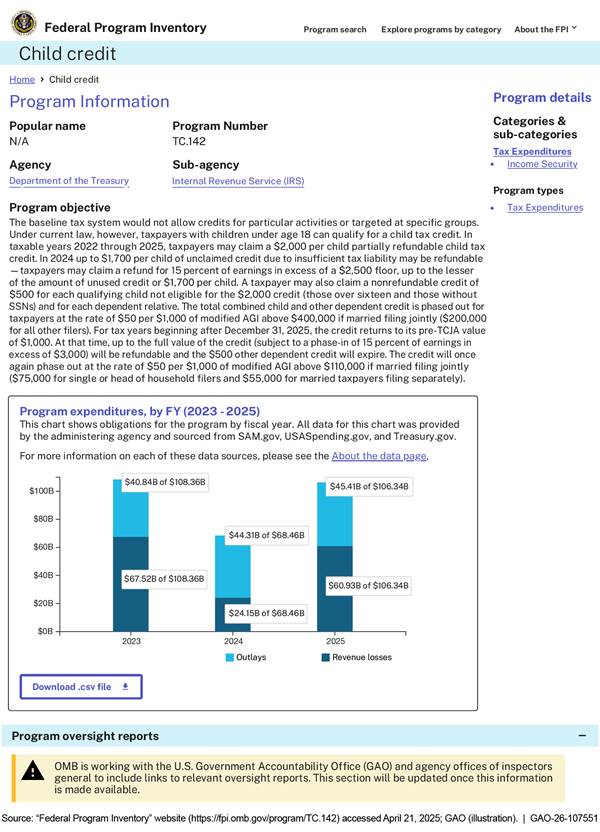
Notes: AGI = adjusted gross income; FY = fiscal year; TCJA = Tax Cuts and Jobs Act of 2017. The Office of Management and Budget (OMB) states in the description of the program expenditures chart that it shows obligations for the program by fiscal year. However, the data in the chart are labeled as “outlays” and “revenue losses.” OMB provides obligations data for financial assistance programs in the 2025 version of the inventory, but not for other program types, such as tax expenditures.
Figure 26: Information for Interest on the Public Debt in the 2025 Version of the Federal Program Inventory
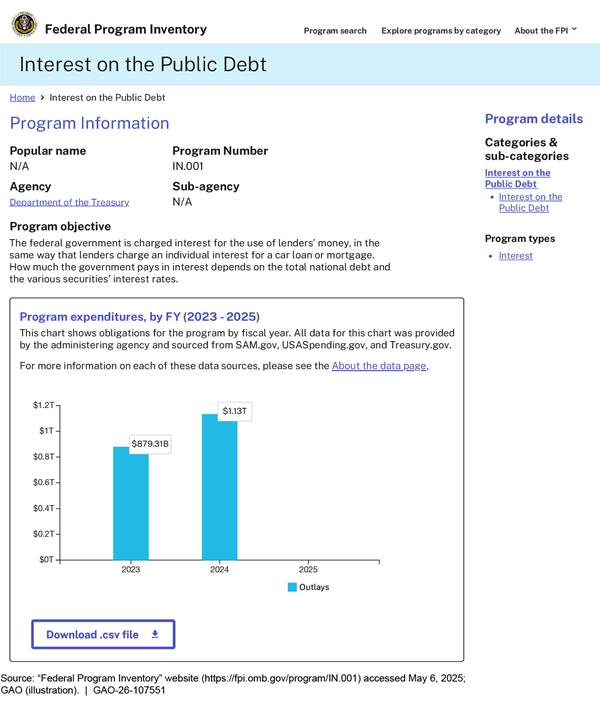
Notes: FY = fiscal year. The Office of Management and Budget (OMB) states in the description of the program expenditures chart that it shows obligations for the program by fiscal year. However, the data in the chart are labeled as “outlays.” OMB provides obligations data for financial assistance programs in the 2025 version of the inventory, but not for other program types, such as interest on the public debt.
As described earlier, the Office of Management and Budget (OMB) provided some guidance to agencies to help them consistently implement the definition of a financial assistance program and only include active programs in the federal program inventory. In July 2024, OMB issued guidance to ensure that SAM.gov—and therefore the inventory—only presents information about active financial assistance programs.[115]
We identified 157 financial assistance programs in the January 2025 version of the inventory that reported no spending data across the 3 fiscal years covered by the inventory. Of those, one program’s inventory page explains why it is still active and therefore included in the inventory, consistent with OMB’s guidance.[116] Six other programs’ pages state that they are no longer active, but do not explain why they were included in the inventory.[117] For the other 150 programs, no explanation about whether they were active was provided. It is unclear whether those programs are still active, and therefore whether they should have been included in the inventory, per OMB’s guidance.[118]
OMB could address these data quality issues by fully implementing one of our past recommendations. In September 2024, we found that OMB had taken some actions to establish data governance—activities to ensure data are transparent, accessible, and of sufficient quality—for the inventory.[119] However, it had not fully implemented five out of the six activities our past work has identified as part of an effective data governance structure. One of those activities is to have policies and processes. OMB had not yet established any overarching policies or processes for the inventory, including for collecting and ensuring the quality of data agencies reported for the programs included in the inventory. We recommended OMB do so. At that time, OMB generally agreed with this recommendation and OMB staff stated that they were already taking steps to more fully develop a data governance structure. However, as of February 2026, OMB did not have an update on the status of those actions.
Our past work reviewing the inventories agencies published in 2013 identified similar issues with agencies consistently following OMB’s guidance when they identified programs (see text box).
|
Agencies Did Not Always Identify Relevant Activities as Programs, in Part Based on Unclear OMB Guidance In October 2014, we found that OMB identified four characteristics agencies should consider when determining what constitutes a program for inclusion in the inventories they published in May 2013.a These characteristics were: 1. Externally recognizable. Agencies were to use programs that were related to programs or objectives used in Congressional Budget Justifications, statute, recognized by Congress and stakeholders, or already publicly known. 2. Operationally meaningful. Agencies were to use programs that were operationally meaningful to agency senior leadership and components of the agency, and programs were to represent how the agency was managed and delivered on its mission. 3. Link to an organizational component(s), such as headquarters, bureau or office. Programs were to be operationally meaningful to the agency and its senior leadership. 4. Persistent. Generally, programs that persisted over time were to be included. However, agencies had the flexibility to identify short-term efforts as programs. In discussions with agency officials who were involved in developing inventories, we identified several instances where activities were not included as programs because officials initially determined those activities did not meet at least one of the above characteristics. However, after discussions with us, they determined otherwise and stated they planned to include those activities as programs in subsequent inventories. Officials also noted that OMB’s guidance did not clearly define when a short-term activity had persisted long enough to be considered a program. Therefore, agencies may have used different standards for when to include them as programs in their inventories. As a result, agencies’ inventories may not have been as comprehensive as desired. We recommended that OMB revise relevant guidance to provide a time frame for what constitutes “persistent over time” that agencies can use as a decision rule for whether to include short-term efforts as programs. OMB agreed with this recommendation and had taken limited action in response to it, as of February 2026. In March 2026, we closed this recommendation as no longer valid based on the updated findings and recommendations in this report. |
Source: GAO. │ GAO‑26‑107551
aGAO, Government Efficiency and Effectiveness: Inconsistent Definitions and Information Limit the Usefulness of Federal Program Inventories, GAO‑15‑83 (Washington, D.C.: Oct. 31, 2014).
GAO Contact
Dawn G. Locke, LockeD@gao.gov
Staff Acknowledgements
In addition to the contact named above, Benjamin T. Licht (Assistant Director), Emily Tucker (Analyst-in-Charge), Michael Bechetti, Carole J. Cimitile, Peter Del Toro, Kathleen Drennan, Brian James, Amalia Konstas, Daniel Mahoney, Steven Putansu, and Andrew J. Stephens made key contributions to this report.
The Government Accountability Office, the audit, evaluation, and investigative arm of Congress, exists to support Congress in meeting its constitutional responsibilities and to help improve the performance and accountability of the federal government for the American people. GAO examines the use of public funds; evaluates federal programs and policies; and provides analyses, recommendations, and other assistance to help Congress make informed oversight, policy, and funding decisions. GAO’s commitment to good government is reflected in its core values of accountability, integrity, and reliability.
Obtaining Copies of GAO Reports and Testimony
The fastest and easiest way to obtain copies of GAO documents at no cost is through our website. Each weekday afternoon, GAO posts on its website newly released reports, testimony, and correspondence. You can also subscribe to GAO’s email updates to receive notification of newly posted products.
Order by Phone
The price of each GAO publication reflects GAO’s actual cost of production and distribution and depends on the number of pages in the publication and whether the publication is printed in color or black and white. Pricing and ordering information is posted on GAO’s website, https://www.gao.gov/ordering.htm.
Place orders by calling (202) 512-6000, toll free (866) 801-7077,
or
TDD (202) 512-2537.
Orders may be paid for using American Express, Discover Card, MasterCard, Visa, check, or money order. Call for additional information.
Connect with GAO
Connect with GAO on X,
LinkedIn, Instagram, and YouTube.
Subscribe to our Email Updates. Listen to our Podcasts.
Visit GAO on the web at https://www.gao.gov.
To Report Fraud, Waste, and Abuse in Federal Programs
Contact FraudNet:
Website: https://www.gao.gov/about/what-gao-does/fraudnet
Automated answering system: (800) 424-5454
Media Relations
Sarah Kaczmarek, Managing Director, Media@gao.gov
Congressional Relations
David A. Powner, Acting Managing Director, CongRel@gao.gov
General Inquiries
[1]GPRA Modernization Act of 2010, Pub. L. No. 111-352, § 7, 124 Stat. 3866, 3876–3878 (2011), codified, as amended, at 31 U.S.C. § 1122(a).
[2]Pub. L. No. 116-283, div. H, § 9601, 134 Stat. 3388, 4823–4828 (2021), codified, in part, at 31 U.S.C. § 1122(a).
[3]GAO, Federal Programs: OMB Needs a Structure to Govern and a Plan to Develop a Comprehensive Inventory, GAO‑24‑107656 (Washington, D.C.: Sept. 25, 2024).
[4]GAO, 2025 Annual Report: Opportunities to Reduce Fragmentation, Overlap, and Duplication and Achieve an Additional One Hundred Billion Dollars or More in Future Financial Benefits [Reissued with revisions on May 13, 2025], GAO‑25‑107604 (Washington, D.C.: May 13, 2025).
[6]Pub. L. No. 116-283, div. H, § 9601(b)(4), 134 Stat. at 4827.
[7]GAO‑24‑107656 was the first product in the series. In that report, we provided information about the February 2024 version of the federal program inventory. We also assessed OMB’s efforts to develop, maintain, and update the inventory to ensure it is comprehensive and provides useful information.
[8]See 31 U.S.C. § 1122(a).
[9]The January 2025 inventory presents the same categories of information—such as program objective and program expenditures—on the webpages for individual programs of the same program type (e.g., all federal financial assistance programs).
[10]GAO, Open Data: Treasury Could Better Align USAspending.gov with Key Practices and Search Requirements, GAO‑19‑72 (Washington, D.C.: Dec. 13, 2018). In that report, we identified five key practices and 18 key actions by systematically evaluating and synthesizing information from literature on open data, as well as interviews with open data experts and good governance groups. Since the inventory is to be an open government data asset—that is, government-produced information that can be freely used, modified, and shared by anyone for any purpose—these key practices and actions are relevant to its implementation.
[11]GAO, Federal Spending Transparency: Opportunities Exist for Treasury to Further Improve USAspending.gov’s Use and Usefulness, GAO‑22‑104127 (Washington, D.C.: Dec. 16, 2021). The subgroups we identified covered (1) organizations representing nonprofit and private sector recipients of federal awards; (2) organizations that include federal, state, or local governments and officials; (3) nonprofit organizations, think tanks, advocacy groups, or consultants; (4) agency senior management; (5) federal agencies; (6) Inspectors General; and (7) Congress.
[12]For example, OMB provided some direction to agencies related to inventory implementation in its 2025 update to Circular No. A-11, Preparation, Submission, and Execution of the Budget (August 2025). Our past work related to inventory implementation included GAO‑24‑107656 and GAO, Federal Programs: Approaches to Help Create a Useful Inventory, GAO‑23‑106272 (Washington, D.C.: Jan. 24, 2023).
[13]We suspended audit work for this report in June 2024. At that time, we had developed preliminary observations on the extent to which the inventory website published by OMB in February 2024 addressed requirements. We published an initial assessment in September 2024, to provide timely information ahead of the January 2025 statutory deadline for OMB to develop a complete inventory. See GAO‑24‑107656. We resumed audit work for this report in December 2024.
[14]GPRA Modernization Act of 2010, Pub. L. No. 111-352, § 7, 124 Stat. 3866, 3876 (2011).
[15]Pub. L. No. 116-283, div. H, § 9601, 134 Stat. 3388, 4823–4828 (2021); https://fpi.omb.gov/.
[20]For more information, see https://www.gao.gov/tax‑expenditures.
[21]Debt held by the public measures borrowing from sources outside the federal government. This includes the private sector (e.g., banks and investors), state and local governments, and foreign entities, as well as the Federal Reserve. Intragovernmental debt represents balances of Treasury securities held by federal government accounts—for example, trust funds for Social Security and Medicare. These trust funds are typically required to invest excess revenue in federal securities. When federal government accounts redeem Treasury securities, Treasury usually borrows from the public to finance the redemptions. For more information, see GAO, The Nation’s Fiscal Health: Strategy Needed as Debt Levels Accelerate, GAO‑25‑107714 (Washington, D.C.: Feb. 5, 2025).
[23]GAO, Government Efficiency and Effectiveness: Inconsistent Definitions and Information Limit the Usefulness of Federal Program Inventories, GAO‑15‑83 (Washington, D.C.: Oct. 31, 2014).
[27]These include requirements established by various laws and guidance. For example, Title II of the Foundations for Evidence-Based Policymaking Act of 2018, is the Open, Public, Electronic and Necessary Government Data Act of 2018. Pub. L. No. 115-435, 132 Stat. 5529, 5534–5544 (2019). It requires federal agencies to publish their information as open data using standardized, nonproprietary formats, making data available to the public open by default, unless otherwise exempt. In January 2025, OMB issued guidance related to implementing those requirements. See OMB, Phase 2 Implementation of the Foundations for Evidence-Based Policymaking Act of 2018: Open Government Data Access and Management Guidance, Memorandum M-25-05 (Washington, D.C.: 2025).
[28]31 U.S.C. § 1122(a)(2)(C).
[29]31 U.S.C. § 1122(a)(2)(D)(ii).
[30]As of February 2026, more than 12 months have passed since OMB last updated the inventory website and data on January 10, 2025. We will examine any further updates to the inventory in future work.
[31]31 U.S.C. § 1122(a)(2)(B)(i), (d).
[32]The 2025 inventory does not provide obligations data for interest on the public debt; therefore, we used the $1.1 trillion reported on USAspending.gov. In addition, according to the 2025 inventory, the 174 tax expenditures included in it represent approximately $1.8 trillion in estimated outlays and forgone revenue. Tax expenditures can help achieve social and economic goals, but they also limit the amount of tax revenue the federal government collects. Therefore, they have the same net effect on the federal budget as spending programs.
[33]31 U.S.C. § 1122(a)(4).
[34]In March 2025, we asked OMB whether an archive of the February 2024 version of the inventory was available on the inventory website or elsewhere. As of February 2026, OMB had not responded to our question. Although the inventory website does not provide an archive of the February 2024 version, it provides access to an archive of a prior 2020 pilot. See https://fpi.omb.gov/about/background‑on‑the‑fpi.
[35]31 U.S.C. § 1122(a)(3)(A). Specifically, the program inventory is to include an identification of how agencies define “program” consistent with OMB guidance, including the program activities that are aggregated, disaggregated, or consolidated to be considered a program by an agency.
[36]Office of Management and Budget, Reducing Burden in the Administration of Federal Financial Assistance, M-24-11 (Washington, D.C.: Apr. 4, 2024).
[37]Specifically, OMB directed agencies to ensure that each new assistance listing they create represents a single program. In addition, OMB directed agencies to examine their existing assistance listings and identify where multiple programs had historically been included in a single listing. By November 15, 2024, agencies were to complete their initial assessments and provide OMB with preliminary plans to establish a single assistance listing for each program, where appropriate. As of February 2026, the inventory does not provide information on the results of agencies’ efforts to separate existing assistance listings to ensure each represented a single financial assistance program.
[38]Office of Management and Budget, Reminder of New Requirements for 2024-2025 Assistance Listings Updates, CA-24-2 (Washington, D.C.: July 2, 2024). In this guidance, OMB directed agencies to (1) archive listings for programs that no longer provide assistance, or (2) explain instances where programs no longer provide funding but are still active for various reasons, such as when recipients continue to report on their use of previously-provided funding.
[39]The inventory states that for its purposes those two program types are an individual tax expenditure as described by Treasury, or the sum of interest on the public debt. That information provides a source for how these programs were identified. As noted earlier in this report, our work and others define tax expenditures as provisions of the tax code that can reduce how much a taxpayer owes, and interest on the public debt is the product of the size of accumulated federal debt and interest rates.
[40]According to information reported in the inventory, three of the four tax expenditures applied to 2021 or earlier, which is outside the 3-year window covered by the inventory’s spending data (fiscal years 2023, 2024, and 2025). These were (1) the Credit for Family and Sick Leave Taken by Self‑Employed Individuals, which, according to the inventory, applied to leave taken prior to October 1, 2021 under current law; (2) Premiums for Mortgage Insurance Deductible as Interest, which, according to the inventory, applied to premiums paid in 2021; and (3) Tax Credits for Clean‑Fuel Burning Vehicles and Refueling Property, which, according to the inventory, expired after December 31, 2017, except for the plug-in electric-drive motor vehicle credit (which was included in Treasury’s fiscal year 2025 list of tax expenditures as Tax Credits for Clean Vehicles). For the fourth tax expenditure, Expensing of Certain Small Investments (Normal Tax Method), the inventory does not provide an explanation for why no program expenditure data was reported for it, nor is it identified in Treasury’s fiscal year 2025 list of tax expenditures.
[41]31 U.S.C. § 1122(a)(3)(A), (D)(vii)(I). As defined in statute, tax expenditures may not contain program activities. However, there may be aggregation, disaggregation, or consolidation of items in the tax code to be considered a tax expenditure, like program activities for other types of programs, that could be explained in the inventory.
[42]The DATA Act requires appropriations, obligations, and outlays to be reported by program activity on USAspending.gov. See Pub. L. No. 113-101, § 3, 128 Stat. 1146, 1148 (2014). An inventory that identified the relationship between program and program activity could then provide the link between the spending data reported under the DATA Act and programs.
[43]31 U.S.C. § 1122(a)(3)(B), (D)(i).
[44]31 U.S.C. § 1122(a)(3)(D)(iv). An authorizing statute establishes or continues the operation of a federal program either indefinitely or for a specific period. See GAO, Federal Budget: Authorization and Appropriation Information for Selected Agencies, GAO‑25‑107294 (Washington, D.C.: July 24, 2025) and A Glossary of Terms Used in the Federal Budget Process (Supersedes AFMD-2.1.1), GAO‑05‑734SP (Washington, D.C.: Sept. 1, 2005).
[45]31 U.S.C. § 1122(a)(3)(D)(v). A regulation is a general statement issued by an agency, board, or commission that has the force and effect of law, pursuant to statutory or other legal authority. For the purposes of the inventory, federal statute does not define what constitutes a “major” regulation. In addition, as of February 2026, OMB has not publicly issued guidance to define a “major” regulation for inclusion in the inventory.
[46]31 U.S.C. § 1122(a)(3)(D)(ii)(I).
[47]Some federal programs and activities are not subject to annual appropriations. “Mandatory spending,” also known as “direct spending,” refers to budget authority that is provided in laws other than appropriation acts and the outlays that result from such budget authority. Mandatory spending includes entitlement authority (for example, the Supplemental Nutrition Assistance Program, Medicare, and veterans’ pension programs), payment of interest on the public debt, and nonentitlements such as payments to states from Forest Service receipts. By defining eligibility and setting the benefit or payment rules, federal law controls spending for these programs indirectly rather than directly through appropriations acts.
[48]Payment of interest on the public debt is subject to an indefinite appropriation. 31 U.S.C. § 1305(2). Including this provision and explaining its indefinite nature could help address this requirement in the context of the interest on the public debt. As tax expenditures result in foregone revenue, they may not have an appropriation. However, the statutory provision creating a tax expenditure would generally share many of the characteristics of an entitlement authority in that it would likely define eligibility and govern the amount of the benefit. In the absence of an appropriation, including the statutory provisions governing the tax expenditures listed in the inventory could help address this requirement for those tax expenditures.
[49]31 U.S.C. §1122(a)(3)(D)(ii)(II).
[50]In several places, the inventory states that it presents obligations data for interest on the public debt. See, for example, https://fpi.omb.gov/about/about‑the‑data. However, on the webpage for that program, those data are labeled as outlays. See https://fpi.omb.gov/program/IN.001. Therefore, we considered them outlays for the purposes of our report.
[51]31 U.S.C. § 1122(a)(3)(D)(ii)(III).
[52]The outlays for tax expenditures represent estimated amounts the federal government paid back to taxpayers for refundable credits. The inventory also provides estimated revenue losses for tax expenditures, as applicable, based on how each tax expenditure works. The inventory is not required to provide these estimates, but doing so provides greater insights on the net budgetary effects of each tax expenditure, and therefore the investments the federal government is making in certain areas. Appendix III provides an example of a tax expenditure program page with information on both estimated outlays and revenue losses.
[53]31 U.S.C. § 1122(a)(3)(B).
[54]Office of Management and Budget, Circular No. A-11, Preparation, Submission, and Execution of the Budget, pt 6, § 210.3 (August 2025).
[56]31 U.S.C. § 1122. This required website—implemented by OMB as Performance.gov—is to include (1) information on cross-agency priority goals and agency priority goals, including quarterly progress updates, and (2) agency strategic plans, annual performance plans, and annual performance reports, which identify an agency’s mission, strategic goals, strategic objectives, and performance goals.
[57]Agencies are to identify the programs that contribute to cross-agency priority goals, strategic objectives, performance goals, and agency priority goals. 31 U.S.C. § 1115(a)(2), (b)(5)(C); § 1120(b)(5)(C); § 1122. OMB, Circular No. A-11, pt. 6, § 230.5 (2025). In July 2016, we recommended that OMB, in collaboration with the Secretary of the Treasury, should work with agencies to identify which tax expenditures contribute to their agency goals, as appropriate—that is, they should identify which specific tax expenditures contribute to specific strategic objectives and agency priority goals. OMB agreed with this recommendation but, as of March 2025, had not taken any action in response to it. See GAO, Tax Expenditures: Opportunities Exist to Use Budgeting and Agency Performance Processes to Increase Oversight, GAO‑16‑622 (Washington, D.C.: July 7, 2016).
[58]31 U.S.C. § 1122(a)(3)(D)(iii). The Foundations for Evidence-Based Policymaking Act of 2018 defines evidence as “information produced as a result of statistical activities conducted for a statistical purpose.” It defines statistical purpose as “the description, estimation, or analysis of the characteristics of groups, without identifying the individuals or organizations that comprise such groups and includes the development, implementation, or maintenance of methods, technical or administrative procedures, or information resources that support” those actions. Pub. L. No. 115-435, § 101(a)(1), 132 Stat. at 5530; 44 U.S.C. § 3561(6), (12). OMB’s Circular No. A-11 contains these definitions. However, it also states that in the context of implementing the guidance to deliver a high-performing government, “evidence” can be viewed more broadly. It states that evidence can be quantitative or qualitative and may come from a variety of sources, including foundational fact finding (e.g., aggregate indicators, exploratory studies, descriptive statistics, and other research), performance measurement, policy analysis, and program evaluation. Evidence has varying degrees of credibility, and the strongest evidence generally comes from several high-quality, credible sources rather than a single study. OMB, Circular No. A-11, pt. 6, § 200.4 (2025).
[59]Figures 24 and 25 in appendix III show this information from example financial assistance program and tax expenditure pages, respectively.
[60]OMB, Circular No. A-11, pt. 6, § 290.3 (2025). In August 2025 guidance, OMB directed agencies to consolidate two different evidence-related plans into a single Evidence Plan. Pursuant to the Foundations for Evidence-Based Policymaking Act of 2018, agencies are required to develop evidence-building plans every 4 years (also referred to as learning agendas) that identify policy questions and the evidence that the agency expects to develop to address them. Annually, agencies are to develop evaluation plans describing the activities they plan to conduct as part of their agency evidence-building plans. 5 U.S.C. § 312.
[61]31 U.S.C. § 1122(a)(3)(D)(vii)(I). On the inventory website, OMB defined assistance listings as “detailed public descriptions of federal programs that provide federal financial assistance such as grants, loans, scholarships, insurance, and other types of assistance awards.”
[62]31 U.S.C. § 1122(a)(3)(D)(vii)(II).
[63]31 U.S.C. § 1122(a)(3)(D)(vii)(V).
[64]31 U.S.C. § 1122(a)(3)(D)(vii)(VI).
[65]31 U.S.C. § 1122(a)(3)(D)(vii)(III).
[66]31 U.S.C. § 1122(a)(3)(D)(vii)(IV). For the purposes of the inventory, federal statute does not define what constitutes “management and administration.” In addition, as of February 2026, OMB has not publicly issued guidance to define these terms for financial assistance listings included in the inventory.
[67]As discussed earlier in the report, the January 2025 version of the inventory does not include any appropriated amounts for the programs listed in it.
[80]https://bidenwhitehouse.archives.gov/omb/briefing‑room/2025/01/10/the‑biden‑harris‑administration‑launches‑major‑update‑to‑the‑federal‑program‑inventory‑further‑increasing‑the‑spending‑transparency‑and‑accessibility‑of‑federal‑programs/.
[81]An API allows users to connect directly with the dataset by enabling machine-to-machine communication. APIs can be particularly useful for large, frequently updated, or highly complex datasets because they offer users flexibility to obtain the data they need. See GAO‑19‑72 for additional information.
[87]OMB defines assistance type as “the form in which the federal government provides assistance to the award recipient, including contracts, grants, loans, insurance, and direct payment.” See https://fpi.omb.gov/about/about-the-data.
[88]GAO‑24‑107656. In September 2024, we found that OMB was working with the interagency Council on Federal Financial Assistance to develop standard definitions for certain assistance listing fields for SAM.gov, which OMB used to develop the data elements for financial assistance programs in the inventory. In July 2024, OMB staff told us that as of that date, the council had completed definitions for assistance types and applicant types and was developing definitions for different types of beneficiaries. In March 2025, we asked OMB about the status of these efforts, but OMB had not responded to our question as of February 2026.
[93]The inventory also does not include information that identifies these 60 programs as new in 2025. Because OMB did not make an archive of the 2024 version of the inventory available, a user cannot compare the 2024 and 2025 versions to determine which programs were newly added or removed. As discussed earlier in this report, in April 2024, OMB directed agencies to examine their existing assistance listings by November 2024 and take steps to ensure that existing and new assistance listings each represent a single program, where appropriate. In March 2025, we asked OMB about what (1) accounted for the change in the total count in financial assistance programs in the inventory, (2) it learned about how many assistance listings represented multiple programs, and (3) subsequent actions, if any, it and agencies took to separate those programs into individual listings or disclose in the inventory that the financial assistance program consisted of multiple programs. As of February 2026, OMB had not responded to our questions.
[104]An outlay is the issuance of checks, disbursement of cash, or electronic transfer of funds made to liquidate a federal obligation. See GAO‑05‑734SP.
[106]The available filters are (1) agency, (2) categories, (3) program type, and (4) eligible applicants. See https://fpi.omb.gov/search.
[110]GAO, Data Governance: Agencies Made Progress in Establishing Governance, but Need to Address Key Milestones, GAO‑21‑152 (Washington, D.C.: Dec. 16, 2020).
[112]Because we were interested in interviewing organizations that represented broad user perspectives, we excluded subgroups that contained specific individuals, private companies, and state or local agencies.
[113]For figures 22, 23, and 24, we used Flood Insurance as the sample financial assistance program because we presented information from this program’s page in the February 2024 version of the inventory in our September 2024 report. See appendix I in GAO‑24‑107656.
[115]Office of Management and Budget, Reminder of New Requirements for 2024-2025 Assistance Listings Updates, CA-24-2 (Washington, D.C.: July 2, 2024). In this guidance, OMB directed agencies to (1) archive listings for programs that no longer provide assistance, or (2) explain instances where programs no longer provide funding but are still active for various reasons, such as when recipients continue to report on their use of previously provided funding.
[116]The Coastal Impact Assistance program page explains that it is no longer making awards but remains active to close currently open awards and for reporting purposes.
[117]The six programs are the (1) Academic‑based Drug Field Testing and Training Initiative, (2) Combatting Contraband Cell Phone Use in Prisons, (3) Coronavirus Emergency Supplemental Funding Program, (4) Loan Repayment Program for General Research, (5) Preparing for Emerging Threats and Hazards, and (6) Radon Interventions in Public and Assisted Multifamily Housing.
[118]See, for example, Agriculture Business Innovation Center at a Historically Black College or University, The State Flexibility to Stabilize the Market Grant Program, and the Capital Construction Fund. In March 2025, we shared these examples with OMB. We asked OMB what accounted for these programs being included in the inventory. OMB had not responded to our question as of February 2026.
[119]See GAO‑24‑107656 for additional information.