
Report to Congressional Requesters
United States Government Accountability Office
A report to congressional requesters.
For more information, contact: Kathryn A. Larin at LarinK@gao.gov.
What GAO Found
GAO found that 242 federal programs, inclusive of 12 tax expenditures, provide a range of benefits and services to pregnant women, children through age 5, or their families, among other groups. Of the 242 programs, 15 provide some amount of direct services solely to this population.
Fiscal Year 2024 Federal Programs That Provide Some Amount of Direct Services Solely to Pregnant Women, Children Through Age 5, or Their Families, by Agency
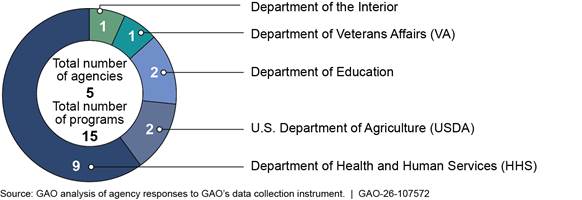
The 15 programs are fragmented across five federal agencies, meaning the programs overlap across the agencies to some extent—with similar populations or services. However, the programs are not duplicative because they vary in beneficiary population characteristics or type of services provided. Officials from all 15 programs reported coordinating with other programs serving pregnant women, children through age 5, or their families. Coordination improves agencies’ ability to provide services and improves outcomes for beneficiaries.
Three of the 15 programs have not fully established a performance management process at the federal level—in which they set performance goals, collect performance information, and use that information to assess results:
· HHS’s Preschool Development Grants Birth Through Five Program. HHS officials said this program does not set federal performance goals because it monitors progress toward state-defined goals in order to maximize state flexibility. However, a federal performance management process allows a program to assess national progress across varied state activities.
· USDA’s Special Supplemental Nutrition Program for Women, Infants, and Children (WIC) Farmers Market Nutrition Program. USDA officials said such a process is not warranted, in part, because the program is small and lacks dedicated funding for this. However, regardless of program size, Congress and taxpayers need to know how effectively tax dollars are being spent.
· VA’s Veterans Health Administration (VHA) Maternity Care Coordinator Program. Officials said they are working on establishing a process, but have not yet completed it.
By fully establishing such a process, the agencies would have a more systematic way to identify potential strategies to reduce any unnecessary fragmentation and overlap, ensure that the programs are achieving their intended results, and target resources appropriately.
Why GAO Did This Study
Federal programs play a significant role in supporting many pregnant women, children through age 5, and their families by providing services to address their distinct needs.
GAO was asked to identify programs that serve pregnant women, children through age 5, or their families. This report examines (1) federal programs that serve this population, including programs that provide some amount of direct services solely to this population; (2) the extent to which duplication, overlap, or fragmentation exists among programs that provide some amount of direct services solely to this population; and (3) the extent to which programs that provide some amount of direct services solely to this population have established a performance management process.
GAO identified 250 potentially relevant programs primarily using the federal assistance listings on the System for Award Management website, SAM.gov. To verify the list of programs and collect additional information about them, GAO sent a data collection instrument to the 18 federal agencies that administer the programs. GAO also reviewed relevant agency documentation and interviewed agency officials, as appropriate.
What GAO Recommends
GAO is making three recommendations. Two recommend that HHS and USDA establish a federal performance management process for one of their programs. One recommends that VA finalize its federal performance management process for one of its programs. HHS disagreed with GAO’s recommendation. USDA neither agreed nor disagreed. VA agreed. GAO maintains its recommendations, as discussed in this report.
Abbreviations
AIDS acquired immunodeficiency syndrome
CHIP Children’s Health Insurance Program
COVID-19 Coronavirus Disease 2019
CRS Congressional Research Service
DCI data collection instrument
EHDI Early Hearing Detection and Intervention
FACE Family and Child Education
FY fiscal year
HHS Department of Health and Human Services
HIV human immunodeficiency virus
MOU memorandum of understanding
OMB Office of Management and Budget
SNAP Supplemental Nutrition Assistance Program
SUD substance use disorder
USDA U.S. Department of Agriculture
VA Department of Veterans Affairs
VHA Veterans Health Administration
WIC Special
Supplemental Nutrition Program for Women,
Infants, and Children
This is a work of the U.S. government and is not subject to copyright protection in the United States. The published product may be reproduced and distributed in its entirety without further permission from GAO. However, because this work may contain copyrighted images or other material, permission from the copyright holder may be necessary if you wish to reproduce this material separately.
May 5, 2026
The Honorable Darin LaHood
Chairman
Subcommittee on Work and Welfare
Committee on Ways and Means
House of Representatives
The Honorable Kevin Hern
House of Representatives
In 2024, there were approximately 21.2 million children through age 5 and 3.6 million births in the United States, according to Census Bureau and Centers for Disease Control and Prevention data, respectively.[1] Federal programs play a significant role in supporting many pregnant women, children through age 5, and their families by providing services to address their distinct needs. You asked us to identify programs that serve this population and to assess any duplication between these programs. This report examines
1. federal programs that serve pregnant women, children through age 5, or their families, including programs that provide some amount of direct services solely to this population;
2. the extent to which duplication, overlap, or fragmentation exists among the programs that provide some amount of direct services solely to this population;[2] and
3. the extent to which the programs that provide some amount of direct services solely to this population have established a performance management process to monitor performance.
To address our first objective, we identified programs serving pregnant women, children through age 5, or their families that operated in fiscal year (FY) 2024.[3] We did so through a multi-step process summarized below and detailed in appendix I.
· We identified potentially relevant programs primarily from the federal assistance listings on the System for Award Management website, SAM.gov, using the most recent data available at the time we conducted our search in October 2024.[4] We also included potentially relevant tax expenditures and identified them using FY 2025 Department of the Treasury tax expenditure documents.[5]
· We assessed each program that we identified against criteria to determine whether it served pregnant women, children through age 5, or their families. (The programs could also serve other populations or have other eligibility requirements.) More specifically, we assessed whether the programs served:
· pregnant women;[6]
· children through age 5, including any subset of children through age 5; or
· families, including the parents/guardians of such children, who receive benefits due to their connection to the pregnant women or children through age 5.
· We took steps to verify the program list including, but not limited to, sending a data collection instrument (DCI) to relevant federal agencies, which is detailed below.
This list of programs is in appendix II. During our review, a comprehensive inventory of federal programs serving this population did not exist. Therefore, the list we developed is the most complete list available of programs operating in FY 2024, despite its limitations.
From this list of programs, we identified a subset of “Focused” programs that (1) only serve pregnant women, children through age 5, or their families (regardless of whether they have other eligibility requirements) and (2) provide some amount of direct services (e.g., food assistance)—not solely indirect services (e.g., activities such as research, staff training, or technical assistance to states or other nonfederal entities)—to this population.[7]
We created and sent a DCI to the 18 federal agencies that administered all of the programs we identified to gather information to address all three objectives.[8] We asked each agency to list any relevant programs that we did not identify. For all of the programs, we asked agencies to provide basic program information, such as obligations, beneficiaries, and services provided.[9] For the Focused programs, we also asked for information on intra- and interagency coordination activities and program performance management (as discussed below). We did not independently verify the information that agencies provided in the DCI or conduct a legal analysis to confirm the program descriptions. However, we conducted basic data verification of the DCI responses. Program information in this report is based on agencies’ DCI responses, unless otherwise noted.[10] Tax expenditure information in this report is based on publicly available documentation from the Department of the Treasury. See appendix I for more information.
To address our second objective, we used agencies’ DCI responses to evaluate the Focused programs using our duplication, overlap, and fragmentation framework.[11] Specifically, we compared the populations served, goals, and service types of each Focused program.[12] Consistent with the framework, we defined (1) duplication as instances in which programs have identical target populations, goals, and services; (2) overlap as instances in which programs have target populations, goals, or services that are similar but not identical; and (3) fragmentation as instances in which there are overlapping programs across different agencies. We also analyzed agencies’ DCI responses about program coordination and relevant documentation to determine program coordination activities. We did not assess the quality of these activities.
To address our third objective, we used agencies’ DCI responses to compare Focused programs’ performance management with our three-step performance management process. This process requires programs to, at the federal level, (1) set goals to identify the results they seek to achieve, (2) collect performance information to measure progress, and (3) use that information to assess results and inform decisions to ensure further progress toward achieving those goals.[13] We also considered federal internal control standards for defining objectives and using quality information to achieve objectives.[14] We did not assess the appropriateness of the programs’ performance goals, performance information, or use of performance information. We also did not determine whether programs collect performance information for each of their performance goals or if programs are achieving each of their performance goals. However, we used agencies’ DCI responses to broadly assess the completeness of programs’ performance management processes.
To address all three objectives, we also reviewed relevant agency documentation and interviewed agency officials, as appropriate.
We conducted this performance audit from May 2024 through May 2026 in accordance with generally accepted government auditing standards. Those standards require that we plan and perform the audit to obtain sufficient, appropriate evidence to provide a reasonable basis for our findings and conclusions based on our audit objectives. We believe that the evidence obtained provides a reasonable basis for our findings and conclusions based on our audit objectives.
Background
Federal Assistance Programs and Tax Expenditures
The federal government provides services to pregnant women, children through age 5, and their families in part through federal assistance programs. Federal assistance programs may provide money, property, services, or other items of value to recipients to carry out a public purpose authorized by law, such as supporting a target population. For example, federal programs may provide grants to state governments that distribute the grant funds to local governments or nongovernmental entities. States often oversee these programs and must adhere to federal regulations. For some programs (e.g., Medicaid), state or other nonfederal money is required, while other programs may be fully funded with federal dollars (e.g., the Special Supplemental Nutrition Program for Women, Infants, and Children [WIC]).
Federal assistance program funding levels and mechanisms vary. Some programs’ (e.g., the Supplemental Nutrition Assistance Program [SNAP]) funding generally allows them to serve all eligible beneficiaries. Other programs (e.g., the Temporary Assistance for Needy Families Program) have a fixed amount of federal funds available, which may limit the number of eligible beneficiaries who can receive benefits. Moreover, not all eligible individuals choose to participate in programs, even if funding is available.[15]
Federal support is also available through tax expenditures, which may include tax credits, deductions, or exclusions. Tax expenditures reduce the tax burden of, and provide targeted financial support to, the beneficiary. They are generally measured as the estimated reduction in tax revenue for the federal government. Some tax credits are refundable, meaning the credit in excess of tax liability results in a cash refund to the tax filer.
Duplication, Overlap, and Fragmentation
Since 2010, we have reported annually on duplicative programs in the federal government. In 2015, we developed an evaluation and management guide to supplement these reports.[16] This guide contains the following definitions:
· Duplication occurs when multiple agencies or programs engage in the same activities or provide the same services to the same beneficiaries.
· Overlap occurs when multiple agencies or programs have similar goals, engage in similar activities or strategies to achieve them, or target similar beneficiaries.
· Fragmentation occurs when multiple agencies (or multiple organizations within an agency) are involved in the same broad area of national need.
These concepts are related and can occur in combination across programs. For example, fragmentation exists when multiple agencies are involved in the same area, and a subset of their programs could overlap or be duplicative depending on how similar the programs are. Duplication, overlap, or fragmentation among programs is not necessarily problematic. In some cases, it may be appropriate or beneficial for multiple agencies or entities to be involved in the same programmatic or policy area due to the complex nature or magnitude of the federal effort.
Program Performance Management
Our prior work defines a three-step performance management process by which agencies
1. set goals to identify the results they seek to achieve,
2. collect performance information (a type of evidence) to measure progress, and
3. use that information to assess results and to inform decisions to ensure further progress toward achieving those goals.[17]
This performance management process should occur at the federal program level so that agencies can assess national progress toward performance goals across varied state activities and efforts. We use the following definitions:
· Performance goals are the specific results the agency expects its program to achieve in the near term (e.g., increasing program participation by 10 percent in 2024).
· Performance information is quantitative or qualitative data used to track progress toward achieving agency goals or objectives or to assess the overall performance of a program, operation, or project. It can be used to focus on different aspects of performance, such as efficiency or quality. Performance information (e.g., maternal morbidity rates) can be used to show the agency’s progress in achieving performance goals. Performance measures are tools to collect performance information.
The performance management process helps agencies define what they are trying to achieve, determine how well they are performing, and identify what they could do to improve results. Performance information is generally collected on a regular basis (e.g., monthly, quarterly, annually). This allows for regular monitoring and oversight—both within a federal agency and by outside parties, such as Congress, the public, and other stakeholders.
Over 200 Programs Across 15 Federal Agencies Serve Pregnant Women, Children Through Age 5, or Their Families
Most Programs That Serve Pregnant Women, Children Through Age 5, or Their Families Also Serve Other Populations
We found that 242 federal programs, including 12 tax expenditures, provide a range of benefits and services to pregnant women, children through age 5, or their families.[18] Of these 242 programs, 238 responded to our DCI. Of the 238 programs, 212 programs serve populations that include, but are not limited to, pregnant women, children through age 5, or their families.[19] For example, the Child and Adult Care Food Program serves eligible children through age 5, as well as adults. The 238 programs may also have eligibility requirements unrelated to being in the population of pregnant women, children through age 5, or their families, such as an income requirement.
FY 2024 obligations for the 238 programs—which included funds for populations other than pregnant women, children through age 5, or their families—totaled over an estimated $1.5 trillion, as reported by agencies.[20] Reported obligations ranged from $10,000 (FISH-ABLE Fun with Reclamation, a Department of the Interior recreational fishing program for children and youth with disabilities and underserved children and youth) to $660 billion (Medicaid) per program. However, for these programs, pregnant women, children through age 5, or their families were often a small subset of the entire population served and therefore only a portion of funding may have benefited them. For example, the U.S. Department of Agriculture (USDA) reported that in FY 2023, total program spending for SNAP was over $100 billion but only about 11 percent of SNAP benefits went to children under age 5.[21] See appendix II for a list of the programs and more specific information about them.
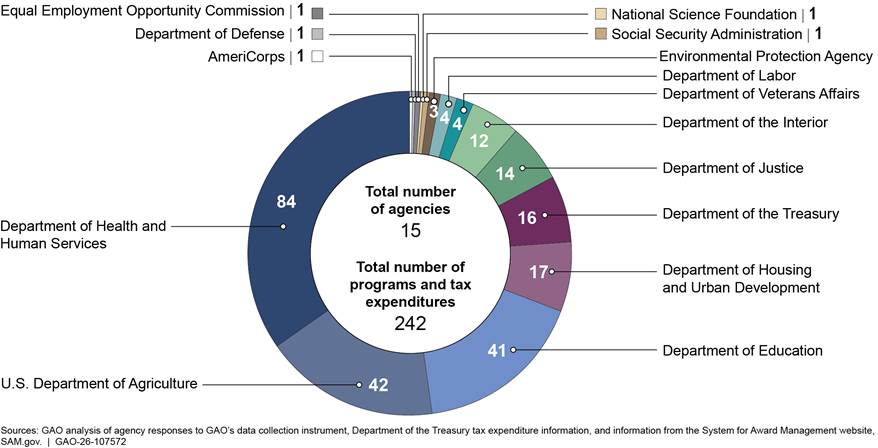
Fifteen federal agencies administer the 242 programs. However, the majority of the programs are administered by the Department of Health and Human Services (HHS) (84 programs), USDA (42 programs), or the Department of Education (41 programs), as shown in figure 1.
Figure 1: FY 2024 Federal Programs and Tax Expenditures That Serve Pregnant Women, Children Through Age 5, or Their Families, Among Other Groups, by Federal Agency
Notes: The programs operated in fiscal year (FY) 2024, according to agency officials. GAO excluded programs specifically for federal employees (e.g., federal employee maternal benefit programs), including programs for active-duty military or their families and for federal civilian employees. For the purpose of this report, pregnant women includes postpartum women.
Populations Served
The majority of the 238 programs that responded to our DCI serve (among other populations) a combination of the three groups—pregnant women, children through age 5, and their families—rather than one group alone. Thirty-one of the 238 programs serve all three groups. Eighty-eight percent of the programs (209 of 238 programs) include at least children through age 5 as a beneficiary. See figure 2.
Figure 2: FY 2024 Federal Programs and Tax Expenditures That Serve Pregnant Women, Children Through Age 5, or Their Families, Among Other Groups, by Beneficiary Group(s) Served
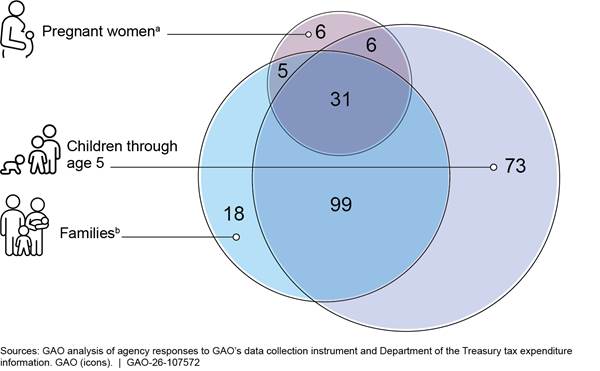
Notes: The programs operated in fiscal year (FY) 2024, according to agency officials. Despite GAO’s efforts to collect data from all programs, four of the 242 programs and tax expenditures GAO identified that serve pregnant women, children through age 5, or their families, did not complete GAO’s data collection instrument and are excluded from this figure. Each number in the figure represents the number of programs that serve the group(s) in the overlapping circles where the number is placed. For example, 99 programs serve both children through age 5 and families, and 31 programs serve all three groups.
aFor the purpose of this report, pregnant women includes postpartum women.
bThis includes families (of pregnant women or children through age 5) that receive program benefits due to their connection to either of those groups.
The number of beneficiaries served by these programs varies widely. For example, HHS’s Infant and Early Childhood Mental Health Program reported that in FY 2024, it served 6,650 children through age 12 who have, or are at risk for, a mental illness, as well as their families or caregivers. In contrast, USDA’s National School Lunch Program reported serving almost 30 million school-age children, on average, every day during the school year in FY 2024.[22]
Some of these programs include pregnant women, children through age 5, or their families as a small subset of the entire population served. These programs may include additional targeted population characteristics, including eligibility requirements.[23] For example, HHS’s Children’s Health Insurance Program provides health coverage to eligible children under age 19, and eligibility for health coverage under the program is based, in part, on income.[24] Excluding the “other” category, the most common additional targeted population characteristics were income level (70 programs), school-aged children (61 programs), and disability (38 programs), according to agency officials (see fig. 3).
Figure 3: Additional Targeted Population Characteristics for FY 2024 Federal Programs and Tax Expenditures That Serve Pregnant Women, Children Through Age 5, or Their Families, Among Other Groups
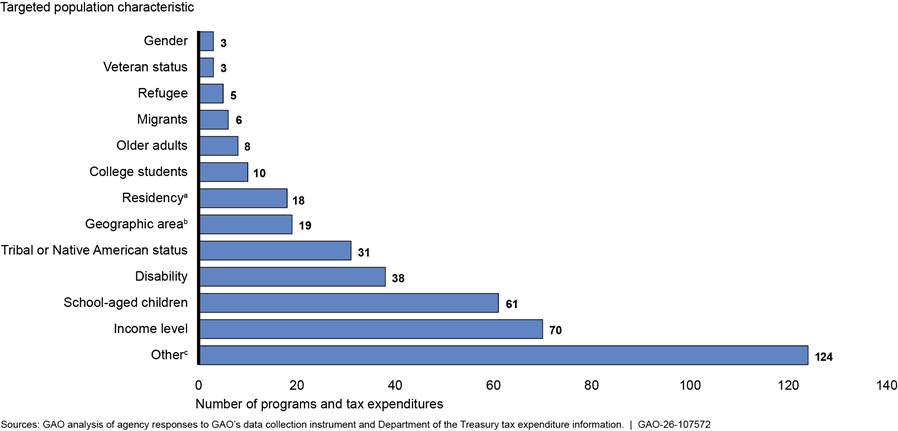
Notes: The programs operated in fiscal year (FY) 2024, according to agency officials. Agency officials selected additional targeted population characteristics from a pre-designated list. Despite efforts to collect data from all programs, four of the 242 programs did not complete GAO’s data collection instrument and are excluded from this figure. Since officials could select as many characteristics as were relevant, adding the programs in the figure will result in a number greater than 238—the total number of programs and tax expenditures GAO identified that serve pregnant women, children through age 5, or their families, and that responded to GAO’s data collection instrument. For the purpose of this report, “targeted population characteristics” includes (1) requirements that beneficiaries must meet to be eligible for a program and (2) other population characteristics that programs target but that are not required for program eligibility. For the purpose of this report, pregnant women includes postpartum women.
aResidency refers to, for example, a certain zip code or county.
bGeographic area refers to, for example, an urban or rural area.
c“Other” includes any targeted population characteristic that does not fit into an identified population category on the data collection instrument, as reported by agency officials. For example, this could include U.S. citizenship or diagnosis of substance use disorder.
Services Provided
The 238 programs that responded to our DCI provide an array of benefits and services to pregnant women, children through age 5, and their families, among other groups—encompassing both direct and indirect services.
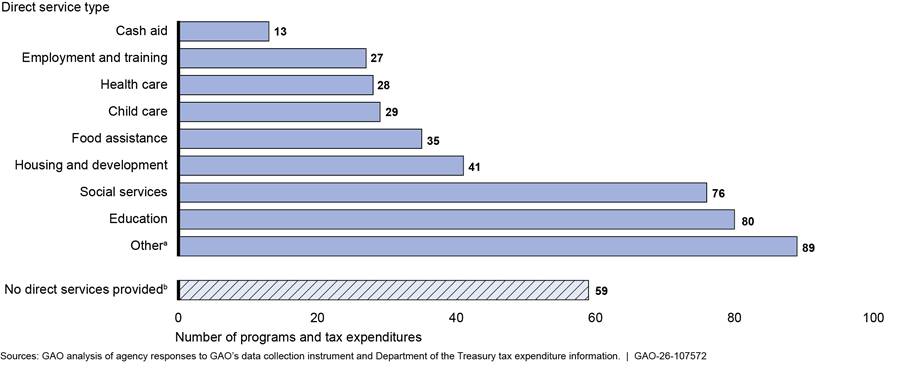
Direct services. Seventy-five percent of the 238 programs provide some amount of direct services—those that benefit a person, specifically, rather than a population, generally.[25] Many programs provide multiple types of direct services. Among programs that provide direct services, the most common specified direct service types are education (provided by 45 percent of direct service programs), social services (42 percent), and housing and development (23 percent). See figure 4.
Figure 4: Direct Service Types of the FY 2024 Federal Programs and Tax Expenditures That Serve Pregnant Women, Children Through Age 5, or Their Families, Among Other Groups
Notes: The programs operated in fiscal year (FY) 2024, according to agency officials. Agency officials identified direct service types using seven categories developed by the Congressional Research Service. These were cash aid, education, employment and training, food assistance, health care, housing and development, and social services. GAO added a category for child care and an “other” option and requested that agency officials describe the “other” services. Based on agency officials’ written responses, GAO sometimes assigned additional direct service types (beyond what they identified in this field) to a program. Despite GAO’s efforts to collect data from all programs, four of the 242 programs did not complete GAO’s data collection instrument and are excluded from this figure. Since programs may provide multiple direct service types, adding the programs in the figure will result in a greater number than 238—the total number of programs and tax expenditures GAO identified that serve pregnant women, children through age 5, or their families, and that responded to GAO’s data collection instrument. For the purpose of this report, pregnant women includes postpartum women.
a“Other” includes any service that does not fit into an identified service type category on the data collection instrument, as reported by agency officials.
bThese programs provide only indirect services. For the purpose of this report, GAO defines direct services as those that benefit a person, specifically, rather than a population, generally. This means actual services or benefits are provided to participants or beneficiaries (e.g., food assistance) through a program. The services or benefits may be provided directly by the federal government or through entities receiving federal funds, such as state governments. In contrast, GAO defines indirect services as those that benefit a population as a whole. Such programs do not provide a specific service to beneficiaries, but rather provide funds to support activities such as research, staff training, or technical assistance to states or other nonfederal entities.
Specific services of the same direct service type can differ. For example, the Department of Education’s Special Education Grants to States Program and Indian Education Grants to Local Educational Agencies Program both provide the direct service type of education to children. However, the Special Education Grants to States Program focuses on special education services, while the Indian Education Grants to Local Educational Agencies Program supports culturally relevant education, such as Native American language programs.
Indirect services. Twenty-five percent of the 238 programs provide only indirect services—those that benefit a population as a whole as opposed to providing specific services to beneficiaries. These programs provide funds to support activities such as research, staff training, or technical assistance to states or other nonfederal entities. For example, the Environmental Protection Agency’s Protection of Children from Environmental Health Risks Program protects children from harmful environmental contamination that impacts lifelong health by conducting research, carrying out community engagement and partnerships, and providing relevant entities with scientific expertise to develop environmental regulations, among other activities, according to agency officials.
Tax Expenditures
The 12 tax expenditures we identified include tax credits, tax exclusions, and tax deductions.[26] These tax expenditures serve families and children through age 5, and are available to a wide range of taxpayers beyond this population. For example, the Child Tax Credit is available to eligible families with qualifying children, generally those under age 17 at the end of the tax year.
Fifteen Federal Programs Provide Direct Services Solely to Pregnant Women, Children Through Age 5, or Their Families
Of the 242 programs, 15 programs—which we refer to as Focused programs in this report—provide some amount of direct services solely to pregnant women, children through age 5, or their families.[27] The size and scope of these 15 Focused programs vary. The programs ranged from serving 233 beneficiaries to approximately 6.7 million beneficiaries in the most recent fiscal year for which data were available. Reported FY 2024 obligations for the 15 programs ranged from approximately $6 million to $12 billion per program and totaled over $22 billion.[28] See table 1.
Table 1: The 15 FY 2024 Federal Programs That Provide Some Amount of Direct Services Solely to Pregnant Women, Children Through Age 5, or Their Families
|
Program |
Purpose |
Number of beneficiaries in most recent fiscal
year (FY) for which |
FY 2024 obligations, |
|
Department of Education |
|||
|
Grants for Infants and Families |
Support early intervention services for infants and toddlers with disabilities and their families. |
462,847 in FY 2023 |
$540 |
|
Special Education Preschool Grants |
Assist states in providing a free appropriate public education in the least restrictive environment for children with disabilities, ages 3 through 5. |
587,709 in FY 2023 |
$420 |
|
Department of Health and Human Services |
|||
|
Early Hearing Detection and Intervention |
Provide grants to state Early Hearing and Detection Intervention Programs to maintain and support a coordinated statewide screening, data-tracking, and referral system for infant hearing loss. |
3,547,774 in FY 2022 |
$19 |
|
Head Startb |
Administer grants to local agencies to provide comprehensive early learning and development services to economically disadvantaged children, families, and pregnant women. |
805,660 in FY 2024c |
$12,373 |
|
Healthy Start Initiative |
Improve health outcomes before, during, and after pregnancy and reduce infant death and adverse perinatal outcomes. |
85,000 in FY 2022 |
$145 |
|
Maternal, Infant, and Early Childhood Home Visiting Program |
Fund states and jurisdictions to support voluntary, evidence-based home visiting services that support expectant and new parents during the early childhood period. |
150,332 in FY 2024 |
$444 |
|
Maternal Opioid Misuse Model |
Address fragmentation in the care of pregnant and postpartum Medicaid beneficiaries with opioid use disorder and improve quality of care while reducing costs. Through state-driven changes to service delivery systems, the program coordinates clinical care and the integration of other services critical for health, wellbeing, and recovery. |
1,345 in FY 2024 |
$8 |
|
Preschool Development Grants Birth Through Five |
Improve child health and development, maximize parent engagement and knowledge, prepare children to enter kindergarten ready to succeed, and improve transitions from the early childhood system into the local educational agency or elementary school. Grant recipients are charged with strengthening early childhood systems by investing in the early childhood education workforce, expanding access to high-quality early childhood education programs through a mixed-delivery system, engaging families, and promoting children’s healthy development, among other activities. |
Data unavailabled |
$315 |
|
Services Program for Residential Treatment for Pregnant and Postpartum Women |
Provide residential substance use disorder (SUD) and co-occurring SUD and mental illness treatment to pregnant and postpartum women and their minor children; provide services to non-residential family members of both the women and children; and support evidence-based parenting and SUD/Mental Illness treatment models, including trauma-specific services in a trauma-informed context. |
233 in FY 2024 |
$13 |
|
State Pilot Program for Treatment for Pregnant and Postpartum Women |
Support family-centered services for pregnant and postpartum women with a primary diagnosis of a SUD, including opioid use disorder; help state substance use agencies address the continuum of care, including services provided to women with SUD in non-residential settings; and promote a coordinated state system of SUD care managed by state substance use agencies by encouraging new approaches and models of service delivery. |
378 in FY 2024 |
$9 |
|
Tribal Maternal, Infant, and Early Childhood Home Visiting |
Fund tribal entities to support voluntary, evidence-based home visiting services for American Indian and Alaska Native pregnant women, expectant fathers, and families with children from birth to kindergarten entry. |
3,718 in FY 2024 |
$33 |
|
Department of the Interior |
|||
|
Early Childhood Development: Family and Child Education |
Promote students’ academic and social-emotional success through family enrichment, prekindergarten, and adult education services that are grounded in Native values. |
2,914 in FY 2024c |
$25 |
|
Department of Veterans Affairs |
|||
|
Veterans Health Administration Maternity Care Coordinator Program |
Coordinate maternity care for pregnant and postpartum veterans inside and outside of Veterans Affairs medical centers. |
17,267 in FY 2023 |
$6 |
|
U.S. Department of Agriculture |
|||
|
Special Supplemental Nutrition Program for Women, Infants, and Children (WIC) |
Safeguard the health of low-income pregnant, postpartum, and breastfeeding women; infants; and children up to age 5 who are at nutritional risk by providing nutritious foods to supplement diets, information on healthy eating including breastfeeding promotion and support, and referrals to health care. |
6,704,329 in FY 2024 |
$7,986 |
|
WIC Farmers Market Nutrition Program |
Provide fresh, nutritious, unprepared fruits and vegetables from farmers’ markets to women, infants, and children who participate in—or are on the waiting list for—the WIC Program and expand awareness of, use of, and sales at farmers’ markets. |
1,552,542 in FY 2024 |
$31 |
Source: GAO analysis of agency responses to GAO’s data collection instrument. | GAO‑26‑107572
Notes: GAO did not independently verify the information provided by the agencies or conduct a legal analysis to confirm the information in this table. In some cases, GAO edited the programs’ purposes provided by agencies for brevity and standard reporting across programs. The programs may have other requirements for beneficiary eligibility beyond being in the population of pregnant women, children through age 5, or their families. The programs in this table operated in FY 2024, according to agency officials. For the purpose of this report, pregnant women includes postpartum women. For the purpose of this report, GAO defines direct services as those that benefit a person, specifically, rather than a population, generally. This means actual services or benefits are provided to participants or beneficiaries (e.g., food assistance) through a program. The services or benefits may be provided directly by the federal government or through entities receiving federal funds, such as state governments. Programs that provide direct services may also provide indirect services.
aGAO asked agencies to provide obligations for FY 2024. Appropriations for some programs are multi-year, so the amounts in the table may include FY 2024 obligations from prior year appropriations. The obligations listed may not be dedicated solely to direct services.
bHead Start includes Head Start Preschool, Early Head Start, and Head Start Disaster Recovery.
cData from these programs are from the 2023–2024 school year.
dDepartment of Health and Human Services officials said that the number of beneficiaries is not reported uniformly across states that receive grants due to variation in states’ approaches to the Preschool Development Grants Birth Through Five Program. For example, officials reported in GAO’s data collection instrument that in addition to providing funds to states to build state systems, the program allows states to fund local programs to provide direct services to beneficiaries. They indicated that this option has not been widely used. As such, the program was unable to provide data on the number of beneficiaries it served in the most recent FY.
All 15 Focused Programs Overlap and Reported Coordination Activities
Focused Programs Are Fragmented Across Agencies and Overlap in Population Characteristics and Direct Service Types, but They Are Not Duplicative
We found that the 15 Focused programs are fragmented across five federal agencies.[29] In addition, the programs overlap to some extent in population characteristics, direct service types, or both. We determined that none of these programs are duplicative of each other because they vary to some extent in population characteristics, direct service types, or both.
Fragmentation Across Federal Agencies
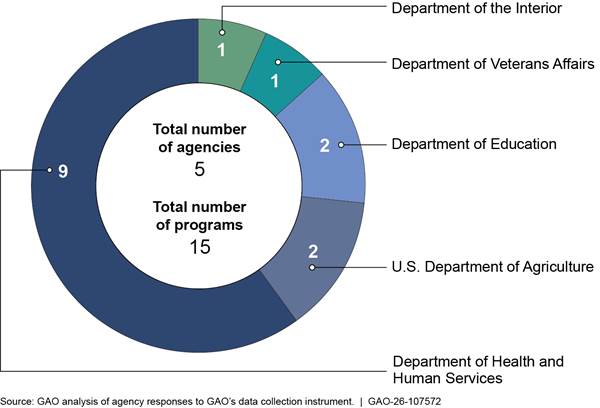
We found that five federal agencies administer the 15 Focused programs. The majority (nine programs) are administered by HHS, as shown in figure 5.
Figure 5: FY 2024 Federal Programs That Provide Some Amount of Direct Services Solely to Pregnant Women, Children Through Age 5, or Their Families, by Federal Agency
Notes: The programs operated in fiscal year (FY) 2024, according to agency officials. For the purpose of this report, pregnant women includes postpartum women. For the purpose of this report, GAO defines direct services as those that benefit a person, specifically, rather than a population, generally. This means actual services or benefits are provided to participants or beneficiaries (e.g., food assistance) through a program. The services or benefits may be provided directly by the federal government or through entities receiving federal funds, such as state governments.
Overlap in Population Characteristics
We found that all 15 Focused programs serve at least part of the population of pregnant women, children through age 5, or their families. Specifically, nine programs serve all three groups within the population, and an additional four programs serve two but not all three groups. The final two programs serve only one group (see fig. 6).
Figure 6: Overlap in Group(s) Served Among the FY 2024 Federal Programs That Provide Some Amount of Direct Services Solely to Pregnant Women, Children Through Age 5, or Their Families
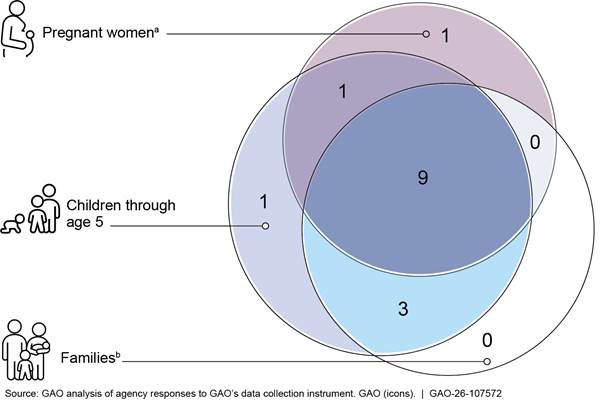
Notes: The programs operated in fiscal year (FY) 2024, according to agency officials. For the purpose of this report, GAO defines direct services as those that benefit a person, specifically, rather than a population, generally. This means actual services or benefits are provided to participants or beneficiaries (e.g., food assistance) through a program. The services or benefits may be provided directly by the federal government or through entities receiving federal funds, such as state governments. Each number in the figure represents the number of programs that serve the group(s) in the overlapping circles where the number is placed. For example, three programs serve both children through age 5 and families, and nine programs serve all three groups.
aFor the purpose of this report, pregnant women includes postpartum women.
bThis includes families (of pregnant women or children through age 5) that receive program benefits due to their connection to either of those groups.
The Focused programs differ in the specific subset(s) of the group(s) they serve. For example:
· Of the 12 programs that serve both children through age 5 and families, nine programs serve children of all ages through age 5, and three serve some but not all children through age 5.
· Of the 10 programs that serve both pregnant women and children through age 5, eight programs serve children of all ages through age 5, and two serve some but not all children through age 5.
In addition, the Focused programs have varying beneficiary population characteristics—including additional eligibility factors or other characteristics—for the populations they serve, according to agency officials. For example, HHS’s Maternal Opioid Misuse Model Program serves pregnant and postpartum women and their children under age 1 but requires participants to have an opioid use disorder diagnosis. The Department of Veterans Affairs’ (VA) Veterans Health Administration (VHA) Maternity Care Coordinator Program also serves pregnant and postpartum women but requires participants to have veteran status and be enrolled in VHA’s health care system. See appendix III for each Focused program’s population characteristics, including group subset(s) served.
Overlap in Direct Service Types
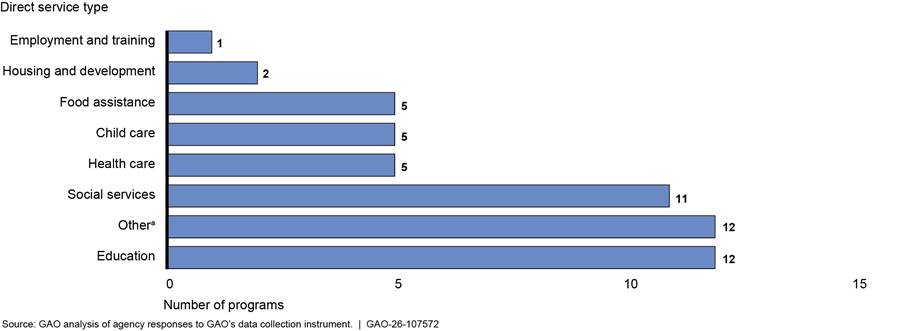
We found that all 15 Focused programs overlap to some extent in the types of direct services they provide to pregnant women, children through age 5, or their families.[30] For example:
· Nine programs provide both education and social services. Of these programs, two also provide both child care and food assistance services, and one also provides employment and training services.
· Five programs provide education or social services, but not both.
· One program provides neither education nor social services (this program provides only food assistance services).
Figure 7 shows the 15 Focused programs’ direct service types. See appendix III for more specific information.
Figure 7: Direct Service Types of FY 2024 Federal Programs That Provide Some Amount of Direct Services Solely to Pregnant Women, Children Through Age 5, or Their Families
Notes: The programs operated in fiscal year (FY) 2024, according to agency officials. Agency officials identified direct service types using seven categories developed by the Congressional Research Service. These were cash aid, education, employment and training, food assistance, health care, housing and development, and social services. GAO added a category for child care and an “other” option and requested that agency officials describe the “other” services. Based on agency officials’ written responses, GAO sometimes assigned additional direct service types (beyond what they identified in this field) to a program. Since programs may provide multiple direct service types, adding the programs in the figure will result in a number greater than the total number of programs. For the purpose of this report, GAO defines direct services as those that benefit a person, specifically, rather than a population, generally. This means actual services or benefits are provided to participants or beneficiaries (e.g., food assistance) through a program. The services or benefits may be provided directly by the federal government or through entities receiving federal funds, such as state governments. For the purpose of this report, pregnant women includes postpartum women.
a“Other” includes any service that does not fit into an identified direct service type category on the data collection instrument, as reported by agency officials.
For Focused programs that provide the same direct service type, the specific services they provide may vary. For example, 12 of the 15 programs provide education services, but the type of education they provide is different for some programs. For example, to improve infant health outcomes, HHS’s Healthy Start Initiative provides prenatal and parenting education—on topics such as breastfeeding and infant injury prevention—to pregnant women and parents of children 18 months or younger. Education’s Special Education Preschool Grants Program assists states in providing special education and related services to children with disabilities.
Officials from Every Focused Program Reported Coordination Activities with Other Federal Programs
Officials from all 15 Focused programs reported coordinating to some extent with other programs serving pregnant women, children through age 5, or their families. As we reported in 2023, coordination among agencies and programs can help ensure that they benefit from fragmentation. For example, it can help focus resources on specific aspects of a goal or bring specific expertise to a topic. Coordination can also mitigate the risks associated with fragmentation, such as working at cross-purposes or wastefully duplicating efforts.[31]
The 15 Focused programs’ reported coordination was formal, informal, or both. The coordination occurred between different components of the same agency, different agencies, or both. Formal coordination includes mechanisms such as interagency working groups or memoranda of understanding (MOU) between agencies. Informal coordination includes activities such as ad hoc discussions or information sharing.
Agency officials identified several coordinating bodies among the Focused programs. For example:
· Tribal Early Childhood Federal Partners Workgroup. This group is comprised of program offices in HHS’s Administration for Children and Families, other HHS offices, the Department of the Interior, Education, and USDA, according to officials from HHS’s Tribal Maternal, Infant, and Early Childhood Home Visiting Program. They said that the workgroup shares information, best practices, and expertise across agencies to more effectively implement early childhood programs and systems in tribal communities.
· Children’s Interagency Coordinating Council. This council is operated by HHS. It includes 10 agencies, such as the Department of Housing and Urban Development, Education, Interior, and USDA. The council aims to increase coordination and transparency on child policy across agencies and examine crosscutting issues affecting child well-being.
· Early Childhood Federal Partners Meeting Group. This group—convened by HHS’s Office of the Assistant Secretary for Planning and Evaluation—is a working group that meets monthly and includes officials from HHS, Education, USDA, Department of Labor, Department of Transportation, and Department of Defense, according to HHS officials. They told us that participation in the meetings has resulted in increased awareness of eligibility requirements and available services for HHS’s Maternal, Infant, and Early Childhood Home Visiting Program.
Officials from various programs also reported holding regular meetings to coordinate with each other. For example, officials from Education’s Grants for Infants and Families Program reported having regular meetings with officials from HHS’s Maternal, Infant, and Early Childhood Home Visiting Program. The meetings have helped the two agencies make their messaging more consistent and focus on early childhood intervention priorities, according to the officials.
Additionally, agency officials identified MOUs between agencies to encourage coordination. For example:
· USDA’s Food and Nutrition Service and HHS’s Substance Abuse and Mental Health Services Administration signed an MOU in December 2024. The MOU aims to strengthen their partnership for the Special Supplemental Nutrition Program for Women, Infants, and Children (WIC). Specifically, the agencies coordinate on (1) training about mental illness, substance use disorder prevention, treatment, and recovery initiatives and (2) the development of WIC-specific resources to support WIC staff in delivering substance use prevention education.
· HHS’s Administration for Children and Families and USDA’s Food and Nutrition Service have a December 2017 MOU that affirms the agencies’ collaborative relationship with the goal of improving service delivery for WIC, Head Start, and other programs for low-income children and families. It encourages coordination at the federal, state, and local levels and suggests collaborative efforts between state and local service providers in areas such as nutrition services, health care services and referrals, and volunteer services.
Because the Focused programs’ services often complement each other, effective coordination improves agencies’ ability to provide services, according to USDA officials. For example, officials from USDA’s WIC Program told us that they work with HHS’s Head Start and HHS’s Maternal, Infant, and Early Childhood Home Visiting Program to ensure program administrators are aware of the benefits of the programs’ services that support early, healthy development. According to these officials, services from other programs complement those provided by WIC, and efforts to foster relationships with other agencies improve services for low-income children and their families. They said that coordination is critical to success across programs.
Effective coordination can also improve outcomes for program beneficiaries and ultimately reduce duplication, according to agency officials. For example, officials from HHS’s Preschool Development Grants Birth Through Five Program told us the program builds on existing resources from other programs to expand and support services for pregnant women, children through age 5, and their families. Additionally, HHS’s Substance Abuse and Mental Health Services Administration officials said that their work with other HHS components allow programs to provide consistent assistance, ultimately resulting in positive outcomes for mothers, children, and families. They told us that coordination efforts allow information to spread more widely and thereby improve education for organizations and institutions that serve pregnant and postpartum women. Overall, this type of coordination reduces duplicative efforts.
Three of the 15 Focused Programs Have Not Fully Established a Performance Management Process
Twelve Focused Programs Have Established a Performance Management Process
Twelve of the 15 Focused programs have established a performance management process. As previously described, this process includes setting performance goals, collecting performance information to measure progress toward those goals, and using performance information to assess results and inform program management decisions.[32] The programs have established this process at the federal level.[33] These programs include:
1. Early Childhood Development: Family and Child Education (Interior)
2. Early Hearing Detection and Intervention (EHDI) (HHS)[34]
3. Grants for Infants and Families (Education)[35]
4. Head Start (HHS)[36]
5. Healthy Start Initiative (HHS)[37]
6. Maternal, Infant, and Early Childhood Home Visiting Program (HHS)[38]
7. Maternal Opioid Misuse Model (HHS)
8. Services Program for Residential Treatment for Pregnant and Postpartum Women (HHS)
9. Special Education Preschool Grants (Education)[39]
10. State Pilot Program for Treatment for Pregnant and Postpartum Women (HHS)
11. Tribal Maternal, Infant, and Early Childhood Home Visiting (HHS)
12. WIC
(USDA)
|
Example of Performance Management Process in Interior Program Interior’s Early Childhood Development: Family and Child Education (FACE) Program set the performance goal that 75 percent of enrolled 3-, 4-, and 5-year-olds will meet or exceed developmental expectations for the 2024–2025 school year. To measure progress toward this goal, FACE collects data via an observation-based assessment tool. Educators use this tool to record observational data across all areas of child development and learning, including cognitive, student resilience, physical, language, and literacy skills. FACE then uses these data to assess progress towards its goal and to identify any areas for improvement. Source: GAO analysis of Department of the Interior response to GAO’s data collection instrument. | GAO‑26‑107572 |
These programs’ performance goals and performance information vary, but they all met the standards of our methodology for this report. Specifically:
· Performance goals. Programs reported different numbers of specific, objective performance goals at the federal level that the agencies expect the programs to achieve in the near term. For example, HHS’s Healthy Start Initiative has 10 performance goals, and USDA’s WIC Program has one performance goal, according to agency officials.
·
Performance information. Programs collect a variety of
performance information. For example, officials from USDA’s WIC Program told us
that the agency’s Food and Nutrition Service collects two types of performance
information: monthly program participation and cost data. They used this
performance information to assess progress toward their goal of reaching 6.8
million WIC participants in FY 2024 and to inform USDA’s annual budget.
Three Focused Programs Have Not Fully Established a Performance Management Process
Three of the 15 Focused programs have not fully established a performance management process. Two of these programs—HHS’s Preschool Development Grants Birth Through Five Program and USDA’s WIC Farmers Market Nutrition Program—do not have performance goals. As such, the two programs cannot collect or use performance information to measure progress towards those goals and assess results. The third program—VA’s VHA Maternity Care Coordinator Program—is in the process of establishing a performance management process.
Programs should use a three-step performance management process at the federal level to set performance goals, collect performance information, and use performance information to assess results.[40] Additionally, agency management should define objectives in specific and measurable terms, such as performance goals, and use quality information, such as performance information, to achieve programs’ objectives, according to federal internal control standards.[41]
Agency officials provided different reasons for why the programs do not have federal performance goals. Officials from HHS’s Preschool Development Grants Birth Through Five Program reported that the program does not set performance goals at the federal program office level because doing so could negatively affect states’ ability to tailor their programs to meet state-specific needs and performance goals. They said that the federal program’s performance management focuses on monitoring state progress toward state-defined goals for their early childhood systems to maximize state flexibility. Specifically, officials said the states set their own strategic priorities based on their statewide needs assessments and strategic plans. HHS then collects data from states through the Annual Performance Progress Report to measure states’ progress on efforts to strengthen the early childhood care and education workforce, expand access to high-quality early childhood care and education, improve program quality, engage families and increase family choice in system design and program decisions, and implement and coordinate early childhood care and education systems. However, the specific goals are defined by the individual states.
While federal monitoring of state-level goals can be useful in supporting states, providing them the flexibility to address local conditions, and monitoring their adherence to federal program rules, a federal performance management process allows a program to assess national progress toward performance goals. If officials from a national program rely only on assessing states’ progress toward states’ varied goals, they may not be able to assess the national program in its entirety.[42] Without using a common measure across states, national program officials cannot easily identify (1) which states are performing well and may have proven or promising practices that could be shared with others and (2) which states are underperforming and could benefit from proven or promising practices, potentially because they are facing challenges similar to those that other states have overcome. Moreover, establishing a federal-level performance goal does not necessarily impede states’ ability to tailor their programs to state-specific needs. Rather, a federal-level goal could be applicable to state programs with varied state-specific goals.
Next, officials from USDA’s WIC Farmers Market Nutrition Program reported that it does not have federal performance goals because the program is small and subject to discretionary funding. USDA officials reported that the program does not receive any dedicated funding to perform activities related to establishing performance goals. Officials said they do conduct formal reviews of the state agencies implementing the program, referred to as management evaluations, to ensure compliance with program requirements. Officials therefore did not think that additional performance management activities would be warranted. However, without a defined performance goal, program officials cannot use management evaluations to gather performance information to measure progress toward such a goal and assess results. In addition, performance management principles apply to both large and small entities; regardless of program size, Congress and taxpayers need to know how effectively tax dollars are being spent.[43]
In contrast, VA’s VHA Maternity Care Coordinator Program has started, but not yet fully established, its performance management process, according to agency officials. They told us that as of February 2026, the program had set performance goals at the federal level related to outreach to and screening of pregnant veterans, but it had not yet disseminated those goals to VHA Maternity Care Coordinator Program field sites for implementation. Similarly, the program was developing, but had not finished, a dashboard to collect and analyze certain program information.[44] Agency officials noted that the performance goals and dashboard were intended to be ready for the field sites’ use by March 2026, but these steps had been delayed. In their comments on this report, VA officials indicated that they now expect to complete this process by October 2026.
By fully establishing a performance management process at the federal level, the three agencies administering these programs—HHS, USDA, and VA—would have a more systematic way to identify potential strategies to reduce any unnecessary fragmentation and overlap, ensure that the programs are achieving their intended results, and target resources appropriately.
Conclusions
Pregnant women, children through age 5, and their families represent a significant proportion of individuals in the United States, and may have unique needs. The federal government has invested in a wide range of programs that support these groups. While these programs are not duplicative, they are fragmented and overlap in populations served and services provided.
It is crucial that the federal programs serving this population have a performance management process by which they set specific performance goals and monitor them to ensure the programs are achieving their intended level of performance. Of the 15 programs we identified that focus solely on this population and provide some amount of direct services, three have not fully established a performance management process at the federal level. Without establishing such a process, agencies may not be able to identify potential strategies to reduce any unnecessary fragmentation and overlap, ensure that programs are achieving their intended results, and target resources appropriately.
Recommendations for Executive Action
We are making a total of three recommendations, including one each to HHS, USDA, and VA. Specifically:
The Secretary of Health and Human Services should establish a performance management process at the federal level for the Preschool Development Grants Birth Through Five Program. (Recommendation 1)
The Secretary of Agriculture should establish a performance management process at the federal level for the WIC Farmers Market Nutrition Program. (Recommendation 2)
The Secretary of Veterans Affairs should complete the process of establishing a performance management process at the federal level for the VHA Maternity Care Coordinator Program. (Recommendation 3)
Agency Comments and Our Evaluation
We provided a draft of this report to Education, HHS, USDA, and VA for review and comment. HHS and VA provided written comments that are reproduced in appendixes IV and V, respectively, and summarized below. USDA provided comments via email that are summarized below. In addition, Education, HHS, and USDA provided technical comments, which we incorporated as appropriate. We also provided relevant sections of a draft of this report for technical comments to AmeriCorps, Department of Defense, Department of Housing and Urban Development, Department of Justice, Department of Labor, Department of the Interior, Department of the Treasury, Environmental Protection Agency, Equal Employment Opportunity Commission, National Science Foundation, and Social Security Administration. The following agencies provided technical comments, which we incorporated as appropriate: AmeriCorps, Department of Defense, Department of Housing and Urban Development, Department of Justice, Department of Labor, Department of the Interior, National Science Foundation, and Social Security Administration.
In its comments, HHS disagreed with our first recommendation. HHS officials said that the Preschool Development Grants Birth Through Five Program already has a performance management system that monitors state progress toward state-defined goals for their early childhood systems. Officials said this method for performance management maximizes flexibility and supports state-level innovation.
HHS officials said the agency collects and monitors data from grant recipients (e.g., states) to assess progress on state goals that are aligned with the program’s implementing statute. States are required to identify overarching goals and strategies in several areas. HHS then collects information from states on their specific goals in its Annual Performance Progress Report, including information on their efforts to, for example, strengthen the early childhood care and education workforce. Officials said that in addition to the Annual Performance Progress Report, the agency manages state performance by reviewing quarterly progress reports and holding quarterly individual grantee meetings, among other things.
Although HHS’s monitoring of state progress toward state-level goals may be useful in providing states flexibility and monitoring state adherence to federal program rules, a federal-level performance management process is also important. Such a process allows a program to assess national progress toward performance goals across varied state activities and efforts. A federal-level performance goal could relate to the various efforts that HHS already asks about in its Annual Performance Progress Report, such as ensuring that a certain number of states meet their goals. Such a performance goal could be in line with the program’s statutory goals and be broader than states’ specific goals so that it does not limit states’ flexibility, but it should meet the definition of performance goal (i.e., the specific results the agency expects its program to achieve in the near term). We maintain that the Preschool Development Grants Birth Through Five Program should develop performance goals and establish a performance management process at the federal level.
In its comments, USDA neither agreed nor disagreed with our second recommendation. USDA officials reiterated that the WIC Farmers Market Nutrition Program does not have a performance goal—the first step of a performance management process—because it does not have dedicated funding for this purpose. Officials stated that the program collects performance information and uses it to assess results—the second and third steps of a performance management process—primarily through conducting management evaluations of the state agencies that implement the program and also by collecting performance information through state plans and state agency reports. Officials said they use the evaluations to ensure that state agencies are in compliance with program requirements and that federal funds are being used appropriately, and to identify areas for improvement.
However, without set performance goals to guide such evaluations, the management evaluations cannot fulfill the second and third steps of a performance management process. Officials noted that participation rates—which the larger WIC program uses as a performance goal—are not an appropriate performance goal for the WIC Farmers Market Nutrition Program because they vary widely across state agencies. However, there are other possible federal-level performance goals that could be appropriate, such as a goal related to any outcome measures that the program is already evaluating at the state level. We maintain that the WIC Farmers Market Nutrition Program should develop performance goals and establish a performance management process at the federal level.
In its comments, VA agreed with our third recommendation. VA officials said the agency anticipates completing a federal-level performance management process for the VHA Maternity Care Coordinator Program by October 2026.
We are sending copies of this report to the appropriate congressional committees, the Secretary of Education, the Secretary of Health and Human Services, the Secretary of Agriculture, the Secretary of Veterans Affairs, and other interested parties. In addition, the report is available at no charge on the GAO website at https://www.gao.gov.
If you or your staff have any questions about this report, please contact me at LarinK@gao.gov. Contact points for our Offices of Congressional Relations and Media Relations may be found on the last page of this report. GAO staff who made key contributions to this report are listed in appendix VI.
Kathryn A. Larin
Director
Education, Workforce, and Income Security
Program List Creation
Criteria for Full and Focused List Programs
To determine which federal programs to include in our review, we constructed criteria for a full list of programs and a Focused list of programs. Specifically:
· A full list of programs. Programs that serve pregnant women, children through age 5, or their families, potentially among other groups. More specifically, we defined this population as pregnant women, including postpartum women; children through age 5 including any subset of children through age 5 (e.g., preschool-aged children or children through age 3); or families, including the parents/guardians of such children, who receive benefits due to their connection to the pregnant women or children through age 5. The programs could serve one or a combination of these groups. The programs could also serve other populations or have other eligibility requirements.
· A Focused list of programs. A subset of the full list programs—which we call “Focused” programs in this report—that (1) only serve pregnant women, children through age 5, or their families (regardless of whether they have other eligibility requirements) and (2) provide some amount of direct services (e.g., food assistance)—not solely indirect services (e.g., activities such as research, staff training, or technical assistance to states or other nonfederal entities)—to this population.[45]
Additionally, we excluded programs in the following categories from both lists: (1) programs related to COVID-19, (2) programs with a limited geographic scope (e.g., if only a few states have the program or can access program funding), and (3) programs specifically for federal employees (e.g., federal employee maternal benefit programs).[46]
Program Selection
To construct our list of federal programs serving pregnant women, children through age 5, or their families that operated in fiscal year (FY) 2024, we created an initial full list of programs and a subset of Focused list programs, using the criteria detailed above. We primarily used the federal assistance listings on the System for Award Management website, SAM.gov.[47] During our review, a comprehensive inventory of federal programs serving this population did not exist; we determined that the federal assistance listings were the best available data source to inform our program list. We downloaded a complete dataset of the SAM.gov federal assistance listings as of October 2024, which were the most recent data available at the time we conducted our search.
We assessed the reliability of the SAM.gov data by reviewing technical documentation and previous GAO reports using those data, performing electronic testing for obvious errors in accuracy and completeness, and interviewing knowledgeable agency officials and GAO staff with relevant subject matter expertise. We cleaned the data using data analysis software to address the accuracy and completeness errors we identified. We determined that the data were sufficiently reliable for our purposes of creating an initial program list.
To identify potentially relevant programs in the complete SAM.gov dataset that we downloaded, we filtered for programs associated with relevant categories—categories related to pregnant women, children, or families—in two federal assistance listing indices. To identify these categories, three analysts manually reviewed the indices to identify any categories that may relate to our population. We focused specifically on categories related to (1) family, children, pregnancy, or women or (2) education, health, or social services. As an additional measure to identify potentially relevant programs, we conducted a keyword search of the complete dataset for the following words: “pregnant,” “maternal,” “child,” “women,” “parent,” “toddler,” “families,” “family,” and “infant.” We created a filtered dataset of federal assistance listings that included any programs associated with the categories or containing the keywords.
Although we determined that the SAM.gov data were sufficiently reliable for our purposes, they had limitations that prevented us from identifying all programs that serve pregnant women, children through age 5, or their families. These limitations included:
· The data were not consistent across programs, according to our analysis of the data.
· There was no way to filter the data for specific program beneficiaries or participants.
· The data did not contain all federal programs.
To mitigate these data limitations and ensure that we did not miss any relevant programs, we reviewed published reports and consulted with agency officials.
First, we identified potentially relevant reports from sources including GAO and the Congressional Research Service and reviewed them for programs that may be related to pregnant women, children, or their families.[48] We also considered programs that agency officials mentioned during our meetings. We included any potentially relevant programs based on these steps in our filtered dataset.
Once we compiled our filtered dataset, two analysts completed separate reviews of the dataset to determine if the identified programs belonged on the full list or Focused list. The analysts then discussed any disagreements and came to consensus. This process resulted in our initial program list, which included 250 programs that met our full list criteria and, of those, 15 programs that met our Focused list criteria. We then asked GAO staff with relevant subject matter expertise to review our initial program list to identify any missing programs.
Tax Expenditure Selection
To identify any tax expenditures related to pregnant women, children through age 5, or their families, we used the criteria for full and Focused list programs described above.[49] We started by reviewing FY 2025 tax expenditure documents, compiled annually by the Department of the Treasury, for tax expenditures in FY 2024 that benefited some subset of our population.[50] An analyst reviewed the title of each tax expenditure to identify any that (1) specifically mentioned pregnant women, children, or families or (2) related to service areas for our population, such as education. Additionally, an analyst conducted a keyword search of the tax expenditures’ descriptions to identify any additional expenditures that potentially served our population. The keywords included the following: “child,” “pregnant,” “women,” “parent,” “family,” and “dependent.”
After conducting the search, the analyst reviewed the identified tax expenditures and determined which may be relevant to our population. Next, an additional analyst reviewed the tax expenditure list to determine if they agreed with the determinations made by the first analyst. The analysts resolved any disagreements, resulting in a list of potentially relevant tax expenditures.
We then compiled additional publicly available tax expenditure documentation from the Department of the Treasury to determine whether the potentially relevant tax expenditures met the criteria for program inclusion described above. Two analysts then independently determined which program list, if any, each tax expenditure belonged on and discussed and resolved any disagreements. This process resulted in 12 tax expenditures on our full list and none on our Focused list.
Data Collection Instrument
After we developed our initial program list, we created and sent a data collection instrument (DCI) to the 18 federal agencies that administer the programs.[51] We asked each agency to have the appropriate program offices complete information for each program and to list any relevant programs that we did not identify. We requested information at the federal level and did not analyze state-level data or operations.
To ensure the questions on the DCI were understandable and that we collected the desired information, we pretested the DCI with officials from three federal agencies. We revised it based on their feedback. We also met with other agencies, as requested, and explained the DCI in more detail to ensure consistency in data collection.
For the full list of programs, we asked program offices to provide basic program information, such as obligations, beneficiaries, and services provided. For the Focused programs, we also asked for information on intra- and interagency coordination and program performance management. We sent the DCI to agencies beginning in December 2024 and collected responses through March 2025. We did not receive responses for four of the 250 programs.[52]
Once we collected the data, we used agency responses to reassess each program’s placement on the full or Focused list and to consider adding any programs the agencies identified that were not on the lists. During this reassessment process, we determined that 51 of the 250 programs we originally identified did not provide services specifically to pregnant women, children through age 5, or their families, or were no longer active, so we removed them from our review.[53] For example, if agencies alerted us during this data collection period that programs were inactive, we removed these programs from the list. This occurred after discussing the programs further with relevant agency officials or after reviewing completed DCIs. This resulted in three previously identified agencies that had no relevant programs; we therefore removed these three agencies from our review. In addition, agency officials identified 11 additional programs relevant to our population that were not on our initial program list, and a GAO expert identified one additional program. Agency officials also split eight federal assistance listings we identified as individual programs into multiple entries, resulting in an additional 19 programs. The list we developed using the program selection and DCI steps is the most complete list available of programs operating in FY 2024, despite its limitations.
We did not independently verify the information that agencies provided in the DCI or conduct a legal analysis to confirm the program descriptions. However, we conducted basic data verification of the DCI responses. In some cases, we contacted agencies to clarify their responses or obtain additional information. In other instances, we obtained information from agency websites or agency documents to clarify or elaborate on DCI responses. When we categorized or otherwise interpreted DCI information to present in this report (e.g., children’s age groups), we confirmed these decisions with the appropriate agency. Program information in this report is based on agencies’ DCI responses, unless otherwise noted, and is sometimes characterized as “according to agency officials.” Tax expenditure information in this report is based on publicly available documentation from the Department of the Treasury.
Appendix II: Federal Programs and Tax Expenditures That Serve Pregnant Women, Children Through Age 5, or Their Families
We found that 242 federal programs, including 12 tax expenditures, provide a range of benefits and services to pregnant women, children through age 5, or their families.[54] Eighty-nine percent of the programs that responded to our data collection instrument (212 of 238 programs) also provide benefits and services to other populations. Table 2 lists the 242 programs. In the table, programs that provide direct services may also provide indirect services. Also, the obligations listed may not be dedicated solely to direct services or to the population of pregnant women, children through age 5, or their families.
Table 2: The 242 FY
2024 Federal Programs and Tax Expenditures That Serve Pregnant Women, Children
Through Age 5, or Their Families, Among Other Groups
|
Program |
FY 2024 obligations, |
Direct service type providedb |
Population group, among others |
||
|
Pregnant womenc |
Children through age 5 |
Familiesd |
|||
|
AmeriCorps |
|
||||
|
AmeriCorps Seniors Foster Grandparent Program |
$125 |
Education |
— |
✓ |
— |
|
Department of Defense |
|||||
|
National Defense Education Program |
$23 |
Education |
— |
✓ |
— |
|
Department of Education |
|||||
|
Assistance for Arts Education |
$37 |
Education |
— |
✓ |
— |
|
Child Care Access Means Parents in School |
$75 |
Child care |
— |
✓ |
✓ |
|
Competitive Grants for State Assessments |
$29 |
No direct services provided |
— |
✓ |
— |
|
Comprehensive State Literacy Development |
$383 |
Education |
— |
✓ |
— |
|
Congressionally Directed Spending for Elementary and Secondary Education Community Projects |
$88 |
Child care |
— |
✓ |
— |
|
Consortium Incentive Grant Program |
$3 |
Education |
— |
✓ |
— |
|
Education for Homeless Children and Youth |
$129 |
Education |
— |
✓ |
— |
|
Education Innovation and Research (formerly Investing in Innovation Fund) |
$250 |
Education |
— |
✓ |
— |
|
English Language Acquisition State Grants |
$8 |
Education |
— |
✓ |
— |
|
Expanding Opportunity Through Quality Charter Schools - Grants to State Entities |
$295 |
No direct services provided |
— |
✓ |
— |
|
Expanding Opportunity Through Quality Charter Schools Program - Grants to Charter Management Organizations for the Replication and Expansion of High-Quality Charter Schools (Charter Management Organizations Grants) |
$34 |
Education |
— |
✓ |
— |
|
Expanding Opportunity Through Quality Charter Schools Program - Grants to Charter School Developers for the Opening of New Charter Schools and for the Replication and Expansion of High-Quality Charter Schools (Developer Grants) |
$5 |
Education |
— |
✓ |
— |
|
Grants for Infants and Families |
$540 |
Education |
— |
✓ |
✓ |
|
Impact Aid |
$1,522 |
Education |
— |
✓ |
— |
|
Indian Education Grants to Local Educational Agencies |
$110 |
Education |
— |
✓ |
— |
|
Indian Education National Activities (State Tribal Education Partnership and Native American Language) |
$8 |
Education |
— |
✓ |
— |
|
Indian Education Special Programs for Indian Children |
$72 |
Education |
— |
✓ |
— |
|
Innovative Approaches to Literacy |
$30 |
Education |
— |
✓ |
— |
|
Javits Gifted and Talented Students Education |
$17 |
Education |
— |
✓ |
— |
|
Promise Neighborhoods, Full-Service Community Schoolse |
$241 |
Child care |
— |
✓ |
✓ |
|
Ready to Learn Programming |
$31 |
Education |
— |
✓ |
✓ |
|
Rural Education Achievement Program |
$220 |
Education |
— |
✓ |
✓ |
|
Special Education Educational Technology, Media, and Materials for Individuals with Disabilities |
$31 |
No direct services provided |
— |
✓ |
— |
|
Special Education Grants to States |
$14,214 |
Education |
— |
✓ |
— |
|
Special Education Parent Information Centers |
$33 |
Education |
— |
— |
✓ |
|
Special Education Personnel Development to Improve Services and Results for Children with Disabilities |
$115 |
No direct services provided |
— |
✓ |
— |
|
Special Education Preschool Grants |
$420 |
Education |
— |
✓ |
— |
|
Special Education Research Grants Program |
$70 |
No direct services provided |
— |
✓ |
✓ |
|
Special Education State Personnel Development |
$39 |
No direct services provided |
— |
✓ |
— |
|
Special Education Studies and Evaluations |
$12 |
No direct services provided |
— |
✓ |
✓ |
|
Special Education Technical Assistance and Dissemination to Improve Services and Results for Children with Disabilities |
$39 |
No direct services provided |
— |
✓ |
— |
|
Special Education Technical Assistance on State Data Collection |
$26 |
No direct services provided |
— |
✓ |
— |
|
Statewide Family Engagement Centers |
$20 |
Education |
— |
✓ |
✓ |
|
Statewide Longitudinal Data Systems |
$49 |
No direct services provided |
— |
✓ |
— |
|
Student Support and Academic Enrichment Program |
$1,380 |
Education |
— |
✓ |
— |
|
Supporting Effective Instruction State Grants (formerly Improving Teacher Quality State Grants) |
$2,190 |
No direct services provided |
— |
✓ |
— |
|
Teacher Quality Partnership Grants |
$70 |
No direct services provided |
— |
✓ |
— |
|
Title I, Part C - Education of Migratory Children |
$376 |
Education |
— |
✓ |
— |
|
Title I Grants to Local Educational Agencies |
$18,407 |
Education |
— |
✓ |
— |
|
Title I State Agency Program for Neglected and Delinquent Children and Youth |
$49 |
Education |
— |
✓ |
— |
|
Twenty First Century Community Learning Centers |
$1,330 |
Education |
— |
✓ |
✓ |
|
Department of Health and Human Services |
|||||
|
A Cultural Approach to Good Health and Wellness in Indian Country |
$21 |
Education |
✓ |
✓ |
✓ |
|
Adoption and Legal Guardianship Incentive Payments Program |
$61 |
Social services |
— |
✓ |
✓ |
|
Adoption Assistance |
$3,999 |
Cash aid |
— |
✓ |
✓ |
|
Adoption Opportunities |
$33 |
Social services |
— |
✓ |
✓ |
|
Advancing System Improvements for Key Issues in Women’s Health |
$14 |
Child care |
✓ |
— |
— |
|
Affordable Care Act Personal Responsibility Education Program |
Agency did not provide responses for this program. This program is included in the report in the full list of programs and total program count based on the program name and agency listed on SAM.gov. It is not included in the other summary statistics provided in the report. |
||||
|
Alliance for Innovation on Maternal Health |
$15 |
No direct services provided |
✓ |
— |
— |
|
Autism Collaboration, Accountability, Research, Education, and Support Act of 2014 |
$56 |
No direct services provided |
— |
✓ |
— |
|
Basic Center Grant |
Agency did not provide responses for this program. This program is included in the report in the full list of programs and total program count based on the program name and agency listed on SAM.gov. It is not included in the other summary statistics provided in the report. |
||||
|
Birth Defects and Developmental Disabilities - Prevention and Surveillance |
$19 |
No direct services provided |
✓ |
✓ |
✓ |
|
Centers for Disease Control and Prevention’s Autism and Developmental Disabilities Monitoring Network |
$9 |
No direct services provided |
— |
✓ |
✓ |
|
Centers of Excellence to Enhance Disease Detection in Newborns |
$1 |
Healthcare |
— |
✓ |
✓ |
|
Child Abuse and Neglect Discretionary Activities |
$15 |
No direct services provided |
— |
✓ |
✓ |
|
Child Abuse and Neglect State Grants |
<$1 |
No direct services provided |
— |
✓ |
✓ |
|
Child Care and Development Block Grant |
$8,746 |
Child care |
— |
✓ |
— |
|
Child Care Mandatory and Matching Funds of the Child Care and Development Fund |
$3,550 |
Child care |
— |
✓ |
— |
|
Child Health and Human Development Extramural Research |
$1,759 |
No direct services provided |
✓ |
✓ |
✓ |
|
Child Support Services |
$4,468 |
Cash aid |
— |
✓ |
✓ |
|
Child Support Services Research |
$4 |
No direct services provided |
— |
✓ |
✓ |
|
Child Welfare Research Training or Demonstration |
$15 |
No direct services provided |
— |
✓ |
✓ |
|
Childhood Lead Poisoning Prevention Program |
$51 |
Other |
— |
✓ |
✓ |
|
Children’s Health Insurance Program (CHIP) |
$20,088 |
Health care |
✓ |
✓ |
— |
|
Children’s Hospitals Graduate Medical Education Payment Program |
$369 |
Health care |
✓ |
✓ |
— |
|
Children’s Justice Grants to States |
$17 |
No direct services provided |
— |
✓ |
— |
|
Circles of Care for American Indian/Alaska Natives |
<$1 |
No direct services provided |
— |
✓ |
✓ |
|
Community Based Child Abuse Prevention Grants |
$71 |
Child care |
— |
✓ |
✓ |
|
Community Mental Health Services Block Grant |
$1,013 |
Other |
— |
✓ |
— |
|
Community Services Block Grant |
$770 |
Cash aid |
— |
✓ |
✓ |
|
Culturally Specific Domestic Violence & Sexual
Assault Discretionary Grants |
$7 |
Child care |
— |
✓ |
✓ |
|
Demonstration Grants for Domestic Victims of Human Trafficking |
$3 |
Child care |
— |
✓ |
— |
|
Early Hearing Detection and Intervention |
$19 |
Education |
— |
✓ |
✓ |
|
Early Hearing Detection and Intervention Information System Surveillance Program |
$6 |
No direct services provided |
— |
✓ |
✓ |
|
Education and Prevention Grants to Reduce Sexual Abuse of Runaway, Homeless, and Street Youth |
Agency did not provide responses for this program. This program is included in the report in the full list of programs and total program count based on the program name and agency listed on SAM.gov. It is not included in the other summary statistics provided in the report. |
||||
|
Emergency Medical Services for Children |
$24 |
No direct services provided |
— |
✓ |
— |
|
Enhancing Reviews and Surveillance to Eliminate Maternal Mortality |
$24 |
No direct services provided |
✓ |
— |
— |
|
Family to Family Health Information Centers |
$5 |
Education |
— |
✓ |
✓ |
|
Family Violence Prevention and Services/Domestic Violence Shelter and Supportive Services/Awards to States, Family Violence Prevention and Services/Domestic Violence Shelter and Supportive Services/Grants to Native American Tribes (including Alaska Native Villages) and Tribal Organizationse |
$164 |
Child care |
— |
✓ |
✓ |
|
Foster Care Title IV-E |
$5,145 |
Social services |
— |
✓ |
✓ |
|
Grants for the Expansion and Sustainability of the Comprehensive Community Mental Health Services for Children with Serious Emotional Disturbances |
$106 |
Social services |
— |
✓ |
— |
|
Grants to States for Access and Visitation Programs |
$10 |
Social services |
— |
— |
✓ |
|
Guardianship Assistance |
$322 |
Social services |
— |
✓ |
✓ |
|
Head Start |
$12,373 |
Child care |
✓ |
✓ |
✓ |
|
Healthy Marriage Promotion and Responsible Fatherhood Grants |
$147 |
Education |
✓ |
✓ |
✓ |
|
Healthy Start Initiative |
$145 |
Education |
✓ |
✓ |
✓ |
|
High Obesity Program |
$11 |
Education |
— |
✓ |
✓ |
|
Infant and Early Childhood Mental Health Program |
$12 |
Social services |
— |
✓ |
✓ |
|
Integrated Care for Kids Model |
$16 |
Social services |
✓ |
✓ |
✓ |
|
Integrated Maternal Health Services |
$10 |
No direct services provided |
✓ |
— |
— |
|
Learn the Signs. Act Early. |
$2 |
Education |
— |
✓ |
✓ |
|
Low Income Home Energy Assistance Program |
$4,125 |
Other |
— |
✓ |
✓ |
|
MaryLee Allen Promoting Safe and Stable Families Program |
$384 |
Social services |
— |
✓ |
✓ |
|
Maternal, Infant, and Early Childhood Home Visiting Program |
$444 |
Education |
✓ |
✓ |
✓ |
|
Maternal and Child Health Services Block Grant to the States |
$593 |
Health care |
✓ |
✓ |
✓ |
|
Maternal Opioid Misuse Model |
$8 |
Child care |
✓ |
✓ |
— |
|
Medical Assistance Program (commonly known as Medicaid) |
$660,965 |
Health care |
✓ |
✓ |
✓ |
|
National Child Traumatic Stress Initiative |
$108 |
No direct services provided |
— |
✓ |
✓ |
|
National Resource Centers and Technical Assistance Centers |
$17 |
No direct services provided |
— |
✓ |
✓ |
|
Pregnancy Risk Assessment Monitoring System, Perinatal Quality Collaboratives, and the Sudden Unexpected Infant Death/Sudden Death in the Young Case Registry Programf |
$24 |
No direct services provided |
✓ |
✓ |
✓ |
|
Preschool Development Grants Birth Through Five |
$315 |
Child care |
— |
✓ |
✓ |
|
Project Linking Actions for Unmet Needs in Children’s Health |
$21 |
Social services |
— |
✓ |
✓ |
|
Protection and Advocacy for Individuals with Mental Illness |
$39 |
Other |
— |
✓ |
— |
|
Refugee and Entrant Assistance State/Replacement Designee Administered Programs |
$2,726 |
Cash aid |
✓ |
✓ |
— |
|
Refugee and Entrant Assistance Wilson/Fish Program |
$13 |
Education |
— |
— |
✓ |
|
Regional Partnership Grants |
$11 |
Social services |
— |
✓ |
✓ |
|
Ryan White HIV/AIDS Program Part D Coordinated HIV Services and Access to Research for Women, Infants, Children, and Youth Existing Geographic Service Areas |
$72 |
Child care |
✓ |
✓ |
— |
|
Ryan White HIV/AIDS Program Part F AIDS Education and Training Centers |
$32 |
No direct services provided |
✓ |
✓ |
— |
|
Screening and Treatment for Maternal Mental Health and Substance Use Disorder |
$11 |
No direct services provided |
✓ |
— |
— |
|
Services Program for Residential Treatment for Pregnant and Postpartum Women |
$13 |
Child care |
✓ |
✓ |
✓ |
|
Social Services Block Grant |
$1,603 |
Child care |
— |
✓ |
✓ |
|
Social Services Research and Demonstration |
$20 |
Health care |
— |
✓ |
✓ |
|
Specialized Services for Abused Parents and Their
Children |
$22 |
Child care |
— |
✓ |
✓ |
|
State Court Improvement Program |
$30 |
Other |
— |
✓ |
✓ |
|
State Newborn Screening System Priorities Program (Propel)/Cooperative Newborn Screening System Priorities Program (Co-Propel) |
$13 |
No direct services provided |
— |
✓ |
✓ |
|
State Physical Activity and Nutrition Program |
$15 |
Education |
✓ |
✓ |
✓ |
|
State Pilot Program for Treatment for Pregnant and Postpartum Women |
$9 |
Child care |
✓ |
✓ |
✓ |
|
Stephanie Tubbs Jones Child Welfare Services Program |
$269 |
Employment and training |
— |
✓ |
✓ |
|
Substance Use Prevention, Treatment, and Recovery Services Block Grant |
$2,008 |
Child care |
✓ |
— |
✓ |
|
Temporary Assistance for Needy Families |
$17,346 |
Cash aid |
✓ |
✓ |
✓ |
|
Title IV-E Kinship Navigator Program |
$17 |
Social services |
— |
✓ |
✓ |
|
Title IV-E Prevention Program |
$169 |
Social services |
✓ |
✓ |
✓ |
|
Transitional Living for Homeless Youth |
Agency did not provide responses for this program. This program is included in the report in the full list of programs and total program count based on the program name and agency listed on SAM.gov. It is not included in the other summary statistics provided in the report. |
||||
|
Tribal Maternal, Infant, and Early Childhood Home Visiting |
$33 |
Education |
✓ |
✓ |
✓ |
|
Unaccompanied Children Program |
$5,069 |
Child care |
✓ |
✓ |
✓ |
|
Welfare Reform Research, Evaluations, and National Studies |
$6 |
No direct services provided |
✓ |
✓ |
✓ |
|
Department of Housing and Urban Development |
|||||
|
Choice Neighborhoods Implementation Grants |
$182 |
Housing and development |
— |
✓ |
✓ |
|
Continuum of Care Program |
$3,437 |
Housing and development |
— |
✓ |
✓ |
|
Emergency Solutions Grant Program |
$290 |
Housing and development |
— |
✓ |
✓ |
|
Eviction Protection Grant Program |
$20 |
Housing and development |
— |
✓ |
✓ |
|
Family Unification Program |
$0g |
Housing and development |
— |
✓ |
✓ |
|
Home Investment Partnerships Program |
$1,614 |
Housing and development |
— |
✓ |
✓ |
|
Housing Opportunities for Persons with AIDS |
$434 |
Housing and development |
— |
✓ |
✓ |
|
Indian Housing Block Grants |
$1,223 |
Housing and development |
— |
✓ |
✓ |
|
Lead Hazard Reduction Demonstration Grant Program |
$313 |
Housing and development |
— |
✓ |
✓ |
|
Lead Hazard Reduction Grant Program |
$380 |
Housing and development |
— |
✓ |
✓ |
|
Lower Income Housing Assistance Program Section 8 Moderate Rehabilitation |
$0h |
Housing and development |
— |
✓ |
✓ |
|
Mainstream Vouchers |
$0g |
Housing and development |
— |
✓ |
✓ |
|
Project Based Rental Assistance |
$16,500h |
Housing and development |
— |
✓ |
✓ |
|
Public Housing Operating Fund |
$7,300 |
Housing and development |
— |
✓ |
✓ |
|
Section 8 Housing Choice Vouchers |
$29,810g |
Housing and development |
— |
✓ |
✓ |
|
Self Help Homeownership Opportunity Program |
$14 |
Housing and development |
— |
✓ |
✓ |
|
Youth Homelessness Demonstration Program |
$107 |
Housing and development |
✓ |
✓ |
✓ |
|
Department of Justice |
|||||
|
Children and Youth and Engaging Men Program |
$9 |
Education |
— |
✓ |
✓ |
|
FY 2024 U.S. Department of Justice Coordinated Tribal Assistance Solicitation |
$4 |
Cash aid |
— |
✓ |
✓ |
|
Office of Juvenile Justice and Delinquency Prevention FY 2024 Child Abuse Training for Judicial and Court Personnel |
$3 |
No direct services provided |
— |
✓ |
✓ |
|
Office of Juvenile Justice and Delinquency Prevention FY 2024 Child Victimization and Juvenile Justice Prosecution Training and Technical Assistance Program |
$2 |
No direct services provided |
— |
✓ |
— |
|
Office of Juvenile Justice and Delinquency Prevention FY 2024 Children’s Advocacy Centers National Subgrants Programs |
$29 |
No direct services provided |
— |
✓ |
— |
|
Office of Juvenile Justice and Delinquency Prevention FY 2024 Court Appointed Special Advocates Training, Technical Assistance, and Subgrants Program |
$25 |
Social services |
— |
✓ |
— |
|
Office of Juvenile Justice and Delinquency Prevention FY 2024 Second Chance Act Addressing the Needs of Incarcerated Parents and Their Minor Children |
$3 |
Social services |
— |
✓ |
✓ |
|
Office of Juvenile Justice and Delinquency Prevention FY 2024 Strategies to Support Children Exposed to Violence |
$7 |
Social services |
— |
✓ |
— |
|
Rural Domestic Violence, Dating Violence, Sexual Assault, and Stalking Assistance Program |
$36 |
Social services |
— |
✓ |
✓ |
|
Sexual Assault Services Culturally Specific Program |
$9 |
Cash aid |
— |
✓ |
✓ |
|
Sexual Assault Services Formula Program |
$52 |
Cash aid |
— |
✓ |
✓ |
|
The Bureau’s National Parenting from Prison Program |
$0i |
Education |
— |
— |
✓ |
|
The Family Programming Series |
$0i |
Education |
— |
— |
✓ |
|
Tribal Sexual Assault Services Program |
$11 |
Cash aid |
— |
✓ |
✓ |
|
Department of Labor |
|||||
|
Fostering Access, Rights, and Equityj |
$1 |
Child care |
✓ |
— |
✓ |
|
Homeless Veterans’ Reintegration Programk |
$66 |
Child care |
✓ |
— |
✓ |
|
Women in Apprenticeship and Nontraditional Occupations |
$6 |
Child care |
— |
— |
✓ |
|
Workforce Innovation and Opportunity Act Youth Activities |
$944 |
Child care |
✓ |
— |
✓ |
|
Department of the Interior |
|||||
|
Early Childhood Development: Family and Child Education |
$25 |
Education |
✓ |
✓ |
✓ |
|
Education Enhancements |
$21 |
Education |
— |
✓ |
— |
|
Education Program Management |
$36 |
No direct services provided |
— |
✓ |
— |
|
FISH-ABLE Fun with Reclamation |
<$1 |
Education |
— |
✓ |
— |
|
Indian Child Welfare Act Title II Grants |
$17 |
Social services |
— |
✓ |
✓ |
|
Indian School Equalization Program |
$482 |
Education |
— |
✓ |
— |
|
Indian School Equalization Program Adjustments |
$7 |
Education |
— |
✓ |
— |
|
Indian Schools Student Transportation |
$70 |
Education |
— |
✓ |
— |
|
Johnson-O’Malley Assistance Grants (Tribal Priority Allocations) |
$5 |
Education |
— |
✓ |
— |
|
Replacement School Construction |
$1 |
No direct services provided |
— |
✓ |
— |
|
Services to Indian Children, Elderly, and Families |
$78 |
Social services |
— |
✓ |
✓ |
|
Tribal Grant Support Cost |
$96 |
No direct services provided |
— |
✓ |
— |
|
Department of the Treasury |
|||||
|
Adoption credit and exclusion |
$300l |
Other (tax credit and exclusion) |
— |
— |
✓ |
|
Assistance for adopted foster children |
$650l |
Other (tax credit and exclusion) |
— |
— |
✓ |
|
Capital Magnet Fund |
$321 |
Housing and development |
— |
✓ |
✓ |
|
Child credit |
$68,460m |
Other (tax credit) |
— |
— |
✓ |
|
Credit for child and dependent care expenses |
$3,560l |
Other (tax credit) |
— |
— |
✓ |
|
Earned income tax credit |
$66,930m |
Other (tax credit) |
— |
— |
✓ |
|
Employer-provided child care exclusion |
$860l |
Other (tax exclusion) |
— |
— |
✓ |
|
Exclusion of certain foster care payments |
$920l |
Other (tax exclusion) |
— |
— |
✓ |
|
Exclusion of employer contributions for medical insurance premiums and medical care |
$247,300l |
Other (tax exclusion) |
— |
— |
✓ |
|
Low Income Taxpayer Clinics |
$20 |
Education |
— |
✓ |
✓ |
|
Medical Savings Accounts and Health Savings Accounts |
$14,020l |
Other (tax exclusion and deduction) |
— |
— |
✓ |
|
Qualified tuition programs (includes Education Individual Retirement Arrangement) |
$3,220l |
Other (tax exclusion) |
— |
✓ |
✓ |
|
Refundable Premium Assistance Tax Credit |
$106,463m |
Other (tax credit) |
— |
— |
✓ |
|
Self-employed medical insurance premiums |
$8,530l |
Other (tax deduction) |
— |
— |
✓ |
|
Social Impact Partnerships to Pay for Results Act |
$0n |
Cash aid |
— |
✓ |
✓ |
|
Volunteer Income Tax Assistance Matching Grant Program |
$41 |
Other |
— |
✓ |
✓ |
|
Department of Veterans Affairs |
|||||
|
Dependency and Indemnity Compensation |
$10,936 |
Cash aid |
— |
✓ |
✓ |
|
Supportive Services for Veteran Families Program |
$802 |
Child care |
— |
✓ |
✓ |
|
Survivor Pension |
$1,266 |
Cash aid |
— |
✓ |
✓ |
|
Veterans Health Administration Maternity Care Coordinator Program |
$6 |
Education |
✓ |
— |
— |
|
Environmental Protection Agency |
|||||
|
Protection of Children from Environmental Health Risks |
$6 |
No direct services provided |
✓ |
✓ |
✓ |
|
Reducing Lead in Drinking Water (Safe Drinking Water Act 1459B) |
$35 |
Other |
— |
✓ |
✓ |
|
Voluntary School and Child Care Lead Testing and Reduction Grant Program (Safe Drinking Water Act 1464(d)) |
$28 |
Education |
— |
✓ |
✓ |
|
Equal Employment Opportunity Commission |
|||||
|
Employment Discrimination Private Bar Program |
$0o |
Other |
✓ |
— |
✓ |
|
National Science Foundation |
|||||
|
Science, Technology, Engineering, and Mathematics Education (formerly Education and Human Resources) |
$1,172 |
No direct services provided |
— |
✓ |
✓ |
|
Social Security Administration |
|||||
|
Social Security Survivors Insurance |
$58,750p |
Cash aid |
— |
— |
✓ |
|
U.S. Department of Agriculture |
|||||
|
Child and Adult Care Food Program |
$4,200 |
Food assistance |
— |
✓ |
— |
|
Child Nutrition Technology Innovation Grant |
$39 |
No direct services provided |
— |
✓ |
— |
|
Children, Youth, and Families at Risk |
$8 |
Education |
— |
✓ |
✓ |
|
Expanded Food and Nutrition Education Program |
$70 |
Education |
✓ |
✓ |
✓ |
|
Food and Agriculture Service Learning Program |
$1 |
Education |
— |
✓ |
— |
|
Food Distribution Program on Indian Reservations |
$165 |
Education |
✓ |
✓ |
✓ |
|
Food Distribution Program on Indian Reservations Nutrition Paraprofessional Training |
$0q |
No direct services provided |
✓ |
✓ |
✓ |
|
Fresh Fruit and Vegetable Program |
$195 |
Food assistance |
— |
✓ |
— |
|
FY 2024 Behind the Tray - Food Science for School Meals Cooperative Agreement |
$1 |
No direct services provided |
— |
✓ |
— |
|
FY 2024 FAIR Health Food Allergy Prevalence |
<$1 |
No direct services provided |
— |
✓ |
— |
|
FY 2024 Institute of Child Nutrition Food Safety Cooperative Agreement |
$1 |
No direct services provided |
— |
✓ |
— |
|
Local Food for Schools Cooperative Agreement Program |
$0q |
Food assistance |
— |
✓ |
— |
|
Micro Grants for Food Security Program |
$5 |
No direct services provided |
— |
✓ |
✓ |
|
National Food Service Management Institute Administration and Staffing Grant |
$5 |
No direct services provided |
— |
✓ |
— |
|
National School Lunch Program |
$16,600 |
Food assistance |
— |
✓ |
— |
|
Patrick Leahy Farm to School Grant Program |
$14 |
Education |
— |
✓ |
— |
|
Patrick Leahy Farm to School State Formula Grant Program |
$0q |
Education |
— |
✓ |
— |
|
Rural Housing Preservation Grants |
$11 |
Housing and development |
— |
✓ |
✓ |
|
Rural Self Help Housing Technical Assistance |
$22 |
Housing and development |
— |
✓ |
✓ |
|
School Breakfast Program |
$6,100 |
Food assistance |
— |
✓ |
— |
|
Section 515 Rural Rental Housing |
$10 |
Housing and development |
— |
✓ |
✓ |
|
Section 521 Rental Assistance |
$1,608 |
Housing and development |
— |
✓ |
✓ |
|
Section 538 Guaranteed Rural Rental Housing Program |
$225 |
Housing and development |
— |
✓ |
✓ |
|
Special Milk Program for Children |
$7 |
Food assistance |
— |
✓ |
— |
|
Special Supplemental Nutrition Program for Women, Infants, and Children (WIC) |
$7,986 |
Education |
✓ |
✓ |
✓ |
|
FY 2024 WIC Infrastructure |
$15 |
No direct services provided |
✓ |
✓ |
✓ |
|
Participant Research Innovation Laboratory for Enhancing WIC Services |
$0q |
No direct services provided |
✓ |
✓ |
✓ |
|
WIC Farmers Market Nutrition Program |
$31 |
Food assistance |
✓ |
✓ |
✓ |
|
WIC Telehealth Evaluation Collaborative |
$0q |
No direct services provided |
✓ |
✓ |
✓ |
|
State Administrative Expenses for Child Nutrition |
$350 |
No direct services provided |
— |
✓ |
— |
|
Summer Electronic Benefit Transfer Program for Children |
$2,800 |
Food assistance |
— |
✓ |
✓ |
|
Summer Food Service Program |
$859 |
Food assistance |
— |
✓ |
— |
|
Supplemental Nutrition Assistance Program (SNAP) |
$108,451 |
Food assistance |
— |
✓ |
✓ |
|
FY 2024 SNAP Earnings Verification Support Grant |
$37 |
No direct services provided |
— |
✓ |
✓ |
|
FY 2024 SNAP Education National Program Evaluation and Reporting System |
$2 |
No direct services provided |
— |
✓ |
✓ |
|
FY 2024 SNAP Employment and Training National Partnership Grants |
$3 |
No direct services provided |
— |
✓ |
✓ |
|
SNAP Education Toolkit |
$0q |
No direct services provided |
— |
✓ |
✓ |
|
SNAP Partnership Grant |
$0q |
No direct services provided |
— |
✓ |
✓ |
|
SNAP Process and Technology Improvement Grants |
$5 |
No direct services provided |
— |
✓ |
✓ |
|
Supporting the Use of Traditional Indigenous Foods in Child Nutrition Programs |
$2 |
Education |
— |
✓ |
— |
|
Team Nutrition Training Grants |
$9 |
Education |
— |
✓ |
— |
|
The Emergency Food Assistance Program |
$462 |
Food assistance |
✓ |
✓ |
✓ |
Sources: GAO analysis of agency responses to GAO’s data collection instrument, Department of the Treasury tax expenditure information, and information from the System for Award Management website, SAM.gov. | GAO‑26‑107572
Notes: Program information in this table is based on GAO’s analysis of agencies’ data collection instrument responses and publicly available information from the Department of the Treasury and SAM.gov. GAO did not independently verify the information provided by the agencies in the data collection instrument or conduct a legal analysis to confirm the information. The 238 programs that responded to GAO’s data collection instrument operated in fiscal year (FY) 2024, according to agency officials.
aGAO asked agencies to provide each program’s FY 2024 obligations. For the 12 tax expenditures, the amounts are not obligations, but rather the FY 2024 estimated reduction in tax revenue for the federal government. In general, an obligation is a definite commitment on the part of the federal government for the payment of goods and services ordered or received. Payment may be made immediately or in the future. An agency incurs an obligation, for example, when it places an order, signs a contract, awards a grant, or purchases a service, among other things. If obligation numbers in this table are summed, the sum should be interpreted as an estimated total that covers varying program implementation time frames, types and levels of assistance provided to each beneficiary, and eligibility requirements, among other variations. GAO did not ask agencies to identify the obligations that were used specifically for pregnant women, children through age 5, or their families. Requesting this information would have unduly increased the administrative burden for officials completing the data collection instrument, given that this population was often a small subset of the entire population served. For example, a recent U.S. Department of Agriculture report estimated that about 11 percent of FY 2023 SNAP benefits went to children under age 5, and total obligations for SNAP, including benefits for other groups, were over $100 billion.
bAgency officials identified direct service types using seven categories developed by the Congressional Research Service. These were cash aid, education, employment and training, food assistance, health care, housing and development, and social services. GAO added a category for child care and an “other” option, and requested that agency officials describe the “other” services. In the table, “other” generally indicates this option; however, “other (tax…)” refers to the 12 tax expenditures. Based on agency officials’ written responses, GAO sometimes assigned additional direct service types (beyond what they identified in this field) to a program. Some programs—marked as “no direct services provided” in the table—provide only indirect services. For the purpose of this report, GAO defines direct services as those that benefit a person, specifically, rather than a population, generally. This means actual services or benefits are provided to participants or beneficiaries (e.g., food assistance) through a program. The services or benefits may be provided directly by the federal government or through entities receiving federal funds, such as state governments. In contrast, GAO defines indirect services as those that benefit a population as a whole. Such programs do not provide a specific service to beneficiaries, but rather provide funds to support activities such as research, staff training, or technical assistance to states or other nonfederal entities. Programs that provide direct services may also include indirect services, and the obligations listed may not be dedicated solely to direct services.
cFor the purpose of this report, pregnant women includes postpartum women.
dThis includes families (of pregnant women or children through age 5) that receive program benefits due to their connection to either of those groups.
eAgency officials stated that these are two separate programs.
fAgency officials stated that multiple programs are included within this assistance listing, including those listed in the table.
gAgency officials stated that the Section 8 Housing Choice Vouchers Program obligation amount also includes obligations for the Family Unification Program and the Mainstream Vouchers Program.
hAgency officials stated that the Project Based Rental Assistance obligation amount also includes obligations for the Lower Income Housing Assistance Program Section 8 Moderate Rehabilitation Program.
iAgency officials stated that these programs were funded by the local institution’s annual budget and not by a separate Bureau of Prisons program allocation.
jAs of November 2025, agency officials stated that this program is no longer active.
kHomeless Veterans’ Reintegration Program includes Homeless Veterans’ Reintegration Program, Incarcerated Veterans’ Transition Program, and Homeless Women Veterans and Homeless Veterans with Children Reintegration Grant Program.
lThe dollar amounts associated with these tax expenditures represent the Department of the Treasury’s estimates of the reduction in tax revenues that the federal government would have otherwise collected.
mThe dollar amounts associated with these tax expenditures represent the sum of the Department of the Treasury’s estimates of the reduction in tax revenues that the federal government would have otherwise collected and net payments to the taxpayer from refundable tax credits.
nAgency officials stated that this program did not obligate funds in FY 2024 because it was between rounds of funding. The agency’s 2024 notice of funding for this grant stated that the agency anticipated making award notifications by October 2024.
oAgency officials stated that the agency did not allocate appropriations specifically to this program. Providing referrals to private attorneys pursuant to the program is part of the regular duties of Equal Employment Opportunity Commission staff.
pAgency officials stated that this obligation amount represents Supplemental Security Income federal benefit obligations for the agency’s Supplemental Security Income benefit payment activity. This amount does not include reimbursable state supplementation or administrative expense activities.
qAgency officials stated that funding for these programs was fully obligated in a previous fiscal year, but the programs were still operational in FY 2024.
Appendix III: Focused Program Population Characteristics and Service Types, as Reported by Agency Officials
We found that 15 federal programs provide some amount of direct services solely to pregnant women, children through age 5, or their families.[55] Table 3 lists the 15 programs and the specific populations they serve. Table 4 lists the 15 programs and the direct services they provide.
Table 3: Population Characteristics, as Reported by Agency Officials, for the 15 FY 2024 Programs That Provide Some Amount of Direct Services Solely to Pregnant Women, Children Through Age 5, or Their Families
|
Program |
Population group |
|
|||||
|
Pregnant womena |
Children under age 1 |
Children ages 1 through 2 |
Children ages 3 through 5 |
Familiesb |
Additional targeted population characteristicsc |
||
|
Department of Education |
|||||||
|
Grants for Infants and Families |
— |
✓ |
✓ |
— |
✓ |
Disability |
|
|
Special Education Preschool Grants |
— |
— |
— |
✓ |
— |
Disability |
|
|
Department of Health and Human Services |
|||||||
|
Early Hearing Detection and Intervention |
— |
✓ |
✓ |
— |
✓ |
None |
|
|
Head Startd |
✓ |
✓ |
✓ |
✓ |
✓ |
Disability; income level; Tribal or Native American status; migrants; other |
|
|
Healthy Start Initiative |
✓ |
✓ |
✓e |
— |
✓ |
Geographic area; residency; other |
|
|
Maternal, Infant, and Early Childhood Home Visiting Program |
✓ |
✓ |
✓ |
✓ |
✓ |
Income level; other |
|
|
Maternal Opioid Misuse Model |
✓ |
✓ |
— |
— |
— |
Other |
|
|
Preschool Development Grants Birth Through Five |
— |
✓ |
✓ |
✓ |
✓ |
Income level; other |
|
|
Services Program for Residential Treatment for Pregnant and Postpartum Women |
✓ |
✓ |
✓ |
✓ |
✓ |
Other |
|
|
State Pilot Program for Treatment for Pregnant and Postpartum Women |
✓ |
✓ |
✓ |
✓ |
✓ |
Other |
|
|
Tribal Maternal, Infant, and Early Childhood Home Visiting |
✓ |
✓ |
✓ |
✓ |
✓ |
Geographic area; residency; other |
|
|
Department of the Interior |
|||||||
|
Early Childhood Development: Family and Child Education |
✓ |
✓ |
✓ |
✓ |
✓ |
Residency; Tribal or Native American status; other |
|
|
Department of Veteran Affairs |
|||||||
|
Veterans Health Administration Maternity Care Coordinator Program |
✓ |
— |
— |
— |
— |
Veteran status; other |
|
|
U.S. Department of Agriculture |
|||||||
|
Special Supplemental Nutrition Program for Women, Infants, and Children (WIC) |
✓ |
✓ |
✓ |
✓ |
✓ |
Residency; income level; other |
|
|
WIC Farmers Market Nutrition Program |
✓ |
✓ |
✓ |
✓ |
✓ |
Residency; income level; other |
|
Source: GAO analysis of agency responses to GAO’s data collection instrument. | GAO‑26‑107572
Notes: Focused programs (1) only serve pregnant women, children through age 5, or their families (regardless of whether they have other eligibility requirements) and (2) provide some amount of direct services (e.g., food assistance)—not solely indirect services (e.g., activities such as research, staff training, or technical assistance to states or other nonfederal entities)—to this population. The programs operated in fiscal year (FY) 2024, according to agency officials.
aFor the purpose of this report, pregnant women includes postpartum women.
bThis includes families (of pregnant women or children through age 5) that receive program benefits due to their connection to either of those groups.
cSome of the additional targeted population characteristics are program eligibility requirements, and others are beneficiary characteristics that are not required for eligibility. “Other” includes any population characteristic that does not fit into an identified population category on the data collection instrument, as reported by agency officials. For example, this could include U.S. citizenship or diagnosis of substance use disorder. Geographic area may include, for example, urban or rural areas. Residency may include, for example, a certain zip code or county.
dHead Start includes Head Start Preschool, Early Head Start, and Head Start Disaster Recovery.
eHealthy Start Initiative serves children age 0
through 18 months.
Table 4: Direct Service Types, as Reported by Agency Officials, for the 15 FY 2024 Programs That Provide Some Amount of Direct Services Solely to Pregnant Women, Children Through Age 5, or Their Families
|
Program |
Direct service type |
|||||||
|
Child care |
Education |
Employment & training |
Food assistance |
Health care |
Housing & development |
Social services |
Othera |
|
|
Department of Education |
||||||||
|
Grants for Infants and Families |
— |
✓ |
— |
— |
— |
— |
✓ |
✓ |
|
Special Education Preschool Grants |
— |
✓ |
— |
— |
— |
— |
— |
— |
|
Department of Health and Human Services |
||||||||
|
Early Hearing Detection and Intervention |
— |
✓ |
— |
— |
— |
— |
— |
✓ |
|
Head Startb |
✓ |
✓ |
— |
✓ |
— |
— |
✓ |
✓ |
|
Healthy Start Initiative |
— |
✓ |
— |
✓ |
✓ |
— |
✓ |
✓ |
|
Maternal, Infant, and Early Childhood Home Visiting Program |
— |
✓ |
— |
— |
— |
— |
✓ |
✓ |
|
Maternal Opioid Misuse Model |
✓ |
✓ |
— |
✓ |
✓ |
— |
✓ |
✓ |
|
Preschool |
✓ |
✓ |
— |
— |
— |
— |
— |
— |
|
Services Program for Residential Treatment for Pregnant and Postpartum Women |
✓ |
— |
— |
— |
✓ |
✓ |
✓ |
✓ |
|
State Pilot Program for Treatment for Pregnant and Postpartum Women |
✓ |
— |
— |
— |
✓ |
✓ |
✓ |
✓ |
|
Tribal Maternal, Infant, and Early Childhood Home Visiting |
— |
✓ |
— |
— |
— |
— |
✓ |
✓ |
|
Department of the Interior |
||||||||
|
Early Childhood Development: Family and Child Education |
— |
✓ |
✓ |
— |
— |
— |
✓ |
✓ |
|
Department of Veterans Affairs |
||||||||
|
Veterans Health Administration Maternity Care Coordinator Program |
— |
✓ |
— |
— |
✓ |
— |
✓ |
✓ |
|
U.S. Department of Agriculture |
||||||||
|
Special Supplemental Nutrition Program for Women, Infants, and Children (WIC) |
— |
✓ |
— |
✓ |
— |
— |
✓ |
✓ |
|
WIC Farmers Market Nutrition Program |
— |
— |
— |
✓ |
— |
— |
— |
— |
Source: GAO analysis of agency responses to GAO’s data collection instrument. | GAO‑26‑107572
Notes: Focused programs (1) only serve pregnant women, children through age 5, or their families (regardless of whether they have other eligibility requirements) and (2) provide some amount of direct services (e.g., food assistance)—not solely indirect services (e.g., activities such as research, staff training, or technical assistance to states or other nonfederal entities)—to this population. Agency officials identified service types using seven categories developed by the Congressional Research Service. These were cash aid, education, employment and training, food assistance, health care, housing and development, and social services. GAO added a category for child care and an “other” option and requested that agency officials describe the “other” services. Based on agency officials’ written responses, GAO sometimes assigned additional direct service types (beyond what they identified in this field) to a program. The programs operated in fiscal year (FY) 2024, according to agency officials. For the purpose of this report, pregnant women includes postpartum women.
a“Other” includes any service that does not fit into an identified service type category on the data collection instrument, as reported by agency officials.
bHead Start includes Head Start Preschool, Early Head Start, and Head Start Disaster Recovery.
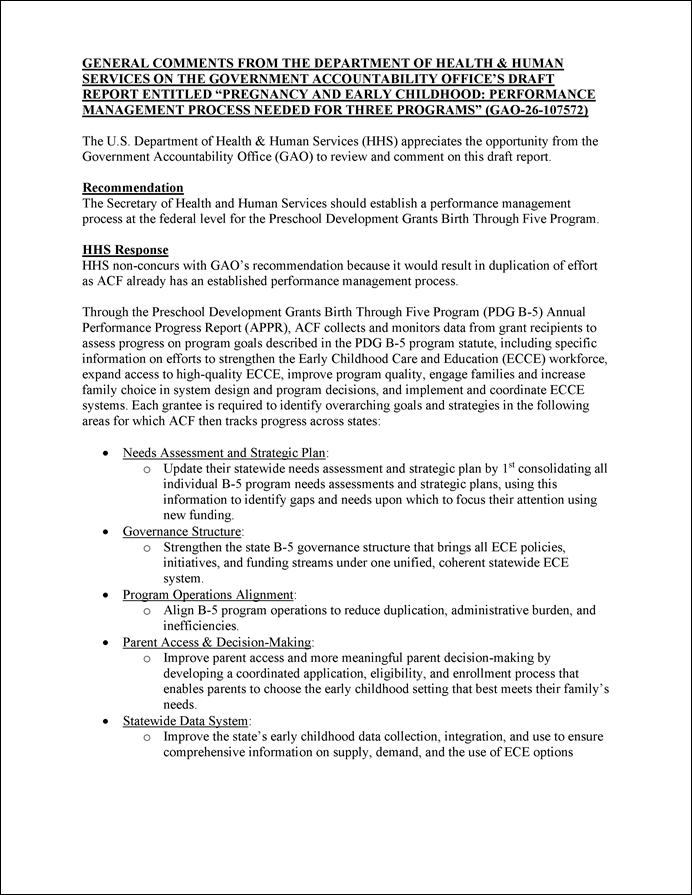
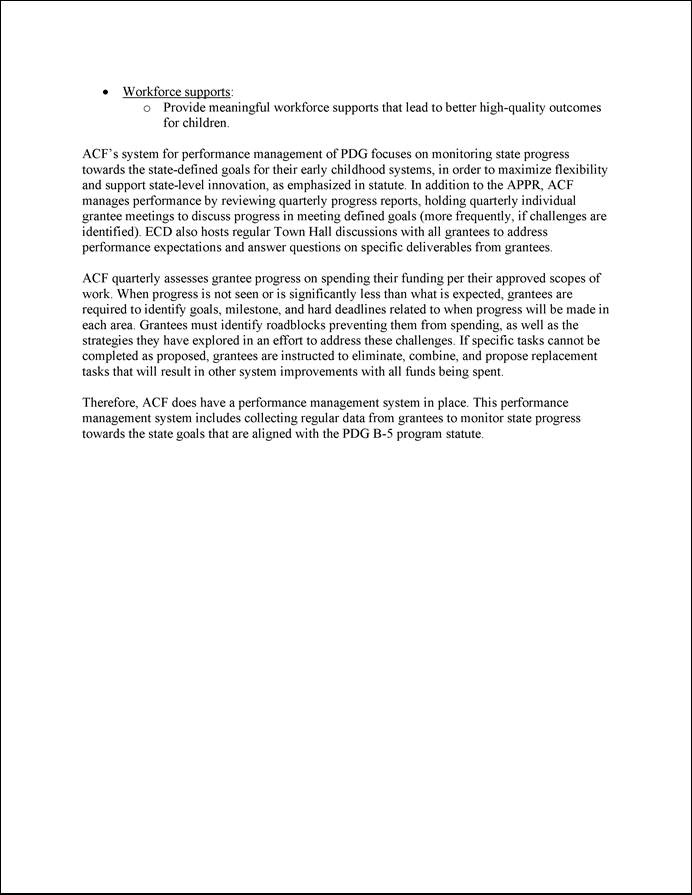
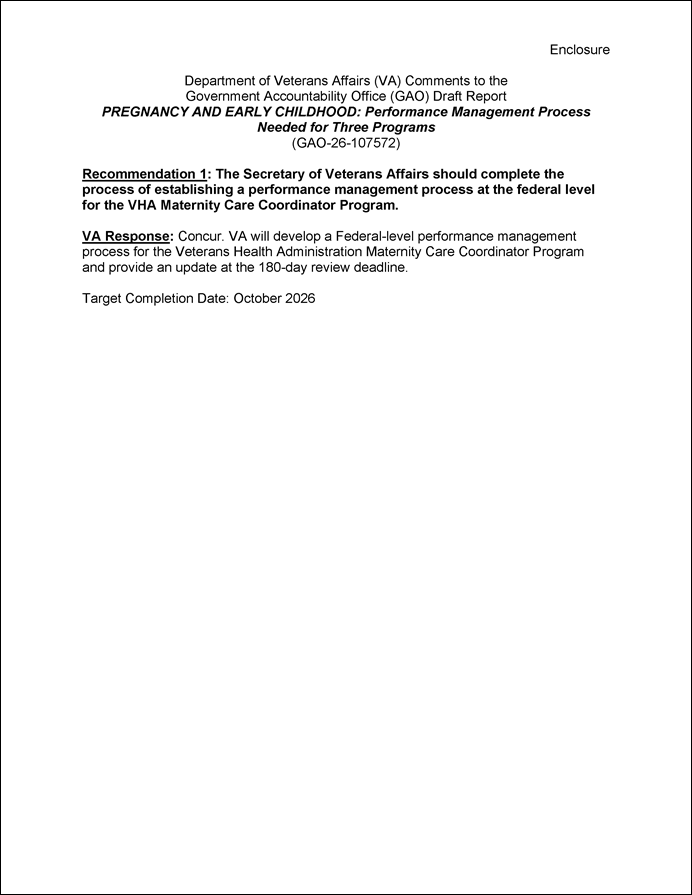
GAO Contact
Kathryn A. Larin, LarinK@gao.gov
Staff Acknowledgments
In addition to the contact named above, Sara Schibanoff Kelly (Assistant Director), Rebecca Kuhlmann Taylor (Analyst in Charge), Rebecca M. Gertler, Sarahi Robles King, and Meghann E. Lewis made significant contributions to the report. Also contributing to this report were Tracey A. Cross, Karen M. Doran, Christoph R. Hoashi-Erhardt, Janice C. Latimer, Benjamin T. Licht, Serena C. Lo, Avani Locke, Daniel Mahoney, Carly J. McCann, Andrew Nelson, Stacia Odenwald, Aaron Olszewski, Michelle B. Rosenberg, MaryLynn Sergent, Lindsay D. Shapray, Justin A. Snover, Curtia O. Taylor, Margaret A. Ullengren, and Tatyana N. Walker.
The Government Accountability Office, the audit, evaluation, and investigative arm of Congress, exists to support Congress in meeting its constitutional responsibilities and to help improve the performance and accountability of the federal government for the American people. GAO examines the use of public funds; evaluates federal programs and policies; and provides analyses, recommendations, and other assistance to help Congress make informed oversight, policy, and funding decisions. GAO’s commitment to good government is reflected in its core values of accountability, integrity, and reliability.
Obtaining Copies of GAO Reports and Testimony
The fastest and easiest way to obtain copies of GAO documents at no cost is through our website. Each weekday afternoon, GAO posts on its website newly released reports, testimony, and correspondence. You can also subscribe to GAO’s email updates to receive notification of newly posted products.
Order by Phone
The price of each GAO publication reflects GAO’s actual cost of production and distribution and depends on the number of pages in the publication and whether the publication is printed in color or black and white. Pricing and ordering information is posted on GAO’s website, https://www.gao.gov/ordering.htm.
Place orders by calling (202) 512-6000, toll free (866) 801-7077,
or
TDD (202) 512-2537.
Orders may be paid for using American Express, Discover Card, MasterCard, Visa, check, or money order. Call for additional information.
Connect with GAO
Connect with GAO on X,
LinkedIn, Instagram, and YouTube.
Subscribe to our Email Updates. Listen to our Podcasts.
Visit GAO on the web at https://www.gao.gov.
To Report Fraud, Waste, and Abuse in Federal Programs
Contact FraudNet:
Website: https://www.gao.gov/about/what-gao-does/fraudnet
Automated answering system: (800) 424-5454
Media Relations
Sarah Kaczmarek, Managing Director, Media@gao.gov
Congressional Relations
David A. Powner, Acting Managing Director, CongRel@gao.gov
General Inquiries
[1]U.S. Census Bureau, “Age of Own Children Under 18 Years in Families and Subfamilies by Living Arrangements by Employment Status of Parents,” American Community Survey, 2024, ACS 1-Year Estimates Detailed Tables, Table B23008, accessed Sept. 16, 2025, https://data.census.gov/table/ACSDT1Y2024.B23008?q=b23008. B. E. Hamilton, J. A. Martin, M. J. K. Osterman, Births: Provisional Data for 2024, Vital Statistics Rapid Release Report, no. 38 (National Center for Health Statistics, April 2025), https://dx.doi.org/10.15620/cdc/174587.
[2]We report annually on the federal government’s opportunities to reduce duplication, overlap, and fragmentation, as well as reduce costs and increase revenue. See our most recent report: GAO, 2025 Annual Report: Opportunities to Reduce Fragmentation, Overlap, and Duplication and Achieve an Additional One Hundred Billion Dollars or More in Future Financial Benefits, GAO‑25‑107604 (Washington, D.C.: May 13, 2025).
[3]We excluded programs in the following categories: (1) programs related to COVID-19, (2) programs with a limited geographic scope (e.g., if only a few states have the program or can access program funding), and (3) programs specifically for federal employees (e.g., federal employee maternal benefit programs), including programs for active-duty military or their families and for federal civilian employees.
[4]The General Services Administration manages the System for Award Management, available at SAM.gov, which provides information on working with the federal government. The federal assistance listings on SAM.gov are federal programs that provide grants, loans, and other types of financial assistance. In February 2024, the Office of Management and Budget (OMB) published an inventory of federal programs, using data from SAM.gov along with other sources. For the purpose of its inventory, OMB defined “program” as a federal financial assistance listing. Despite the availability of the OMB inventory, at the start of our review, we determined that SAM.gov was the best data source for our initial program list, as the inventory did not yet include all federal programs or required information, which we reported in September 2024. During our review, OMB published an updated and expanded inventory of federal programs in January 2025. It included two additional types of programs—tax expenditures and interest on the public debt. However, in March 2026, we found that the inventory did not yet include all federal programs, such as defense programs and acquisition programs. We also identified quality issues, such as inactive programs being included in the inventory and missing spending data. See GAO, Federal Programs: OMB Needs to Continue Developing a Complete and Useful Inventory, GAO‑26‑107551 (Washington, D.C.: Mar. 5, 2026) and Federal Programs: OMB Needs a Structure to Govern and a Plan to Develop a Comprehensive Inventory, GAO‑24‑107656 (Washington, D.C.: Sept. 25, 2024).
[5]Tax expenditures are provisions of the tax code that can reduce the amount taxpayers owe or provide payments to taxpayers. Examples include special tax credits, deductions, exclusions, exemptions, deferrals, and preferential tax rates. We included tax expenditures in our total count of programs serving pregnant women, children through age 5, or their families.
[6]For the purpose of this report, pregnant women includes postpartum women.
[7]For the purpose of this report, direct service programs are those that provide some amount of direct services (potentially in addition to indirect services); indirect service programs are those that provide only indirect services. Even if a program primarily provides indirect services, as long as some amount of direct service is provided, we consider it a direct service program for the purpose of this report. We define direct services as those that benefit a person, specifically, rather than a population, generally. This means the actual services or benefits are provided to participants or beneficiaries (e.g., food assistance) through a program. The services or benefits may be provided directly by the federal government or through entities receiving federal funds, such as state governments. In contrast, we define indirect services as those that benefit a population as a whole. Such programs do not provide a specific service to beneficiaries, but rather provide funds to support activities such as research, staff training, or technical assistance to states or other nonfederal entities.
[8]These agencies include: (1) AmeriCorps, (2) Department of Commerce, (3) Department of Defense, (4) Department of Education, (5) Department of Health and Human Services, (6) Department of Homeland Security, (7) Department of Housing and Urban Development, (8) Department of Justice, (9) Department of Labor, (10) Department of the Interior, (11) Department of the Treasury, (12) Department of Veterans Affairs, (13) Environmental Protection Agency, (14) Equal Employment Opportunity Commission, (15) Library of Congress, (16) National Science Foundation, (17) Social Security Administration, and (18) U.S. Department of Agriculture. For the purpose of this report, we use the term “agency” to describe the overarching federal department, such as the Department of Health and Human Services. Some agencies we talked to use this term differently and we adjusted language as necessary.
[9]In general, an obligation is a definite commitment on the part of the federal government for the payment of goods and services ordered or received. Payment may be made immediately or in the future. An agency incurs an obligation, for example, when it places an order, signs a contract, awards a grant, or purchases a service, among other things.
[10]We did not receive DCI responses from four of the programs. These programs are included in this report in our full list of programs and total program count based on the program name and agency listed on SAM.gov. They are not included in the other summary statistics provided in this report.
[11]GAO, Fragmentation, Overlap, and Duplication: An Evaluation and Management Guide, GAO‑15‑49SP (Washington, D.C.: Apr. 14, 2015).
[12]To identify the service types, we used a list of seven categories developed by the Congressional Research Service (CRS) for its series of reports on low-income programs. These were cash aid, education, employment and training, food assistance, health care, housing and development, and social services. The CRS list also included energy assistance, but we removed this category as we determined that it was not uniquely relevant to pregnant women, children through age 5, or their families. Additionally, we added a category for child care and an “other” option, and we requested that agency officials describe the “other” services. For each program, we asked agency officials to select the category(ies) that best described the services their programs provided to pregnant women, children through age 5, or their families. Based on agency officials’ written responses, we sometimes assigned additional direct service types (beyond what they identified in this field) to a program.
[13]See GAO, Evidence-Based Policymaking: Practices to Help Manage and Assess the Results of Federal Efforts, GAO‑23‑105460 (Washington, D.C.: July 12, 2023).
[14]Principles 6 & 13 from GAO, Standards for Internal Control in the Federal Government, GAO‑14‑704G (Washington, D.C.: Sept. 10, 2014).
[15]See GAO, Means-Tested Programs: Information on Program Access Can Be an Important Management Tool, GAO‑05‑221 (Washington, D.C.: Mar. 11, 2005).
[18]This number is not definitive. During our review, OMB did not yet have a comprehensive inventory of federal programs serving this population. The list we developed using the steps described in app. I is the most complete list available of programs operating in FY 2024, despite its limitations. Program information in this section is based on agencies’ DCI responses, unless otherwise noted, and is sometimes characterized as “according to agency officials.” There may have been changes to the programs (such as the elimination of existing programs or the addition of new programs) since we developed this list.
[19]The remaining 26 programs serve only pregnant women, children through age 5, or their families. Eleven of these programs provide solely indirect services, so they are not included in our list of Focused programs.
[20]We asked agencies to provide each program’s FY 2024 obligations. We did not ask agencies to identify the obligations that were used specifically for pregnant women, children through age 5, or their families. Requesting this information would have unduly increased the administrative burden for officials completing the DCI, given that this population was often a small subset of the entire population served. For the 12 tax expenditures, the amounts are not obligations, but rather the FY 2024 estimated reduction in tax revenue for the federal government. For the purpose of this report, “FY 2024 obligations” includes the FY 2024 estimated reduction in tax revenue for the federal government for the 12 tax expenditures. We calculated the total FY 2024 obligations by adding the 238 programs’ obligations for that fiscal year as reported by agencies in the DCI or as reported in publicly available tax expenditure documentation from the Department of the Treasury (see app. II) then rounding to the nearest trillion. However, this total is an estimate because some agencies did not provide obligation data and some reported obligation estimates despite being asked for actual amounts. In addition, we did not independently verify the obligation data that agencies reported in the DCI.
[21]“Supplemental Nutrition Assistance Program (SNAP) – Key Statistics and Research,” Economic Research Service, U.S. Department of Agriculture, last updated July 24, 2025, https://www.ers.usda.gov/topics/food-nutrition-assistance/supplemental-nutrition-assistance-program-snap/key-statistics-and-research.
[22]Many agencies were not able to report information specifically for pregnant women, children through age 5, or their families because their programs also serve other groups. We therefore asked agencies to provide information on total program beneficiaries or participants.
[23]For the purpose of this report, “targeted population characteristics” includes (1) requirements that beneficiaries must meet to be eligible for a program and (2) other population characteristics that programs target but that are not required for program eligibility. For example, the Department of Labor’s Homeless Veterans’ Reintegration Program requires that beneficiaries have veteran status for program eligibility. The program also targets veterans with disabilities, although having a disability is not a program requirement.
[24]Other eligibility criteria may also apply, depending on state eligibility standards, according to HHS officials.
[25]The services or benefits may be provided directly by the federal government or through entities receiving federal funds, such as state governments. For the purpose of this report, direct service programs are those that provide some amount of direct services (potentially in addition to indirect services); indirect service programs are those that provide only indirect services.
[26]A tax credit reduces tax liability dollar-for-dollar or may result in a net payment to the beneficiary if refundable. A tax exclusion reduces total reported income. A tax deduction reduces income subject to tax.
[27]This number is not definitive. During our review, a comprehensive inventory of federal programs serving this population did not exist. The list we developed using the steps described in app. I is the most complete list available of programs operating in FY 2024, despite its limitations. None of the Focused programs are tax expenditures.
[28]FY 2024 obligations were reported by the agencies; we did not independently verify this information.
[29]This number is not definitive. During our review, a comprehensive inventory of federal programs serving this population did not exist. Therefore, the list we developed using the steps described in app. I is the most complete list available of programs operating in FY 2024, despite its limitations. Program information in this section is based on agencies’ DCI responses, unless otherwise noted, and is sometimes characterized as “according to agency officials.” Duplication, overlap, or fragmentation among programs is not necessarily problematic. In some cases, it may be appropriate or beneficial for multiple agencies or entities to be involved in the same programmatic or policy area due to the complex nature or magnitude of the federal effort.
[30]The programs’ specific services differ, as described later in this report.
[31]GAO, Government Performance Management: Leading Practices to Enhance Interagency Collaboration and Address Crosscutting Challenges, GAO‑23‑105520 (Washington, D.C.: May 24, 2023). For the purpose of this report, we did not assess agencies’ coordination efforts against leading practices.
[32]See GAO‑23‑105460. Some programs use different terminology related to performance management. For example, programs may call performance goals “targets” or “benchmarks,” but the information that agencies provided still met GAO’s definition of a performance goal. We define performance goals as the specific results the agency expects its program to achieve in the near term. We did not (1) assess the appropriateness of the programs’ performance goals, performance information, or use of performance information or (2) determine whether programs collect performance information for each of their goals. Program information in this section is based on agencies’ DCI responses, unless otherwise noted, and is sometimes characterized as “according to agency officials.”
[33]See GAO‑23‑105460. Performance management processes should occur at the federal program level so that the federal program can assess national progress across varied state activities and efforts. Some programs also have state-level performance management processes that may interface with the federal-level performance management process (e.g., data-sharing from the state to federal level). We did not assess state-level processes or their role in the federal process.
[34]The federal EHDI Program uses a federal-level performance management process to assess national progress across varied state activities and efforts. In some situations, also having a state-level performance management process can provide states the flexibility to address certain local conditions. We recommended in 2025 that HHS require state EHDI programs to set performance goals that can be used to measure progress in addressing any identified disparities in access for underserved populations and regularly report that progress to HHS. HHS agreed with this recommendation and, as of June 2025, was continuing to review this recommendation. See GAO, Hearing Detection and Intervention: Program Connects Deaf or Hard of Hearing Infants and Children to Services, but Actions Needed to Improve Access, GAO‑25‑106978 (Washington, D.C.: Jan. 2, 2025).
[35]We reviewed the program’s federal-level performance goals, which the program refers to as “targets.” According to agency officials, states also set their own performance goals and are not required to use the federal program targets.
[36]Head Start includes Head Start Preschool, Early Head Start, and Head Start Disaster Recovery.
[37]We reviewed the program’s three-step performance management process according to this report’s methodology and determined that the program has established such a process. However, we conducted an in-depth review of the program’s performance measures in 2024 and recommended that HHS (1) implement a documented process to review Healthy Start Initiative performance measures before a grant period begins to ensure they are clear and allow for the collection of reliable data and (2) implement a documented process for program officials to coordinate the selection of performance measures across related programs, including the Healthy Start Initiative. As of February 2026, the first recommendation had been partially addressed and remained open, and the second had been implemented. See GAO, Maternal and Infant Health: HHS Should Strengthen Processes for Measuring Program Performance, GAO‑24‑106605 (Washington, D.C.: Mar. 27, 2024).
[38]We reviewed the program’s three-step performance management process according to this report’s methodology and determined that the program has established such a process. In 2024, we recommended that HHS implement a documented process for program officials to coordinate the selection of performance measures across related programs, including the Maternal, Infant, and Early Childhood Home Visiting Program. As of February 2026, this recommendation had been implemented. See GAO‑24‑106605.
[39]We reviewed the program’s federal-level performance goals, which the program refers to as “targets.” According to agency officials, states also set their own performance goals and are not required to use the federal program targets.
[41]GAO‑14‑704G, principles 6 and 13.
[42]See reports that provide example strategies for developing a federal performance management process across varied state activities: GAO, Veterans Justice Outreach Program: VA Could Improve Management by Establishing Performance Measures and Fully Assessing Risks, GAO‑16‑393 (Washington, D.C.: Apr. 28, 2016) and Program Evaluation: Strategies for Assessing How Information Dissemination Contributes to Agency Goals, GAO‑02‑923 (Washington, D.C.: Sept. 30, 2002).
[43]See, for example, GAO‑14‑704G and GAO, Military and Veteran Support: Performance Goals Could Strengthen Programs that Help Servicemembers Obtain Civilian Employment, GAO‑20‑416 (Washington, D.C.: July 9, 2020).
[44]We recommended in 2024 that VA’s Office of Women’s Health finalize the development of and implement a systematic process to compile and review data on Maternity Care Coordinator screening of veterans for mental health conditions on an ongoing basis. Agency officials told us that the dashboard they are developing is a result of this recommendation. See GAO, Veteran’s Health: VA Should Improve Its Monitoring of Severe Maternal Complications and Mental Health Screenings, GAO‑24‑106209 (Washington, D.C.: Jan. 16, 2024).
[45]For the purpose of this report, direct service programs are those that provide some amount of direct services (potentially in addition to indirect services); indirect service programs are those that provide only indirect services. Even if a program primarily provides indirect services, as long as some amount of direct service is provided, we consider it a direct service program for the purpose of this report. We define direct services as those that benefit a person, specifically, rather than a population, generally. This means actual services or benefits are provided to participants or beneficiaries (e.g., food assistance) through a program. The services or benefits may be provided directly by the federal government or through entities receiving federal funds, such as state governments. In contrast, we define indirect services as those that benefit a population as a whole. Such programs do not provide a specific service to beneficiaries, but rather provide funds to support activities such as research, staff training, or technical assistance to states or other nonfederal entities.
[46]The third exclusion encompasses programs for active-duty military or their families and for federal civilian employees, such as Department of Defense programs that intentionally mirror programs for the general public. For example, the Women, Infants, and Children Overseas Program—like the Special Supplemental Nutrition Program for Women, Infants, and Children operated by the U.S. Department of Agriculture—is a nutrition education and supplemental food program for women, infants, and children. Department of Defense employees—including active-duty military, civilian employees, contractors, and their families stationed overseas—may be eligible for this program. When discussing potentially relevant programs with Department of Defense officials, they informed us that many of their programs are not on SAM.gov and that there may potentially be hundreds of additional relevant programs that we had not identified. Given the targeted nature of these programs, we excluded all programs for federal employees, including such Department of Defense programs, from our review.
[47]The General Services Administration manages SAM.gov, which provides information on working with the federal government. In February 2024, the Office of Management and Budget (OMB) published an inventory of federal programs, using data from SAM.gov along with other sources. For the purpose of its inventory, OMB defined “program” as a federal financial assistance listing. Despite the availability of the OMB inventory, at the start of our review, we determined that SAM.gov was the best data source for our initial program list, as the inventory did not yet include all federal programs or required information, which we reported in September 2024. During our review, OMB published an updated and expanded inventory of federal programs in January 2025. It included two additional types of programs—tax expenditures and interest on the public debt. However, in March 2026, we found that the inventory did not yet include all federal programs, such as defense programs and acquisition programs. We also identified quality issues, such as inactive programs being included in the inventory and missing spending data. See GAO, Federal Programs: OMB Needs to Continue Developing a Complete and Useful Inventory, GAO‑26‑107551 (Washington, D.C.: Mar. 5, 2026) and Federal Programs: OMB Needs a Structure to Govern and a Plan to Develop a Comprehensive Inventory, GAO‑24‑107656 (Washington, D.C.: Sept. 25, 2024).
[48]Reports included, for example, GAO, Federal Low-Income Programs: Multiple Programs Target Diverse Populations and Needs, GAO‑15‑516 (Washington, D.C., July 30, 2015); Congressional Research Service, Federal Spending on Benefits and Services for People with Low Income: FY2008-FY2020, R46986 (Washington, D.C.: Dec. 8, 2021), https://www.congress.gov/crs-product/R46986; and First Focus on Children, Babies in the Budget 2024: Federal Share of Spending on Infants and Toddlers: FY2020-FY2024 (Washington, D.C., July 29, 2024).
[49]Tax expenditures are provisions of the tax code that can reduce the amount taxpayers owe or provide payments to taxpayers. Examples include special tax credits, deductions, exclusions, exemptions, deferrals, and preferential tax rates. We included tax expenditures in our total count of programs serving pregnant women, children through age 5, or their families.
[50]Department of the Treasury, “FY2025 Tax Expenditures” (dataset) (Mar. 11, 2024), https://home.treasury.gov/policy-issues/tax-policy/tax-expenditures. “Tax Expenditures,” Policy Issues, Department of the Treasury, accessed October 17, 2024, https://home.treasury.gov/system/files/131/Tax-Expenditures-FY2025.pdf.
[51]These agencies include (1) AmeriCorps, (2) Department of Commerce, (3) Department of Defense, (4) Department of Education, (5) Department of Health and Human Services, (6) Department of Homeland Security, (7) Department of Housing and Urban Development, (8) Department of Justice, (9) Department of Labor, (10) Department of the Interior, (11) Department of the Treasury, (12) Department of Veterans Affairs, (13) Environmental Protection Agency, (14) Equal Employment Opportunity Commission, (15) Library of Congress, (16) National Science Foundation, (17) Social Security Administration, and (18) U.S. Department of Agriculture.
[52]These four programs were administered by the Department of Health and Human Services. We followed up several times over 3 months requesting responses and informed the agency that we would proceed with our review without their responses. These programs are included in this report in our full list of programs and total program count based on the program name and agency listed on SAM.gov. They are not included in the other summary statistics provided in this report.
[53]We removed one of these 51 programs as a result of technical comments from the Department of Health and Human Services that indicated the program was not yet active in FY 2024.
[54]This number is not definitive. During our review, a comprehensive inventory of federal programs serving this population did not exist. The list we developed using the steps described in app. I is the most complete list available of programs operating in fiscal year 2024, despite its limitations.
[55]For the purpose of this report, direct service programs are those that provide some amount of direct services (potentially in addition to indirect services); indirect service programs are those that provide only indirect services. Even if a program primarily provides indirect services, as long as some amount of direct service is provided, we consider it a direct service program for the purpose of this report. We define direct services as those that benefit a person, specifically, rather than a population, generally. This means the actual services or benefits are provided to participants or beneficiaries (e.g., food assistance) through a program. The services or benefits may be provided directly by the federal government or through entities receiving federal funds, such as state governments. In contrast, we define indirect services as those that benefit a population as a whole. Such programs do not provide a specific service to beneficiaries, but rather provide funds to support activities such as research, staff training, or technical assistance to states or other nonfederal entities.