
Report to Congressional Committees
United States Government Accountability Office
A report to congressional committees.
For more information, contact: Tatiana Winger at wingert@gao.gov.
What GAO Found
Across 11 selected UN capital projects that were completed or in progress from December 31, 2014, through December 31, 2024, seven projects were within budget and three were on schedule. For the projects that experienced budget increases and schedule delays, GAO found that multiple factors contributed to the increases and delays. For example, as of May 2025, the Strategic Heritage Plan project (SHP) was 10 percent over budget and 4 years behind schedule. COVID-19 reduced the number of workers who could be on site, causing schedule delays, and challenges coordinating construction work with contractors slowed progress, according to SHP officials. However, the Gigiri Master Plan, located in Nairobi, Kenya, is on budget and on schedule, in part because of effective project monitoring and reporting, with construction expected to be completed in 2029.
Coordinating U.S. oversight of UN capital projects is a Department of State responsibility. State’s Bureau of International Organization Affairs (IO) monitors UN capital projects through mechanisms including reviewing reports, attending meetings, and engaging with UN officials. However, GAO found that opportunities exist for State to strengthen its oversight of projects. For example, State IO officials do not systematically monitor key indicators (e.g., budget and schedule) and do not have guidance that identifies indicators, triggers, or steps for taking action to address issues with capital projects. Establishing such guidance could provide a useful tool for fulfilling oversight responsibilities and could help minimize budget or schedule overruns.
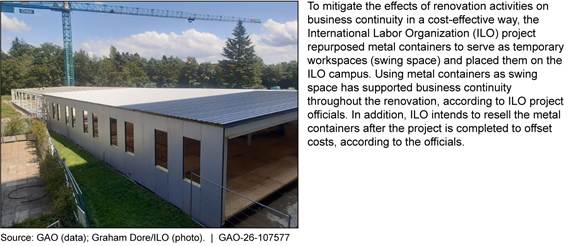
To help mitigate risks, UN officials identified lessons learned, including through collaboration between project officials and on-the-job experience, and applied them to capital projects. These lessons help projects avoid design complications, increased costs, and schedule delays. They also help strengthen governance and support business continuity through use of swing space (see below). For example, the Gigiri Master Plan and other projects created steering committees to strengthen their governance structures by informing, advising, and constructively challenging the project director.
Why GAO Did This Study
In the past 10 years, the UN has undertaken several significant capital projects, collectively valued at more than $4 billion, with the aim of bringing its workspaces up to modern usability, safety, security, and environmental standards. In 2023, the U.S. was the largest financial contributor to the UN. State, the lead U.S. agency on foreign affairs, advances U.S. interests at the UN.
A House Committee Report includes a provision for GAO to review UN capital projects with a total budget of $25 million or more in the past 10 years. This report examines factors that have contributed to changes in budget and schedule for selected UN capital projects, how State monitors the progress of projects, and lessons learned, among other objectives.
To address these objectives, GAO selected 11 UN capital projects with budgets of over $25 million that were either completed or ongoing in the period from December 31, 2014, through December 31, 2024. GAO analyzed UN documents, reports, and guidance related to budget, schedule, fraud mitigation, and lessons learned. GAO also interviewed State and UN officials and relevant contractors. Additionally, GAO conducted field visits and met with officials at UN headquarters in New York and at project sites in Geneva.
What GAO Recommends
GAO is recommending that State IO develop guidance that outlines how it should oversee large-scale UN capital projects. State agreed with the recommendation.
|
Abbreviations |
|
|
|
ACABQ |
Advisory Committee on Administrative and Budgetary Questions |
|
|
the Board |
United Nations Board of Auditors |
|
|
CMP |
Capital Master Plan |
|
|
GMP |
Gigiri Master Plan |
|
|
GAMPS |
Global Asset Management Policy Service |
|
|
IAO |
Office of Internal Audit and Oversight |
|
|
ILO |
International Labor Organization |
|
|
INFM |
Inter-Agency Network of Facilities Managers |
|
|
IO |
Bureau of International Organization Affairs |
|
|
ITU |
International Telecommunication Union |
|
|
OBO |
Bureau of Overseas Buildings Operations |
|
|
OIOS |
Office of Internal Oversight Services |
|
|
SMP |
Seismic Mitigation Retrofit and Life-Cycle Replacements Project |
|
|
SHP |
Strategic Heritage Plan |
|
|
UN |
United Nations |
|
|
UNOG |
United Nations Office at Geneva |
|
|
UNON |
United Nations Office of Nairobi |
|
|
UNESCO |
United Nations Educational, Scientific and Cultural Organization |
|
|
USUN |
United States Mission to the United Nations |
|
|
WHO |
World Health Organization |
|
This is a work of the U.S. government and is not subject to copyright protection in the United States. The published product may be reproduced and distributed in its entirety without further permission from GAO. However, because this work may contain copyrighted images or other material, permission from the copyright holder may be necessary if you wish to reproduce this material separately.
April 29, 2026
Congressional Committees:
In the past 10 years, the United Nations (UN) has undertaken several significant office construction and renovation projects, or capital projects, that are collectively valued at more than $4 billion, according to the UN.[1] UN officials and reports have stated the aim of these improvement efforts is to bring UN workspaces up to modern usability, safety, security, and environmental standards, particularly for buildings built several decades ago. In a 2015 report, we found that the UN’s renovation of its headquarters in New York City, the Capital Master Plan (CMP), exceeded its original budget by $379 million and experienced a 3-year delay.[2] In 2023, the U.S. was the largest financial contributor to the UN and one of the largest to UN system organizations.[3] The Department of State is responsible for advancing U.S. interests in the UN, which include ensuring that the UN effectively manages office construction and renovation projects.
A Committee Report[4] included a provision for us to review UN office construction and renovation projects with a total budget of $25 million or more in the past 10 years.[5] Our report includes the 11 projects that fall into this category, with a focus on four that have larger budgets and are currently undergoing construction.
Our report examines (1) factors that have contributed to changes in budget and schedule for selected UN office construction and renovation projects, (2) how State monitors the progress of UN office construction and renovation projects, (3) actions the UN has taken to reduce the risk of fraud related to office construction and renovation projects, and (4) how the UN has identified and applied lessons learned related to office construction and renovation projects.
To address these objectives, we reviewed project-specific documentation for each of the 11 projects within our scope. To focus our analysis, we selected four projects with larger budgets and more recent activity: the Strategic Heritage Plan (SHP), Gigiri Master Plan (GMP), International Telecommunication Union (ITU) project, and International Labor Organization (ILO) project. For these four projects, we analyzed UN documents, reports, and guidance that provided information related to budget and schedule, the role of State, fraud mitigation, and lessons learned. We also interviewed State and UN officials, and contractors responsible for office construction and renovation projects. We traveled to New York City to meet with officials at UN headquarters and to Geneva, Switzerland, to meet with officials at several project sites. We also conducted virtual meetings with UN officials in Nairobi, Kenya. See appendix I for further information on our scope and methodology and appendix II for summary information on our four focus capital projects.
We conducted this performance audit from May 2024 to April 2026 in accordance with generally accepted government auditing standards. Those standards require that we plan and perform the audit to obtain sufficient, appropriate evidence to provide a reasonable basis for our findings and conclusions based on our audit objectives. We believe that the evidence obtained provides a reasonable basis for our findings and conclusions based on our audit objectives.
Background
The UN System
The United Nations (UN) and member states share a mission of advancing human rights, promoting the peaceful settlement of disputes, and ensuring adherence to international law. The UN is composed of six principal bodies, or organs: the General Assembly, Economic and Social Council, International Court of Justice, Secretariat, Security Council, and Trusteeship Council. The General Assembly is the main deliberative policymaking and representative organ. Each year in September, all 193 member states meet in New York City for the annual General Assembly session, where the General Assembly makes decisions on a variety of matters, including those related to budget. The Secretariat carries out the daily work of the UN under the mandate of the General Assembly and the other four main UN organs. The Secretary-General leads the Secretariat and its offices outside New York City headquarters, such as in Geneva, Switzerland, and Nairobi, Kenya. The Secretary-General also issues various reports on a variety of topics, including budgetary matters.[6]
Under each organ, the UN also contains specialized agencies and organizations that are part of the UN system. Specifically, the UN defines specialized agencies as autonomous international organizations that coordinate with the UN system. Each organization or specialized agency has its own governing body, funding mechanisms, and membership criteria. Examples include the International Labor Organization (ILO), United Nations Educational, Scientific and Cultural Organization (UNESCO), and World Health Organization (WHO).
UN Entities Supporting Construction of UN Capital Projects
The UN General Assembly and Secretariat contain several entities responsible for providing oversight and other support for UN capital projects. These entities approve budgets, audit accounts, manage risks, share lessons learned, and provide policy guidance for UN capital projects.
· The Fifth Committee is part of the General Assembly and responsible for administrative and budgetary matters. Based on reports of the Fifth Committee, the General Assembly considers and approves the budget of the UN. The committee assists the General Assembly in considering and approving the UN’s budget, including capital projects, according to State officials. A U.S. delegate attends Fifth Committee meetings to help the U.S. Mission to the UN (USUN) monitor the status of UN capital projects’ budget and schedule and use of contingency funds, according to a State official.[7]
· The Advisory Committee on Administrative and Budgetary Questions (ACABQ), a subsidiary organ of the General Assembly, consists of 21 members appointed by the General Assembly for a period of 3 years to, among other things, provide expert examination of the UN program budget and assist the Fifth Committee. ACABQ issues reports on the SHP and the CMP, for example, that examine project progress, risks, and costs.
· The UN Board of Auditors (the Board) provides independent auditing with a focus on financial accounts and management of the UN and its funds and programs. The Board’s auditing activities include reviewing financial statements and examining administration and management of UN entities. The Board can initiate audits in response to requests from governing bodies, among others, and by annual schedules. The Board has authored several reports on UN capital projects.
· The Office of Internal Oversight Services (OIOS) functions as the internal oversight body of the UN and assists the Secretary-General in fulfilling oversight responsibilities over resources and staff of the UN. OIOS has operational independence under the authority of the Secretary-General and can initiate, carry out, and report on any action that it considers necessary to fulfill its responsibilities, including oversight of capital projects. To do so, OIOS conducts program audits, evaluations, and investigations of UN capital projects. These activities can include examining misconduct, operational, and programmatic issues. OIOS uses a risk-based approach to oversight, prioritizing areas of strategic importance or significant risk.
· The Global Asset Management Policy Service (GAMPS) is the central unit at UN headquarters responsible for overseeing construction, risk management, and sharing lessons learned between UN construction projects in the UN Secretariat, according to UN officials. Additionally, GAMPS coordinates with UN headquarters and offices away from headquarters on planning and implementation of capital projects. In 2019, GAMPS issued the “Guidelines for the Management of Construction Projects,” which are based on the guidelines that the UN issued in 2016 in response to our recommendation that member states develop written guidance on lessons learned.[8] The purpose of the guidelines is to implement industry best practices as well as lessons learned from previous large-scale construction projects undertaken by the Secretariat.
UN Office Construction Projects
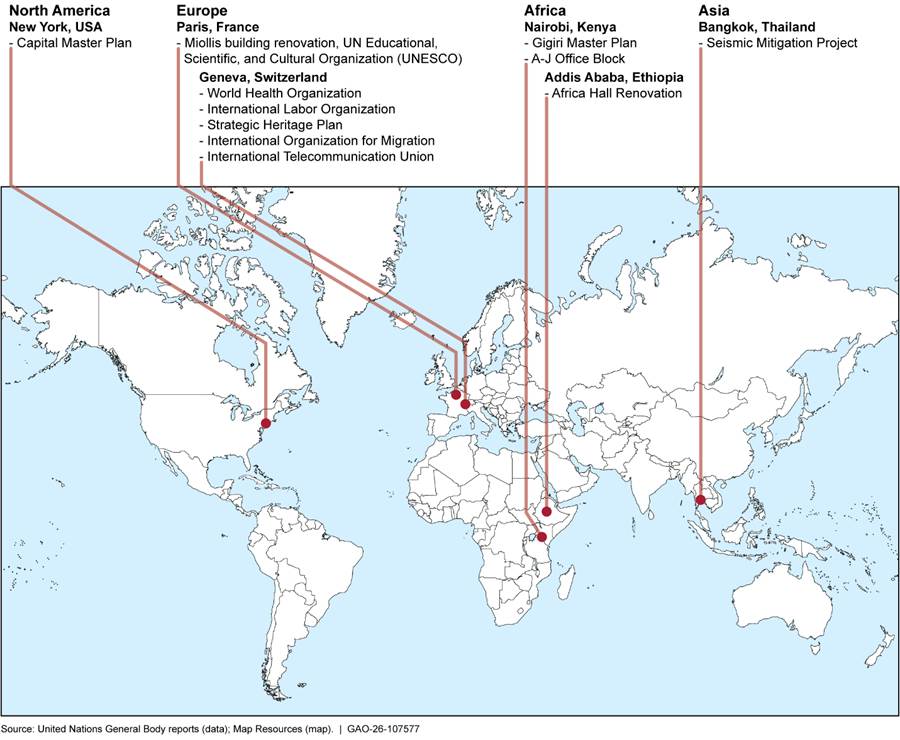
We identified 11 UN construction and renovation projects with budgets of over $25 million that were either completed or ongoing from December 31, 2014, through December 31, 2024 (see fig. 1).
Figure 1: Locations of 11 Ongoing and Completed UN Office Construction and Renovation Projects over $25 Million, 2014 Through 2024
State’s Role in Advancing U.S. Interests in the UN
State engages with the UN through multiple U.S. Missions to the UN (USUN). State is mandated to report to Congress on the status of UN capital projects as directed in House Appropriations Committee Report 118-146. The Bureau of International Organization Affairs (IO) oversees developing and implementing U.S. policy at the UN and other international organizations. IO has several missions to the UN, including in New York City, Geneva, and Nairobi.
Under IO, USUN acts as the U.S. delegate to the UN and is responsible for carrying out the U.S.’s participation and pursuing its interests in the world body. Within USUN, the Management and Reform Section serves as the U.S. delegate to the General Assembly’s Fifth Committee and other UN committees. The section works to strengthen the oversight capacity of the UN and oversight bodies within the UN system and ensuring that UN programs and activities are efficient, effective, and properly managed.
UN Guidelines for Using Lessons Learned from UN Capital Projects
In 2016, the UN Secretariat issued its Guidelines for the Management of Construction Projects, which contains
· provisions on using relevant lessons learned from the construction and implementation of other UN construction projects,
· guidance on how lessons learned should be documented and used, and
· strategies to provide effective management of capital projects.[9]
These guidelines were mandated by General Assembly resolutions and draw upon lessons learned from the CMP and other UN capital construction projects. The guidelines are nonbinding and serve as a reference for capital projects in the UN Secretariat, in addition to project manuals and other project materials, according to an UN official.
Prior GAO Work
We have previously issued several reports on the UN’s renovation of its headquarters in New York City, the CMP. In a 2015 report, we found that the CMP was projected to cost about $379 million more than was originally projected and was running 3 years behind schedule.[10] In this report, we recommended that State and the U.S Permanent Representative to the UN (1) work with other member states to ensure that lessons learned during the CMP are used to develop documented guidance for future capital projects, and (2) clearly justify assumptions used to estimate future office space needs.[11] In 2012, we found deficiencies in the quality of CMP information and made two recommendations to State and the U.S. Permanent Representative to the UN to improve the quality and reliability of information provided to the UN and its member states.[12] State addressed these recommendations by working with member states to improve the information provided by the CMP Office and the UN Office of Central Support Services.
COVID-19 and Other Factors Affected Some UN Capital Projects’ Budgets and Schedules
Three of 11 Selected UN Capital Projects Have Stayed on Schedule; Seven Have Remained Within Budget
Of the 11 selected UN construction and renovation projects that were either completed or ongoing from December 31, 2014, through December 31, 2024, three were on schedule and seven were on budget, as of 2025 (see figure 2).
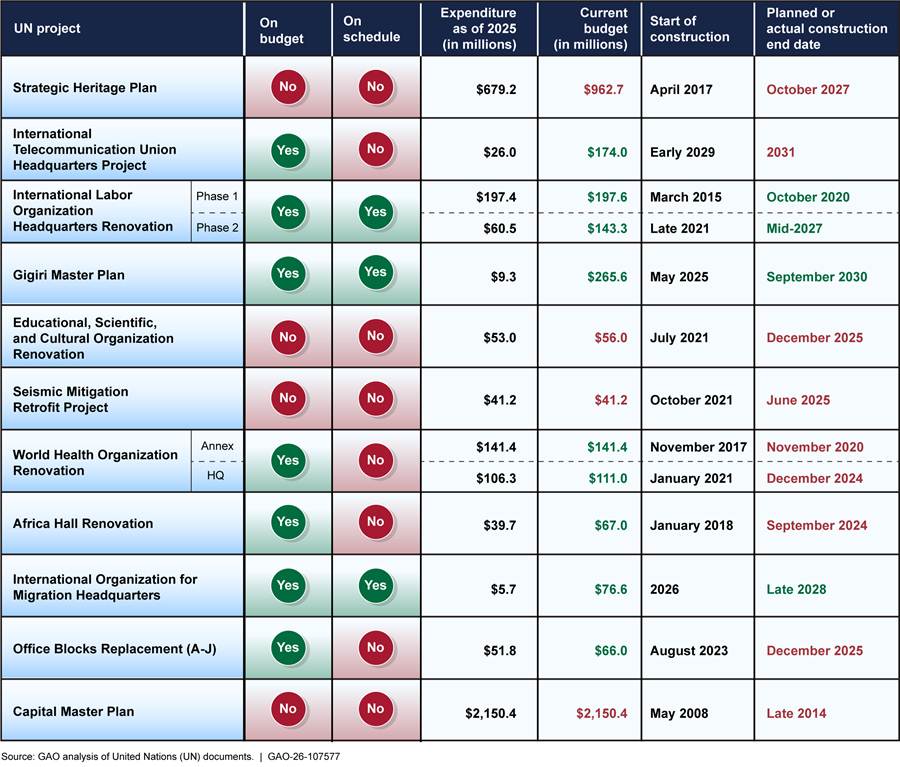
Notes: The budgets for some of these projects were originally reported in different currencies. To convert those values to dollars, we used the U.S. dollar period average exchange rate for the year in which the project budget was originally approved. Construction end dates refer to “substantial completion dates,” not including project closeout.
COVID-19, Inflation, and Contractor Coordination Contributed to the SHP’s Budget Overrun and 4-Year Delay
Factors including COVID-19, inflation, and contractor coordination contributed to SHP’s 10 percent budget overrun[13] and 4-year delay on progress toward substantial completion.[14] The SHP, located in Geneva, includes constructing a new office space, Building H, and a renovation of the Palais des Nations. The Palais, a historic building complex built in 1937, consists of eight buildings (Buildings A, B, C, D, E, H, S1, and S2) and five stand-alone villas and annexes. The Palais also houses the United Nations Office at Geneva (UNOG) and contains 34 conference rooms and 2,800 workspaces. As of 2025, the SHP’s construction was expected to be substantially completed by October 2027, which is a delay of about 4 years from the originally planned completion date of 2023.
In 2015, the UN approved an $871.4 million budget for the SHP, but in 2025, the Fifth Committee, a UN budget body, approved increasing the budget to $962.7 million. According to a 2025 Secretary-General report, the SHP’s cost overrun has been driven by various factors, such as schedule extensions, increases in the cost of construction materials, supply chain delays, and other factors. Annual reports for the Secretary-General on the SHP provide budget projections, using simulations to estimate costs and the amount of contingency funding needed.
· Schedule extensions. SHP officials said that only a small percentage of workers could be on site during the COVID-19 pandemic, resulting in schedule delays. According to a 2024 Board of Auditors report, costs increased by 27 percent from the baseline because of the SHP’s schedule extensions. Officials from the SHP’s risk firm said that every month of delay costs about $1 million.[15]
· Construction cost increases. Officials from the SHP’s risk firm said that the cost of construction materials, such as mechanical and electrical components, increased because of COVID-19, chip shortages, and delays in receiving supplies. These officials also said that these materials made up a large proportion of the cost of building E, a component of the SHP.[16] According to a 2024 Secretary-General report, inflation-related cost increases in building E came from mechanical, electrical, and plumbing components. Building E’s costs were a contributing factor to the SHP’s 2024’s projected budget overrun.
· Supply chain delays. According to a 2025 Secretary-General report, the supply chain has been under stress because of rising material costs and scarcity of skilled labor. According to a 2024 Secretary-General report, the renovation of buildings A, C, D, and S was extended by 24 months from the previous progress report, because supply chain constraints limited the ability to conduct concurrent work in different sections. Also, SHP contractors said that the ongoing Ukraine war increased demand and thus limited the availability of some materials and increased costs.
SHP officials told us that the selected contractor for building H struggled to coordinate effectively with its subcontractors. In addition, according to SHP officials, the contractor needed more direction on designing the building than is typically needed. As a result, building H was substantially completed in October 2021, about 2 years later than the original expected completion date of November 2019.
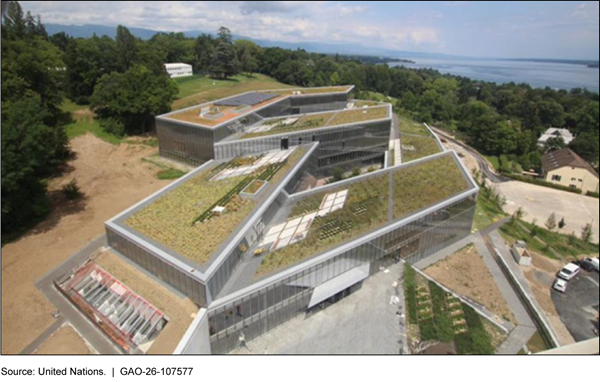
After substantial completion, Building H encountered additional delays during its closeout period, which began in October 2021, because of the extensive list of minor items the contractor needed to address to complete the project. In a 2022 report, the Board of Auditors recommended that the SHP team ensure that the contractor addressed post construction defects as quickly as possible, to which UNOG agreed. In 2024, the Board found that the contractor had made slow progress in addressing defects. In December 2022, the list of minor defects that were not addressed included 10,588 issues that the SHP team had identified. By February 2024, the list had increased to 11,350 issues and included 412 on which there was disagreement with the contractor. In addition, the list included outstanding issues related to building H, such as a building management system. In its July 2024 report, the Board recommended that the team take steps to resolve the outstanding issues of building H, such as setting a deadline for closing all outstanding items and engaging intensively with the contractor. UNOG accepted the recommendation and has been working closely with the contractor. See figure 3 for a photograph of building H.
Figure 3: Aerial View of the Strategic Heritage Plan’s Building H, Substantially Completed in October 2021
In addition to the factors mentioned above, contractor coordination was a
challenge that contributed to schedule delays, according to officials in
Geneva. SHP officials said that hiring contractors in Geneva is difficult and
creates delays, as it requires coordination with the local government to ensure
that workers are properly certified. In addition, Geneva only has four
available electrician firms, which hinders competitive bidding and limits
resources, according to project officials.
As of September 2025, the SHP had completed renovations and construction of several buildings. Building H was substantially completed in May 2021. Renovations of Building D were finished in August 2023, renovations of Building S1 were finished in November 2024, and renovations of Building A were completed in March 2025. Renovation work on Building C is ongoing. Future renovation construction activities are planned for Building S2 and Buildings B and E, with construction expected to end in 2027.
Higher Than Expected Construction Bids Stalled the ITU Project and Led to a $20 Million Loss
According to reports and an ITU official, the ITU project was stalled and incurred an unrecoverable cost of over $20 million because initial construction bids were higher than expected. According to a 2023 ITU Secretary-General report, the loss largely came from initial architectural and engineering services. An ITU official said that the ITU team cancelled an initial contract with an architect chosen through international competition because the cost to build the proposed design would exceed the $174.4 million budget approved in 2021. ITU officials said the reason for the mismatch was that member states selected a design without considering cost and functionality. An ITU official said that architects had “free rein” and billed hours for blueprints that included impractical designs.
In June 2024, over a year after progress was paused on initial construction plans, the ITU Council agreed on a new scope that would stay within the $174.4 budget.[17] The new scope excluded some elements from the initial design, such as some conference rooms and various amenities. According to the 2024 Secretary-General report, the project was in the planning stage. Construction is set to begin in 2028 and be substantially completed by late 2031.
The ILO Project and the GMP Are on Track
ILO project. The ILO project finished construction of the first phase of its project in October 2020, largely on schedule and within budget, and generated a total savings of about $200,000. In 2021, the Office of Internal Audit and Oversight (IAO), the ILO’s oversight body, found that the ILO project value engineering exercises resulted in substantial cost savings, and that the subcontractor selection process continued to be cost effective.[18] ILO project officials said that Phase 1 started to run behind schedule, but the ILO project’s transition to Lean Management implementation—a type of planning that breaks down a large plan to smaller units—enabled it to mitigate delays and finish Phase 1 on time. The ILO project has completed renovations of its conference rooms and plans to move on to renovating its storage rooms. The project is planned to be completed in 2027.
GMP. Project monitoring and reporting helped the GMP stay on budget and on schedule. According to a 2025 OIOS audit, the GMP had established appropriate mechanisms for reporting to stakeholders. For example, the GMP project manager is required by the UN’s Guidelines for the Management of Construction Projects to submit regular project progress reports, including details such as a financial expenditure report showing analysis by budget categories, to stakeholders. GMP project officials have provided regular briefings to the Advisory Board, the Steering Committee, and other project stakeholders. The GMP will be in the planning and design phase until February 2026, when construction of the new buildings is set to begin, according to a September 2024 Secretary-General progress report.
Remaining Selected UN Projects Are at Different Stages and Reflect a Mix of Budget and Schedule Statuses
The other seven of the 11 UN projects we reviewed are at different stages and have mixed statuses.
UNESCO. Unplanned project revisions largely contributed to UNESCO’s Miollis building renovation budget increases. After initial budget approval, a project management firm conducted a study and recommended replacing the building’s exterior to meet environmental standards. This unplanned revision added about $4.2 million to the project’s budget of $47 million approved in 2017, bringing the total estimated cost to about $51.2 million. In addition, inflation affected estimated project costs. For example, construction contractor bids came in higher than estimated because of inflation, which added about $4.5 million more to the budget, according to UNESCO documents. In February 2024, the project management firm proposed a modified work schedule, with a construction completion date of September 2025, and estimated that the project would need to add about $5.8 million more to the original budget to account for price revisions and work contingencies. Member states also requested revisions to additional building facilities, such as the delegates’ lounge, cafeteria, and gym, which were expected to cost about $6.4 million more in total. According to a March 2025 UNESCO Headquarters Committee progress report, in October 2024, the additional building facilities were incorporated into the project, bringing the total cost of the renovation to about $60.3 million.
Seismic Mitigation Retrofit and Life-Cycle Replacements Project. This project in Thailand experienced a 3 percent budget overrun, according to a September 2023 Secretary-General report, because of construction delays spanning 7 months. The delays were partially due to COVID-19 impacts and unforeseen site conditions, according to UN reporting. The General Assembly approved a new budget of $41.2 million in December 2023. The project was completed in June of 2025.
WHO and Africa Hall Renovation. These two capital projects experienced or are expected to experience schedule delays of about a year or more. WHO completed construction of a new Annex building in November 2020, a 4-month delay from the original plan. This delay resulted from the cessation of construction activity to limit transmission of COVID-19. In addition, the Africa Hall Renovation in the Economic Commission for Africa experienced a 3-year delay. According to a 2024 OIOS audit, one of the reasons was the contractor’s failure to complete the renovation. Contributing to the delay was the bankruptcy of a lead joint venture partner, leading to the termination of the contract and selection of a new contractor. The project manager also attributed the delay to the implementation of security upgrades and renovations to an exhibition space, according to the audit. The Africa Hall Renovation was completed in September of 2024.
International Organization for Migration, Office Blocks Replacement (A-J), and CMP. The International Organization for Migration project is in the early stages, with the construction procurement process underway, and is on schedule and on budget. Office Blocks Replacement (A-J) was planned to reach completion in December 2025 on budget but was delayed by supply-chain and tenant moving issues. In a 2015 report, we found that the CMP had exceeded its original budget by $379 million and experienced a 3-year delay. Additionally, as of 2025, the CMP was involved in arbitration proceedings with its construction manager, according to UN reporting.
State IO Monitors UN Capital Projects but Could Strengthen Oversight
State Receives Updates on UN Capital Projects Through a Variety of Mechanisms
State IO receives updates on UN capital projects through a variety of mechanisms, including regular reporting, meetings, and ad hoc engagement.
Regular Reporting
State IO officials track and review regular UN reports that address UN capital projects, such as reports from the Advisory Committee on Administrative and Budgetary Questions (ACABQ) and the Secretary-General, according to a State official. In addition, State USUN Geneva officials send updates to the IO Bureau in Washington, D.C., on UNOG activities, such as the SHP. According to a State OIG report, in response to a 2020 State OIG recommendation, State IO established a standard operating procedure for reporting.[19] Specifically, USUN Geneva was to formally report, or work with Washington, D.C.-based delegations to formally report, on all significant UN meetings where the U.S. is a participant to ensure a full diplomatic record.
Informal and Formal Meetings
Officials address capital projects through various informal and formal meetings. For example, the GMP project team holds informal briefings with member states on the GMP’s progress, which USUN Nairobi and other U.S. staff attend, according to the GMP project manager. A State IO official said that he travels to Nairobi for executive meetings, which address key activities, including the GMP.
State can raise concerns about capital projects through formal channels, such as UN committees, according to State officials. The Fifth Committee holds two meetings during the year, according to an IO official. The first is the Committee for Programs and Coordination, which meets in the spring to report on capital projects and provides an opportunity for member states to comment. The second is the Fifth Committee meeting in the fall, where members discuss all parts of the UN budget, including capital projects. USUN Mission staff in New York City participate in these meetings to convey any concerns about capital projects, according to IO officials. For example, in 2024 State IO submitted questions about SHP’s budget to the Fifth Committee and discussed ways to address the 10 percent budget overrun at the fall meeting.
Ad Hoc Engagement
State IO engages on an as-needed basis to help assess UN construction projects, according to a State official. Also, USUN Geneva officials monitor activities of local UN organizations, including capital projects, and engage with UN project officials if issues arise, according to State officials.
For example, in 2023, USUN Geneva requested that the Bureau of Overseas Buildings Operations (OBO) assist in reviewing the ITU project after $20 million had been spent on a design with little progress, according to State officials.[20] According to an OBO official, oversight of UN construction projects is outside of OBO’s authority. Nevertheless, in this case OBO conducted a review and proposed that the ITU use a design/build rather than a design/bid/build contract. ITU paused the project, made changes, then relaunched it in 2024.
State IO Could Strengthen Its Oversight of UN Capital Projects
The Foreign Affairs Manual states that State IO is responsible for coordinating oversight of budgetary and financial matters, including capital investment policies, at over 60 international organizations.[21] As previously mentioned, State IO officials coordinate oversight through a variety of mechanisms, including regular reporting, meetings, and ad hoc engagement. However, opportunities exist for State IO to strengthen its oversight efforts and to be better positioned to identify potential cost overruns and address them before they occur. State IO does not have guidance that defines how officials should fulfill their responsibility for UN capital projects. For example, State IO officials said they do not systematically monitor key indicators, such as budget and schedule, and do not have clear triggers, such as percentage over budget or time behind schedule, for when to take action. They also said they do not have clear steps for taking action, including guidance on who to contact and which communication method to use, according to officials.
State IO officials told us that staff rotate every few years and do not have guidance that identifies indicators, triggers, or steps. The officials also told us that incoming staff face competing priorities and generally do not have specific skills for coordinating oversight of UN capital projects. Therefore, those skills must be learned on the job and staff may not know exactly when or how to engage with UN officials on project schedule and budget matters, according to the officials. Guidance would help equip staff to fulfill oversight responsibilities and could help address potential delays or budget overruns in the future, according to the officials. GAO’s Standards for Internal Control in the Federal Government state in part that management should provide guidance for business objectives, which may appear in various forms, such as management directives, administrative policies, or operating manuals.[22]
With such guidance, State IO staff could strengthen oversight of UN capital projects, which could help avoid future cost or schedule overruns. Given the high dollar value and remaining work on five projects, State officials will remain engaged as the projects continue, and guidance would provide a useful tool for fulfilling oversight responsibilities in the years ahead.
UN Has Taken Steps to Mitigate Fraud Risk
Project Officials Applied Fraud Guidance Principles
Project officials applied fraud guidance principles, outlined in official documents, to reduce the risk of fraud on UN capital projects. For example, SHP and GMP project officials, such as the project manager and contractor personnel, said they had applied principles of the Anti-Fraud and Anti-Corruption Framework of the UN Secretariat (the UN fraud framework), which applies to the SHP and GMP.[23] The UN fraud framework identifies fraud prevention measures including conducting risk management, participating in training, respecting internal controls, and preventing conflicts of interest. Similar frameworks apply to the ILO and ITU projects. We describe examples of application below.
· SHP. SHP contractor personnel developed a risk register, which assesses fraud as a risk and identifies mitigation steps. SHP project officials completed fraud awareness training, which covers the UN standards of conduct, definitions and examples of various types of fraud and corruption and how to recognize them, and measures to expose and prevent fraud and corruption, according to the SHP project manager. Additionally, the SHP project manager developed a program manual to document internal controls. The manual addresses procurement, among other things, and states that specialized procurement staff in UNOG’s Central Support Services are funded by SHP to provide dedicated procurement support for the extensive and complex contract requirements associated with such a large-scale construction and renovation project. The manual also states that the project manager and other key officials share responsibility to ensure that the procurement is completed within a reasonable time frame and to the standard required to comply with UN procurement rules, which emphasize fairness, integrity and transparency. In addition, SHP project officials submitted a financial disclosure to the UN Secretariat to reduce risk of conflicts of interest, according to the SHP project manager.[24]
· GMP. GMP project officials managed a risk register that identifies fraud as moderate risk and outlines mitigation steps, including strictly adhering to financial and procurement regulations, according to the project manager. A consulting firm conducted an independent risk assessment in June 2025. In May 2025, GMP project officials participated in a fraud prevention workshop training, conducted and designed by the International Federation of Consulting Engineers specifically for GMP project officials. In addition, GMP project officials submitted a financial disclosure to the UN Secretariat to reduce risk of conflicts of interest, according to the GMP project manager.
· ILO. Like the UN Fraud Framework, the ILO’s Policy against fraudulent and other proscribed practices identifies fraud prevention measures. These include providing training, briefings, and other communication tools to managers and officials on the ILO’s Financial Regulations and Financial Rules; developing and maintaining effective controls; and reviewing systems and procedures. ILO project officials said that they had communicated financial rules and regulations in detailed discussions with bidders to ensure compliance with ILO standards. To maintain effective controls, a project official checks all expenses on an infrequent basis and systematically checks the selection of subcontractors before awarding contracts to ensure compliance with good procurement practices, according to the project manager. With regard to reviewing systems and procedures, the ILO project manager said that the project team conducts a risk assessment annually to mitigate fraud risk.
· ITU. The ITU’s Policy Against Fraud, Corruption and Other Proscribed Practices identifies fraud prevention measures that may include providing training and briefings to managers and other personnel on ethical obligations and good financial practices and reviewing systems and procedures. ITU project officials said that all project staff had completed mandatory fraud training and read the provisions of a range of fraud prevention documents, including the Code of Ethics for ITU Personnel and Standards of Conduct for the International Civil Service. Regarding systems and procedures, ITU project officials said that fraud is systematically addressed in the risk register and that specific risks include fraud related to vendors, bribery, kickbacks, and false invoices. The risk register identifies mitigation steps and tracks the risk across time. In addition, project officials said that the ITU procurement office, which is responsible for the timely and efficient acquisition of all goods and services required by the organization in compliance with ITU’s procurement policies and procedures, manages all procurement.
UN Oversight Bodies Conducted Reviews and Did Not Report Any Allegations of Fraud
UN oversight bodies, such as the Board of Auditors and Office of Internal Oversight Services (OIOS), conducted reviews of the SHP and GMP and did not report any allegations of fraud; however, they identified issues related to fraud risk that project officials addressed. For example, in 2022, the Board found that in response to observations it made in 2020, SHP officials had removed irrelevant and redundant information from risk registers in monthly and quarterly risk management reports. OIOS reported in 2019 that its recommendation to the SHP to strengthen invoice review would be considered implemented in 2020 upon receipt of evidence that amounts invoiced were adequately supported and accurately computed in accordance with the contract and supporting documents. While the GMP is still in its early stages, OIOS conducted a 2022 review and did not report any allegations of fraud.
Office of Internal Audit and Oversight (IAO) officials told us that IAO conducts audits of the ILO project every 2 years and that the audits are contracted out to firms with construction expertise. The 2019 audit of the ILO project recommended the establishment of a written risk management assessment, which project officials implemented. IAO officials told us that there have been no indications or allegations of fraud and that to minimize fraud, anyone can report it through email or a soon-to-be launched hotline.
The ITU project manager told us that internal and external audits of the project had not reported any allegations or indications of fraud. For example, ITU’s 2022 internal audit report on the new ITU Headquarters Project did not report any allegations of fraud.
We spoke with a range of State officials responsible for monitoring UN capital projects, and they said they were not aware of any fraud allegations.
UN Applied Lessons Learned to Mitigate Capital Project Risks
UN officials identified lessons learned through multiple methods, including from collaboration between project officials and on-the-job experience. They applied lessons learned to capital projects as part of preconstruction activities and during construction to mitigate a variety of project risks.
UN Identified Lessons Learned Through Multiple Methods
UN officials identified a number of lessons learned from capital projects using multiple methods, including collaboration with the UN’s Global Asset Management Policy Service (GAMPS), on-the-job experience, and information-sharing meetings. The goal of identifying lessons learned is to increase the chances of positive outcomes or reduce the chances of negative outcomes for a capital project, according to UN guidance on construction projects.
Collaboration Between UN Capital Projects and GAMPS
GAMPS is a UN service that enters into formal agreements with UN Secretariat capital projects and regularly meets with project officials to identify and implement lessons learned from previous capital projects. These activities can increase cost savings and mitigate project risks, according to UN officials. For example, GAMPS worked with the GMP to implement a lesson learned from the CMP related to stakeholder communication. As a result, GMP officials communicated regular cost forecasts to stakeholders, helping to inform member states about potential rising costs later in the construction process. GAMPS’s formal agreements are established at the start of a project’s construction and identify its role and responsibilities for the project, according to UN officials.
On-the-Job Experience
Officials from all four of our focus projects identified lessons learned directly from on-the-job experience. For instance, ILO officials said they learned techniques and approaches that increased efficiencies with repetitive tasks between project phases, such as installing ventilation ducts during the first phase of the project. As a result, they reduced installation time from 3 days to half a day in the second phase of the project.
Information-Sharing Meetings
UN project officials engaged in both formal and informal meetings to discuss lessons learned. For example, project officials from the ILO, IOM, ITU, and SHP participated in annual Inter-Agency Network of Facilities Manager (INFM) meetings, which are organized by GAMPS, to facilitate sharing lessons learned between projects, according to UN officials. GAMPS develops agendas, coordinates participation, and manages communications for INFM meetings. Lessons learned presented at INFM meetings include effective implementation of flexible workspace strategies, cost-efficient procurement activities for obtaining furniture, and capital planning for environmental sustainability.
UN Officials Applied Lessons Learned from the Capital Master Plan and from On-The-Job Experience to Help Manage Capital Projects
Lessons learned can help address cost risks and strengthen project governance, according to UN officials and UN reporting. They can also support business continuity and help projects avoid design complications as well as increased costs and schedule delays, according to the officials. UN officials applied lessons learned from the CMP and from on-the-job experience to better manage capital projects in those ways.
Lessons Learned from the Capital Master Plan Mitigated Cost Risks and Strengthened Project Governance
In various projects, UN officials said they applied lessons learned from the CMP in an effort to help mitigate the risk of cost overruns and to strengthen governance on other capital projects (see table 1). These included developing a risk management strategy to help manage contingency funds and establishing project steering committees to strengthen governance. Our 2015 report identified these lessons learned from the CMP as some of the most commonly cited in UN reporting.[25] Project officials from multiple projects also applied a lesson from the CMP regarding using guaranteed maximum price contracts, which the Board of Auditors identified in a 2014 report.[26]
|
Lesson learned |
Illustrative examples of applications |
|
Use a guaranteed maximum price contract |
The ILO, ITU, SHP, and WHO projects are using a guaranteed maximum price contract, according to UN officials. The officials said this contract approach helps mitigate risk to the construction project, establishes firm prices for defined work, and provides other benefits.a |
|
Develop a risk management strategy to help manage contingency funds |
The Africa Hall renovation, GMP, SHP, and SMP projects are using an independent risk manager as part of their risk management strategy to help manage the use of contingency funds. Assessing and quantifying risks as potential costs helps manage the use of a project’s contingency fund. |
|
Establish project steering committees |
The GMP, International Organization for Migration, and SHP projects created steering committees as part of their governance structures. Generally, according to officials, steering committees inform, advise, and constructively challenge the project director in real time, strengthening the project’s governance structure. |
Legend: CMP = Capital Master Plan, GMP = Gigiri Master Plan, ILO = International Labor Organization, ITU = International Telecommunications Union, SHP = Strategic Heritage Plan, SMP = Seismic Mitigation Retrofit and Life-Cycle Replacements Project
Source: GAO analysis of UN documents. | GAO‑26‑107577
aAccording to SHP officials, guaranteed maximum price contracts reduce the risk of cost overruns because the contractor must bear any cost over the maximum amount agreed upon. ILO officials said that their project’s guaranteed maximum price contract incentivizes cost savings by splitting any remaining funds at the end of each project phase between the project and the contractor.
Lessons from On-The-Job Experience Supported Business Continuity While Helping Projects Avoid Costly Potential Issues
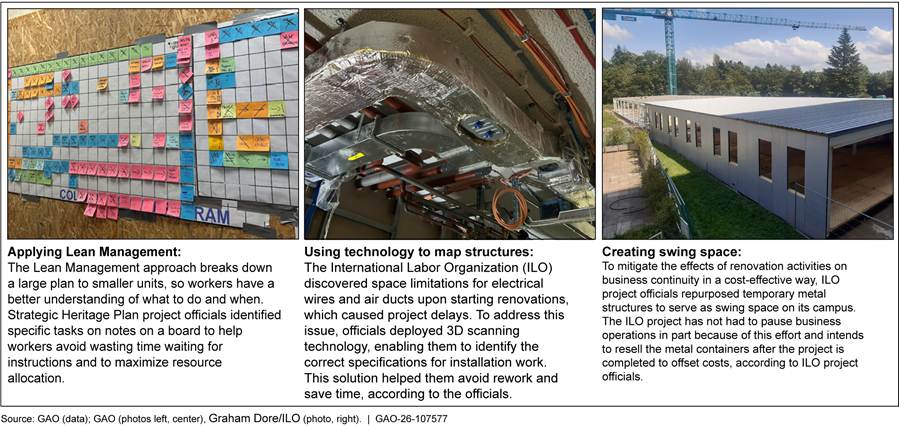
For our focus projects, UN officials applied lessons learned that were identified from on-the-job experience as projects progressed. Lessons learned can be identified and compiled at any point during a capital project. They can support UN business operations, help projects avoid design complications and increased costs, and mitigate schedule delays, according to project officials. See table 2 for examples.
|
Lesson learned |
Illustrative examples of applications |
|
Apply Lean Management |
After the ILO project and SHP encountered delays, both implemented Lean Management, according to ILO and SHP officials. The Lean Management approach breaks down a large plan to smaller units, ideally resulting in improved contractor performance, according to UN officials. Workers have a better understanding of what to do and when, avoid unnecessary work, and do not waste time waiting for instructions for their next task, which generally maximizes resource allocation, according to the officials. ILO officials credited this approach for enabling them to finish the first phase of their project on schedule. |
|
Use technology to map structures |
ILO project officials said they discovered space limitations for electrical wires and air ducts upon starting renovations, which caused delays. To address this issue, officials deployed 3D scanning technology before initiating subsequent work, enabling them to define and procure the correct specifications of air ducts and electrical wires. This solution helped them avoid rework and save time, according to the officials. |
|
Create swing space |
To mitigate the effects of renovation activities on business continuity in a cost-effective way, the ILO project repurposed metal containers to serve as temporary workspaces (swing space) and placed them on the ILO campus. ILO has not had to pause business operations in part because of this effort and intends to resell the metal structures after the project is completed to offset costs, according to ILO project officials. |
|
Communicate design specifications |
The ITU project initially spent approximately $20 million on architects and consultants to develop building designs but did not communicate specifications to stakeholders, according to ITU project officials. As a result, the ITU project received designs that were too expensive to build and were not usable. The project reconsidered its approach and now plans to conduct a design feasibility study to incorporate stakeholder feedback earlier. Doing so would help the project stay within budget and ensure the development of a useful design, according to ITU project officials. |
|
Improve change controls |
The SHP experienced a 6-week delay while constructing the project’s new H building, in part because of the time it took to review and approve changes made during the construction process that were not in the original plan. Change order processes for the remaining SHP building renovations have been amended and are now more efficient, according to UN officials. The amended contracts require an early warning of possible change orders from the project staff, according to the officials. This early warning helps the contractor determine any potential impact to schedule or cost. Additionally, it requires a shorter time frame for each party to respond within the change order process, thereby limiting effect on the project’s schedule. |
Legend: ILO = International Labor Organization, SHP = Strategic Heritage Plan, ITU = International Telecommunications Union
Source: GAO analysis of United Nations (UN) documents. | GAO‑26‑107577
Figure 4 shows examples of lessons learned from on-the-job experience.
Conclusions
Coordinating oversight of UN capital projects is an important responsibility that involves monitoring several large-scale projects around the world. State oversees capital projects through a variety of mechanisms, including regular reporting, meetings, and ad hoc engagement. However, State IO officials may face competing priorities when keeping track of a variety of activities occurring within the UN system and may need to develop construction project expertise quickly. Developing guidance for staff in overseeing such projects—such as setting indicators, triggers, and steps for taking action—could strengthen existing efforts. Such guidance will become more important as high dollar value projects, such as the GMP, begin construction.
Recommendation for Executive Action
We are making the following recommendation to State:
The Secretary of State should ensure the Bureau of International Organization Affairs (IO) develops guidance that outlines how it should oversee large-scale UN capital projects. Such guidance could include identifying indicators or triggers that should be monitored or steps that should be taken.
Agency Comments
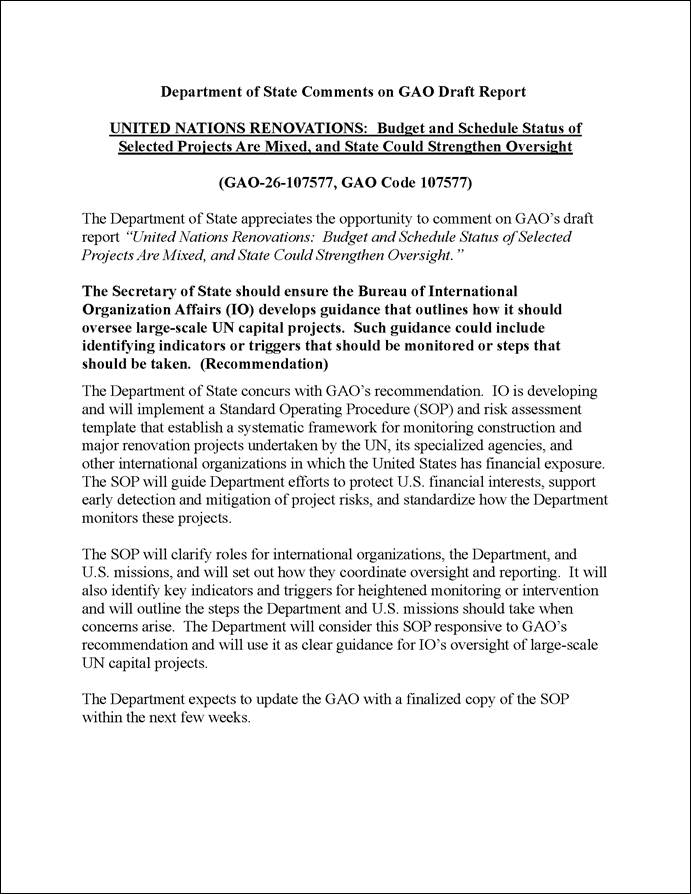
We provided a draft of this report to the Department of State for review and comment. In its formal comments, reproduced in appendix III, State concurred with our recommendation and stated that it is developing and will implement a Standard Operating Procedure and risk assessment template that establishes a systematic framework for monitoring construction and major renovation projects undertaken by the UN.
We are sending copies of this report to the appropriate congressional committees and the Secretary of State. In addition, the report is available at no charge on the GAO website at https://www.gao.gov.
If you or your staff have any questions about this report, please contact me at wingert@gao.gov. Contact points for our Office of Congressional Relations and Media Relations may be found on the last page of this report. GAO staff who made key contributions to this report are listed in appendix III.
Tatiana Winger
Director, Contracting and National Security Acquisitions
List of Congressional Committees
The Honorable Lindsey Graham
Chair
The Honorable Brian Schatz
Ranking Member
Subcommittee on State, Foreign Operations, and Related Programs
Committee on Appropriations
United States Senate
The Honorable Mario Diaz-Balart
Chairman
The Honorable Lois Frankel
Ranking Member
Subcommittee on National Security, Department of State, and Related
Programs
Committee on Appropriations
House of Representatives
This report examines (1) factors that have contributed to changes in budget and schedule for selected United Nations (UN) office construction and renovation projects, (2) how the Department of State monitors the progress of UN office construction and renovation projects, (3) actions the UN has taken to reduce the risk of fraud related to office construction and renovation projects, and (4) how the UN has identified and applied lessons learned related to office construction and renovation projects.
This report examines UN office construction and renovation projects with total budgets of $25 million or more that were completed or ongoing between December 31, 2014, and December 31, 2024. For the purposes of our reporting objectives, we define UN capital projects as construction or building renovation projects, excluding other capital projects such as infrastructure, service, or assistance projects. To identify UN office construction and renovation projects over $25 million, we analyzed State and UN reports that document construction activities. We also spoke with State IO officials who monitor UN construction activities to verify that we had identified all projects over $25 million in the 10-year period. We reviewed project-specific documentation for each of the 11 projects within this scope. To focus our analysis, we selected four projects with larger budgets and more recent activity: the Strategic Heritage Plan, Gigiri Master Plan, International Telecommunication Union project, and International Labor Organization project. For these four projects, we reviewed and analyzed UN capital project plans, annual progress reports, internal auditor reports, fraud prevention frameworks, and reports from other UN entities. We traveled to New York City to meet with officials at UN headquarters and to Geneva, Switzerland, to meet with officials at several project sites. We also conducted virtual meetings with officials in Nairobi, Kenya.
To identify factors contributing to changes in budget and schedule for UN office construction and renovation projects, we analyzed UN capital project annual progress reports; reports from the UN Office of Internal Oversight Services (OIOS), UN Board of Auditors (the Board), Advisory Committee on Administrative and Budgetary Questions, and Fifth Committee; UN General Assembly resolutions; and other internal UN project documents. We compared current planned construction or renovation cost estimates and projected completion dates with previously reported baseline budget and schedule estimates. We interviewed State and UN officials and contractors responsible for office construction and renovation projects to obtain their perspectives on budgetary and scheduling factors. We also met with officials from OIOS; the Department of Management Strategy, Policy, and Compliance; and the U.S. Mission to the UN to discuss factors affecting budget and schedule. For the Gigiri Master Plan, we conducted virtual interviews with officials knowledgeable about budget and schedule factors. It was not within the scope of our work to audit and verify UN capital project cost data, but we reviewed underlying documentation and interviewed cognizant officials about the data. On the basis of this work, we determined that the data were sufficiently reliable for the purposes of our reporting objectives.
To examine how State monitored the progress of UN capital projects, we conducted interviews with officials from State’s Bureau of International Organizations (IO) and officials from the USUN Mission post in Nairobi, Kenya. We traveled to UN headquarters in New York City and to Geneva, Switzerland, to conduct interviews with State officials in USUN New York City and USUN Geneva, respectively. We also reviewed the Foreign Affairs Manual for State’s responsibility for oversight over international construction projects.[27] We also reviewed State’s fiscal year budget justification documents to further understand State’s responsibilities. We compared State IO’s efforts to oversee capital projects with selected standards for internal control in the federal government—specifically those related to management guidance on business objectives.[28]
To determine what actions the UN has taken to reduce the risk of fraud related to office construction and renovation projects, we reviewed and analyzed UN anti-fraud and anti-corruption frameworks, as well as reports or audits conducted by UN offices and oversight bodies—including OIOS, the Board, and the Joint Inspection Unit—that address fraud risks for UN office building projects. We conducted interviews with UN officials, U.S. Mission to the UN officials, and contractors responsible for fraud risk mitigation in New York City; in Geneva, Switzerland; and virtually in Nairobi, Kenya.
To examine how the UN identified and applied lessons learned related to our selected office construction and renovation projects, we identified lessons learned described in various UN documents, including UN capital project annual progress reports, Board reports, and Secretary-General update reports, among others. Additionally, we interviewed UN and U.S. Mission to the UN officials responsible for UN office construction and renovation projects who could identify lessons learned either applied to their project, or related to their project as it progressed, in New York City; in Geneva, Switzerland; and virtually in Nairobi, Kenya.
We conducted this performance audit from May 2024 to March 2026 in accordance with generally accepted government auditing standards. Those standards require that we plan and perform the audit to obtain sufficient, appropriate evidence to provide a reasonable basis for our findings and conclusions based on our audit objectives. We believe that the evidence obtained provides a reasonable basis for our findings and conclusions based on our audit objectives.
Strategic Heritage Plan
The United Nations (UN) established seven key objectives for the Strategic Heritage Plan (SHP). These include ensuring the day-to-day business and operational continuity of the Palais des Nations; meeting relevant building codes; repairing and updating the electrical, mechanical, and plumbing systems; optimizing the use of interior spaces and conference facilities; and preserving historical elements as well as preventing the deterioration of the Palais.
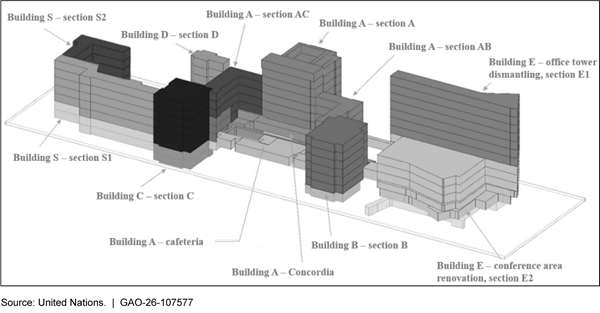
The SHP’s funding comes from member state assessed contributions, Swiss loans, and other sources.[29] For construction of Building H, according to a UN report, the Swiss government has provided a zero-interest rate loan repayable over 50 years. For renovation of the Palais, the Swiss government has provided a fixed-interest rate loan repayable over 30 years, according to a UN report. Member state assessments and other donations make up the remaining funds of the SHP’s $962.7 million budget. See figure 5 for an illustration of the sections of work for the Palais renovation.
The Gigiri Master Plan
The Gigiri Master Plan (GMP), approved in 2023, is a renovation and expansion of the conference facilities at the UN Office of Nairobi (UNON). Established in 1996 by the General Assembly, UNON is home to the UN Environment Program and the UN Human Settlements Program. According to UN documentation, UNON’s existing facilities are no longer fit for purpose because its maximum capacity of 2,000 has been outpaced by the increasing number of attendees at high-level conferences, as exemplified by the almost 6,000 who participated in the UN Environment Assembly in 2024. According to GMP project and State officials, a new visitor center, vehicular entrance, and assembly hall will expand UNON’s conference capacity to 9,000. Construction of the GMP is projected to start in May 2025 and be finished in 2030.
In addition to increasing conference capacity, the UN has established nine key objectives for the GMP. Some of these include meeting industry norms relating to health and safety issues, ensuring the removal of hazardous materials, improving space usage efficiency, modernizing outdated building systems, increasing sustainability by reducing energy consumption, increasing conference capacity, and maintaining business continuity.
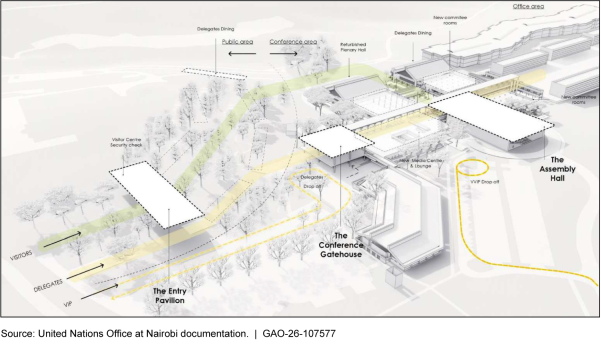
The GMP is a $265.7 million project funded by member state assessed contributions. The project team that provides the construction project with management and operational support intends to solicit voluntary contributions to reduce the amounts of assessed contributions. See figure 6 for an illustration of the sections of work for the GMP.
International Labor Organization Headquarters Building Renovation Project
The International Labor Organization Headquarters building renovation project (the ILO project), approved in November 2010, is a renovation of the ILO headquarters building in Geneva, Switzerland, which was constructed in the early 1970s. According to ILO reports and officials, the renovation’s objectives are to replace technical installations, equipment, and materials; remove asbestos; and meet local fire safety standards in Switzerland.
The project was divided into two phases. ILO project officials said Phase 1 included work on the main building, where they renovated the building vertically in three sections. Phase 1 was completed on schedule in October 2020. Phase 2, approved in November 2021, includes work on renovations to the conference center, audio-visual equipment, general service areas/archives, and parking. Phase 2 renovations are planned to be completed in 2027.
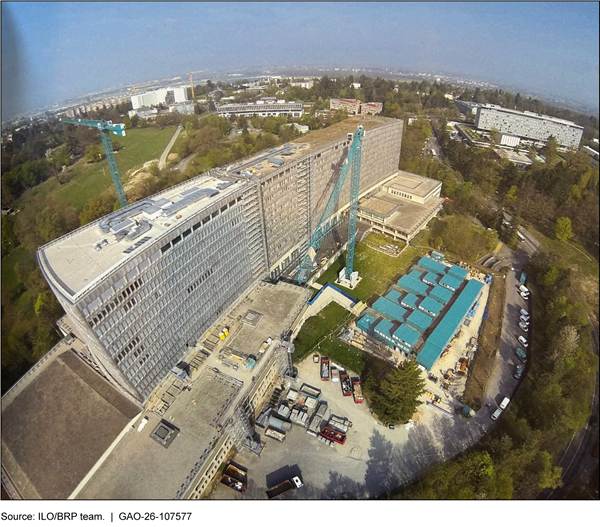
The ILO project’s Phase 1 was funded by the sale of ILO-owned land and a Swiss loan with a fixed interest rate repayable over a 30-year period, according to an ILO report. The remaining funds came from income surpluses and other accounts; these sources funded the $197.6 million budget for Phase 1. Phase 2 has a budget of $125.4 million and is being funded from land sales and unspent funds from Phase 1. See figure 7 for a photo of ILO’s headquarters undergoing renovations.
Figure 7: Aerial View of Renovations at the International Labor Organization’s Headquarters in Geneva, Switzerland
International Telecommunication Union Headquarters Premises Project
The International Telecommunication Union (ITU) project, approved in September 2019, is the planned demolition and reconstruction of the Varembé building, which was completed in 1962, in Geneva, Switzerland. According to a State report, the Varembé building has reached the end of its lifespan and contains numerous safety and building code violations, for which renovations are needed. The ITU project consists of eight main elements of work. These include developing a larger conference room with 500 seats, 23 meeting rooms, open seating workspaces, amenities (e.g., an infirmary, security, and a crisis room), a cafeteria, and a delegate lounge. The project is expected to be completed in 2031.
The ITU Secretariat, in collaboration with the Member State Advisory Group, Steering Committee, and Management Board, considered three guiding principles for developing the design of the ITU project, according to a 2024 ITU Secretary-General report. The first is fit-for-purpose, which includes providing modern and flexible workspaces for personnel. The second is planning for future needs to be efficient and flexible in design and use of spaces. The third is to be compliant, by complying with all types of local, international, and UN security requirements.
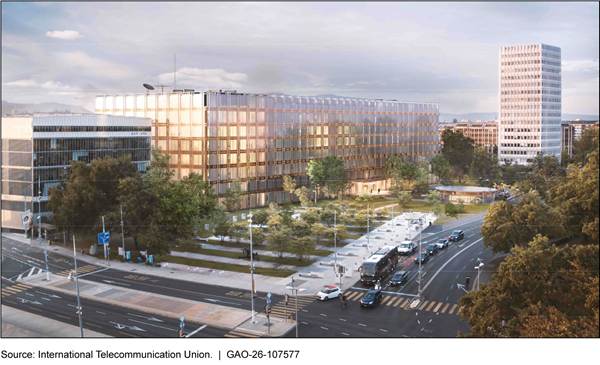
The ITU project is funded by a zero-interest Swiss loan repayable over a 50-year period, according to an ITU report, sponsorships and donations, and capital project specific accounts.[30] Together, these make up the ITU project’s $196.3 million budget. See figure 8 for an illustration of the current ITU headquarters.
Other Ongoing or Completed UN Capital Projects
In addition to the four capital projects that we focused on, the UN has seven other ongoing or completed office construction and renovation projects, according to UN documents. These are the (1) Capital Master Plan, (2) World Health Organization Renovation, (3) Africa Hall Renovation in the Economic Commission for Africa, (4) Organization for Migration Headquarters, (5) Office Blocks Replacement (A-J), (6) Seismic Mitigation Retrofit and Life-Cycle Replacements Project at the Economic and Social Commission for Asia and the Pacific premises in Bangkok, and (7) UN Educational, Scientific and Cultural Organization Capital Master Plan.
GAO Contact
Tatiana Winger, wingert@gao.gov
Staff Acknowledgments
In addition to the contact named above, Jeffrey Baldwin-Bott (Assistant Director), Marc Castellano (Analyst-in-Charge), Seth Roca, Arturo Barrera, Debbie Chung, Neil Doherty, Jeffrey Isaacs, Christopher Keblitis, Seto Bagdoyan, John Bauckman, David Bruno, Keith Cunningham, Gergana Danailova, and Samantha Lalisan made key contributions to this report.
The Government Accountability Office, the audit, evaluation, and investigative arm of Congress, exists to support Congress in meeting its constitutional responsibilities and to help improve the performance and accountability of the federal government for the American people. GAO examines the use of public funds; evaluates federal programs and policies; and provides analyses, recommendations, and other assistance to help Congress make informed oversight, policy, and funding decisions. GAO’s commitment to good government is reflected in its core values of accountability, integrity, and reliability.
Obtaining Copies of GAO Reports and Testimony
The fastest and easiest way to obtain copies of GAO documents at no cost is through our website. Each weekday afternoon, GAO posts on its website newly released reports, testimony, and correspondence. You can also subscribe to GAO’s email updates to receive notification of newly posted products.
Order by Phone
The price of each GAO publication reflects GAO’s actual cost of production and distribution and depends on the number of pages in the publication and whether the publication is printed in color or black and white. Pricing and ordering information is posted on GAO’s website, https://www.gao.gov/ordering.htm.
Place orders by calling (202) 512-6000, toll free (866) 801-7077,
or
TDD (202) 512-2537.
Orders may be paid for using American Express, Discover Card, MasterCard, Visa, check, or money order. Call for additional information.
Connect with GAO
Connect with GAO on X,
LinkedIn, Instagram, and YouTube.
Subscribe to our Email Updates. Listen to our Podcasts.
Visit GAO on the web at https://www.gao.gov.
To Report Fraud, Waste, and Abuse in Federal Programs
Contact FraudNet:
Website: https://www.gao.gov/about/what-gao-does/fraudnet
Automated answering system: (800) 424-5454
Media Relations
Sarah Kaczmarek, Managing Director, Media@gao.gov
Congressional Relations
David A. Powner, Acting Managing Director, CongRel@gao.gov
General Inquiries
[1]For the purposes of our reporting objectives, we use the terms “office construction and renovation projects” and "capital projects" interchangeably.
[2]GAO, United Nations Renovations: Original Scope Reduced and Project Over Budget, but Lessons Learned Could Improve Future Projects, GAO‑15‑414 (Washington, D.C.: May 2015).
[3]The UN system is made up of many programs, organizations, specialized agencies, and funds in addition to the UN. In early 2026, the administration announced its intention to withdraw from various UN organizations, including the World Health Organization.
[4]H.R. Rep. No. 118-146, at 132 (2023).
[5]The 10-year span includes UN capital projects that were either completed or ongoing from December 31, 2014, through December 31, 2024.
[6]These reports are called reports of the Secretary-General.
[7]According to a UN capital project manager, contingency funds are used to address realized risk events and unforeseen costs.
[8]GAO‑15‑414. In a UN resolution, the General Assembly requested the Secretary-General ensure that management and construction project guidelines for the implementation of future construction and major projects draw upon relevant lesson learned in the planning and implementation of certain projects. United Nations, G.A. Res. 64/243 (Feb. 24, 2010).
[9]United Nations, “Guidelines for the Management of Construction Projects,” unpublished document, March 2016.
[11]State implemented both of these recommendations.
[12]GAO, United Nations Renovations: Best Practices Could Enhance Future Cost Estimates, GAO‑12‑795 (Washington, D.C.: July 2012).
[13]According to a U.S. official, a cost or budget overrun occurs when a project’s costs exceed its budget.
[14]Substantial completion is a milestone that represents the stage at which the execution of construction work is complete, except for minor omissions and defects.
[15]A risk firm focuses on identifying, assessing, and mitigating threats or uncertainties that could affect an organization. The SHP’s risk firm holds monthly risk advisory meetings and delivers quarterly independent risk reports.
[16]Risk firm officials added that in January 2023, additional factors increased construction costs, including the addition of lightning protection and measures to increase air quality control in building E’s conference rooms.
[17]The ITU is governed by both the Plenipotentiary Conference and the Administrative Council. The ITU Council acts as the Union’s governing body and approves budgets and controls expenditures of the ITU.
[18]According to the General Services Administration, value engineering analyzes designed building features, systems, equipment, and material selections to achieve essential functions and enhance results while reducing the life-cycle cost.
[19]Department of State Office of Inspector General, Inspection of U.S. Mission to the United Nations and Other International Organizations in Geneva, Switzerland, ISP-I-20-16 (Arlington, VA: June 2020).
[20]OBO is the single real property manager for the planning, acquisition, construction, and maintenance of US diplomatic and consular property overseas. OBO formulates and directs the implementation of building polices abroad for the conduct of U.S. diplomacy and the promotion of U.S. interests worldwide, a mission that does not include oversight of UN capital projects, according to an OBO official.
[21]Department of State, Foreign Affairs Manual, 1 FAM 333.2(b)(2) (Washington, D.C.: 2025).
[22]GAO, Standards for Internal Control in the Federal Government, GAO‑25‑107721 (Washington, D.C.: May 2025), Principle 12.
[23]United Nations Secretariat, The Anti-Fraud and Anti-Corruption Framework of the UN Secretariat, ST/IC/2016/25 (Sept. 9, 2016).
[24]Certain UN employees have an obligation to file an annual financial disclosure, including staff procurement officers and those whose principal duties relate to the investment of assets of the United Nations. United Nations, Secretary-General Bulletin: Financial Disclosure and Declaration of Interest Statements, U.N. Doc. ST/SGB/2006/6 (April 10, 2006).
[26]United Nations Board of Auditors, Lessons from the United Nations Capital Master Plan, December 2014.
[27]Department of State, Foreign Affairs Manual (Washington, D.C.: 2025).
[28]GAO, Standards for Internal Control in the Federal Government, GAO‑25‑107721 (Washington, D.C.: May 2025), Principle 12.
[29]Assessed contributions are the amount of money that all UN member states are required to pay to cover the expenses of the organization through its regular budget, as determined by the UN General Assembly.
[30]These sponsorships and donations are voluntary payments from member states such as Saudia Arabia, the United Arab Emirates, Kuwait, the Czech Republic, Ghana, and Nigeria.