
Report to Congressional Committees
United States Government Accountability Office
A report to congressional committees
Contact: Mary Deningan-Macauley at deninganmacauleym@gao.gov
What GAO Found
Emerging infectious diseases are infections that are new (e.g., COVID-19) or have existed but are reappearing in an area (e.g., measles), according to the Department of Health and Human Services (HHS). As the federal lead for public health, HHS partners with thousands of entities at all levels of government to conduct surveillance for emerging infectious diseases; doing so through continuous data collection, analysis, and sharing of health data needed to plan for and respond to such threats.
Experts on a roundtable GAO convened suggested a range of actions that the federal government could take to improve U.S. emerging infectious disease surveillance. GAO categorized experts’ suggestions across four areas related to collaboration, data, methods, and communication (see table).
Four Areas with Examples of Federal Actions Experts Suggested to Improve Emerging Infectious Disease Surveillance
|
Collaboration |
Data Quality and Infrastructure |
Surveillance Methods |
Communication |
|
Increase coordination by creating a multisectoral, multidisciplinary leadership group |
Strengthen data quality by identifying, developing, and using standards for surveillance data |
Optimize surveillance by evaluating cost-effectiveness of surveillance systems and methods |
Improve awareness and perception of public health and surveillance by developing a communication strategy |
Source: GAO analysis of statements made by a roundtable of 18 experts. | GAO-26-107610
A key theme in experts’ suggested actions for improvement was to unify efforts between animal and human health sectors, in recognition that emerging diseases often affect both. For example, experts suggested that a multisectoral, multidisciplinary leadership group should be created to direct surveillance planning and activities across federal agencies, including those responsible for both human and animal health. Such a group could address a lack of centralized authority to direct cross-agency surveillance activities leading to inconsistent collaboration that hinders the effectiveness of U.S. surveillance for emerging infectious diseases.
Officials from HHS and other federal departments, such as the U.S. Department of Agriculture (USDA), which has responsibility for animal health, highlighted existing efforts that they thought were related to expert-suggested actions. For example, HHS officials cited the U.S. One Health Coordination Unit as an existing effort related to the expert-suggested action to create a multisectoral, multidisciplinary leadership group to improve federal collaboration.
The actions suggested by experts offer HHS and stakeholders a chance to assess tradeoffs and feasibility in expanding current efforts or exploring new approaches for infectious disease surveillance, while considering past recommendations by GAO and others. These actions also provide HHS an opportunity to determine if any of the suggestions assist the department in its leadership and coordination of public health emergencies, an area GAO placed on its High-Risk List in January 2022.
Why GAO Did This Study
Emerging infectious disease outbreaks have increased in incidence and impact, posing an ever-present threat to national health, security, and economic interests. Some emerging infectious diseases can become highly transmissible and capable of wide, uncontrollable spread in human populations potentially leading to pandemics.
With factors such as increased global interconnectedness, animal-to-human disease transmissibility risk, and disease virulence contributing to this threat, there is heightened concern that an emerging infectious disease may develop into a widespread outbreak with significant consequences.
The CARES Act includes a provision for GAO to monitor and report on the federal pandemic response. This report describes (1) how HHS has conducted surveillance of emerging infectious disease threats and (2) actions experts suggested for the federal government to improve surveillance of emerging infectious diseases.
GAO convened a roundtable of 18 experts in April and May 2025 to discuss actions to improve public health surveillance for emerging infectious disease threats. GAO contracted with the National Academies of Sciences, Engineering, and Medicine to help identify experts representing a range of perspectives including former federal officials and animal and human health professions. Their comments reflected solely their views. GAO also reviewed documents and interviewed officials from HHS, USDA, and public health associations, among others.
Abbreviations
ASPR Administration
for Strategic Preparedness and
Response
APHIS Animal and Plant Health Inspection Service
CDC Centers for Disease Control and Prevention
DMI Data Modernization Initiative
DHS Department of Homeland Security
HHS Department of Health and Human Services
Mpox monkeypox
NBIC National Biosurveillance Integration Center
USDA U.S. Department of Agriculture
USGS U.S. Geological Survey
This is a work of the U.S. government and is not subject to copyright protection in the United States. The published product may be reproduced and distributed in its entirety without further permission from GAO. However, because this work may contain copyrighted images or other material, permission from the copyright holder may be necessary if you wish to reproduce this material separately.
July 30, 2026
Congressional Committees
Emerging infectious diseases pose a significant threat to American lives, national security, and economic interests. In recent decades, several emerging infectious diseases, such as 2009 H1N1 influenza and COVID-19, have developed into widespread human outbreaks in the United States and across the globe, resulting in tens of millions of deaths and hundreds of billions of dollars in economic costs worldwide. Zoonotic diseases, those that can spread between humans and animals, account for an estimated 75 percent of emerging infectious diseases making them a particularly serious human health concern.[1] While emerging infectious diseases have increased in incidence and impact, factors like increased global connectedness and animal-to-human disease transmissibility risk contribute to the threat that such diseases may develop into widespread outbreaks with significant consequences.
To detect emerging infectious disease threats to the nation’s public health, the federal government and other entities conduct disease surveillance—the ongoing, systematic collection, analysis, and sharing of health-related data needed to plan for and respond to such threats. In the U.S., surveillance for emerging infectious disease threats to public health is a shared effort between the Department of Health and Human Services’ (HHS) Centers for Disease Control and Prevention (CDC) and thousands of agencies at the federal, state, local, tribal, and territorial levels (collectively “jurisdictions”), along with health care providers, laboratories, and others. Agencies within the U.S. Department of Agriculture (USDA) and the Department of the Interior (Interior) have responsibility for emerging infectious disease surveillance in U.S. livestock as well as companion, wildlife, and aquatic animals.
During the COVID-19 public health emergency, diagnostic testing and other types of surveillance data were needed to understand the disease’s spread. However, the data HHS relied on in that emergency were incomplete and inconsistent, highlighting longstanding concerns we had with the data and other aspects of HHS’s response to public health emergencies. In part due to these concerns, we added HHS’s leadership and coordination of public health emergencies to our High-Risk List in January 2022.[2] While HHS has implemented some of our recommendations, including those related to surveillance, the department remained on our High-Risk List, as of February 2025.[3]
The CARES Act included a provision for us to monitor and report on the federal pandemic response.[4] This report is part of our body of work in response to the CARES Act. This report describes
1. how CDC conducts surveillance for emerging infectious disease threats and
2. what federal actions selected experts suggested to improve U.S. surveillance for emerging infectious diseases.
For our first objective, describing how CDC conducts surveillance for emerging infectious disease threats, we focused on CDC as the agency with primary responsibility at the federal level for conducting disease surveillance related to public health. We used CDC’s definition for emerging infectious diseases, that is, those infectious diseases where human cases are increasing or threatening to increase in the near future. These diseases can be completely new or new to or reappearing in an area, according to CDC.[5] We also focused this objective on surveillance data and data systems infrastructure that CDC identified as necessary to detect and monitor such threats.[6] See appendix I for information on selected CDC surveillance data systems. To address this objective, we obtained and reviewed documentary and testimonial evidence from CDC as well as from other selected federal agencies and departments that coordinate with and/or provide information to CDC regarding emerging infectious disease threats to public health. These agencies and departments included the Administration for Strategic Preparedness and Response (ASPR) within HHS; the Animal and Plant Health Inspection Service (APHIS) within USDA; the U.S. Geological Survey (USGS) within Interior; and the Department of Homeland Security (DHS). We did not evaluate the completeness or capability of the various surveillance systems. We also interviewed representatives from four national organizations that support public health surveillance activities and that collectively represent local, state, and territorial public health agencies—the Association of State and Territorial Health Officials, the Association of Public Health Laboratories, the Council of State and Territorial Epidemiologists, and the National Association of County and City Health Officials.
To address our second objective describing federal actions selected experts suggested to improve U.S. emerging infectious disease surveillance, we convened a roundtable of 18 selected experts in April and May 2025.[7] For our roundtable, we contracted with the National Academies of Sciences, Engineering, and Medicine (National Academies) to help identify experts in this topic area.[8] The experts we selected to participate represented a broad spectrum of experience, and a variety of professional and academic fields.[9] Comments provided by our selected experts reflected their own views and not those of the organizations with which they are affiliated. The experts’ views may not correspond with those of others with similar backgrounds and expertise. See appendix II for more information about these experts, their professional disciplines, and their institutional affiliations, as well as the methodology used to conduct the roundtable.
We grouped actions suggested by experts into several categories that we present without any specific rank or order. We did not assess or compare the potential strengths and limitations actions suggested by experts and their inclusion is not an endorsement. Implementing any one action or a combination of actions might require considerations, such as implementation feasibility, resource and legal constraints, and tradeoffs between actions or taking no action at all. See appendix III for detailed information about the actions suggested and the category into which they were grouped.
As appropriate, we also identified recommendations we and others have made that may be similar or related to the actions suggested by our experts. To do this, we reviewed our own relevant reports, and those of the Bipartisan Commission on Biodefense and the Center for Strategic & International Studies. We selected these two entities for their reputations as bipartisan research organizations. We then identified recommendations from these reports that were related to emerging infectious disease surveillance or that were similar or related to our expert-suggested actions.
We also provided officials from HHS, USDA, DHS, and Interior with the opportunity to respond to actions suggested by the experts. Specifically, we sent descriptions of each category, which included certain actions experts suggested, certain gaps the actions were intended to address, and other considerations identified by experts, to each agency for review and written comments. We reviewed the responses for each action including any related documentation but did not otherwise corroborate the departments’ responses or attempt to determine whether or to what extent the departments had taken the actions suggested by our experts. We incorporated these responses, as appropriate.
We conducted this performance audit from June 2024 to July 2026 in accordance with generally accepted government auditing standards. Those standards require that we plan and perform the audit to obtain sufficient, appropriate evidence to provide a reasonable basis for our findings and conclusions based on our audit objectives. We believe that the evidence obtained provides a reasonable basis for our findings and conclusions based on our audit objectives.
Background
Emerging Infectious Diseases
CDC defines emerging infectious diseases as those where human cases are increasing or threatening to increase in the near future. They can be a completely new disease (such as COVID-19 globally in 2020), a disease new to an area (such as mpox, also known as monkeypox, in the U.S. in 2022), or one re-emerging in an area (such as measles in the U.S. in 2025). (See fig. 1.) Some emerging infectious diseases, such as 2009 H1N1 influenza and COVID-19, can become highly transmissible and capable of wide, uncontrollable spread in human populations potentially leading to pandemics.
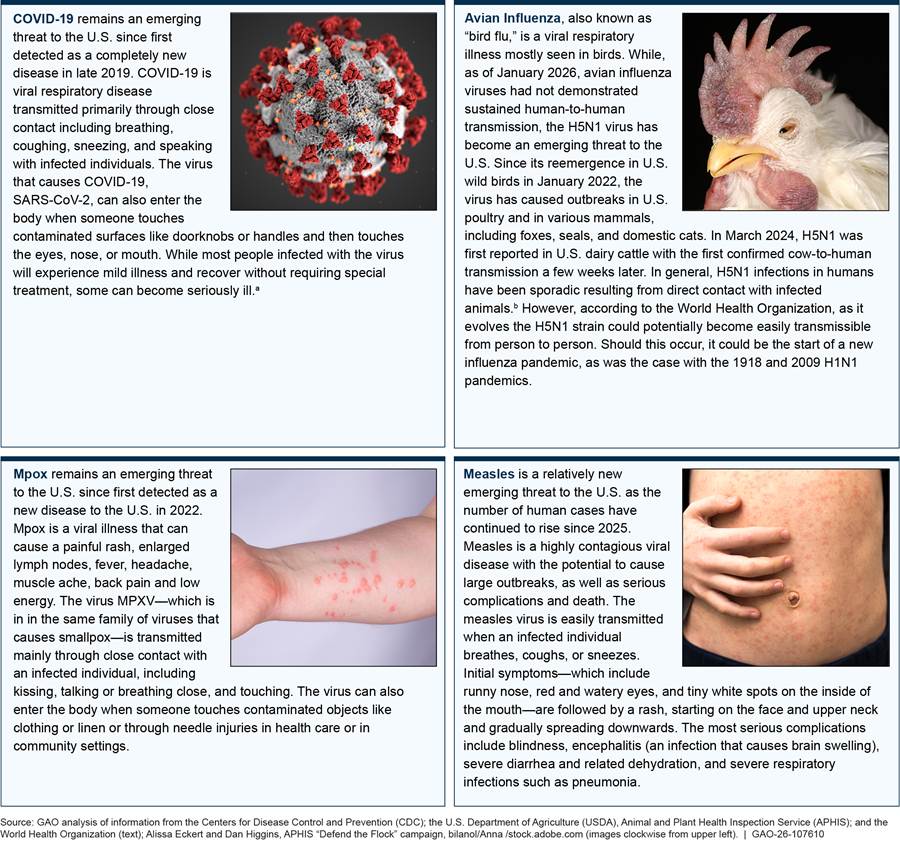
aAs of November 2025, nearly 780 million cases and more than 7.1 million deaths due to COVID-19 have been reported worldwide since December 2019, but the actual number is thought to be higher, according to the World Health Organization.
bAs of March 2026, there have been a total of 71 confirmed human cases in the U.S. since April 2024, according to CDC data.
Responsibilities Related to Emerging Infectious Disease Surveillance
In the U.S., responsibility for disease surveillance is shared at all levels of government and with other entities. Although CDC has primary responsibility for disease surveillance at the federal level, others also play key roles, including health care providers, laboratories, about 3,000 jurisdictional health departments, and multiple other federal departments, among others.[10] In addition, the U.S. works with international partners on international disease surveillance, according to CDC officials.
CDC is charged with protecting the nation’s public health by directing efforts to prevent and control diseases and responding to public health emergencies. It has primary responsibility for conducting national disease surveillance and developing epidemiological and laboratory tools to enhance disease surveillance. CDC also provides an array of technical and financial support for jurisdictional infectious disease surveillance efforts.
Health care providers have a responsibility to protect public health. Because health care providers are typically the first health officials to encounter—and potentially diagnose—cases of infectious diseases, these professionals play an important role in helping to identify, report, and prevent the spread of infectious diseases.
Jurisdictional health departments take the lead in protecting the public’s health, conducting emerging infectious disease and other surveillance, and supporting response efforts. Generally, local health departments are responsible for conducting initial investigations into reports of infectious diseases. Local health departments are also responsible for sharing information they obtain from providers, laboratories, or other sources with their state department of health. State health departments are responsible for collecting surveillance information from across their state, coordinating investigations and response efforts, and voluntarily sharing surveillance data with CDC and others.
Several other federal agencies and components have some responsibilities related to disease surveillance, in addition to CDC.[11] These include the following:
· ASPR, an agency within HHS, leads the nation’s medical and public health preparedness for, response to, and recovery from disasters and public health emergencies.
· APHIS, an agency within USDA, is responsible for protecting and improving the health and marketability of animals and animal products in the U.S. by preventing, controlling, and eliminating animal diseases. APHIS undertakes disease surveillance and response activities to protect U.S. livestock, ensure the safety of international trade, and contribute to the national zoonotic disease surveillance effort. APHIS also participates in wildlife disease surveillance.
· USGS and the U.S. Fish and Wildlife Service, agencies within Interior, are responsible for disease surveillance in wildlife and aquatic animals.
· Multiple components within DHS have responsibilities related to disease surveillance. For example, the National Biosurveillance Integration Center (NBIC) is responsible for integrating and analyzing information from health surveillance systems across the federal government and the National Biodefense Analysis and Countermeasures Center supports emerging threat characterization, among other things.[12]
We have reported challenges with federal coordination during public health emergencies, including detecting and monitoring emerging infectious diseases. We placed HHS’s leadership and coordination of public health emergencies on our High-Risk List in January 2022.[13] As of January 2025, 83 recommendations related to preparing for and responding to public health emergencies have not been implemented.[14]
CDC Conducts Surveillance for Emerging Infectious Disease Threats by Collecting Data, Conducting Analysis, and Communicating Information
CDC conducts surveillance for emerging infectious diseases by collecting health-related data, analyzing and modeling data, and communicating information on both potential and existing threats.
CDC Collaborates on Collecting Health-Related Data
CDC collects health-related data in collaboration with state and local (jurisdictional) health departments, health care providers, laboratories, as well as other federal agencies.[15] These entities are the first to gather or generate health-related surveillance data, which they then report or share with CDC through several surveillance systems.
CDC and its partners collect data on patient symptoms during emergency care (syndromic data), disease presence in community sewage (wastewater data), and provider or laboratory-confirmed cases of certain infectious diseases (case data), along with other relevant data. According to CDC officials, the surveillance data systems used to collect these data can be used in tandem, as they can provide complementary data to support emerging infectious disease surveillance. (See fig. 2 for an illustration of how CDC and its partners collect certain types of data, and app. I for more detailed information on CDC’s surveillance data systems.)
Figure 2: Centers for Disease Control and Prevention (CDC) Collection of Syndromic, Wastewater, and Clinical Case Data
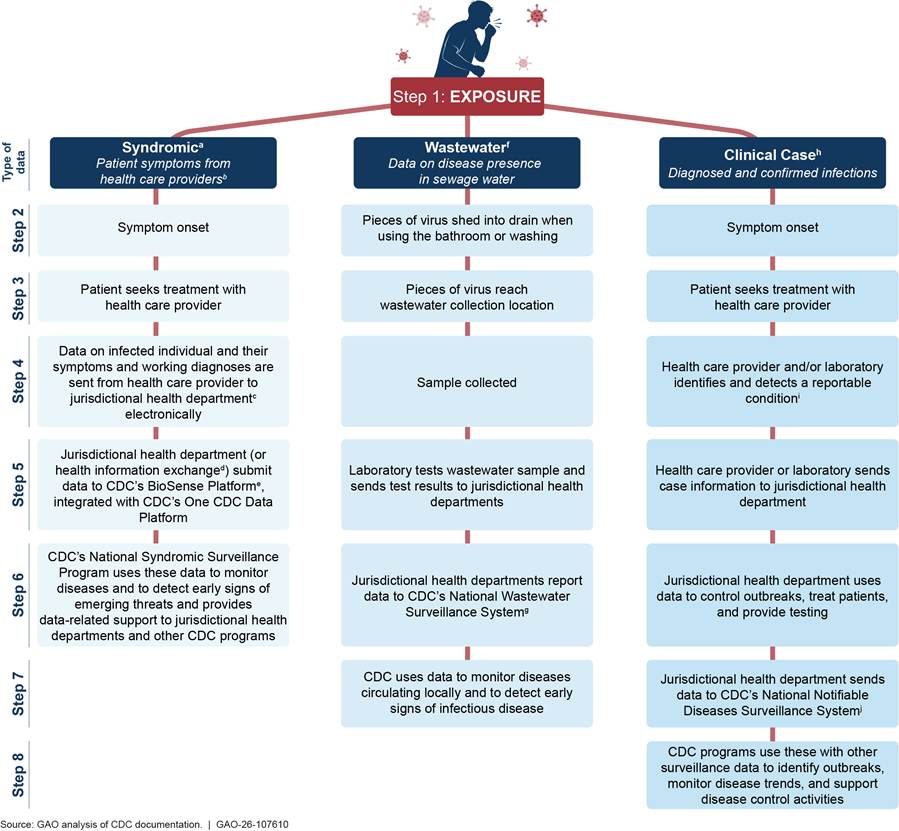
aSyndromic data are those collected on patient symptoms (i.e., chest-like illnesses, cough, fever).
bFor this report, the term “health care providers” includes all health care professionals, such as physicians and nurses, as well as health care institutions, such as hospitals and clinics.
cJurisdictional health departments refer to departments in states, territories, Tribes, and localities (such as counties and cities) that have primary responsibility for public health in their geographic areas.
dHealth information exchanges are organizations that electronically move data among health care stakeholders (such as laboratories, public health departments, hospitals, and physicians).
eCDC’s BioSense Platform is a secure electronic health information system that collects syndromic surveillance data.
fWastewater is used water. It includes substances such as human waste, food scraps, oils, soaps, and chemicals. It is monitored for pathogens (e.g., viruses), as well as pharmaceuticals and toxic or other chemicals by testing sewage.
gCDC’s National Wastewater Surveillance System monitors the testing of wastewater samples to detect community infections and provide early warnings of disease circulation to CDC.
hClinical case surveillance occurs each time public health agencies at the local, state, or national levels collect information about a case or person diagnosed with a disease or condition that poses a serious health threat.
iReportable conditions are defined by state and local jurisdiction-specific laws or regulations that require health care providers and/or laboratories to report cases to state or local health authorities, according to CDC.
jThe nationally notifiable conditions list is updated annually, or as needed during emergency responses, and designated through a collaborative process involving approval by the Council of State and Territorial Epidemiologists and adoption by CDC. Jurisdictional health departments voluntarily submit case data for nationally notifiable conditions to CDC.
CDC officials noted that the agency’s workforce, along with those of state and local health departments, are also critical components of data collection. Agency officials and others we spoke with stressed the importance of obtaining information on emerging infectious diseases through collaboration with healthcare providers, other federal agencies and departments, international organizations, and other non-federal entities:
· CDC officials, experts, and public health associations all noted that surveillance for emerging infectious disease surveillance continues to rely on “astute clinicians.” As the first health officials to encounter cases of emerging infectious diseases, these clinicians are often the first to notify jurisdictional health departments directly, which can be done via phone, about an unusual or concerning diagnosis or set of symptoms. These direct notifications can be timelier than receiving syndromic and case data.
· One Health partnerships with USDA and Interior have been key to understanding emerging zoonotic threats in livestock and wildlife, according to CDC officials, given the significance of such threats to human health. For example, CDC officials told us how they have used USDA data on H5N1 detections in livestock to help identify jurisdictions of concern for human cases. CDC has also monitored genomic sequencing information shared by USDA to monitor viral changes.[16]
· CDC works directly with regional public health institutions, national public health institutes, and other international partners to collect health-related data on emerging infectious diseases abroad.[17] CDC’s Global Health Center maintains extensive global surveillance partnerships and a sustained in-country staff presence in strategic priority “hotspot” regions around the world, according to agency officials. CDC staff in these locations collect and integrate laboratory and epidemiologic data to accelerate early detection of infectious diseases among high-risk and underserved populations internationally, according to CDC officials.[18]
CDC works alongside non-federal entities to improve the collection of data for surveillance systems. For example, the agency awarded a cooperative agreement and provided technical support to jurisdictional health departments related to the collection of syndromic data.[19] CDC also awarded a cooperative agreement and provided training to jurisdictional health departments for laboratory staff who use methods to identify and characterize disease-causing pathogens for the collection of genomic sequencing data.
CDC Analyzes and Models Collected Health-Related Data
CDC analyzes the health-related data it collects in various ways to detect unusual patterns and monitor changes in disease activity. For example, CDC analyzes syndromic data to detect potential diseases even before health care professionals make diagnoses based on those symptoms. In one such instance, as part of the agency’s strategy to detect potential cases of H5N1—one of several influenza viruses that causes avian influenza (or “bird flu”)—CDC used syndromic data to help monitor for unusual influenza activity in geographic areas with known infections in cattle herds according to CDC officials. When increased levels of activity were noted, CDC officials then contacted state or local authorities to further assess whether the unusual activity was the result of H5N1 or other causes.
CDC also analyzes data from wastewater samples across the country to track detections of certain emerging infectious diseases. For example, CDC is using these data to track detections of avian influenza A(H5), measles, and mpox.
CDC also uses artificial intelligence to support the agency’s analysis of health-related data. These efforts include AI-enabled augmentation of surveillance data, real-time monitoring of circulating strain patterns, and detection of emerging strain patterns, according to agency officials. For example, agency officials stated that one artificial intelligence model, Rosetta, was developed to analyze genomic surveillance data to detect potentially novel, emerging, or atypical strains by comparing current strain patterns with prior years.
CDC uses the collected data for forecasting and scenario modeling to estimate current or near term and future disease dynamics and burden. These efforts include the following:
· nowcasting to provide real-time estimates of disease surveillance metrics, which can include measures of disease burden (e.g., hospitalization rates) and incidence (number of cases) during disease outbreak events. Estimates are produced from models based on currently available and historical reporting patterns to account for incomplete data. This incomplete data may be due to several factors, including delays in jurisdictional reporting to CDC, reported data not capturing asymptomatic individuals, or people who do not seek medical care. This method has been used to determine circulation trends of respiratory viruses (e.g., influenza, COVID-19, and respiratory syncytial virus, known as RSV) and to estimate disease burden, according to CDC.
· scenario modeling to illustrate how future disease dynamics might occur. While similar to forecasting, scenario modeling allows for exploration of longer-term hypotheticals in the form of “what if” questions under a range of assumptions about the future, whereas forecasting focuses on shorter-term predictions and quantifying uncertainty on what will happen. This method has been to examine potential hospitalization burden for COVID-19 and to estimate the number of hospitalizations that could be prevented due to vaccination for influenza and RSV, during 2024-2025 annual respiratory disease season.
CDC Communicates Information to Its Partners and the General Public
CDC communicates disease surveillance information to its partners and the general public on a continual basis through a number of different ways, including the following:[20]
· Early warning and response system. CDC operates an early warning and response system, the Health Alert Network, which is designed to ensure that jurisdictional health partners, as well as federal partners, have timely access to emerging health information. This messaging system delivers health alerts, advisories, updates, and crucial information to over one million recipients, which include public health officials, clinicians, laboratories, and emergency responders.
|
Hantavirus Outbreak On May 8, 2026, the Centers for Disease Control and Prevention (CDC) issued a Health Alert Network Health Advisory to inform clinicians and health departments about hantavirus disease cases among passengers and crew of a cruise ship in the South Atlantic Ocean. According to the advisory, the cases resulted from infection with the Andes virus, the only type of hantavirus known to spread person-to-person after an initial case resulting from close contact with infected rodents. As it progresses, the virus can cause hantavirus pulmonary syndrome, a severe and potentially deadly disease affecting the lungs. The advisory noted three deaths among the eight cases associated with this cluster. The advisory also summarized CDC's recommendations for U.S. public health departments, clinical laboratories, and healthcare workers about hantavirus disease case identification, testing, and biosafety considerations in clinical laboratories. While there is no specific antiviral treatment or vaccine for the Andes virus, CDC considered the risk to public health in the U.S. extremely low. Source: GAO analysis of CDC information. | GAO‑26‑107610. |
· Communities of practice and webinars. CDC participates in the National Syndromic Surveillance System community of practice, where it holds monthly calls with members to share information concerning syndromic surveillance, according to CDC. CDC uses webinars to communicate information and surveillance activities for emerging disease threats. We previously reported on how CDC initiated webinars and emails after the first case of mpox was identified to share external communication about groups at high risk for the disease.[21] These communication channels have served as forums for learning and exchanging information for emerging infectious disease surveillance. ASPR similarly engages public and private sector partners through monthly and bi-monthly meetings, bulletins, and ad hoc communications, according to officials. Officials noted that these mechanisms provide opportunities to share information on emerging threats and strengthen coordination across partners, among other things.
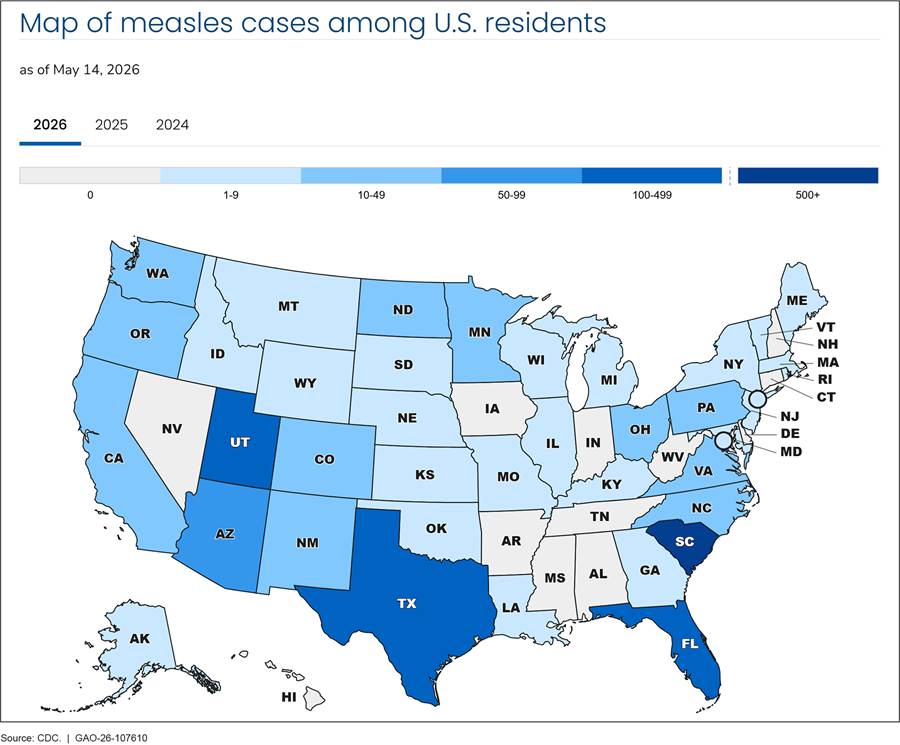
· Public-facing dashboards. CDC maintains several dashboards on its internet site. These dashboards share the data CDC collects from state health departments. Data are collected from thousands of local jurisdictions, territories, and health care facilities. CDC’s dashboards integrate this information to provide a visual overview of national health trends while supporting targeted local responses. For example, CDC maintains a dashboard of weekly reported cases of measles across the United States. See figure 3 below for screenshot from CDC’s measles dashboard.
Selected Experts Suggested Federal Actions to Improve U.S. Emerging Infectious Disease Surveillance
Experts on our roundtable suggested a range of federal actions to improve U.S. emerging infectious disease surveillance. These actions fell into four categories: 1) actions to increase collaboration among surveillance entities, 2) actions to strengthen surveillance data quality and infrastructure, 3) actions to refine surveillance methods, and 4) actions to improve surveillance communications.
We also found these expert-suggested actions were consistent with some of our and others’ prior recommendations. In addition, officials from relevant federal departments including HHS, Interior, USDA, and DHS identified existing federal efforts they thought were related to the suggested actions.
For additional detailed information on the experts’ suggestions, including specific actions and considerations, and existing federal efforts identified by the departments, see appendix III.
Increase Surveillance Collaboration among Surveillance Entities
Experts in our roundtable suggested several actions to increase surveillance collaboration, including federal collaboration among agencies and with non-federal partners, including jurisdictions, non-government entities, and international entities.
Collaboration among Federal Agencies
Experts’ suggestions to increase collaboration among federal agencies fell into two categories. In making these suggestions, they cited a lack of centralized authority to oversee and coordinate surveillance activities across federal agencies. While collaborative efforts exist, experts noted that these lack the authority to direct cross-agency surveillance efforts or are informal.
Specifically, experts made suggestions to 1) create a multisectoral, multidisciplinary leadership group and, 2) develop and implement a national emerging infectious disease surveillance strategy.
Create a multisectoral, multidisciplinary leadership group. Experts suggested that such a group could help align disparate surveillance efforts occurring across public and animal health agencies, and levels of government.
In particular, experts suggested creating a multisectoral, multidisciplinary group to lead surveillance efforts using the One Health approach. The federal government defines One Health as a collaborative, multisectoral, and transdisciplinary approach—working at the local, regional, national, and global levels—with the goal of achieving optimal health outcomes recognizing the interconnection between people, animals, plants, and their shared environment. The location, composition, and authorities should be considered when establishing such a leadership group, experts noted. Specifically, experts noted that placing the group within the White House could help ensure it has sufficient authority to direct collaboration and funding across agencies. Conversely, placing the group within a department could insulate it from administration or political changes but weaken its authority. Similarly, two bipartisan research organizations—the Center for Strategic & International Studies and the Bipartisan Commission on Biodefense—have both recommended establishing a centralizing authority, in part, to help align disparate cross-agency surveillance efforts.[22]
Federal agency officials described efforts they indicated were related to this action, including the U.S. One Health Coordination Unit. Established in 2024 and co-led by CDC, Interior, and USDA, this unit is intended to support coordinated prevention, detection, control, and response efforts for zoonotic diseases and related One Health activities, according to CDC officials. The unit had planned for a working group to address federal interagency surveillance needs related to zoonotic and emerging infectious diseases, but this effort was paused due to competing priorities, including the New World screwworm threat.
Develop and implement a comprehensive national strategy for surveillance of emerging infectious disease threats. Experts suggested the federal government develop a comprehensive national strategy for public health surveillance of emerging infectious disease threats to improve collaboration and effectiveness of surveillance by, for example, reducing duplication of data collection and eliminating siloed surveillance activities. According to the experts, this strategy should clearly define objectives and goals to unite national efforts for both overall emerging infectious disease surveillance, as well as specific surveillance methods used across all levels of government. Additionally, the strategy should cover the responsibilities of different agencies and levels of government in conducting surveillance activities and how those activities should be conducted.
Federal agency officials described efforts they indicated were related to this action, including the National One Health Framework to Address Zoonotic Diseases and Advance Public Health Preparedness. Released in January 2025, the framework includes a goal to strengthen coordinated surveillance and information sharing for zoonotic disease surveillance, according to CDC officials. Similarly, the Integrated Strategy for Biosurveillance for Fiscal Years 2025-2029 includes a goal of advancing biosurveillance and information-sharing capabilities by identifying, leveraging, and developing multisectoral technologies and data, according to DHS officials.
|
Related GAO Recommendations on Surveillance Collaboration GAO has previously made recommendations similar to the suggestions described by the experts in the roundtable to improve collaboration across government agencies during public health emergencies. For example, GAO’s April 2024 report on the mpox emergency noted jurisdictional challenges reporting and submitting data during the Department of Health and Human Services’ (HHS) response to the emergency. To address this, GAO recommended, and HHS concurred, that HHS develop and implement a coordinated, department-wide after-action program that (1) encouraged after-action collaboration across HHS agencies, and (2) includes relevant external stakeholders involved in each response. In December 2024, HHS developed a standard operating procedure to establish a coordinated, department-wide after-action program. However, HHS is still awaiting the results of a public health emergency response after-action report to implement this procedure. Therefore, these recommendations had not been fully implemented as of June 2026. |
Source: GAO analysis. See also Public Health Preparedness: Mpox Response Highlights Need for HHS to Address Recurring Challenges, GAO‑24‑106276 (Washington, D.C.: April 18, 2024). | GAO‑26‑107610.
Collaboration with Non-Federal Partners
Experts’ suggestions to improve federal collaboration with non-federal partners, including jurisdictions, non-government entities, and international entities, fell into three categories. In making their suggestions, experts cited concerns that a lack of collaboration between the federal government and these partners, including in the conducting of surveillance activities and sharing or reporting of data, affected the country’s ability to effectively detect and monitor potential emerging infectious disease threats.
Experts suggested the federal government 1) encourage jurisdictional participation with incentives and collaborative mechanisms, 2) increase participation of non-governmental entities in federal surveillance efforts, and 3) leverage global health resources and international surveillance partnerships.
Encourage jurisdictional participation with incentives and collaborative mechanisms. Experts noted how federal agencies depend upon jurisdictions to conduct surveillance activities and report public and animal health data collected for emerging infectious disease surveillance. According to experts, an incomplete picture of an emerging infectious disease threat could be provided if surveillance activities are not routinely conducted and data are not consistently reported across jurisdictions. To encourage jurisdictional participation in surveillance activities, experts suggested federal agencies consider providing both incentives, such as conditioning federal funding (i.e., funding that comes with specific requirements for recipients), and providing operational support to jurisdictions, such as placing liaisons with surveillance expertise in jurisdictional health departments.
Officials from federal agencies described existing efforts they thought were related to this action. For example, CDC officials cited cooperative agreements that provide financial support and technical assistance to state, local, and U.S. territory and affiliate health departments to detect, prevent, and respond to emerging infectious diseases. Additionally, USGS provided input on a toolkit to support the development of fish and wildlife health programs, which officials noted could be a model for jurisdictional emerging infectious disease surveillance.
Improve collaboration with non-government entities regarding data sharing. To encourage the involvement of non-governmental entities in surveillance, federal agencies should consider improving avenues for data sharing, experts said. The experts cited challenges with the completeness of surveillance data resulting from a lack of access to specimens, such as blood and other fluid samples, among other things, and privacy concerns associated with participating in surveillance activities and sharing data. For example, experts stated that agricultural entities, such as dairy farmers, may be hesitant to share identifiable animal health data because of potential financial losses due to decreased public perception of their product. To improve collaboration and data sharing, experts specifically suggested the following:
· Increasing the involvement of the academic sector and leveraging its research and laboratory capabilities could help improve detection of emerging infectious disease threats. This could be done, experts said, by addressing potential health privacy concerns associated with publishing research that uses shared data, among other means.
· For the agriculture sector, developing de-identified data sharing processes, such as anonymized or aggregated data reporting, might encourage collaboration, according to experts. They also suggested expanding USDA’s indemnity and compensation program beyond the poultry industry to include the dairy industry as well. (See text box.)
CDC officials described existing efforts they thought were related to this action. For example, these officials cited a program that works with multisectoral partners to establish consistent data and metadata standards for data sharing for public health.
|
U.S. Department of Agriculture (USDA) Indemnity Payments Experts from our roundtable suggested expanding an existing government program might encourage agricultural sector participation in emerging infectious disease surveillance. Currently, USDA provides indemnity payments to farmers when chickens in their flocks test positive for highly pathogenic avian influenza. If this influenza is detected in a flock, USDA officials will depopulate all the birds and eggs. USDA then provides compensation for each bird or egg destroyed. USDA does not provide compensation for birds that died due to infection. Experts said that this incentivizes farmers to report signs of infection early to gain maximum benefit from the payments. USDA also compensates farmers for materials, such as contaminated feed or egg packaging, that must be destroyed and provides flat rate payments for virus elimination activities, including barn preparation, a cleaning step, and a disinfection step. Experts suggested extending the program to cover the dairy industry could increase that industry’s willingness to report cases of emerging infectious disease to surveillance authorities. However, they acknowledged payments to the dairy industry could be much greater than to the poultry industry due to the relative value of livestock. This could strain the funding for indemnity payments. |
Source: USDA and GAO expert roundtable | GAO‑26‑107610
Better leverage global health resources and international surveillance partnerships. Experts said reductions in U.S. surveillance efforts abroad could affect the country’s ability to detect emerging infectious diseases before they reach the U.S. and, in response, the experts suggested ways to improve collaboration with international surveillance partners. Experts suggested that leveraging established collaborative efforts, such as the Global Health Security Initiative and Global Outbreak Alert and Response Network, could help ensure the country’s national security, especially in light of U.S. pullback from multilateral partnerships such as the World Health Organization.[23] In doing this, federal agencies should consider optimizing existing international resources and personnel, leveraging existing and new bilateral partnerships, and restoring beneficial international connections, experts said. Similarly, the Center for Strategic & International Studies recommended in 2026 that the federal government strengthen technical cooperation and data and sample sharing with international partners.[24]
Officials from federal agencies described efforts they thought were related to this action. For example, DHS officials cited how their current biosurveillance strategy includes an objective to further develop existing and new international partnerships to increase information sharing. Additionally, ASPR officials cited the National Emerging Special Pathogens Training and Education Center collaboration and knowledge-sharing with international partners in preparing for infectious disease outbreaks.
Strengthen Surveillance Data Quality and Infrastructure
Experts’ suggestions to strengthen data quality and infrastructure for emerging infectious disease surveillance fell into three categories. In making their suggestions, experts noted onerous data requests for jurisdictions, lack of interoperability (i.e., the ability for data systems to communicate or speak the same or similar language) and standardized data systems, and outdated technology, all of which could affect the sharing and completeness of emerging infectious disease surveillance data.
Specifically, experts suggested the federal government 1) identify, develop, and use surveillance data standards, 2) develop and use a federated data platform that could allow more access in a protected way, and 3) assess, and potentially modify, CDC’s Data Modernization Initiative (DMI).
Identify, develop, and use standards for surveillance data. Experts suggested that improving data standards could allow for more effective data analysis. In developing such standards, federal agencies should consider developing data use agreements and guidance, including a core set of minimum data elements, according to the experts.
Similarly, the Bipartisan Commission on Biodefense, in 2024, also recommended the federal government improve public health data infrastructure by developing a data interoperability plan with interagency partners and creating a data sharing agreement in advance of biological events.[25] Specifically, the recommendation stated the data interoperability plan should describe the structure of the information sharing network used by agencies and include data reporting standards to ensure interoperability, according to the report.
CDC officials described existing efforts they thought were related to this action. Specifically, CDC cited efforts to establish minimum reporting requirements for four core public health data sources: case notification, laboratory diagnostic testing data, hospital capacity data, and syndromic surveillance emergency department visit data.
Improve data quality and sharing by developing a federated surveillance data platform. Experts suggested that a more developed federated data system could improve data accessibility and address privacy concerns raised by local governments and, thus, would allow surveillance data sharing and analysis. (See sidebar.) A federated data system would allow greater access and collaboration for more entities, while protecting privacy and control of data, according to experts. Additionally, experts said a federated system can allow for the layering of diverse data types, including human, animal, and environmental data, to identify any connections between them or trends in disease spread. Experts said that in developing such a system, federal agencies should consider developing interoperability standards where they are lacking and improving the quality of animal and environmental surveillance data.
|
Federated Surveillance Data System A federated data system allows data to be stored and controlled locally while also allowing the data to be sent and received, usually through cloud-based platforms, for user sharing, comparisons, analytics, and visualization. In contrast, a centralized data system stores data in a single central database that users must access to conduct any analysis. Data privacy and security are improved in a federated system because data are stored and controlled by the agencies that collect the data. Additionally, both federal and jurisdictional agencies can more quickly and autonomously access and analyze data since it does not need to be sent to a central database. Source: GAO analysis based on prior GAO reporting and Centers for Disease Control and Prevention information. | GAO‑26‑107610. |
|
Related GAO Recommendations on Surveillance Data Quality and Infrastructure GAO previously reported on data quality and infrastructure challenges with the Department of Health and Human Services’ (HHS) public health preparedness data systems, which include surveillance data systems. For example, in 2022, GAO reported on the lack of an interoperable network of systems for near real-time public health situational awareness, despite such a network being mandated by law and recommended that HHS should prioritize the development of the network. As of June 2026, several of GAO’s related recommendations had not been implemented. |
Source: GAO analysis. See also COVID-19: Pandemic Lessons Highlight Need for Public Health Situational Awareness Network, GAO‑22‑104600 (Washington, D.C.: June 23, 2022). | GAO‑26‑107610.
Officials from federal agencies described efforts they thought were related to this action. For example, CDC officials cited the agency’s unified data platform that connects the agency and its partners, including jurisdictions, to shared tools, capabilities, and data as an existing federated data platform. Additionally, officials from DHS cited the use of layered data in BioFeeds, a data-mining software. BioFeeds “reads” and labels news articles, blogs, scientific research, and other information sources, with tags including the type of threat and specific event details.
Assess, and potentially modify, CDC’s Data Modernization Initiative for surveillance. Experts suggested assessing and modifying, as appropriate, current efforts related to CDC’s DMI (see sidebar) to align with jurisdictional resources and expertise. Experts said that current efforts could be doing too much with limited resources at the jurisdictional level, preventing jurisdictions from fully using or integrating modern technology in their surveillance efforts. In implementing this action, federal agencies should consider assessing the status of CDC’s DMI and re-aligning efforts based on jurisdictions’ resource availability and capacity, experts said.
|
Centers for Disease Control and Prevention’s (CDC) Data Modernization Initiative (DMI) CDC’s DMI was launched in 2019 to provide structured funding and a strategic framework to enhance health data systems. One of the initiative’s objectives is to modernize and connect key public health surveillance systems and sources for streamlined and consolidated collection, routing, exchange, and linkage of public health data. One of the key results of this objective is to have core public health data automatically and electronically sent and ready for use in cloud-enabled data systems. To achieve this and other objectives, CDC has worked to create interoperable systems for jurisdictions and healthcare entities, and funded technology infrastructure modernization efforts. Source: CDC. | GAO-26-107610 |
CDC officials described an effort they thought was related to this action. Specifically, CDC officials said the agency is using findings from a comprehensive evaluation, completed in February 2026, of indirect support to jurisdictions to strengthen the DMI.
Refine Surveillance Methods
Experts’ suggestions to refine surveillance activities fell into four categories. In making their suggestions, experts identified possible inefficiencies in animal and public health surveillance methods, including lack of optimized surveillance methods and insufficient targeting of high-risk populations. For example, experts suggested that a lack of surveillance of certain animal populations, such as non-game wildlife or companion animals, created gaps in animal surveillance coverage. Additionally, they pointed out that certain surveillance methods are not being used in a strategic way to maximize their potential benefit. For example, an expert said that wastewater surveillance is not always conducted at optimal locations. The Center for Strategic & International Studies reported similar concerns in 2026, noting that federal agencies have insufficiently leveraged emerging technologies such as wastewater surveillance.[26]
Experts suggested the federal government 1) use a risk-based approach to animal surveillance, 2) improve wastewater surveillance, 3) adapt more diverse collection and testing techniques, and 4) assess cost-effectiveness to be most efficient and effective.
Improve surveillance coverage by refining wildlife, farm, and companion animal surveillance methods and targeting surveilled populations using a risk-based approach. Experts suggested refining animal surveillance using a risk-assessment process to identify what emerging infectious disease data to gather and what actions to take. This process would include identifying what animal populations to surveil, what data to collect from those populations, and what methods to use to collect that data. Such an approach could decrease data burdens and improve data analysis, according to experts. To improve animal surveillance, federal agencies should consider awarding cooperative agreements to jurisdictions to build capacity for animal surveillance and expanding surveillance where animal-human contact is high.
|
Related GAO Recommendation on Zoonotic Disease Surveillance In 2023, GAO recommended that the Centers for Disease Control and Prevention (CDC), in collaboration with other agencies, comprehensively assess zoonotic disease risks related to imported wildlife. Such an assessment could include identifying high-priority categories of wildlife and then conducting risk assessments for those categories. While a CDC workgroup has developed and tested a 4-phase risk assessment model for estimating the zoonotic risk a species poses to the U.S. population, GAO believes CDC’s assessment of zoonotic disease risks related to imported wildlife should be comprehensive. CDC did not concur with this recommendation. This recommendation had not been implemented as of June 2026. |
Source: GAO analysis. See also Zoonotic Diseases: Federal Actions Needed to Improve Surveillance and Better Assess Human Health Risks Posed by Wildlife, GAO‑23‑105238 (Washington, D.C.: May 31, 2023). | GAO‑26‑107610
Officials from federal agencies described efforts they thought were related to this action. For example, USGS officials cited the continued development of a national wildlife disease surveillance system to improve situational awareness and threat prediction for potential disease threats from wildlife. Additionally, APHIS officials cited their ongoing risk-based wildlife surveillance for pathogens such as rabies, avian influenza, and African swine fever.
Enhance wastewater surveillance by using a more strategic approach. Experts suggested enhancing wastewater surveillance capacity through a more strategic approach. While CDC collects and displays wastewater data through the National Wastewater Surveillance System (see sidebar), experts said that there is no strategy or guidance provided to jurisdictions to help them conduct wastewater surveillance, such as guidance on best use cases or analysis techniques. Similarly, in 2022, we reported that methods for wastewater sample collection, analysis, and data sharing are not standardized, making it difficult to compare sites.[27]
|
Wastewater Surveillance in the U.S. Wastewater (sewage) can be tested to detect traces of infectious diseases circulating in a community, even if people do not have symptoms. People with infections such as COVID-19 can shed pieces of the virus or bacteria when they use the bathroom, shower, or wash their hands, even if they don’t have symptoms These pieces of virus or bacteria then travel through the wastewater system where samples are collected and tested for the presence of different types of infections. Because wastewater surveillance collects ongoing data at a community-level, it can show changes in disease trends before trends are seen in clinical cases. The Centers for Disease Control and Prevention’s (CDC) National Wastewater Surveillance System collects and displays wastewater data from communities across the United States. CDC receives data from about 1,500 wastewater monitoring sites across the United States each week. The system currently tracks levels of COVID-19, respiratory syncytial virus, commonly known as RSV, and the flu in wastewater. Additionally, the system has been used to track recent detections of emerging or re-emerging viruses such as measles, bird flu, and mpox. Source: CDC. | GAO‑26‑107610 |
According to experts, federal agencies should consider supporting jurisdictional wastewater surveillance activities, including by providing guidance, such as on how to interpret results of wastewater analysis, and focusing wastewater surveillance using an overall sampling strategy that identifies where this type of surveillance can add the most value.
Officials from federal agencies described efforts they thought were related to this action. For example, CDC cited several mechanisms by which the agency guides state and local wastewater surveillance efforts. Additionally, USGS officials stated that the agency is well-positioned to develop wastewater surveillance methods and processes related to detecting disease in animals on a small-scale based on support they provided to CDC wastewater surveillance efforts during the COVID-19 pandemic.
Improve surveillance coverage of high-risk human populations by considering different data collection techniques and methods. Experts suggested that focusing on human populations most at risk for emerging infectious diseases and using diverse surveillance approaches could enhance the representativeness of surveillance data and improve surveillance efforts. In doing this, federal agencies should consider establishing and analyzing population-level cohorts and collecting both positive and negative diagnostic test results for analysis, experts suggested.[28]
CDC officials described an effort they thought was related to this action. Specifically, CDC officials cited a collaboration with 12 state health departments and academic partner sites working to translate infectious disease research into policy and public health practice.
Optimize surveillance by evaluating cost-effectiveness of surveillance systems and methods. Experts suggested evaluating the cost-effectiveness of current surveillance systems to address possible inefficiencies. In doing this, federal agencies could consider, for example, the cost of certain surveillance efforts and the extent to which they, and the surveillance data obtained, help achieve desired outcomes of emerging infectious disease surveillance, experts suggested. Agencies could then focus on the most cost-effective surveillance efforts and take steps to ensure that there were appropriate staffing and other resources (e.g., funding) to optimize those efforts. We have previously reported on the importance of a strong public health infrastructure, including a skilled and adequately staffed workforce, to conduct key public health functions, including surveillance.[29] Additionally, experts said agencies should consider using novel tools, such as machine learning and AI, and data, such as from social media, to gain efficiencies in data collection and analysis.
CDC officials described efforts they thought were related to this action. For example, CDC officials cited an AI-based dashboard for monitoring school closures, which the agency estimates will provide cost-savings of $2 million per year. CDC officials also described how their event-based surveillance team scans ad hoc and unstructured data sources, such as from social media, to detect signals of potential public health threats.
Improve Surveillance Communication
Experts on our roundtable identified communication issues in several areas including inconsistencies with public messaging efforts by federal agencies and guidance provided to jurisdictions. Experts said that the public grew less willing to participate in surveillance activities, such as getting tested and reporting when one is infected, and follow public health guidance, during recent disease outbreaks. If the public does not trust public health entities and, therefore, is less willing to participate in surveillance activities, then public health agencies may collect incomplete or inaccurate data on the presence of an emerging infectious disease.
|
Related GAO Work on Communication During Public Health Responses In 2024, GAO reported on similar communication issues between the federal government and the public. Specifically, we reported that during the mpox response, the Department of Health and Human Services (HHS) did not effectively communicate to the public the significantly increased risk of mpox for certain individuals during the initial stages of the outbreak and did not adapt messaging to different communities. The communication challenges GAO identified during the mpox response are similar to those GAO identified during the COVID-19 pandemic, and the 2016 Zika and 2009 H1N1 responses. |
Source: GAO analysis. See also Public Health Preparedness: Mpox Response Highlights Need for HHS to Address Recurring Challenges. GAO‑24‑106276, (Washington, D.C.: April 18, 2024). | GAO‑26‑107610
Improve awareness and perception of public health and surveillance by developing a communication strategy. Experts suggested a formal communication strategy could promote the importance of surveillance and increase trust in the public health system. Experts said that in developing a strategy, federal agencies should consider involving communication professionals, incorporating theories of behavior change principles, and using various types of communication modalities, such as relying on trusted messengers, including community or religious leaders, and community involvement.[30]
Officials from federal agencies described efforts they thought were related to this action. For example, CDC officials cited how the agency conducts interviews, focus groups, and message testing to develop communication products including materials that explain how surveillance data are generated. Additionally, USGS officials cited the USDA’s work regarding New World screwworm as a leading example of interagency coordinated communication. This includes a website that has targeted resources for a range of stakeholders, including livestock producers, veterinarians, and animal health officials, among others, and contains information on cases of New World screwworm infection and response activities.
|
New World Screwworm
New World screwworm is species of parasitic fly that feeds on the tissue or flesh of warm-blooded animals, including livestock, pets, wildlife, and people. These flies lay eggs in wounds or body openings that hatch into maggots that eat live tissue, causing an often painful and foul-smelling wound. The flies are typically found in South America and parts of the Caribbean but have steadily moved northward from through every country in Central America and Mexico since 2023. New World screwworm infestations do not regularly occur in the U.S., but cases have occurred in travelers returning from areas where flies are present. New World screwworm also has the potential to significantly impact agriculture and vulnerable wildlife species if it re-establishes in the U.S. Source: Centers for Disease Control and Prevention (CDC) and U.S. Department of Agriculture (text); Prof. Gary D. Alpert, PhD, of Northern Arizona University (image). | GAO‑26‑107610 |
Emerging infectious diseases pose significant public health, economic, and national security threats, necessitating a robust surveillance system. CDC’s leadership and coordination with its surveillance partners at all levels of government and with non-government entities are critical to ensuring our nation is able to effectively detect and monitor emerging infectious diseases. Additionally, a strong public health infrastructure, including a skilled workforce, is integral to emerging disease surveillance.
Our roundtable of experts suggested several actions to streamline and strengthen federal emerging infectious disease surveillance, some of which are in line with prior GAO recommendations.[31] Expert actions offer HHS and stakeholders a chance to assess tradeoffs and feasibility in expanding current efforts or exploring new approaches for infectious disease surveillance, while considering past recommendations by us and others. These actions also provide HHS an opportunity to determine if any of the suggestions assist the department in its leadership and coordination of public health emergencies.
Agency Comments
We provided a draft of this report to HHS, DHS, Interior, and USDA for review and comment. HHS, DHS, and USDA provided technical comments, which we incorporated in the report, as appropriate.
We are sending copies of this report to appropriate congressional committees, the Secretaries of HHS, DHS, Interior, and USDA, and other interested parties. This report will also be available at no charge on the GAO website at https://www.gao.gov. If you or your staff have any questions about this report, please contact Mary Denigan-Macauley at DeniganMacauleyM@gao.gov.
Contact points for our Offices of Congressional Relations and Media Relations may be found on the last page of our report. Key contributors to this report are listed in appendix IV.

Mary Denigan-Macauley
Director, Health Care
List of Committees
The Honorable Susan Collins
Chair
The Honorable Patty Murray
Vice Chair
Committee on Appropriations
United States Senate
The Honorable Mike Crapo
Chairman
The Honorable Ron Wyden
Ranking Member
Committee on Finance
United States Senate
The Honorable Bill Cassidy, M.D.
Chairman
The Honorable Bernard Sanders
Ranking Member
Committee on Health, Education, Labor and Pensions
United States Senate
The Honorable Rand Paul, M.D.
Chairman
The Honorable Gary C. Peters
Ranking Member
Committee on Homeland Security and Governmental Affairs
United States Senate
The Honorable Tom Cole
Chairman
The Honorable Rosa L. DeLauro
Ranking Member
Committee on Appropriations
House of Representatives
The Honorable Brett Guthrie
Chairman
The Honorable Frank Pallone, Jr.
Ranking Member
Committee on Energy and Commerce
House of Representatives
The Honorable Andrew Garbarino
Chairman
The Honorable Bennie G. Thompson
Ranking Member
Committee on Homeland Security
House of Representatives
The Honorable James Comer
Chairman
The Honorable Robert Garcia
Ranking Member
Committee on Oversight and Government Reform
House of Representatives
The Honorable Jason Smith
Chairman
The Honorable Richard Neal
Ranking Member
Committee on Ways and Means
House of Representatives
The Department of Health and Human Services’ Centers for Disease Control and Prevention (CDC) maintains many surveillance systems or networks (systems) to collect data on a variety of diseases. According to CDC officials, surveillance systems use a variety of complementary approaches that together create a network for public health data collection. These complementary approaches include:
· Syndromic surveillance. This surveillance approach involves actively monitoring patients’ symptoms and working diagnoses to detect potential disease events, sometimes even before health care professionals make diagnoses. Syndromic data (e.g., chief complaint, diagnosis codes, patient characteristics, and location) are collected from health care providers, local and state health departments, and health information exchanges in near real-time.[32]
· Wastewater surveillance. This surveillance approach involves collecting and testing wastewater (sewage) samples to detect infections circulating in a community. Data are collected from state and local public health departments, CDC’s national wastewater testing contract, and an academic partner group.[33]
· Laboratory-based surveillance. Diagnostic testing by clinical laboratories identifies infection-causing pathogens. CDC primarily collects these data through electronic laboratory reporting and case surveillance from state and local health departments.
· Genomic surveillance. Pathogens are tracked through genomic sequence data collected by CDC and its partners. Sequencing reveals details about the pathogen’s lineage and characteristics helping to detect new variants and monitor emerging trends.
· Hospitalization surveillance. This surveillance approach monitors trends and disease burden by using rates of laboratory-confirmed respiratory illness hospitalizations. Detailed demographic and clinical data help CDC identify hospitalization patterns and assess who is at the highest risk for severe illness from infectious diseases.
CDC officials identified a selection of surveillance systems that they considered to be critical for early detection of infectious disease outbreaks and threats. These systems are only a portion of the infrastructure CDC considers necessary to monitor infectious disease threats, according to CDC officials. Table 1 below describes the systems CDC officials identified as key infectious disease surveillance systems for collection of data.
Table 1: Selected Surveillance Systems Identified by Centers for Disease Control and Prevention (CDC) as Critical to Early Detection and Monitoring of Emerging Infectious Disease Threats, as of April 21, 2026.
|
Name |
Description |
Diseases Monitored |
|
National Syndromic Surveillance Program |
The National Syndromic Surveillance Program is a collaboration with state and local partners that collects patient visit data from electronic health records systems (i.e. chief complaints, diagnoses, emergency department and inpatient visits) from multiple health care sources in near real-time, including from more than 85 percent of non-federal emergency departments located throughout all 50 states, the District of Columbia, and Guam. This system is an all-hazard surveillance system and plays an important role in supporting jurisdictional and CDC identification of changing patterns of illness unfolding in near real-time, according to CDC officials. CDC receives syndromic data, such as automated emergency department reports about patient visits, in near real-time allowing for timely analysis. |
Disease-agnostic (not disease specific) |
|
Traveler-Based Genomic Surveillance Program |
The Traveler-Based Genomic Surveillance program enables timely detection of SARS-CoV-2 variants and other pathogens of public health importance among international travelers at select airports. Data are provided by voluntary, anonymous nasal swab testing of international travelers, and/or airplane wastewater sampling. CDC operates the program in partnership with selected airports—Miami (MIA), Los Angeles (LAX), Newark (EWR), Seattle (SEA), Boston (BOS), San Francisco (SFO), New York City (JFK), and the District of Columbia (IAD). The program monitors the international movement of pathogens amongst travelers and can enable timely detection of communicable diseases of public health concern. |
Priority respiratory viral diseases monitored include: · SARS-COV-2 · Respiratory syncytial virus · Influenza A/B |
|
U.S. Outpatient Influenza-like Illness Surveillance Network |
The U.S. Outpatient Influenza-like Illness Surveillance Network captures the number of medical visits associated with influenza-like illness—i.e., any respiratory pathogen that presents with fever, cough, and/or a sore throat. Data are submitted weekly to the network by outpatient health care providers throughout all 50 states, Puerto Rico, the District of Columbia, and the U.S. Virgin Islands. This network provides an assessment of current respiratory illness activity by region, state, and jurisdiction. |
Influenza |
|
Influenza Virologic Surveillance |
Influenza virologic surveillance testing data are collected from approximately 100 public health and approximately 300 clinical laboratories located throughout all 50 states, Puerto Rico, Guam, and the District of Columbia. This includes information received from respiratory specimens, such as diagnostic purposes, circulating virus types, and the demographics of infected individuals. A certain number of specimens from public health laboratories are used for genetic and antigenic characterization at CDC. CDC uses genetic characterization for several reasons, including to determine how closely “related,” or similar, influenza viruses are to one another genetically, monitor how influenza viruses are evolving or changing over time, and assess how well a flu vaccine might protect against a particular influenza virus based on its genetic similarity to the virus. CDC antigenically characterizes viruses to monitor for changes in circulating viruses and to compare how similar these viruses are to those included in flu vaccines. Specimens received from public health laboratories for virus characterization serve as an important source of viruses to create candidate vaccine viruses for future influenza seasons. |
Influenza |
|
National Respiratory and Enteric Virus Surveillance System |
Participating U.S. laboratories across all 50 states, the District of Columbia, and Puerto Rico voluntarily report weekly to CDC the total number of tests performed to detect respiratory and enteric viruses and the total number of those tests that were positive. The system allows for timely analysis of laboratory data to monitor viral seasons and circulation patterns. |
Respiratory viruses monitored include: · SARS-CoV-2 · Respiratory syncytial virus · Influenza A/B · Human parainfluenza viruses · Human metapneumovirus · Rhinovirus/enterovirus · Respiratory adenoviruses · Human coronaviruses · Rotavirus · Norovirus |
|
National Wastewater Surveillance System |
The National Wastewater Surveillance System collects and tests samples from wastewater to detect and report on the different types of infections from diseases that are circulating in a community. The system includes data from local and state health departments, CDC’s national wastewater contract, and an academic partnership that covers more than 140 million Americans in all 50 states, seven territories, and some tribal communities. Health departments submit wastewater testing data to CDC through the One CDC Data Platform portal, according to CDC officials. The system provides a community level perspective on what diseases are circulating locally and early warning of levels of infection for diseases it monitors. |
As of March 2026, priority diseases monitored included: · COVID-19 · Influenza A · Avian Influenza A (H5) · Respiratory syncytial virus · mpox · Measles |
|
National Notifiable Diseases Surveillance System |
The National Notifiable Diseases Surveillance System is used for clinical case surveillance of national notifiable diseases. The list of nationally notifiable diseases is updated on an annual basis by CDC and the Council of State and Territorial Epidemiologists. This system collects case data for infectious diseases using uniform criteria for reporting. About 3,000 public health departments collect reportable case data which are submitted to CDC. The system helps CDC gain clinical insight into who is being affected by diseases, where incidents of diseases are happening, and how those diseases are impacting the population. |
120 nationally notifiable diseases currently under the system |
|
ArboNET |
ArboNET maintains data on arboviral infections among humans, presumptive viremic blood donors, veterinary disease cases, mosquitoes, dead birds, and sentinel animals. ArboNET is passive in that it is dependent on clinicians considering the diagnosis of an arboviral disease, obtaining the appropriate diagnostic test, and reporting of laboratory-confirmed cases to public health authorities. Data are managed in ArboNET by CDC and state health departments. This system is used to assess the public health impact of arboviruses, to identify risk factors for infection, and to determine which populations are at high risk for infection, according to CDC officials. |
Mosquito-borne viral diseases monitored include: · Cache Valley · Chikungunya · Dengue · Eastern equine encephalitis · Jamestown canyon · La Crosse encephalitis · St. Louis encephalitis · West Nile Virus · Zika |
|
National Healthcare Safety Network |
CDC’s National Healthcare Safety Network is a health care-associated infection and antimicrobial resistance surveillance system that monitors data from over 38,000 U.S. health care facilities, enabling near real-time detection of emerging and endemic infectious threats, according to CDC officials. The domestic tracking and response system identifies emerging and enduring threats across healthcare, such as COVID-19, health care-associated infections, and antimicrobial-resistant infections. Data are either reported by health care facilities directly to the system or reported electronically from electronic health records. |
Monitors more than 2,000 organisms when reporting infections in healthcare settings, according to CDC officials. |
|
SARS-CoV-2 Genomic Surveillance |
The specimens and sequences analyzed through CDC’s national genomic sequencing and bioinformatics form the comprehensive and population-based U.S. surveillance system established to identify and monitor the spread of variants, according to CDC officials. Virus genomic sequencing data combined with phenotypic data are further used to determine whether COVID-19 tests, treatments, and vaccines authorized or approved for use in the United States will work against emerging variants. CDC generates genomic sequencing data and collects data from multiple sources including data submitted by academic, commercial testing, non-profit, and medical laboratories to genomic databases. Scientists at CDC then conduct detailed analyses of the sequence data to identify variants and actively monitor which variants are most common in the U.S. |
SARS-CoV-2 |
|
National Center for Health Statistics Mortality Surveillance |
The National Center for Health Statistics Mortality Surveillance System collects death certificate data from state vital statistics offices for all deaths occurring in the United States based on ICD-10 death codes, according to CDC officials. The data are used to identify deaths associated with influenza, COVID-19, and pneumonia. The system offers information regarding mortality trends of infectious diseases throughout the United States, with 94 percent of morbidity data collected within 8 weeks following a death. |
· Influenza · COVID-19 · pneumonia |
Source: GAO analysis of information provided by CDC. | GAO‑26‑107610
Note: CDC identified these surveillance data systems as one part of the infrastructure necessary to detect and monitor emerging infectious disease threats. Other necessary infrastructure components include diagnostic laboratory methods, molecular genomics, disease forecasting and modeling, and workforce, according to CDC officials.
To address our second objective, we convened a 3-day roundtable on April 23, May 13, and May 14, 2025, of 18 experts to discuss actions the federal government could take to improve surveillance for emerging infectious diseases. We contracted with the National Academies of Sciences, Engineering, and Medicine (National Academies) to help identify potential experts representing a broad spectrum of views and expertise, and a variety of professional and academic fields related to disease surveillance.[34] The National Academies identified potential experts for participation in the following sectors and occupations:
· Former federal officials from the Departments of Health and Human Services (HHS), Agriculture (USDA), Defense, and the Interior (Interior).
· Current public health officials from state and local governments.
· Current public health officials from foreign governments and international health organizations.
· Representatives from public and animal health organizations including the Association of State and Territorial Health Officials, the Association of Public Health Laboratories, the Council of State and Territorial Epidemiologists, the National Association of County and City Health Officials, the Infectious Diseases Society of America, and the American Veterinarian Medical Association.
· Academia, such as public policy researchers.
· Private sector.
We selected experts for participation based on several factors. Specifically, we considered (1) type and depth of experience; (2) recognition in the professional community, as demonstrated by relevant publications and professional affiliations, among other distinctions; and (3) recommendations from the National Academies and individual animal and public health associations. Some experts had experience or qualifications in multiple areas of interest. The team also considered geographic representation, where possible. Table 2 lists the 18 selected experts and their affiliations at the time of the roundtable.[35]
Table 2: Alphabetical List of Expert Participants in GAO Roundtable on Emerging Infectious Diseases Surveillance, Held April 23 and May 13-14, 2025
|
Expert |
Institutional affiliation at time of roundtable |
Relevant federal experience, if applicable |
|
Joseph Annelli, DVM, MS |
National Association of Federal Veterinarians; Practical One Health Solutions |
U.S. Department of Agriculture -Animal and Plant Health Inspection Service |
|
Natasha Bagdasarian, MD, MPH, FIDSA, FACP |
Michigan Department of Health & Human Services; Association of State and Territorial Health Officials |
|
|
Joshua Barocas, MD |
University of Colorado School of Medicine; Infectious Diseases Society of America |
|
|
David Blazes, MD, MPH |
Gates Foundation |
Armed Forces Health Surveillance Center - Global Emerging Infections Surveillance program |
|
John Brownstein, PhD |
Boston Children’s Hospital |
|
|
Lauren Charles, DVM, PhD |
Pacific Northwest National Laboratory; Washington State University |
|
|
Rita Espinoza, DrPH, MPH |
San Antonio Metropolitan Health District; National Association of County and City Health Officials |
|
|
Lawrence Gostin, JD, LLD (Hon.) |
Georgetown University |
|
|
Johanna Hanefeld, PhD, MS |
Robert Koch Institute, Centre for International Health Protection |
|
|
Loren Hopkins, PhD |
Houston Health Department; Rice University |
|
|
Rima Khabbaz, MD |
Retired |
Department of Health and Human Services - Centers for Disease Control and Prevention |
|
Ali Khan, MD, MPH, MBA |
University Nebraska Medical Center, College of Public Health |
Department of Health and Human Services - Centers for Disease Control and Prevention |
|
Ruth Lynfield, MD |
Minnesota Department of Health; Council of State and Territorial Epidemiologists |
|
|
Jennifer Nuzzo, DrPH |
Brown University, School of Public Health |
|
|
Jonathan Sleeman, DVM |
Retired |
Department of the Interior, U.S. Geological Survey |
|
Beth Thompson, JD, DVM |
South Dakata Animal Industry Board; American Veterinarian Medical Association |
|
|
Andrea Vicari, DVM, PhD |
Pan American Health Organization |
|
|
Kelly Wroblewski, MPH |
Association of Public Health Laboratories |
|
Legend: DrPH = Doctor of Public Health; DVM = Doctor of Veterinary Medicine; FIDSA = Fellow of Infectious Diseases Society of America; FACP = Fellow of American College of Physicians; JD = Juris Doctor; LLD = Doctor of Laws; MBA = Master of Business Administration; MD = Doctor of Medicine; MPH = Master of Public Health; MS = Master of Science; PhD = Doctor of Philosophy.
Source: GAO. | GAO‑26‑107610
Notes: The comments provided by the experts reflected their own views and not those of the organizations with which they are affiliated. Further, the experts’ views may not correspond with those of others with similar backgrounds and expertise. To help identify any potential biases or conflicts of interest, before finalizing the participation of experts, we asked each expert who participated in the roundtable to disclose whether they had investments, sources of earned income, organizational positions, relationships, or other circumstances that could affect, or could be viewed to affect, their statements during the roundtable. None of the experts reported potential conflicts that would affect their ability to participate, according to our determination.
To help identify any potential biases or conflicts of interest before we finalized the participation of experts, we asked the experts to disclose whether they had investments, sources of earned income, organizational positions, relationships, or other circumstances that could affect, or could be viewed to affect, their statements during the roundtable. We determined that none of the experts reported potential conflicts that would affect their ability to participate.
To help inform our approach to the roundtable, we conducted six interviews with experts to gather their perspectives on the salient topics in emerging infectious diseases surveillance including the types of questions for experts to consider during the roundtable. We selected these individual experts by considering a variation of experience and knowledge regarding emerging infectious disease surveillance.
During the first day of the roundtable (held April 23, 2025, virtually), we facilitated a discussion about current gaps in U.S. surveillance for emerging infectious diseases based on what the experts knew about how such surveillance was conducted at the time.[36] During the discussion, we developed a list of gaps identified by experts. This discussion was audio-recorded and transcribed to ensure that we accurately captured experts’ statements. We analyzed the list of gaps developed during the first day summarizing and organizing them into categories to facilitate discussions during the second and third days of the roundtable. We sent the list of gap categories and selected examples to experts in advance of the meeting.
For the second and third days (held May 13 and 14, 2025, in person) we organized sessions around these gap categories. During each session, we facilitated a discussion about what actions the federal government could take to address the gaps.
As with the first day, discussions during the second and third days were also audio-recorded and transcribed to ensure that we accurately captured experts’ statements. We reviewed and analyzed these transcripts to synthesize a list of actions that experts suggested the federal government could take to improve surveillance for emerging infectious diseases. We grouped specific actions suggested into 13 categories.
We provided HHS, USDA, the Department of Homeland Security, and Interior with descriptions of these categories, which included certain actions experts suggested, certain gaps the actions were intended to address, and other related considerations for their review and written comment, which we incorporated as appropriate. We also provided the experts with descriptions of the 13 categories for their review and written comment, which we incorporated as appropriate.
We do not provide counts or otherwise quantify the number of experts supporting an action. Throughout the report, we use the term “experts” to refer to more than one expert.
Additionally, the actions in this report are listed without any specific rank or order. We generally did not analyze or evaluate the actions suggested by experts. Their inclusion should not be interpreted as GAO endorsing any action. Implementing any one action or a combination of actions might require considerations such as implementation feasibility, resource and legal constraints, and tradeoffs between actions or taking no action at all.
Appendix III: Actions Suggested by Experts to Address Gaps in U.S. Surveillance for Emerging Infectious Disease Threats
Experts on the roundtable we convened suggested a range of actions that the federal government could take to improve U.S. emerging infectious disease surveillance.[37] From their suggestions, we identified 13 categories addressing gaps in surveillance collaboration, surveillance data quality and infrastructure, surveillance methods, and surveillance communication.
This appendix provides additional information from the roundtable of experts, including the relevant gaps experts identified, selected considerations for each category, and responses from the Departments of Health and Human Services, Agriculture, Homeland Security, and the Interior regarding existing actions officials in each department identified as related to these categories.
Increase Surveillance Collaboration
Experts in our roundtable suggested federal actions to increase surveillance collaboration. (See table 3.)
Table 3: Actions to Increase Collaboration Among Surveillance Entities, as Cited by Experts in a Federal Roundtable on Surveillance for Emerging Infectious Disease Conducted by GAO, 2025
|
Create a multisectoral, multidisciplinary leadership group. |
|
|
Gap(s) that could be addressed |
Experts expressed concerns that collaboration (e.g., data and information sharing) across federal agencies is inadequate, hindering the effectiveness of U.S. surveillance for emerging infectious diseases. This is, in part, due to a lack of centralized authority to direct surveillance activities, both during and outside of emerging infectious disease events, across federal agencies and dedicated funding to support collaboration efforts. Experts acknowledged that while certain agencies have surveillance coordination groups, each focuses only on their own agency’s surveillance efforts and lack the authority to require other agencies to share information or direct other agencies in a collaborative approach to surveillance. This leads to disjointed actions among federal agencies and issues with data sharing, according to experts. For example, animal health agencies may conduct surveillance and collect data in a way that meets their agency needs while public health agencies may conduct surveillance and collect data on the same topic or disease but in a different way in order to meet their agency needs. While some informal collaboration and data sharing exist, such as through Centers of Excellence at different agencies or based on personal relationships of people across agencies, these are mostly ad hoc. Additionally, experts said the lack of sustained funding for collaboration efforts affects the impact of existing collaborative efforts. Without specific funding for such activities, collaboration is not built into any agency’s specific mission. |
|
Potential benefit |
Such a leadership group could serve as a central One Health body to coordinate disparate surveillance efforts occurring across agencies and levels of government.a It could address or take a role in implementing other actions experts proposed, such as developing a national emerging infectious disease surveillance strategy or taking steps to evaluate surveillance systems through a cost-effectiveness lens. |
|
Selected considerations |
Experts identified several considerations for creating this leadership group, which included: · The location of the leadership group, organizationally. Experts noted that placing the group within the White House could help ensure it has sufficient authority to direct collaboration and funding across agencies but cautioned that the group could be marginalized and rendered ineffective when not considered a priority by an administration. Placing the group within a department could insulate it from administration or political changes but weaken its authority, conversely. · The multidisciplinary makeup of the group, including different levels of government and private/academic sector involvement. · Securing dedicated funding to support agencies’ collaboration efforts helping ensure the group has a lasting impact. · Overseeing or implementing other actions that experts suggested. |
|
Agency response Officials from the Centers for Disease Control and Prevention (CDC), Department of Homeland Security (DHS), U.S. Geological Survey (USGS), and Administration for Strategic Preparedness and Response (ASPR) responded to this action. |
CDC: The existing U.S. One Health Coordination Unit could be used to help with coordination on emerging infectious surveillance across federal, jurisdictional, and non-governmental One Health partners. Established in January 2024, the unit includes an interagency leadership team from CDC, U.S. Department of Agriculture (USDA), and the Department of the Interior (Interior) and membership from 27 federal agencies as well as maintaining networks of jurisdictional and other partners. The unit’s plans for a working group to address federal interagency surveillance needs related to zoonotic and emerging infectious diseases were paused as the coordination unit focuses on the emerging threat from New World screwworm. The U.S. One Health Coordination Unit maintains three distinct networks to coordinate with all levels of One Health partners: (1) a federal network; (2) a jurisdictional network of public health, agriculture, wildlife, environment, food safety, and other fields; and (3) a network of non-governmental organizations, jurisdictional and federal government partners from multiple sectors (1 and 2), other One Health partners. DHS Office of Health Security: The National Biosurveillance Integration Center (NBIC) is required by law to enhance the capability of the federal government to rapidly identify, characterize, localize and track biological events of national concern. While NBIC provides capabilities and forums for coordination and the opportunity to jointly develop capabilities of mutual benefit, the agency does not direct the activities or funding of its partners. NBIC oversees the development and operation of the National Biosurveillance Integration System, which shares relevant information on biological events with federal interagency members. The NBIC Advisory Board serves as the senior body for coordinating and communicating integrated biosurveillance conducted by NBIC. Advisory board membership consists of officials at the Assistant Secretary level or an agency’s equivalent and are authorized to make decisions for their respective organizations. Member agencies include 12 departments, the Environmental Protection Agency, Office of the Director of National Intelligence, United States Agency for International Development, and the United States Postal Service. USGS: Coordination during a biological incident is currently done through the Biological Incident Notification and Assessment protocol, which is highlighted in the Biological Incident Annex to the Response and Recovery Federal Interagency Operational Plan. This protocol, for example, could trigger activation of this proposed group. ASPR: The agency co-leads a Unified Coordination Group with USDA—when established for a domestic biological incident impacting human and animal health requiring multi-agency coordination—to integrate and synchronize the response and recovery activities of relevant federal departments and agencies. This group is organized around specific lines of efforts, including detecting, preventing, characterizing, and controlling emerging infectious diseases |
|
|
|
|
|
|
|
|
|
|
|
|
|
Develop and implement a comprehensive national strategy for surveillance of emerging infectious disease threats. |
|
|
Gap(s) that could be addressed |
Experts expressed concerns that limited interagency planning, both during and outside of emerging infectious disease events, has led to inefficiencies in surveillance. These have included duplication of data collection and siloed surveillance efforts across federal agencies and in agencies’ work with jurisdictions. Additionally, a lack of defined objectives and goals for collaboration around emerging infectious disease surveillance means that federal agencies do not have an incentive to collaborate around a shared mission. Therefore, federal agencies focus only on their own missions (e.g., public health agencies focus on human disease surveillance while animal health agencies focus on animal disease surveillance). In addition to undefined goals regarding collaborative efforts, there are also undefined objectives and use cases for emerging infectious disease surveillance methods, according to experts. A lack of defined objectives for specific surveillance methods, as well as for the surveillance system in general, can lead to inefficiencies, such as competing missions for different agencies and conducting surveillance with no defined use for the data. |
|
Potential benefit |
Developing a comprehensive national strategy could help to formalize surveillance activities and goals, improving collaboration and effectiveness of surveillance overall. Such a strategy could be an avenue to implement other actions, such as including a communications plan component, a federated data system that incorporates layered data, or a mechanism to set standards for jurisdiction surveillance. |
|
Selected considerations |
In developing and implementing a comprehensive national strategy, experts said federal agencies should consider the following: · Incentivizing jurisdictions to implement or take part in the strategy. · Making the strategy a whole-of-government or One Health focused-strategy. · Bringing together multiple stakeholders, including jurisdictions, private sector (veterinary and agricultural), and academia, to align priorities. · Clearly defining objectives and goals of the strategy, such as the goals of different surveillance methods in relation to the goals of the overall surveillance system. · Providing additional guidance or plans for conducting specific surveillance activities. · Defining the roles and responsibilities, including any current or needed authorities, for each federal agency involved in detecting and monitoring emerging infectious diseases. · Ensuring long-term success of the strategy through tabletop exercises. |
|
Agency response Officials from CDC, DHS, USGS, and ASPR responded to this action. |
CDC: The National One Health Framework to Address Zoonotic Diseases and Advance Public Health Preparedness in the United States (2025-2029), which was released in January 2025, includes a goal to strengthen coordinated surveillance and information sharing for zoonotic disease surveillance and other One Health-relevant surveillance (e.g., emerging infectious disease) and reporting systems across sectors. Objectives of this goal include: · Leverage and expand on existing surveillance system evaluations to review One Health collaboration, coordination, communication, and information exchange across relevant sectors. · Develop a model One Health framework for coordinated surveillance and secure information sharing for priority, endemic, emerging, and reemerging zoonotic diseases, between relevant U.S. government departments and agencies, including international efforts. · Enhance knowledge and strengthen One Health collaboration, coordination, communication, information exchange, and data interoperability for surveillance and secure information sharing systems. The initial focus may include the effects of social, economic, and environmental determinants of health and upstream drivers on priority, endemic, emerging, and reemerging zoonotic diseases and other priority One Health issues. DHS Office of Health Security: The Integrated Strategy for Biosurveillance for Fiscal Years 2025-2029 established a roadmap to achieve NBIC’s mission through specified goals and objectives. These goals include: · Goal 1: Enhance One Health early warning and situational awareness of disease emergence and spread by strengthening existing and developing new partnerships. · Goal 2: Advance biosurveillance and information sharing capabilities by identifying, leveraging, and developing multisectoral technologies and data sources. · Goal 3: Provide federal, state, local, tribal, and territorial partners early warning and situational awareness through interactive and targeted information products to meet their mission needs. · Goal 4: Align NBIC to leverage the skills and technologies necessary to implement the capabilities addressed in this strategy. The Integrated Strategy for Biosurveillance for Fiscal Years 2025-2029 also includes the objective to expand engagement with and identify unique requirements and priorities of new and existing jurisdictional partners through One Health and other networks to enable mutually beneficial information sharing. USGS: The agency has participated in the development of strategies and a framework related to this action and believes a more comprehensive strategy is needed. Similarly, USGS Ecosystems worked with the Environmental Protection Agency, USDA, the Department of Health and Human Services, and others to develop and exercise the flexible One Health research agenda called for in the 2022 National Biodefense Strategy and Implementation Plan. Additionally, USGS officials said that the Department of Energy’s Pacific Northwest National Laboratory One Health Team is developing the One Health Threat Risk Event Analysis, Detection and Surveillance Framework tool, which will include data from a USGS-led effort to develop a National Wildlife Disease Database with the primary goal being to support pandemic preparedness. ASPR: The agency has supported White House-led extensive strategy efforts related to biosurveillance coordination as part of implementation of the 2022 National Biodefense Strategy and Implementation Plan, including most recently through the early warning and diagnostics “One Health” Joint Capabilities Plans. |
|
Encourage jurisdictional participation with incentives and collaborative mechanisms. |
|
|
Gap(s) that could be addressed |
Insufficient collaboration between federal agencies and jurisdictions could lead to surveillance, data, and participation that varies across jurisdictions, according to experts. Experts acknowledged the lack of federal authority to require or mandate jurisdictions to conduct surveillance and/or collect specific data and, therefore, the need for more collaborative mechanisms to encourage jurisdictional governments’ participation. |
|
Potential benefit |
Encouraging federal-jurisdictional collaboration in developing flexible surveillance methods and guidance could improve jurisdictional participation and adherence to uniform surveillance efforts, according to experts. This increased alignment among state and local surveillance efforts could in turn enhance surveillance effectiveness. |
|
Selected considerations |
Experts said federal agencies should consider: · Providing incentives and operational support to jurisdictions, such as placing liaisons in jurisdictional health agencies, to increase surveillance collaboration. · Developing ways to support jurisdictions to interpret and implement emerging infectious disease-related guidance given their available resources and capabilities. · Encouraging uniformity in state laws related to surveillance data collection and reporting. · Exploring how mandates could be used, if at all, to compel jurisdictional authorities to collect and share surveillance data for specific populations, diseases, or events. |
|
Agency response Officials from CDC, USGS, and ASPR responded to this action. |
CDC: The agency began a new Epidemiology and Laboratory Capacity for Prevention and Control of Emerging Infectious Diseases Cooperative Agreement cycle in 2024. The agreement included guidance to enhance coordination and engagement between state and local health departments. Specifically, the cooperative agreement 1) modified budget reporting to include estimated percentage of time or resources that support local health departments, and 2) required the development of local engagement plans. USGS: Interior and the U.S. Fish and Wildlife Service have worked with states and Tribes to embed regional coordinators for fish and wildlife health. For example, USGS provided input as states developed a National Fish and Wildlife Health Initiative Toolkit. Officials noted that this toolkit could be a model for jurisdictional emerging infectious disease surveillance. ASPR: There are existing structures for state and local authorities to communicate with and receive information from the relevant departments and agencies responsible for surveillance of emerging infectious diseases. These include the whole-of-government Unified Coordination Group and ASPR Regional Emergency Coordinators. ASPR officials said they do believe that strengthening data provenance, privacy, information security, and data-sharing agreements will further improve the effectiveness of federal-state coordination. |
|
Improve collaboration with non-government entities regarding data sharing. |
|
|
Gap(s) addressed |
Experts cited a variety of challenges to improved collaboration between government and non-government surveillance entities that limited the latter’s participation in surveillance efforts as well as the effectiveness of shared efforts. Such challenges included a lack of access to specimens, privacy concerns from agricultural and health care entities, and fear of negative financial impacts for the agricultural sector if surveillance data were shared. For example, certain agricultural entities may fear economic loss, either through needing to discard agricultural products or decreased public perception of their product quality, if they share data showing the presence of an emerging infectious disease threat. |
|
Potential benefit |
Increased collaboration with, and participation of, non-government entities could increase the amount of data and diagnostic and analytic capabilities available for emerging infectious disease surveillance. |
|
Selected considerations |
To improve collaboration between government and non-governmental surveillance teams, experts said federal agencies should consider: · Developing data-sharing agreements with academia that acknowledge and address privacy concerns and allow data to be used in academic research for publication. · Improving the use of material transfer agreements to share specimens. · Providing options to allow sharing of anonymized or aggregated surveillance information from agricultural sources. · Providing incentives to share data or signs of infections, including by expanding the USDA indemnity payments for birds and eggs destroyed for testing positive for avian flu to the dairy industry. |
|
Agency response Officials from CDC responded to this action. |
CDC: The National Center for Emerging and Zoonotic Infectious Diseases Advanced Molecular Detection program is working with multi-sector partners to establish consistent data and metadata standards for genomic sequence data sharing for public health. Ongoing work with academic and public health partners focuses on bioinformatics pipelines to ensure secure, valid, and reproducible genomic data are reported into federated systems, and that data generated by jurisdictions and private sector partners exceed the necessary standards for national surveillance. |
|
Better leverage global health resources and international surveillance partnerships. |
|
|
Gap(s) that could be addressed |
Experts expressed concern that the U.S. is not fully leveraging existing international surveillance programs and partnerships. As a leader in global health surveillance, as noted by experts, the U.S. has played a significant role in either directly detecting or helping other countries detect potential emerging infectious disease events. Experts cautioned that reductions in international surveillance efforts, such as the country’s withdrawal from the World Health Organization and downsizing of CDC’s Center for Global Health and international field sites, could undermine U.S. national security. |
|
Potential benefit |
Experts suggested that leveraging established collaborative groups could ensure the U.S.’ continued leadership in emerging infectious disease surveillance and the country’s national security. Further, experts stressed the need to optimize existing international resources and personnel while leveraging existing and new international partnerships to prevent the loss of global emerging infectious disease surveillance expertise and data. |
|
Selected considerations |
To better leverage global health resources and international surveillance partnerships, experts said federal agencies should consider: · Implementing long-term global surveillance processes to maximize existing programs and systems. · Restoring beneficial international connections, including multilateral partnerships. · Leveraging existing and new bilateral partnerships. |
|
Agency response Officials from CDC, DHS, and ASPR responded to this action. |
CDC: There are various international surveillance activities related to this action, including: · the GeoSentinel system within National Center for Emerging and Zoonotic Infectious Diseases, a global surveillance network of specialized travel and tropical medicine clinics, provides insights into global disease trends, particularly in regions with limited direct U.S. surveillance capacity. · CDC’s Global Health Center, Division of Global Health Protection, maintains extensive global surveillance partnerships and a sustained in-country staff presence in strategic priority hotspot regions around the world. · CDC’s One Health Office has a longstanding partnership with the World Organization for Animal Health, serving as a Collaborating Centre for Emerging and Re-emerging Zoonotic Diseases and participating in the Wildlife Health Network. DHS Office of Health Security: NBIC has shared biosurveillance reports with international partners since August 2022. Additionally, NBIC’s Integrated Strategy for Biosurveillance for Fiscal Years 2025-2029 includes an objective to further develop existing and new international partnerships to support increased information sharing. ASPR: The Department of Health and Human Services’ Secretary’s Operation Center serves as the U.S. International Health Regulations National Focal Point. The Focal Point facilitates rapid dissemination of potentially sensitive information related to emerging infectious diseases and other health events. Additionally, the National Emerging Special Pathogens Training and Education Center is a component of the National Special Pathogen System, a nationwide systems-based network approach that builds on existing infrastructure and investments in preparing for infectious disease outbreaks. The center’s international partnerships and programs advance global health security by leading and supporting collaboration, networking, and knowledge-sharing among global high-level isolation units, according to ASPR officials. |
Source: GAO analysis of statements made by roundtable of 18 experts. | GAO‑26‑107610
aOne Health is an approach that recognizes that the health of people is closely connected to the health of animals and our shared environment.
Strengthen Data Quality and Infrastructure
Experts in our roundtable suggested federal actions to strengthen surveillance data quality and infrastructure. (See table 4.)
Table 4: Actions to Improve Data Quality and Infrastructure, as Cited by Experts in a Federal Roundtable on Surveillance for Emerging Infectious Disease Conducted by GAO, 2025
|
Identify, develop, and use standards for surveillance data. |
|
|
Gap(s) that could be addressed |
Experts expressed concern that ongoing and new emerging infectious disease event data requests from the Centers for Disease Control and Prevention (CDC) could be onerous to surveillance entities. Additionally, these requests could exceed what is needed for decision-making regarding a threat. For example, data requests can be burdensome for jurisdictions not already collecting requested data or not collecting it in the same manner as CDC requests. Additionally, the lack of data agreements with predefined core data elements to report to CDC for new emerging infectious disease events can delay reporting and the timeliness of response efforts due to the need to negotiate agreements individually with states at the outset of new events. Experts acknowledged that detecting and monitoring emerging infectious diseases may require data elements that are often unknown until the event occurs and more is learned about the disease. |
|
Potential benefit |
Developing minimum data requirements and guidance would improve data standardization, allowing for more efficient data sharing and effective data analysis. |
|
Selected considerations |
To improve data standards required for surveillance, experts said federal agencies should consider: · Developing guidance, including a core set of minimum data elements, with input from jurisdictions. · Developing data use agreements and publication agreements in advance of emerging infectious disease events. |
|
Agency response Officials from CDC responded to this action. |
CDC: The agency has established the Minimal Data Necessary for Public Health Emergency Response, a subset of data needed to inform decisions in the early stages of a public health emergency, for four core public health data sources (case notification, laboratory diagnostic testing data, hospital capacity, and syndromic surveillance emergency department visit data). The agency is nearing completion of similar subsets for two other data sets, vital statistics and immunization. CDC officials said they have leveraged existing data subsets to develop event-agnostic response reporting frameworks—including pre-established data pipelines, dashboard modules, and report templates—which may be rapidly launched to support information gathering and early decision-making during a public health emergency. Further, CDC is collaborating with jurisdictional health departments and other partners in developing governance processes for implementing the established subsets as well as routine assessments of each, according to officials. Officials noted that the assessments will help ensure minimal data collections support public health emergency response goals and reduce burden on data submitters. Single agency-to-agency data use agreements with jurisdictions that send CDC critical core data remain in a more nascent stage of implementation than the Minimal Data Necessary for Public Health Emergency Response, with some jurisdictions participating for only a portion of the data that they send to CDC. |
|
|
|
|
|
|
|
|
|
|
Improve data quality and sharing by developing a federated surveillance data platform. |
|
|
Gap(s) that could be addressed |
Experts expressed concerns regarding a lack of data accessibility and interoperability among data systems, and trust and privacy issues regarding sharing data with the federal government. To further develop a federated data system where data from multiple sources can be stored and controlled locally while allowing the data to be sent and received, experts expressed a need for better data coordination between federal agencies and jurisdictions so that surveillance data are standardized, and therefore, able to be exchanged between surveillance entities and analyzed. |
|
Potential benefit |
Experts emphasized how a federated data system could improve surveillance data analysis and address data access and privacy concerns raised by local governments; such a system would allow surveillance data to be protected, stored and shared at local levels, while layering data from different animal, human, and environmental sources. This layering could allow for more effective detection and monitoring of emerging infectious diseases. |
|
Selected considerations |
To improve data quality and sharing, experts said federal agencies should consider: · Further developing interoperability standards where they are lacking, including defining minimum data sets and key variables. · Further developing federated data systems that allow jurisdictions to remain in control of their data while improving the ability to access and analyze data from multiple sources. · Using layered data from animal, environmental, and human surveillance (such as electronic health records and immunization data). |
|
Agency response Officials from CDC, Department of Homeland Security (DHS), and U.S. Geological Survey (USGS) responded to this action. |
CDC: The Advanced Molecular Detection Platform standardizes and secures data workflows, incorporating verification and validation practices, and providing partners with options to share results across jurisdictions to facilitate collaboration. Piloted projects were implemented in 2025 with a goal for full implementation in 2027. The Advanced Molecular Detection Platform aims to offer a secure environment that increases interoperability across surveillance and bioinformatic tools, simplifies reporting of genomic data, and enhances data interpretation that will result in shortened time from detection to public health action. CDC officials said they are also working towards increasing data access within its enterprise data platform, the One CDC Data Platform, to ensure that data hosted within the platform can be utilized for multiple different data needs. DHS Office of Health Security: The National Biosurveillance Integration Center (NBIC) has two data platforms that incorporate layered data and data sharing. These are Biofeeds 1.0, currently available to federal agencies, and NBIC INSiGHT (Integrated Network for Surveillance of Global Health Threats), currently in development. NBIC plans to provide jurisdictions access to Biofeeds 2.0. USGS: The National Wildlife Health Center has developed case definitions to support standardized surveillance across the various diagnostic laboratories that input surveillance data into the WHISPers or the Wildlife Health Information Sharing Partnership. |
|
Assess, and potentially modify, CDC’s Data Modernization Initiative (DMI) for surveillance. |
|
|
Gap(s) addressed |
Experts expressed concerns that, despite DMI efforts, some jurisdictions’ public health data systems continue to remain outdated, affecting the completeness and timeliness of surveillance data. Additionally, experts wondered whether current efforts were trying to achieve too much across CDC’s five DMI priorities at the same time with limited resources, specifically at the jurisdictional level, resulting in slower results. |
|
Potential benefit |
Assessing and modifying DMI efforts to align with jurisdictional capabilities, including prioritizing efforts that would have the most benefit at these levels, could improve surveillance entities’ capabilities to operate in a more efficient manner. |
|
Selected considerations |
In assessing CDC’s DMI, experts said federal agencies should consider: · Assessing the status of DMI efforts in relation to jurisdictional resources and expertise. · Re-aligning efforts based on resource availability and capacity, if necessary. |
|
Agency response Officials from CDC responded to this action. |
CDC: In February 2026, the agency completed a comprehensive evaluation of indirect support to jurisdictions through its Implementation Center program for data modernization to evaluate the efficiency and effectiveness of the program and its implementing partners. The agency is using those findings to strengthen program execution in its final years of operation. |
Source: GAO analysis of statements made by roundtable of 18 experts. | GAO‑26‑107610
Refine Surveillance Methods
Experts in our roundtable suggested federal actions to refine surveillance methods. (See table 5.)
Table 5: Actions to Refine Surveillance Methods, as Cited by Experts in a Federal Roundtable on Surveillance for Emerging Infectious Disease Conducted by GAO, 2025
|
Improve surveillance coverage by refining wildlife, farm, and companion animal surveillance methods and the targeting of surveilled populations using a risk-based approach. |
|
|
Gap(s) that could be addressed |
Experts expressed concern that a lack of animal surveillance, either the lack of surveillance of specific animal populations, such as non-game wildlife or companion animals, or lack of optimized use of surveillance methods, created gaps in animal surveillance coverage and animal data for diseases that could pose a threat to humans. Experts also focused on the need for greater animal and zoonotic disease surveillance to detect and monitor possible human crossover events. For example, experts said that risk assessments are not always used to focus resources on high-risk animal populations, such as farm, companion, and urban wildlife, for early detection of potential zoonotic diseases. |
|
Potential benefit |
Refining animal surveillance using a risk-assessment process to identify what emerging infectious disease data to gather and what actions to take in response to observed zoonotic or animal-based emerging infectious disease events can decrease data burdens and improve data analysis. |
|
Selected considerations |
To improve animal surveillance coverage and data, experts said federal agencies should consider: · Awarding cooperative agreements to jurisdictions to expand capacity for wildlife disease outbreak investigations. · Using the existing National Animal Disease Preparedness and Response Program funding mechanism to enhance jurisdictions’ ability to conduct animal surveillance activities. · Using a risk-based approach to expand animal surveillance where animal-human contact is high, such as in some wildlife populations and the pet trade. |
|
Agency response Officials from the Centers for Disease Control and Prevention (CDC), Animal and Plant Health Inspection Service (APHIS), and U.S. Geological Survey (USGS) responded to this action. |
CDC: System interoperability across platforms used in the animal and public health sectors for zoonotic diseases is minimal. However, CDC and the U. S. Department of Agriculture (USDA) collaborate closely on surveillance for zoonotic notifiable diseases to build connectivity between human and animal surveillance. For example, CDC laboratories collaborate with USDA laboratories on routine surveillance for selected zoonoses and during many zoonotic disease and One Health events, according to CDC officials. Further, routine specimen-sharing processes are in place for a few zoonoses, but the process is informal and ad hoc for most zoonotic pathogens. APHIS: The agency conducts risk-based surveillance in wildlife populations for pathogens such as rabies, avian influenza, and African swine fever. Additionally, the agency awards cooperative agreements to state wildlife agencies for surveillance purposes, specifically, sample collection. USGS: The Pacific Northwest National Laboratory One Health Team is developing the One Health Threat Risk Event Analysis, Detection and Surveillance framework, which will include data from the Department of the Interior and USGS-led efforts to develop a National Wildlife Disease Database with the primary goal of supporting pandemic preparedness. However, officials also said the President’s budget requests for fiscal years 2026 and 2027 proposed eliminating the agency’s Ecosystems Mission Area, which includes the National Wildlife Health Center and its nationwide wildlife health and disease expertise and research portfolio. |
|
Enhance wastewater surveillance by using a more strategic approach. |
|
|
Gap(s) that could be addressed |
Experts expressed concern that public health wastewater surveillance is not being used to its maximum value. They suggested that enhancing such surveillance could help address gaps in surveillance coverage. Currently, CDC does not provide a comprehensive sampling strategy to guide state and local wastewater surveillance efforts, according to experts. Thus, wastewater surveillance is limited, primarily targeting specific pathogens based on the discretion of individual states. Without clear guidance on topics such as where jurisdictions should collect samples to detect harmful pathogens and how data should be interpreted, these threats may go undetected in human and animal water sources. |
|
Potential benefit |
Strengthening wastewater surveillance capacity (technology, workforce, and funding), including by providing guidance, at the jurisdictional level could facilitate improved wastewater surveillance coverage and integration with federal systems. |
|
Selected considerations |
To develop a more strategic approach to wastewater surveillance, experts said federal agencies should consider: · Expanding wastewater surveillance to detect for presence of additional priority pathogen threats that circulate in animals and become risks to humans. · Integrating remote sampling methods. · Supporting state and local wastewater surveillance activities including by providing guidance, to boost capacity and integrate results with a federal system. · Optimizing wastewater surveillance methods for detecting emerging pathogens since current methods focus on known pathogens. · Focusing wastewater surveillance and an overall sampling strategy where it can add most value, as compared to other surveillance methods. |
|
Agency response Officials from CDC and USGS responded to this action. |
CDC: CDC has not developed a comprehensive wastewater surveillance strategy; instead, the agency guides state and local wastewater surveillance efforts through several mechanisms and approaches. CDC’s National Wastewater Surveillance System tracks infectious diseases in approximately 1,500 wastewater treatment sites across the United States to monitor for diseases such as COVID-19, seasonal and avian influenza, mpox, and measles. Officials noted that the program was established and expanded solely through one-time supplemental funding. USGS: The USGS Ecosystems team, which maintains wastewater surveillance capabilities, previously supported the National Wastewater Surveillance System during the COVID-19 pandemic and is well-positioned to provide further support on a small-scale, including by developing surveillance methods and processes related to detecting disease in animals. However, officials noted they would need dedicated resources and the authority to direct resources toward emerging infectious diseases, zoonotic diseases, and other One Health issues. |
|
Improve surveillance coverage of high-risk human populations by considering different data collection techniques and methods. |
|
|
Gap(s) that could be addressed |
Experts expressed concern with the lack of representativeness in certain types of surveillance methods. Additionally, experts said that surveillance activities do not always focus on human populations most at risk for emerging infectious diseases. Without targeted surveillance techniques such as population-based surveillance and sentinel sites to monitor these high-risk groups, the likelihood of emerging infectious disease outbreaks could increase. |
|
Potential benefit |
Experts emphasized that diverse surveillance approaches could enhance representativeness, foster community involvement, and improve responses to emerging infectious disease threats. Experts underscored the need to explore diverse surveillance methods for humans, such as in-home diagnostic testing and serological surveys, to improve coverage of surveillance efforts. |
|
Selected considerations |
To improve surveillance coverage of high-risk human populations, experts said federal agencies should consider: · Establishing population-level cohorts, such as identifying all individuals with a certain disease or risk factor, for targeted surveillance efforts. · Increasing intentional sampling and testing methods to better detect diseases. · Collecting both positive and negative diagnostic test results for analysis. · Encouraging the public to participate in community-based surveillance efforts. |
|
Agency response Officials from CDC responded to this action. |
CDC: The National Center for Emerging and Zoonotic Infectious Diseases funds the Emerging Infections Program network. This network is a collaboration with 12 state health departments and academic partner sites that conduct enhanced surveillance and applied research to detect, prevent, and control emerging infectious diseases. The network conducts active, population-based surveillance for pathogens of public health importance, integrating epidemiologic and laboratory methods to assess disease burden, identify risk factors and high-risk populations, and evaluate vaccine effectiveness. |
|
Optimize surveillance by evaluating cost-effectiveness of surveillance systems and methods. |
|
|
Gap(s) that could be addressed |
Experts expressed concern about limited resources available for surveillance systems and possible inefficiencies in surveillance efforts. They stated a need to evaluate the cost-effectiveness of current surveillance systems. Not prioritizing efficiency of both the surveillance system as a whole and specific surveillance methods could result in misallocated resources, increased costs, and delays in detecting emerging pathogens. Experts cautioned that while funding cuts and staff turnover in federal surveillance programs could undermine U.S. emerging infectious disease surveillance, they could also provide an opportunity to re-evaluate and optimize surveillance efforts. |
|
Potential benefit |
Experts stated that clearly defining the expected results and goals of surveillance, assessing data already being collected, assessing costs of current and potential innovative surveillance efforts, and optimizing surveillance based on those assessments could better ensure these systems are cost-effective and meet specific needs. Experts also emphasized that demonstrating the economic value derived from effective surveillance systems allows stakeholders to better advocate for necessary resources. |
|
Selected considerations |
To optimize surveillance effectiveness and efficiency, experts said federal agencies should consider: · Confirming the desired outcome and goals of surveillance systems and methods to then align how those systems and methods are used. · Prioritizing surveillance efforts and data based on cost-effectiveness of obtaining the intended data and desired outcomes. · Using novel tools, such as machine learning, and non-traditional data, such as from social media, to gain efficiencies in data collection and analysis, and promote cost savings. · Maximizing use of samples, such as those collected using active surveillance techniques, and data to increase efficiency of systems. · Surveying capabilities lost due to workforce reduction to prevent experience loss. |
|
Agency response Officials from CDC responded to this action. |
CDC: The Office of Readiness and Response Event-Based Surveillance Team conducts event-based surveillance by scanning ad hoc and unstructured data sources, including open source media and social media, to detect signals of potential public health threats and works across a network of partners to verify these signals and gather additional context, to support a timely and properly scaled public health response. Officials also said the Office of Readiness and Response’s School Closure Monitoring Dashboard is the nation’s first artificial intelligence driven system of its kind and provides an estimated cost-savings of $2 million per year to the agency. Additionally, CDC’s disease detective training program, the Epidemic Intelligence Service, requires every officer to conduct a thorough evaluation of a surveillance system in their area of expertise, make recommendations for improvement, and report back on any changes as a result of the evaluation and recommendations. |
Source: GAO analysis of statements made by roundtable of 18 experts. | GAO‑26‑107610
Improve Surveillance Communication
Experts in our roundtable suggested federal actions to improve surveillance communication. (See table 6.)
Table 6: Actions to Improve Surveillance Communication, as Cited by Experts in a Federal Roundtable on Surveillance for Emerging Infectious Disease Conducted by GAO, 2025
|
Improve awareness and perception of public health and surveillance by developing a communication strategy. |
|
|
Gap(s) that could be addressed |
Experts expressed concern that poor public communication by federal and jurisdictional health officials during the COVID-19 pandemic has had a lasting effect on the public’s perception of surveillance and other aspects of public health. Experts cited a lack of communication professionals and trusted messengers being involved in the development of a communication strategy or guidance as one of the reasons why public health and surveillance messaging continues to fall short. Additionally, due to a lack of consistent communication guidance from the federal government, jurisdictions have received shifting messages around emerging infectious diseases that they are expected to relay to the public. These shifting messages, which are sometimes not crafted to address target audiences’ concerns, can further erode the public’s trust in public health agencies and willingness to follow guidance, according to experts. |
|
Potential benefit |
Experts suggested a formal communication strategy could increase awareness of what surveillance is, promote the importance of surveillance to individuals, and increase trust in the public health system. Improved perception and trust could lead to improved participation in surveillance efforts, such as reporting potential disease cases, ultimately improving the effectiveness of surveillance. |
|
Selected considerations |
To improve communication, experts said federal agencies should consider: · Involving communication professionals and incorporating theories of change principles in message development. · Using various types of communication modalities, such as relying on trusted messengers and community involvement, to deliver messages. · Increasing coordination between science and communication teams in message development. · Ways to increase the clarity of messages. |
|
Agency response Officials from the Centers for Disease Control and Prevention (CDC) and U.S. Geological Survey (USGS) responded to this action. |
CDC: The agency’s National Center for Emerging and Zoonotic Infectious Diseases uses interviews, focus groups, message testing, and other forms of communication research to develop communication products and strategies, according to CDC officials. CDC officials said this process has improved clarity in public health language, guided selection of communication modalities, and produced materials that explain how surveillance data are generated, how they protect communities, and how people can act based on this information. USGS: The U.S. Department of Agriculture’s New World Screwworm Directorate is a leading example of an interagency coordinated communication effort. Additionally, officials pointed towards the agency’s expertise in crowdsourcing disaster data and social media sentiment analysis during various disasters as innovative ways to engage with the public. Officials said social scientists need to be included in communication strategy development and that such a strategy should include science communication training for technical experts involved in surveillance and response efforts. |
Source: GAO analysis of statements made by roundtable of 18 experts. | GAO‑26‑107610
GAO Contact
Mary Denigan-Macauley, at DeniganMacauleyM@gao.gov
Staff Acknowledgments
In addition to the contact named above, Tom Conahan (Assistant Director), Aaron Holling (Analyst-in-Charge), Jack Knauer, Meghann Lewis, Sami Mujibuddin, and Christian Perez made key contributions to this report. Also contributing were Jennie Apter, Kaitlin Farquharson, Eric Peterson, Rebecca Sero, Amber Sinclair, Roxanna Sun, and Walter Vance.
Bipartisan Commission on Biodefense. The National Blueprint for Biodefense: Immediate Action Needed to Defend against Biological Threats. April 2024.
Center for Strategic & International Studies’ Bipartisan Alliance for Global Health Security Working Group on Biodefense. Protecting Americans from Biological Threats. February 2026.
Public Health Preparedness: HHS Needs a Coordinated National Approach for Diagnostic Testing for Pandemic Threats. GAO‑25‑106980. Washington, D.C.: June 4, 2025.
High-Risk Series: Heightened Attention Could Save Billions More and Improve Government Efficiency and Effectiveness. GAO‑25‑107743. Washington, D.C.: February 25, 2025.
Public Health Preparedness: Mpox Response Highlights Need for HHS to Address Recurring Challenges. GAO‑24‑106276. Washington, D.C.: April 18, 2024.
Biodefense: National Biosurveillance Integration Center Has Taken Steps to Address Challenges, but Could Better Assess Results. GAO‑24‑106142. Washington, D.C.: November 29, 2023.
Zoonotic Diseases: Federal Actions Needed to Improve Surveillance and Better Assess Human Health Risks Posed by Wildlife. GAO‑23‑105238. Washington, D.C.: May 31, 2023.
Biodefense: Actions Needed to Address Long-Standing Challenges. GAO‑23‑106476. Washington, D.C.: March 9, 2023.
Pandemic Origins: Technologies, Challenges, and Policy Options to Support Investigations. GAO‑23‑106562. Washington, D.C.: February 1, 2023.
Pandemic Origins: Technologies and Challenges for Biological Investigations. GAO‑23‑105406. Washington, D.C.: February 1, 2023.
COVID-19 in Nursing Homes: CMS Needs to Continue to Strengthen Oversight of Infection Prevention and Control. GAO‑22‑105133. Washington, D.C.: September 14, 2022.
COVID-19: Pandemic Lessons Highlight Need for Public Health Situational Awareness Network. GAO‑22‑104600. Washington, D.C.: June 23, 2022.
Science & Tech Spotlight: Wastewater Surveillance. GAO‑22‑105841. Washington, D.C.: April 11, 2022.
COVID-19: Current and Future Federal Preparedness Requires Fixes to Improve Health Data and Address Improper Payments. GAO‑22‑105397. Washington, D.C.: April 27,2022.
Biodefense: Opportunities to Address National Strategy and Programmatic Challenges. GAO‑22‑105733. Washington, D.C.: February 17, 2022.
COVID-19: Significant Improvements Are Needed for Overseeing Relief Funds and Leading Responses to Public Health Emergencies. GAO‑22‑105291. Washington, D.C.: January. 27, 2022.
VA Health Care: Additional Data Needed to Inform the COVID- 19 Response in Community Living Centers. GAO‑21‑369R. Washington, D.C.: June 10, 2021.
Science & Tech Spotlight: Genomic Sequencing of Infectious Pathogens. GAO‑21‑426SP. Washington, D.C.: March 30, 2021.
COVID-19: Data Quality and Considerations for Modeling and Analysis. GAO‑20‑635SP. Washington, D.C.: July 30, 2020.
Infectious Disease Modeling: Opportunities to Improve Coordination and Ensure Reproducibility. GAO‑20‑372. Washington, D.C.: May 13, 2020.
Antibiotic Resistance: Additional Federal Actions Needed to Better Determine Magnitude and Reduce Impact. GAO‑20‑341. Washington, D.C.: March 30, 2020.
Biodefense: Federal Efforts to Develop Biological Threat Awareness. GAO‑18‑155. Washington, D.C.: October 11, 2017.
Emerging Infectious Diseases: Actions Needed to Address the Challenges of Responding to Zika Virus Disease Outbreaks. GAO‑17‑445. Washington, D.C.: May 23, 2017.
Avian Influenza: USDA Has Taken Actions to Reduce Risks but Needs a Plan to Evaluate Its Efforts. GAO‑17‑360. Washington, D.C.: May 11, 2017.
Emerging Infectious Diseases: Actions Needed to Ensure Improved Response to Zika Virus Disease Outbreaks. GAO‑17‑612T. Washington, D.C.: May 23, 2017.
The Government Accountability Office, the audit, evaluation, and investigative arm of Congress, exists to support Congress in meeting its constitutional responsibilities and to help improve the performance and accountability of the federal government for the American people. GAO examines the use of public funds; evaluates federal programs and policies; and provides analyses, recommendations, and other assistance to help Congress make informed oversight, policy, and funding decisions. GAO’s commitment to good government is reflected in its core values of accountability, integrity, and reliability.
Obtaining Copies of GAO Reports and Testimony
The fastest and easiest way to obtain copies of GAO documents at no cost is through our website. Each weekday afternoon, GAO posts on its website newly released reports, testimony, and correspondence. You can also subscribe to GAO’s email updates to receive notification of newly posted products.
Order by Phone
The price of each GAO publication reflects GAO’s actual cost of production and distribution and depends on the number of pages in the publication and whether the publication is printed in color or black and white. Pricing and ordering information is posted on GAO’s website, https://www.gao.gov/ordering.htm.
Place orders by calling (202) 512-6000, toll free (866) 801-7077,
or
TDD (202) 512-2537.
Orders may be paid for using American Express, Discover Card, MasterCard, Visa, check, or money order. Call for additional information.
Connect with GAO
Connect with GAO on X,
LinkedIn, Instagram, and YouTube.
Subscribe to our Email Updates. Listen to our Podcasts.
Visit GAO on the web at https://www.gao.gov.
To Report Fraud, Waste, and Abuse in Federal Programs
Contact FraudNet:
Website: https://www.gao.gov/about/what-gao-does/fraudnet
Automated answering system: (800) 424-5454
Media Relations
Sarah Kaczmarek, Managing Director, Media@gao.gov
Congressional Relations
David A. Powner, Acting Managing Director, CongRel@gao.gov
General Inquiries
[1]See GAO, Zoonotic Diseases: Federal Actions Needed to Improve Surveillance and Better Assess Human Health Risks Posed by Wildlife, GAO‑23‑105238 (Washington, D.C.: May 31, 2023).
[2]See GAO, COVID-19: Significant Improvements Are Needed for Overseeing Relief Funds and Leading Responses to Public Health Emergencies, GAO‑22‑105291(Washington, D.C.: Jan. 27, 2022).
[3]See GAO, High-Risk Series: Heightened Attention Could Save Billions More and Improve Government Efficiency and Effectiveness, GAO‑25‑107743 (Washington, D.C.: Feb. 25, 2025).
[4]Specifically, the act required us to monitor and oversee the federal government’s efforts to prepare for, respond to, and recover from the pandemic. Pub. L. No. 116-136, § 19010(b), 134 Stat. 281, 580 (2020). The American Rescue Plan Act of 2021 also included a provision for us to conduct oversight of the COVID-19 response. Pub. L. No. 117-2, § 4002, 135 Stat. 4, 78. All of our reports related to the COVID-19 pandemic are available on our website at https://www.gao.gov/coronavirus.
[5]CDC’s emerging infectious disease definition also includes diseases caused by antimicrobial resistance, which refers broadly to drug-resistant bacterial, fungal, viral, and other types of microbial infections. For purposes of this review, we excluded such diseases from the scope. For additional information regarding the surveillance for diseases caused by antibiotic—specifically, antibiotic drugs that can kill bacteria—resistance see GAO, Antibiotic Resistance: Additional Federal Actions Needed to Better Determine Magnitude and Reduce Impact, GAO‑20‑341 (Washington, D.C.: Mar. 30, 2020).
[6]CDC identified the surveillance data systems as one part of the infrastructure necessary to monitor infectious disease threats. Other necessary infrastructure components identified include diagnostic laboratory methods, molecular genomics, disease forecasting and modeling, and workforce, which we discuss in relation to the data and surveillance data systems.
[7]We convened a related roundtable in January 2024 to discuss actions to improve diagnostic testing for future infectious diseases with pandemic potential. See GAO, Public Health Preparedness: HHS Needs a Coordinated National Approach for Diagnostic Testing for Pandemic Threats, GAO‑25‑106980 (Washington, D.C.: June 4, 2025).
[8]This roundtable was planned and convened with the assistance of the National Academies to help ensure a breadth of expertise in its preparation; however, all final decisions regarding meeting substance and expert participation were the responsibility of GAO.
[9]The roundtable included former, but not current federal officials. The perspective of current federal officials is included in our description of the agency responses to the actions suggested.
[10]For this report, the term “health care providers” includes all health care professionals, such as physicians and nurses, as well as health care institutions, such as hospitals and clinics.
[11]The Department of Defense’s Global Emerging Infections Surveillance program has primary responsibility for surveillance, prevention, and response capability to protect U.S. service members globally. The program operates through a global network of U.S. Army, Navy, and Air Force Service laboratories positioned in strategic locations worldwide. These Department of Defense Service laboratories receive laboratory-confirmed pathogen identification data, genomic sequence data, epidemiological demographic and risk factor data, and other related information that, when combined, provides critical details about emerging or expanding infectious disease threats around the world that may impact the health of the service members.
[12]According to the October 2022 National Biodefense Strategy and Implementation Plan, biosurveillance is the process of gathering, integrating, interpreting, and communicating essential information related to all-hazard threats or disease activity affecting human, animal, or plant health. The purposes of biosurveillance are to (1) achieve early detection and warning, (2) contribute to overall situational awareness of the health impacts of the incident, and (3) enable better decision-making at all levels.
[13]See GAO‑22‑105291.
[14]See GAO‑25‑107743.
[15]CDC’s fiscal year 2027 Justification of Estimates for Appropriation Committees includes a legislative proposal to give “CDC the authority to set reporting requirements about which data elements should be reported to public health authorities, including CDC, from healthcare providers, facilities, and suppliers, pharmacies; laboratories and service organizations; and state, local, Tribal, and territorial agencies” in order to improve the agency’s capacity to detect and respond to public health threats (among other purposes).
[16]Genomic sequencing can reveal the genetic code helping to characterize the properties of an infectious disease pathogen, such as SARS-CoV-2, the virus that causes COVID-19.
[17]Though other international partnerships continue, the United States formally withdrew from the World Health Organization on January 22, 2026.
[18]International partners also help to verify signals (i.e., unusual disease trends or patterns) across the world detected from unstructured data sources (including open-source media, social media, and partner reports across the world) collected by CDC, according to CDC officials.
[19]A cooperative agreement is a federal award to a non-federal entity to carry out a public purpose. Unlike grants, cooperative agreements generally provide for substantial involvement between the awarding federal agency and the non-federal entity in carrying out the activity contemplated by the award. See 2 C.F.R. § 200.1 (2025).
[20]Surveillance information refers to data that is analyzed, interpreted, and contextualized to show trends, identify outbreaks, and enable public health action.
[21]See GAO, Public Health Preparedness: Mpox Response Highlights Need for HHS to Address Recurring Challenges, GAO‑24‑106276 (Washington, D.C.: April 18, 2024).
[22]See Center for Strategic & International Studies’ Bipartisan Alliance for Global Health Security Working Group on Biodefense, Protecting Americans from Biological Threats (Washington, D.C.: Feb. 2026) and Bipartisan Commission on Biodefense, The National Blueprint for Biodefense: Immediate Action Needed to Defend Against Biological Threats (Washington, D.C.: April 2024).
[23]The U.S. is a member of the Global Health Security Initiative. This initiative is an informal, international partnership between eight countries, the European Commission, and the World Health Organization intended to strengthen public health preparedness and response globally to threats of chemical, biological, and radio-nuclear terrorism, as well as pandemic influenza. The Global Outbreak Alert and Response Network is a global technical partnership facilitated by the World Health Organization intended to engage the resources of technical agencies for rapid identification, confirmation of, and response to public health emergencies of international importance.
[24]Center for Strategic & International Studies Bipartisan Alliance for Global Health Security Working Group on Biodefense, Protecting Americans from Biological Threats.
[25]Bipartisan Commission on Biodefense, The National Blueprint for Biodefense: Immediate Action Needed to Defend against Biological Threats.
[26]Center for Strategic & International Studies Bipartisan Alliance for Global Health Security Working Group on Biodefense, Protecting Americans from Biological Threats.
[27]See GAO, Science & Tech Spotlight: Wastewater Surveillance, GAO‑22‑105841 (Washington, D.C.: Apr. 11, 2022).
[28]In a cohort study, a defined population is surveilled to assess disease exposure, incidence, and outcomes. In this case, a high-risk population would be followed.
[29] See GAO, Public Health Preparedness: HHS and Jurisdictions Have Taken Some Steps to Address Challenging Workforce Gaps, GAO‑25‑107002 (Washington, D.C.: Jan. 29, 2025) and Public Health Preparedness: Building and Maintaining Infrastructure beyond the COVID-19 Pandemic, GAO‑24‑105891 (Washington, D.C.: Nov. 7, 2023).
[30]Theories of behavior change can provide a decision-making framework to help encourage behavior change.
[31]We did not assess or compare the potential strengths and limitations of the actions suggested by experts and their inclusion is not an endorsement. Implementing any one action or a combination of actions might require considerations, such as implementation feasibility, resource and legal constraints, and tradeoffs between actions or taking no action at all.
[32]Health information exchanges are organizations that electronically move data among health care stakeholders (such as laboratories, public health departments, hospitals, and physicians).
[33]Wastewater data collected from some sites that participate in the National Wastewater Surveillance System are supported by CDC’s national wastewater testing contract.
[34]This meeting of experts was planned and convened with the assistance of the National Academies to help ensure a breadth of expertise in its preparation; however, all final decisions regarding meeting substance and expert participation were the responsibility of GAO.
[35]The comments provided by the experts reflected their own views and not those of the organizations with which they are affiliated. Further, the experts’ views may not correspond with those of others with similar backgrounds and expertise.
[36]For purposes of this report, we defined a gap in emerging infectious disease surveillance as an area where there is a missing component, a deficiency, or a shortfall between the current state and where emerging infectious disease surveillance needs to be to be most effective. These gaps could contribute to vulnerabilities or blind spots in the detection and monitoring of the next emerging infectious disease threat.
[37]See appendix II for additional information on the roundtable of experts.