
Report to Congressional Requesters
United States Government Accountability Office
A report to congressional requesters
Contact: Thomas Costa at costat@gao.gov
What GAO Found
The Black Lung Benefits Program provides benefits (income and medical benefits) to coal miners who are totally disabled due to black lung disease. These miners may also receive other benefits, such as state workers’ compensation payments, for their black lung disability. According to GAO’s analysis, in 2024, there were 7,709 miner beneficiaries. Ninety-three percent of these miners were age 62 or older, and 87 percent received only federal black lung benefits for their disability. They may also have been eligible for Social Security retirement benefits. For the 7 percent who were under age 62, GAO found that most received additional benefits for their black lung disability. However, nearly one-fourth received only federal black lung benefit payments, which averaged $13,400 annually.
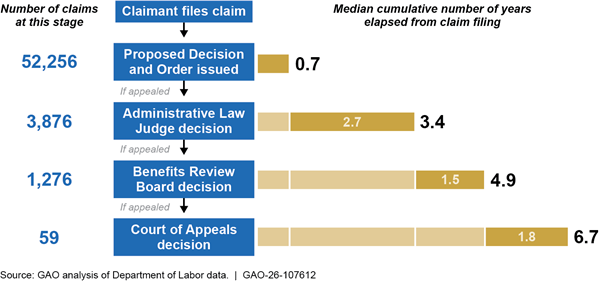
The Department of Labor (DOL) has taken some steps to address miners’ challenges with federal black lung benefits. For example, to address lengthy claims, it uses timeliness performance measures for claims examiners on parts of the claim process that it controls. According to GAO’s analysis of closed claims from 2013 to 2024, the median time for DOL to issue an initial decision was 0.7 years (see figure). Appealed claims took longer to close. Forty percent of approved claims were appealed. According to a DOL official, approved claims are generally appealed by responsible operators—the entities liable for claimants’ benefits, such as coal mine operators.
Median Federal Black Lung Processing Time for Miner Claims, Jan. 2013-Aug. 2024
Miners in all six of GAO’s focus groups reported challenges with black lung-related medical benefits, with two groups specifically noting difficulty obtaining coverage from responsible operators. DOL does not monitor responsible operators’ provision of medical benefits. While DOL collects feedback from miners, it does not collect information on this topic. DOL officials said they regularly conduct surveys of miners and could add such a question to a survey. Without collecting information on and monitoring responsible operators’ provision of medical benefits, DOL risks not achieving the mission of the program. As a result, miners might not receive the coverage of black lung-related medical expenses to which they are entitled.
Why GAO Did This Study
DOL is responsible for administering the Black Lung Benefits Program, by reviewing claim applications, issuing initial claim decisions, and administering benefits. About 22,500 beneficiaries, including miners, survivors, and dependents, received over $153 million in benefits in fiscal year 2025.
GAO was asked to review the federal and state benefits that miners and their families receive due to black lung disease. This report examines, among other things, (1) the benefits miners and their families receive for black lung disease and (2) the challenges miners and their families may have faced in obtaining federal black lung benefits and the steps DOL has taken to address these challenges.
GAO analyzed DOL benefits data for calendar year (CY) 2024, which included state workers’ compensation benefits; Social Security Administration benefits data for February 2025; and DOL claims data for CY 2013–2024. GAO generated hypothetical benefits packages for miners. GAO conducted six focus groups with miners who had applied for federal black lung benefits in Kentucky, Pennsylvania, Virginia, and West Virginia. GAO interviewed miners, survivors, DOL officials, and black lung clinic representatives; and reviewed relevant federal laws, regulations, and agency documents. GAO assessed DOL’s monitoring of responsible operator medical benefits against congressional budget justifications and federal internal controls.
What GAO Recommends
GAO is recommending that DOL collects information on and monitors responsible operators’ provision of medical benefits. DOL agreed with this recommendation and stated it would add questions about medical benefits to its survey of miners.
|
Abbreviations |
|
|
|
|
|
ALJ |
Administrative Law Judge |
|
AWI |
Average Wage Indexing |
|
BRB |
Benefits Review Board |
|
BLS |
Bureau of Labor Statistics |
|
CY |
calendar year |
|
DOL |
Department of Labor |
|
GS |
General Schedule |
|
MMWR |
Morbidity and Mortality Weekly Report |
|
PDO |
Proposed Decision and Order |
|
RO |
responsible operator |
|
SSA |
Social Security Administration |
|
SSDI |
Social Security Disability Insurance |
|
Trust Fund |
Black Lung Disability Trust Fund |
|
UMWA |
United Mine Workers of America |
This is a work of the U.S. government and is not subject to copyright protection in the United States. The published product may be reproduced and distributed in its entirety without further permission from GAO. However, because this work may contain copyrighted images or other material, permission from the copyright holder may be necessary if you wish to reproduce this material separately.
May 11, 2026
The Honorable John Hickenlooper
Ranking Member
Subcommittee on Employment and Workplace Safety
Committee on Health, Education, Labor and Pensions
United States Senate
The Honorable John Fetterman
United States Senate
The Honorable Tim Kaine
United States Senate
The Honorable Mark R. Warner
United States Senate
The Black Lung Benefits Program was created in 1969. It is a federal program that provides benefits to coal miners who are totally disabled due to pneumoconiosis, also known as black lung disease, arising from coal mine employment that contributes to the miner’s total disability. This progressive, irreversible, and sometimes fatal lung disease develops through exposure to coal dust. The National Institute for Occupational Safety and Health found that black lung disease caused or contributed to about 75,000 deaths between 1970 and 2016. According to one of the Institute’s studies, between 1999 and 2016, the average years of lost life expectancy attributable to black lung disease increased from 8.1 to 12.6 years, likely due to increased disease severity resulting from cutting through rock to reach thinner coal seams.[1]
The Black Lung Benefits Program provides two types of benefits to eligible miners or survivors of deceased miners:
· Benefit payments. Miners and their families can receive monthly benefit payments. In 2026, these payments totaled between about $9,523 and $19,045 annually based on the number of dependents in the miner’s family, according to Department of Labor (DOL) information.
· Medical benefits. Miners can also receive benefits to cover medical expenses for their black lung disease, such as medications.
You asked us to review the federal and state benefits that coal miners and their families receive due to black lung disease. This report (1) describes the benefits coal miners and their families receive for black lung disease and how these benefits may affect their financial well-being and health and (2) describes any challenges miners and their families may have faced in obtaining federal black lung benefits and assesses the steps DOL has taken to address these challenges.[2]
To describe the benefits miners and their families receive for black lung disease, we analyzed the following data:
· DOL data on federal black lung benefit payments provided to beneficiaries for January 2024 through mid-August 2024, the most recent data available.[3] These data also included state workers’ compensation benefits for black lung disease.
· Social Security Administration (SSA) data on disability benefits for black lung disease, including Social Security Disability Insurance (SSDI) and Supplemental Security Income benefits for February 2025.[4]
· DOL data on medical benefits from the Black Lung Disability Trust Fund for calendar year (CY) 2024.
We assessed the reliability of the data by reviewing documentation, such as DOL’s internal user guides; interviewing DOL and SSA officials; and conducting data testing. We determined the data were sufficiently reliable for the purposes of our reporting objective. We used these data to describe the number of Black Lung Benefits Program beneficiaries; their characteristics, such as age; and the total black lung-related benefits they received from these sources. We also used median benefit payments in these data, as well as estimates of Social Security retirement and private pension benefits, to describe hypothetical benefits packages for miners.
To describe how black lung-related benefits may affect beneficiaries’ financial well-being, we compared miners’ benefit payments to 2024 poverty guidelines and to average annual wages for coal mining extraction workers, using data from the Department of Health and Human Services and the Bureau of Labor Statistics.[5] We also conducted focus groups with 64 miners to gather their perspectives on their financial well-being and health. We conducted a total of six focus groups with miners in the four states with the largest numbers of Black Lung Benefits Program beneficiaries: Kentucky, Pennsylvania, Virginia, and West Virginia. We asked miners for their opinions on the application process and benefits they received due to their black lung disease.[6] For additional details on how we recruited for and conducted our focus groups, see appendix I. Findings from our focus groups represent the perspectives of the participating miners and cannot be generalized to other miners within their states or in other states.[7] We also conducted interviews with additional miners and survivors to gain their perspectives on the same topics. We reported the perspectives from these interviews separately from the focus groups.
To describe the challenges miners and their families may have faced in obtaining federal black lung benefits and to assess the steps DOL has taken to address these challenges, we analyzed DOL data on Black Lung Benefits Program claims filed from January 2013 through mid-August 2024. We analyzed approval and denial rates for claims as well as claim processing time at certain stages of the claim process, such as appeals. We assessed the reliability of the data by reviewing documentation, such as DOL’s internal user guides; interviewing DOL officials; and conducting data testing. We determined the data were sufficiently reliable for the purposes of our reporting objective. We reviewed relevant federal laws and regulations and agency documentation on the administration of the Black Lung Benefits Program. We also assessed DOL’s monitoring of beneficiaries’ medical benefits against its recent Black Lung Disability Trust Fund Congressional Budget Justifications and federal internal controls on monitoring the control system and evaluating results.[8]
Lastly, to gather additional perspectives on the program, we asked miners in our focus groups questions about any challenges they faced and what went well. We used information from our additional interviews with miners and survivors to inform our work. We also interviewed officials from DOL; SSA; the Department of Health and Human Services; state workers’ compensation offices in Kentucky and Virginia; DOL claims examiners; black lung clinic representatives; and other relevant stakeholders, such as union representatives from the United Mine Workers of America.[9] For more information on our scope and methodology, see appendix I.
We conducted this performance audit from June 2024 to May 2026 in accordance with generally accepted government auditing standards. Those standards require that we plan and perform the audit to obtain sufficient, appropriate evidence to provide a reasonable basis for our findings and conclusions based on our audit objectives. We believe that the evidence obtained provides a reasonable basis for our findings and conclusions based on our audit objectives.
Background
Black Lung Benefits Program Scale
In fiscal year 2025, the Black Lung Benefits Program had about 22,500 beneficiaries.[10] The number of these beneficiaries has decreased steadily over the past 2 decades from nearly 57,000 beneficiaries in fiscal year 2004 (see fig. 1). The production of coal also declined during this period, according to U.S. Energy Information Administration data. However, research using Black Lung Benefits Program data shows that in recent years, cases of progressive massive fibrosis are increasing. This is the most severe and disabling form of black lung disease and may afflict heavily exposed miners at younger ages than usual.[11]
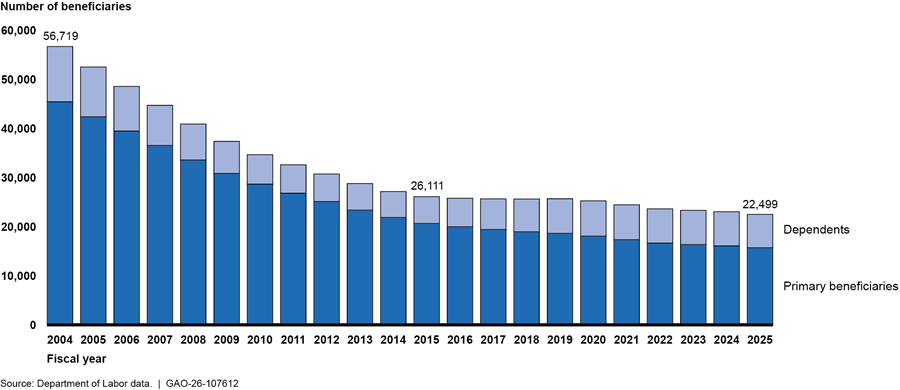
Note: These are Part C beneficiaries, whose black lung claims were filed after December 31, 1973, and approved by the Department of Labor.
Eligibility for Program Benefits
To be eligible for federal black lung benefits, a miner must
1. have black lung disease, which may be proven through medical evidence;
2. have black lung disease that arose, at least in part, from coal mine employment;[12]
3. be totally disabled; and
4. have black lung disease that substantially contributed to the miner’s total disability.[13]
Survivors of deceased miners may also be eligible for federal black lung benefits in certain cases. For example, when a miner who is a program beneficiary dies, those benefits will transfer to a survivor through an expedited process known as a “conversion application.” If the miner had applied for benefits but had not yet received a decision when they died, DOL officials will attempt to identify a substitute party—typically the miner’s next of kin—to continue the claim, according to DOL officials. In addition, if a miner was not a program beneficiary and had not applied for benefits, a survivor can apply for and receive benefits on behalf of the miner if their death was due to black lung disease.
Program Administration
DOL’s Division of Coal Mine Workers’ Compensation administers the Black Lung Benefits Program under the Black Lung Benefits Act.[14] Various entities play a role in the process:
· Five DOL district/field offices. These offices review claim applications, make decisions to initially approve or deny claims, and administer benefit payments and medical benefits.
· DOL’s Office of Administrative Law Judges (ALJ) and Benefits Review Board. These agencies adjudicate appealed claims. Claims can be further appealed to the relevant U.S. Court of Appeals.
· Responsible operators. These are entities liable for claimants’ federal black lung benefits. This is most often a coal mine operator that employed a claimant or the operator’s insurance company.[15] Responsible operators provide benefit payments and black lung-related medical coverage.
· Black Lung Disability Trust Fund (Trust Fund). The Trust Fund is the funding source used by the federal government to provide benefits when no responsible operator can be identified or when the liable operator does not pay.[16]
Program Claim Process
According to DOL documentation, when a miner applies for federal black lung benefits, the application is routed to a DOL district office and assigned to a claims examiner who collects and processes the evidence.[17] The claims examiner reviews the miner’s employment history, requests their earnings record from SSA, and provides them a list of approved medical providers to conduct a medical evaluation. The claim typically proceeds through the following key stages (see fig. 2).[18]
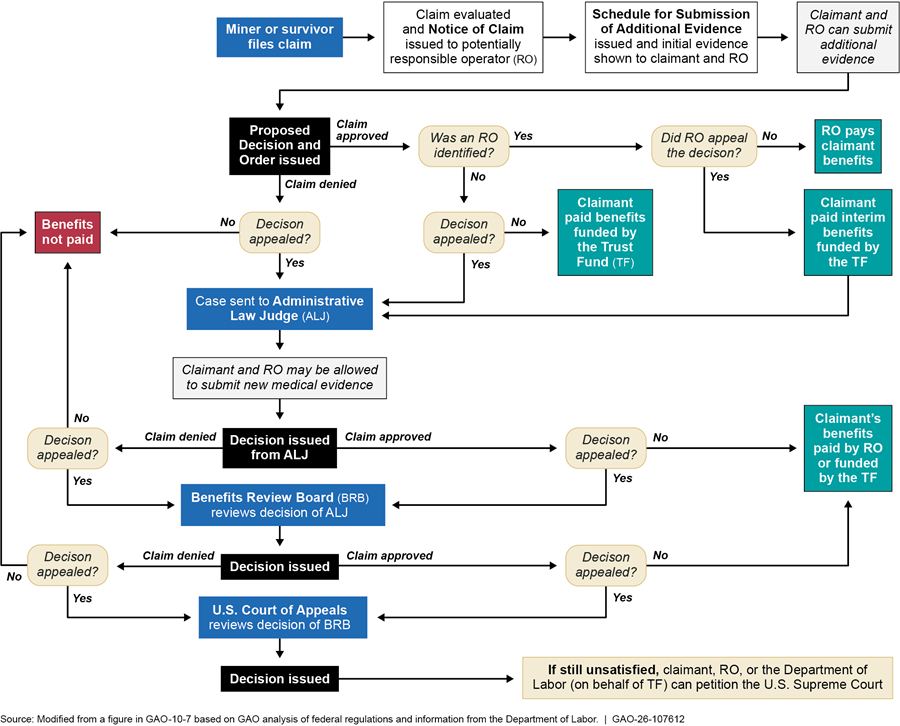
Notes: This figure presents a basic overview of the Black Lung Benefits Program’s claim process for a typical claim. For clarity, some stages, processes, and legal options for parties to a claim are omitted.
Decisions can be appealed within 30 days of a Proposed Decision and Order or Administrative Law Judge decision, within 60 days of a Benefits Review Board decision, or within 90 days of a U.S. Court of Appeals decision. If an approved claim is appealed, interim benefits are paid through the Trust Fund during the appeals process. After the appeals deadline has passed for an approved claim, if an operator is deemed responsible, it will begin paying benefits in place of the Trust Fund. Claimants may request to modify a claim up to 1 year after a decision denying benefits. Any party to the claim may request to do so up to 1 year after the last payment of benefits.
Notice of Claim. While reviewing the miner’s employment history, the claims examiner determines which operator may be responsible for paying federal black lung benefits should the claim be approved. The responsible operator is generally the company that most recently employed the miner. If the claims examiner does not identify a responsible operator, then the Trust Fund provides the benefits. The claims examiner then notifies the potentially responsible operator (or operators if more than one is identified) and its insurance provider. After the Notice of Claim is issued, the potential responsible operator has 30 days to respond, indicating its intent to accept or contest responsibility for the claim. Additionally, the potential responsible operator has 90 days from the date it received the Notice of Claim to submit documentary evidence that supports its position.[19]
Schedule for Submission of Additional Evidence (tentative decision). After the potential responsible operator has provided evidence and the miner has completed their medical evaluation, DOL assesses the evidence and makes a tentative decision to approve or deny the claim. DOL issues a document to the claimant and potential responsible operator with the initial evidence and tentative decision. The claimant and potential responsible operator have 60 days to submit affirmative evidence and then 30 days to submit rebuttal evidence, totaling a period of 90 days.
Proposed Decision and Order (PDO) and appeals process. After reviewing any additional evidence, DOL issues its decision, known as the PDO. The claimant, responsible operator, or DOL officials (if no responsible operator can be identified) may appeal—or request a revision to—the PDO within 30 days. If 30 days elapse with no request for appeal, the decision becomes final, and the claim is considered closed. If a party requests an appeal, the claim is referred to an ALJ. The ALJ issues a decision on the claim, which may be appealed to higher levels: the Benefits Review Board and then the relevant U.S. Court of Appeals.[20]
Interim benefits. If DOL approves the claim at the PDO stage and it is appealed, the claimant generally receives interim benefits paid through the Trust Fund, according to DOL procedures. However, if the claim is overturned on appeal and denied, the claimant may need to pay back the interim benefits. If DOL denies the claim at the PDO stage and the claimant appeals, interim benefits are not provided. However, if the claim is overturned on appeal and approved, the claimant receives retroactive benefits.
Federal Black Lung Benefits and State and Social Security Offsets
Federal black lung benefit payments are set at 37.5 percent of the base salary of federal employees in grade GS-2, step 1.[21] Additional benefits are granted if the beneficiary has dependents (see table 1). For example, in 2026, a miner with no dependents would receive payments totaling about $9,523 annually, while a miner with two dependents would receive about $16,664 annually.[22] In fiscal year 2025, beneficiaries received over $153 million in benefits, according to DOL data.
|
Claimant |
Total annual benefit |
|
Primary beneficiary |
$9,523.20 |
|
Primary beneficiary and one dependent |
$14,283.60 |
|
Primary beneficiary and two dependents |
$16,664.40 |
|
Primary beneficiary and three or more dependents |
$19,045.20 |
Source: GAO summary of Department of Labor information. | GAO‑26‑107612
Note: These benefit rates are for Part C claims, which are black lung claims filed after December 31, 1973, and approved by the Department of Labor.
A miner may also receive federal black lung medical benefits for conditions the program considers attributable to black lung disease—generally lung conditions. Survivors and dependents are not eligible for these medical benefits.
A beneficiary may receive state workers’ compensation for black lung disease in addition to receiving federal black lung benefit payments. When this is the case, the federal black lung benefit payments are reduced—or offset—dollar-for-dollar by the amount the beneficiary receives from black lung-related state workers’ compensation payments.[23] If the state workers’ compensation payment matches or exceeds the federal black lung benefit amount, then the benefit payment is totally offset, and the beneficiary does not receive a federal black lung benefit payment while they receive the state workers’ compensation payment.
A beneficiary may also receive SSDI payments for a disability resulting from black lung disease. SSDI provides payments to those who have a disability that stops or limits their ability to work and who have enough work history to qualify.[24] SSDI payments may be reduced based on the federal black lung benefit payment amount.[25]
In some cases, a beneficiary may receive all three of these benefits at the same time—federal black lung, state workers’ compensation, and SSDI. When that is the case, the federal black lung payment is reduced by the amount received for state workers’ compensation for black lung disease. In addition, SSA may reduce SSDI based on the federal black lung and state workers’ compensation payments, depending on the beneficiary’s pre-disability earnings.
Most Federal Black Lung Beneficiaries May Rely on Multiple Benefits, but Those Who Do Not Are More Likely to Face Financial Challenges
About 16,000 Miners and Their Survivors Were Beneficiaries of the Black Lung Benefits Program in 2024, and More Than 90 Percent Were Age 62 Or Older
According to our analysis of DOL program data, there were nearly 16,000 primary beneficiaries of the Black Lung Benefits Program in 2024.[26] About half of these beneficiaries were living miners, and the other half were survivors of deceased miners (see fig. 3). Most survivors (about 90 percent) were widows or widowers. About 61 percent of the beneficiaries had no dependents, 37 percent had one dependent, and 3 percent had multiple dependents.

Note: These beneficiaries were in active payment status in calendar year 2024.
About 80 percent of beneficiaries resided in four states in 2024:
· Kentucky: 4,684 beneficiaries (about 29 percent)
· West Virginia: 4,058 beneficiaries (about 25 percent)
· Virginia: 2,463 beneficiaries (about 15 percent)
· Pennsylvania: 1,479 beneficiaries (about 9 percent)
The remaining 20 percent of beneficiaries (3,253) resided in other states across the country (see fig. 4).
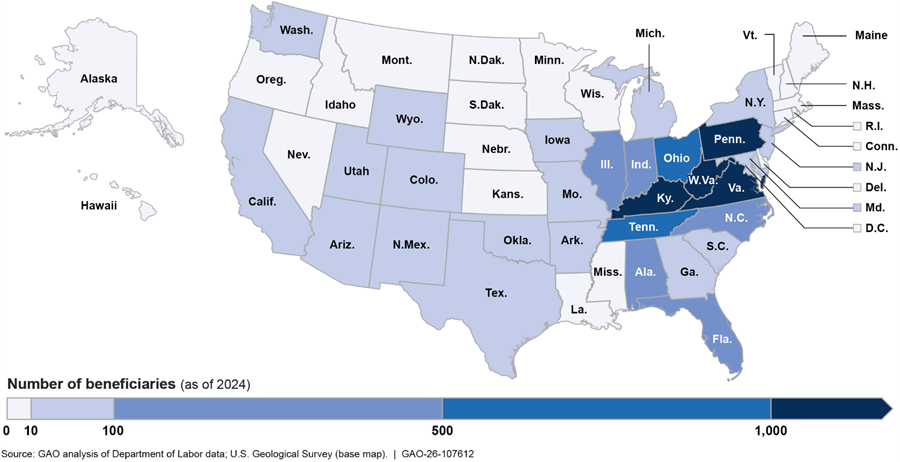
Notes: The map depicts where beneficiaries resided in 2024. Their state of residence may vary from the location of their coal mine employment.
Nearly 15,000 of these approximately 16,000 federal black lung beneficiaries were age 62 or older in 2024, according to our analysis. Among miner beneficiaries, 93 percent were age 62 or older, and 7 percent were younger than age 62—similar to survivors (see fig. 5).

Notes: These beneficiaries were in active payment status in calendar year 2024. GAO did not have age data for one miner, and therefore this individual was excluded from these counts. Percentages are rounded and therefore may not add to 100 percent.
Miner Beneficiaries May Struggle Financially if They Receive Only Federal Black Lung Benefits, and Those Age 62 or Older Are Likely Eligible to Receive Retirement Benefits
Miner Beneficiaries Age 62 or Older
Our analysis shows that about 87 percent of miners age 62 or older who received federal black lung benefits in 2024 received no other benefits specifically for their black lung disease.[27] The other 13 percent of them received other black lung-related benefits (see table 2).[28]
Table 2: Federal Black Lung Miner Beneficiaries Age 62 or Older by Black Lung Benefits Received, Calendar Year 2024
|
|
Benefits received |
|
||||
|
Beneficiaries’ age |
Federal black lung onlya |
Federal black |
Federal |
Federal |
Federal black |
Total |
|
62–66 |
357 |
26 |
596 |
73 |
3 |
1,055 |
|
67+ |
5,830 |
253 |
0 |
0 |
7 |
6,090 |
|
Total |
6,187 (87%) |
279 (4%) |
596 (8%) |
73 (1%) |
10 (<1%) |
7,145 |
Source: GAO analysis of Department of Labor and Social Security Administration data. | GAO‑26‑107612
Notes: Percentages are generally rounded to the nearest whole number.
a“Federal black lung only” means that federal black lung benefits were the only benefit they received of all the black lung-related benefits we analyzed for this report.
bWhen beneficiaries receive state workers’ compensation benefits for black lung disease, their federal black lung benefit payments are offset accordingly. GAO included beneficiaries with both partial and total offsets in the table. If a beneficiary received state workers’ compensation benefits for black lung disease that matched or exceeded their federal black lung benefit, they incurred a total offset.
cThese other benefits included federal workers’ compensation and Social Security Supplemental Security Income. Other benefits were those we had data on but did not address individually in this report.
In 2024, about 5 percent of miner beneficiaries age 62 or older received state workers’ compensation for their black lung disease.[29] For most of these miners, their total black lung-related benefits stayed the same because their state workers’ compensation benefit partially offset their federal black lung benefit payment.[30] However, 29 miners age 62 or older received state workers’ compensation benefits that met or exceeded their federal black lung benefit payment, resulting in a total offset. When a miner’s state workers’ compensation benefit payment exceeds their federal black lung benefit payment, their total benefits will increase, despite the offset.
On average, the miners who received both federal black lung and state workers’ compensation benefits received about $14,300 in these benefits in 2024.[31] See the text box for more information about variation in state workers’ compensation benefits in our selected states.
|
State Workers’ Compensation Benefits: Examples from Selected States State workers’ compensation benefits may differ across states, and from federal black lung benefits in terms of compensation and eligibility. For example: · State benefit rates may vary depending on the state. States may offer partial disability payments depending on the severity of someone’s black lung disease. For example, according to state officials, Virginia offers 50 weeks of disability benefits for those in the first stage of the disease, 100 weeks for those in the second stage, 300 weeks for those in the third stage, and lifetime benefits for those who are totally disabled, and the compensation rate is based on prior employment wages. State officials told us that lifetime benefits are less common than partial awards in Virginia because to be eligible miners must prove that they are incapable of working in a coal mine or similar environment. In comparison, federal black lung eligibility requires total disability. · State awards may vary in how often they are paid. For example, officials in Kentucky said their state awards are typically paid biweekly, but that they also could be dispersed as a lump sum if the miner and the company reach a settlement agreement. In comparison, federal black lung benefits are generally paid monthly based on a set rate, unless an over- or under-payment must be resolved. · States can have statutes limiting how long miners are eligible to apply for state workers’ compensation. For example, in Virginia, according to state officials, the claim must be filed within 3 years of communication of diagnosis or within 5 years of last injurious exposure. In comparison, miner claims for federal black lung benefits must be filed within 3 years of a medical determination of total disability due to black lung disease. |
Source: GAO summary of interviews with state and Department of Labor officials and Department of Labor program information. | GAO‑26‑107612
|
Social Security Disability Insurance (SSDI) Eligibility Eligibility for SSDI is based on having a disability affecting a person’s ability to work that is expected to last for a year or more or will result in their death. In addition, they generally must have worked for at least 5 of the last 10 years. There are multiple reasons why a miner may be eligible for and receive federal black lung benefits but not SSDI benefits for black lung disease. Social Security Administration (SSA) officials told us that an individual entitled to federal black lung benefits may not meet certain SSDI eligibility requirements. For example, SSDI beneficiaries must meet the definition of disability as defined in the Social Security Act. In addition, a federal black lung beneficiary could receive SSDI benefits for a disability other than their black lung disease. Source: GAO summary of SSA information and interviews with officials, and 42 U.S.C. § 423. | GAO‑26‑107612 |
In 2024, 669 federal black lung miner beneficiaries age 62 or older received SSDI benefits.[32] The median annual SSDI benefit received by these miners was about $33,700—with the 25th percentile around $28,200, and the 75th percentile around $37,200, according to our analysis.[33] On average, in 2024, these miners received about $44,900 in federal black lung and SSDI benefits combined.[34]
|
Social Security Retirement Social Security retirement benefits can be received at age 62. The benefit amount increases the longer someone waits to begin receiving the benefits, up to age 70. The benefit amount is also progressive, meaning that it replaces a greater percentage of earnings for workers with lower career-average earnings. Individuals age 62 or older who worked 10 years or more and paid Social Security taxes are generally eligible. Dependents may qualify based on a family member’s work. These benefits are not generally offset by federal black lung benefit payments. Source: GAO summary of Social Security Administration information. | GAO-26-107612 |
While 87 percent of miner beneficiaries age 62 or older received only federal black lung benefit payments for their black lung disease (no state workers’ compensation or SSDI benefits), these miners were likely eligible to receive Social Security retirement benefits.[35] Some may also have received private pension or retirement benefits through a union or their mine operator. Because our analysis did not include Social Security retirement or pension data, we developed four hypothetical annual benefit scenarios to demonstrate possible financial outlooks for miners with black lung disease after they reach retirement age (see fig. 6). In the scenarios, for the miners who worked a common coal mining job, their benefits in retirement ranged from about 40 to 86 percent of the 2024 average wage for their job. For the miners who worked a coal mining supervisory job, their benefits in retirement ranged from about 34 to 66 percent of the 2024 average wage for their job.[36] In each case, the miner’s benefits exceeded 2024 poverty guidelines.[37]
|
Benefits for Survivors Age 62 or Older There were about 7,600 federal black lung survivor beneficiaries age 62 or older in 2024. Of these, about 99 percent received only federal black lung benefits (no state workers’ compensation or Social Security Disability Insurance benefits for black lung disease). Similar to miners, these beneficiaries may have been eligible to receive other benefits, such as Social Security retirement and possibly private pension benefits. Source: GAO analysis of Department of Labor data. | GAO‑26‑107612 |
Figure 6: Hypothetical Benefit Scenarios for Retired Miners Who Are Federal Black Lung Beneficiaries and Worked a 20- or 30-Year Career
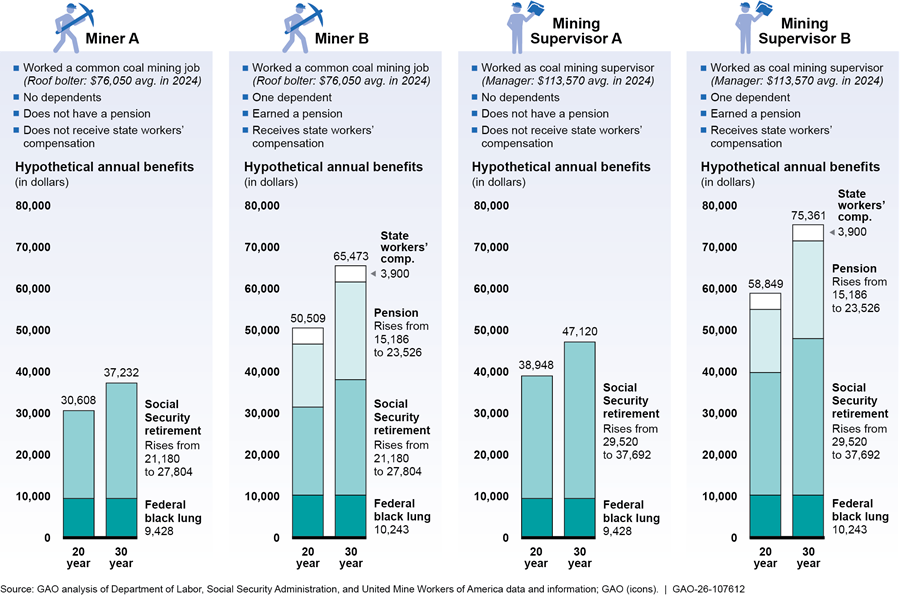
Notes: Federal black lung benefits shown in the figure are based on the 2025 benefit rates. The United Mine Workers of America hypothetical pensions were calculated assuming that miners retire with a normal retirement pension after 20 or 30 years of credited signatory service. State workers’ compensation is a hypothetical amount based on the median state benefit for miners age 62 or older in GAO’s analysis.
Social Security retirement benefits were calculated using 2025 dollars. GAO used the Social Security Administration’s online retirement benefits calculator to calculate hypothetical Social Security retirement benefits for multiple scenarios, in consultation with Social Security Administration officials. GAO selected hypothetical wages using data from the Bureau of Labor Statistics on coal mine employment annual average wages. Specifically, GAO used average wage data for roof bolters and first-line supervisors/managers of construction trades and extraction workers for each year. For the years without data for those occupations, GAO adjusted the data available to calculate hypothetical wages for those years using the Social Security Administration’s Average Wage Indexing Series. The figure shows benefits once each hypothetical miner has reached full retirement age for Social Security in 2025. GAO assumed that each miner worked either a 20- or 30-year career from 1982 to 2001 or 1982 to 2011, respectively. After miners stopped working but before they reached full retirement age, they may have relied on other benefits or income, such as Social Security Disability Insurance. See app. I for more information.
Miner Beneficiaries Under Age 62
In contrast to miners age 62 or older, we found that about three-quarters of miner beneficiaries under age 62 in 2024 received additional benefits for their black lung disease, such as state workers’ compensation benefits or SSDI (see table 3).[38]
Table 3: Federal Black Lung Miner Beneficiaries Under Age 62 by Black Lung Benefits Received, Calendar Year 2024
|
|
Benefits received |
|
|
|||||
|
Beneficiaries’ age |
Federal black lung onlya |
Federal black lung and state workers’ compensationb |
Federal black lung and Social Security Disability Insurance (SSDI) |
Federal black lung, SSDI, and state workers’ compensationb |
Federal black lung and other benefitsc |
Total |
||
|
Under age 40 |
3 |
0 |
4 |
0 |
0 |
7 |
||
|
40–49 |
14 |
7 |
17 |
7 |
0 |
45 |
||
|
50–61 |
118 |
25 |
320 |
40 |
8 |
511 |
||
|
Total |
135 (24%) |
32 (6%) |
341 (61%) |
47 (8%) |
8 (1%) |
563 |
||
Source: GAO analysis of Department of Labor and Social Security Administration data | GAO‑26‑107612
Notes: Percentages are generally rounded to the nearest whole number.
a“Federal black lung only” means that federal black lung benefits were the only benefit they received of all the black lung-related benefits we analyzed for this report.
bWhen beneficiaries receive state workers’ compensation benefits for black lung disease, their federal black lung benefit payments are offset accordingly. GAO included beneficiaries with both partial and total offsets in the table. If a beneficiary received state workers’ compensation benefits for black lung disease that matched or exceeded their federal black lung benefit, they incurred a total offset.
cThese other benefits included federal workers’ compensation and Social Security Supplemental Security Income. Other benefits were those we had data on but did not address individually in this report.
|
Benefits for Survivors Under Age 62 There were about 600 federal black lung survivor beneficiaries under age 62 in 2024, according to our analysis. Of these, about 96 percent received only federal black lung benefits. Source: GAO analysis of Department of Labor data. | GAO‑26‑107612 |
Among the 135 miner beneficiaries under age 62 who received only federal black lung benefits, their payments averaged about $13,400 annually, according to our analysis. Federal black lung benefits alone do not exceed the poverty guidelines adjusted for family size nor the average annual wage of an extraction miner in their state. Thus, when federal black lung benefits are someone’s sole or primary source of household income, they may face financial challenges.
In 2024, about 14 percent of miner beneficiaries under age 62 (79 of 563 miners) also received state workers’ compensation for their black lung disease, according to our analysis. Total annual federal black lung and state workers’ compensation benefits for these miners averaged about $18,500.
Of these 79 miners:
· Forty-seven also received SSDI benefits, and all had benefits that exceeded the poverty guidelines for their family size.
· The remaining 32 did not receive SSDI benefits, and 17 of these miners did not have benefits exceeding the poverty guidelines for their family size. Unlike miners age 62 or older, these miners were not eligible for Social Security retirement benefits; therefore, federal black lung and state workers’ compensation benefits may have been their sole income.
· Twenty-one of the 79 miners received state workers’ compensation benefits that met or exceeded their federal black lung benefit payment, resulting in a total offset. When state workers’ compensation benefits exceed federal black lung benefits, the miner’s total benefits will increase, despite the offset.
In 2024, over two-thirds of miner beneficiaries under age 62 received both federal black lung and SSDI benefits for their black lung disease, according to our analysis.[39] The median annual SSDI benefit for these miners was about $33,800—with the 25th percentile around $28,700 and the 75th percentile around $37,400, according to our analysis.[40] On average, in 2024, these miners received about $45,500 in federal black lung and SSDI benefits. These miners typically had benefits that exceeded the poverty guidelines for their family size. However, their benefits were generally below the average annual wages of extraction miners in their state. The average annual wage of an extraction miner nationally was $69,900 in 2024.
We developed hypothetical annual benefit scenarios to demonstrate how different combinations of benefits may affect the financial outlook of miners under age 62 with black lung disease (see fig. 7).
Figure 7: Hypothetical Benefit Scenarios for Miners Who Are Federal Black Lung Beneficiaries and Under Age 62
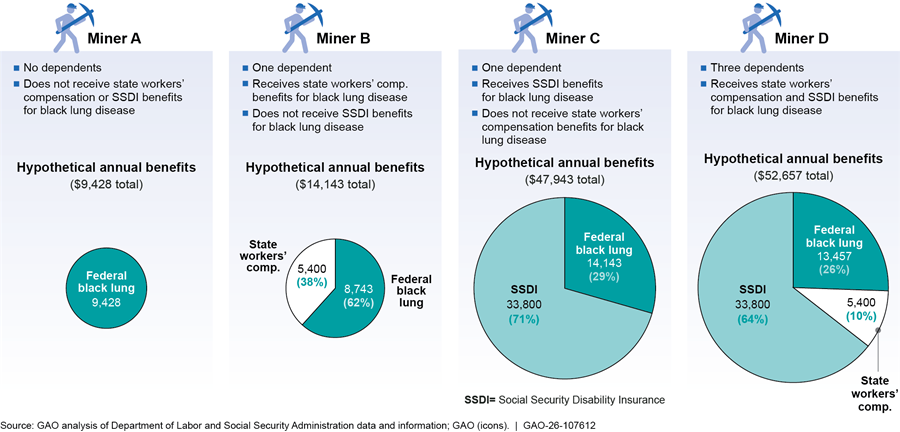
Notes: Federal black lung benefit payments shown in the figure are based on the 2025 benefit rates. The state workers’ compensation and SSDI benefits are hypothetical amounts based on the median state workers’ compensation and SSDI benefits for miners under age 62 in GAO’s analysis.
Miners Reported Varied Opinions on the Benefit Payments, and They Said They Used Medical Benefits Regularly
Benefit Payments
Miners in three of our six focus groups described how federal black lung benefit payments helped them (see text box).[41] For example, miners said the benefit payments helped with daily expenses, such as bills and groceries.
|
Selected Miners’ Statements on How Benefit Payments Helped Them · “You have a little spending money to take your family out to eat. You can buy a few extra clothes for your kid and maybe groceries. It helps.” · “It helps. The way the prices and everything you got now, if it wasn’t for the [federal black lung benefit payments], I couldn’t make it.” · “A lot of miners . . . can no longer [tend] [their] yard . . . and things like that—a lot of things. But [miners have] a little bit of money to hand out for somebody to do it for them, so that helps.” |
Source: GAO focus groups with coal miners. | GAO‑26‑107612
At least one miner in all six focus groups said that the benefit payments did not provide enough money for them to make ends meet (see text box). Some stated that they had to change their lifestyle due to the reduction in income from when they were working. Miners in most groups (five of six groups) recommended raising the benefit amount.
|
Selected Miners’ Statements on How Benefit Payments Were Not Enough · “You go from $5,000–$6,000 a month [while working] down to $1,000–$2,000 [in benefits]. If you didn’t have your wife and somebody working, you wouldn’t be able to make it.” · “We need to make more a month. You know, it’s pitiful what we make a month. It’s better than nothing, but there’s no comparison to today’s prices and the way things are.” |
Source: GAO focus groups with coal miners. | GAO‑26‑107612
Medical Benefits
When asked about federal black lung medical benefits specifically, miners in four of six focus groups said they used them regularly, such as for medicine, oxygen, respiratory therapy, doctor appointments, and medical scans. In 2024, DOL spent about $23 million on reimbursements for beneficiaries’ medical benefits for Trust Fund-covered miners.[42] Common types of medications for which DOL made reimbursement payments included inhalers and oral medications used to treat lung diseases, such as bronchodilators.
Miners in two of six focus groups told us that the program’s medical benefits were more valuable to them than the benefit payments. When asked what went well with medical benefits, miners in three groups discussed positive experiences with getting their medical benefits covered, such as for their inhalers or oxygen. Miners in four of our six groups expressed that they had no complaints with their medical benefits. See the text box below.
|
Selected Miners’ Statements on Medical Benefits · “All this breathing stuff. . . we figured it’s like close to $7,000 a month. . . . Without [the medical benefits], how am I going to pay that kind of money?. . .[The benefit payments are] nice. Believe me. Anybody needs money, but [the medical benefits are] even nicer because. . . you can lose everything you [have] over medical.” · “One of the good things. . . outside of your pay. . . is having these pulmonary rehab sessions and the clinic. . . . We attend that two to three times a week. . . . It [doesn’t] fix our lungs, but we can make them a little bit stronger. That rehab and the moving around and exercising.” |
Source: GAO focus groups with coal miners. | GAO‑26‑107612
Miners Cited Challenges with Federal Black Lung Benefits, and DOL Does Not Monitor Some Medical Benefits
Appealed Claims Could Take Over 3 Years to Close, and Some Miners Expressed Frustration About the Length of the Process
About 40 Percent of Approved Claims Were Appealed from January 2013 Through mid-August 2024
Of the almost 53,000 federal black lung claims filed by miners after 2012 and closed as of mid-August 2024, DOL initially approved 11 percent of claims, according to our analysis (see fig. 8). Forty percent of these claims were appealed.[43] A much smaller percentage of initially denied claims were appealed (about 6 percent). Approved claims are typically appealed by responsible operators and denied claims are typically appealed by claimants, according to a DOL official. In total, about 2 percent of DOL’s initial decisions were reversed on appeal. DOL ultimately approved about 11 percent of claims after all appeals.
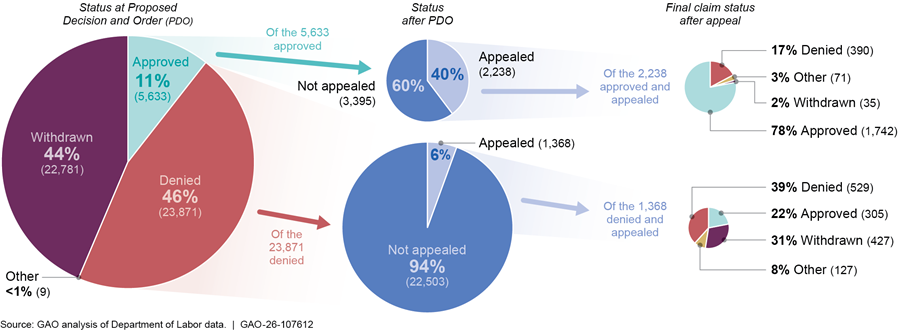
Notes: This figure shows closed claims filed from January 2013 to mid-August 2024. It presents the stages of a typical claim going through the appeals process.
PDO is the Department of Labor’s initial decision on a claim. If no party appeals the PDO in 30 days, it becomes the final decision.
The “other” category includes other scenarios such as claims that were administratively closed when no decision was made on a case, for example if a conference was requested but never held.
In some cases, numbers may not
add to 100 percent due to rounding.
Miners may not qualify for benefits when they first apply, but qualify later as their black lung disease progresses. DOL approved 2,655 claims filed between January 2013 and mid-August 2024 for miners who had previously been denied benefits during this time frame because their black lung disease was not totally disabling. Overall, almost half of the miners in our six focus groups who responded to this question in our questionnaire had applied for benefits multiple times.
Appealed Claims Could Take Over 3 Years to Close
|
Working with Lawyers The Department of Labor (DOL) recommends the claimant obtain a lawyer experienced with black lung claims if their claim is appealed to an Administrative Law Judge. In most of our focus groups, miners identified working with a lawyer as a positive part of their application experience. One labor union representative felt that having legal representation is necessary for a miner to get a claim approved. According to DOL data, in 2025, about 35 percent of claims filed had attorney representation for claims at the district level. Additionally, about 31 percent of claims had representation from a lay representative, or someone other than a lawyer who assisted with the claim. One black lung clinic representative we spoke with said they will act as a lay representative for miners in the early stages of the application process. Source: GAO summary of interviews with DOL officials, labor union officials, and black lung clinics; DOL data; and GAO focus groups with coal miners. | GAO‑26‑107612 |
According to our analysis of DOL claims data from January 2013 through mid-August 2024, most miners’ claims were closed in under a year (see fig. 9). However, the median length of an appealed claim was 3 years or more, depending on the stage of the appeal.
The median length of time between a claimant filing an application and the claimant receiving a decision on an appeal was:
· Over 3 years for claims that went to the ALJ,
· Almost 5 years for claims that went to the Benefits Review Board, and
· About 7 years for claims that went to a U.S. Court of Appeals.
Of the almost 53,000 closed miner claims filed from January 2013 through mid-August 2024, we identified 11 claims that each took over 10 years to close.
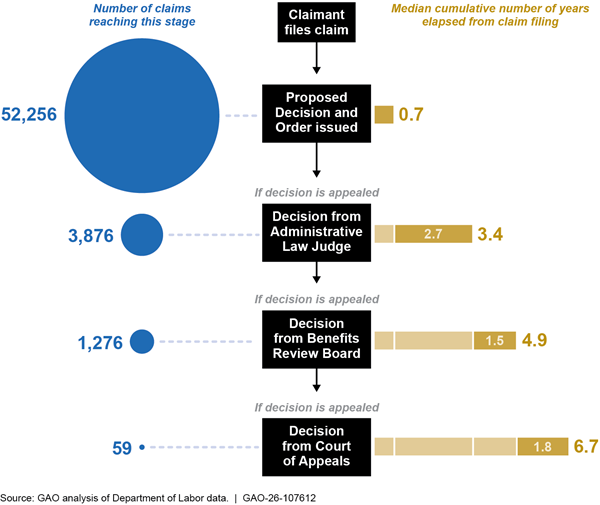
Notes: This figure shows closed claims that were filed from January 2013 to mid-August 2024. GAO considered a claim to be closed if (1) at least 30 days had passed since a Proposed Decision and Order or Administrative Law Judge decision had been made, at least 60 days had passed since a Benefits Review Board decision had been made, or 90 days had passed since a U.S. Court of Appeals decision had been made and the claim had not been appealed to a further stage; or (2) the claim had been withdrawn at any stage.
This figure presents the stages of a typical claim moving through the appeals process. For each stage, years from claim filing to each stage were calculated for claims that reached that specific stage.
|
Survivor Claim Application Time Frames · After a miner dies, their surviving family can apply for benefits. A survivor of a miner who had an approved claim can submit a survivor conversion application. The median time for the Department of Labor (DOL) to process conversion applications was 20 days, according to our analysis. · A survivor of a miner who did not have an approved claim when they died can submit a new claim. According to a representative we spoke with from a black lung clinic, it is challenging to obtain approval for these claims, because the survivor must prove that the miner’s death was hastened by black lung disease. |
Source: GAO analysis of DOL data, summary of DOL information, and interviews with black lung clinics. | GAO‑26‑107612
Some Miners Expressed Frustration with the Length of the Process
Miners in our focus groups shared differing perspectives on the length of the claim process. When asked what went well and what challenges they experienced, some miners in five of six groups said their application was processed quickly. For instance:
· One miner said that they received their initial decision from DOL after 6 months, and that their responsible operator eventually paid their benefits.
|
Selected Challenges Identified by Miners In focus groups, miners discussed challenges with the Black Lung Benefits Program claim process: · Miners in all six groups described doctors they felt were biased against miners. · Miners in most focus groups described negative experiences at medical and doctors’ appointments. For example, miners in two of our groups had difficulties with required exams. One miner told us they almost passed out during the exam from walking on the treadmill too long. · Miners in most groups described the financial strain of the application process, such as paying for more testing to support an application. · Miners in most groups described appeals judges who had limited knowledge of mining. Source: GAO focus groups with coal miners. | GAO‑26‑107612 |
However, in five of six groups, some miners discussed how lengthy wait times were a challenge. For example:
· One miner told us they were frustrated that it took 8 years to close their claim.
· One miner said that they received their initial decision from DOL quickly but went back and forth with the mine operator for another 2 years in which court hearings would be set and then postponed.
The length of time it takes to close a claim may negatively affect miners. For example, a labor union representative we spoke with said that the length of the claims process may have a chilling effect on miners. The representative said that a miner may decide there is no point in applying for benefits because they hear negative stories from other miners.
Miners in all six groups expressed their belief that mine operators were either “waiting for them to die” or “waiting for them to give up” so they could avoid paying benefits. Of miners who had an approved claim by mid-August 2024 and had died between January 2013 and mid-August 2024, 2,620 died before their claim was closed.[44]
DOL Has Performance Measures for Claim Timeliness
DOL has timeliness performance measures for the claims procedures that are within claims examiners’ control. However, factors outside of DOL claims examiners’ control can affect how long it takes to close a claim.
· DOL measures the number of days it takes claims examiners to issue the Notice of Claim after receiving a claim. Similarly, DOL measures the number of days it takes to issue the tentative decision after collecting evidence. A claims examiner told us that these performance measures affect claims examiners’ performance ratings. According to DOL’s Fiscal Years 2023 and 2024 Annual Report to Congress, these performance measures focus on actions involved in processing claims and issuing initial decisions.[45] In 2024—the most recent year these performance data were available—DOL met its targets for every measure.
· Federal regulations may affect the timeliness of cases since they include specific timeframes for responsible operators and claimants to respond to decisions and submit evidence. For example, after a Notice of Claim is issued, a responsible operator has 30 days to contest DOL’s decision that it was the liable operator.[46] The responsible operator also has an additional 60 days to submit documentary evidence to support its position.[47] Further, extensions can be granted at multiple points in the process.[48] When DOL issues its decision, each party has up to 30 days to submit an appeal.[49]
The Potential Need to Pay Back Interim Benefits Creates Uncertainty for Miners, and DOL Offers Hardship Waivers
Miners face uncertainty caused by the possibility that they will be responsible for paying back interim benefits if their claim is denied after appeal.[50] For a miner with one dependent whose claim is denied after a typical length appeals process, the amount owed would equal over $35,000.[51] From January 2013 to mid-August 2024, 390 beneficiaries whose claims were initially approved had their claims denied after appeal (less than 1 percent of miners’ claims). One widow we interviewed said that their spouse’s claim was denied after an appeal, and after their spouse died they were responsible for paying back the interim benefits.[52] Another widow we spoke with said that they were waiting on a decision on the appeal of their claim, and that they were afraid to spend the interim benefits.
|
Miners Had Positive Experiences Getting Assistance from Clinics Black lung clinics are funded by the Health Resources and Services Administration within the Department of Health and Human Services. They provide treatment and other black lung-related services to coal miners. Miners in all six of our focus groups said they had positive experiences working with black lung clinics. For example, miners said: · “They knew what they were doing. I have nothing but respect [for this clinic].” · “I filed through [the clinic] and they were real helpful…They guided me through the process.” · “[The clinic] directed us from the start, and they’ve done the scheduling.” Source: GAO focus groups with coal miners. | GAO‑26‑107612 |
The uncertainty of paying back interim benefits is a challenge for some miners, according to representatives at two black lung clinics. Clinics provided varying advice to miners about whether to spend interim benefits—some clinic representatives advised miners to spend them while others advised miners to save them in case DOL required the benefits to be repaid. One representative told us that some miners do not spend the money while the claim is undergoing appeals. One miner told us that they were afraid to spend their interim benefits or use their interim medical benefits because they may be responsible for paying them back. Other miners in multiple focus groups said they spent their interim benefits. One miner we spoke with told us that they had to pay back two to three years of benefits when their claim was denied after appeals. They told us that they submitted a new claim a few years later, which was approved. However, since it was a new claim, the miner was not refunded the interim benefits they had paid back.
DOL officials said the agency has procedures for granting a hardship waiver if a beneficiary is not able to pay back interim benefits. Specifically, if a claim is denied on appeal after DOL paid interim benefits, DOL asks beneficiaries to submit an overpayment questionnaire. The questionnaire collects information on income, expenses, debts, and other assets. According to DOL officials, DOL uses this information to determine whether the beneficiary should receive a hardship waiver, which could reduce or eliminate the amount owed. DOL officials said that there are guidelines for claims examiners to follow when making hardship waiver determinations and told us that supervisors review waiver decisions. Often, the claimant does not need to pay back the full amount, according to officials.[53]
Some Miners Reported Logistical Challenges Using and Getting Coverage from Medical Benefits, and DOL Does Not Monitor Responsible Operator-Provided Medical Benefits
Miners in our focus groups expressed varying opinions on federal black lung medical benefits. Some miners in four of our six focus groups said they had not experienced challenges with medical benefits. For example, one miner told us that their oxygen was covered without any issues. However, there were some miners in all six groups who discussed challenges with medical benefits, such as with the logistics of using medical benefits and with medical coverage, including responsible operator-provided medical benefits.
Logistical challenges. Miners in all six focus groups identified logistical and administrative challenges associated with using medical benefits. For example, miners discussed challenges with billing, pre-approval of benefits, and communication. For example:
· A miner described how their health provider mistakenly billed Medicare instead of the Black Lung Benefits Program for blood clots in their lungs.
· A miner described communication challenges when trying to follow up about medical benefits and pre-approval for a black lung-related procedure.
DOL provides black lung identification cards to beneficiaries that they can present when they see a provider to facilitate proper billing as well as guidance on how providers can bill the Black Lung Benefits Program.
|
Program Changes Suggested by Miners Miners in most of our focus groups suggested Black Lung Benefits Program changes, such as: · Increasing the benefit amount (Five of six groups); · Improving the benefit for survivors, such as simplifying the survivor conversion application process (Five of six groups); · Expediting the application process, such as by reducing the number of doctors’ appointments for miners (Four of six groups); and · Adjusting how the Black Lung Disability Trust Fund is funded (Four of six groups). Source: GAO focus groups with coal miners. | GAO‑26‑107612 |
Medical coverage. Miners in all six groups identified challenges with black lung medical coverage. Limiting medical coverage to pulmonary issues was the most commonly identified challenge. Miners in most groups suggested that the program expand medical coverage to include other issues they felt were related to their black lung disease.[54] For example, one miner said that having bad lungs can affect their entire body.[55] A widow we spoke with also suggested the program be expanded to cover costs such as increased electricity from running oxygen devices and ointment that makes the oxygen tank more comfortable. Federal regulations outline a dispute resolution process for disputes concerning medical services and treatments.[56]
Responsible operator-provided medical benefits. Miners in two of six focus groups discussed concerns with medical coverage provided by responsible operators.[57] One miner told us that the mine operator paying their benefits would not cover their oxygen tank. Another miner told us that they had problems receiving medicine and meeting other medical needs with their responsible operator-provided medical benefits. This miner told us these medical needs had been covered when DOL was providing interim medical benefits.
For the past several years, DOL’s Black Lung Disability Trust Fund Congressional Budget Justifications have stated that the program will monitor medical benefits paid by responsible operators.[58] Additionally, federal internal control standards state that management should establish and operate activities to monitor the internal control system and evaluate the results.[59] DOL officials told us that they expect responsible operators to provide the same medical coverage as DOL while administering medical benefits. However, DOL officials stated that they do not have a formal process to monitor medical payments made by responsible operators.
DOL officials told us they investigate issues if a miner contacts them, but they were not aware of challenges like those described by miners in two of our six focus groups and were not aware of issues with responsible operator-provided medical coverage occurring frequently. Though DOL has mechanisms for collecting feedback from miners, it does not collect information on this topic and therefore does not know if issues with responsible operator-provided medical coverage are prevalent. DOL officials told us that they regularly conduct surveys of miners, including a customer experience survey. Officials shared that the customer experience survey does not currently include a question about responsible operator-provided medical benefits, but DOL could add such a question. DOL is responsible for administration of the Black Lung Benefits Program, including medical benefits for miners. Without collecting information on and monitoring responsible operators’ provision of medical benefits, it cannot fully ensure proper administration of the program. As a result, miners might not receive the coverage of black lung-related medical expenses to which they are entitled.
Conclusions
To be eligible for federal black lung benefits, miners must generally prove that their black lung disease is so severe that they are physically unable to perform their usual coal mining work. Once they are able to prove total disability and get approved for benefits, these benefits alone are not enough to lift miners disabled by black lung disease out of poverty. While miners age 62 or older may rely on Social Security retirement benefits, miners under age 62 cannot. More miners are experiencing the most severe form of black lung disease than in the past, which research has shown may affect miners at younger ages. We found that a quarter of miners with federal black lung benefits who were under age 62 (135 of 563 miners) received no other benefits for their black lung disease, such as state workers’ compensation or SSDI benefits. These miners may face heightened financial difficulties.
Miners rely on federal black lung medical benefits to treat the effects of their disease. However, miners in all of our focus groups reported challenges using these benefits. In a third of our focus groups, miners reported that responsible operators did not cover some black lung-related medical treatments that DOL had previously covered when the miners were receiving interim benefits. DOL officials told us they were not aware of these concerns, and the agency does not monitor responsible operator-provided medical coverage. Without collecting information on and monitoring responsible operators’ provision of medical benefits, DOL risks not achieving the mission of the program and miners may not receive the care to which they are entitled.
Recommendation for Executive Action
The Secretary of Labor should ensure that the Division of Coal Mine Workers’ Compensation collects information on and monitors responsible operators’ provision of medical benefits. For example, this could include soliciting miners’ feedback through DOL’s existing customer experience survey. (Recommendation 1)
Agency Comments
We provided DOL, SSA, and the Department of Health and Human Services with a draft of this report for review and comment. All three agencies provided technical comments, which we incorporated as appropriate.
DOL provided written comments, reproduced in appendix II. DOL agreed with our recommendation and identified actions it plans to take. DOL stated that it plans to update its customer experience surveys to include questions about medical benefits provided by responsible operators. In addition, DOL stated that claimants will have the opportunity to provide their contact information, which will allow DOL to conduct follow-up as needed. DOL stated that it will use the survey results to guide any additional actions needed.
We are sending copies of this report to the appropriate congressional staff, the Secretary of Labor, the Commissioner of the Social Security Administration, the Secretary of Health and Human Services, and other interested parties. In addition, the report is available at no charge on the GAO website at http://www.gao.gov.
If you or your staff have any questions about this report, please contact me at costat@gao.gov. Contact points for our Offices of Congressional Relations and Media Relations may be found on the last page of this report. GAO staff who made key contributions to this report are listed in appendix III.

Thomas Costa
Director, Education, Workforce, and Income Security
Appendix I: Objectives, Scope, and Methodology
This report (1) describes the benefits coal miners and their families receive for black lung disease and how these benefits may affect their financial well-being and health and (2) describes any challenges miners and their families may have faced in obtaining federal black lung benefits and assesses the steps the Department of Labor (DOL) has taken to address these challenges.
To address these objectives, we analyzed administrative data from DOL and the Social Security Administration (SSA), conducted six focus groups of miners, and interviewed knowledgeable officials and survivors of miners. We supplemented our data analysis with data on poverty guidelines from the Department of Health and Human Services and on annual mean wages from the Bureau of Labor Statistics (BLS). We reviewed relevant federal laws and regulations and agency documentation on the administration of the Black Lung Benefits Program. We also assessed DOL’s monitoring of beneficiaries’ medical benefits against its recent Black Lung Disability Trust Fund Congressional Budget Justifications and internal control standards on monitoring the control system and evaluating results.[60]
Data Analysis
Analysis of Benefit Payments
To address the benefits miners and their families receive for black lung disease, we primarily used DOL administrative data on federal black lung benefit payments. These data include all federal black lung benefit payments and claims from the start of the Black Lung Benefits Program in 1969 through mid-August 2024. We combined and matched these data with SSA data on Social Security Disability Income (SSDI) benefits from February 2025.[61] To assess the reliability of these data, we reviewed documentation, such as DOL’s internal user guides; interviewed knowledgeable DOL and SSA officials; and conducted testing of the datasets. We found the data to be sufficiently reliable for the purposes of describing benefits provided for black lung disease (federal black lung benefits, state workers’ compensation, and SSDI).
DOL administrative data provide detail on beneficiaries’ payment amounts, state workers’ compensation amounts, benefit adjustments, and number of dependents. SSA administrative data provide detail on individuals who received SSDI for black lung disease and federal black lung benefits, including their SSDI payment amounts. These two datasets enabled us to calculate the federal and state benefits that coal miners and their families received for black lung disease (i.e., the total amount of federal black lung benefit payments, state workers’ compensation, and SSDI for each beneficiary).
We limited our data sample to focus on beneficiaries who received Part C federal black lung benefit payments. Part C claims are those filed after December 31, 1973, with DOL. Part B claims, which we excluded, are those filed on or before December 31, 1973, with SSA.
We focused our analysis on beneficiaries in active payment status in calendar year 2024, the most recent year with available data. We used several methods to identify these individuals based on our discussions with DOL officials. Specifically, we included any beneficiary with a status indicating that they were active; a flag in DOL’s data showing that they were not a medical benefits-only claim; and data showing that they had some activity between January 1, 2024, and mid-August 2024 (e.g., received a payment check, updated their electronic funds transfer details, updated the benefit record, or received a benefit adjustment). After we identified the beneficiaries, we compared our results to DOL’s publicly reported number of claims in payment in fiscal year 2024. We found that the results closely matched, and differences between them were attributable to the different time periods and analysis structures.[62]
To calculate beneficiaries’ federal black lung benefit payments, we used each beneficiary’s most recent payment amount and made certain adjustments to the data. For beneficiaries in active status with no payments recorded in 2024, we converted beneficiaries’ most recent monthly payment prior to 2024 to the applicable 2024 benefit rate. For example, if a beneficiary’s latest monthly payment was $1,106.90 in 2023 for a claimant plus one dependent, we converted it to the applicable 2024 rate of $1,158.90. We did not adjust any 2024 amounts that differed from DOL’s listed benefit rates because the payments could have been offset by state workers’ compensation payments. In addition, for the federal black lung benefit payments, state workers’ compensation, and SSDI benefits, we converted the benefits from monthly payment amounts to annual amounts by multiplying the monthly amounts by 12.
To address how black lung benefits may affect beneficiaries’ financial well-being, we compared miners’ total benefits to poverty guidelines and average annual wages for miners.[63] We used the following data sources for our analysis:
1. The Department of Health and Human Services’ region-based poverty guidelines based on household size for 2024.[64] We matched DOL administrative data to these poverty guidelines using the primary beneficiaries’ state of residence, and number of dependents as of mid-August 2024.
2. BLS’s average annual wage of coal mining extraction workers by state in 2024.[65] We used this threshold as a proxy for wage replacement since our data do not provide information on miners’ prior income.
Analysis of Hypothetical Social Security Retirement and Pension Benefits
Social Security retirement. We used SSA’s online retirement benefits calculator to calculate hypothetical Social Security retirement benefits for multiple scenarios, in consultation with SSA officials.[66] See figure 6. Specifically, we calculated benefits for hypothetical miners with two different career paths in the coal mining industry: (1) a roof bolter and (2) a first-line supervisor of construction trades and extraction workers. We selected these occupations from BLS’s Occupational Employment and Wage Statistics. We chose a roof bolter as one example because many miners who submitted questionnaires for our focus groups told us that they worked as roof bolters. We also chose a first-line supervisor of construction trades and extraction workers, a supervisory position within the same occupation group as a roof bolter, to show how a higher-wage career could affect miners’ retirement benefits.
We assumed that each hypothetical miner was born in 1958 and worked either for 20 or 30 years—specifically from 1982 to 2001 or from 1982 to 2011. According to our analysis of DOL claims data, the median number of proven years worked by miners with approved closed claims to the Black Lung Benefits Program was 23 years.[67] Miners who participated in our focus groups worked, on average, for about 32 years. We assumed that each hypothetical miner opted to begin receiving Social Security retirement benefits at their full retirement age, which is age 66 and 8 months for those born in 1958.
We established the hypothetical miners’ wages for each year of their 20- or 30-year career using various steps. For those with a 20-year career (1982–2001), we relied on BLS’ May 2003 average mean wages, the first year with available data for our chosen occupations. The average mean wage was $38,250 for roof bolters and $62,850 for supervisors. We used SSA’s Average Wage Indexing Series to adjust these wages to the years in our analysis.[68] For those with a 30-year career (1982–2011), we relied on BLS’s average mean wages for May 2003 through May 2011. For 1982–2002, we used the average mean wages for May 2003, as described above, and SSA’s Average Wage Indexing Series to adjust for each year.
Pension benefits. We used the United Mine Workers of America (UMWA) Pension Plan to calculate hypothetical pension benefits for two scenarios: (1) a miner who earned UMWA’s normal retirement pension after a 20-year career and (2) a miner who earned a normal retirement pension after a 30-year career. For both scenarios, we assumed that the miner retired on or after July 1, 2011, and that they earned at least 1 year of credited signatory service after December 5, 1974.[69] We also assumed that the miner’s entire career was in credited signatory service.
We calculated the hypothetical miners’ monthly and annual pension benefits. For scenario 1, the miner retired under UMWA’s normal retirement pension after a 20-year career from 1982 to 2001. For each year of credited signatory service, the miner earned the following, which amounts to $1,265.50 per month and $15,186 annually:
· 1982–1988: $54.50 per month
· 1989: $62 per month
· 1990–1993: $66.50 per month
· 1994–2001: $69.50 per month
For scenario 2, the miner retired under UMWA’s normal retirement pension after a 30-year career that spanned from 1982 to 2011. For each year of credited signatory service, the miner earned the following, which amounts to $1,960.50 per month and $23,526 annually:
· 1982–1988: $54.50 per month
· 1989: $62 per month
· 1990–1993: $66.50 per month
· 1994–2011: $69.50 per month
Analysis of Medical Benefits
To address the benefits miners and their families receive for black lung disease, we used DOL administrative data to analyze federal black lung medical benefits for miner beneficiaries.[70] These data include all medical expenses paid through the Black Lung Disability Trust Fund, such as medications, physician appointments, and hospital services for calendar year 2024. These data do not contain information on medical benefits paid by responsible operators. We analyzed the data to determine (1) the medical benefits paid to miners and (2) the most frequently covered medications.
Analysis of Claim Timeliness
To address the challenges miners and their families may have faced in obtaining federal black lung benefits and the steps DOL has taken to address these challenges, we analyzed the timeliness with which DOL decided federal black lung claims. To analyze the timeliness with which DOL decided federal black lung claims, we reviewed DOL administrative data on claims filed between January 2013 and mid-August 2024, when we received the data. Specifically, we reviewed each claim’s adjudication history and whether claimants had filed multiple claims. As with our analysis of benefit payments, we reviewed Part C claims and excluded Part B claims. We assessed the reliability of the data by reviewing documentation, such as DOL’s internal user guides; interviewing DOL officials; and conducting data testing. We determined the data were sufficiently reliable for the purposes of our reporting objective.
We limited our analysis to closed claims. We considered a claim to be closed if (1) at least 30 days had passed since a Proposed Decision and Order or Administrative Law Judge (ALJ) decision had been made, at least 60 days had passed since a Benefits Review Board decision had been made, and at least 90 days had passed since a U.S. Court of Appeals decision had been made; or (2) the claim had been withdrawn at any stage. When analyzing timeframes between stages, we used the first instance that a claim had reached each stage in the process. For example, if a claim went to an ALJ multiple times, we used the first instance in our calculation.
Additionally, we analyzed the data by claimant type. We identified miner claims and survivor claims by using variables related to who submitted the claim and the final determination code of the claim. To identify survivor claims, we used the associated approval determination code in the dataset.
We also analyzed claims that were denied when the miner had black lung disease but did not meet the criteria for being totally disabled. We identified claims with a denial code indicating that DOL found support that the miner had black lung disease, but that they were not totally disabled.
Focus Groups and Interviews
To address how federal black lung benefits may affect miners and survivors and to identify any challenges they may have faced in obtaining these benefits, we conducted in-person focus groups and interviews with miners and survivors in February 2025. We also conducted additional interviews with survivors over the phone and video conferencing in March 2025. We conducted six miner focus groups with a total of 64 miners.[71] The number of participants within each focus group ranged from five to 13 participants.[72] We also conducted interviews with seven additional miners and 15 survivors. When reporting the findings from our focus groups in this report, we define “most” groups as four or five groups. We treated findings from interviews separately from the focus groups in this report.
We conducted our focus groups and in-person interviews in four states: Kentucky, Pennsylvania, Virginia, and West Virginia. We selected these states primarily because, according to DOL, they had the largest numbers of federal black lung beneficiaries in fiscal year 2023, the most recent year with available data at the time of our analysis. We reasoned that these states would, therefore, have the most beneficiaries from which to recruit focus group participants. We also considered whether the states had black lung clinics, which would help us recruit participants. Findings from our focus groups represent only the perspectives of the miners participating in the groups and cannot be used to make generalizations to other miners within these states or other states.
To recruit participants, we coordinated with stakeholders from the National Black Lung Association, local black lung association chapters, and black lung clinics. The stakeholders recruited participants through a mix of open invitation, meaning they did not select specific individuals but rather advertised the focus groups widely to members of their organizations, and individual invitation. The stakeholders also helped us secure sites to conduct the focus groups.
We targeted recruitment to miners who were in active payment status or who had received federal black lung benefits in the past. Before the start of each focus group, we administered a questionnaire to ensure participants met our criteria for participation. We asked if they were currently receiving, or approved to begin receiving, federal black lung benefits. If they answered “no,” we asked if they had previously received or been eligible to receive benefits. If they answered “no” again, we asked if they were currently eligible to receive benefits but were opting not to. We considered a “yes” to any one of those three questions as meeting our criteria for participation. In addition, the questionnaire collected basic information about each participant. For miners, this information included their age, years worked in the coal industry, positions held, and state of coal mine employment.
Most of our focus group participants adhered to these criteria. However, 11 of the 64 participants that did not respond “yes” to any of the questions above reported that they had applied for benefits one or more times. We decided to allow these participants to join our groups because we were interested in understanding their experiences with the application process. These participants answered some but not all our questions.
Based on our questionnaire data, on average, miners in our focus groups were age 70 and had worked for about 32 years in the coal mining industry.[73] All of the miners reported having worked in Kentucky, Pennsylvania, Virginia, or West Virginia. Thirty-six miners (of the 49 miners who provided this information) reported having one dependent. Twenty-five miners (of the 54 miners who provided this information) reported that they had applied for federal black lung benefits more than once. When asked whether the benefits were paid by a responsible operator or through the Trust Fund, 24 miners reported that a responsible operator paid their benefits, 15 reported that their benefits were paid through the Trust Fund, and 17 did not provide a response or said they did not know.
Our focus group discussions were structured and guided by a moderator who followed a script and asked a standardized set of questions while encouraging participants to share their thoughts and experiences. We conducted four pretests with individual miners to test our pre-focus group questionnaire and focus group discussion questions. We used the results of the pretests to revise our questionnaire and discussion guide. At the start of each focus group, we encouraged participants to speak openly and honestly about their experiences with the Black Lung Benefits Program. GAO moderators tried to hear from as many participants as possible. Due to time constraints, there was a limited amount of time for each question. As a result, there may have been times when a participant had a response to a question but did not provide it.
To document and assess what we learned during our focus groups, we recorded the sessions with audio recorders and obtained a contract for transcription services to produce written transcripts. We used the transcripts to perform a systematic content analysis of our miner focus groups. Three analysts independently reviewed each transcript and identified an initial list of themes. The analysts then reconciled their lists and jointly developed a codebook with categories for coding the transcripts. The analysts then pretested the codebook by independently coding the same subset of transcripts. After each pretest, the analysts identified discrepancies in their coding and refined the codebook. The codebook was iteratively tested and refined. After coding, an analyst reviewed the results of the analysis and determined how many groups mentioned each theme. In this report, we report on the themes that were most commonly discussed.[74]
To address both of our objectives, we also interviewed stakeholders—such as representatives from 10 black lung clinics, union officials from UMWA, and state officials knowledgeable on workers’ compensation programs in Kentucky and Virginia about black lung benefits. We selected clinics from different parts of the country to ensure we had perspectives on how the program affects miners living in different regions. We selected state workers’ compensation programs in Kentucky and Virginia to ensure we understood their programs before conducting focus groups in those states. Additionally, we interviewed officials from DOL, SSA, and the Department of Health and Human Services.
We conducted this performance audit from June 2024 to May 2026, in accordance with generally accepted government auditing standards. Those standards require that we plan and perform the audit to obtain sufficient, appropriate evidence to provide a reasonable basis for our findings and conclusions based on our audit objectives. We believe that the evidence obtained provides a reasonable basis for our findings and conclusions based on our audit objectives.
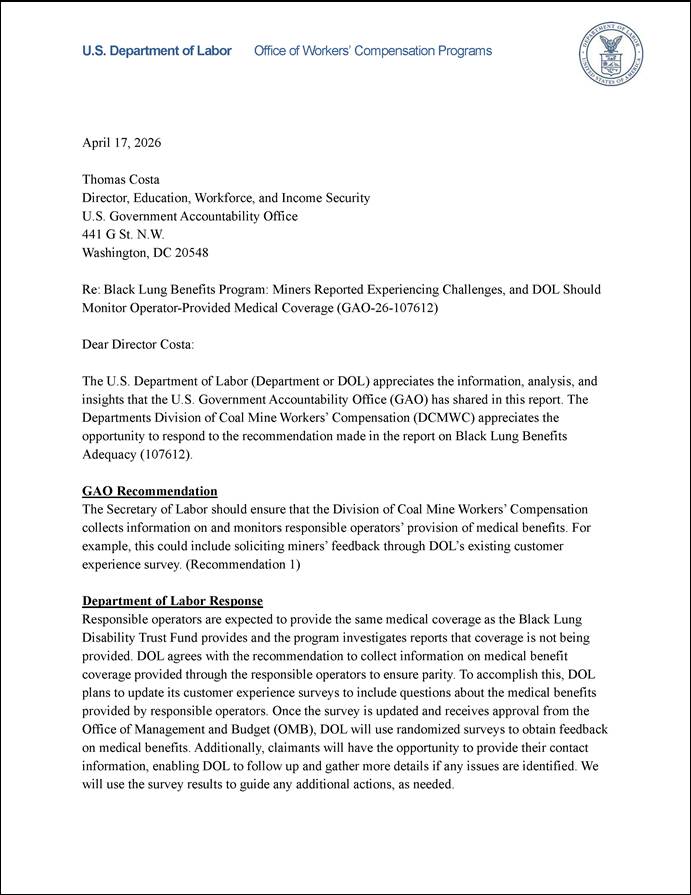

GAO Contact
Thomas Costa, costat@gao.gov
Staff Acknowledgments
In addition to the individual mentioned above, Blake Ainsworth (Assistant Director), Sara Rizik (Analyst in Charge), Lauren Shaman, James Bennett, Caitlin Cusati, Alex Galuten, Sam Kenney, Michael Naretta, Stacia Odenwald, Frank Todisco, and Seyda Wentworth made key contributions to this report.
Black Lung Benefits Program: Lack of Resolution on Coal Operator Self-Insurance Increases Financial Risk to Trust Fund, GAO‑24‑107597, Washington, D.C.: May 22, 2024.
Black Lung Benefits Program: Continued Inaction on Coal Operator Self-Insurance Increases Financial Risk to Trust Fund, GAO‑22‑105546, Washington, D.C.: Dec. 2, 2021.
Black Lung Benefits Program: Oversight Is Needed to Address Trust Fund Solvency Strained by Bankruptcies, GAO‑20‑438T, Washington, D.C.: Feb. 26, 2020.
Black Lung Benefits Program: Improved Oversight of Coal Mine Operator Insurance Is Needed. GAO‑20‑21, Washington, D.C.: Feb. 21, 2020.
Black Lung Benefits Program: Financing and Oversight Challenges Are Adversely Affecting the Trust Fund, GAO‑19‑622T, Washington, D.C.: June 20, 2019.
Black Lung Benefits Program: Options for Improving Trust Fund Finances, GAO‑18‑351, Washington, D.C.: May 30, 2018.
Black Lung Benefits Program: Administrative and Structural Changes Could Improve Miners’ Ability to Pursue Claims, GAO‑10‑7, Washington, D.C.: Oct. 30, 2009.
The Government Accountability Office, the audit, evaluation, and investigative arm of Congress, exists to support Congress in meeting its constitutional responsibilities and to help improve the performance and accountability of the federal government for the American people. GAO examines the use of public funds; evaluates federal programs and policies; and provides analyses, recommendations, and other assistance to help Congress make informed oversight, policy, and funding decisions. GAO’s commitment to good government is reflected in its core values of accountability, integrity, and reliability.
Obtaining Copies of GAO Reports and Testimony
The fastest and easiest way to obtain copies of GAO documents at no cost is through our website. Each weekday afternoon, GAO posts on its website newly released reports, testimony, and correspondence. You can also subscribe to GAO’s email updates to receive notification of newly posted products.
Order by Phone
The price of each GAO publication reflects GAO’s actual cost of production and distribution and depends on the number of pages in the publication and whether the publication is printed in color or black and white. Pricing and ordering information is posted on GAO’s website, https://www.gao.gov/ordering.htm.
Place orders by calling (202) 512-6000, toll free (866) 801-7077,
or
TDD (202) 512-2537.
Orders may be paid for using American Express, Discover Card, MasterCard, Visa, check, or money order. Call for additional information.
Connect with GAO
Connect with GAO on X,
LinkedIn, Instagram, and YouTube.
Subscribe to our Email Updates. Listen to our Podcasts.
Visit GAO on the web at https://www.gao.gov.
To Report Fraud, Waste, and Abuse in Federal Programs
Contact FraudNet:
Website: https://www.gao.gov/about/what-gao-does/fraudnet
Automated answering system: (800) 424-5454
Media Relations
Sarah Kaczmarek, Managing Director, Media@gao.gov
Congressional Relations
David A. Powner, Acting Managing Director, CongRel@gao.gov
General Inquiries
[1]Jacek M. Mazurek, John Wood, David J. Blackley, and David N. Weissman, “Coal Workers’ Pneumoconiosis—Attributable Years of Potential Life Lost to Life Expectancy and Potential Life Lost Before Age 65 Years—United States, 1999-2016,” Morbidity and Mortality Weekly Report (MMWR), vol. 67, no. 30 (2018).
[2]Throughout this report, we use the term “federal black lung benefits” to refer to the benefits of the Black Lung Benefits Program, unless otherwise specified.
[3]To analyze data for the full calendar year, we multiplied a beneficiary’s latest monthly payment by 12 to estimate their full year of benefits.
[4]SSA was unable to provide the data for benefits using the same “as of” date as DOL’s provided data. We used SSA’s 2025 data as an approximation for what beneficiaries received in 2024 when matching with the DOL data, but there may be slight discrepancies between these data and what beneficiaries actually received in 2024.
[5]Extraction workers may perform tasks such as operating mining machinery.
[6]Most participants in our groups were receiving or had previously received final or interim/temporary benefits. However, some had not yet received a determination on their application or had been denied and were undergoing an appeal.
[7]When reporting the findings from our focus groups, we define “most” groups as four or five groups.
[8]Federal standards for internal controls include principles around organizations performing monitoring activities (Principle 16). GAO, Standards for Internal Control in the Federal Government, GAO‑25‑107721 (Washington, D.C.: May 2025).
[9]We chose to interview state workers’ compensation officials in Kentucky and Virginia because they are two states where we conducted focus groups. Black lung clinics are funded by the Health Resources and Services Administration within the Department of Health and Human Services. We interviewed clinic staff located in multiple states across the country.
[10]This number includes both primary beneficiaries and their dependents.
[11]Kirsten S. Almberg et al., “Progressive Massive Fibrosis Resurgence Identified in U.S. Coal Miners Filing for Black Lung Benefits, 1970-2016,” Ann Am Thorac Soc., vol. 15, no. 12 (2018).
[12]If a miner was employed for 10 or more years in coal mining, there is a rebuttable presumption that their disease arose from coal mine employment. 20 C.F.R. § 718.203(b).
[13]See 20 C.F.R. § 725.202(d).
[14]Originally, SSA administered the program and approved any claims filed through December 31, 1973. These are Part B claims, pursuant to Part B of the Black Lung Benefits Act. Administration of the program was transferred to DOL, and claims filed after December 31, 1973, are Part C claims, pursuant to Part C of the Black Lung Benefits Act. For the purposes of this report, we focus solely on Part C claims and beneficiaries.
[15]Sometimes other entities qualify as responsible operators, such as trucking companies or contractors, according to DOL officials.
[16]The Trust Fund is primarily funded through an excise tax on coal produced and sold domestically. However, there have been concerns with its solvency. Specifically, the fund has borrowed from the U.S. Treasury’s general fund almost every year since 1979 to meet expenditures. See GAO, Black Lung Benefits Program: Lack of Resolution on Coal Operator Self-Insurance Increases Financial Risk to Trust Fund, GAO‑24‑107597 (Washington, D.C.: May 22, 2024) and Black Lung Benefits Program: Options for Improving Trust Fund Finances, GAO‑18‑351 (Washington, D.C.: May 30, 2018). See Related GAO Products for more information.
[17]As of April 2026, according to DOL, there were 68 claims examiners. This number decreased from 70 examiners in September 2025, 89 examiners in September 2024, and 115 examiners in September 2019.
[18]While claims typically follow the process outlined, a small number of claims may skip steps for various reasons, according to DOL officials.
[19]The time limits in the claim process are established by federal regulations. Many of them can be extended if one party requests an extension.
[20]We considered a claim to be closed if (1) at least 30 days had passed since a Proposed Decision and Order or Administrative Law Judge (ALJ) decision had been made, at least 60 days had passed since a Benefits Review Board decision had been made, and at least 90 days had passed since a U.S. Court of Appeals decision had been made; or (2) the claim had been withdrawn at any stage.
[21]Each year the benefit payments are adjusted in accordance with changes to the grade GS-2, step 1 base salary. For example, the 2026 benefit payments reflected a 1 percent increase, approximately, from the 2025 benefit payments. The General Schedule (GS) is a pay system for federal employees, which includes 15 grades starting with GS-1 as the lowest, and each grade also includes 10 step rates, starting with step 1.
[22]There are certain limited cases in which a miner receives medical benefits from the program but not benefit payments. One way this may happen, according to DOL officials, is if a miner is approved for benefits but chooses to continue working. In these instances, miners’ federal black lung benefit payments could be offset by their earnings, and they might receive only medical benefits.
[23]In 2024, miners received state workers’ compensation benefits from 11 states including Kentucky, Pennsylvania, Virginia, and West Virginia, according to our analysis of DOL data. Federal black lung benefits are also reduced when a beneficiary receives federal workers’ compensation. We focus on state workers’ compensation for the purposes of this report.
[24]According to SSA, family members of an SSDI beneficiary may receive survivor benefits based on the worker’s earnings record at their time of death.
[25]SSDI automatically converts to Social Security retirement when the beneficiary reaches full retirement age, and at that time, benefits are generally no longer reduced. Full retirement age can vary depending on when a retiree was born. For those born in 1960 and later, the full retirement age is 67. In some circumstances, instead of SSDI, a beneficiary may receive Social Security Supplemental Security Income. According to SSA, federal black lung benefits may be counted as a type of unearned income, which would reduce Supplemental Security Income payments.
[26]Throughout this report, when we use the term “primary beneficiary” or “beneficiary” for short, we are referring to primary beneficiaries of the Black Lung Benefits Program unless otherwise specified. This generally includes miners or survivors of miners (e.g., widow(er)s or surviving children). When we refer to beneficiaries of the program, we mean they either received a federal black lung benefit payment, or they had their federal black lung benefit payment totally offset by their state workers’ compensation benefit payment. In our analysis, there were 61 beneficiaries with this total offset. In our analysis, we included Part C beneficiaries in calendar year 2024 that we obtained from DOL data. Data from our analysis may differ from DOL’s publicly reported data on the total number of beneficiaries for a few reasons, including a small difference in the timeframe we analyzed and our focus on primary beneficiaries (i.e. excluding dependents from our total beneficiary count).
[27]This refers to beneficiaries receiving only federal black lung benefits of the following three categories of benefits in our analysis: federal black lung benefits, state workers’ compensation, and SSDI benefits for black lung disease.
[28]Included in these counts are federal black lung beneficiaries who had total offsets in 2024 due to state workers’ compensation benefit payments.
[29]Some of these miners (73 of 352 miners) also received SSDI benefits for black lung disease.
[30]State workers’ compensation benefits a miner receives for conditions other than black lung do not offset a miner’s federal black lung benefit payment. We did not include state workers’ compensation benefits received for other conditions in our analysis.
[31]The extent to which state workers’ compensation benefits for black lung disease are offset depends on the percentage of a beneficiary’s state award attributable to the disease. For example, if a miner receives $35,000 annually in state workers’ compensation but only 15 percent is attributable to black lung disease, their state benefit for black lung disease would be $5,250. As a result, their federal black lung benefits would be offset by $5,250.
[32]Some of these miners (73 of 669 miners) also received state workers’ compensation benefits. SSDI benefits for black lung disease may be reduced—or offset—when federal black lung benefits are received. In just under half of the cases in the data (309 of 669 miners), SSDI benefits received by miners age 62 or older were offset.
[33]These estimates include the SSDI benefit reduction to account for federal black lung benefits, when applicable.
[34]When a miner receiving SSDI benefits reaches full retirement age (somewhere between age 65 and 67, depending on the year they were born), their SSDI payments convert to Social Security retirement benefits. Therefore, all miners receiving SSDI benefits in our analysis of this age group were between age 62 and 66.
[35]We did not analyze data on the receipt of benefits not related to black lung, such as Social Security retirement benefits. Basic eligibility for Social Security retirement generally includes earning at least 40 Social Security credits, which generally equates to 10 years of work, including paying Social Security taxes. Those eligible can begin receiving Social Security retirement benefits as early as age 62. According to our analysis of DOL claims data, the median number of proven years worked by miners with approved closed claims to the Black Lung Benefits Program was 23 years.
[36]We would not necessarily expect a miner’s income in retirement to match or exceed their wage earned while working.
[37]We use the poverty guidelines, which vary based on household size, from the Department of Health and Human Services Poverty Guidelines for 2024 for the 48 contiguous states, Alaska, and Hawaii. This threshold was $15,060 per year for a one-person household, and $20,440 for a two-person household in the 48 contiguous states.
[38]Included in these counts are federal black lung beneficiaries who had total offsets in 2024 due to state workers’ compensation benefit payments.
[39]Forty-seven of these 388 miners also received state workers’ compensation benefits.
[40]SSDI benefits for black lung disease may be reduced—or offset—when federal black lung benefits are received. In about 40 percent of cases in our review (154 of 388 miners), SSDI benefits received by miners under age 62 were offset. These benefit estimates include the offset, when applicable.
[41]While we report our findings by the number of focus groups in which a topic was discussed, it does not necessarily mean that there was a consensus or agreement among all focus group participants on a given topic. We report on the themes that were most frequently discussed across groups. See app. I for more information about our methodology.
[42]Thirty-five percent of miner beneficiaries in our analysis had benefits paid through the Trust Fund.
[43]DOL’s initial decision on the claim is called the Proposed Decision and Order (PDO). If no party appeals the decision in 30 days, it becomes the final decision.
[44]Over 26,000 miners died between January 2013 and mid-August 2024 with an approved claim. These miners received benefits for an average of 12 years before their death. The average age at claim approval for these miners was 65, and their average age of death was 77. The median length of time these miners received benefits for was 7 years, the 25th percentile was 3 years, and the 75th percentile was 17 years.
[45]Department of Labor, Office of Workers’ Compensation Programs, OWCP Annual Report to Congress: Fiscal Years 2023 and 2024 (2026).
[46]20 C.F.R. § 725.408(a).
[47]20 C.F.R. § 725.408(b).
[48]20 C.F.R. § 725.423.
[49]20 C.F.R. § 725.419(a).
[50]When an approved claim is appealed, DOL will provide interim benefits to the miner or survivor, including medical benefits for miners. DOL notifies those receiving interim benefits that they may need to pay the benefits back if their claim is denied after appeals.
[51]This example was calculated by multiplying the 2026 benefit rate for a miner with one dependent ($14,283.60 per year) by 2.7 years, the difference in the median amount of time between receiving a PDO and receiving a decision from the ALJ.
[52]We conducted two survivor group interviews with four and six participants and interviewed five additional survivors.
[53]DOL officials told us that they do not collect data on the number of hardship waivers submitted or approved. Officials stated that it would not be feasible to identify the number of hardship waiver requests, approval rates for waivers, and the number of waivers tied to overturned claims with accuracy.
[54]The Black Lung Benefits Program provides medical coverage for the treatment of lung diseases related to black lung disease.
[55]A 2020 study found that federal black lung beneficiaries enrolled in Medicare were more likely to have specific respiratory and cardiovascular diseases listed as a cause of death compared to other Medicare beneficiaries. See Laura Kurth, Cara Halldin, A Scott Laney, and David J Blackley, “Causes of death among Federal Black Lung Benefits Program beneficiaries enrolled in Medicare, 1999-2016,” American Journal of Industrial Medicine, vol. 63, no. 11 (2020): 973-979.
[56]20 C.F.R. § 725.718.
[57]Other challenges with black lung-related medical coverage discussed in two of our six groups were with specific services or drugs that were not covered and problems with medical providers’ billing. Another medical coverage-related challenge discussed in one of our six groups was with needing to pay an out-of-pocket expense for medical services.
[58]The Congressional Budget Justifications from 2020 through 2025 include this language. Department of Labor, Office of Workers’ Compensation Programs, Congressional Budget Justification: Black Lung Disability Trust Fund (fiscal years 2020–2025), https://www.dol.gov/general/budget/archive.
[59]GAO, Standards for Internal Control in the Federal Government, GAO‑25‑107721 (Washington, D.C.: May 2025).
[60]Federal standards for internal controls include principles around organizations performing monitoring activities (Principle 16). GAO, Standards for Internal Control in the Federal Government, GAO‑25‑107721 (Washington, D.C.: May 2025).
[61]The SSA data also provide detail on Social Security Supplemental Security Income benefits. We only report these data as other benefits in our analyses because the data matched with few beneficiaries in the federal black lung data. SSA was unable to provide the data for benefits using the same “as of” date as DOL’s provided data. We used SSA’s 2025 data as an approximation for what beneficiaries received in 2024 when matching with the DOL data, but there may be slight discrepancies between these data and what beneficiaries actually received in 2024. In addition, SSA provided SSDI benefit amounts for a few individuals who were at full retirement age in 2024. We dropped their SSDI benefit amount because SSDI benefits convert to Social Security retirement benefits at full retirement age.
[62]DOL has not published details on how they estimated claims that received payments in fiscal year 2024.
[63]This analysis was consistent with retirement literature comparing post-work income to poverty guidelines and prior income levels.
[64]The Department of Health and Human Services publishes poverty guidelines for three regions: Alaska, Hawaii, and the 48 contiguous states.
[65]The Bureau of Labor Statistics publishes state-level average annual wage of coal mining extraction workers for 18 states. For miners outside of these 18 states, we used the national average.
[66]“Online Benefits Calculator” Social Security Administration, accessed September 15, 2025, https://www.ssa.gov/benefits/retirement/planner/AnypiaApplet.html (site modified in January 2026).
[67]DOL collects data on proven and alleged years of work. Proven years of work is the number that has been verified by DOL officials as they collect evidence for the claim, whereas alleged years of work is the number that the miner claimed to have worked.
[68]“Average Wage Indexing (AWI) Series,” Social Security Administration, accessed January 8, 2026, https://www.ssa.gov/oact/cola/awiseries.html.
[69]Credited signatory service is for work in a classified job (i.e. bargaining unit work) for a signatory employer (i.e. an employer that contributes to the pension trust).
[70]Other medical coverage, such as Medicare and Medicaid, were outside the scope of our analysis, but miners and their families may access these programs if they qualify.
[71]For our miner focus groups, we had one in Kentucky, one in Pennsylvania, three in Virginia, and one in West Virginia. We originally planned to conduct two miner focus groups in each state, but were unable to do so due to issues with recruiting participants. When we were unable to conduct a focus group because we did not have enough participants, we conducted interviews instead.
[72]While our goal was to limit the focus groups to 12 participants, we had one group with 13 participants. We decided to make this one exception to maximize overall participation and be accommodating to our attendees. Additionally, spouses and other family members occasionally sat in on our focus groups, but they were asked to not participate in the discussion. In instances where they did provide feedback, we excluded this from our analysis.
[73]In a few instances, focus group participants left certain questions on the questionnaire blank. Also, we did not receive questionnaires from eight of the 64 participants. The averages we calculated and other information we provide about focus group participants is based on the information available to us.
[74]In a few instances, a theme was common among groups but did not answer our research questions. Therefore, we did not include it in this report.