
Report to Congressional Requesters
GAO-26-107685
A report to congressional requesters.
For more information, contact: Heather MacLeod at MacLeodH@gao.gov.
What GAO Found
The Coast Guard identified 49 actions to implement as part of its reform effort to address sexual misconduct since July 2023. As of September 2025, the service reported implementing 32 of them. These actions include revising policy to improve accountability for sexual misconduct and developing new training. Coast Guard officials cited several reasons why the 17 remaining actions are incomplete, including their complexity and transitions in the service’s leaders.
The Coast Guard has taken steps to incorporate aspects of leading practices to support its reform efforts, but gaps in key areas may affect its ability to maintain progress and achieve lasting results to address sexual misconduct.
Extent to Which the Coast Guard’s Reform Effort to Address Sexual Misconduct Followed Selected Leading Practices for Agency Reforms
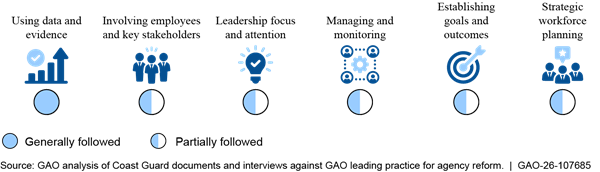
Specifically, GAO identified gaps in these areas:
· Involving employees and key stakeholders. The Coast Guard engaged employees and stakeholders (e.g., the Department of Defense) when developing its reforms but does not have a dedicated method for collecting feedback from its personnel. Establishing a two-way communication strategy would better ensure the Coast Guard has opportunities to collect and respond to employee feedback regarding the effects of the reforms.
· Leadership focus and attention. The service established a steering committee, but it has not met since November 2024. An active reform implementation team would help the Coast Guard maintain momentum.
· Managing and monitoring. The Coast Guard has not updated timelines or outlined clear next steps for incomplete reform actions. Developing a clear implementation plan with key milestones and updated time frames could help the Coast Guard pinpoint performance shortfalls and address challenges.
· Establishing goals and outcomes. The Coast Guard has not developed an evaluation plan to assess the effectiveness of its efforts, as GAO recommended in March 2024. Officials have begun to develop a service culture index to measure progress; however, it is incomplete.
· Strategic workforce planning. The service has added staff to support its reform efforts (e.g., 16 personnel at the Academy) but has not fully assessed workforce needs. Addressing GAO’s 2020 recommendation on workforce assessment planning would better ensure the Coast Guard has the right people in the units responsible for implementing the reform efforts.
Why GAO Did This Study
Sexual assault and sexual harassment (i.e., sexual misconduct) are serious offenses that can have lasting, harmful effects on victims. Incidents of sexual misconduct in the Coast Guard—a maritime military service within the Department of Homeland Security (DHS)—have generated congressional and media attention for nearly 2 decades. In July 2023, after media reporting on the mishandling of sexual assault cases, the Coast Guard directed a review to identify areas for organizational improvement and to counter sexual misconduct.
GAO was asked to review the Coast Guard’s effort to address sexual misconduct. This report examines (1) the reform actions the Coast Guard has taken since July 2023 to address sexual assault and harassment and (2) the extent to which the Coast Guard has followed selected leading agency reform practices to implement and sustain its reform efforts.
GAO reviewed Coast Guard documentation on its reform actions and assessed them against selected leading practices for agency reform. GAO also interviewed Coast Guard officials from headquarters and from five of nine districts (selected based on size and geography) and visited one of these districts (New England) as well as the Coast Guard Academy.
What GAO Recommends
GAO recommends that the Coast Guard (1) establish a two-way communications strategy with employees regarding the status and effects of its reform efforts; (2) ensure there is an active reform implementation team in place to manage and sustain its reform efforts; and (3) develop an implementation plan for its reform effort. DHS agreed with the recommendations.
|
Abbreviations |
|
|
|
|
|
DHS |
Department of Homeland Security |
This is a work of the U.S. government and is not subject to copyright protection in the United States. The published product may be reproduced and distributed in its entirety without further permission from GAO. However, because this work may contain copyrighted images or other material, permission from the copyright holder may be necessary if you wish to reproduce this material separately.
January 14, 2026
Congressional Requesters
Sexual assault and sexual harassment are serious offenses that can have lasting, harmful effects on victims. Incidents of sexual assault and sexual harassment in the Coast Guard, a maritime military service within the Department of Homeland Security (DHS), have generated congressional and media attention for nearly 2 decades. More recently, in 2020, the Coast Guard concluded a series of investigations called “Operation Fouled Anchor,” in which the Coast Guard Investigative Service examined more than 100 separate allegations of sexual assault that occurred between 1990 and 2006 at the Coast Guard Academy.[1] The final report concluded that the Academy often mishandled these cases and failed to take sufficient action to ensure a safe environment and instill a culture intolerant of any form of sexual misconduct.
After media reporting on Operation Fouled Anchor in June 2023, the Coast Guard conducted a 90-day review (called the Accountability and Transparency Review) of the laws, policy, processes, practices, resources, and service culture relevant to countering sexual assault and sexual harassment in the service.[2] The review identified sexual misconduct reforms—areas for improvement to Coast Guard service culture and programs aimed at preventing and responding to sexual misconduct—so that Coast Guard personnel would have an experience aligned to the service’s core values of honor, respect, and devotion to duty.
You asked us to review the Coast Guard’s effort to address sexual assault and sexual harassment within the service.[3] This report examines (1) the reform actions the Coast Guard has taken since July 2023 to address sexual assault and harassment, and (2) the extent to which the Coast Guard followed selected leading agency reform practices to implement and sustain its reform efforts.
To identify the reform actions the Coast Guard took to prevent and respond to sexual misconduct (i.e., sexual assault and sexual harassment), we focused on the Coast Guard’s implemented and planned reform actions since July 2023, when the service initiated its 90-day Accountability and Transparency Review.[4] We obtained and analyzed Coast Guard documents detailing its review and the development and implementation of the resulting reform actions. To identify the service’s ongoing and planned reform actions, including reforms aimed at preventing and responding to sexual misconduct, as well as the status of these actions, we reviewed Coast Guard planning documents and interviewed Coast Guard officials. We also reviewed updated policy, guidance, training materials, and other available documents such as newsletter articles and website information.
To examine the extent to which the Coast Guard followed leading practices in developing, implementing, and sustaining its reform efforts, we reviewed Coast Guard plans and processes resulting from the Accountability and Transparency Review and other Coast Guard-identified actions to address harmful behaviors, including sexual assault and sexual harassment. We reviewed Coast Guard documents—such as memoranda, meeting agendas and presentations on the reform implementation, and budget documents—and interviewed Coast Guard headquarters officials about plans, processes, and steps they have taken. We compared this information to selected leading practices for effective agency reform. These practices have been identified in our prior work.[5]
We also interviewed field officials from five of nine Coast Guard districts to obtain their perspectives on implementation of the reform actions, any challenges encountered, and activities related to leading agency reform practices, such as those involving employees and key stakeholders, as well as communication about reforms.[6] We selected districts based on geographic dispersion and varying size of district area of commands (i.e., number of personnel). Field level officials interviewed include district and Coast Guard Academy leadership, sexual assault response coordinators, and victim advocate program specialists. The views from district and other field officials cannot be generalized to other districts or Coast Guard personnel that we did not interview; however, their views provided insight about the Coast Guard reform process and implementation.
We focused our assessment of Coast Guard’s implementation of its reform actions since 2023 on six selected leading agency reform practices and selected key questions for those practices that we determined were the most relevant to the Coast Guard’s stated objectives, organizational structure, and key participants.[7] To conduct our assessment, two analysts reviewed the evidence related to each practice drawn from the documents and interviews described above, reconciling differing conclusions to reach agreement. They assessed the extent to which the Coast Guard followed the selected leading practices and assigned a rating of generally followed, partially followed, or did not follow for each selected leading practice.[8]
We conducted this performance audit from July 2024 to January 2026 in accordance with generally accepted government auditing standards. Those standards require that we plan and perform the audit to obtain sufficient, appropriate evidence to provide a reasonable basis for our findings and conclusions based on our audit objectives. We believe that the evidence obtained provides a reasonable basis for our findings and conclusions based on our audit objectives.
Coast Guard Reported Implementing Many of Its Planned Actions to Address Sexual Misconduct, Including Some Related to Training, Policy, and the Academy
The Coast Guard identified 49 reform actions to implement as part of its effort to address sexual misconduct and reported completing about two-thirds of them as of September 2025. In November 2023, the service directed the initiation of 33 reform actions based on the recommendations from its Accountability and Transparency Review. The actions addressed issues across six categories, including workforce training, culture, and professional development; Coast Guard Academy; and information, data, and transparency.[9] Subsequently, while implementing the initial 33 actions, Coast Guard officials identified 16 additional program-initiated reform actions that were part of the service’s broader sexual misconduct prevention, response, and recovery efforts.[10] Though not grouped into the six categories, these other 16 reform actions included developing or revising Coast Guard policy and guidance, creating and filling new personnel positions, and developing evaluation tools. Figure 1 shows the Coast Guard-identified status and examples of the reform actions by category as of September 2025, which appendix I describes in greater detail.
Figure 1: Coast Guard-Identified Status of Its Reform Actions to Address Sexual Assault and Sexual Harassment as of September 2025
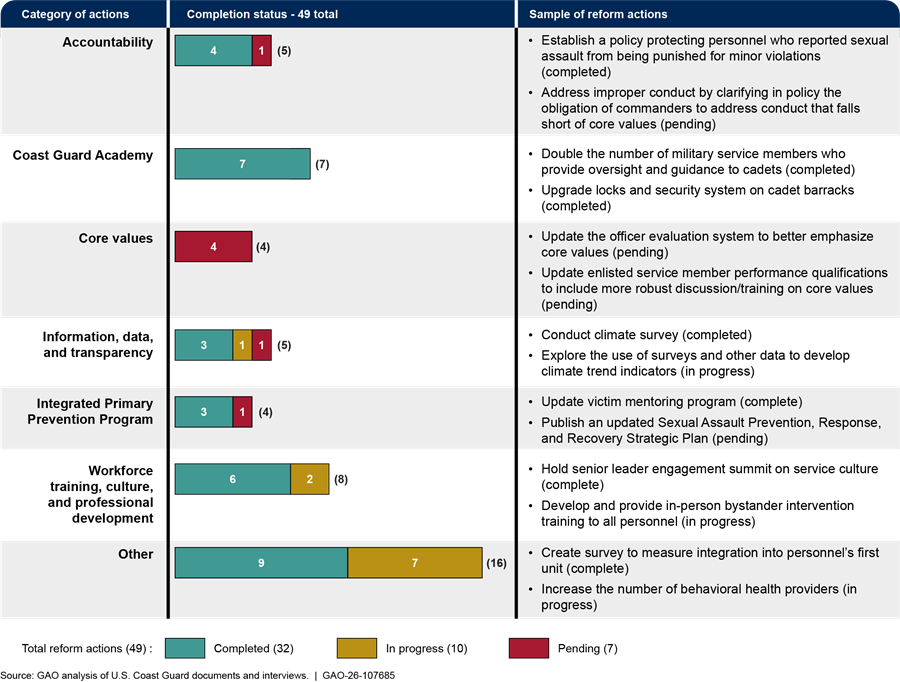
Notes: The Coast Guard’s initial 33 reform actions addressed issues across six categories. Subsequently, the service identified 16 additional reform actions, which we grouped into a category labeled “Other.”
The Coast Guard uses “in progress” to describe actions the service is actively working to complete, while “pending” describes actions that are not currently under development.
Coast Guard officials said the agency is actively working to complete actions they categorize as “in progress,” while the service is not working on “pending” actions. These officials cited several reasons why actions are in progress or pending, including complexity, sequencing, and leadership transition and administration priorities.
Complexity. Some reform actions to address sexual misconduct are more complex efforts that require a greater level of work, additional resources, and more time to implement, according to Coast Guard officials. For example, Coast Guard officials said that creating and staffing a Coast Guard Integrated Primary Prevention Program, which would provide prevention support to leaders and all other personnel and promote prevention activities, is a long-term effort that will take time and additional resources.[11]
Sequencing. Other ongoing efforts must be completed before some reform actions can be implemented, according to Coast Guard officials. For example, officials stated that the performance qualification and evaluation system reform actions depend on completion of the core values reform action that expands Coast Guard’s definitions and set up processes.[12] This reform action is pending as of September 2025.
Leadership transition and administration priorities. Three reform actions are not currently in development (i.e., pending) until a new Coast Guard Commandant is confirmed, according to Coast Guard officials. These reform actions are (1) expanding and reinforcing core values, (2) updating the enlisted servicemember evaluation system to better emphasize core values, and (3) publishing an updated Sexual Assault Prevention, Response and Recovery Program strategic plan.
Further, in March 2025, Coast Guard officials said the agency had paused work on some other reform actions, such as analyzing surveys to develop climate trend indicators to align their efforts with administration and department priorities identified in the January 2025 executive orders terminating federal diversity and equity programs.[13] The Coast Guard has since aligned those reform actions with the executive orders and continued with implementation, according to officials.
While Coast Guard officials told us in July 2025 that the service had time frames to fully implement the remaining three of the 33 initial reform actions that were in progress by September 2025, officials did not have estimated completion dates for the other seven initial reform actions that were designated as pending. The November 2023 memorandum directing implementation of the initial 33 reform actions identified planned time frames, ranging from December 2023 to October 2024, and expected results for each action.[14] The initial time frames have passed, and the Coast Guard has not identified updated implementation time frames. Similarly, Coast Guard officials did not have estimated time frames for five of the seven additional reform actions that were in progress or pending as of September 2025. We discuss this topic in greater detail later in this report.
Coast Guard Has Partially Followed Most Selected Leading Practices for Agency Reform, Leaving Gaps in Key Areas
The Coast Guard has taken steps to incorporate aspects of leading practices to support its reform effort to address sexual misconduct, but gaps in key areas may affect its ability to maintain progress and achieve lasting results. For example, consistent with leading reform practices, the Coast Guard obtained input from its employees and stakeholders and reviewed prior studies and data on sexual misconduct in the service to identify areas for corrective actions. However, the lack of a defined channel for Coast Guard personnel to share feedback on the effects of the reforms may limit transparency and hinder personnel engagement with reform efforts. Further, while the Coast Guard established an executive steering committee to guide its sexual misconduct reform efforts, the committee has not met since November 2024, and there are no milestones or updated time frames for some of its remaining actions. This may limit the committee’s ability to maintain continued focus and ensure steady progress. Moreover, the Coast Guard has not developed an evaluation plan to assess the effectiveness of its efforts, and our prior work has shown the service faces continued challenges in determining its workforce needs.
Our prior work on agency reforms has shown that successful reforms or transformations depend upon following change management practices, such as agreement on reform goals and involving Congress, federal employees, and other key stakeholders.[15] We applied selected leading practices, as shown in table 1, to assess the Coast Guard’s efforts to develop, implement, and sustain its reform effort to address sexual misconduct.[16]
|
Selected leading practice |
Description |
|
Using data and evidence |
In undertaking a major reform, agencies are better equipped when basing their efforts on data and evidence, such as program evaluations or performance data. This includes identifying the data or evidence the agency is using to justify its proposed changes and determining that the evidence is sufficiently reliable to support the case for the changes. |
|
Involving employees and key stakeholders |
It is important for agencies to directly and continuously involve not only their employees, but also key stakeholders, in the development of major reforms. These stakeholders may include congressional stakeholders, customers, other agencies, and other external partners. Agencies should incorporate the feedback received from stakeholders into proposed changes. Agencies should also have a two-way continuing communications strategy that listens and responds to concerns of employees regarding the effects of potential reforms and a way to publicize and report on their related progress. |
|
Leadership focus and attention |
Agency reforms should be led by high-performing designated leaders and a reform implementation team to help set the tone and direction, to make a compelling case for change, and to institutionalize accountability in implementing the changes within the agency. |
|
Managing and monitoring |
Agencies should carefully and closely manage organizational transformations by developing an implementation plan with key milestones and deliverables to track and communicate implementation progress. This also includes putting processes in place to collect data for measuring the reform’s outcome-oriented goals and plans to measure customer satisfaction with the changes resulting from their reforms. |
|
Establishing goals and outcomes |
Agencies should identify what they are trying to achieve and establish clear outcome-oriented goals and performance measures that enable them to assess the extent to which reform projects are achieving progress toward their goals. This process should also include considering how the changes align with the agency’s mission and strategic plan. |
|
Strategic workforce planning |
Agencies should conduct strategic workforce planning, which is an essential activity for ensuring that an agency’s human capital program aligns with its current and emerging mission and programmatic goals, and that agencies can meet future needs. This includes assessing the effects of the proposed organizational changes on the agency’s workforce and conducting strategic workforce planning to determine whether the agency will have the needed resources and capacity, including the skills and competencies, in place. |
Source: GAO. │GAO‑26‑107685
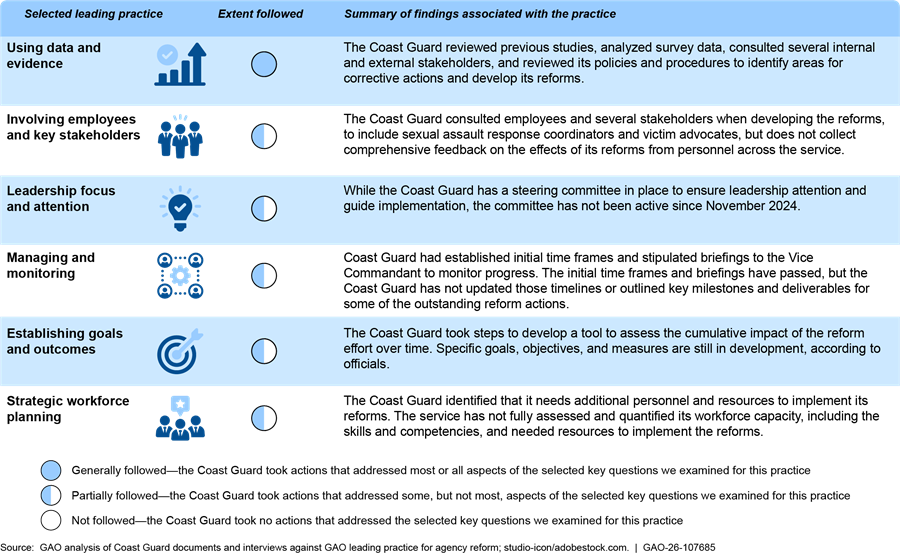
We found that the Coast Guard at least partially followed all six selected leading reform practices but left gaps in key areas that, if addressed, could strengthen implementation of its reform efforts to address sexual misconduct. Figure 2 summarizes our assessment of the extent to which Coast Guard’s sexual misconduct reforms follow selected leading practices.
Figure 2: Assessment of the Extent to Which the Coast Guard’s Reforms to Address Sexual Misconduct Followed Selected Leading Practices for Effective Agency Reforms
Using Evidence and Data
The Coast Guard developed and justified its reform efforts to address sexual misconduct through its Accountability and Transparency Review. To conduct its Accountability and Transparency Review, the Coast Guard reviewed prior information on the topic and obtained feedback from Coast Guard personnel and experts to identify areas for corrective actions.
Reviewing prior information. The Coast Guard reviewed academic, GAO, other government, and industry studies and analyzed survey data to identify key themes of sexual misconduct within the Coast Guard. For example, the Coast Guard review team analyzed survey data to identify the prevalence and characteristics of sexual assault, sexual harassment, and discrimination. A Coast Guard official who conducts outreach to Coast Guard field personnel said that this information helps educate commanding officers in the field and provide context for the reform efforts.
Obtaining feedback. The Coast Guard conducted focus groups and listening sessions at selected field units and the Academy to gather input on training, policies, and procedures relating to Coast Guard culture and misconduct, including sexual misconduct. During the review process, the Coast Guard also provided a link that its personnel could use to submit comments, suggestions, or other input. Leaders, sexual assault response coordinators, and victim advocate program specialists we spoke with at four of the five districts and the Coast Guard Academy confirmed that they used at least one of these feedback mechanisms.[17]
Involving Employees and Key Stakeholders
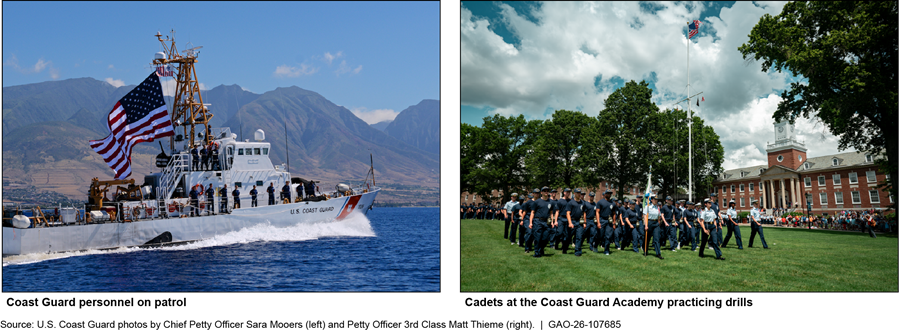
The Coast Guard obtained input from employees and external stakeholders to develop reforms and has shared some information on the progress of its efforts with personnel but does not collect comprehensive feedback on the effects of its reforms from personnel across the service. The service obtained feedback from its personnel in advance of developing its initial actions. As described above, the Coast Guard gathered input on sexual misconduct issues from cadets at the Coast Guard Academy and personnel at select field units, including those stationed at remote locations or deployed at sea, where unique challenges may arise.[18] Figure 3 shows a Coast Guard unit deployed at sea and cadets at the Academy. The Coast Guard also engaged sexual assault and sexual harassment prevention experts from the Department of Defense and other external subject matter experts with knowledge of sexual assault and sexual harassment. Coast Guard officials also said they gathered input during congressional hearings that led to development of some of the reform actions.
While implementing its reforms, Coast Guard headquarters communicated and shared progress updates to its personnel using several methods, including a webpage, email messages, newsletter articles, and unit visits. For example, the Coast Guard communicated information on the reform actions to its personnel through a dedicated public-facing webpage that described the 33 initial reform actions and provided the implementation status for each one. The Coast Guard also published articles on the progress of the additional 16 actions, such as streamlining systems for veterans’ access to their personnel records and hiring an enterprise victim advocate.
Officials from headquarters and three of the five districts we interviewed told us the webpage was the primary method for ensuring all Coast Guard members were aware of the reform efforts and for providing updates on the status of the reform actions.[19] However, Coast Guard leadership removed the webpage in January 2025 because they were assessing the impact of certain executive orders related to diversity, equity, and inclusion on the reform actions, according to officials.[20] Coast Guard officials said that the service subsequently aligned its reform actions with the executive orders and, in July 2025, reactivated the webpage.
Though the Coast Guard shares and publicizes some information on the progress on its reforms, the agency has not solicited continuous feedback from personnel across the service regarding the effects of the reform actions. According to officials, the Coast Guard receives feedback through district leaders’ participation in the Executive Steering Committee, discussion sessions during field unit visits, beta-testing of some reform efforts and feedback provided to implementing program offices. For example, leaders from two of the districts we met with said they requested feedback from commanding officers in their area of responsibility on the draft versions of the Command Transparency toolkit designed to facilitate discussions about misconduct, including sexual misconduct, at the unit level. In addition, leaders from two districts we met with said they provide feedback directly to the program officials responsible for implementing reform actions.
However, only three of nine districts participate in the Executive Steering Committee, and leaders we spoke with at the five selected districts had varying degrees of involvement in implementing the reform efforts or soliciting feedback from subordinate leaders and units. Further, sexual assault response coordinators and victim advocate program specialists we interviewed from the Academy and three of five districts we met with stated that headquarters leadership has not solicited feedback on reform actions since implementation began. Two of these officials stated that they do not know how to provide feedback on reform actions that are being implemented by offices other than the Sexual Assault Prevention, Response, and Recovery Program—one of about 15 implementing program offices for the reform actions.[21]
Officials stated the Coast Guard does not have a dedicated method for collecting feedback service-wide because its personnel can provide feedback on the reforms through their established chain-of-command or programmatic structures in place. However, as we have previously reported and as stated in the Accountability and Transparency Review report, command climate can be a challenge and varies across Coast Guard units.[22] This may affect the personnel’s comfort with providing input to their chain-of command.[23] In addition, Coast Guard officials said the Sexual Assault Prevention, Response, and Recovery program, one of many implementing offices, has an email account used to facilitate direct communication with field personnel. However, field personnel may not be aware that they can provide feedback specific to the reform efforts using this email, given that the email was created for a different purpose before the Coast Guard’s reform effort began.
Consistent with leading agency reform practices, establishing a two-way communication strategy that shares information about the agency reforms and collects and responds to feedback from employees regarding the effects of reforms would better ensure that all personnel have the opportunity to provide feedback on the full scope of the reforms.[24] Program managers implementing the reform actions would also have more opportunities to listen and respond to employee concerns and help ensure the changes align with Coast Guard’s needs.
Leadership Focus and Attention
The Coast Guard designated a committee and outlined procedures aimed at facilitating executive and field-level leadership awareness and focus on the reform effort to address sexual misconduct. However, this committee has not met in over a year, which may limit Coast Guard’s momentum and progress in implementing its reforms. Specifically, the Coast Guard established the Executive Steering Committee to guide implementation, remove barriers impeding progress to executing the reform actions, and recommend proposed changes. The Coast Guard designated the Director of Staff, previously the Deputy for Personnel Readiness, responsible for directing implementation of reform efforts and leading the steering committee. Other members of the committee include a designated action officer—a Coast Guard official who coordinates activities across program offices responsible for each reform action, representatives from field units, and executives from program offices. The action officer also gathers data, monitors progress, and prepares reports on the 33 initial actions for leadership, according to Coast Guard officials.
The November 2023 memorandum directing implementation of the initial reform actions outlined procedures to update the Commandant of the Coast Guard quarterly and provide an annual brief on implementation progress. From January 2024 through November 2024, the Executive Steering Committee met nine times to discuss implementation progress and provided monthly and quarterly updates of the 49 actions to the Vice Commandant and Commandant, respectively. During committee meetings, program managers shared information about challenges and committee members helped to solve problems and ensure implementation progress, according to officials.
However, the committee had not met since November 2024 due to other operational duties taking priority and changes in Coast Guard senior leadership as of January 2025, according to officials. As a result, the Coast Guard does not have an active team to guide reform implementation.
Our previous work shows that fully implementing major transformations can take years and requires focused, full-time attention to ensure that initiatives are sequenced and implemented in a coherent and integrated way.[25] Ensuring that there is an active implementation team to manage and sustain its reforms, consistent with leading agency reform practices, would help maintain momentum and focus on Coast Guard’s reform effort to address sexual misconduct.
Managing and Monitoring
The Coast Guard initially established time frames to track the progress of its reforms, but it has not updated timelines or outlined clear next steps and deliverables for some of the outstanding reform actions. Specifically, in the November 2023 memorandum directing the sexual misconduct reform effort, the Coast Guard outlined expectations and planned time frames for each of the 33 initial reform actions. For 29 of the 33 actions, the memorandum detailed expectations for a series of briefings to the Vice Commandant on the progress of these actions within time frames ranging from December 2023 to October 2024. Upon conclusion of these briefings, Coast Guard officials were then expected to decide on subsequent next steps for each action, as appropriate, according to headquarters officials.
The initial time frames and briefings have passed; however, the next steps, deliverables, and future time frames for continued work on some of Coast Guard’s reforms to address sexual misconduct are not clear. During our review, the Coast Guard did not provide us with an implementation plan with key time frames, milestones, and deliverables for the 33 directed reform actions. Additionally, as previously mentioned, the Coast Guard did not identify implementation time frames or milestones for most of the 16 additional reform actions. Further, as of September 2025, 17 of 49 total reform actions were not complete and some of these are complex, longer-term efforts.[26] Coast Guard officials said they expect to continue to take steps toward fully implementing these longer-term reform actions but did not identify related next steps, key milestones, or deliverables. Coast Guard officials stated it was difficult to determine the collective status of the actions since implementation efforts are decentralized across multiple programs.
In March 2025, Coast Guard officials said the process for developing or updating milestones and time frames for the reform actions was cumbersome, and they therefore discontinued those efforts. In August 2025, Coast Guard officials provided updated time frames and milestones for five of 17 outstanding reform actions and said obtaining information on the progress of the actions was difficult because its efforts were not centralized. In response to our draft report, in December 2025, Coast Guard officials told us that the Coast Guard does monitor and maintain tracking on timelines, milestones, and update time frames for the directed actions but did not provide any accompanying evidence of these activities.
However, the Coast Guard could benefit from an implementation plan with key milestones and time frames, consistent with leading agency reform practices. This is especially important, given that its reform efforts include complex actions with associated challenges that require greater level of effort or additional resources. For example, all the sexual assault response coordinators and victim advocate specialists we interviewed identified resource and logistical challenges regarding the new bystander intervention training across all the field units in their districts. Identified challenges include length of the training, limited number of personnel to conduct the training, scheduling difficulties, and potential reluctance of Coast Guard personnel to attend the training. While officials stated that the Coast Guard has incorporated feedback and shortened the training from 8 hours to 3 hours, establishing milestones and time frames could help them navigate the other identified challenges.
Developing a clear implementation plan with key milestones, deliverables, and updated time frames for its reform actions addressing sexual misconduct could help the Coast Guard implement its reform efforts. Specifically, Coast Guard could better pinpoint performance shortfalls; address challenges to enable corrections; assess potential tradeoffs between scope of reform actions, time, and resources; and provide a roadmap to key stakeholders. An implementation plan could also better ensure continued progress over the long term.
Establishing Goals and Outcomes
The Coast Guard has had longstanding challenges with developing goals and measures to evaluate its progress addressing sexual misconduct but is taking steps to evaluate its current reform efforts. Specifically, in 2008, we found that the Coast Guard had not established an oversight framework that would enable the service to evaluate the effectiveness of its sexual assault and sexual harassment programs both service-wide and at the Coast Guard Academy.[27] While the Coast Guard took steps to improve its oversight by implementing recommendations we made in 2008, in March 2024, we found that it did not have a plan to assess whether current reform efforts to address sexual misconduct are working.[28] We recommended the agency develop an evaluation plan and mechanisms to do so.[29]
The Coast Guard has taken steps to develop an evaluation plan since March 2024. Coast Guard officials stated that the agency has contracted three full-time staff to develop a Service Culture Index—a tool to leverage relevant metrics from its current surveys and other reports to establish a baseline for assessing the cumulative impact of the reform actions.[30] The contracted staff have conducted an initial assessment to determine the data sources to use for the index and were working on developing the evaluation process as of July 2025, according to Coast Guard officials.
Officials also stated that specific goals, objectives, and measures that they plan to use to assess the effectiveness of the reforms are still in development. These officials told us that the results of the index will be used to evaluate effectiveness, and they are developing outcome-oriented goals and performance measures for the index, which is a leading reform practice. We will continue to monitor Coast Guard progress in this area.
Strategic Workforce Planning
The Coast Guard has identified that it needs additional personnel and funding as part of its sexual misconduct reform effort; however, it has not fully assessed the extent of resources needed. Specifically, the Accountability and Transparency Review found that the Coast Guard has a significant shortage of accessible, trained behavioral healthcare providers and volunteer victim advocates who provide guidance to victims across large geographic areas. Similarly, several district-level and Coast Guard Academy officials we interviewed said the agency needs additional personnel at the Office of the Chief Prosecutor, sexual assault response coordinators and victim advocates, and medical and behavioral health practitioners to effectively implement reforms and to address cited challenges. For example, district officials we interviewed cited long investigation and adjudication time frames for sexual assault and sexual harassment cases as a challenge. Officials from one of these districts also said that additional investigators and legal staff would better enable the Coast Guard to manage sexual misconduct cases.[31]
The Coast Guard has taken some steps to address the personnel needs identified in the review by requesting funding and adding staff for a portion of the total personnel Coast Guard says it needs to conduct some of its reform activities. Specifically, according to DHS’s fiscal year 2025 congressional budget justification for the Coast Guard and related testimony,[32] the agency requested $160 million in part for reform efforts related to creating an Integrated Primary Prevention Program, victim advocacy, and modernizing the officer evaluation system.[33] The Coast Guard also identified $11.8 million as part of its unfunded priorities to address reform efforts for fiscal year 2025.[34] While the President’s fiscal year 2025 budget request for the Coast Guard was not enacted, officials told us that the Coast Guard received $3.8 million in fiscal year 2025 for 29 full time positions for mental health professionals, Enterprise Victim Advocate program, and the Integrated Primary Prevention program.[35]
In addition, to implement reform efforts, the Coast Guard has added five new positions to the Sexual Assault Prevention, Response, and Recovery program, six new positions for the Integrated Program Prevention Program, and 16 positions to enhance cadet oversight, a reform action, at the Coast Guard Academy. Further, Coast Guard officials told us that the Coast Guard plans to add 59 full time positions to support sexual assault prevention, victim services, and independent investigations with fiscal year 2026 funding.
While these staffing additions are important to supporting reform efforts, the Coast Guard has not fully assessed and quantified its workforce capacity—including the skills, competencies, and resources it needs to fully implement the sexual misconduct reforms—consistent with leading reform practices. For example, while the Coast Guard has determined the number of behavioral health specialists it needs, it has not identified the number of volunteer victim advocates or the staff needed for the Office of the Chief Prosecutor, as recommended in the Accountability and Transparency Review report.[36] Officials we spoke to at the Coast Guard Academy said that the Academy needs roughly double the number of victim advocates it currently has to provide adequate support. Further, according to the Accountability and Transparency Review conclusions and Coast Guard officials, the Coast Guard will require significantly more personnel with various skills beyond the six new positions it recently added to fully staff an Integrated Primary Prevention Program workforce, one of the reform actions.
The Coast Guard has faced continued challenges in determining its workforce needs and conducting strategic workforce planning. In our prior work reviewing how Coast Guard has leveraged its workforce to meet mission needs, we found that Coast Guard has not fully assessed its workforce needs and recommended Coast Guard improve its workforce assessment process.[37] Specifically, in 2020, we found that the Coast Guard had completed workforce requirements determinations for only 6 percent of its workforce.[38]
We recommended in 2020 that the Coast Guard update its Workforce Requirements Plan with time frames and milestones for achieving its goal of assessing its entire workforce. Since then, the Coast Guard has made some progress, assessing 27 percent of its workforce as of June 2025. However, key offices involved in the reform effort, including the Sexual Assault Prevention, Response, and Recovery program, have not received a workforce requirements determination. Fully addressing our prior recommendation would better position the Coast Guard to ensure that it has the right number of people with the requisite skills in the right units—including the units responsible for implementing the reform efforts intended to address sexual misconduct.
Conclusions
The Coast Guard’s challenges responding to incidents of sexual assault and sexual harassment have been longstanding. After media reporting in June 2023 on Coast Guard’s mishandling of sexual assault cases at the Coast Guard Academy, the service committed to reforming its culture, including addressing sexual misconduct. The service identified and has begun implementing many of the 49 reform actions, such as developing new awareness and prevention training and revising policy to hold military personnel accountable for sexual misconduct. It has reported implementing 32 of these actions as of September 2025, to include 23 of the initial 33 directed actions and 9 of the16 program-initiated actions.
Notably, the Coast Guard has followed the leading practice of using data and other evidence to identify areas for corrective actions and to develop its reforms. We encourage the service to continue this important practice that will be necessary to achieve the envisioned changes in practices and culture.
However, while the Coast Guard has taken steps to address aspects of the other five selected leading practices for effective agency reform, significant gaps remain. For example, establishing a two-way communication strategy that involves sharing information about the reform actions and collecting and responding to feedback from employees about the effects of the reforms could better ensure that changes made to address sexual misconduct align with the Coast Guard’s needs. In addition, having an active reform implementation team would help the Coast Guard keep momentum, even through organizational changes such as staff turnover. Further, developing an implementation plan that identifies key milestones, deliverables, and updated time frames for reform actions could help the Coast Guard monitor its progress, identify and adjust to issues as they arise, and stay on track with meeting its goals.
Finally, the Coast Guard would be better equipped to assess the effectiveness of its reforms and determine the necessary staffing and skills needed to implement them by fully addressing our prior recommendations for the service to develop an evaluation plan that includes outcome-oriented goals and measures and to update its Workforce Requirements Plan.
Addressing these gaps could help the Coast Guard better position itself to make the types of long-term cultural and procedural changes that are necessary to address sexual misconduct.
Recommendations for Executive Action
We are making the following three recommendations to the U.S. Coast Guard:
The Commandant of the Coast Guard should establish a two-way communications strategy that involves sharing information about the reform efforts to address sexual misconduct and collecting and responding to feedback from employees regarding the effects of the reform efforts. (Recommendation 1)
The Commandant of the Coast Guard should ensure there is an active reform implementation team to manage and sustain its reform efforts to address sexual misconduct. (Recommendation 2)
The Commandant of the Coast Guard should develop an implementation plan that identifies key milestones, deliverables, and updated time frames for reform actions addressing sexual misconduct. (Recommendation 3)
Agency Comments and Our Evaluation
We provided a draft of this report to the Coast Guard for review and comment. In its comments, reproduced in appendix II, the Department of Homeland Security concurred with all three of our recommendations and described the Coast Guard’s planned actions to address them.
DHS concurred with our recommendation to establish a two-way communication strategy (recommendation 1). DHS stated that the Coast Guard plans to implement an enterprise communications strategy that will also address collecting and responding to employee feedback regarding the effects of the reform effort by June 30, 2026. If implemented, this action should address the intent of the recommendation and better ensure that changes made to address sexual misconduct align with the needs of the service.
DHS concurred with our recommendation to ensure there is an active reform implementation team (recommendation 2). DHS stated that the Coast Guard plans to reconstitute its Sexual Assault Prevention, Response, Recovery Committee to serve as an implementation team to manage and sustain its reform efforts. This action should address the intent of the recommendation and help ensure the reform actions are completed.
DHS concurred with our recommendation to develop an implementation plan for its reform efforts (recommendation 3). In its comments, DHS stated that the Coast Guard has developed an implementation plan for the reform actions addressing sexual misconduct and identified its webpage that describes the 33 initial reform actions as the plan. We examined the webpage throughout the course of our review and concluded that it does not include milestones, quantifiable deliverables, or updated target dates (time frames), which would provide an objective means to track and report on the progress of the nine outstanding directed actions. Additionally, the Coast Guard did not provide documentation of an implementation plan, with milestones, deliverables, and time frames for the outstanding program-initiated reform actions. We maintain that the Coast Guard should take additional actions to further implement this recommendation.
The Coast Guard also provided technical comments, which we incorporated as appropriate.
We are sending copies of this report to the appropriate congressional committees, the Secretary of Homeland Security, the Acting Commandant of the Coast Guard, and other interested parties. In addition, the report is available at no charge on the GAO website at http://www.gao.gov.
If you or your staff have any questions about this report, please contact me at MacLeodH@gao.gov. Contact points for our Offices of Congressional Relations and Public Affairs may be found on the last page
of this report. GAO staff who made significant contributions to this report are listed in appendix III.

Heather MacLeod
Director, Homeland Security and Justice
List of Requesters
The Honorable Maria Cantwell
Ranking Member
Committee on Commerce, Science, and Transportation
United States Senate
The Honorable Sam Graves
Chairman
The Honorable Rick Larsen
Ranking Member
Committee on Transportation and Infrastructure
House of Representatives
The Honorable Salud Carbajal
Ranking Member
Subcommittee on Coast Guard and Maritime Transportation
Committee on Transportation and Infrastructure
House of Representatives
The Honorable Hillary Scholten
House of Representatives
The issue of sexual assault and sexual harassment in the Coast Guard is not new, according to the Coast Guard. In 2020, in the “Operation Fouled Anchor” investigation, Coast Guard examined 102 claims of sexual assault occurring between 1990 to 2006 at the Coast Guard Academy and concluded that the Academy often mishandled these cases. After media reporting on Operation Fouled Anchor in June 2023, the Coast Guard conducted a 90-day review—the Accountability and Transparency Review—of its laws, policy, processes, practices, and resources to identify areas for improving service culture aimed at preventing and responding to sexual misconduct (i.e., sexual misconduct reforms).[39] Based on the findings of the review, Coast Guard initiated reform efforts to address sexual misconduct across the service and at the Coast Guard Academy.
The Coast Guard identified 49 reform actions to implement as part of its effort to address sexual misconduct. Specifically, in November 2023, Coast Guard directed implementation of 33 actions to address the recommendations from its 90-day review.[40] In addition, the Coast Guard identified 16 other program-initiated reform actions while implementing the initial 33 actions.[41]
The directed 33 reform actions to address sexual misconduct were divided into six categories: (1) accountability; (2) Coast Guard Academy; (3) core values; (4) information, data, and transparency; (5) Integrated Primary Prevention Program and (6) workforce training, culture, and professional development. Coast Guard did not categorize the other 16 reform actions. GAO categorized these actions as “Other.” See the tables below for a full description of the 49 reform actions in their associated categories, status of implementation (i.e., completed, in progress, or pending) as identified by the Coast Guard, and the executed activities for each reform action, as of September 2025.
Accountability Directed Actions
The accountability directed actions are intended to develop policies and proposals to improve accountability within the Coast Guard. Table 2 describes the five directed actions in this category.
Table 2: Accountability Directed Actions and Their Status as Identified by Coast Guard as of September 10, 2025
|
Action |
Action Description |
Status |
Work Completed to Date |
|
Highest grade held |
Examine whether policy should be updated to more effectively implement the authority found in 14 U.S.C. § 2501, grade on retirement. Review should specifically address whether the criteria is clear for determining unsatisfactory performance, addressing misconduct in a lower grade, and reopening determinations for retired officers. |
Completed |
In March 2024, the Coast Guard clarified its policy and procedures to specify that a retirement approving authority can (a) consider retiring an officer at a lower grade and (b) re-open a retirement grade determination after an officer has retired when there is credible, documented misconduct, such as sexual assault or sexual harassment. |
|
Characterization of service |
Review policy and procedures to ensure that substantiated cases of sexual assault and sexual harassment are appropriately taken into account when determining characterization of service upon discharge for both officers and enlisted members. |
Completed |
In March 2024, the Coast Guard updated its policy to clarify that an officer that will be separated based on a sexual assault, or if already separated, will not receive an honorable discharge. |
|
Enhancing rights of crime victims |
Develop policy to implement a “Safe-to-Report” framework that addresses certain minor misconduct if that misconduct is collateral to a sexual assault. |
Completed |
In February 2024, the Coast Guard established a “Safe-to-Report” policy that prescribes the handling of minor collateral misconduct involving a service member who is the alleged victim of a sexual assault. The policy states that sexual assault victims and reporting witnesses will not be subject to discipline for minor collateral misconduct, such as underage drinking. |
|
Enhancing rights of crime victims |
Develop policy to allow a victim of sexual assault the right to be present and the right to be heard at an administrative separation proceeding where conduct related to the sexual assault is a basis for separation. |
Completed |
In March 2024, the Coast Guard established a policy that enables victims of reported sexual assault, sexual harassment, and domestic violence offenses to participate in an Administrative Separation Board related to the alleged offense. |
|
Addressing improper conduct |
Clarify in policy the obligation of commanders to take action to address improper conduct that falls short of Coast Guard core values even if it fails to establish the elements of sexual harassment, sexual assault, or other violations of the Uniform Code of Military Justice and clarify tools available to the commander to do so. |
Pending |
— |
Source: GAO analysis of Coast Guard documentation and interviews. │GAO‑26‑107685
Notes: The Coast Guard uses “in progress” to describe actions the service is actively working to complete, while “pending” describes actions that are not currently under development.
(—) Coast Guard has not provided information on work completed to date.
Coast Guard Academy Directed Actions
The Coast Guard Academy directed actions are intended to improve accountability at the Coast Guard Academy. Table 3 describes the seven directed actions in this category.
Table 3: Coast Guard Academy Directed Actions and Their Status as Identified by Coast Guard as of September 10, 2025
|
Action |
Action Description |
Status |
Work Completed to Date |
|
Academy reporting structure |
Make the Coast Guard Academy Superintendent a direct report to the Vice Commandant. |
Completed |
In November 2023, the Coast Guard issued a memorandum making the Coast Guard Academy Superintendent a direct report to the Vice Commandant. |
|
Academy Board of Visitors and Board of Trustees |
Examine roles, responsibilities, and membership of the Board of Visitors and Board of Trustees to invigorate diverse oversight of the Coast Guard Academy. Recommend improvements and associated resources to strengthen and enhance the Board of Trustees, including changes to oversight, advisory functions, and authorities. |
Completed |
In June 2024, the Coast Guard revised the Board of Trustees charter so that the board can act as a more activist and oversight body for Coast Guard Academy leadership. The updated charter allows for recruiting additional board members who offer a diverse perspective and experience and strengthening the connection between the Academy and headquarters programs. According to Coast Guard officials, five new board members were added in 2024 and 2025. Additionally, the Academy held a meeting with the Board of Visitors in October 2024. |
|
Cadet swab summer |
Improve the cadet summer training program and increase the supervision of cadet leadership. |
Completed |
The Coast Guard implemented an updated swab summer program in 2025. Among other things, the program focused on the specific language to use in interactions among cadets and created a list of acceptable and unacceptable behaviors. |
|
Cadet oversight |
Increase oversight of the corps of cadets and identify the resources required for these improvements. |
Completed |
The Academy doubled the number of positions for company officers and chiefs—active duty, permanent Coast Guard officers and enlisted personnel who oversee the development of cadets in military performance, leadership, and other skills—from 16 to 32. As of March 2025, Coast Guard assigned eight of the 16 new personnel and had plans to fill the other eight positions by end of 2025. |
|
Cadet conduct system |
Revise the cadet conduct system for implementation in the 2024-2025 academic year, including improving overall transparency and transparency regarding retention criteria. |
Completed |
In fall 2024, the Academy revised its cadet conduct disciplinary system to include a cadet conduct continuum, which requires cadets to engage in counseling and on-the spot correction of behaviors to remediate minor infractions. |
|
Cadet victim support |
Explore courses of action to provide expedited transfer options to allow a cadet victim access to the officer ranks. Identify any potential gaps in existing authorities to inform future legislative efforts. |
Completed |
In April 2024, the Academy revised its Federal Service Academy Exchange Program Memorandum of Agreement to enable student victims of rape, sexual assault, stalking, and other forms of sexual misconduct, to transfer to other participating military service academies. |
|
Physical security in Chase Hall |
Immediately explore options to enhance physical security throughout Chase Hall including, but not limited to, upgrading locks on cadet barracks rooms. |
Completed |
As of January 2025, the Academy installed security doors and a security system, including cameras, in the cadet barracks, Chase Hall. |
Source: GAO analysis of Coast Guard documentation and interviews. │GAO‑26‑107685
Core Values Directed Actions
The core values directed actions are intended to reemphasize the Coast Guard’s core values of honor, respect, and devotion to duty and better incorporate them into enterprise communications, training, command philosophy statements, and officer and enlisted evaluations. Table 4 describes the four directed actions for this category.
Table 4: Core Values Directed Actions and Their Status as Identified by Coast Guard as of September 10, 2025
|
Action |
Action Description |
Status |
Work Completed to Date |
|
Core values |
Expand the core values definitions so they are clear and less likely to be subject to individual interpretation. Set up a process to ensure that all workforce messaging reinforces the service’s core values. |
Pending |
According to a Coast Guard news article, in March 2024, Coast Guard trained experts conducted almost 400 interviews to help develop a draft of the core values definitions. In October 2024, the service requested further feedback, via a web portal, from Coast Guard personnel to help refine the draft core values definitions. |
|
Enlisted performance qualifications |
Review and update enlisted service member performance qualifications to include more robust discussion/training on core values. |
Pending |
According to Coast Guard officials, Sexual Assault Prevention, Response, and Recovery-specific performance qualifications were incorporated into the enlisted fall 2026 rating requirements. |
|
Officer evaluation system |
Update the officer evaluation system to better emphasize core values. |
Pending |
According to Coast Guard officials, the officer evaluation system performance content was approved. |
|
Enlisted evaluation system |
Update the enlisted evaluation system to better emphasize core values. |
Pending |
According to Coast Guard officials, the Sexual Assault Prevention, Response, and Recovery-specific performance qualifications to be incorporated into the enlisted evaluation system were approved. |
Source: GAO analysis of Coast Guard documentation and interviews. │GAO‑26‑107685
Note: The Coast Guard uses “in progress” to describe actions the service is actively working to complete, while “pending” describes actions that are not currently under development.
Information, Data, and Transparency Directed Actions
The information, data, and transparency directed actions are intended to improve and centralize information available to personnel; identify options to improve human resources data collection; and complete service-wide command climate surveys to improve accountability and transparency. Table 5 describes the five directed actions in this category.
Table 5: Information, Data, and Transparency Directed Actions and Their Status as Identified by Coast Guard as of September 10, 2025
|
Action |
Action Description |
Status |
Work Completed to Date |
|
Coast Guard-wide climate survey |
Coast Guard units, directorates, and offices with at least 16 members must complete a Defense Organizational Climate Survey by January 31, 2024. Units that initiated a Defense Organizational Climate Survey after August 1, 2023, and completed or expect to complete the survey before January 31, 2024, do not need to initiate a new survey. |
Completed |
Coast Guard service members completed the 2024 Defense Organizational Climate Survey. Active Coast Guard personnel had about a 52 percent response rate and reservists had about a 45 percent response rate. |
|
Survey analysis and trend development |
Explore the use of surveys (including Defense Organizational Climate Survey) and environmental and location data to develop climate trend indicators. Recommend resources and processes for commands to receive assistance in interpreting and addressing climate. |
In Progress |
According to Coast Guard officials, Coast Guard contracted three full-time staff who are developing a Service Climate Index—a tool to leverage relevant metrics from its current surveys to assess the service climate. Officials said they have identified the surveys that will be used and are in the process of developing the evaluation and automation process for the index. They expect to launch an internal SharePoint dashboard in September 2025. |
|
Direct access |
Identify immediate investments to improve the functionality of Direct access—a key component in the Coast Guard’s personnel and pay system—to enhance accountability and transparency across the enterprise, particularly with regards to personnel analytics and force management. |
Pending |
— |
|
Command transparency toolkit |
Create a tool kit to guide commands in how and when to talk about Sexual Assault Prevention, Response, and Recovery/climate incidents with members of their command. |
Completed |
The Coast Guard developed and provided discussion guides and other resources, as part of the command transparency toolkit. |
|
Resources hub |
Develop a resources hub for the entire workforce to have ready access to information regarding awareness, prevention, accountability, victim support, and recovery. The Resources hub should also include resiliency resources. |
Completed |
Coast Guard launched the resources hub, which is a webpage that can be found on the landing page on every Coast Guard Standard Workstation. The webpage has resources and tools for sexual assault, suicide prevention, and other work-life resources. |
Source: GAO analysis of Coast Guard documentation and interviews. │GAO‑26‑107685
Notes: The Coast Guard uses “in progress” to describe actions the service is actively working to complete, while “pending” describes actions that are not currently under development.
(—) Coast Guard has not provided information on work completed to date.
Integrated Primary Prevention Program Directed Actions
The Integrated Primary Prevention Program directed actions are intended to create a Coast Guard Integrated Primary Prevention Program modeled after the Department of Defense program.[42] Table 6 describes the four directed actions for this category.
Table 6: Integrated Primary Prevention Program Directed Reform Actions and Their Status as Identified by Coast Guard as of September 10, 2025
|
Action |
Action Description |
Status |
Work Completed to Date |
|
Workforce resiliency organizational structure |
Examine Coast Guard Headquarters program offices for opportunities to modernize organization, ensure continuity, and optimally align capabilities. |
Completed |
According to Coast Guard officials, under Coast Guard Force Design 2028, the Sexual Assault Prevention, Response, and Recovery program, Integrated Primary Prevention, and Anti-Harassment Program Management Office are reorganized under a common Deputy Commandant. The Deputy Commandant aligns across directorates to represent all stakeholders in Coast Guard’s effort to address sexual assault and sexual harassment. |
|
Victim recovery |
Identify and evaluate options to improve coordination and continuity of care for victims of sexual assault. |
Completed |
According to officials, the Coast Guard added five new positions: three regional sexual assault response coordinators, one regional supervisor, and one additional sexual assault response coordinator for the Academy. Officials also said Coast Guard hired a new Office Chief for the Sexual Assault Prevention, Response, and Recovery headquarters office program. |
|
Victim mentor |
Utilizing the existing Coast Guard mentorship program, develop a process by which victims of sexual assault and harassment can request to be paired with a mentor who has demonstrated requisite knowledge of Coast Guard Sexual Assault Prevention, Response, and Recovery policies and procedures, and who can advise on available resources for recovery, continued service, etc. |
Completed |
According to Coast Guard officials, as of May 2024, the Coast Guard updated its mentoring program profile questionnaire that allows volunteer victim advocates to identify themselves on the platform and verify credentials. Officials said this update allows Coast Guard personnel to search and find a volunteer victim advocate in the Mentoring Program. |
|
Sexual Assault Prevention, Response, and Recovery Strategic Plan |
Publish an updated Sexual Assault Prevention, Response, and Recovery Strategic Plan. |
Pending |
— |
Source: GAO analysis of Coast Guard documentation and interviews. │GAO‑26‑107685
Notes: The Coast Guard uses “in progress” to describe actions the service is actively working to complete, while “pending” describes actions that are not currently under development.
(—) Coast Guard has not provided information on work completed to date.
Workforce, Training, Culture, and Professional Development Directed Actions
The workforce, training, culture, and professional development directed actions are intended to provide tailored training to personnel to better act on the Coast Guard’s core values, understand organizational expectations, and cultivate a positive workplace climate. Table 7 describes the eight actions for this category.
Table 7: Workforce, Training, Culture, and Professional Development Directed Actions and Their Status as Identified by Coast Guard as of September 10, 2025
|
Action |
Action Description |
Status |
Work Completed to Date |
|
Senior Executive summit |
Convene a Senior Executive summit to review critical actions and hold in-person bystander intervention training. |
Completed |
The Coast Guard held biannual Senior Executive conferences in February and October 2024 to discuss Operation Fouled Anchor, the Accountability and Transparency Review and the directed reform actions’ progress. At the February 2024 conference, Coast Guard also held training, called Commanding Officer Conference – Strengthening Service Culture, that included bystander intervention training. |
|
Preparatory course for new recruits |
Establish a Coast Guard enlisted service preparatory course to immediately follow new recruit training and serve as a continuation of acculturation and acclimation while providing fundamental followership/leadership training. |
Completed |
The Coast Guard developed the Sentinel Transformation and Readiness Training Preparatory Course for new recruits. The course includes lessons on team building and leadership, communication, interpersonal relationships, bystander intervention, and others. |
|
Workforce in-person training modules |
Develop tailored training modules on Coast Guard core values, Sexual Assault Prevention, Response, and Recovery; leadership expectations; bystander intervention training; and workplace climate. These modules should be incorporated into existing Coast Guard leadership courses. |
Completed |
The Coast Guard incorporated a climate/culture course module that covers command expectations, accountability, and workplace climate to be taught at its Leadership Management School. |
|
Develop more effective career leadership courses |
Identify and develop phased options, including resources needed, to provide Coast Guard members with additional leadership courses across their careers. |
Completed |
The Coast Guard identified the following six training courses and modules as the leadership career courses: Commanding Officer Conference - Strengthen Service Culture Facilitated Dialogue; Chief Petty Officer Academy; Sexual Assault Prevention, Response, and Recovery mandatory online course; Officer and Civilian Leadership Continuum; Sexual Assault and Prevention, and Bystander Intervention Training. |
|
Senior leader engagement |
Incorporate a robust leadership discussion, including case studies surrounding leadership/climate, into all 2024 Commanding Officer conferences. |
Completed |
The Coast Guard developed a 90-minute course called “Facilitated Dialogue: Strengthening Service Culture” that was delivered at all 2024 Commanding Officer Conferences. The course included small group scenario-based discussions, with a focus on how to navigate potentially harmful behavior, including sexual assault and sexual harassment. |
|
Bystander intervention training |
Develop a plan to expand in-person bystander intervention training for all Coast Guard personnel beginning in calendar year 2025. |
In Progress |
The Coast Guard developed a bystander intervention training that is combined with the in-person Sexual Assault and Prevention, Response and Recovery training. According to Coast Guard officials 1,817 personnel have completed the training. |
|
In-person Sexual Assault Prevention, Response, and Recovery training |
Develop a plan to provide in-person Sexual Assault Prevention, Response, and Recovery training to all Coast Guard personnel beginning in calendar year 2025. |
In Progress |
The Coast Guard combined the in-person Sexual Assault Prevention, Response, and Recovery training with the Bystander Intervention Training. According to Coast Guard officials 1,817 personnel have completed the training. |
|
Online mandated training |
Separate Sexual Assault Prevention, Response, and Recovery training from Resiliency Training to reestablish a stand-alone Sexual Assault Prevention, Response, and Recovery module in the Coast Guard’s online Mandated Training. |
Completed |
The Coast Guard developed and deployed an online Sexual Assault and Prevention, Response and Recovery training Bystander Intervention Training. The course focuses on tactics—such as recognizing barriers to action, predatory behaviors, and bystander intervention techniques—to prevent a potential offender from committing an assault. It includes information on reporting options. |
Source: GAO analysis of Coast Guard documentation and interviews. │GAO‑26‑107685
Note: The Coast Guard uses “in progress” to describe actions the service is actively working to complete, while “pending” describes actions that are not currently under development.
Other
The other 16 actions include developing or revising Coast Guard policy and guidance, creating and filling new personnel positions, and developing evaluation tools. Table 8 describes the 16 actions for this category.
|
Action |
Action Description |
Status |
Work Completed to Date |
|
Veterans Affairs/Interactive Personnel Electronic Management System Connection |
Create connection between Interactive Personnel Electronic Management System to Veteran Affairs system to quickly determine service connection when filing, working with or utilizing veteran services. |
Completed |
According to the Coast Guard personnel service website, On October 31, 2022, the service deployed a federally compliant electronic records management system called the Interactive Personnel Electronic Records Management System. In November 2023, the Coast Guard activated the Defense Personnel Records Information Retrieval System, which allows the Veteran’s Affairs Office direct access to view records retained in Coat Guard’s Interactive Personnel Electronic Management System Connection. Further, in February 2024, the Coast Guard activated the capability for veterans to access records in the Defense Personnel Records Information Retrieval System. |
|
Enterprise Victim Advocate |
Create new position designed to break through bureaucratic processes to ensure more victim-centric service approach across spectrum of sexual assault and sexual harassment policies, procedures, outreach. |
Completed |
The Coast Guard created and filled the new Enterprise Victim Advocate position in January 2024. |
|
Senior executives for communications |
Hire communication professional. |
Completed |
In April 2024, the Coast Guard hired a Deputy Director of Government and Public Affairs as well as another communication expert. |
|
Coast Guard Investigative Service investigators |
Increase the number of investigators. |
In Progress |
According to officials, the Coast Guard Investigative Service hired a human resource specialist who will help to expedite the onboarding process. Additionally, the officials stated that the Coast Guard fiscal year 2026 budget includes funding request for six additional criminal investigators. |
|
Behavioral health providers |
Increase number of behavioral health providers. |
In Progress |
Officials said that the Fiscal Year 2026 President’s Budget Request includes funding request for 10 behavioral health providers and 10 behavioral health technicians. |
|
Personnel Service |
Increase the boards, panels, and disability workforce at the Personnel Service Center. |
Completed |
According to officials, the Coast Guard plans to increase staffing to support boards and panels as well as the disability evaluation system within the Personnel Service Center. Officials stated that the Coast Guard has requested funding for staff as part of its fiscal year 2026 budget request. |
|
Commanding officer’s 360 evaluation |
Create a commanding officer 360 evaluation program. |
In Progress |
According to officials, Coast Guard completed 360 evaluations for Captain rank personnel who completed the Commanding Officer Wiley Leadership Practice Inventory course in academic year 2025 and plan to conduct these evaluations for newly assigned captain rank personnel in 2026. Officials also stated that a “Multirater Assessment (360)” evaluations for the rest of the Coast Guard captain rank personnel is forthcoming. |
|
Sexual Assault Prevention, Response, and Recovery reports to Congress alignment |
Align Coast Guard Academy and Coast Guard service-wide Sexual Assault Prevention, Response and Recovery reports to Congress. |
In progress |
According to officials, Sexual Assault Prevention, Response, and Recovery office is exploring partnerships with sexual assault report stakeholders to align data reporting across programs. |
|
Insider Threat Program |
Upgrades and additions to personnel and training for Insider Threat Program. |
In progress |
According to officials, the Fiscal Year 2026 President’s Budget request includes a $750,000 investment to upgrade software and licenses for the program. |
|
Commandant’s guidance to boards and panels |
Update and refresh to Coast Guard Commandant guidance to boards and panels. |
Completed |
— |
|
First Tour Arrival Survey |
Create survey instrument to measure the Coast Guard’s newest personnel integration into their first unit. |
Completed |
The Coast Guard developed and deployed the survey in fall 2024 to collect feedback from new Coast Guard members at their first unit on the Coast Guard onboarding process and observations on unit culture. |
|
Continuum of accountability |
Create a tool outlining the full spectrum of accountability tools to better ensure accountability occurs. |
In Progress |
According to officials, the Coast Guard developed the Continuum of Accountability tool, which will be published in the next promulgation of the Commander’s Quick Reference Legal Guide. Officials said the estimated completion date is September 2026. |
|
Executive Director for Health Services |
Create a flag officer position with the service that is responsible for the integration of health policy and service delivery. |
Completed |
In April 2024, the Coast Guard created and hired an Executive Director for Health Services. |
|
Marion Military Institute instructor position |
Create a new Line Officer Instructor position at Marion Military Institute |
Completed |
According to officials, the Coast Guard Academy scholarship program at Marion Military Institute was suspended. |
|
Guidance to special boards and panels |
Create standalone guidance to special boards and panels for an officer facing adverse administrative action because of documented misconduct, poor performance, or an inability to execute their prescribed duties. |
Completed |
According to a Coast Guard December 2024 news article, the former Commandant issued guidance to Special Boards and Panels to help reinforce accountability. Additionally, officials stated that, Coast Guard issued guidance to Special Boards and Panels for promotion year 2025 but determined that such additional guidance was unnecessary, and it was not issued for promotion year 2026. Officials also stated that the Coast Guard will continue to evaluate on an annual basis the need for additional guidance to special boards and panels for the following promotion year. |
|
Operation Fouled Anchor follow-up |
Cadet Records, Operation Fouled Anchor Commandant Directed Actions Memo review for Coast Guard Academy Leadership, and Operation Fouled Anchor Commandant Directed Actions memo consideration when asking for former Coast Guard Academy leadership participation in Coast Guard Academy/Coast Guard events, governance, oversight, or advisory roles. |
In Progress |
According to officials, Coast Guard Academy leadership reviewed the Operation Fouled Anchor Consolidated Disposition Authority Memorandum and it will be provided it to future leadership. In addition, the Academy will revise its policy to include review and vetting procedures for individuals with a speaking, governance, oversight, and advisory role at the Academy. Officials stated that the policy revision is estimated to be completed by December 31, 2025. |
Source: GAO analysis of Coast Guard documentation and interviews. │GAO‑26‑107685
Notes: The Coast Guard uses “in progress” to describe actions the service is actively working to complete, while “pending” describes actions that are not currently under development.
(—) Coast Guard has not provided information on work completed to date.
GAO Contact
Heather MacLeod, MacLeodH@gao.gov
Staff Acknowledgments
In addition to the contact named above, Paul Hobart (Assistant Director), Jamarla Edwards (Analyst-in-Charge), Ryan Basen, Benjamin Crossley, Richard (Giff) Howland, Shirley Hwang, Landis Lindsey, Samantha Lyew, Amanda Panko, Sarah Veale, and Emily Wentworth made key contributions to this report.
The Government Accountability Office, the audit, evaluation, and investigative arm of Congress, exists to support Congress in meeting its constitutional responsibilities and to help improve the performance and accountability of the federal government for the American people. GAO examines the use of public funds; evaluates federal programs and policies; and provides analyses, recommendations, and other assistance to help Congress make informed oversight, policy, and funding decisions. GAO’s commitment to good government is reflected in its core values of accountability, integrity, and reliability.
Obtaining Copies of GAO Reports and Testimony
The fastest and easiest way to obtain copies of GAO documents at no cost is through our website. Each weekday afternoon, GAO posts on its website newly released reports, testimony, and correspondence. You can also subscribe to GAO’s email updates to receive notification of newly posted products.
Order by Phone
The price of each GAO publication reflects GAO’s actual cost of production and distribution and depends on the number of pages in the publication and whether the publication is printed in color or black and white. Pricing and ordering information is posted on GAO’s website, https://www.gao.gov/ordering.htm.
Place orders by calling (202) 512-6000, toll free (866) 801-7077,
or
TDD (202) 512-2537.
Orders may be paid for using American Express, Discover Card, MasterCard, Visa, check, or money order. Call for additional information.
Connect with GAO
Connect with GAO on X,
LinkedIn, Instagram, and YouTube.
Subscribe to our Email Updates. Listen to our Podcasts.
Visit GAO on the web at https://www.gao.gov.
To Report Fraud, Waste, and Abuse in Federal Programs
Contact FraudNet:
Website: https://www.gao.gov/about/what-gao-does/fraudnet
Automated answering system: (800) 424-5454
Media Relations
Sarah Kaczmarek, Managing Director, Media@gao.gov
Congressional Relations
Dave Powner, Acting Managing Director, CongRel@gao.gov
General Inquiries
[1]Coast Guard, “Fouled Anchor” Investigation – Final Report, Memo of 31 Jan 2020. See also, Coast Guard, Accountability and Transparency Review Team Report, (Washington, D.C.: Nov. 2023). Congress directed the DHS Office of Inspector General to review Coast Guard’s handling of Operation Fouled Anchor, including to review timeline and decisions for notifying Congress and whether previous investigations of sexual assault and violence were appropriately handled, among other things. See Staff of H.R. Comm. on App., 118th Cong., Joint Explanatory Statement for Division C—Department of Homeland Security Appropriations Act 12 (Comm. Print 2024). In March 2025, DHS Office of Inspector General officials told us that their investigation of Operation Fouled Anchor is ongoing and therefore declined to provide additional detail on the scope of their investigation or estimated completion time frames. As of December 2025, the investigation was ongoing.
[2]B. Ellis, M. Hicken, and A. Ash, “Criminal investigation into Coast Guard Academy revealed years of sexual assault cover-ups, but findings were kept secret,” CNN Politics (June 30, 2023).
[3]After we provided our draft to DHS for comment, the National Defense Authorization Act for Fiscal Year 2026 was enacted. The law adds new requirements for the Coast Guard related to covered misconduct, which the law defines to include sexual assault and sexual harassment, such as issuing new policies and procedures. The law also includes a provision for GAO to review the Coast Guard’s efforts to implement these requirements and the effectiveness of Coast Guard efforts to mitigate sexual assault and sexual harassment, among other things See Pub. L. No. 119-60, div. G, tit. LXXV, subtit. A, sec. 7501(a)(2)(A)(i), subtit. B, sec. 7511(a), § 2533, 2539, 139 Stat. 718 (2025).
[4]Coast Guard defines sexual assault as intentional sexual contact characterized by use of force, threats, intimidation, or abuse of authority, or when the victim does not or cannot consent. The term includes a broad category of sexual offenses consisting of rape, sexual assault, aggravated sexual contact, abusive sexual contact, forcible sodomy (forced oral or anal sex), or attempts to commit any of these acts. The Coast Guard defines sexual harassment as unwelcomed verbal, nonverbal, or physical conduct amounting to such as sexual advances, demands or requests for sexual favors, or other conduct of a sexual nature. The conduct must also cause one to believe that submission to such conduct is made a condition of the job or used as a basis for job-related decisions, or be so severe, repetitive, or pervasive it causes unreasonable interference with an individual’s work performance or creates an intimidating, offensive, or hostile work environment. See, Coast Guard, Commandant Instruction 1754.10F, Sexual Assault Prevention, Response and Recovery (SAPRR) Program, (Washington, D.C.: April 13, 2023) and Commandant Instruction 5350.6A., Harassing Behavior Prevention, Response and Accountability, (Washington, D.C.: Nov. 13, 2025).
[5]GAO, Government Reorganization: Key Questions to Assess Agency Reform Efforts, GAO‑18‑427 (Washington, D.C.: June 13, 2018). “Reform” broadly includes any organizational changes—such as major transformations, mergers, consolidations, and other reorganizations—and efforts to streamline and improve the efficiency and effectiveness of government operations.
[6]The five selected districts are: Northeast, Heartland, Great Lakes, Northwest, and Arctic. As part of our field work, we also conducted one site visit to the New England region to meet with officials in Northeast District as well as at the Coast Guard Academy.
[7]We excluded six of the 12 leading practices for effective agency reforms identified in our June 2018 report because we determined they were not relevant to Coast Guard improvement efforts, or it was too early in the reform process to assess. For example, one of these practices focuses on workforce reduction strategies, but workforce reduction is not a component of Coast Guard’s reform effort to prevent and respond to sexual assault and sexual harassment. In another example, one of the practices focuses on employee performance management, but Coast Guard is still in the process of revising employee performance management system processes. For the full list of leading reform practices and their associated key questions, see GAO‑18‑427.
[8]We determined that the Coast Guard generally followed a reform practice if the evidence showed that the Coast Guard took actions that addressed most or all aspects of the selected key questions we examined for the practice. The Coast Guard partially followed a reform practice if the evidence showed that the Coast Guard took actions that addressed some, but not most, aspects of the selected key questions we examined for the practice. We determined that the Coast Guard had not followed a reform practice if the evidence showed that the Coast Guard took no actions that addressed the selected key questions we examined for the practice.
[9]The six categories and the status of work completed for the associated reform actions are discussed in appendix I.
[10]According to Coast Guard officials, the service’s effort to track and implement the 33 directed actions is separate from the 16 additional program-initiated actions. This report discusses efforts to implement all these actions together as part of the comprehensive review of Coast Guard’s efforts to prevent and respond to sexual misconduct, where appropriate.
[11]The Accountability and Transparency Review stated that the scope of the Integrated Prevention Program includes data collection and analysis; provision of evidence-based prevention interventions; guidance to leadership; strategy to nurture a culture of respect at every level; and raising awareness of available resources.
[12]The reform actions related to updating performance qualification and evaluation systems are (1) Enlisted Professional Military Education Performance Qualifications/ Rating Performance Qualifications, (2) Officer Evaluation System, and (3) Enlisted Evaluation System.
[13]According to Coast Guard officials, the reform actions that were paused are developing effective career leadership courses; workforce resiliency organizational structure; victim recovery; core values campaign; enlisted performance qualifications/rating performance qualifications; officer evaluation system; enlisted evaluation system; and survey analysis and trend development. Coast Guard identified the following executive orders related to diversity, equity, and inclusion: Executive Order No. 14151, Ending Radical and Wasteful Government DEI Programs and Preferencing, 90 Fed. Reg. 8339 (Jan. 20, 2025); Executive Order No. 14173, Ending Illegal Discrimination and Restoring Merit-Based Opportunity, 90 Fed. Reg. 8633 (Jan. 21, 2025); and Executive Order No. 14185, Restoring America’s Fighting Force, 90 Fed. Reg. 8763 (Jan. 27, 2025).
[14]The Coast Guard did not identify implementation time frames for the 16 additional reform actions.
[16]GAO’s leading practices for agency reform are organized into four categories and 12 subcategories. For our purposes, we identified and used six subcategories of the leading practices to assess Coast Guard reform effort to address sexual misconduct. We excluded six of the 12 leading practices for effective agency reforms identified in GAO June 2018 report because we determined they were not relevant to Coast Guard reform efforts, or it was too early in Coast Guard’s reform process to assess. For the full list of leading reform practices and their associated key questions, see GAO‑18‑427.
[17]Sexual assault response coordinators and victim advocate program specialists administer Coast Guard’s sexual assault prevention and awareness efforts in the field and provide response and recovery assistance services to victims when a sexual assault occurs. Sexual assault response coordinators serve as the point of contact for coordinating appropriate and responsive care for victims in their area of responsibility, and Volunteer Victim Advocates provide advocacy services to victims.
[18]For example, several Coast Guard personnel we met with at the Academy stated that cadets are less likely to use certain victim services—such as receiving counseling or medical attention on campus and using expedited transfers to another service academy. According to Coast Guard officials, cadets form closeknit communities that makes it difficult for them to report sexual assault or sexual harassment, which could uproot their lives. In another example, the Accountability and Transparency Review reported that Coast Guard personnel at remote locations or deployed at sea may face longer wait times for care, limited availability of healthcare and medical services, and disruptions in the continuity of care.
[19]The other two districts did not provide information related to this topic because we did not explicitly cover this topic with all districts.
[20]Coast Guard identified the following Executive Orders: Executive Order No. 14151, Ending Radical and Wasteful Government DEI Programs and Preferencing, 90 Fed. Reg. 8339 (Jan. 20, 2025); Executive Order No. 14173, Ending Illegal Discrimination and Restoring Merit-Based Opportunity, 90 Fed. Reg. 8633 (Jan. 21, 2025); and Executive Order No. 14185, Restoring America’s Fighting Force, 90 Fed. Reg. 8763 (Jan. 27, 2025).
[21]Sexual assault response coordinators and victim advocate program specialists from four of the five districts said they would provide feedback on reform actions specific to the Sexual Assault Prevention, Response, and Recovery program managers during their regular coordination meetings. The sexual assault response coordinator and victim advocate program specialist from one district did not provide information related to this topic.
[22]Coast Guard, Accountability and Transparency Review Team Report, (Washington, D.C.: Nov. 2023).
[23]During our review of Coast Guard retention issues, service members identified command climate as a challenge affecting retention. For example, service members in six of 12 discussion groups stated that leadership mishandled instances of sexual assault and harassment, which led to a sense of injustice and dissatisfaction. See, GAO, Coast Guard: Enhanced Data and Planning could Help address Service Member Retention Issues, GAO‑25‑107869 (Washington, D.C.: April 23, 2025).
[25]GAO‑18‑427 and GAO, Results-Oriented Cultures: Implementation Steps to Assist Mergers and Organizational Transformations, GAO‑03‑669 (Washington, D.C.: July 2, 2003).
[26]The 17 incomplete reform actions as of September 2025 included 10 of the 33 directed actions and 7 of the 16 additional actions.
[27]See, e.g., GAO, Military Personnel: The DOD and Coast Guard Academies Have Taken Steps to Address Incidents of Sexual Harassment and Assault, but Greater Federal Oversight is Needed, GAO‑08‑296 (Washington, D.C.: Jan 17, 2008); Military Personnel: DOD’s and the Coast Guard’s Sexual Assault Prevention and Response Programs Face Implementation and Oversight Challenges, GAO‑08‑924 (Washington, D.C.: Aug 29, 2008).
[28]In 2008, we made two recommendations for Coast Guard to develop an oversight framework for its sexual assault and sexual harassment programs and activities at the service and at the Academy. In 2010, the Coast Guard developed an action plan with long-term goals and objectives, milestones, criteria for measuring progress, and performance goals for its service-wide sexual assault prevention and response program. However, the action plan did not include components for an oversight framework for the Academy programs. See GAO‑08‑296 and GAO‑08‑924.
[30]Coast Guard officials said the Service Culture Index will use the following five data sources: First Unit Arrival Survey, Defense Organizational Climate Survey, Career Intentions Survey, and Federal Employee Viewpoint Survey, Organizational Assessment Survey.
[31]Coast Guard legal staff includes (1) Special Victims’ Counsel who represents individuals eligible for military legal assistance, including civilian Coast Guard and DHS employees who are victims of an alleged sex-related offense and (2) Special Trial Counsel who prosecutes under exclusive authority certain covered offenses, notably sexual assault. See 10 U.S.C. §§ 1044e, 1565b(a)(1)(A) (Special Victims’ Counsel); 10 U.S.C. §§ 801(17) 824a – Art. 24a. (Special Trial Counsel).
[32]Department of Homeland Security, U.S. Coast Guard Budget Overview Fiscal Year 2025 Congressional Justification, Washington, DC; Review of Fiscal Year 2025 Maritime Transportation Budget Requests, PT. 2: The Coast Guard, Before the Subcommittee on Coast Guard and Maritime Transportation, 118 Cong., 2nd sess., May 23, 2024.
[33]An Integrated Primary Prevention Program provides prevention support to leaders and all personnel and promotes prevention by providing evidence-based prevention interventions, training and guidance to leadership, and raising awareness of available resources, among other activities.
[34]Coast Guard, FY 2025 Unfunded Priorities List Report, (Washington D.C. March 11, 2024).
[35]A full-year continuing resolution was enacted for fiscal year 2025. Full-Year Continuing Appropriations and Extensions Act, 2025, Pub. L. No. 119-4, 139 Stat. 9.
[36]Established by the Coast Guard in April 2023, the Office of the Chief Prosecutor is responsible for resolving the most serious victim-centric offenses; prosecuting of all courts-martial; and overseeing all Coast Guard prosecutors.
[37]Coast Guard’s preferred tool for assessing workforce needs is its manpower requirements determination process. See GAO, Coast Guard: Actions Needed to Evaluate the Effectiveness of Organizational Changes and Determine Workforce Needs, GAO‑20‑223 (Washington, D.C.: Feb. 26, 2020).
[39]B. Ellis, M. Hicken, and A. Ash, “Criminal investigation into Coast Guard Academy revealed years of sexual assault cover-ups, but findings were kept secret,” CNN Politics (June 30, 2023).
[40]Coast Guard, Accountability and Transparency Review Team Report, (Washington, D.C.: Nov. 2023).
[41]According to Coast Guard officials, the service’s effort to track and implement the 33 directed actions is separate from the 16 additional program-initiated actions. This report discuses efforts to implement all these actions together as part of the comprehensive review of Coast Guard’s efforts to prevent and respond to sexual misconduct, where appropriate.
[42]Integrated Primary Prevention is a holistic approach for primary prevention of self-directed harm and prohibited abusive or harmful acts. See DOD Instruction 6400.11, DOD Integrated Primary Prevention Policy for Prevention Workforce and Leaders (Washington, D.C.: Dec. 20, 2022).