
Report to Congressional Committees
United States Government Accountability Office
A report to congressional committees.
For more information, contact: Kristy Williams at WilliamsK@gao.gov.
What GAO Found
The Department of Defense (DOD) identified over $400 million in fiscal year 2025 for the Junior Reserve Officers’ Training Corps (JROTC) program. JROTC aims to develop citizenship, service to the United States, and personal responsibility in students. In 2025, there were more than 6,000 JROTC instructors across all 50 states and in DOD schools overseas.
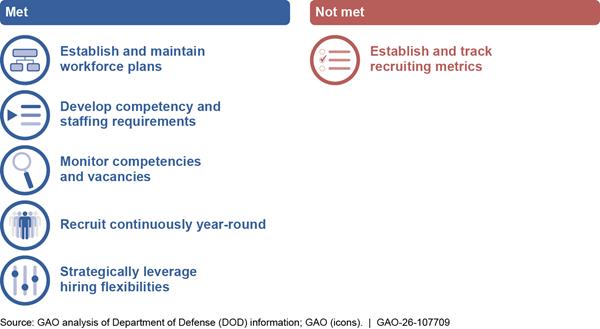
The military services met five out of six leading practices for recruiting JROTC instructors such as monitoring instructor vacancies and recruiting year-round, but did not consistently establish or track metrics. Establishing standardized metrics would better position the military services to evaluate the effectiveness and the success of JROTC recruiting efforts across the entire JROTC program.
Assessment of How Military Services Met Leading Practices for Recruiting Junior Reserve Officers’ Training Corps (JROTC) Instructors
Neither DOD nor the Department of Homeland Security (DHS) are positioned to determine the effectiveness of the new JROTC instructor pay scale on JROTC instructor recruiting and retention without a plan and metrics to evaluate its effectiveness. For example, JROTC instructors GAO spoke to or surveyed had mixed opinions about the new JROTC pay scale, including concerns that the pay scale was lower than the legacy pay scale in their high cost of living areas. Defining metrics to evaluate the new pay scale would provide the military services with improved oversight and visibility about the effectiveness of the new pay scale in supporting JROTC program goals, to include recruiting and retaining JROTC instructors.
Why GAO Did This Study
The military services—Army, Air Force, Navy, Marine Corps, and Coast Guard—under DOD and DHS are responsible for recruiting and certifying JROTC instructors. Legislation expanded eligibility requirements for JROTC instructors in fiscal year 2023 and modified the JROTC pay system in fiscal year 2024 to help the military services address challenges recruiting JROTC instructors.
The Senate Report 118-58 accompanying a bill for the National Defense Authorization Act for Fiscal Year 2024 includes two provisions for GAO to review the JROTC program. This report evaluates the extent to which 1) the military services followed leading practices for recruiting; and 2) the new JROTC instructor pay scale supports recruitment and retention needs, among other issues.
GAO interviewed agency officials and reviewed DOD and military service policy and guidance for the JROTC programs. GAO also conducted a survey of 95 JROTC instructors and received 46 responses for a response rate of 47 percent. The results of this survey are not generalizable. GAO also interviewed JROTC instructors at 28 high schools that were selected based on military service and geographic representation.
What GAO Recommends
GAO is making seven recommendations, including that the military services develop an evaluation plan for JROTC instructor recruiting efforts and that DOD and DHS update guidance to better evaluate the effects of the new JROTC instructor pay scale on recruitment and retention. DOD did not comment. DHS concurred with GAO’s recommendations.
|
Abbreviations |
|
|
|
|
|
DOD |
Department of Defense |
|
DHS |
Department of Homeland Security |
|
JROTC |
Junior Reserve Officers’ Training Corps |
|
JSIPS |
JROTC Standardized Instructor Pay Scale |
This is a work of the U.S. government and is not subject to copyright protection in the United States. The published product may be reproduced and distributed in its entirety without further permission from GAO. However, because this work may contain copyrighted images or other material, permission from the copyright holder may be necessary if you wish to reproduce this material separately.
January 26, 2026
The Honorable Roger F. Wicker
Chairman
The Honorable Jack Reed
Ranking Member
Committee on Armed Services
United States Senate
The Honorable Mike Rogers
Chairman
The Honorable Adam Smith
Ranking Member
Committee on Armed Services
House of Representatives
The Junior Reserve Officers’ Training Corps (JROTC) is a federally funded program[1] for high school students administered by the military services with the goal of instilling high school students with the values of citizenship, service to the United States, and personal responsibility.[2] In 2025, there were more than 3,400 JROTC units with over 6,000 instructors across all 50 states and in Department of Defense (DOD) schools overseas.[3] The military services are responsible for recruiting and certifying JROTC instructors. However, the military services have experienced difficulties in recruiting instructors for the JROTC program. To help address these difficulties, the James M. Inhofe National Defense Authorization Act for Fiscal Year 2023 expanded the eligibility requirements for JROTC instructors, requiring fewer years of military service, and the National Defense Authorization Act for Fiscal year 2024 modified their pay system.[4]
In fiscal year 2025, Congress appropriated over $400 million to support the JROTC program.[5] The relevant funding is made available to the military services which, in turn, decide how to fund their individual JROTC programs. The military services reimburse school districts half of the minimum instructor pay and provide additional funding to individual JROTC units for equipment, uniforms, and activities. Individual JROTC units participate in many kinds of activities including physical and academic competitions, community service, and field trips. Funding for these activities comes from a variety of sources including the military services, local schools, and donations to the JROTC units.
Senate Report 118-58, accompanying a bill for the National Defense Authorization Act for Fiscal Year 2024 includes two provisions for us to review the JROTC program.[6] This report examines the (1) extent to which the military services’ recruitment of JROTC instructors follow leading practices for recruiting; (2) extent to which the new JROTC instructor pay scale supports recruiting and retention needs; and (3) types of activities JROTC units participate in and how they fund these activities.
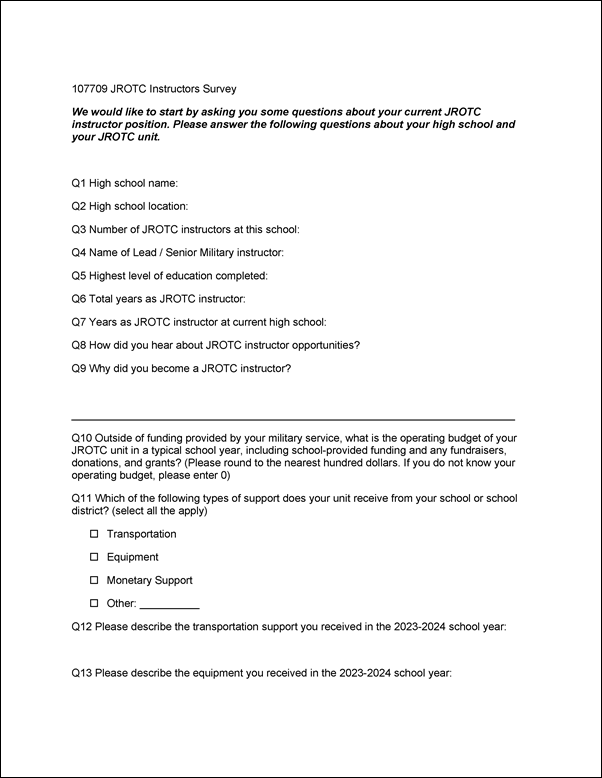
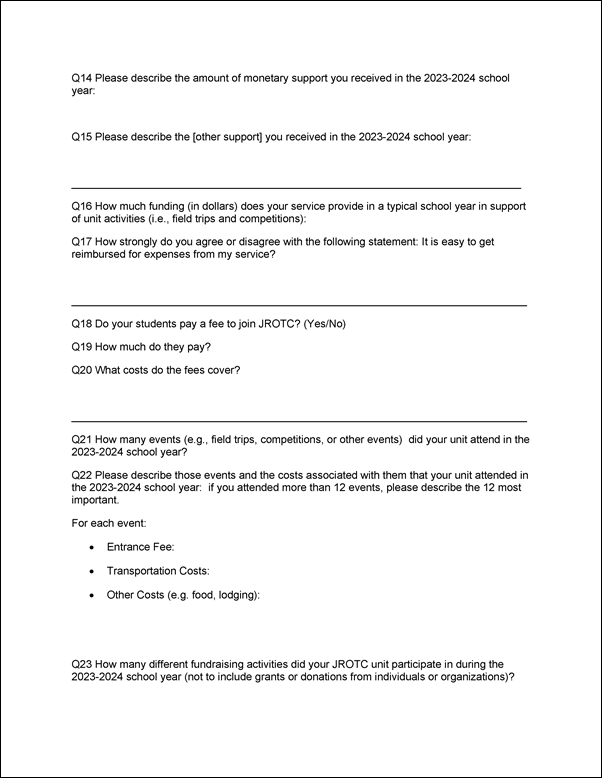
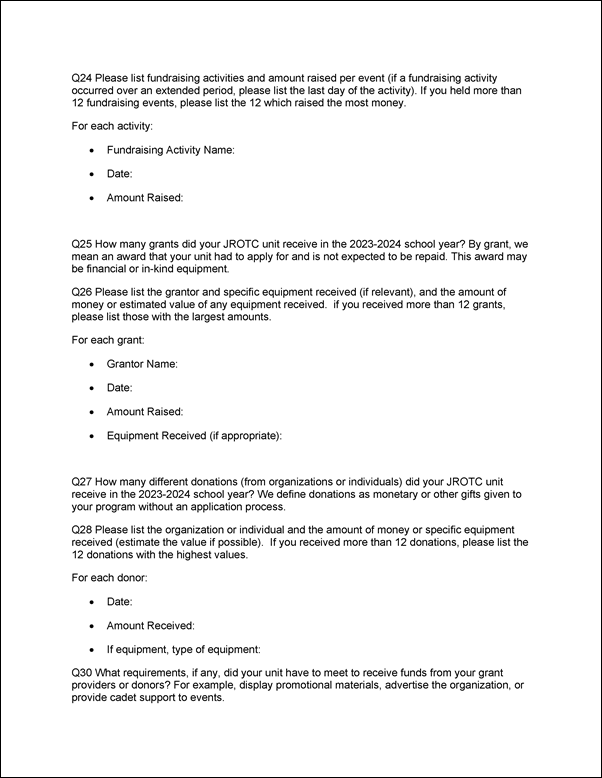
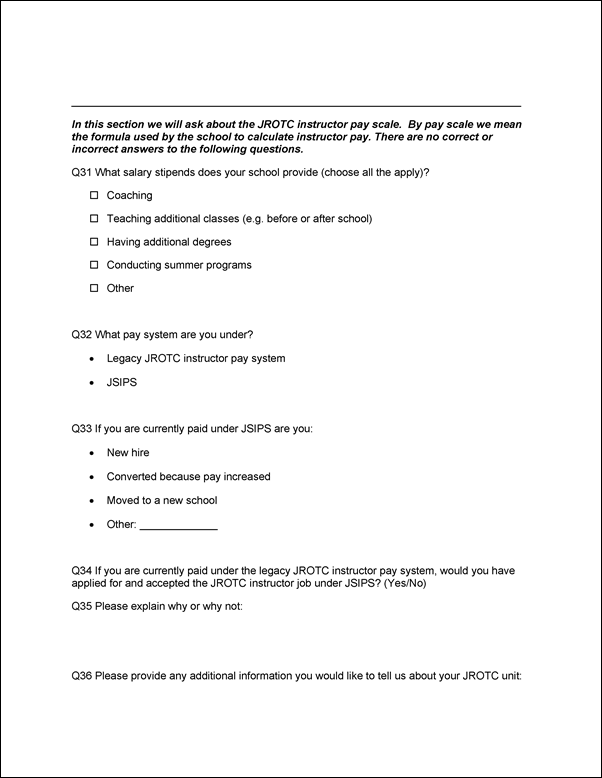
To address these objectives, we reviewed DOD and military service guidance on the administration of the JROTC program, including regulations regarding fundraising activities. We interviewed DOD and military service officials responsible for the oversight of the JROTC program. We compared the military services’ recruiting activities to leading practices for recruiting.[7] We interviewed JROTC instructors at 28 JROTC units, including site visits to 16 of those high schools with JROTC units. We selected these schools based on a mixture of military service and geographical representation. In addition, we conducted a survey of 95 JROTC instructors to obtain their views on the operation of their individual JROTC units, including the funding for their JROTC units’ activities. We received responses from 46 of these instructors for a response rate of 47 percent. Due to our small population and low response rate, the results of this survey are non-generalizable. We analyzed the information collected through our interviews and surveys to identify themes. Appendix I has further information about our scope and methodology. Our survey questions are reprinted in Appendix II.
We conducted this performance audit from July 2024 to January 2026 in accordance with generally accepted government auditing standards. Those standards require that we plan and perform the audit to obtain sufficient, appropriate evidence to provide a reasonable basis for our findings and conclusions based on our audit objectives. We believe that the evidence obtained provides a reasonable basis for our findings and conclusions based on our audit objectives.
Background
Overview of the JROTC Program
The Junior Reserve Officers’ Training Corps is a federally funded program of instruction for high school-aged students conducted by the military services. Congress annually appropriates JROTC funds as part of DOD’s operation and maintenance and military personnel budget. Beyond reimbursing a portion of instructor salaries, the military departments also fund uniforms, cadet travel, training aids, textbooks, education materials, and other unit operating expenses. Schools provide classroom space, facilities, and administrative support for the unit as well as a portion of instructor salaries. In addition, as discussed later in this report, individual JROTC units may receive funds from donations, grants, and fundraising.
The purpose of JROTC is to instill in students in the United States secondary educational institutions the values of citizenship; service to the United States (including an introduction to service opportunities in military, national, and public service); and personal responsibility and a sense of accomplishment.
JROTC instructors are typically retired or reserve officers and enlisted noncommissioned officers. School districts hire instructors directly and the military services provide oversight of the program. Instructors are required to meet certain requirements set by the military service, as well as policies set by their host schools. Generally, schools with JROTC units employ a minimum of two instructors, with one officer (Senior Military Instructor) and one enlisted servicemember (Junior Military Instructor).
JROTC classes are taught over a 3-to-4-year period on topics such as leadership, ethics, civics, history, and health and wellness. The National Defense Authorization Act for Fiscal Year 2020 authorized adding instruction in science, technology, engineering and mathematics fields.[8] The JROTC curriculum also includes service-specific courses such as Aerospace Science and Seamanship and Navigation. Table 1 provides the number of JROTC units and instructors for each military service for the 2025 – 2026 school year.
Table 1: Junior Reserve Officers’ Training Corps (JROTC) Units and Instructors by Military Service, 2025 – 2026 School Year
|
Military service |
Number of |
Number of |
|
Army |
1,754 |
3,569 |
|
Navy |
583 |
1,148 |
|
Marine Corps |
248 |
500 |
|
Air Force |
804 |
1,459 |
|
Space Forcea |
10 |
20 |
|
Coast Guard |
16 |
30 |
|
Total |
3,415 |
6,726 |
Source: GAO analysis of military service information. | GAO‑26‑107709
Note: A JROTC unit is a group of JROTC students and faculty at one high school.
aSpace Force JROTC units are managed by the Air Force.
JROTC Program Structure
In 2025, the JROTC program had an enrollment of about 490,000 cadets in about 3,400 JROTC units in all 50 states and at DOD schools overseas representing each military service. Most JROTC units are in public schools (about 99 percent) while several dozen JROTC units exist within private schools or military academies (about 1 percent). Figure 1 shows the percentage of public high schools with a JROTC unit by state.
Figure 1: Percentage of Public Schools with Junior Reserve Officers’ Training Corps (JROTC) Programs, as of December 2024
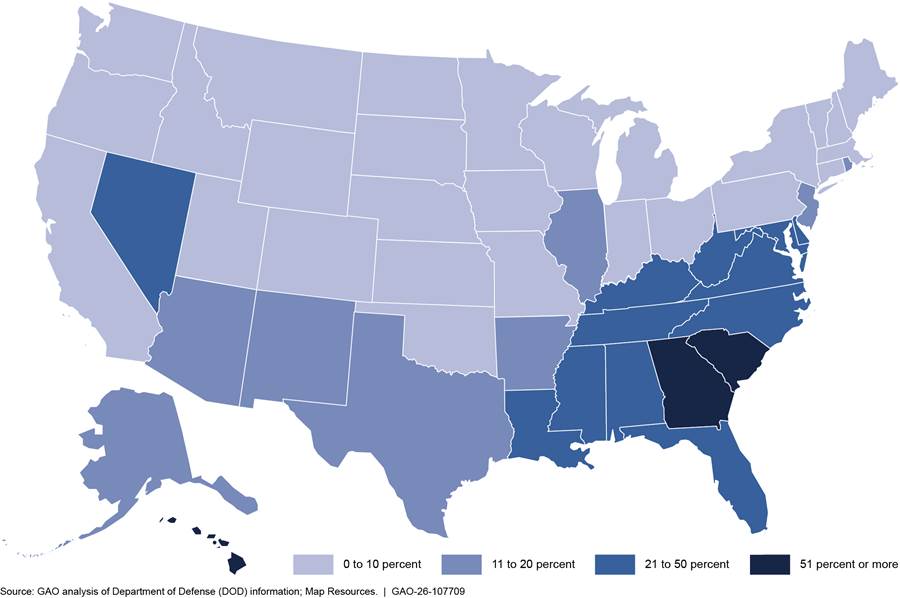
Note: For the purpose of this graphic, private schools were removed from the total number. Of the over 3,400 JROTC units, fewer than 40 are at private schools.
JROTC Program Roles and Responsibilities
The JROTC program operates through a structured chain of oversight. The Assistant Secretary of Defense for Manpower and Reserve Affairs sets broad policy and ensures alignments with DOD priorities in youth education. The individual military services are then responsible for administering their individual JROTC programs through various forms of administrative and financial oversight. The military services’ regional directors and the states’ school districts share support of programs in their respective geographical areas through their administrative, operational and financial management roles. At the school level, JROTC instructors are school employees who are directly responsible for day-to-day instruction of cadets. Together, this structure supports the implementation of the JROTC objectives for high school students. Additional roles and responsibilities for each level are further highlighted in figure 2.
Figure 2: Key Responsibilities of Junior Reserve Officers’ Training Corps (JROTC) Program Stakeholders
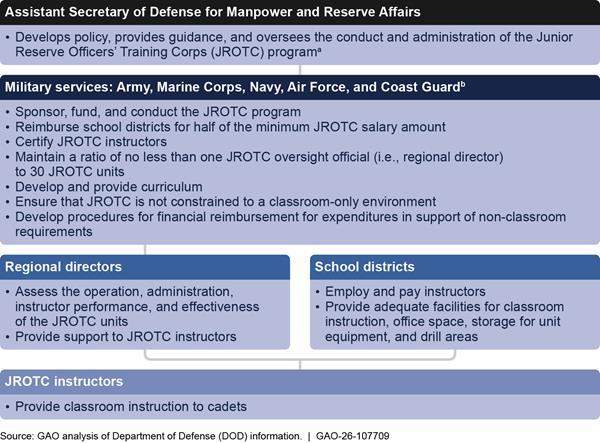
aCoast Guard JROTC falls under the purview of the Commandant of the Coast Guard as delegated by the Secretary of Homeland Security.
bThe Air Force is also responsible for oversight of the 10 Space Force JROTC units.
Recent Statutory Changes to JROTC Programs
The National Defense Authorization Act for Fiscal Year 2023 changed the eligibility requirements for hiring qualified JROTC instructors and the National Defense Authorization Act for Fiscal Year 2024 modified the instructor pay system.[9]
JROTC Instructor Eligibility
Prior to 2023, JROTC instructors had to be current officers or noncommissioned officers or retired officers or noncommissioned officers with at least 20 years of active-duty service. In 2023, eligibility expanded to also include officers and noncommissioned officers who were honorably discharged after completing at least 8 years of military service as well as members participating in active status in the reserves and not yet eligible for retirement pay. However, the Army and the Air Force require their instructors to have at least 10 years of military service.[10] Army and Air Force officials told us this is to ensure that the former servicemembers have the necessary maturity to serve as JROTC instructors. In addition, DOD expanded background check requirements for potential JROTC instructors, with guidance now requiring the military services to conduct a Tier 1 Child Care Investigation for Non-Sensitive Positions for potential JROTC instructors.[11] DOD added this background check requirement to its JROTC policy in 2024, though the Army and Air Force were already conducting these background checks on all JROTC instructors. However, the Navy and Marine Corps conducted less stringent or no background checks on prospective instructors prior to 2024.
JROTC Instructor Pay System
DOD also changed the JROTC Instructor Pay System to reference the General Schedule pay system rather than the military retirement pay system. The new system, called the JROTC Standardized Instructor Pay Scale (JSIPS), accounts for new instructors potentially not receiving retirement pay because they may have served only 8 years in the military rather than the 20 years that would be required to receive retirement pay.[12] For example, prior to 2024, instructors received teaching wages based on their military retirement pay. Under this legacy pay system, JROTC instructor pay was calculated as the difference between an instructor’s pension and his or her active-duty pay. However, instructors hired under expanded eligibility requirements may not be eligible for retirement pay. Therefore, the services needed a way to reflect that in the pay scale.
Military Services Met Most Leading Practices for Recruiting JROTC Instructors but Did Not Establish or Track Metrics
We found that the military services met five out of six leading practices for recruiting staff to attract and retain JROTC instructors based on information the military services gave us on their recruiting activities.[13] For example, officials said DOD developed competency and staffing requirements with the newly expanded eligibility added by statute for fiscal year 2023, which made it easier to recruit instructors.[14] However, we found that military services did not fully establish or track metrics to measure effectiveness of their recruiting efforts. Our assessment of the steps the military services are taking to implement leading practices for recruiting is shown in Figure 3.
Figure 3: Assessment of How Military Services Met Leading Practices for Recruiting Junior Reserve Officers’ Training Corps (JROTC) Instructors
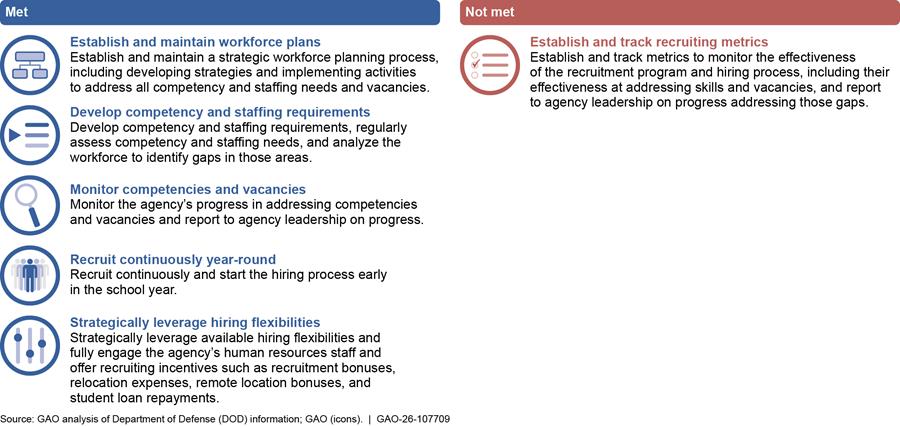
Note: These leading practices are described in GAO, State Department: Additional Actions Needed to Address IT Workforce Challenges, GAO‑22‑105932 (Washington, D.C.: July 12, 2022).
The Military Services Met Five out of Six Leading Practices for Recruiting JROTC Instructors
We found that each of the military services are taking steps to implement five out of the six leading practices for recruiting. Specifically:
Establish and maintain workforce plans. DOD Instruction 1205.13 establishes policy, assigns responsibilities, and provides procedures for the organization and administration of the JROTC program, including guidance on instructor qualifications such as instructor eligibility.[15] Although the Department of Homeland Security (DHS) has delegated authority to the Coast Guard to establish and maintain a Coast Guard JROTC program, it has adopted the same operating principles outlined in DOD guidance, specifically referencing DOD Instruction 1205.13 as part of its guidance, and regularly coordinating with the other military services and DOD.[16] Similar to DOD, the Coast Guard guidance outlines the instructor eligibility requirements, such as military service requirements, for Coast Guard JROTC instructors, among other things.
Each of the five military services—the Army, Navy, Air Force, Marine Corps, and Coast Guard—have created individual guidance documents that provide operational guidance for their respective JROTC programs to align with DOD guidance. For example, the Army has several guidance documents including a program guide for administrators that clearly describes mission philosophies, instructor management, pay, contracts and responsibilities for school districts interested in beginning an Army JROTC program.[17] In addition, the Army has also developed a JROTC strategic plan with the goal of attracting quality instructors by maximizing expanded eligibility and JSIPS, broad instructor marketing, and enhancing training and certification. The Navy and the Marine Corps also have guidance that define responsibilities for supporting the JROTC programs and provide information on instructor qualifications.[18] Further, the military services regularly update their web pages with information about instructor vacancies.
Develop competency and staffing requirements. With the recent changes in instructor eligibility requirements, the military services have had to update recruitment processes and increase communication about expanded instructor availability. Some of the military services told us they have set hiring goals and implemented recruitment activities to meet those goals. For example, Marine Corps officials told us their hiring goal is to have 100 percent of all JROTC instructor positions filled. Marine Corps officials said they use a variety of resources such as quarterly meetings and monetary incentives to support this goal. Air Force officials also told us they have a goal of filling 100 percent of their instructor positions and, as of June 2025, the Air Force has 1,459 total JROTC instructors out of 1,741 positions, or about 84 percent of positions filled. Officials noted that new JROTC instructors typically start in July and August and that June is the lowest staffing point of the year.
According to Air Force officials, in response to additional applicants in the process, the Air Force is working to speed up the background check process to meet demand. Air Force officials told us to support their goal of shorter wait times, the Air Force has also implemented a provisional certification that allows JROTC instructor applicants to work under a probationary period while waiting for background checks to be completed. A Navy official said the Navy also updated its instructor recruitment process in September 2024 to occur at the regional director level instead of Navy JROTC headquarters, allowing the JROTC instructor recruitment process to be more targeted and refined due to regional directors working closely with schools in their area.
Furthermore, the military services have updated their respective websites with information about expanded eligibility requirements for JROTC instructors. Each military service website displays JROTC instructor competencies and staffing requirements and outlines the specific qualifications needed to become a JROTC instructor, such as years of service and demonstrated leadership experience. Some of the websites also detail expectations regarding JROTC instructor roles including teaching responsibilities, mentoring students, and maintaining program standards.
Monitor competencies and vacancies. Each of the military services track JROTC instructor vacancies through individual database systems and regularly post JROTC instructor vacancies on their respective JROTC websites, with links to application materials. For example, Army officials said they maintain data on personnel records and training records for JROTC instructors through the Army’s JROTC Information Management System. Further, they access data on JROTC instructor vacancies every Monday and use this information to post vacancy announcements to Army websites. Air Force officials told us the Air Force has an internal database called WINGS that the Air Force uses to monitor the application status of potential JROTC instructors as well as information about individual JROTC units. Air Force officials told us they regularly use this database to summarize information and brief leadership on the status of JROTC units. Marine Corps officials told us they monitor instructor vacancies almost daily and maintain a list of certified instructors to share with schools for recruitment purposes.
To monitor competencies for JROTC instructors, the military services provide certification courses for their instructors. Instructors are required to complete most of these courses within a certain timeframe—typically within 6 to 18 months of hiring. For example, the Army requires resident certification training for all JROTC instructors that must be completed within the first 18 months of hire. In addition, the Army requires mandatory recertification for instructors every 5 years. The Army issues a 6-month probation letter to instructors for failure to attend the course.
Support continuous recruiting efforts year-round. Although instructors we spoke to at 14 out of 28 JROTC units and 19 out of 46 instructors we surveyed told us they heard about the JROTC instructor position from a friend or colleague, service officials told us about their many ongoing recruiting efforts. We found that the military services support continuous recruiting efforts year-round by traveling to in-person recruiting events, visiting guard and reserve bases, participating in retirement briefings, leveraging online resources, and partnering with the SkillBridge program, as well as continually updating their JROTC websites as discussed above. For example:
· A Navy official told us the Navy has traveled to the Navy Career Development Symposiums to speak with sailors about JROTC instructor opportunities. These events take place throughout the year at various Navy installations and are designed to help sailors manage their careers. Though the focus of these events is not typically post-military opportunities, Navy officials told us these events have been helpful to inform potential applicants of JROTC instructor opportunities, as some sailors attending the seminar will be leaving military service soon.
· Marine Corps officials told us they have been working to inform reservist Marines of the change in the eligibility for JROTC instructors since reservists are now eligible to apply. As part of this effort, Marine Corps officials have attended Independent Ready Reserve check-ins to speak to reservists about becoming JROTC instructors. However, officials told us the return on investment for these visits was minimal and they are looking for other opportunities to raise awareness about JROTC instructor positions.
· Air Force officials told us that in the summer of 2024, they hired three recruiters for the JROTC program to visit Air National Guard and Air Reserve bases in the United States to create awareness of the JROTC program. Originally, the Air Force had planned to visit all Air National Guard and Air Reserve bases by May 1, 2025. However, according to Air Force officials, due to a restriction on civilian travel, the recruiters were not able to meet this goal as travel was paused from March 2025 to June 2025.[19] Air Force officials told us if there are no more travel restrictions or funding issues then they should be able to visit all the bases by March 2027, depending on the drill schedules for individual bases.
|
DOD Transition Assistance Program The Transition Assistant Program led by About 200,000 service members transition from active duty to civilian life every year. To assist with this transition, the Transition Assistance Program has service members begin the mandatory transitioning process 365 days prior to their separation or retirement date. The Transition Assistance Program courses generally consist of individualized pre-separation counseling, educational briefings, as well as instruction on employment, vocational training and higher education. Source: GAO analysis of Department of Defense |
· Military service officials told us they have been working to get information about JROTC instructor opportunities into the Transition Assistance Program briefings, which provide information and training to help servicemembers transition out of military service (see sidebar). Transition Assistance Program briefings take place year-round at various military installations and are also available online. Specifically, some military service officials told us they have been able to add slides about JROTC instructor opportunities into the Transition Assistance Program briefings and have been able to attend some briefings in person to speak with service members. Air Force and Marine Corps officials told us they are more likely to be able to participate in the Transition Assistance Program briefings if they have a personal relationship with the installation commander.
|
DOD SkillBridge Program The Department of Defense’s (DOD) SkillBridge program is an opportunity for service members to gain civilian work experience through industry specific training, apprenticeships, and internships during the last 180 days of military service. This program, launched in 2014, facilitates the transition of separating and retiring servicemembers by connecting transitioning service members with industry partners through real-world job experiences. Through the SkillBridge program, servicemembers can intern alongside experienced JROTC instructors. DOD covers military pay and benefits during the servicemember’s time in the SkillBridge program. Source: GAO analysis of Department of Defense |
· Air Force, Coast Guard, and Army officials told us they utilize the SkillBridge program to provide opportunities for active-duty service members who are close to retirement to gain civilian work experience through internships as JROTC instructors.
· Coast Guard officials told us the Coast Guard has hired a JROTC instructor administrator whose responsibilities include managing the Coast Guard JROTC website and social media account with a focus on recruitment efforts. Marine Corps officials told us they utilize Marine Online, the Marine Corps’ system for managing administrative records, to publicize JROTC instructor opportunities.
Strategically leverage hiring flexibilities. DOD guidance outlines how the military services may use specific hiring tools such as monetary incentives and employment contracts to fill certain hard-to-fill positions.[20] In addition, the military services can be flexible on certain instructor requirements. For example:
· A Navy official told us the Navy can utilize exemption waivers to allow some individuals to become JROTC instructors who do not meet all the qualifications. For example, the Navy can provide a waiver to some individuals who have been out of the Navy for more than 5 years. In addition, typically only officers are eligible for the senior instructor position in JROTC, but according to Navy officials, the Navy can allow an enlisted service member to be hired for the senior JROTC instructor position.
· Marine Corps officials told us they can provide monetary incentives, including covering moving expenses, for JROTC instructor positions that have been designated as hard to fill. These officials told us hard-to-fill positions tend to be in Alaska or other extremely rural locations as well as in inner-city schools.
· An Army official told us the Army will specifically provide an additional month of minimum instructor pay as a bonus for hard-to-fill locations and will continue this bonus annually if the school remains categorized as a hard-to-fill location.[21]
· Although Coast Guard guidance allows for relocation assistance for JROTC instructors who relocate to fill hard-to-fill locations, Coast Guard officials told us the Coast Guard has not needed to use them thus far.[22] The officials further stated they encourage JROTC instructors to negotiate with their respective schools for pay above the JROTC instructor minimum pay or for longer contracts to receive pay throughout more months of the fiscal year.
The Military Services Do Not Consistently Track Recruiting Metrics
The military services have taken multiple steps to implement five of the six leading practices for recruiting JROTC instructors. However, we found that the military services have not taken steps to track and measure the effectiveness of their recruiting efforts, including establishing metrics as part of an evaluation plan. Some of the military services track recruitment information, including where applicants discover information about the job and how successful their recruitment outreach efforts are for employment. However, these efforts are incomplete. For example:
· An Army official told us the Army maintains data on personnel and training records for instructors in the JROTC Information Management System. The Army can run reports on JROTC instructor vacancies and certification, cadet enrollments, and probation reports, among others. An Army official told us he uses these reports to brief leadership weekly on the status of the JROTC program. This official further noted that the JROTC Information Management System was in the process of being updated to create additional reports, such as instructor forecasting to track pending losses of JROTC instructors, which could be used for better oversight of the program. However, funding for the JROTC Information Management System has recently been cut to meet budget priorities and the contract may be ended altogether. According to an Army official, if this contract is ended, the Army will no longer be able to run any reports on the JROTC program.
· A Navy official told us the Navy adopted a computer program called the Civilian Development Management Information System in 2015 to help create and track all documents for JROTC instructors. However, according to Navy officials, the Civilian Development Management Information System was considered outdated when adopted. Due to this, JROTC staff cannot upload documents, verify the total number of instructor positions, check how long a school has had a JROTC instructor vacancy, or track instructor applicants. Navy officials told us this makes analyzing data about JROTC instructor recruitment efforts or applications challenging, as headquarter staff must manually gather all the data.
· Air Force officials told us they do not track how many people they have reached with recruiting efforts, but they do track everyone who has started a JROTC instructor application and completed the certification process, including a background check. In addition, Air Force officials told us they track data on SkillBridge utilization and conversion to full-time JROTC instructor. As of July 2025, the Air Force had 361 service members complete JROTC-related SkillBridge internships, with 173 of those service members being hired as JROTC instructors since July 2023.
· Marine Corps officials told us the application to become a JROTC instructor asks where the applicant heard about the position. Officials told us they gather and maintain this information electronically, but they do not currently have a plan to use this information to evaluate recruiting efforts.
· Coast Guard officials stated the Coast Guard does not have a dedicated information system to collect and track data, such as the programs used by some of the other military services. Instead, the Coast Guard JROTC headquarters staff use various Microsoft Office applications, such as Excel and Teams, and store the files in their unit SharePoint. Coast Guard officials stated this is sufficient for oversight given the relatively small size of the program.
Leading practices for recruiting state that organizations should establish and track metrics to monitor the effectiveness of the recruitment program and hiring process.[23] While DOD provides overall policy and administration for the JROTC program, each military service sponsors, funds, and conducts its own JROTC program.[24] To that end, each military service has developed guidance for implementing their respective JROTC programs. Military service officials told us they are collecting information on their JROTC instructor recruiting efforts; however, they have not developed a plan, including a standardized set of metrics, to evaluate these efforts. DOD and military service officials told us it is too soon to evaluate the impact of new JROTC instructor recruiting efforts since the changes to eligibility were implemented in 2024, but they plan to do so in the future. Establishing an evaluation plan with a standardized set of metrics would better position the military services to evaluate the effectiveness and ensure the success of JROTC recruiting efforts across the entire JROTC program.
It Is Too Soon to Determine the Effect of the New JROTC Instructor Pay Scale on Instructor Recruitment or Retention
It is too soon to determine the effect of JSIPS on recruiting and retention because the 2024 through 2025 school year is the first year with instructors under JSIPS. There are currently two pay systems for JROTC instructors—the legacy pay system and JSIPS. In March 2024, DOD issued a memo with implementing instructions for JSIPS.[25] The Army, Air Force, Marine Corps, and Coast Guard implemented JSIPS in 2024 according to military service officials. The Navy implemented JSIPS in July 2025.[26] All JROTC instructors hired since JSIPS implementation, apart from some instructors hired for Navy JROTC programs, are being paid under JSIPS.
According to military service officials, as of June 2025, about half of JROTC instructors are paid under JSIPS, with the remaining half staying under the legacy pay system.[27] When JSIPS was implemented in July 2024, the military services placed existing JROTC instructors either in the legacy pay system or JSIPS. Military service officials told us they analyzed JROTC instructors’ pay and placed them in the pay system that gave them the highest salary. JROTC instructors under the legacy pay system will remain in that pay system unless they move to a new school.
Under both the legacy pay system and JSIPS, schools are required to pay the JROTC instructor’s salary, and the military services are required to reimburse schools 50 percent of the minimum instructor pay. Because JROTC instructors are hired and paid directly by the school districts, individual JROTC instructor pay can vary because JROTC instructors may negotiate their contracts with the schools and schools may pay over the minimum salary. For example, some JROTC instructors told us they were placed on the teacher pay plan in their district and received regular raises like the other teachers, making their pay higher than the JROTC minimum instructor pay. In addition, we found that some schools pay instructors additional stipends to JROTC instructors. For example, because JROTC instructors typically stay after school to supervise JROTC team practices, schools may pay a coaching stipend.
Schools may also pay an additional stipend to a JROTC instructor for having an advanced degree or teaching additional classes before or after school. Out of the 45 JROTC instructors who responded to our survey question asking if they receive a stipend in addition to their regular salary, 33 stated that they received one or more type of stipend from their school (respondents were asked to select multiple stipends if they received more than one), with 24 of those receiving a coaching stipend. In addition, JROTC instructors who responded to our survey reported receiving stipends for teaching additional classes (6), having additional degrees (14), and conducting summer activities (7).
Under the legacy pay system, a JROTC instructor’s pay was individualized and was calculated based on the difference between the active-duty pay the JROTC instructor would receive if recalled to active duty and the JROTC instructor’s retired pay entitlement. Figure 4 below shows the JROTC instructor pay under the legacy pay system for a hypothetical retired Lieutenant Colonel who was on active duty at Fort Benning, Georgia.
Figure 4: Hypothetical Example of Junior Reserve Officers’ Training Corps (JROTC) Instructor Pay under the Legay Pay System for a Retired Lieutenant Colonel
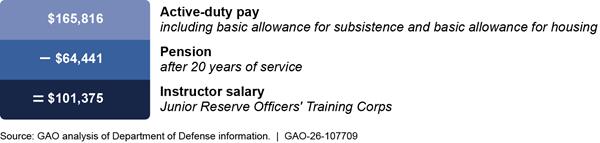
Because new JROTC instructors hired under expanded eligibility may not be receiving retirement pay, DOD had to change the way that JROTC instructor pay was determined. According to DOD, DOD and the military services jointly designed and approved JSIPS to account for the new categories of eligible instructors. JSIPS aligns with the General Schedule pay system rather than the military retirement pay system, providing standard pay ranges based on education and locality. Figure 5 below shows hypothetical examples of pay for JROTC instructors under JSIPS in the Atlanta, Georgia area.
Figure 5: Hypothetical Examples of Junior Reserve Officers’ Training Corps (JROTC) Instructor Pay under the JROTC Instructor Pay System (JSIPS) Compared with a Public School Teacher in Atlanta, Georgia, for the 2024-2025 School Year

The legacy JROTC pay system would cost more over time as DOD implements its new Blended Retirement System. The legacy JROTC pay system was designed to make sure that JROTC instructors’ pay plus their retirement pay was equal to their active-duty pay. However, DOD implemented the Blended Retirement System for all service members starting in January 2018, which will decrease retirement pensions for retirees. Therefore, the military services would have to contribute more funding to make up the difference of the Blended Retirement System’s lower pension so that instructors are paid equal to their active-duty pay. For example, the Army estimated that the Blended Retirement System would increase its JROTC instructor pay requirement by about $19.7 million per year for legacy pay instructors.
On the other hand, JSIPS is based on rank and education and aligns with the General Schedule pay scale. Military service officials told us they expect JSIPS to save money over time by standardizing salaries and separating calculation of instructor pay from retirement pay. With expanded eligibility, JROTC instructors are no longer required to be retired from military service and therefore would not necessarily be receiving a pension. According to an Army analysis, in the short term, the military services will have higher costs to implement JSIPS as it will increase pay for some current JROTC instructors. This Army analysis also showed that over the long-term, the services will save money as the legacy pay system gets phased out. For example, the Army estimated that converting to JSIPS would save $9.7 million over 20 years as JROTC instructors under the legacy pay system retire from teaching.
JROTC instructors that we spoke to or surveyed had mixed opinions about JSIPS. For example, several JROTC instructors expressed concerns that the JSIPS pay scale was lower than the legacy pay scale in their high cost of living area and that it would be difficult to recruit JROTC instructors under JSIPS, especially experienced senior officers. JROTC instructors that we spoke to in rural areas were more likely to be paid more under JSIPS and therefore were happy with the change. For example, one instructor in a rural area told us he received a pay raise under JSIPS and that his new higher salary is very good for the area in which he lives. Further, in our survey, we asked JROTC instructors under the legacy JROTC pay system if they would have applied for and accepted the job under JSIPS. Fifty percent of respondents to this question stated that they would have applied for and accepted the JROTC instructor job under JSIPS, while 50 percent stated that they would not have. JROTC instructors who would not accept the position under JSIPS cited significant decrease in pay as the main deterrent.
Standards for Internal Control in the Federal Government state that management should establish and operate monitoring activities to monitor the internal control system and evaluate the results.[28] This includes establishing a baseline, monitoring, and then evaluating the results. The baseline is the current state of the program that can be compared against the program’s goals. Given the newness of JSIPS, it is too soon to determine the effect of the system on recruiting and retaining JROTC instructors. However, establishment of a baseline is an important step in monitoring the effectiveness of JROTC instructor recruiting efforts. Once established, management can use the baseline to evaluate progress of the program. Currently, DOD and DHS are not positioned to determine the effects of JSIPS on recruiting and retention in the coming school years because current JROTC guidance does not include plans and metrics for evaluating the effects of the pay scale on instructor recruitment and retention.
Because DOD’s current instruction on JROTC precedes the implementation of JSIPS, it does not include the development of a plan or metrics to evaluate JSIPS. Further, the DOD memo implementing JSIPS does not include a plan or metrics for evaluating JSIPS. A DOD official stated that DOD is currently reviewing and updating the DOD Instruction that covers JROTC and that he has considered adding language relating to the evaluation of JSIPS. In addition, the Coast Guard’s guidance on JROTC does not include a plan or metrics for evaluating JSIPS. Coast Guard officials told us they recently updated their JROTC Standard Operating Procedures, and since their program is relatively new, they will likely update them again soon. Both DOD and Coast Guard officials told us they see the importance of evaluating the effect of JSIPS on the program’s ability to recruit and retain JROTC instructors in the future. With a plan for evaluating JSIPS with defined metrics, the military services can improve oversight and visibility about the effectiveness of the new pay scale in supporting JROTC program goals, especially recruiting and retaining JROTC instructors.
JROTC Units Participate in a Variety of Activities and Use a Combination of Funding Sources
Individual JROTC units choose to participate in a variety of activities, including competitions and field trips, and fund their respective programs through a combination of military service funding; school support; and fundraising, grants, and donations.
JROTC Units Participate in a Variety of Activities
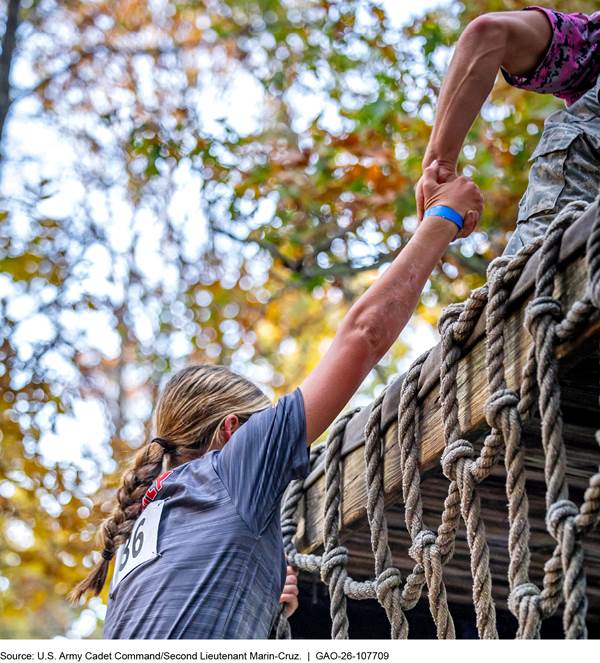
JROTC units engage in a variety of activities designed to develop leadership, discipline, and citizenship, and these activities are selected based on factors including cadet interest, school support, and available funding. JROTC instructors that we spoke with and surveyed told us about the various types of activities that their JROTC units participate in such as team competition events (i.e., marksmanship, drill team, or physical fitness); field trips; and community service activities. JROTC instructors we met with told us one popular physical fitness activity is the Raider competition, which is a team physical fitness challenge focused on individual strength and teamwork. Figure 6 shows students competing at the National Raider Challenge.
Figure 6: Junior Reserve Officers’ Training Corps (JROTC) Cadets Participate in the National Raider Challenge, Fort Knox, Kentucky, October 2024
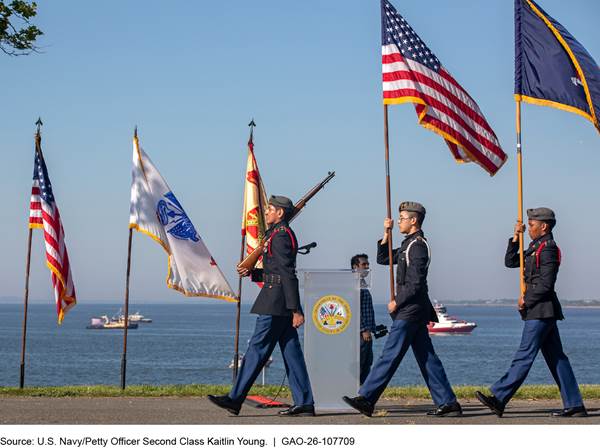
Another popular activity among JROTC instructors that we spoke to or surveyed was JROTC unit color guard. The Color Guard is a team of JROTC cadets that presents the U.S. flag at events such as school assemblies, sporting events, or local community activities. Figure 7 below shows JROTC cadets presenting the colors during New York Fleet Week in 2024.
JROTC instructors that we interviewed and those that we surveyed also told us field trips are popular among their JROTC units. JROTC instructors also told us about taking their JROTC units to visit military installations, both for their military service and of other military services; universities, both military and non-military; and historical sites. Additionally, JROTC instructors told us their JROTC units do a lot of community service such as conducting food drives, volunteering for the Special Olympics, and laying wreaths at Veterans’ cemeteries.
While individual JROTC units have flexibility in deciding which activities to participate in, military service guidance prohibits JROTC units from participating in political events while in uniform because doing so may imply endorsement of the military service. For example,
· Air Force guidance states that JROTC units will not accept invitations to present colors for any political event and that wearing the JROTC uniform is not authorized while participating in political events.[29]
· Army regulations state that JROTC cadets are prohibited from wearing the Army uniform in connection with the furtherance of any political interests or when attending any meeting or event that is a function of an extremist organization.[30]
· Navy guidance prohibits JROTC instructors from wearing their uniform while engaging in a political activity or activity on behalf of a non-Federal entity, such as a labor union. Further, Navy JROTC cadets may not engage in political activities, private employment, or activities supporting commercial interests while in uniform.[31]
· Coast Guard guidance states that JROTC instructors are not authorized to wear their uniform if engaging in political activity or activity on behalf of a labor union and that cadets may not engage in political activities while in uniform.[32]
JROTC Units Fund Their Activities with a Variety of Sources
Costs for JROTC unit activities vary. For example, JROTC instructors told us local competitions may have nominal or no entrance fees, while regional or national competitions may require travel expenses, including flights and hotels. Because individual JROTC budgets outside of service provided funding vary, ranging from $0 to over $100,000 per school year among the instructors we surveyed, we found that JROTC units use a variety of funding sources to cover the costs for these activities including military service provided funding, school provided funding, fundraisers, and grants and donations.
The Military Services Provide Some Funding for JROTC Units
Each of the military services provide funding for individual JROTC units, though the amount and types of funds provided varies by military service. DOD Instruction 1205.13 states that all services shall sponsor, fund, and conduct the JROTC program for their respective services. The military services provide funding for uniforms, equipment, travel, and events in accordance with service-specific guidance, typically using Operation and Maintenance funds and Military Personnel funds. For example:
· Army guidance specifies expenses that are reimbursable to JROTC units by the Army including JROTC cadet transportation and subsistence, cadet uniforms, and team participation in local co-curricular activities.[33] An Army official told us the Army determines the amount of funds to allocate for national events, such as the JROTC Cadet Leadership Challenges, by planning for about 10 percent of enrolled JROTC cadets to attend the events.[34]
· Air Force officials told us in fiscal year 2025, the Air Force budgeted $220 per JROTC cadet. Air Force officials explained that JROTC units can either receive reimbursement from the Air Force for certain activities or can use a government travel card for certain expenses. Air Force officials told us the JROTC program is underfunded and that they do not want to add any additional JROTC units unless the program is appropriately funded. For example, Air Force officials told us they requested $15 million in fiscal year 2025 for JROTC cadet support but only received $6 million. Several Air Force JROTC units that we spoke with mentioned that they did not receive much funding from the Air Force and had to find other ways to support unit activities.
· Navy officials told us individual JROTC units must pay for their expenses upfront and then submit to the Navy for reimbursement. The amount of money that can be allocated to each JROTC unit is based on the number of cadets enrolled.
· The Marine Corps has procedures for obtaining reimbursement for JROTC unit expenses that are documented in what the Marine Corps refers to as a “Smart Book.” For example, the Smart Book specifies that requests to funding transportation, like bus or air travel, must be submitted 10 weeks in advance and that requests for funding entry fees must be submitted 6 weeks in advance. Marine Corps officials told us costs below $50 are the responsibility of the individual JROTC unit.
· The Coast Guard requires school districts to provide upfront funding for JROTC unit activities and then will reimburse the school districts directly once per quarter. The Coast Guard reimburses school districts for authorized JROTC program expenses including incidental uniform, maintenance, and support costs as well as certain qualifying travel and transportation costs.
JROTC instructors who responded to our survey had mixed opinions on the reimbursement process from their respective military services. Specifically, about 24 percent of instructors who responded to our survey either strongly agreed or agreed with the statement “It is easy to get reimbursed for expenses from my service.” On the other hand, 53 percent of respondents disagreed or strongly disagreed with this statement. JROTC instructors that we spoke with told us about the difficulties they sometimes face when trying to get JROTC unit expenses reimbursed by their respective military service. For example, an instructor at an Air Force JROTC unit told us administrative challenges regarding reimbursements create difficulties for his JROTC unit and that processing errors have led to financial losses for the JROTC unit. Instructors from a Marine Corps JROTC unit told us the reimbursement process from the Marine Corps is slow, and the slow process has led to the JROTC unit not always being reimbursed. A Navy JROTC unit instructor told us the Navy’s reimbursement process for local JROTC events is not challenging but can be more challenging for larger events.
Schools Provide Varied Levels of Support to Their Respective JROTC Units
JROTC instructors that we spoke to and surveyed provided examples of varying levels of support received from their respective schools. JROTC instructors told us school support helped with retention, noting that having support from their school and district administrations was key to their willingness to continue in their JROTC instructor positions.
We found, and several instructors pointed out, that the level of support provided by schools varied widely. Some JROTC instructors told us they received little to no support from their schools in terms of funding and resources, while other instructors told us their schools provided them with transportation, equipment, or monetary support to cover activities. JROTC instructors told us transportation is usually their largest expense. Out of the 46 JROTC instructors who responded to our survey, 38 told us they receive transportation support from their schools, including paying for buses or providing a van for the JROTC unit to use. JROTC units that received transportation support from their schools were able to spend their money on other activities. For example, one JROTC instructor that we interviewed told us his school pays for all transportation for his JROTC unit to competitions, field trips, and other events. Although his total unit budget is around $6,000 per school year, he can take his JROTC unit to about four activities per month because he does not have to pay for transportation to events. On the other hand, another JROTC instructor that we spoke with told us his school does not provide any transportation to his JROTC unit, which limits the activities the JROTC unit can participate in because transportation to a local event costs approximately $480, while transportation to an event a few hours away can cost $4,500.
Some schools also provided support to their JROTC units in the form of equipment. Specifically, 28 instructors that we surveyed stated that they received support from their respective schools with equipment. Equipment provided by the schools included office supplies, classroom furniture, computers, air rifle equipment, and archery equipment.
Twenty-one out of 46 JROTC instructors that we surveyed received money from their schools to use for their JROTC units, ranging from about $1,000 to about $80,000. In addition, JROTC instructors that we interviewed also told us about the money they received from their schools. For example, one JROTC instructor that we interviewed told us his school used the military service’s reimbursement of his salary as a budget for his JROTC unit. An Army JROTC instructor at a private school told us his school provides funding for all the JROTC unit’s needs including uniforms, equipment, facilities, and transportation.
JROTC Units Conduct Fundraising Activities
Almost all JROTC instructors that we spoke to or surveyed told us their JROTC units conducted some type of fundraising to support their activities. Out of the 46 JROTC instructors that we surveyed, 41 told us their JROTC units conducted some kind of fundraising to support their activities, and 24 of the 28 instructors we interviewed also told us their JROTC units conducted fundraising. The amount of money raised by JROTC units that we spoke to or surveyed ranged from under $100 to about $45,000 per school year.
We found that JROTC units conduct a variety of fundraisers. One popular fundraiser among the JROTC units we surveyed or interviewed was using an electronic fundraising platform to solicit donations from friends and family members. JROTC instructors told us this type of fundraiser typically results in a large amount of money raised. Some JROTC instructors told us this type of fundraiser is the only fundraiser they do. Other popular fundraisers include selling snacks at school lunch or sporting events, and selling products, such as cookie dough or beef sticks. Some JROTC instructors also told us their JROTC units did events such as car washes.
We found that fundraising was essential to being able to do the types of activities that draw students to JROTC such as field trips and competitions. In conducting fundraising activities, JROTC instructors must follow guidelines from their school and school district. For example, some JROTC instructors told us that all money from fundraising activities was managed by the school office. Some JROTC instructors that we interviewed or surveyed told us they conduct minimal or no fundraising because of the low income of the school population or the perceived difficulties with managing the funds.
JROTC Units Receive Grants and Donations
In addition to fundraising several JROTC units that we spoke to or surveyed told us they receive money for their JROTC units’ activities through grants and donations. Out of the 46 JROTC instructors that we surveyed, nine stated that their JROTC units received grants for which they had to apply. Examples of grantors included the National Rifle Association; military-related organizations such as the Air and Space Forces Association; and other educational organizations. Several JROTC instructors that we spoke to or surveyed told us they utilize the Midway USA Foundation’s endowment program which provides support to marksmanship teams. In addition, 27 JROTC instructors that we surveyed told us their JROTC units received donations from individuals or organizations. One JROTC instructor told us a local community member whose husband had been a Vietnam veteran always donated to his unit. Other JROTC instructors told us they received donations from local organizations such as the Veterans of Foreign Wars or other veteran groups.
According to JROTC instructors we spoke with and surveyed, most grants received by their JROTC units had minimal or no requirements attached to them. For example, some JROTC instructors that we surveyed said that their JROTC cadets provided support to an event in exchange for a grant or donation. One JROTC instructor told us in exchange for a grant from the National Guard, his school displays a banner in the school gymnasium advertising the National Guard.
Conclusions
Ensuring the availability of qualified JROTC instructors is key to providing high school students with the values of citizenship, service, and responsibility that the JROTC program aims to achieve. The military services have taken steps to address most of the leading practices to recruit and hire JROTC instructors but have not established metrics to measure the effectiveness of recruiting efforts and the progress at addressing gaps. The military services could help ensure the success of JROTC instructor recruiting efforts by establishing an evaluation plan that includes metrics to monitor and track the effectiveness of the JROTC instructor recruitment program and hiring process, including addressing skills and vacancies.
To further address challenges in recruiting JROTC instructors, legislation changed the JROTC instructor pay scale in fiscal year 2024 to account for related changes in JROTC instructor eligibility. Both DOD and Coast Guard officials have recognized the importance of developing an approach for determining the effect of the new JROTC pay scale on recruiting and retaining JROTC instructors but it is too soon to do so. However, as DOD and the Coast Guard review and update their respective JROTC guidance, officials have the opportunity to add language requiring the evaluation of the new JROTC pay scale. Without developing an evaluation plan with defined metrics, the military services and Congress may not have sufficient oversight and visibility about the effectiveness of new JROTC pay scale in supporting JROTC program goals, especially recruiting and retaining JROTC instructors.
Recommendations for Executive Action
We are making a total of seven recommendations, including one to the Secretary of Defense, one to the Secretary of the Army, two to the Secretary of the Navy, one to the Secretary of the Air Force, and two to the Secretary of Homeland Security.
The Secretary of the Army should develop an evaluation plan, including a standardized set of metrics, to evaluate the effectiveness of JROTC instructor recruitment. (Recommendation 1)
The Secretary of the Air Force should develop an evaluation plan, including a standardized set of metrics, to evaluate the effectiveness of JROTC instructor recruitment. (Recommendation 2)
The Secretary of the Navy should develop an evaluation plan, including a standardized set of metrics, to evaluate the effectiveness of JROTC instructor recruitment. (Recommendation 3)
The Secretary of the Navy should ensure the Commandant of the Marine Corps develops an evaluation plan, including a standardized set of metrics, to evaluate the effectiveness of JROTC instructor recruitment. (Recommendation 4)
The Secretary of Homeland Security should ensure the Commandant of the Coast Guard develops an evaluation plan, including a standardized set of metrics, to evaluate the effectiveness of JROTC instructor recruitment. (Recommendation 5)
The Secretary of Defense, in collaboration with the Secretaries of the military departments, should update JROTC guidance to include plans and metrics for evaluating how the JROTC instructor pay scale affects instructor recruitment and retention. (Recommendation 6)
The Secretary of Homeland Security should ensure the Commandant of the Coast Guard updates JROTC guidance to include plans and metrics for evaluating how the JROTC instructor pay scale affects instructor recruitment and retention. (Recommendation 7)
Agency Comments
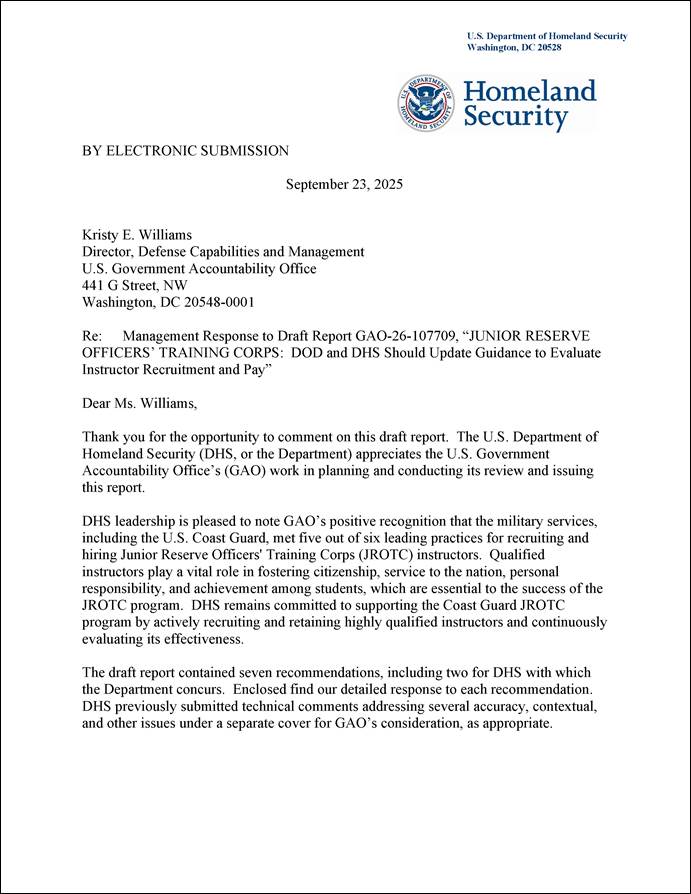
We provided a draft of this report to DOD and DHS for review and comment. DOD did not provide comments on the report. In written comments, reproduced in appendix III, DHS concurred with our two recommendations directed to the department and provided information on planned actions to address them, including developing an evaluation of instructor recruitment to ensure the Coast Guard maintains a pipeline of qualified instructors (recommendation 5) and updating guidance to include plans and metrics for evaluating how the instructor pay scale impacts instructor recruitment and retention (recommendation 7). DHS also provided technical comments which we incorporated where appropriate.
We are sending copies of this report to the appropriate congressional committees, the Secretary of Defense, the Secretary of Homeland Security, the Secretary of the Army, the Secretary of the Air Force, the Secretary of the Navy, the Commandant of the Marine Corps, the Commandant of the Coast Guard, and other interested parties. In addition, the report is available at no charge on the GAO website at https://www.gao.gov.
If you or your staff have any questions about this report, please contact me at williamsk@gao.gov. Contact points for our Offices of Congressional
Relations and Public Affairs may be found on the last page of this report. GAO staff who made key contributions to this report are listed in appendix IV.

Kristy E. Williams
Director, Defense Capabilities and Management
This report examines (1) to what extent do military services’ recruitment of Junior Reserve Officers’ Training Corps (JROTC) instructors follow leading practices, (2) to what extent does the new JROTC instructor pay scale support recruiting and retention needs, and (3) describes the types of activities JROTC units participate in and how do they fund the activities.
To address our objectives, we administered a web-based survey of JROTC senior instructors at high schools with active JROTC programs. We started with a list of active JROTC programs as of March 2025 in public and private high schools in all 50 states, the District of Columbia, and U.S territories. We used Army, Navy, Marine Corps, Air Force, and Coast Guard records provided by officials or from the military services’ websites to identify high schools with active JROTC programs.[35] We reached out to the Instructor Management Division for each of the military services to identify senior instructors at the relevant high schools for contact information. We selected a judgmental sample of schools to ensure a balanced mix across key characteristics such as region, branch, city type, poverty levels, and school type. In total, we reached out to senior instructors at 95 JROTC units out of a population of over 3,400 JROTC units. We collected data from April 2025 to May 2025 and received responses from 46 out of 95 senior instructors for a response rate of 47 percent. Due to our small population and low response rate, the results of this survey were non-generalizable and there was no use of significant testing in this analysis or requirement to test for non-response bias. The survey included questions on a range of topics, including monetary support for JROTC programs, JROTC instructor background, and opinions about the JROTC instructor pay system.
To minimize errors that might occur from respondents interpreting our questions differently than intended, we conducted pre-testing with selected former JROTC program instructors to ensure a common understanding of questions. In addition, prior to the survey’s distribution, we worked with an independent survey specialist to create our survey questions, questionnaire distribution method, and results. Two analysts also independently reviewed the responses of each instructor to check responses were valid and identify possible outliers or signs of misunderstanding. For a complete version of the survey sent to JROTC instructors see appendix II.
To analyze the survey, we cross tabulated close-ended responses and used descriptive statistics to support a variety of strategic goals across objectives. We then performed a content analysis of the open-ended responses by developing themes for free-response questions and then coding the responses into those themes. Two analysts independently reviewed the survey responses and coded the information into the themes. The analysts then discussed and resolved any initial disagreements in the coding to arrive at the final categorization of surveyed responses into the detailed themes.
In addition to the JROTC instructors that we surveyed, we conducted 16 in-person site visits and 12 virtual meetings with JROTC instructors at 28 schools. Table 2 below lists the schools with the JROTC instructors that we spoke to in person and virtually.
Table 2: List of Junior Reserve Officers’ Training Corps (JROTC) Instructors’ Schools Contacted by GAO
|
Santiago High School |
Garden Grove, California |
|
La Habra High School |
La Habra, California |
|
Santa Ana High School |
Santa Ana, California |
|
Mission Bay High School |
San Diego, California |
|
Scripps Ranch High School |
San Diego, California |
|
Vista High School |
Vista, California |
|
New London High School |
New London, Connecticut |
|
Windsor High School |
Windsor, Connecticut |
|
Space Coast High School |
Cocoa, Florida |
|
Druid Hills High School |
Atlanta, Georgia |
|
Midtown High School |
Atlanta, Georgia |
|
Mary Persons High School |
Forsyth, Georgia |
|
Riverside Preparatory Academy |
Gainesville, Georgia |
|
Lithia Springs High School |
Lithia Springs, Georgia |
|
Monroe Area High School |
Monroe, Georgia |
|
Upson-Lee High School |
Thomaston, Georgia |
|
Kellogg High School |
Kellogg, Idaho |
|
Mooseheart Child City & School |
Kane County, Illinois |
|
The English High School |
Boston, Massachusetts |
|
Barnstable High School |
Hyannis, Massachusetts |
|
Assabet Valley Regional/Vocational Technical High School |
Marlborough, Massachusetts |
|
Taunton High School |
Taunton, Massachusetts |
|
Wareham High School |
Wareham, Massachusetts |
|
Farmington High School |
Farmington, New Mexico |
|
Palo Verde High School |
Las Vegas, Nevada |
|
Lejeune High School |
Camp Lejeune, North Carolina |
|
Devils Lake High School |
Devils Lake, North Dakota |
|
Warren County High School |
Front Royal, Virginia |
Source: GAO. | GAO‑26‑107709
Although our observations from these site visits are not generalizable to all JROTC programs, they provide context to how recruitment affect JROTC programs at the senior instructor level.
To address all three of our objectives, we also contacted the Office of the Under Secretary of Defense for Personnel and Readiness within the Department of Defense and the military service offices responsible for oversight of the JROTC program. Organizations that we interviewed during our review include the following:
· Office of the Under Secretary of Defense for Personnel and Readiness
· U.S Army Cadet Command
· Naval Service Training Command
· Air Education and Training Command
· Marine Corps Training and Education Command
· Coast Guard JROTC Program
In addition, we reviewed relevant DOD and military service guidance on the administration of the JROTC program. This included policy manuals, regulations regarding fundraising activities, procedural guidelines, and other materials that provided context and insight into JROTC’s recruitment, retention and fundraising processes. The documents were used to supplement interview findings, identify key examples and ensure alignment between stated objectives and current practices.
To determine the extent to which military services’ recruitment of JROTC instructors follow leading practices, we compared the military services’ recruiting activities to leading practices for recruiting.[36] To determine the extent to which the new JROTC instructor pay scale supports recruiting retention needs, we reviewed DOD and the Department of Homeland Security’s actions to implement the new pay scale and compared it to Standards for Internal Control in the Federal Government.[37]
We conducted this performance audit from July 2024 to January 2026 in accordance with generally accepted government auditing standards. Those standards require that we plan and perform the audit to obtain sufficient, appropriate evidence to provide a reasonable basis for our findings and conclusions based on our audit objectives. We believe that the evidence obtained provides a reasonable basis for our findings and conclusions based on our audit objectives.
GAO Contact
Kristy Williams, williamsk@gao.gov.
Staff Acknowledgments
In addition to the contact listed above, Gina Hoffman (Assistant Director), Leslie Bharadwaja, John Bornmann, Christopher Gezon, Cori Ingram, John Mingus, Kenneth Moore, Lillian Ofili, Clarice Ransom, and Michael Wagner made key contributions to this report.
The Government Accountability Office, the audit, evaluation, and investigative arm of Congress, exists to support Congress in meeting its constitutional responsibilities and to help improve the performance and accountability of the federal government for the American people. GAO examines the use of public funds; evaluates federal programs and policies; and provides analyses, recommendations, and other assistance to help Congress make informed oversight, policy, and funding decisions. GAO’s commitment to good government is reflected in its core values of accountability, integrity, and reliability.
Obtaining Copies of GAO Reports and Testimony
The fastest and easiest way to obtain copies of GAO documents at no cost is through our website. Each weekday afternoon, GAO posts on its website newly released reports, testimony, and correspondence. You can also subscribe to GAO’s email updates to receive notification of newly posted products.
Order by Phone
The price of each GAO publication reflects GAO’s actual cost of production and distribution and depends on the number of pages in the publication and whether the publication is printed in color or black and white. Pricing and ordering information is posted on GAO’s website, https://www.gao.gov/ordering.htm.
Place orders by calling (202) 512-6000, toll free (866) 801-7077,
or
TDD (202) 512-2537.
Orders may be paid for using American Express, Discover Card, MasterCard, Visa, check, or money order. Call for additional information.
Connect with GAO
Connect with GAO on X,
LinkedIn, Instagram, and YouTube.
Subscribe to our Email Updates. Listen to our Podcasts.
Visit GAO on the web at https://www.gao.gov.
To Report Fraud, Waste, and Abuse in Federal Programs
Contact FraudNet:
Website: https://www.gao.gov/about/what-gao-does/fraudnet
Automated answering system: (800) 424-5454
Media Relations
Sarah Kaczmarek, Managing Director, Media@gao.gov
Congressional Relations
Dave Powner, Acting Managing Director, CongRel@gao.gov
General Inquiries
[1]Congress annually appropriates JROTC funds as part of DOD’s operation and maintenance and military personnel budget. Beyond reimbursing a portion of instructor salaries, the military departments also fund uniforms, cadet travel, training aids, textbooks, education materials, and other unit operating expenses. Schools provide classroom space, facilities, and administrative support for the unit as well as a portion of instructor salaries. In addition, as discussed later in this report, individual JROTC units may receive funds from donations, grants, and fundraising.
[2]For this report, the military services include the Army, Navy, Air Force, Marine Corps, and Coast Guard. The Space Force also has JROTC units, but they are managed by the Air Force. Army, Navy, Air Force, and Marine Corps JROTC programs fall under the authority of the Department of Defense and Coast Guard JROTC programs fall under the authority of the Department of Homeland Security, who has delegated authority to establish and maintain a JROTC to the Commandant of the United States Coast Guard. See 10 U.S.C. § 2031; 14 U.S.C. § 320; Department of Defense Instruction 1205.13, Junior Reserve Officers’ Training Corps Program (May 21, 2021) (incorporating change 1, effective Mar. 14, 2024).
[3]A JROTC unit is comprised of a group of JROTC students and faculty at their respective public or private institution (such as a high school or Job Corps center). JROTC units are required to have two instructors: normally one commissioned officer and one enlisted servicemember per unit. Larger JROTC units can have additional instructors.
[4]James M. Inhofe National Defense Authorization Act for Fiscal Year 2023, Pub. L. No. 117-263, § 512 (2022); National Defense Authorization Act for Fiscal Year 2024 Pub. L. No. 118-31, § 553 (2023).
[5]Office of the Under Secretary of Defense (Comptroller), DOD Budget Fiscal Year 2026: Operation and Maintenance Programs (O-1) and Revolving Funds (RF-1) (June 2025); Office of the Under Secretary of Defense (Comptroller), DOD Budget Fiscal Year 2026: Military Personnel Programs (M-1) (June 2025).
[6]S. Rep. No. 118-58, at 136-37 (2023). We also have two reports addressing sexual misconduct in JROTC programs. See GAO, K‑12 Education: Prevention and Response to Adult Sexual Misconduct in Junior Reserve Officers’ Training Corps Programs, GAO‑25‑107670 (Washington, D.C.: Aug. 28, 2025) and GAO, Junior Reserve Officers’ Training Corps: Additional Actions Needed to Improve Oversight and Prevent Instructor Sexual Misconduct, GAO‑26‑107524 (Washington, D.C: Jan. 20, 2026).
[7]GAO, State Department: Additional Actions Needed to Address IT Workforce Challenges, GAO‑22‑105932 (Washington, D.C.: July 12, 2022). This report examined the Department of State’s recruiting and retention practices by identifying topic areas associated with human capital management based on our review of information technology workforce planning and management practices identified in Office of Personnel Management and our prior work. For this report, we are focusing only on leading practices for recruitment.
[8]Pub. L. No. 116-92, § 512 (2019) (amending 10 U.S.C. § 2031).
[9]See Pub. L. No. 117-263, § 512 and Pub. L. No. 118-31, § 553.
[10]As this report was in its final stages, the National Defense Authorization Act for Fiscal Year 2026 further amended section 2031 of Title 10, U.S. Code to prohibit the military department secretaries from requiring more than 8 years of service for a former officer or noncommissioned officer to be approved to serve as a JROTC instructor. Pub. L. No. 119-60, § 541 (2025).
[11]See Department of Defense Instruction 1205.13, Junior Reserve Officers’ Training Corps Program (May 1, 2021) (incorporating change 1, effective Mar. 14, 2024); Department of Defense Manual 1402.05, Background Checks on Individuals in Department of Defense Child Development and Youth Programs (Jan. 24, 2017). A Tier 1 investigation includes a questionnaire, an FBI advanced fingerprint check, and inquiries to current and past employers, among other things.
[12]The military services also adopted a new Blended Retirement System that will lead to lower retirement pay in the future. DOD’s Blended Retirement System went into effect on January 1, 2018. The Blended Retirement System blends the traditional legacy retirement pension, also known as a defined benefit, with a defined contribution benefit into the Thrift Savings Plan. The primary difference between the Blended Retirement System and the legacy retirement system is that the Blended Retirement System adjusts the years of service multiplier from 2.5 percent to 2.0 percent for calculating monthly retired pay. In addition, the Blended Retirement System contributions of 1 percent of basic pay and government matching contributions of up to an additional 4 percent of basic pay to a service member’s Thrift Savings Plan account.
[13]See GAO‑22‑105932.
[14]See Pub. L. No. 117-263 § 512.
[15]DOD Instruction 1205.13, Junior Reserve Officers’ Training Corps Program (May 21, 2021) (incorporating change 1, effective Mar. 14, 2024). An official with the Office of the Secretary of Defense told us this instruction is currently being revised to include guidance on expanded instructor eligibility and JSIPS.
[16]10 U.S.C. § 2031; 14 U.S.C. § 320; Coast Guard Junior Reserve Officers’ Training Corps Manual 01-24, Coast Guard Junior Reserve Officers’ Training Corps (CGJROTC) Standard Operating Procedures (July 2024).
[17]U.S. Army JROTC, The US Army Junior ROTC Program Guide for Administrators (Dec. 14, 2022).
[18]Office of the Chief of Naval Operations Instruction 5761.1, Navy Junior Reserve Officers Training Corps and Navy National Defense Cadet Corps Programs (Jan. 30, 2015); Marine Corps Order 1533.6E, Marine Corps Junior Reserve Officers’ Training Corps (MCJROTC) Program (Nov. 17, 2008).
[19]Under Secretary of Defense for Personnel and Readiness Memorandum, Guidance on Use of Government Travel Charge Cards by Department of Defense Civilian Employees (Mar. 5, 2005).
[20]See DOD Instruction 1205.13. In order for a position to be designated as hard-to-fill, the military department must determine that the secondary educational institution’s position is hard to fill for economic or geographic reasons and the position must be vacant for 6 consecutive months or more, regardless of how many individuals have applied or interviewed during the vacancy. The military department concerned may add additional requirements that define a hard-to-fill position.
[21]As this report was in its final stages, the National Defense Authorization Act for Fiscal Year 2026 established a temporary authority to provide JROTC instructors with a one-time signing bonus of not more than $10,000 if the member or former member (1) agrees to be an instructor for a position the Secretary determines to be hard-to-fill and (2) the member agrees to be an instructor for no less than one academic year. Pub. L. No. 119-60, § 546 (2025).
[22]Coast Guard Junior Reserve Officer Training Corps Manual 01-24, Coast Guard Junior Reserve Officers’ Training Corps (CGJROTC) Standard Operating Procedures (July 2024).
[23]See GAO‑22‑105932.
[24]DOD Instruction 1205.13.
[25]Deputy Secretary of Defense Memorandum Junior Reserve Officers’ Training Corps Instructor Pay (Mar. 25, 2024).
[26]According to Navy officials, personnel turnover and technical issues delayed their implementation of JSIPS and expanded eligibility for instructors.
[27]Instructors hired for the Navy JROTC programs were paid under JSIPS beginning July 1, 2025.
[29]Air Force Junior Reserve Officer Training Corps Instruction 36-201, Air Force Junior Reserve Officer Training Corps (June 1, 2023).
[30]U.S. Army Cadet Command Regulation 145-2, Junior Reserve Officers Training Corps Program: Organization, Administration, Operations, Training, and Support (Aug. 12, 2022).
[31]Naval Service Training Command Manual 5761.1B, Regulations for Citizenship Development (RCD) Program (June 2018).
[32]Coast Guard Junior Reserve Officer Training Corps Manual 01-24, Coast Guard Junior Reserve Officers’ Training Corps (CGJROTC) Standard Operating Procedures (July 2024).
[33]U.S. Army Cadet Command Regulation 145-2.
[34]JROTC Cadet Leadership Challenges are Brigade-level events for Army JROTC Cadets that take place across the world. JROTC Cadet Leadership Challenges are typically held at Boy Scout camps or military installations.
[35]Space Force JROTC programs are managed by the Air Force.
[36]GAO, State Department: Additional Actions Needed to Address IT Workforce Challenges, GAO‑22‑105932 (Washington, D.C.: July 12, 2022). This report examined the Department of State’s recruiting and retention practices by identifying topic areas associated with human capital management based on our review of information technology workforce planning and management practices identified in Office of Personnel Management and our prior work. For this report, we are focusing only on leading practices for recruitment.
[37]GAO, Standards for Internal Control in the Federal Government, GAO‑14‑704G (Washington, D.C.: Sept. 2014).