
Report to Congressional Committees
United States Government Accountability Office
A report to congressional committees
Contact: Jessica Lucas-Judy at lucasjudyj@gao.gov
What GAO Found
The Carbon Oxide Sequestration Credit (45Q) is a tax credit provided for certain carbon oxides that are captured at emission sources or directly from the air and either stored underground or used to produce products. The credit has been amended multiple times, including by the 2022 Inflation Reduction Act (IRA), which added new credit features. More recently, the One Big Beautiful Bill Act created parity in credit values across uses of captured carbon. As of March 2026, there were 33 carbon capture facilities in the U.S., with additional facilities planned. The number of 45Q credit claims more than tripled from 2019 to 2023, according to IRS data.
The Internal Revenue Service (IRS) has taken several actions to administer the 45Q credit and mitigate potential noncompliance. However, taxpayers using carbon to produce products face compliance burdens, delays, and uncertainty in claiming the credit. GAO identified areas in the approval process for carbon utilization where IRS and the Department of Energy (DOE) could potentially minimize compliance burden and improve certainty for taxpayers. Pursuing such opportunities—for example, streamlining certain processes, or clarifying acceptable datasets that can be used to calculate carbon displaced—could improve the process and help minimize delays for both agencies and taxpayers.
Multiple potential goals, the lack of a designated agency to evaluate the effectiveness of the credit, and data limitations complicate Congress’s ability to understand the performance of the 45Q credit. Even so, periodic reviews of tax expenditures are crucial for informed oversight. GAO has previously recommended various actions Congress and agencies could take to improve oversight for other tax expenditures, such as identifying what should be analyzed and by whom. In this report, GAO identified key questions for Congress to consider directing agencies to analyze to help determine the performance of the credit. These key questions are: (1) how well the credit is working to achieve its goals, (2) how efficiently the credit is performing and (3) how the credit compares to other policy tools.
Why GAO Did This Study
The 45Q credit was created in 2008 to incentivize the development of carbon capture technology and reduce carbon emissions. Carbon capture involves complex and novel technology, and the 45Q credit could result in potentially substantial revenue expenditures.
The IRA includes a provision for GAO to review the distribution and use of IRA funds. This report assesses (1) IRS’s administration of the 45Q credit, and (2) the challenges in evaluating the effectiveness of the credit. GAO reviewed agency policies and procedures and interviewed officials from IRS, DOE, and the Environmental Protection Agency. GAO also interviewed selected external stakeholders knowledgeable about the 45Q credit, representing advocacy, research, and industry. GAO also conducted two site visits to carbon capture sites in Houston, Texas.
What GAO Recommends
GAO is recommending that Congress consider directing agencies to collect and analyze data to answer key questions about the performance of the 45Q credit, such as how well it is working to achieve its goals, how efficiently it is performing, and how it compares to other policy tools.
GAO is making four recommendations to IRS and two recommendations to DOE to improve the review process for carbon utilization, by reducing taxpayers’ burden while still mitigating potential noncompliance. These include determining a time period of carbon capture data needed to begin claiming the credit, and clarifying datasets acceptable for calculating carbon displaced. IRS partially agreed with one recommendation; IRS and DOE disagreed with the remaining five. GAO maintains the recommendations are warranted as discussed in the report.
|
Abbreviations |
|
|
|
|
|
CCUS |
Carbon Capture Utilization and Sequestration |
|
DAC |
Direct Air Capture |
|
DOE |
Department of Energy |
|
DOL |
Department of Labor |
|
EPA |
Environment Protection Agency |
|
EOR |
Enhanced Oil Recovery |
|
GHGRP |
Greenhouse Gas Reporting Program |
|
GREET |
Greenhouse gases, Regulated Emissions, and Energy use in Technologies |
|
IRA |
Inflation Reduction Act |
|
IRS |
Internal Revenue Service |
|
LCA |
Lifecycle Analysis Report |
|
LB&I |
Large Business and International Division |
|
MOU |
Memorandum of Understanding |
|
MRV |
Monitoring, Reporting, and Verification |
|
NETL |
National Energy Technology Laboratory |
|
OBBBA |
One Big Beautiful Bill Act |
|
PWA |
Prevailing Wage and Apprenticeship |
|
UIC |
Underground Injection Control program |
This is a work of the U.S. government and is not subject to copyright protection in the United States. The published product may be reproduced and distributed in its entirety without further permission from GAO. However, because this work may contain copyrighted images or other material, permission from the copyright holder may be necessary if you wish to reproduce this material separately.
August 6, 2026
Congressional Committees
The federal tax code includes multiple tax credits related to clean energy, including a tax credit for capturing and sequestering carbon oxide.[1] We have previously reported that the Internal Revenue Service (IRS) and other agencies face multiple challenges in administering and evaluating the performance of clean energy tax credits. For example, the tax credits do not explicitly identify goals, and it may be years before data are available to assess the effectiveness of these credits.[2] Also, some credits include provisions, such as transferability, which involve multiple entities and taxpayers and create unique compliance challenges.[3]
Since 1994, we have recommended greater scrutiny of all tax expenditures, including tax credits.[4] For example, in 2005, we recommended that the Office of Management and Budget, in consultation with the Department of the Treasury, produce a framework for reviewing the performance of tax expenditures.[5] However, as of May 2026, the recommendation had not been implemented, limiting policymakers’ ability to regularly review their effectiveness. Periodic reviews could help determine how well specific tax expenditures work to achieve their goals and how their benefits and costs compare to those of direct spending programs with similar goals.
The Inflation Reduction Act (IRA), enacted in 2022, includes a provision for us to review the distribution and use of IRA funds.[6] We issued a report in May 2025 that included questions policymakers can ask to support their oversight of energy tax expenditures in the IRA. This report uses those questions to (1) assess IRS’s administration of the credit for carbon oxide sequestration, hereafter referred to as the 45Q credit, for capturing carbon and then using or storing it, and (2) assess the challenges in evaluating the effectiveness of the credit.
We selected the 45Q credit for review because this credit involves complex and novel technology; includes new credit features, such as transferability of the credit; and could result in potentially substantial revenue losses. Congress first passed the 45Q credit for capturing and storing carbon in 2008, encouraging reductions in greenhouse gas emissions.[7] Since then, Congress has modified and expanded 45Q credit several times. For example, the IRA modified the pre-existing credit to provide for revised rates, amend facility definitions, and add new credit features.[8] More recently, Public Law 119-21, commonly known as the One Big Beautiful Bill Act (OBBBA), further modified the credit, in part, to apply the same dollar value for the credit to various forms of carbon oxide sequestration at the higher of the two rates.[9]
To assess IRS’s administration of the credit, we reviewed relevant legislation, guidance, and regulations. We also reviewed data IRS collects to administer the credit, including data from tax years 2018 to 2023 related to applications for the credit, use of the credit, and the type and frequency of IRS audits.[10] To assess the reliability of the data, we reviewed the data for outliers and discrepancies and interviewed IRS officials to discuss possible data limitations. We determined the data were sufficiently reliable for purposes of our objective. In addition, we interviewed IRS and Treasury officials about what actions IRS has taken or plans to take and how it plans to ensure those actions support its administration of this credit. We interviewed IRS officials on administration of the 45Q credit prior to the changes made by the IRA and OBBBA to determine how existing energy credit expertise and administration experience from past activities have aided in administering the revised credit and how the modifications to this credit changed IRS’s administration of the credit. We also interviewed relevant Treasury, Department of Energy (DOE), and Environmental Protection Agency (EPA) officials about actions taken to help develop guidance and regulations and actions to support IRS administration of the credit.
We reviewed guidance and regulations related to the credit’s design to identify aspects of the credit that may be challenging to enforce. We also reviewed relevant literature and testimonial information to aid in identifying potential challenges. We interviewed 26 selected external stakeholders, including carbon capture developers, credit brokers, researchers who focus on finance and energy, and various advocacy and opposition groups to get a range of perspectives on various credit features and how those features could affect IRS’s administration of the credit. To identify potential stakeholders, we reviewed literature on the credit, consulted our own experts on carbon capture, and used snowball referral techniques. We selected stakeholders who were knowledgeable about general environmental policy, novel features of the 45Q credit, or carbon capture technology, and we ensured our selection represented a range of views, including advocacy, research, and industry. In addition, to further understand the implications the technology may have on IRS’s ability to administer the credit, we conducted a site visit to two different carbon capture facilities near Houston. Although the perspectives from these interviews and site visits are not generalizable to all stakeholders, they represent a variety of perspectives in experiences with the 45Q credit and the technology on which the credit is based.
We assessed how IRS is using information on taxpayer use of credits, such as uptake or potential fraud, to inform IRS efforts to strengthen voluntary compliance, identify and address intentional non-compliance, and detect and prevent fraud. We assessed IRS’s efforts to address potential challenges to administration against our criteria for a good tax system.[11]
To assess the challenges in evaluating the effectiveness of the credit, we used guidance and regulations related to the credit’s design to identify aspects of the credit that may require different agencies to evaluate its effectiveness, various outcome measures and data sources, and coordination between different types of agencies. We interviewed officials at DOE, EPA, and IRS to inform our analysis of how federal agencies are prepared to report on the outcomes and effectiveness of the tax credit. The interviews also provided information on interagency collaboration and challenges to evaluating the effectiveness of this credit. We assessed agencies’ ability to evaluate the effectiveness of the credit using our criteria for evaluating tax expenditures.[12]
We conducted this performance audit from July 2024 to August 2026 in accordance with generally accepted government auditing standards. Those standards require that we plan and perform the audit to obtain sufficient, appropriate evidence to provide a reasonable basis for our findings and conclusions based on our audit objectives. We believe that the evidence obtained provides a reasonable basis for our findings and conclusions based on our audit objectives.
Background
Carbon Capture, Utilization, and Sequestration Technology
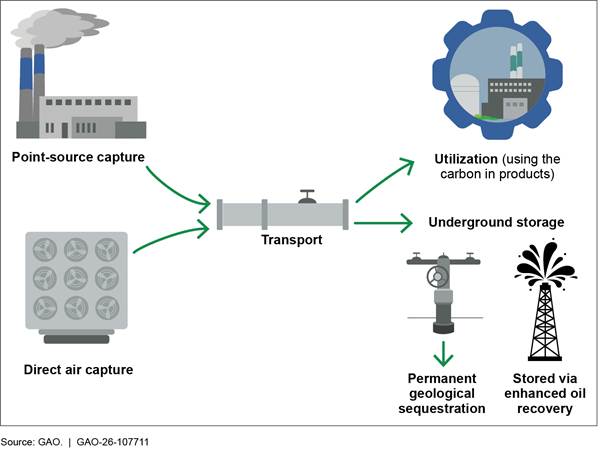
Carbon Capture, Utilization, and Sequestration (CCUS) refers to a group of technologies that capture and dispose of carbon oxides, which we generally refer to as carbon in this report. Carbon oxides include carbon dioxide and carbon monoxide. Carbon can be captured at emissions sources (point-source capture): fossil-fuel based power generating facilities or industrial production facilities, such as cement manufacturing, hydrogen production, and petrochemical plants. It can also be captured directly from ambient air (direct air capture). Once captured, the carbon can be disposed of by storage underground through permanent geological sequestration or enhanced oil recovery. It can also be used to develop products (see fig. 1). Captured carbon is generally stored or used in the form of carbon dioxide.
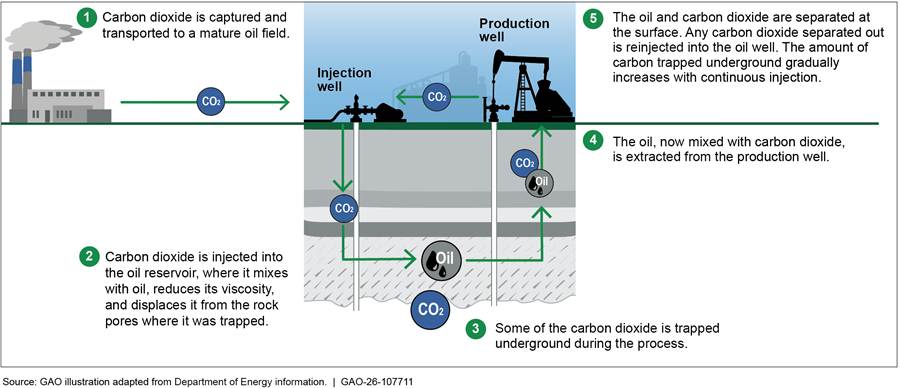
The most common fate for captured carbon is enhanced oil recovery (EOR). In EOR, carbon dioxide is injected into underground oil reservoirs to dislodge oil. Some of the carbon is trapped underground in the process, and the rest is extracted with the oil—once extracted, the oil and carbon are separated, and the carbon is reinjected. The amount of carbon trapped underground gradually increases with continuous injection (see fig. 2).
Alternatively, carbon can be directly stored underground in permanent geological sequestration. Carbon sequestration, also called carbon storage, involves storing carbon dioxide deep underground in porous rock formations. In this approach, the carbon dioxide is compressed to the point where it behaves like a liquid. Next, it is injected into porous rock formations deep under the ground, where it becomes physically trapped in the pore spaces, dissolves in the fluid within the formations, and eventually reacts to form stable minerals. Examples of storage types include saline formations, oil and natural gas reservoirs, unmineable coal seams, basalt formations, and organic-rich shales.
Captured carbon can also be used to create a variety of products, called carbon utilization. Examples include building materials such as concrete, plastics, and various synthetic fuels such as gasoline, diesel, and jet fuel. Products made with captured carbon, such as synthetic fuels, have the potential to displace the production of products made without, such as traditional fossil fuels. The duration of the captured carbon’s isolation from the atmosphere will vary across different products. For example, carbon used to make synthetic fuels will be released when the fuel is burned, but carbon used to make concrete is permanently mineralized.
According to data from the International Energy Agency, as of March 2026, there were currently 33 carbon capture facilities operating in the U.S. Most of those facilities are point-source carbon capture, and about half of those have an end use of EOR. Four carbon capture facilities operating in the U.S. are direct air capture (DAC) facilities. In recent years there has been an increase in the planned development of DAC facilities, with 31 projects announced between 2021 and 2025. As of 2026, three DAC facilities are under construction.[13]
Proponents of carbon capture note that the technology is essential to reducing greenhouse gas emissions because fossil fuels will continue to be used for energy production. Some proponents point to the intermittency of green energy sources, while others note that continued use of fossil fuels for energy can be cheaper than using green energy sources. In contrast, some stakeholders have expressed concerns with increased reliance on carbon capture to mitigate climate change, stating that it supports fossil-fuel-based energy sources over other sources, such as wind and solar. Additional concerns about carbon capture relate to lack of oversight of the disposal of captured carbon and accurate measurement of the total emissions reduction from the development and operation of carbon capture facilities.
The 45Q Carbon Oxide Sequestration Credit
The credit for carbon oxide sequestration (the 45Q credit) provides a tax credit for capturing carbon and then using or storing it.[14] Both carbon capture methods are eligible for the 45Q credit: point-source capture and direct air capture. The credit can be claimed by taxpayers with eligible facilities that have used the carbon in products or securely disposed of the carbon underground, as described above.
The 45Q credit can be claimed by taxpayers whose eligible facilities satisfy minimum capture amount requirements:
· For most facilities, the minimum capture amount is 12,500 metric tons of qualified carbon oxide per year.[15] For context, a typical passenger vehicle emits about 4.6 metric tons of carbon dioxide per year.
· For DAC facilities, the minimum capture amount is 1,000 metric tons of carbon oxide per year.[16]
· For electricity generation facilities, the minimum capture amount is 18,750 metric tons of qualified carbon oxide per year. In addition, the carbon capture equipment installed must capture at least 75 percent of the facility’s baseline carbon emissions.[17]
The credit as amended by the IRA is generally applicable to facilities and equipment that are placed in service beginning no earlier than January 1, 2023. The amendments made by the OBBBA apply to facilities or equipment placed into service after July 4, 2025, and construction must have started before 2033. The credit may be claimed for 12 years after the facility was placed in service.
Figure 3: Dollar Amounts for the Credit for Carbon Oxide Sequestration (26 U.S.C. § 45Q), Per Metric Ton
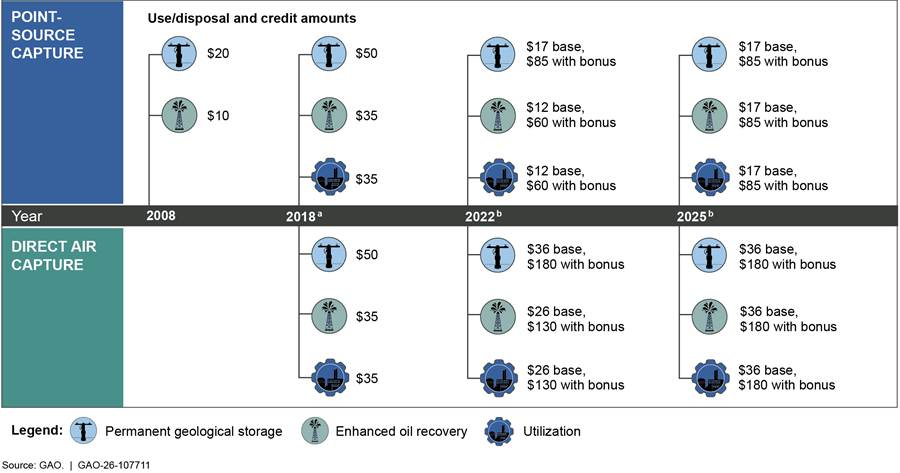
aThe Bipartisan Budget Act of 2018 increased the dollar amounts for the 45Q credit using linear interpolation from 2017 through 2026. The dollar amounts shown are the amounts designated for 2026.
bBonus provisions for the 45Q credit were introduced in the Inflation Reduction Act of 2022. Taxpayers claiming the 45Q credit may multiply by five times the base credit amount if they meet certain requirements, including paying workers prevailing wages and meeting apprenticeship requirements. 26 U.S.C. § 45Q(h).
As most recently amended in the OBBBA, credit amounts are generally $85 per metric ton of qualified carbon oxide for point-source capture and $180 per metric ton of qualified carbon oxide for direct air capture, irrespective of the carbon’s use or storage method.[18] The credit was revised several times since its original enactment:
· The 45Q credit was originally enacted under the Energy Improvement and Extension Act of 2008, which allowed for only point-source capture as a capture method. The captured carbon could only be used in permanent geological sequestration or enhanced oil recovery. This credit was applicable until a cap of 75 million metric tons of carbon was captured and disposed of.[19]
· The credit was expanded and extended by the Bipartisan Budget Act of 2018, most notably by adding DAC as a capture method and carbon utilization as a carbon end use, and eliminating the 75-million-metric-ton cap.[20]
· The IRA, which was signed into law on August 16, 2022, further modified and extended the 45Q credit. The IRA introduced bonus provisions allowing taxpayers to claim a higher credit amount if they meet certain requirements, including paying workers prevailing wages and meeting apprenticeship requirements.[21]
1. Elective pay. This feature allows entities that do not typically owe federal income taxes, such as tribal and state governments, to receive payment for the credit amount. Elective pay is allowed for all types of tax filers for 45Q for 5 years of the credit period.[22]
2. Transferability. This allows taxpayers to transfer the value of the credit to another party in exchange for cash.[23]
3. Bonus provisions. The 45Q credit is eligible for the prevailing wage and apprenticeship bonus credit amount. This allows taxpayers to multiply the base credit amount by five if the taxpayer paid laborers and mechanics prevailing wages to construct the facility or equipment and provided certain apprenticeship opportunities.[24]
· The OBBBA further modified and extended the 45Q credit, most notably by making the credit amounts for the three end uses of carbon the same (see fig. 3).[25]
Agency Roles in Administering the 45Q credit
IRS has the primary role in administering the tax code, including this credit. IRS is responsible for providing guidance for claiming the credit and ensuring compliance through enforcement actions. Other agencies, including DOE and EPA, have a role in aiding administration of different aspects of the credit, depending on the fate of carbon and additional requirements to claim the credit.[26]
DOE plays a role when taxpayers claim the 45Q credit for utilization: the taxpayer must prepare a lifecycle analysis report (LCA), which quantifies how much carbon dioxide was either captured and permanently isolated from the atmosphere or displaced from being emitted into the atmosphere.[27] DOE conducts a technical review of these taxpayers’ LCAs as specified in a memorandum of understanding with IRS. IRS uses DOE’s review as part of its determination whether to approve the LCA.
EPA administers requirements related to the 45Q credit through the Greenhouse Gas Reporting Program (GHGRP).[28] It also is responsible for permitting wells used for geological sequestration and EOR under the Underground Injection Control program (UIC).[29] These programs have different requirements for operators performing direct geological sequestration or EOR.
Direct geologic sequestration requires the use of Class VI wells. EPA requires Class VI well operators to perform carbon dioxide monitoring, reporting, and verification (MRV).[30] MRV plans are site-specific plans for how facilities will monitor, measure, verify, and report carbon dioxide sequestration to EPA. EPA is responsible for reviewing and approving MRV plans.
In contrast, MRV plans are generally not required for EOR, which typically uses Class II wells.[31] Instead of creating an MRV plan, EOR operators can follow international industry standards for EOR.[32] Though not required, EOR operators may elect to submit an MRV plan to EPA. EPA is also responsible for approving permits for constructing both types of wells. Figure 4 describes key agencies involved for the different ways carbon can be stored or used.
Figure 4: Roles of the Department of Energy and Environmental Protection Agency in Aiding Administration of the Carbon Oxide Sequestration Credit
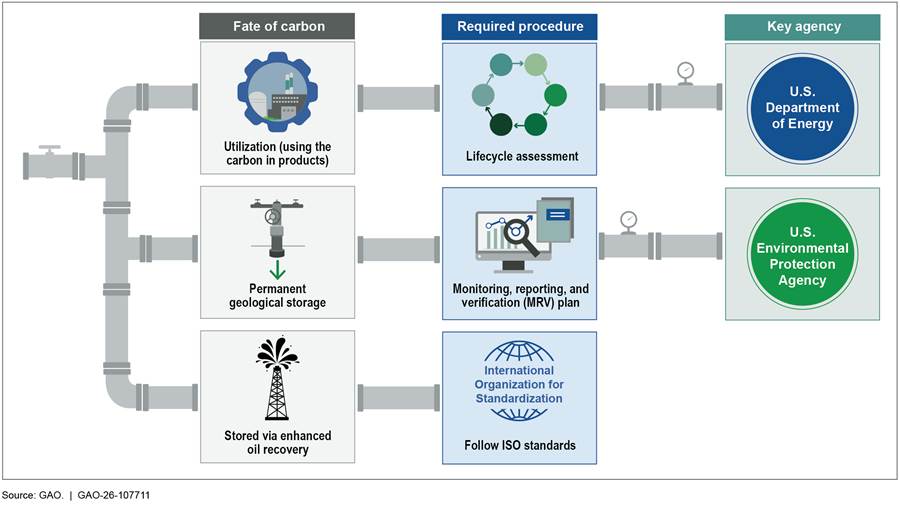
Note: The credit amount a taxpayer can claim depends on the amount of qualified carbon oxide the taxpayer captures, which for utilization is required to be based on an analysis of lifecycle greenhouse gas emissions and subject to regulations. 26 U.S.C. § 45Q(f)(5)(B). The regulations require an MRV plan for geological storage and allow for ISO standards to document secure storage through enhanced oil recovery. 40 C.F.R. § 98.448; 26 CFR § 1.45Q-3(b).
Taxpayers prepare and submit information under subpart RR of part 98 of title 40, Code of Federal Regulations, including the MRV plan, through the GHGRP. In September 2025, EPA proposed eliminating the GHGRP.[33] In March 2026, EPA officials told us that termination was still under consideration. In the meantime, EPA extended the 2025 reporting year deadline for the GHGRP from March 31, 2026, to October 30, 2026.[34] However, according to EPA officials, the tool used for this reporting, the Electronic Greenhouse Gas Reporting Tool (e‑GGRT), has not yet been updated with new reporting requirements, and therefore end users cannot submit reports using the tool as of March 2026. As we note later in the report, IRS has taken some steps to help mitigate reporting challenges in the event that the EPA does not launch e-GGRT for filers to prepare and submit information required.
The Department of Labor determines the prevailing wage that taxpayers must pay contractors and employees to receive the prevailing wage bonus.[35]
Oversight of Energy Tax Credits
We have a long-standing body of work on how agencies can mitigate noncompliance risk, including fraud, relevant to government initiatives such as tax expenditures. In 2012, we developed a framework for evaluating tax expenditures that included a series of oversight questions.[36] For our May 2025 report, we adapted these questions to ensure their relevance to energy tax expenditures introduced or amended in the IRA (see fig. 5).[37] We used this past work to inform our review of the 45Q credit.
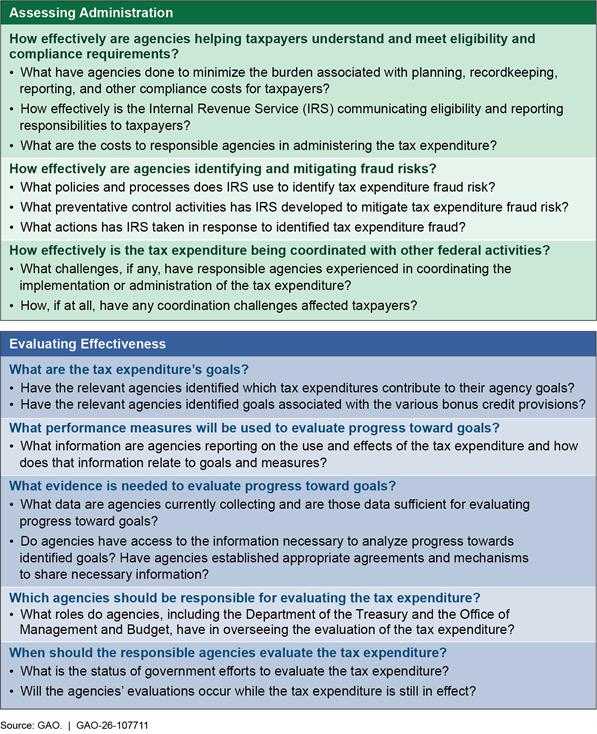
Note: These questions are adapted from several of our reports including our framework for evaluating tax expenditures (GAO‑13‑167SP), our framework for managing fraud risks in federal programs (GAO‑15‑593SP), and our reports related to effective policy administration, particularly tax administration (GAO‑05‑690 and GAO‑23‑105460).
IRS Has Taken Steps to Address Complex and Changing 45Q Credit Legislation, but Taxpayers Face Difficulties and Noncompliance Risks Could Grow
As frequent changes occur in the laws related to energy tax credits, Treasury and IRS have consistently made progress in developing and implementing regulations and guidance for the 45Q credit.
Stakeholders we spoke with told us that the IRS guidance and Treasury regulations have been helpful in understanding how to meet the requirements to claim the 45Q credit. However, stakeholders also identified challenges that taxpayers face in claiming the credit for utilization.
IRS Has a Pre-Approval Process for 45Q Credit Eligibility for Utilizing Carbon, but Taxpayers Face Challenges Claiming the Credit
Taxpayers seeking to claim the 45Q credit for utilization face challenges related to the pre-approval process, developing the lifecycle analysis report (LCA), and the resolution process for rejected LCAs. These processes are important to mitigate noncompliance and overpayments. However, as currently implemented they delay taxpayers’ ability to claim the credit and contribute to increased taxpayer burden and uncertainty.
Pre-Approval Requirements in Claiming the Credit for Utilization
LCA Preparation and Pre-Approval
To calculate the value of the 45Q credit for utilization, taxpayers must prepare an LCA, which quantifies the net amount of carbon dioxide that was either permanently captured or displaced from being emitted into the atmosphere.[38] The LCA compares the taxpayer’s product system to a comparison product system—the process for making the same product following U.S. industry-average or industry-standard practices.[39]
For example, a facility producing fuels could use point-source captured carbon to create e-methanol. To determine to what extent the e-methanol production is less carbon intensive than average U.S. methanol production, the LCA compares both production processes. The difference in carbon intensity between the taxpayer’s product system and the comparison product system is expressed through a ratio called the lifecycle displacement factor. This ratio determines the amount of captured carbon the taxpayer may claim for the 45Q tax credit for utilization (if the taxpayer is otherwise eligible). For example, if a facility captures the minimum of 12,500 metric tons per year and its displacement factor is 0.4, the resulting credit amount would be $425,000 (if bonus provisions making the credit amount $85 per metric ton are met).
Before a taxpayer is allowed to claim section 45Q credits for utilization on their tax return each year, the taxpayer needs to have previously received approval of an LCA from IRS, called pre-approval. To receive pre-approval, the taxpayer must send the LCA to both IRS and DOE. DOE performs a technical review of the LCA and advises IRS on whether DOE concurs with the LCA.
After the credit was expanded to add carbon utilization in 2018, Treasury introduced the requirement for LCA pre-approval through regulations that were proposed in June 2020 and finalized in January 2021.[40] IRS officials said that it is easier to correct problems in an LCA at the pre-approval stage than in the audit process, and Treasury and IRS analysis states that the pre-approval requirement potentially reduces IRS administrative costs. IRS issued further guidance on the process for preparing the LCA and receiving pre-approval in July 2024.[41] Because the only limit to the 45Q credit for utilization is dictated by the taxpayer’s amount of captured carbon utilized, pre-approval helps to mitigate the risk that a taxpayer overclaims the credit.
Direct Data and LCA Pre-Approval Timing Challenges
For modeling the taxpayer’s product system, IRS and DOE guidance specify that the 45Q utilization LCA must rely upon direct, or primary, data—in other words, data measured directly from the operation of the taxpayer’s system.[42] For a taxpayer’s initial LCA pre-approval, the taxpayer must provide direct data starting from when their facility begins utilizing qualified carbon through the end of that taxpayer’s tax year.
According to stakeholders, the requirement for LCA pre-approval combined with the requirement to use direct data through the end of the tax year creates considerable timing challenges that can delay taxpayers from claiming the credit. For example, to claim the credit, a project needs to be in operation and the taxpayer must wait until the end of their tax year, after which the taxpayer will develop the LCA with prior year production data, submit the LCA to DOE and IRS, and wait for their review and pre-approval. The requirement for direct data through the end of the tax year applies regardless of when in the year a facility is placed in service. While waiting for pre-approval, taxpayers and their investors must continue to fund years of project development, construction, and operation of their carbon capture and utilization projects. Meanwhile, delays caused by direct data requirements make it difficult to secure investors in developing Carbon Capture Utilization and Sequestration (CCUS) facilities, according to stakeholders we interviewed.
The timing of LCA pre-approvals can also prevent taxpayers from benefitting from another 45Q feature, transferability, through which they transfer all or a portion of their credit to an unrelated taxpayer. Transfer elections cannot be made for the first time on an amended return.[43] However, because of the pre-approval timing challenges, many businesses cannot claim the 45Q credit on their originally filed tax return, especially if their initial LCA submission was not approved; instead, they need to submit an amended return (see fig. 6).[44]
Figure 6: Timelines for a C Corporation Claiming the 45Q Credit for Carbon Utilization (Illustrative Examples)
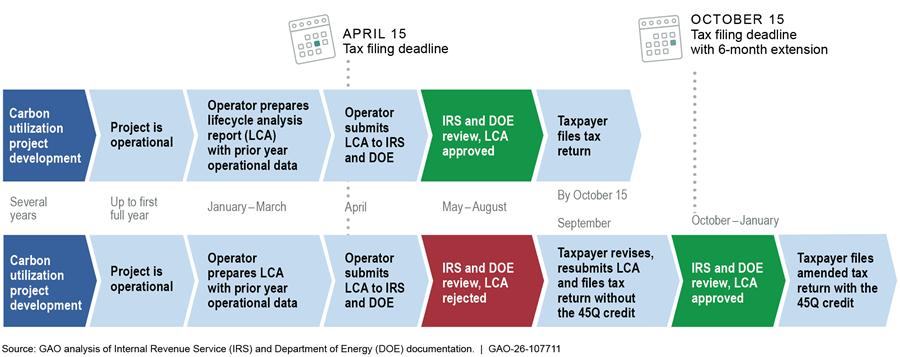
Note: LCA timelines are illustrative and are based on examples from stakeholders. IRS and DOE review time is based on the period listed in IRS and DOE’s amended memorandum of understanding.
IRS and DOE did not provide us with a clear explanation for why direct data through the end of the tax year is necessary for pre-approval regardless of when during the year a facility was placed in service. Officials explained how they review and use these data, but their explanations do not demonstrate why direct data through the end of the tax year is required during the pre-approval process:
· IRS officials told us that they use the direct data to determine the placed-in-service date, the carbon dioxide amount captured, the carbon dioxide amount utilized, and the tax year in which the utilization took place. While this information is important, it is also included in the tax return.
· DOE officials told us that for the LCA pre-approval they review the direct, primary data to ensure that data are complete and reflect reasonable values. However, the time period of direct data DOE reviews varies based on the taxpayer’s circumstances. Additionally, DOE does not review direct data from every tax year, because some taxpayers with an initial LCA pre-approval are permitted to skip pre-approval in certain subsequent years.
Consider two taxpayers using a calendar tax year, where the first taxpayer’s carbon capture and utilization project enters operation on February 1 and the second taxpayer’s on November 1. In their LCAs submitted for pre-approval, both taxpayers must provide direct data from when their facility begins utilizing qualified carbon through the end of the tax year. This means that both taxpayers must wait until the start of the next tax year to submit their LCA for pre-approval. For the first taxpayer, this would involve collecting 11 months of data, and for the second taxpayer 2 months of data. For purposes of approving a taxpayer’s initial displacement factor in the LCA submitted for pre-approval, IRS and DOE already accept either amount of data depending on when the taxpayer’s project utilizing qualified carbon enters operation.
IRS has existing guidance that considers the length of time of direct data in determining how long those data may be used in subsequent years. Once IRS approves a taxpayer’s LCA, the taxpayer is generally considered to have an approved LCA for that tax year and for 1 or 2 tax years afterward. The number of additional years the approval is valid depends on the length of time for which the taxpayer submitted direct data:
· If the taxpayer’s initial LCA pre-approval is for an LCA that analyzes a period of less than 6 months, then the taxpayer is considered to have an approved LCA for that tax year and for 1 tax year afterward.
· If the taxpayer’s initial LCA pre-approval is for an LCA that analyzes a period of 6 months or more, then the taxpayer is considered to have an approved LCA for that tax year and for 2 tax years afterward.
IRS guidance specifies that in these scenarios, the taxpayer is able to skip pre-approval for the following 1 or 2 years, provided that changes to the taxpayer’s product system do not result in a reduction to the displacement factor greater than 0.05 from the value identified in the original LCA.
Improving the LCA Pre-Approval Process
Pre-approval helps mitigate the risk that a taxpayer overclaims the credit by using faulty LCA methodologies. However, the current process for LCAs indicates that IRS and DOE could accept the taxpayer’s LCA methodology without making all taxpayers gather direct data through the end of the current tax year. IRS and DOE have an opportunity to reevaluate the point at which taxpayers may submit an initial LCA for pre-approval. Determining a minimum time period of direct data needed to establish the displacement factor would allow for taxpayers that meet that minimum to submit their initial LCAs for pre-approval before the end of the tax year. Such a change could minimize unnecessary delays for taxpayers with facilities entering operation earlier in the tax year, because taxpayers receiving LCA pre-approval in this scenario could claim the tax credit earlier. When these taxpayers file their tax returns, they would then determine their credit amount using their pre-approved displacement factor, following the same process that already exists for subsequent tax years after taxpayers receive LCA pre-approval in a prior tax year. Just as with the current rules, if changes to the taxpayer’s product system result in a reduction to the displacement factor greater than 0.05 from the value identified in the pre-approval LCA, then IRS and DOE could require the LCA’s resubmission.
Our prior work has found that a good tax system should be simple, transparent, and administrable—that is, a tax system should minimize compliance burden, impose less uncertainty on taxpayers, and allow the government to collect taxes as cost effectively as possible.[45] Allowing taxpayers who have collected enough direct data to establish the displacement factor to submit their LCAs for pre-approval earlier would increase their ability to claim the credit on the original tax return filing, use the transferability provision, and secure investment. This, in turn, could reduce taxpayer compliance costs, taxpayer uncertainty, and delays in completing tax filings. Importantly, implementing such a change would still allow for a full review of the LCA’s methodology.
Challenges in Developing LCAs
Comparison Product System Technology Baselines
IRS and DOE guidance for 45Q specifies what data can be used in developing a comparison product system.[46] A taxpayer claiming the 45Q credit for utilization is required to compare their carbon-capture and utilization system to the average greenhouse gas emissions for U.S. production of the same product. If sufficient data are not available to determine the average greenhouse gas emissions for U.S. production of the same product, the taxpayer may compare to a method of production that represents the industry standard practice for U.S. production.
To help taxpayers make this comparison, DOE has created U.S.-average comparison product systems for several common applicant products, including nitrogen fertilizer production, corn ethanol production, and carbon dioxide production. DOE stated that these comparison product system technology baselines minimize the instances of applicants using inappropriate substitutes. DOE officials told us they intend to create additional technology baselines dependent on resource availability. However, they said that because DOE does not receive information on what products will be submitted ahead of time, it is not feasible to create technology baselines for all potential applicant products.
For comparison product systems for other products, stakeholders we interviewed told us that DOE has rejected various data from commercial data sources. While commercial data sources are allowed, DOE requires the data to be verifiable by DOE reviewers. According to DOE officials, any commercial data must be of sufficient quality and used appropriately within the context of the LCA.
GREET Models Functionality for Other Tax Credits
Other models exist that contain extensive data useful to develop LCAs for a wide variety of products and are used for other tax credits. These models for LCAs, called GREET (Greenhouse gases, Regulated Emissions, and Energy use in Technologies), are used for two other tax credits: the section 45V credit for the production of clean hydrogen (the 45V credit) and the section 45Z credit for the production of clean fuels (the 45Z credit). GREET models are publicly available, widely used, and developed by the Argonne National Laboratory, part of DOE’s national laboratory system. For these credits, DOE developed specific GREET models to represent some methodologies and processes for preparing the LCA for those credits. For the 45V and 45Z credits, taxpayers have two methods to determine the lifecycle emissions rate of their production processes, or pathways:
· For pathways covered by the specific GREET models, taxpayers may submit the LCA at the same time as the rest of the tax return, which officials told us can be accepted without manual review by IRS and DOE.
· For other technology pathways not yet covered by the specific GREET models, taxpayers can follow a provisional emissions process, where potential applicants request that DOE provide new emissions rates for these pathways.[47]
Suitability of Existing GREET Model Data for 45Q
Currently, some products claimed by taxpayers for the 45Q credit for utilization are already included in GREET inventories, according to officials. Although DOE officials said that GREET data can be acceptable for 45Q credit claims, they further explained that to use GREET data for the comparison product system, the taxpayer needs to verify which data in GREET models represent U.S.-average or industry-standard production by reviewing the data’s original study details. Because of differences in requirements for other data uses, some GREET data do not represent U.S.-average or industry-standard production; for example, DOE officials noted that the e-fuels module uses a simplified carbon capture accounting method that compares that taxpayer’s product system to an uncaptured version of itself.[48] Officials said DOE has not concurred with LCAs that used certain GREET data inappropriately, and current 45Q guidance does not describe which GREET data are acceptable to use.
Improving the LCA Development Process
A substantial percentage of LCAs are rejected during review, presenting potential opportunities to improve the LCA development process. According to IRS, as of January 2026, IRS had received 99 LCA requests since LCA pre-approval was required in 2021, comprised of 54 original LCA requests and 45 resubmissions. Of the 54 unique taxpayer or tax period requests, as of January 2026, IRS approved 26 and rejected 22; reviews were pending for six taxpayer requests. Common issues include the selection of appropriate comparison product systems, mathematical and methodological errors, and using inappropriate data or data with insufficient documentation.
Our prior work has found that a good tax system should be simple, transparent, and administrable.[49] We identified areas in the LCA development process where IRS and DOE could potentially minimize compliance burden and improve certainty for the taxpayer, but the agencies have not taken steps to leverage these opportunities. Pursuing such actions could improve the LCA development process and help minimize delays for both agencies and taxpayers:
· Requesting additional technology baselines. Creating a process for taxpayers to request DOE-developed technology baselines would help DOE determine priorities for which baselines to develop next. Additional technology baselines would make it easier for taxpayers to develop their comparison product systems. This process could function similarly to the provisional emissions rate requests for the 45V and 45Z credits.
· Developing a GREET LCA process for common pathways. When the taxpayer’s technology pathway has been fully modeled, the GREET models for the 45V and 45Z credits allow for taxpayers to submit an LCA at the same time as the rest of the tax return. While the 45Q credit could be claimed for utilization for many potential products, officials have said that several product types are common. For these common 45Q credit utilization products, a GREET model could make developing an LCA easier for taxpayers and reduce the need for IRS and DOE review, if developing such a model is feasible.
· Clarifying which GREET model data are appropriate for the 45Q LCA. Depending on the circumstances of a specific LCA, some existing data in GREET models are appropriate for use as the comparison product system when claiming the 45Q credit for utilization, while others are not. However, current IRS and DOE guidance for the 45Q credit does not specify which GREET data taxpayers may use. Doing so would help taxpayers better make use of GREET data and reduce the risk of LCA submissions with improperly used GREET data.
Delays Resolving Rejected LCAs
According to some stakeholders we spoke to, if the LCA is rejected for pre-approval because it does not conform to applicable standards, the taxpayer needs to redo the LCA and start the review process with IRS and DOE over again.[50] The taxpayer loses their place in IRS and DOE’s queue for review.
Stakeholders we interviewed told us there are few opportunities for the taxpayer to discuss the specifics of their LCA with DOE reviewers. DOE and IRS allow only limited interaction with taxpayers. Upon receipt of an LCA application, DOE will review the application for completeness and identify any questions for the taxpayer.[51] DOE may contact the taxpayer directly only if additional information or clarification is needed to complete its technical review. In September 2025, IRS and DOE modified their memorandum of understanding (MOU) to allow for potential applicants to reach out to DOE with clarifying questions on technical requirements prior to submission of an LCA. The MOU states that DOE will employ measures to maintain independence in its review and prohibits DOE from otherwise communicating with taxpayers about the status of their LCA applications. Significantly, the MOU prohibits DOE from providing a prereview of an LCA application or providing any indication of the likelihood of an individual LCA application being successful upon submission.[52]
While taxpayers may clarify or provide missing information to DOE and IRS during the LCA review process, the MOU does not provide a process for the taxpayer to correct or modify information contained in their LCA. However, IRS officials said that while minor errors can be corrected during the review process, other errors cannot. If such a correction or modification is necessary, the taxpayer must resubmit their LCA, losing their place in the review queue and delaying their ability to claim the credit on their tax return. However, requiring taxpayers wishing to comply with LCA requirements to start the application process over again for every rejected LCA imposes taxpayer burden and uncertainty and delays claiming the credit, contrary to findings from our prior work that a good tax system should be simple, transparent, and administrable.[53] By not providing potential taxpayers who demonstrate a willingness to be compliant and who are close to having a compliant LCA an opportunity to correct or modify limited portions of their LCA, IRS and DOE may be missing an opportunity to reduce the time it takes for taxpayers to get an approved LCA and improve tax administration.
IRS Has Taken Action to Mitigate Noncompliance Risks, Though Officials Said Staffing and Program Cuts Have Resulted in 45Q Credit Auditing Delays
IRS has taken several steps to mitigate the risk of noncompliance, including fraud, for the 45Q credit—this includes steps related to elective pay and transferability, the prevailing wage and apprenticeship bonus provisions, and the review of monitoring, reporting, and verification (MRV) plans. However, the legislative changes to section 45Q that could yield significant compliance challenges are relatively recent—4 years old. Not enough time has passed to determine the success of IRS’s actions because of the time needed to file a tax return and complete an audit:
· The IRA passed in 2022, but the amended 45Q credit provisions took effect for the 2023 tax year.
· While business taxpayers do not necessarily file their taxes based on a calendar year, they generally would file their 2023 returns in 2024.
· IRS generally selects tax returns for audits within a 3-year period after they are filed, with the earliest returns for tax year 2023 being selected in 2025.
· Audits may take several years to conduct, so as of April 2026, few with the amended 45Q credit provisions have been completed.
IRS tax form 8933 requires information on carbon capture facilities, equipment, and credit calculations. To determine whether a taxpayer claiming the 45Q credit is in compliance with the law, IRS officials said they consider information reported on the tax return and several other data sources, including commonly known industry information and publicly available data sources. For taxpayers claiming the 45Q credit for utilization, IRS also considers the LCA. In the case of an audit, IRS also considers information furnished by the taxpayer in response to audit team requests. The audit team generally includes an engineer who helps determine if the taxpayer is in compliance, according to IRS.
In identifying risk factors for the 45Q credit, IRS officials cite several factors they consider in developing the risk profile, including absence of a qualifying facility or pre-filed documentation. IRS also considers compliance with other provisions, including other energy tax credits. In addition, IRS officials said they also consider factors that are specific to the fate of captured carbon. For example, issues common to geological sequestration or enhanced oil recovery (EOR) include absence of an EPA-approved MRV plan and a mismatch of the injected carbon dioxide amounts. Issues common to utilization include ineligibility due to a rejected LCA.
IRS officials said IRS continues to develop training and employee resources, including a virtual library, and a tax reform issue book. In addition, subject matter experts from the Large Business and International Division (LB&I), which according to IRS officials is the primary division responsible for 45Q credit compliance, provide support to examiners and engineers as needed. For example, from 2021 through 2025, audit teams submitted 10 inquiries for assistance with 45Q credit issues.
According to IRS officials, LB&I is also conducting centralized risk assessment of credits added or modified by the Inflation Reduction Act (IRA credits). It is analyzing data of filed returns with IRA credits and will assess how to use this data to identify and address compliance risks. For example, the 45Q credit filter will display data from forms specific to the credit, such as whether the taxpayer has an elective payment or transfer election registration number, and other general information about the taxpayer including total assets and business activity.
IRS officials said that LB&I also created a team to review taxpayer claims of IRA credits, including the 45Q credit. According to IRS officials, as of January 2026, LB&I audits with the 45Q credit as an issue consisted of 18 unique taxpayers covering 53 total tax returns since the credit was first implemented in 2008.[54] While these numbers appear small, according to IRS officials, historical data prior to tax year 2023 show few claims of the 45Q credit, with fewer than 20 C corporations claiming this credit each year. However, data provided by IRS show the number of claims by corporations of the 45Q credit in 2023 has more than tripled between 2019 and 2023. The LB&I team is still developing specific compliance plans for calendar year 2026 and beyond.
While IRS has taken steps to identify noncompliance risks and has been working with other agencies to mitigate these risks, IRS, DOE, and EPA have all undergone significant staffing reductions over the past year. IRS officials said that staffing losses resulted in the departure of some subject matter experts in the 45Q credit area, but that the remaining subject matter experts maintain significant institutional knowledge and technical expertise, helping ensure continuity of operations and support. IRS officials also noted that staffing reductions in management have led to delays in identifying and processing tax returns for audit because of the time needed to realign managers and staff to new roles. According to IRS, these changes did not materially impact IRS’s ability to audit high-risk 45Q claims. Nonetheless, these cuts raise concerns about the agencies’ continued capacity to share and act on pertinent information in a timely way.
IRS Actions to Mitigate Bonus Provision Noncompliance Risks
Bonus provisions were introduced in the IRA that allow taxpayers to claim five times the credit base rate if they meet prevailing wages and apprenticeship (PWA) requirements.[55] Due to the effective date of the PWA rules and the time required to complete and place an eligible facility in service, IRS officials said they expect PWA to first become an active compliance issue during audits of tax year 2024 returns. Because of normal return processing and IRS audit selection time frames, IRS has not yet begun examining these returns.
To help address noncompliance risks IRS developed a form specifically for reporting PWA for use beginning in filing season 2026.[56] For example, the form’s section on apprenticeship requirements requires the number of qualified apprentices, total labor hours worked, total hourly wages paid to qualified apprentices, and total labor hours that did not meet those requirements.
IRS officials said that noncompliance with the PWA requirements can ultimately only be determined through an audit. In an audit, IRS would request the taxpayer provide supporting documentation to show they comply with PWA requirements throughout the construction, alteration, or repair work of the qualified facility or project. This documentation would likely include an analysis performed by the taxpayer that shows the employees, contractors, and subcontractors, with their hours, rates of payment, and designations for apprentices, according to IRS. IRS officials said it would generally obtain wage data from the taxpayer during an audit involving PWA.
In addition, IRS entered into a December 2024 MOU with the Department of Labor (DOL), under which IRS is receiving support from DOL. Under the MOU, DOL will share certain information received relating to potential PWA noncompliance and provide training support to IRS and collaboration on public outreach and information. According to IRS officials, as of January 2026, the information shared by DOL has primarily been questions DOL received from the public about PWA and has not included tips or information about suspected noncompliance. DOL initiates the sharing of information in accordance with the MOU and is generally providing data monthly, according to IRS officials.
IRS Actions to Mitigate Elective Pay and Transferability Noncompliance Risks
IRS officials said the elective pay and transferability provisions of the 45Q credit and the other IRA credits present unique challenges for managing noncompliance risks.
According to IRS, elective pay creates distinctive risks by essentially making the 45Q credit operate like refundable tax credits, which we have previously reported are at higher risk of improper payments than nonrefundable credits.[57]
Because transferability involves one taxpayer claiming a credit generated by another taxpayer, it also presents distinctive risks. According to IRS officials, transfer of the credit from the taxpayer to the transferee can occur based on the expected value of the credit before the taxpayer generating the credit has filed a tax return. If a taxpayer is found to be ineligible for the 45Q credit after filing has taken place, transferability increases the challenges involved in “clawing back” or recouping credits that are reduced or eliminated after an audit.
IRS officials said that beginning with tax year 2023, IRS incorporated reviews of returns with 45Q credits involving elective payment or transferability elections into existing compliance plans. As part of this work, IRS officials said they discovered and prevented fraud early on in some transferable credits; a related July 2024 IRS news release warns individual taxpayers to avoid unscrupulous preparers engaged in transferability fraud.
In December 2023, IRS also instituted a pre-file registration process, where taxpayers’ basic eligibility is reviewed prior to providing a registration number, according to IRS officials. This registration is needed for a taxpayer to use 45Q’s transferability and elective pay features. IRS developed and requires taxpayers to use an online portal to register before using transferability and elective pay elections. IRS officials said they had to spend significant resources for registration and reviews at the time of filing to assess risk associated with an entity generating the credit in very short time frames.
IRS Actions to Mitigate MRV Noncompliance Risks
To claim the 45Q credit for geological sequestration, a taxpayer must have an EPA-approved monitoring, reporting, and verification (MRV) plan.[58] EPA reviews these MRV plans to ensure they provide sufficient information on the annual monitoring activities, reporting of leakages, and planned actions to address leakages.
In April 2020, the Treasury Department’s Inspector General for Tax Administration reported that some taxpayers claimed the 45Q credit without having an EPA-approved MRV plan. Specifically, 10 taxpayers claimed over $1 million in credits for tax years 2010 through 2019, but only three had an approved MRV plan with EPA.
Since that report, IRS has collaborated with EPA, DOE, and DOL in drafting regulations. IRS also took several actions to help improve compliance with the 45Q credit including by adjusting forms and instructions and issuing additional guidance:
· IRS has taken steps to address this noncompliance risk by requiring all taxpayers to attach to their return a copy of their approved MRV plan or a URL where it can be viewed on the EPA website.
· In addition, IRS began requiring that taxpayers provide the EPA-approved MRV plan when they register to make use of the elective pay or transferability provisions.
As noted earlier, an EPA reporting program critical to determining eligibility for the 45Q credit for geological sequestration may be ending: EPA announced in September 2025 that it is proposing to eliminate the greenhouse gas reporting requirements in subpart RR of part 98 of title 40, Code of Federal Regulations. If this program is eliminated, IRS will lose third-party data sources that can be used to ensure compliance with the credit. As we have previously reported, third-party data are important for ensuring compliance.[59]
The program that EPA proposes eliminating includes the requirement to produce an MRV report, the document that IRS uses to ensure that taxpayers have securely sequestered their captured carbon. Another part of the program is the requirement to use the electronic Greenhouse Gas Reporting Tool (e-GGRT), which is how taxpayers report the amount of carbon they securely captured. Without this reporting tool, IRS loses its ability to readily verify the amount of carbon securely captured—the basis for calculating the credit.
IRS has taken some steps to help mitigate the possible elimination of EPA’s program. IRS has issued guidance for taxpayers in the event that the EPA does not launch e-GGRT for filers to prepare and submit information required under subpart RR for reporting year 2025 by June 10, 2026.[60] That guidance would require the taxpayer to submit the same annual report it would have sent to EPA to an independent engineer or geologist, who is to certify the annual report.
According to IRS officials, they have not had sufficient time to determine what related challenges may exist in the future. For example, the tax form asks for a link to the EPA-approved MRV plan, but, as noted earlier, EPA may eliminate that reporting structure. IRS officials also noted that EPA had not approved a new MRV plan since October 31, 2025. EPA officials told us that this pause was due to an EPA staff reorganization and that MRV reviews were once again underway.
Multiple Challenges Complicate Efforts to Evaluate the Effectiveness of the 45Q Credit
Our previous work has shown that, once enacted, tax expenditures and their relative contributions toward achieving federal missions and goals are often less visible than spending programs, which are often subject to more systematic review. Since 1994, we have recommended greater scrutiny of tax expenditures to help determine how well specific tax expenditures work to achieve their goals and how their benefits and costs compare to those of programs with similar goals.[61] Evaluating the effectiveness of the 45Q credit is challenging because there are multiple possible policy goals and no one agency has been explicitly tasked with responsibility for evaluating credit performance. Even so, Congress has options to prioritize the information and analysis it needs for robust oversight.
Multiple Possible Goals for the Performance of the Credit
The One Big Beautiful Bill Act and IRA do not explicitly identify goals for the 45Q credit. However, a few sources have identified possible goals. For example, the preamble to Treasury regulations for the 45Q credit state the Bipartisan Budget Act of 2018 was enacted to encourage the construction and use of carbon capture and sequestration projects.[62] Further, several agencies highlighted potential benefits of the IRA including addressing climate change, advancing Carbon Capture, Utilization, and Sequestration (CCUS) technology, and increasing wages and job opportunities related to clean energy projects.[63]
These suggest three possible goals for the 45Q credit: (1) reduce net carbon dioxide emissions, (2) increase development of carbon capture technologies, and (3) increase economic development through higher wages and apprenticeship programs.
It is not uncommon for statutory provisions to have multiple and sometimes contradictory goals as they are the result of compromise in the legislative process. However, this complicates efforts to evaluate the effectiveness of programs, including tax expenditures, like the 45Q credit.
Evaluating the Effectiveness of the 45Q Credit Toward Possible Goals
We have previously reported on several questions policymakers should consider in evaluating tax expenditures.[64] Among those are key questions that can be used to evaluate the 45Q credit: (1) how well the credit is working to achieve its goals, (2) how efficiently the credit is performing, and (3) how the credit compares to other policy tools. Different goals may require different types of analyses needed to evaluate those questions. In turn those analyses may require different types of data, which may or may not be readily available. Further, the type of analysis and data requirements could signify what agencies might be best positioned to conduct the evaluation. Because several agencies have roles in the administration of the 45Q tax credit, efforts to designate an agency with responsibility for reporting on the credit’s effectiveness may be more complex.
We outline several examples of the type of analyses that could provide information to aid in the oversight of this credit, the data needed for that evaluation, and potential agencies that might be in a position to conduct that analysis. For each goal and analysis, data on the use of the 45Q credit would be needed. As discussed earlier, data for tax years before 2023 show low participation in the 45Q credit.[65] While data on use of the credit are available, there are limitations. Specifically, more recent data that would coincide with changes in the credit are not yet available.
Reducing Net Carbon Dioxide Emissions
In the case of a goal of reducing net carbon dioxide, an informative analysis could indicate to what extent emissions were reduced due to the introduction and expansion of the 45Q credit. As part of that analysis, the cost to society of carbon emissions (social cost) could be considered to aid in determining if the credit value is efficiently targeting the costs of the emissions.
To conduct these types of analyses, data on the amount of carbon dioxide emitted in the construction and operation of carbon capture facilities, the amount of carbon captured from operation, and estimates of the social cost of carbon would be needed.
There are limitations in the availability of these data. EPA currently provides the amount of carbon dioxide injected underground. However, data are not readily available on the amount of carbon emitted in the construction and operation of CCUS facilities. Further, as discussed earlier, EPA’s proposal to eliminate the reporting of these data would complicate future efforts. Federal government estimates of the social cost of carbon exist but vary from a few dollars to more than $200 per metric ton of carbon emissions.[66] These estimates rely on several models with potentially different assumptions.[67]
In addition to analyzing how the credit is achieving the goal of reduced carbon emissions, evaluating how the credit works compared to other policy tools for reaching the same goal could help distinguish, to some extent, whether the government is employing the most optimal policy. Other options that have been considered or used related to reducing carbon emissions include carbon pricing. We have reported on the benefits and tradeoffs of instituting carbon pricing, such as through a carbon tax or cap-and-trade programs.[68]
Economic literature indicates that carbon pricing can provide incentives similar to subsidies for CCUS such as the 45Q credit but could be less costly to the government for the same level of emissions reduction. For example, to implement and administer the complex 45Q credit, IRS has had to dedicate significant resources it could use elsewhere. Carbon pricing is not specific to CCUS but instead would incentivize emitters to find the most cost-effective approach to reduce emissions, such as switching to low-carbon technology or improving efficiency. However, carbon pricing would likely have other effects, including increasing the cost of carbon-intensive products such as gasoline or electricity.
Evaluating the 45Q credit toward a goal of reducing carbon emissions could be conducted by several different entities. For example, Treasury’s Office of Tax Analysis annually compiles a list of tax expenditures and estimates of their revenue costs. An interagency working group and the EPA have estimated the social cost of carbon. Policymakers could consider requiring these entities to conduct additional analyses.
Increasing the Development of Carbon Capture Technologies
In the case of a goal of increasing the development of carbon capture technologies, analyses could indicate the extent to which increased construction of facilities or progress in the development and optimization of the technology was due to the introduction and expansion of the 45Q credit. Those analyses could also examine whether the credit is encouraging the desired behavior or simply providing a subsidy for actions that would have been taken without the credit, which would help identify potential improvements to its structure.
To conduct these types of analyses, data on the trends in the development of CCUS facilities would be needed. Additional information that could be useful include technical readiness levels of key technologies, and whether new or improved technologies are being incorporated in facilities.[69]
Several data sources provide information on the number of carbon capture facilities that are in operation or have been planned.[70] Key features of these data show:
· increased development since 2008 and the emergence of DAC facilities beginning in 2023;
· a continued focus on EOR as the fate of carbon, with an emergence of geological storage in 2017 and utilization in 2023; and
· a marked increase in planned facilities since 2020, with most planning on geological storage.[71]
Analysis of the potential for windfall gains would also rely on these data but could require additional information, such as data on the potential market income from carbon capture activities, to determine if the activity would have been conducted without the credit. For example, the current credit rates are equal for geological sequestration, sequestration through EOR, and utilization. However, both EOR and utilization have markets that yield income streams for the carbon capture activity.[72] While utilization is relatively new and considered a nascent industry, EOR has been used as a technology for carbon capture prior to the credit. Further, sequestration is a biproduct of EOR activities designed to extract trapped oil out of original oil fields. Skeptics of carbon capture have pointed to this application as supporting the continued reliance on fossil fuels.
Tax expenditures are one but not the only option to address policy goals. Evaluating the 45Q credit against other financial incentives for the desired outcome would help policy makers determine if the current policy is the most effective tool. Another possible tool to aid in developing carbon capture facilities is grants. We have reported on several of those programs and the challenges they have encountered.[73] For example, we found that DOE’s investment of $1.1 billion on nine large CCUS demonstration projects from 2010 to 2017 resulted in varying levels of success.[74] Projects implemented at coal facilities were generally less successful than those at other industrial facilities, largely due to external factors that affected their economic viability.
As with the goal of reducing net carbon dioxide emissions, several agencies may need to be involved in conducting analysis related to this goal. DOE’s familiarity with carbon capture facilities, as well as its technical support to IRS for carbon utilization, suggest it should be involved in evaluating the credit’s effectiveness in developing carbon capture facilities. Because protected taxpayer data on the use of the credit would be essential to this evaluation, IRS or Treasury would need to have a key role.
Increased Economic Development
In the case of a goal of increasing economic development analyses could include the extent to which increased development of CCUS facilities and increased wages and jobs were due to the PWA bonus provision in the 45Q credit.
To conduct this type of analysis multiple types of data would be needed: data on the use of the PWA provisions, data on wages and employment, and data on the construction of CCUS facilities. In addition, these data would need to be available by geographic location.
IRS developed a form specifically for reporting PWA for use beginning in filing season 2026.[75] DOL provides data on prevailing wages by county.[76] In addition, several data sources exist for data on wages, including the Bureau of Labor Statistics, which publishes wage data by several categories, including occupation, county, and metropolitan area; and the Federal Reserve, which has data on population, employment, and labor markets.[77] As discussed earlier, there are several data sources on the development of CCUS facilities.
There are limitations to the use of these data. IRS data on PWA would not be available for several years. While wage and employment data exist, it may be challenging to adequately link those data with the location of CCUS facilities. In addition, similar challenges mentioned earlier exist with determining the relationship between the credit and the development of CCUS facilities.
According to Treasury, the PWA provisions are intended to increase pay for people working on IRA clean energy projects, most of which are in counties with below-average median household incomes. Further analysis would be needed to determine how this provision compares to possible other policy tools, such as direct federal spending on projects.
The need to use protected taxpayer data on the use of PWA provisions would necessitate IRS or Treasury having a role in evaluating the 45Q credit toward this goal. Coordination with DOE and DOL could be useful.
How Congress Could Direct Agencies to Evaluate and Report on Credit Effectiveness
Although data and methodological challenges exist, periodic reviews of tax expenditures could provide Congress with information necessary to determine how well they have worked to achieve their objectives and whether the benefits from specific tax expenditures are greater than their costs. We have previously recommended various actions that agencies and Congress could take to improve the evaluation of tax expenditures’ effectiveness. For example:
· In 2020, we recommended that Congress consider identifying questions about the performance of the Opportunity Zones tax expenditure that it wanted agencies to address to help guide data collection and performance measurement.[78] In July 2025, Congress passed, and the President signed into law Pub. L. No. 119-21, which requires Treasury to issue annual reports on Qualified Opportunity Funds and reports every 5 years on the impacts and outcomes from designating certain census tracts as Opportunity Zones.
· In 2015, we recommended that Congress consider directing IRS to collect and report project-level data from taxpayers claiming two energy tax credits for the development of renewable electricity projects to provide Congress with basic information about what projects have been supported.[79] In that report, we note that such information would be necessary for evaluating progress toward achieving the energy tax expenditures’ identified goals, such as determining whether they were effective at encouraging development of new renewable energy projects. Congress has not taken action on these recommendations as of February 2026.
· In 2005, we recommended that the Office of Management and Budget resume presenting tax expenditures in the budget together with related outlay programs to show a truer picture of the federal support within a mission area.[80] It did not concur with the recommendation and, as of January 2025, had not implemented it.
Similar actions specific to the 45Q credit could provide Congress with the data and analyses it needs to determine if the credit is achieving its intended purpose and designed in the most efficient and effective manner. The nation’s current and projected fiscal imbalance serves to reinforce the importance of engaging in such a review and reassessment.
Conclusions
The 45Q credit was originally created in 2008 to incentivize the development of carbon capture technology and to reduce carbon emissions. It has since been amended multiple times with bipartisan support. The complexity of both the 45Q credit and the underlying technology results in multiple challenges to administering it and evaluating its effectiveness.
IRS has taken considerable effort to administer the 45Q credit and mitigate potential noncompliance with the credit. However, taxpayers who are using captured carbon to manufacture products face greater burdens to be eligible to take the credit, compared to other uses of captured carbon. Requiring pre-approval of a lifecycle analysis report (LCA) based on operational data through the end of the tax year, without regard to when a taxpayer’s facility came into service during the tax year, can limit some taxpayers’ ability to secure investment and file for the credit in a timely manner. In addition, opportunities exist to minimize issues related to the LCA review and approval process that contribute to taxpayers’ challenges in effectively claiming the 45Q credit and benefitting from transferability. Taking action on these opportunities to improve its LCA review processes—such as by enabling streamlined processes for common pathways and clarifying acceptable data sets—could help IRS and DOE alleviate burdens and reduce uncertainty for taxpayers seeking to claim the credit.
Multiple possible goals, the lack of a designated agency required to collect data and evaluate the effectiveness of the credit, and data limitations complicate the ability to evaluate the effectiveness of the 45Q credit, and therefore limit the information available to policymakers. Even so, periodic reviews of tax expenditures are crucial for informed oversight. We have previously recommended various actions Congress could take to improve the evaluation of tax expenditures’ effectiveness, such as identifying what should be analyzed and by whom. In addition, we have identified key questions for consideration, including (1) how well the credit is working to achieve its goals, (2) how efficiently the credit is performing and (3) how the credit compares to other policy tools. Considering questions such as these, and directing agencies to take action accordingly, would aid in evaluating the effectiveness of tax expenditures, such as the 45Q credit.
Matter for Congressional Consideration
Congress should consider directing agencies to collect and analyze data to answer key questions about the performance of the 45Q credit, such as how well it is working to achieve specific goals, how efficiently it is performing, and how it compares to other policy tools. (Matter for Congressional Consideration 1)
Recommendations for Executive Action
We are making the following six recommendations, four to IRS and two to DOE:
The Commissioner of Internal Revenue, in coordination with DOE, should determine the minimum time period of production system direct data needed to determine the displacement factor in the LCA pre-approval, and update guidance to allow for taxpayers that meet that minimum to submit an LCA for pre-approval prior to the end of the tax year. (Recommendation 1)
The Commissioner of Internal Revenue, in coordination with DOE, should continue creating additional comparison product system technology baselines, including by implementing a process for taxpayers to request specific technology baselines, similar to the process for requesting provisional emissions rates for the 45V and 45Z credits. (Recommendation 2)
The Commissioner of Internal Revenue, in coordination with DOE, should determine the feasibility, including the costs and benefits, of developing a Greenhouse gases, Regulated Emissions, and Energy use in Technologies (GREET) model for common 45Q utilization pathways, allowing an LCA process that can be submitted upon tax return filing without prior review, similar to the 45V and 45Z credits. (Recommendation 3)
The Secretary of Energy, in coordination with IRS, should adjust the 45Q credit guidance on LCAs to clarify which GREET model data are acceptable for use with a 45Q credit LCA and how and when they can be used. (Recommendation 4)
The Commissioner of Internal Revenue, in coordination with DOE, should modify the IRS/DOE memorandum of understanding (MOU) to provide taxpayers, with appropriate limitations, an opportunity to modify elements of their LCAs prior to rejection, rather than having to resubmit their LCAs and restart the process. (Recommendation 5)
The Secretary of Energy, in coordination with IRS, should modify the IRS/DOE MOU to provide taxpayers, with appropriate limitations, an opportunity to modify elements of their LCA prior to rejection, rather than having to resubmit their LCAs and restart the DOE review process. (Recommendation 6)
Agency Comments and Our Evaluation
We provided a draft of this report to IRS, DOE, and EPA for review and comment. IRS and DOE provided written comments, which are reproduced in appendixes I and II. IRS, DOE, and EPA also provided technical comments, which we incorporated as appropriate.
IRS disagreed with three and partially agreed with one of our recommendations. DOE disagreed with two recommendations.
IRS disagreed with our recommendation to determine a minimum time period of production system direct data needed to determine the displacement factor in the lifecycle analysis report (LCA) pre-approval (Recommendation 1). IRS said it would be infeasible to identify a single fixed minimum period of time that would apply for every taxpayer or product because circumstances vary by industry and product. For example, IRS stated that industries tied directly to agriculture or other biomass may experience significant seasonal variability in operations. However, IRS’s current requirements do not vary by type of industry or product—for a taxpayer’s initial LCA pre-approval, the taxpayer must provide direct data starting from when their facility begins utilizing qualified carbon through the end of that taxpayer’s tax year, irrespective of industry or product type.
Implementing our recommendation would allow taxpayers with sufficient data to submit an LCA for pre-approval prior to the end of the tax year. As IRS noted, some taxpayers’ data may not sufficiently establish a representative displacement factor—however, even if our recommendation were implemented, these taxpayers ought not to submit an LCA early. For example, industries with seasonal variability such as those tied to agriculture might still need to wait until the end of the tax year to gather data and submit their LCA. As we note in our report, IRS’s current guidance for the years following an initial LCA pre-approval informs how an early submission process would work. Just as with the current rules, if changes to the taxpayer’s product system result in a material change to the displacement factor approved in the pre-approval LCA, then IRS could still require the LCA’s resubmission. Allowing taxpayers who have collected enough direct data to establish the displacement factor to submit their LCAs for pre-approval earlier would increase their ability to claim the credit on the original tax return filing, use the transferability provision, and secure investment. Importantly, implementing such a change would still allow for a full review of the LCA’s methodology.
IRS partially agreed with our second recommendation, which was to continue creating additional comparison product system technology baselines, including by implementing a process for taxpayers to request specific technology baselines, similar to the process for requesting provisional emissions rates for 45V and 45Z (Recommendation 2). Specifically, IRS agreed with the objective of expanding generally applicable comparison product system baselines where appropriate and agreed to talk to the DOE’s National Energy Technology Laboratory (NETL), the responsible agency, about developing additional baselines. However, IRS stated it did not agree to create a provisional emissions rate process similar to the processes provided in sections 45V and 45Z. Our recommendation is to implement a process for taxpayers to request specific technology baselines for the 45Q credit for utilization. While we note that this process could be similar to the process for requesting provisional emissions rates for the 45V and 45Z credits, our intention is not for IRS to replicate this process. Instead, the discussion in our report and the associated recommendation illustrate that such a process for the 45Q credit could share similar features of the provisional emissions rate process for the other two credits.
IRS stated that there was statutory authority to determine the process for those credits and that authority does not exist for the 45Q credit. However, subsection 45Q(f)(5)(B)(i) of the Internal Revenue Code specifies that determining the amount of qualified carbon oxide utilized is subject to such requirements as the Secretary of the Treasury or his delegate, in consultation with the Secretary of Energy and the Administrator of the Environmental Protection Agency, determines appropriate. Coordinating with NETL on establishing the baselines would be a necessary and important step toward implementing our recommendation. We maintain that there is an opportunity for IRS to provide additional baselines to allow taxpayers to indicate what type of baselines might be most useful, and we would encourage IRS to explore what steps it could take using its broad existing statutory authority to implement processes similar to, but not necessarily identical to, those used for the 45V and 45Z credits.
IRS disagreed with our recommendation to determine the feasibility, including the costs and benefits, of developing a GREET model for common 45Q utilization pathways, similar to the 45V and 45Z credits (Recommendation 3). In its response, IRS indicated issues related to statutory authority and feasibility. IRS states that there is statutory authority for use of the GREET model for the 45V and 45Z credits that do not apply to the 45Q credit. However, subsection 45Q(f)(5)(B)(i) of the Internal Revenue Code specifies that determining the amount of qualified carbon oxide utilized is subject to such requirements as the Secretary of the Treasury or his delegate, in consultation with the Secretary of Energy and the Administrator of the Environmental Protection Agency, determines appropriate and IRS could similarly explore whether this provision grants it the authority to take the action contemplated by our recommendation.
In addition, IRS said that developing a GREET model capable of evaluating every commercial process that could displace carbon would be excessively resource intensive. However, our recommendation was not to develop a GREET model for every possible process, but rather to determine the feasibility of GREET model development for common utilization pathways. IRS indicates it believes developing an additional GREET model would be too costly given the limited number of taxpayers claiming the 45Q credit for utilization. Outlining and documenting basis of that determination, such as the costs and benefits of developing a GREET model for common utilization pathways could be responsive to our recommendation. More importantly, doing so could determine whether there is a feasible opportunity to improve the LCA process with use of a GREET model.
IRS disagreed with our recommendation to modify its MOU with DOE to provide taxpayers an opportunity to modify elements of their LCA prior to rejection (Recommendation 5). In its written comments, IRS said that both IRS and DOE currently allow taxpayers to modify elements of their LCAs prior to rejection by submitting supplemental information. However, as we state in the report, while taxpayers may clarify or provide missing information to DOE and IRS during the LCA review process, neither the DOE and IRS MOU nor Notice 2024-60 provide for a process for the taxpayer to otherwise modify information contained in their LCA. Providing taxpayers who demonstrate a willingness to be compliant and who are close to having a compliant LCA an opportunity to correct or modify limited portions of their LCA could reduce the time it takes to get an approved LCA and improve tax administration.
DOE disagreed with our recommendation to clarify which GREET model data would be acceptable for a 45Q LCA (Recommendation 4). DOE said it is unable to provide broad guidance because the appropriate use of the GREET database, which contains a large amount of data, depends on the specific circumstances of the LCA, such as the product systems and unique facility processes. However, as we state in our report and DOE acknowledges in its response, additional information on using GREET model data for developing LCAs would be useful to taxpayers. In its written comments DOE stated that that it could update the Frequently Asked Questions and Additional Resources section of its 45Q LCA Guidance Toolkit to provide this information, as appropriate. Taking this action could be responsive to our recommendation. We maintain that providing such guidance would help taxpayers better make use of GREET data and reduce the risk of LCA submissions with improperly used GREET data.
DOE also disagreed with our recommendation to modify its MOU with IRS to provide taxpayers an opportunity to modify elements of their LCA prior to rejection (Recommendation 6). DOE stated that it is committed to facilitating improvements in the LCA review processes and that it shares our goal for reducing the time needed to get an approved LCA. In its written comments, DOE stated that the current MOU with IRS allows DOE to request clarifying information from applicants during the LCA review process. However, as we state in the report, while taxpayers may clarify or provide missing information to DOE and IRS during the LCA review process, the MOU does not provide a process for the taxpayer to correct or modify information contained in their LCA. Providing taxpayers who demonstrate a willingness to be compliant and who are close to having a compliant LCA an opportunity to correct or modify limited portions of their LCA could reduce the time it takes to get an approved LCA and improve tax administration.
We are sending copies of this report to the appropriate congressional committees, the Secretary of the Treasury, the Secretary of Energy, and the Administrator of Environmental Protection Agency, and other interested parties. In addition, the report is available at no charge on the GAO website at https://www.gao.gov.
If you or your staff have any questions about this report, please contact me at lucasjudyj@gao.gov. Contact points for our Offices of Congressional Relations and Media Relations may be found on the last page of this report. GAO staff who made key contributions to this report are listed in appendix III.

Jessica Lucas-Judy
Director, Tax Issues
Strategic Issues
List of Committees
The Honorable Mike Crapo
Chairman
The Honorable Ron Wyden
Ranking Member
Committee on Finance
United States Senate
The Honorable Rand Paul, M.D.
Chairman
The Honorable Gary C. Peters
Ranking Member
Committee on Homeland Security and Governmental Affairs
United States Senate
The Honorable Bill Hagerty
Chair
The Honorable Jack Reed
Ranking Member
Subcommittee on Financial Services and General Government
Committee on Appropriations
United States Senate
The Honorable James Comer
Chairman
The Honorable Robert Garcia
Ranking Member
Committee on Oversight and Government Reform
House of Representatives
The Honorable Jason Smith
Chairman
The Honorable Richard E. Neal
Ranking Member
Committee on Ways and Means
House of Representatives
The Honorable Dave Joyce
Chairman
The Honorable Steny H. Hoyer
Ranking Member
Subcommittee on Financial Services and General Government
Committee on Appropriations
House of Representatives
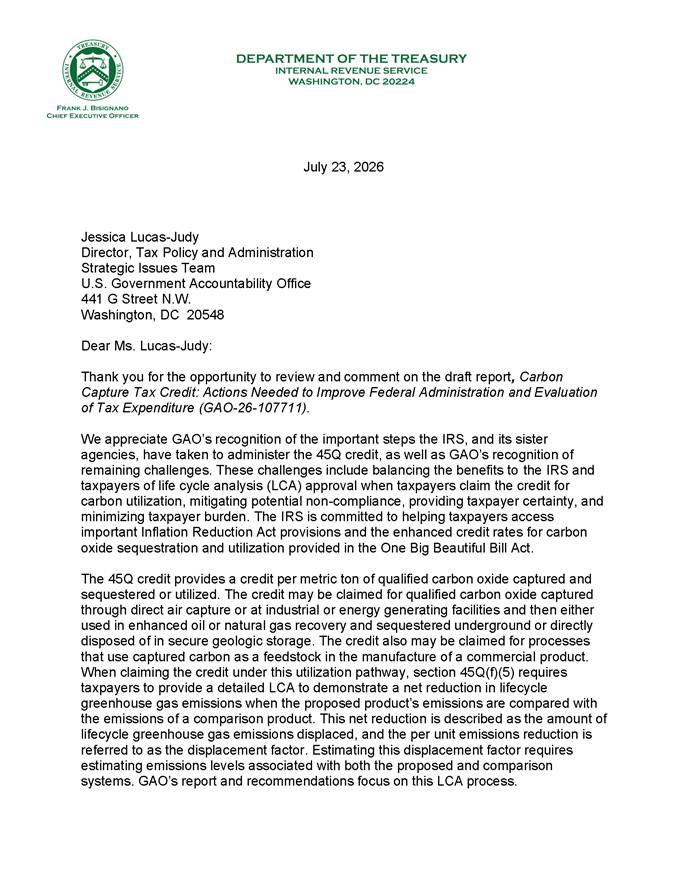

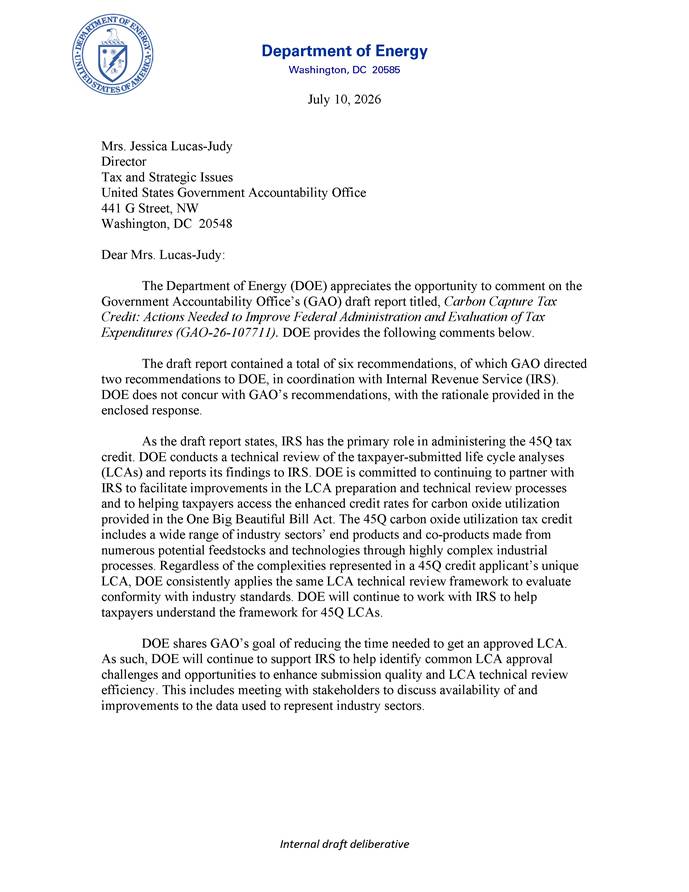

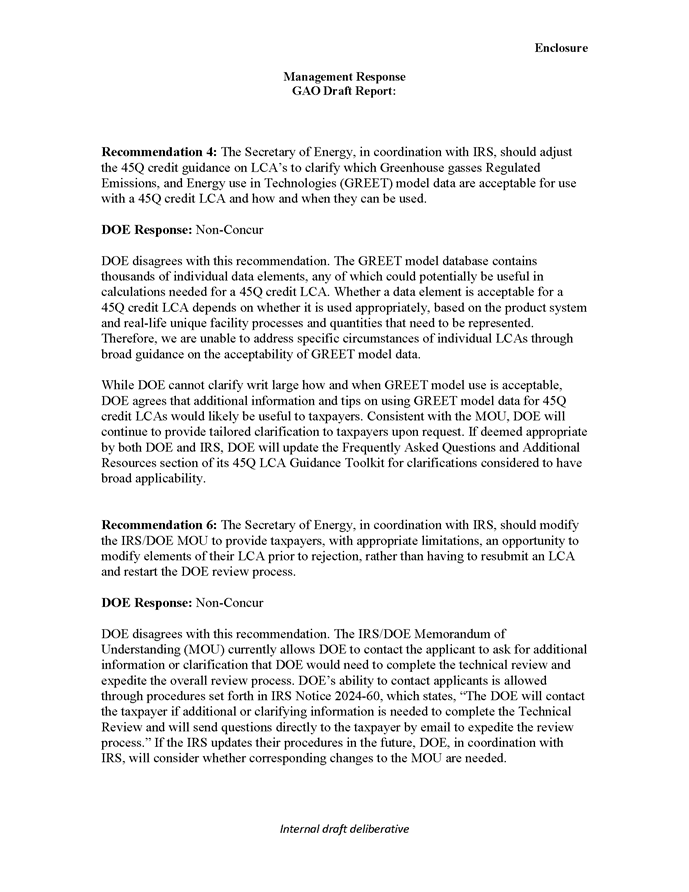
Jessica Lucas-Judy, lucasjudyj@gao.gov
In addition to the contact named above, Jessica Nierenberg, Assistant Director; Jennifer Stratton, Analyst-in-Charge; Jackson Eckel; Jonathan Ferguson; Robert Gebhart; Quindi Franco; Laura Holliday; Gina Hoover; Brian James; Dan Mahoney; Jesse Mitchell; Colson Campbell Ricciardi; Andrew J. Stephens; Joe Thomas; Alicia White; and Clarette Yen made significant contributions to this report.
The Government Accountability Office, the audit, evaluation, and investigative arm of Congress, exists to support Congress in meeting its constitutional responsibilities and to help improve the performance and accountability of the federal government for the American people. GAO examines the use of public funds; evaluates federal programs and policies; and provides analyses, recommendations, and other assistance to help Congress make informed oversight, policy, and funding decisions. GAO’s commitment to good government is reflected in its core values of accountability, integrity, and reliability.
Obtaining Copies of GAO Reports and Testimony
The fastest and easiest way to obtain copies of GAO documents at no cost is through our website. Each weekday afternoon, GAO posts on its website newly released reports, testimony, and correspondence. You can also subscribe to GAO’s email updates to receive notification of newly posted products.
Order by Phone
The price of each GAO publication reflects GAO’s actual cost of production and distribution and depends on the number of pages in the publication and whether the publication is printed in color or black and white. Pricing and ordering information is posted on GAO’s website, https://www.gao.gov/ordering.htm.
Place orders by calling (202) 512-6000, toll free (866) 801-7077,
or
TDD (202) 512-2537.
Orders may be paid for using American Express, Discover Card, MasterCard, Visa, check, or money order. Call for additional information.
Connect with GAO
Connect with GAO on X,
LinkedIn, Instagram, and YouTube.
Subscribe to our Email Updates. Listen to our Podcasts.
Visit GAO on the web at https://www.gao.gov.
To Report Fraud, Waste, and Abuse in Federal Programs
Contact FraudNet:
Website: https://www.gao.gov/about/what-gao-does/fraudnet
Automated answering system: (800) 424-5454
Media Relations
Sarah Kaczmarek, Managing Director, Media@gao.gov
Congressional Relations
David A. Powner, Acting Managing Director, CongRel@gao.gov
General Inquiries
[1]26 U.S.C. § 45Q. The Carbon Oxide Sequestration Credit provides a tax credit for capturing carbon and then using or storing it. The tax credit allows for the capture of certain carbon oxides, including carbon dioxide and sometimes carbon monoxide.
[2]GAO, Energy-Related Tax Expenditures: Information and Questions for Policymakers’ Oversight of the Inflation Reduction Act, GAO‑25‑107704 (Washington, D.C.: May 19, 2025).
[3]Transferability is the ability of a taxpayer to transfer all or a portion of an eligible credit determined with respect to such taxpayer for any taxable year to an unrelated taxpayer (the “transferee taxpayer”). Payments to the taxpayer by the transferee taxpayer must be made in cash.
[4]Tax expenditures can include exclusions, exemptions, or deductions from gross income or special credits, a preferential rate of tax, or deferrals of tax liability.
[5]GAO, Government Performance and Accountability: Tax Expenditures Represent a Substantial Federal Commitment and Need to Be Reexamined, GAO‑05‑690 (Washington, D.C.: Sept. 23, 2005).
[6]Pub. L. No. 117-169, § 70004, 136 Stat. 1818, 2087 (2022).
[7]Energy Improvement and Extension Act of 2008, Pub. L. No. 110-343, div. B, § 115, 122 Stat. 3765, 3829–3831 (2008).
[8]An Act To provide for reconciliation pursuant to the title II of S. Con. Res. 14. Pub. L. No. 117-169, div. H, § 13104, 136 Stat. 1818, 1924–1929 (2022).
[9]An Act To provide for reconciliation pursuant to title II of H. Con. Res. 14, Pub. L. No. 119-21, § 70522(b), 139 Stat. 72, 279–280 (2025).
[10]Data from the 2023 tax year are the most recent available data.
[11]GAO, Understanding the Tax Reform Debate: Background, Criteria, and Questions, GAO‑05‑1009SP (Washington, D.C.: Sept. 1, 2005).
[12]GAO, Tax Expenditures: Background and Evaluation Criteria and Questions, GAO‑13‑167SP (Washington, D.C.: Nov. 29, 2012).
[13]International Energy Agency, IEA (2026), CCUS Projects Database, https://www.iea.org/data-and-statistics/data-product/ccus-projects-database.
[14]26 U.S.C. § 45Q. The tax credit allows for the capture of certain carbon oxides, including carbon dioxide and sometimes carbon monoxide. Captured carbon is generally stored or used in the form of carbon dioxide.
[15]26 U.S.C. § 45Q(d)(2)(C).
[16]26 U.S.C. § 45Q(d)(2)(A).
[17]26 U.S.C. § 45Q(d)(2)(B). For existing generation units, baseline carbon production is the unit’s average annual carbon output as measured over defined periods. For new units, baseline carbon production represents 60 percent of the unit’s designed annual capacity.
[18]Bonus provisions were introduced in the Inflation Reduction Act of 2022 that allow taxpayers to claim five times the credit base rate if they meet certain requirements, including paying workers prevailing wages and meeting apprenticeship requirements. Without meeting the requirements for bonus provisions, the credit rate is $17 per metric ton of qualified carbon oxide for point-source capture and $36 per metric ton of qualified carbon oxide for direct air capture. 26 U.S.C. § 45Q(b)(1)(A)(i) (point-source capture rate), (b)(1)(B) (direct air capture rate), (h)(1) (bonus provisions).
[19]Pub. L. No. 110-343, div. B, § 115, 122 Stat. 3765, 3829–3831 (2008).
[20]Pub. L. No. 115-123, div. D, § 41119, 132 Stat. 64, 162–168 (2018).
[21]Pub. L. No. 117-169, div. H, § 13104, 136 Stat. 1818, 1924–1929 (2022).
[22]26 U.S.C. § 6417.
[23]26 U.S.C. § 6418.
[24]26 U.S.C. § 45Q(h).
[25]Pub. L. No. 119-21, § 70522(b), 139 Stat. at, 279–280.
[26]IRS is to consult with EPA, DOE, and the Department of the Interior on regulations determining adequate security measures for the geological storage of carbon oxide. 26 U.S.C. § 45Q(f)(2). IRS is to consult with EPA when the 75 million metric tons cap that applies to equipment placed into service before 2018 is met. 26 U.S.C. § 45Q(g).
[27]See 26 U.S.C. § 45Q(f)(5)(B). IRS is required to consult with DOE and EPA on regulations governing the required analysis of lifecycle greenhouse gas emissions. An LCA addresses the environmental aspects and potential environmental impacts (e.g., use of resources and environmental consequences of releases) throughout a product’s lifecycle from raw material acquisition through production, use, end-of-life treatment, recycling, and final disposal.
[28]40 C.F.R. §§ 98.1–98.528.
[29]Class II and VI wells are regulated under the Safe Drinking Water Act’s UIC and require a UIC permit. See, 40 C.F.R. §§ 144.1–146.95. States may be the UIC permitting authority, when approved by EPA.
[30]40 C.F.R. § 98.448.
[31]Facilities that conduct EOR are not required by 40 CFR part 98 to report under subpart RR unless (1) the owner or operator chooses to opt into subpart RR or, (2) the facility holds a UIC Class VI permit for the well used for EOR. Annual reports that are submitted under 40 CFR part 98 to EPA’s GHGRP undergo verification by EPA, and non-confidential data from these reports are published on EPA’s website.
[32]To claim the 45Q credit for EOR for tax years starting on or after February 9, 2018, taxpayers can use the CSA/ANSI ISO 27916:2019 standard to establish that qualified carbon oxides are being securely stored.
[33]90 Fed. Reg. 44591 (Sept. 16, 2025). The notice of proposed rulemaking did not inform taxpayers of how to provide the required information to claim the 45Q Credit should GHGRP be eliminated.
[34]91 Fed. Reg. 9712 (Feb. 27, 2026).
[35]26 U.S.C. § 45Q(h)(3)(A)(ii).
[38]26 U.S.C. § 45Q(f)(5)(B)(i). By contrast, to calculate the value of the 45Q credit for enhanced oil recovery or permanent geological sequestration, taxpayers measure the amount of carbon dioxide they securely disposed underground.
[39]The taxpayer’s comparison product system is based on either the profile that represents (1) the average greenhouse gas emissions for U.S. production or (2) the methods of production that represents the industry standard practice for U.S. production. The determination of the use of average U.S. greenhouse gas emissions or industry standard practice is dependent on data availability. See Cutshaw, A., Clarke, J., Chou, J. Krynock, M. and G. Cooney, “45Q Addendum to the NETL CO2U LCA Guidance Document. Version 2.0.,” National Energy Technology Laboratory, Pittsburgh. July 17, 2024.
[40]86 Fed. Reg. 34050 (June 2, 2020); and 86 Fed. Reg. 4728 (Jan. 15, 2021), codified at 26 C.F.R. § 1.45Q-4(c)(6).
[41]On July 24, 2024, IRS released Notice 2024-60, which provides Internal Revenue Code Section 45Q guidance for utilization of carbon dioxide and other carbon oxides. The notice addresses the information that must be included in the required LCA, procedures for submitting the LCA, and supporting information required to be provided to the IRS and DOE for review. IRS Notice 2024-60, 2024-34 I.R.B. 515. Also in July 2024, DOE published a toolkit addendum to further provide guidance for the 45Q LCA.
[42]Notice 2024-60 states that “[f]or purposes of § 45Q, an LCA must rely upon direct, or primary, data to address the actual operational performance of the taxpayer’s system for the taxable year for which the LCA is submitted.”
[43]26 U.S.C. § 6418(e)(1); 26 C.F.R. § 1.6418-2(b)(4).
[44]For many businesses, the tax return is typically due on March or April 15, with automatic extensions for up to September or October 15.
[46]IRS Notice 2024-60, Required Procedures to Claim a Section 45Q Credit for Utilization of Carbon Oxide (July 24, 2024); T. J. Skone et al., Carbon Dioxide Utilization Life Cycle Analysis Guidance for the U.S. DOE Office of Fossil Energy and Carbon Management Version 2.0, National Energy Technology Laboratory, Pittsburgh (January 2022); and Cutshaw, A. et al., 45Q Addendum to the NETL CO2U LCA Guidance Document. Version 2.0.
[47]Department of Energy emissions value request process, 26 C.F.R. § 1.45V-4(c)(5).
[48]For certain uses, the Argonne National Laboratory proposes an incremental approach to LCAs by considering those activities solely related to carbon capture and utilization systems in facilities where those systems are added on. This approach differs from LCA guidance from the National Energy Technology Laboratory, in which the products of carbon capture and utilization systems are evaluated by way of system expansion and the effects of carbon capture and utilization systems are evaluated together with the facilities where these systems are added to. Greg Cooney, José Benitez, Uisung Lee, and Michael Wang, Clarification to Recent Publication - Incremental Approach for the Life-Cycle Greenhouse Gas Analysis of Carbon Capture and Utilization (2022). https://greet.anl.gov/publication-ccu_lca_memo.
[50]DOE reviews the LCA and then IRS rejects or approves it. Officials told us that there has been no circumstance where IRS’s approval/rejection differed from DOE concurrence/non-concurrence.
[51]DOE and IRS MOU Section 5.2.3 (as modified by the September 2025 addendum).
[52]DOE and IRS MOU Section 5.2.3 (as modified by the September 2025 addendum).
[54]IRS officials stated that because historically there was only one identifier for the 45Q credit, these data do not provide further information about the taxpayer’s claim for the 45Q credit and whether a 45Q issue was the primary reason the audit was opened.
[55]26 U.S.C. § 45Q(h).
[56]Form 7220 Prevailing Wage and Apprenticeship (PWA) Verification and Corrections.
[57]GAO, Refundable Tax Credits: Comprehensive Compliance Strategy and Expanded Use of Data Could Strengthen IRS’s Efforts to Address Noncompliance, GAO‑16‑475 (Washington, D.C.: May 27, 2016); and Improper Payments: Information on Agencies’ Fiscal Year 2024 Estimates, GAO‑25‑107753 (Washington, D.C.: Mar. 11, 2025).
[58]40 C.F.R. § 98.448.
[59]GAO, Tax Administration: Better Coordination Could Improve IRS’s Use of Third-Party Information Reporting to Help Reduce the Tax Gap, GAO‑21‑102 (Washington, D.C.: Dec. 15, 2020).
[60]As of March 2026, EPA had not opened the e-GGRT portal.
[61]GAO, Tax Policy: Tax Expenditures Deserve More Scrutiny, GAO/GGD/AIMD-94-122 (Washington, D.C.: June 3, 1994).
[62]86 Fed. Reg. 4728, 4728 (Jan. 15, 2021).
[63]These include the Congressional Research Service, which highlighted broad goals to encourage cleaner, more efficient, and environmentally responsible use of coal specifically and greenhouse gas emissions reductions; DOE, which stated the IRA’s investment in climate and energy will drive innovation and deployment of clean energy, industrial and manufacturing technologies, and infrastructure toward the goal of achieving net-zero emissions; Treasury, which stated the IRA’s PWA provisions are intended to increase pay for the people working on IRA clean energy projects; and DOL, which said that pairing climate investment with the creation of good-paying jobs will help improve job quality in clean energy industries and incentivize the expansion of workforce training pathways into these jobs.
[65]See also IRS Publication 5108 and Publication 4801 for data on the number of claimants and amounts claimed for many tax credits, including the 45Q credit.
[66]In a January 2025 executive order, the President directed EPA to issue guidance on reevaluating the usage of the social cost of carbon. Exec. Order No. 14154, Unleashing American Energy, § 6(c), 90 Fed. Reg. 8353, 8356 (Jan. 29, 2025).
[67]These assumptions involve models of local and global economies, including economic outputs like gross domestic product and environmental outputs like carbon dioxide emissions; models of the global climate, including the temperature increase from increases in atmospheric carbon dioxide concentrations; models connecting the previous models to establish a “damage function”—the stream of monetized future costs and benefits from additional carbon dioxide emissions (like higher sea levels and temperatures, etc.); and models to convert future economic impacts into a net present value, typically through the application of a discount rate.
[68]GAO, Decarbonization: Status, Challenges, and Policy Options for Carbon Capture, Utilization, and Storage, GAO‑22‑105274 (Washington, D.C.: Sept. 29, 2022).
[69]GAO‑22‑105274 discusses some considerations for developing and optimizing carbon capture technologies and systems. For example, “learning-by-doing” at commercial scale under real-world conditions helps identify risks across a full range of conditions, optimize the system, reduce costs, and develop viable business models.
[70]We identified several data sources that provide information on CCUS facilities. including International Energy Agency, CCUS Projects Database - Data product - IEA; The Global CCS Institute, Facilities - Global CCS Institute; Clean Air Task Force, U.S. Carbon Capture Project Map – Clean Air Task Force.
[71]IEA, CCUS Projects Database, IEA, Paris https://www.iea.org/data-and-statistics/data-product/ccus-projects-database, Licence: CC BY 4.0.
[72]Geological sequestration can also yield some income from the sale of carbon removal credits. However, that market is voluntary and therefore uncertain.
[73]GAO, Decarbonization: Opportunities Exist to Improve the Department of Energy’s Management of Risks to Carbon Capture Projects, GAO‑24‑106489, (Washington, D.C.: May 16, 2024); and GAO‑22‑105274.
[74]GAO, Carbon Capture and Storage: Actions Needed to Improve DOE Management of Demonstration Projects, GAO‑22‑105111 (Washington, D.C.: Dec. 20, 2021).
[75]Form 7220 Prevailing Wage and Apprenticeship (PWA) Verification and Corrections.
[77]Overview of BLS Wage Data by Area and Occupation : U.S. Bureau of Labor Statistics; Federal Reserve Economic Data | FRED | St. Louis Fed.
[78]GAO, Opportunity Zones: Improved Oversight Needed to Evaluate Tax Expenditure Performance, GAO‑21‑30 (Washington, D.C.: Oct. 8, 2020).
[79]GAO, Electricity Generation Projects: Additional Data Could Improve Understanding of the Effectiveness of Tax Expenditures, GAO‑15‑302, (Washington, D.C.: Apr. 28, 2015).