
Report to the Ranking Member, Committee on Education and Workforce, House of Representatives
United States Government Accountability Office
A report to the Ranking Member of the Committee on Education and Workforce, House of Representatives
For more information, contact: Thomas Costa at costat@gao.gov
What GAO Found
An estimated 2.8 million children worked in the U.S. in 2023, according to GAO’s analysis. The Department of Labor (DOL) publishes statistical data that provide information on working children’s fatalities, injuries, and illnesses. These data are used to develop workplace safety strategies and policies, but data limitations and discontinued data sets have contributed to information gaps. For example:
· In DOL’s dataset on workplace fatalities, some data on the cause of death or industry in which the child worked are not publicly available.
· DOL changed how it collects data on working children’s injuries and illnesses, so data since 2021 cannot be compared to earlier years.
· Between 2015 and 2023, one DOL survey and two other federal datasets that contained child labor injury data ended.
By mitigating child labor data gaps, DOL would be better positioned to identify and respond to dangerous working conditions for children.
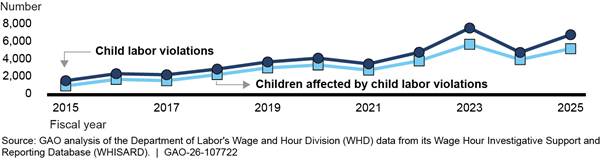
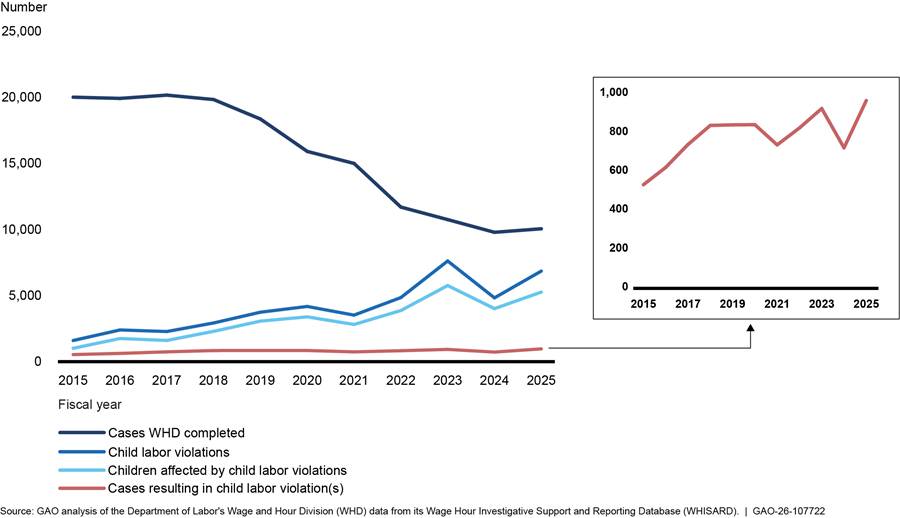
Since fiscal year 2015, the number of annual child labor violations that DOL cited and the number of children affected by their employers’ violations has generally increased, according to GAO’s analysis (see figure). Examples of violations include children working later than allowed or doing hazardous work such as operating meat processing machines.
DOL recently launched an initiative to enhance its enforcement of child labor laws, but it faces some challenges. For example:
· DOL regional and district officials expressed concern with the data DOL recommended for targeting egregious child labor violations, including that the data were not detailed enough to provide useful investigation leads. DOL does not have a process to identify and evaluate additional data sources.
· DOL officials described persistent knowledge gaps among employers and the public on child labor laws. DOL implemented a communications strategy to raise awareness, but taking steps to measure and assess its outreach would help DOL understand whether its efforts are achieving its goals.
In 2023 and 2024, DOL’s interagency collaboration on child labor did not fully follow leading collaboration practices, according to GAO’s analysis. Although DOL works with other agencies to protect children, it discontinued its interagency task force in 2025. Strengthening future collaboration and ensuring key information is shared could enhance DOL’s efforts to protect working children.
Why GAO Did This Study
The Fair Labor Standards Act of 1938 included provisions to protect the safety and health of working children under 18. Almost 90 years later, DOL continues to find numerous child labor law violations.
GAO was asked to review child labor data and enforcement. Among other things, this report addresses (1) information gaps in data about fatalities, injuries, and illnesses among working children; (2) trends in child labor violations; (3) recent changes DOL has made in its child labor enforcement practices, and how DOL has addressed related challenges; and (4) the extent to which DOL has collaborated with other federal agencies on child labor.
GAO analyzed federal data on working children from 2023; child labor fatalities, injuries, and illnesses since 2013; and cited child labor violations from 2015 to 2025 (the most recent data available). GAO reviewed relevant federal laws, regulations, and agency documentation on enforcement and collaboration. To gather information on enforcement and challenges, GAO interviewed officials at DOL’s Wage and Hour Division, including at five regional and six district offices selected to capture a variety of enforcement experiences. GAO also analyzed information from DOL and seven other agencies on child labor collaboration.
What GAO Recommends
GAO is making five recommendations to DOL, including that DOL mitigate child labor data gaps, develop a process to evaluate data for targeting investigations, and assess its employer outreach. DOL generally disagreed with the data gaps recommendation, neither agreed nor disagreed with the outreach recommendation, and agreed with the three other recommendations. GAO maintains DOL should fully implement its recommendations.
|
Abbreviations |
|
|
|
|
|
|
|
ACF |
Administration for Children and Families |
|
|
ASEC |
Annual Social and Economic Supplement |
|
|
BLS |
Bureau of Labor Statistics |
|
|
CAIS |
Childhood Agricultural Injury Survey |
|
|
CDC |
Centers for Disease Control and Prevention |
|
|
Census |
U.S. Census Bureau |
|
|
CFOI |
Census of Fatal Occupational Injuries |
|
|
CIPSEA |
Confidential Information Protection and Statistical Efficiency Act of 2018 |
|
|
CMP |
Civil Money Penalties |
|
|
CPS |
Current Population Survey |
|
|
DOL |
Department of Labor |
|
|
FACE |
Fatality Assessment and Control Evaluation Program |
|
|
FLSA |
Fair Labor Standards Act of 1938, as amended |
|
|
HHS |
Department of Health and Human Services |
|
|
HO |
Hazardous Occupations Order |
|
|
IATF |
Interagency Task Force to Combat Child Labor Exploitation |
|
|
NAICS |
North American Industry Classification System |
|
|
National Initiative |
National Strategic Enforcement Initiative on Child Labor |
|
|
NAWS |
National Agricultural Workers Survey |
|
|
NEISS-Work |
National Electronic Injury Surveillance System-Occupational Supplement |
|
|
NIOSH |
National Institute for Occupational Safety and Health |
|
|
SOII |
Survey of Occupational Injuries and Illnesses |
|
|
WHD |
Wage and Hour Division |
|
|
WHISARD |
Wage Hour Investigative Support and Reporting Database |
|
This is a work of the U.S. government and is not subject to copyright protection in the United States. The published product may be reproduced and distributed in its entirety without further permission from GAO. However, because this work may contain copyrighted images or other material, permission from the copyright holder may be necessary if you wish to reproduce this material separately.
September 18, 2026
The Honorable Robert C. “Bobby” Scott
Ranking Member
Committee on Education and Workforce
House of Representatives
Dear Ranking Member Scott:
Work can provide numerous benefits to the millions of young people employed in the U.S., including by helping them build independence or contribute to their families’ finances, but it also presents potential risks unique to this vulnerable population. The Fair Labor Standards Act of 1938 (FLSA) included provisions to protect working children’s safety and health.[1] Almost 90 years later, the Department of Labor (DOL) continues to identify numerous violations of child labor laws, such as those involving children working in meatpacking plants, sawmills, and other hazardous environments.
In the last 5 years, some states have introduced or passed legislation that modifies rules for working children. In light of this changing legal landscape and recent violations of the FLSA’s child labor provisions, policymakers, worker advocacy groups, and child welfare organizations have raised questions about how DOL’s enforcement capabilities and its collaboration with other agencies help prevent and address these child labor violations.
You asked us to review child labor data and enforcement. This report addresses (1) what available data show about fatalities, injuries, and illnesses among working children in the U.S., and what information gaps remain; (2) what available data show about child labor violations; (3) recent changes DOL has made in its child labor enforcement practices, including in its use of data to inform enforcement, and the extent to which DOL has addressed related challenges; and (4) the extent to which DOL has collaborated with other federal agencies to prevent and detect child labor violations, including through its Interagency Task Force to Combat Child Labor Exploitation (IATF).
To examine fatality, injury, and illness trends, we analyzed aggregated data from DOL’s Bureau of Labor Statistics’ (BLS) Census of Fatal Occupational Injuries (CFOI) from 2013 through 2023, and its Survey of Occupational Injuries and Illnesses (SOII) from 2013 through 2024, which were the most recent data available at the time we conducted our analyses. We also analyzed data from the Annual Social and Economic Supplement (ASEC) of the Current Population Survey (CPS) to examine demographic information on working children for 2023. We found each of these datasets to be sufficiently reliable for the purposes of this report, though we report on their limitations as well. To identify information gaps in these data sources, we reviewed studies and documentation related to the datasets and interviewed officials from DOL and the Department of Health and Human Services (HHS). As we examined gaps in child labor data, we assessed our findings against the Federal Committee on Statistical Methodology’s Framework for Data Quality and our key practices for evidence-based policymaking.[2]
To examine trends in child labor violations and cases, we analyzed data from the DOL’s Wage and Hour Division’s (WHD) electronic case management system, the Wage Hour Investigative Support and Reporting Database (WHISARD), from fiscal year 2015 through fiscal year 2025. These were the most recent data available at the time of our review, and we found them to be sufficiently reliable for the purposes of this report.
To analyze recent changes in and challenges to DOL’s enforcement practices, we reviewed relevant federal laws, regulations, policies, and documents; interviewed officials from the WHD national office, all five regional offices, and six district offices that we selected to capture a variety of enforcement experiences; and interviewed experts and stakeholders from six organizations focused on employers, occupational health and safety, or working children.[3] We compared WHD’s practices to federal standards for internal control and our key practices for evidence-based policymaking.[4]
To assess DOL’s collaboration with other federal agencies, we reviewed agency documentation; interviewed officials and reviewed written responses from DOL and HHS, which has frequently coordinated with DOL on child labor issues in the past; and reviewed responses to a structured questionnaire we sent to the six other agencies involved in the IATF.[5] We assessed DOL’s collaboration against leading practices for interagency collaboration identified in our prior work.[6] See appendix I for a detailed scope and methodology of this review.
We conducted this performance audit from July 2024 to September 2026 in accordance with generally accepted government auditing standards. Those standards require that we plan and perform the audit to obtain sufficient, appropriate evidence to provide a reasonable basis for our findings and conclusions based on our audit objectives. We believe that the evidence obtained provides a reasonable basis for our findings and conclusions based on our audit objectives.
Background
Fair Labor Standards Act
The FLSA, as amended, and youth employment regulations issued by DOL─the federal agency generally responsible for enforcing the FLSA─provide protections for certain working children under 18, such as restrictions on the hours and times of day they can work and on occupations that DOL has deemed hazardous.[7] Federal child labor laws generally distinguish between the rules that apply to children working in agricultural occupations and children working in nonagricultural occupations.
Nonagricultural Employment
Children under 18 are allowed to work in a variety of jobs but are generally prohibited from working in the 17 nonagricultural hazardous occupations that DOL has established by regulation, subject to limited exemptions.[8] These regulations are known as the hazardous occupations orders (HO). For example, children are prohibited from working in coal mining occupations.
Additional provisions for children in nonagricultural jobs depend on age. For example:
· Children ages 16 to 17 may work in any occupation, other than those deemed hazardous by DOL, and there are no limitations on the number of hours or times of day they can work.[9]
· Children ages 14 to 15 are generally limited to occupations and time periods that DOL has determined will not interfere with their schooling, health, or well-being.[10]
· Children ages 13 and under generally may not be employed in nonagricultural work aside from work in areas exempt from the FLSA, such as newspaper delivery.[11]
Agricultural Employment
For children in agricultural jobs:
· Children ages 16 to 17 do not have occupational restrictions on working in agriculture.
· Children under 16 are generally prohibited from working in the 11 agricultural hazardous occupations that DOL has established by regulation, subject to limited exemptions.[12]
· Children ages 14 to 15 may generally work outside of school hours in agricultural occupations, other than those deemed hazardous by DOL. For example, children are prohibited from operating or working with certain agricultural machinery, such as cotton pickers, grain combines, and hay mowers.
· Children ages 12 and 13 may generally work outside of school hours with written parental consent or work on the same farm as their parent (or person standing in place of a parent).[13]
DOL’s Role in Child Labor Enforcement
DOL’s WHD enforces the FLSA, including its child labor requirements and associated regulations and other laws.[14] WHD uses a range of compliance actions to enforce these laws. For example, WHD cases can be full investigations that cover all laws under the agency’s jurisdiction; limited investigations with a narrow focus, such as a certain time frame or section of a law; or conciliations, which are simple cases where WHD staff work with employers and workers to resolve limited issues over the phone, such as issues involving a missed paycheck for a single worker; among other types of cases.[15]
WHD may start cases in response to complaints or on its own initiative (directed cases). For directed cases, WHD selects certain types of businesses or industries for investigation, such as low-wage industries with high rates of violations or egregious violations, or industries that employ vulnerable workers.[16]
WHD’s national office provides guidance and training on its enforcement practices to its five regional and 54 district offices, and it establishes performance measures for these practices. WHD regional offices oversee the district offices, which conduct investigations and audits. District offices also have Community Outreach Resource and Planning Specialists, whose primary duties include enforcement planning and outreach efforts, such as making presentations to employers on child labor requirements.
When WHD determines that an employer has violated the FLSA’s child labor provisions and its regulations, WHD may assess a civil money penalty (CMP) for the violation, based on the severity of the violation, the number and age of children involved, the duration of illegal employment, and other factors. In addition, WHD may work with DOL’s Solicitor’s Office to issue subpoenas and apply the “hot goods” provisions of the FLSA to prevent interstate shipment of goods produced in an establishment where illegal child labor occurred, among other efforts.[17]
Limited and Discontinued Data on Working Children’s Fatalities, Injuries, and Illnesses Have Contributed to Information Gaps
Available but Limited Data Suggest That Most Work-Related Child Fatalities Occurred in Agriculture
An estimated 2.8 million children worked in the U.S. in 2023, including an estimated 68,000 children employed in agricultural industries, according to our analysis of CPS data.[18] We found that from 2013 through 2023, an average of 24 children under 18 died each year due to work-related incidents, according to publicly available CFOI data.[19] Most work-related child fatalities for which the industry was reported in the CFOI data occurred in various agricultural industries. However, DOL does not publish a substantial amount of data on certain CFOI variables, such as detailed information on the cause of death and the industry involved, in its publicly available datasets, which limits what is publicly known about the overall characteristics of child fatalities.
Fatalities by Selected Characteristics
We analyzed working children’s fatalities from 2013 through 2023 according to sex, race and ethnicity, cause of death, and industry, using publicly available CFOI data. We found the presence of certain characteristics was disproportionately higher among work-related child fatalities from 2013 through 2023, as compared to the overall working child population that we estimated using CPS data.
From 2013 through 2023, 260 children under 18 died in work-related fatalities, according to CFOI data.
Sex. CPS data indicate that boys and girls each made up about half of child workers ages 15 to 17 in 2023.[20] However, CFOI data show that boys under 18 incurred 90 percent of fatalities during the period we analyzed (see fig. 1 and fig. 2).[21]
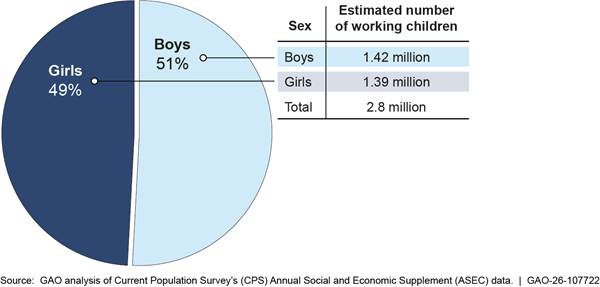
Notes: GAO’s CPS ASEC analysis uses 2024 data, which is based on work experience during 2023. The estimate for working children covers ages 15 to 17. The 95 percent confidence interval for boys is 48 percent to 53 percent. The 95 percent confidence interval for girls is 47 percent to 52 percent. In this report, the terms “boys” and “girls” refer to individuals identified in the dataset as male or female, respectively.
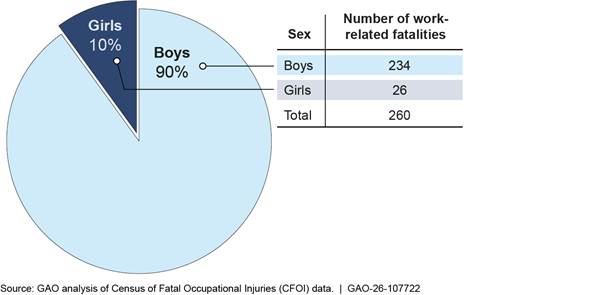
Notes: Work-related child fatalities data include children under 18. CFOI identifies individuals by their sex (male or female). In this report, the terms “boys” and “girls” refer to individuals identified as male or female, respectively, in the dataset.
Race and ethnicity. In contrast to work-related child fatalities by sex, the race and ethnicity of children who sustained work-related fatalities did not appear to differ as appreciably from that of working children overall, based on available CFOI and CPS data.[22] For example, our analyses show:
· White children accounted for 70 percent of working children’s fatalities, according to CFOI data from 2013 through 2023. In 2023, White children comprised an estimated 65 percent of working children, according to CPS data.[23]
· Hispanic children accounted for 21 percent of fatalities, according to CFOI data from 2013 through 2023. In 2023, Hispanic children comprised approximately 17 percent of working children, according to CPS data.[24]
· Black children accounted for 5 percent of fatalities, according to CFOI data from 2013 through 2023. In 2023, Black children comprised approximately 9.5 percent of working children, according to CPS data.[25]
Cause of death and industry. Over half of the 260 child fatality cases in the period we analyzed using BLS’s publicly available data did not contain detailed information on the associated cause of death or the industry in which the child worked.[26] BLS does not disclose why any particular data points are not published, but officials told us that a potential reason could be that publication of the data point could risk revealing confidential information (for example, due to a low number of fatalities).[27] This limitation in the publicly available data makes it more difficult for stakeholders outside of DOL—including other government agencies—to accurately identify the conditions under which working children were killed or the industries in which they worked when their deaths occurred.[28]
Our analysis of publicly available CFOI data on working children’s fatalities from 2013 through 2023 found that:
· Of the 111 fatalities with a reported cause, transportation incidents—such as a collision with a motorized vehicle—caused approximately two-thirds of fatalities (see fig. 3).[29]
Figure 3: Work-Related Fatalities of Children Under 18 in the U.S. for Which Cause Was Reported, by Cause (Event or Exposure), 2013−2023
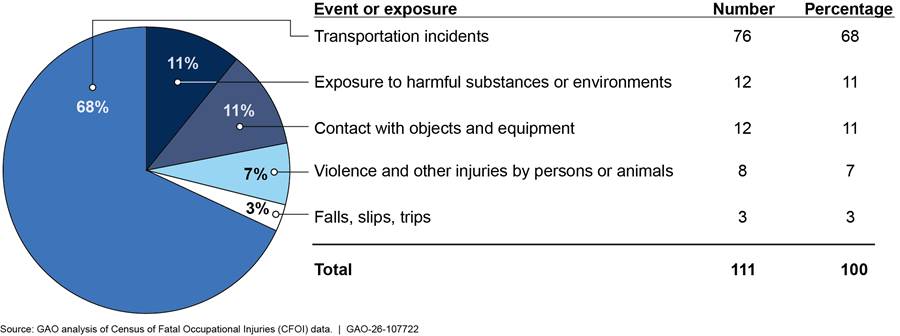
Notes: Work-related child fatalities data include children under 18. The term “cause” refers to a variable in the CFOI labeled “event/exposure” that describes how the fatal injury occurred (for example, the worker was hit by a moving vehicle). GAO did not analyze all related variables in the CFOI, including the primary source of an injury (which describes the implement involved, such as a mechanical saw). GAO grouped cause information at the 2-digit level of the Occupational Injury and Illness Classification System to understand fatalities at the specific category level, and then aggregated data to the 1-digit level. Information on cause was available for 111 of the 260 fatalities GAO identified from the Department of Labor’s Bureau of Labor Statistics’ (BLS) publicly available data for working children’s fatalities for 2013−2023. More information on cause may be publicly available at the 1-digit level for the 260 child fatalities GAO identified, according to BLS officials. A potential reason for a data point not being published could be that it could risk revealing confidential information (for example, due to a low number of fatalities), according to BLS officials. Percentages may not add up to 100 because of rounding.
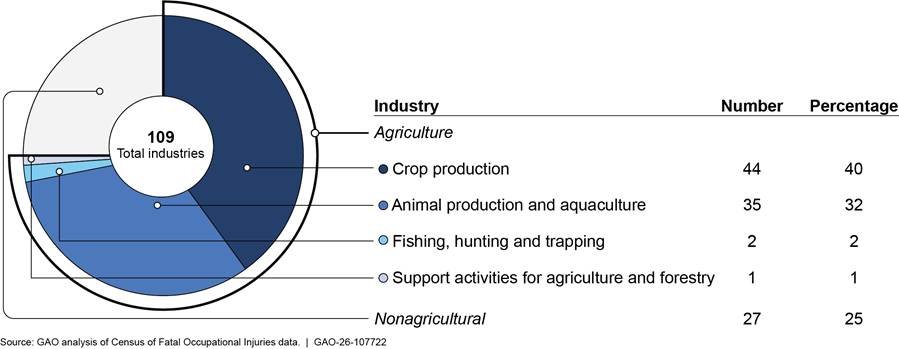
· Of the 109 fatalities with a reported industry, 75 percent occurred in various agricultural industries (see fig. 4).[30] Most of those fatalities occurred in crop production. In 2023, about 2.5 percent of working children were employed in agriculture, according to CPS data.[31]
See appendix II for more detailed results of our analyses of working children’s fatalities by industry.
Figure 4: Work-Related Fatalities of Children Under 18 in the U.S. for Which Industry Was Reported, by Industry, 2013−2023
Notes: Work-related child fatalities data include children under 18. GAO did not analyze all related variables in the Census of Fatal Occupational Injuries, including the specific occupation worked (for example, fast food and counter workers). GAO grouped industries at the 3-digit level of the North American Industry Classification System. Using this grouping, information on industry was available for 109 of the 260 fatalities GAO identified from the Department of Labor’s Bureau of Labor Statistics’ (BLS) publicly available data for working children’s fatalities from 2013−2023. A potential reason for a data point not being published could be that it could risk revealing confidential information (for example, due to a low number of fatalities), according to BLS officials. Using a different grouping methodology, some additional information on industry may be available for more of the 260 child fatalities we identified. Percentages may not add up to 100 because of rounding.
Recent Changes in DOL’s Data Collection and Reporting Methodology Add to Existing Limitations in Injury and Illness Data
While DOL collects information on working children’s injuries and illnesses through the SOII, multiple changes in methodology have made it difficult to examine recent trends.[32]
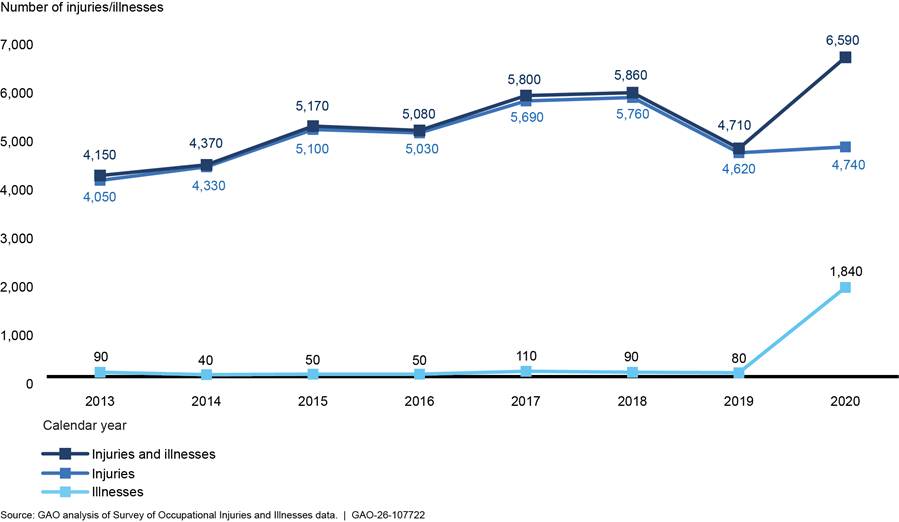
Through our analysis of SOII data, we found an estimated 6,590 injuries and illnesses combined among working children under 18 in 2020, compared with 4,150 in 2013 (see fig. 5).[33] An increase in illnesses among working children between 2019 and 2020 appears to be the main driver of this change, rising from 80 illnesses in 2019 to 1,840 in 2020. According to BLS officials, this rise mirrors a large increase in 2020 workplace reports of viral disease, a category that includes COVID-19.
Figure 5: Estimated Number of Work-Related Injuries and Illnesses Among Children Under 18 in the U.S., 2013−2020
Notes: The relative standard errors of the combined injury and illness figures are 3.2 percent or smaller; of the injury figures 3.5 percent or smaller; and of the illness figures 32.5 percent or smaller. Separate injury and illness figures for a given year may not add up to the combined injury and illness figure because of rounding differences.
We were not able to examine injury and illness trends after 2020 because of various changes BLS made to the SOII methodology after that date, as discussed below. However, BLS provided us with estimates from discrete 2-year periods after 2020. These estimates show approximately 17,420 injuries and illnesses to working children ages 17 and under in 2021−2022. An estimated 12,310 of these were injuries and 5,110 were illnesses. In 2023−2024, BLS estimated that working children experienced 10,810 injuries and illnesses combined, of which 10,250 were injuries and 560 were illnesses.[34]
Injuries and Illnesses by Sex
In contrast to work-related fatalities, injuries and illnesses to working children were distributed relatively evenly across boys and girls, ranging annually from 45 percent to 56 percent for boys, and 44 percent to 55 percent for girls from 2013 through 2020.[35]
Injuries and Illnesses by Type
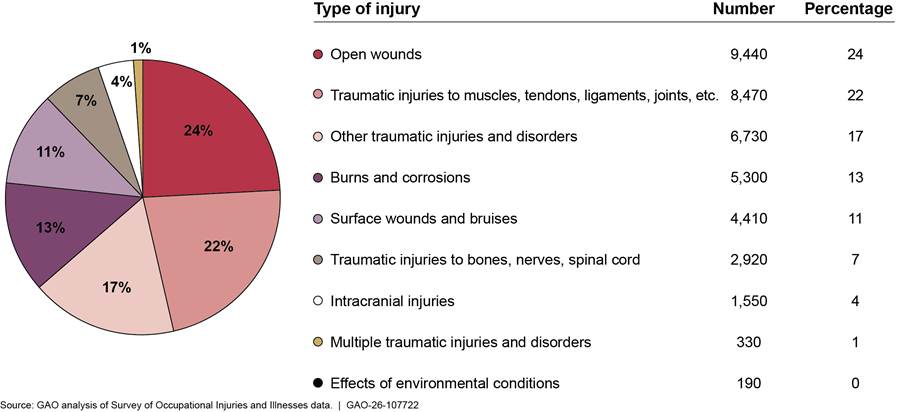
The vast majority of injuries to working children from 2013 through 2020 were traumatic injuries and disorders (94 percent), most commonly open wounds and traumatic injuries to muscles or tendons, according to our analysis of SOII estimates (see fig. 6). The number of viral diseases was low until 2020, when it contributed to nearly 30 percent of all injuries and illnesses combined in that year.[36]
Notes: The relative standard errors of these numbers and percentages are 14.7 percent or smaller. Percentages may not add up to 100 because of rounding. The category “Other traumatic injuries and disorders” includes traumatic injuries and disorders that are not included in other categories, such as nonfatal injuries that involve the lack of oxygen, or those that result from contact with electrical current.
Injuries and Illnesses by Industry
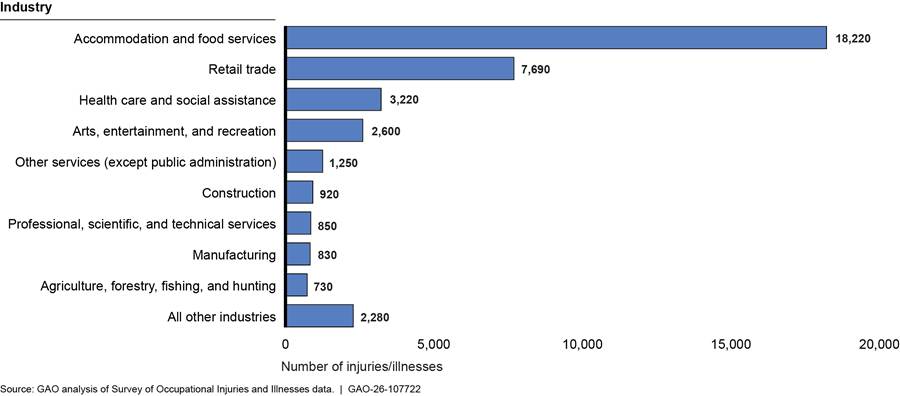
From 2013 through 2020, work-related injuries and illnesses among children occurred most often in the accommodation and food services industry (47 percent of injuries and illnesses) and in retail trade (20 percent of injuries and illnesses), according to our analysis of SOII estimates (see fig. 7).[37]
Figure 7: Injuries and Illnesses Among Working Children in the U.S., Ages 15−17, by Industry, 2013−2020
Notes: The relative standard errors of these numbers are
11.3 percent or smaller. GAO analyzed injuries and illnesses to children ages
15−17, rather than children under 18, to enable comparisons with data on
working children by industry.
Within the accommodation and food services industry, we found that approximately 96 percent of injuries and illnesses occurred among children working at food services and drinking places such as restaurants (including full-service restaurants) and limited-service eating places. Within retail trade, most injuries and illnesses occurred at food and beverage stores (44 percent), followed by those occurring at general merchandise stores (22 percent). In contrast to our finding that agricultural work accounted for the majority of work-related child fatalities for which data on industry exist, we found that approximately 2 percent of working children’s injuries and illnesses occurred among children engaged in agricultural work from 2013 through 2020.[38] See table 4 in appendix II for our analysis of working children by industry.
Changes in Methodology for Collecting and Reporting Injury and Illness Data
In 2021, and again in 2023, BLS changed its methodology for collecting and reporting injury and illness data through the SOII. The 2021 changes included shifting from annual to biennial data collection. As a result of this and other changes, it is not possible to compare injury and illness data from 2021 onward to earlier data, according to BLS officials. In addition, due to further methodology changes in 2023, BLS recommends against comparing its 2021−2022 and 2023−2024 data with each other.
Specifically, BLS:
· Added reporting on job transfers and restrictions. In 2021, BLS added detailed reporting of injuries and illnesses that resulted in job transfer or restriction, such as when an injured employee is assigned to another job on a temporary basis. Before this change, BLS only reported details on case circumstances and worker characteristics for cases that resulted in days away from work.[39]
· Moved from annual to biennial data. As part of its 2021 changes, the agency shifted from annual to biennial data collection and publication, with the first biennial dataset covering 2021-2022. According to BLS documentation, the shift to biennial reporting was aimed at reducing respondent burden while enabling more detailed estimates.[40]
· Altered sampling methodology. BLS also altered its sampling methodology in 2021 to accommodate the added data collection for job transfer and restriction cases without having to add agency resources or increase respondent burden, according to agency officials. Specifically, BLS made it easier for certain employers to report on a smaller sample of cases as they complete their surveys.
· Changed the coding of injury and illness characteristics. BLS reported that in 2023, it changed the way it coded the characteristics of injuries and illnesses to improve data quality and better meet user needs. For the 2023−2024 dataset, BLS used its newly revised system for classifying injury and illness characteristics, such as the nature of the injury or the part of the body affected.[41] These changes had been planned for 2021, but they were delayed to align with other updates to industry and occupation coding systems, according to BLS documentation.[42]
BLS made these changes in response to particular goals and resource constraints, according to agency documentation and our discussions with BLS officials. However, the resulting lack of comparability over the last four years of data adds to already existing limitations in the SOII, the primary federal source of information on nonfatal workplace injuries and illnesses. We and other federal agencies have previously reported on limitations in the SOII, such as variability in employer recordkeeping practices, underreporting of injuries and illnesses, and exclusion of certain worker categories, among others.
For example, in 2020, BLS reported wide variability in the extent to which employers maintained injury logs that are used to inform the SOII, as well as considerable misunderstanding of recordkeeping requirements for workplace injuries and illnesses based on a 2015 survey.[43] In 1996, the Centers for Disease Control and Prevention (CDC) reported that employment data in 1993 suggested that at least 11 percent of working children under 18 were not represented by the SOII, in part because of excluded categories of workers, such as those who work on small farms.[44] Similarly, in 2018, we reported that SOII injury and illness data may undercount injuries and illnesses to working children because the data exclude certain industries. We recommended BLS evaluate the feasibility of measuring injuries and illnesses of child household and farm workers, among other recommendations. BLS determined that it would not be feasible to do so because its methods were insufficient to reliably sample these populations. In addition, we noted that the SOII doesn’t collect age information for workers with milder injuries or illnesses that do not result in time away from work.[45]
Discontinued Datasets Have Contributed to Information Gaps About Fatalities, Injuries, and Illnesses Among Working Children
Despite various efforts to improve the sufficiency and quality of child labor data, less information is currently available to track working children’s fatalities, injuries, and illnesses at a national level than in past years because of the elimination of several datasets that included working children. For decades, federal agencies and others have highlighted and made recommendations about gaps in this information on working children. For example, in 1998, the National Academies of Sciences, Engineering, and Medicine reported that data on working children’s injuries and illnesses were limited, poorly coordinated, and had not been evaluated to assess whether they omitted certain categories of working children.[46] The report made recommendations to address these gaps. Similarly, in 1997, a working group of the CDC’s National Institute for Occupational Safety and Health (NIOSH) found significant data gaps in child labor surveillance and made recommendations to address them.[47]
BLS and NIOSH each reported they had taken steps that implemented some recommendations from these and other reports. For example, in 1998, the National Academies recommended that BLS publish SOII information by separate age categories, rather than reporting age groups that combine children under 18 with older workers. BLS officials told us BLS made it possible to retrieve SOII data by individual age sometime in the decade following the 1998 report.[48] However, the limitations we discuss in this report indicate that considerable gaps persist.
Compounding these longstanding concerns, fewer federal datasets that include child labor data are published now than were in the past. Two NIOSH datasets─the National Electronic Injury Surveillance System-Occupational Supplement (NEISS-Work) and Childhood Agricultural Injury Survey (CAIS)─and one DOL survey, the National Agricultural Workers Survey (NAWS), have ended.[49]
· NEISS-Work. The NEISS-Work provided estimates of nonfatal work-related injuries and illnesses treated in emergency departments, including among children ages 15 to 17.[50] According to CDC officials, the agency terminated NEISS-Work after it determined that NIOSH could no longer sustain funding to collect the data. The final data were collected in 2023. The elimination of NEISS-Work removes a data source that previously shed light on areas where SOII data were limited. For example, NEISS-Work included data on emergency room visits from children working on farms with fewer than 11 workers, a category the SOII does not capture. In addition, NEISS-Work contains data on children with milder injuries and illnesses that did not result in days away from work, who are not disaggregated from adults in the SOII.[51]
· CAIS. The CAIS, which provided data on nonfatal injuries among children working on U.S. farms, ended in 2015 when its funding was discontinued, according to CDC officials.[52] CDC officials told us that the termination of this dataset created a gap in national data on fatalities, injuries, and illnesses to children working on farms, especially younger children, as these data are not captured by the SOII. CDC officials noted that the federal government has no remaining national data collection efforts specifically related to children in agriculture, and NIOSH does not have any plans to resume the CAIS in the future.
· NAWS. DOL’s Employment and Training Administration conducts the NAWS, an employment-based, random-sample survey of U.S. crop workers that collects demographic, employment, and health data in face-to-face interviews. DOL and NIOSH collaborated to administer an occupational injury module for four of the NAWS survey cycles (1999, 2002−2004, 2008−2010, and 2014−2015). The injury modules included an examination of injury rates and characteristics for crop workers ages 14 through 17, a group that is not comprehensively included in the SOII. There are no plans for another such module that includes children under 18, according to both DOL and NIOSH officials.[53]
|
Fatality Assessment and Control Evaluation (FACE) Program The National Institute for Occupational Safety and Health’s FACE Program conducts comprehensive investigations into selected work-related child and adult fatalities by taking steps such as visiting worksites, examining equipment, reviewing documentation, and interviewing employers and witnesses. The resulting reports provide detailed findings and recommendations aimed at preventing future fatalities. For example, the FACE Program investigated and reported on: · A 16-year-old boy working as a tire repair assistant who died when a vehicle fell and crushed him. · An 11-year-old boy working on a family farm who died when he was caught in a mechanical sweeping tool used to clean corn off a silo floor. · A 16-year-old boy working as a roofer who died when the metal ladder he was holding contacted a high-voltage line. Source: Information from the National Institute for Occupational Safety and Health’s FACE and state FACE Programs. | GAO‑26‑107722 |
In addition, less information is available on child fatalities than in the past, which is particularly notable in light of the limitations in the publicly available CFOI data described earlier in this report. Specifically, NIOSH’s Fatality Assessment and Control Evaluation (FACE) Program—which aims to prevent work-related fatal injuries by identifying high-risk work situations and disseminating prevention strategies—had designated youth fatalities as a priority from 1999 to 2010 (see sidebar). CDC officials told us NIOSH shifted FACE’s focus from youth to other priority areas in 2010 because of an ongoing decrease in the child fatality rate.[54] After that year, the program investigated child workplace fatalities more selectively, according to CDC officials, resulting in fewer FACE reports on working children.[55]
As the primary statistical and enforcement agency for issues related to labor, DOL produces statistical data that provide information on work-related fatalities, injuries, and illnesses, including those related to children.[56] These data are used to develop workplace safety strategies and policies. For example, DOL relies on data to develop and evaluate its policies to ensure working children receive the protections to which they may be entitled under the FLSA. However, limitations in DOL’s publicly available CFOI data and its SOII data, compounded by the elimination of other relevant federal datasets, contribute to gaps in critical information about children’s fatalities, injuries, and illnesses.
The Federal Committee on Statistical Methodology’s Framework for Data Quality describes best practices for identifying and addressing key data quality issues, including determining the data’s relevance in meeting current and prospective user needs.[57] Part of determining the data’s relevance involves reevaluating data needs when changes in the availability of other sources occur, as has happened over time with sources of child labor fatalities, injury, and illness data that have been discontinued. In addition, we have identified key practices to help federal agencies assess and build evidence they need to support their mission and address policy questions.[58] These practices include assessing the sufficiency of existing evidence, identifying and prioritizing evidence needs, and generating new evidence, as needed. DOL’s latest Evidence Plan, published in 2026, did not include plans to address child labor data needs. Without taking steps to mitigate the limitations and gaps in child labor data on working children’s fatalities, injuries, and illnesses, DOL will be hampered in its efforts to prevent and respond to dangerous conditions that put working children at risk.
Child Labor Violations Cited by WHD Have Generally Increased Since 2015, and Most Cited Employers for Scheduling Children to Work Longer or Later Than Permitted
Since 2015, Child Labor Violations Cited by WHD Have Generally Increased
From fiscal year 2015 through fiscal year 2025, WHD found 44,857 violations of child labor laws resulting from 8,688 cases, according to our analysis of WHD enforcement data.[59] During this timeframe, the number of child labor violations generally increased, peaking at 7,624 cited violations in fiscal year 2023. Similarly, the number of children affected by child labor violations has generally increased over time (see fig. 8). WHD officials noted that these data should not be used to describe the prevalence of illegal child labor in the U.S. Rather, these are the violations that WHD identified and cited through its investigative work. Each case can result in more than one violation.
Figure 8: Cases Completed and Child Labor Violations Cited by the Department of Labor’s Wage and Hour Division (WHD), Fiscal Years 2015−2025
Note: Cases and violations are recorded in the WHD case management system in the fiscal year in which a case is closed, which may differ from the year in which an incident occurred or the year in which a case started. This figure excludes conciliations (which are simple cases that WHD can typically resolve by phone, such as violations involving a missed paycheck for a single worker), because WHD began transitioning conciliation cases to a new case management system in fiscal year 2023. According to GAO’s analysis of these data, conciliations resulted in 31 child labor violations in GAO’s review period. Officials noted that WHD generally uses more comprehensive investigative tools when cases involve child labor. Officials also noted that enforcement data should not be used to describe the prevalence of illegal child labor in the U.S. Rather, these are the violations that WHD identified and cited through its investigative work. Each case can result in more than one violation.
Despite the overall increase in the number of child labor violations WHD cited from fiscal year 2015 through fiscal year 2025, we found the number of cases the agency completed decreased during that period.[60] WHD officials said there were many factors that might have contributed to this decrease, such as some cases taking more time and resources to complete. In the last few years, WHD has also prioritized cases that are likely to find egregious violations, as we discuss later in this report. Such cases may involve coordinating across regions or working with DOL’s Solicitor’s Offices to arrange search warrants or use other legal tools. WHD officials also said the agency had been operating with a smaller investigative workforce and other resource constraints in recent years.[61]
Most Child Labor Violations Cited by WHD Involved Employers Scheduling 14- and 15-Year-Olds to Work Longer or Later Than Permitted
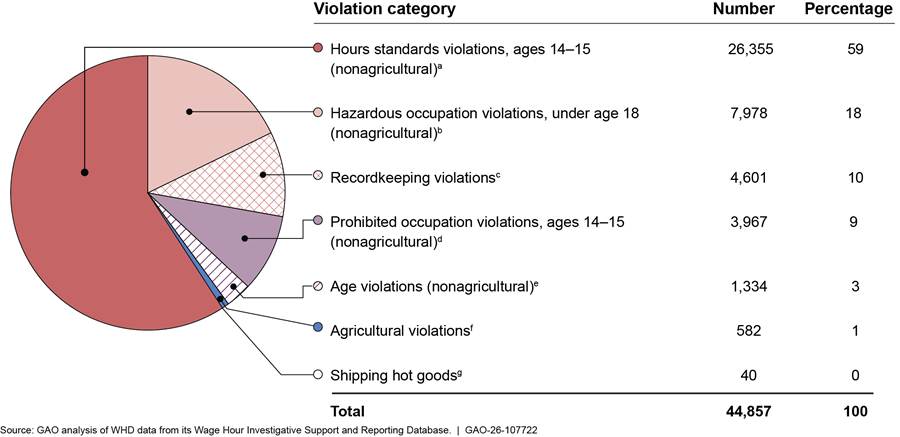
Most child labor violations (59 percent) cited by WHD involved employers scheduling 14- and 15-year-olds to work longer or later than is permitted by federal child labor laws for nonagricultural work, according to our analysis of WHD enforcement data from fiscal year 2015 through fiscal year 2025 (see fig. 9). These hours standards establish daily and weekly limits for 14- and 15-year-olds in nonagricultural work, such as allowing children to work no more than 3 hours per day or 18 hours per week when school is in session.
Additionally, of the child labor violations that WHD cited:
· 18 percent were related to the nonagricultural HOs, which generally prohibit children under 18 from working in occupations DOL has deemed particularly hazardous.[62]
· 10 percent were related to recordkeeping requirements for child workers, such as not having required documentation of a child worker’s date of birth.[63]
· 9 percent involved employers allowing 14- and 15-year-olds to work in occupations that are prohibited for children of these ages, such as transportation and construction.[64]
· 3 percent were related to age standards, in which children were employed despite being under the legal age for employment in nonagricultural occupations.
· 1 percent of violations were related to agricultural work, including age and hours violations in agriculture and violations of agricultural HOs.[65]
· Less than 1 percent were related to employers shipping hot goods made with illegal child labor.
Figure 9: Child Labor Violations Cited by the Department of Labor’s Wage and Hour Division (WHD), by Violation Category, Fiscal Years 2015−2025 Combined
Note: This figure includes cited child labor violations from all types of WHD cases, such as full investigations, limited investigations, conciliations, and other case types. According to our analysis, conciliations resulted in 31 child labor violations in our review period. WHD officials noted that enforcement data should not be used to describe the prevalence of illegal child labor in the U.S. Rather, these are the violations that WHD identified and cited through its investigative work.
aThe “hours standards” for 14- and 15-year-olds establish daily and weekly limits for nonagricultural work, such as allowing children to work no more than 3 hours per day while school is in session.
bNonagricultural hazardous occupations orders (HO) generally prohibit children under 18 from working in occupations the Department of Labor has deemed particularly hazardous.
cRecordkeeping violations may be found in both agricultural and nonagricultural cases.
dSome nonagricultural occupations are prohibited for 14- and 15-year-olds.
eIn general, children under 14 may not be employed in nonagricultural occupations covered by the Fair Labor Standards Act.
fThis category includes all agricultural violations related to any of the standards and exemptions set forth in law and regulations about children working in agriculture: (1) agricultural HOs prohibit children under 16 from working in agricultural jobs deemed particularly hazardous, with limited exceptions; (2) the legal minimum age for agricultural work outside of school hours is generally 14 years old, with some exceptions; and (3) agricultural work must generally be done outside school hours.
gHot goods violations occur when employers ship goods made with illegal child labor.
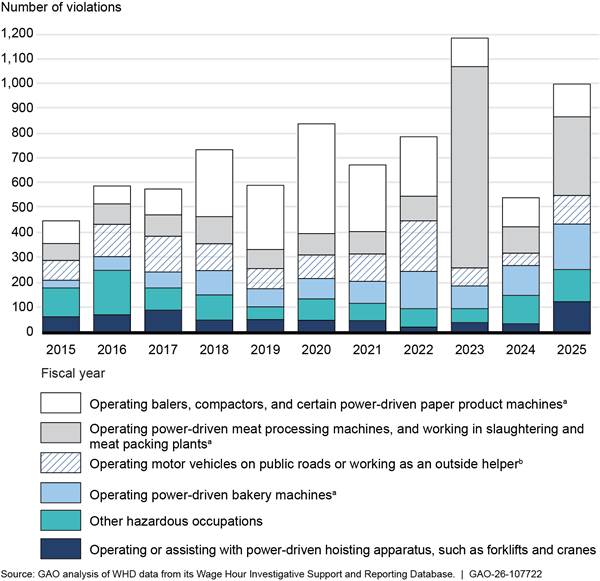
Cited nonagricultural hazardous occupation violations. From fiscal year 2015 through fiscal year 2025, the most common nonagricultural HO violations cited by WHD varied, according to our analysis of WHD enforcement data (see fig. 10). For example, from fiscal year 2018 through fiscal year 2022, the most commonly cited nonagricultural HO violations involved work with balers, compactors, and power-driven paper product machines. In fiscal year 2023, there was a spike in cited violations involving work with power-driven meat processing machines and work in slaughtering and meatpacking plants, which rose from 99 cited violations in fiscal year 2022 to 809 in fiscal year 2023.[66]
Figure 10: Number of Child Labor Violations of the Nonagricultural Hazardous Occupations Orders (HO) Cited by the Department of Labor’s Wage and Hour Division (WHD), Fiscal Years 2015−2025
Note: This figure includes cited child labor violations from all types of WHD cases, such as full investigations, limited investigations, conciliations, and other case types. According to GAO’s analysis, conciliations resulted in 31 child labor violations in the review period. WHD officials noted that enforcement data should not be used to describe the prevalence of illegal child labor in the U.S. Rather, these are the violations that WHD identified and cited through its investigative work.
aAccording to the Department of Labor (DOL), certain HOs generally include the occupations of setting up, adjusting, repairing, oiling, and cleaning the equipment covered in the HO.
bAccording to DOL, an outside helper is any individual, other than a driver, whose work includes riding on a motor vehicle outside the cab for the purpose of assisting in transporting or delivering goods. Per DOL regulations, there are limited exceptions for incidental and occasional driving by 17-year-olds.
Cited agricultural violations. Violations related to agricultural work made up around 1 percent—or 582—of all cited child labor violations from fiscal year 2015 through fiscal year 2025. Most of those agricultural violations were associated with hours and age requirements (538 violations), such as cases in which employers scheduled 12- or 13-year-olds to work during school hours. WHD cited 44 agricultural HO violations in this timeframe. Of those, the most common involved (1) operating a tractor and related work or (2) operating a trencher, fork lift, potato combine, or power-driven saws (see app. III).
Cited violations associated with fatalities and injuries. Through its investigative process, WHD also tracks fatalities and injuries that are associated with child labor violations it identifies.[67] Our analysis of WHD enforcement data show that, from fiscal year 2015 through fiscal year 2025, around 1 percent of cited child labor violations (489 violations) were associated with fatalities or injuries.[68] The number of cited child labor violations associated with fatalities varied by fiscal year, with zero violations in fiscal year 2022 and fiscal year 2023, and a high of 12 violations in fiscal year 2025. The number of cited violations associated with injuries generally trended upward from fiscal year 2015 through fiscal year 2025, which correlates with the overall increase in child labor violations during that timeframe (see app. IV for more information on fatalities and injuries associated with child labor violations).
Most Child Labor Violations WHD Cited Involved Employers in the Accommodation and Food Services Industry
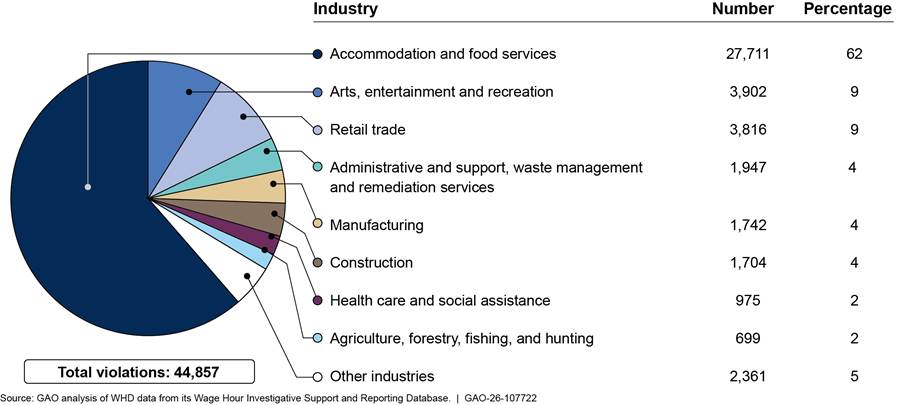
We found that most child labor violations WHD cited from fiscal year 2015 through fiscal year 2025 occurred in the accommodation and food services industry (62 percent of violations).[69] Other industries with relatively high proportions of cited violations were the arts, entertainment, and recreation industry (9 percent) and retail trade industry (9 percent). (See fig. 11.)
Figure 11: Child Labor Violations Cited by the Department of Labor’s Wage and Hour Division (WHD), by Industry, Fiscal Years 2015−2025 Combined
Notes: This figure includes cited child labor violations from all types of WHD cases, such as full investigations, limited investigations, conciliations, and other case types. According to GAO’s analysis, conciliations resulted in 31 child labor violations in the review period. WHD officials noted that these data should not be used to describe the prevalence of illegal child labor in the U.S. Rather, these are the violations that WHD identified and cited through its investigative work. Percentages may add up to more than 100 due to rounding.
DOL Has Focused on Identifying Egregious Child Labor Violations and Has Increased Penalties but Continues to Face Enforcement Challenges
WHD’s National Initiative Has Focused on Finding and Penalizing Egregious Violations and Has Aimed to Use Data to Drive Investigations
WHD launched its National Strategic Enforcement Initiative on Child Labor (National Initiative) in February 2023 in response to increases it identified in children working in hazardous occupations, according to WHD officials. The National Initiative aims to use resources strategically to address illegal child labor and to use all available enforcement tools to find egregious violations.[70]
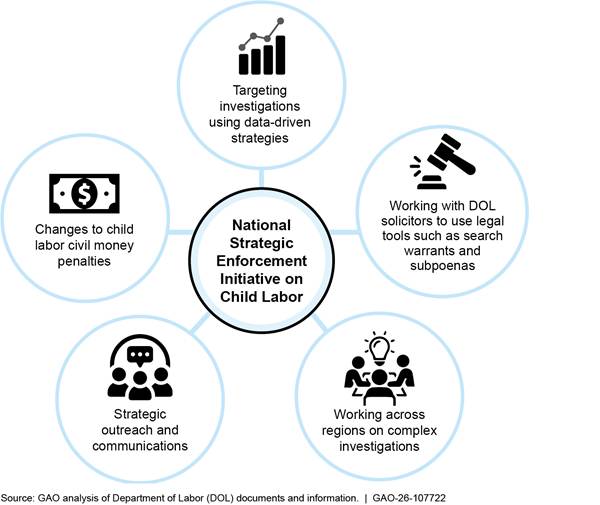
WHD’s efforts under the National Initiative include multiple focus areas (see fig. 12).
Figure 12: Focus Areas Under the Wage and Hour Division’s National Strategic Enforcement Initiative on Child Labor
National Initiative Focus Areas
Data-driven strategies. The National Initiative emphasizes using data and other information to initiate investigations where child labor violations are most likely to occur. From fiscal year 2023 through fiscal year 2025, WHD directed its regional offices to consider starting investigations in geographic areas where vulnerable workers might be, based on a combination of specific HHS and U.S. Census Bureau (Census) data, according to WHD officials and documents. WHD also directed regional offices to consider other factors when starting investigations in those areas, including local circumstances and data sources particular to individual regions or districts.[71]
Collaboration with Solicitor’s Office and multiregional efforts. Through its National Initiative, officials said WHD encourages collaboration with DOL’s Solicitor’s Offices and across WHD’s regional offices. Officials we spoke with in all five regions said that under the National Initiative, they work more frequently with DOL solicitors to use legal tools such as warrants for entering facilities, subpoenas of documents, or injunctions to stop the shipment of hot goods. In fiscal year 2024, WHD cited 18 hot goods violations, followed by another 10 such violations in 2025, compared to an average of one per year from 2015 through 2023.
WHD officials also described pooling resources from multiple field offices to support complex or multiregional investigations under the National Initiative. For example, officials from one regional office said their child labor taskforce included investigators from nine district offices who were ready to quickly respond to complex child labor cases. Officials from another regional office described a case where two regional offices conducted coordinated investigations after WHD received a tip that a large company was hiring children at poultry facilities in both regions.
Strategic outreach and communications. As part of the National Initiative, WHD planned a public awareness campaign to reach children, teachers, parents, and employers with multilanguage resources about compliance with child labor laws. WHD developed a corresponding strategic communications plan in 2023 that outlined deliverables, such as an updated child labor website, and included intended outcomes for different audiences. It also included child labor toolkits for WHD to standardize outreach and branding. From 2023 through 2025, WHD shared information on child labor laws during 5,141 outreach events and activities, according to our analysis of WHD data.[72]
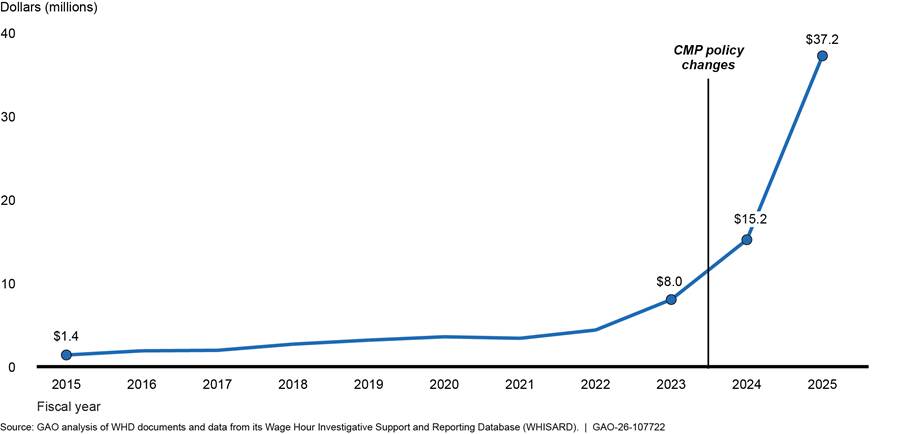
Changes to child labor civil money penalties (CMP). To hold employers accountable for child labor violations and deter future violations, WHD also changed how it assesses CMPs for nonserious injury and noninjury child labor violations.[73] In November 2023, WHD began assessing CMPs on a per-violation basis, rather than the previous approach of one penalty per child involved. For example, under the new approach, if an employer committed three separate violations related to one child’s employment, WHD would assess CMPs for all three violations.[74] Additionally, the CMP calculation for these child labor violations now starts at the maximum amount allowed by statute, and is then adjusted according to the gravity of the violation, business size, and other factors.[75] WHD officials said that as a result of these changes, child labor CMPs increased overall.
Our analysis of WHD data shows that the dollar amount of CMPs WHD assessed for child labor violations has trended upward since fiscal year 2015. WHD assessed $1.4 million in child labor CMPs in fiscal year 2015 and about $8 million in fiscal year 2023, the year before the CMP changes. From fiscal year 2023 to fiscal year 2025, WHD more than quadrupled the amount it assessed in child labor CMPs (see fig. 13).
Figure 13: Total Civil Money Penalties (CMP) the Department of Labor’s Wage and Hour Division Assessed for Cited Child Labor Violations, Fiscal Years 2015–2025
Since the changes in CMPs, field officials in two regions we spoke with said that it was more common for employers to seek post-assessment reductions in CMPs through enhanced compliance agreements. Under these agreements, an employer takes extra steps—such as implementing a system to more easily identify workers under 18 or having WHD train their managers on child labor laws—to ensure long-term compliance with child labor laws in exchange for a reduction in CMPs. If the employer and WHD come to an agreement, the CMPs may be reduced.
National Initiative Results
As part of the National Initiative, WHD created a severity index and corresponding performance measure to help it prioritize and funnel resources toward child labor cases with egregious violations, according to officials. In fiscal year 2025, WHD met its target of having 40 percent of cases fall into higher severity categories on the index, according to DOL documentation. In its 2026−2030 Strategic Plan, DOL establishes new targets for the child labor severity index, which increase incrementally each year.[76]
Our analysis of enforcement data shows that WHD conducted 393 cases specifically under the National Initiative from fiscal year 2023 through fiscal year 2025, although officials noted that additional cases related to the National Initiative’s focus areas might be tracked under other initiatives.[77] Of these 393 National Initiative cases, 161 (41 percent) resulted in at least one cited child labor violation, of which almost half were related to hazardous occupations orders.
WHD Has Not Fully Addressed Challenges It Faces in Enforcing Child Labor Laws
We found that WHD has faced some challenges in its child labor enforcement, including in verifying working children’s personal information, such as dates of birth; implementing changes to CMP calculations; using data to drive investigations under the National Initiative; ensuring effective outreach; and assessing whether certain child labor cases involve hazardous conditions. WHD has taken steps to alleviate some of these challenges, but it has not fully addressed others.
Verifying employee information. Field officials in four regions told us school officials were often hesitant to share student information, such as dates of birth, with investigators, largely because the Family Educational Rights and Privacy Act of 1974 protects students’ data. To help address this challenge, WHD issued internal guidance to field officials in 2023 to help them explain relevant aspects of the law to schools. WHD has also emphasized other methods investigators can use to verify age, such as reviewing passports or birth certificates, according to officials.
Calculating new civil money penalties. Field officials in four out of five regions said that calculating the new CMPs had complicated or slowed down case resolution, in part because WHD’s legacy case management system, WHISARD, did not have the capability to do the complex calculations required by the new assessment policy. After the transition to the new CMP assessment approach, officials calculated CMPs by hand and had to obtain approval from the WHD Regional Administrator before CMPs could be finalized. In November 2025, WHD rolled out its new case management system, the Wage Hour Integrated System for Enforcement (known as WISE 2.0), which has automated capabilities to assist officials with CMP calculations. These improvements will likely reduce administrative burden and the risk of errors in calculating CMPs, according to officials.
Implementing the National Initiative’s data-driven strategy. We found that field officials faced challenges implementing a portion of the National Initiative’s data-driven strategy that aimed to use specific HHS and Census data to identify geographic areas where vulnerable workers might be, and in turn, where violations were more likely to occur.[78] Field officials in three of WHD’s five regions said the data that WHD asked them to use were not detailed enough to provide useful investigation leads. Field officials in four regions told us that state or local data sources were generally more useful for targeting investigations. In addition, district officials in two regions said most of their child labor work came from complaints or referrals, so they had not used the HHS and Census data.
When we asked WHD’s national office about using these data, officials said the specific HHS and Census data became less useful in 2025. Officials said WHD chose to use these specific HHS and Census data as part of the National Initiative’s strategy from 2023 through 2025 based on trends among particular populations and information from the media and various stakeholders. In selecting the data, officials did not actively solicit input from field officials, although they considered input from staff in the regional offices if they offered it during their regular meetings with the national office.
WHD updated the National Initiative in January 2026 to exclude these specific HHS and Census data from WHD’s targeting strategy and did not replace them with another specific dataset it recommended, according to officials and planning documentation. Officials added that using external data to target investigations has been a longstanding priority, and the national office gives field offices the autonomy to determine what data may help them at the local level. As of May 2026, WHD officials told us they are continuing to explore other datasets they could use to help target child labor investigations under the National Initiative, but said they have no specific processes in place to guide that exploration.
WHD has presented its data-driven strategy to target investigations as a key component of its National Initiative, but it has not developed a systematic process to identify and evaluate potential data sources it uses to target those investigations. In prior work, we identified key practices that can help federal agencies develop and use evidence to effectively manage federal efforts. According to these practices, it is important to assess the sufficiency of existing evidence, identify and prioritize evidence needs, and generate new evidence as appropriate to support policymaking.[79] Additionally, standards for internal control state management should use quality information to make informed decisions.[80] Without creating a systematic process to ensure that any new sources of data WHD chooses are appropriate and useful—such as a process that includes actively consulting field officials about the usefulness of potential data sources—WHD may not effectively target investigations and may miss opportunities to identify violations and bring employers into compliance with the law.
Performing outreach to and communicating with employers and the public. WHD’s National Initiative included a public awareness campaign and strategic communications plan to increase awareness of child labor laws. However, we found that despite these outreach efforts, field officials still encounter persistent knowledge gaps when engaging with employers and the public. Further, although public awareness is a priority under the National Initiative, WHD has not consistently established performance goals or measures to help gauge the effectiveness of its child labor outreach efforts.
Officials in each regional and district office we met with across five regions described gaps in public and employer knowledge of federal child labor laws. For example, investigators from one district office said that children and parents often did not know what a given child was legally permitted to do at work, and the investigators had to explain to them that the child’s employer violated the law. An official from another district office said some employers knew children were prohibited by the HOs from using vertical dough mixers during baking, but many employers did not realize that cleaning the machines was also generally prohibited.[81]
In addition, field officials in four regions said that differences in federal and state child labor laws could be confusing for employers.[82] For example, federal law generally allows 14- and 15-year olds to work until 7:00 p.m., except during the summer, but some state laws allow children of that age to work past 7:00 p.m. year-round.[83] In this example, an employer may be in compliance with state law but out of compliance with federal law. Officials and investigators from district offices in two regions described encountering employers who had trouble understanding how they could be out of compliance at the federal level if they complied with state child labor laws.
WHD has taken some steps to alleviate these knowledge gaps. For example, it actively uses digital media and conducts outreach to educate the public and stakeholders on how to handle inconsistencies between federal and state child labor laws, as well as providing employers with information and resources during investigations. WHD’s Fact Sheets provide detailed information on child labor laws, including what to do if federal and state requirements differ.[84] WHD also maintains an interactive webpage with information on selected state child labor standards for children in non-farm employment.[85]
WHD officials acknowledged that disseminating information on child labor laws continues to be a challenge, largely because of WHD’s small size and because working children are employed in a wide range of industries, locations, and business types. Officials we spoke to in regional and district offices across five regions described having fewer resources for preventative outreach—such as outreach to schools—than in the past, and officials in four regions described staffing shortages for their outreach specialist position.
Officials said WHD’s 2023 Strategic Communications Plan was intended to extend through fiscal year 2025. The plan included some long-term goals, such as increasing awareness of child labor laws among vulnerable workers through digital content. To work toward this goal, WHD set and met a short-term measure of increasing shareable social media content by 10 percent within 90 days in 2023.[86] However, officials said that WHD did not establish short-term measurable goals or performance measures in fiscal year 2024 or fiscal year 2025 that would have allowed it to track progress towards the agency’s longer-term goal of increasing awareness of child labor laws.
Leading up to summer 2026, WHD updated its strategic communications plan and rolled out additional resources on federal child labor laws for employers. According to the updated plan, WHD plans to track engagement on its website and social media platforms and record information on outreach events. However, the plan does not include quantitative targets and timeframes against which performance can be measured.
In prior work, we identified key practices that could help federal agencies to develop and use evidence to effectively manage and assess the results of federal efforts. According to these practices, it is important to (1) identify desired long-term outcomes and assess progress by breaking the outcomes into measurable performance goals, which include quantitative targets and timeframes for measurement; (2) collect relevant data through related performance measures; and (3) use that evidence to make decisions, among other key practices.[87] Without assessing its strategic communications work, including measuring progress toward goals and using the resulting information to make decisions about future efforts, WHD may miss opportunities to target its resources toward the most impactful outreach strategies and to increase employer and public knowledge of child labor laws, which could ultimately help prevent child labor violations.
Identifying hazardous occupation violations. Field officials in three of WHD’s regions described challenges in applying the hazardous occupations orders (HO) to some investigations because the HOs do not cover certain modern equipment and do not fully address complicated situations. For example, officials from one district office said some newer construction and food service equipment was not listed in the HOs, some of which have not been updated since 2010. In addition, officials from district offices in two regions said it could be difficult to determine if an HO applies when children use hazardous equipment for a task other than its intended purpose (such as using a meat-shredding machine to shred cheese).[88] Field officials in two regions said they commonly experienced challenges applying HOs related to power-driven bakery machinery, power-driven woodworking tools, and power-driven metalworking tools.
If it is unclear whether an HO applies to a given investigation based on existing guidance, field offices submit their questions to WHD’s Office of Policy, according to WHD. Officials said they work on a case-by-case basis to research the equipment and advise the inquiring field officials whether an HO applies, including consulting with the Solicitor’s Office if needed. According to WHD officials, the Office of Policy may receive multiple questions from field officials about a given HO over time, but WHD does not analyze whether there are patterns in the questions it receives because it is rare that two cases are identical. Additionally, WHD’s tracking system for technical assistance requests from field offices does not include any data fields that would allow WHD to easily aggregate and analyze questions related to HOs.
Field officials in two regions said that supports such as additional guidance, trainings, and more regular updates to the Field Operations Handbook—which provides investigators and staff with interpretations of regulatory provisions and other guidance, including on HO application—would help them to apply the HOs to complicated cases. WHD officials stated that in general, the agency develops guidance in response to a need to clarify existing guidance and it updates the handbook when there is a change in law or policy. However, WHD officials said there were no instances in which WHD updated internal or external guidance or the handbook based on a question from field officials about applying HOs.
Federal standards for internal control state that management should use quality information to achieve the entity’s objectives and communicate relevant and quality information down and across reporting lines.[89] If WHD does not track and analyze the assistance it provides to the field on applying HOs, it may continue to miss opportunities to update guidance or streamline how it addresses questions on HOs, which could lead to longer investigation timeframes.
DOL’s Collaboration with Federal Agencies on Child Labor Has Not Fully Followed Leading Practices and Decreased After 2024
DOL Collaborated with Agencies Through Its Interagency Task Force but Did Not Fully Follow Leading Practices
In 2023 and 2024, DOL collaborated to varying degrees with seven federal agencies to prevent and detect child labor violations through cross-training, information sharing, and the efforts of its Interagency Task Force to Combat Child Labor Exploitation (IATF).[90] According to DOL documentation, DOL worked with other federal agencies on at least 20 different efforts in 2023 and 2024 to educate key stakeholders and advance shared goals around children’s safety, opportunities, and well-being. For example, in January 2024, WHD provided a training on the role of WHD in combatting illegal child labor to the Department of Homeland Security’s Center for Countering Human Trafficking. In addition, DOL and HHS collaborated in 2023 and 2024 to provide several trainings to educate DOL staff on the work of HHS’s Office of Refugee Resettlement and to educate HHS staff, contractors, and grantees on child labor laws.
WHD and HHS’s Administration for Children and Families (ACF) also exchanged information through their interagency data sharing memorandum of agreement. The agreement, signed in March 2023, describes procedures for sharing investigation information and child labor trends between WHD and ACF, among other information-sharing efforts.[91]
Most prominently, DOL’s recent collaboration with other federal agencies on child labor centered on the IATF, which DOL established in February 2023 as a government-wide approach to combat illegal child labor. DOL officials described the IATF as a mechanism for DOL and the seven other participating agencies to collaborate and share information about illegal child labor. The officials told us the IATF’s priority was coordinating and communicating among agencies, rather than producing plans or reports.
According to DOL documentation, the IATF met five times between October 2023 and June 2024. These meetings served as opportunities for each agency to share updates and receive feedback, brief other agencies on topics relevant to child labor, and discuss agency actions, according to IATF agendas. As part of its efforts with the IATF, DOL officials told us they also engaged in partnerships with agencies to address child labor exploitation in new ways. For example, in summer 2023, DOL and State Department staff briefed top embassy representatives from Colombia, El Salvador, Guatemala, Honduras, and Mexico on WHD child labor efforts. According to State officials, this endeavor was successful because it demonstrated to foreign consular officials that child labor is a priority and a concern in the U.S. In addition, DOL and the Department of Commerce worked together to include a provision in Commerce’s financial assistance award contract to reinforce an employer’s existing obligations to comply with the child labor provisions of the FLSA. The provision was included in Commerce’s Standard Terms and Conditions beginning on October 1, 2024, and applies to all of Commerce’s financial assistance programs.
In our prior work, we found that effective interagency collaboration benefits from certain leading practices.[92] These eight leading collaboration practices can help agencies implement, enhance, and sustain collaboration. We assessed whether DOL followed these leading practices, including selected key considerations, in its collaborative efforts with other agencies to prevent and detect child labor violations.[93] Of the eight leading collaboration practices, we found that in 2023 and 2024, DOL generally followed three practices and somewhat followed five practices (see table 1).
|
Leading practice |
Selected key considerations |
GAO assessment |
|
Define common outcomes |
· Have the crosscutting challenges or opportunities been identified? · Have the short-term and long-term outcomes been clearly defined? |
● |
|
Clarify roles and responsibilities |
· Have the roles and responsibilities of the participants been clarified? |
● |
|
Include relevant participants |
· Have all relevant participants been included? |
● |
|
Ensure accountability |
· What are the ways to monitor, assess, and communicate progress toward the short- and long-term outcomes? |
◐ |
|
Bridge organizational cultures |
· Have participating agencies established compatible policies, procedures, and other means to operate across agency boundaries? · Have participating agencies agreed on common terminology and definitions? |
◐ |
|
Identify and sustain leadership |
· Has a lead agency or individual been identified? · How will leadership be sustained over the long term? |
◐ |
|
Leverage resources and information |
· Are methods, tools, or technologies to share relevant data and information being used? |
◐ |
|
Develop and update written guidance and agreements |
· If appropriate, have agreements regarding the collaboration been documented? · Have ways to continually update and monitor written agreements been developed? |
◐ |
○ Did not follow = None of the key considerations were followed
◐ Somewhat followed = Some of the key considerations were followed
● Generally followed = All of the key considerations were generally followed
Source: GAO analysis of leading collaboration practices; Department of Labor (DOL) documentation; and information from the Departments of Agriculture, Commerce, Education, Health and Human Services, Homeland Security, Justice, and State. | GAO‑26‑107722
The three leading collaboration practices that DOL generally followed in working with other agencies on the IATF include defining common outcomes, clarifying roles and responsibilities, and including relevant participants. In doing so, DOL successfully identified cross-cutting opportunities to collaborate with other participating agencies to reach outcomes they collectively sought. For example, in April 2023, DOL worked with the U.S. Department of Agriculture to develop a letter the Secretary of Agriculture sent to the meat and poultry industry to share information on preventing and detecting illegal child labor in meat and poultry plants.
The five leading collaboration practices that DOL somewhat followed in working with other agencies on the IATF include:
· Ensure accountability. Agencies should identify ways to monitor and track progress toward outcomes for interagency collaboration. Many participating agencies agreed that DOL communicated about progress toward meeting the short-term and long-term outcomes of the IATF. However, DOL officials did not develop a way to track and monitor progress on collaborative efforts of the IATF.
· Bridge organizational cultures. Agencies should address differences in organizational cultures to create mutual trust that is critical for interagency collaboration, including by establishing compatible policies, procedures, and other means to operate across agency boundaries. DOL took some steps to address organizational differences. For example, the memorandum of agreement between HHS’s ACF and WHD outlined procedures to be followed by both agencies in working together to address the need for information sharing and coordination. However, while DOL officials said a goal of the IATF was to support a shared understanding and vocabulary among participants, officials from some participating agencies did not agree that DOL established common definitions for the IATF to use, such as a working definition of child labor.
· Identify and sustain leadership. Identifying a leader for interagency collaboration can be beneficial because it centralizes accountability and speeds decision-making. Sustaining leadership is also important to maintaining interagency efforts over time. Most IATF-participating agencies agreed that DOL was the lead agency for the IATF. However, some agency officials we spoke with said they did not have information about whether there were plans for any future IATF meetings or about the current operating status of the IATF.
· Leverage resources and information. Collaborating agencies should share data and information, which support interagency efforts by pooling together resources that may be scarce. DOL shared information with other participating agencies through IATF meetings, shared briefings, and trainings, among other methods. However, according to WHD officials, the IATF never issued a charter or planning documents. As such, no records reflect an assessment of the resources and capacities of each agency to contribute to the IATF.
· Develop and update written agreements. Written agreements to formalize collaboration can enable agencies to do more than they could by acting alone. In addition to its memorandum of agreement with HHS’s ACF, WHD signed a memorandum of understanding with Agriculture’s Office of Contracting and Procurement in 2024 to strengthen collaboration on child labor compliance in Agriculture’s contracting and procurement. However, officials from two other agencies stated that a written agreement to describe how and when DOL and their agencies should work together would be helpful for future collaboration efforts.
DOL Decreased Its Interagency Collaboration on Child Labor After 2024
Since January 2025, DOL’s collaboration with federal agencies on activities to prevent and detect child labor violations has largely diminished. For example:
· WHD-ACF memorandum of agreement expired. WHD’s memorandum of agreement to share data with HHS’ ACF expired in March 2026. WHD officials told us in June 2026 that they planned to renew the agreement with ACF, but they have not yet done so.
· IATF ceased operation. The last documented meeting of the IATF was in June 2024. In November 2025, WHD officials stated that the agency had insufficient information about the IATF to continue operation of the IATF when agency leadership transitioned in early 2025. In addition, officials from other agencies that participated in the IATF told us in summer 2025 that they faced difficulty obtaining information on the IATF’s status and their agency’s prior participation in it. For example, officials from some agencies said they could not find or access agency records related to the IATF, with some citing recent staff turnover as a contributing factor.
· DOL participated in few child labor collaboration activities at the national level. DOL officials provided little evidence of interagency collaboration activities at the national level that had occurred since January 2025. They said the agency continues to participate in a Department of Justice-led working group that focuses on forced labor, including forced child labor. DOL officials also stated they continue to work with HHS to verify information on specific child labor investigations and provide notification and assistance to their Office on Trafficking in Persons. At the field level, WHD staff engage in child labor outreach and other activities with partners that sometimes include other federal agencies, according to DOL officials. However, at the national level, DOL has not led or participated in the types of cross-training, briefings, and information sharing with other federal agencies in which it engaged in prior years.
When we asked about any future planned collaboration efforts, DOL officials responded that ensuring the safety and wellbeing of children in the workplace was a top priority for the agency. They also said DOL was evaluating available tools, including strengthening enforcement and interagency coordination, and that it intended to continue engaging with other agencies.
However, when its interagency collaboration activities decreased at the national level and the IATF ceased operation, DOL lost opportunities to achieve outcomes related to child labor that require the coordinated efforts of more than one federal agency. Our prior work found that more clearly identifying and sustaining leadership across the government can improve coordination and communication between agencies, particularly for complex, crosscutting issues.[94] By taking steps to strengthen future interagency collaboration, including by incorporating GAO’s eight leading collaboration practices and ensuring continuity of information sharing during personnel changes, WHD could better leverage the federal government’s capacity to protect vulnerable children.
Conclusions
Working can help children under 18 develop skills, independence, and responsibility, as well as provide financial benefits to them and their families. At the same time, children are uniquely vulnerable at work, especially when it interferes with their education or presents a physical danger. DOL’s enforcement aims to ensure that children’s workplaces are safe and healthful, but ongoing challenges make it more difficult for DOL to provide these protections.
Fewer datasets and continued data limitations on fatalities, injuries, and illnesses among working children mean that federal agencies, policymakers, and others cannot fully understand how often and in what ways working children are most likely to be injured or killed. As a result, they have less information to help employers create safer workplaces and to target violators who put children at risk. By mitigating these gaps, DOL could ensure that it has information it needs to prevent and respond to dangerous conditions that put working children at risk.
DOL has taken steps to strategically address egregious violations of child labor laws, including using some data to target investigations under its National Initiative and prioritizing prevention through outreach. As DOL continues these efforts, it is critical that the agency develop a process to identify data sources that can help it effectively target the most egregious cases of illegal child labor. Additionally, assessing its outreach efforts will help DOL ensure it is achieving its goal of increasing awareness of child labor laws and ultimately keeping working children safe.
Moreover, DOL’s hazardous occupations orders (HO) protect children under 18 from working in dangerous settings, but sometimes investigators have questions related to how the HOs could be applied to a specific situation. By establishing a process to track and analyze the questions it receives from field officials on applying HOs, and using the resulting information to update its guidance, DOL would help investigators to complete child labor investigations more efficiently.
Finally, DOL’s prevention and detection of child labor violations would be enhanced by more consistently leveraging the expertise of and coordinating with other federal agencies. Taking the lead on federal collaboration efforts around child labor and incorporating practices for interagency collaboration, such as establishing sound procedures to ensure this collaboration can continue over time, would enable DOL to better protect children in the workplace.
Recommendations for Executive Action
We are making the following five recommendations to DOL:
The Secretary of Labor should ensure that the Wage and Hour Division Administrator and the Bureau of Labor Statistics Commissioner assess and mitigate the information gaps we identified in child labor fatality, injury, and illness data, including considering the need for increased or improved data collection. (Recommendation 1)
The Secretary of Labor should direct the Wage and Hour Division Administrator to develop a systematic process to identify and evaluate potential data sources, including by obtaining and documenting input from regional- and district-level staff, as it considers adding new sources of data to target investigations under its National Strategic Enforcement Initiative on Child Labor. (Recommendation 2)
The Secretary of Labor should ensure that the Wage and Hour Division assesses its outreach efforts to educate employers and the public about child labor laws, including by (1) setting goals for long-term outcomes and assessing progress by breaking them into measurable performance goals, (2) collecting relevant data through related performance measures, and (3) using that information to inform the agency’s future outreach strategies. (Recommendation 3)
The Secretary of Labor should direct the Wage and Hour Division Administrator to establish procedures to track and analyze the questions it receives from field offices related to applying the hazardous occupations orders, as well as the technical assistance it provides, and use the analysis to regularly update guidance, as appropriate. (Recommendation 4)
The Secretary of Labor should strengthen its collaboration with other federal agencies to prevent and detect illegal child labor, including by incorporating GAO’s eight leading collaboration practices and ensuring continuity of information sharing to sustain efforts during agency transitions and other changes. (Recommendation 5)
Agency Comments and Our Evaluation
We provided a draft of this report to DOL and HHS for their review and comment. DOL’s WHD and BLS provided separate comments to the report, which are reproduced in appendixes V and VI, and summarized below. Both WHD and BLS also provided technical comments, which we incorporated as appropriate. HHS provided technical comments, which we incorporated as appropriate.
BLS disagreed with our recommendation to assess and mitigate the information gaps we identified in child labor fatality, injury, and illness data, including considering the need for increased or improved data collection. However, it also noted steps it is taking to publish more child labor data, which could reduce information gaps. BLS stated that some gaps we identified represent program features and data protection requirements, such as confidentiality protections established by CIPSEA, under which BLS cannot publish fatal injury counts that would reveal confidential information directly or indirectly. In its comments, BLS limited its discussion to CFOI and SOII, its two main datasets that provide information on working children’s fatalities, injuries, and illnesses. BLS stated that it continues to seek ways to improve its statistical products, and that it balances expansions of available data, such as the changes it made to broaden its injury and illness dataset, with comparability of data over time. WHD deferred to BLS in its response to the recommendation, which we made jointly to WHD and BLS.
We acknowledge the legal requirements that BLS faces and the related limitations in the detailed statistical data it can publish. However, these statutory restrictions do not preclude BLS from exploring ways to mitigate information gaps within the confines of the current legal framework. For example, DOL could try to ensure that future years of SOII data are comparable to the current data, so the agency and others can once again examine trends over time in child worker injuries and illnesses. This is particularly important now that DOL is only publishing this information every two years.
Moreover, the information gaps we identified in the report go beyond the limitations contained in the CFOI and SOII. Our report also stresses the importance of reevaluating data needs when changes in the availability of other data sources occur, as has happened over time with federal datasets on child labor fatalities, injuries, and illnesses that were discontinued. As a result of these changes, less is known than in the past about whether and how this vulnerable population is getting injured or killed at work.
We continue to believe that DOL should assess and mitigate the information gaps we identified, so that DOL will be better positioned to assess, prevent, and respond to dangerous conditions that put working children at risk. As the primary statistical and enforcement agency for issues related to labor, including child labor, DOL is best positioned to reevaluate and act on these data needs. BLS noted it is exploring ways to publish more fatal injury counts while protecting confidential information─including evaluating new disclosure methods and examining process changes─which may help address our findings. While we support these efforts, we also believe DOL could consider taking additional steps to increase or improve data on the safety of working children, such as developing or identifying new sources of data, or collaborating with other agencies to address data gaps. DOL has stated that the well-being of the nation’s working children is a priority. Having robust information on the fatalities, injuries, and illnesses working children experience is critical to understanding and mitigating workplace threats to their safety.
WHD agreed with three of our remaining four recommendations, including that it should develop a systematic process to identify and evaluate potential data sources under its National Strategic Enforcement Initiative on Child Labor; establish procedures to track and analyze the questions it receives from field offices related to applying the hazardous occupations orders and using the analysis to regularly update guidance; and strengthen its collaboration with other federal agencies to prevent and detect illegal child labor. While WHD stated it agreed with the recommendation to develop a systematic process to identify and evaluate potential data sources to target investigations, it also stated it would address the recommendation by strengthening its agency-wide planning process. We would like to emphasize that the process we are recommending should be tailored to child labor investigations, with the goal of guiding WHD’s exploration of different data sources to target investigations under the National Initiative. A systematic process that includes gathering input from regional- and district-level staff on potential targeting strategies will help ensure that the initiative is useful and appropriate for the field.
WHD neither agreed nor disagreed with our recommendation to assess WHD’s outreach efforts to educate employers and the public about child labor laws but noted planned actions to address GAO’s findings.
As agreed with your office, unless you publicly announce the contents of this report earlier, we plan no further distribution until 11 days from the report date. At that time, we will send copies to the appropriate congressional committees, the Acting Secretary of Labor, and the Secretary of Health and Human Services. In addition, the report will be available at no charge on the GAO website at https://www.gao.gov.
If you or your staff have any questions about this report, please contact me at costat@gao.gov. Contact points for our Offices of Congressional Relations and Media Relations may be found on the last page of this report. GAO staff who made key contributions to this report are listed in appendix VII.
Sincerely,
Thomas Costa
Director
Education, Workforce, and Income Security
This report addresses (1) what available data show about fatalities, injuries, and illnesses among working children in the U.S. and what information gaps remain; (2) what available data show about child labor violations; (3) recent changes the Department of Labor (DOL) made in its child labor enforcement practices, including in its use of data to inform enforcement, and the extent to which DOL has addressed related challenges; and (4) the extent to which DOL has collaborated with other federal agencies to prevent and detect child labor violations, including through its Interagency Task Force to Combat Child Labor Exploitation (IATF).
Analysis of Data on Child Labor Fatalities, Injuries, and Illnesses; and Working Children
To describe what is known about work-related fatalities, injuries, and illnesses to working children, we obtained and analyzed data from two national DOL datasets (see table 2):
· Census of Fatal Occupational Injuries (CFOI) from 2013 through 2023, the most recent data available at the time we conducted our analysis.
· Survey of Occupational Injuries and Illnesses (SOII) from 2013 through 2024, the most recent data available at the time we conducted our analysis.
We also obtained and analyzed data on working children from the Current Population Survey’s (CPS) Annual Social and Economic Supplement (ASEC) for 2024, which refers to employment and income during calendar year 2023.
Table 2: Data Sources Analyzed to Understand Fatalities, Injuries, and Illnesses Among Working Children
|
Data File |
Organization Responsible |
Reported Statistics and Analyses |
Population GAO Examined |
Reported Timeframe |
|
Census of Fatal Occupational Injuries (CFOI) |
DOL’s Bureau of Labor Statistics (BLS) |
Number and proportion of children who suffered work-related fatalities by characteristics, including age, sex, race/ethnicity, industry, and causes of fatality. |
Working children under 18 |
2013−2023a |
|
Survey of Occupational Injuries and Illnesses (SOII) |
BLS |
Estimated number and proportion of children who incurred work-related injuries and illnesses that resulted in at least one day away from work by characteristics, including age, sex, the type of injuries/illnesses, and industry. |
Working children under 18 |
2013−2024b |
|
Current Population Survey (CPS), including its Annual Social and Economic Supplement (ASEC) |
BLS; Census Bureau |
Estimated number and proportion of working children working in specific industries (by NAICS code) and by characteristics, including sex and race/ethnicityc |
Working children ages 15−17 |
2023d |
Source: GAO analysis of Department of Labor (DOL) data | GAO‑26‑107722
aThe Occupational Injury and Illness Classification System, which BLS uses to describe fatalities in the CFOI, was substantially revised in 2022. Due to these changes, BLS advises CFOI users to carefully examine data combinations that cross 2023. GAO found the combination of data that it examined from 2013 through 2023 to be sufficiently reliable for the purposes of analyzing working children’s fatalities.
bGAO obtained injury and illness data through 2024 but only presents trends in these data through 2020, because BLS recommended that post-2020 data not be compared with later data due to changes in the SOII methodology.
cA NAICS code (North American Industry Classification System) is a 2- to 6-digit numeric identifier used by federal agencies to classify businesses by their primary economic activity.
dGAO analyzed data from the 2024 ASEC, which provides information about the industries and occupations that children reported they worked in during the prior year (i.e., calendar year 2023).
The CFOI is an annual count of fatal workplace injuries, and is a federal-state cooperative program that has been implemented in all 50 states and the District of Columbia. BLS uses diverse state, federal, and independent data sources to identify, verify, and describe fatal work injuries to ensure counts are as complete and accurate as possible. The CFOI also covers workers on farms of any size, including those employing 10 or fewer workers, and self-employed, family, and federal government workers. We obtained CFOI data at the 3-digit level of the North American Industry Classification System (NAICS) using an online BLS tool that enables users to access publicly available data.[95] We conducted a data reliability assessment of the CFOI variables included in our analyses. We reviewed technical documentation, related publications, and information on the data available on the BLS website. We spoke with the appropriate officials at BLS to resolve any questions about the data and identify any known limitations.[96] We also conducted electronic testing, where feasible, to check for logical consistency, missing data, and consistency with data reported in technical documentation. We determined that the summary data provided were sufficiently reliable for the purposes of our reporting objectives.
The SOII is an annual estimate of workplace injuries and illnesses based on a survey of 200,000 sampled employers in the public and private sectors across the U.S.[97] The SOII considers an occupational injury to be any injury—such as a cut, fracture, sprain, amputation, and so forth—that results from a work-related event or from a single instantaneous exposure in the work environment. Workplace injury records reflect the employer’s understanding of which cases are work-related and meet other recordkeeping requirements established by DOL’s Occupational Safety and Health Administration.[98]
In addition to injury and illness counts, since 1992, BLS has asked survey respondents to provide additional information for the subset of cases that involved at least 1 day away from work beyond the day of injury or illness. For the SOII’s 2021−2022 publication cycle, BLS began asking respondents to provide information on cases involving at least 1 day of job transfer or restriction beyond the first day of job transfer or restricted work. Employers answer several questions about these cases, including the demographics of the worker—such as age, the nature of the disabling condition, the event and source producing that condition, and the part of body affected.
BLS generated and provided us with estimates and relative standard errors for selected SOII data from 2013 through 2024. The data were classified by industry using BLS industry codes derived from NAICS codes. We reviewed related SOII data documentation to assess the data collection methodology and available variables, as well as technical notes for any issues that may impact this analysis. We also performed basic tests for data completeness and logic. Based on our assessment, we determined we could analyze trends in SOII data through 2020. However, the data provided for both 2021−2022 and 2023−2024 differ in their methodologies from the previous years. As such, BLS indicated that estimates are not comparable across these different time periods (2013−2020, 2021−2022, and 2023−2024). Instead, we present estimated trends from the 2013-2020 period only, and limited estimates for discrete 2-year periods from 2021−2024.[99]
To describe basic facts about working children and to provide context for the fatality, injury, and illness data, we obtained and analyzed data from the CPS’s 2024 ASEC. The CPS, which is jointly produced by the Census Bureau and BLS, is the primary source of federal government statistics on employment and unemployment in the United States. The basic monthly survey collects information on employment, such as employment status, occupation, and industry, as well as demographic characteristics, among other things. The survey is based on a sample of the civilian, noninstitutionalized population of the United States. In addition to the standard questions from the basic CPS monthly survey, the ASEC includes additional questions for households and provides supplemental data on work experience. To match the most recent year’s data in the timeframe we used to describe fatalities, injuries, and illnesses, we downloaded public data from the 2024 CPS ASEC, which was conducted from February to April 2024. Data on employment and income refer to the preceding calendar year, although demographic data such as age refer to the time of the survey. We identified working children based on age at the time of the survey.
We reviewed CPS ASEC data documentation to assess the data collection methodology and available variables, as well as technical notes for any issues that may impact this analysis. We conducted basic tests for data completeness and logic, including verification of sample inclusion. We found the 2024 CPS ASEC data to be reliable for our purposes.
Analysis of Child Labor Information Gaps
To assess information gaps in child labor data, we reviewed two reports that contained recommendations on improving child labor data and enforcement in the U.S. and further reviewed select federal studies cited in documents we received from DOL and CDC that addressed challenges in federal data collection.[100] We also examined agency documentation and obtained information from officials from BLS and the Department of Health and Human Services’ (HHS) National Institute for Occupational Safety and Health. We assessed gaps in child labor data against the Federal Committee on Statistical Methodology’s Framework for Data Quality and our key practices on evidence-based policymaking.[101]
Analysis of Child Labor Violations Data
To examine trends in child labor violations, we analyzed data from the DOL Wage and Hour Division’s (WHD) electronic case management system, the Wage Hour Investigative Support and Reporting Database (WHISARD), which includes information from cases WHD has conducted and violations it has cited related to child labor. We analyzed WHISARD data from fiscal year 2015 through fiscal year 2025, the most recent year available.[102] We analyzed data elements including case type; district and regional office that investigated; NAICS codes; violation type and number; date a case was closed; amount of child labor civil money penalties assessed; number of children affected by child labor violations; association with the National Strategic Enforcement Initiative on Child Labor; and violations associated with deaths or injuries. We also analyzed WHISARD data on child labor outreach events. Data fields are recorded in the fiscal year in which a case is closed, which may differ from the year the case started or when a child labor incident occurred.
To assess data reliability and identify information gaps for the violations data, we reviewed the current WHISARD data dictionary and user guide. We also conducted electronic and manual data reliability testing, and we interviewed knowledgeable officials on variables related to child labor cases and violations. We found the data to be reliable for the purposes of this report.
Interviews and Site Visits with WHD and Stakeholder Organizations
To analyze recent changes in and challenges to DOL’s enforcement, we reviewed relevant laws, regulations, policies, and documents, and interviewed officials from WHD’s national office and leadership officials at all five of WHD’s regional offices.[103] We also conducted in-depth site visits at six of its 54 district offices within selected regions.
We selected three regions for in-depth site visits. To ensure the regions we selected had recent experience enforcing child labor laws, including changes to enforcement approaches, our primary criterion was that selected regions had a relatively high concentration of cases resulting in cited child labor violations. We also considered regions that were geographically dispersed and that had a higher proportion of violations of hazardous occupations orders. Based on these criteria, we selected the Midwest, Northeast, and West regions for in-depth site visits, which included discussions with regional office leadership, district office leadership, the Community Outreach and Resource Planning Specialist, and Wage and Hour investigators at two district offices per region. We conducted the Midwest site visit in person and the Northeast and West site visits by video conference.
To ensure our district office selection captured a variety of enforcement experiences and to minimize bias in this nongeneralizable sample, we chose one district office with an above-average percentage of cases resulting in child labor violations compared to other districts in the region, and one that had an average or below-average percentage of recent violations.[104] In addition to those primary criteria, we gave preference to district offices in each selected region that also had above-average concentrations of hazardous occupations violations compared to other districts in that region, and districts with instances of hazardous occupations violations in agriculture in recent years (fiscal year 2022 through fiscal year 2024). In the event that a choice was not clear based on those primary and secondary criteria, we prioritized district offices located in states that had recently experienced changes to their child labor laws between 2021 and 2024.
At each site visit interview, we conducted semi-structured interviews with agency officials. In this report, statements attributed to “field officials” or to officials in a certain number of regions include statements from regional and district officials, including investigators, unless specifically noted otherwise.
In addition, we interviewed representatives from five organizations, including those focused on industry and advocacy (the Child Labor Coalition, the National Children’s Center for Rural and Agricultural Health, the Young Workers Project, the Meat Institute, and the Young Center for Immigrant Rights), as well as one subject matter expert in occupational safety and health for children working in agriculture.
Analysis of Agency Collaboration
To assess federal collaboration efforts on child labor issues between DOL and other agencies, we obtained relevant agency documents, conducted interviews with, and received written responses from officials at DOL and HHS, which has frequently coordinated with DOL on child labor issues in the past. We also received written responses to questions we asked these agencies.
In addition, we sent a questionnaire with closed- and open-ended questions about child labor collaboration to each of the six other agencies that participated in DOL’s Interagency Task Force to Combat Child Labor Exploitation, including the Departments of Agriculture, Commerce, Education, Homeland Security, Justice, and State. Agencies received the questionnaire in May 2025 and replied to the questions in writing, in meetings, or via a combination of written responses and meetings, as preferred by the agency. Some agencies sent responses from multiple offices or bureaus within the agency.
We used agency documentation provided by DOL, HHS, and the six other agencies listed above to determine the number of national-level training and information-sharing efforts in which DOL participated in 2023 and 2024. A single collaboration effort could involve multiple, discrete events or activities. For example, in 2023, DOL and HHS collaborated to provide several trainings to educate DOL staff on HHS’s Unaccompanied Children Program and to educate HHS staff, contractors, and grantees on child labor laws. We counted this as one collaboration effort.
We compared DOL’s collaboration efforts with federal agencies against GAO’s leading practices for interagency collaboration developed in prior work: defining outcomes, ensuring accountability, bridging organizational cultures, identifying and sustaining leadership, including relevant participants, identifying resources, clarifying roles and responsibilities, and written guidance and agreements.[105] Each of these practices contains key considerations to use when implementing the leading practices. We reviewed and selected the key considerations for each leading practice that we determined to be relevant to DOL’s interagency collaboration efforts on child labor.
To determine the extent to which DOL followed leading collaboration practices, two analysts independently examined relevant documents and written responses from DOL, HHS, and the six other agencies listed above, and assessed each agency’s perspective on DOL’s child labor collaboration efforts.[106] Based on these reviews, we determined whether DOL’s actions followed leading practices for collaboration with other agencies on child labor issues using the following definitions:
· Generally followed: DOL followed all critical elements of the leading practice to a large or full extent.
· Somewhat followed: DOL followed some, but not all, critical elements of the leading practice.
· Did not follow: DOL did not follow any of the critical elements of the leading practice.
Appendix II: Work-Related Child Fatalities and Estimated Percentage of Working Children by Industry, 2013–2023
The Department of Labor’s (DOL) Bureau of Labor Statistics tracks work-related fatalities, including those to children, through its Census of Fatal Occupational Injuries (CFOI). From 2013 through 2023, of the 109 child fatalities for which the industry in which the child was working was reported, 75 percent occurred in various agricultural industries (see table 3). Most of those fatalities occurred in crop production.
Table 3: Work-Related Child Fatalities for Which Industry Was Reported, by Detailed Industry, 2013−2023
|
|
Detailed industry |
Number |
Percentage |
|
Agriculture |
Crop production |
44 |
40 |
|
Animal production and aquaculture |
35 |
32 |
|
|
Forestry and logging |
0 |
0 |
|
|
Fishing, hunting and trapping |
2 |
2 |
|
|
Support activities for agriculture and forestry |
1 |
1 |
|
|
Agriculture subtotal |
82 |
75 |
|
|
Nonagricultural |
Food service and drinking places |
8 |
7 |
|
Administrative and support services |
5 |
5 |
|
|
Performing arts, spectator sports, and related industries |
3 |
3 |
|
|
Other nonagricultural industries |
11 |
10 |
|
|
Nonagricultural subtotal |
27 |
25 |
|
|
Total |
|
109 |
100 |
Source: GAO analysis of the Census of Fatal Occupational Injuries | GAO‑26‑107722
Note: Work-related child fatalities data include children under 18. GAO did not analyze all related variables in the CFOI, including the specific occupation worked (for example, fast food and counter workers). GAO grouped industries at the 3-digit level of the North American Industry Classification System. Information on industry was available for 109 of the 260 fatalities GAO identified from the Department of Labor’s Bureau of Labor Statistics’ (BLS) publicly available data for working children’s fatalities for 2013−2023. Percentages may not add up to 100 because of rounding. A potential reason for a data point not being published could be that it could risk revealing confidential information (for example, due to a low number of fatalities), according to BLS officials.
The Current Population Survey (CPS) Annual Social and Economic Supplement (ASEC) estimates employment and income data, including the numbers and characteristics of working children ages 15−17. In 2023, about 2.5 percent of working children were engaged in agricultural work, according to CPS data (see table 4).
|
|
Detailed industry |
Estimated percentage of working children |
Standard error (percent) |
|
Agriculture |
Crop production |
1.1 |
0.4 |
|
Animal production and aquaculture |
1.1 |
0.4 |
|
|
Forestry and logging |
0.2 |
0.1 |
|
|
Fishing, hunting and trapping |
a |
- |
|
|
Support activities for agriculture and forestry |
a |
- |
|
|
Nonagricultural |
Food service and drinking places |
34.8 |
1.5 |
|
Administrative and support services |
2.3 |
0.5 |
|
|
Performing arts, spectator sports, and related industries |
0.7 |
0.2 |
|
|
Other nonagricultural industries |
59.8 |
1.6 |
|
|
Total |
|
100 |
|
Source: GAO analysis of Current Population Survey’s (CPS) Annual Social and Economic Supplement (ASEC) | GAO‑26‑107722
Note: To produce estimates for the numbers and characteristics of working children ages 15−17, GAO analyzed data from the 2024 CPS ASEC. The 2024 ASEC refers to employment and income during calendar year 2023, which matches the most recent year’s data in the timeframe GAO used to describe fatalities, injuries, and illnesses. The CPS and its ASEC are jointly sponsored by the Census Bureau and the Department of Labor’s Bureau of Labor Statistics. GAO grouped industries at the 3-digit level of the North American Industry Classification System.
aCPS ASEC does not include a sufficient sample to estimate the proportion.
Children under 16 are generally prohibited from working in agricultural occupations that the Department of Labor (DOL) has deemed particularly dangerous, through regulations known as the agricultural hazardous occupations orders (HO). DOL established 11 agricultural HOs. If a child under 16 is found to be working in one of these occupations, DOL’s Wage and Hour Division (WHD) will assess civil money penalties for violations, as appropriate. Our analysis of data from the Wage Hour Investigative Support and Reporting Database shows that WHD cited 44 violations across six types of agricultural HOs from fiscal year 2015 through fiscal year 2025. See fig. 14.
Figure 14: Violations of the Agricultural Hazardous Occupations Orders (HO) Cited by the Department of Labor’s Wage and Hour Division, by Category, Fiscal Years 2015−2025 Combined
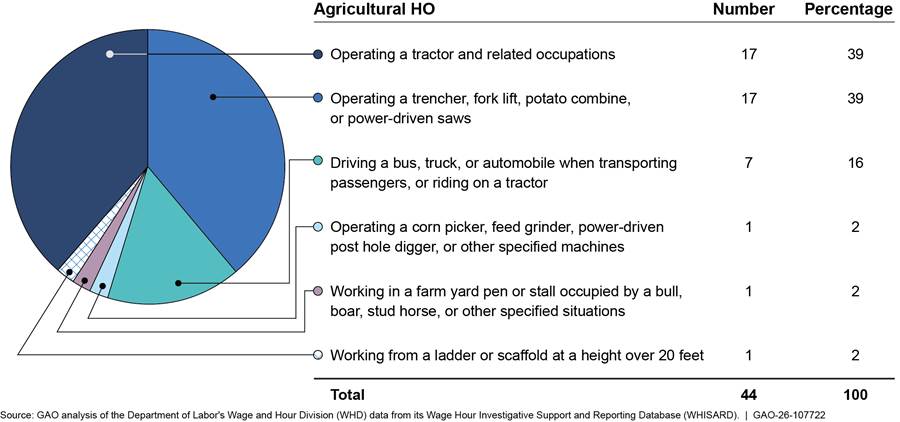
Note: This figure includes cited child labor violations from all types of WHD cases, such as full investigations, limited investigations, conciliations, and other case types. WHD officials noted that these data should not be used to describe the prevalence of illegal child labor in the U.S. Rather, these are the violations that WHD identified and cited through its investigative work.
The Department of Labor’s Wage and Hour Division (WHD) tracks data on cases and the child labor violations it cites, including fatalities and injuries that are associated with the child labor violations it finds. Our analysis of data from the Wage Hour Investigative Support and Reporting Database found that 489 cited child labor violations were associated with fatalities or injuries from fiscal year 2015 through fiscal year 2025 (see fig. 15).
Figure 15: Number of Child Labor Violations Cited by WHD That Were Associated with Child Fatalities or Injuries, Fiscal Years 2015−2025
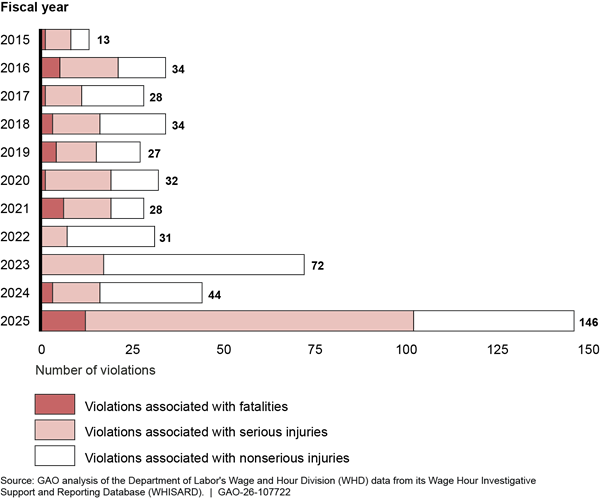
Notes: More than one cited violation may be associated with a single fatality or injury. The fatality and injury categories are mutually exclusive (i.e., a violation cannot be associated with both a fatality and an injury). GAO’s analysis showed that 23 children died and 384 were injured at work in association with child labor violations during this timeframe.
The fatalities and serious injury categories include situations in which a child labor violation WHD identified contributed to or caused a fatality or serious injury. WHD defines serious injuries as those that generally require multiple treatments, such as getting and removing stitches; result in five or more days away from normal activities; or result in a permanent loss, permanent paralysis, or substantial impairment. Nonserious injuries generally include injuries that require a one-time treatment or prevent a child from participating in normal activities, school, or work for less than five days, according to WHD. These data pertain only to violations WHD identified and cited and are separate from the Department of Labor’s Bureau of Labor Statistics’ datasets that report on fatalities, injuries, and illnesses of working children more broadly, which may or may not have occurred during legal work activities. This figure includes cited child labor violations from all types of WHD cases, such as full investigations, limited investigations, conciliations, and other case types. WHD officials noted that these data should not be used to describe the prevalence of illegal child labor in the U.S.
GAO Contacts
Thomas Costa at (202) 512-7215 or costat@gao.gov
Staff Acknowledgments
In addition to the contact named above, Rebecca Woiwode (Assistant Director), Eve Weisberg (Analyst-in-Charge), Kayla Good, Ariel Jona, Moon Parks, Suellen Foth, Norma-Jean Simon, Joey Carroll, Aaron Olszewski, Jeffrey Fiore, Thomas Cook, Alexandra Edwards, Elizabeth Fan, Benjamin Licht, Stacia Odenwald, and Curtia Taylor made significant contributions to this report.
Also contributing to this report were Lauren Mosteller, Maria Gadel, Michelle Munn, Lindsay Shapray, Lorin Obler, Manual Valverde, Sabrina Riddick, Sarah Wu, and Cady Panetta.
The Government Accountability Office, the audit, evaluation, and investigative arm of Congress, exists to support Congress in meeting its constitutional responsibilities and to help improve the performance and accountability of the federal government for the American people. GAO examines the use of public funds; evaluates federal programs and policies; and provides analyses, recommendations, and other assistance to help Congress make informed oversight, policy, and funding decisions. GAO’s commitment to good government is reflected in its core values of accountability, integrity, and reliability.
Obtaining Copies of GAO Reports and Testimony
The fastest and easiest way to obtain copies of GAO documents at no cost is through our website. Each weekday afternoon, GAO posts on its website newly released reports, testimony, and correspondence. You can also subscribe to GAO’s email updates to receive notification of newly posted products.
Order by Phone
The price of each GAO publication reflects GAO’s actual cost of production and distribution and depends on the number of pages in the publication and whether the publication is printed in color or black and white. Pricing and ordering information is posted on GAO’s website, https://www.gao.gov/ordering.htm.
Place orders by calling (202) 512-6000, toll free (866) 801-7077,
or
TDD (202) 512-2537.
Orders may be paid for using American Express, Discover Card, MasterCard, Visa, check, or money order. Call for additional information.
Connect with GAO
Connect with GAO on X,
LinkedIn, Instagram, and YouTube.
Subscribe to our Email Updates. Listen to our Podcasts.
Visit GAO on the web at https://www.gao.gov.
To Report Fraud, Waste, and Abuse in Federal Programs
Contact FraudNet:
Website: https://www.gao.gov/about/what-gao-does/fraudnet
Automated answering system: (800) 424-5454
Media Relations
Sarah Kaczmarek, Managing Director, Media@gao.gov
Congressional Relations
David A. Powner, Acting Managing Director, CongRel@gao.gov
General Inquiries
[1]Fair Labor Standards Act of 1938, ch. 676, 52 Stat. 1060 (codified as amended at 29 U.S.C. §§ 201-219).
[2]Federal Committee on Statistical Methodology. A Framework for Data Quality. FCSM 20-04 (Sept. 2020); and GAO, Evidence-Based Policymaking: Practices to Help Manage and Assess the Results of Federal Efforts, GAO‑23‑105460 (Washington, D.C.: July 12, 2023).
[3]WHD has five regional offices—covering the Midwest, Northeast, Southeast, Southwest, and West regions—and 54 district offices nationwide.
[4]GAO, Standards for Internal Control in the Federal Government, GAO‑25‑107721 (Washington, D.C.: May 15, 2025); and GAO‑23‑105460.
[5]In addition to DOL and HHS, the agencies on the IATF include the Departments of Agriculture, Commerce, Education, Homeland Security, Justice, and State.
[6]GAO, Government Performance Management: Leading Practices to Enhance Interagency Collaboration and Address Crosscutting Challenges, GAO‑23‑105520 (Washington, D.C.: May 24, 2023).
[7]See generally 29 U.S.C. § 203(l) and 29 C.F.R. §§ 570.50-.68 (DOL’s “hazardous occupations orders” (HO) for nonagricultural occupations for minors between 16 and 18 years old) and 29 U.S.C. § 213(c)(2); 29 C.F.R. §§ 570.70-.72 (DOL’s HOs for agricultural employment of children under the age of 16). The FLSA’s child labor provisions do not cover all working children, such as children employed by their parents on a farm owned or operated by their parent. Children may also be covered under a state’s child labor laws. In this report, “child labor laws” refer to the FLSA, as amended, and youth employment regulations issued by DOL. States may provide additional protections beyond the minimum requirements established by FLSA and its implementing regulations (see 29 U.S.C. 121(c) and 229 C.F.R. pt. 570). In instances where a state child labor law is more restrictive than the federal law, the state law applies. DOL’s WHD enforces federal law.
[8]For
more information on the hazardous occupations orders for nonagricultural
occupations for children, see 29 C.F.R. §§ 570.50-.68.
[9]For more information on nonagricultural employment laws and regulations for children, see 29 U.S.C. §§ 201-219; 29 C.F.R. pt. 570. In addition to the child labor provisions, the FLSA also requires covered employers to comply with certain minimum wage and overtime requirements.
[10]See generally 29 U.S.C. § 203(l) and 29 C.F.R. §§ 570.31-.39. Employment not specifically permitted is prohibited.
[11]29 C.F.R. § 570.124.
[12]29 U.S.C. § 213(c)(1) and (2). Exceptions may apply to eligible student-learners in a vocational agricultural program and certain children who have completed certain training in tractor or machine operation. See 29 C.F.R. §§ 570.71-.72.
[13]29 C.F.R. § 570.2(b)(1). Children under age 12 are further generally limited to working outside of school hours on a farm owned or operated by their parent or, with parental consent, certain farms exempt from minimum wage requirements. 29 C.F.R. § 570.2(b)(2).
[14]WHD enforces several other statutes, including the Davis-Bacon Act and related acts, the Migrant and Seasonal Agricultural Worker Protection Act, and the Family and Medical Leave Act, among others. In addition, DOL oversees workplace safety and health through the Occupational Safety and Health Administration (OSHA), which is responsible for setting and enforcing workplace safety and health standards under the Occupational Safety and Health Act of 1970, as amended. These standards generally require employers to take steps to maintain a place of employment for workers, including those under 18 years old, free from recognized safety and health hazards. A 2023 memorandum of understanding between OSHA and WHD lays out how the two agencies can make referrals to each other about cases that could involve working children. For example, OSHA could refer a case involving children exposed to workplace hazards to WHD, which would then determine if a child labor investigation is needed, according to WHD officials.
[15]WHD may also use office audits or self-audits to enforce FLSA and other laws.
[16]According to WHD officials and documents, “egregious violations” occur in situations where children are legally deemed too young to work, employed in prohibited or hazardous occupations that put their safety at risk, or injured or killed on the job.
[17]The FLSA’s “hot goods” provision permits DOL to seek a court order to prevent the interstate shipment of goods that were produced in or about an establishment where a child labor violation occurred in the past 30 days. See 29 U.S.C. § 212. In this report, the term “illegal child labor” refers to violations of the child labor provisions of the FLSA and DOL’s youth employment regulations.
[18]To produce estimates for the numbers and characteristics of working children ages 15−17, we analyzed data from the 2024 CPS ASEC. The 2024 ASEC refers to employment and income during calendar year 2023, which matches the most recent year’s data in the timeframe we use to describe fatalities, injuries, and illnesses. The CPS and its ASEC are jointly sponsored by the Census Bureau and BLS. We generally refer to these figures as CPS data throughout this report.
[19]We used publicly available CFOI data for this report. The publicly available data we used are what most researchers and other parties are able to access, except in cases in which BLS has granted special access to restricted data files.
[20]The 95 percent confidence interval for boys is 48 percent to 53 percent. The 95 percent confidence interval for girls is 47 percent to 52 percent. Our CPS ASEC analysis uses 2024 data, which is based on work experience during 2023. The estimate for working children is for ages 15−17, because CPS data do not include work experience information on children age 14 or younger. In this report, we use the terms “boys” and “girls” to refer to individuals identified as male or female, respectively, in the dataset.
[21]Work-related child fatalities data include children under 18. CFOI identifies individuals by their sex (male or female). In this report, we use the terms “boys” and “girls” to refer to individuals identified as male or female, respectively, in the dataset.
[22]BLS reported race and ethnicity information for 253 of the 260 work-related fatalities to children under 18 from 2013−2023. For the purposes of this report, we grouped respondents who were identified as being of Hispanic ethnicity and any race (for example, Black and Hispanic) as Hispanic. “Other races” accounted for 2 percent of work-related fatalities based on available CFOI data and include (1) Asian children (non-Hispanic); (2) anyone reported as being of two or more races; or (3) anyone reported as being of unknown race and who was not reported as being of Hispanic ethnicity. “Other races” made up an estimated 8.5 percent of working children in 2023, according to CPS ASEC data. BLS did not report any work-related child fatalities for American Indians or Alaskan Natives (non-Hispanic) or for Native Hawaiians or Pacific Islanders (non-Hispanic) for 2013−2023. Percentages may not add up to 100 because of rounding.
[23]Our CPS ASEC analysis uses 2024 data, which is based on work experience during 2023. The estimate for working children covers ages 15 to 17. The 95 percent confidence interval for White children is 62 percent to 68 percent.
[24]The 95 percent confidence interval for Hispanic children is 15 percent to 20 percent.
[25]The 95 percent confidence interval for Black children is 8 percent to 12 percent.
[26]We use the term “cause of death” to refer to a variable in the CFOI labeled “event/exposure” that describes how the fatal injury occurred (for example, the worker was hit by a moving vehicle). We found BLS’s publicly available data to be sufficiently reliable for the purposes of reporting on working children’s fatalities, though we report on its limitations as well. While we analyzed variables related to the cause of death and the industry in which the affected children worked, we did not analyze all related variables in the publicly available CFOI data, including the primary source of an injury (which describes the implement involved, such as a mechanical saw) or the specific occupation worked (for example, fast food and counter workers). The data we analyzed on fatalities by industry includes private industry workers only.
[27]The Confidential Information Protection and Statistical Efficiency Act of 2018 (CIPSEA) governs the use of individually identifiable information collected for statistical purposes under a pledge of confidentiality. The disclosure of such data in identifiable form for any non-statistical purposes without the respondent’s informed consent is generally prohibited. See 44 U.S.C. §§ 3561-3583.
[28]Entities using restricted CFOI data may also face limitations in the analyses they can conduct. For example, CDC officials told us that they had less flexibility now to conduct in-depth analyses of CFOI data because BLS changed their process for accessing the data in 2022. The new system limits the modeling approaches CDC can use and the descriptive analyses it can conduct.
[29]We grouped cause information at the 2-digit level of the Occupational Injuries and Illnesses Classification System to understand fatalities at the specific category level, and then aggregated data to the 1-digit level. More information on cause may be publicly available at the 1-digit level for the 260 child fatalities we identified, according to BLS officials.
[30]We grouped industries at the 3-digit level of the North American Industry Classification System. Using a different grouping methodology, some additional information on industry may be available for more of the 260 child fatalities we identified.
[31]Our CPS ASEC analysis uses 2024 data, which is based on work experience during 2023. The estimate for working children is for ages 15 to 17 because CPS data do not include work experience information on children age 14 or younger.
[32]The SOII provides nonfatal occupational injury and illness estimates based on a sample of approximately 200,000 establishments in private industry and the public sector (state and local government). It includes data on a variety of employer, employee, and case characteristics. In-scope cases include work-related injuries or illnesses to workers who require medical care beyond first aid.
[33]The SOII estimates that we present only apply to injuries and illnesses that resulted in days away from work.
[34]The relative standard errors of these numbers are 13.2 percent or smaller.
[35]The relative standard errors of these percentages are 3.5 percent or smaller. Unlike our analysis of fatalities, our analysis of injuries and illnesses among working children did not include race or ethnicity because race is not a mandatory variable for the SOII.
[36]The relative standard errors of these percentages are 4.9 percent or smaller.
[37]The relative standard errors of these percentages are 2.1 percent or smaller.
[38]The relative standard errors of these percentages are 8.7 percent or smaller. According to DOL officials, numerous factors may account for this disparity, including differences in how DOL collects fatal and non-fatal data. For example, the CFOI includes agriculture establishments of all sizes, while the SOII is limited to those with 11 or more employees. In 2018, we reported a similar finding and noted that DOL told us many children working in agriculture were outside the scope of the agency’s injury and illness dataset. See GAO, Working Children: Federal Injury Data and Compliance Strategies Could be Strengthened, GAO‑19‑26 (Washington, D.C.: Nov. 2, 2018).
[39]According to BLS documentation, the agency made this change following a series of studies from 2011 through 2019 that compared the case circumstances and worker characteristics of injuries and illnesses requiring days away from work to those that lead to job transfer or restriction. Bureau of Labor Statistics, “Injuries, Illnesses, and Fatalities: Case and Demographic Characteristics for Work-Related Injuries and Illnesses Involving Days of Job Transfer or Restriction,” https://www.bls.gov/iif/nonfatal-injuries-and-illnesses-tables/soii-case-and-demographic-characteristics-historical-data/days-of-job-transfer-or-restriction.htm, last modified on June 4, 2021.
[40]Bureau of Labor Statistics, “Occupational Injuries and Illnesses Classification System (OIICS), Version 3.0,” https://www.bls.gov/iif/definitions/oiics‑version‑3‑major‑changes.htm, last modified Feb. 1, 2024, and “Injuries, Illnesses, and Fatalities: Occupational Safety and Health Frequently Asked Questions,” https://www.bls.gov/iif/questions‑and‑answers.htm, last modified Apr. 26, 2024.
[41]BLS uses its Occupational Injuries and Illnesses Classification System to code characteristics of the fatal injuries it reports in the CFOI and the non-fatal injuries and illnesses it reports in the SOII.
[42]Bureau of Labor Statistics, “Occupational Injuries and Illnesses Classification System (OIICS), Version 3.0.”
[43]Elizabeth Rogers, "The Survey of Occupational Injuries and Illnesses Respondent Follow-Up Survey," Monthly Labor Review, U.S. Bureau of Labor Statistics, May 2020, https://doi.org/10.21916/mlr.2020.9. To examine employer record keeping and reporting practices, BLS contracted a nationally representative follow-up survey of private employer respondents that participated in the 2013 SOII survey. Of the 3,703 private sector establishments contacted, 1,852 (53 percent) participated in the follow-up survey in 2015.
[44]Centers for Disease Control and Prevention, “MMWR Weekly: Work-Related Injuries and Illnesses Associated with Child Labor -- United States, 1993,” vol. 45, no. 22 (June 07, 1996): 464−468. Categories of workers under 18 that were not included in the 1993 SOII included self-employed workers, farms with fewer than 11 employees, private households, and government employees. According to BLS officials, there are no known updated estimates of how many workers under 18 are not represented by the SOII.
[46]National Academies of Sciences, Engineering, and Medicine, Protecting Youth at Work: Health, Safety, and Development of Working Children and Adolescents in the United States (Washington, D.C.: The National Academies Press, 1998), https://doi.org/10.17226/6019.
[47]U.S. Department of Health and Human Services, Public Health Service, Centers for Disease Control and Prevention, Child Labor Research Needs: Recommendations from the NIOSH Child Labor Working Team, No. 97-143 (Aug. 1997).
[48]BLS officials also noted that, in response to National Academies recommendations in the late 1980s, the agency began publishing nonfatal injury and illness data and fatal injury data by case characteristics and worker demographics for workers 14 and older, something it continues to do today. WHD officials stated that their agency routinely publicizes serious, willful, and repeated violators, and has conducted targeted child labor investigations, updated guidance relative to child labor, and provided cross-training for investigators over the years. Given the age of the National Academies and NIOSH reports and subsequent staff changes at DOL and HHS, it was not possible to determine if the agencies undertook these actions specifically in response to the recommendations.
[49]NIOSH conducted the CAIS in collaboration with the U.S. Department of Agriculture’s National Agricultural Statistics Service.
[50]NIOSH collected these data through a collaborative agreement with the Consumer Product Safety Commission, which maintains the National Electronic Injury Surveillance System. While the NEISS-Work occupational supplement ended in 2023, other components of NEISS continued after 2023.
[51]In 2018, we found that NEISS-Work’s estimates of the number of work-related childhood injuries and illnesses were generally more than five times higher than SOII estimates. We noted that some of the differences in the estimates might be related to data collection methods, as the SOII relies on surveyed employer records and NEISS-Work data were based on emergency room documentation. GAO‑19‑26.
[52]CDC officials told us that from 2001 through 2014, NIOSH conducted six iterations of the CAIS in response to recommendations such as those made in the 1998 National Academies study. National Academies of Sciences, Engineering, and Medicine, Protecting Youth at Work.
[53]According to DOL, the most recent contract for conducting NAWS ended in April 2026. DOL officials told us that the agency was currently exploring more cost-effective methods for obtaining farm labor data.
[54]FACE periodically reviews and updates these priorities to remain responsive to national and state needs. The current priority categories are jobs related to robots, tree care, operating powered industrial trucks in warehouses, tow truck driving, and waste collection/sanitation. See https://www.cdc.gov/niosh/face/about/index.html
[55]CDC officials told us that prior to 2010, NIOSH issued an estimated 106 FACE reports that described workplace fatalities for children under 18. Between 2010 and January 2025, NIOSH issued approximately seven additional reports involving this age group, the officials said. According to CDC officials, the number of FACE reports may also reflect changes in program capacity over time. They noted that reductions in the number of federal investigators and a decline in the number of participating states have reduced the program's capacity to conduct investigations and produce reports.
[56]Under the Occupational Safety and Health Act of 1970, as amended, the Secretary of Labor is required to “compile accurate statistics on work injuries and illnesses which shall include all disabling, serious, or significant injuries and illnesses, whether or not involving loss of time from work, other than minor injuries requiring only first aid treatment and which do not involve medical treatment, loss of consciousness, restriction of work or motion, or transfer to another job.” 29 U.S.C. § 673(a).
[57]See Federal Committee on Statistical Methodology, 2020.
[58]See GAO‑23‑105460.
[59]Child labor violations and cases are recorded in WHD’s case management system, WHISARD, in the fiscal year in which a case is closed, which may differ from the year in which an incident actually occurred or the year in which a case started. These totals include cited child labor violations from all types of WHD cases, such as full investigations, limited investigations, conciliations, and other case types.
[60]According to DOL, Wage and Hour investigators inquire about illegal child labor in every FLSA case, regardless of whether the case was started for reasons related to child labor.
[61]According to DOL officials, WHD had 995 full-time investigative staff members in fiscal year 2015, and in March 2026, WHD had 618 full-time investigative staff members. In 2025, DOL’s Office of Inspector General reported on resource constraints that had affected child labor enforcement, including insufficient staff to meet the current volume of child labor complaints. Department of Labor, Office of Inspector General, Office of Audit, Review of WHD Efforts to Address Child Labor Law Violation Challenges , Report No. 17-25-001-15-001 (Sept. 30, 2025).
[62]There are 17 nonagricultural HOs, some of which were last updated in 2010.
[63]Recordkeeping violations can occur in nonagricultural and agricultural workplaces. Employers are required to maintain and preserve records containing certain information, including the employee’s date of birth if the employee is under 19, for employees subject to the FLSA’s minimum wage provisions or both the minimum wage and overtime pay provisions. 29 C.F.R. § 516.2(a)(3).
[64]Fourteen- and 15-year-olds are prohibited from working in certain nonagricultural occupations, including any occupations listed in the nonagricultural HOs and most occupations involving transportation, construction, warehousing, manufacturing, power-driven machinery, and baking, among others. The regulations also list jobs that 14- and 15-year-olds are permitted to hold, such as most retail jobs, bagging groceries, and cashiering. Jobs that are not explicitly permitted are prohibited. 29 C.F.R. §§ 570.33-.34. For the purposes of our analysis, violations of the nonagricultural HOs involving 14- and 15-year-olds are counted in the hazardous occupation category (not in the prohibited occupations category).
[65]The FLSA sets different standards for children in agricultural work than in nonagricultural work. For example, 16- and 17-year olds can work in hazardous agricultural jobs. In contrast, all children under 18 are prohibited from working in hazardous nonagricultural jobs. While there are no daily or weekly limits to the number of hours a child may work in agriculture (as long as the work occurs outside school hours), 14- and 15-year-olds are limited in the amount of time they can engage in in nonagricultural work. Further, children of any age may work at any time in any job on a farm owned or operated by their parent(s) or person standing in place of the parent(s), including in work that is otherwise prohibited by agricultural HOs.
[66]In fiscal year 2023, WHD completed its investigation of Packers Sanitation Services Inc., which WHD found to have employed at least 102 children from 13 to 17 years of age in hazardous occupations and working overnight shifts at 13 meat processing facilities across 8 states. See “More Than 100 Children Illegally Employed in Hazardous Jobs, Federal Investigation Finds; Food Sanitation Contractor Pays $1.5M in Penalties,” News Release, Department of Labor (Feb. 17, 2023), https://www.dol.gov/newsroom/releases/whd/whd20230217‑1.
[67]These data are from WHISARD and only reflect fatalities or injuries to children that occurred in association with a child labor violation cited by WHD during its cases. WHD’s enforcement data are separate from BLS’s CFOI and SOII datasets, which reflect fatalities, injuries, and illnesses among working children more broadly that may or may not have occurred during legal work activities.
[68]More than one violation may be associated with a single fatality or injury. The fatality and injury categories are mutually exclusive: a violation cannot be associated with both a fatality and an injury. Our analysis showed that these 489 violations were associated with a total of 23 children who died and 384 children who were injured while working between fiscal year 2015 and fiscal year 2025.
[69]Officials noted that WHD targeted cases in the accommodation and food services industry, and these data should not be used to describe the prevalence of illegal child labor in the U.S. Rather, these are violations that WHD found.
[70]According to WHD officials and documents, egregious violations occur in situations where children are legally deemed too young to work, employed in prohibited or hazardous occupations that put their safety at risk, or injured or killed on the job.
[71]WHD officials said the specific datasets used to target investigations under the National Initiative were Controlled Unclassified Information and making these strategies public could hamper their enforcement efforts. As such, we are providing a high-level description of WHD’s targeting approach.
[72]This outreach includes presentations and seminars, stakeholder meetings, trainings and webinars, face-to-face consultations, and hosting booths or exhibits at events, among other activities.
[73]See Department of Labor, Wage and Hour Division, “Child Labor Civil Money Penalty Assessments for Nonserious Injury and Noninjury Violations,” Field Assistance Bulletin No. 2023-4 (Nov. 28, 2023), available publicly at https://www.dol.gov/sites/dolgov/files/WHD/fab/fab2023_4.pdf, which supersedes sections of Field Assistance Bulletin No. 2016-5 for violations involving nonserious injury or no injury. According to WHD documents, nonserious injury requires only a one-time treatment and inhibits normal activities or school and work attendance for less than 5 days. Field Assistance Bulletin No. 2016-5 is still relevant for violations involving serious injury or death and violations meeting the criteria of the Child Labor Enhanced Penalty Program.
[74]As of January 16, 2025, maximum CMPs are $72,876 for violations that cause the death or serious injury of a child, $145,752 for willful or repeated violations of child labor standards that cause the death or serious injury of a child, and $16,035 for noninjury violations or injury violations that do not cause the death or serious injury of a child. 29 C.F.R. § 579.1.
[75]Each individual factor may result in the initial CMP amount being adjusted upward or downward. If the resulting overall calculated amount of the CMP is above the statutory maximum, the statutory maximum is assessed. Previously, WHD calculated CMPs using various base amounts under the maximum, depending on the gravity of the violation. For example, prior to the current approach, the initial CMP amount for an hours standard violation in which a child under 16 was required to work in a nonagricultural position later in the evening than permitted on a school night was $791, as of January 15, 2023, according to WHD documents. Multipliers could be applied to the amount, such as when a violation was willful or repeated. After the change, the CMP calculation in such a case would begin with the current statutory maximum of $16,035 and be adjusted based on factors listed in Wage and Hour Field Assistance Bulletin No. 2023-4 and related regulations. To calculate the CMP in the example, the initial CMP amount could be reduced by 30 percent if no hazardous work was conducted, there were no injuries, and the work did not occur during school hours.
[76]See U.S. Department of Labor Strategic Plan, FY 2026-2030, p. 33, https://www.dol.gov/sites/dolgov/files/general/reports/FY2026‑2030‑DOL‑StrategicPlan.pdf WHD created the measure in 2024, but due to methodological changes, fiscal year 2025 is the first year for which it set a target.
[77]From 2023 to 2025, investigations could be labeled as part of the National Initiative if there was a high likelihood of egregious violations and a need for coordination across regions or levels of WHD, according to officials. However, if an investigation also fit into an industry-based initiative, such as WHD’s construction or food service initiatives, the investigation may have been labeled as part of the industry initiative instead. WHD officials said they were updating how these cases were tracked in their new case management system.
[78]WHD officials said the specific datasets used to target investigations under the National Initiative were Controlled Unclassified Information, and making these strategies public could hamper their enforcement efforts. As such, we are providing a high-level description of WHD’s targeting approach.
[80] GAO‑25‑107721, Principle 13.
[81]According to DOL, certain HOs generally include the occupations of setting up, adjusting, repairing, oiling, or cleaning the equipment covered in the HO.
[82]In 2025, DOL’s Office of the Inspector General also reported that differences in state and federal child labor laws have created confusion among employers. See DOL OIG Report No. 17-25-001-15-001.
[83]Specifically, per federal child labor laws, 14- and 15-year-olds are allowed to work until 7:00 p.m. between Labor Day and June 1, and until 9:00 p.m. from June 1 through Labor Day. In contrast, some state laws permit 14- and 15-year-olds to work past 7:00 p.m. year-round. For example, Iowa enacted a law in 2023 to extend work hours for children under 16 to 9:00 p.m. during the school year and to 11:00 p.m. from June 1 through Labor Day. See Iowa Code § 92.7. New Hampshire also allows children under 16 to work until 9:00pm. See N.H. Rev. Stat. Ann. § 276-A:4.
[84]See U.S. Department of Labor, Fact Sheet #43: Child Labor Provisions of the Fair Labor Standards Act (FLSA) for Nonagricultural Occupations (Dec. 2016).
[85]See Selected State Child Labor Standards Affecting Minors Under 18 in Non‑farm Employment as of July 15, 2025 | U.S. Department of Labor. Note that historical tables are available for 2008 through 2023. As of June 2026, the webpage had last been updated on July 15, 2025.
[86]These metrics reflect content across DOL’s accounts on X, LinkedIn, Facebook, Instagram, and YouTube.
[88]According to WHD officials, use of power-driven meat processing equipment by a child can still be a violation when the equipment is used for other purposes.
[89]GAO‑25‑107721. Principal 13.01 and 14.01.
[90]The seven agencies are the Departments of Agriculture, Commerce, Education, Health and Human Services, Homeland Security, Justice, and State.
[91]Memorandum of Agreement Between the United States Department of Labor, Wage and Hour Division, and the United States Department of Health and Human Services, Administration for Children and Families Regarding Inter-Agency Data Sharing Memorandum of Agreement (Mar. 23, 2023). The agreement was in effect for 3 years from the start date.
[93]Each of these practices contains key considerations for collaborating agencies to use when implementing the leading practices. We selected the key considerations for each leading practice relevant to DOL’s interagency collaboration efforts on child labor. For the full list of practices and key considerations, see GAO‑23‑105520.
[94]See GAO‑23‑105520.
[95]NAICS is the standard used by federal statistical agencies to classify business establishments by industry for the purpose of collecting, analyzing, and publishing statistical data. The 3-digit NAICS code level represents the economic subsector (e.g., crop production), which is narrower than the economic sector (e.g., agriculture, forestry, fishing, and hunting) or super-sector (e.g., natural resources and mining). We used publicly available CFOI data for this report.
[96]The Occupational Injury and Illness Classification System, which BLS uses to describe fatalities in the CFOI, was substantially revised in 2022. Due to these changes, BLS advises CFOI users to carefully examine data combinations that cross 2023. We found the combination of data that we examined from 2013 through 2023 to be sufficiently reliable for our purposes of analyzing working children’s fatalities.
[97]BLS uses a two-stage process to select a sample for the SOII. First, it considers all in-scope establishments that will be required to participate in the SOII, and creates a stratified sample that considers industry, ownership, and establishment size. The second stage is selecting sample cases involving workers who experienced (1) days away from work or (2) job transfer or work restriction from the establishments that were chosen in the first stage that reported large numbers of such cases.
[98]See generally 29 C.F.R. pt. 1904.
[99]In January 2026, BLS issued an errata because railroad and mining cases in 2021 were incorrectly coded as “all other” for occupational injury and illness categories. BLS officials told us this error likely led to an overcount of “all other” categories and an undercount for some occupational categories in the published SOII case and demographic data for 2021–2022. BLS officials also noted that in 2023–2024 (unaffected by this errata), there were no publishable days away from work cases in the mining industry for the private sector for workers under 18. The errata does not substantively affect our reporting, as we do not analyze trends in the SOII after 2020. In addition, for the few individual estimates we provide from 2021−2022 and 2023−2024, we would expect few children to be employed in the railroad and mining sectors because of the hazardous nature of related work.
[100]National Academies of Sciences, Engineering, and Medicine, Protecting Youth at Work: Health, Safety, and Development of Working Children and Adolescents in the United States. (Washington, D.C.: National Academies Press, 1998), http://www.nap.edu/catalog/6019.html and U.S. Department of Health and Human Services, Public Health Service, Centers for Disease Control and Prevention, Child Labor Research Needs: Recommendations from the NIOSH Child Labor Working Team, No. 97-143 (August 1997).
[101]Federal Committee on Statistical Methodology, A Framework for Data Quality. FCSM 20-04 (2020); and GAO, Evidence-Based Policymaking: Practices to Help Manage and Assess the Results of Federal Efforts, GAO‑23‑105460, (Washington, D.C.: July 12, 2023).
[102]According to WHD officials, case management and data entry moved from WHISARD into a new system, the Wage Hour Integrated System for Enforcement (called WISE 2.0), in November 2025. Data through the end of fiscal year 2025 are from WHISARD.
[103]WHD has five regional offices covering the Midwest, Northeast, Southeast, Southwest, and West regions.
[104]We calculated the average percentage of cases resulting in child labor violations for each district office within a region, from fiscal year 2022 through fiscal year 2024 (the 3 most recent years of WHISARD data available at that time).
[105]See GAO, Government Performance Management: Leading Practices to Enhance Interagency Collaboration and Address Crosscutting Challenges, GAO‑23‑105520 (Washington, D.C.: May 24, 2023).
[106]The two analysts resolved any differences in determinations through discussion.