
Report to Congressional Committees
United States Government Accountability Office
A report to congressional committees
Contact: Andrew Von Ah at vonaha@gao.gov
What GAO Found
Since 2020, four federal agencies administered the bulk of federal funding for broadband deployment through the nine programs GAO reviewed. These were the Federal Communications Commission (FCC), National Telecommunications and Information Administration (NTIA), and Departments of Agriculture and the Treasury. For example, NTIA oversees the over $42-billion Broadband Equity, Access, and Deployment (BEAD) program, which provides grants to states and territories that select providers to deploy broadband networks to underserved areas. As of February 2026, all nine programs had begun distributing funding.
|
Program (agency) |
Date |
|
State and Local Fiscal Recovery Funds (Treasury) |
2026 |
|
Broadband Infrastructure Program (NTIA); Capital Projects Fund (Treasury) |
2027 |
|
Selected High Cost subprograms (FCC) |
2028 |
|
Tribal Broadband Connectivity Program rounds one and two (NTIA) |
2029 |
|
Tribal Broadband Connectivity Program round three (NTIA); selected High Cost subprograms (FCC); Broadband Equity, Access, and Deployment Program (NTIA) |
2030 and beyond |
Source: Documentation and officials from National Telecommunications and Information Administration (NTIA), Federal Communications Commission (FCC), and Department of the Treasury. | GAO-26-107725
Note: Table excludes the U.S. Department of Agriculture programs that GAO reviewed because expected completion dates vary by funding round.
Federal agencies target funding to underserved areas using FCC mapping data showing which locations do and do not have broadband access, as reported by providers. To improve data accuracy, FCC accepts challenges from the public and makes updates if needed. Some program participants and stakeholders said this challenge process was burdensome and unclear. For example, challenging a large number of locations in an area could be difficult for smaller communities and providers with limited resources. Without targeted outreach to smaller communities and providers to address such difficulties, FCC may not be able to obtain the most accurate information about broadband availability and therefore may not be able to effectively identify and target funding to underserved areas.
As one of the largest programs focused on broadband deployment GAO reviewed, BEAD holds great potential to make broadband available to areas that have been underserved. GAO has previously reported on issues providers face in high-cost areas, including financial sustainability. In October 2025, NTIA announced a requirement that BEAD providers certify that they will not accept federal funding from other sources for broadband deployment and operations costs for locations funded by BEAD for at least 10 years. This provision is intended to ensure that BEAD projects are financially self-sustainable without additional federal funding. NTIA’s BEAD documentation for states and territories states that there may be a basis for them to request certain data from providers. However, NTIA did not detail the circumstances that could warrant such a request. By providing more details, NTIA would help states anticipate potential problems and prevent service lapses to underserved areas when providers cannot continue providing services due to financial issues.
Why GAO Did This Study
Federal programs have received billions of dollars in recent years, including over $50 billion from the Infrastructure Investment and Jobs Act, to deploy broadband networks to areas that lack service. These areas are typically remote and harder or more expensive to serve than other areas. This effort involves multiple federal agencies, states, territories, Tribes, and broadband providers.
House Report 118-124 includes a provision for GAO to review the efficacy of recent federal broadband deployment programs. This report examines selected agencies’ progress in deploying broadband, their approaches to targeting underserved areas, and NTIA’s efforts to encourage sustainability in its BEAD program, among other things.
GAO analyzed broadband program data, reviewed documents, and interviewed officials from the four selected broadband funding agencies. GAO selected seven programs administered by these agencies with broadband deployment as a main purpose and two Treasury programs due to the significant amount of funding used for broadband deployment. GAO compared FCC’s efforts to improve data in its maps and NTIA’s efforts to encourage sustainability to relevant federal internal control standards.
What GAO Recommends
GAO recommends that FCC work with smaller communities and providers to identify and address difficulties in completing the challenge process. GAO also recommends that NTIA provide information to states and territories on monitoring BEAD projects to support financial sustainability. FCC and NTIA agreed with these recommendations.
|
Abbreviations |
|
|
|
|
|
BEAD |
Broadband Equity Access and Deployment |
|
BFM |
Broadband Funding Map |
|
BIP |
Broadband Infrastructure Program |
|
BLM |
Bureau of Land Management |
|
CAF-II Auction |
Connect America Fund Phase II Auction |
|
CPF |
Capital Projects Fund |
|
E-ACAM |
Enhanced Alternative Connect America Cost Model |
|
FCC |
Federal Communications Commission |
|
NEPA |
National Environmental Policy Act |
|
NTIA |
National Telecommunications and Information Administration |
|
RDOF |
Rural Digital Opportunity Fund |
|
SLFRF |
State and Local Fiscal Recovery Funds |
|
TBCP |
Tribal Broadband Connectivity Program |
|
TIP |
Telecommunications Infrastructure Program |
|
USDA |
United States Department of Agriculture |
This is a work of the U.S. government and is not subject to copyright protection in the United States. The published product may be reproduced and distributed in its entirety without further permission from GAO. However, because this work may contain copyrighted images or other material, permission from the copyright holder may be necessary if you wish to reproduce this material separately.
August 31, 2026
The Honorable John Hoeven
Chair
The Honorable Jeanne Shaheen
Ranking Member
Subcommittee on Agriculture, Rural Development, Food and Drug
Administration, and Related Agencies
Committee on Appropriations
United States Senate
The Honorable Andy Harris
Chairman
The Honorable Sanford Bishop, Jr.
Ranking Member
Subcommittee on Agriculture, Rural Development, Food and Drug
Administration, and Related Agencies
Committee on Appropriations
House of Representatives
Broadband, or high-speed internet, is increasingly considered essential for employment, education, health care, and other activities in Americans’ daily lives. From 2020 to 2025, Congress appropriated tens of billions of dollars, including over $50 billion from the Infrastructure Investment and Jobs Act, in additional federal funding for new and existing programs that support expanding broadband access to those areas of the country that are unserved or underserved.[1] However, we reported in 2025 that federal agencies continue to find that a substantial number of Americans lack sufficient access to broadband.[2]
In our prior work, we found that many federal agencies have a role in addressing gaps in broadband access, making coordination among broadband programs critical to effectively identifying and addressing those gaps and preventing duplication of effort. Specifically, our 2022 report on federal broadband programs found that there were over 100 programs across 15 agencies that supported broadband access.[3]
More recently, in 2025, we reported on coordination among the four agencies that administer the bulk of federal funding for deployment of new or enhanced broadband networks.[4] These agencies are the National Telecommunications and Information Administration (NTIA) within the Department of Commerce, the U.S. Department of Agriculture (USDA), the Federal Communications Commission (FCC), and the Department of the Treasury. These agencies have agreements in place to coordinate and share information to better identify areas in need of service and to avoid duplication—where separate programs fund broadband grants for deployment in the same area, for the same population, and at the same level of service.[5]
We have also reported that the role of states and territories in distributing federal broadband funds has increased in recent years with the creation of new programs that provide funds directly to them.[6] For example, NTIA’s Broadband Equity, Access, and Deployment (BEAD) program received approximately $42 billion in 2021 to expand broadband access in all states and territories. Additionally, Treasury’s Capital Projects Fund is a $10-billion grant program available to states and territories, among other entities, that may be used for broadband infrastructure projects.
House Report 118-124, incorporated by reference into the explanatory statement accompanying the Consolidated Appropriations Act, 2024, includes a provision for us to review federal broadband deployment programs to evaluate each program’s efficacy in providing internet access to unserved and underserved areas, which we refer to collectively as “underserved.”[7] This report examines (1) selected agencies’ progress in deploying broadband; (2) the selected agencies’ approaches to targeting broadband deployment funding to underserved areas while avoiding duplication; and (3) how the selected agencies have addressed challenges that program participants face in sustaining broadband service and obtaining permits and reviews.
To address these objectives, we focused on the four agencies specified above—NTIA, USDA, FCC, and Treasury. We chose these agencies because they administer the bulk of federal broadband deployment funding and have formally agreed to coordinate and share data on broadband deployment projects funded by their programs. When reviewing the selected agencies’ activities, we focused on seven programs whose main purpose is to fund last-mile broadband deployment.[8] We also included two Treasury programs in our review due to the significant amount of funds used for broadband investment, although funding broadband deployment is only one possible eligible use of funds in these programs. Although some selected programs have other eligible uses for funds, we refer to the selected programs collectively as broadband deployment programs for the purposes of this report. For each agency, we reviewed agency documentation, reviewed relevant statutes, and interviewed agency officials.
We also interviewed 12 program participants (three state broadband offices, three Tribes, and six broadband providers) and eight other stakeholders (five industry associations, one consumer group, and two research groups) to obtain their perspectives on selected agencies’ progress in deploying broadband, selected agencies’ approaches to targeting broadband deployment to underserved areas, and challenges that program participants face in sustaining broadband service and obtaining permits and reviews. The views expressed by each participant or stakeholder are not generalizable to those of all participants or stakeholders, though they provided us with a variety of perspectives.
To examine selected agencies’ progress in deploying broadband, we reviewed agencies’ notices of funding opportunity and other documentation for selected programs to identify expected timelines for project completion. We also analyzed FCC’s Broadband Funding Map data for fiscal years 2019 through 2025 to obtain information on eight selected programs’ progress, such as funding awarded for broadband deployment and number of deployment projects funded.[9] For one of the selected FCC subprograms, the Broadband Funding Map data included only projects with planned speeds of at least 100 megabits per second (Mbps) for download and 20 Mbps for upload. This analysis did not include NTIA’s BEAD program because NTIA began submitting data to the Broadband Funding Map for this program in fiscal year 2026.
In assessing the reliability of the Broadband Funding Map data related to key program and project characteristics such as funding amount, speed, and technology, we identified several variables with missing or unexpected values and instances where agencies were using the same variable differently. In part because of our alerting FCC to these data issues, FCC, in consultation with the other selected agencies, reviewed the data specifications for the map and updated the specifications to ensure consistent use of data variables. As a result of data errors we found, FCC also updated its quality assurance process and fixed the specific data errors.[10] The Broadband Funding Map data we used for our analysis reflect these updates to the data and data specifications. As a result, the map’s data are more reliable and useful for comparisons across programs, though some cross-program comparability limitations remain, as discussed below. We assessed the reliability of the updated data and found them to be generally reliable for the purpose of describing characteristics of broadband programs and projects. We also analyzed Broadband Funding Map data on planned service locations for fiscal years 2019 through 2025 and determined these data were sufficiently reliable for the purpose of reporting approximate counts of planned locations, rounded to the nearest 100.[11]
To obtain information on completed projects, we reviewed buildout data (i.e., data on constructed broadband infrastructure) from the Broadband Funding Map for fiscal years 2019 through 2025. However, at the time of our review, data on completed projects were available for only three of our nine selected programs—NTIA’s Broadband Infrastructure Program, NTIA’s Tribal Broadband Connectivity Program, and Treasury’s Capital Projects Fund program.[12]
To examine agencies’ approaches to targeting broadband deployment funding to underserved areas while avoiding duplication, we reviewed agencies’ notices of funding opportunity and other program documentation to see how they targeted program funds. We also spoke with officials from each agency about how they coordinate their various programs with the other agencies. In addition, we evaluated FCC’s bulk challenge process—a process through which entities (state, local, and tribal governments and consumers) can challenge FCC data on broadband availability and on the location of structures that can receive broadband.[13] To do so, we compared FCC’s practices with relevant federal internal control standards related to obtaining quality data.[14]
To examine challenges that participants face in sustaining broadband service and obtaining permits and reviews, and how agencies have addressed those challenges, we reviewed reports from the Congressional Research Service, federal inspectors general, and our prior work. To evaluate NTIA’s efforts to help make BEAD sustainable, we compared NTIA’s actions with its goals and with federal standards for internal control. We focused on BEAD primarily because it is the only selected program that announced a requirement for subrecipients (i.e., broadband providers) to certify in writing that they will not accept federal funding for network deployment and operations for BEAD-funded locations for at least 10 years.
Appendix I provides additional information on our objectives, scope, and methodology, including how we selected entities to interview and how we assessed the reliability of the Broadband Funding Map data. Appendix II provides information regarding key characteristics of projects within selected programs, such as planned technology, planned speeds, and geographic location, based on our analysis of the map’s data.
We conducted this performance audit from July 2024 to August 2026 in accordance with generally accepted government auditing standards. Those standards require that we plan and perform the audit to obtain sufficient, appropriate evidence to provide a reasonable basis for our findings and conclusions based on our audit objectives. We believe that the evidence obtained provides a reasonable basis for our findings and conclusions based on our audit objectives.
Background
Broadband Technologies and Speeds
Broadband providers can use a variety of technologies to deliver service to single locations such as homes or businesses. The selected federal broadband programs we reviewed generally do not prescribe specific technologies—such as fiber, coaxial cable, fixed wireless, and satellite—as long as the service meets programmatic speed and latency requirements.[15] However, some of these requirements are more easily met by certain technologies. For example, USDA’s fifth round of funding for its ReConnect program required at least 100 Mbps upload and download speed, a requirement that can be readily met by fiber but may be more challenging to meet with other technologies. Additionally, some technologies—such as satellite—may meet technical requirements for some programs and increase access, but there are concerns about service limitations.[16]
Geography and cost considerations can also affect the choice of technology. For example, remote areas may be served at a lower cost by fixed wireless or satellite service, as installing long stretches of fiber to reach those areas can be expensive. However, satellite technology may not be able to reach areas that have heavy tree coverage, and fixed wireless may not be able to reach locations in valleys or behind hills. Additionally, rocky ground may make it difficult to dig to lay underground coaxial cable or fiber, and aerial hangings (running coaxial cable or fiber from utility poles) may be a more economical solution. (See fig. 1.)
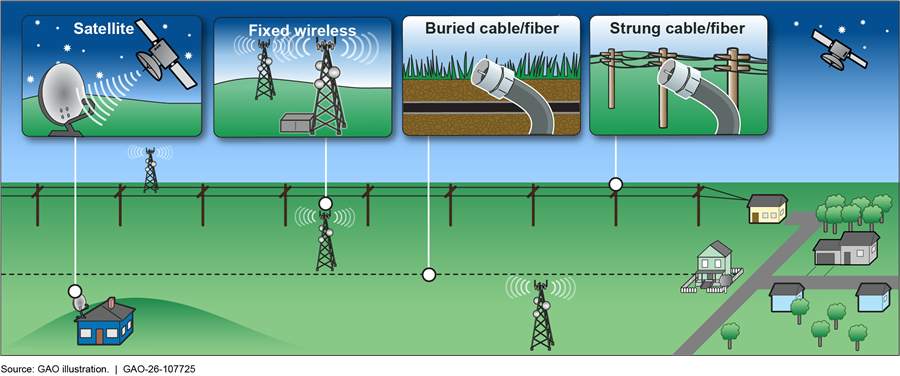
Note: Fixed broadband service generally refers to service that is fixed to a specific location, such as a home, as opposed to mobile broadband service. Fixed wireless refers to a technology that provides broadband via wireless signals that are directed to a single, static location, such as a home, and does not provide connectivity to other locations.
Features of Selected Federal Agencies and Programs
The four selected agencies in this report—NTIA, USDA, FCC, and Treasury—administer most of the federal government’s broadband deployment funding, and their programs have various purposes, funding types, and eligible entities. For example:
· NTIA was appropriated approximately $50 billion for broadband programs in fiscal years 2021 and 2022, including for two multibillion-dollar deployment programs: BEAD, which provides grants to states and territories to, among other things, select subrecipient providers to deploy broadband to underserved areas; and the Tribal Broadband Connectivity Program, which provides funding to Tribes and other eligible entities for a similar purpose.
· USDA’s broadband programs fund the deployment of broadband specifically to underserved rural communities, providing grants, loans, or both, depending on the program. The largest of these programs, ReConnect, began as a pilot program in 2018 and has since provided five separate rounds of funding, typically going directly to broadband providers and local entities for broadband deployment.
· FCC’s Universal Service Fund programs have historically provided the bulk of federal broadband funding. The largest component of the Universal Service Fund is the High Cost program, which targets financial support to rural and high-cost areas for the deployment of broadband-capable voice networks, as well as for the operation and maintenance of networks. The High Cost program includes subprograms such as the Connect America Fund Phase II Auction and the Rural Digital Opportunity Fund.
· Treasury’s Capital Projects Fund program and State and Local Fiscal Recovery Funds program provide funding to respond to the COVID-19 pandemic. This funding goes to state and territorial governments, among other entities, for many purposes, including expanding broadband access. Under both programs, recipients, not Treasury, select the individual projects for funding based on program eligibility requirements.
Table 1 shows key features of the nine broadband deployment programs we reviewed. For some programs, a significant portion of the appropriation may be used for purposes other than broadband deployment. For example, Treasury’s State and Local Fiscal Recovery Funds program provided $350 billion to help cover a broad range of costs stemming from the health and economic effects of the COVID-19 pandemic. In 2024, we reported that recipients obligated most of this funding for purposes other than broadband deployment, such as for assistance to households.[17] Our analysis of Broadband Funding Map data, featured later in this report, provides some information on how much of the appropriated funds have been or will be used for last-mile broadband deployment.
|
Program |
Amount appropriated, fiscal years 2019–2025 |
Funding type |
Examples of eligible entities |
Examples of broadband-related uses of funds |
|
National Telecommunications and Information Administration |
||||
|
Broadband Equity, Access, and Deployment Program |
$42.5 billion |
Grant |
States, territories |
Deployment, planning, and devices |
|
Tribal Broadband Connectivity Program |
$3 billion |
Grant |
Tribal governments, organizations, colleges and universities; Alaska Native corporations; and the Department of Hawaiian Home Lands |
Deployment, affordability, planning, devices, and digital skills |
|
Broadband Infrastructure Program |
$300 million |
Grant |
Partnerships between states (or political subdivisions) and fixed broadband providers |
Deployment |
|
U.S. Department of Agriculture |
||||
|
ReConnect Program |
$4.7 billiona |
Grant, loan, grant-loan combination |
Cooperatives, mutual organizations, corporations, limited liability companies, state or local governments, U.S. territories or possessions, Tribes |
Deployment |
|
Telecommunications Infrastructure Program |
$4.6 billionb |
Loan, loan guarantee |
Nonprofits, cooperatives, mutual associations, Tribes, state or local governments |
Deployment |
|
Community Connect Grant Program |
$210 million |
Grant |
Private corporations, limited liability companies, cooperatives, state or local governments, Tribes |
Deployment and affordability |
|
Federal Communications Commission |
||||
|
High Cost Program |
$5.4 billionc |
Subsidy |
Providers designated as eligible telecommunications carriers under 47 U.S.C. § 214(e) |
Deployment, operations, and maintenance |
|
Department of the Treasury |
||||
|
State and Local Fiscal Recovery Funds |
$350 billiond |
Direct payment for specified uses |
States, territories, tribal, and local governments |
Deployment, affordability, devices, and digital skills |
|
Capital Projects Fund |
$10 billiond |
Grant |
States, territories, freely associated states, tribal governments |
Deployment, affordability, devices, and digital skills |
Source: GAO analysis of relevant statutes, regulations, and agency information. | GAO‑26‑107725
Notes: In this table, states include the District of Columbia.
Some affordability-related activities may allow for broadband subsidies to pay for monthly subscriber costs.
aThe amounts reported as awarded under ReConnect may be greater than the amounts appropriated for the program because the appropriated funds are not used for the amount a loan recipient borrows, according to U.S. Department of Agriculture officials. Instead, these appropriated funds cover the loans’ subsidy costs, which represent the cost of the loan program.
bAppropriations for the Telecommunications Infrastructure Program are not limited to broadband purposes. Program funds may also be used to furnish and improve telephone services in rural areas.
cThe Federal Communications Commission (FCC) program listed is part of the Universal Service Fund, which was authorized as a permanent, indefinite appropriation (i.e., appropriations that, at the time of enactment, are for an unspecified amount, and that remain available without further congressional action) based on the fund’s receipts. GAO’s review focused on five selected subprograms within the High Cost program: Connect America Phase II Auction, Rural Digital Opportunity Fund, Bringing Puerto Rico Together Stage 2 Fixed Support, Connect U.S. Virgin Islands Stage 2 Fixed Support, and Enhanced Alternative Connect America Cost Model. This table lists the total expenses reported by FCC officials for fiscal years 2019 through 2025 for these subprograms to represent the related receipts and amounts appropriated. This amount is lower than the amount GAO reports as awarded for these subprograms later in this report because the awarded amount is the total award amount, which is disbursed monthly over a 10- or 15-year funding period.
dAppropriations for Capital Projects Fund and State and Local Fiscal Recovery Funds were for all uses, not just broadband deployment, affordability, devices, and digital skills. For example, State and Local Fiscal Recovery Funds recipients, including state and local governments, could use program funds for aid to tourism and other industries affected by COVID-19.
Program Timelines
The nine selected programs vary significantly in terms of key program dates and timelines, application and awarding periods, dates of first awards, and information related to expected timing of project completion (see fig. 2).[18] Programs with relatively short application and awarding periods that occurred several years ago, such as NTIA’s Broadband Infrastructure Program, are likely to have a higher proportion of completed projects than programs with multiple rounds and longer application and awarding periods, such as NTIA’s Tribal Broadband Connectivity Program. The Broadband Infrastructure Program had a 13-month application and awarding period that finished in June 2022, while the Tribal Broadband Connectivity Program has had a multiyear application and awarding period that included the first round starting in June 2021, a second round starting in July 2023, and a third round starting in June 2026.
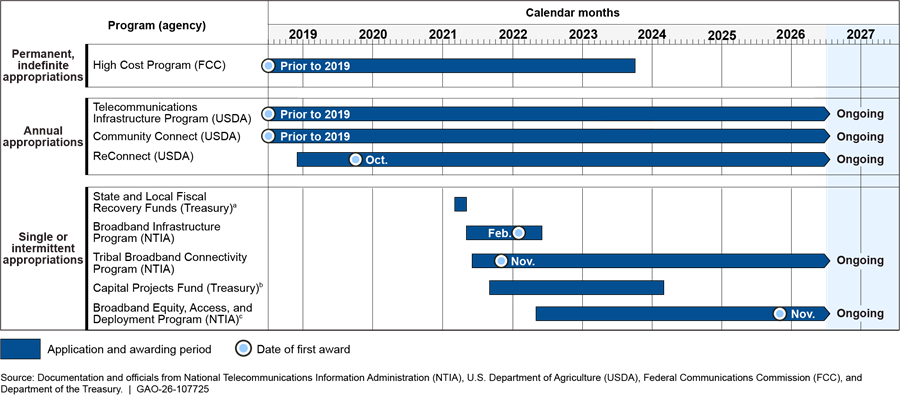
Note: Dates reflect all awards, not just those submitted to the Broadband Funding Map. For example, this figure depicts the Broadband Infrastructure Program application and awarding period ending in June 2022, when NTIA made an award that primarily funded middle-mile infrastructure and did not fund last-mile infrastructure and therefore was not included in the Broadband Funding Map, according to NTIA officials.
aThe State and Local Fiscal Recovery Funds program provided direct funding to state governments, local governments, and other recipients. According to Treasury officials, Treasury began disbursing the first portion of the funds to recipients 60 days after enactment of the statute. For the purposes of this figure, GAO considers that date to be the end of the application and awarding period. However, because this is the date Treasury began disbursing the first portion of funds, according to Treasury officials, the true end date may have been later.
bThe Capital Projects Fund program provided funding to recipients such as states, Tribes, and territories. Recipients then created program plans, which Treasury reviewed and approved. For the purposes of this figure, GAO considers the beginning of the application and awarding period to be when Treasury issued its program guidance and the end to be when Treasury announced the last project funded through an award to a state.
cThe Broadband Equity, Access, and Deployment program provided funding to states and territories (56 recipients). Recipients then created proposals, which NTIA reviewed and approved. For the purposes of this figure, GAO considers the beginning of the application and awarding period to be when NTIA issued the notice of funding opportunity. This figure does not depict an end of the application and awarding period for this program because NTIA had not approved two states’ proposals as of June 2026.
Federal Broadband Coordination and Maps
The selected agencies have multiple mechanisms for coordinating on broadband deployment. For example, the Broadband Interagency Coordination Act of 2020 directs NTIA, USDA, and FCC to enter into an interagency agreement—which the agencies established in June 2021—to coordinate and share information about funding for new broadband deployment projects under their respective programs.[19] Additionally, in May 2024, NTIA, USDA, FCC, and Treasury renewed a 2022 memorandum of understanding that established guidelines for sharing information about broadband deployment funding under their programs.[20]
The four agencies primarily share information about project areas and locations through a process that involves federal broadband maps.[21] The agencies use the underlying data from these maps to target funding to underserved areas and to prevent duplication of federal funding. We previously reported that duplication occurs when two or more agencies or programs are involved in the same activities or provide the same services to the same beneficiaries.[22] In the case of broadband funding, duplication occurs when multiple grants or subsidies go toward providing the same level of service (same activities/services) to the same area (same beneficiaries). Because broadband service is provided to physical locations, a necessary element of duplication is having service areas that physically overlap. Throughout this report, when referring to overlap, we mean the physical overlap of areas or locations being served.
FCC maintains two maps that show where broadband is available and where the federal government has funded broadband infrastructure deployment projects:
· National Broadband Map. This map, which FCC launched in 2022, shows where broadband is available in the U.S. for specific locations. FCC collects and reports data from broadband providers to assess the extent to which advanced telecommunications services are being provided in a reasonable and timely manner. Prior to these changes in 2022, FCC collected these data at the census block level, which we and others criticized as potentially overstating the services that were provided. As required by the 2020 Broadband DATA Act, FCC adopted a new mapping process to identify service at a specific location.
To update the map, internet service providers submit broadband availability information to FCC twice a year, including the technology type and maximum advertised download and upload speeds they offer at each location. As required by statute, FCC implemented a process that allows entities (e.g., state, local, and tribal governments, and consumers) to challenge the accuracy of the map’s data. In our 2025 report, we found that FCC had not documented or assessed the sufficiency of its processes for ensuring the accuracy of the broadband availability information on the map.[23] We recommended that FCC assess and document the results of monitoring its data collection and remedy any identified deficiencies. FCC concurred with this recommendation, and officials told us they were in the process of implementing this recommendation as of July 2026.
· Broadband Funding Map. This map, which FCC launched in 2023, integrates data from various federal agencies to visualize the deployment of broadband infrastructure funded by the federal government. The mapping data include project areas, planned start and end dates, amounts of funding awarded, technology types, and expected speeds. Agencies use this map as a mechanism to share data with each other when coordinating on funding decisions. In our 2025 report, we found that NTIA, USDA, FCC, and Treasury had not clearly documented the scope of how they would implement coordination efforts.[24] We recommended the agencies collaborate to clearly define and document certain aspects of their coordination efforts, including timelines to submit information for the map. As of July 2026, some of the agencies had reported implementing these recommendations.[25]
Additionally, NTIA maintains the NTIA Broadband Analytics and Monitoring platform. This is a tool that contains nonpublic data for agencies showing service areas of federally funded broadband projects and sensitive information on pending projects not yet awarded. It includes data on broadband deployment from federal agencies as well as data from the U.S. Census and private sources.
Selected Programs Have Begun Distributing Funding for Broadband Deployment, and Progress on Completing Projects Varies
Selected Programs Have Begun Distributing Funding for Broadband Deployment and Reporting Data on Status, Including Completed Buildout
As of February 2026, when the first BEAD subrecipients received funding for broadband deployment projects, all nine selected programs had begun distributing funding for broadband infrastructure deployment. Progress on completing projects varies across the programs. For example, some programs, such as NTIA’s Broadband Infrastructure Program and Treasury’s Capital Projects Fund, are expected to complete deployment for most projects in 2026 and 2027. Other programs, such as USDA’s programs and NTIA’s Tribal Broadband Connectivity Program, have been awarding and completing projects on a rolling basis, with additional expected program completion dates in 2026 and beyond. BEAD subrecipients have expected project completion dates in 2030 and beyond.
Below we discuss our analysis of Broadband Funding Map data on progress for the eight selected programs other than BEAD, such as total funding amount awarded; planned number of locations to be served; and the range, median, and mean amount awarded by project.[26] In addition, two agencies had begun reporting data on completed broadband deployment (buildout data) for some programs, and all selected agencies planned to do so for most programs, with varying timelines. (App. II includes our analysis of speeds, technologies, and other characteristics of federally funded broadband deployment projects in the eight selected programs.) For BEAD, we present information on key milestones, including a policy update and timing of expected project completion. Because NTIA began submitting data on BEAD projects to the Broadband Funding Map data in 2026, we did not analyze these data.
NTIA’s Broadband Infrastructure Program and Tribal Broadband Connectivity Program
NTIA’s Broadband Infrastructure Program (BIP) awarded funds in February 2022 to 13 projects to serve 138,600 locations. The total amount awarded was $272 million of the $300 million appropriated.[27] Awards ranged from $3 million to $42 million, with a median of $20 million and mean of $21 million. The authorizing statute required recipients to expend all funds within 1 year, with extensions available under certain circumstances.[28] According to NTIA officials, all projects received extensions.
According to our analysis of Broadband Funding Map data as of May 2026, infrastructure buildout was complete for 27,900 locations (about 20 percent). NTIA officials told us they would submit updates to the Broadband Funding Map data as they receive additional buildout data as part of recipients’ required reporting. The officials said they expected the remaining projects would be completed in 2026 and 2027. In addition, disbursement data show that 79 percent of obligated funds had been disbursed as of April 2026, suggesting that buildout has progressed substantially on these projects.[29]
NTIA’s Tribal Broadband Connectivity Program (TBCP) awarded funds to 147 broadband infrastructure deployment projects to serve 165,000 locations in two funding rounds beginning in April 2022, with the second funding round ongoing as of June 2026.[30] The total amount awarded was $1.8 billion of the $3 billion appropriated.[31] About one-quarter of these awards were for $500,000 or less, and these awards accounted for 1 percent of the funding awarded.[32] Because projects awarded $500,000 or less varied significantly from projects awarded more than $500,000 in terms of maximum, median, and mean award amount, we analyzed these projects separately. (See table 2.)
Table 2: Tribal Broadband Connectivity Program Statistics by Award Amount, Fiscal Years 2019–2025, as of April 2026
|
|
Award amount |
||
|
Program statistics |
$500,000 or less |
Over $500,000 |
All awards |
|
Number of projects |
38 |
109 |
147 |
|
Number of locations |
4,300 |
160,700 |
165,000 |
|
Total amount awarded |
$18 million |
$1.8 billion |
$1.8 billion |
|
Minimum amount awarded |
$220,000 |
$613,000 |
$220,000 |
|
Maximum amount awarded |
$500,000 |
$73 million |
$73 million |
|
Median amount awarded |
$500,000 |
$9 million |
$6 million |
|
Mean amount awarded |
$471,000 |
$16 million |
$12 million |
Source: GAO analysis of Federal Communications Commission Broadband Funding Map data. | GAO‑26‑107725
Notes: This table presents analysis of projects in the Broadband Funding Map. In addition to last-mile infrastructure construction, such projects may also include other broadband-related activities such as middle-mile infrastructure construction, planning, and supporting affordability and digital skills.
The funding amount is the amount of the award, not the amount for last-mile infrastructure construction. Dollar values are rounded according to magnitude. Values under 1 million are rounded to the nearest thousand, values between 1 million and 1 billion are rounded to the nearest million, and values of 1 billion or greater are rounded to the nearest 10th of a billion.
For numbers of planned locations, GAO used rounded figures because the source data varied in unit of analysis across programs and agencies, and because GAO identified reliability limitations affecting exact counts.
In June 2026, NTIA made the remaining $540 million available under a third notice of funding opportunity. Originally, the authorizing statute required expending all funds within 1 year after receiving an award, with extensions available under certain circumstances. A subsequent statute lengthened the general expenditure requirement to 4 years.[33]
According to our analysis of Broadband Funding Map data, infrastructure buildout was complete for 4,600 locations (about 3 percent) as of May 2026. NTIA officials told us that they would submit updates as they received additional buildout data as part of recipients’ required reporting. Closeout timelines for TBCP infrastructure deployment awards are specific to each award, consistent with each recipient’s approved period for expending funds and any authorized extensions, according to NTIA officials.[34] NTIA officials told us they expected all round-one infrastructure deployment awards to close no later than 2029. Round-two infrastructure awards will likely close in 2029, and any round-three infrastructure awards will likely close in 2030 and beyond. Disbursement data show that as of April 2026, about 28 percent ($506 million of $1.8 billion) of TBCP funds awarded for projects in fiscal years 2022 through 2025 had been disbursed, suggesting that TBCP implementation may be progressing more slowly than BIP implementation. This difference may be due in part to TBCP awards having been awarded later than BIP awards.
NTIA’s timeline for making round-two TBCP awards included the change of administration in January 2025. NTIA began making infrastructure deployment awards for round two in November 2024. According to NTIA officials, 15 of the round-two applications that the Assistant Secretary under the previous administration had recommended for “full” award were subject to review for alignment with current administration priorities. Of these 15 applications, NTIA determined that six were eligible for equitable distribution awards (awards of $500,000 or less per tribal government), and applicants have begun re-scoping their applications accordingly. NTIA officials told us that the remaining nine applications were no longer being considered for award and that the applicants had been notified they were not selected.
USDA’s ReConnect Program, Telecommunications Infrastructure Program, and Community Connect Program
The largest of our selected USDA broadband deployment programs, ReConnect, provided grants, loans, and grant-loan combinations in each year from fiscal year 2019 through fiscal year 2025, with the greatest amounts provided in fiscal years 2022 and 2023. (See fig. 3.) Altogether, ReConnect awarded $5.5 billion to 424 projects to serve 583,900 locations.[35]
Figure 3: ReConnect Funding Awarded by Fiscal Year and Funding Type, Fiscal Years 2019–2025, as of April 2026
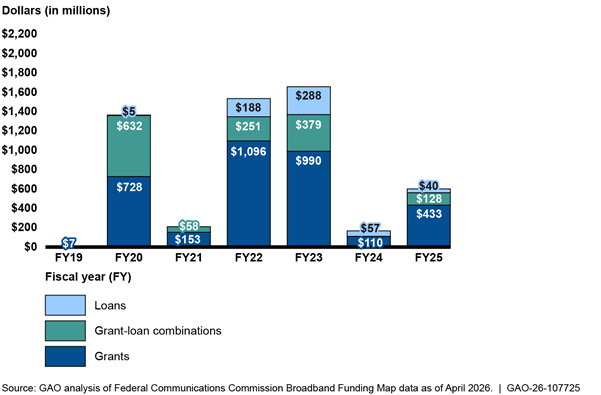
Note: This analysis excludes 19 projects that were erroneously classified as fiscal year 2026 projects (and therefore out of GAO’s scope) in the Broadband Funding Map data when GAO conducted the analysis in April 2026. These projects were awarded $267 million ($147 million for grants, $23 million for loans, and $97 million for grant-loan combinations).
In ReConnect, grants accounted for the largest proportion of number of projects (70 percent), number of planned locations (66 percent), and funds awarded (64 percent). While the maximum, median, and mean award amounts for grant-only projects were significantly lower than those of the loan-only and grant-loan combination projects, grants are not directly comparable to loans because recipients must repay the loans. (See table 3.) Recipients must complete ReConnect projects within 5 years.
|
|
Funding types |
|||
|
Program statistics |
Grants only |
Grant-loan combinations |
Loans only |
All funding types |
|
Number of projects |
298 |
92 |
34 |
424 |
|
Number of locations |
384,600 |
153,900 |
45,400 |
583,900 |
|
Total funds amount awarded |
$3.5 billion |
$1.4 billion |
$579 million |
$5.5 billion |
|
Minimum amount awarded |
$167,000 |
$992,000 |
$750,000 |
$167,000 |
|
Maximum amount awarded |
$35 million |
$57 million |
$50 million |
$57 million |
|
Median amount awarded |
$8 million |
$13 million |
$16 million |
$10 million |
|
Mean amount awarded |
$12 million |
$16 million |
$17 million |
$13 million |
Source: GAO analysis of Federal Communications Commission Broadband Funding Map data. | GAO‑26‑107725
Notes: Amounts awarded for loans do not reflect the true cost to the federal government because the loans need to be repaid. The amounts awarded record the amounts given to the loan recipients, but the true cost to the U.S. Department of Agriculture (USDA) will be lower once the recipient repays the loan. Similarly, as explained by USDA officials, the amounts reported as awarded under ReConnect may be greater than the amounts appropriated for the program because the appropriated funds are not used for the amount a loan recipient borrows. Instead, these appropriated funds cover the loans’ subsidy costs, which represent the cost of the loan program. The subsidy costs are calculated based on factors such as the loan disbursements, repayments of principal, and interest. See 2 U.S.C. § 661a(5). Consistent with Office of Management and Budget (OMB) guidance, USDA borrowed funds from Treasury to cover the amounts awarded for the loans’ principals. See OMB Cir. No. A-11, § 185.2(c).
This analysis excludes 19 projects that were erroneously classified as fiscal year 2026 projects (and therefore out of GAO’s scope) in the Broadband Funding Map data when GAO conducted the analysis in April 2026. These projects were awarded $267 million ($147 million for grants, $23 million for loans, and $97 million for grant-loan combinations) and were associated with 14,100 locations.
For numbers of planned locations, GAO used rounded figures, because the source data varied in unit of analysis across programs and agencies and because GAO identified reliability limitations affecting exact counts.
Dollar values are rounded according to magnitude. Values under 1 million are rounded to the nearest thousand, values between 1 million and 1 billion are rounded to the nearest million, and values of 1 billion or greater are rounded to the nearest 10th of a billion.
The second largest of our selected USDA broadband deployment programs, the Telecommunications Infrastructure Program (TIP), provided loans in varying amounts from fiscal year 2019 through fiscal year 2025 (see fig. 4). Altogether, TIP awarded $522 million in loans to 37 projects to serve 145,700 locations. Loan amounts ranged from $2 million to $45 million, with a median loan amount of $10 million and a mean loan amount of $14 million. Recipients are to complete projects within 5 years, according to USDA officials.
Figure 4: Telecommunications Infrastructure Program Funding Awarded by Fiscal Year, Fiscal Years 2019–2025, as of April 2026
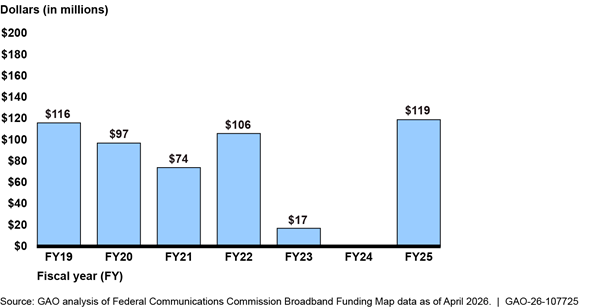
Note: The Telecommunications Infrastructure Program provided loans to recipients.
In contrast to the other selected USDA broadband programs, the agency has awarded much less for TIP than has been appropriated. Specifically, appropriations for TIP for fiscal years 2019 through 2025 totaled $4.6 billion, and USDA had obligated about 10 percent of this funding as of April 2026.[36] USDA officials identified several factors that likely affected the lower obligation rate, including the following:
· The significant expansion of federal broadband funding intended to close the digital divide—that is, the gap between those that do and do not have broadband service—included many new federal broadband programs that provided funding in the form of grants, which are often more attractive to applicants than the loans offered under TIP.
· USDA’s expanded ReConnect program provided more favorable funding structures, further drawing interest away from TIP.
However, USDA officials stated that they expect an increase in TIP applications after the recent influx of federal broadband funding winds down, as providers seek financing to complete remaining buildouts and sustain long-term network needs.
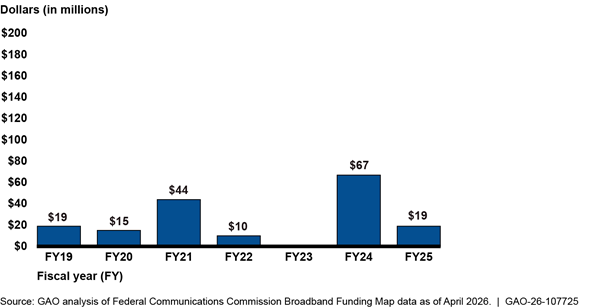
The smallest of our selected USDA broadband deployment programs, Community Connect, provided grants in varying amounts from fiscal year 2019 through fiscal year 2025, with the greatest amounts provided in fiscal years 2021 and 2024 (see fig. 5). Altogether, Community Connect awarded $174 million to 70 projects to serve 20,000 locations. Awards ranged from $137,000 to $5 million, with both a median and mean award amount of $2.5 million.[37] Community Connect projects are to be completed within 3 years.
Figure 5: Community Connect Program Funding Awarded by Fiscal Year, Fiscal Years 2019–2025, as of April 2026
Note: The Community Connect Program provided grants to recipients.
As of May 2026, USDA had not reported complete buildout data to the Broadband Funding Map for the three selected programs. According to USDA officials, they had not done so because they did not have precise data for a required field and did not want to submit inaccurate or misleading data. USDA and FCC staff met in February 2026 to resolve the issue, and FCC updated the map’s data specifications in March 2026 accordingly. USDA officials told us they planned to begin submitting buildout data later in 2026.[38] However, our analysis of expenditure data provides some information on progress.[39] As table 4 shows, the ReConnect projects that were awarded in fiscal year 2019 have expended all obligated funds and are likely completed; as discussed above, ReConnect projects are to be completed within 5 years. Projects awarded in fiscal year 2020 and beyond show lower levels of expenditure, suggesting less progress. For TIP and Community Connect, more than half of awarded funds have been expended by projects awarded in fiscal years 2019 through 2022, suggesting substantial progress.
Table 4: Percentage of Awarded Funds Expended as of April 2026 for U.S. Department of Agriculture (USDA) Broadband Infrastructure Projects Awarded in Each Fiscal Year (FY)
|
Program name |
FY2019 |
FY2020 |
FY2021 |
FY2022 |
FY2023 |
FY2024 |
FY2025 |
|
ReConnect |
100% |
69% |
37% |
29% |
7% |
3% |
1% |
|
Telecommunications Infrastructure Program |
99% |
85% |
78% |
52% |
3% |
— |
3% |
|
Community Connect |
87% |
94% |
82% |
82% |
— |
0% |
0% |
Source: GAO analysis of Federal Communications Commission Broadband Funding Map data. | GAO‑26‑107725
Notes: “—” indicates no awards were made.
This analysis excludes 19 ReConnect projects that were erroneously classified as fiscal year 2026 projects (and therefore out of GAO’s scope) in the Broadband Funding Map data when GAO conducted the analysis in April 2026. These projects were awarded $267 million ($147 million for grants, $23 million for loans, and $97 million for grant-loan combinations).
For projects in which recipients likely should have completed construction, such as for fiscal year 2020 projects, USDA officials explained why not all funds have been expended. For example, one recipient had completed its project and received reimbursement for all allowable expenses other than the engineering retainage. Because the deadline for advancing loan amounts had passed, USDA officials told us they were in the process of de-obligating the remaining funds. In another example, the award’s end date had passed, but a recipient submitted a request for a time extension that USDA was considering as of April 2026.
FCC’s High Cost Program
FCC’s High Cost program, which includes five subprograms, awarded over $25.4 billion for 956 projects in fiscal years 2019 through 2025 to serve 7,684,500 locations.[40] High Cost subprograms generally provide funding for deployment to underserved locations (as well as operations and maintenance for those locations), although one subprogram modified and extended existing funding to recipients to operate and maintain service to locations that were already served prior to the subprogram.[41] Overall, project funding amounts ranged from $60 to $538 million (see table 5).[42]
|
Program statistics |
Connect America Fund Phase II Auctiona |
Rural Digital Opportunity Fund |
Bringing Puerto Rico Together Stage 2 Fixed Support |
Connect U.S. Virgin Islands Stage 2 Fixed Support |
Enhanced Alternative Connect America Cost Model |
|
Number of projects |
134 |
447 |
4 |
1 |
370 |
|
Number of planned locations |
391,100 |
3,252,700 |
1,222,500 |
46,000 |
2,772,200b |
|
Funding period |
10 years |
10 years |
10 years |
10 years |
15 years |
|
Total amount awarded |
$1.2 billion |
$5.8 billion |
$127 million |
$84 million |
$18.3 billion |
|
Minimum amount awarded |
$5,000 |
$60 |
$4 million |
$84 million |
$100,000 |
|
Maximum amount awarded |
$162 million |
$248 million |
$52 million |
$84 million |
$538 million |
|
Median amount awarded |
$2 million |
$2 million |
$36 million |
$84 million |
$26 million |
|
Mean amount awarded |
$9 million |
$13 million |
$32 million |
$84 million |
$49 million |
Source: GAO analysis of Federal Communications Commission (FCC) Broadband Funding Map data. | GAO‑26‑107725
Notes: Locations affected by providers withdrawing from the program, along with the associated award amounts, are not reflected in this analysis because they are not in the Broadband Funding Map data. For numbers of planned locations, GAO used rounded figures, because the source data varied in unit of analysis across programs and agencies, and because GAO identified reliability limitations affecting exact counts.
Dollar values are rounded according to magnitude. Values below 1,000 are rounded to the nearest hundred, values under 1 million are rounded to the nearest thousand, values between 1 million and 1 billion are rounded to the nearest million, and values of 1 billion or greater are rounded to the nearest 10th of a billion.
aThe Broadband Funding Map data GAO analyzed for this subprogram did not include projects with planned speeds lower than 100 megabits per second (Mbps) download and 20 Mbps upload. According to FCC officials, there are fewer than an estimated 350,000 locations associated with these projects not included in the Broadband Funding Map data.
bThe Enhanced Alternative Connect America Cost Model subprogram differs from other selected subprograms in this table because it provided funding to carriers who were already receiving funding from a different subprogram to maintain that service for 15 years. It also provided funding to these carriers to deploy broadband service to previously unserved locations. GAO’s analysis of the Broadband Funding Map data indicates there are about 2.8 million planned locations for this subprogram. According to FCC officials, around 500,000 of these locations were previously unserved.
The timeline for FCC’s High Cost subprograms follows a different pattern from the other federal broadband deployment programs. These subprograms generally have a relatively short application and awarding period, followed by an authorization period during which recipients submit additional information to prove their technical and financial qualifications before receiving funding. Authorized recipients then receive funding during a 10- or 15-year period and are required to complete deployment by a certain time during this period. (See fig. 6.)
Figure 6: Key Dates for Subprograms Within the Federal Communication Commission’s (FCC) High Cost Program
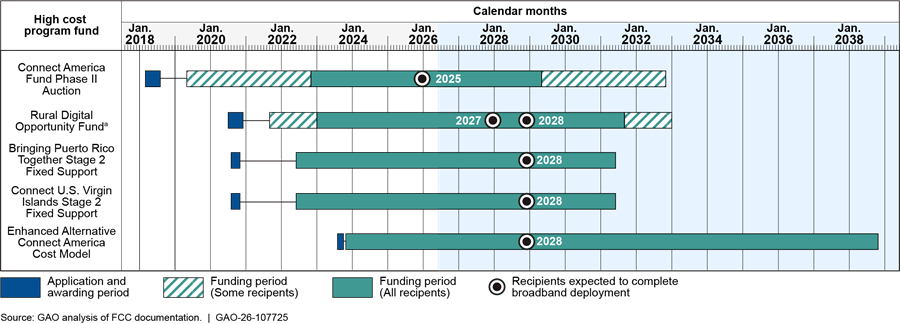
aIn cases where FCC data on broadband serviceable locations as of December 2026 include more locations than originally estimated, Rural Digital Opportunity Fund recipients will have an additional 2 years to complete deployment in additional locations, according to FCC officials.
These funds are disbursed on a monthly basis during the funding period. In contrast to other selected programs that focus on broadband deployment, the High Cost program allows recipients to use program funds for operations and maintenance. The High Cost program provides a subsidy to providers to build and operate networks capable of delivering voice and broadband service in high-cost areas, and the five subprograms analyzed in this report do not track how recipients use funds (e.g., for construction, operations, or maintenance). Because of this, FCC expenditure data do not provide information on project progress for the High Cost program as they do for the programs discussed above.
FCC monitors project progress by tracking deployment milestones, and most of the funding recipients have met these milestones. However, a number of recipients of FCC’s largest subprogram that used a reverse auction to award funds, the Rural Digital Opportunity Fund (RDOF), have not met milestones. FCC has procedures to withhold or recover funds from recipients that miss certain milestones. Recipients that withdraw from a subprogram during or after the authorization period are considered to have defaulted (i.e., failed to provide the agreed-upon service). About 38 percent of funding from RDOF ($3.5 billion of $9.2 billion) has been affected by recipients defaulting. These defaults have affected about 38 percent of planned service locations (1,976,900 of about 5.2 million).[43] The Connect America Fund Phase II Auction (CAF-II Auction), which also used a reverse auction to award funds, has experienced defaults on a smaller scale, affecting less than 1 percent of CAF-II Auction funding ($11 million of at least $1.5 billion) and less than 2 percent of planned service locations (11,000 of at least 700,000).[44] Most of the RDOF defaults and all of the CAF-II Auction defaults occurred before June 6, 2025, the as-of date NTIA set for determining eligibility of locations for BEAD funding. To the extent these areas are ultimately served by BEAD or another federal broadband deployment program, they will likely be served later than the planned deployment completion date under the High Cost program (2025 for CAF-II Auction and 2027 to 2028 for most RDOF deployment).
As of May 2026, the Broadband Funding Map data did not include buildout data for the FCC subprograms we reviewed. However, FCC officials told us they were working on improvements to FCC’s reporting system that would allow the agency to submit buildout data to the map for four of the five subprograms we reviewed (i.e., all selected subprograms except CAF-II Auction). Specifically, in January 2025, FCC adopted measures to revise its collection of buildout data for RDOF, Bringing Puerto Rico Together Stage 2 Fixed Support, and Connect U.S. Virgin Islands Stage 2 Fixed Support to use FCC’s standardized location data rather than methods previously used, such as geocodes and addresses. FCC officials said they expected to include buildout data in the Broadband Funding Map for these three subprograms as well as the Enhanced Alternative Connect America Cost Model subprogram, which already had been using FCC’s standardized location data, after June or July 2026. FCC officials said they did not include the remaining subprogram, CAF-II Auction, in the measures adopted in January 2025 in part because this subprogram was nearing buildout completion, with completion required by the end of 2025. FCC officials told us they would maintain and make publicly available buildout data for this subprogram through other sources.[45]
Treasury’s Capital Projects Fund and State and Local Fiscal Recovery Funds
Treasury’s Capital Projects Fund (CPF) program provided $10 billion in funding to states and territories, among other entities, to carry out capital projects enabling work, education, and health monitoring. Under this program, recipients, not Treasury, select the individual projects for funding. Treasury made most awards to recipients on a rolling basis in calendar years 2022 through 2024, and recipients awarded projects to subrecipients primarily in calendar years 2023 through 2025, according to Treasury officials. Treasury’s guidance directed that funds generally be expended by December 31, 2026. In May 2026, Treasury announced that recipients’ projects that receive approval for a deadline extension would be required to expend all funds by June 30, 2027.
According to our analysis of Broadband Funding Map data as of April 2026, CPF recipients awarded at least $5.7 billion to 1,387 broadband deployment projects to serve approximately 1,331,000 locations.[46]
However, according to Treasury officials, Broadband Funding Map data on the number of planned locations and awarded funding will not be fully complete and validated until after all projects are completed and closed out, which is currently expected to occur in 2027. Specifically:
· Planned location data. Treasury officials submit data on planned service locations to the Broadband Funding Map after the recipient and subrecipient agree to a subaward and the recipient reports the planned service locations to Treasury. When Treasury began submitting location data it received from recipients to the Broadband Funding Map, much of the location data was incomplete, according to Treasury officials. Treasury officials said they focused on resolving issues with the location data before they began adding funding data to the Broadband Funding Map.
· Funding amount data. Treasury began adding funding amounts to the Broadband Funding Map for CPF in 2025. Originally, Treasury planned to include funding amount data only after the recipient reported the project as complete to avoid posting incomplete and incremental data, according to officials. As of September 2025, Treasury had begun including funding amount data for new projects uploaded to the Broadband Funding Map. Beginning in late 2025, Treasury also began submitting funding amount data for projects that were not yet complete.
Treasury began reporting CPF buildout data to the Broadband Funding Map at the end of March 2026 and is working to update the data, according to officials. Because the buildout data are incomplete and would likely misrepresent progress in constructing broadband infrastructure, we are not reporting on these data.
Treasury’s State and Local Fiscal Recovery Funds (SLFRF) program’s $350 billion in funding went directly to recipients—over 30,000 state, local, tribal, and territorial governments—which could spend the funds for a variety of purposes, including broadband deployment.[47] According to agency officials, Treasury began disbursing the first portion of SLFRF funds 60 days after enactment of the statute authorizing the program in March 2021.[48] SLFRF recipients generally have until December 2026 to expend their program funds, which are available to cover obligations incurred by December 31, 2024.
According to our analysis of Broadband Funding Map data as of April 2026, SLFRF recipients awarded at least $1.5 billion to over 300 broadband deployment projects to serve at least 403,100 locations. However, it is likely that the total amount is a significant underestimation, as the reported funding amount was zero for 63 of the over 300 projects.[49] As with CPF, Treasury originally planned to include funding amount data only after the recipient reported the project as complete to avoid posting incomplete and incremental data, according to officials, and only later began submitting funding amount data for projects that were not yet complete. Further, the Broadband Funding Map data did not include buildout data for SLFRF as of May 2026. Treasury officials said recipients are required to submit a final report to Treasury by April 30, 2027, and that they expect the map’s project and buildout data for SLFRF will be complete at that time or shortly thereafter.
NTIA’s Broadband Equity, Access, and Deployment Program
NTIA’s BEAD program, funded by the Infrastructure Investment and Jobs Act in 2021, is a multiphase federal grant program that aims to connect every American to high-speed internet by funding partnerships to build infrastructure.
To access BEAD funding allocated by a statutory formula, each state or territory must create a proposal identifying each area in its jurisdiction that does not have sufficient access to broadband.[50] Then, the state must allow local governments, nonprofit organizations, and broadband providers to challenge whether areas are sufficiently served. After adjudicating challenges, the state must finalize its proposal and receive NTIA’s approval. The state proposal specifies where the state will use BEAD funds for broadband deployment projects. Finally, states use BEAD funds to award competitive grants to providers. These providers are to complete broadband deployment generally within 4 years after receiving the subaward from the state.[51]
Key milestones in this process relate to FCC’s timing for updating its National Broadband Map, which the Infrastructure Investment and Jobs Act required NTIA to use in determining allocation amounts to states. The final milestone before NTIA distributes funds to providers, so they can begin deploying broadband infrastructure, is for NTIA to approve states’ final proposals. Prior to the change in administration in January 2025, NTIA had approved final proposals for three states. In March 2025, the Secretary of Commerce announced a review of BEAD and the intention to revamp the program by removing certain program requirements and taking a technology-neutral approach, according to the announcement. In June 2025, NTIA issued a policy notice that rescinded approval of previously approved final state proposals and required all states to redraft their proposals in accordance with revised requirements.[52] This policy notice included changes to program requirements related to technology, directed states to use deployment cost as a primary factor in scoring competing applications, and modified implementation time frames.[53] For example, the notice eliminated the original notice of funding opportunity’s fiber preference. NTIA started approving states’ updated final proposals in November 2025, and states began releasing funds to providers in February 2026. As of June 2026, NTIA had approved final proposals for all but two states and had signed award agreements for all but four.
Overall, NTIA expects to serve about 3.8 million locations through BEAD, with a total amount awarded for deployment of $18.4 billion, according to NTIA officials. In February 2026, NTIA announced it estimated the expected deployment funds awarded according to states’ revised proposals would be about $21 billion less than under the states’ original proposals.[54] NTIA held listening sessions in February 2026 regarding how to spend the remaining funds, which they refer to as non-deployment funds. NTIA had not issued guidance on how recipients could use these funds as of July 2026. Figure 7 depicts the original and revised milestones for BEAD.
Figure 7: Broadband Equity, Access, and Deployment (BEAD) Program Original and Revised Milestones, as of June 2026
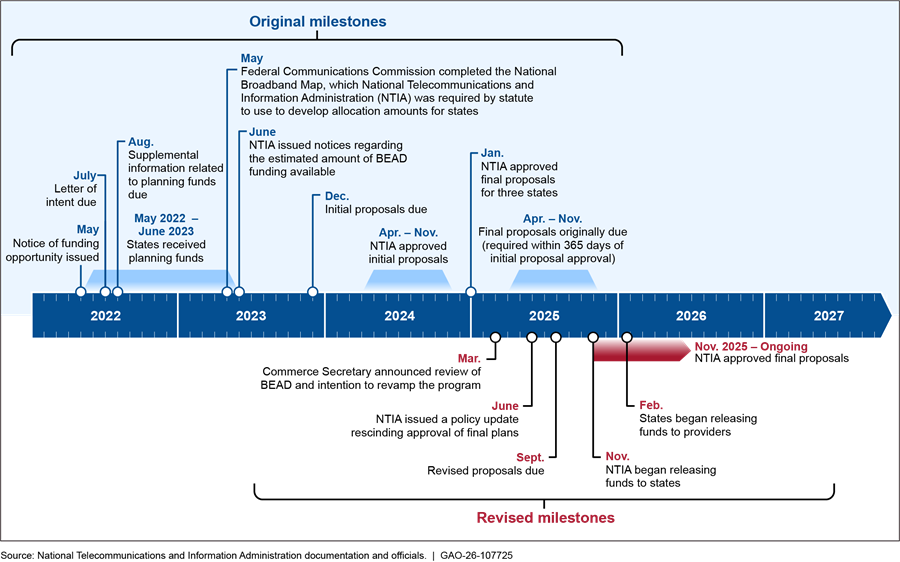
Note: In this figure, the term “states” refers to all BEAD recipients, including states and territories. Some states submitted their final proposals to NTIA before they were required to do so, and NTIA approved some states’ proposals before final proposals were due.
The BEAD policy update lengthened the program’s timeline by adding time to program implementation, particularly for states with approved proposals. Officials we spoke with from three state broadband offices expressed frustration with potential changes that would require reworking final proposals. Additionally, in a letter addressed to the Secretary of Commerce, one large association that represents 19 states and three territories expressed concern about potential delays and changes to requirements. Two states that had received final approval under the original framework had their final proposals approved under the revised framework about 11 months after they had received their prior final approval; the third received approval under the revised framework more than a year after receiving prior approval under the original framework.
The June 2025 policy update also resulted in changes that could lower costs. NTIA officials told us they analyzed differences between these three state final proposals under the original framework and the revised framework. In each case, these states’ revisions resulted in a greater mix of technologies funded, a lower overall cost for deployment, a lower average cost per location, and a lower highest cost per location, while still meeting statutory and technical requirements established in the notice of funding opportunity, according to NTIA officials. However, some commenters, such as members of Congress and research groups, have expressed concern that the greater mix of technologies (i.e., less fiber and more fixed wireless and satellite) may result in some areas being served by networks that are less able to meet current and future needs, such as precision agriculture and other advanced or growing technologies.[55]
Differences Among Selected Programs and Data Preclude Return on Investment Comparison
We used Broadband Funding Map data to analyze cost per location for the eight broadband deployment programs in our review for which fiscal year 2019 through 2025 data were available, as part of determining the return on investment for federal broadband deployment programs and comparing agencies’ progress in deploying broadband.[56] However, based on our analysis, we determined that a comparison among the programs on this basis would be misleading due to significant differences in costs among programs and differences and inconsistencies we identified in the location data.
Although Broadband Funding Map data on award amounts for the eight selected programs include funding for broadband infrastructure deployment, these programs vary in the other costs included and in other factors related to cost. For example:
· FCC’s High Cost subprograms. Recipients may use the subsidies that FCC provides monthly over a funding period to operate and maintain broadband networks that they constructed with funding from the subprograms. Accordingly, a cost-per-location metric for the subprograms would be different from such a metric for programs that did not fund operations and maintenance. Additionally, the Enhanced Alternative Connect America Cost Model subprogram provides funding to support ongoing operations and maintenance of broadband networks that recipients built with funding from an earlier High Cost subprogram, as well as to fund construction of new broadband infrastructure. For example, a carrier that built a network with funding from the Alternative Connect America Cost Model subprogram could receive Enhanced Alternative Connect America Cost Model funding to operate and maintain that network. Moreover, because recipients receive funding monthly throughout the 15-year funding period, a cost-per-location metric for this subprogram would be different than for the other FCC subprograms, which receive funding monthly throughout a 10-year funding period.
· NTIA’s TBCP. Recipients can use awarded funds reported in the Broadband Funding Map for non-construction activities such as workforce training and subsidized broadband service. According to NTIA officials, they do not separate funding by activity category, so the map’s data reflect the total award amount rather than the cost for infrastructure deployment activities only.
· USDA’s Community Connect program. Recipients can use awarded funds for non-construction activities such as improving, expanding, or acquiring a community center and providing broadband access for certain facilities free of charge for 2 years.
· USDA’s TIP. Recipients can use awarded funds for activities unrelated to broadband, such as providing telephone services.
In addition, several programs we reviewed funded middle-mile infrastructure as part of projects that also included last-mile infrastructure. Such projects can support regional broadband connectivity beyond the planned service locations represented in the Broadband Funding Map data. For example, USDA officials told us about a ReConnect project with a total project cost of $47 million (and a ReConnect award of $40 million) that includes both middle-mile and last-mile construction. According to USDA officials, a substantial portion of the overall project cost—about $40 million—is associated with constructing new submarine middle-mile cable infrastructure. The middle-mile investment is intended to improve performance, reliability, and resiliency for multiple coastal communities in Southcentral and Southeast Alaska, ultimately benefitting about 4,000 residents, Alaska Native entities, local business, and other entities. However, the award will fund just 34 last-mile connections, according to USDA officials.
In addition to the differences among programs related to costs reflected in the Broadband Funding Map, we identified variations and some irregularities in how agencies identified the number of planned locations for projects included in the Broadband Funding Map data. These differences limit the extent to which the map’s data can support cross-program comparisons involving project funding amounts and planned locations.
First, we found that the programs and subprograms we reviewed used different methods to determine the number of planned locations. Specifically, one of the FCC High Cost subprograms we reviewed (Enhanced Alternative Connect America Cost Model) and the two Treasury programs used FCC’s standardized location data.[57]
The other programs and subprograms we reviewed began making funding decisions before the standardized location data became available in 2022, so they used other methods to identify the number of planned locations, such as agency analysis of Census-derived data. We and others have raised concerns with these methods for analyzing broadband availability, and such concerns were instrumental in FCC’s creation of the broadband maps that use standardized location data.[58] The selected agencies vary in their plans to update planned locations to align with the standardized location data.
· FCC. One of the selected subprograms, the Enhanced Connect America Cost Model, used the standardized location data from the beginning of the subprogram in 2023. In 2025, FCC issued an order requiring that three of the five selected High Cost subprograms we reviewed transition to using data corresponding to FCC’s standardized location data for broadband availability. The other selected subprogram we reviewed, CAF-II Auction, was not subject to this requirement, because providers funded under this subprogram are subject to area- rather than location- based obligations, and because deployment under this subprogram was almost complete when FCC issued the order, according to FCC officials.
· USDA. USDA officials said they would update the planned location data using FCC’s standardized location data later in 2026.
· NTIA. NTIA officials said that using planned location data that do not reflect FCC’s standardized location data has not affected their ability to make and monitor awards, and they did not indicate plans to update planned location data to align with FCC’s standardized location data.
Second, we found irregularities in USDA data on planned locations. Specifically, in reviewing outliers we identified in the Broadband Funding Map data, USDA officials determined the data on the number of planned locations were incorrect for multiple projects. According to USDA officials, the Broadband Funding Map data reflected the number of planned locations USDA staff estimated using Census-derived data, but for projects predating USDA’s use of FCC’s standardized location data, staff should have used the applicants’ number for planned locations. For example, the map’s data for one awarded ReConnect project shows 32 planned locations, whereas the recipient’s approved application shows 189 planned locations, according to agency officials. Additionally, the map’s data for one awarded Community Connect project shows a single location, whereas the recipient plans to serve 48 households according to its approved application, according to agency officials. In April 2026, USDA officials told us they would review planned locations in the Broadband Funding Map to ensure they align with planned location data in approved project applications. They expected to complete this review later in 2026.[59]
As mentioned above, Broadband Funding Map data on planned locations for CPF and SLFRF will be incomplete until the programs are complete, according to Treasury officials.
Agencies Use Mapping Data to Target Underserved Areas, but Aspects of FCC’s Challenge Process May Hamper These Efforts
Selected Agencies Use FCC Mapping Data to Identify Underserved Areas and Avoid Funding Duplication
NTIA, USDA, and FCC share project information and predominantly use FCC mapping data sources to target broadband deployment funding to underserved areas.[60] These data (i.e., project attributes and geographic information) allow the agencies to identify eligible locations for broadband deployment programs by determining where service is already available and where federal funding already exists for broadband deployment. Treasury shares project information with NTIA, USDA, and FCC but does not directly identify underserved areas or set area eligibility.[61] Some programs, like NTIA’s Broadband Infrastructure Program and BEAD, explicitly require the use of FCC mapping data for these purposes. For example, NTIA’s BEAD program directs states and territories to identify locations lacking available service at a speed of at least 100/20 Mbps using FCC mapping data. Areas that states and territories identify as underserved are eligible for BEAD funding.
The selected agencies also share mapping data to avoid duplication in funding. According to officials, the agencies generally avoid duplicative funding using these steps:
· The agencies share project information with each other during regular meetings and by exchanging project data, including mapping data. This information includes proposed project areas and any changes to project areas.
· The agencies examine project areas to identify awards that may overlap with one another.
· Once the agencies identify potential overlap in project areas, they determine whether those overlapping areas include locations, such as households, using FCC’s standardized location data. For awards that are defined by lists of locations rather than a project area, the agencies compare the locations to see if any are the same.
· If the number of locations in the overlapping area is above a certain threshold—10 locations for FCC subprograms, for instance—then the agencies work to change the project areas, limit project activities so funding is not duplicative, or determine not to proceed with one of the awards to avoid duplication.
In prior work, we found that, in general, NTIA, USDA, FCC, and Treasury have successfully shared award information and collaborated to identify and avoid duplicative funding among the broadband deployment programs they administer. Agency officials told us they have continued these efforts. In 2022, we reported that USDA and FCC had avoided duplication between USDA’s ReConnect program and areas receiving FCC funds.[62] In 2025, we reported on efforts among NTIA, USDA, FCC, and Treasury to avoid duplication across their broadband deployment programs.[63] While crediting the agencies for their efforts at avoiding duplication, we recommended that NTIA, USDA, and FCC clearly define and formally document the de-duplication process. As of July 2026, some of these agencies had reported implementing these recommendations.[64]
We analyzed the extent to which broadband programs represented in Broadband Funding Map data overlapped and identified two examples of projects that appeared to overlap based on our analysis. The overlap had been corrected in one case, and it was allowed by program rules in the other case. The first instance of potential overlap involved a USDA ReConnect award and an FCC Enhanced Alternative Connect America Cost Model (E-ACAM) award. According to our analysis of the project areas using the data shown on the Broadband Funding Map, these two awards overlapped by over 10 percent of each award’s project area. Officials from FCC and USDA told us that when FCC made the E-ACAM award in October 2023, they had reviewed the ReConnect project areas that overlapped with E-ACAM eligible areas and identified locations within the overlaps. They removed any locations that were in the ReConnect project area from E-ACAM eligibility.[65]
The second example of potential overlap involved a ReConnect project and an FCC Rural Digital Opportunity Fund (RDOF) project. According to agency officials, the RDOF recipient is a subsidiary of the ReConnect recipient and the two recipients have delineated responsibilities, such that ReConnect and RDOF funding will not be used for duplicative purposes. The recipients will retain separate accounts for each award and report on uses, and the RDOF funding will be used only for operational expenses, not for deployment. According to agency officials, this is an allowable and non-duplicative use of funds according to the program rules for these programs.
Areas Where a Federal Broadband Project Has Defaulted Are Particularly at Risk of Remaining Underserved
Federal broadband deployment programs target funding to areas that are underserved or that do not have enforceable commitments via other federal awards to provide broadband by a certain date. However, when recipients make a commitment to provide broadband in areas but then default on their projects (i.e., fail to provide the agreed-upon service), it can result in those areas remaining unserved. Agencies have taken some steps to address these potential service gaps. However, concerns remain that some unserved areas affected by defaults will remain unserved.
Specifically, three of eight stakeholders (i.e., consumer advocacy organizations, industry associations, research groups) and three of 12 participants (i.e., internet service providers, local governments, and Tribes) identified the impact of defaults as a particular concern with FCC’s RDOF. As of June 2026, over one-third (2 million of 5.2 million) of the original RDOF locations had been affected by defaults. Over one-third ($3.5 billion of $9.2 billion) of the original RDOF funding was awarded to providers serving these locations. Three stakeholders and four participants told us that due to program rules to prevent funding duplication, some locations where defaults have occurred miss opportunities to be served by interested parties obtaining funding through other federal programs, because the locations were already considered to be receiving funding when program eligibility was determined.
Several factors may have contributed to the relatively high level of RDOF defaults. Two of the stakeholders and participants we spoke with cited the subprogram’s reverse-auction structure—a method of awarding funds to the providers that commit to providing service at the lowest costs—as a factor.[66] According to FCC officials, another contributing factor may have been higher levels of inflation and increases in the costs of materials since the beginning of RDOF in July 2020.
The generally higher costs of building in remote areas may also have affected the level of defaults. In one case, a participant mentioned a small RDOF recipient defaulting because the costs of building out to the RDOF area and complying with the program requirements were not worth the award amount. Areas that are more remote tend to be costlier to build in and less profitable to providers; indeed, one industry association and two providers told us that without federal funding, there would be no business case to serve these areas. The costs of serving remote areas vary based on geographic differences. For example, a remote area that is hilly and covered with trees may not be able to receive satellite or fixed wireless service, meaning that a wired connection—either fiber or coaxial cable—would need to be used to reach it. Building wired connections in such terrain results in a higher cost per location than for locations with flatter terrain.
Three stakeholders and participants told us they were concerned that, depending on the timing, additional defaults from any broadband deployment program could jeopardize efforts to serve remote areas that lack service. For example, NTIA’s BEAD program specifies that, as of June 6, 2025, any areas that have service or are covered by an enforceable commitment to receive service are generally ineligible for BEAD funding.[67] If a recipient were to default after that date, then the area that the recipient was supposed to serve would be left without its original project and would also be ineligible for BEAD. As of June 2026, eight RDOF recipients had announced defaults after the June 6, 2025, BEAD cutoff, according to FCC officials. Additionally, a satellite provider that won BEAD subawards in several states recently asked for an exemption to some BEAD program requirements. NTIA has stated that program requirements will not be waived. At the time of our review, the satellite provider had finalized BEAD agreements with some of the states for which it had won subawards.
When defaults occur, the selected agencies provide updates to FCC for the Broadband Funding Map. However, the timing of these updates can vary.[68] Officials we spoke with said the amount of time between when a recipient defaults and when this information is reflected on the map can vary, from as little as 2 weeks to over a month, depending on several factors. These factors include whether the default was for the entire project or only part of it; the complexity and scope of the project; how quickly the agency is able to inform FCC about the default; the timing of the default; and whether other providers can step in and serve some of the defaulted project area. Agency officials have also told us they discuss how those defaults will affect eligibility of areas for broadband programs before making updates to the map. In addition to sharing information through regular meetings, officials from the selected agencies told us they share information with one another as needed when defaults occur, especially if they expect a lag between the occurrence of a default and its reflection on the Broadband Funding Map.
The selected agencies may also work with states at times to identify areas that have been affected by defaults and may need to be made eligible for federal funding. For example, USDA officials told us they were working with states to identify areas that would not be covered by BEAD or other federal programs, to make these areas eligible for ReConnect funding. Similarly, officials from one state broadband office told us they planned to use any leftover BEAD funding to provide service to areas that might still be left unserved after it makes its initial BEAD awards. Other representatives from states have mentioned similar plans in public statements. As of June 2026, NTIA had not released official guidance on the allowable uses of BEAD funds that remain after final proposals for deployment receive approval. Officials from the selected agencies also told us they share information with one another when they expect awards to default or reduce in scope, based on what they learn from working with the recipients. They said that doing so allows them to proactively work toward getting service to those areas, even before receiving official notice about the default or change in a project.
Some Aspects of FCC’s Challenge Process May Hamper Efforts to Reach Underserved Areas
As discussed above, the selected agencies use mapping data from FCC’s National Broadband Map, among other sources, to identify eligible locations for broadband deployment programs by determining where service is already available. In addition, the agencies use FCC’s standardized location data to determine where locations that could receive broadband service exist. Standards for internal control in the federal government state that agencies should use relevant information from reliable sources. One method FCC uses to ensure the reliability of mapping information it publishes is a process by which consumers, providers, and other entities can challenge the accuracy of information in the National Broadband Map or its underlying location data. This broadband data collection challenge process helps FCC refine its data and ensure it provides accurate, up-to-date information. However, some aspects of this process may hamper agencies’ efforts to reach underserved areas.
Entities such as internet service providers, municipalities, or tribal governments can submit bulk broadband availability and location challenges.[69] An availability challenge could assert, for example, that service shown on FCC’s National Broadband Map is not actually available at the location(s) the map indicates has service. A location challenge could similarly assert that the data are missing a location or set of locations. When FCC resolves a challenge, it generates a response code that indicates the result. A detailed description of the codes is available at FCC’s Broadband Data Collection Help Center.[70] FCC provides challengers with response codes indicating the results of challenges. FCC also publishes the publicly available data on completed challenges and the codes on the National Broadband Map.
However, two of 12 participants told us they found FCC’s explanations for challenge resolutions to be unclear.[71] We reviewed FCC challenge response codes and asked FCC officials about them and whether stakeholders and providers have brought up issues with the codes. FCC officials told us that they have refined the codes, including adding some and changing the descriptions of at least one, to provide more details to challengers. In addition, to ensure transparency, the officials said FCC has provided written responses to entities seeking more information about their challenge results and met with them to discuss their challenges and review the submitted evidence.
Additionally, three participants, including a local and a tribal government, and three of eight stakeholders, including industry associations representing rural cooperatives and other internet service providers, told us they or their members had experienced other difficulties with the bulk challenge process. Specifically, they said the process for making bulk challenges was overly burdensome. For example, according to one participant, they had to provide separate service availability information for each individual location that was part of the challenge, instead of using the geospatial data the participant had readily available regarding service coverage. The need to submit information for each location was prohibitively labor intensive and ultimately dissuaded the participant from filing a bulk challenge. Another participant said that providing evidence to support challenges for many locations is infeasible for an organization with a small staff.
FCC officials told us they allow challengers to submit a wide variety of data as evidence for bulk availability challenges. Some of these data sources, like images of uninstalled network infrastructure, can serve as evidence for multiple locations at once. FCC officials also said they engaged with participants, including internet service providers, local governments, and Tribes, on the challenge process. In January 2024, FCC released a notice seeking comments on the process, and officials told us the agency was still reviewing those comments. Additionally, FCC officials described other actions they have taken to engage with participants. These actions have included, for example, meeting with and giving presentations and demonstrations to various types of entities (such as state and local governments and intergovernmental organizations); holding training, technical assistance, or workshop sessions with tribal entities; and hosting office hours with NTIA in preparation for the third Tribal Broadband Connectivity Program funding round.
However, three smaller participants we interviewed have still described difficulties in filing bulk location and availability challenges. FCC has acknowledged that further outreach to smaller participants may improve the challenge process, and in May 2026, FCC released another notice seeking comments on issues providers face with the challenge process. However, it is unclear whether FCC releasing a call for comments will reach smaller participants. For example, according to one participant we spoke with, the methods FCC has historically used to communicate, such as publishing notices seeking comment, may not be effective for smaller participants. The participant told us that smaller providers may not check FCC’s website or published notices frequently and may therefore miss updates or offerings of resources. Additionally, letters or emails may not reach the correct recipient of an organization or may be filtered if the letter or email looks automated. Moreover, if some of the program participants we spoke to who are local or tribal governments experienced these challenges, it is likely that representatives from other communities, such as local or tribal governments who have not participated in broadband deployment programs, may face similar issues with the challenge process. Without a targeted outreach process to engage with smaller communities (such as local or tribal governments) and providers to identify and address these difficulties, FCC may not be able to collect the most accurate information about broadband serviceable locations and broadband availability.
NTIA Lacks a Process for Monitoring Sustainability of BEAD Projects, but Agencies Have Taken Steps to Address Challenges with Permits and Reviews
NTIA Expects BEAD Projects to Be Financially Sustainable but Does Not Have a Process to Monitor Providers’ Financial Health
The underserved areas funded by the broadband deployment programs we reviewed typically lack service because they are more expensive and less profitable for providers to serve, for reasons such as geographic barriers (mountains or other rugged terrain), lower population density, and lower incomes of potential subscribers. While the selected agencies’ programs provide funding for the capital expense of deploying networks, once such networks are built, providers then face the costs of operating and maintaining those networks—and making them financially sustainable. Operations and maintenance costs are often higher in the remote and rural areas served by these programs than in more accessible locations.
We have previously reported on issues that broadband providers may face in operating networks in high-cost areas. For example:
· In our January 2023 report on FCC’s Affordable Connectivity Program—which subsidized broadband service for low-income households—we reported that the inability to afford broadband service presented a barrier to access, particularly for low-income households.[72] At the time of our report (based on data as of September 2022), over 14 million subscribers had benefited from the program. However, the program ended in 2024.
· Three stakeholders we interviewed also noted that FCC’s Universal Service Fund, which includes the High Cost program, is important for supporting the long-term sustainability of broadband networks because it is the only selected program that can be used for ongoing operations and maintenance costs in addition to the capital expense of network deployment. Although program rules generally prohibit the overlap of funds from different programs for the use of deployment, some deployment programs, such as ReConnect, have allowed for overlap with the High Cost program in certain circumstances, so long as funds are used for complementary instead of duplicative purposes.[73] However, many broadband providers are not eligible to receive High Cost funding. For example, our prior work found that few tribally owned providers participate in the program because it requires a provider to be designated as an eligible telecommunications carrier by a relevant state or FCC—a process that tribal stakeholders have told us is too costly and burdensome.[74]
· In our June 2024 report on NTIA’s Tribal Broadband Connectivity Program (TBCP), we reported that a tribal organization and NTIA told us that it would be difficult to financially sustain some networks built with TBCP funding.[75] Such networks would be serving areas that had not attracted private-sector investment due to their remote location, low population density, and low income levels. Over half of TBCP recipients with infrastructure projects planned to use other federal funding to support their ongoing financial sustainability. However, those sources have proven difficult for Tribes to obtain or have ended, such as the Affordable Connectivity Program. In a 2022 white paper, a tribal broadband association described how affordability is a greater barrier to broadband adoption in tribal areas than in other areas. The paper noted that while much federal funding has supported the deployment of broadband networks in tribal areas, such networks are at risk of failure without funding to also help sustain them.[76]
In October 2025, NTIA announced a BEAD requirement to further emphasize that financial sustainability is an objective of the program. NTIA expects BEAD projects to be financially sustainable beyond the 4-year project deployment period. Specifically, in an update to its program General Terms and Conditions, NTIA stated that it requires BEAD subrecipients (i.e., broadband providers) to certify in writing that they will not accept federal funding for network deployment and operations of BEAD-funded locations—such as funding from FCC’s High Cost program—for a period of at least 10 years.[77] According to the NTIA Administrator, the purpose of this requirement is to ensure that BEAD projects are financially self-sustainable without additional federal funding.
As subrecipients in the BEAD program, broadband providers are subject to management and oversight from states rather than NTIA directly.[78] For example, the BEAD notice of funding opportunity calls for states to review business plans and related analyses that substantiate the sustainability of the proposed project when selecting providers to be subrecipients. NTIA also requires that BEAD subrecipients provide states with reports, including information such as the actual speeds of broadband service being offered at least every 6 months during the performance period—the phase during which providers are building their broadband networks. States are responsible for establishing the related buildout milestones, enforceable as conditions of the subgrant, to ensure progress is being made, which states report back to NTIA in semi-annual reports.
Federal standards for internal control state that agencies should identify information needed to achieve objectives. However, NTIA’s BEAD requirements for states do not include gathering information from subrecipients (i.e., providers) during the 10-year federal interest period during which NTIA expects projects to be financially sustainable.[79] According to NTIA officials, this is because—despite expecting projects to be financially sustainable beyond the 4-year project deployment period—NTIA considers the program’s objectives to have been met when deployment is complete. NTIA’s September 2025 BEAD Performance Measures Policy Notice identifies requirements for subrecipients to report to recipients to validate that BEAD-funded services comply with program performance standards (e.g., speed, capacity, latency, availability) during the 4-year deployment period. It also indicates that states may have a basis to request that subrecipients provide performance data demonstrating their compliance with performance standards beyond this 4-year period. However, the notice states that it does not address these situations or provide examples of circumstances that might warrant these requests.
As one of the largest of the broadband programs we reviewed, BEAD holds great potential to help close the digital divide. But, BEAD also faces risks if the program does not take additional steps to support its commitment to financial sustainability. In particular, NTIA risks that some projects may falter in the future before the state could potentially flag concerns and work with providers to prevent a possible service lapse for consumers using a BEAD-funded network. According to NTIA officials, NTIA cannot require BEAD recipients or subrecipients to submit reports to NTIA outside of the 4-year deployment period.[80] However, providing more details to recipient states on what data they could request from BEAD subrecipients would help states monitor their performance (which may indicate the financial sustainability) of their BEAD-funded projects during the 10-year federal interest period. Such information could include considerations about provider defaults in other BEAD projects and other broadband deployment programs and requesting network performance data from subrecipients that have defaulted. Requesting performance data from subrecipients that have defaulted on other BEAD projects or in other federal broadband programs could provide states with insight into risks related to financial sustainability. By providing this information to states, NTIA could help ensure the program’s objective of offering affordable broadband to currently underserved areas.
Participants Have Faced Deployment Challenges Related to Permits and Reviews, and Agencies Have Taken Some Steps to Address Them
In our interviews with selected participants and other stakeholders, most (16 of 20) identified deployment challenges related to permits, historic preservation reviews, or environmental reviews. We have reported on these long-standing challenges in prior reports.[81] Some federal agencies have taken some steps to address these challenges.
Permits. To deploy broadband, providers may need to obtain permits from private landowners or from federal, state, local, or tribal governments. Providers may need permits to install equipment (e.g., fiber or cable), construct facilities (e.g., towers or equipment shelters), gain right-of-way access, or cross railroads. Three interviewees said that certain permits involved unclear costs and could extend the length of projects. Specifically, two stakeholders said the cost of obtaining a railroad permit was unpredictable. One participant told us that obtaining a permit from entities such as private landowners or the federal government to install fiber could add 9 to 12 months to a project and that the cost of the permit was uncertain.
Among federal agencies, we previously reported that the Bureau of Land Management (BLM) and Forest Service process most of these permits,[82] which they are required to grant or deny within 270 days of receiving an application.[83] However, three participants and two stakeholders said the agencies could take years to process permits. One stakeholder said BLM required a separate permit for providers to attach cable to electric power poles that the agency had already approved, resulting in a long and costly process.
In April 2024, we reported that for about half of the permit applications that BLM and Forest Service reviewed—such as to lay fiber or cable on federal property—the agencies either exceeded the required deadline or did not have sufficiently accurate and complete information to determine if they had met the deadline.[84] Forest Service implemented our recommendations to better track and manage applications for permits, and BLM officials told us they planned to implement two recommendations by the end of August 2026 and the last recommendation by the end of December 2026.
Historic preservation reviews. The National Historic Preservation Act of 1966, as amended, designates a process that federal agencies must follow when their projects may affect a historic property.[85] State historic preservation offices and tribal historic preservation offices advise and assist federal agencies in carrying out their historic preservation responsibilities and ensure that any impacts on historic properties are taken into consideration during project planning.
Three participants and two stakeholders expressed concerns about the length of time and cost of the historic preservation reviews. For example, one participant told us they had to consult with their State Historic Preservation Office to complete an archaeological survey on an existing right-of-way for a highway and had not anticipated the additional time and cost it would add to their project. Another participant said their historic preservation review was costly and time-consuming, as they had to hire two archaeologists to walk the entirety of the project area—previously disturbed by other projects such as construction of roads and other utilities—and excavate every 3 feet to catalog all human-made objects over 50 years old.
Environmental reviews. Four participants and three other stakeholders expressed concerns about the amount of time needed to comply with environmental reviews. For instance, one participant said their project required a lengthy and complex environmental review, because the project area was located in a tribal area.
Depending on the significance of the project’s reasonably foreseeable environmental effects, the National Environmental Policy Act (NEPA) may require an environmental assessment or a more complex environmental impact statement.[86] Alternatively, a project may fall under a categorical exclusion if an agency has determined such category of actions normally does not significantly affect the human environment.[87] For example, one participant told us a categorical exclusion applied to part of their broadband deployment project, while the other part of the project required an environmental assessment, which resulted in a finding of no significant environmental impact. The selected agencies track the NEPA review progress for each project to ensure the necessary review is completed before construction begins.[88]
The selected agencies in our review have taken some steps to address challenges related to permits, historic preservation reviews, and environmental reviews. These steps include the following:
· For BEAD, NTIA created a system to track all relevant federal permits and reviews for each project. According to officials, NTIA also established at least 30 categorical exclusions applicable to environmental reviews of some broadband projects, and participants can indicate which exclusions may apply for BEAD projects through the tracking system.
· For TBCP, NTIA participated in an interagency program intended to improve the timeliness, predictability, and transparency of reviews for eligible projects.[89] As of April 2026, two TBCP projects had completed the program and two other projects were still undergoing the process, according to agency officials.
· The Advisory Council on Historic Preservation amended two procedures to streamline compliance for agencies with historic preservation requirements related to broadband.[90] According to FCC and NTIA officials, the two agencies worked with this council to amend these procedures.
· USDA officials told us they recognized the need for additional staffing to assist with environmental and historic preservation reviews, including related to their broadband deployment programs. In 2024, USDA hired additional archaeologists and an anthropologist.[91] Officials also said they recently improved an internal system that started tracking environmental and historic preservation reviews for their broadband programs in January 2025. In addition, officials told us they planned to move the tracking of environmental reviews into a more robust system that includes integrated mapping tools and the ability to dynamically generate environmental review documentation.
Conclusions
The large federal investment in broadband deployment since 2020 represents a significant commitment to achieving the goal of closing the digital divide, but fully doing so requires sustained attention to efforts that will help ensure the success of federal broadband deployment programs. The fragmented nature of these programs requires federal agencies involved in this effort to closely coordinate their activities, a critical theme of our previous and current work on this issue. In particular, the accuracy and timeliness of project location data shared by the agencies and reported by FCC in its maps must be continuously maintained as programs offer new funding opportunities to continue to fill the underserved areas in those maps. The accuracy of FCC’s maps depends, in part, on stakeholders’ ability to submit challenges to inaccuracies in the maps’ underlying data. However, this check is not effective if stakeholders with necessary information choose not to participate due to hurdles in submitting such challenges. This currently may be the case with smaller participants, such as small local governments and tribal entities. Targeted outreach to these participants and their broadband providers would help ensure the accuracy of FCC’s Broadband Data Collection and help agencies identify underserved areas.
Furthermore, as agencies extend funding to providers deploying networks in high-cost areas they would not have otherwise served, it is incumbent upon programs to consider ways to guard against the financial failure of such ventures. NTIA’s BEAD program is one of the largest investments yet to build out broadband networks in underserved areas. As such, this program represents an important opportunity to take steps to avoid the defaults that have plagued prior federal broadband programs. Providing states and territories with additional information on situations that warrant requesting performance information after the deployment period and during the federal interest period will help avoid the waste and delays that can result when broadband providers are unable to fulfill their service commitments due to a lack of financial sustainability. Doing so will also better ensure that the significant public investment in broadband can achieve its fullest potential.
Recommendations for Executive Action
We are making a total of two recommendations, including one to FCC and one to NTIA. Specifically:
The Chair of FCC should conduct targeted outreach to smaller participants (such as local and tribal governments and providers), to identify and address difficulties they have experienced completing the bulk Broadband Data Collection challenge process. (Recommendation 1)
The NTIA Administrator should provide information to NTIA’s partner states and territories on when and why to request additional information from BEAD subrecipients, to monitor and support their ability to remain financially sustainable in offering affordable broadband during the 10-year federal interest period. (Recommendation 2)
Agency Comments
We provided a draft of this report to FCC, the Department of Commerce, NTIA, USDA, and Treasury for review and comment. We received written comments from FCC, which are reproduced in Appendix II and summarized below. FCC, NTIA, USDA, and Treasury also provided technical comments, which we incorporated as appropriate.
In its comments, FCC agreed with our recommendation and described plans to address it. FCC noted that FCC staff have scheduled a tribal workshop that will provide hands-on technical assistance for filing data and challenges in FCC’s Broadband Data Collection. FCC also stated that it would partner with local government associations and provider trade associations to organize roundtable discussions designed to elicit feedback on the challenge processes, including opportunities for improvements.
The Department of Commerce did not provide written comments. NTIA, however, in its technical comments, stated that it agreed with our recommendation and described steps it would take to implement it.
We are sending copies of this report to the appropriate congressional committees; the Chair of FCC; the Secretaries of Commerce, Agriculture, and the Treasury; and other interested parties. In addition, the report is available at no charge on the GAO website at https://www.gao.gov.
If you or your staff have any questions about this report, please contact me at vonaha@gao.gov. Contact points for our Offices of Congressional Relations and Media Relations may be found on the last page of this report. GAO staff who made key contributions to this report are listed in appendix IV.
Andrew Von Ah
Director, Physical Infrastructure
This report examines (1) selected agencies’ progress in deploying broadband; (2) the selected agencies’ approaches to targeting broadband deployment funding to underserved areas while avoiding duplication; and (3) how the selected agencies have addressed challenges that participants face in sustaining broadband service and obtaining permits and reviews.
We focused our review on the four federal agencies that administer the bulk of federal broadband deployment funding and have formally agreed to coordinate and share data on broadband deployment projects funded by their programs: the National Telecommunications and Information Administration (NTIA) within the Department of Commerce, the U.S. Department of Agriculture (USDA), the Federal Communications Commission (FCC), and the Department of the Treasury. Among programs administered by these agencies, we focused on those that included broadband last-mile deployment as a primary purpose.[92] We also included Treasury’s Capital Projects Fund and State and Local Fiscal Recovery Funds programs due to the significant amount of funds used for broadband deployment, although funding broadband deployment is only one possible purpose of these programs. Table 6 lists the nine programs we included in our scope.
|
Agency |
Program |
|
National Telecommunications and Information Administration |
· Broadband Equity, Access, and Deployment Program · Tribal Broadband Connectivity Program · Broadband Infrastructure Program |
|
Department of Agriculture |
· ReConnect Program · Telecommunications Infrastructure Program · Community Connect Program |
|
Federal Communications Commission |
· High Cost program |
|
Department of the Treasury |
· Capital Projects Fund · State and Local Fiscal Recovery Funds |
Source: GAO. | GAO‑26‑107725
Note: We refer to the selected programs as federal broadband programs for the purposes of this report although some selected programs have other eligible uses for funds.
To address all three objectives, we reviewed documentation and interviewed officials from the selected agencies. For example, we reviewed notices of funding opportunity and other program documentation to understand how programs targeted underserved areas. We also reviewed program documentation related to permits, reviews, and sustainability to understand agency actions associated with these issues. We reviewed our previous reports on federal broadband programs and applicable statutes, such as those statutes that established the federal broadband programs we examined and those that require our selected agencies to take actions related to broadband availability data and interagency coordination.
To gather additional perspectives on all our objectives, we interviewed representatives from the following eight stakeholder organizations selected to obtain a mix of research, advocacy, and industry organizations: NTCA-The Rural Broadband Association, The Pew Charitable Trusts, Public Knowledge, the Benton Institute for Broadband & Society, the National Rural Electric Cooperative Association, WTA Advocates for Rural Broadband, the National Tribal Telecommunications Association, and the National Association of Regulatory Utility Commissioners. Because the stakeholders vary in their expertise in various topics, not every stakeholder provided an opinion on every topic. Accordingly, their views are not generalizable to all stakeholders, though they provided us with a variety of perspectives.
We also interviewed 12 participants from seven of our nine selected programs, to gather illustrative examples and contextual sophistication. Selected participants included state broadband offices from three selected states: Missouri, New Mexico, and Texas.[93] These states were selected to represent a range in the amount of federal broadband deployment funding directed to the state, participation in at least five different federal broadband deployment programs, and at least two states with funding specifically for Tribes. We selected the other nine participants to represent other types of participants, including six broadband providers and three Tribes that are recipients of funding from a variety of the selected federal broadband deployment programs. Eleven of the 12 participants we interviewed were in our three selected states.[94] Below is a list of the participants we interviewed.
· Blossom Telephone Company
· Confederated Tribes of the Umatilla Indian Reservation
· Eastex Telephone Cooperative Inc.
· La Jicarita Rural Telephone Cooperative
· Missouri Office of Broadband Development
· New Mexico Office of Broadband Access and Expansion
· Picuris Pueblo
· Poka Lambro Telecommunications
· Pueblo of Isleta
· Sabine County
· Texas Broadband Development Office
· Wisper Internet
Because participants vary in their experiences in various topics and with the broadband programs and agencies, participants did not provide an opinion on every topic. Accordingly, the views of these participants are not generalizable to all participants.
To address our first objective, we analyzed publicly available data obtained from FCC’s Broadband Funding Map (BFM).[95] Specifically, on April 27, 2026, we used an application programming interface to download data from FCC’s BFM website. In examining agency progress on deploying broadband, we focused on fiscal years 2019 through 2025, because fiscal year 2019 was the first year for which BFM data were available and fiscal year 2025 was the last full fiscal year for which data were available when we conducted our review.[96]
The BFM data included program-, project-, and location-level information, including location data reported as both points and polygons. To support our analysis, we reconciled these data into a project-level analytic file, which allowed us to examine selected characteristics of planned projects across programs. We used the created project-level data for all analyses. According to agency officials, there may be differences between project-level and program-level data for a variety of reasons, such as a time lag between when an agency took an action and when information on that action became publicly available. For example, the program-level data may be updated to reflect an award termination or default sooner than the project-level data.
We tested these data electronically for outliers and potential errors such as duplicate and missing records. We also reviewed documentation on these data systems and interviewed knowledgeable FCC officials about the data. In addition, we interviewed knowledgeable officials from our other selected agencies about these data, because they submit data to the BFM. For FCC’s Connect America Fund Phase II Auction, the BFM data included only projects with planned speeds of at least 100 megabits per second (Mbps) for download and 20 Mbps for upload. This subprogram began making awards in 2019, 2 years before FCC made awards for the other selected subprograms. According to FCC officials, fewer than an estimated 350,000 locations were not included in the BFM data because planned speeds were lower than 100 Mbps for download and 20 Mbps for upload.
In assessing the reliability of the BFM data related to key program and project characteristics such as funding amount, speed, and technology, we identified several variables with missing or unexpected values, and instances in which agencies were using the same variable differently. In part because of our alerting FCC to these data issues, FCC, in consultation with the other selected agencies, reviewed the data specifications for the map and updated the specifications to ensure consistent use of data variables. As a result of data errors we found, FCC also updated its quality assurance process and fixed the specific data errors.[97] The BFM data we used for our analysis reflect these updates to the data and data specifications. As a result, the map’s data are more reliable and useful for comparisons across programs, though some cross-program comparability limitations remain, as discussed below. We assessed the reliability of the updated data and found them to be generally reliable with two exceptions:
· USDA’s data on planned locations. In response to our questions about some outliers we identified, USDA officials told us there may be some errors in the number of planned locations for some projects.[98]
· Treasury’s State and Local Fiscal Recovery Funds data on award amount. Project-level records for the State and Local Fiscal Recovery Funds (SLFRF) program were missing values for the amount of funding awarded for over 25 percent of records.[99]
Regarding the BFM data on planned locations, we determined they were sufficiently reliable for the purpose of reporting approximate counts of planned locations, rounded to the nearest 100.[100] We used rounded figures because the source data varied in unit of analysis across programs and agencies, and because we identified reliability limitations affecting exact counts. We did not calculate a formal error rate because the available information was insufficient to support one. However, based on the nature of the data limitations and the intended use of the figures as high-level estimates, we determined that reporting rounded counts was appropriate.
To obtain information on completed projects, we reviewed buildout data (i.e., data on constructed broadband infrastructure) from the BFM for fiscal years 2019 through 2025. However, at the time of our review, data on completed projects were available for only three of our nine selected programs: NTIA’s Broadband Infrastructure Program, NTIA’s Tribal Broadband Connectivity Program, and Treasury’s Capital Projects Fund program.[101] As with the analysis above, this analysis did not include NTIA’s BEAD program, because NTIA began submitting data to the BFM for this program in fiscal year 2026.
To address our second objective, we reviewed documentation on broadband deployment programs and agency coordination. For example, we reviewed rules for broadband deployment programs on determining eligible service areas and memoranda of understanding on information sharing among agencies. We also interviewed agency officials about how agencies identify and target underserved areas, and how they avoid duplication of funding among broadband projects.
Additionally, we reviewed documentation on FCC’s challenge process for correcting errors in FCC data on broadband serviceable locations and broadband availability. We also interviewed agency officials as well as stakeholders and participants regarding FCC’s challenge process. We compared FCC’s challenge process with relevant federal internal controls related to obtaining relevant, timely, and accurate information.
In addition, to identify potential instances of duplication and obtain agencies’ perspectives on these instances, we conducted geospatial analysis on BFM data. Specifically, we identified planned projects that had overlapping areas and calculated how much the areas overlapped. We used this analysis to identify selected broadband projects that appeared to overlap.[102] We then asked officials from relevant agencies and FCC about these apparent overlaps and how, if at all, agencies took steps to avoid duplication of funding in these instances.
The National Broadband Map datasets that we used in this analysis consist of both polygonal coverage areas and point-level location data. During technical vetting, we identified that point-level records for the Tribal Broadband Connectivity Program, Capital Projects Fund, and SLFRF programs do not consistently contain populated latitude and longitude fields. Following FCC guidance, we used satellite data from FCC’s National Broadband Map as a crosswalk to assign hexagonal identification numbers to these records to approximate “point” geometries. While hexagonal geometries enable the inclusion of records without coordinates, this method may overstate the actual physical footprint of a served location, as the hexagon represents a broader area than a specific point geometry. In addition, according to FCC, not all point-level records in the primary dataset have a corresponding, comparable location in the satellite crosswalk data. Consequently, a small subset of records may remain geographically unassigned.
We electronically tested the BFM geospatial data for issues such as duplicate records and self-intersection of planned project areas. We found and resolved a small number of self-intersections. In general, we found these data were reliable for the purpose of identifying examples of apparent overlap among planned project areas.
To address our third objective, we reviewed reports from the Congressional Research Service, federal inspectors general, and our prior work. Because NTIA included a long-term sustainability objective for its Broadband Equity, Access, and Deployment (BEAD) program, we evaluated NTIA’s efforts to support making BEAD sustainable. Specifically, we reviewed NTIA’s guidance and public statements on its requirements for subrecipients and plans for monitoring their finances, and we compared NTIA’s actions with BEAD program requirements and federal standards for internal control.
We conducted this performance audit from July 2024 to August 2026 in accordance with generally accepted government auditing standards. Those standards require that we plan and perform the audit to obtain sufficient, appropriate evidence to provide a reasonable basis for our findings and conclusions based on our audit objectives. We believe that the evidence obtained provides a reasonable basis for our findings and conclusions based on our audit objectives.
In this appendix, we provide tabulations and descriptive statistics of planned broadband deployment projects funded by selected programs administered by the National Telecommunications and Information Administration (NTIA) within the Department of Commerce; the U.S. Department of Agriculture (USDA); the Federal Communications Commission (FCC); and the Department of the Treasury.[103] Selected programs include:
· NTIA[104]
· Broadband Infrastructure Program
· Tribal Broadband Connectivity Program
· USDA
· Community Connect
· ReConnect
· Telecommunications Infrastructure Program
· FCC
· High Cost Program (Within this program, we selected the following subprograms: Bringing Puerto Rico Together Stage 2 Fixed Support; Connect America Fund Phase II Auction; Connect U.S. Virgin Islands Stage 2 Fixed Support; Enhanced Alternative Connect America Cost Model; and Rural Digital Opportunity Fund.)[105]
· Treasury
· Capital Projects Fund
· State and Local Fiscal Recovery Funds
Specifically, we provide information about the technology used in these planned projects; the speed at which the planned projects will provide service; and the geographic locations of planned projects in fiscal years 2019 through 2025.
We gathered this information using the same sources and methodologies as the first objective of this report. For more information on these methodologies, see appendix I.
Technology Used
In fiscal years 2019 through 2025, broadband deployment programs administered by NTIA, USDA, FCC, and Treasury predominantly funded planned projects to deploy networks that used fiber-optic cable (fiber). Figures 8 and 9 show the total number of planned projects that will use each technology type or combination (fiber; fiber and fixed wireless; licensed fixed wireless; fiber and coaxial cable, or fiber and copper wire; and all other combinations) for all planned projects across all programs, and by program for each agency.[106]
Figure 8: Number of Broadband Deployment Projects by Planned Technology Across All Selected Programs, Fiscal Years 2019–2025
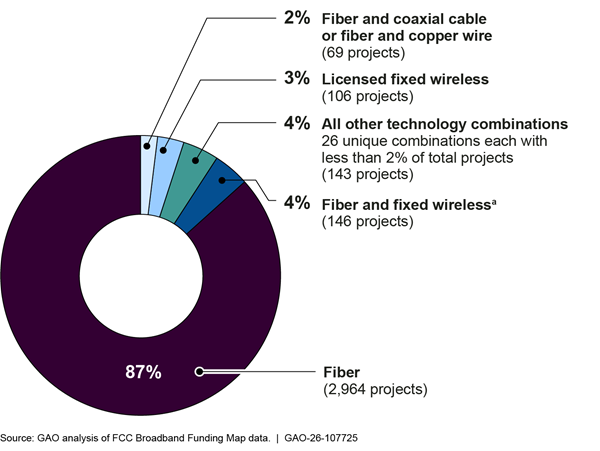
Notes: This figure contains information on selected planned broadband deployment projects funded by programs administered by the National Telecommunications and Information Administration (NTIA): Broadband Infrastructure Program and Tribal Broadband Connectivity Program; U.S. Department of Agriculture (USDA): Community Connect, ReConnect, and Telecommunications Infrastructure Program; Federal Communications Commission (FCC): Bringing Puerto Rico Together Stage 2 Fixed Support, Connect America Fund Phase II Auction, Connect U.S. Virgin Islands Stage 2 Fixed Support, Enhanced Alternative Connect America Cost Model, and Rural Digital Opportunity Fund; and Department of the Treasury: Capital Projects Fund and State and Local Fiscal Recovery Funds. Data reported on Treasury programs to the Broadband Funding Map will not be complete until those programs finish deployment.
This analysis excludes 19 ReConnect projects that were erroneously classified as fiscal year 2026 projects (and therefore out of GAO’s scope) in the Broadband Funding Map data when GAO conducted the analysis in April 2026. These projects were awarded $267 million ($147 million for grants, $23 million for loans, and $97 million for grant-loan combinations) and were associated with 14,100 locations.
aA fixed wireless network provides broadband service by transmitting signals from fixed sites, such as radio towers, to other individual fixed locations, such as a consumer’s premises. Fixed wireless includes licensed fixed wireless, unlicensed fixed wireless, and licensed by rule fixed wireless. Licensed fixed wireless uses entirely licensed spectrum or a hybrid of licensed, unlicensed, and licensed-by-rule spectrum to make last-mile connections to fixed locations. Licensed-by-rule fixed wireless uses entirely licensed-by-rule spectrum or a hybrid of licensed-by-rule and unlicensed spectrum to make last-mile connections to fixed locations. Licensed-by-rule spectrum users include operators providing last-mile connections through general authorized access (GAA) in the 3.5 GHz Citizens Broadband Radio Service band.
Figure 9: Planned Technology for Broadband Deployment Projects Funded by Selected Agencies, Fiscal Years 2019–2025
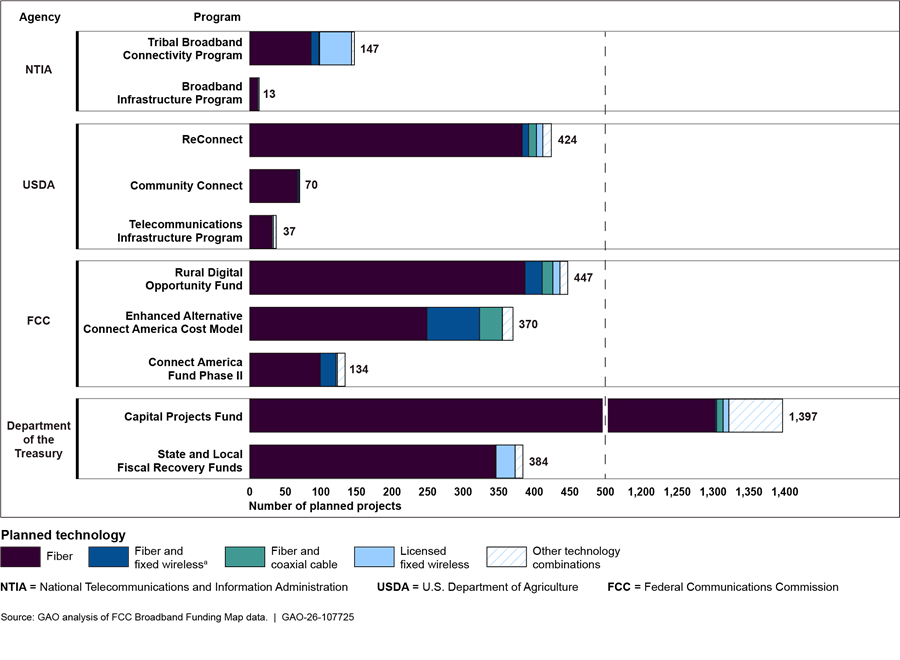
Notes: FCC programs also included Bringing Puerto Rico Together Phase 2 Fixed Support (two fiber-only projects, one fiber and coaxial cable project, and one fiber and fixed wireless project) and Connect U.S. Virgin Islands Phase 2 Fixed Support (one fiber-only project). These are not included in the figure.
This analysis excludes 19 ReConnect projects that were erroneously classified as fiscal year 2026 projects (and therefore out of GAO’s scope) in the Broadband Funding Map data when GAO conducted the analysis in April 2026. These projects were awarded $267 million ($147 million for grants, $23 million for loans, and $97 million for grant-loan combinations) and were associated with 14,100 locations.
aThese planned projects involved fiber and one or more of the following fixed wireless technologies: licensed fixed wireless, unlicensed fixed wireless, and licensed-by-rule fixed wireless. A fixed wireless network provides broadband service by transmitting signals from fixed sites, such as radio towers, to other individual fixed locations, such as a consumer’s premises. Fixed wireless includes licensed fixed wireless, unlicensed fixed wireless, and licensed-by-rule fixed wireless. Licensed fixed wireless uses entirely licensed spectrum or a hybrid of licensed, unlicensed, and licensed-by-rule spectrum to make last-mile connections to fixed locations. Licensed-by-rule fixed wireless uses entirely licensed-by-rule spectrum or a hybrid of licensed-by-rule and unlicensed spectrum to make last-mile connections to fixed locations. Licensed-by-rule spectrum users include operators providing last-mile connections through general authorized access (GAA) in the 3.5 GHz Citizens Broadband Radio Service band. Data reported on Treasury programs to the Broadband Funding Map will not be complete until those programs finish deployment.
In all selected broadband deployment programs, at least 50 percent of projects funded in fiscal years 2019 through 2025 planned to use only fiber. Figure 10 shows the percentage of planned fiber-only projects for each program.
Figure 10: Percentage of Planned Fiber-Only Broadband Deployment Projects by Program, Fiscal Years 2019–2025
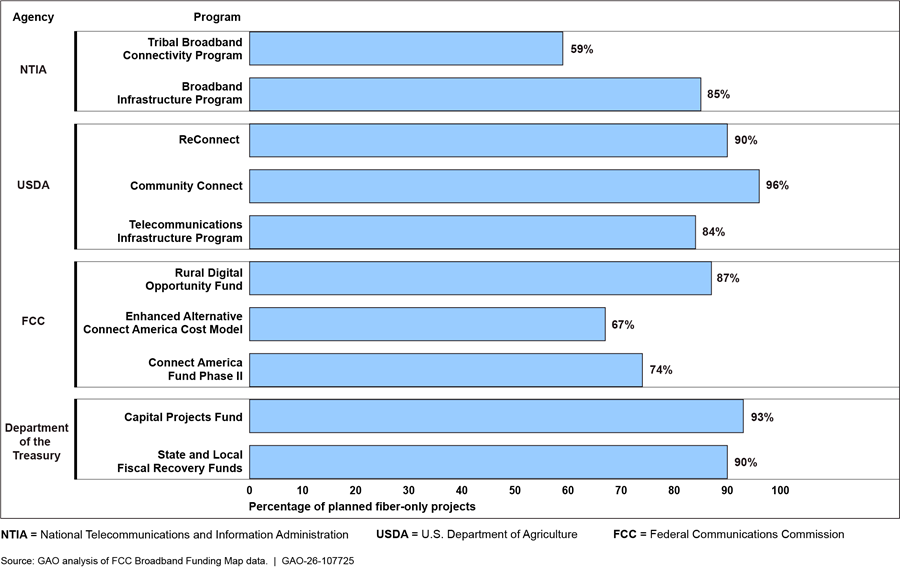
Notes: FCC programs also included Bringing Puerto Rico Together Phase 2 Fixed Support (50 percent fiber-only) and Connect U.S. Virgin Islands Phase 2 Fixed Support (100 percent fiber-only). These are not included in the figure. Fiber-only refers to projects that only plan to use fiberoptic cable, according to data from FCC’s Broadband Funding Map. Data reported on Treasury programs to the Broadband Funding Map will not be complete until those programs finish deployment.
This analysis excludes 19 ReConnect projects that were erroneously classified as fiscal year 2026 projects (and therefore out of GAO’s scope) in the Broadband Funding Map data when GAO conducted the analysis in April 2026. These projects were awarded $267 million ($147 million for grants, $23 million for loans, and $97 million for grant-loan combinations) and were associated with 14,100 locations.
Speed of Service
In fiscal years 2019 through 2025, most planned broadband deployment projects proposed service speeds of at least 1000 megabits per second (Mbps) when downloading and 1,000 Mbps when uploading, or 1,000/1,000 Mbps. Planned projects proposing speeds of at least 100/100Mbps but less than 1,000/1,000 Mbps numbered the next highest. Relatively few planned projects proposed service at speeds of 25/3 Mbps. (See fig. 11.)
Figure 11: Download and Upload Speed Combinations of Planned Broadband Deployment Projects by Selected Agency and Program, Fiscal Years 2019–2025
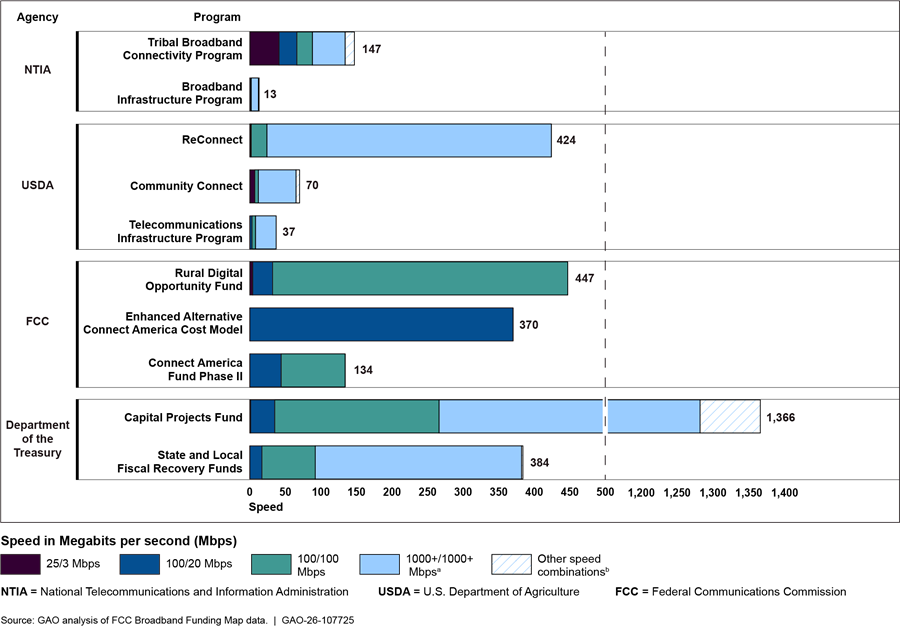
Notes: FCC programs also included Bringing Puerto Rico Together Phase 2 Fixed Support (two projects in the 100/20 Mbps category and two in the 100/100 Mbps category) and Connect U.S. Virgin Islands Phase 2 Fixed Support (one project in the 100/100 Mbps category). These are not included in the figure.
This analysis excludes 19 ReConnect projects that were erroneously classified as fiscal year 2026 projects (and therefore out of GAO’s scope) in the Broadband Funding Map data when GAO conducted the analysis in April 2026. These projects were awarded $267 million ($147 million for grants, $23 million for loans, and $97 million for grant-loan combinations) and were associated with 14,100 locations.
GAO categorized speed combinations using the lowest download/upload speed available through the project. The speed categories include speed combinations in excess of the category label that are lower than the next category. For example, 25/3 Mbps includes projects at speeds of 30/5 Mbps, and 100/20 Mbps includes projects at speeds of 250/25 Mbps. This analysis excludes projects with a “0” for either the maximum download or maximum upload speed (31 projects).
Data reported on Treasury programs to the Broadband Funding Map will not be complete until those programs finish deployment.
aOf the projects GAO categorized as “1,000+/1,000+ Mbps,” most (84 percent) were 1,000/1,000 Mbps. The other 16 percent had a higher download speed, upload speed, or both.
bThe Other category captures combinations of download/upload speeds that do not fall within the categories (e.g., 100/2 Mbps).
Geographic Locations
Almost all states and territories had more than one planned project each. In most states and territories, broadband deployment programs planned to use only fiber in 70 percent or more of planned projects (see table 7). We considered a project to be in a state or territory if 10 percent or more of the planned project area intersected with that state. In cases where a single project intersected with multiple states by 10 percent or more of the planned project area, we counted it as being in both states.
Table 7: Number of Planned Broadband Deployment Projects and Fiber-Only Broadband Deployment Projects for Selected Programs by U.S. State or Territory, Fiscal Years 2019–2025
|
State |
Number of broadband deployment projects |
Number of fiber-only broadband deployment projects |
Percentage of fiber-only broadband deployment projects |
|
Alabama |
131 |
126 |
96% |
|
Alaska |
49 |
32 |
65% |
|
Arizona |
43 |
31 |
72% |
|
Arkansas |
81 |
71 |
88% |
|
California |
126 |
110 |
87% |
|
Colorado |
60 |
49 |
82% |
|
Connecticut |
13 |
13 |
100% |
|
Delaware |
3 |
3 |
100% |
|
Florida |
272 |
254 |
93% |
|
Georgia |
70 |
59 |
84% |
|
Guam |
2 |
1 |
50% |
|
Hawaii |
3 |
3 |
100% |
|
Idaho |
41 |
31 |
76% |
|
Illinois |
104 |
97 |
93% |
|
Indiana |
111 |
104 |
94% |
|
Iowa |
133 |
128 |
96% |
|
Kansas |
77 |
67 |
87% |
|
Kentucky |
77 |
75 |
97% |
|
Louisiana |
109 |
102 |
94% |
|
Maine |
44 |
39 |
89% |
|
Maryland |
55 |
42 |
76% |
|
Massachusetts |
86 |
31 |
36% |
|
Michigan |
81 |
74 |
91% |
|
Minnesota |
135 |
125 |
93% |
|
Mississippi |
81 |
77 |
95% |
|
Missouri |
130 |
125 |
96% |
|
Montana |
80 |
72 |
90% |
|
Nebraska |
98 |
86 |
88% |
|
Nevada |
26 |
14 |
54% |
|
New Hampshire |
25 |
19 |
76% |
|
New Jersey |
13 |
13 |
100% |
|
New Mexico |
78 |
57 |
73% |
|
New York |
64 |
53 |
83% |
|
North Carolina |
89 |
86 |
97% |
|
North Dakota |
38 |
35 |
92% |
|
Northern Mariana Islands |
1 |
0 |
0% |
|
Ohio |
33 |
31 |
94% |
|
Oklahoma |
304 |
232 |
76% |
|
Oregon |
54 |
46 |
85% |
|
Pennsylvania |
83 |
74 |
89% |
|
Puerto Rico |
5 |
3 |
60% |
|
Rhode Island |
15 |
13 |
87% |
|
South Carolina |
54 |
51 |
94% |
|
South Dakota |
29 |
20 |
69% |
|
Tennessee |
72 |
69 |
96% |
|
Texas |
83 |
57 |
69% |
|
U.S. Virgin Islands |
1 |
1 |
100% |
|
Utah |
28 |
24 |
86% |
|
Vermont |
20 |
17 |
85% |
|
Virginia |
51 |
47 |
92% |
|
Washington |
76 |
62 |
82% |
|
West Virginia |
37 |
34 |
92% |
|
Wisconsin |
82 |
78 |
95% |
|
Wyoming |
33 |
23 |
70% |
Source: GAO analysis of Federal Communications Commission (FCC) Broadband Funding Map data. | GAO‑26‑107725
Notes: This table contains information on selected planned broadband deployment projects funded by programs administered by the National Telecommunications and Information Administration (NTIA): Broadband Infrastructure Program and Tribal Broadband Connectivity Program; U.S. Department of Agriculture (USDA): Community Connect, ReConnect, and Telecommunications Infrastructure Program; FCC: Bringing Puerto Rico Together Stage 2 Fixed Support, Connect America Fund Phase II Auction, Connect U.S. Virgin Islands Stage 2 Fixed Support, Enhanced Alternative Connect America Cost Model, and Rural Digital Opportunity Fund; and Department of the Treasury: Capital Projects Fund and State and Local Fiscal Recovery Funds. Projects spanning two or more states are counted in each state. The number of planned projects in a state does not directly correspond to the number of locations served by federal broadband deployment programs in a state. The number of locations each planned project serves can vary. Data reported on Treasury programs to the Broadband Funding Map will not be complete until those programs finish deployment. Broadband Funding Map data also included three projects in the Federated States of Micronesia. These projects are not included in the table, as the Federated States of Micronesia is not a U.S. state or territory.
This analysis excludes 19 ReConnect projects that were erroneously classified as fiscal year 2026 projects (and therefore out of GAO’s scope) in the Broadband Funding Map data when GAO conducted the analysis in April 2026. These projects were awarded $267 million ($147 million for grants, $23 million for loans, and $97 million for grant-loan combinations) and were associated with 14,100 locations.
Several programs had planned projects that included tribal lands. We analyzed the planned project area data and overlaid it with U.S. Census Bureau shapefiles that show tribal areas.[107] If 10 percent or more of a planned project area intersected with tribal lands, we considered that the planned project included tribal lands. (See fig. 12.)
Figure 12: Number of Planned Broadband Deployment Projects That Include Tribal Lands by Program, Fiscal Years 2019–2025
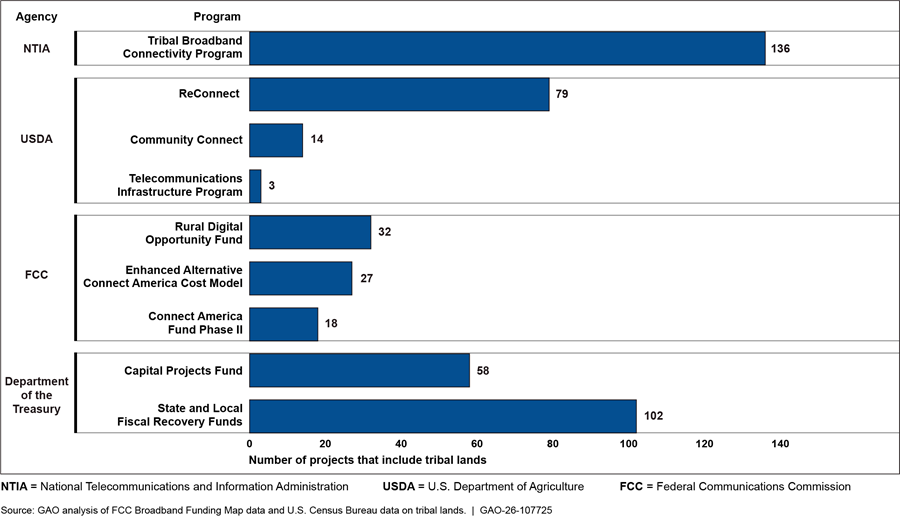
Notes: Two selected FCC programs—Bringing Puerto Rico Together Phase 2 Fixed Support and Connect U.S. Virgin Islands Phase 2 Fixed Support—and NTIA’s Broadband Infrastructure Program are excluded from this figure because they did not have any projects that include tribal lands. Data reported on Treasury programs to the Broadband Funding Map will not be complete until those programs finish deployment.
This analysis excludes 19 ReConnect projects that were erroneously classified as fiscal year 2026 projects (and therefore out of GAO’s scope) in the Broadband Funding Map data when GAO conducted the analysis in April 2026. These projects were awarded $267 million ($147 million for grants, $23 million for loans, and $97 million for grant-loan combinations) and were associated with 14,100 locations.
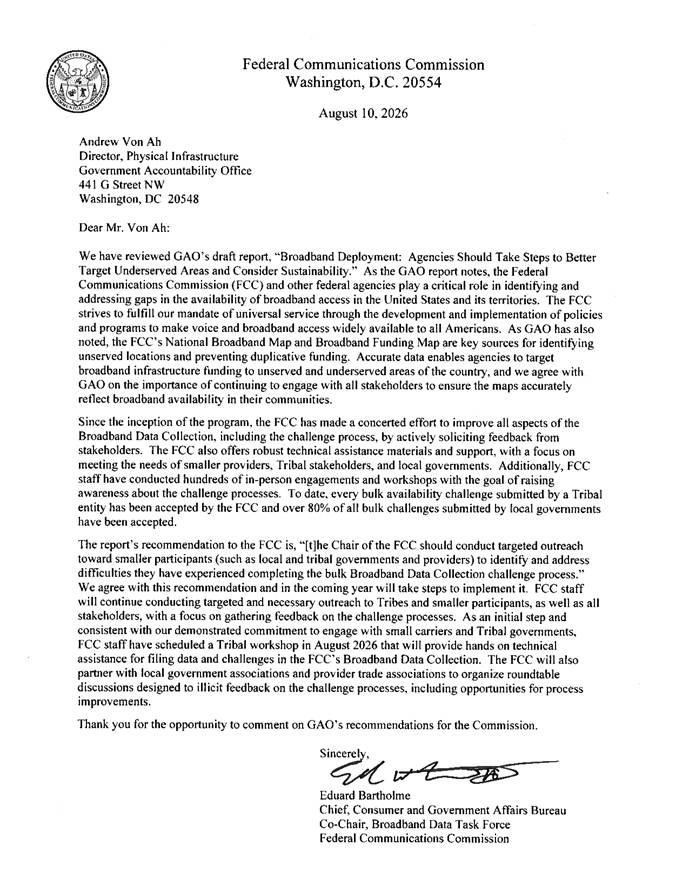
GAO Contact
Andrew Von Ah, vonaha@gao.gov
Staff Acknowledgments
In addition to the contact named above, Andrew Huddleston (Assistant Director), Nalylee Padilla (Assistant Director), Rebecca Rygg (Analyst in Charge), Madeline Barch, Kevin Barsaloux, Alma Laris, John Mingus, Jaclyn Mullen, Mike Soressi, Erin Villareal, Laurel Voloder, and Malika Williams made key contributions to this report.
The Government Accountability Office, the audit, evaluation, and investigative arm of Congress, exists to support Congress in meeting its constitutional responsibilities and to help improve the performance and accountability of the federal government for the American people. GAO examines the use of public funds; evaluates federal programs and policies; and provides analyses, recommendations, and other assistance to help Congress make informed oversight, policy, and funding decisions. GAO’s commitment to good government is reflected in its core values of accountability, integrity, and reliability.
Obtaining Copies of GAO Reports and Testimony
The fastest and easiest way to obtain copies of GAO documents at no cost is through our website. Each weekday afternoon, GAO posts on its website newly released reports, testimony, and correspondence. You can also subscribe to GAO’s email updates to receive notification of newly posted products.
Order by Phone
The price of each GAO publication reflects GAO’s actual cost of production and distribution and depends on the number of pages in the publication and whether the publication is printed in color or black and white. Pricing and ordering information is posted on GAO’s website, https://www.gao.gov/ordering.htm.
Place orders by calling (202) 512-6000, toll free (866) 801-7077,
or
TDD (202) 512-2537.
Orders may be paid for using American Express, Discover Card, MasterCard, Visa, check, or money order. Call for additional information.
Connect with GAO
Connect with GAO on X,
LinkedIn, Instagram, and YouTube.
Subscribe to our Email Updates. Listen to our Podcasts.
Visit GAO on the web at https://www.gao.gov.
To Report Fraud, Waste, and Abuse in Federal Programs
Contact FraudNet:
Website: https://www.gao.gov/about/what-gao-does/fraudnet
Automated answering system: (800) 424-5454
Media Relations
Sarah Kaczmarek, Managing Director, Media@gao.gov
Congressional Relations
David A. Powner, Acting Managing Director, CongRel@gao.gov
General Inquiries
[1]These programs and their authorizing statutes vary in their requirements for what areas are eligible to receive funding. Some programs use broadband service speeds to determine whether an area is unserved or underserved, but not all programs use these terms or include threshold speeds for eligibility. This report uses “underserved” to refer to areas eligible to receive federal funding for increasing broadband access.
[2]GAO, Broadband Programs: Agencies Need to Further Improve Their Data Quality and Coordination Efforts, GAO-25-107207 (Washington, D.C.: Apr. 17, 2025).
[3]GAO, Broadband: National Strategy Needed to Guide Federal Efforts to Reduce Digital Divide, GAO‑22‑104611 (Washington, D.C.: May 31, 2022). Of these over 100 programs, 31 programs, including the nine we selected for this review, could fund broadband deployment. For over half (18) of these 31 programs, broadband-related activities were one possible use. The report recommended that the Executive Office of the President develop and implement a national broadband strategy to support better management of fragmented and overlapping federal broadband programs and synchronize coordination efforts. This recommendation remained open as of June 2026.
[5]Additionally, 2 C.F.R. § 200.403(f) generally prohibits an award recipient from using the award to cover costs that were also covered by another federal award.
[6]GAO‑22‑104611. In this report, we refer to the 50 U.S. states, five U.S. territories, and the District of Columbia as states and territories.
[7]Pub. L. No. 118-42, § 4, 138 Stat. 25, 26 (2024); H.R. Rep. No. 118-124, at 6 (2023); 170 Cong. Rec. S1287 (daily ed. Mar 5, 2024) (incorporating by reference House Report 118-124).
[8]Last-mile broadband refers to the connection from a middle-mile network to a customer’s premises. Middle-mile network refers to broadband infrastructure that connects local service providers to the global internet.
[9]We analyzed Broadband Funding Map data to ensure comparable data across agencies. Selected agencies maintain broadband program data separate from their submissions to the Broadband Funding Map and may make some of the data publicly available. There are some differences between agencies’ publicly available data and the map’s data. For example, data on one of FCC’s High Cost subprograms are publicly available and include more projects than the map’s data, because FCC limited its Broadband Funding Map data submissions to projects where deployed speeds could be considered duplicative of other potential federal broadband projects. Additionally, this subprogram’s data predate the creation of the Broadband Funding Map, and FCC does not plan to update the subprogram’s requirements to align with the Broadband Funding map, as discussed in greater detail below. We focused on Broadband Funding Map data for fiscal years 2019 through 2025 because fiscal year 2019 was the first year for which data were available and fiscal year 2025 was the last full fiscal year for which data were available when we conducted our review.
[10]In addition, in August 2026, USDA officials told us that the April 2026 Broadband Funding Map data we analyzed included erroneous values for project start dates for USDA’s ReConnect program, because a USDA staff member had misapplied the updated data specifications. USDA officials provided corrected data, and we updated our analysis to reflect the corrections. However, because of this issue, our analysis excludes 19 ReConnect projects that were classified as fiscal year 2026 projects when we conducted our analysis of April 2026 data. These 19 projects were awarded $267 million ($147 million for grants, $23 million for loans, and $97 million for grant-loan combinations) and had 14,100 planned service locations.
[11]Similarly, dollar values throughout the report are rounded according to magnitude to improve readability. Values below 1,000 are rounded to the nearest hundred, values under 1 million are rounded to the nearest thousand, values between 1 million and 1 billion are rounded to the nearest million, and values of 1 billion or greater are rounded to the nearest 10th of a billion.
[12]The Broadband Funding Map data reflect provider-reported data on broadband availability, which may indicate project completion but do not reflect agencies’ reporting on project completion.
[13]These locations are typically referred to as “broadband serviceable locations” and include homes and businesses, but not locations like trailheads or buildings where fixed broadband is not needed or may not be possible due to a lack of electricity. Under 47 U.S.C. § 642(b), a serviceable location refers to locations in the U.S. where fixed broadband internet access service can be installed, as determined by FCC. Throughout this report, we refer to broadband serviceable locations as “locations.”
[14]GAO, Standards for Internal Control in the Federal Government, GAO‑25‑107721 (Washington, D.C.: May 15, 2025).
[15]Latency is the time it takes for a signal to go between two defined points.
[16]Congressional Research Service, Low Earth Orbit Satellites: Potential to Address the Broadband Digital Divide, R46896 (Nov. 14, 2025); and The Persistent Digital Divide: Selected Broadband Deployment Issues and Policy Considerations, R47506 (Apr. 18, 2023).
[17]GAO, COVID-19 Relief: States’ and Localities’ Fiscal Recovery Funds Spending as of March 31, 2024, GAO‑24‑107301 (Washington, D.C.: Sept. 26, 2024).
[18]In this report, application and awarding period refers to the period in which program participants apply for funds and selected agencies identify and award recipients. For programs with multiple funding rounds, such as ReConnect and the Tribal Broadband Connectivity program, we present the application and awarding period as continuous rather than showing an application and awarding period for each distinct round.
[19]Pub. L. No. 116-260, div. FF, tit. IX, § 904, 134 Stat. 1182, 3214 (2020) (codified at 47 U.S.C. § 1308(b)(2)). The ACCESS BROADBAND Act, which was enacted in 2020, also specifies that any agency that offers a federal broadband support program should coordinate with NTIA.
[20]This May 2024 information-sharing memorandum of understanding is intended to be a separate agreement and not to supersede or otherwise impact the terms of the interagency agreement established in 2021, which is still active. Memorandum of Understanding Regarding Information Sharing dated as of May 9, 2024, between the Federal Communications Commission, U.S. Department of Agriculture, the National Telecommunications and Information Administration of the U.S. Department of Commerce, and the U.S. Department of the Treasury (May 9, 2024).
[21]The two federal broadband maps discussed below both use a dataset of locations throughout the country where fixed broadband access is or could be installed. This dataset was first made available to the public in 2022 and allows data filers, FCC, and others to work from a single, standardized list of location identification numbers. FCC refers to this dataset as the “Broadband Serviceable Location Fabric (Fabric).” Throughout this report, we refer to data from the Fabric as “standardized location data.”
[22]GAO, Fragmentation, Overlap, and Duplication: An Evaluation and Management Guide, GAO‑15‑49SP (Washington, D.C.: Apr. 14, 2015).
[25]As of July 2026, we had started to receive supporting materials from some of the agencies for their implementation of the recommendations, and we were in the process of reviewing these materials and working with officials to determine whether these efforts address our recommendations.
[26]In some cases, the median may provide a better measure of a typical value than the mean, particularly when the data are skewed or contain outliers, because the median is more resistant to extreme values.
[27]Of the $300 million appropriated for the BIP, NTIA announced in its notice of funding opportunity that it would make up to $288 million available for awards. Differences in the amount awarded and amount available for award may be due in part to changes to the scope of an awarded project or projects.
[28]See 47 U.S.C. § 1705(d)(5).
[29]Disbursement amounts are the amounts provided by an agency to recipients. For NTIA’s BIP program and Tribal Broadband Connectivity Program, we report on disbursement data, rather than expenditure data (as we do for USDA’s programs), because, according to NTIA officials, NTIA tracks disbursements and not expenditures. The percentage of obligated funds disbursed is an imperfect proxy for project progress. In some cases, participants may purchase long-lead-time materials and equipment during the environmental review and before construction begins, and receive disbursements related to these expenses, according to NTIA officials. In these cases, disbursements may be recorded even though deployment has not started. Conversely, some recipients may delay purchases until after environmental clearance, according to NTIA officials. According to NTIA officials, projects funded by BIP have completed deployment to more locations than indicated in the Broadband Funding Map data. NTIA officials said they will continue to submit buildout data to the map as they receive information from recipients’ performance reports.
[30]TBCP funds other project types, such as broadband use and adoption and planning projects. Our analysis only includes projects that involve broadband infrastructure deployment and that NTIA submitted to the Broadband Funding Map. NTIA planned to finish making round-two awards by the end of 2026, according to officials.
[31]The difference between the amount appropriated and award amount included in the Broadband Funding Map data is primarily due to three factors. First, TBCP awards for use and adoption or planning projects without last-mile deployment activities are not included in the map’s data. Second, NTIA had not finished announcing awards under its second funding round as of June 2026 and announced a third funding round in June 2026 through which it expected to award up to $540 million, according to the notice of funding opportunity. Third, NTIA may use up to 2 percent of amounts appropriated for TBCP for administrative purposes. 47 U.S.C. § 1705(c)(3)(B); Consolidated Appropriations Act, 2022, Pub. L. No. 117-103, div. B, tit. V, § 541, 136 Stat. 49, 153.
[32]NTIA’s funding announcements stated that it would allocate up to $500,000 per tribal government to meet the statutory requirement that TBCP funds appropriated by the Consolidated Appropriations Act, 2021, be distributed equitably. The allocation is to each federally recognized Tribe delineated by the Bureau of Indian Affairs, including those listed parenthetically in the Bureau’s published list. See 91 Fed. Reg. 4102 (Jan. 30, 2026). NTIA is applying the statutory equitable distribution requirement to all TBCP funding, not just the amount appropriated for TBCP by the Consolidated Appropriations Act, 2021. As we previously reported, such grants would be available to applicants that passed merit review—the second of three application review phases—but did not receive the amount they requested. See GAO, Tribal Broadband: Additional Assistance to Recipients Would Better Support Implementation of $3 Billion in Federal Grants, GAO‑24‑106541 (Washington, D.C.: June 24, 2024). NTIA officials refer to these awards as equitable distribution awards and to other awards as “full” awards. Most TBCP awards of $500,000 or less were equitable distribution awards, according to NTIA officials.
[33]See 47 U.S.C. § 1705(c)(4)(B).
[34]Generally, award recipients must submit all required financial and performance reports within 120 days after the conclusion of the performance period, the time frame in which the recipient must complete the work under the award. The agency must close out the award when it determines all administrative action and required work have been completed. 2 C.F.R. § 200.344.
[35]The amount awarded was higher than the amount appropriated because some awarded amounts were for loans. For loans, the appropriated funds are not used for the amount a loan recipient borrows. Instead, these appropriated funds cover the loans’ subsidy costs, which represent the cost of the loan program.
[36]TIP receives appropriations that generally expire at the end of each fiscal year, so the amount available in any given fiscal year was less than the total amount reported for this period.
[37]Because Community Connect funds could also be used to provide broadband service free of charge for certain facilities, the obligated amount reflects other activities in addition to broadband deployment.
[38]In commenting on a draft of this report in August July 2026, USDA officials told us they began submitting buildout data to the Broadband Funding Map in June 2026. Our analysis of buildout data in the Broadband Funding Map reflects the data as of May 2026, as we did not analyze or assess the reliability of data submitted later.
[39]As with the NTIA programs discussed above, the percentage of obligated funds expended is an imperfect proxy for project progress for USDA programs for similar reasons. Additionally, in USDA’s programs, recipients may use matching funds before using program funding, according to USDA officials.
[40]While FCC’s High Cost program includes additional subprograms, we selected these five subprograms because the Broadband Funding Map included data on planned projects for only these subprograms. As mentioned earlier in this report, the amount awarded reflects the total amount awarded for the funding period, which is 10 or 15 years depending on the subprogram, rather than for 6 six fiscal years we examined.
[41]The Enhanced Alternative Connect America Cost Model subprogram differs from other selected subprograms because it provided funding to providers who were already receiving funding from a different subprogram to maintain that service for 15 years. Our analysis of the Broadband Funding Map data indicates that there are about 2.8 million planned locations for this subprogram. According to FCC officials, around 500,000 of these locations were previously unserved.
[42]Low project funding amounts may be associated with smaller projects associated with a larger award. Projects were defined and reported to the Broadband Funding Map by network speeds and state. For example, one Rural Digital Opportunity Fund (RDOF) project in this subprogram was awarded $300 to serve a single location with a network speed of 100/20 Mbps. This project is part of a $4.5 million award to serve over 6,000 locations almost entirely at the gigabit performance tier.
[43]Of the 1,976,900 planned service locations affected by defaults, 1,762,000 (about 89 percent) were affected by defaults that occurred during the authorization phase, which means they had not begun receiving funding.
[44]The number of locations here (at least 700,000) is much higher than the number of planned locations in table 5 above (391,100), primarily because the number in table 5 above excludes an estimated 350,000 locations that are not included in the Broadband Funding Map because their planned speeds were lower than 100/20 Mbps, as described above.
[45]These sources are (1) an open data website administered by the Universal Service Administration Company, which administers FCC’s High Cost program, and (2) the Connect America Fund map.
[46]The Broadband Funding Map data for 10 projects did not include information on amount awarded. We therefore excluded these 10 projects from our analysis.
[47]Treasury’s reporting guidance lists over 100 expenditure categories, one of which is broadband last-mile projects.
[48]See American Rescue Plan Act of 2021, Pub. L. No. 117-2, § 9901, 135 Stat. 4, 223.
[49]We present these figures to describe the scale of reported activity, but they should be interpreted in light of limitations in the underlying data.
[50]Under 47 U.S.C. § 1702(c)(4), BEAD allocations are subject to NTIA’s approval of states’ and territories’ application materials, such as the initial proposal and final proposal. Throughout this subsection, we refer to states and territories collectively as “states.”
[51]47 U.S.C. § 1702(h)(4)(C).
[52]National Telecommunications and Information Administration, Broadband Equity, Access, and Deployment (BEAD) Program: BEAD Restructuring Policy Notice (June 6, 2025).
[53]Additional changes to program requirements related to labor, employment, workforce, climate change, and affordability.
[54]In addition to the $18.4 billion in expected deployment funds and the expected $21 billion in non-deployment funds, NTIA provided planning funds to recipients, and the statute allowed NTIA to use some funds for administrative expenses.
[55]See, e.g., Congressional Research Service, The Broadband Equity, Access, and Deployment (BEAD) Program: Issues for the 119th Congress, R48666 (Washington, D.C.: Aug. 29, 2025). Precision agriculture involves collecting, analyzing, and taking actions based on data. It can help the agricultural sector meet increasing demand for food products, while also helping farmers improve efficiencies such as through reduced input costs.
[56]As discussed above, NTIA began submitting BEAD data to the Broadband Funding Map data in fiscal year 2026, so our analysis did not include BEAD.
[57]BEAD recipients also began funding projects after FCC’s standardized location data became available in 2022, but we did not include BEAD in this analysis.
[58]GAO, Broadband Internet: FCC’s Data Overstate Access on Tribal Lands, GAO‑18‑630 (Washington, D.C.: Sept. 7, 2018); Congressional Research Service, Broadband Data and Mapping: Background and Issues for the 116th Congress, R45962 (Washington, D.C.: Oct. 16, 2019).
[59]In commenting on a draft of this report in July 2026, USDA officials told us they had resolved the identified irregularities and submitted related updates to the Broadband Funding Map.
[60]Agencies also use NTIA’s Broadband Analytics and Monitoring platform, a nonpublic resource that includes data on federally funded broadband deployment projects and sensitive information on pending projects not yet awarded. It includes data on broadband deployment from federal agencies as well as data from the U.S. Census and private sources.
[61]Treasury Capital Projects Fund and State and Local Fiscal Recovery Funds recipients determine which areas they administer are eligible for program funding and make subawards for projects. While Treasury does not directly determine which areas are eligible for award in these programs, program rules and guidance direct recipients to use funds in areas that lack service.
[62]GAO, Broadband: USDA Should Set Performance Goals and Improve Fraud Risk Management for Funding Program, GAO‑23‑105265 (Washington, D.C.: Oct. 31, 2022).
[64]As of July 2026, we had started to receive supporting materials from some of the agencies for their implementation of the recommendations, and we were in the process of reviewing these materials and working with officials to determine whether these efforts address our recommendations.
[65]According to FCC officials, this overlap still appears on the Broadband Funding Map because E-ACAM awards are depicted on the map as areas, but the actual awards are to provide service to a set of locations. FCC officials told us that they are in the process of converting the Broadband Funding Map data on E-ACAM to reflect this.
[66]The Connect America Fund Phase II Auction was also structured as a reverse auction but has not experienced the same levels of default as RDOF. Enacted in May 2026, the Rural Broadband Protection Act of 2025 requires that FCC establish a vetting process to review High Cost program applicants’ documentation of their technical, financial, and operational capabilities related to the proposed deployment, as well as a reasonable business plan. Pub. L. No. 119-89, 140 Stat. 818 (2026).
[67]The BEAD Restructuring Policy Notice established the June 6th deadline. As explained by the policy, states and territories were not required to re-run their challenge processes after that date.
[68]GAO‑25‑107207. In this report, we found that agencies lacked clear timelines for providing updates to FCC. We recommended that FCC, NTIA, USDA, and Treasury, in collaboration with each other, clearly define and document timelines for agencies to submit data on funded awards to the Broadband Funding Map, including any changes to awards. As of July 2026, some of the agencies had reported implementing these recommendations, we had started to receive supporting materials from some of the agencies for their implementation of recommendations, and we were in the process of reviewing these materials and working with officials to determine whether these efforts address our recommendations.
[69]Individuals can also submit single-location challenges to broadband availability or location data.
[70]Federal Communications Commission, “Fabric Challenge Response Codes,” https://help.bdc.fcc.gov/hc/en-us/articles/17077103993371-Fabric-Challenge-Response-Codes (updated June 30, 2025).
[71]Not all participants and stakeholders we interviewed had direct experience with FCC’s bulk challenge process, so they did not provide information on this issue.
[72]GAO, Affordable Broadband: FCC Could Improve Performance Goals and Measures, Consumer Outreach, and Fraud Risk Management, GAO‑23‑105399 (Washington, D.C.: Jan. 18, 2023).
[73]ReConnect has also allowed recipients of certain High Cost program funding from FCC to receive loans in certain rounds. For example, in Round 5, recipients of funds from FCC’s Enhanced Alternative Connect America Cost Model are eligible for ReConnect loans, but they remain ineligible for ReConnect grant funding. 89 Fed. Reg. 13035, 13038 (Feb. 21, 2024). As reported previously, according to FCC and USDA officials, these loans are considered supplemental to these grants, instead of duplicative, because they are paid back. GAO‑23‑105265.
[75]GAO‑24‑106541. In our review, we found that NTIA’s plans for providing technical assistance throughout the funding period did not include support for recipients that are unable to implement their financial sustainability plans. We recommended that NTIA provide technical assistance throughout the funding period to support recipients that are unable to implement their financial sustainability plans. We also recommended that NTIA report to Congress on the resources necessary to ensure the financial sustainability of TBCP infrastructure projects. NTIA agreed with both recommendations but had not implemented them as of June 2026.
[76]Douglas K. Kitch and Christopher S. Barron, Evaluating the Critical Need for Broadband Sustainability Funding on Rural Tribal Lands, a white paper prepared on behalf of the National Tribal Telecommunications Association, August 2022.
[77]According to the NTIA FAQ for BEAD, for most providers, the certification applies through the period of federal interest (i.e., the 10-year period following the performance period), during which providers complete network buildout. For providers operating low-earth-orbit satellite networks, the 10-year period is an extended performance period.
[78]Throughout this subsection, we refer to states and territories collectively as “states.”
[79]Under 2 C.F.R. § 200.316, a federal award subrecipient serves as trustee of real property, equipment, and intangible property improved with the federal award. Accordingly, BEAD subrecipients hold property acquired or improved through BEAD in trust for the benefit of the public served by the infrastructure project. As explained in a NTIA policy notice for BEAD, the federal government retains an interest in this property for 10 years after the project has been closed out. This period is known as the federal interest period. NTIA’s BEAD Performance Measures Policy Notice states, “[A] subgrantee’s obligation to provide broadband service meeting these network performance standards continues for the duration of the Federal Interest Period.”
[80]However, as NTIA guidance indicates there may be a basis for recipients to request performance data demonstrating their compliance with performance requirements beyond the 4-year deployment period, there may also be a basis for recipients to request financial data demonstrating their ability to remain financially sustainable, and thus meet performance requirements, during the 10-year federal interest period.
[81]For example, see GAO‑24‑106541 and GAO, Broadband Deployment: Agencies Should Take Steps to Better Meet Deadline for Processing Permits, GAO‑24‑106157 (Washington, D.C.: Apr. 10, 2024).
[83]Making Opportunities for Broadband Investment and Limiting Excessive and Needless Obstacles to Wireless (“MOBILE NOW”) Act, Pub. L. No. 115-141, div. P, tit. VI, § 606(a), 132 Stat. 1097, 1101 (2018) (amending 47 U.S.C. § 1455(b)(3)).
[85]Pub. L. No. 89-665, § 106, 80 Stat. 915, 917 (1966) (codified as amended at 54 U.S.C. § 306108). As of August 2026, the Advisory Council on Historic Preservation is considering revising the statute’s implementing regulations. RIN: 3010-AA10.
[86]42 U.S.C. § 4336(b). During our review, the Council on Environmental Quality (CEQ) rescinded its regulations implementing NEPA. 90 Fed. Reg. 10610 (Interim Final Rule, Feb. 25, 2025); 91 Fed. Reg. 618 (Final Rule, Jan. 8, 2026). As CEQ explained when issuing its final rule, the rescission of CEQ’s regulations did not alter each agency’s duty to comply with the statute or rescind other agencies’ procedures for implementing NEPA. 91 Fed. Reg. 618, 625–28.
[87]42 U.S.C. § 4436e(1).
[88]According to Treasury guidance, NEPA generally does not apply to broadband infrastructure projects funded by the Treasury programs we reviewed. According to Treasury officials, coordination related to historic preservation reviews happens at the recipient level, because recipients are responsible for selecting and making awards.
[89]The program, FAST-41, was established in 2015 by Title 41 of the Fixing America’s Surface Transportation Act and is managed by an interagency group known as the Federal Permitting Improvement Steering Council.
[90]This council is an independent federal agency established by the National Historic Preservation Act in 1966. The council advises and recommends measures to coordinate the activities of federal, state, and local agencies, private institutions, and individuals relating to historic preservation.
[91]As of January 2026, USDA had reduced the number of archaeologists to levels below that reached after the USDA’s hiring in 2024, but the levels were still higher than before that hiring. According to USDA officials, some of the staff reduction was the result of the Department of Government Efficiency’s deferred resignation program and retirements.
[92]Although USDA’s Rural Broadband Program has broadband deployment as a primary purpose, we did not include the program in our review, because the program made just one award in the period we reviewed. According to USDA officials, they did not plan to make additional awards in the program. Additionally, we excluded FCC programs like E-Rate because they provide funding for specific entities, like schools and libraries, rather than last-mile deployment.
[93]In addition to the three state broadband offices we met with, we requested interviews with two other state broadband offices: Oregon and Idaho. Oregon’s state broadband office declined our request for an interview. Idaho’s state broadband office requested we meet after they completed their revised proposal for the Broadband Equity, Access, and Deployment (BEAD) program following NTIA’s policy update. When that time came, we determined that we had gathered sufficient information, so we did not meet with Idaho’s state broadband office.
[94]One of the participants is in Oregon and was selected when we had expected to meet with the Oregon state broadband office.
[95]While NTIA’s BEAD program is one of our selected programs, we did not include it in our analysis of BFM data because the first projects were awarded in fiscal 2026, whereas we analyzed data for fiscal years 2019 through 2025.
[96]FCC’s BFM includes data on selected programs’ broadband infrastructure deployment projects funded by the federal government.
[97]In addition, in August 2026, USDA officials told us that the April 2026 BFM data we analyzed included erroneous values for project start dates for ReConnect, because a USDA staff member had misapplied the updated data specifications. USDA officials provided corrected data, and we updated our analysis to reflect the corrections. However, because of this issue, our analysis excludes 19 ReConnect projects that were classified as fiscal year 2026 projects when we conducted our analysis of April 2026 data. These 19 projects were awarded $267 million ($147 million for grants, $23 million for loans, and $97 million for grant-loan combinations) and had 14,100 planned locations.
[98]As a result of our examination of the data, USDA officials told us USDA planned to review its broadband programs’ location data for accuracy. In commenting on a draft of this report in July 2026, USDA officials told us they resolved the identified irregularities and submitted related updates to the BFM in April 2026.
[99]According to Treasury officials, BFM data on funding awarded for SLFRF will not be complete until the program expenditure deadline in December 2026, or shortly thereafter, because Treasury officials review and validate these data after the recipients report on completed projects.
[100]Similarly, dollar values throughout the report are rounded according to magnitude to improve readability. Values below 1,000 are rounded to the nearest hundred, values under 1 million are rounded to the nearest thousand, values between 1 million and 1 billion are rounded to the nearest million, and values of 1 billion or greater are rounded to the nearest 10th of a billion.
[101]The BFM data reflect provider-reported data on broadband availability, which may indicate that buildout has occurred at a particular location but do not reflect agencies’ reporting on project completion.
[102]In some cases, project areas may overlap but contain no locations to be served by federal broadband programs. In other cases, rules allow funds to go to the same area. For example, some programs allow the recipient to use other federal funds for operational expenses.
[103]The data we reviewed from the Broadband Funding Map are data submitted for planned broadband deployment projects. Some projects may have been completed from fiscal year 2019 through fiscal year 2025. However, we refer to planned projects because the BFM data we analyzed are on planned projects.
[104]We excluded NTIA’s Broadband Equity, Access, and Deployment program from this appendix because our analysis was of awards made in fiscal years 2019 through 2025, and BEAD recipients began making awards in fiscal year 2026.
[105]Because of differences between subprograms within the High Cost program, we analyzed these selected subprograms separately and refer to them in this appendix as programs.
[106]A fixed wireless network provides broadband service by transmitting signals from fixed sites, such as radio towers, to other individual fixed locations, such as a consumer’s premises. Licensed fixed wireless uses entirely licensed spectrum or a hybrid of licensed, unlicensed, and licensed-by-rule spectrum to make last-mile connections to fixed locations. Licensed-by-rule fixed wireless uses entirely licensed-by-rule spectrum or a hybrid of licensed-by-rule and unlicensed spectrum to make last-mile connections to fixed locations. Licensed-by-rule spectrum is spectrum that is open to use by users, including operators providing last-mile connections through general authorized access (GAA) in the 3.5GHz Citizens Broadband Radio Service band.
[107]We chose U.S. Census Bureau data because they conform with FCC’s definition of tribal lands used in FCC’s Broadband Deployment Reports. This definition includes (1) Joint Use Areas; (2) legal federally recognized American Indian area consisting of reservation and associated off-reservation trust land; (3) legal federally recognized American Indian area consisting of reservation only; (4) legal federally recognized American Indian area consisting of off-reservation trust land only; (5) Statistical American Indian area defined for a federally recognized tribe that does not have reservation or off-reservation trust land, specifically a tribal designated statistical area or Oklahoma Tribal Statistical Area; (6) Alaskan Native village statistical area; and (7) Hawaiian Home Lands established by the Hawaiian Homes Commission Act of 1921. See Federal Communications Commission, Inquiry Concerning the Deployment of Advanced Telecommunications Capability to All Americans in a Reasonable and Timely Fashion, Report, 39 FCC Rcd. 3247, 3276–77, para. 57, n.221 (Mar. 18, 2024). We used these data in our report on broadband deployment funding and the availability of broadband service in tribal lands. GAO, Tribal Broadband: National Strategy and Coordination Framework Needed to Increase Access, GAO‑22‑104421 (Washington, D.C.: June 22, 2022). The Tribal Broadband Connectivity Program defines tribal lands using a broader definition. NTIA officials confirmed that all Tribal Broadband Connectivity Program projects include tribal lands according to that program’s definition.