
Report to Congressional Committees
United States Government Accountability Office
A report to congressional committees
Contact: Derrick Collins at collinsd@gao.gov
What GAO Found
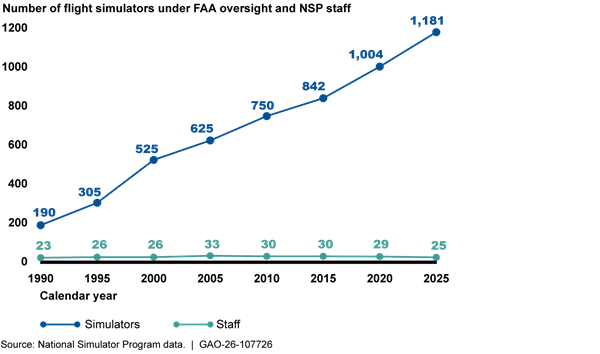
The Federal Aviation Administration (FAA) uses the National Simulator Program (NSP) to evaluate and oversee an increasing number of flight simulators. NSP’s oversight ensures that simulators accurately replicate the aircraft they simulate. From 1990 to 2025, the number of simulators increased by more than 500 percent, while the number of NSP staff remained steady. From 2019 through 2024, the number and type of simulator evaluations that NSP conducted remained relatively steady, as NSP implemented the Extended Evaluation Interval (EEI) program, among other strategies, to oversee the growing number of simulators. This program allows FAA to extend intervals between evaluations—from the standard 12 months up to 36 months—for simulators that demonstrate consistent, high-quality performance.
Trends in the Number of Simulators Under Federal Aviation Administration Oversight and National Simulator Program Staff, 1990–2025
However, GAO found that NSP has not communicated with simulator sponsors about its process for determining simulators’ eligibility for the EEI program and the intervals between evaluations of simulators in the program. Six of 10 selected sponsors raised concerns about communication, including insufficient opportunity to provide information that could help improve EEI determinations. For example, two sponsors cited potential safety issues that could result from extending the intervals between evaluations. Communicating with sponsors could help NSP make more informed decisions about eligibility and evaluation intervals, and identify and address risks associated with those determinations.
GAO found that NSP has identified staffing and skills gaps but has not addressed all mission-critical skills gaps, including in standards development. Developing and implementing a process to address all identified mission-critical skills gaps would help NSP ensure its staff has the requisite skills to keep pace with evolving technology while handling an increased oversight workload.
Why GAO Did This Study
NSP plays a critical role in aviation safety, as it oversees the flight simulators that airlines and flight schools use to train pilots to operate aircraft in a variety of situations.
The FAA Reauthorization Act of 2024 includes a provision for GAO to review FAA’s oversight of simulators. This report examines, among other objectives, how the number and type of simulator evaluations NSP conducts annually has changed in recent years, and how NSP has addressed increased demand; the extent to which NSP has communicated with sponsors in its process for making EEI program determinations; and the extent to which NSP has identified and addressed gaps in staffing levels and staff skill sets.
GAO reviewed FAA policies, guidance, and data, as well as relevant federal laws and regulations. GAO also interviewed FAA officials and simulator sponsors, such as major and regional airlines. For these interviews, GAO selected a nongeneralizable sample of 10 sponsors that own or operate over 62 percent of all flight simulators. In addition, GAO conducted two site visits to observe simulators managed by a flight simulator manufacturer and a flight training organization.
What GAO Recommends
GAO recommends that FAA develop and implement a mechanism to communicate with and receive feedback from sponsors about its process for determining which simulators are eligible for inclusion in the EEI program, and develop and implement a process to address all identified mission-critical skills gaps. The Department of Transportation concurred with the recommendations.
|
Abbreviations |
|
|
|
|
|
EASA |
European Union Aviation Safety Agency |
|
EEI program |
Extended Evaluation Interval program |
|
FAA |
Federal Aviation Administration |
|
ICAO |
International Civil Aviation Organization |
|
NSP |
National Simulator Program |
|
NTSB |
National Transportation Safety Board |
|
simulator |
flight simulation training device |
This is a work of the U.S. government and is not subject to copyright protection in the United States. The published product may be reproduced and distributed in its entirety without further permission from GAO. However, because this work may contain copyrighted images or other material, permission from the copyright holder may be necessary if you wish to reproduce this material separately.
September 3, 2026
The Honorable Ted Cruz
Chairman
The Honorable Maria Cantwell
Ranking Member
Committee on Commerce, Science, and Transportation
United States Senate
The Honorable Sam Graves
Chairman
The Honorable Rick Larsen
Ranking Member
Committee on Transportation and Infrastructure
House of Representatives
The Federal Aviation Administration’s (FAA) National Simulator Program (NSP) plays a vital role in ensuring the quality and reliability of civil aviation flight simulation training devices (simulators) used in pilot training programs across the United States.[1] Simulator sponsors, such as airlines and flight schools, use simulators to meet training or flight experience requirements for certifying or qualifying flight crewmembers.[2] According to FAA, simulators are more cost-effective for training than aircraft, because pilots can be trained on multiple scenarios and procedures during a single training session. Furthermore, simulators can also be used to train pilots for situations that rarely occur or that would be too dangerous to execute in an aircraft. FAA conducts evaluations to determine whether simulators accurately replicate the FAA-certified aircraft they simulate, to ensure crewmembers are effectively trained to safely operate aircraft in a variety of situations.
The complexity and number of simulators have increased in recent years, raising questions about how NSP has adapted to those changes. Some stakeholders have expressed concern that FAA’s evaluation standards and regulations for flight simulators are outdated, because some were developed more than 20 years ago and have not kept pace with technological advances in flight simulators, such as virtual reality. In addition, as the number of simulators has increased, the number of NSP staff has remained steady. FAA has extended the interval between some simulator evaluations through a program called the Extended Evaluation Interval (EEI) program.[3]
The FAA Reauthorization Act of 2024 includes a provision for us to review how NSP accounts for technological advances pertaining to flight simulators, and how NSP engages air carriers and relevant industry stakeholders.[4] The act also includes a provision for us to review NSP’s staffing levels, critical competencies, and skills gaps. This report examines (1) how the number and type of simulator evaluations NSP conducts annually has changed in recent years, and how NSP has addressed increased demand; (2) the extent to which NSP has communicated with sponsors about its process for making EEI program determinations; (3) the steps FAA has taken to learn about technological advances in flight simulators; and (4) the extent to which NSP has identified and addressed gaps in staffing levels and staff skill sets.
To determine how the number and type of evaluations NSP conducts annually has changed in recent years, we reviewed FAA data for calendar years 2019 through 2024 on the number, type, and frequency of simulator evaluations. We chose this time frame because 2019 was the first full year for which NSP’s Simulator Inventory and Evaluation Scheduling System had complete data, and 2024 was the most recent full year with complete data at the time of our review. To assess the accuracy and completeness of the data, we conducted tests for outliers, missing fields, or obvious errors in the database. We resolved any concerns we identified in the data through discussions with NSP officials. We determined the data were sufficiently reliable for reporting on the number and type of evaluations that NSP conducted from 2019 through 2024. We also interviewed NSP officials about actions NSP has taken to address increased demand for simulator evaluations. In addition, we conducted two site visits to observe how simulators managed by a flight simulator manufacturer and a flight training organization operate.
To determine the extent to which NSP has communicated with sponsors in its process for making EEI program determinations, we interviewed FAA officials and conducted semi-structured interviews with a nongeneralizable selection of 10 flight simulator sponsors, to learn more about the simulators they manage and their perspectives on the processes for simulator qualification for the EEI program.[5] The sponsors we interviewed represent relevant groups that operate simulators and consisted of flight simulator manufacturers, aircraft manufacturers, flight training organizations, major airlines, and regional airlines.[6] Our primary criteria for selection were to include at least one member of each identified relevant group, and to include entities covering a large share of the total number of flight simulators, according to FAA data. We also considered recommendations from sponsors to identify candidates for interviews. The sponsors we interviewed own or operate over 62 percent of all flight simulators. We compared NSP’s efforts to communicate externally with industry stakeholders with federal internal control standards related to communicating relevant and quality information to external parties.[7]
To identify the steps FAA has taken to learn about technological advances in flight simulators, we reviewed applicable federal regulations, as well as relevant NSP and FAA documents.[8] We also interviewed NSP officials and the 10 selected simulator sponsors about the steps NSP has taken to learn about technological advances, how NSP has involved sponsors in these efforts, and how NSP plans to address technological advances in future versions of its simulator standards.
To determine the extent to which NSP has identified and addressed gaps in staffing levels and staff skill sets, we reviewed our prior related work, interviewed NSP officials, and reviewed NSP documents.[9] In addition, we interviewed the 10 selected sponsors to understand more about their perspectives on NSP staffing levels and any skills gaps that might exist. We assessed NSP’s efforts to identify and address any gaps in staffing levels and skill sets against selected workforce planning principles, including that organizations should (1) determine the critical skills needed to meet the organization’s present and future goals, and (2) develop strategies to address any gaps in staffing levels or staff skill sets.[10] To implement these principles, we previously reported that organizations should (1) regularly assess staffing levels and staff skill sets and identify any staffing or skills gaps, and (2) develop and implement strategies to address any gaps.[11]
We conducted this performance audit from July 2024 to September 2026, in accordance with generally accepted government auditing standards. Those standards require that we plan and perform the audit to obtain sufficient, appropriate evidence to provide a reasonable basis for our findings and conclusions based on our audit objectives. We believe that the evidence obtained provides a reasonable basis for our findings and conclusions based on our audit objectives.
Background
NSP Functions, Simulator Evaluations, and Staffing
In June 1980, FAA established the National Simulator Program (NSP), which has three mission-critical functions: (1) developing standards against which to qualify flight simulators; (2) qualifying all flight simulators used in FAA-approved flight training programs; and (3) overseeing the national fleet of simulators to ensure they continue to accurately replicate the FAA-certified aircraft they simulate.[12] These functions remain the same today and support FAA’s broader aviation safety goals. According to NSP, its staff of aeronautical engineers, aviation safety inspectors, and analysts oversee the operational performance of the simulator fleet, including by evaluating and qualifying simulators and ensuring they comply with regulation.
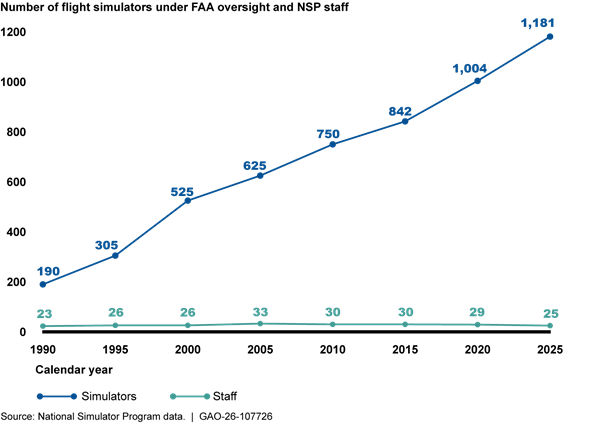
Since 1990, the number of simulators under FAA oversight has grown substantially, while the number of NSP staff has remained steady. According to FAA data, since 1990, the number of simulators in use under FAA oversight has grown by more than 500 percent, from 190 in 1990 to 1,181 at the end of 2025. In 1990, NSP had 23 staff members, and in December 2025, it had 25 staff members comprising 14 inspectors, five engineers, and six managers and analysts. See figure 1 for trends in the number of simulators compared with the number of NSP staff since the program’s inception.
Figure 1: Trends in the Number of Flight Simulators Under the Federal Aviation Administration’s (FAA) Oversight and in the Number of National Simulator Program (NSP) Staff, 1990–2025
At the end of 2025, according to NSP data, about 60 different sponsors managed FAA-qualified simulators. These sponsors included flight simulator manufacturers, aircraft manufacturers, flight training organizations, major airlines, and regional airlines. According to NSP officials, NSP helps ensure that sponsors comply with relevant regulations by providing guidance for sponsors, regularly evaluating all simulators that sponsors manage, and engaging with sponsors in various committees and working groups.
Types of Simulators That NSP Qualifies
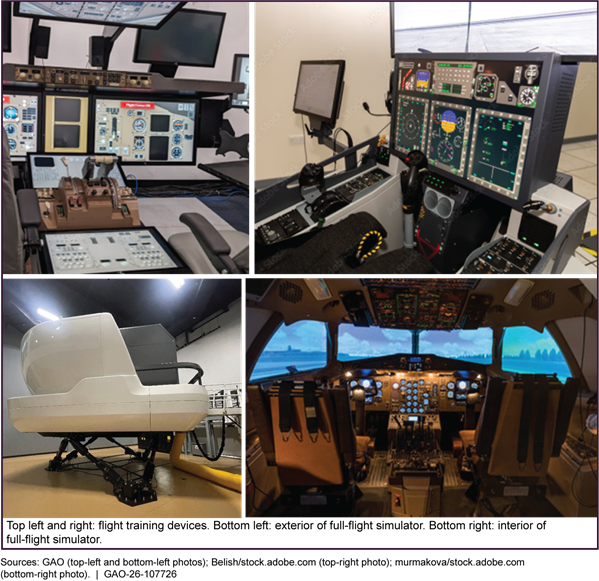
The types of simulators that FAA qualifies fall into two categories: flight training devices and full-flight simulators.
· Flight training devices. Based on NSP data, flight training devices account for roughly 27 percent of simulators currently qualified by FAA. Sponsors use flight training devices primarily for introducing pilots to flight procedures, according to one sponsor we interviewed. In most cases, these flight training devices are not required to have a motion system or external visual system.
· Full-flight simulators. Based on NSP data, full-flight simulators account for roughly 73 percent of all simulators currently qualified by NSP. A full-flight simulator is a replica of a specific type or make, model, or series of aircraft, and includes equipment and computer programs necessary to represent aircraft operations in ground and flight conditions; a visual system that provides a view out of the flight deck; and a system that provides cues at least equivalent to those of a 3-degree-of-freedom motion system to simulate pilot cues experienced during actual flight.[13]
See figure 2 for examples of flight training devices and full-flight simulators.[14]
Evolution of FAA Simulator Oversight
Prior to 2006, FAA simulator standards were found in different parts of FAA’s regulations and in advisory circulars. FAA consolidated and updated simulator standards relating to criteria for design, evaluation, and qualification of simulators in 2006 (codified at 14 C.F.R. Part 60 and referred to as Part 60), and has updated those regulations a number of times.[15] For example, in a 2016 final rule, FAA revised Part 60, partly in response to multiple recommendations issued by the National Transportation Safety Board (NTSB).[16] According to NSP officials, the changes to Part 60 also improved alignment between FAA regulations and standards developed by the International Civil Aviation Organization (ICAO).
The 2016 final rule included “deviation authority,” which allows sponsors to propose an alternative set of initial qualification standards (i.e., a deviation from Part 60), as long as the request for deviation provides “sufficient justification” that the deviation meets or exceeds the simulator testing requirements and tolerances outlined in Part 60.[17] According to FAA, the agency included deviation authority as part of the final rule to allow it to be more responsive to changes in the international simulator evaluation criteria, as well as to provide additional options to sponsors of simulators that are qualified by multiple national aviation authorities.[18] FAA has used its deviation authority to approve some simulators that use extended reality.[19] Part 60 does not mention extended reality, but FAA can approve devices if the addition of extended reality technologies results in a slight deviation from the existing standards, according to FAA officials.
The Number of Simulator Evaluations NSP Conducted Remained Relatively Steady, As It Extended Evaluation Intervals to Meet Demand
The Number and Type of Evaluations NSP Conducted Annually Has Remained Relatively Steady in Recent Years
From 2019 through 2024, the number and type of simulator evaluations that NSP conducted remained relatively steady, despite an increase in the total number of simulators under FAA oversight. During this period, FAA averaged approximately 825 evaluations per year, while the number of simulators under its oversight increased by 18 percent, from approximately 1,000 in 2019 to 1,181 in 2024 (see fig. 3). The COVID-19 pandemic disrupted normal operations in 2020, resulting in a temporary decline in evaluation activity. From 2019 through 2024, NSP performed close to 5,000 simulator evaluations in total. With the exception of 2020, most of the evaluations that NSPS conducted in each of these years were on-site evaluations of simulators that NSP had already qualified, to ensure ongoing compliance with regulations.
Figure 3: Number and Type of Simulator Evaluations Conducted by the Federal Aviation Administration’s (FAA) National Simulator Program (NSP), 2019–2024
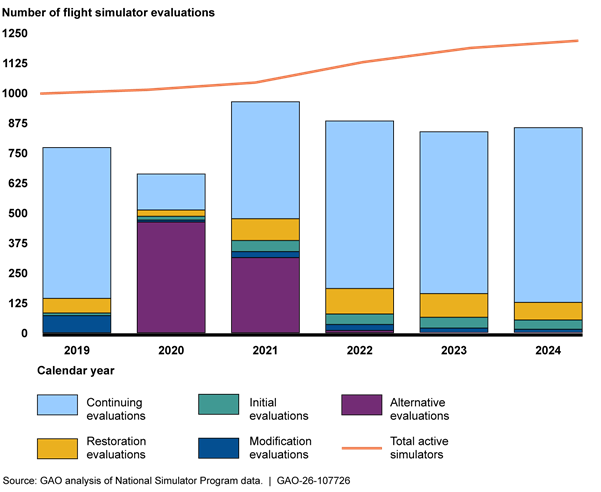
Note: When a sponsor first submits a simulator for qualification in an FAA-approved training program, NSP conducts an initial evaluation to ensure compliance with FAA regulations. Following initial qualification, NSP conducts periodic continuing evaluations of simulators, to ensure ongoing compliance. NSP conducts modification evaluations when sponsors make significant changes to their simulators. If a simulator loses its qualification, then NSP may conduct a restoration evaluation. NSP developed alternative, virtual evaluations during the COVID-19 pandemic to use when on-site visits were not possible; NSP no longer conducts these types of evaluations.
As shown in figure 3, NSP conducts five principal types of simulator evaluations—initial, continuing, modification, restoration, and alternative—each serving a distinct oversight function.
Initial evaluations. Pursuant to FAA regulations, a sponsor must submit a request to FAA to evaluate a simulator for initial qualification for use in an FAA-approved training program.[20] These evaluations typically involve a 3-day, on-site visit by a team of NSP inspectors and engineers. According to NSP officials, during this time, the team conducts extensive testing to confirm that the simulator accurately replicates the flight and ground-handling characteristics of the aircraft it is modeled after. If the team finds performance discrepancies during the evaluation, sponsors are expected to resolve them—ideally while the team is still on site. NSP officials told us that once the evaluation is complete, NSP staff prepare a comprehensive report, provide instructions for resolving any outstanding issues, and, when appropriate, issue a Statement of Qualification that officially certifies the simulator for training use. From 2019 through 2024, approximately 450 of the evaluations that NSP conducted were initial evaluations.
Continuing evaluations. Pursuant to FAA regulations, following initial qualification, each simulator is to undergo periodic continuing evaluations to ensure ongoing compliance with training, evaluation, or flight experience requirements.[21] According to NSP officials, these evaluations, which typically take about a day, are scheduled every 12 to 36 months, depending on the simulator’s past performance and risk profile. Officials told us that during a continuing evaluation, NSP inspectors review sponsor-reported discrepancies, including any item found to be missing, malfunctioning, or inoperative. NSP inspectors also conduct performance testing and verify selected test results to confirm that the simulator remains in regulatory compliance with Part 60 requirements. From 2019 through 2024, over 3,300 of the evaluations that NSP conducted were continuing evaluations.
Modification evaluations. NSP conducts modification evaluations when sponsors make significant changes to their simulators, such as hardware upgrades and software revisions. According to FAA guidelines, similar to initial evaluations, simulator sponsors must submit a request to FAA for a modification evaluation.[22] According to NSP officials, these evaluations ensure that changes do not adversely affect simulator fidelity or training reliability. From 2019 through 2024, 160 of the evaluations that NSP conducted were modification evaluations.
Restoration evaluations. According to FAA regulations, a simulator’s qualification is automatically lost when any of the following occurs: (1) the simulator is not used in the sponsor’s FAA-approved flight training program in accordance with NSP requirements and the sponsor does not obtain and maintain a specified written statement from a qualified pilot regarding the simulator’s performance and handling qualities; (2) the simulator is physically moved from one location and installed in a different location, regardless of distance; (3) the simulator is not inspected as part of the continuing evaluation requirements; or (4) the master qualification test guide is missing or otherwise not available and a replacement is not made within 30 days.[23] In such cases, NSP must conduct an evaluation to restore the simulator’s qualification, or the responsible Flight Standards office advises the sponsor that an evaluation is not necessary.[24] From 2019 through 2024, just over 200 of the evaluations that NSP conducted were restoration evaluations.
Alternative evaluations. A large portion of the evaluations that NSP conducted in 2020 and 2021 were alternative evaluations. During the COVID-19 pandemic, NSP developed alternative evaluations to accommodate situations in which on-site visits were not possible. NSP officials told us that these remote evaluations, conducted via video conferencing and digital documentation, allowed NSP to maintain oversight and qualification processes with minimal disruption. NSP no longer conducts alternative evaluations for simulators. From 2019 through 2024, 785 of the evaluations that NSP conducted were alternative evaluations.
NSP Extended Evaluation Intervals to Meet Increased Demand
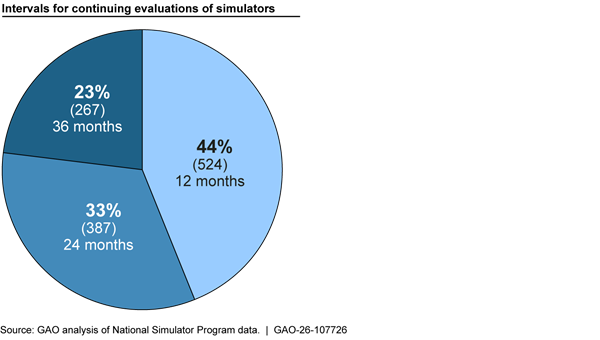
NSP has developed and implemented strategies to meet the increased demand for simulator evaluations with staffing levels that have remained steady. According to NSP officials, in 2019, NSP implemented the Extended Evaluation Interval (EEI) program as a key strategy to manage the increased demand for simulator evaluations. According to NSP’s standard operating procedures, this program allows NSP to extend continuing evaluation intervals from the standard 12 months to up to 36 months for specific sponsors and simulators that demonstrate consistent, high-quality performance. However, if a simulator in the EEI program performs poorly, NSP can compress the timeline for subsequent evaluations to address increased risk, according to NSP officials. For example, a simulator evaluated every 24 months that performs poorly may be put on a 12-month interval, or a simulator evaluated every 12 months that performs poorly may be put on a 6-month interval. According to NSP officials, because the regulatory limit for the EEI program is 36 months, they do not plan to extend evaluation intervals beyond that time frame. See figure 4 for more information on the intervals for continuing evaluations of simulators.
Figure 4: Intervals for the Federal Aviation Administration National Simulator Program’s Continuing Evaluations of Simulators, as of December 2024
In addition to the EEI program, NSP implemented several other strategies to meet the increased demand for simulator evaluations. These strategies include using a 3-month grace period to more evenly distribute scheduled evaluations and partnering with regional FAA offices to conduct some continuing evaluations for flight training devices. We discuss these additional strategies in further detail later in the report.
NSP Has Not Communicated with Sponsors About Its Process for Making EEI Program Determinations
NSP officials and multiple sponsors we interviewed said that the EEI program was a valuable tool for balancing oversight responsibilities and resource constraints. However, NSP’s process for making EEI program determinations—specifically, for determining the eligibility of simulators for inclusion in the EEI program, and the length of time between evaluations of simulators in the program—does not include communication with sponsors. More than half of the sponsors cited this lack of communication as a risk or concern.
The EEI program is part of a broader risk-based oversight strategy and uses performance history to determine whether specific simulators are eligible for inclusion, according to NSP officials.[25] Following the program’s implementation in 2019, NSP finalized internal standard operating procedures in January 2020 to guide EEI determinations. These procedures require simulators to have undergone at least one continuing evaluation and also include detailed criteria, based on a simulator’s performance in evaluations, for assessing simulator reliability and operational risk.[26] Officials stated that they assign each simulator a risk-based, cumulative score, based on the number of discrepancies, the severity of the discrepancies, and the overall performance of the sponsor across its simulators. According to NSP officials, this approach addresses short-term fluctuations and highlights the longer-term trend of a simulator. The score NSP assigns a simulator determines whether NSP includes it in the EEI program and, if so, the appropriate evaluation interval for the simulator. According to NSP officials, they have shifted from using older historical data to using simulators’ more recent performance in evaluations, with a focus on the last three to five evaluations.
However, in our interviews with simulator sponsors, more than half raised concerns related to NSP’s level of communication with them during its process of determining whether to include simulators in the EEI program and the length of time between evaluations of those simulators. Specifically, six of the 10 sponsors we interviewed expressed concerns about a lack of communication and transparency, while one sponsor characterized NSP’s communication as effective.[27]
The six sponsors that expressed concerns about NSP’s level of communication cited several specific issues and identified the need for NSP to provide more information about the EEI program, to ensure the continued effectiveness of NSP’s evaluations.
· Two of these sponsors told us that NSP’s lack of communication when making EEI determinations could result in potential safety issues. One sponsor stated that it had requested NSP remove its simulators from the EEI program, citing a desire for increased NSP oversight. This sponsor was concerned that longer evaluation intervals could result in fewer opportunities for meaningful feedback from NSP. NSP officials told us they would not consider such requests, because the purpose of the EEI program is to reduce the number of simulators that NSP staff must evaluate each year, given their current staffing level. The other sponsor said the inclusion of its simulators in the EEI program had prompted it to increase the number of internal evaluations it conducted due to concerns about reduced external oversight, which could erode overall safety standards. Neither sponsor reported having an opportunity to share its feedback with NSP prior to the EEI determinations for their simulators.
· Two of these sponsors said they did not have sufficient opportunity to communicate with NSP about the accuracy of the information NSP used to make EEI determinations. One sponsor told us that some of the evaluation findings NSP used to assign the cumulative score and make the EEI determination were incorrect, and that NSP did not change the cumulative score after its initial determination. This sponsor said the EEI process was not only unclear but significantly flawed, because if it is discovered that one or more of the findings was an error or corrected during the evaluation, NSP does not recalculate the score. The sponsor said NSP should have a process that enables sponsors to provide input after the evaluation, to ensure NSP uses accurate information in its determinations. The other sponsor said NSP had not communicated regarding inconsistencies in how it assesses discrepancies in the data. This sponsor said that minor discrepancies in evaluation data or incorrect data entries could lead NSP to exclude a simulator from the program, and that improved communication with sponsors could resolve such issues proactively and ensure NSP uses accurate information in its EEI determinations.
· Four of these sponsors said they were unclear on how NSP evaluates simulators for inclusion in the EEI program and on the criteria NSP uses to make such determinations. For example, one sponsor said NSP should release a guidance bulletin that includes information on the EEI process and could leverage the Simulator Technical Issues Group to develop it. Another sponsor suggested that NSP improve its communication by providing quarterly or yearly email updates about the EEI program to sponsors. Such efforts could help sponsors better collaborate with NSP in the process of qualifying flight simulators and ensure the simulators continue to accurately replicate the aircraft they simulate.
The sponsor that told us NSP communicated EEI’s program goals effectively cited NSP’s presentation to the Simulator Technical Issues Group prior to the program’s implementation. In this presentation, NSP provided an overview of the EEI program, including a review of its process for determining eligibility and length of intervals. Since that time, NSP has made changes to the EEI program, including extending continuing evaluations up to 36 months, but has not provided similar presentations on those updates.
According to federal internal control standards, agencies are expected to establish open, two-way communication channels to ensure the exchange of quality information. Such communication helps agencies obtain information needed to achieve their objectives, identify and respond to risks, and make informed decisions. The internal control standards also state that management should communicate with external parties, as necessary, to obtain quality information and help achieve agency objectives.[28]
NSP officials told us that NSP unilaterally makes EEI determinations, without any sponsor influence or input. The officials stated that they do not consider sponsor input necessary, as they make EEI determinations solely based on the performance of the simulator and of its sponsor. Moreover, they said that NSP emphasizes open communication during evaluations after it has made the EEI determination, and that sponsors can raise concerns at that time; that interested sponsors can request information from, or a consultation with, NSP regarding the EEI program; and that they have generally received positive informal feedback from sponsors about the program.
Nonetheless, by developing and implementing a mechanism to communicate with and receive timely feedback from sponsors regarding EEI determinations, NSP can make more informed decisions about simulator eligibility and evaluation intervals, and better identify and address potential risks associated with those determinations. Moreover, by doing so, NSP can help sponsors better understand NSP’s decisions and collaborate with NSP in its efforts to use the EEI program to balance oversight responsibilities and resource constraints.
FAA Has Taken Multiple Steps to Learn About Technological Advances in Flight Simulators
Key Technological Advances That Affect Simulators Include Powered-Lift Aircraft and Extended Reality
FAA has started to learn more about two technological advances—powered-lift aircraft and extended reality—that FAA and sponsors told us would be key to future flight simulation.
· The first technological advance involves the development of simulators for new types of aircraft, such as powered-lift aircraft, which are hybrids of fixed-wing aircraft and helicopters. For example, one manufacturer is currently designing a powered-lift aircraft that combines the vertical takeoff and low-speed maneuver capabilities of a helicopter with the speed and range of a turboprop airplane. To train pilots to safely operate these aircraft, simulator manufacturers will need to design new simulators that replicate the performance of these aircraft.
· The second advance involves new technologies that can be used with existing simulators, such as extended reality technologies. Extended reality technologies integrate the digital world and the real world to support user engagement. Extended reality applications often include hardware (such as a head-mounted display), software, and user interaction with the physical or virtual environment.[29] For example, representatives from one industry sponsor told us they are using extended reality technologies in flight training devices to help pilots “see” virtual smoke on the flight deck and experience how their visibility would be reduced. Pilots would not be able to practice this scenario in traditional simulators because it would not be safe to fill those devices with smoke, according to that sponsor.
FAA Has Conducted Research and Taken Other Steps to Learn About Technological Advances That Affect Simulators
FAA has taken multiple steps to learn about technological advances that affect simulators, including powered-lift aircraft and extended reality. These steps include implementing a process to develop standards for powered-lift simulators, conducting and funding research about the use of extended reality technologies, and engaging with stakeholders in committees and working groups.
We previously reported that experts and scholars have found that regulators need time to build knowledge of emerging technologies, and to understand any implications those technologies may pose for existing regulations.[30] FAA has taken the steps described below to build its knowledge of powered-lift aircraft and extended reality technologies before it develops new simulator standards for these technologies, which are not yet included in Part 60, according to FAA officials.[31]
Implementing a process to develop standards for powered-lift simulators. FAA has implemented an iterative 10-year special regulatory process to develop standards for powered-lift simulators and to gather data about the operation of early models.[32] New standards are needed because Part 60 includes distinct standards for fixed-wing aircraft and for helicopters, but not for hybrid powered-lift aircraft, according to FAA officials. Officials told us that throughout the special regulatory process, they will collaborate with manufacturers that are designing powered-lift aircraft models to gather data about the operation of early models and to develop draft qualification standards.[33] During the iterative process, FAA plans to publish manufacturers’ proposed qualification standards for new powered-lift simulators in the Federal Register, to solicit public comments from a wider set of stakeholders. Those comments will be used to inform manufacturers’ efforts to refine their proposed standards. The goal is for NSP and industry stakeholders to come to consensus about the new powered-lift simulator standards that FAA will add to a future version of Part 60, according to FAA officials.
Conducting and funding research about the use of extended reality technologies. FAA has conducted and funded research about simulators, in part to learn more about extended reality technologies that sponsors are beginning to use to enhance training opportunities for pilots. Since extended reality technologies are still evolving, it would be premature to update the simulator standards in Part 60 at this time, according to FAA. Instead, FAA has used the deviation authority in Part 60 to give the agency the time and flexibility it needs to test innovations in simulators—such as extended reality technologies—and to evaluate the benefits and limitations associated with their use.
FAA has conducted some research about extended reality technologies. For example, FAA installed two helicopter simulators that use extended reality in one of its research and development centers. FAA is studying those simulators over a 4-year period—from fiscal years 2024 to 2028—to determine how the use of extended reality headsets compares with the training experience in a full-flight simulator, according to officials and FAA’s National Aviation Research Plan.[34]
FAA has also funded research it conducts in collaboration with external entities to learn more about the potential benefits and limitations of using extended reality technologies in simulators. For example, the purpose of one such study is to help FAA and NSP gather more information about the use of extended reality, which can inform NSP’s future guidance, potential updates to Part 60, and NSP’s decisions about whether to use deviation authority to qualify simulators that use extended reality technologies, according to FAA.[35]
Findings from an FAA-funded study outlined both limitations and potential benefits of using extended reality technologies in simulators.[36] One limitation that researchers identified was that many pilots experience motion sickness when using extended reality. Potential benefits that researchers identified included (1) allowing pilots to practice emergency procedures that would be too dangerous to execute in a flight simulator (e.g., fire in the cockpit); (2) offering opportunities for pilots to participate in joint training exercises, even if they are in different physical locations; and (3) making training more cost-effective by shifting more training on basic procedures to flight training devices that use extended reality, thus freeing up full-flight simulators for more complex types of training.
Engaging with stakeholders in committees and working groups. FAA has also learned about emerging technological advances that could affect simulators by engaging with stakeholders in a range of committees and working groups. For example:
· FAA and industry sponsors have continued to co-lead the Air Carrier Training Aviation Rulemaking Committee and a simulator-focused working group within the committee. This collaboration allows FAA to solicit industry feedback about potential new rules or updates to existing rules, including Part 60. For example, when FAA updated Part 60 in a 2016 final rule, the rule noted that FAA’s updates to Part 60 addressed, among other things, recommendations about simulator fidelity made by an aviation rulemaking committee.[37] More recent Air Carrier Training Aviation Rulemaking Committee recommendations, published in 2025, encouraged FAA to update its regulations and guidance to enable innovations in simulators—and in the types of training allowed on those devices—by expanding the use of both the deviation authority and international standards to qualify simulators and to determine how those simulators can be used in pilot training.
· FAA has continued to coordinate with international organizations, such as ICAO and the European Union Aviation Safety Agency (EASA), to discuss how emerging technologies could be incorporated into simulator standards, according to an FAA official.[38] These conversations have helped FAA learn more about related international efforts, such as EASA’s special process to qualify flight simulators that use extended reality technologies, according to an FAA official.
· FAA has continued to interact with sponsors in simulator-focused industry groups, such as the Flight Simulator Engineering and Maintenance Committee and the Simulator Technical Issues Group, in part to learn more about how sponsors are using emerging technologies in their simulators, according to FAA officials.[39]
NSP Has Identified Staffing and Skills Gaps but Has Not Addressed All Mission-Critical Skills Gaps
NSP Has Identified Staffing and Mission-Critical Skills Gaps
We previously reported that organizations should regularly assess staffing levels and staff skill sets and identify any potential gaps to ensure that staff have the critical skills needed to meet the organization’s present and future goals.[40] During this review, we examined the extent to which NSP has implemented those workforce planning principles. We found that NSP has identified gaps in staffing levels and mission-critical skills, as described below.
Assessing Staffing Levels and Identifying Gaps
NSP, which is a component of Flights Standards, works collaboratively with Flight Standards to regularly assess staffing levels and identify potential gaps. Flight Standards is responsible for managing a staffing model that projects the number of inspectors needed to ensure FAA can meet its safety goals. The model uses data inputs, such as historical work activities and work hours, as a baseline for future staffing requirements.
The staffing model is not specifically tailored to the needs of NSP. However, officials told us the staffing model process includes feedback loops to gather information from program managers. According to NSP officials, they meet with the Flight Standards staffing team every 6 months to review the staffing model estimates, identify gaps, and provide feedback if staffing levels are not sufficient for simulator oversight.
Assessing Skill Sets and Identifying Gaps
During this review, we found that NSP has identified four skills gaps related to three mission-critical skills: conducting initial evaluations to qualify simulators, conducting continuing evaluations as part of NSP’s oversight efforts, and developing standards that guide the simulator evaluation process. Although NSP does not formally assess skills in the same way that it regularly assesses staffing levels, it has periodically assessed skills to identify the gaps described below.
The first skills gap NSP identified relates to the variation in knowledge and prior experience among newly hired inspectors and engineers, who are responsible for conducting initial and continuing evaluations. NSP first assesses the skills of new staff during the hiring phase, when NSP compares candidates’ skill sets with those outlined in the position descriptions for inspectors and engineers. Although NSP strives to hire candidates with broad aviation experience or simulator-specific expertise, officials told us that new staff may have simulator-related knowledge in some areas but not others, such as conducting simulator evaluations.
The second skills gap NSP identified relates to the variation in knowledge of different types of aircraft among its inspectors. Inspectors are also pilots, which means they hold type ratings that qualify them to pilot specific types of aircraft, based on their prior experience. Tracking this individual and collective expertise is critical, because an important part of inspectors’ responsibilities during the evaluation process is to determine the extent to which simulators replicate specific aircraft, according to NSP officials. NSP tracks inspectors’ type ratings on an internal spreadsheet and updates it when inspectors earn additional type ratings or as new hires join the staff, according to officials and our review of the spreadsheet. NSP uses the spreadsheet when scheduling evaluations to identify inspectors with expertise specific to the simulator that is to be evaluated. NSP can also use the spreadsheet to identify potential gaps in inspectors’ collective knowledge about the simulators in the fleet, according to officials.
For NSP to be able to assign inspectors with relevant type ratings to evaluations for all qualified simulators in the national fleet, NSP inspectors would need to collectively hold about 110 type ratings for the more than 230 aircraft models that simulators replicate, according to our analysis of FAA data on type ratings represented in the national fleet of simulators. However, inspectors collectively hold about 35 type ratings, based on our analysis. Although those 35 type ratings cover the most common aircraft in the fleet—including Boeing and Airbus narrow-body passenger airplanes and Embraer regional jets—we found inspectors do not have expertise specific to each aircraft model that qualified simulators replicate. We discuss actions NSP takes to address this gap in the next section.
The third skills gap NSP identified relates to emerging technologies. NSP officials told us that staff do not currently have expertise in emerging technologies because those technologies are so new. Although NSP has qualified two simulators that use extended reality technologies, it used the deviation authority to do so, rather than standards that are specific to extended reality. However, after standards for powered-lift simulators and simulators that use extended reality are developed, and the number of simulators that use those technologies increases, NSP staff will need to learn how to appropriately evaluate those new simulators during initial and continuing evaluations.
The fourth skills gap NSP identified relates to standards development. Because NSP’s simulator standards guide both initial and continuing evaluations, developing effective simulator standards is essential to NSP’s ability to fulfill its mission, according to NSP officials. They told us that standards development skills are particularly important because Part 60 needs to be updated to ensure that simulator standards reflect emerging technologies.[41] Yet, maintaining this expertise has been a persistent challenge, in part because FAA has not historically prioritized the standards development skill set or opened new positions that would address this gap, according to an NSP official.
NSP Has Addressed Staffing Gaps but Has Not Addressed All Mission-Critical Skills Gaps
We previously reported that organizations should develop and implement strategies to address any identified gaps in staffing levels and skill sets.[42] During this review, we examined the extent to which NSP has implemented those workforce planning principles. We found that although NSP has addressed staffing gaps and some skills gaps that it identified, it has not addressed all mission-critical skills gaps, as described below.
Addressing Staffing Gaps
During this review, we found that NSP has developed and implemented three strategies to address gaps in staffing levels, as the number of simulators has outpaced the number of its staff. First, as discussed above, NSP implemented the EEI program to reduce the number of simulator evaluations its inspectors must conduct annually by increasing the intervals between continuing evaluations for high-performing simulators. Second, NSP uses a 3-month grace period—a flexibility included in Part 60—to more evenly distribute scheduled evaluations throughout the year, because the distribution of evaluations has been uneven in the past, according to NSP officials.[43] Third, NSP continues to partner with regional FAA offices, whose staff conduct some continuing evaluations for flight training devices, which are less complex than full-flight simulators. By implementing these strategies, NSP has been able to conduct all required evaluations before simulator qualifications expire, despite the increased number of simulators, according to NSP officials.
Although NSP has regularly assessed its staffing levels and developed and implemented strategies to address identified gaps, NSP officials told us that insufficient staffing levels could pose a risk to NSP’s ability to conduct all future evaluations required by Part 60. As discussed above, staffing levels have remained steady while the number of simulators has grown by more than 500 percent since 1990. If the number of simulators continues to increase, it will be important for NSP to continue its practice of regularly assessing staffing levels and addressing any future staffing gaps.
Addressing Skills Gaps
To address skills gaps related to variation in knowledge and experience among newly hired inspectors and engineers, NSP offers training to ensure all new inspectors and engineers have the same foundational knowledge about simulator standards and the evaluation process, according to NSP training procedures and officials. NSP training includes (1) an advanced simulator evaluation course for new hires,[44] and (2) on-the-job training programs that pair new inspectors or engineers with more experienced peers in their respective roles. The experienced staff members mentor new inspectors and engineers and provide them with feedback that will support their development, according to NSP officials.
Through this training, new inspectors and engineers gradually assume increasing responsibility, according to NSP officials. After new inspectors complete the advanced simulator evaluation course, they spend 3 to 6 months in an on-the-job training program that prepares them to conduct continuing evaluations. After new inspectors independently conduct continuing evaluations of different types of simulators for at least 1 year, they begin another on-the-job training program that prepares them to conduct initial evaluations. New engineering hires also complete an on-the-job training program that focuses on engineers’ responsibilities during the initial evaluation, according to NSP training procedures. The speed at which new hires complete the on-the-job training programs for initial and continuing evaluations depends on their previous experience and on their performance in the programs, according to NSP officials.
During this review, we found that NSP has developed and implemented four strategies to address skills gaps related to varied knowledge of aircraft types among inspectors. First, during both initial and continuing evaluations, Part 60 requires sponsors to provide pilots who are knowledgeable about the aircraft to help the inspector determine whether the simulator accurately replicates that aircraft.[45] Second, NSP might partner with FAA field offices, whose staff may be able to provide technical expertise specific to a particular aircraft during an evaluation, according to officials. Third, NSP allows inspectors to evaluate simulators even if they do not have familiarity with the replicated aircraft, because inspectors’ most important skill is their broader ability to evaluate simulators against the standards outlined in Part 60, according to officials. Fourth, NSP hires strategically to fill identified gaps in expertise related to specific types of aircraft. For example, if an inspector with helicopter expertise retired, NSP officials told us they would try to hire someone with helicopter expertise to fill the position.
Although NSP has taken steps to address some skills gaps, we found that it has not developed and implemented a strategy to address other mission-critical skills gaps. As described above, one remaining skills gap is that NSP staff will need to learn how to appropriately evaluate powered-lift simulators and simulators that use extended reality during initial and continuing evaluations after standards for those technologies are developed and finalized. In addition, NSP has not addressed its gap in standards development, which requires a specialized skill set. As NSP takes preliminary steps to update Part 60, it will need expertise in standards development to appropriately address the emerging technologies described above in the updated standards, according to NSP officials. However, NSP has not historically prioritized the standards development skill set or opened new positions that would address this gap, according to an official. In addition, NSP must use its available staff to conduct the increased number of simulator evaluations required by Part 60, according to officials.
These mission-critical skills gaps pose risks to NSP’s ability to meet its present and future goals. By developing and implementing a strategy to address these mission-critical skills gaps, NSP would be better positioned to develop standards that address emerging technologies in simulators, and then to train its staff to use those new standards to effectively evaluate powered-lift simulators and simulators that use extended reality technologies.
Conclusions
NSP plays a critical role in aviation safety by ensuring the quality and reliability of flight simulators that airlines and flight schools use to train pilots. As the number of simulators continues to grow, NSP’s staffing levels have remained steady, and NSP has used the EEI program to help it keep pace with the increased demand for simulator evaluations. By communicating with and receiving feedback from sponsors about EEI program determinations, NSP can make more informed decisions about simulator eligibility and evaluation intervals, and better identify and address risks associated with those determinations. In addition, by developing and implementing a process to address mission-critical skills gaps, NSP can help ensure its staff has the requisite skills to carry out its mission, especially as technology evolves and the number of simulators may continue to grow.
Recommendations for Executive Action
We are making the following two recommendations to FAA:
The FAA Administrator should ensure that NSP develops and implements a mechanism to communicate with and receive feedback from sponsors about its process for determining which simulators are eligible for inclusion in its EEI program. (Recommendation 1)
The FAA Administrator should ensure that NSP develops and implements a process to address all identified skills gaps that pose a risk to NSP’s ability to meet its mission. (Recommendation 2).
Agency Comments
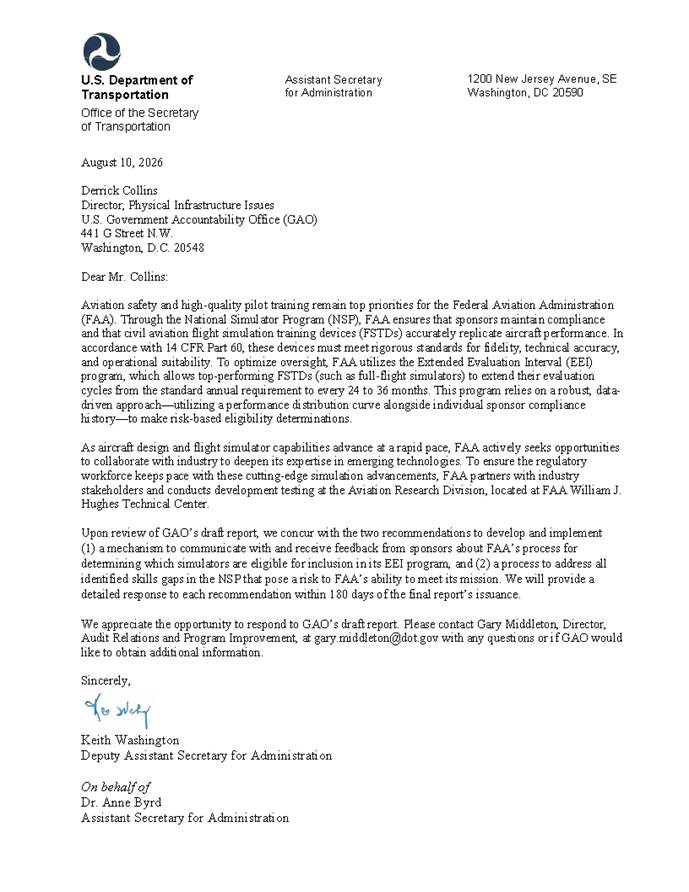
We provided a draft of this report to DOT for review and comment. In its comments, reproduced in appendix I, DOT agreed with our two recommendations.
We are sending copies of this report to the appropriate congressional committees, the Secretary of Transportation, the Administrator of FAA, and other interested parties. In addition, the report is available at no charge on the GAO website at https://www.gao.gov.
If you or your staff have any questions about this report, please contact me at collinsd@gao.gov. Contact points for our Offices of Congressional Relations and Media Relations may be found on the last page of this report. GAO staff who made key contributions to this report are listed in appendix II.
Derrick Collins
Director, Physical Infrastructure
GAO Contact
Derrick Collins, collinsd@gao.gov
Staff Acknowledgments
In addition to the contact named above, Vashun Cole (Assistant Director), Ray Griffith (Analyst in Charge), Melanie Diemel, Elizabeth Fan, Peggie Garcia, Geoff Hamilton, Rich Hung, Laurel Voloder, and Elizabeth Wood made key contributions to this report.
The Government Accountability Office, the audit, evaluation, and investigative arm of Congress, exists to support Congress in meeting its constitutional responsibilities and to help improve the performance and accountability of the federal government for the American people. GAO examines the use of public funds; evaluates federal programs and policies; and provides analyses, recommendations, and other assistance to help Congress make informed oversight, policy, and funding decisions. GAO’s commitment to good government is reflected in its core values of accountability, integrity, and reliability.
Obtaining Copies of GAO Reports and Testimony
The fastest and easiest way to obtain copies of GAO documents at no cost is through our website. Each weekday afternoon, GAO posts on its website newly released reports, testimony, and correspondence. You can also subscribe to GAO’s email updates to receive notification of newly posted products.
Order by Phone
The price of each GAO publication reflects GAO’s actual cost of production and distribution and depends on the number of pages in the publication and whether the publication is printed in color or black and white. Pricing and ordering information is posted on GAO’s website, https://www.gao.gov/ordering.htm.
Place orders by calling (202) 512-6000, toll free (866) 801-7077,
or
TDD (202) 512-2537.
Orders may be paid for using American Express, Discover Card, MasterCard, Visa, check, or money order. Call for additional information.
Connect with GAO
Connect with GAO on X,
LinkedIn, Instagram, and YouTube.
Subscribe to our Email Updates. Listen to our Podcasts.
Visit GAO on the web at https://www.gao.gov.
To Report Fraud, Waste, and Abuse in Federal Programs
Contact FraudNet:
Website: https://www.gao.gov/about/what-gao-does/fraudnet
Automated answering system: (800) 424-5454
Media Relations
Sarah Kaczmarek, Managing Director, Media@gao.gov
Congressional Relations
David A. Powner, Acting Managing Director, CongRel@gao.gov
General Inquiries
[1]As part of FAA’s reorganization efforts in 2021, NSP became housed within FAA’s Air Transportation Division’s Training and Simulation Group, which is part of the larger Flight Standards Division within FAA Office of Aviation Safety. In this report, we use the term “NSP officials” to refer both to FAA staff who managed NSP before it was reorganized into the Training and Simulation Group and are not currently with the Training and Simulation Group, and to Training and Simulation Group officials who currently manage NSP.
[2]A simulator sponsor is an organization or entity that owns or operates flight simulation training devices and is responsible for ensuring their compliance with FAA’s regulations and standards. Airlines and flight schools use simulators for both commercial and general aviation aircraft. Commercial aviation includes operations from network and low-cost commercial passenger airlines, regional airlines, private operators, and airlines that offer charter and on-demand services. General aviation includes noncommercial operations that range from flights for personal pleasure to worldwide corporate flights.
[3]The EEI program allows simulator evaluation intervals to be extended from the standard 12 months up to 36 months, for simulators that have been adequately maintained and that demonstrate consistent, high-quality performance.
[4]FAA Reauthorization Act of 2024, Pub. L. No. 118-63, § 325(d), 138 Stat. 1025, 1085.
[5]A simulator sponsor is an organization or entity that owns or operates flight simulation training devices and is responsible for ensuring their compliance with FAA’s regulations and standards. Since all stakeholders we interviewed are sponsors of flight simulators, we refer to them as “sponsors” for the remainder of the report.
[6]We interviewed the following sponsors: Airbus, Alaska Airline, American Airlines, Avenger Flight Group, CAE, FedEx Corporation, FlightSafety International, Pan Am Flight Academy, Republic Airways, and United Airlines.
[7]GAO, Standards for Internal Control in the Federal Government, GAO‑25‑107721 (Washington, D.C.: May 2025). See also Government Performance Management: Leading Practices to Enhance Interagency Collaboration and Address Crosscutting Challenges, GAO‑23‑105520 (Washington, D.C.: May 24, 2023).
[8]These regulations and documents include Part 60, which prescribes the rules governing the initial and continuing qualification and use of all aircraft flight simulation training devices used for meeting training, evaluation, or flight experience requirements of this chapter for flight crewmember certification or qualification. FAA’s National Aviation Research Plan (FY 2024-2028); Aviation Safety Research & Development Project Plan for the FAA Immersive Flight Simulation Project; and preliminary findings in Modern Training Practices: Studying the Use of Virtual Reality for Training Procedures in Flightcrew Training, FAA CRA 692M151940002 (Dec. 1, 2023).
[9]Our prior work includes GAO, Human Capital: Key Principles for Effective Strategic Workforce Planning, GAO‑04‑39 (Washington, D.C.: Dec. 11, 2003); Aviation Safety: FAA’s Office of Aviation Safety Should Take Additional Actions to Ensure Its Workforce Has Needed Skills, GAO‑21‑94 (Washington, D.C.: Nov. 9, 2020); and FAA Workforce: Better Assessing Employees’ Skill Gaps Could Help FAA Prepare for Changes in Technology, GAO‑21‑310 (Washington, D.C.: May 13, 2021). FAA and NSP documents include those related to the Flight Standards staffing model, NSP staffing trends over time, NSP position descriptions, NSP simulator evaluation course materials, and NSP documents describing training requirements for staff.
[10]For relevant workforce planning principles, see GAO‑04‑39. We determined that two of the five strategic workforce planning principles outlined in GAO‑04‑39 were relevant to this review based on the following factors: (1) The second and third principles are most closely aligned with our mandate to report on NSP’s staffing and skills gaps. (2) Given NSP’s small size and limited scope, it is not responsible for implementing all five strategic workforce planning principles at FAA. The second and third principles are directly applicable to NSP’s workforce and to the workforce planning processes that NSP can control. (3) Our analysis focused on NSP to avoid duplicating our prior work with open recommendations for FAA to assess, on a recurring basis, organization-wide competency gaps for its inspector and engineer workforces and training curricula for these workforces; and to ensure that planned skills gap assessments, conducted in coordination with FAA offices, are quantitative and include all mission-critical occupations. For more information regarding these recommendations, see GAO‑21‑94 and GAO‑21‑310.
[11]GAO, IT Workforce: Key Practices Help Ensure Strong Integrated Program Teams; Selected Departments Need to Assess Skill Gaps, GAO‑17‑8 (Washington, D.C.: Nov. 30, 2016). In this report, we generally use the terms “skills” or “skill sets” to refer to both skills and competencies. The Office of Personnel Management defines competencies as measurable patterns of knowledge, skills, abilities, behaviors, and other characteristics that an individual needs to perform work roles or occupational functions successfully.
[12]NSP qualifies active flight simulators by evaluating them based on established standards, according to FAA officials.
[13]See 14 C.F.R. Part 60, Appendix F.
[14]FAA also certifies Aviation Training Devices. FAA defines an Aviation Training Device as a training device other than a flight training device or full-flight simulator, that has been evaluated, qualified, and approved by FAA. FAA evaluates and approves Aviation Training Devices for training and testing, and it checks them for certificates and ratings. We do not include Aviation Training Devices as part of our review because they are outside our scope.
[15]71 Fed. Reg. 63392 (Oct. 30, 2006), Flight Simulation Training Device Initial and Continuing Qualification and Use.
[16]81 Fed. Reg. 18178 (Mar. 30, 2016), Flight Simulation Training Device Qualification Standards for Extended Envelope and Adverse Weather Event Training Tasks. For examples of NTSB accident reports that included simulator-related recommendations to FAA, see NTSB, Aircraft Accident Report: Loss of Control on Approach, Colgan Air, Inc., Operating as Continental Connection Flight 3407, Bombardier DHC-8-400, N200WQ, Clarence Center, New York, February 12, 2009 (Washington, D.C.: Feb., 2, 2010); and Aircraft Accident Report: Uncontrolled Flight Into Terrain, ABX Air (Airborne Express), Douglass DC-8-63, N827AX, Narrows, Virginia, December 22, 1996 (Washington, D.C.: July 15, 1997).
[17]See, 14 C.F.R. § 60.15(c)(5). In addition, these regulations specify that a request for a deviation may instead provide “sufficient justification” that the deviation will otherwise not adversely affect the fidelity and capability of the simulators evaluated and qualified under the deviation.
[18]In the 2016 final rule, FAA noted that the ability for FAA to recognize equivalent simulator evaluation standards issued by ICAO and national aviation authorities will support the qualification of simulators located in other countries and promote existing bilateral agreements, which may result in cost savings for simulator sponsors, manufacturers, and data providers. 81 Fed. Reg. 18178, 18205 (Mar. 30, 2016). FAA further noted that with simulators that are qualified by multiple national aviation authorities, the ability to recognize an equivalent international standard can reduce redundant testing requirements and documentation that would otherwise be needed to demonstrate compliance with multiple international standards. Id.
[19]Extended reality is an overarching term used to describe three types of technologies that connect the digital world and the real world: augmented reality, virtual reality, and mixed reality. Augmented reality overlays digital content onto real-world views, using smartphones, tablets, or special glasses. Virtual reality obscures the real world, immersing users in digital environments by using headsets. Mixed reality combines elements of virtual and augmented reality, to enable interaction between digital content and the real world.
[20]14 C.F.R. § 60.15.
[21]14 C.F.R. § 60.19.
[22]14 C.F.R. §§ 60.16, 60.23.
[23]14 C.F.R. § 60.27. The master qualification test guide is created during the initial evaluation of a flight simulator. This is the master document, as amended, to which flight simulator continuing evaluation test results are compared.
[24]14 C.F.R. § 60.27. In determining whether such an evaluation is not necessary, the responsible Flight Standards office is to consider factors including the number of continuing evaluations missed, the number of sponsor-conducted quarterly inspections missed, and the care that had been taken of the device since the last evaluation. 14 CFR § 60.27(c).
[25]According to FAA, the agency continues to evolve its overall approach to safety oversight. To best target its oversight priorities and resources, FAA uses a robust risk-based, data-supported oversight system.
[26]NSP considers the specific criteria to be sensitive information.
[27]While all 10 sponsors we interviewed provided information regarding their experiences working with NSP, three sponsor groups did not comment directly on NSP’s communication about the EEI program.
[29]Extended reality technologies are a subset of immersive technologies. Extended reality is an overarching term used to describe three types of technologies that connect the digital world and the real world: augmented reality, virtual reality, and mixed reality. Augmented reality overlays digital content onto real-world views, using smartphones, tablets, or special glasses. Virtual reality obscures the real world, immersing users in digital environments by using headsets. Mixed reality combines elements of virtual and augmented reality to enable interaction between digital content and the real world. For more information, see GAO, Immersive Technologies: Most Civilian Agencies Are Using or Plan to Use Augmented Reality, Virtual Reality, and More, GAO‑24‑106665 (Washington, D.C.: Aug. 8, 2024).
[30]GAO, Federal Regulation: Selected Emerging Technologies Highlight the Need for Legislative Analysis and Enhanced Coordination, GAO‑24‑106122 (Washington, D.C.: Jan. 25, 2024).
[31]Simulator standards for these technologies are also not addressed in international simulator standards, according to officials.
[32]In November 2024, FAA issued a final rule for powered-lift aircraft and simulators that adopted permanent amendments as well as a Special Federal Aviation Regulation (an interim rule to address a unique situation) for a period of 10 years. Among other things, the final rule outlined the application of FAA’s Special Federal Aviation Regulation (SFAR) process with respect to powered-lift operations. According to the 2024 final rule, FAA determined that a 10-year period is an appropriate length of time to collect operational data from powered-lift operations. The 2024 final rule additionally noted that the 10-year duration of the SFAR “does not mean that the FAA will not propose any updated regulations in the interim” and that “the FAA is not precluded from proposing updating regulations prior to the expiration of the SFAR.” 89 Fed. Reg. 92296 (Nov. 21, 2024).
[33]FAA’s November 2024 final rule noted that FAA would gather data throughout the 10-year special regulatory process about how powered-lift simulators perform during a range of training tasks, including takeoff, landing, hovering, and other flight maneuvers that are required for pilot training and qualification. 89 Fed. Reg. 92296 (Nov. 21, 2024). This final rule further provided that data from this 10-year period would be used to inform subsequent rulemaking to implement permanent amendments to FAA regulations. Id.
[34]Federal Aviation Administration, National Aviation Research Plan (FY 2025-2029) (Washington, D.C.: Oct. 9, 2024). The plan includes cost estimates for fiscal years 2025 to 2029 for the larger program that includes this research, System Safety Management/Terminal Area Safety. According to the plan, FAA’s fiscal year 2024 enacted budget for the larger program was $9,252,000.
[35]For example, one Immersive Flight Simulation research project was estimated to cost $1,305,000 from fiscal years 2024 to 2026, according to the FAA research project plan.
[36]Nguyen et al., Modern Training Practices: Studying the Use of Virtual Reality for Training Procedures in Flightcrew Training, a special report prepared at the request of the Federal Aviation Administration, December 2023.
[37]81 Fed. Reg. 18178 (Mar. 30, 2016).
[38]According to the publicly available bilateral agreement with EASA, FAA and EASA meet at least once annually. See Technical Implementation Procedures – Simulator (TIP-S) between the Federal Aviation Administration of the United States of America and the European Union Aviation Safety Agency of the European Union (Nov. 19, 2020).
[39]According to the Simulator Technical Issues Group chair, the Simulator Technical Issues Group meets twice annually.
[41]According to FAA officials, historically, FAA has developed its simulator standards in coordination with international stakeholders.
[43]According to Part 60, continuing qualification evaluations conducted in the 3 calendar months before or after the calendar month in which such continuing qualification evaluations are required will be considered to have been conducted in the calendar month in which they were required. 14 C.F.R. § 60.19 (b)(5). As a result, NSP is using the 3-month grace period flexibility to spread evaluations out more evenly.
[44]The advanced simulator course is a 2-week course that covers a range of topics related to simulator evaluation, including simulator hardware, motion systems, and flight testing, according to NSP documents.
[45]See 14 C.F.R. § 60.15 (Appendix A, section 11(l)); Appendix B, section 11(l); Appendix C, section 11(l); and Appendix D, section 11(l)), and 14 C.F.R. § 60.19 (Appendix A, section 14(d); Appendix B, section 14(d); Appendix C, section 14(d), and Appendix D, section 14(d)).