
Report to Congressional Requesters
United States Government Accountability Office
A report to congressional requesters
Contact: Mary Denigan-Macauley at DeniganMacauleyM@gao.gov
What GAO Found
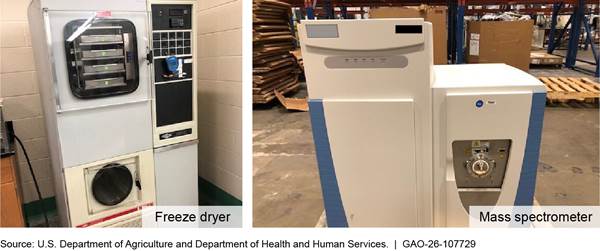
The Department of Health and Human Services (HHS) and the U.S. Department of Agriculture (USDA) sold 1,316 pieces of unneeded laboratory equipment in fiscal years 2022 through 2025. Of that 1,316, GAO identified nine pieces of equipment–freeze dryers and mass spectrometers–that were on the Commerce Control List and sold to individuals and companies in the U.S. and Canada, some of which appeared to be resellers. These items are subject to export controls because they could be used by certain countries of concern to develop biological weapons or to gain a military advantage.
GAO found that HHS and USDA, in selling the nine pieces of equipment, did not report to the General Services Administration (GSA) that the items were on the Commerce Control List, as required by federal regulations. GAO identified two reasons: HHS’s policy is silent on this requirement and GSA’s property management system does not have a standard approach, such as a specific field, for agencies to report this information. Until HHS revises its policy and GSA creates a standard approach, GSA and potential recipients may not know when items are subject to export controls, risking harm to national security.
GAO also found that HHS and USDA have not assessed the biosecurity risks associated with the disposal of its laboratory equipment. These risks include nefarious actors acquiring such items to create a biological weapon or obtain sensitive information from the equipment. This is because agency efforts have focused on decontamination of laboratory equipment, among other reasons. Regularly assessing the biosecurity risks and taking steps, as needed, to mitigate risks as part of HHS’s and USDA’s overall risk management efforts, could better position the agencies to prevent nefarious actors from procuring federal equipment. To illustrate risks, GAO used fictitious identities, including that of a nonprofit organization, to successfully acquire four pieces of HHS and USDA laboratory equipment that experts said could pose a biosecurity risk.
Why GAO Did This Study
Each year, HHS and USDA dispose of hundreds of pieces of unneeded laboratory equipment. Some of this equipment could potentially be used for malicious purposes. GSA handles the disposal process, which includes transferring it to other federal agencies or auctioning it to the general public, among other options. Certain high-risk items are identified on the Commerce Control List and require a license to be exported to certain countries to protect national security and public health.
GAO was asked to review sales of equipment that pose a risk. This report, among other things, examines the extent to which the selected agencies (1) sold controlled laboratory equipment and did so in accordance with federal requirements, and (2) have assessed the risks associated with the sale of federal laboratory equipment.
GAO reviewed GSA data for fiscal years 2022-2025 on sales of HHS and USDA laboratory equipment. GAO also used fictitious identities to attempt to acquire federal laboratory equipment, reviewed relevant regulations, and interviewed agency officials. GAO also visited a federal laboratory being decommissioned to review how the equipment will be disposed of.
What GAO Recommends
GAO is making four recommendations related to the disposal of laboratory equipment, including that HHS revise its policy to require staff to identify items on the Commerce Control List; GSA develop a standard approach for identifying items on the list; and HHS and USDA assess and address the biosecurity risks of selling laboratory equipment. The agencies generally agreed with the recommendations and indicated plans to implement them.
|
This is a work of the U.S. government and is not subject to copyright protection in the United States. The published product may be reproduced and distributed in its entirety without further permission from GAO. However, because this work may contain copyrighted images or other material, permission from the copyright holder may be necessary if you wish to reproduce this material separately. |
|
Abbreviations |
|
|
|
|
|
DHS |
Department of Homeland Security |
|
FBI |
Federal Bureau of Investigation |
|
GSA |
General Services Administration |
|
HHS |
Department of Health and Human Services |
|
USDA |
U.S. Department of Agriculture |
September 1, 2026
Congressional Requesters
The Department of Health and Human Services (HHS) and the U.S. Department of Agriculture (USDA) own and operate federal research laboratories. These include high containment laboratories that use equipment to conduct research on pathogens that pose a significant risk to public and animal health, and the economy. Each year, these agencies identify hundreds of pieces of biological laboratory equipment as no longer needed. The process for disposing of unneeded laboratory equipment is largely governed by the Federal Management Regulation, issued by the General Services Administration (GSA).[1] During the GSA disposal process, agency options include transferring unneeded equipment to other federal agencies, donating it to eligible non-federal recipients, such as local governments and nonprofits, or selling it to the general public. The Federal Management Regulation also allows agencies to destroy or recycle equipment when warranted, such as when it no longer holds value.
While the donation and sale of unneeded federal laboratory equipment may increase access to resources that are needed to conduct scientific research, it may also present biosecurity risks. Biosecurity aims to prevent unauthorized access, loss, theft, misuse, diversion, release, or weaponization of biological materials and technology, including equipment, according to the World Health Organization.[2] Many types of laboratory equipment are considered to be “dual-use,” which means that while this equipment has legitimate applications, it also has the potential to be misused by nefarious actors for malicious purposes, such as biological terrorism or warfare. The 2022 National Biodefense Strategy establishes that biological threats are among the most serious threats facing the United States and the international community.[3] This strategy states that the United States must address the risk of intentional misuse of advances in biotechnology and threats posed by terrorist groups or adversaries seeking to use biological weapons. To this end, one of the strategy’s five goals states that the United States will strengthen biosecurity to prevent both state and nonstate actors from obtaining equipment for nefarious purposes.
The Department of Commerce (Commerce) maintains the Commerce Control List, a list of certain types of laboratory equipment, among other items, for which licenses are required in order to be exported to certain countries of concern. According to regulations issued by Commerce, export controls on certain laboratory equipment are maintained to oppose the proliferation and illegal use of biological weapons.[4] In the preamble text accompanying an interim final rule, Commerce said export controls on certain laboratory equipment are necessary to respond to concerns that certain countries are actively pursuing a strategy to exploit the combination of biotechnology with other technologies to gain a military advantage.[5] The Commerce Control List generally includes highly specialized and high-capacity laboratory equipment that the United States and the international community have identified as the highest international threats. For example, the list includes items such as fully enclosed biological safety cabinets for working with dangerous biological agents and inhalation equipment for exposing test animals to viruses or toxins.[6] The Federal Management Regulation states that items on the Commerce Control List are subject to special handling requirements in the disposal process and requires agencies to identify such property to GSA and notify potential recipients that these items may not be exported to certain countries without an export license.[7]
Recent investigations have highlighted the potential for nefarious actors to misuse laboratory equipment beyond the items that are subject to export controls on the Commerce Control List, including the potential to do so domestically. For example, a 2023 congressional investigation found that an individual operating under a false identity had established an illegal biological laboratory in California. It included laboratory equipment that is not on the Commerce Control List, such as ultralow temperature freezers and centrifuges that were likely used to store and test infectious agents.[8] According to the congressional report, a federal inspection identified at least 20 potentially infectious agents in the laboratory, including HIV and the agents that cause tuberculosis and the deadliest known form of malaria. In February 2026, the Federal Bureau of Investigation (FBI), along with other federal and local partners, raided a home in Las Vegas owned by the same individual allegedly operating the illegal laboratory in California. Incidents like these raise questions about public access to biological laboratory equipment.
You asked us to review the adequacy of oversight and controls related to sales of used federal laboratory equipment that could increase biosecurity risks. In this report, we
1. Examine the extent to which selected federal agencies sold controlled biological laboratory equipment and did so in accordance with federal requirements;
2. Describe the biosecurity risks and mitigation strategies that selected experts identified associated with the disposal of biological laboratory equipment; and
3. Examine the extent to which HHS and USDA have assessed the biosecurity risks associated with the disposal of biological laboratory equipment.
To examine the extent to which selected federal agencies sold controlled biological laboratory equipment and did so in accordance with federal requirements, we reviewed relevant regulations, agency policies, and agency data, and interviewed agency officials. Specifically, we reviewed Commerce regulations about export controls for certain laboratory equipment and the Federal Management Regulation about personal property disposal procedures, including requirements for items on the Commerce Control List. We also reviewed HHS and USDA policies on personal property disposal procedures. We reviewed GSA data on HHS and USDA laboratory equipment that was sold through the GSA process from fiscal year 2022 through 2025, the four most recent years of data at the time of our review. To assess the reliability of the data, we reviewed the data for outliers and meaningful information and interviewed GSA officials to better understand the data. We found that the data were reliable for the purpose of summarizing the number of pieces of HHS and USDA laboratory equipment that were sold during that time frame. We used these data to identify HHS and USDA laboratory equipment that was subject to export controls and assessed the extent to which HHS and USDA disposed of those items according to federal requirements. We interviewed officials from HHS, USDA, and GSA about the disposal of such equipment, including sales.
To describe the biosecurity risks and mitigation strategies that selected experts identified associated with the disposal of biological laboratory equipment, we conducted interviews with a non-generalizable selection of external biosecurity experts. We selected seven experts who were not federal employees at the time of our review and had 1) served on a biosecurity committee or workgroup, 2) published biosecurity research, or both. We also interviewed U.S. government officials with expertise in biosecurity threats from two agencies outside of HHS and USDA.[9] We also asked the biosecurity experts, including the U.S. government experts, about potential risk mitigation strategies, as well as any challenges associated with mitigating the risks they identified.
To examine the extent to which HHS and USDA have assessed the risks associated with the disposal of biological laboratory equipment, we reviewed agency documentation and interviewed officials. We also reviewed the controls available in the GSA disposal system. We assessed HHS’s and USDA’s efforts against the 2022 National Biodefense Strategy and federal internal control standards related to risk assessments and control activities, as well as requirements from the Office of Management and Budget.[10] To illustrate potential risks associated with laboratory equipment disposal, we attempted to acquire six pieces of laboratory equipment from HHS and USDA through the GSA disposal process using fictitious identities. Further, we reviewed GSA data on laboratory equipment disposals from fiscal year 2022 through 2025 to assess the extent to which HHS and USDA sold or donated the types of laboratory equipment that at least two of the external non-federal biosecurity experts identified as a potential risk. See appendix I for more details on our scope and methodology, including how we attempted to acquire HHS and USDA laboratory equipment through the GSA disposal process.
We conducted this performance audit from July 2024 to September 2026 in accordance with generally accepted government auditing standards. Those standards require that we plan and perform the audit to obtain sufficient, appropriate evidence to provide a reasonable basis for our findings and conclusions based on our audit objectives. We believe that the evidence obtained provides a reasonable basis for our findings and conclusions based on our audit objectives. We also conducted our related investigative work in accordance with investigation standards prescribed by the Council of the Inspectors General on Integrity and Efficiency.
Background
GSA Disposal Process
Each year, HHS and USDA dispose of hundreds of pieces of laboratory equipment that they determine are no longer needed, or “excess.”[11] Many excess items are in good working order but are no longer needed to meet the agencies’ missions or research needs. Because this equipment was originally purchased with federal funds and represents a significant investment, the government seeks to promote its reuse by other federal agencies to minimize new procurement costs and by non-federal entities in order to maximize the property’s public benefit.
GSA plays a central role in the process of disposing of excess property. The Federal Management Regulation governs agencies’ disposal of all types of personal property, including laboratory equipment. Once property is declared excess, the GSA disposal process generally consists of four disposal methods: transfer to another federal agency or certain other entities, donation, sale, and abandonment or destruction.[12] If the property is not disposed of during one stage, it advances to the next stage, though the listing agency generally retains physical custody of the property until it is disposed of. See figure 1 for an illustration of the GSA personal property disposal process.
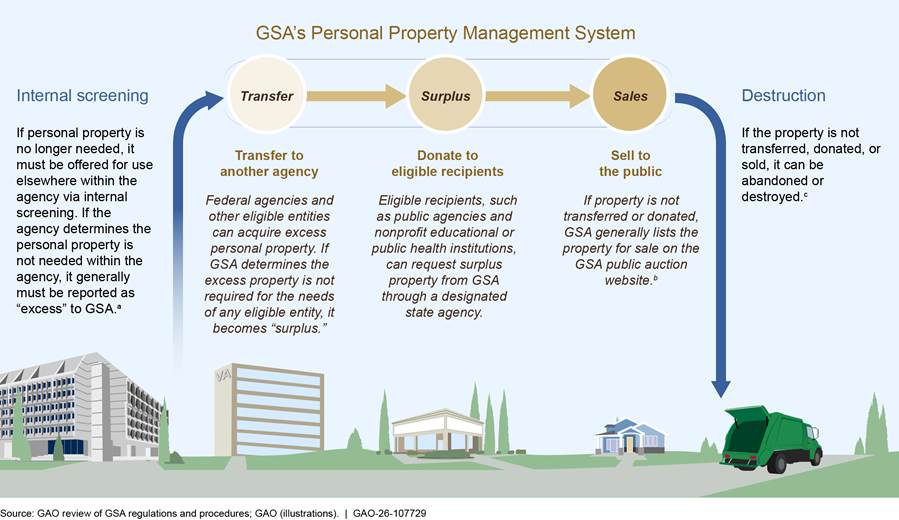
aThere are some exceptions to GSA’s procedures. For example, if there is a written determination that the property has no commercial value, agencies may abandon or destroy the property or donate it to public bodies without going through GSA. Additionally, agencies may have separate legal authority to provide certain types of property directly to certain entities without going through GSA.
bIn addition to the GSA public auction website, personal property may be sold through other competitive methods by GSA or another agency authorized by GSA.
cProperty that is not transferred, donated, or sold may also be relisted for sale or donated directly to a public body.
Federal agencies list information about excess and unneeded property in GSA’s Personal Property Management System. This system is a real-time, web-based database in which agencies provide information about property in various fields, such as the type of property, its physical location, and whether it is hazardous. GSA encourages reporting agencies to provide a complete description of the property and to include photographs.
Once property is reported to GSA as excess, federal agencies and some other entities are eligible to acquire it through transfer.[13] If none of these eligible entities request the property, it becomes “surplus”—that is, GSA determines that it is not required for the needs of any federal agency.[14] Surplus property may be donated to eligible entities through a State Agency for Surplus Property.[15] The State Agencies for Surplus Property are responsible for determining an entity’s eligibility and making requests to GSA for property on their behalf.[16] Property not selected for donation may be sold to the general public.[17] Such property may be auctioned by GSA or sold through other competitive methods by GSA or another agency authorized by GSA.[18] Personal property that is still available at the end of this process may be abandoned or destroyed.[19]
There are some exceptions to GSA’s procedures. For example, if at any point, a determination is made that the property has no commercial value or that the estimated cost of its continued care and handling would exceed the estimated proceeds from the sale, the agency can dispose of the property through abandonment or destruction or donate it to public bodies. This determination may occur at any stage.[20] Additionally, agencies can have separate legal authority to provide certain types of property directly to certain entities without going through the GSA disposal process. For example, federal agencies are permitted to loan, lease, or give excess research equipment to an educational institution or nonprofit organization for the conduct of technical and scientific education and research activities.[21]
Export-Controlled Laboratory Equipment
The Commerce Control List controls the export of items that are dual-use, such as laboratory equipment and advanced semiconductors, as well as specified commercial satellite items and certain firearms and related munitions. The laboratory equipment on the Commerce Control List may not be exported to certain countries without export licenses. The inclusion of laboratory equipment on the list is based on multilateral agreements with foreign countries and unilateral concerns about certain types of equipment that could present a risk to public health and national security. The Commerce Control List identifies characteristics and features for each item, such as specific material, volume, speed, and functions, to meet the specifications for export control. The list also includes the reasons for control. Laboratory equipment that is subject to export controls is identified in two sections of the Commerce Control List.[22]
· Equipment Capable of Use in Handling Biological Materials. This section of the Commerce Control List includes laboratory equipment based on the items and controls agreed upon by the Australia Group, an international, informal forum of countries that seeks to ensure that exports do not contribute to the development of biological weapons, such as the agents that cause anthrax or foot-and-mouth disease.[23] As a member country, the United States is represented by the Department of State, and Commerce implements this agreement through this section of the Commerce Control List. The laboratory equipment in this section generally includes highly specialized and high-capacity equipment for the protection, preparation, production, and dissemination of biological materials. For example, it includes fermenters (for growing biological agents) with features such as an internal volume of 20 liters or greater and freeze-drying equipment (for preparing powders of biological agents) with a condenser capacity between 10 and 1,000 liters of water in a 24-hour period. The Commerce Control List cites chemical and biological weapons and antiterrorism as the reasons for control of the items in this section.
· Specific Laboratory Equipment. This section of the Commerce Control List includes two additional types of laboratory equipment: 1) flow cytometers and cell sorters (for analyzing and separating specific biological agents of interest) that are “specially designed” for spectral analysis or contain 26 or greater detectors or channels and 2) liquid chromatography mass spectrometry instruments “specially designed” for top-down proteomic analysis.[24] These items are controlled unilaterally by the United States based on concerns that these items generate high-quality, high-content biological data, which can be used to facilitate the development of artificial intelligence and biological design tools. These data sets can be misused for the development of biological weapons. The Commerce Control List cites national security, regional stability, and antiterrorism as the reasons for control of the items in this section.
See figure 2 for a summary of the types of laboratory equipment on the Commerce Control List.
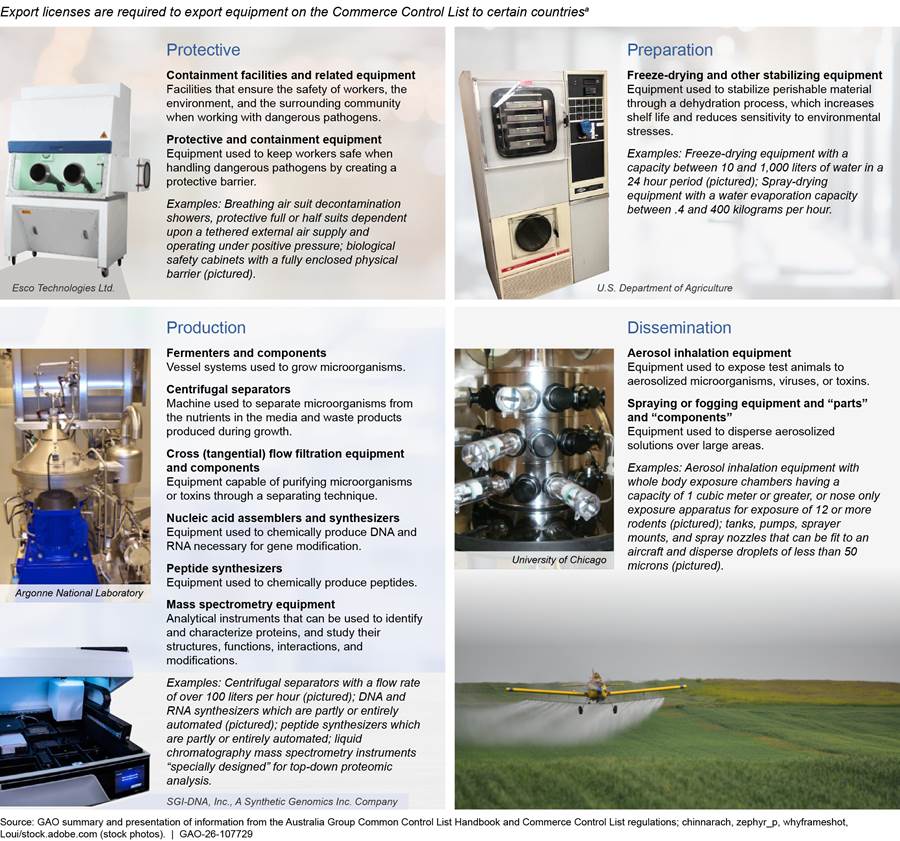
aSee 15 C.F.R. pt. 774, supp. 1.
The Federal Management Regulation states that items on the Commerce Control List are subject to special handling requirements in the disposal process.[25] When reporting excess personal property to GSA, agencies are required to clearly indicate property that requires special handling as well as the related hazards, precautions, and handling requirements.[26] While personal property with special handling requirements are generally available for transfer, donation, and sale, agencies must also include information about restrictions associated with the item.[27] For items on the Commerce Control List, this would include making GSA and potential recipients aware that these items may not be exported to certain countries without export licenses.
Few Sales of Laboratory Equipment Were Subject to Export Controls; Agencies Did Not Notify GSA as Required
Few GSA Sales of HHS and USDA Laboratory Equipment Were Subject to Export Controls in Fiscal Years 2022 Through 2025
GSA facilitated sales of 1,316 HHS and USDA laboratory equipment listings (some of which included more than one piece of equipment) in fiscal years 2022 through 2025, according to GSA data.[28] Of the 1,316 GSA sales, we identified nine pieces of HHS and USDA laboratory equipment subject to export controls.[29] Of the nine export-controlled items, seven belonged to HHS and two were from USDA.[30]
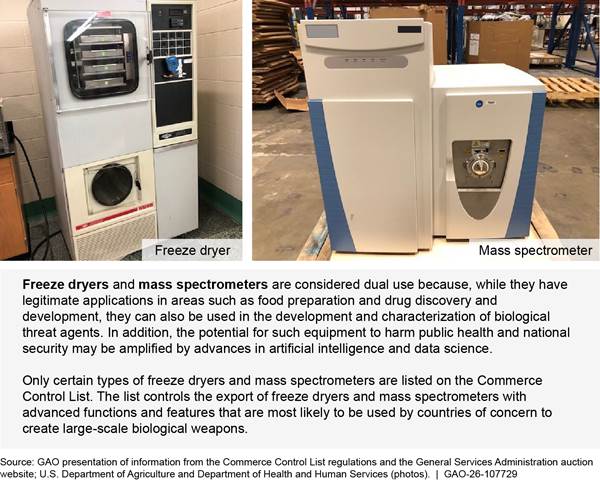
The nine export-controlled items that we identified included three freeze dryers and six mass spectrometers.[31] Freeze dryers can be used to preserve biological material such as viruses and toxins, as well as to produce powders for easier dissemination. Mass spectrometers are analytical instruments that can be used to identify and characterize proteins, and study their structures, functions, interactions, and modifications, such as how such proteins respond to viruses and treatments. See figure 3 for more information on freeze dryers and mass spectrometers.
GSA data show that the purchasers of the HHS and USDA laboratory equipment included a range of recipients. For example, for the six items that were purchased by companies, three items were purchased by companies that appeared to be laboratory equipment resellers and the other three were purchased by companies that appeared to provide property disposal services, according to information available on the internet. Of the three individuals that bought export-controlled equipment, one was a professor at a university and two did not have any clear affiliation with a relevant entity.[32]
We also found in our review of GSA data that individuals and companies who purchased these nine export-controlled items often purchased other types of laboratory equipment from GSA. For example,
· One buyer purchased two of the export-controlled items that we identified—one freeze dryer and one mass spectrometer. This same buyer made over 100 other purchases of additional HHS laboratory equipment through GSA between fiscal year 2022 and 2025. The additional items included laboratory equipment that are not subject to export controls, such as imaging systems and DNA analyzers and sequencers. GSA and HHS officials were not able to provide information about how this buyer was using this laboratory equipment, such as whether it was being reused, resold, or scrapped.
· Another company that purchased one of the mass spectrometers made 14 other purchases of HHS and USDA laboratory equipment during the same time frame. These purchases included several other less advanced mass spectrometers, which did not meet the specifications for export control under the Commerce Control List, and a DNA analyzer. This company lists refurbished laboratory and medical equipment for sale on its website.
We found that the individuals and companies who bought these nine export-controlled items, which were used and often in need of repair, paid a fraction of the original acquisition cost, according to the GSA data. For example,
· Two of the freeze dryers were sold to individuals through the GSA online auction for $29 and $208, respectively, according to the GSA data. The conditions of the freeze dryers were listed as either salvage or repairable, and the original costs of these items were approximately $12,000 and $25,000, respectively. The third freeze dryer was sold as part of a lot including other laboratory equipment for a total of $10,000, in comparison to the approximately $234,000 for which the GSA data indicates the agency acquired the freeze dryer.
· The six mass spectrometers were purchased from the GSA auction for between $6,750 and $99,000. The original cost for these items, all of which were listed in repairable or usable condition, ranged from about $310,000 to $824,000, according to GSA data.
HHS and USDA officials said there are a few reasons that there were not many sales of export-controlled laboratory equipment. Specifically, both HHS and USDA officials said the types of equipment that are subject to export controls are fairly uncommon. HHS officials said that high-end equipment is typically used until it no longer holds value and that unneeded equipment may be transferred internally. USDA officials said they may utilize other disposal methods, such as destruction, recycling obsolete equipment, or donating equipment directly to a research partner when a research project ends.
HHS and USDA Did Not Notify GSA or Recipients That Laboratory Equipment Was Subject to Export Controls
HHS and USDA did not clearly indicate to GSA and purchasers of the equipment that any of the nine export-controlled items we identified as having been sold in fiscal years 2022 through 2025 had special handling requirements related to export controls. Such notification is required by the Federal Management Regulation.[33]
A weakness in GSA’s Personal Property Management System helps explain why HHS and USDA did not follow GSA’s notification requirements. Specifically, the GSA property management system that agencies use to list information about available property does not include a dedicated field, or other standardized way of indicating that an item is on the Commerce Control List. GSA officials acknowledged that there is not a dedicated field for identifying these items and that this could lead to improper reporting of Commerce Control List items.
In the absence of a dedicated field, GSA officials said that there are several ways that an agency could indicate that a piece of laboratory equipment is on the Commerce Control List. However, we found that HHS and USDA did not utilize these methods to identify the nine items. For example, GSA officials said that the agencies may indicate that an item is on the Commerce Control List in the item description field. However, none of the nine items we identified included this information in the item description field. For two of the nine items, the item description indicated that the buyer would need to complete a statement of intent but did not specify export controls as the reason. We also found in our review of the data that vague descriptions and missing information, such as model numbers and clear photos, made it even more difficult to identify the laboratory equipment that was subject to export controls. Further, the potential for the specific items on the Commerce Control List and related requirements to change in response to evolving technology and risks may make it difficult for the agencies, GSA, and potential recipients to maintain awareness of these items without an explicit indication. GSA officials stated in February 2026 that they could consider adding a dedicated field for Commerce Control List items.
Until GSA develops a standard approach for agencies to indicate that an item is on the Commerce Control List, such as adding a dedicated field, GSA staff and potential recipients of this equipment may not be aware that these items are subject to export controls.
Further, we found that HHS staff may not be aware of the requirement to identify items on the Commerce Control List. While HHS’s policy included a section on requirements for disposal of some types of personal property at the time of our review, it was silent on the requirement to notify GSA and potential recipients when laboratory equipment is on the Commerce Control List, as required by the Federal Management Regulation.[34] This was in contrast with the USDA policy, which includes this requirement. In July 2026, HHS provided an excerpt of draft revisions to its policy to include these requirements. Finalizing these revisions could help ensure that HHS employees and purchasers are aware of export requirements and help prevent international sales of this equipment without export licenses.
Experts Identified Biosecurity Risks and Risk Mitigation Strategies Associated with Laboratory Equipment Disposal
Most of the nine selected biosecurity experts we spoke with said there are risks of nefarious actors acquiring federal laboratory equipment through the disposal process. These experts said the risks pertain to equipment on the Commerce Control List, as well as certain other types of equipment not on the list. To mitigate these risks, experts suggested a variety of risk mitigation strategies but also cautioned that there are challenges to controlling the disposal of this equipment, such as potentially inhibiting legitimate use.
Biosecurity Risks Associated with Disposal of Laboratory Equipment Include Creation of a Biological Weapon and Acquisition of Sensitive Information
Most of the selected biosecurity experts we spoke to said that there are risks associated with the disposal of federal laboratory equipment, including both equipment on the Commerce Control List but also certain other types of equipment not on the list. According to these experts, the primary risks include nefarious actors (1) using the equipment to create a biological weapon or (2) obtaining sensitive information from the equipment.
|
Biological Terror Events Historical events highlight the dangers of biological attacks. For example:
In 1984, members of a religious commune in Oregon contaminated salad bars at 10 restaurants with Salmonella bacteria, leading to 751 people suffering food poisoning. During the 1990s, a religious cult attempted several acts of chemical and biological terrorism in Japan. For example, the cult unsuccessfully released aerosolized Bacillus anthracis spores from the roof of a building in Tokyo. However, some chemical attacks were successful, including the 1995 sarin attack on the Tokyo subway, which killed 12 people and injured almost 3,800.
The 2001 anthrax attacks occurred in the U.S. over the course of several weeks beginning on September 18, 2001. Letters containing anthrax spores were mailed to several news media offices and U.S. senators, killing five people and infecting 17 others. Source: GAO analysis of GAO reports and research articles; Centers for Disease Control and Prevention, Federal Bureau of Investigation (photos). | GAO‑26‑107729 |
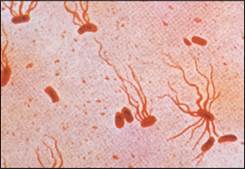
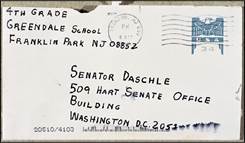
Most of the experts said nefarious actors could acquire laboratory equipment that allows them to safely work with, produce, preserve, and disseminate dangerous pathogens. For example, a nefarious actor could acquire a federal laboratory fermenter that could grow twice as many organisms as an improvised fermenter and for a cheaper price than on the commercial market, according to one expert. However, most of the experts we spoke with said that these potential risks are not unique to the federal government because this equipment can also be purchased elsewhere. Most experts also said that nefarious actors could obtain sensitive information from some equipment such as research data, intellectual property, or genetic information. For example, if nefarious actors acquired equipment like a DNA synthesizer or sequencer from a federal laboratory, they could potentially see what types of DNA were sequenced, amplified, and processed by the federal laboratory if that information was not properly removed, according to one expert. In addition, there is a risk of sending equipment to recipients who do not have the budget or required knowledge for proper operation and maintenance of the equipment, leading to potential equipment-related accidents, according to one expert.
Most of the experts we spoke to agreed that there are risks associated with the disposal of laboratory equipment on the Commerce Control List. However, they also identified 16 additional types of equipment that they thought could present risks. The Commerce Control List aims to prevent state actors from acquiring highly specialized and high-capacity equipment for their own national biological weapon programs, but other types of equipment could still be used on a smaller scale by non-state actors to cause harm, according to most experts. For example, although the Commerce Control List controls spraying systems specifically designed to attach to an aircraft, other sprayers could be used to disseminate pathogens if attached to another type of vehicle, according to one expert. Similarly, the Commerce Control List places export restrictions on fermenters with a volume over 20 liters, but two experts said that a smaller 10-liter or 15-liter fermenter could easily produce enough pathogens for a small-scale attack. See appendix II for information on the full list of 16 types of equipment that our selected experts said could present risks.
Experts Identified Strategies and Challenges to Mitigating Biosecurity Risks
The selected experts in our review identified a variety of potential risk mitigation strategies agencies could implement to prevent misuse of federal laboratory equipment. Specifically, experts suggested additional screening of purchasers, not selling, or limiting the sales of, certain equipment, tracking certain equipment and purchasers, and coordinating with the intelligence community, as described in figure 4.
Figure 4: Summary of Risk Mitigation Strategies Identified by Selected Experts to Prevent Misuse of Federal Laboratory Equipment Disposed of by Federal Agencies
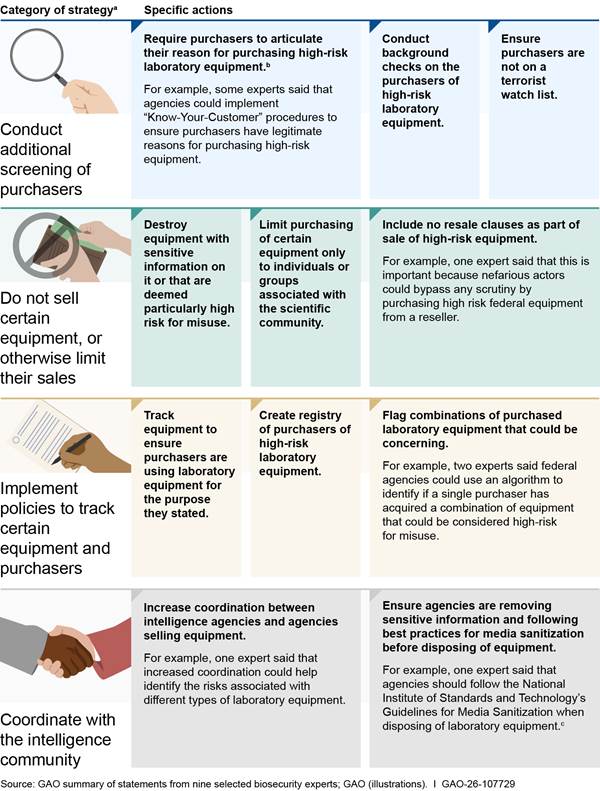
aWe developed these categories of risk mitigation strategies based on our summaries of expert statements.
bHigh-risk equipment refers to equipment that could be used to create a biological weapon, such as freeze dryers, or from which sensitive information could be obtained, such as DNA sequencers.
cMedia sanitization is a process by which data is irreversibly removed from media, or the media is permanently destroyed. The principal goal of media sanitization is to ensure that sensitive data is not unintentionally released.
Experts we spoke with also said that there are a variety of challenges with mitigating potential risks associated with the disposal of federal laboratory equipment. Specifically, experts mentioned the difficulty in determining what equipment is high-risk, the potential for risk mitigation strategies to inhibit legitimate usage, resource constraints, and privacy concerns, as described in figure 5.
Figure 5: Summary of Challenges Identified by Selected Experts to Mitigating Potential Risks Associated with the Disposal of Federal Laboratory Equipment by Federal Agencies
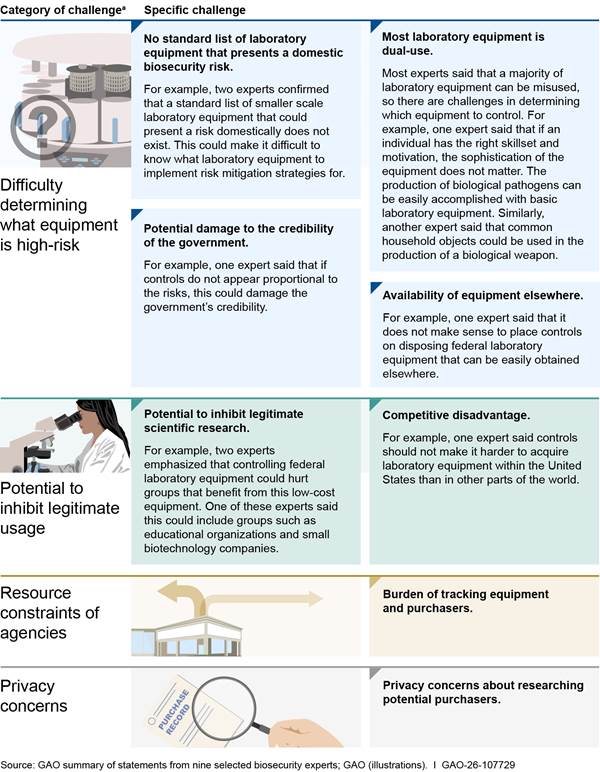
aWe developed these categories of challenges based on our summaries of expert statements.
HHS and USDA Have Not Assessed the Risks Associated with the Disposal of Federal Laboratory Equipment
HHS and USDA have not assessed the biosecurity risks associated with the disposal of federal laboratory equipment that is on the Commerce Control List, as well as with additional equipment that is not, according to HHS and USDA officials.[35] These risks could include nefarious actors acquiring the equipment to create a biological weapon or obtain sensitive information from that equipment. This is inconsistent with the 2022 National Biodefense Strategy, which emphasizes the importance of assessing biological risks and includes a goal to strengthen biosecurity to prevent both state and nonstate actors from obtaining equipment for nefarious purposes.[36] Further, the Standards for Internal Control in the Federal Government state that agencies should identify, analyze, and respond to risks related to achieving the defined objectives, such as the National Biodefense Strategy goal.[37] Similarly, the Office of Management and Budget’s Circular A-123 requires federal agencies to develop and apply risk management practices—including risk assessment, risk response designed to mitigate or reduce risks, and risk monitoring—to achieve agency objectives.[38] According to the circular, risk assessments should be ongoing and iterative to ensure that agencies are ready to identify, analyze, and respond to changing conditions. This is particularly important due to rapid advances in biotechnology that pose national security and public health risks.
Agency officials told us they have not conducted this type of risk assessment for a variety of reasons. For example:
· Focus on decontamination: HHS and USDA have policies in place to ensure decontamination of laboratory equipment before disposal, which agency officials felt was the most immediate risk. While decontamination is a critical step to prevent the spread of pathogens from laboratory equipment, it does not address the separate biosecurity threat of nefarious actors acquiring and misusing laboratory equipment.
· Removal of sensitive information: HHS and USDA officials said staff remove sensitive information from equipment hardware before disposal. However, U.S. government experts outside of HHS and USDA said that because the techniques to obtain sensitive information from equipment are improving rapidly, it could be beneficial for agencies to review the effectiveness of their information removal processes from a biosecurity perspective.
· Availability from other sources. HHS and USDA officials said that the laboratory equipment they dispose of is widely available from other sources, such as third-party retailers. However, some of the experts we interviewed said there could be reasons for nefarious actors to purchase equipment from the federal government. For example, federal equipment could be cheaper, more likely to be safe and functioning properly, and it could include sensitive information about federal research.
· GSA’s role to sell the equipment. HHS and USDA officials said that because they do not directly sell the equipment, but instead dispose of the items through GSA, they do not have biosecurity risks to mitigate. However, officials from GSA said that the listing agencies have the responsibility to mitigate any potential biosecurity risks associated with disposing of federal laboratory equipment, not GSA. GSA officials said that their agency conducts a cursory review of what other agencies input into GSA’s property management system, but do not provide input on what, if any, controls or limitations should be in place when disposing of an item.
|
The Plum Island Animal Disease Center
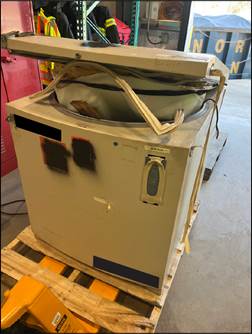
DHS officials said that they plan to destroy all laboratory equipment via autoclave and physical destruction. See below for a photo of an ultra-low temperature freezer that had been destroyed in an autoclave. DHS and USDA officials said they do not plan to make any of the equipment available for donation or sale, in part to reduce the risk of a nefarious actor acquiring equipment from their laboratory. Source: GAO summary of site visit to Plum Island Animal Disease Center, and DHS and U.S. Environmental Protection Agency websites; DHS (photo). I GAO‑26‑107729
|
 The Plum
Island Animal Disease Center was a federal research facility operated by
the Department of Homeland Security (DHS) and the U.S. Department of
Agriculture (USDA). Up until 2025, it served as an important part of the
nation’s defense against foreign animal diseases. Scientists studied highly
contagious, economically damaging pathogens to protect the agricultural
sector. In 2008, the facility was found to have aging infrastructure and
limited capacity to keep up with current animal agricultural research needs.
At the time of this report, DHS and USDA were in the process of
decommissioning the laboratory.
The Plum
Island Animal Disease Center was a federal research facility operated by
the Department of Homeland Security (DHS) and the U.S. Department of
Agriculture (USDA). Up until 2025, it served as an important part of the
nation’s defense against foreign animal diseases. Scientists studied highly
contagious, economically damaging pathogens to protect the agricultural
sector. In 2008, the facility was found to have aging infrastructure and
limited capacity to keep up with current animal agricultural research needs.
At the time of this report, DHS and USDA were in the process of
decommissioning the laboratory.In commenting on a draft of this report, HHS officials said that they are planning to update the HHS Logistics Management Manual to require periodic assessments of biosecurity risks associated with laboratory equipment disposal. HHS did not provide an estimated date for such revisions. Regularly assessing the biosecurity risks associated with the disposal of federal laboratory equipment, as part of the agency’s overall risk management efforts, could help HHS and USDA determine the extent to which they should implement mitigation strategies that could help prevent nefarious actors from procuring federal equipment, such as the ones our selected experts have identified. These efforts include establishing a no resale clause as part of the sale of certain laboratory equipment and increasing coordination with the intelligence community. Assessing biosecurity risks could also enable HHS and USDA to identify and address the risks associated with certain types of equipment or purchasers that may present a higher risk for creating a biological weapon or obtaining sensitive information. Such an assessment could also help HHS and USDA determine the extent to which they should coordinate with GSA to implement controls available in the GSA disposal system.
Specifically, GSA officials said that agencies disposing of property can implement the following controls when they list items in GSA’s Personal Property Management System:
· Agencies can instruct GSA to require the buyer to be a U.S. citizen.
· Agencies can instruct GSA to require a purchaser to complete a statement of intent, whereby a purchaser certifies how they intend to use the property and that they will not use the equipment for nefarious purposes.
· Agencies can indicate in GSA’s Personal Property Management System if a piece of property should not be listed on the GSA public auction. In this case, a piece of property would only be made available to other federal agencies and State Agencies for Surplus Property.
· Agencies can also choose to destroy a piece of property to mitigate potential biosecurity risks instead of putting property through the GSA disposal process.
To illustrate the potential risks associated with the disposal of HHS and USDA laboratory equipment, we used fictitious identities in an attempt to acquire equipment that experts said could be used to create a biological weapon or obtain sensitive information. Between April 3, 2025, and October 31, 2025, we were able to purchase one piece of laboratory equipment each from HHS and USDA that experts identified as a potential biosecurity risk through the GSA public auction by utilizing counterfeit documentation to register a fictitious identity on the auction website. We were also awarded two additional pieces of USDA equipment through a State Agency for Surplus Property using a fictitious nonprofit organization. The equipment that we acquired was not on the Commerce Control List. After being awarded each piece of equipment, GAO chose not to take physical possession of these items.
Furthermore, in our review of GSA data from fiscal years 2022 through 2025, we identified sales and donations of the 16 types of HHS and USDA laboratory equipment that our selected experts identified as a potential biosecurity risk. Specifically, we identified 251 items that were sold on the GSA public auction and two that were donated through a State Agency for Surplus Property.[39] These included items that are not on the Commerce Control List, but that experts said could present a risk, such as DNA sequencers that could contain sensitive genetic information, incubators that could be used to cultivate infectious agents, and powdering equipment that could be used to grind infectious agents into powder.[40] See appendix II for information on the full list of equipment experts said could present potential risks.
We also found that these agencies sometimes sold this equipment to purchasers that experts said could pose biosecurity risks. This included purchasers who appeared to be reselling this equipment on third-party retail sites, purchasers with email addresses not affiliated with established institutions such as universities, research laboratories, or the scientific community, and purchasers acquiring a combination of multiple pieces of equipment that could be used to create a biological weapon.
Conclusions
The disposal of laboratory equipment purchased with federal funds can help the government minimize new procurement costs and maximize the equipment’s public benefit. However, the disposal of such equipment is not without risks, including the possibility that a nefarious actor could purchase it to create a biological weapon or obtain sensitive information, according to experts we spoke with. The White House’s National Biodefense Strategy establishes a goal for the United States to strengthen biosecurity to prevent state and nonstate actors from obtaining laboratory equipment for nefarious purposes. Thus, it is crucial that HHS and USDA thoroughly consider risks throughout the GSA disposal process and do so regularly given evolving technology and risks.
Our review shows that HHS and USDA did not report special handling requirements to GSA and potential recipients when disposing of laboratory equipment on the Commerce Control List from fiscal years 2022 through 2025, as required by the Federal Management Regulation. Until GSA develops a standard approach for agencies to indicate that an item is on the Commerce Control List, such as adding a dedicated field in its Personal Property Management System, GSA staff and potential recipients may not be aware that these items are subject to export controls. Similarly, until HHS finalizes its policy to include disposal requirements for such laboratory equipment, HHS employees may not be aware that the requirements exist. This, in turn, increases the possibility of laboratory equipment that presents a biosecurity risk being sold internationally without obtaining the required export licenses, which could be harmful to national security and public health.
In addition, our review shows that HHS and USDA have not assessed the biosecurity risks associated with the disposal of federal laboratory equipment, such as the risks of nefarious actors acquiring the equipment to create a biological weapon or obtain sensitive information. Regularly assessing such risks, as part of the agency’s overall risk management efforts, can help HHS and USDA determine the extent to which they should take steps to mitigate any identified risks. It could also provide an opportunity for agencies to assess the challenges and weigh the tradeoffs of implementing risk mitigation strategies or the controls available to them through the GSA disposal system that could better position them to prevent nefarious actors from procuring federal equipment. By purchasing equipment that experts said could be used to create a biological weapon or obtain sensitive information, we illustrated the risks of a nefarious actor acquiring this equipment through the GSA public auction or through a State Agency for Surplus Property.
Recommendations for Executive Action
We are making four recommendations, including one to GSA, two to HHS, and one to USDA. Specifically:
The Administrator of GSA should develop a standard approach for agencies to indicate when laboratory equipment going through the GSA disposal process is on the Commerce Control List, such as adding a dedicated field to its property management system. (Recommendation 1)
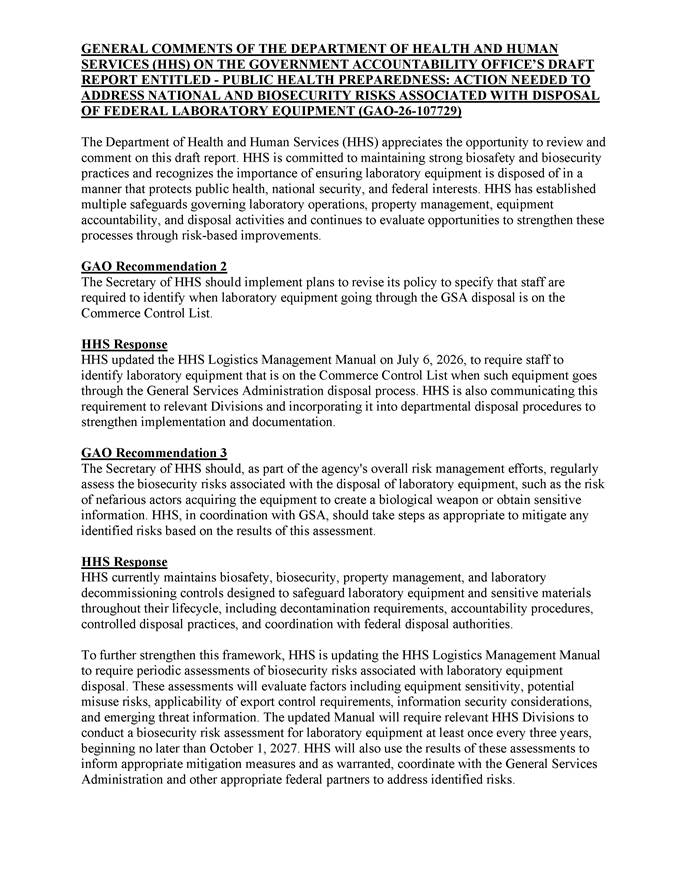
The Secretary of HHS should implement plans to revise its policy to specify that staff are required to identify when laboratory equipment going through the GSA disposal process is on the Commerce Control List. (Recommendation 2)
The Secretary of HHS should, as part of the agency’s overall risk management efforts, regularly assess the biosecurity risks associated with the disposal of laboratory equipment, such as the risk of nefarious actors acquiring the equipment to create a biological weapon or obtain sensitive information. HHS, in coordination with GSA, should take steps as appropriate to mitigate any identified risks based on the results of this assessment. (Recommendation 3)
The Secretary of USDA should, as part of the agency’s overall risk management efforts, regularly assess the biosecurity risks associated with the disposal of laboratory equipment, such as the risk of nefarious actors acquiring the equipment to create a biological weapon or obtain sensitive information. USDA, in coordination with GSA, should take steps as appropriate to mitigate any identified risks based on the results of this assessment. (Recommendation 4)
Agency Comments and Our Evaluation
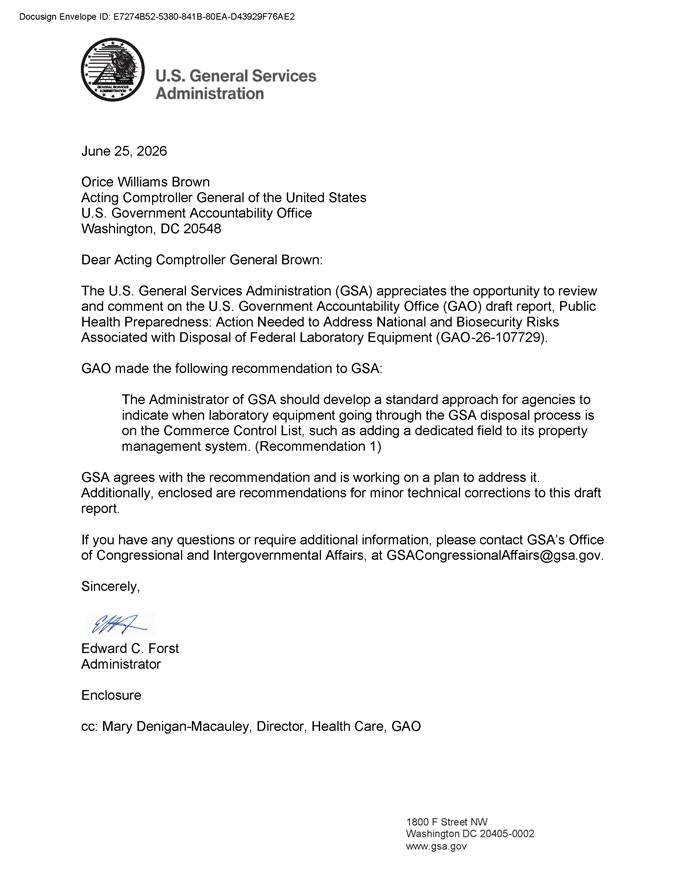
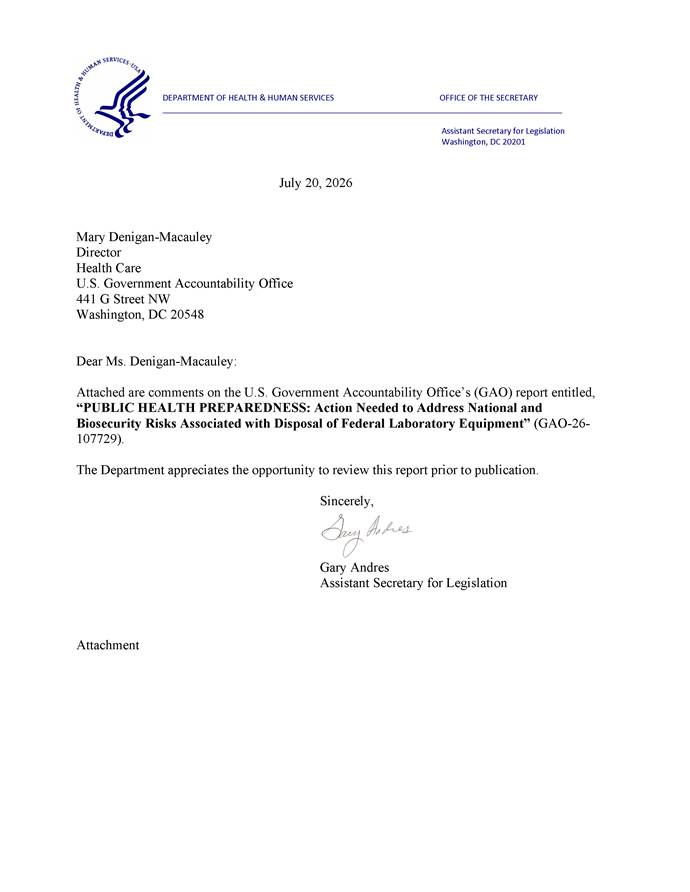
We provided a draft copy of this report to DHS, the Department of Justice, the Department of State, GSA, HHS, and USDA for review and comment. In GSA’s written comments, reproduced in appendix III, GSA concurred with our first recommendation and said it is taking steps to develop a standard approach for agencies to identify laboratory equipment on the Commerce Control List. In HHS’s written comments, reproduced in appendix IV, HHS said it is committed to maintaining strong biosafety and biosecurity practices and recognizes the importance of ensuring laboratory equipment is disposed of in a manner that protects public health, national security, and federal interests. In response to our second recommendation, HHS provided an excerpt to its policy that it is revising to include requirements related to disposal of laboratory equipment on the Commerce Control List, specifically notifying GSA. HHS estimated finalizing the revisions in August 2026. We revised our draft to make note of these draft revisions. If finalized, such revisions would address the intent of our second recommendation. In response to our third recommendation, HHS described plans to require periodic assessments of the biosecurity risks associated with laboratory equipment disposal, beginning no later than October 1, 2027. We will continue to monitor GSA’s and HHS's efforts. In an email, USDA officials said they generally agree with the report.
The Department of Justice, GSA, HHS, and USDA also provided technical comments, which we incorporated as appropriate.
As agreed with your offices, unless you publicly announce the contents of this report earlier, we plan no further distribution until 30 days from the report date. At that time, we will send copies to the appropriate congressional committees, as well as the Secretaries of Homeland Security, State, HHS, and Agriculture, the Administrator of GSA, the Attorney General, and other interested parties. In addition, the report is available at no charge on the GAO website at http://www.gao.gov.
If you or your staff have any questions about this report, please contact me at DeniganMacauleyM@gao.gov. Contact points for our Offices of Congressional Relations and Public Affairs may be found on the last page of this report. GAO staff who made key contributions to this report are listed in Appendix V.
Mary Denigan-Macauley
Director, Health Care
List of Requesters
The Honorable Brett Guthrie
Chairman
Committee on Energy and Commerce
House of Representatives
The Honorable Gary Palmer
Chairman
Subcommittee on Environment
Committee on Energy and Commerce
House of Representatives
The Honorable H. Morgan Griffith
Chairman
Subcommittee on Health
Committee on Energy and Commerce
House of Representatives
The Honorable John Joyce, M.D.
Chairman
Subcommittee on Oversight and Investigations
Committee on Energy and Commerce
House of Representatives
The Honorable Earl L. “Buddy” Carter
House of Representatives
This report (1) examines the extent to which selected federal agencies sold controlled biological laboratory equipment and did so in accordance with federal requirements; (2) describes the biosecurity risks and mitigation strategies that selected experts identified associated with the disposal of biological laboratory equipment; and (3) examines the extent to which the Department of Health and Human Services (HHS) and the U.S. Department of Agriculture (USDA) assessed the biosecurity risks associated with the disposal of biological laboratory equipment.
To examine the extent to which selected federal agencies sold controlled biological laboratory equipment, we analyzed data from the General Services Administration (GSA) on laboratory equipment from HHS and USDA that was sold to the general public in fiscal years 2022 through 2025, the four most recent years of data available at the time we conducted our review. We reviewed each listing in the GSA data to identify the number and type of laboratory equipment that were subject to export controls from the Department of Commerce (Commerce). Specifically, we compared the data to the types of laboratory equipment that are listed in the Commerce Control List, sections Equipment Capable of Use in Handling Biological Materials (2B352) and Specific Laboratory Equipment (3A069).[41] To assess the reliability of the data, we reviewed the data for outliers and meaningful information and interviewed GSA officials to better understand the data. We found that the GSA data were reliable for the purpose of summarizing the number pieces of HHS and USDA laboratory equipment that the data indicated were sold during that time frame.
We interviewed officials from the Department of State because it represents the United States in the Australia Group, an international, informal forum of countries that develops the Control List of Dual-use Biological Equipment and Related Technology and Software, the basis for Equipment Capable of Use in Handling Biological Materials section of the Commerce Control List. We also interviewed officials from HHS’s Program Support Center, Centers for Disease Control and Prevention, Food and Drug Administration, and National Institutes of Health; USDA’s Office of Property and Environmental Management, Animal and Plant Health Inspection Service, and Agricultural Research Service; and GSA’s Office of Government-Wide Policy and Office of Personal Property Management. We interviewed these officials about the disposal of export-controlled laboratory equipment.
To examine the extent to which selected federal agencies followed federal requirements for export control, we reviewed the Federal Management Regulation for requirements on disposing of export-controlled laboratory equipment. We reviewed GSA data and documentation for the export-controlled items that we identified in the data in fiscal years 2022 through 2025 and assessed whether HHS and USDA clearly identified to GSA and purchasers that these items were subject to export requirements, as required by the Federal Management Regulation. We also reviewed HHS and USDA policies on personal property disposal and interviewed HHS, USDA, and GSA officials about the disposal of export-controlled laboratory equipment.
To describe the biosecurity risks and mitigation strategies that selected experts identified associated with the disposal of biological laboratory equipment, we interviewed seven external biosecurity experts. We selected experts who were not federal employees at the time of our review and had 1) served on a biosecurity committee or workgroup, 2) published biosecurity research, or both. In addition to the seven external experts, we interviewed U.S. government officials with expertise in biosecurity threats from two agencies outside of HHS and USDA. We interviewed these experts about the risks associated with the disposal of federal laboratory equipment, including the nature of the risks.[42] We also asked the biosecurity experts for their perspectives on potential risk mitigation strategies, as well as any challenges associated with mitigating the risks they identified.
To examine the extent to which HHS and USDA assessed the risks associated with the disposal of biological laboratory equipment, we reviewed agency documentation and interviewed officials. Specifically, we interviewed HHS and USDA officials regarding the extent to which each of these agencies assessed the biosecurity risks associated with disposal of laboratory equipment and requested supporting documentation of these efforts. We also reviewed the controls available in the GSA Personal Property Management System. We assessed HHS’s and USDA’s efforts against the 2022 National Biodefense Strategy and federal internal control standards related to risk assessments and control activities, as well as requirements from the Office of Management and Budget.[43]
To illustrate the potential risks associated with laboratory equipment disposal, we attempted to acquire laboratory equipment from HHS and USDA through the GSA disposal process using fictitious identities. Specifically, we used covert identities and counterfeit documents to create two undercover user profiles on the GSA public auction website. In addition, we utilized covert identities and counterfeit documents to register a fictitious nonprofit with three State Agencies for Surplus Property. We then monitored GSA’s property management system for 211 calendar days to search for equipment that at least two experts said could be a biosecurity risk. During this period, we bid on two pieces of equipment that met our criteria through the public auction and requested four pieces of equipment through the State Agencies for Surplus Property.
To further illustrate potential risks, we reviewed the extent to which HHS and USDA disposed of laboratory equipment that selected experts identified as a biosecurity risk. Specifically, we established a list of the types of non-export-controlled laboratory equipment that at least two of the seven non-federal external biosecurity experts identified as a risk. We then reviewed the GSA data on laboratory equipment disposals between fiscal years 2022 and 2025 to quantify the number of GSA sales and donations of HHS and USDA equipment on this list. For this equipment, we compared the GSA data on the sale and donation of this equipment to the types of concerns that experts identified. For example, we reviewed whether the buyers of HHS and USDA equipment that experts identified as a risk appeared to be resellers, not affiliated with the scientific community, and whether they purchased potentially concerning combinations of laboratory equipment.
To enhance our understanding of laboratory equipment disposal, we conducted a site visit to the Plum Island Animal Disease Center. Plum Island Animal Disease Center, located off the coast of New York, conducted critical research and diagnostic activities on high-consequence foreign animal diseases, such as foot-and-mouth disease.[44] The Plum Island Disease Center, which the Department of Homeland Security (DHS) operated in partnership with USDA, was designated for replacement by a new state-of-the-art biocontainment facility. We visited the Plum Island Animal Disease Center in February 2025, at which time the facility was preparing for closure. We interviewed USDA and DHS staff about their plans and timelines for disposal of laboratory equipment, and the extent potential biosecurity risks posed a factor in their disposal plans.
We conducted this performance audit from July 2024 to September 2026 in accordance with generally accepted government auditing standards. Those standards require that we plan and perform the audit to obtain sufficient, appropriate evidence to provide a reasonable basis for our findings and conclusions based on our audit objectives. We believe that the evidence obtained provides a reasonable basis for our findings and conclusions based on our audit objectives. We also conducted our related investigative work in accordance with investigation standards prescribed by the Council of the Inspectors General on Integrity and Efficiency
This report describes biosecurity risks associated with the disposal of laboratory equipment. To identify equipment that could pose a biosecurity risk, we interviewed seven external biosecurity experts. Specifically, we selected experts who were not federal employees at the time of our review and had 1) served on a biosecurity committee or workgroup, 2) published biosecurity research, or both.
Most experts told us that although there is an export control list that aims to prevent certain countries from proliferating large-scale equipment for the development of national biological weapon programs, other types of equipment could still be used on a smaller scale to cause harm. We therefore asked experts what additional equipment could pose a biosecurity risk that is not subject to export controls. If at least two experts said a piece of equipment could be a biosecurity risk, we added that equipment to our scope. Table 1 below describes equipment not subject to export controls that at least two experts said could be a biosecurity risk and a description of the equipment.
|
Equipment Type |
Description of the Equipment |
|
Smaller or less advanced versions of equipment that is on the Commerce Control Lista |
|
|
10-20 liter fermenters |
Vessel systems used to grow microorganisms. |
|
Aerosol generation and inhalation equipment |
Equipment used to expose laboratory animals to aerosolized microorganisms, viruses, or toxins. |
|
Bioreactors |
Vessel systems used to grow microorganisms or viruses within a controlled environment. |
|
Centrifuges with · Capacity to spin multi-liter bottles · High speed and ultra centrifuges · Aerosol-resistant caps or biocontainment lids · Continuous flow capability |
Equipment used to separate microorganisms from the nutrients in the media and waste products produced during growth. |
|
Class 2 biological safety cabinets |
Enclosed spaces that control ventilation and the environment for work with infectious agents or toxins. |
|
Freeze dryers |
Equipment that converts material into a dry powder form to increase its shelf life and reduce sensitivity to environmental stresses. It works by freezing the material and then applying a vacuum that removes the water in a process called sublimation. |
|
Spray dryers |
Equipment that converts material into a dry powder form to increase its shelf life and reduce sensitivity to environmental stresses. It works by converting a liquid feedstock into fine particles or droplets (atomization) and immediately evaporating the liquid from the atomized particles via contact with a drying gas of a higher temperature. |
|
Sprayers that can disseminate pathogens |
Equipment used to disperse aerosolized solutions over large areas. |
|
Equipment that is not on the Commerce Control List |
|
|
Animal caging associated with biocontainment |
Specialized caging used for animal research that is equipped to prevent the transmission of any disease agent from a laboratory animal to a researcher. |
|
Agricultural drone capable of delivering a pathogen |
Drones used to dispense or spray substances. |
|
Desiccators |
Airtight and moisture tight chambers used to preserve biological specimens after drying. |
|
DNA sequencers |
Equipment that enables scientists to decode the DNA of organisms that cause sickness and disease. |
|
Growth chambers |
Equipment that allows control of environmental variables for smaller-scale plant growth and plant-microbe experiments. |
|
Incubators |
Devices with various chambers or water-filled compartments in which controlled environmental conditions, particularly temperature, are maintained to cultivate microorganisms. |
|
Powdering equipment |
Specialized equipment such as hammer mills and micronizers which can be used to grind biological material into powder. |
|
Ultra-low temperature freezers |
Refrigerated cabinets that can maintain set point storage temperatures used for the preservation of volatile reagents, biological specimens, and other research materials. |
Source: Analysis of statements from seven selected external biosecurity experts, federal regulations, Centers for Disease Control and Prevention, National Institutes of Health, U.S. Department of Energy and Federal Aviation Administration websites, research articles, and the Australia Group Commerce Control List Handbook I GAO‑26‑107729
Note: We interviewed seven external biosecurity experts to ask them what additional equipment could pose a biosecurity risk that is not subject to export controls. We included equipment that was mentioned by at least two experts.
aThe Department of Commerce (Commerce) maintains the Commerce Control List, a list of certain types of laboratory equipment, among other items, for which licenses are required in order to be exported to certain countries of concern. For a piece of equipment to be on that list, it must meet certain technical specifications. This category includes equipment that did not meet those technical specifications, but experts still said could pose a biosecurity risk.
GAO Contact
Mary Denigan-Macauley, (202) 512-7114 or DeniganMacauleyM@gao.gov
Staff Acknowledgments
In addition to the contact named above, Kelly DeMots (Assistant Director), Kaitlin McConnell (Analyst-in-Charge), Michael Dickens, Alex Francesconi, Mark MacPherson, Chase Polak, and Patricia Powell made key contributions to this report. Sam Amrhein, James H. Arp, Sonia Chakrabarty, and Ethiene Salgado-Rodriquez, also made important contributions.
The Government Accountability Office, the audit, evaluation, and investigative arm of Congress, exists to support Congress in meeting its constitutional responsibilities and to help improve the performance and accountability of the federal government for the American people. GAO examines the use of public funds; evaluates federal programs and policies; and provides analyses, recommendations, and other assistance to help Congress make informed oversight, policy, and funding decisions. GAO’s commitment to good government is reflected in its core values of accountability, integrity, and reliability.
Obtaining Copies of GAO Reports and Testimony
The fastest and easiest way to obtain copies of GAO documents at no cost is through our website. Each weekday afternoon, GAO posts on its website newly released reports, testimony, and correspondence. You can also subscribe to GAO’s email updates to receive notification of newly posted products.
Order by Phone
The price of each GAO publication reflects GAO’s actual cost of production and distribution and depends on the number of pages in the publication and whether the publication is printed in color or black and white. Pricing and ordering information is posted on GAO’s website, https://www.gao.gov/ordering.htm.
Place orders by calling (202) 512-6000, toll free (866) 801-7077,
or
TDD (202) 512-2537.
Orders may be paid for using American Express, Discover Card, MasterCard, Visa, check, or money order. Call for additional information.
Connect with GAO
Connect with GAO on X,
LinkedIn, Instagram, and YouTube.
Subscribe to our Email Updates. Listen to our Podcasts.
Visit GAO on the web at https://www.gao.gov.
To Report Fraud, Waste, and Abuse in Federal Programs
Contact FraudNet:
Website: https://www.gao.gov/about/what-gao-does/fraudnet
Automated answering system: (800) 424-5454
Media Relations
Sarah Kaczmarek, Managing Director, Media@gao.gov
Congressional Relations
David A. Powner, Acting Managing Director, CongRel@gao.gov
General Inquiries
[1]Laboratory equipment is considered personal property. See generally 41 C.F.R. ch. 102, subchapter B.
[2]World Health Organization, Laboratory Biosecurity Guidance.
[3]While the focus of this engagement is on federal laboratory equipment from HHS and USDA, the strategy also emphasizes the importance of state, local, tribal, and territorial entities, the international community, industry, scientists, educators, and health care providers in preparedness and response to biological threats. See White House, National Biodefense Strategy and Implementation Plan for Countering Biological Threats, Enhancing Pandemic Preparedness, and Achieving Global Health Security (Washington, D.C.: October 2022).
[4]See 15 C.F.R. § 742.2(a).
[5]See Controls on Certain Laboratory Equipment and Related Technology To Address Dual Use Concerns about Biotechnology, 90 Fed. Reg. 4612 (Jan. 16, 2025).
[6]See 15 C.F.R. pt. 774, supp. 1.
[7]See 41 C.F.R. §§ 102-36.245, 102-40.15, 102-40.35, 102-40.50.
[8]House of Representatives, Select Committee on the Chinese Communist Party, “Investigation into the Reedley Biolab.” Nov 15, 2023.
[9]For the purposes of this report, we will refer to all 9 experts as “all,” 5-8 experts as “most,” 2-4 experts as “some,” and 1 expert as “one.”
[10]See White House, National Biodefense Strategy. Also see GAO, Standards for Internal Control in the Federal Government, GAO‑25‑107721 (Washington, D.C.: May 15, 2025) and Office of Management and Budget, Management’s Responsibility for Internal Control, Circular No. A-123 (Washington, D.C.: Mar. 10, 2026).
[11]If personal property is no longer needed for the purpose of the appropriation used to make the purchase, executive agencies must reassign it to another activity within the agency to the extent practicable. See 40 U.S.C. § 524(b)(1); see also 41 C.F.R. § 102-35.10(a). If the agency determines it is not needed by any activity within the agency, it generally must be reported as excess to GSA. See 41 C.F.R. §§ 102-35.10(a), 102-35.20. Certain types of excess personal property do not need to be reported to GSA. See 41 C.F.R. § 102-36.125.
[12]See 41 C.F.R. § 102-35.10. Some types of property require different disposal procedures or have restrictions that prohibit their disposal. For example, the Federal Management Regulation limits the transfer of excess firearms to federal agencies authorized to acquire firearms for official use and does not permit the transfer or donation of surplus firearms to non-federal recipients. In addition, agencies are not permitted to abandon firearms; they must be destroyed. See 41 C.F.R. § 102-40.75.
[13]See 41 C.F.R. § 102-36.25.
[14]See 41 C.F.R. §§ 102-35.10(b), 102-35.20.
[15]See 40 U.S.C. § 549; 41 C.F.R. pt. 102-37. Eligible entities include public agencies and nonprofit educational or public health organizations.
[16]See 41 C.F.R. §§ 102-37.20; 102-37.60.
[17]See 41 C.F.R. §§ 102-35.10(c).
[18]See 41 C.F.R. pt. 102-38.
[19]See 41 C.F.R. §§ 102-36.165–170, 102-38.95. Abandonment or destruction of federal personal property can include recycling, crushing, or sending to a landfill. Property that is still available at the end of the GSA disposal process may also be relisted for sale or donated.
[20]See 41 C.F.R. § 102-35.10(d).
[21]15 U.S.C. § 3710(i).
[22]The Commerce Control List also includes other types of dual-use items, such as advanced semiconductors and radar. For a complete list of laboratory equipment on the Commerce Control List, see 15 C.F.R. pt. 774, supp. 1, sections 2B352 and 3A069. Other sections, such as 3A999, may include laboratory equipment, but this report focuses on 2B352 and 3A069 because these sections include specific types of laboratory equipment that are controlled for the prevention of biological weapons.
[23]Australia Group, Control List of Dual-use Biological Equipment and Related Technology and Software (Sept. 30, 2025).
[24]Top-down proteomic analysis is used to identify and characterize proteins. This information could be used to modify and enhance biological agents or develop novel toxins.
[25]See 41 C.F.R. § 102-36.245.
[26]See 41 C.F.R. § 102-40.15.
[27]See 41 C.F.R. §§ 102-40.35, 102-40.50.
[28]Of 1,316 combined sales, 822 listings included HHS laboratory equipment and 494 included USDA laboratory equipment, according to GSA data on HHS and USDA laboratory equipment sales from fiscal years 2022 through 2025.
[29]We limited our analysis of export-controlled laboratory equipment to the items for which there was sufficient information in the GSA data for us to make a clear determination that the items met the Commerce specifications for control. For 15 of the 1,316 sales, the data was missing information needed to make this assessment, such as the equipment model. For this reason, the nine items we identified may under report the total number of export-controlled HHS and USDA equipment that was sold in fiscal years 2022 through 2025.
[30]We also identified an HHS peptide synthesizer that would currently meet the specifications for export control under the Commerce Control List but would not have at the time it was sold to a private company in a GSA auction in October 2022. Certain peptide synthesizers were added to the Commerce Control List in December 2024 due to international concerns that such technology could be used to produce controlled toxins for biological weapons purposes.
[31]While we identified other HHS and USDA freeze dryers and mass spectrometers in our review, only these nine met the specifications for export control. For mass spectrometers, we included only the most advanced models; we excluded models that are lower resolution or designed for analysis of smaller proteins.
[32]We identified one buyer with an address in Canada, and the rest of the buyers had addresses in the United States, according to the GSA data. The Commerce Control List does not require licenses to export these items to Canada.
[33]See 41 C.F.R. §§ 102-36.245, 102-40.15, 102-40.35, 102-40.50.
[34]See 41 C.F.R. §§ 102-40.15, 102-40.35, 102-40.50.
[35]We talked to officials from the HHS Centers for Disease Control and Prevention, Food and Drug Administration, and National Institutes of Health, as well as the USDA Animal and Plant Health Inspection Service and the Agricultural Research Service.
[36]See White House, National Biodefense Strategy.
[37]See GAO‑25‑107721.
[38]See Office of Management and Budget, Management’s Responsibility for Internal Control, Circular A-123.
[39]There were two additional items we requested through a State Agency for Surplus Property, but were not awarded. Although we were not informed the exact reason for not being awarded those items, there are a variety of factors GSA takes into account when determining allocation of items such as need and proposed use.
[40]We also identified some additional items that did not include relevant information needed to assess the items, such as the model number of the equipment, so there could have been additional items sold and donated that experts identified as a biosecurity risk.
[41]For a complete list of laboratory equipment on the Commerce Control List, see 15 C.F.R. pt. 774, supp. 1, sections 2B352 and 3A069.
[42]For the purposes of this report, we will refer to all 9 experts as “all,” 5-8 experts as “most,” 2-4 experts as “some,” and 1 expert as “one.”
[43]See White House, National Biodefense Strategy and Implementation Plan for Countering Biological Threats, Enhancing Pandemic Preparedness, and Achieving Global Health Security (Washington, D.C.: Oct. 2022). Also see GAO, Standards for Internal Control in the Federal Government, GAO‑25‑107721 (Washington, D.C.: May 15, 2025) and Office of Management and Budget, Management’s Responsibility for Internal Control, Circular No. A-123 (Washington, D.C.: Mar. 10, 2026).
[44]Foot-and-mouth disease is a severe, fast-spreading viral disease that primarily affects cloven-hoofed animals, including cows, pigs, sheep, goats, and deer.