
CONSUMER PRODUCT SAFETY COMMISSION
Opportunities to Strengthen Oversight of Toxic Substances in Children's Products
Report to Congressional Requesters
United States Government Accountability Office
A report to congressional requesters
For more information, contact: Alicia Puente Cackley at cackleya@gao.gov.
What GAO Found
The Consumer Product Safety Commission (CPSC) uses risk-based approaches to target children’s products that may contain toxic substances for examination at U.S. ports. For example, it uses U.S. Customs and Border Protection systems that analyze national shipment and law enforcement data to target high-risk products. Examinations include screening products with handheld devices for lead and other toxic substances and reviewing importer documentation to verify that products were tested by third-party labs and meet CPSC safety standards.

Starting July 2026, CPSC will require importers to electronically submit (“e-file”) key data (including product identification and place of testing) when products enter U.S. ports. According to CPSC officials, e-filing may help address challenges, such as delays in completing examinations when importers lack lab testing documentation. However, CPSC has not developed an oversight plan to ensure that importers file timely, accurate data. Establishing such a plan would help CPSC ensure that e-filing achieves its intended objectives, such as making targeting more effective and examinations more efficient.
CPSC has review processes to verify that third-party labs that test children’s products meet its accreditation and other requirements. For example, labs owned or controlled by a manufacturer or government entity must provide information about their safeguards from undue influence. However, CPSC has not proactively analyzed data across all types of labs to assess potential risks, such as inaccurate testing or misreported results. CPSC recently began analyzing violations data for labs owned by manufacturers to better evaluate their safeguards from undue influence, but it does not do so for independent or government labs. By better leveraging its violations data for these labs, CPSC would be better positioned to identify and address potential problems associated with all types of labs, which could help prevent violative products from entering the market.
CPSC has reviewed and updated some testing requirements for children’s products, but not its requirements for lead or phthalates (toxic substances used to make plastics more pliable). The Consumer Product Safety Improvement Act of 2008 requires CPSC to review its lead requirements at least every 5 years; however, it has not done so. In addition, CPSC does not have written procedures for how staff should monitor changes related to phthalates and other toxic substances in children’s products. By reviewing its lead requirements and documenting a process for staying up-to-date on toxic substances, CPSC could help ensure that it does not miss opportunities to strengthen its standards and protect children from harm.
Why GAO Did This Study
CPSC is responsible for regulating the safety of thousands of consumer products, including children’s products. It requires manufacturers and importers to have certain toys and other children’s products tested by labs for lead and other toxic substances before they can enter the U.S. market. However, the large volume of products entering U.S. ports makes it challenging to ensure compliance.
GAO was asked to review how CPSC addresses children’s products that contain toxic substances. This report examines CPSC’s (1) processes for examining children’s products and planning for an electronic data filing system; (2) processes for approving and assessing risks of third-party labs that test children’s products; and (3) efforts to keep safety standards for lead and other toxic substances up-to-date.
GAO reviewed CPSC’s third-party testing and lab accreditation requirements; analyzed CPSC policies and procedures; and visited a nongeneralizable sample of four ports to observe product examinations. Ports were selected to prioritize those with higher volumes of children’s products entering the U.S. and to provide a mix of geographic locations.
What GAO Recommends
GAO recommends CPSC (1) establish a plan to oversee compliance with e-filing requirements, (2) establish a process for using violations data to assess risks associated with independent and government labs, (3) review its lead requirements and document a process for completing lead reviews every 5 years, and (4) document a process for staying up-to-date on changes related to phthalates and other toxic substances. CPSC agreed with the recommendations and indicated it would implement them.
|
Abbreviations |
|
|
|
|
|
CBP |
U.S. Customs and Border Protection |
|
CPSC |
Consumer Product Safety Commission |
|
ILAC |
International Laboratory Accreditation Cooperation |
|
RAM |
Risk Assessment Methodology |
This is a work of the U.S. government and is not subject to copyright protection in the United States. The published product may be reproduced and distributed in its entirety without further permission from GAO. However, because this work may contain copyrighted images or other material, permission from the copyright holder may be necessary if you wish to reproduce this material separately.
January 22, 2026
The Honorable Patty Murray
Ranking Member
Committee on Appropriations
United States Senate
The Honorable Jon Ossoff
United States Senate
The Consumer Product Safety Commission (CPSC) is a federal agency responsible for protecting the public from unreasonable risks of injury and death from consumer products.[1] CPSC’s work includes developing and enforcing safety standards to protect children from hazardous products containing toxic substances.
The Consumer Product Safety Improvement Act of 2008 strengthened CPSC’s authority to enforce children’s product safety standards.[2] The act established limits for certain toxic substances and required manufacturers and importers of certain children’s products to certify that their products meet these standards.[3] This certification must be based on testing conducted by CPSC-approved third-party labs.
In fiscal year 2024, about 140 million shipments of children’s products entered the U.S., according to CPSC. The large volume of products entering U.S. ports makes it challenging to ensure compliance, and children’s products that contain lead and other toxic substances continue to enter the market.[4] Policymakers have raised questions about the effectiveness of CPSC’s oversight and the adequacy of its safety standards.
You asked us to review how CPSC monitors and addresses safety hazards from children’s products that contain lead or other toxic substances. This report examines (1) CPSC’s processes for examining children’s products at ports and its plans to require importers to electronically file certain data upon entry; (2) CPSC’s processes for approving third-party labs to test children’s products and for assessing risks posed by labs; and (3) the extent to which CPSC has reviewed its safety standards for lead and other toxic substances to ensure they remain up-to-date.
To address the first objective, we reviewed CPSC’s policies and procedures for targeting and examining children’s products entering U.S. ports for toxic substances, as well as for monitoring and investigating safety hazards and incidents once products are on the market. We also reviewed Federal Register notices, an implementation plan, and operating plans.
We interviewed CPSC officials at headquarters and at a nongeneralizable sample of six U.S. ports, visiting four to observe examinations. The four ports we visited were a Northeast sea port, a West Coast sea port, a West Coast airport, and a Southeast sea port. The other two ports were a Midwest port covering products from both a sea port and airport, and a Northeast land port. We selected ports to prioritize those with the largest volume of children’s products entering the U.S. and to obtain a mix from different U.S. regions.
To address the second objective, we reviewed federal laws and regulations to identify CPSC requirements applicable to third-party labs. Additionally, we reviewed CPSC’s policies and procedures for approving labs to test children’s products and investigating misconduct. We also reviewed a nongeneralizable sample of 34 lab applications from 30 labs and interviewed representatives of a nongeneralizable sample of four labs. For the lab application review, we selected 24 labs randomly and six judgmentally to prioritize those with more testing scopes and those located in countries exporting the largest volume of children’s products to the U.S.[5] The four labs where we interviewed officials were also judgmentally selected to prioritize the same factors.
To address the third objective, we reviewed federal laws and regulations to identify third-party testing requirements for toxic substances in children’s products and provisions requiring CPSC to review its testing requirements. We reviewed Federal Register notices and CPSC procedures to identify steps CPSC has taken to ensure its third-party testing requirements remain up-to-date. We also interviewed officials of CPSC and standard-developing organizations about their processes for updating their standards. Appendix I provides further information on our scope and methodology.
We conducted this performance audit from July 2024 to January 2026 in accordance with generally accepted government auditing standards. Those standards require that we plan and perform the audit to obtain sufficient, appropriate evidence to provide a reasonable basis for our findings and conclusions based on our audit objectives. We believe that the evidence obtained provides a reasonable basis for our findings and conclusions based on our audit objectives.
Background
CPSC was created in 1972 under the Consumer Product Safety Act to regulate consumer products that pose an unreasonable risk of injury, to assist consumers in evaluating the safety of consumer products, and to promote research and investigation into product-related deaths, injuries, and illnesses. CPSC’s jurisdiction is broad, encompassing over 10,000 product types, including children’s products. Examples include toys, cribs, strollers, and children’s clothing.
In most instances, the Consumer Product Safety Act requires CPSC to defer to voluntary safety standards that are predominately drafted and developed by private industry.[6] However, CPSC also issues and enforces regulations establishing mandatory safety standards for some consumer products.
In 2008, the Consumer Product Safety Improvement Act amended the Consumer Product Safety Act to establish mandatory consumer product safety standards for children’s products and to require manufacturers and importers of all children’s products to certify in a written Children’s Product Certificate that their products comply with these standards. CPSC refers to products that are not in compliance as violative products.
Certification must be based on results from third-party testing, meaning testing performed by an accredited lab that CPSC has accepted to perform specific tests for each children’s product safety standard.[7] CPSC accepts three types of labs to test children’s products: independent, firewalled, and government-owned labs.[8] Independent third-party labs are not owned, managed, or controlled by a manufacturer or private labeler of a children’s product to be tested by the lab, or owned or controlled by a government. Government labs are owned or controlled, in whole or in part, by a domestic or foreign government entity. A third-party lab must apply for firewalled status if it is (1) owned, managed, or controlled by a manufacturer or private labeler of a children’s product, (2) the children’s product is subject to a CPSC children’s product safety rule and the lab requests CPSC acceptance to test, and (3) the third-party lab intends to test such a children’s product made by the owning, managing or controlling entity for the purpose of supporting a Children’s Product Certificate.[9]
CPSC safety standards that address toxic substances in children’s products and require third-party testing are as follows:
· ASTM F963 (the toy standard). This standard establishes requirements and test methods for toys to reduce or prevent death or injuries to children from mechanical, chemical, and other hazards. For example, it limits the levels of antimony, arsenic, barium, cadmium, chromium, mercury, and selenium that toys can contain. The Consumer Product Safety Improvement Act of 2008 mandated that ASTM F963—the voluntary toy safety standard in effect in 2008 when the law was enacted—become a nationwide mandatory children’s product safety rule. The standard was developed by ASTM International, a standard-developing organization.
· Lead standards. Lead exposure can result in serious health effects in children, including brain damage, slowed development and growth, and learning and behavioral health problems. The Consumer Product Safety Improvement Act of 2008 limits the total lead content in the accessible components in children’s products to 100 parts per million.[10] The act also limits the amount of lead in paint or similar surface coatings on children’s products to 90 parts per million.[11] These requirements went into effect in 2011 and 2009, respectively.
· Phthalates standard. Phthalates are chemicals used to make plastics softer or more pliable. The Consumer Product Safety Improvement Act of 2008 limits the amount of certain phthalates in accessible plasticized components of children’s toys and child care articles to 1,000 parts per million.[12] CPSC’s interim prohibition against phthalates became effective in February 2009 and was made permanent in April 2018 after CPSC convened an advisory panel and found that certain phthalates could have adverse effects on male reproductive development.
Several CPSC offices are involved in CPSC’s efforts to address toxic substances in children’s products:
· The Office of Risk Reduction (known as the Office of Hazard Identification and Reduction prior to late 2024) is responsible for collecting and analyzing consumer product–related injury and fatality data to identify hazards and hazard patterns. It also evaluates risks associated with consumer products and conducts technical work and lab testing to support CPSC’s surveillance and compliance activities. Additionally, the office collaborates with voluntary standard-developing organizations and develops mandatory standards. The office includes CPSC’s Health Sciences staff, who review and evaluate human health effects and hazards related to consumer products and assess exposure.
· The Office of Import Surveillance is responsible for coordinating with the Department of Homeland Security’s U.S. Customs and Border Protection (CBP) to prevent violative or hazardous products from entering the country. This office colocates CPSC investigators with CBP at selected ports of entry to target and examine consumer products that may violate CPSC safety standards.
· The Office of Compliance and Field Operations is responsible for conducting online and in-person product surveillance, such as on-site inspections of manufacturers, importers, and retailers. The office enforces applicable laws and regulations to remove hazardous products from the marketplace. If the office determines that a product violates a mandatory CPSC standard or has a defect that presents a substantial product hazard, it may ask the manufacturer to voluntarily remove the product from the marketplace.[13]
CPSC Uses Port Examinations to Identify Toxic Substances but Has Not Developed a Plan for Ensuring E-Filing Compliance
CPSC Uses a Risk-Based Approach to Examine Children’s Products at Ports
Port examinations are a key component of CPSC’s efforts to identify toxic substances in children’s products. They are important because many children’s products sold in the U.S. are imported and examinations can help prevent violative products from entering the market.[14] Toxic substances can have chronic health effects that emerge over time, according to CPSC officials, and harm from these substances can be difficult to trace after products have reached consumers.[15]
According to CPSC, its Office of Import Surveillance uses a risk-based approach to place staff at selected ports. CPSC colocates port investigators with CBP staff at selected high-volume ports of entry to identify and interdict shipments at high risk of noncompliance with CPSC requirements.[16] CPSC officials said they had staff at 23 of the 328 ports as of August 2025.[17]
CPSC port investigators use different methods to target and examine high-risk shipments with children’s products as they enter the ports.
· National targeting operations. CPSC works with CBP at its Commercial Targeting and Analysis Center to identify incoming, high-risk shipments for examination.[18] CBP uses its systems that contain national-level shipment and law enforcement data to facilitate national targeting operations with CPSC and other federal agencies that oversee import safety. Most shipments targeted through the Commercial Targeting and Analysis Center are automatically held at the ports for review by CPSC investigators. According to CPSC estimates, these shipments historically represent one-quarter to one-third of CPSC’s annual port examinations.[19]
· Referrals and coordination with colocated CBP staff. CBP staff colocated with CPSC port investigators may identify and refer shipments for CPSC’s examination while completing their own targeting and examination activities. CPSC investigators also coordinate with CBP staff to target shipments using CBP’s data system.
· CPSC’s Risk Assessment Methodology (RAM) system. Port investigators may use RAM to identify high-risk shipments for examination. RAM assigns risk scores to incoming shipments using entry data from CBP, including a 10-digit Harmonized Tariff Schedule code used to identify imported children’s products and other products under CPSC’s jurisdiction.[20] Investigators may review the RAM risk score or past examination records stored in RAM to manually target shipments and request they be held for further examination.
· Port staff expertise. CPSC port investigators said they may use their own judgment, prior knowledge about importers, or expertise in port-specific activities to select shipments for examination. For example, they may consider information from CBP entry documentation, Children’s Product Certificates, and third-party test reports to make targeting decisions.[21]
We observed CPSC port investigators examining children’s products at four ports and interviewed them, along with investigators at two additional ports, about CPSC’s targeting and examination processes. Generally, examinations consist of screening products for certain toxic substances, reviewing documentation, and determining whether to release a shipment into the market (see fig. 1).
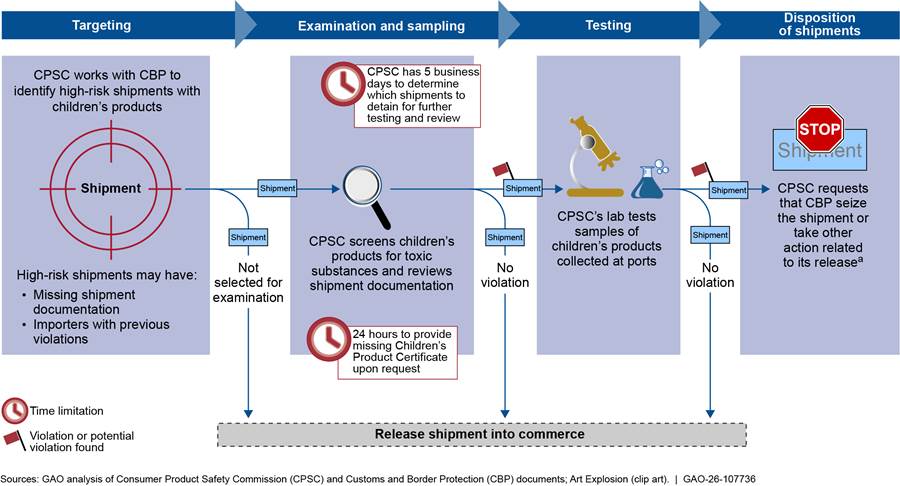
aFor example, CPSC may ask CBP to release a shipment if the importer agrees to bring the product into compliance. CBP may also return the shipment to its origin or destroy products in consultation with the importer.
Port investigators we interviewed vary in the targeting methods they primarily use. Most rely on the Commercial Targeting and Analysis Center or referrals from local CBP port staff to target children’s products for examination. Investigators at the Northeast sea port said they also use CPSC’s RAM system to consider other factors beyond the purview of the center, such as prior CPSC examinations, in making targeting decisions.
Differences in targeting methods across some ports were partly due to time and resource availability and the port type. For example, investigators at the airports and the land port noted that they primarily rely on the Commercial Targeting and Analysis Center or CBP systems, which automatically hold shipments at the port for examination. This approach is more efficient because cargo at these ports is processed more quickly and may be released when investigators are not on duty or before they can review it.
Examination activities we observed included initial screenings, where port investigators used handheld devices to screen children’s products for lead, other heavy metals, and phthalates (see fig. 2). CPSC port investigators can use CBP entry information and other shipment documentation to identify packages containing children’s products within a shipment that need to be screened for toxic substances.[22] A product will fail CPSC’s screening if the device’s results indicate that the product contains levels of these substances that exceed the limits in CPSC’s safety standards. Investigators told us they also check for a Children’s Product Certificate and third-party test report as part of these initial screenings.
Figure 2: Devices the Consumer Product Safety Commission Uses to Screen Children’s Products for Toxic Substances at U.S. Ports
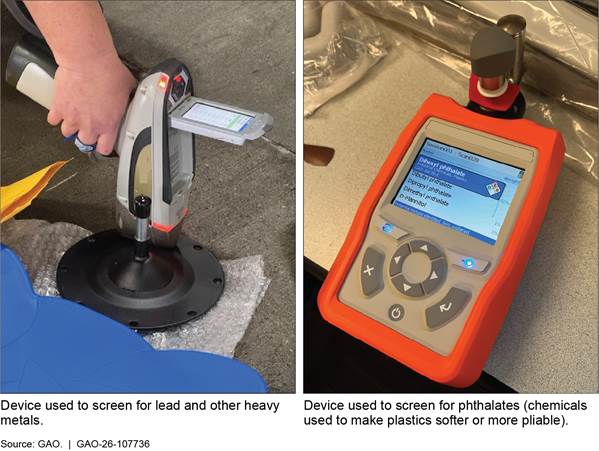
Investigators may collect and submit samples of products for further CPSC lab testing if the products fail screenings or do not have a Children’s Product Certificate and test report, as CPSC requires.[23] If CPSC’s lab determines that the sample violates CPSC’s safety standards, CPSC requests that CBP take one of several possible actions at the ports with respect to the product. For example, CPSC may request that CBP seize and destroy the violative products or redeliver them to the importer.
CPSC has taken steps to measure the results of its port examination processes. For example, it has developed performance measures to help track the percentage of high-risk consumer product imports it examines and the total number of import examinations it completes (see table 1). According to CPSC officials, these measures incorporate data on children’s products examined for toxic substances. CPSC staff have also developed an internal dashboard to gauge the effectiveness of RAM targeting and risk scoring. CPSC officials told us the dashboard is a work in progress, but that management can use it to review data on the rate at which high-risk shipments scored by RAM are found to violate CPSC standards.
|
Measure |
Target |
Actual |
|
Percentage of high-risk, imported consumer products examineda |
85% |
92% |
|
Percentage of shipments processed through CPSC’s Risk Assessment Methodology system and cleared in 1 business day |
99% |
99.8% |
|
Number of port examinations completedb |
45,000 |
51,893 |
|
Number of de minimis shipments examinedc |
12,000 |
13,966 |
Source: GAO review of Consumer Product Safety Commission (CPSC) documents. | GAO‑26‑107736
aAccording to CPSC officials, this measure calculates the percentage of shipments physically examined by CPSC port investigators and initially targeted by the Commercial Targeting and Analysis Center. Officials said approximately 75 percent of these examined shipments included children’s products.
bExcludes de minimis shipments.
cA de minimis shipment is valued below $800 and qualifies for a duty exemption under the Tariff Act. 19 U.S.C. § 1321(a)(2)(C). Effective Aug. 29, 2025, Executive Order 14324 ended duty-free access for de minimis shipments from all countries. Public Law 119-21— commonly known as the One Big Beautiful Bill Act—repeals the statutory basis for the de minimis exemption effective July 2027. An Act to provide for reconciliation pursuant to title II of H. Con. Res. 14, Pub. L. No. 119-21, tit. VII, § 70531(b), 139 Stat. 72, 283 (2025).
CPSC Has Developed a New E-Filing System but Does Not Yet Have a Plan for Overseeing Compliance with It
Currently, importers of children’s products must present a copy of the accompanying Children’s Product Certificate upon request by CPSC investigators at a port of entry. Starting July 2026, CPSC will require importers to electronically file (or e-file) seven data elements from these certificates upon entry, including the product model number or other product identification, date of manufacture, and date and place of third-party testing.[24]
Through e-filing, CPSC aims to address delays in port examinations, such as those caused by shipments lacking required certificates. While waiting for missing documents, CBP staff may need to move or release shipments to free limited storage space at ports.[25]
Additionally, through e-filing, CPSC aims to help address targeting challenges associated with low-value (de minimis) shipments.[26] As de minimis packages, these shipments were permitted to enter U.S. ports without Harmonized Tariff Schedule codes or other CBP entry information needed for targeting prior to August 29, 2025.[27] CPSC port investigators said importers provide broad or inaccurate codes that make it difficult to identify incoming shipments with children’s products. Under e-filing, CPSC plans to incorporate certificate data into the RAM risk score to provide port investigators more product-specific information aligned with CPSC targeting priorities than the CBP entry data they currently rely on.
CPSC has been working toward an e-filing system for over 10 years but has yet to develop a detailed plan for overseeing importers’ compliance with the system.[28] In December 2020, CPSC approved a multiyear, four-stage plan to implement the system. While the plan outlines CPSC’s steps toward finalizing e-filing, it does not address how CPSC will ensure that importers submit required data elements on time or that the data are accurate. For example, the plan does not include steps CPSC will take when an importer does not e-file upon entry or how CPSC will determine whether the data submitted are correct. CPSC officials told us they do not have detailed oversight plans because they are still in the early stages of developing them, and that such details will be available by the e-filing system’s July 2026 implementation. However, CPSC could not provide any documentation about its efforts to develop an oversight plan.
Federal internal control standards state that management should design control activities to achieve objectives and respond to risks—in CPSC’s case, risks that include importers not e-filing required information needed for CPSC to efficiently conduct product examinations.[29] The standards also state that management should implement control activities through policies. By developing and implementing a plan for overseeing importers’ compliance with its e-filing system, CPSC could be better positioned to ensure importers submit required data elements on time. CPSC could also help ensure e-filing achieves its intended objectives, such as making examinations more efficient by mitigating delays and making targeting more effective by collecting data needed to improve it.
CPSC Verifies That Labs Are Accredited but Could Better Leverage Data to Assess Risk
CPSC Has Processes to Verify Accreditation and Other Requirements
CPSC’s process for ensuring that third-party labs meet its standards relies on labs obtaining and maintaining accreditation from accrediting bodies that are members of the International Laboratory Accreditation Cooperation (ILAC). ILAC is an international organization involved in the accreditation of labs.[30] CPSC officials told us that establishing their own accreditation process would have required significant amounts of staff and funding, which is why they rely on ILAC’s accreditation system.[31] Accreditation bodies assess labs’ operations to determine whether they meet international standards for impartiality, technical competence, and management. Accrediting bodies also reassess labs at least every 5 years to ensure they maintain their standards of independence and technical expertise, in accordance with ILAC standards.
To approve labs to test children’s products for compliance with its safety rules, CPSC requires labs to submit an initial application demonstrating that the lab meets its requirements and provide renewal applications every 2 years.[32] CPSC has baseline requirements that labs of all types (independent, firewalled, and government) must meet to demonstrate that they have the competence to conduct required testing. Under these requirements, all labs must submit an accreditation certificate from an ILAC accrediting body, as well as documentation showing the children’s product safety rules and test methods for which the lab is accredited (referred to as the testing scope). CPSC approves labs to conduct only those specific tests listed in their testing scope documents, and testing scopes can vary across labs.
In addition to these baseline requirements, firewalled and government labs must provide additional documents demonstrating safeguards to prevent manufacturers or other interested parties from compromising the lab’s testing process or test results. For example, firewalled labs must provide organizational charts for the lab and the entity that owns it to show sufficient independence from the manufacturer. Firewalled and government labs must provide documents describing their policies on undue influence.
CPSC’s process for reviewing first-time lab applications consists of two independent reviewers checking for compliance with CPSC baseline requirements, with additional reviews by committees for firewalled and government labs. For firewalled labs, CPSC staff also analyze data on prior violations to identify associations between the lab and violative products, and they provide the analysis to the committee for its review. Once the committee completes its review of the analysis of prior violations, it develops a memorandum recommending the firewalled lab’s approval or denial to CPSC’s commissioners. CPSC officials said that before going to the commissioners, the memorandum goes through CPSC’s clearance process, which includes review and approval from relevant management officials. The next step in CPSC’s process is a vote by commissioners on whether to approve the lab.[33] For government labs, once the committee reaches consensus on its recommendation, it provides its recommendation and analysis to the Office of General Counsel to review for completeness (see fig. 3).
Figure 3: CPSC’s Process for Approving First-Time Third-Party Lab Applicants to Test Children’s Products
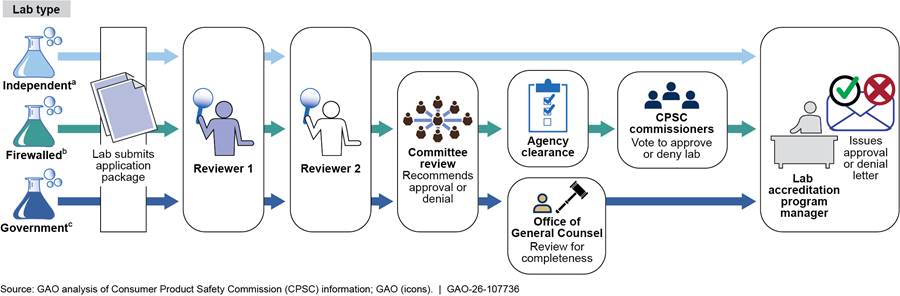
Notes: According to CPSC’s website, as of Sept. 15, 2025, CPSC had approved 702 labs, of which 606 were independent, 59 were government-owned, and 37 were firewalled. Since Aug. 22, 2025, CPSC has operated with one commissioner, the Acting Chairman.
aIndependent labs are not owned, managed, or controlled by a manufacturer or private labeler of a children’s product, or owned or controlled by a government.
bFirewalled labs are owned, managed, or controlled by a manufacturer or private labeler of children’s products.
cGovernment labs are owned or controlled, in whole or in part, by a domestic or foreign government entity.
For renewal applications, CPSC requires all labs to submit a current accreditation certificate and testing scope documents every 2 years. Firewalled and government labs must also submit updated documentation on undue influence safeguards. CPSC uses two independent reviewers to check its renewal applications for compliance, similar to its first-time application review process, according to CPSC officials. However, there are no additional committee reviews for firewalled and government labs.
We reviewed a nongeneralizable sample of 34 CPSC lab applications, which included first-time lab applications and renewal applications for each lab type. CPSC approved 25 of these applications, 20 of which contained documentation on accreditation.[34] We also found that CPSC reviewers verified that applicants were accredited for each testing scope for which they sought CPSC acceptance by crosschecking this information on the labs’ accrediting bodies’ websites.
CPSC Does Not Regularly Analyze Data on Prior Violations to Assess Risk for All Labs
For firewalled labs, CPSC analyzes data on the labs’ prior violations to better evaluate these labs’ safeguards against undue influence. However, it does not analyze such data for government or independent labs.
Potential risks posed by third-party labs include inaccurate testing or reporting false or inaccurate test results because of undue influence from a manufacturer or other interested party. For example, in 2022, CPSC investigated and withdrew its approval of two independent labs after finding evidence that one lab had issued false test reports and the other had fraudulently used the address and emblem of a different lab on hundreds of test reports. Additionally, in its 2018 e-filing certificate of compliance study, CPSC found that certain third-party labs were associated with higher violation rates compared with other labs.[35] CPSC conducted this study to assess the correlation between timing and availability of certificates of compliance, the data provided on a certificate, and the violation rates in finished products.
Federal internal control standards state that management should identify, analyze, and respond to risks.[36] CPSC has some procedures to help identify potential risks associated with labs through data analysis. For example, its procedures for investigating labs for misconduct state that it may initiate investigations based on several factors, including if CPSC identifies trends of noncompliant products associated with a particular lab or trends of inconsistencies in test reports. Additionally, for firewalled labs seeking approval, CPSC staff must analyze violations data to better evaluate these labs’ safeguards against undue influence. CPSC implemented this data analysis after reviewing its firewalled lab approval process.[37]
However, CPSC has not regularly analyzed violations data to identify and respond to risks for labs of all types. For example, from 2014 through August 2025, 19 of CPSC’s 21 investigations were based on information from outside parties instead of its own analysis, according to CPSC officials.[38] Additionally, although CPSC analyzes violations data when reviewing firewalled lab applications, it does not do so for independent and government labs. Officials said limited resources have been the primary reason CPSC has not regularly analyzed violations data for these labs.
By developing a process to regularly analyze violations data for independent and government labs, CPSC would be better positioned to identify and address risks of violative products entering the market. Such a process could specify how often staff should conduct trend analyses (taking into consideration CPSC’s limited resources) and how to use new data from the e-filing system to track risks over time.
CPSC Has Updated Some Children’s Product Testing Requirements but Not Those for Lead or Phthalates
CPSC Has Helped Revise Some Toy Testing Requirements and Developed Additional Requirements
Since 2009, CPSC has enforced ASTM International’s toy safety standard as a mandatory standard for toys. This standard requires children’s toys to be tested for certain heavy metals, such as mercury. CPSC has worked with ASTM to review and update the standard, most recently in 2024, when CPSC reviewed ASTM’s changes to determine whether they improve toy safety and should become part of CPSC’s mandatory children’s product safety rules.[39] Additionally, CPSC has helped ASTM revise some requirements, such as limits on heavy metals in accessible toy materials, according to CPSC officials.
CPSC also approved a new mandatory rule in August 2025 that established additional testing requirements for toys to address safety issues that it found were not adequately addressed by the toy standard.[40] Specifically, after reviewing incident data on injuries from water beads, CPSC determined that the toy standard’s requirements were insufficient to address all known water bead hazards, including potential toxicity risks related to acrylamide, a chemical that may be found in this product.[41] The rule establishes acrylamide limits and new testing requirements for water beads.[42]
CPSC Has Not Updated Its Lead Requirements for Children’s Products
The Consumer Product Safety Improvement Act of 2008 requires CPSC to review its lead requirements—which limit the total lead content in accessible components and the amount of lead in paint or similar surface coatings in children’s products—at least every 5 years and to lower the limits if it determines doing so is technologically feasible.[43] The act also requires CPSC to review its methods for measuring lead in paint or other surface coatings at least every 5 years to ensure the methods are the most effective available to protect children’s health.[44]
However, CPSC has not reviewed its lead limits or its method for measuring lead in paint since the requirements first went into effect in 2011 and 2009.[45] CPSC officials told us that limited resources have prevented CPSC from conducting any of the statutorily required lead reviews to date.
Lead exposure can result in serious health effects in children, including brain damage, slowed development and growth, and learning and behavioral health problems. Exposure to even small amounts of lead can harm children, according to the Centers for Disease Control and Prevention. By completing a review of its lead rules to determine whether its lead limits and testing methods for measuring lead in paint should be revised and documenting a process for completing this review every 5 years, CPSC could help ensure that it does not miss opportunities to strengthen its standards and that its standards protect children as intended. Completing these reviews would also ensure CPSC meets its statutory obligations under the Consumer Product Safety Improvement Act of 2008.
CPSC Does Not Have a Documented Process for Staying Up-to-Date on Phthalates and Other Toxic Substances
CPSC has not reviewed its requirement limiting the concentration of certain phthalates—chemicals used to make plastics softer or more pliable—in children’s toys and child care articles for any needed updates.[46] CPSC issued an interim prohibition against certain phthalates starting in February 2009 and made the prohibition permanent in April 2018 after CPSC convened an advisory panel and found the prohibition was necessary to protect children’s health. CPSC officials said they rely on CPSC’s Health Sciences staff to research toxic substances and their limits and stay up-to-date on changes in science.[47] Officials said they were not aware of any major changes in science that would warrant a review of the phthalates requirement.
However, CPSC does not have a documented process for its staff to monitor and consider research developments to ensure its standards for phthalates and other toxic substances in children’s products remain current. For example, it does not have procedures describing when Health Sciences staff should conduct research or take other steps to monitor changes associated with these substances.[48] CPSC officials also noted that agency research on toxic substances is often limited by staff and resource constraints. They said they have not documented a process because they have not considered it necessary given more critical priorities.
CPSC’s strategic plan states that its safety standards play a vital role in protecting the public from hazardous products, and notes that research is important to developing and improving these standards.[49] Additionally, federal internal control standards state that management should identify, analyze, and respond to significant changes that could impact the internal control system—in this case, potential changes affecting the standards and methods CPSC uses to provide assurance of the safety of children’s toys.[50] Management should also implement control activities through policies. This can include documenting the responsibilities of units within an agency and the timing of when activities should occur. By documenting a process for staying up-to-date on changes related to phthalates and other toxic substances in children’s products, CPSC could better ensure that its staff take the necessary steps to keep their knowledge current and that CPSC has the information needed to address related safety hazards. For example, this information could help CPSC determine whether updates to its safety standards for children’s products are warranted.
Conclusions
CPSC has developed safety standards to protect children from hazardous products containing lead and other toxic substances. CPSC has also developed oversight processes to ensure that importers of children’s products and third-party labs that test the products comply with its requirements. However, opportunities exist for CPSC to strengthen these safety standards and oversight processes.
For example, CPSC has been working toward its e-filing system for over 10 years, and the system promises to improve its ability to collect data to target and examine children’s products at ports. However, CPSC has yet to develop a plan for how it will ensure importers’ compliance with its new e-filing requirements. Establishing such a plan would help ensure the system achieves its intended objectives, such as making targeting more effective and examinations more efficient.
Further, potential risks posed by third-party labs include inaccurate testing and reporting false test results. However, CPSC has not proactively and regularly analyzed prior violations data to assess these risks for independent and government labs. Leveraging these data could enable CPSC to proactively identify risks and prevent violative children’s products from entering the market.
Additionally, CPSC is statutorily required to review its lead limits and method for measuring lead in paint or other surface coatings at least every 5 years, but it has not done so since these requirements took effect in 2011 and 2009. Completing these reviews would help CPSC ensure that it does not miss opportunities to strengthen its standards, protects children as intended, and meets its statutory obligations.
Finally, while CPSC relies on its Health Sciences staff to monitor changes in science, it does not have a documented process for monitoring changes related to phthalates and other toxic substances found in children’s products. By documenting such a process, CPSC could better ensure that it has current information to address safety hazards, such as by determining whether standards for phthalates and other toxic substances in children’s products need updating.
Recommendations for Executive Action
We are making the following four recommendations to CPSC:
The Chairman of CPSC should establish a plan for overseeing compliance with CPSC’s e-filing requirements. The plan should ensure that importers comply with e-filing requirements and submit timely, accurate certificate data. (Recommendation 1)
The Chairman of CPSC should develop a process for using CPSC’s violations data to assess risks associated with independent and government labs. Steps could include revising its lab investigation procedures to specify how often staff should analyze data for trends related to violative findings, or developing a process for using lab data collected from the new e-filing system to examine trends over time. (Recommendation 2)
The Chairman of CPSC should complete a review of CPSC’s lead requirements for children’s products to determine whether it is feasible to lower lead limits, and review its methods for measuring lead in paint or other surface coatings to ensure they are the most effective available to protect children’s health, as required by the Consumer Product Safety Improvement Act of 2008. In doing so, CPSC should also document a process for completing this review every 5 years. (Recommendation 3)
The Chairman of CPSC should document a process for how CPSC staff should stay up-to-date about potential changes related to phthalates and other toxic substances found in children’s products. Steps could include developing internal procedures or a research agenda specifying the nature and timing of research or other activities staff should conduct. (Recommendation 4)
Agency Comments
We provided a draft of this report to CPSC and the Department of Homeland Security for review and comment. CPSC provided written comments, which are reproduced in appendix III. CPSC agreed with our four recommendations and indicated it would take actions to implement them. The Department of Homeland Security did not have any comments on the report.
We are sending copies of this report to the appropriate congressional committees, the Acting Chairman of CPSC, the Secretary of Homeland Security, and other interested parties. In addition, the report is available at no charge on the GAO website at https://www.gao.gov.
If you or your staff have any questions about this report, please contact me at cackleya@gao.gov. Contact points for our Offices of Congressional Relations and Public Affairs may be found on the last page of this report. GAO staff who made key contributions to this report are listed in appendix IV.

Alicia Puente Cackley
Director, Financial Markets and Community Investment
This report examines (1) the Consumer Product Safety Commission’s (CPSC) processes for examining children’s products at ports and its plans to require importers to electronically file certain data upon entry; (2) CPSC’s processes for approving third-party labs to test children’s products and for assessing risks posed by labs; and (3) the extent to which CPSC has reviewed its safety standards for lead and other toxic substances to ensure they remain up-to-date.
To address our first objective, we reviewed documentation on CPSC’s processes for identifying and addressing toxic substances in children’s products. For example, we reviewed CPSC’s policies and procedures for targeting and examining children’s products entering U.S. ports and for monitoring and investigating safety hazards and incidents involving products already on the market. Additionally, we reviewed CPSC’s annual operating plans, performance reports, and other assessments outlining the steps it has taken to measure the results of its port examinations for the last 10 years.
We also obtained and analyzed CPSC data from fiscal years 2014 through 2024 on violative children’s products identified through port examinations and other efforts. We assessed the reliability of the data by reviewing relevant documentation, testing the data for errors, and interviewing CPSC officials about steps taken to ensure data quality. We found the data reliable for the purpose of describing the types of toxic substances CPSC found in violative children’s products.
We also reviewed Federal Register notices and CPSC’s four-phased implementation plan to assess how CPSC has planned for its electronic filing (or e-filing) system for certificate data. We determined that the control activities component within standards for internal control in the federal government was significant to this objective, and we assessed CPSC’s implementation plan against the component’s underlying principles that management should design and document control activities to achieve the agency’s objectives.[51]
To obtain additional information and perspectives on CPSC’s port examinations, e-filing system, and other processes, we interviewed CPSC officials at headquarters and at a nongeneralizable sample of six U.S. ports, four of which we visited to observe how examinations are conducted. The ports visited were a Northeast sea port, a West Coast sea port, a West Coast airport, and a Southeast sea port. The other two ports where we interviewed staff were a Midwest port covering products from both a sea port and airport, and a Northeast land port. We selected the ports to prioritize those with the largest volume of children’s products entering the U.S. and to obtain a mix of different U.S. regions. We also interviewed representatives of an industry group (Baby Safety Alliance, formerly known as Juvenile Products Manufacturers Association) and three consumer advocacy groups (Consumer Federation of America, Kids in Danger, and Public Interest Research Group) to gather background information on toxic substances in children’s products.
To address the second objective, we reviewed federal laws and regulations to identify CPSC requirements applicable to third-party labs. Additionally, we reviewed CPSC’s policies and procedures for overseeing labs, which included procedures for approving labs to test children’s products and investigating misconduct. Further, we reviewed CPSC’s March 2023 report on its lab approval process for firewalled labs (those owned or controlled by the manufacturer).[52] We determined that the risk assessment component within standards for internal control in the federal government was significant to this objective, and we assessed CPSC’s lab oversight processes against the component’s underlying principle that management should identify, analyze, and respond to risks.[53]
We also reviewed a nongeneralizable sample of 34 lab applications from 30 labs, which included first-time and renewal applications for each lab type, and we interviewed representatives of a nongeneralizable sample of four labs to better understand how they meet CPSC’s requirements.[54] For the lab application review, we selected 24 labs randomly and six judgmentally to prioritize those with a larger number of testing scopes and those located in countries exporting the largest volume of children’s products to the U.S.[55] We also judgmentally selected four labs for interviews using the same factors.
In addition, we interviewed CPSC officials to collect additional information on CPSC’s processes for overseeing third-party labs. We also interviewed officials of the International Laboratory Accreditation Cooperation to better understand its role and that of accreditation bodies.
To address the third objective, we reviewed federal laws and regulations to identify CPSC safety standards for lead and other toxic substances in children’s products that require third-party testing, along with provisions requiring CPSC to review these standards. Additionally, we reviewed Federal Register notices and CPSC procedures to identify steps CPSC has taken to ensure its requirements remain current and to stay up-to-date on changes in science related to toxic substances in children’s products. We also interviewed officials of CPSC and two standard-developing organizations—ASTM International and the International Organization for Standardization—about their processes for updating their standards. We determined that the risk assessment and control activities components within standards for internal control in the federal government were significant to this objective. We assessed CPSC’s process for staying up-to-date on changes in science related to toxic substances against the components’ underlying principles that management should identify, analyze, and respond to change and document control activities through policies.[56]
We conducted this performance audit from July 2024 to January 2026 in accordance with generally accepted government auditing standards. Those standards require that we plan and perform the audit to obtain sufficient, appropriate evidence to provide a reasonable basis for our findings and conclusions based on our audit objectives. We believe that the evidence obtained provides a reasonable basis for our findings and conclusions based on our audit objectives.
From fiscal years 2014 to 2024, the number of children’s product violations related to the Consumer Product Safety Commission’s (CPSC) safety standards on toxic substances decreased overall and in most years. The most common violation during this period was for lead (see fig. 4).
To identify these violations, CPSC tested samples of children’s products collected through port examinations, domestic surveillance activities, and reviews of product reports submitted by manufacturers, distributors, and retailers.[57] Over 90 percent of samples collected during this period were from imported children’s products.
Figure 4: Samples of Children’s Products in Violation of CPSC Safety Standards on Toxic Substances, Fiscal Years 2014–2024
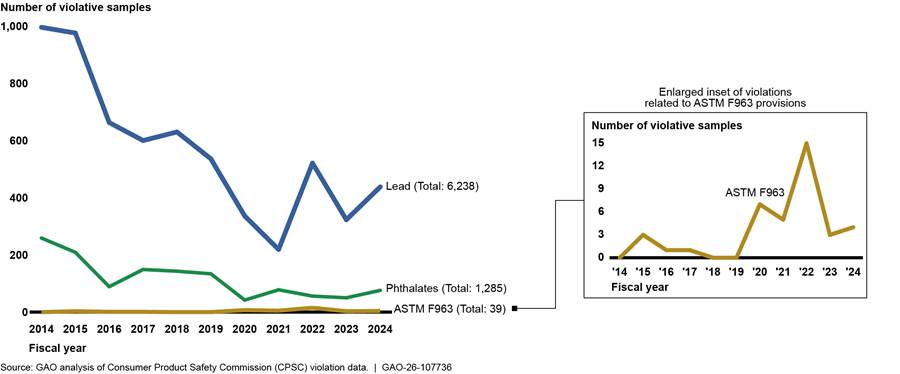
Notes: This figure shows the number of children’s product samples CPSC determined to be in violation of its safety standards for lead, phthalates (chemicals used to make plastics softer or more pliable), or other heavy metals and toxic substances identified in ASTM F963 (the toy standard). CPSC officials noted that changes in the number and type of violations over this period could reflect several factors, including changes in staffing levels, industry compliance, products, and safety hazards. ASTM F963 was developed by ASTM International, an international standard-developing organization. Samples may include multiple violations.
CPSC headquarters officials said they could not definitively explain why children’s product violations have changed over the last 10 years. They noted that changes in the number and type of violations could reflect several factors, including changes in staffing levels, industry compliance, products, and safety hazards. Officials said the size of incoming shipments could also have affected the number of violations, as smaller shipments may not contain enough product units to sample, test, and confirm violations. In addition, they said that in fiscal year 2020, samples of imported children’s products decreased due to the COVID-19 pandemic. CPSC investigators conducted remote port examinations that year, which limited the types of products investigators could screen.[58]
GAO Contact
Alicia Puente Cackley, cackleya@gao.gov
Staff Acknowledgments
In addition to the contact named above, John Fisher (Assistant Director), Erika Navarro (Analyst in Charge), Alma Atassi, Genesis Galo, Jill Lacey, Marc Molino, Jessica Sandler, Jennifer Schwartz, Cristina Toppin, and Kristen Watts made key contributions to this report.
The Government Accountability Office, the audit, evaluation, and investigative arm of Congress, exists to support Congress in meeting its constitutional responsibilities and to help improve the performance and accountability of the federal government for the American people. GAO examines the use of public funds; evaluates federal programs and policies; and provides analyses, recommendations, and other assistance to help Congress make informed oversight, policy, and funding decisions. GAO’s commitment to good government is reflected in its core values of accountability, integrity, and reliability.
Obtaining Copies of GAO Reports and Testimony
The fastest and easiest way to obtain copies of GAO documents at no cost is through our website. Each weekday afternoon, GAO posts on its website newly released reports, testimony, and correspondence. You can also subscribe to GAO’s email updates to receive notification of newly posted products.
Order by Phone
The price of each GAO publication reflects GAO’s actual cost of production and distribution and depends on the number of pages in the publication and whether the publication is printed in color or black and white. Pricing and ordering information is posted on GAO’s website, https://www.gao.gov/ordering.htm.
Place orders by calling (202) 512-6000, toll free (866) 801-7077,
or
TDD (202) 512-2537.
Orders may be paid for using American Express, Discover Card, MasterCard, Visa, check, or money order. Call for additional information.
Connect with GAO
Connect with GAO on X,
LinkedIn, Instagram, and YouTube.
Subscribe to our Email Updates. Listen to our Podcasts.
Visit GAO on the web at https://www.gao.gov.
To Report Fraud, Waste, and Abuse in Federal Programs
Contact FraudNet:
Website: https://www.gao.gov/about/what-gao-does/fraudnet
Automated answering system: (800) 424-5454
Media Relations
Sarah Kaczmarek, Managing Director, Media@gao.gov
Congressional Relations
A. Nicole Clowers, Managing Director, CongRel@gao.gov
General Inquiries
[1]According to CPSC’s fiscal year 2026 budget request, the President’s fiscal year 2026 budget proposes to reorganize and transfer CPSC’s functions to the Department of Health and Human Services. The request states that CPSC will continue to carry out its mission as a stand-alone agency until authorizing legislation is enacted. See Consumer Product Safety Commission, Performance Budget Request to Congress: Fiscal Year 2026 (May 30, 2025). CPSC was operating with one commissioner, the Acting Chairman, as of August 22, 2025.
[2]Pub. L. No. 110-314, 122 Stat. 3016.
[3]A children’s product is a consumer product designed or intended primarily for children 12 years of age or younger. 15 U.S.C. § 2052(a)(2).
[4]From fiscal years 2014 through 2024, CPSC identified 6,238 children’s product samples in violation of its requirements related to lead through port examinations and other methods. A sample consists of one or more items of evidence, and a single sample can have multiple violations, according to CPSC.
[5]Testing scope refers to the range of children’s product safety rules and testing methods for which the lab has been accredited. We reviewed 21 labs’ most recent applications (which included renewals and scope increases), 10 first-time applications, and three additional scope-increase applications for a total of 34 lab applications. The applications were submitted to CPSC from December 2008 through February 2025.
[6]CPSC is generally statutorily restricted from issuing mandatory safety rules except in instances in which voluntary standards would not “eliminate or adequately reduce the risk of injury” and where it is unlikely there “will be substantial compliance with such voluntary standards.” 15 U.S.C. § 2056(b).
[7]Certain printed materials and metal component parts of bicycles are excluded from the third-party testing requirements related to lead content limits. 15 U.S.C. § 2063(d)(5).
[8]According to CPSC’s website, as of September 15, 2025, CPSC had approved 702 labs, of which 606 were independent, 59 were government-owned, and 37 were firewalled.
[9]CPSC requires these labs to implement safeguards that “firewall” them against the possibility of undue influence from the manufacturer or private labeler.
[10]Pub. L. No. 110-314, § 101 (2008) (codified at 15 U.S.C. § 1278a(a)(2)(C)). CPSC’s lead content standard is found in 16 C.F.R. § 1500.87-.91. CPSC has determined that certain materials do not need to be tested for lead content amounts if those materials are untreated and unadulterated, such as wood, textiles consisting of natural fibers, and certain electronic component parts in children’s electronic devices.
[11]Pub. L. No. 110-314, § 101(f) (2008) (codified at 15 U.S.C. § 1278a(f)(1)). CPSC’s lead paint standard is found in 16 C.F.R. pt. 1303.
[12]Pub. L. No. 110-314, § 108 (2008) (codified at 15 U.S.C. § 2057c). CPSC’s phthalates standard is found at 16 C.F.R. pt. 1307.
[13]The Consumer Product Safety Act defines a substantial product hazard as a failure to comply with an applicable consumer product safety rule or a product defect which (because of the pattern of defect, the number of defective products distributed in commerce, the severity of the risk, or otherwise) creates a substantial risk of injury to the public. 15 U.S.C. § 2064(a).
[14]According to CPSC officials, in fiscal year 2024, 98 percent of dolls, toys, and games sold in the U.S. were imported, and 83 percent of these were from China. CPSC officials told us these estimates were based on data from the U.S. International Trade Commission and noted that other types of children’s products were not included. For example, CPSC could not provide estimates for imports of children’s apparel because the data do not differentiate between children’s and adult apparel.
[15]CPSC also takes steps to identify and address violative children’s products that have already entered the market, such as imported products that were not examined or products manufactured in the U.S. To help identify these products, CPSC’s Integrated Product Teams analyze data on product-related injuries, fatalities, and other incidents. CPSC officials noted that the data primarily cover incidents acute enough to be attributed to a specific product, unlike long-term health effects from toxic substance exposure. See app. II for information on the types of children’s product violations related to toxic substances found through CPSC’s import and domestic surveillance efforts.
[16]CPSC funded a staffing level of 534 full-time employees for fiscal year 2025. For fiscal year 2026, it proposed a staffing level of 459 full-time employees. Consumer Product Safety Commission, Performance Budget Request to Congress.
[17]According to CPSC officials, port investigators may also examine high-risk shipments at additional ports without colocated staff. Additionally, other CPSC staff (such as product safety investigators from CPSC’s Office of Compliance and Field Operations) may complete port examinations as needed.
[18]The center is located at CBP headquarters in Washington, D.C. From this office, CBP systems are used to help identify high-risk shipments of consumer products that arrive at the border nationwide.
[19]In fiscal year 2024, CPSC reported conducting over 65,000 import examinations, including nearly 14,000 products from de minimis shipments. A de minimis shipment is valued below $800 and meets the requirement for a duty exemption under the Tariff Act. 19 U.S.C. § 1321(a)(2)(C). The shipments targeted by the Commercial Targeting and Analysis Center include children’s products and other consumer products. Effective Aug. 29, 2025, Executive Order 14324 ended duty-free access for de minimis shipments from all countries. Public Law 119-21— commonly known as the One Big Beautiful Bill Act—repeals the statutory basis for the de minimis exemption effective July 2027. An Act to provide for reconciliation pursuant to title II of H. Con. Res. 14, Pub. L. No. 119-21, tit. VII, § 70531(b), 139 Stat. 72, 283 (2025).
[20]CPSC’s RAM system receives entry data from CBP’s Automated Commercial Environment system under a 2013 memorandum of understanding between the two agencies. This system is used by the trade community to report imports and exports and by the U.S. to determine admissibility. In addition to Harmonized Tariff Schedule codes, entry information includes the importer’s identification number and the shipment’s weight, origin, and value.
[21]Importers file entry documentation with CBP when shipments arrive at U.S. ports of entry. Key information about the importer and consumer product are detailed across this documentation, which generally includes a CBP entry form, commercial invoice, packing list, and identification of the buyer or consignee. 19 C.F.R. § 142.3.
[22]Port investigators may need to open multiple boxes to locate children’s products when shipping documentation does not match the contents.
[23]According to CPSC officials, a sample represents one or more items of evidence collected to provide necessary data and information for CPSC operations. Most samples consist of consumer products or their component parts. Samples may also consist of records, product labels, photographs, and other documents, including Children’s Product Certificates.
[24]According to the Federal Register notice for CPSC’s e-filing final rule, requirements affecting applicable products will take effect on July 8, 2026. Requirements affecting products imported into a Foreign Trade Zone and subsequently entered for consumption or warehousing will take effect on Jan. 8, 2027. Foreign Trade Zones are secure areas located throughout the U.S. that are treated as outside U.S. customs territory for duty assessments and other customs entry procedures. Certificates of Compliance, 90 Fed. Reg. 1800 (January 8, 2025).
[25]According to CPSC port investigators we interviewed, importers are currently required to provide Children’s Product Certificates within 24 hours of their products being examined, but investigators may not receive them within that time frame. Under an agreement with CBP, investigators have 5 business days to decide whether to hold shipments presented for CPSC examination.
[26]As noted earlier, a de minimis shipment is valued below $800 and meets the requirement for a duty exemption under the Tariff Act. 19 U.S.C. § 1321(a)(2)(C). But the definition is repealed effective July 2027. Pub. L. No. 119-21, tit. VII, § 70531(b), 139 Stat. 72, 283 (2025). According to CPSC, in fiscal year 2024, approximately 137 million entry-filed, de minimis shipments of children’s products entered the U.S., totaling $1.99 billion in shipment value. To provide these estimates, CPSC told us they included de minimis shipments that entered under a streamlined, voluntary entry process (referred to as Entry Type 86) and that fell within 181 Harmonized Tariff Schedule codes that best align with the product category of children’s products.
[27]Prior to August 29, 2025, importers of de minimis shipments were permitted to submit CBP entry documentation without Harmonized Tariff Schedule codes or a CBP entry summary, which contains information such as the imported product’s origin. 19 C.F.R. § 143.23(k); 19 C.F.R. § 128.24(e). Effective Aug. 29, 2025, Executive Order 14324 ended duty-free access for de minimis shipments from all countries. For non-postal shipments after the effective date, the parties must file the appropriate entry type in the Automated Commercial Environment and therefore no longer have a filing exemption. However, for postal shipments, the changeover to eliminate the exemption is not as clear. CBP issued a notice in the Federal Register in early September 2025 describing how the process will work for postal shipments with regard to determining which tariff rates apply. Notice of Implementation of the President’s Executive Order 14324, Suspending Duty-Free De Minimis Treatment for All Countries, 90 Fed. Reg. 42418 (Sept. 2, 2025).
[28]Since 2013, CPSC has undertaken projects to advance implementation of an e-filing requirement, including conducting e-filing pilot programs and a study. For example, CPSC’s 2018 certificate study concluded that CPSC may use the availability of a certificate at import and certain certificate data elements as major predictors of a violation without reviewing the entire certificate. The study found that shipment entries without a certificate of compliance were five times more likely to have a violation related to CPSC’s requirements for lead, phthalates, and heavy metals, among other types of safety hazards. See Consumer Product Safety Commission, eFiling Certificate of Compliance Study Assessment (Aug. 28, 2018).
[29]GAO, Standards for Internal Control in the Federal Government, GAO‑14‑704G (Washington, D.C.: Sept. 10, 2014).
[30]Accrediting bodies that are ILAC members have been peer reviewed and have entered international agreements with other accrediting bodies within the organization to accept testing and data from each other’s labs.
[31]By law, CPSC may accredit third-party labs itself or may designate an independent accreditation organization to do so.
[32]16 C.F.R. § 1112.13; 16 C.F.R. § 1112.35. For purposes of this report, we use the term “renewal application” to describe the audit that must be conducted of third-party conformity assessment bodies for continuing accreditation.
[33]Since Aug. 22, 2025, CPSC has operated with one commissioner, the Acting Chairman. The Acting Chairman issued a statement that he and a former commissioner worked with CPSC staff on plans, including directives and delegations of authority, to ensure CPSC’s efforts to protect the public continue without interruption. According to the statement, under the Consumer Product Safety Act, Congress empowered the commission to delegate all of its powers, including enforcement, regulatory, and administrative functions, to the Chairman and agency staff with the sole exception of certain subpoenas. See Statement by Consumer Product Safety Commission, Acting Chairman Peter A. Feldman (Aug. 19, 2025).
[34]For four of the applications that CPSC approved, CPSC officials told us they could not provide complete documentation because of limitations with the data system CPSC was using at the time these applications were submitted, and the other application was for changing the lab address. The other nine applications in our sample were either still going through CPSC’s review process at the time of our review, denied by CPSC, or removed by CPSC because the lab applicant submitted certain information incorrectly.
[35]CPSC staff found that four data elements, including the lab where a product was tested, showed potential correlations with higher or lower violation rates. According to CPSC, the study offered a compelling case for CPSC’s e-filing initiative. Consumer Product Safety Commission, eFiling Certificate of Compliance Study Assessment.
[37]CPSC analyzes violations data for initial and renewal applications. See Consumer Product Safety Commission, Report on CPSC Approval Process for Firewalled Testing Laboratories (Mar. 8, 2023). CPSC has not reviewed its approval process for independent or government labs.
[38]CPSC officials said they returned 17 labs to active status after completing their investigations. However, they withdrew two of the labs after finding that a manufacturer had exerted undue influence or otherwise interfered with or compromised the integrity of the labs’ testing processes. These labs remained withdrawn as of August 2025. Additionally, CPSC officials said CPSC initiated two investigations in 2025, one of which was ongoing and the other of which was closed as of August 2025.
[39]ASTM International officials told us they review the toy standard at least every 5 years for potential revisions. Section 106(g) of the Consumer Product Safety Improvement Act of 2008 requires CPSC to incorporate ASTM’s proposed revisions to ASTM F963 into its consumer product safety rules within 180 days of receiving notice unless CPSC has determined that the proposed revisions do not improve the safety of the consumer products covered by the standard and notifies ASTM within 90 days of receipt of the revision notification.
[40]Safety Standard for Toys: Requirements for Water Beads, 90 Fed. Reg. 57820 (December 12, 2025).
[41]CPSC describes water beads as multicolored or clear beads of various shapes composed of water-absorbing polymers, which expand when soaked in water or other liquids. 90 Fed. Reg. at 57821. Acrylamide may have harmful health effects if present in large amounts, according to the Food and Drug Administration.
[42]CPSC developed this rule pursuant to sections 106(c) and (d) of the Consumer Product Safety Improvement Act of 2008 (codified at 15 U.S.C. § 2056b(c) and (d)). Section 106(c) requires CPSC to periodically review and revise its mandatory toy safety standards to ensure that such standards provide the highest level of safety for toys that is feasible. Section 106(d) further requires CPSC to examine and assess the effectiveness of its mandatory toy safety standards in protecting children from safety hazards and to promulgate consumer product safety rules that are more stringent than existing standards if CPSC determines that more stringent standards would further reduce the risk of injury associated with such toys.
[43]Pub. L. No. 110-314, § 101 (2008) (codified at 15 U.S.C. § 1278a(a)(2)(E) and § 1278a(f)(2)). As of Aug. 14, 2011, accessible components of children’s products manufactured in or imported into the U.S. must not contain more than 100 parts per million of total lead content. Section 101(a)(2)(C) of the Consumer Product Safety Improvement Act of 2008 (codified at 15 U.S.C. § 1278a(a)(2)(C)). As of Aug. 14, 2009, paint and similar surface coatings used in children’s products must not contain a concentration of lead greater than 90 parts per million. 15 U.S.C. § 1278a(f)(1). The Consumer Product Safety Improvement Act of 2008 requires CPSC to review and revise these limits downward if technologically feasible no less than every five years after the limits went into effect in 2011 and 2009, respectively.
[44]Pub. L. No. 110-314, § 101 (2008) (codified at 15 U.S.C. § 1278a(f)(5)). The act required CPSC to complete a study evaluating the effectiveness, precision, and reliability of x-ray fluorescence technology or other alternative methods for measuring lead in paint or other surface coatings when used on a children’s product or furniture by Aug. 14, 2009 and to review and revise any methods for measurement it uses no less than every 5 years after the study was completed. 15 U.S.C. § 1278a(f)(4)(A) and (f)(5). CPSC completed this study on Aug. 1, 2009. See Consumer Product Safety Commission, Study on Effectiveness, Precision, and Reliability of X-ray Fluorescence Spectrometry and Other Alternative Methods for Measuring Lead in Paint (Aug. 1, 2009).
[45]As noted earlier, the requirement that CPSC review its total lead content limits at least every 5 years went into effect in 2011, and that it review its lead in paint limits in 2009. The requirement that CPSC review its methods for measuring lead in paint at least every 5 years also went into effect in 2009.
[46]Section 108 of the Consumer Product Safety Improvement Act of 2008 prohibits the manufacture for sale, offer for sale, distribution in commerce, or importation into the U.S. of children’s toys and child care articles that contain more than 1,000 parts per million of certain phthalates in accessible plasticized components. Pub. L. No. 110-314, § 108 (2008) (codified at 15 U.S.C. § 2057c).
[47]CPSC officials told us they typically document CPSC-led research in rulemaking documents or case files, as this research supports rulemaking efforts and compliance cases. However, they noted that CPSC does not have internal procedures or other documentation that outlines Health Sciences staff’s research efforts or process.
[48]CPSC has procedures for its Integrated Product Teams, which include some toxicologists within the Health Sciences group. However, the procedures focus on reviewing incident and injury data to identify emerging trends and hazards, not on research about changes in science or limits for toxic substances. CPSC officials also told us the team’s reports on emerging hazards and trends typically do not focus on chemical hazards in children’s products, which are less prevalent in the data CPSC reviews.
[49]Consumer Product Safety Commission, Strategic Plan 2023–2026: Protecting the Public From Hazardous Consumer Products (revised Feb. 25, 2025).
[51]GAO, Standards for Internal Control in the Federal Government, GAO‑14‑704G (Washington, D.C.: Sept. 10, 2014).
[52]Consumer Product Safety Commission, Report on CPSC Approval Process for Firewalled Testing Laboratories (Mar. 8, 2023).
[54]We reviewed 21 labs’ most recent applications (which included renewals and scope increases), 10 first-time applications, and three additional scope-increase applications for a total of 34 lab applications. The applications were submitted to CPSC from December 2008 through February 2025.
[55]Testing scope refers to the range of children’s product safety rules and testing methods for which the lab has been accredited.
[57]According to CPSC, a sample represents one or more items of evidence collected to provide necessary data and information for CPSC operations. Most samples consist of consumer products or their component parts. Samples may also consist of records, product labels, photographs, and other documents, including Children’s Product Certificates. Domestic surveillance activities include inspections of an importer’s or domestic manufacturer’s premises and reviews of consumer complaints. CPSC’s Integrated Product Teams conduct some of the reviews, analyzing complaint data and other information. Firms must submit reports notifying CPSC of potentially hazardous or violative products under Section 15(b) of the Consumer Product Safety Act (codified at 15 U.S.C. § 2064(b)).
[58]CPSC implemented procedures for conducting remote port examinations in response to the COVID-19 pandemic. These procedures did not call for targeting and examining certain high-risk products because they required more than a visual inspection, such as screenings for toxic substances using CPSC’s handheld devices. For more information, see GAO, Consumer Product Safety Commission: Action Needed to Improve Preparedness for Product Examination Disruptions, GAO‑23‑105445 (Washington, D.C.: Oct. 27, 2022).