
Report to Congressional Committees
United States Government Accountability Office
A report to congressional committees
Contact: Carol C. Harris at HarrisCC@gao.gov
What GAO Found
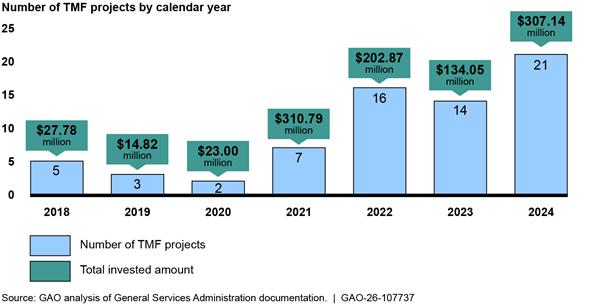
The Technology Modernization Fund (TMF) invests funding in agency projects to, among other things, modernize aging federal information technology (IT) systems. From fiscal years 2018 through 2025, the TMF received over $1 billion in net appropriations, of which the Technology Modernization Board invested about $1.03 billion in 68 unclassified projects (see figure).
As of June 2025 (the latest data available at the time of this analysis), 24 TMF projects expected to achieve total savings of about $1.06 billion. Eleven of these projects had collectively realized savings of about $13.5 million, and 13 had not yet begun to achieve savings. While savings thus far have been small, the amount is not unexpected given that 21 projects—with expected savings of about $1.04 billion, or 98.3 percent of the total—anticipate achieving their savings in fiscal year 2027 or later. Thirty-seven projects did not expect any cost savings, but are intended to provide other value, such as mitigating security risks. Seven other projects were cancelled prior to June 2025 and no longer expect savings.
Most of the projects were still active as of June 2025. Of the six completed TMF projects that expected cost savings, two met or were on track to meet their expected savings (within 10 percent) and four did not meet or were not on track to meet their savings. Officials for the projects that did not meet their expected savings attributed it to various reasons, such as the removal of planned functionality and higher system migration costs than planned, which led to tens of millions less in actual savings than estimated.
As required under the Competition in Contracting Act of 1984, all procurements, with certain exceptions, must use full and open competition so that any qualified entity can submit an offer. Of 177 TMF contract actions, the majority (154, or 87 percent) were awarded using competitive procedures. This accounted for about $713.1 million (96 percent) of the total funding awarded. In 23 instances where agencies awarded contract actions without such procedures, the agencies documented authorized exceptions.
Why GAO Did This Study
The federal government has faced longstanding problems in managing its IT. The Modernizing Government Technology Act established the TMF to help address key IT modernization challenges. The Act stated that TMF funds should be used to procure commercial products and services using full and open competition to the greatest extent practicable. The Office of Management and Budget (OMB) issued guidance to agencies applying for TMF funds, directing that project proposals include a reliable estimate of any project-related cost savings.
The act includes a provision for GAO to report biennially on the TMF and the expected cost savings of projects that received funding. This fourth report identifies the (1) approved TMF projects, their invested funds, and their expected and actual cost savings; (2) extent to which agencies' completed projects met their expected cost savings targets; and (3) extent to which the agencies used full and open competition for any acquisitions related to TMF invested projects.
GAO analyzed and summarized TMF financial data and documentation, including cost estimates, associated with 68 projects in which GSA had invested funds as of June 2025. For applicable completed projects, GAO compared the difference between expected and realized cost savings to OMB’s variance threshold of 10 percent.
GAO analyzed contract documentation for 32 projects that issued 177 contract actions between March 1, 2023, and June 2, 2025. GAO determined whether each one was awarded using full and open competition, in accordance with the Competition in Contracting Act of 1984 and the Federal Acquisition Regulation. GAO also interviewed relevant agency officials.
|
Abbreviations |
|
|
|
|
|
CIO |
Chief Information Officer |
|
FPDS |
Federal Procurement Data System |
|
GSA |
General Services Administration |
|
IT |
information technology |
|
MGT |
Modernizing Government Technology |
|
OMB |
Office of Management and Budget |
|
TMF |
Technology Modernization Fund |
This is a work of the U.S. government and is not subject to copyright protection in the United States. The published product may be reproduced and distributed in its entirety without further permission from GAO. However, because this work may contain copyrighted images or other material, permission from the copyright holder may be necessary if you wish to reproduce this material separately.
July 23, 2026
Congressional Committees
Federal agencies spend more than $100 billion annually on information technology (IT). However, the federal government has faced longstanding problems in its IT management. Because of these longstanding challenges, we added the federal government’s management of IT acquisitions and operations to our High Risk list as a government-wide challenge in 2015 and continue to designate it as such today.[1]
Recognizing the challenges in modernizing government IT systems, in December 2017, Congress enacted legislation—commonly referred to as the Modernizing Government Technology (MGT) Act—that established a funding mechanism to improve, retire, or replace existing systems.[2] Specifically, this act established the Technology Modernization Fund (TMF) within the Department of the Treasury. The fund was intended to improve the efficiency and effectiveness of federal IT systems, especially aging legacy systems. The act stated that the fund should be used to procure commercial products and services using full and open competition to the greatest extent practicable.
In March 2018, the Office of Management and Budget (OMB) issued funding guidelines for projects receiving TMF investments.[3] The guidance stated that the proposals must include a reliable estimate of any project-related cost savings or avoidance relative to pre-modernization activities, among other things.[4]
The MGT Act included a provision for GAO to report biennially on the TMF and the expected cost savings of projects that received funding. Accordingly, we have published three reports documenting the findings from each of these reviews.[5] In the reports, we made five recommendations to the General Services Administration (GSA) and OMB. As of November 2025, both agencies had implemented all the recommendations.
This report is our fourth review of the TMF. As of July 2026, the authorization for the TMF was set to expire at the end of September 2026. Without reauthorization, there will be no new investments from the TMF, and this will be our final report on the projects in response to the MGT Act provision.
The objectives of this review were to (1) identify the approved TMF projects, their invested funds, and their expected and actual cost savings; (2) determine the extent to which agencies’ completed projects met their expected cost savings targets; and (3) determine the extent to which the agencies used full and open competition for any acquisitions related to TMF invested projects. The scope of our review included GSA’s TMF Program Management Office—which is responsible for TMF administration, in consultation with the Chief Information Officers (CIO) Council and with the approval of the Director of OMB—and the 40 agencies and offices that had received TMF funds, as of June 2, 2025.[6] As of that date, GSA had invested these funds in 68 unclassified projects.
For the first objective, we identified the reported costs and expected cost savings for the 68 projects that received investments during the period from June 7, 2018 (when projects first began to receive investments) through June 2, 2025. In particular, we obtained invested fund information from the TMF website and from the agencies responsible for the projects.[7] We also obtained expected cost savings data from agencies’ project savings estimates and, when available, documentation of the actual savings achieved, as of June 2025.
For our second objective, we identified the completion dates, where available, for the 68 projects in which the TMF had invested to determine which had been completed. For the six completed projects that had at least a full fiscal year of savings as of June 2025, we compared the agencies’ expected cost savings for these projects to their reported actual savings to determine the extent to which the projects had met or were on track to meet their expected savings targets. We considered a project to have met its expected savings if its total realized savings were within 10 percent of its expected savings or were greater than expected. We considered a project to have not met its expected savings if its total realized savings were at least 10 percent less than expected and the agency did not anticipate that the project would realize any additional savings. In other words, if an agency expected to save $100 and its realized savings were less than $90, it would trigger our threshold indicating it had not met its expected savings. The 10 percent variance is consistent with OMB guidance that states a cost variance of 10 percent or more from a project’s expected savings estimate is a concern and should trigger formal reporting.[8]
To address the third objective, we reviewed contract documentation from 32 projects that received TMF investments between March 1, 2023, and June 2, 2025. These projects awarded a total of 177 contract actions during that time.[9]
We then analyzed data from the Federal Procurement Data System (FPDS)[10]—a government contract award database—to determine whether each of these contract actions used full and open competition in accordance with the Competition in Contracting Act of 1984 and the Federal Acquisition Regulation.[11] For those that were not identified in FPDS as using full and open competition, we reviewed contract documentation supporting the exceptions to competition. Appendix I includes additional information on our objectives, scope, and methodology.
We conducted this performance audit from July 2024 to July 2026 in accordance with generally accepted government auditing standards. Those standards require that we plan and perform the audit to obtain sufficient, appropriate evidence to provide a reasonable basis for our findings and conclusions based on our audit objectives. We believe that the evidence obtained provides a reasonable basis for our findings and conclusions based on our audit objectives.
Background
Federal agency IT systems provide essential services critical to the nation’s health, economy, and defense. Approximately 80 percent of the billions of dollars that the federal government invests in IT each year is spent on operating and maintaining these systems—many of which are legacy systems (i.e., systems that are outdated or obsolete).[12] Such legacy systems may have hardware or software that is unsupported by the vendor and may have security vulnerabilities that are technically difficult or prohibitively expensive to address.
The TMF was intended to improve the efficiency and effectiveness of federal IT systems, especially aging legacy systems. From fiscal years 2018 through 2025, Congress appropriated a net total of over $1 billion to the TMF, which was to be used to fund projects aimed at modernizing and improving such systems.[13] As of July 2026, the authorization for the TMF was set to expire at the end of September 2026. The fund is still operating on its existing budget and is continuing to collect agencies’ reimbursement payments from the invested projects (these payments are discussed in more detail later).
Oversight of the Technology Modernization Fund
The MGT Act assigns specific responsibilities to OMB, GSA, and the Technology Modernization Board for the fund’s administration.[14] The act also assigns responsibilities to federal agencies that receive invested funds.
· OMB. The act requires the Director of OMB to issue guidance on the administration of the fund, among other things.
· GSA. The act designates the Administrator of GSA, in consultation with the CIO Council and with the approval of the Director of OMB, responsibility for administering the fund. This includes, among other things: (1) providing direct technical support in the form of personnel services and other services; (2) assisting the Technology Modernization Board with the evaluation, prioritization, and development of agency modernization proposals; and (3) performing regular project oversight and monitoring of approved agency modernization projects.
In March 2018, GSA established a TMF Program Management Office within the agency to manage these functions. An executive director leads the office and reports to the Office of the Deputy Administrator within GSA. According to GSA officials, the operating costs of the Program Management Office totaled approximately $21.2 million from October 2018 through December 2024.[15]
The TMF Program Management Office also maintains a website with information about the TMF and the approved projects, including details on the full list of approved unclassified projects.[16] TMF officials stated the list is to be reviewed and updated quarterly. Among other things, the website identifies each project’s start date, any schedule delays or cost overruns experienced, and financial data, including the total investment amount and the amount obligated to the agency to date.
· Technology Modernization Board. The act established this board,[17] which is chaired by the Federal CIO.[18] The board is responsible for, among other things, providing input to the Director of OMB to develop processes for agencies to submit proposals, making recommendations to the Administrator of GSA to help agencies refine their submitted proposals, and evaluating and approving submitted proposals.[19] The board is also responsible for recommending the funding of modernization projects to the Administrator of GSA and monitoring the progress and performance or approved projects in consultation with the Administrator. In addition, the board is tasked with monitoring the operating costs of the fund.
· Other federal agencies. The act states that any agency that submits an IT-related project proposal and receives funds from the TMF must reimburse the fund for the transfer, including any services of work performed in support of the transfer, in accordance with the terms established in a written agreement. Specifically, after the board approves a project proposal (and before the transfer of funds to an agency), the Administrator of GSA, in consultation with the Director of OMB and the head of the agency, shall enter into a written agreement documenting how the funds will be used and the terms of repayment.
In July 2022, we issued a legal decision which found that TMF authorizing legislation leaves OMB and GSA the discretion to set rates at less than full reimbursement.[20] In February 2024, GSA updated its repayment policy to require a minimum 50 percent repayment for new investments, with exceptions requiring both GSA and OMB approval. In May 2025, GSA announced a strategic shift to prioritize full repayment for new investments to maximize its capacity to continue accelerating high-impact modernization projects across the federal government.
OMB Issued Guidance on Applying for TMF Investments
In February 2018, OMB issued guidance on implementing the MGT Act that included instructions for agencies on submitting applications for TMF funding.[21] Agencies were allowed to begin submitting initial application proposals on February 27, 2018. The guidance included an initial application template that agencies were required to complete. The template required agencies to provide an estimate of the TMF funding request and the agency’s method used for cost estimation. Subsequently, in March 2018, OMB issued funding guidelines for projects receiving investments. The guidelines stated that project proposals must include a reliable estimate of any project-related cost savings or avoidance relative to pre-modernization activities using the templates provided.[22] In addition, the guidelines stated that estimates must undergo appropriate due diligence and concurrence from the requesting agency’s Office of the Chief Financial Officer before submission to the Technology Modernization Board in consultation with OMB’s Resource Management Office. The guidelines also stated that GSA’s TMF Program Management Office could assist agencies with completing their project proposal templates.
For agencies receiving a TMF investment, the guidelines stated that agencies were required to reimburse amounts transferred from the fund and a fee, which was determined based on the amount of invested funding. According to GSA officials, the agency discontinued these fees after the enactment of the American Rescue Plan Act, which appropriated $1 billion to the TMF in March 2021. As part of the process, the Act required agencies to establish a written agreement with GSA that set forth the terms for reimbursing the transferred funds and the fee. Agencies were required to start making payments no more than 1 year after the initial amount of investment funding was transferred and complete repayment within 5 years unless otherwise approved by OMB. While the guidelines noted that reimbursement was not contingent upon achieving project-related savings, agencies could use the project’s generated cost savings to repay the investment. The TMF’s most recent funding and repayment guidance, issued May 2025, states that partial repayment arrangements may be considered for projects that tackle urgent IT cybersecurity and modernization problems.
In addition, on December 31, 2020, OMB updated its guidelines (in consultation with the TMF program office) to include a provision that project teams should follow their agency’s implementation of OMB Circular A-11[23] concerning cost estimating, and OMB Circular A-131[24] concerning value engineering.[25] The guidelines further instructed the project proposals to include a reliable estimate of project-related costs and any cost savings or avoidance relative to pre-modernization activities. In March 2021, the GSA TMF Program Management Office also began sending a memo to each agency that received TMF funds. This memo reiterated that agencies are to follow their own agency’s implementation of OMB Circular A-11 concerning cost-estimating policies and processes. Moreover, the TMF Program Management Office’s May 2025 funding and repayment guidance further reiterated that project teams should follow their agency’s implementation of Circulars A-11 and A-131 concerning cost estimating and value engineering, respectively.
Some Agencies Expect Substantial Future Savings, but Actual Savings Small So Far
About one-third of the TMF projects in which GSA invested funds as of June 2025 expect to achieve cost savings by the end of their life cycles. While substantial savings have not yet been realized, these projects expect about $1.06 billion in savings in the future. The other two-thirds of TMF projects that do not expect cost savings expect other non-financial benefits, such as improved security or driving operational efficiencies.
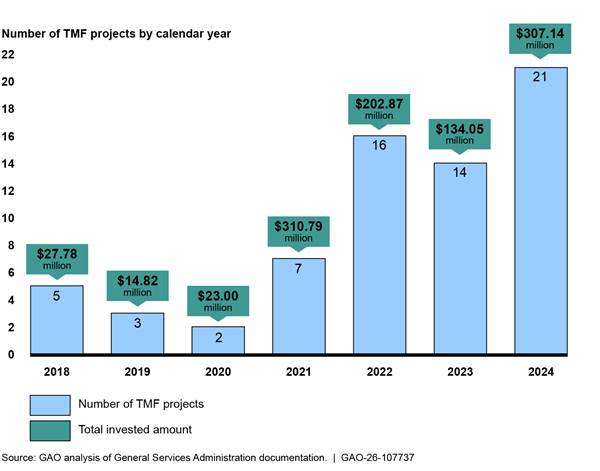
As of June 2025, the TMF had invested approximately $1.03 billion in funds to 68 unclassified projects among 40 agencies.[26] Appendix II provides a full list of the 68 unclassified TMF projects and their invested funding amounts. Figure 1 provides an overview of the number of projects announced and the total amount invested by calendar year.
According to agency officials, 24 projects expected to collectively achieve total cost savings of approximately $1.06 billion, as of June 2025. While 37 projects did not expect to achieve any savings, these projects are intended to provide other value, such as mitigating security risks, improving federal policy compliance, driving operational efficiencies, and enhancing service delivery. Seven other projects were canceled prior to June 2025 and no longer expect savings.
Of the $1.06 billion that the 24 projects expected to save, three of these projects expected to save approximately $849.3 million (about 80 percent of the total):
1. U.S. Department of Agriculture’s Network Modernization—$578.76 million (about 55 percent of the total expected savings);
2. Department of Veterans Affairs’ Veteran Identity Modernization—$210.36 million (about 20 percent of the total expected savings);[27] and
3. Office of Personnel Management’s Modernizing Federal Retirement Systems—$60.2 million (about 6 percent of the total expected savings).
Figure 2 depicts the total expected savings amounts for the 24 TMF projects.
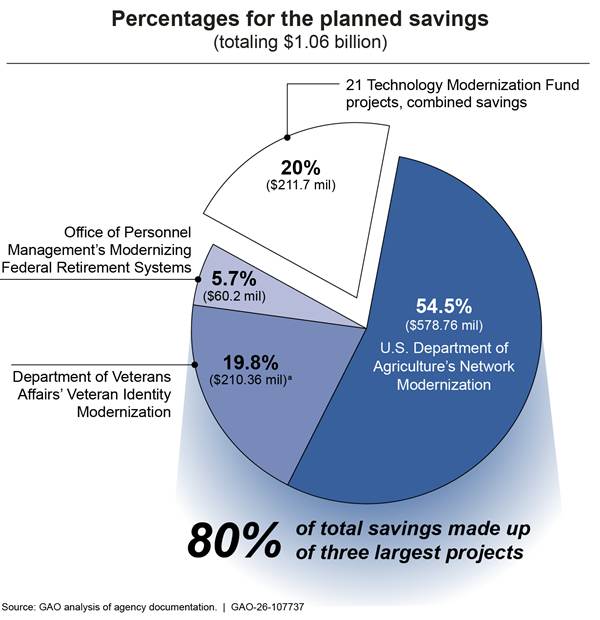
aIn commenting on a draft of this report in June 2026, officials from the Department of Veterans Affairs stated that the department had revised its expected savings estimate for the Veteran Identity Modernization project. The officials now expect this project to save $35 million over fiscal years 2025 through 2028. They attributed the decrease in expected savings to the department retaining and continuing to pay for licenses for identity verification that it did not include in its previous cost estimate.
As of June 2025, 11 of the 24 projects had collectively realized savings of about $13.5 million. The 13 other projects had not yet begun to achieve savings. (See table 1 for details about the 11 TMF projects that had realized cost savings as of June 2025.)
|
Agency |
Project |
Status |
TMF funds investeda |
Total expected savings |
Realized savings |
Additional savings expected |
|
Department of Labor |
Data Modernization |
Complete |
$9,600,000 |
$14,910,124 |
$714,467 |
Yes |
|
|
Labor Certificate Processing Monitoring |
Complete |
3,500,000 |
6,505,348 |
1,574,374 |
Yes |
|
Equal Employment Opportunity Commission |
Charge and Case Management System Modernization |
Active |
4,000,000 |
2,505,818 |
1,347,000 |
Yes |
|
General Services Administration |
Application modernization integrating flexible architectures |
Complete |
7,276,450 |
1,256,645 |
556,000 |
No |
|
|
Modernizing Regulatory Services for the Public and the Federal Government |
Active |
19,700,954 |
7,531,723 |
535,559 |
Yes |
|
Postal Regulatory Commission |
IT Modernization |
Active |
4,045,000 |
No cost savings were expected |
259,850 |
No |
|
Social Security Administration |
Personal Data Security for Public Benefits Processing |
Active |
23,300,000 |
1,400,000 |
200,000 |
Yes (through fiscal year 2031) |
|
U.S. Agency for International Development |
Zero Trust Architecture |
Canceledb |
5,687,598 |
135,299 |
137,000 |
No |
|
U.S. Department of Agriculture |
Agricultural Marketing Service Specialty Crops System Modernization |
Complete |
8,000,000 |
5,160,000 |
3,590,000 |
No |
|
|
Infrastructure Optimization and Cloud Adoption |
Complete |
220,000 |
943,720 |
573,119 |
No |
|
|
Network Modernization |
Active |
64,000,000 |
578,762,705 |
4,000,000 |
Yes |
|
Total |
|
|
$149,330,002 |
$619,111,382 |
$13,487,369 |
|
Source: GAO analysis of TMF Program Management Office and TMF project documentation. | GAO‑26‑107737
aFunds invested refers to the funds approved by the TMF board, Office of Management and Budget, and General Services Administration.
bU.S. Agency for International Development’s Zero Trust Architecture was canceled in February 2025 after the project had fully realized its expected savings.
While the total savings thus far have been small, the amount is not unexpected given the planned savings time frames of the projects. Specifically, as of June 2025,
· Eight projects—which collectively expect to save about $129 million—plan to begin achieving their savings in fiscal year 2026 or later; and
· 21 projects—with expected savings of about $1.04 billion (98.3 percent of the total expected savings)—plan to finish achieving their savings in fiscal year 2027 or later. (12 of those 21—with expected savings of about $763.2 million—plan to finish achieving them in 2030 or later).
Two Completed Projects Met or Were on Track to Meet Savings Targets; Four Did Not or Were Not on Track
Of the six TMF projects that expected cost savings and were complete as of June 2025,[28] two met or were on track to meet their expected savings targets,[29] and four did not meet or were not on track to meet their savings targets.[30] Specifically,
· Met or on track to meet expected cost savings targets: two projects. One of these projects—U.S. Agency for International Development’s Zero Trust Architecture—met (and exceeded) its cost savings target of $135,299. Agency officials stated that the project realized $137,000 in savings.
Another project—Department of Labor’s Labor Certificate Processing Modernization—was on track to achieve its expected savings estimate of $6.5 million. As of June 2025, department officials stated that the project had realized about $1.6 million in savings. The officials expected this project to continue achieving savings through fiscal year 2029.
· Did not meet or not on track to meet expected cost savings targets: four projects. Three projects did not meet their expected cost savings targets, and one project was not on track to meet its savings target, which the project had planned to achieve through fiscal year 2029. Specifically,
· GSA’s Application Modernization Integrating Flexible Architectures did not meet its expected savings target of about $1.26 million. According to agency officials, the project realized total savings of $556,000. The officials stated the project went through a major change that descoped planned work and reduced expected savings.
· The Department of Agriculture’s Agricultural Marketing Service Specialty Crops System Modernization did not meet its expected savings target of about $5.16 million. Department officials stated the project’s actual savings were about $3.59 million. The officials stated that functionality was descoped from the project, which led to fewer realized savings than expected.
· The Department of Agriculture’s Infrastructure Optimization and Cloud Adoption project did not meet its expected savings target of about $943,000. Department officials estimated that the project’s realized savings were about $573,000. The officials stated that the project achieved these savings early in its planned savings time frame and the project did not realize any further recurring savings.
· Housing and Urban Development’s UNISYS Mainframe Migration was not on track to meet its expected cost savings target of about $48.16 million. The project had expected to achieve these savings through fiscal year 2029. However, in March 2026, agency officials stated that the project did not and would not achieve any cost savings compared to its baseline costs from prior to implementing the project. The officials stated that the department had realized annual cost reductions after migrating from the legacy UNISYS mainframe platform. However, they explained that the project had experienced increased costs migrating the mainframe environment to the cloud,[31] as well as increased transition costs. As a result, the officials stated that the anticipated cost savings did not materialize.
Table 2 provides cost savings details about the six completed projects.
Table 2: Completed Technology Modernization Fund (TMF) Projects that Expected Cost Savings, as of June 2025
|
Agency |
Project |
Total TMF investment |
Total expected savings |
Realized savings |
Additional savings expected |
Assessment |
|
Department of Labor |
Labor Certificate Processing Modernization |
$3,500,000 |
$6,505,348 |
$1,574,374 |
Yes |
√ |
|
General Services Administration |
Application Modernization Integrating Flexible Architectures |
7,276,450 |
1,256,645 |
556,000 |
No |
╳ |
|
Housing and Urban Development |
UNISYS Mainframe Migration |
13,850,013 |
48,157,217 |
0a |
No |
╳ |
|
U.S. Agency for International Development |
Zero Trust Architecture |
5,687,598 |
135,299 |
137,000 |
No |
√ |
|
U.S. Department of Agriculture |
Agricultural Marketing Service Specialty Crops System Modernization |
8,000,000 |
5,160,000 |
3,590,000 |
No |
╳ |
|
|
Infrastructure Optimization and Cloud Adoption |
220,000 |
943,720 |
573,119 |
No |
╳ |
No highlight and √ assessment: project met or was on track to meet its expected savings target.
Gray highlight and ╳ assessment: project did not meet or was not on track to meet its expected savings target.
Source: GAO analysis of TMF Program Management Office and TMF project documentation. | GAO‑26‑107737
aHousing and Urban Development had expected that the UNISYS Mainframe Migration project would achieve about $48 million in savings through fiscal year 2029. However, in March 2026, agency officials stated that the project did not and would not achieve any cost savings compared to its baseline costs from prior to implementing the project. The officials explained that the project had experienced increased costs migrating the mainframe environment to the cloud, as well as increased transition costs. As a result, the officials stated that the anticipated cost savings did not materialize.
TMF Project Acquisitions Used Full and Open Competition or Documented Authorized Exceptions
The MGT Act requires the Administrator of GSA to ensure that commercial off-the-shelf products and services are incorporated to the greatest extent practicable in agency projects that receive investments through the TMF.[32] Further, as required under the Competition in Contracting Act of 1984, procurements, with certain exceptions,[33] are generally required to be competed on a full and open basis so that all responsible sources are permitted to compete.[34]
Agencies must also publicly report their contract transactions in FPDS, including information on the type of award made and whether competitive procedures were used.[35] In addition, if an agency issues task orders under an existing contract where multiple vendors can compete, then the agency is required to identify whether competitive procedures were used. Further, if the contract did not use competitive procedures, the agency must report why the contract was not competed.
Of 177 contract actions awarded under 32 TMF projects between March 1, 2023 and June 2, 2025, agencies used competitive procedures to award the majority (87 percent) of them, according to FPDS data. Specifically, agencies awarded 154 of the contract actions using competitive procedures, which accounted for about $713.1 million (about 96 percent) of the total funding associated with the 177 actions. In 23 instances where agencies awarded contract actions without competitive procedures, the agencies documented authorized exceptions. Table 3 identifies the number of TMF contract actions that agencies awarded using competitive procedures and their associated total value.
Table 3: Technology Modernization Fund Contract Actions Awarded Using Competitive Procedures as of June 2025
|
|
Number of |
Total Value |
|
Awarded under competitive procedures |
154 |
$713.12 |
|
Awarded using authorized exceptions to competitive procedures |
23 |
27.76 |
Source: GAO analysis of Federal Procurement Data System data. | GAO‑26‑107737
The 23 contract actions awarded using authorized exceptions to competitive procedures were associated with seven TMF projects at seven agencies. As noted earlier, each of these agencies documented the use of authorized exceptions. For example,
· The Department of Homeland Security’s Customs and Border Protection completed a justification and obtained approval for other than full and open competition on an order to, among other things, sustain critical application software development and testing under the Automated Commercial Environment system. Contract documents stated that only one responsible source could perform the required services, and that competition would result in unacceptable risk to the government.
· The Department of Homeland Security completed a justification and obtained approval for other than full and open competition on an order so that there would not be a break in service while migrating to a new governance, risk, and compliance platform. Contract documents stated that the agency’s need for contractor services was so urgent that providing a fair opportunity would result in unacceptable delays.
· The Equal Employment Opportunity Commission completed a justification and obtained approval for other than full and open competition on an order so that the agency could, among other things, maintain the knowledge, experience, and skills that the existing contractors had on the agency’s complex legacy systems and environment. Contract documents stated that the new work was a logical follow-on that would provide critical continuity of services throughout the project, while also allowing 1 year to fully recompete the contract services after the migration is complete.
· GSA completed a justification and obtained approval for other than full and open competition on an order for Agile software development services. Contract documents cited the justification that the work is a logical follow-on to an original order and fair opportunity was not provided in the interest of economy and efficiency. The documents further noted that the support provided by the original order was essential to the operations of the agency and re-competing the effort would introduce significant schedule and performance risk and would not provide material cost savings.
Competition is a cornerstone of the acquisition system and a critical tool for achieving the best possible return on investment for taxpayers. Agencies’ adherence to federal acquisition requirements for TMF-funded investments should help ensure that these funds are used appropriately to benefit both the agencies and the public.
Agency Comments and Our Evaluation
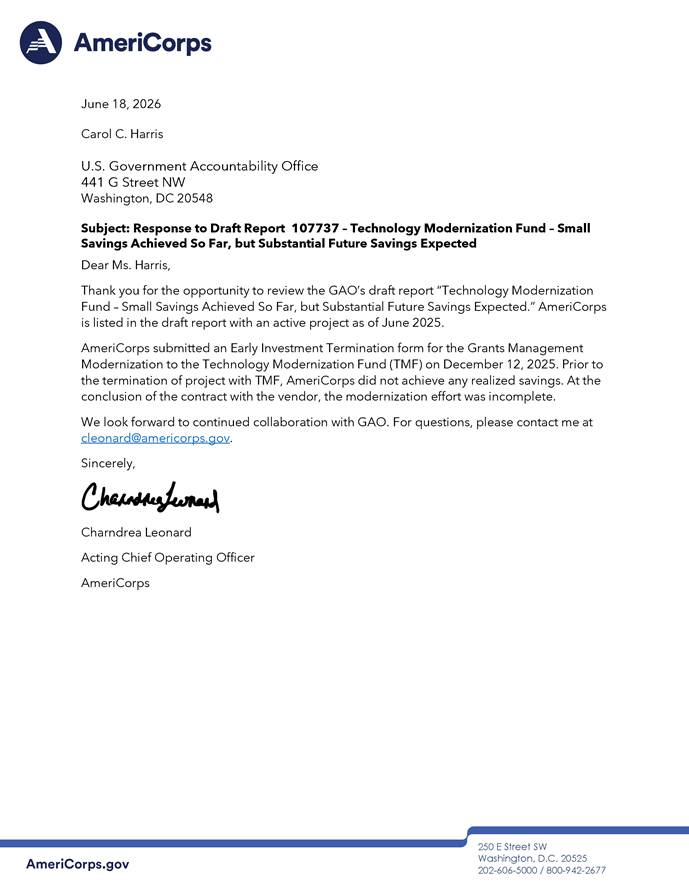
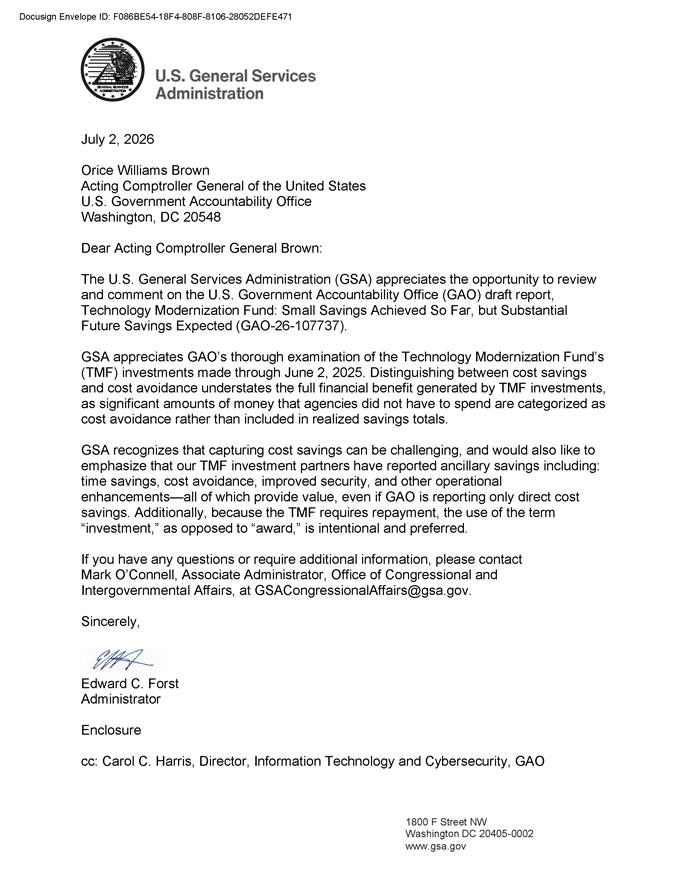
We provided a draft of this report to the 40 agencies and offices that had received TMF investments as of June 2025 for their review and comment.[36] Two agencies—AmeriCorps and GSA—provided written comments.
· In AmeriCorps’ comments, reprinted in appendix III, the Acting Chief Operating Officer provided updated information about the status of the agency’s Grants Management Modernization project, noting that it was terminated in December 2025 and did not achieve any realized cost savings.
· In GSA’s comments, reprinted in appendix IV, the Administrator of GSA stated that distinguishing between cost savings and cost avoidance understates the full financial benefit generated by TMF investments, as significant amounts of money that agencies did not have to spend are categorized as cost avoidance rather than included in realized savings totals. In addition, the administrator noted that capturing cost savings can be challenging and emphasized that TMF investment partners have reported ancillary savings, including time savings, cost avoidance, improved security, and other operational enhancements. We agree that the cost savings noted in the report would be higher if other factors, like cost avoidance, were to be added in. The MGT Act requires GAO to report on TMF projects’ cost savings and that is what this report covers.
Thirty-three of the agencies and offices stated that they had no comments on the draft report. In addition, the U.S. Agency for International Development was unable to provide comments because staff from the agency’s Office of the Executive Secretariat reported that other agency needs had taken priority. Lastly, six agencies—AmeriCorps; the Departments of Housing and Urban Development, Interior, Justice, and Veterans Affairs; and GSA—provided technical comments, which we incorporated as appropriate.
We are sending copies of this report to the appropriate congressional committees, the Secretaries and agency heads of the departments and agencies in this report, and other interested parties. In addition, this report will also be available at no charge on the GAO website at https://www.gao.gov.
If you or your staff have any questions about this report, please contact me at HarrisCC@gao.gov. Contact points for our Offices of Congressional Relations and Media Relations may be found on the last page of this report. GAO staff who made major contributions to this report are listed in appendix V.
Carol C. Harris
Director, Information Technology Acquisition Management Issues
List of Committees
The Honorable Roger Wicker
Chairman
The Honorable Jack Reed
Ranking Member
Committee on Armed Services
United States Senate
The Honorable Rand Paul, M.D.
Chairman
The Honorable Gary C. Peters
Ranking Member
Committee on Homeland Security and Governmental Affairs
United States Senate
The Honorable John Hoeven
Chair
The Honorable Jeanne Shaheen
Ranking Member
Subcommittee on Agriculture, Rural Development, Food and Drug
Administration, and Related Agencies
Committee on Appropriations
United States Senate
The Honorable Jerry Moran
Chair
The Honorable Chris Van Hollen
Ranking Member
Subcommittee on Commerce, Justice, Science, and Related Agencies
Committee on Appropriations
United States Senate
The Honorable Mitch McConnell
Chair
The Honorable Christopher Coons
Ranking Member
Subcommittee on Defense
Committee on Appropriations
United States Senate
The Honorable Bill Hagerty
Chair
The Honorable Jack Reed
Ranking Member
Subcommittee on Financial Services and General Government
Committee on Appropriations
United States Senate
The Honorable Katie Britt
Chair
The Honorable Chris Murphy
Ranking Member
Subcommittee on Homeland Security
Committee on Appropriations
United States Senate
The Honorable Lisa Murkowski
Chair
The Honorable Jeff Merkley
Ranking Member
Subcommittee on Interior, Environment and Related Agencies
Committee on Appropriations
United States Senate
The Honorable Shelley Moore Capito
Chair
The Honorable Tammy Baldwin
Ranking Member
Subcommittee on Labor, Health and Human Services, Education, and
Related Agencies
Committee on Appropriations
United States Senate
The Honorable Mike Rogers
Chairman
The Honorable Adam Smith
Ranking Member
Committee on Armed Services
House of Representatives
The Honorable James Comer
Chairman
The Honorable Robert Garcia
Ranking Member
Committee on Oversight and Government Reform
House of Representatives
The Honorable Andy Harris
Chairman
The Honorable Sanford Bishop, Jr.
Ranking Member
Subcommittee on Agriculture, Rural Development, Food and Drug
Administration, and Related Agencies
Committee on Appropriations
House of Representatives
The Honorable Hal Rogers
Chairman
The Honorable Grace Meng
Ranking Member
Subcommittee on Commerce, Justice, Science, and Related Agencies
Committee on Appropriations
House of Representatives
The Honorable Ken Calvert
Chairman
The Honorable Betty McCollum
Ranking Member
Subcommittee on Defense
Committee on Appropriations
House of Representatives
The Honorable Dave Joyce
Chairman
The Honorable Steny Hoyer
Ranking Member
Subcommittee on Financial Services and General Government
Committee on Appropriations
House of Representatives
The Honorable Mark Amodei
Chairman
The Honorable Henry Cuellar
Ranking Member
Subcommittee on Homeland Security
Committee on Appropriations
House of Representatives
The Honorable Mike Simpson
Chair
The Honorable Chellie Pingree
Ranking Member
Subcommittee on Interior, Environment and Related Agencies
Committee on Appropriations
House of Representatives
The Honorable Robert Aderholt
Chairman
The Honorable Rosa DeLauro
Ranking Member
Subcommittee on Labor, Health and Human Services, Education, and
Related Agencies
Committee on Appropriations
House of Representatives
Our objectives were to: (1) identify the approved Technology Modernization Fund (TMF) projects, their invested funds, and their expected and actual cost savings; (2) determine the extent to which the agencies’ completed projects met their expected cost savings targets; and (3) determine the extent to which the agencies used full and open competition for any acquisitions related to TMF invested projects.
The scope of our review included the General Services Administration’s (GSA) TMF Program Management Office—which is responsible for TMF administration, in consultation with the Chief Information Officers (CIO) Council and with the approval of the Director of OMB. We also performed work at the 40 agencies and offices that had received TMF funds as of June 2, 2025.[37] Specifically, GSA invested these funds in 68 unclassified projects.[38]
For the first objective, we identified the reported costs and expected cost savings targets for the 68 projects that received investments during the period from June 7, 2018 (when projects first began to receive investments) through June 2, 2025. In particular, we obtained invested fund information from the TMF website and from the agencies responsible for the projects.[39] This agency data included proposal documentation, status briefings, cost savings estimates, and supporting documentation. In addition, we reviewed expected cost savings data from agencies’ project savings estimates and, when available, documentation of the actual savings achieved, as of June 2025.
To determine the accuracy and completeness of the reported costs, expected cost savings, and realized cost savings for the 68 projects, we first asked the agencies to explain how they prepared their projects’ savings estimates in order to determine whether they had processes and applications/tools in place to develop the estimates. We also assessed supporting documentation of the anticipated cost savings. Further, we compared the cost savings information provided by the agencies to the spending amounts GSA reported on the TMF investment website for obvious errors and inconsistencies. We did not identify any significant errors related to the accuracy or completeness of the data for 61 projects. Agencies cancelled the other seven projects prior to June 2025 and no longer expect savings.
For our second objective, we identified the completion dates, where available, for the 68 projects the TMF invested in to determine which of the projects had been completed. As of June 2025, 11 projects had been completed.[40] Seven of these 11 projects expected to achieve cost savings and four did not.[41]
We assessed the realized cost savings for projects that had at least one full fiscal year to achieve savings after agencies completed the projects. As of June 2025, six of the seven completed projects expecting cost savings met this criterion and one did not. Specifically, the Department of Labor’s Data Modernization project had not yet had a full fiscal year to achieve cost savings, as of June 2025. As such, we did not assess whether it was on track to meet its expected savings target.
For the six completed projects that had at least a full fiscal year of savings as of June 2025, we compared the agencies’ expected cost savings for these projects to their reported actual savings to determine the extent to which the projects had met or were on track to meet their expected savings targets. Specifically, we assessed each project as follows:
· Met expected savings target. A project’s total realized savings were within 10 percent of its expected savings target or were greater than expected.
· On track to meet expected savings target. A project’s realized savings during the first fiscal year after which the project was complete were within 10 percent of its expected savings target for that time period.
· Did not meet expected savings target. A project’s total realized savings were at least 10 percent less than expected and the agency did not anticipate the project would realize any additional savings (in other words, if an agency expected to save $100 and its realized savings were less than $90, it would trigger our threshold indicating it had not met its expected savings). The 10 percent variance is consistent with Office of Management and Budget guidance that states a cost variance of 10 percent or more from a project’s planned savings estimate is a concern and should trigger formal reporting.[42]
· Not on track to meet expected savings target. A project’s realized savings during the first fiscal year after which the project was complete were at least 10 percent less than its expected savings for that time period.
In instances where the projects did not meet, or were not on track to meet, their expected savings targets, we asked agency officials to explain why the full expected savings amounts were not realized as anticipated.
To determine the reliability of the cost savings data for the six completed projects, we compared initial project documentation to current estimates and sought clarification from agency officials on any differences. Further, we assessed the reliability of agencies’ realized cost savings by (1) reviewing the underlying data to identify any obvious errors or inaccuracies and (2) comparing the cost savings data provided by the agencies to TMF project savings data provided by GSA. We sought clarification from TMF project officials on any differences. We found that the cost savings data were sufficiently reliable for our purposes of reporting on expected and realized cost savings.
To address the third objective, we reviewed contract documentation from 32 projects that received TMF investments between March 1, 2023 and June 2, 2025. These 32 projects awarded a total of 177 contract actions[43] during that time.[44] From the documentation, we compiled a list of each contract action’s unique identifiers. Using these identifiers, we obtained and analyzed data from the Federal Procurement Data System (FDPS)[45]—a government contract award database—to determine whether each of these contract actions used full and open competition in accordance with the Competition in Contracting Act of 1984 and the Federal Acquisition Regulation.[46] For those that were identified in FDPS as not using full and open competition, we reviewed contract documentation supporting the exceptions to competition.
To ensure the accuracy and completeness of the projects’ contract information related to the use of full and open competition as reported in FDPS, we presented the results of our analysis to officials from each agency. We asked these officials to verify the completeness and accuracy of the data and provide any updates, as appropriate. Officials in charge of all the projects confirmed the accuracy of the contract information related to the use of full and open competition and provided additional contract acquisition data, as appropriate. Based on these steps, we determined that these data were sufficiently reliable to report on TMF-funded project acquisitions’ use of full and open competition.
We conducted this performance audit from July 2024 to July 2026 in accordance with generally accepted government auditing standards. Those standards require that we plan and perform the audit to obtain sufficient, appropriate evidence to provide a reasonable basis for our findings and conclusions based on our audit objectives. We believe that the evidence obtained provides a reasonable basis for our findings and conclusions based on our audit objectives.
As of June 2025, the Technology Modernization Fund (TMF) had provided investments to 68 unclassified projects. Table 4 identifies these projects, as well as their associated agencies, start dates, amount of TMF funds invested, and statuses, as of June 2025.
|
Agency name |
Project name |
TMF funds invested |
Project |
Status |
|
AbilityOne Commission |
Development of the Next Generation Procurement List Information Management System 2.0 |
$1,781,000 |
October 2022 |
Active |
|
AmeriCorps |
Grants Management Modernization |
14,000,000 |
August 2022 |
Active |
|
Armed Forces Retirement Home |
Transforming Resident-Centered Healthcare Through Modernized Electronic Health Record Systems |
6,050,000 |
January 2024 |
Active |
|
Department of Defense—Army |
Critical Infrastructure Cyber Protection |
15,575,246 |
October 2022 |
Active |
|
Department of Education |
Improving federal student loan borrower experience |
5,939,936 |
May 2024 |
Active |
|
|
Zero Trust Architecture |
20,000,000 |
September 2021 |
Active |
|
Department of Energy |
Enterprise Cloud Email |
2,436,153 |
July 2018 |
Complete |
|
|
Human Resources Information Technology Modernization |
17,000,000 |
June 2024 |
Active |
|
|
Modernizing Nuclear Emergency Response |
3,812,000 |
July 2024 |
Active |
|
Department of Health and Human Services—Inspector General |
Securing Public Health Information with Mature Zero Trust |
18,000,000 |
April 2023 |
Active |
|
Department of Homeland Security |
Information Sharing Modernization |
26,950,000 |
June 2022 |
Active |
|
|
Southwest Border Technology Integration Program |
50,000,000 |
September 2021 |
Complete |
|
Department of Homeland Security—Customs & Border Protection |
Automated Commercial Environment Collections Module |
15,000,000 |
October 2020 |
Complete |
|
Department of Housing and Urban Development |
Identity Credential Access Management Modernization for Federal Housing Administration Connection |
14,800,000 |
October 2022 |
Active |
|
|
Transforming Identity and Access Management |
19,800,000 |
October 2024 |
Active |
|
|
UNISYS Mainframe Migration |
13,850,013 |
August 2018 |
Complete |
|
Department of the Interior—Bureau of Indian Education |
Improving Services for Tribal Communities Through Modernized School Websites |
5,868,000 |
June 2024 |
Active |
|
Department of the Interior—Bureau of Land Management |
Digitizing Records for Easier Public Success |
9,180,000 |
July 2023 |
Active |
|
Department of Justice—Antitrust Division |
Improving Antitrust Enforcement with Modern Technology |
45,514,719 |
January 2024 |
Active |
|
Department of Justice—Executive Office for Immigration Review |
Modernizing Legacy Case Management System |
1,340,000 |
December 2024 |
Canceled |
|
Department of Labor |
Enhancing Security of Department of Labor Data and Applications |
15,182,000 |
July 2023 |
Active |
|
|
Ensuring Injured and Ill Workers Receive Services and Benefits Faster |
42,000,000 |
April 2024 |
Active |
|
|
Data Modernization |
9,600,000 |
March 2021 |
Complete |
|
|
Labor Certificate Processing Modernization |
3,500,000 |
January 2019 |
Complete |
|
|
Permanent Labor Certification Program Visa Modernization |
7,221,149 |
August 2022 |
Active |
|
Department of Labor—Employee Benefits Security Administration |
Improving Ability of America’s Workers to Find Lost Retirement Benefits |
3,465,000 |
November 2023 |
Active |
|
Department of State |
Increasing Capacity to Safeguard Identity Data |
13,100,000 |
May 2024 |
Active |
|
|
Increasing Diplomacy Through Generative Artificial Intelligence |
18,200,000 |
May 2024 |
Active |
|
Department of Transportation |
Protecting Aviation Consumers and Streamlining Regulated Entity Interactions Through Human-Centered Design |
8,039,855 |
September 2023 |
Active |
|
Department of Transportation—Federal Aviation Administration |
Improving Mission Support with Modernized Applications |
6,430,000 |
April 2023 |
Active |
|
Department of the Treasury |
Secure Cloud National Intelligence Sharing |
11,145,244 |
February 2023 |
Active |
|
Department of Veterans Affairs |
Digitizing Forms and Personalizing Experiences for Better Veterans’ Benefits Management and Customer Support |
7,378,730 |
July 2023 |
Active |
|
|
Veteran Identity Modernization |
10,550,000 |
April 2022 |
Active |
|
Environmental Protection Agency |
Securing Data Availability and Integrity |
2,500,000 |
July 2023 |
Active |
|
Equal Employment Opportunity Commission |
Charge and Case Management System Modernization |
4,000,000 |
October 2019 |
Active |
|
Federal Election Commission |
Modernizing FECFile |
8,824,934 |
June 2024 |
Active |
|
Federal Trade Commission |
Securing and Modernizing the Registered Identification Number System |
1,100,000 |
September 2023 |
Active |
|
|
Multi-Cloud Security Operations Center |
3,990,000 |
June 2022 |
Complete |
|
General Services Administration |
Advancing Zero Trust |
29,802,431 |
September 2021 |
Active |
|
|
Application Modernization Integrating Flexible Architectures |
7,276,450 |
October 2018 |
Complete |
|
|
Login.gov |
187,050,000 |
September 2021 |
Active |
|
|
MAX.gov Transition |
4,433,437 |
September 2021 |
Canceled |
|
|
Modernizing Regulatory Services for the Public and the Federal Government |
19,700,954 |
January 2024 |
Active |
|
|
NewPay Payroll and Work Schedule and Leave Management Software as a Service |
7,316,786 |
February 2019 |
Canceled |
|
National Aeronautics and Space Administration |
Accelerating Network Cybersecurity and Performance Improvements in Benefit to Agency Missions |
5,872,492 |
April 2024 |
Active |
|
National Archives and Records Administration |
High Value Asset Mission Essential Systems |
9,133,034 |
May 2022 |
Active |
|
National Institute of Standards and Technology |
Improving AI Safety for a Smarter Future |
10,000,000 |
July 2024 |
Active |
|
National Labor Relations Board |
Case Management System Modernization |
23,197,800 |
September 2024 |
Active |
|
National Oceanic and Atmospheric Administration |
Rebuilding Weather.gov |
12,064,000 |
May 2024 |
Active |
|
National Transportation Safety Board |
Improving Customer Experience with Digital Content Delivery |
16,208,429 |
July 2023 |
Active |
|
Office of Personnel Management |
Modernizing Federal Retirement Systems |
18,330,000 |
December 2024 |
Active |
|
|
Website And Digital Modernization |
6,048,058 |
October 2022 |
Canceled |
|
|
Zero Trust Networking |
9,900,000 |
September 2021 |
Active |
|
Postal Regulatory Commission |
IT Modernization |
4,045,000 |
March 2022 |
Active |
|
Railroad Retirement Board |
Citizen-Centric Online Self-Services |
8,695,389 |
December 2022 |
Active |
|
Selective Service System |
Registration and Verification Modernization |
5,988,807 |
March 2022 |
Active |
|
Social Security Administration |
Digitizing Forms and Enhancing Customer Experience |
19,540,125 |
October 2024 |
Active |
|
|
Modernizing Beneficiary Notifications |
9,000,000 |
October 2024 |
Active |
|
|
Personal Data Security for Public Benefits Processing |
23,300,000 |
February 2023 |
Active |
|
|
Using Artificial Intelligence to Support Disability Claim Processing |
1,980,560 |
October 2024 |
Active |
|
U.S. Agency for Global Media |
Improving IT Security with Zero Trust Architecture |
6,200,000 |
February 2023 |
Active |
|
U.S. Agency for International Development |
CRM System |
5,917,127 |
February 2023 |
Canceled |
|
|
Zero Trust Architecture |
5,687,598 |
August 2022 |
Canceled |
|
U.S. Department of Agriculture |
Agricultural Marketing Service Specialty Crops System Modernization |
8,000,000 |
January 2020 |
Complete |
|
|
Farmers.Gov Customer Experience Portal |
4,000,000 |
July 2018 |
Canceled |
|
|
Infrastructure Optimization and Cloud Adoption |
220,000 |
November 2018 |
Complete |
|
|
Network Modernization |
64,000,000 |
June 2022 |
Active |
|
|
Network Monitoring, Detection, And Response |
4,406,842 |
May 2022 |
Active |
Source: GAO analysis of project data posted on the Technology Modernization Fund website and data provided by the agencies. | GAO‑26‑107737
Carol C. Harris, harriscc@gao.gov
In addition to the contact named above, individuals making key contributions to this report included Emily Kuhn and Eric Winter (Assistant Directors), Justin Booth and Jonathan Wall (Analysts in Charge), Amanda Andrade, Christopher Businsky, Daniel Coletta, Jonnie Genova, Gabriel Nelson, and Adam Vodraska.
The Government Accountability Office, the audit, evaluation, and investigative arm of Congress, exists to support Congress in meeting its constitutional responsibilities and to help improve the performance and accountability of the federal government for the American people. GAO examines the use of public funds; evaluates federal programs and policies; and provides analyses, recommendations, and other assistance to help Congress make informed oversight, policy, and funding decisions. GAO’s commitment to good government is reflected in its core values of accountability, integrity, and reliability.
Obtaining Copies of GAO Reports and Testimony
The fastest and easiest way to obtain copies of GAO documents at no cost is through our website. Each weekday afternoon, GAO posts on its website newly released reports, testimony, and correspondence. You can also subscribe to GAO’s email updates to receive notification of newly posted products.
Order by Phone
The price of each GAO publication reflects GAO’s actual cost of production and distribution and depends on the number of pages in the publication and whether the publication is printed in color or black and white. Pricing and ordering information is posted on GAO’s website, https://www.gao.gov/ordering.htm.
Place orders by calling (202) 512-6000, toll free (866) 801-7077,
or
TDD (202) 512-2537.
Orders may be paid for using American Express, Discover Card, MasterCard, Visa, check, or money order. Call for additional information.
Connect with GAO
Connect with GAO on X,
LinkedIn, Instagram, and YouTube.
Subscribe to our Email Updates. Listen to our Podcasts.
Visit GAO on the web at https://www.gao.gov.
To Report Fraud, Waste, and Abuse in Federal Programs
Contact FraudNet:
Website: https://www.gao.gov/about/what-gao-does/fraudnet
Automated answering system: (800) 424-5454
Media Relations
Sarah Kaczmarek, Managing Director, Media@gao.gov
Congressional Relations
David A. Powner, Acting Managing Director, CongRel@gao.gov
General Inquiries
[1]See, for example, GAO, High-Risk Series: Heightened Attention Could Save Billions More and Improve Government Efficiency and Effectiveness, GAO‑25‑107743 (Washington, D.C.: Feb. 25, 2025).
[2]Modernizing Government Technology provisions of the National Defense Authorization Act for Fiscal Year 2018, Pub. L. No. 115-91, div. A, title X, subtitle G, 131 Stat. 1283, 1586-94 (2017).
[3]OMB, Funding Guidelines for Agencies Receiving Disbursements from the Technology Modernization Fund (Washington, D.C.: Mar. 12, 2018).
[4]OMB defines cost savings as a reduction in actual expenditures below the projected level of costs to achieve a specific objective, and cost avoidance as an action taken in the immediate time frame that will decrease costs in the future. For example, cost avoidance may be an engineering improvement that increases the mean time between failures and thereby decreases operation and maintenance costs. Cost avoidance may be considered an additional benefit to quality or other non-quantifiable value engineering improvement.
[5]GAO, Technology Modernization Fund: Although Planned Amounts Are Substantial, Projects Have Thus Far Achieved Minimal Savings, GAO‑24‑106575 (Washington D.C.: Dec.12, 2023); Technology Modernization Fund: Implementation of Recommendations Can Improve Fee Collection and Proposal Cost Estimates, GAO‑22‑105117 (Washington, D.C.: Dec. 10, 2021); and Technology Modernization Fund: OMB and GSA Need to Improve Fee Collection and Clarify Cost Estimating Guidance for Awarded Projects, GAO‑20‑3 (Washington, D.C.: Dec. 12, 2019).
[6]At the time of our analysis, data as of June 2025 were the latest data available.
[7]GSA provides information on the status of invested projects on the TMF website at https://tmf.cio.gov/.
[8]OMB, Preparation, Submission, and Execution of the Budget, Circular A-11 (Washington, D.C.: Aug. 6, 2021).
[9]One additional contract action was awarded during the March 2023 through June 2025 time period. However, as of July 2025, the agency responsible for it—the U.S. Agency for International Development—had ceased administration of its programs and did not respond to our documentation request. As such, we did not review documentation for this contract.
[10]FPDS is a web-based tool for agencies to report contract transactions. In addition, it is a searchable database of contract information that provides a capability to examine data across government agencies and provides managers a mechanism for determining where contract dollars are being spent.
[11]The Competition in Contracting Act of 1984 requires agencies to obtain full and open competition through the use of competitive procedures in their procurement activities unless otherwise authorized in law. See Pub. L. No. 98-369, div. B, title VII, §§ 2711(a)(1) (civilian), 2712 (military), 98 Stat. 1175, 1184 (1984), codified as amended at 41 U.S.C. § 3301 and 10 U.S.C. § 3201. In implementing the Competition in Contracting Act of 1984, the Federal Acquisition Regulation requires that contracting officers promote and provide for full and open competition in soliciting offers and awarding government contracts. Full and open competition, when used with respect to a contract action, means that all responsible sources are permitted to compete. See Federal Acquisition Regulation 48 C.F.R. § 2.101 and part 6. Allowable exceptions to full and open competition include circumstances when the contractor is the only responsible source, and no other supplies or services will satisfy agency requirements. See Federal Acquisition Regulation 48 C.F.R. part 6.
[12]GAO, High-Risk Series: Critical Actions Needed to Urgently Address IT Acquisition and Management Challenges, GAO‑25‑107852 (Washington, D.C.: Jan. 23, 2025).
[13]Specifically, the TMF received $100 million in fiscal year 2018, $25 million each year during fiscal years 2019 through 2021, and $50 million in fiscal year 2023. Additionally, the TMF received $1 billion from the American Rescue Plan Act in fiscal year 2021. $100 million of the act’s appropriations was subsequently rescinded in fiscal year 2024.
[14]The MGT Act established the Technology Modernization Board, which is chaired by the Federal CIO within OMB.
[15]To help cover the operating costs of the TMF Program Management Office, GSA collected administrative fees from agencies that received TMF funding. GSA officials stated that the agency stopped collecting these fees from new TMF projects in March 2021, after the enactment of the American Rescue Plan Act, which appropriated $1 billion to the TMF. According to GSA officials, as of January 2025, the agency was still collecting such fees from six projects that received funding prior to enactment of the act. The officials stated that, in total as of January 2025, the office had collected about $2.3 million in fees from TMF projects.
[16]See the TMF website at https://tmf.cio.gov.
[17]According to the MGT Act, the board shall be comprised of seven voting members, including the Federal CIO; a senior official from GSA with technical expertise in IT development; an employee of the National Protection and Programs Directorate (now the Cybersecurity and Infrastructure Security Agency) of the Department of Homeland Security; and four employees of the federal government primarily having technical expertise in information technology development, financial management, cybersecurity and privacy, and acquisition.
[18]The Federal CIO is formally known as the Administrator of the Office of Electronic Government. The Office of the Federal CIO is part of OMB within the Executive Office of the President.
[19]The MGT Act required the Technology Modernization Board to establish criteria for evaluating submitted proposals to address the greatest security, privacy, and operational risks; have the greatest government-wide impact; and have a high probability of success based on factors including a strong business case, technical design, consideration of commercial off-the-shelf products and services, procurement strategy (including adequate use of rapid, agile, iterative software development practices), and program management.
[20]GAO, Office of Management and Budget/General Services Administration—Reimbursement Requirement for the Technology Modernization Fund, B-333396, (Washington, D.C.: July 14, 2022).
[21]OMB, Implementation of the Modernizing Government Technology Act, M-18-12 (Washington, D.C.: Feb. 27, 2018).
[22]OMB, Funding Guidelines for Agencies Receiving Disbursements from the Technology Modernization Fund (Washington, D.C.: Mar. 12, 2018).
[23]OMB, Preparation, Submission, and Execution of the Budget, Circular A-11 (Washington, D.C.: Aug. 29, 2025).
[24]OMB, Value Engineering, Circular A-131 (Washington, D.C.: Dec. 26, 2013).
[25]OMB, Funding Guidelines for Agencies Receiving Disbursements from the Technology Modernization Fund (Washington, D.C.: Dec. 31, 2020).
[26]The TMF also invested $52 million in classified projects that are outside the scope of this review.
[27]In commenting on a draft of this report in June 2026, officials from the Department of Veterans Affairs stated that the department had revised its expected savings estimate for the Veteran Identity Modernization project. The officials now expect this project to save $35 million over fiscal years 2025 through 2028. They attributed the decrease in expected savings to the department retaining and continuing to pay for licenses for identity verification that it did not include in its previous cost estimate.
[28]One of these six projects—U.S. Agency for International Development’s Zero Trust Architecture—was canceled after it had fully achieved its expected cost savings. Because it had realized these savings before being canceled, we considered it to be a completed project for our purpose of determining the extent to which agencies’ completed projects met their expected cost savings targets.
[29]For the purposes of this review, we considered a project to have met its cost savings if its total realized savings were either within 10 percent of its expected savings target or were greater than expected.
[30]As of June 2025, five other TMF projects had also been completed. However, four of these projects did not expect to achieve any cost savings and the fifth project—Department of Labor’s Data Modernization—had not yet had a full fiscal year to achieve cost savings; as such, we did not assess whether it was on track to meet its expected savings target. Details on our scope and methodology are discussed in appendix I.
[31]Cloud computing enables on-demand access to shared computing resources. It can often provide access to IT resources through the internet faster and for less money than owning and maintaining such resources.
[32]A commercial off-the-shelf product is generally defined as a type of product customarily available to the general public, sold in substantial quantities in the commercial marketplace, and offered to the government in the same form in which it is sold to the general public. Procuring commercial products and services can be more cost-effective than custom-developed products and in-house services.
[33]Exceptions to competition are documented in agency justifications and approvals, an example of which includes circumstances when the contractor is the only responsible source and no other supplies or services will satisfy agency requirements.
[34]Competition in Contracting Act of 1984, Pub. L. No. 98-369, div. B, title VII, §§ 2711(a) (1) (civilian), 2712 (military), 98 Stat. 1175, 1184 (1984), codified as amended at 41 U.S.C. § 3301 and 10 U.S.C. § 3201.
[35]Contract Award Data in SAM.gov | SAM.gov
[36]The agencies included GSA, which is both responsible for TMF administration and also had projects that received TMF investments, as well as: AbilityOne Commission; AmeriCorps; Armed Forces Retirement Home; the Departments of Defense (including the Army), Education, Energy, Homeland Security (including Customs and Border Protection), Housing and Urban Development, the Interior (including the Bureaus of Indian Education and Land Management), Justice (including the Antitrust Division and Executive Office for Immigration Review), Labor (including the Employee Benefits Security Administration), State, Transportation (including the Federal Aviation Administration), the Treasury, and Veterans Affairs; Environmental Protection Agency; Equal Employment Opportunity Commission; Federal Election Commission; Federal Trade Commission; Health and Human Services (including its Office of Inspector General); National Aeronautics and Space Administration; National Archives and Records Administration; National Institute of Standards and Technology; National Labor Relations Board; National Oceanic and Atmospheric Administration; National Transportation Safety Board; Office of Personnel Management; Postal Regulatory Commission; Railroad Retirement Board; Selective Service System; Social Security Administration; U.S. Agency for Global Media; and U.S. Department of Agriculture.
[37]At the time of our analysis, data as of June 2025 were the latest data available.
[38]We did not assess classified TMF projects during this review. In addition, after June 2, 2025, the Technology Modernization Board funded three additional investments in 2025. These investments were not included in our review.
[39]GSA provides information on the status of invested projects on the TMF’s website at https://tmf.cio.gov/.
[40]The U.S. Agency for International Development’s Zero Trust Architecture project was canceled after it had fully achieved its expected cost savings. Because it realized these savings before being canceled, we considered it to be a completed project for our purpose of determining the extent to which agencies’ completed projects met their expected cost savings targets. As of June 2025, seven other TMF projects had also been terminated early, but did not achieve any cost savings. We did not consider these to be completed projects.
[41]Beyond cost savings, TMF projects may provide other value, such as mitigating security risks, improving federal policy compliance, driving operational efficiencies, and enhancing service delivery.
[42]Office of Management and Budget, Preparation, Submission, and Execution of the Budget, Circular A-11 (Washington, D.C.: Aug. 6, 2021).
[43]A contract action is any oral or written action that results in the purchase, rent, or lease of supplies or equipment, services, or construction using appropriated dollars over the micro-purchase threshold, or modifications to these actions regardless of dollar value. Contract action does not include grants, cooperative agreements, other transactions, real property leases, requisitions from Federal stock, training authorizations, or other non-Federal Acquisition Regulation based transactions. See Federal Acquisition Regulation 4.601.
[44]One additional contract action was awarded during the March 2023 through June 2025 time period. However, as of July 2025, the agency responsible for it—the U.S. Agency for International Development—had ceased administration of its programs and did not respond to our documentation request. As such, we did not review documentation for this contract. In addition, officials from agencies responsible for 34 of the 68 TMF-funded projects did not identify any new contract actions awarded between March 2023 to June 2025 for those projects. Further, two of the 68 projects had not yet awarded any contracts, as of June 2025.
[45]We extracted this data on April 8, 2026. FDPS is a web-based tool for agencies to report contract transactions. In addition, it is a searchable database of contract information that provides a capability to examine data across government agencies and provides managers a mechanism for determining where contract dollars are being spent.
[46]The Competition in Contracting Act of 1984 requires agencies to obtain full and open competition through the use of competitive procedures in their procurement activities unless otherwise authorized in law. See Pub. L. No. 98-369, div. B, title VII, §§ 2711(a)(1) (civilian), 2712 (military), 98 Stat. 1175, 1184 (1984), currently codified at 41 U.S.C. § 3301 and 10 U.S.C. § 3201. In implementing the Competition in Contracting Act of 1984, the Federal Acquisition Regulation requires that contracting officers promote and provide for full and open competition in soliciting offers and awarding government contracts. Full and open competition, when used with respect to a contract action, means that all responsible sources are permitted to compete. See Federal Acquisition Regulation 48 C.F.R. § 2.101 and part 6. Allowable exceptions to full and open competition include circumstances when the contractor is the only responsible source, and no other supplies or services will satisfy agency requirements. See Federal Acquisition Regulation 48 C.F.R. part 6.