
Report to Congressional Requesters
United States Government Accountability Office
A report to Congressional Requesters
For more information, contact: Candice N. Wright at WrightC@gao.gov.
What GAO Found
In 2022 The Office of Science and Technology Policy (OSTP) directed federal agencies to make research results freely accessible to the public immediately when published. In response, seven of the nine agencies GAO reviewed issued updated plans or policies. The Department of Transportation and the Nuclear Regulatory Commission were still drafting updated plans and policies at the time of our review. Five agencies’ plans or policies fully met OSTP’s guidance. The National Science Foundation’s and U.S. Department of Agriculture’s plans did not fully address OSTP’s guidance for reuse rights. These rights describe how others can share, modify, or use the research. Better alignment with OSTP’s guidance could help ensure this research can be built upon by others.
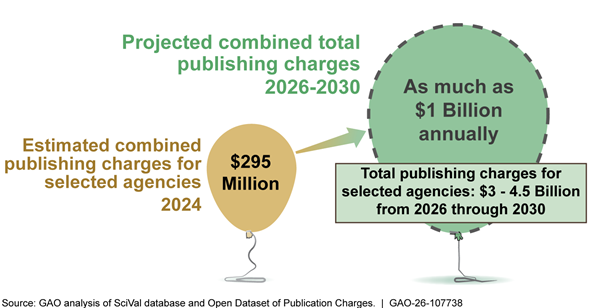
Amid the federal shift to public access, publishers are changing their business models to remain viable without subscription revenue and will require authors to pay to have their publications made open access. Agencies allow grant funds to cover these charges. Assuming historical patterns continue, the new policies and publishers' responses may result in significant agency cost growth. This would mean less money for research (see figure). However, only the National Institutes of Health has planned to manage these potential costs. Additional analysis could help other agencies better manage costs, which may triple annually.
Increased public access can improve the visibility of research and enable readers to identify problems with specific publications more quickly. However, according to stakeholders GAO spoke with, pay-to-publish models may encourage publishers to lower publication standards to publish more articles.
In 2024, OSTP published an economic analysis on expanding public access, but it did not fully reflect all five of GAO’s key elements of an economic analysis. Notably, the scope did not address the goal of estimating the potential costs and other effects. Ensuring that future analyses are consistent with the key elements can help agencies better understand the cost implications of their new policies.
Why GAO Did This Study
The U.S. government is one of the largest funders of scientific research globally. The results of federally funded research are ordinarily shared through scholarly publications. But many of these publications were restricted to paid subscribers. GAO was asked to examine agencies’ efforts to implement OSTP’s 2022 guidance.
This report examines: (1) the extent to which selected agencies' public access plans and policies are consistent with federal guidance, (2) how the scholarly publishing industry is responding to the federal shift to public access and how this affects selected agencies and journal market dynamics, (3) the potential effects of expanding public access to federally funded research, and (4) the extent to which OSTP’s 2024 economic analysis of public access followed GAO’s key elements for an economic analysis.
GAO selected nine agencies with a mix of research funding levels and assessed their public access plans and policies against OSTP guidelines. GAO reviewed available literature and data and interviewed nongovernmental stakeholders, such as publishers and universities. Further, GAO assessed OSTP’s economic analysis against GAO’s key elements that serve as a framework for assessing an economic analysis.
What GAO Recommends
GAO is making 11 recommendations to nine agencies to ensure public access plans meet federal requirements and assess budgetary and economic effects of expanding public access. Four of these agencies concurred with GAO’s recommendations and five agencies had no comments.
Abbreviations
DOD Department of Defense
DOE Department of Energy
DOT Department of Transportation
NASA National Aeronautics and Space Administration
NIH National Institutes of Health
NRC Nuclear Regulatory Commission
NSF National Science Foundation
OSTP Office of Science and Technology Policy
R&D research and development
SSA Social Security Administration
USDA Department of Agriculture
This is a work of the U.S. government and is not subject to copyright protection in the United States. The published product may be reproduced and distributed in its entirety without further permission from GAO. However, because this work may contain copyrighted images or other material, permission from the copyright holder may be necessary if you wish to reproduce this material separately.
May 21, 2026
The Honorable Brian Babin
Chairman
The Honorable Zoe Lofgren
Ranking Member
Committee on Science, Space, and Technology
House of Representatives
The Honorable Frank D. Lucas
House of Representatives
Federally funded research can accelerate scientific discovery and inform critical decisions by both policymakers and the public. However, scholarly publications describing this research have traditionally been restricted behind subscription paywalls that require readers to pay fees for access, making it difficult for the public and other researchers to access and learn from.[1]
To make federal research easier for the public to access, in August 2022, the White House Office of Science and Technology Policy (OSTP) updated its 2013 guidance for all federal agencies that fund research and development (R&D).[2] The new guidance required these agencies to update public access policies to generally make federally funded scholarly publications and their underlying scientific data public immediately and freely accessible once published. This research includes federally funded analyses conducted at universities, in addition to research done in federal labs.
The results of federally funded research, such as scholarly publications, are often published in peer-reviewed journals owned by for-profit or nonprofit publishers. These publishers use a range of business models, some of which allow for open access. In this report, we use the term public access to refer to the free availability of federally funded scholarly materials to the public. We use the related term open access to refer to a range of publishers’ business models used to provide free access to scholarly publications, whether or not those publications were federally funded. Under one of the most used open access models, called the gold or pay-to-publish model, publishers charge researchers fees to make their publications freely and immediately accessible to the public. Amid this backdrop, in 2024, OSTP conducted an economic analysis to evaluate the financial implications of the 2022 guidance.
You asked us to examine the potential effects of expanded public access for scholarly publications. This report examines:
1. the extent to which selected agencies’ public access plans and policies are consistent with federal guidance for scholarly publications;
2. how the scholarly publishing industry is responding to the federal government’s shift toward public access and how this affects selected agencies and journal market dynamics;
3. what available information reveals about potential effects of expanding public access to federally funded research; and
4. the extent to which OSTP’s 2024 economic analysis of public access followed GAO’s key elements for economic analysis.
To address these objectives, we selected nine R&D funding agencies, including six large and three small agencies, on the basis of how much R&D they funded, according to fiscal year 2022 National Science Foundation (NSF) data, the most recent available data at the time of our analysis.[3] Then we compared the agencies’ public access plans or policies with selected components of OSTP’s 2022 public access guidance for scholarly publications.[4] In cases where the selected agency follows a departmental public access plan or policy, we assessed the departmental policy, and this report presents information at the department level as appropriate. In this report we refer to both departments and agencies as “agencies” for simplicity. The six selected large agencies are the National Institutes of Health (NIH), NSF, the Navy within the Department of Defense (DOD), the Agricultural Research Service within the U.S. Department of Agriculture (USDA), the National Aeronautics and Space Administration (NASA), and the Department of Energy (DOE). The three selected small agencies are the Nuclear Regulatory Commission (NRC), Social Security Administration (SSA), and National Highway Traffic Safety Administration within the Department of Transportation (DOT).
We also interviewed relevant agency and OSTP officials to better understand how agencies are developing and planning to implement their public access plans or policies.
Additionally, to identify potential effects of expanding public access to federally funded research among the selected agencies, we analyzed publications data on the selected agencies from 2015 through 2024 available in Elsevier’s SciVal, an analytics platform that provides data on scholarly publications. We reviewed SciVal’s documentation and performed manual data testing to assess the reliability of its data. We also applied corrections to the open access field within the data to account for inconsistencies identified in the data for publications that received funding from multiple selected agencies. Additionally, we provided an opportunity for the selected agencies to review the data and identify any observations that had the incorrect open access label. Following these tests and updates, we determined that this data source was sufficiently reliable for the purpose of reporting publication statistics related to open access and public access for the selected agencies.
To analyze how the scholarly publishing industry is responding to the federal government’s shift toward public access, we interviewed representatives of over 20 stakeholder groups, such as publishers and university libraries, with a broad range of perspectives.
To evaluate OSTP’s economic analysis, we compared it to GAO’s leading practices for economic analysis. For more on our objectives, scope and methodology, see appendix I.
We conducted this performance audit from July 2024 to May 2026 in accordance with generally accepted government auditing standards. Those standards require that we plan and perform the audit to obtain sufficient, appropriate evidence to provide a reasonable basis for our findings and conclusions based on our audit objectives. We believe that the evidence obtained provides a reasonable basis for our findings and conclusions based on our audit objectives.
Background
R&D Funded by Selected Federal Agencies
The U.S. federal government is one of the largest funders of scientific research globally, investing an estimated $195.7 billion in fiscal year 2024.[5] These investments are intended to advance knowledge, drive innovation, and benefit the public. Federal agencies fund R&D for a wide range of scientific disciplines. Table 1 summarizes examples of the types of R&D the nine selected agencies fund.
|
Agency |
Example areas of funded research |
|
Department of Health and Human Services, National Institutes of Health |
Brain and mental health, substance use, eye and ear health, and cancer |
|
National Science Foundation |
Arctic and Antarctic, astronomy and space, biology, chemistry, and computing |
|
Department of Defense |
Advanced computing and software, biotechnology, directed energy weapons, hypersonic systems, and human-machine interfaces |
|
Department of Energy |
Physics, materials science, computing, and chemistry |
|
Department of Agriculture |
Agriculture, food supply safety, natural resources, climate, and nutrition |
|
National Aeronautics and Space Administration |
Space and Earth sciences, life and physical sciences, human health research, aeronautics, engineering, and human and robotic exploration |
|
Nuclear Regulatory Commission |
Nuclear reactors, nuclear materials, and radioactive waste |
|
Social Security Administration |
Analyses of social security programs, including retirement and disability programs |
|
Department of Transportation |
Transportation safety, freight and supply chain systems, and materials and structures |
Source: GAO analysis of selected agencies’ information. | GAO‑26‑107738
Figure 1 below shows the relative proportions of scholarly publications funded by the selected agencies from 2015 through 2024.
Figure 1: Percentages of Federally Funded Research Publications Across Selected Agencies, 2015 through 2024
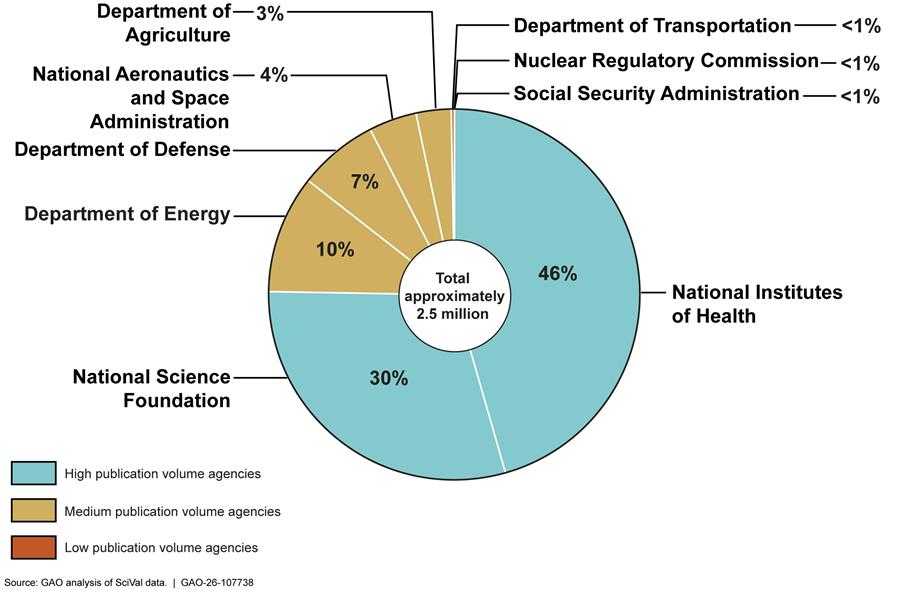
Note: Total may not sum to 100% due to rounding.
Federal agencies fund two types of researchers—intramural and extramural. Intramural researchers are federal employees or contractors. For example, intramural researchers may be scientists who work at federal labs or clinics. In contrast, extramural researchers are employed by non-federal organizations and receive federal funding to conduct research. They include scientists and research personnel who receive grants or other federal funding for their work at universities, academic medical centers, and other research institutions. Both intramural and extramural researchers develop research results, including manuscripts that summarize their findings. These manuscripts may be further edited and then published in scholarly journals.
Scholarly Publishing and the Peer Review Process
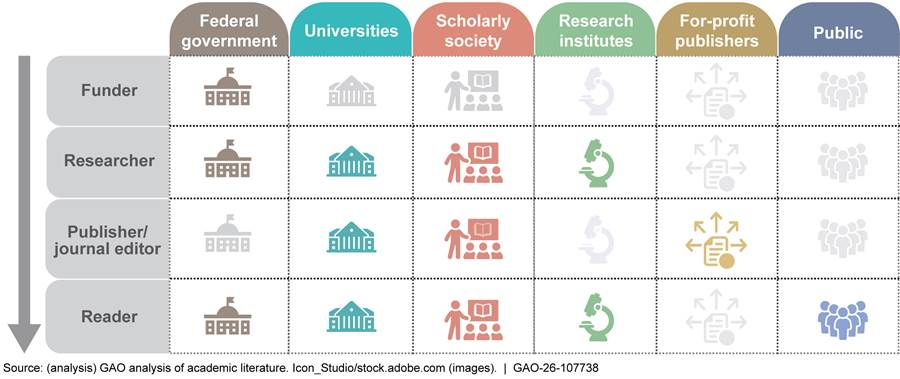
A wide range of entities play a role in the scholarly publishing process (see fig. 2).
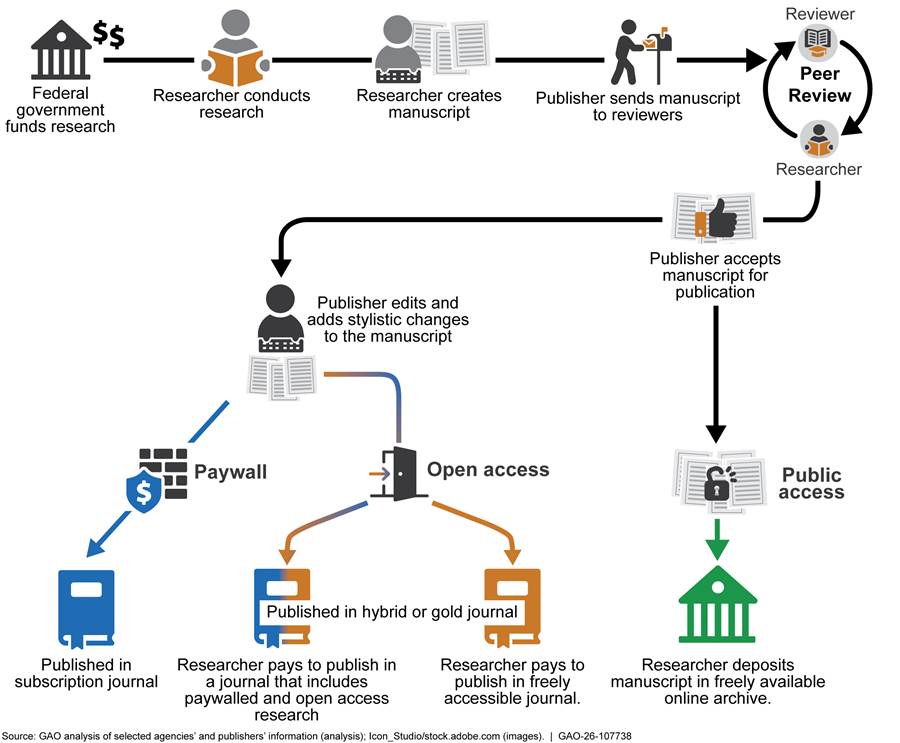
Peer review is the process in which draft manuscripts are scrutinized by other experts in the same field to help ensure the validity, quality, and often the originality of the research before it is published. Publishers facilitate this process. Before the peer review process, a researcher conducts research, writes a manuscript that describes their findings, and submits it to a journal. Then, editors of the journal review the draft to ensure it fits with the journal’s scope. If the manuscript passes this initial evaluation, the editors begin the peer review process.
A typical peer review process follows multiple steps to ensure overall quality. For example, the editors may first send the draft out for review by other experts in the same field, known as peer reviewers. Each peer reviewer evaluates whether the manuscript is descriptive, clear, informative, and accurate, or other commonly understood dimensions of quality for the field or publication type.[6] As part of their review, the reviewer recommends if the manuscript should be rejected, accepted with major revisions, accepted with minor revisions, or accepted with no revisions (or other similar rating scheme). If recommending that a manuscript be rejected, the reviewer may also suggest that the researcher submit to a different journal. If the manuscript is accepted with revisions, a researcher can go through several rounds of revisions before the final manuscript is accepted. It is very rare for a scholarly publication to be accepted with no revisions. If the manuscript is accepted, the peer review process is complete, and the editors move the manuscript to the publication stage.
For an overview of the scholarly research publishing process, see figure 3.
Methods for Sharing Federally Funded Research Results
Following successful completion of peer review and acceptance to a scholarly journal, federal agencies typically require researchers to share their manuscript with the public for free. This is referred to as the green public access model. This model involves researchers depositing the accepted version of their research manuscript into a public access repository, where the public can then freely access it.[7] These research repositories are managed by the federal agencies. We discuss these repositories later in the report.
Separate from public access enabled by repositories, commercial and non-profit publishers also offer researchers a range of business models for publishing in a journal. These business models are managed by the publishers and not the agencies. Generally, publishers may make formatting and visual appearance changes to the manuscript. The final version that is published in a journal is known as the version of record.[8] This means that there are typically two versions of a federally funded publication being shared: (1) the “author accepted manuscript” in a public access repository and (2) the version of record in a journal.
Publishers’ business models vary by how they are funded and who can access the publication. For example, publications are often disseminated in subscription journals. In these journals, researchers do not pay for publishing, but readers pay for a subscription to access the publication. For example, the American Association for the Advancement of Science publishes the journal Science under a subscription model for institutions and individuals. While individual readers can subscribe to journals as desired, in practice, research libraries often purchase bulk subscription packages that give researchers at their institution access to many of the publisher’s journals. For example, publishers may sell these bulk subscription packages to university libraries or federal libraries, such as the NIH Library or National Agricultural Library.
Many publishers also offer open access publication models. Under open access models, publishers allow the public to access publications in a journal for free. However, under some of the most common open access models—known as gold and hybrid—the authoring researcher must pay the publisher to have their research results published and made publicly accessible. Some notable open access models include the following:
Gold open access. Under this model, the researcher pays the publisher to have their research published in a freely accessible journal. This payment is referred to as an article processing charge or publication charge.
Hybrid open access. Under this model—a combination of gold and subscription models—a publication is published in a subscription journal, but the researcher can pay a publication charge to make the specific publication freely available. For example, commercial publisher Springer Nature’s journal Nature uses allows authors to choose to publish their work either through the traditional subscription publishing model or pay a publication charge to make a publication freely accessible to the public.
Bronze open access. Under this model, a publisher temporarily makes a publication that would otherwise be restricted behind a subscription paywall publicly accessible. A publisher may want to make available certain high-profile publications, such as prize-winning publications. Many publishers voluntarily made COVID-19-related research publicly accessible for free. However, depending on the license used, publishers may remove access to such publications at any time.
Diamond (or platinum) open access. This model is similar to the gold model, except that the publisher or another external sponsor covers the publication costs instead of the author. For example, the American Physical Society publishes a freely accessible diamond journal called Physical Review Accelerators and Beams.[9] The journal is funded by contributions from 40 sponsors, including national and international labs, universities, and private companies.
Subscribe to open. Under this model, the publisher uses subscription revenue to convert paywalled publications to open access if certain conditions are met. Specifically, if the journal meets a targeted number of subscriptions within a set period, its publications in the following year will be open access. For example, all of nonprofit publisher Annual Reviews’ journals published in 2024 were open access because it met subscription targets, according to the publisher. However, if those conditions are not met, the journal remains behind a paywall for the following year.[10]
Federal Guidance on Public Access
OSTP advises the president on a range of issues, including scientific, engineering, and technological aspects of the economy. Beginning in 2013, OSTP issued guidance to federal agencies on providing public access to federally funded research:
· 2013 memorandum.[11] In February 2013, OSTP directed federal agencies with over $100 million in annual R&D expenditures to develop plans to support increased public access to federally funded research. Agencies were directed to allow up to 12 months after publication in a subscription journal, known as an embargo period, to make the research publicly available. This embargo meant that, once published, federally funded research could remain behind a paywall for up to 12 months before becoming publicly accessible.
· 2022 memorandum.[12] In August 2022, OSTP expanded its public access guidance and encouraged federal agencies to update their public access plans accordingly. First, OSTP removed the option of a 12-month embargo period, now requiring federally funded research to be public upon publication in a journal. Second, OSTP broadened the requirements’ scope to all federal agencies that fund R&D, including agencies that fund less than $100 million in R&D annually. Finally, immediate public access is required not only for federally funded publications but also for their underlying scientific data.[13] Table 2 summarizes the selected components of the 2022 public access guidance for scholarly publications.
Table 2: Selected Components of OSTP’s 2022 Guidance for Public Access to Federally Funded Scholarly Publications
|
Topic |
Description |
|
Publication methods |
Agency plans should describe how peer-reviewed scholarly publications should be made publicly accessible.a |
|
Maximizing equitable reach |
Agency plans should describe how to maximize equitable reach of public access to peer-reviewed scholarly publications, including free online access to publications in formats that allow for machine-readability and broad accessibility through assistive devices.b |
|
Reuse permissions |
Agency plans should describe the circumstances or prerequisites needed to make the publications freely and publicly available by default, including any use and re-use rights and which restrictions, including attribution, may apply. |
|
Publication costs |
In consultation with the Office of Management and Budget, federal agencies should allow researchers to include reasonable publication costs and costs associated with submission, curation, management of data, and special handling instructions as allowable expenses in all research budgets. |
Source: GAO summary of information from the Office of Science and Technology Policy (OSTP). | GAO‑26‑107738
aThe term scholarly publications includes all peer-reviewed research articles or final manuscripts published in scholarly journals. The term also includes some peer-reviewed book chapters, editorials, and peer-reviewed conference proceedings published in other scholarly outlets.
bMachine-readability refers to a format that a computer can read. It enables automated systems to access, process, and analyze data without human intervention.
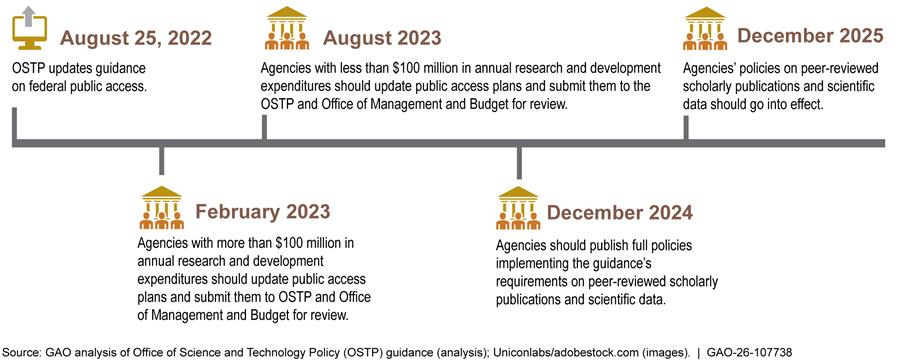
According to OSTP’s 2022 memo, agencies should issue final policies by December 2024, and the policies are to go into effect by December 2025 (see fig. 4).
2025 memorandum.[14] In June 2025, OSTP provided guidance to agencies on implementing Executive Order 14303 Restoring Gold Standard Science.[15] The guidance includes key tenets, such as transparency. The memo states that transparency in the research process can enable scrutiny, validation, and reuse. The memo also identifies open access journals and public data repositories as platforms that enable transparency.
OSTP Reports on the Economic Effects of Public Access
From 2022 through 2024, OSTP published a series of annual reports to estimate the potential taxpayer costs that will accrue because the 2022 memorandum allows agencies to pay reasonable publication charges on behalf of federally funded researchers. OSTP issued these reports in response to congressional requests.
· 2022 economic report.[16] This report described the potential economic effect of removing the 12-month embargo period on federally funded scholarly publications. It estimated that implementing public access would have cost the American taxpayer through agency research budgets roughly between $390 million and $789 million on average per year from 2021 through 2022.
· 2023 economic report.[17] This report expanded on financing mechanisms for public access to federally funded research. In this report, OSTP updated its estimate of publishing costs accrued to federally funded grantees and researchers to range from about $272 million to $378 million per year from 2016 through 2021.
· 2024 economic report.[18] This report included the status of federal agencies’ implementation of their updated public access policies, trends in publishing since OSTP’s 2023 report, and an update to estimated publication charges paid to publish federally funded research. OSTP updated its estimate to range from about $135 million to $408 million per year from 2016 through 2022.
Most Agencies’ Updated Public Access Plans or Policies are Consistent with Federal Guidance for Scholarly Publications
Most of the nine selected agencies have begun adopting public access plans or policies in response to OSTP’s 2022 memorandum on public access, though the agencies were in different stages of doing so during our review.
While OSTP’s guidance does not distinguish between plans and policies, agencies told us their interpretation of the distinction between a public access plan and policy.[19] For example, a NIH official said that a public access plan describes NIH’s high-level intentions for how it will implement public access, and a policy formalizes and puts into effect NIH’s public access requirements. Similarly, DOE released a high-level public access plan in June 2023 that described the agency’s intentions to update its public access policy in response to OSTP’s guidance. Then, in October 2024, DOE published a policy that formalized the changes described in the plan.
While the OSTP guidance states that agency public access policies were to be published by December 31, 2024, the selected agencies were at different stages of responding to OSTP’s guidance during our review.[20] Specifically, five of the selected agencies had released a public access plan, two had released a public access policy, and two had not issued any updated plan or policy in response to the OSTP guidance as of April 2026 (see table 3). In accordance with OSTP’s guidance, the public access plans and policies of the seven agencies had gone into effect as of December 2025. Notably, one of these agencies, NIH, accelerated implementation of the updated policy. Specifically, NIH published its policy in December 2024, with the intent to make the policy effective in December 2025. However, in April 2025, NIH announced that it would be accelerating its implementation timeline and would instead be making the updated policy effective as of July 1, 2025.[21]
|
Agency |
Plan or policy |
Publication date |
|
Department of Agriculture |
Plan |
June 2023 |
|
Department of Defense |
Plan |
December 2024 |
|
Department of Energy |
Policy |
October 2024 |
|
Department of Transportation |
Draft policy |
— |
|
National Aeronautics and Space Administration |
Plan |
November 2024 |
|
National Institutes of Health |
Policy |
December 2024 |
|
National Science Foundation |
Plan |
February 2023 |
|
Nuclear Regulatory Commission |
No updated plan or policy |
— |
|
Social Security Administration |
Plan |
December 2023 |
Source: GAO analysis of selected agencies’ public access plans and policies. | GAO‑26‑107738
While most of the selected agencies issued updated public access plans or policies, two of our selected agencies, DOT and NRC, had not done so. OSTP’s 2022 memorandum states that “federal agencies should develop new, or update existing, public access plans as soon as possible” and that policies should be effective no later than December 31, 2025. Officials at both agencies indicated that the agencies are in the process of drafting plans or policies. DOT officials told us that they have drafted a policy, and that they anticipated publishing the policy by February 2026. However, as of April 2026, DOT has not issued the final policy. Because it was not developed enough at the time of our review, we were unable to assess it against the OSTP guidance.
NRC officials told us in February 2025 that they did not originally plan to develop a new public access policy, as the officials stated the agency’s existing policies already largely satisfy OSTP’s 2022 guidance. However, in August 2025, NRC officials told us that the agency had determined that it will develop a new public access plan, consistent with the OSTP guidance.
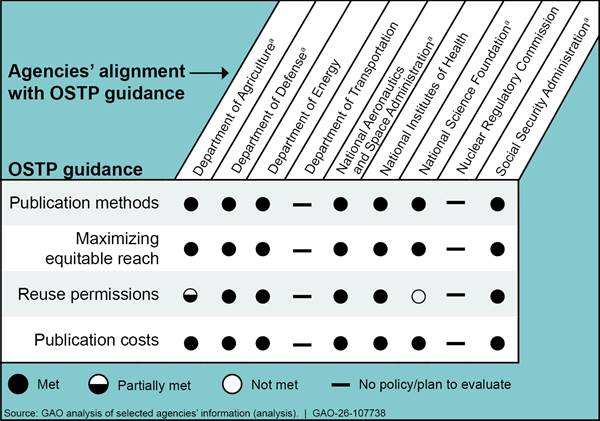
Regarding agencies that had issued an updated plan or policy, we found that the updated plans and policies largely aligned with the OSTP public access guidance (see fig. 5). We analyzed four areas related to publications within OSTP’s guidance: publication methods, maximizing equitable reach, reuse permissions, and publication costs.
Figure 5: Selected Agencies’ Plans and Policies’ Alignment with OSTP’s 2022 Public Access Guidance for Scholarly Publications, as of February 2026
aAgency public access plan was evaluated because agency does not have an updated public access policy.
Our analysis of the extent to which the seven agencies’ public access plans or policies align with OSTP’s guidance is detailed below:
Publication methods. OSTP’s 2022 memorandum states that agency public access plans “should describe how peer-reviewed publications should be made publicly accessible.” All seven of the relevant selected agencies met this aspect of the guidance. Although OSTP did not specify how agencies should make research results publicly available, each agency’s plan or policy stated that the research it funds would be made available to the public by having the researcher deposit the publication in freely accessible repositories. The plans and policies also described the specific repositories that the agencies will use (see table 4). For example, NIH’s public access policy states that it will make the publications it funds “publicly available through PubMed Central without embargo.” The repositories identified in the selected agency plans and policies are all managed by the agencies themselves.
Table 4: Selected Agencies’ Online Scholarly Publication Repositories Identified in Public Access Plans or Policies
|
Agency |
Publication repository |
|
Department of Agriculture |
PubAg |
|
Department of Defense |
Defense Technical Information Center (DTIC) |
|
Department of Energy (DOE) |
DOE Public Access Gateway for Energy & Science (DOE PAGES) |
|
National Aeronautics and Space Administration (NASA) |
NASA PubSpace collection within NASA’s Technical Report Server (NTRS) |
|
National Institutes of Health |
PubMed Central ® (PMC) |
|
National Science Foundation (NSF) |
NSF Public Access Repository (NSF-PAR) |
|
Social Security Administration (SSA) |
No specific repository identified in plana |
Source: GAO analysis of selected agencies’ information. | GAO‑26‑107738
aWhile SSA does not maintain its own repository, it does publish some research content on its website.
Equitable reach. OSTP’s 2022 memorandum states that agency public access plans should describe “how to maximize equitable reach of public access to peer-reviewed scholarly publications, including by providing free online access to peer-reviewed scholarly publications in formats that allow for machine-readability and enabling broad accessibility through assistive devices.” All of the seven relevant agencies met this aspect of the guidance. Some agencies have identified specific examples of assistive devices that can be used. For example, SSA’s plan specifically mentions ensuring accessibility for those “who use assistive devices such as screen readers,” which are software programs that allow blind or visually impaired users to read text on a computer through a braille display or a speech synthesizer that reads the text aloud. Additionally, several other agencies told us that their scholarly publications will be readable by screen readers
Reuse permissions. OSTP’s 2022 memorandum states that agency public access plans should describe any use and re-use rights and which restrictions, including attribution, apply to scholarly publications that are made publicly accessible. Reuse rights describe the terms of copyright, such as how others can share, modify, or use the research after it is published. Most of the agencies fully met this aspect of the OSTP guidance, but two agencies, NSF and USDA, did not. NSF’s plan described general actions and prerequisites related to public access publications that NSF believes federal agencies will need to collectively address. For example, the plan described the need for agencies to agree on a common licensing scheme, such as one of the Creative Commons licenses.[22] However, the plan did not address any specifics regarding re-use rights or restrictions or how they apply to NSF-funded publications. NSF officials told us that the agency is planning to address this aspect of the guidance in the next publication of its proposal and awards guidance.[23]
USDA’s plan partially aligns with the OSTP guidance, as it meets OSTP’s guidance on restrictions but does not include any specific mentions of use or re-use rights. A USDA official told us that the plan did not address re-use rights because the agency wanted to gather more input from stakeholders before addressing re-use rights but did not specify time frames for completing this effort.[24] OSTP’s guidance discusses how shifts towards public access can help create a “scientific culture that values collaboration.” If agencies are not clear about how federally funded research can be shared, modified, or otherwise used, this may discourage others from building upon the research.
Publication costs. OSTP’s 2022 public access memorandum encourages agencies to allow research grants to cover reasonable publication costs. All seven relevant agencies allow reasonable publication costs to be included in research budgets. Some agencies also gave specific examples of what types of publication costs can be covered. For example, NSF’s plan provided an extensive list of publication-related costs and activities that researchers can include in their research budgets, such as “the costs of documenting, preparing, publishing or otherwise making available to others the findings and products of the work conducted [using the funding].” Additionally, SSA’s plan states that “costs associated with public access” are an allowable expense in research budgets.
The Code of Federal Regulations states that “a cost is reasonable if it does not exceed an amount that a prudent person would incur under the circumstances prevailing when the decision was made to incur the cost.”[25] Officials from several agencies told us that they determine reasonableness of publication costs when reviewing a proposed research budget. Officials at some agencies also told us that researchers often have the ability to reallocate funds within their budgets after the agency’s review. Researchers could therefore reallocate funds to spend more on publication costs than they initially stated they would in their proposed budget.
As Publishers Adopt Pay-to-Publish Models, Agencies Could Pay More to Make Research Public
Publishers Indicate That Federally Funded Researchers Will Typically Need to Pay to Make Research Publicly Accessible
Publishers are changing their business models with the goal of maintaining financial sustainability amid the shift to public access without an embargo, according to most commercial publishers we met with. Almost all of the commercial publishers we spoke with told us that, without an embargo period, they will only offer federally funded researchers open access publishing options that include a publication charge (such as gold or hybrid).[26] Therefore, federally funded researchers that want to have their publication shared both in a repository and in a journal will often have to pay a publication charge. For example, the website of a prominent journal, Nature, states that researchers who must make their research immediately available to the public will be directed towards the gold open access model, which requires a publication charge payment. The website also states that “publication under the subscription model isn’t suitable for authors whose funders require no embargo.” Similarly, a DOE official stated that they have received anecdotal feedback from the agency’s funded researchers that publishers are only offering them the option to publish under the gold open access model.
The selected agencies will likely bear much of the cost of these publication charges. This is because researchers are allowed to charge reasonable publication costs to their research grants, per the relevant selected agencies’ updated public access plans and policies and in accordance with OSTP’s 2022 guidance. Publishers stated that implementing these charges is the only financially sustainable way for them to make content immediately and publicly accessible. In a 2024 report, OSTP reported that the average publication charge that year was approximately $3,025 for gold journals and $4,072 for hybrid journals for the top 100 journals for federally funded research.[27]
Publishers cite OSTP’s 2022 guidance that no longer allows an embargo period as the main reason publication charges are needed for publishers’ financial sustainability. Under the previous 2013 OSTP guidance, federally funded research could be published in a subscription journal and then made freely available in an appropriate repository after the 12-month embargo period. Publishers told us that this arrangement was financially sustainable for them because readers would pay for subscriptions to access the content during the 12-month embargo period. This offered a no-cost option to agencies for making research publicly accessible.[28]
Under updated agency policies and plans, publishers told us that this no-cost option will not be offered to federally funded researchers in most cases. They explained that this is because subscription-based publication models are not financially sustainable for publishers to operate when publications are made immediately and freely accessible in repositories. Publishers stated that readers are unlikely to pay for research that is behind a subscription paywall if that content can already be freely accessed through a repository. Federally funded researchers will still be able to deposit publications into repositories.[29] However, where there were no costs to researchers associated with publishing in a subscription journal with an embargo period, publishers have stated that they will now typically charge federally funded researchers to make their research results immediately available to the public in an open access or hybrid journal.
There were two exceptions among the publishers we spoke with. First, a representative from one commercial publisher told us that they currently allow researchers to publish in their subscription journals even when the publication is also being immediately shared in a publicly accessible repository. However, this representative said that they are only able to do this because they are uniquely positioned in the publishing industry, as they are large enough for institutions to value maintaining subscriptions, but small enough that their publishing choices do not affect the wider publishing industry. The representative stated that, if larger publishers began offering similar arrangements and enough publications in the market become freely available, then their current approach will likely no longer remain sustainable. This representative said they would then need to switch to pay-to-publish models. Second, one nonprofit publisher told us that they believe libraries will continue to subscribe to their journals, even if its articles are immediately available in public access repositories. This may, however, be a unique circumstance explained in part by the publisher’s and journals’ reputation.
Publishers’ transitions to pay-to-publish models may not align with agency expectations.[30] Officials from several of the selected agencies stated that researchers can comply with their public access policies by depositing their author accepted manuscript into a repository at no cost. For example, an NIH official told us that an alternative option may be that researchers seek to publish their research with publishers that allow them to deposit their manuscripts with their funders without added costs. However, publishers we spoke with stated that they will not offer researchers an option for their publications to be deposited in repositories at the time of publication unless the researcher pays a publication charge.
While researchers can satisfy agency public access requirements by only depositing their manuscript into an approved repository, in practice, this is unlikely to be a feasible approach for researchers. This is because the publishers currently facilitate the peer review process. This means that a researcher who wants their work peer reviewed is often going to have to go through the publication process with a publisher. Thus, there is currently no practical way for researchers to deposit publications that have been peer reviewed into a repository without incurring a publication charge.
DOE officials raised some potential alternatives that could allow agencies to get publications peer reviewed without involvement of the publishing companies, and subsequently avoid paying publication charges to these companies. One alternative was to incorporate a layer of peer review into the process for sharing early versions of publications, known as preprints.[31] Another alternative raised by DOE officials is the possibility of government agencies creating their own scientific journals, and that publishing in these journals would allow researchers to avoid publication charges through private companies.
Most of the selected agencies have not conducted formal analyses or planned for the potential budgetary and other effects of shifting towards pay-to-publish models. This could be explained at least in part by agencies not fully anticipating the expected shift towards pay-to-publish models, as discussed above. NIH was the only agency that had begun conducting such an analysis during our review. In July 2025, NIH issued a request for information related to publishing costs.[32] The request for information proposed several options for how the agency may handle limiting allowable publication costs, including:
· disallowing all publication costs in federal grants,
· setting a limit on allowable publication costs per publication (such as $2,000),
· setting a limit on allowable publication costs per publication and allow a higher amount to be paid when peer reviewers are compensated (such as $3,000 for journals that compensate peer reviewers for their services),
· setting a limit on the share of an award that can be used for publication costs (such as 0.8% of the total award), or
· setting a limit on both the per publication cost and the share of the award that can be used for publication costs.
As of December 2025, an NIH official stated that the agency was considering the over 900 comments it received in response to the request for information. The official also stated that NIH aims to develop a final policy on publication costs in 2026.
Officials from two agencies, NRC and SSA, told us their agencies have not conducted an analysis of how they may be affected by a shift towards pay-to-publish because their extramural grant programs are currently unfunded. In the case of NRC, an official told us that the agency’s intramural research would not be affected by a shift toward pay-to-publish because the research is published on the NRC website and does not go through the typical external peer-review and journal publication process.[33] Additionally, NRC officials told us that their external grants program was roughly 10 percent of their research prior to 2026, when the program stopped receiving funding. For SSA, an official told us that the agency will continue doing intramural research and that some of this research will likely be published in journals. Therefore, even in the absence of an extramural grants program, SSA may be affected by a shift to pay-to-publish models. Additionally, while these agencies told us they currently do not have funding for their extramural research programs, they may receive funding again in the future and would benefit from understanding how their extramural research programs may be affected.
Additionally, in April 2026, the President’s budget proposal for fiscal year 2027 included language prohibiting the use of Federal funds for “expensive subscriptions to academic journals and prohibitively high publishing costs unless required by Federal statute or approved in advance by a Federal agency.”[34] However, it is too soon to know how agencies would interpret and implement such a prohibition and what effects this would have on their public access plans and policies. This may lead to federally funded researchers paying for publishing fees out-of-pocket, according to a representative from the American Association of Publishers during an April 2026 Congressional hearing on the state of scientific publishing.[35]
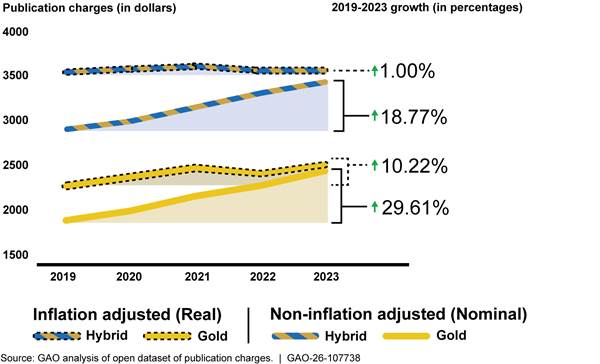
Amid these changes, studies and data analyses show that publication charges have become more expensive. For example, OSTP’s 2023 economic analysis cited a 2019 study that reported the four largest fully open access publishers increased their publication charges at a rate that outpaced inflation from 2012 through 2018.[36] Additionally, we analyzed a dataset of publishing charges listed by six large publishers from 2019 through 2023 and found that these publishers increased the average publishing charge by 29.6 percent for their gold journals (10.2 percent after adjusting for inflation) and by 18.8 percent for their hybrid journals (1.0 percent after adjusting for inflation) (fig. 6).[37] One preprint of a study from 2024 found that global spending on publication charges for six large publishing companies nearly tripled from 2019 ($910.3 million) to the end of 2023 ($2.5 billion).[38]
Figure 6: Average Publication Charge for Gold and Hybrid Journals at Six Large Publishers, 2019–2023
While research shows that publication charges were generally rising, they vary by publisher and by journal, sometimes significantly. Additionally, publishers told us that the exact calculations they use to determine publication charges are typically not made public. Publishers we spoke with told us that publication charges are influenced by a number of factors, including journal prestige and selectivity, the rigor of the quality checks performed by the journal, the academic discipline of the journal, market conditions, and general publication costs. See appendix II for more details on how these conditions may affect publication charges.
Agencies that fund research that results in scholarly publications should expect a substantial increase in the amount that researchers will request to spend on publication charges. Our analysis of the selected agencies’ publications found that 46 percent of research funded by the agencies was published under a pay-to-publish model in 2024 (30 percent was published fully open access and 16 percent was published under a hybrid model).[39]
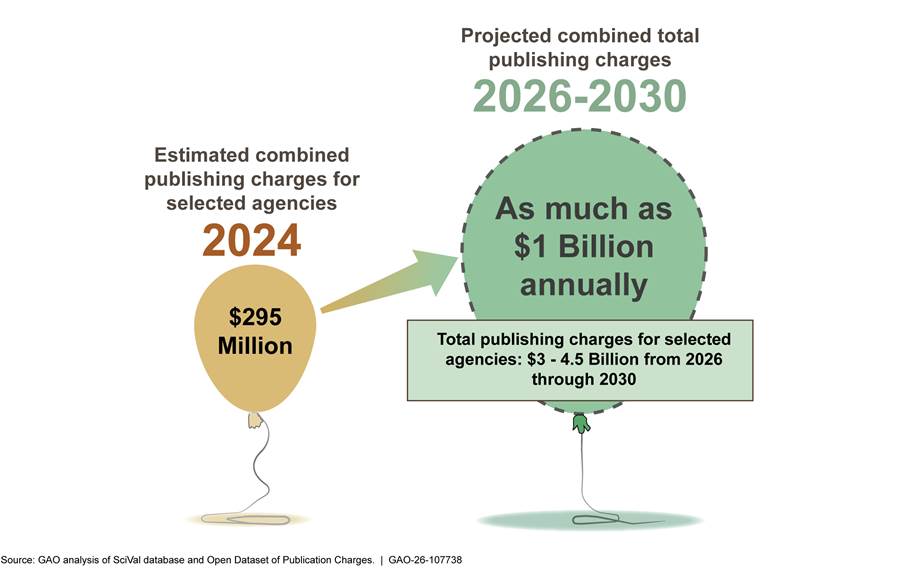
Based on what publishers told us about how they plan to support open access publishing for federally funded researchers, we expect this share to increase substantially. This increase could have significant cost implications for federal agencies. Using OSTP’s average publication charge estimates for pay-to-publish models in 2024, we estimate that the selected federal agencies spent a combined total of approximately $295 million on publication charges in 2024.[40] Had publishers been requiring the use of pay-to-publish models for all publications at this time, like they have indicated they will begin doing for federally funded researchers, we estimate that the selected agencies would have spent between approximately $607 million and $715 million on publication charges that year.[41] This represents a 105 to 142 percent increase in spending on publication charges.
Assuming publication counts and costs continue to follow recent historical patterns, annual expenditures on publication charges for the selected agencies could range from approximately $582 million to $937 million (in 2024 dollars) each year over the next 5 years.[42] We estimate that the selected agencies could collectively spend approximately $3 billion to $4.5 billion in 2024 dollars on research publishing from 2026 through 2030 ($3.2–$4.9 billion in nominal terms). Figure 7 shows our estimate for how much selected agencies spent on publication charges in 2024 and the projected increase in spending under the new public access guidance.
|
Research from Europe: Open Access May Not Reduce Spending on Subscriptions While some U.S. agencies have canceled their subscriptions to prominent scholarly journals in the last year, a study of Europe’s shift toward open access publication of government research suggests that adopting open access publishing may not lead to decreased subscription spending. Specifically, a study commissioned by the group of national research funding organizations that launched Europe’s open access efforts (known as cOAlition S) found that the greatest effect of Europe’s shift to open access has been an increase in the likelihood of funded papers being published as hybrid open access. The paper states that hybrid open access leads to double dipping, a double payment phenomenon in which an institution pays to access a journal’s publications through the subscription model while simultaneously paying publication charges for the journal to publish the institution’s research. In this circumstance, open access does not reduce subscription spending but rather introduces new costs in addition to existing subscription spending. Notably, at the start of 2025, cOAlition S stopped allowing its researchers to pay publication charges to hybrid journals. The group specifically cited double dipping in their rationale for the change. Source: de Castro et al. https://doi.org/10.5281/zenodo.13738479. | GAO‑26‑107738 |
These estimates are intended as illustrative bounds, assuming publishing trends remain broadly consistent with recent history. In practice, the scholarly publishing industry is difficult to predict.
Expenditures could fall outside these ranges if, for example, researchers change their publishing behavior in response to policy shifts or market conditions, if publishers adjust their business models and pricing strategies, or if agencies implement strategies to control costs, as the President’s 2027 budget suggests. Additionally, a study of Europe’s shift to open access publication models shows that increased spending on publication charges is unlikely to be offset by decreased subscription spending (see sidebar).
According to the Standards for Internal Control in the Federal Government, agencies should identify and analyze significant changes that could affect agency operations, and as appropriate respond by changing operating practices on a timely basis.[43] Agency adoption of new public access plans that cover reasonable publication charges combined with the journal market shift towards pay-to-publish models represent a significant change with financial implications for the selected agencies.
However, only one of the nine selected agencies, NIH, conducted formal analyses or planned for the potential effects of shifting towards pay-to-publish models, including budgetary effects. As a result, the remaining eight agencies (USDA, DOD, DOE, DOT, NASA, NRC, NSF, and SSA) are not reasonably assured that they are prepared for how the shift toward pay-to-publish models will affect their research efforts and budgets. To use research budgets efficiently, the selected agencies must anticipate how these budgets may be affected by the shift toward pay-to-publish models. Efficient use of research budgets is especially important given anticipated constraints on research funding.[44] If the selected agencies do not anticipate the effects of rising publication costs, they risk inaccurately projecting how much of their research budgets will be used on publication charges, instead of other uses such as directly conducting research, purchasing equipment, or hiring research staff. Such inaccuracy could negatively affect the extent to which the agency is able to achieve its research goals. Additionally, conducting an analysis like NIH’s could help agencies develop a basis for what they would consider a reasonable cost for publication charges.
A Variety of Stakeholders Expressed Concerns with the Economic Effects of Pay-to-Publish Models, Including Consolidation and Opportunity Costs
A variety of stakeholders we spoke to expressed concerns with the potential economic effects of pay-to-publish models, including these models’ effects on publishing industry consolidation and research spending. These concerns may become more prominent, as publishers have indicated that they will typically require federally funded researchers who want to publish in their journals to use pay-to-publish models. These concerns included:
Leads to market consolidation. Stakeholders we spoke with and data analyses we reviewed indicate that consolidation in the publishing market has grown considerably in recent decades as open access publishing has become increasingly common.[45] This consolidation is especially concerning for small publishers who lack the resources needed to negotiate agreements with institutions.
Increases costs. A variety of stakeholders stated that pay-to-publish models are not financially sustainable for researchers and research institutions and that these models will increase costs for researchers and their institutions relative to the subscription model.
Poses opportunity costs. Grant funds used for publication charges cannot be used for other purposes, including conducting research, hiring research staff, or maintaining facilities and equipment. As more funding is dedicated towards publishing research, less will be available for conducting research.
Limits some researchers’ ability to publish. Some stakeholders stated that researchers who have limited access to funding or publishing support will have greater difficulties publishing under pay-to-publish models, as they may be unable to pay for publication charges.
Shifts cost burden. Some stakeholders expressed concern that research institutions that publish greater than average volumes of research will have to bear much of the cost of publication under the pay-to-publish models. Because pay-to-publish models require a payment for every publication, institutions that publish more often will pay more than others.
Challenges scholarly societies. Stakeholders told us that scholarly societies rely on subscription revenue to support their operations, and that if the market shifts primarily to pay-to-publish models that these societies may struggle to adapt.
See appendix III for additional details on these concerns.
Public Access Increases Research Visibility and Use, but Pay-to-Publish Models Can Pose Risks to Research Integrity
Public Access Encourages Use of Federal Research
Researchers viewed and cited open access scholarly publications more than paywalled publications funded by the selected agencies. We analyzed data from SciVal on these publications from 2015 through 2024 and found that publicly accessible publications were cited and viewed more than paywalled publications for all but one of the agencies.[46] This pattern holds using field-weighted citations which control for variation in scientific disciplines. For example, publicly accessible publications funded by NIH, which has both the most funded publications and highest share of publicly accessible publications among our selected agencies, were cited 37 percent more often than paywalled publications when field weighted.[47] Another agency, DOE, saw a similar advantage in field weighted views, as their publicly accessible publications were viewed 31 percent more often than paywalled publications. See figure 8 for more information on field-weighted views and citations for the selected agencies.
Figure 8: Field-Weighted Views and Citations of Scholarly Publications Funded by Selected Agencies, by Public Access and Paywall, 2015–2024
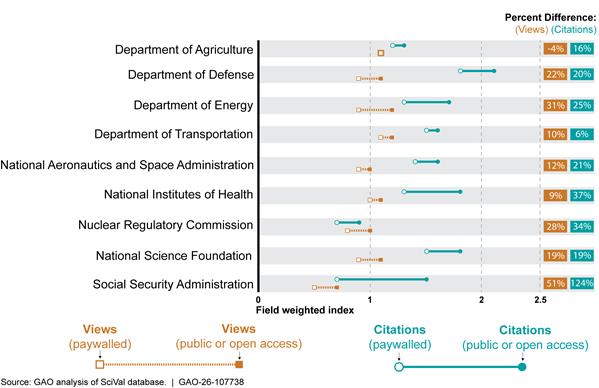
Note: Field-weighted views or citations indicate how the number of views or citations of an entity’s publications compares with the average for all other similar publications in the same field. Similar publications are those that have the same publication year, type, and scientific discipline. A field-weighted value of 1 indicates that the agency’s publications have been viewed or cited as much as the average. A greater or lesser value indicates that they have been viewed or cited more or less than the average.
We reviewed scholarly literature and found results consistent with our data analysis. Several studies found evidence that open access publications were cited more frequently than paywalled scholarly publications across a range of disciplines. For example:
· A study from 2020 found evidence that a non-generalizable sample of journals that switched to an open access model were cited more than journals that remained behind a paywall.[48]
· One preprint of a study (not yet peer reviewed) that analyzed open access and patent citations found that open access publications are 38 percent more prevalent in patent citations across all fields, and 73 percent more prevalent in patent citations related to biology.[49]
In addition, a representative of one large commercial publisher told us that their open access publications were downloaded three times as often and cited nearly twice as often as their paywalled publications.
|
Expanding Access to Research During the COVID-19 Pandemic
The COVID-19 pandemic highlighted the potential benefits of providing public access to scholarly publications. In March 2020, chief science advisors from 12 countries, including the U.S., urged publishers to voluntarily make COVID-19-related publications immediately accessible to support public health response efforts. More than 50 publishers and scholarly societies did so voluntarily via NIH’s PubMed Central. Around one-third of these publications remain permanently accessible there. The remaining two-thirds were deposited under custom license terms that expired in May 2023 and were removed. Source: GAO summary of information from the National Institutes of Health (NIH) (text) and Production Perig/stock.adobe.com (image). | GAO‑26‑107738 |

These results suggest that increased accessibility can improve visibility of federally funded research and encourage and accelerate scientific progress in areas funded by the selected agencies (see sidebar). Some agency public access plans and policies have described expected results of expanded public access to their funded research. For example, NSF’s plan states that improved public access to NSF-funded research will accelerate the dissemination of fundamental science, assisting researchers in advancing knowledge, innovation, and technology across disciplines. Similarly, NIH’s policy states that public access can accelerate future research, lead to collaboration, and allow interested readers and patients to follow the latest advances more closely.
Public Access Promotes Transparency, but Pay-to-Publish Models Introduce Incentives That Could Pose Risks to Research Integrity
Public access to federally funded research promotes transparency and can lead to faster corrections and retractions. However, compared to subscription models, pay-to-publish open access business models introduce different incentives that also pose risks related to ensuring research integrity.[50]
Public access leads to faster corrections and retractions because it allows more researchers to view and identify research integrity issues, such as flawed or erroneous content, according to officials and one university stakeholder. Those issues can then be corrected more quickly than they would be in paywalled scholarly publications. Publishers can also “retract” publications that are found to have issues such as significant errors, plagiarism, fraudulent data, or unethical research practices.[51] One study, from 2024, found that the average retraction time of publications under a gold pay-to-publish model was shorter than paywalled scholarly publications for selected biochemistry journals by about 3½ months.[52]
However, under the pay-to-publish models, publishers are financially incentivized to publish more scholarly publications because they receive publication charges for each one. This incentive has negatively affected the academic publishing industry, according to stakeholders we spoke with. Open access journals do not inherently have lower standards of quality, according to publishers and scholarly societies. These stakeholders told us that research quality varies from journal to journal, for a range of reasons regardless of public access or open access status.
The incentives created by pay-to-publish models have contributed to the following three issues.
Paper mills. Some organizations, commonly referred to as “paper mills,” let people pay to have their name listed among the authors of a publication on which they were not an author. These publications may be entirely fraudulent or legitimate apart from the illegitimate author or authors. Some researchers find this offering attractive because they face pressure to publish a high quantity of scholarly publications to advance in their careers.[53] The use of paper mills is less prevalent for U.S.-based researchers than foreign-based researchers, but even limited use poses reliability concerns.[54] Paper mills are mainly overseas organizations that conduct a variety of fraudulent activities, including fabricating scholarly publications, adding authors to already accepted publications, and bribing journal editors to accept manuscripts for publication.[55] According to a news article in Nature, roughly 2 percent of all manuscripts submitted to journals in 2022 showed signs of paper mill activity.[56] For example, paper mills may follow specific templates, with minor variation between articles.
|
Example of Paper Mill Activity
In 2021, a large U.S.-based commercial publisher acquired for $298 million an open access publisher founded in Egypt that had over 200 gold open access journals. The U.S. publisher stated that this acquisition would double its share of gold open access journals. Some of these journals used outside guest editors to manage the submission review process. In 2022, the publisher identified and alerted the
industry to large-scale paper mill activity enabled by the acquired company. “Specifically,
we found fraudulent outside editors that had subverted our processes and
workflows, leading to a proliferation of bad content,” the publisher wrote in
a press release. The publisher stated that it responded in several ways,
including by alerting other publishers, reworking its publishing processes,
increasing integrity checks, pausing publication of certain journals, and
retracting compromised scholarly publications. It retracted over 11,000
affected publications and closed 19 journals, the publisher told the Wall
Street Journal Source: GAO summary of information from Wiley and the Wall Street Journal (text). AntonioDiaz/stock.adobe.com (image). | GAO‑26‑107738 |

Paper mills submit manuscripts to journals for publication, targeting journals with lax quality assurance processes to improve the paper mill’s chances of getting the bogus manuscript published. There have been instances of open access journals being targeted by paper mills. For example, in 2021, a large U.S.-based commercial publisher acquired an open access publisher but later found that this publisher enabled significant paper mill activity. As a result, the U.S. publisher closed 19 journals and retracted over 11,000 scholarly publications with integrity concerns (see sidebar). Additionally, in July 2025, a major scientific publisher paused submissions to one of its fully open access journals so that its editors could investigate approximately 1,000 scholarly publications in the journal that show indicators of potential paper mill behavior. However, it is unclear whether new paper mill activity has been a result of the spread of open access journals.
Predatory publishers. Some publishers may charge to make a scholarly publication open access and mislead researchers into believing that the publishers conduct high-quality peer review without doing so. In 2017, NIH published tips on how to spot predatory journals, along with links to external resources on determining if a journal is predatory.[57] For example, the NIH announcement indicated that predatory publishers can be identified by several attributes, such as a lack of transparency on publication charges, misleading or suspicious peer-review process, and aggressive tactics to solicit submissions. A study from 2020 found that publications from journals that the study identified as predatory were cited very few times, with over half of the sampled publications having no citations.[58] This suggests that the influence of predatory journals may be limited.
Lowering publication standards. Several stakeholders, including publishers and scholarly societies, expressed concern to us that some publishers may seek to increase profits by lowering publication standards. This could involve either publishing more articles or reducing spending on quality assurance. Editors who work for the publishers make the final decisions about what to publish. Publishers we spoke to told us that they have not lowered publication standards and that they use the same editorial review processes for their subscription and open access journals. One told us that the consequences to a publisher’s brand and reputation for publishing low-quality, inaccurate research far outweigh the short-term revenue benefits of publishing more articles.
Nevertheless, there have been multiple instances of editorial boards for pay-to-publish journals resigning for what the former board members claim are concerns about quality and other issues.[59] These former editors cited a variety of research integrity and quality concerns in their resignation letters. These included:
· Staffing concerns. One editorial board cited a workload that was too high, which they said hindered the editors’ efforts to review and publish high-quality work. For example, in 2024, the editorial board for a human evolution journal resigned, citing concerns with editorial staff being cut. The former editors stated in their resignation letter that following the staff cuts, editors were “handling far more papers, and on topics well outside their areas of expertise” and that these changes “preclude maintaining the quality and integrity fundamental to [the journal’s] success.”[60]
· Quantity over quality. Additionally, one editorial board stated that the publisher pushed them to publish more, which made editors feel forced to sacrifice quality for quantity.
While these editors’ resignations highlight potential concerns that may affect research quality in individual pay-to-publish journals, they are not necessarily representative of all such journals. The small numbers of these resignations with respect to the size of the publishing industry make it difficult to draw industry-wide conclusions.
There are a range of steps publishers or researchers can take to help ensure research integrity of open access scholarly publications, according to publishers we spoke with. These include:
· Conducting high-quality peer review. Peer review is the process in which external experts from the same field or discipline evaluate the quality of a peer’s research by assessing the validity, quality, and often the originality of research for publication. This work is typically provided by researchers on a volunteer basis, coordinated by volunteer or professional editorial staff. To facilitate high-quality review, editors can, for example, ensure that an appropriate number of qualified and reputable reviewers examine each manuscript in timely manner. Editors can also ensure that reviewers do not have too many manuscripts to review at once.
· Checking for research misconduct. Publishers can use automated tools and manual reviews to help identify manipulated images or plagiarized text in submitted manuscripts. For example, one open access publisher told us that it uses a proprietary AI tool that checks every submitted manuscript for language quality, the integrity of figures and images, plagiarism, conflicts of interest, and more. Editors and reviewers consider these results as they decide whether to put the manuscript through the peer review process or to reject it.
· Verifying publisher reputation. When deciding which journal to submit a manuscript to, researchers can check curated lists of known credible open access publishers that have agreed to adhere to certain business standards. For example, one stakeholder identified the Open Access Scholarly Publishing Association, which approves its members using several criteria, such as clearly stating peer review and editorial processes and policies. Members must also not provide misleading information or attempt to mimic another journal or publisher.[61] It can be difficult to accurately identify predatory publishers, although some online lists attempt to do so.
Additionally, some publishers that we spoke to expressed concerns with how agencies handle retractions in public access repositories. More specifically, as shown in figure 3, the same publication may exist in different versions both an agency-designated repository (called the author-accepted manuscript) and a scholarly journal (called the version of record). Following publication, publishers generally make any changes, such as corrections or retractions, to the version of record. Publishers told us that there is a risk that federal agencies might not accurately track and carry over such changes to the versions in repositories.
Officials from the selected agencies generally told us they did not share this concern, for various reasons.[62] For example:
· NASA officials noted that within their repository, they include a link to the publisher’s version of record, which would include information on corrections and retractions.
· USDA officials told us that when an article is retracted, the title of the article will include “RETRACTED” at the beginning. Additionally, USDA has a metadata agreement with several publishers so that when these publishers update posted scholarly publications, these updates are reflected in USDA’s repository.
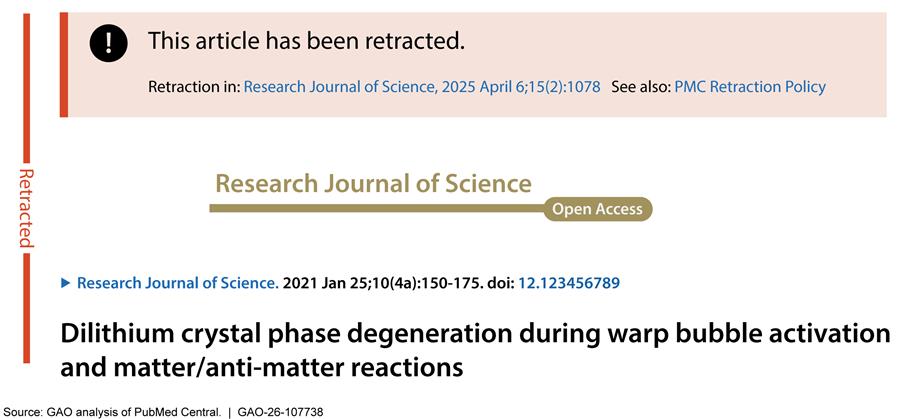
· NIH’s policy states that if publications that appear in PubMed Central are retracted, the agency will create links in PubMed Central to original publications and to post-publication updates, using information published by the journal. NIH’s practice is to mark updated or retracted publications in PubMed Central with a banner and watermark (see fig. 9). PubMed Central also links to the version of record on the journal website whenever possible.
Figure 9: Fictional Example of PubMed Central’s Retracted Public Access Scholarly Publications Markings
Agencies Offer Researchers Flexibility on Research Reuse Rights
The selected agencies with public access plans or policies require their funded research results to be deposited into a freely accessible repository under what is referred to as a federal purpose license.[63] Licenses establish the rights of readers of a scholarly publication to reuse the research. Beyond this requirement, all of the agencies offer flexibility by not mandating or stating a preference for a specific license for researchers to use when publishing in a scholarly journal. Licenses granted by the publishers of open access publications generally allow for anyone, such as researchers or the public, to read and freely share a publication, but these licenses can vary in what restrictions are placed on reuse. For example, they may vary in whether the publication can be reused for commercial purposes or adapted and then shared.
Publishers offer a range of licenses for researchers to choose from when making their work open access. This is largely both to meet researcher demand and to align with international funder requirements, according to publishers we spoke with. Some international funders of research, in Europe in particular, require the use of certain licenses.[64]
Table 5 provides additional information on Creative Commons licenses that are often used with open access publishing.[65] Publishers may offer researchers any number of these or other licenses.
|
License name |
Can the scholarly publication be shared? |
Can it be adapted and then shared? |
Can it be used for commercial purposes? |
Do(es) the original author(s) need to be credited? |
|
Attribution (CC BY) |
Yes |
Yes |
Yes |
Yes |
|
Attribution-NonCommercial (CC BY-NC) |
Yes |
Yes |
No |
Yes |
|
Attribution-NoDerivatives (CC BY-ND) |
Yes |
No |
Yes |
Yes |
|
Attribution-NonCommercial-NoDerivatives (CC BY-NC-ND) |
Yes |
No |
No |
Yes |
Source: GAO summary of information from Creative Commons. | GAO‑26‑107738
Researchers retain their copyright when publishing with an open access license, according to publishers.[66] In contrast, when publishing in a subscription journal, authors may need to transfer copyright to the publisher, which can then distribute the publication under a publisher-specific license. These licenses for subscription journals are generally more restrictive than open access licenses. For example, they may limit the right to read a scholarly publication to subscribers only.
Stakeholders, including publishers and scholarly societies, told us that researchers vary in their preferences for licenses. Some prefer less restrictive licenses—such as the Creative Commons Attribution license (CC-BY)—so that the research can be built upon and shared as widely as possible. Others want more restrictive licenses—such as Attribution-NoDerivatives (CC BY-ND)—because of concerns that using less restrictive licenses could result in a scientists’ work being misrepresented if it is reused or adapted to support something that the original authors did not intend.
Additionally, the rise of generative AI raises new questions on the legal and ethical uncertainty surrounding the reuse of scholarly publications. Web traffic from bots run by AI companies is disrupting scientific journal websites, with some publications reporting that their websites are now visited by more bots than genuine users, according to Chemical & Engineering News.[67] One publisher told us that AI developers can use publicly accessible publications to improve their models because access enables them to more easily incorporate scientifically accurate information. However, because publicly available information may be subject to copyright protections, it is unclear whether this information may be used to train commercial generative AI models without infringing on copyright protections.[68] Information being publicly available does not mean that the information is within the public domain or not subject to copyright protections.
OSTP’s Analysis Provides an Incomplete Projection of the Effects of Expanding Public Access
We found that the economic analysis in OSTP’s 2024 report on financing mechanisms for open access publishing partially met three and did not meet two of the five key elements for an economic analysis.[69] Most notably, the scope of the analysis did not address the report’s own stated objective of estimating the potential effects of expanding public access on federal research investments. This reduces the utility of the report to research agency leadership and Congress as they weigh policy decisions about the future of public access to federal research findings.
GAO’s Assessment Methodology for Economic Analysis describes five key elements that serve as a framework for assessing an economic analysis.[70] It defines an economic analysis as an analysis intended to inform decision-makers and stakeholders about the economic effects of an action. An economic analysis may be prospective, examining an action that could be taken, or retrospective, examining the outcome of an action that has already been taken. In this case, the examined action is prospective—expanding public access to federally funded research under OSTP’s 2022 guidance once agency policies later go into effect. See table 6 for a description of these key elements and our assessment of whether OSTP’s 2024 economic analysis properly dealt with them.
|
Key element |
Description |
GAO assessmenta |
|
Objective and scope |
The economic analysis explains the policy action examined (in this case, the shift to public access) and includes a rationale and justification for the action. The analysis states its objective. The scope of the analysis is designed to address this objective. Unless otherwise justified, the analysis focuses on economic effects that accrue to citizens and residents of the U.S., and its time horizon is long enough to encompass the important economic effects of the action. |
Partially met |
|
Methodology |
The economic analysis examines the effects of the action by comparing alternatives, using one of them as the baseline. Unless otherwise justified, it considers alternatives that represent all relevant alternatives, including that of no action. The analysis defines an appropriate baseline. The analysis justifies each alternative considered (including the baseline) represents the best assessment of that scenario. The analysis identifies the important economic effects for each alternative considered, their timing, and whether they are direct or indirect effects. |
Not met |
|
Analysis of effects |
Where feasible, the economic analysis quantifies the important economic effects and monetizes them using the concept of opportunity cost. The analysis uses the criterion of net present value, or related outcome measures, to compare these effects across alternatives.b It controls for inflation and uses economically justified discount rates. Where important economic effects cannot be quantified, the analysis explains how they affect the comparison of alternatives. Where the equity and distributional effects are important, the full range of these effects is separately detailed and quantified, where feasible. |
Not met |
|
Transparency |
The economic analysis describes and justifies the analytical choices, assumptions, and data used. The analysis assesses how plausible adjustments to each important analytical choice and assumption affect the estimates of the economic effects and the results of the comparison of alternatives. The analysis explains the implications of the key limitations in the data used. Where feasible, the analysis adequately quantifies how the statistical variability of key data used effects these estimates, and the results of the comparison of alternatives. |
Partially met |
|
Documentation |
The economic analysis is clearly written, with a plain language summary, clearly labeled tables that describe the data used and results, and a conclusion that is consistent with these results. The analysis cites all sources used and documents that it used on the best available economic information. The analysis documents that it complies with a robust quality assurance process and, where applicable, the Information Quality Act. The analysis discloses the use and contributions of contractors and outside consultants. |
Partially met |
Source: GAO analysis of Office of Science and Technology Policy (OSTP) information and GAO‑18‑151SP. | GAO‑26‑107738
a”Fully met” means the economic analysis has properly dealt with the element. “Partially met” means the economic analysis has only partly properly dealt with the element. “Not met” means the economic analysis has not properly dealt with the element.
bThe present value of a stream of future returns or costs is its worth in terms of money paid immediately.
Objective and scope (partially met). OSTP’s 2024 economic analysis clearly defines its objectives and scope, but the scope was not sufficient to address the objectives. OSTP’s objectives were to detail developments in the open access publishing landscape since November 2023, including potential and anticipated effects of the 2022 OSTP memorandum on federal research investments, research integrity, and the peer review process. Despite these forward-looking objectives, OSTP’s scope was primarily retrospective. It included: (1) a discussion of open access business models, (2) domestic and global developments in public access, (3) estimated expenditure on publication charges paid to publish federally funded research from 2016 through 2022, (4) efforts to advance research integrity, and (5) trends in peer review. This scope did not address the stated objective of assessing potential and anticipated effects of the 2022 OSTP memorandum.
Methodology (not met). OSTP’s analysis did not examine the anticipated effects of its 2022 guidance by comparing alternatives. An economic analysis should examine the effects of the action by comparing alternatives, using one of them as the baseline.[71] OSTP’s analysis included information on past trends in the publishing landscape. However, OSTP did not develop a methodology to assess this information and provide a clear picture of how the publishing landscape might differ under the 2022 guidance or other alternatives, such as revoking that guidance.
Analysis of effects (not met). OSTP’s 2024 economic analysis did not quantitatively or qualitatively describe the potential economic effects OSTP outlined in the 2022 guidance. OSTP did not assess how market dynamics or changes in the behaviors of researchers, publishers, or institutions may affect costs borne by the federal government, including whether federal spending on publication charges is expected to increase, decrease, or stay the same.
There are a range of economic impacts of the guidance that will likely affect federal expenditures on publication costs going forward that OSTP could examine. For example, publishers told us that in response to the removal of the 12-month embargo period, they would no longer offer federally funded researchers no-cost publishing options. If this were to occur, then a greater portion of federally funded research would incur publication charges under the new guidance. Further, past trends show publication charges have been increasing. Because the selected agencies all allow research grants to cover reasonable publication charges, researchers may be more likely to publish in open access journals that include these charges. If researchers prefer to publish in more prestigious journals—and given that we found that more prestigious journals typically have higher publication charges—then researchers may increasingly opt to publish in more expensive journals and pass those costs to the federal government. As shown earlier, assuming publication counts and costs continue to follow recent historical patterns, the selected agencies could collectively spend approximately $3 billion to $4.5 billion in 2024 dollars on research publishing from 2026 through 2030 ($3.2–$4.9 billion in nominal terms).
Transparency (partially met). OSTP discussed its justification of analytical choices and key limitations but did not fully account for how plausible adjustments to its analytical choices and assumptions could affect estimates made in its 2024 economic analysis. Its discussions primarily focus on the estimate of publication charges paid by federally funded researchers. For limitations, the report described in detail the challenges to estimating the number of federally funded scholarly publications and publication charges. For example, the report stated that databases vary in which journals they include, and the databases interpret data on scholarly publication funding sources differently. OSTP partially accounts for this by using several databases to count scholarly publications. However, OSTP’s report states that its estimates of publication charges did not account for variability in what authors pay (including discounts or waivers resulting from transformative agreements) because of a lack of available data on this variation. OSTP did not fully assess how this variability could affect its estimates, meaning actual spending could have been different than what OSTP estimated.[72] This limits the reader’s ability to understand how reliable OSTP’s estimates are and how to use them.
Documentation (partially met). OSTP’s 2024 economic analysis is clearly written, but OSTP presented few conclusions that address the stated objectives. The analysis that OSTP conducted was primarily retrospective, making it difficult to form appropriate conclusions about potential effects of the 2022 guidance. For example, the report concluded that publication charges ranged from 0.09 to 0.25 percent of the federal R&D budget, but there is no clear explanation for how these values relate to the anticipated effects of the 2022 policy.
Overall, OSTP’s analysis provides an incomplete projection of the potential effects of its 2022 public access guidance and falls short of supporting evidence-based decision-making. This deficiency arose because the analysis was not appropriately scoped to address its objectives and offers little interpretation of its findings in terms of their implications to the federal government and the publishing industry. Providing further analysis—such as whether spending on publication charges are expected to increase, decrease, or stay the same—would better inform agencies as they begin to implement their public access policies.
Conclusions
Public access to federally funded research has traditionally been restricted by subscription paywalls. All of the selected R&D funding agencies have begun or intend to adopt new public access plans or policies to provide immediate and free access to the public. Expanded public access to federally funded research under these policies may help support innovation in areas of interest to the selected agencies.
Of the seven selected agencies we were able to assess, five—DOD, DOE, NASA, NIH, and SSA—fully met OSTP’s guidance for scholarly publications, while USDA’s and NSF’s plans did not fully align with the guidance. Assuming historical patterns continue, we expect the agencies’ new policies and publishers’ responses to them to result in significant publishing cost growth—potentially billions of dollars over the next 5 years—for the agencies. However, only one agency (NIH) planned to manage these potential cost increases. Planning for these costs would better enable selected agencies to manage potential effects on their research efforts and budgets.
Further, OSTP’s 2024 economic analysis of the shift to public access did not fully meet key criteria of an economic analysis. As a result, it provides an insufficient assessment of the cost implications and other potential and anticipated effects of implementing OSTP’s 2022 guidance. This information could help the agencies better understand the cost implications of their public access policies.
Recommendations for Executive Action
We are making the following 11 recommendations to DOD, DOE, DOT, NASA, NSF, NRC, SSA, USDA, and OSTP:
The Director of NSF, in finalizing the public access policy, should ensure that the policy addresses: (1) the prerequisites needed to make publications publicly available by default, (2) use or re-use rights, and (3) which restrictions, such as attribution, apply to publicly accessible scholarly publications funded by the agency. (Recommendation 1)
The Secretary of Agriculture, in finalizing the agency’s public access policy, should ensure that the policy addresses use or re-use rights for its funded scholarly publications. (Recommendation 2)
The Secretary of Defense should conduct an analysis of how the agency’s research efforts and budget may be affected by expected expenditure increases resulting from its December 2024 public access plan and update the plan as appropriate. (Recommendation 3)
The Secretary of Energy should conduct an analysis of how the agency’s research efforts and budget may be affected by expected expenditure increases resulting from its October 2024 public access policy and update the policy as appropriate. (Recommendation 4)
The Secretary of Transportation should conduct an analysis of how the agency’s research efforts and budget may be affected by expected expenditure increases resulting from its forthcoming public access policy and update the policy as appropriate. (Recommendation 5)
The Administrator of NASA should conduct an analysis of how the agency’s research efforts and budget may be affected by expected expenditure increases resulting from its November 2024 public access plan and update the plan as appropriate. (Recommendation 6)
The Director of NSF should conduct an analysis of how the agency’s research efforts and budget may be affected by expected expenditure increases resulting and ensure its forthcoming public access policy reflects the results of the analysis. (Recommendation 7)
The Chairman of NRC should develop a plan to analyze how the agency’s research efforts and budget may be affected by its forthcoming public access plan. (Recommendation 8)
The Commissioner of SSA should conduct an analysis of how the agency’s research efforts and budget may be affected by expected expenditure increases resulting from its December 2023 public access plan and update the plan as appropriate. (Recommendation 9)
The Secretary of Agriculture should conduct an analysis of how the agency’s research efforts and budget may be affected by expected expenditure increases and ensure its forthcoming public access policy reflects the results of the analysis. (Recommendation 10)
The Director of OSTP should conduct an analysis on the potential effects of its 2022 guidance and ensure this analysis aligns with GAO’s key elements of an economic analysis. OSTP should update its 2022 guidance based on the findings of this analysis, as appropriate. (Recommendation 11)
Agency Comments
We provided a draft of this report to DOD, DOE, DOT, NASA, NIH, NRC, NSF, SSA, USDA, and OSTP for review and comment. DOT, NASA, and NSF provided written comments that are reprinted in appendix IV, V, and VI, respectively. DOT concurred with recommendation 5 and stated that it will undertake an analysis of the potential impact of expected expenditure increases on the department’s research efforts and associated budgets and will modify the policy as appropriate. NASA concurred with recommendation 6, stating that it will conduct further analysis of how NASA research efforts and budget may be affected by expected expenditure increases resulting from its November 2024 public access plan and will update its plan as needed. NSF concurred with recommendations 1 and 7, stating it will identify steps to continue to improve public access policies and address publishing costs.
USDA stated via email that it concurred with recommendations 2 and 11. NIH provided technical comments, which we incorporated as appropriate. DOE, NRC, OSTP, and SSA did not have any comments on the report and neither agreed nor disagreed with our recommendations. DOD did not provide comments.
We are sending copies of this report to appropriate congressional committees; DOD, DOE, DOT, NASA, NIH, NRC, NSF, SSA, USDA, and OSTP; and other interested parties. In addition, this report will be available at no charge on the GAO website at http://www.gao.gov.
If you or your staff have any questions about this report, please contact me at wrightc@gao.gov. Contact points for our Offices of Congressional
Relations and Public Affairs may be found on the last page of this report. GAO staff who made major contributions to this report are listed in appendix VII.
Candice N. Wright
Director, Science, Technology Assessment, and Analytics
This report examines
1. the extent to which selected agencies’ public access plans and policies are consistent with federal guidance for scholarly publications;
2. how the scholarly publishing industry is responding to the federal government’s shift toward public access and how this affects selected agencies and journal market dynamics;
3. what available information reveals about potential effects of expanding public access to federally funded research; and
4. the extent to which OSTP’s 2024 economic analysis of public access followed GAO’s key elements for economic analysis.
To address these objectives, we selected nine R&D funding agencies, including six large and three small agencies, based on R&D funding amounts contained in NSF’s Survey of Federal Funds for Research and Development.[73] We selected the six agencies with the greatest amounts of R&D expenditures in 2022, which was the most recent available data at the time of our analysis. For departments with multiple subagencies, we selected the largest subagency by R&D expenditure. To ensure variation, we selected only one agency per department. For simplicity, we refer to both the departments and agencies as agencies. The six selected large agencies are: the National Institutes of Health (NIH) within the Department of Health and Human Services, the National Science Foundation (NSF), the Navy within the Department of Defense (DOD), the Agricultural Research Service within the U.S. Department of Agriculture (USDA), the National Aeronautics and Space Administration (NASA), and the Department of Energy (DOE).
We also selected three of the agencies with the highest R&D funding from agencies with $100 million or less in R&D funding. The three selected small agencies are the Nuclear Regulatory Commission (NRC), Social Security Administration (SSA), and National Highway Traffic Safety Administration within the Department of Transportation (DOT). Our results are not generalizable to agencies not selected for review.
To determine the extent to which selected agencies’ public access plans and policies are consistent with federal guidance for peer-reviewed scholarly publications, we compared the selected agencies’ public access plans or policies with OSTP’s 2022 public access guidance. In cases where the selected agency followed a departmental public access plan or policy, we assessed the departmental policy, and this report presents information at the department level as appropriate. DOE and NIH had formal policies that outlined how they will implement public access, while DOD, NASA, NSF, SSA, and USDA had plans describing high-level approaches for providing public access. We assessed the most recent plan or policy that the agency had issued as of August 2025. Officials at one agency, NRC, told us in February 2025 that they did not intend to produce a public access plan. In August 2025, NRC officials told us that the agency would develop a new public access plan, but the plan was not available at the time of our review. Another agency, DOT, was still in the process of drafting its updated public access policy at the time of our review.
We identified four discrete elements of guidance for agencies related to scholarly publications in OSTP’s 2022 memorandum—publication methods, maximizing equitable reach, reuse permission, and publication costs. For each element, we compared the agencies’ plans or policies and other relevant supplementary information, as appropriate. We also interviewed relevant agency and OSTP officials to better understand how agencies are developing and planning to implement their public access policies. Two analysts independently reviewed this information and assigned ratings of met, partially met, or not met to each element. The analysts reconciled any differing ratings and assigned a final rating. We used the following rating scheme for our analysis of agency public access plans and policies:
· Met. Agency plan or policy addressed all aspects of the relevant OSTP guidance.
· Partially met. Agency plan or policy addressed some aspects of the relevant OSTP guidance but did not address others.
· Not met. Agency plan or policy did not address any aspect of the relevant OSTP guidance.
To determine how the scholarly publishing industry is responding to the federal government’s shift toward public access and how this affects journal market dynamics, we conducted a literature review on the effects of public access research on the publishing industry and the wider research community. We conducted a search of several databases, including Scopus, ProQuest Dialog Databases, EBSCO, and PolicyFile. We reviewed abstracts for 286 scholarly publications and identified 194 of these as potentially relevant to our review. At least two analysts reviewed each of the remaining 194 scholarly publications for relevance, quality, and the robustness of each paper’s methodology. Following these reviews, we included 51 papers as evidence in our review.
We also identified and interviewed representatives from over 20 relevant non-governmental stakeholders to hear their perspectives on open access publishing. These stakeholders represented a broad range of perspectives on public access. They included commercial and nonprofit publishers, university presses and libraries, scientific societies, and trade organizations. We used a snowballing methodology, asking stakeholders for suggestions on additional organizations to interview. All decisions on which groups to interview (or not interview) were made independently by GAO. The results of our interviews are not generalizable. These non-governmental stakeholders were:
· American Association for the Advancement of Science
· Association of American Publishers
· American Physical Society
· American Society of Civil Engineers
· American Society for Legal History
· Cambridge University Press
· Clarke & Esposito
· Elsevier
· Frontiers
· International Association of Scientific, Technical, & Medical Publishers
· PLOS (Public Library of Science)
· Massachusetts Institute of Technology Press
· Sage
· SPARC (Scholarly Publishing and Academic Resources Coalition)
· Springer Nature
· Taylor & Francis
· University of Arkansas Libraries
· California Digital Library
· Wiley
We also met with a former OSTP official who had knowledge of OSTP’s development of its 2013 public access guidance. Additionally, we met with an informational sciences professor who spoke with us on her own behalf.
To determine what available information suggests about potential effects of expanding public access to federally funded research, we interviewed officials from the selected agencies and the non-governmental stakeholders and reviewed relevant academic literature, described above. Additionally, we analyzed available data on publications funded by the selected agencies from 2015 through 2024 contained in Elsevier’s SciVal—a data analytics platform that contains detailed information on published research articles—to identify trends in public access and estimate agency spending on publication charges. We reviewed SciVal’s documentation and performed manual data testing to assess the reliability of its data. We also applied corrections to the open access field within the data to account for inconsistencies identified in the data for publications that received funding from multiple selected agencies. Additionally, we provided an opportunity for the selected agencies to review the data and identify observations that had the incorrect open access label, if any. We then updated the open access label on observations to reflect agency corrections as appropriate.[74] Following these tests and updates, we determined that this data source was sufficiently reliable for the purpose of reporting publication statistics related to open access and public access for the selected agencies.
To forecast publication expenditures for federally funded research in 2026–2030, we combined estimates of future article processing charges (APCs) with agency-level publication counts. Future APCs for hybrid and gold journals were estimated by combining OSTP’s 2023–2024 APC estimates with publisher price lists from six large publishers (Elsevier, Frontiers, MDPI, PLOS, Springer-Nature, and Wiley) covering 2019–2023. Lower and upper bound growth rates were applied to these APC estimates to produce forecasts for future years.
Publication count bounds were established from SciVal, with the lowest and highest annual totals serving as reference points. We assumed that future federally funded publications will appear only in hybrid and gold journals in proportions consistent with recent years. Combining the upper and lower bounds of APCs with the corresponding publication count ranges allowed us to project plausible ranges of publication expenditures for each year.
Additionally, due to a lack of available data, the agency publication charge spending estimates do not include adjustments for discounts and waivers that researchers may have access to through arrangements with publishers such as transformative agreements. When available, researchers can use waivers and discounts to offset some of the cost associated with paying a publication charge. To the extent that researchers who receive federal funding also have access to waivers or discounts, this could reduce the amount agencies would expect to spend on publication charges. While we were unable to account for these waivers and discounts in our spending estimates, in our review of OSTP’s economic analysis we found that OSTP had opportunities to more fully assess how the lack of data on discounts and waivers could affect its estimate of publication charges paid by agencies.
We also analyzed a dataset of annual publishing charges for journals published by six large scholarly publishers from 2019 through 2023 to estimate growth rates in publication charges for gold and hybrid open access journals.[75] To ensure a balanced panel, we retained only journals that had publication fee data for every year and were exclusively gold or exclusively hybrid throughout the period. Including journals that opened, closed, or switched publishing models in ways associated with publication charges could confound estimates and misrepresent true publication charge growth. This cleaning ensured that year-to-year comparisons reflected genuine price changes for the same journals and that no journal contributed to both publishing models. All publishing fees were adjusted for inflation to 2024 dollars using the GDP price index.
To determine the extent to which OSTP’s estimate of public access fees paid by federally funded researchers followed GAO’s key elements for economic analysis, we assessed OSTP’s 2024 economic analysis using our Assessment Methodology for Economic Analysis. Our assessment methodology includes five key elements of an economic analysis—objective and scope, methodology, analysis of effects, transparency, and documentation.[76] We rated OSTP’s analysis against each element as follows:
· Fully met, meaning the economic analysis has considered and properly dealt with the element
· Partially met, meaning the economic analysis has only partly considered and properly dealt with the element
· Not met, meaning the economic analysis has not considered or not properly dealt with the element
We conducted this performance audit from July 2024 to May 2026 in accordance with generally accepted government auditing standards. Those standards require that we plan and perform the audit to obtain sufficient, appropriate evidence to provide a reasonable basis for our findings and conclusions based on our audit objectives. We believe that the evidence obtained provides a reasonable basis for our findings and conclusions based on our audit objectives.
Publishers we spoke with and studies we reviewed identified several factors that influence how they set their publication charge prices. These included:
Journal prestige and selectivity. Publishers may charge higher publication charges for more prestigious or selective journals. Several studies found that publishers charged higher publication charges for journals with higher impact factors, which reflect the average number of citations the journal’s publications received.[77] Some of these studies also found that average publication charges are typically higher for hybrid journals than for gold journals. One publisher told us that hybrid journals typically have higher publication charges because these journals tend to be more established and selective than gold journals. A study from 2020 found that publishers charge on average about $1,470 more per article for hybrid journals than gold journals.[78]
Rigor of quality checks. Publishers may charge higher publication charges for journals with more rigorous quality reviews than those with less rigorous quality checks. Publishers can use automated tools and manual reviews to perform quality checks to identify issues such as manipulated images or plagiarized text. While publishers told us that the rigor of their quality checks influence the level at which they set their publication charges, one publisher specified that research that is published in a journal with a higher publication charge is not inherently any more rigorous or reliable than other published research.
Academic discipline. Publishers may charge different rates for journals focused on different academic disciplines. For example, one study found that the average publication charge in 2022 was more than $1,000 for natural and life science journals but approximately $250 for social science journals.[79]
General publication costs. Publishers that have higher general publication costs may have higher publication charges than publishers with lower general publication costs. According to a 2023 report from OSTP, “there are costs associated with the sorting, editing, curation, marketing, administration, outreach, training, and other functions [publishers] perform.” Publishers that dedicate more resources to these types of activities may have higher publication charges than those that dedicate fewer resources. OSTP’s 2023 report also states that “in general, publishers receive two of their most important inputs — article drafts and peer reviewers to review those drafts — for free.” A study from 2020 found that, on average, publishing costs publishers about $770 per open access article.[80]
Commercial versus nonprofit publishers. Commercial and nonprofit publishers may charge different rates for their journals. Both types of publishers can have different operating philosophies and motivations because publishing can be both a means to disseminate scientific information and a way to generate profit. One study from 2019 found that commercial publishers charged higher publication charges than nonprofit publishers.[81] A separate study from 2020 found that commercial publishers charged an average of about $130 more per article than nonprofit publishers.[82] A representative of one nonprofit publisher told us that their organization sets publication charges as actual publishing costs plus 10 percent to cover overhead.
Stakeholders identified a number of concerns about the potential economic impacts of a shift towards pay-to-publish models. Details on these concerns are provided below.
Consolidation. A variety of stakeholders we spoke with expressed concern that the shift to open access publishing has contributed to increased consolidation of the scholarly publishing market. There is evidence that consolidation has grown considerably in recent decades as open access publishing has become increasingly common, though no causal link between open access or public access and consolidation has been confirmed. In 2000, the top five publishers were responsible for 39 percent of articles, but as of 2022, the top five publishers were responsible for 61 percent of articles—a 56 percent increase.[83] Specific to federally funded research, the Office of Science and Technology Policy (OSTP) reported in 2023 that five publishing companies were responsible for the publication of 51 percent of federally funded publications from 2016 through 2021.[84]
Consolidation in the scholarly publishing market accelerated in 2018.[85] This coincided with the introduction of open access publishing guidance in Europe.[86] Publishers and an industry group we spoke with told us that publishers began to move towards pay-to-publish models in response to the European guidance.
Several publishers we spoke with stated that they use transformative agreements to help research institutions shift from subscription to pay-to-publish models. A common type of transformative agreement is referred to as a read-and-publish agreement. A read-and-publish agreement is a single contractual agreement between the publisher and institution where the institution is paying both for access to subscription content and open access publishing. Transformative agreements vary, but in general, they are designed with the goal of redirecting existing subscription spending so that the new agreement is cost-neutral compared to the previous subscription-based agreement.[87] Research institutions and scholarly societies we spoke with identified benefits associated with these kinds of agreements, as they believe such agreements help reduce costs in a pay-to-publish environment.
While research institutions identified benefits associated with these agreements, their use introduces several challenges for small publishers. Both publishers and research institutions told us that these agreements are time and resource intensive to negotiate. For example, one small publisher we spoke with said that for them, negotiations on these agreements can take 6 months to a year. This publisher told us they have a staff of seven people who work to establish these agreements with their customer base, which includes between 2,500 and 3,000 research institutions.[88] According to a variety of stakeholders we spoke with, this has two specific negative effects on small publishers:
· First, small publishers have fewer resources to devote to such negotiations, putting them at a disadvantage relative to larger publishing companies.
· Second, because research institutions have finite resources to dedicate towards negotiating these agreements, they prioritize negotiating with large publishers.[89] Additionally, because these agreements lower publication charges, researchers may be more likely to publish with publishers their institution has an agreement with.
Since the rise of these agreements, many small publishers have been absorbed into the portfolio of larger publishers, further accelerating consolidation of the publishing market. One stakeholder told us that the consolidation of the publishing market and subsequent reduced competition among publishers have contributed toward rising publication charges.
Increases costs. Stakeholders, including a former OSTP official and a publisher, stated that pay-to-publish models will increase costs for researchers and research institutions compared to the subscription model. A former OSTP official we spoke with stated that, due to increases in publication charges, the total amount researchers will have to spend to publish their research will become more than the amount research institutions previously had to pay in subscription costs. Additionally, a university librarian we spoke with stated that, amid the shift to open access, their library has not been able to meaningfully reduce spending on subscriptions, as there are many subscription journals that the university’s researchers still need to be able to access. As such, the library had to maintain similar spending on subscriptions, while also figuring out how to help researchers pay for publication charges. The university has entered into transformative agreements with publishers, which are intended to help with this issue, but the library stated that they are still spending more under the transformative agreements compared to when they were only paying for subscriptions. University librarians, as well as a representative from a research library advocacy organization, also told us that they do not believe the pay-to-publish model to be financially sustainable for researchers and research institutions. This representative stated that publishers will increase their publication charges to the highest level that the market can bear. If the use of pay-to-publish models results in increased costs for researchers and research institutions, this would directly affect federally funded researchers who will use these models to publish their research.
Poses opportunity costs. A variety of stakeholders stated that there are opportunity costs associated with using grant funding to cover publication charges, as that portion of the funding can no longer be used to conduct research or support other needs. For example, grant funds used for publication charges cannot be used to hire research staff or maintain research equipment and facilities. NIH acknowledged the tradeoffs associated with publication charges in its request for information regarding placing a limit on allowable publication costs, stating that it wants to “maximize the value of each research grant” and that “journals with large publishing fees can lead awardees to pay unreasonably high fees from their NIH awards that lessen the funds available for conducting research.” Additionally, an NSF official told us that every dollar spent on publication costs is a dollar that will shift away from scientific uses and that this takes away from research.
Limits some researchers’ ability to publish. Some stakeholders, such as publishers and scholarly societies, expressed concerns that the pay-to-publish models make it more difficult for some researchers to publish: specifically those with little funding or those whose institutions do not have agreements with publishers that provide discounted publication charges. One expert we spoke with stated that researchers in fields that have very little funding, such as mathematics, would not likely have the funds to publish their research if the researchers have to pay a publication charge of several thousand dollars.
Shifts cost burden. Some stakeholders, including a company with expertise in consulting for the publishing industry and a scholarly society, expressed concerns with how publication charges shift the costs of publication onto large research institutions that publish greater than average volumes of research. Under the subscription model, institutions paid for a subscription to access a journal, but their researchers did not have to pay to have their research published. Under pay-to-publish models, the opposite is true. Institutions and researchers can access journal content without having to pay, but now they must pay a publication charge for each article they publish. As such, assuming they have similar transformative agreements, researchers and institutions that publish more articles will pay more than those who publish fewer.
Challenges scholarly societies. Stakeholders, including a scholarly society and a former OSTP official, told us that small scholarly societies that rely on revenue from subscriptions may have difficulties transitioning from a subscription model to a pay-to-publish model. Scholarly societies often focus on specific academic disciplines. They support researchers through publishing scholarly publications and various initiatives such as career support and public engagement. Representatives we spoke with from a scholarly society that currently maintains a mix of subscription and pay-to-publish journals told us that the society makes most of its revenue from subscriptions. They also said that the society would need to more than double its current publication charges to remain sustainable without subscription revenue. One survey of scholarly societies found that nearly half of its respondents said they rely on publishing revenue for more than 50 percent of their total budget.[90] Additionally, the speed of transition to open access publishing was also highlighted as one of the top challenges for scholarly societies in the survey.
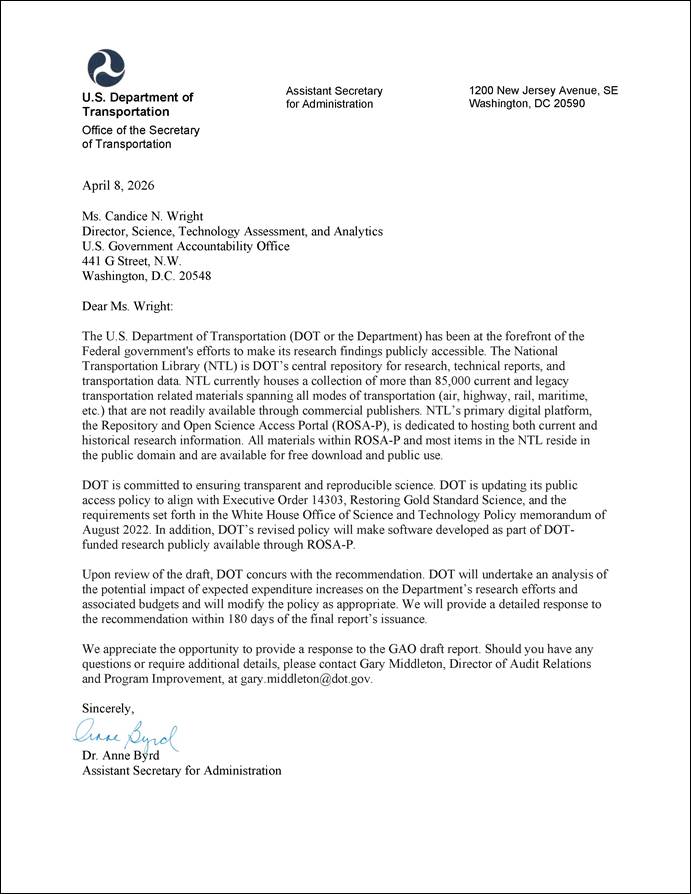
GAO Contact
Candice N. Wright, wrightc@gao.gov
Staff Acknowledgments
In addition to the individual named above, Rob Marek (Assistant Director), Douglas G. Hunker (Analyst in Charge), Victoria Aysola, Isabella Burns, Jenny Chanley, Sean Dedmon, Patrick Harner, Curtis Martin, Alec McQuilkin, Farah Pitcher, Jack Reid, and Jacob Selgestad made key contributions to this report.
The Government Accountability Office, the audit, evaluation, and investigative arm of Congress, exists to support Congress in meeting its constitutional responsibilities and to help improve the performance and accountability of the federal government for the American people. GAO examines the use of public funds; evaluates federal programs and policies; and provides analyses, recommendations, and other assistance to help Congress make informed oversight, policy, and funding decisions. GAO’s commitment to good government is reflected in its core values of accountability, integrity, and reliability.
Obtaining Copies of GAO Reports and Testimony
The fastest and easiest way to obtain copies of GAO documents at no cost is through our website. Each weekday afternoon, GAO posts on its website newly released reports, testimony, and correspondence. You can also subscribe to GAO’s email updates to receive notification of newly posted products.
Order by Phone
The price of each GAO publication reflects GAO’s actual cost of production and distribution and depends on the number of pages in the publication and whether the publication is printed in color or black and white. Pricing and ordering information is posted on GAO’s website, https://www.gao.gov/ordering.htm.
Place orders by calling (202) 512-6000, toll free (866) 801-7077,
or
TDD (202) 512-2537.
Orders may be paid for using American Express, Discover Card, MasterCard, Visa, check, or money order. Call for additional information.
Connect with GAO
Connect with GAO on X,
LinkedIn, Instagram, and YouTube.
Subscribe to our Email Updates. Listen to our Podcasts.
Visit GAO on the web at https://www.gao.gov.
To Report Fraud, Waste, and Abuse in Federal Programs
Contact FraudNet:
Website: https://www.gao.gov/about/what-gao-does/fraudnet
Automated answering system: (800) 424-5454
Media Relations
Sarah Kaczmarek, Managing Director, Media@gao.gov
Congressional Relations
David A. Powner, Acting Managing Director, CongRel@gao.gov
General Inquiries
[1]This report uses the term scholarly publications to include all peer-reviewed research articles or final manuscripts published in scholarly journals. The term also includes peer-reviewed book chapters, editorials, and peer-reviewed conference proceedings published in other scholarly outlets.
[2]In 2019, we reported on the progress that 19 selected agencies had made in implementing the 2013 guidance. GAO, Federal Research: Additional Actions Needed to Improve Public Access to Research Results, GAO‑20‑81 (Washington, D.C.: Nov. 2019). We made 37 recommendations to 16 selected agencies to advance full and effective implementation of agency public access plans. The agencies fully implemented 23 of these 37 recommendations.
[3]Federal research funding data are reported in NSF, National Center for Science and Engineering Statistics, “Survey of Federal Funds for Research and Development, 2022-2023,” (Alexandria, VA: 2024).
[4]OSTP’s 2022 guidance does not distinguish between plans and policies. We assessed agencies’ plans and policies based on OSTP’s guidance related to peer-reviewed scholarly publications, as well as the portion of the scientific data guidance related to allowable publication costs. The guidance also included components related to sharing data and to scientific integrity.
[5]National Center for Science and Engineering Statistics. 2025. Federal R&D Obligations Declined 2.1% in FY 2023; Estimated to Increase in FY 2024. NSF 25-329. Alexandria, VA: U.S. National Science Foundation. https://ncses.nsf.gov/pubs/nsf25329.
[6]Also, publishers generally have three main ways to conduct a peer review: open review, single-blind review, or double-blind review. An open peer review occurs when both the researcher and the peer reviewer know each other’s identity. A single-blind peer review occurs when the researcher does not know who the peer reviewer is, but the peer reviewer knows the researcher’s identity. Finally, a double-blind review occurs when both the researcher and the peer reviewer are anonymized for each other.
[7]A public access repository is a federally designated online archive for content that is freely available to everyone. This earlier version of the research publication is commonly referred to as the “author accepted manuscript.” The author accepted manuscript is the author’s final version of a peer-reviewed manuscript as accepted for journal publication, including all modifications from the peer review process.
[8]The version of record is produced later and is the publisher’s authoritative copy of a manuscript, including all modifications from the publishing peer review process, copyediting, stylistic edits, and formatting changes.
[9]The American Physical Society is a not-for-profit scholarly society, and its members include professional physicists.
[10]Subscribe to open journals typically go through this process each year.
[11]OSTP, Increasing Access to the Results of Federally Funded Scientific Research, Memorandum (Washington, D.C.: Feb. 22, 2013).
[12]OSTP, Ensuring Free, Immediate, and Equitable Access to Federally Funded Research, Memorandum (Washington, D.C.: Aug. 25, 2022).
[13]The 2022 memorandum allows for exceptions to this data sharing requirement for legal, privacy, ethical, technical, intellectual property, or security reasons.
[14]OSTP, Agency Guidance for Implementing Gold Standard Science in the Conduct & Management of Scientific Activities, Memorandum (Washington, D.C.: June 23, 2025).
[15]Exec. Order No. 14303, Restoring Gold Standard Science, 90 Fed. Reg. 22601 (May 29, 2025).
[16]OSTP, Economic Landscape of Federal Public Access Policy. (Washington, D.C.: Aug. 2022). OSTP issued this report in response to report language accompanying H.R.2471, the FY 2022 omnibus appropriations legislation signed into law in March 2022. In that request, OSTP was asked to provide a report to Congress on the potential economic impacts of anticipated federal public access policy changes.
[17]OSTP, Report to the U.S. Congress on Financing Mechanisms for Open Access Publishing of Federally Funded Research. Office of Science and Technology Policy, (Washington, D.C.: 2023). OSTP issued this report pursuant to H.Rept. 117-395 (Committee Report to accompany Commerce, Justice, Science, and Related Agencies Appropriations Bill, 2023), p. 116 (as incorporated by reference in the Joint Explanatory Statement to accompany Division B of the Consolidated Appropriations Act, 2023).
[18]OSTP, Updated Report to the U.S. Congress on Financing Mechanisms for Open Access Publishing of Federally Funded Research, Office of Science and Technology Policy. (Washington, D.C.: 2024). OSTP issued this report pursuant to the Joint Explanatory Statement accompanying Division C of the Consolidated Appropriations Act, 2024. The Joint Explanatory Statement required OSTP to provide additional information with respect to financing mechanisms for open access publishing of federally funded research, as well as potential impacts of federal public access policies on peer review and research integrity.
[19]While OSTP’s 2022 memorandum is largely directed towards what agencies should include in their public access plans, we compared agency public access policies against the 2022 memorandum in place of plans when possible. Because the policies were issued after the plans, reviewing policies when possible allowed us to ensure we were assessing the most recent information.
[20]The OSTP guidance also states that agencies’ public access policies should be effective no later than December 31, 2025.
[21]The NIH Office of Science Policy stated in a related May 2025 blog post that “NIH leadership believes strongly that transparency in all we do is critical and that we should not waste a moment in fulfilling our promise to the public.”
[22]Creative Commons is a nonprofit organization that offers a variety of licensing arrangements that provide a “standardized way to grant the public permission to use their creative work under copyright law.” According to Creative Commons, its licenses tell those interested in reusing someone’s copyrighted work what they can specifically do with the work.
[23]NSF has generally released a new version of its proposal and awards guidance every 1 to 2 years. The most recent version, NSF 24-1, was made effective on May 20, 2024.
[24]USDA’s public access plan states that stakeholders include intramural and extramural researchers, federal and non-federal professionals and support teams, librarians, archivists, museum curators, professional societies, publishers, and other private, non-governmental parties.
[25]2 C.F.R. § 200.404.
[26]While publishers do occasionally use other open access models, such as diamond (also known as platinum), bronze, or subscribe to open, a variety of stakeholders we spoke with stated that these models would not effectively support large-scale, sustainable publication of federally funded research publications.
[27]OSTP, Updated Report to the U.S. Congress on Financing Mechanisms for Open Access Publishing of Federally Funded Research (Washington, D.C.: 2024).
[28]While there are no publication charges directly associated with depositing research into a repository, there are other costs associated with the publication of research that researchers may use grant funding to pay. For example, NSF’s public access plan states that researchers may use grant funding to cover “the costs of documenting, preparing, publishing or otherwise making available to others the findings and products of the work conducted under the award.” Additionally, NIH officials told us that authors also may pay publishing costs such as color printing charges, even if they are depositing the research into a repository.
[29]The selected agencies with updated public access plans or policies all require researchers to deposit research funded by the agency into an approved repository, such as those listed above in table 4.
[30]All selected agencies with updated public access plans and policies require researchers to deposit their research publications into an approved publicly accessible research repository. For example, NIH requires the research publications it funds to be deposited into its PubMed Central research repository. We identified appropriate repositories above in Table 5.
[31]Preprints are early versions of scholarly publications that are publicly posted at no cost to the author and free to read before formal peer review. There are many non-governmental preprint repositories available today, such as Cornell University’s arXiv, which provides free access for researchers to deposit and the public to read preprints in physics, mathematics, and other fields. However, OSTP’s 2022 guidance applies only to peer-reviewed scholarly publications, and sharing non-peer-reviewed preprints would not meet this guidance. The sharing of preprints for public access purposes would likely raise quality assurance questions unless they were peer-reviewed.
[32]NIH accepted comments on this request for information through September 15, 2025. NIH, NOT-OD-25-138, Request for Information on Maximizing Research Funds by Limiting Allowable Publishing Costs (July 30, 2025). The comments are available at: https://osp.od.nih.gov/wp‑content/uploads/2025/12/Compiled‑Public‑Comments‑on‑the‑RFI‑on‑Maximizing‑Research‑Funds‑by‑Limiting‑Allowable‑Publishing‑Costs.pdf.
[33]NRC’s final research products are typically published as NRC documents. For example, NRC’s NUREG publications are reports or brochures on regulatory decisions, results of research, results of incident investigations, and other technical and administrative information. These products are made public (excluding those containing sensitive information) both in NRC’s online document system and on its website.
[34]Office of Management and Budget, Budget of the U.S. Government, Fiscal Year 2027 (Washington, D.C.: April 2026).
[35]The State of Scientific Publishing: Assessing Trends, Emerging Issues, and Policy Considerations, Before the H. Comm. On Science, Space, and Technology, Investigations and Oversight Subcommittee (2026) (statement of Mr. Carl Maxwell, Senior Vice President, Public Policy, Association of American Publishers).
[36]OSTP, Report to the U.S. Congress on Financing Mechanisms for Open Access Publishing of Federally Funded Research (Washington, D.C.: 2023), and Shaun Yon-Seng Khoo, “Article Processing Charge Hyperinflation and Price Insensitivity: An Open Access Sequel to the Serials Crisis”. LIBER Quarterly: The Journal of the Association of European Research Libraries vol. 29, no. 1 (2019): 1-18, https://doi.org/10.18352/lq.10280.
[37]Leigh-Ann Butler, Madelaine Hare, Nina Schönfelder, Eric Schares, Juan Pablo Alperin, Stefanie Haustein, “Open dataset of annual Article Processing Charges (APCs) of gold and hybrid journals published by Elsevier, Frontiers, MDPI, PLOS, Springer-Nature and Wiley 2019-2023”, Harvard Dataverse, vol. 1 (2024), https://doi.org/10.7910/DVN/CR1MMV.
[38]Stefanie Haustein, Eric Schares, Juan Pablo Alperin, Madelaine Hare, Leigh-Ann Butler, and Nina Schönfelder, “Estimating Global Article Processing Charges Paid to Six Publishers for Open Access between 2019 and 2023,” arXiv, July 23, 2024. https://doi.org/10.48550/arXiv.2407.16551.
[39]The remaining 54 percent of publications consist of approximately 38.8 percent subscription, 12.8 percent green open access, and 2.5 percent bronze open access.
[40]In 2024, OSTP estimated the average publication charge to be $3,025 for a fully open access journal and $4,072 for a hybrid journal.
[41]The low-end estimate was calculated by assuming all non-pay-to-publish publications were published in a fully open access journal with an average publication charge. The high-end estimate was calculated by assuming all non-pay-to-publish publications were published in a hybrid journal with an average publication charge.
[42]Projected 2026–2030 publication expenditures were derived by combining estimates of future publication costs with agency-level publication counts. Recent OSTP estimates of publication costs, along with publisher data, were used to define lower and upper bounds for article processing charges. Publication counts were assumed to follow historical patterns. Combining these costs and counts produced a plausible range of expenditures for upcoming years. All dollar amounts were adjusted for inflation using the GDP price index. See appendix I for additional details.
[43]GAO, Standards for Internal Control in the Federal Government, GAO‑25‑107721 (Washington, D.C.: May 2025).
[44]For example, some scientific research agencies’ budget requests for fiscal year 2027 include reductions in funding. This includes a proposed reduction in funding of $5 billion for NIH and $4.8 billion for NSF.
[45]See, for example, David Crotty, “Quantifying Consolidation in the Scholarly Journals Market”, Scholarly Kitchen (2023) https://scholarlykitchen.sspnet.org/2023/10/30/quantifying-consolidation-in-the-scholarly-journals-market/.
[46]The exception was USDA, which had slightly more views on average for its non-publicly accessible publications compared to its publicly accessible publications. SciVal is a database of abstracts and citations owned by the publishing company Elsevier. SciVal contains research performance metrics on citations and views for over 24,700 research institutions and their associated researchers, from 230 nations.
[47]According to our analysis of SciVal’s data, NIH contributed funding to approximately 1.1 million publications between 2015 and 2024. Of these publications, 87 percent have been made publicly accessible.
[48]Nuria Bautista-Puig, Carmen Lopez-Illescas, Felix de Moya-Anegon, Vicente Guerrero-Bote, and Henk F. Moed. “Do journals flipping to gold open access show an OA citation or publication advantage?.” Scientometrics vol. 124, no. 3 (2020): 2551-2575.
[50]According to OSTP, research integrity promotes the use of honest and verifiable methods in proposing, performing, and evaluating research; reporting research results with particular attention to adherence to rules, regulations, and guidelines; and following commonly accepted professional codes or norms. NSTC Scientific Integrity Fast-Track Action Committee. Protecting the Integrity of Government Science. The White House Office of Science and Technology Policy, January, 2022. For additional information, see GAO, Research Reliability: Federal Actions Needed to Promote Stronger Research Practices, GAO‑22‑104411 (Washington, D.C.: July 2022).
[51]Publishers typically issue a notice and mark retracted scholarly publications but leave them accessible to maintain the scholarly record. Rarely, publishers can completely remove an article for reasons such as defamation or if the publication could pose a serious health risk.
[52]The study found that average retraction time was about 2 years and 9 months for paywalled scholarly publications and about 2 years and 5½ months for open access publications. Er-te Zheng, Zhichao Fang, and Hui-Zhen Fu, “Is Gold Open Access Helpful for Academic Purification? A Causal Inference Analysis Based on Retracted Articles in Biochemistry,” Information Processing & Management, vol 61, no. 3 (2024): 103640.
[53]Christine Ro and Jack Leeming, “Authorship for Sale: Nature investigates how paper mills work,” Nature (June 09, 2025).
[54]NSF officials told us that funding for federal research is provided only after a rigorous merit review process, which helps to ensure credibility and would suggest the basis for the research is trustworthy.
[55]According to a news article in Nature, hospitals, universities, and institutes in China had the greatest portion of research articles retracted from 2014–2024. These retractions can be partly explained by the proliferation of paper mills. Richard Van Noorden, “Exclusive: These universities have the most retracted scientific articles,” Nature, (Feb. 19, 2025).
[56]Richard Van Noorden, “How big is science’s fake-paper problem?” Nature, (November 16, 2023).
[57]NIH, Statement on Article Publication Resulting from NIH Funded Research, NOT-OD-18-011, Nov 3, 2017.
[58]Bo-Christer Björk, Sari Kanto-Karvonen, and J. Tuomas Harviainen. “How Frequently Are Articles in Predatory Open Access Journals Cited,” Publications, vol. 8 no. 2 (2020): 17.
[59]As of December 2025, Retraction Watch has identified 46 such resignations since 2015. Retraction Watch is a freely available database of retractions and information on related publishing topics. The Center for Scientific Integrity is a nonprofit organization that manages Retraction Watch. The Center’s mission is to promote transparency and integrity in science and scientific publishing, and to disseminate best practices and increase efficiency in science.
[60]Journal of Human Evolution: Resignation of the Editorial Board.
[61]The Open Access Scholarly Publishing Association is a non-profit foundation that supports and represents the interests of publishers of scholarly open access journals and books, in all scholarly disciplines.
[62]OSTP’s 2022 guidance did not specifically direct agencies to include information on retractions or corrections in their public access plans and policies.
[63]A federal purpose license may provide the government with certain rights in copyrighted works resulting from federal funding. This can include the right to require recipients and subrecipients to make such works available through agency-designated public access repositories. See 2 C.F.R § 200.315(b). Additionally, NIH has a statutory responsibility to require researchers funded by NIH to submit or have submitted for them to the National Library of Medicine’s PubMed Central an electronic version of their final, peer-reviewed manuscripts upon acceptance for publication, to be made publicly available no later than 12 months after the official date of publication. See 42 U.S.C. § 282c.
[64]According to Europe’s Plan S Principles, authors or their institutions retain copyright to their publications. All publications must be published under an open license, preferably the Creative Commons Attribution license.
[65]Creative Commons is an international nonprofit organization that provides licenses to grant copyright permissions for creative and academic works; ensure proper attribution; and enable others to copy, distribute, and make use of those works.
[66]Copyright is a type of intellectual property that protects original works of authorship. Copyright owners have exclusive rights to reproduce the work and prepare derivates of the work, among other things.
[67]Dalmeet Singh Chawla, Chemical & Engineering News, AI bots are overwhelming some journals, April 16, 2025.
[68]For more information, see Artificial Intelligence: Generative AI Training, Development, and Deployment Considerations, GAO‑25‑107651 (Washington, D.C., Oct 22, 2024).
[69]OSTP, Updated Report to the U.S. Congress on Financing Mechanisms for Open Access Publishing of Federally funded Research. This report contained OSTP’s most recent economic analysis related to public access at the time of our review.
[70]GAO, Assessment Methodology for Economic Analysis, GAO‑18‑151SP (Washington, D.C.: April 2018).
[72]Many universities and publishers have negotiated transformative agreements that provide discounts or waivers for publication charges. For example, one large university system has secured agreements that offer discounts of around 15% for articles accepted by certain major publishers’ journals, and in some cases, waive them entirely. However, the specific terms of these agreements vary by both university and by publisher.
[73]NSF, National Center for Science and Engineering Statistics, “Survey of Federal Funds for Research and Development, 2022-2023,” (Alexandria, VA: 2024).
[74]For example, if a publication was listed as non-open access within the SciVal data, but an agency provided evidence that the publication was publicly available in an agency repository, then we would update the open access status associated with the publication to reflect this.
[75]Leigh-Ann Butler, Madelaine Hare, Nina Schönfelder, Eric Schares, Juan Pablo Alperin, Stefanie Haustein, “Open dataset of annual Article Processing Charges (APCs) of gold and hybrid journals published by Elsevier, Frontiers, MDPI, PLOS, Springer-Nature and Wiley 2019-2023”, Harvard Dataverse, vol. 1 (2024), https://doi.org/10.7910/DVN/CR1MMV.
[76]OSTP, Updated Report to the U.S. Congress on Financing Mechanisms for Open Access Publishing of Federally Funded Research (Washington, D.C.: 2024), and GAO, Assessment Methodology for Economic Analysis, GAO‑18‑151SP (Washington, D.C.: Apr. 10, 2018).
[77]Oliver Budzinski, Thomas Grebel, Jens Wolling, and Xijie Zhang, “Drivers of article processing charges in open access,” Scientometrics, vol. 124 (2020): 2185–2206. Abdelghani Maddi and David Sapinho, “Article Processing Charges, Altmetrics and Citation Impact: Is there an economic rationale?” Scientometrics (2022). Kyle Siler and Koen Frenken, “The pricing of open access journals: Diverse niches and sources of value in academic publishing,” Quantitative Science Studies, vol. 1, no. 1 (2020): 28–59.
[78]Budzinski et al., “Drivers of article processing charges in open access.”
[79]Thomas Klebel and Tony Ross-Hellauer, “The APC-barrier and its effect on stratification in open access publishing,” Quantitative Science Studies, vol. 4, no. 1 (2023).
[80]Budzinski et al., “Drivers of article processing charges in open access.”
[81]Siler and Frenken, “The pricing of open access journals.”
[82]Budzinski et al., “Drivers of article processing charges in open access.”
[83]This analysis was conducted by a representative of a consulting company with expertise in the publishing industry that we spoke with. David Crotty, “Quantifying Consolidation in the Scholarly Journals Market”, Scholarly Kitchen (2023) https://scholarlykitchen.sspnet.org/2023/10/30/quantifying-consolidation-in-the-scholarly-journals-market/
[84]OSTP, Report to the U.S. Congress on Financing Mechanisms for Open Access Publishing of Federally Funded Research, (Washington, D.C.: Nov. 2023).
[85]Crotty, “Quantifying Consolidation in the Scholarly Journals Market.”
[86]In 2018, a group of European national research funding organizations began an initiative called Plan S. The initiative aimed to make all research “funded by public or private grants provided by national, regional and international research councils and funding bodies” immediately accessible to the public upon publication.
[87]Some publishers are fully open access, meaning that they have no paywalled subscription content. These publishers may still attempt to establish some type of open access agreement with research institutions that allows a given level of publishing for a set fee. However, because there is no existing subscription agreement, this would not result in fund reallocation in the same way a transformative agreement would.
[88]One individual who works for this publisher told us that they had previously worked with a large publishing company that had 150 staff dedicated to establishing these kinds of agreements with research institutions.
[89]Because large publishers own more journals than small publishers, reaching an agreement with a large publisher would provide a research institution with a larger volume of journals that its researchers could potentially receive discounts for publishing in. Therefore, having agreements with large publishers may be more beneficial to research institutions than having agreements with smaller publishers.
[90]Liz Allen, Sarah Greaves, Rob Johnson, Frances Palmer, Safeguarding the Future of Society Publishing, (Research Consulting, 2025), https://www.research-consulting.com/wp-content/uploads/2025/05/Safeguarding-the-future-of-society-publishing-online.pdf.