
Report to Congressional Committees
United States Government Accountability Office
A report to congressional committees
Contact: Nathan Anderson at andersonn@gao.gov
What GAO Found
As of March 31, 2025, the Department of Energy’s (DOE) Office of Environmental Management (EM) awarded 57 task orders across nine contracts since implementing the End State Contract Model (ESCM) in fiscal year 2020. The ESCM uses task orders for contractors to achieve a stated outcome, or “end state,” to move sites toward completion, manage cost and schedule performance, and reduce DOE’s environmental liability. About half (29) included defined end states and the remainder were for support work or cleanup work that did not yet have a defined end state.
EM has not consistently achieved intended results for selected task orders GAO reviewed. Of the nine selected task orders completed as of March 31, 2025, three did not define end states and six defined them but were inconsistent in achieving them. For example, three task orders with defined end states reduced or carried over scopes of work post-award, resulting in contractors completing less work to achieve modified end states. The extent to which EM reduced costs for these task orders is unclear because of inconsistent documentation. Further, EM headquarters did not provide adequate oversight to ensure task orders achieved end states. Without this oversight, EM cannot assess how well it is meeting program goals.
EM did not fully use contract incentives to manage costs. As a result, post-award changes to task order requirements led to over $500 million in cost growth.
|
Dollars in thousands |
|||
|
Cleanup site |
Task order (TO) |
Total cost growth |
Total cost growth, percent |
|
Idaho National Laboratory |
TO 3 Integration and Mission Continuity (Phase 1) |
$42,054 |
6.29% |
|
TO 3.2 Integration and Mission Continuity Hybrid Task Order (Phase 2) |
$75,553 |
11.74% |
|
|
Nevada National Security Site |
TO 2 Environmental Operations |
$75,793 |
149.61% |
|
Oak Ridge Reservation |
TO 3 End States Phase-In |
$216,661 |
45.17% |
|
TO 6-1 Y-12 Operations and Cleanup End States |
$23,871 |
6.05% |
|
|
TO 8-1 Environmental Management Disposal Facility Early Site Prep |
$1,559 |
6.48% |
|
|
TO 9-2 Outfall 200 Mercury Treatment Facility Construction and Commissioning End State |
$25,811 |
138.89% |
|
Source: GAO analysis of Federal Procurement Data System and Strategic Integrated Procurement Enterprise System data and Office of Environmental Management information. | GAO-26-107745
Note: Dollar amounts are rounded to the nearest thousand. For the purposes of this review of task orders, GAO analyzed cost growth based on increases in contract value.
EM’s task orders have different incentives for cost performance, some of which can reduce risk of cost growth. Of the task orders reviewed, those types that put more risk on the contractor generally had the lowest cost growth. EM more frequently used contract types that put more risk on EM, and these experienced the greatest cost growth. Until EM takes steps to address task orders’ cost performance, EM may miss opportunities to better manage cost growth.
Why GAO Did This Study
EM is responsible for cleaning up 15 sites across the U.S. that are contaminated from decades of nuclear weapons production and energy research. To conduct this work, EM has awarded ESCM contracts since fiscal year 2020. GAO previously found that EM experienced challenges implementing end state task orders and that stakeholders had concerns about fair pricing for cleanup work because of lack of competition among contractors. Since 1990, GAO has designated DOE contract management as a high-risk area.
A congressional committee report includes a provision for GAO to evaluate EM’s implementation of the ESCM. This report examines (1) the status of ESCM task orders issued since fiscal year 2020 and the role of contractors in defining end states, (2) the extent to which selected ESCM task orders have achieved intended results, and (3) the extent to which EM is using selected ESCM task orders to manage contract cost performance.
GAO reviewed data for all ESCM task orders awarded as of March 31, 2025, evaluated contract documents for 19 selected task orders, and interviewed EM officials. GAO also conducted site visits to the Hanford and Savannah River cleanup sites.
What GAO Recommends
GAO is making six recommendations to DOE, including to provide better oversight to help ensure sites define and achieve end states and to take actions to improve the cost performance of task orders. DOE concurred with five out of six recommendations and partially concurred with one recommendation, as discussed in the report. GAO continues to believe DOE should fully implement all recommendations.
|
Abbreviations |
|
|
|
|
|
CID |
contract identification |
|
CPAF |
cost-plus-award-fee |
|
CPFF |
cost-plus-fixed-fee |
|
CPIF |
cost-plus-incentive-fee |
|
DOE |
Department of Energy |
|
EM |
Office of Environmental Management |
|
ESCM |
End State Contract Model |
|
FAR |
Federal Acquisition Regulation |
|
FFP |
firm-fixed-price |
|
FPDS |
Federal Procurement Data System |
|
HCA |
Head of Contracting Activity |
|
IDIQ |
indefinite delivery, indefinite quantity |
|
IGCE |
independent government cost estimate |
|
PEMP |
Performance Evaluation and Measurement Plan |
|
SAM.gov |
System for Award Management |
|
SRS |
Savannah River Site |
|
STRIPES |
Strategic Integrated Procurement Enterprise System |
|
UCA |
undefinitized contract action |
This is a work of the U.S. government and is not subject to copyright protection in the United States. The published product may be reproduced and distributed in its entirety without further permission from GAO. However, because this work may contain copyrighted images or other material, permission from the copyright holder may be necessary if you wish to reproduce this material separately.
July 29, 2026
Congressional Committees
The Department of Energy’s (DOE) Office of Environmental Management (EM) is responsible for cleaning up 15 sites across the U.S. that are contaminated from decades of nuclear weapons production and energy research. This cleanup mission could continue until 2122 and cost more than half a trillion dollars. To carry out its mission, EM uses contractors to remediate contaminated soil and groundwater; deactivate and decommission contaminated facilities; and design, construct, and operate facilities to treat radioactive waste. To conduct this work, EM has been using its End State Contracting Model (ESCM) since December 2019. According to EM, the ESCM aims to focus contractors on achieving a stated outcome, or “end state,” with defined criteria designed to move sites toward completion, manage cost and schedule performance, and reduce DOE’s environmental liability.
Under the ESCM, EM uses task orders to help achieve a defined end state. After awarding a master indefinite delivery, indefinite quantity (IDIQ) contract, EM issues task orders for contractors to perform specific tasks.[1] Compared to previous contracts, EM intends for this approach to better define discrete scopes of work for site closure or end states in a way that supports more realistic and reliable pricing, as well as appropriate incentive structures that result in significant reductions in environmental liabilities.
In 2022, we found that EM experienced challenges implementing end state task orders and that stakeholders raised concerns regarding fair pricing for cleanup work because of lack of competition among contractors.[2] In addition, the National Academies of Sciences, Engineering, and Medicine has found various challenges with EM’s implementation of the ESCM, such as limited incentives for innovation and increased demands on EM contracting managers.[3] Since 1990, we have designated DOE contract management as a high-risk area because of challenges such as developing reliable cost and schedule estimates for cleanup efforts.[4]
Senate Report No. 117-130 accompanying S. 4543, a bill for the National Defense Authorization Act for Fiscal Year 2023, includes a provision for GAO to evaluate EM’s implementation of the ESCM.[5] This report examines (1) the status of ESCM task orders issued since December 2019 and the role of contractors in defining end states, (2) the extent to which selected ESCM task orders have achieved intended results, and (3) the extent to which EM is using selected ESCM task orders to manage contract cost performance.
To address these objectives, we
· reviewed all ESCM task orders awarded as of March 31, 2025, to describe task order types, periods of performance, and award amounts, among other attributes;
· reviewed task order data that EM reported in the Federal Procurement Data System (FPDS) and Strategic Integrated Procurement Enterprise System (STRIPES). We compared these data for consistency between the two systems;
· reviewed nine ESCM task orders completed as of March 31, 2025 at four selected sites to determine the extent to which sites achieved intended results (end states) identified in contract documents and 10-Year Strategic Task Order Plans. The selected sites are the Hanford Site, Idaho National Laboratory, Oak Ridge Reservation, and Savannah River Site (SRS). These sites cover the four largest ESCM contracts;
· used a selection of 19 task orders at five selected sites to evaluate the extent to which task orders performed to cost targets set at award. Selected sites included the four largest ESCM contracts, listed above, and one smaller contract (Nevada). The task orders included nine completed task orders, and a selection of ten ongoing task orders. For ongoing task orders, we prioritized those with higher value and closer to completion. We also considered contract type and date of award to obtain a variety of these factors as well as input from EM officials;
· interviewed officials from EM headquarters and all EM sites that awarded ESCM task orders and contractors from five selected sites; and
· visited Hanford and SRS, which we selected based on factors including the number and current value of task orders awarded and input from EM officials.
See appendix I for additional information about our objectives, scope, and methodology.
We conducted this performance audit from September 2024 to July 2026 in accordance with generally accepted government auditing standards. Those standards require that we plan and perform the audit to obtain sufficient, appropriate evidence to provide a reasonable basis for our findings and conclusions based on our audit objectives. We believe that the evidence obtained provides a reasonable basis for our findings and conclusions based on our audit objectives.
Background
Contracting Under the ESCM
Under the ESCM, EM competitively awards a master IDIQ contract for up to 15 years of cleanup work. While these master contracts have a 10-year ordering period, a task order may be issued on the last day of this period for up to 5 years, effectively creating a longer period of performance. After the master contract is awarded, EM negotiates with the selected contractor for task orders that define the scopes of work, costs, and schedules for specific cleanup activities at the site. The ESCM represents a significant change from EM’s prior contracting approach because it defines scopes of work and associated costs and schedules for task orders after the contract has been awarded. EM’s previous approach generally required developing detailed scopes of work for the full length of the contract prior to award.
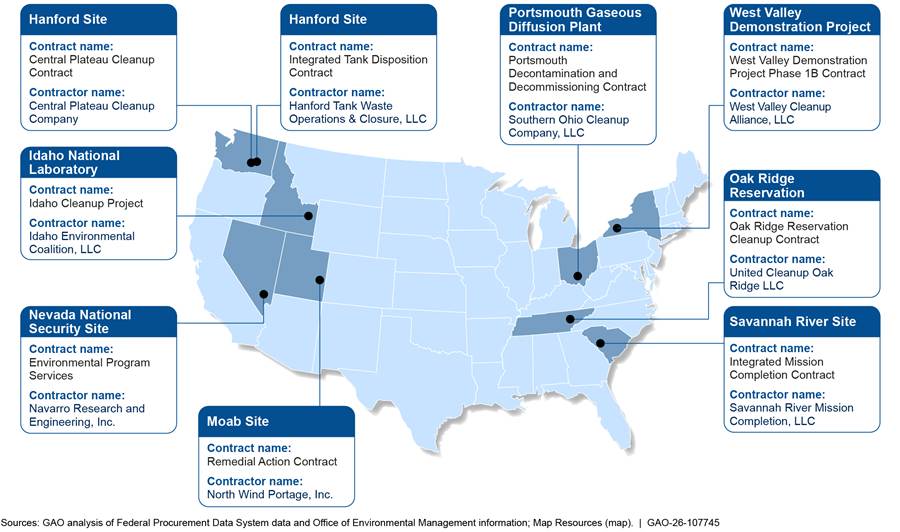
As of March 31, 2025, EM had awarded nine contracts and 57 task orders under the ESCM across eight of its 15 cleanup sites (see fig. 1).
Figure 1: Office of Environmental Management (EM) Active Cleanup Sites with Contracts Awarded Under the End State Contract Model, as of March 31, 2025
In designing the ESCM, EM aimed to replicate specific contracting elements that it identified as successful in enabling the completion of cleanup work at other sites, such as the Rocky Flats and Fernald Preserve sites, according to EM documentation.[6] These elements included productive working partnerships with selected contractors, more equitable risk sharing between the government and the contractor, and effective financial incentive structures. Additionally, EM documentation states that these sites had well-developed scopes of work and clear agreements on assumptions, regulatory milestones, and a targeted focus on achieving specific end states.
EM’s Process for Implementing ESCM Contracts
During the pre-award phase, EM develops an acquisition plan, conducts market research, and gathers industry feedback, as is required by ESCM Program Plan. EM then issues a draft request for proposal outlining the proposed ESCM contract terms and scopes of work. After receiving industry feedback for this draft, EM issues a final request for proposal that has an established due date for prospective contractors to submit proposals. The request for proposal establishes criteria that EM will use to evaluate each proposal, such as key contractor personnel responsible for managing the contract, the contractor’s past performance, and the contractor’s proposed management approach.[7] EM then is to select the best value contractor and award an ESCM master IDIQ contract.
Once the master contract has been awarded, EM issues a notice to proceed under a transition task order, which typically lasts 60 to 90 days. ESCM solicitations generally require contractors to submit cost estimates for the transition task order and provide some information on personnel labor rates, key personnel costs, and proposed fees. Under the transition task order (task order 1), EM prepares to undertake work and begins negotiations with the contractor on the implementation task order (task order 2). Under the implementation task order, which typically lasts 120 to 180 days, the contractor takes responsibility for maintaining ongoing operations. At this time, according to EM documents, EM and the contractor negotiate requirements, contract types, costs, and end states for future task orders.
After the award of the first two task orders, which typically do not include end states, EM and the contractor negotiate subsequent task orders for cleanup work with end states and support activities.[8] EM is to oversee contractor execution of these task orders. EM closes out task orders after completion of work, and the master IDIQ contract can only be closed out after completion of all task orders and all costs are settled.
Key Policy and Guidance for ESCM Contracts
The following policy and guidance documents are central to the ESCM acquisition and planning process:
· ESCM Program Plan. In October 2020, EM issued its ESCM Program Plan, which provides a high-level overview of the ESCM and documents EM’s preference for using the model for large-dollar cleanup contracts. The plan details the process for administering ESCM contracts and assigns roles and responsibilities for applicable entities during critical milestones. Specifically, the plan explains that EM’s Consolidated Business Center is primarily responsible for managing the pre-award phase for all ESCM contracts, while EM sites are primarily responsible developing, negotiating, and awarding individual task orders.[9] The ESCM Program Plan also requires EM headquarters approval for task orders of more than $25 million. According to EM headquarters staff, in March 2026, DOE reorganized EM contract professionals—including those from EM’s Consolidated Business Center—to be under DOE’s Office of Management. The reorganization realigned about 90 staff from EM to the Office of Management, though EM will continue to fund these positions while those employees are working on EM contracts. EM officials said this reorganization will impact how EM implements the ESCM going forward.
· 10-Year Strategic Task Order Plans. In a June 2021 memo, EM set a requirement for field sites to develop a 10-Year Strategic Task Order Plan for each ESCM contract awarded. The plan serves as the framework for planning, managing, and identifying the necessary resources for awarding and administering task orders over the 10-year contract period. These plans must identify the anticipated scope of work, approximate cost, periods of performance, contract type, and desired end states. Additionally, according to EM officials, the plans are intended to be updated annually or as needed. EM officials told us that 10-Year Strategic Task Order Plans are key acquisition planning documents under the ESCM. Although the requirement for these plans was not yet in place when EM awarded the first ESCM contracts, including Hanford’s Central Plateau Cleanup Contract and at Nevada, all sites with ESCM contracts now make use of these plans or will do so in the future, according to EM officials.
· Head of Contracting Activity (HCA) Directive 2 on Independent Government Cost Estimates (IGCE). This directive, issued in February 2013 and most recently revised in September 2023, generally requires that contracting officers obtain an IGCE for all awards above a certain threshold.[10] An IGCE is the government’s estimate of the resources and projected cost a contractor will incur in the performance of a contract. An IGCE is based on the scope of work outlined in the solicitation and established contract requirements. It also serves as the basis for reserving funds for the contract as part of acquisition planning and for comparing costs or prices proposed by potential contractors. According to the directive, an IGCE plays an important role in the contractor proposal evaluation and selection/award processes. HCA Directive 2 is not exclusive to ESCM contracts but includes them.
· HCA Directive 14 on End State Contracting Model Administration Best Practices, Guidance, and Directives. In July 2023, this directive set out best practices for contracting officers to consider, such as appointing a Government Task Order Integration Manager who understands both technical and contractual aspects of ESCM contracts and holding routine government-contractor partnering sessions. HCA Directive 14 also provides guidance for task order creation and approaches for implementing the ESCM. In addition, HCA Directive 14 includes requirements for ESCM contracts and negotiations.
Use of Different Contract Types and Undefinitized Contract Actions
EM can choose from a selection of contract types for its ESCM task orders. Contract types vary by the extent of responsibility assumed by the contractor for the costs of performance, as well as the amount and nature of the profit incentive offered to the contractor for achieving or exceeding specified standards or goals. There are two broad categories of contract types—cost-reimbursement type and fixed-price-type. Cost-reimbursement type contracts provide for payment of allowable incurred costs to the extent provided for in the contract. Fixed-priced type contracts have a firm price, a ceiling price, or a target price. Within these categories, specific contract types include the following:
· A cost-plus-fixed-fee (CPFF) contract is a cost-reimbursement contract that includes payment of an agreed upon fixed-fee.[11]
· A cost-plus-award-fee (CPAF) contract is a cost-reimbursement contract with a fee consisting of a base amount fixed at the contract’s inception, which may be zero, and an award fee that the contractor may earn in whole or in part during performance to provide motivation for excellence in the areas of cost, schedule, and technical performance.[12] According to EM officials, none of the ESCM task orders include a base fee.
· A cost-plus-incentive-fee (CPIF) contract is also a cost-reimbursement contract that adjusts the initially negotiated fee based on a formula that compares total allowable costs to total target costs.[13] The formula provides for a lower or greater fee for the contractor depending on whether total allowable costs are over or under target costs, and this is intended to provide an incentive for the contractor to effectively manage costs. According to EM officials, ESCM CPIF task orders typically have incentives for performance, schedule, or both, in addition to the required cost incentive.
· Under firm-fixed-price (FFP) contract types, the contractor has full responsibility for the performance costs and resulting profit (or loss).[14]
Selecting the contract type is generally a matter of negotiation, with the objective of negotiating a contract type and price that will result in reasonable contractor risk and provide the contractor with the greatest incentive for efficient and economical performance. If certain contract types are selected, the agency must document the government’s risks and the burden to manage the contract type selected.
To meet urgent needs, EM can authorize contractors to begin work and incur costs under agreements known as Undefinitized Contract Actions (UCA).[15] UCAs authorize contractors to begin work before reaching final agreement on contract terms, such as scope of work, cost, and schedule. By contrast, in a definitized contract action, the parties to the contract agree to all contract terms at the time of contract award. We have previously reported that while this type of contract action may be necessary under certain circumstances, it is considered risky in part because the government may incur unnecessary costs if requirements change before the contract is definitized.[16]
Databases for Reporting ESCM Task Order Data
EM reports data on ESCM master IDIQ contracts and task orders—including their periods of performance, type, value, and obligations—in DOE’s internal procurement system known as the Strategic Integrated Procurement Enterprise System (STRIPES). DOE’s Acquisition Guide states that STRIPES is DOE’s repository for all acquisition actions and that DOE procurement offices are responsible for the completeness, accuracy, and timeliness of all data submitted to STRIPES and other government procurement systems.[17]
STRIPES directly integrates and shares data with official government-wide procurement systems such as the Federal Procurement Data System (FPDS) and the System for Award Management (SAM.gov).[18] Following the integration of FPDS capabilities into SAM.gov, the latter includes data on ESCM master IDIQ contracts and task orders including modifications, which change the terms of the contract. EM sites sometimes provide ESCM contract and task order data on publicly available websites, which may be updated periodically.
EM Awarded Nearly $20 Billion Across 57 Task Orders, and Contractors Influenced How EM Defined Task Orders’ End States
Since implementing the ESCM in fiscal year 2020, EM has awarded 57 task orders across nine ESCM contracts totaling nearly $20 billion. Differences in implementation across EM sites affected the quality of data on task orders, resulting in data gaps and reporting discrepancies that may mask cost growth and scope changes. We also found that under the ESCM, contractors have considerable influence in defining end states and planning the work to achieve them.
EM Has Awarded Nearly $20 Billion in Task Orders Under the ESCM
From December 2019, through March 2025, EM awarded 57 task orders valued at a total of nearly $20 billion across nine ESCM contracts (see table 1).[19] EM awarded these contracts for cleanup work at eight sites. As of March 31, 2025, EM completed 12 task orders apart from the task orders that were for transition and implementation activities. About half of all awarded task orders (29) included defined end states. EM awarded the other 28 task orders to conduct planning, support, or administrative work or to begin cleanup work that did not yet have a defined end state.[20] See appendix II for task order summary data.
Table 1: Office of Environmental Management (EM) End State Contracts and Task Orders, as of March 31, 2025
|
Dollars in millions |
|
|
|
|
|
|
Cleanup site |
Period of performance start date |
Number of |
Total base contract value |
Total task order value |
|
|
Hanford Site (Central Plateau Cleanup Contract) |
12/12/2019 |
8 |
$10,000 |
$3,200 |
|
|
Nevada National Security Site |
10/1/2020 |
4 |
$350 |
$161 |
|
|
Idaho National Laboratory |
10/1/2021 |
9 |
$6,400 |
$2,014 |
|
|
Oak Ridge Reservation |
10/26/2021 |
17 |
$8,300 |
$3,147 |
|
|
Savannah River Site |
10/27/2021 |
10 |
$21,000 |
$10,267 |
|
|
Moab Site |
2/3/2022 |
5 |
$614 |
$315 |
|
|
Portsmouth Gaseous Diffusion Plant |
7/13/2023 |
1 |
$5,870 |
$5 |
|
|
Hanford Site (Integrated Tank Disposition Contract) |
2/29/2024 |
2 |
$45,000 |
$567 |
|
|
West Valley Demonstration Project |
10/31/2024 |
1 |
$3,000 |
$4 |
|
|
Total |
|
57 |
$100,534 |
$19,679 |
|
Source: GAO analysis of Federal Procurement Data System and Strategic Integrated Procurement Enterprise System data. | GAO‑26‑107745
Note: Dollar amounts are rounded to the nearest million.
Differences in Implementation Across Sites Resulted in Data Gaps and Reporting Discrepancies
EM sites used task orders to implement the ESCM in different ways, but these differences resulted in data gaps and reporting discrepancies that may mask cost growth or changes in scope that could affect their value to the government.
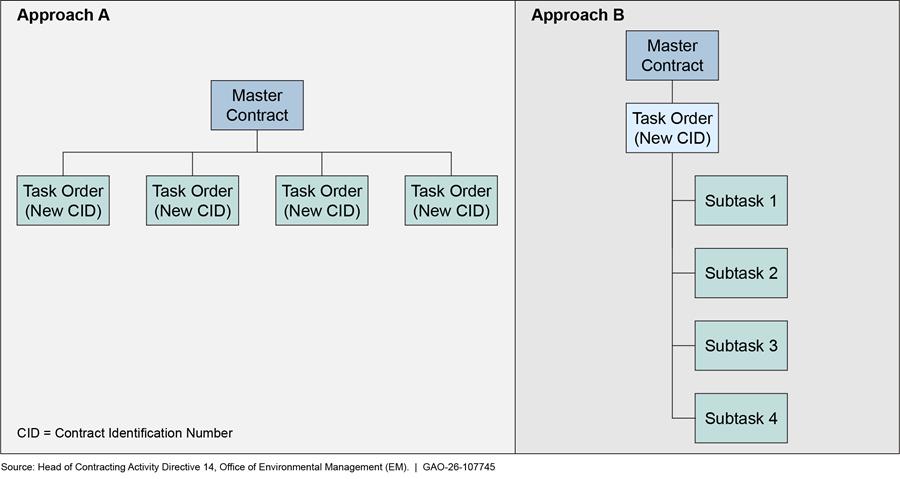
EM policy allows sites to choose from two approaches to implement the ESCM:[21]
· Under Approach A, sites may use task orders with separate contract identification (CID) numbers created in STRIPES, which then publicly reports data to government-wide procurement data systems—previously FPDS and now SAM.gov. EM policy states that this approach ensured obligations were reported at the CID/task order level in FPDS, thereby facilitating reporting and transparency requirements established under the Digital Accountability and Transparency Act of 2014 and other statutory reporting requirements.[22]
· Approach B results in the issuance of one task order with its own CID, which includes subtasks within the task order.[23] Under Approach B, subtask level data, such as current value, obligations, and period of performance dates, were not reported to FPDS, according to EM officials. Instead, under this approach, EM reported aggregated data for the master task order that includes all subtasks. Moreover, contract modifications reported in FPDS that involved subtasks did not consistently identify the related subtasks in a way that provided clear data at the subtask level.
According to EM policy, both approaches comply with the Federal Acquisition Regulation (FAR).[24] Further, EM officials told us that task orders awarded under Approach A and subtasks awarded under Approach B are functionally equivalent for EM’s purposes. See figure 2.
EM officials told us that as of March 31, 2025, Hanford (Central Plateau Cleanup Contract), Nevada, SRS, and Moab were using Approach A, and Oak Ridge and Idaho were using Approach B. Officials for the more recent ESCM contracts at the Portsmouth Gaseous Diffusion Plant, Hanford (Integrated Tank Disposition Contract) and West Valley told us they planned to use Approach A.
Officials at some sites that used Approach A said they chose not to use subtasks in lieu of task orders because they believed doing so would make it harder for them to track relevant data. Further, officials at one site said that they believed using Approach B could result in changes and cost increases due to the nature of the work at that site. EM sites that used Approach A varied in how they implemented the model, sometimes in ways that were not discussed in EM guidance. For example, although EM awarded eight task orders under Hanford’s Central Plateau Cleanup Contract using Approach A, most of the substantive cleanup work to date took place under a single task order.[25] This task order included 26 end states, and EM divided this work into subtasks that were not tracked at the individual level in FPDS or STRIPES. In contrast, eight of 10 task orders that EM awarded at SRS included cleanup work with end states for which EM reported data in both FPDS and STRIPES.[26]
Officials at sites that used Approach B said they did so because their contractors’ accounting systems made it difficult to record multiple CIDs for task orders and because it reduced the administrative burden associated with task orders and the modification process.[27] The two sites that used Approach B—Oak Ridge and Idaho—also differed in how they implemented the ESCM model. For example:
· EM officials at Oak Ridge said they combined different subtasks into modifications in FPDS as part of implementing Approach B. This approach helped the site reduce administrative burden after losing staff responsible for overseeing the contractor’s work. EM officials at Oak Ridge kept a modification log outside of FPDS that identifies which subtasks are included in each modification, but the log does not provide information about the dollar amounts or activities associated with each subtask. In addition, Oak Ridge officials divided subtasks into further subtasks that they did not report individually in FPDS or STRIPES.
· Idaho officials identified associated subtasks for each modification in FPDS, which creates a public record of significant events for each subtask, including the initial award. They also did not divide subtasks into further subtasks.
As described above, EM sites using Approach B report subtask data in a way that is difficult to track publicly on government-wide procurement data systems.[28] That issue still remains true now that FPDS data are only publicly reported on SAM.gov, as both systems share the goal to ensure transparency in federal awards and acquisitions. Data in these systems inform Congress, federal managers, oversight bodies, and the public about how much agencies obligate for procurement. Further, EM headquarters officials said they used FPDS data for external data requests for information on obligations. Without accurate publicly available data at the subtask level, decision makers do not have reliable information on the use of subtasks in ESCM contracts.[29] Specifically, without easily accessible subtask level data in SAM.gov for these contracts going forward, decision-makers cannot track the award of new subtasks or assess whether these subtasks experienced cost growth or changes in scope with dollar value impact that could affect their value to the government.[30]
We also found that the way EM reported data for contracts using Approach B in FPDS resulted in discrepancies between data reported in FPDS and STRIPES for these contracts. For example:
· EM reported that the value of all task orders and subtasks at Idaho as of March 31, 2025, was about $2 billion in STRIPES, but about $1 billion in FPDS. EM site officials told us that the difference was because Idaho issued two task orders and two subtasks as modifications to the master IDIQ contract and because of a timing error.[31] These errors resulted in EM underreporting the current value of aggregated task orders and subtasks for Idaho’s ESCM contract in FPDS.
· Similarly, EM reported that the value of all task orders and subtasks at Oak Ridge as of March 31, 2025, was over $3 billion in STRIPES but only $2.4 billion in FPDS. Officials told us that the difference was because of Oak Ridge issuing transition and implementation task orders as modifications to the master IDIQ contract and an error in FPDS caused by a limitation in STRIPES.[32] EM corrected this error in a subsequent modification after March 31, 2025.
· For both Idaho and Oak Ridge contracts, the task orders and subtasks issued as modifications to the master IDIQ contract remain as such in FPDS, now SAM.gov—resulting in an ongoing inconsistency with data EM reported in STRIPES.
Task order data may be difficult to track, leading to challenges in obtaining accurate STRIPES data from EM as of a particular date. For example, EM sometimes unintentionally provided us with task order data from STRIPES that did not include all modifications as of the requested date or included modifications that took place after the requested date. These discrepancies made it challenging to reconcile the STRIPES data we reviewed with the data EM reported in FPDS.
The data differences we identified illustrate the increased risk of EM reporting inaccurate or incomplete data in FPDS, now SAM.gov, for ESCM contracts that use Approach B. Furthermore, we have reported on challenges with the accuracy of procurement data at DOE. For example, in September 2025, we reported that DOE did not have adequate procedures for ensuring timely and accurate procurement data in FPDS.[33] In that report, we found that DOE’s sampling methodology for verification and validation procedures did not prescribe a statistically valid method for random sampling of contract action reports. DOE officials stated at the time that they did not know that the sampling method the team used was not statistically valid. We recommended that the Secretary of Energy should ensure that the Office of Acquisition Management develops a sampling methodology, in consultation with appropriate experts, to help ensure that DOE’s procurement data quality sampling procedures are statistically valid and meet Office of Management and Budget guidance.
EM headquarters officials told us that they depend on the sites to report accurate data for ESCM contracts, and they conducted random checks for discrepancies between data reported in FPDS and STRIPES on a quarterly basis. EM headquarters also employs site liaisons who report biweekly on the status of task orders, including their value, modifications, and any new task orders awarded. EM headquarters officials told us that they are aware of discrepancies between FPDS and STRIPES data, but they rely on regular interactions with sites to resolve issues as they arise. However, these officials told us that EM headquarters does not provide sites with specific instructions about how they should track task order data. Further, as described above, EM officials did not fully address the underreporting of subtask data that we identified in FPDS.
DOE must report to FPDS, now SAM.gov, all IDIQ contracts, including all task orders awarded under it that exceed a set minimum amount and any modifications to those actions that change previously reported contract action data, regardless of dollar value.[34] DOE also requires officials to report contract information in STRIPES, which directly integrates and shares data with SAM.gov, and stresses the importance of the quality of these data.[35] By providing instruction to sites on how to better report consistent data into public facing government-wide procurement data systems and internally in STRIPES for aggregated task orders—and how to correct any discrepancies once identified—EM will better ensure its officials and policymakers can more accurately assess the status and success of ESCM contracts that use Approach B. Without such assessments, EM cannot know whether the ESCM is performing as expected and is an improvement upon the previous contract model.
EM headquarters officials acknowledged the challenges that sites faced managing multiple task orders and subtasks, describing the execution phase of the ESCM as more difficult than anticipated to manage administratively. These officials said EM has two more ESCM contracts planned—one for the Portsmouth and Paducah Project Office and one at the Los Alamos National Laboratory. After these contracts are awarded, EM will re-evaluate the ESCM approach, according to officials.
Contractors Have Considerable Influence in Defining End States and Planning the Work to Achieve Them
We found that EM sites’ implementation of the ESCM gave contractors an influential role that could affect EM’s ability to protect the government’s interest and ensure it receives the best value for cleanup work. According to EM officials, contract partnering in the end state definition process is an intentional design feature of the ESCM, as stated in the ESCM Program Plan.[36] Officials at several sites also said that partnering with the contractor had helped them define end states, and the ESCM Program Plan states that defining the end state through partnering with the contractor is essential to success.[37] At one site, EM officials told us that they try not to get too involved with planning the actual cleanup work because they see it as the contractor’s role to develop plans to address the requirements set by EM.[38] At another site, the contractor told us that they conducted the initial mark-up of the contract’s 10-Year Strategic Task Order Plan and then coordinated with EM until it was finalized.
EM officials at the latter site told us that due to recent staff losses sustained under the Deferred Resignation Program, the site has been more reliant on the contractor for staff, workload, and institutional knowledge.[39] However, they said they continued to believe the contractor did not perform inherently governmental functions. We have long reported that the closer contractor services come to supporting inherently governmental functions, the more important federal oversight is to avoid risk of contractors influencing the government’s control over, and accountability for, decisions that may not be in the best interest of the government and the taxpayer.[40]
We also found that EM implemented its ESCM contracts in ways that precluded additional opportunities for competition after the master IDIQ contract had been awarded. As described above, EM uses single award IDIQs for ESCM contracts. According to DOE, this approach is adopted to provide specific, task-based flexibility for site closure, despite the regulatory preference for multiple-award IDIQs.[41] However, in our 2022 review of the ESCM, we reported that an EM official told us that negotiating task orders in a noncompetitive environment puts EM at a disadvantage since the contractor knows it is the only company available to undertake the work.[42]
EM headquarters officials told us that EM could theoretically compete cleanup work with different contractors rather than negotiating a task order if the originally selected contractor’s position is untenable or if there are performance concerns. However, despite EM officials describing some performance concerns with contractors, we did not find any instances where a site re-competed a task order once cleanup work was underway. Officials at multiple sites told us that the significant cost of finding a new contractor in the middle of an active contract is a deterrent.
EM Has Not Consistently Achieved Intended Results for Selected Task Orders
EM has not consistently achieved intended results for selected task orders we reviewed, including reaching the defined end states or identifying reductions in environmental liabilities. Specifically, one task order we reviewed did not fully achieve the end state defined in the task order, and some reduced or carried over scope of work to other task orders. Additionally, the sites we reviewed that awarded selected task orders did not identify financial reductions in environmental liabilities at the task order level.
EM Has Not Consistently Achieved End States for Selected Task Orders
EM sites did not consistently achieve defined end states for most of the selected task orders we reviewed, as of March 31, 2025. According to EM policy, under the ESCM, each contract needs to incentivize the contractor to achieve an end state, or stated outcome, with defined completion criteria. The end state of the contract is to be a culmination of separate defined outcomes for the task orders. In addition, environmental cleanup activities should be split into manageable subsets with a clearly defined scope and budget.[43]
Of the nine task orders we selected, three did not define end states and the remaining six defined end states but were inconsistent in achieving them. The three task orders that did not include defined end states were “end state enabling” task orders that enabled cleanup work for other task orders. Activities under these enabling task orders included continuity of operations, training, administrative support tasks, or cleanup work that did not yet have a defined end state, according to EM officials. Because these three enabling task orders did not define end states, we did not evaluate them.
Of the remaining six task orders we reviewed, we found inconsistent results: two task orders achieved defined end states as planned, one task order did not fully achieve its defined end state, and three task orders defined end states but reduced or carried over scopes of work to other task orders.
Task Orders That Achieved Defined End States
Two of the six selected task orders we reviewed defined and achieved end states as planned:
· Savannah River. SRS task order 4, valued at $94 million, had a defined end state for the contractor to obtain Critical Decision-4 approval (i.e., approval to start operations) on two saltstone disposal units by specific deadlines.[44] The contractor obtained Critical Decision-4 approval for one saltstone disposal unit 5 months ahead of the deadline. For the second saltstone disposal unit, the contractor achieved the end state by obtaining Critical Decision-4 approval for the disposal unit 1 month after the deadline, according to requirements described in the task order. EM officials said the project was still completed early based on the overall project schedule. The contractor received full fee, $4.8 million, for this work.
· Oak Ridge. Oak Ridge task order 8-1, valued at $26 million, was for early site preparation. The contractor completed the task order on schedule and earned the full fee of approximately $374,000, according to EM documents.
One Task Order Did Not Fully Achieve Defined End States
One of the six selected task orders that defined end states, SRS task order 3, valued at $987 million, did not fully achieve the defined end state. The defined end state required the contractor to process 4.5 million gallons of liquid waste. The contractor processed approximately 4.2 million gallons, or 93 percent of the waste. The site awarded the contractor a $67 million fee, which was 99 percent of the target fee or 78 percent of the total available performance-based incentive fee.[45]
SRS officials explained that the contractor received most of the fee because the fee was heavily weighted toward early stages of work due to technical operational barriers and higher risk. Specifically, contract documents established that the contractor would receive a 7 percent fee for processing 2.5 million gallons of liquid waste and a 7.5 percent fee to process the remaining 2 million gallons of liquid waste to achieve the end state. This fee structure created a greater incentive to process about 56 percent of the waste—where the risk was greatest—than to process the remaining 44 percent and complete the end state. DOE officials said this fee structure was specifically designed to place greater incentive on contractor performance during the technically complex and highest-risk phases of liquid waste processing, which is consistent with the ESCM Program Plan’s direction for fee to be commensurate with the complexity of work and risk.
Task Orders That Reduced or Carried Over Scope of Work to Other Task Orders
Two task orders reduced or carried over scope of work to other task orders. As a result, contractors completed less work than originally required in order to achieve a modified end state. In addition, one site closed a task order without completion and carried over the scope of work to another task order without documented completion of any end states.
Hanford. Task order 4 at the Hanford Site, valued at $1.8 billion, reduced work requirements for defined end states and carried over some work to task order 7. As a result, the contractor did not achieve all the originally defined end states. We identified 26 end states within task order 4 for specific cleanup activities, such as removing contaminants from water.[46] We analyzed documentation from EM officials at Hanford and we found evidence that the contractor completed 22 of the 26 end states, or almost 85 percent. However, EM changed the scope of work for 12 of these 22 end states.
We also found that the contractor did not achieve one end state. Further, we could not determine from the documentation whether the contractor completed the remaining three end states. Figure 3 summarizes the status of Hanford task order 4’s end states. It is unclear how much the contractor ultimately earned in fee for these end states because the contract files we reviewed were not specific to these end states.
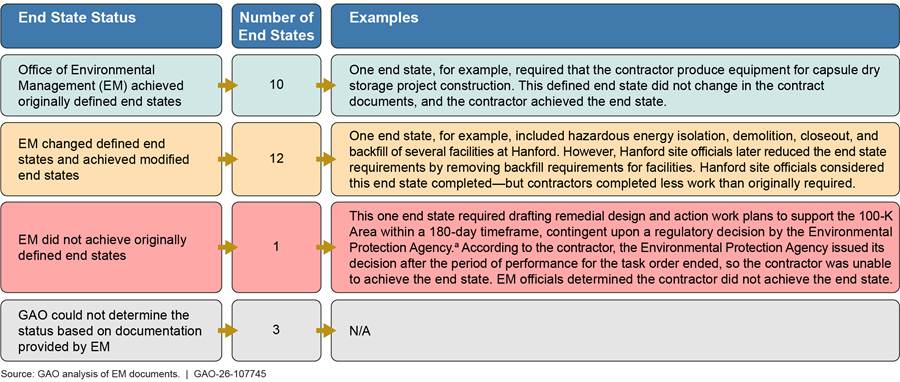
aThe 100-K East Reactor is a fuel storage basin containing nuclear waste. DOE’s greater mission is to place the K East Reactor into a long-term storage configuration called Interim Safe Storage.
Hanford officials issued a modification for task order 4 that carried over work from various end states, worth about $19 million, to task order 7. Officials said that this modification included all cleanup work carried over to the new task order. However, the modification did not account for all of the work we identified as removed from the end states of task order 4.
Hanford’s inclusion of 26 end states under one task order made it difficult for us to track and document outcomes for these end states. For example, although we observed completed work on a site visit for an end state that required capsule dry storage project construction, Hanford officials did not provide contract files to support that this end state was achieved. In addition, Hanford officials provided us evidence of demolition completion for an end state requiring demolition preparation, even though demolition completion was a separate end state with a different deadline. It is also unclear whether Hanford consistently reduced costs when it removed scopes of work or carried them over to another task order because obligations and de-obligations data in contract files were not specific to these end states.
Idaho. Task order 4a at the Idaho site, valued at $96 million, completed modified end states after reducing end state requirements. After awarding the task order, Idaho site officials excluded the abandonment of eight wells due to changes and delays in construction, according to Idaho officials. Idaho officials said the cost of removing well abandonment was $30,000 and they did not deduct the fee from the contractor because the dollar value was small and because the wells remained available for testing, which benefited the site.
Oak Ridge. Task order 9-1 at Oak Ridge, valued at $10 million, carried over its scope of work to another task order and closed without completion. Task order 9-1 defined 12 end states with work such as project management and construction services. Oak Ridge officials carried over all cleanup work from this task order to task order 9-2 and added new cleanup tasks to task order 9-2. The total incurred cost for task order 9-1 was $2.6 million, which Oak Ridge officials said will be audited as a part of an annual incurred cost audit and closeout process. The work for task order 9-2 was ongoing as of April 2026 with no planned completion date, according to site officials. Based on the documentation provided by Oak Ridge officials, we could not determine how they accounted for costs from the scope of work that they removed from task order 9-1.
A factor that may have contributed to task orders not achieving defined end states as originally planned is the challenges sites faced defining ends states and planning cleanup work to achieve them. Specifically, officials at some EM sites said that changes to scope of work and interdependent cleanup had made it difficult to define end states for task orders. For example, at the Hanford site, officials said they added work from task orders 3 and 5 to task order 4 after they were awarded due to the interdependence of cleanup work at the site. Further, Oak Ridge Reservation site officials said that their cleanup work occurs across different sites and locations, resulting in varying task order requirements that pose challenges for defining end states.
Additionally, sites did not consistently achieve intended results for selected task orders in part because EM did not provide oversight to ensure task orders achieved end states. According to EM officials, EM uses various oversight mechanisms for task orders, including Business Clearance Reviews, meetings, and workshops.[47] However, EM headquarters’ officials told us that they did not conduct oversight that would enable them to track the extent to which sites defined and achieved end states.
Further, EM site officials—such as at Hanford—said their capacity to conduct the necessary oversight was limited due to staff shortages.[48] EM headquarters officials told us that the planned reorganization of EM and potential movement of contracting staff to a different office could affect future oversight plans.
DOE HCA Directive 11 directs EM headquarters officials to conduct oversight in topical contracting areas, such as ESCM task orders, that represent risk to the government.[49] These topical reviews are to be performed periodically and can involve the reviewer completing a worksheet for each site that documents noteworthy accomplishments, findings, observations, and recommendations for improvement for each topical area. These reviews are intended to help verify, among other things, that the pace of cleanup and closure work has improved with ESCM task orders, according to HCA Directive 11.
However, EM headquarters officials told us they have not conducted these post-award reviews for any of their ESCM contracts, and HCA Directive 11 and other EM directives may be rescinded following the planned reorganization of EM. We have previously reported that with hundreds of billions in taxpayer dollars spent on government contracts, strong contract oversight is essential.[50] Without adequate oversight of whether ESCM task orders defined and achieved end states, EM cannot fully assess the extent to which task orders are meeting ESCM program goals and minimizing risks to the government.
EM Sites Have Not Identified Financial Reductions in Environmental Liabilities for Selected Task Orders
Our review found that sites did not identify financial reductions in environmental liabilities for task orders. We reviewed four selected sites to determine whether sites with completed task orders reduced the environmental liabilities associated with these task orders. Environmental liabilities are the estimated cost to clean up areas where federal activities have contaminated the environment, including hazardous and radioactive waste resulting from nuclear weapons research and production. As of fiscal year 2024, the U.S. government faced an estimated $666 billion in environmental liabilities, according to a DOE report.[51] DOE’s estimated share of this environmental liability was $545 billion (82 percent) in fiscal year 2024. Federal law requires EM to submit annual financial statements to Congress that include the agency’s liabilities, and EM has guidance for sites to estimate and report these environmental liabilities.[52] Furthermore, one goal of the ESCM approach is to yield significant reductions in environmental risk and financial liability in the near term, according to the ESCM Program Plan.
EM requires sites to include information on how task orders will contribute to the reduction of environmental risk and financial liabilities in task order strategy documents—including the sites’ 10-Year Strategic Task Order Plans. Specifically, in its June 2022 memo updating requirements for sites’ 10-Year Strategic Task Order Plans, DOE requires sites to discuss the reduction to environmental risk and financial liability as a result of completing work under the proposed task orders.[53] The memo explains, for example, that sites can identify the number of curies eliminated from the environment by treating salt waste.[54] Sites are also instructed to state the reduction of DOE’s financial liability with the completion of each task order, according to the memo.
|
Environmental Risk and Financial Reliability Requirement for Sites’ 10-Year Strategic Task Order Plans EM’s 2022 memo provided an updated template with requirements for the 10-Year Strategic Task Order Plan, including requirements for environmental and financial liability. Specifically, in the 10-Year Strategic Task Order Plan, sites are to have a section that discusses risk and liability. The memo describes this section with the following: “Discuss the reduction to risk and liability as a result of completing work under the proposed Task Orders. For example, by treating the salt waste, a quantity of X curies were eliminated from the environment. Completion of Task Order X will result in a reduction of DOE’s financial liability in the amount of X.” |
Source: Department of Energy document. | GAO‑26‑107745
We found that one of four selected sites we reviewed with completed task orders, SRS, reported in its 10-Year Strategic Task Order Plan that its liquid waste mission would reduce environmental liabilities by approximately $13 billion.[55] This estimate of reduction in environmental liabilities includes all task orders in the SRS 10-Year Strategic Task Order Plan, rather than the two SRS task orders we reviewed and did not include estimated reductions at the task order level. However, the other three sites—Hanford, Idaho, and Oak Ridge—did not identify financial reductions in environmental liabilities associated with task orders in their 10-Year Strategic Task Order Plans. Furthermore, EM site officials told us that they do not track environmental liabilities at the task order level. As a result, EM was unable to provide us information on how much individual task orders are expected to reduce environmental liabilities associated with these task orders.[56]
Since 2017, we have designated environmental liabilities as a high-risk area because of the large and increasing estimated costs of cleaning up sites.[57] Further, in fiscal year 2026, the DOE Office of Inspector General reported on material weaknesses in how EM estimates its environmental liabilities, including deficiencies related to cost estimates, schedules, and assumptions.[58] Without ensuring its cleanup sites include projected reductions in environmental liabilities associated with task orders in their 10-Year Strategic Task Order Plans, EM is missing an important opportunity to demonstrate the outcomes of cleanup work as a result of ESCM task orders.
EM Did Not Fully Manage Cost Performance of Task Orders
EM did not fully use contract incentives in selected task orders to manage costs. Selected task orders we reviewed experienced cost growth largely because of requirement changes after award, which resulted in about $500 million in cost growth.[59] Although we identified some cost growth on all task order types, task orders that used contract incentives to place more responsibility on contractors for cost performance generally had the least cost growth in line with ESCM objectives. However, EM did not monitor task orders’ cost performance to help manage cost growth. Additionally, the quality of independent government cost estimates (IGCE) and EM’s use of undefinitized contract actions (UCA) may increase risk of cost growth for task orders.
Changes in Requirements for Selected Task Orders Led to $500 Million in Cost Growth
Selected task orders at five sites experienced cost growth of more than $500 million from their awarded value to their current value as of March 31, 2025, generally because of changes in requirements after the task orders were awarded. We selected 19 task orders for review that included completed and ongoing task orders. We assessed 18 task orders for cost performance, since one task order did not have a finalized award amount as of March 31, 2025. Aggregate cost growth by site for the 18 task orders varied from less than 1 percent to 89 percent.
Of the 18 task orders we reviewed, task orders at three sites—Idaho, Oak Ridge, and Nevada—exhibited the most cost growth. Aggregate cost growth on Idaho and Oak Ridge task orders was 8 percent and 17 percent, respectively. Nevada task orders experienced cost growth of 89 percent because of cost growth on one task order (see table 2). Seven task orders at these sites had cost growth of 5 percent or more, with selected task orders at Oak Ridge exhibiting the most cost growth.[60]
Table 2: Cost Growth on Selected Department of Energy (DOE) Office of Environmental Management (EM) Task Orders, as of March 31, 2025
|
Dollars in thousands |
|
|
|
|
Cleanup site |
Task order (TO) |
Total cost growth |
Total cost growth, percent |
|
Hanford Site |
TO 4 End States, Base Operations and Groundwater Operations |
$30,155 |
1.72% |
|
Idaho National Laboratory |
TO 3 Integration and Mission Continuity (Phase 1) |
$42,054 |
6.29% |
|
|
TO 3.2 Integration and Mission Continuity (Phase 2) |
$75,553 |
11.74% |
|
|
TO 4a Accelerated Retrieval Project / Subsurface Disposal Area Demolition and Organic Contamination Vadose Zone Well Abandonment |
$3,738 |
4.07% |
|
|
TO 5.1 Naval Reactors Demolition and Dismantlement |
$462 |
0.79% |
|
Nevada National Security Site |
TO 2 Environmental Operations |
$75,793 |
149.61% |
|
|
TO 3 Deactivation, Decommissioning, Decontamination, and Demolition |
$0 |
0% |
|
Oak Ridge Reservation |
TO 3 End States Phase-In |
$216,661 |
45.17% |
|
|
TO 5-1 Oak Ridge National Laboratory Operations and Cleanup End States, Phase 1 |
$25,310 |
3.19% |
|
|
TO 6-1 Y-12 Operations and Cleanup End States |
$23,871 |
6.05% |
|
|
TO 8-1 Environmental Management Disposal Facility Early Site Prep |
$1,559 |
6.48% |
|
|
TO 9-1 Outfall 200 Mercury Treatment Facility Subtask 1 |
$0 |
0% |
|
|
TO 9-2 Outfall 200 Mercury Treatment Facility Construction and Commissioning End State |
$25,811 |
138.89% |
|
|
TO 9-3 Outfall 200 Mercury Treatment Facility Onboarding and Training |
$0 |
0% |
|
Savannah River Site |
TO 3 Liquid Waste Program Operations |
$0 |
0% |
|
|
TO 4 Saltstone Disposal Units 8/9 |
$715 |
0.76% |
|
|
TO 6 Liquid Waste Operations |
$0 |
0% |
|
|
TO 7 Tank Closure and Waste Retrieval |
$0 |
0% |
Source: GAO analysis of Federal Procurement Data System and Strategic Integrated Procurement Enterprise System data, and EM information. | GAO‑26‑107745
Note: We define cost growth as the net change of an estimated or actual amount over a base figure previously established. Cost growth can include increases in contract value as well as other increases from a baseline estimate. For the purposes of our review of task orders, we analyzed cost growth based on increases in contract value.
For all but one of these task orders, cost growth was because of changes in requirements, such as extensions of period of performance or additions of scopes of work after award. For example:
· Oak Ridge task order 9-2 to conduct initial support and construction activities for commissioning and operating the Outfall 200 Mercury Treatment Facility increased in value by over 138 percent. This increase resulted from multiple extensions of the period of performance, and the decision to add requirements that had previously been on another task order, according to officials.
· Nevada site officials said they incrementally increased the period of performance of task order 2 to provide groundwater testing and industrial facility closure, among other activities. These planned extensions to the task order, along with smaller modifications for additional work, led to a growth in value of almost 150 percent. Officials said the vast majority of cost growth was due to the planned extensions and stated they could have awarded new task orders but chose to extend the existing task order to maximize flexibility and efficiency under the ESCM.
· Two Idaho task orders (task order 3 and task order 3.2) experienced cost growth of over 5 percent because of additional requirements after award, according to officials. Site officials explained that the task orders acted as a catch all for cleanup work that was not yet designated for an end state task order, and included activities related to facility infrastructure, liquid waste facility closure, and spent nuclear fuel.[61]
Oak Ridge task orders experienced the greatest dollar amount of cost growth with four of seven selected task orders increasing by 5 percent or more. In addition to the identified cost growth, two Oak Ridge task orders (task order 5-1 and task order 6-1) expect greater costs in the future because of the planned addition of operational costs, according to officials. Both task orders have periods of performance of approximately ten years, and officials reported that only 5 years of operations costs are included in the value. Further, Oak Ridge officials reported plans to add several additional years of operations costs to these task orders.
Of the 18 task orders, nine experienced cost growth of 2 percent or less, and the task orders at Hanford and SRS had less cost growth compared to other selected sites. Of the four SRS task orders, EM completed two and two were relatively early in their period of performance. All four had little to no cost growth at the time of our review. The two ongoing task orders at SRS (task order 6 and task order 7) had over 6 years left on an 8 year period of performance, which is expected to end in October 2031. Officials attributed the lack of cost growth to flexibility in tailoring incentives for each task order to better ensure success, as well as their detailed system plan for waste cleanup that was the basis for defining requirements for the various task orders.[62]
In some cases, task orders had little cost growth but the contractor did not complete the required cleanup work, per end state requirements in the original award. For example, Hanford’s task order 4 experienced less than 2 percent cost growth, but the site changed end state requirements after award to remove work, as we reported above. Also, Oak Ridge’s task order 9-1 showed no cost growth, though site officials closed the task order without it being completed and added the remaining work to task order 9-2, according to officials. Lastly, SRS’s task order 3 also had no cost growth, but the contractor fell approximately 7 percent short of the cleanup target for the task order while receiving 99 percent of the target award fee because of the fee structure of the task order. These examples show how task orders can appear to have good cost performance at the expense of some completed cleanup work.
EM Has Not Assessed Task Orders for Cost Performance
Different contract types provide different incentives for cost performance, including placing different levels of responsibility on the contractor for cost performance. The task orders we reviewed varied in the extent to which they used these incentives and in their cost performance. Although fixed-price contract types generally put more risk on contractors to deliver goods or services at a specified cost, the government can also incentivize cost performance through cost-reimbursable contract types (see fig. 4). Specifically, CPIF contract types incentivize contractors by tying the contractor’s fee to a target cost for the work, allowing the contractor to earn more fee by keeping costs below that target.

According to ESCM program documents, a benefit of the ESCM is to use contract vehicles with fair risk sharing between the government and cleanup contractors. In addition, EM officials said CPIF and FFP, which put more risk on the contractor for controlling cost, are the preferred task order types under the ESCM. The master IDIQ contracts state this preference, according to EM officials. Of the 18 task orders we reviewed for cost performance, 15 were CPIF or CPAF and one was FFP. Two task orders were CPFF, which puts the most risk on the government compared to other types.
Officials from three of the five selected sites did not express a preference for either CPIF or CPAF task order types and said that either type could include incentives for cost performance. For the other two sites with selected task orders, officials at one site expressed a preference for CPIF to incentivize cost savings and performance, but officials at the other site told us that CPAF could better incentivize cost performance for their large portfolio of cleanup work. Specifically, the officials at one site told us that CPAF could better incentivize contractor performance on cleanup tasks to receive a fee on an annual basis, and that CPIF task orders work better where scopes of work are well defined and relatively simple.
Officials and contractors at the five sites told us that fee is generally the most important tool to incentivize CPIF task orders, and the Performance Evaluation and Measurement Plan (PEMP) is the main tool to incentivize performance on CPAF task orders.[63] Officials at one site said they did not believe the CPFF contract type provided incentives for cost performance. Site officials at all five sites also described a close relationship between cost and schedule performance and described similar structures in task orders for incentivizing both. For example, CPAF task orders may include schedule milestones in the PEMP, and CPIF task orders may incorporate a schedule in the structure of the contract’s terms and fee.
Although we identified some cost growth on all task order types, the highest percentages of cost growth generally occurred on the CPFF and CPAF awards. Specifically, the two CPFF and five CPAF task orders we reviewed averaged approximately 50 percent cost growth. In contrast, the one FFP and 10 CPIF task orders we reviewed averaged cost growth of just over 2 percent, with five showing no cost growth and the other six showing cost increases between approximately 1 percent and 6 percent. This difference in cost growth is consistent with FFP and CPIF type contracts generally putting more risk on the contractor than other cost-reimbursable contract types and therefore better incentivizing cost performance.
EM officials told us that sometimes it is not appropriate to award FFP or CPIF task orders for work that is not understood well enough to clearly define risk, even though there is a stated preference for FFP and CPIF task orders in the ESCM.[64] For example, three of the CPAF task orders with cost growth over 5 percent were end state enabling task orders, not end state task orders with defined end states, and officials specifically told us that these task orders included broad scopes of cleanup work that would move to better defined end state task orders in the future. However, an ESCM guidance document states the approach allows for reducing risk where work scope can be defined and executed over shorter time frames, so that cleanup activity is split into manageable subsets with discrete scopes of work that have more realistic and reliable pricing.
The examples of cost growth we identified, particularly for task order types other than CPIF and FFP, suggest the ESCM may not be performing as expected. In our 2022 report on ESCM implementation, we recommended that EM assess performance to ensure that the ESCM is achieving desired results.[65] EM has not yet addressed this recommendation, but EM officials reported that they are in the process of developing new guidance for assessing performance of ESCM contracts and task orders. In addition, EM’s contract oversight policy calls for officials to assess whether pricing of end state task orders has been realistic and reliable post-award, but EM officials said this oversight policy has not been implemented because of lack of staff.[66] As such, EM has not identified the actions it plans to take to monitor cost performance and therefore has not analyzed and addressed any root cause for cost growth. Until EM takes the necessary steps to address cost performance on task orders, EM may miss opportunities to better manage cost growth and ensure task orders’ cost performance aligns with ESCM objectives. Unplanned cost growth on task orders ultimately affects the total available budget for cleanup across the EM portfolio.
Cost Estimate Quality and Use of Undefinitized Contract Actions May Increase Cost Risk for Task Orders
Changing Requirements and Inaccurate Data Affected the Quality of Cost Estimates
The ESCM Program Plan directs sites to prepare an IGCE for task orders.[67] EM guidance on IGCEs states that they should be accurate, with actual costs deviating little from the estimate, and they should incorporate any changes to the scope of work that occur before receipt of proposals.[68] However, changing task order requirements during negotiations and inaccurate data affected the quality of IGCEs prepared for ESCM task orders.
We reviewed IGCEs for 17 of the 19 selected task orders; two sites did not prepare IGCEs for two of the selected task orders. Among the IGCEs we reviewed, we identified eight task orders where estimated costs in the IGCE deviated from the actual award by 10 percent or greater, and seven of these task orders had variances between 19 percent and 44 percent.[69] The remaining nine task orders we reviewed had variances of less than 10 percent. According to contract documents and discussions with officials, reasons for variances between IGCE and award amounts of 10 percent or more included changing contract requirements during negotiations, as well as cases of better accuracy in contractor proposal data.[70] For six of the eight task orders with variances of at least 10 percent, officials pointed to difficulties setting requirements or changes made to scopes of work during negotiations that the IGCE did not reflect. For example:
· We identified four Oak Ridge task orders with variances attributed to these problems with the IGCEs. For example, task order 3 with an award cost of $447 million exceeded the IGCE by approximately 19 percent because the scope of work covered many cleanup projects and was not very well defined, according to officials. Oak Ridge officials also reported difficulty defining the requirements for two task orders associated with a mercury treatment facility, citing the complex nature of the project as a challenge.
· Idaho and Nevada sites also had one task order each with a large variance between award and the IGCE that officials attributed to changes to requirements. Specifically, Idaho’s task order 3.2 was awarded with a cost 20 percent less than the IGCE as officials told us they had to reduce work scope because of available funding, and the broad scope of cleanup work was difficult to define and negotiate. Similarly, Nevada’s task order 3 had an award cost of $31.7 million that was approximately 26 percent less than the IGCE. Officials said this difference was due to the descoping of some demolition work that ultimately reduced the cost of the task order. Nevada officials also reported that they completed a reconciliation to account for requirements changes prior to award but stated the IGCE should have been updated to reflect the descoping of work. Although the award was less than the IGCE in these cases, the amount of variance and requirements changes may indicate poor estimate quality, according to EM guidance that with accurate IGCEs actual costs should deviate little from the estimate.
For the other two task orders where the IGCE varied from award significantly, officials cited the superiority of contractor proposal data as the reason for variances between the award amount and the IGCE. Specifically:
· Task order 6 at SRS had an award cost of $6.6 billion, approximately 10 percent or $582 million higher than the IGCE. SRS officials documented a detailed comparison of the IGCE and proposed costs that concluded the higher proposed costs were fair and reasonable. The officials cited multiple times the superior accuracy of the contractor’s proposed costs over the estimates in the IGCE as part of the justification for the higher award amount. For example, SRS’s pre-negotiation plan for the task order stated that the IGCE failed to account for significant increases in materials, labor and facility maintenance, and upgrades associated with increased production goals in the task order’s scope of work. By contrast, the plan also stated that contractor’s proposal demonstrated a better understanding of required resources to meet production goals.
· In the case of Hanford’s task order 7, officials pointed to a lack of risk assessment for estimates in the IGCE that led to underestimation of costs, whereas the contractor’s proposal accounted for risk. The task order, once definitized, was awarded at a cost of $1.5 billion, over 22 percent higher than the $1.2 billion estimated in the IGCE.
When asked why the contractor might have access to better data, SRS officials said contractors may have more current labor and supplier costs, while the site relies on historical invoice data. Hanford officials also told us that they often learn new information during negotiations with the contractor, and this information can change their assessment of cost accuracy in the proposal and the IGCE.
For two of our selected 19 task orders, officials did not prepare individual IGCEs for the task orders and relied on related cost estimates. Specifically:
· Oak Ridge officials told us that one of their task orders (9-3) had been included in a larger IGCE before it was separated out for its own award, but they were unsure where the pertinent IGCE information would be located. This task order was also related to the mercury treatment facility, and officials told us that the turbulent nature of the project resulted in preparation of multiple IGCEs, making it particularly difficult for officials to identify pertinent data. As a result, we could not review any estimates for this task order. Furthermore, contract documentation for this task order indicates that officials based the award value on actual costs incurred by the contractor, since the task order was not definitized until work was complete.
· SRS task order 4 did not have an individual IGCE prepared during the negotiation and award process. Officials used information from a related cost estimate that was prepared previously for the project included in the task order scope of work. The project had an approved baseline for cost and officials used this as the basis to determine the award amount.
EM designed the ESCM so that competition does not occur at the task order level and task orders are negotiated with the contractor. The reliance on negotiations to determine the price of cleanup work elevates the importance of IGCEs as a tool for determining the reasonableness of a contractor’s proposal. EM headquarters officials told us that sites may use other tools in addition to the IGCE to determine price reasonableness, such as a detailed cost analysis.[71] However, the ESCM Program Plan directs the preparation of an IGCE and does not discuss other cost analysis documents. The variances between IGCE and awards that we identified, combined with the documentation from site officials pointing to inaccuracies in IGCEs, highlights limitations to the quality of the estimates that federal contracting officials are using during task order negotiations. The usefulness of the IGCE in determining the initial task order award depends in part on the quality of the estimate. Lower-quality estimates may ultimately affect the site’s ability to effectively negotiate with the contractor, and this may also increase the risk that sites pay more for cleanup work. By taking steps to improve ICGE cost data and incorporate changes to scopes of work, EM can better ensure its sites have accurate and useful ICGEs and are better positioned to negotiate with contractors, enabling contracts to return greater value for taxpayer dollars spent.
Starting Task Orders as Undefinitized Actions May Contribute to Cost Growth
We found that six selected task orders at three sites started as UCAs, meaning the contractor started work before fully negotiating the scope of work, cost, schedule, and fee. These included two task orders at Hanford, three at Oak Ridge, and one at Nevada.
We have previously reported that UCAs may be risky for the government as it bears the majority of the cost and risk during the undefinitized period.[72] Cost risks are greater during this time because the contractor has little incentive to control costs, creating a potential for wasted taxpayer dollars. UCAs may only be used after an agency determines no other contract is suitable.[73] In these cases, regulations and DOE policy generally require contract terms, such as scope of work, cost, and schedule, to be definitized within 180 days.[74] However, we found that four of the task orders that started as UCAs took over 180 days to definitize. Specifically:
· Hanford officials reported that they started cleanup work with UCAs because work needed to get underway before finalizing negotiations and award. Hanford site officials did not definitize either task order within 180 days. Hanford task order 4 was definitized in September 2022, 409 days after the initial award in August 2021. Officials attributed the need for a UCA and the lengthy definitization to unrealistic time frames for task order planning and negotiations at the start of the ESCM, when this task order was awarded. The definitization of task order 7 occurred in April 2025, 225 days after initial award in September 2024, and officials told us this delay was because of challenges with determining the scope for the task order that resulted in multiple rounds of negotiations. Specifically, officials cited challenges with defining an end state and the nature of cleanup work for the task order, including groundwater remediation and building deactivation and demolition, which did not lend itself to this sort of definition.
· EM awarded Oak Ridge task order 3 in September 2022, and it was definitized in May 2023 after 229 days. Officials described this task order as a “heavy lift” to plan the requirements, and this challenge led them to begin cleanup work on an undefinitized basis while also completing the planning and contractor negotiations. Oak Ridge task order 9-2, initially awarded in November 2023, was definitized in July 2024 after 239 days. Officials pointed to multiple issues that affected the timeliness of the award, including conflicts with the previous contractor and lack of staff resources to work through negotiations quickly. Lastly, Oak Ridge task order 9-3 was initially included in the scope of work for task order 9-2 but was moved to its own task order, according to officials. Contract documents state the task order was definitized in early April 2024 after completion of the work. This was a few weeks before the end of the period of performance, and contrary to the regulatory requirement to definitize before the earlier of 180 days or completion of 40 percent of work.
In our previous work on DOE’s end state contracts, we reported concerns regarding EM’s award of UCAs and agency officials reported taking steps to limit their use.[75] However, EM does not consistently track whether task orders are awarded as UCAs and therefore does not have information to ensure they are definitized within the required timeframe. EM headquarters officials told us that there has not been consistent communication with sites through the existing oversight process about all UCAs awarded and EM headquarters officials are not always aware that a site started a task order undefinitized. Establishing a process to track UCAs would improve EM headquarters’ oversight of undefinitized task orders and sites’ progress in definitizing task orders within 180 days or completion of 40 percent of work.
Conclusions
EM has been using the ESCM since December 2019 with the goal of awarding task orders with defined end states for cleanup work and supporting appropriate incentive structures to yield more reliable pricing and significant reductions in environmental liabilities. However, it is unclear whether the ESCM is an improvement over the previous contract model.
While EM’s intent with the ESCM was to define discrete scopes of work and clear end states, implementation differences across EM sites resulted in data gaps and reporting discrepancies that prevented decision makers from having reliable information on the status of all task orders, the extent to which end states were achieved, and the task orders’ value to the government. Further, sites that awarded selected task orders did not identify projected financial reductions in environmental liabilities associated with these task orders, as EM required. Without reliable task order data, EM is missing important information that would enable it to assess whether the ESCM is meeting program goals.
EM’s intent with the ESCM was to also bring about more realistic and reliable pricing, but several task orders we reviewed experienced requirement changes after award that led to cost growth, with certain task order contract types being more vulnerable to such growth. Until EM takes the necessary steps to address cost performance on task orders, it may miss opportunities to prevent the conditions that lead to cost growth in the future.
Recommendations for Executive Action
We are making the following six recommendations to DOE:
The Assistant Secretary of EM should ensure sites using Approach B report contract modification data at the individual subtask level in procurement data systems and correct existing and future data discrepancies. (Recommendation 1)
The Assistant Secretary for EM should strengthen how EM headquarters oversees cleanup work under ESCM task orders to better ensure sites consistently define and achieve end states. (Recommendation 2)
The Assistant Secretary of EM should direct sites to follow requirements for 10-Year Strategic Task Order Plans to discuss the reduction to environmental risk and financial liability as a result of completing work under proposed task orders. (Recommendation 3)
The Assistant Secretary for EM should ensure that EM headquarters identifies, analyzes, and addresses the root causes for task order cost growth. (Recommendation 4)
The Assistant Secretary of EM should ensure sites implement steps to improve the accuracy of cost data including better incorporating changes to scopes of work in task order IGCEs during negotiations. (Recommendation 5)
The Assistant Secretary of EM should direct EM headquarters to implement a process to ensure all task orders awarded as UCAs are definitized by the regulatory deadline. (Recommendation 6)
Agency Comments and Our Evaluation
We provided a draft of this report to DOE for review and comment. In its comments, reproduced in appendix III, DOE concurred with recommendations 1 through 3 and 5 and 6, describing actions it will take to address these recommendations and estimated completion dates. DOE partially concurred with recommendation 4, as discussed below. DOE also provided technical comments, which we incorporated as appropriate.
In its comments, DOE stated that it partially concurred with recommendation 4 to identify, analyze, and address the root causes for task order cost growth. DOE noted that “cost growth” is not a term defined in the Federal Acquisition Regulation. DOE also stated that it does not concur with GAO’s conclusion that all increases in task order value are due to unintended cost increases, stating that the complexity of EM’s mission can often result in requirement changes. Therefore, cost increases within a given task order can result in long-term net benefit of reduced environmental risk and more efficient utilization of taxpayer dollars in completion of the EM mission, according to DOE. However, we did not conclude that cost growth is only due to unintended cost increases. To clarify, we included our definition of cost growth as the net change of an estimated or actual amount over a base figure previously established. Further, in our report, we described examples where increases in task order value were due to factors other than unintended cost increases. To elaborate, we included that EM officials said that the vast majority of cost growth for task order 2 at Nevada was due to planned extensions.
In its comments, DOE also stated that for ESCM task orders that experience cost control performance below a satisfactory level (as reported through the Contractor Performance Assessment Reporting System), EM will identify, analyze, and address root causes. Furthermore, DOE stated that contractors will be held accountable in both their fee and Contractor Performance Assessment Reporting System ratings as warranted. We note that the Contractor Performance Assessment Reporting System is a tool for evaluating and reporting contractor past performance on government contracts, including a contractor’s effectiveness in controlling costs.[76] The system is not designed to evaluate government actions that may contribute to cost growth. For example, if the government inadequately defines a contract’s requirements or poorly estimates its cost, the Contractor Performance Assessment Reporting System would not reflect the government’s contribution to cost outcomes. By relying on Contractor Performance Assessment Reporting System information, EM headquarters staff may miss opportunities to improve EM processes or practices that contribute to contract or task order cost growth.
We continue to believe that DOE should identify, analyze, and address the root causes for task order cost growth for all task orders where cost growth is present and not just a subset based on contractor ratings in the Contractor Performance Assessment Reporting System. For example, DOE could follow HCA Directive 11, which was the contracting oversight protocol at the time of our review. This guidance document directs EM to verify whether the ESCM is obtaining desired results by reviewing, among other things, whether contractors performed the work under each ESCM task order within 5 percent of the baseline cost estimate. Conducting such a review may confirm whether cost growth was a natural product of planned decisions or a result of factors that could be improved with better controls.
We are sending copies of this report to the appropriate congressional committees, the Secretary of Energy, and other interested parties. In addition, the report is available at no charge on the GAO website at http://www.gao.gov.
If you or your staff members have any questions about this report, please contact Nathan Anderson at 202-512-3841 or andersonn@gao.gov. Contact points for our Offices of Congressional Relations and Media Relations may be found on the last page of this report. GAO staff that made key contributions to this report are listed in appendix IV.
Nathan Anderson
Director, Natural Resources and Environment
List of Committees
The Honorable Roger F. Wicker
Chairman
The Honorable Jack Reed
Ranking Member
Committee on Armed Services
United States Senate
The Honorable John N. Kennedy
Chair
The Honorable Patty Murray
Ranking Member
Subcommittee on Energy and Water Development
Committee on Appropriations
United States Senate
The Honorable Mike Rogers
Chairman
The Honorable Adam Smith
Ranking Member
Committee on Armed Services
House of Representatives
The Honorable Chuck Fleischmann
Chairman
The Honorable Marcy Kaptur
Ranking Member
Subcommittee on Energy and Water Development, and Related Agencies
Committee on Appropriations
House of Representatives
This report examines (1) the status of End State Contracting Model (ESCM) task orders issued since fiscal year 2020 and the role of contractors in defining end states, (2) the extent to which selected ESCM task orders have achieved intended results, and (3) the extent to which the Office of Environmental Management (EM) is using selected ESCM task orders to manage contract cost performance.
To address our objectives, we obtained data on all ESCM task orders reported as of March 31, 2025. We obtained this data from two procurement data systems: the Federal Procurement Data System (FPDS), which is the system of record for federal procurement data, and the Strategic Integrated Procurement Enterprise System (STRIPES), which is the Department of Energy’s (DOE) primary repository for contract information.[77] We used both FPDS and STRIPES data because EM allows sites to use subtasks under the ESCM, which are considered functionally equivalent to task orders per EM officials. For the purposes of our report, we refer to both subtasks and task orders as task orders, given they are considered as equivalent by EM officials. However, EM does not report certain data at the subtask level in FPDS for sites that use subtasks in lieu of task orders. For example, subtask level data on current value and period of performance are not available in FPDS, and EM provided us these data from STRIPES. In some instances, we used data from EM sites’ publicly available websites to supplement the data we reviewed from FPDS and STRIPES.
For our first objective, we reviewed all ESCM task orders awarded between December 2019, when the ESCM began, and March 2025—a total of 57 task orders. We reviewed these task orders to describe task order types, initial award date, periods of performance, value as of March 31, 2025, and whether the task order had an end state, among other attributes.
We compared FPDS and STRIPES task order data to identify the universe of task orders and also compared data sets for discrepancies. For identified discrepancies, we obtained additional information from EM officials to clarify accurate data and gather information about the source of discrepancies. To conduct this work, we reviewed related policies and guidance on FPDS and STRIPES data entry, as well as procurement data quality. In addition, we reviewed EM policy documents and interviewed EM officials and contractors to describe the role contractors played in defining end states.
To address our second and third objectives, we selected a nongeneralizable sample of 19 task orders at five selected sites. We selected the sites with the four highest value ESCM contracts based on awarded task orders—Hanford Site, Idaho National Laboratory, Oak Ridge Reservation, and Savannah River Site (SRS). We also selected Nevada National Security Site for review to include a smaller value contract. From these five sites, we selected nine task orders that were completed as of March 31, 2025, and ten ongoing task orders.[78] For the selection of ongoing task orders, we prioritized higher value task orders as well as task orders that were closer to completion. We also considered contract type and date of award to reflect a range of these factors. In addition, we considered input from EM officials. Our selection excluded transition and implementation task orders as these involved planning work for subsequent task orders and generally did not include end states.
For our second objective, we reviewed a subset of our sample of task orders. Specifically, we reviewed all selected ESCM task orders that were completed as of March 31, 2025 at selected sites—a total of nine task orders—to determine the extent to which sites achieved intended results (end states). EM awarded these nine task orders at four of our selected sites— Hanford Site, Idaho National Laboratory, Oak Ridge Reservation, and SRS. There were no completed task orders for Nevada National Security Site’s ESCM contract that could be included for review. Of the nine completed task orders we identified, we found that three did not have end states because they were considered “end state enabling” task orders that included work related to continuity of operations, training, administrative support tasks, or cleanup work that did not yet have a defined end state. Thus, we excluded these three task orders from further review. For the six remaining task orders, we reviewed planned end states in the sites’ 10-Year Strategic Task Order Plans, as well as required end states from the contract’s Performance Work Statements. We also assessed the extent that the contractor achieved the end state based on documentation provided by the sites, both as originally required by the initial award as well as achievement of any modified end states that were changed after award. Lastly, we reviewed ESCM policies and guidance related to environmental liabilities, as well as broader policies related to environmental liabilities. We reviewed 10-Year Strategic Task Order Plans for our four selected sites with completed task orders to identify any reported environmental liabilities related to task orders and spoke with headquarters and site officials regarding any tracking of these liabilities at the task order level.
For our third objective, we used the selection of 19 task orders at five selected sites to evaluate the extent to which task orders performed to cost targets set at award. For the 19 selected task orders, we compared the value at award to the value as of March 31, 2025, where this information was available.[79] For those task orders with cost growth, we obtained information from sites regarding the reasons for cost growth. For this objective, we also compared the award value for the 19 selected task orders to independent government cost estimates (IGCE) to assess how well estimates reflected the cost at award.[80] For those task orders with variances of 10 percent or greater from the IGCE, we reviewed contract documents and obtained information from site officials regarding the reasons for the variances. We used 10 percent as a threshold for variance as this same standard was used in our prior work that examined IGCEs.[81] Lastly, we identified which of the 19 selected task orders started as Undefinitized Contract Actions (UCA), and for those task orders that started as a UCA, we reviewed the length of time between award and definitization. In cases where the site took more than 180 days to definitize the award, we obtained information on the reason for the delay and we also interviewed EM headquarters officials about their oversight of UCAs.
In addition, we reviewed relevant DOE and EM policies and guidance documents related to the award and management of task orders. These included documentation on DOE and EM’s contracting process more broadly, including the DOE Acquisition Guide and EM Directives, and on the ESCM specifically, including the ESCM Program Plan.
To obtain perspectives on the use of ESCM task orders and to collect information on task orders for all objectives, we interviewed and obtained written responses from officials at EM headquarters, EM’s Consolidated Business Center, and the eight EM sites with awarded ESCM contracts as of March 31, 2025. We also interviewed contractor personnel associated with five ESCM contracts at our five selected sites to gather their perspectives on ESCM task orders. We conducted site visits to two sites (Hanford and SRS), selected based on factors including the number and current value of task orders awarded and input from EM officials.
We assessed the reliability of EM’s FPDS and STRIPES data. We reviewed existing documentation about FPDS and STRIPES, including the data dictionary for FPDS and DOE’s mandatory use policy and relevant guidance in DOE’s Acquisition Guide for STRIPES. We also examined DOE documentation on the accuracy and completeness of its data reported to FPDS, including the department’s annual data quality report, and conducted electronic testing of the data. In addition, we reviewed data obtained from FPDS and STRIPES for validity and obvious errors and compared data to contract documents where appropriate. Lastly, we interviewed relevant officials about the reliability of task order data in FPDS and STRIPES, particularly regarding discrepancies we identified. During our analysis, we identified certain limitations related to the consistency of task order data in STRIPES and FPDS, and we describe these limitations as part of our findings in the report. We determined the data, despite these limitations, were sufficiently reliable for identifying task orders awarded from fiscal years 2020 through March 31, 2025, and reporting on issues related to our objectives.
We conducted this performance audit from September 2024 to July 2026 in accordance with generally accepted government auditing standards. Those standards require that we plan and perform the audit to obtain sufficient, appropriate evidence to provide a reasonable basis for our findings and conclusions based on our audit objectives. We believe that the evidence obtained provides a reasonable basis for our findings and conclusions based on our audit objectives.
|
Dollars in thousands |
|||||||
|
Task order number |
Description |
Does the task order have an “end state?” |
Initial award date |
Period of performance start date |
Period of performance end date |
Type |
Value as of 3/31/25 |
|
1 |
Transition |
No |
12/13/2019 |
10/05/2020 |
01/24/2021 |
Cost no-fee |
$5,416 |
|
2 |
Implementation Period |
No |
01/23/2021 |
01/24/2021 |
09/30/2021 |
Cost-plus-award-fee |
$397,156 |
|
3 |
Manhattan Project National Park Program |
No |
08/16/2021 |
10/01/2021 |
12/12/2029 |
Cost-plus-fixed-fee |
$2,650 |
|
4 |
End States, Base Operations and Groundwater Operations |
Yes |
08/16/2021 |
08/16/2021 |
09/30/2024 |
Cost-plus-incentive-fee |
$1,778,906 |
|
5 |
Groundwater Operations |
No |
08/16/2021 |
08/16/2021 |
09/30/2024 |
Cost-plus-fixed-fee |
$12,800 |
|
6 |
Manhattan Project National Park Program |
No |
09/24/2024 |
10/01/2024 |
09/30/2027 |
Cost-plus-fixed-fee |
$2,108 |
|
7 |
End States and Base Operations |
Yes |
09/16/2024 |
10/01/2024 |
09/30/2027 |
Cost-plus-award-fee |
$1,000,000 |
|
8 |
Navy Reactor Compartment Program |
No |
08/23/2024 |
08/23/2024 |
09/30/2027 |
Cost-plus-fixed-fee |
$721 |
|
|
|
|
|
|
|
Total |
$3,199,758 |
Source: GAO analysis of Federal Procurement Data System, Strategic Integrated Procurement Enterprise System, and Office of Environmental Management data. | GAO‑26‑107745
Note: Dollar amounts are rounded to the nearest thousand. We used the estimated ultimate completion date from latest action reported in the Federal Procurement Data System (FPDS) as of March 31, 2025, as the period of performance end date. The estimated ultimate completion date represents the completion date including all options regardless of whether they are exercised.
Table 4: Nevada National Security Site’s Task Orders for the Environmental Program Services Contract, as of March 31, 2025
|
Dollars in thousands |
||||||||
|
Task order number |
Description |
Does the task order have an “end state?” |
Initial award date |
Period of performance start date |
Period of performance end date |
Type |
Value as of 3/31/25 |
|
|
Minimum guarantee only |
Minimum guarantee only ($500,000 obligated and later deobligated) |
No |
06/17/2020 |
06/17/2020 |
06/16/2025 |
Not applicable |
$0 |
|
|
1 |
Transition |
No |
09/24/2020 |
10/01/2020 |
11/30/2020 |
Cost no-fee |
$124 |
|
|
2 |
Environmental Operations |
Yes |
11/30/2020 |
11/30/2020 |
04/28/2027 |
Cost-plus-award-fee |
$126,453 |
|
|
3 |
Deactivation, Decommissioning, Decontamination, and Demolition |
Yes |
03/31/2023 |
03/31/2023 |
09/30/2025 |
Cost-plus-incentive-fee |
$34,053 |
|
|
|
|
|
|
|
|
Total |
$160,630 |
|
Source: GAO analysis of Federal Procurement Data System, Strategic Integrated Procurement Enterprise System, and Office of Environmental Management data. | GAO‑26‑107745
Note: Dollar amounts are rounded to the nearest thousand. We used the estimated ultimate completion date from latest action reported in FPDS as of March 31, 2025, as the period of performance end date. The estimated ultimate completion date represents the completion date including all options regardless of whether they are exercised.
Table 5: Idaho National Laboratory’s Task Orders for the Idaho Cleanup Project Contract, as of March 31, 2025
|
Dollars in thousands |
|||||||
|
Task order number |
Description |
Does the task order have an “end state?” |
Initial award date |
Period of performance start date |
Period of performance end date |
Type |
Value as of 3/31/25 |
|
1 |
Transition |
No |
5/27/2021 |
10/1/2021 |
12/31/2021 |
Cost-reimbursement |
$3,587 |
|
2 |
Implementation |
No |
12/2/2021 |
1/1/2022 |
4/30/2022 |
Cost-plus-fixed-fee |
$155,318 |
|
3 |
Integration and Mission Continuity (Phase 1) |
No |
4/27/2022 |
5/1/2022 |
9/30/2023 |
Cost-plus-award-fee |
$710,671 |
|
4a |
Accelerated Retrieval Project/Subsurface Disposal Area Demolition and Organic Contamination Vadose Zone Well Abandonment |
Yes |
10/4/2022 |
10/4/2022 |
12/31/2024 |
Cost-plus-incentive-fee |
$95,658 |
|
5.1 |
Naval Reactors Demolition and Dismantlement |
Yes |
9/8/2023 |
10/1/2023 |
11/26/2025 |
Cost-plus-incentive-fee |
$58,691 |
|
3.2 |
Integration and Mission Continuity Hybrid Task Order (Phase 2) |
No |
9/22/2023 |
10/1/2023 |
9/30/2025 |
Cost-plus-award-fee |
$719,380 |
|
6.1 |
Non-Defense Project |
No |
9/19/2023 |
10/1/2023 |
9/30/2025 |
Cost-plus-fixed-fee |
$13,449 |
|
7.1 |
Integrated Waste Treatment Unit Operations |
Yes |
9/18/2023 |
10/1/2023 |
9/30/2025 |
Cost-plus-fixed-fee |
$238,939 |
|
4.2 |
Additional Idaho Comprehensive Environmental Response, Compensation, and Liability Act Disposal Facility Landfill Cell and Evaporation Pond Project 2 |
Yes |
11/19/2024 |
11/14/2024 |
4/30/2027 |
Cost-plus-incentive-fee |
$18,300 |
|
Total |
$2,013,994 |
||||||
Source: GAO analysis of Federal Procurement Data System, Strategic Integrated Procurement Enterprise System, and Office of Environmental Management data. | GAO‑26‑107745
Note: Dollar amounts are rounded to the nearest thousand. According to EM officials, Idaho uses subtasks in lieu of task orders but these awards are functionally equivalent. These subtasks are labeled as task orders in the data we reviewed.
Table 6: Oak Ridge Reservation’s Task Orders for the Oak Ridge Reservation Cleanup Contract, as of March 31, 2025
|
Dollars in thousands |
|||||||
|
Task order number |
Description |
Does the task order have an “end state?” |
Initial award date |
Period of performance start date |
Period of performance end date |
Type |
Value as of 3/31/25 |
|
1 |
Transition |
No |
2/9/2022 |
2/8/2022 |
5/22/2022 |
Cost-reimbursement |
$2,508 |
|
2 |
Implementation |
No |
5/20/2022 |
5/23/2022 |
9/30/2022 |
Cost-plus-fixed-fee |
$175,005 |
|
Subtask 3 |
End States Phase-In |
No |
9/3/2022 |
10/1/2022 |
1/31/2025 |
Hybrid (Cost-plus-award-fee/Cost-reimbursement) |
$696,372 |
|
Subtask 4-1 |
Core Functions and Post-Retirement Benefits/Long-Term Disability and Pension-Phase 1 |
No |
11/20/2023 |
11/27/2023 |
10/21/2025 |
Cost-plus-fixed-fee |
$312,093 |
|
Subtask 4-2 |
Identity, Credential, and Access Management Implementation |
No |
8/21/2023 |
8/21/2023 |
12/5/2024 |
Cost-plus-fixed-fee |
$805 |
|
Subtask 4-3 |
Headquarters Funded Technology Development |
No |
6/21/2024 |
6/21/2024 |
5/31/2028 |
Cost-plus-fixed-fee |
$4,685 |
|
Subtask 5-1 |
Oak Ridge National Laboratory Operations and Cleanup End States, Phase 1 |
Yes |
11/22/2023 |
11/27/2023 |
4/13/2033 |
Cost-plus-incentive-fee |
$817,483 |
|
Subtask 6-1 |
Y-12 Operations and Cleanup End States |
Yes |
11/27/2023 |
11/27/2023 |
1/21/2032 |
Cost-plus-incentive-fee |
$418,238 |
|
Subtask 6-2 |
Alpha 2 Complex Demolition |
Yes |
8/9/2024 for long lead items; the rest was issued on 9/4/2024 |
8/29/2024 |
4/17/2028 |
Cost-plus-incentive-fee |
$52,513 |
|
Subtask 7-1 |
East Tennessee Technology Park Soil Remediation End State |
Yes |
7/24/2023 |
7/24/2023 |
7/16/2026 |
Cost-plus-incentive-fee |
$56,820 |
|
Subtask 8-1 |
Environmental Management Disposal Facility Early Site Prep |
Yes |
7/24/2023 |
7/24/2023 |
9/11/2024 |
Cost-plus-incentive-fee |
$25,619 |
|
Subtask 8-2 |
Environmental Management Disposal Facility Groundwater Field Demo/Balance of Construction |
Yes |
11/20/2023 |
11/16/2023 |
5/9/2030 |
Cost-plus-incentive-fee |
$238,705 |
|
Subtask 9-1 |
Outfall 200 Mercury Treatment Facility Subtask 1 |
Yes |
7/21/2023 |
7/24/2023 |
1/27/2025 |
Cost-plus-fixed-fee |
$10,272 |
|
Subtask 9-2 |
Outfall 200 Mercury Treatment Facility Construction and Commissioning End State |
Yes |
11/16/2023 |
11/16/2023 |
4/30/2025 |
Cost-plus-fixed-fee |
$44,395 |
|
Subtask 9-3 |
Outfall 200 Mercury Treatment Facility Onboarding and Training |
No |
11/16/2023 |
11/16/2023 |
4/30/2024 |
Firm-fixed-price |
$1,143 |
|
Subtask 10-1 |
East Tennessee Technology Park Final Groundwater Records of Decision/ Remedies/ Closure, Subtask 1 |
Yes |
11/20/2023 |
11/27/2023 |
5/9/2033 |
Hybrid (Cost-plus-fixed-fee/Cost-plus-incentive-fee) |
$263,923 |
|
Subtask 17-1 |
Y-12 and Oak Ridge National Laboratory Infrastructure |
Yes |
11/20/2023 |
11/27/2023 |
4/28/2026 |
Cost-plus-incentive-fee |
$26,293 |
|
Total |
$3,146,872 |
||||||
Source: GAO analysis of Federal Procurement Data System, Strategic Integrated Procurement Enterprise System, and Office of Environmental Management data. | GAO‑26‑107745
Note: Dollar amounts are rounded to the nearest thousand. According to EM officials, Oak Ridge uses subtasks in lieu of task orders, but these awards are functionally equivalent.
Table 7: Savannah River Site’s Task Orders for the Integrated Mission Completion Contract, as of March 31, 2025
|
Dollars in thousands |
|
|
|
|
|
|||||||
|
Task order number |
Description |
Does the task order have an “end state?” |
Initial award date |
Period of performance start date |
Period of performance end date |
Type |
Value as of 3/31/25 |
|||||
|
1 |
Transition |
No |
10/27/2021 |
10/27/2021 |
03/20/2023 |
Cost no-fee |
$5,504 |
|||||
|
2 |
Implementation |
No |
02/25/2022 |
02/27/2022 |
06/26/2022 |
Cost-plus-fixed-fee |
$268,115 |
|||||
|
3 |
Liquid Waste Program Operations |
Yes |
06/23/2022 |
06/27/2022 |
09/30/2023 |
Cost-plus-incentive-fee |
$987,410 |
|||||
|
4 |
Saltstone Disposal Units 8/9 |
Yes |
06/23/2022 |
06/27/2022 |
09/30/2024 |
Cost-plus-award-fee |
$94,480 |
|||||
|
5 |
Saltstone Disposal Units 10-12 |
Yes |
06/23/2022 |
06/27/2022 |
08/31/2030 |
Cost-plus-incentive-fee |
$455,609 |
|||||
|
6 |
Liquid Waste Operations |
Yes |
09/13/2023 |
10/01/2023 |
10/26/2031 |
Cost-plus-incentive-fee |
$7,343,706 |
|||||
|
7 |
Tank Closure and Waste Retrieval |
Yes |
09/13/2023 |
10/01/2023 |
10/26/2031 |
Cost-plus-incentive-fee |
$1,029,237 |
|||||
|
10 |
Accelerated Basin Deinventory-Quad Volute Pumps |
Yes |
05/15/2023 |
05/15/2023 |
10/31/2027 |
Cost-plus-award-fee |
$25,708 |
|||||
|
11 |
Tank 42 Conversion to support Accelerated Basin Deinventory |
Yes |
05/15/2023 |
05/15/2023 |
11/30/2027 |
Cost-plus-award-fee |
$36,728 |
|||||
|
12 |
Fast Critical Assembly Material Processing Support- Design Requirements Development, Equipment Procurement, and Modification of Pump Tank |
Yes |
05/15/2023 |
05/15/2023 |
01/31/2026 |
Cost-plus-award-fee |
$20,039 |
|||||
|
|
|
|
|
|
|
Total |
$10,266,536 |
|||||
Source: GAO analysis of Federal Procurement Data System, Strategic Integrated Procurement Enterprise System, and Office of Environmental Management data. | GAO‑26‑107745
Note: Dollar amounts are rounded to the nearest thousand. We did not include task orders 8 and 9 in this table because they have not yet been issued. If issued, task orders 8 and 9 would be new stand-alone task orders built with incentives to finish the mission, according to EM officials. We used the estimated ultimate completion date from latest action reported in FPDS as of March 31, 2025 as the period of performance end date. The estimated ultimate completion date represents the completion date including all options regardless of whether they are exercised.
|
Dollars in thousands |
|
|
|
|
|
||||||
|
Task order number |
Description |
Does the task order have an “end state?” |
Initial award date |
Period of performance start date |
Period of performance end date |
Type |
Value as of 3/31/25 |
||||
|
1 |
Transition |
No |
02/03/2022 |
03/01/2022 |
04/30/2022 |
Firm-fixed-price |
$0 |
||||
|
2 |
Implementation |
Yes |
03/31/2022 |
04/01/2022 |
09/30/2022 |
Firm-fixed-price |
$19,748 |
||||
|
3 |
Lifecycle Baseline Initiation |
Yes |
09/29/2022 |
10/01/2022 |
12/31/2023 |
Firm-fixed-price |
$49,787 |
||||
|
4 |
Acquisition of Equipment and Transportation |
No |
09/29/2022 |
10/01/2022 |
03/31/2024 |
Cost-plus-fixed-fee |
$22,787 |
||||
|
5 |
Pile Completion and Cell Rock Cover |
Yes |
09/29/2023 |
10/01/2023 |
04/30/2027 |
Firm-fixed-price/cost-plus-fixed-fee |
$222,718 |
||||
|
Total |
$315,041 |
||||||||||
Source: GAO analysis of Federal Procurement Data System, Strategic Integrated Procurement Enterprise System, and Office of Environmental Management data. | GAO‑26‑107745
Note: Dollar amounts are rounded to the nearest thousand. We used the estimated ultimate completion date from latest action reported in FPDS as of March 31, 2025 as the period of performance end date. The estimated ultimate completion date represents the completion date including all options regardless of whether they are exercised.
Table 9: Portsmouth Gaseous Diffusion Plant’s Task Order for the Portsmouth Decontamination and Decommissioning Contract, as of March 31, 2025
|
Dollars in thousands |
|
|
|
|
|
|||||||
|
Task order number |
Description |
Does the task order have an “end state?” |
Initial award date |
Period of performance start date |
Period of performance end date |
Type |
Value as of 3/31/25 |
|||||
|
1 |
Transition |
No |
07/13/2023 |
06/02/2025 |
10/16/2024 |
Cost no-fee |
$4,976 |
|||||
|
Total |
$4,976 |
|||||||||||
Source: GAO analysis of Federal Procurement Data System, Strategic Integrated Procurement Enterprise System, and Office of Environmental Management data. | GAO‑26‑107745
Note: Dollar amounts are rounded to the nearest thousand. We used the estimated ultimate completion date from latest action reported in FPDS as of March 31, 2025 as the period of performance end date. The estimated ultimate completion date represents the completion date including all options regardless of whether they are exercised.
Table 10: Hanford Site’s Task Orders for the Integrated Tank Disposition Contract, as of March 31, 2025
|
Dollars in thousands |
|
|
|
|
|
|||||||
|
Task order number |
Description |
Does the task order have an “end state?” |
Initial award date |
Period of performance start date |
Period of performance end date |
Type |
Value as of 3/31/25 |
|||||
|
1 |
Transition |
No |
02/29/2024 |
10/21/2024 |
02/28/2034 |
Cost no-fee |
$8,808 |
|||||
|
2 |
Implementation |
No |
02/18/2025 |
02/24/2025 |
09/30/2025 |
Cost-plus-award-fee |
$558,090 |
|||||
|
Total |
$566,898 |
|||||||||||
Source: GAO analysis of Federal Procurement Data System, Strategic Integrated Procurement Enterprise System, and Office of Environmental Management data. | GAO‑26‑107745
Note: Dollar amounts are rounded to the nearest thousand. We used the estimated ultimate completion date from latest action reported in FPDS as of March 31, 2025 as the period of performance end date. The estimated ultimate completion date represents the completion date including all options regardless of whether they are exercised.
Table 11: West Valley Demonstration Project’s Task Order for the West Valley Demonstration Project Phase 1B Contract, as of March 31, 2025
|
Dollars in thousands |
|
|
|
|
|
||||||
|
Task order number |
Description |
Does the task order have an “end state?” |
Initial award date |
Period of performance start date |
Period of performance end date |
Type |
Value as of 3/31/25 |
||||
|
1 |
Transition |
No |
11/01/2024 |
11/01/2024 |
06/30/2025 |
Cost no-fee |
$3,936 |
||||
|
Total |
$3,936 |
||||||||||
Source: GAO analysis of Federal Procurement Data System, Strategic Integrated Procurement Enterprise System, and Office of Environmental Management data. | GAO‑26‑107745
Note: Dollar amounts are rounded to the nearest thousand. We used the estimated ultimate completion date from latest action reported in FPDS as of March 31, 2025 as the period of performance end date. The estimated ultimate completion date represents the completion date including all options regardless of whether they are exercised.
GAO Contact
Nathan Anderson, andersonn@gao.gov
Staff Acknowledgments
In addition to the contact named above, Wyatt R. Hundrup (Assistant Director), Keya Cain (Analyst in Charge), Celina Davidson, and Sara Younes made key contributions to this report. Also contributing to this report were Adrian Apodaca, Antoinette Capaccio, Jeffrey Carr, Tara Congdon, Suellen Foth, Haneul Jung, Serena Lo, Meghan Perez, and Jeanette Soares.
The Government Accountability Office, the audit, evaluation, and investigative arm of Congress, exists to support Congress in meeting its constitutional responsibilities and to help improve the performance and accountability of the federal government for the American people. GAO examines the use of public funds; evaluates federal programs and policies; and provides analyses, recommendations, and other assistance to help Congress make informed oversight, policy, and funding decisions. GAO’s commitment to good government is reflected in its core values of accountability, integrity, and reliability.
Obtaining Copies of GAO Reports and Testimony
The fastest and easiest way to obtain copies of GAO documents at no cost is through our website. Each weekday afternoon, GAO posts on its website newly released reports, testimony, and correspondence. You can also subscribe to GAO’s email updates to receive notification of newly posted products.
Order by Phone
The price of each GAO publication reflects GAO’s actual cost of production and distribution and depends on the number of pages in the publication and whether the publication is printed in color or black and white. Pricing and ordering information is posted on GAO’s website, https://www.gao.gov/ordering.htm.
Place orders by calling (202) 512-6000, toll free (866) 801-7077,
or
TDD (202) 512-2537.
Orders may be paid for using American Express, Discover Card, MasterCard, Visa, check, or money order. Call for additional information.
Connect with GAO
Connect with GAO on X,
LinkedIn, Instagram, and YouTube.
Subscribe to our Email Updates. Listen to our Podcasts.
Visit GAO on the web at https://www.gao.gov.
To Report Fraud, Waste, and Abuse in Federal Programs
Contact FraudNet:
Website: https://www.gao.gov/about/what-gao-does/fraudnet
Automated answering system: (800) 424-5454
Media Relations
Sarah Kaczmarek, Managing Director, Media@gao.gov
Congressional Relations
David A. Powner, Acting Managing Director, CongRel@gao.gov
General Inquiries
[1]An IDIQ contract is a type of contract that provides for an indefinite quantity, within stated limits, of supplies or services during a fixed period. DOE, Class Deviation PF 2026-21, Class Deviation to Adopt Revolutionary Federal Acquisition Regulation (FAR) Overhaul Part 16- Types of Contracts 33 (2026). IDIQ contracts are used when the precise quantities of supplies or services the government will need during the contract period cannot be determined. The contract provides flexibility in cases where the government cannot determine the exact quantities and required timing of a product or service. Under this model, the government must order and the contractor must provide at least a minimum agreed-upon quantity of products or services, also known as a minimum guarantee.
[2]GAO, Nuclear Waste Cleanup: Actions Needed to Determine Whether DOE’s New Contracting Approach Is Achieving Desired Results, GAO‑22‑105417 (Washington, D.C.: September 2022).
[3]National Academies of Sciences, Engineering, and Medicine, Effectiveness and Efficiency of Defense Environmental Cleanup Activities of the Department of Energy’s Office of Environmental Management: Report 2 (2022).
[4]GAO, High-Risk Series: Heightened Attention Could Save Billions More and Improve Government Efficiency and Effectiveness, GAO‑25‑107743 (Washington, D.C.: Feb. 25, 2025).
[5]S. Rep. No. 117-130, at 363 (2022).
[6]The Rocky Flats site was used as a production facility for nuclear weapon components from 1952 to 1993. The Fernald Preserve site was a uranium processing facility from 1951 to 1989. DOE completed the environmental cleanup of both sites in 2006.
[7]EM’s ESCM Program Plan states that EM also evaluates price but, when combined, these three criteria are significantly more important than price.
[8]Alternatively, the Hanford Integrated Tank Disposal Contract implementation task order included cleanup milestones, according to EM officials.
[9]EM’s Consolidated Business Center is a DOE field office established in 2004 to provide centralized business and technical support for EM. It is intended to streamline operations by handling procurement, financial, legal, and human resources functions for cleanup sites, reducing redundancies across the complex.
[10]In October 2025, this threshold changed from $250,000 to $350,000. The directive acknowledges the IGCE requirement may be waived in certain circumstances.
[11]The fixed fee does not change with actual cost but may be adjusted as a result of changes in the work to be performed under the contract. DOE, Class Deviation PF 2026-21, Class Deviation to Adopt Revolutionary FAR Overhaul Part 16- Types of Contracts 17 (2026).
[12]DOE, Class Deviation PF 2026-21, Class Deviation to Adopt Revolutionary FAR Overhaul Part 16- Types of Contracts 27 (2026).
[13]Id.
[14]Specifically, a firm-fixed-price contract provides for a price that is not subject to any adjustment on the basis of the contractor’s experience in performing the contract. However, firm-fixed price contracts may include incentives when the award fee or incentive is based solely on factors other than cost, such as a delivery or performance incentive. DOE, Class Deviation PF 2026-21, Class Deviation to Adopt Revolutionary FAR Overhaul Part 16- Types of Contracts 9 (2026).
[15]DOE, Class Deviation PF 2026-21, Class Deviation to Adopt Revolutionary FAR Overhaul Part 16- Types of Contracts 54 (2026).
[16]GAO, Missile Defense: The Warfighter and Decision Makers Would Benefit from Better Communication about the System’s Capabilities and Limitations. GAO‑18‑324 (Washington, D.C.: May 18, 2018); GAO, Defense Contracting: Use of Undefinitized Contract Actions Understated and Definitization Time Frames Often Not Met, GAO‑07‑559 (Washington, D.C.: June 19, 2007).
[17]Department of Energy, Acquisition Guide, Fiscal Year 2025, version 4 (Washington, D.C.: July 25, 2025).
[18]FPDS is the system of record for federal procurement data. SAM.gov is a centralized source for finding and bidding on U.S. government contract opportunities, awards and publishing subcontract reports. Beginning on February 24, 2026, data reported by contracting officials to FPDS is only publicly available through SAM.gov. However, FPDS was publicly available when we did most of our audit work. According to the General Services Administration, which manages SAM.gov, other FPDS capabilities will eventually transition to SAM.gov on an incremental basis to make way for a modernized procurement data system within SAM.gov.
[19]According to the FPDS data dictionary, value reflects mutually agreed upon total contract value, including all options. Value differs from obligations, which reflect the amount currently funded for the contract.
[20]These task orders include almost all of the 15 transition or implementation task orders EM issued as of March 31, 2025.
[21]This policy is established in HCA Directive 14, a memorandum on best practices, guidance, and directives for the administration of end state contracts. DOE, Environmental Management Head of Contracting Activity Directive 14: End State Contracting Model Administration Best Practices, Guidance and Directives (July 30, 2023).
[22]Pub. L. No. 113-101, 128 Stat. 1146. One of the act’s purposes is to increase accountability and transparency of federal spending.
[23]According to EM officials, in some cases, subtasks may align with work associated with specific Contract Line Item Numbers, but in other cases, subtasks may span multiple Contract Line Item Numbers. A Contract Line Item Number is a unique four-digit identifier used in government contracting to define, track, and price individual goods or services.
[24]The FAR is a single acquisition regulation for all acquisitions, and all executive agencies. An agency head may issue agency acquisition regulations that are necessary to implement the FAR, or to supplement the FAR to satisfy a specific agency need. The Office of Management and Budget’s Office of Federal Public Procurement Policy is leading a comprehensive revision of the FAR. This initiative, called the Revolutionary FAR Overhaul, began in April 2025 as directed by Executive Order 14275, Restoring Common Sense to Federal Procurement. The executive order states the aim of the initiative is to remove provisions from the FAR that are not required by statute or essential to sound procurement. Exec. Order No. 14275, 90 Fed. Reg. 16447 (Apr. 15, 2025). In May through October 2025, the Office of Federal Procurement Policy and the FAR Council issued model “class deviation” text—departures from the FAR that affect more than one contract action—for each part of the FAR and continues to issue updates. The FAR Council plans to initiate the formal rulemaking process to incorporate the model class deviation text into the FAR. DOE has adopted all of the model text. While this report includes data that was collected just before the initiation of the Revolutionary FAR Overhaul initiative, it refers to the class deviation text that is currently in effect rather than the FAR provisions in effect at the time of data collection. For the citations provided, the language is essentially the same between the two sources.
[25]All references to the Hanford contract refer to the Hanford Cleanup Central Plateau Contract unless otherwise indicated.
[26]The other two task orders were the transition and implementation task orders, which did not include end states.
[27]For example, the contractor at Oak Ridge—United Cleanup Oak Ridge LLC—is an integrated contractor and its financial systems are linked to DOE’s financial system. This accounting structure makes it challenging for the contractor to work with multiple task orders.
[28]As of February 24, 2026, data reported by contracting officials to FPDS are publicly available through SAM.gov.
[29]The General Services Administration acquisition guidance states that award descriptions in FPDS for modifications should describe what the modification is doing.
[30]For example, carrying over scopes of work from one subtask to another could increase costs because of factors such as inflation or the need to renegotiate the terms of work.
[31]According to EM officials, EM awarded transition and implementation task orders at Idaho and Oak Ridge as modifications to the master IDIQ contract before EM issued HCA Directive 14 in July 2023, which required task orders for each action. EM also awarded two subtasks at Idaho—task orders 3 and 4a—as modifications to the master IDIQ contract.
[32]EM officials told us that if a modification is pending in STRIPES that revises the line-item value for the master task order but does not complete processing and get released, any subsequent modifications requiring an increase to this line item cannot be processed since that line item would not be available to be increased or decreased. The fix requires issuing a “catch-up” modification after the fact. Officials added that since EM Oak Ridge has multiple contracting officers administering various subtasks, all of which fall under that same line item, and these officials often processes actions concurrently, the changes cannot always be captured in a timely manner.
[33]GAO, Federal Spending Transparency: Actions Needed to Help Ensure Procurement Data Quality, GAO‑25‑107469 (Washington, D.C.: Sept. 25, 2025).
[34]DOE, Class Deviation PF 2025-66, Class Deviation to Adopt Revolutionary FAR Overhaul Part 4- Administrative and Information Matters 18 (2025). DOE issued this class deviation to the FAR pursuant to Executive Order 14275 Restoring Common Sense to Federal Procurement. DOE contracting officers have been directed to follow the deviation in lieu of the FAR Part 4.
[35]The data that link from STRIPES to FPDS, now SAM.gov, do not include subtask level data for ESCM task orders.
[36]Moreover, DOE officials said EM maintains ultimate decision-making authority for all end state requirements and contractors are not performing inherently governmental functions. An inherently governmental function means a function “that is so intimately related to the public interest as to require performance by Federal Government employees.” Pub. L. No. 105-270, § 5(2)(A), 112 Stat. 2382, 2384-2385 (1998) (classified at 31 U.S.C. § 501 Note).
[37]Department of Energy, Policy Directive: End State Contracting Model Program Plan (Washington, D.C.: Oct. 21, 2020). The plan also states that the comprehensive partnering required between the federal staff and the contractor includes a signed non-binding Partnering Agreement for the cleanup of the site. The agreement will establish a common vision with supporting goals, objectives, and expectations of doing business in a manner that brings the best value to the government
[38]EM officials said contractor development of such plans is a fundamental tenet of performance-based acquisition allowed by the FAR. The FAR provides for performance-based contracts to include performance work statements that are proposed by the contractor or prepared by the federal agency. DOE, PF 2026-11, Class Deviation to Adopt Revolutionary FAR Overhaul Part 37- Service Contracting 4 (2026).
[39]The Deferred Resignation Program is a government initiative implemented in 2025 allowing eligible employees to resign or retire voluntarily from federal service. We reported on this in more detail in May 2026; see GAO, Nuclear Waste Cleanup: DOE Shortages in Mission-Critical Positions Have Continued to Increase, GAO‑26‑108674 (Washington, D.C.: May 19, 2026). EM contract professionals are responsible for managing EM contracts, including oversight of contractor costs and schedules. In May 2026, we reported that as of December 2025, 77 contract specialist positions (occupation series 1102) in EM were vacant, for a vacancy rate of 43 percent. In March 2026, DOE reorganized EM’s 90 contract specialists to be under DOE’s Office of Management.
[40]GAO, Federal Contracting: OMB’s Acquisition Savings Initiative Had Results, but Improvements Needed, GAO‑12‑57 (Washington, D.C.: November 2011) and DHS Service Contracts: Increased Oversight Needed to Reduce the Risk Associated with Contractors Performing Certain Functions, GAO‑20‑417 (Washington, D.C.: May 7, 2020).
[41]DOE, Class Deviation PF 2026-21, Class Deviation to Adopt Revolutionary FAR Overhaul Part 16- Types of Contracts 34 (2026).
[43]Department of Energy, Policy Directive: End State Contracting Model Program Plan (Washington, D.C.: Oct. 21, 2020).
[44]Saltstone disposal units are large containers used to dispose of nuclear waste. GAO, Nuclear Waste: An Integrated Disposal Plan Could Help DOE Complete Its Cleanup Mission and Save Billions, GAO‑25‑107109 (Washington, D.C.: May 29, 2025).
[45]A performance-based incentive fee is earned based on a contractor’s performance compared to set targets for objectively measurable tasks. DOE, Class Deviation PF 2026-21, Class Deviation to Adopt Revolutionary FAR Overhaul Part 16- Types of Contracts 24-25 (2026). A target fee is a fee initially negotiated on the assumption that the contract would be performed for a cost equal to the estimated cost initially negotiated. DOE, Class Deviation PF 2026-21, Class Deviation to Adopt Revolutionary FAR Overhaul Part 16- Types of Contracts 85 (2026).
[46]We identified 14 additional activities that did not have end states because they enabled other cleanup work, such as workforce training, which we excluded from our review.
[47]According to DOE’s Acquisition Guide, under the Business Clearance Review process, certain procurement actions (e.g., solicitations, contracts, and major contract changes) are required to be reviewed and approved by the DOE Senior Procurement Executive. Department of Energy, DOE Acquisition Guide FY2024 Version 8 (Washington, D.C.: Oct. 31, 2024).
[48]We previously reported on EM’s staffing shortages and made 10 recommendations to EM to improve its workforce management. EM has not yet fully addressed nine of the 10 recommendations and has partially addressed one recommendation, as of March 2026. GAO, Nuclear Waste Cleanup: Changes Needed to Address Current and Growing Shortages in Mission-Critical Positions, GAO‑24‑106479 (Washington, D.C.: July 18, 2024).
[49]Department of Energy, Environmental Management, Head of Contracting Activity Directive 11: Contracting Oversight Protocol (Washington, D.C.: Mar. 17, 2023).
[50]GAO, Contract Audits: Role in Helping Ensure Effective Oversight and Reducing Improper Payments, GAO‑11‑331t (Washington, D.C.: Feb. 1, 2011).
[51]Department of Energy, Department of Energy Agency Financial Report, Fiscal Year 2024 (Washington, D.C.: Dec. 12, 2024).
[52]31 U.S.C. § 3515.
[53]Department of Energy, Office of Environmental Management, Update to the 10-Year End State Strategic Task Order Plan (Washington, D.C.: June 23, 2022).
[54]A curie is a unit of measure for radioactivity.
[55]Department of Energy, Savannah River Site, Integrated Mission Completion Contract Ten-Year End State Strategic Task Order Plan, Revision 2 (Aiken, SC: Aug. 26, 2024). SRS’s liquid waste mission includes cleanup work under 10 ESCM task orders.
[56]EM headquarters officials told us that they started to develop a dashboard to track reductions in environmental liabilities at each site at the task order level. However, plans to develop this dashboard were uncertain as of April 2026, according to EM officials.
[57]GAO’s high-risk program identifies government operations with greater vulnerabilities to fraud, waste, abuse, and mismanagement or the need for transformation to address economy, efficiency, or effectiveness challenges. GAO, High-Risk Series: Progress on Many High-Risk Areas, While Substantial Efforts Needed on Others, GAO‑17‑317 (Washington, D.C.: Feb. 15, 2017).
[58]Department of Energy, Office of Inspector General, Management Challenges at the Department of Energy: Fiscal Year 2026, DOE-OIG-26-05 (Washington, D.C.: Dec. 17, 2025).
[59]We define cost growth as the net change of an estimated or actual amount over a base figure previously established. Cost growth can include increases in contract value as well as other increases from a baseline estimate. For the purposes of our review of task orders, we analyzed cost growth based on increases in contract value.
[60]We identified task orders with cost growth with over 5 percent because EM’s HCA Directive 11 topical review examines whether ESCM task order contractors performed the work within 5 percent of the baseline cost estimate.
[61]Spent nuclear fuel is fuel that has been removed from commercial nuclear power reactors after being used to produce electricity.
[62]The SRS Liquid Waste System Plan integrates and documents the activities required to disposition the existing and future high-level waste and remove from service radioactive liquid waste tanks and facilities. The plan provides a technical basis for the liquid waste cleanup contract. DOE, Liquid Waste System Plan, Revision 23 (Aiken, SC: Mar. 21, 2023).
[63]The PEMP establishes expectations for contractor performance and describes how the responsible EM officials will evaluate and measure performance against those expectations. The PEMP provides the blueprint for what performance is expected of contractors, how contractors’ performance will be evaluated, and how the evaluations will be used to determine award fees, award terms, and any other incentives.
[64]EM officials said the FAR required them to use cost-reimbursement contracts, which have higher risk to the government, when requirements could not be sufficiently defined to allow for a fixed price contract, which has lower risk to the government. See DOE, Class Deviation PF 2026-21, Class Deviation to Adopt Revolutionary FAR Overhaul Part 16- Types of Contracts 7 (2026) (when a reasonable basis for firm pricing does not exist, other contract types should be considered, and negotiations should be directed toward selecting a contract type, or combination of types, that will appropriately tie profit to contractor performance).
[66]Department of Energy, Environmental Management, Head of Contracting Activity Directive 11: Contracting Oversight Protocol (Washington, D.C.: Mar. 17, 2023).
[67]DOE, Policy Directive: End State Contracting Model Program Plan (Washington, D.C.: Oct. 21, 2020).
[68]Department of Energy, Environmental Management Head of Contracting Activity Directive 2, Revision 1: Independent Government Cost Estimates (Sept. 25, 2023). The ESCM Program Plan is a policy directive that describes key activities to be completed for task orders, including preparation of IGCEs, while Directive 2 establishes policy for preparation of IGCEs for all EM contract actions anticipated to exceed the simplified acquisition threshold.
[69]EM’s HCA Directive 2 on IGCEs calls for accuracy where actual costs deviate little from estimates, but the directive does not specify thresholds for acceptable deviations. We used 10 percent as a threshold for reviewing deviations between IGCEs and award amounts based on prior work. See GAO, Service Contracts: Agencies Should Take Steps to More Effectively Use Independent Government Cost Estimates, GAO‑17‑398 (Washington, D.C.: May 17, 2017).
[70]In addition, DOE officials noted that IGCEs for ESCM task orders cannot be validated against multiple proposals since ESCM utilizes a single award IDIQ contract.
[71]According to the DOE Acquisition Guide, a cost analysis involves the review and evaluation of separate cost elements and profit in an offeror’s proposal and is used to determine how well the proposed costs represent the cost of the contract. DOE, Acquisition Guide, Fiscal Year 2025, version 4 (Washington, D.C.: July 25, 2025).
[72]GAO, COVID-19 Contracting: Actions Needed to Enhance Transparency and Oversight of Selected Awards, GAO‑21‑501 (Washington, D.C.: July 26, 2021). GAO, Defense Contracting: DOD Has Enhanced Insight into Undefinitized Contract Action Use, but Management at Local Commands Needs Improvement, GAO‑10‑299 (Washington, D.C.: Jan. 28, 2010). GAO‑07‑559.
[73]DOE, Class Deviation PF 2026-21, Class Deviation to Adopt Revolutionary FAR Overhaul Part 16- Types of Contracts 55 (2026).
[74]DOE, Class Deviation PF 2026-21, Class Deviation to Adopt Revolutionary FAR Overhaul Part 16- Types of Contracts 54 (2026); DOE Acquisition Guide. The regulation provides that the contract letter must include a schedule for definitization of the contract within 180 days after the date of the letter contract or before completion of 40 percent of the work to be performed, whichever occurs first. “Definitization” means the agreement on, or determination of, contract terms, specifications, and price, which converts the undefinitized contract action to a definitive contract.
[76]However, the past performance evaluation of contractors does not include evaluation of cost control for firm fixed price or fixed price with economic price adjustment arrangements. DOE, Class Deviation PF 2026-15, Class Deviation to Adopt Revolutionary Federal Acquisition Regulation (FAR) Overhaul Part 42- Contract Administration and Audit Services 56 (2025).
[77]Following the integration of FPDS capabilities into the System for Award Management (SAM.gov), ESCM task order data is now in SAM.gov. However, at the time of our review, we obtained data from FPDS.
[78]We selected all completed task orders at the five selected sites with one exception. We excluded one completed task order at Oak Ridge because of its small dollar value (less than $1 million).
[79]We found that one task order did not have a definitized value as of March 31, 2025, and excluded this task order from our review of cost growth.
[80]We found that sites did not prepare IGCEs for two of the selected task orders and these were excluded from our analysis.
[81]GAO, Service Contracts: Agencies Should Take Steps to More Effectively Use Independent Government Cost Estimates, GAO‑17‑398 Washington, D.C.: May 17, 2017).