
Report to Congressional Committees
United States Government Accountability Office
A report to congressional committees
Contact: Derrick Collins at CollinsD@gao.gov
What GAO Found
According to Federal Aviation Administration (FAA) data for 2020 through 2024, helicopter operators cumulatively averaged over 32,000 flights and 20,000 flight hours annually in the Washington, D.C. area (D.C. area). During this 5-year period, operators conducted an average of 91 flights per day, ranging from one to 202 flights. Military, air medical, and state and local law enforcement operators accounted for most helicopter flights and flight hours. Military operators include the Department of Defense’s (DOD) Air Force, Army, D.C. Army National Guard, and Marine Corps, and Department of Homeland Security’s (DHS) Coast Guard.
FAA-Reported Helicopter Flights and Flight Hours in the Washington, D.C. Area by Operator Type, 2020–2024
|
Operator type |
Number of flights (flight hours) |
Percentage of total flights (flight hours) |
|
Military |
56,811 (46,891) |
35% (46%) |
|
Air medical |
53,984 (16,838) |
33 (16) |
|
State and local law enforcement |
23,614 (14,888) |
15 (15) |
|
Other |
14,209 (9,338) |
9 (9) |
|
Federal law enforcement and emergency support |
7,844 (7,430) |
5 (7) |
|
News |
5,568 (6,993) |
3 (7) |
Source: GAO analysis of Federal Aviation Administration (FAA) data. | GAO-26-107758
Note: In this table, the Washington, D.C. area comprises the area within 30 nautical miles of Ronald Reagan Washington National Airport. For more details, see table 1 in GAO-26-107758.
According to FAA, it has taken steps to address helicopter noise in the D.C. area, including collecting and sharing noise complaint data. For example, FAA collects complaints through a centralized system and posts summaries of D.C.-area helicopter noise complaints on its website. Air medical, local law enforcement, and military helicopter operators GAO spoke with have also taken steps to reduce noise impacts. These steps include flying along designated helicopter routes, avoiding certain residential areas, and conducting training flights outside the D.C. area. However, military operators have not engaged in continuous awareness and outreach programs to communities affected by helicopter noise, as required by DOD’s Operational Noise Program. Helicopter route changes near Ronald Reagan Washington National Airport after the January 2025 midair collision may heighten the need for military operators to engage in community outreach, because some new areas will experience noise impacts. By conducting additional outreach, military operators could help these communities better understand the purposes of helicopter flights and their efforts to reduce noise.
Selected operators said they use drones infrequently for their D.C.-area operations. As such, drones have little effect on overall aircraft noise. GAO spoke with three local law enforcement operators that use drones, and they said drones are not a substitute for helicopters for their missions. Military and air medical operators told GAO they cannot use drones in the D.C. area due to the nature of their operations. In addition, selected stakeholders said the potential effects that electric vertical takeoff and landing aircraft may have on noise are unclear, in part because none are currently in operation, and operators do not have immediate plans to use them in the D.C. area.
Why GAO Did This Study
Helicopter noise is an ongoing concern for some D.C.-area residents. The D.C. area is unique among areas with high concentrations of helicopter activity due to its highly restricted and constrained airspace and the presence of many federal agencies and military installations. Studies have suggested that aircraft noise exposure can be annoying, disturb sleep, and increase the risk of more serious medical issues.
The FAA Reauthorization Act of 2024 includes a provision for GAO to report on reducing rotorcraft noise in the D.C. area. This report examines, in the D.C. area, (1) the extent to which helicopter operations are conducted and for what purposes, (2) the extent to which FAA and selected operators have addressed helicopter noise, and (3) the views of selected operators and stakeholders on how the use of drones and electric vertical takeoff and landing aircraft may affect helicopter noise.
GAO reviewed FAA regulations, relevant laws, DOD and DHS policies, and relevant literature, and analyzed FAA and military operators’ helicopter flight data for 2020 through 2024. GAO also interviewed FAA officials; 11 helicopter operators, selected based on the number of flights in the D.C. area; and seven stakeholders, selected based on experience with drone and electric vertical takeoff and landing aircraft noise.
What GAO Recommends
GAO is making a total of four recommendations—three to DOD and one to DHS—to develop and implement plans to engage in ongoing and continuous outreach programs to D.C.-area communities affected by military helicopter noise. DOD concurred with the recommendations and DHS did not. GAO maintains that all of its recommendations are warranted.
|
Abbreviations |
|
|
|
ANCIR |
Aviation Noise Complaint and Inquiry Response |
|
|
D.C. area |
Washington, D.C. area |
|
|
DHS |
Department of Homeland Security |
|
|
DOD |
Department of Defense |
|
|
eVTOL |
electric vertical takeoff and landing (aircraft) |
|
|
FAA |
Federal Aviation Administration |
|
|
NORAD |
North American Aerospace Defense Command |
|
|
Reagan National |
Ronald Reagan Washington National Airport |
|
This is a work of the U.S. government and is not subject to copyright protection in the United States. The published product may be reproduced and distributed in its entirety without further permission from GAO. However, because this work may contain copyrighted images or other material, permission from the copyright holder may be necessary if you wish to reproduce this material separately.
March 23, 2026
The Honorable Ted Cruz
Chairman
The Honorable Maria Cantwell
Ranking Member
Committee on Commerce, Science, and Transportation
United States Senate
The Honorable Sam Graves
Chairman
The Honorable Rick Larsen
Ranking Member
Committee on Transportation and Infrastructure
House of Representatives
Helicopter noise is an ongoing issue for some residents of the densely populated Washington, D.C. area (D.C. area).[1] As we reported in 2021, the D.C. area experiences a high volume of helicopter activity that supports federal, military, local law enforcement, air medical, and other types of operations.[2] The use of helicopters offers certain benefits, such as enabling operators to access areas that airplanes cannot. However, studies have suggested that exposure to aircraft noise, including from helicopters, can have a variety of potential impacts, from annoyance and sleep disturbance, to more serious medical issues such as increased risk of cardiovascular disease.[3]
Unlike other metropolitan areas with high concentrations of helicopter traffic, the D.C. area has unique characteristics that add to the complexity of helicopter operations. For example, the D.C. area is home to many federal agencies and military installations that have unique helicopter-based missions in the region. These military operators share the D.C.-area airspace with local law enforcement and air medical operators that conduct missions similar to those in many metropolitan areas. Additionally, the D.C.-area airspace is shared by many types of aircraft, including commercial passenger airplanes flying in and out of the area’s three large hub airports—most notably Ronald Reagan Washington National Airport (Reagan National), where limited takeoff and landing approaches create added constraints. Since September 11, 2001, additional airspace restrictions have been in place for national security purposes, making the D.C. area’s highly restricted airspace more complex for helicopter operations.
The Federal Aviation Administration (FAA), within the Department of Transportation, is responsible for ensuring that the airspace, including in the D.C. area, is safe and efficient. With respect to helicopter noise, FAA sets noise certification standards for most civilian helicopters.[4] These standards establish maximum allowable noise levels at the time of certification, and manufacturers must demonstrate compliance through flight testing. FAA is responsible for managing helicopter activity as part of its management of the navigable airspace in the United States.[5]
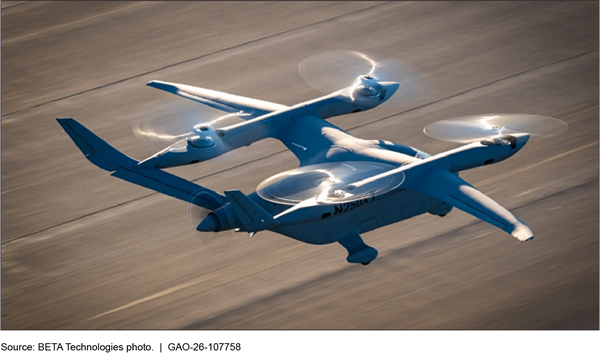
The introduction of aircraft technologies such as drones and electric vertical takeoff and landing (eVTOL) aircraft may further increase the complexity and challenges of operating within the D.C. airspace.[6] Drones and eVTOL aircraft are being developed for a range of operations across the country, including transportation of cargo and passengers, emergency response, and other tasks currently performed by helicopters. As a result of their design and operation, the sound generated by drones and eVTOL aircraft is different from the sound generated by helicopters. According to FAA, these aircraft technologies will need to integrate into an already constrained and security-sensitive airspace in the D.C. area. See figure 1 for an example of an eVTOL aircraft in flight.
The FAA Reauthorization Act of 2024 includes a provision for GAO to report on how operators consider noise mitigation when flying helicopters in the D.C. area, and how law enforcement and other emergency response services are considering using alternatives to helicopters in their work, among other things.[7] This report examines (1) the extent to which helicopter operations are conducted in the D.C. area and for what purposes, (2) the extent to which FAA and selected operators have addressed helicopter noise in the D.C. area, and (3) the views of selected operators and stakeholders on how the use of drones and eVTOL aircraft may affect helicopter noise in the D.C. area.
For each of these objectives, we interviewed FAA officials and selected helicopter operators in the D.C. area. We selected a nongeneralizable sample of 11 helicopter operators to provide perspectives on their operations. Our selected operators included the types of operators that account for most helicopter flights in the D.C. area: three air medical service providers; three local, nonfederal law enforcement agencies; and the five military operators that regularly fly helicopters in the D.C. area (i.e., Air Force, Army, D.C. Army National Guard, Coast Guard, and Marine Corps).[8] We selected the three air medical service providers with the highest number of helicopter flights during the 5-year period from calendar years 2020 through 2024. To ensure we heard perspectives from operators currently using drones, we selected three local law enforcement agencies that had an FAA waiver to operate drones in D.C.’s flight restricted zone and had conducted a high number of helicopter flights during the same period.
To describe the extent to which helicopter operations are conducted in the D.C. area and the purposes of those operations, we analyzed FAA and military operator data for calendar years 2020 through 2024 on the number of flights and flight hours by type of operator, and the purpose of military operations.[9] To assess the reliability of the FAA data, we reviewed documentation on FAA’s Performance Data Analysis and Reporting System; conducted testing for missing data, outliers, and obvious errors; cleaned the data; and reviewed written responses from FAA regarding the data’s reliability. For the data from the military operators, we reviewed written responses from the operators regarding the data’s reliability and any noted differences from the requested data that were specific to their operations. Based on these actions, we determined that the data we used were sufficiently reliable to describe helicopter operations and the purposes of military operations in the D.C. area.
To describe the extent to which FAA and selected operators have addressed helicopter noise in the D.C. area, we reviewed FAA regulations, the noise policies and guidance (including those related to noise complaints) of FAA and selected operators, and industry leading practices on strategies for mitigating helicopter noise. We reviewed available information on helicopter noise complaints collected by FAA and selected operators. We compared the actions of FAA and military operators with applicable FAA and Department of Defense (DOD) community involvement policies. We also compared these actions with Standards for Internal Control in the Federal Government, particularly the principle on communicating relevant and quality information with appropriate external parties.[10]
To describe the views of selected operators and stakeholders on how the use of drones and eVTOL aircraft may affect noise in the D.C. area, we reviewed FAA regulations and interviewed 11 selected operators about their current and planned uses of drones and eVTOL aircraft in the D.C. area. In addition, to describe how the use of drones and eVTOL aircraft could affect helicopter noise and how the noise profiles of these technologies compare with helicopters, we interviewed seven stakeholders representing manufacturers and industry associations (specifically, two eVTOL aircraft manufacturers, one drone manufacturer, and four industry associations). We selected the two eVTOL aircraft manufacturers based on recommendations from stakeholders. We selected two drone manufacturers from a list of vetted companies that meet U.S. government cybersecurity, data privacy, and operational reliability standards, and one responded to our interview request. We spoke with one industry association representing airborne law enforcement, one representing air medical service operators, and two focused on vertical aviation. The views we obtained from this sample of stakeholders and relevant literature are nongeneralizable, but they provided perspectives and examples to inform our review. See appendix I for a full list of interviewees.
In addition, we reviewed relevant literature on the noise impacts of drones and eVTOL aircraft and on how their noise compares with helicopter noise. We identified the literature by searching databases, such as Scopus and ProQuest. We searched for a variety of materials, including government reports; trade and industry articles; association, nonprofit, and think tank publications; scholarly and peer-reviewed materials; and conference papers published over a 5-year period (2020 through 2024). We also reviewed relevant literature that was recommended by internal and external stakeholders.[11]
We conducted this performance audit from August 2024 to March 2026 in accordance with generally accepted government auditing standards. Those standards require that we plan and perform the audit to obtain sufficient, appropriate evidence to provide a reasonable basis for our findings and conclusions based on our audit objectives. We believe that the evidence obtained provides a reasonable basis for our findings and conclusions based on our audit objectives.
Background
FAA’s Responsibilities Related to Helicopter Noise and Airspace Management
FAA regulates noise from civilian helicopters at the design and certification stage through its aircraft certification process, which establishes maximum allowable noise levels for civilian aircraft.[12] According to FAA officials, once a civilian helicopter is certified, FAA does not regulate its day-to-day operational noise. FAA officials noted that many civilian helicopters currently in service were certified under older noise standards that FAA has since updated. As a result, older helicopter models may generate more noise while in operation when compared with newer models designed to meet current FAA certification requirements.
FAA does not have certification authority for military helicopters, which are designed, certified, and operated under separate military authorities.[13] Accordingly, civilian and military helicopters are not subject to the same regulations and, according to FAA officials, are not directly comparable for noise certification or regulatory purposes. The certification process for military aircraft is managed internally by each military service.[14] According to the Air Force, some military helicopters are variants of commercial models that comply with their applicable FAA certification requirements. DOD also has developed policy to reduce noise generated from military operations.[15]
FAA manages helicopter activity as part of its broader responsibility for ensuring the safe and efficient use of the national airspace. To do so, FAA has established various procedures, such as recommended routes and flight altitudes, to ensure safety and efficiency of operations within the airspace. While these procedures can influence how communities experience helicopter noise, FAA states that the requirements are not intended as noise-control measures. In addition, FAA provides air traffic control services to helicopters operating in the airspace for traffic management and to ensure vertical separation from commercial aircraft. Some flights also operate under visual flight rules in certain airspace without the direct involvement of air traffic control.[16] Military helicopters may receive FAA air traffic control services when operating in civilian-controlled airspace, and they operate under DOD’s authority in restricted or military-only airspace.
Washington, D.C. Area Airspace
The D.C.-area airspace has unique restrictions that were established after September 11, 2001, due to national security requirements, making it among the most restricted airspace in the United States.[17] Authorized helicopters may operate to and from designated heliports and airports located within the D.C. area under strict clearance procedures. The D.C. area’s airspace restrictions include the following:
· FAA designated the Washington, D.C. metropolitan area (i.e., the area within a radius of 30 nautical miles of Reagan National) a special flight rules area. Most operators flying within the special flight rules area must file a flight plan if they are operating under the visual flight rules traffic pattern and maintain constant communication with air traffic control while flying in the area, among other things.[18]
· FAA also established a flight restricted zone within a radius of approximately 15 nautical miles of Reagan National.[19] FAA and the Transportation Security Administration jointly manage authorizations to operate in this zone, which is typically limited to specific operators such as federal agencies, local law enforcement, and air medical. Civilian helicopter operations in the flight restricted zone are highly restricted, and according to FAA, routine waivers are not widely available.
· FAA also restricts helicopter operations in prohibited airspace, the area near the U.S. Capitol, National Mall, and other nearby landmarks.[20]
FAA publishes helicopter route charts to promote operational safety and efficiency in metropolitan areas with high concentrations of helicopter activity, including Washington, D.C.[21] These charts depict recommended helicopter routes, recommended altitudes, and designated operating zones, to help organize helicopter traffic within congested airspace.
The helicopter routes, which operators use for routine operations, are generally located above major roadways and waterways which may help minimize the associated noise exposure by concentrating flights over areas with higher ambient sound rather than densely populated residential areas. According to FAA officials, the routes were established to address operational and security requirements in the complex D.C. airspace and were not intended as noise-mitigation measures. Any noise-related effects that may result are incidental and may vary by route. In the D.C. area, helicopter route options are further constrained by restricted and prohibited airspace, security requirements, and other factors. Operating zones are designated areas of the airspace within the helicopter route chart in which certain helicopter operators, such as air medical and local law enforcement, may fly. Helicopter operators use the zones for time-sensitive, point-to-point flights.
FAA policy states that FAA is to review helicopter route charts annually and update them as needed based on operational demand, safety reviews, and airspace changes. For example, in May 2023, FAA revised the Washington, D.C. helicopter route chart by raising the maximum operating altitudes for certain routes and zones. In addition, in June 2025, FAA revised the route chart in response to the January 2025 midair collision between a commercial passenger airplane and military helicopter near Reagan National. As of November 2025, the D.C.-area helicopter route chart included 18 helicopter routes and nine operating zones. (See fig. 2 for FAA’s recommended helicopter routes, as well as the special flight rules area and flight restricted zone, in the D.C. area.)
Figure 2: Helicopter Routes, Special Flight Rules Area, and Flight Restricted Zone in the Washington, D.C. Area, as of November 27, 2025
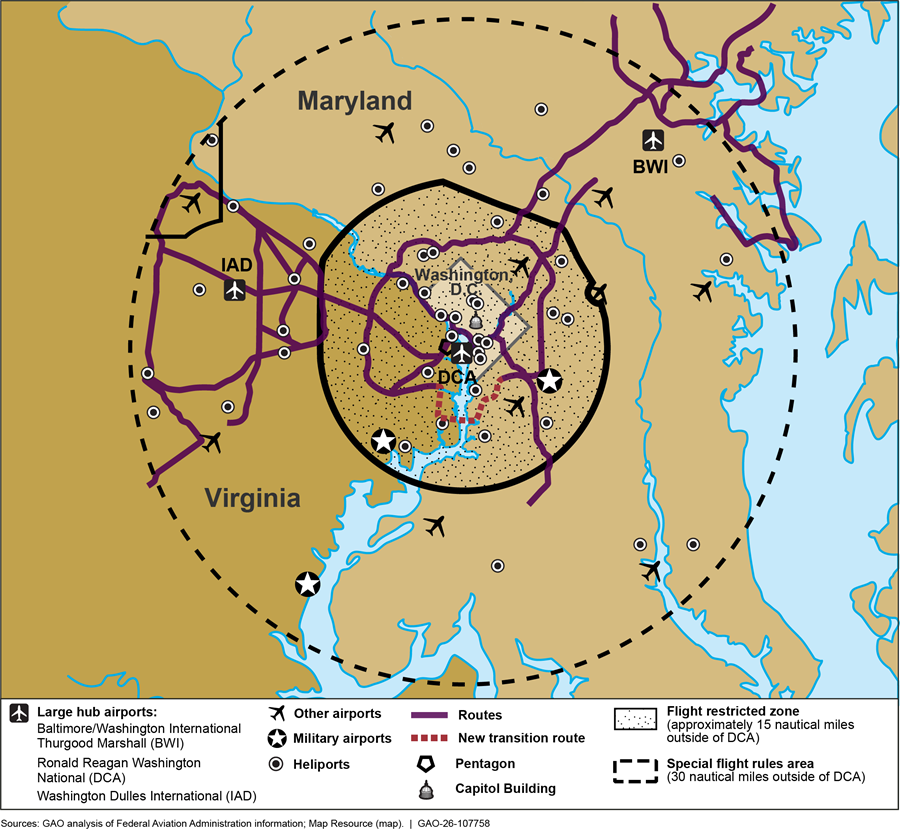
Note: The Federal Aviation Administration established a
new transition route in June 2025 for helicopters traveling south of Ronald
Reagan Washington National Airport. The purpose of the new transition route was
to create greater vertical separation from commercial aircraft on final
approach to the airport than the prior routes.
Helicopter operators’ use of the recommended helicopter routes and altitudes is normally voluntary. However, FAA expects or can request compliance with assigned charted routes and altitudes in the interest of safety or traffic management.[22] To deviate from flying along a route to a specific operating zone, helicopter operators must typically obtain permission from air traffic control. According to FAA, obtaining this approval depends on safety, traffic, and airspace constraints.
Helicopter Noise
There are three primary sources of helicopter noise: the main rotor with blades located on top of the helicopter, the tail rotor (or another anti-torque system), and the engine. The interaction of these components creates a “slap” sound generated by the unsteady pressure fluctuations from blades. Some reports suggest that some people may find helicopter noise more annoying than conventional aircraft due to this distinctive sound.[23] While the sound produced by helicopters can be measured in decibels, the ways in which people perceive and respond to that noise depend on the interaction of numerous factors, such as the design of the helicopter, how the helicopter is operated in flight, and weather conditions during the flight.[24]
The helicopter industry developed voluntary “Fly Neighborly” practices to help mitigate noise impacts from helicopter operations. These practices include avoiding noise-sensitive areas (e.g., residential areas, hospitals, and schools); following routes with higher ambient noise or lower population density (e.g., highways and waterways); maintaining the highest possible altitude; limiting sharp maneuvers; varying routes for recurring flights; and ascending and descending steeply near landing areas.[25] FAA encourages the voluntary use of the “Fly Neighborly” practices when operationally feasible. However, according to FAA officials, during time-critical, emergency, or security-driven operations—particularly within restricted or congested airspace—operational options may be limited and immediate safety requirements must take precedence. In such circumstances, according to FAA, noise impacts may be an unavoidable secondary effect.
Helicopter Operators Cumulatively Average Over 32,000 Flights Per Year in the D.C. Area to Support a Variety of Missions
According to FAA data, from 2020 through 2024, about 400 helicopter operators conducted flights in the D.C. area. These operators included federal, state, and local governments, as well as civilian operators (both businesses and individuals). Most of these helicopter operators (61 percent) conducted fewer than 10 flights total in the D.C. area during the 5-year period. During this period, operators cumulatively flew an average of more than 32,000 helicopter flights and 20,000 flight hours annually in the D.C. area. Operators conducted an average of about 91 flights per day during this period, which ranged from one to 202 flights per day based on mission needs. Seventy-three percent of these helicopter flights were conducted entirely during daytime hours, with the remaining flights occurring, at least in part, during evening hours (between 10:00 p.m. and 6:00 a.m.).
Military, air medical, and state and local law enforcement conducted the majority of the helicopter flights and logged the most flight hours in the D.C. area from 2020 through 2024 (see table 1). During this period, the average number of annual flights in the D.C. area was approximately 32,000 flights, which was about a 10-percent increase from the period we previously reported on (2017 through 2019).[26] This increase was largely due to an increase in air medical flights. FAA officials and selected air medical operators we spoke with were not sure why the number of air medical helicopter flights had increased in recent years.
Table 1: FAA-Reported Helicopter Flights and Flight Hours in the Washington, D.C. Area by Operator Type, 2020–2024
|
|
Number of helicopter flights (flight hours) in the Washington, D.C. area |
||||||||
|
Operator type |
2020 |
2021 |
2022 |
2023 |
|
2024 |
Total |
Percentage of total flights (flight hours) |
|
|
Militarya |
11,017 (8,346) |
11,023 (7,874) |
11,709 (9,787) |
11,334 (10,404) |
|
11,728 (10,479) |
56,811 |
35% (46%) |
|
|
Air medical |
6,495 (2,051) |
7,706 (2,427) |
12,084 (3,773) |
13,011 (3,992) |
|
14,688 |
53,984 |
33 (16) |
|
|
State and local law enforcement |
3,855 (2,360) |
4,014 (2,457) |
4,988 (3,122) |
5,128 (3,304) |
|
5,629 |
23,614 |
15 (15) |
|
|
Otherb |
2,982 (1,307) |
2,795 (1,223) |
3,018 (2,181) |
2,827 (2,369) |
|
2,587 |
14,209 |
9 (9) |
|
|
Federal law enforcement and emergency support |
1,499 (1,414) |
1,601 (1,445) |
1,694 (1,648) |
1,349 (1,283) |
|
1,701 |
7,844 (7,430) |
5 (7) |
|
|
News |
1,145 (1,338) |
1,084 (1,313) |
1,289 (1,561) |
1,043 (1,269) |
|
1,007 |
5,568 (6,993) |
3 (7) |
|
|
Total |
26,993 (16,817) |
28,223 (16,740) |
34,782 (22,073) |
34,692 (22,621) |
|
37,340 (24,126) |
162,030 |
100% (100%) |
|
Source: GAO analysis of Federal Aviation Administration (FAA) data. | GAO‑26‑107758
Notes: Total flight hours may not add up due to rounding.
The Washington, D.C. area includes the area within 30 nautical miles of Ronald Reagan Washington National Airport.
aMilitary operators include the helicopter operators flying military missions in the Washington, D.C. area: Air Force, Army, Coast Guard, D.C. Army National Guard, and Marine Corps.
bOther includes helicopter flights by business aviation and general aviation operators, and flights for which the type of operator was unknown due to incomplete FAA data.
Overall, military operators—Air Force, Army, Coast Guard, D.C. Army National Guard, and Marine Corps—conducted the largest share of helicopter flights from 2020 through 2024. Specifically, military operators had the largest share of flights (35 percent) and flight hours (46 percent). Moreover, military helicopter flights were longer in duration relative to other operators. For example, the average flight time of military helicopter flights (50 minutes) was significantly longer than air medical flights (19 minutes) in the D.C. area, which resulted in a much higher number of flight hours while conducting a similar number of flights. According to Army officials, their pilots try to complete as many training events in a single flight as possible, which may increase the length of certain military flights.
Military operators regularly fly helicopters in the D.C. area for mission execution, personnel transportation, training, and other purposes.
· Mission execution. These flights carry out a military operator’s assigned mission in the D.C. area and exclude personnel transportation, other than for the President and Vice President (see table 2).
· Personnel transportation. These flights primarily serve to transport military personnel, such as senior officers or civilian government officials (excluding the President and Vice President), around the D.C. area.
· Training. These flights enable military operators to practice carrying out their mission or to ensure pilots remain qualified and proficient to fly their aircraft.
· Other. Other flights include aircraft maintenance checks, community or public engagement events, and support for federal, state, and local governments.
|
Military operator |
Mission |
|
Air Force |
To maintain continuity of government operations. |
|
Army |
To maintain continuity of government operations, provide defense support to civil authorities, and transport personnel. |
|
Coast Guard |
To conduct rotary wing air intercepts in support of Operation Noble Eagle (the military’s homeland defense mission). |
|
D.C. Army National Guard |
To provide support for a variety of missions, including air medical operations and counter-drug operations, and to transport personnel. |
|
Marine Corps |
To provide transportation in support of the President and Vice President and to support other national security activities. |
Source: GAO analysis of military operator interviews. | GAO‑26‑107758
Note: The Washington, D.C. area includes the area within 30 nautical miles of Ronald Reagan Washington National Airport.
The majority of military helicopter flight hours in the D.C. area are for training purposes (see fig. 3). Training flight hours comprise more than 70 percent of the Air Force, Army, and Coast Guard’s total flight hours. Officials from these three military operators stated that they must conduct some training flights in the D.C. area rather than in more rural locations. For example, the Army conducts mission-related training flights in the D.C. area to ensure pilots’ familiarity with the local geographic area and readiness for their specific mission. These flights account for 64 percent of the Army’s total training flight hours in the D.C. area. Air Force and Coast Guard officials said they must conduct all training flights in the D.C. area to be prepared to immediately respond to incidents in the area, as their missions require. According to Marine Corps officials, the Marine Corps does not conduct training flights close to Washington, D.C.; rather, it conducts training flights in a less populated area near Quantico, Virginia.
Figure 3: Helicopter Flight Hours by Military Operator and Percentage of Flight Hours by Purpose in the Washington, D.C. Area, 2020–2024
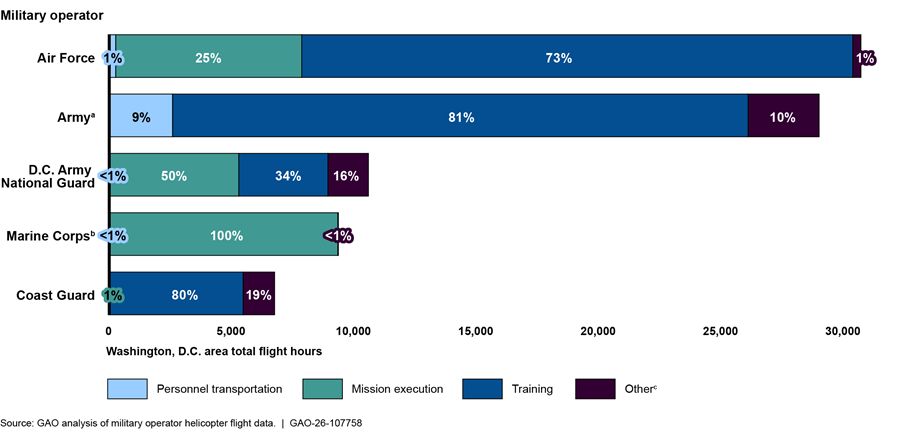
Notes: Percentages may not add up to 100 percent due to rounding.
The Washington, D.C. area includes the area within 30 nautical miles of Ronald Reagan Washington National Airport.
aThe Army reported the data in fiscal years, not calendar years.
bAccording to the Marine Corps, the reported mission execution flight hours include all flight time related to its presidential transportation mission, some of which occurred outside of the D.C. area.
cOther includes flights for maintenance checks, community or public engagement events, and support for federal, state, and local governments.
Military operators noted that some of their flights must be conducted at night. For example, some military operators told us that certain training flights occur at night because their pilots must remain qualified for specific nighttime flying procedures, such as flying while wearing night vision goggles. While military flights accounted for 25 percent of all evening flights (between 10:00 p.m. and 6:00 a.m.) from 2020 through 2024, these flights comprised 41 percent of evening flight hours. Noise from evening helicopter flights may be more disruptive for residents than noise from daytime flights, because people are generally at home or sleeping during evening hours.
In the D.C. area, civilian helicopter operators, such as air medical operators and local law enforcement, conduct flights primarily for mission-related purposes. All three air medical operators we spoke with primarily conduct flights to transport patients from one hospital to another. The three local law enforcement operators we spoke with said they fly helicopters to conduct surveillance, pursue suspects, search for missing persons, observe crowds assembling, and support other police and governmental missions. One air medical operator and two local law enforcement operators we spoke with said some training flights occur in the D.C. area to familiarize pilots with the airspace. However, one air medical operator said they do not conduct training flights in the D.C. area and typically train in less populated areas.
In support of their missions, air medical and state and local law enforcement operators may need to conduct flights to transport patients and respond to public safety incidents at any time of day. From 2020 through 2024, air medical operators accounted for 48 percent of evening flights and 24 percent of evening flight hours. State and local law enforcement operators accounted for 21 percent of evening flights and 23 percent of evening flight hours.
FAA and Operators Have Taken Steps to Address Helicopter Noise, but Military Operators Have Not Consistently Engaged with Affected Communities
FAA Has Collected and Shared Information on Helicopter Noise Complaints and Conducted Community Outreach
FAA has taken several steps to address helicopter noise, including collecting and responding to noise complaints, and sharing and using information from noise complaints. FAA has also conducted community outreach when updating its helicopter route charts.
Collecting and Responding to Noise Complaints
FAA has a role in collecting and responding to aviation noise complaints, including those related to helicopters, but it does not have sole responsibility for addressing noise. FAA collects helicopter noise complaints from the public through the following mechanisms to track, analyze, and address noise complaints.
· Aviation Noise Complaint and Inquiry Response (ANCIR). According to FAA officials, the agency began to develop a system to collect and store noise complaint information in 2015. Officials also told us that in 2017, the agency implemented a webform, which became available nationwide in 2020, to collect complaint information on a regional basis. In 2024, FAA launched the ANCIR portal, which updated its prior webform and is FAA’s central mechanism for collecting aviation noise complaints. ANCIR is an online webform that allows members of the public to report details of an aviation noise complaint—such as location, approximate time, and aircraft type—to FAA.[27] FAA also encourages airports and operators to submit noise complaint information that these entities received directly from the public to ANCIR. While FAA continues to accept noise complaints by mail and phone, FAA officials stated that the agency encourages the public to submit noise complaints online through ANCIR. FAA officials noted that ANCIR is used by most complainants and its implementation supports more efficient intake, tracking, and analysis of noise complaint information.
· Regional Ombudsmen. Individuals may also report noise complaints directly to FAA’s nine regional offices. Each of these offices has a Regional Ombudsman, who helps respond to complaints submitted through ANCIR, as well as those received directly by phone or mail.[28] In addition to responding to complaints and serving as public liaisons, Regional Ombudsmen are responsible for coordinating with airports, operators, and community groups to help ensure that concerns related to aviation noise, among other issues, are properly addressed.
· Flight Standards District Offices. In some cases, individuals may submit complaints to the FAA Flight Standards District Offices. These offices are primarily responsible for reviewing safety-related complaints.[29] FAA officials told us that while helicopter noise complaints generally do not involve safety issues, members of the public sometimes report noise complaints to the district offices, either as a first point of contact or if they were dissatisfied with FAA’s other responses to a noise complaint. In such cases, district offices generally redirect noise concerns to ANCIR or other appropriate FAA offices.
After receiving a complaint, FAA conducts a review that may take more than 30 days, depending on the complexity of the complaint and the need to coordinate with multiple FAA offices. Once the review is complete, FAA sends a response to the complainant, which may include the name of the operator responsible for the noise. For example, if FAA determines that an air medical helicopter flight was responsible for the noise complaint, officials told us the agency will provide the complainant with the name of the helicopter operator or the hospital.
In the D.C. area, FAA received 49 non-repeat helicopter noise complaints in 2024 and 82 from January through September 2025. FAA officials told us the agency consolidates multiple complaints from the same individual, only counts them once, and per its noise complaint policy, provides a single response to each individual.[30]
Airports and operators also have a role in collecting helicopter noise complaints. FAA advises members of the public to first contact their local airport to report an aviation noise complaint prior to submitting a complaint to FAA.[31] In the D.C. area, several airports on military installations are considered local airports. FAA officials told us that FAA does not have access to these external reporting mechanisms and does not receive or track the complaints submitted directly to airports or operators. For example, members of the public may submit complaints to the Metropolitan Washington Airports Authority, which operates Reagan National.[32] According to the airport authority’s online complaint dashboard, the airport authority received 416 noise complaints attributed to helicopter operations in 2024, and 405 from January through September 2025. Unlike FAA, the airport authority does not consolidate similar complaints from the same individual. According to an airport official responsible for the data, the 416 helicopter noise complaints in 2024 were made by 13 individuals, and the 405 complaints in 2025 were made by 11 individuals.
Sharing and Using Information from Noise Complaints
As part of implementing its noise complaint policy, FAA aggregates data on aviation noise complaints that it receives, and it posts public summaries of the data on its website. FAA officials said FAA aggregates aviation noise complaint data to identify general areas of reported concern and to inform its coordination efforts. FAA officials said complaint data are not a quantitative measure of noise exposure, regulatory compliance, or community-wide impact, as they may be influenced by repeat complainants.
FAA published biannual summary data about noise complaints it received in 2024, and it expanded to quarterly data updates starting with the first quarter of 2025. FAA’s website includes nationwide noise complaint data by location and aircraft type, including helicopter-specific complaint data for four areas: New York City, NY; Los Angeles, CA; the state of Hawaii; and Washington, D.C.[33] The helicopter noise complaint summaries include the monthly number of complaints and a map showing the general locations of the complaints within each area, but do not provide other details such as the time of complaint or the operator responsible for the noise. FAA officials told us FAA cannot share more details about complaints, to protect the privacy of complainants and certain operators, and to comply with legal requirements.[34]
FAA officials stated that due to legal restrictions, FAA does not share information about the operator if it determines the flight involved a sensitive military or law enforcement mission. FAA officials told us they do not comment on military operations, but if FAA determined that a military helicopter was responsible for a noise complaint, its response to the complainant may inform them how to contact nearby military installations. Additionally, for other individual complaints FAA receives, FAA officials said the agency does not share personal information from the complaints with the operators responsible for the noise because of legal privacy requirements that prohibit the disclosure of such information.[35]
According to FAA, the agency has used complaint information to provide insight about areas of aircraft noise concern across different communities. For example, FAA officials told us that FAA uses complaint data as one source to help identify patterns that may warrant additional review, validate other technical data, and coordinate efforts with airports and operators.[36] However, FAA does not use complaints as the primary basis for policy decisions, because complaints may be submitted by a small number of repeat complainants and therefore may not reliably reflect overall community noise concerns.
FAA has partially implemented our prior recommendation related to helicopter noise in the D.C. area. In 2021, we recommended that FAA develop a mechanism to exchange helicopter noise information with operators in the D.C. area.[37] According to FAA officials, in response to this recommendation, FAA modified ANCIR to allow helicopter operators to submit information about noise complaints that the operators received.
In 2022, FAA also began hosting biannual helicopter symposiums for stakeholders, including for both civilian and military helicopter operators in the D.C. area. The purpose of these symposiums was to enable stakeholders to exchange information to address helicopter operational concerns, including trends in noise complaints, and to discuss recommendations aimed at reducing helicopter noise impacts on D.C.-area communities. For example, following discussions with operators during the April 2022 symposium, FAA adjusted the helicopter route chart to reduce noise impacts by raising the maximum operating altitudes for certain routes and zones in the D.C. area. FAA held the most recent symposium in December 2024. In May 2025, FAA officials told us the agency has paused the symposiums until the National Transportation Safety Board completes its investigation of the January 2025 midair collision near Reagan National.[38]
By resuming the helicopter noise symposiums, FAA would complement its existing efforts to collect information through its ANCIR portal and provide a forum for civilian and military operators to share information on helicopter noise. In doing so, FAA would fully implement our 2021 recommendation, and the agency and operators would be better positioned to determine what, if any, additional strategies are needed to address helicopter noise in the D.C. area.
Conducting Community Outreach
FAA communicates with the public about helicopter noise in the D.C. area through various community outreach efforts. FAA’s Community Involvement Policy establishes a goal of active, early, and continuous public involvement in its decision-making.[39]
FAA officials told us that the agency may conduct community outreach when updating the D.C. helicopter route chart.[40] According to FAA policy, FAA is responsible for reviewing the helicopter route chart annually.[41] The officials told us that FAA updates and republishes the route chart every 56 days, even if the updates include only minor changes. Officials also stated that FAA generally reviews the route chart for more comprehensive updates every 2 years. According to FAA officials, once FAA has updated the route chart, FAA posts information on its community engagement website, meets with congressional representatives, and presents to established community groups. FAA officials stated that airspace changes driven by safety considerations are implemented pursuant to the agency’s statutory safety authority. Due to this mandate, FAA typically provides public notification after such decisions are finalized, rather than conducting advance public input processes that may apply to more discretionary actions.
In the D.C. area specifically, FAA officials told us they conduct outreach through the Reagan National Airport Community Working Group. This group is sponsored by the Metropolitan Washington Airports Authority and includes community representatives from five D.C., five Northern Virginia, and five Maryland neighborhoods appointed by local elected officials. The working group first met in 2015 and met quarterly as of November 2025. Helicopter noise is not the primary focus of the group, but the topic has occasionally been included on meeting agendas, including during FAA’s process of updating the D.C. helicopter route chart following the January 2025 midair collision near Reagan National. While developing these updates, FAA officials presented at a Reagan National Airport Community Working Group meeting and briefed local congressional representatives.
Three military operators told us they anticipated that FAA’s changes to the D.C.-area airspace after the January 2025 midair collision would affect helicopter noise. Following the midair collision, for safety purposes, FAA immediately restricted helicopter traffic near Reagan National. In its helicopter route chart update, which went into effect on June 12, 2025, FAA removed portions of three routes near Reagan National and created a new transition route to allow helicopter traffic to cross the Potomac River from east to west and vice versa. According to FAA, the purpose of this new transition route was to provide greater vertical separation between helicopters and commercial aircraft on final approach to the airport than the prior routes. Because the new transition route is located over an area that previously did not have a helicopter route, officials from one helicopter operator told us nearby residents may experience impacts from helicopter noise. According to FAA officials, safety considerations required the agency to move helicopter traffic to an area that did not previously experience much helicopter noise. FAA’s November 27, 2025, helicopter route chart update reflects the changes made after the January 2025 midair collision (see fig. 4).
Figure 4: Changes to the Helicopter Route Chart for the Washington, D.C. Area, as of November 27, 2025
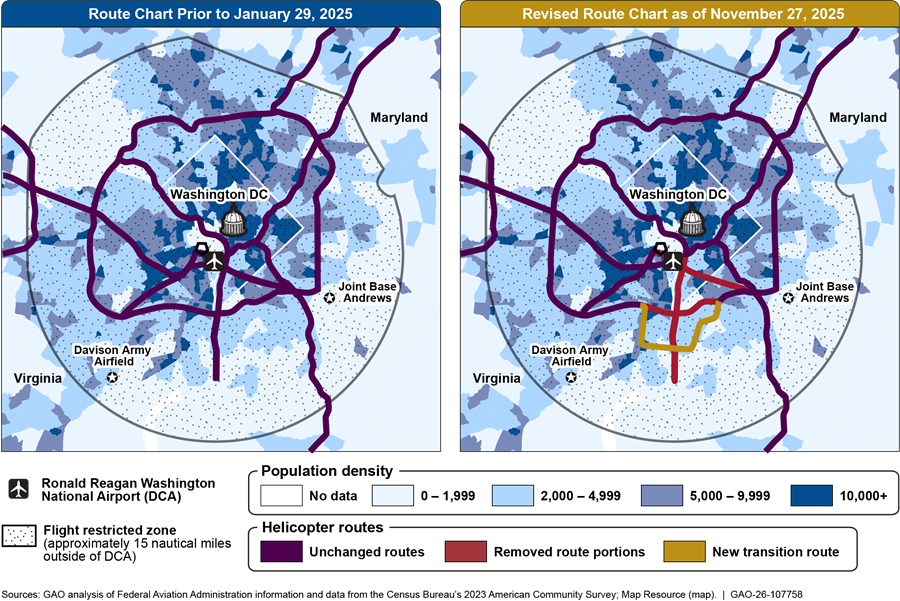
Note: After the January 2025 midair collision between a commercial passenger airplane and military helicopter, the Federal Aviation Administration established a new transition route in June 2025 for helicopters traveling south of Ronald Reagan Washington National Airport. The purpose of the new transition route was to create greater vertical separation from commercial aircraft on final approach to the airport than the prior routes.
Military Operators Have Taken Steps to Address Helicopter Noise but Have Not Consistently Conducted Outreach to Affected Communities
Military operators told us they have taken steps to reduce noise resulting from their helicopter operations in the D.C. area and to respond to noise complaints. The Army has conducted limited community outreach related to helicopter noise, but other military operators have not.
Taking Steps to Reduce Noise Impacts
Military operators told us they have undertaken efforts to reduce helicopter noise from their operations in the D.C. area, consistent with DOD’s policy to reduce annoyance of surrounding communities from military noise to the extent practicable and consistent with maintaining military readiness.[42] These efforts include the following:
· Flying along FAA helicopter routes. All five military operators told us they use FAA’s helicopter routes for their flights when possible. Officials told us that using these helicopter routes reduces noise impacts, because the routes are over highways and waterways and generally avoid densely populated residential areas.
· Following industry leading practices. All military operators also told us that, when possible, they follow helicopter industry leading practices, known as “Fly Neighborly,” to help reduce helicopter noise impacts. These practices include flying at the highest practicable altitudes, varying flight patterns to avoid repeatedly flying over the same locations, and avoiding designated noise-sensitive areas.
· Training outside of the D.C. area. Some military operators said they conduct training flights outside of the D.C. area when possible, which may reduce noise impacts. For example, Marine Corps officials told us they conduct training flights near Quantico, Virginia, a more rural area, instead of in Washington, D.C.
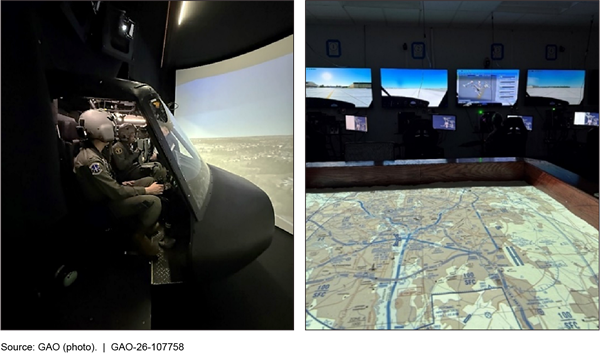
· Using simulators for training. All military operators told us they use simulators for some helicopter pilot training, which may help reduce the number of training flights in the D.C. area. For example, the Air Force and Army have simulators and virtual reality laboratories at their D.C.-area military installations, and pilots use them to become familiar with the local geography and to practice specific helicopter tasks and missions (see fig. 5).
Figure 5: Air Force Helicopter Simulator and Virtual Reality Laboratory Used in the Washington, D.C. Area
Responding to Noise Complaints
According to DOD documentation and military helicopter operators in the D.C. area that we spoke with, the operators have received and responded to individual noise complaints from the public. DOD’s Operational Noise Program requires that DOD’s military operators develop standard procedures to receive, respond to, and review complaints about military noise, including from helicopter operations.[43]
Each military operator has a public affairs office at its D.C.-area military installation that receives noise complaints, including complaints related to helicopter noise. For example, the Air Force receives complaints through the public affairs office at Joint Base Andrews in Maryland, and Coast Guard has a process to receive and respond to complaints through Air Station Atlantic City in New Jersey.[44] The Air Force, Army, D.C. Army National Guard, and Marine Corps noted that they receive few or no noise complaints from members of the public in the D.C. area directly.
When military operators receive complaints, their respective public affairs offices may seek to address them with the complainants. For example, the Air Force provides responses to complainants stating whether it was operating nearby and why, if applicable. Three military operators—Army, D.C. Army National Guard, and Marine Corps—told us they have not shared individual helicopter noise complaints that they have received with FAA, and officials from the Air Force and Coast Guard said they may occasionally forward complaints to FAA. Operators are not required to share complaints they receive with FAA. However, FAA officials told us they want to make it easier for operators to share noise complaints they have received, so they recently modified the ANCIR intake form to provide an option for operators to do so.
Some military operators told us they have limited ways to modify flight paths in response to noise complaints, because mission requirements or airspace restrictions may require that they follow certain flight paths. For example, the Army’s mission requires that it fly helicopters to and from the Pentagon, but airspace restrictions near Reagan National require that it follow a specific arrival and departure path over Arlington, Virginia. However, two military operators stated that they have taken steps to adjust their flight paths where feasible and in line with mission requirements, such as avoiding noise-sensitive areas. For example, the Army designated the neighborhood of Newington in Fairfax County, Virginia, near Davison Army Airfield, as a noise-sensitive area in response to receiving noise complaints from the community. The Army instructed pilots to avoid flying over the noise-sensitive area, and Coast Guard officials told us its pilots are aware of the Army’s designation and also avoid the area when flying nearby.
Conducting Community Outreach
Four of the five military helicopter operators—Air Force, Army, Coast Guard, and D.C. Army National Guard—conduct some community outreach on their missions in the D.C. area, but only one of these four conducts outreach on helicopter noise. Air Force, Coast Guard, and D.C. Army National Guard officials said they engage in some community outreach efforts in the D.C. area to educate the public about their missions and operations, but that none of these efforts are related to helicopter noise or their efforts to manage noise impacts. For example, D.C. Army National Guard officials told us they have presented to teachers and youth about their helicopter operations, and Coast Guard officials told us they have participated in media interviews and documentaries about their D.C.-area helicopter mission. As previously mentioned, Army officials said they have conducted some outreach to the community of Newington in Virginia, near Davison Army Airfield. Army officials said their outreach was not a regular occurrence but included meeting with residents in response to complaints about helicopter noise and providing the community with advance notice when they expected increased helicopter activity.
DOD’s Operational Noise Program requires its military operators to engage in community awareness and outreach programs to educate the public specifically about military noise and their efforts to manage noise impacts, including noise from their helicopter operations.[45] DOD’s guide for implementing its Operational Noise Program states that community awareness and outreach efforts should be ongoing and continuous.[46] Standards for Internal Control in the Federal Government, applicable to all military operators including Coast Guard, also state that agencies should communicate relevant and quality information to appropriate external parties.[47]
However, we found that none of the five military helicopter operators in the D.C. area have engaged in continuous outreach efforts about helicopter noise or about efforts to manage noise impacts to affected communities. The Air Force, Coast Guard, and D.C. Army National Guard’s community outreach efforts are not focused on helicopter noise or their efforts to manage noise impacts. Furthermore, Marine Corps officials told us they do not have any community outreach programs because of their narrow mission to transport the President and Vice President. Although the Army has conducted some outreach regarding helicopter noise to the community of Newington, it has not engaged in ongoing, continuous community awareness and outreach efforts as recommended in DOD’s guide to implementing its Operational Noise Program.[48]
Military operators identified several challenges to conducting community outreach efforts regarding helicopter noise. Four military operators noted that they do not directly receive many noise complaints, and two operators stated that the complaints they received were not caused by their operations. Similarly, Army officials also said they were hesitant to engage in community outreach that may be perceived as representing all military operators, which would require a DOD-wide approach. Because Coast Guard’s helicopter operations in the D.C area support Operation Noble Eagle, the military’s homeland defense mission under the command of the North American Aerospace Defense Command (NORAD), Coast Guard officials told us that NORAD is responsible for community outreach related to helicopter noise from Coast Guard operations. Additionally, one military operator told us it may not have the resources to engage in community outreach beyond its current efforts, and another military operator identified the large number of densely populated communities along helicopter routes in the D.C. area as a challenge to conducting effective outreach.
However, recent helicopter route changes near Reagan National made after the January 2025 midair collision may heighten the need for military operators to engage in community outreach about helicopter noise. Officials from FAA and some military operators told us that helicopter traffic patterns along the routes and near Reagan National have changed because of the route changes. As a result, Army officials told us they anticipate receiving additional noise complaints from Northern Virginia and Maryland residents near the new transition route, as these residential areas were previously not located under a helicopter route. Additionally, Coast Guard officials told us that FAA’s airspace restrictions close to Reagan National required their helicopters to hover over residential areas near the airport longer than before the midair collision, which may increase helicopter noise for these communities.
By developing and implementing a plan to engage in ongoing and continuous community awareness and outreach, military operators can help communities affected by helicopter noise better understand the purposes of flights in the area and their efforts to reduce noise. Military operators could consider collaborating across or within departments on their efforts to develop and implement an outreach plan and efficiently use resources. For example, given Coast Guard’s helicopter operations to support Operation Noble Eagle in the D.C. area, DOD and the Department of Homeland Security (DHS) could collaborate to define the roles and responsibilities associated with an outreach plan. In addition, military operators could potentially combine outreach on noise with their existing efforts to educate communities on their mission. Furthermore, by engaging in regular community awareness and outreach efforts, DOD’s military operators could advance DOD’s broader goal of effective public communication, education, and cooperation to manage noise exposure while protecting their missions in the D.C. area.[49]
Air Medical and Local Law Enforcement Operators Said They Avoid Noise-Sensitive Areas and Have Acquired Quieter Helicopters
The three air medical and three local law enforcement operators we spoke with said they have used several methods to reduce and manage helicopter noise in the D.C. area. These methods include the following:
· Following industry leading practices. Air medical and law enforcement operators we spoke with said they follow industry “Fly Neighborly” practices for reducing helicopter noise. For example, selected operators told us they fly at the highest permissible altitudes. Because air medical and local law enforcement operators’ flights often involve time-sensitive transportation of ill or injured patients or are in response to law enforcement incidents in progress, some of these operators told us they generally fly point-to-point using established operating zones in the D.C. helicopter route chart instead of helicopter routes that generally avoid populated areas. Doing so may require these helicopters to fly over more residential areas. However, as previously noted, air medical and law enforcement flights tend to be shorter in length than military helicopter flights, in part due to flying more direct routes.
· Modifying flight procedures. Two air medical operators and one law enforcement operator we spoke with said they modified their flight procedures to help reduce helicopter noise in the D.C. area. For example, one air medical operator developed noise abatement procedures based on complaints, to avoid flying over specific properties, and established specific approach paths at local hospitals to reduce noise in surrounding communities. Similarly, the Fairfax County Police Department developed an approach path over a landfill to their station to avoid flying over a specific residential community.
· Operating quieter aircraft. Officials from one law enforcement and one air medical operator told us they had acquired helicopter models that are quieter than others to help reduce noise. For example, the Prince George’s County Police Department in Maryland uses a fleet of four helicopters without tail rotors. Prince George’s County Police Department officials estimated that the tail rotor is responsible for 70 percent of noise on a helicopter and said they specifically chose a model without a tail rotor to help reduce noise from their operations. Similarly, officials from Metro Aviation, an air medical operator with a fleet of four helicopters in the D.C. area, told us their helicopters have an enclosed tail rotor and are quieter than comparable helicopters with conventional tail rotors.
Two air medical operators and one law enforcement operator also told us that they respond to complaints they receive and adjust their operations based on complaints as practicable. All the air medical and law enforcement operators we spoke with told us they rarely or never receive helicopter noise complaints. When operators receive a complaint, they review their flight records to determine if the noise was from one of their flights and try to resolve the complainant’s concern. For example, some operators told us they share the purpose of the flight with the complainant to help improve public understanding of their operations.
Selected Operators and Stakeholders Said Drones Have Little Effect on Noise, and the Adoption and Effects of eVTOL Aircraft Are Uncertain
Selected Operators and Stakeholders Said the Use of Drones Has Little Effect on Overall Aircraft Noise in the D.C. Area
Drone operations currently have little effect on overall aircraft noise in the D.C. area. Selected helicopter operators told us that, due to the nature of their missions, drones have limited use and near-term applications in the D.C. area. As a result, operators do not expect drones to replace the use of helicopters for their operations in the D.C. area in the near future.
The three local law enforcement operators we spoke with use drones infrequently. For example, officials from two of the operators said they generally use drones no more than once a week, and officials from the third operator said they use drones on average once a day. These operators use drones to support certain helicopter missions, including locating persons of interest and surveilling large crowds. They also use drones in locations a helicopter is unable to access, such as indoor spaces. While drones can complement helicopters during certain missions, law enforcement operators told us that drones cannot replace helicopters, and that their use of drones had not decreased their helicopter activity. Officials from two of the operators noted that they were either in the process of or had interest in expanding their drone program. However, officials from these operators were unable to tell us when these changes would be completed or how these changes could affect aircraft noise.
The majority of all non-law enforcement operators we spoke with said they cannot use drones for their D.C.-area operations due to the nature of the operations. For example, Army officials told us their mission involves transporting people, which drones cannot perform due to limitations on the weight they can carry. While representatives of an air medical association said drones have been used in other areas to transport medical supplies, none of the air medical operators we spoke with said they were planning to use drones in the D.C. area for this purpose.
Several factors may limit the more extensive use of drones in the D.C. area. These factors include the following:
· D.C. airspace security. Operators may not fly drones within D.C.’s flight restricted zone without specific authorization from FAA. The flight restricted zone is the radius of approximately 15 nautical miles around Reagan National. According to FAA officials, DOD and DHS share control of managing the flight restricted zone. FAA officials said these departments can deny or delay an operator’s request to use a drone due to national security reasons. According to FAA officials, this requirement, along with enhanced communication and surveillance requirements, add layers of complexity to operating a drone in the D.C. area.
· FAA rules on drone operations. FAA has established several rules for drone operations that affect how operators use drones nationwide. These rules include limits on a drone’s maximum speed and flight altitude; restrictions on where a drone can be flown; and the requirement that the drone generally stay within view of the operator during flight.[50] These rules may limit some operators’ use of drones. For example, two local law enforcement operators we spoke with said drones cannot be used to assist in a high-speed chase due to these rules. FAA officials said drone operators may expand their operations if they obtain a waiver or exemption from the regulatory requirements.[51] FAA officials told us the agency does not normally grant waivers for drone operations over certain locations in the D.C. area.
· Technical limitations. According to local law enforcement operators we spoke with, drones’ technical limitations affect the types of missions for which they can be used. As noted earlier, drones can carry limited weight and therefore cannot be used to transport people. Also, drones may not be capable of longer-duration missions due to limited battery life. For example, one operator said a drone mission may be limited to 15 to 25 minutes before the battery needs to be replaced or recharged. In addition, one local law enforcement operator said inclement weather conditions, such as wind, can shorten the battery life.
· Privacy concerns. FAA officials said the presence of the federal government in the D.C. area may create heightened privacy concerns about drone activity, such as potential surveillance. Two of the three local law enforcement operators we spoke with have taken some steps to build public trust in their use of drones. These steps include conducting community outreach; developing operational procedures for when a drone’s camera can be used (e.g., not activating a drone’s camera until it has reached the mission site); and developing policies restricting the use of technologies that may be equipped on a drone (e.g., prohibiting facial recognition software). These types of concerns are not unique to the D.C. area; according to FAA officials, based on drone complaints received in FAA’s ANCIR, individuals in areas outside of D.C. also have privacy concerns related to drone activity.
Electric or battery-powered drone motors are generally quieter than traditional helicopter engines. The three D.C.-area law enforcement operators we spoke with said that their drones were quieter than helicopters and that they had not received any complaints about drone noise.
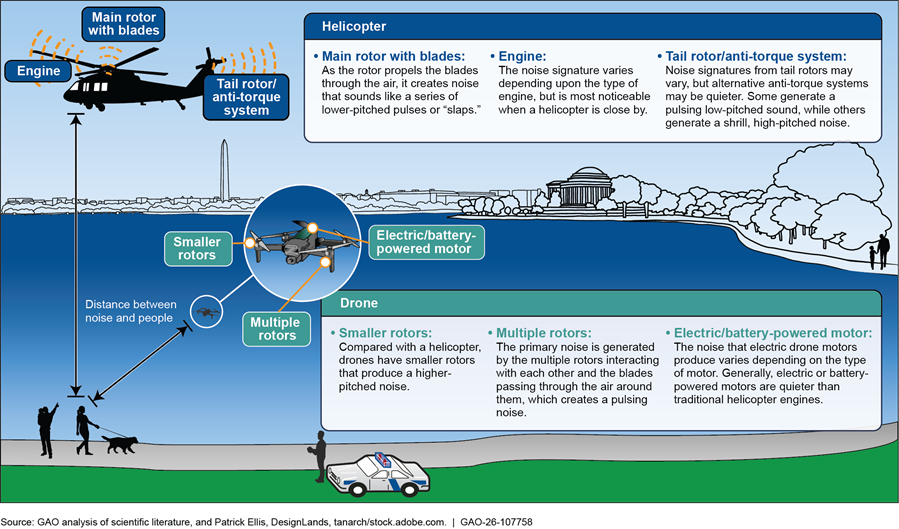
However, studies indicate that people may find drones more annoying than helicopters because of the pitch of the sound drones emit and how they are flown (see fig. 6).[52] Drones have multiple, smaller rotors that spin and interact with each other. The rotors emit a pulsing noise that is higher pitched than the “slaps” of helicopter blades. Higher-pitched sounds tend to be more annoying than lower-pitched sounds, even if they are quieter, according to studies.[53] In addition, studies note that the ways in which drones are flown may make them more annoying than helicopters, because the drones may come in closer proximity to the public.[54] For example, drones generally fly at lower altitudes, may hover in place, can take off and land anywhere, and may fly unconventional flight paths. Helicopters, on the other hand, tend to pass by quickly overhead at higher altitudes.
Selected Operators and Stakeholders Said the Adoption of eVTOL Aircraft and the Potential Effects on Noise in the D.C. Area Are Uncertain
In July 2023, FAA published its Advanced Air Mobility Implementation Plan, which aims to integrate advanced air mobility operations such as eVTOL aircraft in key locations by 2028.[55] In December 2025, the Department of Transportation issued its Advanced Air Mobility National Strategy and accompanying Comprehensive Plan to help accelerate the development and deployment of advanced air mobility technologies in the United States.[56] As of that time, there were no commercial or civilian operations of eVTOL aircraft in the D.C. area or elsewhere in the United States.[57] None of the helicopter operators we spoke with told us about immediate plans to use eVTOL aircraft in the D.C area. As a result, this technology currently has no effect on overall aircraft noise in the D.C. area, and its potential future effects are unclear.
Only one of the three air medical operators we spoke with had plans to use eVTOL aircraft, but it did not have immediate plans to use them in the D.C. area. Specifically, this operator ordered up to 20 eVTOL aircraft from BETA Technologies that are intended for use in air medical transportation.[58] According to this operator, eVTOL aircraft are significantly cheaper to purchase, operate, and maintain than most helicopters. The operator told us it is working with BETA Technologies to configure the interior of the aircraft to be used for air medical purposes, including transporting patients. While the operator believed eVTOL aircraft could be useful for patient transportation in the D.C. area in the future, it did not have immediate plans for their use in the area. The two other air medical operators we spoke with said that eVTOL aircraft could potentially transport patients in the future. However, neither operator told us they planned to use eVTOL aircraft in the D.C. area. Also, none of the local law enforcement operators we spoke with told us about plans to use eVTOL aircraft in the D.C. area.
Only one of the five military operators we spoke with—the Air Force—has explored using eVTOL aircraft. The Air Force is funding eVTOL aircraft research and development for potential use of the aircraft for logistics operations. For example, Air Force officials said they were exploring the potential of an eVTOL aircraft powered by an onboard generator, which could increase flight time compared with battery power alone. However, officials from the Air Force said they did not have immediate plans to use eVTOL aircraft in the D.C. area.
Selected stakeholders and our prior work identified areas that need to be addressed before eVTOL aircraft can be used in the D.C. area and nationwide, including the following:
· FAA aircraft certification standards. We previously reported that stakeholders said FAA needs to certify any new technologies, such as batteries and automated flight systems, that will be introduced with eVTOL aircraft and are not covered by existing FAA regulations or industry standards.[59] According to FAA’s Advanced Air Mobility Implementation Plan, as of July 2023, about a dozen manufacturers had reached a level of maturity and development to advance in FAA’s type certification process.[60] In July 2025, FAA published guidance on ways eVTOL aircraft in general may show compliance with applicable regulations for type certification.[61]
· New air traffic management tools. We previously reported that existing air traffic control tools, procedures, and protocols were adequate for the use of eVTOL aircraft in the short term. However, we noted that FAA and other stakeholders believe that air traffic management rules and procedures will need to be changed to support eVTOL aircraft operations in the long term.[62] In June 2025, FAA officials noted that additional tools and technologies to help manage air traffic and ensure aircraft separation are needed to use eVTOL aircraft in the D.C. area’s complex airspace.
· Ground infrastructure. We previously reported that eVTOL aircraft will require different types of ground infrastructure that still need to be developed. This infrastructure includes eVTOL aircraft takeoff and landing facilities, passenger handling equipment, and electrical equipment for charging eVTOL aircraft.[63] In December 2024, FAA finalized standards and guidance for infrastructure for vertical takeoffs and landings.[64] However, FAA officials told us that, as of August 2025, the D.C. area did not have the ground infrastructure to support the use of eVTOL aircraft.
· Public acceptance. FAA officials told us robust public engagement strategies will be required to build trust and social acceptance for the deployment of eVTOL aircraft. In 2022, we reported that the eVTOL aircraft industry would need public acceptance to succeed. For example, stakeholders noted that the public would want assurance that the aircraft will be safe, reliable, and quiet, because they will operate in dense urban environments in close proximity to homes, neighborhoods, and businesses.[65] Two of the three local law enforcement operators and two of the three air medical operators we spoke with said they would like to see, for example, additional testing of the eVTOL aircraft’s technology, including its safety and reliability, before considering them for their operations.
The noise that eVTOL aircraft generate is different from that of a conventional helicopter, and stakeholders have varying views on how the noise from the two types of aircraft compare. As shown in figure 7, an eVTOL aircraft’s noise comes from its rotors and electric or battery-powered motor.[66] According to two eVTOL aircraft manufacturers and one study, eVTOL aircraft will be quieter than helicopters due to their use of an electric motor rather than a conventional turbine or diesel engine.[67] However, other studies have focused on eVTOL aircrafts’ rotors and found that they will produce a “slap” noise similar to helicopter blades.[68]
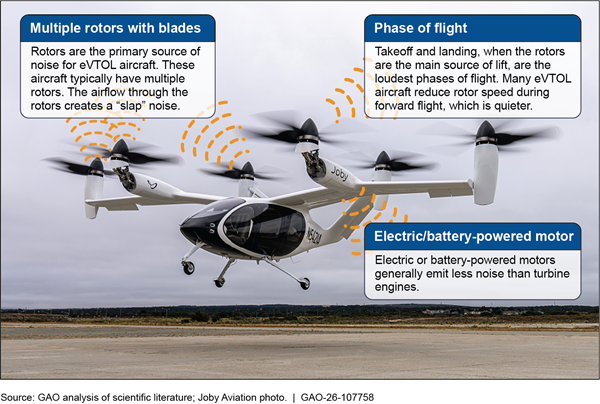
While eVTOL aircraft will have more rotors than a helicopter, some manufacturers are designing and configuring their aircraft’s rotors to help mitigate noise. Studies have found that the number and configuration of the rotors on an eVTOL aircraft will affect how much noise it generates due to the changes in air flow between the rotors.[69] Depending on how the rotors are being used, they may cause more noise. For example, at takeoff and landing, when the rotors are the main source of lift, they rotate faster and may generate more noise. Some manufacturers are also designing eVTOL aircraft to be quieter than helicopters, despite their greater number of rotors. According to a vertical flight technical organization, eVTOL aircraft can be quieter than helicopters due to their use of multiple, individually controlled rotors optimized for noise and performance. For example, representatives of one eVTOL aircraft manufacturer told us they designed their aircraft to be quieter than helicopters by using rotors with thicker blades, which rotate more slowly but with greater force, helping to minimize noise.
The potential effects of eVTOL aircraft on aircraft noise in the D.C area are uncertain because of incomplete noise impact data and limitations of studies that model eVTOL aircraft noise. In March 2024, we reported that FAA would need additional information from manufacturers, as well as aircraft operational data, to analyze the overall noise impacts of eVTOL aircraft.[70] According to one study, operational data beyond the design of an aircraft, such as the volume of flights and preexisting noise in areas the eVTOL aircraft will fly through, are necessary to fully account for the noise impacts of an aircraft.[71] As of December 2025, no such operational data existed for the D.C. area because, as discussed above, eVTOL aircraft were not in use. In the absence of operational data, some studies have suggested computer-generated models could provide insight into the potential effects of noise from eVTOL aircraft.[72] However, these studies often focus on one specific eVTOL aircraft design, which limits their ability to generalize about the potential effects of noise from eVTOL aircraft regardless of differences in design and operations.
Conclusions
The D.C. area’s complex and highly restricted airspace creates a uniquely challenging environment for helicopter operators, which include military, law enforcement, and air medical operators. Given the operational constraints of the D.C. area, the need for procedures that are safe, secure, and efficient, and the wide range of mission-essential operations, some exposure to helicopter noise is inevitable for D.C.-area residents.
FAA, helicopter operators, and other stakeholders play roles in addressing complaints arising from helicopter noise in the D.C. area. FAA revised its online portal to improve the collection and analysis of helicopter noise complaints, and helicopter operators have adjusted their operations to reduce the effects of noise on surrounding communities to the extent practicable. In addition, military operators have a process to receive and respond to noise complaints received directly at their D.C.-area installations. However, none of the five D.C.-area military helicopter operators have conducted ongoing or continuous outreach efforts to communities affected by helicopter noise, as required by DOD’s Operational Noise Program. To do so, military operators could consider collaborating across or within departments on their efforts to develop and implement a plan to conduct such outreach and efficiently use resources. By conducting ongoing and continuous outreach, military operators could improve public awareness and acceptance of their mission-essential helicopter operations in the D.C. area. This is particularly true for individuals who may experience changes in helicopter activity and noise following FAA’s recent helicopter route changes to improve aircraft safety near Reagan National. In addition, these efforts would complement actions taken by FAA, helicopter operators, and other stakeholders to respond to public concerns related to helicopter noise.
Recommendations for Executive Action
We are making a total of four recommendations, including three to DOD and one to DHS. Specifically:
The Secretary of the Air Force should develop and implement a plan to engage in ongoing and continuous community awareness and outreach programs to communities affected by Air Force helicopter noise in the D.C. area. This outreach should include communicating information about military helicopter flights and the Air Force’s efforts to reduce noise from its flights in the D.C. area. (Recommendation 1)
The Secretary of the Army should develop and implement a plan to engage in ongoing and continuous community awareness and outreach programs to communities affected by Army and D.C. Army National Guard helicopter noise in the D.C. area. This outreach should include communicating information about military helicopter flights and efforts by the Army and D.C. Army National Guard to reduce noise from their flights in the D.C. area. (Recommendation 2)
The Secretary of the Navy, in coordination with the Commandant of the Marine Corps, should develop and implement a plan to engage in ongoing and continuous community awareness and outreach programs to communities affected by Marine Corps helicopter noise in the D.C. area. This outreach should include communicating information about military helicopter flights and Marine Corps’ efforts to reduce noise from its flights in the D.C. area. (Recommendation 3)
The Secretary of Homeland Security, in coordination with the Secretary of Defense, should develop and implement a plan to engage in ongoing and continuous community awareness and outreach programs to communities affected by Coast Guard helicopter noise in the D.C. area. This outreach should include communicating information about Coast Guard’s helicopter flights in support of Operation Noble Eagle and its efforts to reduce noise from its flights in the D.C. area. (Recommendation 4)
Agency Comments and Our Evaluation
We provided a draft of this report to DOD, DHS, and the Department of Transportation for review and comment. In its written comments, reproduced in appendix II, DOD concurred with our recommendations.
DHS did not concur with our recommendation. In its comments, DHS indicated that Coast Guard supports the intent of the recommendation to engage in ongoing and continuous community awareness related to Coast Guard missions. However, DHS stated that because Coast Guard’s helicopter mission in the D.C. area supports Operation Noble Eagle, Coast Guard defers to the North American Aerospace Defense Command (NORAD) to conduct community outreach. We continue to believe that our recommendation is warranted and would not preclude the development or implementation of an outreach plan under the mission command structure. As we noted in the report, recognizing Coast Guard’s helicopter operations to support Operation Noble Eagle in the D.C. area, DOD and DHS could collaborate to define the roles and responsibilities associated with an outreach plan for operations under this mission. By developing and implementing a plan to engage in ongoing and continuous community awareness and outreach, Coast Guard can improve public awareness and acceptance of its mission-essential helicopter operations in the D.C. area. DHS’s official response is reproduced in appendix III.
In addition, DOD, DHS, and the Department of
Transportation provided technical comments, which we incorporated as
appropriate.
We are sending copies of this report to the appropriate congressional committees, the Secretary of Defense, the Secretary of Homeland Security, the Secretary of Transportation, and other interested parties. In addition, the report is available at no charge on the GAO website at https://www.gao.gov.
If you or your staff have any questions about this report, please contact me at CollinsD@gao.gov. Contact points for our Offices of Congressional Relations and Media Relations may be found on the last page of this report. GAO staff who made key contributions to this report are listed in appendix IV.

Derrick Collins
Director, Physical Infrastructure
|
Category |
Mission or type |
Organization |
|
Manufacturers |
Drone manufacturer |
Skydio |
|
|
Electric vertical takeoff and landing (eVTOL) aircraft manufacturer |
BETA Technologies |
|
Joby Aviation |
||
|
Operators |
Air medical |
Metro Aviation |
|
PHI Air Medical |
||
|
Stat MedEvac |
||
|
Military |
U.S. Air Force |
|
|
U.S. Army |
||
|
U.S. Army National Guard |
||
|
U.S. Coast Guard |
||
|
U.S. Marine Corps |
||
|
State and local law enforcement |
Fairfax County Police Department |
|
|
Metropolitan Police Department |
||
|
Prince George’s County Police Department |
||
|
Stakeholders |
Industry associations |
Airborne Public Safety Association |
|
Association of Air Medical Services |
||
|
Vertical Aviation International |
||
|
Vertical Flight Society |
Source: GAO. | GAO‑26‑107758
Derrick Collins, CollinsD@gao.gov
In addition to the contact named above, Matt Voit (Assistant Director), Catherine Kim (Analyst in Charge), Laura Bonomini, Jieun Chang, Lincoln Dow, Scott Henderson, Carolyn Johnson, John Mingus, Shannon Murphy, Andrew Nguyen, Paras Sharma, Mike Soressi, Matt Ullengren, Erin Villareal, Laurel Voloder, and Malika Williams made key contributions to this report.
The Government Accountability Office, the audit, evaluation, and investigative arm of Congress, exists to support Congress in meeting its constitutional responsibilities and to help improve the performance and accountability of the federal government for the American people. GAO examines the use of public funds; evaluates federal programs and policies; and provides analyses, recommendations, and other assistance to help Congress make informed oversight, policy, and funding decisions. GAO’s commitment to good government is reflected in its core values of accountability, integrity, and reliability.
Obtaining Copies of GAO Reports and Testimony
The fastest and easiest way to obtain copies of GAO documents at no cost is through our website. Each weekday afternoon, GAO posts on its website newly released reports, testimony, and correspondence. You can also subscribe to GAO’s email updates to receive notification of newly posted products.
Order by Phone
The price of each GAO publication reflects GAO’s actual cost of production and distribution and depends on the number of pages in the publication and whether the publication is printed in color or black and white. Pricing and ordering information is posted on GAO’s website, https://www.gao.gov/ordering.htm.
Place orders by calling (202) 512-6000, toll free (866) 801-7077,
or
TDD (202) 512-2537.
Orders may be paid for using American Express, Discover Card, MasterCard, Visa, check, or money order. Call for additional information.
Connect with GAO
Connect with GAO on X,
LinkedIn, Instagram, and YouTube.
Subscribe to our Email Updates. Listen to our Podcasts.
Visit GAO on the web at https://www.gao.gov.
To Report Fraud, Waste, and Abuse in Federal Programs
Contact FraudNet:
Website: https://www.gao.gov/about/what-gao-does/fraudnet
Automated answering system: (800) 424-5454
Media Relations
Sarah Kaczmarek, Managing Director, Media@gao.gov
Congressional Relations
David A. Powner, Acting Managing Director, CongRel@gao.gov
General Inquiries
[1]For the purposes of this review, the D.C. area is defined as the area within a radius of 30 nautical miles of Ronald Reagan Washington National Airport (Reagan National). The D.C. area includes nearby counties in Maryland and Virginia.
[2]GAO, Aircraft Noise: Better Information Sharing Could Improve Responses to Washington, D.C. Area Helicopter Noise Concerns, GAO‑21‑200 (Washington, D.C.: Jan. 7, 2021).
[3]M. Basner, C. Clark, A. Hansell, J. I. Hileman, S. Janssen, K. Shepherd, and V. Sparrow, “Aviation Noise Impacts: State of the Science,” Noise & Health, vol. 19, no. 87 (2017).
[4]See 14 C.F.R. Part 36, Subpart H. The noise standards in Part 36 do not apply to helicopters that are designated exclusively for agricultural aircraft operations, for dispensing firefighting materials, or for carrying external loads. 14 C.F.R. § 36.1(a)(4). The Department of Defense (DOD) has a policy to manage noise generated from military operations, including from aircraft such as helicopters. DOD, DOD Operational Noise Program, DOD Instruction 4715.13 (Jan. 28, 2020).
[5]According to FAA officials, once a civilian helicopter is certified, FAA does not regulate its day-to-day operational noise. Consistent with this role, FAA manages the safe and efficient use of the airspace rather than regulating the number of helicopters or other aircraft operating within it.
[6]eVTOL aircraft can take off and land vertically like a helicopter but do not rely on combustion engines. Rather, these aircraft use electric propulsion, which can be powered by onboard rechargeable batteries.
[7]FAA Reauthorization Act of 2024, Pub. L. No. 118-63, § 790, 138 Stat. 1025, 1315 (2024).
[8]The 11 operators we selected accounted for about 71 percent of all helicopter flights in the D.C. area from 2020 through 2024. The Air Force, Army, and Marine Corps are military services operating under the Department of Defense (DOD), and Coast Guard is a military service typically operating under the Department of Homeland Security (DHS). Coast Guard helicopters support Operation Noble Eagle, the North American Aerospace Defense Command’s (NORAD) homeland defense mission, to help secure the airspace in the D.C. area. The D.C. Army National Guard is the D.C. militia that serves as a reserve component of the Army. The Navy does not regularly fly helicopters in the D.C. area. For the purposes of our review, we refer to the Air Force, Army, D.C. Army National Guard, Coast Guard, and Marine Corps as military helicopter operators in the D.C. area.
[9]For the purposes of this review, we selected calendar years 2020 through 2024 because the FAA data for that time frame were the most current available at the time of our analysis. All military operators provided their data in calendar years except the Army, which reported its data in fiscal years. We also selected this time frame to provide continuity in presenting data from our prior review on helicopter noise in the D.C. area (GAO‑21‑200), which included data from 2017 through 2019.
[10]GAO, Standards for Internal Control in the Federal Government, GAO‑25‑107721 (Washington, D.C.: May 2025).
[11]The literature search resulted in 60 publications related to our scope, and our stakeholders identified an additional 10 publications. We reviewed all 70 publications for relevance to our objective and for methodological rigor. We included information from 12 publications that met our criteria.
[12]FAA has the authority to prescribe aircraft certification and noise standards. 49 U.S.C. §§ 44701, 44715. See 14 C.F.R. Part 36, Subpart H. The noise standards in Part 36 do not apply to helicopters that are designated exclusively for agricultural aircraft operations, for dispensing firefighting materials, or for carrying external loads. 14 C.F.R. § 36.1(a)(4).
[13]49 U.S.C. § 40102(a)(41) (definition of public aircraft); see also 49 U.S.C. § 44701(a)(1) (FAA authority limited to civil aircraft). In addition, although these operations must continue to comply with certain general operating rules, including those applicable to all aircraft in the National Airspace System, other civil certification and safety oversight regulations do not apply to these operations.
[14]DOD, DOD Airworthiness Policy, DOD Instruction 5030.61 (Dec. 3, 2024).
[15]DOD, DOD Operational Noise Program. Coast Guard is not subject to this instruction because it is not a component of DOD.
[16]Visual flight rules govern the procedures for conducting flight under visual conditions, as opposed to instrument flight rules, which govern the procedures for conducting instrument flight.
[17]FAA established the restrictions associated with the special flight rules area and the flight restricted zone on a temporary basis in 2003 and codified these restrictions through a final rule published in 2008. See Washington, D.C. Metropolitan Area Special Flight Rules Area, 73 Fed. Reg. 76,195 (Dec. 16, 2008) (14 C.F.R. Part 93 Subpart V).
[18]DOD aircraft, law enforcement operations, or lifeguard or air ambulance operations within the entire special flight rules area are not required to file a flight plan under FAA/Transportation Security Administration airspace authorization if the operator is in contact with air traffic control and is transmitting an air traffic control-assigned discrete transponder code. 14 C.F.R. § 93.339(b). Pilots operating under the visual flight rules have additional requirements, dependent on location, outlined at 14 C.F.R. § 93.339.
[19]Within areas in which the special flight rules area and the flight restricted zone overlap, aircraft are subject to the operating requirements of the special flight rules area as well as to the operating requirements specific to the flight restricted zone.
[20]The restrictions surrounding the area that includes the U.S. Capitol and National Mall, defined as Area P-56, were initially established by executive order in the 1930s and codified in 1966. See Amendment of Prohibited Area P-56; District of Columbia, 76 Fed. Reg. 9501 (Feb. 18, 2011).
[21]The Washington, D.C. helicopter route chart includes the Baltimore, MD, area. FAA also has helicopter route charts for Boston, MA; Chicago, IL; Dallas-Fort Worth, TX; Detroit, MI; Houston, TX; Los Angeles, CA; and New York, NY.
[22]FAA, Facility Operation and Administration, JO 7210.3EE (2025). Controllers also may restrict operations within designated operating zones when requested by local law enforcement officials, and the restriction would not adversely affect other aircraft operations.
[23]FAA, Report to Congress: Nonmilitary Helicopter Urban Noise Study (Washington, D.C.: December 2004); International Civil Aviation Organization, Helicopter Noise Reduction Technology: Status Report (Montreal, Canada: Apr. 21, 2015).
[24]See GAO‑21‑200 for a more in-depth discussion of these factors.
[25]Vertical Aviation International, Fly Neighborly Guide (Alexandria, VA: December 2024).
[27]FAA, Aviation Noise Complaint and Inquiry Response portal, accessed July 17, 2025, https://ancir.faa.gov/ancir.
[28]The FAA Reauthorization Act of 2018 required each FAA Regional Administrator to designate a Regional Ombudsman to serve as a liaison with the public on issues regarding aircraft noise, pollution, and safety. FAA Reauthorization Act of 2018, Pub. L. No. 115-254, § 180, 132 Stat. 3186, 3230 (2018). FAA typically designates Community Engagement Officers, who act as the primary point of contact between local communities and FAA, to serve as Regional Ombudsmen. However, according to FAA officials, as of September 2025, the Community Engagement Officer positions for some of FAA’s regional offices were vacant.
[29]Flight Standards District Offices are FAA’s 77 field offices located throughout the country. They are responsible for local aviation safety matters, such as enforcement of regulations and pilot certification.
[30]FAA, Policy on Addressing Aircraft Noise Complaints and Inquiries from the Public (July 12, 2023). According to FAA officials, this practice is intended to prevent complaint data from being skewed by a small number of repeat complainants; provide a clearer picture of broader community concerns; and help allocate FAA staff resources more effectively. FAA officials noted that complaints submitted to its Flight Standards District Offices are safety-related and are not included in ANCIR. Flight Standards District Offices are responsible for addressing aviation safety issues, while noise-related concerns are tracked separately through FAA’s noise complaint process.
[31]FAA guidance encourages airports that have approved Part 150 Noise Compatibility Programs to establish citizen complaint mechanisms as part of their noise mitigation strategies. FAA, Noise Control and Compatibility Planning for Airports, AC 150/5020-1 (August 1983). Reagan National has a Part 150 program, but according to its program update document, the airport is not the most appropriate venue to which to submit helicopter noise complaints, because there are minimal helicopter operations at the airport. Military installations do not have Part 150 Noise Compatibility Programs.
[32]From 2022 through 2024, members of the public in the D.C. area could also report helicopter noise complaints through a phone application and website called PlaneNoise, which was funded by local governments. This system allowed members of the public to report noise complaints and automatically associate them with a specific helicopter based on location data. FAA did not have access to complaints submitted directly to PlaneNoise. According to officials from one local law enforcement agency, PlaneNoise sometimes incorrectly attributed noise complaints from military helicopters to other helicopters. This could occur because military helicopters historically did not broadcast location data when flying in the D.C. area. In 2024, local funding for PlaneNoise lapsed, and the service was no longer available in the D.C. area as of November 2025.
[33]“Responding to the Nation's Aviation Noise Concerns,” last modified April 29, 2025, https://www.faa.gov/noise/inquiries/noise‑complaint‑inquiry‑policy.
[34]According to FAA officials, FAA may not legally identify the operator responsible for the noise when the flight involves sensitive military, law enforcement, or security missions. FAA officials identified the following requirements: 49 U.S.C. § 40123 (protection of voluntarily submitted information), exemptions under the Freedom of Information Act (5 U.S.C. § 552(b)(7) for law enforcement and security), and DOD directives prohibiting FAA from disclosing sensitive flight information that could compromise security or operations.
[35]FAA officials cited the Privacy Act of 1974 (codified as amended at 5 U.S.C. § 552a) as prohibiting the sharing of individual complaints with helicopter operators, even if FAA can identify the operator responsible for a specific noise complaint. The Privacy Act of 1974, as amended, places limitations on agencies’ collection, disclosure, and use of personal information maintained in systems of records, which are defined as groups of records under the control of any agency from which information is retrieved by the name of the individual or by an individual identifier.
[36]FAA officials also said they had used other technical data to address aviation noise concerns. These data include modeled noise exposure maps; operational data such as flight tracks, traffic volumes, and altitudes; environmental reviews; and research on community annoyance and health impacts.
[38]The National Transportation Safety Board is an independent establishment of the U.S. government. Its mission is to make transportation safer by conducting independent accident investigations and advocating for safety improvements. It is required, by statute, to investigate all civil aviation accidents, and with the participation of appropriate military authorities, each accident involving both military and civil aircraft. 49 U.S.C. § 1132(a)(1). The National Transportation Safety Board completed its investigation of the January 2025 midair collision in January 2026.
[39]FAA, Procedures for Handling Airspace Matters, Appendix 10: Community Involvement Policy Statement, FAA Order JO 7400.2R (February 2025).
[40]The National Environmental Policy Act requires federal agencies to consider the potential environmental effects of proposed major federal actions. Pub. L. No. 91-190, 83 Stat. 852 (1970) (codified at 42 U.S.C. §§ 4321–47). Modifications of helicopter routes that follow major thoroughfares, and that FAA determines do not have the potential to significantly increase noise over noise-sensitive areas, normally qualify for a National Environmental Policy Act categorical exclusion. FAA, FAA National Environmental Policy Act Implementing Procedures, FAA Order 1050.1G (June 2025). If a proposal is likely to have reasonably foreseeable significant effects on the quality of the human environment, and such effects cannot be mitigated to be non-significant, FAA Order 1050.1G directs staff to develop an environmental impact statement, which should allow for meaningful public comment.
[41]In January 2026, as part of its investigation into the January 2025 midair collision near Reagan National, the National Transportation Safety Board found that the FAA was unable to provide documentation of the required annual reviews for the Washington, D.C. helicopter route chart. The National Transportation Safety Board recommended that FAA ensure that annual reviews of helicopter route charts are being conducted throughout the National Airspace System as required by FAA Order. National Transportation Safety Board, Midair Collision over the Potomac River PSA Airlines Flight 5342, Mitsubishi Heavy Industries (MHI) RJ Aviation CL-600-2C10 (CRJ700), and US Army Priority Air Transport Flight 25, Sikorsky UH-60L, AIR-26-02 (Washington, D.C.: Jan. 29, 2025).
[42]DOD, DOD Operational Noise Program. Coast Guard is not subject to this instruction because it is not a component of DOD.
[43]DOD, DOD Operational Noise Program. This policy applies to all DOD components and includes military noise from all DOD operations in the United States.
[44]Coast Guard’s D.C.-area rotary wing air intercept mission is the responsibility of Air Station Atlantic City in New Jersey but is carried out with aircraft and crews stationed at Reagan National.
[45]DOD, DOD Operational Noise Program.
[46]DOD, Defense Noise Working Group, Community and Environmental Noise: A Guide for Military Installations and Communities (December 2018).
[48]DOD, Defense Noise Working Group, Community and Environmental Noise: A Guide for Military Installations and Communities.
[49]DOD, Defense Noise Working Group, Community and Environmental Noise: A Guide for Military Installations and Communities.
[50]See 14 C.F.R. Part 107. FAA’s rules for drone operations depend on the size of the drone. Drones weighing less than 55 pounds are generally subject to 14 C.F.R. Part 107 unless used solely for recreational purposes. The FAA Reauthorization Act of 2024 directed FAA to issue a rule establishing regulations that would enable drones to operate beyond line of sight. FAA Reauthorization Act of 2024, Pub. L. No. 118-63, § 930, 138 Stat. 1025, 1366. A subsequent executive order promoted the issuance of such a rule. Unleashing American Drone Dominance, Exec. Order No. 14.3017, 90 Fed. Reg. 24727 (June 6, 2025). In response, in August 2025, FAA published a notice of proposed rulemaking. The notice sought public comment on a proposal to allow more drones to operate at low altitudes beyond their operators' visual line of sight, among other drone-related regulations. Normalizing Unmanned Aircraft Systems Beyond Visual Line of Sight Operations, 90 Fed. Reg. 38212 (Aug. 7, 2025).
[51]Waivers from certain regulatory requirements may be granted if the drone operator demonstrates that its operation can be conducted safely. Similarly, exemptions from certain regulatory requirements may be granted if the drone operator demonstrates that its operation is in the public interest and can be conducted without adversely affecting safety.
[52]Claudia Kawai, Jonas Jäggi, Fotis Georgiou, Jonas Meister, Reto Pieren, and Beat Schäffer, “Short-term Noise Annoyance Towards Drones and Other Transportation Noise Sources: A Laboratory Study,” The Journal of the Acoustical Society of America, vol.156 (2024); Rohan Kapoor, Nicola Kloet, Alessandro Gardi, Abdulghani Mohamed, and Roberto Sabatini, “Sound Propagation Modelling for Manned and Unmanned Aircraft Noise Assessment and Mitigation: A Review,” Atmosphere, vol. 12, no. 1424 (2021); and Antonio J. Torija and Rory K. Nicholls, “Investigation of Metrics for Assessing Human Response to Drone Noise,” International Journal of Environmental Research and Public Health, vol. 19, no. 3152 (2022).
[53]C.T. Justine Hui, Michael J. Kingan, Yusuke Hioka, Gian Schmid, George Dodd, Kim N. Dirks, Shaun Edlin, Sean Mascarenhas, and Young-Min Shim, “Quantification of the Psychoacoustic Effect of Noise from Small Unmanned Aerial Vehicles,” International Journal of Environmental Research and Public Health, vol. 18 (2021); Kawai et al., “Short-term Noise Annoyance Towards Drones and Other Transportation Noise Sources”; and Torija and Nicholls, “Investigation of Metrics for Assessing Human Response to Drone Noise.”
[54]Kawai et al., “Short-term Noise Annoyance Towards Drones and Other Transportation Noise Sources”; and Kapoor et al., “Sound Propagation Modelling for Manned and Unmanned Aircraft Noise Assessment and Mitigation.”
[55]FAA, Advanced Air Mobility (AAM) Implementation Plan: Near-term (Innovate28) Focus with an Eye on the Future of AAM, Version 1.0 (Washington, D.C.: July 2023).
[56]Department of Transportation, Advanced Air Mobility Interagency Working Group, The Advanced Air Mobility National Strategy: A Bold Policy Vision for 2026-2036 and The Advanced Air Mobility Comprehensive Plan: LIFTing AAM to Maturity in the United States (Washington, D.C.: Dec. 17, 2025).
[57]In June 2025, an executive order directed FAA to establish a pilot program to accelerate the deployment of eVTOL operations in the United States. Unleashing American Drone Dominance, Exec. Order No. 14.3017, 90 Fed. Reg. 24727 (June 6, 2025). In response, in September 2025, FAA issued a notice of establishment of the Electric Vertical Takeoff and Landing and Advanced Air Mobility Integration Pilot Program and request for proposals. The program aims to encourage the safe and lawful deployment of eVTOL and other advanced air mobility operations. Electric Vertical Takeoff and Landing and Advanced Air Mobility Integration Pilot Program—Announcement of Establishment of Program and Request for Proposals, 90 Fed. Reg. 44751 (Sept. 16, 2025).
[58]BETA Technologies is an eVTOL aircraft manufacturer.
[59]Because FAA has not yet established powered-lift airworthiness standards in 14 C.F.R, FAA issues type certificates for powered-lift aircraft under two processes under 14 C.F.R. § 21.17 to use in certifying a new design for such aircraft, including advanced air mobility aircraft: (1) existing aircraft class with special conditions (14 C.F.R § 21.17(a)), and (2) special aircraft class (14 C.F.R. § 21.17(b)). According to FAA, all of the eVTOL aircraft designs currently under the agency’s review are being evaluated using the special class regulatory provision following a spring 2022 decision. However, some eVTOL aircraft might be certified under existing class certification regulations with special conditions, depending on the exact specifications of the proposed design, according to FAA officials. In July 2025, FAA also amended rules to allow for the design and manufacture of more kinds of light-sport category aircraft, which may include powered-lift aircraft. Modernization of Special Airworthiness Certification, 90 Fed. Reg. 35034 (July 24, 2025). GAO, Advanced Air Mobility: Legal Authorities and Issues to Consider for Operations, GAO‑24‑106451 (Washington, D.C.: Mar. 14, 2024); and Transforming Aviation: Stakeholders Identified Issues to Address for ‘Advanced Air Mobility,’ GAO‑22‑105020 (Washington, D.C.: May 9, 2022).
[60]FAA, Advanced Air Mobility (AAM) Implementation Plan.
[61]FAA, AC 21.17-4, Type Certification-Powered-lift (July 18, 2025). This guidance document provides an acceptable means of compliance, but it is not the only means of showing compliance with the applicable regulations for type certification.
[62]FAA, Advanced Air Mobility (AAM) Implementation Plan; and GAO‑24‑106451.
[64]FAA, Engineering Briefing No. 105A, Vertiport Design, Supplemental Guidance to Advisory Circular 150/5390-2D, Heliport Design (Dec. 27, 2024).
[66]For the purposes of our report, we are using the term rotor to refer to any device that produces thrust to generate lift.
[67]Kapoor et al., “Sound Propagation Modelling for Manned and Unmanned Aircraft Noise Assessment and Mitigation.”
[68]Joseph Czech, Mihir Rimjha, Timothy Middleton, Daniel Cuppoletti, Peter Sorensen, and Paul Cobb, Noise Estimation Framework for Advanced Air Mobility, paper presented at the 10th Convention of the European Acoustics Association, Turin, Italy (September 2023); and Kapoor et. al., “Sound Propagation Modelling for Manned and Unmanned Aircraft Noise Assessment and Mitigation.”
[69]Alper Celik, Nur Syafiqah Jamaluddin, Kabilan Baskaran, Stefano Meloni, Djamel Rezgui, and Madhi Azarpeyvand, “Experimental Characterisation of Rotor Noise in Tandem Configuration,” Applied Acoustics, vol. 222, no. 110053 (2024); and Czech et al., Noise Estimation Framework for Advanced Air Mobility.
[71]Zhenyu Gao, Yue Yu, Qinshuang Wei, Ufuk Topcu, and John-Paul Clarke, “Noise-aware and Equitable Urban Air Traffic Management: An Optimization Approach,” Transportation Research Part C, vol. 165, no. 104740 (2024).
[72]Czech et al., Noise Estimation Framework for Advanced Air Mobility; Sesi Kottapalli, Christopher Silva, and D. Douglas Boyd Jr., Applicability of Fly Neighborly Noise Recommendations to UAM Quadrotors Undergoing Steady Maneuvers, paper presented at the Vertical Flight Society 6th Decennial Aeromechanics Specialists’ Conference, Santa Clara, California (February 2024); and Daniel S. Little, Joseph Majdalani, Roy J. Harfield Jr., and Vivek Ahuja, “On the Prediction of Noise Generated by Urban Air Mobility (UAM) Vehicles: I. Integration of Fundamental Acoustic Metrics,” Physics of Fluids, vol. 34, no. 116117 (2022).