
Report to the Ranking Member, Joint Economic Committee
United States Government Accountability Office
A report to the Ranking Member of the Joint Economic Committee
For more information, contact: Candice N. Wright at WrightC@gao.gov
What GAO Found
The National Quantum Initiative Act requires a strategic plan to help direct federal efforts in quantum information science, including quantum computing. An entity known as the Subcommittee on Quantum Information Science (SCQIS), co-chaired by four federal organizations, is responsible for drafting this strategic plan. Among these organizations, the Office of Science and Technology Policy (OSTP) plays a central role.
GAO found that, with respect to quantum computing, the current national quantum strategy does not fully address GAO’s desirable characteristics intended to help ensure accountability and more effective results. For example, the relevant planning and reporting documents do not include performance measures to gauge progress on quantum computing. They also do not specify the level of resources, including infrastructure, needed for the National Quantum Initiative. In addition, they do not describe federal agencies’ specific roles and responsibilities, and they do not integrate agency-level plans to implement the strategy. Updating the strategy to address these characteristics could improve interagency planning and coordination. Further, the outcomes of such updates could include more efficient use of federal resources, faster progress in delivering the technology, and better management of quantum computing efforts.
Extent to Which the Quantum Computing Component of the National Quantum Strategy Addresses GAO’s Desirable Characteristics of a National Strategy
|
Characteristic |
GAO assessment |
|
Purpose, scope, and methodology |
Fully addresses |
|
Problem definition and risk assessment |
Fully addresses |
|
Goals, subordinate objectives, and performance measures |
Partially addresses: Includes goals but not subordinate objectives or performance measures. |
|
Resources, investments, and risk management |
Partially addresses: Includes current but not future budgets. No assessment of federal infrastructure needs. |
|
Roles, responsibilities, and coordination |
Partially addresses: Lists agencies but not their specific roles. |
|
Integration and implementation |
Partially addresses: Links to other strategies but does not integrate across agencies. |
Source: GAO. | GAO-26-107759
The National Quantum Initiative Act also requires SCQIS to develop and assess the U.S. quantum workforce. During its initial assessment, SCQIS noted challenges such as a lack of (1) comprehensive data on the many occupational fields covered by the quantum workforce and (2) metrics for assessing the effectiveness of training programs. An ongoing National Science Foundation-funded study analyzing needed knowledge, skills, and abilities could begin to address such challenges.
Why GAO Did This Study
Quantum computing leverages physics at the atomic scale to potentially solve certain problems that today’s computers cannot. A future quantum computer may enable advances in drug development, materials, and scientific discoveries. But it also could pose risks. For example, adversaries might use it for cyberattacks or to decode encrypted financial transactions and military communications.
In 2018, the President signed the National Quantum Initiative Act into law to help ensure the continued leadership of the U.S. in quantum information science and its technology applications. Multiple federal agencies are working to advance quantum computing, collectively spending about $200 million per year.
GAO was asked to review federal efforts regarding quantum computing and cryptography. This report addresses (1) the extent to which the quantum computing component of the national quantum strategy addresses GAO’s desirable characteristics of a national strategy and (2) the status of federal efforts to develop and assess the U.S. quantum information science workforce. GAO analyzed key strategy documents, interviewed agency officials with leadership roles in advancing quantum computing, and interviewed nonfederal stakeholders.
What GAO Recommends
GAO recommends that OSTP, in coordination with the SCQIS agencies, augment and update the national quantum strategy, which includes quantum computing, to address the desirable characteristics of a national strategy. OSTP neither agreed nor disagreed with GAO’s recommendation.
|
Abbreviations |
|
|
|
CISA |
Cybersecurity and Infrastructure Security Agency |
|
|
CRCQ |
cryptographically relevant quantum computer |
|
|
CU Boulder |
University of Colorado Boulder |
|
|
DOE |
Department of Energy |
|
|
LPS |
Laboratory for Physical Sciences |
|
|
NASA |
National Aeronautics and Space Administration |
|
|
NASEM |
National Academies of Sciences, Engineering, and Medicine |
|
|
NSA |
National Security Agency |
|
|
NSF |
National Science Foundation |
|
|
NIST |
National Institute of Standards and Technology |
|
|
NQCO |
National Quantum Coordination Office |
|
|
NQI |
National Quantum Initiative |
|
|
OMB |
Office of Management and Budget |
|
|
OSTP |
Office of Science and Technology Policy |
|
|
QED-C |
Quantum Economic Development Consortium |
|
|
RIT |
Rochester Institute of Technology |
|
|
RSA |
Rivest-Shamir-Adleman |
|
|
SCQIS |
Subcommittee on Quantum Information Science |
|
This is a work of the U.S. government and is not subject to copyright protection in the United States. The published product may be reproduced and distributed in its entirety without further permission from GAO. However, because this work may contain copyrighted images or other material, permission from the copyright holder may be necessary if you wish to reproduce this material separately.
March 18, 2026
The Honorable Margaret Wood Hassan
Ranking Member
Joint Economic Committee
Quantum computing leverages physics at the atomic scale to potentially solve certain problems today’s computers cannot. With further development, quantum computing could facilitate scientific advances, potentially leading to improvements in drug development, materials development, logistics planning, and other areas.
But it also could pose risks, most notably the potential to break critical cryptographic methods. Were it to become available, a quantum computer with that capability—a cryptographically relevant quantum computer (CRQC)—could defeat cryptographic methods that currently secure most internet-based financial transactions, jeopardize encrypted civilian and military communications, and undermine cybersecurity for the electric grid, public water supplies, and other vital systems. While a CRQC may not exist for another 10 to 20 years, adversaries might acquire sensitive data encrypted with current cryptographic methods beforehand and save them for future decryption. Recognizing the potential impact of this issue, we and others have highlighted the threat of a CRQC to cryptographic methods, such as adversaries using it for cyberattacks.[1]
In 2018, the President signed the National Quantum Initiative (NQI) Act into law to help ensure continued U.S. leadership in quantum information science and its technology applications, which include quantum computing.[2] Multiple federal agencies are working to advance quantum computing, and the NQI Act requires coordination of their activities. It assigns some of the responsibility for coordination to an existing body, the Subcommittee on Quantum Information Science (SCQIS). The Office of Science and Technology Policy (OSTP), which provides high-level oversight of federal research and development and leads interagency science and policy coordination, plays a central role in SCQIS and other federal coordinating bodies for the NQI. The act authorized funding for the National Institute of Standards and Technology (NIST), the National Science Foundation (NSF), and the Department of Energy (DOE) to carry out NQI activities through 2023. Authorization for the NQI and activities of its coordination bodies will terminate in 2029. However, the President may continue NQI activities if the President determines that such activities are necessary to meet national economic or national security needs.
Congress continues to demonstrate significant interest in quantum information science through proposed legislation. In addition, in March 2025, a letter from the President to the Director of OSTP outlined three goals for American innovation, one of which focused on ensuring that the U.S. maintains its position as the leader in emerging technologies like quantum information science.[3] Similarly, in September 2025, a letter from the Director of OSTP to the heads of executive agencies highlighted quantum information science as one of five research and development budget priorities for fiscal year (FY) 2027.[4]
This report is the third in a body of work you requested on CRQCs and quantum computing.[5] It addresses (1) the extent to which the quantum computing component of the national quantum strategy addresses GAO’s six desirable characteristics of a national strategy and (2) the status of federal efforts to develop and assess the U.S. quantum information science workforce.
To address these objectives, we reviewed federal agency guidance and other documentation and conducted site visits to agencies and companies. Also, we interviewed the following:
· Officials from agencies that co-chair SCQIS, including OSTP, NIST, NSF, and DOE
· Officials from other agencies leading the nation’s initiative to implement new cryptographic methods, including the Cybersecurity and Infrastructure Security Agency (CISA) and the National Security Agency (NSA)
· Representatives from a partnership between NIST and a university that is advancing research and education in quantum computer science and quantum information theory
· Representatives from Brookhaven, Lawrence Berkeley, and Sandia National Laboratories with expertise in multiple quantum computing approaches and workforce development
· Representatives from six companies representing four different approaches to building a quantum computer—three of which also provide access to other companies’ prototype quantum computers through a cloud platform
· Representatives from the Quantum Economic Development Consortium (QED-C), which fosters collaboration between businesses, research institutions, and government agencies
To examine the extent to which the quantum computing component of the national quantum strategy addresses GAO’s six desirable characteristics of a national strategy, we determined whether the NQI planning and reporting documents address, partially address, or do not address desirable characteristics of a national strategy, as identified in our past work.[6] These planning and reporting documents include the National Strategic Overview for Quantum Information Science (Strategic Overview), which was issued in September 2018 and set the nation’s strategy for ensuring continued leadership in quantum information science, and several subsequent documents that augment the Strategic Overview.
To describe the status of federal efforts to develop and assess the quantum information science workforce, we reviewed workforce development programs and workforce assessments. For more information about our objectives, scope, and methodology, see appendix I.
We conducted this performance audit from August 2024 to March 2026 in accordance with generally accepted government auditing standards. Those standards require that we plan and perform the audit to obtain sufficient, appropriate evidence to provide a reasonable basis for our findings and conclusions based on our audit objectives. We believe that the evidence obtained provides a reasonable basis for our findings and conclusions based on our audit objectives.
Background
Advanced Quantum Computers Could Solve Some Problems More Efficiently Than Classical Computers
Quantum computers, a technology within the broader field of quantum information science (which also includes quantum networking and quantum sensing), could perform certain calculations much faster than today’s “classical” computers—faster by billions of years in some cases. Their development presents risks because adversaries could use a quantum computer of sufficient size and sophistication, a CRQC, to decrypt sensitive data. Such a computer could break, in a matter of days, cryptographic methods such as Rivest-Shamir-Adleman (RSA) encryption, which is used to secure financial and other sensitive documents and digital information.
Quantum computers might also offer benefits. For example, they may prove able to assist in developing new medicines, solve optimization problems to support supply chain logistics, and improve financial modeling. They may also enable scientific discoveries in materials science, chemistry, or high-energy physics. Some experts predict that a CRQC could be developed in the next 10 to 20 years, but that it will be necessary to first develop a scientifically or industrially useful quantum computer that can perform many of the critical computational steps on a smaller scale. That is, quantum computers need significant further development before a CRQC would be possible.
Quantum computers operate using building blocks known as qubits. While classical computers use binary digits, or “bits,” to represent information through 0s or 1s, quantum computers use quantum bits, or “qubits.”
Several types of qubits—each of which operates differently with distinct hardware—are in development (see table 1).
Table 1: Example Qubit Technologies Used in Quantum Computers and How They Work
|
Type of Qubit |
How it works and critical equipment |
|
Trapped ion
|
Single ions (charged atoms) are trapped in electric fields, or electric and magnetic fields, and laser-cooled to near absolute zero, the lowest possible temperature. Trapped ion qubits are manipulated with lasers or microwave pulses. |
|
Superconducting
|
Superconductors are cooled to near absolute zero to create a circuit that functions as an artificial atom. These qubits are controlled with microwave electronics and can operate quickly. Special “dilution” refrigerators use helium to cool the qubits to these low temperatures. |
|
Photonic
|
Photonic qubits are encoded in light that travels through optical chips or fiber. These qubit systems can operate at room temperature, but some may require components near absolute zero temperatures to detect qubits. Photonic qubits also use special refrigerators. |
|
Neutral atom
|
Neutral, or uncharged, atoms are similar to trapped ions and are controlled by lasers or microwave pulses. |
|
Quantum dot
|
A quantum dot qubit is an artificial atom, similar to a transistor, consisting of a small semiconducting crystal controlled with microwaves or electrical signals. They require temperatures near absolute zero to operate. |
|
Color center
|
A color center qubit is composed of a defect in a diamond or other crystal, often created by an added atom or a vacant space. These qubits are controlled with light and microwaves and are optically detected. |
|
Topological
|
Topological qubits may be created by, for example, channeling electrons along the boundary between two different materials. Topological qubits are composed of “quantum braids” in time. |


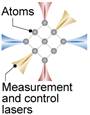
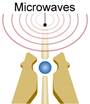


Source: GAO (analysis), various sources (images; see note). | GAO‑26‑107759
Note: GAO analyzed a National Academies of Sciences, Engineering, and Medicine report; white papers; journal articles; and industry documents. Image Source: From “Scientists are close to building a quantum computer that can beat a conventional one,” G. Popkin, Science, December 1, 2016 (doi:10.1126/science.aal0442). Redrawn and modified with permission from AAAS (all other images). Image courtesy of Oak Ridge National Laboratory, Department of Energy. Carlos Jones, Oak Ridge National Laboratory Photographer (photonic), Dana Anderson, University of Colorado Boulder (neutral atoms).
Infrastructure and hardware needs differ for each type of qubit. For example, superconducting qubits need dilution refrigerators to cool the qubits to millikelvin temperatures (i.e., close to -459 degrees Fahrenheit), while trapped ions need specialized lasers to position and control the ions (see fig.1).
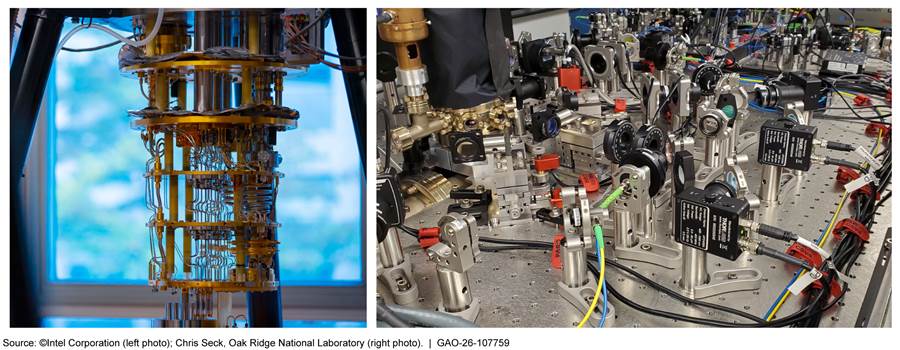
Note: Examples of dilution refrigerators to cool superconducting qubits (left) and specialized lasers to position and control trapped ions (right).
The capabilities of quantum computers in development today are far from those needed to solve critical industrial problems. Experimental quantum computing systems can outperform classical computers for specific problems, but these problems are often academic in nature and constructed to show a quantum advantage for a problem that may not be critical to any application. While many quantum computers used in experiments hold about 100 qubits or less, a quantum computer that could simulate critical chemical reactions (e.g., to develop fertilizers and medicines) will likely need more than 100,000 qubits, and one that could break certain cryptographic methods may need more than 1 million qubits.[7] Advanced quantum computing applications will likely require logical qubits, which are a group of physical qubits that mimics a single robust, stable qubit. Estimates of the number of physical qubits needed for one logical qubit include 300, 1,000, 10,000, and higher. As qubits improve, the number of physical qubits needed for some applications may decrease. We previously reported on the size of quantum computers needed for different applications.[8]
Federal Advancements in Quantum Computing
Federal programs and research initiatives at a range of agencies, including NIST, NSF, DOE, and DOD, have contributed to advancements in quantum computing in recent years. For example:
· NIST researchers have investigated technologies used in superconducting qubits, such as low-noise cryogenic microwave amplifiers and cryostats. Reducing the noise in cryogenic microwave amplifiers can help maintain quantum systems for longer durations, making quantum computing operations easier. Cryostats are critical for reaching the requisite temperatures for superconducting qubits.[9]
· NSF announced a $20 million award in 2024 for a National Quantum Nanofab facility to accelerate co-design and development of neutral atom and photonic qubits.
· DOE national laboratory researchers have combined quantum and classical computing to improve the accuracy of chemical reaction simulations.[10] Overall, DOE’s quantum computing topics span basic research in algorithms, computer science, computing models, complexity theory, software, hardware, quantum simulators, and quantum computing applications in several domains relevant to DOE’s mission space and the broader community.
· DOD’s Defense Advanced Research Projects Agency funded research to understand and improve the capabilities of hybrid quantum-classical computers.
Policy Landscape
For decades, the federal government has supported work on quantum technologies, resulting in advances toward quantum computing and the bolstering of industry efforts to develop quantum computers. In June 2018, the National Science and Technology Council formed SCQIS to convey the importance of developing a unified national plan for quantum information science. SCQIS, led by co-chairs from NIST, DOE, NSF, and OSTP, and with members from additional agencies, is tasked to provide interagency coordination by (1) establishing and maintaining a national agenda in quantum information science and technology, (2) expanding U.S. economic and national security, and (3) coordinating federal quantum information science and technology policy and programs.[11] In September 2018, SCQIS released its Strategic Overview, which established broad policy goals for quantum information science and called for the development of agency-level plans that address those goals. The Strategic Overview also stated that those agency-level plans would then be integrated into an overall strategic plan to enable quantum development opportunities over a 10-year time frame.[12] An OSTP official told us that SCQIS released the Strategic Overview in anticipation of the enactment of the NQI Act.
In December 2018, the NQI Act was enacted to help ensure the continued leadership of the U.S. in quantum information science and its technology applications, which include quantum computing.[13] The NQI Act established the National Quantum Initiative Program and required SCQIS to coordinate NQI efforts by, among other things, (1) developing two 5-year strategic plans to cover a 10-year window through December 2029 and (2) assessing and developing the U.S. quantum information science workforce. In addition, the act required establishment of the National Quantum Initiative Advisory Committee and the National Quantum Coordination Office (NQCO). The Advisory Committee consists of representatives from industry, universities, and federal laboratories who are qualified to provide advice and information on quantum information science and technology. The NQCO carries out the daily activities needed to coordinate and support the initiative. It is led by a director appointed by the Director of OSTP, in consultation with the Secretaries of Commerce and Energy and the Director of NSF. Staff are employees detailed from federal departments and agencies.[14] OSTP plays a central role in the National Quantum Initiative because of its activity as a co-chair of SCQIS and as the entity that houses NQCO.
While developing a CRQC is not an intended outcome of the NQI Act, developing an advanced quantum computer could ultimately enable creation of a quantum computer capable of breaking important cryptographic methods. Both the 2018 SCQIS Strategic Overview and the NQI Act include quantum computing as a major part of their definitions of quantum information science, and the Office of Management and Budget (OMB) collects and analyzes budget data on quantum computing as one of five NQI Program Component Areas. Since FY 2020, the federal government has expended about $200 million per year on quantum computing research and development, or about one-fifth of the $1 billion per year in funding for quantum information science (see fig. 2).
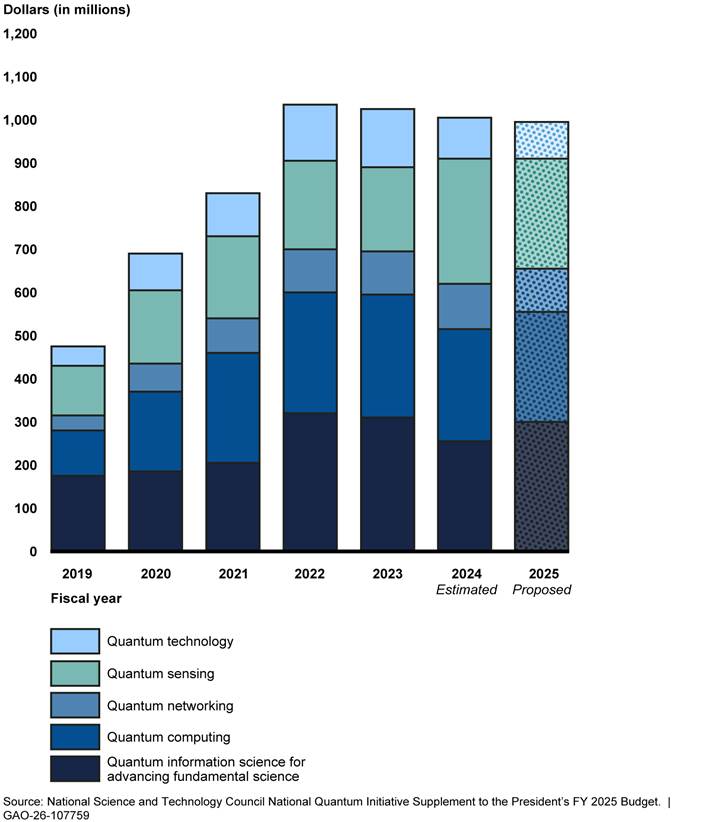
Note: U.S. quantum information research and development budget allocations by NQI program component area. The bar heights represent actual expenditures for fiscal years 2019 to 2023, estimated expenditures for fiscal year 2024, and the budget request for fiscal year 2025. Fiscal year 2025 data were the most recent available.
The Quantum Computing Component of the National Quantum Strategy Does Not Address All Desirable Characteristics
The NQI Act required the President, acting through federal bodies, to establish the goals, priorities, and metrics for a 10-year plan to accelerate development of quantum information science and technology applications in the U.S.[15] It further required SCQIS to develop a 5-year strategic plan by December 2019 and a subsequent 5-year strategic plan by December 2024, and to periodically update each plan as necessary. The co-chairs of SCQIS were required to submit each strategic plan and any updates to these plans to the President, the National Quantum Initiative Advisory Committee, and appropriate committees of Congress.[16]
An OSTP official told us that multiple NQI planning and reporting documents augment the national quantum strategy set by the Strategic Overview (see table 2 for those documents that are relevant to the quantum computing component of the national quantum strategy). OSTP officials also told us that meetings among SCQIS agencies ensure coordination, as well as mutual understanding of the intent of the strategy and each agency’s role. However, the officials did not provide us with documentation of meeting outcomes and told us that such documentation may not always exist. Lacking documentation, these meetings do not satisfy the NQI Act requirement to submit each strategic plan and updates to the President, the Advisory Committee, and appropriate committees of Congress.
Table 2: National Quantum Initiative (NQI) Planning and Reporting Documents Relevant to the Quantum Computing Component of the National Quantum Strategy
|
Document name |
Release date(s) |
Producer |
Key points |
|
National Strategic Overview for Quantum Information Science (Strategic Overview) |
Sept. 2018 |
Subcommittee for Quantum Information Science (SCQIS) |
This document set the nation’s strategy for ensuring continued leadership in quantum information science. The strategy defines six policy goals. According to Office of Science and Technology Policy officials, SCQIS developed this document in anticipation of the enactment of the NQI Act, which occurred 3 months later. |
|
Quantum Frontiers: Report on Community Input to the Nation’s Strategy for Quantum Information Science (Quantum Frontiers) |
Oct. 2020 |
National Quantum Coordination Office (NQCO) |
This report cites community responses to the public request for information regarding the Strategic Overview. This report summarizes and organizes the community input to focus the nation’s quantum information science federal and nonfederal leaders on frontier areas. |
|
FY21-25 National Quantum Initiative Supplements to the President’s Budget (Annual Reports) |
Jan. 2021, Dec. 2021, Jan. 2023, Dec. 2023, Dec. 2024 |
SCQIS |
These reports serve as the statutorily required annual budget reports containing the budget for the NQI. These reports also contain some reporting of the progress made toward achieving the goals and priorities of the NQI. |
Source: GAO analysis of NQI planning and reporting documents. | GAO‑26‑107759
We previously identified a set of desirable characteristics to aid organizations in developing and implementing national strategies—and to help enhance their usefulness in policy and resource decisions, as well as ensure accountability.[17] These six characteristics, when included in a national strategy, help federal agencies implement the strategy and achieve its goals. The more detail a strategy provides, the easier it is for the responsible parties to implement it and achieve its goals. Taking steps to provide sufficient detail could provide agencies and nonfederal stakeholders with a better understanding of federal priorities and help hold entities accountable to the national strategy.
We found that the quantum computing component of the national quantum strategy fully addresses two of these characteristics: (1) purpose, scope, and methodology and (2) problem definition and risk assessment. But it does not fully address the remaining characteristics (see table 3).
Table 3: Extent to Which National Quantum Initiative (NQI) Planning and Reporting Documents Address GAO’s Desirable Characteristics of a National Strategy
|
Desirable characteristics of a national strategy |
Overall |
2018 Strategic Overview |
2020 Quantum Frontiers |
FY 2021 – FY 2025 Annual Program Budget Reports |
|
Purpose, scope, and methodology |
● |
● |
a |
a |
|
Problem definition and risk assessment |
● |
● |
a |
a |
|
Goals, subordinate objectives, and performance measures |
◐ |
◐ |
◐ |
◐ |
|
Resources, investments, and risk management |
◐ |
○ |
○ |
◐ |
|
Roles, responsibilities, and coordination |
◐ |
◐ |
○ |
◐ |
|
Integration and implementation |
◐ |
◐ |
○ |
◐ |
● – Fully addresses ○ – Does not address ◐ – Partially addresses
Source: GAO analysis of NQI planning and reporting documents. | GAO‑26‑107759
aIf the Strategic Overview fully addresses a characteristic, we did not assess whether the other NQI planning and reporting documents did so.
The following sections provide details on how the quantum computing component of the national quantum strategy addresses the six characteristics. They also describe how certain requirements in the NQI Act align with the characteristics.
Purpose, Scope, and Methodology – Fully Addresses
|
Policy Goals for Quantum · Choosing science-first approach to QIS · Creating quantum-smart workforce for tomorrow · Deepening engagement with quantum industry · Providing critical infrastructure · Maintaining national security and economic growth · Advancing international cooperation Source: National Science & Technology Council, Committee on Science, Subcommittee on Quantum Information Science, National Strategic Overview for Quantum Information Science (Washington, D.C.: Sept. 2018). | GAO-26-107759 |
The Strategic Overview fully addresses the first desirable characteristic of a national strategy: purpose, scope, and methodology. Specifically, it addresses why the strategy was produced, the scope of its coverage, and the process by which it was developed. For example, the Strategic Overview describes the strategy’s purpose, which is to create a visible, systematic, national approach to quantum information research and development. It describes the strategy’s scope, which covers six policy goals to support quantum information science, including quantum computing. It also describes the methodology SCQIS used to develop the strategy, which involved incorporating contributions from the SCQIS member agencies and assessing the national quantum information science portfolio using broad categories, including a quantum computing category.
Problem Definition and Risk Assessment – Fully Addresses
The Strategic Overview fully addresses the second characteristic: problem definition and risk assessment. Specifically, it addresses the particular national problems and threats the strategy is directed toward. For example, the Strategic Overview defines four key challenges to address for quantum information science: (1) coordination both within the federal government and between public and private institutions, (2) expanding the quantum workforce, (3) developing connections between different scientific disciplines, and (4) maintaining a culture of discovery. It also describes the challenges for advancing each of the policy goals.[18] These challenges apply to quantum computing because, as previously discussed, quantum computing is a key component of quantum information science. As another example, the Strategic Overview assesses risks associated with quantum computing and states that development of a quantum computer far beyond the current level of technology—that is, one of sufficient size and sophistication—could pose risks to the security of sensitive data.
Goals, Subordinate Objectives, and Performance Measures – Partially Addresses
The NQI planning and reporting documents partially address the third characteristic: goals, subordinate objectives, activities, and performance measures. Specifically, they partially address what the strategy is trying to achieve, steps to achieve those results, and the priorities, milestones, and performance measures to gauge results.
The NQI Act requires SCQIS to “establish goals and priorities of the Program, based on identified knowledge and workforce gaps and other national needs.” SCQIS has taken steps in that direction. For example, as described above, the Strategic Overview contains six policy goals for quantum information science. However, it does not address subordinate objectives for the quantum computing component of the NQI. OSTP and other agency officials told us that establishing subordinate objectives specific to quantum computing on a national level is not practical because the technology is nascent and the direct economic advantage of developing a quantum computer is unclear. An OSTP official told us that, instead, agencies would establish their own subordinate objectives, or agency-level goals, for quantum computing that align with the agencies’ missions. For example, DOE specified some of its subordinate objectives for quantum computing in its 2024 Quantum Information Science Applications Roadmap. This roadmap details technical challenges, guideposts, and milestones related to applications in quantum computing and other technologies that align with DOE’s work. In particular, the roadmap lists technology milestones to be reached in 5-year increments, such as 1,000 physical qubits with low error rates in 5 years and 10,000 physical qubits in 10 years. The roadmap also lists goals for enabling research, such as developing quantum user facilities.
However, such agency-level plans do not necessarily document a common understanding across agencies or ensure that the subordinate objectives support the higher-level goals of the national quantum strategy. Establishing subordinate objectives for quantum computing on a national level could help agencies track progress and ensure efficient use of resources toward achieving shared goals. One potential subordinate objective that may be helpful is to explore the direct economic advantage of quantum computing, which could clarify the potential return on future investments and support decision making related to the policy goal of maintaining national security and economic growth. At least one effort is underway that would contribute to this objective. The Defense Advanced Research Projects Agency’s Quantum Benchmarking Initiative seeks to verify and validate whether any quantum computing approach can achieve utility-scale operation—meaning its computational value exceeds its cost—by the year 2033.
Furthermore, establishing subordinate objectives for quantum computing in the national quantum strategy could benefit nonfederal stakeholders. As private companies advance quantum computing as a commercial product, and as the federal government funds quantum computing research and development (expending about $200 million per year in recent years), establishing subordinate objectives could help ensure efficient use of resources toward shared goals. Industry stakeholders told us that government and industry should pursue different but complementary work to prevent duplication of efforts between agencies and industry. Industry and academic stakeholders are critical for quantum information science and quantum computing efforts, according to the Strategic Overview. But without documented and communicated subordinate objectives, these stakeholders may be unaware of opportunities to support national goals or provide products and services to the federal government.
Regarding performance measures, the NQI Act requires SCQIS to submit to Congress an annual NQI budget report containing, among other things, “an analysis of the progress made toward achieving the goals and priorities” of the NQI. The NQI planning and reporting documents describe activities that support the strategic goals, but they do not identify performance measures to gauge results. Specifically, the FY21-25 Annual Program Budget Reports highlight agencies’ quantum computing activities, such as the launch of prize challenges and labs, to help achieve the policy goals, but they do not describe performance measures to gauge the results of these activities. Without performance measures to gauge results of federal quantum computing activities, federal agencies, industry, and academia will find it difficult to track progress and determine whether they are achieving results in specific time frames. SCQIS may also find it difficult to oversee agency efforts and determine when intervention is needed.
Resources, Investments, and Risk Management – Partially Addresses
The NQI planning and reporting documents partially address the fourth characteristic: resources, investments, and risk management. Specifically, they partially address what the strategy will cost, the sources and types of resources and investments needed, and where resources and investments should be targeted based on balancing risk reductions with costs.
The NQI planning and reporting documents provide some descriptions of the resources and total investments needed to carry out the strategy. For example, as described above, the NQI Act requires SCQIS to submit to Congress an annual NQI budget report containing, among other things, the budget for the current fiscal year and the proposed budget for the next fiscal year. The FY21-25 Annual Program Budget Reports describe the federal investment in quantum computing for previous fiscal years, as well as the proposed expenditure for the current fiscal year. However, they do not address investments needed for the next fiscal year. While these reports partially address the NQI Act’s budget reporting requirement, a longer-term cost estimate for quantum computing work that describes overall costs and how different agencies and stakeholders can contribute to efforts in the field could help Congress and the administration develop more effective federal programs to stimulate desired investments, enhance preparedness, and leverage finite resources. A strategy for managing investments would include explaining how efforts will be funded and sustained in the future.
An important category of resources needed to advance quantum computing is infrastructure, including research facilities and equipment. The NQI Act requires SCQIS to assess and recommend federal infrastructure needs to support the National Quantum Initiative Program. SCQIS and others have taken steps in that direction. For example, the Quantum Economic Development Consortium (QED-C) and its parent organization have developed reports relevant to certain aspects of industry’s infrastructure needs for quantum computing, including the supply chain and the use of public-private partnerships.[19] More recently, the FY 2025 Annual Program Budget Report described the importance of infrastructure development and the status of existing infrastructure in the federal government.[20] Furthermore, individual agencies have taken steps to inventory existing infrastructure or to outline general future needs. For example, NIST commissioned a report on its facility needs, which noted the effect of deferred maintenance of facilities on ongoing research. Similarly, DOE produced a roadmap that stated a need for additional infrastructure, like widely accessible quantum user facilities and testbeds.
However, SCQIS has not yet conducted a broader infrastructure assessment for quantum computing. A description of the resources and investments needed to meet the goals, subordinate objectives, and activities of the quantum computing component of the national quantum strategy could help SCQIS assess and recommend federal infrastructure needs to support the NQI. Without subordinate objectives or activities for quantum computing on a national level, the initiative will be missing information vital to determining the infrastructure needed to meet the goals of the quantum computing component of the national quantum strategy.
Also, a national strategy would ideally give guidance to implementing parties to manage their resources and investments based on the threats to, and vulnerabilities of, critical assets and operations.[21] However, the NQI planning and reporting documents do not provide guidance to implementing parties on how to manage their resources and investments based on the threats to, and vulnerabilities of, critical assets and operations.
The NQI Act also requires SCQIS to “propose a coordinated interagency budget for the Program to [OMB] to ensure the maintenance of a balanced quantum information science research portfolio and an appropriate level of research effort.” The FY21-25 Annual Program Budget Reports show quantum information science research and development budgets for agencies engaged in NQI activities (e.g., NASA, NIST, DOE, DOD, and NSF) and describe quantum information science research and development activities by agency.
However, none of the NQI planning and reporting documents address where to target resources and investments for activities that involve both federal and nonfederal entities. Some industry representatives told us they face challenges accessing certain resources, such as specialized facilities necessary to research, develop, and manufacture quantum computing technologies. Without a strategy that addresses where to target resources and investments, the federal government will find it difficult to “assess and recommend federal infrastructure needs” to support the NQI as statutorily required.
Roles, Responsibilities, and Coordination – Partially Addresses
The NQI planning and reporting documents partially address the fifth characteristic: organizational roles, responsibilities, and coordination. Specifically, they partially address who will be implementing the strategy, what their roles will be compared to others, and mechanisms for them to coordinate their efforts.
Regarding organizational roles and responsibilities, the Strategic Overview lists which agencies may play a role in quantum computing, states that SCQIS member agencies will develop written, agency-level plans for integration into an overall strategic plan, and calls for deepening engagement with the quantum industry. As another example, the FY21-25 Annual Program Budget Reports describe agencies’ quantum information science activities. However, the NQI planning and reporting documents do not explain respective roles for implementation of the strategy. For example, the Strategic Overview notes that DOD, DOE, NASA, NIST, NSF, NSA, and the Office of the Director of National Intelligence contribute to advancing the quantum computing component of the national quantum information science portfolio, but it does not describe those agencies’ roles or responsibilities.
Regarding coordination, the NQI Act requires SCQIS to “coordinate the quantum information science and technology research, information sharing about international standards development and use, and education activities and programs of the federal agencies.” The NQI planning and reporting documents indicate that SCQIS and others have taken steps in that direction. For example, the FY21-25 Annual Program Budget Reports state that SCQIS coordinates federal research and development in quantum information science and related technologies. Quantum Frontiers summarizes community input from a public request for information, with the goal of focusing the nation’s quantum information science leaders on priority areas, but does not address mechanisms to coordinate activities in these areas.[22] OSTP officials told us that meetings to share information about related activities among SCQIS constituent agencies ensure coordination, as well as mutual understanding of the intent of the strategy and each agency’s role. However, documentation of the meeting outcomes was unavailable. Without documentation, it may prove difficult to communicate decisions made at these meetings to other federal and nonfederal organizations, and to hold the relevant federal bodies accountable to such decisions. Some industry representatives we spoke with said that some of their investment decisions are challenging to make due to uncertainties. Knowledge about decisions made at the federal level, such as those in some coordination meetings, could allow them to align their efforts.
Integration and Implementation — Partially Addresses
The NQI planning and reporting documents partially address the sixth characteristic: integration and implementation. Specifically, they partially address how a national strategy relates to other national strategies’ goals, objectives, and activities, and to subordinate levels of government and their plans to implement the strategy.
Regarding other national strategies, the FY 23-25 Annual Program Budget Reports state that quantum computing will address long-term military challenges in areas such as access to high-performance computing, which is the topic of another national strategy—the National Strategic Computing Initiative. As another example, the Strategic Overview relates the NQI to subordinate levels of government by describing how quantum computing could improve defense initiatives by improving computational ability or new materials and systems.
The NQI planning and reporting documents also partially address implementation of the strategy. For example, the Strategic Overview states that the SCQIS member agencies will develop agency-level plans that will then be integrated into an overall strategic plan to address strategic goals.[23] However, an OSTP official told GAO that these agency-level and overall strategic plans have not been completed as of August 2025. Furthermore, an OSTP official told GAO that agency-level plans would not necessarily reflect a common understanding between agencies regarding the purpose of overall federal work on quantum computing.
Agencies Support Quantum Information Science Workforce Development; Assessment in Progress
One of the goals of the NQI Act is to expand the quantum information science workforce to establish a workforce pipeline.[24] The act gives broad direction to agencies to grow and strengthen the quantum information science workforce and requires SCQIS to assess the status and development of that workforce. The agencies established several programs at different levels to address the workforce development requirement, including workforce assessments that are in progress.
Federal Bodies Have Taken Actions to Develop the Quantum Workforce
The purpose of the NQI Act is to ensure the leadership of the U.S. in quantum information science and its technology applications by, among other things, (1) expanding the number of researchers, educators, and students with training in quantum information science and technology to develop a workforce pipeline and (2) promoting the development and inclusion of multidisciplinary curriculum and research opportunities for quantum information science at the undergraduate, graduate, and postdoctoral levels. To these ends, the NQI Act requires investment in activities to develop a quantum information science and technology workforce pipeline. Similarly, the 2018 Strategic Overview identifies “creating a quantum-smart workforce for tomorrow” as a policy goal.
Federal agencies support several activities to develop the quantum workforce. Examples of these activities, many of which were initiated following enactment of the NQI Act, include the following:
· K-12. For students in elementary through high school, federal agencies have established programs that introduce students to quantum information science to establish the start of a quantum information science pipeline. For example:
· In 2020, NSF and OSTP created the National Q-12 Education Partnership, a collaboration that develops quantum-related outreach activities and educational materials for K-12 students and educators.
· DOE’s five National Quantum Information Science Research Centers, established in 2020, have supported summer programs like Quantum, Computing, Mathematics, & Physics for high school students and educators.
· Undergraduate. Federal agencies offer summer research programs for students to expand their science and technology skills. For example:
· Since 2019, NSF has supported the Software-Tailored Architectures for Quantum Codesign program at Duke University, which provides lectures to students on a range of quantum topics.
· Since 2021, the National Security Agency’s Laboratory for Physical Sciences (LPS) Qubit Collaboratory has provided a summer course on quantum computing.
· Graduate and early career. Federal agencies have supported initiatives that raise awareness of quantum career pathways. For example:
· Since 2021, the five DOE National Quantum Information Science Research Centers have hosted an annual Quantum Information Science Career Fair. Similarly, in 2024 and 2025 (and planned for Fall 2026), the NSF-supported Quantum Leap Career Nexus offered networking opportunities and workshops on quantum careers for students, postdocs, and early career professionals.
· Collaborative research organizations, such as the Joint Quantum Institute, a partnership established in 2006 between the University of Maryland, NIST, and LPS, provides students and faculty with on-the-job training, interdisciplinary measurement skills, professional development, financial support, and laboratory resources.
· The University of New Mexico Center for Quantum Information and Control, established in 2009, partners with neighboring quantum researchers from the University of Arizona, Sandia National Laboratories, and Los Alamos National Laboratory to provide students with on-the-job training, financial support, and postdoctoral fellowships.
SCQIS Faces Challenges in Studying the Quantum Workforce
The NQI Act, enacted in 2018, directs SCQIS to assess the status, development, and diversity of the U.S. quantum information science workforce.[25]
In 2022, SCQIS published its Quantum Information Science and Technology Workforce Development National Strategic Plan (Workforce Plan).[26] It found that talent shortages exist across academia, industry, and government, and it recommended actions to understand short- and long-term workforce needs, introduce broader audiences to quantum information science, address gaps in professional education and training, and make careers in quantum information science more accessible.
The Workforce Plan finding that talent shortages in the field exist was based on available information at the time, including an industry survey, anecdotal input, and data from online job boards. The Workforce Plan described the available information as “useful, if incomplete,” as no singular, comprehensive source of data that provides definitive, quantitative information regarding the quantum workforce landscape exists. The data are incomplete, in part, because the quantum workforce draws on fields from a range of science and engineering disciplines, coding and data analysis, circuit design, and laboratory experience.
The Workforce Plan also identified a challenge in establishing metrics for assessing the outcomes of training programs. One measure of success could be the growth of these programs, and another could be the population of students identified as aware of or proficient in quantum skills. However, establishing these metrics is difficult because it is unclear which skills and training define the quantum workforce. For example, an examination of PhD dissertation titles could provide some data. But, distinguishing between quantum information science and more general science subjects for relevant data analysis could be subjective. As a result, determining who and what skills qualify as part of the quantum workforce remains a challenge.
An OSTP official and industry representatives told us about similar challenges. For example, an OSTP official told us that uncertainty as to what constitutes a “quantum job” posed challenges to assessing the workforce. This is because job postings for quantum careers list widely varying requirements for quantum proficiency, ranging from quantum expertise at the PhD level, to awareness of quantum information science based on a single academic course, to some other science background or technical laboratory skills. Similarly, industry representatives we spoke with described the difficulty in clearly defining who qualifies as a quantum worker. For example, it is unclear whether a mechanical engineer with no training in quantum science who works on support systems for quantum research should be classified as a quantum worker for the purposes of a workforce assessment.
To help address these and other challenges, following release of the Workforce Plan in February 2022, the CHIPS and Science Act supplement to the NQI Act required the Director of NSF to enter into an agreement with the National Academies of Sciences, Engineering, and Medicine (NASEM) by February 2023 to evaluate and make recommendations for the quantum information science workforce.[27] The results of this evaluation could help mitigate the challenges described in the SCQIS Workforce Plan because the act called for a characterization of the quantum workforce. This characterization was to include a description of what constitutes a “quantum information science qualified worker,” a description of the size of the workforce, and an assessment of current and future trends.
According to NSF officials, NSF has not yet entered into an agreement with NASEM for this study because their appropriated funds were not sufficient to complete all statutorily required studies, and because NSF found that to maximize the value of a potential NASEM study, some preliminary work was needed. Therefore, in FY 2023, NSF made two 3-year awards to the University of Colorado Boulder (CU Boulder) and the Rochester Institute of Technology (RIT) to conduct a collaborative study of the quantum information science workforce, to be completed by August 2026. According to NSF officials, the CU Boulder and RIT study will not fully address the goal of the statutorily required NASEM study, but it could provide a foundation for such a study. NSF officials told us they intend to revisit whether to commission the NASEM study as the CU Boulder and RIT study proceeds and appropriations permit.
NSF officials told us they expect that the CU Boulder and RIT collaborative study could produce findings that begin to address some of the challenges identified in the 2022 SCQIS Workforce Plan. For example, the study proposal describes a plan to provide a better characterization of the quantum workforce by analyzing necessary knowledge, skills, and abilities. NSF officials also told us they expect that such efforts could provide a first step toward building the data necessary to conduct the required NASEM study.
Conclusions
Although federal agencies are working to continue advancing quantum computing, the NQI planning and reporting documents relevant to the quantum computing component of the national quantum strategy do not fully address important strategic aspects such as objectives, performance measures, needed resources, roles and responsibilities, and integration and implementation. Targeted updates to the strategy that address these desirable characteristics could improve interagency planning and coordination of federal research and development for quantum computing. They could also provide agencies, academic researchers, industry, and Congress with a shared understanding of the plans, roles, and responsibilities of the federal agencies involved in the effort. The outcomes of such updates could include more efficient use of taxpayer dollars and private resources, faster progress in delivering the benefits of this technology, and better management of federal quantum computing efforts. As the lead organization coordinating interagency science policy, OSTP is positioned to lead the effort to update the national quantum strategy, which includes quantum computing.
Recommendation for Executive Action
The Director of OSTP should, in coordination with the SCQIS agencies, augment and update the national quantum strategy, which includes quantum computing, to address all the desirable characteristics of a national strategy.
Agency Comments
We provided a draft of this report to CISA, DOE, NIST, NSA, NSF, and OSTP for review and comment. DOE and OSTP provided technical comments, which we incorporated as appropriate. OSTP neither agreed nor disagreed with our recommendation and said it had no concerns regarding the language of the recommendation.
We are sending copies of this report to the appropriate congressional committees, the Secretary of Energy, the Directors of CISA, NIST, NSA, NSF, and OSTP, and other interested parties. In addition, the report is available at no charge on the GAO website at http://www.gao.gov.
If you or your staff have any questions about this report, please contact me at WrightC@gao.gov. Contact points for our Offices of Congressional Relations and Media Relations may be found on the last page of this report. GAO staff who made key contributions to this report are listed in appendix III.
Sincerely,

Candice N. Wright
Director, Science, Technology Assessment, and Analytics
Our objectives were to assess (1) the extent to which the quantum computing component of the national quantum strategy addresses GAO’s six desirable characteristics of a national strategy and (2) the status of federal efforts to develop and assess the U.S. quantum information science workforce.
The scope of our review included the agencies that co-chair the National Science and Technology Council Subcommittee on Quantum Information Science (SCQIS), which include the Office of Science and Technology Policy (OSTP), the National Institute of Standards and Technology (NIST), the National Science Foundation (NSF), and the Department of Energy (DOE).
For both objectives, we also interviewed the following:
· Officials from agencies that co-chair SCQIS, including OSTP, NIST, NSF, and DOE
· Officials from other agencies leading the nation’s initiative to implement new cryptographic methods, including the Cybersecurity and Infrastructure Security Agency (CISA) and the National Security Agency (NSA)
· Representatives from a partnership between NIST and a university that is advancing research and education in quantum computer science and quantum information theory
· Representatives from Brookhaven, Lawrence Berkeley, and Sandia National Laboratories with expertise in multiple quantum computing approaches and workforce development
· Representatives from six companies representing four different approaches to building a quantum computer—three of which also provide access to other companies’ prototype quantum computers through a cloud platform
· Representatives from the Quantum Economic Development Consortium (QED-C), which fosters collaboration between businesses, research institutions, and government agencies
We visited four companies pursuing quantum computing that represent four different approaches to build a quantum computer. We visited the companies to see their physical infrastructure and understand their workforce needs. We also visited NIST campuses in Gaithersburg, Maryland, and Boulder, Colorado, to observe their quantum information science and quantum computing facilities.
To examine the extent to which the quantum computing component of the national quantum strategy addresses GAO’s six desirable characteristics of a national strategy, we determined whether the National Quantum Initiative (NQI) planning and reporting documents address, partially address, or do not address the desirable characteristics of a national strategy, as identified in our past work.[28] These planning and reporting documents include the National Strategic Overview for Quantum Information Science (Strategic Overview), which was issued in September 2018 and set the nation’s strategy for ensuring continued leadership in quantum information science, and several subsequent documents that augment the Strategic Overview. OSTP officials told us that the Strategic Overview serves as the primary strategy document and that all other NQI planning and reporting documents augment the Strategic Overview. Therefore, if the Strategic Overview fully addresses a particular characteristic, we concluded that the quantum computing component of the national quantum strategy fully addresses that characteristic. If the Strategic Overview does not fully address a particular characteristic, we reviewed whether one or a combination of the augmentative NQI planning and reporting documents partially or fully addresses that characteristic. Two analysts reviewed the extent to which the documents address, partially address, or do not address GAO’s six desirable characteristics of a national strategy. A third analyst verified that the evidence provided either addresses, partially addresses, or does not address the characteristics. The third analyst raised points where the analysis was unclear. The two analysts then reviewed the points and provided additional evidence or reached a consensus with the reviewer regarding the extent to which the NQI planning and reporting documents address the characteristics. Finally, all three analysts reached consensus on the analysis.
To describe the status of federal efforts to develop and assess the quantum information science workforce, we reviewed workforce development programs and workforce assessments. We reviewed federal documents and websites, talked to industry representatives, and interviewed experts from joint academic institutes about efforts to develop the quantum workforce pipeline. We examined the award abstracts and annual project reports from a collaborative NSF study focused on the quantum information science workforce.
We conducted this performance audit from August 2024 to March 2026 in accordance with generally accepted government auditing standards. Those standards require that we plan and perform the audit to obtain sufficient, appropriate evidence to provide a reasonable basis for our findings and conclusions based on our audit objectives. We believe that the evidence obtained provides a reasonable basis for our findings and conclusions based on our audit objectives.
Science and Technology: Considerations for Maintaining U.S. Competitiveness in Quantum Computing, Synthetic Biology, and Other Potentially Transformational Research Areas, GAO‑18‑656, Washington, D.C.: September 26, 2018.
National Security: Long-Range Emerging Threats Facing the United States as Identified by Federal Agencies, GAO‑19‑204SP, Washington, D.C.; December 13, 2018.
Science & Tech Spotlight: Quantum Technologies, GAO‑20‑527SP, Washington, D.C.: May 28, 2020.
High-Risk Series: Federal Government Needs to Urgently Pursue Critical Actions to Address Major Cybersecurity Challenges, GAO‑21‑288, Washington, D.C.: March 24, 2021.
Quantum Computing and Communications: Status and Prospects, GAO‑22‑104422, Washington, D.C.: October 19, 2021.
Cybersecurity High-Risk Series: Challenges in Establishing a Comprehensive Cybersecurity Strategy and Performing Effective Oversight, GAO‑23‑106415, Washington, D.C.: January 19, 2023.
Science & Tech Spotlight: Securing Data for a Post-Quantum World, GAO‑23‑106559, Washington, D.C.: March 8, 2023.
Quantum Technologies: Defense Laboratories Should Take Steps to Improve Workforce Planning, GAO‑24‑106284, December 5, 2023.
High-Risk Series: Urgent Action Needed to Address Critical Cybersecurity Challenges Facing the Nation, GAO‑24‑107231, Washington, D.C.: June 13, 2024.
Future of Cybersecurity: Leadership Needed to Fully Define Quantum Threat Mitigation Strategy, GAO‑25‑107703, Washington, D.C.: November 21, 2024.
Future of Cybersecurity: Federal Actions Needed to Prepare for Quantum Computing Threat, GAO-25-107392SU, Washington, D.C.: September 11, 2025.
GAO Contact
Candice N. Wright at WrightC@gao.gov
Staff Acknowledgements
In addition to the contact name above, the following staff members made key contributions to this report: R. Scott Fletcher (Assistant Director), Nicole Catanzarite (Analyst-in-Charge), Caroline Baker, Brian Bothwell, Kaelin Kuhn, Michael Lebowitz, Claire McLellan, Ryan Han, Amanda Siciliano, and Ben Shouse.
The Government Accountability Office, the audit, evaluation, and investigative arm of Congress, exists to support Congress in meeting its constitutional responsibilities and to help improve the performance and accountability of the federal government for the American people. GAO examines the use of public funds; evaluates federal programs and policies; and provides analyses, recommendations, and other assistance to help Congress make informed oversight, policy, and funding decisions. GAO’s commitment to good government is reflected in its core values of accountability, integrity, and reliability.
Obtaining Copies of GAO Reports and Testimony
The fastest and easiest way to obtain copies of GAO documents at no cost is through our website. Each weekday afternoon, GAO posts on its website newly released reports, testimony, and correspondence. You can also subscribe to GAO’s email updates to receive notification of newly posted products.
Order by Phone
The price of each GAO publication reflects GAO’s actual cost of production and distribution and depends on the number of pages in the publication and whether the publication is printed in color or black and white. Pricing and ordering information is posted on GAO’s website, https://www.gao.gov/ordering.htm.
Place orders by calling (202) 512-6000, toll free (866) 801-7077,
or
TDD (202) 512-2537.
Orders may be paid for using American Express, Discover Card, MasterCard, Visa, check, or money order. Call for additional information.
Connect with GAO
Connect with GAO on X,
LinkedIn, Instagram, and YouTube.
Subscribe to our Email Updates. Listen to our Podcasts.
Visit GAO on the web at https://www.gao.gov.
To Report Fraud, Waste, and Abuse in Federal Programs
Contact FraudNet:
Website: https://www.gao.gov/about/what-gao-does/fraudnet
Automated answering system: (800) 424-5454
Media Relations
Sarah Kaczmarek, Managing Director, Media@gao.gov
Congressional Relations
David A. Powner, Acting Managing Director, CongRel@gao.gov
General Inquiries
[1]Since 2021, we have emphasized the threat of a CRQC as part of our Ensuring the Cybersecurity of the Nation high-risk area. GAO, High-Risk Series: Federal Government Needs to Urgently Pursue Critical Actions to Address Major Cybersecurity Challenges, GAO‑21‑288 (Washington, D.C.: Mar. 24, 2021). In 2024, we reported on new cryptographic methods that could protect data from a CRQC. GAO, Future of Cybersecurity: Leadership Needed to Fully Define Quantum Threat Mitigation Strategy, GAO‑25‑107703 (Washington, D.C.: Nov. 21, 2024). Other agencies have also reported on these cryptographic methods. National Institute of Standards and Technology, Migration to Post-Quantum Cryptography: Preparation for Considering the Implementation and Adoption of Quantum Safe Cryptography, 1800-38A (revised May 2, 2023).
[2]National Quantum Initiative Act, Pub. L. No. 115-368, 132 Stat. 5092-5103 (2018), codified at 15 U.S.C. §§ 8801-8802, 8811-8815; 8831, 8841-8842; 8852.
[3]The White House, A Letter to Michael Kratsios, Director of the White House Office of Science and Technology Policy, Mar. 26, 2025, https://www.whitehouse.gov/briefings-statements/2025/03/a-letter-to-michael-kratsios-director-of-the-white-house-office-of-science-and-technology-policy/.
[4]The White House, Memorandum for the Heads of Executive Departments and Agencies, Sept. 23, 2025, https://www.whitehouse.gov/wp-content/uploads/2025/09/M-25-34-NSTM-2-Fiscal-Year-FY-2027-Administration-Research-and-Development-Budget-Priorities-and-Cross-Cutting-Actions.pdf.
[5]GAO‑25‑107703. GAO, Future of Cybersecurity: Federal Actions Needed to Prepare for Quantum Computing Threat, GAO-25-107392SU (Washington, D.C.: Sept. 11, 2025).
[6]GAO. Combating Terrorism: Evaluation of Selected Characteristics in National Strategies Related to Terrorism, GAO‑04‑408T (Washington, D.C.: Feb. 3, 2004). GAO has used these desirable characteristics to evaluate various national strategies, including quantum computing cybersecurity, high-performance computing, and other science and technology issues.
[7]While quantum simulation experiments may include thousands of qubits, these qubits do not directly compare to those likely to be found in the architectures needed for an industrially useful quantum computer.
[8]Quantum Computing: Leadership Needed to Coordinate Cyber Threat Mitigation Strategy, GAO‑25‑108590 (Washington, D.C.: June 24, 2025); Quantum Computing and Communications: Status and Prospects, GAO‑22‑104422 (Washington, D.C.: Oct. 19, 2021).
[9]M. Malnou, T.F.Q. Larson, J.D. Teufel, F. Lecocq, J. Aumentado, “Low-noise cryogenic microwave amplifier characterization with a calibrate noise source,” Review of Scientific Instruments, 95, 034703 (2024). Ryan Snodgrass, Vincent Kotsubo, Scott Backhaus, and Joel Ullom. “Dynamic acoustic optimization of pulse tube refrigerators for rapid cooldown,” Nature Communications 15 3386 (2024).
[10]Karol Kowalski and Nicholas P. Bauman, “Quantum Flow Algorithms for Simulating Many-Body Systems on Quantum Computers,” Physical Review Letters, 131, 200601 (2023).
[11]The NQI Act subsequently stated that SCQIS shall be jointly chaired by the Directors of NIST and NSF and the Secretary of Energy. Although the NQI Act states that SCQIS shall include a representative of OSTP, among others, the Director of OSTP was listed by SCQIS as a co-chair.
[12]National Science & Technology Council, Committee on Science, Subcommittee on Quantum Information Science, National Strategic Overview for Quantum Information Science (Washington, D.C.: Sept. 2018).
[13]National Quantum Initiative Act, Pub. L. No. 115-368, 132 Stat. 5092-5103 (2018), codified at 15 U.S.C. §§ 8801-8802, 8811-8815; 8831, 8841-8842; 8852.
[14]Historically, the Director of NQCO has been detailed to OSTP from other federal entities.
[15]National Quantum Initiative Act, Pub. L. No. 115-368, 132 Stat. 5092-5103 (2018), codified at 15 U.S.C. §§ 8801-8802, 8811-8815; 8831, 8841-8842; 8852. The federal bodies include federal agencies, councils, working groups, subcommittees, and the National Quantum Coordination Office, as the President considers appropriate.
[16]According to the NQI Act, the appropriate committees of Congress include the Committee on Commerce, Science, and Transportation of the Senate; the Committee on Energy and Natural Resources of the Senate; and the Committee on Science, Space, and Technology of the House of Representatives.
[17]GAO‑04‑408T. We have used these desirable characteristics to evaluate various national strategies, including those related to science and technology issues (e.g., GAO‑25‑107703, GAO‑21‑104500).
[18]The key challenges are: improving and facilitating coordination both within the government and between public and private institutions; maintaining and expanding a broad and viable quantum-smart workforce; promoting cross-community connections between disciplines, from physics to computer science to engineering; and maintaining a culture of discovery.
[19]QED-C is an industry consortium that aims to foster collaboration between businesses, research institutions, and government agencies to advance quantum technologies. SRI International, Quantum Technology Manufacturing Roadmap: Scaling Up Quantum (Menlo Park, CA: Oct. 2023). Quantum Economic Development Consortium (QED-C), Toward a Resilient Quantum Computing Supply Chain: Response to the American COMPETE Act (Arlington, VA: Apr. 2022). Quantum Economic Development Consortium (QED-C), Public Private Partnerships in Quantum Computing (Arlington, VA: Sept. 2022).
[20]National Science & Technology Council, Committee on Science, Subcommittee on Quantum Information Science, National Quantum Initiative Supplement to the President’s FY 2025 Budget (Washington, D.C.: Dec. 2024).
[22]The White House National Quantum Coordination Office, Quantum Frontiers: Report on Community Input to the Nation’s Strategy for Quantum Information Science, (Washington D.C.: Oct. 2020).
[23]“The key next step will be to develop agency-level plans that address the identified approaches and policy opportunities in the next section, which will be integrated into an overall strategic plan. This will enable new opportunities on a ten-year horizon, possibly including: the development of quantum processors which may enable limited computing applications . . .” Strategic Overview, pg. 2.
[24]National Quantum Initiative Act, Pub. L. No. 115-368, 132 Stat. 5092-5103 (2018), codified at 15 U.S.C. §§ 8801-8802, 8811-8815; 8831, 8841-8842; 8852.
[25]National Quantum Initiative Act, Pub. L. No. 115-368, 132 Stat. 5092-5103 (2018), codified at 15 U.S.C. §§ 8801-8802, 8811-8815; 8831, 8841-8842; 8852.
[26]National Science & Technology Council, Committee on Science, Subcommittee on Quantum Information Science, Quantum Information Science and Technology Workforce Development National Strategic Plan, (Washington, D.C.: Feb. 2022).
[27]42 USC § 19261.
[28]GAO, Combating Terrorism: Evaluation of Selected Characteristics in National Strategies Related to Terrorism, GAO‑04‑408T (Washington, D.C.: Feb. 3, 2004). GAO has used these desirable characteristics to evaluate various national strategies, including quantum computing cybersecurity, high-performance computing, and other science and technology issues.