
Report to Congressional Requesters
United States Government Accountability Office
A report to congressional requesters
For more information, contact: Rebecca Gambler at GamblerR@gao.gov.
What GAO Found
From October 2018 through May 2025, U.S. Customs and Border Protection (CBP) granted about 2.4 million paroles—temporary permission for a noncitizen to stay in the U.S.—out of its nearly 10.4 million encounters at the southwest border (see figure). Over half were to Mexicans, Cubans, and Venezuelans.
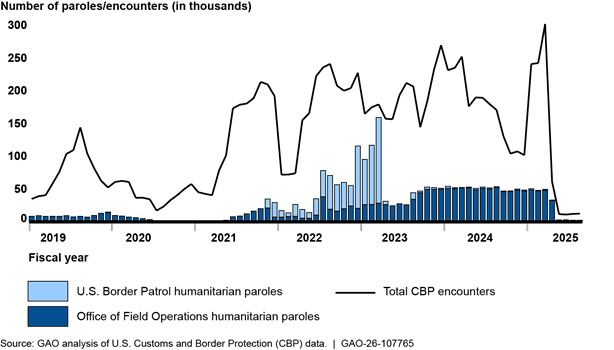
CBP implemented policies in 2021 expanding the use of humanitarian parole to help manage increasing encounters at the southwest border. In July 2021, CBP’s U.S. Border Patrol authorized agents to parole apprehended noncitizens on a case-by-case basis under certain conditions, such as limited immigration detention space. Further, in May 2023, CBP expanded access for noncitizens to use the CBP One mobile application to schedule appointments for CBP Office of Field Operations (OFO) officers to inspect them. Almost all (97 percent) appointments in fiscal years 2023 and 2024 resulted in paroles. Noncitizens paroled under the policies were generally placed in removal proceedings. Since January 2025, Border Patrol and OFO implemented guidance and policies restricting the use of parole and the number of paroles decreased substantially.
Once noncitizens are paroled at the southwest border, U.S. Immigration and Customs Enforcement (ICE) is responsible for monitoring them to ensure they adhere to the conditions of their release. For example, ICE may require assurances that they attend their removal proceedings. In January 2025, the Department of Homeland Security (DHS) and ICE issued guidance that emphasized the importance of ICE reviewing these cases to determine whether further enforcement action is appropriate. However, ICE does not have the information it needs to readily identify noncitizens CBP paroled at the southwest border and does not monitor them as required. By obtaining this information from CBP, ICE would be better positioned to monitor these noncitizens, review their cases, and take enforcement action, in accordance with DHS and ICE guidance.
Why GAO Did This Study
Within DHS, CBP is responsible for securing U.S. borders while facilitating legitimate travel and trade. CBP encounters noncitizens at the southwest border at and between ports of entry. CBP has discretion to grant parole—temporary permission to stay in the U.S.—to noncitizens it encounters for urgent humanitarian reasons or significant public benefit. CBP’s OFO and Border Patrol are responsible for securing the border at and between ports of entry. ICE, also within DHS, is responsible for monitoring paroled noncitizens to ensure they adhere to the conditions of their release.
GAO was asked to review CBP’s use of humanitarian parole at the southwest border and ICE’s enforcement efforts for paroled noncitizens. This report examines (1) what CBP data show about the number and characteristics of humanitarian paroles at the southwest border since fiscal year 2019; (2) how CBP has used humanitarian parole in processing noncitizens encountered at the southwest border; and (3) ICE’s monitoring and enforcement efforts related to those noncitizens. GAO analyzed CBP and ICE documents, and CBP data on paroles granted at the southwest border from October 2018 through May 2025. GAO also interviewed officials from (1) CBP and ICE headquarters, (2) selected CBP field locations that collectively granted more than half of paroles over the time period, and (3) selected ICE field offices responsible for monitoring noncitizens.
What GAO Recommends
GAO is recommending ICE obtain information from CBP on the parole status of noncitizens CBP paroled at the southwest border and make that information accessible to relevant ICE officials, to inform ICE’s monitoring and enforcement decisions. DHS concurred with the recommendation.
|
Abbreviations |
|
CBP U.S. Customs and Border Protection |
|
DHS Department of Homeland Security |
|
ERO Enforcement and Removal Operations |
|
ICE U.S. Immigration and Customs Enforcement |
|
OFO Office of Field Operations |
This is a work of the U.S. government and is not subject to copyright protection in the United States. The published product may be reproduced and distributed in its entirety without further permission from GAO. However, because this work may contain copyrighted images or other material, permission from the copyright holder may be necessary if you wish to reproduce this material separately.
May 18, 2026
Congressional Requesters
According to the Department of State, 20 million people in the Western Hemisphere were displaced as of 2023 due to violence, persecution, and other humanitarian crises. These events contributed to increases in Department of Homeland Security (DHS) encounters at the southwest border as individuals sought entry into the U.S.
Within DHS, U.S. Customs and Border Protection (CBP) is responsible for securing U.S. borders while facilitating legitimate travel and trade. During fiscal years 2021 through 2024, CBP reported an average of about 2.2 million encounters at the southwest border each fiscal year, as compared to an average of about 600,000 encounters during each of the 4 prior fiscal years.[1] More recently, during fiscal year 2025, CBP encounters along the southwest border declined to about 444,000.
DHS may grant parole to any noncitizen applicants for admission it encounters, which provides them with permission to enter and stay temporarily in the U.S. under certain conditions. Specifically, the Homeland Security Act of 2002 authorizes the Secretary of Homeland Security, under the Immigration and Nationality Act, to parole noncitizens, on a case-by-case basis, into the U.S. temporarily for urgent humanitarian reasons or significant public benefit.[2] Pursuant to this authority, DHS may set the duration of the parole, and DHS officials may terminate parole.[3] The Secretary of Homeland Security has delegated parole authority to agencies within the department, including CBP.
Beginning in 2021, CBP implemented policies that involved using parole to help manage the increasing number of noncitizens arriving at and between ports of entry along the southwest border.[4] Within CBP, the Office of Field Operations (OFO) and U.S. Border Patrol were involved in granting parole under these policies. Specifically, OFO officers and Border Patrol agents could parole arriving noncitizens into the U.S., who would then generally undergo removal proceedings in immigration court. Once noncitizens are paroled into the country, U.S. Immigration and Customs Enforcement (ICE), also within DHS, is responsible for monitoring them to ensure they adhere to the conditions of their release and taking enforcement action against paroled noncitizens, as appropriate. As part of monitoring, ICE may require assurances that released noncitizens attend immigration court proceedings or check in with ICE officers.
In addition to paroling noncitizens at the southwest border, in 2022 and 2023, DHS established and implemented processes for humanitarian parole that generally required noncitizens to fly to an interior port of entry (airport) in the U.S.[5] These processes also required the noncitizens to have a U.S.-based supporter who agreed to financially support them for the duration of their parole period.
In December 2025, we reported on DHS’s use of these processes and challenges that existed in their implementation.[6] We found that from May 2022 through September 2024, DHS granted parole to about 774,000 noncitizens across the processes. DHS identified fraud risks and other vulnerabilities in these processes and subsequently suspended or terminated them. However, we found that DHS had not developed an internal control plan to help proactively mitigate fraud risks in new or changed programs in the future. Additionally, DHS faced other challenges in implementing these parole processes, including limited staffing and resources, inconsistent review of the reasons for noncitizens requesting parole, and supporters not upholding their commitments. We recommended that DHS (1) develop an internal control plan that can be applied to a new or changed program, (2) assess lessons learned from the parole processes, and (3) apply the lessons to ongoing operations as appropriate.[7]
You asked us to review CBP’s use of parole at the southwest border and ICE’s enforcement efforts for paroled noncitizens. This report examines (1) what CBP data show about the number and characteristics of humanitarian paroles at the southwest border since fiscal year 2019; (2) how CBP has used humanitarian parole in processing noncitizens encountered at the southwest border; and (3) ICE’s monitoring and enforcement efforts related to noncitizens granted humanitarian parole at the southwest border.
To determine what CBP data show about humanitarian paroles, we obtained summary data from OFO and Border Patrol. We analyzed the data to identify trends in the number and characteristics of grants of humanitarian parole from October 2018 (the beginning of fiscal year 2019) through May 2025. We selected this period to examine the use of parole over time and under different processes, before and after the COVID-19 pandemic, and to include the most recent data available during our review.[8] Our data analysis addressed the total number of paroles OFO and Border Patrol granted at the southwest border by month, as well as characteristics of the paroled noncitizens, including their family status, country of citizenship, and criminal history.[9] We analyzed OFO data on paroles that officers granted during both primary- and secondary-level inspections.[10]
To determine how DHS has used parole at the southwest border since fiscal year 2019, we obtained DHS and CBP guidance, including memorandums, policies, and training materials. We analyzed this guidance to identify the circumstances in which OFO and Border Patrol were to use humanitarian parole at the southwest border, processes for granting parole, and any changes in guidance over time. Further, we analyzed the OFO and Border Patrol data we obtained to determine the number of paroles each agency granted under different processes and policies in place from fiscal year 2019 through May 2025.
Additionally, we conducted interviews with officials from OFO and Border Patrol headquarters and from a nongeneralizable selection of field locations (including four OFO ports of entry and two Border Patrol sectors) that CBP data indicated had paroled relatively large numbers of noncitizens.[11] Through these interviews, we collected information on how OFO and Border Patrol locations used humanitarian parole, including the circumstances and factors officers considered to determine whether parole was appropriate and the processing steps they took. We also discussed DHS and CBP guidance on humanitarian parole that the locations followed and any changes to the guidance or how the locations implemented it over time. The information we obtained from these interviews cannot be generalized to all OFO ports of entry and Border Patrol sectors, but it offers insight into how officers and agents used parole when processing noncitizens over time.
To examine ICE’s monitoring and enforcement efforts related to noncitizens granted humanitarian parole at the southwest border, we collected and analyzed relevant DHS and ICE documentation, including memorandums and guidance. Further, we interviewed officials from ICE Enforcement and Removal Operations (ERO), which is responsible for monitoring and taking enforcement action against paroled noncitizens. Specifically, we interviewed officials from ERO headquarters and a nongeneralizable selection of three ERO field offices regarding how they identify and monitor noncitizens paroled at the southwest border, when and how they take enforcement actions, and any related challenges.[12] The information we obtained from these interviews cannot be generalized to all ERO field offices, but provides insights into how ICE has prioritized and approached monitoring and enforcement for paroled noncitizens. We compared ICE’s processes for monitoring and enforcing adherence to parole requirements against relevant guidance, including ERO’s May 2024 policy for monitoring nondetained noncitizens and DHS’s January 2025 memorandums addressing enforcement actions for ICE to take against paroled noncitizens.[13]
To assess the reliability of the data we analyzed for this report, we reviewed relevant documentation, such as data dictionaries and user manuals; interviewed knowledgeable CBP officials; and manually reviewed the data to identify any obvious errors or missing information. We found the data sufficiently reliable to identify trends in the number and characteristics of grants of humanitarian parole and describe how CBP used parole to process noncitizens encountered at the southwest border over the period of analysis.
We conducted this performance audit from September 2024 to May 2026 in accordance with generally accepted government auditing standards. Those standards require that we plan and perform the audit to obtain sufficient, appropriate evidence to provide a reasonable basis for our findings and conclusions based on our audit objectives. We believe that the evidence obtained provides a reasonable basis for our findings and conclusions based on our audit objectives.
Background
DHS’s Use of Humanitarian Parole
Pursuant to the Immigration and Nationality Act, as amended, the Secretary of Homeland Security has discretionary authority to parole into the U.S. “any alien applying for admission…on a case-by-case basis, for urgent humanitarian reasons or significant public benefit.”[14] Noncitizens receiving a grant of parole at or between a port of entry generally may have been determined to be inadmissible, that is, ineligible to be formally admitted into the U.S. Over time, DHS has generally interpreted “humanitarian” parole as related to urgent medical, family, and related needs, and “significant public benefit” parole as limited to individuals of interest for law enforcement purposes, such as witnesses to judicial proceedings.[15] We refer to the exercise of this parole authority as “humanitarian parole” throughout this report.
Humanitarian parole does not constitute an admission to the U.S., and DHS considers paroled noncitizens to be applicants for admission during their stay. Parole is not an immigration status and is temporary in nature. However, paroled noncitizens may apply for any immigration status for which they may otherwise be eligible while present in the U.S., which may allow them to stay in the U.S. pursuant to such lawful status.[16] Paroled noncitizens may also be placed into removal proceedings before an immigration court and apply for relief or protection from removal through those proceedings.[17] Additionally, they may apply for employment authorization, which allows them to work lawfully in the U.S. during their period of parole.[18] At the end of their period of parole, they are generally required to depart the U.S.[19] After the period of parole ends or parole is terminated, paroled noncitizens who are not already in ongoing removal proceedings may be placed in removal proceedings and ordered removed, as appropriate.
Since enactment of the parole authority, the federal government has used it in various ways. For example, prior administrations have paroled groups of noncitizens in response to emergent humanitarian situations. In the 1960s and 1970s, the U.S. paroled in hundreds of thousands of Cuban and Southeast Asian refugees following the Cuban Revolution and the Vietnam War.[20] Additionally, during and after the U.S. military withdrawal from Afghanistan in 2021, the U.S. paroled about 77,000 Afghan nationals under an effort called Operation Allies Welcome. Further, in 2022 and 2023, in response to humanitarian crises and challenges posed by the high number of border encounters, DHS established and implemented parole processes that required noncitizens to have U.S.-based supporters.[21]
Additionally, beginning in 2021, DHS expanded its use of parole for noncitizens arriving at the southwest border. In particular, CBP implemented policies under which officers and agents paroled certain inadmissible noncitizens into the U.S. and issued them a charging document known as a Notice to Appear, which, when filed with the immigration courts, initiates removal proceedings in court on a set date.[22] The noncitizens CBP paroled included individuals who presented themselves at southwest border land ports of entry, such as those who made appointments for inspections using the mobile application formerly known as CBP One.[23] CBP apprehended others for crossing the border unlawfully between ports of entry and subsequently paroled them, such as under a policy known as Parole plus Alternatives to Detention.[24] We further discuss the policies and circumstances under which CBP officers and agents paroled noncitizens at the southwest border later in this report.
CBP Responsibilities
Within CBP, the Office of Field Operations (OFO) and U.S. Border Patrol are responsible for securing the border at and between ports of entry. As shown in figure 1:
· OFO is responsible for inspecting pedestrians, passengers, and cargo at 28 land ports of entry along the southwest border, eight of which offered CBP One appointments. Four OFO field offices oversee these 28 ports of entry within their designated areas of responsibility.
· Border Patrol is responsible for patrolling the areas between ports of entry to prevent individuals and goods from entering the U.S. illegally. Border Patrol divides responsibility for southwest border security operations geographically among nine sectors. Within each sector, there are Border Patrol stations, and some locations have had centralized processing centers, where Border Patrol processes noncitizens it apprehends.
Figure 1: Office of Field Operations (OFO) Ports of Entry and Border Patrol Sectors Along the Southwest Border
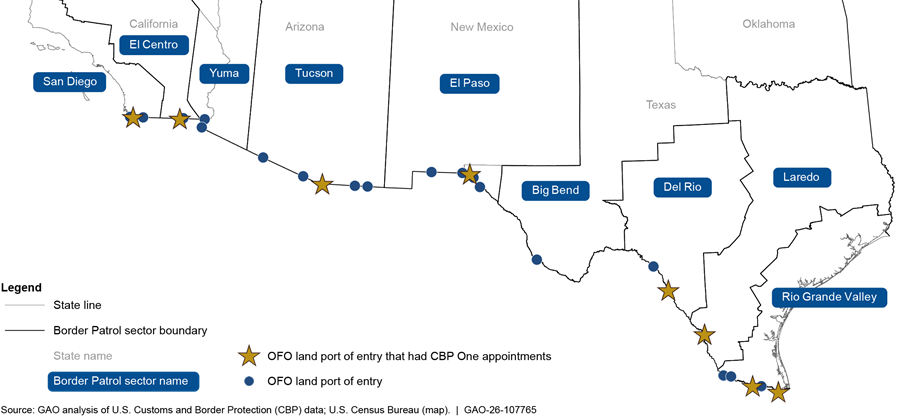
Note: The figure does not include two OFO pedestrian border crossings: Otay Cross Border Xpress, which connects the Tijuana International Airport with a terminal in San Diego; and Boquillas, a crossing that services pedestrians within Big Bend National Park in Texas who visit protected areas across the border in Mexico.
Upon encountering noncitizens at or between ports of entry, OFO officers and Border Patrol agents must determine how to process them. In particular, officers and agents interview each noncitizen and collect personal information such as their name, country of citizenship, and age. Officers and agents also collect biometric information, such as photographs and fingerprints, from certain noncitizens. The fingerprints are used to run records checks against federal government databases to determine whether noncitizens have any previous immigration or criminal history. Officials are then to enter information about the noncitizens in the appropriate automated data system, in accordance with CBP policy.
OFO officers and Border Patrol agents then consider the information they gathered about the noncitizen along with other relevant factors, such as current laws and policies, to determine the appropriate processing pathway. Officers and agents may use various pathways to process noncitizens they determine are inadmissible for entry into the U.S. Since October 2018, these pathways have included placing the noncitizens into expedited removal proceedings or full removal proceedings.[25] Noncitizens processed under these two pathways may have been granted parole, as further discussed below. In addition to these two pathways, officers or agents may have paroled noncitizens without placing them in removal proceedings.
· Expedited removal. Generally, noncitizens placed in expedited removal proceedings are to be detained and ordered removed from the U.S. without a hearing before an immigration judge.[26] Noncitizens placed into expedited removal who indicate an intention to apply for asylum, a fear of persecution or torture, or a fear of return to their country are to be screened for credible fear by an asylum officer within DHS’s U.S. Citizenship and Immigration Services.[27] Through that screening, the asylum officer determines whether the noncitizen has a credible fear of persecution or torture if returned to their country. Noncitizens who receive positive determinations of their fear claims are placed in full removal proceedings.
Prior to January 2025, these noncitizens with positive determinations may have also been paroled into the country to continue their removal proceedings before an immigration judge.
· Full removal proceedings. Noncitizens placed in full removal proceedings are charged with a Notice to Appear in immigration court. While in full removal proceedings, noncitizens have the opportunity to present evidence to an immigration judge within the Department of Justice’s Executive Office for Immigration Review to challenge their removal from the country. They may also apply for various forms of relief or protection, including asylum.[28] Whereas expedited removal is intended to be efficient and does not generally involve a hearing before an immigration judge, full removal proceedings may take months or years.[29]
Generally until January 2025, noncitizens in full removal proceedings may have been released into the U.S. and granted parole. They may also have been released into the U.S. through another means, such as an order of recognizance.[30]
· Parole without removal proceedings. In some cases, OFO officers and Border Patrol agents may parole noncitizens into the U.S. without placing them in expedited or full removal proceedings. For example, such cases may include if a noncitizen whom OFO or Border Patrol encounters is in need of urgent medical treatment. Noncitizens may also be granted parole without removal proceedings for specific law enforcement purposes, such as to allow them to testify as a material witness in federal court or to be prosecuted for a violation (e.g., drug smuggling) that occurred at the port of entry during their encounter. In such cases, noncitizens are paroled into the U.S. only for the time needed to meet the purpose of their parole.
Figure 2 shows the processing pathways OFO officers and Border Patrol agents used to process inadmissible noncitizens at the southwest border that could have resulted in parole from October 2018 through May 2025. CBP’s use of these processing pathways varied within this period as discussed later in this report.
Figure 2: CBP Processing Pathways for Inadmissible Noncitizens Encountered at the Southwest Border That Could Result in Parole, October 2018–May 2025
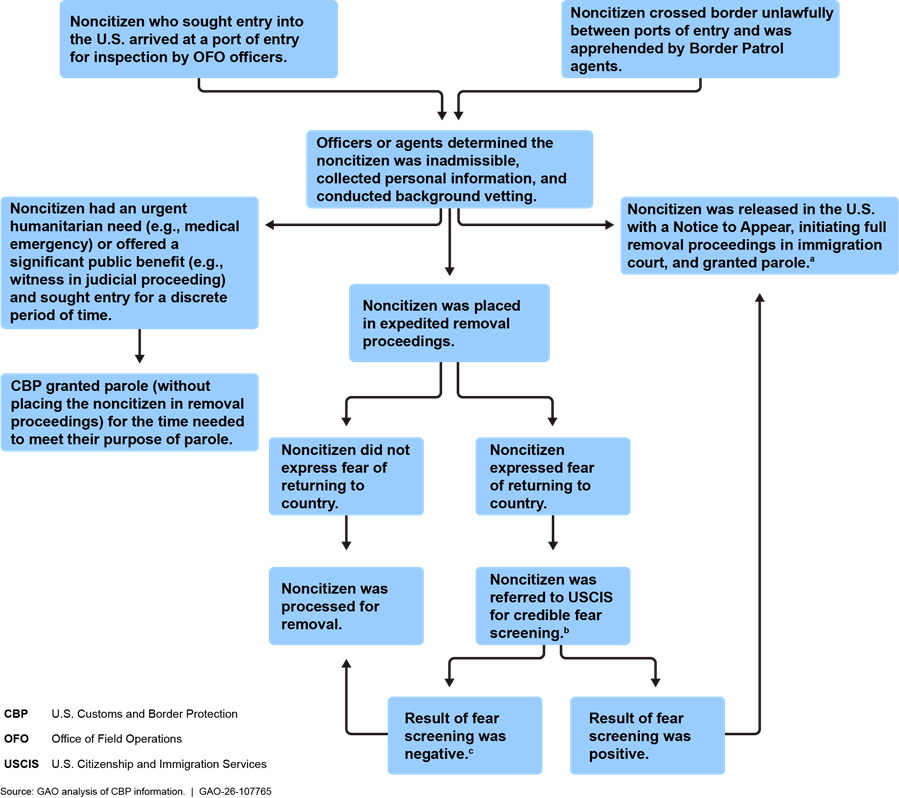
Note: CBP’s use of these processing pathways varied within the time period (October 2018 through May 2025) and by agency (OFO and Border Patrol). See 8 U.S.C. §§ 1225(b) (governing expedited removal), 1229a (governing removal proceedings before an immigration judge, which we refer to as “full removal proceedings”), 1182(d)(5)(A) (providing authority to grant parole on a case-by-case basis). Statute defines an “alien” as any person who is not a citizen or national of the U.S. 8 U.S.C. § 1101(a)(3). DHS documentation we reviewed used the terms “alien,” “migrant,” and “noncitizen” interchangeably. For readability, we use the term “noncitizen” in this figure.
aAccording to CBP officials, officers and agents generally only paroled noncitizens if vetting determined they did not have a criminal history or pose a risk to public safety. The period of parole that noncitizens received varied. For those who were not placed in removal proceedings, the period was set for the time needed to meet the purpose of the parole. For noncitizens placed in full removal proceedings the parole period was generally up to 2 years.
bSee 8 U.S.C. § 1225(b); 8 C.F.R. § 208.30.
cA noncitizen who receives a negative credible fear screening may request a review of the determination by an immigration judge. See 8 C.F.R. § 208.30(g).
ICE Responsibilities
When CBP placed noncitizens in full removal proceedings, including those paroled into the U.S., ICE ERO became responsible for monitoring their compliance with the conditions of their release. Such conditions may include the noncitizen attending required check-ins at local ERO field offices, and ICE may also require reasonable assurances that the noncitizen attend their immigration proceedings.
Additionally, ERO is responsible for conducting civil enforcement actions against paroled noncitizens, such as apprehending, arresting, or interviewing them in connection to administrative immigration violations. For example, if a noncitizen’s parole is terminated or they remain in the U.S. after their period of parole ends without obtaining another status, ERO may need to evaluate whether further civil enforcement action or removal is warranted. This may include taking steps to ensure the noncitizen’s attendance at ongoing removal proceedings, initiating removal proceedings for those not in ongoing proceedings, or executing a final order of removal.
As shown in figure 3, ERO has 25 field offices nationwide that are responsible for performing monitoring and enforcement in their areas of responsibility.
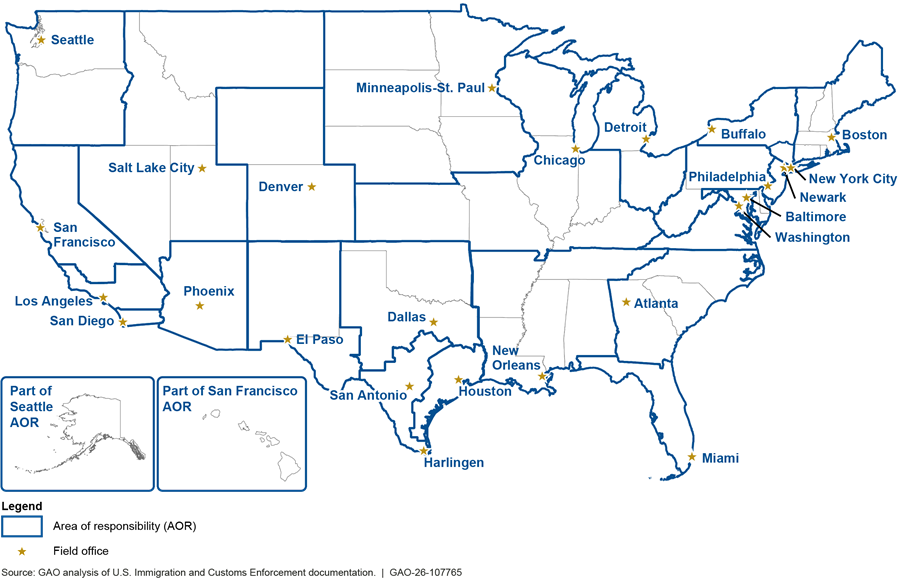
Note: The figure does not represent the Harlingen area of responsibility (AOR) in southern Texas, which includes the cities of Corpus Christi and Laredo. The figure also does not include Guam and the Northern Mariana Islands, which are part of the San Francisco AOR, or Puerto Rico and the U.S. Virgin Islands, which are part of the Miami AOR.
To help with its monitoring responsibilities, ERO may enroll noncitizens CBP paroled into the U.S. in its Alternatives to Detention program. Those enrolled in the Alternatives to Detention program receive more intensive supervision through case management and electronic monitoring than those paroled without being enrolled in the program. Some of the monitoring technology used in this program include GPS ankle bracelets, smartphone applications, and telephonic reporting. ERO field officials are to determine the level of supervision and technology assigned to the noncitizen based on several factors, such as their immigration status, criminal history, and whether they have been complying with program requirements, if already enrolled.[31]
Additionally, ERO is responsible for detaining noncitizens in the U.S. who may be subject to removal while they await the resolution of their immigration cases or who have been ordered removed from the U.S. According to ICE guidance, because the agency exercises significant authority when it detains noncitizens, it must do so in the most humane manner possible, focusing on providing sound conditions and care.[32] Those detained by ICE for violations of immigration law may include individuals with criminal and noncriminal backgrounds who are determined to be inadmissible for entry into the U.S. In December 2024, ICE reported that it detained noncitizens in over 100 detention facilities during fiscal year 2024.
CBP Granted About 2.4 Million Humanitarian Paroles at the Southwest Border from October 2018 through May 2025
CBP Granted About 2.4 Million Paroles; The Majority of Paroles Were Granted by OFO at Ports of Entry
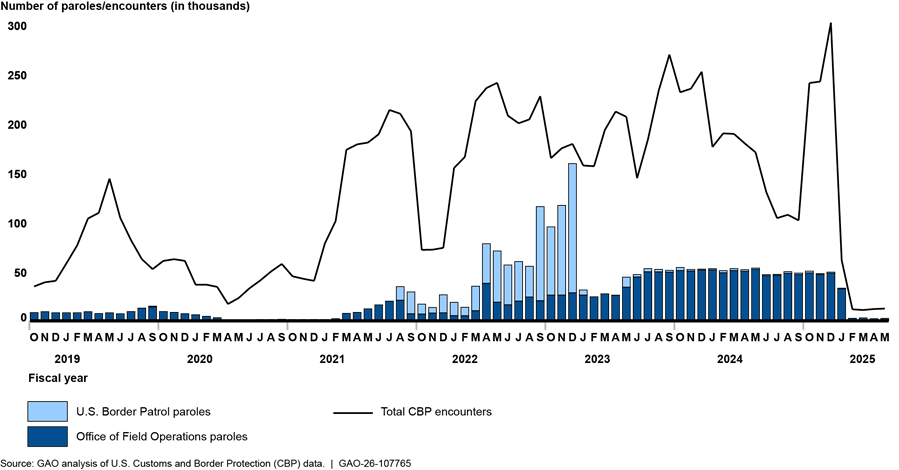
According to our analysis of CBP data, from October 2018 through May 2025, OFO and Border Patrol granted about 2.4 million paroles out of their nearly 10.4 million encounters at the southwest border.[33] Overall, OFO granted the majority of these paroles at ports of entry. Specifically, OFO granted about 68 percent of the paroles (over 1.6 million) and Border Patrol granted about 32 percent (nearly 760,000). However, the total number of paroles and the relative number of paroles by each agency changed over time, as shown in figure 4.
Notes: The Office of Field Operations is responsible for securing the border at ports of entry and Border Patrol is responsible for securing the border between ports of entry. CBP encounters include interactions with noncitizens CBP apprehends or finds to be inadmissible to the U.S.—that is, after inspection by an immigration officer, they are determined to be ineligible for lawful entry into the U.S. Encounters that do not result in CBP granting parole may result in various other outcomes. For example, encountered noncitizens may be placed in immigration detention, returned to their country of origin, or released into the country without being granted parole.
Specifically, our analysis showed that OFO and Border Patrol granted relatively few paroles during fiscal years 2019 and 2020. During this time period the proportion of southwest border encounters resulting in parole ranged from about 3 percent to 28 percent. The number of paroles granted increased beginning in the summer of 2021 and peaked in December 2022, when 89 percent of encounters resulted in parole. Paroles granted declined substantially after December 2022 and again after January 2025.
Paroles until summer 2021. According to CBP data, from October 2018 through July 2021, both OFO and Border Patrol granted fewer than 20,000 paroles per month, and OFO granted 99 percent of all paroles. This included a period from April 2020 through February 2021 when the number of paroles both agencies granted decreased to fewer than 2,200 per month. During this time, the government restricted the entry of noncitizens due to COVID-19 health concerns.[34]
Border Patrol paroles since summer 2021. The number of Border Patrol paroles increased from fewer than 20 in July 2021 to nearly 14,000 in August 2021. Border Patrol paroles generally continued to climb over time, peaking at about 131,000 in December 2022. Thereafter, the number of Border Patrol paroles remained below 11,000 per month. We discuss Border Patrol’s use of parole during this time period in more detail later in this report.
OFO paroles since summer 2021. The number of OFO paroles increased during summer 2021 and reached almost 21,000 in August 2021, as compared to generally being fewer than 10,000 prior to April 2021. OFO paroles then dropped to under 10,000 per month until March 2022. In April 2022 OFO paroles increased again to about 38,000 before dropping to about 19,000 in May 2022, after which paroles generally increased before plateauing from June 2023 through December 2024 at around 50,000 per month.
Paroles since January 2025. OFO and Border Patrol granted fewer paroles in January 2025, after which paroles decreased substantially. From February through May 2025, OFO paroles were fewer than 3,000 per month and Border Patrol did not grant parole to any noncitizens.
We discuss policy changes that contributed to these trends later in this report.
Half of Paroles CBP Granted Were to Single Adults and About Half Were to Members of Families
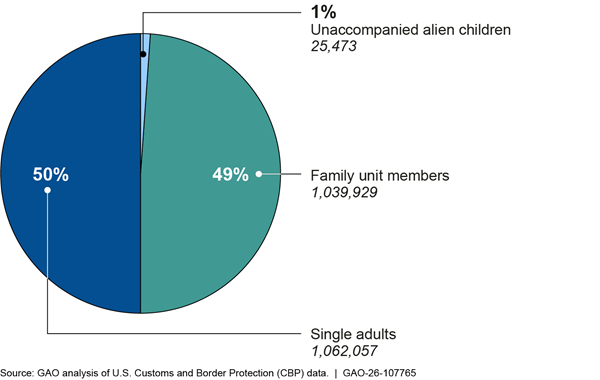
From October 2018 through May 2025, 50 percent of paroles CBP granted at the southwest border were to single adults and 49 percent were to members of a family unit, as shown in figure 5.[35] Unaccompanied alien children accounted for about 1 percent of paroles over the time period.[36]
Notes: Single adults include noncitizens who are at least 18 years of age and not part of a family unit. CBP defines a “family unit” to include one or more non-U.S. citizen juveniles accompanied by their parent(s) or legal guardian(s). The Homeland Security Act of 2002 defines unaccompanied alien children as those who (A) have no lawful immigration status in the U.S.; (B) have not attained 18 years of age; and (C) with respect to whom—(i) there is no parent or legal guardian in the U.S.; or (ii) no parent or legal guardian in the U.S. is available to provide care and physical custody. 6 U.S.C. § 279(g)(2). The information presented on family status does not include approximately 258,000 noncitizens officers paroled directly from primary inspection because OFO collects family status information during secondary inspection, but not primary inspection. During primary inspection, CBP officers inspect travelers to determine compliance with U.S. law and admissibility to the country. When CBP officers cannot determine admissibility during the primary inspection or when additional time is needed to determine admissibility, travelers, their baggage, and their vehicles, if any, are referred to secondary inspection to continue the inspection process.
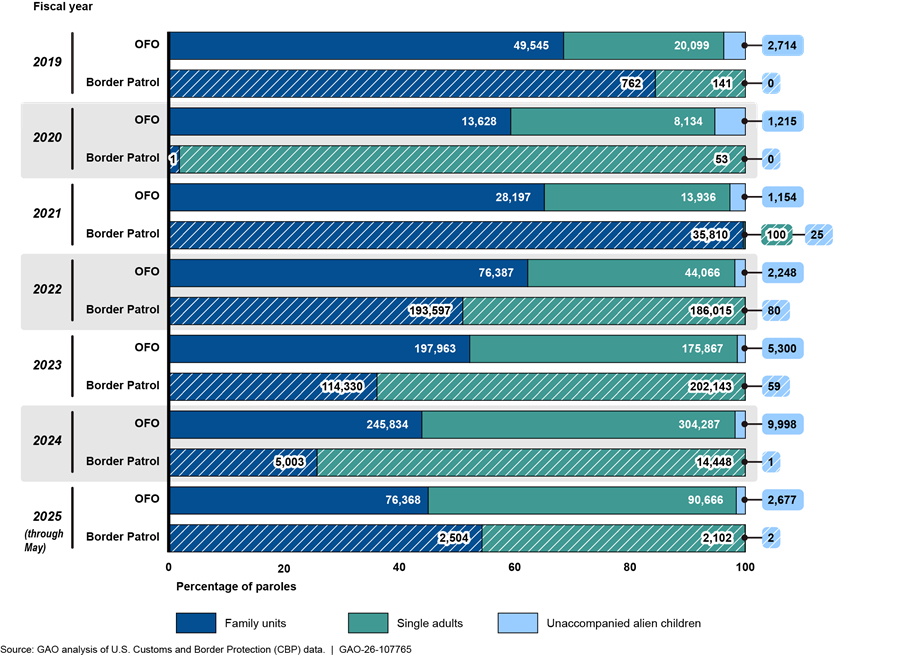
The portion of paroles granted to members of family units and single adults varied by agency and changed over time, as shown in figure 6. In particular, regarding OFO, it granted slightly more paroles to members of family units (50 percent) than single adults (48 percent) overall, but the proportion of paroles it granted to members of family units declined over the time period. For example, paroles of family unit members constituted 68 percent of total OFO paroles in fiscal year 2019, whereas less than 45 percent of OFO paroles were granted to family unit members in fiscal year 2025 (through the end of May). Additionally, nearly all paroles of unaccompanied alien children were granted by OFO at a land port of entry (over 99 percent) rather than by Border Patrol over the time period.
In contrast, Border Patrol granted more paroles to single adults (53 percent) than family unit members (46 percent) over the time period. When Border Patrol paroles first began increasing in fiscal year 2021, less than 1 percent of paroles it granted that year were to single adults. The percentage of Border Patrol paroles granted to single adults grew to 64 percent in fiscal year 2023 and 74 percent in fiscal year 2024. In fiscal year 2025 (through the end of May), Border Patrol granted about 46 percent of paroles to single adults.
Figure 6: Office of Field Operations (OFO) and Border Patrol Paroles at the Southwest Border by Family Status, October 2018–May 2025
Note: OFO is responsible for securing the border at ports of entry and Border Patrol is responsible for securing the border between ports of entry. Single adults include noncitizens who are at least 18 years of age and not part of a family unit. CBP defines a “family unit” to include one or more non-U.S. citizen juveniles accompanied by their parent(s) or legal guardian(s). The Homeland Security Act of 2002 defines unaccompanied alien children as those who (A) have no lawful immigration status in the U.S.; (B) have not attained 18 years of age; and (C) with respect to whom—(i) there is no parent or legal guardian in the U.S.; or (ii) no parent or legal guardian in the U.S. is available to provide care and physical custody. 6 U.S.C. § 279(g)(2). The information presented on family status does not include approximately 258,000 noncitizens officers paroled directly from primary inspection because OFO collects family status information during secondary inspection, but not primary inspection. During primary inspection, CBP officers inspect travelers to determine compliance with U.S. law and admissibility to the country. When CBP officers cannot determine admissibility during the primary inspection or when additional time is needed to determine admissibility, travelers, their baggage, and their vehicles, if any, are referred to secondary inspection to continue the inspection process.
Over Half of Paroles CBP Granted Were to Noncitizens from Mexico, Cuba, and Venezuela
From October 2018 through May 2025, 55 percent of paroles CBP granted at the southwest border were to noncitizens from three countries—Mexico (22 percent), Cuba (17 percent), and Venezuela (16 percent). As shown in figure 7, the next most common countries of citizenship were Haiti (9 percent) and Nicaragua (7 percent).
Figure 7: Percent of U.S. Customs and Border Protection Paroles at the Southwest Border by Country of Citizenship, October 2018–May 2025
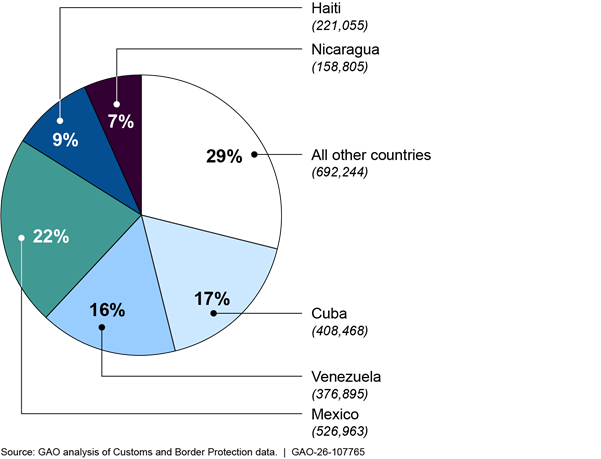
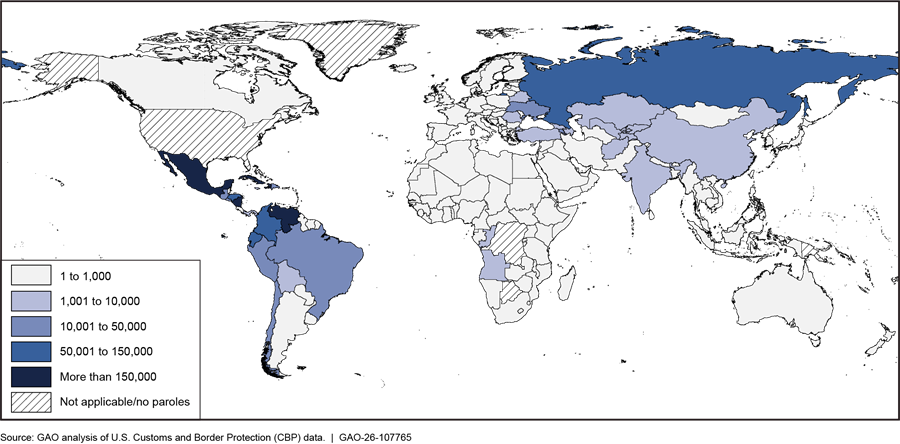
A total of 29 percent of paroles granted at the southwest border were to noncitizens who came from 207 other countries. As shown in figure 8, these countries spanned globally across six continents.
Figure 8: Number of CBP Paroles at the Southwest Border by Country of Citizenship, October 2018–May 2025
Additionally, the portion of paroles OFO and Border Patrol granted to
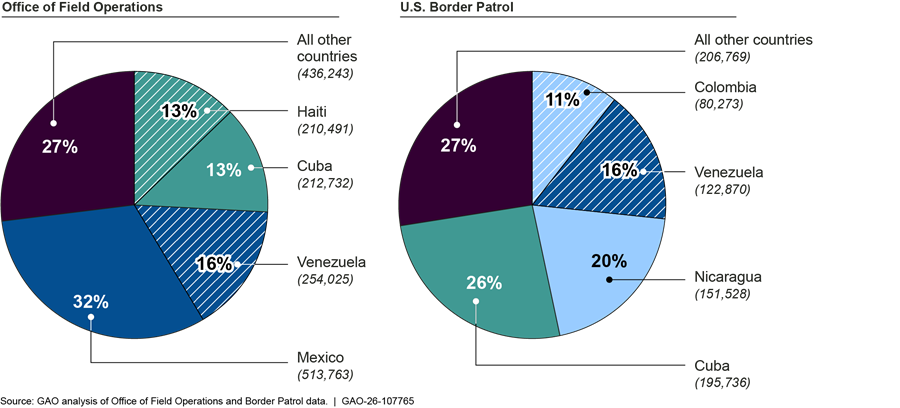
noncitizens from particular countries varied by agency. For example, while
paroles of noncitizens from Mexico accounted for the largest portion of OFO
paroles (513,763, or about 32 percent), noncitizens from Cuba made up the
largest portion of Border Patrol paroles over the period (195,736, or about 26
percent). Further, Venezuela was among the top three countries of citizenship
for noncitizens paroled by both OFO and Border Patrol, with about 376,895
paroles granted altogether. From October 2018 through May 2025, OFO granted
parole to noncitizens from 196 countries and Border Patrol granted parole to
noncitizens from 124 countries. Figure 9 shows the number and percentage of OFO
and Border Patrol paroles by the top four countries of citizenship.
Figure 9: Percent of U.S. Customs and Border Protection Paroles at the Southwest Border by Agency and Country of Citizenship, October 2018–May 2025
Border Patrol data indicate that 208 out of the approximately 757,000 paroles
(about 0.03 percent) agents granted from October 2018 through May 2025 were to
noncitizens identified as having a criminal history at the time of their
parole.[37]
According to Border Patrol officials, agents determine whether noncitizens they
encounter have a criminal history by running their biometric and biographical
information through various federal, state, local, and international systems.[38] These systems return results for
domestic and international criminal records and allow agents to see any
misdemeanor or felony charges, and when available, their dispositions.[39] Border Patrol officials stated that
agents generally did not parole noncitizens they determined had a criminal
history. However, due to challenges Border Patrol was facing, such as limited
detention space and time-in-custody policies, agents considered noncitizens with
non-violent minor offenses for parole on a case-by-case basis, when needed,
Border Patrol officials said.[40]
For example, the 208 paroled noncitizens with criminal histories faced charges
related to, among other things, petty theft, improperly entering the U.S., and
driving without a license, according to Border Patrol officials.
CBP Expanded Its Use of Humanitarian Parole at the Southwest Border Between August 2021 and January 2025
CBP Parole Policies Changed Over Time
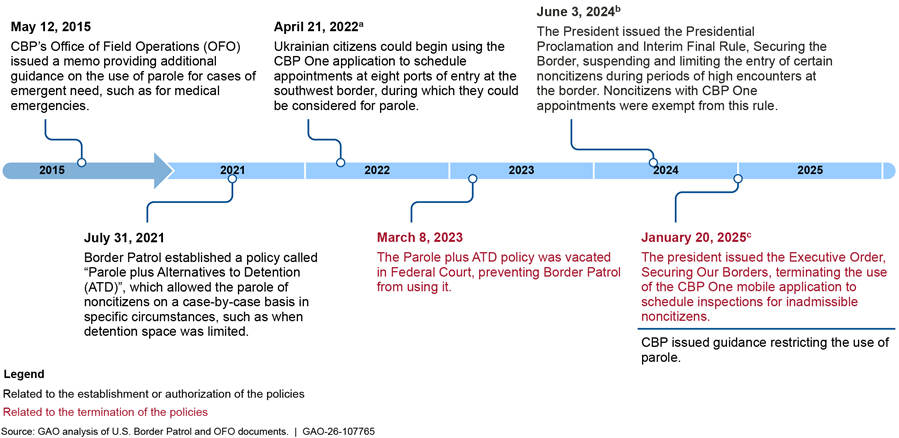
Since 2015, CBP has made changes to the policies that guide how OFO officers and Border Patrol agents use their discretionary authority to parole noncitizens into the U.S. As shown in figure 10, these policy changes have included the increased use of parole for noncitizens without emergent need beginning in the summer of 2021, as well as the subsequent termination of using parole for that purpose beginning in January 2025. CBP officials stated that shifts in priorities across presidential administrations and in the southwest border operating environment, such as increasing numbers of encounters, contributed to these changes.
Figure 10: Changes in Policies Related to U.S. Customs and Border Protection’s (CBP) Use of Parole, May 2015–January 2025
Notes: Since before 2015, CBP policy has allowed for the exercise of discretionary measures such as the use of parole in cases of inadmissibility or minor violations where refusal of admission or withdrawal of application for admission would involve detention or undue hardship. Per CBP policy, CBP officers are to evaluate each case to adequately determine if the exercise of discretionary authority is warranted. Statute defines an “alien” as any person who is not a citizen or national of the U.S. 8 U.S.C. § 1101(a)(3). Department of Homeland Security (DHS) documentation we reviewed used the terms “alien,” “migrant,” and “noncitizen” interchangeably. For readability, we use the term “noncitizen” in this figure.
aIn April 2022, DHS established a new parole process to allow Ukrainians displaced by the war with Russia and their immediate family members to come to the U.S. for a period of up to 2 years. DHS stated that it intended for the Uniting for Ukraine (U4U) process to provide an orderly pathway for Ukrainians to enter the U.S. In June 2022, DHS released guidance encouraging U4U beneficiaries to fly into the U.S., to relieve pressure at the southwest border land ports of entry.
bPres. Proc. No. 10773, Securing the Border, 89 Fed. Reg. 48,710 (June 7, 2024).
cExec. Order 14165, Securing Our Borders, 90 Fed. Reg. 8467 (Jan. 30, 2025).
Additionally, CBP officials stated that while the agency’s parole authority has remained the same over time, OFO officers and Border Patrol agents have used the authority to parole noncitizens through different processing pathways. For example, OFO and Border Patrol officials said they placed some noncitizens they paroled into full removal proceedings, placed others in expedited removal proceedings, and paroled others without placing them in removal proceedings, as discussed in more detail below.
Border Patrol Used Parole to Process Increasing Arrivals of Noncitizens
In July 2021, Border Patrol established a new procedure that used parole as a mechanism to help process an increasing number of encounters along the southwest border. Prior to this, Border Patrol paroled noncitizens into the U.S. sparingly in cases of an emergent need, such as if agents encountered a noncitizen at the border who needed emergency medical care. From October 2018 through July 2021, Border Patrol data indicate agents granted between one and 31 paroles per month, with the exception of September 2019, during which Border Patrol granted 788 paroles.[41] Border Patrol officials stated that in an ideal situation, they would place all eligible noncitizens they apprehend into expedited removal rather than paroling them. This is because crossing the border between ports of entry is a violation of immigration law and expedited removal allows for the most efficient removal from the U.S., the officials said.
Parole Plus Alternatives to Detention
During fiscal year 2021, the number of noncitizens Border Patrol apprehended at the southwest border dramatically increased to about 1.7 million—a 300 percent increase from the previous fiscal year. Border Patrol could not place all eligible noncitizens into expedited removal because that process generally requires that they be detained by ICE pending a final determination of credible fear or, if found not to have a fear, until removed.[42] Border Patrol’s temporary holding capacity and ICE’s detention capacity was constrained at that time, and as a result, Border Patrol began paroling increasing numbers of noncitizens into the country, according to Border Patrol officials.
Specifically, on July 31, 2021, Border Patrol authorized agents to use the Parole plus Alternatives to Detention processing pathway. Under this process, which was initially authorized in the Rio Grande Valley sector, agents could parole apprehended noncitizens on a case-by-case basis into the country when certain conditions were met.[43] For example, agents were authorized to parole encountered noncitizens when: (1) the sector reached 75 percent of its detention capacity; (2) the number of noncitizens arriving in the sector exceeded the number of noncitizens discharged over a 24-hour period; and (3) the average time noncitizens were held in Border Patrol custody exceeded 48 hours. Border Patrol expanded this process to other sectors in Texas and Arizona in August and September 2021.[44]
On November 2, 2021, Border Patrol established further conditions for using the Parole plus Alternatives to Detention process. Border Patrol agents were to parole noncitizen family units for 15 days to allow for the noncitizens to travel to their intended destination within the U.S. As we reported in September 2022, ERO officials located on-site in Border Patrol facilities enrolled the head of household in the Alternatives to Detention program where ICE would monitor them electronically, such as using a GPS device, as a condition of their parole.[45] Once the head of household and their family unit members reported to an ERO field office within the U.S., ERO officers placed them in full removal proceedings by serving them with a Notice to Appear in immigration court and determined the appropriate level of ongoing monitoring for them.
Border Patrol agents were to consider several factors when determining whether to parole inadmissible noncitizens under the Parole plus Alternatives to Detention process. Such factors included whether the noncitizen posed a threat to national security or public safety, whether their own Border Patrol facility met its detention capacity, and whether ICE would accept custody of the noncitizen. Officials from Border Patrol headquarters we spoke with stated a noncitizen’s country of origin and family status also affected whether they were paroled under the process. This was because ICE did not have detention facilities for families when the policy was in place and noncitizens from certain countries were more difficult to remove.[46] According to Border Patrol policy, the Parole plus Alternatives to Detention process was intended to provide a processing pathway for noncitizens in situations where there was not appropriate detention space available. Noncitizens were also paroled under the process due to concerns about the length of time they would be detained in CBP facilities, according to CBP officials. These officials stated such situations justified using parole on a case-by-case basis for humanitarian reasons at that time.
During the time that Border Patrol’s Parole plus Alternatives to Detention process was in place, the number of paroles Border Patrol granted increased substantially, as shown in figure 11. For example, Border Patrol granted 16 paroles in July 2021, but granted 13,835 paroles in August 2021, the first month in which the Parole plus Alternatives to Detention process was authorized. The number of paroles Border Patrol granted continued to generally increase in subsequent months, reaching 51,805 in May of 2022 and peaking at 130,905 paroles in December 2022. Border Patrol officials we interviewed from two sectors stated that Border Patrol agents paroled most of the noncitizens they encountered during the time the process was in place between August 2021 and March 2023.
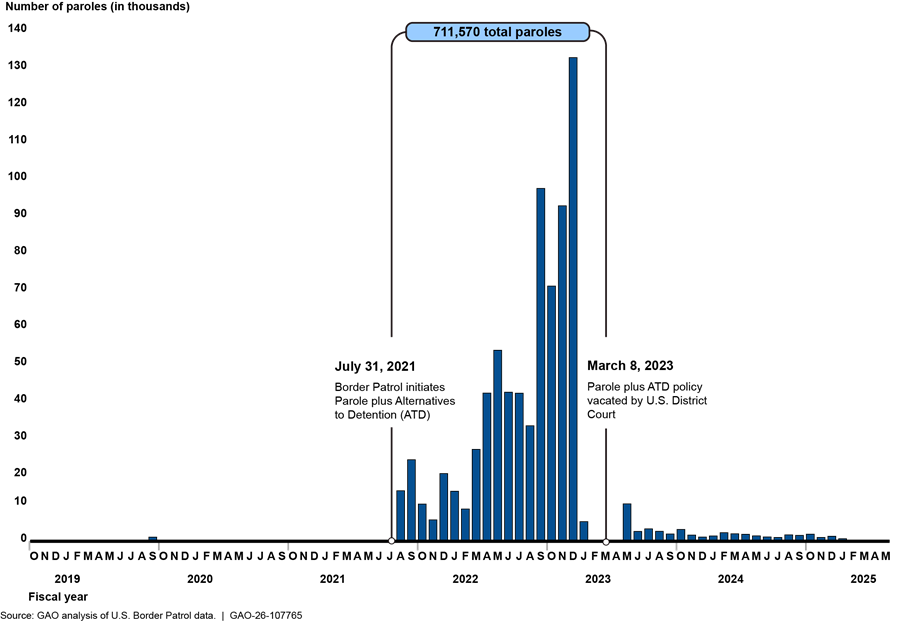
Note: The Parole plus ATD policy was vacated by a U.S. District Court on March 8, 2023. Fla. v. Mayorkas, 660 F. Supp. 3d 1239 (N.D. Fla. 2023)
As previously discussed, Border Patrol first implemented the Parole plus Alternatives to Detention process in the Rio Grande Valley sector in Texas, where the largest surge of noncitizens was arriving at the time, and then expanded it to other sectors. Over one-third of Border Patrol paroles along the southwest border since October 2018 occurred in the Del Rio sector, as shown in figure 12.
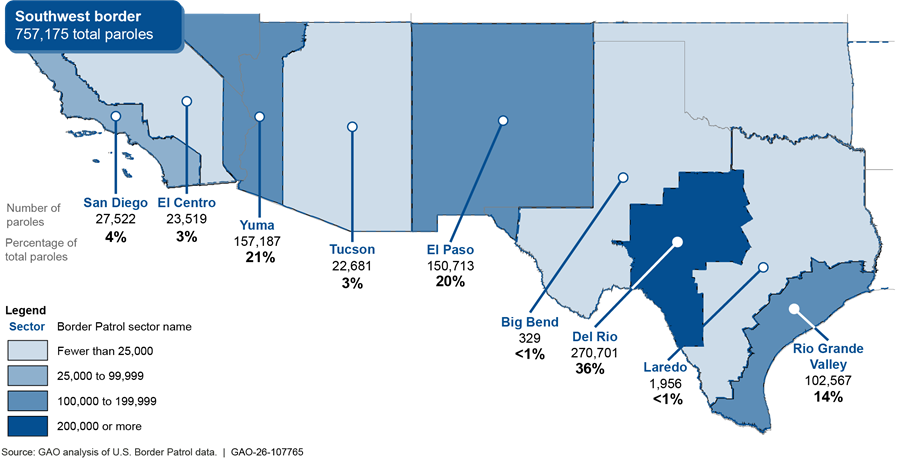
Note: Border Patrol data indicate there were no paroles granted in any sector from February 2025 through May 2025. Percentages do not total 100 percent due to rounding.
Border Patrol officials stated that the conditions for implementing the Parole plus Alternatives to Detention process (e.g., sectors reaching 75 percent of detention capacity) were not met between January 2023 and March 2023. As a result, there were fewer paroles during that time. The process was later vacated by federal court in March 2023, preventing Border Patrol from using it.[47]
Parole and Release of Noncitizens After Parole Plus Alternatives to Detention
After the Parole plus Alternatives to Detention process was no longer in effect, Border Patrol’s use of parole declined substantially. For example, while Border Patrol paroled about 131,000 noncitizens in December 2022, paroles did not exceed 11,000 per month after that time. According to Border Patrol officials, after December 2022, Border Patrol’s use of parole was generally limited to situations of emergent need, such as if noncitizens required immediate medical attention, or in cases of significant public benefit, such as noncitizens entering the U.S. to testify in federal court.
After January 2023 there continued to be surges in the number of noncitizens Border Patrol apprehended at the southwest border, according to CBP data. Border Patrol officials said that, with their use of parole more limited, an alternative pathway agents used to process noncitizens was releasing them on their own recognizance and serving them with a Notice to Appear.[48] According to Border Patrol data, after Border Patrol stopped using the Parole plus Alternatives to Detention process in January 2023, agents released an average of over 67,000 noncitizens per month on their own recognizance through the rest of fiscal year 2023, and an average of over 71,000 noncitizens per month during fiscal year 2024. While this process did not include a grant of parole, Border Patrol officials from one sector we spoke with said noncitizens experienced the process similarly to parole in that they were released into the U.S. and placed in full removal proceedings. The difference was that when Border Patrol agents released noncitizens on their own recognizance, they, rather than an ERO officer, issued the Notice to Appear.
Parole of Noncitizens Placed in Expedited Removal
According to Border Patrol officials, both before and after the Parole plus Alternatives to Detention process was in place, Border Patrol agents paroled certain noncitizens who were initially placed in expedited removal. For example, Border Patrol officials told us they paroled certain noncitizens whom agents initially placed in expedited removal, but who subsequently claimed or established a credible fear of persecution. If U.S. Citizenship and Immigration Services or an immigration judge found a noncitizen whom agents initially placed in expedited removal to have a credible fear, Border Patrol issued them a Notice to Appear in immigration court at a later date and paroled them.[49] Border Patrol officials stated that once they placed a noncitizen in expedited removal, the agency’s only available option if they released the noncitizen was by parole.[50] According to our analysis of CBP data, Border Patrol agents granted 18,957 paroles to noncitizens they initially placed in expedited removal from October 2018 through May 2025.
On June 3, 2024, the administration issued a Presidential Proclamation that limited the ability for noncitizens to claim asylum at the southern border.[51] Border Patrol officials we spoke to said that the proclamation led to a reduction in the number of noncitizens who arrived at the border, and overall apprehensions decreased. As a result, more detention space was available and agents were able to place a greater portion of noncitizens they apprehended into expedited removal rather than releasing them on parole or their own recognizance, according to Border Patrol officials.
Use of Parole in 2025
Subsequently, on January 20, 2025, under the new presidential administration, Border Patrol issued guidance further restricting the use of parole. The updated guidance instructed Border Patrol agents to take every reasonable action to detain all noncitizens who enter the U.S. without proper immigration documents until removal. Border Patrol guidance restricted the authority to grant parole to the Chief of the Border Patrol or other designated headquarters personnel. Each use of parole was to be reported to the Acting Commissioner and Chief of Staff along with an individualized justification explaining the urgent humanitarian reasons or significant public benefit for the parole. According to Border Patrol data from February 2025 through May 2025, Border Patrol had not paroled any noncitizens since the new guidance was released in January 2025.
OFO Expanded Use of Parole Under the CBP One Appointment Process
Similar to Border Patrol, prior to 2021, OFO primarily used parole at land ports of entry along the southwest border in cases of emergent need.[52] However, in response to an increase in the number of inadmissible noncitizens arriving at the border, OFO began using parole more frequently starting in 2021. Further, in May 2023, CBP expanded the use of the CBP One application, which allowed eligible inadmissible noncitizens to schedule appointments to be inspected at eight ports of entry along the southwest border, and paroles further increased as OFO paroled noncitizens with appointments.[53]
As shown in figure 13, at southwest border ports of entry, OFO paroled fewer than 10,000 noncitizens every month except two from October 2018 through April 2021. Paroles then increased in May, June, July, and August 2021 before dropping to less than 10,000 per month until March 2022. OFO paroles reached over 38,000 in April 2022 before dropping to about 19,000 in May 2022, after which paroles generally increased before plateauing from June 2023 through December 2024 at around 50,000 per month. In addition, while 98 percent of paroles in fiscal year 2022 were granted to noncitizens who did not have a CBP One appointment, the portion with appointments grew starting in early fiscal year 2023. Paroles stemming from CBP One appointments continued to make up the majority of OFO paroles at southwest border ports of entry through January 2025, when the President issued an executive order rescinding the CBP One appointment process.[54] Nearly 80 percent of OFO paroles were granted to noncitizens with CBP One appointments in fiscal years 2023 and 2024.
Figure 13: Office of Field Operations (OFO) Paroles at Southwest Border Ports of Entry, October 2018–May 2025
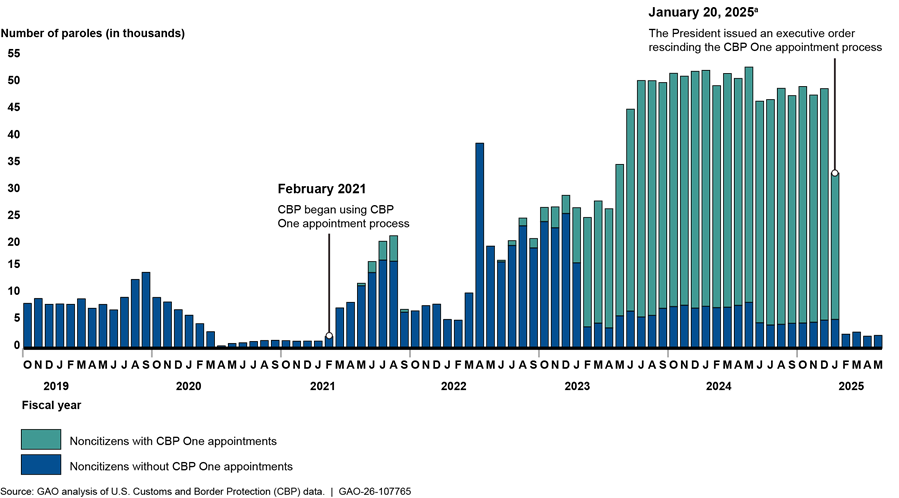
Notes: Noncitizens with CBP One appointments include noncitizens who registered an account in the CBP One mobile application. This may include noncitizens who scheduled a CBP One appointment but were inspected by OFO at a different time because they missed their appointment or arrived at the wrong time.
aExec. Order 14,165, Securing Our Borders, § 7, 90 Fed. Reg. 8467 (Jan. 30, 2025).
CBP developed the CBP One appointment process to streamline and increase processing capacity of inadmissible noncitizens at land ports of entry. The process allowed OFO to obtain information from noncitizens in advance that would otherwise have been collected during the inspection process at the port of entry. In February 2021, CBP began using the CBP One application to help verify the identity and eligibility of individuals enrolled in the Migrant Protection Protocols who wished to present themselves for admission to the U.S.[55] CBP expanded the use of the CBP One appointment process in January 2023, allowing certain noncitizens to use the application to seek an exception to the Centers for Disease Control and Prevention’s Public Health Order, which suspended the introduction of certain noncitizens into the U.S. for public health reasons.[56]
The use of the CBP One appointment process was further expanded on May 11, 2023, in coordination with a DHS and Department of Justice final rule imposing conditions on asylum eligibility for noncitizens presenting themselves at the border without using the CBP One appointment process. The Lawful Pathways rule, designed to address the anticipated surge of migration after the public health order was lifted, was intended to encourage the lawful, safe, and orderly processing of noncitizens arriving at the border through the utilization of the CBP One application.[57] Noncitizens arriving at the border without a CBP One appointment were presumed to be ineligible for asylum.
The CBP One appointment process involved several steps, as discussed below. First, noncitizens used the application to schedule an appointment at a port of entry and to submit personal information to CBP ahead of the appointment. CBP then conducted an initial vetting of the submission and verified the information upon inspection at the port. Finally, CBP made a decision on the noncitizens’ case.
Scheduling the appointment. Under the CBP One appointment process, inadmissible noncitizens physically located within Mexico could use the CBP One application to schedule an appointment up to 2 weeks in advance to present themselves for inspection at one of the eight participating ports of entry.[58] Noncitizens first entered personal information into the application, such as a facial photograph, their name, date of birth, nationality, and other identifying information. Then, the noncitizen could select a desired port of entry, date, and time of arrival. Noncitizens could apply for an appointment once per day and were notified the next day whether their application was accepted for one of the limited available appointments.
Initial vetting. Prior to the noncitizens’ arrival at the port for their appointment, CBP used the information provided through the CBP One application to conduct system checks to identify individuals who could pose a risk to national security, border security, or public safety. According to OFO officials, CBP’s National Targeting Center conducted an initial screening of the information in advance of the appointment to identify noncitizens with derogatory information, such as those with a criminal history or affiliation with gangs or terrorism.[59] The National Targeting Center communicated any derogatory information found to the port in advance of the noncitizens’ arrival, so OFO officers could adjust the interview and vetting process at the port as appropriate.
Inspection at the port. At the port of entry appointment, OFO officers first reviewed the advanced vetting information from the National Targeting Center for the noncitizens scheduled to arrive at the port. Officers then collected biometric information from the noncitizens, including fingerprints and DNA samples, and confirmed the personal information submitted in advance through the CBP One application. According to OFO officials, officers then vetted the biometrics through federal government databases to identify any derogatory information, such as past immigration history, national security concerns, or a criminal record. Officers then interviewed the noncitizens to learn more about them, why they left their home country, and their reason for coming to the U.S.
OFO officials at all four ports of entry we interviewed stated the CBP One process generally utilized a streamlined version of the typical interview conducted for inadmissible noncitizens.[60] For example, officers said that the interviews typically did not include any in-depth questions about the noncitizen’s potential to claim asylum. Officials from three of the four ports we interviewed stated they did not typically obtain a sworn statement from noncitizens during CBP One appointments. However, officers conducted more in-depth vetting of certain noncitizens with CBP One appointments, including those flagged by the National Targeting Center, OFO officials said.
|
OFO Paroling Noncitizens and Issuing a Notice to Appear When OFO paroled a noncitizen at a port of entry and issued them a Notice to Appear, the OFO officer scheduled the noncitizen to appear in immigration court to undergo full removal proceedings. According to OFO data, about one-third of all noncitizens OFO paroled from fiscal year 2023 through March 2025 were initially scheduled to appear in immigration court beyond when their 2-year period of parole would expire. CBP officials told us that if a noncitizen was scheduled to appear in court after their period of parole ended, the noncitizen would remain in removal proceedings and be considered lawfully present in the U.S. for the duration of the proceedings. Source: GAO analysis of Office of Field Operations (OFO) information. | GAO‑26‑107765 |
Case determination. After gathering and reviewing information about the noncitizen, OFO officers determined how to process them. Officials from all four ports we spoke with stated that officers did not determine a noncitizen’s humanitarian need for parole under the CBP One process. Rather, if the OFO officers conducting the appointment did not identify any derogatory information associated with the noncitizen, the default was to issue them a Notice to Appear in full removal proceedings in immigration court, parole them for a period of 2 years, and release them into the interior.[61] Supervisory officers then reviewed the record to ensure the information gathered was clear and complete before approving the parole or other disposition.
Officials from all four ports we interviewed stated that most noncitizens with CBP One appointments were paroled. Our analysis of CBP data substantiates this, as we found about 97 percent of CBP One appointments that occurred in fiscal year 2023 and 2024 resulted in a parole. One port director we spoke with stated most noncitizens encountered at the port of entry were either single adults with no derogatory information or family units, whom ICE did not have space to detain. The port chose to proactively parole such noncitizens into the U.S. with a Notice to Appear. According to the port director, this helped ensure that, when OFO inspected an inadmissible noncitizen that it deemed a priority for expedited removal and detention (e.g., due to national security concerns or a criminal history), ICE had detention space available for them.
Officials we spoke with identified advantages and disadvantages of the CBP One appointment process. For example, officers from all four ports stated that the CBP One process was more orderly and efficient for processing inadmissible noncitizens than processing noncitizens without CBP One appointments. For example, the appointment system reduced the number of noncitizens gathering at the port of entry and the length of time they had to wait in line to be inspected. However, officials stated implementing the CBP One process was resource intensive and required that OFO reallocate officers from other locations and mission areas. For example, OFO reassigned officers from airports to southwest border ports of entry that offered CBP One appointments to help manage the workload. In addition, officials from one port said staffing so many officers to process CBP One appointments meant there were less resources available to conduct other CBP operations, such as inspecting cargo and screening travelers for narcotics.
In January 2025, the President issued an Executive Order that directed DHS to adjust its parole policies, including to cease use of the CBP One application process, terminate all categorical parole programs, and align operations at the border to ensure that all future parole decisions comply with the order.[62] OFO stopped processing noncitizens with CBP One appointments as a result.
Additionally, OFO established policies that limited the use of parole and generally required inadmissible noncitizens to be put into expedited removal and detained until removal. For example, OFO issued a policy stating any parole of inadmissible applicants for admission required the approval of the port’s Director of Field Operations. After the new policies were implemented, the number of OFO paroles declined substantially. For example, while OFO granted over 44,0000 paroles per month, on average, from January 2023 through January 2025, paroles declined to less than 3,000 per month from February 2025 through May 2025.
ICE Does Not Have Information Needed to Monitor Paroled Noncitizens and Make Enforcement Decisions Related to Them
ICE is responsible for monitoring paroled noncitizens in removal proceedings to ensure they adhere to the conditions of their release, and January 2025 DHS guidance emphasized the importance of ICE reviewing their cases to determine whether further enforcement action, such as placing them in expedited removal, is appropriate. However, ICE does not have the information it needs to readily identify noncitizens CBP paroled at the southwest border for monitoring and enforcement purposes and does not monitor them as required by ICE policy.
Monitoring. Within ICE, ERO is responsible for monitoring noncitizens who are in ongoing removal proceedings and who have been released into the U.S. This includes those CBP paroled at the southwest border and served with a Notice to Appear in immigration court. As part of monitoring these noncitizens, ERO is to ensure that they comply with the conditions of their release.[63] For example, ERO may require assurances that they attend scheduled removal proceedings, comply with all laws, regularly report to local ERO field offices, and if ordered, surrender for removal from the U.S.
In support of these conditions, ERO policy requires that every nondetained noncitizen report to ICE at least once per year. This reporting can be in-person at an ERO field office or one of its contractor locations, through a kiosk, or as instructed by ERO officers.[64] According to the policy, the objective of this reporting is to encourage noncitizens to comply with the conditions of their release and discourage them from becoming fugitives.
However, ERO is not conducting its required monitoring of all noncitizens CBP paroled at the southwest border and placed into removal proceedings. According to CBP officials, when CBP paroled noncitizens with a Notice to Appear, CBP directed them to provide the address of their intended residence while awaiting their proceedings. Officials stated that the noncitizens were then required to report to the designated ERO field office responsible for that location, and that information is available to ICE on noncitizens issued a Notice to Appear. According to ERO officials, ERO relies on the “honor system” to ensure noncitizens report to field offices as directed. However, ERO officials told us that not all paroled noncitizens report as required.
As a result, ERO officials from headquarters and all three field offices we interviewed stated that the field offices only monitor paroled noncitizens who (1) are enrolled in the Alternatives to Detention program, which include a minority of all noncitizens CBP paroled at the border; or (2) voluntarily present themselves to an ERO field office.[65] According to these officials, paroled noncitizens who fail to report to a field office would not typically be an ICE priority for monitoring and enforcement. Instead, ERO officials told us that ICE would typically only prioritize paroled noncitizens for monitoring and enforcement if they became potential threats to public safety, border security, or national security.
Enforcement. In January 2025, DHS and ICE issued guidance that newly emphasized the importance of ICE reviewing the cases of paroled noncitizens—which include those CBP paroled at the southwest border—and using enforcement discretion to determine whether parole remains appropriate. According to ICE officials, paroled noncitizens have not been historically prioritized for enforcement as a population. The January 2025 guidance directs ICE to (1) evaluate whether noncitizens’ parole status should be terminated; and (2) determine whether additional enforcement action should be taken towards them, including placing them in expedited removal proceedings.[66]
According to regulation, a noncitizen’s parole may be terminated on written notice and subsequent removal proceedings are to occur in accordance with the Immigration and Nationality Act.[67] During this time, ICE may assess whether detaining the noncitizen would be appropriate, in addition to ensuring they attend removal proceedings, as expected.[68] Further, according to ICE headquarters officials, ICE may also evaluate whether to move to dismiss the noncitizens’ ongoing removal proceedings and instead place them in expedited removal, with the approval of an immigration judge to dismiss their case.[69]
In April 2025, following the guidance from DHS to review cases of paroled noncitizens, and at the direction of the new administration, according to CBP officials, CBP terminated the parole of approximately 654,000 noncitizens through written notices.[70] The notice stated that DHS terminated their parole pursuant to federal laws and regulations.[71] According to CBP officials, the recipients of this notice included noncitizens CBP paroled at the southwest border and placed in removal proceedings, many of whom were likely still in proceedings at the time of receiving the notice.[72]
As discussed earlier, pursuant to regulation, when parole is terminated for a noncitizen who is in removal proceedings, their proceedings continue unless fully terminated by an immigration judge at the request of ICE.[73] According to CBP and ICE officials, such noncitizens are permitted to remain in the U.S. for the duration of their proceedings. However, the language CBP used in the notice did not state that recipients’ removal proceedings will continue after their parole is terminated, or that noncitizens could face legal consequences if they fail to appear in court.[74] In addition to CBP, ICE did not convey this information to the affected noncitizens, although it is responsible for ensuring they attend their proceedings.
Although DHS and ICE guidance emphasizes the importance of ICE’s monitoring and enforcement efforts for paroled noncitizens, ICE is not well-positioned to carry out these responsibilities because it does not have readily accessible information about noncitizens’ parole status.[75] According to ICE officials, while ICE obtains information from CBP on noncitizens it places in removal proceedings, this information does not include the parole status of noncitizens who should be monitored, including those whose parole was terminated by CBP through the April 2025 notices. While CBP systems have data fields that provide readily accessible information about parole status, ERO headquarters officials told us there are no specific data fields in ICE’s internal systems that indicate this.
Rather, CBP officials stated that parole information may be noted in the narrative field of a noncitizen’s record that ICE’s systems receive from CBP. However, because the parole information is in a narrative field, ICE officials stated that there is no readily accessible or systematic way for ERO field officers to query their data systems. As a result, ERO field office officials we spoke with stated they cannot efficiently identify the population of paroled noncitizens they are to monitor and whose cases they are to review for potential enforcement action.
ICE also receives information from CBP through other mechanisms on the parole status of some—but not all—noncitizens who were paroled at the southwest border. CBP officials told us that CBP sends ICE daily updates generated from its data system on noncitizens who remain in the U.S. beyond their authorized period of stay (known as overstays). These leads include paroled noncitizens whose parole status has expired or been terminated. Specifically, CBP documentation shows that CBP refers these leads to a unit within ICE’s Homeland Security Investigations division, which forwards selected leads to ERO field offices for enforcement based on those who present potential national security or public safety concerns.[76] Due to this prioritization, ERO field offices do not receive leads on all overstays, and therefore not all noncitizens whose parole has expired or been terminated.
In addition to these leads, ERO field offices have access to the parole status of noncitizens Border Patrol paroled under the Parole plus Alternatives to Detention process. In summer 2021, Border Patrol developed a data dashboard that provided ERO with access to summary information on those processed under Parole plus Alternatives to Detention, which ERO used to create its own internal dashboard. As part of ERO’s dashboard, officers can track various information about noncitizens paroled under the Parole plus Alternatives to Detention process such as their expected and actual field office check-in location. However, these processes of lead referrals and tracking of noncitizens paroled under Parole plus Alternatives to Detention do not provide ICE with information on the parole status of all noncitizens paroled at the southwest border, according to ICE officials, limiting ICE’s ability to conduct required monitoring and enforcement action, as appropriate.
Furthermore, according to CBP officials as of May 2025, ERO’s National Criminal Analysis and Targeting Center began coordinating with CBP to ensure ERO has the information needed to monitor and take enforcement action, as appropriate, for noncitizens who received the parole termination notice.[77] However, ERO headquarters officials told us they were unaware of such coordination and were unclear how they would receive information from CBP about which noncitizens’ parole had been terminated.[78]
CBP officials said it would not require significant resources for CBP to provide ICE with information on the parole status of all noncitizens who were paroled at the southwest border, and ICE officials stated that having ready access to this information would help them. For example, officials from one ERO field office told us that such information would help them better understand the number of non-detained noncitizens who were paroled from the southwest border and placed in immigration proceedings in their area of responsibility who failed to report to ERO as required. Officials stated such information could be helpful in considering potential enforcement actions against those noncitizens who failed to report as required. Another ERO field official told us that having information on noncitizens’ parole status that is readily accessible and housed in a single location in their data system would be beneficial to their office for monitoring and enforcement purposes.
ICE officials also stated that the agency’s ability to monitor and take enforcement action against paroled noncitizens has been limited by resource constraints. While we recognize that resource constraints can pose challenges, having information on noncitizens’ parole status would better position the agency to make prioritization decisions about how to use its available resources for the monitoring and enforcement of paroled noncitizens, which DHS and ICE have emphasized the importance of doing. For example, if ICE is aware of which noncitizens CBP paroled, officers would be better able to direct resources towards reviewing their cases and use information from the reviews to make decisions about any enforcement actions. Moreover, certain actions may not be as resource intensive. For example, ICE could use information on paroled noncitizens to communicate with them by email or other means about their obligations, such as reporting to ERO and attending their immigration court hearings, as expected.[79]
By obtaining information from CBP on the parole status of noncitizens it paroled at the southwest border, and making that information accessible to relevant ICE officials, ICE would be better positioned to monitor them, review their cases, and take enforcement action, in accordance with DHS and ICE guidance. Additionally, ICE could use this information to help ensure noncitizens, including those whose parole CBP terminated in April 2025, attend their scheduled immigration court hearings, when expected. This is especially important given that the notices CBP sent to noncitizens terminating their parole did not state that their removal proceedings would continue and they may be subject to legal consequences if they do not attend.
Conclusions
CBP granted over 2 million paroles at the southwest border from October 2018 through May 2025. ICE is responsible for monitoring noncitizens paroled into the country to undergo removal proceedings, to ensure they comply with the conditions of their release. However, without readily accessible information about noncitizens’ parole status, ICE does not have the information it needs to identify and monitor these noncitizens, or to take enforcement action, as appropriate. By obtaining information from CBP on the parole status of noncitizens paroled at the southwest border, and making that information accessible to relevant ICE officials, ICE would be better positioned to monitor them, review their cases, and take enforcement action, in accordance with DHS and ICE guidance.
Recommendation for Executive Action
The Director of ICE should obtain information from CBP on the parole status of noncitizens CBP paroled at the southwest border and make that information accessible to relevant ICE officials to inform ICE’s monitoring and enforcement decisions. (Recommendation 1)
Agency Comments and Our Evaluation
We provided a draft of this report to DHS for review and comment. In its comments, reproduced in appendix I, DHS agreed with our recommendation. DHS stated that ERO is modernizing its systems to improve visibility into a noncitizen’s full immigration history, and as part of this effort, ERO plans to work with CBP as appropriate to obtain any additional data needed on paroled noncitizens. If these modernization efforts result in ERO obtaining and sharing readily accessible data on the parole status of noncitizens CBP paroled at the southwest border, they should address our recommendation. DHS also provided technical comments, which we incorporated as appropriate.
We are sending copies of this report to the appropriate congressional committees and the Secretary of Homeland Security. In addition, the report is available at no charge on the GAO website at https://www.gao.gov.
If you or your staff have any questions about this report, please contact me at gamblerr@gao.gov. Contact points for our Offices of Congressional Relations and Public Affairs may be found on the last page of this report. GAO staff who made key contributions to this report are listed in appendix II.
Rebecca Gambler
Chief Quality Officer, Audit Policy and Quality Assurance
List of Requesters
The Honorable Charles E. Grassley
Chairman
Committee on the Judiciary
United States Senate
The Honorable Katie Britt
Chair
Subcommittee on Homeland Security
Committee on Appropriations
United States Senate
The Honorable James Lankford
Chairman
Subcommittee on Border Management, Federal Workforce, and Regulatory Affairs
Committee on Homeland Security and Governmental Affairs
United States Senate
The Honorable John Cornyn
Chairman
Subcommittee on Border Security and Immigration
Committee on the Judiciary
United States Senate
The Honorable Andrew Garbarino
Chairman
Committee on Homeland Security
House of Representatives
The Honorable Michael Guest
Chairman
Subcommittee on Border Security and Enforcement
Committee on Homeland Security
House of Representatives
The Honorable Josh Brecheen
Chairman
Subcommittee on Oversight, Investigations, and Accountability
Committee on Homeland Security
House of Representatives
The Honorable Marsha Blackburn
United States Senate
The Honorable Tom Cotton
United States Senate
The Honorable Ted Cruz
United States Senate
The Honorable Lindsey Graham
United States Senate
The Honorable John Kennedy
United States Senate
The Honorable Mike Lee
United States Senate
The Honorable Thom Tillis
United States Senate
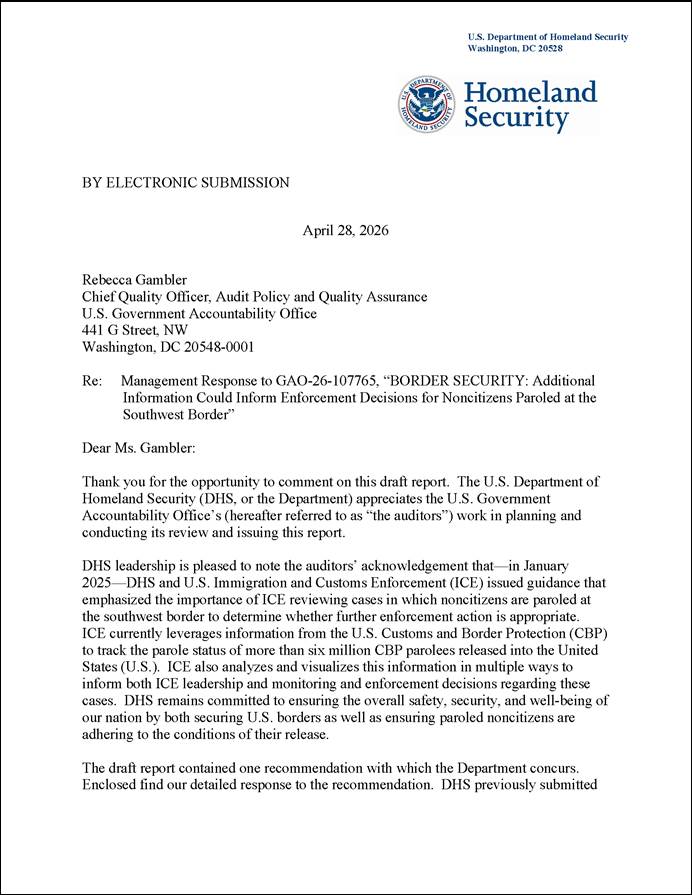
Rebecca Gambler, gamblerr@gao.gov
In addition to the contact named above, Taylor Matheson (Assistant Director), Brendan Kretzschmar (Analyst in Charge), Nasreen Badat, Ben Crossley, Michele Fejfar, Briana Lalman, Elana Maloul, Shannon Murphy, and Heidi Nielson made key contributions to this report.
The Government Accountability Office, the audit, evaluation, and investigative arm of Congress, exists to support Congress in meeting its constitutional responsibilities and to help improve the performance and accountability of the federal government for the American people. GAO examines the use of public funds; evaluates federal programs and policies; and provides analyses, recommendations, and other assistance to help Congress make informed oversight, policy, and funding decisions. GAO’s commitment to good government is reflected in its core values of accountability, integrity, and reliability.
Obtaining Copies of GAO Reports and Testimony
The fastest and easiest way to obtain copies of GAO documents at no cost is through our website. Each weekday afternoon, GAO posts on its website newly released reports, testimony, and correspondence. You can also subscribe to GAO’s email updates to receive notification of newly posted products.
Order by Phone
The price of each GAO publication reflects GAO’s actual cost of production and distribution and depends on the number of pages in the publication and whether the publication is printed in color or black and white. Pricing and ordering information is posted on GAO’s website, https://www.gao.gov/ordering.htm.
Place orders by calling (202) 512-6000, toll free (866) 801-7077,
or
TDD (202) 512-2537.
Orders may be paid for using American Express, Discover Card, MasterCard, Visa, check, or money order. Call for additional information.
Connect with GAO
Connect with GAO on X,
LinkedIn, Instagram, and YouTube.
Subscribe to our Email Updates. Listen to our Podcasts.
Visit GAO on the web at https://www.gao.gov.
To Report Fraud, Waste, and Abuse in Federal Programs
Contact FraudNet:
Website: https://www.gao.gov/about/what-gao-does/fraudnet
Automated answering system: (800) 424-5454
Media Relations
Sarah Kaczmarek, Managing Director, Media@gao.gov
Congressional Relations
David A. Powner, Acting Managing Director, CongRel@gao.gov
General Inquiries
[1]CBP encounters include interactions with aliens CBP apprehends or finds to be inadmissible to the U.S.—that is, after inspection by an immigration officer, they are determined to be ineligible for lawful entry into the U.S. Statute defines an “alien” as any person who is not a citizen or national of the U.S. 8 U.S.C. § 1101(a)(3). DHS documentation we reviewed for this report used the terms “alien,” “migrant,” and “noncitizen” interchangeably. For readability, we generally use the term “noncitizen,” except when quoting language in statute, regulation, or executive orders that used the term “alien.”
[2]According to the act, the Secretary of Homeland Security has the authority to “parole into the U.S. temporarily under such conditions as [the Secretary] may prescribe only on a case-by-case basis for urgent humanitarian reasons or significant public benefit any alien applying for admission to the U.S.” 6 U.S.C. §§ 251, 557; 8 U.S.C. § 1182(d)(5)(A). We refer to the exercise of parole under this authority as “humanitarian parole” throughout the report.
[3]DHS officials may terminate parole when, in the opinion of these officials, neither humanitarian reasons nor public benefit warrants the continued presence of the noncitizen in the U.S. See 8 C.F.R. § 212.5(a) (identifying the officials who may make a determination to grant or terminate parole), (e)(2) (providing procedures from termination of parole).
[4]Ports of entry are facilities that provide for the controlled entry into or departure from the U.S. CBP officers at ports of entry clear passengers, merchandise and other items; collect duties; enforce customs and other U.S. laws; and inspect persons seeking to enter or applying for admission into, or departing the U.S., pursuant to U.S. immigration and travel controls.
[5]These processes for humanitarian parole included: Uniting for Ukraine; Cubans, Haitians, Nicaraguans, and Venezuelans; and family reunification parole.
[6]See GAO, Humanitarian Parole: DHS Identified Fraud Risks in Parole Processes for Noncitizens and Should Assess Lessons Learned, GAO‑26‑107433, (Washington, D.C.: Dec. 11, 2025). The supporter-based processes for humanitarian parole we reviewed included Uniting for Ukraine; Cubans, Haitians, Nicaraguans, and Venezuelans; and family reunification parole.
[7]DHS agreed with our first recommendation and reported plans to implement it. DHS did not agree with our other two recommendations. We continue to believe assessing and applying lessons learned could help DHS improve other areas of its operations beyond the parole processes.
[8]In March 2020, the Centers for Disease Control and Prevention issued an order pursuant to Title 42, U.S. Code, which temporarily suspended entry of certain noncitizens into the U.S. from Canada or Mexico who would otherwise be subject to Title 8 immigration enforcement authorities. Under this order, such individuals could be immediately expelled to their country of last transit to prevent the spread of communicable diseases, rather than being detained and processed for removal under Title 8. Title 42 expulsions began on March 21, 2020, and the order was lifted when the COVID-19 Public Health Emergency ended in May 2023. See 42 U.S.C. § 265; 42 C.F.R. § 71; 85 Fed. Reg. 16,559 (Mar. 24, 2020); 85 Fed. Reg. 17,060 (Mar. 26, 2020); 88 Fed. Reg. 31,314 (May 16, 2023) (discussing the expiration of the Title 42 order); see also, e.g., 85 Fed. Reg. 65,806 (Oct. 13, 2020).
[9]We omitted 668 records in our analysis of countries of citizenship to ensure we: (1) captured only countries that were outside of the U.S. and its territories and (2) excluded records that were entered as unknown or blank. The omitted citizenship records accounted for less than a tenth of a percent of the total paroles in our analysis. In addition, our analysis included five records of parole that were granted from an air port of entry in Tucson, Arizona rather than a land port of entry. Further, our analysis of criminal history data included paroles granted by Border Patrol but not OFO. This is because, prior to February 2025, OFO did not maintain readily available information on whether noncitizens it encountered had a criminal history, according to OFO officials.
[10]During primary inspections, OFO officers inspect travelers to determine admissibility to the country, among other things. When CBP officers cannot determine admissibility during the primary inspection or when additional time is needed to determine admissibility, travelers are referred to secondary inspection to continue the inspection process. OFO collects family status information during secondary inspection, but not primary inspection. As a result, our analysis of family status did not include approximately 258,000 noncitizens officers paroled directly from primary inspection.
[11]We selected four out of 28 OFO ports of entry (San Ysidro and Calexico in California, and Brownsville and Hidalgo in Texas) along the southwest border that collectively accounted for approximately 62 percent of OFO paroles from fiscal year 2019 through May 2025. We selected two out of the nine Border Patrol sectors (San Diego in California and Del Rio in Texas) across which the agency divides responsibility for southwest border security operations. These sectors were located in the same states as the OFO ports of entry we selected and collectively accounted for approximately 39 percent of Border Patrol paroles from fiscal year 2019 through May 2025.
[12]We selected three out of 25 ERO field offices to interview (Miami, Florida; New York, New York; and Los Angeles, California) using data we obtained from ICE. Specifically, we selected these field offices because they had the largest nondetained docket caseloads, or number of nondetained noncitizens that the field office is responsible for monitoring in the U.S. as they await their immigration court proceedings, as of the end of fiscal year 2023.
[13]ICE, Revised Reporting Requirements for Non-Detained Migrants, ERO Policy No.: 24000 (Washington, D.C.: May 28, 2024); DHS, Exercising Appropriate Discretion Under Parole Authority (Washington, D.C.: Jan. 20, 2025); DHS, Guidance Regarding How to Exercise Enforcement Discretion (Washington, D.C.: Jan. 23, 2025); ICE, Interim Guidance for Implementing Acting Secretary Huffman’s Memorandum, Guidance Regarding How to Exercise Enforcement Discretion (Jan. 31, 2025); and ICE, Reporting Requirements for Aliens Released from ICE Custody, Memorandum No.: 24006 (Washington, D.C.: Oct. 28, 2025).
[14]6 U.S.C. §§ 251, 557; 8 U.S.C. § 1182(d)(5)(A). The term “admission” means “with respect to an alien, the lawful entry of the alien into the United States after inspection and authorization by an immigration officer” and an “alien who is paroled . . . shall not be considered to have been admitted.” 8 U.S.C. § 1101(a)(13)(A)-(B).
[15]DHS, Memorandum of Agreement Coordinating the Concurrent Exercise by USCIS, ICE, and CBP, of the Secretary’s Parole Authority under INA § 212(d)(5)(A) with Respect to Certain Aliens Located Outside of the United States (September 2008).
[16]USCIS, Policy Manual, Volume 1: General Policies and Procedures, Part H: Emergencies or Unforeseen Circumstances, Chapter 2: Emergencies or Unforeseen Circumstances-Related Flexibilities (June 24, 2025). Examples of statuses or benefits that may allow eligible paroled noncitizens to remain on a temporary basis include re-parole and Temporary Protected Status. See 8 U.S.C. § 1254a (providing authority for Temporary Protected Status). Examples that may provide a pathway to lawful permanent resident status include asylum and family-based immigration. Cuban nationals may apply and receive lawful permanent resident status after one year of lawful presence in the U.S., under the Cuban Adjustment Act of 1966. See Pub. L. No. 89-732, 80 Stat. 1161 (1966).
[17]As discussed later in this report, paroled noncitizens may experience this process similarly to noncitizens who are placed in removal proceedings before an immigration court and released from DHS custody without being granted parole.
[18]See 8 C.F.R. § 274a.12(c)(11).
[19]8 C.F.R. § 212.5(d). However, if a noncitizen is in ongoing removal proceedings, according to CBP and ICE officials, those noncitizens are permitted to remain in the U.S. for the duration of their proceedings.
[20]Prior to enactment of the 1980 Refugee Act, parole was the primary mechanism the U.S. used to allow into the country noncitizens it considered to be refugees. The 1980 act defined in statute the term refugee, established a refugee admissions process, and amended the parole authority to restrict its use for admitting refugees. Pub. L. No. 96-212, tit. II, 94 Stat. 102. Specifically, this restriction now states that the Secretary of Homeland Security may not parole in a noncitizen who is a refugee unless they determine that compelling reasons in the public interest with respect to that particular noncitizen require that they be paroled into the U.S. rather than be admitted as a refugee. See 8 U.S.C. § 1182(d)(5)(B).
[21]For additional information, see GAO‑26‑107433.
[22]8 U.S.C. §§ 1229, 1229a (governing the initiation of removal proceedings before an immigration judge). As described later in this report, there are two types of removal proceedings: (1) those we refer to as “full removal proceedings,” during which a noncitizen may seek relief or protection from removal before an immigration judge and (2) “expedited removal” during which noncitizens generally are to be detained and ordered removed from the U.S. without a hearing before an immigration judge. We refer to proceedings under section 1229a as “full removal proceedings” and proceedings under 8 U.S.C. § 1225(b) as “expedited removal proceedings.”
[23]The CBP One mobile application allowed certain noncitizens who lacked appropriate admission documents and were located in Central and Northern Mexico, or in the Southern Mexico states of Chiapas and Tabasco, to schedule an immigration inspection at certain southwest border ports of entry. DHS discontinued the scheduling functionality on January 20, 2025. In March 2025, DHS changed the application’s name to CBP Home and added functionality to allow noncitizens to voluntarily notify DHS of their intent to leave the U.S.
[24]We previously reported on CBP’s implementation of the Parole plus Alternatives to Detention process. See GAO, Southwest Border: Challenges and Efforts Implementing New Processes for Noncitizen Families, GAO‑22‑105456, (Washington, D.C.: Sept. 28, 2022).
[25]See 8 U.S.C. §§ 1225(b), 1229a; see also 8 C.F.R. § 235.3(b)(4).
[26]Prior to January 2025, immigration officers could apply expedited removal to noncitizens encountered within 100 air miles of the border and within 14 days of their date of entry regardless of the noncitizen’s method of arrival. See 69 Fed. Reg. 48,877 (Aug. 11, 2004); Expedited Removal, 87 Fed. Reg. 16,022 (Mar. 21, 2022). In January 2025, DHS issued a Federal Register notice expanding the scope of expedited removal to apply to most noncitizens who are determined to be inadmissible in accordance with the INA and have been in the U.S. continuously for less than 2 years prior to the determination of inadmissibility. Designating Aliens for Expedited Removal, 90 Fed. Reg. 8,139 (Jan. 24, 2025). On August 29, 2025, the January 2025 notice expanding the scope of expedited removal and related implementing guidance were stayed by a federal district court. See Make the Road New York v. Noem, No. CV-00190 (D.D.C. memorandum opinion Aug. 29, 2025). As of December 2025, the January 2025 notice expanding the scope of expedited removal is thereby not in effect, pending appeal and appeal is ongoing at the D.C. Circuit Court of Appeals.
[27]See 8 U.S.C. § 1225(b).
[28]See 8 U.S.C. §§ 1158, 1229a.
[29]For example, in December 2024 we reported that for completed cases received during fiscal years 2016 through 2023, full removal proceedings took a median of 394 days from their start to when an immigration judge issued an order—such as an order of removal or a grant of relief—resolving the case. We also found that this time frame varied based on the custody status of the noncitizen. Specifically, detained respondents’ cases took a median of 52 days to resolve, and non-detained respondents’ cases took a median of 625 days. GAO, Immigration Courts: Actions Needed to Track and Report Noncitizens’ Hearing Appearances, GAO‑25‑106867 (Washington, D.C.: Dec. 19, 2024).
[30]Noncitizens released on their own recognizance are released without having to post a bond with the assurance that they will attend their hearings in immigration court.
[31]For additional information about this program, see GAO, Alternatives to Detention: ICE Needs to Better Assess Program Performance and Improve Contract Oversight, GAO‑22‑104529 (Washington, D.C.: June 22, 2022).
[32]ICE, Performance-Based National Detention Standards 2011 (Revised 2016).
[33]Throughout this report, we present information on the number of paroles CBP granted rather than the number of noncitizens it paroled because, according to CBP officials, it is possible that CBP paroled the same person multiple times. CBP defines encounters to include U.S. Border Patrol Title 8 apprehensions, individuals encountered by OFO at ports of entry who are seeking lawful admission into the U.S. but are determined to be inadmissible, individuals presenting themselves to seek humanitarian protection under U.S. law, individuals who withdraw an application for admission and return to their countries of origin within a short time frame, and individuals processed for expulsion under Title 42 authority by Border Patrol or OFO.
[34]In March 2020, the Centers for Disease Control and Prevention issued an order, under Title 42 of the U.S. Code, which allows the government to suspend the introduction of individuals from foreign countries to prevent the spread of communicable diseases. Under the order, the Centers for Disease Control and Prevention temporarily suspended the introduction of certain individuals who would be detained in congregate settings to prevent the spread of COVID-19. Instead, these individuals were to be immediately expelled to their country of last transit or country of origin.
[35]Single adults include noncitizens who are at least 18 years of age and not part of a family unit. CBP defines a “family unit” to include one or more non-U.S. citizen juveniles accompanied by their parent(s) or legal guardian(s). The information presented on family status does not include approximately 258,000 noncitizens officers paroled directly from primary inspection because OFO collects family status information during secondary inspection but not primary inspection. During primary inspection, CBP officers inspect travelers to determine compliance with U.S. law and admissibility to the country. When CBP officers cannot determine admissibility during the primary inspection or when additional time is needed to determine admissibility, travelers, their baggage, and their vehicles, if any, are referred to secondary inspection to continue the inspection process.
[36]The Homeland Security Act of 2002 defines unaccompanied alien children as those who (A) have no lawful immigration status in the U.S.; (B) have not attained 18 years of age; and (C) with respect to whom—(i) there is no parent or legal guardian in the U.S.; or (ii) no parent or legal guardian in the U.S. is available to provide care and physical custody. 6 U.S.C. § 279(g)(2).
[37]Similar information is not available for noncitizens OFO paroled because prior to February 2025, OFO did not maintain readily available information on whether noncitizens it encountered were known to have a criminal history.
[38]In accordance with a January 2025 DHS policy directing all DHS components to adhere to statutory language regarding immigration, DHS officials use the term “alien” when referring to any person who is not a citizen or national of the U.S. 8 U.S.C. § 1101(a)(3). DHS, Reinstating Statutory Immigration Terminology (Washington, D.C.: Jan. 23, 2025). For readability, we use the term “noncitizen” when referring to statements made by DHS officials.
[39]Border officials stated that, due to limited sharing of intelligence and law enforcement information from some countries, these systems may not provide full criminal history information for all noncitizens.
[40]In this context, time-in-custody policies refer to CBP policies relating to the length of time noncitizens may be held in CBP holding facilities. According to CBP policy, individuals in custody are generally not to be held for longer than 72 hours in such facilities. Further, a 2024 CBP report states that CBP considered the impact of various conditions, including the length of time-in-custody, when determining the appropriate processing pathways for noncitizens. In making these decisions, it gave consideration to whether individuals had been or were likely to be in custody for more than 72 hours or if the facility was over capacity. See CBP, Short-Term Detention: Fiscal Year 2024 Report to Congress, (Washington, D.C.: Dec. 17, 2024).
[41]According to Border Patrol officials, there was an influx of noncitizens encountered in the El Paso sector in September 2019. These officials stated that ICE and Border Patrol had limited detention space available, and ICE declined to detain the encountered noncitizens. As a result, Border Patrol granted them parole and released them, officials said.
[42]8 U.S.C. § 1225(b)(1)(B)(iii)(IV).
[43]The use of Parole plus Alternatives to Detention at specific Border Patrol locations required approval from the Commissioner of CBP through the Border Patrol Chief and was approved on a sector-by-sector basis.
[44]These additional sectors were Del Rio, Laredo, and Big Bend in Texas; the El Paso sector, covering parts of Texas and New Mexico; and the Yuma sector, covering parts of Arizona and California.
[45]See GAO‑22‑105456, which provides additional information on Border Patrol’s Parole plus Alternatives to Detention policy.
[46]Border Patrol officials stated the U.S. has bilateral agreements with certain countries, such as Mexico, that make the removal process more efficient. Noncitizens from countries with more difficult procedures for removals were more likely to be paroled because ICE had limited space to detain noncitizens awaiting removal, officials said. For example, DHS has previously noted challenges with its ability to remove and return Haitian and Nicaraguan nationals.
[47]Fla, v. Mayorkas, 660 F. Supp. 3d 1239 (N.D. Fla. 2023).
[48]Noncitizens may be charged with a Notice to Appear in immigration removal proceedings and released on their own recognizance—that is, released without having to post a bond with the assurance that they will attend their hearings—if CBP determines that they do not pose a threat to public safety or a flight risk.
[49]Additionally, in May 2023, Border Patrol implemented a process for paroling apprehended members of family units who expressed fear of persecution or torture or an intent to apply for asylum. Under this process, Border Patrol agents would first place the members of the family unit in expedited removal but then parole them subject to conditions, including the family enrolling in ICE’s Family Expedited Removal Management process. Under this ICE process, families were to obtain a credible fear determination by a U.S. Citizenship and Immigration Services asylum officer and any requested review by an immigration judge at their intended destination. ICE enrolled certain heads of household in its Alternatives to Detention program and families were subject to a home curfew overnight. Families determined to possess a credible fear were placed in full removal proceedings. Families determined not to possess a credible fear were generally to be removed from the U.S.
[50]The Attorney General in Matter of M-S- held that “an alien who is transferred from expedited removal to full removal proceedings after establishing a credible fear of persecution or torture is ineligible for release on bond [and] . . . must be detained until his removal proceedings conclude unless he is granted parole.” 27 I&N Dec. 509 (A.G. 2019). Published decisions by the Attorney General are generally binding on DHS. 8 C.F.R. § 1003.1(g)(1).
[51]Pres. Proc. No. 10773, Securing the Border, 89 Fed. Reg. 48,710 (June 7, 2024). Under this proclamation and related rulemaking, certain noncitizens who entered the U.S. across the southern border on or after June 5, 2024, are ineligible for asylum unless they demonstrate that they meet a qualifying exception. See 8 C.F.R. §§ 208.13(g)-(h), 208.35(a), 1208.13(g)-(h), 1208.35(a). In addition, pursuant to this rulemaking proclamation, when CBP places such individuals into expedited removal, CBP officers and agents generally do not have to affirmatively ask them if they intend to apply for asylum or have a fear of return. Instead, the individual would only be referred for a credible fear screening if they “manifest a fear” of persecution. See 8 C.F.R. § 235.15(b)(4).
[52]OFO guidance stated officers should only parole noncitizens into the country in cases where an emergent need existed, such as a medical emergency or a legitimate law enforcement purpose, and where the noncitizen was not a flight risk or at risk to adding to the population of individuals unlawfully present in the U.S. U.S. Customs and Border Protection, Parole of Inadmissible Nonimmigrant Aliens (May 12, 2015).
[53]Ports of entry offering CBP One appointments included San Ysidro and Calexico in California; Nogales in Arizona; and El Paso, Eagle Pass, Laredo, Hidalgo, and Brownsville in Texas.
[54]Exec. Order 14,165, Securing Our Borders, § 7, 90 Fed. Reg. 8467 (Jan. 30, 2025).
[55]On January 25, 2019, DHS implemented the Migrant Protection Protocols, a policy whereby certain applicants for admission could be returned to Mexico and wait outside of the U.S. for their immigration proceedings.
[56]In March 2020, the Centers for Disease Control and Prevention issued an order, under Title 42 of the U.S. Code, which allowed the government to suspend the introduction of individuals from foreign countries to prevent the spread of communicable diseases, particularly those who would be detained in congregate settings. See 85 Fed. Reg. 16,559 (Mar. 24, 2020). Instead, the individuals were to be immediately expelled to their country of last transit or country of origin. Title 42 allowed for certain exceptions including humanitarian factors. This process ended in May 2023, when the federal public health emergency for COVID-19 was lifted.
[57]Under the Circumvention of Lawful Pathways rule (“Lawful Pathways rule,”) generally, if a noncitizen traveled to a third country and did not apply for asylum there before arriving in the U.S. between May 11, 2023 and May 11, 2025, they would undergo a modified credible screening, in which they would be screened for whether they could make a sufficient showing that the lawful pathways condition on eligibility for asylum is inapplicable or that they are subject to an exception or rebuttal ground. If they did not meet that showing, then the asylum officer would screen the noncitizen for statutory withholding of removal and protection under the Convention Against Torture using the higher ‘‘reasonable possibility’’ standard. See generally 88 Fed. Reg. 31,314 (May 16, 2023). This rule and associated guidance was challenged and vacated in part by a district court in May 2025. See Las Americas Immigrant Advocacy Ctr. v. Dept. of Homeland Security, No. CV-01702 (D.D.C. May 9, 2025). Under the Securing the Border interim and final rules, CBP agents and officers generally do not have to affirmatively ask a noncitizen if they intend to apply for asylum or have a fear of return during “emergency border circumstances,” as defined by the rule. See 89 Fed. Reg. 48,710 (June 7, 2024); 89 Fed. Reg. 81,156 (Oct. 7, 2024).
[58]Noncitizens without documents sufficient for lawful admission to the U.S. and who were located in Central and Northern Mexico, or in the Southern Mexico states of Chiapas and Tabasco could request an appointment using the CBP One application. Mexican nationals could request and schedule appointments from anywhere in Mexico.
[59]OFO’s National Targeting Center vets travelers by conducting traveler data matching and analysis activities, such as matching the traveler’s information against U.S. government databases including the Terrorist Screening Dataset and the Department of Justice’s National Crime Information Center.
[60]We interviewed officials from four southwest border land ports of entry in California and Texas: San Ysidro, Calexico, Hidalgo, and Brownsville. These ports collectively granted 62 percent of OFO paroles from October 2018 through May 2025, according to our analysis of OFO data. All four ports offered CBP One appointments.
[61]OFO officials we spoke with stated that while OFO officers scheduled an initial court date, the date may be subsequently rescheduled by the immigration courts during the full removal proceedings.
[62]Exec. Order 14,165, Securing Our Borders, 90 Fed. Reg. 8467 (Jan. 30, 2025). “Categorial parole processes” is not defined, but an Executive Order issued the same day directs the Secretary of Homeland Security to ensure that parole authority is “exercised on only a case-by-case basis in accordance with the plain language of the statute.” Exec. Order No. 14159, Protecting the American People Against Invasion, 90 Fed. Reg. 8,443, 8,446 (Jan. 30, 2025).
[63]See 8 C.F.R. § 212.5(d) (for those released on humanitarian parole); 8 U.S.C. § 1226(a) (for those released on recognizance). Notices from the immigration court, including the initial Notice to Appear include information about the consequences of failing to appear—that is, a noncitizen who does not attend is generally to be ordered removed in absentia. 8 U.S.C. § 1229a(b)(5). ICE may require “reasonable assurances that the alien will appear at all hearings and/or depart the United States when required to do so.” See 8 C.F.R. § 212.5(d).
[64]ICE, Revised Reporting Requirements for Non-Detained Migrants, ERO Policy No.: 24000 (Washington, D.C.: May 28, 2024). This policy was updated in October 2025 to also require noncitizens released from ICE custody to be enrolled in the Alternatives to Detention program. ICE, Reporting Requirements for Aliens Released from ICE Custody, Memorandum No.: 24006 (Washington, D.C.: Oct. 28, 2025). Prior to the issuance of these policies, nondetained noncitizens were similarly required to report to an ERO field office at least once per year pursuant to ICE, Revised Reporting Requirements for Aliens Released from ICE Custody, ERO Policy No. 11168.1 (Washington, D.C.: Jan. 25, 2021). Noncitizens enrolled in the Alternatives to Detention program may be instructed to check in at an ICE contractor location. ERO administers the program in conjunction with a contractor that provides case management and technology monitoring services for participants at sites across the country.
[65]We interviewed officials from three ERO field offices (Miami, New York City, and Los Angeles) that had the largest nondetained docket caseloads as of the end of fiscal year 2023, according to ICE data. As discussed below, ICE does not have readily accessible information about noncitizens’ parole status. As a result, ICE could not quantify the total number of noncitizens CBP paroled at the southwest border whom ERO is responsible for monitoring, or the portion of them who checked in with ERO or were enrolled in the Alternatives to Detention program. However, ICE data indicate that noncitizens enrolled in the Alternatives to Detention program include a minority of all who CBP paroled at the southwest border. For example, the overall number of participants enrolled in the program was about 179,000 at the end of fiscal year 2024, including both noncitizens who were paroled or released through other means, such as from ICE custody. Meanwhile, CBP data showed it paroled over 612,000 noncitizens at the southwest border in fiscal year 2024 alone.
[66]DHS, Exercising Appropriate Discretion Under Parole Authority (Washington, D.C.: Jan. 20, 2025); DHS, Guidance Regarding How to Exercise Enforcement Discretion (Washington, D.C.: Jan. 23, 2025); and ICE, Interim Guidance for Implementing Acting Secretary Huffman’s Memorandum, Guidance Regarding How to Exercise Enforcement Discretion (Jan. 31, 2025).
[67]8 C.F.R, § 212.5(e)(2)(i). The regulation outlines a process for the termination of parole and assumes that paroled noncitizens are not in ongoing removal proceedings; however, the regulation provides that any further inspection or hearing after the termination of parole through written notice “shall be conducted under section 235 or 240 of the [Immigration and Nationality Act].” Sections 235 and 240 of the Immigration and Nationality Act govern expedited removal and full removal proceedings, respectively. Under 8 C.F.R, § 212.5(e)(2)(i) parole also terminates automatically without written notice upon departure from the U.S.
[68]Noncitizens are expected to appear for their immigration court hearings unless their appearance has been waived by an immigration judge. Noncitizens whose appearance has not been waived and fail to appear for any of their immigration court hearings may be subject to legal consequences. For instance, when DHS establishes that the noncitizen received notice and is removable, the immigration judge is to order the noncitizen removed from the country in their absence, and any applications or potential applications for relief or protection from removal will be deemed abandoned. See 8 U.S.C. §§ 1229(a)(1)(G), 1229a(b)(5); 8 C.F.R. §§ 1003.25(a), 1003.26.
[69]In part, the statute governing expedited removal outlines an expedited process for the inspection, screening, and removal of certain noncitizens “who have not been admitted or paroled.” See 8 U.S.C. § 1225(b)(1). This clause and the extent to which it allows expedited removal to be used for paroled noncitizens is the subject of ongoing litigation. In August 2025, a federal district court placed a stay on several DHS directives and policies insofar as they subject noncitizens paroled at a port of entry to expedited removal. The ruling blocked DHS from pursuing expedited removal for such noncitizens, pending the conclusion of the legal proceedings. See Coalition for Humane Immigrant Rights v. Noem, No. CV-872 (D.D.C. Aug. 1, 2025, memorandum opinion). On August 18, 2025, this ruling was administratively stayed by the D.C. Circuit Court of Appeals pending further consideration of the appeal.
[70]According to CBP officials, CBP sent the parole termination notices to approximately 764,000 individuals. However, officials stated that not all those individuals were actively paroled at the time they received the notice. For example, some individuals’ period of parole had already expired, and others had adjusted to another immigration status, such as legal permanent residency. Therefore, the 764,000 notices applied to about 654,000 noncitizens who had active parole at the time of receipt.
[71]The notices CBP sent indicated that DHS terminated noncitizens’ parole pursuant to 8 U.S.C. § 1182(d)(5)(A) and 8 C.F.R. § 212.5(e).
[72]For example, according to OFO data, over 214,000 noncitizens OFO paroled at the southwest border during fiscal years 2024 and 2025 were assigned initial court dates on their Notice to Appear over 2 years later, meaning their initial court date was scheduled for no earlier than October 2025. Moreover, our prior work found that it can take years for non-detained noncitizens’ immigration proceedings to conclude. See GAO‑25‑106867.
[73]For cases in which a Notice to Appear has been filed by DHS with the immigration court, ICE may not unilaterally dismiss proceedings. However, ICE may file a motion to dismiss the ongoing proceedings before the immigration judge for the reasons outlined in regulation, including because “circumstances of the case have changed after the notice to appear was issued to such an extent that continuation is no longer in the best interest of the government.” See 8 C.F.R. § 239.2(a)(7), (c).
[74]According to ICE officials, the initial Notice to Appear that noncitizens receive when paroled, and any subsequent notices from immigration courts, describe the consequences of failing to appear. However, these notices do not inform the noncitizen that their removal proceedings will continue if their parole is terminated.
[75]In July 2025, the DHS Office of Inspector General (OIG) issued a report in examining three parole processes: Operation Allies Refuge/Operation Allies Welcome; Uniting for Ukraine; and Cubans, Haitians, Nicaraguans, and Venezuelans. The report found that DHS did not have a clear process to monitor or address parole expiration for noncitizens who were paroled under these processes and are no longer authorized to remain in the U.S. The OIG recommended that CBP develop and implement a process to ensure ICE receives timely, accurate data on noncitizens paroled through the three processes. DHS concurred with this recommendation. See DHS OIG, DHS Needs to Improve Oversight of Parole Expiration for Select Humanitarian Parole Processes, OIG-25-30 (Washington, D.C.: July 2, 2025).
[76]U.S. Customs and Border Protection, U.S. Department of Homeland Security, Entry/Exit Overstay Report: Fiscal Year 2023 Report to Congress (August 5, 2024).
[77]ICE’s National Criminal Analysis and Targeting Center supports ERO field offices by identifying and targeting removable noncitizens in the U.S., such as gang members, felons, sex offenders, child predators, and foreign fugitives for criminal offenses committed abroad. The center disseminates referrals to ERO field offices to support the location and arrest of such removable noncitizens.
[78]National Criminal Analysis and Targeting Center documentation shows that in February 2025, it requested information from U.S. Citizenship and Immigration Services (USCIS) about noncitizens who were paroled through supporter-based parole processes to identify potential criminal threats in that population. However, the scope of the information request did not include noncitizens who were paroled at the southwest border who may have also received the parole termination notices. According to officials from the Center, ICE has not made any other requests to USCIS or CBP for information on paroled noncitizens, nor taken any action towards them, since its initial request.
[79]According to ICE officials, not all noncitizens CBP paroled at the southwest border provided an accurate intended address for their residence. While this may impede ICE’s ability to communicate with these noncitizens, having information on their parole status could better position ICE to identify and address such information gaps.