
Report to the
Committee on Transportation and Infrastructure,
House of Representatives
United States Government Accountability Office
A report to the Committee on Transportation and Infrastructure, House of Representatives.
For more information, contact: Andrew Von Ah at VonAha@gao.gov
What GAO Found
Constructing offshore wind projects requires numerous oceangoing vessels (offshore wind vessels). Under the Jones Act and other coastwise laws, vessels used for some U.S. offshore wind activities must be U.S. flag—built and registered in the U.S. and largely crewed by domestic mariners. GAO identified more than 300 unique vessels involved in the construction of three selected U.S. offshore wind projects in the Atlantic Ocean. About 80 percent were U.S.-flag. These U.S.-flag vessels were generally smaller and conducted support activities like ferrying workers and surveying cable routes. About 20 percent of the vessels were foreign-flag; many were large, specialized vessels for which there were no U.S.-flag counterparts. GAO estimated that a similar number of foreign and domestic mariners worked across the vessels for the three selected projects, since the larger, more complex foreign-flag vessels required more mariners.
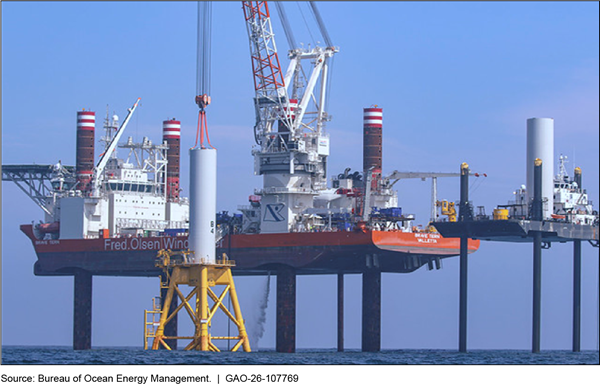
Note: Wind turbine installation vessels often have “legs” capable of extending to the seafloor, allowing the vessel to become a fixed platform.
Fifty new offshore wind vessels, according to the American Clean Power Association, had been delivered, were under construction, or were on order at U.S. shipyards. Constructing all these vessels could generate revenue at almost 20 shipyards across a dozen states. Most are for support vessels, but U.S. vessel owners also invested in two larger, specialized U.S.-built installation vessels. None of the vessel construction was financed using Maritime Administration assistance programs. According to vessel owners GAO interviewed, that was, in part because the application process took too long. Maritime Administration officials said their review process takes, at best, 6 to 9 months. The vessel owners said it often takes much longer. They also said additional vessel construction was unlikely given a lack of future projects.
Why GAO Did This Study
Concerns over the state of U.S. commercial shipbuilding have grown in recent years. Proponents of offshore wind suggest the demands of the industry may provide opportunities to invest in new vessels at U.S. shipyards. Since 2010, the Department of Interior (Interior) has granted about 40 offshore wind leases to commercial developers. Five projects were under construction, as of December 2025. In 2025, the White House took steps to suspend offshore wind development pending review.
GAO was asked to review the extent to which the U.S. maritime industry is constructing U.S. offshore wind projects. This report discusses (1) the extent to which U.S.-flag vessels and domestic mariners were used at selected offshore wind projects and (2) investments in U.S.-built offshore wind vessels, including any use of Maritime Administration financial assistance programs.
GAO selected three offshore wind projects under construction as of August 2025 and analyzed developer-provided data on the vessels used as of November 2025. GAO estimated the range in number of mariners on these vessels based on vessel specifications and discussions with the U.S. Coast Guard and a mariners’ union. GAO reviewed an August 2025 study on investments in offshore wind vessels by the American Clean Power Association; spoke with 11 vessel owners and 11 stakeholders identified based on their expertise; reviewed relevant laws; and interviewed officials from the Maritime Administration, Interior, Department of Energy, and Department of Homeland Security.
|
Abbreviations |
|
|
|
|
|
BOEM |
Bureau of Ocean Energy Management |
|
CBP |
U.S. Customs and Border Protection |
|
CCF |
Capital Construction Fund |
|
CTV |
Crew transfer vessel |
|
OCS SOV |
Outer Continental Shelf Service operation vessel |
|
WTIV |
Wind turbine Installation vessel |
This is a work of the U.S. government and is not subject to copyright protection in the United States. The published product may be reproduced and distributed in its entirety without further permission from GAO. However, because this work may contain copyrighted images or other material, permission from the copyright holder may be necessary if you wish to reproduce this material separately.
March 26, 2026
The Honorable Sam Graves
Chairman
The Honorable Rick Larsen
Ranking Member
Committee on Transportation and Infrastructure
House of Representatives
Over the last two decades, offshore wind energy development in the United States has led to active wind projects and construction in the Atlantic and planned development off the Pacific coast. In 2005, the Secretary of the Interior was authorized—through the Energy Policy Act of 2005—to grant leases on the U.S. Outer Continental Shelf (OCS) to produce or support the production of offshore wind and other renewable energy resources.[1] Subsequently, the Department of the Interior identified a number of potential lease areas off of both the east and west coasts of the United States that appeared most suitable for commercial wind energy production. In 2013, the agency held its first competitive federal offshore commercial wind lease sale and in following years issued dozens of leases for offshore wind projects across the United States, including in Massachusetts, New York, Virginia, and California.[2] These projects are potentially capable of producing electricity to power millions of homes. As of November 2025, several East Coast projects had begun construction, and others were in various stages of the regulatory process.[3]
Constructing, operating and maintaining these projects requires a number of oceangoing vessels for installation and other tasks, some of which are highly specialized for the industry. Some of these vessels, if engaged in coastwise trade, are generally required to be built in the United States, owned by U.S. citizens, and largely crewed by U.S.-citizen mariners, among other requirements.[4] In this report, we refer to vessels that meet these requirements (as designated in developer-provided data) as coastwise-qualified or U.S.-flag.[5] In 2020, we reported that one approach being considered to construct offshore wind energy projects was a mix of U.S.-flag and foreign-flag vessels (i.e., vessels registered and operated under the laws of a country other than the United States). Stakeholders at that time said that such a mix might be required given the lack of U.S.-built specialized ships for installing wind turbines.[6]
In 2022, the National Laboratory of the Rockies (formerly the National Renewable Energy Laboratory) estimated that to accelerate the deployment of offshore wind energy, a number of new U.S.-built, specialized installation vessels would be required. Some proponents of offshore wind have suggested that building and operating such vessels could spur the domestic maritime industry, increasing vital investments in U.S. shipyards and providing jobs for domestic mariners. In recent years, concerns have grown regarding the nation’s capacity to meet government shipbuilding and repair needs more broadly that are critical to national defense. The Navy and other government agencies rely, in large part, on the capability and capacity that private shipyards provide to support their shipbuilding and repair efforts. Beyond the seven private shipyards that generally build major ships for the Navy, private shipbuilding or repair companies in the United States may work on a mix of military, other government, and commercial vessels.[7] They rely, in part, on work from U.S. domestic vessel owners or operators, such as those that would invest in vessels for offshore wind. To support this commercial maritime industry, the Maritime Administration manages a number of financial assistance programs to support domestic vessel owners’ efforts to build or repair vessels at U.S. shipyards.
You asked us to review the extent to which the U.S. maritime industry (U.S.-flag commercial vessels and domestic mariners) is carrying out the work to develop and maintain U.S. offshore wind projects. This report discusses: (1) the extent to which U.S.-flag commercial vessels (U.S.-flag vessels) and domestic mariners were used during the installation of selected offshore wind projects, and (2) investments in U.S.-built vessels for the offshore wind industry, including any use of Maritime Administration financial assistance programs.
For both objectives, we reviewed prior GAO reports, relevant federal laws and regulations, and selected U.S. Customs and Border Protection (CBP) rulings on whether various proposed uses of vessels at offshore wind projects would require the vessels to be coastwise qualified and thus U.S.-flag (see appendix I setting out aspects of selected rulings). We also interviewed a non-generalizable selection of 22 industry stakeholders. This included 11 U.S. vessel owners, ten of whom had recently invested in the construction or retrofit of an offshore wind vessel. To select these vessel owners, we reviewed: (1) a 2025 American Clean Power Association study tracking vessel investments directly linked to the offshore wind industry and (2) information on current offshore wind projects. Because this was not a random or statistically representative sample, the views of these vessel owners are not generalizable to all vessel owners contracted to work on offshore wind projects. However, they provide illustrative information on the use of U.S. flag vessels and domestic mariners in the U.S. offshore wind industry and related investments. We interviewed 11 other stakeholders, including industry associations and maritime unions. We selected these stakeholders based on their knowledge of the offshore wind industry, among other factors. We also interviewed officials from the Department of Interior, Department of Energy, Department of Transportation and at U.S. Coast Guard and CBP in the Department of Homeland Security.
To describe the extent to which U.S.-flag vessels and domestic mariners were used during the installation of selected offshore wind projects, we identified three offshore wind projects—(1) Vineyard Wind, comprised of 62 planned turbines off the coast of Massachusetts, (2) Coastal Virginia Offshore Wind, comprised of 176 planned turbines off the coast of Virginia, and (3) Revolution Wind, comprised of 65 planned turbines off the coast of Rhode Island. We selected the projects because, as of August 2024—when we began our evaluation—these were the only projects actively undertaking offshore wind construction activities.[8]
All three developers provided data on all vessels contracted for their projects. These data include the vessel type, scope of work, and flag of registration, and cover the time period from when the respective project began surveying their lease areas through November 2025. We categorized these vessels into 13 vessel types based on their specifications, size, and purpose to determine the extent to which U.S. vessels were used at these projects. For more information on these vessel types see appendix II. To determine the extent to which U.S. mariners were used, we analyzed publicly available vessel information to estimate a range of possible credentialed mariners crewing each vessel type. Because vessel crew counts are not publicly available and the Maritime Administration does not track active credentialed mariners, we made two notable assumptions: (1) we used a vessel’s total accommodations—which was publicly available—as a proxy for the total number of crew serving onboard, and (2) of the total crew serving onboard, we assumed 30 percent were credentialed mariners. We chose 30 percent based on conversations with U.S. Coast Guard officials and a union that represents mariners.
To describe investments in vessels for the offshore wind industry including any use of Maritime Administration financial assistance programs, we reviewed information from the American Clean Power study and spoke with the vessel owners and other stakeholders described above. The vessel owners we spoke to validated that they did construct or were planning to construct the vessels identified in the study. We also reviewed documents on two financial assistance programs the Maritime Administration manages: the Federal Ship Financing Program and the Capital Construction Fund Program. We discussed these programs with Maritime Administration officials and our selected vessel owners.[9] In addition, we reviewed information from our recent report on these two programs.[10] For more information on our scope and methodology, see Appendix III.
We conducted this performance audit from August 2024 to March 2026 in accordance with generally accepted government auditing standards. Those standards require that we plan and perform the audit to obtain sufficient, appropriate evidence to provide a reasonable basis for our findings and conclusions based on our audit objectives. We believe that the evidence obtained provides a reasonable basis for our findings and conclusions based on our audit objectives.
Background
Offshore Wind Power Generation and Installation Process
Offshore wind turbines can produce significantly more wind energy than land-based turbines since they tend to be larger, and ocean winds tend to blow harder and more uniformly. They generate electricity by capturing the ocean’s wind energy—the blades turn around a rotor, spinning a generator to create electricity. Power generated from offshore wind turbines is transmitted to shore through cables that are typically buried under the seafloor. One offshore wind project can consist of more than 150 turbines and power over 600,000 homes, according to the Pacific Northwest National Laboratory. In 2024, South Fork Wind—a 12 turbine project—became the first fully operational, utility-scale offshore wind project to generate electricity in the U.S.
Over 99 percent of all installed offshore wind turbines are on fixed-bottom support structures in shallow water (e.g. less than 60 meters deep), according to the National Laboratory of the Rockies.[11] While there are various fixed-bottom options, during the 2020s, most offshore wind projects on the United States’ outer continental shelf are expected to use monopile foundations, which were the most common foundation type for offshore wind turbines globally at the time of our review. A monopile foundation is a single vertical, steel cylinder pile driven into the seabed that secures a tower and other turbine components to the seafloor (see fig. 1).[12] The monopile foundations are also the entry points for the cables that transmit the generated power from the turbines to offshore substations. Turbines have been increasing in size, and when fully assembled, the total height above sea level for current U.S. projects can reach up to 850 feet, according to Department of Energy officials.[13]
Installing the monopiles and other components, as well as laying the necessary power cables, requires a variety of installation vessels that are typically purpose built for the offshore wind industry (see fig. 1).
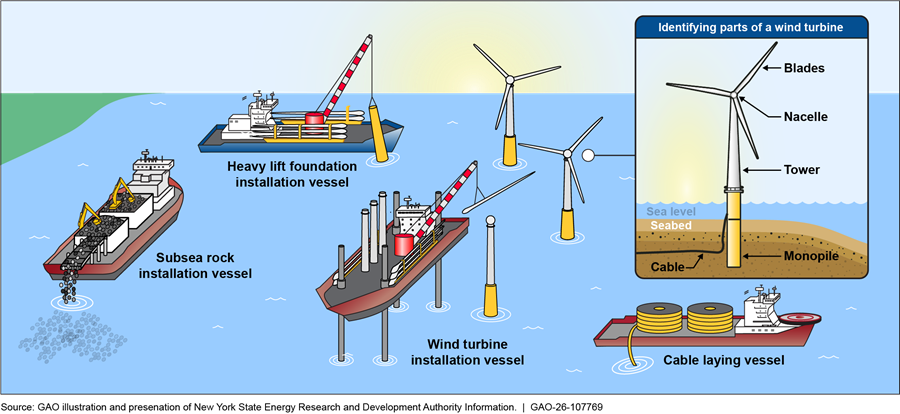
For the purposes of our report, we grouped offshore wind construction into three areas of activities, each of which requires a variety of vessels: (1) preconstruction survey activities, (2) turbine installation activities, and (3) cable laying activities. Within their respective construction plans, the developers for our selected projects outlined various vessels and steps required for each area. Specifically:
Preconstruction survey activities. Prior to construction, offshore wind developers survey the seabed and geology in their lease areas and along proposed cable routes. These surveys acquire information for state and federal permits, inform project design, and identify any hazards that may affect construction. A variety of vessels are used to study geological factors (such as seismic activity), biological factors (such as surveys of fish populations), or geotechnical factors (such as samples of sediment properties).
Turbine installation activities. To install the turbines, offshore wind developers lay scour protection (rocks) around the foundation locations, drive the monopile foundations into the seabed, and install the turbine components onto the foundations, among other activities. These activities require the use of several vessels with specific capabilities, including:
· Subsea rock installation vessels. According to our selected projects’ construction plans, it was anticipated that scour protection, consisting of the placement of stone or rock material around the foundation, would be installed by specialized subsea rock installation vessels prior to the installation of the foundations.
· Heavy-lift installation vessels. Once the seabed has been prepared—this could include removal of large obstructions—a heavy-lift installation vessel is expected to use a crane to upend the monopile and lower it to the seabed. It would then hammer the monopile into the seabed.
· Wind turbine installation vessels. Once the foundation is in place, a wind turbine installation vessel (WTIV)—would then install the tower (either as a single lift if pre-assembled or in multiple lifts for separate sections). The tower is then bolted to the foundations, and the WTIV is expected to install the nacelles and blades.
Cable laying activities. Offshore wind developers must lay two types of cables for offshore wind turbines to carry power to the electrical grid: (1) inter-array and (2) export. Prior to installing both types of cables, in accordance with normal industry practices, various vessels often conduct pre-lay “grapnel runs” to locate and clear obstructions such as abandoned fishing gear and other marine debris. Inter-array cables (around 8 inches in diameter) connect the individual turbines to each other and to the offshore substation. Export cables (around 12 inches in diameter) connect the windfarms to the onshore grid. Generally, specialized cable-laying vessels—that can be equipped with one or two large carousels capable of spooling long lengths of cable—can be used to lay both types of cables. For export cables, these vessels may simultaneously lay and bury the export cable. However, in places where burial may be difficult, subsea rock installation vessels may be used to install additional physical protection, such as rocks, to cover the exposed cables.
In addition to the installation vessels discussed above, a number of other vessels such as offshore supply and crew transfer vessels serve in support roles throughout the offshore construction process. These vessels can be used to carry goods, supplies, or other equipment, support specific installation activities, or house offshore workers, among other tasks. For more information on these installation and support vessels, including examples of the activities they perform, see appendix II.
Conducting survey activities and installing offshore wind energy components at sea also requires a workforce that can operate these vessels and install large industrial structures, machines, and cables in challenging ocean environments. Each vessel has workers on board comprised of credentialed mariners as well as other project and construction crew. Credentialed mariners are civilian employees, credentialed by the U.S. Coast Guard, with different levels of skill and qualifications working on a variety of public and privately owned U.S.-registered merchant, towing, and passenger vessels—some positions include deck officers, engineers, or medical personnel. The other crew on board (i.e., project and “at-sea” construction crews such as crane operators, commercial divers, and pile drivers) are generally responsible for overseeing and supporting the various installation activities.
Federal Roles for Offshore Wind and Shipbuilding
The Department of the Interior is authorized under the Energy Policy Act of 2005 to grant a lease, easement, or right-of-way related to renewable energy such as offshore wind development on the OCS. The Department of the Interior issued the nation’s first lease for commercial wind energy development on the OCS in 2010 and 3 years later, held its first competitive lease auction for offshore wind in federal waters. Since then, the Bureau of Ocean Energy Management (BOEM)—within the Department of the Interior—has administered about 40 existing offshore wind leases, constituting over 3 million acres on the OCS. These competitive lease auctions raised about $6 billion. In 2022, the then-administration aimed to accelerate offshore wind development and announced a joint effort of the federal government and the governors of several East Coast states to deploy offshore wind turbines capable of 30 gigawatts of electricity by 2030.
BOEM is responsible for implementing a framework for issuing leases, easements and rights-of-way for OCS activities that support production and transmission of renewable energy, including offshore wind. In this role, BOEM has promulgated rules and guidelines governing the permitting and operation of offshore wind facilities.[14] More specifically, BOEM’s renewable energy program consists of four distinct phases: (1) Planning and Analysis, where BOEM seeks to identify suitable areas for wind energy leasing; (2) Leasing, where BOEM issues a commercial wind energy lease through a competitive or noncompetitive process; (3) Site Assessment, where BOEM must approve the lessee’s site assessment plan; and (4) Construction and Operations, where BOEM conducts environmental and technical reviews of the lessee’s Construction and Operations Plan (COP) and decides whether to approve or disapprove it. BOEM approval of the COP is needed before approved activities can begin under the lease. For more information on what mechanisms BOEM, in coordination with other agencies, has in place to oversee offshore wind energy development, see our previous report on offshore wind development in federal waters.[15]
Since January 2025, the current administration has taken steps to temporarily halt offshore wind development and construction. For example:
· In January 2025, the administration temporarily halted offshore wind leasing and permitting through a Presidential memorandum that, among other things, prohibits federal agencies from issuing or renewing leasing, permits, or approvals for offshore wind projects pending a review of federal wind leasing and permitting practices.[16]
· In August 2025, BOEM issued a Director’s Order to Revolution Wind to halt all ongoing activities on the OCS to allow BOEM to address concerns that arose during the review undertaken pursuant to the January 2025 Presidential memorandum.[17]
· In December 2025, BOEM issued subsequent Director’s Orders suspending construction activities at all offshore wind projects under construction due to potential national security risks; specifically, that the blades and towers create radar interference.[18]
According to a September 2025 Congressional Research Service report, many of the about 40 offshore wind leases—in various stages of BOEM’s approval process—were affected by the January 2025 Presidential Memorandum.[19] Most lessees had not yet received the necessary permits and approvals for project construction. While five offshore wind projects that had approved COPs—including our three selected projects—undertook construction in 2025, all of these projects fell under the December 2025 Director’s Orders to suspend construction activities.[20]
Outside of the permitting process, the Maritime Administration, within the Department of Transportation, and CBP play key roles in the potential development of offshore wind by promoting U.S. shipbuilding and administering coastwise laws such as the Jones Act, respectively.
Promoting U.S. shipbuilding. The Maritime Administration within the Department of Transportation is responsible for fostering, promoting, and developing the merchant maritime industry of the United States. To support this mission, among other things, the Maritime Administration seeks to ensure that the United States maintains adequate shipbuilding and repair services for the domestic and international commerce of the United States and national security needs. Also in support of this mission, the Maritime Administration administers a number of statutorily authorized financial assistance programs for U.S. vessel owners or operators constructing vessels in U.S. shipyards, including the Capital Construction Fund (a tax deferral program) and the Federal Ship Financing Program (a loan guarantee program).[21] The collective purposes of these programs are to encourage U.S. vessel owners or operators to construct or reconstruct vessels at U.S. shipyards. In June 2025, we studied the extent to which these programs followed leading practices and made seven recommendations to address challenges facing the maritime industry.[22] The Maritime Administration concurred with these recommendations. In December 2025, the Office of the Secretary of Transportation informed us that the Maritime Administration was in the process of engaging a contractor to assist in implementing these recommendations and that it expected to complete these actions by September 2026.
The Capital Construction Fund Program allows vessel owners or operators to defer paying tax on certain eligible deposits and earnings that can later be used to fund projects at U.S. shipyards. For example, vessel owners or operators could defer paying tax on the gains attributable to the sale of a vessel that are deposited into a fund account for future vessel construction or reconstruction at a U.S. shipyard.
The Federal Ship Financing Program provides loan guarantees to vessel owners for vessel construction or reconstruction projects at U.S. shipyards. According to the Maritime Administration, the intended benefits of the loan guarantee program are long repayment terms (up to 25 years), below market interest rates, and up to 87.5 percent project financing. The Maritime Administration reviews applications to the Federal Ship Financing Program in coordination with an independent financial advisor and other federal entities, including the Office of Management and Budget.
Administering coastwise laws, such as the Jones Act. The vessels needed for the construction of offshore wind projects may be subject to the Jones Act and related coastwise laws. Thus, depending on the activity, vessels involved in these projects may need to be U.S.-flag.[23] CBP is responsible for enforcing and administering laws and regulations which set forth procedures to control and oversee the coastwise trade, including coastwise laws such as the Jones Act. The Jones Act, in particular, prohibits the maritime transport of merchandise between points in the U.S. by non-coastwise-qualified vessels.[24] As discussed above, to be coastwise-qualified, a vessel must, in general, be registered under the U.S. flag, built in the U.S., owned by U.S. citizens, and crewed predominantly by U.S. citizens.[25]
CBP, in its administrative responsibilities, reviews written requests from interested parties for rulings or information setting forth a definitive interpretation of customs and related laws, including coastwise laws, such as the Jones Act, in light of specifically proposed transactions. Interested parties, such as offshore wind developers, may request a ruling from CBP regarding, for example, the extent to which planned vessels’ uses comply with the Jones Act and other coastwise laws.[26] For more information on selected issues in CBP rulings on the proposed use of relevant vessels and approaches taken to construct offshore wind energy projects, see appendix I.
Selected Offshore Wind Projects Used More U.S.-Flag Vessels than Foreign-Flag Vessels but Were Estimated to Have Used a Similar Number of U.S. and Foreign Mariners
U.S.-Flag Vessels Comprised the Majority of Those Used at Selected Projects, but Specialized Foreign Vessels Were Used for Installation Activities
We found more than 330 unique vessels were used at the three selected projects, about 80 percent of which were U.S.-flag. The percentage of U.S.-flag vessels used during preconstruction survey, turbine installation, and cable laying activities varied, in part because certain tasks require particular vessel types, some of which the U.S. does not have. We also found that 58 vessels were used across multiple projects.
Preconstruction Survey Activities
There is generally no requirement that survey or research activities aboard vessels be performed on vessels that are Jones Act compliant (see app. 1).[27] Nevertheless, we found that 76 of 100 vessels (76 percent) used in preconstruction survey activities at our selected projects were U.S.-flag (see fig. 2).
During preconstruction survey activities, developers use a range of vessel types to collect environmental, geotechnical, and geophysical information on the project areas, in part to inform construction decisions and minimize environmental impacts. The lease areas for our three selected projects totaled over 328,000 acres and were located up to 35 miles offshore in depths up to 197 feet.
Figure 2: Types and Numbers of Unique U.S.-Flag and Foreign-Flag Vessels Used for Preconstruction Survey Activities at Three U.S. Offshore Wind Farms, as of November 2025
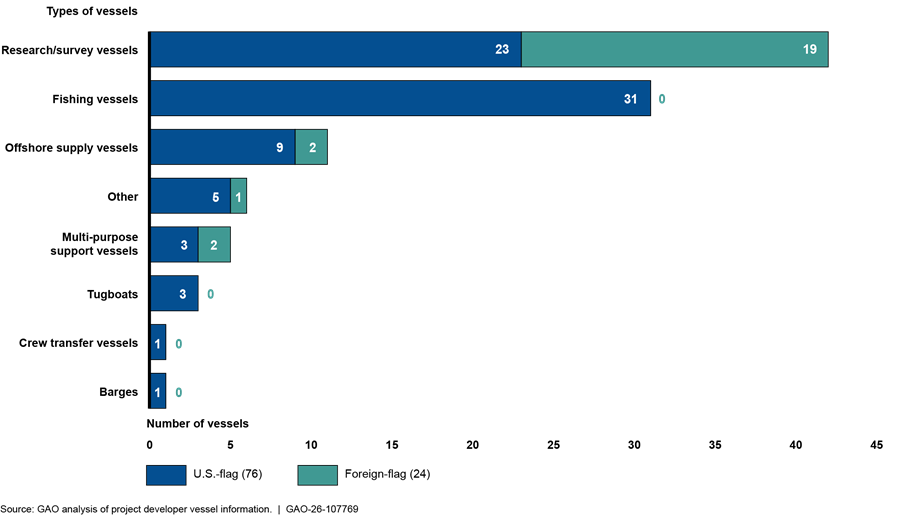
Note: “Other” vessels include miscellaneous vessel types, such as skiffs and lift boats. They were used for conducting geophysical and geological surveys in shallow waters, among other tasks.
Generally, U.S.-flag vessels taking part in preconstruction survey activities were smaller and not designed for deep-water survey work. The largest percentage of U.S. vessels were fishing vessels, some of which were used to conduct surveys of marine life—such as studies on black sea bass and lobster—or safety vessels that coordinated commercial and public mariner traffic. More than 20 U.S.-flag research/survey vessels were also used—the smaller of which were likely crewed by just a few mariners and others, according to the American Maritime Officers Union. For example, one of these research vessels that worked on multiple projects was a smaller shallow-water survey vessel that used seismic survey equipment to reveal potential obstructions in advance of export cable laying activities.
On the other hand, the foreign research vessels were often much larger and may be specialized for deep-water surveys. For example, some of these foreign vessels have onboard laboratories and specialized survey equipment and can accommodate up to almost 100 crew. According to all three developers, they selected the foreign vessels because U.S.-flag vessels either were not available or did not have the necessary specifications to conduct the surveys at the time the developers invited project bids. For example, one developer said that capable U.S.-flag survey vessels were unavailable due to ongoing annual survey work for the National Oceanic and Atmospheric Administration. The other two developers said that such vessels were unavailable due to ongoing contracts with the oil and gas industry.
Turbine Installation Activities
We found that 137 of 151 vessels (about 91 percent) used in turbine installation activities at our three selected projects were U.S.-flag (see fig. 3). Construction of offshore wind turbines generally consists of two stages: (1) the installation of the foundation (e.g., monopiles and scour protection) and (2) the installation of the subsequent tower and other components (e.g., nacelles and blades). As we discussed previously, each stage requires unique vessels to perform the associated installation tasks. As of November 2025, much of this work on our three selected projects was ongoing.
Figure 3: Types and Numbers of Unique U.S.-Flag and Foreign Vessels Used for Turbine Installation Activities at Three U.S. Offshore Wind Farms, as of November 2025
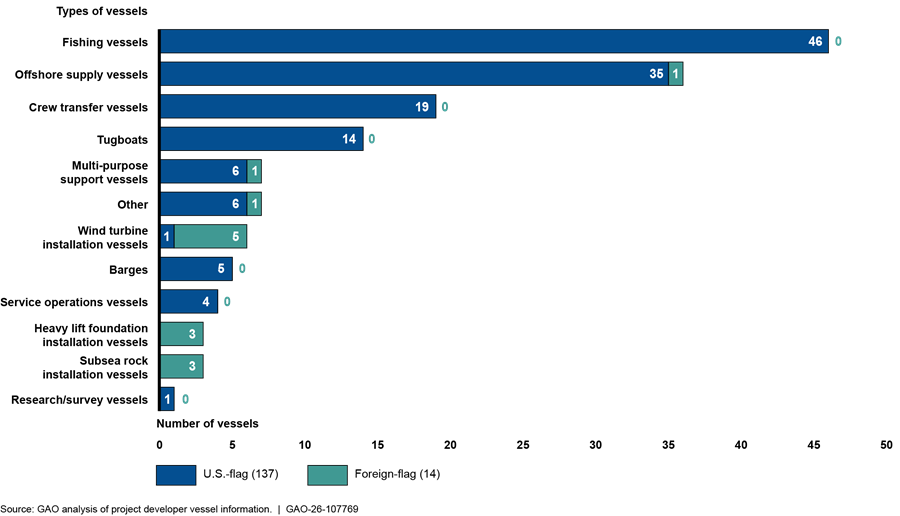
Note: Since only two of the three projects had begun installing turbines at the time we collected vessel data from developers, some additional construction vessels may not be included in our analysis. “Other” vessels include skiffs, lift boats, and other types of miscellaneous support vessels. They were used for accommodating workers at sea, monitoring marine mammals, testing turbine operations, and monitoring for safety, among other tasks.
Selected developers considered a number of approaches, designed to be compliant with Jones Act requirements, to install foundations and did so, in part because of the lack of U.S.-built specialized ships. With regard to installing the foundations, according to CBP rulings, whether a coastwise-qualified vessel must be used depends, in part, on whether the vessel carrying the foundation is traveling from a U.S. port, which is considered a coastwise point, and whether anything has been installed on the seabed at the installation location prior to the foundation that would establish a second coastwise point (see app. 1).[28] As the National Laboratory of the Rockies reported in 2024, there were no operational Jones Act-compliant heavy-lift vessels designed for installing fixed-bottom foundations. As of the summer of 2025, there were no plans to build one of these vessels at U.S. shipyards. As a result, representatives from all three projects told us they used foreign-flag vessels for these activities—and developed strategies designed to do so without violating Jones Act requirements. One developer said that they had three strategies to choose from:
1. The foundations could be loaded at a U.S. port (i.e., a coastwise point) and transported by a foreign-flag heavy lift vessel for subsequent installation by that same vessel. The developer said this strategy could be used only if the foundation was being installed directly on a pristine seabed—i.e., no scour protection had been placed on the site beforehand establishing a coastwise point. (See app. I for a discussion of CBP rulings related to a pristine seabed and what has been found to establish a coastwise point)
2. The foundations could be loaded at a U.S. port, transported to the installation site by a U.S.-flag vessel, and installed by a foreign-flag heavy lift vessel.
3. The foundations could be loaded at a foreign port, such as a Canadian port, and transported by a foreign-flag heavy lift vessel for subsequent installation by that same vessel.
Two developers told us that they began construction by using a foreign-flag subsea rock installation vessel to lay scour protection rocks at designated future foundation locations and used a foreign-flag heavy-lift foundation installation vessel to make multiple trips to Canada to pick up the monopile foundations, transport them from Canada to the installation site, and install them (option 3). The other used a U.S. port and began construction by using a foreign-flag heavy-lift foundation installation vessel to install the monopiles before laying scour protection (option 1).
With regard to installing the turbines, the U.S. maritime fleet had no Jones Act-compliant vessels capable of installing turbines and turbine components, as of June 2025. Accordingly, two developers told us that at the time they needed to install turbines, there were no Jones-Act compliant installation vessels for them to use. As a result, the two developers said they utilized a feeder barge method (feeder system) in which U.S.-flag barges transported the turbines from a U.S. port to a foreign-flag wind turbine installation vessel (WTIV) stationed on site (see fig. 4). See appendix I for a CBP ruling discussion of the use of the feeder system.[29]
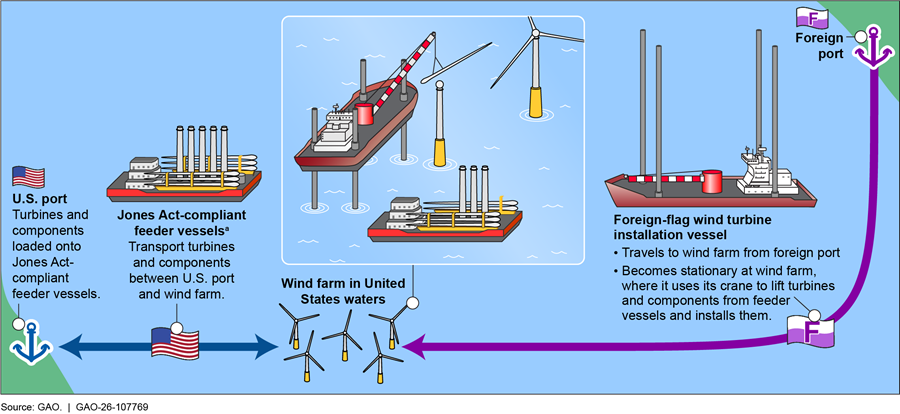
Note: The Jones Act generally requires that vessels carrying merchandise between any two points in the United States be owned and crewed by U.S. citizens, registered under the U.S. flag, and built in the United States.
The vessels that supported the installation vessels’ activities were overwhelmingly U.S.-flag. About one quarter of all U.S.-flag vessels used during turbine installation were offshore supply vessels. These were used for activities such as transporting supplies, conducting bubble curtain operations to reduce noise, and supporting larger vessels installing foundations, among other responsibilities.[30] For example, at one of our selected projects, seven U.S.-flag offshore supply vessels were used to support a foreign-flag heavy-lift installation vessel that was pile-driving monopiles into the seabed. According to the developer, the one foreign-flag offshore supply vessel was used because they needed an additional vessel capable of conducting bubble curtain operations. CBP rulings have found that the transportation and installation of certain bubble curtain systems aboard a bubble curtain vessel are vessel equipment rather than merchandise such that the bubble curtain vessel may be a foreign-flag vessel.[31] The developer told us that they attempted to find a U.S.-flag vessel; however, no U.S.-flag alternatives existed in the short-term “spot” market and the foreign offshore supply vessel was already in the area.[32]
Cable Laying
We found that 77 of 103 vessels (about 75 percent) used in cable laying activities at our three selected projects were U.S.-flag (see fig. 5). CBP rulings note that it has been their longstanding position that the sole use of a vessel in laying cable between two coastwise points generally is not considered coastwise trade, and therefore, does not need to be done by a coastwise-qualified vessel. As the National Laboratory of the Rockies reported, in 2024 there were no operational Jones Act-compliant cable laying vessels or subsea rock installation vessels. However, the first Jones Act-compliant subsea rock installation vessel entered into service in the summer of 2025 (we discuss this investment, as well as others, later in this report).
In addition to installing inter-array and export cables, vessels are also needed to survey potential cable routes, clear debris, boulders, and unexploded ordnance from the seabed, and inspect and install scour protection for the cable, among other tasks. Developers at our selected projects used a variety of vessels to conduct these tasks.
Figure 5: Types and Numbers of Unique U.S.-Flag and Foreign Vessels Used for Cable Laying Activities at Three U.S. Offshore Wind Farms, as of November 2025
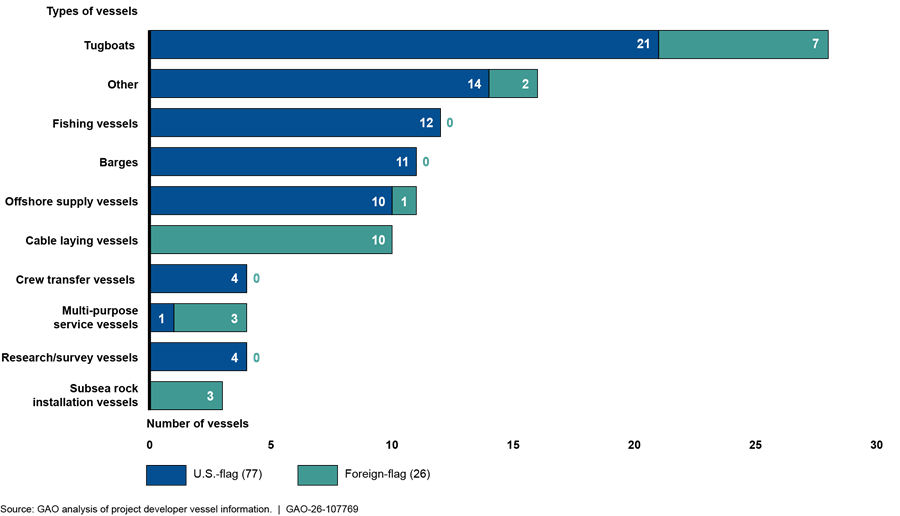
Note: “Other” vessels include crew transfer vessels as well as other miscellaneous vessel types, such as skiffs and lift boats. They were used for tasks such as ensuring safety, handling cables, and supporting divers and larger cable laying vessels.
At our selected projects, U.S.-flag vessels supported nearshore or inter-array cable laying activities. U.S.-flag tugboats were used, for example, to tow cable laying barges as well as handle anchors for them. In addition, all three developers used U.S.-flag vessels to remove obstructions, such as boulders and debris, from the seafloor in order to clear a route for the cables and other safety activities.
Developers we spoke with provided a variety of reasons for using foreign-flag vessels for other various cable laying activities. They said that as of July 2025, all existing cable laying and subsea rock installation vessels worldwide were foreign-flag. In addition, one developer told us all U.S. vessels capable of being modified to lay inter-array cables were tied up with work for the oil and gas industry. The same developer stated that given the technical limitations of those vessels, the retrofits required to lay inter-array cables would be substantial and would end up being cost prohibitive, especially given the market uncertainty for future offshore wind projects.
Another developer told us they found a shortage of U.S.-flag anchor handling tugboats and other shallow water workboats on the east coast. According to the developer, most of the domestic versions of these vessels are located on the west coast—making it difficult to bring them to work on east coast projects. They also said a number of other foreign vessels were subcontracted by the primary foreign installation vessel operators—these foreign installation vessel operators preferred to work with companies they have worked with in the past, given the complexities and safety risks of cable laying.
Thousands of U.S. and Foreign Mariners Were Likely to Have Worked on Selected U.S. Offshore Wind Projects
We estimate that the range of foreign and U.S. mariner numbers for those who worked on these three offshore wind projects was similar, even though most of the vessels were U.S.-flag, because the larger foreign-flag vessels involved generally required more mariners.[33] We estimate that the number of foreign mariners crewing vessels across our selected projects was likely between about 1,600 and 3,500. In comparison, we estimate the number of U.S. mariners to be between about 1,580 and 3,620.[34] Our estimations account for a “double crew” since vessel operators typically hire two crews to keep the vessel operating continuously, with each crew typically onboard a vessel for several weeks followed by a similar time period at home.
Because the U.S.-flag vessels working on our selected projects tended to be smaller, they accommodated smaller crews and would typically have fewer mariners per vessel. For example, an owner of a U.S. offshore supply vessel said that they employ six or seven credentialed mariners to navigate, manage, and maintain their vessel. Offshore supply vessels accounted for almost 20 percent of all U.S.-flag vessels used on these three projects.
On the other hand, because the foreign-flag installation vessels—generally designed for offshore construction activities and, in the case of wind turbine installation vessels, purpose-built for the offshore wind industry—tended to be larger and more complex, they would typically require more mariners to operate them. For example, the American Mariner Officers Union told us that a larger vessel such as a heavy-lift foundation vessel may have around 40 mariners onboard at any given time. That was true for other larger vessel types as well. According to our analysis, almost half of all foreign mariners at our selected projects worked on cable laying or on larger survey vessels. A foreign-flag vessel owner also told us that mariners generally stay with the vessel as it travels from project site to project site around the world, in part because the vessel’s complexities require a high level of institutional knowledge.
One stakeholder told us that there were some non-mariner U.S. citizens working on these vessels in construction or other related activities.[35] For example, the United Brotherhood of Carpenters and Joiners of America (UBC) reported that in 2024 about 20 American pile drivers worked on a foreign-flag installation vessel to assist in foundation installations on an offshore wind project off the coast of Scotland. The vessel owner told us those pile drivers comprised about 10 percent of the vessel’s total crew. The vessel owner also said the U.S. pile drivers were highly effective and the vessel owner sought to retain them. In early 2024, during the slow season for U.S. east coast offshore wind installation, eight of these American pile drivers accompanied the vessel to Europe to install monopiles off the coast of Scotland.[36] According to the UBC, if offshore wind development continues, it could be a major job source for union members in the coming decades.
Offshore Wind Industry Demands Spurred Some U.S. Vessel Investment Without Use of Federal Financial Assistance but Additional Investments Are Uncertain
To meet the demands of the industry, 50 new vessels for offshore wind projects had recently been delivered, were under construction, or were on order at U.S. shipyards as of August 2025, according to the American Clean Power Association. Constructing all these vessels would likely generate revenue for almost 20 shipyards in 12 states, including Texas, Pennsylvania, Louisiana, Rhode Island, and Florida.
While most of the vessels identified by the American Clean Power Association were for support vessels, U.S. vessel owners also invested in a U.S.-flag WTIV and a U.S.-flag subsea rock installation vessel. When completed, these two vessels would each become the first U.S.-flag offshore wind installation vessel of its kind. None of the vessel owners used the Maritime Administration’s financial assistance programs to help finance these investments. Vessel owners and other industry stakeholders we spoke with cited challenges to additional vessel investments, including current market uncertainty.
Most Investments Targeted Support Vessels for Construction, Operations and Maintenance
Of the 50 offshore wind vessels identified by the American Clean Power Association, 46 (92 percent) were investments or potential planned investments in vessels designed to perform supporting roles during offshore wind project construction and operations, such as tugs, barges, crew transfer vessels (CTVs), and service operation vessels (SOVs). CTVs and SOVs, in particular, play an important role in the offshore wind industry due, in part, to being needed regularly throughout a wind project’s lifetime, during its construction as well as operations and maintenance activities—which may be around 30 years (see fig. 6). CTVs are designated for fast transport of personnel and light equipment on day trips, whereas SOVs are dynamically positioned vessels from which technicians “walk to work” directly from the vessel to turbine. See appendix II for more information on these vessels’ characteristics and purposes.
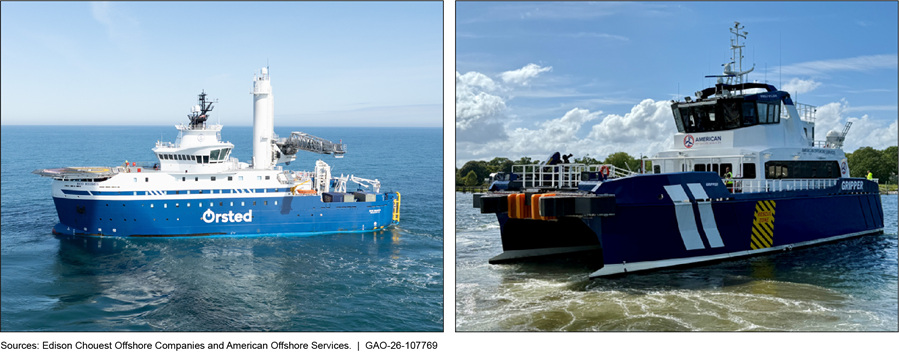
Note: The Eco Edison, a service operation vessel pictured on the left, supported commissioning activities at Revolution Wind in 2025. The AOS Gripper, a crew transfer vessel pictured on the right, transported crew at Revolution Wind in 2025.
In total, 40 of the 46 potential investments were for CTVs, SOVs, or other vessels designed for similar functions. Many of these vessels are often purpose-built for a specific project. One developer, in its Construction and Operations Plan, estimated that it would need up to five CTVs or one SOV and several CTVs for daily operations and maintenance over the project’s lifetime. Vessel owners told us that these vessels are an economically sound investment for two reasons: less foreign competition and potential long-term charter lengths.
· Less foreign competition. CTVs and SOVs often provide services between two coastwise points. Accordingly, coastwise laws, such as the Jones Act, constrain the market by excluding foreign competitors and act to shield U.S. operators of U.S.-flag vessels, such as CTVs and SOVs, from foreign competition in domestic commerce.
· Long-term charter length. According to vessel owners, wind project developers can offer long-term charters for CTV and SOV services, potentially up to 15 years. According to Maritime Administration documentation, a charter agreement may provide payment on a per day basis over the term of the contract and can be absolute, meaning the agreement is not dependent on being at sea or the operation of the wind farms. U.S. vessel owners said long term charters are an attractive market opportunity because the first 5 to 10 years of the vessel is generally spent paying off the loans for its construction. They said they generally do not make a profit on the vessel until later in its lifecycle, with the vessel expected to remain in service for 20 to 30 years.
According to two U.S.-flag vessel owners, a newly constructed CTV can cost between $10 and $15 million while a newly constructed SOV can cost around $100 million. One vessel owner told us that investments in SOVs could rise to close to $2 billion if all expected projects on the east coast became operational; however, they have since noted that it is difficult to assess if developers will continue to invest in offshore wind projects. One wind project developer stated that they had invested over $216 million to construct 13 new crew transfer vessels for their upcoming offshore projects in addition to another $194 million for a SOV to serve as its “floating base” for operations and maintenance. One vessel owner also said that in some cases, vessels can be retrofitted at a fraction of the cost. For example, they told us that they purchased and retrofitted an existing fishing vessel into a CTV at a cost of about $2.5 million.
Some Investments Targeted Installation Vessels
Of the 50 offshore wind vessels potentially being built at U.S. shipyards, 4 (8 percent) were investments or planned investments in vessels designed to perform specific installation activities. Unlike CTVs and SOVs, which are used throughout the lifetime of the project, installation vessels are used for discrete tasks. As a result, decisions on whether to invest in the construction of these vessels are often based on the long-term market outlook for the industry. As we reported in 2020, prior to investing in such a vessel, vessel owners prefer to line up multiple years’ worth of contracts for future work to establish sufficient business certainty to support the vessel’s financing.[37] We found some of these vessels faced construction delays and another was abandoned due to market uncertainty. Specifically:
Acadia. In November 2021, Great Lakes Dredge and Dock, a U.S. dredging company that owns a fleet of specialized vessels, announced a $197 million contract with Philly Shipyard to build the Acadia—designed to be the first Jones Act compliant subsea rock installation vessel (see fig. 7). Great Lakes Dredge and Dock representatives told us they built the vessel given the outlook for offshore wind projects in the U.S.at the time. These representatives said they had contracts for the vessel to be used for two U.S. offshore wind projects. However, given the number of stalled projects and the federal permitting and approvals pause since 2025, they said they were exploring other long-term, international options. As of March 2026, they said the vessel will begin eight months of domestic work before it sails to the United Kingdom where international offshore energy contracts will keep it utilized in Europe for the majority of 2027. They plan to keep its U.S.-flag designation in anticipation of covering U.S. pipelines and cables, and potentially, future offshore energy work.
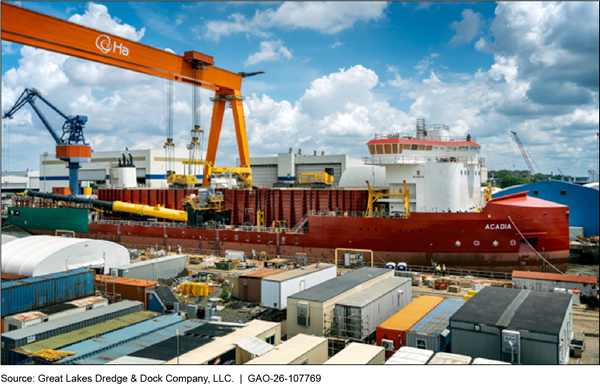
Note: The Acadia was launched in July 2025 and is expected to begin work in the second quarter of 2026 on domestic projects already under contract, according to a company representative.
Charybdis. In June 2021, Dominion Energy announced the construction of the Charybdis—designed to be the first Jones Act-compliant wind turbine installation vessel. Dominion Energy’s position as an energy company building a WTIV is unique—Dominion Energy owns the offshore wind project Coastal Virginia Offshore Wind, where the vessel will first be used. As such, it has more certainty on the vessel’s use, including on that project and the company’s future portfolio, which may include two other offshore wind projects on the east coast. The $700 million vessel, built in Brownsville, Texas faced commissioning delays in 2025. It installed the first turbine at Coastal Virginia Offshore at the end of January 2026.
Kalypso. In April 2024, Kalypso Offshore, a contractor for the U.S. offshore wind industry, planned to invest in the first U.S.-flag cable laying vessel; however, this investment did not occur. Representatives from the company said they had begun negotiations with three separate offshore wind projects—planning to start construction around 2028 or 2029 onwards—for about 5 years’ worth of work. However, representatives from the company told us that when the federal permitting and approvals pause was issued, the developers ended negotiations due to market uncertainty and ultimately cancelled the project. The company is no longer planning to move forward with the vessel’s construction, as of December 2025.
Marmac 306. In July 2025, Crowley Wind Services and Nexans announced they planned to develop and operate the first Jones Act compliant cable laying barge. The 300-foot barge, built in Louisiana, according to the announcement, was working at Empire Wind, installing and trenching export cables in conjunction with a number of support vessels.
Vessel Owners Have Not Used the Maritime Administration’s Financial Assistance Programs to Support Offshore Wind Vessel Investments
Two Maritime Administration financial assistance programs were available to potentially help vessel owners invest in offshore wind vessels at U.S. shipyards: the Federal Ship Financing Program and the Capital Construction Fund.[38] Because U.S.-built vessels generally cost more than foreign-built ones, the goal for both of these programs is to encourage shipbuilding at U.S. shipyards. However, vessel owners we spoke to did not use either program to finance their investments in U.S.-built offshore wind vessels.
Federal Ship Financing Program
The Federal Ship Financing Program provides loan guarantees to vessel owners for vessel construction or reconstruction projects at U.S. shipyards.[39] In June 2022, the Maritime Administration designated offshore wind vessels as “Vessels of National Interest”, in part to prioritize and expedite their loan guarantee applications for the program.[40] However, as of June 2025, no vessels related to offshore wind had been financed through the program. In the last 5 years, across maritime sectors, the program has executed two loan guarantees for two vessel owners, intended for the construction of 22 new vessels totaling nearly $400 million. Neither of these guarantees were related to offshore wind.
Since 2022, when offshore wind vessels were designated as “Vessels of National Interest”, four U.S. companies submitted loan guarantee applications related to offshore wind—intended for the construction of seven new offshore wind vessels, totaling more than $584 million. For example, one company applied for a loan guarantee of $43 million to build 4 CTVs at Rhode Island and Louisiana shipyards. Ultimately, all four vessel owners chose to pursue private financing, eventually constructing all seven vessels.
Vessel owners we spoke with identified two key challenges that informed their decision to pursue alternative financing options: the length of the application process and the independent economic assessment of potential risks.
Length of time. Almost all U.S. vessel owners we spoke with commented that the application review process takes too long. After an application has been submitted to the program, the application review process takes, as a best-case scenario, between six to nine months, according to Maritime Administration officials. However, vessel owners said that the process often takes much longer. One vessel owner that applied to the program told us the process took longer than 2 years, after which they ultimately decided to stop pursuing the loan.
Vessel owners also said that during this long review process, they cannot get needed information from the Maritime Administration in time to use it to submit a competitive bid for a charter, which they need to justify investing in the vessel. Specifically, vessel owners also said to submit a competitive bid for a charter, they require an estimate of the loan details, such as interest rates, to develop the pricing structure. One vessel owner told us a commercial bank, or other private lending institutions, can provide a general estimate in under a month. Maritime Administration officials said they were unable to provide such estimates.
Independent economic assessments. In reviewing loan guarantee applications, the Maritime Administration is required to assess an applicant’s economic soundness. The Maritime Administration is authorized to require an independent third-party analysis to provide objective risk analysis for loan guarantee applications. Vessel owners told us that the independent analysis assessment by the Maritime Administration’s Independent Financial Advisor did not reflect the vessel owner’s understanding of the potential risks nor how private financing institutions viewed the risk. Two vessel owners also said, in their experience, the Independent Financial Advisor generally lacked expertise in the offshore wind or similar industry, like oil and gas. Maritime Administration officials told us offshore wind and oil and gas expertise is too niche and would limit the number of independent financial advisors they could use. In contracting with independent financial advisors, they said they are solely searching for the technical skills to perform economic assessments, because, in their opinion, they can supplement the assessment with their own expertise.
However, Maritime Administration officials also told us that some of the four applications submitted for offshore wind-related vessels were problematic because they asked the federal government to take on unreasonable risk. They said that a majority of the offshore wind vessel applicants did not include assurances that a credit-worthy company would pay back the loan if the applicant failed to do so. For example, they found that one project, while economically sound, was not capable of guaranteeing the debt due to a lack of a financial backstop. According to Maritime Administration officials, further negotiations revolved around loan restructuring—potentially mitigating risks to acceptable levels—but talks eventually broke down.
Capital Construction Fund Program
The Capital Construction Fund Program (CCF) was established to encourage vessel owners and operators to construct or reconstruct vessels in U.S. shipyards through the deferment of some federal income taxes. This program allows vessel owners or operators to defer paying income tax on certain income they invest in a CCF account and later use to fund vessel construction at U.S. shipyards. To qualify for a CCF account, a company needs to have had a minimum 3 years of income, among other eligibility requirements, according to Maritime Administration officials. However, Maritime Administration officials also told us that this may be a challenge for many offshore wind companies as it is a nascent industry.
In 2022, eligibility for the Capital Construction Fund was expanded, making all U.S. built vessels, including offshore wind vessels, engaged in the domestic or foreign trade of the United States, or in the fisheries of the United States eligible under the program. As of 2024, the Capital Construction Fund Program had 137 vessel owners participating in the program, including two of the 10 vessel owners we interviewed, according to Maritime Administration documentation. These two vessel owners planned to retrofit three existing vessels into SOVs, including installing walk-to-work capabilities, onboard amenities, and enhanced crane capacity. Neither used the Capital Construction Fund to finance these investments. One of these vessel owners stated that they found their Capital Construction Fund Account helpful and had used it to help fund vessel investments in the past. However, in this case, they briefly explored using the Federal Ship Financing Program for an offshore wind vessel, but decided that it was not viable, instead deciding to privately finance the vessel without the use of its Capital Construction Fund account. The other vessel owner said that, in part due to a previous negative experience trying to use the Federal Ship Financing Program, it chose to finance the vessel investments itself.
We previously reviewed the Federal Ship Financing Program and the Capital Construction Fund, and in June 2025, found that the Maritime Administration had not determined to what extent the assistance programs were achieving their intended outcomes. The Maritime Administration’s purpose for the programs is to encourage vessel owners and operators to construct or reconstruct vessels at U.S. shipyards. However, we found that the agency did not set any measurable goals for the programs to determine to what extent the programs’ purpose is being achieved. Without such goals, the agency cannot assess if the programs are achieving the desired results. The fact that these programs were not generally used for vessel construction by our selected U.S. vessel owners—especially given that offshore wind vessels were named “vessels of national interest”—further underscores the importance of understanding the extent to which the programs are encouraging U.S. shipbuilding.
In our June 2025 report, we made seven recommendations to the Maritime Administration, including that it develop measurable goals for the Federal Ship Financing Program and the Capital Construction Fund program, develop processes to collect information to measure progress, and use that information to assess progress on a regular basis. Such information could provide additional insights and better position Maritime Administration officials to determine their programs’ value and consider changes that could increase the effectiveness of the programs. The Maritime Administration agreed with all seven recommendations. In December 2025, the Secretary of Transportation stated that the Maritime Administration was in the process of engaging a contractor to help them implement some of these recommendations and that it anticipated completing these actions by September 2026.
Selected Vessel Owners and Other Stakeholders Cited Longstanding and Interconnected Challenges Hindering Additional Vessel Investments
Based on our discussions with selected U.S. vessel owners as well as other industry stakeholders, challenges hindering U.S. vessel owners’ willingness to invest in additional Jones Act-compliant offshore wind vessels fall into three main areas; specifically: (1) industry and regulatory uncertainty, (2) shipyard capacity, and (3) foreign competition.
Industry and regulatory uncertainty. As of August 2025, five offshore wind projects were fully permitted and had begun construction activities. No additional U.S. offshore wind projects were scheduled to begin construction. While some projects had been delayed or canceled prior to the January 2025 permitting and approvals pause, the timeline for other projects became increasingly uncertain due to this pause. Furthermore, as described, all five of the projects that were under construction earlier in 2025 fall under the December 2025 Director’s Orders to suspend construction activities. Without greater certainty about the development of the overall market, vessel owners are unable to develop a sufficient business case for investments.
Shipyard capacity. In 2020, we reported that stakeholders said there were a limited number of shipyards in the United States with the capacity to construct large, more specialized offshore wind vessels. This largely remains the case, as one vessel owner estimated that only five U.S. shipyards have the capacity to construct them. Moreover, given U.S. shipyards’ lack of experience in building these vessels—a challenge we also identified in 2020—some vessel owners said they have experienced cost increases, due in part to the learning curve associated with their construction. Another vessel owner told us that the cost of constructing an offshore wind vessel in the United States can be more than twice as expensive as constructing a vessel in China, and while Singapore and Turkey are not as cheap, they can also offer significant cost savings.[41] One stakeholder said that these costs can be attributed, in part, to construction inefficiencies due to older infrastructure and techniques used at U.S. shipyards in comparison to other global shipbuilding markets.
However, a shipyard representative told us that, to make infrastructure investments, a shipyard would need an acceptable return on investment. This representative said that a contract for one vessel has no return on investment because there is no guarantee of building more vessels with a similar design. Without a larger contract for multiple vessels, the shipyard does not have a business case to invest in infrastructure improvements that could make future investments more efficient.
Foreign competition. U.S. vessel owners we interviewed told us that it is difficult to compete against foreign companies for work where the requirements of the Jones Act, as applied to specific proposed factual situations, have been interpreted by CBP to be not applicable to certain foreign-flag vessel activities. They stated that competing with foreign-flag vessels is difficult because the cost of constructing and operating U.S.-flag offshore wind vessel is higher. For example, one vessel owner said U.S. operators carry a comparatively high structural cost burden. In addition to federal taxes, they said that U.S. operators are often subject to significant state and local taxes in the jurisdictions where they operate—such as ports in Rhode Island and Massachusetts. They also said operating costs are also materially higher due to U.S. labor requirements, U.S. wage and benefit levels, and the need to comply with U.S. licensing, documentation, safety, and liability requirements. In another example, a vessel owner told us that construction costs in foreign shipyards are lower because foreign governments heavily subsidize production, up to 25 percent of vessel construction costs. That allows foreign operators to pay lower capital expense costs. In addition, foreign vessel operators may also pay lower mariner wages. According to this vessel owner, U.S. operators can expect to pay their mariners about $10,000 per day to operate the vessel, whereas it might cost about $2,000 per day for foreign operators. These factors contribute to the overall cost structure of U.S.-flag offshore wind vessels, and in turn, require vessel owners to seek a higher return on investment. As a result, U.S. vessel owners said they generally must charge higher rates for their services, potentially impacting their competitiveness when bidding for contracts.
The two vessel owners that invested in U.S.-built installation vessels that can be Jones Act-compliant said they expect significant efficiencies from using these vessels in offshore wind construction, due to their ability to move between U.S. coastwise points, unlike foreign vessels. However, the extent to which these efficiencies will occur is unknown until the Charybdis and the Acadia have spent some time in service. For example, Dominion representatives told us that they expect the Charybdis to be able to install offshore wind turbines in about half of the time needed to install them using a feeder system with a foreign-flag WTIV and U.S.-flag feeder barges. With regard to scour protection, one developer told us it takes approximately seven to nine days for a foreign subsea rock installation vessel to go from their site, refill with rocks in Canada, and return to the site. Representatives from the Great Lakes Dredge and Dock Company (owners of the Acadia) told us they can undertake a similar round trip in less than two days using a domestic port. However, as a developer told us, these potential efficiencies become inconsequential without future projects in the pipeline.
Agency Comments
We provided a draft of this report to the Department of Energy, Department of Interior, DHS, and DOT for review and comment. Department of Interior did not have any comments on the report. Department of Energy and DOT provided technical comments, which we incorporated as appropriate.
We also provided a draft of this report to DHS for review and comment on January 30, 2026. DHS was subject to a lapse in appropriations beginning February 14, 2026. DHS did not provide comments on the draft report. In addition, we provided a statement of facts to DHS in September 2025. We routinely provide statements of facts to agencies to confirm that key information used to formulate our analyses and findings is current, correct, and complete. We incorporated comments from DHS on the statement of facts as appropriate.
We are sending copies of this report to appropriate congressional committees, the Secretary of the Interior, the Secretary of Energy, the Secretary of Homeland Security, and the Secretary of Transportation. In addition, the report is available at no charge on GAO’s website at https://www.gao.gov.
If you or your staff have any questions about this report, please contact Andrew Von Ah at vonaha@gao.gov. Contact points for our Offices of Congressional Relations and Media Relations may be found on the last page of this report. GAO staff who made major contributions to this report are listed in appendix IV.
Andrew Von Ah
Director Physical Infrastructure
The term “coastwise trade” is defined in federal regulation to “include the transportation of passengers or merchandise between points embraced with the coastwise laws of the United States.”[42] The term “coastwise laws” generally refers to a group of federal laws applicable to, among other things, the transportation of merchandise and passengers between points in U.S. waters (coastwise points).[43] In general, these transportation-related coastwise laws bar foreign vessels from engaging in coastwise commerce between different coastwise points. This discussion will focus mainly on selected issues regarding the application of the coastwise law known as the Jones Act[44] relevant to the use of vessels in offshore wind projects. The Jones Act, set out at 46 U.S.C. § 55102, provides, in pertinent part, that except as otherwise provided, a vessel may not provide any part of the transportation of merchandise by water, or by land and water, between points in the United States to which the coastwise laws apply, either directly or via a foreign port, unless the vessel (1) is owned by citizens of the United States for the purposes of engaging in the coastwise trade, and (2) has been issued a certificate of documentation with a coastwise endorsement. The Jones Act and related coastwise laws collectively require that such vessels be registered under the U.S. flag, built in the U.S., owned by U.S. citizens, and crewed predominantly by U.S. citizens.[45] Such a vessel, after it has obtained a coastwise endorsement from the U.S. Coast Guard, is said to be “coastwise qualified.”[46] U.S. Customs and Border Protection (CBP) regulations provide that a coastwise transportation of merchandise takes place when merchandise laden (loaded) at a coastwise point is unladen (unloaded) at another coastwise point, regardless of origin or ultimate destination.[47]
CBP, through ruling letters, provides guidance and definitive interpretation of coastwise laws such as the Jones Act and other applicable laws. A ruling may be requested under Part 177 of the CBP Regulations[48] by any person who, as an importer or exporter of merchandise, or otherwise, has a direct and demonstrable interest in the question or questions presented in the ruling request.
With respect to the offshore wind industry, examples of those that could request a ruling include developers or contractors to determine whether a proposed vessel activity qualifies as subject to coastwise statutes such as the Jones Act. With respect to the offshore wind industry, ruling requests might include information such as a description of the proposed operation, the vessel(s) the party proposes to use, what items would be transported, and the points at which the vessel(s) would be laden (i.e. loaded) and unladen (i.e. unloaded) of such items, and asks CBP to determine, for example, if that activity would be compliant with the Jones Act or other coastwise statutes.
CBP rulings, according to CBP officials, are narrow in scope and solely apply to the specific proposed actions of a specific case. They are not intended to function as broad sweeping principles. Accordingly, CBP officials recommend that vessel owners do not rely on previous letter rulings unless a case in question shares identical details. Since 1988, CBP has issued over 12,000 rulings associated with coastwise laws.
We reviewed CBP interpretations from selected CBP rulings related to the use of vessels in offshore wind construction. The following discussion is intended to highlight selected issues pertinent to the application of the Jones Act regarding the use of vessels in fixed bottom (e.g. monopile) offshore wind projects and is not intended to be: (1) comprehensive as to potentially pertinent issues or (2) comprehensive as to the full sets of CBP holdings in the CBP rulings cited.
Selected Rulings Associated with the Definition of Merchandise Relevant to Offshore Wind Projects
The Jones Act has been described as using but not fully defining the term “merchandise.”[49] The Jones Act provides that the term “merchandise” includes merchandise owned by the United States Government, a State, or a subdivision of a State, and valueless material.[50] Historically, CBP has turned to the definition of “merchandise” contained in the Tariff Act (19 U.S.C. § 1401(c)) to supplement its interpretation of the Jones Act.[51] Under 19 U.S.C. 1401(c), the term “merchandise” is defined to mean “goods, wares, and chattels of every description, and includes merchandise the importation of which is prohibited, and monetary instruments as defined in section 5312 of title 31.[52]
Preconstruction Activities
Some preconstruction survey activities have been found by CBP to not implicate coastwise laws such as the Jones Act. For example, regarding vessel activity related to the installation of a subsea power cable, a December 2024 CBP ruling found that a vessel used to conduct survey operations by mapping a seabed located in U.S. territorial waters on the OCS using a sonar-based survey tool that does not physically contact the seabed would not implicate the Jones Act.[53] CBP rulings have noted that CBP has long held that vessels engaged in oceanographic research are not engaged in coastwise trade, so long as the vessels are utilized in a research role.[54] In doing so, CBP has noted that while not controlling CBP determinations in this area, CBP looks to 46 U.S.C. § 50503, providing that an oceanographic research vessel (as defined in section 2101 of title 46)[55] is deemed not be engaged in trade or commerce, as instructive.[56]
Offshore Wind Merchandise
Scour Protection. Scour protection can be composed of rock or similar material installed on the seabed to prevent sediment erosion and protect against increased seabed drag caused by the placement of a foundation.[57] CBP rulings have interpreted the definition of “merchandise” to include rocks and dredged material.[58] CBP rulings have found that the offshore transportation of scour protection materials can, under certain circumstances, constitute the transportation of merchandise under the Jones Act.[59]
Monopiles. A monopile has been described in CBP rulings as a foundation embedded in the seafloor.[60] Monopiles have been described as the most commonly used foundation type for offshore wind turbines.[61] CBP rulings have found the offshore transportation of monopiles can, under certain circumstances, constitute the transportation of merchandise subject to the Jones Act.[62]
Power Cables.
Laying of Power Cable (Paid out/Not Unladen)
CBP rulings distinguish between transportation of power cable for the purpose of laying out the power cable (paid out/not unladen) and merely transporting the power cable to another point of lading in the United States. CBP rulings have noted that it has been CBP’s longstanding position that the initial placement of cable by paying the cable out from the vessel does not constitute transportation under the Jones Act.[63] For example, an August 2024 CBP ruling noted that “CBP has long held that the sole use of a vessel in laying pipe or cable between two coastwise points is not considered a use in the coastwise trade of the United States.”[64] In doing so, CBP has reasoned those situations in which material is not landed as cargo but is only paid out in the course of the installation operation makes such operation permissible (i.e., “paid out/not unladen”).[65] According to the August 2024 CBP ruling, because the use of a vessel in pipe or cable laying is not a use in the coastwise trade, a non-coastwise-qualified vessel may carry pipe or cable which is laid between such points by that vessel.[66] CBP rulings have noted, however, that the transportation of pipe or cable by any vessel other than the vessel that is laying that pipe or cable at a point within U.S. territorial waters would be considered coastwise trade; therefore, that transportation would have to be accomplished by a coastwise-qualified vessel.[67]
In our discussions with CBP officials, they stated that “paid out/not unladen” is a narrowly drawn and highly specific interpretation that solely applies to the laying of power cable. According to CBP officials, the foundation of the ruling is based on the Supreme Court’s characterization of “transportation” from an 1885 decision providing that transportation implies the taking up of persons and property at some point and putting them down at another.[68] According to CBP officials, due to the continuous installation process of cable laying, in which the cable is continuously unspooled and not picked up somewhere and put down somewhere else, the laying of power cable does not need to be done by a coastwise-qualified vessel.
CBP rulings, such as a December 2024 ruling, have further noted that because the use of a vessel in pipe or cable laying is not a use in the coastwise trade, a non-coastwise-qualified vessel may carry pipe or cable which is laid between such points by that vessel.[69] This December 2024 CBP ruling, for example, found that because a proposed loading of cable, either at a U.S. port or a foreign port, aboard non-coastwise-qualified cable installation vessels, would be paid out in the course of an installation operation directly onto the seabed at OCS sites and not unladen onto the seabed, it would not be in violation of the Jones Act.[70]
CBP rulings have also determined that the process by which previously placed cable ends may be picked up and connected with additional cable does not constitute coastwise trade because it “still constitute[s] a cable-laying operation.”[71] A July 25, 2023 CBP ruling, for example, determined that a non-coastwise-qualified trenching support vessel’s transportation of cable in the later phases of a project, in order to combine it with additional cable sections from prior phases, would not constitute coastwise trade in violation of the Jones Act.[72]
Creating Cable Laying Trenches
Pursuant to 46 U.S.C. § 55109, known as the Dredging Statute, only coastwise-qualified vessels may engage in dredging in the navigable waters of the United States. CBP rulings note that “CBP has consistently held that the term ‘dredging’ within the meaning of 46 U.S.C. § 55109, is “the use of a vessel equipped with excavating machinery in digging up or otherwise removing submarine material.”[73]
CBP rulings also note, however, that CBP has long held that the use of certain devices to create underwater trenches for the purpose of cable laying does not constitute “dredging.”[74] A July 2023 CBP ruling provides, for example, that it “has consistently stated that the use of cable-burial devices by cable-laying vessels, which employ a water jetting action that emulsifies or fluidizes the seabed surrounding the cable, does not constitute an engagement in dredging. This fluidizing process creates a long, narrow trench as the jetting action displaces the particles of the seabed until the cables are buried. The particles then return to the seabed by way of the ocean currents to bury the cables; none of the seabed material is removed in the process.”[75] For these reasons, the July 2023 CBP ruling found that such a process is not “dredging” within the meaning of the Dredging Statute whereby the performance of such a process by a non-coastwise-qualified vessel would not violate the Dredging Statute.[76]
Turbine Components.
CBP rulings have found the transportation of wind turbine components[77] such as a concrete hull supporting a wind turbine generator,[78] a wind turbine generator transition piece cover,[79] and nuts and bolts as well as any other components to be integrated into a wind turbine generator during the construction process,[80] to constitute merchandise for the purposes of the Jones Act. In a 2023 ruling, for example, CBP addressed whether the transportation of wind turbine components by a coastwise-qualified tug and barge from a U.S. port to an anchored, non-coastwise-qualified jack up vessel[81] located on the OCS would violate the Jones Act.[82] After finding that the wind turbine components being transported offshore would constitute merchandise, CBP ruled that such transportation would be between two coastwise points because the jack up vessel secured to the seabed of the OCS constituted a coastwise point.[83] The proposed transportation by the tug and barge were deemed by CBP to be allowable under the Jones Act because such vessels would be coastwise-qualified.[84]
Vessel Equipment and Tools
CBP notes that it has held that “vessel equipment” is not included within the general meaning of merchandise within the scope of the Jones Act.[85] According to CBP, “[v]essel equipment” has been defined as portable articles, “necessary and appropriate for the navigation, operation or maintenance of the vessel and for the comfort and safety of the persons on the board.”[86] Items considered “necessary and appropriate for the operation of the vessel,” according to a CBP ruling, “are those items that are integral to the function of the vessel and are carried by the vessel. This may include those items that aid in the installation and construction of offshore infrastructure. Whether such articles constitute vessel equipment is a fact-specific, case-by-case determination.”[87]
In a February 2021 ruling, for example, CBP assessed whether a proposed transportation and unlading at turbine installation sites of certain installation tools (e.g., bolt handling tools, hand tools, containers, bags, and personal protection equipment) and material (e.g., hand washing material, rags, cleaning clothes, and food and drink) for use by installation crewmembers, between coastwise points by a non-coastwise-qualified jack up vessel, would violate the Jones Act.[88] The February 2021 ruling found that because such tools would be used by the installation crew in physically installing and commissioning the wind turbine generator units, those tools would be integral to the function of the vessel, which would be to install and commission such wind turbine generator units. This ruling further found that the remainder of the items (e.g., personal protection equipment, food and drink) would be necessary for the “comfort and safety” of such crewmembers. As such, CBP ruled that the proposed tools and materials would not be considered “merchandise” under the Jones Act such that their transportation by a non-coastwise-qualified vessels would not violate the Jones Act.[89]
Selected Rulings Associated with the Definition of Passengers that Pertain to Offshore Wind Projects
Pursuant to 46 U.S.C. § 55103, also known as the Passenger Vessel Services Act (PVSA), only coastwise-qualified vessels may transport passengers between ports or places in the navigable waters in the United States, either directly or by way of a foreign port. CBP regulation defines a passenger as “any person carried on a vessel who is not connected with the operation of such vessel, her navigation, ownership, or business.[90]
CBP rulings have found that individuals transported between coastwise points are not classified as “passengers” within the meaning of the PVSA if they are required to be onboard to contribute to the accomplishment of the operation or navigation of the vessel during the voyage or are onboard because of a necessary vessel ownership or business interest during the voyage.[91]
Installation crew involved in specified activities have been found by CBP to not constitute “passengers” within the scope of the PVSA. In a March 2023 CBP ruling, for example, CBP found that workmen or technicians transported between coastwise points are not classified as “passengers” within the meaning of the PVSA if they are required to be onboard to contribute to the accomplishment of the operation or navigation of the vessel during the voyage or are onboard because of a necessary vessel ownership or business interest during the voyage.[92] With respect to a project crew for a wind turbine installation, an April 2022 CBP ruling found a crew, consisting of supervisors, lifting operations crewmembers, and technical crew (e.g., installation technicians, high voltage technicians), that performed work such as installation and commissioning work on wind turbine generators and pre-installation tasks on board the installation vessel, to be directly and substantially related to the operation, navigation, or business of the vessel itself, and thus were not “passengers” within the meaning of the PVSA.[93]
Selected Rulings Relevant to Transporting and Installing Foundations and Turbines for Offshore Wind Projects
Transportation of Merchandise Laden at a Foreign Port
When merchandise is laden on a vessel at a foreign port, because the foreign port is not a U.S. coastwise point, even when such merchandise is unladen at a U.S. coastwise point, there is no transportation between U.S. coastwise points within the meaning of the Jones Act.[94] Within this context, CBP rulings have determined that regardless of whether merchandise is unladen at a coastwise point, if the merchandise, such as monopiles, scour protection, power cables, and turbine components, is laden at a foreign port, there is no transportation between coastwise points, presuming that the subject merchandise did not originally come from a U.S. coastwise point.[95] As such, a coastwise-qualified vessel would not be required for such activities under the Jones Act. For example, a September 2023 CBP ruling held that with respect to the transportation of wind turbine generators, for the cargo of offshore substations, foundations, and scour protection laden on a vessel at a foreign port and unladen at a coastwise point, because the foreign port point of lading is not a coastwise point, there is no transportation between coastwise points within the meaning of the Jones Act.[96]
Transportation of Merchandise Between a Coastwise Point and the Pristine Seabed
CBP notes that its longstanding position is that the pristine seabed is not a coastwise point and that an inadvertent misinterpretation in a January 2021 ruling that the pristine seabed was a coastwise point was corrected two months later in a March 2021 ruling.
January 2021 Ruling
A January 27, 2021 CBP ruling held that a proposed transportation and unlading of scour protection materials from the Port of Providence, Rhode Island, a coastwise point, to the undeveloped pristine seabed of the Outer Continental Shelf (OCS)[97] by a non-coastwise-qualified vessel in connection with the construction of a wind energy installation would constitute a violation of the Jones Act.[98] In doing so, CBP (1) noted January 3, 2021 amendments to the Outer Continental Shelf Lands Act (OCSLA)[99] extending the jurisdiction of the United States on the Outer Continental Shelf to, among other things, the subsoil and seabed of the outer Continental Shelf, as well as “installations and other devices permanently or temporarily attached to the seabed, which may be erected thereon for the purpose of exploring for, developing, or producing resources, including non-mineral energy resources,” and (2) concluded that the “undeveloped (i.e., ‘pristine’) seabed of the Outer Continental Shelf (OCS)” was a coastwise point.[100] According to CBP, CBP inadvertently altered its longstanding position in the January 2021 ruling due to an incorrect interpretation of certain statutory amendments.[101]
March 2021 Ruling Modification and Current Position
In a March 2021 ruling, CBP modified its January 2021 ruling by holding that the transportation of scour protection material between a coastwise point and the pristine seabed on the OCS would not be in violation of the Jones Act because “the Jones Act does not apply to activity occurring at the pristine seabed on the OCS, which has been CBP’s longstanding position on the issue.”[102] CBP explained “in its application of the Jones Act, CBP interprets the OCSLA to provide CBP jurisdiction where there is an installation or device attached to the seabed serving a purpose articulated in the OCSLA – the exploration for, or development, production, transmission, or transportation of resources.”[103] CBP further explained that it “previously has determined that jurisdiction does not reach activity occurring at the pristine seabed, where there is no installation or device attached to the seabed, and thus where for Jones Act purposes no coastwise point exists.”[104] Thus, according to the March 2021 modification ruling, at that time of first delivery, there is no coastwise point, and hence no transportation of merchandise from one coastwise point to another.[105] The modification ruling also noted prior CBP rulings that a coastwise point under the Jones Act will be created when the first layer of scour protection material is place on the seabed.[106]
CBP’s March 2021 modification ruling was appealed within CBP for a de novo review.[107] In a June 2022 ruling on the appeal, CBP upheld the CBP interpretation that pristine locations on the seabed of the OCS are not subject to the Jones Act.[108] In addition, the June 2022 CBP ruling sought to clarify the modification ruling’s “first layer of scour protection” language explaining that “CBP intends that the single scour-laying vessel can apply whatever volume of scour rock, in however many separate layers, it might apply at the site for that vessel’s immediate (present) visit to the site. CBP understands this to be referred to as the “filter layer” of scour protection. This application of scour protection by that vessel (whether completed at that time or not) establishes the coastwise point.”[109]
With respect to the pristine seabed, a July 2023 ruling[110] finding that transportation of monopiles from a U.S. coastwise point to a pristine seabed site on the OCS by a non-coastwise-qualified installation vessel would not violate the Jones Act because no coastwise point would exist at the pristine seabed, was modified around two months later by a CBP ruling in September 2023.[111] The party requesting that the July 2023 ruling be revoked noted that the installation vessel might anchor at the monopile installation site. In response, CBP issued a modified ruling specifying that the installation vessel would not violate the Jones Act so long as it is not anchored or attached to the installation site. CBP noted that anchoring of the installation vessel to the seabed to aid its installation activity would establish the vessel as a coastwise point while the attachment exists and result in a violation of the Jones Act once the monopiles are unladed at the vessel.[112]
Activity that Establishes a Coastwise Point on the Pristine Seabed
Regarding monopiles and scour protection, CBP rulings have established that, whichever comes first at the pristine seabed (scour protection placement or monopile foundation installation) establishes the coastwise point.[113] As described in an April 2022 CBP ruling, once a coastwise point is created, any transportation of merchandise to be unladen, for example, at a scour protection site, “if the merchandise being transported was laden at a coastwise point, must be conducted by a coastwise-qualified vessel.”[114] The April 2022 ruling further noted that (1) this “includes any transportation of additional materials to that coastwise point, including additional scour protection (whether “filter” or “armor” layer) and the monopile or other structure that will support the wind turbine generator,” and (2) precludes any simultaneous transportation of the monopile or other components to the site from another coastwise point on a non-coastwise-qualified vessel.[115]
Transportation of Turbines to Turbine Foundation Site
With respect to wind farms off the coast of Rhode Island, in a 2011 ruling, CBP concluded that turbines to be laden aboard a non-coastwise-qualified vessel in a foreign port and transported to sites within and outside of U.S. territorial waters, because they do not contemplate transportation between coastwise points, would not be considered coastwise transportation within the meaning of the Jones Act.[116] This 2011 ruling also concluded that turbines laden aboard a coastwise-qualified vessel in Rhode Island and transported to sites within and outside of U.S. territorial waters, because they would be transported by coastwise-qualified vessels, would not violate the Jones Act.[117] Similarly, a 2022 CBP ruling found that transportation of wind turbine generators effected by a coastwise-qualified tugboat and barge from a U.S. port to an affixed, non-coastwise-qualified crane vessel located on the OCS would not violate the Jones Act because the vessels transporting the turbine components would be coastwise-qualified vessels.[118]
Selected Rulings Associated with the Use of Jack-Up Vessels Relevant to Offshore Wind Projects
CBP rulings have addressed whether the installation of wind turbine generators by a non-coastwise-qualified jack-up vessel on the OCS violates the Jones Act. In a May 2011 ruling, for example, CBP concluded that such installation would not be in violation of the Jones Act because installation activity is not coastwise trade and the jack-up vessels would remain completely stationary or only make incidental movements subordinate to and a direct consequence of any lifting operations during the installation process.[119] This May 2011 ruling noted that CBP has previously held the use of a non-coastwise-qualified crane vessel to lade and unlade cargo or to construct or dismantle a marine structure is not coastwise trade and does not violate the coastwise laws, provided any movement of the merchandise is effected exclusively by the crane and not by any movement of the vessel, except for necessary movement which is incidental to a lifting operation while it is taking place.[120]
A range of vessels with capabilities specialized to certain functions but not necessarily to offshore wind are required to install, operate, and maintain offshore wind projects. American Clean Power estimates that more than 25 different vessel types may be needed. However, the exact number of vessels and types is dependent on project size, distance from shore, environmental conditions, and other factors. Below are descriptions of selected vessel types that can be found working on offshore wind projects (See table).
|
Vessel Type |
Purpose |
Characteristics |
|
Heavy-Lift Foundation Installation Vessel |
These vessels are able to lift very heavy loads, and place turbine foundations on the ocean floor. |
They are heavy-load carriers with a high-capacity crane and dynamic positioning capabilities and are designed to install fixed-bottom foundations. These vessels can also be involved in offshore oil and gas construction. They may utilize two methods to install the monopiles: (1) “vibro-hammering” in which the monopile is vibrated, causing the seafloor to soften and the monopile to be pushed downward and (2) a hydraulic impact hammer that drives the monopile to its target depth. According to a vessel owner, less than 10 vessels—across the world—can install monopiles on the U.S. Outer Continental Shelf. One vessel that worked on a selected project measured around 700 feet long and could accommodate about 160 crew. |
|
Wind Turbine Installation Vessel |
Installs turbine components on top of foundations. |
Typically, a jack-up vessel with legs capable of extending to the seafloor. When the legs are deployed, it’s capable of rising above the surface of the sea and essentially becomes a fixed platform. They also need a large amount of clear deck space and a tall, heavy-capacity crane to carry and install turbine components, including the tower and blades. According to a vessel owner, less than 25 vessels—across the world—can install the newest generation of wind turbines. One vessel that worked on a selected project measured around 500 feet long and could accommodate about 130 crew. |
|
Subsea Rock Installation Vessel |
Specialized to place scour protection rock beds around the site and offshore wind turbine foundations to prevent erosion. |
They have the ability to carry tens of thousands of tons of rock. A conveyor belt moves rocks to a chute that feeds them into a “fallpipe.” To place the rocks precisely on the ocean floor, the fallpipe extends to the seafloor and may be positioned by a remotely operated underwater vehicle. According to a vessel owner, about 20 such vessels—across the world—can operate at offshore wind projects. One vessel that worked on our selected projects measured around 500 feet long and could accommodate about 50 crew. |
|
Cable Laying Installation Vessel |
Specialized to lay cable along the ocean floor. |
They have the ability to carry thousands of tons of cables. They can be equipped with one or more carousels allowing for the continuous unspooling and laying of cable. According to a vessel owner, about 10 to 15 such vessels—across the world—can operate at offshore wind projects. One vessel that worked on a selected project measured more than 400 feet long and could accommodate about 80 crew. |
|
Research/Survey Vessel |
These vessels conduct environmental, geotechnical, and geophysical surveys. |
They carry survey equipment and can be purpose-built for offshore wind or a multi-purpose vessel with survey equipment. Their size and capabilities may vary significantly depending the vessel. For example, one vessel that worked on our selected projects was a 77-foot catamaran built to support marine biology research in coastal waters. Another vessel that worked on our selected projects measured over 300 feet long, could accommodate about 100 crew, and was equipped with drilling rigs and onboard laboratories to collect soil samples up to 8,000 feet below the water surface and analyze the results. |
|
Offshore Supply Vessel |
Designed to carry goods, supplies, offshore workers, and equipment |
They feature a flat, unobstructed deck and are versatile craft that can be used across industries for a variety of tasks. Many have dynamic positioning capability, allowing them to hold station while conducting operations. |
|
Service Operation Vessel |
Houses technicians and transports them between turbines. |
They have the ability to house a large number of technicians for several weeks and transfer them to turbines. They are equipped motion-compensated gangways to allow turbine technicians to “walk to work” directly from the vessel to the turbine They may also have small cranes to transfer equipment onto a turbine’s platform and launchable daughter crafts to ferry turbine technicians to multiple locations on the wind farm. |
|
Crew Transfer Vessel |
Transports turbine technicians from ports to turbines |
They are small vessels. The hull is generally constructed of aluminum, and they are typically capable of higher speeds to minimize travel times for wind turbine technicians. They may also have the ability to push up against a turbine so technicians can climb onto it. |
Source: GAO analysis of GAO‑21‑153, United States Coast Guard information, and vessel owner information. | GAO-26-107769
This report discusses (1) the extent that U.S.-flag vessels and domestic mariners were used during the installation of selected offshore wind projects, and (2) investments in U.S.-built offshore wind vessels, including any use of Maritime Administration financial assistance programs.
To inform both objectives, we reviewed relevant federal laws and regulations. In addition, to understand the role of the U.S. Customs and Border Protection (CBP) and CBP’s interpretive ruling letters associated with customs and related laws such as the coastwise law[121] commonly known as the “Jones Act,” we reviewed selected rulings addressing whether various proposed uses of vessels relevant to the use of vessels at offshore wind projects would require such vessels to be coastwise qualified and thus U.S.-flag. We also spoke to lawyers at CBP involved in some of those rulings to understand the processes developers follow to seek such rulings from CBP and how those rulings may provide a context that influences the use of foreign vessels for offshore wind projects. We also discussed the factors and reasoning for selected rulings, including rulings associated with the definition of the term “merchandise” in the context of the Jones Act relevant to offshore wind projects,[122] rulings associated with cable laying, and rulings relevant to transporting and installing foundations and turbines. For more information on these rulings and CBP’s rationale behind them, see App. I.
We also identified and interviewed a non-generalizable selection of 20 industry stakeholders. This included 10 U.S. vessel owners, nine of whom had recently invested in the construction or retrofit of an offshore wind vessel. To select these vessel owners, we reviewed a 2024 American Clean Power Association study tracking vessel investments directly linked to the offshore wind industry and information on current offshore wind projects. Because this was not a random or statistically representative sample, the views of these vessel owners are not generalizable to all vessel owners contracted to work on offshore wind projects, but they provide illustrative information on the use of U.S.-flag vessels and domestic mariners in the U.S. offshore wind industry and related investments, including challenges. We also interviewed 10 other stakeholders, including industry associations and maritime unions. We selected these stakeholders based on their knowledge of the offshore wind industry and recommendations from other stakeholders. We also spoke with officials at the Department of Interior, Department of Transportation and at U.S. Coast Guard and CBP in the Department of Homeland Security.
To describe the extent that U.S.-flag vessels and domestic mariners were used during the installation of selected offshore wind projects, we selected three offshore wind projects to serve as illustrative case studies: (1) Vineyard Wind, comprised of 62 planned turbines off the coast of Massachusetts, (2) Coastal Virginia Offshore Wind, comprised of 176 planned turbines off the coast of Virginia, and (3) Revolution Wind, comprised of 65 planned turbines off the coast of Rhode Island.[123] We selected the projects because, as of August 2024—when we began our evaluation—these were the only projects actively undertaking offshore wind construction activities.[124] To obtain these developers’ perspective on the use of, and investment in, U.S.-built offshore wind vessels, we reviewed developer provided documentation, publicly available Construction and Operations Plans—detailed plans that developers submitted to the Bureau of Ocean Energy Management (BOEM), and publicly available monthly mariner updates that communicate information about the vessels involved in project construction activities, among other information.[125] We also spoke with project officials about their approaches to construction activities as well as their decision-making process for contracting vessels.
All three developers provided data on all vessels contracted for their projects from the time each project-initiated surveying of their lease areas through November 2025. The data provided by the developers were records of the names of the vessels, the flags under which the vessels were registered, the types of vessels used (e.g. crew transfer vessel, cable laying vessel, etc.), and brief descriptions of the scopes of work the vessels performed. To assess the reliability of the vessel data, we interviewed project officials and conducted data checks. We found the data were sufficiently reliable for our purposes, which was to understand the extent that U.S.-flag vessels were used at these projects.
Since each developer used different naming conventions for the vessel types, to standardize the data, we categorized the vessels into 13 vessel types. We based these categories on a number of factors, including the vessel type name the developers used and how developers described the work the vessels performed. We also considered the vessels’ specifications, accommodations, photographic images, sizes, and missions—as described in official company specification sheets we identified online using vessel owner websites. As needed, we also considered the presence of specialized features and equipment on some vessel types, such as large cranes or helicopter decks. For this categorization effort, one analyst carried out an initial vessel review and another analyst verified each vessel’s type, scope of work, and flag, and confirmed that each vessel fit reasonably well into one of the 13 vessel type categories. Where differences existed, the analysts discussed them and reached agreement.
To determine the extent that U.S. mariners were used at selected projects, we analyzed publicly available vessel information to estimate a range possible credentialed mariners crewing each vessel type.[126] Then, for each vessel type, we multiplied that range by the number of vessels we identified through the developer data. Because vessel crew counts are not publicly available and the Maritime Administration does not track active credentialed mariners, we made two assumptions as part of this analysis. Specifically: (1) we used a vessel’s total accommodations—which was publicly available—as a proxy for the total number of crew serving onboard, and (2) of the total crew serving onboard, we assumed 30 percent were credentialed mariners. We chose 30 percent based on conversations with U.S. Coast Guard officials and a union that represents mariners. We also validated this percentage through our selected vessel owners, who provided real-world examples of their crew compositions. From these examples, we found that the number of credentialed mariners ranged from about 24 percent to 44 percent of the total crew.
To describe investments in offshore wind vessels, we reviewed the August 2025 American Clean Power Study that tracked vessel construction or retrofits linked to the offshore wind industry. As discussed above, we spoke to a number of vessel owners identified in the study and validated their investments. We also discussed the rationales for their investments, cost estimates of construction, and any challenges they faced constructing or crewing operating the vessel.
To determine the extent U.S. vessel owners used the Maritime Administration financial assistance programs, we reviewed programmatic documents on the Federal Ship Financing Program and the Capital Construction Fund Program and spoke to Maritime Administration officials administering those two programs.[127] We reviewed publicly available information on pending and approved applications to the Federal Ship Financing Program and information on Capital Construction Fund users. For the Federal Ship Financing Program, we reviewed independent financial advisor reports commissioned by the Maritime Administration that were designed to provide evaluations of the financial capability of the loan guarantee applicants. In speaking with the federal officials, we discussed the programs’ eligibility requirements, approval timeframes, and risk assessment processes. In speaking with our selected vessel owners, we discussed how, if at all, these programs helped support investments for their own vessels, the extent to which the owners were aware of the programs, and whether the programs presented specific challenges.[128] In addition, we relied on information from our recent report on these two programs, which included examining a nongeneralizable sample of domestic vessel owners on their use of, and experiences with, Maritime Administration programs.[129]
We conducted this performance audit from August 2024 to March 2026 in accordance with generally accepted government auditing standards. Those standards require that we plan and perform the audit to obtain sufficient, appropriate evidence to provide a reasonable basis for our findings and conclusions based on our audit objectives. We believe that the evidence obtained provides a reasonable basis for our findings and conclusions based on our audit objectives.
GAO Contact
Andrew Von Ah at vonaha@gao.gov
Staff Acknowledgements
In addition to the contact named above, the following staff members made key contributions to this report: Alwynne Wilbur (Assistant Director), Ross Gauthier (Analyst-in-Charge), Gary Guggolz, and Geoffrey Hamilton. Other staff who made contributions to this report were Melissa Bodeau, Jack Wang, and Elizabeth Wood.
The Government Accountability Office, the audit, evaluation, and investigative arm of Congress, exists to support Congress in meeting its constitutional responsibilities and to help improve the performance and accountability of the federal government for the American people. GAO examines the use of public funds; evaluates federal programs and policies; and provides analyses, recommendations, and other assistance to help Congress make informed oversight, policy, and funding decisions. GAO’s commitment to good government is reflected in its core values of accountability, integrity, and reliability.
Obtaining Copies of GAO Reports and Testimony
The fastest and easiest way to obtain copies of GAO documents at no cost is through our website. Each weekday afternoon, GAO posts on its website newly released reports, testimony, and correspondence. You can also subscribe to GAO’s email updates to receive notification of newly posted products.
Order by Phone
The price of each GAO publication reflects GAO’s actual cost of production and distribution and depends on the number of pages in the publication and whether the publication is printed in color or black and white. Pricing and ordering information is posted on GAO’s website, https://www.gao.gov/ordering.htm.
Place orders by calling (202) 512-6000, toll free (866) 801-7077,
or
TDD (202) 512-2537.
Orders may be paid for using American Express, Discover Card, MasterCard, Visa, check, or money order. Call for additional information.
Connect with GAO
Connect with GAO on X,
LinkedIn, Instagram, and YouTube.
Subscribe to our Email Updates. Listen to our Podcasts.
Visit GAO on the web at https://www.gao.gov.
To Report Fraud, Waste, and Abuse in Federal Programs
Contact FraudNet:
Website: https://www.gao.gov/about/what-gao-does/fraudnet
Automated answering system: (800) 424-5454
Media Relations
Sarah Kaczmarek, Managing Director, Media@gao.gov
Congressional Relations
David A. Powner, Acting Managing Director, CongRel@gao.gov
General Inquiries
[1]See Energy Policy Act of 2005, Pub. L. No. 109-58, § 388, 119 Stat. 594, 744 (codified as amended at 43 U.S.C. § 1337(p)). The term “Outer Continental Shelf” is defined as “(1) all submerged lands lying seaward and outside of the area of lands beneath navigable waters as defined in section 1301 of this title [the Submerged Lands Act], and of which the subsoil and seabed appertain to the United States and are subject to its jurisdiction and control or within the exclusive economic zone of the United States and adjacent to any territory of the United States; and (2) does not include any area conveyed by Congress to a territorial government for administration. 43 U.S.C. § 1331(a).
[2] A January 20, 2025, Presidential memorandum, among other things, prohibited federal agencies from issuing or renewing leasing, permits, or approvals for offshore wind projects pending a review of federal wind leasing and permitting practices. Presidential Memorandum, Temporary Withdrawal of All Areas on the Outer Continental Shelf from Offshore Wind Leasing and Review of the Federal Government’s Leasing and Permitting Practices for Wind Projects. 90 Fed. Reg. 8363 (Jan. 29, 2025).
[3]On December 22, 2025, the Department of the Interior announced the pausing of leases for all large-scale offshore wind projects under construction in the U.S. due to national security risks identified by the Department of War. In doing so, the Bureau of Ocean Energy Management (BOEM) issued Director’s Orders to five leaseholders, and in accordance with these Orders, the leaseholders are to suspend all ongoing on-lease activities related to the specified leaseholder projects. These five leaseholders have challenged the December 2025 Director’s Orders in federal court. Empire Leaseholder LLC, et al. v. Burgum, et al., No. 1:26-cv-00004 (D.C. Cir. 2026); Sunrise Wind LLC, v. Burgum, et al., No. 1:26-cv-00028 (D.C. Cir. 2026); Revolution Wind LLC, v. Burgum, et al., No. 1:25-cv-02999 (D.C. Cir. 2025) (see January 1, 2025 motion for leave to supplement its 2025 complaint to challenge BOEM’s December 22, 2025 pause order to Revolution Wind); Virginia Electric and Power Company, d/b/a Dominion Energy Virginia, and OSW Project, LLC v. Burgum, et al., No. 2:25-cv-00830 (E.D. Va. 2025). As of March 2026, each of the five leaseholders has been granted a preliminary injunction against the December 2025 Director’s Order respectively issued to each such leaseholder.
[4] The term “coastwise trade” is defined in federal regulation to include the transportation of passengers or merchandise between points embraced with the coastwise laws of the United States. The term “coastwise laws” generally refers to a group of federal statutes applicable to coastwise trade such as the transportation of merchandise, passengers, the towing of vessels, and dredging, among others, in U.S. waters. In general, these coastwise laws require vessels engaging in coastwise commerce to be coastwise-qualified and bar non-coastwise-qualified vessels from engaging in coastwise commerce. The law commonly known as the Jones Act, codified at 46 U.S.C. § 55102, for example, prohibits the maritime transportation of merchandise between points in the U.S. by non-coastwise-qualified vessels. To be coastwise-qualified a vessel must, in general, be registered under the U.S. flag, built in the U.S., owned by U.S. citizens, and crewed predominantly by U.S. citizens.
[5] For the purposes of this report, we did not assess whether vessels designated as U.S.-flag in developer provided data met the requirements to be considered coastwise-qualified.
[6]GAO, Offshore Wind Energy: Planned Projects May Lead to Construction of New Vessels in the U.S., but Industry Has Made Few Decisions amid Uncertainties, GAO‑21‑153 (Washington, D.C. Dec. 8, 2020).
[7]See GAO, Commercial Shipbuilding: Maritime Administration Needs to Improve Financial Assistance Programs, GAO‑25‑107304 (Washington, D.C., June 30, 2025). We also recently reported on the seven private shipyards primarily used by the Navy. See GAO, Shipbuilding and Repair: Navy Needs a Strategic Approach for Private Sector Industrial Base Investments, GAO-25-106286 (Washington, D.C.: Feb. 27, 2025).
[8]For the purposes of addressing the objectives in our report, offshore construction activities were deemed to have commenced once the first seabed disturbing activity was undertaken, such as removing unexploded ordnance or boulders from the seabed. We did not apply and are not suggesting the application of this scoping definition to any issue of whether proposed uses of vessels would require such vessels to be coastwise qualified. The Department of Interior paused the leases for all three of these projects on December 22, 2025. As of March 9, 2026, the developers of these three projects have challenged the December 2025 pauses in federal court.
[9]We did not include a third financial assistance program, the Construction Reserve Fund Program, in our review because according to Maritime Administration officials, the most recent year a new CRF account was opened was in 2013.
[11] In deeper waters (e.g. depths greater than 60 meters), such as those off the Pacific coast, Hawaii, and the Gulf of Maine, developers are planning to use floating turbine technology. Floating wind turbines look similar to fixed-bottom turbines from the surface but are supported by buoyant substructures moored to the seabed. They may require different vessels to be installed. However, this technology has not been widely used. Most U.S. projects being built during the 2020s will still use fixed-bottom supports, although this may change beyond 2030 as the industry evolves, according to the National Laboratory of the Rockies.
[12]The major components in wind turbines are the blades, hub (the component that supports the blades), and nacelle. The blades capture energy from wind. The nacelle is the shell resting atop the tower containing the equipment that generates electricity and the electronic components that allow the turbine to monitor changes in wind speed and direction.
[13]In July 2024, we reported on the technologies and approaches that can be used to address the environmental impacts of offshore and onshore wind turbines as well as the challenges that might hinder implementation of them. See GAO, Wind Energy: Technology and Approaches to Help Address Environmental Effects, GAO‑24‑106687 (Washington, D.C., July 23, 2024).
[14]In August 2025, the Department of the Interior announced the launch of a BOEM-led review of offshore wind energy regulations to ensure alignment with the Outer Continental Shelf Lands Act and America’s energy priorities under the current administration.
[16]Presidential Memorandum, “Temporary Withdrawal of All Areas on the Outer Continental Shelf from Offshore Wind Leasing and Review of the Federal Government’s Leasing and Permitting Practices for Wind Projects.” 90 Fed. Reg. 8363 (Jan. 29, 2025).
[17] In September 2025, the U.S. District Court for the District of Columbia granted Revolution Wind a preliminary injunction against BOEM’s stop-work order to Revolution Wind. The preliminary injunction allowed Revolution Wind to resume offshore construction. Revolution Wind LLC, v. Burgum, et al., No. 1:25-cv-02999 (D.C. Cir. 2025).
[18]As noted above, five leaseholders subject to the December 2025 Director’s Orders have challenged such orders in federal court and, as of March 2026, each has been granted a preliminary injunction against the December 2025 Director’s Order respectively issued to each such leaseholder.
[19]Congressional Research Service, Offshore Wind: Status and Issues for the 199th Congress, (Washington, D.C., September 25, 2025).
[20]Six other projects that had the necessary federal approvals and permits to begin construction had been delayed or cancelled due to legal, regulatory, or economic challenges prior to the January 2025 Presidential Memorandum, according to public announcements.
[21]See, e.g., 46 U.S.C. Ch. 535 and 46 U.S.C. Ch 537.
[23]The term U.S.-flag vessel generally means the ship is registered in the United States. U.S.-flag commercial vessels must meet U.S. Coast Guard requirements for safety and security, and the company operating the ship must also comply with the requirements of coastwise laws, such as the Jones Act, and abide by the laws of the United States, according to the Maritime Administration.
[24]46 U.S.C. § 55102.
[25]See, 46 U.S.C. §§ 55102, 8103, 12112.
[26] Whether such activities are considered by CBP to be coastwise trade needing to be accomplished by a coastwise-qualified vessel depends on the facts of each specific case. CBP rulings may be sought pursuant to 19 C.F.R. Part 177.
[27]CBP rulings have held that vessels, so long as they are utilized in a research role and are not engaged in coastwise trade, do not have to be Jones Act compliant (see app. I). See also, 46 U.S.C. § 50503 providing that an oceanographic research vessel (as defined in section 2101 of title 46) is deemed not be engaged in trade or commerce. Under 46 U.S.C. 2101(24), the term “oceanographic research vessel” is defined to mean a vessel that the Secretary (of the department in which the Coast Guard is operating) finds is being employed only in instruction in oceanography or limnology, or both, or only in oceanographic or limnological research, including studies about the sea such as seismic, gravity meter, and magnetic exploration and other marine geophysical or geological surveys, atmospheric research, and biological research. In some of its rulings, CBP has advised while CBP rulings do not determine whether the vessels themselves are oceanographic research vessels under 46 U.S.C. 2101, the activities of the vessel and the persons aboard the vessel are determinative of whether the vessel is engaged in oceanographic research. See, e.g., HQ H196496 (Mar. 12, 2012).
[28]As described previously, the Jones Act prohibits the maritime transport of merchandise between points in the U.S. (coastwise points) by non-coastwise-qualified vessels. See, 46 U.S.C. § 55102. CBP notes that its longstanding position is that the pristine seabed is not a coastwise point. See, e.g., HQ H317289 (Mar. 25, 2021). CBP letter rulings point out that the installation of foundations or scour protection, whichever comes first, establishes a coastwise point. See, e.g., HQ H329165 (Aug. 21, 2024).
[29]At the end of January 2026, our third selected project used the first U.S.-flag WTIV to install the project’s first turbine, thus, not requiring the use of the “feeder system” to be Jones Act-compliant.
[30]According to Dominion Energy, a bubble curtain system uses compressed air to create a bubble barrier that absorbs sound in water. Bubble curtains are generated underwater by hoses with holes chained to the seabed. Sound waves emitted by the pile-driving of the foundations must pass through the ascending air bubbles and are thus mitigated.
[31]See, HQ H338525 (May 28, 2024) (bubble curtain reels and hose transported by a bubble curtain vessel are the bubble curtain vessel’s equipment and not merchandise whereby their transportation between coastwise points would not violate the Jones Act). See also, HQ H326258 (Sept. 15, 2023) (bubble curtain case noting that whether such article constitute vessel equipment is a fact-specific, case-by-case determination).
[32]The “spot” market, according to a market intelligence firm, involves chartering vessels on a short-term basis, typically for single jobs or brief operational needs.
[33]Some vessel types, such as fishing vessels, do not need crew with merchant mariner credentials, and as such, they are excluded from our mariner estimates. See, e.g., 46 U.S.C. § 8701(a).
[34]As discussed above, to estimate the number of mariners working on our selected projects, we identified a range of the total number of crew serving onboard each vessel type based on the total number of people the vessels could accommodate—identified through publicly available vessel specifications. In discussions with the American Mariner Organization and the U.S. Coast Guard, we found that about 30 percent of a vessel’s total crew are credentialed mariners. We then extrapolated that percentage across the total crew ranges of our identified vessel types.
[35]We did not include people working on vessels in construction or other related activities in our mariner estimates.
[36]Pile driving associated with the installation of wind turbine generators can be subject to certain restrictions. For example, an authorization, effective beginning on October 13, 2023 and expiring after October 12, 2028, from the National Oceanic and Atmospheric Administration’s National Marine Fisheries Service regarding a wind energy project prohibits impact pile driving between January 1st through April 30th in specified waters along the U.S. east coast for the protection of whales.
[38]The Maritime Administration also manages a third program with a similar purpose to encourage U.S. vessel owners to build or repair vessels in U.S. shipyards—the Construction Reserve Fund (CRF) program. Similar to the Capital Construction Fund program, interested vessel owners or operators must open an account for this tax deferral program. We did not include this program in our review because according to Maritime Administration officials, the most recent year a new CRF account was opened was in 2013.
[39]The program may also provide loan guarantees to U.S. shipyards for shipyard modernizations projects.
[40]Effective April 17, 2025, the designation for Vessels of National Interest has been rescinded by the Maritime Administration.
[41]The Charybdis was originally expected to cost about $500 million, but the final cost was around $715 million, according to Dominion’s fiscal year 2025 financial reports. In 2024, a foreign vessel owner reported that a WTIV built at a Chinese shipyard cost under $400 million.
[42]46 C.F.R. § 67.3.
[43]Some coastwise laws, such as the law known as the Dredging Statute that addresses dredging in the navigable waters of the United States, do not pertain to transportation. See, e.g., 46 U.S.C. § 55109.
[44]For the purposes of this discussion, the term Jones Act refers to 46 U.S.C. § 55102, and does not refer to another statutory provision at 46 U.S.C. § 30104 relating to civil actions seeking recovery for personal injury or death of seamen, also sometimes referenced as the Jones Act.
[45]Only a citizen of the U.S. may serve specified positions such as master, chief engineer, or radio officer. Each unlicensed seaman must be a citizen of the U.S., an alien lawfully admitted to the U.S. for permanent residence, or a foreign national enrolled in the U.S. Merchant Marine Academy. Not more than 25 percent of the total number of unlicensed seamen may be aliens admitted to the U.S. for permanent residence. See, 46 U.S.C. § 8103.
[46]See, e.g., HQ H329165 (Aug. 21, 2024).
[47]19 C.F.R. § 4.80b(a).
[48]See, 19 C.F.R. Part 177.
[49] See, Furie Operating Alaska, LLC v. United States Dept of Homeland Sec., 2014 U.S. Dist. LEXIS 40916 (providing that “[t]he term ‘merchandise’ is not defined in the Jones Act”).
[50] 46 U.S.C. § 55102(a).
[51] See, Furie, 2014 U.S. Dist. LEXIS 40916 citing e.g., 14 Cust. B. & Dec. 1044, 1980 CUSBUL LEXIS 1085, 1980 WL 113089 (May 30, 1980); See also, CBP Ruling HQ H026282 (May 13, 2008).
[52] CBP rulings also provide that “vessel equipment” or “equipment of the vessel” is not included within the general meaning of merchandise. These ruling provide that “vessel equipment” has been defined as portable articles, “necessary and appropriate for the navigation, operation or maintenance of the vessel and for the comfort and safety of the persons on the board.” Items considered “necessary and appropriate for the operation of the vessel” are those items that are integral to the function of the vessel and are carried by the vessel. This may include those items that aid in the installation and construction of offshore infrastructure. The fact that an item is returned to and is not left behind on the seabed is a factor that weighs in favor of an item being classified as vessel equipment but is not a sole determinative factor. Whether such articles constitute vessel equipment is a fact-specific, case-by-case determination. See, e.g., HQ H300962 (Apr. 12, 2002).
[53] See, HQ H334641 (Dec. 17, 2024).
[54]See, e.g., HQ H325990 (Aug. 30, 2023) (research activities consisting of observing small organisms, microplastics, algae, etc., as well as collection water samples conducted aboard a small craft launched from a foreign-flagged, non-coastwise-qualified cruise vessel, if such vessel is employed solely for oceanographic research, would not violate the Jones Act).
[55]Under 46 U.S.C. §2101(24), the term “oceanographic research vessel” is defined to mean a vessel that the Secretary (of the department in which the Coast Guard is operating) finds is being employed only in instruction in oceanography or limnology, or both, or only in oceanographic or limnological research, including studies about the sea such as seismic, gravity meter, and magnetic exploration and other marine geophysical or geological surveys, atmospheric research, and biological research. In some of its rulings, CBP has advised that the agency not determine whether the vessels themselves are oceanographic research vessels under 46 U.S.C. §2101, the activities of the vessel and the persons aboard the vessel are determinative of whether the vessel is engaged in oceanographic research. See, e.g., HQ H196496 (Mar. 12, 2012).
[56]See, e.g., HQ H325990 (Aug. 30, 2023).
[57]HQ H309186 (Jan. 27, 2021).
[58]See, e.g., HQ H317289 (Mar. 25, 2021); HQ H113219 (Oct. 17, 1994).
[59]See, e.g., HQ H317289 (Mar. 25, 2021).
[60]See, e.g., HQ H309186 (Jan. 27, 2021).
[61]L. Qu, H. An, S. Draper, P. Watson, M. Zhao, J. Harris, R. Whitehouse, D. Zhang; A review of scour impacting monopiles for offshore wind; Ocean Eng.; Vol. 301; (2024).
[62]HQ H333956 (Sept. 14, 2023). This ruling modified HQ 328718
[63]See, e.g., HQ H329165 (Aug. 21, 2024).
[65]HQ H329165 (Aug. 21, 2024).
[66]Id.
[67]HQ H329165 (Aug. 21, 2024) citing e.g., HQ H311602; HQ H318628; HQ H329630. Cable transported but not paid out onto the seabed by a vessel has also been found by CBP rulings to be within the meaning of “merchandise” with respect to the Jones Act. HQ H327804 (Oct. 28, 2022). In a May 1992 CBP ruling, for example, CBP found that the carriage of cable by a foreign-built cable-laying and repair vessel from its point of lading in the United States to a second point in the United States would constitute a violation of the Jones Act. HQ H111591 (May 18, 1992).
[68]See, Gloucester Ferry Co. v. Com. Of Pennsylvania, 114 U.S. 196 (1885).
[69]See, e.g., HQ H334641 (Dec. 17, 2024).
[70]Id. In this same ruling, CBP also found that the proposed return of a de minimis amount of excess power cable by a non-coastwise-qualified cable installation vessel to the exact location from which it was laden would not be in violation of the Jones Act. CBP explained that it has “consistently held that there is no transportation of merchandise where merchandise is unladen from a vessel at the same location where it was originally laded. HQ H334641 (Dec. 17, 2024). See also, e.g., HQ H314401 (Nov. 12, 2020); HQ H303322 (May 10, 2019). In addition, the proposed return of up to 5% of such excess power cable laden on a non-coastwise-qualified vessel to a coastwise point other than where originally laded has been found by CBP to not violate the Jones Act. See, HQ H327804 (Sep. 2, 2022). Conversely, CBP noted that it has found that the proposed unlading of more than 5% of the cable initially laden aboard a non-coastwise-qualified cable installation vessel would result in a violation of the Jones Act. See, HQ H334641 (Dec. 17, 2024).
[71]See, e.g., HQ H300962 (citing HQ H113711 (Nov. 26, 1996)); HQ H327804 (Oct. 28, 2022).
[72]See, HQ H332364 (July 25, 2023).
[73]See HQ H300962 (Apr. 14, 2022) citing HQ H103692 (Dec. 28, 1978 published as Customs Service Decision (C.S.D.) 79-331); HQ H109108 (Nov.13, 1987); HQ H109910 (Jan. 26, 1989 published as C.S.D. 89-64).
[74]See, e.g., HQ H346762 (July 3, 2025).
[75]HQ H332364 (July 25, 2023) citing ; HQ H109412 (March 29, 1988); HQ H109882 (December 2, 1988); HQ H115646 (Apr. 12, 2002); HQ H115972 (April 22, 2003); HQ H116117 (February 26, 2004); HQ H311602 (March 25, 2022); HQ H300962 (April 14, 2022). CBP has further reasoned that this process “temporarily lift[s]” a “narrow ‘slice’“ of the seabed, which amounts to a “temporary manipulation of the seabed” as opposed to the creation of a furrow or trench by operation of a share or plow and disc cutting wheel. See HQ H113223 (Sept. 29, 1994); HQ H109412 (Mar. 29, 1988), published at C.S.D. 88-7; see also HQ H311602; HQ H300962; HQ H329630 (Mar. 9, 2023).
[76]See, e.g., HQ H332364 (July 25, 2023).
[77] See, e.g., HQ H328865 (Feb. 14, 2023), HQ H337433 (Feb. 28, 2024).
[78] HQ H318739 (July 6, 2021).
[79] HQ H329275 (Apr. 18, 2023). The facts in this ruling provided that prior to the Jack-up Vessel’s arrival at each wind turbine generator site, an unrelated vessel would install a monopile foundation and transition piece at each site. This first vessel would leave a transition piece cover atop each transition piece before departing for the next site. The transition piece cover would be a canvas cover designed to protect the transition piece. CBP reasoned that the transition piece covers played no role in protecting the wind turbine generator components during transport so they would not be considered “vessel equipment” and instead served to protect the previously installed wind turbine generator monopile and would be considered merchandise. Id.
[80] HQ H338702 (Aug. 13, 2024).
[81] While their crane capacity and clear deck area are not sufficient to install turbines, they can carry components out to be installed by a wind turbine installation vessel. By jacking up, these vessels provide a stable platform for components to be lifted by the wind turbine installation vessel’s crane. See, GAO‑21‑153, Offshore Wind Energy: Planned Projects May Lead to Construction of New Vessels in the U.S., but Industry Has Made Few Decisions amid Uncertainties (Washington, D.C.: December 2020).
[82] HQ H328865 (Feb. 14, 2023).
[83] Id.
[84] Id.
[85] HQ H316313 (Feb. 21, 2021) citing Treasury Decision 49815(4) (Mar. 13, 1939).
[86] Id.
[87] Id.
[88] Id.
[89] Id.
[90]19 C.F.R. § 4.50(b).
[91]See, e.g., HQ H341844 (Oct. 16, 2024); HQ H311603 (Aug. 31, 2020).
[92]See, HQ H329630 (Mar. 9, 2023) citing HQ H183157 (Sept. 2, 2011), HQ H168214 (May 26, 2011).
[93]HQ H329630 (Mar. 9, 2023) citing HQ H300962 (Apr. 14, 2022).
[94]See, e.g., HQ H326258 (Sept. 15, 2023).
[95]Id.
[96]Id.
[97]The Outer Continental Shelf, as defined in statute, means the submerged lands seaward of the territorial jurisdiction of all 50 states and certain territories but within U.S. jurisdiction and control, generally extending seaward from 3 geographical miles off the coastline to at least 200 nautical miles. 43 U.S.C. § 1331(a)(1); see also §§ 1301(a)–(b), 1302, 1312; Presidential Proclamation 5030 of March 10, 1983, Exclusive Economic Zone and Maritime Boundaries, 60 Fed. Reg. 43825 (Aug. 23, 1995). The statutory definition of Outer Continental Shelf excludes areas conveyed by Congress to a territorial government for administration. 43 U.S.C. § 1331(a)(2).
[98]HQ H309186 (Jan. 27, 2021).
[99]See, William M. (Mac) Thornberry National Defense Authorization Act for Fiscal Year 2021 (NDAA 2021), Pub. L. No. 116-283, § 9503, 134 Stat. 3388, 4822.
[100]HQ H309186 (Jan. 27, 2021).
[101]CBP notes that its longstanding position is that the pristine seabed is not a coastwise point. CBP also notes that “because of a misinterpretation by CBP of statutory amendments in 2021, CBP issued the January 2021 ruling letter, which was quickly corrected by the issuance of the March 2021 ruling letter, returning CBP to its historical and accurate position that the pristine seabed is not a coastwise point.”
[102]HQ H317289 (Mar. 25, 2021).
[103]Id.
[104]Id. See also, e.g., HQ H115069 (June 14, 2000) (noting a pristine site “is not considered to be a coastwise point”).
[105]Id.
[106]Id. CBP further provided that “[d]ue to its role in securing and protecting a [wind turbine generator unit] used for the production of wind energy, we find that the subject scour protection material will be attached to the seafloor for the purpose of exploration, development, or production of non-mineral energy resources. As such, any subsequent transportation of merchandise to each scour protection area must be conducted by a coastwise-qualified vessel.” Id.
[107]A person may appeal an adverse interpretive ruling and any interpretation of any regulation prescribed to implement such ruling to a higher level of authority within the Customs Service for de novo review. 19 U.S.C. § 1625(b).
[108]HQ H317289 (Mar. 25, 2021). Addressing an argument by the appellant, CBP concluded that NDAA 2021 amendments reformatted statutory language regarding U.S. jurisdiction on the OCS but did not change the meaning of the language in the statute. Id.
[109] HQ H318758 (June 6, 2022). CBP noted that its March 2021 modification ruling “should not be construed to mean that one rock that is installed as part of the initial layer of scour protection constitutes a coastwise point. Id. With respect to the establishment of a coastwise point, CBP has explained that the construction of an overall “wind farm” facility is a multi-step process, but it does not need to be complete before coastwise points are established. See, e.g., HQ H329165 (Aug. 21, 2024).
[110] HQ H328718 (July 17, 2023).
[111] HQ H333956 (Sept. 14, 2023).
[112] Id. The modification ruling also noted that the anchoring of the installation vessel on the OCS for the sole purpose of vessel safety due to inclement weather would not violate the Jones Act, so long as the vessel is no longer anchored when the monopiles are installed.
[113] See, e.g., HQ H329165 (Aug. 21, 2024) (citing previous CBP letter rulings). CBP has further noted that construction of the overall “wind farm” facility is a multi-step process, but it does not need to be complete before coastwise points are established.”. Id.
[114] HQ H300962 (Apr. 14, 2022).
[115] Id.
[116] HQ H143075 (Feb. 24, 2011).
[117] Id.
[118] HQ H320052 (May 11, 2022).
[119]HQ H320052 (May 11, 2022).
[120]Id. citing to, for example, HQ H116111 (Jan. 30, 2004) (ruling no transportation occurs where a stationary crane barge moored in place by four anchors picks up boulders from a coastwise-qualified supply barge and places them on the seabed to create a breakwater).
[121]The term “coastwise trade” is defined in federal regulation to include the transportation of passengers or merchandise between points embraced with the coastwise laws of the United States. 46 C.F.R. § 67.3. The term “coastwise laws” generally refers to a group of federal statutes applicable to coastwise trade such as the transportation of merchandise, passengers, the towing of vessels, and dredging, among others, in U.S. waters. In general, these coastwise laws require vessels engaging in coastwise commerce to be coastwise-qualified and bar non-coastwise-qualified vessels from engaging in coastwise commerce. The law commonly known as the Jones Act, codified at 46 U.S.C. § 55102, for example, prohibits the maritime transportation of merchandise between points in the U.S. by non-coastwise-qualified vessels. To be coastwise-qualified a vessel must, in general, be registered under the U.S.-flag, built in the U.S., owned by U.S. citizens, and crewed predominantly by U.S. citizens.
[122]The Jones Act has been described as using but not fully defining the term “merchandise.” See, Furie Operating Alaska, LLC v. United States Dept of Homeland Sec., 2014 U.S. Dist. LEXIS 40916 (providing that “[t]he term ‘merchandise’ is not defined in the Jones Act”). The Jones Act provides that the term “merchandise” includes merchandise owned by the United States Government, a State, or a subdivision of a State, and valueless material. 46 U.S.C. § 55102(a). Historically, CBP has turned to the definition of “merchandise” contained in the Tariff Act (19 U.S.C. § 1401(c)) to supplement its interpretation of the Jones Act. See, Furie, 2014 U.S. Dist. LEXIS 40916 citing e.g., 14 Cust. B. & Dec. 1044, 1980 CUSBUL LEXIS 1085, 1980 WL 113089 (May 30, 1980); See also, CBP Ruling HQ H026282 (May 13, 2008). Under 19 U.S.C. 1401(c), the term “merchandise” is defined to mean “goods, wares, and chattels of every description, and includes merchandise the importation of which is prohibited, and monetary instruments as defined in section 5312 of title 31.
[123]In total, these three projects were expected to generate about 3 gigawatts of electricity— enough electricity to power almost 1.5 million homes. Each of these projects has made varying degrees of progress towards their installation.
[124] For the purposes of addressing the objective of our report, offshore construction activities were deemed to have commenced once the first seabed-disturbing activity was undertaken. We did not apply and are not suggesting the application of this scoping definition to any issue of whether proposed uses of vessels would require such vessels to be coastwise qualified.
[125]According to BOEM guidance, a Construction and Operations Plan (COP) contains information describing all planned facilities that every commercial lease applicant, leaseholder, or operator of facilities on a commercial lease proposes to construct and use for the project, along with all proposed activities including proposed construction activities, commercial operations, and conceptual decommissioning plans for all planned facilities. A COP must demonstrate planning and preparation to conduct proposed activities in a manner that, among other things, conforms to specified responsibilities (e.g., designing the project and conducting all activities in a manner that ensures safety and will not cause undue harm or damage to natural resources), per 30 C.F.R. § 585.621; this includes the application of best management practices.
[126]In some cases, we used fixed estimates not tied to accommodations, since U.S. Coast Guard and other maritime organization officials said that their 30 percent estimation may not apply to certain vessel types. For example, a maritime organization told us that since smaller vessels, such as tugboats, smaller research vessels, and crew transfer vessels accommodate less crew, these vessels generally require fewer mariners. Accordingly, we assumed any of those three vessel types had a range of four to five mariners on board at any given time. We also spoke to vessel owners, who confirmed these assumptions as reasonable.
[127]We did not include a third financial assistance program, the Construction Reserve Fund Program, in our review because according to Maritime Administration officials, the most recent year a new CRF account was opened was in 2013, before any offshore wind vessels had been constructed in the U.S.
[128] In recent work, we found that the Capital Construction Fund Program and the Construction Reserve Fund Program appeared duplicative in terms of beneficiaries, services, and administration. We also found that the Capital Construction Fund program had certain advantages over the Construction Reserve Fund program and recommended that the Maritime Administration assess the potential effects of either combining the Construction Reserve Fund Program and the Capital Construction Fund Program or eliminating the Construction Reserve Fund Program and, if warranted, develop a legislative proposal for congressional consideration. The Department of Transportation concurred with this recommendation. In December 2025, the Office of the Secretary of Transportation informed us that the Maritime Administration was in the process of engaging a contractor to assist in implementing these recommendations and that it expected to complete these actions by September 2026. . GAO, Commercial Shipbuilding: Maritime Administration Needs to Improve Financial Assistance Programs GAO‑25‑107304 (Washington, D.C.: January 30, 2025).