
Report to Congressional Requesters
United States Government Accountability Office
A report to congressional requesters
For more information, contact: Kathryn A. Larin at LarinK@gao.gov
What GAO Found
The Office of Head Start (OHS) provides funding and technical assistance to support Tribal Head Start programs in teaching Native languages and culture. In fiscal year 2024, OHS provided $345 million for Tribal Head Start programs. OHS also provided training to 141 Tribal Head Start programs related to incorporating Native language, culture, and traditions in recent years. Each of the 10 selected Tribal Head Start programs GAO interviewed used immersion, dual language classrooms, or short language lessons to teach Native languages, as allowed by the Head Start Program Performance Standards.
OHS offers Tribal Head Start programs flexibilities, training, and technical assistance to help address enrollment concerns. Officials from selected Tribal Head Start programs spoke positively of support from OHS but reported communication challenges with OHS involving timeliness that impacted their use of the flexibilities. For example, to address challenges with hiring or retaining qualified staff, Head Start programs can apply for approval to reduce the number of program seats they are required to fill and may use funds from leftover seats to raise staff wages. In fiscal year 2024, OHS took an average of 199 days to communicate approval decisions to Tribal Head Start programs.
OHS reported a new intake process in August 2024. This reduced the average time to 91 days for the nine requests that were submitted after the new process began and were completed as of July 2025. However, 35 requests that were also submitted after the new process began were pending as of September 2025, with time frames ranging from 15 to 308 days. Five of 10 selected Tribal Head Start programs GAO interviewed in 2025 also said they did not receive timely communication from OHS about such requests, and one reported the lack of communication limited its ability to increase teacher compensation. OHS has not identified and addressed the causes of timeliness challenges, reported by selected Tribal Head Start programs, in its communication with the programs related to increasing enrollment. By doing so, OHS could help tribal programs avoid delays in their efforts to improve their enrollment numbers.
Why GAO Did This Study
According to OHS, Tribal Head Start programs are key to preserving and promoting Native language, culture, and traditions. They also help fulfill the federal government’s trust responsibility to protect the interests of Tribal Nations. Yet, enrollment in Tribal Head Start programs has declined in recent years, from about 26,000 in school year 2018-2019, to about 18,000 children in school year 2023-2024.
GAO was asked to review the role of Tribal Head Start programs in promoting Native language and culture as well as their declining enrollment. Among other things, this report examines OHS’s support for tribal programs in teaching Native language and culture and the extent to which OHS helps programs address their enrollment challenges.
GAO interviewed a nongeneralizable sample of 10 Tribal Head Start programs. Tribal programs were selected to reflect a variety of regions, experience operating Head Start programs, and enrollment. GAO conducted site visits to eight of the selected programs. GAO also analyzed the most recent OHS data, reviewed relevant federal laws, regulations, and guidance, and interviewed OHS officials.
What GAO Recommends
GAO is recommending that OHS identify and address the causes of timeliness challenges in its communication with Tribal Head Start programs related to improving enrollment. OHS concurred with our recommendation.
Abbreviations
|
ACF Administration for Children and Families |
|
BIA Bureau of Indian Affairs |
|
COVID-19 Coronavirus Disease 2019 |
|
DEI diversity, equity, and inclusion |
|
HHS Department of Health and Human Services |
|
OHS Office of Head Start |
This is a work of the U.S. government and is not subject to copyright protection in the United States. The published product may be reproduced and distributed in its entirety without further permission from GAO. However, because this work may contain copyrighted images or other material, permission from the copyright holder may be necessary if you wish to reproduce this material separately.
May 13, 2026
The Honorable Lisa Murkowski
Chairman
The Honorable Brian Schatz
Vice Chairman
Committee on Indian Affairs
United States Senate
The Honorable Jared Huffman
Ranking Member
Committee on Natural Resources
House of Representatives
The Honorable James P. McGovern
Ranking Member
Committee on Rules
House of Representatives
The Honorable Gabe Vasquez
House of Representatives
Tribal Head Start programs are key to preserving and promoting Native language, culture, and traditions and help fulfill the federal government’s trust responsibility to protect the interests of Tribal Nations and communities, according to the U.S. Department of Health and Human Services’ (HHS) Office of Head Start (OHS). OHS administers Head Start grants to 151 federally recognized Tribes and tribal agencies across 27 states. Tribal Head Start programs, like Head Start programs overall, were launched in 1965 and aim to promote school readiness for children in poverty through early education, nutrition, health, social, and other services.[1] Yet between school years 2018–2019 and 2023–2024, enrollment in Tribal Head Start programs declined from about 26,000 to about 18,000 children.[2]
Tribal Head Start programs have recently received policy guidance and undergone program changes to support their operations. For example, in 2024, OHS issued guidance affirming the use of Indigenous Knowledge, confirming Tribes may apply their knowledge to develop, adapt, and implement curricula to meet program requirements. It confirmed they can use assessment tools they deem developmentally, culturally, and linguistically appropriate.[3] Tribal Head Start programs also now have discretion to expand eligibility for Head Start services.[4] Broader federal efforts have aimed to stabilize the Head Start workforce overall, by establishing new requirements for programs to increase wages by 2031 and improve the quality of Head Start services, such as mental health services, including for Tribal Head Start programs.[5]
You asked us to review Tribal Head Start programs’ role in promoting Native language and culture as well as declining enrollment in Tribal Head Start programs. This report examines (1) how selected Tribal Head Start programs teach Native language and culture, and challenges they report facing in doing so; (2) the extent to which OHS supports Tribal Head Start programs in teaching Native language and culture; (3) enrollment challenges Tribal Head Start programs face; and (4) the extent to which OHS helps Tribal Head Start programs address enrollment challenges.
To address all four objectives, we conducted site visits to eight Tribal Head Start programs from December 2024 to May 2025 and interviewed officials from two additional Tribal Head Start programs. We selected Tribal Head Start programs to reflect a variety of regions, experience operating Head Start Preschool or Early Head Start programs, and enrollment. The views of those we interviewed are not generalizable to all Tribes and their Head Start programs, but they provided valuable insights into the experiences and challenges Tribal Head Start programs may face administering the programs. To obtain broader perspectives on issues facing Tribal Head Start programs, we interviewed officials from nine stakeholder organizations that represent Tribal Head Start directors and programs, other Head Start associations, and organizations involved in research or advocacy for Native education.
To address our objectives, we also reviewed relevant federal laws, agency regulations and guidance, and other documentation on Tribal Head Start programs. We interviewed relevant officials from OHS, including from its regional office that oversees Tribal Head Start programs and its training and technical assistance provider, among others. Finally, we obtained and analyzed federal data on Head Start program characteristics (school years 2020–2021 through 2023–2024) and enrollment levels (school years 2018–2019 through 2023–2024), the most recent years for which full-year data were available. To assess the reliability of the data, we reviewed documentation, requested written responses from OHS officials knowledgeable about the data, and conducted electronic testing of the data. We determined these data were sufficiently reliable for the purposes for which they are used in our report. See appendix I for more details on our scope and methodology.
We conducted this performance audit from August 2024 to May 2026 in accordance with generally accepted government auditing standards. Those standards require that we plan and perform the audit to obtain sufficient, appropriate evidence to provide a reasonable basis for our findings and conclusions based on our audit objectives. We believe that the evidence obtained provides a reasonable basis for our findings and conclusions based on our audit objectives.
Background
Head Start Programs
Established in 1965, Head Start promotes school readiness by supporting the development of children in poverty through educational, nutritional, health, social, and other services. The Head Start program serves children, families, and pregnant women across the country. Head Start programs are commonly carried out in classroom settings, known as Head Start centers. The Head Start Preschool program serves children ages 3 to school age, while the Early Head Start program serves pregnant women and expectant families, infants, and toddlers under age 3.
Tribal Head Start Programs
OHS, an office within HHS’s Administration for Children and Families (ACF), administers Head Start grants through multiple regional offices across the country. Tribal Head Start programs, generally known as American Indian and Alaska Native Head Start programs, are operated by tribal governments, tribal colleges, or tribal agencies. In school year 2023–2024, about 84 percent of the children enrolled were American Indian or Alaska Native. In fiscal year 2024, the most recent year for which data are available, OHS provided about $345 million in funds for Tribal Head Start programs.[6]
Funded enrollment refers to the number of children OHS expects Head Start programs will serve based on the funds awarded—that is, the number of “seats” supported by federal Head Start funds. Head Start programs must maintain full enrollment (with at least 97 percent of funded slots filled) and fill vacancies as soon as possible.[7] There were nearly 21,000 funded Tribal Head Start seats in school year 2023–2024. See table 1 for funded enrollment seats for Tribal Head Start programs over the most recent 6 years for which data are available.
|
School year |
Number of funded seats |
|
2018–2019 |
23,208 |
|
2019–2020 |
22,035 |
|
2020–2021 |
21,815 |
|
2021–2022 |
21,871 |
|
2022–2023 |
21,230 |
|
2023–2024 |
20,951 |
Source: Office of Head Start. | GAO‑26‑107775
Note: Funded enrollment seats refer to the number of seats that are supported by federal Head Start funds.
|
Head Start Program Performance Standards The Head Start Act directs the Department of Health and Human Services to enact program performance standards and consult with Indian Tribes when developing any modifications to these standards. The Head Start Program Performance Standards define the minimum requirements for all Head Start services, including both Head Start Preschool and Early Head Start. The standards serve as the foundation for the Head Start program’s mission to deliver comprehensive, high-quality individualized services supporting the school readiness of children from families with low income. Originally published in 1975, the standards were revised in 2016 and most recently, in 2024. The most recent revision reflects key program changes for health and safety, workforce supports, mental health, and other quality improvements. Source: 42 U.S.C. § 9836a Department of Health and Human Services, 2024 Head Start Program Performance Standards. | GAO‑26‑107775 |
Head Start Program Performance Standards allow flexibility for programs to teach Native language and culture. For example, Tribal Head Start programs may integrate efforts to preserve or revitalize the tribal language into program services.[8] Such language efforts may include full immersion in the Native language, and exposure to English is not required if the child’s home language is English and if the program wishes to fully use the Native language.
Additionally, the performance standards require that programs implement developmentally appropriate and research-based curricula.[9] According to OHS guidance, Tribal Head Start programs may apply Indigenous Knowledge to developing and implementing curricula.[10] While performance standards do not mandate any particular curriculum, the standards require programs use a curriculum that is sufficiently content-rich to promote measurable progress toward goals outlined in the Head Start Early Learning Outcomes Framework (ELOF): Ages Birth to Five.[11] OHS guidance also states that Tribes have discretion to determine the best way to make progress toward the framework’s domains, which can include grounding learning in their own communities’ culture, language, and ways of life.[12]
Eligibility
To enroll in Head Start Preschool or Early Head Start, children and families must generally meet one of the following eligibility criteria:
· the child’s family earns income at or below the federal poverty line;
· the child’s family is eligible, or in the absence of child care would potentially be eligible, for public assistance (e.g., Temporary Assistance for Needy Families);
· the child is in foster care; or
· the child is homeless.[13]
The Further Consolidated Appropriations Act, 2024 provided Tribal Head Start programs with discretion to consider expanding eligibility for Head Start services to families regardless of income.[14] In accordance with Head Start regulations, Tribal Head Start programs are still required to establish selection criteria annually to enroll children in their service area who would benefit most from Head Start services.[15]
Federally Recognized Tribes and the Federal Government
The federal government recognizes Tribes as distinct, independent political entities that possess certain powers of self-government. As of January 2026, there were 575 federally recognized Tribes. Tribal citizens are individuals who are enrolled in a federally recognized Tribe. Federally recognized Tribes generally determine their own criteria for enrollment, and these criteria differ from Tribe to Tribe. According to the Bureau of Indian Affairs (BIA), in 2021, there were approximately 2.5 million tribal citizens.[16] American Indian and Alaska Native individuals may or may not be tribal citizens. The federal government has a unique trust responsibility to protect and support Tribes and their citizens through treaties, statutes, and historical relations with Tribes.[17]
Tribal Consultations
According to BIA, a consultation is a formal, two-way government-to-government dialogue between official representatives of Tribes and federal government agencies. These consultations are held to discuss federal proposals before the federal agency makes decisions on those proposals. For Tribal Head Start programs, consultations are convened by OHS as required by the Head Start Act and in conformity with the Administration for Children and Families Tribal Consultation Policy and the Department of Health and Human Services Tribal Consultation Policy.[18] According to the Head Start Act, consultations provide a forum for discussing how to better meet the needs of American Indian and Alaska Native children and families.
Selected Tribal Head Start Programs Teach Native Culture and Language in Various Ways, and Reported Challenges Hiring Native-Speaking Teachers
Selected Tribal Head Start Programs Incorporate Native Culture into Programming
|
Role of Native Language and Culture in Tribal Head Start Programs According to Affirming the Use of Indigenous Knowledge to Meet Curricula and Assessment Requirements in American Indian and Alaska Native Head Start Programs guidance issued by the Office of Head Start (OHS) in 2024, a central purpose of Tribal Head Start programs is to enhance opportunities for young children and their families to engage in Native cultural activities, and to expand opportunities for exposure to Native languages. Additionally, centering Native language, culture, and traditions in tribal education programs is important to children’s development and long-term success. In February 2026, the Department of Health and Human Services (HHS) archived this guidance as part of a broader effort to reduce sub-regulatory guidance. However, OHS officials told us the guidance was a policy clarification, not a policy change, and programs could continue to engage in the activities described in the guidance. Source: GAO analysis of HHS documents. | GAO‑26‑107775 |
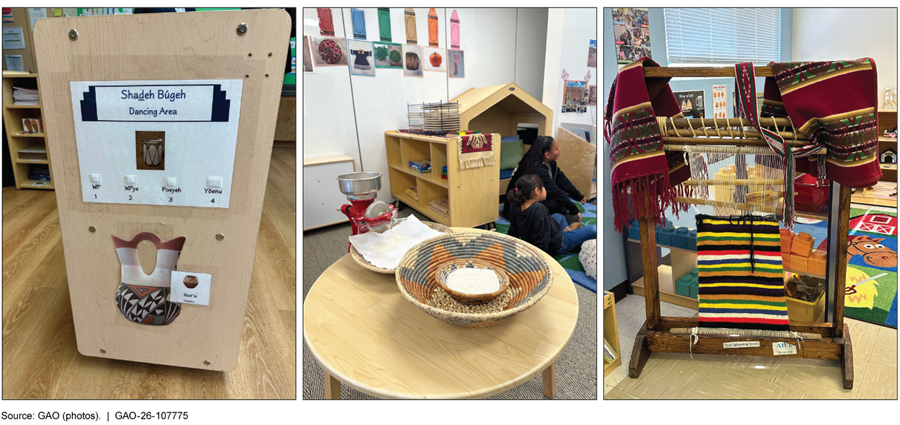
Of the 10 Tribal Head Start programs we interviewed, all 10 teach Native culture and offer children opportunities to participate in traditional practices. For example, representatives from six of the 10 selected programs told us their programs have incorporated traditional dancing, singing, or drumming into their instruction to support children’s participation in cultural activities in their community (see fig. 1). Representatives from three Tribal Head Start programs shared with us that Tribal Head Start teaches children the significance of traditional dances and cultural expectations, with teachers guiding children who may not have learned these traditions at home.
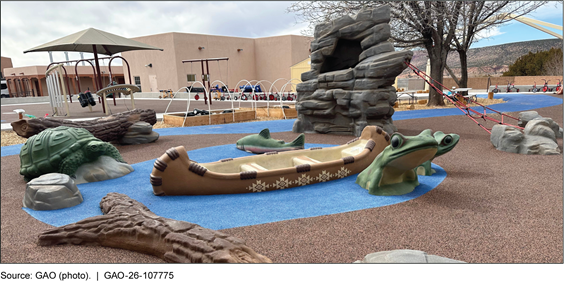
Programs we visited incorporated culturally relevant design elements into learning spaces, such as Indigenous-themed playgrounds and open areas that encourage traditional dancing. For example, one playground featured deer, frogs, and canoes (see fig. 2), while representatives told us another featured traditional housing and rivers—prominent features in the landscape. According to one Tribal Head Start director, when they designed their playground, they intentionally shifted away from standard American features to elements aligned with their traditional way of life.
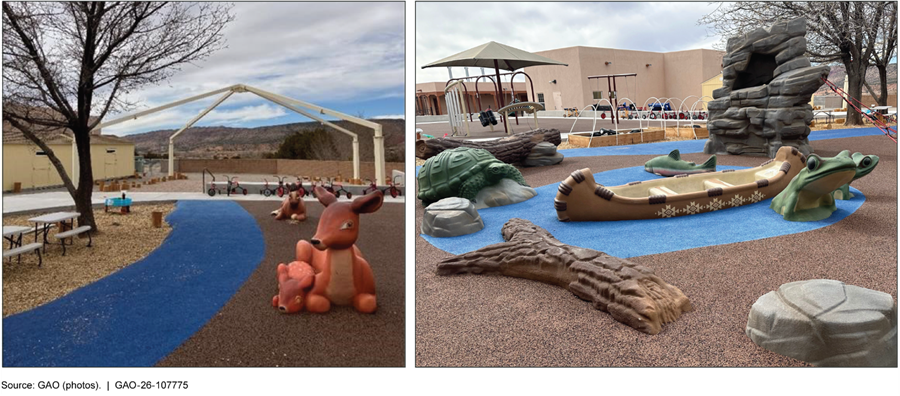
Seven of the 10 selected Tribal Head Start programs reported that they incorporate traditional foods or offer opportunities for children to interact with their natural environment to strengthen children’s knowledge about traditional ways of life. For example, one program incorporated corn, deer meat, and fry bread alongside class activities and held a field trip to a nearby corn field where children learned how to shell and grind corn. Another program planned to build a smoking station for fish and meat, and a canning area to preserve berries, to teach children about subsistence living.
To facilitate the transfer of cultural knowledge to children, seven of the 10 selected Tribal Head Start programs told us they invited tribal leaders and elders into the classroom. For example, one program observed President’s Day by having the Tribe’s governors and church officials visit classrooms to discuss the history of the Tribe and their roles as tribal leaders. Another program hosted elders who taught children about the cultural significance of traditional jewelry and attire. According to one Tribal Head Start program representative, interactions with elders and visual learning experiences reinforce children’s native identity.
Selected Tribal Head Start Programs Practice Language Immersion and Dual Language Instruction
Of the 10 selected Tribal Head Start programs we interviewed, all 10 teach children Native languages by using immersion, dual language classrooms, or short language lessons, depending on teacher fluency. Of the 10 selected Tribal Head Start programs:
· One program led a full immersion program where the Native language was used for all classroom instruction and interactions outside the classroom, including conversations between and among teachers, parents and non-teaching staff.
· Two programs had at least one language immersion classroom where lead teachers were fluent and used the Native language for all classroom instruction.
· One program led a dual language program where the teacher was fluent in the Native language and used both the Native language and English for instruction.
· The remaining six programs led language lessons or activities in their Native language, but based on teacher fluency, used English for most of the instruction.
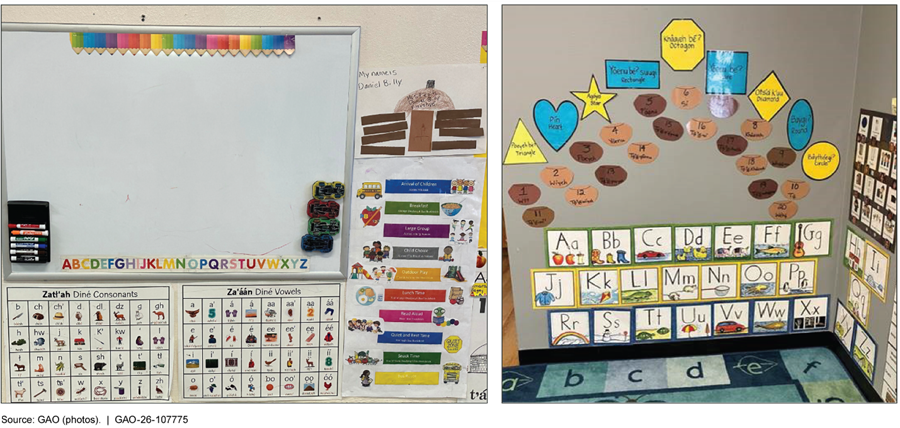
In addition to teaching children, seven of the 10 selected Tribal Head Start programs reported engaging families in their children’s language education and offering opportunities for family members to reinforce what children are learning in the classroom. For example, programs hosted storytelling activities, game nights, or provided families with community engagement calendars or newsletters with Native songs that parents could practice singing with their children. According to tribal leaders from one Tribe, it can be difficult to teach children their Native language when parents are not fluent or do not practice the language at home (see text box). Representatives from one Tribal Head Start program told us they planned to host adult classes to help parents overcome language gaps, noting that some parents struggle to understand their children’s schoolwork. During a consultation with OHS, tribal leaders said that Tribal Head Start programs are key to preserving and promoting Native language, culture, traditions, and ways of life.
|
Preserving Native American Languages and Cultures According to the Department of the Interior Federal Indian Boarding School Initiative, from the early 1880s to 1969, many Native children attended federal boarding schools where Native practices and languages were prohibited and punished. The boarding school experience resulted in Native children being unable to speak their communities’ languages, being unfamiliar with their communities’ traditions, and having weakened intergenerational relationships with their Tribes. Source: GAO summary of Department of the Interior documents. | GAO‑26‑107775 |
Selected Tribal Head Start Programs Reported Challenges Hiring Native-Speaking Teachers and Leveraged Partnerships to Mitigate Them
Head Start program representatives from over half of the Tribes we spoke with described challenges hiring teachers who are both Native language speakers and qualified to teach Head Start.[19] According to representatives from two selected Tribal Head Start programs, most of their Tribes’ Native language speakers are elderly and lack teaching credentials, which further reduces the number of qualified Native language teachers available. Representatives from a third program reported that the retirement of a fluent speaker led to the closure of its dual language classroom. High turnover can pose a special challenge for programs teaching Native language, as staff often require years of language instruction and language teaching to become effective language teachers, according to a report commissioned by OHS.[20]
In response to challenges associated with hiring qualified Native language-speaking teachers, the selected Tribal Head Start programs reported using partnerships with elders, their tribal governments, and educational institutions to support language and cultural efforts. For example:
· Partnering with elders. Six of the 10 selected programs hosted elders and community members as volunteers who lead storytelling, crafts, or gardening activities alongside classroom teachers.
· Partnering with tribal governments. Two of the 10 selected programs used their Tribe’s language and culture departments to offer training for teachers and staff, especially those not fluent in the Native language. Two other programs were working with their tribal governments to train language teachers, helping build future capacity.
· Partnering with educational institutions. Seven of the 10 selected programs partnered with educational institutions to support language or cultural efforts. For example, representatives from two programs told us they collaborate with a university with a focus on language revitalization to learn about effective language immersion teaching strategies.
OHS Supports Teaching Native Languages and Culture, but Tribes Reported Confusion Regarding Recent Policy Changes
OHS Provides Resources, Technical Assistance, and Funding to Teach Native Languages and Culture
|
Office of Head Start’s Request for Information to Improve Program Quality On March 18, 2024, the Office of Head Start (OHS) published the “Request for Information: Office of Head Start Tribal Programs” in the Federal Register. The request invited public comment on changes to Tribal Head Start programs that may improve program quality and operations. Topics included how OHS can best support Tribes in integrating Native language and culture in the classroom. According to OHS, commenters recommended increasing funding and technical assistance for culturally and linguistically grounded curricula, supporting knowledge sharing, and allowing flexibility to involve Native language speakers and cultural experts. Source: GAO summary of Department of Health and Human Services documents. | GAO‑26‑107775 |
OHS provides resources, technical assistance, and funding to support Tribal Head Start programs in teaching Native languages and culture in the classroom, as allowed by the performance standards (see text box).[21] For example, OHS developed Making it Work, a suite of tools designed to help programs, among other things, connect Tribe-specific traditional cultural values and beliefs to school readiness goals. It also helps programs create culturally relevant lessons to engage families. Additionally, the Head Start Cultural and Linguistic Responsiveness Resource Catalogue provides programs with a catalogue of evidence-based materials, including books, articles, and videos to add to existing curricula.[22]
|
Head Start Program Performance Standards The Head Start Program Performance Standards state that a program that serves American Indian and Alaska Native children may integrate efforts to preserve, revitalize, restore, or maintain the tribal language for these children into program services. Such language preservation and revitalization efforts may include full immersion in the tribal language for the majority of the hours of planned class operations. Source: 45 C.F.R. § 1302.36 Department of Health and Human Services, 2024 Head Start Program Performance Standards. | GAO 26 107775 |
OHS has also provided technical assistance. OHS issued a memorandum that identifies how Tribal Head Start programs can meet program performance standards related to curricula and assessment in ways that center Indigenous Knowledge and tribal sovereignty.[23] Furthermore, OHS offers training and technical assistance to Tribal Head Start programs related to incorporating Native language, culture, and traditions. From fiscal year 2021 to fiscal year 2024, a total of 141 Tribal Head Start grant recipients received such training and technical assistance, according to OHS officials.[24]
|
Reporting Tribal Language Efforts in the Head Start Grant Application The Office of Head Start requires recipients to submit a funding application for each year of the project period. Every five years, Tribal Head Start programs are required to describe their efforts for tribal language preservation, revitalization, restoration, or maintenance, where applicable. Source: GAO summary of Department of Health and Human Services information. | GAO‑26‑107775 |
Tribal Head Start programs can also use grant funds to support Native language and cultural education. Of the 10 selected programs we interviewed, five programs’ grant applications mentioned using OHS funding to support Native language and culture in the classroom during fiscal year 2025 and fiscal year 2026. For example, one program planned to use OHS funds to purchase supplies to make traditional regalia for children to wear during their Head Start graduation. Another program planned to use OHS funds to pay for the salary of three language and cultural specialists.
Representatives from five Tribal Head Start programs told us that paying staff salaries, including those of teachers and bus drivers, often leaves limited federal funding to support language and cultural efforts. In response to these budget constraints, representatives from four of the 10 selected Tribal Head Start programs reported using state funding to support language and cultural efforts. For example, one of the four programs used a dedicated state fund for Tribes to hire a language and cultural specialist, while another program used state funding to develop lesson plans for its dual language classrooms. Additionally, one Head Start director reported that their Tribe received a grant from the Administration for Native Americans, a component of HHS, to offer language classes that will encourage parents of language immersion students to speak their Native language fluently at home (see text box).
|
Administration for Native Americans Grant Funding Opportunities for Native Languages The Administration for Native Americans offers two programs focused on preserving Native languages: Native Language Preservation and Maintenance: This program provides funding for projects to support assessments of the Native languages in an established community, as well as the planning, designing, restoration, and implementing of Native language curriculum and education projects to support a community’s language preservation goals. Esther Martinez Immersion: This program provides funding to support Native American Language Nests and Survival Schools, site-based programs that provide at least 500 hours of immersion instruction in a Native language to school-aged students each year of the project. Source: GAO summary of Administration for Native Americans information. | GAO 26 107775 |
Some Selected Tribal Head Start Programs Reported Initial Confusion About the Applicability of Diversity, Equity, and Inclusion Efforts
On March 14, 2025, to align with a recent Executive Order, OHS announced it would not approve expenditures, including those for training and technical assistance, that promoted diversity, equity, and inclusion (DEI) initiatives, creating confusion among some of the Tribal Head Start representatives we interviewed.[25] OHS officials told us in June 2025 that they had not received guidance indicating Native language and cultural efforts were considered DEI, but representatives from three Tribal Head Start programs said they were uncertain about their ability to continue promoting Native language and culture in the classroom. For example, one director, who was in the process of renewing the program’s grant, reported removing terms such as “Native culture,” “language,” and “diversity” from their application out of concern it could be denied. OHS officials said they have received questions from Tribal Head Start programs asking for clarification about the applicability of the federal restrictions to Tribal Head Start programs, and they have provided information to programs on a case-by-case basis.
Recent litigation prohibited HHS from enforcing its March 2025 DEI guidance, affecting Tribal Head Start programs. On April 28, 2025, a group of Head Start associations filed a lawsuit challenging HHS’s implementation of the March 2025 DEI guidance, arguing that the restrictions were inconsistent with the Head Start Act, among other things. On January 6, 2026, a federal court issued a preliminary injunction prohibiting HHS from enforcing or implementing the March 2025 DEI guidance, all agencywide directives implementing or effectuating a ban on DEI, and any similar actions that enforce or implement Executive Order 14,151 against any Head Start agencies or program providers, which would include Tribal Head Start programs.[26] In effect, the injunction generally prevented HHS from implementing the DEI guidance for Head Start. The preliminary injunction also required HHS to inform Head Start programs of the injunction. According to OHS officials, as of January 22, 2026, Head Start programs had been informed of the injunction, and the information had been posted on their website.
Selected Tribal Head Start Programs Reported Multiple Challenges to Program Enrollment
Tribal Head Start Programs, Like Nontribal Ones, Struggle with Enrollment
|
Enrollment Terms Funded enrollment: The number of participants who are supported by federal Head Start funds in a program at any one time during the program year. Actual enrollment: The number of seats a program has filled according to its current monthly enrollment report. Underenrolled: Programs that have filled fewer than 97 percent of Head Start seats they have been funded to serve. Source: GAO summary of Department of Health and Human Services information. | GAO‑26‑107775 |
Tribal Head Start programs, much like nontribal programs, have struggled with enrollment in recent years. On average, between school years 2018–2019 and 2023–2024, Tribal Head Start programs filled 83 percent of the overall seats they were funded to serve (funded enrollment), a level comparable to nontribal programs (see fig. 4). Moreover, both tribal and nontribal programs faced acute drops in enrollment during the COVID-19 pandemic, when Tribal Head Start programs filled a 6-year low of 73 percent of their funded seats in school year 2021–2022. Since then, tribal enrollment has been slowly increasing, filling, on average, 78 percent of funded seats in the most recent school year of our analysis. Head Start programs must enroll 100 percent of their funded enrollment and maintain an active waiting list of participants.[27]
Figure 4: Percentage of Funded Head Start Seats Filled in Tribal and Nontribal Programs, School Years 2018–2019 Through 2023–2024
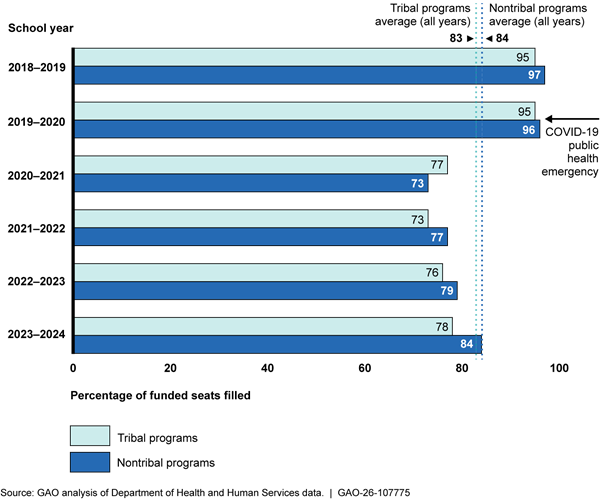
Note: Each Head Start Preschool and Early Head Start program is funded to serve a specified number of participants (its funded enrollment). In this analysis, the percentage of funded seats filled for each school year represents the average of programs’ monthly actual enrollment divided by funded enrollment, calculated for all Head Start Preschool and Early Head Start programs that reported at least 6 months of data. GAO compared Tribal Head Start program data to other, geographically based Head Start programs. GAO excluded Migrant and Seasonal Head Start seats from this analysis because these programs do not necessarily follow a traditional school year.
Among Tribal Head Start programs, Early Head Start programs consistently filled a greater percentage of seats for which they were funded than Head Start Preschool programs over the same period (see fig. 5). For example, while Tribal Early Head Start enrollment dropped to a 6-year low, with programs filling 80 percent of their funded seats in school year 2021–2022, Tribal Head Start Preschool programs filled 71 percent the same year.
Figure 5: Percentage of Funded Seats Filled in Tribal Early Head Start and Head Start Preschool Programs, School Years 2018–2019 Through 2023–2024
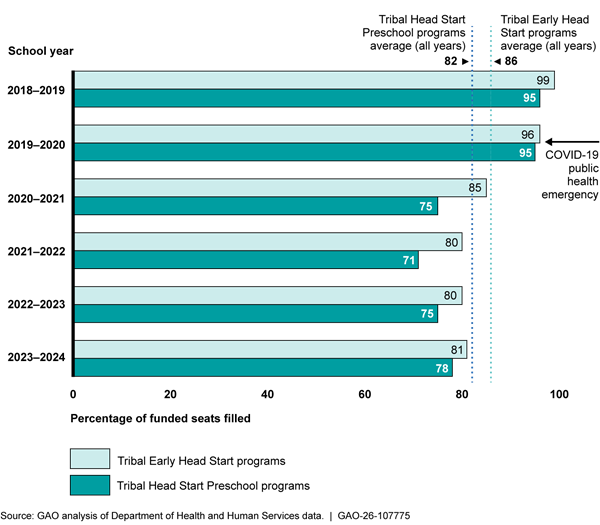
Note: Each Early Head Start and Head Start Preschool program is funded to serve a specified number of participants (its funded enrollment). In this analysis, the percentage of funded seats filled for each school year represents the average of programs’ monthly actual enrollment divided by funded enrollment, calculated for all programs that reported at least 6 months of data. GAO compared Tribal Early Head Start program data to Tribal Head Start Preschool program data.
Representatives from seven of the 10 Tribal Head Start programs we interviewed described COVID-19-related declines in their enrollment. For example, some Tribal Head Start representatives told us their programs were at full funded enrollment prior to the pandemic but had not been full since. According to one program, some parents are still hesitant to send their children to school, whether to Head Start or their local public school, and enrollment numbers are now slowly increasing.
Selected Tribal Head Start Programs Reported That Workforce and Other Challenges Affected Program Enrollment
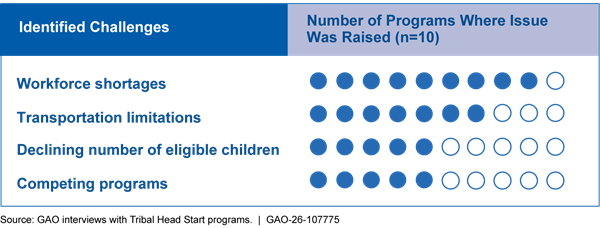
In addition to the COVID-19 pandemic, Tribal Head Start program representatives reported multiple challenges that affect program enrollment, including workforce shortages, transportation limitations, declining number of eligible children, and competing programs (see fig. 6).
Workforce Shortages
Nearly all of our 10 selected Tribal Head Start programs reported challenges with being able to hire or retain qualified staff, which can affect their ability to enroll eligible children. According to OHS, the workforce is the most essential component to provide high-quality early childhood education and comprehensive services to children and families. Tribal Head Start programs we interviewed faced interconnected workforce challenges across the following areas:
· Compensation. Nine of the 10 Tribal Head Start programs we interviewed reported facing competition for teaching staff, including from K-12 school systems and other job sectors, in part based on relatively lower Head Start salaries. For example, a representative from one program said that teachers with an early childhood degree make $40,000 per year in their Head Start program compared to a minimum annual salary of $50,000–$55,000 in the local school system. A Tribal Head Start director from a stakeholder association told us that their program had a waitlist of 15 children ages 3 to 5 because of insufficient teaching staff, as staff had left childcare for higher paying opportunities, such as fast-food restaurants and department stores. Head Start directors said that teacher compensation does not recognize them for the skills and experience they have and that making their wages competitive was a top priority. Representatives from two selected Tribal Head Start programs said supplemental state funding has helped to raise the compensation of their teaching staff.
|
Tribal Colleges and Universities Head Start Partnership Program According to the Office of Head Start (OHS), this partnership program between Head Start and higher education institutions in Tribal Nations is designed to help build and sustain early childhood education career pathways in Native American communities and address the employment needs of Tribal Head Start programs, while being responsive to the cultures and languages of Tribes. Since 2020, OHS has awarded $8 million to the partnership program. One of our selected Tribal Head Start programs involved in this partnership reported that three of its Head Start staff will soon graduate with higher education credentials through the program. Source: GAO summary of Department of Health and Human Services information and GAO interview with Tribal Head Start program. | GAO‑26‑107775 |
· Qualifications. Eight of the 10 Tribal Head Start programs reported limited availability of qualified staff. As previously noted, the Head Start Act prescribes minimum education qualifications for Head Start and Early Head Start teachers, among others. Six of the 10 selected programs cited statutory Head Start credentialing requirements as a challenge. This is particularly a challenge in communities with limited access to higher education. Representatives from one Tribal Head Start association told us that obtaining an early childhood credential often involves significant financial cost and requires access to higher education institutions that may not be accessible to Indigenous communities. Tribal Head Start program representatives also said that it was hard to recruit staff, as few people pursue careers in early childhood education—a particular challenge in less-populated, rural areas that may have fewer housing and transportation resources to support their workforces. The applicant pool is further limited for programs that seek fluent Native language speakers. One Head Start director told us she had not been able to hire enough teachers with a child development associate credential for Early Head Start, which had left 41 children on the program’s wait list and the program underenrolled.
· Workplace conditions. Five of 10 Tribal Head Start programs described challenging workplace conditions, such as behavioral challenges in children, that resulted in teacher burnout. According to Head Start association representatives, since the COVID-19 pandemic, children have greater behavioral challenges, including extreme behaviors related to trauma, and decreases in communication and self-regulation skills. One Tribal Head Start director said her core workforce challenge is the lack of qualified staff driven by the demanding nature of the work and low wages. Another Tribal Head Start program representative said her program has experienced a significant increase in challenging behaviors that require intensive, individualized support that, in some cases, create safety concerns for other children and staff. Tribal Head Start program representatives reported finding small ways to give back to teachers, with one telling us she provided teachers with small gifts and snacks at her personal expense in light of limited program funding.
Our analysis of OHS’s national Tribal Head Start program data illustrates some of these workforce challenges on a broader scale. Overall, from school years 2020–2021 to 2023–2024, Tribal Head Start programs lost 16 percent of their staff, fewer than half of whom were replaced. Of the teachers and child development staff who left employment, Tribal Head Start programs reported that nearly a quarter left for higher compensation. Moreover, 30 percent of these staff who left for higher compensation moved to state pre-K or other early childhood education programs.
Transportation Limitations
Representatives from seven of the 10 Tribal Head Start programs we interviewed identified transportation challenges for families or Tribal Head Start programs that affect program access or enrollment. For example:
· Family challenges. Some families have unreliable vehicles to transport their children or may be reluctant to drive their children to the program, challenges that can be exacerbated by remote or rugged terrain in some tribal communities. One Tribal Head Start director said that the Tribe’s citizens are scattered across the county, which creates logistical challenges for families to bring their children to the Head Start program, and that addressing transportation challenges is key to ensuring access and support for all families.
· Program challenges. Tribal Head Start programs also reported challenges with hiring qualified bus drivers to transport children, which requires a special license that is costly and can be time-consuming to obtain. Representatives from one Tribal Head Start program said that paying for the required training can cost $4,000, which is a risky investment for a program that does not know an applicant well and whether the applicant will remain employed long term. Another director said her program was looking at alternative transportation, such as passenger vans, that did not require a special license to address the challenge of hiring qualified bus drivers.
Our analysis of national Tribal Head Start program data indicates the key role that transportation plays for children enrolled in these programs.[28] For example, in school year 2023-2024, Tribal Head Start Preschool programs provided transportation for 44 percent of enrolled students.
Declining Number of Eligible Children
Representatives from five of 10 Tribal Head Start programs said that the declining number of eligible children, due to families moving away from the tribal community or declining birth rates, for example, contributed to their enrollment challenges. Tribal Head Start directors noted that many young adults leave the tribal community to settle in larger cities or out of state, for example, as a result of challenges that include housing shortages, lack of educational or job opportunities, or lack of space in their home. Two Head Start directors also told us that birth rates within their tribal communities have fallen, affecting future enrollment.
Competing Programs
Five of the 10 selected Tribal Head Start programs reported competition with other preschool or early care options as a challenge to their enrollment. For example, representatives of one Tribal Head Start program said they compete with five other preschool programs within an 11-mile radius, including other tribal programs. Another director said that parents often find state pre-K programs easier to navigate as they require fewer commitments than Head Start. According to a Tribal Head Start director of a program that offers Early Head Start, recruitment has become more challenging because there are other community resources available for pregnant women, which takes away potential applicants.
In addition, families may struggle with the operating schedule of Head Start programs, many of which close during the summer months. Representatives from one Tribal Head Start program said that many families would prefer a year-round schedule to match their work schedule. They added that it was a challenge for parents to find another place to care for their children during the summer, and once they found one, they might not return to Head Start.
OHS Flexibilities Help Address Enrollment Concerns, but Selected Tribal Head Start Programs Reported Communication Challenges
OHS Identifies Underenrolled Programs and Offers Flexibilities to Help Address Enrollment Concerns
OHS developed an oversight initiative—the Full Enrollment Initiative—to identify, support, and monitor Head Start programs that have not been enrolled at their funded levels for at least 4 consecutive months. To assist programs with enrollment, OHS offers certain flexibilities to Head Start programs, with additional flexibilities available specifically to Tribal Head Start programs, and provides support through training and technical assistance.
Full Enrollment Initiative
OHS’s Full Enrollment Initiative is an oversight initiative that identifies underenrolled Head Start programs and provides targeted support and additional monitoring to increase enrollment, as required by the Head Start Act (see fig. 7).[29] As of April 2025, OHS had identified 115 Tribal Head Start programs for this oversight initiative since fiscal year 2023, including nine of the 10 we selected.[30] According to OHS, agency staff work in partnership with identified programs to offer support, technical assistance, and guidance as programs develop a required plan and timetable to reduce or eliminate underenrollment. After 12 months, OHS may designate programs that have not reached 97 percent of funded enrollment as chronically underenrolled. Seven of our selected Tribal Head Start programs were designated chronically underenrolled in fiscal year 2023 or 2024. OHS may recapture, withhold, or reduce a chronically underenrolled program’s annual funding. However, these are not OHS’s only options, and to date, OHS officials told us they have taken such measures for Tribal Head Start programs in few instances.

Note: Programs that are designated as chronically underenrolled will receive a letter that informs them of any subsequent actions and their opportunity to appeal a recapture, withholding, or reduction in funding. Programs maintain this designation until they achieve at least 97 percent of their new funded enrollment level for at least 6 months.
Head Start Program Flexibilities
OHS recommends that Head Start programs included in the Full Enrollment Initiative consider certain flexibilities available to all Head Start programs to address underlying causes of underenrollment. These flexibilities include reducing the program’s funded enrollment slots, converting Head Start Preschool slots to Early Head Start slots to better meet community needs, and using a locally designed program option to address unique community needs. Programs must request OHS approval to use these flexibilities. Between fiscal years 2019 and 2024, OHS approved 31 different Tribal Head Start programs for one or more options.[31]
Programs may request approval to reduce their funded enrollment slots without a corresponding reduction in program operations funding.[32] In 2024, OHS officials said that reducing funded enrollment slots while retaining program funding is a way for Head Start programs to increase compensation for—and thus better recruit and retain—teachers. Representatives from one Tribal Head Start program we interviewed told us they were intentional when they proposed to reduce their funded enrollment slots. Their aim was to find the right balance to increase their program’s wages to make them comparable with local school districts without losing more enrollment slots for children than necessary, as their Tribal Head Start program provides services critical to both tribal and nontribal children.
Other flexibilities are tribal-specific and offer tribal programs additional ways to support program enrollment, according to Tribal Head Start programs.[33] Among them are the ability to enroll any age-eligible applicants in a program’s service area regardless of family income, and, with approval from the Secretary of the Interior through the Bureau of Indian Affairs (BIA), to integrate Head Start funding with other federal funding sources for streamlining purposes using statutory flexibilities granted under the 477 program.[34] Both of these flexibilities have been available to Tribes since 2024.
Enroll any age-eligible applicants. According to OHS, enrolling children regardless of income will increase the number of children in tribal communities eligible to participate in Head Start services and engage with Native language and culture. Four of the 10 Tribal Head Start programs we interviewed described changes to their enrollment following the eligibility expansion, and one program reported it reached full enrollment for the first time in at least seven years since removing the income restriction barrier. A representative from a Tribal Head Start association told us the change in eligibility has been welcome, and those from another organization said that it makes more sense for Tribes to set their own eligibility criteria as they are sovereign nations.
|
477 Program Public Law 102-477, the Indian Employment, Training and Related Services Demonstration Act of 1992, is often referred to as “477.” According to the Administration for Children and Families (ACF), the law was established to enhance the ability of federally recognized Tribes and Alaska Native entities to address their employment and training needs. With approval from the Bureau of Indian Affairs (BIA)—which serves as the lead federal agency—477 allows Tribes to streamline and consolidate authorized activities and related services involving certain federal grant programs under a single, comprehensive plan with a consolidated budget and unified reporting system. This approach is intended to align tribal priorities with the policy of self-determination, reduce administrative burdens, and enhance the efficiency and effectiveness of service delivery within tribal communities. Within the Department of Health and Human Services, 10 ACF programs, including Head Start, have been integrated under 477. Source: Indian Employment, Training and Related Services Demonstration Act of 1992, Pub. L. No. 102-477, 106 Stat. 2302 and GAO summary of ACF and BIA information. | GAO‑26‑107775 |
Integrate Head Start funding under 477 to improve employment outcomes. Integrating Head Start under 477 supports tribal workforce development and enhances family access and stability, according to representatives of a tribal stakeholder organization we interviewed. They said that through integrated service delivery, 477 can increase access to the early childhood workforce pipeline and support the recruitment and retention of Head Start staff, as staffing shortages often limit a program’s ability to serve more children. For example, programs can support the workforce by funding employment-related supports, such as housing stipends and tuition assistance, and integrating Head Start into their workforce development goals to recruit, train, and retain Native educators. Programs may also provide staff with job coaching and support services to increase retention and build leadership capacity.
One Tribal Head Start program reported it used 477 funds to help grow its Head Start workforce and support working families by recruiting additional part-time staff to provide services to children and families over the course of a full day (7:45am to 5pm). Another program reported it used the 477 program to support its long-term goal of helping grow the tribal workforce in its home community. According to the Tribal Head Start program director, over time, the program intends to track students from Head Start through high school and beyond and guide them in their chosen career path. At the same time, the program provides wrap around support systems for families accessing services across multiple programs, for example, by requiring parents to enroll age-appropriate children in its Head Start program and ensuring they attend at least 85 percent of the time. Integrating Head Start programs under 477 requires approval from the Secretary of the Interior through the BIA. To date, seven Tribes and tribal organizations have obtained approval to integrate their Head Start programs under 477, according to BIA officials.[35]
Training and Technical Assistance
OHS provides training and technical assistance to Tribal Head Start grantees to assist with enrollment challenges, according to agency officials. In fiscal year 2024, OHS reported 215 training and technical assistance activities related to full enrollment and 75 activities related to flexibilities. For example, according to the Tribal Head Start training and technical assistance provider, staff work closely with programs, step-by-step, to help them build underenrollment plans in response to OHS’s Full Enrollment Initiative. Training and technical assistance staff also support programs in analyzing data to support data-informed decisions when they apply for approval to use flexibilities, such as reducing funded enrollment slots. Most Tribal Head Start directors from our selected programs praised OHS’s training and technical assistance. For example, one director said that technical assistance was instrumental in refining proposed changes to their program design application by including greater detail, which was ultimately approved by OHS.
In addition, OHS reported 16 training and technical assistance activities in fiscal year 2024 related to changes in the Head Start Program Performance Standards, which were updated to reflect HHS’s final rule on Supporting the Head Start Workforce and Consistent Quality Programming (see text box).[36] According to OHS, these requests for training and technical assistance generally centered around mental health and staff wellness.
|
Supporting the Head Start Workforce and Consistent Quality Programming The Office of Head Start (OHS) identified severe workforce shortages as a significant barrier to full enrollment, and, in 2024, issued a final rule on Supporting the Head Start Workforce and Consistent Quality Programming. The final rule, effective August 2024, made changes to the Head Start Program Performance Standards to support and stabilize the Head Start workforce and improve the quality of services Head Start programs provide. These include requirements for Head Start programs, over time, to: · Provide competitive wages for staff with annual salaries that are comparable to public school preschool teachers or 90 percent of public kindergarten teachers’ salaries by 2031. · Provide or facilitate access to benefits, such as high-quality affordable health care coverage and paid leave by 2028. · Cultivate a culture of wellness, that includes providing each staff member with regular breaks. · Allow for behavioral health support specialists to be used in coordination with a mental health consultant to better support children, families, and staff. · Make quality improvements, including more reasonable caseloads for family service workers. The rule exempts grantees with 200 or fewer enrollment seats from certain Head Start wage and benefit requirements, which according to OHS officials, includes the majority of Tribal Head Start programs. Source: 89 Fed. Reg. 67,720 (Aug. 21, 2024) and GAO summary of Department of Health and Human Services information. | GAO 26 107775 |
Selected Tribal Head Start Programs Reported Challenges with Receiving Timely and Consistent Communication from OHS
Though many of our selected Tribal Head Start programs spoke positively about the assistance they received from OHS, most programs also reported a lack of timely and consistent communication from OHS to help address enrollment concerns. Specific communication challenges surfaced around OHS’s program flexibilities, its Full Enrollment Initiative, and recent program changes.
Program flexibilities. Directors from five of the 10 Tribal Head Start programs and a Tribal Head Start program association identified delays or communication challenges related to their applications for OHS approval to use program flexibilities. For example, as of May 2025, one program director said she was awaiting a final decision on her application to reduce funded enrollment that she submitted in November 2024. She said she had been reaching out to OHS for updates on a weekly basis. She said this delay negatively affected her ability to provide salary increases for teachers in her Tribal Head Start program who were making $22.88 per hour with a bachelor’s degree. In fiscal year 2024, OHS took an average of 199 days to communicate a final decision to Tribal Head Start programs from the time an application was received.
OHS officials told us that they implemented a new intake team in August 2024 to review applications for the use of program flexibilities, which they said decreased the time it took to communicate final decisions to Tribal Head Start programs to 91 days for the nine requests that were completed as of July 2025. However, as of September 2025, applications from 35 programs that were submitted after the implementation of the new intake team were pending, from a range of 15 days to 308 days.
In another example, representatives of two Tribal Head Start programs said they were unsure of the process to convert Head Start Preschool program slots to Early Head Start slots—a flexibility that would allow them to better meet their community needs—due to a lack of clear guidance. According to the Head Start Act and associated regulations, a tribal program that operates Head Start Preschool and Early Head Start may reallocate funds between them to address fluctuations in client populations at its discretion and by notifying the regional OHS office.[37] OHS officials also confirmed that tribal programs can shift slots between the two programs.[38] However, a 2022 OHS information memorandum—the latest available at the time of our interviews—stated that a request to reduce funded enrollment or convert Head Start slots to Early Head Start slots requires prior OHS approval, rather than notification to OHS for tribal programs seeking to reallocate funds.[39] The memorandum did not list an exception for tribal programs or separate instructions for them on how to proceed, aside from stating that governing body and tribal and policy council approvals are required prior to submitting the request to OHS.
When we asked whether OHS had addressed this discrepancy for tribal programs, OHS officials told us in September 2025 that the agency relied on its program specialists to ensure that Tribal Head Start programs were aware of this flexibility and was in the process of developing guidance for tribal programs. According to a representative from a tribal stakeholder organization we interviewed, this inconsistent messaging for tribal programs between the statute and the 2022 memorandum has led to a lengthy and difficult approval process for programs seeking to use this flexibility. Since then, however, OHS officials said they issued guidance to remind tribal programs that they could reallocate funds between existing Tribal Head Start Preschool and Early Head Start programs to address fluctuations in their communities, in accordance with the Head Start Act. They said the guidance was available to Head Start grant recipients through OHS’s online platform, the Head Start Enterprise System.
Full Enrollment Initiative. Representatives from four of the nine selected Tribal Head Start programs that were part of OHS’s Full Enrollment Initiative reported a lack of communication from OHS after being told their program was underenrolled or after submitting an underenrollment plan as part of the initiative. For example, one program’s representatives told us in February 2025 that since submitting their plan the previous year, they had not received feedback or had meetings with OHS. As a result, they were uncertain about the future of their program.
Recent program changes. Representatives from four Tribal Head Start programs and two Tribal Head Start stakeholder organizations also described communication challenges they tied to recent program changes. For example, according to one program’s representatives, the lack of communication around a proposed reorganization of regional Head Start offices in March 2025 raised questions about how such changes might impact Tribal Head Start programs, and has affected staff morale at all levels.[40] The director said that learning about changes to OHS from the news, rather than the agency itself, led to discord, which took away from staff’s ability to focus on providing services. Another program’s director said that OHS had not communicated with their program following important events—including a funding freeze and agency layoffs—that could significantly impact it. The director said that the lack of communication had instilled considerable fear and stress at the program level. OHS officials told us that HHS intended to keep a distinct regional entity that specifically supported Tribal Head Start programs, although there might be changes to OHS and grants management personnel supporting tribal programs.
According to OHS, program specialists are a Tribal Head Start program’s primary contact for programmatic support, including for program flexibilities, underenrollment plans, and training and technical assistance.[41] Officials told us that it is a long-standing OHS expectation for program specialists to connect with their assigned Head Start programs, at a minimum, on a monthly basis and discuss enrollment, any related challenges, and options based on the specific challenges they are experiencing.[42] OHS said that communication is ongoing and occurs on an individual basis throughout the flexibility approval process. For example, staff may seek clarification or additional information from Tribal Head Start programs on their requests for flexibilities and often discuss delays directly.
While OHS noted opportunities for timely, consistent communication between Tribal Head Start programs and program specialists, as discussed above, the experiences of several of our selected programs and tribal associations did not always reflect this. For example, a representative from a Tribal Head Start association we interviewed said that Tribal Head Start programs receive inconsistent communication and messaging from their program specialists, who may tell one program one thing and another something different around the same topic. A Tribal Head Start program director told us their program has faced a lot of turnover with their OHS program specialist, which left them working with four different ones. Turnover at the program level can further complicate communication between OHS and Tribal Head Start programs. OHS officials told us that with frequent leadership changes within Tribal Head Start programs, new program directors may not be immediately aware of existing flexibilities, available technical assistance, or past training efforts.
Federal internal control standards state that it is important for entities to communicate quality information externally, and on a timely basis, so external parties can help entities achieve their objectives.[43] In OHS’s case, such objectives include providing support to Head Start programs to help them achieve their full funded enrollment levels. The communication challenges, as discussed above, are indications that opportunities exist for improving the timeliness and consistency of OHS communication with Tribal Head Start programs. Yet OHS has not identified or addressed the causes of such challenges faced by some of our selected Tribal Head Start programs. By identifying and addressing the causes of challenges in timeliness and consistency of its communication with Tribal Head Start programs—including in its approval process for program flexibility requests—OHS could help mitigate difficulties these programs may experience in improving enrollment, including their ability to use available flexibilities. According to a tribal stakeholder organization we interviewed, the cumulative impact of communication delays, lack of timely decisions, and frequent personnel changes within OHS create administrative burdens and programmatic uncertainties.
Conclusions
Tribal Head Start programs integrate Native language, culture, and traditions into their activities where, nationwide, about 18,000 children from birth to age 5 are beginning their education. In supporting these Tribal Head Start programs, OHS helps the federal government fulfill its trust responsibility to protect the interests of Tribal Nations and communities. However, OHS has missed opportunities to ensure timely and consistent communication with Tribal Head Start programs, as noted by representatives of some of our selected programs. By identifying and addressing the causes of challenges in the timeliness and consistency of its communication with Tribal Head Start programs, OHS could help Tribal Head Start programs avoid delays and programmatic uncertainties in their work and support programs in increasing enrollment.
Recommendation for Executive Action
The Secretary of HHS should ensure OHS identifies and addresses the causes of challenges in the timeliness and consistency of its communication with Tribal Head Start programs related to improving enrollment. (Recommendation 1)
Agency Comments
HHS provided written comments on a draft of this report, which are reproduced in appendix II. In its comments, HHS agreed with our recommendation to identify and address the causes of communication challenges with Tribal Head Start programs related to improving enrollment. HHS said OHS would assess current communication practices and implement standardized procedures to improve timeliness, consistency, and clarity in its engagement with Tribal Head Start programs. The agency said OHS recognizes that enrollment remains an ongoing challenge for Tribal Head Start programs, with factors including workforce shortages and transportation limitations, and would incorporate these considerations into its efforts. HHS also provided technical comments, which we incorporated as appropriate.
We are sending copies of this report to the appropriate congressional committees, the Secretary of Health and Human Services, and other interested parties. In addition, the report is available at no charge on the GAO website at https://www.gao.gov
If you or your staff have any questions about this report, please contact me at LarinK@gao.gov. Contact points for our Offices of Congressional Relations and Media Relations may be found on the last page of this report. GAO staff who made key contributions to this report are listed in appendix III.
Kathryn A. Larin, Director
Education, Workforce, and Income Security
Our report examines (1) how selected Tribal Head Start programs teach Native language and culture, and challenges they report facing in doing so; (2) the extent to which the Office of Head Start (OHS) supports Tribal Head Start programs in teaching Native language and culture; (3) enrollment challenges Tribal Head Start programs face; and (4) the extent to which OHS helps Tribal Head Start programs address enrollment challenges. In addition to the methods discussed below, to address our research objectives, we reviewed relevant federal laws, agency regulations and guidance, and other documentation on Tribal Head Start programs.
Tribal Site Visits and Interviews
To inform each of our objectives, we conducted site visits to eight Tribal Head Start programs from December 2024 to May 2025.[44] We met with directors and other representatives of the Tribal Head Start programs and, in some cases, tribal leaders. We also conducted virtual interviews with representatives of two additional Tribal Head Start programs.
We selected states and Tribal Head Start programs to reflect factors including region and rurality, the number of Tribes or tribal organizations operating programs in each state, whether programs administered Head Start Preschool and/or Early Head Start, and programs’ funded enrollment and reported cumulative enrollment from 2019 through 2024. For example, wage and benefit requirements from the Final Rule for Supporting the Head Start Workforce and Consistent Quality Programming apply differently to Head Start programs with 200 or fewer funded enrollment slots compared to those with more than 200 funded enrollment slots. Interviewing Tribal Head Start programs with varied experiences also allowed us to better understand the range of challenges different Tribes and tribal associations might face in administering Tribal Head Start programs. The views of those we interviewed are not generalizable to all Tribes and their Head Start programs but they provided valuable insights into the experiences and challenges Tribal Head Start programs might face administering the programs.
Aside from our 10 selected Tribal Head Start programs, we collected written responses from two additional Tribal Head Start programs that integrated their Head Start programs under 477, specifically about their experiences in doing so.
Additional Interviews
In addition, we interviewed officials from nine stakeholder organizations for broader perspectives on issues facing Tribal Head Start programs. These included three national or regional organizations that represent Tribal Head Start directors and programs; three associations that represent Head Start programs, including tribal and nontribal ones; and three organizations involved in research or advocacy around Native education.
To obtain additional information about the administration of Tribal Head Start programs and the federal support provided to them, we interviewed officials in OHS, including the regional office that covers Tribal Head Start programs, the training and technical assistance provider, the collaboration office for Tribal Head Start programs, and three national centers: the National Center on Program Management and Fiscal Operations, the National Center on Early Childhood Development, Teaching, and Learning, and the National Center on Parent, Family, and Community Engagement. We also interviewed officials from the Administration for Children and Families’ (ACF) Administration for Native Americans for additional resources available to Tribal Head Start programs.
Data
For additional context on enrollment challenges facing Tribal Head Start programs, we obtained annual data from OHS’s Program Information Report—a uniform collection of data from Head Start programs nationwide.[45] For both tribal and nontribal programs, we analyzed available data related to workforce and transportation between school years 2020–2021 and 2023–2024. We also obtained monthly enrollment data directly from ACF between school years 2018–2019 and 2023–2024. We used the enrollment data to compare the actual enrollment levels that programs reported to the number of seats they were funded for—a number known as funded enrollment. To assess the reliability of the data, we reviewed documentation, requested written responses from OHS officials knowledgeable about the data, and conducted electronic testing of the data. We determined these data were sufficiently reliable for the purpose of providing contextual information on factors selected Tribal Head Start programs identified that contribute to enrollment challenges and on program enrollment levels.
GAO Contact
Kathryn A. Larin, LarinK@gao.gov
Staff Acknowledgments
In addition to the contact above, Scott Spicer (Assistant Director), Avani Locke (Analyst-in-Charge), and Tracie Sánchez made key contributions to this report. Also contributing to this report were James Ashley, Estelle Bowman, Charlotte Cable, MacKenzie Cooper, Serena Lo, Grant Mallie, Jessica Mausner, Mimi Nguyen, Anna Maria Ortiz, James Rebbe, Almeta Spencer, William Stupski, Lisa Van Arsdale, and Adam Wendel.
The Government Accountability Office, the audit, evaluation, and investigative arm of Congress, exists to support Congress in meeting its constitutional responsibilities and to help improve the performance and accountability of the federal government for the American people. GAO examines the use of public funds; evaluates federal programs and policies; and provides analyses, recommendations, and other assistance to help Congress make informed oversight, policy, and funding decisions. GAO’s commitment to good government is reflected in its core values of accountability, integrity, and reliability.
Obtaining Copies of GAO Reports and Testimony
The fastest and easiest way to obtain copies of GAO documents at no cost is through our website. Each weekday afternoon, GAO posts on its website newly released reports, testimony, and correspondence. You can also subscribe to GAO’s email updates to receive notification of newly posted products.
Order by Phone
The price of each GAO publication reflects GAO’s actual cost of production and distribution and depends on the number of pages in the publication and whether the publication is printed in color or black and white. Pricing and ordering information is posted on GAO’s website, https://www.gao.gov/ordering.htm.
Place orders by calling (202) 512-6000, toll free (866) 801-7077,
or
TDD (202) 512-2537.
Orders may be paid for using American Express, Discover Card, MasterCard, Visa, check, or money order. Call for additional information.
Connect with GAO
Connect with GAO on X,
LinkedIn, Instagram, and YouTube.
Subscribe to our Email Updates. Listen to our Podcasts.
Visit GAO on the web at https://www.gao.gov.
To Report Fraud, Waste, and Abuse in Federal Programs
Contact FraudNet:
Website: https://www.gao.gov/about/what-gao-does/fraudnet
Automated answering system: (800) 424-5454
Media Relations
Sarah Kaczmarek, Managing Director, Media@gao.gov
Congressional Relations
David A. Powner, Acting Managing Director, CongRel@gao.gov
General Inquiries
[1]42 U.S.C. § 9831. Head Start Preschool programs generally serve children ages 3 to school age. Early Head Start programs serve infants and toddlers under age 3 and expectant families, providing prenatal and postpartum information and education. 42 U.S.C. §§ 9840, 9840a; 45 C.F.R. § 1302.12(b)-(c).
[2]This represents the actual number of children and pregnant women served by the program throughout the entire program year, which includes those who left during the program year and others who filled those empty seats.
[3]In February 2026, HHS archived this guidance as part of a broader effort to reduce sub-regulatory guidance. However, OHS officials told us the guidance was a policy clarification, not a policy change, and programs could continue to engage in the activities described in the guidance.
[4]Further Consolidated Appropriations Act, 2024, Pub. L. No. 118-47, div. D, tit. II, § 238, 138 Stat. 460, 681.
[5]These changes were made through a final rule, Supporting the Head Start Workforce and Consistent Quality Programming, 89 Fed. Reg. 67,720 (Aug. 21, 2024).
[6]In fiscal year 2024, OHS provided over $11.8 billion in funds across all Head Start programs.
[7]Programs must fill any vacancy within 30 days. 45 C.F.R. § 1302.15(a). Programs that do not meet their enrollment obligations may have their funding reduced. 42 U.S.C. § 9836a(h).
[8]45 C.F.R. § 1302.36. Department of Health and Human Services, 2024 Head Start Program Performance Standards.
[9]45 C.F.R. § 1302.32(a). Department of Health and Human Services, 2024 Head Start Program Performance Standards.
[10]Department of Health and Human Services, Office of Head Start, Affirming the Use of Indigenous Knowledge to Meet Curricula and Assessment Requirements in American Indian and Alaska Native Head Start Programs, ACF-OHS-IM-24-03 (September 17, 2024). In February 2026, HHS archived this guidance as part of a broader effort to reduce sub-regulatory guidance. However, OHS officials told us the guidance was a policy clarification, not a policy change, and programs could continue to engage in the activities described in the guidance.
[11]45 C.F.R. § 1302.32(a)(1)(ii). Department of Health and Human Services, 2024 Head Start Program Performance Standards.
[12]Head Start domains are broad areas of early learning and development from birth to age 5 that are essential for school and long-term success. The central domains are approaches to learning; social and emotional development; language and literacy; cognition; and perceptual, motor, and physical development.
[13]Head Start programs may enroll children whose families do not meet any of these eligibility requirements if the child would benefit from services, provided that these participants only make up to 10 percent of a program’s enrollment. 45 C.F.R. § 1302.12(c)(2).
[14]Further Consolidated Appropriations Act, 2024, Pub. L. No. 118-47, div. D, tit. II, § 238, 138 Stat. 460, 681.
[15]45 C.F.R. §§ 1302.11(b), 1302.14. These selection criteria must prioritize participants based on identified community needs.
[16]Tribal citizenship is a political classification, and not a racial or ethnic classification. Tribes have inherent authority to determine requirements for citizenship; however, some Tribes’ citizenship is also subject to requirements in federal law or treaty.
[17]Indian Trust Asset Reform Act, Pub. L. No. 114-178, § 101(3), 130 Stat. 432 (2016) (codified at 25 U.S.C. § 5601(3)). The fiduciary responsibilities of the United States to Indians are also founded in part on specific commitments made through written treaties and agreements securing peace, in exchange for which Indians have surrendered claims to vast tracts of land, which provided legal consideration for permanent, ongoing performance of federal trust duties. Id. at § 101(4).
[18]42 U.S.C. § 9835(l)(3)-(4). Department of Health and Human Services, Administration for Children and Families, Tribal Consultation Policy (Aug. 18, 2011); Department of Health and Human Services, Tribal Consultation Policy (Sept. 12, 2023).
[19]Head Start teachers must have at least an associate or bachelor’s degree in child development or early childhood education, equivalent coursework, or otherwise meet the requirements of 42 U.S.C. § 9843a(a)(3)(B); 45 C.F.R. § 1302.91(e)(2)(ii). Assistant teachers must have, at a minimum, a Child Development Associate credential or a state-awarded certificate that meets or exceeds the requirements for a Child Development Associate credential or be enrolled in a program that will lead to such a credential or certificate within 2 years of the time of hire. See 45 C.F.R. § 1302.91(e)(3). Similarly, Early Head Start teachers, who serve infants and toddlers, must have a minimum of a Child Development Associate or comparable credential and have been trained or have taken equivalent coursework in early childhood development with a focus on infant and toddler development. See 45 C.F.R. § 1302.91(e)(1).
[20]Ruth Rouvier, A Report on Tribal Language Revitalization in Head Start and Early Head Start (National Center on Cultural and Linguistic Responsiveness: 2016).
[21]45 C.F.R. § 1302.36.
[22]Department of Health and Human Services, Office of Head Start, “Native and Heritage Language Preservation, Revitalization, and Maintenance,” vol. 2 of Head Start Cultural and Linguistic Responsiveness Resource Catalogue, (2012).
[23]Department of Health and Human Services, Office of Head Start, Affirming the Use of Indigenous Knowledge to Meet Curricula and Assessment Requirements in American Indian and Alaska Native Head Start Programs. In February 2026, HHS archived this guidance as part of a broader effort to reduce sub-regulatory guidance. However, OHS officials told us the guidance was a policy clarification, not a policy change, and programs could continue to engage in the activities described in the guidance.
[24]OHS administers Head Start grants to 151 federally recognized Tribes and tribal agencies.
[26]Wash. State Ass’n of Head Start v. Kennedy, No. C25-781, 2026 U.S. Dist. LEXIS 1799 (W.D. Wash. Jan. 6, 2026). The court’s order stated that the preliminary injunction shall remain in effect pending further order from the court.
[27]42 U.S.C. § 9837(g).
[28]Head Start Program Performance Standards require Head Start programs to use data from their community assessments to identify potential barriers to enrollment and attendance, including transportation needs. Recognizing transportation can be a barrier, OHS has identified potential solutions for consideration, among them, partnering or contracting with a local school district for transportation services. We heard from two Tribal Head Start programs, however, that their local K-12 schools also struggled with hiring enough bus drivers.
[29]The Head Start Act requires HHS to identify programs with actual enrollment that is less than funded enrollment based on at least four consecutive months of data. 42 U.S.C. § 9836a(h)(3).
[30]OHS administers Head Start grants to 151 federally recognized Tribes and tribal agencies.
[31]According to OHS, a request to reduce funded enrollment is considered a change in scope request and requires OHS prior approval. Change in scope requests must be submitted a minimum of 90 days prior to the planned implementation date. A request for a locally designed program option requires a waiver that is similarly requested as a change in scope request.
[32]42 U.S.C. § 9835(g)(3). According to OHS, such a change in scope requires prior OHS approval and constitutes a permanent adjustment to funded enrollment. Programs must demonstrate that a change in scope request is data-informed and explain how the requested changes will improve quality of services for children and families, better meet community needs, support staff, and promote a sustainable program.
[33]For example, Tribal Head Start programs may reallocate funds at any time between Head Start Preschool and Early Head Start programs to address fluctuations in client populations in their communities. The use of tribal-specific flexibilities does not require prior OHS approval.
[34]Further Consolidated Appropriations Act, 2024, Pub. L. No. 118-47, div. D, tit. II, Sec. 238, 138 Stat. 460, 681; Indian Employment, Training and Related Services Demonstration Act of 1992, Pub. L. No. 102-477, 106 Stat. 2302. According to ACF, the 477 Program was established to enhance the ability of federally recognized Tribes and Alaska Native entities to address their employment and training needs. The primary intent of the 477 Program is to streamline and consolidate various federal grant programs related to employment, training, and related services into a single, cohesive plan, budget, and reporting system. In February 2026, ACF officials said that ACF has concluded that the purpose of Head Start does not fall within any of listed purposes in the 477 statute. While several Tribes have integrated their Head Start programs under 477, ACF officials said that in no case did HHS provide affirmative reasoning why Head Start may be integrated.
[35]In March 2025, BIA coordinated with OHS to conduct two mandatory onsite reviews for two Tribes, according to BIA officials. These reviews assessed program implementation, compliance, and quality standards for Head Start services integrated under the Tribes’ respective 477 plans.
[36]According to OHS, these activities cited the final rule as a resource used in the training and/or technical assistance.
[37]42 U.S.C. § 9840(d)(3); 45 C.F.R. § 1302.20(c)(4).
[38]According to OHS officials, because Early Head Start classrooms have lower teacher-to-child ratios and smaller maximum class sizes, they are more expensive to operate. As a result, they said converting Head Start Preschool slots to Early Head Start slots is rarely, if ever, a one-to-one exchange. Additionally, Tribes with existing Head Start Preschool programs that seek to convert slots and create a new Early Head Start program require OHS approval. However, Tribes with only Early Head Start programs cannot convert slots to create new Head Start Preschool programs, according to OHS officials.
[39]Department of Health and Human Services, Office of Head Start, Enrollment Reductions and Conversion of Head Start Slots to Early Head Start Slots, ACF-IM-HS-22-09 (Nov. 7, 2022).
[40]In March 2025, HHS announced a proposed departmental restructuring that, among other things, would reduce the number of its geographically-based regional offices from ten to five. According to the National Head Start Association, regional office closures in Boston, Chicago, New York, San Francisco, and Seattle could create delays in essential program support as regional office staff play an integral role in ensuring that eligible children and families receive reliable and high-quality services. In February 2026, OHS officials told us that, due to current litigation, the agency was prohibited from implementing actions related to departmental restructuring.
[41]Officials said, however, that contact points can vary based on the nature of the support needed. For example, for training requests related to fiscal matters, a grant specialist may take the lead or help connect them to the appropriate resources. In most cases the program specialist remains the main point of contact.
[42]According to OHS officials, the requirement is a documented interaction or update recorded in the OHS online platform, the Head Start Enterprise System, which OHS supervisors monitor through the platform.
[43]GAO, Standards for Internal Control in the Federal Government, GAO‑25‑107721 (Washington, D.C.: May 15, 2025).
[44]We refer to American Indian and Alaska Native (AIAN) Head Start programs as Tribal Head Start programs, for the purposes of our report.
[45]According to ACF, the Program Information Report is not intended to assess compliance with the Head Start Program Performance Standards or other regulations.