
Report to Congressional Committees
United States Government Accountability Office
A report to congressional committees
Contact: Latesha Love Grayer at lovegrayerl@gao.gov
What GAO Found
Economic conditions in the Freely Associated States (FAS)—the Federated States of Micronesia (FSM), Republic of the Marshall Islands (RMI), and Republic of Palau—include population loss and economic decline. FSM’s population decreased by 26 percent between the 2010 and 2023 censuses, and RMI lost 20 percent of its population from 2011 to 2021. U.S. and FAS officials said high levels of out-migration have exacerbated skilled labor shortages and rising costs for government services. Though Palau’s population has remained relatively stable, a sharp drop in tourism during the COVID-19 pandemic drove a decline in its gross domestic product from 2019 through 2022.
The three countries plan to use compact funding to prioritize education and health. Their allocations of compact grants for fiscal year (FY) 2025 largely support personnel salaries in the education and health sectors, and the countries plan to use compact infrastructure funds for projects that include schools and hospitals. However, FAS officials told GAO that project implementation has encountered obstacles such as delayed compact funds disbursement, rising construction costs, and labor shortages.
The FAS have not yet met certain oversight requirements established by the amended compacts, while U.S. oversight efforts are underway with some delays. Most documents that FSM, RMI, and Palau are required to submit were not submitted on time, and some remain outstanding. For example, since FY 2019, all three countries’ required single audit reports—critical to U.S. compact oversight efforts—have been late. FAS officials said they are taking steps to improve the reports’ timeliness, such as by increasing financial accounting capacity. U.S. agencies have begun to implement oversight efforts. For example, the U.S.–FSM and U.S.–RMI joint management and accountability committees met in August 2025. However, delayed U.S. appointments to these committees affected members’ ability to discuss all planned issues. Also, the Interagency Group on the Freely Associated States submitted its FY 2024 report on its activities and recommendations for compact implementation to Congress 10 months late. State Department officials told GAO that plans to establish and staff a unit to support FAS relations and compact implementation by March 2029 had been paused due to the federal government’s hiring freeze and operational constraints.
Why GAO Did This Study
The U.S. has provided economic assistance through compacts of free association to FSM and RMI since 1986 and to Palau since 1994. This assistance—including grants overseen by the U.S. Department of the Interior as well as programs and services provided by various U.S. agencies—is intended to promote the economic advancement and self-sufficiency of the FAS. The compacts also provide the U.S. with military access in these strategically located countries in the Pacific.
In 2023, the U.S. signed amended compacts with FSM, RMI, and Palau, extending economic assistance for another 20 years. The compacts provide for, among other things, grant assistance and trust fund contributions for the FSM, RMI, and Palau that total to more than $6 billion collectively through 2043.
The Compact of Free Association Amendments Act of 2024 included a provision for GAO to review U.S. assistance provided under the amended 2023 compacts. This report (1) describes economic conditions and associated risks in each of the FAS, (2) describes funding provided under the amended compacts as well as planned uses of the funding, and (3) examines the extent to which the FAS and U.S. agencies have met selected oversight requirements established by the compacts. GAO reviewed relevant documents and data. GAO also observed projects funded by compact assistance and interviewed FAS and U.S. government officials in the three countries in 2025.
|
Abbreviations |
|
|
|
|
|
ACS |
American Community Survey |
|
ADIS |
Arrival and Departure Information System |
|
CBP |
U.S. Customs and Border Protection |
|
DHS |
Department of Homeland Security |
|
EAP/ANP |
Bureau of East Asian and Pacific Affairs, Office of Australia, New Zealand, and Pacific Island Affairs |
|
FAS |
freely associated states |
|
FEMA |
Federal Emergency Management Agency |
|
FSM |
Federated States of Micronesia |
|
FY |
fiscal year |
|
GDP |
gross domestic product |
|
IAG |
Interagency Group on the Freely Associated States |
|
JEMFAC |
Joint Economic Management and Financial Accountability Committee |
|
JEMCO |
Joint Economic Management Committee |
|
PRC |
People’s Republic of China |
|
RMI |
Republic of the Marshall Islands |
|
USAID |
U.S. Agency for International Development |
This is a work of the U.S. government and is not subject to copyright protection in the United States. The published product may be reproduced and distributed in its entirety without further permission from GAO. However, because this work may contain copyrighted images or other material, permission from the copyright holder may be necessary if you wish to reproduce this material separately.
May 5, 2026
Congressional Committees
For several decades, the U.S. has provided economic assistance to the freely associated states (FAS)—the Federated States of Micronesia (FSM), the Republic of the Marshall Islands (RMI), and the Republic of Palau—through compacts of free association. This assistance is intended to promote the countries’ self-sufficiency.
Pursuant to the second amendment of these compacts in 2023, the U.S. committed to provide, through 2043, more than $6 billion of compact assistance, including support for health care, education, and infrastructure, as well as contributions to trust funds established under the compacts to provide ongoing revenue for the countries. The U.S. receives exclusive military rights to access these strategically important countries in the Indo-Pacific. According to Department of State officials, the U.S. partnerships with the FAS have contributed to the stability and prosperity of the Indo-Pacific region.
The compacts with the FAS require each of the three countries and certain U.S. agencies, including the Department of the Interior, to conduct oversight of funding implementation. We have previously reported on challenges affecting the management of, and accountability for, compact grants and on the sustainability of the compact trust funds.[1] (For a complete list of our previous work on the compacts, see Related GAO Products at the end of this report.)
This report is the first in a planned series of reviews responding to a provision in the Compact of Free Association Amendments Act of 2024 for us to perform oversight of U.S. funding through the compact agreements.[2] This report (1) describes economic conditions and associated risks in each of the FAS, (2) describes funding provided under the amended compacts as well as planned uses of the funding, and (3) examines the extent to which the FAS and U.S. agencies have met selected oversight requirements established by the compacts. Our future reviews may assess, among other things, the quality of reports that the FAS are required to submit, the status of assistance authorized by the compacts, efforts to increase investments in the FAS, economic policy reforms, and progress in compact implementation and oversight.
To describe the economic conditions and associated risks for the three FAS, we collected data on each country’s gross domestic product (GDP), employment, and population. We also collected the latest estimates of compact migrants in the U.S. from the Census Bureau and historical population levels from official FAS publications. We interviewed Census officials about their methodology and about challenges associated with data collection on compact migrants in the U.S. states and territories.[3] We used data from U.S. Customs and Border Protection’s (CBP) Arrival and Departure Information System to estimate net migration of FAS citizens to U.S. areas. In addition, we used data from the Lowy Institute to measure foreign assistance to the FAS.[4] We spoke with staff from Graduate School USA, U.S., and FAS officials about the uses and limitations of national economic data for the FAS. We also spoke with U.S. officials and stakeholders about challenges associated with measuring foreign development assistance to the FAS. Further, we spoke with U.S. officials and FAS officials about economic conditions and challenges in each country.
To describe funding provided under the 2023 amended compacts and planned uses for the funding in each of the three countries, we reviewed legislation and relevant compacts outlining U.S. assistance to the FAS. In addition, we met with FAS officials in the three countries and with Interior officials in Honolulu to discuss disbursements of compact assistance. We collected documentation of planned uses for compact funding, including strategic and budgetary plans, from each country’s government for fiscal years (FY) 2024 through 2026. We also conducted in-person visits to each FAS to observe ongoing compact-funded projects. During these visits, we interviewed FAS officials in national and state governments, as applicable, about plans for compact assistance and challenges they had encountered in implementing compact-funded projects.
To examine the extent to which the FAS governments and U.S. agencies have met selected oversight requirements, we reviewed U.S. legislation and the compacts, including amendments and related agreements. We interviewed FAS, Interior, and State officials to discuss oversight activities and any associated challenges. We reviewed documentation from each of the three countries, including annual reports and single audits, and U.S. agency documents, including briefing documents and resolutions. In addition, we reviewed information provided by Interior regarding each country’s compliance with compact reporting requirements. We also reviewed U.S. government assessments of FAS report quality, but we did not independently assess the quality or reliability of submitted reports.
We conducted this performance audit from August 2024 through May 2026 in accordance with generally accepted government auditing standards. Those standards require that we plan and perform the audit to obtain sufficient, appropriate evidence to provide a reasonable basis for our findings and conclusions based on our audit objectives. We believe that the evidence obtained provides a reasonable basis for our findings and conclusions based on our audit objectives.
Background
FAS Locations
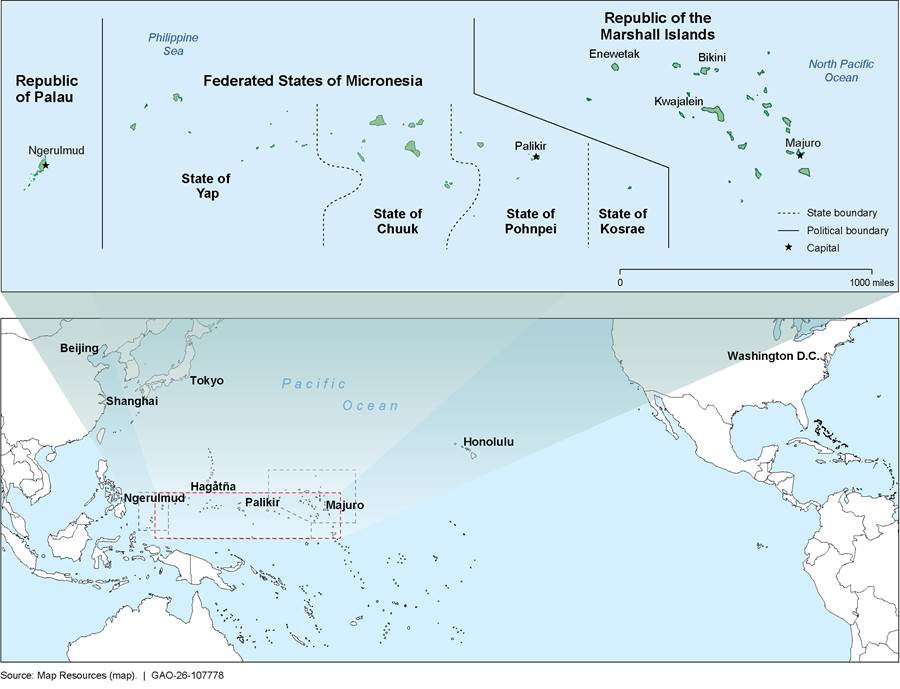
The FAS, located in the Pacific Ocean, are among the world’s smallest countries by population. Each consists of a series of islands that vary in elevation, some of them inhabited. FSM is a federation of four states—Chuuk, Kosrae, Pohnpei, and Yap—and comprises more than 600 islands; RMI comprises more than 1,100 islands; and Palau comprises more than 300. FSM and RMI are both approximately 3,000 miles southwest of Hawaii, while Palau lies about 500 miles southeast of the Philippines (see fig. 1).
U.S. Relationships with the FAS
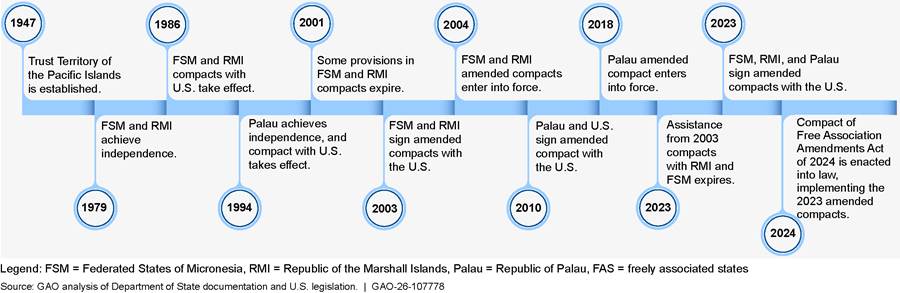
The U.S. relationships with the FAS began when American forces liberated the islands from Japanese control near the end of World War II. In 1947, the U.S. entered into a trusteeship with the United Nations and became the administering authority over FSM, RMI, and Palau.[5] FSM and RMI remained subject to U.S. authority until 1986, when each entered into a compact of free association with the U.S.;[6] Palau’s compact with the U.S. entered into force in 1994.[7]
Since those dates, the U.S. and FAS have amended a series of compact agreements (see fig. 2).[8] Under the compacts, the U.S. has provided economic assistance for defined periods; has assumed responsibility for the defense and security of each state; and has allowed eligible FAS citizens to enter, establish nonimmigrant residence in, and engage in occupations in the U.S. notwithstanding certain visa and labor certification requirements of the Immigration and Nationality Act[9] under specific circumstances.[10]
Note: Pub. L. No. 118-42, div. G, tit. II, 138 Stat. 25, 419 (2024).
Under the compacts, the FAS provide the Department of Defense with regional military access and security rights. The department operates U.S. military sites in each country, according to Defense officials. Each of the three countries also has a maritime zone that extends beyond the coastline, granting various sovereign rights to marine resources, among other things, and further enhancing their strategic locations in the Pacific region.
Current Compacts with the FAS
The most recently amended compacts provide for grant assistance and trust fund contributions to FSM, RMI, and Palau as well as for a range of U.S. federal programs and services to the FAS, including some U.S. Postal services. The Compact of Free Association Amendments Act of 2024 also authorized the Department of Veterans Affairs to provide hospital care and medical services in the FAS to eligible veterans[11] and increased the eligibility of FAS citizens residing in the U.S. for other federal programs, such as education programs.[12]
The compacts with FSM and RMI provide that the U.S. will provide disaster preparedness, relief, and recovery assistance under certain circumstances. The Federal Emergency Management Agency (FEMA) was originally designated to provide such assistance, but the responsibility for implementing and overseeing disaster assistance was moved to the U.S. Agency for International Development’s (USAID) Office of Foreign Disaster Assistance in November 2008. According to U.S. officials, State was expected to coordinate with this USAID office to provide emergency assistance; however, most of USAID’s functions were transferred to State for administration through an interagency agreement in 2025. In January 2026, State officials told us that they had fully assumed responsibility for implementing disaster preparedness and response activities required under the compacts and that FEMA remained responsible for funding disaster response in the FAS.
According to Interior officials, compact funding to the FAS was part of the foreign assistance review initiated by the U.S. administration in response to a January 2025 executive order.[13] According to FAS and U.S. officials, this review did not affect compact funding in 2025.
Amended Compacts Oversight and Administration
The implementing legislation and 2023 amended compacts established oversight and administrative responsibilities for both the U.S. and the FAS.
U.S. Oversight and Administration
Several U.S. agencies and entities have roles in compact oversight and administration.
· Interior’s Office of Insular Affairs has primary responsibility for monitoring and coordinating all U.S. assistance to the FAS under the compacts. The office administers and oversees compact funding to the FAS.
· State’s Bureau of East Asian and Pacific Affairs manages bilateral and regional relations with the FAS and supports compact negotiations and implementation.
· The Interagency Group on the Freely Associated States (IAG)—established by the Compact of Free Association Amendments Act of 2024—is responsible for coordinating the development and implementation of policies, programs, services, and other activities related to the FAS and for providing guidance, recommendations, and oversight of compact implementation.[14] The IAG consists of the Secretaries of State, the Interior, Defense, and the Treasury as well as the heads of other relevant federal agencies carrying out certain compact obligations.
In addition, the Compact of Free Association Amendments Act of 2024 directs State to establish a unit focused on FAS policy and compact implementation within its Bureau of East Asian and Pacific Affairs.[15] State is required to assign additional full-time-equivalent personnel to the new FAS unit and to the Office of Australia, New Zealand, and Pacific Island Affairs. The FAS unit is to be responsible for managing bilateral and regional FAS relations, supporting any compact-related negotiations, and coordinating compact implementation with the FAS in consultation with interagency partners.
Joint Management and Accountability Committees
The 2023 amended compacts for FSM and RMI and their subsidiary fiscal procedures agreements continued the operation of two established committees—the Joint Economic Management Committee (JEMCO) for FSM[16] and the Joint Economic Management and Financial Accountability Committee (JEMFAC) for RMI[17]—to oversee compact grants to the two countries. These committees review audits and development plans submitted by each of the governments; review and concur with grant allocations; and evaluate progress, management problems, and any shifts in priorities in each grant sector. The U.S. can, in consultation with FSM or RMI, apply additional terms and conditions for sector grants to improve program performance and fiscal accountability.
Although Palau does not have a joint management and accountability committee, the 2023 amended compact continued an Economic Advisory Group for Palau.[18] The group’s purpose is to contribute to the country’s economic growth and sustainability by recommending economic, financial, and fiscal management measures.[19] The compact also requires Palau and the U.S. to conduct annual economic consultations covering the status and use of compact funds, among other things.
FSM, RMI, and Palau Grant Administration
The FSM, RMI, and Palau governments are responsible for ensuring compliance with grant terms and conditions, including compact reporting requirements. For example, the FSM, RMI, and Palau governments are required to report annually on the status and use of compact grants.[20]
In addition, FSM, RMI, and Palau must adhere to specific fiscal control and accounting procedures and are required to submit annual single audit reports.[21] The single audits, a type of financial audit, generally cover the use of U.S. federal awards, among other things, and are conducted by third-party auditors. Single audits are a critical element in the federal government’s ability to ensure that federal funds are used properly and that federal agencies have information to fulfill their oversight responsibility for the funds they award to nonfederal entities.[22]
U.S. Assistance to the FAS
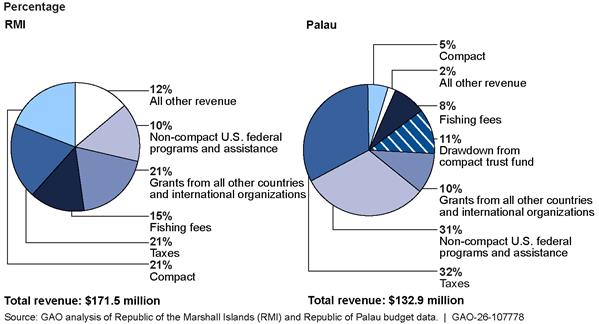
Although all three of the FAS raise revenue via taxes, fishing fees, and other assistance from bilateral and multilateral partners, U.S. assistance is a substantial source of annual government revenue for the FAS governments. In FY 2022, U.S. assistance represented over a third of each country’s total revenue.
FSM’s revenue is divided between the national government and the states. For example, the national government and the states all receive compact assistance, although each state’s portion exceeds that of the national government and differs from the other states’. In FY 2022, according to the most recent available data, compact funding and U.S. federal programs and assistance represented 13 percent of the national government’s revenue and 50 percent or more of each state’s revenue (see fig. 3). FSM did not draw on its trust fund in FY 2022.
Figure 3: Breakdown of Fiscal Year 2022 Revenue Sources for FSM and Its States, by Percentages of Total
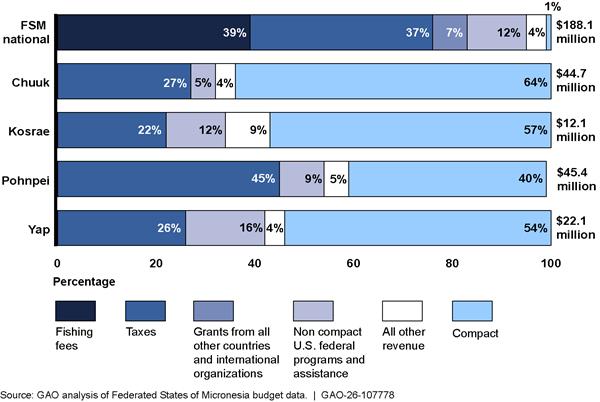
Note: Percentages shown do not sum to 100 because of rounding. The FSM government collects fees from foreign vessels for fishing access in the FSM’s Exclusive Economic Zone. According to FSM officials, the FSM national government amended its constitution in 2023 to share fishing fee revenue with each FSM state government.
In RMI and Palau, U.S. assistance has generally represented about a third of each country’s revenue. For example, in FY 2022, U.S. federal programs, assistance, and compact funding together represented 31 percent of RMI’s total revenue and 36 percent of Palau’s. RMI did not draw on its trust fund in FY 2022, while Palau did.[23] See figure 4.
Note: Percentages shown do not sum to 100 because of rounding.
Sources of Foreign Development Assistance
Although the U.S. provides the largest amount of aid to the FAS, all three countries receive assistance from a variety of donors, according to data from the Lowy Institute. FSM receives development assistance from the People’s Republic of China (PRC), and all three countries receive assistance from Japan. In addition, RMI and Palau receive grants from Taiwan, which has formal diplomatic relations with the two countries. Moreover, each of the FAS receives funding from the World Bank and the Asian Development Bank. Table 1 shows the amounts of development assistance that the three countries received from foreign donors in FYs 2013 through 2022 and the percentages of total foreign aid in those years that that assistance represents.
U.S. dollars in millions
|
Donor |
FSM |
RMI |
Palau |
|||
|
Amount |
Percentage of total aid |
Amount |
Percentage of total aid |
Amount |
Percentage of total aid |
|
|
U.S. |
837 |
61 |
592 |
65 |
114 |
22 |
|
People’s Republic of China |
209 |
15 |
0 |
0 |
0 |
0 |
|
Japan |
105 |
8 |
71 |
8 |
150 |
29 |
|
Taiwan |
0 |
0 |
43 |
5 |
14 |
3 |
|
Australia |
45 |
3 |
34 |
4 |
57 |
11 |
|
World Bank & Asian Development Bank |
140 |
10 |
98 |
11 |
159 |
31 |
|
Other donors |
43 |
3 |
78 |
7 |
27 |
45 |
Source: Lowy Institute. | GAO‑26‑107778
Note: The amounts shown are not adjusted for inflation. U.S. amounts include compact assistance, and other foreign assistance may include loans and grants. Data on assistance provided in FSM by the government of the People’s Republic of China likely underestimate the amount provided, as the government does not report comprehensive data on its assistance.
FAS and U.S. officials in all three countries described notable Chinese investment and influence in their countries (see text box).
|
Chinese Influence in the Freely Associated States
Although the PRC does not provide official development aid to the Republic of the Marshall Islands or Republic of Palau, officials of the freely associated states’ (FAS) and U.S. governments described other forms of Chinese investment and influence in the two countries. For example: · Private sector. Chinese nationals run businesses, including restaurants, in each of the FAS. Forty percent of foreign investment in Palau comes from Chinese sources, according to Palau’s Foreign Investment Board. In addition, Chinese nationals lease tracts of Palau land, which gives them development rights, according to Palau officials. Palau officials noted that the leased tracts often remain undeveloped and are in strategic areas, such as next to the airport. · Strategic tourism. Palau officials expressed concerns about heavy Chinese investment in the tourism sector, including hotels. The PRC previously used tourism as a political tool against Palau by limiting Chinese tourism in response to Palau’s continued recognition of Taiwan, according to Palau officials. More broadly, most Chinese investment in tourism and hotels comes indirectly from the PRC, according to a Palau official. · Illicit activities. Organized crime and espionage linked to the PRC are security concerns in Palau, according to U.S. and Palau government officials. Palau law enforcement agencies have been working to ban entry for certain Chinese individuals and to control potential drug shipments originating in the PRC. |
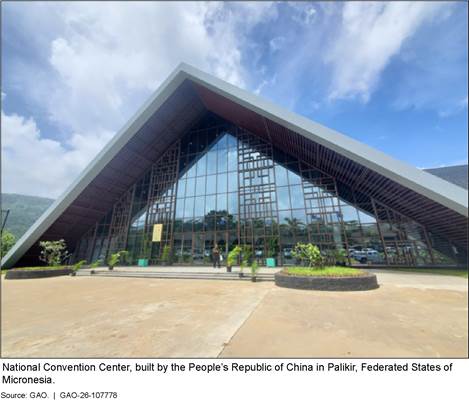 The
government of the People’s Republic of China (PRC) provides official
development assistance to the Federated States of Micronesia, including
infrastructure such as the recently opened National Convention Center in Palikir.
The
government of the People’s Republic of China (PRC) provides official
development assistance to the Federated States of Micronesia, including
infrastructure such as the recently opened National Convention Center in Palikir.
Source: GAO. | GAO‑26‑107778
FSM and RMI Have Experienced Significant Population Loss and Some Economic Decline Since 2010
Out-Migration Has Led to Substantial Population Loss in FSM and RMI
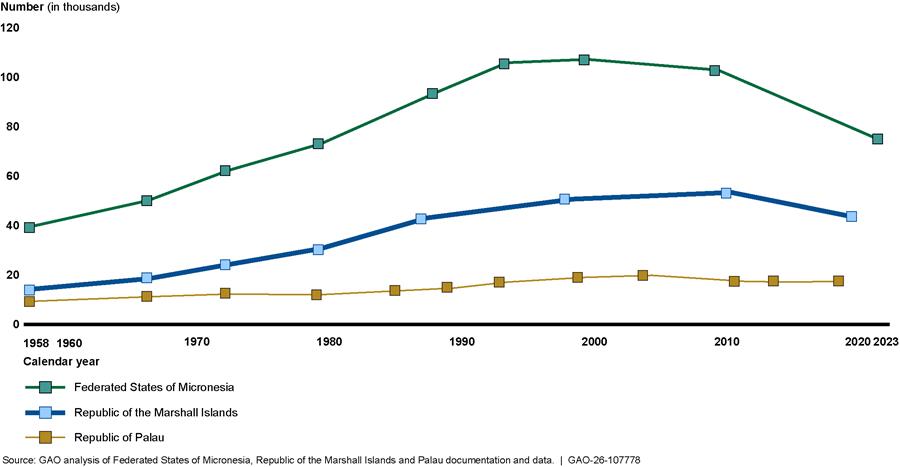
The populations of FSM and RMI have declined significantly over the past decade, while Palau’s population has remained relatively stable (see fig. 5). FAS citizens often migrate to the U.S. and its territories seeking improved health services, educational opportunities, and jobs, among other things.
The following describes recent population trends in the three countries:
· FSM. FSM’s population decreased by 26 percent between the 2010 and 2023 censuses, falling from 102,843 to 75,817. FSM officials estimated the population in 2025 to be between 70,000 and 80,000.[24] State officials estimated that FSM’s 2025 population was likely less than 70,000. Micronesians move internally and abroad for better-paying jobs, educational opportunities, and access to health services, according to FSM officials.
· RMI. RMI’s population decreased by 20 percent between the 2011 and 2021 censuses, falling from 53,158 to 42,418. U.S. and RMI officials estimated that RMI’s population had fallen further, to between 33,000 and 36,000, since its 2021 census.[25] Such losses represent the first population decline for RMI since its 1958 census. According to RMI government officials, migration from the outer island communities to the urban areas of Majuro and Ebeye and abroad is substantial, with 70 percent of these communities experiencing large population decreases. Some outer islands’ populations are less than a third of their reported populations in 2020. As in FSM, this migration is often driven by a relative lack of economic opportunities, according to RMI and U.S. officials. Few jobs are available in the outer islands, and full-time opportunities are usually limited to teacher or health-assistant positions. In addition, skilled workers often leave for better-paying jobs abroad, and training programs often lead to further international migration, according to officials.
· Palau. After losing 12 percent of its population between the 2005 and 2012 censuses, Palau’s population remained relatively stable, around 17,500, between its 2012 and 2020 censuses. According to Palau government officials, Palau maintained its population levels in recent years because its economic activity gave residents an incentive to stay.
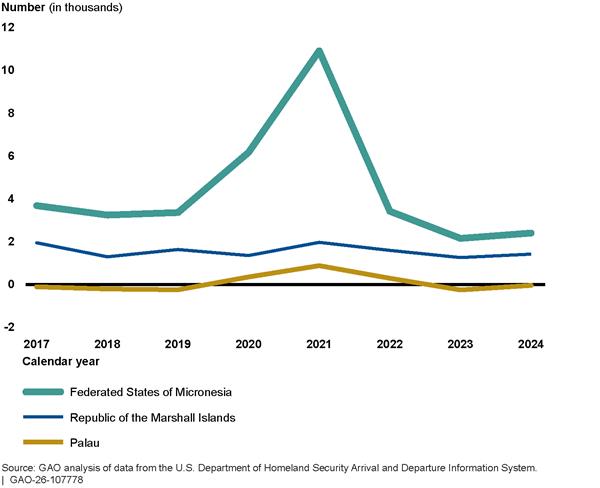
Our analysis of data from CBP’s Arrival and Departure Information System indicated a recent increase in FAS migration to the U.S.[26] Specifically, we found that from 2017 through 2024, almost 48,000 more FAS citizens arrived in the U.S. and its territories than left them.[27] As figure 6 shows, the net number of compact migrants to the U.S.—mostly FSM citizens—substantially increased in 2021 during a period when, according to State, entry into the FAS was restricted because of the pandemic.
Note: We calculated net arrivals as the difference between FAS citizens’ arrivals in the U.S. (including territories) and FAS citizens’ departures from the U.S. (including territories). We excluded land arrivals and departures because the FAS do not share a border with U.S. areas and because, according to officials, data on land departures are less accurate. A negative value in annual net arrivals indicates a net departure of FAS citizens from the U.S. and its territories.
Population Loss Has Affected FAS Labor, Services, and Government Finances
FAS and U.S. government officials noted that FAS citizens’ out-migration has limited the availability of skilled labor and affected the cost and demand for public services as well as the FAS governments’ revenues and allocation of funds.
Availability of skilled labor. Out-migration has contributed to skilled labor shortages in both FSM and RMI, particularly in the construction sector, according to officials. For example, FSM government officials told us that a hospital project in Kosrae relied on nonlocal contractors due to shortages of skilled labor and construction workers. Similarly, RMI officials said that construction companies rely on workers from the Philippines to meet skills gaps. FSM and RMI officials noted that graduates of training programs often leave for higher-paying positions abroad. Palau officials noted that similar difficulties in retaining skilled labor in the private and public sectors had resulted from the high levels of migration to the U.S. and its territories for better pay and access to health services.
Cost and demand for public services. High levels of out-migration increase the per-capita cost of delivering services, such as education and health care, making those services more difficult for the government to provide. According to FSM and RMI officials, out-migration has resulted in smaller numbers of students and teachers per school, particularly in the outer islands, where some schools in RMI now have fewer than 10 students.
Because schools have associated costs that do not depend on enrollment, out-migration can increase the per-student cost, according to ADB officials. The officials noted that a decline in the provision of government services can in turn increase the motivation for out-migration, thereby increasing the difficulty of providing such services. Both FSM and RMI officials described shortages in qualified teachers, linking the shortages to out-migration. RMI has begun to use multigrade teaching in combined classrooms, despite teachers’ limited training and qualification in such methods, according to RMI officials.
In addition, out-migration can affect the demand for services. The Palau Development Plan notes that a decreasing youth population will lead to reduced demand for basic education, while a proportionally larger aging population will place greater demands for government-funded social protection and specialist health services.
Government revenue and allocation of funds. Decreasing population levels directly affect FAS government revenue, such as taxes and other fees, as well as the governments’ allocation of these funds. RMI officials explained that they use population estimates to project tax revenues and that they expect a declining population to lower government revenues over time. Palau is looking to implement strategies recommended by its Economic Advisory Group, such as adjusting pay for public servants, to minimize the impact of outmigration, according to Palauan officials. The Palau government has implemented a savings bond program to encourage investment from its citizens living abroad. Officials stated that tax reform and the Palau Goods and Services tax also help support and stabilize domestic revenue. RMI uses population estimates to develop its budget plans, and FSM allocates funding among its four states partly on the basis of population, according to officials.
FAS Economies Shrank from FY 2019 through FY 2022
From FY 2019 through FY 2022—a period that included the COVID-19 pandemic—FSM’s and RMI’s GDPs declined; Palau’s GDP strongly contracted, driven in part by a sharp decline in tourism (see table 2).[28] All three economies saw a decrease in private sector employment and a relative shift to public sector employment. During this period, according to Graduate School USA, the countries’ public sectors received increased foreign aid, including from the U.S., while the effects of the pandemic lowered private sector growth.
Table 2: Changes in Gross Domestic Product (GDP) and Employment, by Sector, Fiscal Years 2019 and 2022
|
|
|
Number of jobs lost or gained |
|
|
Percentage change in GDP |
Private sector |
Public sector |
|
|
Republic of the Marshall Islands |
-2.7 |
-395 |
660 |
|
Federated States of Micronesia |
-1.9 |
-561 |
323 |
|
Republic of Palau |
-18.3 |
-1,535 |
-35 |
Source: GAO analysis of data published by Graduate School USA. | GAO‑26‑107778
Changes in population levels also affected growth of GDP per capita, which is a proxy for the average living standard.[29] In part because of their decreasing populations, each country’s GDP per capita grew faster than its GDP from 2010 through 2022 (see table 3). In FSM and RMI, which experienced the greatest population decrease, growth in GDP per capita resulted from decreasing population levels rather than from economic growth. According to the International Monetary Fund, the three countries’ growth has recently improved.[30]
Table 3: Annual Compounded Growth Rates of Real Gross Domestic Product (GDP), Estimated Population, and Real GDP per Capita, Fiscal Years 2010–2022
Percentages
|
Real GDP annual growth rate |
Estimated population annual growth |
Real GDP per capita annual growth |
|
|
Republic of the Marshall Islands |
1.8 |
-2.0 |
3.9 |
|
Federated States of Micronesia |
0.4 |
-2.3 |
3.0 |
|
Republic of Palau |
-0.6 |
-0.2 |
-0.3 |
Source: GAO analysis of data published by Graduate School USA. | GAO‑26‑107778
Compact Grants Prioritize Education and Health, but the FAS Face Obstacles to Project Implementation
FAS Receive Most Compact Assistance Through Compact Grants and Trust Fund Contributions
The FAS receive U.S. economic assistance through grants and trust fund contributions under the 2023 amended compacts as well as through a range of U.S. federal programs and services. Under the amended compacts, FSM and RMI receive most compact assistance through sector grants and compact trust fund contributions; Palau, through annual grant assistance and trust fund contributions. The assistance structures for the FSM and RMI compacts are similar to one another but differ from the assistance structure for the Palau compact.[31]
FSM
The U.S. made $140 million available to FSM in sector grant funding in FY 2025 and has committed to do so each year through FY 2043 under the amended 2023 compact.[32] Sector grants represent 85 percent of the $3.3 billion of total committed compact assistance to FSM through FY 2043. FSM revenue, including compact funding, is shared among the national government and each of the four state governments, using a distribution formula. This formula considers population size, among other factors, according to officials.
In addition, the U.S. made $500 million available to FSM’s compact trust fund by the end of FY 2025 under the amended compact. As of November 30, 2025, the compact trust fund had a balance of $1.98 billion, according to its Trust Fund Committee.[33]
RMI
The U.S. made $51 million available to RMI in sector grant funding in FY 2025. Annual sector grant assistance will increase by 2 percent each year until FY 2043 under the amended 2023 compact. Sector grants represent 53 percent of the $2.3 billion of total compact assistance to RMI through FY 2043. RMI manages all compact funds through the national government budget.
The U.S. makes additional funding available to support the Kwajalein Atoll, a chain of islands within RMI.[34] Funding for Kwajalein Atoll includes an annual payment of $1.9 million, adjusted for inflation, to address the special needs of the community on Ebeye and other Marshallese communities within the atoll that are affected by the U.S. presence there. The funding also includes a one-time payment of $132 million to facilitate resilience and healthy communities throughout the Kwajalein Atoll.
In addition, the U.S. will make a total of $700 million available to RMI’s trust fund by 2027 through annual contributions. As of November 30, 2025, the compact trust fund had a balance of $1.6 billion, according to its Trust Fund Committee.[35]
Palau
The U.S. made $20.4 million available to Palau in annual grant assistance in FY 2025. Annual grant assistance will increase by 2 percent each year until 2043 under the amended 2023 compact. Annual grant assistance represents 55 percent of the $889 million of total compact assistance to Palau through FY 2043. Palau manages all compact funds through the national government’s budget.[36]
The U.S. also committed to provide $5 million in annual assistance for infrastructure projects identified in Palau’s National Infrastructure Investment Plan as well as an annual $5 million grant for deposit into Palau’s Infrastructure Maintenance Fund under the 2023 Palau compact.[37] Both streams of funding began in FY 2024, and each will adjust to more than $7 million in FY 2043. Palau will provide a minimum $1 million contribution each year to the Infrastructure Maintenance Fund, which is to be used for the routine and periodic maintenance of U.S.-funded capital improvement projects.
In addition, the U.S. made $100 million available for deposit into Palau’s compact trust fund by end of FY2025.[38] As of November 30, 2025, the compact trust fund had a balance of $441 million, according to Palau’s Trust Fund Committee.[39]
FAS Plan to Prioritize Education and Health Efforts in Their Use of Grant Funding
All three countries propose to use the majority of compact grant funding to support their education and health sectors. In FY 2025, FSM planned to allocate $86.1 million (62 percent) and RMI planned to allocate $29.2 million (57 percent) of their sector grant funding, while Palau planned to allocate $20.4 million (100 percent) of its annual economic assistance to support education and health care. (Tables 4 through 6 show the countries’ proposed compact grant allocations for FY 2025.) To address physical needs in the education and health sectors, such as new construction and building maintenance, FSM and RMI planned to use sector funding for public infrastructure; Palau planned to use its infrastructure funding under the amended 2023 compact.
U.S. dollars
|
Sector |
Proposed allocation |
|
Education |
52,552,344 |
|
Public infrastructurea |
35,000,000 |
|
Health |
33,618,258 |
|
Infrastructure Maintenance Fund |
10,220,000 |
|
Capacity-building in the public sector |
3,341,624 |
|
Enhanced reporting and accountability |
2,668,052 |
|
Environment |
1,750,442 |
|
Private sector development |
849,280 |
|
Total |
140,000,000 |
Source: Federated States of Micronesia (FSM) Fiscal Year 2025 Annual Implementation Plan. | GAO‑26‑107778
aFSM planned to use infrastructure funding to support new construction and maintenance of existing buildings for the health and education sectors, such as schools and dispensaries, among other purposes.
U.S. dollars
|
Sector |
Proposed allocation |
|
Education |
21,679,019 |
|
Public infrastructurea |
15,300,000 |
|
Health |
7,540,922 |
|
Infrastructure Maintenance Fund |
2,550,000 |
|
Enewetak development |
2,448,000 |
|
Capacity-building in the public sector |
1,200,000 |
|
Enhanced reporting and accountability |
646,616 |
|
Private sector development |
503,168 |
|
Environment |
417,275 |
|
Total |
51,000,000 |
Source: Republic of the Marshall Islands (RMI) Fiscal Year 2025 Annual Implementation Plan. | GAO‑26‑107778
aRMI planned to use infrastructure funding to support new construction and maintenance of existing buildings for the health and education sectors, such as schools and a hospital, among other purposes.
Table 6: Palau’s Proposed Allocations of Annual Grant Assistance and Infrastructure Funding, Fiscal Year 2025
U.S. dollars
|
Sector |
Proposed allocation |
|
Health |
10,400,000 |
|
Education |
10,000,000 |
|
Infrastructure projectsa |
4,000,000 |
|
Infrastructure Maintenance Fundb |
5,100,000 |
|
Total |
29,500,000 |
Source: Republic of Palau Fiscal Year 2025 Annual Implementation Plan. | GAO‑25‑107778
aPalau planned to use annual assistance for infrastructure projects to construct new buildings for the education sector, such as a school, among other purposes.
bPalau planned to use funds from the Infrastructure Maintenance Fund for renovations and repairs to existing buildings for the education sector, such as schools. Palau also planned to use an additional $2,090,000 of unexpended funds from fiscal year 2024 alongside funds for fiscal year 2025.
In all three countries, most funding for the health and education sectors supported personnel salaries and wages. In each country, ministry officials we spoke with identified programs and planned infrastructure improvements for the education and health sectors that the governments intended to implement under the 2023 amended compacts.
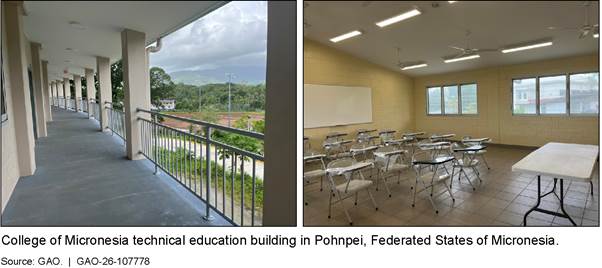
According to FSM’s FY 2025 Annual Implementation Plan, proposed infrastructure projects using sector grant funds include the construction of new schools and medical dispensaries as well as improvements to roads and upgrades of the Kosrae International airport. The plan highlights the College of Micronesia–FSM Instruction Program and the National Scholarship program as two national programs supported by the FSM Department of Education. Enhancement of post-secondary opportunities is one of the strategic goals FSM has set for the amended compact’s term, 2023 through 2045. Figure 7 shows a newly constructed technical education facility, funded by compact assistance, that we saw at the College of Micronesia’s campus in Pohnpei.
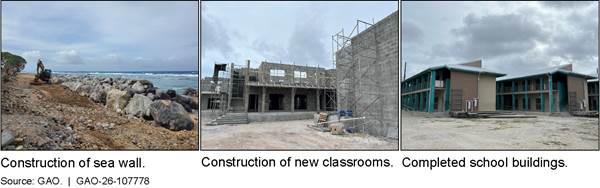
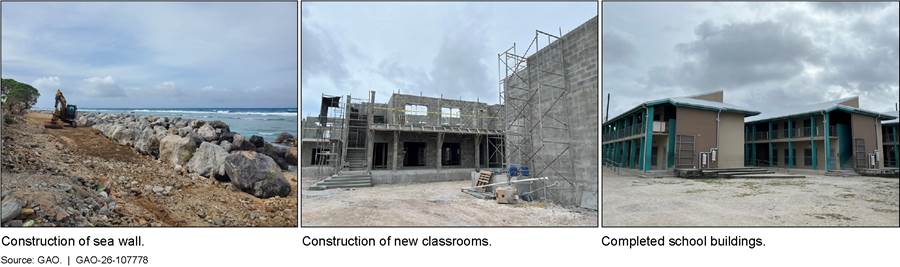
RMI’s National Strategic Plan identified health care infrastructure and services to outer island residents as high priorities. Planned expenditures with sector grant funds include construction of schools in the outer islands, capital improvement repairs to the national hospital in Majuro, and dock repairs and additional public housing in Ebeye. Figure 8 shows ongoing projects that we observed in Ebeye—construction of a sea wall and school facilities—funded by compact assistance, according to officials.
Figure 8: Examples of Compact-Funded Projects in Ebeye, Kwajalein Atoll, Republic of the Marshall Islands
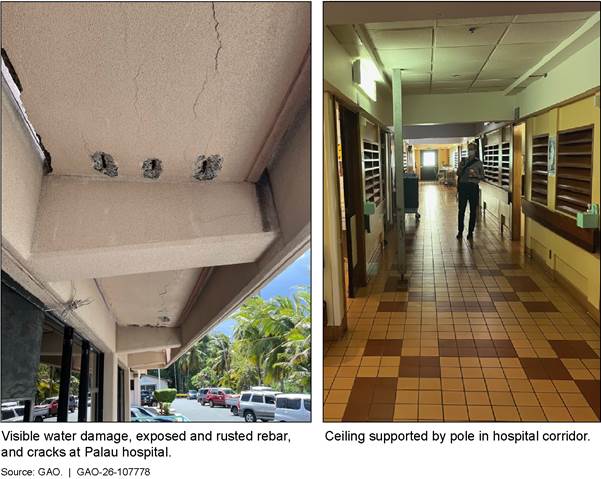
Palau’s FY 2025 Annual Implementation Plan outlines the use of infrastructure funds to implement the New Airai School project, a nine-classroom complex and cafeteria, and to conduct needed repairs for Palau High School and several elementary schools. The plan also notes the intention to build government employee housing meant to attract citizens back to the island for public service job opportunities. Palau officials told us that the government appropriated $2.6 million of its Infrastructure Maintenance Fund in FY 2024 to conduct needed repairs to the hospital roof and structure. However, the officials said that funds had not yet been spent, partly because of procurement process delays. Figure 9 shows some structural problems that we observed at the hospital.
All Three Countries Have Faced Obstacles to Implementing Compact Assistance
U.S. and FAS officials identified obstacles to implementing foreign assistance in the FAS. Specifically, officials said that barriers to construction, including project planning, as well as delays in funding—resulting from the FAS’s geographic isolation, economic conditions, and complex local governance, among other factors—have hindered the initial stages of implementation for the renewed compacts.
Construction Barriers
Officials in each country said that general barriers to construction and project planning affect the implementation of compact funds. Specifically, according to the officials, the islands’ geographic remoteness makes it difficult to maintain a competitive bidding process, given the limited number of companies interested in, or capable of, completing projects in the FAS. Officials also said that complex logistics and high costs associated with acquiring necessary equipment and personnel for construction lead to long delays and budget increases as prices fluctuate, making it difficult to maintain a stable project plan and budget. In addition, officials noted that complex land ownership systems in the FAS necessitate extended legal procedures for public projects and land development. Further, global inflationary pressure on the construction sector, particularly increases in material prices and shipping fees, have dramatically increased project costs and made projects difficult to start or complete in all three countries, according to U.S. and FAS officials.
Moreover, FSM officials stated that high bonding requirements—involving a financial guarantee to protect against financial loss and ensure safety—create a barrier to FSM domestic companies’ participation in compact infrastructure projects, due to the prohibitive cost. U.S. officials informed the FAS in December 2025 that bonding requirements could be reduced for local contractors with a local government’s letter of credit to minimize risk to the U.S. government.
U.S. officials also noted that the FAS governments could use compact funds to hire experienced external project, contracting, and construction management staff for compact-funded projects, which could mitigate some challenges. FAS officials said that shortages of domestic skilled labor, resulting in part from the countries’ population losses, have delayed the implementation of construction projects funded with compact assistance. In addition, the need to import foreign workers from elsewhere in the region, such as the Philippines and Fiji, has increased the projects’ costs.
Population loss also affects the FAS governments’ ability to accurately allocate assistance that the amended compacts make available during FYs 2023 through 2043, the period of the most recent amended compacts. For example, changes in population levels directly affect FSM’s allocations of compact funding to each state, and loss of population in the outer islands of each country affects long-term infrastructure planning for education and health services.
Funding Delays
Delays in the provision of compact funds have created challenges affecting budget processes and implementation plans built around expected assistance, according to FAS officials. For example, the enactment of legislation in March 2024 to implement the 2023 amended compacts meant that compact funds for FY 2024 were not disbursed to the FAS until the end of the fiscal year. Consequently, FAS governments were unable to fully expend FY 2024 funds and some FY 2024 programs were not fully implemented, according to officials. Moreover, FAS officials said the unspent funds for all three countries were deposited into their respective compact trust funds after the fiscal year ended. Palau and FSM officials told us that their governments had to amend their budgets to respond to these changes.
Although the current U.S. administration’s 2025 foreign assistance review did not directly affect compact funding, FAS officials said that other U.S. assistance to the countries, such as grants from the Centers for Disease Control and Prevention, was eliminated or reduced. According to the officials, they had to find new sources of funding or reduce programs supported by this assistance.
FSM and RMI did not experience interruptions in compact funding during the U.S. government lapse in appropriations at the start of FY 2026. RMI officials noted that, despite challenges affecting budget planning, Interior provided support to RMI’s compact implementation office and that, because most compact expenditures are reimbursable, the shutdown had no tangible effects on RMI’s budget.
Most Required FAS Reports Have Been Late, and U.S. Oversight Is Underway With Some Delays
All three of the FAS failed to submit most of the documents due in FY 2025 on time, and U.S. members of JEMCO and JEMFAC have identified various concerns with FSM’s and RMI’s submission of required documents. According to FAS officials, challenges contributing to late FAS reporting include limited guidance from the U.S. government and limited capacity in the FAS. After initial delays to U.S. appointments to the JEMCO and JEMFAC committees, U.S. oversight efforts are underway, including (1) submission of the Interagency Group on the Freely Associated States’ (IAG) annual report to Congress and (2) the establishment of State’s FAS unit. Table 7 summarizes the status of the FAS governments’ and U.S. agencies’ fulfillment of selected oversight requirements under the 2023 amended compacts, including areas of concern and related actions taken.
Table 7: FAS and U.S. Fulfillment of Selected Oversight Requirements Under 2023 Amended Compacts of Free Association
|
Selected requirements |
Areas of concern |
Actions taken |
|
Freely associated states (FAS) |
|
|
|
Single audits. Required annually, single audits are a critical element of the federal government’s ability to ensure that federal funds are used properly.a |
As of December 30, 2025, the Federated States of Micronesia (FSM), Republic of the Marshall Islands (RMI), and Republic of Palau governments had not yet submitted their single audit reports for fiscal year (FY) 2024, which were overdue by 183 days. Also, the RMI and Palau governments had not submitted their FY 2023 single audit reports, which were overdue by 548 days. Until the reports are submitted, U.S. agencies lack access to information needed for oversight of funding provided to the FAS. |
In September 2025, the U.S. Department of the Interior announced it had awarded technical assistance grants to FSM, RMI, and Palau for the hiring of additional staff to improve the timeliness of their single audit report submissions. |
|
Required compact documents. The FAS must provide various plans and reports—detailing, among other things, planned uses of compact funds, goals and objectives, and progress of activities—by specified deadlines for review by oversight entities. |
FSM submitted two of six documents due in FY 2025 on time. RMI submitted none of seven documents due in FY 2025 on time. Palau submitted two of six documents due in FY 2025 on time. U.S. officials also raised concerns about the quality of documents submitted for FSM and RMI, which oversight bodies use to ensure accountability for use of compact assistance. The Joint Economic Management Committee (JEMCO) for FSM and the Joint Economic Management and Financial Accountability Committee (JEMFAC) for RMI are responsible for reviewing and concurring with the countries’ required documents. |
FSM and RMI received extensions to resolve outstanding reporting issues identified by the committees. As of December 2025, Palau had submitted all required documents. |
|
U.S. agencies |
|
|
|
Departments of State and the Interior |
|
|
|
Interagency Group on the Freely Associated States (IAG). The IAG is required to meet annually. It is also required to provide an annual report describing the group’s coordination activities and recommendations for the establishment and implementation of policies relating to the FAS.b |
The IAG reported meeting twice in FY 2024 but submitted its required report for FY 2024 10 months late. |
N/A |
|
Oversight committee appointments. The Compact of Free Association Amendments Act of 2024 requires the U.S. government to appoint three representatives to JEMCO and two representatives to JEMFAC.c |
The U.S. government did not complete its appointments of new members to JEMCO and JEMFAC until August 2025, several months after the positions were vacated and a week before the committees’ annual meetings. Because of the late appointments, JEMCO and JEMFAC were unable to review required reporting prior to the meeting and therefore could not cover all planned oversight items during their August 2025 meetings. |
Following the August 2025 meetings, FSM, RMI, and U.S. officials took steps to address oversight concerns related to required reporting. Both committees plan to hold additional oversight meetings in spring 2026 to complete their reviews of FSM and RMI compact reports. |
|
Department of State |
|
|
|
FAS unit. The Compact of Free Association Amendments Act of 2024 requires State to assign no fewer than four additional full-time-equivalent staff to the Bureau of East Asian and Pacific Affairs’ Office of Australia, New Zealand, and Pacific Island Affairs, including an FAS unit, no later than March 9, 2029.d |
Two State desk officers from the Office of Australia, New Zealand, and Pacific Island Affairs cover the FAS portfolio. State’s efforts to establish and fully staff the FAS unit were paused in January 2026 because of hiring and operational constraints, according to officials. |
State is exploring options to fully staff the FAS unit by the mandated deadline. |
Legend: N/A = not applicable.
Source: GAO analysis of U.S. agency and FAS documentation. | GAO‑26‑107778
a31 U.S.C. § 7501 et seq. Currently, all nonfederal entities that expend $1 million or more of federal awards in a year are required to obtain an annual audit in accordance with the Single Audit Act, as amended. See 2 C.F.R. § 200.501(b). Single audit reports must be submitted to the Federal Audit Clearinghouse within 30 calendar days after the auditee receives the auditor’s reports, or 9 months after the end of the audit period, whichever comes first. 2 C.F.R. § 200.512.
bPub. L. No. 118-42, § 208(d)(5), (6), 138 Stat. 25, 435-437 (2024).
cPub. L. No. 118-42, §§ 205(b), 206(d), 138 Stat. at 425, 429.
dPub. L. No. 118-42, §209(i)(4), 138 Stat. at 446.
Timeliness and Quality of FAS Documents Required for Oversight Have Raised Concerns
Timeliness of Single Audit Reports and Other Required Submissions
Most documents that FSM, RMI, and Palau are required to submit for U.S. oversight purposes under the amended 2023 compacts have not been submitted on time, and U.S. officials have raised concerns about timeliness. As table 8 shows, as of December 30, 2025, the FSM, RMI and Palau governments had not yet submitted their single audit reports for FY 2024, which were overdue by 183 days. The RMI and Palau government also had not submitted their single audit reports for FY 2023, which were overdue by 548 days.
Table 8: Timeliness of FSM’s, RMI’s, and Palau’s Single Audit Reports, FY 2019–2024, as of Dec. 30, 2025
|
|
Days overdue |
||
|
Single audit (FY) |
FSM |
RMI |
Palau |
|
2019 |
183 |
183 |
230 |
|
2020 |
184 |
341 |
665 |
|
2021 |
302 |
307 |
889 |
|
2022 |
472 |
723 |
825 |
|
2023 |
547 |
548 |
548 |
|
2024 |
183 |
183 |
183 |
Legend: FSM = Federated States of Micronesia; RMI = Republic of the Marshall Islands; Palau = Republic of Palau; FY = fiscal year.
Source: GAO analysis of Department of the Interior Office of Inspector General and Federal Audit Clearinghouse information. | GAO‑26‑107778
Note: Numbers in black type denote days overdue, relative to specified deadlines, for reports that had been submitted as of December 30, 2025. Italicized numbers in grey type denote days overdue for reports that had not been submitted as of December 30, 2025. Single audit reports must be submitted to the Federal Audit Clearinghouse within 30 calendar days after the auditee receives the auditor’s reports or 9 months after the end of the audit period, whichever comes first. 2 C.F.R. § 200.512. We used reporting from the Department of the Interior Office of Inspector General and the date of filing with the clearinghouse to determine timeliness of submissions.
During their annual meetings in 2025, JEMCO and JEMFAC identified late submission of the FSM and RMI governments’ single audit reports as a concern. U.S. members of the committees emphasized the urgent need for FSM and RMI to address the overdue reporting to ensure accountability for their use of compact assistance. Single audits are a critical element in the federal government’s ability to ensure that federal funds are used properly and that oversight entities, including JEMCO and JEMFAC, have information to fulfill their oversight responsibility for the funds provided to the FAS.
In addition, the FSM, RMI, and Palau governments did not meet specified deadlines for submitting most other documents required under the compacts. FSM and RMI must provide various plans and reports to JEMCO and JEMFAC, respectively, and to the U.S. government for review by the specified deadlines. For example, besides submitting annual single audits, they are required to submit
· national plans outlining economic development goals and objectives for sectors described by the compacts,[40]
· infrastructure development plans detailing proposed infrastructure projects to be funded with compact grants or funds,
· annual status reports on infrastructure projects and infrastructure maintenance funds,
· annual implementation plans detailing proposed uses of sector grants,
· annual financial reports detailing general budget and fiscal performance and disbursement and outlay information for U.S. grant assistance, and
· annual performance reports summarizing the progress of sector grant activities.
As table 9 shows, as of December 30, 2025, the FSM government had submitted five of six documents, apart from its single audit report, that were due in FY 2025, but it submitted only two of the documents on time. The RMI government had submitted five of seven documents, apart from its single audit report, that were due in FY 2025 but submitted none of the documents on time.[41]
|
|
|
Days overdue |
|
|
Requirement |
Deadline |
FSM |
RMI |
|
FY 2024 Annual Financial Reporta |
Mar. 29, 2025 |
40 |
58 |
|
FY 2024 Annual Performance Report |
Mar. 29, 2025 |
40 |
40 |
|
FY 2024 Infrastructure Maintenance Fund Report |
Mar. 29, 2025 |
276 |
40 |
|
FY 2024 Kwajalein Development Fund Report |
Mar. 29, 2025 |
N/A |
276 |
|
Infrastructure Development Plan |
Mar. 31, 2025 |
0 |
132 |
|
Strategic Development Plan |
Mar. 31, 2025 |
0 |
N/A |
|
Budget and Investment Framework |
Mar. 31, 2025 |
N/A |
276 |
|
FY 2026 Annual Implementation Plan |
July 15, 2025 |
12 |
24 |
Legend: FSM = Federated States of Micronesia; RMI = Republic of the Marshall Islands; FY = fiscal year; N/A = not applicable.
Sources: Agreement Concerning Procedures for the Implementation of United States Economic Assistance Provided in the 2023 Amended Compact Between the Government of the United States and the Government of the Federated States of Micronesia, March 18, 2024, T.I.A.S. No. 24-318.3; Agreement Concerning Procedures for the Implementation of United States Economic Assistance Provided in the 2023 Amended Compact Between the Government of the United States of America and the Government of the Republic of the Marshall Islands, May 1, 2024, T.I.A.S. No. 24-501.1; GAO analysis of FSM, RMI, and Department of the Interior documents. | GAO‑26‑107778
Note: Numbers in black type denote days overdue, relative to specified deadlines, for reports that had been submitted as of December 30, 2025. Italicized numbers in grey type denote days overdue for reports that had not been submitted as of December 30, 2025. The FSM and RMI governments were required to submit these reports to the U.S. government, to their respective joint economic management and accountability committees, or to both by the deadlines shown. We determined the numbers of days overdue on the basis of report submission dates provided by the Department of the Interior. FY 2025 began on October 1, 2024, and ended on September 30, 2025.
aData are not shown for quarterly financial reports that the RMI government is required to submit.
Further, Interior officials said that they were concerned about the quality of some of the RMI government’s submitted reports. For example, they noted that RMI’s FY 2024 Annual Financial Report had significant formatting and content issues. They also said that RMI’s FY 2024 Annual Performance Report had been rejected and resubmitted multiple times because of problems in its organization and reporting of key performance indicators and objectives.
The Palau government must submit, in addition to its annual single audit report, the following documents to the U.S. government by specified deadlines:
· Annual reports on the status and use of U.S. grant assistance and the infrastructure maintenance fund
· Annual recommendations by the Palau Economic Advisory Group related to economic, financial, and fiscal management
· Annual financial reports detailing general budget and fiscal performance and information about disbursements and outlays for U.S. grant assistance
As of December 30, 2025, the Palau government had submitted all six selected documents, apart from its annual single audit report, that were due in FY 2025. However, it submitted only two of these documents on time (see table 10).
|
Requirement |
Deadline |
Days overdue |
|
FY 2024 Annual Financial Report |
Mar. 29, 2025 |
65 |
|
FY 2024 Fiscal Consolidation Fund Report |
Mar. 31, 2025 |
63 |
|
FY 2024 Infrastructure Maintenance Fund Report |
Apr. 1, 2025 |
62 |
|
FY 2026 Infrastructure Maintenance Fund Plan |
Apr. 1, 2025 |
98 |
|
FY 2024 Economic Advisory Group Recommendations |
May 1, 2025 |
0 |
|
FY 2024 COFA Section 231(b) Annual Report |
July 1, 2025 |
0 |
Legend: COFA = Compact of Free Association; FY = fiscal year.
Sources: Agreement Between the Government of the United States of America and the Government of the Republic of Palau Resulting from the 2023 Compact of Free Association Section 432 Review, U.S.–Palau, May 22, 2023, T.I.A.S. No. 24-315; GAO analysis of Palau and Department of the Interior documents. | GAO‑26‑107778
Note: We determined the numbers of days overdue on the basis of report submission dates provided by the Department of the Interior. FY 2025 began on October 1, 2024, and ended on September 30, 2025.
Quality of National Development Plans
During JEMCO’s and JEMFAC’s annual 2025 meetings, U.S. members identified concerns about the quality of the FSM and RMI governments’ submitted documents. According to the committees’ U.S. members, FSM’s Strategic Development Plan and RMI’s Budget and Investment Framework lacked key elements that would enable JEMCO and JEMFAC to fulfill their oversight responsibilities.[42] The subsidiary agreements require the national development plans to include specific multiyear objectives for each compact sector as well as the potential funding sources for each identified objective. However, U.S. members stated that FSM’s and RMI’s plans lacked these elements and did not provide sufficient structure or information that would enable JEMCO and JEMFAC to monitor progress.
For example, U.S. members of JEMCO stated that while FSM’s plan outlined high-level objectives, it did not provide a sufficient monitoring and evaluation framework, including baseline data and key performance indicators, to assess progress toward the objectives. A JEMCO resolution dated September 12, 2025, called for more-detailed information about FSM’s specific multiyear objectives or targets for planned programs, state development plans, population trends from the latest census, macroeconomic framework, and monitoring and evaluation framework. The resolution recognized an extension request allowing the FSM government additional time to provide the required information. The resolution also noted that FSM members had agreed to identify at least 10 key performance indicators for the health and education sectors, to assist JEMCO in partially fulfilling its responsibilities for ensuring effective use of FY 2026 compact assistance and measuring progress toward stated objectives. FSM members requested that U.S. concerns be provided in advance of JEMCO meetings to ensure that they could address questions about FSM financial and programmatic planning.
U.S. members of JEMFAC stated that RMI’s funding requests needed to be aligned with its Budget and Investment Framework but that the framework was incomplete, without sufficient performance measures. In a JEMFAC resolution dated September 30, 2025, JEMFAC agreed to extend the submission deadline of RMI’s Budget and Investment Framework to March 29, 2026, on the condition that RMI submit bimonthly status updates. In its November 2025 status update on the framework, RMI’s Ministry of Finance reported that it had met with relevant ministries to coordinate, among other things, the development of specific multiyear objectives for compact sectors.
FAS Officials Identified Several Factors Contributing to Late Reporting and Described Efforts to Improve Single Audit Timeliness
Absence of Clarity and Guidance on Funding and Reporting Requirements
FSM and RMI officials stated that an absence of clarity and guidance regarding funding and reporting requirements had contributed to late report submissions. Specifically, they expressed a need for further clarity on requirements for health and education sector funds. For example, RMI officials said that JEMFAC had not approved some budgeted health sector grant uses that they believed should have been allowable expenses. In addition, although U.S. officials noted that reporting requirements had not changed substantially, FSM and RMI officials said they had faced a learning curve in trying to understand new reporting requirements, particularly for the FY 2024 Annual Implementation Plan, in the first year of the 2023 amended compacts. RMI officials said that the compact agreements did not specify clear formats or guidelines for the annual implementation plan and performance plan and that, as a result, ministries had different understandings of how to prepare these reports.
Moreover, FSM and RMI officials said that they were unable to obtain timely reviews and guidance from JEMCO and JEMFAC during a period in 2025 when no U.S. members had been appointed to the committees. For example, FSM officials stated that they did not receive feedback on FSM’s Strategic Development Plan, submitted March 21, 2025, until the JEMCO meeting on August 27, 2025. JEMCO and JEMFAC are responsible for reviewing the required reports, but U.S. appointments to the committees were incomplete until about a week before the August 2025 annual meetings. According to Interior officials, their department is limited in its authority outside JEMCO and JEMFAC to advise FSM and RMI on behalf of the U.S.
Limited Capacity and Other Factors
According to FSM, RMI, and Palau government officials, factors contributing to late single audit reports have included capacity limitations, data system problems, and the COVID-19 pandemic, coupled with their auditor’s departure.
· Capacity limitations. FSM and RMI officials said that they did not have enough local staff trained as accountants who could prepare financial statements. RMI officials said that they had had to hire expatriates from abroad to help government components prepare the required statements. In addition, staff of Ernst & Young, the FAS governments’ current third-party auditor, told us that inadequate capacity in the governments’ financial accounting resources and expertise had been a long-standing challenge for single audits. They noted that there was an overall lack of knowledge about the reconciliation process and that FSM had provided multiple revised balances and expenditure schedules that did not reconcile with financial statements.
· Data system problems. FSM officials stated that the Department of Finance’s data management system was outdated, requiring manual input of budget data and contributing to tardiness of FSM’s submission of single audit reports. FSM National Public Auditor officials also identified an absence of reconciliation across accounts and the national government’s failure to submit accurate trial balance information as challenges that had further delayed the submission of single audits.[43] According to Palau Ministry of Finance officials, the government’s transition to a new accounting system in 2020 contributed to its late submission of single audit reports.
· COVID-19 pandemic and auditor departure. FSM, RMI, and Palau officials observed that the COVID-19 pandemic and the departure of Deloitte, the third-party auditor that had been conducting the countries’ single audits, disrupted operations. Deloitte’s departure, coupled with the challenge of managing the influx of COVID-19 funds, contributed to tardiness in the submission of single audit reports, according to Ernst & Young staff. Furthermore, they noted that the challenge of recruiting qualified staff had delayed the FAS governments’ transition to using Ernst & Young as their primary third-party auditor after Deloitte’s departure.
Efforts to Improve Single Audit Timeliness
According to FSM, RMI, and Palau government officials, the countries are making efforts to improve the timeliness of single audit reports.
· In October 2025, FSM launched a new financial management information system developed under a national reform initiative supported by the World Bank. According to FSM officials, the new system is designed to modernize and strengthen the country’s capacity to manage and report on public finances. The initiative will also train local finance staff in financial reporting, accounting, budgeting, and internal auditing.
· RMI Ministry of Finance, Banking, and Postal Service officials said that they had proposed the use of compact funding to hire additional certified accountants to expedite single audits. Additionally, they said that the heads of other ministries had met with their accounting offices to develop plans for addressing their late audits.
· Palau Office of the Public Auditor officials said that the government planned to expedite Palau’s overdue single audits and to submit them all by the deadline for the FY 2026 single audit.
According to Interior officials and a report from the agency’s Inspector General, delays in the submission of single audit reports have been a long-standing problem for FSM, RMI, and Palau.[44] At the August 2025 JEMCO and JEMFAC meetings, Interior officials informed FSM and RMI officials that unless they took immediate actions to address the overdue reports, Interior would consider enforcement actions such as withholding funds or stopping payments. FSM and RMI officials agreed to submit written timelines for expediting their single audits. On December 29, 2025, FSM submitted its overdue FY 2023 single audit report, while RMI’s and Palau’s overdue FY 2023 single audit reports remained pending. In response to the concerns of U.S. members of JEMCO, FSM officials also agreed to revise FSM’s 2026 Annual Implementation Plan, to include repurposing $1 million in sector grant assistance to strengthen the government’s capacity to submit timely single audit reports.
On September 2, 2025, Interior’s Office of Insular Affairs announced that it had awarded technical assistance grants of $250,000 to each of the primary finance offices of FSM (including the national and four state governments), RMI, and Palau to help them hire additional accountants and related staff to improve the timeliness of single audit report submissions.[45] In January 2026, FSM and Palau officials told us that they had used the grants to hire accounting staff, while RMI officials said that they were planning to use the grants to finish hiring accounting staff by early 2026. Interior officials also noted that Graduate School USA had provided FSM, RMI, and Palau with financial training and support in producing single audit reports to strengthen their financial oversight capacity.
U.S. Oversight Efforts Are Underway With Some Delays
U.S. Appointments to Oversight Committees Were Delayed
The U.S. finished appointing representatives to JEMCO and JEMFAC in August 2025, more than a year after the required completion date.[46] The Compact of Free Association Amendments Act of 2024 requires the U.S. government to appoint three representatives to JEMCO and two representatives to JEMFAC.[47] Although the U.S. government had previously completed its required appointments to JEMCO and JEMFAC as of December 24, 2024, the appointed members were either removed after agency changes or left their role in the course of regular staff turnover, according to Interior and State officials. The U.S. government completed its appointments of new members to JEMCO and JEMFAC a week before the committees’ annual meetings in August 2025.
U.S. officials noted that because of the delay in appointments, they were not able to cover all planned items during the August 2025 committee meetings. Therefore, both committees planned to meet again in spring 2026 to complete their reviews of FSM and RMI compact reports, including their annual financial and performance reports.
IAG Submitted Its FY 2024 Report Late
The IAG met twice in 2024 to coordinate compact implementation but submitted its required FY 2024 annual report 10 months late. The IAG held its first meeting on April 29, 2024, when it appointed its first representative to JEMCO. The group held its second meeting on September 12, 2024, when it discussed activities in the FAS conducted by federal agencies including the Departments of Defense and Education. According to State officials, regular weekly meetings of State, Interior, and Treasury officials regarding FAS and compact issues also have provided a foundation for interagency coordination. The officials also noted that State regularly coordinates with Defense on military construction projects and on military use and operating rights in the FAS.
The IAG submitted its required annual report to Congress on January 13, 2026—10 months after the March 9, 2025 deadline—describing its activities in FY 2024.[48] According to the report, the IAG met twice in 2024, and IAG activities included reviews of FSM and RMI oversight committees, discussions of noncompact funding for FAS initiatives, and outreach to FAS presidents and elected officials. The report also noted the IAG’s recommendation that U.S. agencies with responsibilities related to the 2023 amended compacts disseminate and publicly post these responsibilities on their websites.
State Is Preparing to Establish FAS Unit
State is preparing to establish an FAS unit within the Bureau of East Asian and Pacific Affairs’ Office of Australia, New Zealand, and Pacific Island Affairs (EAP/ANP), according to officials. The Compact of Free Association Amendments Act of 2024 requires State to establish a unit within EAP to be responsible for managing FAS relations, supporting compact negotiations, and coordinating compact implementation with the FAS in consultation with interagency partners.[49] The act requires State to assign no fewer than four additional full-time-equivalent staff to EAP/ANP, including the FAS unit, not later March 9, 2029.[50]
In July 2025, State officials told us that two desk officers within EAP/ANP were responsible for the FAS portfolio. The officials said that the department planned to assign additional staff members to the FAS unit, resulting in a total of four EAP/ANP full-time personnel dedicated to FAS relations and compact implementation. The positions remained unfilled as of January 2026.
According to officials, State’s efforts to establish and fully staff the FAS unit were paused due to the January 20, 2025, presidential memorandum freezing hiring and to ongoing operational constraints related to the full-year continuing resolution for FY 2025.[51] The officials told us that, although State had not finalized the plan or its timeline, the department was exploring flexible hiring authorities and personnel realignment to meet the legislative mandate by March 9, 2029.
Agency Comments and Our Evaluation
We provided a draft of this report to the Departments of State, Defense, Homeland Security, and the Interior and to the governments of FSM, RMI, and Palau for their review and comment.
The FSM and Palau governments provided comments, which are reproduced in appendixes II and III. The FSM government noted continuing dialogue between the FSM and U.S. regarding authorization for health services to eligible veterans in the FAS under the 2023 amended compact as well as challenges related to bonding requirements. The Palau government noted its concerns regarding delays in disbursement of compact funds and the need for U.S. administrative support through the Department of State and the Interagency Group.
The Department of the Interior and the FSM and Palau governments provided technical comments that we incorporated as appropriate. The RMI government and the Departments of State, Homeland Security, and Defense did not have any comments.
We are sending copies of this report to the appropriate congressional committees, the Secretary of State, the Secretary of Defense, the Secretary of Homeland Security, the Secretary of the Interior, the President of the Republic of Palau, the President of the Federated States of Micronesia, the President of the Republic of the Marshall Islands, and other interested parties. In addition, the report is available at no charge on the GAO website at https://www.gao.gov.
If you or your staff have any questions about this report, please contact me at lovegrayerl@gao.gov. Contact points for our Offices of Congressional Relations and Media Relations may be found on the last page of this report. GAO staff who made key contributions to this report are listed in appendix IV.

Latesha Love-Grayer
Director, International Affairs and Trade
List of Committees
The Honorable Mike Lee
Chairman
The Honorable Martin Heinrich
Ranking Member
Committee on Energy and Natural Resources
United States Senate
The Honorable James E. Risch
Chairman
The Honorable Jeanne Shaheen
Ranking Member
Committee on Foreign Relations
United States Senate
The Honorable Brian Mast
Chairman
The Honorable Gregory Meeks
Ranking Member
Committee on Foreign Affairs
House of Representatives
The Honorable Bruce Westerman
Chairman
The Honorable Jared Huffman
Ranking Member
Committee on Natural Resources
House of Representatives
This report (1) describes the economic conditions and associated risks in each of the freely associated states (FAS), (2) describes funding provided under the 2023 amended compacts as well as planned uses of funding, and (3) examines the extent to which the FAS and U.S. agencies have met selected oversight requirements established by the compacts.
We obtained and analyzed information about the population and migration levels for each of the countries—the Federated States of Micronesia (FSM), the Republic of the Marshall Islands (RMI), and the Republic of Palau. To report population levels, we collected available FAS census documentation—for 1958 through 2026 for FSM, for 1958 through 2021 for RMI, and for 1958 through 2020 for Palau. To understand the consequences of recent population changes, including changes resulting from migration, we spoke with U.S and FAS officials and stakeholders and reviewed publications from Graduate School USA and the International Monetary Fund.[52] We determined that the FAS population data were sufficiently reliable for reporting changes in population levels since 1958.
To estimate net arrivals to U.S. areas by travelers with FAS passports, we analyzed data from the Department of Homeland Security (DHS) U.S. Customs and Border Protection’s (CBP) Arrival and Departure Information System (ADIS). According to CBP officials, ADIS aggregates data from several DHS systems to create a unique travel record for all travelers, including for FAS citizens with U.S. citizenship. Using ADIS data that DHS provided, we calculated annual FAS net arrivals to U.S. areas from 2017 through 2024 as the difference between the annual number of individuals with FAS-issued passports who entered U.S. ports of entry and the annual number of such individuals who exited U.S. ports of entry.[53]
To assess the reliability of ADIS data, we spoke with DHS officials to identify potential data reliability concerns and other limitations of ADIS. As we previously reported, according to CBP officials, ADIS was significantly changed in 2016 and may contain duplicate entries for that year.[54] DHS officials stated that there had been no significant changes since 2017. As a result, we determined that ADIS data for 2017 and later were sufficiently reliable for reporting the annual FAS net arrivals to the U.S. and its territories.
To present estimates of compact migrant populations in the U.S., we obtained a special tabulation of data from the U.S. Census Bureau’s 2019–2023 American Community Survey (ACS) for the U.S. We interviewed Census officials about the ACS data, their methodology, and challenges associated with estimating compact migrant populations during this period.[55] As a result, we determined that ACS data were sufficiently reliable for estimating compact migrant populations for the period from 2019 through 2023.
To provide information about the economic context for each of the three countries, we used data from the Lowy Institute to identify the leading donors to FSM, RMI and Palau. Since the People’s Republic of China (PRC) does not publish systematic data on its foreign assistance, we spoke to U.S officials and stakeholders to understand the strengths and limitations of the Lowy Institute data compared with other publicly available data on development assistance. As a result, we determined that the data were sufficiently reliable for reporting development assistance to each of the FAS, despite the likely underestimate for the PRC.
Further, we used data published by Graduate School USA to describe the FSM, RMI, and Palau economies.[56] We reviewed publications pertaining to each of the three countries. Specifically, we analyzed government finance statistics in Graduate School USA’s statistical appendices for each country. To assess the reliability of the Graduate School USA data, we reviewed Graduate School USA’s documentation, spoke with Graduate School USA, U.S., and FAS officials, and reviewed a report that we published in 2022.[57] As a result, we determined that the data were sufficiently reliable for describing the FAS economies.
To describe funding provided under the 2023 amended compacts for each of the FAS, we reviewed legislation and relevant compact agreements outlining U.S. assistance to the three countries. We met with FAS and Department of the Interior officials to discuss disbursement of compact assistance and challenges affecting the provision of funds. To describe how each of the three governments plans to use compact assistance, we collected available documentation, including strategic and budgetary plans, from each government and Interior for FYs 2024 through 2026. Some of these documents, such as the strategic plans, cover a period extending through FY 2043. We also conducted site visits to each of the FAS to observe ongoing compact-funded projects and needs identified by each country. We spoke with FAS officials in national and state governments, as applicable, about their plans for compact assistance and project implementation. Further, we spoke with FAS and U.S. agency officials about challenges encountered in implementing compact-funded projects in the FAS.
To examine the extent to which the governments of the FAS and U.S. agencies have met selected oversight requirements, we reviewed U.S. legislation and the 2023 amended compacts and related agreements. We identified selected requirements for the FAS to submit various reports to the U.S. government to ensure accountability over the use of compact funds. We selected reporting requirements with submission deadlines in fiscal year (FY) 2025, the first full fiscal year after the most recent compact amendments entered into force. We determined the timeliness of these report submissions by reviewing submission dates provided by Interior. We determined the timeliness of FAS single audit report submissions by reviewing Interior’s Office of Inspector General reporting and the dates when the reports were filed with the Federal Audit Clearinghouse. We also identified requirements directing the establishment of an office unit focused on FAS relations and compact implementation within the Department of State and the submission of an annual report for the Interagency Group on the Freely Associated States.
To describe oversight activities and the extent to which the U.S. and FAS have met selected oversight requirements, we interviewed officials from the FAS governments, Interior, and State. We observed the 2025 annual meetings of the U.S.–FSM Joint Economic Management Committee (JEMCO) and the U.S.–RMI Joint Economic Management and Financial Accountability Committee (JEMFAC), which are responsible for reviewing and concurring with proposed uses of grants and providing oversight for the 2023 amended compacts. We reviewed U.S. briefing documents, reports, and resolutions, when available, related to JEMCO, JEMFAC, and the Interagency Group on the Freely Associated States.
In addition, to understand FAS compliance with reporting requirements, we reviewed documents provided by Interior’s Office of Insular Affairs, such as annual implementation plans and performance and financial reports, submitted by the FSM, RMI, and Palau governments to the U.S. government. We further reviewed the most recent single audit reports for the FAS, which we obtained from the Federal Audit Clearinghouse. We described issues related to the quality of FAS reports that the U.S. representatives raised at JEMCO and JEMFAC meetings, but we did not independently assess the quality or reliability of the reports. In addition, we discussed reporting challenges, including the absence of timely single audits, and efforts to address these challenges with FAS and Office of Insular Affairs officials.
We conducted this performance audit from August 2024 through May 2026 in accordance with generally accepted government auditing standards. Those standards require that we plan and perform the audit to obtain sufficient, appropriate evidence to provide a reasonable basis for our findings and conclusions based on our audit objectives. We believe that the evidence obtained provides a reasonable basis for our findings and conclusions based on our audit objectives.
Note: GAO comments supplementing those in the report text appear at the end of this appendix.
See comment 1.
GAO Comments
1. We updated table 9 to reflect the submission of FSM’s 2024 Infrastructure Sector Report as part of its 2024 Annual Performance Report. However, the Department of the Interior did not receive the 2024 Infrastructure Maintenance Fund Report, and we were not able to review a Consolidated Infrastructure Maintenance Plan as part of documentation that FSM submitted to Interior in July 2024. The deadlines and timeliness reported in table 9 reflect information that Interior provided.
Latesha Love-Grayer, lovergrayerl@gao.gov
In addition to the contact named above, Joe Carney (Assistant Director), Katie Bassion (Analyst-in-Charge), Sammy Huang, Gene Beye, Marc Rockmore, Pedro Almoguera, Nisha Rai, Neil Doherty, Reid Lowe, Bahar Etemadian, Terry Richardson, Samantha Lalisan, and Alexa Stechschulte made key contributions to this report.
Climate Change: Improved Data and Performance Management Would Strengthen U.S. Support to the Indo-Pacific. GAO‑25‑106236. Washington, D.C.: December 10, 2024.
Freely Associated States: Agencies Should Enhance Procedures to Address Millions of Dollars in Questionable Spending. GAO‑23‑106160. Washington, D.C.: September 27, 2023.
Compacts of Free Association: Implications of Planned Ending of Some U.S. Economic Assistance. GAO‑22‑104436. Washington, D.C.: February 14, 2022.
Compacts of Free Association: Populations in U.S. Areas Have Grown, with Varying Reported Effects. GAO‑20‑491. Washington, D.C.: June 15, 2020.
Compacts of Free Association: Actions Needed to Prepare for the Transition of Micronesia and the Marshall Islands to Trust Fund Income. GAO‑18‑415. Washington, D.C.: May 17, 2018.
Compacts of Free Association: Issues Associated with Implementation in Palau, Micronesia, and the Marshall Islands. GAO‑16‑550T. Washington, D.C.: April 5, 2016.
Compacts of Free Association: Proposed U.S. Assistance to Palau for Fiscal Years 2016 to 2024. GAO‑16‑788T. Washington, D.C.: July 6, 2016.
Compacts of Free Association: Improvements Needed to Assess and Address Growing Migration. GAO‑12‑64. Washington, D.C.: November 14, 2011.
Compacts of Free Association: Palau’s Use of and Accountability for U.S. Assistance and Prospects for Economic Self-Sufficiency. GAO‑08‑732. Washington, D.C.: June 10, 2008.
Compact of Free Association: Micronesia Faces Challenges to Achieving Compact Goals. GAO‑08‑859T. Washington, D.C.: June 10, 2008.
Compact of Free Association: Implementation Activities Have Progressed, but the Marshall Islands Faces Challenges to Achieving Long-Term Compact Goals. GAO‑07‑1258T. Washington, D.C.: September 25, 2007.
The Government Accountability Office, the audit, evaluation, and investigative arm of Congress, exists to support Congress in meeting its constitutional responsibilities and to help improve the performance and accountability of the federal government for the American people. GAO examines the use of public funds; evaluates federal programs and policies; and provides analyses, recommendations, and other assistance to help Congress make informed oversight, policy, and funding decisions. GAO’s commitment to good government is reflected in its core values of accountability, integrity, and reliability.
Obtaining Copies of GAO Reports and Testimony
The fastest and easiest way to obtain copies of GAO documents at no cost is through our website. Each weekday afternoon, GAO posts on its website newly released reports, testimony, and correspondence. You can also subscribe to GAO’s email updates to receive notification of newly posted products.
Order by Phone
The price of each GAO publication reflects GAO’s actual cost of production and distribution and depends on the number of pages in the publication and whether the publication is printed in color or black and white. Pricing and ordering information is posted on GAO’s website, https://www.gao.gov/ordering.htm.
Place orders by calling (202) 512-6000, toll free (866) 801-7077,
or
TDD (202) 512-2537.
Orders may be paid for using American Express, Discover Card, MasterCard, Visa, check, or money order. Call for additional information.
Connect with GAO
Connect with GAO on X,
LinkedIn, Instagram, and YouTube.
Subscribe to our Email Updates. Listen to our Podcasts.
Visit GAO on the web at https://www.gao.gov.
To Report Fraud, Waste, and Abuse in Federal Programs
Contact FraudNet:
Website: https://www.gao.gov/about/what-gao-does/fraudnet
Automated answering system: (800) 424-5454
Media Relations
Sarah Kaczmarek, Managing Director, Media@gao.gov
Congressional Relations
David A. Powner, Acting Managing Director, CongRel@gao.gov
General Inquiries
[1]For purposes of this report, compact grants refers to the (1) sector grants provided to FSM and RMI pursuant to Section 211 of the 2023 amended compacts, (2) Kwajalein use and impact grants provided to RMI pursuant to Section 212 of the 2023 amended compact, (3) military use and operating rights grants provided to RMI pursuant to the 2003 military use and operating rights agreement, and (4) grants provided to Palau pursuant to Article 1 of the 2023 amended compact. Additionally, the FAS receive some grants authorized by the implementing legislation for the compacts.
[2]Pub. L. No. 118-42, div. G, tit. II, § 208, 138 Stat. 25, 434 (2024), codified at 48 U.S.C. § 1987(a)(2).
[3]For purposes of this report, compact migrant refers to an FAS citizen who migrates to the U.S. and its territories. The 2023 amended compacts’ implementing legislation defines a qualified nonimmigrant as a person, or that person’s children younger than 18 years, admitted or resident pursuant to the compacts who as of a date referenced in the most recently published enumeration is a resident of an affected jurisdiction. 48 U.S.C. § 1921c(e)(2)(B).
[4]According to CBP, its Arrival and Departure Information System (ADIS) is a data aggregation system that contains arrival, departure, and authorized admission status records of U.S. citizens, permanent residents, and foreign nationals.
[5]Under the United Nations trusteeship agreement, the U.S. was the administering authority for the Trust Territory of the Pacific Islands, which included FSM, RMI, Palau, and the Northern Mariana Islands. In 1975, the Northern Marianas became a U.S. territory.
[6]Compact of Free Association Act of 1985, Pub. L. No. 99-239, 99 Stat. 1770 (1986).
[7]Pub. L. No. 99-658, 100 Stat. 3672 (1986). Although Congress approved the Palau compact in 1986, the compact did not enter into force until 1994, after approval by the government of Palau in accordance with its constitutional processes and by a United Nations–observed vote. See Proc. No. 6726, 59 Fed. Reg. 49,777 (Sept. 27, 1994).
[8]For purposes of this report, compact and amended compact refer to the agreements that amend the compacts of free association that were entered into in 1986 and 1994 with the FAS. Those amended compacts include, for example, the 2003, 2010, and 2023 amendments to the compacts. See Treaties and Other International Acts Series (TIAS) 04-501 for the RMI 2003 amended compact; TIAS 04-625 for the FSM 2003 amended compact; TIAS 18-919.2 for the Palau 2010 amended compact; TIAS 24-318 for the FSM 2023 amended compact; TIAS 24-315 for the Palau 2023 amended compact; and TIAS 24-501.2 for the RMI 2023 amended compact. The compacts are accompanied by related subsidiary agreements, which we refer to as subsidiary agreements. They include, for example, the fiscal procedures agreements and military use and operating rights agreements with RMI and FSM. See, e.g., TIAS 24-318.1 for the FSM Federal Program and Services Agreement, TIAS 24-501.1 for the RMI Fiscal Procedures Agreement, TIAS 04-625 for the FSM Military Use and Operating Rights Agreement, and TIAS 04-501.3 for RMI Military Use and Operating Rights Agreement.
[9]8 U.S.C. § 1182(a)(5), (7)(B)(i)(II).
[10]See GAO, Compacts of Free Association: Populations in U.S. Areas Have Grown, with Varying Reported Effects, GAO‑20‑491 (Washington, D.C.: June 15, 2020).
[11]Pub. L. No. 118-42, § 209(a), 138 Stat. at 438. In April 2025, the Department of Veterans Affairs stated in a memo that it would not be expanding coverage for veterans in the FAS.
[12]Pub. L. No. 118-42, § 209(b), 138 Stat. at 441. We refer to this legislation as the compact’s implementing legislation.
[13]The executive order paused foreign development assistance for assessment of programmatic efficiencies and consistency with U.S. foreign policy. Exec. Order No. 14169, “Reevaluating and Realigning United States Foreign Aid, 90 Fed. Reg. 8619 (Jan. 30, 2025).
[14]Pub. L. No. 118-42, § 208(d), 138 Stat. at 435.
[15]Pub. L. No. 118-42, § 209(i), 138 Stat. at 446.
[16]JEMCO is to comprise one U.S. chairperson, two other U.S. representatives, and three FSM representatives. See Agreement between the Government of the United States of America and the Government of the Federated States of Micronesia to Amend the Compact of Free Association, as amended, U.S.–F.S.M., May 23, 2023, T.I.A.S. No. 24-318 [hereinafter U.S.–FSM 2023 amended compact]. The three U.S. members of the committee are appointed by the Secretaries of State and Interior in consultation with the Secretary of the Treasury and the Interagency Group on the Freely Associated States. Pub. L. No. 118-42, § 205(b)(2), 138 Stat. at 425.
[17]JEMFAC is to comprise one U.S. chairperson, one other U.S. representative, and two RMI representatives. See Agreement between the Government of the United States of America and the Government of the Republic of the Marshall Islands to Amend the Compact of Free Association, as amended, U.S.–R.M.I., Oct. 16, 2023, T.I.A.S. 24-501,2 [hereinafter U.S.-RMI 2023 amended compact]. No. 24-501.2 [hereinafter U.S.-RMI 2023 amended compact]. The two U.S. members of the committee are appointed by the Secretary of State and Interior, in consultation with Treasury. Pub. L. No. 118-42, § 2069(d)(2), 138 Stat. at 429.
[18]The Economic Advisory Group for Palau is to comprise two U.S. representatives, two Palau representatives, and one member who is not a Palau resident to be selected by both the U.S. and Palau. The two U.S. representatives are designated by the Secretary of the Interior. See Agreement between the Government of the United States and the Government of the Republic of Palau Resulting from the 2023 Compact of Free Association Section 432 Review, Palau–U.S., May 22, 2023, T.I.A.S. No. 24-315 [hereinafter, 2023 Palau amended compact].
[19]Prior to the amendments of Article 7 of the Palau Compact Agreement in 2023, the Economic Advisory Group for Palau was known as the Advisory Group on Economic Reform.
[20]RMI is also required to submit a quarterly financial report.
[21]31 U.S.C. § 7501 et seq. Currently, all nonfederal entities that expend $1 million or more of federal awards in a year are required to obtain an annual audit in accordance with the Single Audit Act, as amended. See 2 C.F.R. § 200.501(b). Single audit reports must be submitted to the Federal Audit Clearinghouse within 30 calendar days after the auditee receives the auditor’s reports or 9 months after the end of the audit period, whichever comes first. 2 C.F.R. § 200.512.
[22]In 2023, we reviewed the single audit reporting packages that FSM, RMI, and Palau submitted for FYs 2015 through 2019. See GAO, Freely Associated States: Agencies Should Enhance Procedures to Address Millions of Dollars in Questionable Spending, GAO‑23‑106160 (Washington, D.C.: Sep. 27, 2023). We found that the single audits identified more than $1.7 million in questioned costs related to Department of Health and Human Services grants and more than $4 million in questioned costs related to Interior grants. A questioned cost is a cost that is questioned by the third-party auditor for reasons such as the following: (1) a provision of a law, regulation, contract, or grant was, or may have been, violated; (2) the cost, at the time of the audit, was not supported by adequate documentation; or (3) the cost incurred appears unreasonable.
[23]RMI drew on its compact trust fund in fiscal year 2024, while the U.S. government operated under multiple continuing resolutions. In late 2025, RMI began regular withdrawals from the trust fund to support its universal basic income program, locally known as Enra.
[24]The FSM government and U.S. officials provided these estimates before FSM released its 2023 census results in March 2026.
[25]The RMI government conducted a registration of residents in the last quarter of calendar year 2024 and early 2025 to determine its payment distributions through its universal basic income program. The population estimates ranged from 33,000 to 36,000.
[26]We do not include entries and departures through land crossings, because CBP does not fully record these departures, according to officials. (See app. I for more information about the scope of our analysis.) Moreover, given the remoteness of, and limited air connections to, the FAS, the number of compact migrants entering Canada or Mexico over land is likely extremely small.
[27]According to Census Bureau data, the 5-year estimates of the number of compact migrants in the U.S and Puerto Rico increased from almost 73,000, during the period from 2013 through 2017, to almost 96,000, during the period from 2019 through 2023. No corresponding contemporary estimates of migrants in U.S. territories are available. The estimates for the U.S states are from the annual American Community Survey, and the estimates for the territories are from the decennial 2020 Island Areas Censuses. Because of operational issues related to the COVID-19 pandemic, estimates for the territories in 2020 do not meet the Census Bureau’s Statistical Quality Standards.
[28]International visitors to Palau declined from almost 116,000 in FY 2018 to 3,400 in FY 2021, according to data published by Graduate School USA.
[29]GDP per capita is calculated as a country’s GDP divided by its population.
[30]The International Monetary Fund projected that FSM’s economy grew at 1.1 percent in FY 2025, after 2.3 percent growth in FY 2024; that RMI’s economy grew at 2.5 percent in FY 2025, after 3.0 percent growth in FY 2024; and that Palau’s economy grew at 6.7 percent in FY 2025, after 12.0 percent growth in FY 2024.
[31]Sector grants for FSM and RMI target education, health, the environment, public sector capacity building, private sector development, and public infrastructure, among other purposes. Annual grant assistance for Palau targets education, health, climate adaptation and the environment, the administration of justice, and public safety, among other purposes.
[32]Annual sector grant assistance for FSM does not increase over time. The U.S. also made $500,000 available in FY 2024 and FY 2025 and is scheduled to make the same amount available annually through FY2043, with an equal contribution from FSM, to the Disaster Assistance Emergency Fund. The fund is to be used for assistance and rehabilitation resulting from disasters and emergencies or for disaster preparedness activities.
[33]As of January 2026, FSM had not made any withdrawals from its compact trust fund and did not plan any future withdrawals.
[34]In addition, the U.S. made $20 million available in FY 2024 and made up to $8 million available in additional annual grant assistance in FYs 2024 and 2025 for deposit into the U.S. Supplemental Health Fund for RMI. This fund is structured to support the proposed health expenditures of the RMI government in a fiscal year. The U.S. has committed to providing $8 million in additional annual grant assistance through FY 2043. The U.S. also made $22 million available, beginning in FY 2024, in additional education assistance to be used specifically for education and job-training programs; $30 million, beginning in FY 2024, in additional environment assistance to be used specifically for environmental feasibility studies, technical assistance, and future environmental programs; $20 million, in FY 2024, in grant assistance to deposit into the Climate Fund to better enable RMI to cope with challenges from climate impacts; $10 million, beginning in FY 2024, in grant assistance to improve the accessibility of documents and information previously provided to RMI relating to the U.S. nuclear testing program; and $5 million, beginning in FY 2024, in grant assistance to support efforts by RMI to establish a museum and research facility on the U.S. nuclear testing program.
[35]RMI officials stated that $8 million of the compact trust fund was used to cover expenses from October 2023 to February 2024 due to a gap in U.S. funding caused by delayed renewal of the compact agreement. RMI officials also told us that the country’s compact trust fund will financially support the universal basic income system, locally known as Enra, and that withdrawals from the RMI compact trust fund began in November 2025. According to the IMF, Enra provides regular cash transfers to all resident Marshallese citizens. The IMF recommended that the system be replaced with a more targeted scheme to ensure more effective use of the compact trust fund resources and to safeguard against significant macroeconomic risks.
[36]To assist Palau in paying debts incurred before April 1, 2023, the U.S. made $10 million available annually in FYs 2024 and 2025. The U.S. has committed to continue making this amount available annually through FY 2029 for deposit into the Fiscal Consolidation Fund.
[37]In addition to the FY 2024 funds provided under the 2023 compact, the 2010 Palau compact provided $2 million annually to the Infrastructure Maintenance Fund from FY 2011 through FY 2024.
[38]For Palau, compact trust fund refers to the Section 211(f) Fund.
[39]Similar to prior years, Palau’s FY 2025 Annual Implementation Plan states that the government plans to use $15 million of the trust fund to supplement the operations of the Ministries of Health, Justice, and Agriculture and for education assistance programs.
[40]FSM’s plan is known as the Strategic Development Plan. RMI’s plan is known as the Budget and Investment Framework.
[41]For reporting purposes, our analysis excludes the RMI government’s quarterly financial reports, which are required in addition to its annual financial reports.
[42]JEMCO and JEMFAC’s oversight responsibilities include reviewing and concurring with portions of these plans as well as reviewing progress in achieving the goals and broad strategies outlined in these plans.
[43]According to DOI officials, FSM national government must complete its reconciliation of intrafund transfers before the state governments can submit their audits. DOI officials also noted that, for example, Kosrae had completed its audit, but the national government had not completed its reconciliation of accounts receivable as January 2026.
[44]For more information, see U.S. Department of the Interior, Office of Inspector General, The Office of Insular Affairs Needs To Ensure Insular Areas’ Compliance With Federal Regulations Related to Single Audit Submissions, Report No. 2025-FIN-005 (Washington, D.C.: Sept. 15, 2025).
[45]U.S. Department of the Interior, “Interior’s Office of Insular Affairs Awards $250,000 Each to Boost Audit Preparation” (Sept. 2, 2025), https://www.doi.gov/oia/press/Interiors-Office-of-Insular-Affairs-Awards-%24250%2C000-Each-to-Boost-Audit-Preparation.
[46]Under the fiscal procedures agreements with FSM and RMI, appointments to JEMCO and JEMFAC are to be completed no later than 90 days after the agreements entered into force. The RMI fiscal procedures agreement entered into force on May 1, 2024, and the FSM agreement entered into force on March 18, 2024.
[47]Pub. L. No. 118-42, §§ 205(b), 206(d), 138 Stat. at 425, 429.
[48]Pub. L. No. 118-42, § 208(d)(6), 138 Stat. at 437. Specifically, the President is required to submit the annual report describing the activities and recommendations of the Interagency Group on the Freely Associated States. According to agency officials, State is responsible for submitting this report on behalf of the President.
[49]Pub. L. No. 118-42, § 209(i)(3), 138 Stat. at 446.
[50]The act specifies that the four additional full-time equivalent staff assigned to EAP/ANP and the FAS unit are not to be dual-hatted. Pub. L. No. 118-42, § 209(i)(4), 138 Stat. at 446.
[51]Presidential Memorandum, Hiring Freeze Memorandum for the Heads of Executive Departments and Agencies, 90 Fed. Reg. 8247 (Jan. 20, 2025).
[52]See Graduate School USA, Economic Review Federated States of Micronesia Fiscal Year 2024 (May 2025); Economic Review Republic of the Marshall Islands Fiscal Year 2024 (May 2025); and Economic Review Republic of Palau Fiscal Year 2024 (August 2024). See International Monetary Fund, Federated States of Micronesia: Staff Report for the 2023 Article IV Consultation (Washington, D.C.: Feb. 7, 2024); Republic of the Marshall Islands: Staff Report for the 2023 Article IV Consultation (Washington, D.C.: Aug. 30, 2023); Republic of Palau: Staff Report for the 2021 Article IV Consultation (Washington, D.C.: Nov. 13, 2023).
[53]We excluded net arrivals through land-border ports of entry because DHS officials noted that land exits are likely less accurate than entries. DHS officials previously estimated that almost all migrants from the FAS arrive by air via Guam or Hawaii.
[54]GAO, Compacts of Free Association: Populations in U.S. Areas Have Grown, with Varying Reported Effects, GAO‑20‑491 (Washington, D.C.: June 15, 2020).
[55]The universe for the Special Tabulation of ACS data includes people who were born in the FAS and entered the United States after 1986 (for Micronesia and the Marshall Islands) or 1994 (for Palau) and their U.S.-born children (biological, adopted, step-) who are younger than 18 years. Those younger than 18 years must reside in the same household as the migrant to be counted as a compact migrant.
[56]See Graduate School USA, Federated States of Micronesia Fiscal Year 2023 Statistical Appendices (Preliminary) (Honolulu: March 2024); Republic of the Marshall Islands Fiscal Year 2024 Statistical Appendices (Preliminary) (Honolulu: September 2025); Republic of Palau Fiscal Year 2023 Statistical Appendices (Preliminary) (Honolulu: November 2024).
[57]GAO, Compacts of Free Association: Implications of Planned Ending of Some U.S. Economic Assistance, GAO‑22‑104436 (Washington, D.C.: Feb. 12, 2022).