
Report to Congressional Requesters
United States Government Accountability Office
A report to congressional requesters
For more information, contact: Melissa Emrey-Arras at EmreyArrasM@gao.gov
What GAO Found
The Department of Education provides student loan servicers with instruction for implementing program changes via formal documents known as change requests. Change requests outline new or modified requirements for servicers and can vary in their complexity. For example, Education could require servicers to carry out tasks ranging from sending straightforward borrower communications to implementing major repayment plan changes.

The servicers reported facing challenges in implementing Education’s instruction for program changes. All four servicers raised concerns about the number of clarifying questions they needed answered to implement some requested changes. GAO found that the lack of clear up-front instruction sometimes resulted in extensive back-and-forth between Education and servicers. For example, GAO observed a change request that resulted in six rounds of questions and answers with servicers over a 2-month period. All four servicers said instruction could be improved if Education coordinated with them before or immediately after requesting a change, such as by meeting to walk through new requirements.
Education officials acknowledged the value of coordinating early with servicers, but the agency has not consistently undertaken such coordination. Education said that early coordination with servicers was done at staff discretion and was based on factors such as the change request’s complexity. In June 2025, officials said that early coordination was not common, citing insufficient time as a key barrier. Yet, three servicers said that early coordination allows them to respond more quickly to Education’s requests. In December 2025, Education officials said that early coordination with servicers had recently improved. For example, they said they proactively solicited servicer input on draft requirements related to new student loan repayment plans, which led them to revise the related change requests before formally sending them to servicers.
Education guidance states that it can share information with servicers when developing new requirements, but it does not specify criteria for when staff should conduct early coordination. While recent reports of improved early coordination are a positive change, Education does not have formal criteria to ensure it consistently identifies early coordination opportunities and maintains increased coordination. Developing and implementing formal criteria could help ensure that Education provides servicers with the information they need to implement requested changes in a timely and efficient manner.
Why GAO Did This Study
As of September 2025, Education held over $1.6 trillion in outstanding federal student loans. To administer these loans, Education contracts with student loan servicers. Significant program changes have added new complexities to servicers’ responsibilities. For example, under Education’s direction, servicers implemented temporary initiatives and major changes to the repayment plans available to borrowers.
GAO was asked to review Education’s instruction to loan servicers. This report examines Education’s instruction to servicers for program changes.
GAO reviewed Education’s instruction to servicers, including 68 change requests associated with key program changes that the agency issued between the start of the COVID-19 payment pause in March 2020 and December 2024. GAO interviewed officials from Education and the four loan servicers it had contracts with when the payment pause ended in August 2023. GAO also reviewed relevant federal laws and regulations.
What GAO Recommends
GAO is recommending that Education develop and implement criteria for determining when to conduct early coordination with servicers. Education disagreed with GAO’s recommendation, stating that such criteria would hinder its ability to implement changes in a timely and efficient manner while being responsive to administration priorities. GAO maintains the importance of identifying opportunities for early coordination and believes the recommended action would not limit Education’s flexibility to determine when such coordination is appropriate.
|
Abbreviations |
|
|
|
|
|
|
|
COVID-19 |
Coronavirus disease 2019 |
|
|
IDR |
income-driven repayment |
|
|
OBBBA |
One Big Beautiful Bill Act |
|
|
SAVE |
Saving on a Valuable Education |
|
This is a work of the U.S. government and is not subject to copyright protection in the United States. The published product may be reproduced and distributed in its entirety without further permission from GAO. However, because this work may contain copyrighted images or other material, permission from the copyright holder may be necessary if you wish to reproduce this material separately.
July 13, 2026
The Honorable Bill Cassidy, M.D.
Chair
Committee on Health, Education, Labor and Pensions
United States Senate
The Honorable Tim Walberg
Chairman
Committee on Education and Workforce
House of Representatives
The Honorable Virginia Foxx
House of Representatives
As of September 2025, the Department of Education held over $1.6 trillion in outstanding federal student loans for about 43 million borrowers.[1] Education’s Office of Federal Student Aid contracts with student loan servicers to administer these loans. Loan servicers provide borrowers with many of the public-facing services associated with student loan repayment, such as collecting payments, responding to questions, and processing changes to repayment plans. To carry out these responsibilities, servicers receive instruction from Education via change requests—formal written documents that specify new or modified requirements.
Significant changes in the student loan environment over the last several years have introduced new complexities into the servicers’ responsibilities. In March 2020, in response to the COVID-19 pandemic, Education paused several aspects of student loan repayment, including suspending payments and interest accrual.[2] After several extensions, interest began accruing on loans again in September 2023, and monthly payments resumed in October 2023. To assist borrowers when payments resumed, Education introduced temporary relief options. Recent statutory changes to the repayment options available to borrowers took effect in July 2026. Servicers will play a critical role in implementing these changes and communicating with borrowers about their repayment options.
You asked us to provide information about the instruction that Education provides to servicers. This report examines Education’s instruction to servicers for implementing program changes.
To examine this issue, we obtained and reviewed information from Education and student loan servicers, including documentation of Education’s process for implementing program changes and providing instruction to servicers.[3] We also reviewed Education’s servicer contracts and examples of instruction the agency provided to servicers regarding new or modified requirements. We assessed the information we obtained against criteria in Education’s strategic plan and federal standards for internal controls related to quality communication.[4] We also reviewed relevant federal laws and regulations.
We interviewed Education officials to gain a better understanding of the agency’s process of providing instruction to servicers, including how they coordinate with them. To obtain servicers’ perspectives, we interviewed officials from the four loan servicers that were servicing loans when the payment pause ended.[5] After the interviews, we obtained and analyzed servicer responses to a structured questionnaire that solicited targeted information on topics, such as the clarity of Education’s instruction and any suggested improvements.[6] We also interviewed representatives of two borrower advocacy organizations to gain insights into borrower experiences with program changes.
To understand the range of Education’s instruction to servicers, we reviewed 68 change requests associated with key program changes that the agency issued between the start of the payment pause in March 2020 and December 2024.[7] The 68 change requests included changes related to the implementation of payment pause extensions, the resumption of interest accrual and monthly payments, temporary relief options for borrowers, and changes to repayment plans. We also reviewed the associated question-and-answer documents that Education used to clarify the requested changes with servicers.
To better understand servicers’ overall workload, we obtained data from Education on the total number of change requests and the number of those that were deemed emergency or “quick pace” and required expedited processing, from fiscal year 2020 through fiscal year 2025.[8] To assess the reliability of these data, we obtained information from Education officials about the system used to track these data and any potential limitations. We determined that these data were sufficiently reliable for the purpose of describing the number of change requests and the proportion that were emergency or quick pace.
We conducted this performance audit from August 2024 to July 2026 in accordance with generally accepted government auditing standards. Those standards require that we plan and perform the audit to obtain sufficient, appropriate evidence to provide a reasonable basis for our findings and conclusions based on our audit objectives. We believe that the evidence obtained provides a reasonable basis for our findings and conclusions based on our audit objectives.
Background
Education’s Instruction to Loan Servicers
Education’s Office of Federal Student Aid has a structured process for providing contracted student loan servicers with instruction for implementing loan program changes. The process uses change requests to specify the requirements servicers must carry out. The requirements can relate to how servicers manage borrower accounts, communicate with borrowers, and process changes to borrowers’ accounts, among other things. Change requests can vary in their complexity. For example, a straightforward change request could instruct servicers to send a payment reminder to borrowers, while a complex change request could instruct servicers to implement major repayment plan changes. Change requests also specify a date by which the change should be implemented.
Borrower Repayment Options
Education relies on servicers to assist borrowers with repayment options, and servicers must account for varying repayment terms in servicing borrowers’ loans, such as interest rates, monthly payment amounts, and the length of the repayment period.
To help borrowers with the return to repayment after the COVID-19 pandemic, Education established two temporary initiatives. The 12-month “on-ramp” period (October 1, 2023, to September 30, 2024) offered flexibility for borrowers transitioning back to repayment. During this period, financially vulnerable borrowers who missed monthly payments were not reported as delinquent to credit bureaus, placed into default, or referred to debt collection agencies. In addition, the temporary Fresh Start program (April 6, 2022, to October 2, 2024) allowed borrowers with defaulted student loans to restore them to good standing without the typical requirement of loan consolidation or loan rehabilitation.[9] Borrowers who managed to restore their loans to good standing gained access to additional repayment plans and postponement options to help them manage repayment.[10]
Education also created a new income-driven repayment (IDR) plan, known as the Saving on a Valuable Education (SAVE) plan, to assist borrowers in resuming repayment. IDR plans base monthly payments on a borrower’s income and family size and offer forgiveness of any remaining loan balances at the end of the repayment period. However, the SAVE plan was subject to federal court actions beginning in July 2024 that prevented Education from implementing it. As a result, about 8 million borrowers who were enrolled in SAVE were placed in an administrative forbearance, which allows borrowers to temporarily postpone making payments. In December 2025, Education announced a proposed joint settlement agreement that would end the SAVE plan. On March 10, 2026, a federal court order granted the parties’ joint motion and vacated the SAVE plan.[11]
Recent legislative changes are also reshaping borrowers’ repayment options. Public Law 119-21—commonly known as the One Big Beautiful Bill Act (OBBBA)—initiated significant changes to the repayment plans available to borrowers starting July 2026. For example, OBBBA established a new IDR plan, called the Repayment Assistance Plan.[12] OBBBA also sunsets certain IDR plans for both new and current borrowers.[13] A revised Standard repayment plan—with fixed monthly payments and repayment terms ranging from 10 to 25 years based on the total outstanding loan amount—is also scheduled to be available.[14] To implement these changes, servicers will have to update their internal systems and communicate the new options to borrowers. Eligible borrowers can generally change repayment plans at any time. If borrowers do not select a plan, they are automatically enrolled in the Standard repayment plan.
Loan Servicing Changes
When payments resumed in October 2023, Education had contracts with four loan servicers. In April 2024, Education implemented new servicing contracts with these servicers and a fifth servicer. As of September 2025, these servicers managed different volumes of loans and numbers of borrowers (see table 1).
Table 1: Outstanding Federal Student Loan Volume and Number of Borrowers, by Loan Servicer, as of September 2025
|
Student loan servicers |
Volume of
loans |
Number of
borrowers |
|
Nelnet |
$506.4 |
12.4 |
|
Aidvantage |
$383.5 |
9.8 |
|
Missouri Higher Education Loan Authority |
$323.6 |
6.5 |
|
EdFinancial |
$225.1 |
6.8 |
|
Central Research, Inc.a |
$52.0 |
2.8 |
Source: The Department of Education’s National Student Loan Data System | GAO‑26‑107780
Note: The data reflect non-defaulted loans, such as those in an in-school status, repayment, deferment, and forbearance.
aUnlike the other loan servicers, Central Research, Inc. did not begin servicing loans for the Department of Education until April 2024.
Education’s Instruction to Servicers Could Be Improved with Early Coordination
Education Provides Servicers with Instruction via a Structured Process
We found that Education used a structured process to provide servicers with instruction. The process provides servicers with a change request—a document that formally outlines the new or modified requirements—and generally leads to a modification of their contract with Education (see fig. 1).[15]
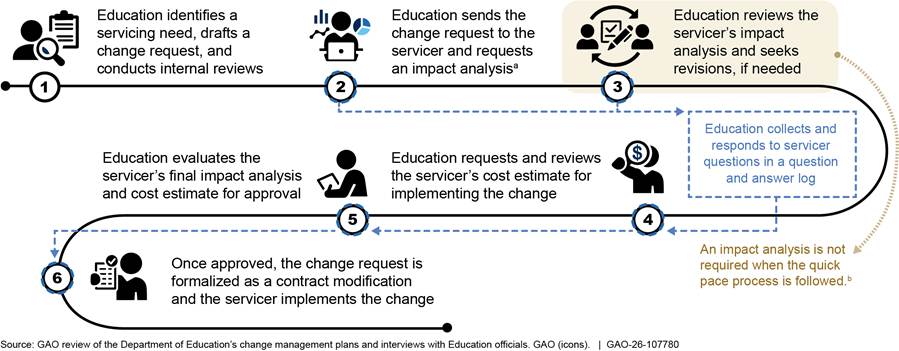
aAn impact analysis describes the servicer’s general approach to implementing the change request and details the required level of effort, assumptions, and constraints.
bEducation’s quick pace process is a streamlined version of the standard process. It omits some internal agency steps and the requirement that servicers submit an impact analysis, but it retains the requirement for cost proposals. The quick pace option is an exception and is used in certain time-sensitive situations.
Based on our review, Education’s current approach to servicer instruction offers more structure and consistency than its prior practices. We previously found that Education’s instruction did not provide key information to loan servicers. Specifically, in 2015, we found that Education’s instruction to servicers sometimes lacked key information, such as how to apply over- or underpayments to borrower accounts. This led to inconsistent and inefficient service to borrowers.[16] Similarly, in 2018, we reported that Education provided the servicer responsible for administering the Public Service Loan Forgiveness program with piecemeal instruction, resulting in staff sometimes being unaware of important policy clarifications.[17]
In both reports, we recommended that Education improve how it provided instruction to servicers. We closed these recommendations as implemented after Education took appropriate steps to address them, including improving how it provided instruction to servicers and releasing a guide outlining overall requirements and servicing standards for the Public Service Loan Forgiveness program. In September 2025, Education announced plans to develop a common servicing manual for student loans, which would provide all servicers with a centralized source of policies and procedures for servicing loans.
Education Missed Opportunities to Coordinate Early with Servicers, Which Could Have Improved Instruction
Despite some improvement, we found that servicers sometimes faced challenges implementing Education’s instruction for program changes, and that early coordination could help the agency enhance the clarity of instruction and mitigate tight time frames for servicers. Early coordination could also help Education meet its strategic plan goal to enhance the services that servicers provide.
Based on their experiences from April 2024 to April 2025, the four servicers had mixed views on the process Education used to provide instruction for implementing changes. Specifically, two servicers rated Education’s process as “mostly sufficient” and two rated it as “somewhat sufficient.”[18] When considering the overall quality of Education’s instruction, including its clarity, three servicers rated it as “somewhat sufficient” and one rated it as “mostly sufficient.”
All four servicers said Education’s instruction could be improved if the agency coordinated with them before or immediately after requesting a change. Three servicers said such early coordination can lead to better outcomes. One servicer shared its experience with a change request that allowed borrowers to separate loans that they had jointly consolidated with a current or former spouse.[19] The servicer said Education shared an outline of the new requirements with servicers and gave them an opportunity to comment on the approach as it was being developed. The servicer said the early coordination enabled critical discussions that allowed it to complete key tasks under tight time frames.
Another servicer shared the negative effects of not coordinating early on change requests. The servicer described a complex change request in which Education changed, added, and deleted requirements throughout a marked-up version of the servicer’s original 300-plus page contract. According to the servicer, early coordination with Education would have significantly reduced the time and resources spent on this multi-phase change request that took over a year and a half to implement.
Three servicers said that not receiving advance notice of proposed changes made it difficult to prepare appropriately for the volume of incoming borrower calls or to adjust work priorities accordingly. Representatives from two borrower advocacy groups echoed this and expressed concerns that borrowers had experienced long wait times and reached customer service representatives who were not yet trained to answer their questions. One servicer noted its experience with a change request that required servicers to make system changes that would provide borrowers on IDR plans with the ability to view the total number of payments they had made toward forgiveness. The servicer said that Education provided one business day’s notice before making the payment count information available to borrowers on StudentAid.gov, and as a result servicers did not have adequate time to prepare for the related influx of calls.[20]
Our review also found limitations in Education’s process for clarifying instruction. While most servicers said that Education generally provided sufficient opportunity to clarify requested changes, all four servicers raised concerns about the number of questions they needed answered to implement some changes. Education officials explained that a servicer can submit written questions to clarify requirements, and the agency will provide responses to all relevant servicers in a running question-and-answer log.[21] One servicer noted that some change requests with complex or unclear requirements resulted in multiple rounds of sending the question-and-answer log back and forth. For example, the servicer said that a change request directing them to resume processing applications for IDR plans sparked new questions after each round of answers. We observed that this change request resulted in six rounds of questions and answers over a 2-month period. The servicer said it had to redo work because Education presented new requirements during this period.
Three servicers suggested that discussing newly issued change requests in a meeting with Education could help them gain clarity faster than the question-and-answer process alone. These servicers cited their experience with a different change request that addressed revisions in IDR plan rules and for which Education did not conduct early coordination. They said that in response to multiple rounds of clarifications from Education, they had to repeatedly revise their impact analyses—general descriptions of their implementation plans and the required effort, assumptions, and constraints. One of these servicers said Education ultimately held meetings to clarify the requirements, but the lost time required an interim manual solution, which resulted in longer processing times for borrowers. Relatedly, two servicers said that waiting for answers sometimes caused delays in submitting their impact analysis.
All four servicers reported implementing change requests with tight time frames. Education officials acknowledged that servicers have had large workloads since fall 2023 when loan repayment resumed, and that many changes had tight time frames. Our analysis of Education’s data found that 36 percent of change requests (60 of 168) from fiscal year 2023 through fiscal year 2025 were designated as emergency or quick pace—classifications used when work needs to begin quickly. In the most recently completed year—fiscal year 2025—42 percent of change requests received these designations. Overall, servicers reported managing tight time frames by requesting deadline extensions, reprioritizing tasks, and reallocating resources. Early coordination could help reduce the need for these adjustments.
Education officials outlined considerations for coordinating with servicers at different stages. Officials said they decide whether to coordinate when developing a change request based on its complexity and timing, along with whether sharing information would add value to the process. They said the primary barrier to seeking servicer input before issuing a change request was insufficient time to do so. Yet, three servicers said that early coordination with Education would allow them to respond to requests more quickly. For example, one servicer said Education asked for input in advance of issuing a change request about resuming IDR plan processing that had been paused due to a court ruling. The servicer said that this early coordination enhanced clarity and allowed it to make system changes more quickly.
After issuing a change request, agency officials said they generally wait to determine whether to meet with servicers until after they receive written questions from servicers. They said the decision about whether to hold a clarification meeting was based on the questions servicers raised, differences in planned approaches, and the change request’s complexity.
Education officials acknowledged the value of coordinating early with servicers, stating that the agency might learn of servicer limitations or concerns that could be addressed in crafting the change request, resulting in more orderly implementation. They said that sharing potential changes can make the process more efficient, as it can reduce the time servicers need to prepare their impact analysis and help servicers better plan for technology or staffing needs.
Agency officials said they sought input from servicers in advance of issuing some complex change requests. For example, they reported having several discussions with servicers before issuing change requests for the on-ramp initiative, which provided temporary relief to borrowers with late or missed payments. They said these preliminary discussions helped ensure the requirements were clear and feasible. However, officials also noted that it is difficult to coordinate with servicers in certain circumstances, such as when time-sensitive changes stem from legal proceedings. Most servicers acknowledged that some tight time frames were outside of Education’s control, such as a series of change requests needed to comply with federal court orders preventing implementation of the SAVE plan.
In June 2025, Education officials told us that early coordination efforts with servicers were not common. However, in December 2025, Education officials said coordination efforts had recently improved. They attributed these recent improvements to a more collaborative relationship with servicers rather than changes to their change management process, which is still being refined. They cited an example of a multi-day summit they held with servicers in September 2025 to discuss draft requirements of the new repayment plans established by OBBBA. These discussions led Education to revise its change request before formally sending it to servicers, according to officials. One servicer confirmed that Education’s early coordination efforts improved with regard to OBBBA implementation efforts.
While recent reports of improved early coordination between Education and servicers are a positive sign, the agency does not have formal criteria to ensure it consistently identifies early coordination opportunities and maintains increased coordination. Agency guidance states that Education can share information with servicers as needed when developing a change request, but it does not formally lay out considerations for when staff should conduct early coordination.[22] Education officials confirmed that they do not have formal criteria and have left the decision of whether to conduct early coordination to the discretion of the staff working on the change request.
The limitations we identified in the clarity of Education’s instruction and its limited early coordination with servicers do not align with the agency’s strategic plan goal to improve the administration of student aid programs by enhancing the services that servicers provide.[23] They are also inconsistent with the federal internal control standard that states management should externally communicate the necessary quality information to achieve the entity’s objectives.[24] Given these limitations, Education has missed opportunities to ensure servicers have the information they need to implement program changes in a timely manner. Both servicers and agency officials said that early coordination could enhance the clarity of instruction and help identify more efficient solutions, improving implementation of changes. Having formal criteria for when to conduct early coordination could help ensure that Education consistently identifies these opportunities and that any improvements in coordination are sustained in the future.
Conclusions
Student loan servicers play an important role in helping Education manage over $1.6 trillion in debt for about 43 million borrowers. The instruction Education provides to servicers on changes to the student loan program is critical to ensuring smooth operations and good customer service for these borrowers. More consistent coordination between Education and servicers early in the change request process could enhance the clarity of instruction and ease the challenge of tight time frames. Education officials acknowledged that early coordination could improve efficiency and allow servicers to plan better. Yet the agency does not have formal criteria for determining when early coordination should occur. Developing and implementing such criteria would help ensure that Education provides servicers with the information they need to implement requested changes in a timely manner. Strategic coordination with servicers could be particularly valuable as Education continues to implement major legislative changes to student loan repayment options affecting millions of borrowers.
Recommendation for Executive Action
The Secretary of Education should ensure that Federal Student Aid develops and implements formal criteria for determining when to conduct early coordination with servicers. For example, when dealing with complex changes or tight time frames, Education could consider if early coordination with servicers could ease implementation challenges. (Recommendation 1)
Agency Comments and Our Evaluation
We provided a draft of this report to Education for review and comment. Education provided written comments, which are reproduced in appendix I. We also provided relevant report statements to the four loan servicers included in our review for technical comment. We incorporated the technical comments they provided as appropriate.
In its written comments, Education disagreed with our recommendation to develop and implement formal criteria for determining when to conduct early coordination with servicers. Education stated that establishing such criteria would be detrimental to the agency and servicers’ ability to implement changes in a timely and efficient manner while also being responsive to dynamic administration priorities. Education also stated that establishing formal criteria would create challenges and risks that could negatively impact the agency and servicers. For example, Education stated that early coordination could result in wasted effort or additional costs if requested changes were cancelled, changed, or reprioritized.
We disagree with Education’s assessment. Having formal criteria for early coordination would help Education ensure servicers have the information they need to implement changes in a timely and efficient manner, while providing needed flexibility to respond to changing circumstances. Using such criteria would positively impact Education and servicers.
In its written comments, Education stated that tight time frames are a primary barrier to early coordination. In particular, Education said early coordination was typically not possible for changes designated as emergency or quick pace due to the short time frames involved. As noted in our report, servicers acknowledged that some tight time frames were out of Education’s control, such as those related to changes needed to comply with federal court orders. However, servicers also told us that early coordination with Education would allow them to respond to requests more quickly. For example, as we reported, one servicer said Education’s efforts to obtain input in advance of issuing a quick pace change request enhanced clarity and allowed it to make system changes more quickly. Servicers also said that not receiving advance notice of proposed changes made it difficult to prepare appropriately for the volume of incoming borrower calls. In its written comments, Education acknowledged the value of advanced notice of proposed changes when time frames are tight. Servicers also said discussing newly issued change requests in a meeting with Education could help them gain clarity faster.
Regarding Education’s concerns about the potential for early coordination resulting in inefficiency, wasted effort, and additional costs, we found servicers expressed similar concerns when Education did not coordinate early. As noted in the report, servicers shared examples of when they needed additional time and resources to clarify requirements and redo work to implement a change when Education did not undertake early coordination.
In its written comments, Education also raised concerns about the need for flexibility. We maintain that having formal criteria for early coordination would still provide Education the flexibility to be responsive to agency priorities and to make decisions on a case-by-case basis. For example, when determining whether early coordination would be beneficial, Education could consider factors such as the likelihood that a change request would move forward or be substantially revised and the potential costs of not conducting early coordination.
In addition, Education raised concerns in its written comments about using complexity as criteria for determining when to do early coordination with servicers. Specifically, Education stated that the complexity of a change is not understood until servicers provide feedback on a change and complexity cannot be determined in advance. However, as noted in the report and in its written comments, Education shared examples of when it determined the complexity of changes in advance. Furthermore, Education has occasionally used this complexity determination to decide whether early coordination is warranted. In particular, Education highlighted an example of early coordination it conducted for complex changes related to recent legislative changes. Education could consider the complexity of changes as part of the formal criteria that informs early coordination, which could help Education better target its resources and ease implementation challenges.
Education also stated that our recommendation is inconsistent with certain federal internal control standards. For example, Education said rigid criteria may result in premature communications with incomplete or changing information, limiting its ability to obtain relevant, quality information. Education also stated that formal criteria are inconsistent with identifying information requirements in an iterative and ongoing process. We disagree with Education’s interpretation of our recommendation. We are not recommending rigid criteria, but rather formal criteria. Formal criteria might consist of factors that staff should consider in deciding whether to conduct early coordination. These criteria could also be integrated into the iterative process Education uses for managing changes. We maintain that having formal criteria to determine when to conduct early coordination with servicers would be consistent with a federal internal control standard that states management should externally communicate the necessary quality information to achieve the entity’s objective.
We continue to believe Education should develop and implement formal criteria for determining when to conduct early coordination with servicers. More consistent coordination early in the change request process could help ease implementation challenges for Education and servicers, potentially save time and resources, and improve the borrowers’ experience.
As agreed with your offices, unless you publicly announce the contents of this report earlier, we plan no further distribution until 30 days from the report date. At that time, we will send copies to the appropriate congressional committees and the Secretary of Education. In addition, the report will be available at no charge on the GAO website at https://www.gao.gov.
If you or your staff have any questions about this report, please contact me at emreyarrasm@gao.gov. Contact points for our Offices of Congressional Relations and Media Relations may be found on the last page of this report. GAO staff who made key contributions to this report are listed in appendix II.

Melissa Emrey-Arras, Director
Education, Workforce, and Income Security
Melissa Emrey-Arras, emreyarrasm@gao.gov
Staff Acknowledgments
In addition to the contact named above, Debra Prescott (Assistant Director), Kathryn O’Dea Lamas (Analyst in Charge), and Abby Marcus made key contributions to this report. Other contributors to this report were Walker Adams, Charlotte Cable, Elizabeth Calderon, Marcia Carlsen, Alison Cashin, Kirsten Lauber, Almeta Spencer, Curtia Taylor, and Adam Wendel.
The Government Accountability Office, the audit, evaluation, and investigative arm of Congress, exists to support Congress in meeting its constitutional responsibilities and to help improve the performance and accountability of the federal government for the American people. GAO examines the use of public funds; evaluates federal programs and policies; and provides analyses, recommendations, and other assistance to help Congress make informed oversight, policy, and funding decisions. GAO’s commitment to good government is reflected in its core values of accountability, integrity, and reliability.
Obtaining Copies of GAO Reports and Testimony
The fastest and easiest way to obtain copies of GAO documents at no cost is through our website. Each weekday afternoon, GAO posts on its website newly released reports, testimony, and correspondence. You can also subscribe to GAO’s email updates to receive notification of newly posted products.
Order by Phone
The price of each GAO publication reflects GAO’s actual cost of production and distribution and depends on the number of pages in the publication and whether the publication is printed in color or black and white. Pricing and ordering information is posted on GAO’s website, https://www.gao.gov/ordering.htm.
Place orders by calling (202) 512-6000, toll free (866) 801-7077,
or
TDD (202) 512-2537.
Orders may be paid for using American Express, Discover Card, MasterCard, Visa, check, or money order. Call for additional information.
Connect with GAO
Connect with GAO on X,
LinkedIn, Instagram, and YouTube.
Subscribe to our Email Updates. Listen to our Podcasts.
Visit GAO on the web at https://www.gao.gov.
To Report Fraud, Waste, and Abuse in Federal Programs
Contact FraudNet:
Website: https://www.gao.gov/about/what-gao-does/fraudnet
Automated answering system: (800) 424-5454
Media Relations
Sarah Kaczmarek, Managing Director, Media@gao.gov
Congressional Relations
David A. Powner, Acting Managing Director, CongRel@gao.gov
General Inquiries
[1]This includes outstanding William D. Ford Federal Direct Loans and Federal Family Education Loans held by Education.
[2]Education implemented this COVID-19 emergency relief for federal student loans in response to the CARES Act, which was enacted on March 27, 2020. See Pub. L. No. 116-136, § 3513, 134 Stat. 281, 404-05 (2020). The relief was retroactive to March 13, 2020, the date COVID-19 was declared a national emergency. This relief was extended by related administrative actions and ended in August 2023 as required by the Fiscal Responsibility Act of 2023. See Pub. L. No. 118-5, § 271, 137 Stat. 10, 33-34.
[3]Throughout this report we use the term “instruction” to cover information contained in change requests, question-and-answer documents, and any other written or verbal information Education provides to servicers about how to implement a change.
[4]U.S. Department of Education, U.S. Department of Education Fiscal Years 2022–2026 Strategic Plan (Washington, D.C.: July 2022). GAO, Standards for Internal Control in the Federal Government, GAO‑25‑107721 (Washington, D.C.: May 2025).
[5]We included the following four servicers in our review: Aidvantage, Edfinancial, Missouri Higher Education Loan Authority, and Nelnet. We did not include a fifth servicer, Central Research, Inc., in our review as it was not servicing loans in repayment at the time the payment pause ended.
[6]We administered the questionnaire in April 2025 and solicited servicers’ perspectives on the sufficiency of Education’s instruction over the prior year.
[7]We reviewed 68 of the 76 change requests Education provided in response to our request for change requests related to key program changes. We determined that eight of the change requests were outside the scope of our review because they were not applicable to the relevant loan servicers. They included seven change requests directed to Education’s Debt Management and Collection System servicer and one that was only a notification that required no action from servicers.
[8]Education issued 508 change requests from fiscal year 2020 through fiscal year 2025. Education gives most change requests a status that indicates how quickly servicers must prepare an analysis describing the impact of implementing the changes. They include “emergency,” “expedited,” “standard,” and “extended.” Compared to a standard 10-day turnaround, “emergency” status generally gives servicers 2 days to prepare their proposal. Education also has a “quick pace” process that moves the desired changes into the contract process within 24–48 hours.
[9]Loan consolidation and loan rehabilitation are two options that allow eligible borrowers to get their loans out of default after they make a series of voluntary on-time monthly payments. For example, borrowers who make at least three on-time monthly payments can pay off defaulted loans by consolidating one or more loans into a single loan with a fixed interest rate. Borrowers who make nine on-time monthly payments in 10 months may be eligible for loan rehabilitation, which entitles them to have the default removed from their credit report. Currently, borrowers may rehabilitate a loan only once. However, beginning in July 2027, borrowers will be able to rehabilitate a loan twice. This change is the result of Public Law 119-21—commonly known as the One Big Beautiful Bill Act (OBBBA). An Act to provide for reconciliation pursuant to title II of H. Con. Res. 14, Pub. L. No. 119-21, § 82003, 139 Stat. 72, 348 (2025).
[10]During this part of the Fresh Start program, Education opted not to resume collections on defaulted loans, such as wage garnishments and offsets on tax refunds or federal benefit payments.
[11]Following the court order, Education posted information on its website explaining that SAVE borrowers will have a limited time to select a new repayment plan and begin repaying their student loans. Also, the court order that vacated the SAVE plan maintained one provision from the final rule that created the SAVE plan. This provision allows time spent in certain deferments or forbearances to count as progress toward loan forgiveness for all eligible borrowers in IDR plans. Improving Income Driven Repayment for the William D. Ford Federal Direct Loan Program and the Federal Family Education Loan Program, 88 Fed. Reg. 43,820 (July 10, 2023).
[12]Under the Repayment Assistance Plan, payments are tied to a borrower’s adjusted gross income, ranging from 1 to 10 percent depending on income, with forgiveness after 30 years of qualifying payments. The plan offers monthly interest subsidies and a minimum $50 principal reduction per month for eligible borrowers.
[13]The eliminated IDR plans are the Income-Contingent Repayment plan and the Pay as You Earn plan. These plans are closed to new borrowers who take out loans on or after July 1, 2026, and will close for current borrowers—those who took out loans before July 1, 2026—on July 1, 2028. The Income-Based Repayment plan is also closed to borrowers who take out loans on or after July 1, 2026, but remain an option for loans taken out before then. As previously mentioned, on March 10, 2026, a federal court order vacated the SAVE plan.
[14]The current Standard repayment plan also has fixed monthly payments, but the term is generally limited to 10 years. Eligible borrowers will also continue to have access to the Graduated repayment plan and Extended repayment plan. The Graduated plan has monthly payments that gradually increase over time and a repayment term of up to 10 years (or 10 to 30 years for Consolidation loans). The Extended plan has monthly payments that can be fixed or graduated and a repayment term of up to 25 years.
[15]In May 2025, Education established an interim plan that streamlined the change management process for Education staff following agency reorganization and reduced staffing levels. Officials reported that the expectations for servicers have not changed. They said Education’s comprehensive Business Change Management Plan remains the foundation of its change management process and details aspects not revised by the interim plan. In January 2026, officials said they aim to replace both the comprehensive Business Change Management Plan and the interim plan with a single consolidated process.
[16]GAO, Federal Student Loans: Key Weaknesses Limit Education’s Management of Contractors, GAO‑16‑196T (Washington, D.C.: Nov. 18, 2015).
[17]GAO, Public Service Loan Forgiveness: Education Needs to Provide Better Information for the Loan Servicer and Borrowers, GAO‑18‑547 (Washington, D.C.: Sep. 5, 2018).
[18]We solicited responses from servicers based on their experiences over the prior year. The questionnaire was deployed in April 2025, so their responses reflect the time frame of April 2024 to April 2025. Servicers were asked to rate sufficiency as “fully sufficient,” “mostly sufficient,” “somewhat sufficient,” or “not at all sufficient.”
[19]Before July 1, 2006, married individuals were able to consolidate their individual federal student loans into a single consolidation loan known as a “joint consolidation loan.” Married individuals who signed a promissory note for a joint consolidation loan agreed to be jointly liable for the entire amount of the joint debt, regardless of any future change in their marital status. Under the terms of the Joint Consolidation Loan Separation Act, borrowers who have a Joint Consolidation Loan can apply to separate the joint debt into individual Direct Consolidation Loans. Pub L. No. 117-200, 136 Stat. 2219 (2022).
[20]Education reported in a December 2025 court filing that it took the payment count information offline because the information was no longer accurate after a court ruling changed which payments qualified. According to the court filing, Education had no plans to resume posting the information.
[21]About half (36 of 68) of the change requests associated with the return to repayment and other program changes issued between March 2020 and December 2024 had question-and-answer logs. Straightforward change requests may not result in any questions from servicers.
[22]Federal Student Aid, Business Change Management Plan (August 2024). This document details the process Education uses to manage new or modified requirements to student loan systems or services.
[23]U.S. Department of Education, Strategic Plan, Fiscal Years 2022–2026 (Washington, D.C.: July 2022). Education officials said they are currently developing a new strategic plan specific to Federal Student Aid. The previous strategic plan for Federal Student Aid included an objective to enhance the quality of loan servicing operations by providing partners with clear information to resolve issues quickly and accurately and increasing coordination with servicers. U.S. Department of Education, Federal Student Aid: Strategic Plan, Fiscal Years 2023-2027.