
Report to Congressional Committees
United States Government Accountability Office
A report to congressional committees.
Contact: Alissa Czyz at CzyzA@gao.gov.
What GAO Found
The Department of Defense (DOD) has not recently met statutory requirements to review and report on the efficiency and effectiveness of its defense agencies and DOD field activities (DAFA). Between April 2023 and September 2024, DOD conducted a review of four DAFAs. However, the department did not finalize the reports based on its reviews or submit the reports to Congress as required. DOD did not have formalized guidance, such as an instruction, in place when conducting these four DAFA reviews. In May 2026, DOD issued a memorandum for future DAFA reviews that includes responsibilities and deadlines. While this is a positive step, DOD previously issued a memorandum for this effort that did not ensure the completion of the reviews. Formalizing guidance for the process would better position DOD to meet its reporting requirements and would provide Congress with better information to inform decision-making related to DOD’s efficiency and effectiveness.
DOD has not assessed the efficiency and effectiveness of its DAFAs, including the Defense Human Resources Agency (DHRA), because the department did not clearly define measures to be used for its most recent DAFA reviews. In its May 2026 memorandum, DOD included standard measures for efficiency and effectiveness, but the memorandum lacks detail on these measures. Moreover, the measures are not clearly defined or established in formalized guidance. Clearly defining how to assess efficiency and effectiveness in formalized guidance for the DAFA reviews would enable DOD to more comprehensively assess DHRA and the other DAFAs’ performance.
As part of its DAFA reviews, DOD is statutorily required to identify each activity of a DAFA that is substantially similar to, or duplicative of, an activity carried out by another organization within DOD. GAO found overlap in two training areas within the DAFAs: (1) the leader development programs at DHRA, the Defense Logistics Agency, and the Washington Headquarters Services; and (2) the sexual assault prevention and response training directed by DOD and developed by the military services. However, DOD has not assessed if there are negative effects on efficiency or effectiveness resulting from this overlap. If DOD were to evaluate these training programs, it may find opportunities to streamline them and reduce any inefficient overlap.
Why GAO Did This Study
DOD’s 27 DAFAs play a critical role in supporting the department’s business operations. For example, DHRA—which DOD renamed the Personnel Readiness Management Agency in June 2026—is a DOD field activity with a stated mission of enhancing the operational efficiency and effectiveness of diverse programs supporting DOD. DOD is required to conduct reviews of each DAFA’s efficiency and effectiveness at least once every 4 years.
The House report accompanying a bill for the Department of Defense Appropriations Act for fiscal year 2024 includes a provision for GAO to evaluate DOD’s DAFA reviews, with a focus on DHRA. This report examines the extent to which (1) DOD is reviewing and reporting on the DAFAs as required by law; (2) DOD has assessed the efficiency and effectiveness of DHRA as part of these reviews; and (3) DHRA provides training services that are duplicative, overlapping, or fragmented with other select DAFAs and the military services.
GAO reviewed DOD guidance, reports, and relevant statutory requirements and interviewed DOD officials.
What GAO Recommends
GAO is making four recommendations to DOD, including that it formalize guidance for fulfilling statutory requirements; include clearly defined measures for efficiency and effectiveness in formalized guidance; and evaluate DAFA and military service training programs to identify inefficient overlap and take action to address it. DOD did not provide written comments on this report.
|
Abbreviations |
|
|
|
|
|
|
|
DAFA |
Defense agency and DOD field activity |
|
|
DFAS |
Defense Finance and Accounting Service |
|
|
DHRA |
Defense Human Resources Activity |
|
|
DLA |
Defense Logistics Agency |
|
|
DMI |
Defense Management Institute |
|
|
DOD |
Department of Defense |
|
|
ODA&M |
Office of the Director of Administration and Management |
|
|
OSD |
Office of the Secretary of Defense |
|
|
P&R |
Office of the Under Secretary of Defense for Personnel and Readiness |
|
|
PSA |
principal staff assistant |
|
|
SAPRO |
Sexual Assault Prevention and Response Office |
|
|
WHS |
Washington Headquarters Services |
|
This is a work of the U.S. government and is not subject to copyright protection in the United States. The published product may be reproduced and distributed in its entirety without further permission from GAO. However, because this work may contain copyrighted images or other material, permission from the copyright holder may be necessary if you wish to reproduce this material separately.
September 3, 2026
Congressional Committees
The Department of Defense (DOD) spends tens of billions of dollars each year to maintain key business operations intended to support the warfighter. These operations include systems and processes related to the management of contracts, finances, the supply chain, support infrastructure, and weapon systems acquisition. Weaknesses in these areas can adversely affect DOD’s efficiency and effectiveness and make its operations vulnerable to waste, fraud, and abuse. DOD’s approach to transforming these business operations is linked to its ability to perform its overall mission and support the readiness and capabilities of U.S. military forces.
DOD’s defense agencies and DOD field activities (DAFA) play a critical role in supporting the department’s business operations. The DAFAs are DOD components that can be established by law, the President, or the Secretary of Defense to provide a supply or service activity common to more than one military department when it is more effective, economical, or efficient to do so on a department-wide basis.[1]
There are 27 DAFAs (19 defense agencies and eight DOD field activities) providing consolidated services on a department-wide basis in areas such as logistics, health, intelligence, and human resources.[2] For example, the Defense Human Resources Activity (DHRA) is a DOD field activity under the Office of the Under Secretary of Defense for Personnel and Readiness (P&R) with a stated mission of enhancing the operational efficiency and effectiveness of diverse programs supporting DOD.[3] DHRA had a budget of about $1.1 billion for fiscal year 2025 for a broad variety of offices, such as those focused on training, personnel data, and sexual assault prevention and response, among others.
However, concerns have been raised about the DAFAs’ efficiencies and potential redundancies. DOD is required by law to conduct reviews at least once every 4 years of the efficiency and effectiveness of each DAFA, including identifying any function that is substantially similar to, or duplicative of, an activity carried out by another element of DOD or that is not being performed to an adequate level to meet department needs.[4]
In 2018, we identified instances of overlap and fragmentation among DAFAs that provide human resources services.[5] We made recommendations for DOD to collect better information on the human resources services provided by the Defense Finance and Accounting Service (DFAS), Defense Logistics Agency (DLA), and Washington Headquarters Services (WHS). As a result, DOD took steps to standardize time-to-hire metrics and identified a timeline and deliverables for identifying and adopting an optimal information technology system for human resources, fully addressing two of the three recommendations.[6]
These recommendations were included in our 2025 High Risk List as part of our assessment of DOD’s approach to business transformation.[7] We first designated DOD’s approach to managing business transformation as a High Risk area in 2005 because DOD had not taken the necessary steps to achieve and sustain business reform that was broad, strategic, department-wide, and integrated.
The House report accompanying a bill for the Department of Defense Appropriations Act for fiscal year 2024 includes a provision for us to evaluate DOD’s reviews of the efficiency and effectiveness of its DAFAs, with a focus on DHRA.[8] This report examines the extent to which (1) DOD is reviewing and reporting on the DAFAs as required by law;[9] (2) DOD has assessed the efficiency and effectiveness of DHRA as part of these reviews; and (3) DHRA provides training services that are duplicative, overlapping, or fragmented with other select DAFAs and the military services.
For our first objective, we reviewed DOD’s processes for conducting DAFA reviews and any resulting DAFA reports and compared them with relevant statutory requirements. We also assessed the DAFA review process, reports, and related guidance against Standards for Internal Control in the Federal Government, which states that agencies should document in policies what is expected to achieve desired outcomes.[10]
For our second objective, we reviewed department documentation relevant to assessing DHRA’s efficiency and effectiveness as part of the DAFA reviews and compared these efforts against our past work for evidence-based decision making and Standards for Internal Control in the Federal Government, which states that management should define objectives in specific and measurable terms.[11]
For our third objective, after reviewing DHRA’s business functions and identifying similar functions at other DAFAs, we selected training as the focus. As a result, we reviewed 19 training offices provided by DHRA, DLA, WHS, and the military services, to include training programs such as leader development and sexual assault prevention and response. We assessed the training programs by using our duplication, overlap, and fragmentation evaluation guide.[12] For all objectives, we interviewed relevant DOD officials, including officials at the Office of the Secretary of Defense (OSD), DHRA, and other relevant DAFAs, among others. See appendix I for a detailed description of our scope and methodology.
We conducted this performance audit from October 2024 to September 2026 in accordance with generally accepted government auditing standards. Those standards require that we plan and perform the audit to obtain sufficient, appropriate evidence to provide a reasonable basis for our findings and conclusions based on our audit objectives. We believe that the evidence obtained provides a reasonable basis for our findings and conclusions based on our audit objectives.
Background
DOD’s DAFAs
DOD’s 19 defense agencies and eight DOD field activities are defense organizations separate from the military departments.[13] The services and supplies provided by the DAFAs are broad, including intelligence, human resources services, missile defense, network and building security, cutting-edge research developments and technological advancements, and groceries for military families. Defense agencies are typically larger than DOD field activities and normally provide a broader scope of supplies and services.
Each director or administrator of the DAFAs manages their agency under the authority, direction, and control of a principal staff assistant (PSA).[14] Each head of a DAFA reports to the PSA within OSD, who in turn reports directly to the Deputy Secretary of Defense or the Secretary of Defense. The PSAs include all the Under Secretaries within the department and are assigned responsibility for their respective DAFAs based on the mission of the DAFA. In addition to providing advice to the Secretary of Defense on assigned matters, each PSA plays an important role in the development and review of key aspects of their respective DAFA’s submissions as part of DOD’s annual budget process, called the Planning, Programming, Budgeting, and Execution process.
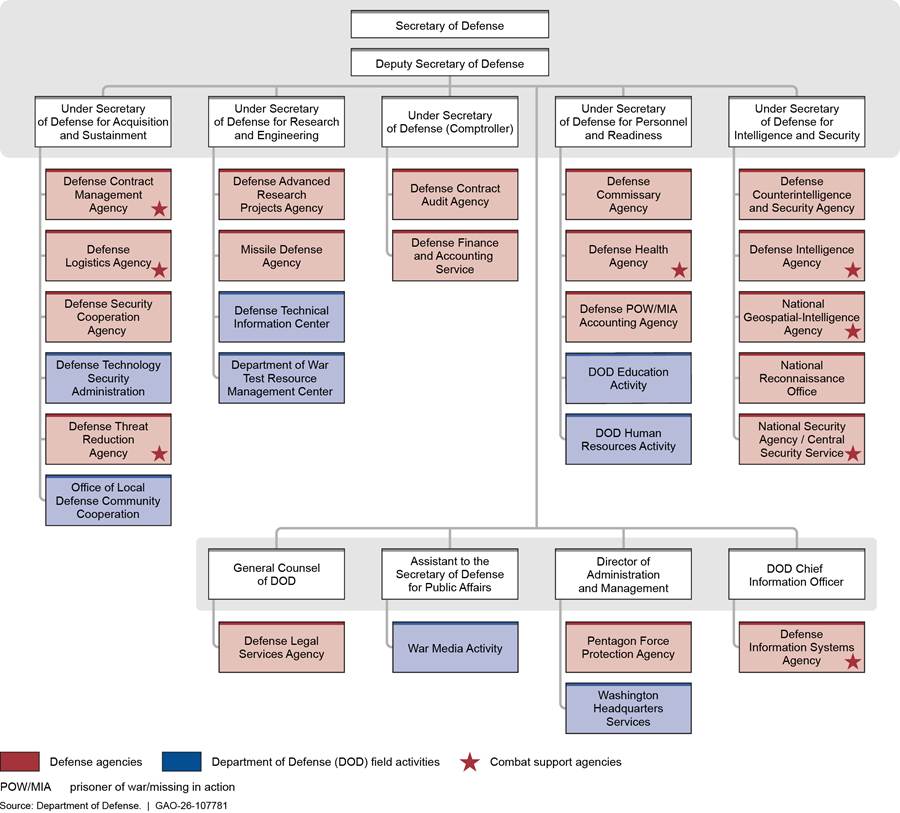
A subset of the DAFAs is designated as combat support agencies, which have focused missions to support the combatant commands. These eight agencies are jointly overseen by their respective PSAs and the Chairman of the Joint Chiefs of Staff. Figure 1 details the organizational structure and reporting relationships of the DAFAs, including the eight combat support agencies as of May 2026.
However, there are additional changes to the organizational structure underway, such as the establishment of new DAFAs.
Statutory Requirements to Conduct Reviews of DAFAs
Section 192 of title 10 of the United States Code was enacted in 1986 and requires DOD to conduct periodic reviews of the DAFAs. Specifically, Section 192 requires DOD to conduct a review of the efficiency and effectiveness of each DAFA. As part of each review, DOD must identify each activity of a DAFA that is substantially similar to, or duplicative of, an activity carried out by another element of DOD or that is not being performed to an adequate level to meet department needs.
Additionally, each report that results from the reviews should include a list of each DAFA that the Secretary of Defense has determined operates efficiently and effectively and does not carry out any function that is substantially similar to, or duplicative of, a function carried out by another element of DOD. For each DAFA not on this list, DOD is to include a plan for rationalizing the functions of the DAFA or transferring some or all of the functions of the DAFA to another element of the department. The report should also include recommendations for functions, if any, currently conducted separately by the military departments that should be consolidated into a DAFA. Lastly, DOD is required to report findings to the congressional defense committees within 90 days of completing a review, which are required at least every 4 years.[15]
From 1987 through 2012, DOD issued biennial reports to Congress to record its response to this statute, but the methodology and quality of those reports varied. For the first five biennial reports, from 1987 through 1995, DOD relied on a research team to identify findings and provide recommendations on the structure and composition of the DAFAs. The four reports issued from 1997 through 2004 relied on a survey of the DAFAs’ customers across DOD. From 2005 through 2010, DOD issued three reports that alternated between a senior management assessment of the DAFAs and an approach based on the results of customer surveys. In addition, the 2009–2010 report recorded activities relevant to the statutory requirement to review the DAFAs, with a focus on a major DOD efficiency initiative that was ongoing at that time.
We reported in 2018 that, according to officials, DOD issued its final biennial report in 2012 before discontinuing the practice, attributing the decision to competing leadership priorities and the significant resources required to produce the reports. Instead, department officials reported at the time that existing internal processes—such as budget assessments, routine management oversight, and efficiency-driven reforms—fulfilled DOD’s statutory review obligations. However, we found that DOD did not provide sufficient evidence that these processes satisfied the statutory mandate.[16] At that time, we recommended that DOD develop guidance that would provide clear direction for conducting and recording DAFA reviews. DOD issued a memorandum in 2019 in response to our recommendation and provided a plan to Congress that detailed responsibilities of the department’s Chief Management Officer for conducting efficiency and effectiveness reviews of the DAFAs to identify duplicative activities, thereby addressing the recommendation.
DOD Has Not Consistently Completed DAFA Reviews or Reported to Congress as Required by Law
DOD changed its process for reviewing its DAFAs in 2021, but it did not have formalized guidance to carry out this review process. As a result, DOD did not complete or submit to Congress any DAFA reports that resulted from this effort. The department issued a memorandum in May 2026 for future DAFA reviews; however, it was not formalized guidance to effectively carry out the review and reporting process.
DOD Changed Its Process for Reviewing DAFAs in 2021
Since we last reported on DOD’s DAFA reviews in 2018, the department revised its review processes in 2021 by delegating responsibility for the DAFA reviews to the Director of Administration and Management under OSD.[17] The Performance Improvement Directorate within the Office of the Director of Administration and Management (ODA&M) led the redesign of the review process, with support from the Defense Business Council.[18] ODA&M also contracted with the Defense Management Institute (DMI) to provide methodological, research, and analytical support for this effort.[19]
According to documentation on the DAFA reviews from June 2023, ODA&M planned to review 23 DAFAs in groups on a rolling basis over a 4-year cycle, with six reviews conducted per year.[20] Between April 2023 and September 2024, ODA&M conducted the first review of a group of four DAFAs: DHRA, DFAS, DLA, and WHS. ODA&M officials stated that they selected these four DAFAs because they each provide human resources functions.
ODA&M and DMI determined the various elements that would constitute the reviews of the first four DAFAs and then conducted fieldwork with the first round of DAFAs through the summer of 2023. According to DMI representatives, in December 2023, DMI provided DOD the four draft DAFA review reports and an overview report that compared findings from across the four DAFAs. However, these reviews never resulted in finalized reports that were provided to Congress, as discussed below.
DOD Has Not Met Statutory Requirement to Review and Report on DAFAs
The department has not submitted any reports to the congressional defense committees since April 2019 and, as such, has not recently met its statutory requirements to review each eligible DAFA at least once every 4 years and report its findings to the congressional defense committees. DOD continues to be challenged to meet this statutory requirement because the department does not have formalized guidance to effectively carry out this process.
DOD Has Not Submitted a Report to Congress Since 2019
DOD has submitted one report to the congressional defense committees in the last 14 years. DOD’s last report was from April 2019 and covered the department’s efforts to review DAFAs from 2013 through 2018.[21] However, in accordance with the statute, the department was required to review all eligible DAFAs again by April 2023. According to DOD documentation, officials originally planned to complete the first four DAFA reviews and submit the resulting reports to the congressional defense committees in January 2024. However, according to ODA&M officials, DOD did not finalize the draft reports for the four DAFAs it reviewed and does not plan to finalize the reports or submit them to the congressional defense committees to meet the statutory requirement.
Further, according to documentation from June 2023, ODA&M planned to start a second round of reviews of other DAFAs in October 2023. Officials later stated it was scheduled to begin in 2025. However, DOD did not begin the second round of reviews.
ODA&M officials attributed delays in completing the DAFA reviews and reports to having competing priorities, among other reasons. In January 2025, ODA&M officials stated that the DAFA reviews were competing with other processes and factors, such as changes in priorities within DOD resulting from the new presidential administration.[22]
Officials also stated that delays and concerns about the quality of the reviews conducted by DMI had also contributed to the department not submitting reports to congressional defense committees as required. Regarding quality, ODA&M officials stated that they conducted additional review activities after receiving the draft reports of four DAFAs from DMI in December 2023.[23] According to the officials, ODA&M revised the reports that they received from DMI and then submitted them to the then-Deputy Performance Improvement Officer in September 2024. However, even after revising the reports, ODA&M did not submit them to the congressional defense committees.
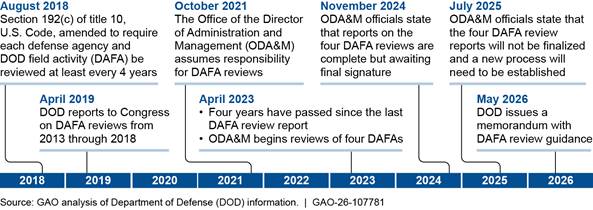
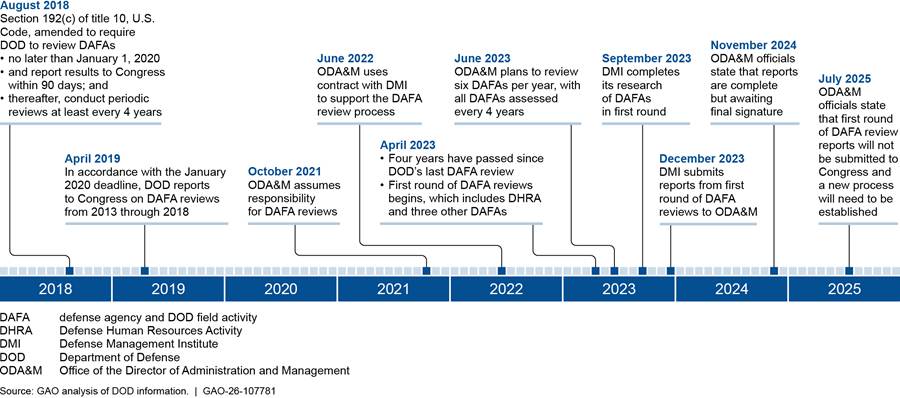
In July 2025, DOD’s recently appointed Director of Administration and Management stated that the results from the four reviews conducted would not be submitted to Congress, as he could not speak to their quality since they were completed before he assumed leadership of the office. Figure 2 shows the timeline of the development of the DAFA reviews from 2018 through 2025.
Figure 2: Timeline of the Department of Defense’s Defense Agency and DOD Field Activity Reviews 2018–2025
DOD Issued a Memorandum for DAFA Reviews but Does Not Have Formalized Guidance for Its DAFA Review Process
The department does not have formalized guidance, such as a DOD instruction, to direct the development of its DAFA reviews and the submission of resulting reports to Congress. This lack of formalized DOD guidance on how to conduct and document DAFA reviews has consistently challenged the department’s efforts to successfully complete the reviews.
As previously stated, we recommended in 2018 that DOD develop guidance for this process.[24] In response to our recommendation, DOD issued a memorandum to better define the DAFA review process in August 2019.[25] However, the memorandum was not formalized in a DOD instruction or similar guidance that institutionalized the process, and the process was changed shortly after.[26] DOD’s most recent DAFA review process was similarly not clearly defined or documented in formalized guidance, and there was no overarching guidance for the process. In August 2025, ODA&M officials stated that they were changing the DAFA review process and were developing a memorandum for this new process that would assign responsibilities in the short term and that they planned to develop an instruction with more detailed guidance to be issued in the long term. However, ODA&M officials later stated in February 2026 that they no longer planned to issue an instruction.
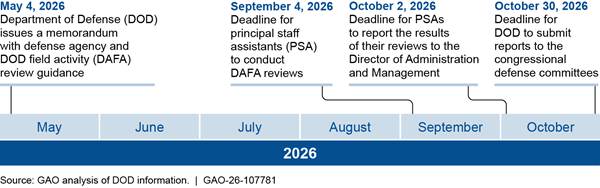
DOD issued a memorandum in May 2026 providing direction and guidance for future DAFA reviews.[27] According to the memorandum, the guidance resets the department’s approach to conducting the DAFA reviews to ensure compliance with Section 192. In addition, the memorandum establishes that the PSAs will be responsible for conducting the DAFA reviews, although they can still contract with outside parties. The memorandum also establishes a timeline for the estimated completion of the reviews and submission of future reports to the congressional defense committees (see fig. 3).
While this may be a positive step to show that DOD is once again focused on the DAFA reviews, DOD has previously issued a memorandum for this effort, and this did not ensure the completion of the reviews or the submission of reports to the congressional defense committees.
DOD Manual 5110.04 states that departmental memorandums should be used for routine correspondence, forwarding material for signature, describing a problem and recommending a solution, and conveying information.[28] DOD instructions should assign responsibilities within a functional area and may provide general procedures for implementing policy.[29] ODA&M officials provided us a draft of the instruction they were developing for the DAFA review process in August 2025 and stated that the instruction would provide overarching guidance for the process. However, the department subsequently issued a memorandum instead of formalized guidance in the form of an instruction.[30]
Formalized guidance with clear details would also help ensure future reviews do not need to be redone, which costs time and money. A project description for DMI’s support of the most recent DAFA reviews states that $750,000 would be devoted to DMI’s efforts. Regarding overall costs, the draft reports we reviewed included a statement that estimated the reports cost DOD about $500,000 each to produce, including about $70,000 in DOD labor. Additional resources will be required to redo these reports. Further, ODA&M officials stated that the reviews required more DOD resources than initially planned, primarily staff time. If ODA&M were to formalize its DAFA review process, it would help ensure future efforts are not repeated and thus avoid potentially wasting resources.
In contrast to the memorandum associated with the DAFA reviews, a Chairman of the Joint Chiefs of Staff instruction provides clear, detailed guidance for another required DAFA review process by the department.[31] Under a separate statute, DOD is required to periodically report on the responsiveness and readiness of the eight combat support agencies, a subset of the DAFAs.[32] The Joint Chiefs of Staff instruction that guides the development of DOD’s combat support agency reports describes requirements for reports and provides direction for the associated process. ODA&M officials stated they consider the assessments a mature DOD best practice.
While a memorandum is a good first step, guidance such as an instruction would formalize and institutionalize the DAFA review process. This formalization is important given that a previous memorandum did not institutionalize the process or result in DOD meeting its statutory requirement. Regarding the need for formalized policies, Standards for Internal Control in the Federal Government states that policies should document what is expected to achieve desired outcomes and to explain procedures to implement those policies.[33] Without clear guidance for the DAFA review process that is formalized in policy, such as an instruction or similar guidance, DOD continues to risk successfully completing its DAFA reviews and meeting its statutory requirements. Formalizing the process within an instruction would be an important step for ensuring DOD and Congress have better information about the DAFAs’ efficiency and effectiveness.
DOD’s Assessment of DHRA’s Efficiency and Effectiveness Has Been Limited
DOD has not assessed the efficiency and effectiveness of its DAFAs, including DHRA (recently renamed the Personnel Readiness Management Agency), because the department did not clearly define these measures for its most recent DAFA reviews that were initiated in 2023. Going forward, DOD established standard measures for efficiency and effectiveness in its May 2026 memorandum, but the measures are not clearly defined nor established in formalized guidance.
DOD Partially Assessed DHRA’s Efficiency and Effectiveness Through Its DAFA Review Process in 2023
DOD’s assessment of DHRA’s efficiency and effectiveness is expected to occur primarily through its DAFA reviews. We reviewed a draft of the DAFA review of DHRA that was completed in 2024 and found that it did not comprehensively assess DHRA’s efficiency and effectiveness because ODA&M did not clearly define how to measure efficiency and effectiveness.
As discussed previously, DHRA is a DAFA with a broad variety of offices organized under it, such as those focused on training, personnel data, and sexual assault prevention and response, among others (see fig. 4).
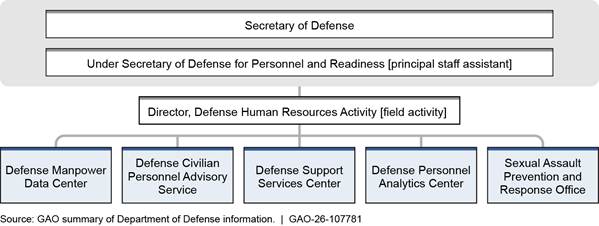
P&R exercises authority, direction, and control over DHRA as the PSA to the Secretary of Defense for total force management.[34]
According to ODA&M officials, the most recent DAFA review process was to include a methodology that would fulfill statutory requirements to review efficiency and effectiveness and align the review with the department’s broader business transformation efforts. DOD documentation notes that the methodology was expected to include an analysis of each DAFA’s ability to deliver on its chartered mission in an efficient and effective manner and on its contributions to the realization of Secretary of Defense priorities. According to ODA&M officials and documentation, their goal in developing this methodology was to improve its tracking of DAFA performance on an ongoing basis. Specifically, ODA&M planned to create a dashboard that would include key measures of the DAFAs’ efficiency and effectiveness that could be updated with new data at regular intervals, allowing for continuous assessment and eliminating the need for time-consuming data calls or ad hoc metrics.
However, according to ODA&M officials, they did not create such a dashboard, and ultimately, its review of DHRA included 12 “crosscutting” metrics that would be applicable to all DAFAs and seven DHRA-specific metrics.[35] The 12 metrics spanned four management topics: financial, personnel, data and information technology, and acquisition and contract management (see fig. 5).
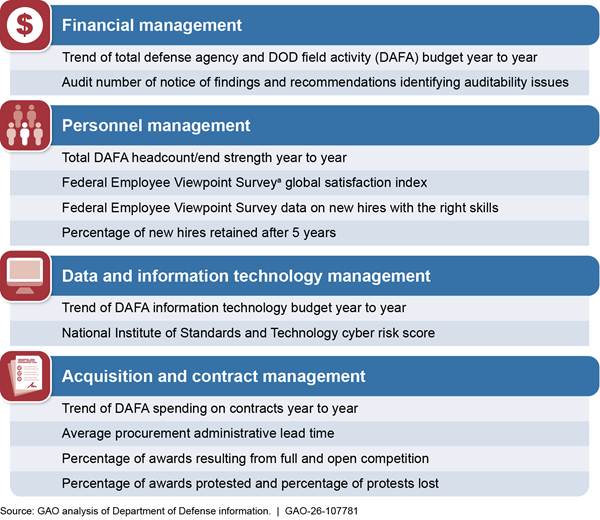
aThe Office of Personnel Management administers the Federal Employee Viewpoint Survey, which is an organizational climate survey that assesses how federal employees jointly experience the policies, practices, and procedures characteristic of their agency and its leadership.
However, ODA&M did not clearly define how any of its selected metrics would be used to assess a DAFA’s overall performance. The draft DHRA report states that some of the selected metrics can be efficiency indicators; however, it does not clearly define how efficiency or effectiveness was assessed.[36]
Representatives from DMI stated that there were challenges in developing and adopting performance metrics for DOD’s DAFA reviews and that they were not able to provide clear assessments of the DAFAs’ efficiency and effectiveness. DMI stated in a draft overview report for the DAFA reviews that no simple set of metrics will be sufficient to reach conclusions about performance of the DAFAs due to the defense mission and complex relationship among supporting tasks. For DHRA specifically, they stated that the diversity of DHRA’s responsibilities also challenged metric selection, as the offices and organizations within DHRA perform many different roles and functions. Further, the draft DHRA report states that it is difficult to assess DHRA’s performance due to a lack of performance trends data and very limited information on customer satisfaction.
P&R officials agreed that the draft DHRA report did not assess the DAFA’s efficiency and effectiveness, which, they stated, is why it was not released. Further, in a January 2025 memorandum, P&R concurred with some of the draft DHRA report’s recommendations but stated that the report should not be submitted to Congress without a more explicit assessment of the findings and recommendations.
DOD’s 2026 Memorandum Includes Measures for Future DAFA Reviews but Does Not Include Clear Details for Performance Measurement
DOD’s May 2026 memorandum on future DAFA reviews includes an enclosure of standard measures for the periodic review of DAFAs, including those for efficiency and effectiveness.[37] The memorandum enclosure states that a cross-functional team or an independent, outside party should examine and assess the efficiency and effectiveness of each DAFA. Specifically, a series of factors are identified for efficiency and for effectiveness and a question to assess each factor is identified. See table 1 for the identified factors and questions to be used to measure the efficiency and effectiveness of each DAFA.
Table 1: Standard Measures Identified in May 2026 Memorandum for Defense Agency and DOD Field Activity (DAFA) Reviews
|
Efficiency factors |
Questions for assessing factors |
|
1. Focus |
Is the DAFA performing only assigned, essential responsibilities and functions? |
|
2. Workforce |
Are the DAFA’s personnel resources aligned to assigned responsibilities and functions? |
|
3. Budgeting |
Does the DAFA budget effectively and effectively manage the execution of its allocated budget? |
|
4. Capacity |
Is the DAFA underutilized, operating at capacity, or overextended (i.e., trying to do too much)? |
|
5. Reliability |
Does the DAFA meet assigned deadlines? |
|
6. Transparency |
Is the DAFA keeping its principal staff assistant (PSA) properly informed of significant events, plans, activities, and challenges? |
|
7. Resourcefulness |
Does the DAFA regularly identify and solve problems effectively? |
|
8. Initiative |
Does the DAFA regularly identify and capitalize on opportunities effectively? |
|
9. Relationships |
Does the DAFA coordinate and collaborate effectively with other components and interagency partners? |
|
Effectiveness factors |
|
|
1. Mission |
Is the DAFA performing all assigned, essential responsibilities and functions? |
|
2. Value delivery |
Do customers benefit from and value the DAFA’s products and services? |
|
3. Timeliness |
Does the DAFA deliver products and services when required? |
|
4. Reliance |
Do other components rely on the DAFA’s products and services to fulfill their missions, responsibilities, or functions? |
|
5. Necessity |
Are the DAFA’s products and services necessary for the department to fulfill its mission, responsibilities, or functions? |
|
6. Responsiveness to customers |
Is the DAFA responsive to customer requests for products, services, and assistance? |
|
7. Responsiveness to PSA |
Is the DAFA responsive to PSA requests for products, services, and assistance? |
Source: Deputy Secretary of War Memorandum, Defense Agency and Department of Defense Field Activity Periodic Reviews (May 4, 2026). | GAO‑26‑107781
The enclosure of the memorandum also establishes processes that reviewers should use to identify any DAFA function or activity that is duplicative of a function or activity of another DOD organization and any DAFA function or activity that is not being performed to an adequate level to meet the department’s needs. The PSAs are responsible for conducting the periodic review of each DAFA, according to this memorandum. For example, P&R—as the PSA for DHRA—is now required to assess the efficiency and effectiveness of DHRA, any potential duplication, and if DHRA is meeting departmental needs.
We assessed the enclosure that defines the standard measures to be used for periodic reviews and found that it lacks some details that could clarify the process for assessing the efficiency and effectiveness of each DAFA. For example:
· Lacks details regarding measuring effectiveness. Regarding efficiency, the enclosure states that if reviewers are able to answer six of the nine questions with a positive response, then the DAFA is operating efficiently. However, regarding effectiveness, the enclosure does not state how many of the seven identified questions must have a positive response for a DAFA to be assessed to be effective. The enclosure provides no further details regarding how efficiency or effectiveness should be measured.
· Does not identify measures for two of four review process options. The memorandum states that there are four options that can be used to conduct the periodic reviews of DAFAs, which are (1) use existing analytic works and processes, (2) establish a cross-functional team to conduct the review, (3) enter into an agreement with another DOD organization to support the review, or (4) contract with an independent, outside party to conduct the periodic review. The enclosure states that using the identified measures is only required for reviews conducted by either a cross-functional team or an independent, outside party. It does not discuss requirements for measures to be used for the other two options.
· Does not identify certain information needed for performance measurement. The enclosure does not identify how reviewers should assess the identified questions, or how much information should be included in the analysis or in a report that results from the review. The identified questions in the enclosure require a positive or negative response (i.e., yes or no), without identifying what, if any, information should be included to measure efficiency or effectiveness. For example, there are no requirements for providing information such as baselines, goals, or trends to measure efficiency or effectiveness over time.
Our past work defines performance management as a three-step process by which organizations set goals to (1) identify the results they seek to achieve, (2) collect performance information to measure progress, and (3) use that information to assess results and inform decisions to ensure further progress towards achieving those goals.[38] Further, Standards for Internal Control in the Federal Government states that agency management should define objectives, such as efficiency or effectiveness, in specific and measurable terms that enable management to identify, analyze, and respond to risks related to achieving those objectives.[39]
DOD’s issuance of a memorandum to guide immediate progress in conducting and reporting the results of DAFA reviews is a positive step. However, DOD may be limited in its ability to comprehensively assess the efficiency and effectiveness of DAFAs, such as DHRA, because its memorandum does not clarify key details about performance measurement for those conducting the review process and documenting the results in a report. With the issuance of the memorandum, at least 10 PSA offices are now responsible for conducting reviews of the 27 DAFAs. Providing additional details for how PSAs should measure efficiency and effectiveness, such as defining goals and intended results or outcomes, could help ensure that the department is able to use the results of these reviews to achieve its objectives. Further, including these details regarding clearly defined measures for efficiency and effectiveness in formalized guidance like an instruction, as discussed previously, would help ensure the department meets its statutory requirements for DAFA reviews.
Some DAFA Offices and Military Services Provide Overlapping Training in Certain Areas
As part of its most recent DAFA review process, DOD noted in a draft report that training should be an area of focus for future assessment of duplication, overlap, and fragmentation.[40] Through our review of 19 selected training programs, we found overlap in two training areas.[41] First, we found overlap in the leader development programs offered by DHRA, DLA, and WHS. Second, we found overlap in the military services’ development efforts for the required elements of the annual sexual assault prevention and response training.[42]
Leader Development Programs Overlap
DOD offers various leader development programs across the department. We identified overlap between DHRA’s enterprise-wide Defense Civilian Emerging Leader Program, DLA’s Enterprise Leader Development Program, and WHS’s Aspiring Leader Program.
DOD Instruction 1430.16, Growing Civilian Leaders, guides these training programs and establishes the standards for what training elements should be included.[43] Specifically, this DOD instruction directs components to implement leader development programs in alignment with the DOD civilian leader competency model.[44] For instance, one element of the model is the DOD civilian leader development continuum, which defines the core competencies leaders should have at varying levels of responsibility. As a result of the DAFAs’ implementation of DOD’s guidance, DHRA, DLA, and WHS created programs that are similarly structured and address the same or similar competencies. Table 2 depicts the competencies covered by the DAFAs’ selected leader development programs.
Table 2: Competencies Addressed by Selected Leader Development Programs at Defense Human Resources Activity (DHRA), Defense Logistics Agency (DLA), and Washington Headquarters Services (WHS)
|
DOD competencies |
DHRA’s Defense Civilian Emerging Leader Program |
DLA’s Enterprise Leader Development Program |
WHS’s Aspiring Leader Program |
|
Level 1: Lead self |
|
|
|
|
Agility |
|
|
|
|
Ethical behavior |
|
|
|
|
Resilience |
|
|
|
|
Lifelong learning |
|
|
|
|
Interpersonal skills |
|
|
|
|
Service motivated |
|
|
— |
|
Problem solving |
|
|
|
|
Digital fluency |
|
|
— |
|
Communication |
|
|
|
|
Level 2: Lead teams/projects |
|
|
|
|
Team building |
|
|
|
|
Accountability |
|
|
|
|
Decisiveness |
|
|
|
|
Influencing |
|
|
|
|
Level 3: Lead people |
|
|
|
|
Human capital management |
|
|
— |
|
Managing conflict |
|
|
|
|
Developing others |
|
|
— |
|
Level 4: Lead organization/programs |
|
|
|
|
Financial management |
— |
|
— |
|
Innovation |
— |
|
|
|
Partnering |
— |
|
— |
|
Level 5: Lead the institution |
|
|
|
|
Vision |
— |
|
|
|
External awareness |
— |
|
— |
|
Strategic thinking |
— |
|
— |
|
Political savvy |
— |
|
— |
|
Systems thinking |
— |
|
— |
 =
Competency covered in training; — = Competency not covered in training
=
Competency covered in training; — = Competency not covered in training
Source: GAO analysis of DHRA, DLA, and WHS documentation. | GAO‑26‑107781
As shown above, the three selected programs cover several, though not all, of the same competencies. DLA has one program that covers competencies from all levels of the DOD civilian leader development continuum, while DHRA and WHS have additional programs that collectively cover those competencies. For example, DHRA oversees multiple leader development programs, and officials stated that, as a whole, their various programs address all the competencies outlined in the DOD civilian leader development continuum.[45]
Other differences across these programs include the duration and audience for the training programs. DHRA’s program takes place over 3 months while WHS’s program occurs over 12 months. DLA’s program is split into five levels, with the first three levels each requiring 160 hours of training completed over 2 years. WHS’s training program is for employees between grades 11 and 13, while both DHRA’s and DLA’s training programs are available to broader audiences. For instance, DHRA’s program targets employees between grades 7 and 12 or an equivalent level. In addition, DHRA’s program is statutorily required and is open to employees across DOD, DLA officials stated their leader development program is open to staff at other DAFAs, and WHS offers its program internally.[46]
While the existence of overlap across programs does not always indicate an issue, it is important to assess the efficiency of having separate programs to be able to justify their value and identify any inefficient or negative outcomes from their overlap. For training programs specifically, effective evaluation practices can help agencies ensure that their investments are targeted strategically and are not wasted on efforts that are irrelevant, duplicative, or inefficient.[47] Our guide on identifying and reducing duplication, overlap, and fragmentation notes that in some cases, it may be appropriate or beneficial for multiple agencies and programs to be involved in the same programmatic or policy area due to the complex nature or magnitude of the federal effort.[48] However, the guide also states that it is important to use the results of existing or new evaluations of identified programs to assess options to reduce or better manage negative effects of duplication, overlap, and fragmentation, such as inefficient use of program funds.
Although some of the selected DAFAs have assessed their individual training programs, DOD does not know whether its leader development programs are efficiently overlapping because it has not conducted an assessment to understand the effect of having multiple leader development programs. DHRA completed a needs assessment of its program in 2023, and officials stated that all of their leader development programs undergo comprehensive reviews to remain aligned with larger departmental mission needs. In addition, WHS completed an evaluation in 2022 that looked at the efficiency and effectiveness of its program, including assessing the cost of the program to convey its value. DLA, however, has not formally assessed the efficiency and effectiveness of its program.
In addition, DHRA is the only DAFA of the three that has an evaluation plan in place that describes the evaluation methodologies for monitoring its program. Although DLA and WHS were unable to provide evaluation plans for their programs, officials from each DAFA said they were in the process of developing more robust and standardized evaluation practices. Lastly, none of the DAFAs have procedures in place to evaluate the cost-effectiveness of their programs.
As part of its DAFA reviews, DOD is statutorily required to identify each activity of a DAFA that is substantially similar to, or duplicative of, an activity carried out by another element of DOD. In addition, Standards for Internal Control in the Federal Government states that management should review policies, procedures, and related control activities on a periodic and ongoing basis for continued relevance and effectiveness in achieving the entity’s objectives or mitigating related risks.[49] If DOD were to assess DHRA’s Defense Civilian Emerging Leader Program against the programs operated by DLA and WHS, DOD would be better positioned to understand the effectiveness of having multiple programs and to ensure it is conducting training in the most efficient and cost-effective manner. Further, this assessment could also help identify effective training practices, reveal opportunities for enhanced coordination, and help mitigate any inefficient overlap.
Military Services’ Development of Sexual Assault Trainings Results in Overlap
We found instances of overlap in how the services develop their annual sexual assault prevention and response training for service members.[50] We reviewed content from the Air Force, Army, Navy, and Marine Corps annual sexual assault prevention and response training for service members and found that the services are required to develop training materials that include some of the same or similar content. As a result of these overlapping efforts, the services use their respective resources to create the same or similar content for parts of their training.
Overlapping training development efforts
DOD’s sexual assault prevention and response guidance provides minimum training requirements and instructs the services to develop and deliver training that meets these requirements, which in practice results in the services using their respective resources to create some of the same or similar general training content.[51] In addition, according to sections 7013, 8013, and 9013 of title 10, United States Code, the military department Secretaries are responsible for and have the authority to conduct training for their respective departments.[52] In exercising this authority, military departments may customize training to meet the particular needs of their service members.
Each service’s sexual assault prevention and response program has a different process for developing its training. According to officials, the Air Force and the Navy use contractors to assist with developing their training, while the Army and Marine Corps develop all training content internally. Further, Army officials said they follow a model for developing and implementing their training, typically referred to as the ADDIE model. The ADDIE model is segmented into five broad, interrelated elements: (1) analysis, (2) design, (3) development, (4) implementation, and (5) evaluation (ADDIE).[53] As a part of this process, the Army collects feedback and pilots training before implementation is finalized, according to officials.
|
DHRA’s SAPRO Oversees DOD’s Sexual Assault Prevention and Response Program The Defense Human Resources Activity’s (DHRA) Sexual Assault Prevention and Response Office (SAPRO) has important department-wide responsibilities as it represents the Secretary of Defense as the central authority charged with preventing sexual assault in the military. As the central authority, SAPRO develops and provides oversight of sexual assault prevention and response policies implemented by the services. SAPRO is also responsible for providing technical assistance as needed to the Department of Defense (DOD) components and for developing oversight metrics to measure the effectiveness of programs and related activities, such as training. SAPRO’s training division—the Sexual Assault Prevention and Response Training and Education Center of Excellence—carries out its responsibilities for standardizing education and training requirements across the department. This division also develops and delivers training for the integrated primary prevention workforce and the sexual assault response workforce. SAPRO officials said they produce common training products when it makes sense to do so, such as for the services’ integrated primary prevention workforce and the sexual assault response workforce. As required by law, SAPRO releases annual reports on sexual assault and harassment in the military, with its most recent report issued in May 2025. Source: Department of Defense Instruction 6495.02, vol. 1, Pub. L. No. 111-383, § 1631 (2011), as amended by Pub. L. No. 116-283, § 537 (2021), and GAO review of SAPRO related documentation. | GAO‑26‑107781 |
The services also have different approaches to updating their training. According to Army officials, training updates occur on an ongoing basis and are triggered during its evaluation phase. The Air Force typically updates its training annually, while the Marine Corps updates its training about every 2 to 3 years, according to service officials. Navy officials told us that its training has been updated twice in the last 10 years, once to modernize content and then again to align with policy updates. Other service officials stated that policy updates and new executive orders also trigger updates.
Officials from the Sexual Assault Prevention and Response Office (SAPRO) stated that after 20 years of producing training materials, the decision to not provide a common annual refresher training was based on service member feedback in surveys, focus group responses, training program assessments, and independent reviews of the sexual assault prevention and response program by outside agencies. However, some service officials raised concerns about the current process. For instance, officials from one service said it would be helpful if they were not responsible for developing the required material. These same officials said that if they had access to standardized material, then they would not have to spend as much of their resources and efforts developing training and could instead focus their efforts more on evaluating the training. These officials added that they believed ownership of standardized material should be at the DOD level or through SAPRO with opportunities to add specific, additional information by service. Officials from another service stated it would be beneficial to have staff professionalized in training development, since their staff does not include training development specialists.
Training content similarities
As previously noted, as a result of the services’ implementation of DOD’s guidance, sexual assault prevention and response training across the services contain some of the same or similar content. Each service is required to address roughly eight topics that range from definitions of sexual assault and consent to how to distinguish between sexual assault and sexual harassment. It also includes requirements to explain available reporting options, victims’ rights, and services or resources available to victims throughout the reporting experience, such as legal and health services. DOD guidance also provides the language that services should use to define consent and sexual assault.[54] As a result, the services largely provide the same definition, although they can add additional details.
In addition, the available reporting options described in the training, and their associated services and resources, are generally the same across the services. Depending on the type of report filed, the following services and resources are available across the services: medical treatment, counseling services, advocacy services, legal services, a sexual assault forensic exam, the CATCH a Serial Offender Program, a military protective order, a civilian protective order, or an expedited transfer.
Officials from two services said that, on joint commands, they will provide additional information on resources provided by other services. Officials from another service said that while the chain of command might change by service, an individual from any service could attend their training because the basic process for reporting sexual assault is the same across services. For example, the same form—DD form 2910, “Victim Reporting Preference Statement”—is used across the services to file formal reports of sexual assault.
Training content differences
Service officials said most of the training is informed by the requirements in DOD’s guidance, and the differences between the services’ training are generally limited to the inclusion of service-specific examples. For instance, services may use the specific name of the military service or its relevant ranks (e.g., Lance Corporal) or use service-specific language in scenarios and examples (e.g., Marines).[55] In addition, the military departments have different offices responsible for investigating reports of sexual assault.[56]
Each service has a different approach to the additions it makes to its general training content. For example, the services vary in the number of videos, example scenarios, or knowledge-check questions they incorporate. The Air Force has two scenarios, the Army has 35, and the Marine Corps has seven. While the Navy does not include scenarios in their training, there are videos of service members discussing topics to support content retention and engagement. The length of the training also varies across the services. The Air Force’s training is less than one hour, while the Navy’s and the Marine Corps’s trainings run about an hour and a half, and, according to Army officials, its training can last between 3 and 4 hours. In addition to the required general training content, the services may incorporate different supplemental training content. For example, we identified a range of topics included by an individual and not covered across the services, including content on “Male Victimization” (Air Force), “Alcohol and Sex” (Army), and “Healthy Relationship Indicators” (Marine Corps). As a result, depending on the service they are in, service members receive different supplemental training.
Service officials stated that service members could attend another service’s training sessions regardless of their associated military department as the general content is the same and should be a mirror image at all four services, since they are all following the same DOD instruction. For instance, Navy officials said if an Air Force service member wants to join a training, then officials work with Sexual Assault Response Coordinators at the installation to coordinate sign-in sheets to document who attends their trainings.
As previously stated, overlap does not always indicate an issue, but it is important to use evaluations to identify any inefficient or negative outcomes from overlap. DOD has not determined whether the overlap in the services’ development efforts for this training is necessary because it has not assessed the services’ curriculum development efforts for potential efficiencies.[57] Standards for Internal Control in the Federal Government states that management should periodically assess policies, procedures, and related control activities for continued relevance and effectiveness in achieving the entity’s objectives or mitigating related risks.[58] While these assessments may include, but are not limited to, formal evaluations, our guide on duplication, overlap, and fragmentation states that it is important to use evaluations to assess options to reduce or better manage negative effects of duplication, overlap, and fragmentation.[59] For example, options to reduce or better manage duplication, overlap, and fragmentation include improving coordination and collaboration across agencies, changes to guidance to revise the roles and responsibilities of agencies and program administrators, or consolidating programs, among others. In addition, these assessments can help officials identify any potential benefits, unintended consequences, or trade-offs associated with the options identified to increase efficiency.
DOD is taking some steps to reduce, and possibly consolidate or eliminate, training requirements as the department is in the process of reviewing and reducing common military training requirements, which includes sexual assault prevention and response training.[60] Between March 2025 and January 2026, DOD issued various memorandums detailing the proposed reduction, consolidation, or elimination of such training requirements not directly linked to readiness or warfighting.
· In March 2025, the Secretary of Defense initiated an effort to eliminate and streamline training across the department and directed P&R to assess all mandatory and recurring training requirements and to identify any unnecessary requirements not linked to readiness or warfighting.[61]
· In September 2025, the Secretary of Defense directed military departments to work with P&R on consolidating mandatory training topics, as appropriate.[62]
· In November 2025, P&R issued a memorandum that summarized approved actions for reducing, consolidating, and eliminating common military training requirements.[63] Military departments were directed to identify specific training consolidation actions, propose implementation timelines, and quantify time savings. The memorandum cited the following training programs for consolidation: Sexual Assault Prevention and Response, Harassment Prevention, Substance Misuse and Gambling Disorder, Suicide Prevention, and Domestic Abuse.
· In January 2026, the Director of SAPRO issued a memorandum that identified three core competency areas to be included in consolidated training materials, along with secondary competencies that are optional to include, resulting in consolidated training requirements.[64] Officials from SAPRO said the services will provide their updated training revisions ahead of SAPRO’s annual report on sexual assault in the military that they plan to issue in April 2027.
Improved coordination within and across agencies or consolidating aspects of programs can help reduce or better manage duplication, overlap, or fragmentation.[65] While DOD’s current efforts discussed above aim to reduce the number of mandatory training requirements, these memorandums do not require the department to address any overlap in the military services’ development of the required general training material for their sexual assault prevention and response training. By having the services continue to develop some of the same general content, DOD may risk wasting resources that could be used for other department priorities. Consolidating or streamlining development efforts would not prevent the services from customizing their training with service-specific scenarios or from providing their training in small groups, for example. DOD may find opportunities to streamline the services’ development efforts if it were to assess for any inefficient overlap in the services’ development of the sexual assault prevention and response training. By assessing and taking action to address any inefficient overlap, DOD and the military services would be better positioned to deliver more cost-effective training.
Conclusions
DOD’s DAFA reviews have the potential to be a source of information for the department on how efficient and effective it is operating. However, DOD has not met its statutory requirement to review all eligible DAFAs at least every 4 years. Lack of formalized guidance has resulted in repeated efforts without a finalized product. By directing its DAFA review process with formalized guidance, like an instruction, DOD could avoid duplicating future efforts and thus potentially wasting resources.
As part of this process, DOD is expected to evaluate the DAFAs’ efficiency and effectiveness, including DHRA’s. However, DOD has not clearly defined measures for assessing efficiency and effectiveness, and recent guidance in its May 2026 memorandum also lacks clear details. Without clearly defining these measures in formalized guidance, DOD cannot fully assess DHRA or any other DAFA.
In our assessment of training programs at three DAFAs and the military services, we found overlap in two training areas: (1) leader development programs by DHRA, DLA, and WHS; and (2) sexual assault prevention and response training by the military services. By evaluating these programs, DOD could identify more efficient and cost-effective training practices, identify opportunities for enhanced coordination, and reduce any inefficient overlap.
Recommendations for Executive Action
We are making the following four recommendations to DOD:
The Secretary of Defense should ensure that the Director of Administration and Management develops formalized guidance for DAFA reviews in a DOD instruction or similar formalized guidance. (Recommendation 1)
The Secretary of Defense should ensure that the Director of Administration and Management includes clearly defined measures for efficiency and effectiveness for DAFA reviews in formalized guidance. (Recommendation 2)
The Secretary of Defense should ensure that the Under Secretary of Defense for P&R assesses DHRA’s Defense Civilian Emerging Leader Program against programs operated by DLA and WHS to determine the effectiveness of having multiple leader development programs and take steps to mitigate any inefficient overlap. (Recommendation 3)
The Secretary of Defense should ensure that P&R, through DHRA’s Sexual Assault Prevention and Response Office and in coordination with the military services, assesses the services’ curriculum development efforts for the sexual assault prevention and response training for potential efficiencies and takes steps to mitigate any inefficient overlap, as part of its ongoing review of mandatory training requirements. (Recommendation 4)
Agency Comments and Our Evaluation
We provided a draft of this report to DOD for review and comment. DOD did not provide written comments on our report. DOD provided technical comments which we incorporated as appropriate.
We are sending copies of this report to the appropriate congressional committees and the Secretary of Defense. In addition, the report is available at no charge on the GAO website at https://www.gao.gov.
If you or your staff have any questions about this report, please contact me at CzyzA@gao.gov. Contact points for our Offices of Congressional Relations and Media Relations may be found on the last page of this report. GAO staff who made key contributions to this report are listed in appendix III.

Alissa H. Czyz
Director, Defense Capabilities and Management
List of Committees
The Honorable Roger Wicker
Chairman
The Honorable Jack Reed
Ranking Member
Committee on Armed Services
United States Senate
The Honorable Mitch McConnell
Chair
The Honorable Christopher Coons
Ranking Member
Subcommittee on Defense
Committee on Appropriations
United States Senate
The Honorable Mike Rogers
Chairman
The Honorable Adam Smith
Ranking Member
Committee on Armed Services
House of Representatives
The Honorable Ken Calvert
Chairman
The Honorable Betty McCollum
Ranking Member
Subcommittee on Defense
Committee on Appropriations
House of Representatives
This report examines the extent to which (1) the Department of Defense (DOD) is reviewing and reporting on defense agency and DOD field activities (DAFA) as required by law; (2) DOD has assessed the efficiency and effectiveness of the Defense Human Resources Activity (DHRA) as part of these reviews; and (3) DHRA provides training services that are duplicative, overlapping, or fragmented with other select DAFAs and the military services.[66]
For our first objective, we focused on DAFA reviews conducted since the time of our last report on this topic in 2018.[67] Since 2018, DOD submitted one report to the congressional defense committees in April 2019, which summarized the department’s DAFA review activities from 2013 through 2018.[68] We reviewed documentation related to DOD’s recent DAFA reviews, including draft reports with findings and compared evidence of these activities with requirements outlined in section 192 of title 10 of the United States Code—such as the requirement for reports to be submitted to the congressional defense committees—to determine if DOD is meeting them.[69] We experienced difficulties in obtaining the draft DAFA reports from the department. These access issues continued from November 2024, when we first requested the draft reports, though July 2025. We also assessed whether DOD’s May 2026 memorandum on the DAFA periodic reviews is formalized guidance and reviewed DOD policies regarding the issuance of correspondence, such as memorandums, and guidance, such as directives and instructions.[70]
In addition, we met with officials from the Office of the Secretary of Defense (OSD) to discuss the processes and procedures for the most recent DAFA reviews and plans for future reviews. Specifically, we interviewed officials from the Office of the Director of Administration and Management (ODA&M), including officials from the Performance Improvement Directorate that led the review. We also interviewed staff from the Defense Management Institute (DMI), the contractor that provided research and analytical support to OSD during the most recent reviews. Finally, we interviewed officials from the four DAFAs reviewed: DHRA, the Defense Finance and Accounting Service (DFAS), the Defense Logistics Agency (DLA), and Washington Headquarters Services (WHS).[71] We compared information gathered on the DAFA review process and reports with Standards for Internal Control in the Federal Government, which states that policies should document what is expected to achieve desired outcomes and explain procedures to implement those policies.[72]
For our second objective, we reviewed department documentation relevant to assessing DHRA’s efficiency and effectiveness, such as a draft DAFA review report of DHRA. In addition, we met with officials from ODA&M and DHRA to discuss the DAFA review’s assessment of DHRA’s efficiency and effectiveness and to identify whether any other assessments of DHRA are conducted outside of the DAFA review. We also met with representatives from DMI to discuss their findings related to DHRA. We compared the draft report and other DAFA review planning documents with Standards for Internal Control in the Federal Government, which states that agency management should define objectives, such as efficiency or effectiveness, in specific and measurable terms that enable management to identify, analyze, and respond to risks related to achieving those objectives.[73]
Also, for our second objective, we reviewed DOD’s May 2026 memorandum for a revised DAFA periodic review process to determine how PSAs are required to assess efficiency and effectiveness as part of future DAFA reviews, which include P&R as the PSA for DHRA. We assessed the memorandum against our past work for evidence-based decision making, which defines performance management as a three-step process by which organizations set goals to (1) identify the results they seek to achieve, (2) collect performance information to measure progress, and (3) use that information to assess results and inform decisions to ensure further progress towards achieving those goals.[74] We also assessed the memorandum against Standards for Internal Control in the Federal Government, which states that agency management should define objectives in specific and measurable terms that enable management to identify, analyze, and respond to risks related to achieving those objectives.[75]
For our third objective, we reviewed the training services of DHRA and other selected DAFAs and the military departments to identify possible instances of inefficient duplication, overlap, or fragmentation. We selected training as the focus of our review after reviewing DHRA’s business functions and identifying similar functions at other DAFAs.
To determine DHRA’s business functions and which other DAFAs to review, we first identified all offices, suboffices, and programs under DHRA and then identified other DAFAs with similar missions or functions. To further refine our list and identify a specific business function for review, we reviewed chartering directives and publicly available data on the selected DAFAs and then identified offices that were potentially similar or associated with DHRA’s offices and functions. If a specific office was identified, we conducted a review of its mission, roles and responsibilities, as well as its services and users, if available. We then grouped offices with similar missions or services under categories that captured the main function or sub-function they provided, excluding categories that had been previously reviewed by GAO.[76]
As a result of our analysis, we focused on training programs at DHRA, DLA, and WHS, which were also included in the first round of DAFA reviews.[77] We spoke with officials from DHRA, DLA, and WHS to identify offices with training and development services.[78] Based on interviews and our review of program documentation, we chose to focus on leader development programs at these DAFAs. In addition, we selected the military services’ sexual assault prevention and response training offices to be part of this review because of their connection to DHRA’s Sexual Assault Prevention and Response Office (SAPRO).[79] We met with officials from the Air Force, Army, Marine Corps, and Navy to discuss their sexual assault prevention and response training and understand their relationship with SAPRO.
Overall, we reviewed 19 training offices within the selected DAFAs and across the military services. See table 3 for a list of training offices included in our review.
Table 3: Training Offices Assessed for Duplication, Overlap, and Fragmentation with DHRA’s Training Services
|
DOD component |
Training office |
|
Defense agency and DOD field activity |
|
|
Defense Human Resources Activity (DHRA) |
· Benefits, Wage, and Nonappropriated Fund Policy · Combating Trafficking in Persons · Defense Activity for Non-Traditional Education Support · Defense Equal Opportunity Management Institute · Employer Support of the Guard and Reserve · Defense Language and National Security Education Office · Defense Travel Management Office · Employment and Compensation · Federal Voting Assistance Program · Labor and Employee Relations · Military-Civilian Transition Office · Sexual Assault Prevention and Response Office · Talent Development |
|
Defense Logistics Agency (DLA) |
· DLA Training |
|
Washington Headquarters Services |
· Individual and Organizational Development Division |
|
Military department |
|
|
Department of the Air Force |
· Headquarters U.S. Air Force Sexual Assault Prevention and Response Program Branch |
|
Department of the Army |
· U.S. Army Sexual Harassment/Assault Response and Prevention Academy |
|
Department of the Navy |
· Marine and Family Programs Division · Navy Culture and Force Resilience Office |
Source: GAO analysis of training offices. | GAO‑26‑107781
To better understand each program, we obtained program documentation and spoke with officials from each training office about the training services they provided. We reviewed the information gathered and compared it against relevant internal controls and our duplication, overlap, and fragmentation guide.[80] Specifically, Standards for Internal Control in the Federal Government states that the management should review policies, procedures, and related control activities on a periodic and ongoing basis for continued relevance and effectiveness in achieving the entity’s objectives or mitigating related risks.[81] We did not evaluate whether the duplication, overlap, or fragmentation would have positive or negative effects.
We conducted this performance audit from October 2024 to September 2026 in accordance with generally accepted government auditing standards. Those standards require that we plan and perform the audit to obtain sufficient, appropriate evidence to provide a reasonable basis for our findings and conclusions based on our audit objectives. We believe that the evidence obtained provides a reasonable basis for our findings and conclusions based on our audit objectives
GAO Contact
Alissa H. Czyz, CzyzA@gao.gov
Staff Acknowledgments
In addition to the contact listed above, Suzanne Perkins (Assistant Director), Nancy Santucci (Analyst in Charge), Nicole Ashby, Sharon Ballinger, Gabriella Baxter, Adrienne Bober, Virginia Chanley, Alexandra Gonzalez, Cooper Hyldahl, Lillian Ofili, and MJ O’Malley made key contributions to this report.
The Government Accountability Office, the audit, evaluation, and investigative arm of Congress, exists to support Congress in meeting its constitutional responsibilities and to help improve the performance and accountability of the federal government for the American people. GAO examines the use of public funds; evaluates federal programs and policies; and provides analyses, recommendations, and other assistance to help Congress make informed oversight, policy, and funding decisions. GAO’s commitment to good government is reflected in its core values of accountability, integrity, and reliability.
Obtaining Copies of GAO Reports and Testimony
The fastest and easiest way to obtain copies of GAO documents at no cost is through our website. Each weekday afternoon, GAO posts on its website newly released reports, testimony, and correspondence. You can also subscribe to GAO’s email updates to receive notification of newly posted products.
Order by Phone
The price of each GAO publication reflects GAO’s actual cost of production and distribution and depends on the number of pages in the publication and whether the publication is printed in color or black and white. Pricing and ordering information is posted on GAO’s website, https://www.gao.gov/ordering.htm.
Place orders by calling (202) 512-6000, toll free (866) 801-7077,
or
TDD (202) 512-2537.
Orders may be paid for using American Express, Discover Card, MasterCard, Visa, check, or money order. Call for additional information.
Connect with GAO
Connect with GAO on X,
LinkedIn, Instagram, and YouTube.
Subscribe to our Email Updates. Listen to our Podcasts.
Visit GAO on the web at https://www.gao.gov.
To Report Fraud, Waste, and Abuse in Federal Programs
Contact FraudNet:
Website: https://www.gao.gov/about/what-gao-does/fraudnet
Automated answering system: (800) 424-5454
Media Relations
Sarah Kaczmarek, Managing Director, Media@gao.gov
Congressional Relations
David A. Powner, Acting Managing Director, CongRel@gao.gov
General Inquiries
[1]Section 191 of title 10, United States Code, states that the Secretary of Defense may provide for the performance of a supply or service that is common to more than one military department by a single DAFA whenever the Secretary of Defense determines such an action would be more effective, economical, or efficient.
[2]While DOD was reviewing this draft for comment, as of May 2026, numerous changes occurred regarding the reorganization, redesignation, and renaming of DAFAs. Information we obtained after we sent the draft for comment is not included in this report and therefore changes such as the total number of DAFAs or name changes are not reflected. DOD did not provide written comments on this report.
[3]While DOD was reviewing this draft for comment, the department changed DHRA’s name to the Personnel Readiness Management Agency, effective June 29, 2026. However, for the purposes of this report, we refer to the DAFA as DHRA. Director of Administration and Management Memorandum, Redesignation of Department of War Field Activities (June 29, 2026). DOD did not provide written comments on this report.
[4]10 U.S.C. § 192(c). Of the 27 DAFAs, DOD has excluded four intelligence-specific defense agencies from its reviews. The law requiring periodic DAFA reviews was enacted in 1986. The periodic DAFA reviews were established to ensure the continuing need for each DAFA, and that the DAFAs’ services and supplies were provided in a more efficient and effective manner than if provided by the military departments. The statute was amended in 2018, requiring DOD to conduct a review and report on the efficiency and effectiveness of each DAFA no less than every 4 years. Specifically, DOD must include a list of each DAFA that operates efficiently and effectively and does not carry out any duplicative functions as other DOD organizations or elements. If DOD finds that any DAFAs do not operate efficiently and effectively or carry out duplicative functions, they must provide a plan to remediate any identified issues.
[5]GAO, Defense Management: DOD Needs to Address Inefficiencies and Implement Reform across Its Defense Agencies and DOD Field Activities, GAO‑18‑592 (Washington, D.C.: Sept. 6, 2018).
[6]We closed one recommendation for DOD to collect information about overhead costs for human resources services as no longer valid because DOD moved away from seeking cost savings in this area.
[7]GAO, High-Risk Series: Heightened Attention Could Save Billions More and Improve Government Efficiency and Effectiveness, GAO‑25‑107743 (Washington, D.C.: Feb. 25, 2025). We reported that DOD has met three out of five ratings criteria. Leadership commitment, capacity, and action plan are met. Monitoring and demonstrated progress are partially met. DOD needs to demonstrate that its approach is leading to positive effects on its performance improvement efforts, including meaningful improvements of DOD’s business operations. Specifically, DOD should: conduct regular assessments of its performance improvement initiatives, including its priority initiatives; consistently report on the activities and resulting accomplishments of its efforts, as required by statute; and demonstrate that its established approach to business transformation is resulting in improved outcomes.
[8]H.R. Rep. No. 118-121, at 86 (2023).
[9]10 U.S.C. § 192(c).
[10]GAO, Standards for Internal Control in the Federal Government, GAO‑25‑107721 (Washington, D.C.: May 2025).
[11]GAO, Evidence-Based Policymaking: Practices to Help Manage and Assess the Results of Federal Efforts, GAO‑23‑105460 (Washington, D.C.: July 2023); GAO‑25‑107721.
[12]GAO, Fragmentation, Overlap, and Duplication: An Evaluation and Management Guide, GAO‑15‑49SP (Washington, D.C.: Apr. 14, 2015).
[13]According to 2026 memorandums, some of the DAFAs are currently undergoing reorganization. For example, DOD is in the process of establishing a new DAFA to provide global household goods and vehicle shipment, storage-in-transit, and nontemporary storage services to DOD personnel and their families. This new DAFA will report to the Under Secretary of Defense for Acquisition and Sustainment. Secretary of War Memorandum, Personal Property Activity Implementation Memorandum (Jan. 21, 2026). The Defense Security Cooperation Agency and the Defense Technology Security Administration will undergo realignment of authority, direction, and control to the Under Secretary of Defense for Acquisition and Sustainment. Deputy Secretary of War Memorandum, Implementation of the Realignment of the Defense Security Cooperation Agency and Defense Technology Security Administration to the Under Secretary of War for Acquisition and Sustainment (Feb. 6, 2026). The DOD Test Resource Management Center was redesignated as the Department of War Test Resource Management Center, and the Defense Media Activity was redesignated as the Department of War Information Activity. Director of Administration and Management Memorandum, Redesignation of Department of War Field Activities (Feb. 9, 2026).
[14]DOD’s PSAs are delegated authority by the Secretary of Defense to provide authority, direction, and control over their assigned responsibilities and functional areas. PSAs are generally the Under Secretaries and other senior DOD positions such as the General Counsel and the Assistant Secretary of Defense for Legislative Affairs, among others. Department of Defense Directive 5100.01, Functions of the Department of Defense and Its Major Components (Dec. 21, 2010) (incorporating change 1, Sept. 17, 2020).
[15]While DOD’s legal requirement to review its DAFAs is longstanding, the specific legal requirements for the reviews have changed over time. When Section 192 was enacted in 1986, it required biennial reviews on the continuing need for each DAFA, among other requirements. In 2018, the law was amended to require a review on the efficiency and effectiveness of each DAFA, among other requirements, every 4 years. 10 U.S.C. § 192(c).
[17]DOD’s Chief Management Officer was responsible for the DAFA reviews before the Director of Administration and Management. DOD reassigned responsibility for the DAFA reviews in 2021 after the William M. (Mac) Thornberry National Defense Authorization Act for Fiscal Year 2021 repealed the Chief Management Officer position. Pub. L. No. 116-283, § 901 (2021).
[18]The Defense Business Council housed the DAFA review steering committee, which met bimonthly, and the DAFA review working group, which met biweekly.
[19]DMI is an independent research entity that was created by ODA&M and the Institute for Defense Analyses. DMI’s objective is to assist DOD as a nonpartisan research entity by building a network of defense management expertise and conducting research on management issues.
[20]10 U.S.C. § 192(c) requires DOD to review all DAFAs, although DOD may determine the appropriateness of including the National Security Agency specifically. DOD planned to review 23 of 27 total DAFAs as part of their new periodic DAFA review process and excluded the following four intelligence-specific defense agencies from the reviews: Defense Intelligence Agency, National Geospatial-Intelligence Agency, National Security Agency, and National Reconnaissance Office.
[21]Department of Defense, Secretary of Defense Biennial Review Series: 2013-2018 Review of Defense Agencies and DOD Field Activities (Apr. 2019). DOD’s April 2019 report was in response to a 2018 change in statute that required the department to review each DAFA no later than January 1, 2020, and report its results to Congress. Prior to this report, DOD submitted a report in 2012 that we previously found generally did not reflect key elements of quality evaluations. GAO‑18‑592.
[22]ODA&M officials stated that both their office and the Performance Improvement Directorate underwent significant changes after the change of presidential administrations, including a newly appointed Director of Administration and Management in May 2025. Thus, statements prior to this appointment are from former officials and the former director. Statements made after this appointment are from current officials and the current director.
[23]ODA&M officials told us that they identified issues with the methodology used in the draft reports developed by DMI. Specifically, ODA&M officials said that the draft reports did not include sufficient information on the shared human resources services provided by the DAFAs. Conversely, representatives from DMI stated that they reported regularly to the Defense Business Council throughout the DAFA review process and report development, including on their findings, and that ODA&M had ongoing opportunities for input.
[24]GAO-18-592.
[25]Deputy Chief Management Officer Memorandum, Guidance for Defense Agencies and DOD Field Activities (DAFA) Reviews (Aug. 28, 2019).
[26]According to DOD officials, the department also began a DAFA review effort in 2020 that was discontinued in 2021 due to internal reorganization. The officials stated that the Chief Management Officer, who was responsible for the DAFA reviews at the time, led the reviews. Officials noted that DOD’s 2020 DAFA reviews halted when the Chief Management Officer position was repealed by Congress in the William M. (Mac) Thornberry National Defense Authorization Act for Fiscal Year 2021. Prior to the reviews’ termination, DOD had developed preliminary findings and recommendations, according to officials.
[27]Deputy Secretary of War Memorandum, Defense Agency and Department of Defense Field Activity Periodic Reviews (May 4, 2026).
[28]Department of Defense Manual 5110.04, vol. 1, Manual for Written Material: Correspondence Management (June 16, 2020) (incorporating change 2, June 6, 2022).
[29]Department of War Instruction 5025.01, DOW Issuances Program (Jan. 20, 2026).
[30]For purposes of this report, we consider formalized guidance to include the five forms of DOD issuances, such as a DOD manual, instruction, or directive. Per Department of War Instruction 5025.01, DOD issuances establish or implement DOD policy, designate authority, assign responsibilities, or provide procedures. DOD issuances can only be signed or approved by specific high-level officials, ranging from the Secretary of Defense to the OSD component heads and their principal deputies.
[31]Chairman of the Joint Chiefs of Staff Instruction 3460.01E, Combat Support Agency Review Team Assessments (Sept. 8, 2023).
[32]10 U.S.C. § 193(a). Section 193(a) of title 10, United States Code, requires that periodically (and not less often than every 2 years), the Chairman of the Joint Chiefs of Staff shall submit to the Secretary of Defense and the congressional defense committees a report on the combat support agencies. Each report shall include a determination of the responsiveness and readiness of each agency to support operating forces in the event of a war or threat to national security and any recommendations that the Chairman considers appropriate.
[34]Department of Defense Directive 5124.02, Under Secretary of Defense for Personnel and Readiness (USD(P&R)) (June 23, 2008) (incorporating change 2, July 23, 2025); Department of Defense Directive 5100.87, Department of Defense Human Resources Activity (DODHRA) (Feb. 19, 2008) (incorporating change 1, Apr. 6, 2017).
[35]While ODA&M selected 12 crosscutting metrics that would be applicable to all DAFAs, one metric was not applied to all four of the DAFAs reviewed. Specifically, DMI’s draft overview report for the DAFA reviews noted that information for the cyber risk score metric was not yet available for all DAFAs but was anticipated for future iterations of the DAFA review process. Generally, the seven DHRA-specific metrics were program-specific and were not individual indicators of the entire DAFA’s performance.
[36]According to GAO’s Program Evaluation: Key Terms and Concepts, program evaluations are intended to assess the efficiency and effectiveness of one or more programs, policies, and organizations. Effectiveness is defined as the extent to which a program or intervention is achieving its intended goals, as determined by a program evaluation. Efficiency is defined as the ratio of monetary and/or nonmonetary program inputs to outputs or outcomes. GAO, Program Evaluation: Key Terms and Concepts, GAO‑21‑404SP (Washington, D.C.: Mar. 2021).
[37]Deputy Secretary of War Memorandum, Defense Agency and Department of Defense Field Activity Periodic Reviews (May 4, 2026).
[40]As stated earlier, section 192 of title 10 of the United States Code requires DOD to conduct reviews of the efficiency and effectiveness of each DAFA at least once every 4 years, including identifying any functions that are duplicative of another DOD organization. However, DOD stated in its September 2024 draft DHRA report that to understand the nature and extent of duplication or overlap, a full, detailed inventory of the activities related to those performed by DHRA and executed elsewhere is required but that this was beyond the scope of the review.
[41]Training can be defined as making available to employees planned and coordinated educational programs of instruction in professional, technical, or other fields that are or will be related to the employee’s job responsibilities. Training can be accomplished through a variety of approaches, such as classroom training, e-learning, and professional conferences that are educational or instructional in nature. See GAO, Human Capital: A Guide for Assessing Strategic Training and Development Efforts in the Federal Government, GAO‑04‑546G (Washington, D.C.: Mar. 2004).
[42]We did not evaluate whether the overlap identified is necessary or whether it has positive or negative effects.
[43]Department of Defense Instruction 1430.16, Growing Civilian Leaders (Aug. 23, 2022) (incorporating change 1, effective July 30, 2025). DHRA officials stated that DOD Instruction 1400.25, vol. 410, DOD Civilian Personnel Management System: Training, Education and Professional Development, is also considered overarching guidance for DHRA’s leader development programs. Department of Defense Instruction 1400.25, vol. 410, DOD Civilian Personnel Management System: Training, Education and Professional Development (Sept. 25, 2013) (incorporating change 1, effective Aug. 2, 2021).
[44]The DOD civilian leader competency model consists of the DOD civilian leader development framework, DOD civilian leader development continuum, and DOD civilian leader competency descriptions. DOD Instruction 1430.16.
[45]In addition to the Defense Civilian Emerging Leader Program, DHRA also oversees the following leader development programs: Executive Leadership Development Program, Defense Senior Leader Development Program, and Vanguard Senior Executive Leadership Program. Based on interviews and our review of program documentation, we focused on DHRA’s Defense Civilian Emerging Leader Program because we found several points of overlap between it and DLA’s Enterprise Leader Development Program and WHS’s Aspiring Leader Program.
[46]Pub. L. No. 111-84, § 1112 (2009).
[47]According to the American Evaluation Association, agencies should establish evaluation plans because evaluation results can reveal effective practices and strengthen accountability and oversight. In addition, program evaluation results can aid decision-makers in managing scarce resources and can serve as an important role in determining if a program is working as intended and what value it provides. See American Evaluation Association, An Evaluation Roadmap for a More Effective Government (Sept. 2019); and GAO‑04‑546G. In addition, guidance from the Office of Personnel Management describes methodologies for conducting training evaluations with the goal of identifying cost-effective training initiatives that maximize mission accomplishments. This guide was created to assist agencies in evaluating training program effectiveness and in demonstrating training value to stakeholders and decision-makers. See Office of Personnel Management, Training Evaluation Field Guide (Jan. 2011).
[50]We selected the military services’ sexual assault prevention and response programs to be part of this review because of their connection to DHRA’s Sexual Assault Prevention and Response Office.
[51]Department of Defense Instruction 6495.02, vol. 2 Sexual Assault Prevention and Response: Education and Training (Apr. 9, 2021) (incorporating change 1, effective Mar. 18, 2025). DOD Instruction 6495.02, vol. 2 establishes sexual assault prevention and response training requirements for service members, individuals who supervise service members, and DOD civilian personnel. The guidance was updated in 2025 and aligns training needs with DOD’s common military training to clearly define minimum training standards and to meet congressional requirements.
[52]10 U.S.C. §§ 7013(b)(5), 8013(b)(5), and 9013(b)(5).
[53]In our guide for assessing strategic training and development efforts, we have found that these five elements help to produce a strategic approach to federal agencies’ training and development efforts. This guide summarizes elements of effective training programs within the components of the ADDIE model. See GAO‑04‑546G.
[54]Department of Defense Instruction 6495.02, vol. 2; Department of Defense Directive 6495.01, Sexual Assault Prevention and Response (SAPR) Program (Jan. 23, 2012) (incorporating change 6, Mar. 26, 2025).
[55]Tailoring training content to a specific workplace and workforce is aligned with leading practices we have previously identified as well as recommendations DOD received from the Independent Review Commission, which conducted a review of sexual assault in the military in 2021. See GAO, Sexual Harassment and Assault: Guidance Needed to Ensure Consistent Tracking, Response, and Training for DOD Civilians, GAO‑21‑113 (Washington, D.C.: Feb. 9, 2021). The commission developed more than 80 recommendations addressing four broad areas: accountability, prevention, climate and culture, and support and care of victims. Officials from SAPRO said they have almost fully executed the commission’s recommendations through the Sexual Assault Prevention and Response Training and Education Center of Excellence, which was established in response to another commission recommendation. See Independent Review Commission on Sexual Assault in the Military, Hard Truths and the Duty to Change: Recommendations from the Independent Review Commission on Sexual Assault in the Military (July 2021).
[56]These offices are the Air Force Office of Special Investigations, Department of the Army Criminal Investigation Division, and Naval Criminal Investigative Service. The Naval Criminal Investigative Service also oversees sexual assault investigations for the Marine Corps.
[57]SAPRO officials stated that the training has undergone extensive review, including the previously mentioned Independent Review Commission on Sexual Assault in the Military’s assessment in 2021. However, this review did not include a focus on potential inefficient overlap in the services’ curriculum development efforts or on potential efficiencies in DOD consolidating the development of the required general training content that is provided across the services.
[60]Common military training is nonoccupational training, which is mandated for all service members to sustain readiness, provide common knowledge, enhance awareness, reinforce expected behavioral standards, or establish a functional baseline that improves the effectiveness of DOD and its constituent organizations. Common military training may include initial, periodic, awareness, or refresher training. Department of Defense Instruction 1322.31, Common Military Training (Feb. 20, 2020) (incorporating change 1, effective May 16, 2023).
[61]Secretary of Defense Memorandum, Mission Focus of the Department of Defense (Mar. 17, 2025).
[62]Secretary of War Memorandum, Reduction of Mandatory Training Requirements to Restore Mission Focus (Sept. 30, 2025).
[63]Under Secretary of War for Personnel and Readiness Memorandum, Implementing Reduced Mandatory Training Requirements to Restore Mission Focus (Nov. 13, 2025).
[64]Defense Human Resources Activity Sexual Assault Prevention and Response Office Memorandum, Common Military Training Consolidation Requirements (Jan. 14, 2026).
[66]While DOD was reviewing this draft for comment, the department changed DHRA’s name to the Personnel Readiness Management Agency, effective June 29, 2026. However, for the purposes of this report, we refer to the DAFA as DHRA. Director of Administration and Management Memorandum, Redesignation of Department of War Field Activities (June 29, 2026). DOD did not provide written comments on this report.
[67]GAO, Defense Management: DOD Needs to Address Inefficiencies and Implement Reform across Its Defense Agencies and DOD Field Activities, GAO‑18‑592 (Washington, D.C.: Sept. 6, 2018).
[68]Department of Defense, Secretary of Defense Biennial Review Series: 2013-2018 Review of Defense Agencies and DOD Field Activities, (Apr. 2019). We did not assess the quality of this report.
[69]10 U.S.C. § 192(c). Title 10 of the U.S. Code, section 192(c) states that DOD must conduct a review of the efficiency and effectiveness of each DAFA no less frequently than every 4 years, including identifying any functions that are duplicative of another DOD organization. Of the 27 DAFAs, the Office of the Director of Administration and Management excluded the following four intelligence-specific defense agencies from the reviews: Defense Intelligence Agency, National Geospatial-Intelligence Agency, National Reconnaissance Office, and National Security Agency.
[70]Deputy Secretary of War Memorandum, Defense Agency and Department of Defense Field Activity Periodic Reviews (May 4, 2026). We also reviewed Department of Defense Manual 5110.04, vol. 1, Manual for Written Material: Correspondence Management (June 16, 2020) (incorporating change 2, June 6, 2022); and Department of War Instruction 5025.01, DOW Issuances Program (Jan. 20, 2026).
[71]The DAFA reviews were planned to occur in “tranches,” with participating DAFAs selected based on criteria ODA&M established. ODA&M officials said DHRA, DFAS, DLA, and WHS were selected for the first tranche because of their provision of human resources functions.
[72]GAO, Standards for Internal Control in the Federal Government, GAO‑25‑107721 (Washington, D.C.: May 2025).
[74]GAO, Evidence-Based Policymaking: Practices to Help Manage and Assess the Results of Federal Efforts, GAO‑23‑105460 (Washington, D.C.: July 2023).
[76]GAO‑18‑592. In September 2018, we found overlap and fragmentation within the DAFAs that provided human resources services to other DAFAs or other organizations within DOD.
[77]Training can be defined as making available to employees planned and coordinated educational programs of instruction in professional, technical, or other fields that are or will be related to the employee’s job responsibilities. Training can be accomplished through a variety of approaches, such as classroom training, e-learning, and professional conferences that are educational or instructional in nature. GAO, Human Capital: A Guide for Assessing Strategic Training and Development Efforts in the Federal Government, GAO‑04‑546G (Washington, D.C.: Mar. 2004.).
[78]We did not review all training programs under DHRA, DLA, or WHS. In addition to the Defense Civilian Emerging Leader Program, DHRA also oversees the following leader development programs: the Executive Leadership Development Program, the Defense Senior Leader Development Program, and the Vanguard Senior Executive Leadership Program. We focused on DHRA’s Defense Civilian Emerging Leader Program because we found several points of overlap between it and DLA’s Enterprise Leader Development Program and WHS’s Aspiring Leader Program. We did not include DFAS in our review of training offices because we did not identify similar training services.
[79]We did not include sexual harassment training as part of our review.
[80]GAO, Fragmentation, Overlap, and Duplication: An Evaluation and Management Guide, GAO‑15‑49SP (Washington, D.C.: Apr. 14, 2015). We included the following DOD guidance in our review: Department of Defense Instruction 1430.16, Growing Civilian Leaders (Aug. 23, 2022) (incorporating change 1, July 30, 2025); Department of Defense Instruction 1400.25, vol. 410, DOD Civilian Personnel Management System: Training, Education, and Professional Development. (Sept. 25, 2013) (incorporating change 1, effective Aug. 2, 2021); Department of Defense Instruction 6495.02, vol. 2, Sexual Assault Prevention and Response: Education and Training (Apr. 9, 2021) (incorporating change 1, effective Mar. 18, 2025); and Department of Defense Directive 6495.01, Sexual Assault Prevention and Response (SAPR) Program (Jan. 23, 2012) (incorporating change 6, Mar. 26, 2025).